Tag: hp-topper

  • U.S. soldiers who died in the Iran war remembered for their service and devotion to their families

    U.S. soldiers who died in the Iran war remembered for their service and devotion to their families

    WEST DES MOINES, Iowa — Sgt. Declan Coady had been checking in with his family from Kuwait every hour or two after the U.S. and Israel launched their military campaign against Iran, even as Tehran launched retaliatory strikes against Israel and Persian Gulf Arab states that host U.S. armed forces.

    When he didn’t respond to messages Sunday, “most of us started to wonder,” Coady’s father, Andrew, told the Associated Press. “Your gut starts to get a feeling.”

    A drone strike at a command center in Kuwait killed Coady, 20, of West Des Moines, Iowa, and five other members of the U.S. Army Reserve who worked in logistics and kept troops supplied with food and equipment.

    The other soldiers identified Tuesday by the Pentagon were: Sgt. 1st Class Nicole Amor, 39, of White Bear Lake, Minn.; Capt. Cody Khork, 35, of Winter Haven, Fla.; and Sgt. 1st Class Noah Tietjens, 42, of Bellevue, Neb. U.S. Army base Fort Knox wrote on Facebook that the names of the other two will be released once next-of-kin notifications are complete.

    The soldiers were assigned to an Army Reserve unit headquartered in Des Moines, Iowa, which is temporarily operating under the 1st Theater Sustainment Command at Fort Knox in Kentucky.

    “Sadly, there will likely be more, before it ends. That’s the way it is,” President Donald Trump said of the deaths. Trump will attend the dignified transfers of the soldiers when they arrive in the U.S., the White House said Wednesday. The ritual honors service members killed in action.

    Defense Secretary Pete Hegseth said the military “ensured that the maximum possible defense and maximum possible force protection was set up before we went on offense.”

    “The terms of this war will be set by us at every step,” Hegseth said Wednesday.

    Nicole Amor and Joey Amor in an undated photo.

    A mother of two who loved gardening

    Amor, 39, was an avid gardener who enjoyed making salsa from the peppers and tomatoes in her garden with her son, a senior in high school. She also enjoyed roller-blading and bicycling with her fourth-grade daughter.

    A week before the drone attack, Amor was moved off-base to a shipping container-style building that had no defenses, Joey Amor said.

    “They were dispersing because they were in fear that the base they were on was going to get attacked and they felt it was safer in smaller groups in separate places,” he said.

    He last spoke to her about two hours before she was killed. He said she was working long shifts and they had been messaging about her tripping and falling the night before.

    “She just never responded in the morning,” he said.

    Childhood friend Natalie Caruso wrote on Facebook that she was “absolutely heartbroken” about Amor’s death.

    “Nicole was always up for an adventure and she had such a contagious laugh!” Caruso wrote Wednesday. ”Growing up next door to you was some of my fondest childhood memories!”

    ‘He loved being a soldier’

    Coady had just told his father last week that he had been recommended for a promotion from specialist to sergeant, a rank he received posthumously.

    He was among the youngest people in his class, trained to troubleshoot military computer systems, but he impressed his instructors, Andrew Coady said Tuesday.

    “He trained hard, he worked hard, his physical fitness was important to him. He loved being a soldier,” Coady said. “He was also one of the most kindest people you would ever meet, and he would do anything and everything for anyone.”

    Coady trained as an information technology specialist with the Army Reserves and was studying cybersecurity at Drake University in Des Moines. He was taking online classes while in Kuwait and wanted to become an officer.

    “I still don’t fully think it’s real,” his sister Keira Coady said. “I just remember all of our conversations about what he was going to do when he came back.”

    A calling to serve his country

    Khork was very patriotic and drawn from a young age to serving the U.S., his family said in a statement Tuesday.

    He enlisted in the Army Reserve and joined Florida Southern College’s ROTC program.

    “That commitment helped shape the course of his life and reflected the deep sense of duty that was always at the core of who he was,” said his mother, Donna Burhans, father, James Khork, and stepmother, Stacey Khork, in a statement.

    Khork also loved history and had a degree in political science.

    His family described him as “the life of the party, known for his infectious spirit, generous heart, and deep care for those who served alongside him and for everyone blessed to know him.”

    Abbas Jaffer posted Monday on Facebook about his friend of 16 years.

    “My best friend, best man, and brother gave his life defending our country overseas,” Jaffer said.

    A loving father and husband

    Tietjens lived with his family in the Washington Terrace mobile home park in the Omaha suburb of Bellevue, Neb. He was married with a son, according to a Facebook page.

    Tietjens earned a black belt in Philippine Combatives and Taekwondo and was “an instructor who gave his time, discipline, and leadership to others,” the Philippine Martial Arts Alliance said in a Facebook post.

    On the mat and as a soldier, “he carried the same values: honor, discipline, service, and commitment to others,” the organization said.

    Army Staff Sgt. Jeff Coleman said Tietjens was his mentor.

    “You could call him day or night,” Coleman told KETV. “He always took the time, you know, he made you feel important. And that’s hard to find sometimes in the military.”

    Nebraska Gov. Jim Pillen on Wednesday ordered U.S. and state flags flown at half-staff until the evening of Tietjens’ burial. State lawmakers held a moment of silence Wednesday to honor the fallen soldier.

    “Noah stepped up to serve and defend the American people from foreign enemies around the world — a sacrifice we must never forget,” Pillen wrote in a tribute Tuesday.

    “We are holding the Tietjens family close in our hearts during this unbelievably difficult time and will keep them in our prayers,” he said.

    Tietjens’ cousin Kaylyn Golike asked for prayers, especially for Tietjens’ 12-year-old son, wife, and parents, as they navigate “unimaginable loss.”

    “We lost a brave soldier this weekend and many hearts are broken,” Golike wrote on Facebook Tuesday.
  • U.S. soldiers killed in Iranian drone strike on operations center had little protection

    U.S. soldiers killed in Iranian drone strike on operations center had little protection

    WASHINGTON — An operations center targeted by an Iranian drone strike that killed six American soldiers on Sunday was located in the heart of a civilian port in Kuwait, miles away from the main Army base, according to satellite images and a U.S. official.

    The husband of one of the slain soldiers, who was part of a supply and logistics unit based in Iowa, told the Associated Press on Tuesday that the hub was a shipping container-style building and had no defenses.

    The development, reported earlier by CNN and CBS News, raises questions about the safety precautions that the U.S. military had in place as it, along with Israel, launched an attack on Iran, which has responded with retaliatory strikes against several countries in the region, including Kuwait. President Donald Trump and top defense leaders say more American casualties are likely.

    Defense Secretary Pete Hegseth said Monday that the six soldiers were killed in a “tactical operations center” when a projectile made its way past air defenses. A day later, the Pentagon confirmed it was a drone strike in Port Shuaiba when announcing the names of four of the soldiers who were slain.

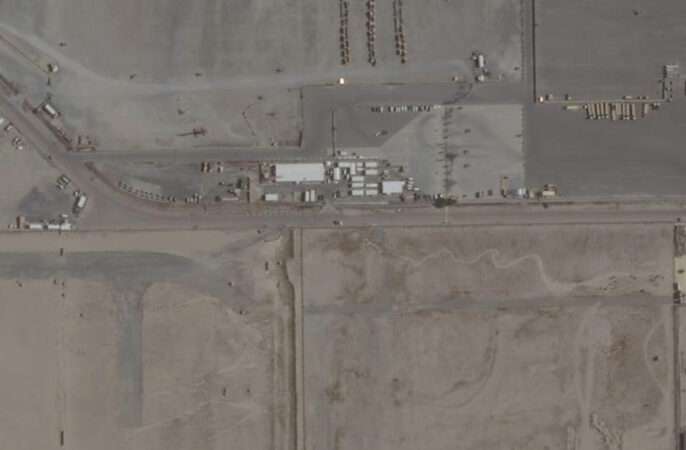
    A satellite image taken Monday and reviewed by the AP showed the main building in the complex destroyed, with a trail of black smoke rising from it. It is located in the heart of Port Shuaiba, a working seaport and industrial area just south of Kuwait City. The U.S. official, who spoke on condition of anonymity to discuss a matter under active investigation, confirmed the image depicted the location of Sunday’s attack.

    The Army base, Camp Arifjan, is more than 10 miles to the south. The operations center was just a little over a mile from some of the piers where merchant ships would offload cargo containers and was surrounded by oil storage tanks, refineries, and a power plant.

    Joey Amor, husband of Sgt. 1st Class Nicole Amor, said his wife had been moved off-base to what he described as a shipping container-style building a week before the Iranian strike. The 39-year-old from White Bear Lake, Minn., was one of the soldiers killed in the attack.

    “They were dispersing because they were in fear that the base they were on was going to get attacked, and they felt it was safer in smaller groups in separated places,” he said.

    After news reports about the operations center emerged, chief Pentagon spokesperson Sean Parnell said on social media that the “secure facility was fortified with 6-foot walls.” He said the military has “the most extensive Air Defense umbrella in the world over the Middle East right now and control of the skies is increasing with every wave of airpower.”

    Parnell’s office did not respond to questions about what role the walls would have played in defending against a drone attack or what air defenses were present in range of the command center at the port.

    Capt. Tim Hawkins, a spokesperson for U.S. Central Command, said “it would be inappropriate to comment given the incident is under investigation.”

  • Israel steps up airstrikes in Tehran, as Iran widens its response across the region

    Israel steps up airstrikes in Tehran, as Iran widens its response across the region

    DUBAI, United Arab Emirates — Israel said it launched airstrikes against Iranian missile launchers and a nuclear research site Tuesday, and Iran struck back against Israel and across the Gulf region, targeting U.S. embassies and disrupting energy supplies and travel.

    Four days into a war that President Donald Trump suggested would last several weeks or perhaps longer, nearly 800 people have been killed in Iran, including some Trump said he had considered as possible future leaders of the country.

    Explosions rang out Tuesday in Tehran and in Lebanon, where Israel said it retaliated against Hezbollah militants. The American embassy in Saudi Arabia and the U.S. consulate in the United Arab Emirates came under drone attacks. Iran has fired dozens of ballistic missiles at Israel, though most of the incoming fire has been intercepted. Eleven people in Israel have been killed since the conflict began.

    In other developments, the Pentagon identified four U.S. Army Reserve soldiers who were killed in a drone strike at a command center in Kuwait. The strike also killed two other service members.

    The spiraling nature of the war raised questions about when and how it would end.

    The administration has offered various objectives, including destroying Iran’s missile capabilities, wiping out its navy, preventing it from obtaining a nuclear weapon, and ensuring it cannot continue to support allied armed groups.

    While the initial U.S.-Israeli strikes killed Iranian Supreme Leader Ayatollah Ali Khamenei and Trump urged Iranians to overthrow their government, senior administration officials have since said regime change was not the goal.

    Trump on Tuesday seemed to downplay chances of the war ending Iran’s theocratic rule, saying that “someone from within” the Iranian regime might be the best choice to take power once the U.S.-Israel campaign is finished.

    Trump says people the U.S. had in mind to lead Iran are dead

    Speaking Tuesday from the Oval Office, Trump said Reza Pahlavi, the exiled son of Iran’s toppled shah, is not someone that his administration has considered in depth to take over.

    As far as possible leaders inside Iran, “the people we had in mind are dead,” Trump said.

    “I guess the worst case would be do this, and then somebody takes over who’s as bad as the previous person, right? That could happen,” Trump said. ”We don’t want that to happen.”

    Iran’s leaders are scrambling to replace Khamenei, who ruled the country for 37 years. It’s only the second time since the 1979 Islamic Revolution that a new supreme leader is being chosen. Potential candidates range from hard-liners committed to confrontation with the West to reformists who seek diplomatic engagement.

    Israel and U.S. strike nuclear facilities and other targets in Iran

    Information coming out of Iran has been limited because of poor communications, round-the-clock airstrikes, and tight restrictions on journalists. But across Iran’s capital, aircraft were heard overhead, and explosions rang out.

    The Israeli military said it conducted a wave of airstrikes on sites that produce and store ballistic missiles, in Tehran and Isfahan. It also said it destroyed what it called Iran’s secret, underground nuclear headquarters. Without providing evidence, it said the site was used for scientific research “to develop a key component for nuclear weapons.”

    “The regime attempted to rebuild its efforts and conceal them, thinking we wouldn’t notice. They were mistaken,” said Israeli military spokesman Brig. Gen. Effie Defrin.

    There was no immediate public comment from the U.S. or Iran about the site Israel named.

    Iran has said it has not enriched uranium since June, though it has maintained its right to do so and says its nuclear program is peaceful.

    The United Nations’ nuclear watchdog said Iran’s Natanz nuclear enrichment site had sustained “some recent damage,” though there was “no radiological consequence expected.” The U.S. hit Natanz during the 12-day war in June, when Israeli and American strikes greatly weakened Iran’s nuclear program.

    Fears rise in Tehran as bombardment of capital intensifies

    New rounds of U.S. and Israeli airstrikes rattled Iran.

    “Since midnight, I and my wife are hearing sound of explosions,” said Ali Amoli, an engineer living in north Tehran.

    Satellite images published Tuesday by Colorado-based company Vantor showed the domed roof of Iran’s presidential complex in Tehran had been destroyed, supporting Israel’s claim of an overnight strike. Iran did not acknowledge the damage or report any casualties.

    A north Tehran resident who spoke on condition of anonymity for fear of retaliation described growing fears in the capital as it comes under heavy bombardment. The resident said most stores in the normally bustling area of Tajrish were closed, though bakeries and supermarkets remained open.

    Iran hits the U.S. Embassy in Riyadh and Washington pulls out staff

    An attack from two drones on the U.S. Embassy in Riyadh caused a “limited fire,” according to the Saudi Arabian Defense Ministry, and the embassy urged Americans to avoid the compound.

    An Iranian drone struck a parking lot outside the U.S. consulate in Dubai, sparking a small fire, Secretary of State Marco Rubio said in Washington. He said all personnel were accounted for.

    The United Arab Emirates said it has intercepted the vast majority of more than 1,000 Iranian missile and drone attacks against it.

    U.S. embassies in Saudi Arabia, Kuwait, and Lebanon said they were closed to the public.

    The U.S. State Department ordered the evacuation of non-emergency personnel and family in Kuwait, Bahrain, Iraq, Qatar, Jordan, and the United Arab Emirates. The U.S. also urged its citizens to leave more than a dozen Middle Eastern countries, though with much of the airspace closed, many were stranded.

    The State Department said Tuesday it’s preparing military and charter flights for Americans who want to leave the Middle East. Several other countries also arranged evacuation flights for their citizens.

    The U.S.-Israeli strikes have killed at least 787 people in Iran, according to the Red Crescent Society. In Lebanon, where Israel launched retaliatory strikes on the Iranian-supported militant group Hezbollah, 50 people were killed, including seven children, Lebanon’s health ministry said.

    The U.S. military has confirmed six deaths of American service members. In addition, three people were killed in the United Arab Emirates, and one each in Kuwait and Bahrain.

    The four dead American soldiers who were identified Tuesday were assigned to the 103rd Sustainment Command in Des Moines, lowa. Killed were Capt. Cody A. Khork, 35, of Winter Haven, Fla.; Sgt. 1st Class Noah L. Tietjens, 42, of Bellevue, Neb.; Sgt. 1st Class Nicole M. Amor, 39, of White Bear Lake, Minn.; and Spc. Declan J. Coady, age 20, of West Des Moines, Iowa.

    Turkish Foreign Minister Hakan Fidan on Tuesday criticized Iran’s attacks against Gulf neighbors that had worked to prevent war as an “incredibly flawed strategy” that threatened to widen the war if those states decide to retaliate.

  • White House offers shifting rationales for war with Iran

    White House offers shifting rationales for war with Iran

    As an expanding Middle East war entered its fourth day, the Trump administration gave shifting rationales for its decision to attack Iran, even as U.S. officials with access to intelligence reports said they saw no sign the country had posed an imminent threat to the United States.

    President Donald Trump and his top national security aides, defending a conflict that has tepid public backing and is incurring escalating risks, emphasized Iran’s arsenal of ballistic missiles rather than its nuclear program as the principal threat. But they provided different descriptions of the danger.

    At his first public event since the attack began, Trump on Monday never mentioned a key part of his original rationale for the war: deposing Iran’s theocratic regime.

    Instead, he emphasized that Iran would “soon” have missiles that could hit targets inside the United States.

    What Trump had outlined over the weekend as an effort to devastate Tehran’s rulers so that the Iranian people could take over was, by Monday, “not a so-called regime change war,” in the words of Defense Secretary Pete Hegseth.

    Hegseth told reporters at the Pentagon that the Islamic Republic was building sophisticated missiles and other conventional weapons to shield its plans for a nuclear bomb. “Iran had a conventional gun to our head as they tried to lie their way to a nuclear bomb,” he said.

    Secretary of State Marco Rubio offered a third line of reasoning. The United States, he said, knew Israel was going to strike Iran, which would lead to counterattacks against U.S. forces and potential casualties, and decided to strike first to minimize the risk.

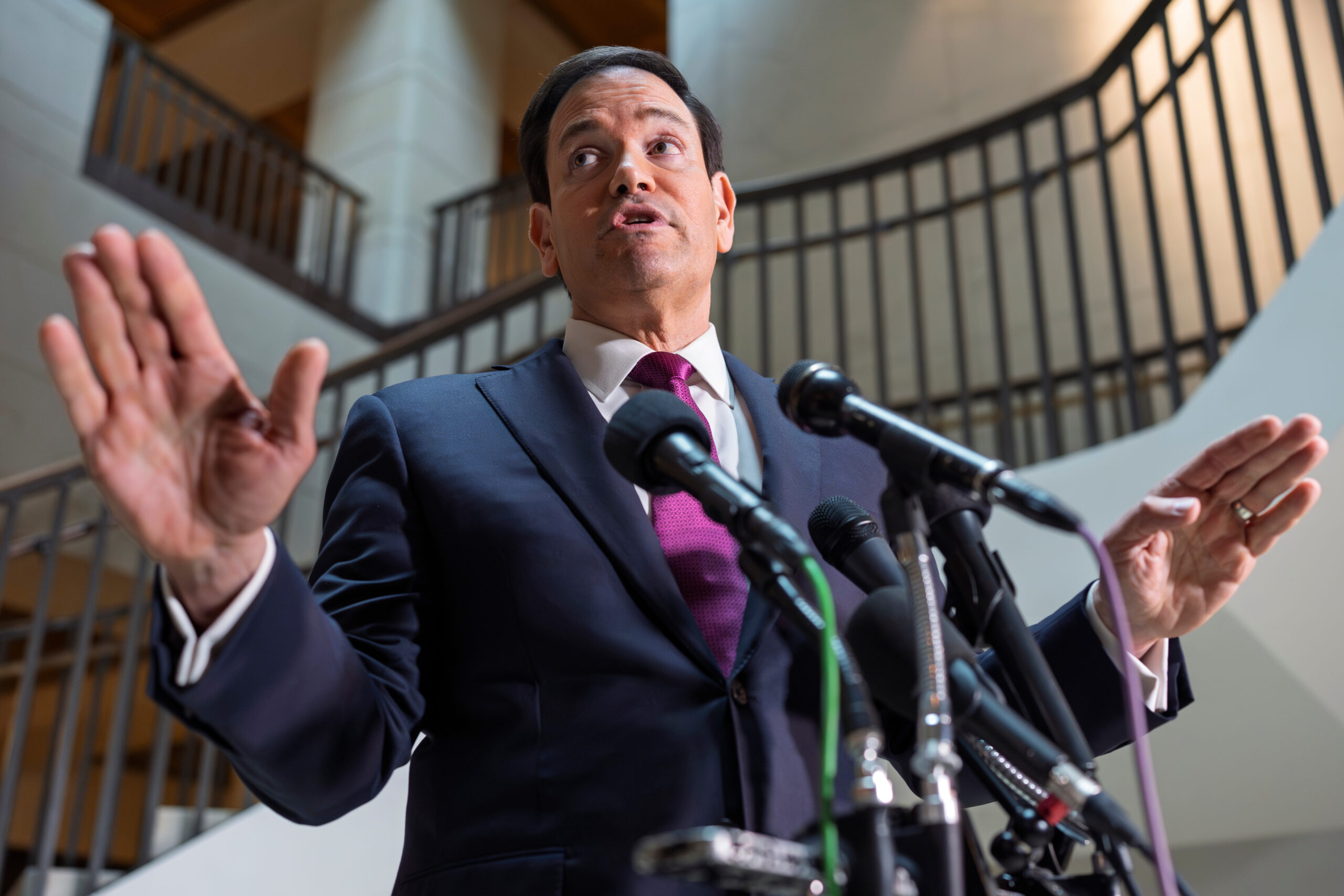
    Secretary of State Marco Rubio speaks to reporters as he arrives for an intelligence briefing with top lawmakers on Iran, at the Capitol in Washington, Monday, March 2, 2026. (AP Photo/J. Scott Applewhite)

    Iran’s voluminous missile arsenal, which was thinned by U.S.-Israeli strikes last June but still considered dangerous, consists mostly of short-range missiles threatening U.S. bases and allies in the Middle East. Over the last two years, Iran has fired those missiles in response to attacks on its territory or interests, but not preemptively.

    As for an intercontinental ballistic missile capable of directly reaching the United States, the Pentagon’s Defense Intelligence Agency reported last year that Iran could have that weapon by 2035 “should Tehran decide to pursue the capability.”

    Meanwhile, more than three days into the conflict and after more than a thousand airstrikes, U.S. and Israeli weapons so far have largely left Iran’s main nuclear installations untouched, suggesting those sites — significantly damaged last June — are not currently seen as a priority threat.

    The White House’s shifting public goals for the war, and questions about the intelligence behind them, have contributed to a lack of clarity about when Trump might declare an end to the largest military operation since the 2003 invasion of Iraq.

    As the war widened across the Middle East, Trump said operations against Iran could go on for four to five weeks, or longer. In an interview with the New York Post, the president said he would not rule out sending in U.S. ground troops, but added that they are “probably” not needed.

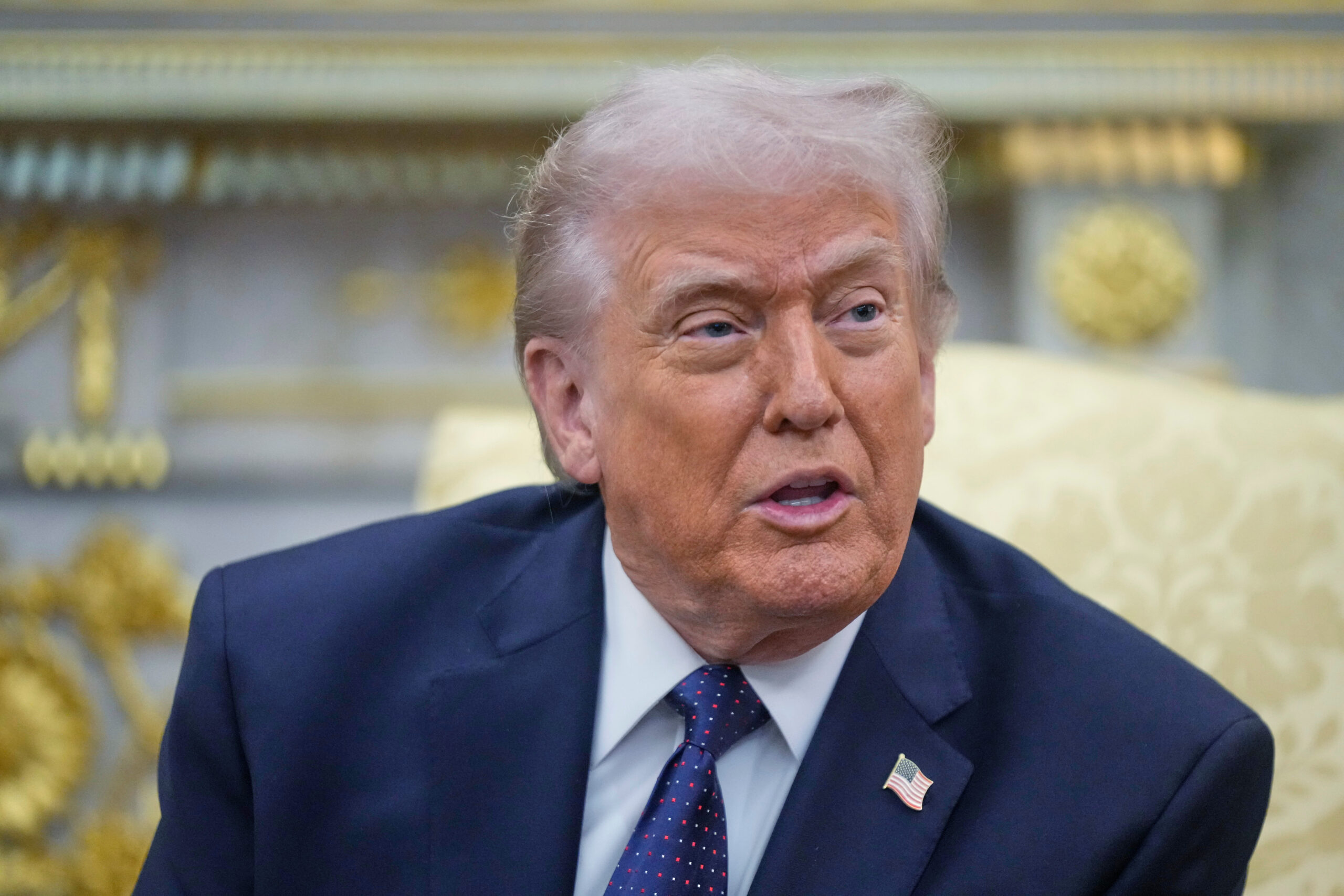
    President Donald Trump speaks during a meeting with German Chancellor Friedrich Merz in the Oval Office at the White House, Tuesday, March 3, 2026, in Washington. (AP Photo/Mark Schiefelbein)

    Republican lawmakers have largely backed Trump’s decision to strike Iran, citing its long record of terrorism against the United States and its allies, and its nuclear ambitions.

    But Rubio’s decision to pin the justification for the attack on Israel angered prominent MAGA commentators and conservative pundits, who said an operation of this magnitude should be done squarely in the interests of the United States.

    “My own feeling is no one should have to die for a foreign country. I don’t think those four service members died for the United States,” said Trump advocate and podcast host Megyn Kelly, referring to the first four acknowledged U.S. deaths in the war, a toll that later rose to six. “I think they died for Iran or for Israel.”

    In a social media post Monday night, Iranian Foreign Minister Abbas Araghchi piled on. “Mr. Rubio admitted what we all knew: U.S. has entered a war of choice on behalf of Israel. There was never any so-called Iranian ‘threat,’” he wrote.

    This week, the House and Senate are poised to vote on measures that would attempt to halt further military attacks in Iran without lawmakers’ approval, as Democrats frame the conflict as an “illegal war” launched without a clear rationale or an authorization from Congress.

    A Washington Post flash poll found that 52% of Americans oppose the strikes “strongly” or “somewhat,” while 39% support them.

    Even as the administration’s public case for war shifted, several U.S. officials with access to classified intelligence assessments said there was no information before the strikes began indicating Iran has made sudden, worrisome progress in its missile or nuclear programs.

    “There was no imminent threat to the United States of America by the Iranians. There was a threat to Israel,” Sen. Mark Warner (D., Va.), the vice chair of the Senate Intelligence Committee, told reporters Monday.

    Others said Iran’s weakness, amid severe economic problems and protests that challenged the regime, provided an opportunity to strike.

    A former U.S. intelligence official said American spy agencies were concerned by the speed with which Iran reconstituted its missile program after the 12-day war in June. “If you wait a year from now, maybe the regime will have stabilized, the missile program will be more populated and federated,” said the former official, who spoke before the strikes began and requested anonymity to discuss a sensitive subject.

    With Trump a potentially lame duck president in a year’s time, “Right now is the sweet spot,” he said.

    Multiple legal experts argued that none of the administration’s public explanations for the attacks appeared to constitute a legitimate rationale to enter into such a major conflict, especially without authorization from Congress.

    “Having a weapons capacity is not the same thing as presenting an imminent threat of an armed attack,” said Tess Bridgeman, a former senior lawyer on the National Security Council during the Obama administration.

    The first days of U.S. and Israeli airstrikes appeared focused on decapitating Iran’s leadership and blunting its ability to retaliate by destroying missile infrastructure and disrupting its military command network.

    Rafael Grossi, head of the International Atomic Energy Agency, said Monday that the U.N. nuclear watchdog agency has seen no “major military activity targeting the nuclear facilities” in Iran since the U.S.-Israeli attacks began early Saturday. That assessment, he said, is based on information from Iran as well as multiple satellite images, including those provided “by the U.S. and others.”

    Grossi’s assessment came as Tehran charged there was an attack on its Natanz enrichment facility and as Israel warned civilians to evacuate areas around Isfahan, a major center of Iran’s nuclear program.

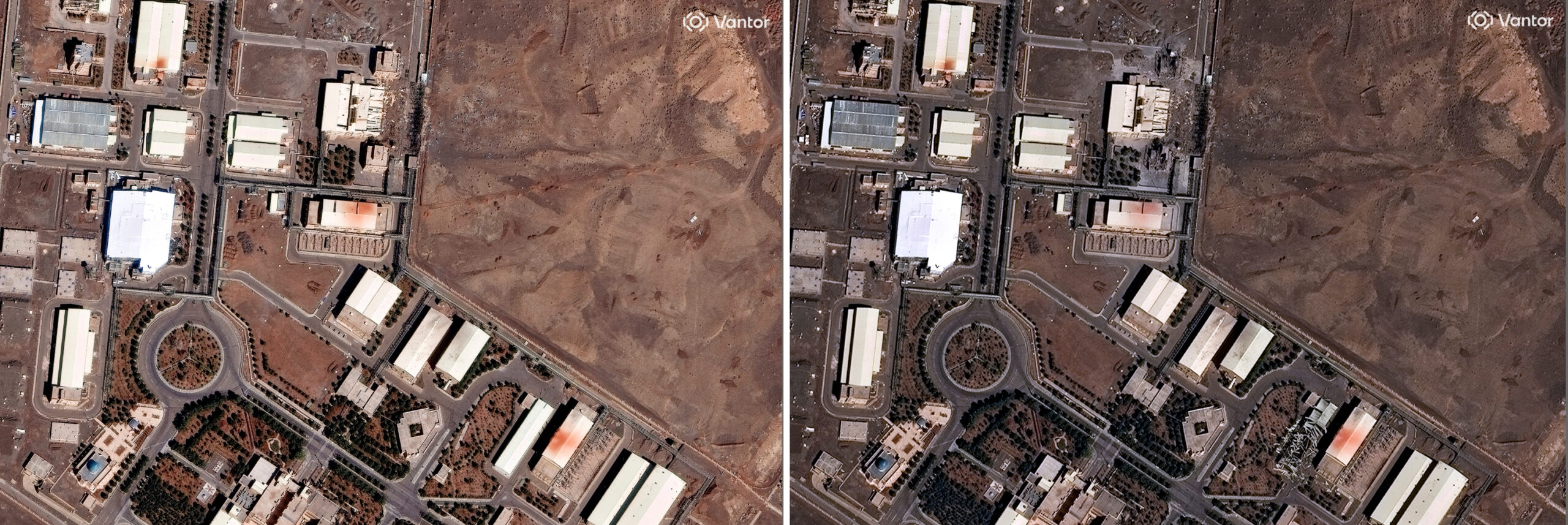
    In this combo from satellite images provided by Vantor shows is a view of Natanz nuclear facility on March 1, 2026, left, and with damage on March 2, 2026 in Iran. (Satellite image ©2026 Vantor via AP)

    Satellite imagery of Natanz captured Monday showed damage to three buildings on the site, damage that Grossi indicated was fairly minor. Vehicle and personnel entrances to underground portions of the facility where centrifuges are kept appear to have been hit, according to the imagery.

    The United States and Israel have long accused Iran of seeking to build a nuclear weapon under the cover of enriching uranium for civilian purposes. Last year’s strikes targeting Iran’s uranium enrichment facilities and other sites significantly delayed the program, U.S., Israeli, and IAEA officials said. Trump and Hegseth said Iran’s nuclear ambitions had been “obliterated.”

    The Defense Intelligence Agency in a report produced before those strikes assessed that since 2019, in the wake of Trump leaving a nuclear deal with Iran that limited its nuclear program, the Islamic Republic had boosted uranium enrichment and expanded its stockpiles to the point that the time required to produce sufficient weapons-grade uranium for a first nuclear device had fallen to “probably less than one week.”

    The actual time to produce a weapon ranged from two to four months, the agency estimated, according to people familiar with the assessments who spoke on the condition of anonymity because of the matter’s sensitivity.

    The June strikes targeted Iran’s main enrichment plants at Natanz and Fordow. But the Iranians had been manufacturing centrifuge cascades long before the strikes and likely were storing them at other locations, the people said. “So their ability to do a breakout may or may not have been dependent at all” on the sites that were bombed, one person said.

    Post-strike, the DIA and other U.S. intelligence agencies determined that the time Iran now needed to produce enough weapons-grade uranium to build a warhead in extremis — without rebuilding the damaged sites — had lengthened to between four and eight months, people familiar with the matter said.

    Uncertainties about Iran’s nuclear program are heightened by the fact that IAEA inspectors left the country last July and haven’t returned.

    “The return of the IAEA inspectors will be further delayed as a result of the renewed conflict, and without effective IAEA monitoring, the whereabouts and security of Iran’s highly enriched uranium will now become even more uncertain,” said Daryl Kimball, executive director of the Arms Control Association think tank.

    In the meantime, Kimball said, “There hasn’t been any sign that Iran is rebuilding anything.”

  • Trump tests a new approach in Iran: Regime change without owning the fight

    Trump tests a new approach in Iran: Regime change without owning the fight

    President George W. Bush used a solemn address from the Cabinet Room to tell Americans that Iraqi leader Saddam Hussein had been captured. President Barack Obama spoke to cameras when he announced that Osama bin Laden had been killed.

    After President Donald Trump’s attack on Iran killed its supreme leader on Saturday, he used a different messaging strategy — a written post on Truth Social.

    Trump has taken an approach to selling U.S. citizens on military action in Iran that sharply contrasts with his predecessors: He devoted three minutes of his 108-minute State of the Union address to the issue, spoke to Americans through social media posts and a pair of videos recorded at Mar-a-Lago but made no public appearances over the weekend since a Friday rally in Corpus Christi, Texas.

    The strategy might afford him flexibility in the coming days and weeks to avoid what former Secretary of State Colin Powell told Bush was the Pottery Barn rule — if you break it, you own it.

    From the outset, Trump has been careful to declare limits around the U.S. attack, saying he wanted to overthrow the current regime, but telling Iranians it was up to them to seize the opportunity to write their country’s next chapter. His communication strategy has reinforced those limits by creating a bit of distance — at least in imagery — between the president and the fighting.

    At the same time, however, Trump has adopted expansive rhetoric about the reasoning for his intervention that recalled the justifications used for earlier U.S. forays into the Middle East.

    “They have waged war against civilization itself,” Trump said in a six-minute video posted to Truth Social on Sunday in which he left the precise goals of the attack flexible.

    “We’re undertaking this massive operation not merely to ensure security for our own time and place, but for our children and their children, just as our ancestors have done for us many, many years ago. This is the duty and the burden of a free people.”

    It was his first on-camera acknowledgment of Supreme Leader Ayatollah Ali Khamenei’s death nearly 24 hours after he made his first written post about it.

    “I call upon all Iranian patriots who yearn for freedom to seize this moment to be brave,” Trump said. “I made a promise to you, and I fulfilled that promise. The rest will be up to you, but we’ll be there to help.”

    Middle East experts said Trump’s strategy could end up politically successful, pairing an airstrike-only approach with a flexible definition of what would constitute victory.

    “We have escalation dominance in Iran. We control the pace, the focus, the intensity of military conflict,” said Aaron David Miller, who advised Democratic and Republican administrations on Middle East issues. “We can escalate when we want, and we can presumably prevent Iranians from escalating, and so we can own Iran without the Pottery Barn rule going into effect. That’s what makes this so Trumpian.”

    Richard Haass, who was the director of policy planning at Powell’s State Department in the lead-up to the 2003 Iraq War, said Trump was “calling for regime change, but is not assuming the responsibility for it.”

    “It gives him an off-ramp, not having to see it through. So if it happens, he gets credit for it, if it doesn’t happen, he doesn’t get the blame for it,” said Haass, who is president emeritus of the Council on Foreign Relations.

    Still, there may be political risks to Trump’s sweeping rhetoric if the situation deteriorates, especially if the number of dead U.S. troops rises. So far in the operation, three have been killed and five injured, the U.S. Central Command announced Sunday. Another death was announced Monday.

    “Sadly there will likely be more before it ends. That’s the way it is,” Trump said in his Sunday video.

    White House officials say they owe nothing to past communications practice and that the president’s videos and written statements on Truth Social have reached a vast audience.

    If Trump had pursued a strategy similar to Bush’s approach to Iraq, in which he laid out an extensive argument for war, “the Ayatollah [Khamenei] would probably still be alive, because we would have been spending weeks and months leading up to this tipping off our adversaries, which would not have led to the killing of the Ayatollah yesterday,” White House press secretary Karoline Leavitt said.

    “Operational secrecy and security is the number one priority for the president,” she said.

    In addition to leaving the objectives flexible, the administration has also been vague about its justification for the attack, including in classified briefings for members of Congress.

    During a closed-door briefing with congressional staff Sunday, some aides said the administration provided no intelligence on an imminent or preemptive threat posed by Iran, according to people in the room who spoke on the condition of anonymity to discuss a classified briefing.

    When asked directly about potential threats, one briefer said Iran was prepared to retaliate against the United States, but such warnings fall short of the traditional tests for a legal basis to launch a preemptive attack on a country or decapitate its political and military leadership.

    U.S. officials told reporters on Saturday that Iran’s ballistic missile program posed a threat. International law would not typically support a military assault based on a country’s maintaining a conventional weapons program of that nature.

    Trump may have been more restrained in the lead-up to Saturday’s attack because he was giving more space for negotiations than Bush had offered Iraq, even as the U.S. military presence in the Middle East ramped up in recent weeks to the largest massing of force since the 2003 Iraq invasion.

    But for a president who rose to power in part on the shoulders of supporters who were weary of decades of U.S. wars in the Middle East, there may be political risk in launching major foreign actions and not bringing his supporters along. Last week, a Washington Post-ABC News-Ipsos poll found that among Trump voters, 46% supported the prospect of the president’s using the U.S. military to force changes in other countries while 22% were opposed and 30% had no opinion.

    White House officials have taken a far more restrained approach this year than last toward how they highlight the president’s foreign policy-related engagements. In 2025, he had a foreign leader in the Oval Office almost every week, ushering in reporters and taking questions in impromptu news conferences that highlighted his central role on the world stage. But since the beginning of the year, that practice has stopped, as the White House tried to steer closer toward a domestic agenda that would highlight positive aspects of the president’s economic record.

    Leavitt said the president put out the initial announcement about Khamenei’s death in the form of a written statement because he “was very busy yesterday in the situation room all day, monitoring it all night, and he was on the phone with our allies around the world and talking to other countries. And so the most effective way for him to get that message out yesterday was by a Truth [Social post], and obviously it was a statement heard around the world.”

    Trump’s Sunday video address offered a more traditional approach to Khamenei, embracing the victory on camera.

    “This wretched and vile man had the blood of hundreds and even thousands of Americans on his hands,” Trump said. “All over Iran, the voices of the Iranian people could be heard cheering and celebrating in the streets when his death was announced.”

    Administration officials make television appearances on Sunday morning shows nearly every week, but none made the rounds this time. A senior White House official said that wasn’t an effort to distance the administration from the fighting, but rather a measure of their need to monitor military operations from the Situation Room and from the president’s side at Mar-a-Lago. The official spoke on the condition of anonymity to discuss sensitive internal strategy.

    Rather than put administration officials in front of the cameras, the White House coordinated a message with congressional Republicans to speak on the shows, offering Secretary of State Marco Rubio on Saturday evening to brief them.

    “I thought the president’s eight-minute video yesterday was outstanding,” Sen. Tom Cotton (R., Ark.) told CBS’s Face the Nation on Sunday. “It laid out Iran’s 47-year campaign of terror and revolutionary violence against the United States and our people and really, the civilized world. I’m sure the president will speak more in the coming days, will have briefings to Congress.”

    Classified briefings to Congress are planned for Tuesday.

    Some supporters of tough action against Tehran said that it may take time to judge the final outcome of the military action — longer than the actual time frame of the bombing.

    “The question is going to be whether it’s good policy, and that will turn in part on American casualties,” said Elliott Abrams, who worked on Iran issues during the first Trump administration and on foreign policy in the Reagan and George W. Bush administrations.

    But, he said, “I caution critics that if this war ends in a week and the regime is still in place, it’s really too soon to say it failed. … If the regime falls in six months or 10 months or next year, everyone will have to acknowledge that this war brought it a lot closer and in retrospect, it will have been a great success, because I think getting rid of that regime will really change the Middle East.”

  • Hegseth insists the Iran conflict is ‘not endless’ and declares, ‘We fight to win’

    Hegseth insists the Iran conflict is ‘not endless’ and declares, ‘We fight to win’

    WASHINGTON — Defense Secretary Pete Hegseth spoke Monday to widening concerns that the U.S.-Israeli strikes in Iran could spiral into a protracted regional conflict by declaring: “This is not Iraq. This is not endless,” even as he warned that more American casualties are likely in the weeks ahead.

    While the Trump administration has cited Iran’s nuclear ambitions as the chief concern to be addressed, officials increasingly are pointing to the threat from Iran’s ballistic missiles as a key reason to launch the attacks as well as an opportunity to take out the government’s leadership and the sense that negotiations around the nuclear program have stalled.

    Trump said Monday that Iran’s conventional missile program “was growing rapidly and dramatically, and this posed a very clear, colossal threat to America and our forces stationed overseas.”

    Hegseth said at a separate press conference with Gen. Dan Caine, chairman of the Joint Chiefs of Staff, that the operation had a “decisive mission” to eliminate the threat of Iranian ballistic missiles, destroy the country’s navy, and ensure “no nukes.”

    “No stupid rules of engagement, no nation building quagmire, no democracy building exercise, no politically correct wars. We fight to win, and we don’t waste time or lives,” Hegseth said.

    Trump, Hegseth, and Caine have not suggested any exit plan or offered signs that the conflict would end anytime soon as the killing of Iranian Supreme Leader Ayatollah Ali Khamenei cast doubt on the future of the Islamic Republic and hurtled the region into broader instability. Caine said the biggest U.S. military buildup in the Middle East in decades would only grow because the commander in the region “will receive additional forces even today.”

    “This is not a so-called regime-change war, but the regime sure did change, and the world is better off for it,” Hegseth said.

    Trump, however, in video statements released after the strikes began, urged the Iranian people “to take back your country.”

    More American troop casualties expected

    The conflict has spiraled into the wider region, with Iran and its allied armed groups launching missiles at Israel, Arab states, and U.S. military targets in the Middle East.

    Six American troops have been killed, with Trump, Hegseth and Caine predicting more casualties. All were Army soldiers and part of the same logistics unit in Kuwait, according to a U.S. official who was not authorized to comment publicly and spoke on condition of anonymity.

    When asked about the six deaths Monday, Hegseth said an Iranian weapon made it past allied air defenses “and, in that particular case, happened to hit a tactical operations center that was fortified.”

    Eighteen American service members also have been seriously wounded, said Capt. Tim Hawkins, a spokesman for U.S. Central Command.

    “We grieve with you, and we will never forget you,” Caine said of the troops killed and their family members.

    The latest sign of the escalating upheaval came when, the U.S. military said, ally Kuwait “mistakenly shot down” three American fighter jets during a combat mission as Iranian aircraft, ballistic missiles, and drones were attacking. U.S. Central Command said all six pilots ejected safely from the American F-15E Strike Eagles and were in stable condition.

    Asked if there are boots on the ground now in Iran, Hegseth said, “No, but we’re not going to go into the exercise of what we will or will not do.”

    He said it was “foolishness” to expect U.S. officials to say publicly “here’s exactly how far we’ll go.”

    Trump told the New York Post on Monday that he wasn’t ruling out U.S. forces in Iran if “they were necessary.” He noted, “I don’t have the yips with respect to boots on the ground.”

    At the White House, Trump said the mission was expected to take four to five weeks but “we have the capability to go far longer than that.”

    Secretary of State Marco Rubio told reporters at the Capitol that the U.S. “will do this as long as it takes to achieve” its objectives and warned that “the hardest hits are yet to come from the U.S. military.”

    Hegseth also dismissed questions about the time frame and said Trump had “latitude” to decide how long it would take. “Four weeks, two weeks, six weeks,” he said. “It could move up. It could move back.”

    Pentagon gives justification for strikes

    In laying out a case for the strikes, Hegseth did not point to any imminent nuclear threat from Iran and said again that strikes by the U.S. and Israel last June “obliterated their nuclear program to rubble.”

    Instead, Hegseth pointed to threats from other weaponry that justified the operation: “Iran was building powerful missiles and drones to create a conventional shield for their nuclear blackmail ambitions.”

    He added, “Our bases, our people, our allies, all in their crosshairs. Iran had a conventional gun to our head as they tried to lie their way to a nuclear bomb.”

    Hegseth said that during negotiations leading up to the attack, Iranian officials were “stalling” despite having “every chance to make a peaceful and sensible deal.”

    He also justified the operation by describing Iran’s government as having started the conflict from its inception, declaring that for 47 years it has “waged a savage, one-sided war against America.”

    In a private briefing Sunday, Trump administration officials told congressional staffers that U.S. intelligence did not suggest Iran was preparing to launch a preemptive strike against the U.S., three people familiar with the briefings said.

    Trump, a Republican, had said the objective of the mission was to eliminate “imminent threats from the Iranian regime.” And senior Trump administration officials, who were not authorized to comment publicly and spoke on the condition of anonymity, told reporters Saturday that there were indicators that the Iranians could launch a preemptive attack.

    Military doesn’t specify Iran’s nuclear sites as targets

    As with the attack that dropped massive bunker-buster bombs on Iranian nuclear facilities last year, Caine said the military used B-2 stealth bombers in the new operation with a 37-hour round trip.

    He said the penetrating bombs were dropped on Iranian underground facilities” but did not specify that they were nuclear facilities. Nuclear sites were not among the types of targets on a list released over the weekend by U.S. Central Command.

    The administration says Israel and the U.S. have bombed Iranian missile sites and targeted its navy, claiming to have destroyed its headquarters and multiple warships.

    Caine on Monday referenced the use of cyber technologies, saying the U.S. “effectively disrupted communications and sensor networks” that left “the adversary without the ability to coordinate or respond effectively.”

    Without giving specifics, Caine said the military “delivered synchronized and layered effects designed to disrupt, degrade, deny and destroy Iran’s ability to conduct and sustained combat operations on the U.S. side.”

    Caine said Trump gave the go-ahead order for the strikes at 3:38 p.m. EST on Friday. That meant the president gave the green light when he was aboard Air Force One heading to Texas with Republican Sens. Ted Cruz and John Cornyn and actor Dennis Quaid.

  • Aramark is out as food provider for new South Philly arena slated for 2030

    Aramark is out as food provider for new South Philly arena slated for 2030

    Aramark will not be the official food, beverage, and hospitality provider at the new South Philadelphia arena where the 76ers, Flyers, and the city’s new WNBA team are expected to play.

    Harris Blitzer Sports & Entertainment, which owns the Sixers, and Comcast Spectacor, which owns the Flyers and Xfinity Mobile Arena, announced that Levy Restaurants will take over food and beverage duties in the new arena, which is slated to open by 2030.

    “Very few cities are as devoted to their teams as Philadelphia, the loyalty and passion are part of the DNA that make the community so special. It’s both an honor and an invigorating opportunity to help amplify the best of Philadelphia,” Levy CEO Andy Lansing said in a statement.

    Smoked chicken cheesesteak is on the 2025-26 menu at the Xfinity Mobile Arena.

    Aramark has overseen hospitality at the Sixers’ and Flyers’ arena since it opened in 1996. Lincoln Financial Field and Citizens Bank Park hospitality services are still operated by the Philadelphia-based food services provider.

    A spokesperson for the arena said that the decision to go with a new provider was not based on Aramark’s performance, but was the result of a standard pitch process.

    “We have a great relationship with our friends at Aramark,” Comcast Spectacor chairman and CEO Dan Hilferty told SportsBusinessJournal. “We have, on both sides, committed that while Xfinity Mobile Arena is still in operation, we’re going to deliver the best possible product.”

    Aramark will continue its tenure at Xfinity Mobile Arena until the new arena opens. The new arena was announced last year after plans to build a Center City arena for the Sixers were abandoned in favor of a new building at the South Philly sports complex.

    Xfinity Mobile Arena used to be known as the Wells Fargo Arena, from 2010 into August 2025.

    “Our team is fully committed to delivering memorable game day experiences, and we are grateful for the many decades spent fueling the passion and energy of the fans,” an Aramark spokesperson said in a statement.

    The hometown food service provider has come under fire in recent years over labor disputes with the thousands of people who work in the stadiums. Before Unite Here Local 274 won its latest contract, fewer than 100 workers represented by the union had year-round healthcare. The contract, signed last March, increased wages and brought hundreds of workers onto the union healthcare plan.

    Levy’s portfolio includes nearly half the NBA/NHL shared arenas, such as Los Angeles’ Crypto.com Arena, according to a Sixers spokesperson. Levy, which has headquarters in Chicago, also provides services for such large events as the Kentucky Derby and the Grammys.

  • Inside the Phillies: Shane Victorino’s advice for Justin Crawford, a changing rotation, and more

    Inside the Phillies: Shane Victorino’s advice for Justin Crawford, a changing rotation, and more

    CLEARWATER, Fla. — Shane Victorino retired to Las Vegas in 2016, three years before Justin Crawford popped up on the scene there at Bishop Gorman High School.

    In December, the former and future Phillies center fielders finally met up at a Vegas-area batting cage.

    “I’m not one to get into the middle of people’s journey, but I would always wonder,” Victorino, a guest instructor in Phillies camp for the past few days, said of Crawford. “And this offseason, we finally decided that we wanted to get some work in together.”

    Victorino, who played in the majors at the same time as Crawford’s dad, was struck by many of the qualities that are impressing Phillies officials this spring. Never mind that Crawford is on track to become the youngest outfielder in a Phillies opening-day lineup since Greg Luzinski in 1973. The 22-year-old has the right mix of confidence and curiosity.

    As manager Rob Thomson puts it, “He acts like he deserves to be here.”

    “Being a son of a big leaguer, he sure didn’t act like one,” Victorino said. “And that was very interesting to me, the humbleness, the kind of kid he is. [The Phillies] have got a good one, bro.”

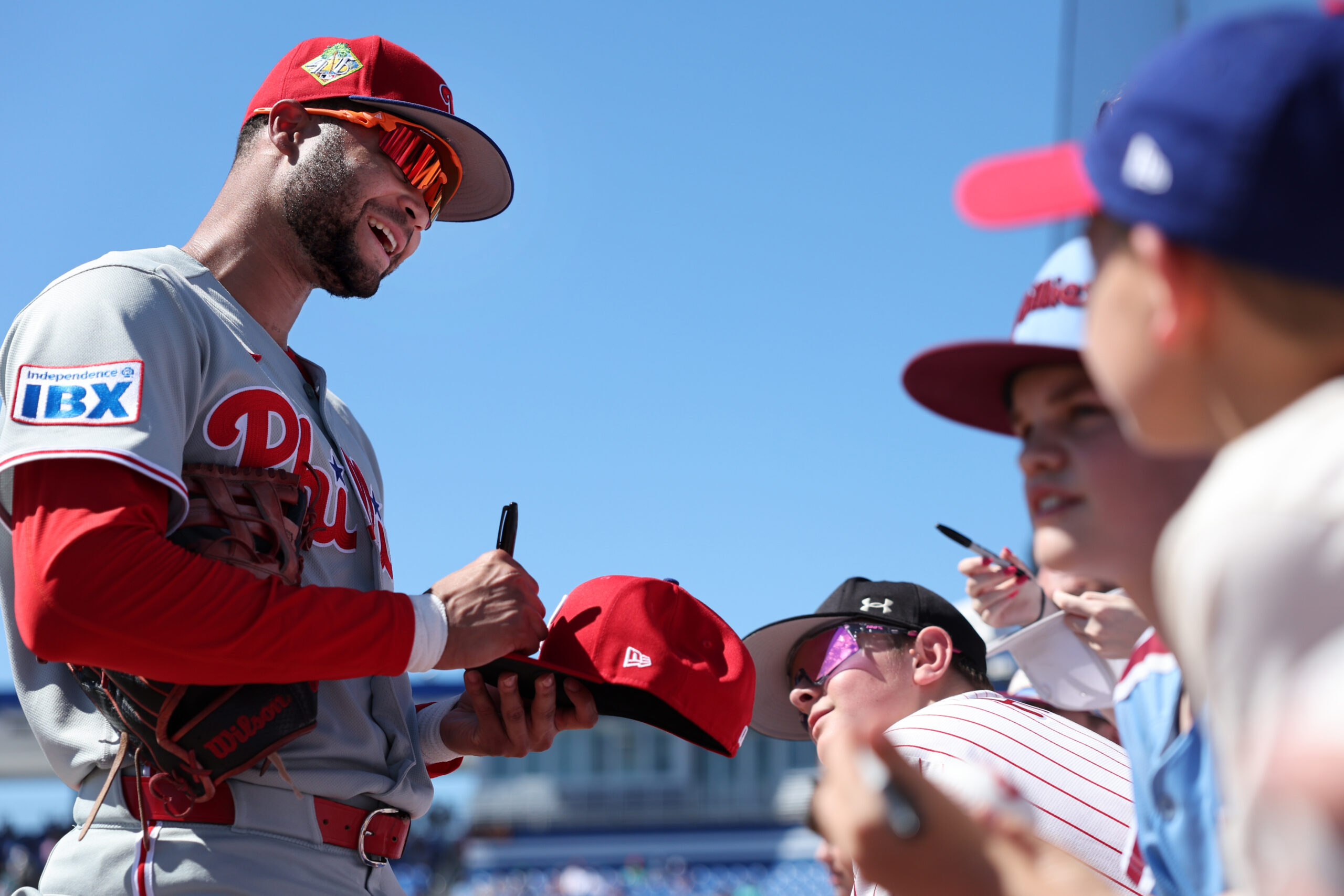
    Phillies center fielder Justin Crawford signs autographs before a spring training game against the Blue Jays on Saturday.

    Crawford’s inner circle is overflowing with major-league influences that extend beyond even his dad, Carl Crawford, a four-time All-Star outfielder with the Tampa Bay Rays. His godfather, Junior Spivey, played five seasons in the majors. Mike Easler, his personal hitting coach, had a 14-year major-league career. Crawford went to Arizona in the offseason to improve his defense — with former star center fielder Eric Davis.

    By all accounts, Crawford is a sponge, soaking in advice and information but also asking pertinent questions. Upon meeting up with Victorino, he wanted to know one thing.

    What’s it like to play in Philadelphia?

    Because it isn’t for everyone. Crawford’s dad came up with the Rays and thrived in small-market Tampa Bay but struggled with the spotlight in Boston after signing a seven-year, $142 million contract with the Red Sox. Philly is a similarly sports-crazed Northeast market.

    Victorino, 45, relished the big-market experience, winning the World Series with the Phillies in 2008 and Red Sox in 2013 and producing big postseason moments during both runs.

    “He wanted to know, like, ‘What are the things that I’ve got to make sure that I’m ready for and that I’m prepared for?’” Victorino recalled. “And I said, ‘You ain’t dumb, bro.’ I said, ‘It’s a hard place to play. It’s a tough fan base.’ But I said, ‘There’s so many things that you bring, the person that you are, the player that you are, that the city’s longing for. So, if you do that, Justin, then the rest will take care of itself.’”

    Former center fielder Shane Victorino is a guest instructor in Phillies camp.

    Victorino offered up two specific tips: Be accountable and play hard.

    “I said, ‘Fly around the bases, play the game right, and this city’s going to love you,’” Victorino said. “‘That’s all they care about. They want you to hit a ground ball and try to beat it out. And when you beat it out, they’re going to have 40,000 [fans] on their feet.’”

    Victorino came to the Phillies in the Rule 5 draft in 2004 and wasn’t a touted prospect. But like Crawford, he had a dominant season in triple A, batting .310 with 18 homers and a .912 OPS in 2005.

    It wasn’t until the Phillies traded Bobby Abreu at the July deadline in 2006 that Victorino got a chance to play every day at age 25. He took over center field once Aaron Rowand left in free agency after the 2007 season.

    The Phillies considered calling up Crawford at times last season but instead left him in triple A, where he won the International League batting crown with a .334 average. Although Crawford is hailed for his bat-to-ball skills and sprinter’s speed, some scouts point to his high ground-ball rate as a reason to be skeptical that he will hit in the majors.

    But Crawford has batted .300 at every level of the minor leagues, and the Phillies believe the time has come to turn over the keys to center field.

    “Just being in the cage with him, his approach, his outlook on the game, his willingness to want to learn and ask questions — the right questions — is what stood out to me,” Victorino said. ”The baseball side, that’s up to [hitting coach Kevin Long]. But I think this organization’s got a great identity of where he is as a player. I think there’s going to be a leash long enough that he’s going to be able to figure it out.

    “I told him, ‘They’re going to forget about guys like me and others because they’re going to fall in love with Justin Crawford.’ And I’m cool with that because that means that the team’s going to be better, the city’s going to be excited, and the fans will be, too.”

    A few other notes from spring training:

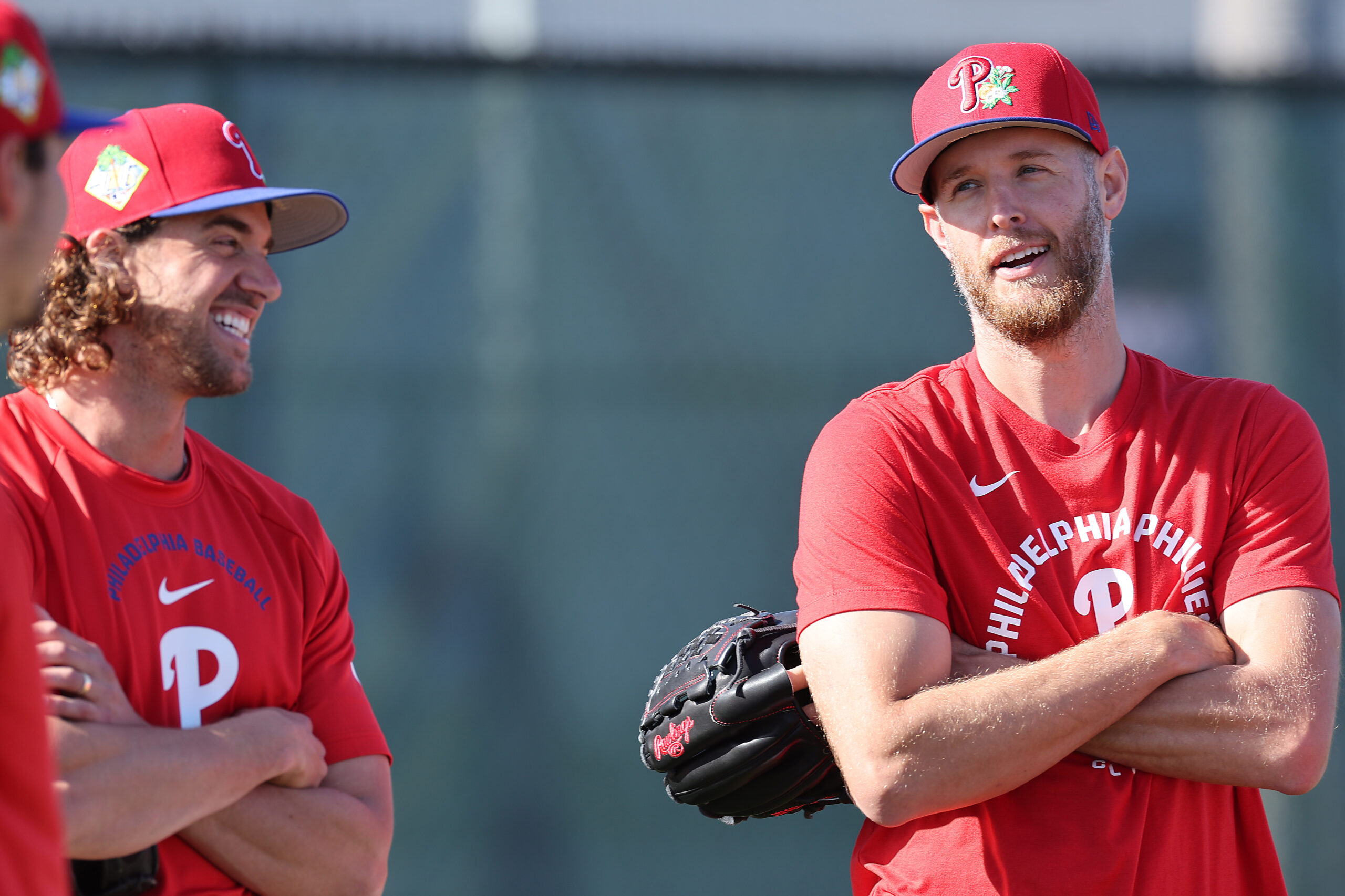
    Aaron Nola (left) and Zack Wheeler (right) are no longer the constants in the Phillies starting rotation.

    Changing of the guard

    For five years, the Phillies’ optimism about their chances to make the playoffs, win the division, and go on a deep run through October was rooted in two pitchers.

    Zack Wheeler and Aaron Nola.

    Wheeler ranks first in WAR (30.4) and third in ERA-plus (146) and among 96 pitchers who threw at least 500 innings since 2020. Nola is 16th in WAR (16.0) and 59th in ERA-plus (102) in that span.

    And their durability stood out as much as their dominance. Wheeler ranks third in innings pitched (979) and fifth in pitches thrown (15,319) since 2020; Nola is seventh (944⅓) and ninth (15,002).

    Wheeler and Nola were as reliable as sunrise and sunset.

    It’s unfamiliar, then, that they represent two of the Phillies’ bigger questions this spring. Wheeler, who will be 36 in May, is attempting to return from surgery in which his first rib was removed to relieve a vein that was compressed between his rib cage and collarbone. Nola, 33 in June, is trying to bounce back from an injury-plagued season in which he posted a 6.01 ERA.

    Suddenly, the surest things in the Phillies’ 2026 rotation are lefties Cristopher Sánchez and Jesús Luzardo. Sánchez, 29, is the Cy Young runner-up; Luzardo, 28, is a candidate for a contract extension with free agency looming after the season.

    And then there’s 22-year-old top prospect Andrew Painter, on the verge of making his long-awaited major-league debut.

    Meanwhile, Wheeler and Nola are still around, with corner lockers in the spring-training clubhouse and the potential to still impact the Phillies’ season in a big way.

    “It’s nice having guys develop and taking those next steps because it helps us if we were to maybe take a step back as we get older,” Wheeler said. “They’re getting to where we’ve been, which is just reaching, I don’t want to say your peak, but reaching your potential and being the pitcher who you think you could be and who everybody else thinks you could be.

    “They’re getting to that point. It’s pretty cool to see. And we’ve already been there, and we’re just trying to make that last, me and [Nola].”

    Phillies reliever Orion Kerkering suffered a mild (Grade 1) strain of his right hamstring early in spring training.

    Bullish on the ’pen

    Orion Kerkering uncorked a pitch in a bullpen session before camp opened and felt a grabbing sensation in his right leg.

    “I thought it was just a cramp,” he said.

    It turned out Kerkering suffered a mild (Grade 1) strain of his right hamstring. He’s aiming to throw from a mound Sunday, which would be a big step in a progression that typically involves multiple bullpen sessions and facing hitters in live batting practice before getting into games.

    There’s still time for Kerkering to be ready for opening day. He would join closer Jhoan Duran, Brad Keller, Jonathan Bowlan, and lefties José Alvarado and Tanner Banks as locks in an eight-man bullpen. Do the math, and there are two spots for at least a half-dozen relievers, most of whom have made solid initial impressions.

    Kyle Backhus might have an inside track. Not only does Thomson prefer a third lefty, but as a sidearmer, Backhus provides a unique look. The 28-year-old posted a 4.62 ERA and 22 strikeouts in 25⅓ innings last season for Arizona. The Phillies traded for him in December for single-A outfielder Avery Owusu-Aseidu.

    It was one in a series of offseason dart throws to add bullpen depth. The Phillies acquired right-handers Yoniel Curet from the Rays and Chase Shugart from the Pirates for minor leaguers. They signed righty Zach Pop as a free agent and selected righty Zach McCambley in the Rule 5 draft.

    Pop, 29, features a sinker that Thomson described as a “bowling ball.” He’s out of options and would need to clear waivers. McCambley, 26, must remain on the Phillies’ active roster all season or be offered back to the Marlins, his former organization, for $50,000.

    Kyle Backhus might have an inside track on one of the two remaining bullpen spots.

    Maybe that gives them an edge over Backhus, Curet, Shugart, and holdovers Seth Johnson and Max Lazar, all of whom have minor-league options.

    Veteran relievers Lou Trivino and lefty Tim Mayza are also in camp as nonroster invitees. Because they finished last season in the majors, have six years of service time, and signed minor-league deals, they are entitled to a $100,000 retention bonus to go to the minors if the Phillies don’t add them to the 26-man roster five days before opening day.

    It all sets up an intriguing competition over the next few weeks.

    “We’re going to have some tough decisions at the end of this thing,” Thomson said.

    Extra bases

    Alvarado committed to pitch for Venezuela in the World Baseball Classic but had to withdraw due to issues in obtaining insurance. The Phillies will have 11 participants: Bryce Harper, Kyle Schwarber, and Keller (U.S.); Sánchez and outfielder Johan Rojas (Dominican Republic); righty Taijuan Walker (Mexico); catcher Garrett Stubbs and Lazar (Israel); infielder Edmundo Sosa (Panama); Nola and outfield prospect Dante Nori (Italy). … Veteran utility man Dylan Moore is competing for the final spot on the bench after signing a minor-league contract a few days before camp opened. Moore, who is also eligible for the retention bonus if he isn’t added to the roster before opening day, said he wanted to join the Phillies for the opportunity to work with Long. “He pointed out some things in my swing that he thought he could really help me with,” said Moore, a .206 hitter with a .693 OPS in seven major-league seasons. “That was a huge factor. I think he could help me.”

  • Snow arrives in Philly (again), rare blizzard conditions expected into Monday

    Snow arrives in Philly (again), rare blizzard conditions expected into Monday

    Before a single wet flake was sighted in the Philly region late Sunday afternoon, what forecasters warned would be a storm of rare severity already was having impacts on the workweek.

    A blizzard warning remained in effect for Philadelphia and all of New Jersey and Delaware until 6 p.m. Monday. And while snow amounts might not qualify as “historic,” by the time it stops Monday this was expected to be the heftiest snowfall in a decade, with accumulation estimates of one to two feet.

    Philadelphia hasn’t experienced a verified blizzard in 33 years, and this one would be powered by a “bomb cyclone” storm whose intensity would be similar to that of Category 1 hurricane, meteorologists said. This marked the first time ever that the entire state of New Jersey was under a blizzard warning, said Judah Cohen, a research scientist with the Massachusetts Institute of Technology.

    With heavy, wet snow at the onset, and gusts howling to 45 mph on the mainland during the night — up to 55 at Shore — thousands of homes in Southern and Central New Jersey were without power Sunday night. Plus, with drier snow expected later as temperatures fall below freezing, the region may see something it hasn’t in several winters: considerable drifting.

    By the time the plows are done this week, the region could end up with a mini-version of the White Mountains.

    (function () {window.addEventListener(‘message’, function (e) { var message = e.data; var els = document.querySelectorAll(‘iframe[src*=”‘ + message.id + ‘”]’); els.forEach(function(el) { el.style.height = message.height + ‘px’; }); }, false); })();

    In addition to heavy snows, a nor’easter that was ripening off the Virginia coast Sunday was destined to generate potent onshore winds setting off moderate flooding along the New Jersey and Delaware coasts.

    The governors of Pennsylvania, New Jersey, and Delaware declared states of emergency and advised against driving.

    Schools announced preemptive plans for closings or virtual learning. SEPTA suspended all bus service and warned that Monday might be a mess. PATCO said it would continue on its snow schedule Monday, Amtrak suspended its Keystone Service from Harrisburg to Philadelphia, and NJ Transit announced it was suspending service as of 6 p.m. Sunday. Philadelphia opened extra warming centers that would be available through Tuesday.

    About two-thirds of the 1,460 flights scheduled into and out of Philadelphia International Airport for Sunday and Monday had been canceled by 5 p.m. Sunday.

    Although the forecast updates later on Sunday were trimmed back from what the weather service said might be “potentially historic” amounts, meteorologists suggested that the conditions would warrant the region’s precautions.

    The weather service’s updated predictions called for 12 to 18 inches, with up to two feet in South Jersey. AccuWeather Inc. was going with 10 to 14 inches.

    “That’s nothing to sneeze at,” said Tom Kines, senior meteorologist with AccuWeather.

    The weather service projections might have been “a little bit high,” said Ray Martin, a lead meteorologist in the Mount Holly office, but, “We don’t want people to be under-warned, that’s for sure.”

    The storm almost certainly will reach “bomb cyclone” status, said Cody Snell, meteorologist at the Weather Prediction Center in College Park, Md.

    “It will very easily qualify,” he said. The criteria is related to drops in the central barometric pressure. In layman’s terms, a bomb is one heck of a storm.

    The storm got off to an uneventful start in the region with light rain falling into early Sunday afternoon with temperatures well above freezing.

    But the changeover finally got underway late in the afternoon from south to north. Amounts of 1 to 5 inches were reported around the region by Sunday evening. Officially 1.7 inches had landed at Philadelphia International Airport, as of 7 p.m. Forecasters said snow could accumulate two inches an hour during the night.

    Amounts likely will vary as a result of “banding,” narrow, moving corridors where snow falls heavily, said Nick Guzzo, a Mount Holly meteorologist. Banding already was evident early Sunday evening, he said.

    And didn’t we just get rid of a bunch of this stuff?

    Yes, that 9.3 inches of snow and white ice that fell on Jan. 25 is survived by some debris-strewn graying and blackening mountains, but it’s otherwise gone.

    It just took about three weeks.

    This one shouldn’t be as tenacious, as it won’t be infused with ice balls, and it will have a tough fight with the increasing power of the February sun.

    In the short term, however, it is likely to be quite obstructive.

    Accumulations are likely to vary substantially. Narrow corridors of heavier snow were likely to form during the night, and areas under the bands are going to receive the highest amounts.

    This also will be a “long duration” storm with its effects continuing well into Monday afternoon. Some snow could continue through the day, the weather service says.

    Some folks were determined to mine the best of the situation imposed by nature.

    Bartender Bill Coburn at Les & Doreen’s Happy Tap said it was a “snowload,” in which people seek refuge from the blizzard at local bars.

    “I think it comes from when you’re a kid — you have a snow day and you all go out somewhere, go sledding,” said James Brenner, 43, who lives above Atlantis: The Lost Bar in Kensington. “It’s just an adult version of that.”

    In Germantown, Ashley Ellis Gitongu, 33, brought her three boys to the grocery store to buy some strawberries, a final outing before the impending storm.

    With another child on the way, Gitongu was dealing with it all with a certain equanimity. “I’m not too worried, but we are going to be stuck inside for two days,” Gitongu said. And it looks like they’ll be getting some exercise.

    “All the furniture is out of the way in the living room so they can play soccer inside,” she said. “We have softballs, Legos, anything to keep them active and distracted.”

    Among those not traumatized by it all was Eric Dobson, 57.

    “These kind of winters were common when I was a kid,” said the Germantown resident. “I guess we have become soft, so we panic.”

    “I don’t know why we always get milk and bread in the storms,” said Dobson with a laugh. “I don’t even think we eat that much bread.”

    This story will be updated.

    Melanie Burney, Kristen A. Graham, Michelle Myers, Ariana Perez-Castells, Maggie Prosser, Brett Sholtis, and Aubrey Whelan contributed to this article.

  • Reese’s grandson accuses Hershey of degrading chocolate, making it ‘not edible.’ Is he right?

    Reese’s grandson accuses Hershey of degrading chocolate, making it ‘not edible.’ Is he right?

    The grandson of the inventor of Reese’s Peanut Butter Cups went viral after penning an open letter to Pennsylvania’s Hershey Company on Feb. 14. But it was far from a valentine.

    Brad Reese, 70, accused the confectionery manufacturer of hurting the brand his grandfather H.B. Reese began a century ago, cutting corners with its chocolate quality. Within the week, Reese’s post has sparked discussions about brand integrity, ingredients, and legacy.

    In a LinkedIn post, Reese said Hershey’s assortment of Reese’s products (including the valentine heart-shaped ones he had recently sampled) include different, cheaper ingredients, swapping milk chocolate for compound coatings and peanut butter for peanut butter créme.

    “How does The Hershey Co. continue to position Reese’s as its flagship brand, a symbol of trust, quality, and leadership, while quietly replacing the very ingredients (Milk Chocolate + Peanut Butter) that built Reese’s trust in the first place?” Reese wrote.

    Reese isn’t wrong. Several Reese’s products today — including the valentine’s hearts and the Easter egg-shaped versions — use chocolate-flavored coatings that cannot be legally called “milk chocolate,” a term that’s regulated by the Food and Drug Administration. It’s unclear exactly when the swaps occurred.

    The flagship Reese’s Peanut Butter Cups continue to list milk chocolate and peanuts as the first two ingredients.

    Still, the product line’s variance represents a shift across the candy industry as cocoa prices continue to rise, driven by a combination of factors, including climate-sparked changes in supply, tariffs, and labor shortages, the New York Times reports. Chocolate companies, including Hershey’s, have responded by making cost-effective ingredient swaps. The Times reported that several chocolate-forward Hershey’s candies no longer listed milk chocolate among their ingredients during last Halloween season.

    Hershey doesn’t deny the swaps, but is defending its quality.

    The company said in a statement Wednesday that Reese’s Peanut Butter Cups are made the same way they’ve always been, with house-made milk chocolate and roasted peanuts, but that ingredients for some other Reese’s products can vary based on demand.

    “As we’ve grown and expanded the Reese’s product line, we make product recipe adjustments that allow us to make new shapes, sizes, and innovations that Reese’s fans have come to love and ask for, while always protecting the essence of what makes Reese’s unique and special: the perfect combination of chocolate and peanut butter,” the company said.

    A package of Reese’s Hearts is shown on Tuesday, Feb. 17, 2026, in New Jersey. (AP Photo/Pablo Salinas)

    A government database last updated in 2023 shows changes to the ratio of peanuts and milk chocolate used in Reese’s Peanut Butter Eggs over the years. Three years ago, the egg chocolates had more peanuts and milk chocolate than anything else. But the current formula lists sugar and vegetable oil first — and no milk chocolate.

    Reese said he thinks Hershey has gone too far this time.

    He picked up a bag of Reese’s Mini Hearts for Valentine’s Day, but threw them away after sampling.

    “It was not edible,” Reese told The Associated Press. “You have to understand. I used to eat a Reese’s product every day. This is very devastating for me.”

    Reese’s grandfather, H.B. Reese, spent two years at Hershey before leaving to form his own company, H.B. Reese Candy Co. in 1919. The company manufactured about 12 types of chocolate, made with ingredients that included real cocoa butter, fresh cream, and freshly roasted peanuts.

    He invented Reese’s Peanut Butter Cups in 1928. They were a hit and had wrappers included the slogan: “Made in Chocolate Town, so they must be good.” H.B. Reese died in 1956. His six sons eventually sold his company to Hershey in 1963.

    Now, Reese is waging war.

    He redesigned his personal website to take on Hershey’s ingredient swaps. The lead photo on the homepage shows an orange cap with the phrase “MAKE REESE’S GREAT AGAIN” stitched on the front. He says the website is devoted to “protecting Reese’s brand integrity.” It includes a list of news coverage his LinkedIn call-out has received to date.

    “Right now, the REESE’S story is diverging from what’s inside REESE’S products. And that divergence puts REESE’S and the legacy behind it, at risk,” Reese said on LinkedIn. “As the grandson of the man who created REESE’S Peanut Butter Cups, I’m not asking for nostalgia. I’m asking for alignment. For truth in REESE’S brand stewardship.”