Renee Nicole Good, 37, was shot and killed by U.S. Immigration and Customs Enforcement agents on Wednesday in Minneapolis. She is the second person killed after the Trump administration unleashed masked, armed, and increasingly unaccountable federal forces upon U.S. cities.
Unless the government immediately changes course, she will not be the last.
Several videos posted to social media show the deadly encounter. If you believe your eyes, Good was fatally shot as she attempted to drive away from agents who were yelling obscenities at her and violently trying to open her vehicle’s door.
If you believe the U.S. Department of Homeland Security, Good was part of a group of “violent rioters” who “weaponized her vehicle” and tried to “run over our law enforcement officers in an attempt to kill them.” Good, according to DHS spokesperson Tricia McLaughlin, was engaged in an act of “domestic terrorism.”
The stark disconnect is telling. The administration’s reflexive lying is emblematic of the moral rot at the heart of President Donald Trump’s militarized mass deportation efforts. It reflects a worldview where all immigrants are criminals, and all dissenters are rioters or terrorists.
By all accounts, Good was neither. She was a mother, a neighbor, a self-described poet, writer, and poor guitar player. In death, she joins Silverio Villegas-Gonzalez, a 38-year-old Chicago resident who was killed by ICE in September during a similar incident. The Mexican immigrant was shot in the neck shortly after he dropped off one of his children at school and another at daycare.
These deaths were as preventable as they were foreseeable.
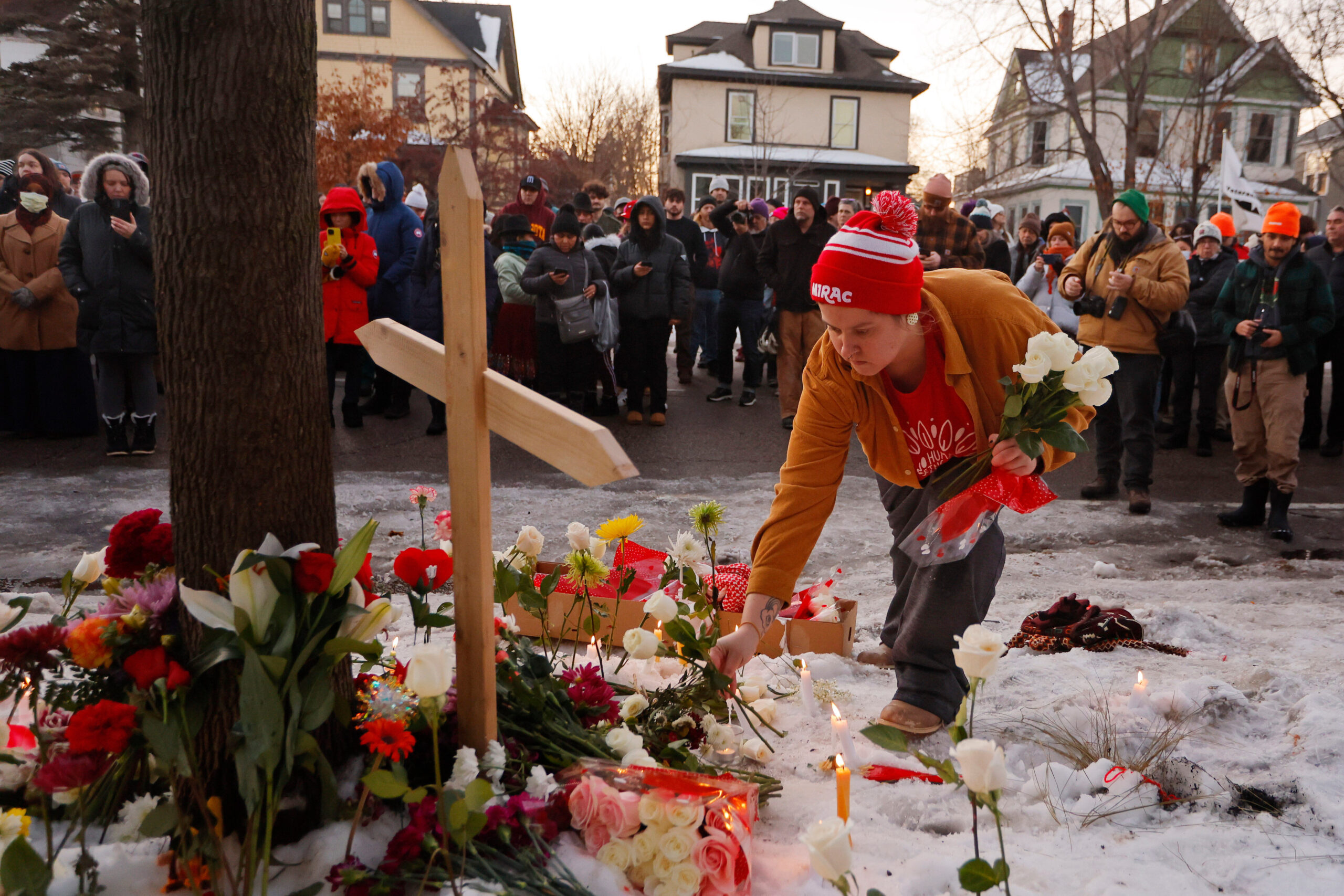
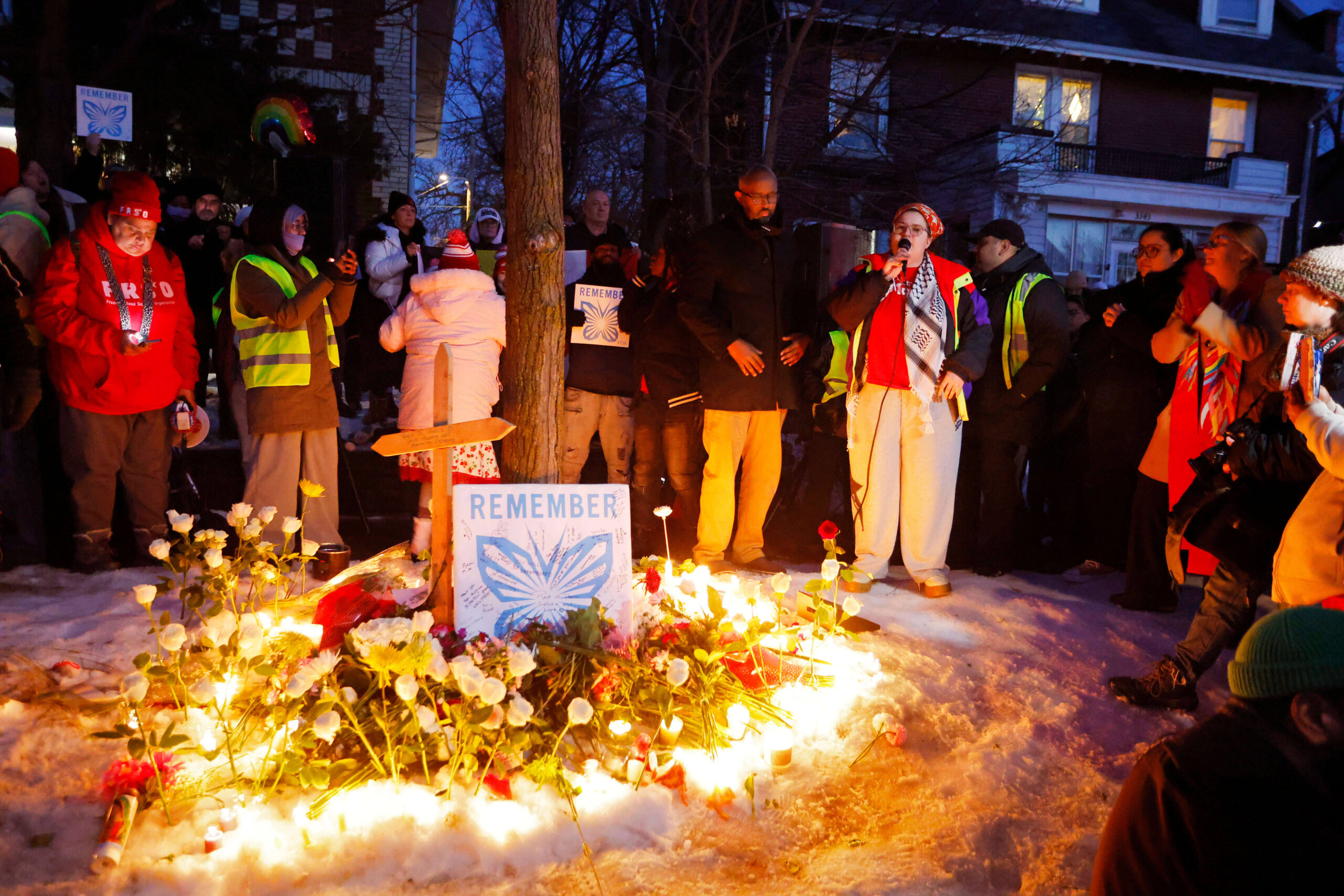
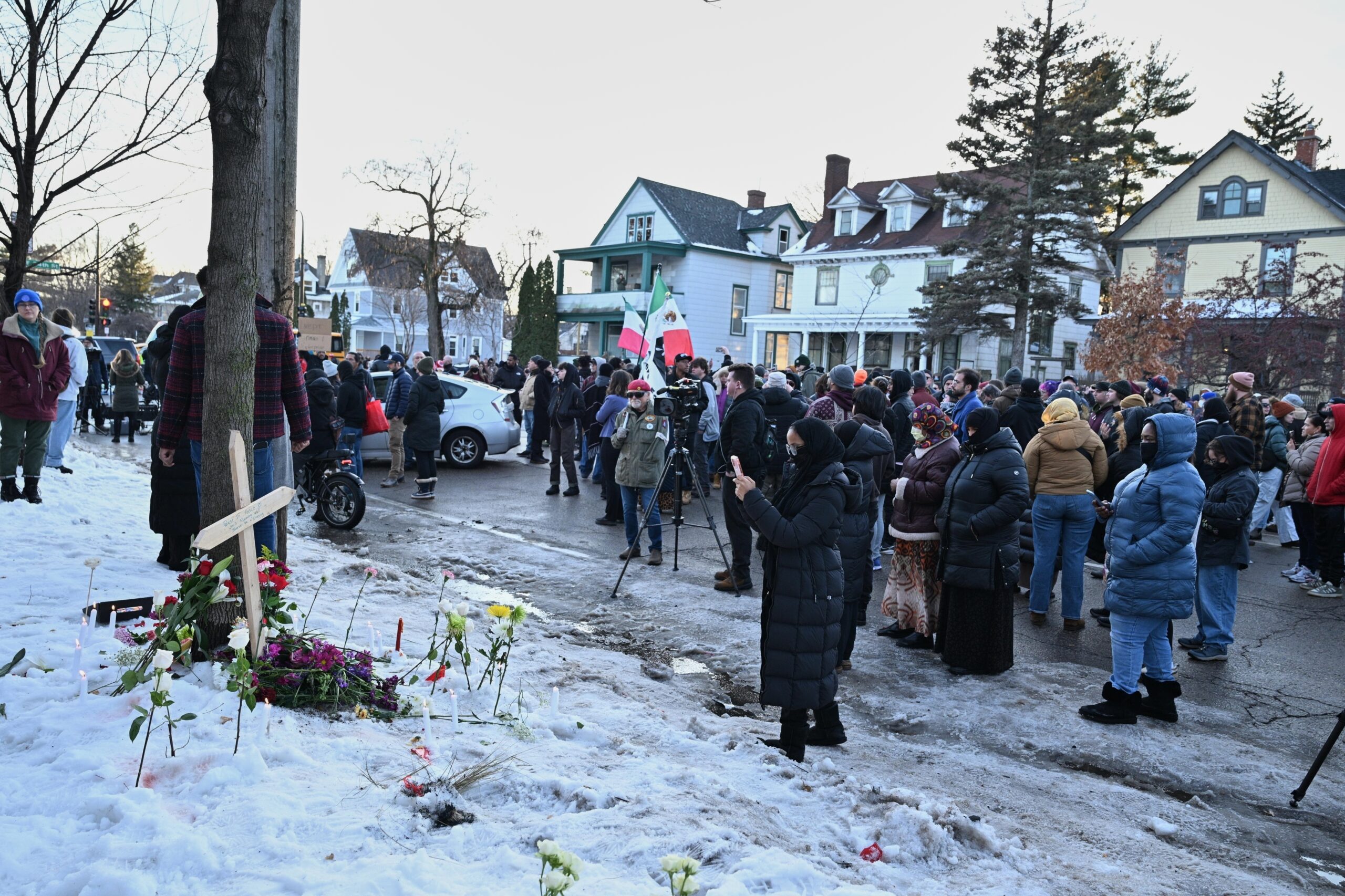
People gather for a vigil after a U.S. Immigration and Customs Enforcement agent shot and killed a motorist earlier in the day.
In her Nov. 20 ruling ordering federal agents to limit aggressive tactics in Chicago, U.S. District Judge Sara Ellis wrote that “agents have used excessive force in response to protesters’ and journalists’ exercise of their First Amendment rights, without justification, often without warning, and even at those who had begun to comply with agents’ orders.”
Dozens of videos, from cities around the nation, have shown federal agents engaging in violent behavior during their enforcement duties. Any one of those incidents could have turned deadly. That more people have not been killed in the administration’s reckless and ill-advised efforts can best be attributed to providence.
Reported close calls in California include Border Patrol agents smashing windows and firing on a truck as it drove away during a traffic stop, a man who claimed he wanted to warn agents there were children nearby was shot in the back by an ICE agent, and a TikTok streamer was shot as ICE agents smashed his car window.
In Chicago, a woman was shot multiple times after she allegedly rammed the vehicle of a U.S. Customs and Border Protection agent. The charges against her were dismissed in the face of glaring inconsistencies in the government’s story.
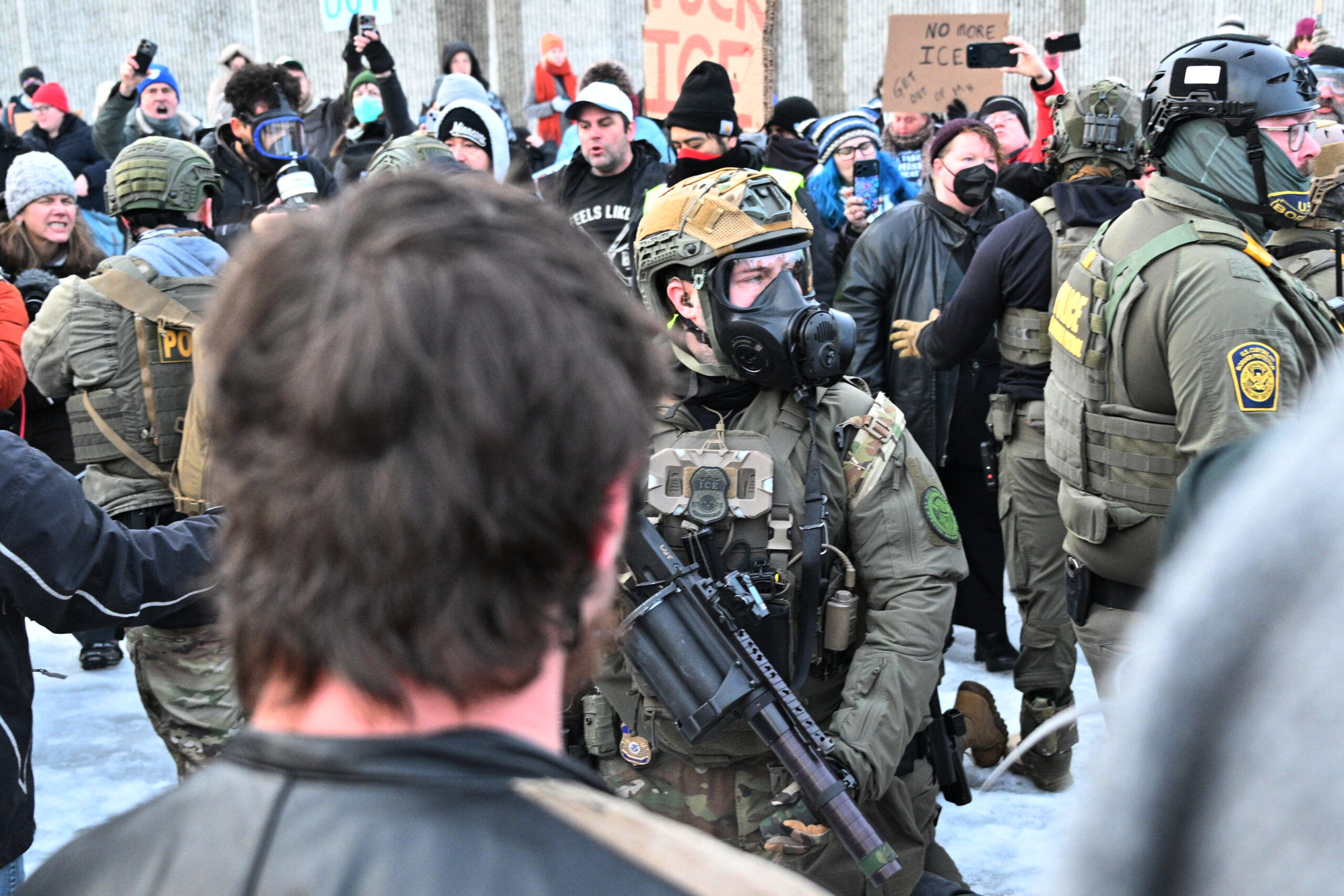
Federal agents confront protesters outside the Bishop Henry Whipple Federal Building on Thursday in Minneapolis.
On Thursday, a day after Good’s killing, two people were reportedly shot by Border Patrol agents in Portland, Ore., after a vehicle stop. DHS once again claimed the driver “weaponized his vehicle” and attempted to run over the agents.
The conduct of too many federal agents involved in immigration enforcement not only violates the norms of decency and order but also goes against the various agencies’ use-of-force policies and rights enshrined in the Constitution.
All of that is meaningless, however, to an administration that has repeatedly shown disdain for the law and which has overtly condoned violence as an acceptable response to nonviolent behavior.
It may be too late for Congress to use its power of the purse to rein in these out-of-control agencies. Republicans have already given the president $30 billion to recruit thousands more ICE agents, even as hiring requirements are lowered and training time is reduced — a recipe for disaster.
Legislators not in thrall to the Trump administration must use every oversight opportunity they can muster to shine the spotlight on abuse and hold rogue officials accountable.
Local and state governments must lawfully push back and protect their residents — including investigating and charging federal law enforcement with crimes. In the Good case, the former is already proving to be a challenge, as Minnesota’s attorney general notes that state law enforcement officials are being pushed aside, and that the investigation will be conducted solely by the FBI.
Even as the president puts his thumb on the scales, the courts must stand firm and uphold the law.
And in communities across the country, everyday Americans like Renee Nicole Good must continue to peacefully exercise and defend our civil rights against those who would use fear and intimidation to gain control. The risk has never been greater, but the stakes have never been higher.
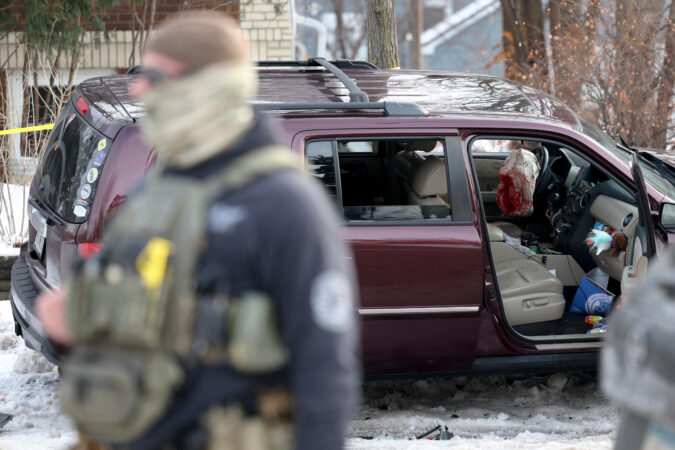
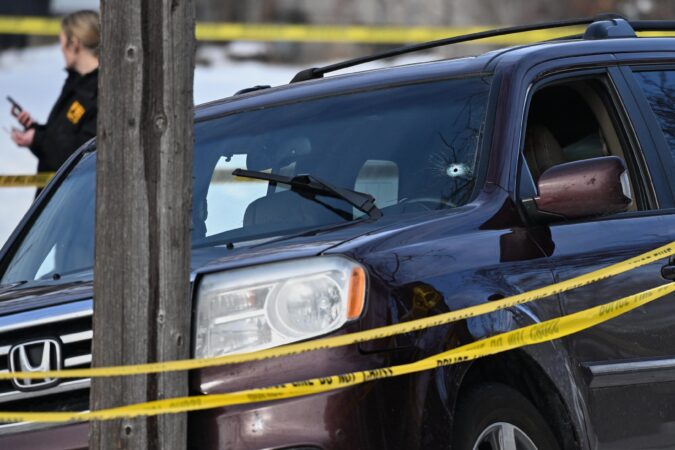
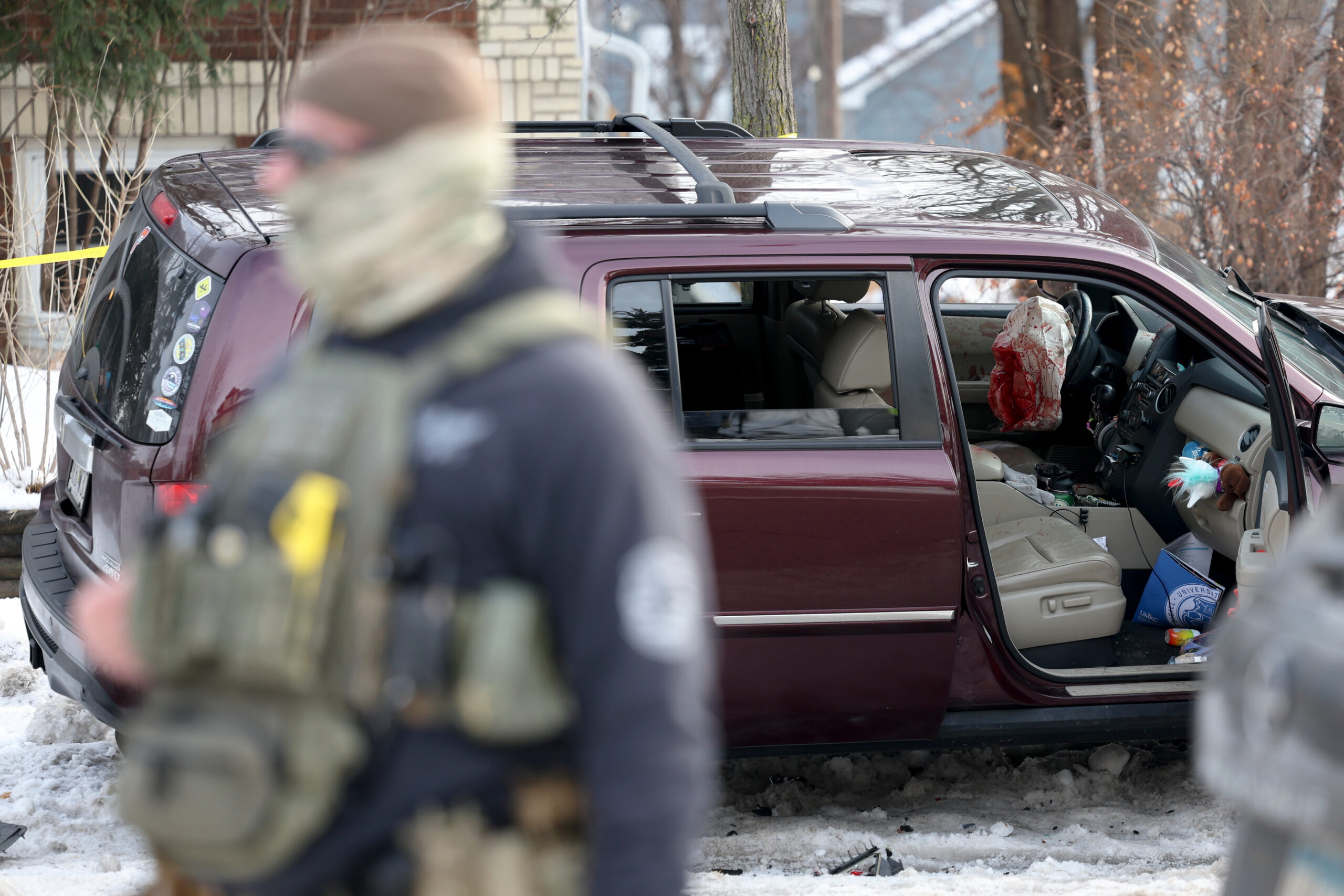
The Honda Pilot family SUV with the glove compartment crammed with a 6-year-old’s adorable stuffed toys and its deployed airbag and headrest drenched in fresh red blood hadn’t even been towed from the Minneapolis murder scene on Wednesday before the full force of the U.S. government attacked Renee Nicole Good a second time.
After the three deadly bullets came a fusillade of outrageous and morally reprehensible lies.
Tricia McLaughlin, the already notoriously fact-averse spokesperson for the U.S. Department of Homeland Security, didn’t even know the identity of the 37-year-old Colorado native — let alone any details of her intricate life or her beautiful, award-winning poetry — when the DHS flack smeared Good as “one of the violent rioters” who’d “weaponized” her SUV against the U.S. Immigration and Customs Enforcement (ICE) agent who shot and killed her, and called it “an act of domestic terrorism.”
Just moments later, DHS Secretary Kristi Noem — the absurdity of her words only ratcheted up by her ridiculously oversized cowboy hat at a Texas border press hit — joined the verbal pile on and amplified the “domestic terrorism” angle, even though the investigation of what had actually happened on snowy Portland Avenue had barely begun. This was all just a warm-up for America’s prevaricator-in-chief.
President Donald Trump took to his so-called Truth Social to offer his own, further-embellished version — insisting to the nation that the still-at-that-moment unidentified woman had “violently, willfully, and viciously ran over” ICE officers, blaming “the Radical Left,” and even claiming that the ICE gunman was recovering in the hospital.
A deployed airbag and blood stains are seen in a crashed vehicle on at the scene of a shooting in Minneapolis on Wednesday.
But this time, millions of Americans could see what really happened to Good, thanks to multiple videos taken on that south Minneapolis street by everyday citizens with a righteous distrust of their own government. It’s the deep skepticism that began with three gunshots and a blurry home movie in Dallas’ Dealey Plaza on Nov. 22, 1963. Now, the digital clarity of three gunshots at 9:30 a.m. on Jan. 7, 2026, may have marked a kind of Waterloo, a righteous turning point in our existential war over the truth.
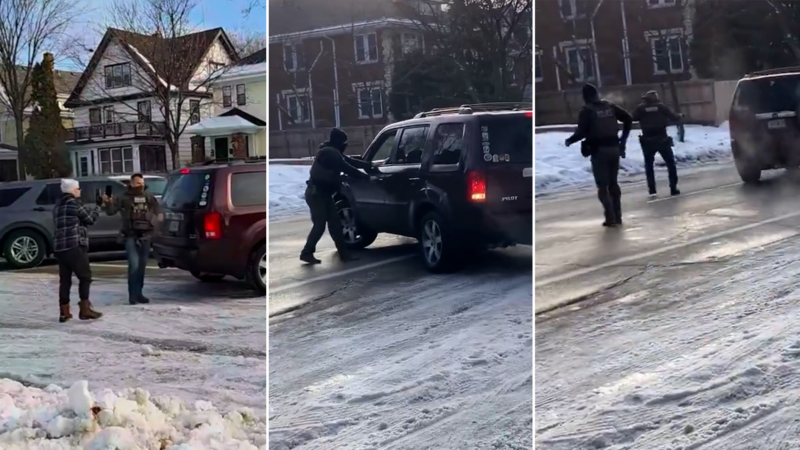
The citizen videos showed Good — it’s unclear whether she was a volunteer observer of the amped-up ICE raids in Minneapolis, or just filming the agents on a whim — parked at an angle across Portland Avenue when an ICE SUV approached. Two agents hopped out and approached Good’s Honda while a third — the soon-to-be shooter — moved in from the opposite side. One agent screamed, “Get out of the f— car,” but Good, with her window now open and her partner in the passenger seat, slowly backed up and then started a sharp right turn, seeking to leave the scene.
But the third federal officer, seen adjacent to the left front fender, had already drawn his gun and fired a shot through the windshield as Good turned her Honda away from him. The videos then show the agent — now a few feet from the vehicle and clearly not in danger — firing two more times into the open window, as the vehicle and the mortally wounded Good traveled halfway down the block and into a parked car.
Must watch: NYT just released a damning forensic analysis of the ICE shooting in Minneapolis.
It flatly refutes Trump administration claims — confirming the motorist was driving away, not toward the officer, and the officer was not hit by the vehicle.https://t.co/n8opkxbtmUpic.twitter.com/jJ0ttyr34R
The shooter — the agent the president claimed had been run over and hospitalized — was filmed walking around the murder scene, apparently unharmed. Meanwhile, the government’s crusade to dehumanize Good was already well underway, as agents were shown blocking a physician who pleaded to aid the dying woman before they finally dragged her away by her limbs.
The senseless killing of Good was exactly the tragedy that state and city officials had feared when DHS declared at the start of the new year that it was flooding Minnesota — whose large community of Somali American refugees had been viciously slurred by Trump as “garbage” — with some 2,000 armed, masked immigration agents.
The national spotlight ensured wall-to-wall cable news coverage when agents killed a white U.S. citizen and a mother of three on the second day of the surge in and around Minneapolis, but all of this has happened before. In the last four months, according to the New York Times, federal agents have fired their weapons in nine separate incidents — each time into a vehicle. And often the initial story from DHS collapses under the weight of truth.
In October, U.S. Customs and Border Protection agents involved in Chicago’s “Operation Midway Blitz” claimed they were boxed in by as many as 10 cars — again, not supported by video — and fired at least five shots at Mirimar Martinez, who was not seriously injured, but was then indicted, along with her passenger, on assault and attempted murder charges. Martinez was not charged with a gun crime — despite an initial DHS claim that she’d brandished a semiautomatic weapon — and soon the entire case crumbled, and now all charges have been dismissed.
Federal agents are only allowed to fire into a moving car when they believe the driver is trying to kill or maim them or other bystanders. As videos of Good’s killing circulated Wednesday afternoon, an unnamed DHS official told NBC News that the agents’ actions — from approaching the vehicle from the front to firing the fatal shots — went against their training. But how can the public expect sound decision-making from a surge of inexperienced new hires that ICE recruits on social media, or in slick ads during NFL games, with plans to target gun shows and military enthusiasts?
People gather for a vigil on Wednesday evening after a U.S. Immigration and Customs Enforcement officer shot and killed a woman hours earlier in Minneapolis.
What’s more, why would the Trump regime tell the truth about killing Good when its entire Minnesota operation — along with everything else about its immoral mass deportation drive — is built atop a foundation of despicable lies, from the White House racist slander of Somali refugees seeking a better life in Minnesota to the gross exaggerations (spiked by a dishonest viral video) about a childcare fraud scandal?
“GOOD MORNING MINNEAPOLIS,” DHS tweeted from its official account Monday as it began an unwarranted, unwelcome operation that is making no one safer, especially not the children of Minnesota. A local coalition of childcare operators called Kids Count on Us reported Wednesday that ICE agents have been swarming their facilities as operators report that little kids are frightened, adding, “We are terrified.” After Good’s death, protesting students at nearby Roosevelt High School were pepper-sprayed by federal agents. And now a 6-year-old child, whose military veteran father had already died in 2023, is an orphan.
Exactly who are the violent rioters committing acts of domestic terrorism here?
Minneapolis is a great American city that has been bombarded with needless tragedies throughout the 2020s, beginning on May 25, 2020, when George Floyd was murdered under the knee of police officer Derek Chauvin, just 0.7 miles from where Good was killed. That homicide also began with official lies that were absurdly false, until a brave citizen’s video showed America what really happened.
Wednesday’s ICE murder carried the grim echoes of past government killing across the upper Midwest — an icy wind that blows from the massacre at Wounded Knee through the 1969 assassination of Black Panther Fred Hampton and over Floyd’s senseless demise. Yet, there is also reason to feel that, this time, a change is in the air.
For one thing, true leaders like Minneapolis Mayor Jacob Frey — who stunned a national TV audience when he bluntly told ICE, “Get the f— out of Minneapolis” — and Minnesota Gov. Tim Walz made it clear they are fed up with the performative violence and the blatant lies. “Maybe we’re at their McCarthy moment,” Walz told a news conference. “Do you have no decency? Do you have no decency? We have someone dead in their car for no reason whatsoever. Enough. Enough is enough.”
But there was something even more critical on this frigid prairie morning: brave everyday citizens willing to put their lives on the line for neighbors they don’t even know, and to risk everything in pursuit of the truth. America knows what really happened to Good because courageous people ran toward the scene with their phones aloft to bear witness, not knowing if ICE would kill again.
It’s the revolutionary spirit we’ve been seeing all across America for months — regular folks from the community blowing whistles, filming ICE raids, and telling the world that our citizens will defend their communities even when all the big institutions and their overpaid leaders will not. Authoritarian governments only thrive in their own manufactured reality, gaslighting the masses that their hardworking, brown-skinned neighbor is a rapist, or that an uninjured federal agent is instead in the emergency room.
Mark down Jan. 7, 2026, as the day America started turning off the gas, and the masks came off. No wonder it came out Thursday morning that the FBI is not cooperating with Minnesota state authorities on the investigation, in a pathetic, too-late effort at covering this mess up.
I was one of many on Wednesday who couldn’t stop thinking about another unprovoked government killing: the Kent State Massacre and the murder of four college students on May 4, 1970. That moment caused Neil Young to write these words that still feel so relevant: “What if you knew her and found her dead on the ground?/ How can you run when you know?”
Good Americans who still believe in truth and justice ran into the danger on Portland Avenue, and we are a better place for that. Some day, and probably soon, there will be a statue on that spot in honor of Renee Nicole Good, an American hero whose bigger freedom fight could not be murdered by tyrants.
In the aftermath, Homeland Security Secretary Kristi L. Noem said the woman had committed an act of “domestic terrorism,” first disobeying officers’ commands and then weaponizing her SUV by attempting to “run a law enforcement officer over.” President Donald Trump said the woman “violently, willfully and viciously ran over the ICE officer.”
A frame-by-frame analysis of video footage, however, raises questions about those accounts. The SUV did move toward the ICE agent as he stood in front of it. But the agent was able to move out of the way and fire at least two of three shots from the side of the vehicle as it veered past him, according to the analysis.
Video taken by a witness shows Renee Nicole Good’s vehicle, a burgundy Honda Pilot SUV, stopped in the middle of a one-way road in a residential area of south Minneapolis on Wednesday morning. That footage and other videos examined by The Washington Post do not show the events leading up to that moment.
The agent, who has not been publicly identified, can be seen standing behind Good’s SUV, holding up a phone and pointing it toward a woman who also has her phone out. The two appear to be recording each other.
The agent then walks around the passenger side of Good’s vehicle.
A pickup truck pulls up, and two additional agents exit the vehicle and approach Good, the video shows. A voice can be heard saying to “get out” of the car at least two times. One of the agents puts a hand on the opening of the driver’s side window and with his other hand tugs twice quickly on the door handle, but the driver’s door does not open.
That same agent puts his hand farther in the opening of Good’s window, and almost simultaneously, the SUV begins to back up.
The agent who was first seen behind Good’s SUV reemerges in front of the vehicle, still appearing to hold up a phone. The SUV quickly pulls forward, and then veers to the right, in the correct direction of traffic on the one-way street.
As the vehicle moves forward, video shows, the agent moves out of the way and at nearly the same time fires his first shot. The footage shows that his other two shots were fired from the side of the vehicle.
Videos examined by The Post, including one shared on Truth Social by Trump, do not clearly show whether the agent is struck or how close the front of the vehicle comes to striking him. Referring to the officer, Trump wrote in his post that it was “hard to believe he is alive.” Video shows the agent walking around the scene for more than a minute after the shooting.
Good’s SUV travels a short distance before crashing into a car parked on the opposite side of the street.
The FBI and Minnesota’s Bureau of Criminal Apprehension are investigating the shooting. The White House and the Department of Homeland Security did not immediately respond to a request seeking comment for this story.
MINNEAPOLIS — An Immigration and Customs Enforcement officer shot and killed a Minneapolis driver on Wednesday during the Trump administration’s latest immigration crackdown on a major American city — a shooting that federal officials said was an act of self-defense but that the mayor described as reckless and unnecessary.
The 37-year-old woman was shot in the head in front of a family member in a snowy residential neighborhood south of downtown Minneapolis, just a few blocks from some of the oldest immigrant markets and about a mile (1.6 kilometers) from where George Floyd was killed by police in 2020.
Her killing after 9:30 a.m. was recorded on video by witnesses, and the shooting quickly drew a crowd of hundreds of angry protesters. By evening, hundreds were there for a vigil to mourn the death and urge the public to resist immigration enforcers.
Homeland Security Secretary Kristi Noem, while visiting Texas, described the incident as an “act of domestic terrorism” carried out against ICE officers by a woman who “attempted to run them over and rammed them with her vehicle. An officer of ours acted quickly and defensively, shot, to protect himself and the people around him.”
In a social media post, President Donald Trump made similar accusations against the woman and defended ICE’s work.
Protesters gather near the scene of the fatal shooting involving federal law enforcement agents Wednesday in Minneapolis.
Hours later, at an evening news conference in Minnesota, Noem didn’t back down, claiming the woman was part of a “mob of agitators.” She said the veteran officer who fired his gun had been rammed and dragged by an anti-ICE motorist in June.
“Any loss of life is a tragedy, and I think all of us can agree that in this situation, it was preventable,” Noem said, adding that the FBI would investigate.
But Minneapolis Mayor Jacob Frey blasted Noem’s version of what happened as “garbage” and criticized the federal deployment of more than 2,000 officers to the Twin Cities of Minneapolis and St. Paul as part of the immigration crackdown.
“What they are doing is not to provide safety in America. What they are doing is causing chaos and distrust,” Frey said, calling on the immigration agents to leave. “They’re ripping families apart. They’re sowing chaos on our streets, and in this case, quite literally killing people.”
“They are already trying to spin this as an action of self-defense. Having seen the video myself, I wanna tell everybody directly, that is bullshit,” the mayor said.
Frey said he had a message for ICE: “Get the f— out of Minneapolis.”
A shooting caught on video
Videos taken by bystanders with different vantage points and posted to social media show an officer approaching an SUV stopped across the middle of the road, demanding the driver open the door and grabbing the handle. The Honda Pilot begins to pull forward and a different ICE officer standing in front of the vehicle pulls his weapon and immediately fires at least two shots into the vehicle at close range, jumping back as the vehicle moves toward him.
It was not clear from the videos if the vehicle made contact with the officer. The SUV then sped into two cars parked on a curb nearby before crashing to a stop. Witnesses screamed obscenities, expressing shock at what they’d seen. After the shooting, emergency medical technicians tried to administer aid to the woman.
“She was driving away and they killed her,” said resident Lynette Reini-Grandell, who was outdoors recording video on her phone.
The Twin Cities have been on edge since DHS announced Tuesday that it had launched the operation, which is at least partly tied to allegations of fraud involving Somali residents. Noem confirmed Wednesday that DHS had deployed more than 2,000 officers to the area and said they had already made “hundreds and hundreds” of arrests.
A large throng of protesters gathered at the scene after the shooting, where they vented their anger at the local and federal officers who were there, including Gregory Bovino, a senior U.S. Customs and Border Patrol official who has been the face of crackdowns in Los Angeles, Chicago and elsewhere.
In a scene that hearkened back to the Los Angeles and Chicago crackdowns, bystanders heckled the officers, chanting “Shame! Shame! Shame!” and “ICE out of Minnesota,” and blew whistles that have become ubiquitous during the operations.
Governor calls for calm
Minnesota Gov. Tim Walz said he’s prepared to deploy the National Guard if necessary. He said a family member of the driver was there to witness the killing, which he described as “predictable” and “avoidable.” He also said like many, he was outraged by the shooting, but he called on people to keep protests peaceful.
“They want a show. We can’t give it to them. We cannot,” the governor said during a news conference. “If you protest and express your First Amendment rights, please do so peacefully, as you always do. We can’t give them what they want.”
Minneapolis Police Chief Brian O’Hara briefly described the shooting to reporters but, unlike federal officials, gave no indication that the driver was trying to harm anyone.
“This woman was in her vehicle and was blocking the roadway on Portland Avenue. … At some point a federal law enforcement officer approached her on foot and the vehicle began to drive off,” the chief said. ”At least two shots were fired. The vehicle then crashed on the side of the roadway.”
There were calls on social media to prosecute the officer who shot the driver. Commissioner Bob Jacobson of the Minnesota Department of Public Safety said state authorities would investigate the shooting with federal authorities.
“Keep in mind that this is an investigation that is also in its infancy. So any speculation about what has happened would be just that,” Jacobson told reporters.
The shooting happened in the district of Democratic Rep. Ilhan Omar, who called it “state violence,” not law enforcement.
For nearly a year, migrant rights advocates and neighborhood activists across the Twin Cities have been preparing to mobilize in the event of an immigration enforcement surge. From houses of worship to mobile home parks, they have set up very active online networks, scanned license plates for possible federal vehicles and bought whistles and other noisemaking devices to alert neighborhoods of any enforcement presence.
In the beginning, God created the 12 days of Christmas and the bacchanalia of New Year’s Eve to get us through the dark and frigid endless nights of winter. That wasn’t nearly enough for us shivering and depressed humans, so God sent us the NFL playoffs. The hope is that the Eagles last long enough to get us to the balmy breezes of baseball’s spring training.
Delay, deny, distract, divert attention: Inside the Epstein Files coverup
Pages from a totally redacted New York grand jury file into Jeffrey Epstein and Ghislaine Maxwell, released by the U.S. Justice Department, are photographed last month in Washington.
I want you all to stonewall it, let them plead the Fifth Amendment, cover up or anything else if it’ll save it — save the plan.
The newish word that best captures the 2020s is one that I’m not allowed to use in a family newspaper like The Inquirer. In 2022, the social critic Cory Doctorow coined this scatological term that I’m calling “en(bleep)ification” (it won’t take much imagination) to describe the way that products, but especially consumer-facing websites, gradually degrade themselves in pursuit of the bigger goal, higher profits.
For example, writer Kyle Chayka wrote a popular New Yorker essay in 2024 about what he called the, um, en(bleep)ification of the music site Spotify as it devolved, in his opinion, from a place for the songs and albums you want to hear to pushing playlists that they want you to hear.
In the political world, no product rollout had been more anticipated than the December release, forced by law upon the Donald Trump regime’s Department of Justice, of the Jeffrey Epstein Files — the investigative trail of documents about the late financier and indicted sex trafficker who also palled around with Trump in the 1990s and early 2000s.
No one with any familiarity of Trump’s modus operandi should have been shocked by what happened when the congressionally mandated deadline for release of all of this massive cache of paperwork finally arrived on Dec. 19 — or by what has happened in the two-and-a-half weeks since then.
Needless to say, the Epstein Files have not offered the seamless user experience that its readers — especially those hoping for bombshells that would expose the tawdry secrets of Trump’s friendship with a man who allegedly abused more than 1,000 young and sometimes underaged women — had anticipated. In the hands of the president’s minions at Justice, the Epstein Files have been en(bleep)ified.
How so? Here’s the diabolical part. The MAGA Gang that normally can’t shoot straight managed to hit the coverup bullseye this time, not with one dramatic act to rile people up — like Nixon during Watergate with his notorious Saturday Night Massacre — but with a blend of tactics and dodges designed to frustrate and exhaust truth-seekers.
Delay. The law, which Trump signed to avoid an embarrassing defeat on Capitol Hill, required the release of every single document — with appropriate blacked-out redactionsto protect things like the names of Epstein’s victims — by that December deadline. But suddenly the Justice Department — which once had as many as 200 staffers combing the papers last spring before its original botched plan to squelch the files — lacked energy and manpower, claiming it was working as fast as it could in an initial release of just about 40,000 pages, which would seem to be a tiny fraction of more than 5 million pages believed to exist.
The DOJ’s small-batch cooking came in two small servings right before Christmas, when most Americans consume the least news, and information about any new releases in the new year has suddenly dried up, with maybe 99% of the files still outstanding.
Deny. The papers that have been released have included major redactions — including the completely blacked-out pages of Manhattan grand jury testimony pictured above — that violate the spirit if not the letter of the law, which demanded that any hidden passages only protect victims and not Epstein’s powerful associates and clients.
Stunningly, DOJ actually took back and attempted to bury some 16 files from the first release, including a photo of a photo that included Trump, before a public outcry led to that file’s republishing. Meanwhile, the department also claimed that 1 million additional Epstein files were discovered in New York after the legal deadline — an incredible claim that was immediately punctured by experts.
Deflect. The initial batch was also larded with photos of Epstein with celebrities like Michael Jackson, Diana Ross, and Walter Cronkite as well as several of a Trump predecessor and longtime enemy, Bill Clinton. The pictures were dumped without any explanation and seemed to prove only that there’s a good reason the government normally doesn’t release raw investigatory files, especially about those not charged with any crime.
The second batch also included a lurid and bizarre apparent letter from Epstein to a fellow famed accused sex offender, the gymnastic coach Larry Nassar, penned right around the time of his August 2019 jail-cell death. It seemed unbelievable, and just hours later the FBI said: Oh yeah, we looked at this and it’s a fake. The not-subtle subtext was essentially: “We don’t know what to believe in these files, and neither should you.”
Nearly 53 years ago, Nixon’s plan to cover up Watergate with a mix of denials, delays, purchased silence and outright lies didn’t work. But Team Trump’s efforts to “save it — save the plan” by stonewalling the Epstein files is going just swell so far.
If this moment feels familiar, it is very much like 2018 and the long-awaited Robert Mueller report on Russian influence in the 2016 presidential campaign and potential links to Moscow’s preferred candidate, Trump. There was a Mueller Report — much like there has been a “release” of the Epstein Files — that contained damning evidence, especially about potential obstruction of justice. But the information was dribbled out, downplayed, denied, and ultimately went nowhere.
The Epstein Files have been destined to fail from Day One. It was always what Trump himself might call a “rigged deal” — with the papers in the possession of those with the most to lose, with many ways to make sure the worst stuff stays buried until at least 2029, if it hasn’t already been shredded. But the biggest truth has already been revealed.
The outright defiance of the law demanding full release of the Epstein Files has exposed the utter brokenness of our democracy.
The reason that Nixon’s coverup plan failed is because America had institutions stronger than his lies, including a Congress that cared more about its strength and independence than party ID, newspapers that were not just widely read but believed, and Supreme Court justices with an allegiance to the law and not the man who appointed them.
Trump and his DOJ are daring a comatose Congress, a cowed news media, and a judiciary already in their back pocket to do something, but so far there is no indication that the en(bleep)ification of the Epstein Files can be undone. For now, they are more like the X Files, because the truth about Trump and his Palm Beach pal is out there…but beyond our weakened grasp.
Yo, do this!
These days I find “vacation” is often just another word for catching up on household chores, but during my long December break I did watch a slew of movies, including some of the ones I’d recommended previously like One Battle After Another (very good, but flawed) and Eddington (meh). I ventured to an actual theater on New Year’s Eve and saw probably my favorite movie of 2025: Song Sung Blue, the bittersweet, based-on-a-true-story saga of a Neil Diamond cover band at the end of the 20th century. As the title implies, the movie is more than just a rousing feel-good pop musical, despite cathartic moments of exactly that. Kate Hudson deserves an Oscar for her Wisconsin Nice accent.
If you miss the glory days of not-formulaic-or-cartoonish movies — in the spirit of Song Sung Blue or One Battle After Another, only better — you should check out a new documentary on Netflix called Breakdown: 1975, by filmmaker Morgan Neville. The film spotlights an all-too-brief golden age of the mid-1970s with clips from the era’s classics like Taxi Driver, Dog Day Afternoon, and Network, and interviews with the likes of Martin Scorsese and Albert Brooks. They could have done much more with this, but I’d still recommend it.
Ask me anything
Question: Do you think that there is enough of a media firestorm over Grok’s nude filter to kill it? — BCooper (@bcooper82.bsky.social) via Bluesky
Answer: The recent, shocking news about the artificial-intelligence tool called Grok that was created for Elon Musk-owned X (formerly Twitter) is a classic example of an important story that so far has befuddled and fallen through the cracks of the mainstream media. In recent days, X users have been asking Grok to create partially clothed and sexualized AI photos of real, everyday people, including images of underage adolescents. And Grok has complied, in what would seem to be a violation of laws regarding child pornography, among other legal and ethical problems. Musk needs to shut down Grok immediately — arguably for good — but that is not enough for the harm that’s already been caused. In a nation that routinely prosecutes citizens for having this kind of material on their computers, Musk, his co-creators of Grok, and X as a corporation need to be hauled before a judge.
What you’re saying about…
The half-dozen or so of you who responded to December’s open-ended call for 2026 predictions had one big thing in common: Boundless pessimism. Readers of this newsletter expect the new year to bring economic collapse and a disastrous midterm election in November, either from Donald Trump stealing it to Democrats somehow blowing it in the ways that only Democrats can. Stephen R. Rourke predicted: “I believe that the American economy, and perhaps the world economy, will slide into a second Great Depression, the almost inevitable consequence of an over leveraged economy, and a lack of willingness across the board to make tough choices about how to address the American addiction to borrowed money…” Oof. Nonetheless, Kim Root stole my heart with this: “I think the Philadelphia Union will rise even with the personnel changes because they are a developer of young talent. DOOP.”
📮 This week’s question: A no-brainer: Donald Trump’s lethal assault on Venezuela and his seizure of that country’s strongman leader, in defiance of U.S. and international law, marks a turning point in American foreign policy. Are you OK with Trump’s actions because a bad guy has been removed from power, or are you alarmed by a military assault with the stated goal of pumping more oil? Please email me your answer and put the exact phrase “Venezuela attack” in the subject line.
Backstory on the growing crisis of ICE custody deaths
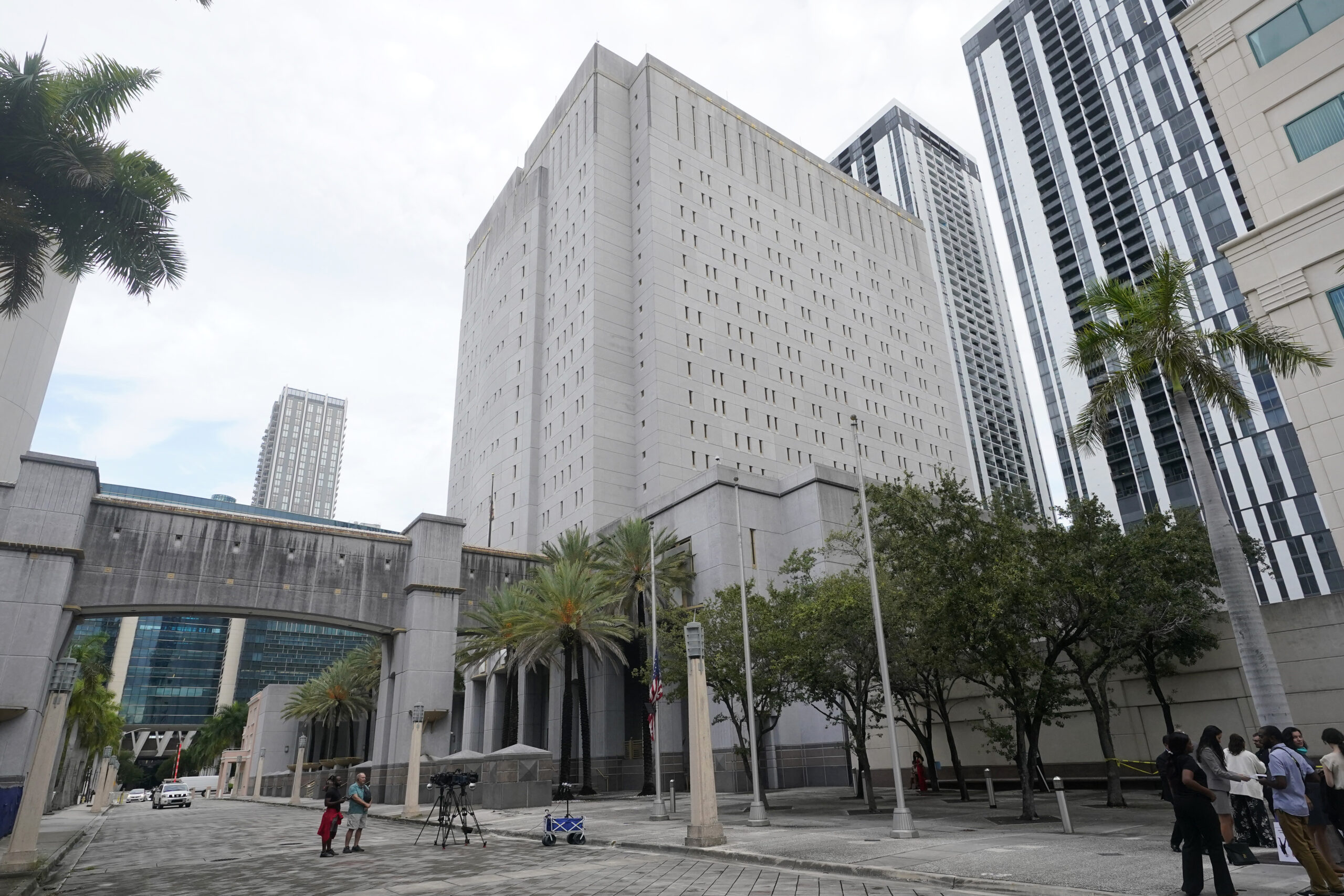
The Federal Detention Center in Miami.
Marie Ange Blaise, a citizen of Haiti, was 44 years old when she was arrested last February by Customs and Border Patrol officers as she attempted to board a commercial flight in Charlotte — one of the thousands swept up during 2025 amid the mass deportation drive of the Donald Trump regime.
Just 10 weeks later, Blaise died inside a federal immigration detention center in Broward County, Fla. A South Florida public radio station reported that the Haitian woman had spoken to her son, who later told the medical examiner that “she complained of having chest pains and abdominal cramps, and when she asked the detention staff to see a physician, they refused her.” Another detainee reported Blaise’s care was “severely delayed,” even as Immigration and Customs Enforcement (ICE) insisted she’d been offered blood-pressure medication but refused.
Blaise’s death was not an isolated incident. There was a sharp spike in ICE custody deaths during 2025, with the final tally of 31 fatalities nearly triple the 11 deaths posted during 2024, the last year of the Biden administration. Given the surge in immigration arrests after Trump took office last January, some increase was inevitable. Two of the 31 were killed by the gunman who fired on an ICE facility in Dallas. But immigration advocates say the crisis has been greatly exacerbated by inadequate medical care, bad food, and unsanitary conditions at detention centers.
“This is a result of the deteriorating conditions inside of ICE detention,” Setareh Ghandehari, advocacy director at Detention Watch Network, told the Guardian, which recently published a comprehensive rundown of all 31 custody deaths. Many died from heart attacks or respiratory failure, with a few apparent suicides — although, in a number of cases, family members are disputing the official account. Only a few of those who died were senior citizens.
There’s a bigger picture here. History has shown that authoritarian regimes can be hazardous to your health, and there is no American Exceptionalism. The MAGA movement’s low regard for the sanctity of human life is breaking through on multiple fronts, from the more than 100 deaths of South Americans on boats blown up by U.S. drones to the global crisis caused by the decimation of foreign aid through USAID (blamed for as many as 600,000 deaths by health experts) to the rising concern about fewer vaccinations and shrinking health insurance. A new generation is witnessing a grim reality: Dictatorship can be deadly.
What I wrote on this date in 2021
Jan. 6, much like Dec. 7 or Sept. 11, is a date which will live in infamy for most Americans. I had some health concerns five years ago that kept me from traveling to Washington to report on the insurrection — which I’ll always regret — but I did dash off an instant column before the smoke from Donald Trump’s failed coup had dissipated. I wrote, “When the future 45th president of the United States egged on the most violent thugs at his Nuremberg-style campaign rallies, when he yelled “get him the hell out of here” as white supporters roughed up a Black man in Birmingham, when he promised to pay the legal fees of brownshirts who beat up anti-Trump demonstrators, and when he said “I’d like to punch him in the face” to one rally insurrectionist, why are people still shocked when a riled-up mob takes Trump up on his own toxic words?” Read the rest: “Trump told us he would wreck America. Why didn’t we believe him the first time?”
Recommended Inquirer reading
I returned from a long Christmas break this weekend with something brand new to write about: the Trump regime’s illegal attack on Venezuela, which killed as many as 80 people, including civilians, and resulted in the capture of that nation’s strongman leader, Nicolás Maduro, and his wife. I wrote that Trump’s war without the required constitutional approval or public support, in violation of international law against unprovoked military aggression, fulfills his ambitions to rule as a dictator. And a new world order based not on the rule of law but brute force makes all of us less safe.
Last June, the partially unclothed body of a young woman was discovered by police under a pallet in an overgrown lot in Philadelphia’s Frankford neighborhood. For weeks, the identity of this murder victim was unknown, which didn’t deter one determined homicide detective, the missing woman’s anguished family who’d been initially told not to file a missing-person report — or The Inquirer’s Ellie Rushing, who has written a moving account of the life and death of the woman eventually learned to be Anastasiya Sangret. This kind of essential local reporting takes time and resources, which means it needs your support. You do exactly that, and unlock all the journalism of one of America’s best newsrooms, when you start 2026 with a subscription to The Inquirer.
By submitting your written, visual, and/or audio contributions, you agree to The Inquirer‘s Terms of Use, including the grant of rights in Section 10.
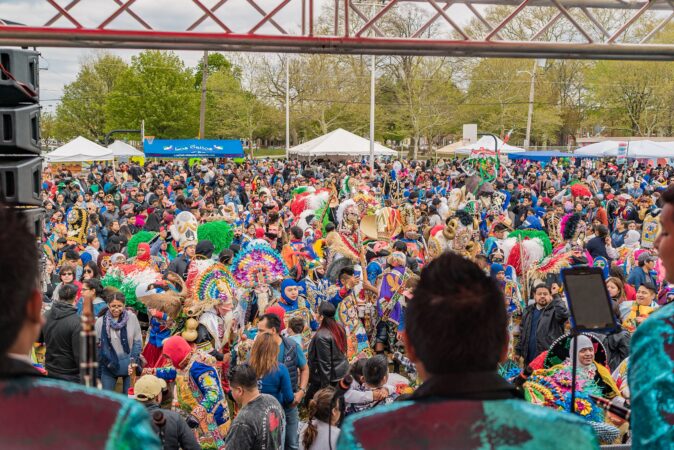
El Carnaval de Puebla, one of the biggest yearly celebrations of Mexican culture in Philadelphia and on the East Coast, is not returning in 2026.
For the second year in a row, the current immigration policies have overshadowed the festival that commemorates the Battle of Puebla traditionally celebrated on May 5, but not for the reasons one might expect.
“We are not scared of ICE; it is not fear that drives us,” said Edgar Ramirez, founder of Philatinos Radio and a committee member for San Mateo Carnavalero. “Many of the people who attend the carnival are second or third generation, but we are living at a time where the feeling of rejection is palpable, and it is not a suitable environment.”
A group of children dress up for the 2019 Carnaval de Puebla.
El Carnaval de Puebla has been a long-standing tradition for the city since 2005, stopping only during the pandemic, the first year of Donald Trump’s presidency in 2017, and last year following his reelection, as concerns for attracting immigration enforcement actions arose.
Since Trump’s reelection, the number of immigrants in federal detention facilities has increased beyond 65,000, a two-thirds increase since he took office last January.
Such uncertainty over when ICE might strike puts festival attendees at risk, making it harder to find sponsors and generate enough revenue to pay for city permits and requirements to hold the event, said committee member Olga Renteria.
“It’s hard to ask people to invest when there is no certainty that the carnival will be able to drive the success of previous years,” said Renteria, who noted that over 15,000 people attended the carnival in 2024. “The carnival is about family, sharing, drinking, enjoying yourself, and right now, any excuse is good enough to arrest someone; one incident is enough.”
For the community, this feels like a loss of space, both literally and figuratively.
A group of Carnavaleros march on Broad Street during the 2019 Carnaval de Puebla.
Longtime carnival attendee Alma Romero looked forward to seeing people in traditional attire, dancing andparading on Washington Avenue, triggering memories of her home in Puebla once a year.
“The carnival would have been good to lift our spirits, just as the Day of the Dead celebrations did,” Romero said, referring to the Ninth Street Corridor festivities in November that commemorate loved ones who passed away. “Without it, it feels like a sense of pride and unity is missing; now we just carry it in our hearts.”
After having attended the parade at all 19 past El Carnaval de Pueblaevents in Philly, Karina Sanchez, too, feels that sense of loss.
“I understand it’s important for the community to feel safe, but it’s sad to see us shrinking ourselves,” Sanchez said. “When that sentimentgrows, it is not a loss just for us, but for Philadelphia as a whole.”
Currently, there are no plans to replace El Carnaval de Puebla, but there is hope among many for a return.
“We have to come back,” Ramirez said. “We must because we are part of this city too, and things have to get better at some point.”
The parade that included horses arrives at the 18th annual El Carnaval de Puebla at Sacks Playground on Washington Avenue on April 30, 2023. El Carnaval de Puebla falls on Mexico’s “Day of the Children” and is one of the city’s biggest celebrations of Mexican culture. The celebration featured a parade, traditional games, food, live music and dancing.
NEW ORLEANS — Dinnertime had just ended when there was a loud knock at the door. Jhony grabbed his ID card and the documents showing he had protection from deportation. His wife, Aracely, rushed the children upstairs.
Six years ago, Jhony had arrived in New Orleans and found work helping renovate the Superdome,which became a symbol of the city’s fortitude after Hurricane Katrina. Now he stood inside his home with an ear to the door as his mind raced through what he would do if someone broke through. Aracely peeked through their window curtains.
Two immigration officers stood outside.
The men wore masks, protective vests, and caps, the couple later recounted. One of them pounded on the door four times. It was raining, and they stood waiting on Jhony and Aracely’s stoop for several minutes. Then they left. Jhony relaxed, but not completely. His papers, earned after filing a complaint with the U.S. Department of Labor for wage theft, did not give him a legal status, and he knew they did not entirely shield him or protect his family.
“We came because at our home, there was no peace,” Jhony said of relocating to the U.S. as agents drove slowly through his neighborhood in a convoy of Chevy Suburbans again the next afternoon. “I feel like I am reliving my life in Honduras, but here.”
Hondurans have been arriving in New Orleans in search of work since the city emerged as a key port in the banana trade over a century ago. They have continued to settle here in successive waves ever since, fleeing political turmoil and poverty in their homeland and helping rebuild after Hurricane Katrina in 2005. A bronze-and-marble statue depicting a Latino worker with a hammer stands in the city in honor of their contributions.
For many Hondurans, the Department of Homeland Security’s launch of Catahoula Crunch in early December has felt like whiplash. The operation’s name is a reference to the Catahoula leopard dogs trained by early Louisiana settlers to hunt wild boar. DHS contends the operation is needed to remove criminals released under “sanctuary” policies that limit local law enforcement from cooperating with federal immigration officers. So far, federal officershave arrested more than 250 people, including at least two dozen they say have criminal records, some of whom are Honduran.
“They honored us for rebuilding the city, doing work no one else would,” said Mario Mendoza, another undocumented Honduran construction worker. “They called us essential workers during the pandemic. Now, we are criminals?”
Latino-owned businesses have locked their doors, and some immigrants are sleeping at their workplaces because they fear being stopped by federal officers on their way home. Construction sites are emptying. Mothers of newborns are sending breast milk via courier to their hospitalized infants or skipping follow-up appointments. Food banks are begging undocumented families not to come in person but to send someone else.
For Jhony and his family, the DHS sting has required painful decisions. The couple spoke on the condition that they be identified by only their first names because they fear being targeted by immigration officers. He and his wife want their five children to advance in school, but they are also terrified they could get detained while walking them there. All but one, the youngest, are undocumented.
Some days, they feel brave and go. Others, they don’t.
After the knock at the door, no one left the house for four days.
‘Invisible’
Jhony arrived in New Orleans in 2019, he said, after his sister, a schoolteacher, was hacked to death by gang members with machetes after a dispute with a local leader. After the killing, Jhony said, the men began to stalk him. A vehicle no one recognized parked outside his family’s home every night. Fearful for their lives, Jhony and his wife said, they decided to head north. They closed the restaurant they ran and set out with their four children.
They crossed illegally on foot, each parent clutching two of their children. Aracely held the youngest, a 1-year-old girl.
They headed to New Orleans because they knew other Hondurans had found work there. Generations of their compatriots had made the city and its adjacent parishes home before them. Hondurans began settling here in the early 1900s as the city became a major hub for United Fruit and Standard Fruit. Both enterprises had lucrative banana plantations in Honduras, and many Hondurans found work in docks and offices in New Orleans.
Another wave of migrants arrived a half-century later as Honduras was struck by political and economic instability, some of it fueled by U.S. support for the nation’s military during the Cold War, and again after Hurricane Mitch left much of the country in ruins in 1998.
The Honduran arrivals built businesses and integrated into the city’s multiethnic culture while introducing their own, one baleada — a traditional taco-like Honduran staple — at a time.And although many arrived as undocumented immigrants, in 1999, the Clinton administration granted Hondurans temporary protected status, reasoning that the widespread destruction caused by Mitch made it unsafe for many to return home. Temporary protected status was not a pathway to citizenship, but it spared tens of thousands from deportation.
Then came Katrina. In the months and years after Hurricane Katrina, thousands of Hondurans arrived in New Orleans to work when the city needed help rebuilding entire neighborhoods destroyedby the storm. Tens of thousands of workers descended on the city, and studies estimate nearly half were immigrants and at least a quarter of all workers were undocumented Latinos. Nearly a third of the undocumented were Honduran, and large numbers stayed in the region.
“Hondurans are integral to the history of this place,” said Sarah Fouts, who is writing a book on the history of immigrant labor in New Orleans post-Katrina. “They’ve created homes and they’ve made their spaces and earned their spaces visibly in churches, through restaurants and local soccer leagues. But there are also ways in which they are invisible within the rebuilt infrastructure.”
Hondurans kept arriving even after most of the initial rebuilding was complete. Established networks of friends and family made finding jobs easier, and while some aspects of life improved in Honduras, political corruption and insecurity continued to push people out. Jhony found work within weeks of arriving. He said he worked on road and bridge repairs, home demolitions, and reconstruction. Some of it was long-delayed work from Katrina and, later, part of the recovery from Hurricane Ida in 2021.
A year later, Jhony was hired as part of a subcontracting crew to help with concrete demolition and interior renovations at the Superdome ahead of the 2025 Super Bowl between the Philadelphia Eagles and the Kansas City Chiefs.
“It felt like God had brought us here because we settled quickly,” he said.
A UH-1Y Venom helicopter from Marine Light Attack Squadron 773 flies over the Superdome on Feb. 8 ahead of the Super Bowl between the Philadelphia Eagles and the Kansas City Chiefs in New Orleans.
But the commemorative statue to honor Latino immigrant workers and the words of solidarity and gratitude that followed Katrina’s aftermath had begun, in recent years, to feel like relics of a time and sentiment that no longer existed. An estimated 23,000 immigrants arrived in Louisiana in the last two years of the Biden administration — one of the largest influxes the state had seen in decades.
New Orleans itself had adopted policies to limit cooperation between local police and federal immigration officers, but the surrounding suburbs where many Honduran immigrants had built their homes took a different approach.
After President Donald Trump was sworn into office again in January, police departments in Kenner and Gretna signed up to partner with Immigration and Customs Enforcement through a program known as 287(g). The initiative trains local officers to carry out some of the functions of a federal immigration agent. Traffic stops ended in immigration arrests. Officers handed jail inmates over to ICE. They chasedand arrested day laborers outside hardware stores.
Republican Gov. Jeff Landry and state lawmakers simultaneously pushed measures to mandate state police cooperation with federal agents in an effort to buoy the Trump administration’s mass deportation campaign. Landry argued that the Biden administration had failed to thoroughly vet the people it had allowed in, and that new immigrants were both a danger and a burden to states now responsible for providing services like education for their children.
“Entering this country illegally doesn’t make you immune from the law,” he said as Catahoula Crunch got underway. “If you commit crimes here, you face consequences — just like any citizen who breaks the law.”
Homero López, legal director of the New Orleans-based Immigration Services and Legal Advocacy organization, said it is not an exaggeration to say that nearly everyone in New Orleans has had work done on their homes or businesses by unauthorized immigrants or has hired undocumented labor. It is not a hidden fact, he said, but it is an inconvenient one for state and federal lawmakers who have not provided a long-term solution.
“We’re still working off of something that was built in 1965,” López said,referring to the Immigration and Nationality Act, which established the framework for immigration to the United States still used today. “The world has significantly changed in 60 years, but we haven’t really changed our immigration system very much in those same 60 years.”
Jhony and his wife contacted an immigration attorney when they arrived in New Orleans, but despite his sister’s slaying, he said, he was counseled not to file an application for asylum. To qualify, migrants must prove they face persecution based on their race, religion, nationality, political opinion, or belonging to a particular social group — and the lawyer told them they probably would not meet those requirements. So they opted to wait.
His work at the Superdome paid well — when his bosses did pay, he said. But Jhony and his coworkers were routinely not paid for overtime work, and he said they lost thousands of dollars. He filed a complaint with the U.S. Department of Labor with the help of a national advocacy organization for day laborers. The agency investigated the claims, finding employers violated federal overtime work laws and underpaid laborers by misclassifying them and keeping incomplete records. The workers negotiated thousands of dollars in back wages, and the victory made Jhony eligible for a Biden-era program that offered protections to workers who blow the whistle on labor violations.
Jhony got a Social Security card, work authorization, and a promise from the federal government that he would not be removed to Honduras. But those protections did not offer a path to a legal status or any guarantee he would not be deported to another country. He knew he would be vulnerable when immigration agents came to town.
Fear
Drones buzzing in their suburban New Orleans neighborhood were the first unnerving signs that federal immigration officers were about to arrive. Two hovered in the backyard of their duplex apartment. Vehicles with out-of-state plates and dark-tinted windows then began circling the streets and watching as people walked their children to school. Some agents took photos of cars, neighbors, homes.
Aracely quit her part-time job at a restaurant. They scaled back meals to basics like tortillas and beans to save money. They began relying on friends and grocery delivery services to avoid trips outside the home. And they joined a neighborhood messaging group that shared tips on ICE’s and Border Patrol’s whereabouts.
It is a half-mile walk to the local elementary school. To get there, Aracely and two of her children, ages 7 and 9, walk past rows of townhouses and neighbors out with their dogs. The couple has tried to keep their children’s lives as normal as possible. On the days when immigration officers are not spotted nearby, Aracely feeds them breakfast, braids her daughter’s hair, and escorts them to the school’s entrance.
Forecasters had warned of rain one such morning. The children threw on jackets and walked outside. Then Aracely noticed a white unmarked vehicle following them.
She turned toward the vehicle and locked eyes with a man inside wearing a vest, mask, and cap.
“ICE is behind me,” she texted her husband.
The car’s engine accelerated. The driver got closer. But then he turned.
There were sightings and scares like this all around the Jefferson Parish communities where Hondurans had made their homes. Jefferson Parish is a Republican stronghold, but among council member at-large Jennifer Van Vrancken’s constituents, the arrests sparked concern. Border Patrol officers clad in black neck gaiters pulled up over their mouths descended on a Home Depot in Kenner and a Lowe’s in Elysian Fields. They used a fire department ladder in Slidell to arrest three workers from the roof of a condominium under construction. One hotel reported that it had no housekeeping staff.
“My constituents voted for President Trump and absolutely are supportive of any effort to close the border and to get dangerous illegals out of the country,” Van Vrancken said. “But they did not envision what we have now. They are very disturbed by what seems to be a ‘pick everybody up and ask questions later’ approach.”
She said that Kenner, a city within the parish, is home to the largest community of Hondurans outside that country and that large numbers of them are legal residents who are too afraid to go to work amid the seemingly indiscriminate roundups. Van Vrancken said she is meeting with local law enforcement, ICE, and Hispanic business leaders to learn whether there is a way to “fine-tune the process.”
“I don’t understand why the unmarked cars and masking is necessary. It just seems aimed at fear,” said Van Vrancken, who describes herself as an outspoken Republican in favor of detaining people with no legal right to be in the country. “If our everyday brave men and women can show up in a uniform and marked car, why is it any different in this scenario?”
Home builders say Catahoula Crunch is exacerbating an already steep labor crisis. Even workers who have a legal immigration status are afraid of being stopped, said Dan Mills, chief executive of the Home Builders Association of Greater New Orleans. The result is an increase in labor costs because the supply of workers is shrinking while demand remains high. He pointed to work being done by several local contractors to improve homes through a federal grant program. Projects that were estimated to cost $8,000 per home have now risen to $10,000.
“If we don’t have workers, we can’t move projects forward,” Mills said.
No Christmas lights
The day Aracely was followed had spooked them all. Jhony began checking his phone every 15 minutes for neighborhood updates. Their two older children ran home from their bus stop through the rain because they were afraid of being grabbed.
Aracely was making tortillas later that week to eat with a stew her brother-in-law had brought over. Her hands made a slight slapping sound as she molded the flour disks. Then she looked at her phone and paused.
“He’s here,” she said, walking over to her husband. “They’re here on our street.”
Border Patrol Commander Gregory Bovino was inside a giant SUV surrounded by a caravan of immigration officers and state police driving slowly on a street alongside their building.
Customs and Border Patrol Commander Gregory Bovino walks with border patrol agents through a neighborhood during an immigration crackdown, in Kenner, La., on Dec. 5.
“Don’t open your doors for anyone!” neighbors texted. “Chicos, La Migra está aquí.”
Jhony looked at his wife, whose breath began to quicken. They logged on to a live stream from local journalists following the agents with cameras. The honks from neighbors shrieked louder and louder as the caravan got close.
“Any minute now, my little one will come running down the steps,” Jhony said, and, as if on cue, his 7-year-old daughter sprinted into his arms.
The immigration officers lingered and left after what felt like hours but was around 30 minutes. Two days later, Jhony went back to work. A colleague with a green card began picking him up. Each morning, he would give Jhony a heads-up on whether La Migra was near. If all was clear, he would run out of his house and into the truck.
“I’m putting myself at risk every day,” he said. “Before I leave for work, I give each of my children a kiss because I don’t know if I’ll return home or not.”
The worst part, Jhony said, is watching how his children have changed. They can’t go to the park every Wednesday and Saturday as they had before to run and kick around a soccer ball. His usually rambunctious girls have grown quiet. They stopped going to church and won’t step outside into their fenced-in backyard. They don’t want to go to school.
The family spends more time together, but it’s clouded by all that is happening and all they cannot do. Jhony and his wife weren’t sure how they would buy Christmas presents.
In early December, the family nonetheless started decorating their home for the holiday. They hung green Christmas garland on the wall and covered the kitchen table with a decorative cloth with images of wreaths, snowflakes, and candy canes.
They put up a tree, too. But the eldest girls made a demand.
They did not want to string holiday lights.
They were afraid it would signal to immigration officers that the family was inside.
For 29% of the world, the world’s 2.3 billion Christians, the days leading up to Dec. 25 are filled with traditions to help us prepare for one of the two most important religious celebrations of the year.
On Christmas Day, the mangers in Nativity scenes in front of churches across the nation, empty until now, will feature depictions of the infant Jesus.
Christians can then, as the carol goes, know the thrill of hope, and the weary world can rejoice.
For a day, an hour, a moment, Christians in the U.S. will seem to be one body in Christ — but perhaps not even the Nativity can bridge the gulf that has grown between Christians over President Donald Trump’s immigration policies.
In fact, this holiday season, some of that deep division has flared up publicly, centered on Nativity scenes at churches — across denominations and geographies — that depict the Holy Family behind barbed wire, or flanked by federal agents from U.S. Immigration and Customs Enforcement and U.S. Customs and Border Protection.
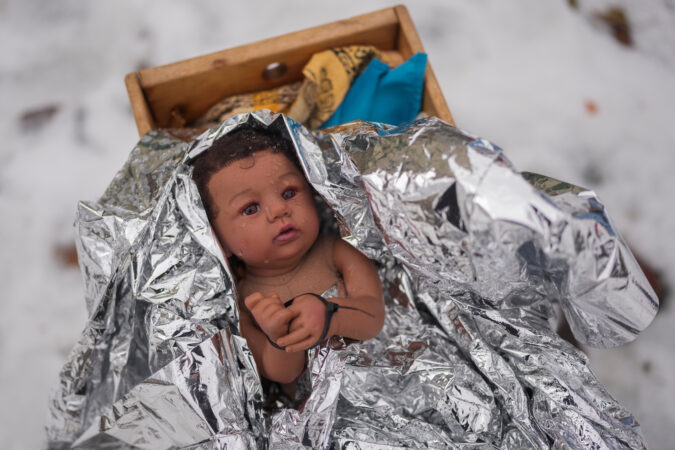
An “ICE WAS HERE” sign is posted in the empty spot for the baby Jesus at a Nativity scene displayed at St. Susanna Church in Dedham, Mass., earlier this month.
In Massachusetts, at the Roman Catholic St. Susanna Church, the Holy Family is missing — replaced by a sign saying “ICE WAS HERE.” At Oak Lawn Methodist in Dallas, the Holy Family is behind a barbed wire fence, with a sign that says “Holy is the refugee.” At Missiongathering Church in Charlotte, N.C., ICE agents wearing bulletproof vests surround the Holy Family.
At Oak Lawn United Methodist Church’s nativity, Mary and Joseph are silhouettes, surrounded by a chain link fence topped with razor wire. Their halos are old bicycle wheels. A shopping cart and two metal bins, frequently used by the unhoused as firepits, flank the scene.
And at Lake Street Church of Evanston, in Evanston, Ill., not only are ICE and CBP figures included, but Mary wears a gas mask, and the infant Jesus has his hands zip-tied together — the way a witness describes federal agents from ICE and CBP zip-tying children together after raiding an apartment building in Chicago in October — and is swaddled in a Mylar blanket like those used in detention centers.
The pastors involved say the Nativities remind everyone that “God is with us” now. The scene “reflects the context that Jesus would be coming into if he were born today,” St. Susanna’s Father Stephen Josoma told the National Catholic Reporter.
The Rev. Michael Woolf, pastor of Lake Street, was even more direct when he posted on Instagram after someone had removed the zip ties from the Jesus figure in his church’s Nativity:
“We restored the zip ties on baby Jesus. The #Christmas story is literally about an authoritarian ruler using violence, causing fear, and eventually driving the holy family to become refugees in Egypt. The parallels couldn’t be more clear between Scripture and our nativity. We’re not going anywhere.”
There is a long tradition of having Nativity scenes reflect contemporary concerns and realities. For example, during World War I, according to Emma Cieslik, a museum professional and religious scholar writing for the website Hyperallergic, the Holy Family huddled in the trenches. More recently, the Christmas Lutheran Church in Bethlehem created a Nativity scene with the infant Jesus cradled by rubble from the bombing of Gaza, and the Vatican itself hosted Nativity scenes depicting the war in Ukraine.
Still, there has been plenty of pushback. The bishop of the Archdiocese of Boston has been critical of St. Susanna’s Nativity, for example, and online comments at X dispute any characterization of the Holy Family as migrants or refugees. (Ahem, Matthew 2:13-14 anybody?)
But the strongest reactions have taken place at the churches in places that were impacted by Trump-directed immigration surges.
At Missiongathering in Charlotte, a person was caught on video knocking over the ICE figures in the Nativity and tearing up the “Know Your Rights” signs around it. At Lake Street Church on Chicago’s North Side, vandals knocked down the ICE and CBP figures, then battered and decapitated the Mary figure.
The violence is symbolic, but the fury is undeniable. This administration has so thoroughly demonized migrants and refugees, labeling all as criminals, that any hint of resemblance between today’s migrants and refugees and the Holy Family reads as anathema to some Christians. But anyone who thinks the parallels are politically driven needs to get their history straight. Way back in 1952, Pope Pius XII was writing in his Exsul Familia Nazarethana that “the migrant Holy Family of Nazareth, fleeing into Egypt, is the archetype of every refugee family.”
And here’s the thing: These Nativities that have enraged people aren’t exclusively reflecting the reality of migrants and refugees who are endangered by the Trump administration policies — they are reflecting the danger to all of us.
Folks may feel safe in their own status, but anyone can be treated the same way the administration is treating migrants and refugees. It is happening already, in fact, with federal agents refusing to accept valid U.S. birth certificates and passports as proof of citizenship.
“No document will protect you,” Malka Older, who heads up the international community of writers and human rights activists Global Voices, and has years of experience working at humanitarian aid, disaster risk reduction, and emergency preparedness organizations, wrote recently on Bluesky.
“All they have to do is take it from you and ‘lose’ it; take it from you and say you never gave it to them; claim it’s fake; make a new rule that you need another document. Citizenship is a made-up status that governments decide the rules for.”
Older said “it has never been about immigration. It’s racism, and it’s intimidation, and profit for some. Allowing it to happen to any group means it’s a possibility for everyone, and that’s how fascism maintains power.”
Which brings me back to Christmas Day, and what every pastor who has placed one of those ICE Nativity scenes knows.
It is a broken world now, and it was a broken world when Christ was born into it.
Amid the soaring Glorias, the sparkle of lights, and the colorful paper wrapped around gifts we give each other in echo of the gifts brought to the Christ child by the Magi, we should remember that three days after Christmas Day, Christians will be marking the slaughter of the Holy Innocents. The one the Holy Family fled from, the one that made them refugees.
They were warned, as we are warned, that authoritarian rulers will stop at nothing to get their way.
Donald Trump, a spray-tanned, 21st-century version of Ebenezer Scrooge, claims the affordability crisis is a “Democratic hoax,” and that parents should deal with it by buying fewer toys. With a heart that’s at least two sizes too small, he just can’t relate to those who scrape to get by. The only struggle he can relate to has to do with pronouncing the word acetaminophen.
Like the main character in Charles Dickens’ A Christmas Carol, Trump enjoys demeaning people — as he did last week when he unveiled a series of plaques near the Oval Office, deliberately distorting the legacies of former Presidents Joe Biden and Barack Obama. Trump isn’t in the same league with either of them. Not even close. Same thing with President John F. Kennedy, but that didn’t stop him from having his name slapped onto the John F. Kennedy Center for the Performing Arts last week.
Please, Santa, make sure your sleigh doesn’t drop off any presents at the White House on Christmas Eve. Same thing with Mar-a-Lago. Remember Trump’s posting an AI-generated meme dropping what looks like feces on “No Kings” protesters back in October?Just tell Dasher, Dancer, Rudolph, and the rest to fly right on by both of these locations.
President Donald Trump speaks during an address to the nation from the Diplomatic Reception Room at the White House in Washington in December.
Unemployment rose to 4.6% last month, the highest increase since 2021. For African Americans, it’s way higher, at 8.3%. Kudos to Rep. Ayanna Pressley (D., Mass.), among others, for demanding answers about what’s going on. Please don’t forget to drop off something really nice for them.
Also, as I’m sure you’re aware, America is on the verge of a healthcare crisis. Once federal subsidies to the Affordable Care Act expire Dec. 31, millions will see their health insurance costs skyrocket. This isn’t the kind of thing you and the elves typically work on up at the North Pole, but members of Congress have failed to come up with a solution.
If something drastic doesn’t happen soon, millions may wind up dropping their policies, which could prove catastrophic. We can’t count on that old Scrooge, I mean the president, who campaigned claiming he had a “concept of a plan” to fix healthcare. He hasn’t done it yet, and I doubt he ever will. Instead of boxed gifts, anything you can do to help us resolve this important issue would be deeply appreciated.
Trump really deserves that No. 1 spot on your naughty list this year. It’s one thing to try to secure America’s borders, but it’s a whole other thing to allow masked U.S. Immigration and Customs Enforcement agents to carry out a reign of terror on undocumented immigrants and U.S. citizens alike.
There have been many other lowlights from the first 11 months of his second term: imposing tariffs on foreign countries that have raised costs for American consumers, dismantling the U.S. Agency for International Development, and stopping diversity, equity, and inclusion in the federal government and anywhere else he can.
On top of everything else, Trump doesn’t even bother to hide his bigotry anymore. Under his leadership, officials have admitted white Afrikaners — descendants of the European colonizers whose segregationist practices led to the formalization of apartheid in South Africa — granting them refugee status while doing everything in his power to deport Black and brown migrants. I haven’t recovered from his calling Somalis “garbage” and saying that they should leave the country.
They and anyone else Trump doesn’t like have to go because he’s worried about “chain migration,” but first lady Melania Trump, who brought her parents to the States using the same process, can stay? Make it make sense.
Volunteers take phone calls from children asking where Santa is and when he will deliver presents to their house, during the annual NORAD Tracks Santa Operation, at the North American Aerospace Defense Command, or NORAD, at Peterson Air Force Base, in Colorado Springs, Colo., last Christmas Eve.
I could go on and on, but I’m trying to embrace the holiday spirit. Please give my regards to Mrs. Claus and to all of the elves who work so hard to make the Yuletide season jolly.
When you make your way down my chimney, you will find your cookies and milk in their usual place. I don’t need anything personally, but please do what you can to make life easier for Americans scraping to get by in the so-called golden age of Trump. As a certain humbug himself might say, thank you for your attention to this matter!
ATLANTIC CITY — Elected officials, religious leaders, and community activists gathered Tuesday in City Hall to condemn recent “aggressive” and “appalling” U.S. Immigration and Customs Enforcement activity in the resort town.
“The reason I’m here is because just last week, our community was attacked,” said Alexander Mendoza, a community organizer with advocacy group El Pueblo Unido of Atlantic City. “Fathers, friends, family members, hardworking people were taken away from us by an inhumane system called ICE.”
El Pueblo has been highlighting recent ICE activity in Atlantic City on its social media, including a car stop on Dec. 12 that led to the detainment of two men, one of whom subsequently missed the birth of his daughter earlier this week after being taken to Delaney Hall. The group called the car stop illegal and said the Mexican Consulate is working to provide the man with legal help.
“He and his partner had just moved into a new apartment and were ready to begin a new chapter in their lives,” Mendoza said. “That morning changed everything. He was taken by ICE and is now being held at Delaney Hall.”
Mendoza said this and other recent activity, including ICE agents establishing a base of operations at the city’s Bader Field, the former municipal airport, have left community members fearful and officials alarmed and outraged.
“There’s a lot of hysteria, a lot of fear in our community, rightly so,” said Cristian Moreno-Rodriguez, executive director of El Pueblo. There were rumors this week that businesses, particularly laundromats, would be targeted this week in Atlantic City and Pleasantville, he said.
“We strategically placed ourselves throughout different traffic hubs where our community is, our immigrant working-class community,” he said.
Moreno-Rodriguez said his organization has tracked some of the same ICE vehicles conducting activity in Bridgeton, Cumberland County.
ICE did not immediately respond to a request for comment regarding activity in the area.
El Pueblo has been educating community members of their rights and training volunteers to document and respond to reported ICE activity. He said the response time in Pleasantville is about two minutes; in Atlantic City, it’s 4 to 5 minutes.
Atlantic County is home to about 12,000 undocumented immigrants. Moreno-Rodriguez said the volunteers include non-Hispanic allies and young Latinos, “children who are standing up for their parents and neighbors.”
City Council Vice President Kaleem Shabazz said the council adopted a resolution last week condemning the ICE activity, which he said had made his constituents wary of leaving their homes without carrying documentation of their citizenship. He said police had not been informed about the raids or the use of Bader Field.
Moreno-Rodriguez said the city is about 33% Latino or Hispanic, and about 29% immigrant, with most Spanish-speaking immigrants coming from Mexico and the Dominican Republic, and smaller numbers from Honduras, El Salvador, and Guatemala. Nearby Pleasantville is about 50% Hispanic and has a sizable Haitian population, he said.
Both Moreno-Rodriguez and Shabazz called on businesses, which employ many immigrants, to support their workers. Moreno-Rodriguez said one man who self-deported after being picked up by ICE had worked for one of Atlantic City’s iconic bread bakeries.
“If you go into any of the small businesses of Atlantic City, they are powered by immigrant labor,” Moreno-Rodriguez said. “And we want to put out a call to action to all the business owners of Atlantic City that if you employ immigrants, please be there for them when they are detained. Please be there for them after they’ve given you hours of labor, years of blood, sweat, and tears to your business.”
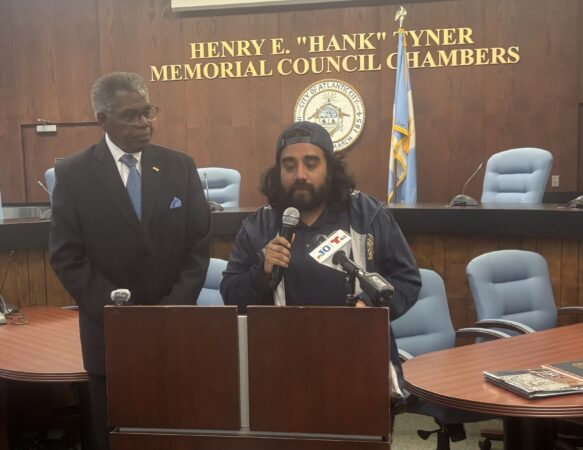
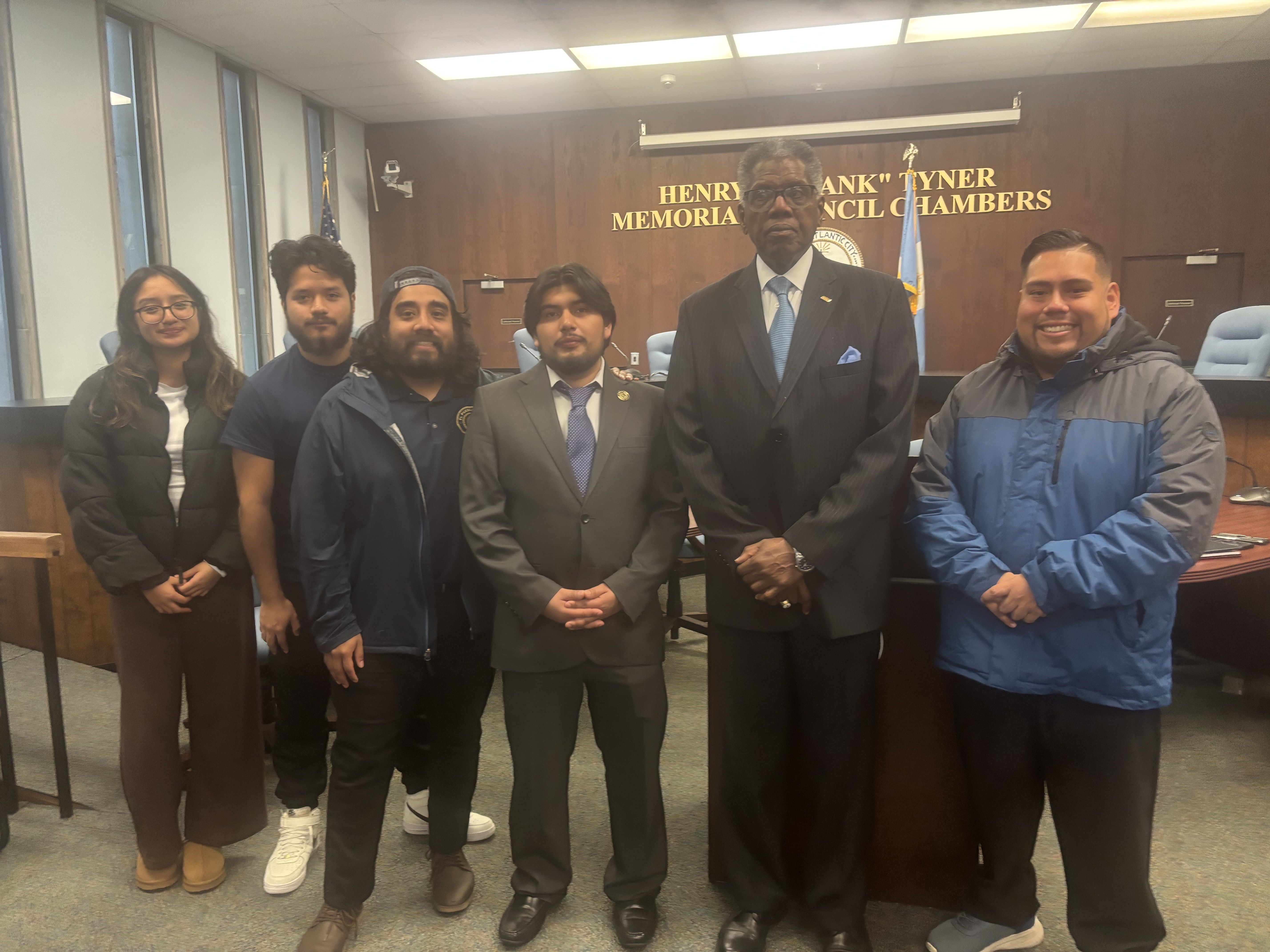
From left, advocacy group El Pueblo Unido of Atlantic City rapid responders Karen Pelaez-Moreno and Christopher Arellano, executive director Cristian Moreno-Rodriguez, Atlantic City Councilman Kaleem Shabazz, and El Pueblo board president Irvin Moreno-Rodriguez, who was recently appointed a Pleasantville School Board member. The group and elected officials held a press conference Dec. 23, 2025 to condemn recent ICE activity.
Also attending the news conference were the Rev. Collins Days, an Atlantic County commissioner, and religious leaders Imam Amin Muhammad of Atlantic City’s Masjid Muhammad mosque, Cantor Jackie Menaker of Ventnor’s Shirat Hayam synagogue, and the synagogue’s president, Joe Rodgers, a criminal defense attorney.
“I am appalled at what’s been happening in our community by ICE,” Days said. “We stand together because an attack on one group is an attack on all groups.”
“When we see the harms of our government, we are obligated to speak out,” Muhammad said. “We need engagement in the political process to make a change.”
Mendoza said activists believed the targeted raids of last week were “the beginning of a large raid on our community … a major escalation.”
“When we drove down Iowa Avenue, we saw an ICE agent and a Border Patrol agent questioning a woman, attempting to extract information in order to detain her,” he said. “When the agents noticed us, they allowed the woman to walk away.”
One of the agents claimed to be looking for a fugitive, he said.
Activists followed the man to Bader Field, where they saw a transport van and eight other vehicles. “That’s when we knew this wasn’t a small operation,” he said. “As soon as the agents realized they were being watched, they left quickly and quietly. It just took two Latino organizers standing by, holding cameras, for ICE to retreat from Atlantic City. ICE operates in the shadows. When people know their rights and when there is accountability, they scatter.”