Tag: Josh Shapiro

  • Pa. just gave low-income workers a tax credit boost. Now it’s Philadelphia’s turn.

    Pa. just gave low-income workers a tax credit boost. Now it’s Philadelphia’s turn.

    Last month, Gov. Josh Shapiro and the General Assembly adopted the state’s first working Pennsylvanians tax credit, ensuring anyone who qualifies for the federal earned income tax credit (EITC) will also automatically receive a state credit equal to 10% of the federal credit when they file taxes next year.

    Pennsylvania joins 31 states and the District of Columbia in giving low-income workers an effective, research-backed wage boost; in 2024, the federal and state credits combined lifted an estimated 6.8 million working people from poverty.

    While the new state EITC is incredibly welcome and historic, it is relatively modest compared with other refundable state EITCs. Most range from 20% to 50% of the federal credit, with a handful below 10% or over 50%. This major step forward still won’t overcome the hardship facing low-wage workers — hardship compounded by Pennsylvania’s and Philadelphia’s deeply regressive overall tax structure.

    The Institute on Taxation and Economic Policy’s “Who Pays?” report found that the lowest-income Pennsylvanians pay 15.1% of their income in state and local taxes — more than double the share paid by the wealthiest 1%, making the new state EITC essential for offsetting the lopsided tax code.

    In the same way states are building upon federal tax credits, localities should consider building on state tax credits.

    In Philadelphia, low earners pay an even higher share of their income in state and local taxes, in part due to the highly regressive, flat wage tax.

    The city’s wage tax refund ordinance, a well-intentioned credit aiming to address regressivity by retroactively reducing the city’s income tax to 1.5%, reaches very few people. This year, 2,700 applications were approved, even though 50,000 were eligible, a dismal 4.5% take-up rate (which is actually double last year’s rate).

    One major reason for this abysmal take-up is linkage to the state’s special income tax forgiveness program, requiring people to first be approved by the Pennsylvania Revenue Department for individuals earning no more than $8,750, or $24,750 for a family of three.

    Councilmember Kendra Brooks in chambers as City Council meets Dec. 11.

    Councilmembers Kendra Brooks and Nicolas O’Rourke introduced legislation as part of the People’s Tax Plan that would raise income eligibility to that of the PACENET prescription assistance program and expand the wage tax refund to include the entire 3.75% wage tax, but the proposals have not moved forward.
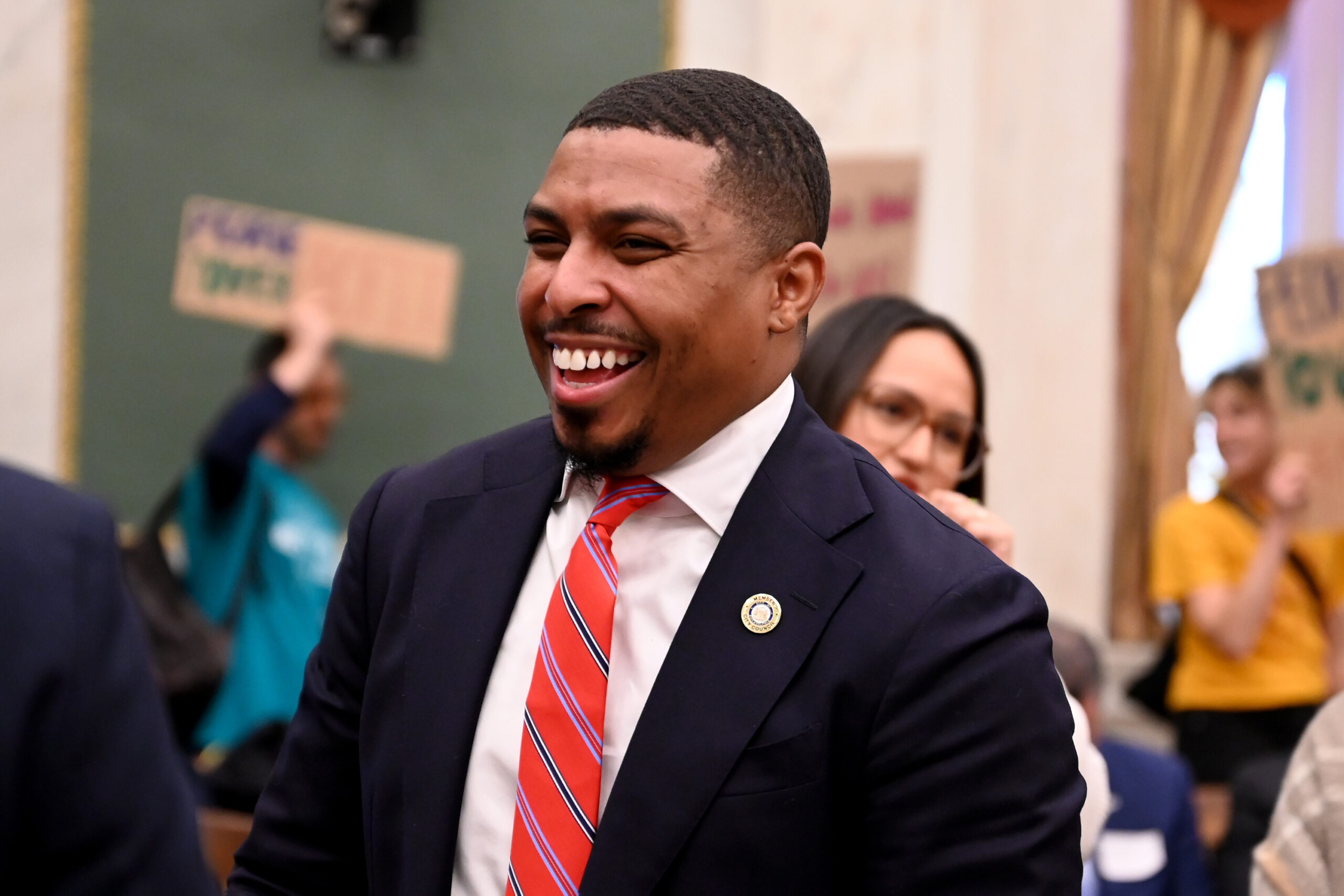
    Councilmember Nicolas O’Rourke in chambers as City Council meets Dec. 11.

    Pennsylvania’s new state EITC opens the door for a far more generous and administratively simple wage tax refund that reaches more residents. Tying the wage tax refund directly to the new state EITC and coordinating with the state can streamline this process.

    Montgomery County, Md., pioneered one practical and high take-up approach: It partners with the state to automatically deliver the refundable portion of its county credit to all residents receiving a refund from the state. The credit is directly deposited or mailed with no additional application required.

    Similarly, Philadelphia can improve eligibility for the wage tax refund by disconnecting it from the state’s income tax forgiveness program and instead linking it to the state’s working Pennsylvanians tax credit. Local policymakers should also automate applications, wage and residence documentation, and payouts.

    Our city’s poverty rate is nearly double the state average. Local refundable credits, such as earned income tax credits and child tax credits, are anti-poverty tools proven to quickly lift incomes and stabilize households facing increasingly high costs. With the federal government retreating from long-standing health and economic security programs, the responsibility now falls even more heavily on states and cities to step up.

    A strengthened, refundable, and automatic local EITC is exactly the kind of targeted investment that can help Philadelphia reverse decades of persistent poverty.

    Kamolika Das is the local tax policy director at the Institute on Taxation and Economic Policy, a nonprofit, nonpartisan tax policy organization that conducts analyses of tax and economic proposals. She lives in Queen Village with her husband and daughter.


  • Pennsylvania was known for an arduous permitting process. New policies aim to accelerate building projects.

    Pennsylvania was known for an arduous permitting process. New policies aim to accelerate building projects.

    When U.S. Steel opted to build a new mill in Arkansas that had originally been planned for Allegheny County, then-Arkansas Gov. Asa Hutchinson joked in 2022 that his state could have the mill built faster than Pennsylvania could have it permitted.

    Three years later, Pennsylvania politicians and business leaders are hopeful that a series of permitting reforms — the latest of which were approved as part of the state’s $50.1 billion budget — have finally flipped that dynamic.

    The reforms, which are designed to expedite Pennsylvania’s Department of Environmental Protection’s permitting process to allow for quicker development, mark a major step forward in a project that has long been a goal for Democratic Gov. Josh Shapiro and Republican leaders in the General Assembly.

    Pennsylvania’s Department of Environmental Protection is responsible for issuing a variety of permits for building plans to ensure they comply with state law and are environmentally safe. The latest reforms will force the agency to automatically approve certain permits relating to stormwater and groundwater within 60 days if it has not completed its review in that time period or sought an extension. For certain permits related to air quality, the changes allow for the permits to be automatically approved 30 days after submission if the DEP has not acted.

    The budget, which Shapiro signed into law last month, also expanded an existing program, called SPEED, that allows companies to hire third-party inspectors for certain permits to expedite the process. And lawmakers required the state to create and maintain a database where companies can easily track the progress of their permit applications.

    For Senate Majority Leader Joe Pittman (R., Indiana), the change represents a paradigm shift in the state. He recalled the 2022 loss of the U.S. Steel mill at a news conference last month.

    “You cannot have economic development without shovels in the ground, and you can’t put shovels in the ground without permits,” Pittman said.

    The reforms, he said, will “provide certainty,” which he called, “critical to economic development.”

    A longtime goal

    Amy Brinton, director of government affairs at the Pennsylvania Chamber of Business and Industry, said it has long been common for businesses to choose other states because of Pennsylvania’s arduous permitting process, and at times begin the process of building in Pennsylvania only to move out of state when permitting becomes a hurdle.

    “We lose a lot of projects to Texas and Ohio because of our complicated permitting process,” Brinton said.

    Remedying this through permitting reforms, as well as expedited certifications, have been among Shapiro’s top priorities as governor.

    “When he took office in January 2023, Governor Shapiro promised to make state government work more efficiently and effectively for Pennsylvanians. Since then, the Shapiro Administration has delivered on that promise to get stuff done — streamlining permitting processes, reducing wait times for licenses, and cutting red tape to attract more businesses to the Commonwealth,“ Kayla Anderson, a spokesperson for Shapiro, said in a statement. ”This budget builds on the Governor’s success.”

    Shapiro signed several executive orders aimed at that goal including developing a “Fast Track” program for high-priority projects. DEP has eliminated the 2,400 permit backlog that existed when Shapiro took office in 2023. Additionally, Shapiro’s office said, the average processing time for all permits dropped to 38 days in 2025 from 53 days in 2022.

    Lawmakers first approved the SPEED program allowing for third-party inspectors in the 2024 budget. Shapiro’s office said the program has already produced results, cutting permit wait times in half in some cases.

    These projects are a key part of Shapiro’s business-friendly approach, which he’s promoted as he bolsters his resume and bipartisan appeal ahead of a 2026 reelection campaign and a potential future presidential run.

    But Senate President Pro Tempore Kim Ward (R., Westmoreland) also celebrated the new reforms, as well as the state’s exit from a multistate carbon cap-and-trade program, as key wins for Republicans.

    “The permitting was awful,” Ward said in an interview last month. “Permitting now, instead of 300 days, we’re at 30 days. It’s amazing that we were able to come together and get that done.”

    Brinton said she is hopeful that the combination of reforms will make it easier for businesses to choose to build in Pennsylvania because the timeline will be more predictable.

    “Improved accountability, greater predictability, faster timelines — those are the key kind of drivers that we’re hoping this will continue to provide to our businesses in the hopes that when they look at Pennsylvania they won’t wince at the fact that this is going to take forever,” Brinton said.

  • Gov. Josh Shapiro schedules a book tour as he stands for reelection, and builds his 2028 profile

    Gov. Josh Shapiro schedules a book tour as he stands for reelection, and builds his 2028 profile

    Days before his memoir is set to hit shelves Pennsylvania Gov. Josh Shapiro will kick off his book tour at Philadelphia’s Parkway Central Library on Jan. 24.

    Shapiro will swing through Philadelphia, New York and Washington, D.C., in the final week of January to promote his book Where We Keep the Light: Stories from a Life of Service, according to events posted online.

    The tour and the book, set for release Jan. 27, will fuel speculation about a potential presidential run in 2028 as Shapiro works to expand his national profile as he also seeks reelection in Pennsylvania next year.

    The forthcoming memoir is expected to detail his life and political career, including the attempted arson attack on the governor’s mansion while he, and his family, slept inside earlier this year on Passover.

    Shapiro, who grew up in Montgomery County and first forged his political brand there, has become a leading figure in the national Democratic Party. The memoir will delve into his vetting to serve as Vice President Kamala Harris’ running mate last year, according to the publicized summary.

    In her own memoir, 107 Days, Harris cited Shapiro’s ambition as a reason she ultimately didn’t ask him to be her vice president and instead opted for Minnesota Gov. Tim Walz. Shapiro remained a regular presence on the campaign trail despite the snub, but Harris’ loss in Pennsylvania has caused much scrutiny of her decision.

    The Pennsylvania governor, Harris wrote, would be unable to “settle for a role as number two” and questioned her about whether he could get Pennsylvanian’s artwork in the vice president’s residence.

    In an interview with the Atlantic, Shapiro called the depiction “complete and utter bulls—.”

    Shapiro also features prominently — and negatively —in Sen. John Fetterman’s memoir.

    The Democratic senator, who has publicly feuded with the governor, described the tension between Pennsylvania’s two top Democrats, which traces back to their time together on the Pennsylvania Board of Pardons when Fetterman was lieutenant governor and Shapiro was state attorney general.

    It’s unclear whether Shapiro will discuss his relationship with Fetterman in the memoir.

    Shapiro’s book tour will kick off at a 3 p.m. event at the Parkway Central Library on Jan. 24. He will also speak at the Kauffman Concert Hall in New York on Jan. 27 and Sixth and I, a historic synagogue and Jewish cultural center in Washington, D.C., on Jan. 29.

  • Some of Philly’s most vulnerable residents say they lost medical care without notice after millions of Pa. state agency letters went unsent

    Some of Philly’s most vulnerable residents say they lost medical care without notice after millions of Pa. state agency letters went unsent

    “Do you realize you are going to end my life by doing this?”

    Eliana Chernyakhovsky said she asked the question through an interpreter over and over again to the Pennsylvania Department of Human Services last week, after her 24-hour, state-funded care was cut off without warning. Her meal provider was also cut off. How would she feed herself? What if her oxygen tank ran out?

    “Fear had risen in my heart,” Chernyakhovsky said in Russian during an interview through an interpreter on Wednesday. “I was genuinely afraid.”

    Chernyakhovsky, 73, of Northeast Philadelphia, was born with spina bifida and has a number of physical disabilities associated with the condition, and uses a wheelchair to get around. She is among the Pennsylvania residents who say they have lost their government-funded services because a state-contracted mail vendor failed to deliver a month’s worth of agency mail.

    That breakdown resulted in 3.4 million letters never getting sent, 1.7 million of which were from the Pennsylvania Department of Human Services — the agency that oversees SNAP food assistance and Medicaid and is tasked with serving the state’s most vulnerable populations.

    Millions of letters from state agencies — including notices of health and SNAP benefit renewal, driver’s license and vehicle registration renewal invitations, vehicle registration cards, and more — were never sent by a mail presort vendor, who was contracted by the state to tray and sort agency mail in order to save money on postage. The failure went undetected for a month until early December, when Gov. Josh Shapiro’s administration fired Harrisburg-based Capitol Presort Services and hired another vendor on a $1 million emergency contract to work through the backlog.

    In Chernyakhovsky’s case, a letter dated Nov. 6 said she had failed to submit a renewal packet to continue receiving in-home care, said her attorney, Louise Hayes of Community Legal Services. Chernyakhovsky had 15 days to appeal to continue receiving services, or else her services would be shut off on Nov. 21.

    But due to the monthlong lapse in state agency mail, Chernyakhovsky did not receive the letter until last week, after funding for her in-home nurses and food services had already been cut off, she said.

    Chernyakhovsky’s home health aides opted to continue her care without pay, and with no assurance they would get paid for the time when her care was restored, because her needs are so great.

    Her services restarted last week thanks to efforts by Community Legal Services while her appeal works its way through the system. As of this week, one of her home health agencies has still not received payment from her insurance company.

    Alexander Aybinder, her day-shift nurse, said Wednesday it was still unclear when he would get paid. But he said he would still come to Chernyakhovsky’s home, no matter what.

    “I will come tomorrow, because she cannot stay without service. I will work,” he said. “She’s absolutely helpless.”

    DHS: Extended deadlines and ‘additional flexibility’

    DHS spokesperson Brandon Cwalina said in a statement Thursday the agency will extend deadlines for appeals and provide “additional flexibility for affected Pennsylvanians.” Residents affected by the mail issue will receive notice of their appeal options and deadline extensions, Cwalina said.

    Medicaid, CHIP, and TANF cash assistance recipients whose benefits were reduced or cut off during the mail delay will have their cases reopened, he added. These cases will be again reviewed to determine if the recipients received the necessary notification of a change in benefits. Renewals for the programs, originally due in December, are now due in January.

    DHS cannot extend renewal deadlines for SNAP benefits due to federal guidelines, but affected SNAP recipients who submit the necessary documentation within 30 days of losing their benefits will be able to have them reopened and backdated, Cwalina said.

    At least two dozen affected so far, with more expected

    At least two dozen Community Legal Services clients have had problems with receiving their benefits because of the mail delay, said Maripat Pileggi, a supervising attorney at CLS. The delay affected state agency letters dated Nov. 3 through Dec. 3, officials have said, and all unsent mail should be received by residents in a few days.

    And as the nonprofit legal agency has tried to help restore critical services to some of its most vulnerable clients, CLS attorney Lydia Gottesfeld said, legal advocates have struggled to reach the departments in DHS that could help them, with phone lines going unanswered or hour-long wait times.

    “It’s been very difficult to get information about these delays,” she added.

    Cwalina said Thursday that any DHS appeal hearings that were missed due to the mail disruption are being reopened and rescheduled, and the agency maintains that its callback system is accessible to recipients.

    Cases like Chernyakhovsky’s are among the first and most urgent that CLS has identified since the state said that a month’s worth of agency mail to residents from DHS and the Pennsylvania Department of Transportation was never sent. Residents like Chernyakhovsky who receive care through the Medicaid-funded home and community-based services program often have the most acute health issues and significant needs, meaning a loss in healthcare services can be catastrophic.

    Gottesfeld expects that more residents will realize in the coming weeks that they lost services — such as food assistance or health insurance — because of missed hearings or deadlines the next time they visit the doctor or grocery store.

    When people lose state-funded services, it is not usually because they suddenly no longer need them, Gottesfeld said. Rather, it is usually due to failing to submit paperwork properly, resulting in a loss of food assistance, healthcare, or other services.

    Questions remain

    It remains unclear how the state agency mail piled up for more than a month before officials noticed, how the backlog was discovered, or where the millions of agency letters were located after the vendor stopped sorting them.

    The reported loss of benefits stemming from the mail delay also comes after several tumultuous months for people who receive public benefits, following a federal government shutdown that cut food assistance, new work requirements to maintain benefits, and future uncertainty under federal cuts passed earlier this year. Shapiro was at the forefront of Democratic opposition to federal cuts to Medicaid and SNAP, and was a vocal critic when the department withheld benefits during the federal shutdown.

    On Thursday, a group of 15 state Senate Republicans, including top legislative leaders, sent a letter to the Pennsylvania Department of General Services citing The Inquirer’s reporting and requesting more information about how the mail delivery failure was discovered, why it took a month to find the backlog, and more.

    “Given the broad scope of this mail delivery failure, it is critical to ensure every effort is made to minimize the impact on our constituents and the disruption it may cause in their lives,” the senators wrote.

    Shapiro’s administration is “exploring all legal options” against the fired vendor, Capitol Presort Services, Cwalina said.

  • SS United States set to sink, despite 11th-hour efforts to intervene

    SS United States set to sink, despite 11th-hour efforts to intervene

    The 990-foot SS United States could be making waves as an artificial reef at the bottom of the Florida Panhandle coast as early as March, according to a tentative timeline from its new owners in Florida.

    Even so, hope still springs eternal for the most ardent swath of ship enthusiasts who would rather see it restored to its former glory than swimming with the fishes.

    As tourism officials in Okaloosa County report being about 80% done with the remediation work required to meet state and federal requirements for sinking, the New York Coalition to Save the SS United States has urged the New York City Council to intervene to the best of its abilities: a move that appeared to be gaining some traction in recent weeks, until it wasn’t.

    A resolution introduced by NYC council member Gale A. Brewer last year finally got a committee hearing in late November.

    The symbolic gesture calls on Congress to pass legislation that would allocate funds for restoration and to bring the ship to New York City’s Gowanus Bay Terminal. It also appeals to President Donald Trump, a fellow New Yorker, to sign the legislation.

    Okaloosa County, respectfully, is hearing none of it.

    “We purchased the vessel specifically to become the world’s largest artificial reef,” said county spokesperson Nick Tomecek. “Anybody that thinks otherwise, that’s just pipe dreams.”

    Brewer is aware the odds are against those hoping to reacquire the ship. She acknowledged the resolution was a “Hail Mary” during last month’s committee hearing.

    Though the resolution moved to the full council, it has not been put on the calendar for a vote — the last session of the year was Thursday.

    The SS United States is pulled out into the Delaware River and ready to bid its farewell from Philadelphia as people gather to watch it leave in the Delaware River in Gloucester City, N.J., on Wednesday, Feb. 19, 2025.

    Brewer could not speak to why the resolution did not get a hearing until a year after she introduced it, but she understands how, despite support on the 51-member council, it has not been put to a vote in the full body.

    “Just like in Philly, we got everything under the sun — restaurants, small business, parking, it’s just endless,” Brewer said. “I think there’s lots of support, but it’s not like number one on anybody’s list.”

    Brewer said the priority would be to stop the sinking of the ship. Once the SS United States was in New York City, preservationists, donors, and lawmakers could figure out the best way to redevelop the ship, though she could see it as a restaurant.

    If this figure-it-out-as-we-go approach sounds familiar, it’s because that was the path the SS United States Conservancy, the ship’s previous owner, took when it bought the vessel in 2011. The conservancy aimed to save the ship from the scrapyard and spent years courting potential developers while it sat parked in Philadelphia, even publishing a 2023 feasibility study for a mixed-use development that would cost about $400 million.

    In many ways, the New York City resolution is also a tried-and-tested approach. As the SS United States faced eviction from its berth along the Delaware River, the conservancy launched public campaigns calling on Florida Gov. Ron DeSantis, New York Gov. Kathy Hochul, and Pennsylvania Gov. Josh Shapiro to step in and help the vessel find a new home.

    Passenger ship aficionados take a last look at the SS United States docked at pier 80 in South Philadelphia Wednesday, Feb. 19, 2025 before it is towed away to Alabama

    The conservancy sent its pleas to then-President Joe Biden, as well as members of Congress on both sides of the aisle.

    Much to the chagrin of preservationists, no politico ever came, despite the conservancy’s assurances that whoever championed the ship would be rewarded with all the jobs redevelopment would create.

    Whether Trump, his administration, or this iteration of Congress would intervene at the eleventh hour is anyone’s guess.

    The New York Coalition to Save the SS United States, which launched as a nonprofit in October 2024, wrote to Trump this year asking him to intervene shortly before the ship left Philadelphia, to no avail.

    In a lawsuit filed in U.S. District Court in Pensacola after the ship’s departure, the coalition said it had “no means of knowing whether the Executive Branch of the United States is even aware of the Letter, let alone whether it is being considered.”

    The White House did not immediately respond to questions about whether the ship’s saga had reached Trump’s desk and if the administration would be inclined to step in.

    Either way, time is working against the coalition.

    The suit warned of how some of the prep work in Mobile, Ala., could hinder preservation efforts.

    “… the twin stacks of SSUS will be removed, as will other parts of her superstructure,” read the suit. “Once this is done, any hope of preserving the Ship afloat and intact will be lost forever.”

    Those smokestacks were indeed removed at the end of summer.

    So were all portholes and windows, along with the ship’s radar mast and propeller, according to an Okaloosa County update last week.

    Despite the coalition’s fears laid out in the suit, Dan Sweeney, who cofounded the group, hit a more optimistic note, saying it was not too late to stop a reefing.

    “The Big U remains an important symbol of America,” he said of the SS United States. “It could also prove to be a robust economic development engine. These two reasons are more than enough for us to continue the effort, and many people across the country agree. For us, it’s ‘damn the torpedoes.’”

    Okaloosa County officials, meanwhile, say the months ahead will be used to finish cleaning the ship, removing nonmetal items, cutting holes throughout the ship because the sinking will not be able to be done with explosives, and coordinating with state and local agencies on a sink date.

    Should work continue at its current pace and no delays in inspections, the SS United States could be sunk as early as March.

    Alex Fogg, the natural resources chief for Destin-Fort Walton Beach, said weather delays, of course, are always possible.

    Tomecek reiterated that the county was working with the SS United States’ previous owners to build a land-based museum, which would feature the eye-catching smokestacks and other preserved ship memorabilia and artifacts.

    He understands the renewed interest in “saving” the ship, though it would have been turned into scrap had Okaloosa officials not stepped in. In any case, Tomecek said, these efforts come too little, too late.

    “I think that when [the SS United States] was sold to the county, a lot of folks kind of woke up and realized what was going on, when, in fact, they should have been worried about her the past 30 years, when she was sitting in Philadelphia,” Tomecek said.

  • ‘Charles Manson,’ a shot at federal workers and a response to Vanity Fair. Here are the highlights from JD Vance’s Pa. visit.

    ‘Charles Manson,’ a shot at federal workers and a response to Vanity Fair. Here are the highlights from JD Vance’s Pa. visit.

    With the midterm elections 11 months away, Vice President JD Vance visited one of the most closely watched swing districts in the country to ask Pennsylvania voters to aim their anger over the economy at Democrats rather than the Trump administration.

    During a speech at Uline Shipping Supplies in Alburtis in the Lehigh Valley, Vance blamed immigrants for the housing shortage and invoked the name of notorious killer and cult leader Charles Manson as he doubled down on President Donald Trump’s rhetoric from the week before in the Poconos.

    Vance’s visit was to U.S. Rep. Ryan Mackenzie’s district, while Trump’s speech last week at the Mount Airy Casino Resort was in U.S. Rep. Rob Bresnahan’s district. Both freshman Republicans won their seats by roughly a percentage point last year and are among the most vulnerable incumbents in Congress headed into 2026.

    Both speeches were billed as being focused on the economy — as Trump and Vance seek to counter Democrats’ message on affordability ahead of next year’s election. But both delved into an assortment of topics.

    Though Vance’s remarks were wide-ranging, the vice president hewed to the White House message that while the price of eggs might still be high, the administration is working to improve pocketbook issues and restore confidence in the economy.

    “Even though we’ve made incredible progress, we understand that there’s a lot more work to do, and the thing that I’d ask from the American people is a little bit of patience,” Vance said.

    Affordability

    Vance didn’t say the affordability crisis is a “Democratic hoax,” as Trump did.

    He just said it’s the Democrats’ fault.

    “When I hear the Democrats talk about the affordability crisis they created,” Vance said, “it’s a little bit like … Charles Manson criticizing violent crime. Look in the mirror, my friend, you are the cause of the problem.”

    It’s a variation of Trump’s line from last week that “Democrats talking about affordability is like Bonnie and Clyde preaching about public safety.”

    Democrats started criticizing the price of eggs when Trump was in office for less than a week, Vance said.

    A woman asked Trump about it, and according to Vance, the president responded, “’Lady, we’ve been here for three days. It takes a little bit of time to fix something that was so fundamentally broken.’”

    Every “single affordability crisis” in the United States — food, housing, medicine, gas — is because we “inherited a nightmare of an economy from Joe Biden,” Vance told the crowd.

    In an unusual explanation of how Biden sent housing costs soaring, for example, Vance explained that the previous administration’s immigration policies were to blame.

    Vance said “20 million illegal immigrants … took homes that, by all rights, go to American citizens, and to the people of this great state.”

    It’s a line that he’s used before, which fact-checkers have flagged. Politifact pointed out that there are around 12 million to 14 million undocumented immigrants living in the United States. And the housing shortage comes from a lack of construction of a sufficient supply of affordable homes, experts say.

    Beyond that, Politifact said, immigrants often share housing with friends or relatives, making their average housing consumption “far smaller than is typical.”

    Democratic Gov. Josh Shapiro, who is up for reelection next year, hit back at Vance on social media and made the case that Trump’s policies, including cuts to Medicaid and tariffs, are exacerbating the cost-of-living headaches for Pennsylvanians.

    “Donald Trump and JD Vance’s economic policies are hurting Pennsylvania. They have raised prices at the grocery store, screwed over our farmers, and gutted healthcare funding,” Shapiro said on X. “I know this Administration thinks the cost of living is a ‘hoax’ — but it’s not, and Pennsylvania families know it.”

    Firing federal workers

    In his speech, Vance made much of the just-released November jobs report, delayed by the government shutdown. Around 64,000 jobs were added to the economy, an improvement over the more than 100,000 jobs lost in October.

    Putting a good face on the big October job loss, Vance told a reporter after his speech that those were federal government jobs eliminated by the Trump administration — with a plan in mind.

    “That is, in a lot of ways, what we’re trying to do under President Trump’s leadership,” Vance said. “We wanted to fire bureaucrats and hire these Americans out here,” Vance said to applause.

    As he spoke, Vance praised Mackenzie for his “dedication to American workers.”

    Asked about the 4.6% November unemployment rate, the highest since 2021 during the pandemic, Vance was able to put a good spin on that as well.

    Many of the unemployed may have lost their jobs two years ago, under Biden, and stopped looking for work, Vance said. Those people aren’t counted in the official unemployment statistics. Now, however, as we see wages rise and more investment into the United States, Vance said, the people sitting out the job search under Biden are getting “off the sidelines” and once again seeking jobs. As they do, they’re being counted as unemployed.

    The high unemployment rate, then, is “exactly what we want,” Vance said. “That is happening under President Trump’s leadership.”

    As he spoke, Vance explained Trump’s ideas to help Americans get by, including omitting taxes on tips and overtime, as well as creating a tax deduction for interest on auto loans.

    These will lead to significant tax refunds, Vance said, adding that middle-class Pennsylvanians will see “the best tax season in 2026 that you’ve ever had.” That’s a result of Americans having “a president and Congress fighting for you for a change,” Vance said.

    Vance responds to Vanity Fair article

    In a tough question from a reporter, Vance was asked about a Vanity Fair article in which Trump’s chief of staff, Susie Wiles, described some of the people in the administration in less-than-flattering ways.

    She said Trump has an “alcoholic’s personality”; Elon Musk is an ”avowed ketamine user” and an ”odd, odd duck”; Budget Director Russell Vought is “right-wing, absolute zealot”; and that Attorney General Pam Bondi ”completely whiffed” in handling the Epstein files.

    As for Vance, Wiles said he’s “been a conspiracy theorist for a decade,” and that Vance’s crossover from a Trump critic to an ally was based on political expediency.

    While Vance didn’t address the latter description, he agreed that he “sometimes” is a conspiracy theorist, but that he only believes “in conspiracies that are true.”

    As an example, he said, he believed in “this crazy conspiracy theory that the media and government were covering up the fact that Joe Biden was clearly unable to do the job.”

    Vance said it turns out that such conspiracy theories are just things that he discovered to be true “six months before the media admitted it.”

    He hastened to add that if anyone in the Trump administration learned a lesson from the Vanity Fair article, it’s that “we should be giving fewer interviews to mainstream media.”

  • Spielberg’s ‘Disclosure Day,’ filmed in New Jersey, drops first trailer

    Spielberg’s ‘Disclosure Day,’ filmed in New Jersey, drops first trailer

    Steven Spielberg wanted New Jersey drivers this year — now they’ll get to see the fruits of their labor on the big screen.

    The first trailer for Disclosure Day, the lauded filmmaker’s new UFO movie starring Emily Blunt, Josh O’Connor, and West Philly’s own Colman Domingo, is out. The production was filmed in parts of South Jersey and Middlesex County earlier this year.

    (Spielberg himself has roots in South Jersey; he spent his early years in Haddon Township.)

    The premise: “If you found out we weren’t alone, if someone showed you, proved it to you, would that frighten you? This summer, the truth belongs to seven billion people. We are coming close to … Disclosure Day.”

    The trailer shows Blunt as a meteorologist who shudders as she experiences some sort of encounter live on air. It includes all the other good stuff: crop circles, deer who are absolutely shook by whatever extraterrestrial activity they’re dealing with, car chases, you know the deal.

    “They tell me the movie is primarily about UFOs and some railroad scenes and car chases,” Woodbine Mayor William Pikolycky told 6abc during filming this spring.

    The film worked under the code name Non-View while filming around Jersey. The original Spielberg sci-fi film has a screenplay penned by his longtime collaborator David Koepp (Jurassic Park, War of the Worlds).

    Disclosure Day was spotted filming scenes in multiple locations, including Tuckahoe, Woodbine, Buena Vista, and Upper Township. Some scenes took place near railroad tracks in Tuckahoe, with state troopers shutting down roads near production sites at the time. Spielberg was also spotted directing a scene with stunt doubles. Locals observed production crews setting up with a large blue screen, likely for special effects work.

    Producers sought locals to work as paid extras, working as background actors in their own cars in Middlesex County in March. The production brought a reported economic boost to the area, with over 150 crew members in town, some who visited local businesses. The New Jersey Motion Picture and Television Commission told 6abc at the time that major film productions are increasingly choosing the state as a location, citing its diverse scenery and financial incentives.

    Just last month, Pennsylvania Gov. Josh Shapiro announced HBO’s Task was awarded a $49.8 million tax credit for filming locally.

    Universal will release Disclosure Day on June 12. It’ll mark Spielberg’s 37th directed film.

    Watch the trailer for Disclosure Day below:

  • In 2026, America needs an anti-AI party | Will Bunch Newsletter

    Sometimes a terrible year can end with a moment of uplift. This actually happened in the last days of 1968, when Apollo 8 took the first humans in orbit around the moon and sent wonder back to a planet struggling with assassinations and riots. Alas, 2025 seems not such a year. A world already reeling from two mass shootings half a world apart learned Sunday night that Hollywood icon Rob Reiner and his wife Michele had been murdered in their home, allegedly by their own son. Boomers like me saw our own journey in that of Reiner — playing a young campus liberal, then taking down the pomposity of classic rock before both an unprecedented streak of classic movies and unparalleled social and political activism. He had more to give, and leaves a void that can’t truly be filled.

    If someone forwarded you this email, sign up for free here.

    Americans fear AI and loathe its billionaires. Why do both parties suck up to them?

    Time’s 2025 person of the year are the architects of AI, depicted in this painting by Jason Seiler. The painting, with nods to the iconic 1932 “Lunch atop a Skyscraper” photograph, depicts tech leaders Mark Zuckerberg, Lisa Su, Elon Musk, Jensen Huang, Sam Altman, Demis Hassabis, Dario Amodei, and Fei-Fei Li.

    “This is the West, sir. When the facts become legend, print the legend.”journalist in the 1962 film, The Man Who Shot Liberty Valance

    The top editors at Time (yes, it still exists) looked west to Silicon Valley and decided to print the legend last week when picking their Person of the Year for the tumultuous 12 months of 2025. It seemed all too fitting that its cover hailing “The Architects of AI” was the kind of artistic rip-off that’s a hallmark of artificial intelligence: 1932’s iconic newspaper shot, “Lunch Atop a Skyscraper,” “reimagined” with the billionaires — including Elon Musk and OpenAI’s Sam Altman — and lesser-known engineers behind the rapid growth of their technology in everyday life.

    Time’s writers strived to outdo the hype of AI itself, writing that these architects of artificial intelligence “reoriented government policy, altered geopolitical rivalries, and brought robots into homes. AI emerged as arguably the most consequential tool in great-power competition since the advent of nuclear weapons.”

    OK, but it’s a tool that’s clearly going to need a lot more work, or architecting, or whatever it is those folks out on the beam do. That was apparent on the same day as Time’s celebration when it was reported that Washington Post editors got a little too close to the edge when they decided they were ready to roll out an ambitious scheme for personalized, AI-driven podcasts based on factors like your personal interests or your schedule.

    The news site Semafor reported that the many gaffes ranged from minor mistakes in pronunciation to major goofs like inventing quotes — the kind of thing that would get a human journalist fired on the spot. “Never would I have imagined that the Washington Post would deliberately warp its own journalism and then push these errors out to our audience at scale,” a dismayed, unnamed editor reported.

    The same-day contrast between the Tomorrowland swooning over the promise of AI and its glitchy, real-world reality felt like a metaphor for an invention that, as Time wasn’t wrong in reporting, is so rapidly reshaping our world. Warts and all.

    Like it or not.

    And for most people (myself included), it’s mostly “or not.” The vast majority understands that it’s too late to put this 21st-century genie back in the bottle, and like any new technology there are going to be positives from AI, from performing mundane organizing tasks that free up time for actual work, to researching cures for diseases.

    But each new wave of technology — atomic power, the internet, and definitely AI — increasingly threatens more risk than reward. And it’s not just the sci-fi notion of sentient robots taking over the planet, although that is a concern. It’s everyday stuff. Schoolkids not learning to think for themselves. Corporations replacing salaried humans with machines. Sky-high electric bills and a worsening climate crisis because AI runs on data centers with an insatiable need for energy and water

    The most recent major Pew Research Center survey of Americans found that 50% of us are more concerned than excited about the growing presence of AI, while only 10% are more excited than concerned. Drill down and you’ll see that a majority believes AI will worsen humans’ ability to think creatively, and, by a whopping 50-to-5% percent margin, also believes it will worsen our ability to form relationships rather than improve it. These, by the way, are two things that weren’t going well before AI.

    So naturally our political leaders are racing to see who can place the tightest curbs on artificial intelligence and thus carry out the will of the peop…ha, you did know this time that I was kidding, didn’t you?

    It’s no secret that Donald Trump and his regime were in the tank from Day One for those folks out on Time’s steel beam, and not just Musk, who — and this feels like it was seven years ago — donated a whopping $144 million to the Republican’s 2024 campaign. Just last week, the president signed an executive order aiming to press the full weight of the federal government, including Justice Department lawsuits and regulatory actions, against any state that dares to regulate AI. He said that’s necessary to ensure U.S. “global AI dominance.”

    This is a problem when his constituents clearly want AI to be regulated. But it’s just as big a problem — perhaps bigger — that the opposition party isn’t offering much opposition. Democrats seem just as awed by the billionaire grand poobahs of AI as Trump. Or the editors of Time.

    Also last week, New York Democratic Gov. Kathy Hochul — leader of the second-largest blue state, and seeking reelection in 2026 — used her gubernatorial pen to gut the more-stringent AI regulations that were sent to her desk by state lawmakers. Watchdogs said Hochul replaced the hardest-hitting rules with language drafted by lobbyists for Big Tech.

    As the American Prospect noted, Hochul’s pro-Silicon Valley maneuvers came after her campaign coffers were boosted by fundraisers held by venture capitalist Ron Conway, who has been seeking a veto, and the industry group Tech:NYC, which wants the bill watered down.

    It was a similar story in the biggest blue state, California, where Gov. Gavin Newsom in 2024 vetoed the first effort by state lawmakers to impose tough regulations on AI, and where a second measure did pass but only after substantial input from lobbyists for OpenAI and other tech firms. Silicon Valley billionaires raised $5 million to help Newsom — a 2028 White House front-runner — beat back a 2021 recall.

    Like other top Democrats, Pennsylvania Gov. Josh Shapiro favors some light regulation for AI but is generally a booster, insisting the new technology is a “job enhancer, not a job replacer.” He’s all-in on the Keystone State building massive data centers, despite their tendency to drive up electric bills and their unpopularity in the communities where they are proposed.

    Money talks, democracy walks — an appalling fact of life in 2025 America. In a functioning democracy, we would have at least one political party that would fly the banner of the 53% of us who are wary of unchecked AI, and even take that idea to the next level.

    A Harris Poll found that, for the first time, a majority of Americans also see billionaires — many of them fueled by the AI bubble — as a threat to democracy, with 71% supporting a wealth tax. Yet few of the Democrats hoping to retake Congress in 2027 are advocating such a levy. This is a dangerous disconnect.

    Time magazine got one thing right. Just as its editors understood in 1938 that Adolf Hitler was its Man of the Year because he’d influenced the world more than anyone else, albeit for evil, history will likely look back at 2025 and agree that AI posed an even bigger threat to humanity than Trump’s brand of fascism. The fight to save the American Experiment must be fought on both fronts.

    Yo, do this!

    • I haven’t tackled much new culture this month because I’ve been doing something I so rarely do anymore: Watching a scripted series from start to finish. That would be Apple TV’s Pluribus, the new sci-fi-but-more-than-sci-fi drama from television genius Vince Gilligan. True, one has to look past some logistical flaws in its dystopia-of-global-happiness premise, but the core narrative about the fight for individualism is truly a story of our time. The last two episodes come out on Dec. 19 and Dec. 26, so there’s time to catch up!
    • The shock and sorrow of Rob Reiner’s murder at age 78 has, not surprisingly, sparked a surge of interest in his remarkable, and remarkably diverse, canon of classic movies. His much-awaited sequel Spinal Tap II: The End Continues began streaming on HBO Max just two days before his death. Check it out, or just re-watch the 1984 original, which is one of the funniest flicks ever made, and which is also streaming on HBO Max and can be rented on other popular sites. Crank it up to 11.

    Ask me anything

    Question: What news value, not advertising value, is accomplished by publicizing every one of Trump’s insane rantings daily? — @bizbodeity.bsky.social via Bluesky

    Answer: This is a great question, and the most recent and blatant example which I assume inspired it — Trump’s stunningly heartless online attack against a critic, Hollywood icon Rob Reiner, just hours after his violent murder — proves why this is a painful dilemma for journalists. I’d argue that Trump’s hateful and pathologically narcissistic post was a deliberate troll for media attention, to make every national moment about him. In a perfect world, it would indeed be ignored. But it was highly newsworthy that his Truth Social post was so offensive that it drew unusual criticism from Republicans, Evangelicals, and other normal supporters. We may remember this is as a political turning point. Trump’s outbursts demand sensitivity, but that Americans elected such a grotesque man as our president can’t easily be ignored.

    What you’re saying about…

    It’s been two weeks since I asked about Donald Trump’s health, but the questions have not gone away. There was not a robust response from readers — probably because I’d posed basically the same question once before. Several of you pointed to expert commentary that suggests the president is experiencing significant cognitive decline, perhaps suffering from frontotemporal dementia. Roberta Jacobs Meadway spoke for many when she lambasted “the refusal if not the utter failure of the once-major news outlets to ask the questions and push for answers.”

    📮 This week’s question: We are going to try an open-ended one to wrap up 2025: What is your big prediction for 2026 — could be anything from elections to impeachment to the Eagles repeating as Super Bowl champs — and why. Please email me your answer and put the exact phrase “2026 prediction” in the subject line.

    Backstory on how I covered an unforgettable year

    Rick Gomez, who travelled 65 hours by bus from Phoenix, Ariz., holds an AI photo composite poster of Donald Trump, in Washington, the day before Trump took the Oath of Office to become the 47th president of the United States.

    Barring the outbreak of World War III — something you always need to say these days — this is my final newsletter, or column, of 2025, as I use up my old-man plethora of vacation days. To look back on America’s annus horribilis, I thought I’d revive a feature from my Attytood blogging days: a recap of the year with the five most memorable columns, not numbered in order of significance. Here goes:

    1. A year that many of us dreaded when the votes were counted in November 2024 began for me with a sad reminder that the personal still trumps the political, when my 88-year-old father fell ill in the dead of winter and passed away on March 11. I wrote about his life, but also what his passion for science and knowledge said about a world that, at the end of his life, was slipping away: Bryan H. Bunch (1936-2025) and the vanishing American century of knowledge.
    2. Still, Donald J. Trump could not be ignored. On Jan. 19, I put on my most comfortable shoes (it didn’t really help) and traipsed around a snowy, chilly Washington, D.C. as the about-to-be 47th president made his “forgotten American” supporters wait on a soggy, endless line for a nothingburger rally while the architects of AI and other rich donors partied in heated luxury, setting the tone for a year of gross inequality: American oligarchy begins as Trump makes billions while MAGA gets left out in the rain.
    3. One of the year’s biggest stories was Trump’s demonizing of people of color, from calling Somali immigrants “garbage” to his all out war on DEI programs that encouraged racial diversity, when the truth was always far different. In February, I wrote about the American dream of a young man from Brooklyn of Puerto Rican descent and his ambition to become an airline pilot, who perished in the D.C. jet-helicopter crash. His remarkable life demolished the MAGA lie about “DEI pilots.” Read: “Short, remarkable life of D.C. pilot Jonathan Campos so much more than Trump’s hateful words.”
    4. If you grew up during the 1960s and ‘70s, as I did, then you understand the story of our lifetimes as a battle for the individual rights of every American — for people to live their best lives regardless of race or gender, or whether they might be transgender, or on the autism spectrum. I wrote in October about the Trump regime’s consuming drive to reverse this, to make it a crime to be different: From autism to beards, the Trump regime wages war on ‘the different
    5. A grim year did end on one hopeful note. Trump’s push for an authoritarian America is faltering, thanks in good measure to the gumption of everyday people. This month, I traveled to New Orleans to chronicle the growing and increasingly brave public resistance to federal immigration raids, as citizens blow whistles, form crowds and protest efforts to deport hard-working migrants: In New Orleans and across U.S., anger over ICE raids sparks a 2nd American Revolution

    What I wrote on this date in 2021

    On this date four years ago, some of us were still treating Donald Trump’s attempted Capitol Hill coup of Jan. 6, 2021 like a crime that could be solved so that the bad guys could be put away. On Dec. 16, 2021, I published my own theory of the case: that Team MAGA’s true goal was provoking a war between its supporters and left-wing counterdemonstrators, as a pretext for sending in troops and stopping Congress from finishing its certification of Joe Biden’s victory. That didn’t happen because the leftists stayed home. More than 1,000 pardons later, check out my grand argument: “A theory: How Trump’s Jan. 6 coup plan worked, how close it came, why it failed.”

    Recommended Inquirer reading

    • Only one column this week, as this senior citizen was still recovering from that grueling trip to New Orleans. On Sunday, I reacted with the shock and sadness of seeing a mass shooting at my alma mater, Brown University. I wrote that in a nation with 500 million guns, it’s a virtual lock that some day our families — nuclear or extended, like the close-knit Brown community — will be struck by senseless violence. And I took sharp issue with Trump’s comment that “all you can do is pray.” There is much that can and should be done about gun safety.
    • Sometimes the big stories are the ones that play out over decades, not days. When I first started coming regularly to Philadelphia at the end of the 1980s, the dominant vibe was urban decline. The comeback of cities in the 21st century has altered our world, for good — but a lot of us old-timers have wondered: Just who, exactly, is moving into all these new apartments from Center City to Kensington and beyond? Last week, The Inquirer’s ace development reporter Jake Blumgart took a deep dive into exactly that — highlighting survey results that large numbers are under 45, don’t own a car, and moved here from elsewhere, and telling some of their stories. Local journalism is the backbone of a local community, and you are part of something bigger when you subscribe to The Inquirer. Plus, it’s a great Christmas gift, and you’ll get to read all my columns in 2026. See you then!

    By submitting your written, visual, and/or audio contributions, you agree to The Inquirer‘s Terms of Use, including the grant of rights in Section 10.

  • As we search for autism’s cause, we ignore those living with it

    As we search for autism’s cause, we ignore those living with it

    Top federal officials talk about finding a cause for autism, generating more buzz by the day. More substantively, the owner of the Philadelphia Eagles gave an extraordinary sum — $50 million — to a local hospital to discover its cause and develop new treatments.

    While such gifts deserve praise, another urgent crisis goes largely unnoticed: how to care for the millions of adults already living with autism.

    Each year, more than 120,000 young people with autism turn 18 and “age out” of pediatric medicine. They enter an adult system that is unprepared to help them. They enter a world with no standardized guidelines for care, no specialized training for physicians, and far less support. Families must navigate a cliff, not a bridge. More than five million adults now push past herculean obstacles for what is often worse care.

    I view this crisis as a pediatric emergency medicine doctor and as the mother of a transition-age autistic son.

    Fear for the future

    We parents are terrified by what will happen to our adult children when we are no longer around to care for them. Parents weep — and sometimes wail — when I refer them to an alternate site for adult care. Our system can no longer remove an appendix or mount a crisis intervention once these children cross over.

    As a doctor, I know how this change can cause unnecessary admissions and a loss of social work and case management. Caregivers must suddenly educate the provider on the patient’s basic needs. As a parent, I watch my son Alexander and others hop from one tiny island of support to another.

    When Alexander broke his arm at age 6, surgeons were called in to pin his shattered bone and clean the wound where the disrupted muscle had burst through the skin. Alexander was ridiculously compliant and poised; I was less so.

    His surgeons accidentally cut one of the three main motor nerves in the arm when they tried to stabilize his floppy elbow. It took many visits over eight weeks to get proper attention. By then, his arm was floppy from a medical error.

    In our home, we work hard to protect him: Trampolines are forbidden, helmets always on, seat belts firmly buckled. Yet, I failed to anticipate how Alexander’s autism could hurt him. This label — his scarlet letter “A” — kept his surgeons at a dangerous distance.

    Could it happen again when I am no longer around?

    We know autistic adults suffer more illness and death compared to their peers. They are more likely to be misunderstood, dismissed, or undertreated. The data are abundant — and damning. We fail these people.

    Deserve tailored care

    I continue to teach Alexander to be responsible for his care so he will thrive when I cannot be beside him. In 2023, the National Institutes of Health formally designated people with disabilities as disadvantaged. I am relieved to see a growing acknowledgment of autistic people as a vulnerable group, at risk for health disparities, deserving of tailored care.

    Justin Pierce (center), who has autism and is an account support associate, meets with his team at Ernst & Young offices in Chicago.

    I have also gained confidence in my voice as an advocate for Alexander. I’ve become a “gang member.”

    Senior staffers for Gov. Josh Shapiro respectfully dubbed my fellow autism advocates as “the mom gang.” It is reassuring only in this context that I present as intimidating. Our band of six wants to make sure that half-baked federal plans to create a national autism registry never happen in Pennsylvania without privacy safeguards.

    Meanwhile, the autism community holds diverse opinions on what to do. Should profound autism be classified separately from other presentations? Is “cure” the right goal? Is Tylenol a risk factor?

    While these conversations pull us in different directions, we must not lose sight of a common purpose to create a better system.

    Autistic adults deserve accessible and affirming change. There are models, tools, and innovations in which to invest:

    • Training emergency, inpatient, and outpatient teams to recognize how autism presents in adults
    • Designing calming public environments that ease communication
    • Creating dedicated consult services — including behaviorists, communication specialists, and caregivers — available in person and via telehealth
    • Prioritizing prevention and de-escalation over restraint
    • Highlighting the voices of autistic individuals in policy decisions that affect them
    • And, critically, funding and scaling programs that treat autism across the lifespan

    Lack of resources

    Resources are scarce. Historic gifts fill some gaps from interrupted government funds pulled from disability and diversity programming. Casualties include the Department of Education’s “Charting My Path for Future Success” transition program, a research-based effort to help high school students with disabilities enter the workforce or higher education.

    We may all agree there is an immediate need to build better supports for adults with autism.

    I worry for my son. I need to know I have pushed every edge of possibility to smooth his way forward. I do this for my daughters, too, who learned from their earliest days their brother needs the same supports they are accustomed to, but he is often denied.

    One day, they will take my place slaying this dragon.

    Eron Friedlaender is a public health investigator, an emergency medicine physician at Children’s Hospital of Philadelphia, and a board member of the Institute for Human Centered Design.

  • Top Pennsylvania Republicans are projecting relative calm amid 2026 national party panic

    Top Pennsylvania Republicans are projecting relative calm amid 2026 national party panic

    The same week Republican National Committee chair Joe Gruters said history predicted “almost certain defeat” for his party in the 2026 midterms, Pennsylvania Republicans partying in Midtown Manhattan projected relative calm about the election cycle.

    Gruters, President Donald Trump’s handpicked chair to run the party, said on a conservative radio station last week: “It’s not a secret. There’s no sugarcoating it. It’s a pending, looming disaster heading our way. We are facing almost certain defeat.”

    He added that the goal is to win and he “liked our chances in the midterms,” but noted “only three times in the last hundred years has the incumbent party been successful winning a midterm.”

    Pennsylvania could decide which party controls the U.S. House next year, as Democrats eye four congressional districts that Republicans recently flipped while the GOP fights to maintain its majority.

    But Pennsylvania Republicans in New York City for the annual Pennsylvania Society glitzy gathering of politicos last weekend had a less hair-on-fire view.

    “At this point when I was running [for Senate in 2024], the betting market said there was a 3% chance I was going to win,” Sen. Dave McCormick (R., Pa.) said after addressing a bipartisan audience at the Pennsylvania Manufacturer’s Association luncheon on Saturday.

    “We’re a million miles from Election Day, and we’ve got a great track record of things to talk about and a great vision for how the president’s policies are going to make life better for working families,” McCormick said. “We just got to go out and make that message happen, but also continue to make the policies that are going to make that a reality happen.”

    The political environment was, of course, far more favorable to Republicans in 2024, when Trump won Pennsylvania by a larger margin than he did in 2016. But with Republicans in power and popular Democratic Gov. Josh Shapiro on the ballot for reelection, the headwinds in 2026 in the Keystone State are different.

    Pennsylvania GOP chair Greg Rothman, in an interview outside the PMA event on Saturday, called Shapiro “one of the greatest politicians of my generation” but noted that upsets have happened across various political environments in state history.

    “Anything can happen and the voters are smart, and all I can do is prepare the party to ride the waves and ignore the crashes, but I’m optimistic,” he added.

    Shapiro will likely face a GOP challenge from State Treasurer Stacy Garrity, who is a popular politician in her own right and holds the record for receiving the most votes of any candidate for statewide office in Pennsylvania.

    Meanwhile, Rothman predicted that the four Pennsylvania congressional incumbents running for reelection in swing districts will sink or swim based on how Trump and his policies land with voters come November.

    “They will be judged by the national economy and by immigration,” he said, and by Trump’s ability to end some international conflicts.

    But U.S. Rep. Rob Bresnahan, a GOP incumbent running for reelection in Pennsylvania’s Eighth Congressional District, which includes Scranton, had a more local view of how to win in 2026.

    “Everything about our job as a member of Congress is about northeastern Pa.,” Bresnahan said.

    “Northeastern Pennsylvania has always been our North Star. We know our district. We are out in our district. We’ve done over 250 public events. Our constituency case work is, in my opinion, one of the best offices in the country.”

    Bresnahan appeared at a rally with Trump in Mount Pocono last week. He was also one of just 20 House Republicans to sign a successful discharge petition to force a vote for collective bargaining to be restored for federal workers.

    “At the end of the day that might have been going against party leadership, but it was what’s right for northeastern Pennsylvania,” he said.

    Democrats have begun a full court press. That was evident at the Pennsylvania Society, where attendees seen mingling with other politicians included: Janelle Stelson, who is running for a second time against U.S. Rep. Scott Perry in the 10th Congressional District, as well as firefighter Bob Brooks and former federal prosecutor Ryan Croswell, both of whom are running for the Democratic nomination to take on U.S. Rep. Ryan Mackenzie in the Seventh.

    Bresnahan’s challenger, Scranton Mayor Paige Cognetti, also attended the soiree and walked through the Rainbow Room atop Rockefeller Center with U.S. Sen. Chris Coons (D., Del.) on Friday night. Coons said the time is now for Democrats to get involved in these races.

    “Given the margin, if there were to be four new Democrats in the House this cycle, as there were in 2018, that’d be the difference maker for the country,” Coons added.

    Staff writer Gillian McGoldrick contributed to this article.