PALM BEACH, Fla. — ’Twas the night before Christmas, and all through the villa, the president assured children that Santa wasn’t a guerrilla.
“Santa’s a very good person,” President Donald Trump said on Christmas Eve, during the annual presidential ritual of helping excited little ones track Santa Claus’ location. “We want to make sure he’s not infiltrated — that we’re not infiltrating into our country a bad Santa.”
This wasn’t exactlywhat Jasper, 10, from Oklahoma, had wanted to know when he dialed the NORAD Santa Tracker on Wednesday afternoon. He had calledto find out where St. Nick and his reindeer were on their nightlong journey circumnavigating the globe, which the hotline “tracks” with the aid of top U.S. military technology.
But out of the phone Jasper rang came a clatter. It was none other than Trump! Nothing was the matter.
The president played along, disclosing Santa’s location, which at that moment, he said, was in the Czech Republic. But first, he offered a few choice observations about Jasper’s own.
“Santa loves Oklahoma like I do,” Trump said. “You know, Oklahoma was very good to me in the election, so I love Oklahoma. Don’t ever leave Oklahoma, OK?”
“OK,” Jasper replied haltingly. “I’ll try.”
Such was Christmas Eve at Mar-a-Lago, the president’s private club in Palm Beach. He had spent the morning at his golf course in West Palm Beach, just across the lagoon, and by the afternoon, he was sitting in a gilded chair before a gilded Christmas tree in his gilded living room, the first lady at his side.
With Melania in her heels and Trump in his tie, the first couple settled down to give Christmas cheer a try. The president took his calls over speakerphone; the first lady took hers murmuring softly into a receiver held closely to her ear: “She’s able to focus totally without listening to this,” Trump said.
Jasper’s 4-year-old sister, Anastasia, told Trump she wanted a dollhouse for Christmas.
“I think we can work that out,” Trump replied. “I think Santa’s gonna bring you the most beautiful dollhouse you’ve ever seen.” (Whether the dollhouse would be subject to his administration’s tariffs, Trump didn’t say. He has been much clearer about dolls, saying earlier this year while imposing globaltariffs that young girls would be “very happy” with just “two or three or four or five.”)
Next was Savannah, 8, from North Carolina, who wanted to know if Santa would be mad if she didn’t leave out cookies for him. The president cocked his head and smirked. “This is getting good!” he told reporters.
“I think he won’t get mad, but I think he’ll be very disappointed,” he counseled Savannah. “You know, Santa’s — he tends to be a little bit on the cherubic side. Do you know what cherubic means? A little on the heavy side. I think Santa would like some cookies.”
Amelia, 8, from Kansas, told Trump she wasn’t sure what she wanted for Christmas. “Not coal,” she said.
“Not coal, no, you don’t want coal,” the president agreed. Then he caught himself. “Well, you mean clean, beautiful coal.” He turned to the media. “I had to do that, I’m sorry,” he said.
“Coal is clean and beautiful,” he told Amelia. “Please remember that, at all costs.”
Next up came a 5-year-old who proudly informed the president she was from Pennsylvania.
“Pennsylvania’s great,” Trump said. “We won Pennsylvania — actually, three times,” he continued. (He did not.)
“This is America,” he said to reporters at one point between calls. The president did not explain what he meant by this.
His last call was with a pair of sisters, ages 6 and 10, from Tacoma, Wash. One of them told Trump she would like a pinball machine for Christmas.
“Pinball machine? That’s great.” Trump said. “You know Elton John?” If she did, she did not say. Nor did she point out that The Who, not Elton John, first released “Pinball Wizard.”
“He did ‘Pinball Wizard,’” the president continued. “We’ll have to send you a copy of ‘Pinball Wizard.’”
Trump didn’t take any questions from reporters, though there were many questions to ask unrelated to Santa’swhereabouts. What about the latest tranche of the Epstein files, which include wide-ranging references to the president? Or the Supreme Court decision that thwarts his planned National Guard deployment in Chicago? Is Nicolás Maduro on the naughty or nice list?
Not today — not on Christmas Eve. Couples were arriving in suits and ball gowns; the aroma of roasting meat wafted through the halls. The club’s celebrations were about to begin, and the president was in the holiday spirit. “Show them the festivities,” he instructed his staff, “and then send them home for Christmas dinner.”
Around 7 p.m., reporters were escorted into the Mar-a-Lago ballroom to take in the teeming dessert platters and his guests’ holiday finest. Trump sat at a table near the center of the room with his wife and father-in-law, cordoned off from his fellow revelers with a velvet rope.
Two minutes later, the media were whisked away. But we all heard him Truth, ere he retired for the night: “Merry Christmas to all, including the Radical Left Scum that is doing everything possible to destroy our Country, but are failing badly.”
U.S. forces struck Islamic State targets in northwestern Nigeria on Thursday evening, following up on threats to the country over killings of Christians, President Donald Trump said in a Truth Social post.
Trump said the military conducted “multiple strikes” but did not elaborate. In a follow-up post, U.S. Africa Command said multiple people it said were ISIS terrorists were killed in strikes in Sokoto State, which is in the northwest portion of the country, bordering Niger, and has become a hot spot for a resurgence in violent extremism and the kidnapping of schoolchildren.
“MERRY CHRISTMAS to all, including the dead Terrorists, of which there will be many more if their slaughter of Christians continues,” Trump posted to social media.
The Pentagon said the Nigerian government approved the strikes and worked with the U.S. to carry them out. No further details on how the strikes were conducted were immediately available.
A spokesperson for the Nigerian foreign ministry confirmed the U.S. strike Thursday evening, saying that “precision hits on terrorist targets in Nigeria by air strikes” had been carried out in response to the “persistent threat of terrorism and violent extremism.”
“Terrorist violence of any form, whether directed at Christians, Muslims or other communities remains an affront to Nigeria’s values,” the statement from spokesperson Kimiebi Imomotimi Ebienfa said.
For months Trump and Republican lawmakers, including Sen. Ted Cruz of Texas andReps. Tom Cole of Oklahoma, Mario Diaz-Balart of Florida, and Riley Moore of West Virginia, have raised alarms about killings of Christians in Nigeria amid larger ethnic and religious bloodshed. Trump had previously directed the Pentagon to plan potential military action in Nigeria, and earlier this month the State Department restricted visas for Nigerians involved in the violence.
Trump threatened an attack in Nigeria early last month, writing on his Truth Social site that: “If the Nigerian Government continues to allow the killing of Christians, the U.S.A. will immediately stop all aid and assistance to Nigeria, and may very well go into that now disgraced country, ‘guns-a-blazing,’ to completely wipe out the Islamic Terrorists who are committing these horrible atrocities.”
His post followed a meeting in Washington between top advisers and representatives of religious groups and came after he watched a Fox News segment on the topic aboard Air Force One, the Washington Post reported. The push to make the issue an administration priority was long in the making, according to three people with knowledge of the situation, but the president’s threat of military action was entirely unexpected, they said.
The Council on Foreign Relations reported earlier this year that the Sahel, a region that spans multiple countries across Central Africa including Niger, Nigeria, Mali, Chad, and Sudan, has seen a significant uptick in the growth of violent extremist organizations as a result of decreased international counterterrorism support.
U.S. forces lost access to key counterterrorism bases in Niger and Chad in 2024. In their place, a number of proxy military groups such as the Russian-backed Wagner Group have filled in.
But the Trump administration has been looking at ways to reduce the U.S. role in Africa overall as it shifts to a strategy that will focus more military assets and attention to the Western Hemisphere. The administration is also looking at potentially consolidating U.S. Africa Command into a theater command that would also include U.S. European Command and U.S. Central Command, which could further reduce the attention and resources the region would receive.
That proposal drew concern from some lawmakers, including Democratic Sen. Chris Coons of Connecticut, who cautioned against the U.S. pulling back given Africa’s young and quickly growing population and economic importance.
Nigeria is a diverse, multiethnic country split between the mostly Muslim north and predominantly Christian south. The country’s 230 million people are roughly split between Christians and Muslims. While violence has sometimes targeted Christians, it has also deeply affected Muslims, according to Nigerian and Western analysts.
Most violence in Nigeria has taken place in the northeast, where the extremist groupBoko Haram has regularly attacked churches and kidnapped children for more than a decade as part of its campaign to build an Islamist state through violence.
MARACAY, Venezuela — This was not the Christmas that Mariela Gómez would have imagined a year ago. Or the one that thousands of other Venezuelan immigrants would have pictured. But Donald Trump returned to the White House in January and quickly ended their American dream.
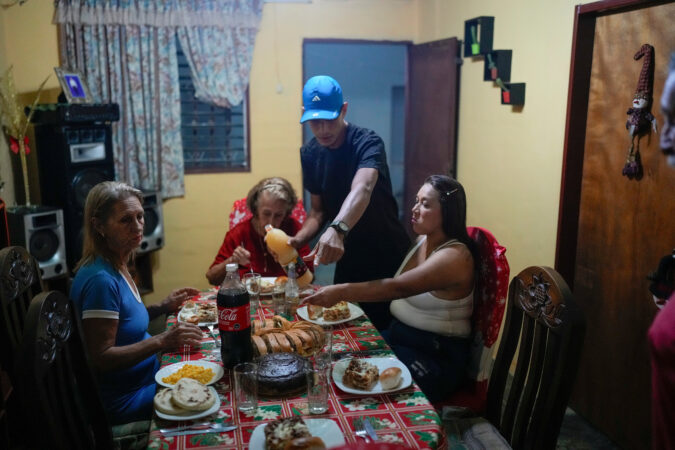
So Gómez found herself spending the holiday in northern Venezuela for the first time in eight years. She dressed up, cooked, got her son a scooter, and smiled for her in-laws. Hard as she tried, though, she could not ignore the main challenges faced by returning migrants: unemployment and poverty.
“We had a modest dinner, not quite what we’d hoped for, but at least we had food on the table,” Gómez said of the lasagna-like dish she shared with her partner and in-laws instead of the traditional Christmas dish of stuffed corn dough hallacas. “Making hallacas here is a bit expensive, and since we’re unemployed, we couldn’t afford to make them.”
Gómez, her two sons, and her partner returned to the city of Maracay on Oct. 27 after crossing the U.S.-Mexico border to Texas, where they were quickly swept up by U.S. Border Patrol amid the Trump administration’s crackdown on immigration. They were deported to Mexico, from where they began the dangerous journey back to Venezuela.
They crossed Central America by bus, but once in Panama, the family could not afford to continue to Colombia via boat in the Caribbean. Instead, they took the cheaper route along the Pacific’s choppy waters, sitting on top of sloshing gasoline tanks in a cargo boat for several hours and then transferring to a fast boat until reaching a jungled area of Colombia. They spent about two weeks there until they were wired money to make it to the border with Venezuela.
Gómez was among the more than 7.7 million Venezuelans who left their home country in the last decade, when its economy came undone as a result of a drop in oil prices, rising corruption, and mismanagement. She lived in Colombia and Peru for years before setting her sights on the U.S. with hopes of building a new life.
Trump’s second term has dashed the hopes of many like Gómez.
As of September, more than 14,000 migrants, mostly from Venezuela, had returned to South America since Trump moved to limit migration to the U.S., according to figures from Colombia, Panama, and Costa Rica. In addition, Venezuelans were steadily deported to their home country this year after President Nicolás Maduro, under pressure from the White House, did away with his long-standing policy of not accepting deportees from the U.S.
Immigrants arrived regularly at the airport outside the capital, Caracas, on flights operated by a U.S. government contractor or Venezuela’s state-owned airline. More than 13,000 immigrants returned this year on the chartered flights.
Gómez’s return to Venezuela also allowed her to see the now 20-year-old daughter she left behind when she fled the country’s complex crisis. They talked and drank beer during the holiday knowing it might be the last time they share a drink for a while — Gómez’s daughter will migrate to Brazil next month.
Gómez is hoping to make hallacas for New Year’s Eve and is also hoping for a job. But her prayers for next year are mostly for good health.
“I ask God for many things, first and foremost life and health, so we can continue enjoying our family,” she said.
DNIPRO, Ukraine — The cherished, century-old Ukrainian song that Americans know as “Carol of the Bells” was written for layers upon layers of voices to fill churches, concert halls, and city squares.
But in wartime, Ukrainians have learned to improvise.
For one choir displaced by Russian bombardment from the very city where many believe the song was written, that means arranging the complex choral melody for just three singers this Christmas, down from the usual 30.
Hearing the arrangement performed by just three singers gives a sense of Ukraine after years of war at the moment: depleted, persistent, still beautiful.
The choir is from a historic music school in the besieged eastern city of Pokrovsk — an institution so tied to the original Ukrainian song, called “Shchedryk,” or “Bountiful,” that it bears the name of its composer, Mykola Leontovych.
The piece has long served as an unofficial anthem for the city, where he lived from 1904 to 1908.
“Wherever we would go, we would sing this song,” said Alla Dekhtyar, 67, the school’s choir director, who will be one of its three singers to perform at the school’s downsized holiday concert this month. “It was like our business card.”
That was before Russia’s devastating advance on Pokrovsk forced most residents — including every member of the choir — to flee elsewhere in Ukraine or Europe.
The Leontovych music school evacuated its most precious instruments in 2024, and drone footage of the city shows the building has since been largely destroyed. Russian forces now control about 95% of what remains of the city, which they aggressively shelled like so much of Ukraine they have sought to control.
The Leontovych school reopened in exile last year in Dnipro, about 115 miles to the west.
But with Pokrovsk’s population so widely scattered, the choir that once blended dozens of voices for regular performances in Pokrovsk is down to just two sopranos and an alto, including Dekhtyar.
Even so, the trio will go ahead with the modified rendition of “Shchedryk” this year. Choosing another, simpler song to perform at the forthcoming holiday concert was never an option.
Singing the song in its original Ukrainian remains an act of resistance against Russian aggression — and a reminder of Ukraine’s contributions to the global cultural canon.
That is especially true for those displaced from Pokrovsk. While the song is beloved across Ukraine, it is particularly special for the eastern city, where many believe Leontovych began writing it long before it premiered in Kyiv in 1916 and stunned an American crowd at Carnegie Hall in 1922.
“For everyone else, that melody means Christmas,” said Angelina Rozhkova, director of the Pokrovsk Historical Museum, who also lives in exile in Dnipro. “For us, that melody means home — a home that we don’t have anymore, a home that is in ruins.”
“For Russia,” she added, “our home means territory that they want to take from us.”
Leontovych was the son of an orthodox priest and an aspiring music teacher. In 1904, he moved with his young wife to the small eastern village of Hryshyne — a hub for rail workers expanding the train line, which eventually became Pokrovsk.
Leontovych was born in the Vinnytsia region of central Ukraine in 1877, and there are competing tales of how he ended up so far east. One version is that he heard about a job posting to teach music at the railway school from rail workers themselves, Rozhkova said. Another claims he responded to a newspaper ad.
Once there, he directed several musical groups, including a choir of rail workers. They sang songs with Ukrainian, Russian, and Jewish roots — but his own music was influenced by sounds from his childhood. Leontovych was a fierce believer in an independent Ukrainian state, and as he gained fame he was viewed, like other Ukrainian intellectuals, as a threat to Russia’s influence over a country it claimed as its own.
“He is connected to the culture of Donbas,” Rozhkova said, referring to the part of eastern Ukraine that includes Pokrovsk, and which Russia is trying to conquer. “He was very much carrying the flag of Ukrainian culture. He was performing repurposed traditional Ukrainian songs with his choir.”
Historians believe that the opening notes of “Shchedryk” — the same ones that have come to signal the start of the Christmas season around the world — originated from a folkloric melody Leontovych heard sometime in his childhood, or that a choir member shared with him from their own memories.
In the original version — the one still sung in Ukraine — there is no “ding dong, ding dong,” no mention of silver bells, no announcement that “Christmas is here.”
The lyrics never even mention Christmas.
Instead, voices describe a swallow fluttering through the sky as it ushers in a prosperous new year, urging a farmer to greet his newborn lambs and celebrate his future. It is because of that Pokrovsk includes a drawing of a swallow on the city’s crest, which is based on a piece of art made by Leontovych’s father.
The song made its major debut abroad only in 1922, one year after a Soviet security agent assassinated Leontovych over his nationalist views. A Ukrainian choir promoting the country’s independence and cultural heritage performed it in Carnegie Hall that year to remarkable reviews — although some American newspapers wrongly praised it as Russian music.
Eventually, Ukrainian American composer Peter Wilhousky adapted the song with a completely different set of lyrics in English, transforming it into a Christmas classic.
“When Leontovych was writing ‘Shchedryk,’ he didn’t understand he was creating a hit,” said Elmira Dzhabrailova-Kushnir, 39, a cultural history specialist in Kyiv. “For him, this was an ethnic study.”
He built the iconic song around the distinct opening notes, building it out into a masterpiece that weaves different voices and melodies into a singular experience for the audience.
“He took three notes and, through his genius, worked it into that song,” Dekhtyar said.
A week before Christmas, Dekhtyar and her trio from Pokrovsk gathered in the new Leontovych music school to rehearse.
The building in Dnipro is cozy and clean, the practice rooms complete with pianos evacuated from Pokrovsk last year.
But the space lacks most of the memories and people that made it home. Albums of archival photos dating back decades sit stacked in a corner. A painting of Leontovych leans against the wall.
Dekhtyar, who used to direct the choir, now sings in it as lead soprano. Her daughter, Natalia Aleksahina, 44, who also teaches vocals at the school, has taken the alto part. Their friend Viktoriia Ametova, 43, joined Dekhtyar as second soprano.
Behind them, a Christmas tree illuminated the corner. Holiday lights twinkled on the walls. But there was little to celebrate. Inside, each singer’s happy memories of home were buried under the pain of leaving.
Aleksahina fled home with her mother in April 2022 after a Russian cluster munition tore through the roof of her parents’ home.
Her 12-year-old daughter was there at the time of the attack but was unharmed. Her father was lightly wounded. The family expected the war would soon end and they would return home and rebuild. They occasionally visited Pokrovsk even as they settled in a rental apartment in Dnipro.
But as Russian forces slowly advanced and a mandatory evacuation order was issued in August 2024, they began to realize their temporary displacement might not be temporary after all.
“It’s a painful subject,” Dekhtyar said. “We all had our own houses. Now there’s nothing left.”
“There’s nothing left,” her daughter repeated. “Our friends, social circle, family — everyone is scattered all over the place.”
Ametova left amid evacuation orders in August 2024, after her neighbor’s building was badly damaged. She still carries the keys to the house and apartment she owns in Pokrovsk everywhere she goes, even if she can’t confirm they’re still standing.
When she thinks of home, Ametova said, “I feel pain.”
The trio agree that singing is one of the only reprieves they have left. And nothing makes them feel better than singing “Shchedryk,” a song they can’t remember not knowing —- a song that lives in them deeper than any other memory.
They stand up. They close their eyes. Dekhtyar raises her hands. They are just three voices, but together, they fill the entire room with the precious sound of home.
WRIGHTWOOD, Calif. — Another powerful storm system threatening to soak Southern California with its wettest Christmas in years rolled into the region on Thursday, bringing the potential for more flooding and mudslides a day after heavy rain and gusty winds were blamed for at least two deaths.
Forecasters warned the additional rain could increase the risk of debris flows in waterlogged areas scorched by wildfires in January. Those burn scar zones have been stripped of vegetation by fire and are less able to absorb water.
Outside of California, a major storm system was moving toward the Midwest and Northeast and was expected to interfere with travel, according to the National Weather Service.
A mix of freezing rain and sleet could create icy conditions across much of Pennsylvania and parts of Michigan and Maryland. Forecasters warned significant ice accumulation on tree limbs and power lines could cause outages. Heavy snow was expected to blanket the Northeast early Friday.
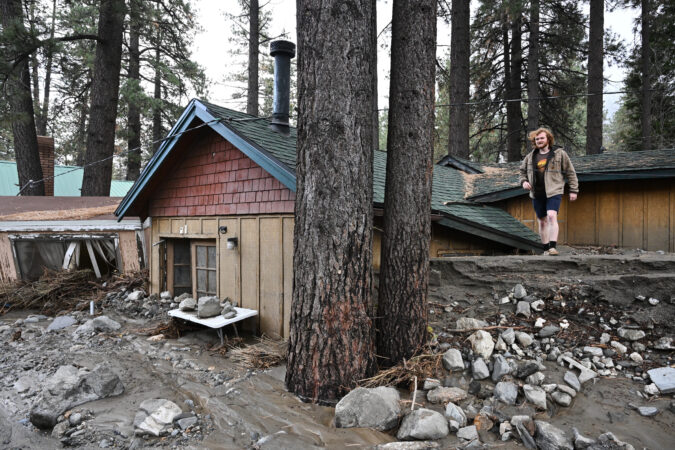
The San Bernardino County Sheriff’s Department in Southern California issued an evacuation warning for Wrightwood, a mountain town about 80 miles northeast of Los Angeles, due to a risk of mudslides.
County firefighters on Wednesday said they rescued people trapped in cars when mud and debris rushed down a road leading into Wrightwood. It was not immediately clear how many people were rescued.
Roads in the town of about 5,000 people were covered in rocks, debris, and thick mud on Thursday. With power out, a local gas station and coffee shop running on generators were serving as hubs for residents and visitors. Statewide, more than 80,000 people were without power Thursday evening, according to PowerOutage.us.
“It’s really a crazy Christmas,” said Jill Jenkins, who was spending the holiday with her 13-year-old grandson, Hunter Lopiccolo.
Lopiccolo said the family had almost fled the previous day, when water washed away a chunk of their backyard. But they eventually decided to stay and still celebrated the holiday. Lopiccolo got a new snowboard and e-bike.
“We just played card games all night with candles and flashlights,” he said.
Resident Arlene Corte said roads in town turned into rivers, but her house was not damaged.
“It could be a whole lot worse,” she said. “We’re here talking.”
With more rain on the way, more than 150 firefighters were stationed in the area, said San Bernardino County Fire spokesperson Shawn Millerick.
“We’re ready,” he said. “It’s all hands on deck at this point.”
Deaths and heavy rain
A falling tree killed a San Diego man Wednesday, news outlets reported. Farther north, a Sacramento sheriff’s deputy died in what appeared to be a weather-related crash.
Residents around burn scar zones from the Airport Fire in Orange County were under evacuation orders.
Areas along the coast, including Malibu, were under a flood watch until Friday afternoon, and wind and flood advisories were issued for much of the Sacramento Valley and the San Francisco Bay Area.
The storms were the result of multiple atmospheric rivers carrying massive plumes of moisture from the tropics during one of the busiest travel weeks of the year.
Southern California typically gets half an inch to 1 inch of rain this time of year, but this week many areas could see between 4 and 8 inches with even more in the mountains, National Weather Service meteorologist Mike Wofford said.
Snow at higher elevations
More heavy snow was expected in the Sierra Nevada, where wind gusts created “near white-out conditions” in places and made mountain pass travel treacherous. Officials said there was a “high” avalanche risk around Lake Tahoe and a winter storm warning was in effect through Friday.
Ski resorts around Lake Tahoe recorded about 1 to 3 feet of snow overnight, said Tyler Salas, a National Weather Service meteorologist in Reno, Nev. Forecasters expect to see up to another 3 feet of snow through Friday, Salas said. The area could see 45 mph gusts of wind in low elevation areas and 100 mph winds along mountain ridges.
Gov. Gavin Newsom declared a state of emergency in six counties to allow state assistance in storm response.
The state deployed emergency resources and first responders to several coastal and Southern California counties, and the California National Guard was on standby.
NEW ORLEANS — Dinnertime had just ended when there was a loud knock at the door. Jhony grabbed his ID card and the documents showing he had protection from deportation. His wife, Aracely, rushed the children upstairs.
Six years ago, Jhony had arrived in New Orleans and found work helping renovate the Superdome,which became a symbol of the city’s fortitude after Hurricane Katrina. Now he stood inside his home with an ear to the door as his mind raced through what he would do if someone broke through. Aracely peeked through their window curtains.
Two immigration officers stood outside.
The men wore masks, protective vests, and caps, the couple later recounted. One of them pounded on the door four times. It was raining, and they stood waiting on Jhony and Aracely’s stoop for several minutes. Then they left. Jhony relaxed, but not completely. His papers, earned after filing a complaint with the U.S. Department of Labor for wage theft, did not give him a legal status, and he knew they did not entirely shield him or protect his family.
“We came because at our home, there was no peace,” Jhony said of relocating to the U.S. as agents drove slowly through his neighborhood in a convoy of Chevy Suburbans again the next afternoon. “I feel like I am reliving my life in Honduras, but here.”
Hondurans have been arriving in New Orleans in search of work since the city emerged as a key port in the banana trade over a century ago. They have continued to settle here in successive waves ever since, fleeing political turmoil and poverty in their homeland and helping rebuild after Hurricane Katrina in 2005. A bronze-and-marble statue depicting a Latino worker with a hammer stands in the city in honor of their contributions.
For many Hondurans, the Department of Homeland Security’s launch of Catahoula Crunch in early December has felt like whiplash. The operation’s name is a reference to the Catahoula leopard dogs trained by early Louisiana settlers to hunt wild boar. DHS contends the operation is needed to remove criminals released under “sanctuary” policies that limit local law enforcement from cooperating with federal immigration officers. So far, federal officershave arrested more than 250 people, including at least two dozen they say have criminal records, some of whom are Honduran.
“They honored us for rebuilding the city, doing work no one else would,” said Mario Mendoza, another undocumented Honduran construction worker. “They called us essential workers during the pandemic. Now, we are criminals?”
Latino-owned businesses have locked their doors, and some immigrants are sleeping at their workplaces because they fear being stopped by federal officers on their way home. Construction sites are emptying. Mothers of newborns are sending breast milk via courier to their hospitalized infants or skipping follow-up appointments. Food banks are begging undocumented families not to come in person but to send someone else.
For Jhony and his family, the DHS sting has required painful decisions. The couple spoke on the condition that they be identified by only their first names because they fear being targeted by immigration officers. He and his wife want their five children to advance in school, but they are also terrified they could get detained while walking them there. All but one, the youngest, are undocumented.
Some days, they feel brave and go. Others, they don’t.
After the knock at the door, no one left the house for four days.
‘Invisible’
Jhony arrived in New Orleans in 2019, he said, after his sister, a schoolteacher, was hacked to death by gang members with machetes after a dispute with a local leader. After the killing, Jhony said, the men began to stalk him. A vehicle no one recognized parked outside his family’s home every night. Fearful for their lives, Jhony and his wife said, they decided to head north. They closed the restaurant they ran and set out with their four children.
They crossed illegally on foot, each parent clutching two of their children. Aracely held the youngest, a 1-year-old girl.
They headed to New Orleans because they knew other Hondurans had found work there. Generations of their compatriots had made the city and its adjacent parishes home before them. Hondurans began settling here in the early 1900s as the city became a major hub for United Fruit and Standard Fruit. Both enterprises had lucrative banana plantations in Honduras, and many Hondurans found work in docks and offices in New Orleans.
Another wave of migrants arrived a half-century later as Honduras was struck by political and economic instability, some of it fueled by U.S. support for the nation’s military during the Cold War, and again after Hurricane Mitch left much of the country in ruins in 1998.
The Honduran arrivals built businesses and integrated into the city’s multiethnic culture while introducing their own, one baleada — a traditional taco-like Honduran staple — at a time.And although many arrived as undocumented immigrants, in 1999, the Clinton administration granted Hondurans temporary protected status, reasoning that the widespread destruction caused by Mitch made it unsafe for many to return home. Temporary protected status was not a pathway to citizenship, but it spared tens of thousands from deportation.
Then came Katrina. In the months and years after Hurricane Katrina, thousands of Hondurans arrived in New Orleans to work when the city needed help rebuilding entire neighborhoods destroyedby the storm. Tens of thousands of workers descended on the city, and studies estimate nearly half were immigrants and at least a quarter of all workers were undocumented Latinos. Nearly a third of the undocumented were Honduran, and large numbers stayed in the region.
“Hondurans are integral to the history of this place,” said Sarah Fouts, who is writing a book on the history of immigrant labor in New Orleans post-Katrina. “They’ve created homes and they’ve made their spaces and earned their spaces visibly in churches, through restaurants and local soccer leagues. But there are also ways in which they are invisible within the rebuilt infrastructure.”
Hondurans kept arriving even after most of the initial rebuilding was complete. Established networks of friends and family made finding jobs easier, and while some aspects of life improved in Honduras, political corruption and insecurity continued to push people out. Jhony found work within weeks of arriving. He said he worked on road and bridge repairs, home demolitions, and reconstruction. Some of it was long-delayed work from Katrina and, later, part of the recovery from Hurricane Ida in 2021.
A year later, Jhony was hired as part of a subcontracting crew to help with concrete demolition and interior renovations at the Superdome ahead of the 2025 Super Bowl between the Philadelphia Eagles and the Kansas City Chiefs.
“It felt like God had brought us here because we settled quickly,” he said.
A UH-1Y Venom helicopter from Marine Light Attack Squadron 773 flies over the Superdome on Feb. 8 ahead of the Super Bowl between the Philadelphia Eagles and the Kansas City Chiefs in New Orleans.
But the commemorative statue to honor Latino immigrant workers and the words of solidarity and gratitude that followed Katrina’s aftermath had begun, in recent years, to feel like relics of a time and sentiment that no longer existed. An estimated 23,000 immigrants arrived in Louisiana in the last two years of the Biden administration — one of the largest influxes the state had seen in decades.
New Orleans itself had adopted policies to limit cooperation between local police and federal immigration officers, but the surrounding suburbs where many Honduran immigrants had built their homes took a different approach.
After President Donald Trump was sworn into office again in January, police departments in Kenner and Gretna signed up to partner with Immigration and Customs Enforcement through a program known as 287(g). The initiative trains local officers to carry out some of the functions of a federal immigration agent. Traffic stops ended in immigration arrests. Officers handed jail inmates over to ICE. They chasedand arrested day laborers outside hardware stores.
Republican Gov. Jeff Landry and state lawmakers simultaneously pushed measures to mandate state police cooperation with federal agents in an effort to buoy the Trump administration’s mass deportation campaign. Landry argued that the Biden administration had failed to thoroughly vet the people it had allowed in, and that new immigrants were both a danger and a burden to states now responsible for providing services like education for their children.
“Entering this country illegally doesn’t make you immune from the law,” he said as Catahoula Crunch got underway. “If you commit crimes here, you face consequences — just like any citizen who breaks the law.”
Homero López, legal director of the New Orleans-based Immigration Services and Legal Advocacy organization, said it is not an exaggeration to say that nearly everyone in New Orleans has had work done on their homes or businesses by unauthorized immigrants or has hired undocumented labor. It is not a hidden fact, he said, but it is an inconvenient one for state and federal lawmakers who have not provided a long-term solution.
“We’re still working off of something that was built in 1965,” López said,referring to the Immigration and Nationality Act, which established the framework for immigration to the United States still used today. “The world has significantly changed in 60 years, but we haven’t really changed our immigration system very much in those same 60 years.”
Jhony and his wife contacted an immigration attorney when they arrived in New Orleans, but despite his sister’s slaying, he said, he was counseled not to file an application for asylum. To qualify, migrants must prove they face persecution based on their race, religion, nationality, political opinion, or belonging to a particular social group — and the lawyer told them they probably would not meet those requirements. So they opted to wait.
His work at the Superdome paid well — when his bosses did pay, he said. But Jhony and his coworkers were routinely not paid for overtime work, and he said they lost thousands of dollars. He filed a complaint with the U.S. Department of Labor with the help of a national advocacy organization for day laborers. The agency investigated the claims, finding employers violated federal overtime work laws and underpaid laborers by misclassifying them and keeping incomplete records. The workers negotiated thousands of dollars in back wages, and the victory made Jhony eligible for a Biden-era program that offered protections to workers who blow the whistle on labor violations.
Jhony got a Social Security card, work authorization, and a promise from the federal government that he would not be removed to Honduras. But those protections did not offer a path to a legal status or any guarantee he would not be deported to another country. He knew he would be vulnerable when immigration agents came to town.
Fear
Drones buzzing in their suburban New Orleans neighborhood were the first unnerving signs that federal immigration officers were about to arrive. Two hovered in the backyard of their duplex apartment. Vehicles with out-of-state plates and dark-tinted windows then began circling the streets and watching as people walked their children to school. Some agents took photos of cars, neighbors, homes.
Aracely quit her part-time job at a restaurant. They scaled back meals to basics like tortillas and beans to save money. They began relying on friends and grocery delivery services to avoid trips outside the home. And they joined a neighborhood messaging group that shared tips on ICE’s and Border Patrol’s whereabouts.
It is a half-mile walk to the local elementary school. To get there, Aracely and two of her children, ages 7 and 9, walk past rows of townhouses and neighbors out with their dogs. The couple has tried to keep their children’s lives as normal as possible. On the days when immigration officers are not spotted nearby, Aracely feeds them breakfast, braids her daughter’s hair, and escorts them to the school’s entrance.
Forecasters had warned of rain one such morning. The children threw on jackets and walked outside. Then Aracely noticed a white unmarked vehicle following them.
She turned toward the vehicle and locked eyes with a man inside wearing a vest, mask, and cap.
“ICE is behind me,” she texted her husband.
The car’s engine accelerated. The driver got closer. But then he turned.
There were sightings and scares like this all around the Jefferson Parish communities where Hondurans had made their homes. Jefferson Parish is a Republican stronghold, but among council member at-large Jennifer Van Vrancken’s constituents, the arrests sparked concern. Border Patrol officers clad in black neck gaiters pulled up over their mouths descended on a Home Depot in Kenner and a Lowe’s in Elysian Fields. They used a fire department ladder in Slidell to arrest three workers from the roof of a condominium under construction. One hotel reported that it had no housekeeping staff.
“My constituents voted for President Trump and absolutely are supportive of any effort to close the border and to get dangerous illegals out of the country,” Van Vrancken said. “But they did not envision what we have now. They are very disturbed by what seems to be a ‘pick everybody up and ask questions later’ approach.”
She said that Kenner, a city within the parish, is home to the largest community of Hondurans outside that country and that large numbers of them are legal residents who are too afraid to go to work amid the seemingly indiscriminate roundups. Van Vrancken said she is meeting with local law enforcement, ICE, and Hispanic business leaders to learn whether there is a way to “fine-tune the process.”
“I don’t understand why the unmarked cars and masking is necessary. It just seems aimed at fear,” said Van Vrancken, who describes herself as an outspoken Republican in favor of detaining people with no legal right to be in the country. “If our everyday brave men and women can show up in a uniform and marked car, why is it any different in this scenario?”
Home builders say Catahoula Crunch is exacerbating an already steep labor crisis. Even workers who have a legal immigration status are afraid of being stopped, said Dan Mills, chief executive of the Home Builders Association of Greater New Orleans. The result is an increase in labor costs because the supply of workers is shrinking while demand remains high. He pointed to work being done by several local contractors to improve homes through a federal grant program. Projects that were estimated to cost $8,000 per home have now risen to $10,000.
“If we don’t have workers, we can’t move projects forward,” Mills said.
No Christmas lights
The day Aracely was followed had spooked them all. Jhony began checking his phone every 15 minutes for neighborhood updates. Their two older children ran home from their bus stop through the rain because they were afraid of being grabbed.
Aracely was making tortillas later that week to eat with a stew her brother-in-law had brought over. Her hands made a slight slapping sound as she molded the flour disks. Then she looked at her phone and paused.
“He’s here,” she said, walking over to her husband. “They’re here on our street.”
Border Patrol Commander Gregory Bovino was inside a giant SUV surrounded by a caravan of immigration officers and state police driving slowly on a street alongside their building.
Customs and Border Patrol Commander Gregory Bovino walks with border patrol agents through a neighborhood during an immigration crackdown, in Kenner, La., on Dec. 5.
“Don’t open your doors for anyone!” neighbors texted. “Chicos, La Migra está aquí.”
Jhony looked at his wife, whose breath began to quicken. They logged on to a live stream from local journalists following the agents with cameras. The honks from neighbors shrieked louder and louder as the caravan got close.
“Any minute now, my little one will come running down the steps,” Jhony said, and, as if on cue, his 7-year-old daughter sprinted into his arms.
The immigration officers lingered and left after what felt like hours but was around 30 minutes. Two days later, Jhony went back to work. A colleague with a green card began picking him up. Each morning, he would give Jhony a heads-up on whether La Migra was near. If all was clear, he would run out of his house and into the truck.
“I’m putting myself at risk every day,” he said. “Before I leave for work, I give each of my children a kiss because I don’t know if I’ll return home or not.”
The worst part, Jhony said, is watching how his children have changed. They can’t go to the park every Wednesday and Saturday as they had before to run and kick around a soccer ball. His usually rambunctious girls have grown quiet. They stopped going to church and won’t step outside into their fenced-in backyard. They don’t want to go to school.
The family spends more time together, but it’s clouded by all that is happening and all they cannot do. Jhony and his wife weren’t sure how they would buy Christmas presents.
In early December, the family nonetheless started decorating their home for the holiday. They hung green Christmas garland on the wall and covered the kitchen table with a decorative cloth with images of wreaths, snowflakes, and candy canes.
They put up a tree, too. But the eldest girls made a demand.
They did not want to string holiday lights.
They were afraid it would signal to immigration officers that the family was inside.
LOS GATOS, Calif. — Like many retirement communities, the Terraces serves as a tranquil refuge for a nucleus of older people who no longer can travel to faraway places or engage in bold adventures.
But they can still be thrust back to their days of wanderlust and thrill-seeking whenever caregivers at the community in Los Gatos, Calif., schedule a date for residents — many of whom are in their 80s and 90s — to take turns donning virtual reality headsets.
Within a matter of minutes, the headsets can transport them to Europe, immerse them in the ocean depths, or send them soaring on breathtaking hang-gliding expeditions while they sit by one another. The selection of VR programming was curated by Rendever, a company that has turned a sometimes isolating form of technology into a catalyst for better cognition and social connections in 800 retirement communities in the United States and Canada.
A group of Terraces residents who participated in a VR session earlier this year found themselves paddling their arms alongside their chairs as they swam with a pod of dolphins while watching one of Rendever’s 3D programs. “We got to go underwater and didn’t even have to hold our breath!” exclaimed 81-year-old Ginny Baird following the virtual submersion.
During a session featuring a virtual ride in a hot-air balloon, one resident gasped, “Oh, my God!” Another said with a shudder: “It’s hard to watch!”
The Rendever technology can also be used to virtually take older adults back to the places where they grew up as children. For some, it will be the first time they have seen their hometowns, virtually or otherwise, in decades.
A virtual trip to her childhood neighborhood in New York City’s Queens borough helped sell Sue Livingstone, 84, on the merits of the VR technology even though she still is able to get out more often than many residents of the Terraces, which is located in Silicon Valley, about 55 miles south of San Francisco.
“It isn’t just about being able to see it again. It’s about all the memories that it brings back,” Livingstone said. “There are a few people living here who never really leave their comfort zones. But if you could entice them to come down to try out a headset, they might find that they really enjoy it.”
Adrian Marshall, the Terraces’ community life director, said that once word about a VR experience spreads from one resident to another, more of the uninitiated typically become curious enough to try it out — even if it means missing out on playing Mexican Train, a dominoes-like board game that is popular in the community.
“It turns into a conversation starter for them. It really does connect people,” Marshall said of Rendever’s VR programming. “It helps create a human bridge that makes them realize they share certain similarities and interests. It turns the artificial world into reality.”
Rendever, a privately owned company based in Somerville, Mass., hopes to build upon its senior living platform with a recent grant from the National Institutes of Health that will provide nearly $4.5 million to study ways to reduce social isolation among seniors living at home and their caregivers.
Some studies have found VR programming presented in a limited viewing format can help older people maintain and improve cognitive functions, burnish memories, and foster social connections with their families and fellow residents of care facilities. Experts say the technology may be useful as an addition to — not a replacement for — other activities.
“There is always a risk of too much screen time,” said Katherine “Kate” Dupuis, a neuropsychologist and professor who studies aging issues at Sheridan College in Canada. “But if you use it cautiously, with meaning and purpose, it can be very helpful. It can be an opportunity for the elderly to engage with someone and share a sense of wonder.”
For older people, VR headsets may be an easier way to interact with technology than fumbling around with a smartphone or another device that requires navigating buttons or other mechanisms, said Pallabi Bhowmick, a researcher at the University of Illinois Urbana-Champaign who is examining the use of virtual reality with older adults.
“The stereotypes that older adults aren’t willing to try new technology needs to change, because they are willing and want to adapt to technologies that are meaningful to them,” Bhowmick said. “Besides helping them to relieve stress, be entertained, and connect with other people, there is an intergenerational aspect that might help them build their relationships with younger people who find out they use VR and say, ‘Grandpa is cool!’”
Rendever CEO Kyle Rand’s interest in helping his own grandmother deal with the emotional and mental challenges of aging pushed him down a path that led him to cofound the company in 2016 after studying neuroengineering at Duke University.
“What really fascinates me about humans is just how much our brain depends on social connection and how much we learn from others,” Rand said. “A group of elderly residents who don’t really know each other that well can come together, spend 30 minutes in a VR experience together, and then find themselves sitting down to have lunch together while continuing a conversation about the experience.”
It’s a large enough market that another VR specialist, Dallas-based Mynd Immersive, competes against Rendever with services tailored for senior living communities.
Besides helping create social connections, the VR programming from both Rendever and Mynd has been employed as a possible tool for potentially slowing down the effects of dementia. That’s how another Silicon Valley retirement village, the Forum, sometimes uses the technology.
Bob Rogallo, a Forum resident with dementia that has rendered him speechless, seemed to be enjoying taking a virtual hike through Glacier National Park in Montana as he nodded and smiled while celebrating his 83rd birthday with his wife of 61 years.
Sallie Rogallo, who does not have dementia, said the experience brought back fond memories of the couple’s visits to the park during the more than 30 years they spent cruising around the U.S. in their recreational vehicle.
“It made me wish I was 30 years younger so I could do it again,” she said of the virtual visit to Glacier. “This lets you get out of the same environment and either go to a new place or visit places where you have been.”
In another session at the Forum, 93-year-old Almut Schultz laughed with delight while viewing a virtual classical music performance at the Red Rocks Amphitheatre in Colorado and later seemed to want to play with a puppy frolicking around in her VR headset.
“That was quite a session we had there,” Schultz said with a big grin after she took off her headset and returned to reality.
NEW YORK — Days after Ghislaine Maxwell asked a judge to immediately free her from a 20-year prison sentence, the public release of grand jury transcripts from her sex-trafficking case returned the spotlight to victims whose allegations helped land her behind bars.
The disclosure of the transcripts as part of the Justice Department’s ongoing release of its investigative files on Maxwell and the late sex offender Jeffrey Epstein exposed how an FBI agent told grand jurors about Maxwell’s critical role in Epstein’s decades-long sexual abuse of girls and young women.
Maxwell, a British socialite and publishing heir, was convicted of sex trafficking in December 2021 after four women told a federal jury in New York City about how she and Epstein abused them in the 1990s and early 2000s. Epstein never went to trial in that case. He was arrested in July 2019 on sex-trafficking charges and killed himself a month later in his cell at a Manhattan federal jail.
Two weeks ago, as the Justice Department prepared to begin releasing what are commonly known as the Epstein files, Maxwell filed a habeas petition, asking a federal judge to free her on grounds that “substantial new evidence” has emerged proving that constitutional violations spoiled her trial.
Maxwell claimed that exonerating information was withheld and that witnesses lied in their testimony. She filed the petition on her own, without the assistance of a lawyer.
This week, the judge, Paul A. Engelmayer, scolded Maxwell for failing to remove victim names and other identifying information from her court papers. He said future filings must be kept sealed and out of public view until they have been reviewed and redacted to protect victims’ identities.
Victims fear Maxwell will be pardoned
Epstein accuser Danielle Bensky said the release of records has only sharpened the focus on Maxwell’s crimes among their victims. Bensky said she has been involved in daily discussions with about two dozen other victims that make clear Maxwell “is a criminal who was 1,000% engaged in sexual acts.”
“I’ve heard things that would make your blood curdle. I just had a conversation with a survivor last night who said she was the puppeteer,” Bensky said.
Bensky said she was sexually abused by Epstein two decades ago. She said she was never personally abused by Maxwell.
The Justice Department has been posting records periodically after acknowledging it would miss last Friday’s congressionally mandated deadline to release all records. It blamed the delay on the time-consuming process of obscuring victims’ names and other identifying information.
On Wednesday, the department said it may need a “few more weeks” to release the full trove after suddenly discovering more than a million potentially relevant documents. It was a stunning development after department officials suggested months ago that they had already accounted for the vast universe of Epstein-related materials.
Some of the Epstein and Maxwell grand jury records were initially released with heavy redactions; a 119-page document marked “Grand Jury-NY” was entirely blacked out. Updated versions were posted over the weekend.
FBI agent testifies Maxwell manipulated young girl
An FBI agent’s grand jury testimony, describing interviews conducted with Epstein victims, foreshadowed trial testimony a year later from four women who described Maxwell’s role in their sexual abuse from 1994 to 2004.
The agent told of a woman who described meeting Maxwell and Epstein as a 14-year-old attending a Michigan summer arts camp in 1994. Flight logs showed Epstein and Maxwell went to the school sponsoring the camp because Epstein was a donor.
According to the agent, whose name was redacted from the transcript, the girl had a chance encounter with Epstein and Maxwell one day. After learning that the girl was from Palm Beach, Fla., Epstein mentioned that he sometimes gave scholarships to students and they requested her phone number, the agent said.
Once home, the girl visited Epstein’s estate with her mother for tea and the mother was impressed when Epstein said he provided scholarships, enough so that the mother said Epstein was like a “godfather,” the agent said.
The agent said the girl began regularly going to the estate as Epstein and Maxwell “groomed” her with gifts and trips to the movies, and Epstein began paying for voice lessons and giving her money that he said she should give to her struggling mother.
The agent said the girl thought her relationship with Epstein and Maxwell was strange, “but Maxwell normalized it for her. She was like a cool, older sister and made comments like, ‘This is what grownups do.’”
Eventually, the agent testified, the girl saw Maxwell topless at the pool. After the girl revealed that she hoped to be an actor and a model, Epstein told her that he was best friends with the owner of Victoria’s Secret and that she would have to learn to be comfortable in her underwear and not be a prude, the agent said.
Then, the agent said, the girl asked Epstein what he meant by that and the financier pulled her into his lap and masturbated. After that, the agent added, the girl’s encounters with Epstein began to include sexual contact, particularly in his massage room.
Maxwell was sometimes there with other girls, the agent said. One of the girls would begin massaging Epstein and Maxwell would tease the girls, the agent said.
“She’d grab the girl’s breasts, and she would direct the girls on what to do,” the agent said, relaying the girl’s account. Maxwell’s attitude during the encounters was ”very casual; she acted like this was normal,” the agent said.
The released testimony appeared to reflect the testimony at Maxwell’s 2021 trial by a woman who testified under the pseudonym “Jane.”
At trial, Jane said Maxwell also participated in group sessions between multiple females and Epstein that usually began with Epstein or Maxwell leading them all into a bedroom or a massage room at the Palm Beach residence.
The Justice Department released a second wave of files related to Jeffrey Epstein this week, providing a window into federal investigators’ examination of sexual abuse allegations lodged against the deceased financier by women and girls over the course of decades.
The tranche of files released by the Justice Department on Monday includes wide-ranging references to President Donald Trump and a revelation that U.S. authorities sought to interview Prince Andrew in connection with two separate criminal investigations. The department had released the initial batch just ahead of last Friday’s deadline that was established in the law passed by Congress.
Despite the deadline to release the full trove of files about Epstein, who died in federal custody in 2019 while awaiting trial on sex-trafficking charges, many files have yet to be made public. The Justice Department’s releases have faced issues, including the latest tranche being briefly taken offline before being uploaded again. The department, which traditionally has been regarded as being independent from partisan influence, released statements saying documents in the latest batch contained what it called “untrue and sensationalist claims” about Trump.
Here is what we have learned so far from the latest release:
Trump is mentioned much more in the latest batch of files
The batch of files released this week produced more documents mentioning Trump than the first one. It includes a 2021 subpoena sent to Mar-a-Lago, Trump’s club in Palm Beach, Fla., for records that pertained to the government’s case against Ghislaine Maxwell, Epstein’s accomplice in sex trafficking. The full reason for the subpoena to Mar-a-Lago was not immediately clear, but an assistant U.S. attorney had been seeking past employment records from Trump’s club that were relevant in the case against Maxwell.
The new batch includes notes from an assistant U.S. attorney in New York about the number of times Trump flew on Epstein’s plane, including one flight that included just Trump, Epstein, and a 20-year-old woman, according to the notes.
The latest drop also includes several tips that were collected by the FBI about Trump’s involvement with Epstein and parties at their properties in the early 2000s. The documents do not show whether any follow-up investigations took place or whether any of the tips were corroborated.
Being mentioned in a mass trove of investigatory documents does not demonstrate criminal wrongdoing. Trump has not been accused of being involved in Epstein’s criminal activities and has denied knowing about Epstein’s abuse of young women and girls. His spokesperson previously said Trump kicked Epstein out of his Mar-a-Lago Club for being a “creep.”
In a statement Tuesday morning, the Justice Department said: “Some of these documents contain untrue and sensationalist claims made against President Trump.”
“Nevertheless, out of our commitment to the law and transparency, the DOJ is releasing these documents with the legally required protections for Epstein’s victims,” the statement said.
In a social media post on Wednesday, the Justice Department said that the “US Attorney for the Southern District of New York and the FBI” informed DOJ that “over a million more documents potentially related to the Jeffrey Epstein case” had been uncovered.
“The DOJ has received these documents from SDNY and the FBI to review. … Due to the mass volume of material, this process may take a few more weeks,” the department added.
When asked for comment Wednesday, the White House referred the Washington Post to the DOJ’s statement on X.
U.S. authorities wanted to interview Prince Andrew, documents show
The new set of public documents includes emails and court filings by U.S. authorities seeking to interview Andrew Mountbatten-Windsor in connection with two separate criminal investigations: one relating to Epstein and another involving Peter Nygard, the Canadian fashion tycoon accused of sexually assaulting multiple women and girls.
The newly released material also contains an email sent from “A,” who writes that he is at the royal residence of Balmoral in Scotland and asks Maxwell whether she had found him some “new inappropriate friends.”
While it had been known that prosecutors wanted to speak to Andrew about Epstein, their desire to engage on Nygard was newly revealed by the recently released documents.
The document regarding Nygard stressed that Andrew was not a target of the investigations and that U.S. authorities had not gathered evidence that he had committed any crime under U.S. law.
U.S. authorities stated that Andrew was not a target of the Epstein investigation and that there is “evidence that Prince Andrew engaged in sexual conduct involving one of Epstein’s victims.” The document noted that U.S. authorities had not concluded he had committed a crime under U.S. law.
Andrew, who was stripped of his royal title, has repeatedly denied all wrongdoing. The former prince’s office did not respond to a request for comment on Tuesday.
Justice Department struggles with releasing files
The second wave of files on Epstein was available for several hours Monday afternoon and evening on the Justice Department website, but the documents were taken down around 8 p.m. The department reposted the files on its website shortly before midnight Monday.
The department did not respond to questions about why the documents had been posted and then apparently removed.
Lawmakers on both sides of the aisle and Epstein’s accusers have criticized the DOJ for releasing only some of the files by the Dec. 19 deadline. The House members who wrote the law setting that date said they would seek to find Attorney General Pam Bondi in contempt of Congress over the partial release.
Deputy Attorney General Todd Blanche told NBC’s Meet the Press on Sunday that the Justice Department has “about a million or so pages of documents” related to Epstein and that “virtually all of them contain victim information.” Based on internal estimates, it appears that hundreds of thousands of pages of additional Epstein-related documents have yet to be publicly released.
The Justice Department has said that some documents made public, including a purported letter from Epstein to Larry Nassar, a doctor convicted of sexually abusing athletes, are fake.
Along with the Justice Department’s statements challenging the veracity of claims made about Trump, Blanche has defended his agency’s procedures for releasing documents related to Epstein.
“We produce documents, and sometimes this can result in releasing fake or false documents because they simply are in our possession because the law requires this. … We will continue to produce every document required by law. Let’s not let internet rumor engines outrun the facts,” Blanche wrote on X.
The latest batch of documents included emails describing how federal investigators faced data-processing delays and issues organizing the large collection of files they had obtained while investigating Epstein.
An assistant U.S. attorney for the Southern District of New York wrote in one February 2020 email released this week that it was “basically impossible for us to keep track of what we’re getting, and what has been completed, without some kind of identification or labeling system.”
A follow-up message in the email chain later that month states that investigators received access to “well over a million documents, and we don’t have any idea what we’re looking at.”
Victims’ rights advocates want specific info from files — and aren’t likely to get it
A group of women who have accused Epstein of abuse said in a statement on Monday that valuable information was missing from Friday’s initial wave of documents released by the Justice Department.
The women, in their statement, claimed that numerous victim identities were left unredacted in the initial release and specifically criticized the lack of financial documents and unredacted grand jury minutes. The second batch of documents was similarly devoid of such information.
The Justice Department said its review process was focused on keeping victims’ identities shielded. While compiling records, the department sought the names of people victimized by Epstein and found “over 1,200 names being identified as victims or their relatives,” Blanche said in a letter to Congress.
Blanche also said the department had withheld some files that it claimed were covered by legal privileges that the new law did not specifically waive. Among those were documents that would reveal internal deliberations at the Justice Department.
LONDON — Talk-show host Jimmy Kimmel took aim at President Donald Trump as he warned Thursday about the rise of fascism in an address to U.K. viewers dubbed “The Alternative Christmas Message.”
The message, aired on Channel 4 on Christmas Day, reflected on the impact of the second term in office for Trump, who Kimmel said acts like a king.
“From a fascism perspective, this has been a really great year,” he said. “Tyranny is booming over here.”
The channel began a tradition of airing an alternative Christmas message in 1993, as a counterpart to the British monarch’s annual televised address to the nation. Channel 4 said the message is often a thought-provoking and personal reflection pertinent to the events of the year.
The comedian has skewered Trump since returning to the air after ABC suspended Jimmy Kimmel Live! in September amid criticism of comments the host made after the killing of conservative activist Charlie Kirk.
Kimmel had made remarks in reference to the reaction to Kirk’s shooting suggesting that many Trump supporters were trying to capitalize on the death.
Trump celebrated the suspension of the veteran late-night comic and his frequent critic, calling it “great news for America.” He also called for other late-night hosts to be fired.
The incident, one of Trump’s many disputes and legal battles waged with the media, sparked widespread concerns about freedom of speech and freedom of the press.
Hundreds of leading Hollywood stars and others in the entertainment industry urged Americans in an open letter to “fight to defend and preserve our constitutionally protected rights.” The show returned to the air less than a week later.
Kimmel told the U.K. audience that a Christmas miracle had happened in September when millions of people — some who hated his show — had spoken up for free speech.
“We won, the president lost, and now I’m back on the air every night giving the most powerful politician on Earth a right and richly deserved bollocking,” he said.
Channel 4 previously invited whistleblower Edward Snowden and Iranian President Mahmoud Ahmadinejad to deliver the alternative Christmas message.
Kimmel, who said he didn’t expect Brits to know who he was, warned that silencing critics is not something that happens only in Russia or North Korea.
Despite the split that led to the American Revolution 250 years ago, he said, the two nations still share a special relationship, and he urged the U.K. not to give up on the U.S. as it was “going through a bit of a wobble.”
“Here in the United States right now, we are both figuratively and literally tearing down the structures of our democracy, from the free press to science to medicine to judicial independence to the actual White House itself‚” Kimmel said, in reference to demolition of the building’s East Wing. “We are a right mess, and we know this is also affecting you, and I just wanted to say sorry.”