Tag: no-latest

  • Judge orders Trump to end efforts to kill Hudson Tunnel funding

    Judge orders Trump to end efforts to kill Hudson Tunnel funding

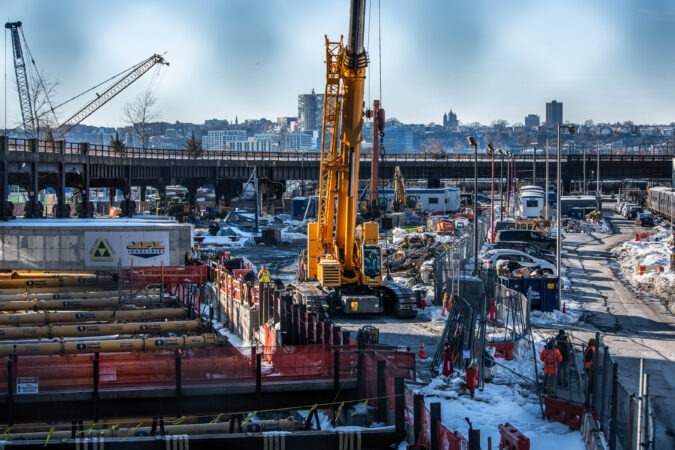
    A federal judge on Monday ordered the Trump administration to permanently abandon its efforts to suspend funding for a $16 billion rail tunnel under the Hudson River, describing those attempts as “flagrantly” illegal.

    Judge Jeannette A. Vargas of the Southern District of New York said that the administration violated federal guidelines when it stopped reimbursing the tunnel’s builders for their expenses in September. The suspension forced a shutdown of the construction project and led to a brief layoff of about 1,000 workers in New York City and New Jersey in February.

    Federal officials said that the payments were stopped while the project’s hiring practices were reviewed. But Vargas noted that President Donald Trump had indicated in interviews that there were political reasons for stopping the tunnel project, which was a favorite of Sen. Chuck Schumer, the Democratic minority leader from New York.

    “We’re cutting a $20 billion project that Schumer fought for 15 years to get, and I’m cutting the project,” the judge quoted Trump as saying in October. “The project is gonna be dead. It’s just pretty much dead right now.”

    The project, known as Gateway, would supplement two 116-year-old single-track tunnels under the Hudson between Manhattan and New Jersey. Schumer had called it the most critical infrastructure project in the United States.

    The project ran out of money about five months after the federal government stopped making payments. The states of New York and New Jersey jointly sued the Trump administration in federal court in Manhattan, seeking an emergency order to end the suspension.

    On Feb. 6, the day that work on the tunnel stopped, Vargas granted a temporary restraining order. The Trump administration opposed that order and continued to press its case but never disputed that the suspension “flagrantly violates federal law,” the judge said.

    In declaring the suspension of funding illegal, Vargas also said that the federal government could not attempt to suspend payment of the federal grants again.

    Catherine Rinaldi, executive vice president of the Gateway Development Commission, which oversees the project, said that before federal funding was frozen, the tunnel project “was on schedule and on budget, and we have made significant progress since federal funding for the project resumed in February.”

    In response to the judge’s decision, Gov. Kathy Hochul of New York and Gov. Mikie Sherrill of New Jersey, both Democrats, released a joint statement with Letitia James, the attorney general of New York, and Jennifer Davenport, the attorney general of New Jersey.

    “We are grateful that a federal court has once again agreed that the Trump administration’s decision to freeze billions of dollars in grants for the Gateway Tunnel Project is flagrantly unlawful,” their statement said. “This victory sends a clear message: The Trump administration’s attempt to halt Gateway funding will not stand.”

    The federal Department of Transportation said that it remained “committed to ensuring hard-working taxpayer dollars are being spent responsibly and do not fund unconstitutional, discriminatory contracting practices.”

    The decision Monday did not complete litigation over the suspension. The development commission is still suing the Transportation Department for monetary damages resulting from the forced shutdown of the project.

    This article originally appeared in the New York Times.

  • Why the true death toll of Venezuela’s quakes is so hard to know

    Why the true death toll of Venezuela’s quakes is so hard to know

    It has been six days since devastating twin earthquakes flattened entire residential neighborhoods in Venezuela, and dozens of newly found bodies are still being hauled out of the rubble.

    On Monday, rescuers piled up coffins inside an improvised morgue at the sun-scorched port in the town of La Guaira, one of the hardest-hit areas. Small trucks arrived with more bodies, leaving them arranged in a long row by a concrete dock.

    “Every day the number of victims keeps going up,” said Jennifer Moreno Canizales, a spokesperson for the United Nations Office for the Coordination of Humanitarian Affairs in Caracas. “And we expect it to keep rising.”

    The official death toll after Venezuela’s earthquakes rose Monday to 1,719 people, an increase of nearly 300 since Sunday. It is based on the number of bodies recovered during the search operations, Moreno Canizales said.

    But sobering as it is, that figure could be a substantial undercount. Many more Venezuelans remain missing, with chances of finding them alive shrinking every day.

    The uncertainty of the number is not just a matter for the journalistic or historic record. For many Venezuelans, it signifies their anguished limbo as they search for friends with bleeding hands, trapped between uncertainty and a desperate refusal to accept the worst.

    There is no official or reliable toll for the missing. And with so much debris from tall residential buildings pressed tightly together, and a shortage of heavy machinery to remove the rubble, estimates of how many people might still be trapped inside vary widely.

    Two forensic doctors at the main morgue in the capital, Caracas, estimated a death toll of about 4,000, basing that on the number of bodies that had been arriving at a morgue in La Guaira every day.

    In anticipation of the toll increasing, the United Nations has been procuring 10,000 body bags in coordination with Venezuela’s government, said Gianluca Rampolla del Tindaro, the organization’s resident coordinator for Venezuela. “That is the applying assumption; it’s very sad,” he said.

    According to an unofficial website where Venezuelans can report the missing, more than 46,000 people were still unaccounted for. The New York Times could not independently verify the figure, which can include people who survived but became separated from relatives.

    To veteran rescue workers, the high number of reported missing may be ominous.

    “Contact is difficult, but not that difficult that you wouldn’t have gotten in contact,” said Linda Hornisberger, the president of REDOG, a nonprofit Swiss search-and-rescue association that has deployed eight dogs and 88 emergency responders to Venezuela since Friday. “We must assume most to be dead.”

    Hornisberger said that despite working eight- to 12-hour shifts for days, “we have not been able to rescue anybody.”

    Disaster response experts say that it often takes several weeks for a full picture to emerge after disasters of this magnitude.

    When Hurricane Maria hit Puerto Rico in 2017, the official government death toll was 64 people. Nearly a year later, they updated it to 2,975, nearly 50 times as high. After the Indian Ocean tsunami of 2004, when entire coastal villages were completely erased, it took the authorities more than a year to settle on the final estimate of 230,000 victims.

    Several signs out of Venezuela indicate that there might also be a delay before a final death toll is reached.

    The area of the quakes

    The day the earthquake struck was a holiday in Venezuela, when it was more likely that families would have been home, or had traveled to the seaside area of La Guaira. Many buildings there were built during an economic boom in the 1970s and 1980s, when developers erected tall towers, many 10 stories or more. A mountain range limited building space, which led developers to choose to build vertically, said Josué Araque, a Venezuelan geographer.

    Now, many of those buildings have been pancaked into a dense tangle of debris.

    “They are mountains of rubble from buildings of many, many levels, made of concrete, which basically turns them into tombs,” Araque said. It is difficult to search the lowest floors of the buildings, he said, “because there are 10 floors that fell on top of them.”

    Araque said he believed that there were probably many more missing people whom “they probably will not be able to recover.”

    There is 1.2 million tons of debris in the hardest-hit areas of La Guaira, the U.N. Development Program said Monday.

    Moreno Canizales, from the U.N., said 700 buildings had collapsed. Despite the rescue teams’ best efforts, she said, “it is hard to reach them all in time” to rescue those who might still be trapped alive.

    Del Tindaro, the U.N. humanitarian coordinator in Venezuela, also said in an interview that the high number of collapsed buildings indicated that the official toll was an undercount.

    Ilan Kelman, a professor of disasters and health at University College London, said a full accounting of the number of deaths might never be known. But a preliminary projection that the final toll could exceed 10,000 — shared by the U.S. Geological Survey based on factors including the magnitude of the earthquake, the population density, and local infrastructure — remains grimly feasible, he said.

    A difficult search

    The work of recovering bodies is painstakingly slow, and it’s not a priority for most response teams that are trying to save those who may be still alive. On Sunday, 49 rescue teams coordinated by the U.N. rescued seven survivors, Moreno Canizales said. Sometimes, she said, the teams are responding to families telling them that they can hear a relative crying from the rubble.

    When the disaster response shifts, more bodies are likely to be found, experts said.

    “The focus of the search-and-rescue teams is to look for those who might be alive” based on reports of sound and motion, said Phil Gelman, a Latin America coordinator with GOAL, an international humanitarian response agency. “When the search-and-rescue phase is ended, and heavy machinery is moved in to move rubble, the casualty count will rise.”

    Even in well-organized response efforts, many survivors end up being rescued by untrained friends, family, and neighbors, said Emily So, a professor of architectural engineering at the University of Cambridge.

    One Caracas resident, Rosmaria Herrera, 30, said she had lost at least three relatives. Family members and other civilians pulled the bodies of her father, her cousin, and her grandmother out of the rubble. But they couldn’t find her uncle.

    “It’s strange, because there is practically nothing left of the building,” she said.

    Witnesses and aid workers described a shortage of heavy machinery as one of the biggest obstacles to rescue efforts, saying volunteers often lacked the equipment needed to move concrete slabs and reach survivors trapped beneath collapsed buildings.

    In videos widely shared on social media, residents pleaded for excavators and other heavy equipment. In one, a man says neighbors pooled their own money to hire machinery after waiting days for government assistance to arrive.

    “If we keep waiting for our wonderful authorities, another week will go by with our relatives still buried there,” he says. “We had to start doing this ourselves.”

    Some victims will likely die from their injuries, in part because of Venezuela’s already overstretched health system, Kelman said.

    So said the final toll would likely be determined by the number of people reported missing, the extent of visible damage to buildings, and impeded access to the worst hit areas, which has stymied some responses.

    “Tragically, until they recover the bodies from underneath the rubble,” So said. “The count will be low.”

    This article originally appeared in the New York Times.
  • Trump’s July 4 fireworks to start much later and last much longer

    Trump’s July 4 fireworks to start much later and last much longer

    The July Fourth fireworks show on the National Mall will start later, last longer, and have far more pyrotechnics than any held previously on Independence Day, according to officials in charge of producing the event.

    Typically, the Fourth of July fireworks at the core of the nation’s capital begin a little before 9:30 p.m. and last 17 to 25 minutes. This year, the show won’t begin until after 10:30 p.m. and may not start until 11 p.m., a spokesperson for Freedom 250, the public-private partnership aligned with President Donald Trump that has taken over much of the programming for America’s semiquincentennial, said in an email.

    The show is expected to last approximately 40 minutes.

    No reason has been publicly provided for why the fireworks will start so late, but Trump has described the event as a “rally” and said he will begin speaking at 9 p.m. The duration of the fireworks is longer — about twice the average length — because of the administration’s goal of setting a record for the world’s largest fireworks display.

    Danielle Alvarez, an adviser to Freedom 250, did not specifically address the late time but called the July 4 event a “once-in-a-generation milestone.”

    “This isn’t just another Independence Day. It’s America’s 250th,” Alvarez said in a statement. “And history only comes around once.”

    The late start, as well as rules prohibiting attendees from bringing coolers, lawn chairs, bags, and more than one bottle of water, drew criticism on social media and elsewhere, particularly because organizers have recommended people arrive early Saturday, when temperatures could surpass 100 degrees.

    A Freedom250 spokesperson said there will be four free hydration stations on the Mall.

    “We’re closely monitoring conditions and will keep adjusting as needed to make sure everyone stays safe and has a great time,” the spokesperson said in a statement.

    D.C. Mayor Muriel E. Bowser (D) urged anyone attending the fireworks show on the Mall to stay hydrated and be cautious.

    “The thing to remember, especially with this heat, is that’s a long, long day,” Bowser said at a news conference Monday to discuss safety measures for Independence Day. “I’m expecting … that families with small children are going to decide that the children should watch on TV or watch at a neighborhood event.”

    The current record for a single display is about 810,000 fireworks, launched at a New Year’s event in the Philippines in 2016, according to Guinness World Records. That display lasted a little over an hour and took place in a driving rain.

    Pyrotecnico, the Pennsylvania-based company putting on this year’s show, plans to set off more than 850,000 fireworks from 10 locations including West Potomac Park, the Reflecting Pool, and barges in the Potomac River, Pyrotecnico CEO Stephen Vitale said in an interview Monday.

    Vitale said he hopes the weather will cooperate and that there will be a slight breeze to clear the smoke and keep all of the fireworks visible.

    A typical July Fourth fireworks show on the Mall in D.C. features about 20,000 fireworks, Vitale said. While this year’s show is about 10 times bigger than any previous show his company has produced, he hopes viewers will remember the show for more than just setting a record.

    “Size always helps, but it’s about the beauty and the memories that people will have for generations,” Vitale said. “Fireworks are magical to people, and we help people walk away believing that’s the best fireworks display that they have seen or ever will see.”

  • Trump begins construction of unannounced White House helipad

    Trump begins construction of unannounced White House helipad

    President Donald Trump has begun construction on a new White House helipad, his latest change to the historic grounds, according to three people who spoke on the condition of anonymity because they were not authorized to discuss the project publicly.

    Construction crews worked into the night Monday on the White House’s South Lawn, with the project blocked off by a large fence. The helipad will be located near the South Portico, the traditional landing site for Marine One, the call sign for whichever helicopter is transporting the president, the people said.

    The new helipad, which the White House has yet to announce, is intended to address a long-running problem: The new generation of Marine One helicopters runs the risk of burning the lawn. The VH-92A Patriot, manufactured by Sikorsky Aircraft, has exhaust vents that aim heat down, making grass-scorching likely.

    Lockheed Martin, which owns Sikorsky Aircraft and has spent years trying to develop a solution to the scorching problem, will donate $5 million to help cover the cost of the helipad, according to a company official familiar with the project.

    The Washington Post reported last month that a helipad was under consideration and reported earlier this month that the administration was moving forward with the project and would rely on a $5 million donation to help fund it.

    The White House and the Marine Corps, which operates the presidential helicopter program, did not immediately respond to questions about the project, its timing or total cost.

    Trump has faced criticism for his recent alterations to the White House, such as his plan to build an expansive ballroom, add gilding to the Oval Office, and create a “Presidential Walk of Fame” that mocked past Democratic presidents. Current and former officials characterized the helipad as a different type of project, driven by security and operational priorities.

    Past administrations had also considered building a permanent helipad on the White House grounds, but the idea had been dismissed for several reasons, including that it would alter an iconic image — the U.S. president boarding a helicopter on the White House’s grassy lawn — that has persisted across administrations for nearly seven decades.

    That was not a concern for Trump, who has made significant changes to the White House in his second term, including demolishing the building’s East Wing and paving over the Rose Garden. Trump also has been an avid helicopter user for much of his professional life, dating back to his time as a real estate magnate when he relied on a Trump-branded helicopter.

    Ray L’Heureux, a retired Marine Corps colonel who previously oversaw the Marine Helicopter Squadron One, said it appears the installation of the White House helipad was determined to be operationally necessary.

    “The new [Marine One] program is a costly one and not using the capability is bad optics all around for many reasons,” he said, adding that having helicopters to ferry the U.S. president to and from the White House is “paramount for seamless operations and security concerns.”

    L’Heureux added that while he believes changing the aesthetics of the White House’s South Lawn is a negative, he hopes the impact of the helipad can be mitigated — perhaps by using green concrete, he suggested — to help it better blend in.

    The VH-92A has been envisioned for more than a decade as the full-time presidential helicopter. The Marine Corps received the final VH-92A in its 23-aircraft presidential fleet nearly two years ago at a cost of about $4.95 billion, or about $215 million each, according to a 2019 report by the independent Government Accountability Office. But the helicopters have yet to ferry a president to and from the South Lawn.

    Trump has used the new VH-92A Patriot for other travel, such as his recent trip to New York City for the NBA Finals, with the new helicopter ferrying the president to a helipad in Manhattan. Trump has continued to rely on older Marine One models when landing in grassy fields, including during his trip to the Group of Seven summit in France earlier this month.

  • Supreme Court lifts spending limits on political parties and candidates

    Supreme Court lifts spending limits on political parties and candidates

    WASHINGTON — The Supreme Court lifted limits Tuesday on how much political parties can spend on advertising and other expenses in coordination with candidates.

    The 6-3 decision, divided along ideological lines, is a major victory for Republicans and could undercut one of the Democrats’ financial advantages going into the midterms.

    The question before the justices was whether current federal limits on such spending — called coordinated party expenditures — violate the First Amendment. During oral arguments, Noel J. Francisco, a lawyer for the National Republican Senatorial Committee, which brought the legal challenge, told the justices that such limits were “at war” with previous decisions by the court that have found that restricting how money can be spent in politics amounts to limiting speech.

    The Republican groups had argued that such spending is necessary to allow political parties to spread their message.

    The Trump administration had supported the Republican groups, asserting in court filings that the federal law “abridges the freedom of speech” under the court’s “recent First Amendment and campaign finance precedents.”

    The coordinated spending case is the latest in a series of efforts to chip away at campaign finance regulations that were enacted after Watergate to lessen the influence of money in elections. In 2010, the Supreme Court struck down limits on independent spending by corporations and unions in Citizens United v. Federal Election Commission. That decision cleared the way for a flood of new money to enter politics and set the stage for further challenges to spending limits.

    The coordinated spending case had been closely watched as the midterm elections approached.

    Experts said the decision would immediately cut into one of the Democratic Party’s critical financial advantages in television advertising. That’s because federal law requires that television broadcasters give political candidates low advertising rates, but extends no such requirement to super political action committees, which are often charged double, triple, and even four times as much for the same television time.

    Republicans in recent election cycles have been more reliant on super PACs and national party committees than Democrats, whose candidates have tended to outraise Republicans and who therefore often have been able to take advantage of the lower television ad rates.

    Allowing unlimited coordinated spending between candidates and parties would essentially permit both to take advantage of the lower rates.

    The case began in 2022, when JD Vance, then a candidate for the Senate in Ohio, sued to challenge the campaign coordination limits. He was joined by several Republican groups. The Biden administration defended the limits, and a panel of federal judges agreed they were legal.

    After President Donald Trump returned to office, the federal government flipped sides in the case and backed the Republicans challenging the spending caps.

    With the government no longer defending the spending limits, the justices appointed veteran Supreme Court litigator Roman Martinez to argue on their behalf. He argued the justices should dismiss the case as moot because Vance is no longer running for office.

    Democratic groups intervened in the case, urging the court to uphold the spending limits. They warned that overturning the law would create a system in which political parties would pay candidates’ expenses for everything from flower arrangements to electric bills.

    This article originally appeared in the New York Times.

  • Trump is using a $500M no-bid contract to build his White House ballroom

    Trump is using a $500M no-bid contract to build his White House ballroom

    White House officials last year secretly awarded a no-bid contract worth up to $500 million for the construction of the East Wing ballroom in an unusual arrangement that sidestepped typical contracting procedures designed to control costs, according to a copy of the agreement obtained by the Washington Post.

    The White House routed the contract through the Executive Residence, the document shows, an office that is exempt from rules that require federal agencies to solicit competitive bids and disclose details to the public. The office is typically responsible for routine repairs, entertainment expenses, and the purchase of furniture, art, and other items for the executive mansion.

    The confidential contract with Clark Construction, along with related correspondence and records obtained by the Post, reveal for the first time how the Trump administration bypassed norms last summer as it set the ballroom project in motion.

    Records also show that President Donald Trump was directly involved in negotiating some costs for the East Wing project.

    The East Wing contract is the latest example of the administration turning to no-bid deals to hasten a Trump-style makeover of the nation’s capital, which has included handpicking firms to upgrade Lafayette Square next to the White House and to renovate the Lincoln Memorial Reflecting Pool.

    Competitive bidding is generally required at most federal agencies. Experts said the Executive Residence is exempt from those rules, and the president has legal authority to hire companies of his choosing to make changes to the executive mansion and the surrounding grounds. Those experts said soliciting bids would have ensured the best price for taxpayers, especially given the size and cost of the East Wing project.

    “I would certainly expect them to compete a project of this size and complexity,” said Anthony Costa, a former General Services Administration official who oversaw complex government real estate projects during a career that spanned four presidential administrations.

    The estimated East Wing construction cost has tripled since last July, when the project was first announced, with half expected to come from taxpayers, the Post previously reported.

    Trump has repeatedly claimed that the ballroom would be paid for by private donors and once said that Clark executives offered to build it for free.

    “They said: ‘Sir, we’ll do it for nothing. This is the greatest honor,” Trump told the New York Times in January.

    Clark’s internal cost projections show the McLean, Virginia-based company, the largest general contractor in the D.C. metro area, stands to make tens of millions of dollars from the work.

    Clark charged a 3% profit for its early work on the East Wing, records show, a rate that experts said was typical for large government construction projects.

    The records reviewed by the Post do not break out Clark’s estimated profit margin for the entire project, but a March document shows the company projected it would receive a total of $65 million in combined profit, overhead, and daily rates for on-site staff and other costs.

    A White House official said in a statement that the East Wing contract was issued through the Executive Residence because that office “will be the primary support of the facility.” The Executive Residence is a division of the Executive Office of the President, which the statement said “consistently executes contracts following the law.”

    A Clark spokesperson said in a statement that the firm has been a federal contractor for more than 80 years, adding: “We follow established procurement and contracting processes for each project and execute the work consistent with schedule, budget, delivery, and contractual requirements.”

    The Trump administration tasked Clark with site preparation and other preliminary work last July, months before the East Wing was demolished, records show. That work was performed under a separate, existing Executive Residence contract the company had won in 2024, during the Biden administration.

    The Biden-era contract covered “a wide variety of maintenance, repair, alteration, and construction type tasks” that might arise at the White House over five years. It was awarded to Clark after a competitive bidding process and had a ceiling of $500 million, according to a copy of the agreement obtained by the Post.

    The White House official told the Post that Clark’s Biden-era contract was “missing various clauses necessary for construction contracts.”

    By mid-August, records show, Trump administration officials began negotiating the new, no-bid agreement for Clark to “fully demolish the East Wing and East Colonnade and construct a modernized East Wing facility.”

    In an email exchange in early September, White House officials explained that they could award the no-bid contract to Clark because the Executive Residence is not bound by competitive bidding requirements, although it often follows them.

    The email cited a federal law that authorizes the president to freely spend for the “care, maintenance, repair, alteration, refurnishing, improvement, air-conditioning, heating, and lighting” of the White House residence.

    In a court case challenging the legality of the ballroom project, the Trump administration has cited the same law as the basis for its authority to undertake the project. The litigation has not surfaced the fact that the contract was awarded without competitive bidding.

    A federal judge rejected the administration’s position, concluding in March that the president’s authority to make changes to the White House does not include demolishing the East Wing and building the ballroom. The administration has appealed the ruling.

    The Justice Department acknowledged in court filings in the case that the Executive Residence is overseeing contracts for the project, claiming it was “best-positioned” to do so in part because of its expertise in the use of White House for official ceremonies.

    Experts told the Post that the GSA or National Park Service are better equipped to handle contracting for large construction projects at the White House, and an internal White House document shows that is the norm.

    Major repairs and structural changes to the White House’s East Wing and East Colonnade are the responsibility of the GSA and Park Service, according to the document, a 2024 memorandum of understanding for the maintenance and operations of the White House obtained by the Post.

    The role of the Executive Residence “does not include maintenance or repair involving structural building elements or major utility systems for those areas, which are handled by GSA or NPS,” according to the memorandum, which expires in 2029.

    An Interior Department spokesperson, responding to questions sent to the Park Service, said in a statement that the Executive Residence is “best positioned to coordinate with all agencies that have equities regarding planning for and implementation of the project.” The GSA referred questions to the White House.

    On Sept. 22, Clark signed the White House contract for the East Wing, which included a range of work the company would provide over a five-year period and a nondisclosure agreement.

    Joshua Fisher, the director of the White House Office of Administration, indicated on the contract that the administration did not solicit bids for the East Wing work because “the disclosure of the executive agency’s needs would compromise the national security.”

    In recent months, Trump has said rebuilding the East Wing is a national security issue, describing an underground military bunker and a rooftop “drone empire … to protect Washington.”

    The Trump administration continued to issue work orders to advance the East Wing project under both the 2024 and 2025 agreements with Clark, records show. Clark’s internal construction cost estimates rose from $200 million in July 2025 to $600 million by March 2026, the Post previously reported.

    After signing the East Wing contract, Clark officials notified the White House that the company planned to award no-bid deals to at least 11 subcontractors for demolition, abatement, excavation, fencing, and other services, according to copies of correspondence obtained by the Post. Two of those subcontractors are Clark subsidiaries.

    On March 4, days after the start of the war with Iran, Trump personally negotiated the price of concrete to be provided by one of Clark’s wholly owned subsidiaries, according to a summary of the terms that notes his involvement. The summary indicates the price, initially more than $47 million, dropped $2.3 million during the negotiation.

  • Kean set to speak at the Capitol after mysterious absence

    Kean set to speak at the Capitol after mysterious absence

    WASHINGTON — Rep. Tom Kean Jr., the New Jersey Republican who disappeared from Congress and the campaign trail in March with almost no explanation, is set to return to the Capitol on Tuesday and address the mysterious health condition he says has kept him away.

    Kean, a 57-year-old seeking a third term in a competitive district, has missed more than 100 votes since he was last seen in public more than 100 days ago. His reemergence will be closely watched after months during which he and his staff refused to disclose anything about where he was or what was keeping him away.

    Their silence has built Tuesday’s return into a major reveal after a prolonged cliffhanger. Even last week, when a reporter for The New York Times found Kean at his home in Westfield dressed in a suit and tie around 8:45 p.m., he declined to offer any explanation, saying: “I’ll talk to you next week.”

    In the absence of official information, his own colleagues have speculated wildly about Kean’s condition, privately raising an array of possibilities for his long and unexplained absence.

    Could it be rehab for a stroke, heart condition or addiction issue? Was it a case of plastic surgery gone awry? Might he reappear on Capitol Hill as a woman? (His brief appearance at home last week put at least some of that speculation to rest.)

    Kean has said only that he is dealing with a “personal medical issue,” and until recently offered no timeline on his return, only vague assurances that when he did come back, he would be fully recovered and transparent about what he had been through.

    Kean’s office also did not provide any detail Monday about his return, though CNN reported that he planned to give a speech on the House floor. He also was scheduled to participate in a fundraising reception Tuesday evening in Washington, according to an email obtained by the Times that confirmed an earlier report by Politico.

    His chief of staff, Dan Scharfenberger, did not respond to calls and emails about the congressman’s planned schedule for Tuesday. A spokesperson for Speaker Mike Johnson said they were leaving the details of Kean’s return to him.

    Kean has invited some Republican officials to participate in a 2 p.m. conference call Tuesday, according to multiple people who were invited. The people said they expected he would have to address the health issue in some way.

    With an election in five months, Kean’s months of mysterious silence have tested the limits of what the public will tolerate in terms of privacy for its leaders.

    Presidents traditionally release the results of their annual physicals and disclose what medications they are taking, although they are not legally required to do so. But members of Congress typically provide no information to the public about the state of their health or their fitness to fulfill their duties.

    Voters tend to be forgiving about the health ailments of their leaders. And some lawmakers in the past have tried to turn their own medical challenges or experiences with mental health, alcohol or addiction into a way to relate to voters who may be struggling themselves.

    So Kean’s decision to keep his constituents and his colleagues in the dark for so long has largely been viewed as inexplicable.

    This article originally appeared in The New York Times.

  • Congress considers sidestepping filibuster to pass Trump’s voting restrictions

    Congress considers sidestepping filibuster to pass Trump’s voting restrictions

    House Republicans are considering using a fast-track process to bypass the filibuster and pass President Donald Trump’s sought-after voting restrictions.

    House Speaker Mike Johnson (R-Louisiana) said Monday that Republicans are moving forward with a plan to establish a grant program that would incentivize states to adopt stricter election rules outlined in the Safeguard American Voter Eligibility (Save America) Act, which includes a new requirement to provide documented proof of citizenship and a photo ID at the time of voting.

    The move would use the so-called reconciliation process, designed to overcome the filibuster, because it can be passed with a simple majority in both chambers, bypassing Democrats.

    “If you put it into a grant program or something similar, then it does make it part of reconciling the budget,” Johnson told reporters Monday, after meeting with Trump at the White House. “It does ultimately work that way.”

    “The only way to get that to the president’s desk, we’ve been shown many times, is to put it on reconciliation,” Johnson said.

    Doing so, Johnson argued, would allow the Save America Act to comply with Senate rules.

    However it’s not clear whether Trump would be on board with voting restrictions administered through a grant program. And many Senate Republicans have expressed doubt about passing more legislation through the fast-track process this year.

    Trump has been trying to pressure Republicans to pass the act, including refusing to sign a bipartisan bill aimed at helping Americans with housing, which was sent to his desk Monday.

    Speaking at the White House on Monday, Trump said it is “even more important” that Congress passes the Save America Act and said he doesn’t understand why Senate Majority Leader John Thune (R-South Dakota) won’t fire the parliamentarian, a nonelected, independent arbiter who advises the Senate on how to navigate laws and rules.

    “[He] has the right to immediately fire her and put somebody else there and it’s not even believable that she’s still there,” Trump complained.

    Senate Republican leaders have repeatedly told Trump that the votes are not there to pass his election bill, which would require proof of citizenship to vote in federal elections and restrict mail-in voting, among other provisions. The House passed a version of the bill earlier this year that did not include all the provisions Trump has demanded.

    Under this new plan, House Republicans said they believe that establishing a grant program that incentivizes states to implement the new election restrictions — rather than establishing them outright — should comply with Senate rules and allow them to pass the legislation with Republican votes only.

    However, Senate rules would likely prevent much of the Save America Act as written from being included as provisions passed through the process must be budgetary.

    At least four Republicans in the Senate have expressed opposition to the Save America Act and previously voted against adding the language to another must-pass measure. It is unclear whether these senators would support the new grant provision.

    Johnson said House Republicans will first attempt to pass a procedural rule that would merge the Save America Act and the National Defense Authorization Act, which is an annual defense policy bill, upon passage of the latter and send both bills together to Senate.

    Rep. Anna Paulina Luna (R-Florida) and a group of GOP hard-liners have been holding up most action on the House floor since last week as a protest against Senate inaction on the Save America Act. They have refused to vote for rules, which are necessary to bring most legislation to the floor.

    On Monday evening, Luna said she opposes the merger maneuver, and she also expressed skepticism over the grant program. The Florida Republican said Johnson had not spoken to her about either option.

  • Three words in the Declaration of Independence paint a cruel picture of Natives

    Three words in the Declaration of Independence paint a cruel picture of Natives

    McKaylin Peters, a 24-year-old Native American graduate student at Johns Hopkins University, still recalls when she first heard the words “merciless Indian savages.”

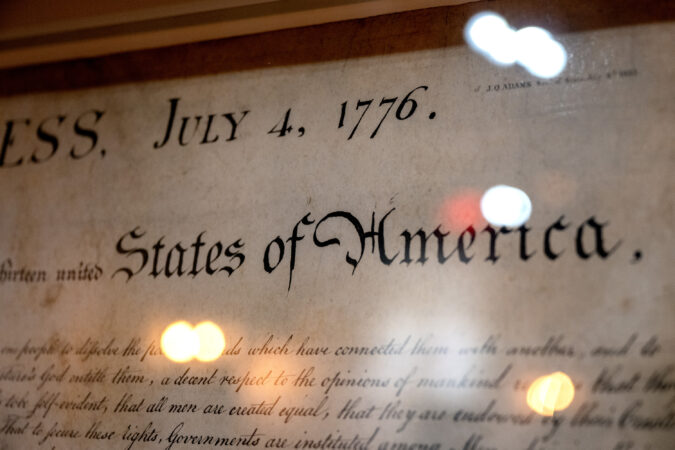
    Sitting in social studies class at her predominantly White middle school near Green Bay, Wisconsin — a school that once used an image of an Indian as its mascot, she cringed when the teacher read a passage deep in the Declaration of Independence: “He has excited domestic insurrections amongst us, and has endeavoured to bring on the inhabitants of our frontiers, the merciless Indian Savages, whose known rule of warfare, is an undistinguished destruction of all ages, sexes and conditions.”

    Peters said she and the six other Native students in the class looked quietly at one another.

    “I was upset. It just rolled off her tongue very easily,” recalled Peters, a citizen of the Menominee Nation who is getting her master’s in organizational leadership. “It seemed like no one else was shocked except for us, the Indigenous students in the classroom. We were like, ‘Did she really just say that?’”

    As the United States marks the 250th anniversary of the Declaration — a document fundamental to the nation’s founding and still revered — Peters and other Native American scholars and tribal leaders are reflecting on the Founding Fathers’ use of the derogatory description for Indigenous people in 1776. Many note that while the Declaration promises that “all men are created equal,” its ideals were not extended to everyone.

    The document’s portrayal of Indigenous people helped establish a moral and legal framework that justified decades of devastating U.S. policies toward Native communities, according to historians. Celebrations of the 250th anniversary of the Declaration’s signing come amid a striking contrast: Native tribes are working to reclaim ancestral lands, revive lost languages and preserve cultural traditions, while the Trump administration has sought to remove or downplay references to slavery, Native dispossession and other dark chapters of U.S. history in parks and museums and on government websites.

    “It’s not just a line in an old document,” Peters said. “It’s a reminder that this country was built by declaring us less than human. When the Declaration of Independence calls us that, it’s a message that Native youth sadly still hear today in classrooms, policy debates and in how society talks about us.”

    Many historians and Indigenous historians say the term “savages” did more than reflect 18th-century attitudes. It helped perpetuate stereotypes of Native Americans and contributed to their marginalization; centuries later, it adds to feelings, especially for Native youths, of being excluded from America’s national story. A 2022 study by Texas A&M University researchers found that the Declaration’s pejorative reference to Native Americans helped normalize a view of them as threats rather than as sovereign nations and peoples with rights.

    For many Native people, the meaning — and impact — of the phrase is emotional and complicated.

    Some discover the wording as adults and are appalled. Others see it as a reminder of racist attitudes and centuries of broken treaties, land theft and forced assimilation. Some young people have reclaimed the epithet, debating it on social media and displaying it on T-shirts and tattoos as a symbol of resilience and empowerment. An Indigenous-led heavy metal band intentionally used the phrase as its name.

    “It’s become sort of an ironic touchstone,” said Kevin Gover, the Smithsonian Institution’s undersecretary for museums and culture. A citizen of the Pawnee Tribe of Oklahoma, Gover said he did not encounter the term until middle age. After his initial outrage, Gover said, he responded as many Native people do: by mocking it.

    “Even we, on the side of the descendants of those who were victimized, have to take a nuanced view,” said Gover, who is also the former director of the National Museum of the American Indian in D.C. “In many respects, it’s a badge of pride that our ancestors had the wherewithal to survive and allow us to be alive in this time.

    “We can acknowledge the wrong,” he said, “and be grateful for our ancestors’ fortitude.”

    Hartman Deetz, an enrolled member of the Mashpee Wampanoag — the Massachusetts tribe that famously helped the Pilgrims survive their first Thanksgiving in 1621 — said the wording reflects the opposite of how Indigenous people treated White settlers.

    “They were fed when they were starving, given hospitality by us, but they treated us in a way that was savage and merciless in the dispossession of our homelands,” said Deetz, who served as a consultant for an exhibition at the Museum of the American Revolution in Philadelphia about the Declaration and the history behind it. “It was framed in a way that justified the treatment they brought upon us, and it continues to this day in attempts to sell our sacred sites for copper mines and to drill for oil and mining on our lands.

    “The colonial enterprise hasn’t stopped,” he said. “There’s such a disregard for Natives to exist or have rights of where we do exist. That’s the legacy of these words.”

    The words originated in an early draft of the Virginia Constitution written by Thomas Jefferson, who later included it in the Declaration of Independence, which Congress adopted.

    Ironically, some historians say, the characterization of Native people contradicts Jefferson’s own views. In “Notes on the State of Virginia,” a book Jefferson wrote that laid out many of his views on race, government and religious freedoms, he was “very sympathetic to Native people,” said Kevin Butterfield, a historian at the Library of Congress. Jefferson described Indigenous people as just, honorable and noble — a sharp contrast to the widespread European belief that Indigenous people were inferior.

    But Jefferson understood the Declaration was political rhetoric — a kind of “public relations piece,” said Butterfield, who is the acting chief of the Manuscript Division at the Library of Congress. He placed it near the end to bolster the case for independence.

    “He’s trying to paint the worst possible picture of how the king is approaching his interactions with the American colonists,” Butterfield said. “So he’s laying out horrible wartime atrocities from the Revolutionary War.”

    The description reflected colonial attitudes and the realities of frontier warfare, scholars say. Colonists were hostile toward Native Americans, who were powerful political and military figures and, just like other nations, protecting their sovereignty. Some Native nations had allied with the British — a move that many settlers resented — and many colonists also opposed King George III’s Proclamation of 1763, which barred settlement west of the Appalachian Mountains.

    Repeated violence between Indigenous people and settlers also helped shape the ideology behind the description, including the French and Indian War and Dunmore’s War in 1774, when Virginia colonists fought the Shawnee and Mingo to expand into the Ohio Valley, according to historians. In the summer of 1776, as the Declaration was drafted and adopted, a lesser-known conflict unfolded when Cherokee warriors attacked frontier settlements across parts of Virginia, North Carolina, South Carolina and Georgia. Colonists responded by burning more than 50 Cherokee towns and driving Native people from their homes.

    By 1776, the Founding Fathers “understood their need to accuse the king of what they considered the ultimate crime — partnering with Indigenous peoples and arming them,” said Ned Blackhawk, a Native American author and Yale University historian. “So they created this vilification in the Declaration that, in many ways, was at odds with their experience of living alongside Natives for generations.”

    The rhetoric was part of a broader racial ideology taking shape during the Revolutionary era, said Blackhawk, an enrolled member of the Te-Moak Tribe of Western Shoshone Indians of Nevada.

    “They were deeply committed to Enlightenment principles, but those were restricted to people similar to themselves,” he said. “Native Americans became a foil in simplified and racialized ways.”

    Tracy L. Canard Goodluck, executive director of the Center for Native American Youth at the Aspen Institute, said she is disappointed the term is either glossed over or not taught in many school curriculums, its impact not discussed.

    It wasn’t until she was a student at Dartmouth College, she said, that she fully understood the context of the description. She was angry, but the new knowledge also awakened in her a passion for educating others about Indigenous history and mistreatment. Goodluck, a member of the Oneida Nation who is also Mvskoke Creek, said in her previous work as a teacher in Seattle and Albuquerque she taught about Indigenous people and the harsh characterization in the Declaration.

    “It shouldn’t just be about White history,” she said. “It should be about all history — the good, the bad and the ugly.”

    She said it’s also important to educate the public, so every Fourth of July, she wears a T-shirt emblazoned with the phrase from the Declaration.

    “Those words served the purpose back then as a way to dehumanize Native people in this country,” said Goodluck. “We need to change that narrative. We’re still here. We’re doctors, lawyers, teachers and political leaders.

    “I am that merciless Indian savage who my ancestors prayed for to do great things.”

  • ‘No one’s coming to save us but us’: Generation Z runs for office

    ‘No one’s coming to save us but us’: Generation Z runs for office

    Melat Kiros was fresh out of Notre Dame Law School in 2023 when she was fired by her New York law firm after publishing a lengthy letter sharply criticizing Israel’s government, raising questions about its historical legitimacy and challenging the firm’s response to law students engaging in pro-Palestinian activism.

    In Tuesday’s Democratic primary in Colorado, under the banner of the Democratic Socialists of America, Kiros, 29, is again challenging the establishment. This time, she hopes to defeat Rep. Diana DeGette, 68, a liberal Democrat who was elected to her Denver-area seat a year before Kiros was born.

    The showdown is the latest between the mainstream Democratic Party and its ascendant, youthful left wing, but Kiros represents more than the DSA. She is one of several Generation Z candidates this year fueled by the generational frustrations of their pandemic-marred youth, social media-fueled isolation, artificial intelligence and the war in the Gaza Strip.

    The upset pulled off by Darializa Avila Chevalier, 32, a socialist doctoral student, over Rep. Adriano Espaillat, 71, in last week’s New York Democratic primary may have only set the stage for the generational and ideological fights to come — on both sides of the political aisle.

    Melat Kiros, right, who is running for Congress and hopes to defeat Rep. Diana DeGette (D-Colo.), who was elected to her Denver-area seat a year before Kiros was born, records a video with Eric Cheng of the podcast “Wait, Say More” while campaigning in Denver, June 27, 2026. Kiros is one of several Gen Z candidates this year fueled by the generational frustrations of their pandemic-marred youth, social media-fueled isolation, artificial intelligence and the war in Gaza. (Chet Strange/The New York Times)

    “When you’re living through these kinds of moments on such a regular basis, it feels impossible to be able to change course and believe your vote actually makes a difference,” Kiros said.

    But, she added, “we’re seeing just how broken the system is, and we’re seeing that no one’s coming to save us but us.”

    DeGette sees lawmakers of all ages working together as important, citing her work with younger members of Congress like Alexandria Ocasio-Cortez, 36, and Jake Auchincloss, 38, on “Medicare for All” legislation. But DeGette still believes experience and community involvement are tantamount to age.

    “What voters look at in these races is they look at who they think is going to most effectively represent them and who can have the power and leadership to fight against Donald Trump,” she said.

    For Generation Z voters, youth and recent history have shaped their views. They did not experience the exhilaration of Barack Obama’s hope-fueled 2008 campaign or George W. Bush’s calls to service after the attacks of Sept. 11, 2001. Instead, they have weathered a decade of Trump’s “American carnage” narrative and the gerontocracy of Joe Biden. Their beefs tend to be less with the other party than their elders.

    Generation Z voters express higher levels of party alienation than any other generation; two-thirds of Generation Z respondents in a recent New York Times/Siena poll expressed dissatisfaction with both Democrats and Republicans. Among Generation Z Democrats, 68% said they were unhappy with their own party.

    But the rise of Generation Z and young millennial candidates demanding change is not limited to Democrats.

    Joe Mitchell, the founder of Run GenZ, an organization aiming to elect young conservatives, is vying to fill the seat of Rep. Ashley Hinson of Iowa, a Republican running for Senate. Mitchell, 29, who runs a real estate development company, represents a brand of young male Republicans inspired by Charlie Kirk, the slain conservative activist, and driven by their Christian faith and by values aligned with Trump’s political movement.

    “Everything I do is going to be America first,” said Mitchell, a former state representative. “Everything we do should be focused on, ‘how can we help the American worker?’”

    Brendan Trachsel remembered celebrating his 16th birthday as he watched election results come in for Trump’s first presidential win in 2016. Although he grew up in a conservative household in the San Diego suburbs, he said he was in “utter shock that someone who is completely OK with treating people so horribly would get into office.”

    After starting at Northern Arizona University in 2019, he registered with the Green Party. Now 25, Trachsel is running for the Arizona House of Representatives in a Democratic-held district near Flagstaff, focusing on labor organizing, data center moratoriums and tighter protections for online privacy.

    James Thibault, a state representative in New Hampshire, in Northfield, N.H., June 27, 2026. For Gen Z voters, youth and recent history have shaped their views. (Veasey Conway/The New York Times)

    If he wins, Trachsel would be the first third-party official in the Arizona Legislature. He cited Zohran Mamdani’s mayoral campaign in New York as an inspiration.

    “It was just so people-focused, so intent on just shutting up and hearing what people needed and want,” Trachsel said.

    Startled by Trump’s return in 2024, Leila Staton, 22, and her mother formed the Insufferable Wenches of Iowa, a progressive group designed in part to link like-minded but socially isolated rural residents. No Democrat had filed to run this year against the two-term Republican state legislator representing her district, so Staton, who lives in Stout, population around 200, decided to run herself.

    College graduates from rural Iowa tend to leave the state. Staton pointed to a state Legislature, where in 2023 the average age was 54, as unrepresentative of her generation.

    Staton has focused her campaign on public education, which has been drained of cash by a new school voucher program; family farms struggling with rising costs and corporate pressure; drinking water that is contaminated with nitrates; and Iowa’s rapidly rising cancer rates.

    “There’s a lack of opportunity, prices are rising, wages are stagnant,” she said, “and our cancer crisis has no clear solution.”

    Generation Z politicians are also the first largely born after the Columbine massacre in 1999 and raised amid the drumbeat of school shootings that followed.

    Tyler Smith, 26, was in a Los Angeles high school when, in 2018, a gunman killed 17 people at Marjory Stoneman Douglas High School in Parkland, Florida. He joined school walkouts and watched as a young breed of activists emerged from Parkland.

    While working for a gun control group, Smith decided to run as a Democrat for a Texas House seat this year in the Houston area held by a staunch conservative, insisting, “People right now are sick and tired of the same old, same old.”

    Braxton Mitchell, a 26-year-old Montana state representative, also became involved in political activism in 2018. But for him, the gun control walkouts that followed Parkland did not represent his “way of life,” so he spearheaded a counter walkout, against gun control, at his high school in Columbia Falls, Montana. After graduation, he got on a plane for the first time and flew to Washington to meet Kirk, who had been sending him messages of support.

    A year and a half later, the state Republican Party chair, Don Kaltschmidt, encouraged Mitchell to run for his local legislative seat, then held by a Democrat. He won and is now running for reelection.

    “We need all generations at the table, especially in places like the state legislature, because the decisions being made are going to impact my generation the most,” Mitchell said.

    He’s working on a school safety bill to put panic alert systems in rural schools across the state — without gun control.

    COVID-19 is another shared experience. James Thibault, the son of a landscaper and a nursing assistant in New Hampshire, had no political aspirations until the pandemic shut down schools. Then politicians reopened them with mask mandates that Thibault, a high school freshman at the time, found onerous and not conducive to learning.

    He protested at school board meetings. He was appointed to a youth legislative council. Then he filed to run for state representative before he graduated from high school. He was elected at 18 as a Republican, becoming the youngest state legislator.

    “COVID was a wake-up call,” said Thibault, 20, who is running for reelection this year.

    In Denver, Kiros also cited the pandemic as consequential to her own politics. “Stagnant” cultural norms that demanded working in offices suddenly gave way to acceptance of remote work, she said. The burning of fossil fuels plunged. Then those social benefits went in reverse.

    Her frustrations with current representatives have only grown deeper.

    “I don’t know if it’s ego,” Kiros said. “I don’t know if it’s recklessness. There really is just no sense of preparing or leaving the world better than where they found it.”

    This article originally appeared in The New York Times.