Tag: no-latest

  • How to choose the best nursing home or assisted living facility

    How to choose the best nursing home or assisted living facility

    Sometimes it’s a fall that brings a broken hip and a loss of mobility. Or memory problems that bubble into danger. Or the death of the partner who was relied upon for care.

    The need to move to a nursing home, assisted living facility, or another type of care setting often comes suddenly, setting off an abrupt, daunting search. It’s likely something no one ever wanted, but knowing what to look for and what to ask can make a big difference.

    Here’s what to do when looking for a long-term care facility:

    Start with government ratings

    Regulation of assisted living facilities varies greatly from state to state, meaning there’s no centralized standards or source for information. If you’re looking for a nursing home, though, they are monitored by the federal government.

    The Centers for Medicare and Medicaid Services maintains records on nursing homes, including data on who owns the facility, how robust its staffing is, and what types of violations it might have been fined for. It assigns homes a star rating, from one to five.

    Sam Brooks, director of public policy for the National Consumer Voice for Quality Long-Term Care, says while the star rating “can be notoriously unreliable,” due to its reliance on self-reported data, it can still provide some clues about a home.

    “One or two stars, expect it to be bad,” Brooks says.

    Ratings can be a resource to rule out the worst options, but not necessarily to find the best. Still, Brooks suggests taking a closer look at four- and five-star facilities and to consider a home’s ownership, too. Nonprofit homes are often better staffed.

    You could scour inspection reports and online reviews for clues, too, but eventually you’ll need to make a list of potential candidates and start making visits.

    “The data,” Brooks says, “only goes so far.”

    Look past the lobby

    When visiting a home on your list, be careful not to be too swayed by decorative touches that might be designed to lure you in, like a lobby’s furniture, dangling chandeliers, or vases of flowers.

    “When I tour a building, I listen first. Is it loud? Are call bells ringing nonstop?” says Mark Sanchez, CEO of United Hebrew, a nursing home in New Rochelle, N.Y.

    After that, Sanchez says, switch your senses. Do you detect an odor? Do you see residents clustered around the nurses’ station, perhaps clamoring for help? Are staffers speaking respectfully to residents? Are they making eye contact? Are they rushed?

    “Culture shows up in small moments,” Sanchez says, “and it matters.”

    Seeking input from families of current residents can be insightful. Another resource may be your local long-term care ombudsman. Ombudsmen, funded by the federal Older Americans Act and present in every state, investigate long-term care residents’ complaints.

    With all the available information on each home, it can be easy to feel like you’re drowning in data. So pay attention to how a place feels, too, and pair that with concrete facts.

    When Jennifer Fink was making the “stressful, grief-inducing, hard, and scary” decision on what memory care community was right for her mother, she didn’t consult state databases or Google ratings. She went with her gut reaction and luckily, it was right.

    “Trust your gut. Keep top of mind that the salesperson wants your loved one’s money,” says Fink, of Auburn, Calif. “If it’s giving you the ‘ick,’ then move on.”

    Staffing matters most

    More than any other single thing, experts on long-term care stress that a facility’s staffing is most important. That means both the quality of the care you witness workers giving residents during your visit and the average staffing levels shown in the reported data.

    A home providing an average of three hours of nursing care to each resident each day may not look all that different on paper from one providing three-and-a-half hours. But those minutes matter dearly, meaning the difference between a person getting a shower, having help at mealtime, or being discovered if they’ve fallen.

    During a visit, pay attention to how quickly call bells are answered and whether it seems like residents are engaged in activities. Ask staff how long they’ve worked there. A home that holds on to its workers for years may offer your loved one more continuity.

    Evan Farr, an elder law attorney in Lorton, Va., who wrote The Nursing Home Survival Guide, says visiting a facility at night or on the weekend can be particularly revealing.

    “These are the times when staffing is reduced and the true operation of the facility becomes apparent,” Farr says. “It is entirely possible to have a five-star rated facility that is woefully understaffed from 5 p.m. Friday until 8 a.m. Monday morning.”

    Keep a long-range view

    When faced with an urgent decision, it can be difficult to focus on anything beyond the factors in front of you. But it’s important to choose a home with a long-range view.

    At the start, many long-term care residents are able to pay for the cost of their bill. But what happens if their money runs out? If it’s a nursing home that accepts Medicaid, how many beds are allocated to such residents? Would your loved one get that slot? If it’s an assisted living facility, do they even accept people on Medicaid?

    Assisted living facilities often have complicated billing structures that require a bevy of questions to understand. Ask how costs may change as a person’s needs increase. Some places tack on separate charges for tasks like helping a person to the bathroom.

    “Four-thousand dollars a month can become $8,000 overnight,” says Geoff Hoatson, founder of the elder law practice Family First Firm in Winter Park, Florida.

    Another fact of long-term care that few understand is how often facilities seek to remove residents seen as undesirable, often due to a change in their financial circumstances or in their health. Dementia patients in particular — with challenging care needs and symptoms that can sometimes bring aggression — are targeted with orders to leave.

    “Ask specifically what conditions would require transfer,” Hoatson says.

  • Sponsors are becoming more visible at the Winter Olympics with product placement and arena shoutouts

    Sponsors are becoming more visible at the Winter Olympics with product placement and arena shoutouts

    MILAN — Eileen Gu and all the other freestyle skiers wait for their scores by a large Powerade-branded cooler, then glide away without taking a drink.

    Bottles of the blue sports drink are stacked in hockey penalty boxes. Even the tissues in figure skating’s drama-packed “Kiss and Cry” area are branded.

    One way the Olympics generally stand out is by the absence of advertising on courses, rinks, and slopes. But increasingly at the Milan Cortina Games, sponsors are creeping into the action.

    “We continue to open up those opportunities for partners,” International Olympic Committee marketing director Anne-Sophie Voumard said Wednesday, noting sponsor products can now “organically be present” more widely.

    The change has seemingly accelerated since French luxury goods maker LVMH prominently placed its Louis Vuitton brand at the opening ceremony of the 2024 Paris Olympics.

    “It seems like there’s been an increasing need and desire from the sponsors for the IOC to show greater value in the TOP [the Olympic partners] program,” Terrence Burns, who has worked for the Olympic body in marketing and consulted for sponsors and hosting bids, told the Associated Press.

    There’s product placement on TV, even if it is still restrained compared to most American sports. Spectators inside the Olympic arenas hear shout-outs by the announcers and see logos on the big screen.

    It’s all happening as sponsors eye fresh opportunities for the 2028 Los Angeles Olympics.

    The IOC is looking to create extra value in its TOP program, which has been a financial success for the organization over four decades. There are 11 TOP sponsors in Milan, after peaking at 15 in Paris. Revenue in 2025 dropped a bit to $560 million in cash and services compared to $871 million in 2024.

    Watching a hockey game in the arena is different

    An Olympic hockey game looks clean and non-commercial on TV to NHL fans used to seeing sponsors on the boards. It’s a little different in the venue.

    “This is the Corona Cero wave!” roars an announcer, attaching an alcohol-free beer brand to efforts to liven up fans at a quiet afternoon game with a wave around the arena.

    An automaker gets a mention with the “Stellantis Freeze Cam” and an interview with a boxer during the intermission between periods is “thanks to Salomon,” a skiwear brand that signed a sponsor deal with the Milan Cortina organizing committee.

    Burns thinks the logos in Olympic arenas are a morale booster for sponsors, but worth relatively little compared to the big campaigns they typically launch in the year before the Games.

    “I think it’s a psychological ‘Attaboy’ to see your brand on a board somewhere in and around the Olympics,” Burns said. ”I get it, but show me how that helps you sell more things.”

    A long-term trend ahead of the 2028 Los Angeles Olympics

    The Olympic Charter, a kind of constitution for the Games, says any logo in an Olympic venue must be approved “on an exceptional basis,” but the IOC has gradually relaxed its restrictions.

    “The Olympic world moves slow, and it should. It’s a 3,000-year-old brand, so they’ve got to be careful with it,” Burns said.

    Barely a decade ago, the “clean venue” policy was so strict that IOC staff checked the hand dryers in arena bathrooms to make sure they had their manufacturer’s brand covered with tape.

    For the Tokyo Olympics in 2021, restrictions on athletes promoting their personal sponsors on social media were relaxed after a legal challenge in Germany.

    The Paris Olympics saw medals delivered to the podium in Louis Vuitton-branded boxes before athletes were handed a phone for “the Olympic Victory Selfie, presented by Samsung,” a new tradition that’s continued at the Milan Cortina Games.

    Voumard, the IOC’s marketing director, acknowledged the need to “be mindful of the legacy of those [Olympic] Games and the uniqueness of the presentation.”

    New opportunities

    The Los Angeles Olympics will break new ground on sponsorship.

    For the first time, the IOC has approved the selling of naming rights for venues in a pilot program. The volleyball venue in Anaheim will keep its Honda Center name, just like it does for NHL games, and Comcast is putting its brand on a temporary arena for squash.

    Until now, stadiums named for sponsors have had to switch to generic names for the Olympics. The O2 Arena in London became the North Greenwich Arena for basketball and gymnastics in 2012, and a raft of French soccer stadiums got new names for 2024.

    Burns predicts the IOC might come under pressure from Los Angeles organizers to take further sponsor-friendly steps, and might need to push back on some requests to protect the Olympic brand.

    “It’s not unreasonable to think that LA would look to what happened in Paris with Louis Vuitton or even Samsung on a podium,” Burns said.

    “It’s their fiduciary responsibility to try to make as much money as they can. So they’re going to be looking for any and all opportunities to generate incremental revenue from sponsors. That’s the IOC’s role as a franchisor to protect that.”

  • Letters to the Editor | Feb. 20, 2026

    Letters to the Editor | Feb. 20, 2026

    National holiday

    I am an avid Eagles fan. I was convinced they would be in the Super Bowl this year, but it was not to be. However, I still love to watch the game and did so a couple of weekends ago with friends and family.

    For millions of Americans, Super Bowl Sunday is a welcome day of celebration. This year’s game was watched by about 125 million people. In any given year, many Americans take “sick days” on the Monday after the game, including this year: An estimated 26 million people were expected to miss work, up from 16 million in 2025 when the Birds won.

    Here’s an idea: Instead of holding the Super Bowl on the second Sunday in February, the NFL should move the game to the third Sunday of the month. Why? The following day is Presidents Day, a national holiday, always observed on the third Monday of February — and a day in which millions of Americans don’t have to go to work.

    The number of people taking part in “Super Sick Monday” would be greatly reduced, and it would be a change welcomed by many.

    Ed Vreeswyk, Yardville

    Epstein class

    While the Trump administration continues to fail to keep the Jeffrey Epstein scandal out of the headlines, I keep thinking of my favorite Maya Angelou quote: “When someone shows you who they are, believe them.”

    As director of Sudan and South Sudan Programs at the U.S. Agency for International Development, my firsthand experience of the Epstein class came in the form of Elon Musk’s Department of Government Efficiency. The U.S. Department of Justice’s latest release of the Epstein files featured more than 1,000 mentions of Musk.

    As the president, another one of the Epstein files’ main characters, allowed the unelected billionaire to go about “feeding USAID into the wood chipper,” Marco Rubio promised USAID’s “lifesaving” programming would be spared. My colleagues and I desperately argued that our work saved lives. It wasn’t a hard case to make — Sudan and South Sudan represent two of the world’s largest humanitarian catastrophes.

    By the end of February 2025, DOGE had cut 90% of USAID’s programming. Estimates indicate approximately 762,000 people have died, including more than 500,000 children. One study warns that the dismantling of USAID could lead to more than 14 million deaths by 2030.

    These lives, like the lives of those trafficked by Epstein, were of no consequence to the Epstein class. They have shown us who they are. We need to believe them.

    Maura O’Brien, Ardmore

    War on scientists

    The present administration has worked hard to discredit science and remove scientific researchers from any government positions. They have labeled climate change as a liberal hoax and claimed that children receive too many vaccinations. Measles, all but eradicated, has made a strong resurgence. As a result of this “war on science,” more than 10,000 science workers have left the government. In an effort to profit from these foolish policy decisions, the European Union has created a fund to attract these scientists to Europe. We are driving away the occupations that have created the greatness that was America.

    Edward Hackett, Phoenixville

    Join the conversation: Send letters to letters@inquirer.com. Limit length to 150 words and include home address and day and evening phone number. Letters run in The Inquirer six days a week on the editorial pages and online.

  • Dear Abby | Fifty years later, former couple again cross paths

    DEAR ABBY: I met “Bobbie” when we were in college in the early 1970s. We fell in love, got married, and stayed together for seven years. Things changed; our divorce was amicable. We went on to successful professional lives and happy second marriages. We stayed in touch over the years, mostly through holiday cards.

    A few years ago, I started getting emails from Bobbie about things and ideas we shared together. She lost her husband earlier this year, and I lost my wife about the same time. I stopped by to see her last summer during a visit with some other friends, and we had a nice visit over brunch. She looked good.

    Would I be crazy to see if I could rekindle our relationship after 50 years? She lives a long way away now, but I’ve thought several times about moving back to the area where I grew up. It’s clear we still share the ideals of our youth, and I’ll admit I’ve always had a soft spot for her. I don’t have much to offer these days, but I get kind of lonely.

    — LOOKING BACK IN WYOMING

    DEAR LOOKING BACK: I don’t think it would be crazy at all to explore rekindling your relationship with her, but please take your time. If you want to move back to the area where you grew up, keep that issue separate from the romance. It would be unfortunate if you relocated, things didn’t work out as you hoped, you had given up all of your social contacts and you had to start completely over solo.

    ** ** **

    DEAR ABBY: My son married my daughter’s best friend, “Kayla.” I have loved this young lady since she was a little girl. When Kayla became part of the family, I was overjoyed.

    Kayla and my son now have had a baby, and I am not allowed to see the child. The only people who get to see the baby are Kayla’s mother and her mother’s family. Kayla’s parents are divorced, so her father doesn’t see his grandchild often either, but it’s far more often than my husband and I do. I wrote a text to my son. It wasn’t a nice one, but please remember I haven’t been able to see my grandchild.

    I don’t know what to do. I’m heartbroken. I did tell them I was sorry and I shouldn’t have written what I did, but they still keep me at arm’s length. In addition, they have just announced that I’m going to be a grandmother again.

    I’m not overjoyed about the news, knowing what it’s been like with this first child. I’m sure it will be more of the same with the new baby. I love my grandchildren and their parents, but I’m tired of being the bad guy. Advice?

    — KEPT AWAY IN TENNESSEE

    DEAR KEPT AWAY: It is not unusual for new mothers to gravitate toward their own mothers after the birth of a child. Why do I suspect there may be more to this estrangement than one nasty text written to your son? I wish you had mentioned what may have caused a rift between you and Kayla, whom you say you have loved since she was a little girl.

    Because apologizing to your son and daughter-in-law was not enough to assuage their anger, you are finally going to have to accept that this regrettable situation is one you cannot change on your own.

  • Horoscopes: Friday, Feb. 20, 2026

    ARIES (March 21-April 19). It used to feel weird to witness the one who seemed to have it all and act like you weren’t inwardly comparing yourself. Now you’ll notice you’re over it. You actually enjoy the inspiration. It sparks ideas. You try things.

    TAURUS (April 20-May 20). You do not need approval to proceed, but don’t let that stop you from sharing. People will love being in on your process. This is how bonds are made. When they feel they’ve have been in on your plans from the start, future rewards will be wonderful for many.

    GEMINI (May 21-June 21). A possession takes more time than you want to give. It’s your cue to make a change. It’s not about upgrading or downsizing but about finding the balance of maintenance to benefit that fits the rest of your life.

    CANCER (June 22-July 22). This week you’re less like the naturally and brilliantly defended crab and more like a snail, half inside your house and half out, as comfortable as you are vulnerable. In this state, any number of things could happen. You could receive a message on the wind, learn a new pleasure or pain, or fall in love.

    LEO (July 23-Aug. 22). You can build bonds through work or play. The work will be easier today though because structure is built in. The rules and expected outcomes are a natural environment for getting to know people and building trust, and you’ll do both.

    VIRGO (Aug. 23-Sept. 22). Whatever you most want from the day can happen if you’re willing to make everything else wait while you put all your focus into priority No. 1. It’s going to take more than a statement of intent. You may have to go somewhere no one will bother you.

    LIBRA (Sept. 23-Oct. 23). Like other kinds of ailments, healing times vary for wounds of the spiritual heart. The important thing is that you know you can bounce back, like you have before. So you also know that love is worth the risk.

    SCORPIO (Oct. 24-Nov. 21). Winning isn’t everything. Having the highest score isn’t always for the highest good for all. You’ll assess the game from a different vantage today and consider ways to “win” that hadn’t occurred to you before.

    SAGITTARIUS (Nov. 22-Dec. 21). Neatness doesn’t automatically improve the substance of work. A messy but brilliant idea is still brilliant. But today, presentation will make your work user-friendly and strongly influence the number of people who engage with it. So all your efforts to polish will pay you back.

    CAPRICORN (Dec. 22-Jan. 19). Novelty can be a pleasure, but pleasure isn’t always about novelty. Today’s self-care will involve returning to your familiar favorite things. What tops your list is no accident. You’ve tried a lot of different things to find out what you like.

    AQUARIUS (Jan. 20-Feb. 18). Busyness is to importance as distraction is to the “ta-da” in a magic trick. They look connected. Maybe they are; maybe it’s smoke and mirrors. Either way, the kind of busyness that counts? Being there for the people who need you.

    PISCES (Feb. 19-March 20). You’ve known that kind of inspiration that feels like a lightning strike from the clouds. This time it’s very different. Intuition comes up from the ground, energizing you while you work. It’s like you’re suddenly plugged in.

    TODAY’S BIRTHDAY (Feb. 20). Welcome to your Year of the Grapevine Knot when your hope holds because it commits. You grip tighter under load, never slip once set, and will not return to any shape you’ve already been — ever forward, ever true. More highlights: fun friends, finding and deepening love, doing the right work over and over until the windfall, and a living arrangement that is so elegantly yours. Your lucky numbers are: 11, 23, 38, 7 and 29.

  • Why changes in a Florida ocean current could wreak havoc worldwide

    Why changes in a Florida ocean current could wreak havoc worldwide

    STRAITS OF FLORIDA — At 2 a.m., oceanographer Ryan Smith was headed into his 12th hour of work with little sleep when trouble started.

    From the rear deck of the University of Miami’s research boat, he guided the vessel’s winch to lower a cage containing 14 long, gray tubes, collectively weighing about 1,000 pounds, hundreds of meters deep into the Atlantic Ocean, to record the temperature, salinity and density of the water. But after running smoothly for the first two-thirds of the trip, the sensors now suddenly stopped transmitting data.

    There was no time for a hiccup. With urgency mounting, Smith signaled to bring the cage to the surface.

    At sea, there is no helpline to call for a broken instrument at this hour (or any hour). If the team couldn’t fix it, they would need to make a 12-hour slog back to Miami through the fast-moving Florida Current — the precise subject they were trying to measure.

    For 43 years, scientists have been studying the strength of the water flow between Florida and the Bahamas to learn what drives its changes over time. The information could help scientists answer a pressing question: Is the Florida Current, one of the world’s fastest ocean currents, slowing down? If so, it could indicate weakening of the larger circulation system in the Atlantic Ocean — what scientists call the Atlantic Meridional Overturning Circulation (AMOC) — which could be disastrous.

    Even Hollywood has imagined the harm that could result from a collapse of this system of currents, which acts like a conveyor belt as it transports water, nutrients, and heat through the Atlantic.

    While scientists doubt the scenario sketched out in the 2004 movie The Day After Tomorrow, in which the AMOC’s failure prompts a calamitous ice age across the Northern Hemisphere, researchers say rain patterns could change or fail in Southeast Asia and parts of Africa, disease may spread to new populations, and temperatures would probably drop across Western Europe. Iceland has even declared that the risk of such a collapse is a national security threat.

    But climate scientists are at odds over how soon, or whether, the circulation system may weaken. Researchers largely agree that the AMOC may weaken over this century as the world warms, but they differ on whether the system is already slowing down.

    Direct observations of the AMOC’s and the Florida Current’s flow, velocity, temperature and salinity could help clarify this. The Florida Current, which helps shuttle water north, is a key component in calculating the system’s strength.

    Traveling between Miami and the Bahamas, a crew from the University of Miami and the National Oceanic and Atmospheric Administration homed in on the Florida Current, the world’s longest nearly continuously observed ocean current. Over 36 sleep-deprived hours, six researchers and seven crew members traversed the ocean, dove underwater, and collected gigabytes of measurements. These expeditions gather data that generations of scientists can use to better understand the state of our oceans — and humanity’s future.

    Tyler Christian, a marine scientist, takes a photo of a waterspout during a research trip to collect data on the Florida Current.

    The AMOC debate

    For more than four decades, scientists have almost continuously measured water flow across the Florida Current, largely with the help of a decommissioned AT&T telecommunications cable running from West Palm Beach to Grand Bahama Island.

    The telephone line wasn’t intended for ocean research, but NOAA scientists noted that it picked up tiny voltages induced by seawater flowing across the Florida Straits, which changed depending on the current’s flow. Using direct measurements of the waterway from research cruises, scientists can convert the voltages into the volume of water carried each second through the strait.

    In 2005, British oceanographer Harry Bryden tapped these cable measurements and the limited available ship measurements in a seminal paper that suggested a possible slowdown in the AMOC between 1957 and 2004. Using data across the Atlantic Basin today, scientists have found that the AMOC varies, daily and seasonally, yet it also appears to have experienced a slight weakening over the past two decades.

    But is it on a long-term decline because of human-induced planetary warming? Debatable.

    At about 4 a.m., oceanographer Denis Volkov, right, checks in on Jay Hooper, who helps the team with data management

    The Florida Current is one of the main forces that make up the western boundary of the AMOC. The warm Florida waters feed into the mighty Gulf Stream, which merges with the warm North Atlantic Current headed toward Europe. As the current reaches the Arctic, air temperatures cool the water, which becomes denser. The water sinks and moves south toward the equator, where it is again warmed by the sun and returns north.

    “The role of the AMOC in the climate is it carries a huge amount of heat from the equator towards the poles,” said Denis Volkov, who is a co-principal investigator of NOAA’s Western Boundary Time Series project along with Smith.

    But scientists say a warming world is throwing off this balance. As Arctic ice melts, freshwater enters the North Atlantic — making the ocean water less dense, so it is less likely to sink. As a result, scientists propose that it cannot power the ocean conveyor belt as well, so less salty, warm water is getting transported northward.

    A major shift in the Atlantic Ocean’s circulation could create severe drought in some areas and damaging floods in others. Sea level could rise by a foot or more along the U.S. East Coast if it collapsed.

    Scientists have typically used data that indirectly hints at the current’s movement — such as sea surface or air temperature — to reconstruct the oceans in models and track whether the overall system is weakening, but they have reached mixed conclusions.

    For instance, a 2018 study plugged sea surface temperatures into computer models to show that the AMOC is weakening. Then, a paper released last January reported no evidence of weakening over the past 60 years after examining data on heat exchanges between the air and the ocean called air-sea fluxes.

    The dive boat takes scientists to a site to collect data on the Florida Current.

    Volkov and his colleagues are helping approach the puzzle with observations. In 2024, they reassessed the cable data from the Florida Current, adjusting for changes from Earth’s geomagnetic field. First, they found that the current had remained stable over the past four decades. Then, they updated calculations of the AMOC in this region, which has been monitored for only 20 years or so, with the corrected data and found that the AMOC wasn’t weakening as much as previously calculated at this latitude.

    “But there is a caveat that observational data is very short,” said Volkov. He said scientists would need another 20 years of AMOC observations to determine if the small decline is a robust feature and not part of natural variability.

    And the AMOC can still weaken even if the Florida Current remains strong, he said, since it is the sum of currents across the basin. But long-term changes in the Florida Current can serve as an indicator of trouble for the rest of the system.

    One snag, said Volkov: The serendipitous cable that provided data for more than 40 years malfunctioned in 2023 — perhaps broke. Until it’s fixed, researchers are ramping up their diving operations to recover data from underwater acoustic barometers on the ocean floor.

    Volkov, left, and Smith watch as a sampling instrument drops into the water.

    The expedition

    When the research vessel departed from the university’s dock around 4 a.m. on Sept. 3, the sun and most of the science staff were down for the night. A few shipmates gazed at the illuminated cityscapes from the stern deck, next to the diesel engine’s deep rumble. After traversing rocking waves, the crew reached scenic Bahamian waters eight hours later.

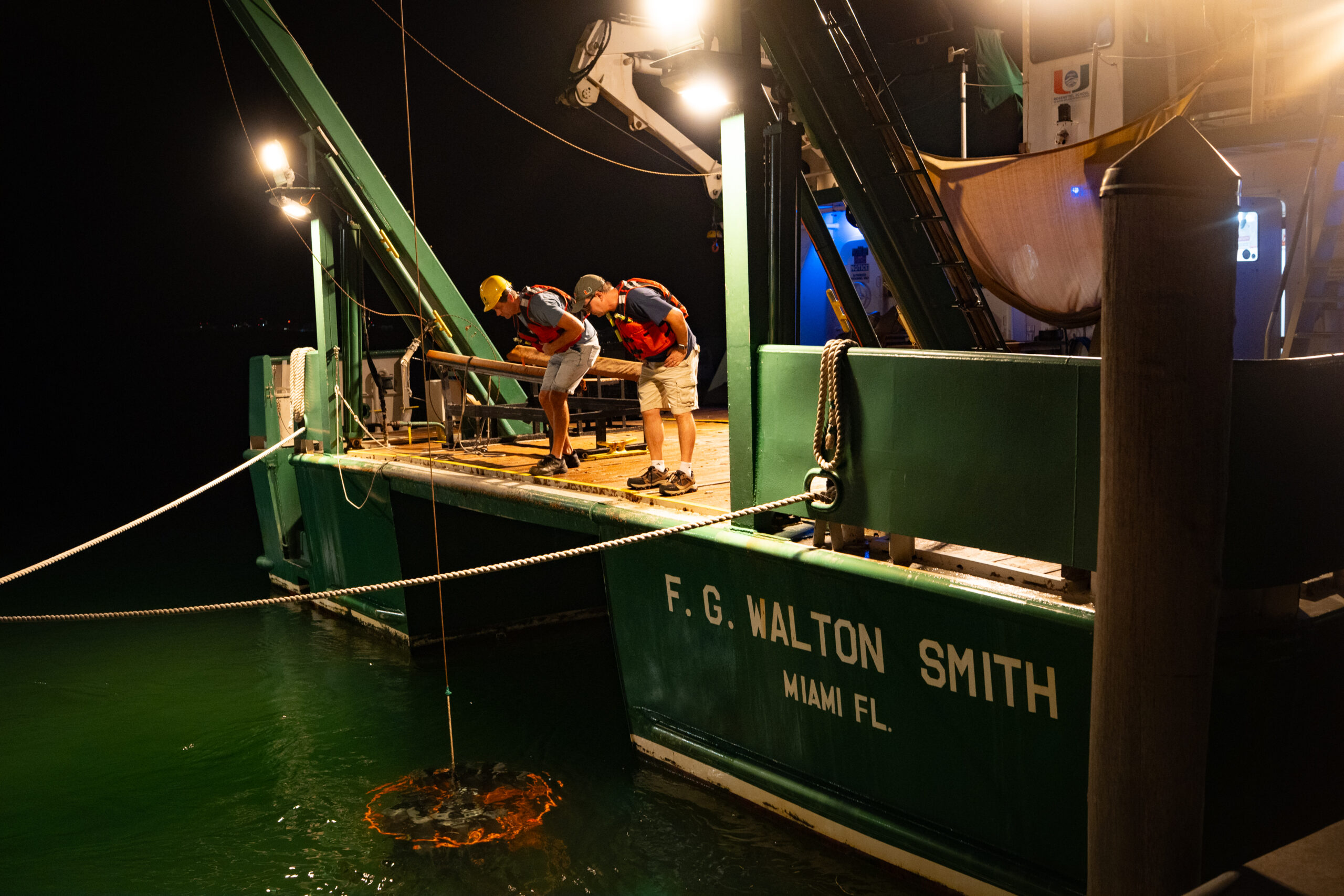
    The green F.G. Walton Smith, 96 feet long, and its crew make this overnight trip about six times a year, traveling 93 nautical miles diagonally from Miami toward the Little Bahama Bank. From there, they go west and collect data at nine sites from the boat and dive underwater at two others.

    The team’s goal is to determine the amount of water flowing north through the Florida Current per second through a series of underwater instruments, from the boat and from satellites. They also collect temperature, salinity, density and velocity data; velocity and temperature, for example, can be combined to calculate the amount of heat transported across an area.

    Chomiak, left, and Zach Barton, a technician and engineer, return from diving to the seafloor to place a data-collection instrument.

    At the first dive site, a remora — a long, torpedo-shaped suckerfish — circled the two scuba divers less than a mile from the boat. The slender fish is known for a unique fin on its head that suctions itself to sharks, whales, and turtles to feed off their detritus. And for a quick moment, it latched onto Leah Chomiak’s head. And her thigh.

    Chomiak focused on the barometer in front of her. Her bulky gloves made it harder to use a screwdriver 50 feet below the Bahamian surface. She and her fellow diver held onto the long tubes that had been recording data every five minutes for the previous two months, since the last time divers brought the instruments to the surface and downloaded the data.

    “Now we decided to service them more frequently, because, at the moment, this is the only source of data for our Florida Current transport estimates,” Volkov said. The scientists can use the pressure data to help calculate the amount of water flowing through the area.

    Next, the ship arrived at the first of nine hydrographic stations and lowered a cage of sensors known as a CTD-rosette sampler (CTD stands for conductivity, temperature and depth, although it measures many more properties). Researchers can use the temperature and salt concentrations of a particular mass of water to infer where it came from and how it reaches other parts of the world.

    Christian takes a quick nap in the galley as the vessel travels back to Miami.

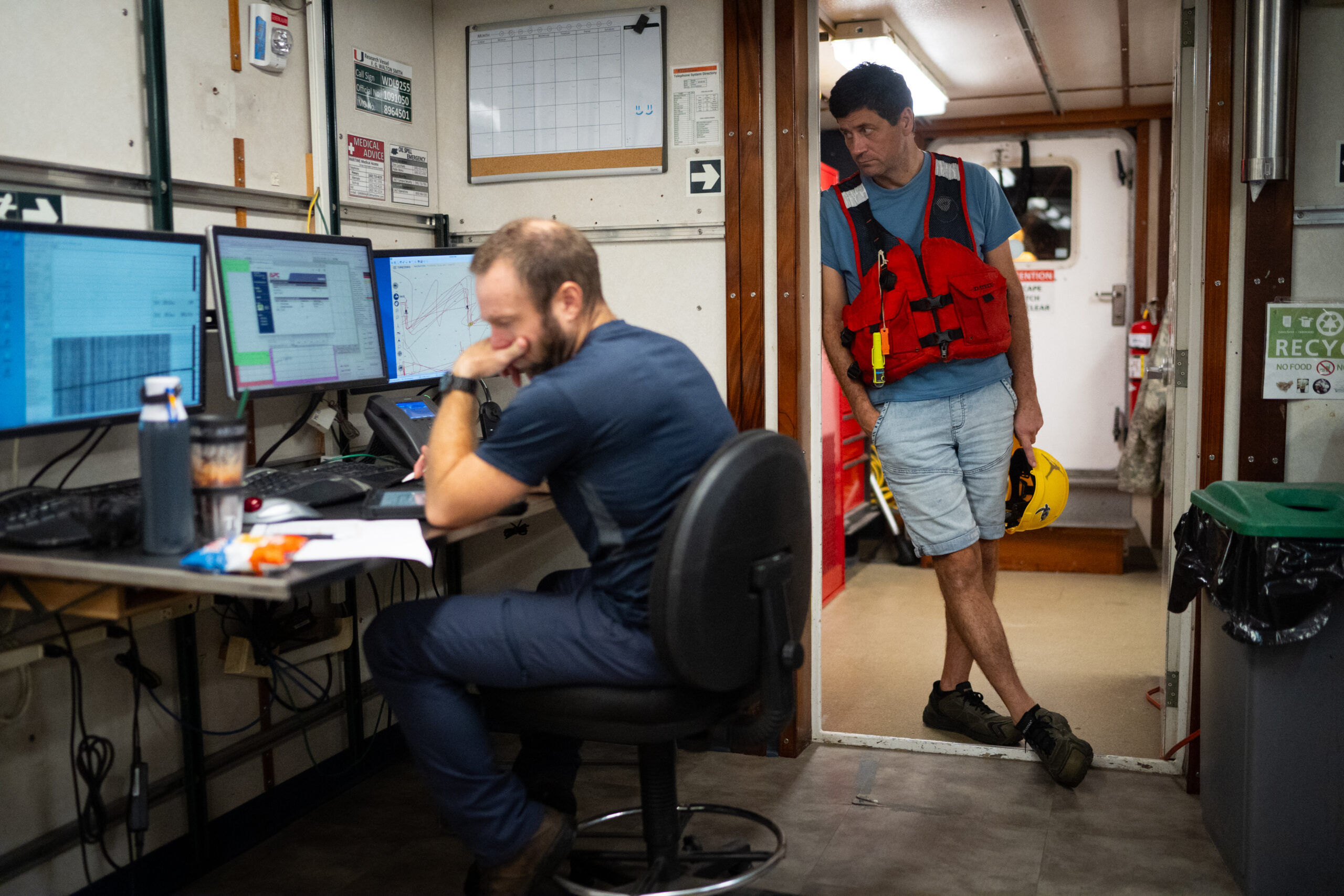
    Jay Hooper, who has been on these trips for 10 years and helps with data management, sat at the ship’s computer station.

    “Ready whenever you are,” he said into his headset.

    From the top deck, the captain lowered the rosette into the water, dropping 60 meters each minute. As the instruments approached the bottom at 486 meters, Hooper said to slow down.

    Lines of various colors — representing salinity, temperature, and density — squiggled down on Hooper’s computer screen as the sensors dropped. Temperature decreased and density increased as the instruments descended. Seventeen minutes later, the rosette was brought back onto the boat.

    After hours of gathering data, Hooper and Smith hit a snag at the seventh station. The rosette now wasn’t sending any information to the computer. Was it human error? Did the instrument break?

    The two tried different solutions as the other scientists slept. Then they replaced the sensors’ cable, and as they lowered the rosette, data filled the computer screen.

    The boat stopped for the last dive near the Florida coast to retrieve the second set of underwater acoustic barometers. But the water was so cloudy, thick and green that the divers couldn’t see their hands, so they decided they would try on the next trip.

    Captain John Cramer pilots the vessel back to the university.

    For the next 12 hours, the boat fought against the Florida Current to take the crew home. Some aboard mustered up energy to sing “Happy Birthday” to one of the crew members.

    The next morning, Smith and his colleagues processed the data to upload to NOAA’s Atlantic Oceanographic & Meteorological Laboratory website. There were no notes about a cable malfunction, encounters with remoras or sleep deprivation.

    The Excel spreadsheet had a single note for each station it recorded: “Profile looks good; use these data.”

  • Sixers’ losing streak reaches three after 117-107 loss to the Atlanta Hawks

    Sixers’ losing streak reaches three after 117-107 loss to the Atlanta Hawks

    Jalen Johnson had 32 points and 10 rebounds and CJ McCollum added 23 points as the Atlanta Hawks beat the 76ers 117-107 on Thursday night in the teams’ first game after the All-Star break.

    Dyson Daniels finished with 15 points, Nickeil Alexander-Walker scored 14, and Zaccharie Risacher and Jock Landale each had 10 as the Hawks snapped a three-game losing streak with their third win over the Sixers this season.

    Tyrese Maxey scored 28 points and Rising Stars MVP VJ Edgecombe added 20 for the Sixers, who were without center Joel Embiid, who missed the game due to right shin soreness.

    Kelly Oubre Jr. scored 17 points and Quentin Grimes scored 10 of his 14 points in the first half for Philly. Andre Drummond contributed 10 points and 14 rebounds as the Sixers lost their third in a row and for the fourth time in five games.

    The Hawks built an 11-point lead with approximately six minutes remaining before the Sixers charged back and closed within 108-104 with less than three minutes left. Atlanta closed the game with a 9-3 run that included five points by Johnson, who shot 14-for-16 from the line.

    The 76ers said Embiid experienced soreness in his shin while participating in a right knee injury management program over the break. After consulting with doctors, Embiid has received daily treatment, while progressing through on-court work and strength and conditioning.

    Coach Nick Nurse said before the game against the Hawks that the plan is to get Embiid on the court on Friday and “see how he looks from there.” Nurse said he “don’t anticipate it being a long time.”

    Embiid is averaging 26.6 points, 7.5 rebounds and 3.6 assists in 31 games this season.

    The Sixers will face the Pelicans on Saturday in New Orleans (7 p.m., NBCSP).

  • Jury convicts man in killings of 4 people sleeping on NYC streets, rejecting insanity defense

    Jury convicts man in killings of 4 people sleeping on NYC streets, rejecting insanity defense

    NEW YORK — A man who fatally beat four sleeping men on the streets of New York City’s Chinatown was convicted Thursday of first-degree murder, with a jury rejecting his insanity defense in the 2019 rampage.

    Randy Santos’ attorneys conceded that he pummeled the defenseless victims — Chuen Kok, Anthony Manson, Florencio Moran and Nazario Vásquez Villegas — with a metal bar and meant to kill them.

    But the lawyers contended that he was too mentally ill to be held criminally responsible. They said he was driven by schizophrenic delusions that made him believe he had to kill 40 people or would die himself.

    Prosecutors countered that Santos took steps, such as sometimes looking out for potential witnesses, and made remarks that showed that he knew that the October 2019 attacks were both illegal and immoral.

    “A jury determined that Randy Santos knowingly and purposefully murdered four men with a metal bar in the span of less than 30 minutes. They were strangers to him and simply happened to be sleeping on Chinatown sidewalks that horrific night,” Manhattan District Attorney Alvin Bragg said in a statement. Jurors, who had deliberated for less than a day, declined to comment.

    Santos, 31, showed no reaction as he heard the verdict, through headphones that allowed him to listen to a Spanish-language interpreter. The Legal Aid Society, which represented Santos, said it would appeal.

    “There is no dispute that Randy has suffered for years from schizophrenia, including on the nights of these tragic events,” the group said in a statement.

    Also convicted of attempted murder and assault charges that include a September 2019 attack, Santos faces a potential life sentence. Sentencing is set for April 16.

    The killings spurred scrutiny of the city’s struggles to aid and protect a homeless population that had reached record size. Then-Mayor Bill de Blasio said the violence shook “the conscience of who we are as New Yorkers.”

    Kok, 83, was a former restaurant worker who had lost his bearings after his wife died and his church closed. Manson, 49, helped establish a Pentecostal church in Mississippi years ago and later made videos and blogged about his thoughts on Scripture, psychology and societal issues.

    Vásquez Villegas, 55, was a factory worker whose family said he had a home on Staten Island and just apparently fell asleep in Chinatown, where he liked to pass the time with friends. Moran, 39, was a onetime aspiring boxer who had formed friendships with other men who lived on the streets, according to Spectrum News/NY.

    Karlin Chan, a Chinatown community activist who knew Manson and raised money for a headstone for Kok, called the verdict “the best outcome.” Having followed the case in court, he was unpersuaded by Santos’ insanity defense: “A lot of people hear voices” and never hurt anyone, Chan noted.

    The Dominican-born Santos came to New York as a young man to live with relatives. They ultimately kicked him out because of his erratic and violent behavior, including an assault on his grandfather. New York police arrested him at least six times over the years on charges that included physically attacking people on a subway train, at an employment agency and in a homeless shelter.

    Santos was diagnosed with schizophrenia before the killings but didn’t take his prescribed medication or go for treatment, his lawyers said.

    Manhattan Assistant District Attorney Alfred Peterson maintained that Santos “knew exactly what he was doing that night, despite his mental illness.”

    In a closing argument, Peterson said Santos carried out the September 2019 beating as a “trial run” and showed awareness of wrongdoing when he shed some clothing afterward. At one point brandishing the rusted metal bar that was used in the killings on Oct. 5, 2019, the prosecutor stressed that Santos briefly held off attacking some of the victims until a passerby was out of eyeshot. And, Peterson noted, the defendant told a prosecution psychiatrist in 2024: “I know it’s not a good action.”

    Santos’ attorneys said that while he might have realized he could get arrested, schizophrenia made him unable to appreciate that what he was doing was morally wrong — a factor that can be enough to support an insanity defense.

    A defense psychologist testified that Santos believed that if other people experienced the commanding voices in his head, they would do the same thing he did.

    “He believed, sincerely, he had to kill 40 people or be killed,” one of his Legal Aid lawyers, Arnold Levine, said in his summation. “Psychosis replaced Randy’s moral judgment.”

  • Trump gets pledges for Gaza reconstruction and troop commitments at inaugural Board of Peace talks

    Trump gets pledges for Gaza reconstruction and troop commitments at inaugural Board of Peace talks

    WASHINGTON — President Donald Trump announced Thursday at the inaugural Board of Peace meeting that nine members have agreed to pledge $7 billion toward a Gaza relief package and five countries have agreed to deploy troops as part of an international stabilization force for the war-battered Palestinian territory.

    While lauding the pledges, Trump faces the unresolved challenge of disarming Hamas, a sticking point that threatens to delay or even derail the Gaza ceasefire plan that his administration notched as a major foreign policy win.

    The dollars promised, while significant, represent a small fraction of the estimated $70 billion needed to rebuild the territory decimated after two years of war between Israel and Hamas. While Trump praised allies for making the commitments of funding and troops, he offered no detail on when the pledges would be implemented.

    “Every dollar spent is an investment in stability and the hope of new and harmonious [region],” Trump said. He added, “The Board of Peace is showing how a better future can be built right here in this room.”

    Trump also announced the U.S. was pledging $10 billion for the board but didn’t specify what the money will be used for. It also was not clear where the U.S. money would come from — a sizable pledge that would need to be authorized by Congress.

    Trump touches on Iran and the United Nations

    The board was initiated as part of Trump’s 20-point plan to end the conflict in Gaza. But since the October ceasefire, Trump’s vision for the board has morphed and he wants it to have an even more ambitious remit — one that will not only complete the Herculean task of bringing lasting peace between Israel and Hamas but also help resolve conflicts around the globe.

    But the Gaza ceasefire deal remains fragile, and Trump’s expanded vision for the board has triggered fears the U.S. president is looking to create a rival to the United Nations.

    Trump, pushing back against the criticism, said the creation of his board would help make the U.N. viable in the future.

    “Someday I won’t be here. The United Nations will be,” Trump said. “I think it is going to be much stronger, and the Board of Peace is going to almost be looking over the United Nations and making sure it runs properly.”

    Even as Trump spoke of the gathering as a triumph that would help bring a more persistent peace to the Middle East, he sent new warnings to Iran.

    Tensions are high between the United States and Iran as Trump has ordered one of the largest U.S. military buildups in the region in decades.

    One aircraft carrier group is already in the region and another is on the way. Trump has warned Tehran it will face American military action if it does not denuclearize, give up ballistic missiles and halt funding to extremist proxy groups, such as Hezbollah and Hamas.

    “We have to make a meaningful deal. Otherwise bad things happen,” Trump said.

    Which countries pledged troops and funding

    Indonesia, Morocco, Kazakhstan, Kosovo, and Albania made pledges to send troops for a Gaza stabilization force, while Egypt and Jordan committed to train police.

    Troops will initially be deployed to Rafah, a largely destroyed and mostly depopulated city under full Israeli control, where the U.S. administration hopes to first focus reconstruction efforts.

    The countries making pledges to fund reconstruction are Kazakhstan, Azerbaijan, the United Arab Emirates, Morocco, Bahrain, Qatar, Saudi Arabia, Uzbekistan, and Kuwait, Trump said.

    Maj. Gen. Jasper Jeffers, leader of the newly created international stabilization force, said plans call for 12,000 police and 20,000 soldiers for Gaza.

    “With these first steps, we help bring the security that Gaza needs for a future of prosperity and enduring peace,” Jeffers said.

    Some U.S. allies remain skeptical

    Nearly 50 countries and the European Union sent officials to Thursday’s meeting. Germany, Italy, Norway, Switzerland, and the United Kingdom are among more than a dozen countries that have not joined the board but took part as observers.

    Most countries sent high-level officials, but a few leaders — including Indonesian President Prabowo Subianto, Argentine President Javier Milei, and Hungarian President Viktor Orbán — traveled to Washington.

    “Almost everybody’s accepted, and the ones that haven’t, will be,” Trump offered. ”And some are playing a little cute — it doesn’t work. You can’t play cute with me.”

    Vatican Secretary of State Cardinal Pietro Parolin told reporters this week that “at the international level, it should above all be the U.N. that manages these crisis situations.” French Foreign Minister Jean-Noël Barrot said in a post on X that the European Commission should never have attended the meeting as it had no mandate to do so.

    More countries are “going through the process of getting on,” in some cases, by getting approval from their legislatures, Trump told reporters later Thursday.

    “I would love to have China and Russia. They’ve been invited,” Trump said. “You need both.”

    Official after official used their speaking turns at the gathering to heap praise on Trump for his ability to end conflicts. Pakistani Prime Minister Shehbaz Sharif called him the “savior of South Asia,” while others said that years of foreign policy efforts by his predecessor failed to do what Trump has done in the past year.

    Turkish Foreign Minister Hakan Fidan said Trump and others there deserved thanks for their collective efforts on Gaza. But Fidan, who said Turkey also was prepared to contribute troops to the stabilization force, cautioned that the situation remains precarious.

    “The humanitarian situation remains fragile and ceasefire violations continue to occur,” Fidan said. “A prompt, coordinated and effective response is therefore essential.”

    Questions about disarming Hamas

    Central to Thursday’s discussions was assembling an international stabilization force to keep security and ensure the disarming of the militant Hamas group, a key demand of Israel and a cornerstone of the ceasefire deal.

    Hamas has provided little confidence that it is willing to move forward on disarmament. The administration is “under no illusions on the challenges regarding demilitarization” but has been encouraged by what mediators have reported back, according to a U.S. official who was not authorized to comment publicly and spoke on condition of anonymity.

    Israeli Prime Minister Benjamin Netanyahu, speaking at a dusty army base in southern Israel, repeated his pledge that “there will be no reconstruction” of Gaza before demilitarization. His foreign minister, Gideon Saar, said during Thursday’s gathering that “there must be a fundamental deradicalization process.”

    Trump said Hamas has promised to disarm and would be met “very harshly” if it fails to do so. But he gave few details on how the difficult task would be carried out.

    Secretary of State Marco Rubio acknowledged that there is a “long ways to go” in Gaza.

    “There’s a lot of work that remains that will require the contribution of every nation state represented here today,” Rubio said.

  • Israeli settlers kill 19-year-old Palestinian American, officials and witnesses say

    Israeli settlers kill 19-year-old Palestinian American, officials and witnesses say

    MUKHMAS, West Bank — Israeli settlers in the occupied West Bank shot and killed a Palestinian American during an attack on a village, the Palestinian Health Ministry and a witness said Thursday.

    Raed Abu Ali, a resident of Mukhmas, said a group of settlers came to the village Wednesday afternoon where they attacked a farmer, prompting clashes after residents intervened. Israeli forces later arrived, and during the violence armed settlers killed 19-year-old Nasrallah Abu Siyam and injured several others.

    Abu Ali said that the army shot tear gas, sound grenades, and live ammunition. Israel’s military acknowledged using what it called “riot dispersal methods” after receiving reports of Palestinians throwing rocks but denied that its forces fired during the clashes.

    “When the settlers saw the army, they were encouraged and started shooting live bullets,” Abu Ali said. He added that they clubbed those injured with sticks after they had fallen to the ground.

    The Palestinian Ministry of Health confirmed Abu Siyam’s death from critical wounds sustained Wednesday afternoon near the village east of Ramallah.

    Abu Siyam’s killing is the latest in a surge in violence in the occupied West Bank. Israeli forces and settlers killed 240 Palestinians last year, according to the United Nations Office for the Coordination of Humanitarian Affairs. Palestinians killed 17 Israelis over the same period, six of whom were soldiers. The Palestinian Authority’s Wall and Settlement Resistance Commission said Abu Siyam was the first Palestinian killed by settlers in 2026.

    Mukhmas and its surrounding area — most of which lies under Israeli civil and military administration — have become a hot spot for settler attacks, including arson and assaults, as well as the construction of outposts that Israeli law considers illegal.

    The Israeli military said late Wednesday that unnamed suspects shot at Palestinians, who were later evacuated for medical treatment. It did not say whether any were arrested.

    Abu Siyam’s mother told the Associated Press that he was an American citizen, making him the second Palestinian American to be killed by Israeli settlers in less than a year.

    A U.S. embassy spokesperson said they “condemn this violence.”

    Palestinians and rights groups say authorities routinely fail to prosecute settlers or hold them accountable for violence.

    U.N. says Israel’s acts in West Bank may be ethnic cleansing

    The U.N. human rights office on Thursday accused Israel of war crimes and said practices that displace Palestinians and alter the demographic composition of the occupied West Bank “raise concerns over ethnic cleansing.”

    The Office of the High Commissioner for Human Rights, citing findings collected November 2024 to October 2025, said Israel was engaged in “concerted and accelerating effort to consolidate annexation” while maintaining a system “to maintain oppression and domination of Palestinians.”

    Residents of Palestinian villages and herding communities have been increasingly displaced as Israeli settlements and outposts expand. Since the start of the Israel–Hamas war, the Israeli rights group B’Tselem says about 45 Palestinian communities have been emptied out completely amid Israeli demolition orders and settler attacks.

    Additionally, the office said Israeli military operations in the northern West Bank “employed means and methods designed for warfare” including lethal airstrikes and forcibly transferring civilians from their homes. It also said Israel “forbade” residents from returning to their homes in northern West Bank refugee camps. The operation, which Israel said was aimed against militants, displaced tens of thousands of Palestinians.

    The report also accused Palestinian security forces of using unnecessary lethal force in the same areas, killing at least eight people, and noted that the Palestinian Authority had engaged in “intimidation, detention and ill-treatment of journalists, human rights defenders and other individuals deemed critical of its rule.”

    Neither Israel’s Foreign Ministry nor the Palestinian Authority responded to requests for comment. Israel has repeatedly accused the U.N. rights office of anti-Israel bias.

    Last year, the U.N. human rights monitor warned of what it called “an unfolding genocide in Gaza” with “conditions of life increasingly incompatible with [Palestinians’] continued existence.” Their report on Thursday also warned of demographic shifts in Gaza raising concerns of ethnic cleansing.

    Report finds imprisoned Palestinian journalists were tortured

    The Committee to Protect Journalists said that dozens of Palestinian journalists who were detained in Israel during the war in Gaza experienced conditions including physical assaults, forced stress positions, sensory deprivation, sexual violence, and medical neglect.

    CPJ documented the detention of at least 94 Palestinian journalists and one media worker during the war, from the West Bank, Gaza and Israel Thirty are still in custody, CPJ said.

    Half of the journalists, the report found, were never charged with a crime and were held under Israel’s administrative detention system, which allows for suspects deemed security risks to be held for six months and can be renewed indefinitely.

    Israel’s prison services did not immediately respond to a request for comment about the report, but rejected a similar report in January about conditions for Palestinian prisoners as “false allegations,” contending it operates lawfully, is subject to oversight and reviews complaints.

    U.N. development chief says removing Gaza rubble will take 7 years

    The vast destruction across Gaza will take at least seven years just to remove the rubble, according to the United Nations Development Program.

    Alexander De Croo, the former Belgian prime minister who just returned from Gaza, said that the UNDP had removed just 0.5% of the rubble and people in Gaza are experiencing “the worst living conditions that I have ever seen.”

    De Croo said 90% of Gaza’s 2.2 million people live in “very, very rudimentary tents” in the middle of the rubble, which poses health dangers and a danger from exploding weapons.

    He said UNDP has been able to build 500 improved housing units, and has 4,000 more that are ready, but estimates the true need is 200,000 to 300,000 units. The units are meant to be used temporarily while reconstruction takes place. He called on Israel to expand access for goods and items needed for reconstruction and the private sector to begin development.