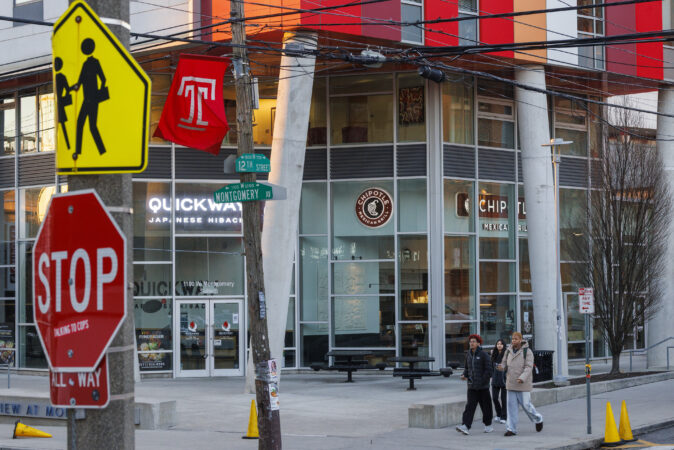
A 16-year-old was found shot to death inside the bathroom of a Chipotle near Temple University’s campus Monday night in what investigators believe may have been an unintentional shooting, according to police and a law enforcement source.
Khyon Smith-Tate and three of his friends were inside the Chipotle on the ground floor of The View at Montgomery apartments at 12th Street and Montgomery Avenue around 5 p.m. Monday, police said. Smith-Tate and one friend went into one bathroom, while the two other teens went into the second bathroom, said Deputy Commissioner Frank Vanore.
According to surveillance video, the teen with Smith-Tate left the restroom alone a short time later, and then walked out of the restaurant with the other teens, Vanore said.
About 15 minutes later, a restaurant employee found Smith-Tate suffering from a gunshot wound to the chest, he said. Police and medics responded, and pronounced him dead at the scene, officials said.
No gun was recovered, though officers found one spent shell casing from a 9mm handgun in the trash can, Vanore said.
Smith-Tate was a student at Imhotep Institute Charter High School. His mother, overwhelmed with grief, declined to speak Monday at her North Philadelphia home.
In a written statement, school officials described Smith-Tate as “caring, energetic, filled with school pride and comical.”
“He was filled with light and love,” the statement, signed by Imhotep Chief Executive Officer Andre Noble and Principal Jury Segers, said. “We will always remember his smile.”
Police have identified the three teens involved, Vanore said, and are poring over cell phone data and interviewing witnesses to try to learn what happened inside the bathroom.
A law enforcement source with knowledge of the investigation said detectives are looking into whether the teens may have been filming a social media video or playing with a gun when it fired and unintentionally struck Smith-Tate.
The source, who asked not to be identified to discuss an ongoing investigation, said the teens are all close friends. Still, they did not call for help, the source said, and left him to die on the bathroom floor.
“As one can imagine, we are struggling today,” Noble and Segers said. Our collective hearts are hurting. But this community is resilient.”
District Attorney Larry Krasner said that trauma-care professionals and victim advocates from his office visited the school on Tuesday to lead “multiple grief trauma healing circles” for students and staff.
“The trauma and grief our young people experience as a result of shootings is unacceptable,” he said. “We will not accept this as normal for our kids and babies.”
If it is confirmed that the shooting was unintentional, Smith-Tate would be the latest in a growing list of children shot by a mishandled gun in Philadelphia.
Dozens of kids have been wounded in accidental shootings in recent years, often the result of other children finding unsecured guns in their homes. Just last month, a 14-year-old was seriously wounded when another teen playing with a gun shot him in the stomach, police said.
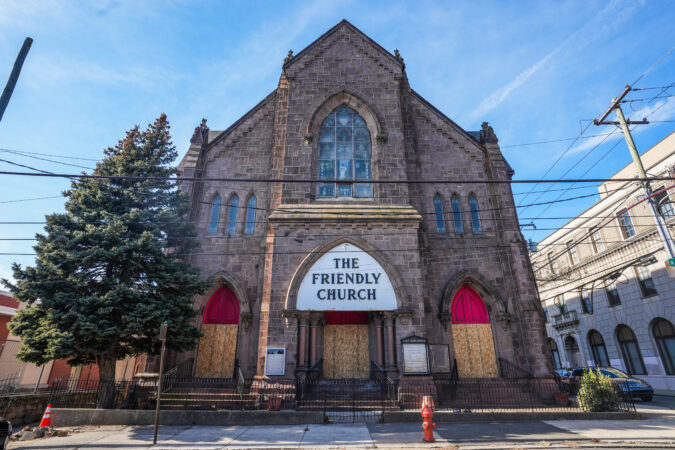
Union Trinity AME Church, one of Philadelphia’s historic Black religious institutions and known as “The Friendly Church,” was vandalized with racist graffiti over the weekend.
Pastor Tianda Smart-Heath was informed of the vandalism shortly after Sunday service, where she found racist slogans invoking the name of God and enslaved people sprayed onto the exterior walls of the more than 200-year-old church, according to the Philadelphia Police Department.
The newly merged church, Union Trinity AME in North Philadelphia, hasn’t welcomed congregants inside the historic building since 2020, and it is currently under construction, according to Fox 29. In that time, church service has been held at the Beckett Life Center next door.
Smart-Heath told local media that the church has been vandalized before, including trespassing and theft, but never with racist hate speech. Police responded to the vandalism on Sunday to photograph the scene and conduct a follow-up investigation. The case is overseen by PPD Central Detectives.
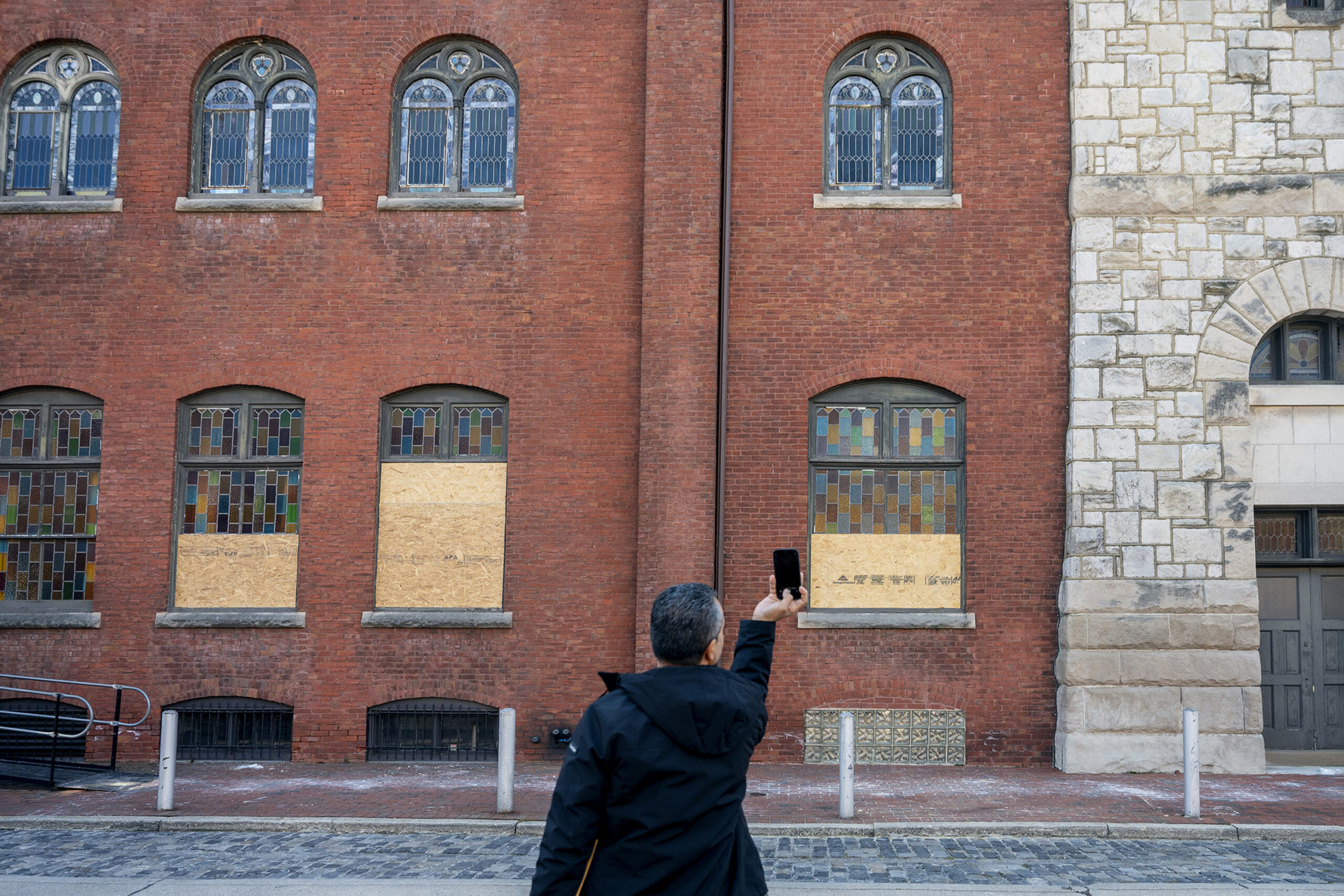
A police officer photographs damaged stained glass at Mother Bethel AME Church on Feb. 20, 2024.
African Methodist Episcopal (AME) churches are part of a vast network of independent Black Christian churches that was started in Philadelphia two centuries ago, when Richard Allen founded Mother Bethel AME in 1787.
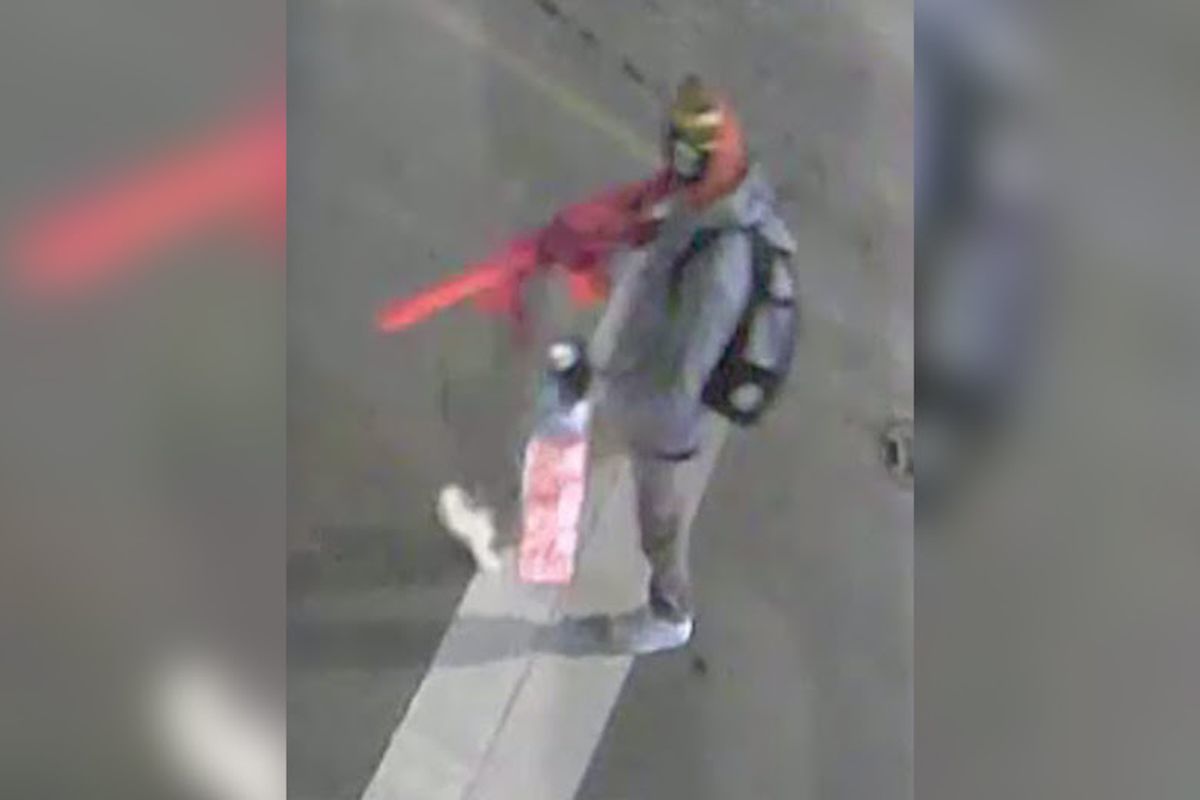
A screenshot of a surveillance video captures the suspect in a recent vandalism incident, where an unknown white male painted racist and antisemitic slogans on the exterior walls of Roxborough High School on Jan. 4, 2026. Police describe the suspect as a white male, wearing an orange scarf/wrap, green and black winter hat, gray hooded jacket, gray pants, and a gray and black backpack.
Hate crimes have more than tripled in Pennsylvania since 2020, according to the most recent “No Hate in Our State” report from the Pennsylvania Human Relations Commission (PHRC). The most prevalent form of hate crime in Pennsylvania, according to FBI reports, is anti-Black or anti-African American hate crimes, accounting for more than one out of every four hate crimes committed in the state in the last five years.
“Any attack on the Black Church as one of the historical foundations of the African American community needs to be condemned and looked at through the lens of a potential hate crime,” said PHRC executive director Chad Dion Lassiter. “We can no longer be silent in this moment of outward hatred and rage toward any institution of faith.”
With less than a minute remaining in Sunday’s game against the 49ers, with the Eagles down 23-19 and their back-to-back Super Bowl aspirations on the line, fans crowded together in McGillin’s Olde Ale House erupted into E-A-G-L-E-S chants as a way to keep hope alive.
Unfortunately, Jalen Hurts was sacked and threw three straight incompletions to end their playoff run early. The Birds’ journey had ended, and with it, the hopes of the region.
Eagles wide receiver A.J. Brown is unable to make the catch as 49ers cornerback Deommodore Lenoir defends during the second half Sunday.
Brandon LaSalata, 24, made the drive from Richmond, Va., to watch Sunday’s wild-card matchup surrounded by Eagles fans.
“I don’t know what happened,” LaSalata said. “We need to get rid of Kevin Patullo. I think that hopefully next year we’ll be a better playoff contender. We should have gotten through this round. I don’t know what happened. I’m very upset.”
On the other side of the pub, 27-year-old Lancaster native Dominic Polidoro sat with his head hanging low in defeat.
“I feel pretty deflated,” Polidoro said. “This team was probably the most talented team in the league. It’s really disappointing to see them fall short. We had higher hopes.”
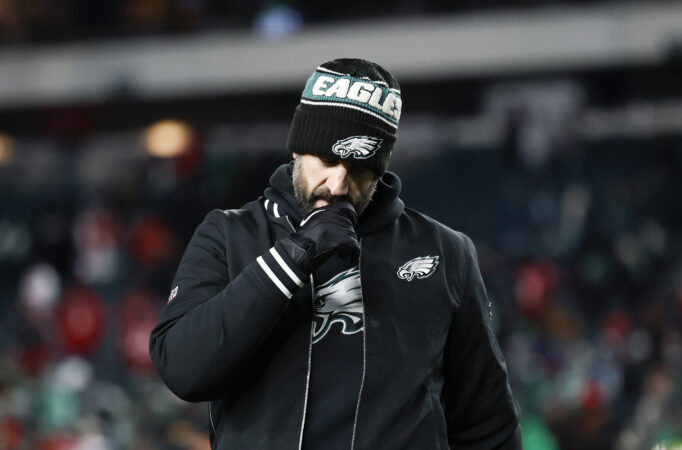
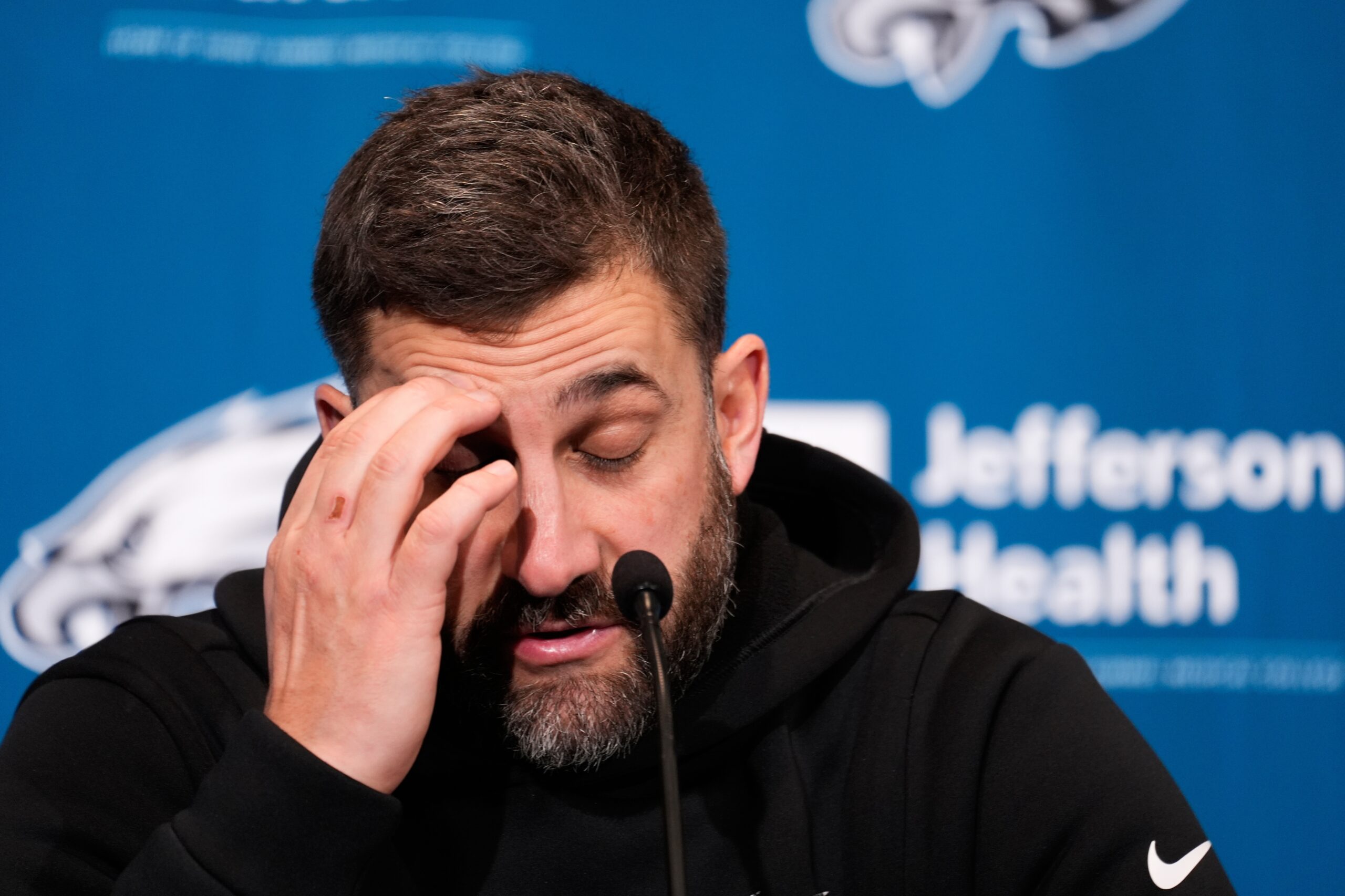
Eagles coach Nick Sirianni speaks during a news conference after the loss.
Somber morning commute for Eagles fans
On Monday morning, the air in Center City was dry, stiff, and unforgiving. And so were the Eagles fans cussing out their favorite team after the season-ending loss.
“I don’t mind losing, but give me an effort. A.J. Brown has to get traded. [Nick] Sirianni has to get fired. Offensive coordinator, fired,” said 73-year-old North Philadelphian Rodney Yatt. “And then we’ll go from there.”
Sunday’s game was marred by incomplete passes, a sideline argument between Sirianni and star wide receiver Brown, and, according to fans, tough calls from referees.
Clay Marsh, 35, of Manayunk, doesn’t think a loss falls to one player.
“I don’t think it was A.J.’s fault,” Marsh said. He saw the offense as disjointed and questioned offensive coordinator Patullo’s strategy, which Marsh said was an overreliance on “running it up the middle” with Saquon Barkley.
“Even if we won, it felt like we were going to go into Chicago and probably get spanked anyway,” Marsh said. “Maybe we saved ourselves some real embarrassment.”
Patullo has been at the center of fans’ ire, not only after last night’s loss but throughout the season. That agita hit a new low when someone egged Patullo’s family home in November after a 24-15 loss to the Chicago Bears.
The latest Patullo roasting comes in the form of a Bucks County golf simulator that allows players to drive balls directly into a digital fairway featuring Patullo’s face. The Golf Place co-owners Justin Hepler and Killian Lennon shared a video of themselves relieving theirfrustrations and honing their swings.
West Philadelphian James Booker, 49, said the small mistakes in the game added up to the loss. He pointed to Brown’s dropped passes and a missed extra point by kicker Jake Elliottthat could have brought the Birds into tie-game territory later on.
Despite the hard loss, Booker doesn’t think Sirianni should be canned.
“You can’t just say you want to up and fire him, even though fans like to do that a lot — Sirianni got us to this point,” Booker said. “I only hope for a better season next year.”
Crystal Edwards didn’t see a dentist until she had a deep cavity at age 10: growing up in a struggling Philadelphia family, the resources to access dental checkups just weren’t there.
So she jumped atthe opportunity to locate a dental clinic in the school where she is now principal, W.D. Kelley, a K-8 in North Philadelphia.
“This dental clinic is saving lives,” said Edwards.
Tucked into a converted science lab on the school’s third floor, the Dental Clinic at William. D. Kelley, operated by Temple University’s Maurice H. Kornberg School of Dentistry, is nearing its third year of operation. It is open to all Philadelphia children, including those who do not attend Kelley, regardless of insurance status.
School district officials have pointed to the Kelley clinic as a model as it prepares to make facilities master plan decisions,which will result in closing, combining, and reconfiguring some school buildings. The clinic is an example, they say, of how the system could use available space in some of its schoolsfor public good.
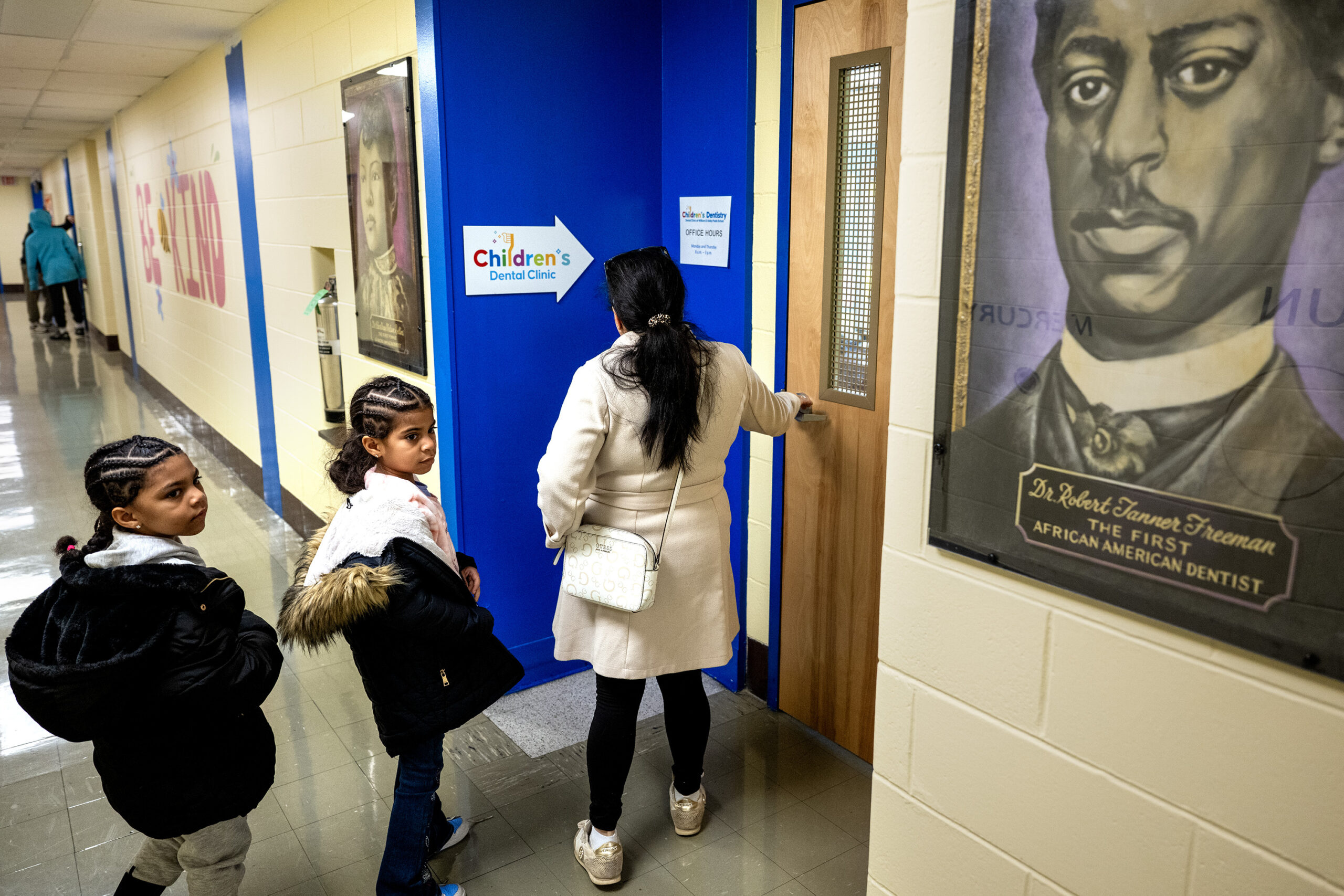
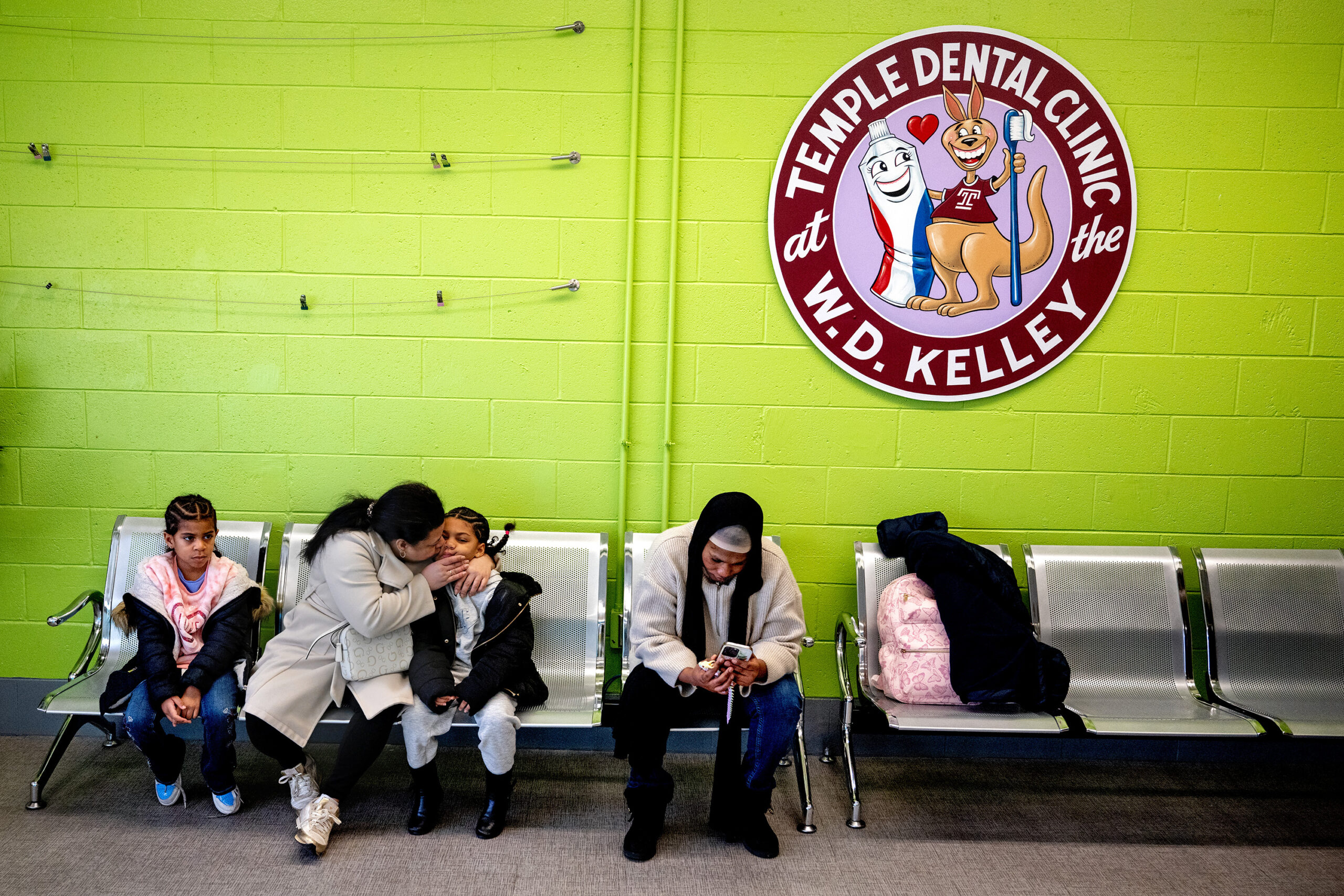
Soribel Acosta arrives at the Dental Clinic at William D. Kelley public school on Thursday, with her children, Andrea Jimenez (left), 6. And Sayra Jimenez, 7.
“This is certainly a great example of what can happen when a university partners with a school district to create life-changing opportunities and outcomes for young people,” Superintendent Tony B. Watlington Sr. said in a statement in 2023, when the clinic opened.
Temple dental school officials said more clinics could follow elsewhere in the city.
Taking care of every child
The underlying concept is simple, said Eileen Barfuss, the Temple dental professor who leads the clinic.
“If your tooth hurts, if you’re not feeling well, you’re not going to learn,” said Barfuss. “In the past, there have been a lot of barriers to care for dentistry that weren’t there for medicine, but preventative care is so important so it doesn’t get to the point of pain.”
The clinic accepts all comers, including those who are uninsured or underinsured, and sometimes treats students’ parents. (Most, but not all, patients have Medicaid dental, and grants help cover treatmentfor those without insurance.)
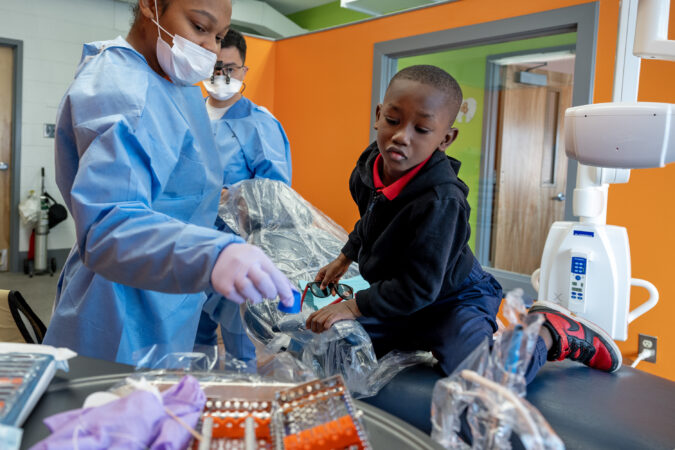
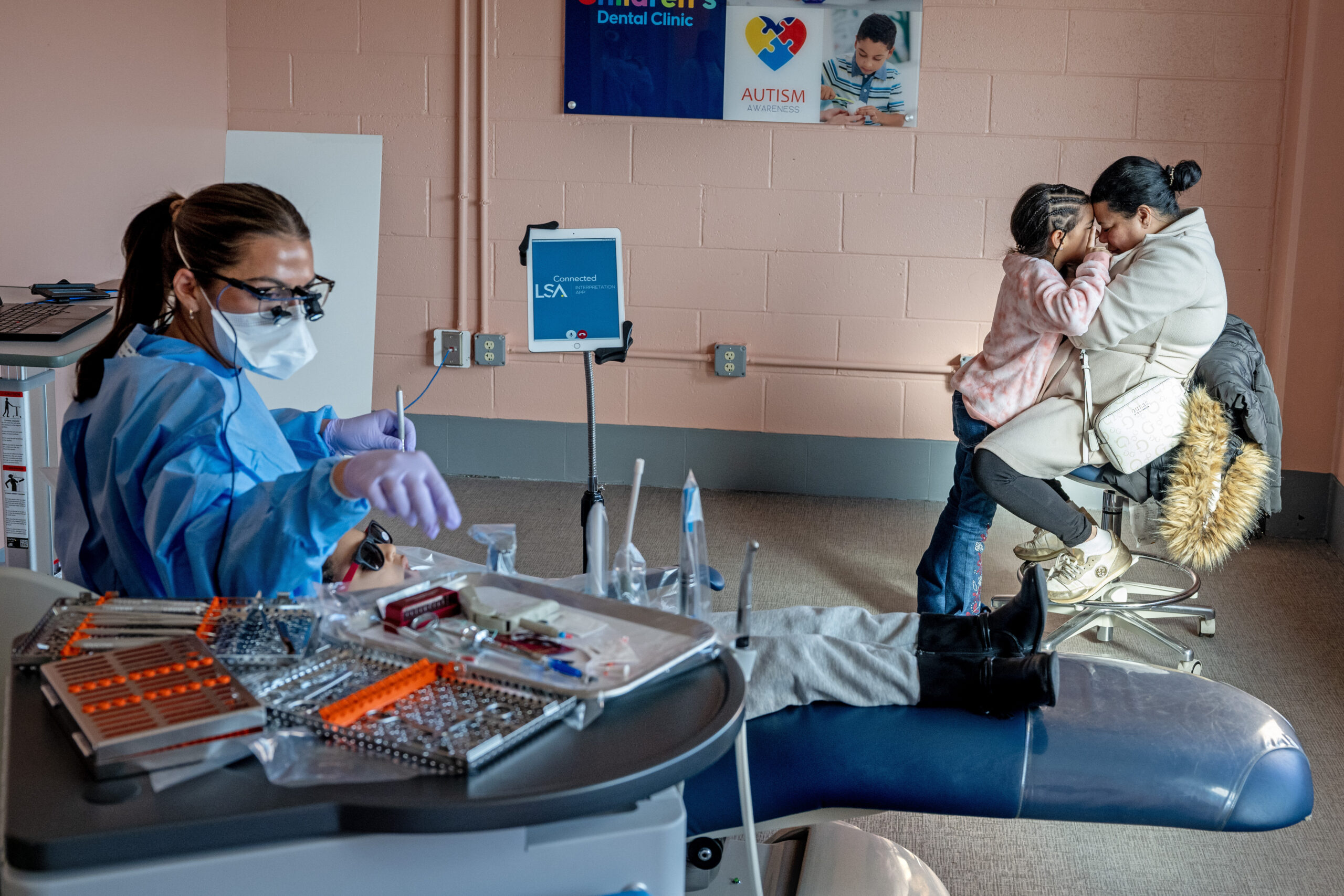
Temple dentistry student Carly Pandit works on the teeth of Andrea Jimenez, 6, as her mother, Soribel Acosta, entertains sister Sayra Jimenez, 7, waiting her turn in the char at the dental clinic at William D. Kelley public school on Thursday.
“We try to take care of every child in the Philadelphia School District,” said Barfuss. “There’s a place that they can come and get comprehensive care and establish a dental home.”
To date, the clinic has seen nearly 700 patients, some of whom are repeat visitors. Patients are treated both by Barfuss and dental students she supervises.
Students do come from other schools to the clinic; Barfuss said her team does outreachat community events andspreads the word through the district’s school nurses, who often send patients to the clinic. And staff teach lessons in Kelley classrooms on oral health andthe importance of seeing a dentist twice a year.
Being in a school helps normalize the dentist for many kids, who might poke their heads into the clinic to look around andsee the friendly dental staff in their scrubs in the hallways, Barfuss said.
‘This is a good dentist’
On Thursday, Fatoumata Bathily, a fourth grader with pink glasses and a bright smile, swung her legs down from a Kelley clinic dentist chair after a successful checkup.
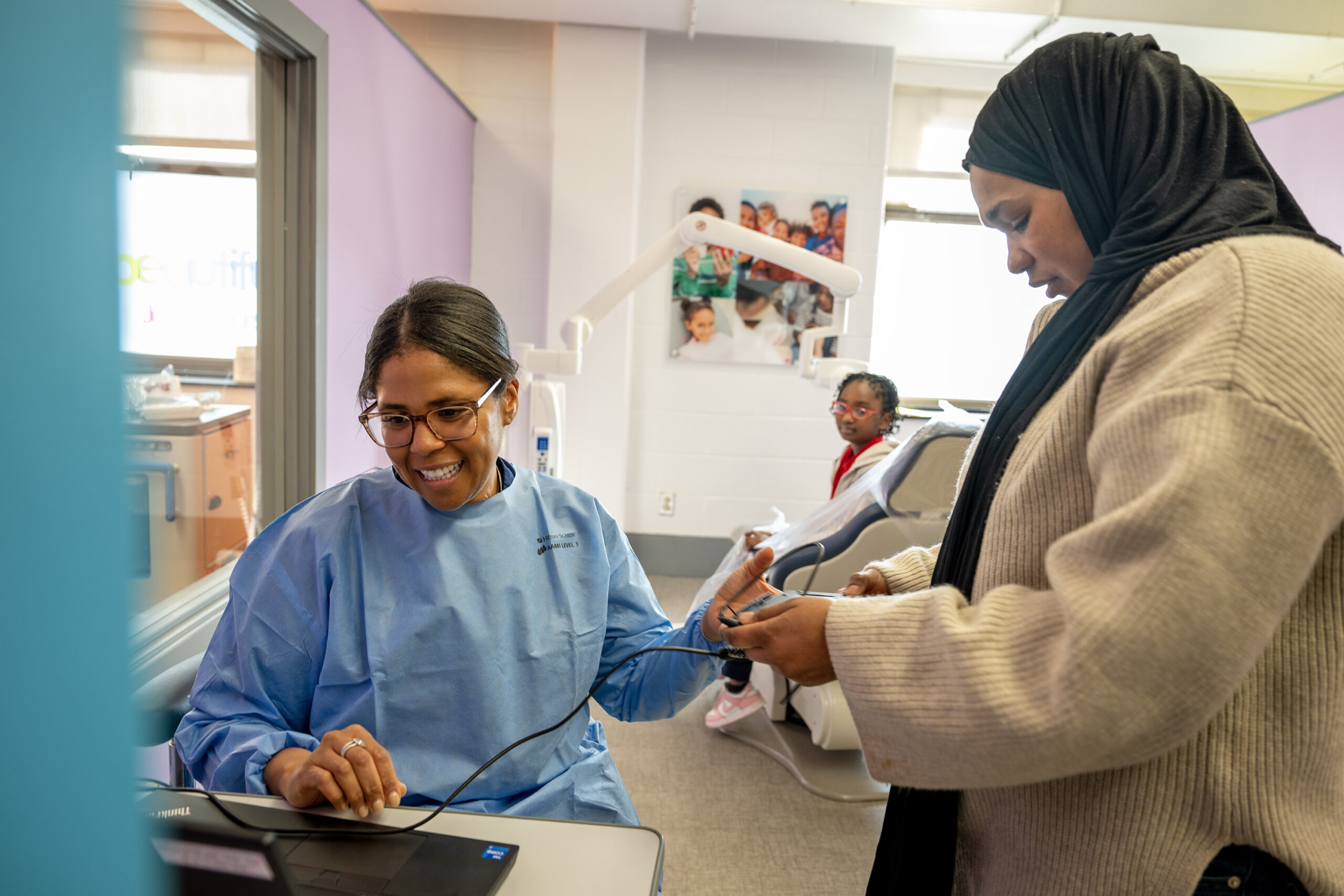
Eileen K. Barfuss (left), a pediatric dentist and Temple dentistry instructor consults with Fily Dramera after her daughter Fatoumata Bathily (rear), 9, was seen by a Temple student dentist at the Dental Clinic at William D. Kelley public school on Thursday.
“It’s good here,” said Fatoumata, who attends nearby Robert Morris Elementary, and came for preventive care along with her brother, Abubakr. “This is a good dentist. I like that it’s colorful, and the people are nice.”
Amid Ismail has wanted to bring such a model to the city since he became dean of Temple’s dental school in 2008. Decades ago, some schools offered dental care via city services, but as funding dried up, those clinics went away, Ismail said.
Ismail raised the idea of a Temple-district partnership, but it took several years to get off the ground. Edwards, an award-winning principal who takes pride in bringing the community into Kelley, got the vision intuitively, he said.
Temple paid to transform a large science lab into the dental clinic; the district provides the space and does not charge rent. There are four chairs, including one in a space specifically designed for patients with autism who might need a quieter environment and more room. Rooms are bright and modern.
“The message to the parents and caregivers is that this is a nice place where all treatment is provided,” Ismail said. “A lot of children do have dental problems, but here we can treat them easily — they miss one class, max, and they don’t have to stay a long time.”
Soribel Acosta waits for their appointment with her children, Sayra Jimenez (left), 7; and Andrea Jimenez (right), 6, at the Dental Clinic at William D. Kelley public school on Thursday.
The clinic, which is about to celebrate its third anniversary, just expanded its schedule — it’s open four days a week, and officials eventually hope it will be open five days.
Edwards fought for the clinic to come to Kelley, and it’s been just the boon she had hoped, she said.
“This is a historic community that was really devastated and hard hit by the crack and drug pandemic,” said Edwards. “The dental office has really given us leverage on how to serve the community better.”
More Philadelphians are visiting emergency departments with the flu than a year ago, as cases are surging across Pennsylvania.
Flu cases in late December hit higher counts locally and statewide than at this time last year, according to city and state data. It’s too early to say whether flu has peaked for the season, or whether cases will continue to rise, health officials say.
window.addEventListener(“message”,function(a){if(void 0!==a.data[“datawrapper-height”]){var e=document.querySelectorAll(“iframe”);for(var t in a.data[“datawrapper-height”])for(var r,i=0;r=e[i];i++)if(r.contentWindow===a.source){var d=a.data[“datawrapper-height”][t]+”px”;r.style.height=d}}});
Philadelphia-area physicians say they’re dealing with an increased flu caseload, including patients suffering from severe complications.
COVID-19 and respiratory syncytial virus (RSV) cases are also rising, but flu is the biggest concern right now, said Brett Gilbert, Main Line Health’s infectious disease chief.
“We’ve been fighting COVID for the last five years, while flu took a back seat,” he said. “But flu is in the driver’s seat this year.”
One reason for the high number of flu cases this early in the flu season, which runs from winter to early spring and typically peaks in December to February, is a new flu variant that emerged this summer.
World health experts meet twice a year to determine which flu variants are circulating and recommend seasonal flu shots to target them.
The variant causing the most cases right now, subclade K, was detected after flu shots for the Northern Hemisphere had already been selected this year, Gilbert said. “There is some degree of vaccine-disease mismatch,” he said.
window.addEventListener(“message”,function(a){if(void 0!==a.data[“datawrapper-height”]){var e=document.querySelectorAll(“iframe”);for(var t in a.data[“datawrapper-height”])for(var r,i=0;r=e[i];i++)if(r.contentWindow===a.source){var d=a.data[“datawrapper-height”][t]+”px”;r.style.height=d}}});
But that doesn’t mean that the current flu vaccine is not effective, especially in preventing hospitalizations and deaths.
“It may not be so great at preventing the illness itself, but [with a vaccine], it may be a mild illness, easily treatable with antivirals or supportive care,” Gilbert said.
Childhood flu vaccination rates in Philadelphia were even higher than the statewide rate, with about 56% of children vaccinated this season.
Some of the most serious cases of flu that pediatrician Daniel Taylor sees are among unvaccinated children.
At St. Christopher’s Hospital for Children, where Taylor sees patients, the outpatient sick clinic is filled with children with severe cases of flu and RSV.
Some are suffering from dehydration and require care in the ER at the North Philadelphia hospital.
Taylor stresses the risk of serious complications from the flu in conversations with parents about vaccination. (Taylor also regularly writes about his experiences as a physician for The Inquirer.)
The flu can trigger severe health crises that can cause brain damage or temporary paralysis from inflammation of the spinal cord. Taylor has seen two children this flu season with benign acute childhood myositis, a rare complication of an upper respiratory infection that causes swelling and muscle damage in the legs, and in even rarer cases can lead to kidney failure.
“They’re not able to walk, and in so much pain from the swelling of the legs,” he said.
Nine children have died nationwide from the flu this season. The season before, flu deaths among children were the highest since 2004, when the Centers for Disease Control and Prevention began tracking them, the American Academy of Pediatrics noted. Among Americans of all ages, the CDC has estimated 5,000 total flu deaths so far this season.
Taylor said that President Donald Trump’s chaotic upheaval of longstanding vaccine policy — with the CDC changing recommendations around flu vaccines and slashing six vaccines from the routine childhood immunization list — makes it harder for physicians to help patients.
He said he had recently met with a mother who told him she’d previously vaccinated her children, but now was avoiding vaccines because she was “scared of giving her kid vaccines with everything going on in the government.”
“They hear something different from the government and the CDC, and they question the relationship” with their doctor, Taylor said.
About 47% of Philadelphians have been vaccinated so far this season, above the national rate.
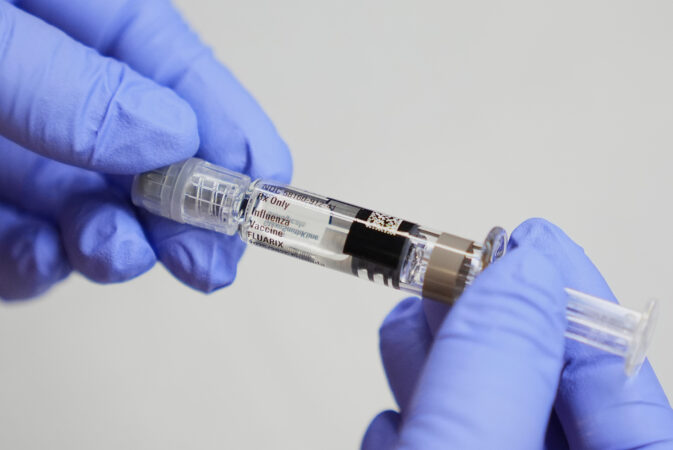
Patients who are feeling sick can get tested for the flu at a hospital or a doctor’s office, and home tests are also available. Antiviral treatments can help ease symptoms. Wearing a mask can also protect others from contracting the flu.
window.addEventListener(“message”,function(a){if(void 0!==a.data[“datawrapper-height”]){var e=document.querySelectorAll(“iframe”);for(var t in a.data[“datawrapper-height”])for(var r,i=0;r=e[i];i++)if(r.contentWindow===a.source){var d=a.data[“datawrapper-height”][t]+”px”;r.style.height=d}}});
In Philadelphia, residents can get free flu and COVID vaccines at five health centers, and the health department regularly conducts vaccine outreach in the city, said Gayle Mendoza, a spokesperson for the Philadelphia Department of Public Health.
“People might say ‘We’re past the holidays, what’s the point in getting vaccinated?’” she said. “Sure, winter break is behind us, but the influenza virus is still forging ahead.”
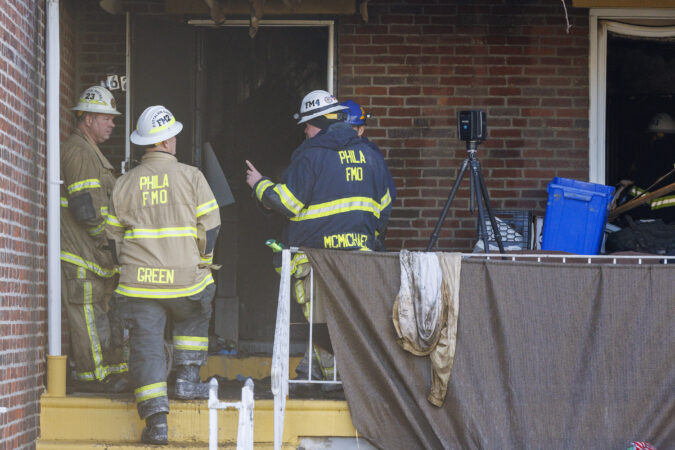
Philadelphia firefighters pulled a 60-year-old woman away from a burning building where she was trapped early Thursday morning, but she later died at a hospital.
The fire department responded to the blaze around 4:45 a.m. on the 6200 block of Ogontz Avenue in North Philadelphia. Firefighters arrived to find a heavy fire scorching throughout the two-story rowhouse.
About 60 firefighters, medics, and support staff were at the scene, officials said. Upon searching the house, firefighters found an unresponsive woman, who did not survive. The Medical Examiner’s Office will soon determine the cause of death, with the Fire Marshal’s Office investigating the cause of the fire.
There have been at least two deadly fires in the area over the last month, in addition to Thursday. Additionally, two people were rescued and survived a fire in South Philadelphia Wednesday, according to CBS.
Earlier this week, Bucks County officials confirmed the death of a third person related to the Bristol Health & Rehab Center fire, which claimed the lives of two other people and injured 20 others. Days before the Bristol fire, a deadly fire in Upper Darby killed one person, critically injured another, and left a firefighter and a handful of others with less-severe injuries.
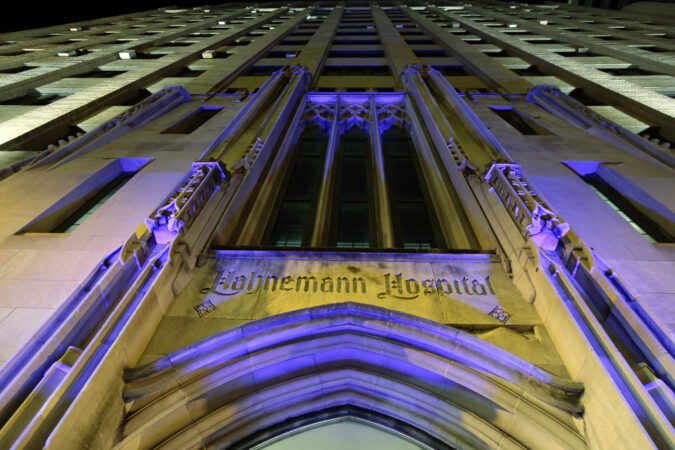
Philadelphia Councilmember Jeffery “Jay” Young introduced a bill at the last City Council meeting of 2025 to ban residential development from the area around former Hahnemann University Hospital.
The proposal covers properties near Broad and Race Streets with owners that include Drexel University, Iron Stone Real Estate Partners, and Brandywine Realty Trust.
But only one known residential project slated for the area is covered by the bill: Dwight City Group’s proposal to redevelop the Hahnemann Hospital patient towers into hundreds of apartments.
If enacted by City Council, which returns on Jan. 22, the bill could have stopped that redevelopment.
But on Dec. 24, Dwight City Group secured a zoning permit for 222-48 N. Broad St. to builda 361-unit apartment building — far larger than the original plan — with space for commercial use on the first floor.
With that permit secured, the project could move forward regardless of whetherYoung’sbill is enacted.
Dwight City Group, however, says they are concentrating on ongoing conversations with Young.
“We are working along with Councilman Young and the community to ensure that this project meets the needs and goals of the district,” said Judah Angster, CEO of Dwight City Group.
The permits show some changes to the original plan. In interviews last year, the developer said the plan contained 288 units and that ground-floor commercial was unlikely.
Young said the proposed housing ban is about preserving jobs by allowing only commercial development at the former hospital site.
“As the city continues to look for ways to incentivize development, we need to ensure jobs and economic opportunities are at the forefront, with engagement from all stakeholders,” Young said in an email. “We look forward to working [with] all stakeholders as this legislation moves through the process.”
Young’s bill confused and outraged manyobservers as a blatant example of spot zoning, in which legislation is used to help or hurt a particular project.
But the tradition of “councilmanic prerogative” would likely guarantee its passage because other Council members are unlikely to vote against a bill that affects only one district.
Nevertheless, the housing and transit advocacy group 5th Square has begun a campaign against the legislation and issued a petition earlier this week calling for its withdrawal.
“The site on Broad and Race Street lies on top of an express subway stop and benefits from proximity to Center City jobs, shops, and cultural amenities,” the petition reads. “Since the shuttering of Hahnemann in 2019, the site currently provides little value to Philadelphians or tax dollars to the city despite its central location.”
In Kensington, a program to mitigate street violence was hitting its stride.
After joining the New Kensington Community Development Corporation in 2023, outreach coordinators with Cure Violence began responding to shootings in the neighborhood, connecting folks with mental health services and other wellness resources.
They hosted men’s therapy groups, safe spaces to open up about the experience of poverty and trauma, and organized a recreational basketball league at residents’ request. Their team of violence interrupters even intervened in an argument that they said could have led to a shooting.
Cure Violence Kensington was funded by a $1.5 million federal grant from the Department of Justice, part of a Biden-era initiative to combat the nation’s gun violence epidemic by awarding funds to community-based anti-violence programs rather than law enforcement agencies.
One year after a political shift in Washington, however, federal grants that Philadelphia’s anti-violence nonprofits say allowed them to flourish are disappearing.
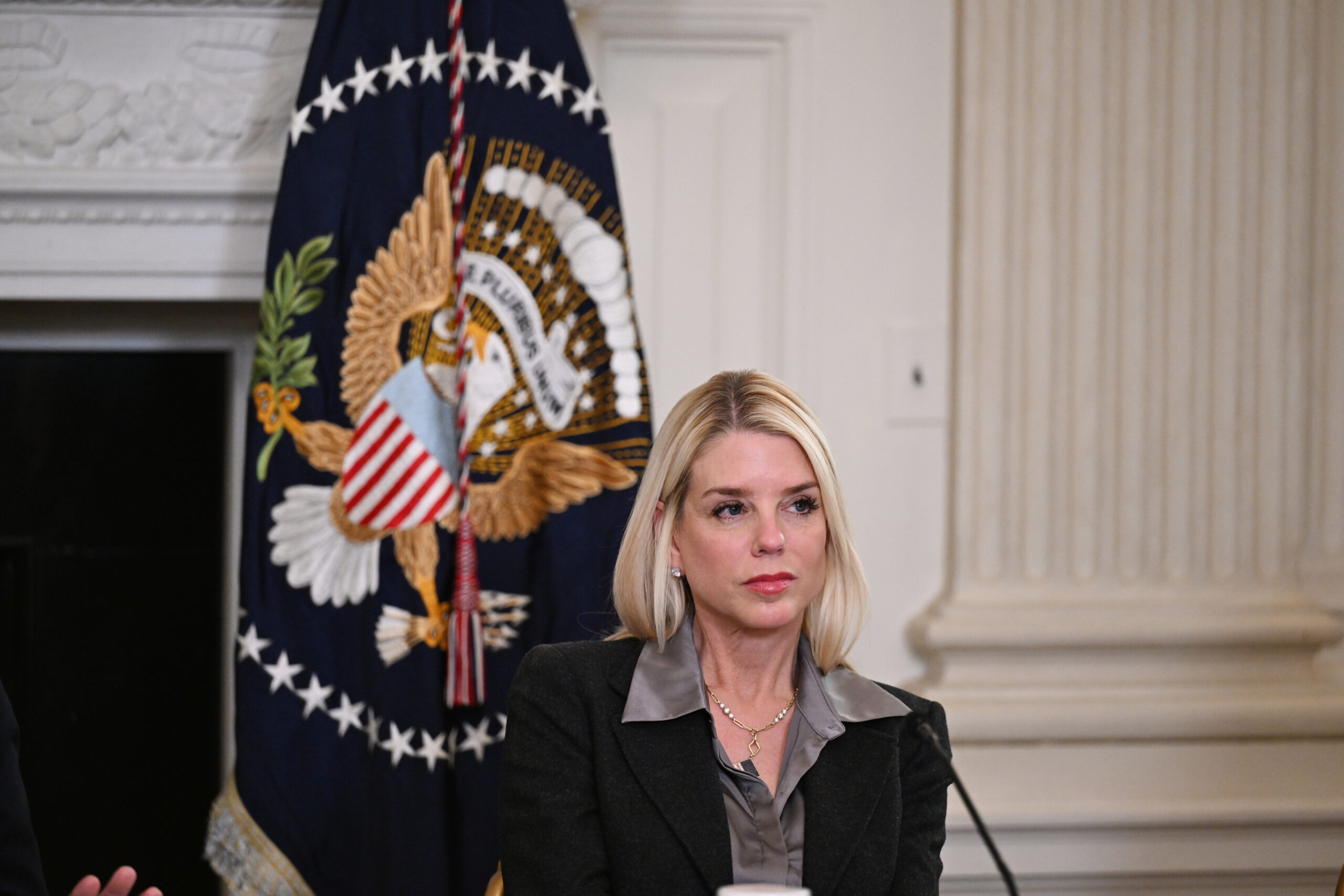
In the spring, New Kensington CDC received a letter from the Justice Department, saying that under the leadership of Attorney General Pam Bondi it had terminated the grant that would have funded Cure Violence for the next three years.
The work, the letter said, “no longer effectuates the program goals or agency priorities.” In the future, it said, the department would offer such grants exclusively to local law enforcement efforts.
“It was a heavy hit,” said Bill McKinney, the nonprofit’s executive director.
The cuts come amid a Trump administration crackdown on nonprofits and other organizations it views as either wasteful or focused on diversity and DEI.
It spent 2025 slashing funds for programs that supplied aid abroad, conducted scientific research, and monitored climate change. At the Justice Department, cuts came for groups like McKinney’s, which aim to target the root causes of violence by offeringmental health services, job programs, conflict mediation, and other alternatives to traditional policing.
In Philadelphia, organizations like the Antiviolence Partnership of Philadelphia and the E.M.I.R. Healing Center say they, too, lost federal funding last yearand expect to see further reductions in 2026 as they scramble to cover shortfalls.
A Justice Department spokesperson said changes to the grant program reflect the office’s commitment to law enforcement and victims of crime, and that they would ensure an “efficient use of taxpayer dollars.”
“The Department has full faith that local law enforcement can effectively utilize these resources to restore public safety in cities across America,” the spokesperson said in an email.
Nonprofits may appeal the decisions, the spokesperson said, and New Kensington CDC has done so.
Attorney General Pam Bondi takes part in an event at the White House on Oct. 23.
Philadelphia city officials, for their part, say they remain committed to anti-violence programs, in which they have invested tens of millions of dollars in recent years.
“There are always going to be things that happen externally that we have no control over as a city,” said Adam Geer, director of the Office of Public Safety.
The reversal in federal support comes at a time when officials like Geer say the efforts of anti-violence programs are beginning to show results.
Violent crime in Philadelphia fell to historic lows in 2025, a welcome relief after the sharp upturn in shootings and homicides that befell the city at the height of the pandemic.
In 2021, the city announced a large-scale campaign to combat gun violence that,in the past year, included nearly $24 million for anti-violence programs.
That was on top of the Biden administration’s Community Based Violence Intervention and Prevention Initiative. Since launching in 2022, the DOJ program awarded more than $300 million to more than 120 anti-violence organizations nationwide.
In April, many of those groups, including New Kensington CDC, lost funds. And in September, a larger swath learned they were now barred from applying for other Justice Department grants that would have arrived this spring.
“We’ve seen enormous dividends” from the work of such groups, said Adam Garber, executive director of CeaseFirePA, a leading gun violence prevention group in the state. “Pulling back now puts that progress at risk — and puts lives on the line.”
Philadelphia feels the squeeze
Federal grants helped Natasha McGlynn’s nonprofit thrive.
McGlynn, executive director of the Antiviolence Partnership of Philadelphia, said a DOJ grant called STOP School Violence allowed her organization to launch a counseling program for young people who had been victims of violence or otherwise exposed to it in some of the city’s most violent neighborhoods.
The nonprofit used the grant to hire therapists to help students develop healthier attitudes around conflict and trauma, she said.
The $997,000 grant was cut in April, and when McGlynn went to apply for another round of funding in the fall, she learned that nonprofits were no longer eligible. The lost funding means some services, like counseling, could now be eliminated, she said.
“I would say several positions are in question,” McGlynn said. “I would say the program is in question.”
Chantay Love, the director of Every Murder is Real, said her Germantown-based victim services nonprofit also lost Justice Department funding in 2025.
Federal grants are not the nonprofit’s only source of income, Love said, but she along with other nonprofit leaders in the city are considering whether they’ll need to cut back on programs this year.
Record-setting investment
The decade before the pandemic saw gun-related deaths in the state climb steadily, spiking during the lockdown as social isolation, school closures, shuttered community services, and higher levels of stress contributed to a spate of gun homicides and shootings that began to ease only in 2024.
Two years earlier, the state began dispersing more than $100 million to community-based anti-violence programs, much of the money coming from the American Rescue Plan, a sweeping Biden administration pandemic recovery package that also sought to reduce rising gun violence. And when those funds expired, state lawmakers continued to invest millions each year, as did Philadelphia city officials.
Garber, of CeaseFirePA, said those efforts “get a lot of heavy-lifting credit” for Philadelphia’s historic decrease in violence.
A report compiled by CeaseFirePA cites studies that found outreach programs like Cure Violence helped reduce shootings around Temple University, as well as in cities like New York and Baltimore, where homicides and shootings in some parts of the city fell by more than 20%.
While it’s too early for data to provide a full picture on how such funding has contributed to overall violence reduction, officials like Geer, the Philadelphia public safety director, agreed that programs like Cure Violence have helped crime reach record lows.
Philadelphia acting chief public safety director Adam Geer attends a news conference on Jan. 30, 2024, about a shooting that left an officer wounded and a suspect dead.
Outreach workers with the city-supported Group Violence Intervention program made more than 300 contacts with at-risk residents in 2025, according to data provided by Geer’s office, either offering support or intervening in conflicts.
And they offered support to members of more than 140 street groups — small, neighborhood-oriented collectives of young people that lack the larger organization of criminal gangs — while more than doubling the amount of service referrals made the previous year.
In practice, a program’s success looks like an incident in Kensington in which Cure Violence workers intervened in a likely shooting, according to members of New Kensington CDC.
In April, a business owner called on the nonprofit after seeing a group of men fighting outside his Frankford Avenue store and leaving to return with guns. Members of the outreach team spoke with both parties, de-escalating the conflict before it potentially turned deadly.
“Each dollar cut is ultimately a potential missed opportunity to stop a shooting,” Garber said.
Cutting off the ‘spigot’
Even as community-based anti-violence programs have risen in popularity, they are not without their critics.
While some officials champion them as innovative solutions to lowering crime, others say the programs can lack oversight and that success is difficult to measure.
In 2023, an Inquirer investigation found that nonprofits with ambitious plans to mitigate gun violence received millions in city funds, but in some cases had no paid staff, no boards of directors, and no offices.
A subsequent review by the Office of the Controller found some programs had not targeted violent areas or had little financial oversight. But by the next round of funding, the city had made improvements to the grant program, the controller’s office found, adding funding benchmarks and enhanced reporting requirements.
Meanwhile, as Philadelphia continued its support these programs, President Donald Trump’s Justice Department began a review of more than 5,800 grants awarded through its Office of Justice Programs. It ultimately made cuts of more than $800 million that spring.
Among programs that lost funding, 93% were “non-governmental agencies,” including nonprofits, according to a letter DOJ officials sent to the Senate explaining the decision.
The balance of remaining funds in the violence prevention grant program — an estimated $34 million — will be available for law enforcement efforts, according to a DOJ grant report. In addition to fighting crime, the money will help agencies improve “police-community relations,” hire officers, and purchase equipment, the document says.
Agencies conducting immigration enforcement are also eligible for grants, the report says, while groups that violate immigration law, provide legal services to people who entered the country illegally, or “unlawfully favor” people based on race are barred.
One group lauding the cuts is the National Rifle Association, which commended the Trump administration in November for cutting off the “spigot” to anti-violence nonprofits.
‘[T]he changes hopefully mean that nonprofits and community groups associated with advocating gun control will be less likely to do it at the expense of the American taxpayer and that real progress can occur on policing violent criminals,” the NRA’s legislative arm wrote in a blog post that month.
Nate Riley disagrees.
Riley, an outreach worker with Cure Violence Kensington, said the cuts threaten to reverse the progress New Kensington CDC has made since he joined the program early last year.
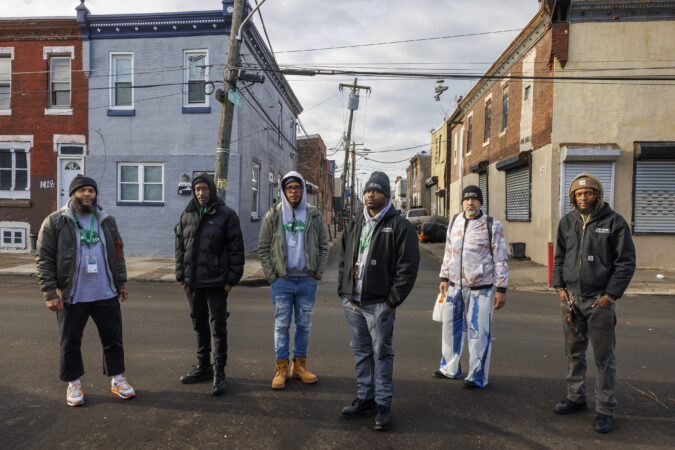
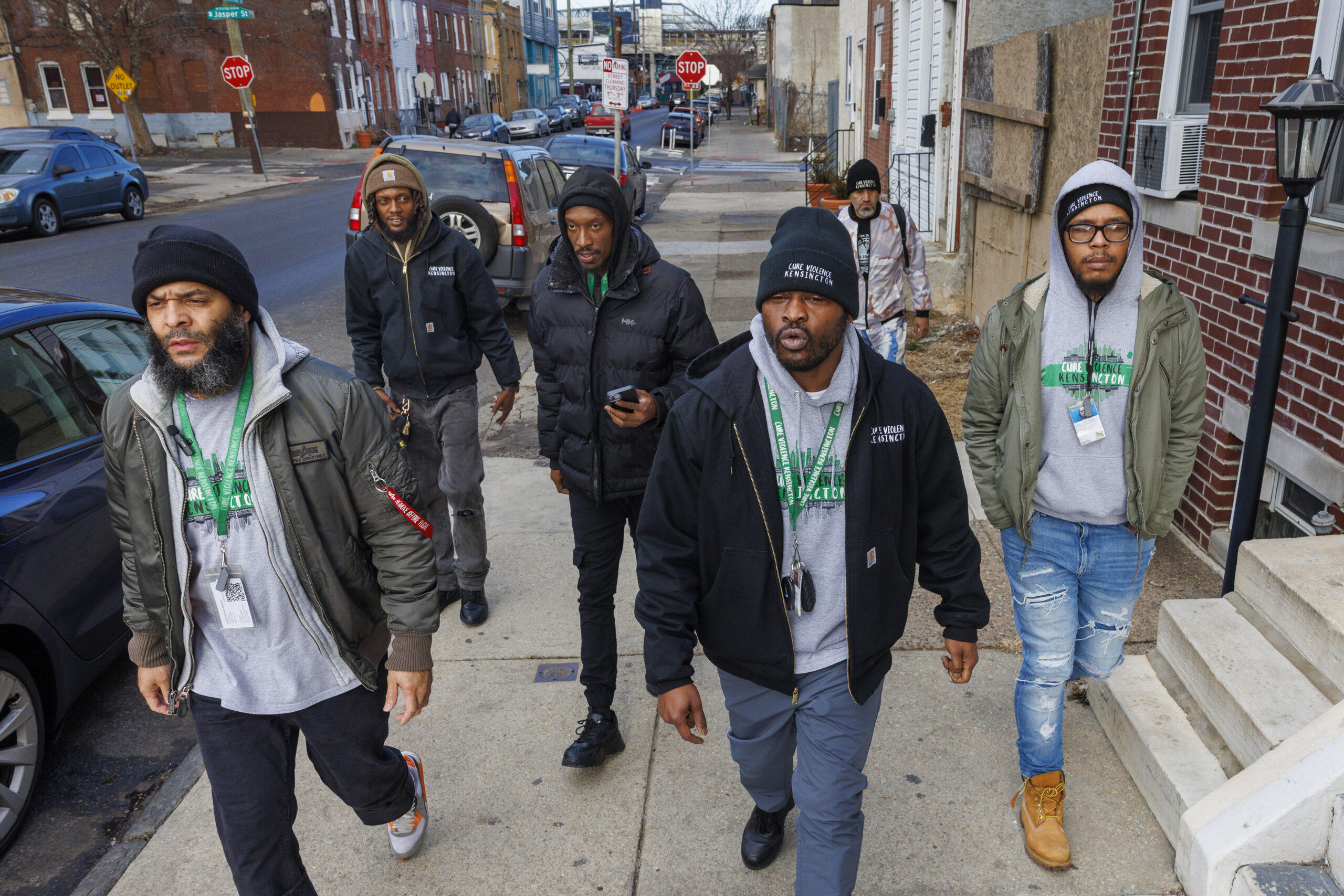
Nate Riley (from left), Tyree Batties, Dante Singleton, Tyreek Counts, Ivan Rodriguez, and Jamall Green-Holmes, outreach workers with New Kensington Community Development Corporation, making their rounds on Wednesday.
Cure Violence’s six-person outreach team is made up of people like Riley, who grew up in North Philadelphia and says he is well-versed in the relationship between poverty, trauma, and violence and brings that experience to Kensington.
“This is a community that’s been neglected for decades,” Riley said. “For lack of a better term, you’ve got to help them come in outside of the rain.”
In a recent month, Cure Violence outreach workers responded to 75% of shootings in the Kensington area within three days, a feat Riley is particularly proud of.
He said the program is not meant to supplant the role of police.
Instead, Riley sees street outreach as another outlet for those whose negative experiences with authorities have led them to distrust law enforcement.
Those people may alter their behavior if they know police are present, he added, giving outreach workers embedded in the community a better chance at picking up on cues that someone is struggling.
From Kensington to Washington
McKinney, with New Kensington CDC, said the group was still expecting about $600,000 from the Justice Department when the grant was cut short.
The nonprofit has since secured a patchwork of private donations and state grants that will keep Cure Violence running through much of 2026, he said.
After that, the program’s future is uncertain.
In the wake of the cuts, national organizations like the Community Justice Action Fund are advocating for federal officials to preserve funding for community-based anti-violence programs in future budgets. Adzi Vokhiwa, a federal policy advocate with the fund, said the group has formed a network of anti-violence nonprofits dubbed the “Invest in Us Coalition” to do so.
The group petitioned congressional leadership in December to appropriate $55 million for anti-violence organizations in the next budget — a figure that both Democrats and Republicans in the Senate have previously agreed on and that Vokhiwa views as a sign of bipartisan support for such programs.
McKinney, with New Kensington CDC, said it was impossible to ignore that the nonprofit and others like it provide services to neighborhoods where residents are overwhelmingly Black and brown. In his view, the cuts also reflect the administration’s “war on cities.”
He was bothered that the Justice Department did not seem to evaluate whether New Kensington CDC’s program had made an impact on the neighborhood before making cuts.
“We’re in a situation where the violence isn’t going away,” he said. “Even if there’s been decreases, the reality is that Kensington still leads the way. As those cuts get deeper, we are going to see increases in violence.”
Two new schools are coming to the Philadelphia School District.
Both schools, a K-8 and a high school,district officials said Wednesday, will have resources to help eliminate long-standing achievement and opportunity gaps for kids from underresourced communities.
They’ll be part of the “North Philadelphia Promise Zone,” Superintendent Tony B. Watlington Sr. announced. Watlington said they would be the first schools in the United States to replicate the success of the acclaimed Harlem Children’s Zone, with the blessing of its founder, Geoffrey Canada,who pioneered a model that takes a birth-to-career approach to tackling generational poverty.
Watlington said the schoolswould be “true year-round schools.” They would bring a new approach to the new Philadelphia public schools, where prior attempts to replicate the Harlem Children’s Zone blueprint have shown mixed results.
Harlem Children’s Zone runs charters in New York City, but the proposed Philadelphiaschools will be run by the district using the organization’s educational model,which includes extra resources and a longer school day and school year, as well as extensive social service supports.
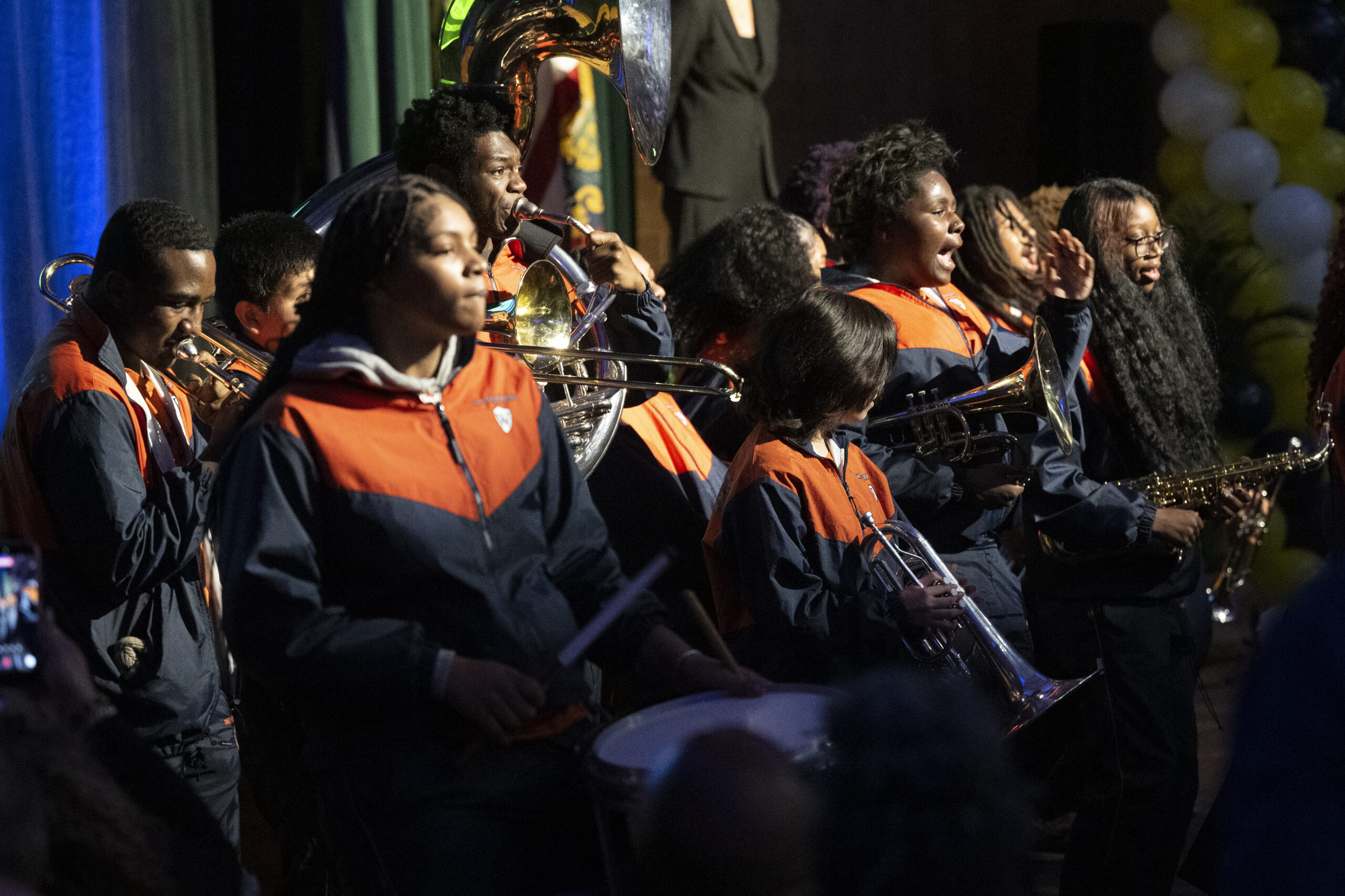
Members of the West Philadelphia Marching Orange & Blue perform before Philadelphia Mayor Cherelle L. Parker speaks on the state of Philadelphia schools during a gathering at Edison High School in Philadelphia, Wednesday, Jan. 7, 2026.
“We’re going to be partners in opening these two state-of-the-art schools,” Watlington said at his state of the schools address, held Wednesday at Edison High School in North Philadelphia.
The district has big hopes for the schools, which officials said will be opened in existing Philadelphia school buildings — no new school structures will be involved.
“Not only will they get better, but get better faster than our district average. We’re going to make sure the school is staffed with the very best, most effective principals,” Watlington said. “We’re going to ensure that these schools are staffed with the very best, most effective teachers.”
They will be schools of choice, meaning parents can opt into having their children attend rather than basing enrollment on where students live.
The schools will also pull in Temple University; Watlington said that via the Temple Future Scholars program, “every single one of these graduates from this K-8 and high school” will be college-ready.
Many details were not clear Wednesday, including when the schools will open, what the year-round model will look like, the exact relationship with Harlem Children’s Zone, how the schools will be funded, and who will staff them. The district said it could not give more details immediately.
News of the new schools caught an important partner off guard. Arthur Steinberg, president of the Philadelphia Federation of Teachers, said Watlington’s speech was the first he heard of the initiative.
“Any changes in working conditions must be negotiated with the PFT,” Steinberg said. “We will not agree to anything that requires members to work additional days or hours.”
Watlington said the K-8 school will open first, and he has tapped Aliya Catanch-Bradley, the respected principal of Bethune Elementary in North Philadelphia, to lead the efforts to open the North Philadelphia Promise Zone schools.
Catanch-Bradley said it was too soon to discuss the particulars about the schools, which will be built with significant community involvement.
But, she said, North Philadelphia is a prime location for the cradle-to-career Harlem Children’s Zone model.
“We know that it’s not a food desert, because food… deserts are natural,” she said of North Philadelphia. “It is food insecure by design, right? And so, we now know that you have a resource drought there, to which it’s going to take an intentional pouring of all types of resources to wrap around a community, to help expand and become a very successful ecosystem.”
Philadelphia district officials will take time to study Harlem Children’s Zone, “but also to understand the landscape of Philadelphia, what needs to be augmented to echo the needs of this community,” Catanch-Bradley said.
Mayor Cherelle L.Parker campaignedon the promise of year-round schools, and her administration has put extended-day, extended-year programs into 40 district and charter schools. But those programs are essentially before- and after-care and summer camps, paid for with city funds and offered free to 12,000 students, rather than traditional year-round education.
Harlem Children’s Zone schools have longer school days and longer school years. It’s not clear what form the proposed North Philadelphia Promise Zone schools might take, and how these efforts would differ from prior attempts around the country to replicate the success of the Harlem Children’s Zone. Former President Barack Obama in 2010 highlighted the model and selected20 communities, including Philadelphia, to start “Promise Neighborhood” programs that would improve access to housing, jobs, and education. Those efforts were met with varying degrees of success, and no schools opened in Philadelphia.
Watlington’s new-school announcement capped a two-plus-hour, pep-rally-style event where he and others underscored progress the district has made in the past year — and since the superintendent came to Philadelphia four years ago.
Philadelphia Mayor Cherelle Parker (left), Superintendent Tony B. Watlington Sr. (center), and school board president Reginald Streater during a ceremony on the state of Philadelphia schools at Edison High School on Wednesday.
Other news from the state of Philadelphia schools event
Parker, who led off the event, said she was pleased with the state of schools.
“The school district has continued to make steady and meaningful progress,” Parker said. “Test scores are rising, attendance is rising. Dropout rates are declining, and those gains are real, and they reflect what happens when we invest in our students.”
Parker emphasized her desire to have the city take over a list of abandoned district buildings. The school board took the first step in December, voting to authorize Watlington and his administration to begin negotiating with the city to do just that.
Parker said thatsome of the buildings have been vacant for as long as 30 years. The district has not yet released a list of buildings to consider transferring, but the mayor said it includes at least 20 former schools.
“I want you to be clear about what my goal and objective is,” Parker said. “It’s not OK for me to have 20, 21 buildings consistently vacant, red on the school district’s balance sheet, generating no revenue and not at all working at their best and highest use. We’re going to find a way to do what has never been done in the city of Philadelphia before — develop a plan for those persistently vacant buildings.”
Watlington alsoran down a laundry list of accomplishments, including ongoing fiscal stability and improvementson the National Assessment of Educational Progress, known as the nation’s report card.
He said the district would “retire” its structural deficit completely by 2029-30 though declined to give details.
He and Reginald Streater, president of the city’s school board, said the district still has a ways to go but has made strides. More than half of all district students still fail to meet grade-level standards in reading and math.
But, Watlington said, “I can assure you we’re making progress. We’re going to double down. More for our children, not less. More opportunities, more access, more exposure, more good things to come in 2026.”
For the first time in more than half a century, Philadelphia has recorded fewer than 225 homicides in a single year.
In 2025,222people were killed — the fewest since 1966, when there were a fraction of as many guns in circulation and 178 homicides.
It is a milestone worth commemorating — and mourning: Violence has fallen to its lowest level in decades, yet 222 deathsin a single city is still considered progress.
window.addEventListener(“message”,function(a){if(void 0!==a.data[“datawrapper-height”]){var e=document.querySelectorAll(“iframe”);for(var t in a.data[“datawrapper-height”])for(var r,i=0;r=e[i];i++)if(r.contentWindow===a.source){var d=a.data[“datawrapper-height”][t]+”px”;r.style.height=d}}});
The drop mirrors a national reduction in violence and follows years of sustained declines after Philadelphia’s annual homicide totals peaked during the pandemic, and it reflects a mix of likely contributing factors: Tech-savvy police are solving more shootings, violence prevention programs have expanded, and the city has emerged from pandemic instability.
No single policy or investment explains it, and officials caution that the gains are fragile.
“The numbers don’t mean that the work is done,” said Adam Geer, the city’s director of public safety. “But it’s a sign that what we’re doing is working.”
The impact is tangible: fewer children losing parents, fewer mothers burying sons, fewer cycles of retaliation.
“We are saving a life every day,” District Attorney Larry Krasner said.
Still, the violence hit some. Victims ranged from a 2-year-old girl allegedly beaten to death by her mother’s boyfriend to a 93-year-old grandfather robbed and stabbed in his home. They included Ethan Parker, 12, fatally shot by a friend playing with a gun, and Said Butler, 18, killed just days before starting his first job.
Police say street-level shootings and retaliatory violence fell sharply, in part because some gang conflicts have burned out after key players were arrested or killed. Killings this year more often stemmed from long-standing drivers — arguments, drugs, and domestic violence — and were concentrated in neighborhoods that have borne the brunt of the crisis.
“These same communities are still traumatized,” said Police Commissioner Kevin Bethel. “One gunshot is a lot. We can’t sit or act like we don’t see that.”
window.addEventListener(“message”,function(a){if(void 0!==a.data[“datawrapper-height”]){var e=document.querySelectorAll(“iframe”);for(var t in a.data[“datawrapper-height”])for(var r,i=0;r=e[i];i++)if(r.contentWindow===a.source){var d=a.data[“datawrapper-height”][t]+”px”;r.style.height=d}}});
The number of domestic-related killings nearly doubled this year compared with last, making up about 20% of homicides, Geer said. The disappearance and killing of Kada Scott, a 23-year-old woman from Mount Airy, was among them, and led to a citywide outcry and renewed scrutiny of how authorities handle violence against women.
And mass shootings on back-to-back holiday weekends — 11 people shot in Lemon Hill on Memorial Day, and 21 shot in a pair of incidents in South Philadelphia over July Fourth — left residents reeling.
<iframe title="Philadelphians’ Perceptions of Safety at Night" aria-label="Line chart" id="datawrapper-chart-GRrTN" src="https://datawrapper.dwcdn.net/GRrTN/1/" scrolling="no" frameborder="0" style="width: 0; min-width: 100% !important; border: none;" height="556" data-external="1"></iframe><script type="text/javascript">window.addEventListener("message",function(a){if(void 0!==a.data["datawrapper-height"]){var e=document.querySelectorAll("iframe");for(var t in a.data["datawrapper-height"])for(var r,i=0;r=e[i];i++)if(r.contentWindow===a.source){var d=a.data["datawrapper-height"][t]+"px";r.style.height=d}}});</script>
The progress comes even as the police department remains 20% below its budgeted staffing levels, with about 1,200 fewer officers on the force than 10 years ago.
The city’s jail population has reached its lowest level in recent history. It dipped below 3,700 in April for the first time in at least a decade, and remains so today.
And arrests citywide, particularly for drug crimes, have cratered and remain far below pre-pandemic levels, mirroring a nationwide trend.
Experts say the moment demands persistence.
“We can’t look at this decline and turn our attention to other problems that we have to solve. We have to keep investing and keep pushing to get this number even lower, because it could be even lower,” said Jason Gravel, an assistant professor of criminal justice at Temple University.
‘Unheard of’ clearance rates
After shootings exploded during the pandemic, and Philadelphia recorded 562 homicides in 2021 — the most in its history — violence began to decline, slowly at first.
But then, from 2023 to 2024, killings fell by 35% — the largest year-over-year reduction among U.S. cities with the highest homicide rates, according to an analysis by Pew.
The decline continued into 2025.
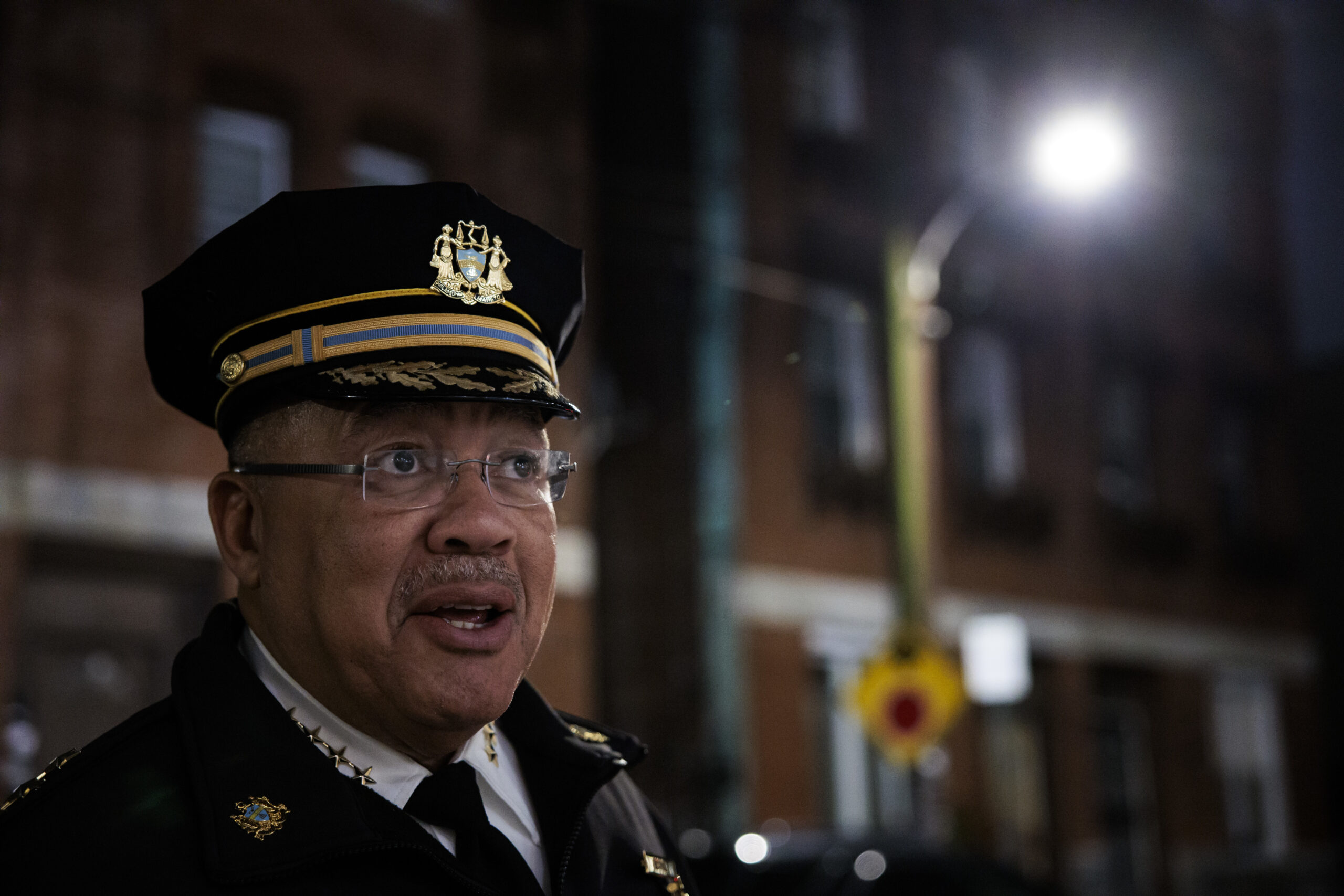
Police Commissioner Kevin Bethel arrives at a North Philadelphia community meeting on Dec. 2.
Bethel has pointed to a host of potential reasons for the decline: the reopening of society post-pandemic — kids returned to school and adults reconnected with jobs, courts, and probation officers — as well as police resources focused in hot spot crime areas and improved coordination among city leaders.
Most notably, he said, detectives are making more arrests in nonfatal shootings and homicides. Experts say that arresting shooters is a key violence-prevention strategy — it prevents that shooter from committing more violence or from ending up as a victim of retaliation, sends a message of accountability and deterrence, and improves the relationship between police and the community.
The homicide clearance rate this year ended at 81.98%, the highest since 1984, and the clearance of nonfatal shootings reached 39.9%.
“That’s unheard of,” said Geer, the public safety director. “The small amount of people who are committing these really heinous, violent crimes in our neighborhood[s] are being taken off the street.”
window.addEventListener(“message”,function(a){if(void 0!==a.data[“datawrapper-height”]){var e=document.querySelectorAll(“iframe”);for(var t in a.data[“datawrapper-height”])for(var r,i=0;r=e[i];i++)if(r.contentWindow===a.source){var d=a.data[“datawrapper-height”][t]+”px”;r.style.height=d}}});
Still, more than 800 killings from between 2020 and 2023 remain without an arrest, according to an Inquirer analysis.
That has had a significant impact on the police department’s relationship with the community over the years, something Bethel has sought to repair since he was appointed commissioner in 2024.
In 2025, he created an Office of the Victim Advocate, hired a 20-person team to communicate with and support victims, and hosted 35 meetings with residents of the most challenged neighborhoods.
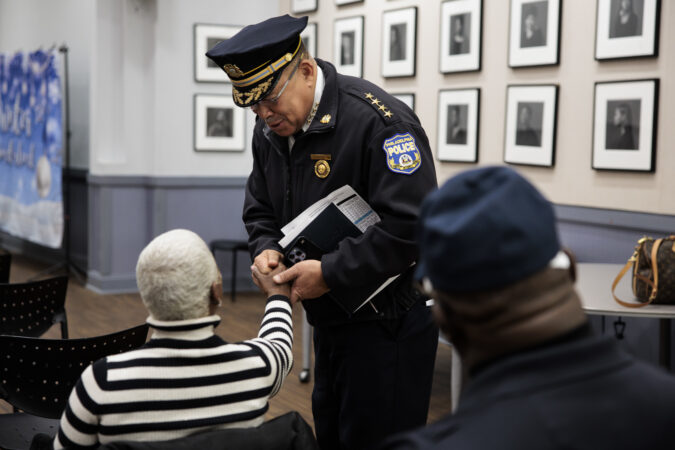
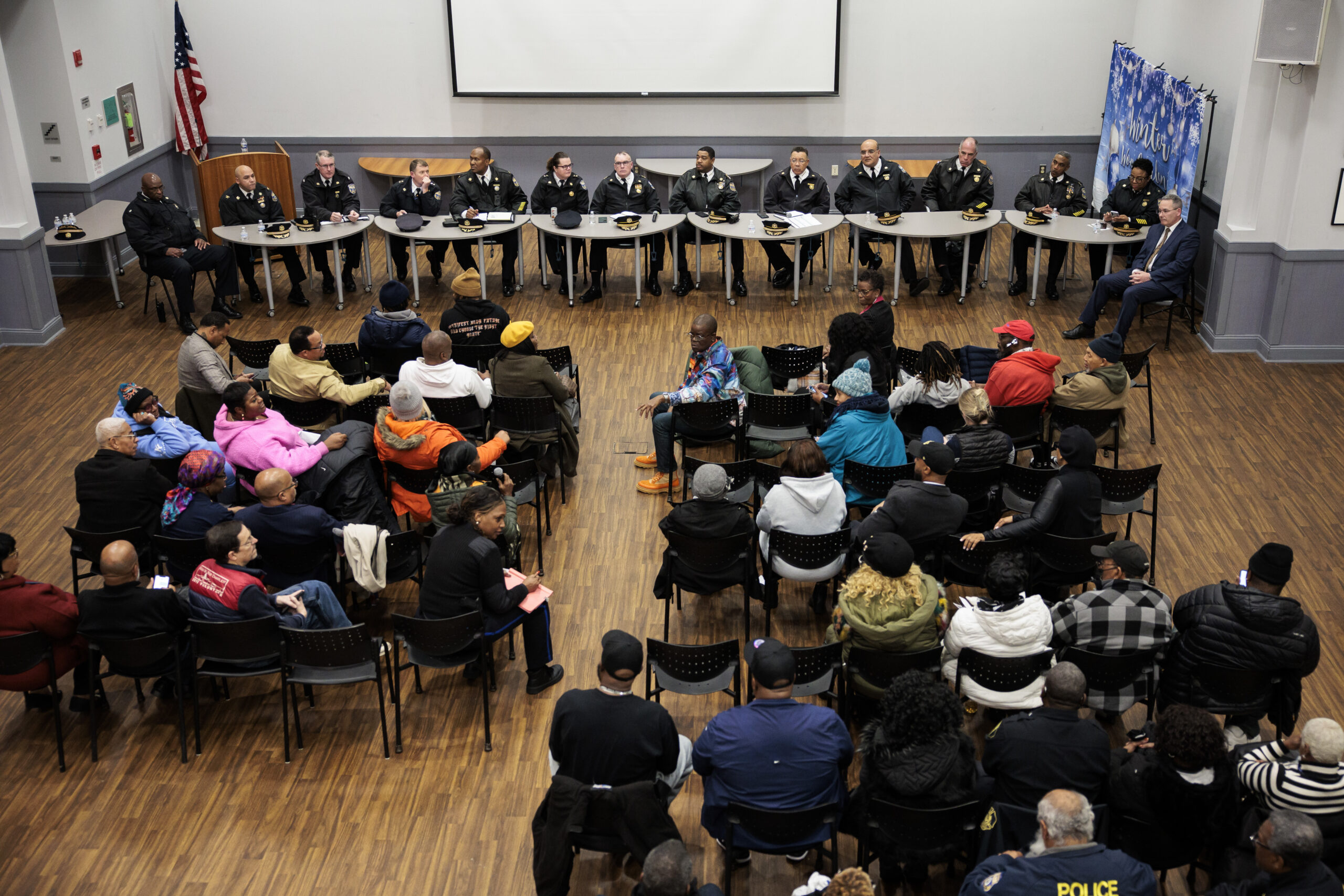
A few dozen community members gathered with top police brass in North Philadelphia on Dec. 2.
Yet Bethel has grappled with the challenge of convincing residents that the city is safer today than four years ago, while questioning whether today’s gains can outweigh years of devastation.
That challenge was on display on a recent cold December night, as Bethel gathered with a few dozen residents inside a North Philadelphia church and asked what they wanted him to know.
Person after person stood and told him what gun violence had taken from them in recent years.
My son. My brother. My nephew.
Both of my sons.
Investing in violence prevention
The city’s network of violence prevention strategies has expanded greatly since 2020, when the city began issuing tens of millions of dollars in grants to grassroots organizations.
Early on, the city faced criticism that its rollout of the funds was chaotic, with little oversight or infrastructure to track impact. Today, Geer said, the city has stronger fiscal oversight, better organizational support, and a data-driven approach that targets neighborhoods experiencing the most violence.
In 2024,Community Justice, a national coalition that researches violence-intervention strategies, said that Philadelphia had the most expansive violence-prevention infrastructure of the 10 largest U.S. cities. When evaluating 100 cities, it ranked Philadelphia as having the third-best public-health-centered approach to preventing violence, falling behind Washington and Baltimore.
Geer said the work will continue through 2026. Starting in January, the city will have a pool of about $500,000 to help cover the funeral expenses for families affected by violence.
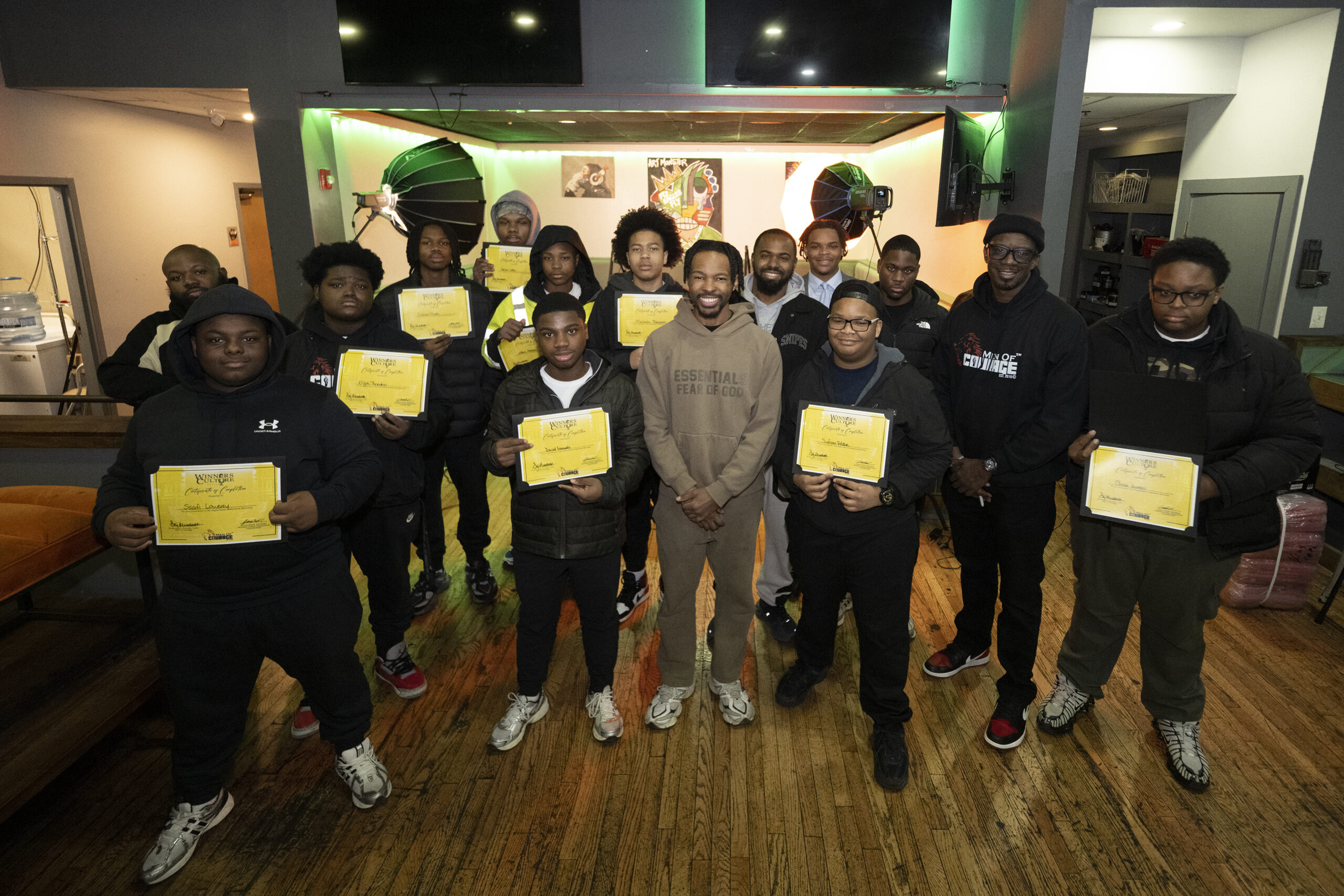
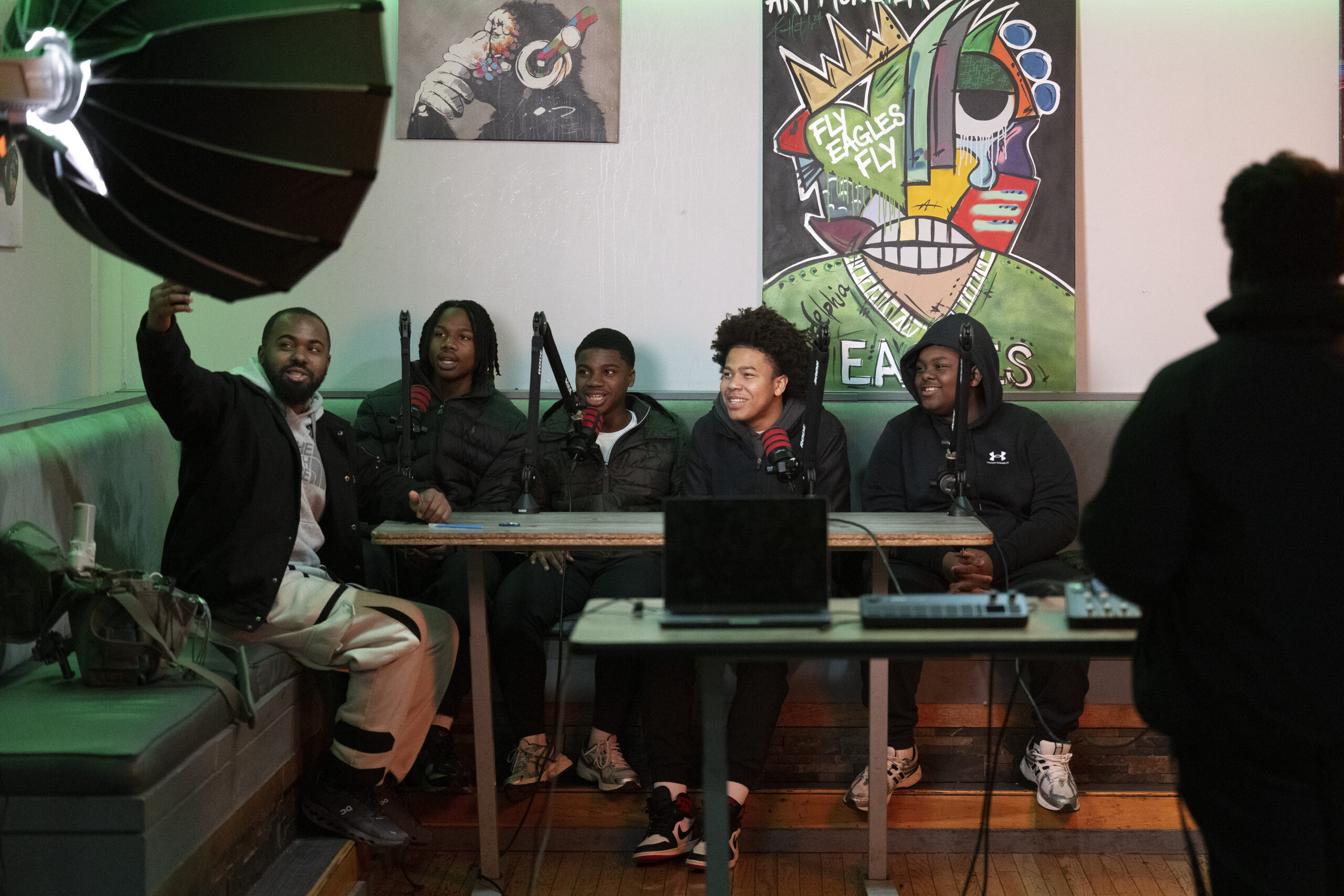
Members of Men of Courage pose with the certificates of accomplishment after completing a 16-week program on multi-media work and podcasting, one of multiple programs the community organization uses to help Black teens build their confidence.
One of those organizations that has benefited from the city’s funding is Men of Courage, a Germantown-based group that mentors young Black men ages 12 to 18 and focuses on building their confidence, resilience, and emotional intelligence.
“We want them to know that one decision can affect your entire life,” said founder Taj Murdock. “Their environment already tells them they’ll be nothing. … We have to shift their mindsets.”
Arguments are a leading cause of shootings, and teaching teens how to de-escalate conflicts and think through long-term consequences can prevent them from turning disputes violent, he said.
Isaiah Clark-White, second to left, and David Samuel, middle, pose for a photo with other members of Men of Courage before recording a podcast.
Isaiah Clark-White, 16, a sophomore at Hill Freedman World Academy in East Mount Airy, said that in his three years working with Men of Courage, he has grown more confident and has improved his public speaking.
And David Samuel, 15, of Logan, said he has learned how to better control his emotions and identify those of the people around him. Both said they feel safer today than three years ago, but remain vigilant of their surroundings.
Samuel said his dad watches the news every day and talks about the overnight crimes and shootings.
“He’s always telling me,” he said, “‘David, I don’t want this to happen to you.’”