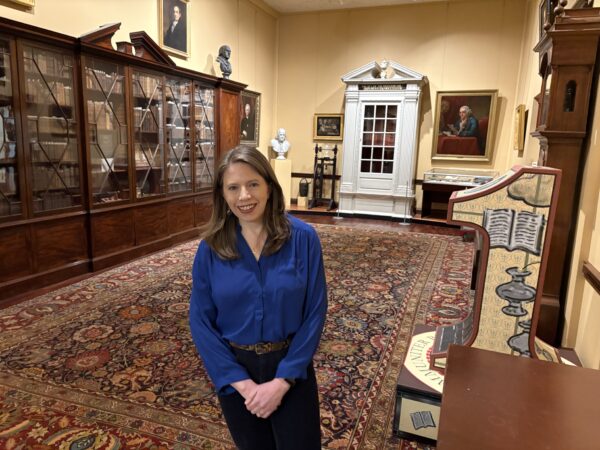
The Library Company of Philadelphia has lined up its next chief. Jessica Choppin Roney will take over the 295-year-old institution as soon as its merger with Temple University is approved by Philadelphia Orphans’ Court, leaders said this week.
Roney has existing ties to both Temple and the Library Company, as director of the program in early American economy and society at the Library Company and as an associate professor of history at Temple. She is also chair of the “integration council” that has been set up to help facilitate the amalgamation of the two groups.
“She’s been working very closely with us, so she was the obvious choice to take on the new role,” said current Library Company director John C. Van Horne, who will continue in his post until Roney takes over. Director and director-designate are already working together on the transition, he said.
Roney said this week that even with the merger, the Library Company’s mission won’t change.
“It continues to be a center of scholarly research and public-facing programming, so we’ve got work in history, in literature, science, and dance and music, and art, and on and on. That all continues and will grow and amplify with our relationship with Temple.”
The group, founded by Benjamin Franklin in 1731, owns more than 500,000 rare books, manuscripts, prints, photographs, works of art, ephemera, and other objects, mostly from the 17th through 19th centuries.
“It has always been America’s library, even before it was America,” Roney said.
The collection will continue to acquire new items, and will explore opportunities for Temple students to “make use of our collections in new ways,” she said.
Roney noted that even though the Library Company has often been powered by women — staff, trustees, shareholders, and donors — it has never had a woman at the helm.
“It’s exciting at a time of change that one of those changes is to have the first woman in charge,” she said.
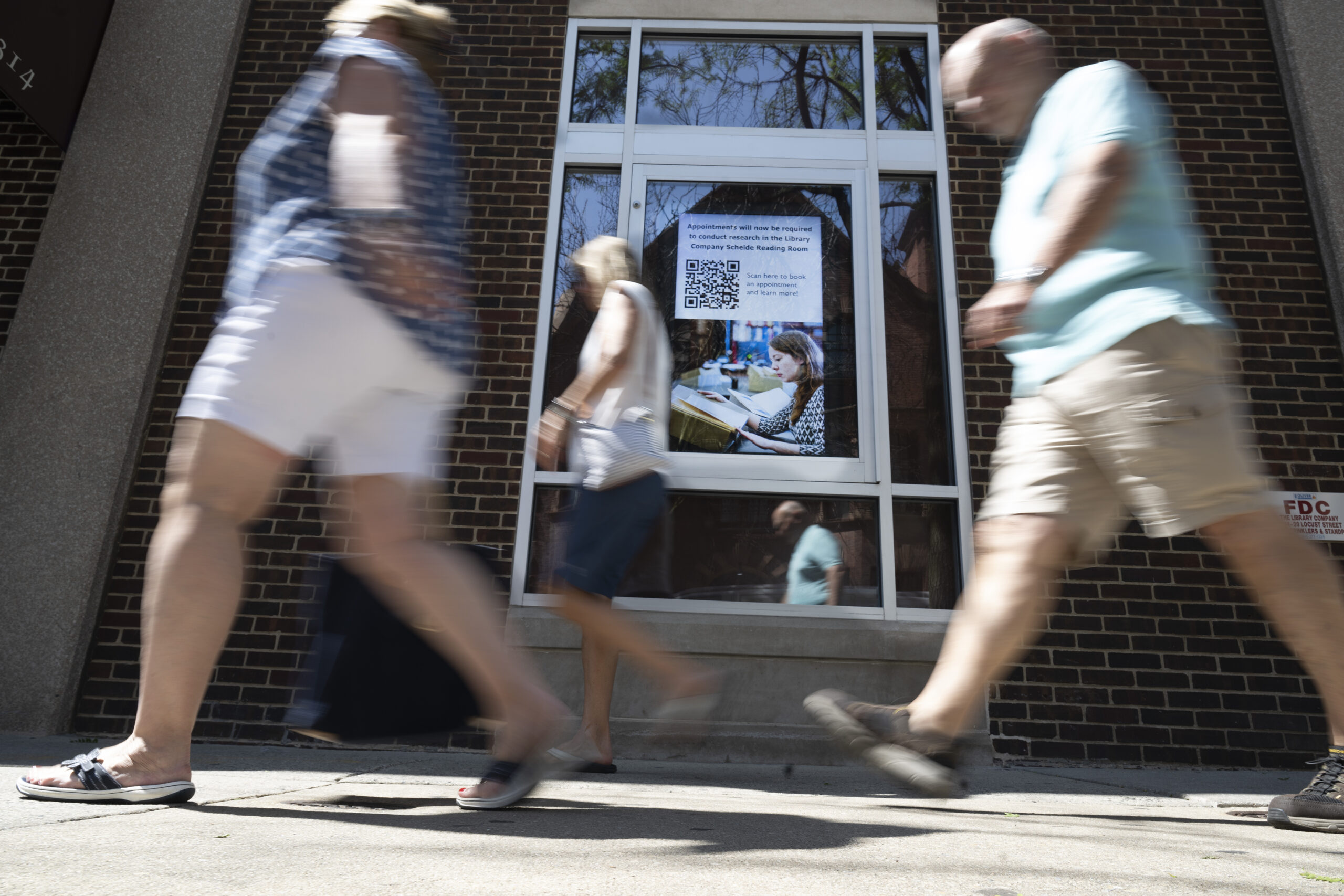
Pedestrians passing the Library Company of Philadelphia in Center City, June 25, 2025.
Facing a string of projected operating deficits, the library began to explore merger opportunities with other groups in 2024. Talks with Temple became public this past June. The boards of both organizations have approved the deal, and in December Library Company shareholders voted 174 to 33 in favor of the merger.
A potential Orphans’ Court approval — which could take weeks to years to receive, said Van Horne — would end nearly three centuries of independence for the library, whose home is on Locust Street just east of Broad, where it will remain.
Roney started as director-designate Jan. 9, and was approved for the post by the Library Company board on Jan. 22, a Temple spokesperson said. Her appointment, however, was not publicly announced until it was included in a newsletter from the group this week. Van Horne said she was chosen without a search, and no other candidates were considered.
“We thought it would be good initially since we’re just getting this relationship off the ground to have a Temple faculty person as the first director [of the merged organization], and it was fortuitous that the early Americanist at Temple was on our payroll,” said Van Horne. “She already had a foot in both camps.”
Roney, 47, earned a bachelor’s degree from Swarthmore College, a master’s from the College of William and Mary, and a Ph.D. from Johns Hopkins University. It was at the Library Company that she conducted research for her first book, Governed by a Spirit of Opposition: The Origins of American Political Practice in Colonial Philadelphia.
Van Horne was director of the Library Company from 1985 until 2014, and then returned in 2024 to help manage its financial difficulties. He has been a strong proponent of the merger, as he was for Roney’s appointment.
“She’s energetic, imaginative, and she has ideas about what we can do with Temple and others,” he said. “I’m very hopeful for the future. I think she’s going to be terrific, and I wasn’t so hopeful for the future a year ago.”
When two of Philadelphia’s most trusted institutions come together, the impact can extend far beyond the field and well outside hospital walls. This February, Jefferson Health and the Philadelphia Eagles announced a landmark new chapter in their long-standing partnership. The team’s training facility will be renamed the Jefferson Health Training Complex, anchoring a collaboration focused on community health, education, and long-term well-being across the region. For both organizations, the name represents a shared statement of purpose.
“Our mission is rooted in our core values: to put people first, pursue excellence, and do what’s right,” Joseph G. Cacchione, MD, the CEO of Jefferson, said. “By aligning with an organization that shares our commitment to excellence, teamwork, and community impact, we’re creating new opportunities to elevate health education, expand prevention efforts, and inspire people across the region to engage with their own well-being. This partnership amplifies our ability to meet people where they are, while staying grounded in the values that define Jefferson as a not-for-profit anchor institution.”
The renaming of the Eagles training facility is only one recent example of Jefferson’s ongoing commitment to the Philly community. Over the years, the health system has advanced health education and workforce development initiatives designed to expand access to care beyond traditional clinical settings.
In 2023, for instance, Jefferson launched its Community Health Worker Academy, a 13-month training and workforce development program that prepares new patient care professionals to support individuals and families within their own communities. Jefferson has also partnered with local venues, including faith-based organizations, to provide health services and outreach in places where people already gather, helping to reduce barriers to preventive care. To underscore this commitment, Jefferson Health recently announced a new collaboration with the Hatfield Ice Center in Colmar, Pa., where it has provided health screenings and wellness programming. The iconic rink will now be known as Jefferson Health Arenas at Hatfield Ice.
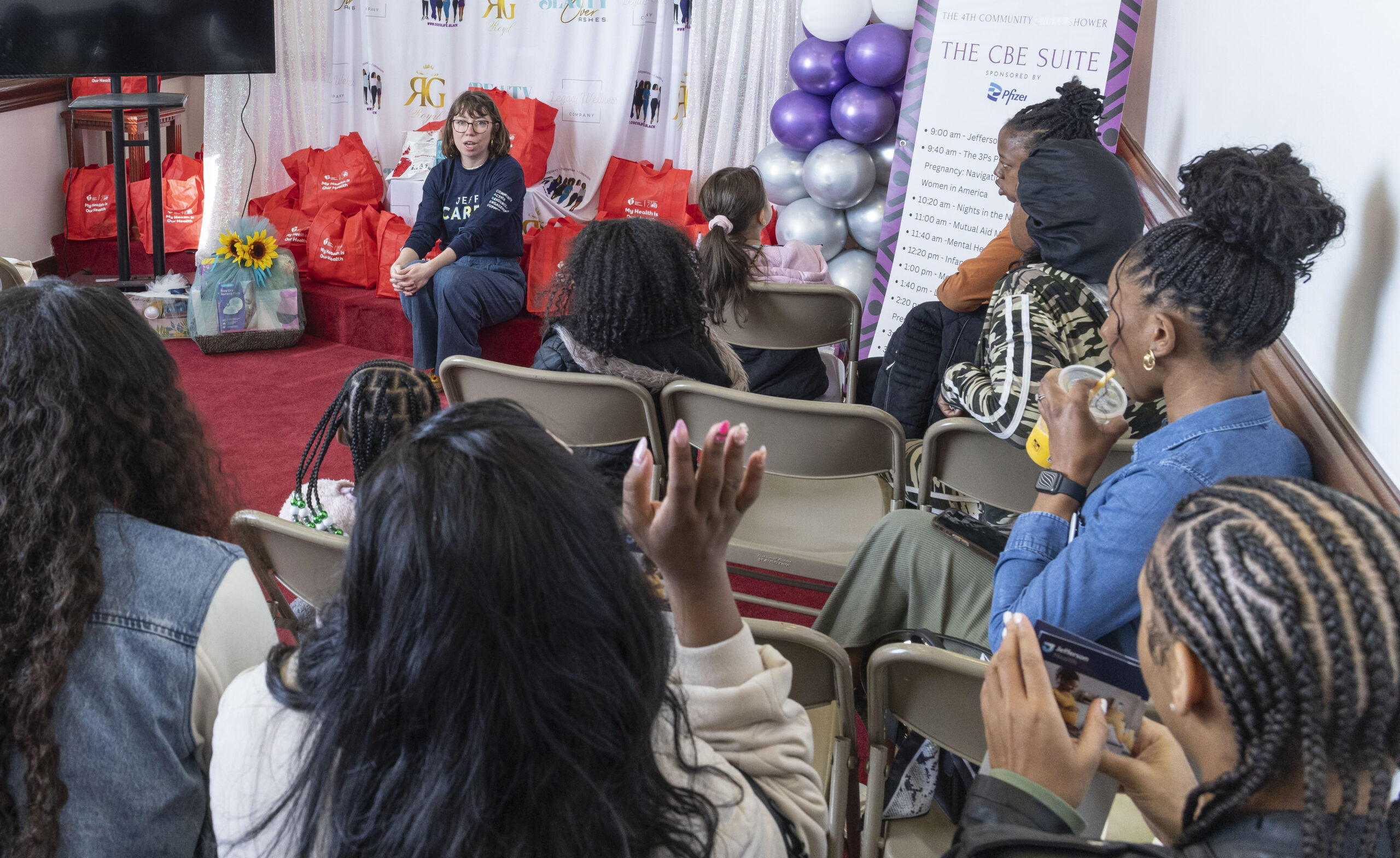
In 2025, Jefferson partnered with Enon Tabernacle Baptist Church for a Black Maternal Health Community Baby Shower. The event offered health screenings, diabetes education, maternity care support, childbirth education, and more.
Recently, the system also partnered with the Cherry Hill, N.J., mayor’s office on its “Healthier Together” wellness campaign, a community‑focused effort aimed at improving health through education, screenings, and active living. In 2026, Jefferson hosted the “Champion Your Health” event at Jefferson Cherry Hill Hospital, created in collaboration with Mayor David Fleisher. The event offered engaging, family‑friendly demonstrations such as CPR practice, fitness sessions, and healthy cooking, all designed to empower residents with practical tools for better living.
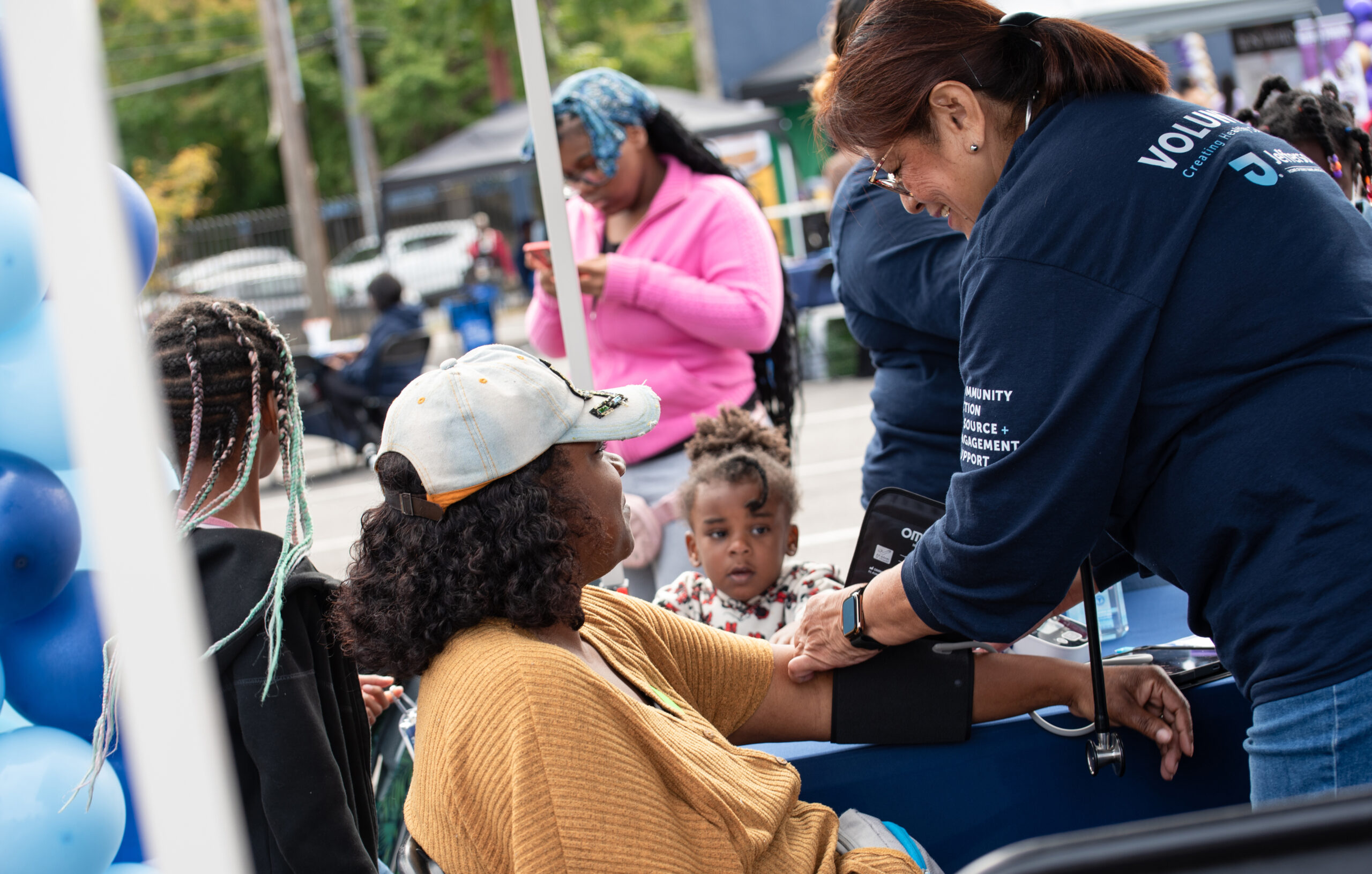
As part of the “Healthier Together” partnership, Jefferson Health also plays a central role in supporting the mayor’s monthly Wellness Walks, a community tradition that encourages people of all ages to stay active. Jefferson clinicians contribute to the campaign by providing blood pressure and glucose screenings, as well as by leading educational sessions on mental wellness, resilience, and setting healthy intentions.
Overall, the “Healthier Together” initiative reflects a shared commitment to giving New Jersey residents accessible, preventive health resources. By combining education, movement, and nutrition guidance, the partnership seeks to strengthen community well‑being and promote a balanced, active lifestyle.
A Cornerstone Investment in Community Health
The Jefferson Health Training Complex will serve as the physical and symbolic cornerstone of its Eagles partnership, a home for elite athletic performance. The naming reinforces Jefferson’s role as a regional and national leader of health, education, workforce development, and research — the $17 billion enterprise includes more than 30 hospitals and 700 care sites across Pennsylvania and New Jersey, a health plan, and a leading academic institution that employs more than 65,000 people.
For the Eagles, the partnership reflects a decades-long commitment to using the sport of football as a force for good, a value long championed by the organization’s ownership. Its impact is ensured by Jefferson’s broad reach and the institutions’ shared connection to the same communities. Jefferson has been one of the Eagles longest-running relationships. Over the years, that partnership has fueled many community initiatives, which have supported breast cancer, autism research, and other causes.
Reaching Communities Where They Are
Jefferson’s community health efforts currently span the full range of programs for the public, including healthy food access, workforce development, and mobile cancer screenings. Other initiatives like JeffCARES empower members of the Jefferson community to take action to address critical social needs, foster engagement, and make a meaningful impact in our diverse neighborhoods and communities through partnerships with local non-profits.
“We’ve seen extraordinary results from programs like our Community Health Worker Academy, a program that creates pathways into health care careers and measurably improves patient outcomes,” Cacchione said.
In October 2025, JeffCARES partnered with the Malcolm Jenkins Foundation to organize Get Ready Fest in Philadelphia. The community event provided 800 families with groceries, health screenings, and employment resources.
The Community Health Worker Academy, which recently became the first in the United States to earn CHW accreditation from the Utilization Review Accreditation Committee (URAC), trains trusted local residents to serve as health advocates in their own neighborhoods, helping to bridge the gap between communities and access to care. “Our partnership with the Eagles strengthens those efforts,” Cacchione said.
What distinguishes the expansion of this partnership between Jefferson and the Eagles is this explicit focus on providing care to their communities outside of traditional health settings. Instead, the partners are offering educational resources and more at gathering places like Eagles games.
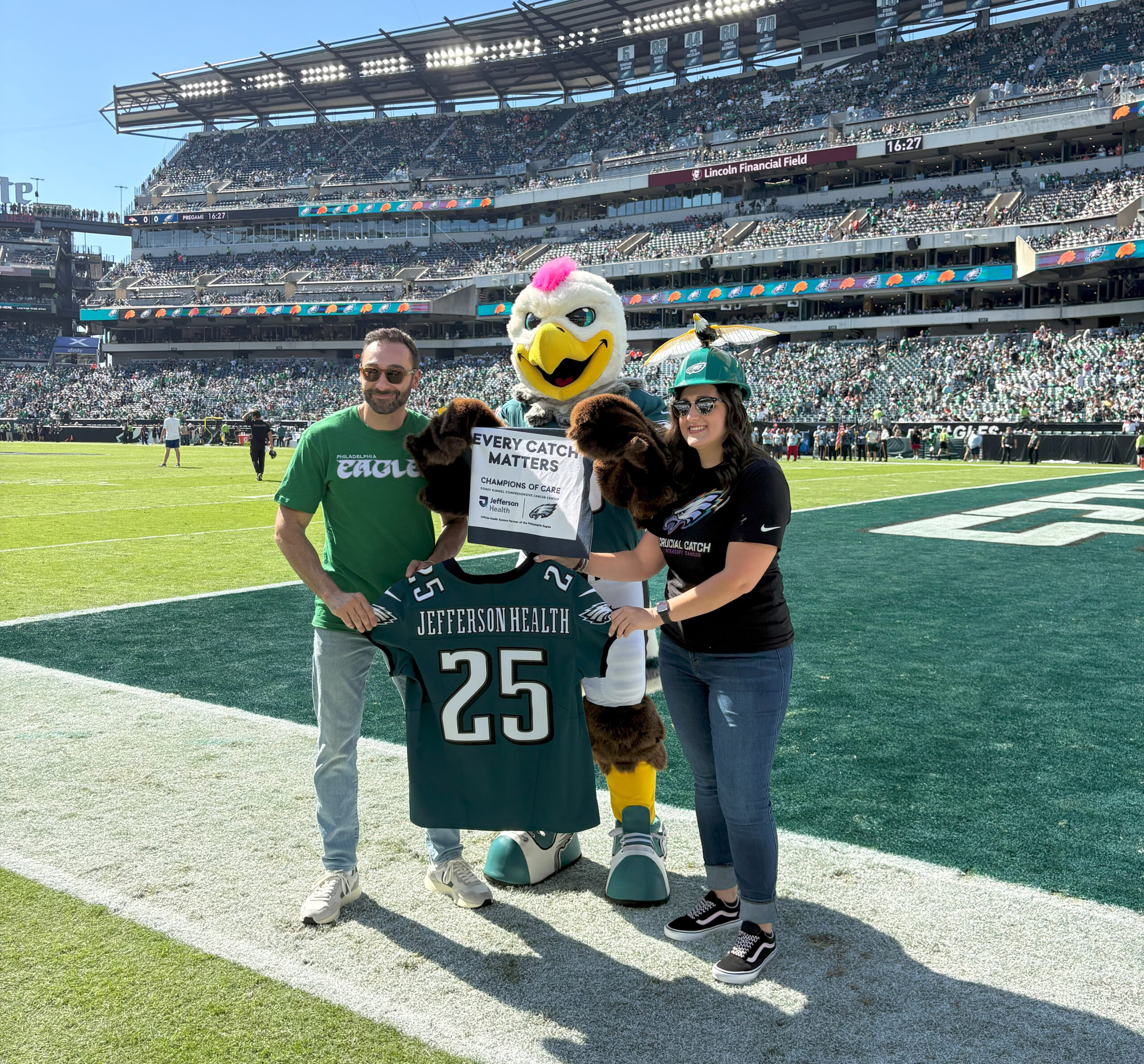
Through programs like Crucial Catch, the NFL and the American Cancer Society’s campaign to fight cancer through early detection, the partnership has provided health care workers at the stadium and recognized cancer survivors during halftime events. Jefferson’s mobile cancer screening vans have also appeared at games, offering screening education and information, proving their slogan: “Driven to Improve Lives.”
“The credibility and visibility the Eagles bring helps us reach individuals who may be hesitant to engage with traditional health care settings,” Nick Ragone, the Jefferson executive vice president and chief marketing officer, said. “When the Eagles encourage fans to prioritize their health, it opens doors we couldn’t open alone.”
“That’s exactly the kind of partnership we want to build on,” Cacchione said. “Meeting people where they are, using trusted voices to break down barriers, and ultimately saving lives through early detection and prevention.”
A Legacy of Philanthropy and Purpose
The partnership also aligns naturally with the Eagles’ long track record of philanthropy. After purchasing the team in 1994, Jeffrey Lurie and his family built robust community impact platforms, including the Eagles Youth Partnership, the Eagles Eye Mobile, and the Go Green initiative, one of the first comprehensive sustainability efforts in professional sports.
The Eagles’ commitment to health-related causes is most visible in the Eagles Autism Foundation, launched by Lurie in 2017 and inspired by his younger brother, who was diagnosed with the condition as a child. The foundation has raised more than $40 million to support autism research and services, directing funds to institutions like Jefferson.
Baligh Yehia, president of Jefferson Health, and Danielle Klingerman, an oncology nurse at Jefferson Einstein Montgomery, celebrate the NFL’s Crucial Catch initiative and honor cancer survivors during an on-field ceremony at a 2025 Eagles game.
“As the team’s Official Health System Partner, Jefferson Health will collaborate with us on year-round community initiatives, focusing on health education and screenings, preventive care awareness, and engagement programs aligned with many of the team’s key priorities, such as the Eagles Autism Foundation and the annual ‛Crucial Catch: Intercept Cancer’ game,” Don Smolenski, the president of the Eagles, said. “Jefferson is an ideal partner because they share our core belief that a sports organization is a force for good far beyond the playing field,” he said.
“The long-standing partnership between the Eagles and Jefferson Health has been built on a shared commitment to the region we serve,” Smolenski said. “This [new] multi-year extension marks a defining moment in our partnership, one that will now call the Jefferson Health Training Complex home to the Philadelphia Eagles.”
Building Healthier Futures Together
In 2024, Jefferson invested $1.8 billion in community benefits, in addition to providing 10 million patient visits, while expanding programs that address social determinants of health. “By working with the Eagles, we’re able to take those initiatives out into the community with even greater visibility and reach,” Cacchione said. “It strengthens our ability to improve long-term health outcomes and ensure every community has access to the resources they need to thrive.”
“I hope it sends the message that health is something to be proactive about, not something to wait on,” Cacchione said. “Whether you’re a young athlete, a parent, or simply a fan, taking care of your health today builds a stronger future. This partnership is a reminder that prevention matters, that early action saves lives, and that Jefferson and the Eagles are united in supporting the well-being of every person in our region.”
Philadelphia is a happening place. No, I’m not referring to the winning sports teams or the great restaurants. I’m talking about the economy. For the first time in generations, Philadelphia’s economy is among the nation’s strongest.
Among the 25 largest metropolitan areas in the country with populations of more than 3 million, Philly enjoyed the strongest job growth last year. Soak that in for a second. Our hometown’s economy grew faster than those of high-flying cities such as Atlanta, Dallas, Denver, and Phoenix.
To be transparent, Philadelphia’s economy looks good, in part, because the nation’s economy is struggling to create jobs. Since so-called Liberation Day in April, when President Donald Trump announced massive tariffs on all our trading partners, many nervous businesses stopped hiring, and job growth has come to a standstill.
Some industries are actually suffering serious job losses, especially those on the front lines of the global trade war, including manufacturing, agriculture, transportation, and distribution. These are big industries in many parts of the South and Midwest, but not in Philadelphia.
Federal government jobs have also been hit hard by the Trump administration’s workforce cuts, which began soon after he took office a year ago. Of course, the broader Washington, D.C., area has struggled with these job losses. These positions were also important to many communities across the country, but less so in Philadelphia.
window.addEventListener(“message”,function(a){if(void 0!==a.data[“datawrapper-height”]){var e=document.querySelectorAll(“iframe”);for(var t in a.data[“datawrapper-height”])for(var r,i=0;r=e[i];i++)if(r.contentWindow===a.source){var d=a.data[“datawrapper-height”][t]+”px”;r.style.height=d}}});
Eds and meds
In fact, Philadelphia’s economy is fortunate to be powered by education and healthcare — eds and meds — the only industries consistently adding to payrolls nationwide. The largest employers in the region are world-class institutions of higher education and healthcare providers, including the University of Pennsylvania, Thomas Jefferson University, the Children’s Hospital of Philadelphia, and Temple University.
Employers in eds and meds are especially attractive, as demand for the services they provide is fueled by the insatiable need for highly educated workers in the age of artificial intelligence, and the inexorable aging of the population. Baby boomers have aged into their 60s and 70s and will require high-quality healthcare for years to come. And since healthcare is largely delivered in person, it is less vulnerable to losing jobs to AI.
These large institutions employ workers of all skill levels. There are highly trained physicians, nurses, and researchers, as well as middle-skilled technicians and administrators, and lesser-skilled maintenance workers. An entire economy can be built on eds and meds, and that’s Philadelphia.
The Philadelphia region also has the good fortune of being home to successful companies across a diverse range of industries. Examples include the media giant Comcast, the financial services powerhouse Vanguard, the global software company SAP, and the technology giant Siemens.
Cost of living
It isn’t cheap to live and work in Philadelphia, but it is highly affordable when compared to neighboring New York and D.C. For example, the typical-priced home in Philadelphia costs about $400,000, which is almost four times the typical household income. In D.C., houses typically cost close to $600,000, or 5.5 times income, and New York house prices exceed $1 million, or 10 times income.
I could go on, but I’m beginning to sound like a Chamber of Commerce, and Philadelphia certainly has big challenges. The nation’s universities and research centers are facing large budget cuts and heightened federal scrutiny. This is a huge shift from the financial largess from D.C. they’ve come to rely on.
Challenges and what’s ahead
Poverty and all the attendant social ills, like crime and drug use, are also long-standing problems in the city. Although the poverty rate has dipped a bit recently, close to one-fifth of the city’s residents live below the poverty line, a disturbing stat. Of the nation’s big cities, only Houston has a higher rate.
The high poverty rate is the result of a complicated brew of factors, but the severe shortage of rental housing for lower- and middle-income residents is one of them. Putting up more homes is a priority for the city’s mayor, and with good reason.
The city’s high wage tax remains a barrier to even stronger growth. It is encouraging that it has declined since peaking more than 40 years ago, but it remains prohibitively high, hindering the city’s efforts to attract workers back into its office towers. The lower-taxed suburban Pennsylvania counties are the key beneficiaries.
It won’t be easy for Philadelphia to consistently remain among the nation’s best-performing economies. We need to support our institutions of higher education and healthcare, work to address poverty, and make it more affordable to live and work here. If we do, we have a good chance of always being in the mix. Kind of like our Eagles.
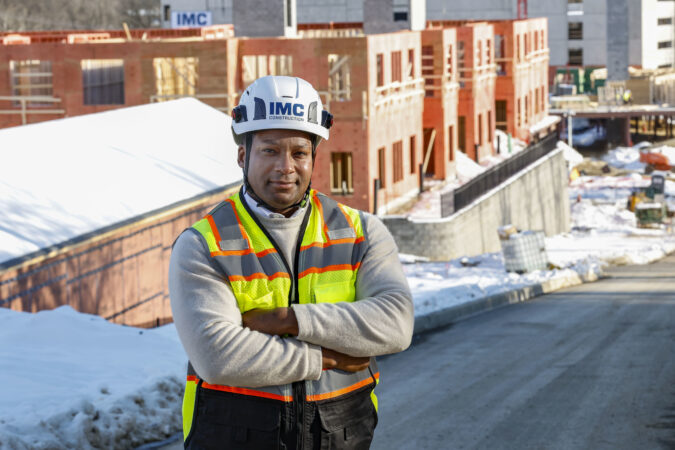
Construction is often a family business. Mike Lloyd, as a Harvard Law graduate, former Wall Street trader, past counsel for Uber and Chevron, and a native of south Louisiana, had a first-class outsider’s resume when he arrived at Malvern-based IMC Construction, one of the mid-Atlantic’s largest general contractors.
But Lloyd is family, too: In 2017, engaged to the boss’ daughter, he took over as IMC’s general counsel, and moved onto a new career path that added his professional and personal skills to IMC’s career construction managers.
Since 2023 he’s been president and the firm’s controlling owner. On his watch, IMC revenue has risen more than 70%, to $600 million, and it has added offices and clients in New Jersey and Delaware, with more planned. The firm, founded in 1976, now employs 300, plus dozens of subcontracted crews at any given time.
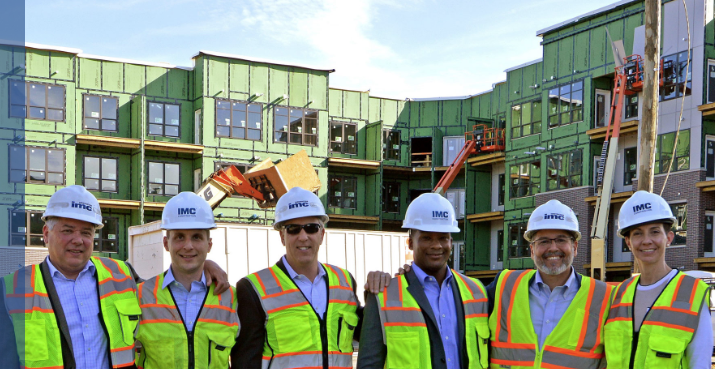
Senior managers of IMC Construction, 2025. CEO Mike Lloyd is third from right; his predecessor, IMC chairman and Lloyd’s father-in-law Robert Cottone, is third from left.
Jobs that IMC built or rebuilt in recent years includePenn and Jefferson medical projects, Prologis warehouses in Marcus Hook, the Morgan Lewis tower at 2222 Market St., new plants for Merck, Solenis and other biotech companies, apartments at the Granite Run Mall, the Promenade at Upper Dublin, the King of Prussia Town Center, and more than 100 other area sites.
Lloyd recently spoke with The Inquirer at IMC’s Chester County headquarters and on a tour of its nearby Great Valley Apartments complex, for developer Greystar. The conversation has been edited for clarity and length.
How did you get this mid-career opening into the construction business?
Rob Cottone [his predecessor as IMC CEO] recognizedhe needed support to help the organization grow across the Mid-Atlantic.
This business is hand-to-hand combat every day. Every day is different.
What I bring to the table is my broad skill set. I’ve worked in finance. I’ve worked in law. I’ve worked in mergers and acquisitions, with big and small companies. I’m comfortable with financial companies, whether for IMC’s own work, or to help the building owners get comfortable with the construction lenders.
I don’t pretend to know things I don’t. We build a team of specialists who complement each other.
What’s an example?
Phil Ritter, a senior project manager, had the idea of creating a Special Projects division for jobs worth $5 million and under. You use a different pool of contractors, and a faster operating model, but you get the benefit of working for a large, efficient organization.
I worked on the business plan, and in 2020 he started it, with maybe a million dollars in revenue that year. In three years, we were doing $30 million. We had a tremendous success doing small projects for Penn Medicine and Jefferson and others.
Many companies would not have put a top project executive in charge of a new business. It costs overhead while working on a business plan. But that’s how we invest in people.
We opened in 2022 in Edison, N.J., with four employees. We are now 37 there, of our 300 total, with $210 million in projected revenue for 2026. Our biggest job is the Crossings at Brick Church in East Orange, a transit-oriented multifamily development for Triangle Equities.
Are those smaller projects non-union?
The labor is driven by the clients’ demands. As a general contractor, we are a merit shop [using both union and non-union contractors]. Our jobs are often 100% union, not always.
Sometimes we do jobs for a lump-sum price, sometimes open-book, guaranteed-maximum, the approach pioneered by Buck Williams [who founded IMC in 1976]. It takes a lot of working with the owners.
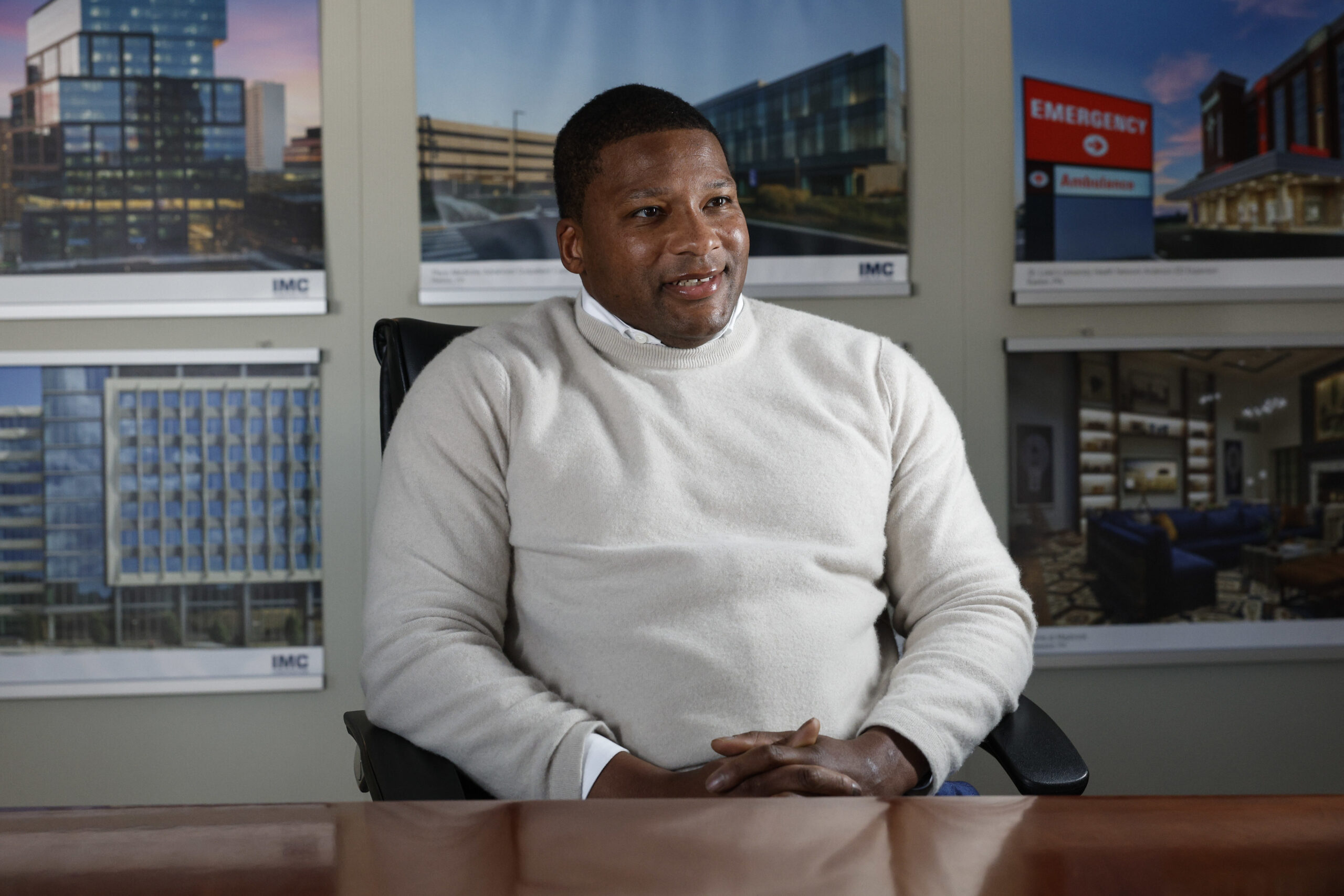
Mike Lloyd, CEO of IMC Construction, in the company’s Malvern headquarters, in January. Behind him are renderings and photos of some of IMC’s recent projects.
You’re building a lot of apartments lately?
We see a tremendous amount of suburban apartment demand.
A lot of these are places where people can avoid going to the city, when you can have a nice dinner and do some retail shopping close to work, close to home. You have that in King of Prussia, you are getting it in the Great Valley, you will see more of it at the Navy Yard, and in Ardmore.
We recently broke ground at 100 Lancaster in Ardmore for Radnor Property Group, and the Great Valley Apartments we’re building for Greystar. You have a demographic of millennials who are finally getting married and moving out of the city as they have kids.
We survived COVID by completing over six million square feet of warehouses. We have turned over nearly 5,000 apartment units since the year before I joined, which should make IMC one of the largest apartment builders in the Philadelphia region. We have turned over 1,700 senior-living units over the past five years, which makes IMC the largest builder of senior living units [around Philadelphia.]
Has office construction peaked?
I don’t know that offices have peaked. I’m actually bullish on office construction. We’re completing our rebuild of 680 Swedesford Rd. [in Wayne], for example. Employers want to get their people back together. There’s benefits for collaboration and connection.
But they want higher-quality space. More light and amenities. They want a kind of ecosystem, like you see at the Navy Yard, where Ensemble is investing in life sciences. They have labs, offices, apartments, and amenities.
At the King of Prussia Town Center, the retail draws people in, and they’re building offices around it. You see a similar trend in the Great Valley. Historically there was this corporate office campus, now there are restaurants, hotels, apartments all around.
Is biotech construction stalled?
We are part of a $100 million lab project in Delaware. We did Penn’s Center of Healthcare and Technology in Center City. We built the Radnor outpatient center —it’s a model. We built their facility in Chesterbrook. And the hospitals are still building.
After years of industry support for underrepresented contractors, are you feeling whiplash due to President Donald Trump’s reaction to DEI?
We are now one of the largest minority-owned contractors [in the country]. We don’t distinguish ourselves by being a minority contractor; we aspire to be the leading general contractor in the Mid-Atlantic region by leveraging technology in unique ways and creating solutions to serve our clients’ needs.
We happen to be a minority-owned company. I personally care about expanding opportunities. We have broadened the subcontractor pool and awarded $1 billion of subcontracts to minority- and women-owned businesses.
We have not felt much backlash or reversal. Many owners still feel committed to expanding the contractor pool. In the current administration it may need to be structured differently.
Will your kids make this a family business?
Our children are young. My daughter has already told me she wants to build her own house, and I can live in it if one day we were working together.
Federal and private grants totaling nearly $29 million were announced Wednesday for conservation projects within the Delaware River Watershed, including a South Philadelphia wetlands park, a water trail in Camden County, and support of the Lights Out Philly program to keep birds from crashing into buildings.
The money comes from nearly $12.5 million in grants to the Delaware Watershed Conservation Fund from the National Fish and Wildlife Foundation (NFWF) and the U.S. Fish and Wildlife Service. An additional $17 million comes in matching funds from nonprofits such as thePhiladelphia-based William Penn Foundation.
The total is about $9 million less than last year’s grant awards of $38 million. A representative for the two federal agencies did not state a reason for the decline.
However, the reduction comes as many federal grants have been cut or reduced by President DonaldTrump’s administration.
What’s being funded?
In all, the new funds will flow to 30 conservation projects, including local trail creations, stream restorations, shoreline enhancements, and wildlife habitat improvements. The money will go toward planning, hiring for, and construction of projects in Pennsylvania, New Jersey, Delaware, and New York.
Jeff Trandahl, executive director and CEO of NFWF, said the projects “demonstrate the impact that public-private partnerships can have at a landscape scale and will help ensure a healthier and cleaner future for the Delaware River watershed and the communities and species that depend on it.”
The watershed is within a densely populated corridor but remains 50% forested. Four hundred miles of it is classified as a National Wild and Scenic River, largely undeveloped but accessible for recreation.
The grants cover a wide range of projects.
For example, $498,800 will go toward reducing migratory bird collisions into buildings throughout the Delaware Watershed, which includes Philadelphia and New Jersey. The project of the Wildlife Management Institute, along with Bird Safe Philly, will identify and retrofit buildings to be bird-friendly, inform the public about built-environment hazards, and how to mitigate them.
Leigh Altadonna, coordinator for Bird Safe Philly, a collaborative of five organizations, welcomed the grant.
“These funds will reinforce Bird Safe Philly’s continuing work with nature centers, libraries, arboretums and other buildings as part of our mission to mitigate bird collisions with glass,” Altadonna said.
She said money would go toward educating the public about howto make their homes and communities bird-friendly.
Bird Safe Philly coordinates with owners of the city’s skyscrapers to turn off or dim lights, which can attract birds during the spring and fall migration seasons.
A sample of grants with total federal and private funding
Pennsylvania
$650,000 for South Philadelphia Wetlands Park II, a project of the Delaware River Waterfront Corp. The money will go toward completing needed documentation for the park located just south of the base of Tasker Street through Pier 70. The goal is to restore wetland habitat and increase public access to piers and berths, add a kayak launch and a natural pier park, and restore two acres of forested upland, meadow and wetlands.
$2 million for stream channel restoration in the south branch of French Creek, a project of the French and Pickering Creeks Conservation Trust. The stream channel and surrounding wetland will be improved as a habitat for brook trout and bog turtle, restore 6.7 acres of riparian buffer, and more than 13 acres of surrounding wetland and flood plain.
$900,400 to reintroduce wild brook trout in restored agricultural watersheds in Chester County, a project of the Stroud Water Research Center, which will monitor the re-establishment effort and implement agricultural best management practices to give trout the best chance of recovery.
New Jersey
$3.5 million for horseshoe crab and shorebird habitat at the Kimbles Beach and Bay Cove area in Cape May Court House, a project of the American Littoral Society. The money will go toward restoring one mile of critical habitat along the Delaware Bay, by placing 49,000 tons of sand to stabilize the beach, reverse coastal erosion, and protect the shoreline.
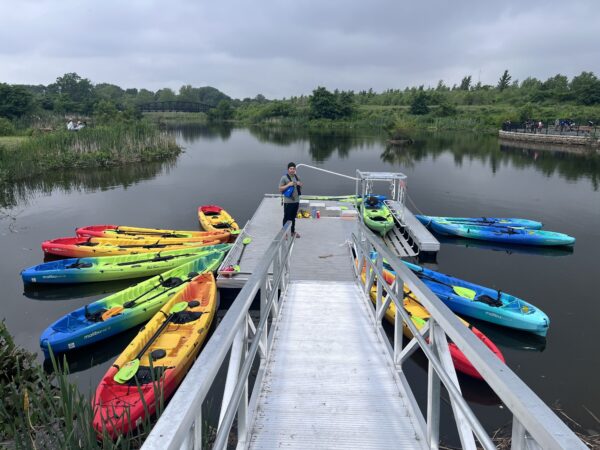
$1.2 million for restoration and recreational projects on the Cooper River Water Trail, which is spearheaded by the Upstream Alliance. The money will go toward engaging 3,000 community members through hands-on recreational programming, hiring local youth, and promoting public access on the new trail in Camden County. It will include paddling and fishing programs for the community and create a Friends of the Cooper River Water Trail group.
$487,400 for ecological restoration and wildlife habitat improvements at Swede Run Fields in Moorestown, Burlington County, for a project by the township to eradicate invasive species and establish native plant communities within the wetlands, riparian forest, and upland meadow buffers.
Philadelphia is a city of neighborhoods, and at the heart of every neighborhood is a school. Schools are where our children learn, where families gather, and where communities take shape. When our schools thrive, Philadelphia thrives.
That is why the Philadelphia School District’s recently announced Facilities Master Plan is so important — not just for students and educators, but for the future of our entire city.
This plan is about more than bricks and mortar. It is about opportunity. It is about ensuring every child, in every zip code, has access to high-quality academic programs, safe and modern learning environments, and the extracurricular experiences that help young people discover their talents and chart their paths forward.
For too long, inequities in school facilities have mirrored broader inequities across our city. Some students learn in buildings that limit what they can access — advanced coursework, arts and music programs, athletics, career and technical education, and modern technology — while others have more opportunities simply because of where they live. That is not acceptable, and it is not sustainable.
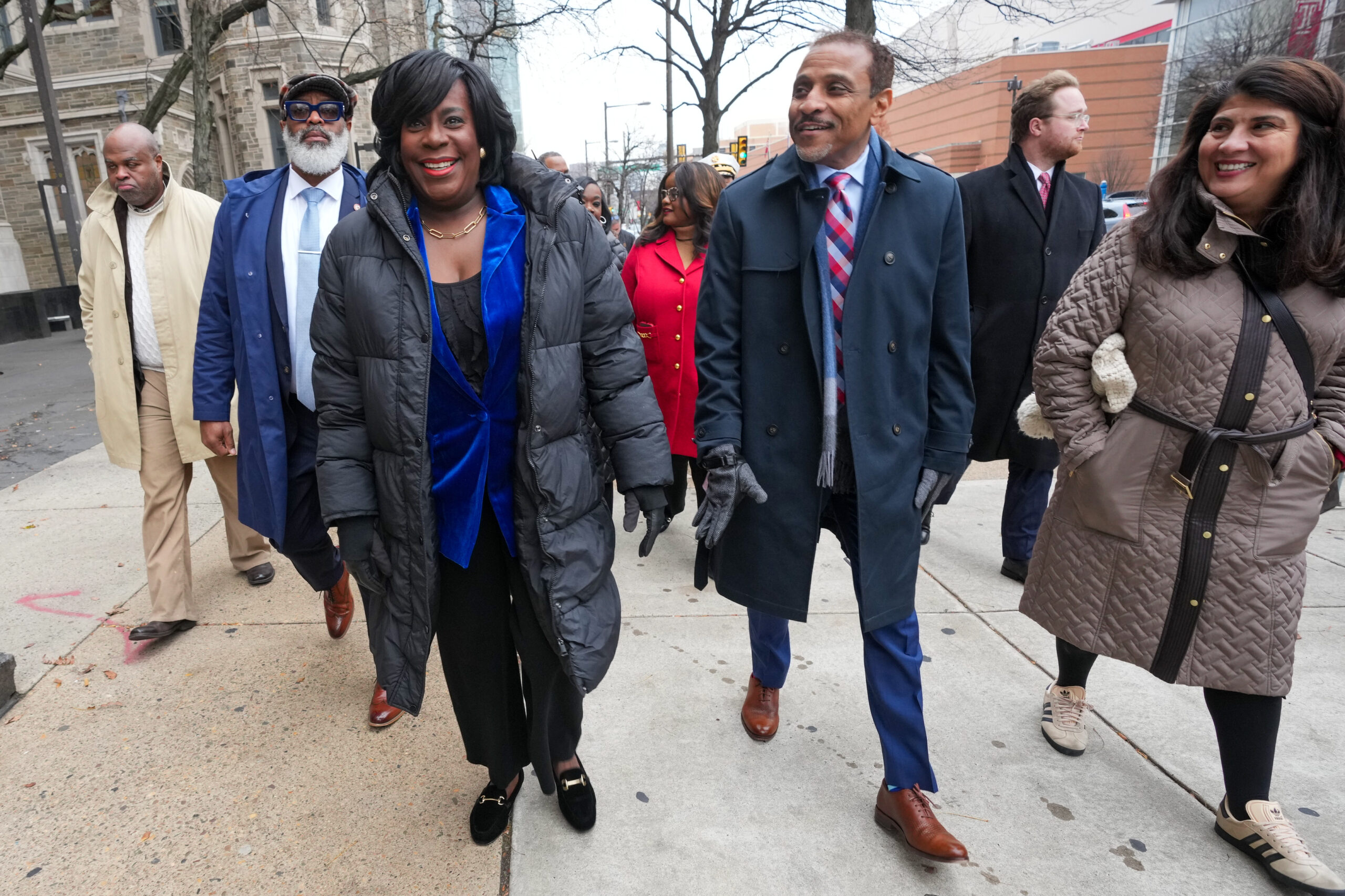
Mayor Cherelle L. Parker and Superintendent Tony B. Watlington Sr. on Temple University’s campus in December 2024. Inequities in school facilities are unacceptable, the pair write.
The Facilities Master Plan directly confronts these challenges. It takes a thoughtful, data-driven approach to aligning school buildings with student needs, enrollment trends, and program quality. The goal is clear: to expand access to strong academic offerings and enriching extracurricular programs across neighborhoods, while making smarter use of resources and improving learning conditions citywide.
Ninety percent of impacted students will be reassigned to schools with comparable or better academic outcomes, and 100% of impacted students will be reassigned to schools with comparable or better academic outcomes and/or comparable or better building conditions.
When students have access to well-equipped schools with robust programs, outcomes improve. Graduation rates rise. Attendance improves. Students are better prepared for college, careers, and civic life. These are not abstract benefits — they translate into a stronger workforce, safer neighborhoods, and a more vibrant local economy.
The impact extends well beyond the classroom. Modernized and rightsized school facilities can anchor neighborhood revitalization. They attract families, support local businesses, and create hubs for community use — from recreation and arts to adult education and workforce training. Investments in schools are investments in communities.
This plan also reflects a commitment to partnership and transparency. It is grounded in community engagement and recognizes that schools do not exist in isolation. The city of Philadelphia and the school district are working together to ensure that planning decisions consider housing, transportation, economic development, and public safety — because when we coordinate our efforts, everyone benefits.
One of us, Mayor Parker, has made clear that creating a safer, cleaner, and greener city with access to economic opportunity for all is critically important to the success of our young people. Strong schools are foundational to that vision.
The other one of us, Superintendent Watlington, has, over the past three years, led a series of sweeping improvements in the district: student attendance, teacher attendance, graduation rates, and test scores in grades four through eight have all increased. During the same period, dropout rates have decreased by more than half.
The Facilities Master Plan brings these priorities together in a way that will drive even stronger and faster progress in an ambitious and responsible manner.
Change is never easy, and conversations about school facilities can be deeply personal. Families care about their schools because schools are part of their identity.
That is why continued engagement and listening will remain central as the plan moves forward. The school district and the city are committed to working with students, families, educators, and community members every step of the way.
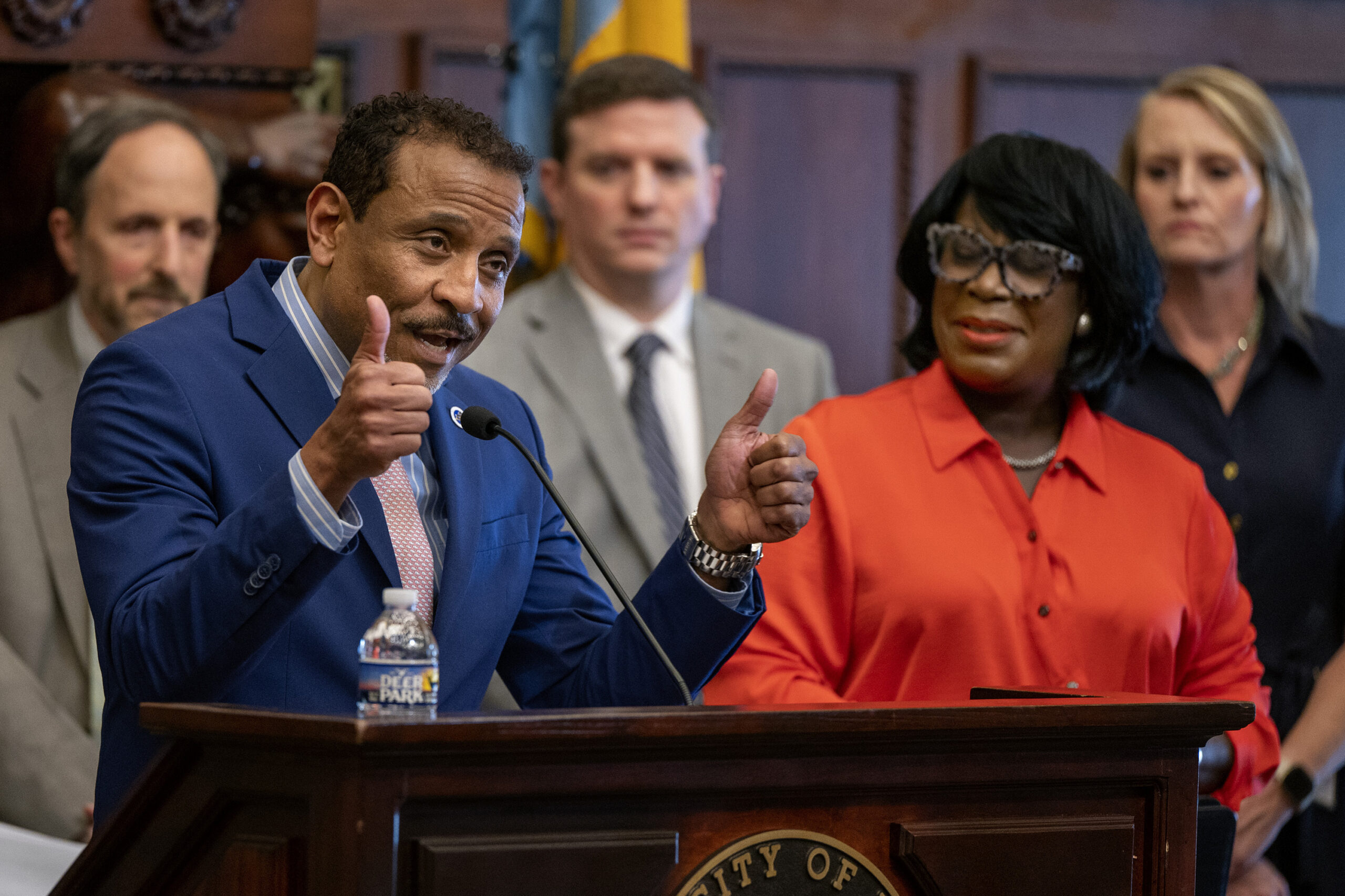
Superintendent Tony B. Watlington Sr. joins Mayor Cherelle L. Parker at a City Hall news conference in August 2024.
What unites us is a shared belief that Philadelphia’s children deserve the best we can offer — and that the city’s future depends on how well we prepare them today.
This Facilities Master Plan is a long-term investment in equity, excellence, and opportunity. It is a commitment to making sure that no matter what zip code a child grows up in in Philadelphia, they have access to high-quality education and enriching experiences that open doors and expand horizons.
By building better schools, we are building a stronger Philadelphia — for this generation and the next.
Tony B. Watlington Sr. is the superintendent of the Philadelphia School District. Cherelle L. Parker is the 100th mayor of Philadelphia.
Competition at Philadelphia-area medical schools intensified in 2025, with programs seeing about 50 applicants for every open spot.
That’s the highest demand since 2022, with the number of applications bouncing back after a three-year decline, recently released data from the Association of American Medical Colleges(AAMC) shows.
The annual report offers a look at the composition of the nation’s future doctors through the demographics of the applicants and enrollees at M.D. degree-granting medical schools across the United States and Canada.
It showed increased class sizes and strong female enrollment across the Philadelphia area’s five M.D. degree-granting schools: University of Pennsylvania, Thomas Jefferson University, Temple University, Drexel University, and Cooper Medical School of Rowan University.
And the fraction of first-year medical students from Pennsylvania who identified as Black or African American, excluding the mixed-race student population, fell from 6.9% to 5.4% between 2023 and 2025.
The racial demographics of entering studentsare seeing increased scrutiny in light of the 2023 Supreme Court decision that effectively ended affirmative action, barring race from being used in higher education admissions.
The percentage of first-year medical students from Pennsylvania who are Black is lower this year than the national average. Pennsylvania also lags behind the national average for first-year enrollment of Hispanic or Latino medical students.
This data reflects the results of the application cycle that concluded last spring. Next year’s prospective medical school students are currently in the thick of admissions season, awaiting interviews and offers.
Here’s a look at the key trends we’re seeing:
Applications back up
Demand for spots at Philadelphia area-medical schools is back up after a three-year decline. There were nearly 5,000 more applications last cycle, a 9.3% increase, with all schools except Cooper seeing a boost.
Jefferson’s Sidney Kimmel Medical College helped drive growth the most, with a 16% increase in applications compared to the previous year.
window.addEventListener(“message”,function(a){if(void 0!==a.data[“datawrapper-height”]){var e=document.querySelectorAll(“iframe”);for(var t in a.data[“datawrapper-height”])for(var r,i=0;r=e[i];i++)if(r.contentWindow===a.source){var d=a.data[“datawrapper-height”][t]+”px”;r.style.height=d}}});
More medical students being trained
Orientation icebreakers might take a bit longer to get through at area-medical schools as first-year classes continue to get bigger.
In 2025, Philadelphia-area schools enrolled 1,089new medical students, compared to 991 in 2017. Drexel University College of Medicine contributed to half of that growth, adding 49 seats to its recent entering class compared to that of 2017.
Penn’s Perelman School of Medicine was the only school that did not increase its class size in 2025.
window.addEventListener(“message”,function(a){if(void 0!==a.data[“datawrapper-height”]){var e=document.querySelectorAll(“iframe”);for(var t in a.data[“datawrapper-height”])for(var r,i=0;r=e[i];i++)if(r.contentWindow===a.source){var d=a.data[“datawrapper-height”][t]+”px”;r.style.height=d}}});
Female enrollment remains strong
More female students have entered Philly-area medical schools over the last decade.
In 2025, 55.4% of first-year enrollees at Philly-area medical schools were female, compared to 47.7% in 2017.
Drexel saw the biggest rise, with 181 women entering in 2025, compared to 120 in 2017.
window.addEventListener(“message”,function(a){if(void 0!==a.data[“datawrapper-height”]){var e=document.querySelectorAll(“iframe”);for(var t in a.data[“datawrapper-height”])for(var r,i=0;r=e[i];i++)if(r.contentWindow===a.source){var d=a.data[“datawrapper-height”][t]+”px”;r.style.height=d}}});
The University of Pennsylvania has received an $8 million gift to redesign how it trains doctors at the Perelman School of Medicine, Penn officials announced Thursday.
Incorporating technology, AI, and data to create customized learning pathways for Penn medical students is an overarching goal. The effort comes at a time when increasingly easyaccess to medical information and changes in care delivery are leading medical schools nationwide to revamp their curricula.
The gift to Penn is from New York-based RTW Foundation, a philanthropy associated with the life sciences investment firmfounded by Perelman School graduate and Penn Medicine board member Rod Wong. Penn said the gift from Wong, and his wife, Marti Speranza Wong, is the largest single donation to support curriculum innovation at the medical school, which dates back to 1765.
At a news conference announcing his donation Thursday, Wong recalled his time atthe medical school right after its last major overhaul of the curriculum in 1998. One update underPenn’s “Curriculum 2000” revamp was recording and making lectures available online — a relatively innovative move at the time (YouTube wouldn’t be created for another several years).
“Technology has changed, and obviously we’re at this same inflection point because of AI and data science,” said Wong, who is managing partner and chief investment officer at RTW Investments LP.
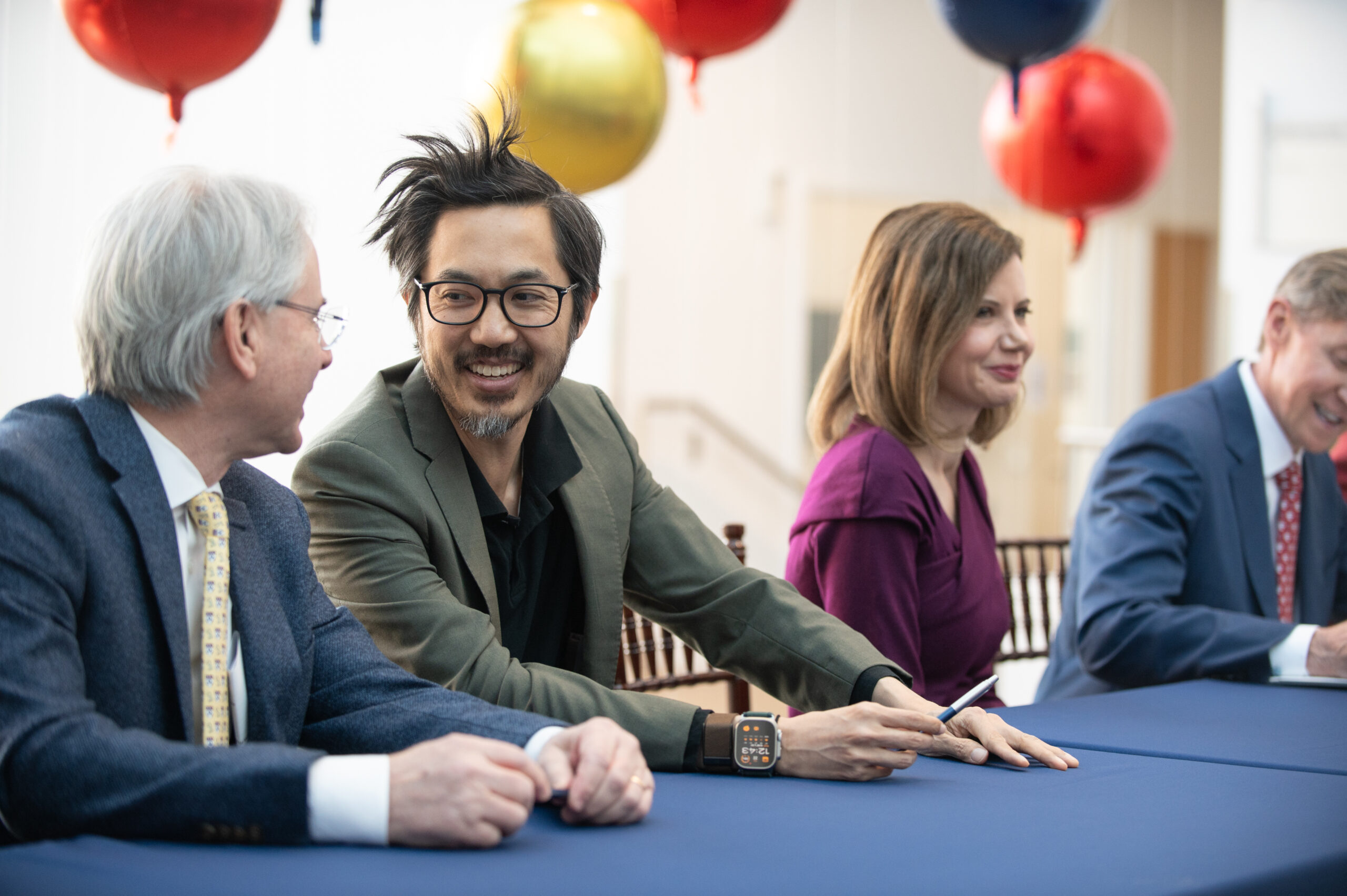
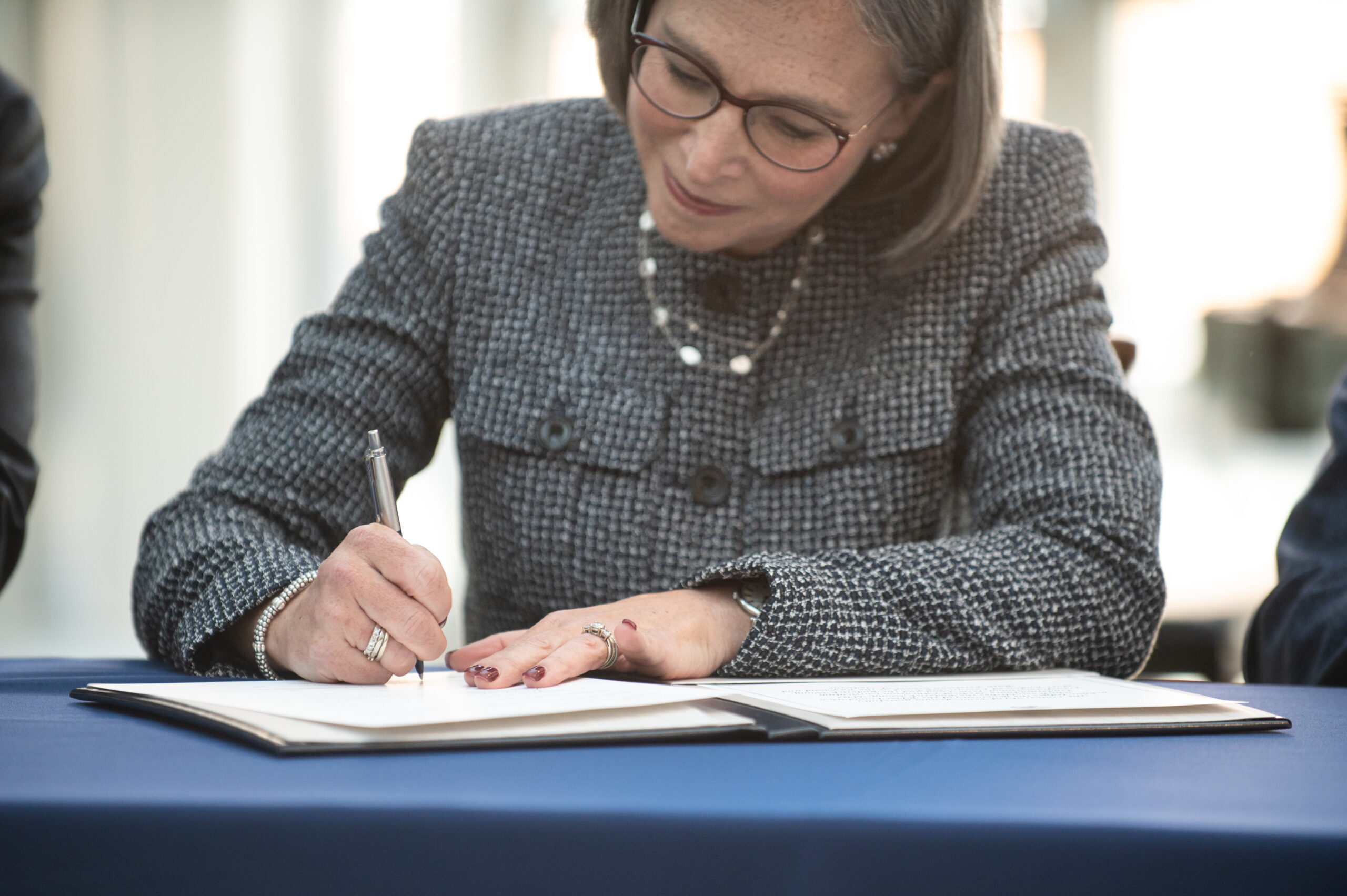
Penn alumnus Rod Wong (center) sits with dean of Perelman School of Medicine Jonathan A. Epstein (left) after signing the gift agreement.
The vast majority of the $8 million gift will go toward hiring data scientists and engineers, supporting faculty, and building and acquiring the platforms needed to deliver the new curriculum.
Technology will be incorporated into new training techniques, such as byusing augmented or virtual reality to assist in learning anatomy, developing knowledge needed to diagnose illnesses and develop treatment plans, and mastering clinical skills such as IV placement and suturing.
For example, students can practice taking a person’s medical history or doing a physical exam on a virtual patient, while an AI agent is there to give feedback in real time.
“It’s really adaptive to the individual learner, but you do it at your own pace, on your own time,” said Lisa Bellini, executive vice dean of the medical school and a leader on the project.
The redesign will take place over the next three years as school leaders consult with stakeholders and work on building the platform.
Some of Wong’s gift will be used to create a biannual endowed lecture in business and entrepreneurship that will bring leaders in medicine and healthcare innovation to campus. The gift will also establish the Roderick Wong Entrepreneurship Pathway, which will provide mentorship, workshops, and project-based learning to students with business interests.
“We really need to incorporate the fundamentals of how best to use technology responsibly within the practice of medicine and create something incredibly enduring, because you’re not going to go through this exercise every three years,” Bellini said.
The Perelman School of Medicine is embarking on its curriculum revamp at a time when medical education is evolving at many schools.
Some medical schools have concentrated the traditional two years spent learning science into one year to give students more time to learn how to interact with patients and collaborate with other medical professionals.
A three-year medical school option is offered at institutions such as the Pennsylvania State University College of Medicine to speed doctors into the clinic and reduce students’ debt loads.
Jennifer Kogan, vice dean for undergraduate medical education at the Perelman School of Medicine, is a leader in the curriculum revamp.
Faster, flexible learning
Like most medical schools, Perelman has a standard curriculum where students take foundational science courses for a stretch of time and then transition to the hospital to gain clinical experience.
This can lead to some students repeating courses that they already mastered in college.
“If you were a biochemistry major as an undergrad, do you really have to take biochemistry again?” said Jennifer Kogan, vice dean of undergraduate medical education and a leader on the redesign project. “How could you better use that time to achieve whatever your career goals are?”
Leaders at Penn want to give students the flexibility to adjust their timelines based on their skill sets and goals.
Instead of setting a fixed time for how long a class or rotation will take, a student who masters a skill more quickly should be able to move on and devote their time to other interests, such as research or entrepreneurship.
Many students at Penn pursue dual degrees or research fellowships that end up adding a fifth year of medical school. Penn leaders hope adding flexibility to the curriculum could enable students to instead finish in four years or “maybe even three,” Kogan said. (The possibility of a three-year path is not yet guaranteed but will be explored.)
“It will be better set up to support students like me who have had to use significant federal loans to finance their way through medical school and might have benefited from the condensed training timeline,” said Alex Nisbet, a fourth-year medical student at Perelman who spoke at the signing event.
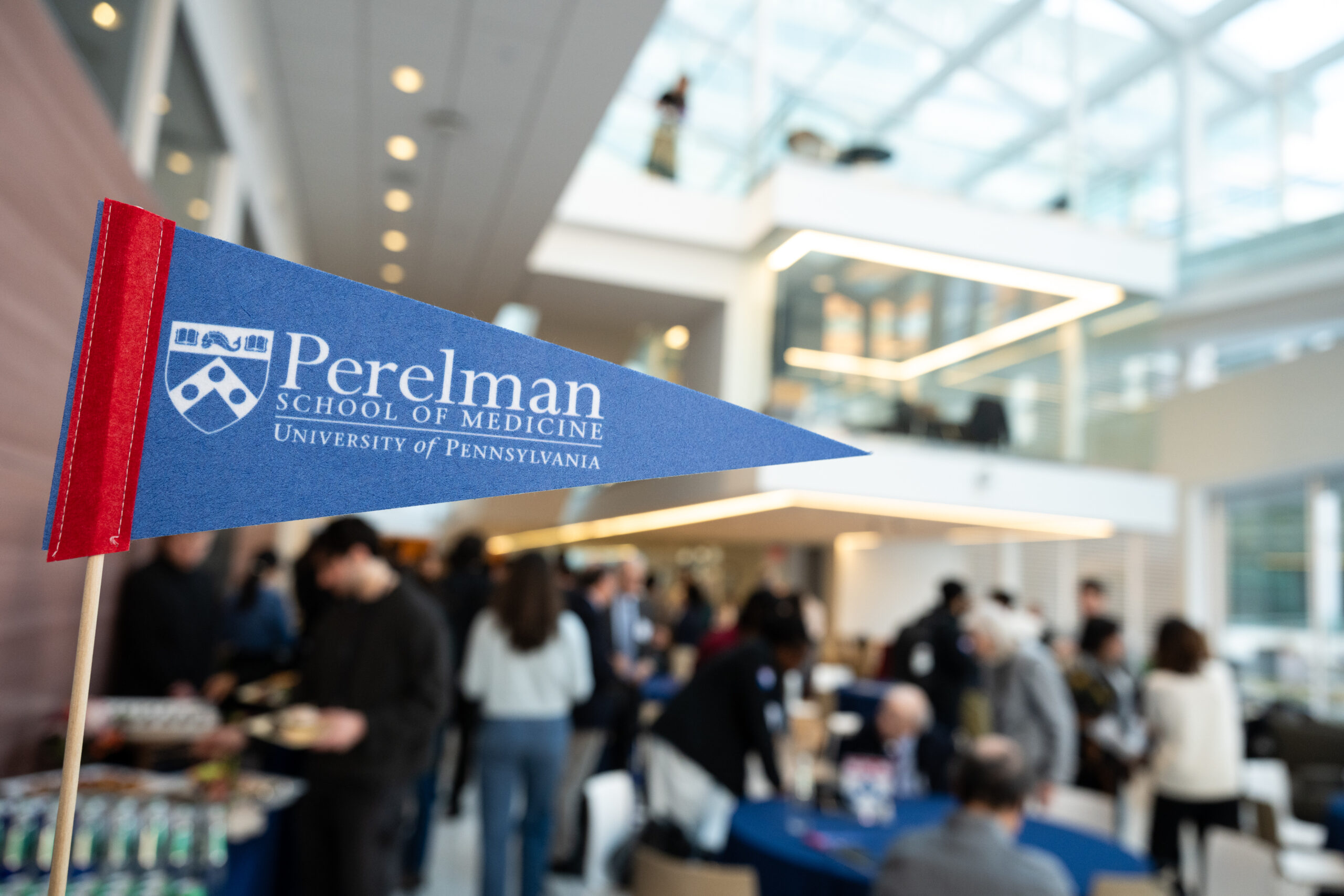
An attendee holds a pennant flag representing the Perelman School of Medicine.
The school will leverage data and AI to assess how individual students are progressing in what they’re calling a “precision education model.”
Though parts of the program will be piloted over the next three years, the first class to see the full implementation of the curriculum will be in the fall of 2029.
A year ago, leaders of Family Practice & Counseling Network feared their health clinic, which has served low-income Philadelphians for more than 30 years, wouldn’t survive past June.
The clinic was part of Resources for Human Development, a Philadelphia human services agency that a fast-growing Reading nonprofit called Inperium Inc. had acquired in late 2024.
As a federally qualified health clinic since 1992, the clinic had received an annual federal grant, higher Medicaid rates, and other benefits.
But federal rules prohibited the clinic from continuing to retain that status and those benefits under a parent company. That meant Family Practice & Counseling Network had two options: close or spin out into a new entity that would reapply to be a federally qualified clinic.
“We had to figure it out,” the organization’s CEO Emily Nichols said in a recent interview.
At the time, the organization’s three main locations had 15,000 patients. They are “very underserved, low-income people that deserve good healthcare,” she said.
Thanks to $9.5 million in financial and operational support from the University of Pennsylvania Health System, a new legal entity took over the clinics in July. They now operate under the tweaked name, Family Practice & Counseling Services Network, and without the federalstatus.
“Penn allowed us to survive,” Nichols said.
Still in a precarious position
The nonprofit, with its name now abbreviated as FPCSN, remains in a precarious position.
Because of the corporate change, the $4.2 million annual grant that Family Practice had been receiving through RHD had to be opened up for other applicants under federal law. FPCSN applied but won’t find out until March the result of the competition.
Natalie Levkovich, CEO of the Health Federation of Philadelphia, a nonprofit that supports community health centers in Southeastern Pennsylvania, expressed confidence that the clinic will regain the funding, which helps cover the cost of caring for people who don’t have insurance.
“FPCSN is a well-run, well-regarded, well-supported health center that has an established, high-functioning practice in multiple locations,” Levkovich said. The clinic received letters of support from all the other federal clinics in the area, she said.
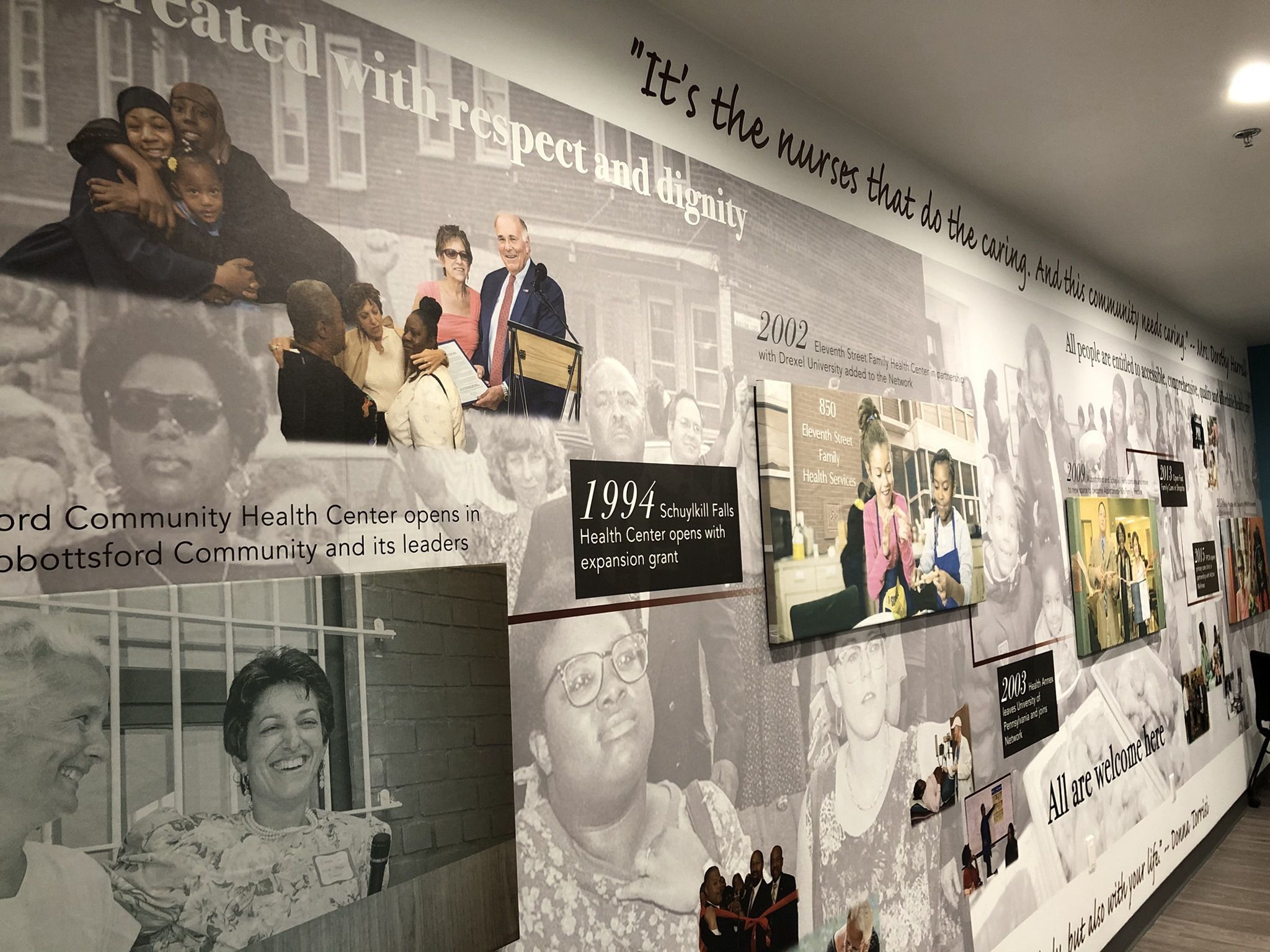
A mural in a conference room at Family Practice & Counseling Services Network’s headquarters in Nicetown shows a timeline of the agency’s history since its founding in 1992.
In return, federally qualified clinics have to accept all patients, including people without insurance. The insurance mix of FPCSN’s patient population is about 60% Medicaid, 20% uninsured, 10% Medicare, and 10% commercial, Nichols said.
Also, half of a federal clinic’s board members have to be patients at the clinic. FPCSN has three main locations, in Southwest Philadelphia, on the western edge of North Philadelphia, and in the West Poplar neighborhood. Its revenue in fiscal 2025 was $31 million.
During the past year, 55 FPCSN staff members have left, leaving 140 employees still at the organization, including 16 nurse practitioners who provide the primary care. The departures may have contributed to a decline in the number of patients seen to 13,500 last year, compared to 15,000 the year before, Nichols said.
Why Penn helped FPCSN
Federally qualified health centers form the core safety net in Philadelphia and across the nation, said Richard Wender, who chairs Family Medicine and Community Health at Penn, which had a longstanding relationship with RHD’s clinics.
Under contract, Penn family practice physicians were providing prenatal care to 400 pregnant patients at the clinics that would have closed abruptly at the end of June if Penn hadn’t provided support. “We wanted them to be able to continue to take care of the patients that they were taking care of,” Wender said.
The money from Penn helped pay startup costs for the new entity and bridged the period until FPCSN was able to secure new contracts with insurance companies.
Penn also didn’t want the clinic’s patients showing up in its already busy emergency departments for basic care. “That adversely affects their health because it’s not a good place to get preventive care,” he said.
But it was important to Penn that there was a pathway back to federal clinic status. “We feel as optimistic as we can,” Wender said.
Wender and Nichols credited Kevin Mahoney, CEO of Penn’s health system, with the preservation of FPCSN’s services for low-income Philadelphians by throwing his full support behind the effort.
“You have to have a CEO, a leader in your health system, who understands that this is the responsibility of large academic health centers,” Wender said.
Lush landscaping and public art will soon line Broad Street, impromptu performances may pop up, and vehicular traffic will be calmed with a new Avenue of the Arts south streetscape about to take shape.
The project — estimated to take $150 million and a decade to realize — will begin modestly.
The groundbreaking ceremony was held Wednesday morning in front of the Kimmel Center and was attended by more than 200 dignitaries, including Mayor Cherelle L. Parker, City Council President Kenyatta Johnson, and other members of City Council, state representatives, and officials from groups along the Avenue of the Arts.
The actual construction is slated to start at the end of January on a small portion of the project: remaking the median strip between Spruce and Pine Streets. That phase is expected to be completed by June.
In 2027, after the end of an anticipated swell in tourism and street activity during the Semiquincentennial, sidewalk beautification will begin on both the east and west sides of that block.
Eventually, pending funding, all of the blocks between City Hall and Washington Avenue will be remade.
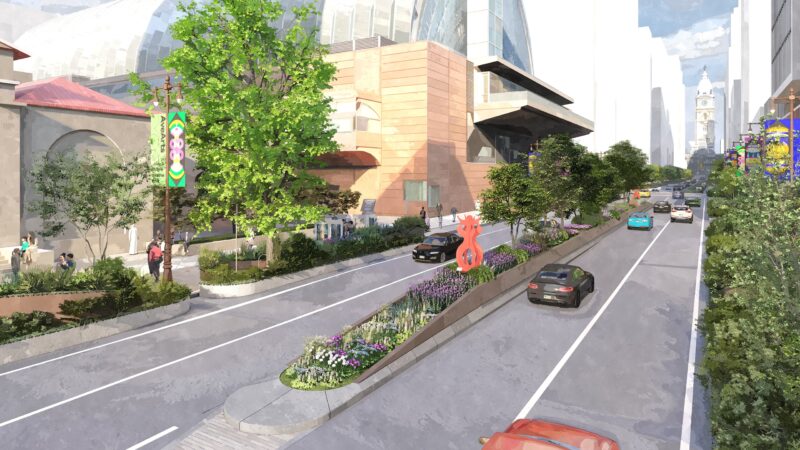
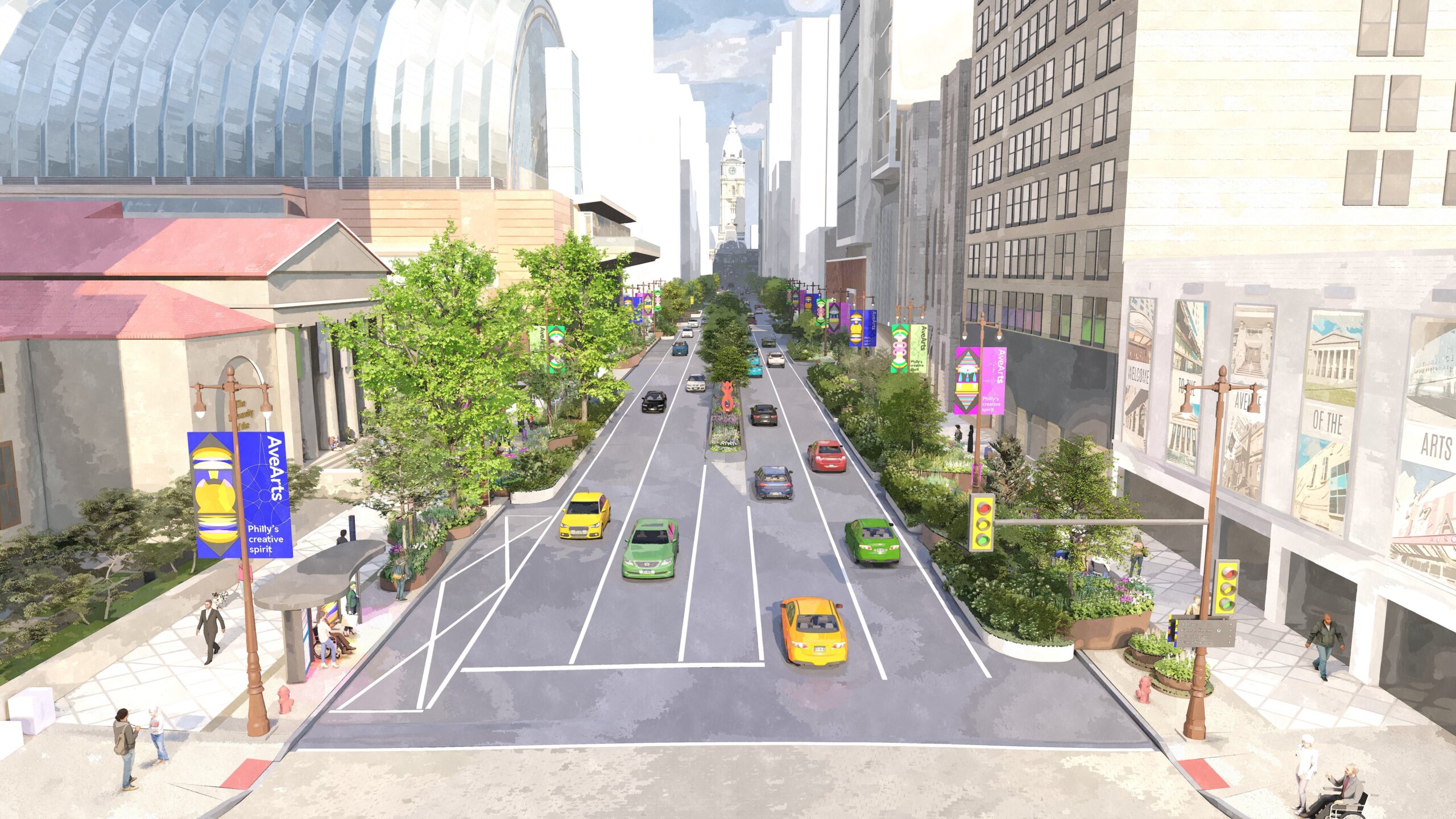
Looking north toward City Hall, a rendering shows the completed first phase of a South Broad Street streetscape project slated to break ground in January 2026.
The current streetscape of planters, pavers, and retro light fixtures was designed and installed more than three decades ago. In addition to the wear and tear of the existing scheme, the thinking around public space has evolved since then, said Carl Dranoff, board chair of Avenue of the Arts, Inc., which is overseeing the project.
“It’s become somewhat aged and dog-eared,” said Dranoff. “In 1993 you didn’t need to have outdoor cafes. We need to activate the street, not just make it palatable. We have the opportunity to really elevate the Avenue of the Arts into one of the world’s great streets.”
The project was announced in July 2024 at $100 million, but inflation and a more detailed cost analysis has now put the total price tag at about $150 million — $15 million per block. These numbers include not just the planters, lighting, public art, street furniture, and aesthetic elements, but also infrastructure work beneath the surface, said Dranoff.
“A lot of it is things you don’t see. There’s a lot of underground construction,” he said. “Right now water is leaking from the median strip into the subway concourse. One of the reasons we got support from SEPTA and PennDot and [the Philadelphia] Streets [Dept.], is as we are building the median strips, we are improving deficiencies in the street in each block.”
In addition, some utilities will have to be moved. One PECO relocation, for instance, will cost the project $250,000, he said.
Dranoff has a vested interest in the vitality of the Avenue of the Arts. He has led several development projects on South Broad Street, including Arthaus, which is on the same block as the first phase of the new streetscape, and, one block south, Symphony House. He compares the investment in the new streetscape to the ones made in the Pennsylvania Convention Center, Philadelphia Navy Yard, Kimmel Center, and Schuylkill River Trail.
“If we don’t make investments in the future, which are going to increase revenue and population, we are relegating ourselves to second-place status.”
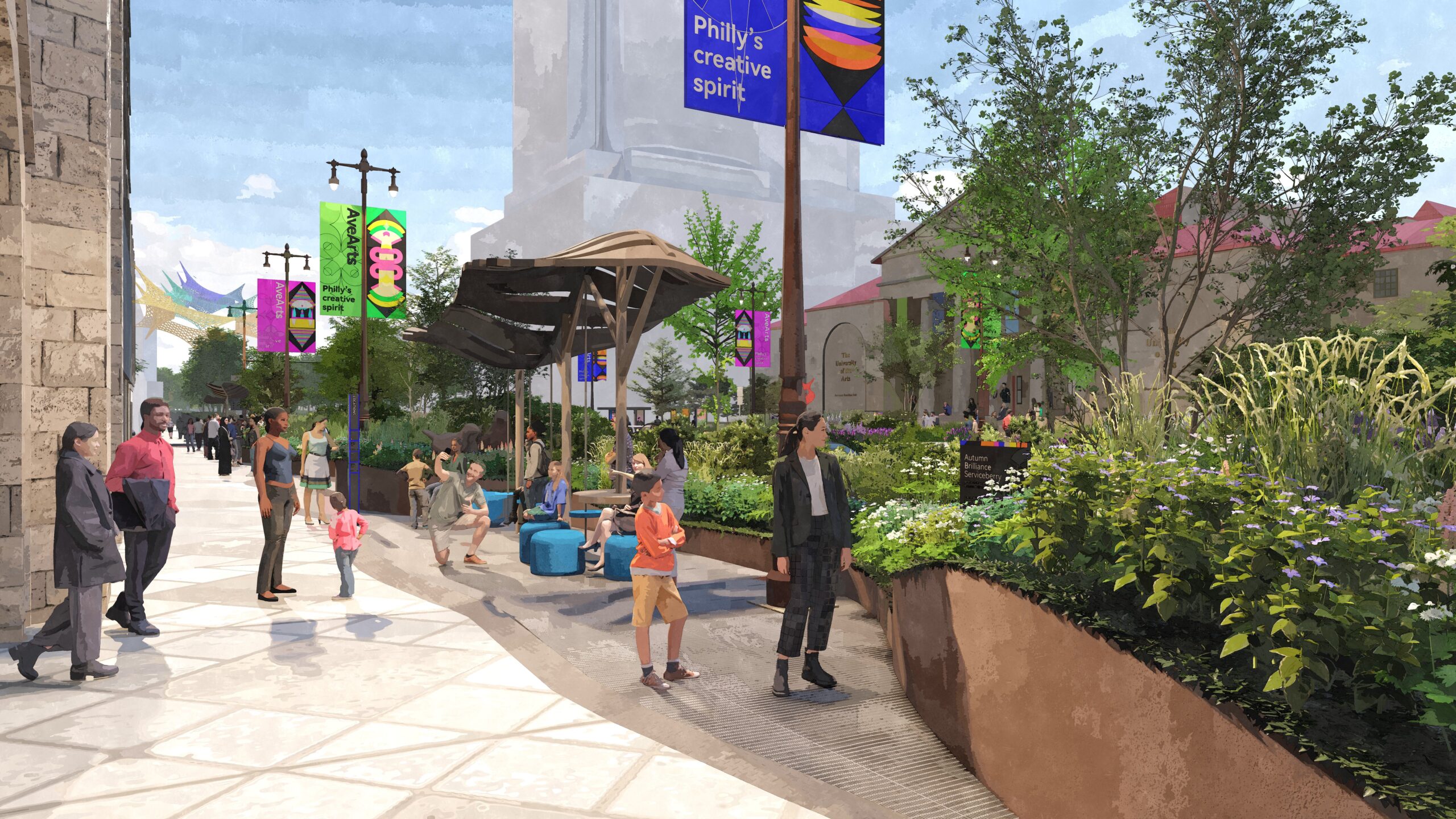
The new $15 million streetscape in the block from Spruce to Pine, which includes a $1 million endowment fund to underwrite maintenance, native-species plants, a rainwater-collection cistern, lighting, curved raised planting beds, public art, seating, way-finding devices, and artist-designed banners.
Of the $15 million needed, $5 million has been raised so far: $3 million from the city over two budget years, $1 million from the state, and $1 million from private donors. Other funding requests are pending, which planners call “very promising.”
A sidewalk garden on the east side of Broad Street between Pine and Spruce Streets is planned for installation in 2027 as part of a new Avenue of the Arts streetscape.
Dranoff says that construction of the median between Spruce and Pine — which is the block occupied by the Kimmel Center and defunct University of the Arts — won’t cause “a lot of disruption. They’re only working business hours, not on weekends.” Any blocked lanes will be reopened after work is done for the day, he said.
The next block to be redesigned hasn’t been decided, but it will likely be north of Spruce Street, Dranoff said. “Part of it will depend on funding. If we get a donor, someone whose offices are near the Academy of Music and is donating $15 million for that block to be next, we might accommodate that,” he said.
Funding for the entire project is expected to be a mix of public money, corporate and individual donations, and foundation support, he said.
The goal isn’t to have the mile-plus between City Hall and Washington Avenue end up with a streetscape that looks uniform, Dranoff said. Instead, design firms Gensler and OJB Landscape Architecture may come up with different ideas for different blocks.
“You don’t need a master plan that’s set for 10 blocks. Every block is different, the institutions are different. It lends itself to block-by-block planning tied together by a common theme.”
Dranoff said once the block from Spruce to Pine is done, it will show the potential, which he expects will spur fundraising to complete the streetscape for the entire Avenue of the Arts south.
“The difference between now and the first block being finished is, you’re going to be driving down a tree-lined boulevard.”
The article has been updated with details from the groundbreaking ceremony.