Tag: Semiquincentennial

  • Proposed rule could gut American science, Penn researcher warns

    Proposed rule could gut American science, Penn researcher warns

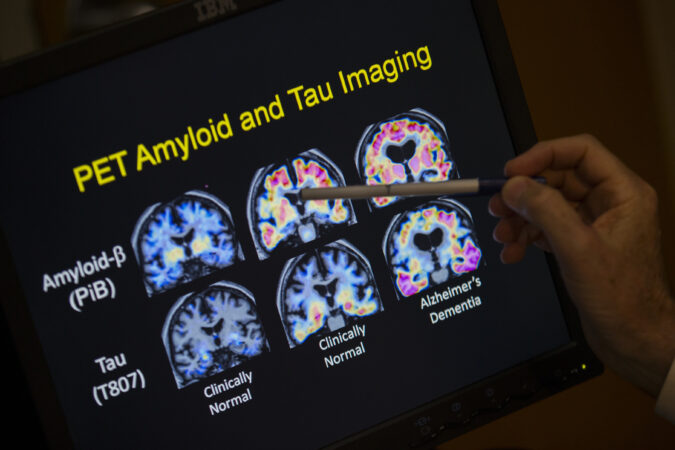
    As an undergraduate researcher at the University of Pennsylvania, I spend my time outside of class studying how a protein called tau destroys the brain cells of Alzheimer’s patients. This research happens at Penn’s Center for Neurodegenerative Disease Research (CNDR), it is funded by the National Institutes of Health, and it is the reason I want to spend my life as a physician-scientist.

    It is also exactly the kind of research a new federal proposal could quietly undermine.

    On May 29, the White House’s Office of Management and Budget (OMB) published a 100-page proposed rule that would fundamentally restructure how the federal government administers research grants. The comment period closes July 13.

    Most Americans have never heard of it. That needs to change.

    The rule has several alarming impacts. For instance, it would allow political appointees to override scientific peer review in grant decisions, upending the meritocratic, rigorous system that has pushed American science forward since World War II.

    Perhaps most critically, it would permit the government to terminate any active federal grant at any time, for any reason — including the vague, undefined justification that a study is no longer in the “national interest.” Furthermore, it would effectively ban federal funding for research into health disparities across racial populations, with a stated exception so narrow it is meaningless in practice.

    Let me put that in perspective with specific examples. Over seven million Americans currently live with Alzheimer’s disease, and that number will nearly double by 2050. The research that underpins our understanding of this disease — including discovery of biomarkers, assembly of databases, and clinical trial frameworks — took decades of sustained, longitudinal federal investment to build. The Alzheimer’s Disease Neuroimaging Initiative, launched in 2004, required over 20 years of continuous funding and investment prior to producing any comprehensive datasets that now drive clinical trials.

    Under the proposed rule, however, a political appointee or administrator with no scientific background could have decided at any point in that 20-year window that the study was no longer in the “national interest” and ended the study. The harm this vague, sweeping rule would do is not hypothetical. Much biomedical and clinical research, including in the field of neurodegenerative diseases, is longitudinal, and progress is not always immediately visible.

    I’m reminded of what the late John Trojanowski, a former leader of the lab I now work in, said in regard to his research on the proteins behind Alzheimer’s:

    “We asked our mentors, ‘Is this something we should do?’ They all said, ‘No. It’s a swamp, and you’ll ruin your careers because so little is known.’ What they saw as a swamp, we saw as a huge challenge and opportunity that has led to an engaging career.”

    Trojanowski’s partner in that research was Virginia Lee, whose work on tauopathies I have the privilege of contributing to today.

    Their “swamp” turned out to be an oasis of discovery that likely would’ve remained untouched if these two experts in their field had not trusted in themselves and decades of training. If even their mentors — senior scientists in their own right — had dismissed these field-defining ideas, imagine the damage administrators and political appointees can inflict on similar revolutionary discoveries simply because they deem them “not in the national interest.”

    The ban on research into racial disparities will compound this harm. Black Americans are diagnosed with Alzheimer’s at roughly twice the rate of white Americans. Population differences in disease risk, progression, and biomarkers are not ideological claims, but instead are observed, replicated findings in the scientific literature.

    For example, research has found that the relationship between the APOE4 gene (a major genetic risk factor for Alzheimer’s disease) and brain pathology inherently differs across racial groups. More specifically, some studies have found different patterns of tau protein markers in Black and Hispanic populations compared with the predominantly white cohorts that comprised much of the foundational, preexisting literature.

    As currently written, this provision reaches much further than OMB’s framing of eliminating unlawful DEI policies suggests, and instead directly threatens legitimate biomedical research.

    From a student perspective, I also want to acknowledge something that institutional press releases may not: This rule falls hardest on the people least able to absorb the blow.

    If a principal investigator or faculty member loses a grant, it is by all means a loss, but they are more likely to have tenure, salary, or institutional support. If a graduate or doctoral student loses a grant mid-project, they potentially lose their publication, graduation timeline, and may face an altered career trajectory. And yet, trainees are never once mentioned in this proposal.
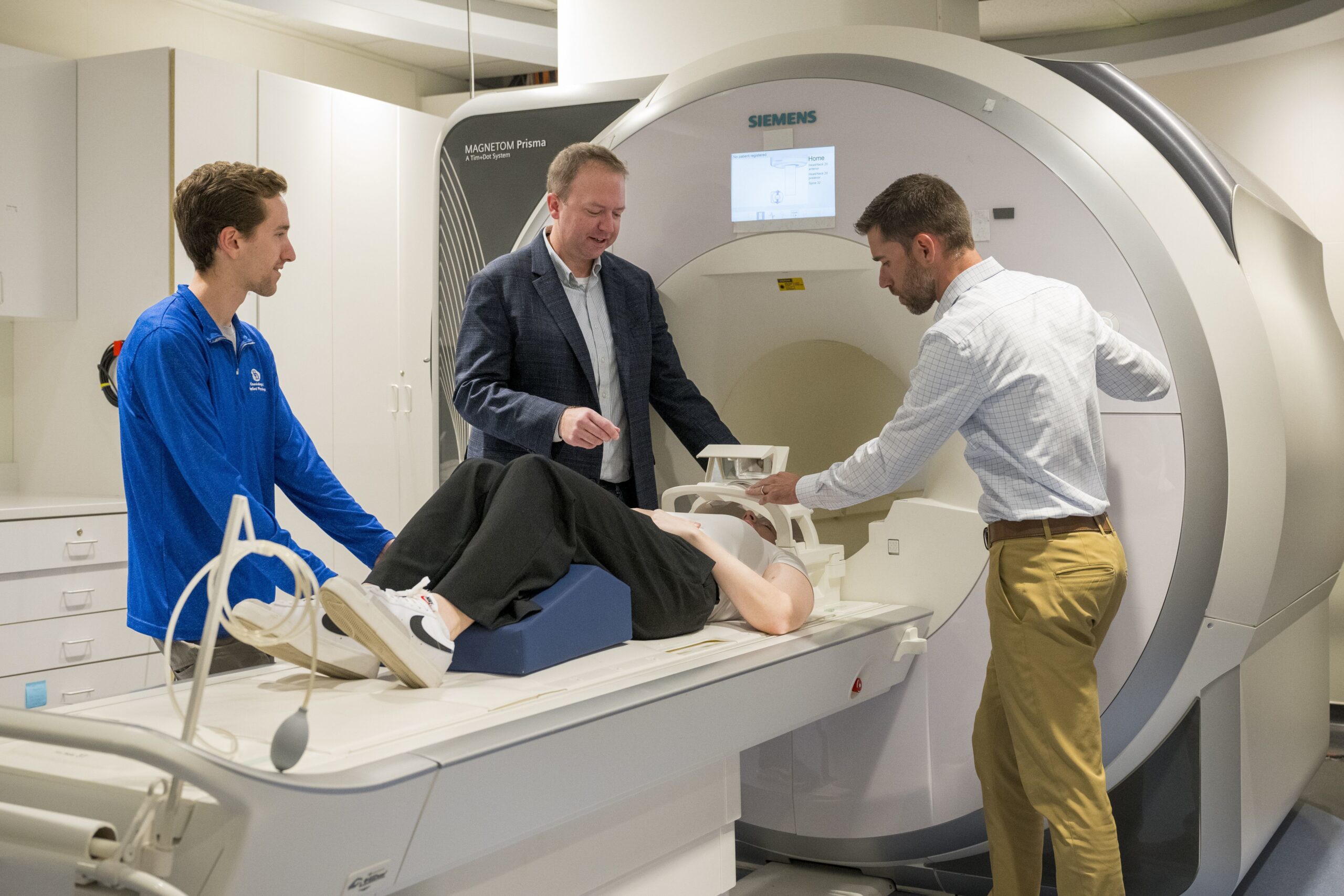
    Doctoral students at the Delaware Center for Cognitive Aging study the impact of cardiovascular function on brain tissue integrity and cognitive aging.

    So what can those of us who want to ensure we have the tools to effectively treat future pandemics and that our children benefit from world-class health research do?

    Congress has little practical recourse here. The Congressional Review Act exists, but in the current political climate, a veto-proof majority to overturn an OMB rule is a fantasy.

    Yet, our voice still matters.

    I do not say this as a mere platitude. The Federal Register, where this document was published, contains a form for anyone to leave a comment for OMB. Unlike the “contact me” forms on senators’ and representatives’ pages that you rarely receive a response from, the comments here are public — and they also carry legal weight. When this proposal gets challenged in court — and it almost certainly will — judges will look at the administrative record, which includes every single comment.

    If OMB does not meaningfully engage with a substantive objection raised during the comment period, that provides grounds to vacate the rule. Your comment doesn’t just go into a void. It becomes part of the legal ammunition.

    Physicians and healthcare workers: Share the stories of your patients who benefited from federally funded studies. Scientists and students: Explain your research and the progress made from it. Attorneys and legal scholars: Challenge the principles and wording in this sweeping, overarching proposal.

    To those whose careers do not directly involve science, this is your fight, too.

    Comment on your medical condition that’s been treated. Chances are that treatment was only possible due to federally funded basic science. And if you or a loved one suffers from a disease or illness for which we do not yet have a cure, it is all the more important that you speak up with us.

    Stable and comprehensive funding allows scientists to develop treatments for both rare illnesses and widespread ones like neurodegenerative diseases.

    This is also a fight for our underrepresented racial and ethnic populations, the LGBTQ+ community, and the marginalized in our city. The decision to fund research on medical disparities is a decision to invest in the people who need it most.

    As we in Philadelphia celebrate our nation’s Semiquincentennial, America’s first hospital and medical school, and the great scientific advancements of our city, it would be wrong not to recognize the benefit biomedical research has received from federal funding.

    This legacy is now in danger. If we want to see another 250 years of great American science, now is the time to act.

    Ayaan Shah is a sophomore at the University of Pennsylvania studying neuroscience and an undergraduate research assistant at Penn’s Center for Neurodegenerative Disease Research.
  • On July 4, 1776, a world-changing Declaration rings out from Philadelphia

    On July 4, 1776, a world-changing Declaration rings out from Philadelphia

    Philadelphia. July 4, 1776.

    Independence is real. Philadelphia rejoices.

    And a printer awaits a declaration.

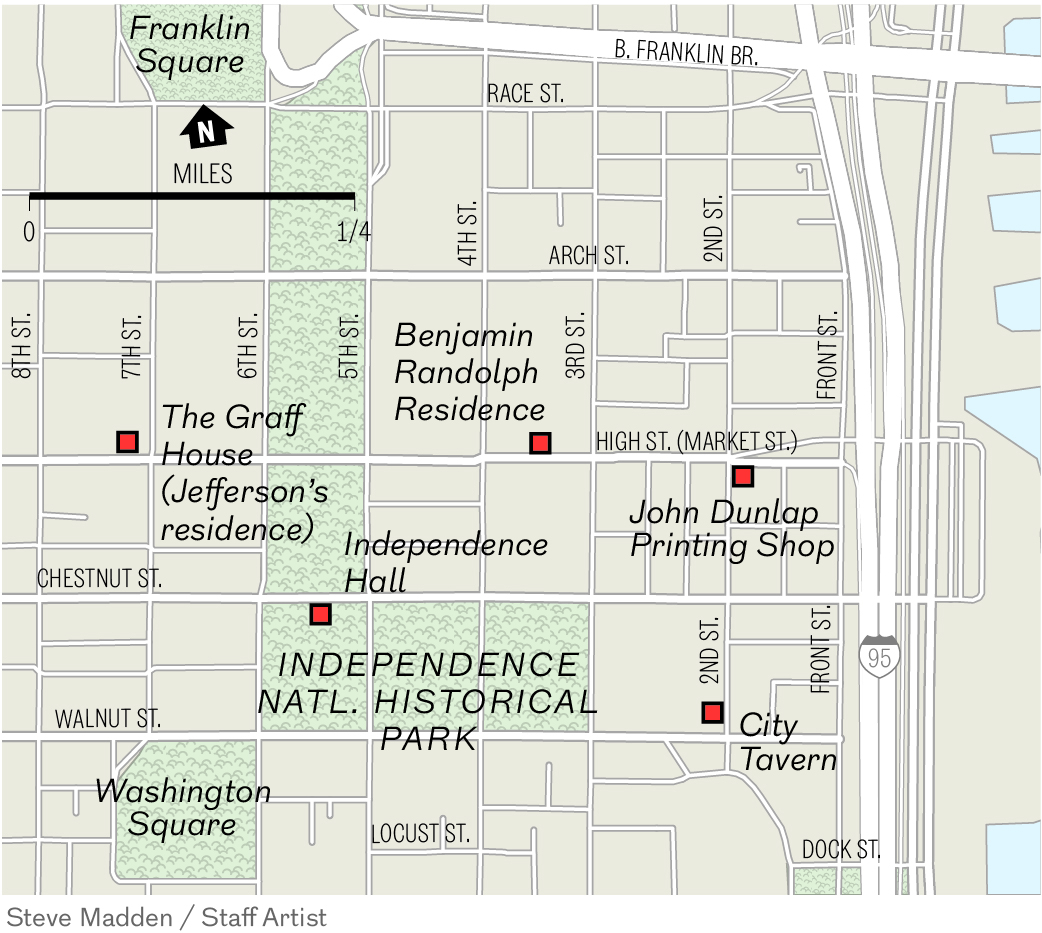
    John Dunlap, 29, an immigrant from Northern Ireland who operates a printing shop at Second and High Streets, a short stroll from the Pennsylvania State House, where the rebels conspire, has watched with keen attention the epochal events of the preceding days.

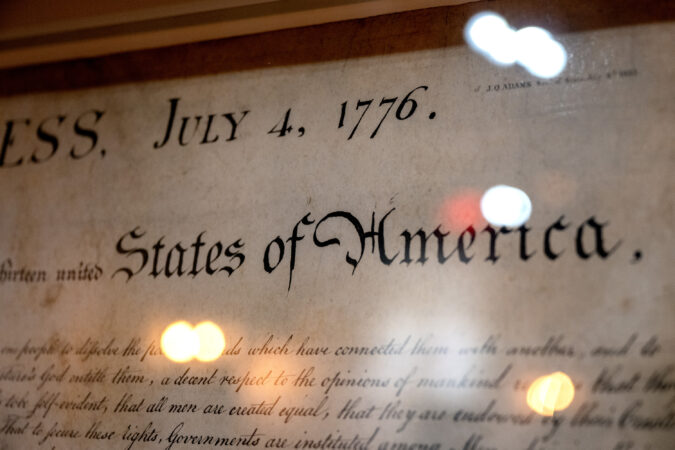
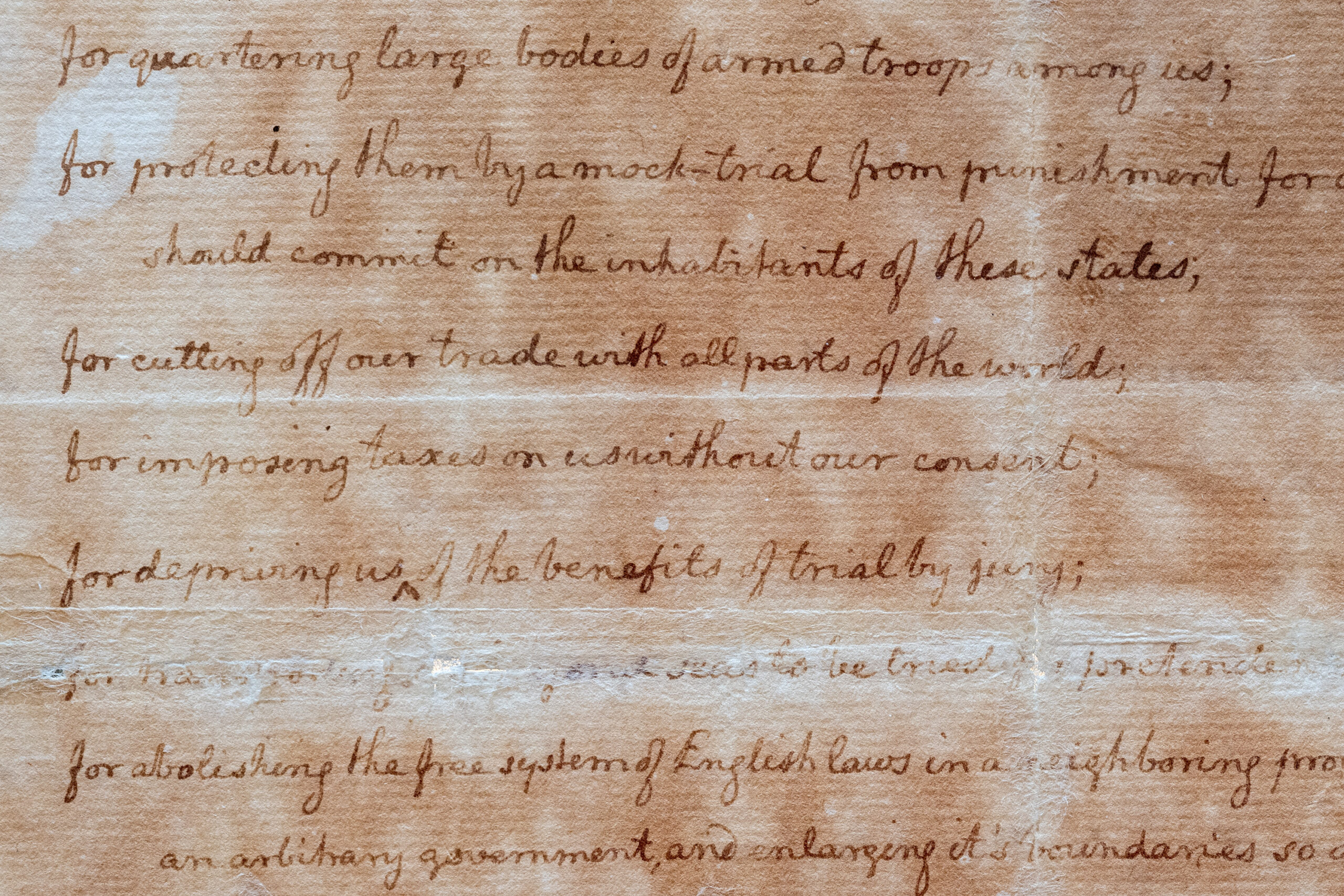
    A faded copy of a draft of the Declaration of Independence handwritten by Thomas Jefferson.

    The exultant patriots and curiosity seekers who braved suffocating summer heat to stand watch outside the State House on July 1, when the 56 delegates of the Second Continental Congress finally commence their locked-door debate on independence. The rapture that seems to ring out from every Philly tavern and tippling joint, coffee house, and street corner on July 2, when word that Congress voted to sever ties with King George III spreads through America’s largest and wealthiest city, like a bolt from one of Dr. Franklin’s electricity experiments. The joy. Hope.

    And now, as an unusually mild morning gives way to rain-laden clouds, Philadelphia holds its breath upon the brink of a mighty happening.

    Cloistered inside their chambers, the delegates fiercely debate and painstakingly parse Thomas Jefferson’s draft of America’s founding creed. Its passage will formalize independence.

    Dunlap, who will eventually serve Washington as an officer in the First Troop Philadelphia City Cavalry, is a patriot. But nobody’s fool. Months earlier, Dunlap had secured a lucrative $654 printing contract with the Congress, and the handsome commission it brings.

    The ink-stained Irishman with the whipcord build of a jockey prepares the shop for the Herculean task he knows is coming. The delegates will desire to thunder out the news of American independence before the iron gall ink even dries on the Dutch paper. John Hancock, 40, charismatic president of the Congress, will want as many broadsides as Dunlap can muster by dawn. Printing broadsides by hand in sweltering, trembling candlelight — meticulously setting the type, carefully rolling the ink, and pulling the heavy presses — is messy, demanding work, the hardened printer knows. He’ll plan to toil until morning’s light.

    Outside, citizens collect in High Street. Soon, the print shop door pushes open. A man, his face obscured by the sun, darkens the doorway. He holds something close. A rag paper manuscript written in fine hand, still wet from fresh changes, and borne by delicate hand to the expectant printer. Words upon which a nation now rests. A declaration.

    July 1, 1776: Three days earlier

    At the Second Street boarding house of Mrs. Sarah Yard, John Adams, 40, awakes before dawn. The unyielding lawyer and farmer from Massachusetts has become accustomed to the city’s morning clarion cry of crowing roosters, ringing bells, clanking ships, and cursing sailors. But not its heat.

    Behold this atlas of independence at his breaking point. Exhausted. Homesick. Hot. Beyond cantankerous that any rational being could yet flinch at the surety and necessity of American independence. For weeks, Adams answers angry letters from citizens demanding to know why Congress stalls.

    “The only question is concerning the proper time for making a specific declaration in words,” Adams writes, barely concealing his own impatience. “But remember you can’t make thirteen clocks strike precisely alike at the same second.”

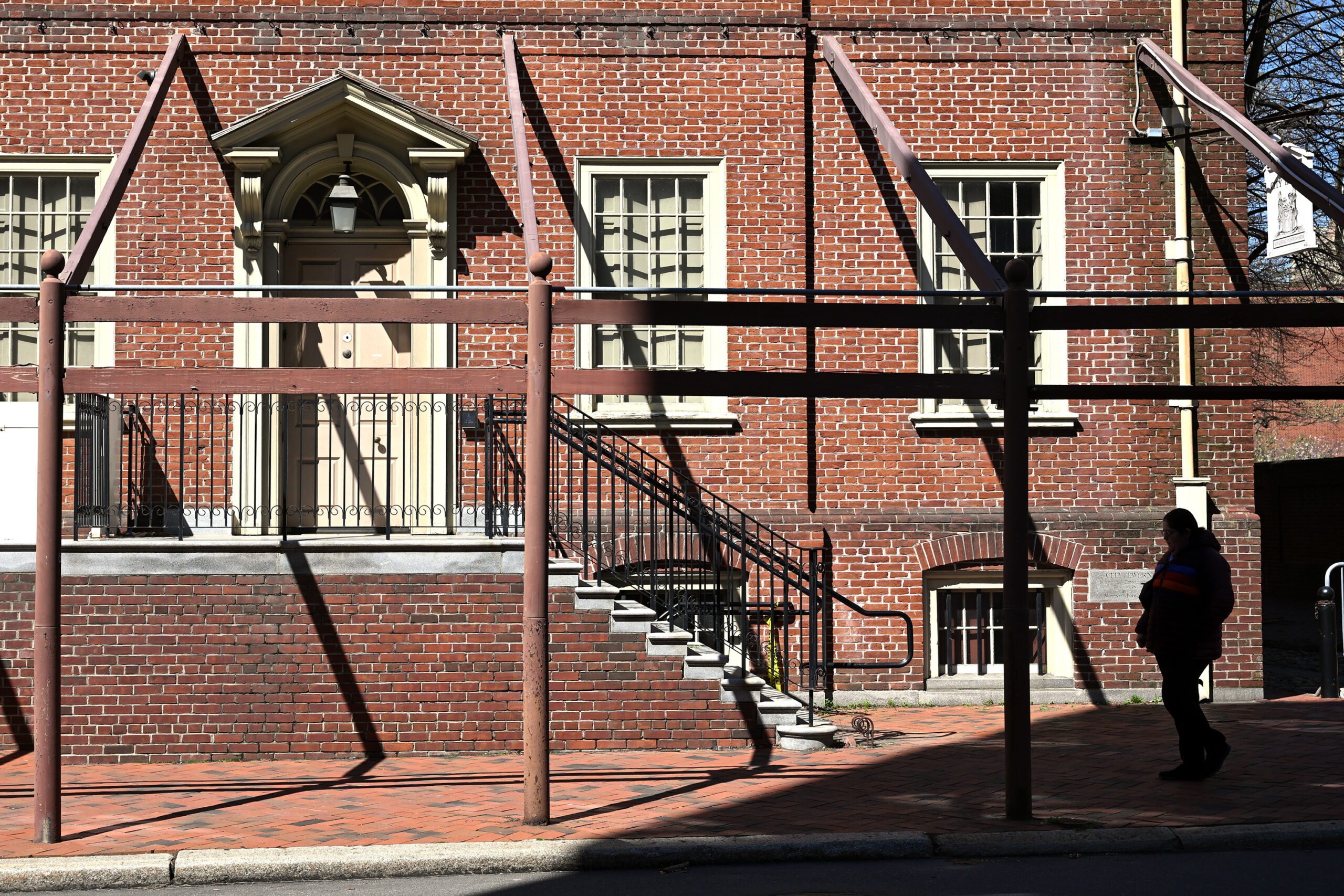
    John Adams and his cousin, Samuel, shared a boarding house near the City Tavern in July 1776. This reconstruction of the original tavern was built in 1975.

    For nearly two years, John Adams has fought for liberty like a bruising prizefighter, while his less refined older cousin, Samuel, 53, conducts a campaign of persuasion in the shadows. No one has done more than John Adams for independence. On this morning, John Adams dresses in the twilight, wishing that he had been blessed with the graces and gifts of ancient orators.

    “This morning is assigned the greatest debate of all,” Adams writes before leaving for the State House. “A declaration, that these colonies are free and independent states, has been reported by a committee some weeks ago for that purpose, and this day or tomorrow is to determine its fate. May heaven prosper this newborn republic.”

    At 9 a.m. on July 1, 1776, Andrew McNair, old and gray bellman of the State House, pulls shut the chamber’s heavy doors. Hancock gavels history to order.

    In the silence, rises Pennsylvania’s reluctant rebel, John Dickinson. His writings once rallied American farmers against British taxes. Now, ghostly and gaunt from illness, he remains a dogged dissenter against independence. Summoning his strength, he abides his conscience, arguing America is not yet ready.

    To proceed with a declaration during an uncertain struggle would be “to brave the storm in a skiff made of paper,” he tells his colleagues, before sitting.

    Outside, the heat breaks. Rain beats against the chamber’s tall windows. Thunder booms. Lightning flashes.

    Adams stands. He speaks over the stormy din. His precise words are lost to posterity. He speaks for two hours. John Adams moves men.

    Adams speaks “with a power of thought and expression that moves us from our seats,” Jefferson, remaining characteristically mum at his table, will later recall.

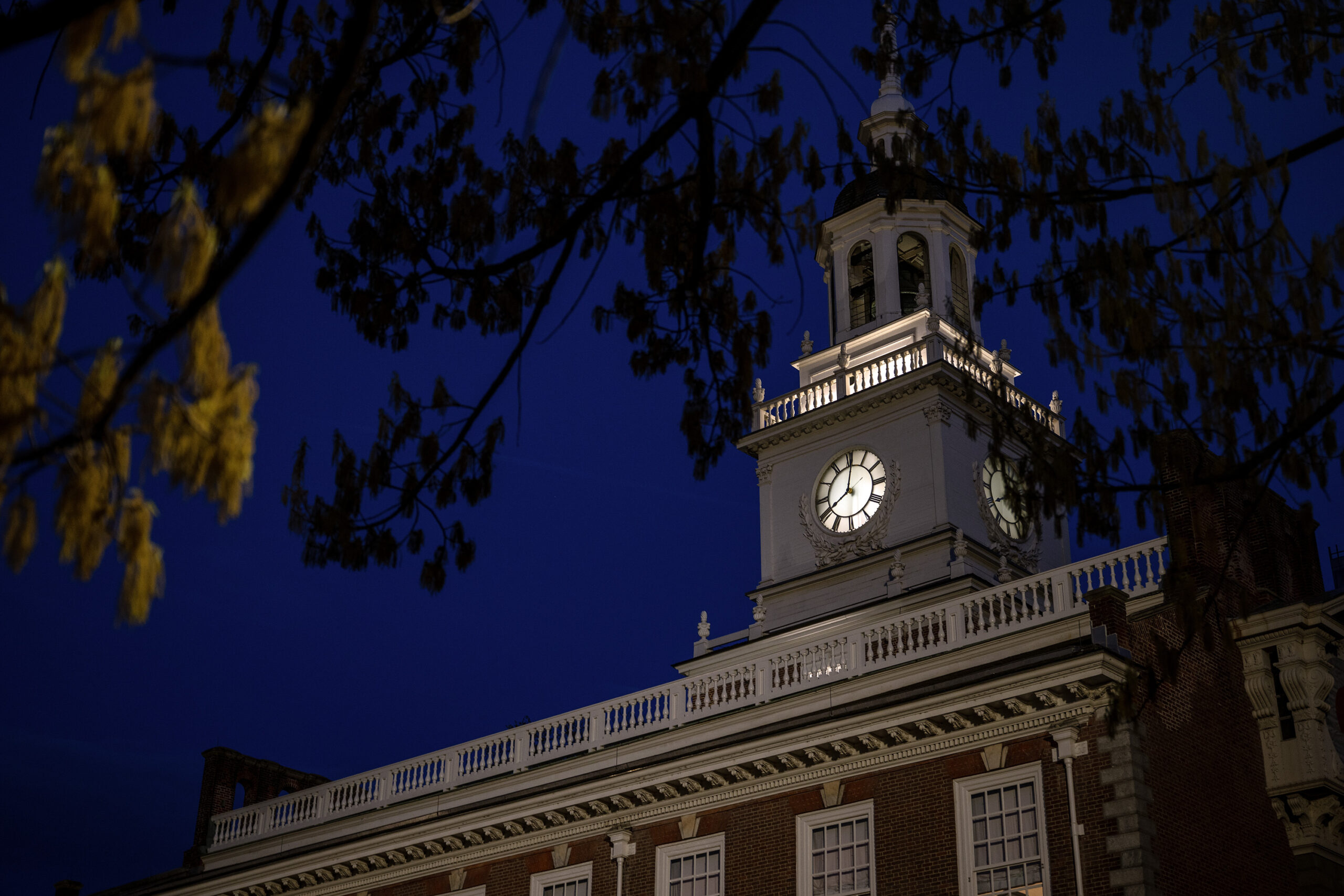
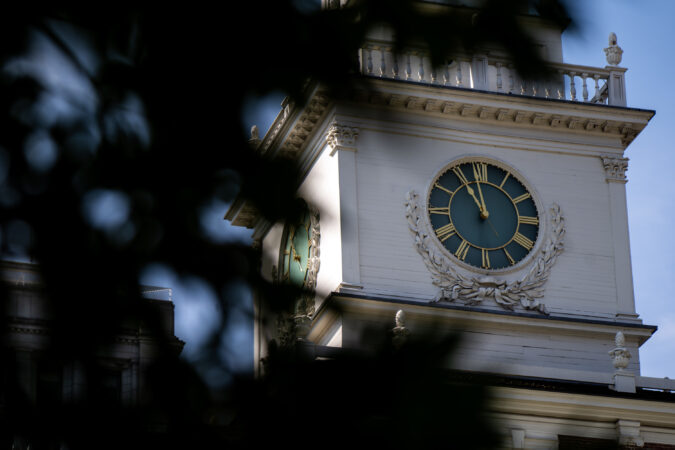
    Recreating the daily hub of the Revolutionary City in 1776. You can hear the cannons from the bell tower of the Pennsylvania State House at Sixth and Chestnut Streets, where the rebels conspire. Now, it’s Independence Hall, photographed April 14, 2026.

    A preliminary vote is taken by candlelight. Despite popular opinion, four colonies — including four members of Pennsylvania’s critical seven-man delegation — vote no.

    Late into the night, at the City Tavern, the delegates drink upon tenterhooks.

    July 2, 1776

    The second day of debate begins with a prosperous portent. Caesar Rodney, of Delaware, mud-splattered boots and spurs, arms akimbo, bursts in before the doors to Congress close. The gravely ill delegate rode 80 miles through the tempest to cast his vote for independence.

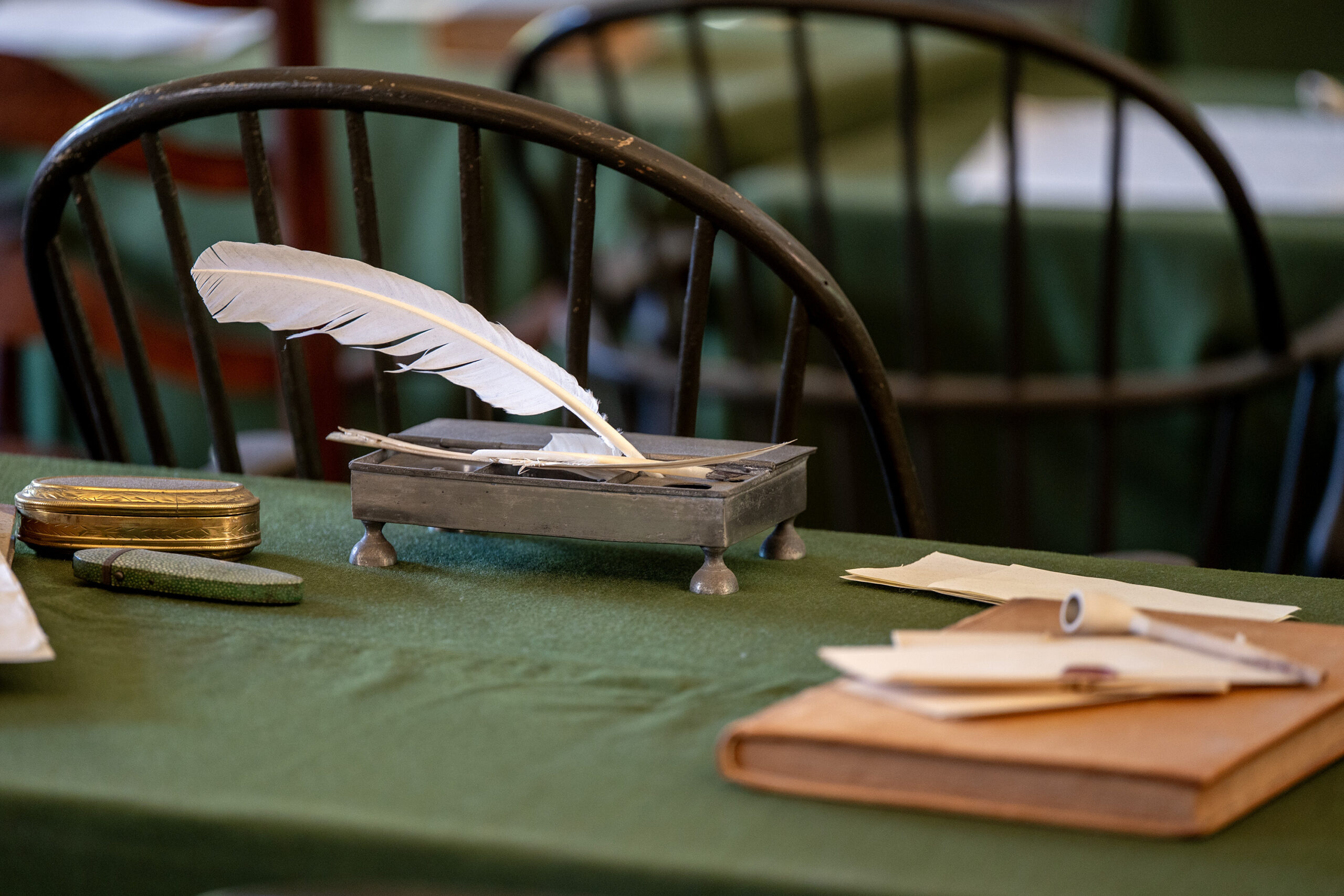
    Replica desks in the Assembly Room in Independence Hall, known as the Pennsylvania State House in 1776. This is the exact space where the Second Continental Congress met and the Declaration of Independence was adopted.

    Better still are the two conspicuously empty chairs at the Pennsylvania table. Unable to vote for independence, but unwilling to thwart unanimity, Dickinson and fellow delegate, Robert Morris, voluntarily abstain. Despite his feelings, Dickinson will soon join the rebel militia — to fight for his country.

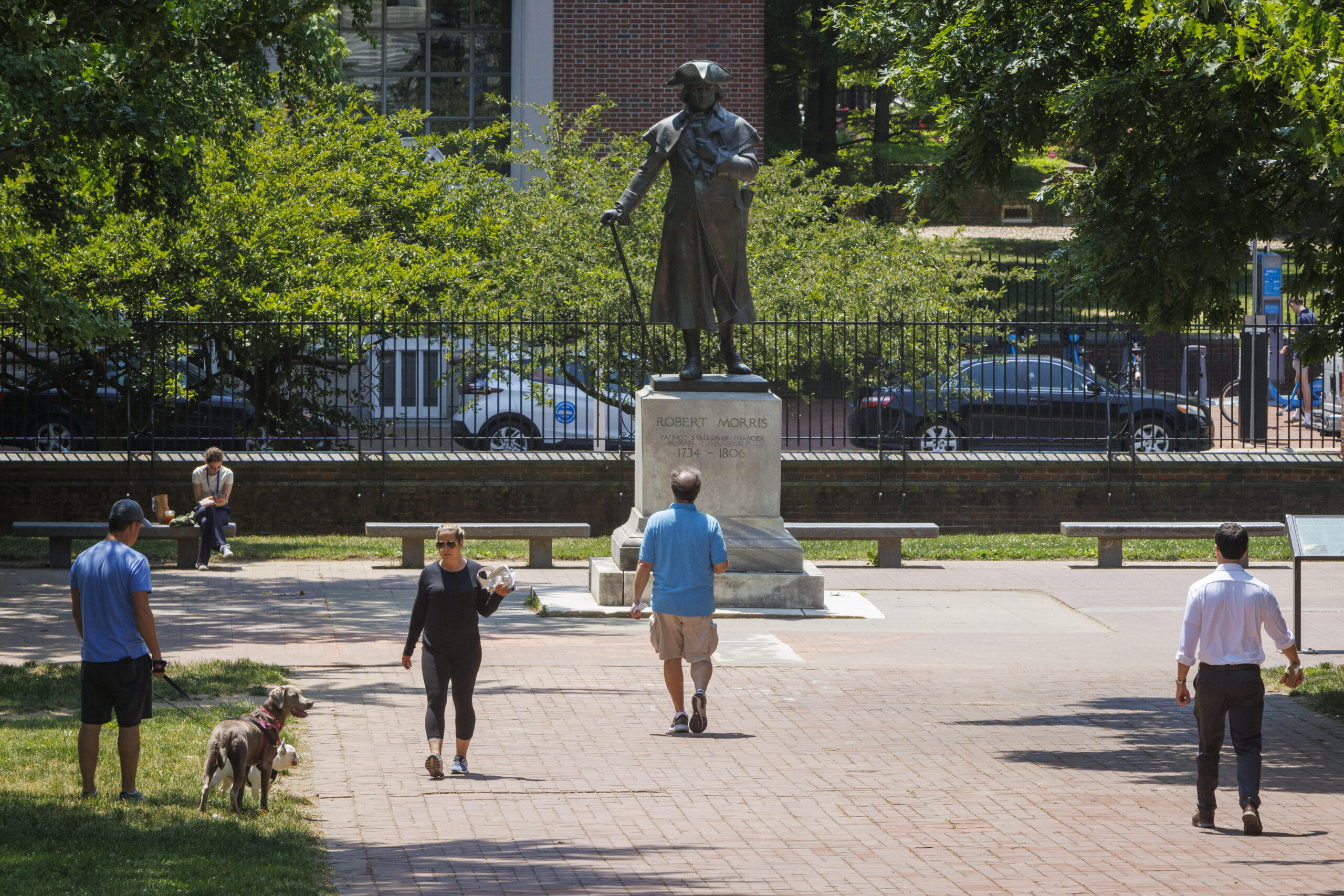
    The statue of Robert Morris in Independence National Historical Park on May 31, 2023.

    Again, the skies open up, raindrops drumming upon the glass.

    With New York abstaining — and Pennsylvania swinging toward independence — the vote goes quick.

    It is done.

    Independence.

    July 3, 1776

    The Congress continues without a break.

    Days earlier, before handing in his draft of the Declaration of Independence, Thomas Jefferson turned to Benjamin Franklin for one last look.

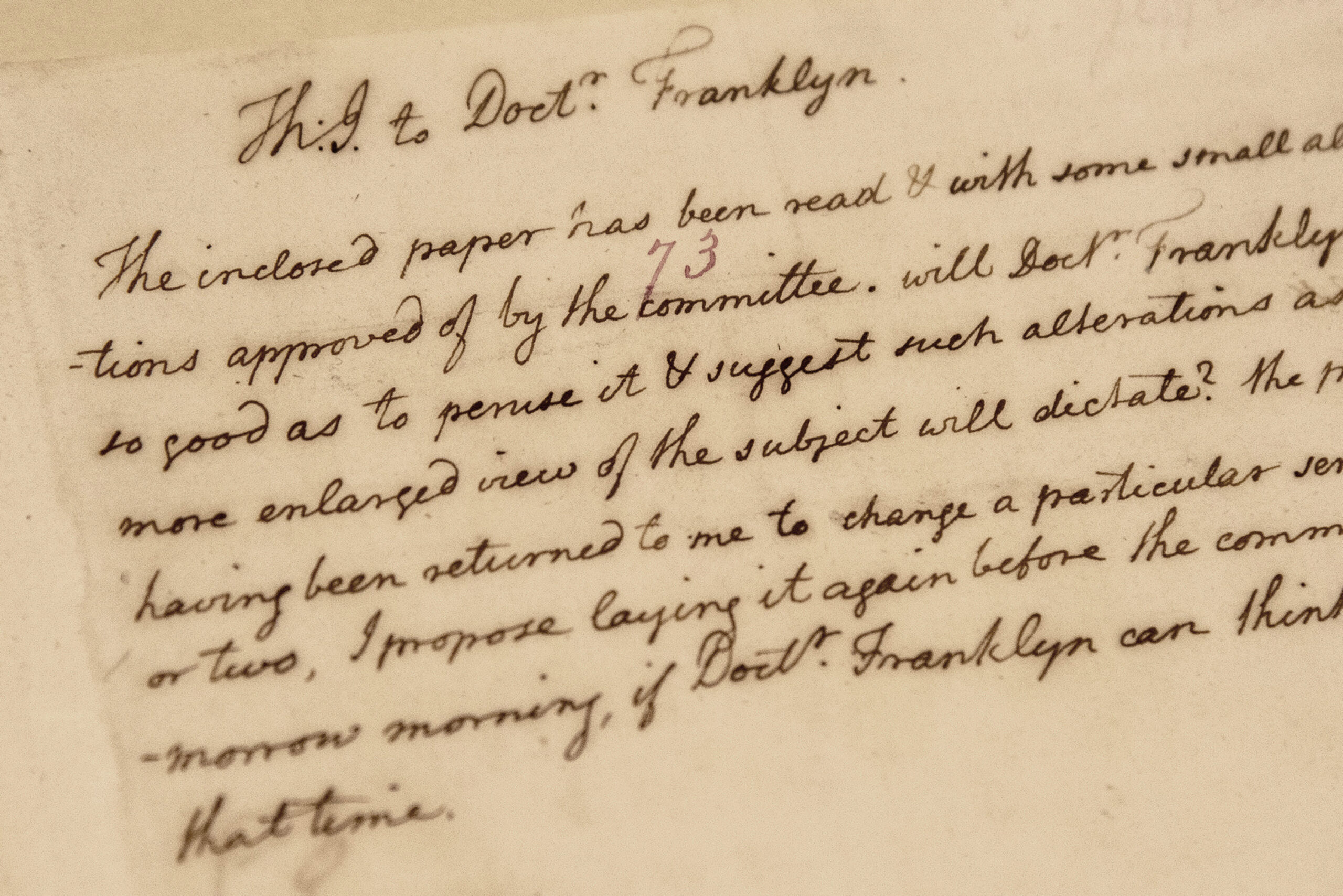
    A letter from Thomas Jefferson to “Doct. Franklyn” (Benjamin Franklin) in June 1776 asking for suggestions on the Declaration of Independence.

    “Will Doctr. Franklyn be so good as to peruse it and suggest such alterations as his more enlarged view of the subject will dictate?” Jefferson inquires, in a note delivered to the silver-haired statesman’s High Street home.

    It’s Franklin, sly satirist, homespun philosopher — grand auteur of America’s self-made aura — who possibly suggests, the inspiring “self-evident” phrasing, replacing Jefferson’s initial “sacred and undeniable truths.”

    And it is Franklin, 70, spectacled lion of liberty, sage of Philadelphia, tamer of lightning, dean of American charm and wit, wooer of women, broad of bow and frame, portly of paunch and plain of coat, a winsome spark dancing across his gray-blue eyes, who comforts the young writer as delegates slash away at his declaration. The winking newspaperman unspools a tale about an enterprising hatmaker who wishes to advertise his wares. By the time the hatter’s friends finish their edits, all that remains is the man’s name, and a photo of a hat, Franklin jokes.

    The delegates trim Jefferson’s harsher language about King George. They excise completely his evisceration of the slave trade. Jefferson does not publicly protest.

    July 4, 1776

    At 11 a.m., debate is closed.

    The moment will eventually be memorialized in painting. The towering trio — Adams, Jefferson, Franklin — presenting America’s credo for approval. Imagine them, these Founding Fathers. These imperfect men for the ages who hazard everything to chance a republic, and change a world.

    There is little ceremony. Horseflies from a nearby stable buzz. One after another, a chorus of “Ayes.”

    Delegates break the tension with gallows humor about whose necks will snap the swiftest.

    History does not record the face of the man who darkens the doorway of John Dunlap’s print shop. Perhaps it was Adams, unable to yield his obsession even in its ultimate realization. Perhaps, it was Franklin, delivering the declaration with a deliciously wry aphorism. Or Jefferson, solemn and silent with the weight of his words.

    Dunlap works all night to the thumping groan of the presses. By morning, roughly 200 broadsides start to spread America’s newly minted founding document far beyond Philadelphia. Breathless riders herald the news in town squares.

    In the trenches in New York, Washington orders the declaration read aloud. Bells ring. Troops parade. Bonfires alight. Candles burn. Prayers are whispered, for those sons and fathers who will die in the bloody conflict ahead.

    By July 6, the Pennsylvania Evening Post, a paper published near Dunlap’s shop, prints the declaration word for word. Its previous issue had been put to press too early to capture the momentous events.

    Instead, the July 4, 1776 edition included usual fare.

    “To be sold,” read one back-page ad. “A NEGRO BOY, about four or five years of age.”

    Crowds pack the State House yard, where the rebels had long conspired. A military officer reads the manifesto to the hushed masses.

    Words that birth the American experiment on an ideal — and the sin of slavery. Words that will endure Civil War and oppression. Words that beckon centuries of American promise and possibility, triumph and failure. Words that inspire new revolutions, new freedoms, new fights. Words that transform. Words that twist. Words that promise a pursuit of happiness — but withhold so much from so many. Words that stand tested still.

    Words written in Philadelphia.

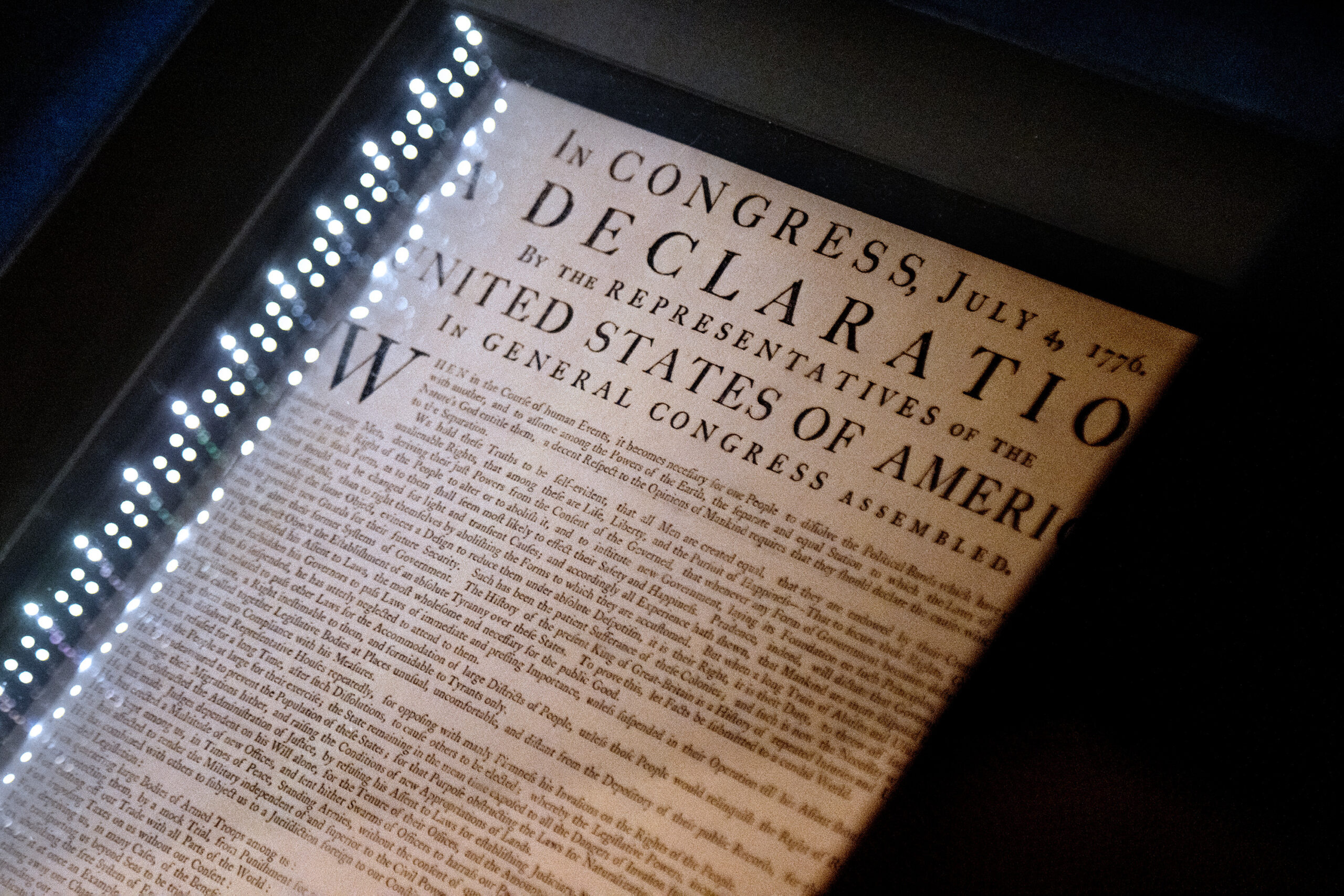
    An original broadside copy of the Declaration of Independence printed by John Dunlap on display in the “Great Essentials” exhibit in the West Wing of Independence Hall on July 29, 2025.
  • Saluting the signers for the Semiquincentennial

    Saluting the signers for the Semiquincentennial

    It’s a common sound in Philadelphia’s historic district during the summer. I was photographing tourists in front of Independence Hall on Wednesday when the beat of a single snare drum a block away achieved its intended purpose.

    Just like when the fife and drum corps would relay tactical commands over the noise of the battlefield, or regulate a soldier’s daily routine, I stopped what I was going and headed in the direction of the beating pulse.

    It was coming from the normally quiet Signer’s Garden pocket park, across 5th Street.

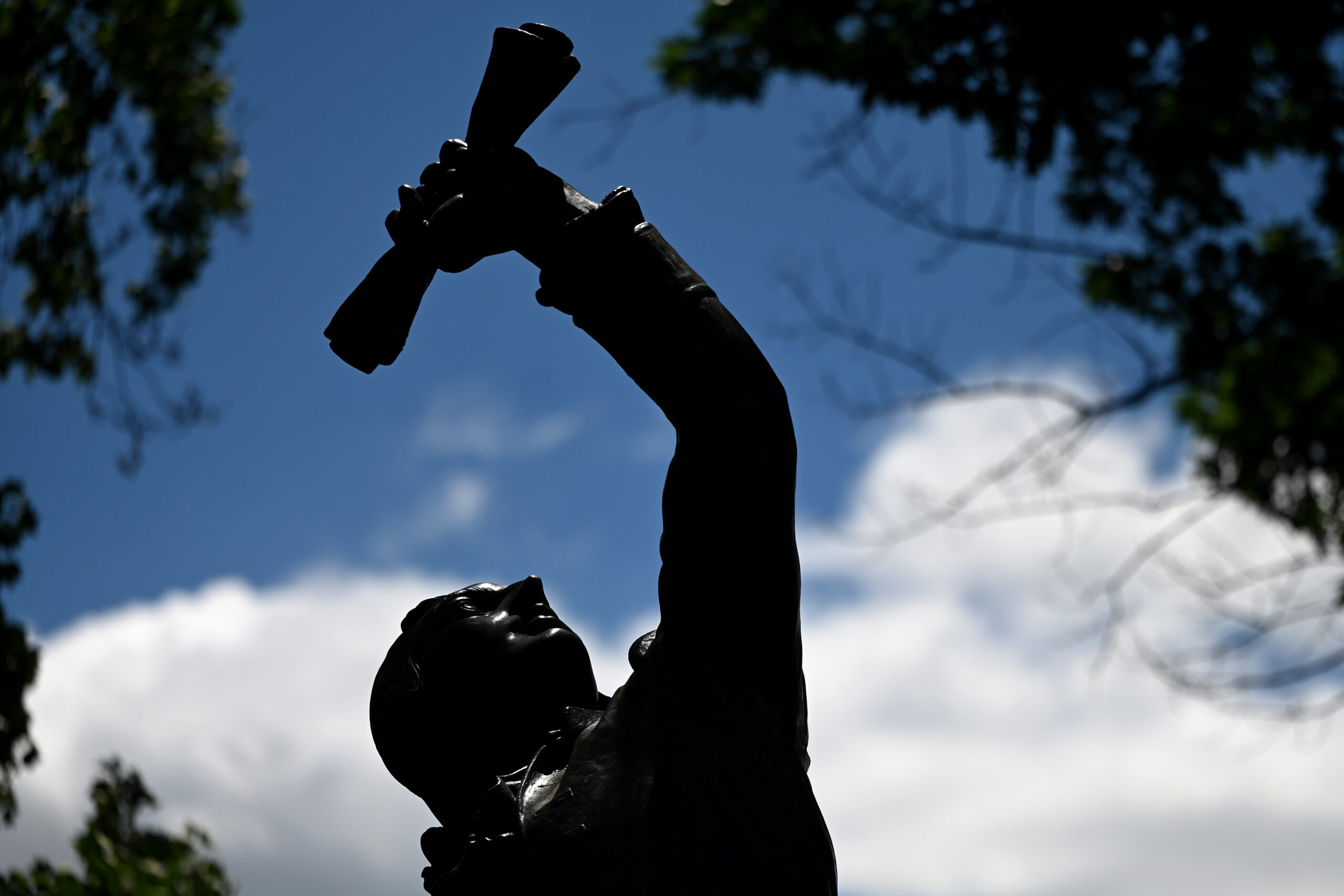
    I had intended to go there anyway to photograph the statue — “The Signer” — as I am working with present-day descendants of the signers of the Declaration of Independence on a photo essay that will be posted online this Fourth of July weekend.

    The statue was inspired by George Clymer, a Philadelphia merchant, statesman, and signer of both the Declaration of Independence and the U.S. Constitution. A National Park Service plaque at the entrance reads “it commemorates the courage of those who altered their lives, and ours, by affixing their names to these documents.”

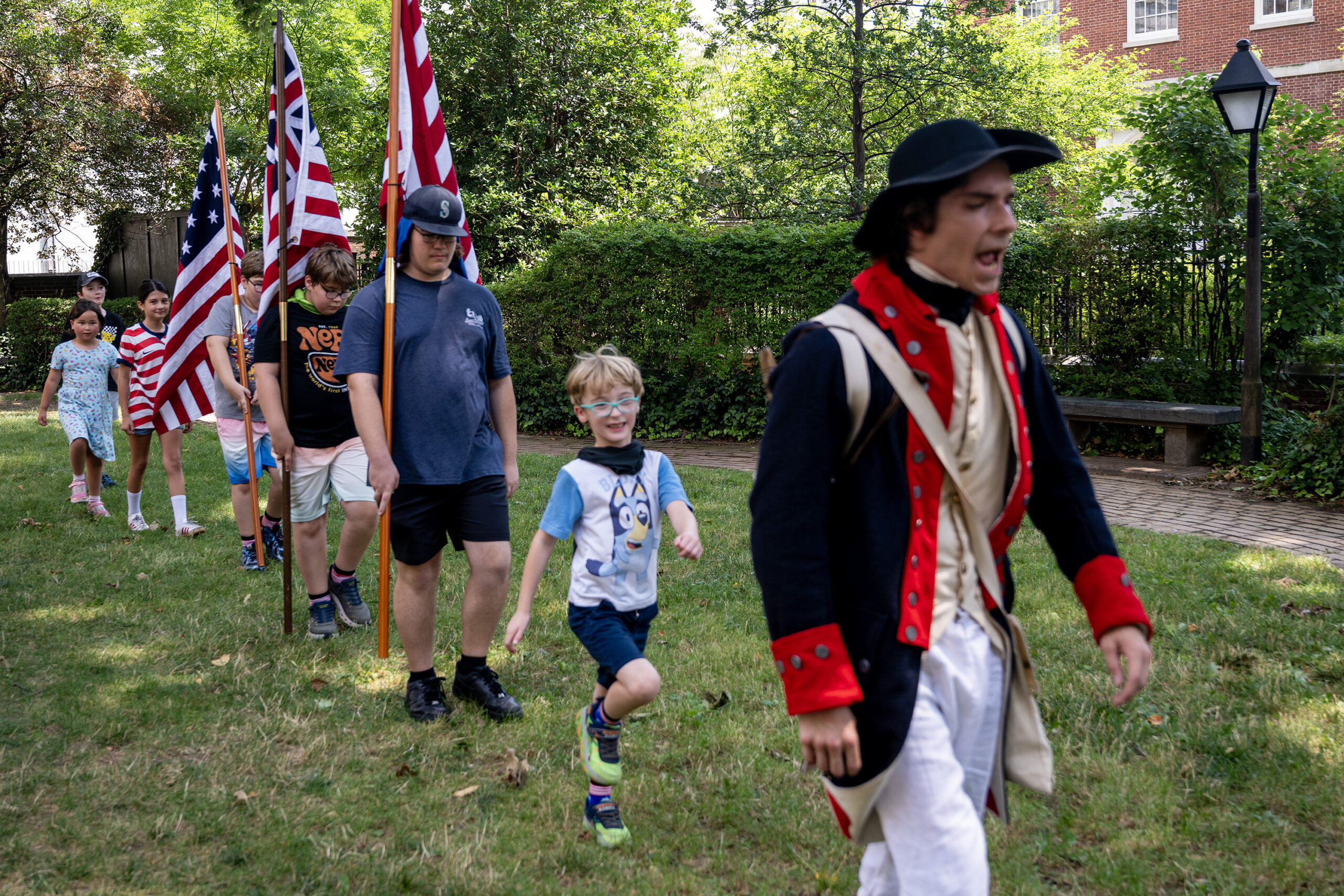
    The drum was mustering holiday week visitors for a presentation by two costumed actors from Historic Philadelphia portraying continental soldiers. I watched as the tourists watched them “draft” youngsters into their performance and found myself smiling more than once at how they engaged the kids — and the rest of us in the crowd — with some of their one-liners.

    Historic Philadelphia actor Lane Norris portraying Continental soldier Conrad Frye leads a contingent of young tourists in Independence National Historical Park Wednesday, July 1, 2026.

    Did I say, smile? I might have had a slightly more sentimental reaction. I have written before that Independence Day has always been my favorite holiday. My dad, who passed away a few years ago, was born on the Fourth of July.

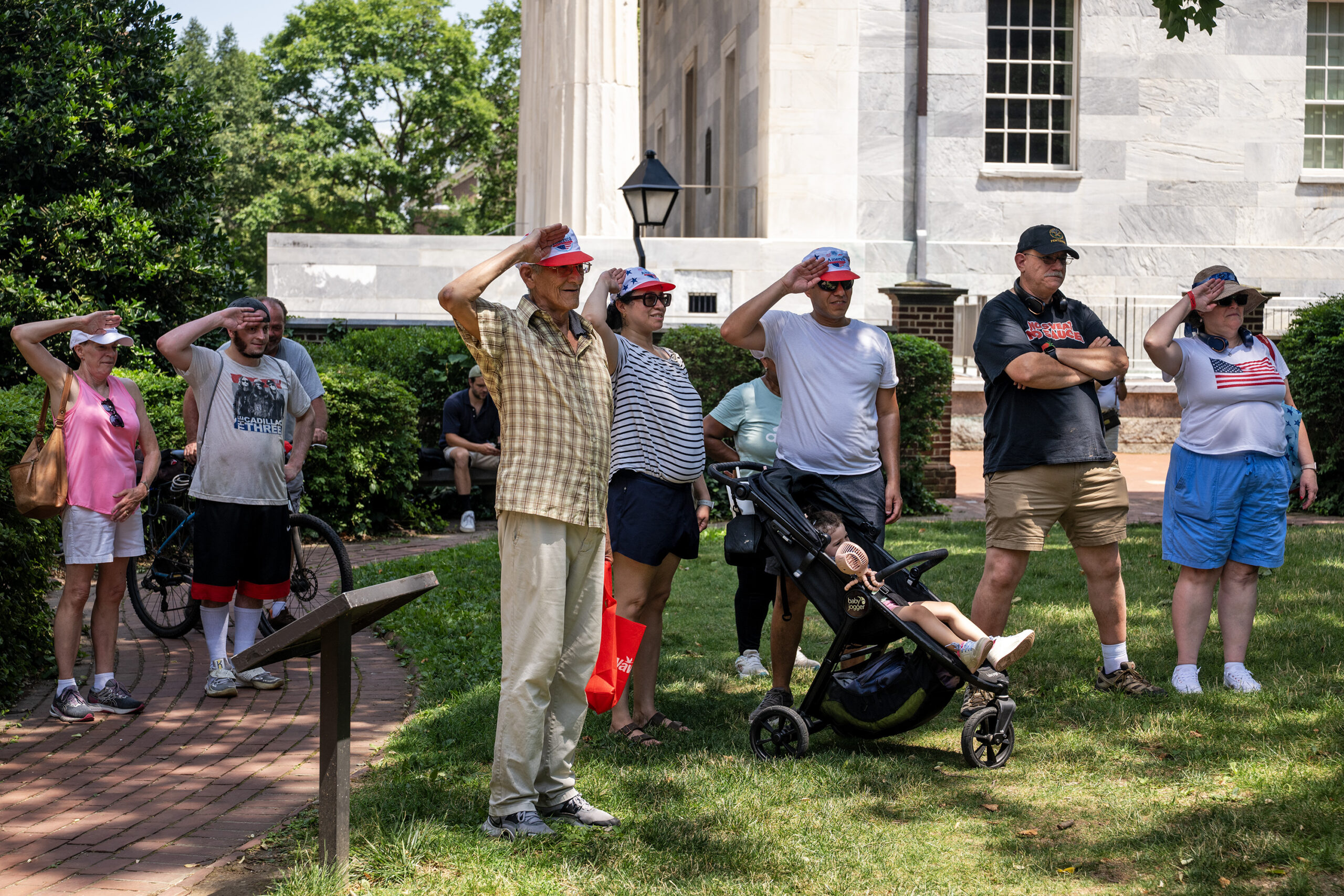
    As I looked around at the crowd I could tell everyone else was also getting into the interactive and engaging program. I photographed saluting adults who I assumed were parents, mirroring the actions of their kids doing the marching drills.

    Afterward, I learned they weren’t. They had a toddler still in a stroller. They were immigrants from Venezuela, and just happy to be here. Like me.

    We’re still in the middle of Philly’s celebration of America’s 250th birthday (with canceled events in a declared heat emergency with 100-plus degree temperatures!). Here are more of my Fourth of July photos and those of my colleagues:

    Since 1998 a black-and-white photo has appeared every Monday in staff photographer Tom Gralish’s “Scene Through the Lens” photo column in the print editions of The Inquirer’s local news section. Here are the most recent, in color:

    » SEE MORE: Archived columns and Twenty years of a photo column.

  • Pope Leo XIV celebrates immigrants in speech to Philadelphia crowd amid clash with Trump ahead of 250th anniversary

    Pope Leo XIV celebrates immigrants in speech to Philadelphia crowd amid clash with Trump ahead of 250th anniversary

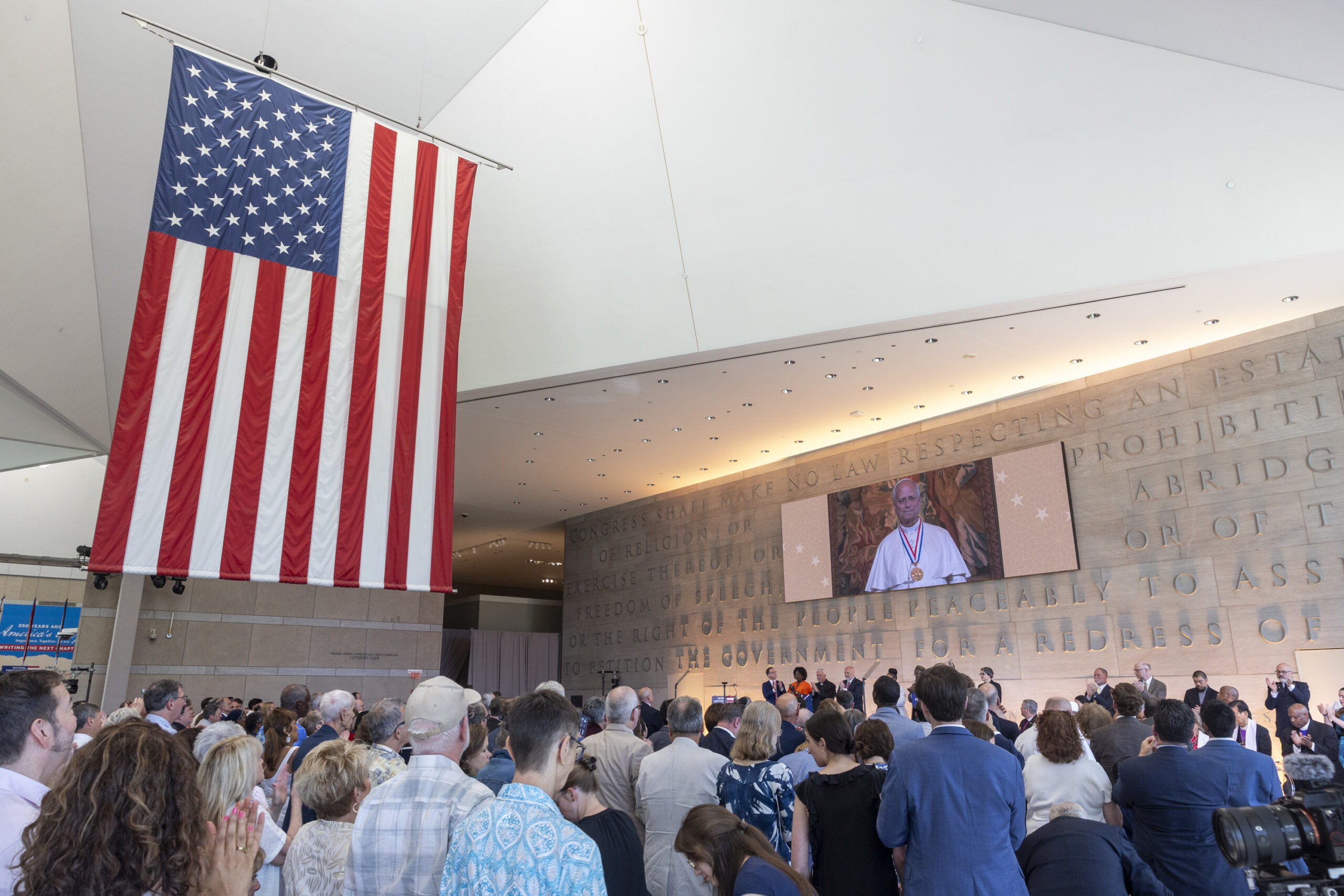
    Addressing a Philadelphia crowd live from the Vatican, Pope Leo XIV called for a “recommitment” to American ideals.

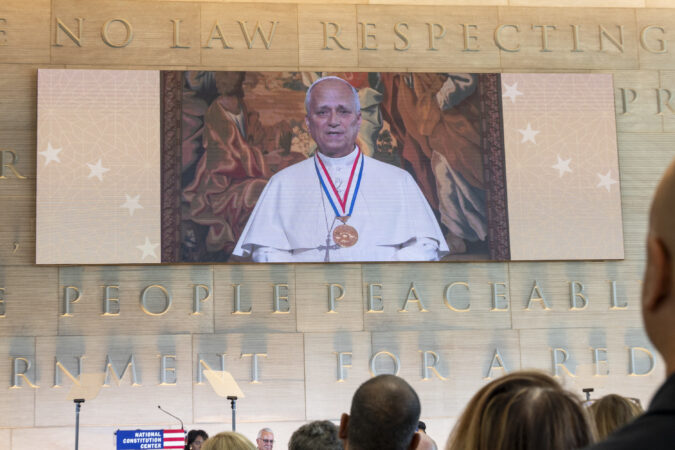
    The first U.S.-born pope delivered remarks virtually at an interfaith ceremony inside Philadelphia’s National Constitution Center on the eve of the United States’ 250th birthday to accept the center’s prestigious Liberty Medal.

    Facing a screen showing the live, cheering Philadelphia audience, the pontiff wore his Liberty Medal along with a cross around his neck.

    Leo, who grew up in Chicago and attended Villanova University, quickly pointed out his American roots, calling himself “a son of this great country.”

    “I join you in asking God’s blessings upon America’s future that the lofty ideals enshrined at the beginning of the Declaration of Independence may continue to guide the flourishing of the nation in unity, justice, and peace,” he said.

    Leo, who was elected pope last year, spent years serving the church in Peru and has been outspoken about calling for international peace. That’s landed him at odds with President Donald Trump’s administration on the issue of migrants, the war in Iran, and more.

    The pope leaned into some of those themes in his speech, even though he did not refer to the president directly.

    He nodded to his advocacy for humane treatment of immigrants and noted that the founders of the United States “made America a byword for freedom, as the country opened its doors to successive waves of immigrants, enabling them and their children to play their part in shaping the future of the nation.”

    He said the “love of freedom” in the United States has inspired the country “to look beyond itself and at great sacrifice to champion the cause of freedom beyond its own borders.” But he acknowledged that mission hasn’t been straightforward, noting that building a society that embodies such ideals “was not always easy and, in many respects, is still a work in progress.”

    The pontiff’s speech comes the day before he plans to visit Lampedusa, an Italian island known as a stop for migrants making the dangerous journey across the Mediterranean Sea from North Africa to Europe. His predecessor Pope Francis made his first official visit outside of Rome in 2013 to the same island and condemned the “globalization of indifference” toward migrants.

    Pope Leo XIV speaks at the Liberty Medal Ceremony at the National Constitution Center in Philadelphia on Friday.

    Julie Silverbrook, the chief content and learning officer for the National Constitution Center, emphasized in a Friday interview that Leo is a “global leader who has been uniquely shaped by American ideals.”

    “He has brought together people of different faith traditions, and through his ministry really reflected his belief in the inherent dignity of all human beings,” she said.

    Leo declined an invitation from Trump to the United States to celebrate the country’s 250th birthday on July Fourth, the New York Times reported. The first American-born pope opting to visit migrants instead sends a stark message as the president pursues his mission of mass deportations.

    But the pontiff’s participation in the Philadelphia program highlights his connections to the region, which isn’t lost on the National Constitution Center.

    The Philadelphia-based private nonprofit organization chose Leo for the award due to “his lifelong work promoting religious liberty and freedom of conscience and expression around the world — ideals enshrined by America’s founders in the First Amendment to the U.S. Constitution.” That, and also because he is the first pope born in the United States, and has connections to Philadelphia, Silverbrook said.

    “He was shaped by those freedoms … in much the same way that the Declaration of Independence was shaped by the city of Philadelphia, and of course a reflection of American values that have been carried globally,” she said.

    When a delegation from Philadelphia’s National Constitution Center met with Leo at the Vatican in April to present him with the medal in person, they also bore a few local goodies: a bundle of Villanova swag, a replica of George Washington’s Acts of Congress, and a Wawa tote bag filled with Tastykakes.

    “I think he very much so feels a connection to Philadelphia, both having been educated here, and I think in this semiquincentennial moment, I think the eyes of the world are on Philadelphia, and we’re thinking about the ideals that have emanated from this place for 250 years,” Silverbrook said.

    Leo, a 1977 Villanova alum, recently passed on a surprise message to graduates of his alma mater. Vince Stango, the interim president and CEO of the National Constitution Center, also went to the Augustinian university on the Main Line, which co-sponsored the NBC10 broadcast of the event along with the archdiocese and Malvern Prep.

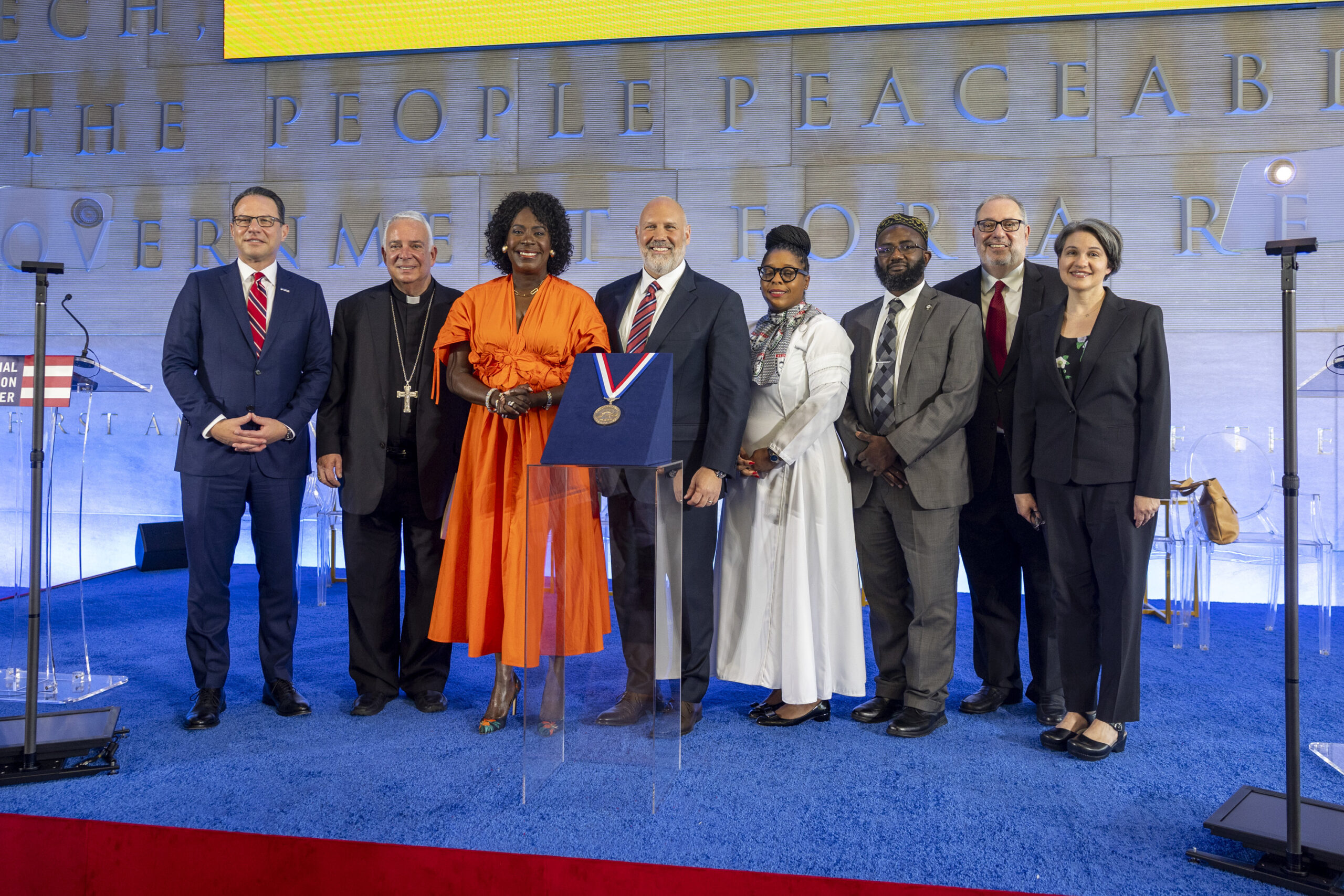
    (From left to right) Gov. Josh Shapiro, Rev. Nelson J. Pérez, Mayor Cherelle L. Parker, Interim President & CEO of National Constitutional Center Vince Stango, Rev. Carolyn C. Cavaness, Imam Quaiser D. Abdullah, Rev. Luis A. Cortés Jr., and Rabbi Jill L. Maderer, pose for a photo at the Liberty Medal Ceremony at the National Constitution Center in Philadelphia, Pa., on Friday.

    Clashing with Trump

    The pope has contended that it’s up to each country to determine how they want to accept migrants while also denouncing the Trump administration’s “extremely disrespectful” treatment of them.

    He has also spoken out against Trump’s threats against Iran, and declined to participate in the president’s “Board of Peace” for Gaza’s reconstruction.

    In an April social media rant, Trump complained that he doesn’t “want a Pope who criticizes the President of the United States.” The president called the Catholic leader weak and accused him of “catering to the Radical Left.”

    Leo told reporters that month that he has “no fear, neither of the Trump administration, nor of speaking out loudly about the message in the Gospel, and that’s what I believe I am called to do, what the church is called to do.”

    In his Friday remarks, the pope made a call for unity but warned that a country should come together with “ideals that do not fade with the passing of time.”

    He called on the United States to recognize its values of “peace and prosperity, a country characterized by generosity and nobility of heart,” and said the values of “shared human dignity, equality, and the rights laid out in the Declaration of Independence” can help unite and guide the nation.

    The Liberty Medal

    The Liberty Medal was created in 1988 and has been hosted by the National Constitution Center since 2006.

    The award has gone to storytellers, philanthropists, civil rights leaders, and politicians on both sides of the aisle, such as Ukrainian President Volodymyr Zelenskyy, former Supreme Court Justice Ruth Bader Ginsberg, the Bushes, Malala Yousafzai, and Thurgood Marshall.

    The center describes its recipients as individuals who “strive to secure the blessings of liberty to people around the globe.”

    The process of selecting Leo began about a year ago, Silverbrook said.

    The speech was initially going to be projected on Independence Mall, but the event was moved indoors due to the extreme heat and livestreamed by the center online.

    Rich Russo, 63, a Fishtown resident who attended the event in person, called the experience “once in a lifetime.”

    “How many times do you get the pope talking to you?” said Russo, who works for a bank.

    Gov. Josh Shapiro, who is Jewish, and Mayor Cherelle L. Parker, a Baptist — both Democrats who have been outspoken about their own faiths — joined Philadelphia Archbishop Nelson J. Pérez and other religious leaders who made remarks on stage prior to the pope’s speech. Pennsylvania Attorney General Dave Sunday, a Republican, rang a replica Liberty Bell outside.

    “Philly is proud that the pope is a graduate of Villanova University who spent time living and working in our region,” Pérez said on stage. “Pope Leo knows us, and we feel like we know him, too.”

    “His influence, however, extends beyond Philadelphia,” the archbishop added.

  • Semiquincentennial parade canceled due to heat, Pops on Independence still on

    Semiquincentennial parade canceled due to heat, Pops on Independence still on

    Wawa’s Salute to Independence Semiquincentennial Parade is canceled due to high temperatures, according to organizers.

    The parade was set to start Friday at noon after a delay was already announced Thursday.

    The Pops concert Friday night, featuring Idina Menzel, is still on, according to Wawa Welcome America.

    While some Facebook users understood the expected over 100 degree weather could put people at risk, others felt strongly about the lack of celebration.

    “What a disappointment for not only those of us who had hoped to watch, but also for the bands and other marchers who have come from all across the U.S.” one user commented. ”I get it — no one wants the liability. But are we just going to cancel everything?”

    Another added, “It’s the 250th in the Birthplace of Freedom, and we’re just canceling parades because it’s warm,” leaving people to argue and point out that it wasn’t simply a warm day in Philadelphia, but a dangerous heat advisory.

    Friday’s high is expected to break records in Philadelphia, with the anticipated minimum high of 104 last met in 1966 — when the nation was a mere 190 years old.

    Experts say this is different and riskier than warm days in past Julys.

    Over the past 85 years, Julys in Philadelphia are running on average 4.4 degrees warmer than in 1940, based on an analysis of historical weather data. That translates to an increase of about 0.52 degrees per decade.

    The city on Tuesday declared a “heat health emergency” in effect from 1 p.m. Wednesday through 8 p.m. Saturday. Across the Northeast, outdoor events are being rescheduled or canceled, citing the heat. Those events range from other America 250 events to local farmers’ markets.

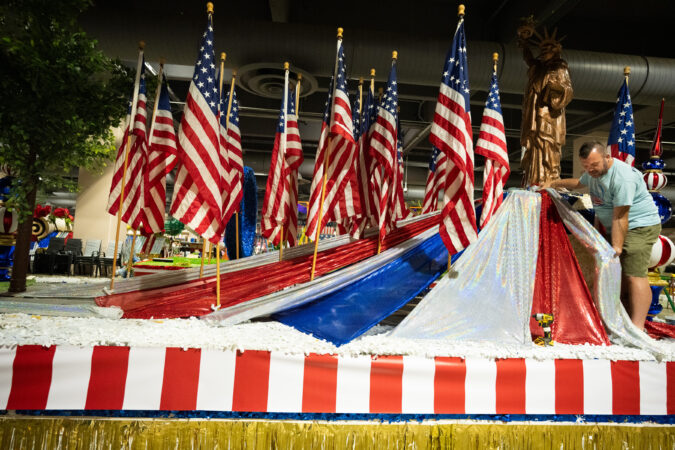
    Friday’s parade would have featured elaborate, giant floats paying tribute to America, including larger-than-life recreations of Martin Luther King Jr. and Harriet Tubman, a peace dove, and a Liberty Bell.

    Inquirer staff writer Anthony R. Wood contributed to this report.

  • Philly’s fireworks won’t start until midnight on July 4th and some residents say that’s too late

    Philly’s fireworks won’t start until midnight on July 4th and some residents say that’s too late

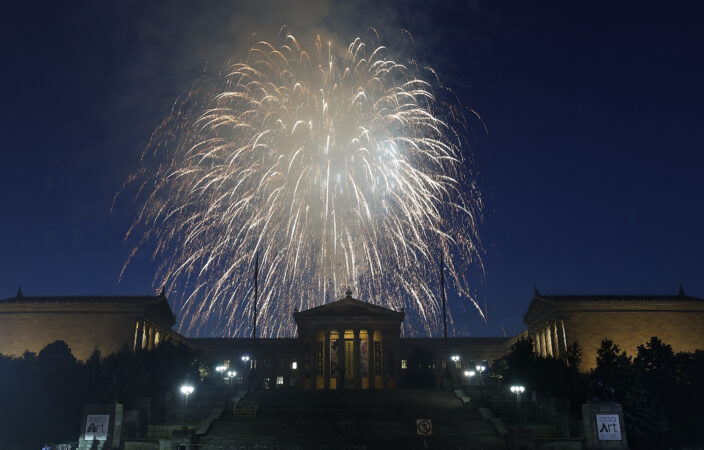
    Fairmount residents are accustomed to annual July Fourth fireworks; it comes with the territory of living near Benjamin Franklin Parkway, where the city stages its major celebrations. With the United States’ 250th birthday, this July Fourth is no different — except that the fireworks will start closer to midnight.

    “We have the whole family coming to our home, all on their way right now,” said Fairmount resident Margo DelliCarpini. “But 11:30, midnight is just too late for some families with children. I understand that it’s the Fourth of July, but the late start for fireworks is decidedly not a family-friendly decision.”

    DelliCarpini will have her children and grandchildren visit to experience the Semiquincentennial in the city where the country began. But with young children in tow, parents along for the trip were hoping to have them in bed by midnight, she said. Instead, the large group is looking to catch one of the fireworks shows at Valley Forge or across Montgomery County, which start around 9 p.m.

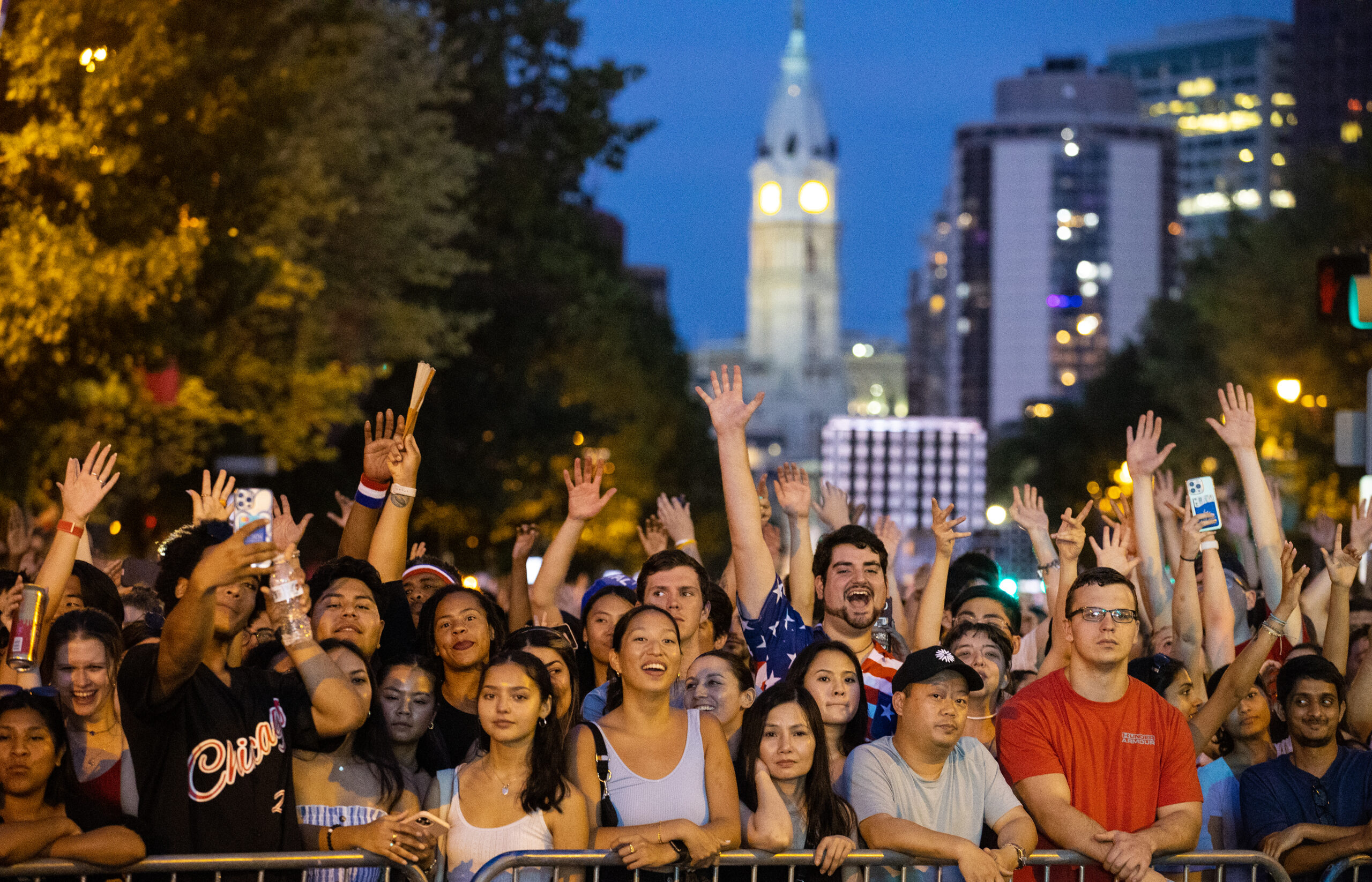
    Fans react to the music as the Wawa Welcome America Festival concluded July 4, 2023, with a free concert on Benjamin Franklin Parkway.

    Philadelphia’s July Fourth concert and fireworks show, the One City: Unity Concert for America, is expanding its lineup from two to three acts like in years past, to 10 artists, including Christina Aguilera, Will Smith, Meek Mill, and Seal. The show will also start earlier and end later, spanning into July 5 by the time people head home.

    The city did not respond to request for comment.

    Other cities, like New York, Boston, and Los Angeles, are keeping their 9-9:30 p.m. start times, while Washington, D.C. is among the cities pushing back its fireworks show to 10:30 p.m. or even 11 p.m. to allow for its expanded America 250 showcase.

    Mykola Kosyk, 36, a lifelong Fairmount resident, has been witnessing the Parkway fireworks for years. Usually he’ll catch some of the concert with his wife, head back home, have time to set off some fireworks of his own with family, and then all head back to the Parkway for the city’s grand finale. Kosyk said he’ll still likely watch the midnight fireworks on Saturday, but feels disappointed that younger Philadelphians may not get to experience it as children during 1976’s Bicentennial, Kosyk’s father recalled.

    “It is the 250th, so if there is a time to do something big, I’m open to the idea,” Kosyk said of the later show. “But I also feel bad for the youngsters coming out, because 9 p.m. is usually a pretty good time for kids to watch the show. Midnight is pushing it a little for kids.”

    For residents like Kosyk and DelliCarpini, the nuisance is less with the noise of fireworks which most Fairmount residents are used to by now, but how late the show will run, limiting access to younger kids and delaying vehicle and pedestrian traffic later into the morning.

    The Inquirer reported that this year’s event will cost more to operate after Mayor Cherelle L. Parker decided to change the management of the festival from its previous nonprofit partner to a for-profit production company. Parker defended that decision at a news conference Wednesday: Philadelphia needed to meet the moment and host a celebration that is “fitting to and for our historical significance and prominence.”

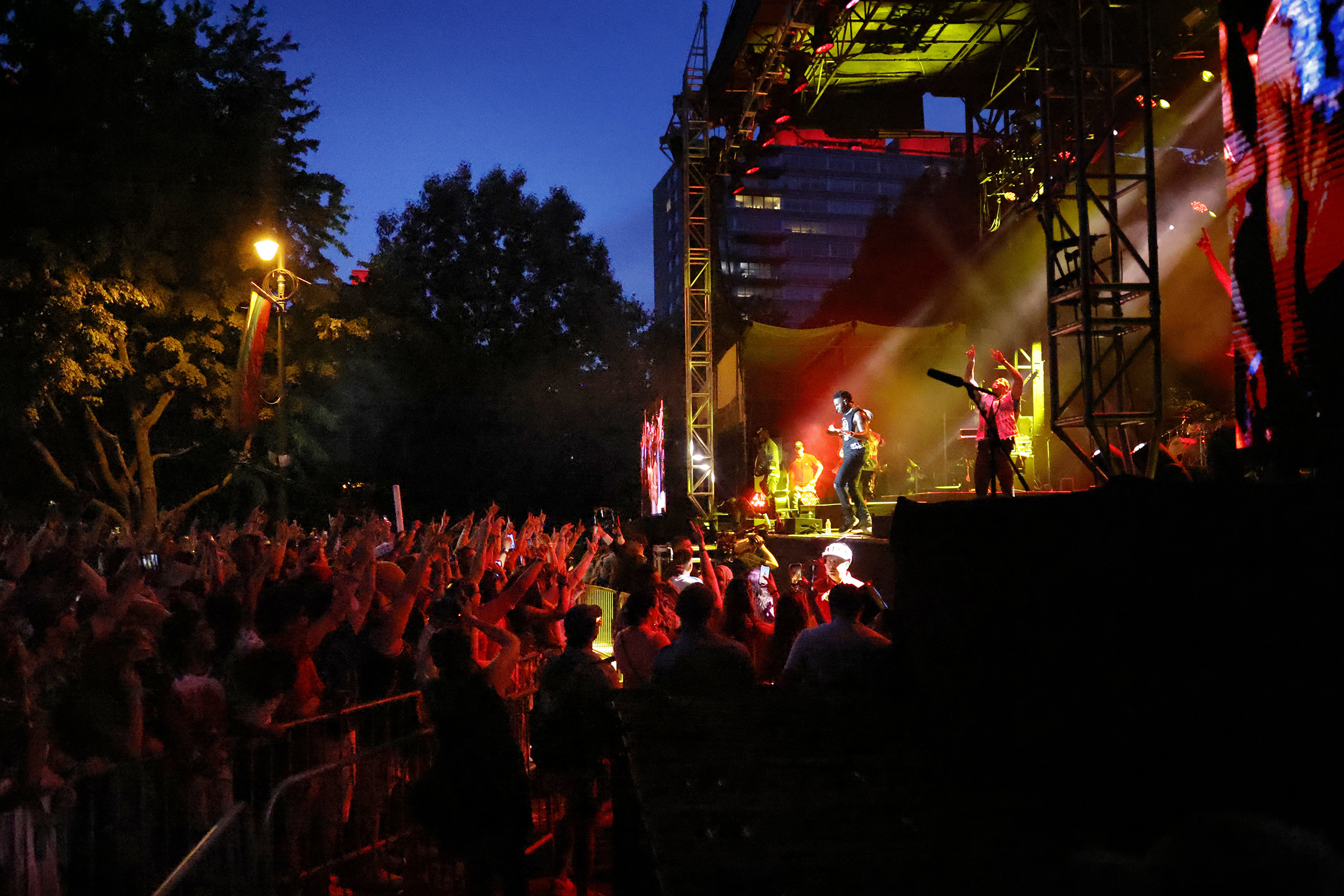
    Jason Derulo performs during the Wawa Welcome America July 4th Concert on the Parkway in 2022.

    Moving an expected 300,000 attendees and their vehicles

    Besides the hurdles for parents with younger children, there’s also the headache of moving an expected 300,000 people from the Parkway back home after the show.

    SEPTA has covered most of its bases for getting people home. Regional Rail lines will have extended service on all lines, but the Landsale/Doylestown, Paoli/Thorndale, Manayunk/Norristown, Trenton, and West Trenton lines are the only lines that will run their last train between 1 a.m. and 1:10 a.m. All other Regional Rail lines stop running before 1 a.m., and in some cases before midnight, so people traveling in from the suburbs should plan accordingly.

    Subways and trolleys will run overnight for those heading back home within the city, and bus service will run on a Sunday schedule, which usually stops operating around 2 a.m. for some routes.

    But vehicle and pedestrian traffic could use some city intervention, said Dustin Dove, president of the Fairmount Civic Association, as there is concern among local civic leaders and some residents about how the city is handling traffic leaving the Parkway.

    “It’s usually a bit of a mess near the Parkway after the fireworks and can lead to some reckless driving nearby as people are stuck,” Dove said. “Historically, after the fireworks, there are thousands of pedestrians and cars that come into the neighborhood.”

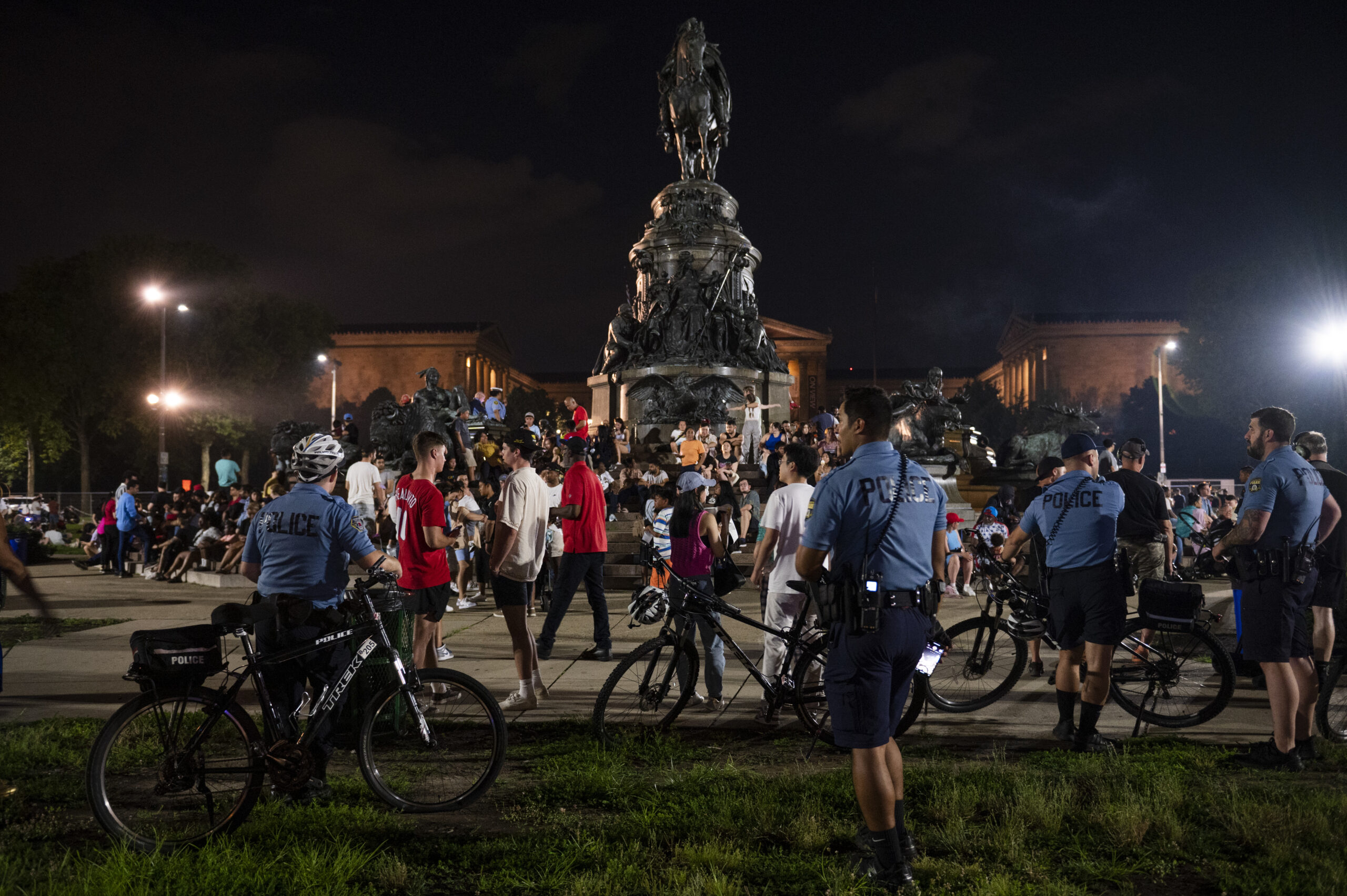
    A police presence is seen in Eakin’s Oval as people wait for the fireworks to start at the Wawa Welcome America Festival on Tuesday, July 4, 2023.

    Dove and others are hoping to see an increased police presence and traffic direction, as the event will be much later with more people this year, Dove said.

    Additionally, residents hope police manage safety accordingly on Saturday.

    “There’s going to be problems when you live in a city; it’s not like it’s the middle of nowhere with no neighbors, but this week … you’re now having people walk back home at midnight, 12:30 a.m.,” DelliCarpini said. “There needs to be a safe environment after the show.”

  • I visited the Great American State Fair on the National Mall in D.C. It wasn’t great.

    I visited the Great American State Fair on the National Mall in D.C. It wasn’t great.

    WASHINGTON — It was blisteringly hot when I showed up at President Donald Trump’s much-ballyhooed Great American State Fair on the National Mall in honor of the nation’s 250th birthday.

    As I headed off to check in as a member of the media, a friend who’d accompanied me decided to wait at a lemonade stand.

    At first, I was a little concerned, wondering how I was ever going to find her. A lemonade stand on the National Mall in Washington, D.C., was bound to be mobbed on a scorcher of a day like the one we had on Monday.

    I needn’t have worried. It wasn’t that kind of party. Crowds were so thin that I quickly spotted her standing alone and eating a snow cone that cost a whopping $8. “Even on a hot day, there was no line at the lemonade stand,” pointed out my friend, Pamela Thomas of Pathfinders Travel, who had taken the train from Philadelphia with me.

    That should give you a pretty good idea of how it was at the so-called Great American State Fair, brought to us by Freedom 250, an organization created by President Donald Trump.

    Low crowds.

    High food prices.

    Lots of walking.

    The Great American State Fair was downright boring.

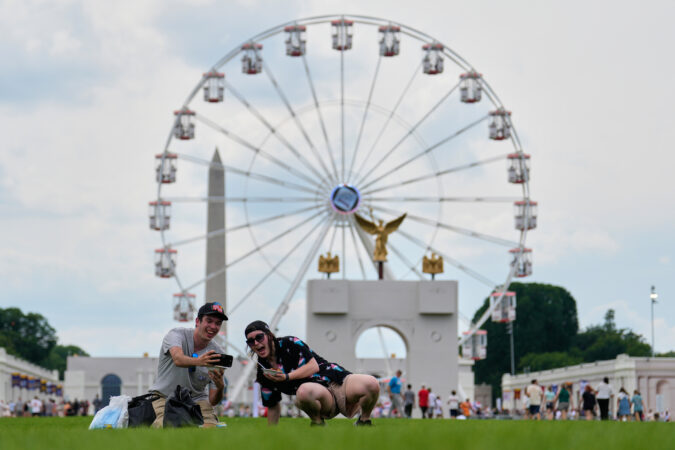
    Oh, there was an 110-foot Ferris wheel borrowed from the Smithsonian Institution. I watched people stand unsheltered under the blazing sun as they waited for their turn. But that’s the only carnival ride I saw.

    This wasn’t like any state fair I’d ever attended. Where was the merry-go-round? Where was the roller coaster? The cotton candy? The local beauty queens? The fair could use a quilting demonstration and band performances. I saw only one cornhole game.

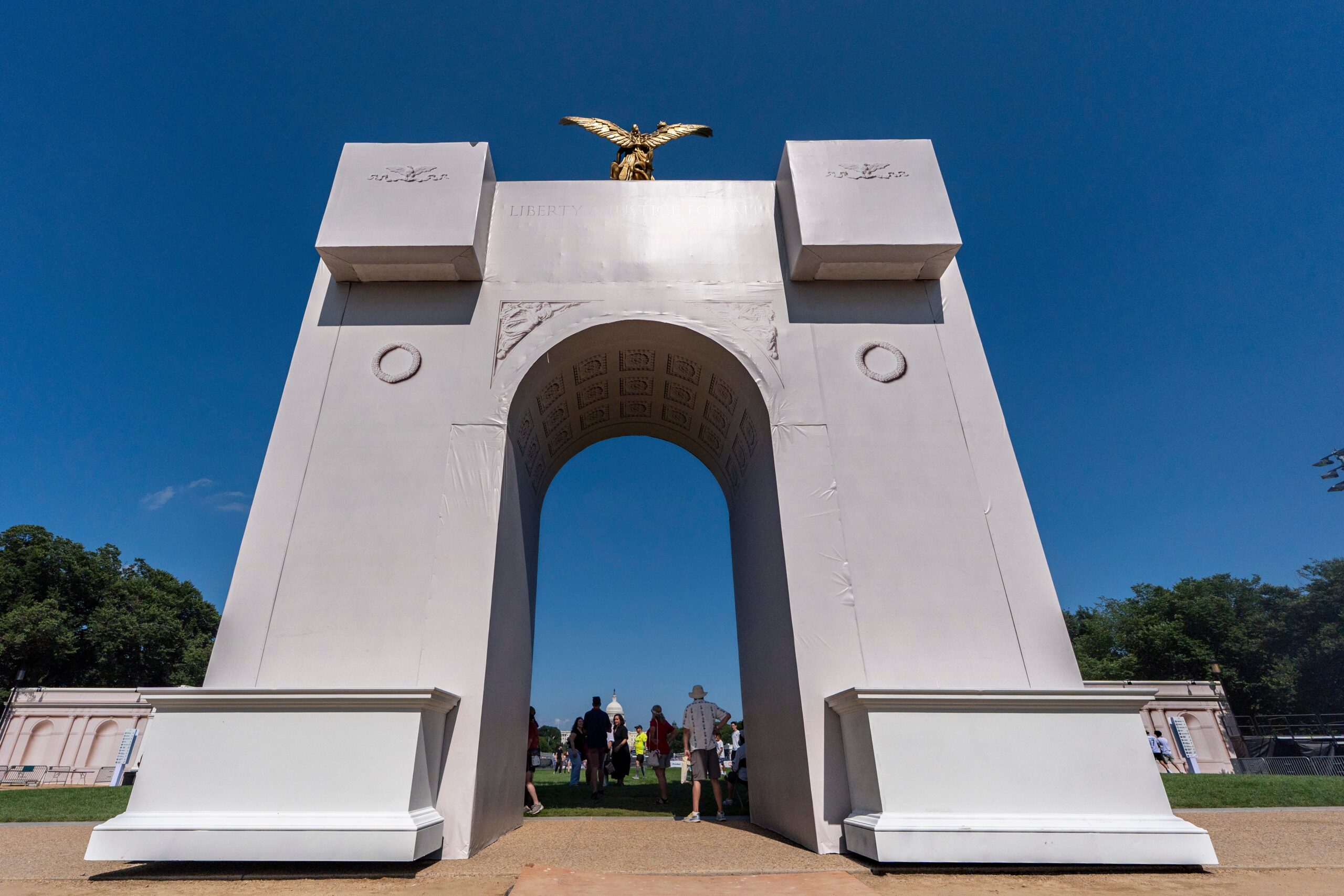
    A mockup of President Donald Trump’s proposed Triumphal Arch stands at the Great American State Fair on the National Mall on June 29.

    The so-called Great American State Fair needs a whole lot more fun and a whole lot less Trump.

    There wasn’t much for children to do besides have souvenir replicas of their new Trump passports stamped.

    I managed to find some shade while sitting on a folding chair inside an area called David’s Tent. As I cooled off, I listened to a woman onstage sing religious songs. Behind me was an aboveground swimming pool set up, ostensibly, for on-the-spot baptisms. In the spirit of inclusivity, there was also a candle-filled menorah positioned in the front of the tent.

    At one point, we made our way over to the Hawaii booth. Inside, all we saw was a large mural of the Aloha State that included a picture of former President Barack Obama that someone had defaced.

    A smiling woman offered to stamp our “passports.” There was nothing else going on in that booth. Not a flowered lei or macadamia nut in sight. No hula dance demonstration. No ukulele performance.

    Same thing with the neighboring Alaska booth.

    I made a point of checking out the North Carolina booth, which had been criticized for having images of Confederate flags on display on TV monitors. This one was a bit more inviting, with its colorful NASCAR displays. I didn’t see anything resembling a rebel flag — but I did see a bale of cotton just sitting on the floor, which can be seen as offensive because of its slavery connotations. The setup had been organized by private donors. One company, Mt. Olive Pickles, has since pulled out of the fair.

    The D.C. booth had some upbeat music playing, a fake cherry blossom tree, and a giant map of the mall that attendees stuck pins into to represent where they lived. “No go-go music?” I asked an attendant, who assured me that some was in the playlist.

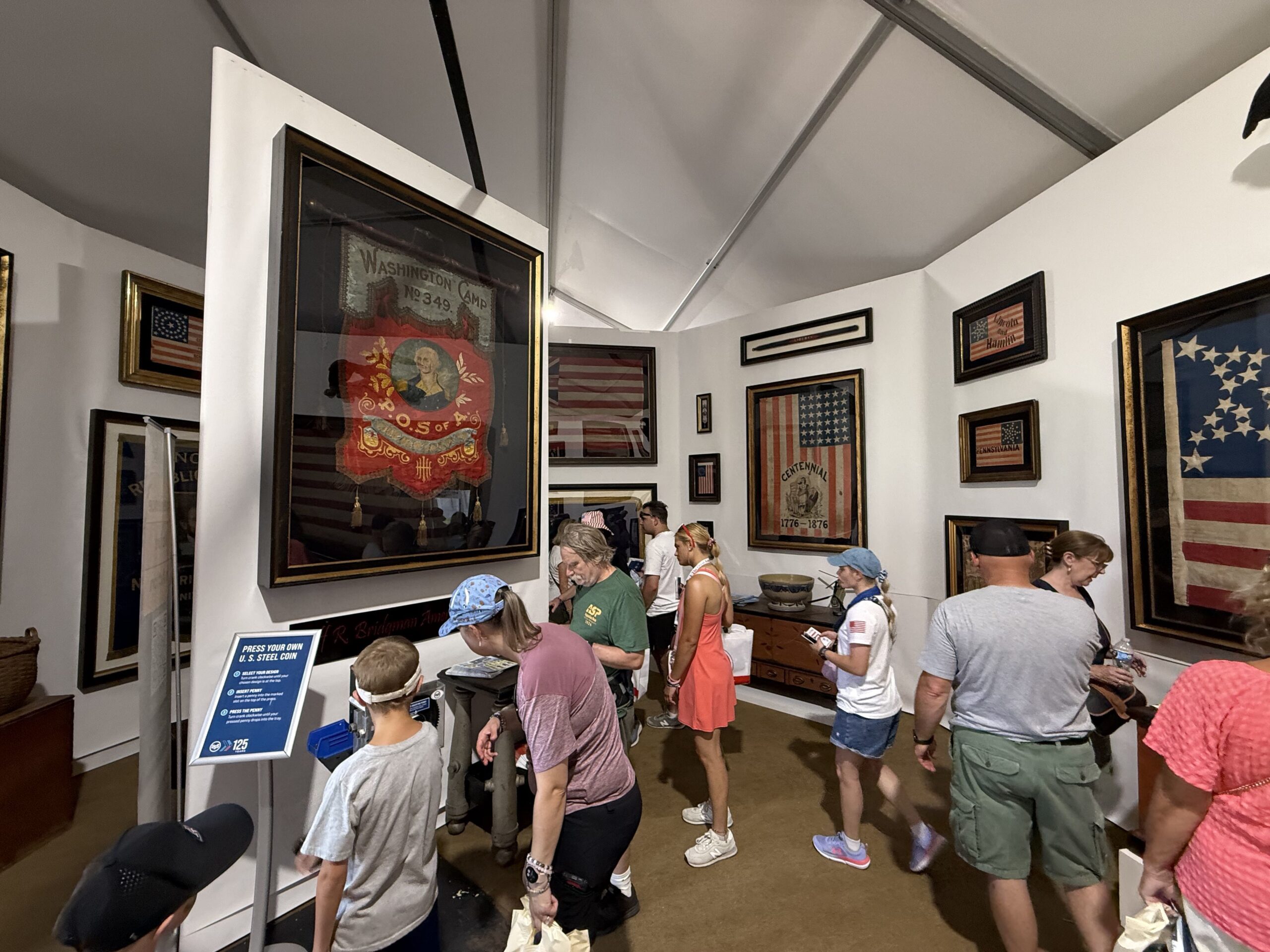
    Pennsylvania’s pavilion showcases state history and memorabilia at the Great American State Fair on June 30 in Washington, D.C.

    Pennsylvania had initially opted out of participating, but its booth opened the day after I was there, funded by private sponsors and pulled together by U.S. Sens. Dave McCormick (R., Pa.) and John Fetterman (D., Pa.) after Gov. Josh Shapiro passed on participating.

    Cape May County, a Republican stronghold, sponsored the New Jersey booth and brought in an impressive-looking eight-foot sand castle. But I noticed one small red plastic bucket of saltwater taffy that a kid was rummaging through. For an area as rich and diverse as the Garden State, the display felt incomplete.

    Soon, I had had enough.

    We stopped by the media table again on our way out and asked about what was on the schedule for later. The answer? A rodeo demonstration at 7 p.m. That was it.

    I was stunned. America deserved more and better for its 250th birthday celebration.

    So, if you decide to go experience the Great American State Fair before it is dismantled on July 10, don’t say I didn’t warn you.

  • Independence (the eagle) is coming to Philadelphia

    Independence (the eagle) is coming to Philadelphia

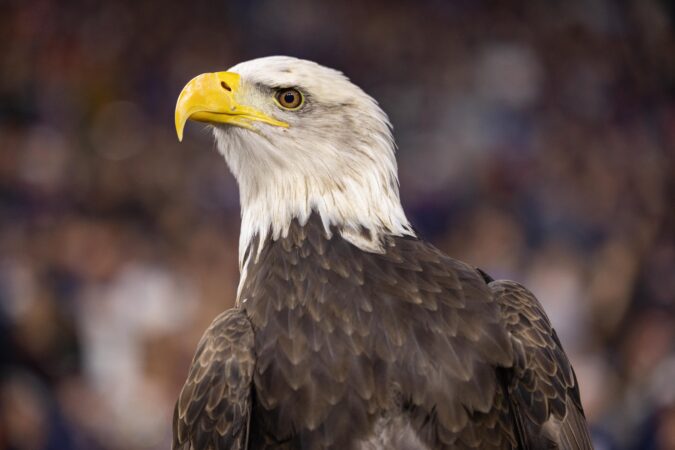
    In Philadelphia, the Independence Day spectacle will include a bald eagle named Independence at Independence Hall.

    The eagle, known as Indy, is scheduled to appear at the burial of America’s Time Capsule, part of the country’s 250th anniversary celebration. Visitors will be able to meet and take pictures with her.

    Since 1782, when the bald eagle was placed on the Great Seal of the United States, the bird has stood for American sovereignty and power, holding arrows in one talon and an olive branch in the other. Long before that, eagles had been used as symbols of empire, authority and military strength, including in ancient Rome.

    What merits does the bird have to have been attributed such strong symbolism — with appeal at events from Saturday’s time-capsule burial to flights at Lincoln Financial Field?

    From a distance, the eagle looks formidable, with a six-foot wingspan. Indy is sometimes released to fly freely during Auburn football games, said Robyn Miller, Indy’s handler and the director of the Auburn University Raptor Center.

    On the rare occasion that one sees eye-level with the bird — such as in Indy’s various TV appearances — the eagle has an intense and almost disconcerting gaze. Her feet are bound or shackled to contain her but she occasionally gives out a squawk and shuffles around. The bird squawks as humans might laugh; they tilt their head back and can either let out a loud cry or many chirps, as Indy tends to do when she is inside.

    The bird will travel to Philly from Auburn on a Delta flight with Miller and three other handlers. Her carrier will be strapped into two coach seats. Miller expects that she will be comfortable in her carrier but notes that she may let out the occasional squawk.

    Indy, now 10, came to the Auburn University Raptor Center in 2018 after suffering a wing injury as a young bird. Although the injury healed, she had imprinted on humans during rehabilitation, meaning she could not be released into the wild. Now, she serves as an ambassador bird, teaching people about raptors, conservation, and the ecosystems that sustain them. Her appearances have included a flight at the Linc for an Eagles’ game.

    Miller makes a distinction between captivity and care. “All of our raptors come to us with life-threatening disabilities,” Miller said.

    The eagle is now used to human socialization and depends on human care. And yet the irony is hard to avoid. What draws people to Indy is precisely the quality that cannot be caged: the wildness she can embody, even if she can no longer live it.

    “Folks can’t help but be fond of her when they meet her,” Robyn said. “Be fond of her wildness.” She added, “We wish these birds could still remain in the wild.”

  • Some Black and Indigenous people say freedom is unfinished business on the 250th Independence Day

    Some Black and Indigenous people say freedom is unfinished business on the 250th Independence Day

    In 1852 Frederick Douglass famously asked, “What to the Slave is the Fourth of July?” Now on the cusp of the nation’s 250th birthday, some Philadelphians still question if the holiday is meant for them.

    Many Black and Indigenous people say they have complicated feelings about celebrating Independence Day, when the holiday did not represent independence or freedom for their ancestors. And their fight for their rights continues in 2026.

    When the nation declared its independence, “people like me, we not only did not have rights, but we were literally relegated [to] property,” said Timothy Welbeck, professor and director of the Center for Anti-Racism at Temple University. “So much of this nation’s history has been marked by the struggle for Black people to have a modicum of liberty and equity.”

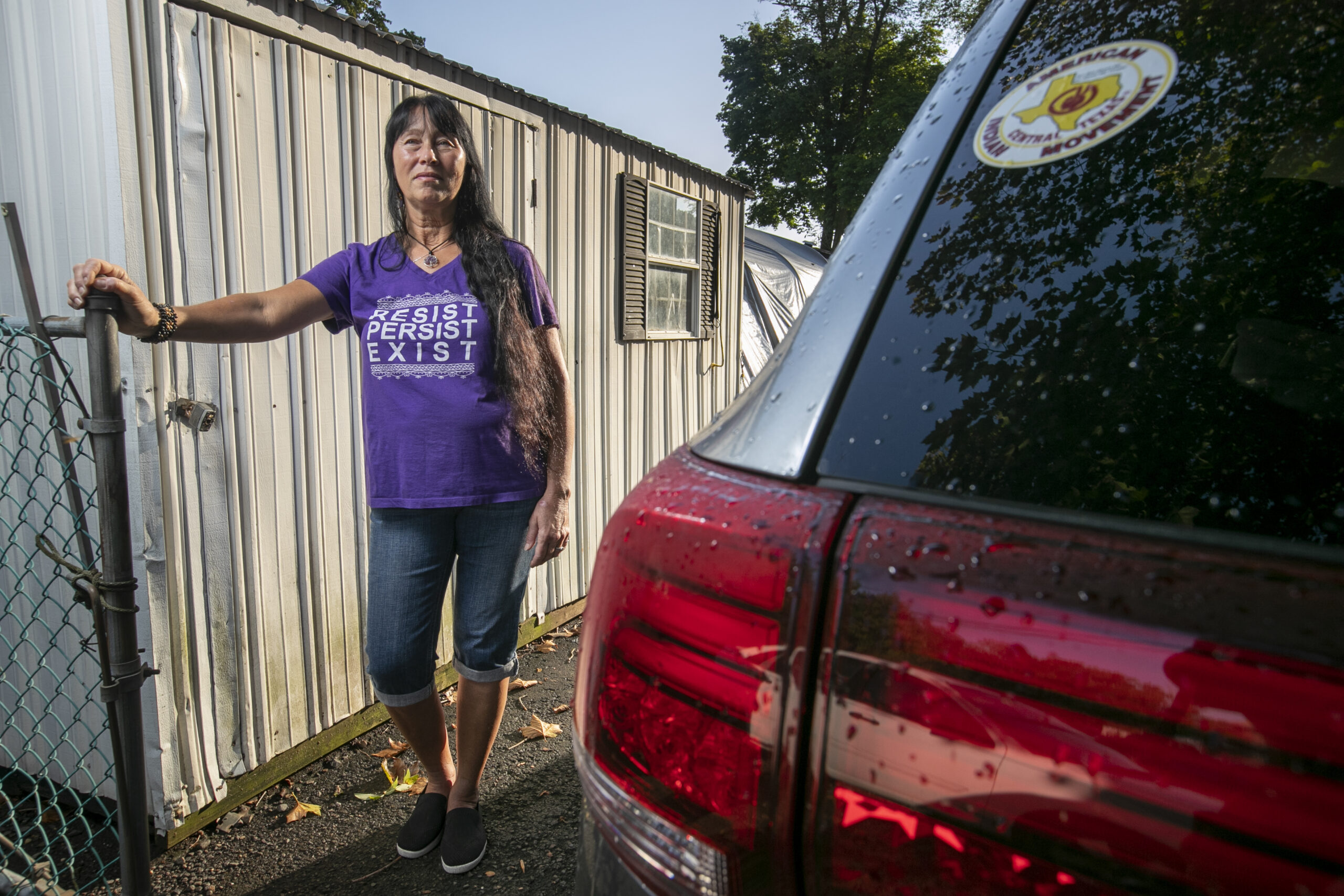
    “I belong here. But I certainly don’t take part in their celebration,” said Donna Fann-Boyle, a Bucks County resident of Choctaw and Cherokee descent who led the fight to change the name of Neshaminy High School’s mascot.

    Donna Fann-Boyle of Langhorne, PA., is a leader in CNA, the Coalition of Natives and Allies, and has been fighting for years to make the Neshaminy school district drop it’s nickname. Photograph taken at her home on Friday morning September 4, 2020.

    She said anytime she hears mention of the semiquincentennial celebration on the TV or radio, she reminds herself that this land and its Indigenous people were here long before 250 years ago.

    “I think it’s very hypocritical … only certain people have those freedoms,” she said of the holiday.

    It took nearly another hundred years after the Declaration of Independence was signed for slavery to end, and another hundred after that for African Americans to have a say in their nation with the passage of the Civil Rights and Voting Rights acts. And when the new nation announced itself July 4, 1776, Native Americans had already been living on the land for hundreds of years, but were still forcibly displaced from their homes and later confined to reservations.

    For some, the holiday is not a day to ignore, but a tool. The Rev. Carolyn Cavaness, the pastor of Mother Bethel AME Church in Society Hill, said the Fourth of July is an opportunity to talk about the nation’s contradictions and to argue that Black people should have always been included in its vision of independence.

    “We have responsibility to lift up these truths,” she said.

    “There is a piece of the brain that says, ‘Well you should sit out.’ But then I also know that when I think about my ancestors, and when I think about the institution that I am called to serve… we have to be out front to show and to celebrate that people of African descent have always been a part of this country,” she said.

    In front of a wall of portraits of former bishops, Rev. Carolyn Cavaness greets members of the congregation during a fellowship reception Sunday, Nov. 10, 2024 the day after historic Mother Bethel A.M.E Church appointed her the first woman pastor in its 230-year history.

    Freedom not realized

    When he was growing up in South Dakota, the Fourth of July was mostly just like any other day for Eugene Black Crow. It wasn’t something he or his community ever celebrated, because it wasn’t their holiday. Black Crow, who is of Oglala Lakota descent, learned more about the country’s Independence Day when he was sent off to a boarding school for Native American children.

    “We got beaten into speaking English,” Black Crow, 70, said, having only spoken Lakota before then. At the boarding school, he saw Fourth of July fireworks for the first time. He and his classmates learned to recite the Pledge of Allegiance, though they didn’t really understand what the words meant until years later.

    Black Crow now lives in the Franklinville section, and over the years, he said he’s noticed more Native Americans celebrating the holiday, even in his South Dakota hometown. He used to take his children to watch fireworks when they were young, but there’s been a dissonant feeling to the experience.

    “It was always in the back of my mind — why are we Natives celebrating this?” he said.

    Even in the 18th and 19th centuries, people of color made the Fourth of July into a day of protest, and celebrated alternative independence days from other nations instead, said Morgan Lloyd, programming coordinator for the African American Museum in Philadelphia. She believes today, the holiday is a useful moment to consider and reflect on the whole history of the United States, where Black and Indigenous people have helped shape the country despite their exclusion from its loftiest ideals of freedom.

    “It is for me, a conversation starter around what does independence and what does full recognition look like,” she said.

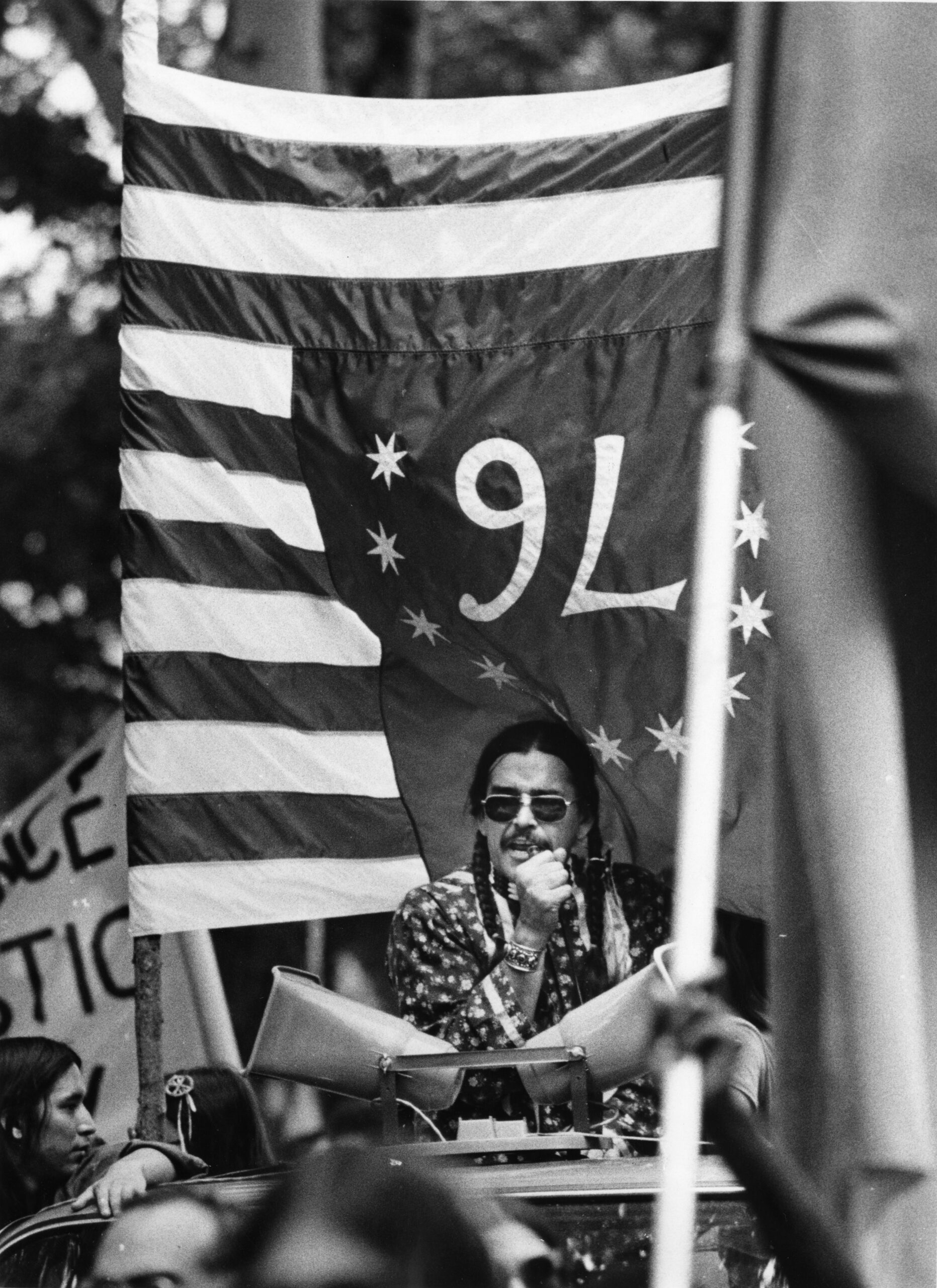
    A group of native Americans lead a ‘July the Fourth Coalition’ protest parade at 33rd. & Diamond streets in Philadelphia, on July 4, 1976.

    Cavaness thinks about the holiday in a similarly inclusive way, and said she plans to speak with her congregation about the nation’s 250th anniversary, representing how freedom is unfinished business.

    “There is still freedom not realized. And every generation goes through this notion of what does freedom look like, who is left out, who needs to be brought in,” she said.

    From his North Philly home, Black Crow teaches students how to speak Lakota over Zoom. His Lakhota Woglakapo Project is intended to ensure the mostly spoken language doesn’t get lost to time. He plans to visit his old reservation this fall, so he can record other Lakota speakers for posterity.

    He attended a pro-immigration rally in Philadelphia this week, just a few days after the U.S. Supreme Court ruled President Donald Trump‘s administration could revoke protected status for Haitian and Syrian immigrants. Black Crow spoke to the crowd filled with immigrants, expressing his solidarity.

    “You’re welcome to America,” he told them.

  • The Bicentennial didn’t go as expected. But it wasn’t exactly as bad as Philadelphians say it was.

    The Bicentennial didn’t go as expected. But it wasn’t exactly as bad as Philadelphians say it was.

    After decades of dashed grand plans, months of unmeetable expectations, and weeks of fearmongering over political violence that never materialized, Philadelphia had little chance to live up to the hype that the Bicentennial carried with it in 1976.

    And in the end, we didn’t. Not by a long shot.

    Up to 20 million people were projected to travel to the city for the United States’ 200th birthday throughout the year — but in reality, only about 7 million came. We were supposed to build a massive suspended platform at 30th Street Station to house an international exposition, and never got either.

    And instead of receiving due recognition as the birthplace of American democracy, we were given Legionnaires’ disease.

    Understandably, the result in ’76 was a level of municipal malaise that rivals any since. We threw a party all summer, we thought, and no one came. No one liked us, but we did care — a lot.

    Now, with five decades of hindsight, and another national anniversary this summer, perhaps the Bicentennial wasn’t as bad as Philadelphians say it was. It didn’t go off exactly as expected, sure, but maybe it wasn’t the abject failure we historically have believed it to be.

    After all, in some ways, it did give us some of the Philadelphia we know today. Here is how the Inquirer and Daily News covered it.

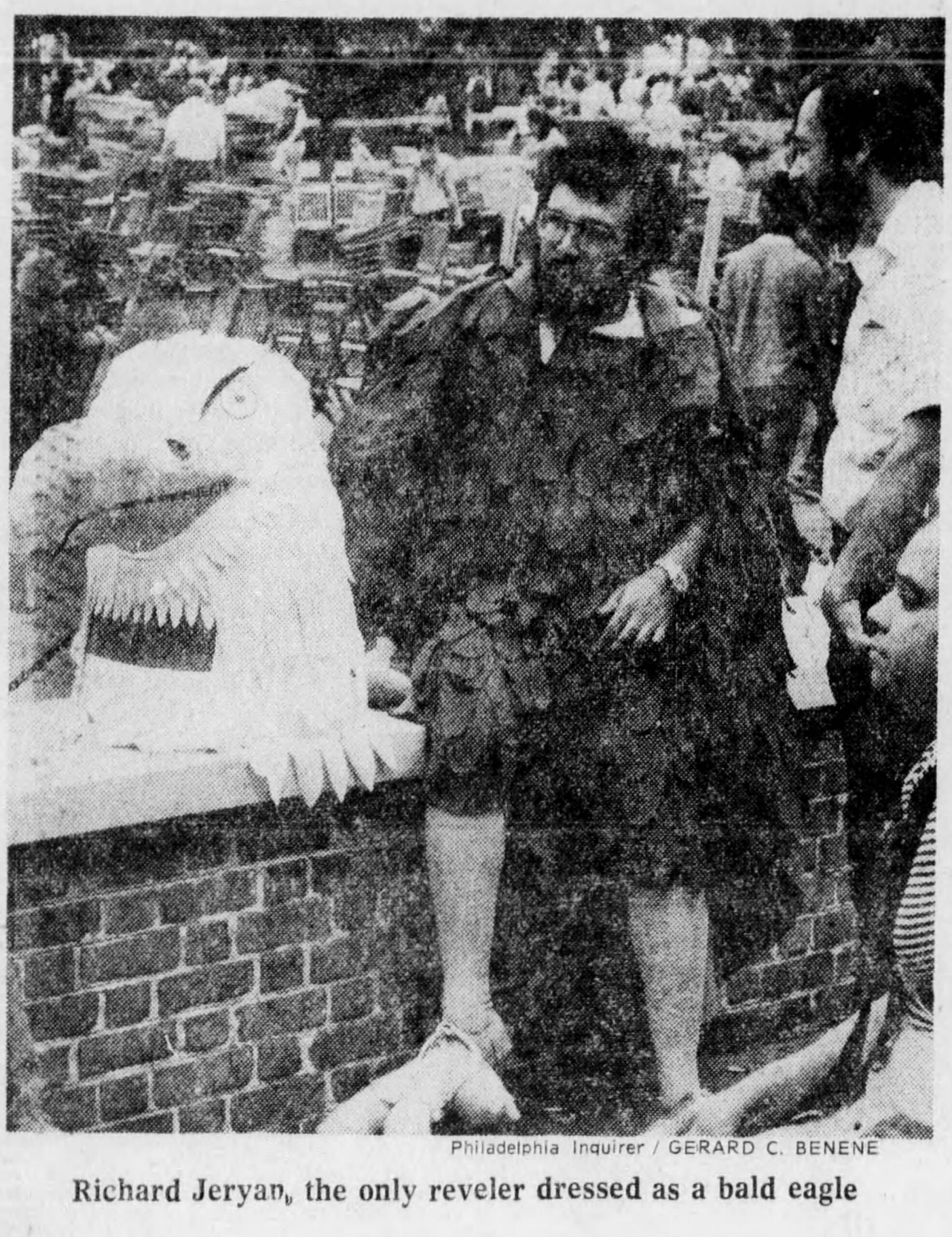
    An Independence reveler celebrates the holiday in 1976 dressed as a bald eagle, as shown in an Inquirer photo from the time.

    False starts and unrealized projects

    Philly had big dreams for the Bicentennial as early as the 1950s, when planning tied the occasion to an international exposition that would bring travelers from all over the world. Some proposals ran into the neighborhood of $2 billion and had the exotic and impractical vision to match the price.

    Among them was an $8 million plan for a flower-focused theme park in Fairmount Park known as “Philaflora” that was quickly abandoned.

    Later, city planners proposed gimmicks like a large elevated platform over 30th Street Station that was to stretch more than four miles to West Philadelphia, the construction of concrete islands in the Delaware River, and converting swampland to solid ground in Eastwick to host the exposition.

    None of these grand plans came to fruition. And by 1972, the entire idea for an international exposition was dead, having been “scotched” by President Richard Nixon, The Inquirer reported at the time. The city’s Bicentennial corporation, Philadelphia ’76 Inc., however held fast to plans for a large celebration, but was left with relatively little time to plan one — and no idea of what it would look like.

    The result was a series of what The Inquirer in 1976 called “bread and circuses” efforts — essentially parades around town, plus a number of events and attractions on the Benjamin Franklin Parkway throughout the summer. These efforts, The Inquirer reported, were designed to give the illusion of tourist activity and interest, but without all the guff of actual planning and logistics.

    And while we did have a Bicentennial celebration, it sadly did not “live up to 20 years of empty visions,” The Inquirer reported. And only months after July 4, 1976, we were left with “this feeling of promises unkept, hopes unfulfilled,” reports from the time said.

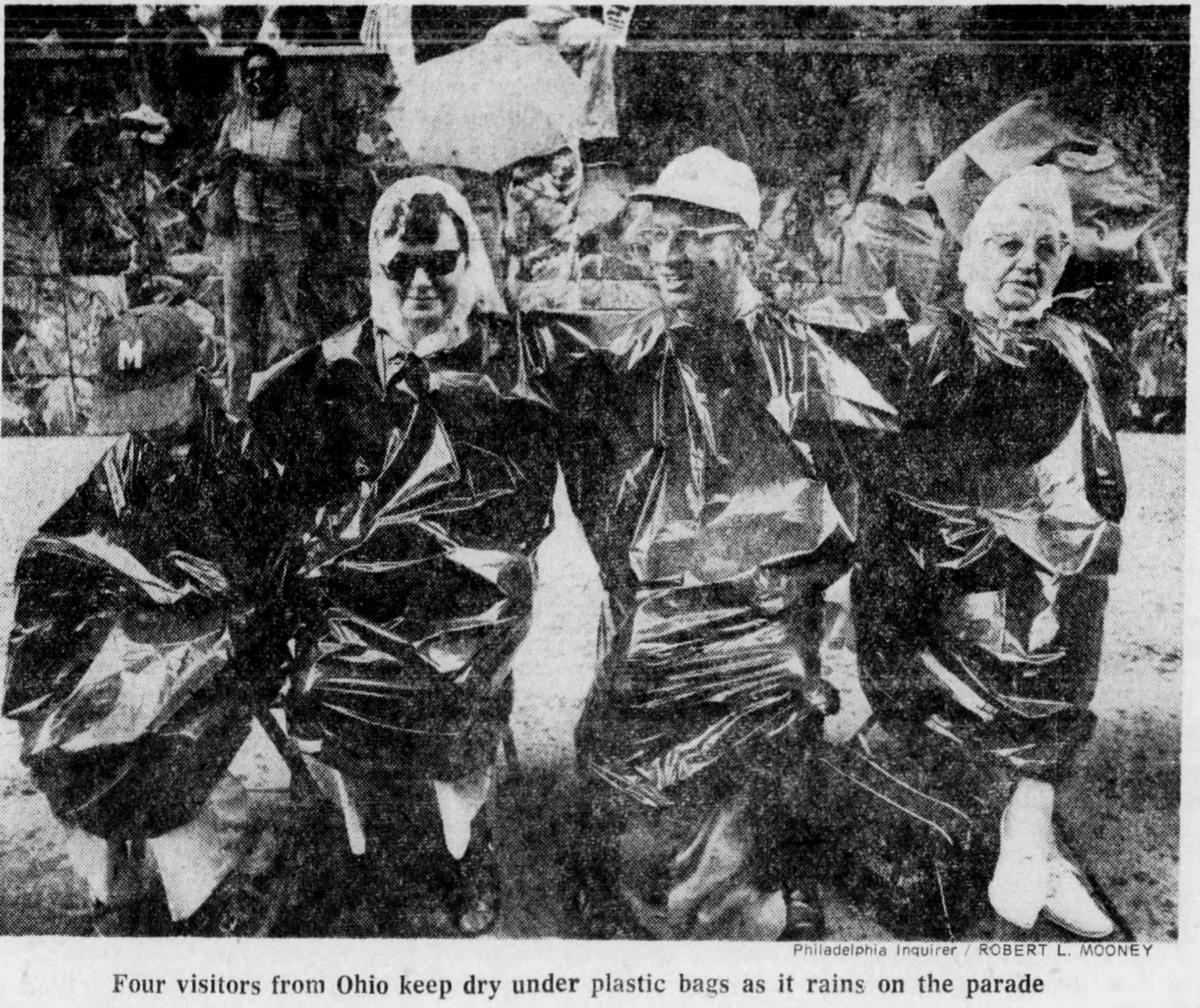
    July 4, 1976 celebrants stave off the day’s rain under plastic bags during the day’s parade, as shown in an Inquirer photo from the time.

    An under-attended party

    Early estimates for tourism in Philadelphia in 1976 predicted 14 million to 20 million visitors for the year — figures that came from Sindlinger & Co., a Swarthmore-based research firm the city hired. The company conducted nationwide polling to determine the number of Americans who planned to visit Philadelphia in 1976.

    They were way off. By October ’76, roughly 7 million visitors had come, reports from the time indicate. Some 2 million toured the city on July 4 alone, with the rest coming amid a myriad of conventions throughout the rest of the year. According to reports from the time, tourism numbers didn’t pick up until post-Independence Day — a welcome development for hotel operators, who expected a sell-out season that never arrived.

    But that doesn’t mean Philadelphia fared poorly.

    At least compared to 1975. As of December 1976, Philadelphia showed a 300% increase in visitors over the year before, The Inquirer reported — a proportion that placed us “better than any other American city in attracting Bicentennial visitors.”

    The next closest city was Boston, which saw a mere 68% increase in tourism. No one else even came close.

    In fact, no one really did well nationwide. According to a Christian Science Monitor article from the time, every city that expected an influx of Bicentennial tourists — Philly, Boston, D.C., and the like — said tourism numbers were way below predictions. Experts attributed that to the country’s economic state.

    But tourism travel in the United States was high for the year, even though the Bicentennial boom never really arrived. The issue, experts said at the time, was that too much was expected. As Discover America Travel Organizations president William D. Toohey said at the time, the travel industry would have otherwise been “well-pleased.”

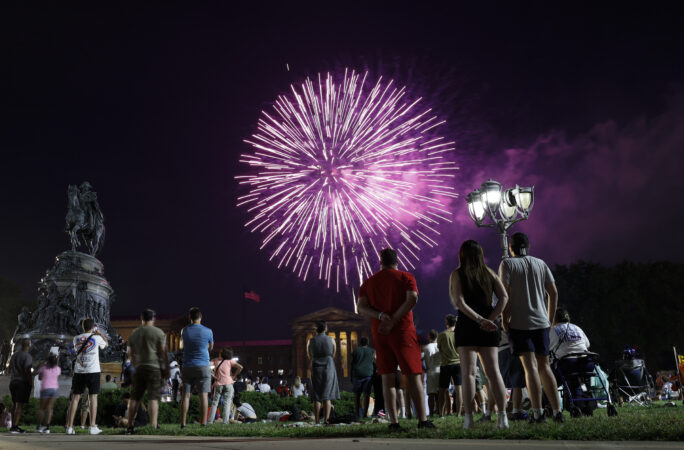
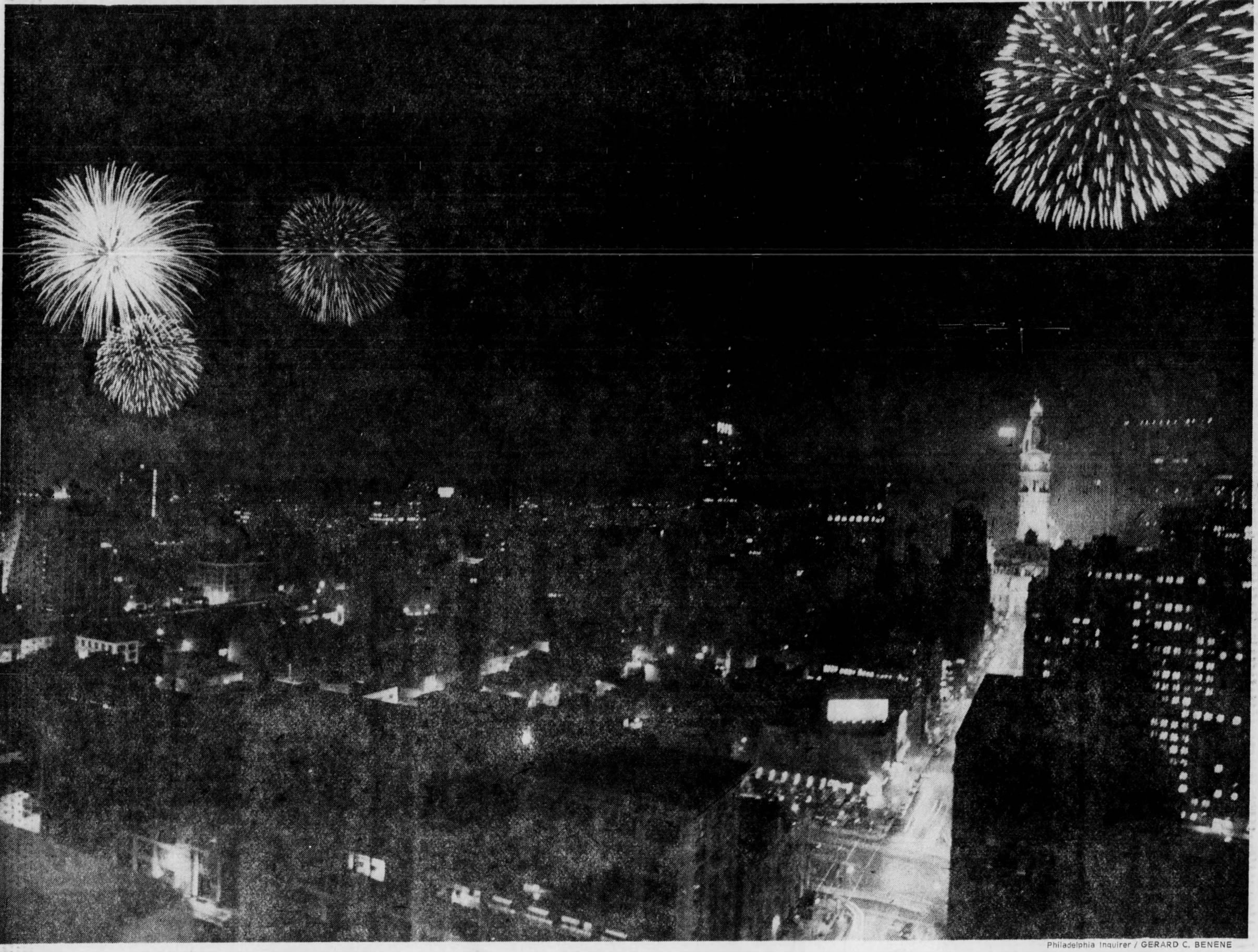
    Fireworks over Philadelphia on July 4, 1976, as shown in an Inquirer article from the time.

    Why Philly fell short

    Philadelphia, however, was not blameless in its failure in 1976.

    Chief among the factors was Mayor Frank Rizzo’s insistence that political violence would erupt on July 4, thanks to a contingent of protesters who planned to demonstrate in North Philadelphia — miles away from the day’s primary celebrations in Center City.

    Rizzo was so worried that he called for thousands of federal troops to be earmarked to protect the city — a request that was ultimately not granted, primarily because investigators were unable to determine that a credible threat ever existed. And yet, when the holiday rolled around, the damage was already done.

    By late June 1976, some 30,000 participants scheduled for the July 4 parade had canceled their trips to Philly, with most citing fear of political violence as the reason for backing out, reports from the time indicate. Rizzo had been essentially telling tourists not to come, and they largely listened.

    Rizzo, however, wasn’t our only worry. In July, a slowdown by municipal workers caused trash to pile up in the streets for weeks. Workers refused to take overtime hours pending contract negotiations for a modest wage increase, and the dispute was not settled until early August.

    And then, there was the Legionnaires’ Disease outbreak — a famous, but sometimes overlooked, factor impacting tourism for the year. The late-July outbreak severely impacted tourism due to concerns over potential illness, but didn’t entirely crush the influx of visitors.

    “It was very clear that the Legionnaire’s Disease had a very sharp impact on tourism,” Philadelphia ’76 Inc. head William Rafsky said at the time.

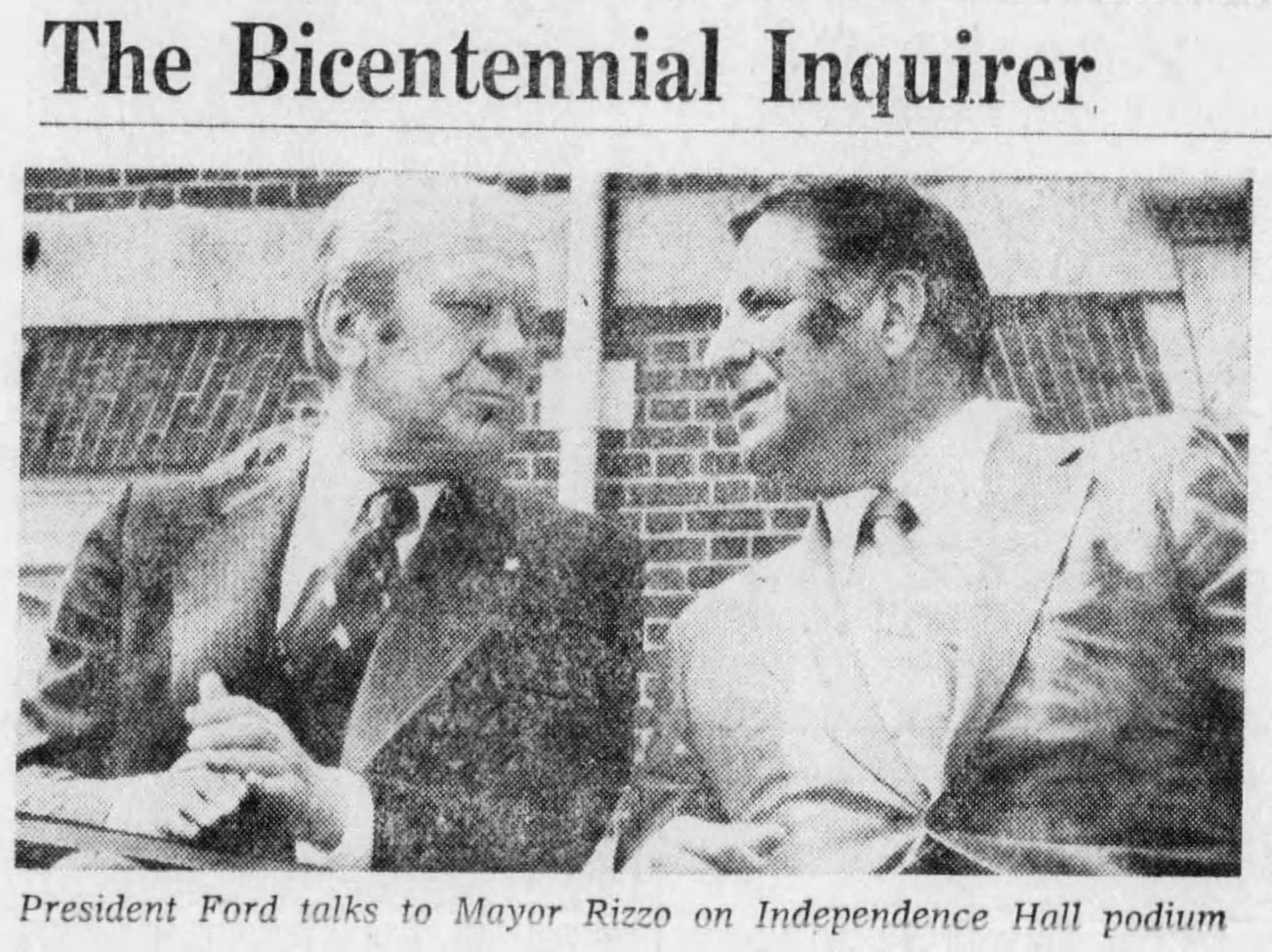
    President Gerald Ford talks with Mayor Frank Rizzo at Independence Hall on July 4, 1976.

    Benefits abound

    Though the Bicentennial may have been something of a tourism bust, we didn’t walk away with nothing. In some ways, the city was enduringly altered — Philadelphia received an estimated $165 million in improvements for the country’s 200th birthday, a good bit of which was federal money that was not likely to be spent otherwise, reports from the time indicate.

    The National Park Service, for example, spent an estimated $30 million on what we know today as Independence National Historical Park, The Inquirer reported. Those federal dollars bought a new Liberty Bell pavilion, extensive repairs and improvements to historical buildings, the construction of City Tavern and the Graff House, and the creation of Franklin Court.

    Other improvements were also palpable. A number of subway stations were painted and rebuilt, institutions like the Philadelphia Museum of Art were improved, and places like the Mummers Museum and the Afro-American Museum (now the African-American Museum of Philadelphia) were established. Roughly 10,000 trees were planted in Fairmount Park.

    These lasting municipal improvements had an impact, even if the Bicentennial itself did not live up to contemporary expectations. By the time 1976 hit, virtually nothing could quell the public’s want for advancement in light of the country’s 200th birthday. And so, it was deemed a failure.

    But now, half a century later, perhaps we are overcoming that disappointment, or are at least willing to see what comes next — after all, the United States is 250 years old in 2026. And though tourism expectations for this year have been quieter, the city still stands, with hoards of visitors now reminiscent of our Bicentennial year.

    “The Bicentennial Year will be a great year for the United States,” Rizzo said in 1976. “And particularly for Philadelphia, where our nation was born.”