Tag: Semiquincentennial

  • Partisanship, divisive Trump presidency hang over 250th celebrations in Philadelphia and Washington

    Partisanship, divisive Trump presidency hang over 250th celebrations in Philadelphia and Washington

    WASHINGTON — Fifty years ago this week, President Gerald Ford’s helicopter arrived at Valley Forge in a dense fog.

    After a speech to 15,000 people, he designated the Revolutionary War landmark as a national park before heading to Philadelphia, where an estimated crowd of 1 million gathered outside Independence Hall. Ford spoke soberly, recounting the story of a nation that, on its 200th birthday, should find confidence in its ability to both celebrate its founding ideals and ask “hard questions” in the pursuit of something better.

    “The American adventure,” Ford said on July 4, 1976, “is a continuing process.”

    Philadelphia’s 250th anniversary celebrations this week are set to feature no appearances from the president. No reflections on self-improvement from the commander-in-chief at the birthplace of American democracy, no luncheons with the Philadelphia mayor near City Hall, as Ford also did after his speech.

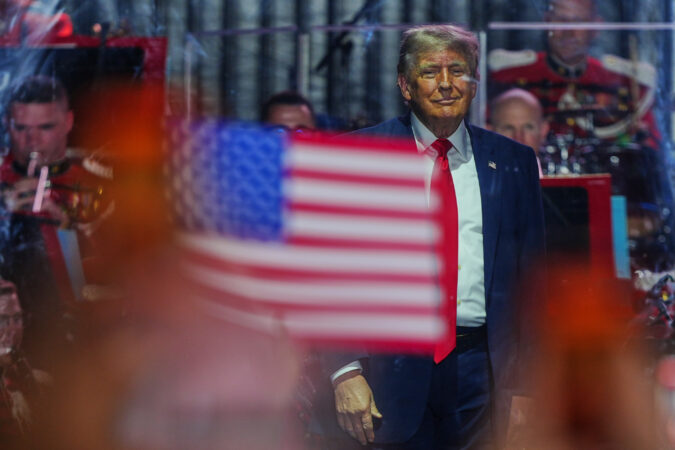
    President Donald Trump has said he will instead use the occasion to throw “the most spectacular TRUMP RALLY” on the National Mall — one of several ways the president’s critics have said he has injected partisanship and self-serving events into what should be a unifying moment.

    Trump’s stamp on “America 250” has been clear.

    A UFC fight on the White House lawn branded as “Freedom 250” overlapped with the president’s 80th birthday and featured adulations directed at him. The Great American State Fair, which some Democratic-led states declined to participate in, opened last week with a campaign-style speech in which the president railed against DEI and transgender athletes. It also featured the U.S. Marine Band playing the Village People’s “Y.M.C.A.,” a Trump campaign rally staple. Transportation Secretary Sean Duffy, using an offensive term that combines liberal with a slur for people with intellectual disabilities, said the band was better than the “libtards” who canceled their performances because of concerns over Trump’s partisan behavior.

    “This is really, more than anything else, an opportunity to attempt to bring us all together as Americans. That’s what past celebrations have done,” said U.S. Rep. Brendan Boyle, a Democrat whose district includes Independence Hall. “It’s just so tragic that for this anniversary, the president we have is Donald Trump, someone who is completely not capable of doing any sort of national unity-type event.”
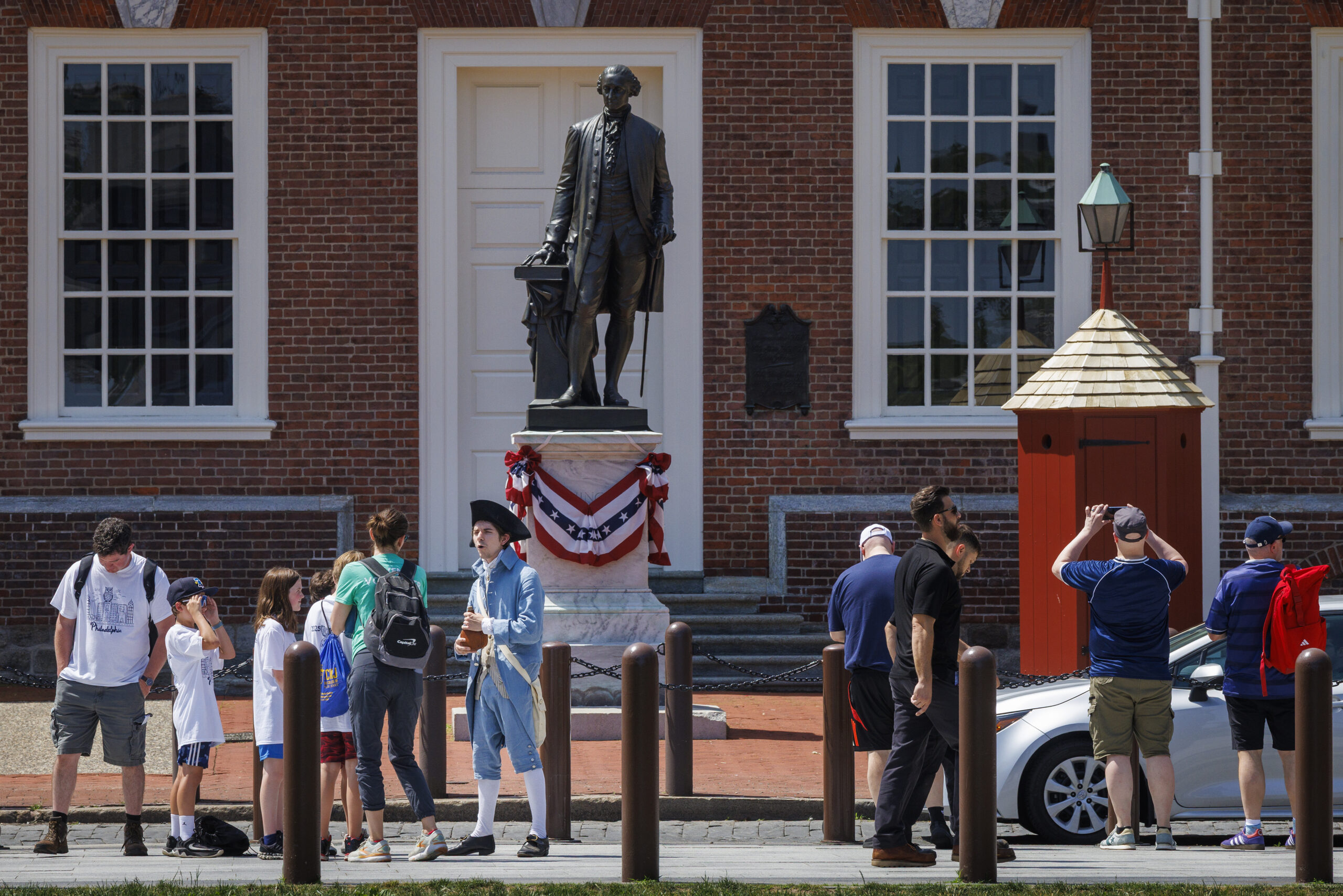
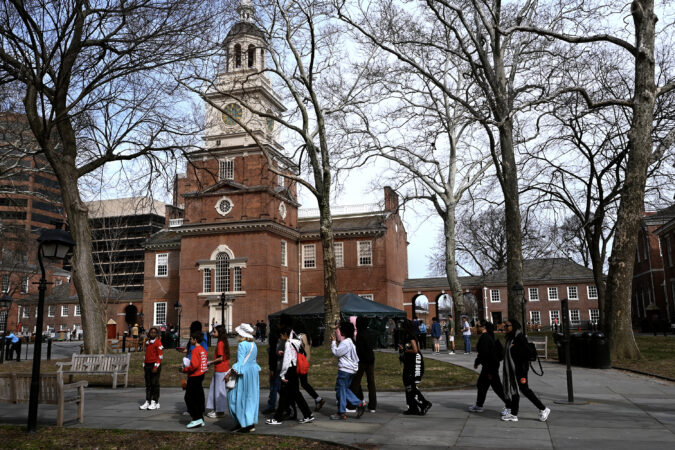
    Historic Interpreter, Lane Norris, as Alexander Hamilton, speaks with tourists outside Independence Hall in Philadelphia.

    Boyle worked for years to arrange a ceremonial gathering of Congress at Independence Hall for the 250th, which is set for Thursday. Though not officially a joint session outside of Washington — which has only occurred two other times since the capital relocated from Philadelphia — the event will mark the moment on July 2, 1776, when the Second Continental Congress voted to adopt a resolution for independence.

    The commemorative moment “just gives me chills to think about it,” said U.S. Rep. Mary Gay Scanlon, a Delaware County Democrat who represents part of Philadelphia and plans to attend Thursday. Scanlon said she was hopeful the event will be bipartisan at a time when the president’s divisiveness was “taking an edge off the celebratory aspect” of the 250th.

    Both Scanlon and Boyle described the president’s lack of plans to mark the moment in Philadelphia as disappointing. The White House did not respond to questions for this article, including whether it made any attempts to plan an event with the president in the city.

    “I always just kind of assumed that the president of the United States would, at some point in the days leading up to the Fourth of July or even on Fourth of July itself, be in Philadelphia,” Boyle said. “But obviously this president has different priorities.”

    Injecting polarization into apolitical events

    Matthew Levendusky, a University of Pennsylvania political science professor who has studied how July Fourth celebrations affect sentiments about national identity and polarization, said previous presidents participated in “patriotic, but not political,” events like concerts, fireworks, and parades.

    Trump has taken a distinctly different path since his first term, Levendusky said, noting the military parade in 2019 and a speech at Mount Rushmore in 2020 when, after the murder of George Floyd in Minneapolis, he used the moment to criticize the removal of monuments that symbolized racial oppression.

    The 250th events are an example of how Trump, a “conflict entrepreneur,” makes such events more political at a time when American society has already become more partisan, Levendusky said.

    “There’s more debate over the meaning of American identity than there was a decade or 15 years ago — in part because there’s been more polarization,” said Levendusky, the director of Penn’s Institutions of Democracy at the Annenberg Public Policy Center. “But he’s also done things that inject polarization into that process.”
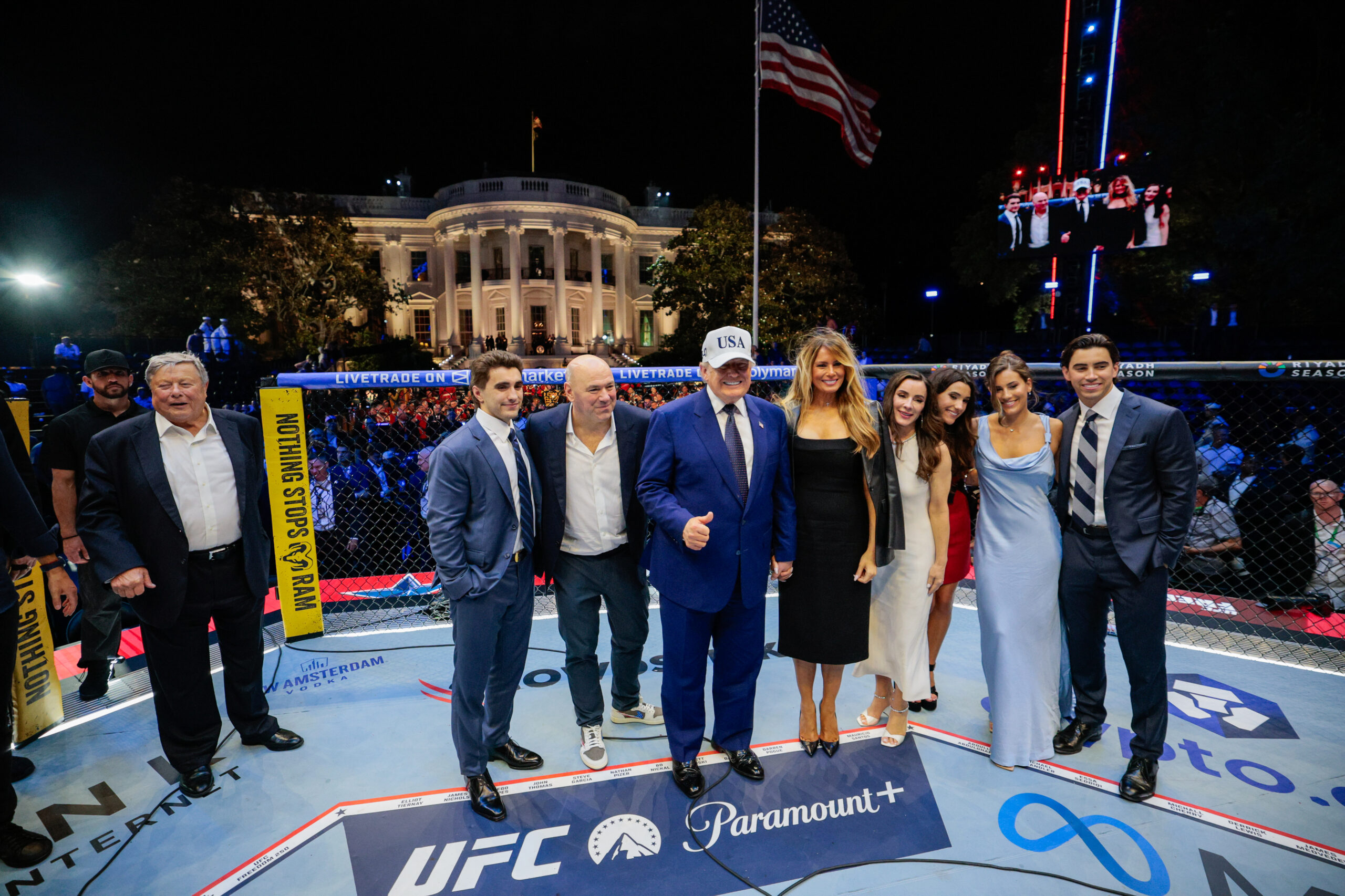
    President Donald Trump, first lady Melania Trump, UFC president and CEO Dana White, and other guests pose inside the octagon after UFC Freedom 250 on the South Lawn of the White House, Monday, June 15, 2026, in Washington. (Evan Vucci/Pool Photo via AP)

    Those actions appear to have affected how voters feel about America’s democracy 250 years in — at least among Philadelphia’s largely Democratic electorate.

    According to a new Suffolk University/Philadelphia Inquirer poll that surveyed 500 city residents, 70% of Philadelphians believe Trump’s presidency has made them feel less confident in the country’s democracy. The answers were strongly correlated to political party, with more Republicans than Democrats saying that Trump’s presidency made them feel more confident in democracy or that it made no difference.

    Tourists flocking to the city have reflected those ideological divides but also a bipartisan desire to set politics aside for a historic milestone.

    “We’re all Americans, I don’t care who the president is,” said Greg Sage, 55, a Republican from Michigan who voted for Trump and toured the city’s historic sites this month. “I try not to politicize it, you know? But I believe we’ve been around 250 years. Maybe we’ll make another 250.”

    Phyllis Ahnberg, 68, a Democrat from California, said that it was “empowering” to visit Philadelphia’s sites and that she would not let one person or administration change how she celebrated a moment for unity. Still, it was hard to ignore Trump’s impact during a recent trip to Washington.

    “We were up at [the] Washington Monument, and we were looking, and it was disgusting to see the White House and this, like, fight thing,” Ahnberg said, referencing the towering structure built to host the UFC fight on June 14. “And to see the East Wing torn down … I mean, it was disgusting. Nobody hired this man to do that.”

    U.S. Sen. Dave McCormick, Pennsylvania’s highest-ranking Republican and a close Trump ally, attended the fight and posted on social media that it was an “incredible evening” that honored “the strength, resilience and spirit of the American people.” His office did not grant a request for an interview for this article.
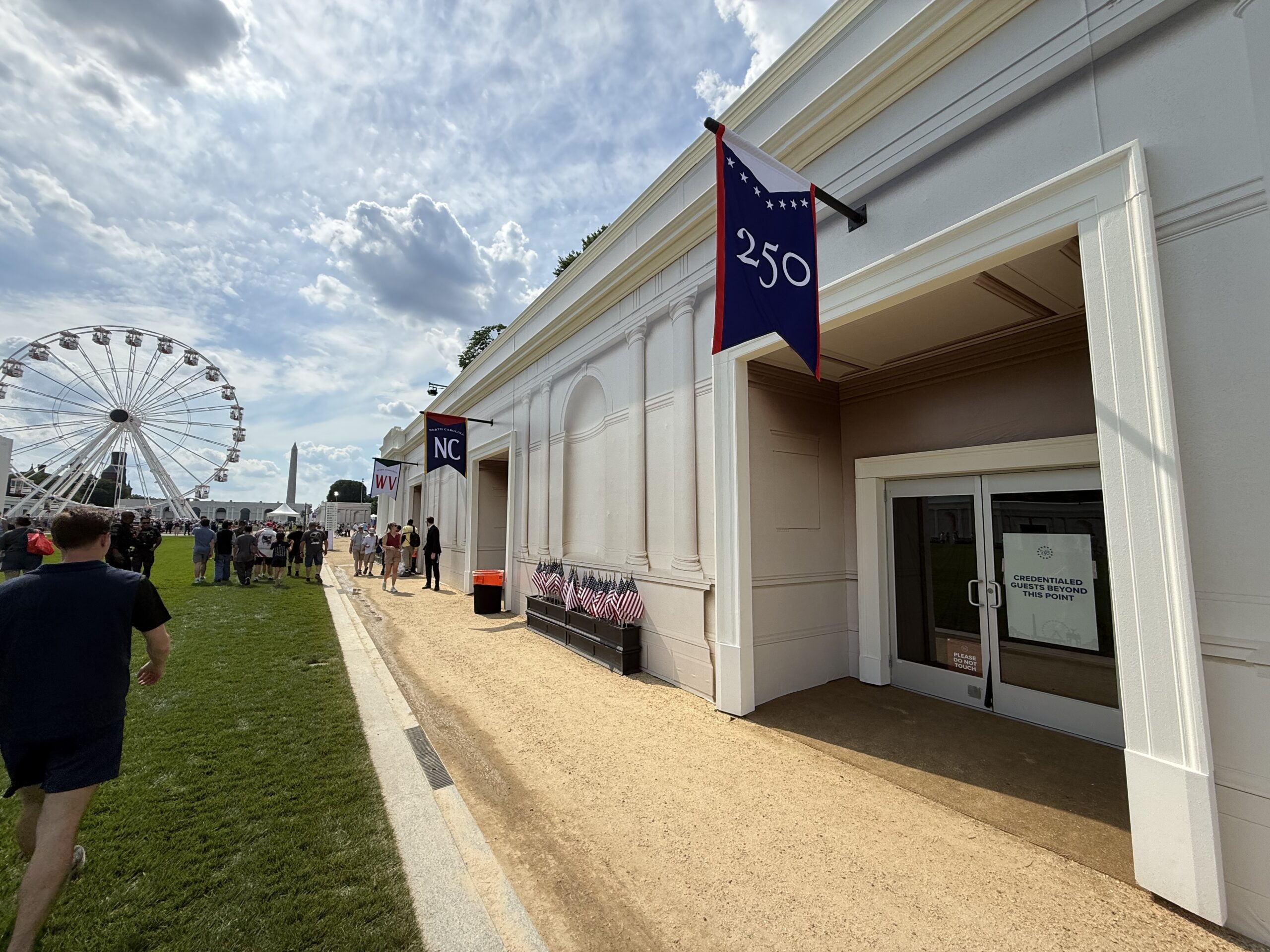
    Pennsylvania’s empty booth at the Great American State Fair on Thursday in Washington. On Saturday, Sens. David McCormick (R., Pa.) and John Fetterman (D., Pa.) announced that they had secured private-industry sponsors for the booth at no cost to taxpayers.

    A debate over past and future America

    Other Republicans on Capitol Hill have defended Trump’s role in the anniversary while using the moment to say they believe left-leaning Democrats are the primary threat to America’s democracy.

    “We are in a fight right now to save the republic, and every American needs to take this seriously. You need to wake up,” an animated House Speaker Mike Johnson (R., La.) said at a news conference last week after three insurgent candidates backed by New York Mayor Zohran Mamdani, a democratic socialist, won competitive congressional primaries.

    “Are we going to maintain our status as a constitutional republic on our 250th anniversary?” Johnson continued. “Or are we going to make a new choice and go down some road toward a communist utopia?”

    Chris Rabb, who won Philadelphia’s competitive primary in May to succeed retiring U.S. Rep. Dwight Evans (D., Philadelphia) next year, endorsed two of the candidates Johnson criticized and is likely to join them in the most progressive bloc in Congress next year.

    A democratic socialist and state legislator, Rabb has been adamant about what he sees as a need for “radical” change. After speaking at an event titled “The Next American Revolution: Breaking Oligarchy and Making a New Democracy” in Washington last week, he said in an interview that Trump’s presidency has in some ways been a “valuable distraction.”

    Instead of celebrating the anniversary in traditional — or what Rabb called “milquetoast” — ways, Trump is creating an opportunity for more critical, nuanced discussions about American identity and history, he said.

    It is a particularly meaningful opportunity for him personally. A longtime family genealogist, Rabb has spoken often about his heritage as the descendant of both a signer of the Declaration of Independence — the slave-owning Philip Livingston — and Black abolitionists.

    “I am an embodiment of the hypocrisy and the complexity of choices and systems that have never really been addressed … [and] that are very similar to what we had 250 years ago,” Rabb said. “Unless and until we have a real public, ongoing, and substantive conversation, it will be more of the same.”

    Staff writer Andrea Padilla contributed to this article.
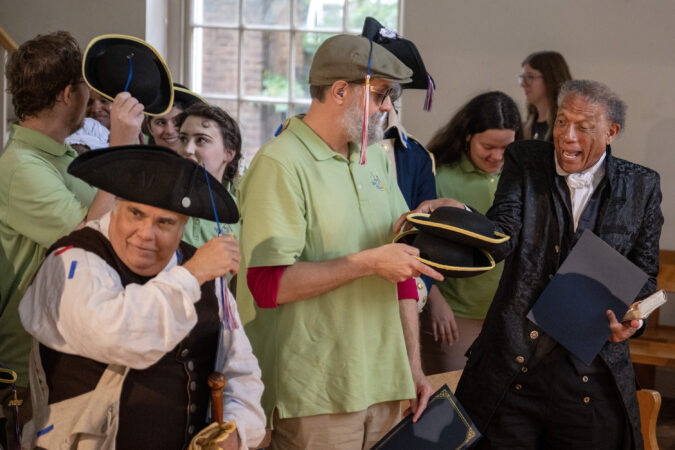
  • How Philly’s historical reenactors are preparing for their Super Bowl: The nation’s 250th

    How Philly’s historical reenactors are preparing for their Super Bowl: The nation’s 250th

    The players amble into the auditorium on a cloudy May morning to run through their schemes and formations and make last-minute adjustments to the roster. Some are already in uniform — waistcoats and breeches — fueling up on Wawa coffee and bagels. Others scroll aimlessly on iPhones or finish off their cigarettes outside the Free Quaker Meeting House near Independence Hall. They discuss contingencies, ready their gear, and buckle their latchet shoes tight.

    “Get out there and have fun,” their coach, Historic Philadelphia’s director of storytelling Johanna Dunphy, says as she sends her proud-chested team of historical reenactors off for their preseason opener.

    This is the start of the team’s Super Bowl run: the lead-up to the nation’s Semiquincentennial. The cast of Ben Franklins, John Adamses, and Betsy Rosses — actors who have spent months and uprooted their lives to learn about and live as colonial America’s key characters — will be at the front lines of the 250th birthday celebrations, which began with the cast’s opening day on May 23 and reach a fever pitch on July 4. They will become de facto historians, guides, entertainers, and ushers to an expected crush of tourists, all while anchoring how the country’s earliest days are memorialized and whose stories get to be told.

    “Fly!” Dunphy says with gusto as the performers shuffle out of the modest redbrick building.

    This set of actors is part of Historic Philadelphia’s Once Upon a Nation program — a series of performances staged throughout the summer and beyond in Philadelphia’s historic district and at Valley Forge. It’s Once Upon a Nation’s 21st season, but this year is expected to be one of its biggest ever, with the most actors, plays, scripts, and events.

    And, with tourism agencies expecting this summer’s events to draw upward of one million visitors, it’s almost certain to be the program’s largest audience.

    “Philadelphia is ready for you,” Amy Needle, Historic Philadelphia CEO, told the players on the last day of the preseason. “And I know you’re ready for them.”

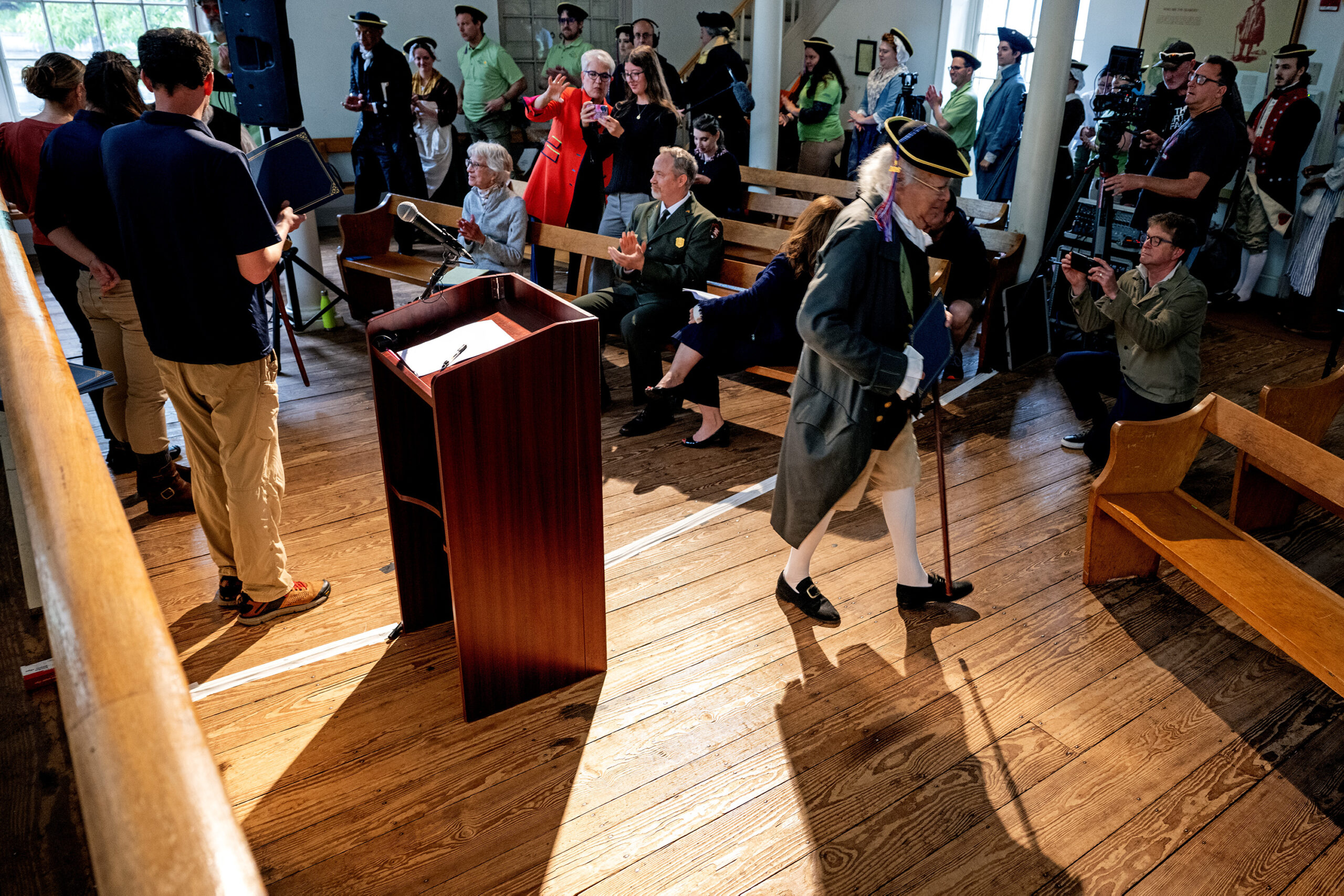
    Shecky Perlman as Ben Franklin, and other historical reenactors receive their diplomas on May 21, 2026, after weeks of intensive, immersive training at the Benstitute.

    Four months to game day

    Actors, mostly local, file in and out of Jason Greenplate’s office on a chilly January afternoon. Greenplate, program manager for Once Upon a Nation, and his colleagues are seeking the strongest possible players who have the passion, the look, and the improvisational skills to take on the characters and become “history makers” — what Historic Philadelphia calls its reenactors. It’s essential for these coaches to choose players who are not only capable of taking on these roles but are also willing to challenge their own understanding of history.

    Spencer Salusky, a 23-year-old fresh William & Mary graduate, walks through the door.

    As a draft prospect, Salusky is an impressive pick. He can execute even the most complex of plays (tricky lines and blocking), and his stats (body measurements and head shape) are optimal.

    “He kind of looks like John Adams,” Greenplate thinks.

    After conferring with his peers, Greenplate chooses Salusky to become Once Upon a Nation’s next John Adams, and, one by one, 19 more actors are cast as history makers and storytellers, those who are stationed at the city’s historic sites in green polos to offer context to visitors. They join the existing 30 company members returning from prior years.

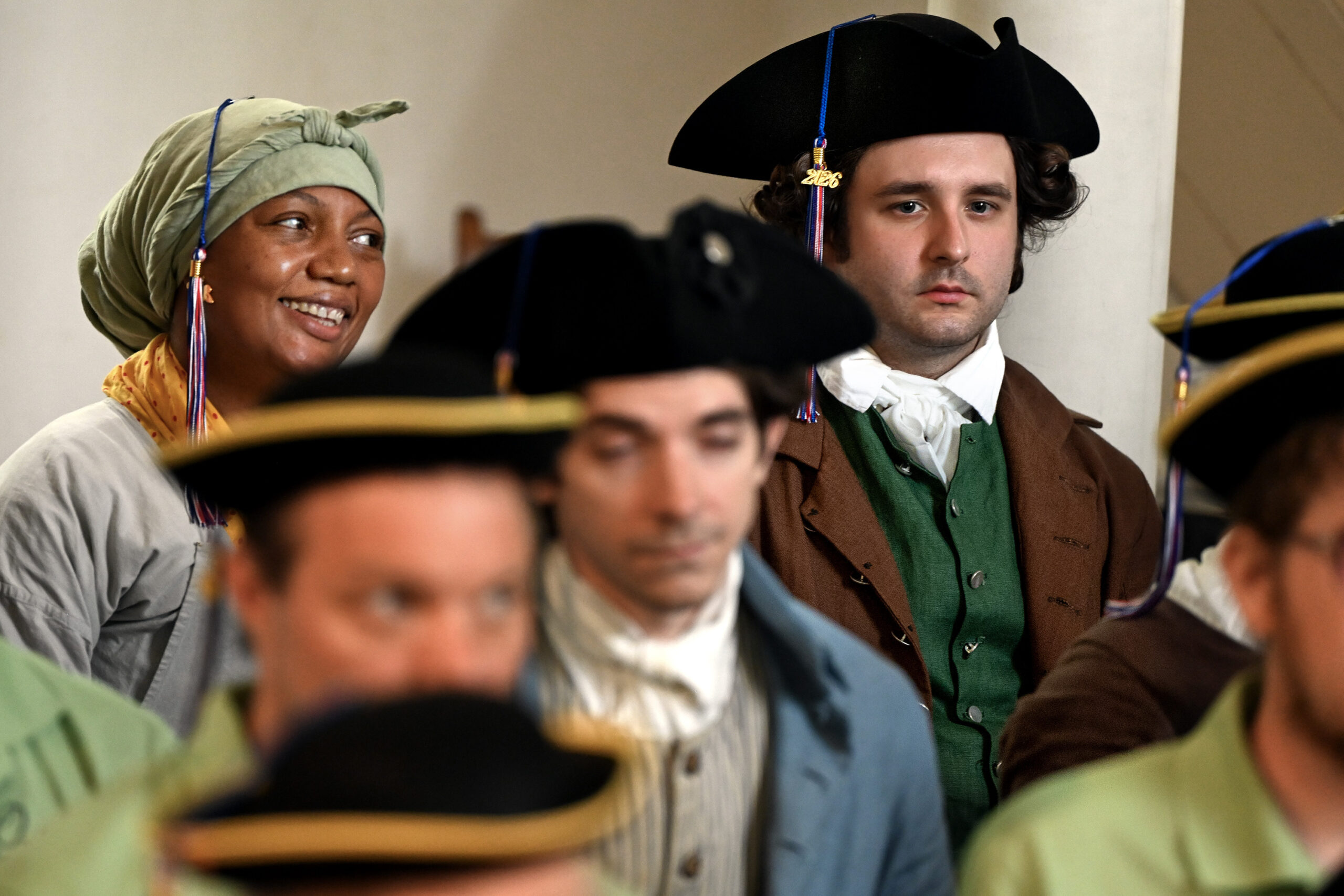
    Courtney Mitchell, who portrays Margaret Woodby (left), and Spencer Salusky (right) as John Adams, join other historical reenactors at graduation on May 21, 2026, after weeks of intensive, immersive training at the Benstitute.

    Three months to game day

    The actors soon begin their training. For Salusky, that looks like receiving a large packet full of biographical information about John Adams — where he was born, his wife’s name, and his perspective on slavery — from Doug Thomas, director of history makers.

    Thomas is a player-coach, a star in his own right who can seamlessly transition to the coaches’ box. Like Deion “Prime Time” Sanders, Thomas is a Swiss Army knife on the field, having played every position in the game of historical reenacting, from William Penn and Patrick Henry to Francis Scott Key, and has been doing the work for nearly 30 years. But what makes him truly elite is his position as Mount Vernon’s George Washington.

    Out in the field, the players might be blindsided by a granular question from a tourist, an offensive remark from a passerby, or incessant badgering from a child. On the stage — where the history makers also perform a series of scripted plays — they must be prepared to embrace their characters’ conflicting motivations, shifting attitudes on political issues, and complex interpersonal relationships.

    Thomas is equipped to help them tackle it all.

    He guides them in studying their characters, trains them on redirecting conversations with visitors toward topics they’re knowledgeable about, and teaches them improvisational techniques. He also prepares them to embody the voice, posture, and behavior of historical figures.

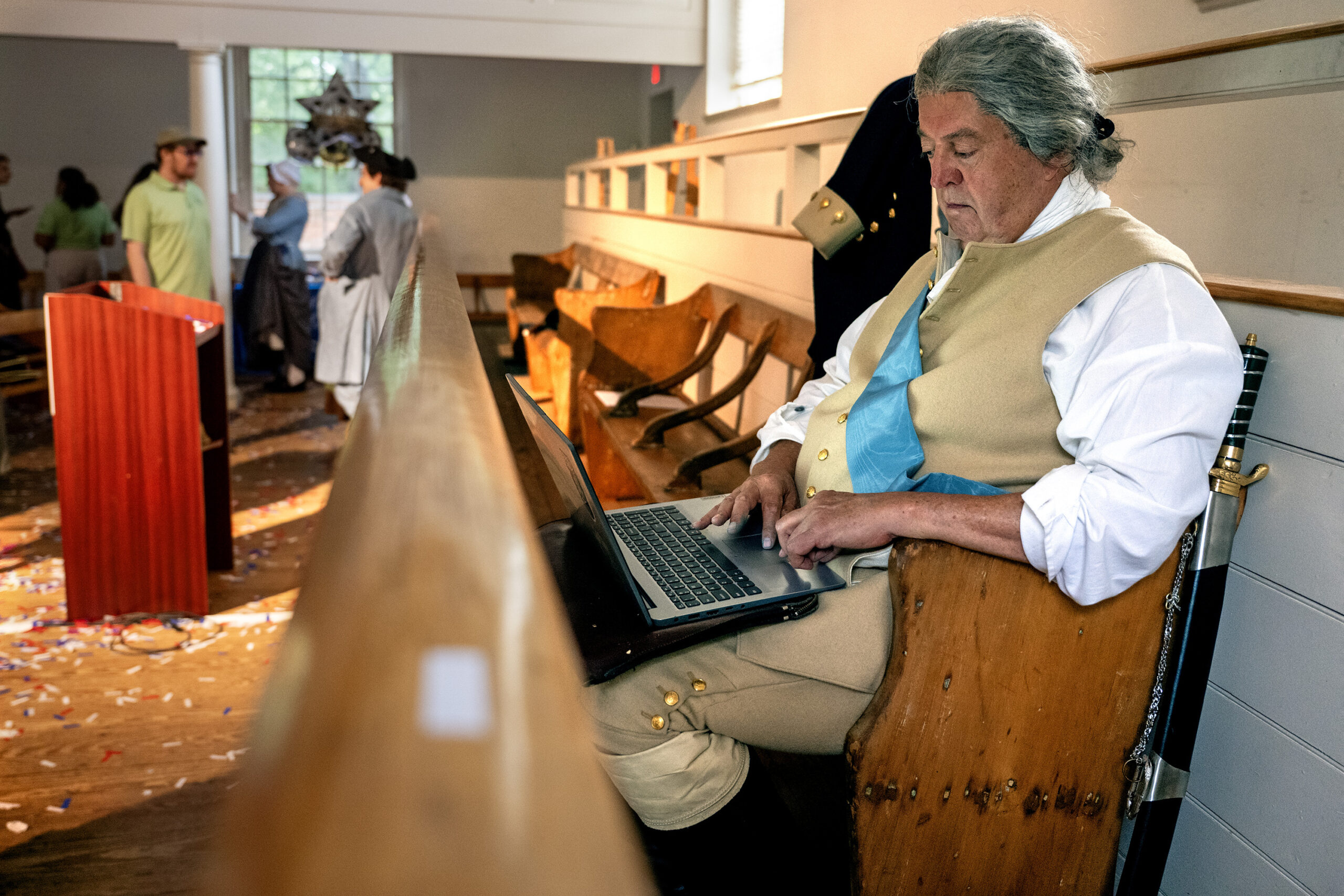
    Jim Fryer as George Washington checks in on his laptop on May 21, 2026, after the graduation of dozens of historical reenactors after weeks of intensive, immersive training at the Benstitute.

    Three days to game day

    “Adams,” Thomas says, summoning Salusky during a rehearsal for Cocktails and Congress, a marquee performance in the Once Upon a Nation repertoire.

    On a scorching 95-degree afternoon that foreshadows what the players can expect during the steamy home games to come, Thomas scans the script, glasses poised atop silky black hair that grazes his shoulders. He directs Salusky’s attention to a moment in the dialogue: “Slavery is like a great cancer.”

    He cautions the actor to be careful with how he utters that line. Adams is torn about slavery at this point in his life, Thomas explains.

    “He doesn’t like it, he doesn’t support it, but also he does realize very practically what eliminating slavery would do to the economy,” Thomas tells Salusky.

    Salusky contemplates the note, sitting on a Meeting House pew with a mechanical pencil tucked behind his ear.

    “Adams is evolving,” Thomas tells him. But “he’s a practical man.”

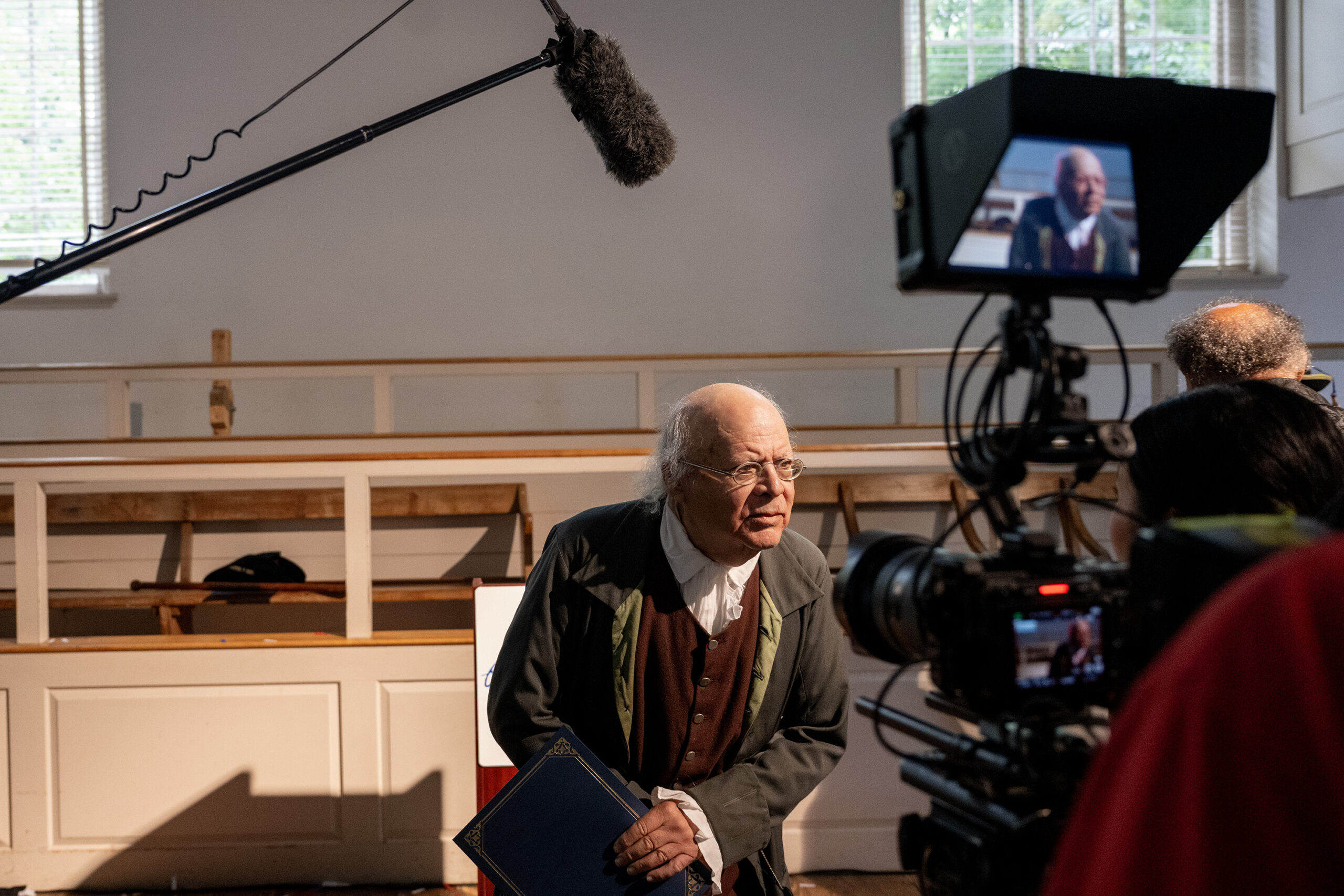
    Shecky Perlman as Ben Franklin, ready for his close-up, on May 21, 2026, as he is interviewed by a documentary film crew, as dozens of historical reenactors graduate after weeks of intensive, immersive training at the Benstitute.

    Two days to game day

    Even with centuries of primary and secondary sources, and extensive research, there are still gaps in what’s known about 18th-century American life that the actors and program coordinators must contend with. There’s a trove of information on John Adams, for example, but the documented lives of women and people of color are far less complete, like that of Hannah Till, an enslaved cook for George Washington at Valley Forge, who purchased her freedom. What’s known about Till is often centered on her enslavers.

    West Philadelphia actor Miranda Thompson, who portrays Till as well as Sarah, a fictional composite character in Cocktails and Congress, relies on more general information about how women of color lived during the colonial era to inform her performance. “You just want to get it right,” Thompson, 43, says. “You want to give truth to who that person was. … I feel like if I’m grounded and honest within that interpretation, I think that I’ve done it justice.”

    For historian Sandra Mackenzie Lloyd, who authored many of the Once Upon a Nation scripts and founded the Benstitute — the immersive training program the actors undergo — the American story is about “more than the dead white dudes.”

    “It’s not a straight line,” Lloyd says. “We are people who have been through many difficult periods and ups, downs. This is a country that was created by people from many places with different beliefs, and that’s historic, and it’s contemporary.”

    Organizers were intentional about the stories and figures they chose to platform this summer, centering diverse and layered voices in the narrative of the nation’s founding, including those of Black Americans whose stories have been omitted in the retellings of the story of 1776.

    “Our history is being erased, voting rights [are being erased], certain books are banned,” Thompson says. “Representation matters … to know that we were there, and we played an important role.”

    Prominently featuring Black history during the 250th, she says, is also an opportunity to dismantle racist, archaic stereotypes about enslaved people through authentic storytelling and connection.

    “You can change a person’s mind,” Thompson says. “We’re human, we can always change our minds.”

    Historian Sandra Mackenzie Lloyd, founder of the Benstitute, delivers the commencement address on May 21, 2026, as dozens of historical reenactors graduate after weeks of intensive, immersive training.

    One day to game day

    Preparations for the reenactors include not only character work, but also tourism and hospitality training. They learn how to guide someone to the best cheesesteak or nearest toilet while staying in character and using period-appropriate vernacular. The actors also learn how to beat the heat in wool frocks and petticoats and stay safe.

    “Make sure to hydrate, hydrate, hydrate,” Dunphy, the storytelling director, tells her team during a morning gathering at the Meeting House before they hit the streets in costume, and a set of volunteer fake tourists heads out to test the reenactors’ skills before they’re faced with real tourists.

    She points them to a packet in their supply bags full of powder to pour into their water for extra hydration.

    “Drink this,” she instructs them.

    Most importantly, Dunphy reminds both the history makers and the storytellers what to do if they’re out in the field and feeling unsafe.

    “History makers, please remember this: If a storyteller says, ‘Have you seen John Adams?’ Don’t be cute. That is a plea for help; they need you to stay with them. It is not a joke. They need you to stay,” she says. “Things can turn on a dime.”

    And, as this is live performance, things often don’t go according to plan.

    During an April news conference at which a Betsy Ross and a Benjamin Franklin from the company stood onstage beside Gov. Josh Shapiro, a giant poster reading “America 250 PA” fell forward, scraping Franklin’s behind.

    Carol Spacht, the Betsy Ross at the event, acted quickly.

    “This is such an exciting announcement that the world is falling apart over it,” she exclaimed after the poster came down, gesticulating with a scroll clasped in her hand before turning to the Benjamin Franklin reenactor, Bill Robling.

    “Quite all right, Dr. Franklin?” she asked as he nodded. “We’re sturdy at our age. 250 years does that.”

    At a recent event at Reading Terminal Market, Salusky, as John Adams, had to navigate how to handle tourists approaching him, thinking he was Benjamin Franklin.

    “As John Adams, how do I react to people thinking I’m Ben Franklin. Well, he was a mentor of his. He really admired him, found him annoying, but would still be a little flattered,” Salusky says. “It’s kind of just like in-the-moment problem-solving.”

    Over the course of their four months of training, the actors finally reach a place of feeling ready for anything … mostly.

    “Speaking in 18th-century tongue continuously, I am nervous about that,” Thompson says. “I want to portray it real.”

    Cause for celebration

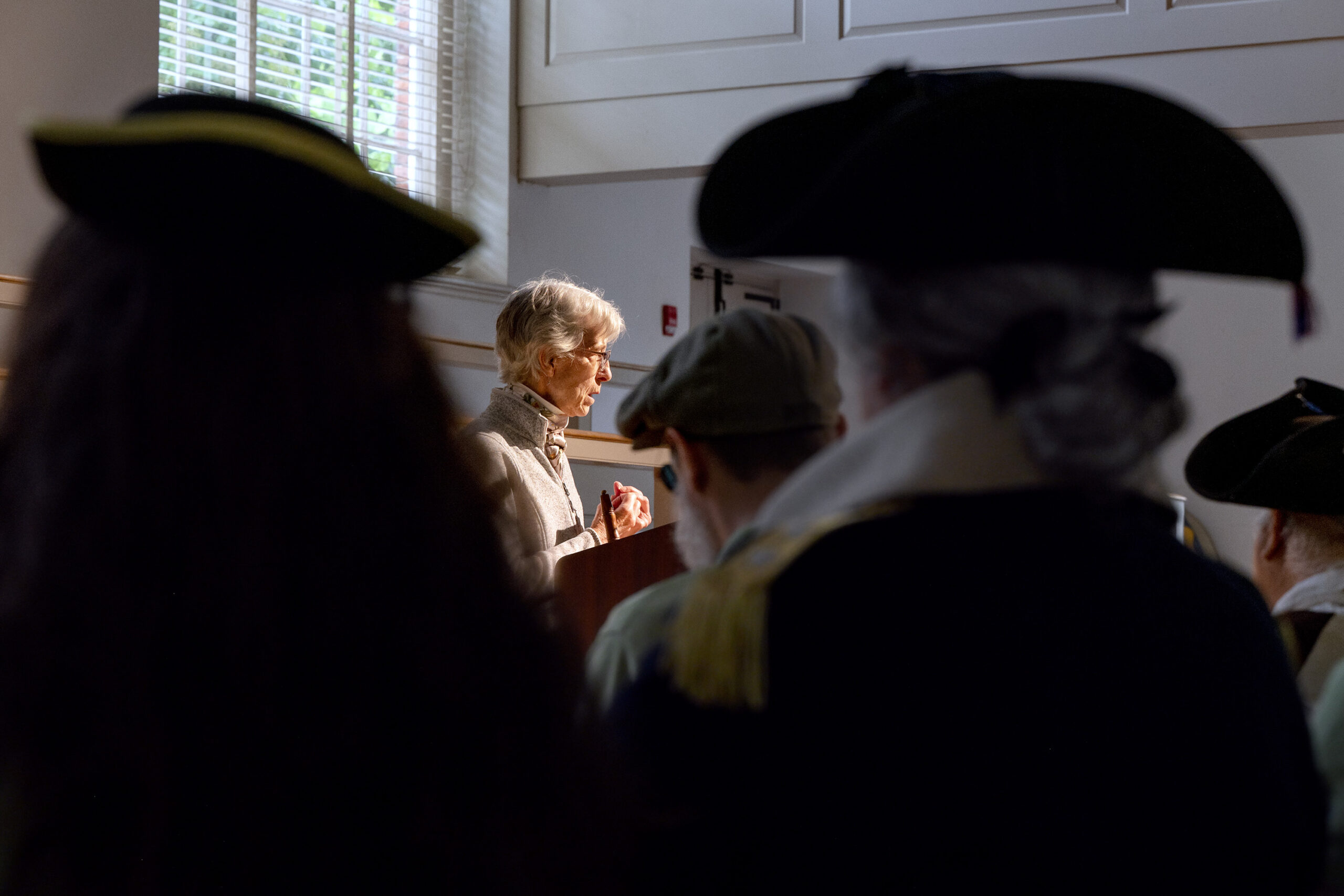
    Before the actors are on their own on the Philly streets, they and their mentors celebrate the completion of their Benstitute training with a graduation ceremony at the Free Quaker Meeting House.

    Graduates file in, some in polos and slacks and some in costume, all wearing red, white, and blue tassels dangling from the center of their mob caps and other historical hats. They sit in the pews, players awaiting the game-time whistle, as their coaches offer them final words of encouragement before they put their drills to the test and tackle the real world, beginning with their season’s opening day — their fervor not letting up until they run through the proverbial tunnel onto the championship field for July 4.

    “History is not just about buildings, artifacts, and famous moments. It is about people — their choices, their struggles, their disagreements, their courage, their hopes for the future,” says Steven Sims, superintendent of Independence National Historical Park. “Long after visitors leave Philadelphia, they may not remember every date they heard or every building they toured, but many will remember how someone made them feel connected to history. Many will remember you.”

    One by one, the reenactors and storytellers cross the stage, graciously accept their diplomas, smile for photos, and return to their seats.

    “Class of 2026, please stand up,” says Amy Needle, the Historic Philadelphia CEO. “Change your tassels. Congratulations! George Washington?”

    “Class of 2026,” a Washington reenactor calls. “Hip hip.”

    “Huzzah,” they respond.

    “Hip hip,” he repeats.

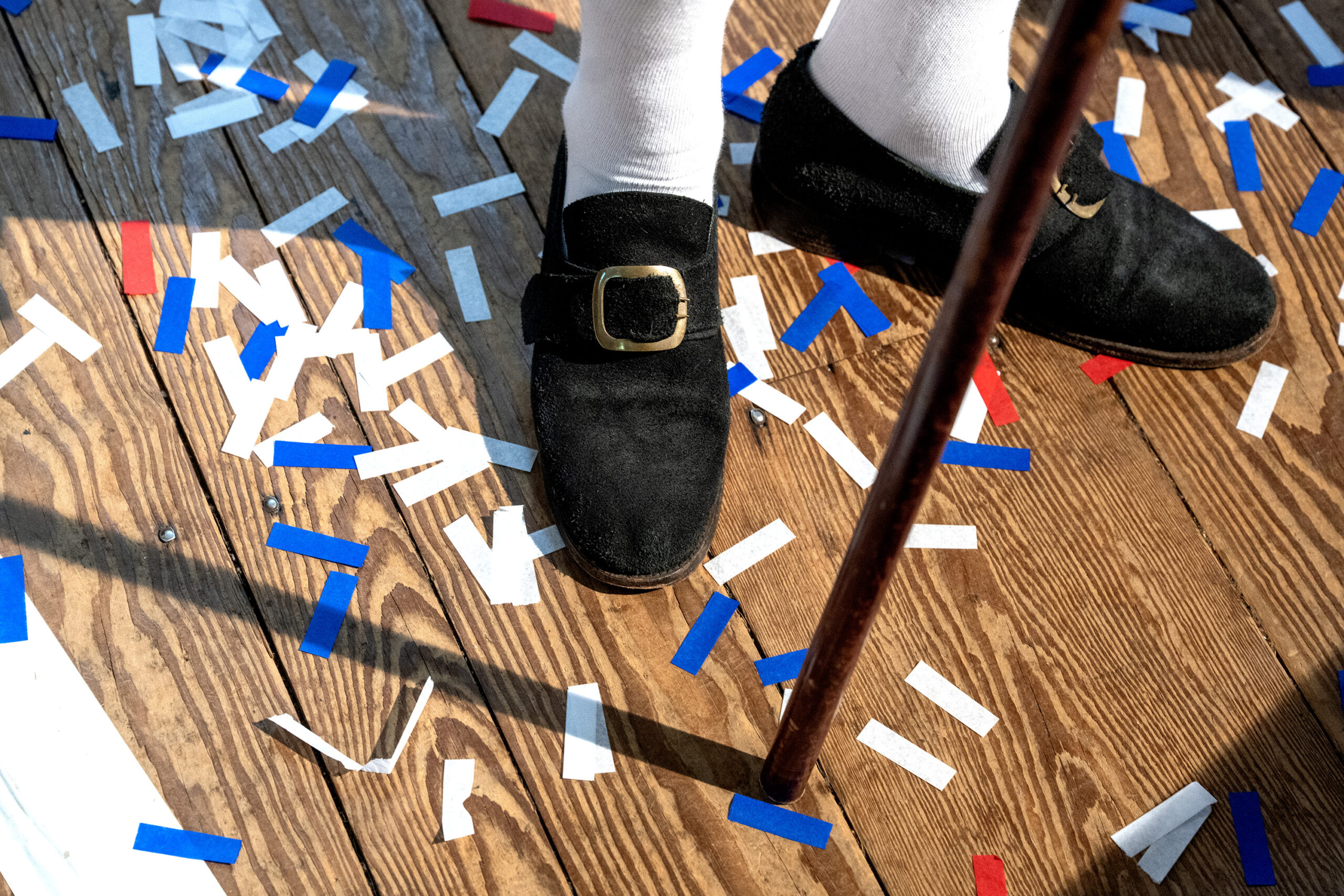
    “Huzzah!” they conclude as audience members deploy tiny silver confetti cannons and red, white, and blue rain down upon them.

    Shecky Perlman as Ben Franklin, his cane and feet, Thursday, May 21, 2026, among the confetti as dozens of historical reenactors graduate after weeks of intensive, immersive training at the Benstitute.
  • In the weeks before independence, the man from Monticello drafts a declaration

    In the weeks before independence, the man from Monticello drafts a declaration

    Philadelphia. June 1776.

    America stands on the brink. The ultimate question of independence hangs over Philadelphia.

    And Thomas Jefferson has a declaration to draft.

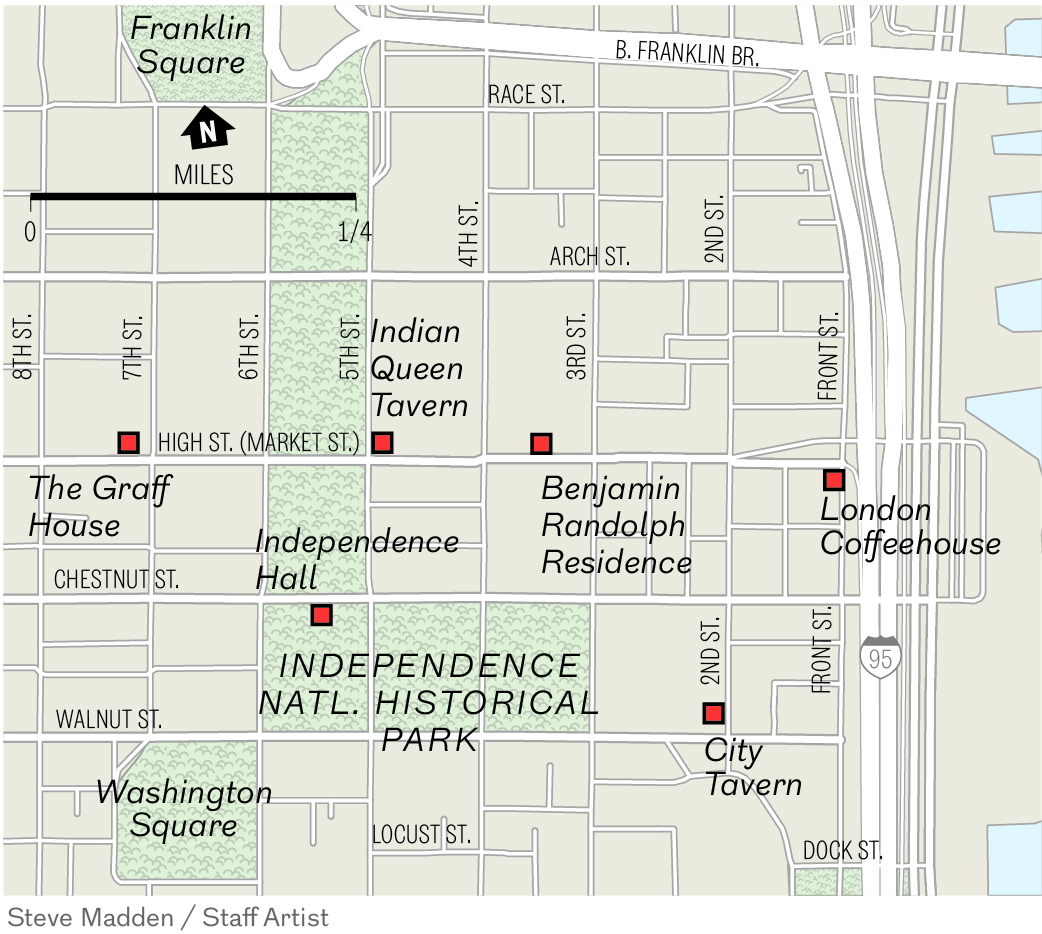
    His heart is in Virginia. His “country,” as he calls it. But here he is at Seventh and High Streets, 33 years old, living in two sweltering rooms, with his chance to make his mark on history.

    Unlike his fellow delegates, lodged in rooms along Philadelphia’s booming riverfront, Jefferson takes quarters along the city’s rural western edge, two blocks from the Pennsylvania State House, where the rebels conspire. The orchards and pastures bordering the downtown of British America’s largest and wealthiest city offer an escape from Philadelphia’s stifling summer heat and foul smells. Its stinking creeks, rotting trash, and unchoked illness. The verdant outpost, elsewise occupied by a bricklayer and his family, provides “the Squire,” as his friends back home call him, some small semblance of his mountaintop mansion, Monticello.

    Thomas Jefferson’s Philadelphia in 1776.

    He is living out of leather-bound trunks. Fresh air and sunlight stream through a window overlooking High Street — Philadelphia’s main thoroughfare, busy even on the outskirts. Hinterland farmers’ wagons clatter over cobbles, headed for the market. The sweet scent of fresh loaves drifts from a shopfront bakery. Jefferson’s thoroughbred — Caractacus, perhaps, his favored bay stallion, whose regal appellation derives from a first-century British chieftain — nickers in a nearby stable.

    Robert “Bob” Hemmings, Jefferson’s 14-year-old enslaved valet — and half brother of Jefferson’s future paramour, Sally — attends his every need in Philadelphia, sleeping in a garret off the writing parlor.

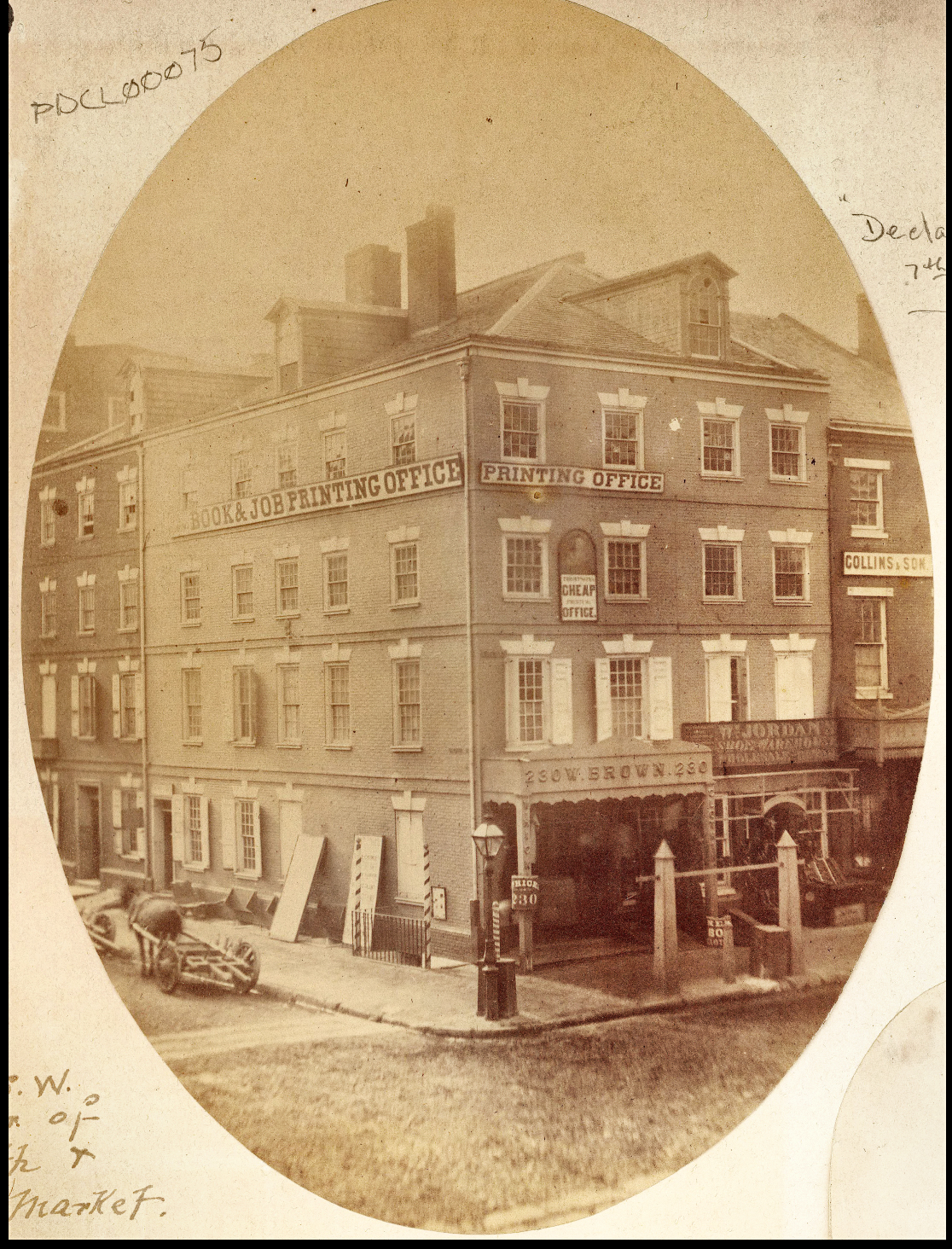
    The Declaration House, 7th and Market Streets, in 1856.

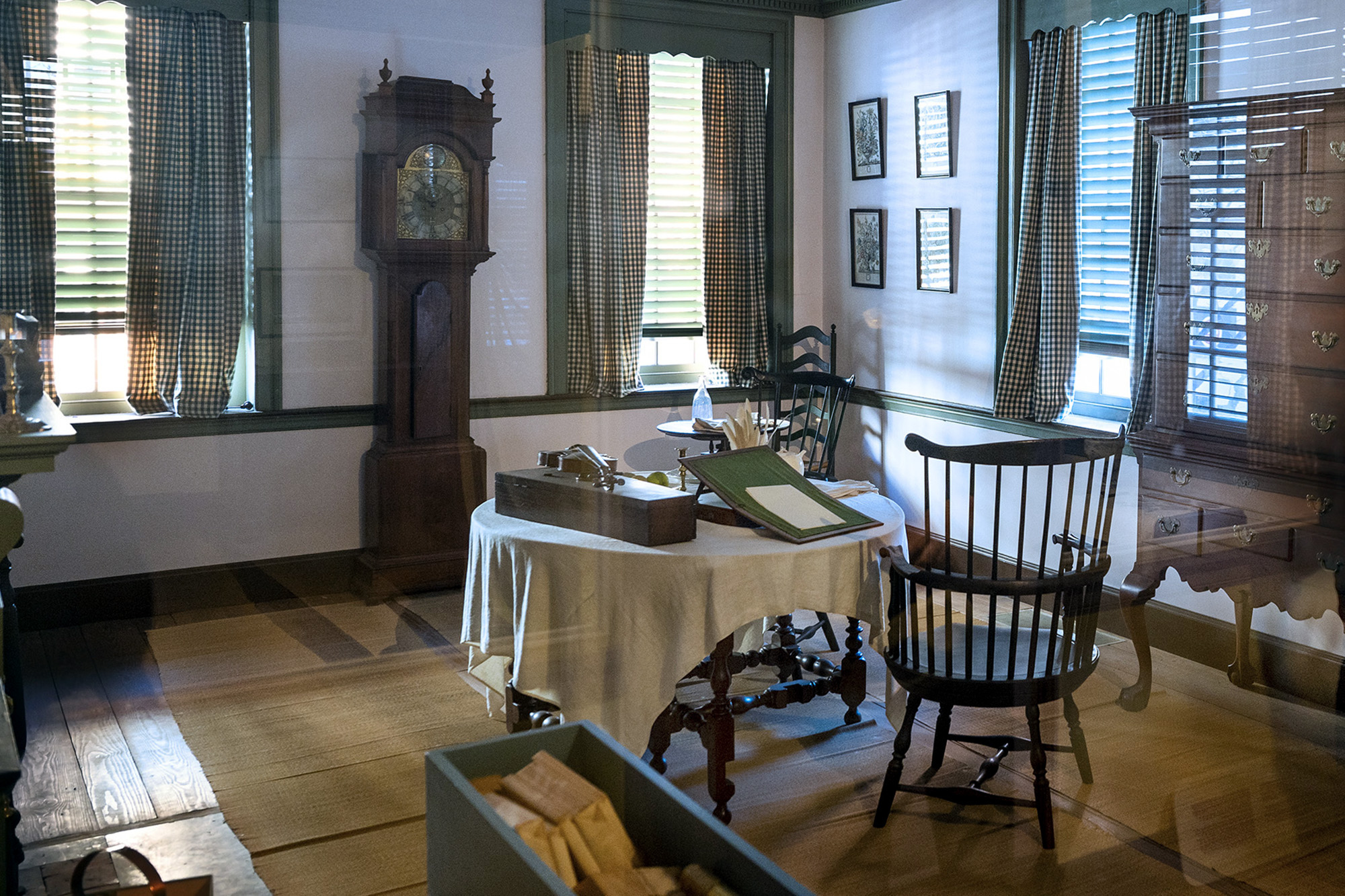
    The rag paper resting on Jefferson’s mahogany travel desk — a small, portable lap device of his own design that the inveterate tinkerer had commissioned from a Chestnut Street cabinetmaker upon his arrival in Philadelphia a month earlier — remains blank. His quill is still. In the shadows, a grandfather clock ticks a stately rhythm.

    Tick … tock … tick … tock.

    The master of Monticello is working on a deadline.

    A momentum for independence

    Tarrying at the threshold of independence for months, the roar of rebellion echoes throughout Philadelphia by late spring.

    Just weeks earlier, more than four thousand Philly patriots braved driving rains to gather in the brick-walled yard of the State House. Celebrating the Second Continental Congress’ decree to form new governments apart from King George III — the masterstroke of John Adams, 40 — the drenched Philly masses thunder for independence.

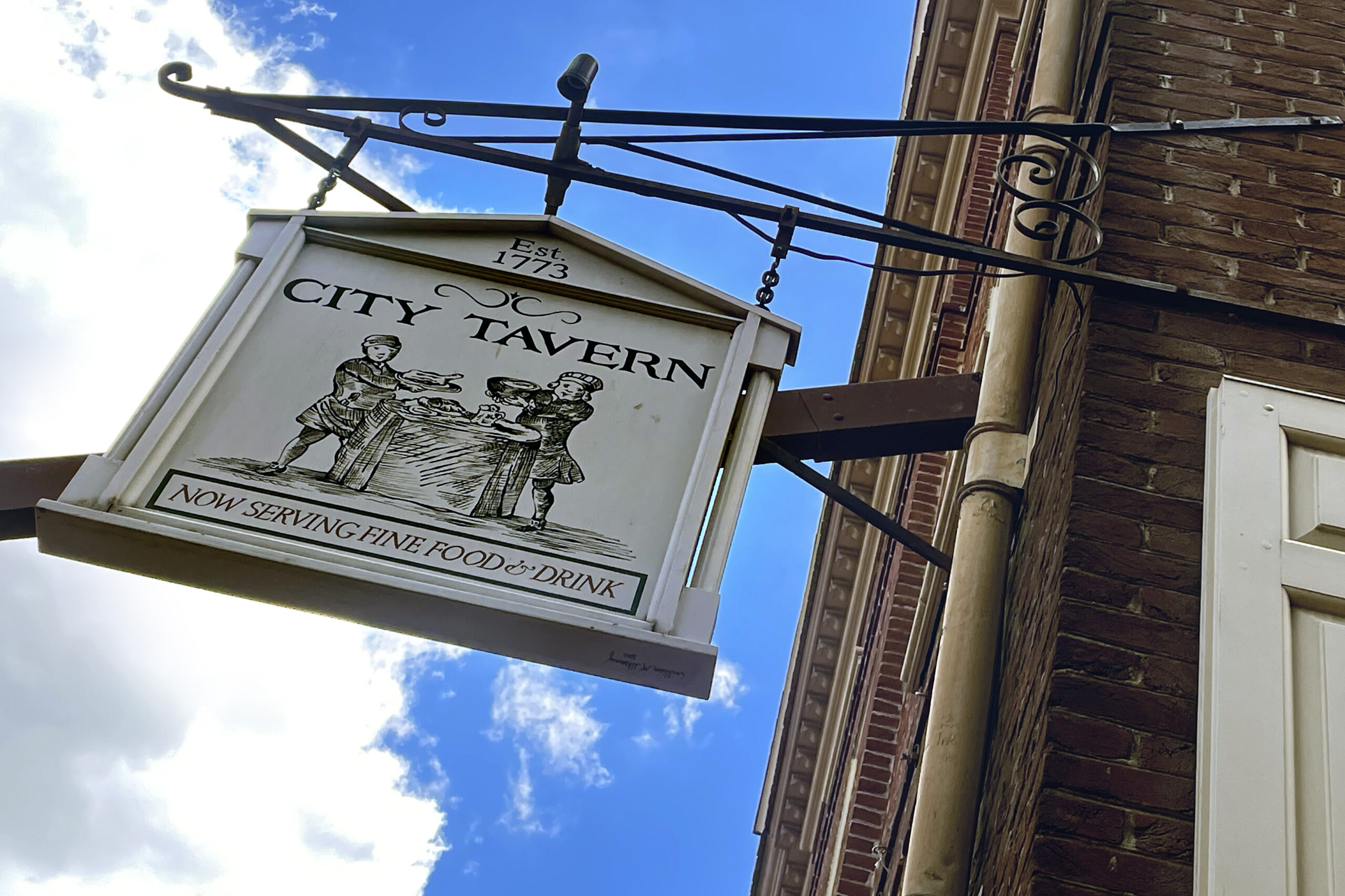
    City Tavern Monday, June 15, 2026. The original building was demolished in 1854 and reconstructed in 1975.

    George Washington himself takes brief leave of his embattled army, digging in for an expected British assault on New York, to update the 56 congressional delegates in Philadelphia. The general’s tidings are lost to the centuries. But hear the lusty huzzahs that greet the stoic warrior at the representatives’ nightly repast at City Tavern, their unofficial headquarters.

    “George Washington, and victory to the American arms!” goes the toast.

    Inside the locked chamber, radicals like Adams and his older cousin, and backroom operator, Samuel, 53, lead the fight for liberty. Jefferson, whose resolve for popular government in America is unquestioned, but who detests public speaking, rarely rises.

    In early June, it is Jefferson’s fellow Virginian, the passionate patriot Henry Lee, who delivers a decisive stroke, boldly uttering words hitherto unsaid in Congress: “That these United Colonies are, and of right ought to be, free and independent.”

    The thunderclap is met by delay. Delegates from powerful colonies, including Pennsylvania’s own reluctant son of liberty, John Dickinson, are hesitant to cut the cord. Radicals work furiously to build unanimity.

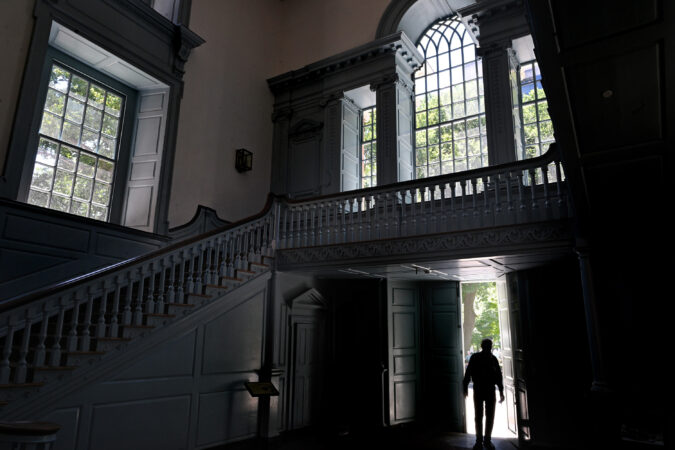
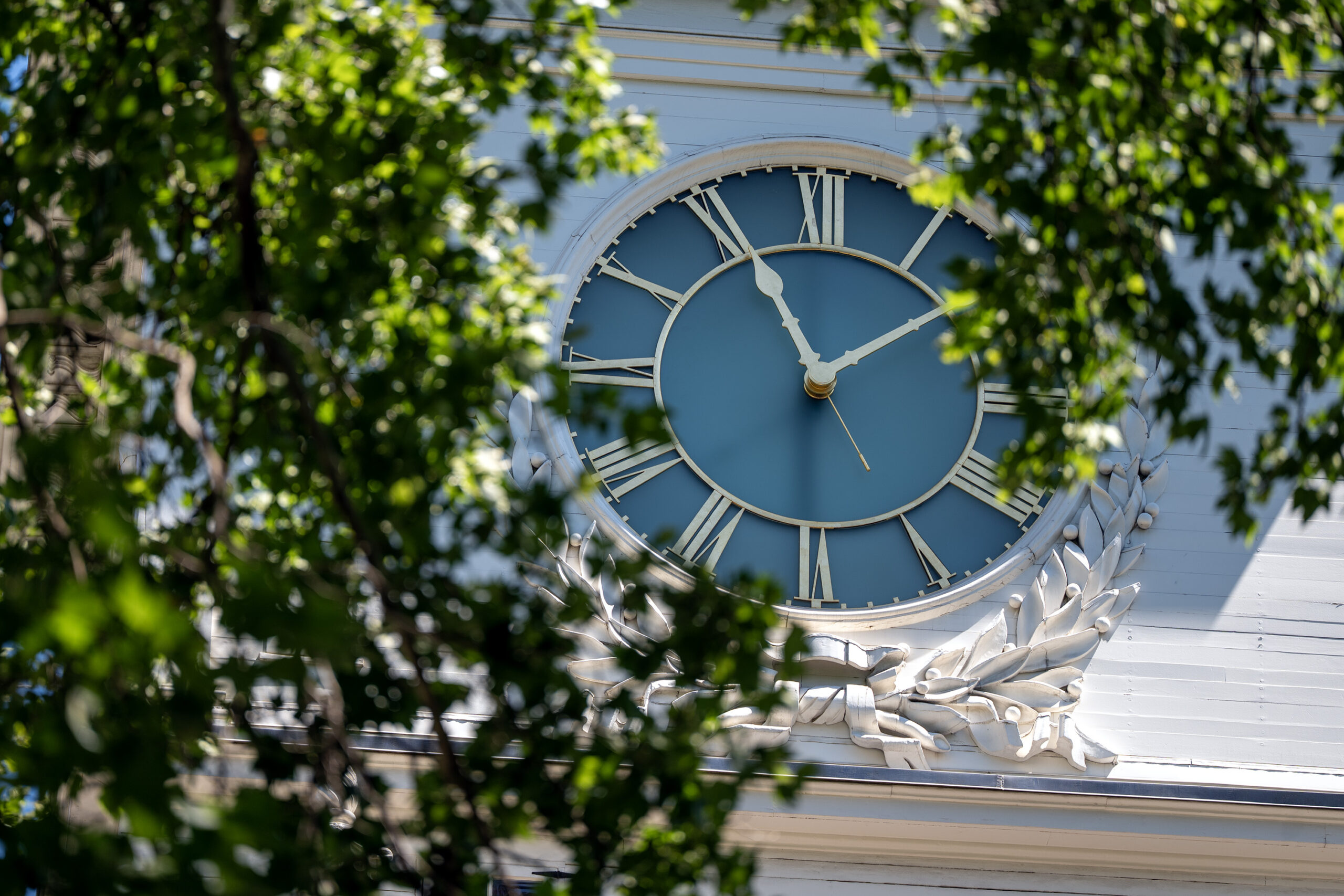
    Clock tower at Independence Hall (Pennsylvania State House) Monday, June 15, 2026.

    Philly headlines — in the same papers publishing fugitive slave ads and notices for the sale of Black children far younger than Bob Hemmings — decry “our mortal enemy the King of Great Britain.”

    “The people wait for us to lead the way,” Jefferson will note.

    During the delegates’ fiery, closed-door debates, his long legs folded underneath his desk, Jefferson stays mum.

    But now the poet-philosopher and slaveholder, whose bright brilliance and dark contradictions mirror perfectly the promise and sins of the nation he seeks to author, must find all the words.

    A renaissance figure among the rebels

    It is John Adams, in characteristically gruff fashion, who appoints Jefferson first quill. The good gentleman from Virginia is but one of five men appointed to draft America’s creed — including Adams and Franklin, home sick with gout and other ailments — but Adams argues it is Jefferson, with his “peculiar felicity for expression,” who should do the writing.

    “Reason first, you are a Virginian, and a Virginian ought to appear at the head of this business,” Adams recalls telling Jefferson in the committee’s first convocation. “Reason second, I am obnoxious, suspected, and unpopular. You are very much otherwise. Reason third, you can write 10 times better than I can.”

    Adams is right.

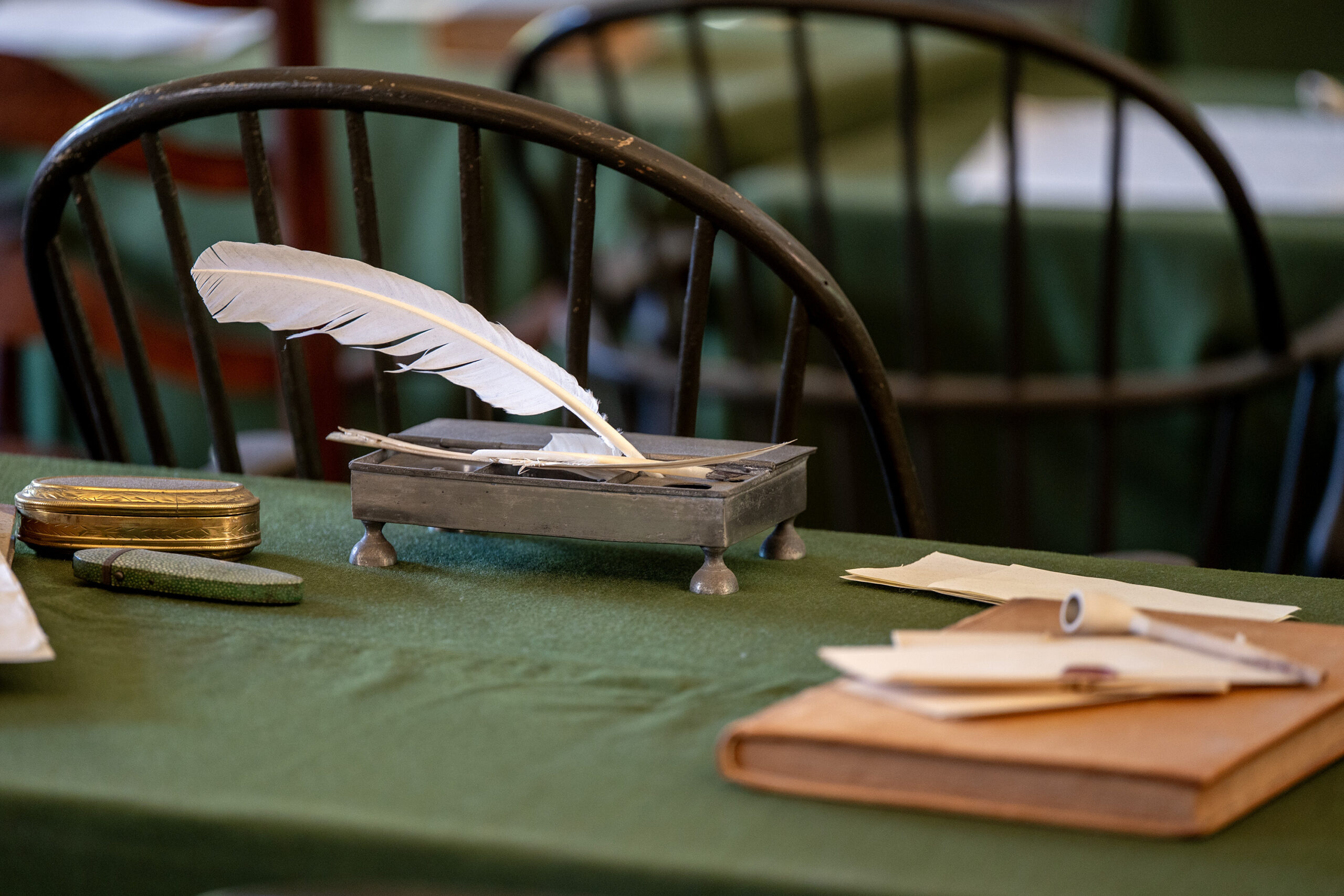
    Replica desks in the Assembly Room in Independence Hall (Pennsylvania State House) Monday, June 15, 2026.

    Both drawn to the flame of American independence — the noblest cause of their age, and any other, they believe — the freedom fighters cut an odd coupling.

    Adams, short, plump, balding, cantankerous. Jefferson, tall, lean, formidable, a shock of copper hair, freckled in the Philly heat, his illusive eyes described as blue or hazel or light gray. The Southern planter and legislator who matriculated at the College of William & Mary is soft-spoken and painfully gracious and polite, charming, flirtatious. He abhors confrontation.

    Behold this true renaissance figure among the rebels.

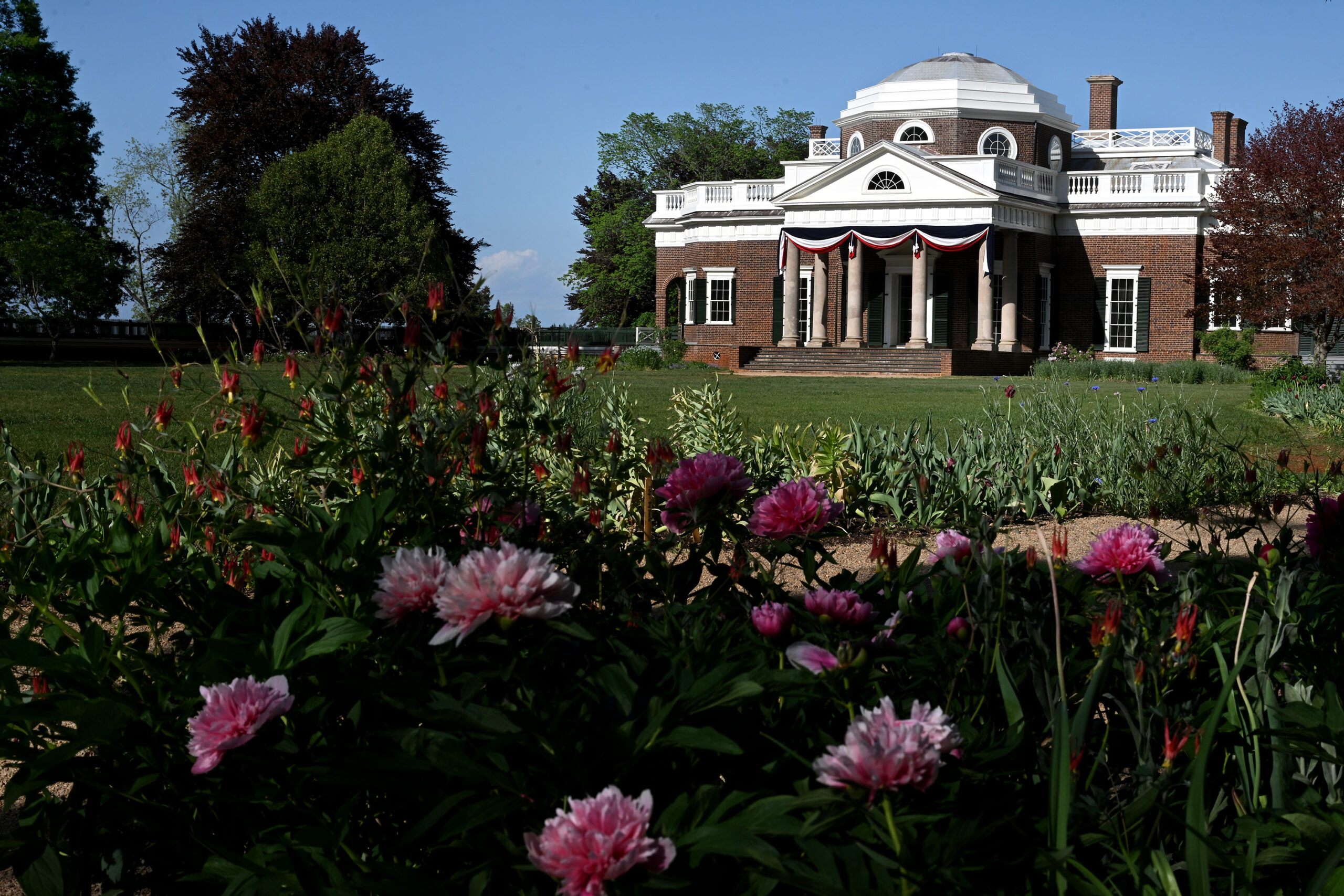
    Monticello, the primary residence and plantation of Thomas Jefferson in Charlottesville, Virginia, April 22, 2026.

    A lover of food and wine and fine things, he studies art and history, philosophy and mathematics, science, botany, astronomy. He speaks four languages and can aptly read ancient Greek. He has been building his Palladian plantation house — situated on land more than five times bigger than the core of Philadelphia, the makeshift colonial capital city, and toiled by more than 100 chained souls — since the age of 14.

    Adams, obsessive even in his sightseeing, catalogs and compares the marvels of Philadelphia — its spacious thoroughfares, leafy green spaces, commanding skyline, including Christ Church’s heaven-kissing steeple, the tallest structure Washington had ever laid eyes on, its booming ports, gleaming institutions, exotic foods, and bottomless wine, porter, and punch.

    During his few hours free from the rigors of revolution, Jefferson shops.

    With Bob touting bulging bundles, the Squire strolls Philadelphia’s abundant artisanal shops, buying maps and books across all his tastes — so many volumes, he commissions his favorite Philly cabinetmaker to make a specialized bookcase to ship them home — and tools for Monticello. He buys fine fabrics for his wife, Martha, whom he is heartsick for. An elegant doll for his 4-year-old daughter, Patsy. He buys a straw hat for himself, and shoes and socks for Bob. At a market stall, he pays a shilling to gaze upon a merchant’s exotic monkey.

    Along with his compatriots, he sups at the City Tavern most nights, enjoying as many as three glasses of wine, but also favors the regal rusticity — and punch — of the Sign of the Conestoga Wagon Tavern on High Street.

    A replica of the room where Thomas Jefferson wrote the Declaration of Independence, inside Declaration House (home of Jacob Graff, Jr.) Dec. 20, 2023.

    Envision him, this sun-freckled Moses of American history, in flesh and bone, a living, breathing man, donning a sun hat, whose first memory is being held on a pillow by an enslaved worker, and who will within days pen the most revolutionary, if fatally flawed, manifesto ever put to parchment, walking among, but set apart from, the working classes of Philadelphia. The laboring, the indentured, and the enslaved — all those he would conversely see lifted to the altar of democracy or sold at the auction block.

    See this man. And understand America.

    An expression of the American mind

    He envisions his task to “place before mankind the common sense of the subject.” A justification for revolution, yes. A litany of proof that King George was a tyrant — and among other things, in an epic, and ultimately unsuccessful, act of blame-shifting, responsible for the entirety of the slave trade. But not a wholly original document. Rather, a soaring summation of the American revolutionary zeitgeist.

    “Neither aiming at originality of principle or sentiment, nor yet copied from any particular and precious writing, it was intended to be an expression of the American mind, and to give to that expression the proper tone and spirit called for by the occasion,” he will later explain.

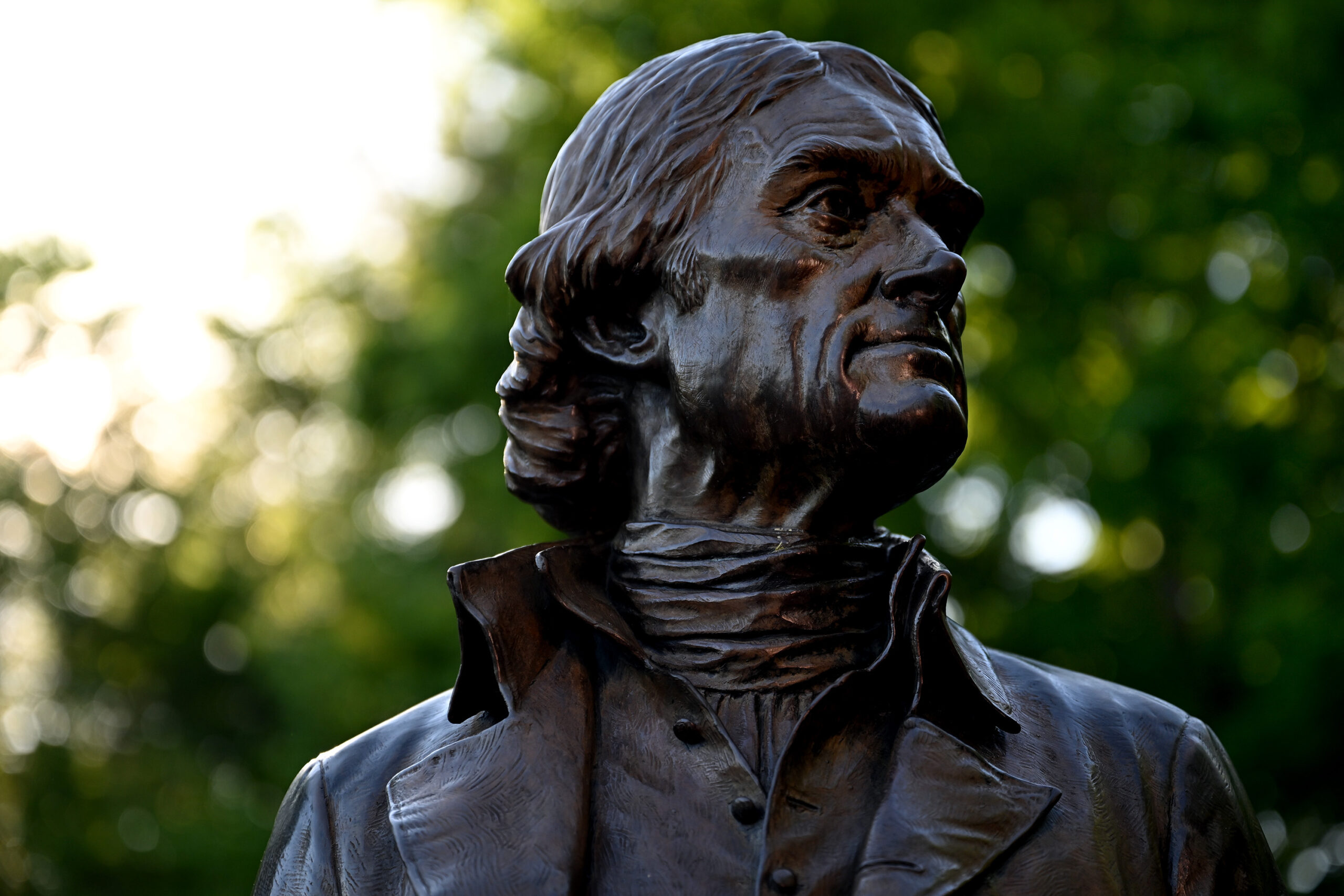
    Statue of Thomas Jefferson at Monticello, his primary residence and plantation of in Charlottesville, Virginia, April 22, 2026.

    In his parlor, with the tall clock ticking and Bob tending to tea, Jefferson works fast, pulling from his own writing — including his recent draft for a new Virginia constitution — and also from a declaration of rights for Virginia, penned by pal George Mason. From the whirling stream of his intellect, he plucks at will the inspirations and ideals of the seminal works of enlightened thinkers like John Locke and David Hume, whose writings on natural rights and freedom (“Life, liberty, and property,” Locke wrote, before Jefferson amends it for the better) provide the bedrock for the revolution.

    Quickly, he begins to find his words. The rag paper fills.

    “We hold these truths to be self-evident,” writes the man from Monticello.

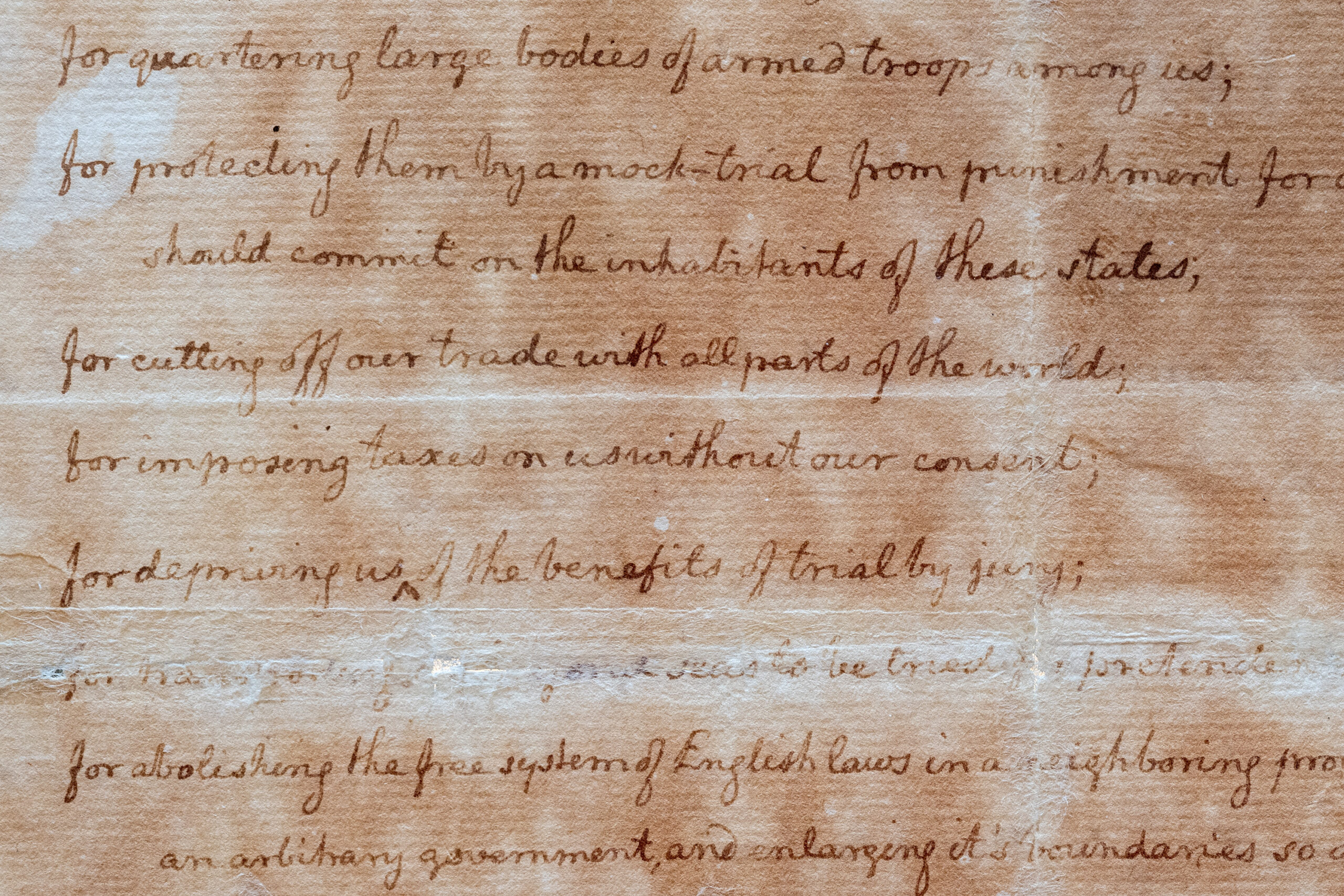
    A faded copy of a draft of the Declaration of Independence handwritten by Thomas Jefferson, known as the “Fair Copy,” on display at the American Philosophical Society Monday, June 15, 2026.

    Dispatches from 1776, Part III will be published online on July Fourth. Read Part I here.

    This historical sketch is based on interviews with Tyler Putman, manager of gallery interpretation at the Museum of the American Revolution, and Michael Idriss, manager of the African American interpretive program at the Museum of the American Revolution, as well as J.M. Duffin, assistant archivist at Penn Libraries, historian and author Michelle Craig McDonald, and Stephen Nepa, history professor at Pennsylvania State University’s Abington campus. The author also based this series on historical newspaper accounts and research from “John Adams,” by David McCullough (Simon & Schuster, 2001), “Declaration: The Nine Tumultuous Weeks When America Became Independent, May 1-July 4, 1776,” by William Hogeland (Simon & Schuster, 2010), “American Scripture: Making of the Declaration of Independence,” by Pauline Maier (Random House, 1997), “The Revolutionary: Samuel Adams,” by Stacy Schiff (Little, Brown & Co., 2022), “Cocked and Boozy: An Intoxicating History of the American Revolution,” by Brooke Barbier (Chicago Review Press, 2026), “Thomas Jefferson: The Art of Power,” by Jon Meacham (Random House, 2012), “Rum Punch and Revolution: Taverngoing and Public Life in Eighteenth Century Philadelphia,” by Peter Thompson (University of Pennsylvania Press, 1999), “The Thomas Paine Reader” (Penguin Books, 1987), and “1776,” by David McCullough (Simon & Schuster, 2005).

  • A time capsule meant to be opened in 250 years will be buried in Philly next week

    A time capsule meant to be opened in 250 years will be buried in Philly next week

    Next week, Philadelphia will begin a centuries-long stint as the host of a time capsule that is not meant to be unearthed for a quarter of a millennium.

    Set to be buried on July Fourth at Independence National Historical Park, the time capsule comes to the city as part of the celebrations surrounding the United States’ Semiquincentennial. After its burial, it is not slated to be seen again until 2276.

    Known officially as “America’s Time Capsule,” it features items from every U.S. state and territory, as well as contributions from the three branches of government. Its creation was led by America250, a national, nonpartisan organization that Congress placed in charge of the 250th birthday celebrations.

    Weighing in at 900 pounds, the time capsule — a massive cylinder emblazoned with an “America250” logo on its side — was sealed shut last week at a ceremony in Gaithersburg, Md. Its unveiling 250 years from now is intended to show future generations “the care, pride, and optimism with which Americans marked our 250th anniversary,” said America250 chair Rosie Rios in a statement.

    Inside the capsule, which is constructed of stainless steel, archival contents sit organized largely in small boxes, with paper documents in a separate compartment. Many states submitted hundreds of letters, postcards, posters, poems, and other printed material for inclusion.

    America250 has posted a detailed list of all the items included in the time capsule. Pennsylvania, for example, contributed a letter from Gov. Josh Shapiro, as well as an archival booklet. New Jersey, meanwhile, ponied up a stainless steel plate inscribed with a greeting for the time capsule’s future openers. And Delaware sent in a set of a dozen notecards from residents detailing their thoughts on what the state means to them.

    There were some guidelines on what states could submit, as items that could degrade or rust were not allowed. Maryland, as a result, was not able to submit Old Bay seasoning, the Associated Press reported.

    Some items were innovative. A “molecular data storage device” from the Library of Congress was included, and it contains synthetic DNA encoded with copies of several items from the library’s collection — including a draft of the Declaration of Independence, handwritten lyrics for “The Star-Spangled Banner,” and a 3-D rendering of President Abraham Lincoln’s hand, America250 said.

    Items were sealed inside at 35% relative humidity to make sure they did not dry out or disintegrate, as well as to keep them from decaying due to moisture issues. The capsule is slated to be buried 10 feet below ground, which should keep it from being damaged by swings in temperature or storms.

    “Philadelphia would have to be six feet underwater in order for this time capsule to even possibly take on water,” Michael Berilla, director of fabrication technology at the National Institute of Standards and Technology, told the AP. ”And if Philly is six feet underwater, you’ve got way bigger problems in the world.”

    Congress dedicated the time capsule in a ceremony Wednesday. Thomas Austin, architect of the Capitol, said it includes a passage from the Declaration of Independence on its front.

    “For those who have the privilege to work here in the Capitol, you get a sense that you are just one chapter in a long history book,” Austin said. “The U.S. Capitol is a symbol of that history. In fact, it is the symbol of that American history.”

    This is not the first time capsule project undertaken by the United States. In 1976, President Gerald Ford opened a “Century Safe” that had been created a century before, and the country that year created a Bicentennial capsule that is to be opened in 2076.

    The time capsule set to be buried in Philadelphia on July Fourth, meanwhile, will be marked with a capstone that includes information about its contents and creation. Additional details about the time capsule’s burial were still forthcoming Friday, according to the America250 website.

    This article contains information from the Associated Press.

  • How to celebrate the 250th in Philly

    How to celebrate the 250th in Philly

    America’s 250th is a big deal for Philadelphia. Our nation was born right here on July 4, 1776, which gives us plenty of reason to celebrate with our Semiquincentennial in Philadelphia, centered around Independence Day and beyond.

    Philly and the region have been busy planning for the nation’s milestone birthday bash for what feels like forever, and now the time is finally here. Whether you’re a local who has been gearing up for this moment or a visitor ready to explore Philly this summer, you’ll find plenty of ways to join in on the festivities.

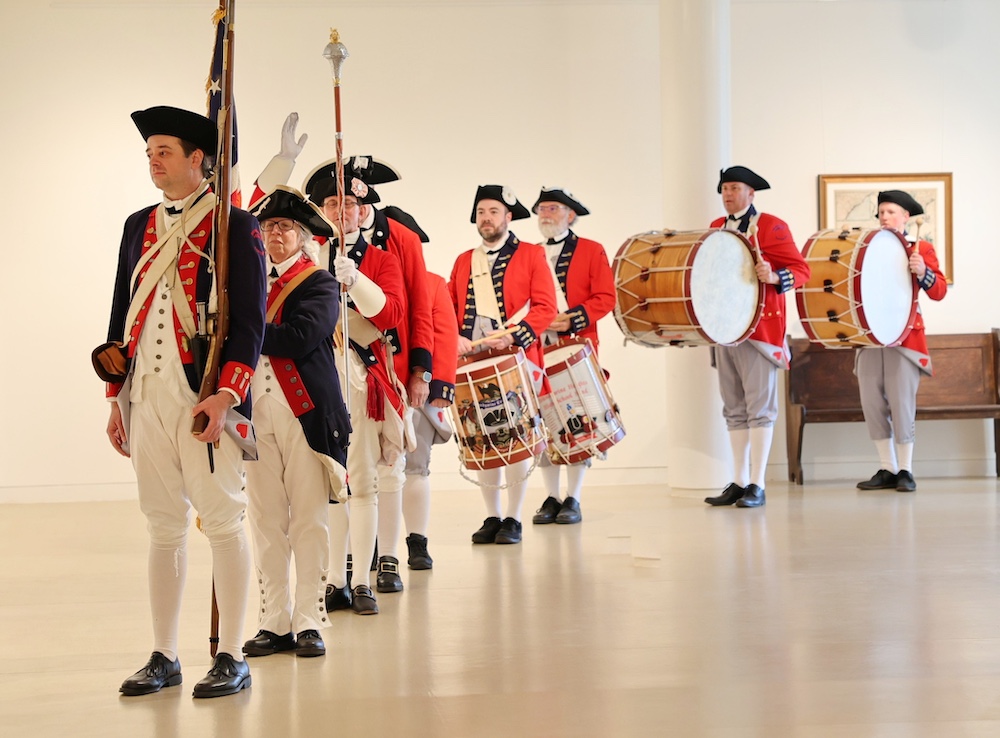
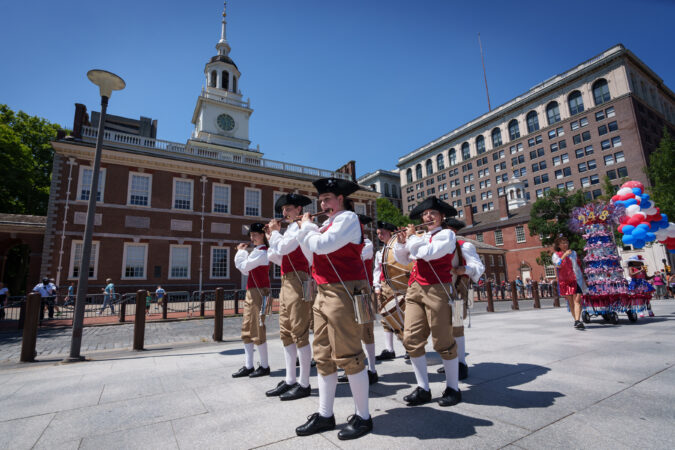
    Brandywine Colonials Fife and Drum Corps.

    Independence Weekend at Schwenkfelder Library and Heritage Center

    The Schwenkfelder Library and Heritage Center in Montgomery County kicks off the holiday weekend with its annual event in New Goshenhoppen Park, including a parade. Brandywine Colonials Fife and Drum Corps performs July 4 with a reading of the Declaration of Independence, followed by music from the Corps and the Red Hill Band before a fireworks display. Heritage Day closes out the weekend at the Heritage Center with crafts for kids and exhibits the whole family can enjoy.

    July 3-5 at various locations and times; free; schwenkfelder.org/250

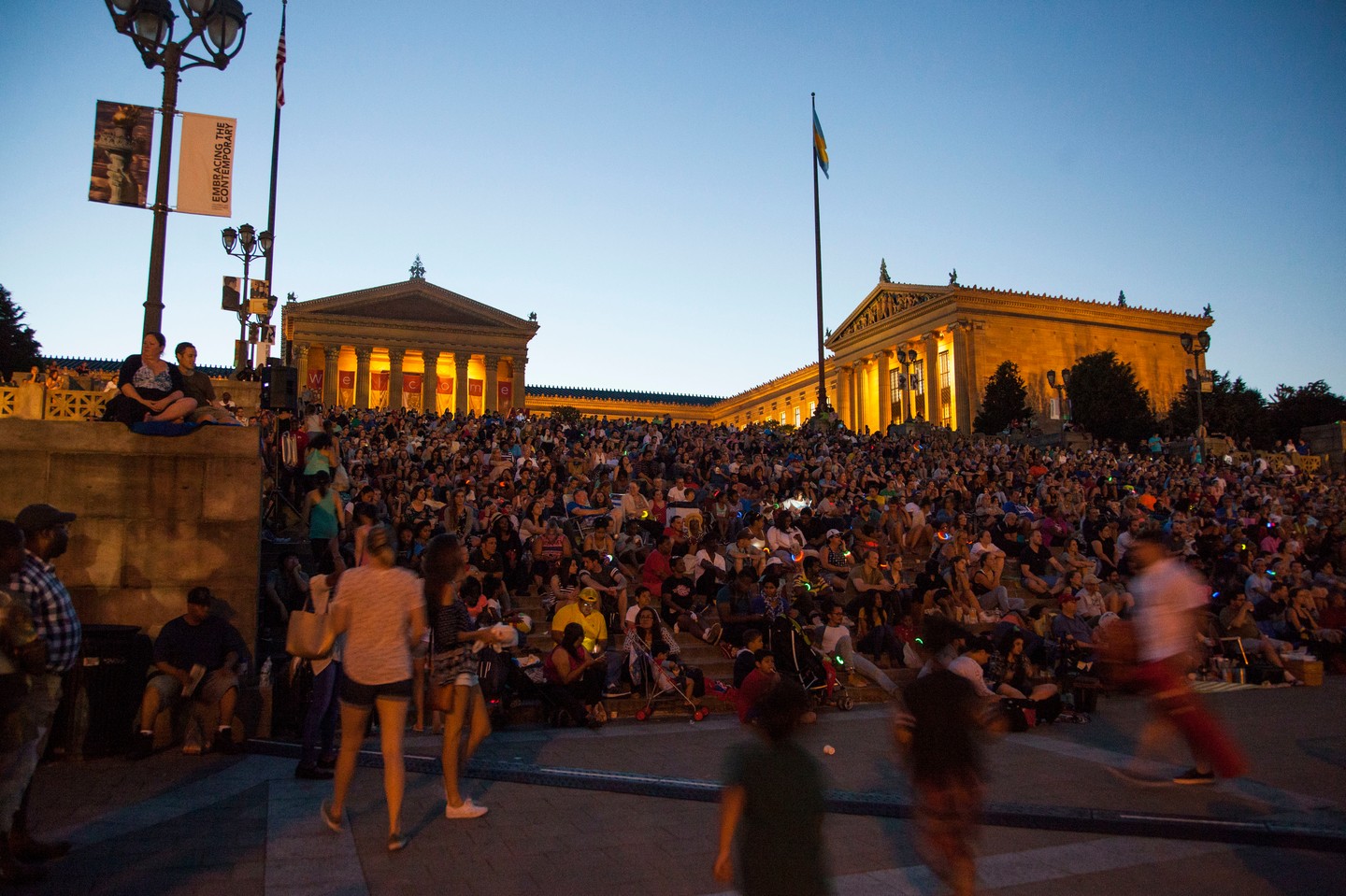
    One highlight of the Wawa Welcome America festival, Philadelphia’s multiday Independence Day celebration, is outdoor movies shown on big screens in iconic city spots. Crowds gather on the steps of the Philadelphia Museum of Art for a free screening of the 1976 classic “Rocky,” starring Sylvester Stallone.

    Wawa Welcome America and One Philly: Unity Concert for America

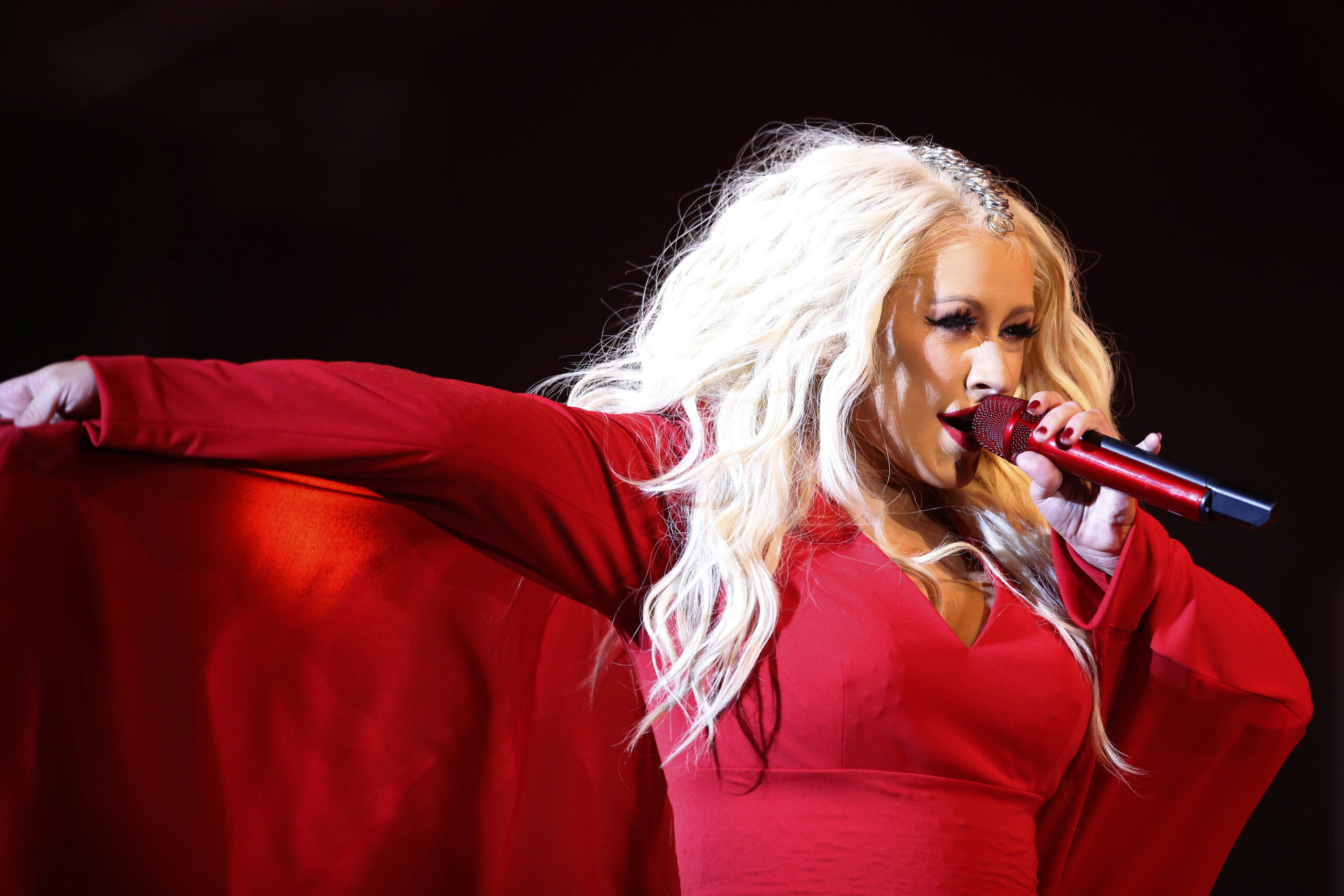
    A local tradition closes its final weekend on July 3 with the Salute to Independence Semiquincentennial Day Parade, the largest of its kind in the nation, featuring 50 marching bands and 13 floats, beginning at noon at 5th and Chestnut Streets. Later in the evening, a live concert featuring patriotic orchestral music takes place from 7-9 p.m. at Independence Mall, with multi-platinum-selling singer/songwriter and Tony Award-winning performer Idina Menzel headlining with the Philly Pops. On July 4, One Philly: Unity Concert for America takes over the Benjamin Franklin Parkway for a free all-day concert featuring Christina Aguilera, Jill Scott, The Roots, Will Smith & DJ Jazzy Jeff, Seal, and others, hosted by Wanda Sykes.

    July 3-4 at various locations and times; free; july4thphilly.com

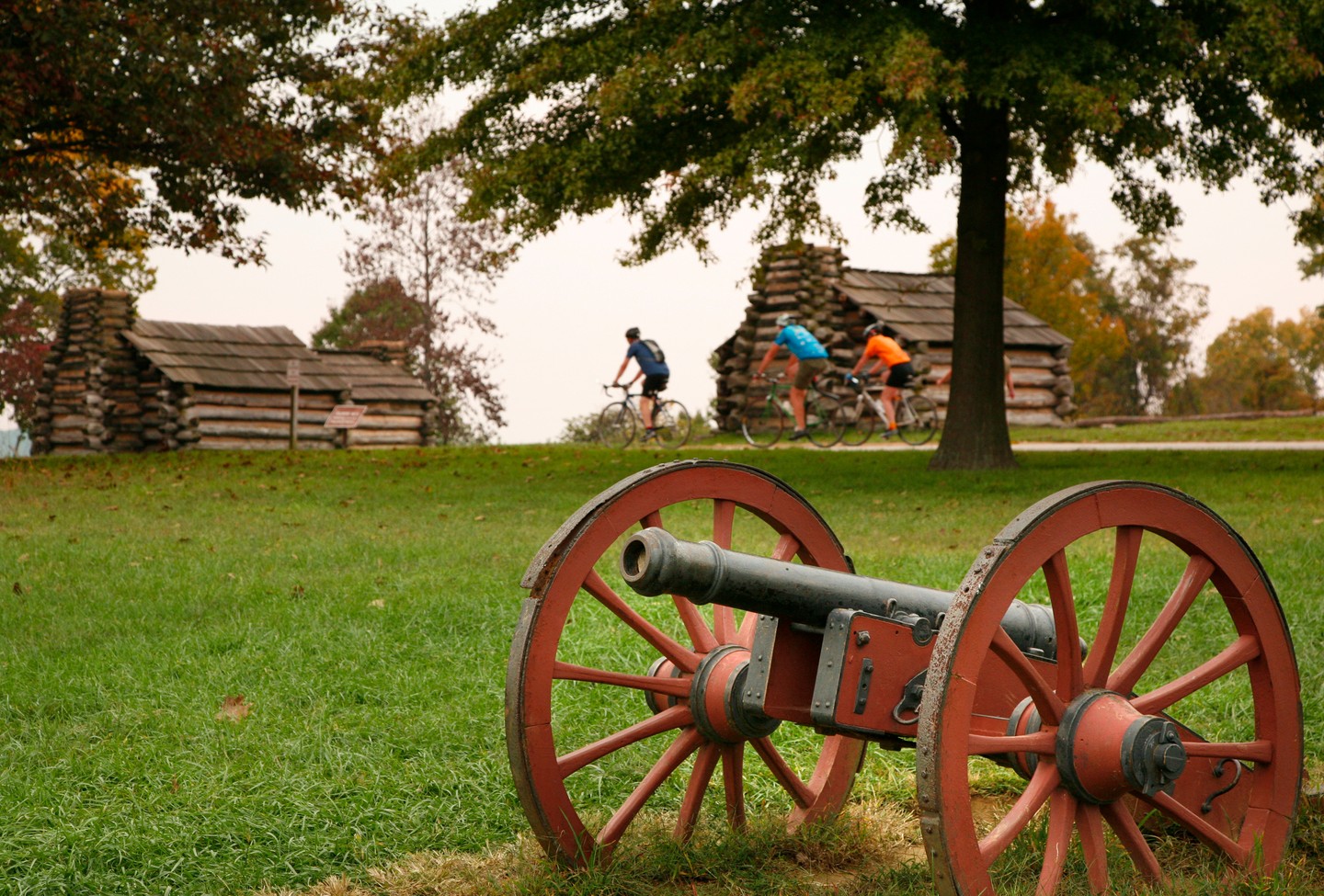
    Valley Forge National Historical Park turns 50 this year.

    Valley Forge National Historical Park’s 50th Birthday

    Valley Forge National Historical Park turns 50 over the July 4 weekend, celebrating with musket-firing demonstrations at Muhlenberg’s Brigade throughout the day on July 3. Philly’s own Hot Taters will perform live at the National Memorial Arch, and a reenactor portraying Anna Morris Holstein, the woman who helped make Washington’s Headquarters a true local landmark in 1879, will take place on the 4th, followed by a closing ceremony on July 5.

    July 3-5 at Valley Forge National Historical Park; free; nps.gov/articles/000/retreat-to-valley-forge.htm

    America Celebrates 250 in New Hope

    America Celebrates 250 holds a three-day festival in New Hope, Bucks County, featuring fireworks and a drone show over the Delaware River on July 3, accompanied by a pub crawl toward a Revolutionary-themed tavern tent with a cash bar and actors performing as patriots on July 4. The Freedom Parade starting in New Hope and the Dragon Boat race on the river will conclude the weekend events on July 5.

    July 3-5 at various locations and times; free; americacelebrates.org/our-events

    Houses of Declaration in Montgomery County

    Montgomery County presents a series of public readings of the Declaration of Independence throughout the July Fourth weekend at various locations, including the Elmwood Park Zoo. The Tapestry Historic Dance Ensemble will perform period dances at 859 County Line Road in Horsham, and guests can channel Thomas Jefferson by practicing writing with a quill pen, as he once used to sign the Declaration.

    July 3-5 at Montgomery County locations; free; valleyforge.org/america250-montcopa/

    America’s Time Capsule to be buried at Independence Hall

    On July 4, America’s Time Capsule, a stainless steel cylinder containing a collection of letters and artifacts from each state, will be buried at Independence National Historical Park. Spectators will have the opportunity to be part of this historical moment, as this capsule will remain sealed for the next 250 years, until 2276, when the generations of that time will be able to recover it.

    July 4 at Independence National Historical Park; free; https://america250.org/time-capsule/

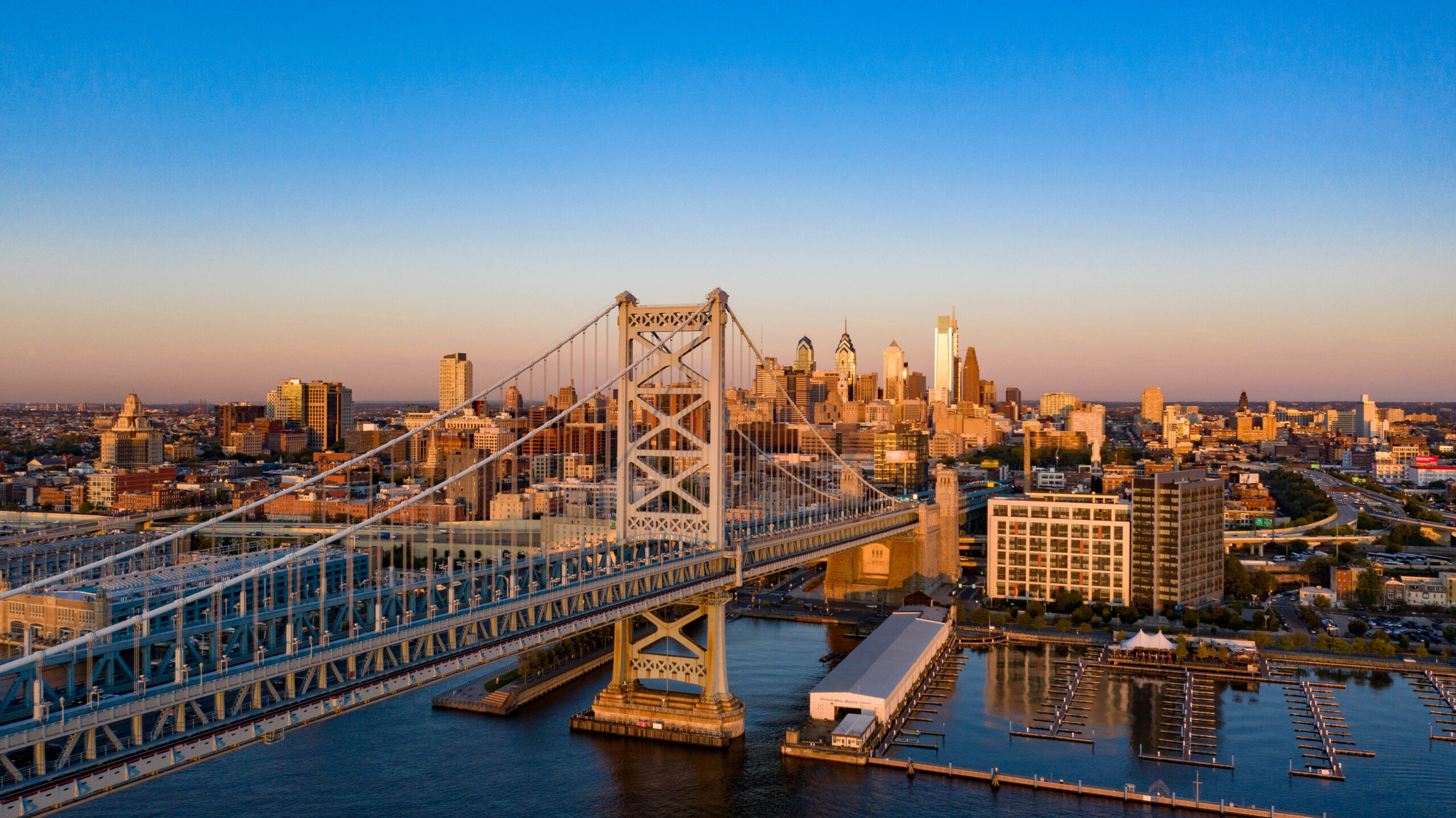
    Completed in 1926, the Ben Franklin Bridge connects Camden and Center City (pictured) over the Delaware River. The 1,750-foot-long span, designed by architect Paul Philippe Cret, was once the longest suspension bridge in the world.

    Ben Franklin Bridge 100th anniversary

    On July 11, the Delaware River Port Authority celebrates the 100th anniversary of the Ben Franklin Bridge with live music, performances, food trucks, and carnival rides. Hosted on the Camden side of the bridge near the toll plaza, a pop-up museum offers attendees a better understanding of this iconic structure’s legacy and features artifacts from the world’s longest suspension bridge.

    July 11 in Camden near the Ben Franklin Bridge toll plaza; free; https://drpa.org/bfb100/index.html

    Philly Phlotilla on the Schuylkill and Delaware Rivers

    More than 100 patriotic kayakers dressed in red, white, and blue will paddle the rivers July 11 for the Philly Phlotilla event. Starting at the Walnut Street Dock, the 8-mile paddle, led by experienced guides, will reach the historical site of Fort Mifflin, known as the “Fort that Saved America.” Paddlers and non-paddlers alike can take in the post-Phlotilla festivities for dinner, cannon firing, and tours of the historic fort.

    July 11 at Walnut Street Dock; $50 and up; schuylkillriver.org/america250-paddle/

    America’s 250th in Newtown

    Newtown in Bucks County packs a full day of spirited events throughout the borough on Aug. 8 to celebrate the nation’s historic milestone. The Old Presbyterian Church of Newtown will hold graveyard tours, while the Newtown Fire House Museum presents its display of antique fire trucks, and the Newtown Theatre sets the stage with period music from a Civil War band.

    Aug. 8 at various locations; free; newtown2026.com/

    Illumination 250 Drone Show in Havertown

    The Haverford High School Football Stadium in Havertown hosts a patriotic-themed drone show on Aug. 29 to mark the country’s anniversary. The day begins with live music, crafts, and other family-friendly activities, with food trucks on the premises, all leading up to an evening of a choreographed illuminated drone display paired with themed music.

    Aug. 29 at Haverford High School Football Stadium; free, donations appreciated; discoverhaverford.org/america250-celebration

  • 1 in 4 Philadelphians say preserving historical sites is city’s top ‘responsibility to the nation,’ poll shows

    1 in 4 Philadelphians say preserving historical sites is city’s top ‘responsibility to the nation,’ poll shows

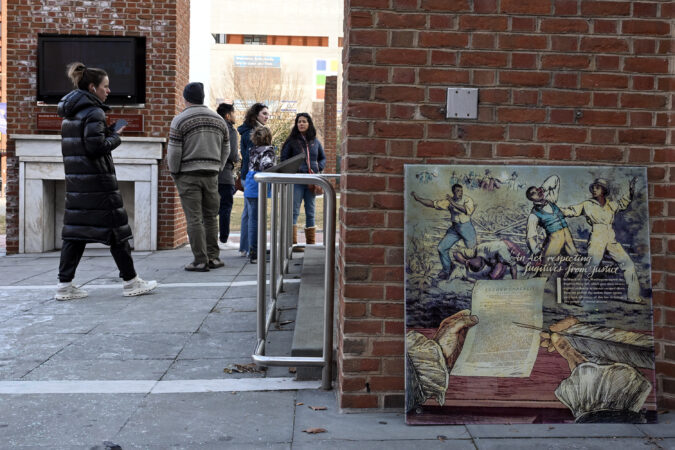
    President Donald Trump’s administration got the green light from a federal appeals court last week to install its own version of the historical exhibits at the President’s House Site on Independence Mall after it dismantled panels about slavery there earlier this year.

    But that may not jibe with what many Philadelphians want to see.

    A new Suffolk University/Philadelphia Inquirer CityView poll of 500 city residents found that a quarter of respondents believe the city’s primary responsibility to the nation is to protect its historical sites for future generations. Nearly 27% said the city’s primary responsibility to the nation is to serve as a model for “diverse, multicultural urban progress.”

    The poll, conducted from June 16 to 20 and released this week, comes after a ruling by the U.S. Court of Appeals for the Third Circuit in favor of the Trump administration and just weeks ahead of celebrations in Philadelphia for the nation’s 250th birthday.

    (function(){function e(){window.addEventListener(`message`,function(e){if(e.data[`datawrapper-height`]!==void 0){var t=document.querySelectorAll(`iframe`);for(var n in e.data[`datawrapper-height`])for(var r=0,i;i=t[r];r++)if(i.contentWindow===e.source){var a=e.data[`datawrapper-height`][n]+`px`;i.style.height=a}}})}e()})();

    The appeals court’s ruling last week was a turning point in a legal battle waged by Mayor Cherelle L. Parker’s administration that questioned the federal government’s authority to interfere in what information is presented at the President’s House. Both the Third Circuit ruling and a recent decision by a Boston-based federal appeals court regarding National Park Service exhibits nationwide have started to pave the way for the Trump administration to make unprecedented changes to displays of U.S. history in the region.

    Alacia Maxton, 36, a respondent to the poll, said frustration with the attacks on the President’s House has been at the forefront of her mind as the city prepares to celebrate the Semiquincentennial.

    For nearly two decades without opposition, the site — which opened in December 2010 — has memorialized the nine people George Washington enslaved at his Philadelphia residence during the founding of America and detailed the brutality of slavery.

    Last month, it was designated as an endangered historic site by a major national historic preservation organization. The new panels proposed by the Trump administration to replace the removed exhibits at the President’s House soften Washington’s role as an enslaver, according to those working to protect the site.

    “I don’t like the idea that certain groups of people want to whitewash history and erase what doesn’t make them feel comfortable,” said Maxton, who lives in Overbrook Park.

    Carolyn Keys, 61, another resident who responded to the poll, said the absence of the some of the original panels is like “missing pieces to a puzzle.”

    “Every piece was specifically put together for a purpose,” said Keys, 61, a veteran who lives in the Tacony neighborhood.

    David Paleologos, director of the Suffolk University Political Research Center, said Philadelphians valuing preserving history and being a model for progress is a particularly localized issue.

    “Which I think makes this really important information for the nation to see,” Paleologos said.

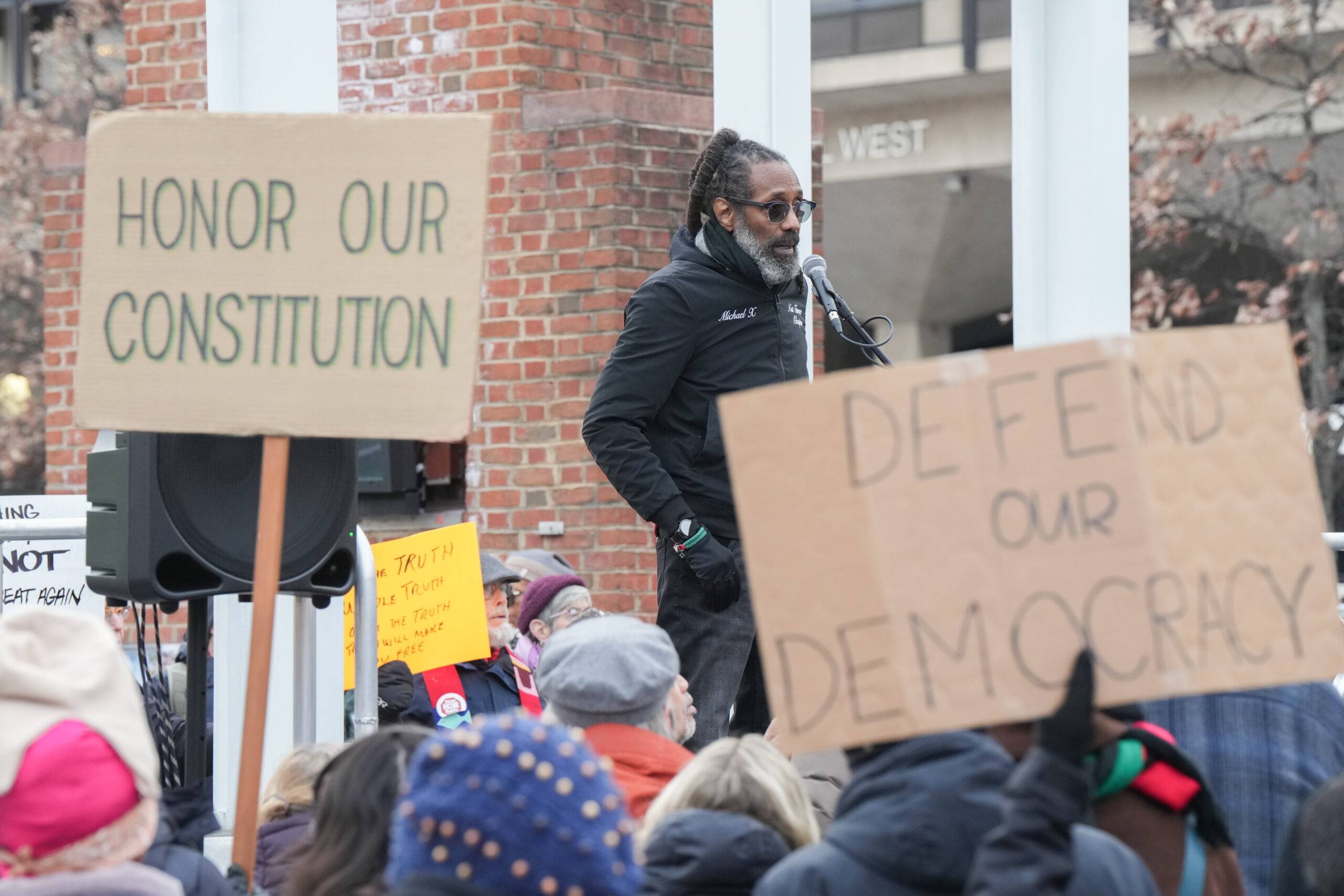
    Philadelphia Lawyer Michael Coard speaks at a rally at the President’s House Site in response to the removal of the President’s House exhibit in Old City, in Philadelphia, Tuesday, Feb. 10, 2026, in Philadelphia

    A bipartisan grassroots group of Philadelphians — called the President’s House/Slavery Memorial Coalition — has been spearheading efforts to protect the historical site, which has been under scrutiny from the Trump administration since last summer.

    The group has often discussed a desire for its work in Philadelphia to be a model for preserving history elsewhere in the country.

    Michael Coard, an attorney and founder of one of the leading groups in the efforts to protect the President’s House, said in a statement Wednesday that the poll results show that “Philadelphians understand the importance of protecting our shared history.”

    “Black history is American history, and we have both an obligation and, based on these results, a clear mandate to ensure that the stories of enslaved Africans and their descendants are preserved, honored, and accurately told,” Coard said.

    Other respondents had different ideas for Philadelphia’s primary responsibility as the birthplace of democracy: Roughly 23% said “leading national conversations on civil rights and economic justice” was a top priority, while almost 17% said the city’s duty to the nation is “proving that a large, complex city can govern itself equitably.”

    These insights come as Philadelphia is bracing for an influx of tourists, with particular emphasis on its history as the nation’s birthplace, ahead of the Semiquincentennial celebrations.

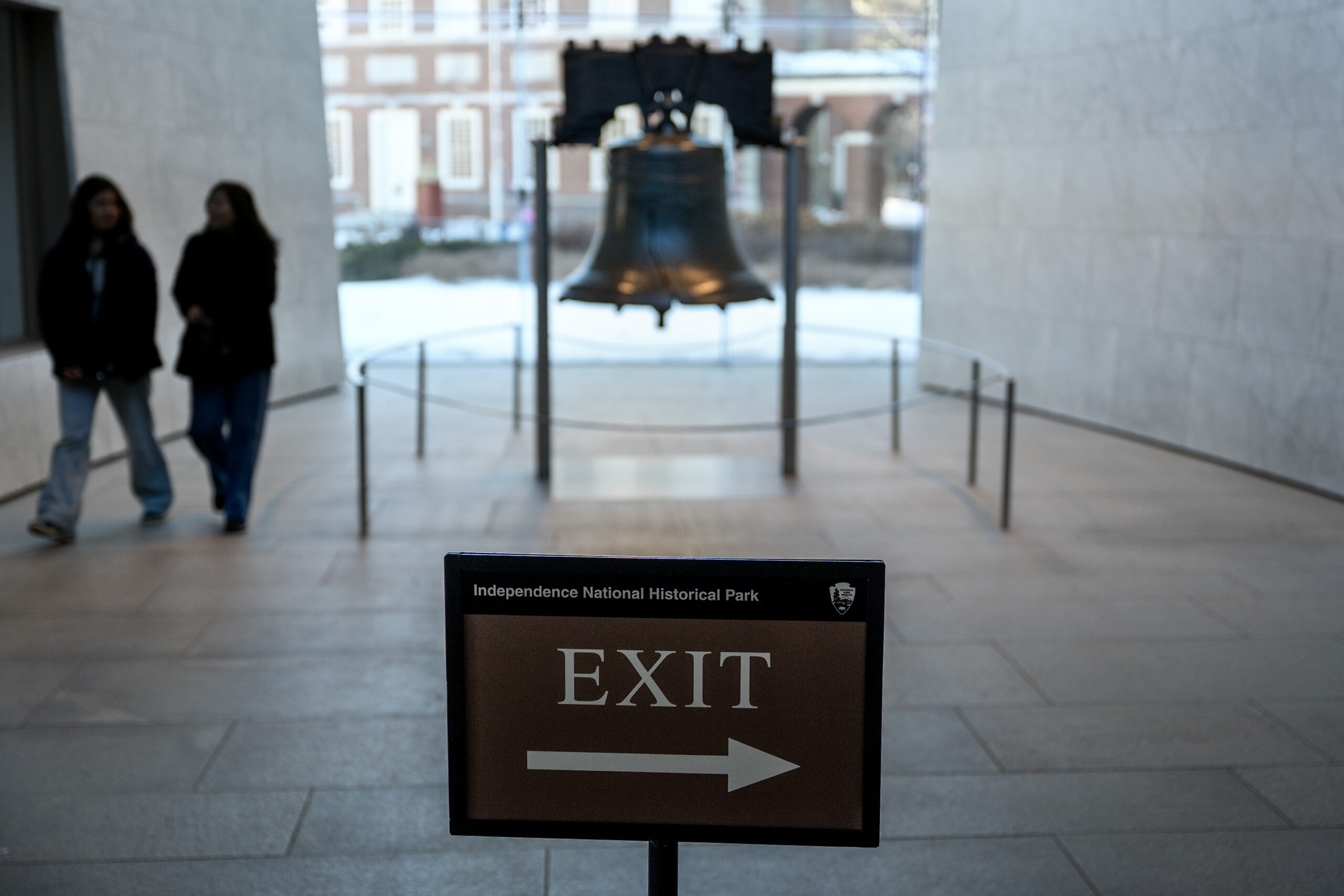
    The Liberty Bell in Independence National Historical Park Feb. 2, 2026.

    Almost 28% of the Philadelphia residents polled see the Liberty Bell — in comparison to Independence Hall, the National Constitution Center, and the Rocky Steps — as the city landmark that best embodies American democracy.

    But hanging over the impending 250th celebrations is the uncertain fate of the President’s House, said Leeanna Lundy, 34, of West Philly.

    “For them to remove where the most impactful part of where history took place, it’s like mind-boggling,” Lundy said.

    Staff writer Michelle Baruchman contributed to this article.
  • Parts of Fairmount Park were not only the site of America’s first paper mill, but also the country’s first company town

    Parts of Fairmount Park were not only the site of America’s first paper mill, but also the country’s first company town

    We take paper for granted now. But in the late 1600s, when Pennsylvania’s founder William Penn recruited German papermaker and preacher William Rittenhouse to manufacture the writing parchment in the New World, paper was a luxury.

    England’s King William III made it difficult for his subjects — at home and in the Americas — to have it. Like many monarchs of his day, he believed it was the Crown’s duty to record history.

    The English imported paper from other European countries. So, to make matters worse, colonists who managed to appeal to the king for paper were double and triple taxed. They got fed up and went about securing their own paper to document the goings on in the government, inform citizens, record history, and ultimately plan a revolution.

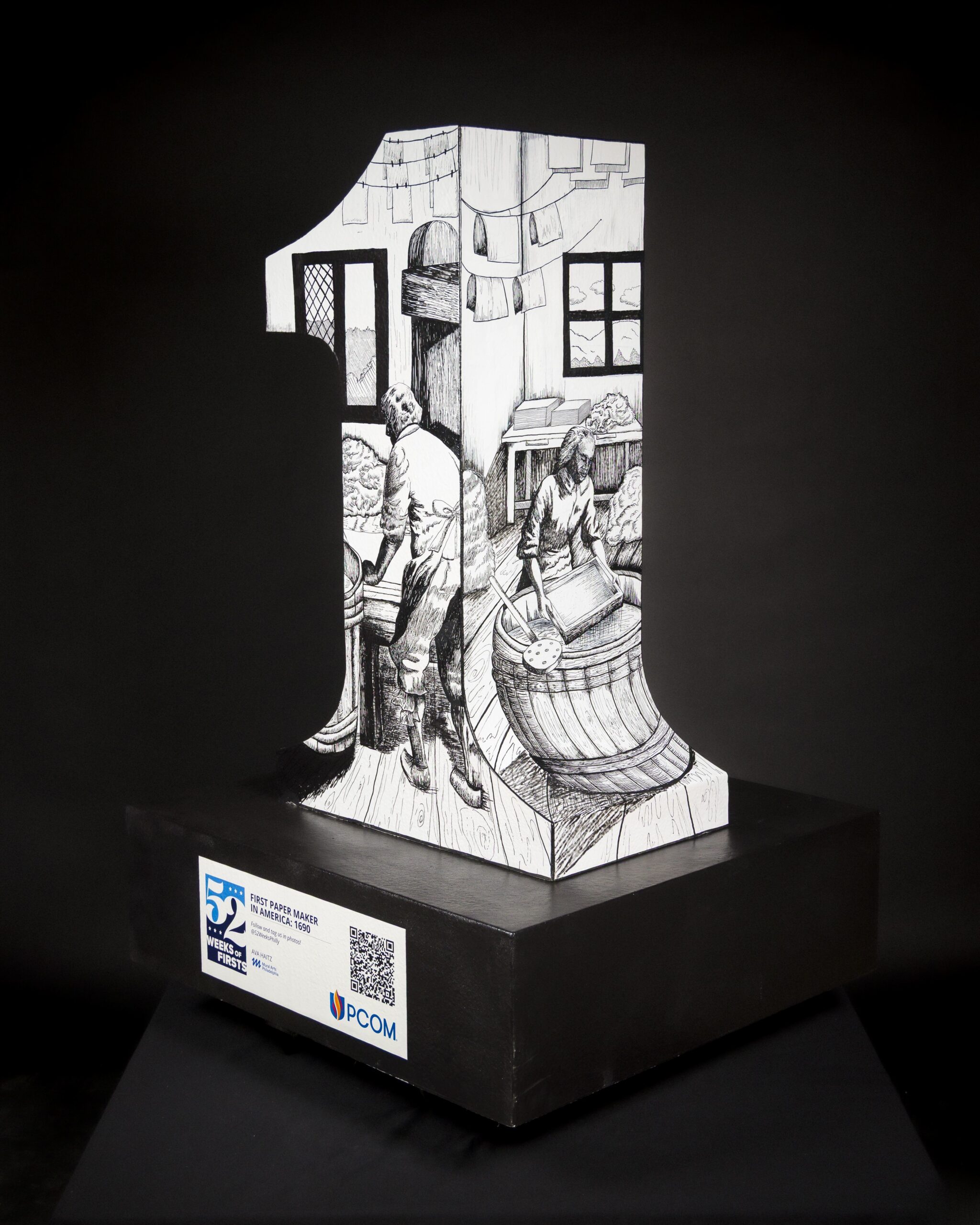
    Artist Ava Haitz’s No. 1 honors the country’s first paper mill, celebrating the invention and craftsmanship that made widespread written communication possible.
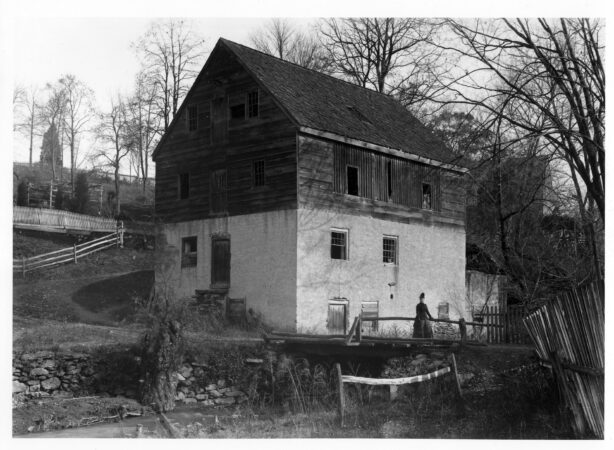
    In 1690, Rittenhouse partnered with Philadelphia’s first printer, William Bradford, to build America’s first paper mill, situated in northwest Philadelphia and powered by the Monoshone Creek, a tributary of the Schuylkill.

    The paper mill will be celebrated this Saturday at Historic RittenhouseTown, part of a series of weekly “Firstival” celebrations. Firstivals are the Philadelphia Historic District’s yearlong birthday nod to places and events with Philadelphia roots. The day parties are a hallmark of this year’s Semiquincentennial fetes.

    At the Rittenhouse mill, paper was made from linen rags fashioned from flax grown in Germantown, that were broken down and shaped into sheets. The mill grew quickly as Rittenhouse, America’s first Mennonite bishop, provided paper for Bibles and Quaker and Mennonite texts in German.

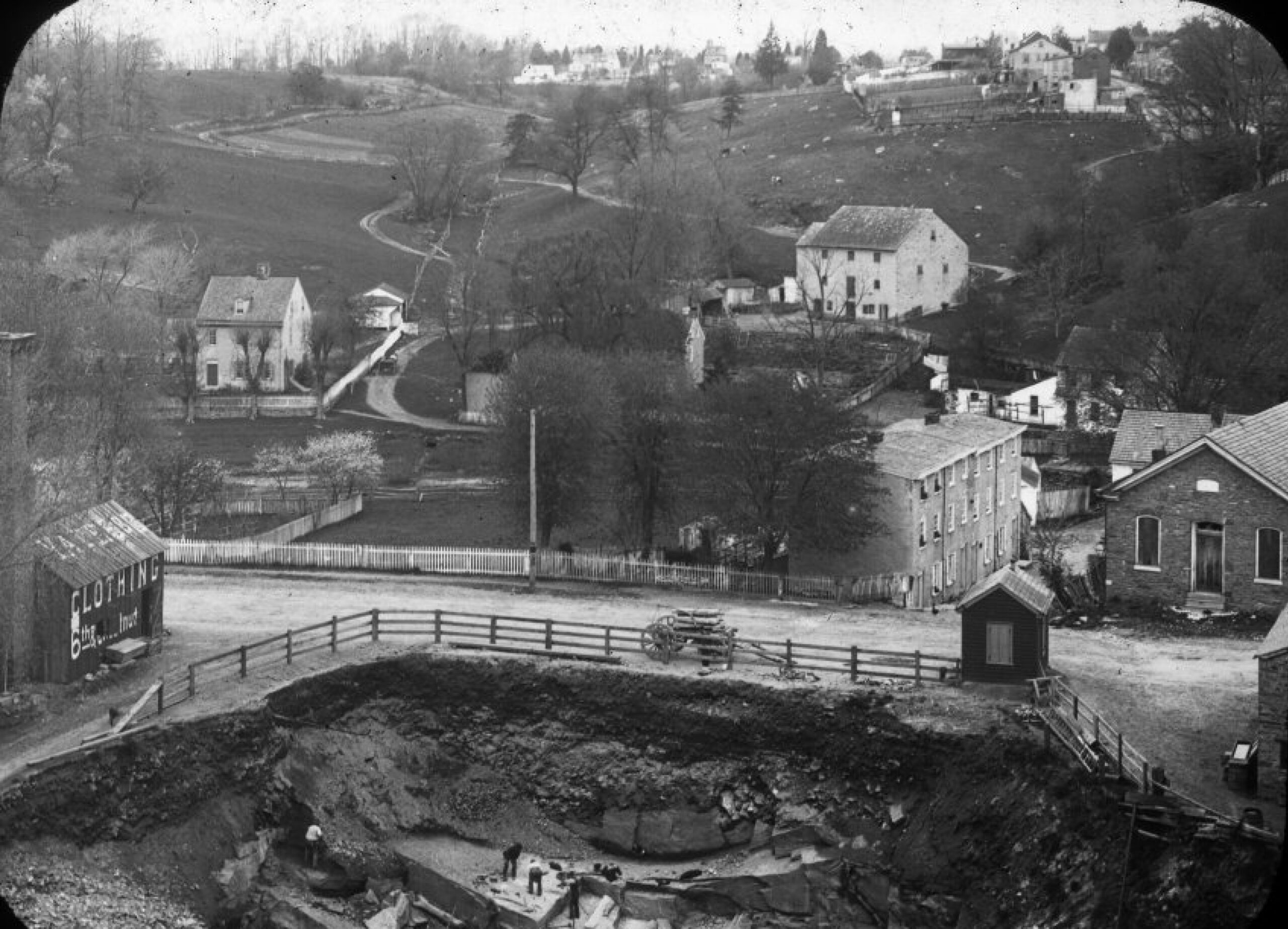
    An aerial view of RittenhouseTown circa 1840-1860. The site eventually grew to more than 200 acres.

    Rittenhouse’s first paper mill was destroyed by a flood, said Alexander Jones, preservation and education manager at Historic RittenhouseTown.

    Then “Rittenhouse rebuilds and he buys out his partner,” Jones said. “The paper mill becomes his sole enterprise. Instead of hiring workers, he recruits his family and it becomes a giant company town. There is a church, a blacksmith, stone houses, a bake house, and more than 40 buildings with five or six of them under what is now Lincoln Drive.”
    RittenhouseTown’s paper mill was the only source of paper in America for more than 40 years, Jones said. It would grow to more than 200 acres.

    David Rittenhouse — Rittenhouse’s great-grandson and the astrologer, clockmaker, and first director of the U.S. Mint after whom Rittenhouse Square is named — was born in his family’s RittenhouseTown homestead in 1732.

    The town thrived for more than a century.

    By the mid-1800s, the paper mill began to slow down as dyes from textile and carpet manufacturers and chemicals from blacksmithing started to pollute the Schuylkill. The filthy water made it nearly impossible to produce good quality paper at the mill.

    The Fairmount Park Commission began acquiring parts of RittenhouseTown through a series of purchases and donations from 1890 to 1917. The city demolished many of the town’s buildings, including a barn that, Jones said, was razed and rebuilt within a year.

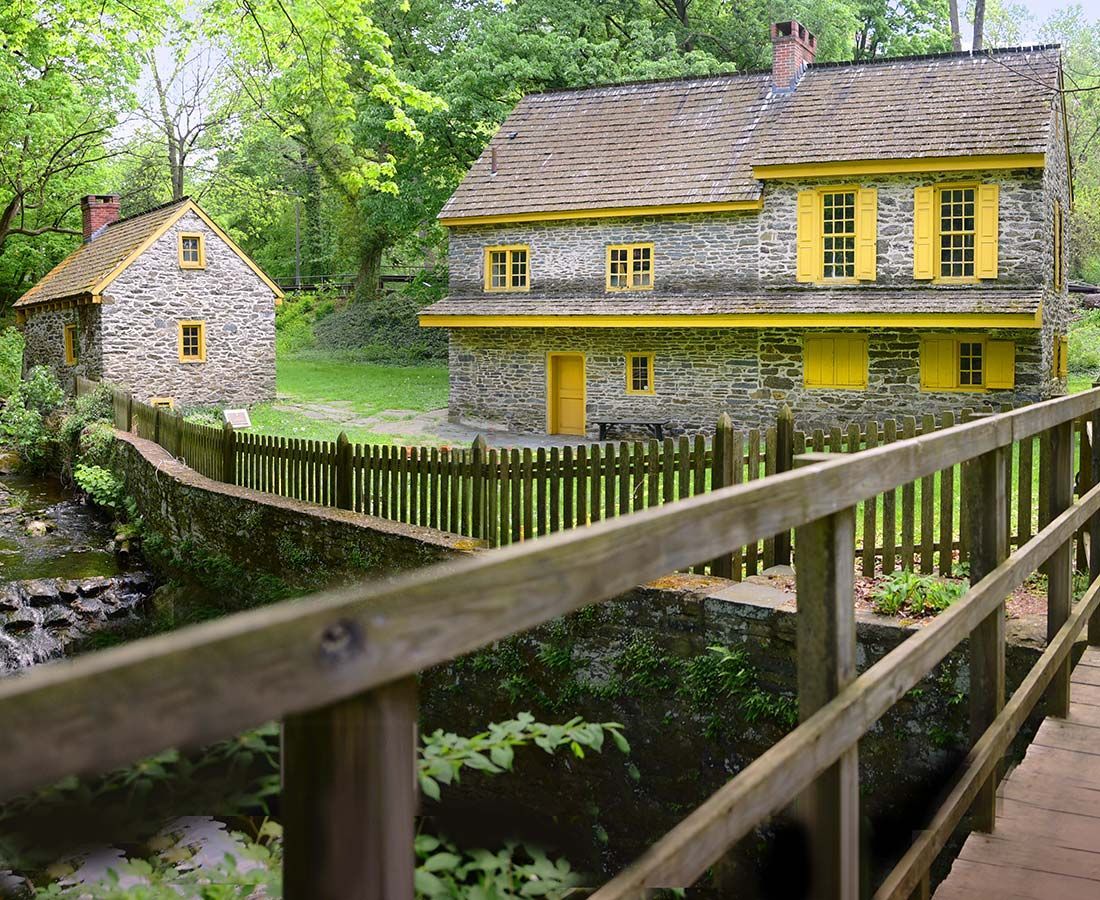
    RittenhouseTown’s homestead and bakehouse. The first permanent home for the Rittenhouse family and birthplace of David Rittenhouse, great-grandson of William Rittenhouse for whom Center City’s Rittenhouse Square is named.

    By that time, however, the Rittenhouse family had spread throughout the Philadelphia region from Center City to Blue Bell, Jones said.

    Today, RittenhouseTown spans 20 acres nestled in Fairmount Park right behind Lincoln Drive. Six of the original buildings remain, serving as a reminder that RittenhouseTown was the first building block of American industry.

    “The paper mill really got the ball rolling for Philadelphia,” Jones said. “And from that first came so many other American firsts in Philadelphia: the first Mennonite bishop, the first company town, and America’s first director of the U.S. Mint.”

    This week’s Firstival is Saturday, June 27, 11 a.m.-1 p.m., at Historic RittenhouseTown, 208 Lincoln Drive.

    The Inquirer is highlighting a “first” from the Philadelphia Historic District’s 52 Weeks of Firsts program each week. A “52 Weeks of Firsts” podcast, produced by All That’s Good Productions, drops every Tuesday.

  • See how Philly museums and arts organizations are celebrating America’s 250th

    See how Philly museums and arts organizations are celebrating America’s 250th

    No city does history quite like Philadelphia — and it’s all on full display this summer for the nation’s 250th. From museums and historic houses to outdoor experiences and more, here are some must-dos over the coming days, weeks, and months.

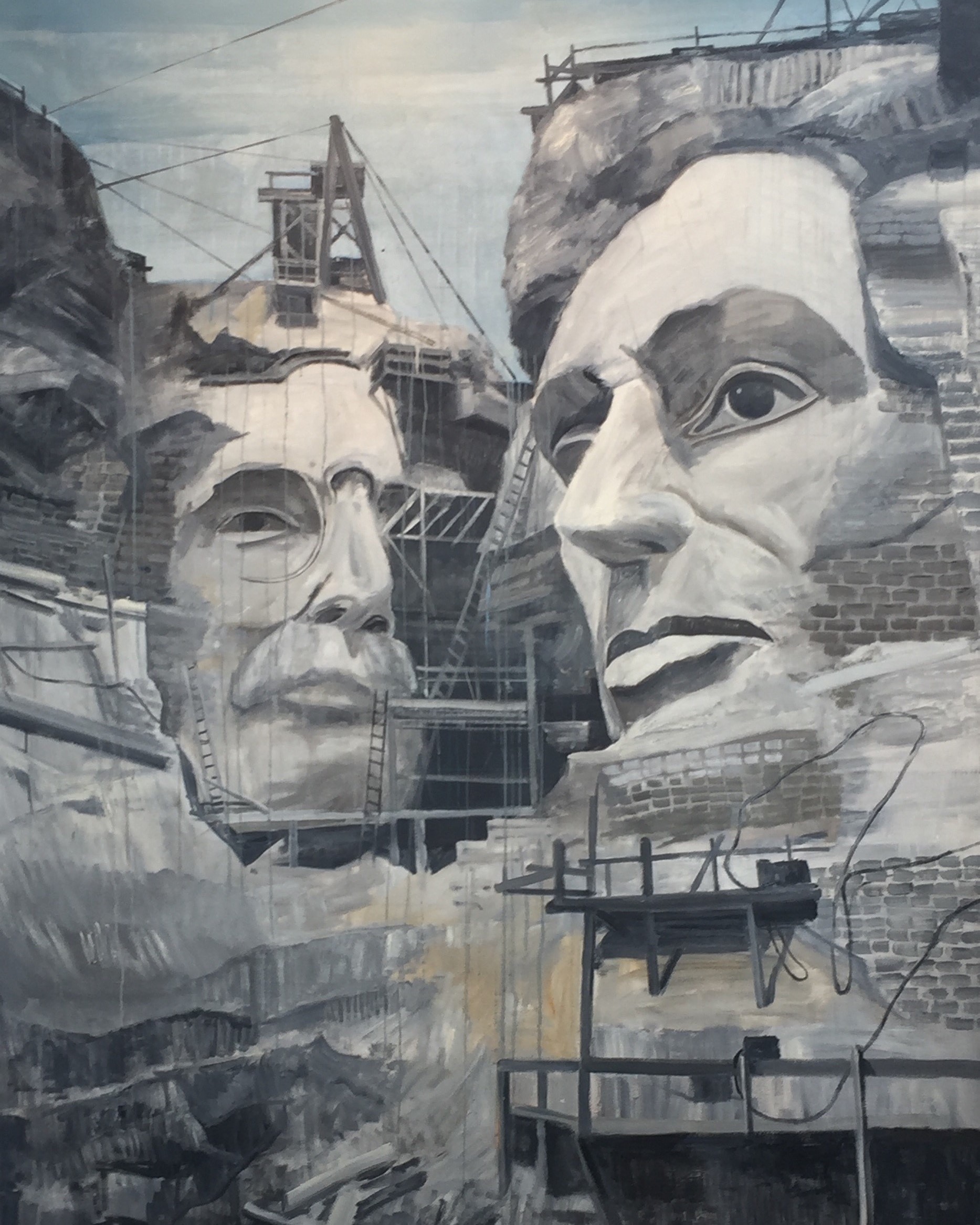
    “Rushmore,” a 2016 painting by Tom Judd, is part of the “Arc of Promise” exhibit at the Woodmere Museum.

    ‘Arc of Promise’

    Woodmere Museum

    Examine how Philadelphia artists have imagined America — from earlier perspectives to modern day — in paintings, sculptures, and other media. Inspired by local artist Jerry Pinkney (1939-2021), whose “arc of promise” concept was influenced by America’s painful histories of slavery, displacement, and injustice, while holding onto the belief that renewal is still attainable.

    9201 Germantown Ave., now through Jan. 10, 2027, woodmeremuseum.org/exhibitions/arc-of-promise

    ‘The First Salute’

    Weitzman National Museum of American Jewish History

    Explore events surrounding Nov. 16, 1776, the day the Dutch governor of St. Eustatius welcomed a ship flying the new American flag into the harbor — making the first recognition of the new nation by a foreign entity. A critical thruway for commerce between Europe and North America, the island’s Dutch leaders offered Jews a relatively high level of religious tolerance. Highlights include a 1761 Hanukkah lamp.

    101 S. Independence Mall East, now through April 2027, theweitzman.org/exhibitions/first-salute/

    Sky Hopinka: ‘Red Metal Dust’

    Barnes Foundation

    View works by artist Sky Hopinka featuring personal perspectives of Indigenous homelands and landscapes. In recognition of the 250th anniversary of the signing of the Declaration of Independence, these works of art thoughtfully explore and interrogate the American experience and its histories.

    2025 Benjamin Franklin Parkway, now through Jan. 18, 2027, barnesfoundation.org/whats-on/exhibitions/sky-hopinka

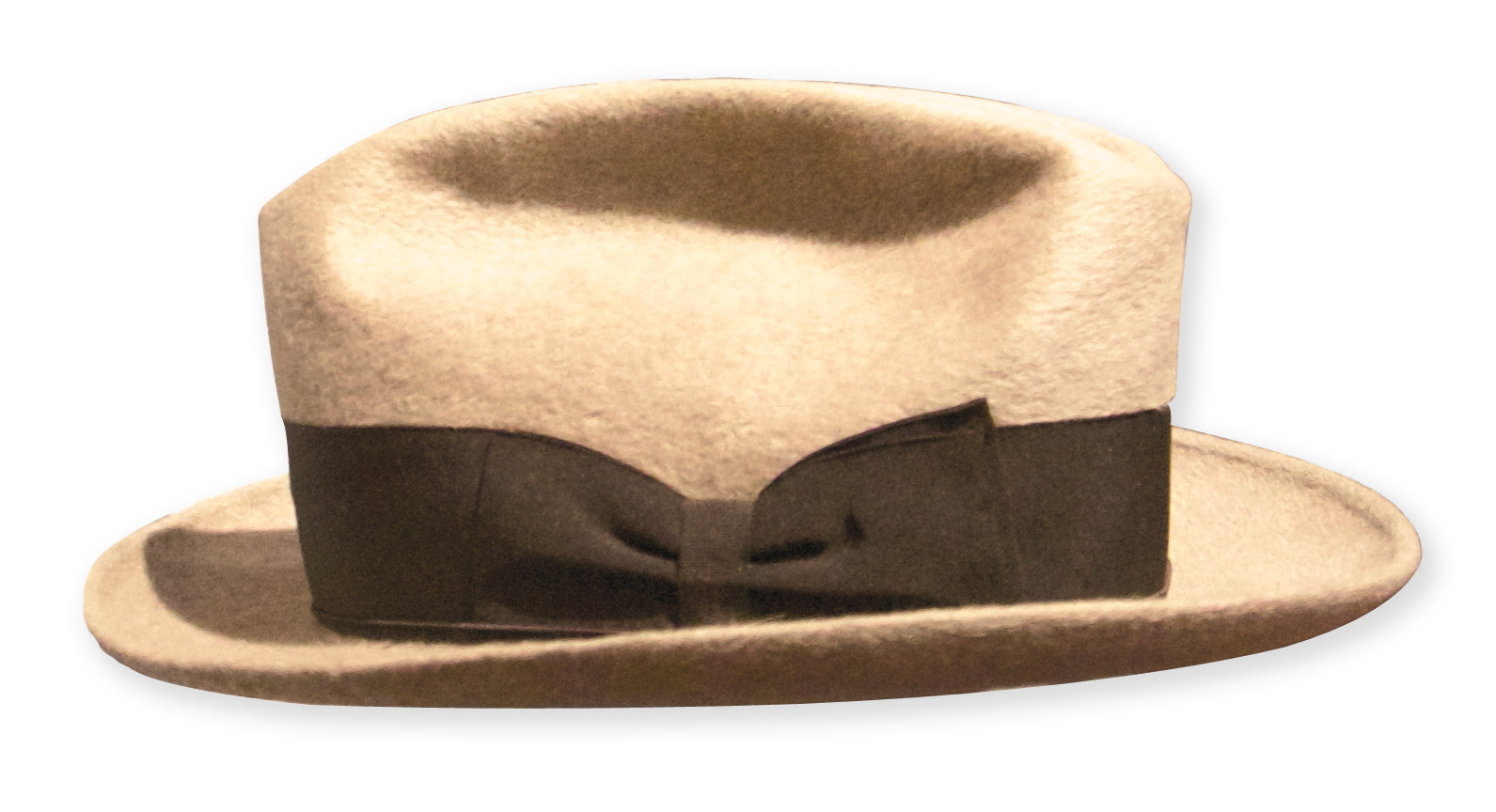
    A fedora owned by Franklin Delano Roosevelt is part of the “Governing the Nation” exhibit at the National Constitution Center.

    ‘Governing the Nation’

    National Constitution Center

    Explore how the American system of government functions through immersive media, dynamic projections, and 3D models of the U.S. Capitol, the White House, and the U.S. Supreme Court. View a pamphlet written by Alexander Hamilton on the constitutionality of the National Bank, as well as Franklin Delano Roosevelt’s fedora.

    525 Arch St., now on permanent display, constitutioncenter.org/museum/exhibits-programs/governing-the-nation

    A view of “Proving Ground: The First 250 Years of the American Experiment,” at Highmark Mann Satell Centennial Wall East.

    ‘Proving Ground: The First 250 Years of the American Experiment’

    Highmark Mann Center for the Performing Arts

    Enjoy an outdoor film experience with the 4,500-square-foot immersive LED canvas at the entrance of Highmark Mann on its new Satell Centennial Wall East. This massive storytelling canvas features cinematic visuals, motion design, music, and historical imagery that immerse visitors in Philadelphia’s role in shaping the American story.

    5201 Parkside Ave., now until October, highmarkmann.org

    ‘Revolutionary Family: The Biddles and American Independence’

    Andalusia Historic House

    Explore historical art and documents based on the Biddles, one of America’s most prominent colonial families. Discover what happened at the Andalusia site during the time of the American Revolution, including the military activity that surrounded the area, and view the beautiful painted portrait miniatures of Clement and Rebekah Biddle.

    1237 State Rd., Andalusia, now through Nov. 13, andalusiapa.org/exhibition/revolutionary-family/

    ‘Freedom Through Faith: Judaism at Eastern State and Beyond’

    Eastern State Penitentiary

    Discover how religious freedom, one of the “unalienable rights” stated in the Declaration of Independence, was strongly represented and practiced in America’s first penitentiary, especially by its Jewish inhabitants. A restored synagogue is a central feature of the exhibit and is the first synagogue in a U.S. prison.

    2027 Fairmount Ave., opening July 2 for permanent display, easternstate.org

    ‘Creating a City of Medicine’

    Mütter Museum

    Explore 250 years of Philadelphia’s impact on health and healing in the U.S., including medical education, technological innovation, and community-based healing practices. Featuring well-recognized Philadelphia leaders as well as lesser-known figures, the exhibit will educate visitors on the vital role Philadelphia played in American medicine and medical education.

    19 S. 22nd St., now through June 2028, muttermuseum.org/visit/

    ‘Nursing the Revolution’

    Barbara Bates Center for the Study of the History of Nursing at the University of Pennsylvania

    In celebration of America 250 at Penn, this exhibit showcases rare materials and reproductions surrounding Revolutionary-era nursing. Explore the influence of Black and Indigenous people on the profession, and the influences of African healing and Indigenous practices on early American medicine.

    418 Curie Blvd., now through Nov. 20 by appointment only, library.upenn.edu/exhibits/nursing-revolution

    ‘Seeking Profit and Power’

    Independence Seaport Museum

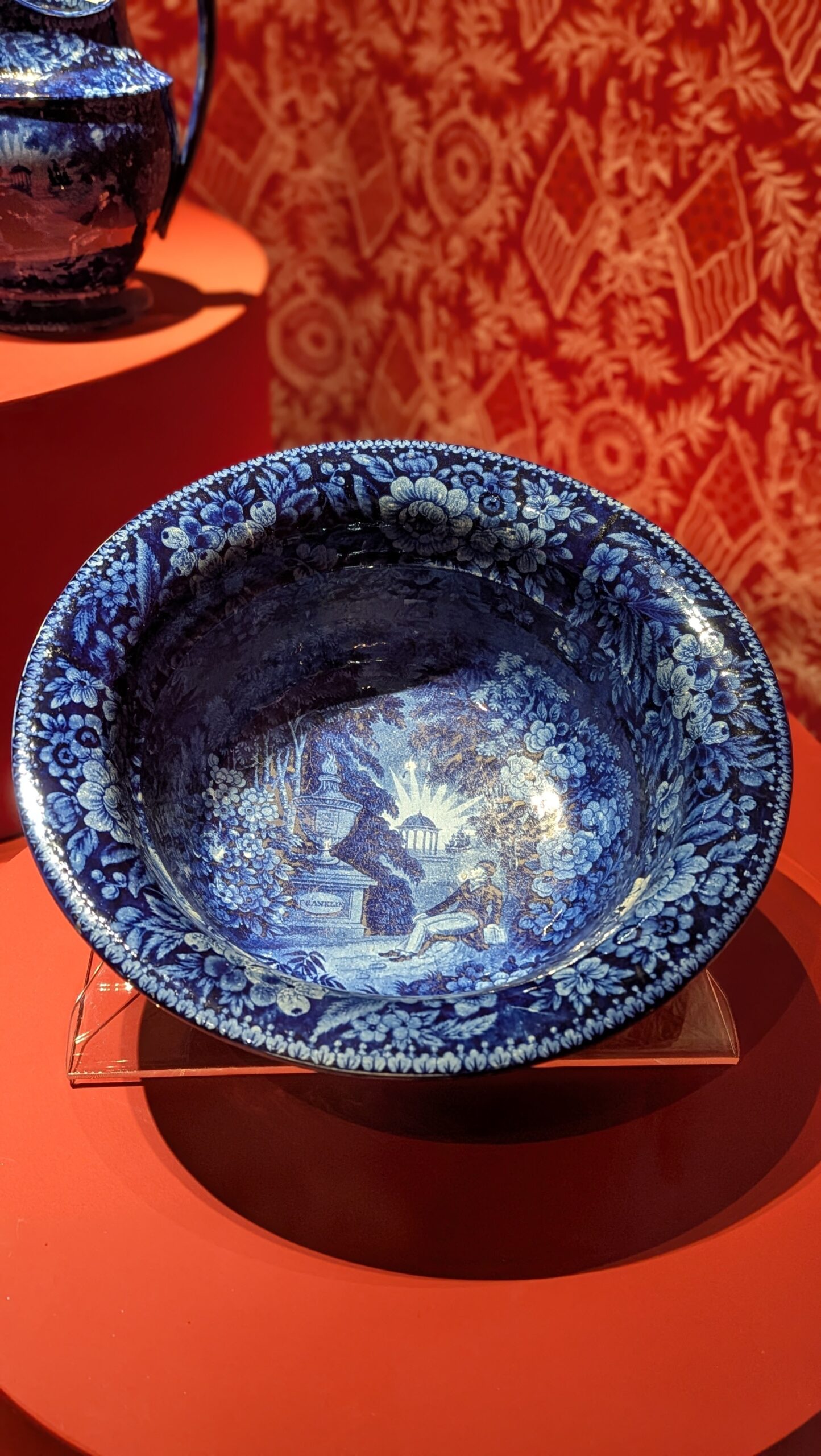
    Explore the history of trade between the U.S. and China, as it relates to the birth of the United States and the long history of trade between them. View a bowl purchased by a Philadelphia merchant for George and Martha Washington, decorated with an unbroken circle and chains representing the strength of the new nation.

    211 S. Columbus Blvd., now through Jan. 3, 2028, phillyseaport.org/current-exhibits/

    ‘The Declaration’s Journey’

    Museum of the American Revolution

    This exhibit traces the American Declaration of Independence’s global influence across 250 years, including political and social change. Featuring 120-plus artifacts from almost 20 nations, it explores how leaders from the Rev. Dr. Martin Luther King Jr. to Gandhi used the declaration’s words as inspiration to inspire political revolutions and civil rights movements worldwide.

    101 S. Third St., now through Jan. 3, 2027, amrevmuseum.org/exhibits/the-declaration-s-journey

    ‘These Truths: The Declarations of Independence’

    American Philosophical Society Museum

    Located next door to Independence Hall, this new exhibition shows that the declaration was a process, and continues to evolve and shape the nation. This exhibit displays 19 rare early printings of the declaration — including one handwritten by Thomas Jefferson, and a copy from July 4, 1776.

    104 S. Fifth St., now through Jan. 3, 2027, amphilsoc.org/museum/exhibitions/these-truths

    ‘Paths to Independence, 1765-1787’

    Historical Society of Pennsylvania

    View 140 rare, original materials tracing how American colonists transformed from loyal British subjects to revolutionaries. Highlights include a letter written by John Adams the day after the adoption of the Declaration of Independence, praising a Massachusetts woman as a “historiographer” of the revolution, and view early drafts of the Constitution.

    1300 Locust St., now through Sept. 18, hsp.org/explore/exhibits-hsp/paths-independence-1765-1787

    ‘A Nation of Artists’

    Pennsylvania Academy of the Fine Arts and Philadelphia Museum of Art

    Two of Philadelphia’s premier institutions have united for this landmark exhibition. At PAFA, works made from the late 18th century to modern day showcase scenes of westward expansion and the rise of industry. At PMA, view American art from 1700 to 1960, identifying global connections that inspired artistic and technological innovation. Featuring more than 1,000 works — including pieces from the private Middleton Family Collection, and by Georgia O’Keeffe and Andy Warhol.

    PAFA, 118-128 N. Broad St., now through Sept. 5, 2027; PMA, 2600 Benjamin Franklin Parkway, now through July 5, 2027; anationofartists.org

    ‘America Today: Voices in Contemporary Print’

    The Print Center

    Explore the current state of democracy through contemporary printmaking from 38 artists. This free exhibition was inspired by the New Deal of the 1930s and 1940s, when printmaking was used for political commentary. View works from generations of artists who use printmaking as an art form to explore and express the issues we face today.

    1614 Latimer St., now through July 25, printcenter.org/100/america-today/

    Medical History in Philly

    Pennsylvania Hospital Museum

    The Pennsylvania Hospital Museum, which opened in May, transforms the historic Pine Building of America’s first chartered hospital, founded by Benjamin Franklin and Thomas Bond in 1751, into a public museum. Discover breakthroughs in brain health, and trace medicine from herbal healing teas to one of the most groundbreaking medical innovations: CRISPR gene editing.

    800 Spruce St., now open permanently, pahmuseum.pennmedicine.org

    ‘Revisit 1876’

    Lits Building

    Connect today’s Philadelphia to 1876, when Philadelphia made history as the first city in North America to host the World’s Fair. At this free exhibit, explore that period and see how far technology has taken us. Use your cell phones to capture a replica of Alexander Graham Bell’s first telephone.

    701 Market St., now through Dec. 31, centercityphila.org

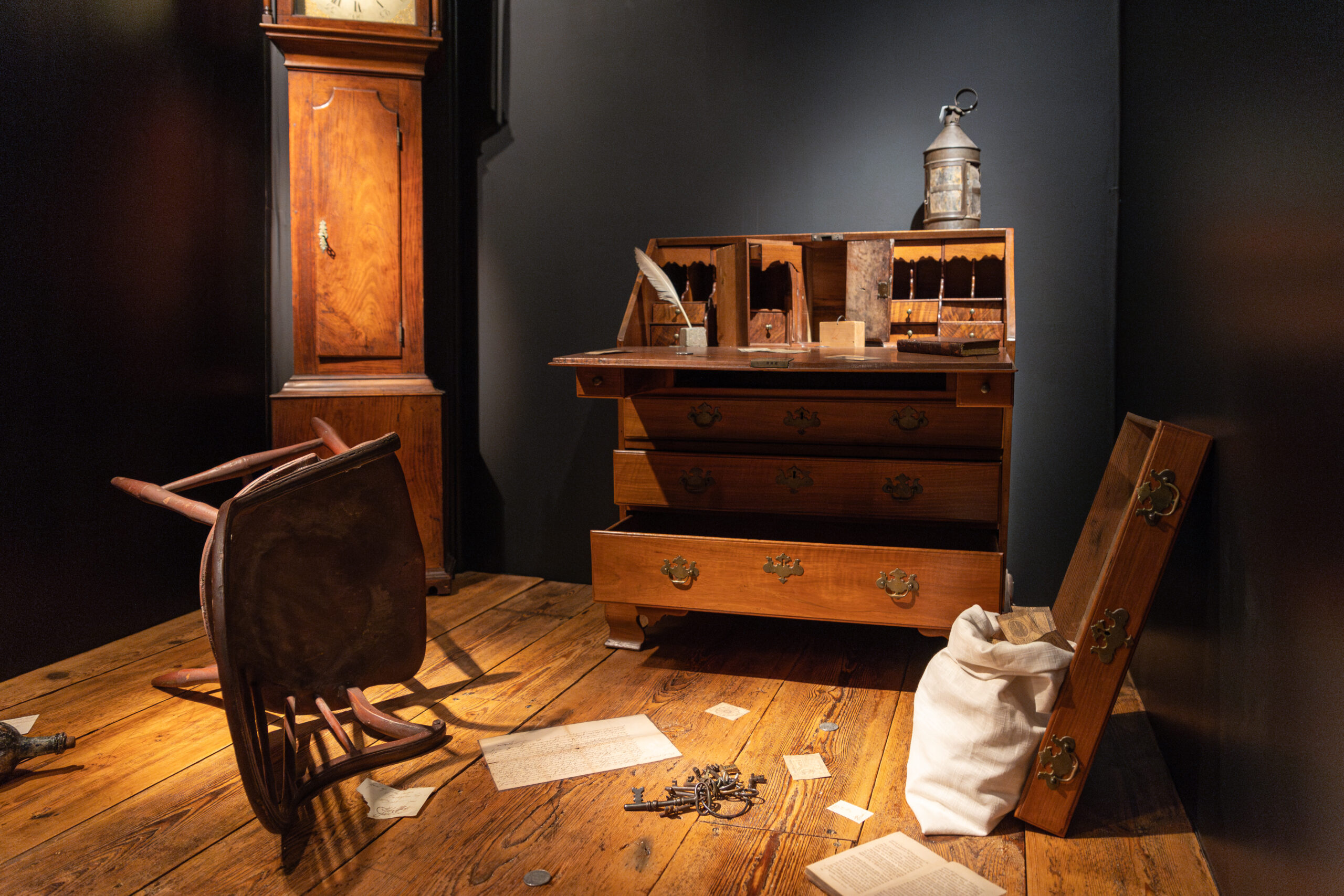
    Part of “The Doan Gang: Outlaws of the Revolution” exhibit at the Mercer Museum.

    ‘The Doan Gang: Outlaws of the Revolution’

    Mercer Museum

    Explore your rebellious side with these known enemies of the Founding Fathers, the Doan Gang, who were loyal to British rule in the colonies. This exhibit is from the perspective of Loyalists, who opposed American independence. Discover the untold stories that combine espionage, legendary robberies, and mythical lost treasure.

    84 S. Pine St., Doylestown, now through Dec. 31, mercermuseum.org/doangang/

    ‘Freedom Dreams’

    Barnes Foundation

    View powerful works by artists that invite viewers to immerse themselves in the memories, dreams, and histories of Black Americans from the past and present. Reflect on how Americans of color have shaped identities and created spaces of resistance, joy, and resilience in the face of systemic oppression. Featured artists include Philadelphia-based David Hartt and Tourmaline.

    2025 Benjamin Franklin Parkway, now through Aug. 9, barnesfoundation.org/whats-on/exhibitions/freedom-dreams

    ‘Let Freedom Ring’

    Cherry Street Pier

    This summer, the Delaware River Waterfront transforms into a free, outdoor gallery called “Where Freedom Flows.” Highlights include “Let Freedom Ring” by Paul Ramírez Jonas — where visitors can strike a 600-pound bell to sound the final note of “My Country, ’Tis of Thee,” connecting Philadelphia’s historic waterfront to the nation’s evolving story of freedom.

    121 N. Columbus Blvd., now through Sept. 27, cherrystreetpier.com

    ‘Wings and Water: The Space Between’

    Cherry Street Pier

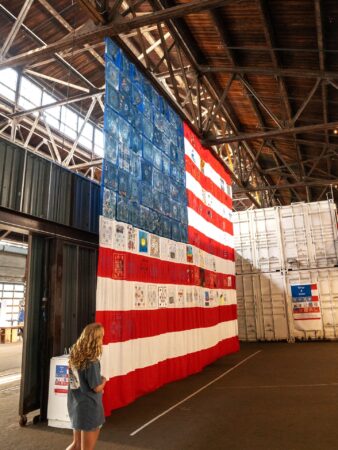
    Set your sights on this beautiful community-driven artwork installation by GrioXArts — artists Duwenavue Santé Johnson and Kara Mshinda. The textile centerpiece is a reimagined American flag composed of hand-embroidered bandannas created during a previous public workshop. It reflects personal and cultural narratives of BIPOC voices into Philadelphia’s evolving story and history.

    121 N. Columbus Blvd., July 3 through Aug. 1, cherrystreetpier.com

    ‘At Liberty: Life in the City of Brotherly Love During the Early Republic’

    Arthur Ross Gallery at the University of Pennsylvania

    Explore fine art during our forefathers’ time with holdings from the University of Pennsylvania, the Pennsylvania Academy of the Fine Arts, the Winterthur Museum, and the Metropolitan Museum of Art. Curated by Gwendolyn DuBois Shaw, it features paintings, sculptures, and watercolor drawings of notable figures, including Benjamin Franklin.

    220 S. 34th St., Aug. 28 through Dec. 13, arthurrossgallery.org

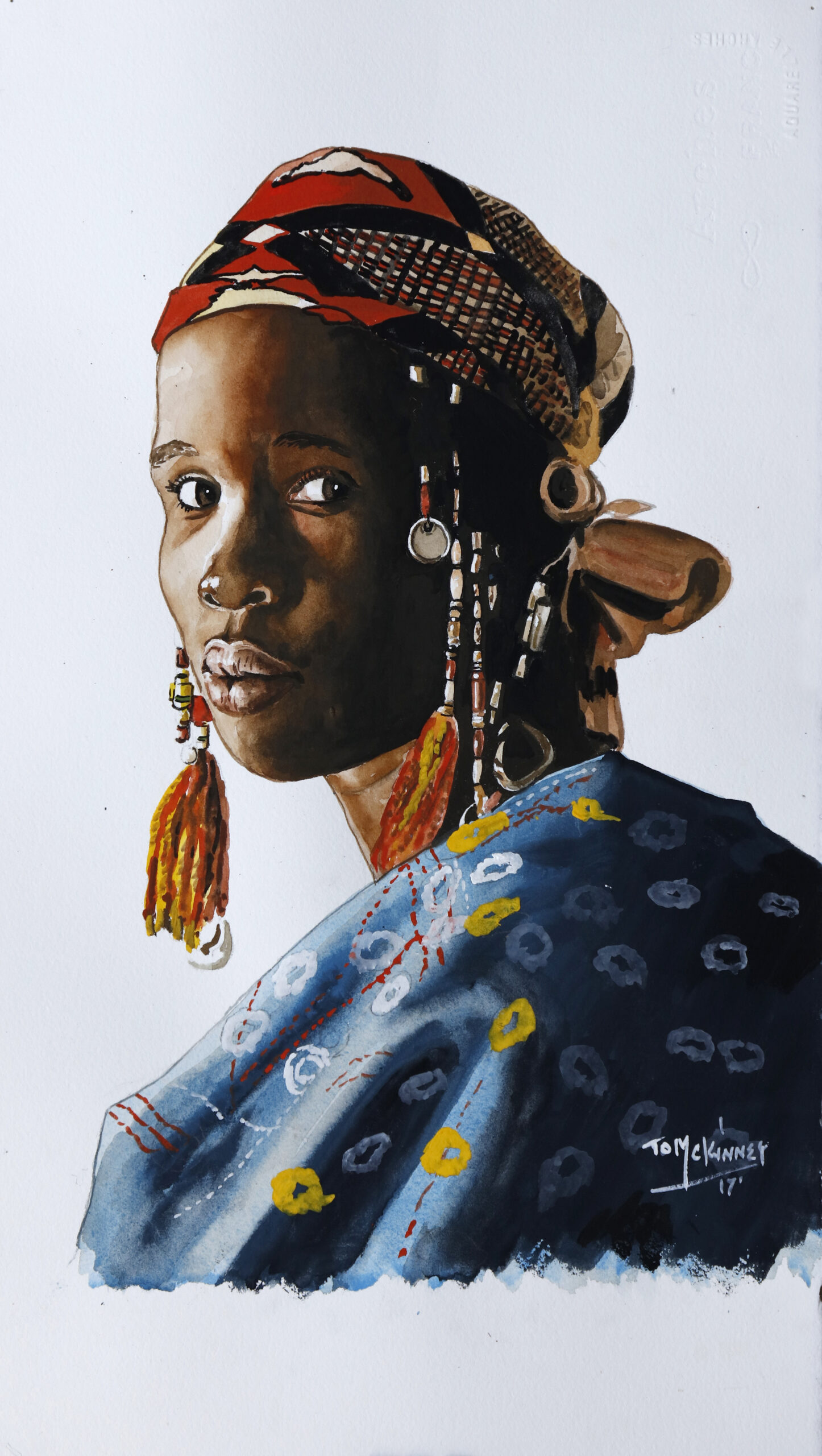
    A portrait by Tom McKinney is part of the “From Invisible to Invincible” exhibit at the Historic Strawberry Mansion.

    ‘From Invisible to Invincible: Honoring the Art of Color’

    Historic Strawberry Mansion

    This exhibit recognizes both the 250th anniversary of the founding of America and the 100th anniversary of the Committee of 1926, a women-led organization formed during the 1926 Sesquicentennial International Exposition, and dedicated to preserving the history and heritage of this mansion. It will showcase artists who did not get a fair opportunity to shine in the original 1926 exposition due to systemic inequities.

    2450 Strawberry Mansion Dr., Sept. 18 through Nov. 8, historicstrawberrymansion.org

  • The biggest America 250 events from now through July 4

    The biggest America 250 events from now through July 4

    There’s a reason the Wall Street Journal (and Travel + Leisure, CNN, the New York Times, National Geographic, the BBC, and others) tapped Philadelphia as a top place to visit in 2026.

    The city has already been a hive of activity this summer — and it’s about to get even busier as the city gears up for America’s 250th birthday.

    There’s a packed calendar of events between now and Independence Day, and countless ways to get in on the celebration.

    From soccer to ballet, art to history, the region’s upcoming events calendar has something for everyone.

    ArtPhilly’s What Now

    This inaugural citywide arts festival has been running strong since late-May, but the coming weeks offer a deep slate of programming ahead of the July 4 weekend.

    Launched to “foreground our city’s artists as interpreters of this complex moment in American history,” the multidisciplinary festival includes puppetry, dance, music, books, film, and more through July 2.

    The lead-up to Independence Day features multiple exhibitions and events, many of them free, making it an affordable way to celebrate the nation’s milestone birthday.

    For a full schedule, check out ArtPhilly.org.

    🕒 Various dates and times, 💵 Prices vary, 📍 Various locations, 🌐 artphilly.org

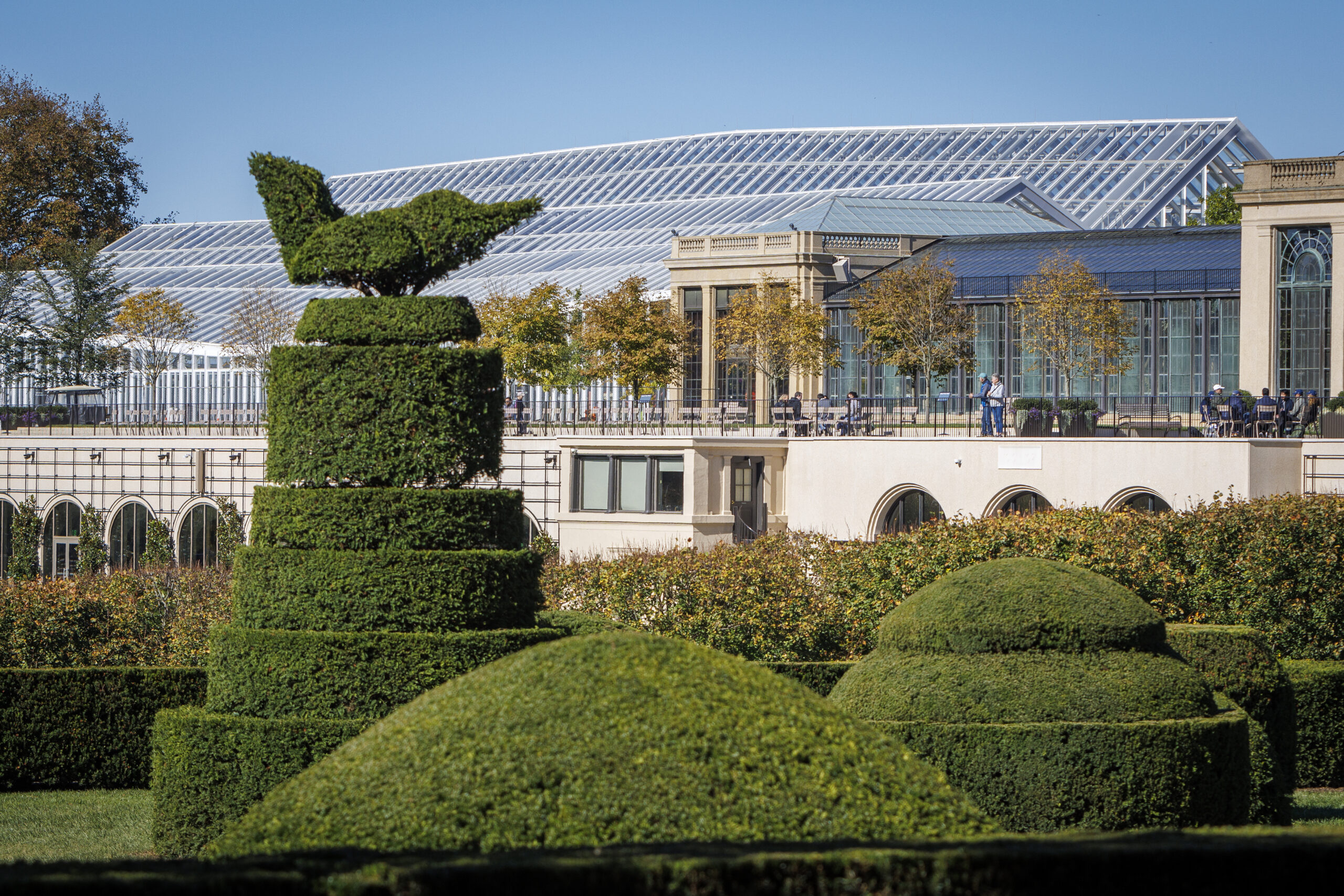
    A view of the new conservatory (background) in October 2024 at Longwood Gardens, Kennett Square, Pa.

    Masterworks 3: Made in America

    The Brandywine Valley Symphony will perform “Masterworks 3: Made in America” in the open-air venue at Longwood Gardens. Before the concert, organizers for Dare to Declare will attempt the region’s largest public reading of the Declaration of Independence.

    🕒 June 25, 7 p.m., 💵 $20-$65, 📍 1001 Longwood Road, Kennett Square, PA 19348, 🌐 bvsymphony.org

    Independence Week Events at the National Constitution Center

    Play trivia, test your knowledge against a historian, and attend a town hall on the “shared principles at the heart of the American idea.” It’s all free and part of the weeklong lead-up to July 4, when the National Constitution Center celebrates America’s 250th birthday.

    🕒 June 29-July 4, times vary, 💵 Free, 📍 525 Arch St., Philadelphia, PA 19106, 🌐 constitutioncenter.org

    Gospel on Independence

    Headlined by 20-time Grammy winner Kirk Franklin, this two-hour gospel music celebration features a choir of more than 250 voices against the backdrop of Independence Hall. Seating is first-come, first-served.

    🕒 June 28, 7 p.m., 💵 Free, 📍 599 Market St., Philadelphia, PA 19106, 🌐 july4thphilly.com.

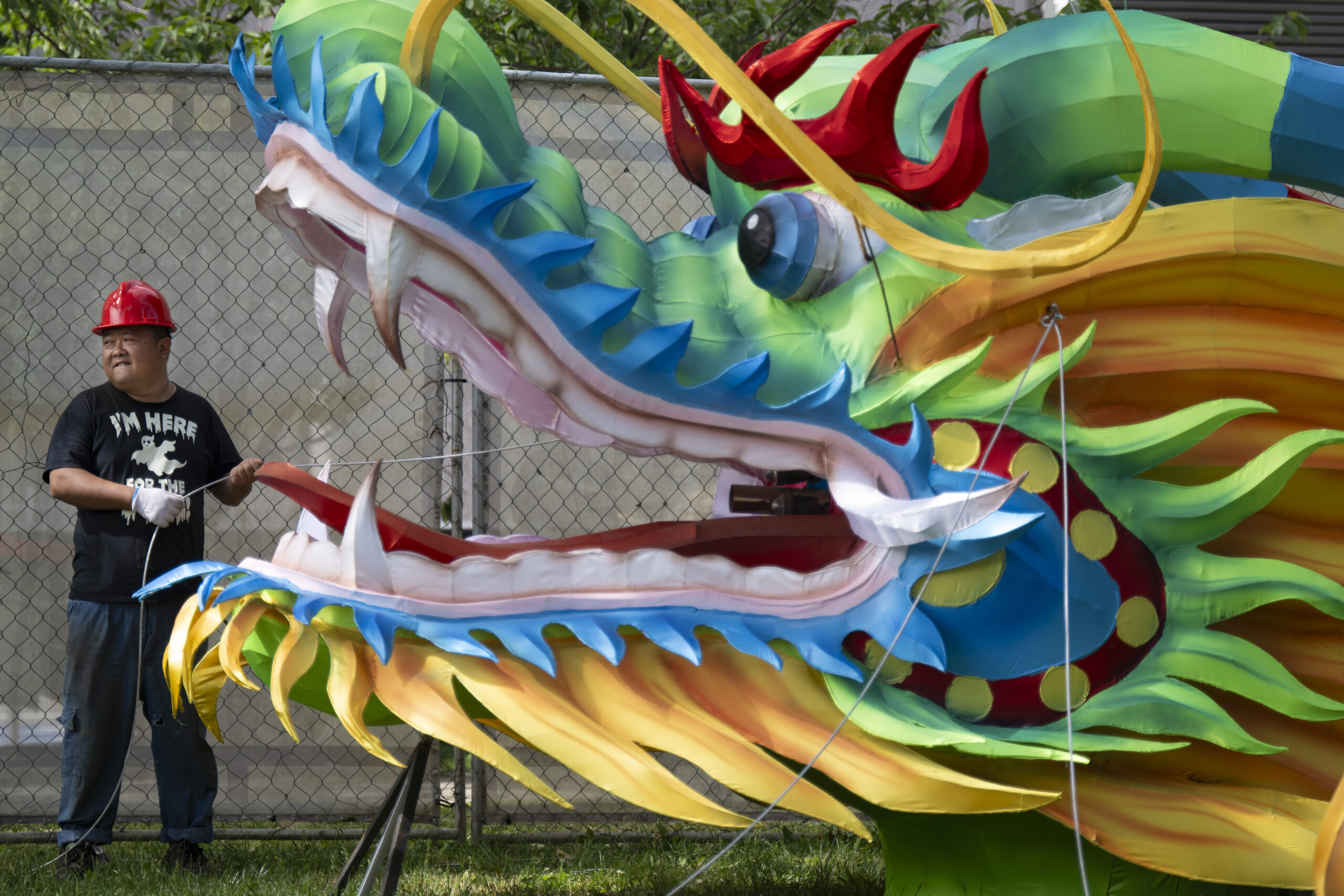
    A worker prepares to raise the head of a fire-breathing dragon lantern in preparation for the Philadelphia Chinese Lantern Festival at Franklin Square this year.

    Chinese Lantern Festival in Franklin Square

    The festival is back with a special nod to the global events arriving in Philadelphia this summer. Handmade sculptures take over Franklin Square, with nightly performances held on three stages: face-changing, table foot-juggling, and head-balancing.

    🕒 Open daily between now and Aug. 2, 💵 Adults $28-$32, with discounts for children and seniors, 📍 200 N. Sixth St., Philadelphia, PA 19106, 🌐 phillychineselanternfestival.com

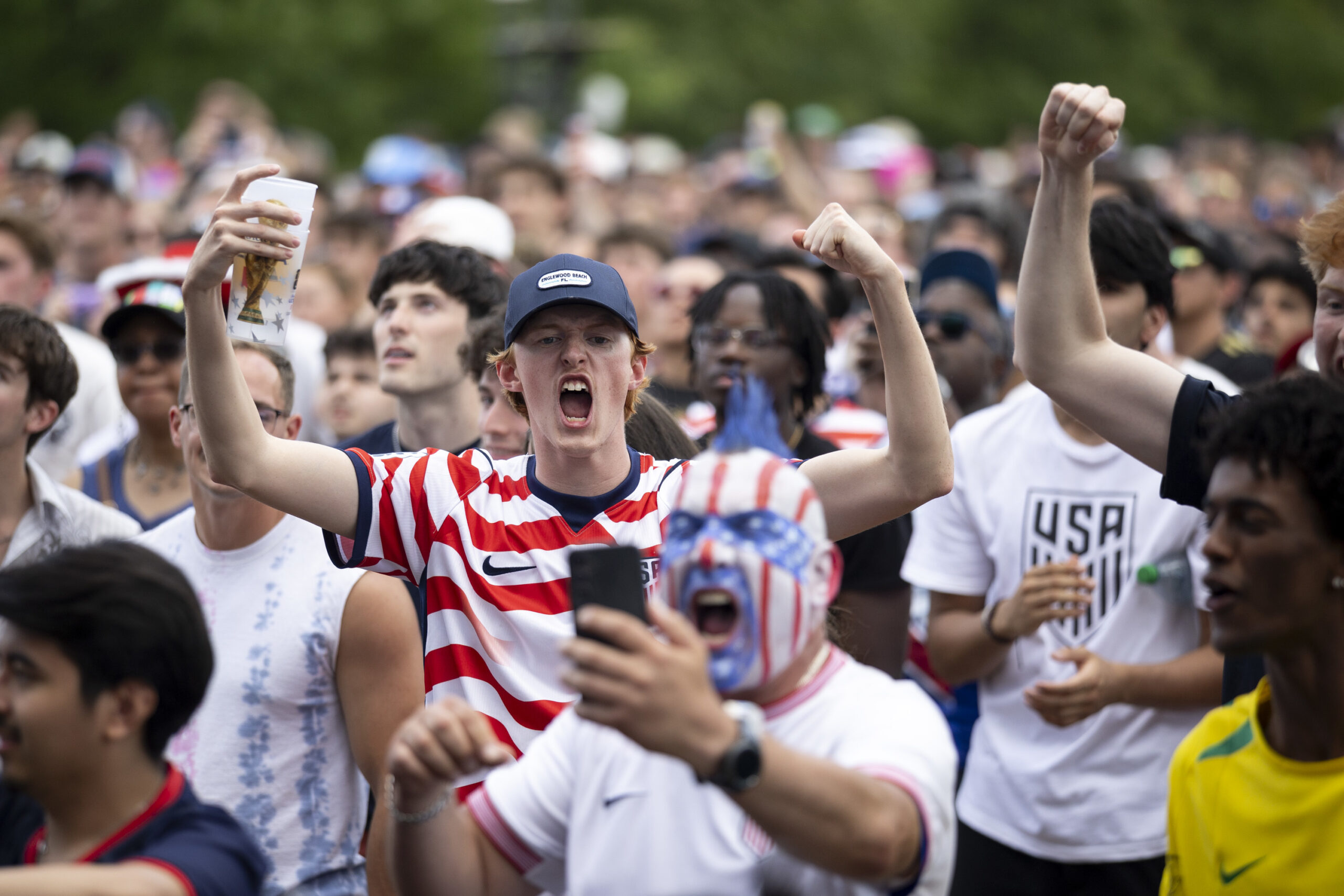
    Cam Gorman, 23, of Gilbertsville, Pa., cheering with Philly Sports Guy at the FIFA Fan Festival at Lemon Hill, as USA beats Australia on June 19.

    FIFA World Cup ’26 and FIFA Fan Festival

    With the U.S. team still battling for a title, what better way to celebrate the lead-up to 250th birthday than by cheering on the team in the World Cup?

    The tournament, with several matches hosted in Philadelphia, has transformed the city into a summer-long party. Much of the action centers on the Fan Festival at Lemon Hill, where visitors can enjoy music, food, drinks, and watch parties. Admission is free, though preregistration is required.

    Two Round of 16 matches are scheduled for July 4, at 1 p.m. and 5 p.m., though the participating teams have yet to be determined. The 5 p.m. game will be played at Lincoln Financial Field.

    🕒 Various dates and times, 💵 Free (registration required), 📍 Lemon Hill Park, 1 Lemon Hill Drive, Philadelphia, PA 19130, 🌐 phillyfwc26.com.

    Welcome America, including the Red, White & Blue To-Do

    Philadelphia’s Historic District goes all out with a full day of events welcoming visitors to America’s “most historic square mile.” Highlights include a giant human Liberty Bell, plus a block party and street music festival featuring more than two dozen acts. At 7 p.m., Queen Latifah performs with the Army Field Band and Soldiers’ Chorus on Independence Mall. A 13-minute drone show follows later that evening.

    🕒 July 2, 7 a.m. to 9 p.m., 💵 Free, 📍 Philadelphia’s Historic District, 🌐 july4thphilly.com

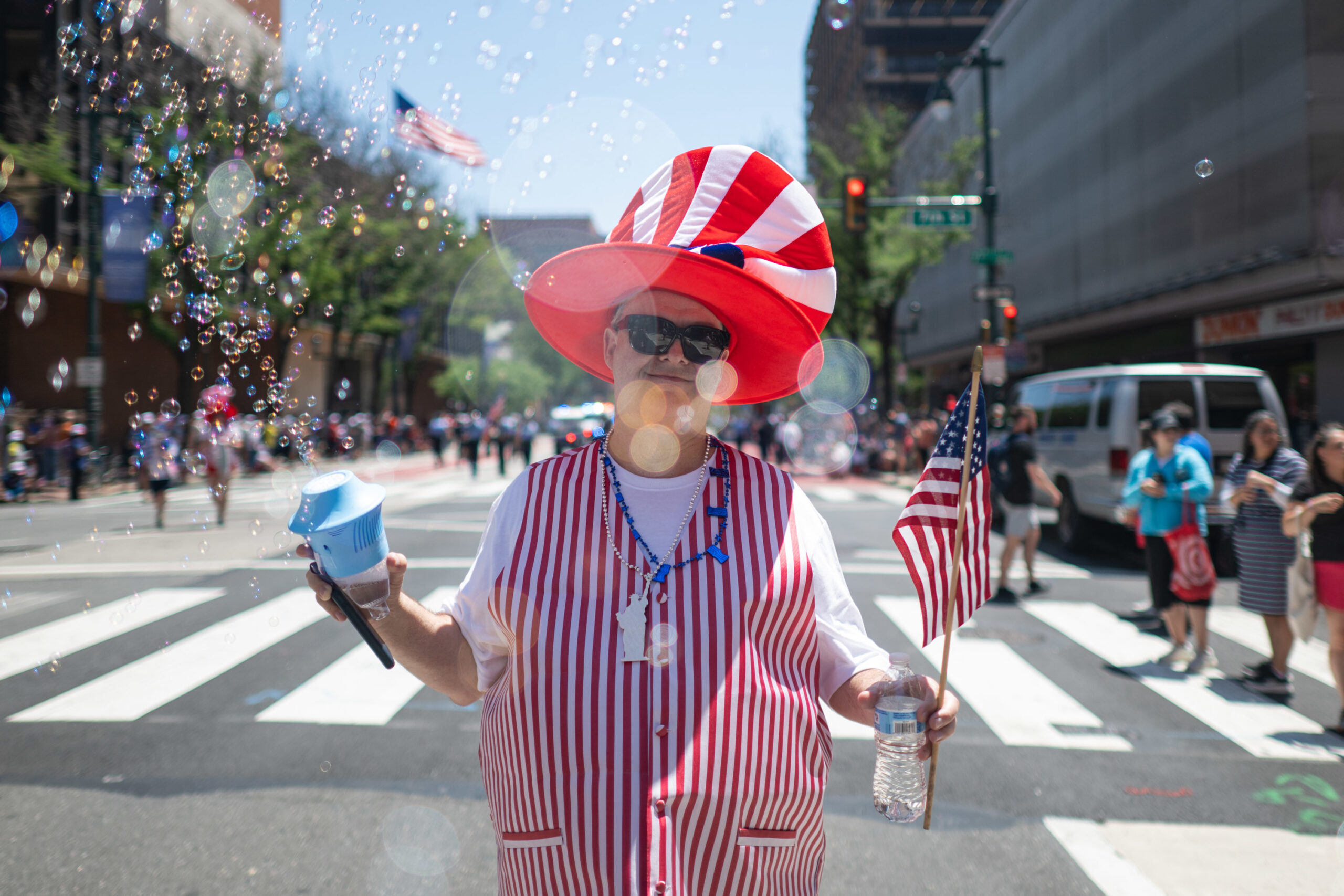
    Dan St. Mary poses for a portrait with his bubble dispenser during the Salute to Independence Parade on July 4, 2025, in Center City.

    Salute to Independence Semiquincentennial Parade

    This year’s parade features an extended route, along with 50 marching bands, 19 floats, and tributes to all 50 states and U.S. territories. The event begins at 5th and Chestnut Streets and winds through Center City before ending near Broad and Chestnut Streets. Feel like skipping the crowds? Catch it live on NBC 10.

    🕒 July 3, noon to 4 p.m., 💵 Free, 📍 Independence Hall to Benjamin Franklin Parkway, 🌐 july4thphilly.com

    Pops on Independence

    The Philly Pops are joined by Broadway legend Idina Menzel for a two-hour concert on the eve of Independence Day. A pre-show block party featuring food trucks and giveaways begins at 5 p.m. Seating is first-come, first-served.

    🕒 July 3, 7 p.m., 💵 Free, 📍 599 Market St., Philadelphia, PA 19106, 🌐 july4thphilly.com

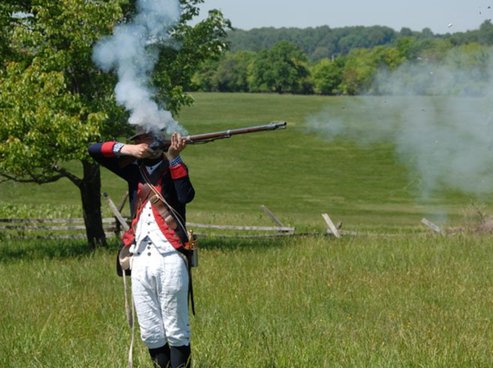
    Musket firing will be a part of the Independence Day Celebration at Valley Forge National Historical Park.

    Valley Forge National Historical Park’s 50th Birthday

    Valley Forge marks 50 years as a national historical park with three days of commemorative programming, including Revolutionary War reenactors, musket firings, and artillery demonstrations.

    SEPTA Bus 125 will get you to the park, and a park shuttle runs throughout the celebration from July 3-5. Plus, there are bike rentals on-site. All events are free to attend, and you can find a complete schedule of the weekend’s events at the National Park Service website.

    🕒 July 3-5, 9 a.m. to 5 p.m. daily, 💵 Free, 📍 North Outer Line Drive in Valley Forge National Historical Park, 🌐 nps.gov.

    Independence Weekend at the Schwenkfelder Library & Heritage Center

    A three-day slate of activities begins July 3 with extended First Friday hours at the Heritage Center and an evening car show at the East Greenville Fire Co. The next day features a parade, a reading of the Declaration of Independence, performances by the Brandywine Colonials Fife and Drum Corps and the Red Hill Band, followed by fireworks. On July 5, the Heritage Center hosts a free family-friendly event from noon to 4 p.m. with exhibits and refreshments.

    🕒 July 3-5, times vary, 💵 Free, 📍 Various locations, 🌐 schwenkfelder.org.

    Celebration of Freedom Ceremony

    In addition to musical performances from Yolanda Adams and DJ Diamond Kuts, a collection of speakers — including Philly Mayor Cherelle L. Parker — are slated to reflect on the nation’s history on the morning of its 250th birthday.

    🕒 10 a.m. to 11 a.m., July 4, 💵 Free, 📍 599 Market St., Philadelphia, PA 19106, 🌐 visitphilly.com

    Betsy Ross House Patriotic Pet Parade

    The courtyard of the Betsy Ross House will be filled with animals on the morning of July 4, during the annual patriotic pet parade and costume contest. Pets will be judged in five categories — Most Patriotic, Best Betsy Ross Influence, Best Duo with Owner, Best Non-Canine, and Best in Show — so make sure they arrive dressed to impress.

    🕒 10:30 a.m., July 4, 💵 Free (pet registration required), 📍 239 Arch St., Philadelphia, PA 19106, 🌐 historicphiladelphia.org

    Christina Aguilera, pictured here in 2016 in Morocco, is one of several musicians performing at this year’s One Philly: Unity Concert for America on July 4.

    One Philly: Unity Concert for America

    This July 4 star-studded concert on the Benjamin Franklin Parkway features Christina Aguilera, The Roots, Jill Scott, Meek Mill, Will Smith, DJ Jazzy Jeff, Seal, and others.. Comedian Wanda Sykes serves as host. Doors open at 3 p.m., and performances begin at 5 p.m.

    🕒 5 p.m. to midnight, July 4, 💵 Free, 📍 Benjamin Franklin Parkway, 🌐 visitphilly.com.

  • How the Marquis de Lafayette became a surprising selfie favorite with visitors at the French National Archives

    How the Marquis de Lafayette became a surprising selfie favorite with visitors at the French National Archives

    PARIS, FRANCE — On a recent sunny May morning, Parisian middle schoolers had found a curious selfie point. Not a tourist landmark, not a kitschy backdrop, and not a mirror booth.

    It was the long rococo staircase of the 14th-century Hôtel de Soubise, which houses the Museum of the National Archives of France, plastered with the face of Marquis de Lafayette, the French military officer who died in 1834.

    “This has become a selfie hot spot somehow,” said Alexandra Hauchecorne, the museum’s technical director of the “Lafayette, between France and America: History and Legend” show.

    The Hôtel de Soubise’s rococo staircase, with likeness of the Marquis de Lafayette, has become a selfie hot spot at the Musée des Archives Nationales in Paris.

    Lafayette — both before and after Lin-Manuel Miranda’s Hamilton — is a celebrated hero in America. Textbooks record that he was only 19 when he came to America in 1777 to join the Continental Army under George Washington. He fought for American independence, participated in the Battle of Brandywine and the Siege of Yorktown, faced the harsh winter of Valley Forge, convinced the French King Louis XVI to send more troops, and developed a deep relationship with Washington — so much so that Lafayette named his only son, George Washington.

    And of course, Lafayette has also become the de-facto author of the catchphrase “Immigrants… We get the job done” by way of Daveed Diggs playing him in Miranda’s immensely popular musical, a phrase splashed on countless tote bags and in hashtags.

    In France, however, “Lafayette was not regarded the same way as he is here,” said Olga Anna Duhl, professor of French and comparative literature at Easton, Pa.’s Lafayette College and one of the exhibition’s curators.

    The yellow room of the ongoing “Lafayette, between France and America: History and Legend” at the Musée des Archives Nationales in Paris. The exhibit focuses on Lafayette’s participation in the American Continental Army.

    His involvement in the French Revolution and desire to have France be a constitutional monarchy, as opposed to a republic like America, made him a target of criticism from both the left and right of the French political system. He was perceived as a traitor and eventually forced to flee the country. Lafayette was imprisoned first by the Austrians and then by the Prussians, who (ironically) considered him a rebel.

    With it being the American Semiquincentennial, Duhl “thought that it would be wonderful” to have an exhibition in Paris and “educate the French people, and any person who comes to visit” about Lafayette.

    In France, she said, “you study history, then you go into his life, and especially his American side. But you know very little about his French contribution, which is very paradoxical.”

    The red room of the ongoing “Lafayette, between France and America: History and Legend” at Paris’ Musée des Archives Nationales focuses on Lafayette’s participation in the American and French revolutions.

    The exhibition encompasses five rooms color coded to fit the years of Lafayette’s life — yellow, the color of the Continental Army uniform, to tell the story of Lafayette’s years in America; red denoting the American Revolution; green to denote Lafayette’s years in semiretirement in France, gardening and practicing agriculture and often experimenting with seeds from America; a light blue to mark Lafayette’s triumphant return to America in 1824; and a darker blue to denote monarchy and Lafayette’s last years, which he spent backing King Louis Philippe I and supporting other revolutions.

    The red room — the most interesting one — builds up Lafayette as the American hero he became. Among other artifacts, it includes a letter Ben Franklin wrote to him on behalf of the Philadelphia Philanthropic Society in 1788.

    The green room of the ongoing “Lafayette, between France and America: History and Legend” at Paris’ Musée des Archives Nationales focuses on Lafayette’s years of semi-retirement spent gardening in Château de Chavaniac.

    “Most of our Legislators have already abolished the Slave Trade,” it reads, “…But from the influence of narrow prejudices and jealousies there is too much reason to apprehend that nothing effectual will be done in this business until France concurs in it, of which we cannot but entertain the most pleasing expectation.”

    Franklin enclosed copies of the U.S. Constitution for Lafayette’s perusal, only six months after Franklin, whose health was failing, had James Wilson read aloud his closing speech at the Constitutional Convention.

    A letter Lafayette wrote to George Washington on March 17, 1790, is on display, too. Along with the letter, Lafayette sent his mentor the key to “that fortress of despotism” that was the Bastille. Thomas Paine, who carried this extraordinary gift, said, “That the principles of America opened the Bastille is not to be doubted, and therefore the Key comes to the right place.”

    Paper fans carrying Lafayette’s name were popular among his followers. Lafayette was a canny self-promoter who hired publicists to defend his image.

    Also on display are lampoons and letters that speak to the immense distrust both the aristocrats and democrats had of Lafayette.

    “If this is the eldest child of Liberty, he is murdering his mother,” a letter reads. “Lafayette treated as he deserves by democrats and aristocrats,” reads a lampoon showing the French lieutenant général being hung by a noose by two men on his either side.

    Lafayette, on his part, was a canny self-promoter. He hired several publicists to defend his public image and recruited people to clap at his speeches. In what would be classified as merch today, his face adorned fans, buttons, and commemorative plates.

    On display in the light blue room, marking his triumphant return to America in 1824, are several objects — pitchers, tea sets, baby shoes, shoeshine brushes — all emblazoned with his face and name.

    Produced in a factory in Burslem, Staffordshire, a tea service set in blue and white earthenware shows the Marquis de Lafayette sitting by Benjamin Franklin’s grave. This imaginary scene appeared on plates and other items manufactured to commemorate Lafayette’s return to the U.S. in 1824. From the “Lafayette, between France and America: History and Legend” at the Musée des Archives Nationales, Paris.

    As Lafayette’s reputation in France remained checkered at best, many of these branded memorabilia were found in homes in Philadelphia, a prominent stop in Lafayette’s “Farewell Tour” of the Union’s 24 states. An invitation to the Lafayette Ball held in Philadelphia in 1824 hangs on the wall.

    Much of the artifacts come from the collection of Lafayette College, the only college in the U.S. named after him. More streets and public places in the U.S. are named after Lafayette than any other foreigner. In Paris, about six hours away from Chateau Lafayette where he lived, only Rue La Fayette, one of the city’s longest streets, bears his name.

    That and a glitzy shopping mall with 10 floors, best known for its rooftop views of the city.

    “Lafayette is very well known [in France] but not as a historical figure,” said Duhl. “And one of the educational aims of this exhibition is to educate people about this compelling figure … so that the new generation can really develop an idea about who Lafayette really was, because he has disappeared basically from manuals.”

    The “Lafayette, between France and America: History and Legend” exhibit at Paris’ Musée des Archives Nationales seeks to educate French visitors about the historical importance of Marquis de Lafayette.

    On a weekday morning, there was a mix of visitors to the exhibition that, Hauchecorne said, was a rare bilingual event at the Archives. Parisians and school children have been visiting, as have Americans on vacation, to know more about the man who has been shown rapping lines that are becoming of his high self-esteem: “No one has more resilience or matches my practical, tactical brilliance!”

    Even though previous exhibitions have not had much materials translated into English, the Archives, which houses records dating back to the 1st millennium, has had Americans dropping in before.

    Most notably: Tom Cruise performing a motorcycle stunt as Ethan Hunt in Mission: Impossible — Fallout (2018).


    “Lafayette, between France and America: History and Legend” runs through July 14 at Musée des Archives Nationales, 60, rue des Francs-Bourgeois, 75003 Paris. archives-nationales.culture.gouv.fr