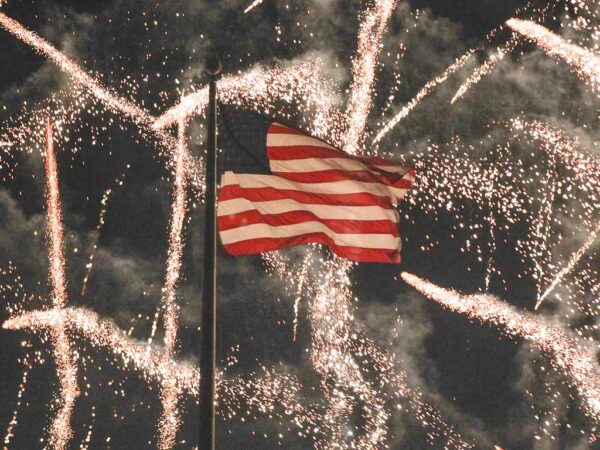
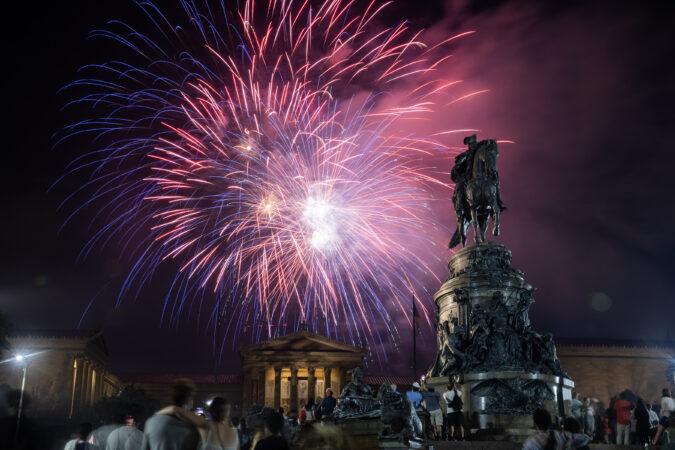
Countless parades, fireworks, drone shows, and more are scheduled for this weekend to celebrate the Fourth of July and the nation’s 250th birthday across South Jersey, but extreme heat is beginning to complicate plans.
With temperatures forecast to exceed 100 degrees through Independence Day, some South Jersey towns are taking steps to keep residents out of the heat — even if it means canceling their annual holiday events.
Others that haven’t taken any major steps yet are advising residents to stay hydrated and out of the direct sunlight as much as possible over the weekend.
Here are some South Jersey towns that have announced changes to their Fourth of July celebrations:
Bordentown Township
Bordentown Township postponed fireworks planned for Friday with plans to reschedule the show for Aug. 4.
“This wasn’t an easy call to make, but the heat forecast is dangerous, and that’s not something we’re willing to gamble with, not with your families, our volunteers, and our first responders out there for hours,” the township posted on social media Thursday.
Delanco Township
Delanco’s summer concert featuring the Nathan Renson Quartet scheduled for Thursday evening was canceled due to the heat. It will be rescheduled for a later date, the township said on social media.
Haddon Township
Due to the heat and humidity forecast for Saturday, Haddon Township has canceled its July Fourth parade.
“This was a difficult choice, but ensuring the health and safety of our participants and spectators alike is our highest priority,” the township wrote on social media.
The township’s “Happy Birthday America Celebration” fireworks will still take place on Friday night at the Haddon Township High School stadium.
Amid the heat wave, the township’s Crystal Lake Pool will be open and free to all township residents, their extended family, friends, and guests.
Haddonfield Borough
Haddonfield’s Independence Day Parade is taking place as scheduled on Friday morning, but due to the extreme heat forecast for later in the day, the block party and drone show scheduled to start at 5 p.m. have been postponed. A new date for the rescheduled events will be announced soon, according to the borough.
Magnolia Borough
Magnolia’s Fourth of July Fair is starting a bit earlier now because of the heat, the borough announced on social media. The fair, which includes food trucks, a beer garden, live music and more, will now take place from 10 a.m. to 2 p.m. on Saturday immediately after the parade.
Oaklyn Borough
Oaklyn is hoping to get ahead of the heat by moving up the start time for the borough’s annual July Fourth parade. The parade will now start at 9 a.m., two hours earlier than originally planned.
Paulsboro
In light of the heat, Paulsboro has also decided to cancel the borough’s annual Fourth of July parade.
“We understand how much this annual tradition means to our community. For generations, the Fourth of July Parade has been a source of hometown pride and a celebration that brings families, friends, and neighbors together. We share the disappointment of having to cancel this cherished event, but the safety and well-being of our community must always come first,” the borough wrote on social media.
Despite the parade cancellation, the borough’s 250th Anniversary Celebration at Fort Billingsport Park will continue as scheduled on Sunday from 9 a.m. to 2 p.m.
Stratford Borough
While Stratford will still be holding its annual Fourth of July parade, the borough has decided to cancel its plans for games, inflatables, and other activities scheduled for Mancini Field throughout the day.
Washington Township
Washington Township has canceled its annual parade on July 4 after recommendations from public safety and local meteorologists. The township’s fireworks will still proceed as planned at 9 p.m., launched from the Washington Township High School Complex.
Check your change: You might have one of the U.S. Mint’s special-edition coins celebrating the nation’s 250th birthday.
For one year only, circulating nickels, dimes, quarters, and half-dollars will feature new historical designs. Part of the U.S. Mint’s Semiquincentennial program, many of the coins entered circulation at the beginning of the year.
“The program is the most significant redesign of the nation’s circulating coins in the past century,” said Jill Westeyn, acting chief of public affairs at the U.S. Mint. “These coins commemorate 250 years of American Liberty by reflecting our country’s founding principles and honoring our nation’s history.”
What’s on the coins
The quarter is a star of the program, boasting five different designs that highlight pivotal moments in American history.
The Mayflower Compact, signed in 1620 as one of the New World’s earliest documents establishing self-government, inspired one of the quarter’s designs, which features the iconic ship.
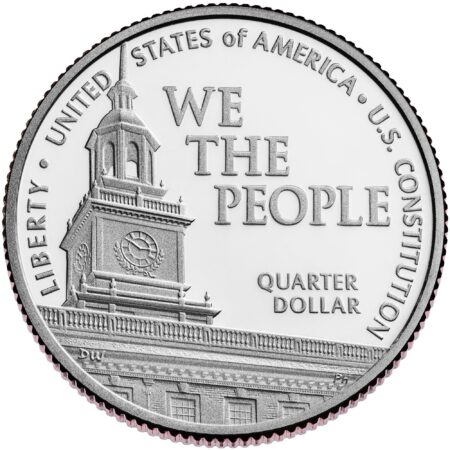
Motifs from the Declaration of Independence, the Revolutionary War, and the U.S. Constitution appear on three of the other quarters. Images include Philadelphia landmarks like the Liberty Bell and Independence Hall.
The fifth quarter honors President Abraham Lincoln’s Gettysburg Address. Meant to highlight the Civil War-era speech’s commitment to equality, the quarter depicts Lincoln on one side and clasped hands on the other.
The quarters are scheduled for circulation in separate intervals throughout the year. So far, the Mayflower Compact Quarter, the Revolutionary War Quarter, and the Declaration of Independence Quarter have been released. The remaining two designs will enter circulation later in the year.
The dime and half-dollar feature Liberty, an American allegorical figure of a mythical goddess. The dime includes her cap, a symbol of freedom in ancient Rome, and the half-dollar depicts Liberty gazing to her right, meant to convey looking toward the future.
The nickel may look familiar with its portrait of President Thomas Jefferson, but an addition of the dual date, “1776 ~ 2026,” updates the coin for the anniversary.
A collectible penny with the dual date is alsoavailable for purchase in annual sets sold on the mint’s website. The mint discontinued the copper cent in 2025 because it cost more to produce than it’s worth.
The bipartisan Citizens Coinage Advisory Committee had reportedly proposed designs for the 250th that will not see the light of day, including coins that would have commemorated the end of slavery, the women’s suffrage movement, and the civil rights movement. But Treasury Secretary Scott Bessent, tasked with making the final design choices, did not pick any of those.
Other coins
President Donald Trump’s 24-karat gold coins, which feature his portrait and were also intended to highlight the country’s 250th anniversary, are not among the program. The U.S. Commission of Fine Arts voted unanimously to approve the design in March, but the coins are not slated for production until after July 4.
The U.S. Mint has approximately 1,400 employees across four production facilities (one of which is in Philadelphia), a bullion depository, and its headquarters in Washington, D.C. It produced 8 billion coins during fiscal year 2025, per the organization’s annual report.
The common wisdom that “There will never be an American pope” went up in white smoke on May 8, 2025, when Cardinal Robert Prevost, a boy from the South Side of Chicago and a graduate of Villanova University, was elected pontiff and took the name Leo XIV.
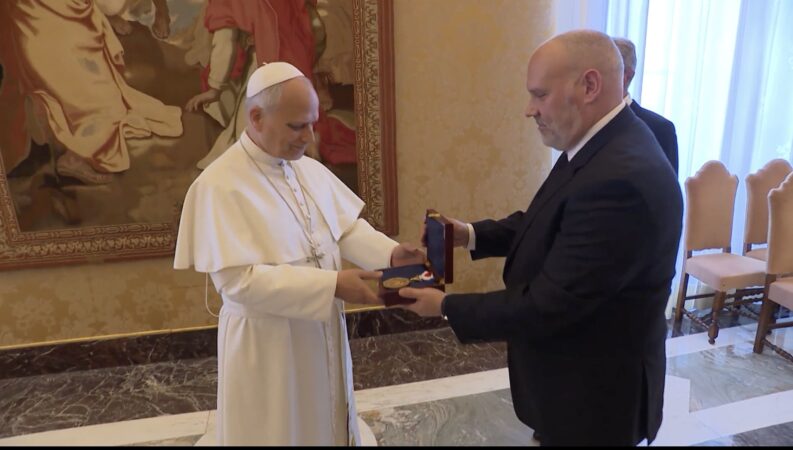
Now, on the eve of America’s Semiquincentennial, as if to underscore how much has changed, the American pope has been awarded the National Constitution Center’s Liberty Medal. Pope Leo accepted the award at the Vatican on April 30. On Friday, in a ceremony at the National Constitution Center on Independence Mall, the pontiff will address the audience live from the Vatican in a speech that will be livestreamed globally.
The medal, according to the center’s interim president and CEO, Vince Stango, will celebrate how “[i]n formal Vatican statements and public addresses, His Holiness has affirmed that peace cannot exist without freedom of religion, freedom of thought, and freedom of expression, principles that closely align with constitutional protections guaranteed by the First Amendment.”
One reason an American pope was long unthinkable is that American principles have not always aligned with Catholic principles. The proud American refusal to establish the Catholic Church as the national religion flew in the face of traditional Catholic teaching that the church should ensoul the body politic.
That was never going to happen in the United States, of course. Not even close. And so the question then became, from the Catholic point of view, what to say about the American model that included the First Amendment, with its coordinated guarantees of the “free exercise” of religion and the nonestablishment of religion by Congress.
Rome’s response has changed over time. In the late 1800s, Pope Leo XIII noted with approval the religious situation of Catholics in the United States, yet cautioned against the error that separation between the church and the civil power was to be the norm. By the 1950s, though, some Catholic thinkers were claiming the American model, in fact, stated the ideal, reasoning that the First Amendment guarantee of “free exercise” is necessary for a person to honor his God-imposed duties.
By now, even though the Second Vatican Council (1962-1965) stated that it was leaving the church’s traditional teaching “untouched,” the nonestablishment of religion and a legal guarantee of individual and group free exercise of religion, subject to just limitations for the common good, constitute the norm proposed by the Catholic Church to the world as we know it.
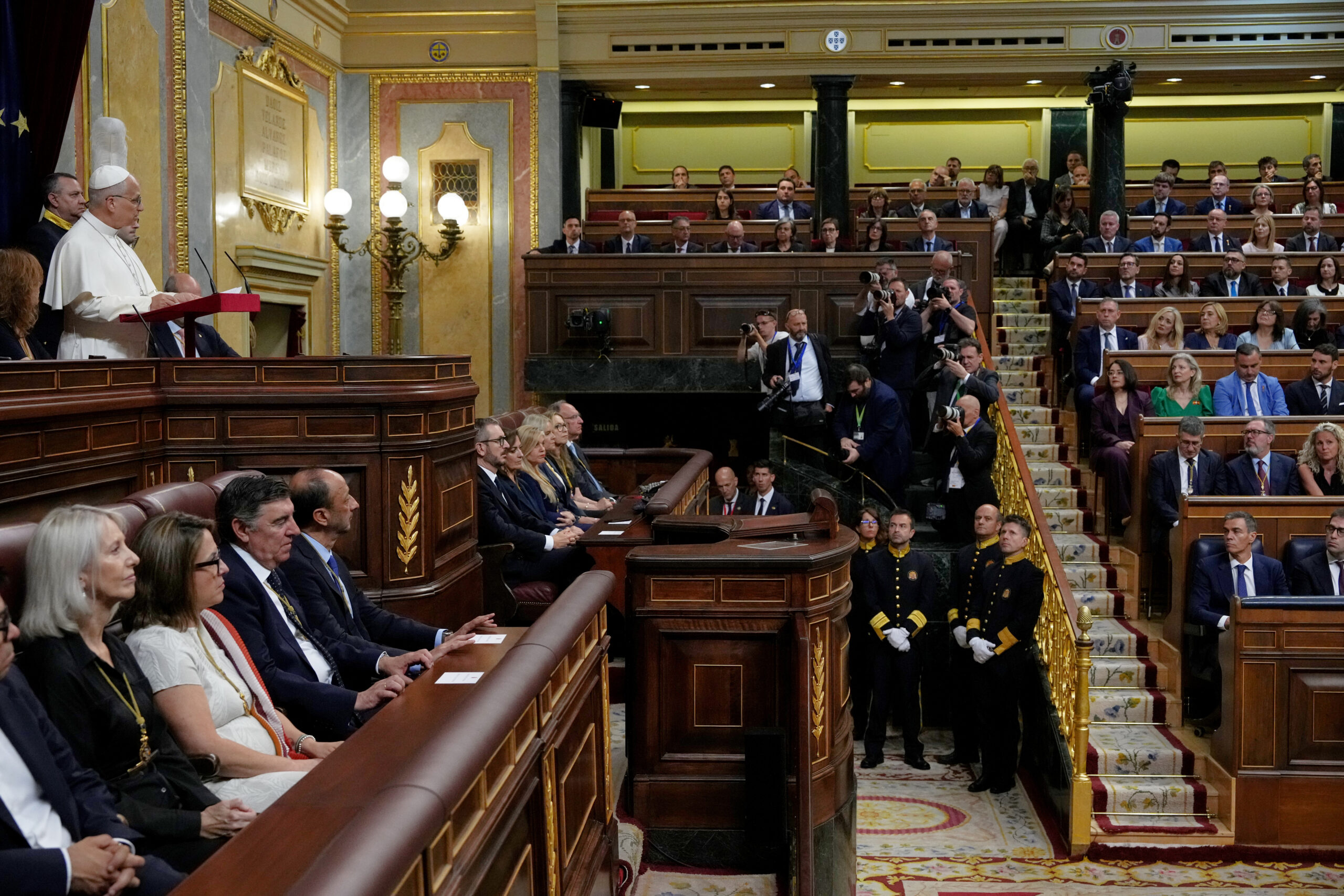
Pope Leo XIV speaks to members of the Spanish Parliament at the Congress of Deputies, in Madrid, on Monday, June 8.
In speaking to the Spanish Parliament on June 8, for example, Pope Leo insisted that laws must respect “freedom of thought, conscience and religion, a fundamental right that protects the most intimate sphere of the person. The freedom upon which the contemporary state is built, if it is authentic, recognizes the religious dimension of the human person.”
In the ceremony on Independence Mall on Friday, Pope Leo will address a nation in which, for the first time in its history, it is becoming socially acceptable to oppose the free exercise of religion for some people. Litigation that threatens to cancel people’s freedom to live according to their conscience becomes more common. The seal of confession, long protected in the United States, is under assault, and the threat is real. In his address to the Spanish Parliament, Pope Leo warned against the withdrawal of that protection, and the warning needs to be echoed in the United States.
It would be one of history’s great ironies for an American pope to call his country back to a principle that his church learned, in part, from America.
Religious liberty is not the only American principle on the American pope’s mind, as his message to the 2026 graduates of his alma mater makes clear. “This being the 250th anniversary of the United States of America, I would invite you to recall in a special way the guiding principles of the foundations of our nation: ‘We hold these truths to be self-evident: that all [people] are created equal; that they are endowed by our Creator with certain inalienable rights, and among those are Life, Liberty and the pursuit of happiness.’”
The principles of the First Amendment are to be cherished, but prior to those principles, the pope has reminded us, are the principles of the Declaration of Independence around which the nation was formed in 1776. And while the declaration does indeed attest to the nation’s commitment to the people’s Creator-given right to liberty, the outstanding principle of the declaration to which President Abraham Lincoln later found the nation “dedicated” since 1776 was that all people are “created equal.”
When Lincoln summoned the American nation to rededicate itself to the equality of all persons, he did so for good reason: Unless we are related to one another as equals, we are related to one another as fractions to wholes. The three-fifths clause of the original U.S. Constitution gave effect to slavery, a grievous injustice removed by the 13th Amendment in concert with the other Reconstruction amendments. These amendments constitutionalized the nation’s earlier commitment to our having been “created equal,” but not everyone is a believer in the equality of all people.
Today, Americans are divided over the declaration and, specifically, the claim that we are “created equal.” Human equality is said by some to be a self-evident lie, and even among those who pay it lip service, commitment to the basic equality of all people is undermined by identity politics, race-based priorities, and blood guilt.
Pope Leo, though, is not in doubt about the equality of all people. In his first encyclical, Magnifica Humanitas, he writes that we are equal in “ontological dignity, which is neither acquired nor earned, nor does it need to be justified.” This immutable and foundational equality is true of all people because we are, without exception, “created in the image and likeness of God.”
And this is another truth Americans need to reclaim.
In order to reclaim it, we need to understand that human equality was never meant to state something empirical or measurable about people. The equality declared by the declaration and celebrated by Lincoln, and fully constitutionalized by the Reconstruction amendments, depends on what is spiritual in a person, represented by the radical Christian judgment that underneath the obvious and often wonderful diversity of people lies a universal sameness in being created in the divine image.
When G.K. Chesterton was asked, “What is America?” he gave a characteristically smart answer that has been debated ever since: “America is a nation with the soul of a church. America is the only nation in the world founded on a creed. That creed is set forth with dogmatic and even theological lucidity in the Declaration of Independence.”
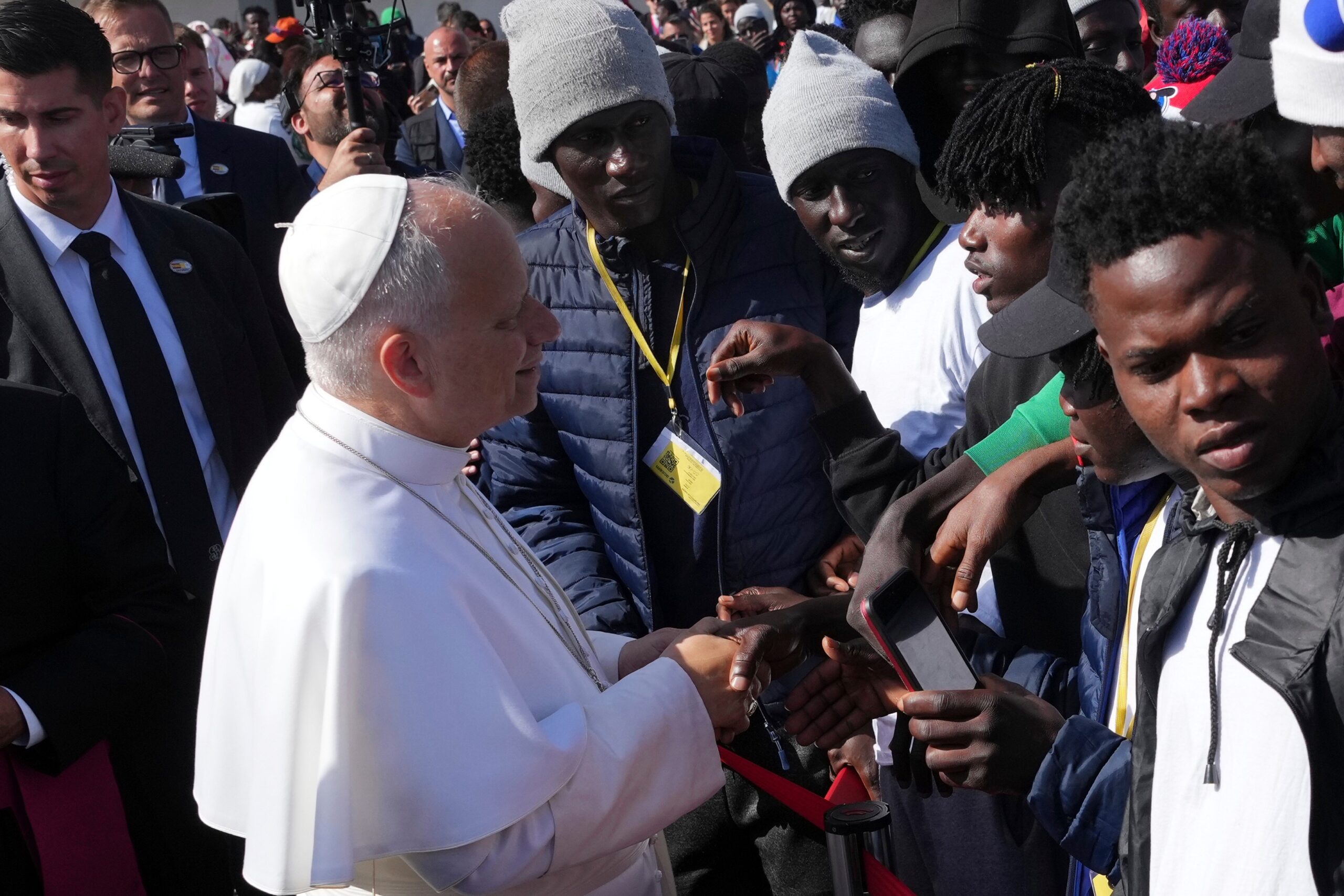
Pope Leo XIV meets migrants at the Las Raices center, in San Cristobal de la Laguna, Tenerife, Spain, June 12.
Robert Prevost, now Pope Leo, was formed, in part, in that “church” with its declarational creed. He was also, and first, formed in the Catholic Church, with its commitment to the universal equality of all people.
What the American pope can do now, in a way no other person on earth can, is to remind Americans that the equality to which their nation has been dedicated since 1776 depends on what Christianity has shown the world: that even the least, in worldly eyes, are equals in God’s eyes.
Patrick McKinley Brennan is the chair of Catholic legal studies and a constitutional law scholar at Villanova University.
After he and Phillies star Bryce Harper unveiled the 2026 All-Star Game logo last July, the team’s managing partner and CEO John Middleton gushed about how “very, very real” hosting the Midsummer Classic felt a year out from first pitch.
“It was real in Atlanta,” Middleton said, three days after the 2025 All-Star Game was played at Truist Park, home of the Braves. “And became a lot more real this afternoon, with the celebration, and the kickoff and everything else. It’s so much bigger than it was in ’96.”
Baseball’s All-Star Game was last staged in the City of Brotherly Love three decades ago, at the since-demolished Veterans Stadium, when there was only a home run derby and the game itself to enjoy. The 2026 edition is expected to be a “Rocky”-sized draw, especially with the festivities coinciding with the country’s 250th birthday.
“It’s great for baseball to be able to, kind of, piggyback right on top of the July Fourth celebration,” Middleton said. “There’s gonna be millions of people in town.”
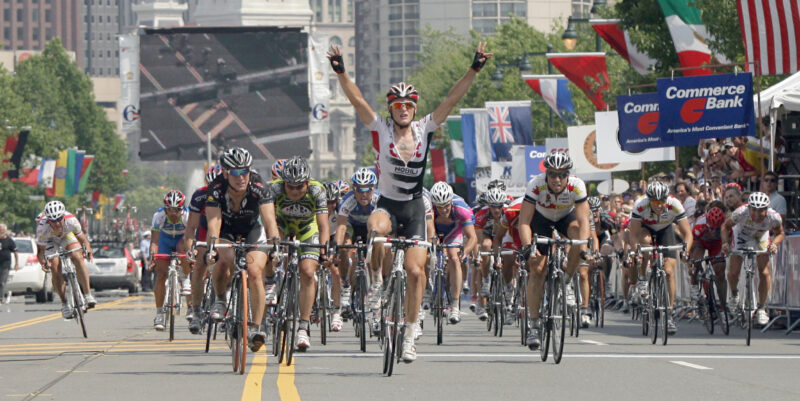
The sports fan masses will continue to flood Philly into late summer when two marquee sports events close out August: the University of Pennsylvania hosts the “Tennis Classic” Aug. 23-29, a showcase featuring some of the top women’s professional players; and after a 10-year hiatus, the Cycling Classic returns to Philadelphia on Aug. 30, when top male and female riders cycle through the city and its outskirts — including the famed Manayunk Wall — en route to a dramatic finish on the Benjamin Franklin Parkway.
Best of all? The Cycling Classic is free.
While the FIFA World Cup leaves Philly after this weekend’s July 4 match, there will be lots of places in town showing the Final on July 19 from East Rutherford, N.J. And, lest we forget the Birds. The NFL preseason kicks off Aug. 13.
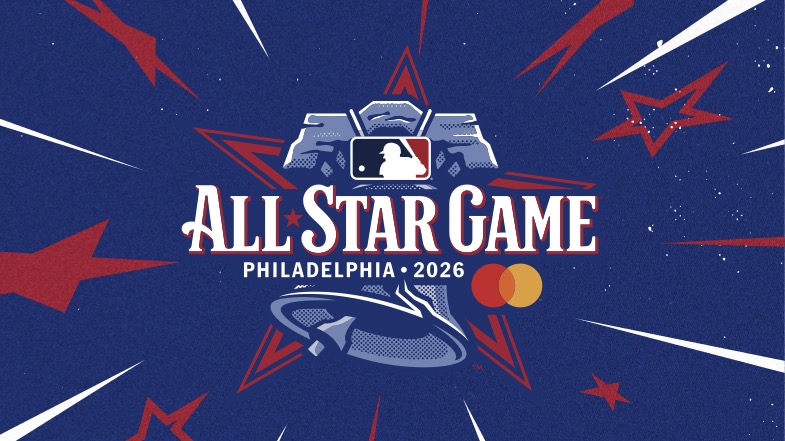
The logo for the 2026 Major League Baseball All-Star Game in Philadelphia.
MLB All-Star Week: July 10-14
The five-day All-Star extravaganza starts with the HBCU Swingman Classic on July 10. In its fourth year, the Swingman Classic features 50 Division-I players from historically Black colleges and universities, selected by a committee that includes Hall of Famer Ken Griffey Jr.
The opening rounds of the Major League Baseball draft follows on July 11 at the Pennsylvania Convention Center, while the All-Star Futures Game is played July 12 at Citizens Bank Park.
The Home Run Derby and All-Star Game round out the festivities on July 13 and 14, respectively, with both events also at the Bank. Diehard Phillies fans can see some of the team’s legends at the Capital One All-Star Village, including scheduled appearances by Hall of Famer Steve Carlton and 2008 World Series champions Ryan Howard, Cole Hamels, and Jimmy Rollins.
“I’m old enough that I was here [in Philadelphia] as an adult in ’76 [the bicentennial],” Middleton had said. “It’s gonna be a spectacular year for Philadelphia.”
Philadelphia Tennis Classic: Aug. 23-29
Tennis fans can see some of the top-ranked women’s players compete at the University of Pennsylvania’s Hamlin Tennis Center. The WTA 125 tournament features rising stars and established players in a somewhat compact venue, meaning up-close views of the action from most seats.
Philadelphia Cycling Classic: Aug. 30
During his pro cycling career, Freddie Rodriguez rode to great success in this city, winning in 2001 (then called the Philadelphia International Championship).
“I made a career out of this race. It’s the closest thing we have to the Tour de France,” Rodriguez, 52, said. After a 10-year pause, the premier U.S. cycling event returns to Philly, and Rodriguez will be on the other side this time, as a TV commentator.
Philly native Eric Robbins, one of the race organizers, said that from the outset, the mission was to not only bring back the event, but eschew public funding (the race is presented by AmeriGas).
“It was really important to give back to the city,” Robbins, a co-owner of the Philadelphia Cycling Classic said. “All these other wonderful sporting events, there’s a price tag that comes with them. This is an absolutely free event. We’re bringing the stadium to the streets.”
Fans can line the Philly streets and see elite international men’s and women’s riders tackle the 14.4-mile loop that includes the grueling Manayunk Wall. The women’s race is 62 miles total, and the men’s is 120 miles. The race dates to 1985 — then known as the CoreStates — won by Olympic speed-skating gold medalist Eric Heiden. Other iconic riders who have competed in Philly include Tour de France legend Greg LeMond.
Pro cyclist Robin Carpenter, a member of the Modern Adventure team competing this year, grew up steps from the Manayunk Wall summit and competed in the last edition in 2016, when riders finished on the Wall. Carpenter, 33, said he’s thrilled the race is back, and that the course organizers have restored the Benjamin Franklin Parkway finish.
“The Wall changed the dynamic of the race a fair bit,” Carpenter said. “Going up the wall every time was always bananas. It is a tunnel of noise. Super loud. The Parkway finish makes the race more open from a competitive standpoint.”
Rodriguez added that the Parkway finish is comparable to the dramatic last stage of the Tour de France, along the Champs-Élysées.
“It feels like that,” Rodriguez said. “When it comes to U.S. racing, this is probably our best classic race. It’s right up there with the quality of riders and the quality of the event.”
The Revolutionary War ended in 1783, but when the 1790s rolled in, America was in an economic spiral. Citizens were broke. Businesses were going under. The government had little money.
So the first United States Treasurer Alexander Hamilton came up with a plan to create a national bank to serve as the primary fiscal agent for the federal government. It would issue paper money, pay America’s bills, provide loans to private citizens, and collect taxes so the country could fund itself.
“Hamilton had been studying the British banking system for decades,” said Lynn Nash, a park ranger at Philadelphia’s First National Bank that is managed by the U.S. National Park Service. “He did a deep dive and decided America needed a similar system to build more fiscal authority.”
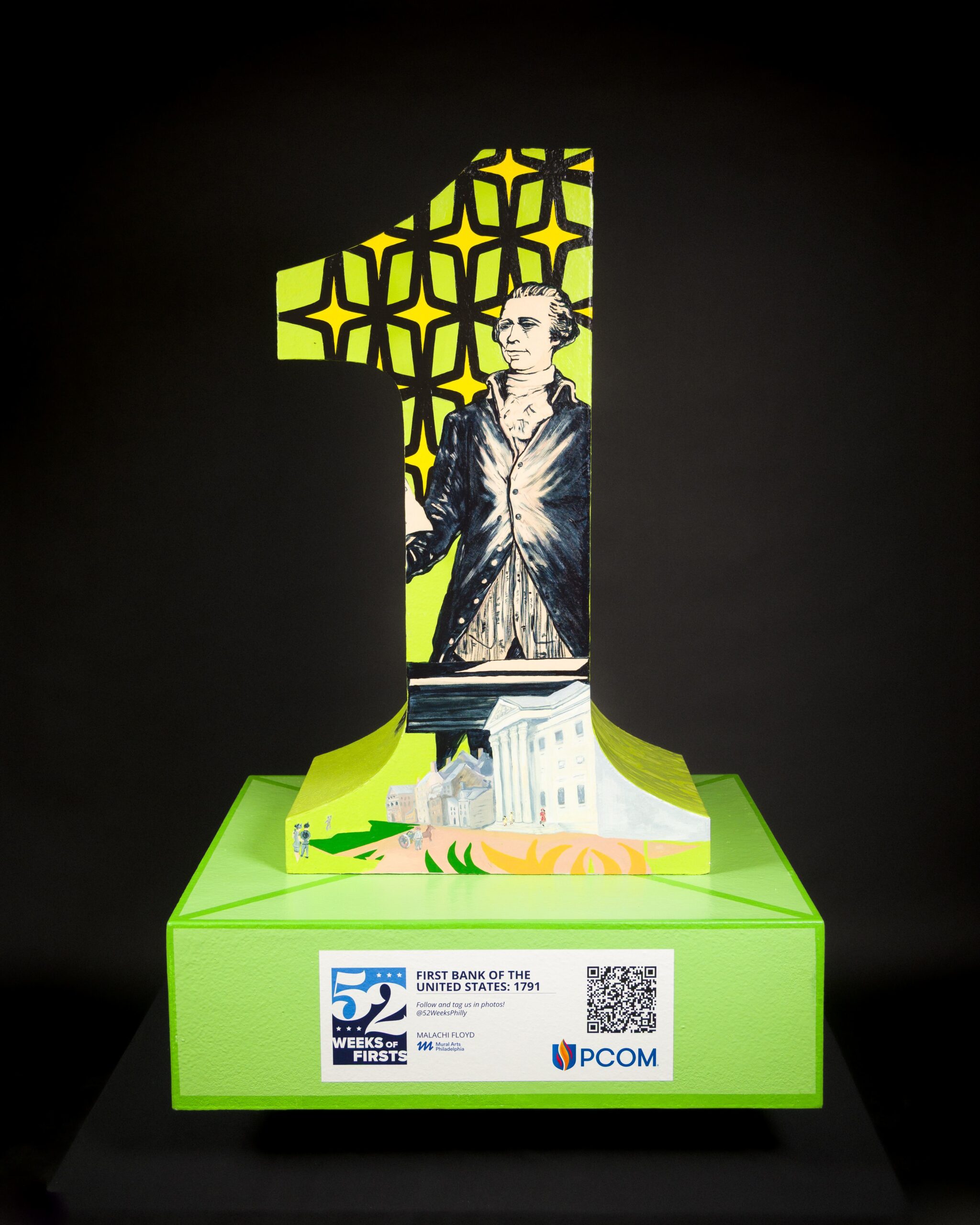
Malachi Floyd’s image of Alexander Hamilton, stacks of money, and the original First Bank of the United States’ building honors Philadelphia’s history as the seat of the federal banking system.
On Feb. 8, 1791, Congress passed a law establishing America’s first federally backed bank, which was located inside Philadelphia’s Carpenter’s Hall.
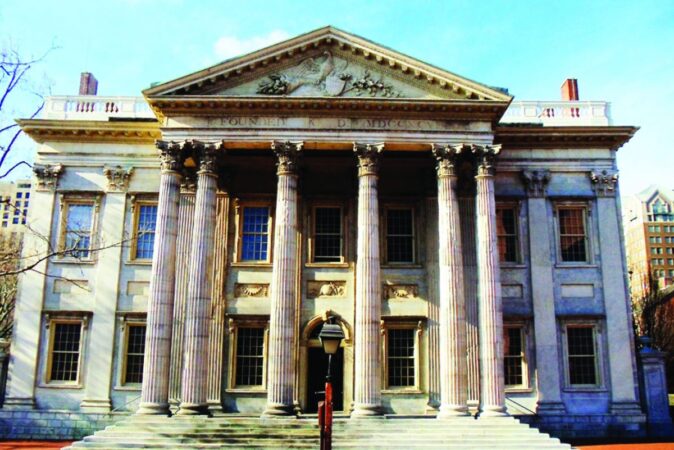
In honor of the Semiquincentennial, the National Park Service will reopen the First Bank to the public on July 1, following a multiyear $43 million rehabilitation. The gleaming Greek Revival-style building will feature exhibits centering on the history of American banking.
America’s first commercial bank, the Bank of North America, was charted by the Continental Congress in 1781 to provide loans to colonists and fund the Revolutionary War. And some lawmakers, especially Thomas Jefferson, thought that was sufficient and that the Federal Bank overstepped the Constitution.
“He writes a letter to George Washington telling him how the bank needs to be housed in a large commercial seat,” Nash said. ”And that he knows Philadelphia will remain prosperous.”
The First Bank of the United States’ charter ended in 1811. Hamilton had died by then and President James Madison did not renew the charter. The next year, the building was purchased by Stephen Girard, who opened a private bank in the space.
“But the War of 1812 was hard on the economy again,” Nash said. On April 10, 1816, Madison signed legislation establishing the Second Bank of the United States at 420 Chestnut St., Nash said.
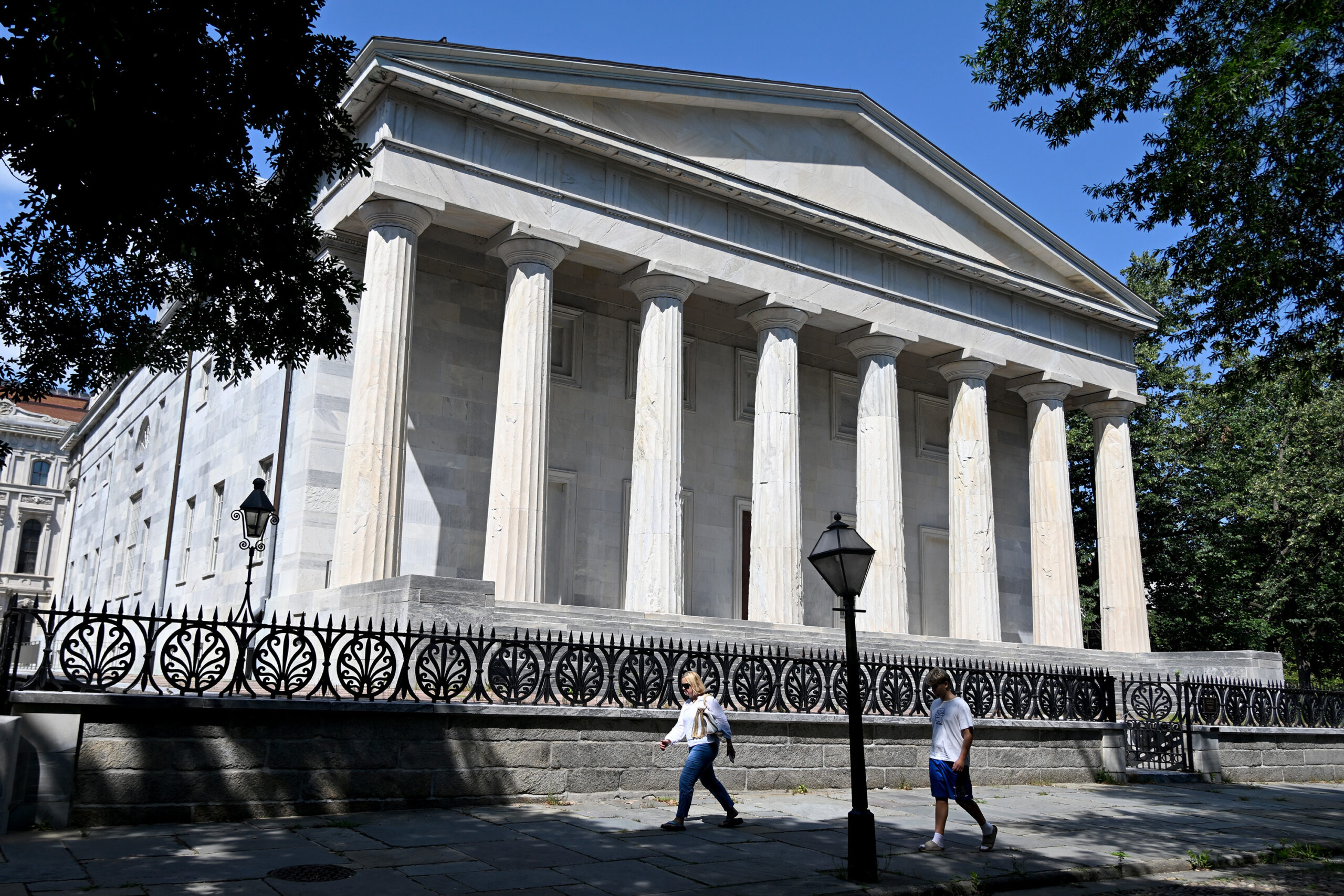
(Today that building is the Second Bank of the United States Portrait Gallery.)
Second Bank of the United States at 420 Chestnut Street. Today it is the Second Bank of the United States Portrait Gallery.
Its charter expired in 1832; Andrew Jackson was president, and he, too, opposed the idea of a federal bank. The charter was not renewed and America didn’t have a federal banking system for 77 years.
In 1907, New York financier J.P. Morgan and a consortium of bankers stopped the American banking system from collapsing by extending a line of credit to banking institutions. Without a federal banking system, the government could not bail these institutions out, so government officials began discussing the establishment of yet another national bank.
Finally, President Woodrow Wilson signed the Federal Reserve Act in 1913, setting up the federal banking system we know today.
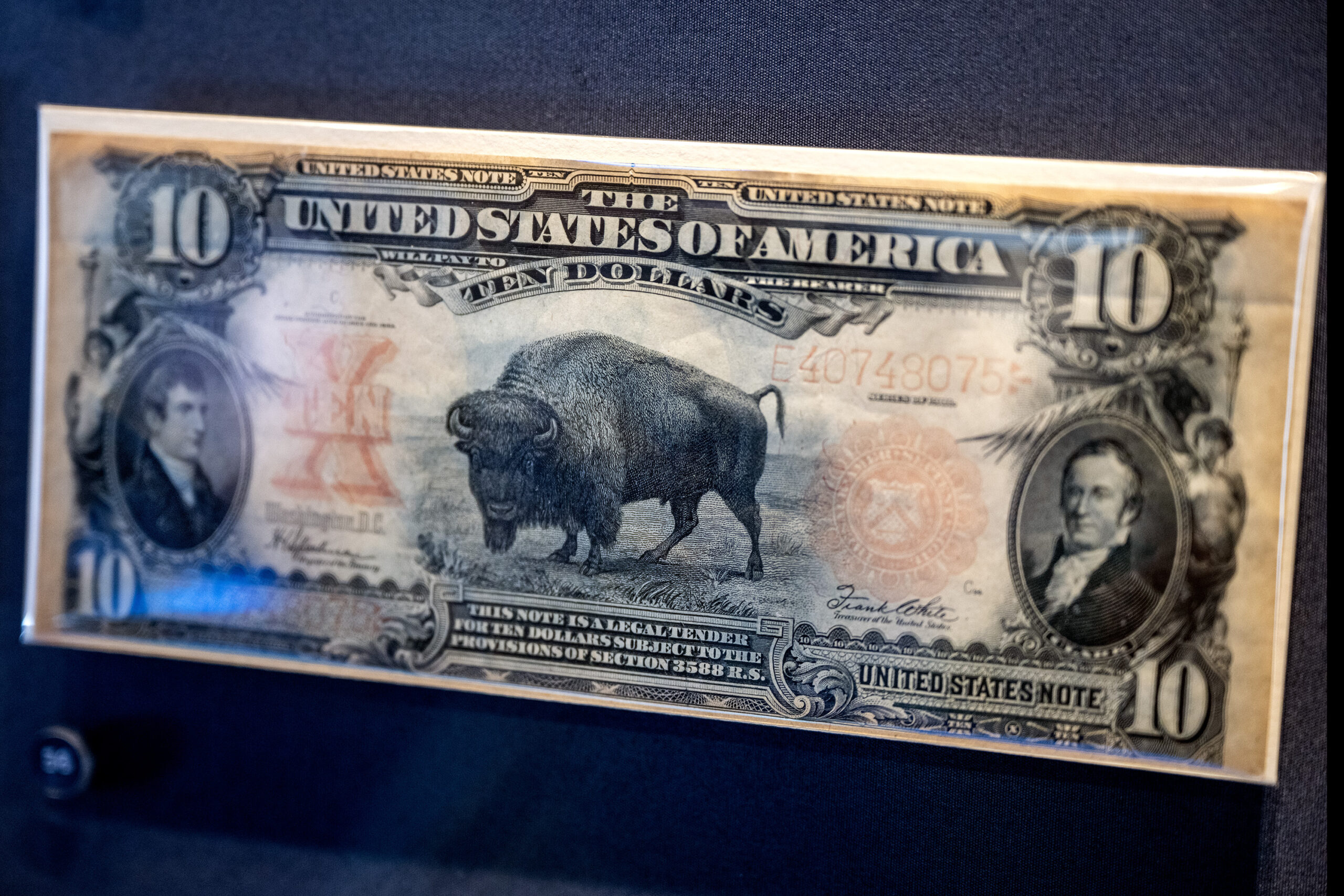
A 1901 $10 Bison Note on display at the Federal Reserve Bank of Philadelphia’s newly redesigned “Money in Motion” exhibit Thursday, May 7, 2026. The bill was issued during the 100 year anniversary of the Lewis and Clark expedition. The exhibit features nearly 400 historic artifacts and interactive installations that explore currency and the Federal Reserve’s mission.
The Federal Reserve is headquartered in D.C., but there are 12 branches across the country; Philadelphia is home to one of them.
Today, the Federal Reserve acts as a fiscal agent for the U.S. Treasury, which issues paper money, collects taxes, and pays America’s bills. It does not offer private loans to businesses or individuals.
Like the national banks, the Federal Reserve also began with a 20-year-charter. But in 1927, Congress passed the McFadden Act, granting the Federal Reserve Bank perpetual succession.
“The government finally agreed that a federal banking system was something America needed,” Nash said. “It just took them more than 100 years to agree.”
America’s First National Bank Firstival will be celebrated on Saturday, July 4, from 11 a.m. to 1 p.m., the First Bank of the United States, 120 S. Third St.
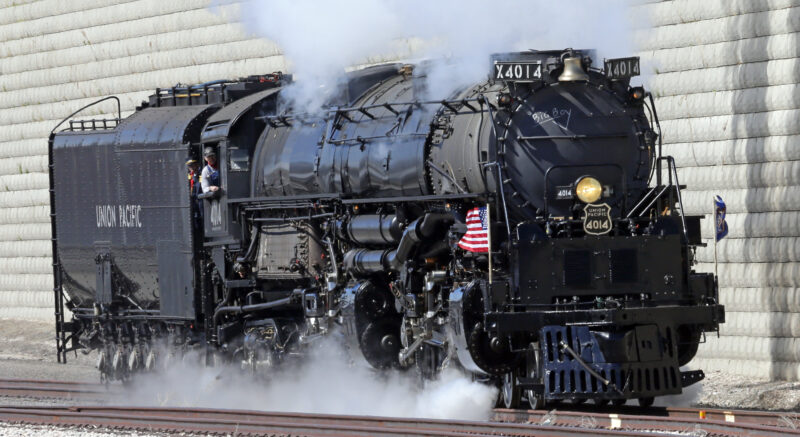
Union Pacific’s Big Boy No. 4014 will arrive in Philadelphia in time for Fourth of July celebrations, completing its journey from the West Coast. The legendary locomotive has already drawn thousands to tracks across Pennsylvania, according to the railroad.
The Big Boy is scheduled to arrive in Philadelphia for a Fourth of July display at Intrepid Avenue and League Island Boulevard in the Navy Yard, where the Port of Philadelphia will host a public viewing from 8 a.m. to 2 p.m. Saturday and again on Sunday from 9 a.m. to 3 p.m. before heading west. Admission is free.
The stop is part of Union Pacific’s coast-to-coast tour marking the nation’s 250th anniversary, a commemoration neatly suited to the locomotive itself: enormous, industrial in purpose, and now preserved as national memory.
On Thursday, the locomotive is scheduled to stop shortly in Reading (1:30 to 2:15 p.m.) and Pottstown (3:30 to 3:45 pm.) for public viewing before traveling to King of Prussia, from where it will depart at 9 a.m. Friday for Philadelphia. It will leave Philly at 9 a.m. Monday.
(function() {
var l2 = function() {
new pym.Parent(‘BIGBOY2.html’,
‘https://media.inquirer.com/storage/inquirer/projects/innovation/arcgis_iframe/BIGBOY2.html’);
};
if (typeof(pym) === ‘undefined’) {
var h = document.getElementsByTagName(‘head’)[0],
s = document.createElement(‘script’);
s.type = ‘text/javascript’;
s.src = ‘https://pym.nprapps.org/pym.v1.min.js’;
s.onload = l2;
h.appendChild(s);
} else {
l2();
}
})();
The Big Boys — 133 feet long and weighing 1.2 million pounds — are the world’s-largest steam locomotives. Big Boy No. 4014 was part of a fleet of 25 locomotives designed to haul heavy freight over the mountains between Ogden, Utah, and Cheyenne, Wyo., as rail traffic surged around World War II.
“There is something romantic about it,” said Robynn Tysver, a spokesperson for Union Pacific.“It echoes back to a time that you and I do not remember. Maybe it’s just the size of it.”
The restoration project that put Big Boy 4014 back on the track has been called one of the most significant locomotive restoration projects in recent memory by railroad experts. The restoration began in 2013. The locomotive was taken down to its bolts and rebuilt using graphics from 1941, according to Union Pacific.
Union Pacific’s history reaches back to the Pacific Railway Act of 1862, when President Abraham Lincoln chartered the railroad to help build the eastern portion of the first transcontinental line. Built largely by immigrant labor, the railroads that followed connected markets and cities, transformed the West, and made the country feel physically continuous.
Big Boy No. 4014 carries some of that history with it. It is both machine and symbol: of movement, expansion, industry, memory, and the complicated national faith that bigger could mean better.
Union Pacific reports that crowd sizes have increased as the locomotive has traveled from California to the East Coast. Though modern locomotives are more durable and have enhanced safety features — for example, AI software to scan tracks for debris — something inarticulable draws people to the Big Boy.
“You just have to see it to understand what captivates people,” Tysver said. “When you see it, you’ll understand what captivates people. It’s a living, breathing piece of history.”
With the eyes of the nation on Philadelphia for America’s 250th birthday, Mayor Cherelle L. Parker’s administration this year took over management of the city’s free July Fourth concert, which for years was produced by a nonprofit established by the city: Welcome America.
The mayor instead hired ESM Productions, a for-profit company, to put on the annual show featuring musical acts and fireworks over the Ben Franklin Parkway, and she changed the name from Wawa Welcome America to the “One Philly: Unity Concert for America” — a version of Parker’s well-known slogan, “One Philly: A United City.”
Another change: It will cost taxpayers far more than in the past.
The city is due to pay ESM Productions about $15.5 million for the show, which will be headlined by Christina Aguilera, Jill Scott, and The Roots, and feature rapper Meek Mill, according to a copy of the city’s contract paperwork with ESM, obtained by The Inquirer. The city in March signed a $10 million contract with the Philadelphia-based company, as well as a $5.5 million contract amendment.
By comparison, Welcome America’s budget for all of 2024 — including that year’s July Fourth concert,the numerous other events it manages in the build-up to the concert, and the salaries of its staff — was about $6.6 million, only about $5.3 million of which came from government grants, according to the group’s most recent federal nonprofit disclosure.
Welcome America, which is a public-private partnership with the mayor serving as a board member, receives city and state funding, as well as a corporate sponsorship. The organization has been involved in Philly’s July Fourth celebrations since 1993.
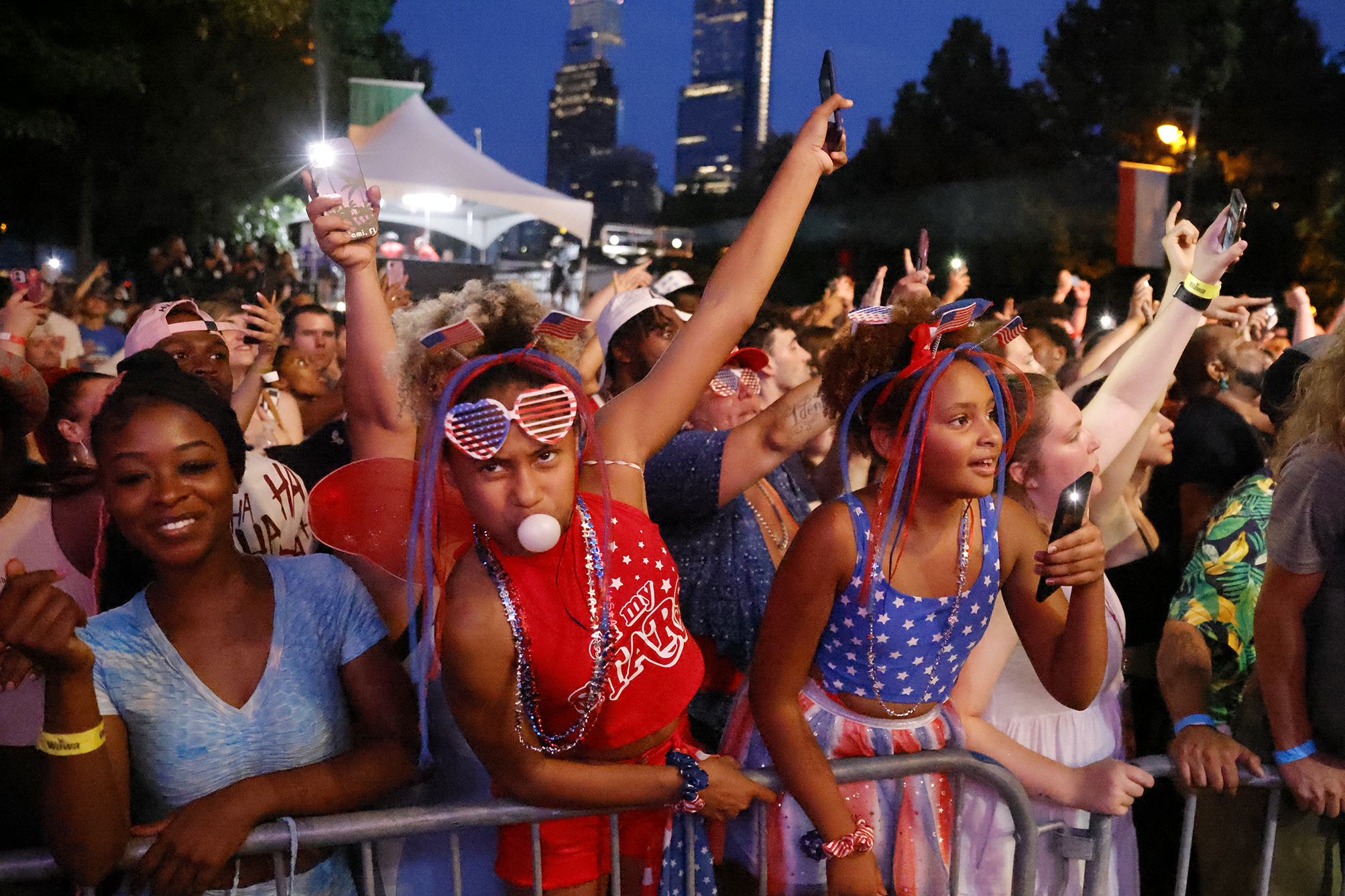
Fans react to the music as the Wawa Welcome America Festival concluded July 4, 2023 with a free concert featuring Ludacris on the Benjamin Franklin Parkway.
Last year’s iteration of the Wawa Welcome America concert cost the organization about $3 million, according to a person with knowledge of the situation who spoke on the condition of anonymity because they were not permitted to disclose that information.
The Philly taxpayer money paid to the concert’s producers does not cover additional expenses borne by the city, such as pay for police officers and sanitation workers staffing the event.
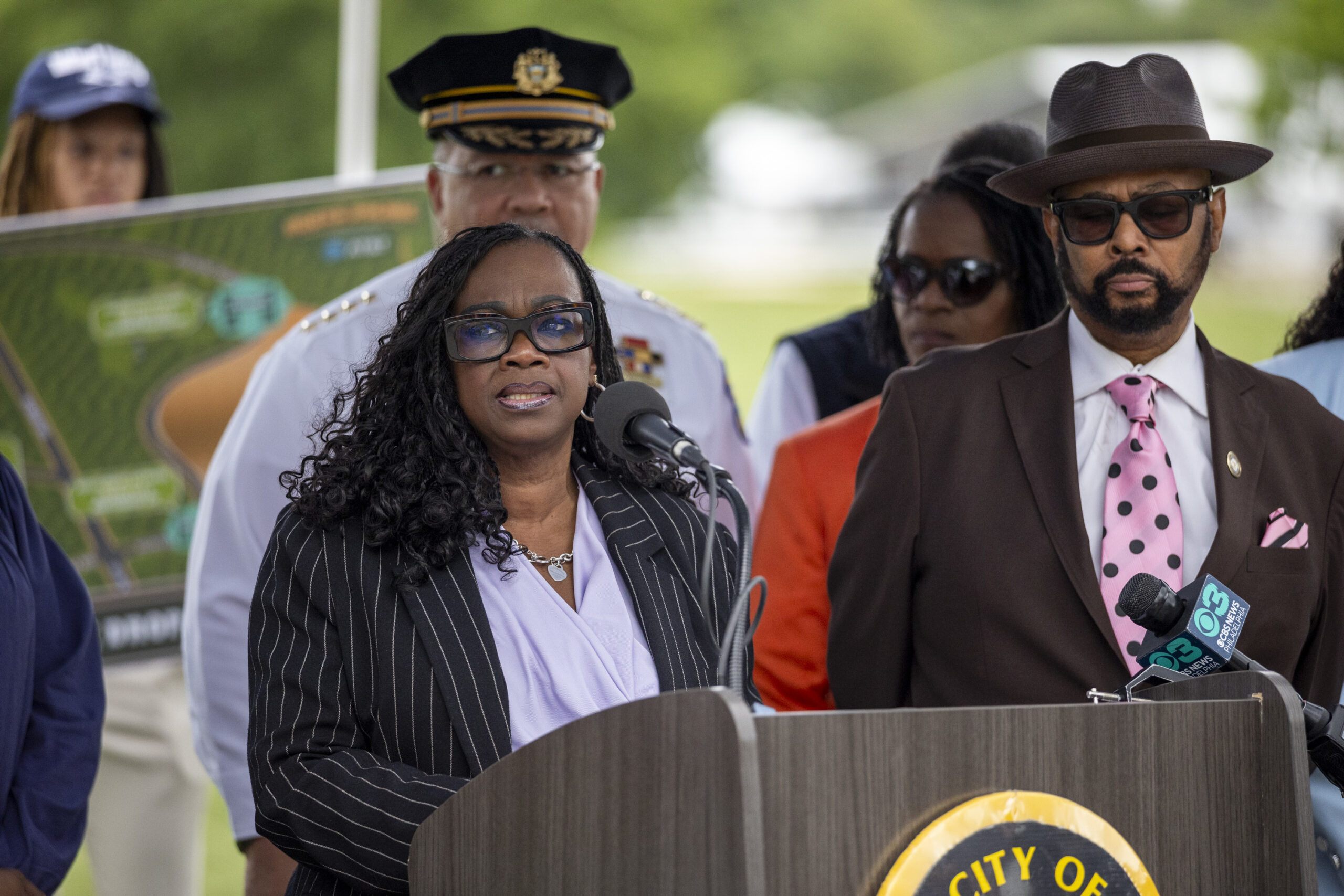
Parker’s office declined a request from The Inquirer for a copy of the contract or information on the cost of this year’s concert. Chief Deputy Mayor Vanessa Garrett Harley said in an interview that the administration would publicly disclose the costs and economic benefits of the concert after it was over.
“At a later time, we could certainly be doing a full accounting, as we’re not trying to hide anything and always want to be transparent,” Garrett Harley said.
Chief Deputy Mayor Vanessa Garrett Harley speaks at Belmont Plateau in Philadelphia on May 28.
Following the interview with Garrett Harley, The Inquirer later obtained the contract, and the mayor’s office on Tuesday did not respond to follow-up questions about the cost of the concert.
ESM’s original $10 million contract with the city included a breakdown of costs, ranging from $5,000 for “furniture” to nearly $3.4 million for “talent.” It also included $1.2 million for “ESM Productions Fees” and $1 million for “Above the line Producer’s Unit.”
The contract amendment for $5.5 million, signed June 26, did not include details on costs.
A spokesperson for ESM declined to comment.
Founded in 1996 by Scott Mirkin and Jenny Woo, ESM has previously produced numerous high-profile events on the Parkway, including the 2015 papal visit and Jay-Z’s Made in America concert.
David L. Cohen, a Philly political powerbroker and former U.S. ambassador to Canada, said he has hired ESM to produce events going back to when he was chief of staff for then-Mayor Ed Rendell in the 1990s.
“They’re incredibly competent; they’re incredibly good; they do an excellent job,” he said. “I really do think they’re the best event producers in Philadelphia.”
In paperwork submitted to the city, ESM said it “has a long standing relationship” with Cohen and pointed to events he hired the company to produce at the U.S. embassy in Ottawa, Canada, as examples of its past work.
Michael DelBene, president and CEO of Welcome America, said that, despite no longer being the producer for the concert, his organization is still managing more than a dozen Semiquincentennial-related events in partnership with the city. The events kicked off on Juneteenth and will run through the Fourth.
“The celebrations that happen in the city are the implementation of the mayor’s vision, and if she chooses a team to implement that vision, that’s great, and we all support that person and that team,” DelBene said in an interview. “We’re all going to row in the same direction to make sure the city shines.”
Drama and infighting had plagued a series of nonprofit efforts and federal commissions meant to coordinate the festivities. And the COVID-19 pandemic pushed party-planning way down the priority list for the city and for state leaders who could have previously led the charge, former Mayor Jim Kenney and former Gov. Tom Wolf.
Those delays likely squandered any opportunities for a monumental building project, such as the Please Touch Museum building, which was constructed for the 1876 Centennial Exposition, or the Ben Franklin Bridge, which opened for America’s 150th birthday in 1926. They may have also cost Philly the chance for an appearance by a high-profile dignitary, such as when Queen Elizabeth II visited for the 1976 Bicentennial.
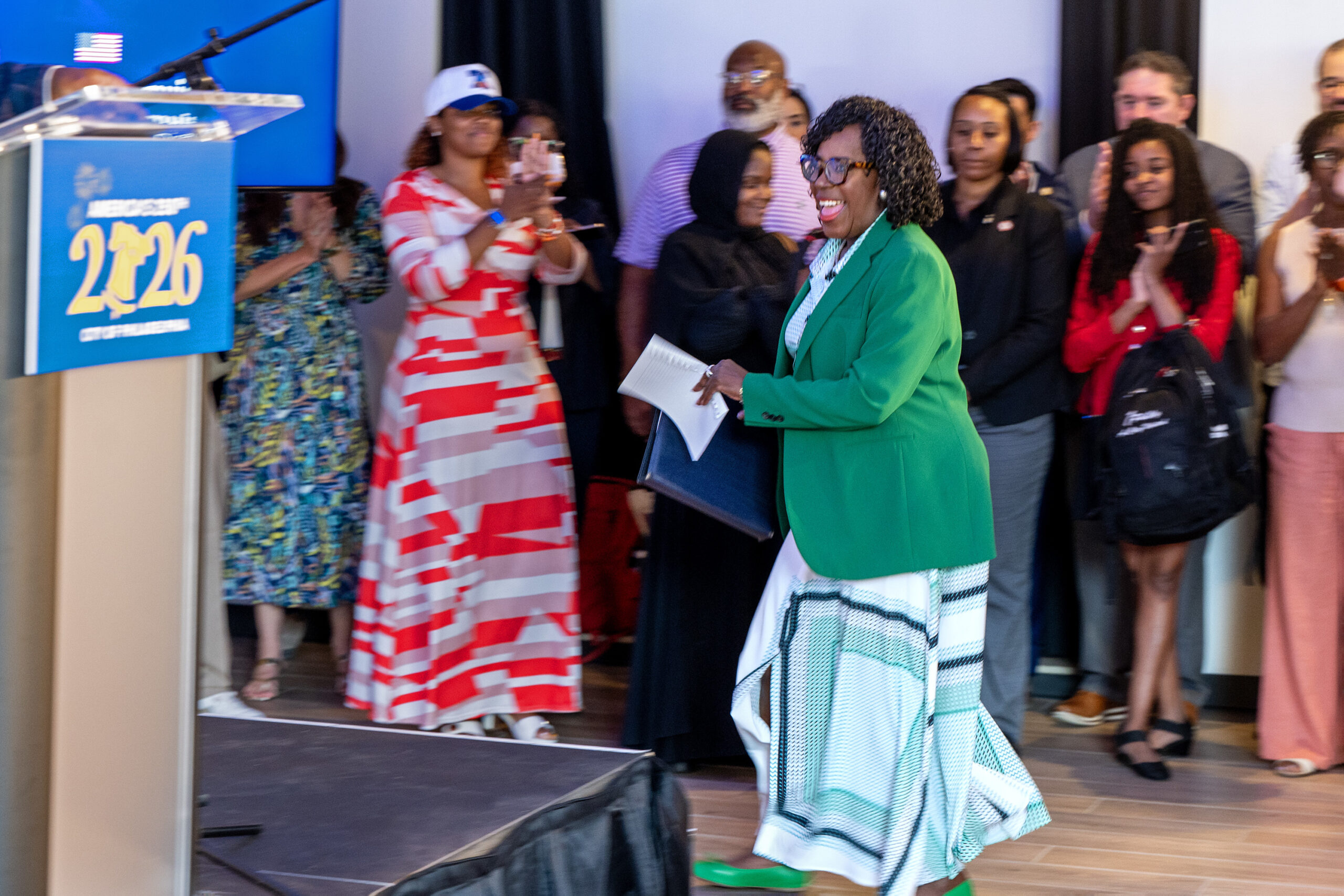
Mayor Cherelle L. Parker heads to the stage at the Independence Visitor Center Wednesday, Sept. 3, 2025 to announce a new initiative that puts city neighborhoods at the forefront of the city celebrations of America’s 250th birthday in 2026.
But the mayor eventually embraced the task in a more public way — following some public prodding from City Councilmember Isaiah Thomas — and the city’s Semiquincentennial celebrations will very much bear her stamp.
Parker has pledged to spend $120 million this year to mark the occasion, and she has made investing in communities across the city, not just the historic district, a major focus as Philadelphia this summer is also hosting World Cup games and the MLB All-Star Game. Much of that spending will pay for street work and beautification projects in neighborhood commercial corridors, 250th-themed block parties, and extra funding for annual events like the Odunde Festival.
“We want to make sure that any and everybody can participate in this regardless of your station in life,” Garrett Harley said.
‘This is her big concert’
With the official Independence Day parade — still organized by Welcome America — scheduled for Friday, July 3, there is surprisingly little in the way of official patriotic proceedings taking place on July Fourth itself.
Parker at 10 a.m. will lead a Philadelphia Freedom Awards ceremony at Independence Mall, honoring seven people, including Cohen and actor and Philadelphia-native Colman Domingo.
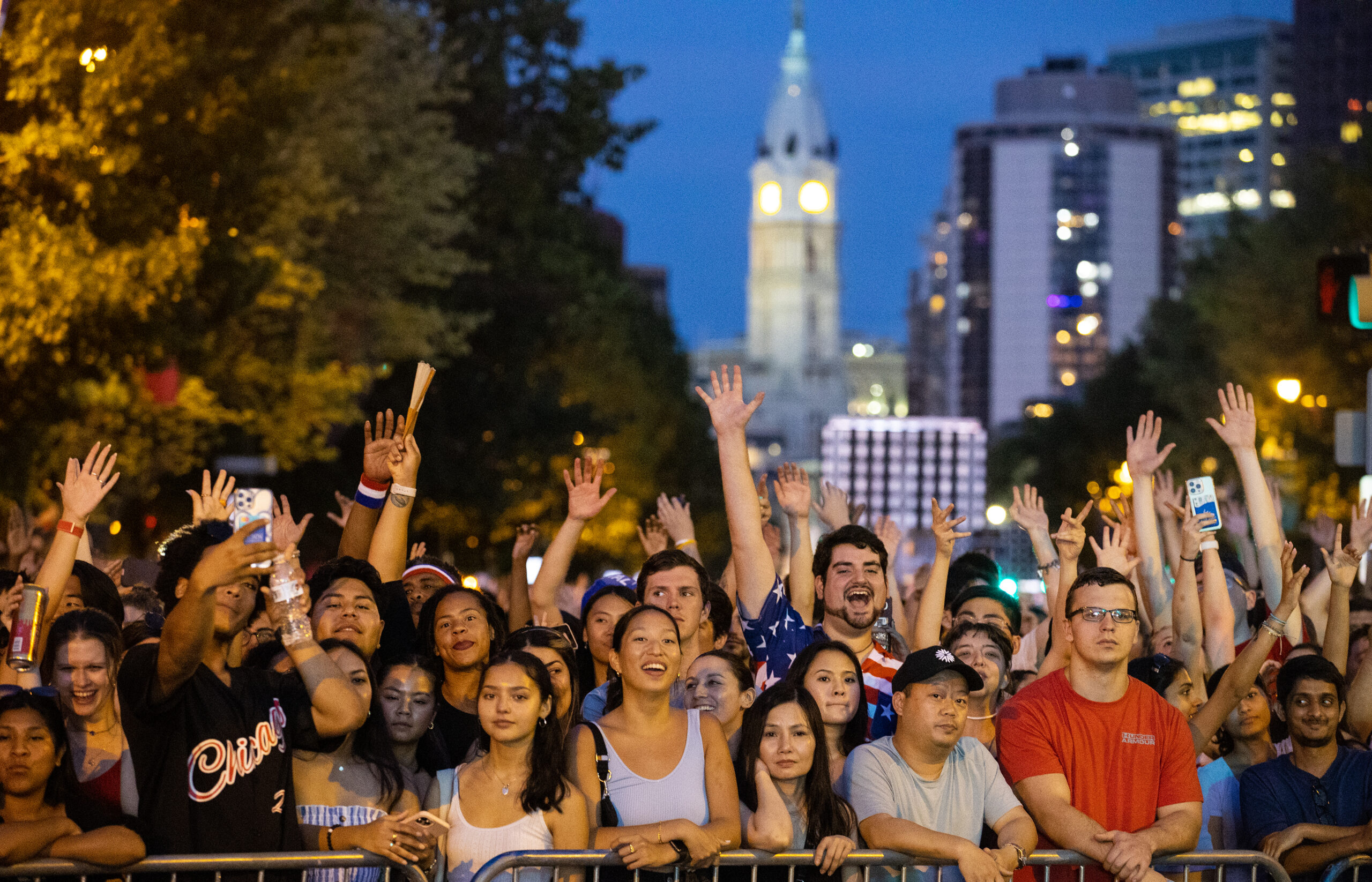
At 5 p.m., the concert will kick off on the Ben Franklin Parkway. Performers include Aguilera, Will Smith, DJ Jazzy Jeff, Jill Scott, The Roots, Meek Mill, and Seal. The city’s official fireworks show will begin at the show’s conclusion, around 11:30 p.m.
Fans during the Wawa Welcome America July 4th Concert on the Parkway in Philadelphia, Pa. on July 4, 2022.
Parker has several times compared this year’s show to Live Aid, the 1985 benefit concert staged in Philadelphia and London that featured in its 10-hour stateside lineup Bob Dylan, Mick Jagger, Madonna, Phil Collins, the Beach Boys, the Four Tops, Santana, Run-D.M.C., and many other musical A-listers.
“If you remember Live Aid and you think about the legacy experience we’re trying to create … that’s what we’re trying to do on July the Fourth,” Parker said in March.
Garrett Harley on Tuesday conceded the concert lineups may not be exactly comparable, but said the mayor was “really talking more about the scope and the magnitude and just the memories.”
“But to certain kids it’s gonna be bigger than Live Aid, because Christina Aguilera means to them what Stevie Wonder and some of the folks who ran Live Aid meant to others,” Garrett Harley said.
Garrett Harley disputed the notion that renaming the concert “One Philly: A Unity Concert for America” meant that it now bears Parker’s branding.
“I don’t know how a ‘Unity Concert for America’ is Parker’s branding because the whole point of this is about unity,” Garrett Harley said. “The branding is really about reminding people that we need to unify, we need to be one America, despite everything that may be going on in the country right now.”
The mayor frequently concludes speeches by asking crowds to raise their index fingers and say in unison, “One Philly: A United City.” She has also had the slogan printed on city trash trucks and cans, along with her name.
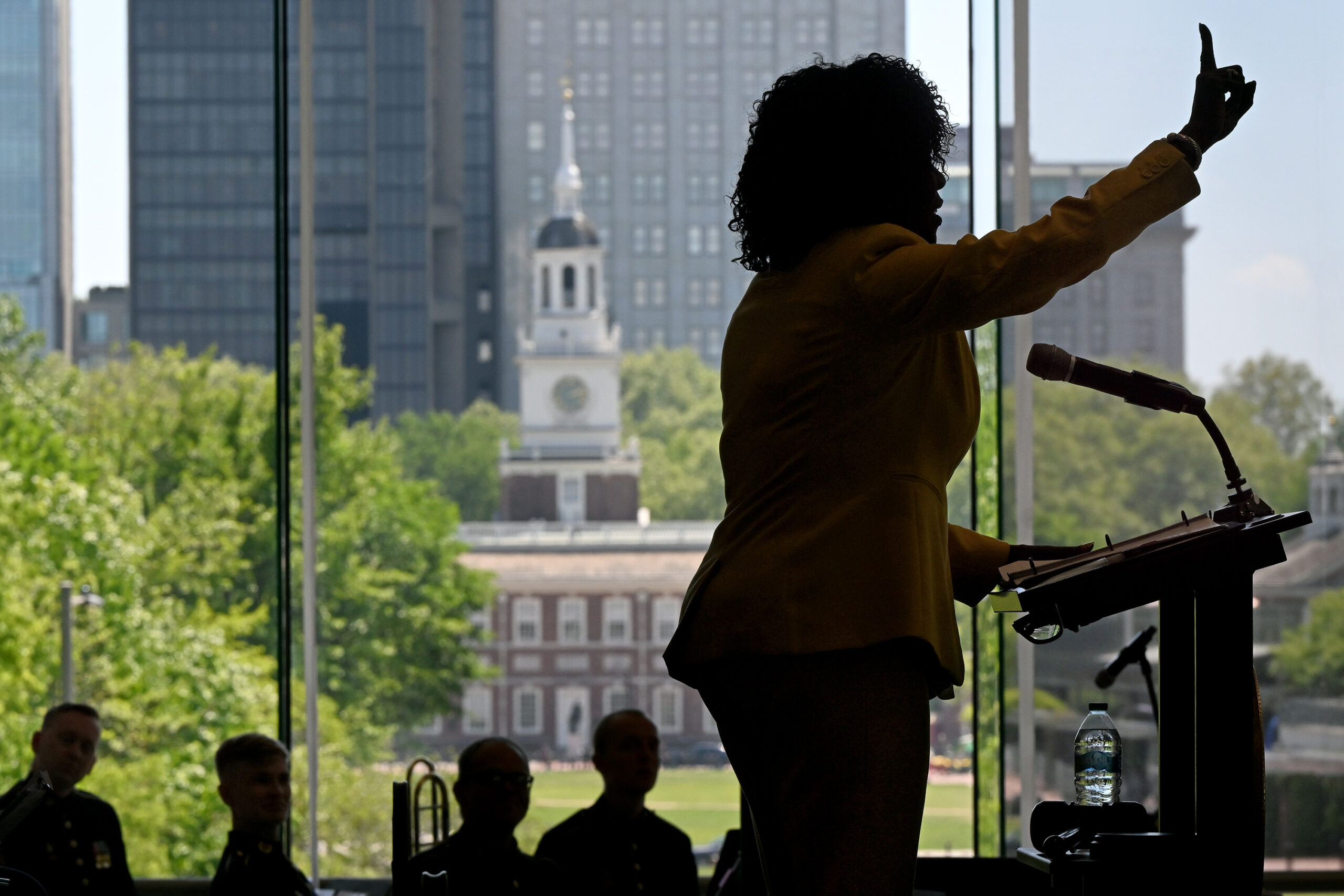
Mayor Cherelle L. Parker raises a finger with her call-and-response “One Philly, A United City” mantra ending her speech during a ceremonial meeting of the Pennsylvania Senate at the National Constitution Center across the mall from Independence Hall on May 5.
“Even if it is Parker’s branding, if that’s how people see it, what would Wawa Welcome America be if not branding?” Garrett Harley added.
(Wawa, a longtime corporate sponsor for the city’s July Fourth festivities, pays Welcome America to include its branding in the event, defraying costs for taxpayers.)
Branding or not, Parker’s vision guided the planning for the concert, Garrett Harley said.
“At the end of the day, this is [Philadelphia’s] 100th mayor,” Garrett Harley said of Parker. “This was her biggest concert, and probably will be the biggest that she will ever do. She’s the first female mayor. She’s the first African American female mayor. This is her big concert.”
I’ve driven across the Ben Franklin Bridge countless times but until last week I’d never walked across it, and I walked across the Brooklyn Bridge once, so I’ve quietly carried that shame with me for years.
When I received a news release about the bridge turning 100 on July 1 and a subsequent anniversary party on July 11 that will close it to vehicles for public use for the first time since Pope Francis’ visit in 2015, I wanted to finally check walking across it off my Philly bucket list before the event.
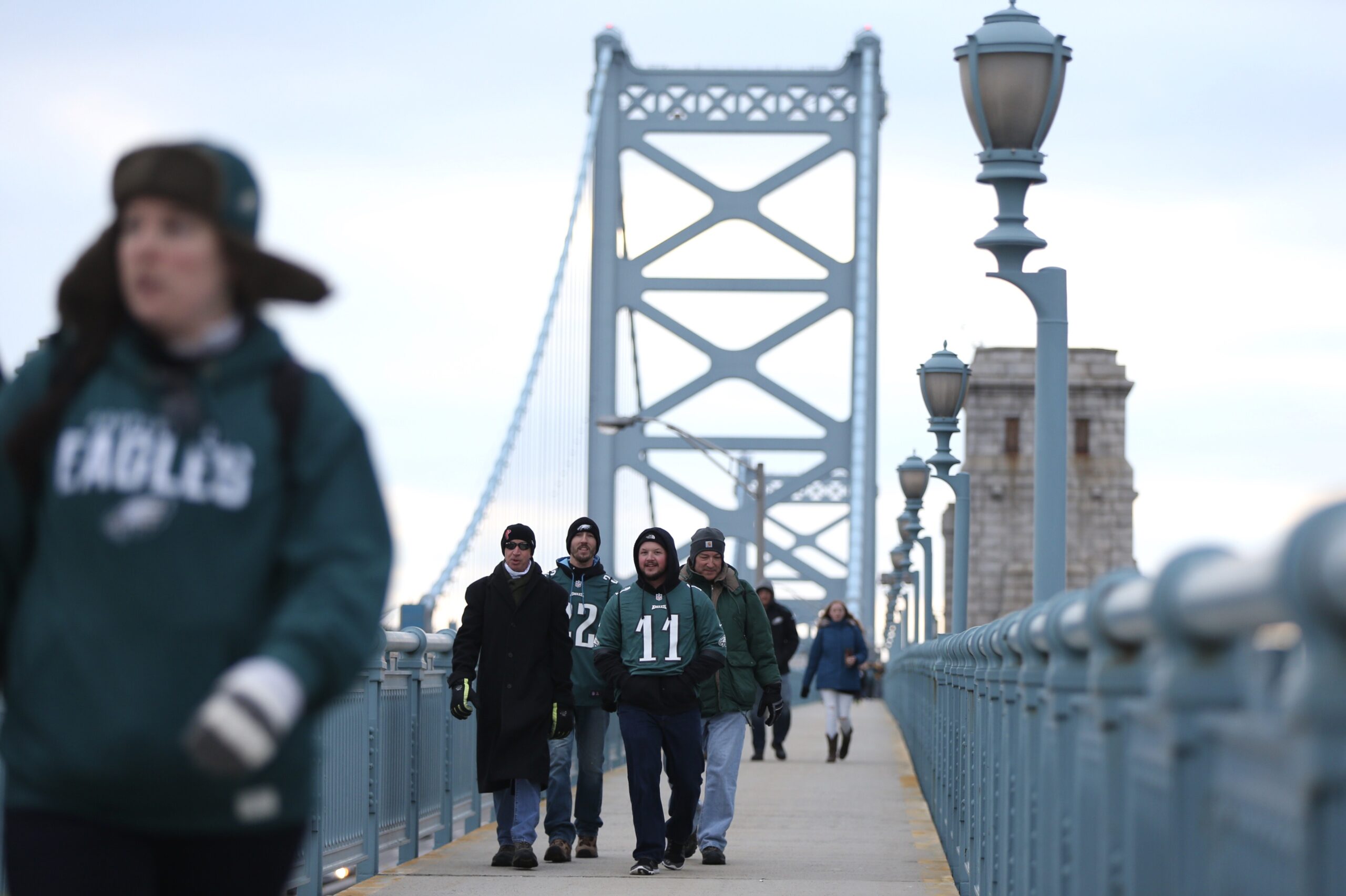
Fans cross the Ben Franklin Bridge into Philadelphia on the morning of the Eagles’ Super Bowl parade in 2018.
I was going to go it alone, but I decided to reach out to Mike Williams, spokesperson for the Delaware River Port Authority (DRPA), which manages the bridge, and he offered to schedule a walkway tour of it for me with DRPA principal engineer Michael Howard.
I met both men at Fifth and Race Streets at the base of the bridge on the Philly side, but as luck would have it, we showed up on opposite sides of the heavily-trafficked span. We waved at each other across the cars and as I tried to figure out how to Frogger my way over to them, Howard and Williams disappeared.
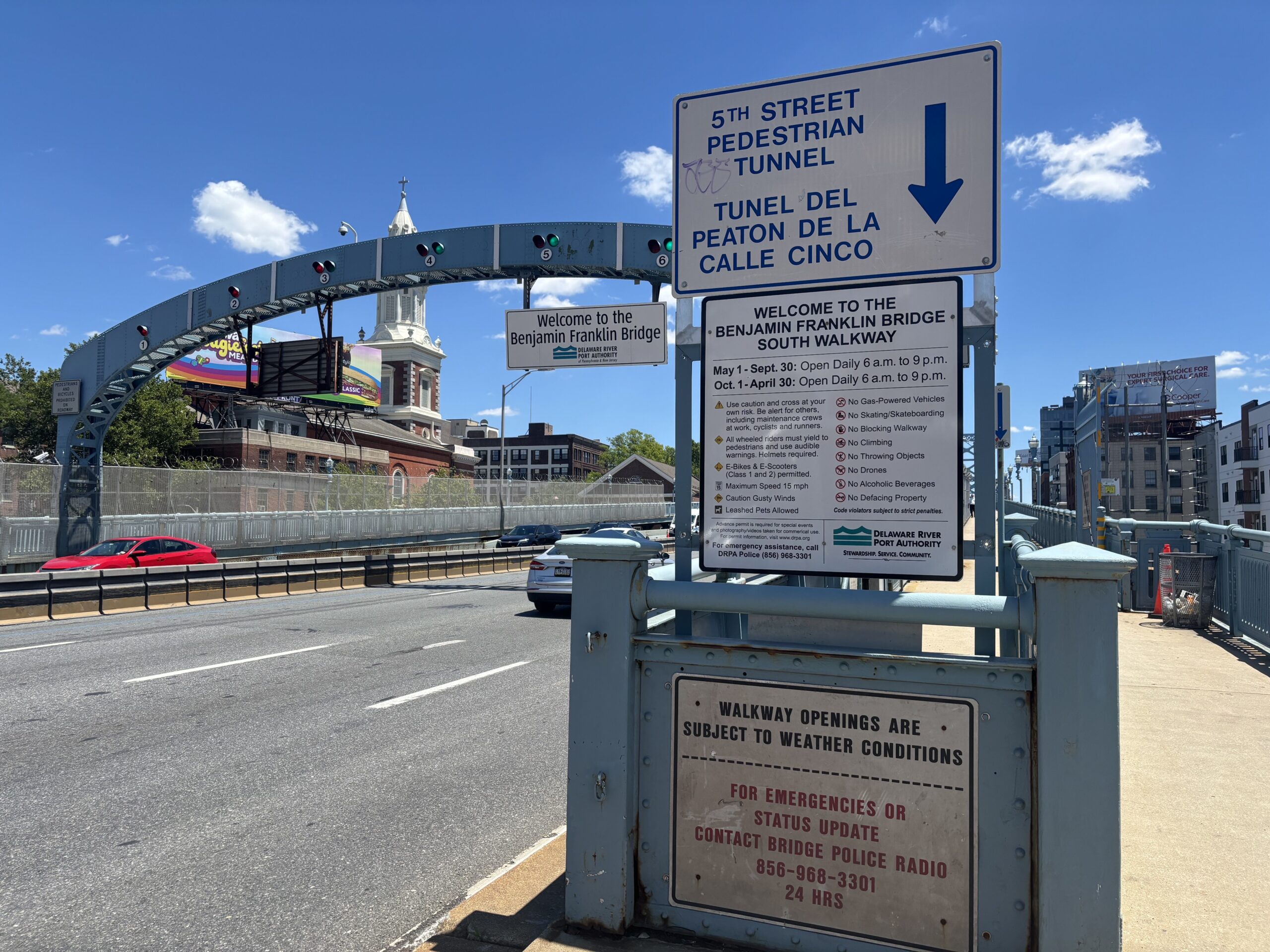
The men popped up out of a stairwell right next to me, having used the Fifth Street pedestrian tunnel under the bridge.
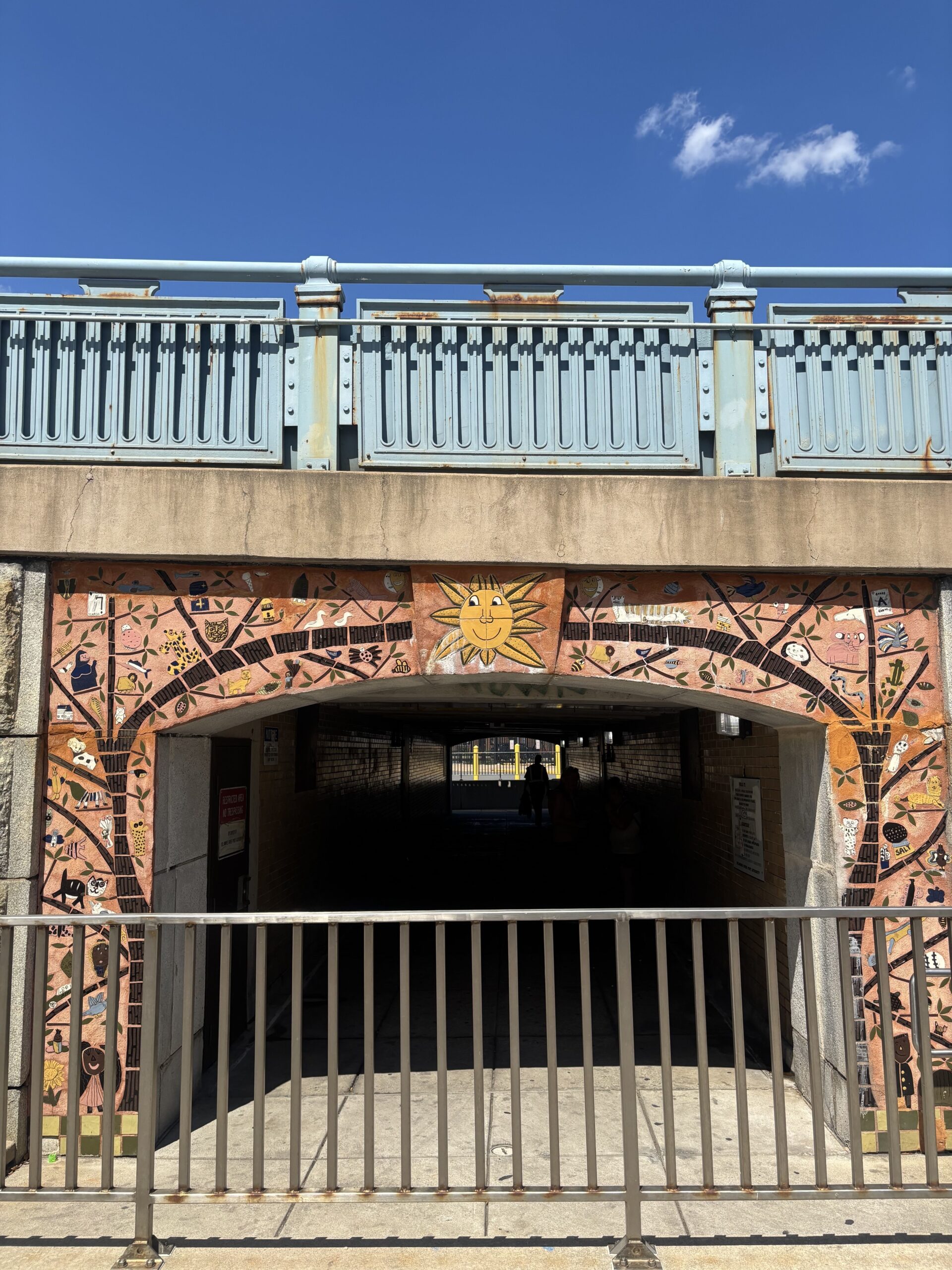
The entrance to the Fifth Street pedestrian tunnel on the south side of the Ben Franklin Bridge in Philadelphia.
“This was one of the original things that we incorporated into the bridge because we didn’t want people to try to walk across the traffic — because they would, you know,” Howard said, and I agreed.
Obviously, it was the first place I wanted to check out.
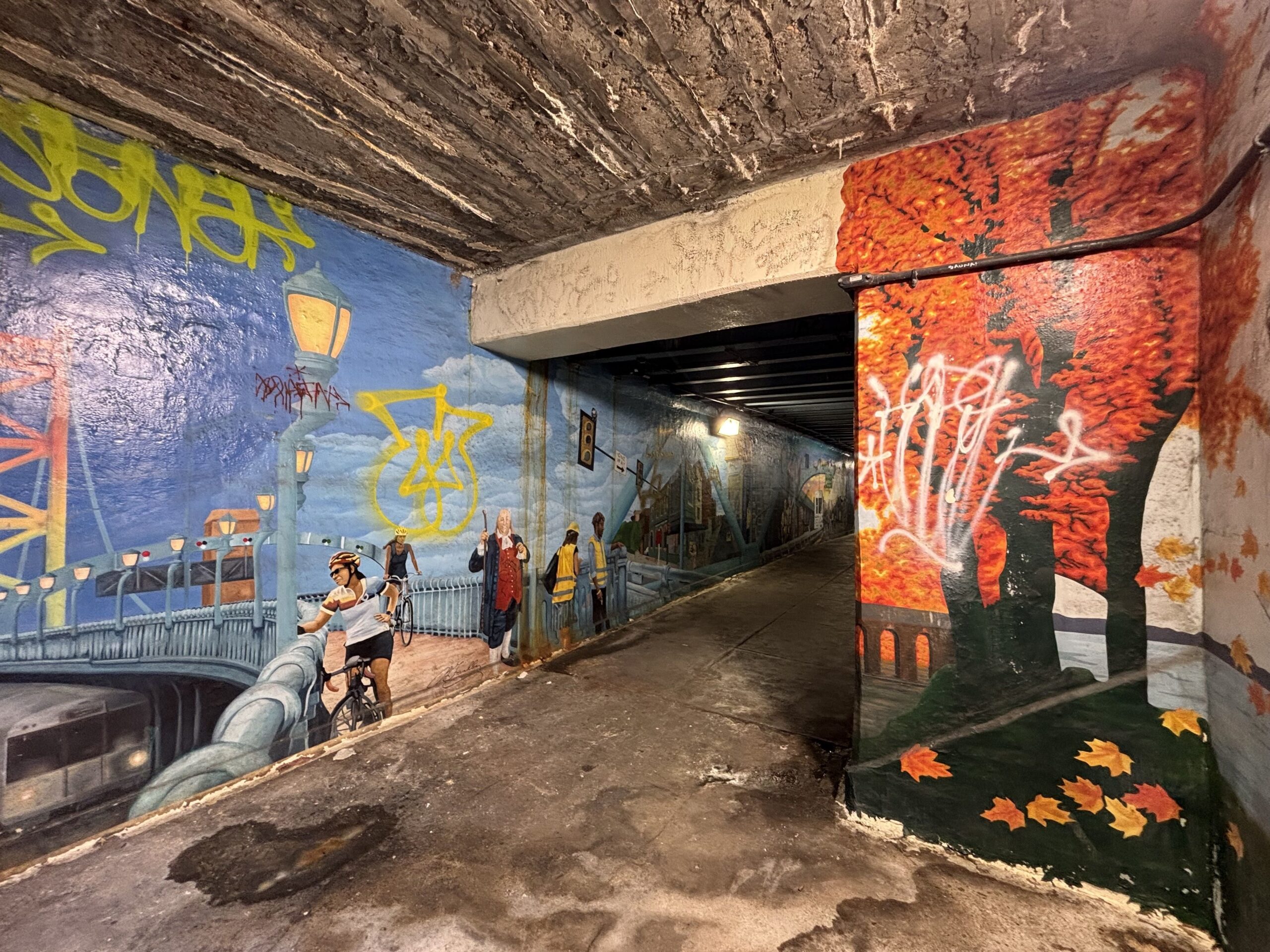
The “Building Connections through Time” mural inside of the Fifth Street pedestrian tunnel on the Philadelphia side of the Ben Franklin Bridge.
The entire length of the 91-foot-long tunnel was painted with a vibrant Mural Arts Philadelphia work by Brad Carney and Melissa Mandel. Created in 2018, Building Connections through Time shows people using the bridge, the building of it, and images of its early years. There are also paintings of Independence Hall, Benjamin Franklin, and other bridges that span the Delaware River.
Finding one of the city’s most secluded murals felt like finding one of those wonderful Philly secrets the city gives sometimes, if you never stop exploring it.
Come along with me as I explore one of Philly’s most secluded murals.
Back on the surface, Howard said that while the bridge has two pedestrian walkways, for operational reasons, only one side is open at a time and it’s usually the south side. The walkway has restricted hours, so be sure to check the signs (currently, it’s open from 6 a.m. to 9 p.m.).
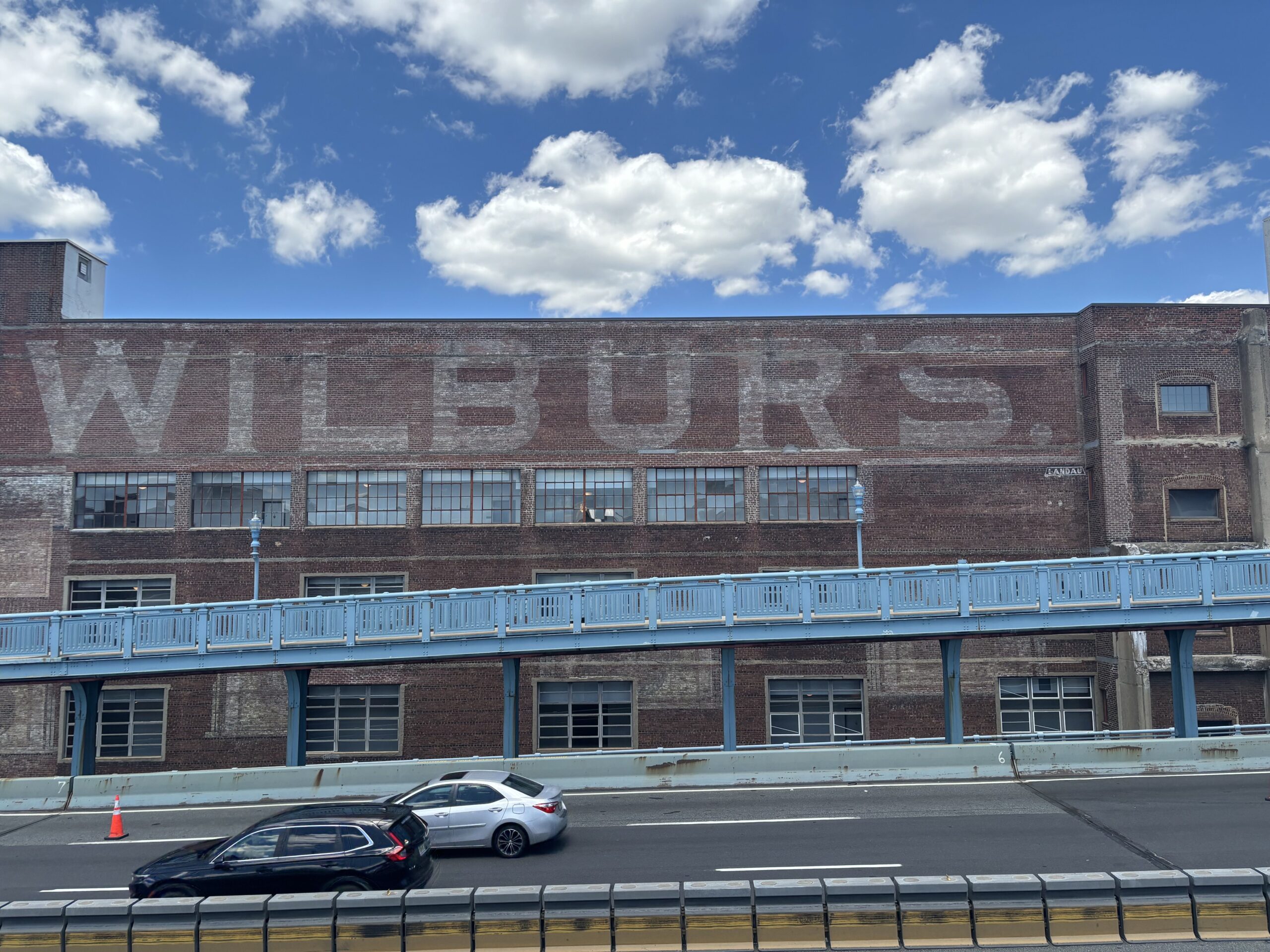
Howard pointed out the old Wilbur Chocolate factory on Third Street and explained that a part was sliced off to make way for the bridge.
“One of the things that we had to do when we were constructing was kind of take a surgeon’s scalpel to the area because you know with Old City, everything’s tightly packed and we wanted to make sure we took the bare minimum of structures,” he said.
A piece of the former Wilbur’s Chocolate Factory had to be sliced off to make way for the Benjamin Franklin Bridge.
Also under threat when the bridge was built was nearby St. George’s United Methodist Church on Fourth Street. Opened in 1769, it’s the country’s oldest Methodist church in continuous service.
“Luckily, the engineers were able to just adjust the angle of the approach ever so slightly to avoid encountering the building,” Howard said.
I marveled as I looked at the mere 14 feet that still separates St. George’s from Philly’s big Ben. The engineers left just enough room for the Holy Spirit.
‘Bridge angels’
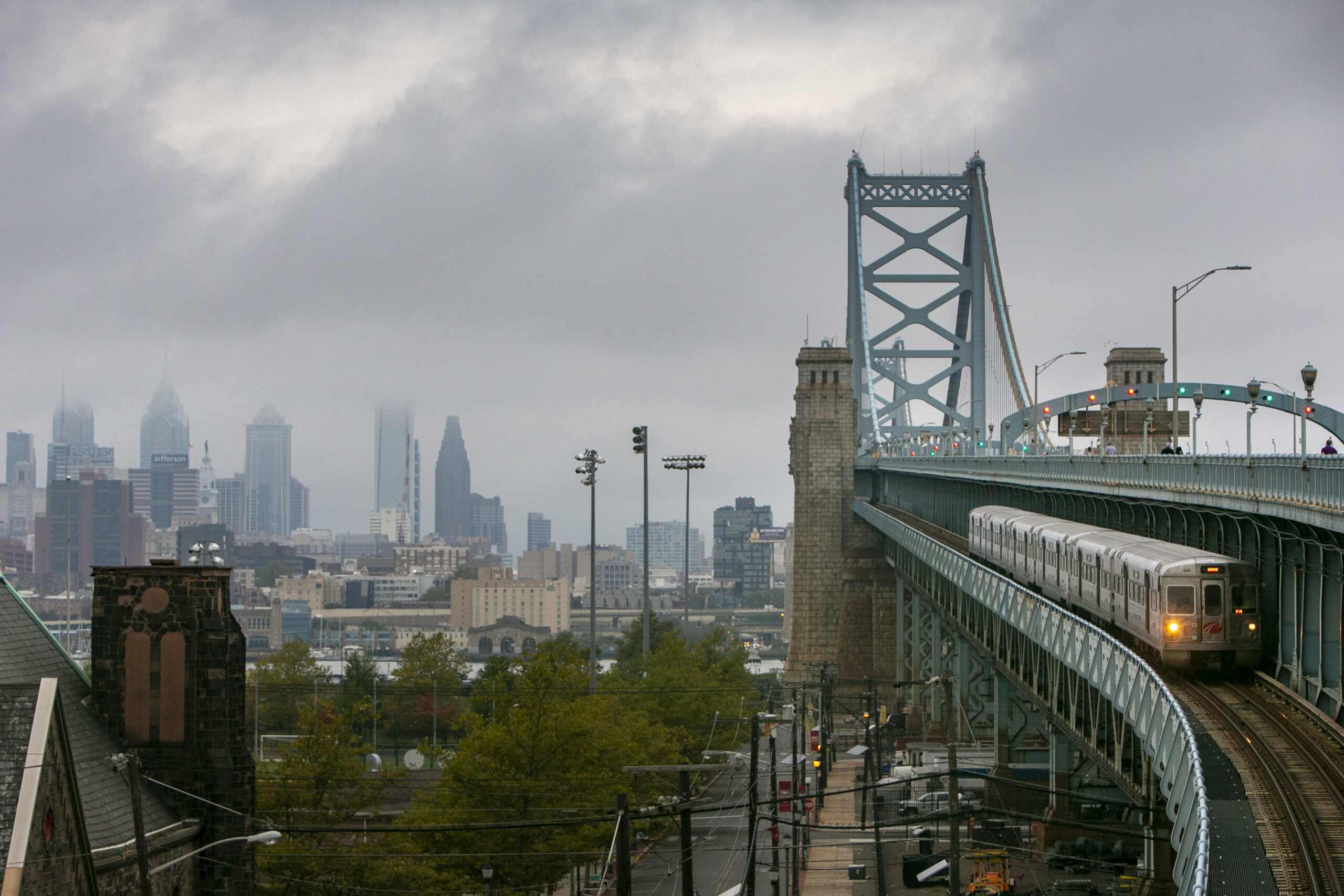
As we began our journey across the bridge, Howard said it took about four-and-a-half years to build and it was designed by architect Paul Philippe Cret, who also designed Philly’s Rodin Museum. The bridge was constructed with eight lanes — six for traffic and two for trolleys, as well as two tracks for heavy rail.
But in the time it took to build it, trolleys went out of fashion and buses came in. The trolley tracks sat unused until the 1940s, when they were paved over. A vast, empty space for a never-opened trolley station remains under the Bolt of Lightning sculpture near the base of the bridge.
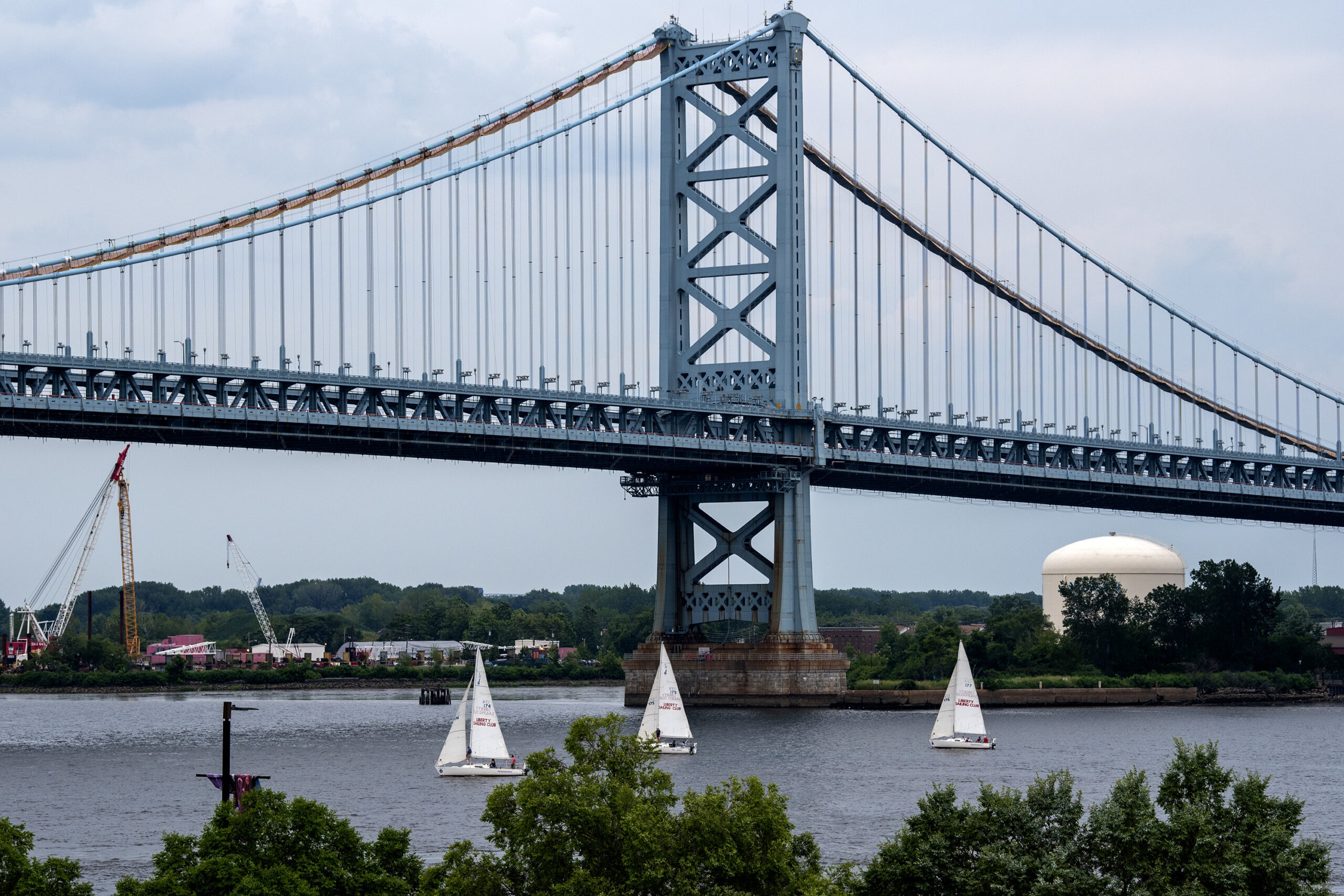
Sailboats pass under the Ben Franklin Bridge in 2020.
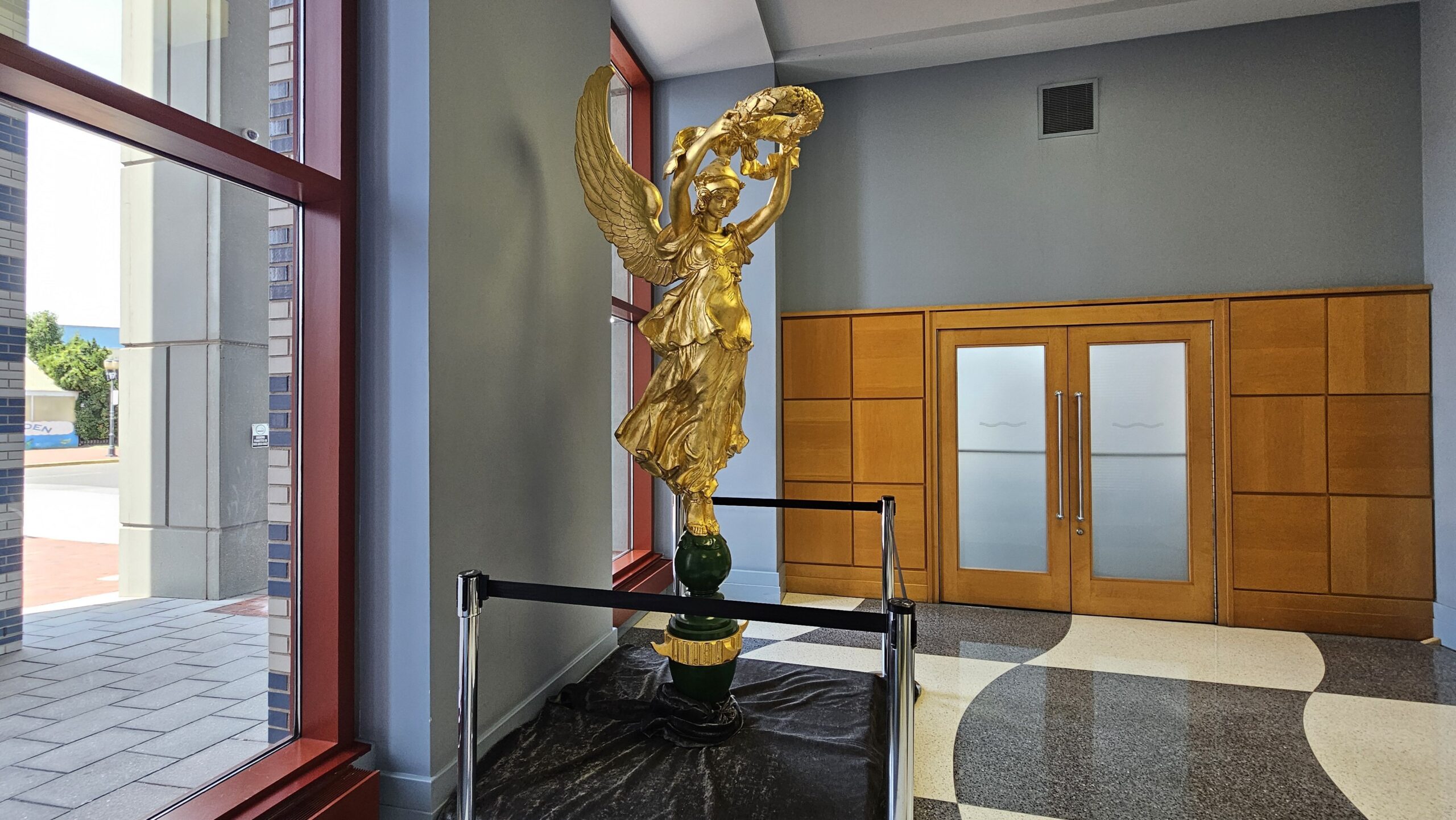
Another original component lost when the trolley tracks were paved over were four 75-foot-tall pylons — two on either side of the bridge — that were topped with bronze angel statues called Winged Victory.
One of the angel statues is in the lobby of DRPA’s headquarters and three are in storage, but one will be displayed at the upcoming 100th anniversary celebration, according to Williams.
One of the four “Winged Victory” statues that used to decorate the Ben Franklin Bridge is now on display at the Delaware River Port Authority’s headquarters.
‘A living beast’
Shortly after we began our trek on the 1.3-mile walkway, I felt a PATCO train speeding beneath my feet and the bridge move ever so slightly.
“The bridge is dynamic, almost like a living beast because the steel expands when it gets warm out and with traffic, it bounces,” Howard said.
A PATCO train travels from Philadelphia to Camden underneath the pedestrian walkway of the Ben Franklin Bridge.
I got used to the sensations within minutes. That being said, I’m not afraid of heights. It could be unnerving if you are.
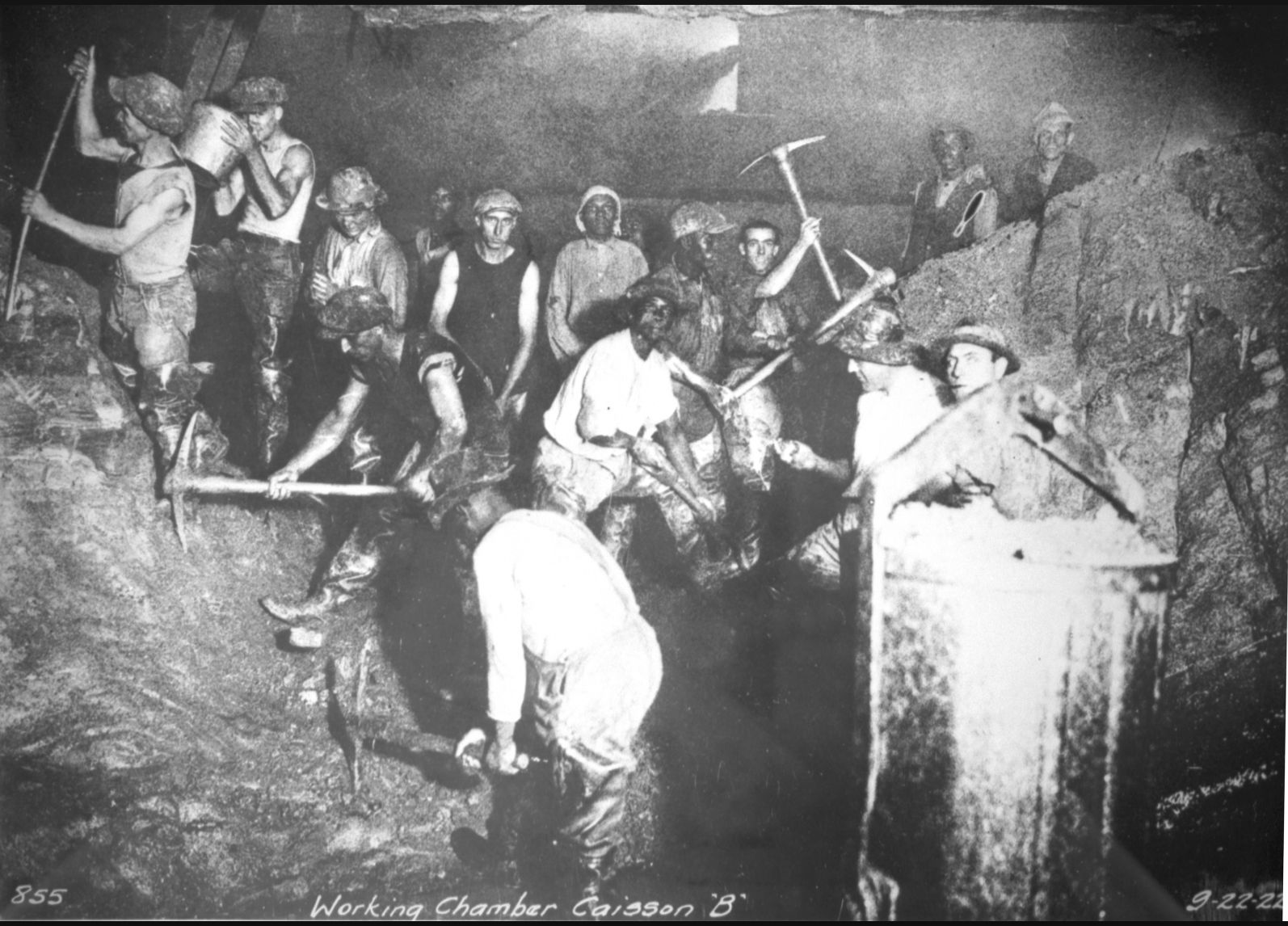
It took $36 million and 1,300 people to build the 376-foot-tall bridge that extends an additional 100 feet or so below the river, Howard said. Guys known as “sand hogs” worked in submerged watertight structures called caissons where temps sweltered into the 90s, even in winter, to dig down to the bedrock of the Delaware River.
In a photo dated 1922, men known as “sand hogs” work in a submerged watertight structure called a caisson to dig down to the bedrock of the Delaware River during the construction of the Benjamin Franklin Bridge.
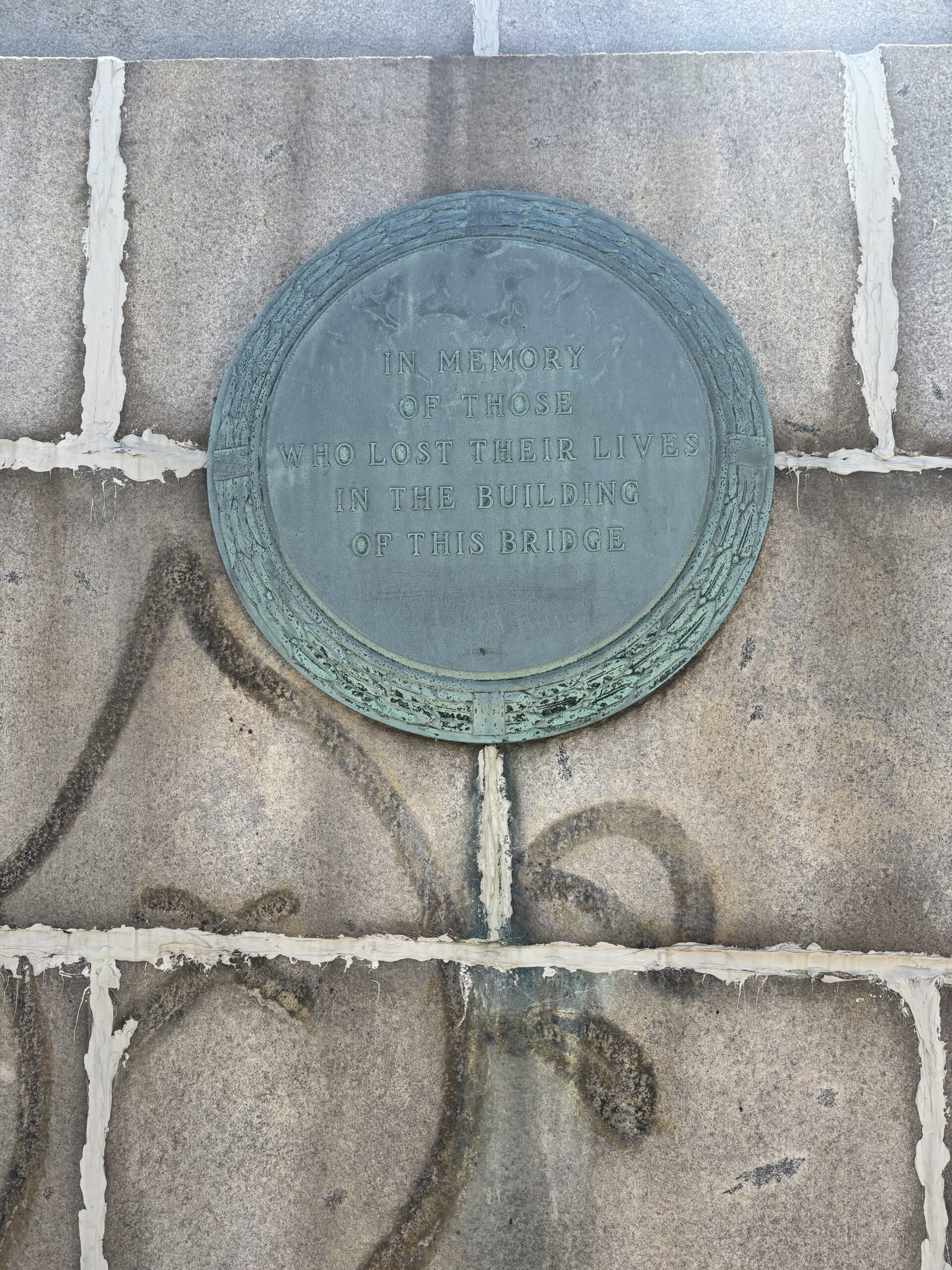
Fifteen workers died in the construction of the bridge. We passed a circular plaque in their memory as we walked. I wondered who they were, how they died, and how they lived.
“Unfortunately, the rule of thumb at the time was for every million dollars you’re spending, you expect to lose a life … so by that rationale you could have had 36 fatalities.” Howard said. “Nowadays, you know, one injury is unacceptable.”
A plaque on the Benjamin Franklin Bridge is dedicated in memory of those who lost their lives while building it.
Unique elements
Our pace was a steady stroll, so we were often passed by runners, walkers, and cyclists. Some appeared to be having a good time, and others looked like they were going through tough times. Some talked to themselves and some stopped to take photos. It was a microcosm of Philly and Camden, suspended high above the river.
Howard said when the bridge was built, its chief engineer believed the walkways wouldn’t be used “in an increasingly or completely motorized age.”
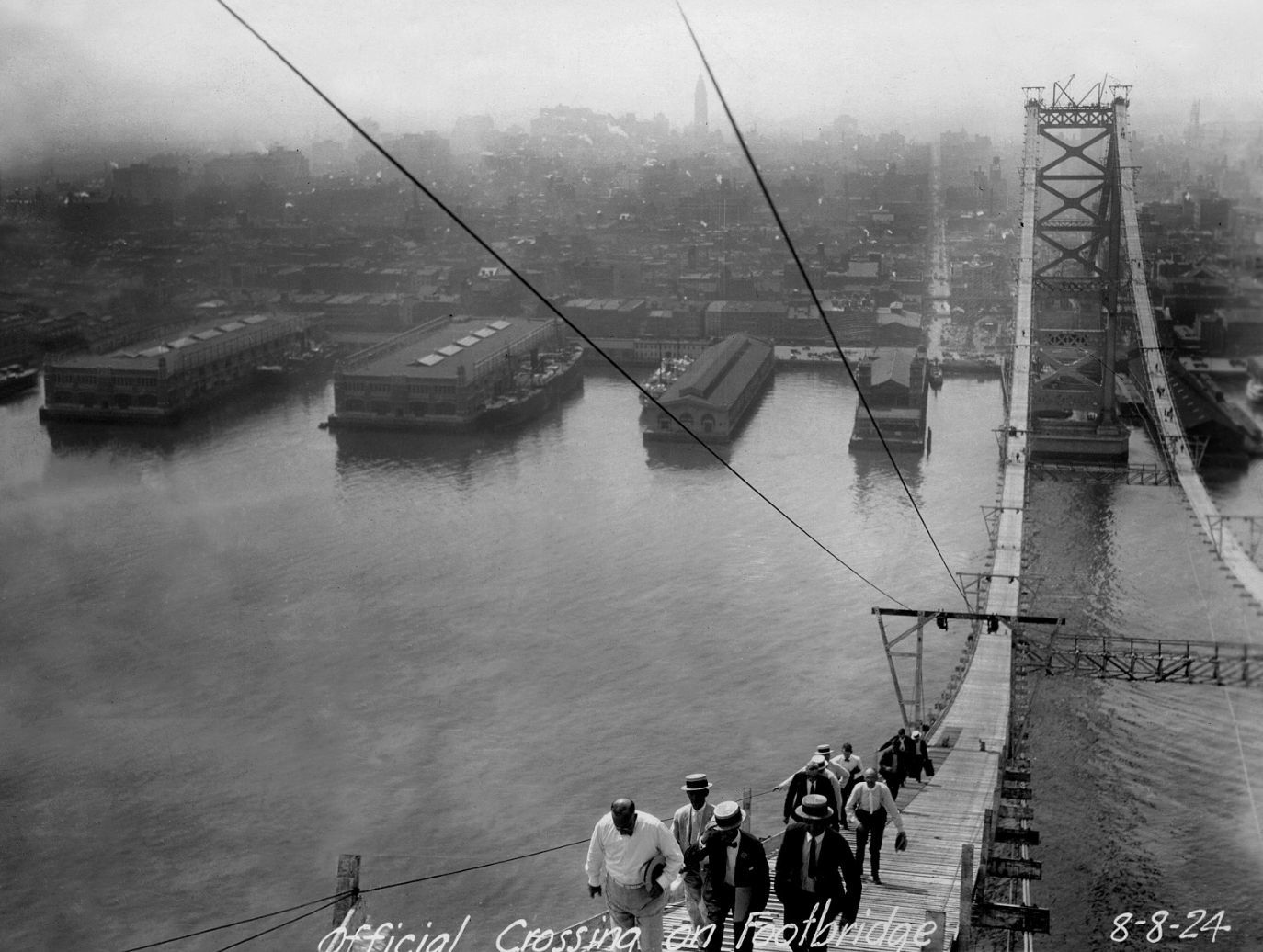
A photo dating from 1924 shows the first official crossing of the Benjamin Franklin Bridge’s pedestrian walkway prior to the 1926 opening of the bridge.
“But you see today the amount of people that are using this walkway and it’s one of the unique elements of this bridge,” he said.
I looked ahead to Camden and then back to Philly. I was so grateful for this walkway and this view. I couldn’t imagine not having it and I couldn’t believe it took me so long to see the city from this new perspective.
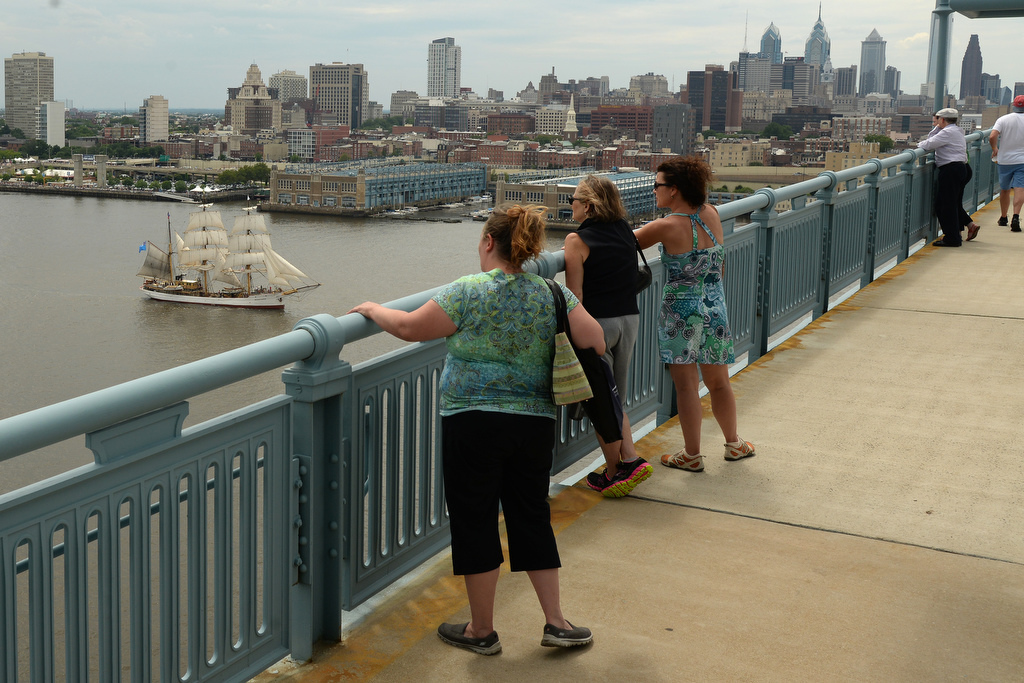
Spectators watch from the Ben Franklin Bridge pedestrian walkway as the Picton Castle sails up the Delaware River in 2015 during the Parade of Tall Ships.
The only thing I found worrisome and the thing that kept all three of us looking over our shoulders, were the e-bike and e-scooter riders we didn’t always hear zooming behind us. Skateboards and rollerblades aren’t allowed, but certain classes of e-bikes and e-scooters are. Gas-powered vehicles are also prohibited on the walkway, but a guy on a dirt bike definitely zoomed by at one point.
In the bridge’s early days, horses and carriages were allowed on the main span alongside cars, according to Howard, but their slow pace proved dangerous and their excrement, troublesome, so they were banned in the 1940s.
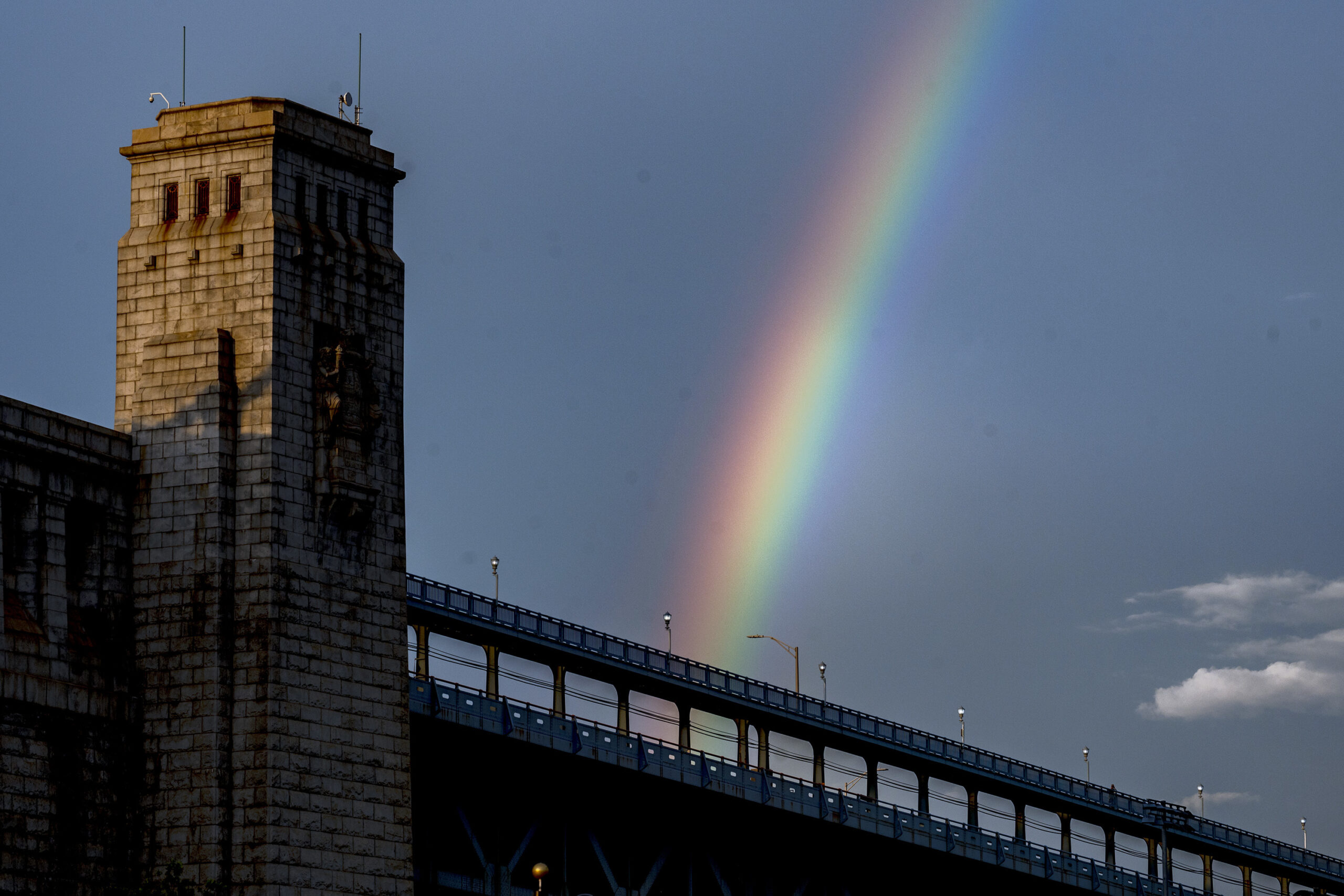
A rainbow appears behind the Camden anchorage of the Ben Franklin Bridge after an early evening rainstorm passes through.
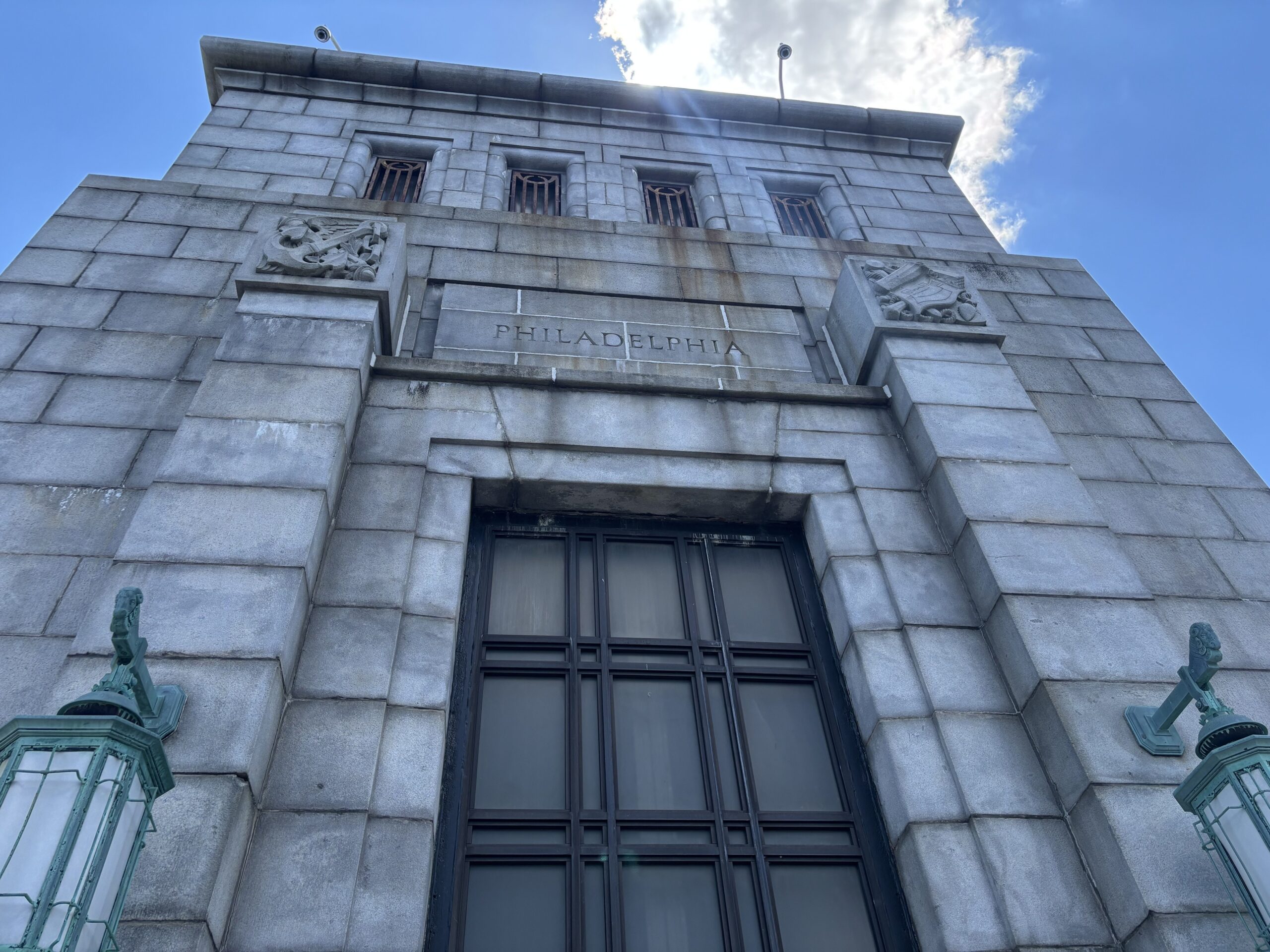
We stopped at one of the Philadelphia anchorages, the massive concrete-and-granite structures where the bridge’s cables are anchored.
These structures were made to house elevators for the trolleys. Alas, the anchorages are off-limits spaces, but Howard told me that each of the four have the same seven artistic tiles inside commemorating milestones in transportation, from one of a Conestoga wagon to one of the USS Shenandoah, the ill-fated dirigible that crashed before the bridge even opened.
One of the anchorages on the Philadelphia side of the Benjamin Franklin Bridge as seen from the pedestrian walkway.
Another name
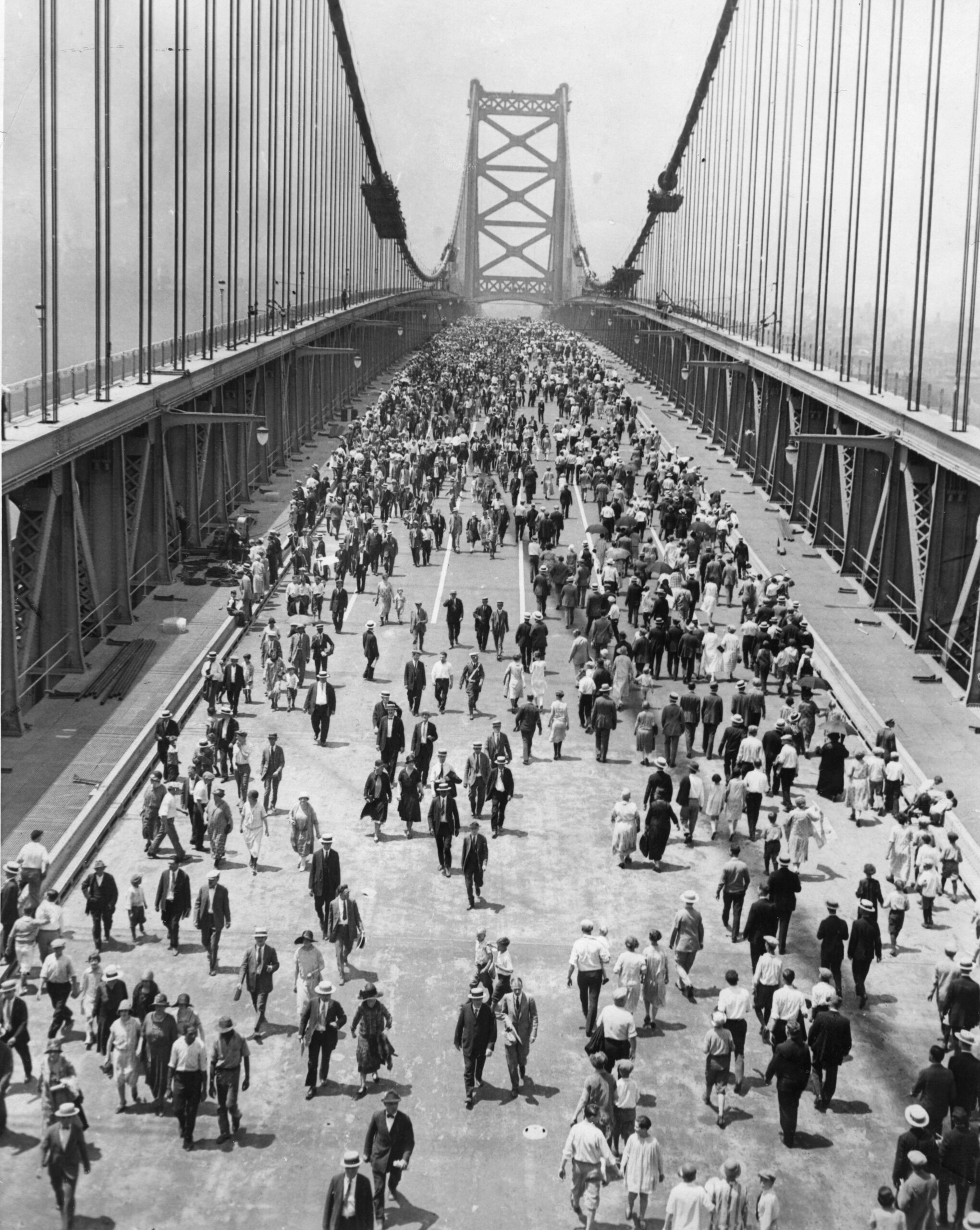
The Ben Franklin Bridge was the longest suspension span in the world, with a distance of 1,750 feet between the two towers, when it opened on July 1, 1926.
In a front-page Inquirer report, journalist Richard J. Beamish noted 250,000 people crossed the bridge on foot opening day and that the structure was “beautiful as gossamer web and seemingly as frail.”
Pedestrian cross the Delaware River Bridge on its opening day in 1926.
Howard, who quoted that report to me, then asked: “When do you think our first accident was?”
I guessed July 2, 1926. I guessed wrong.
“It was the day it opened,” he said. “People were jockeying to be one of the first to cross the bridge, and over in Camden, you had a fender bender.”
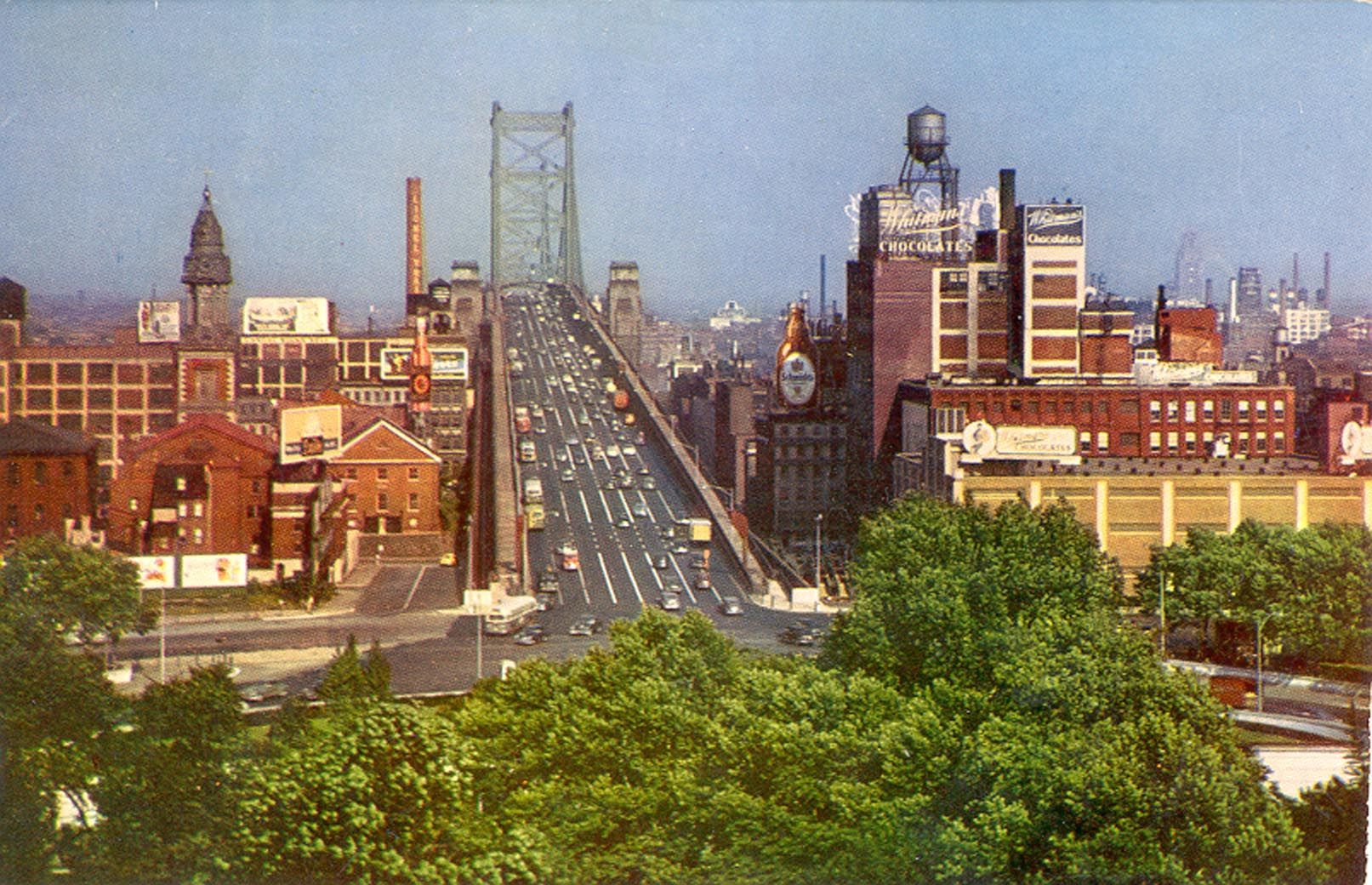
Back then, the span also had a different name — the Delaware River Bridge. It was rechristened in 1956 to avoid confusion when the Walt Whitman Bridge was also built over the Delaware River.
A view of the Benjamin Franklin Bridge in the 1950s.
The Ben Franklin Bridge wasn’t always blue, either. It was originally gray and was repainted to its current color just ahead of the Bicentennial, Howard said.
‘Calm and serene’
As we stood talking, a man jogging by in Rocky Run T-shirt asked if we’d take a photo of him with the Philly skyline.
Jim Bach of Voorhees works in Camden and likes to run the bridge during his lunch break.
“It’s fantastic. I mean the views that you get when you’re up here, it’s just calm and serene,” he said.
I too felt serene. It was quiet and peaceful on the bridge and being atop it helped me see the city I love in a new way.
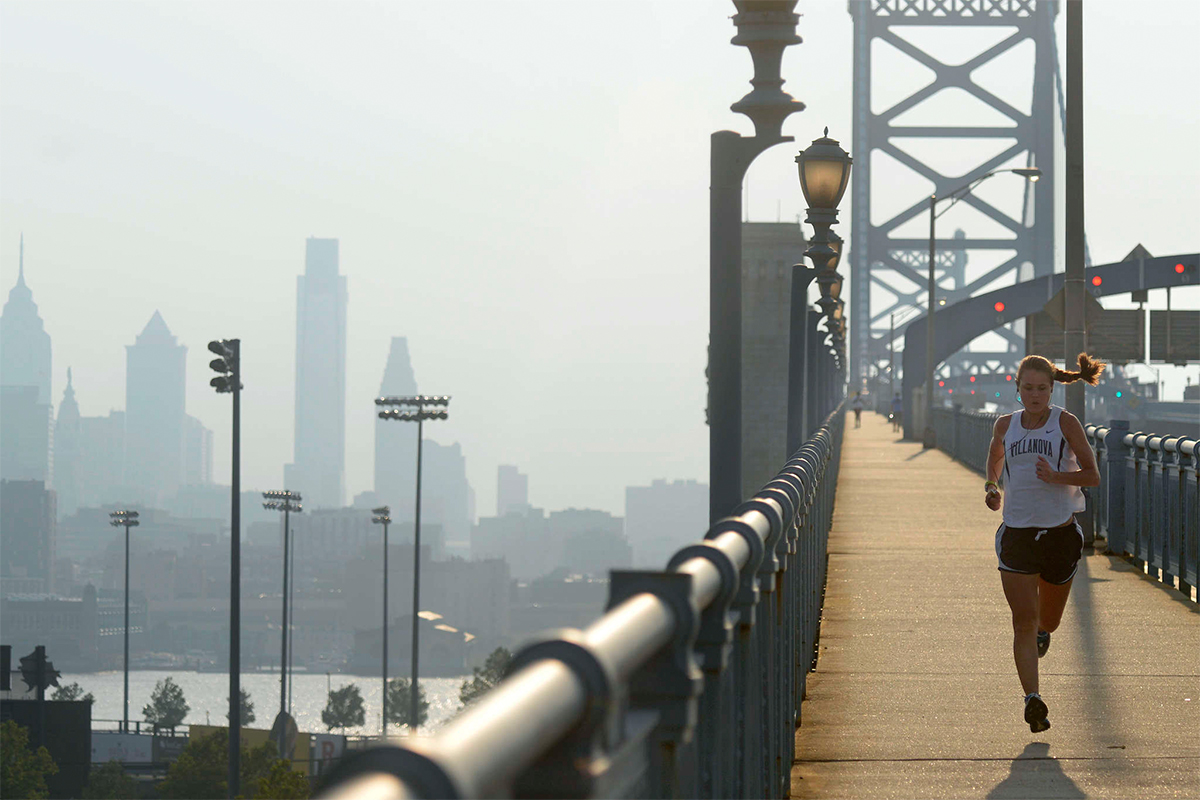
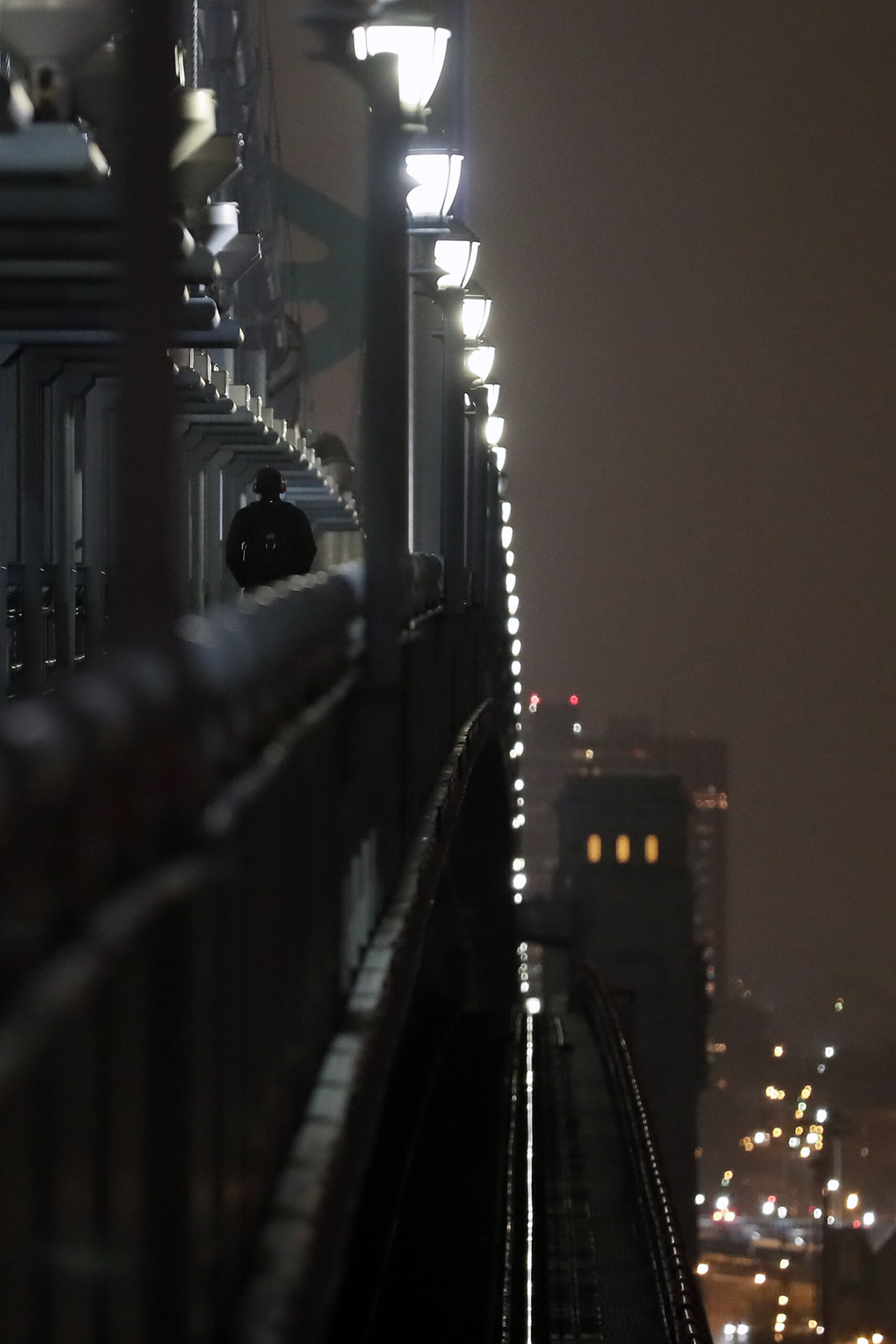
A jogger runs across the Ben Franklin Bridge in an Inquirer file photo.
Howard also helped me to see something else — the Betsy Ross, Walt Whitman, and Commodore Barry Bridges are all visible from the top of the Ben Franklin.
“All bridges essentially become monuments to the area,” he said. This was most true of the one we were standing on.
We talked about the Ben Franklin’s many appearances in television and movies, from Blow Out to 12 Monkeys.
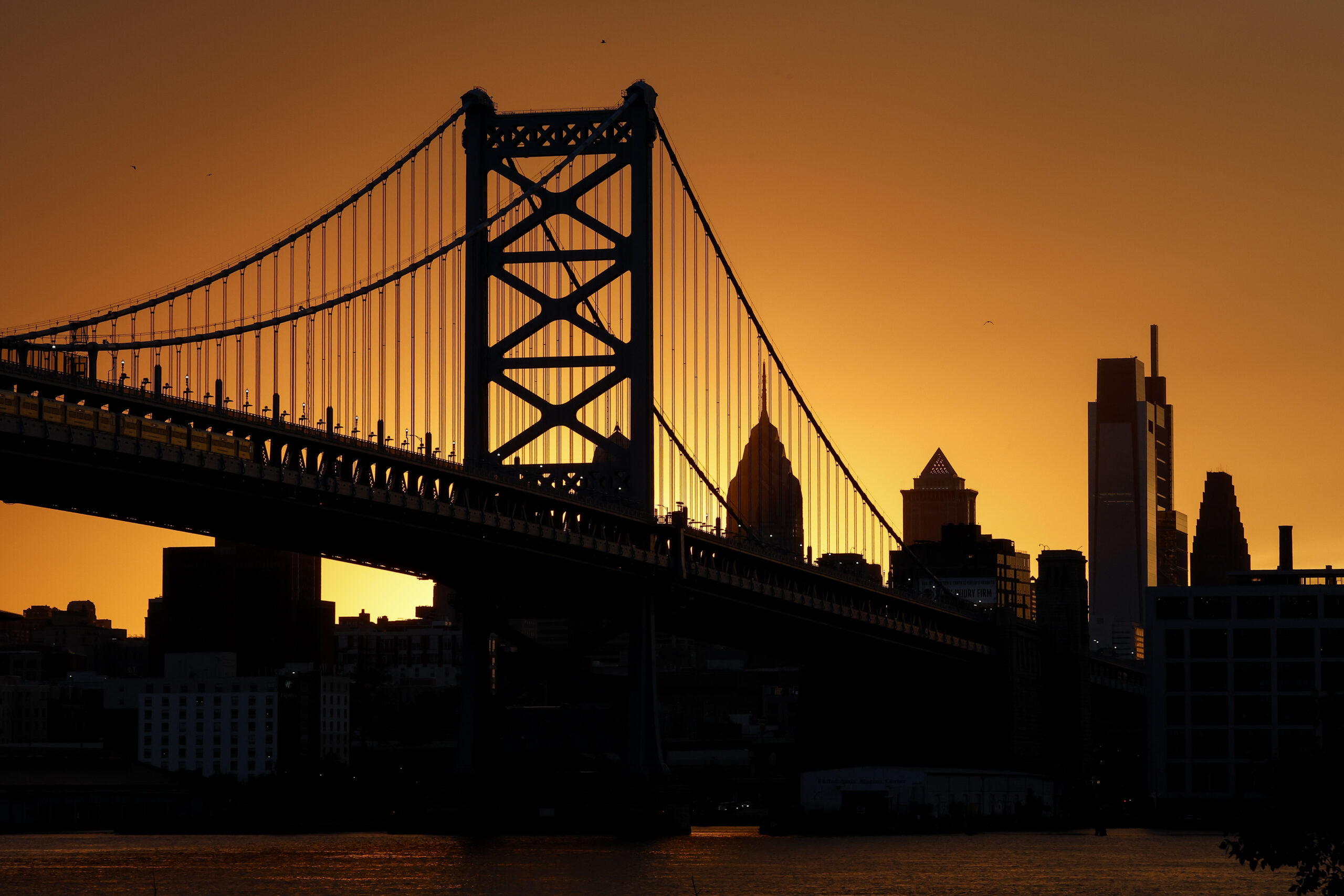
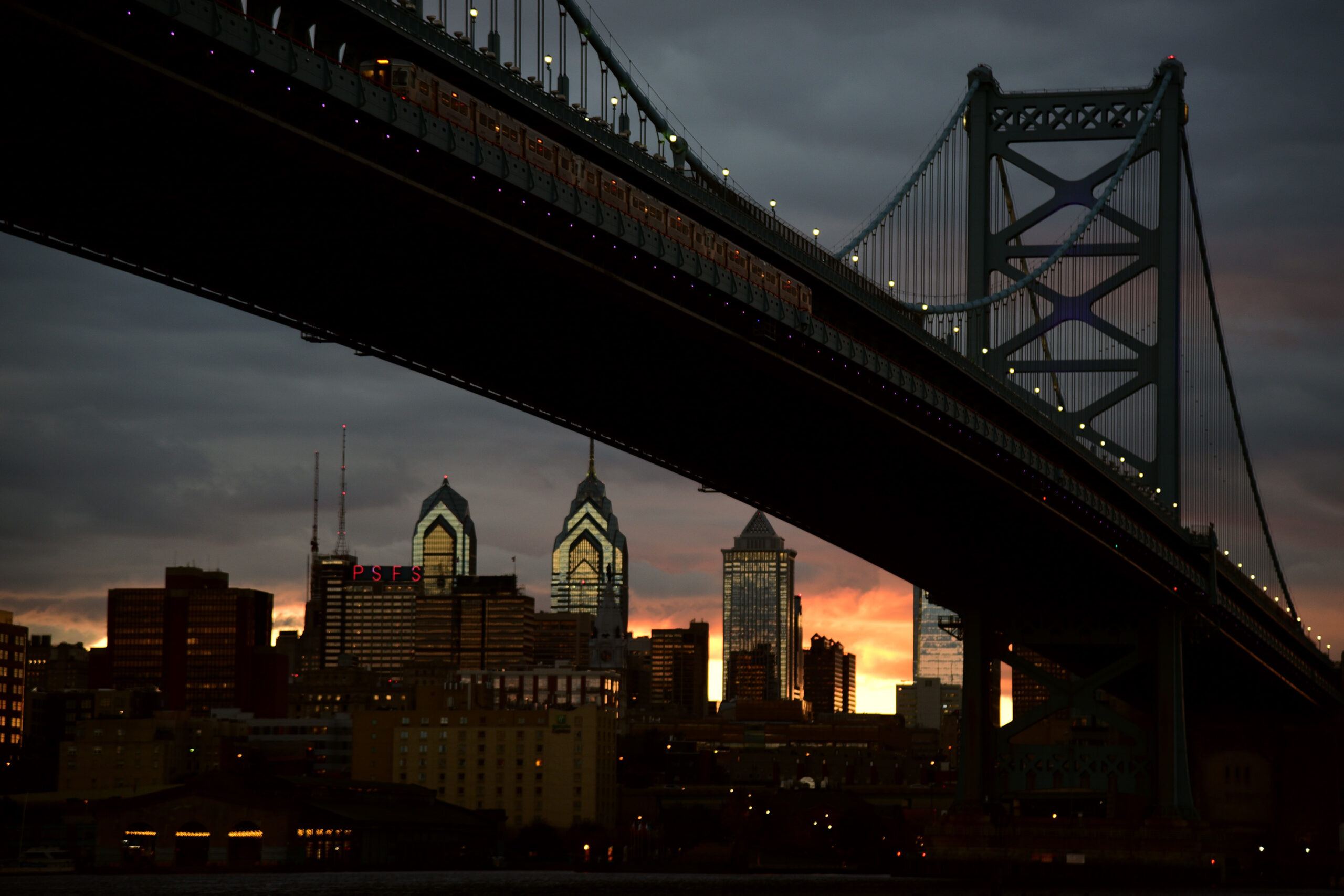
The sun sets behind the Ben Franklin Bridge, seen from Cooper’s Poynt Park on Tuesday, Sept. 30, 2025 in Camden, NJ.
“Last year they kept coming back from commercial breaks during Monday Night Football and they showed one of three things — the Liberty Bell, someone making cheesesteaks, or the bridge,” Howard said.
In its 100 years, the bridge has become a visual touchstone for the region. You see it and you know you’re in Philly, whether you’re watching a movie or coming back from a road trip. It’s given Philly its sense of place as much as the LOVE sculpture or Independence Hall.
A great connector
When we got to Camden, we walked through the pedestrian tunnel on that end, too. It doesn’t have a mural, but the exterior is decorated with a bright mosaic of birds and animals created by Camden schoolchildren in the early 2000s.
A mosaic created by Camden schoolchildren decorates the exterior of the pedestrian tunnel on the Camden side of the Benjamin Franklin Bridge.
On our return walk, I asked Howard if he had a moment on the bridge that’s stuck with him. He said a few years ago, while he was leading a tour, there was a commotion on the Philly side. A kitten found its way onto the bridge and police were called. The feline then crawled into the engine compartment of a police cruiser, which had to be taken apart to get it freed.
“I was like, ‘Yeah, so I gotta go adopt it,’” Howard said.
And so he did, and he named the furry little girl Beanie.
I thought of a poignant moment I had once on the bridge. I was a passenger in a vehicle years ago, when I looked over and saw that the car I was in was traveling at relatively the same speed as the PATCO train next to us.
The sun sets over the Philadelphia Skyline behind the Benjamin Franklin Bridge looking southwest from Cooper’s Point Waterfront Park in Camden in this Inquirer file photo.
I locked eyes with a woman on the train, who looked a lot like me. We smiled at each other and I waved and she waved back. It’s a brief moment that’s always stuck with me. Maybe it’s because I felt like I could have been her in another life, or she could have been me.
Walking the bridge and hearing its stories, I realized that it connects so much more than just Camden and Philly. It connects all of us to each other — in big and small ways — and it connects our future with our history.
Today, I have a new story about the Benjamin Franklin Bridge, the day I walked across it. If you haven’t done so yet, I encourage you to walk it, too, and make a new memory with one of Philadelphia’s great old structures.
A man walks across the Ben Franklin Bridge towards Camden in an Inquirer file photo.
The anniversary celebration for the Ben Franklin Bridge will take place from 10 a.m. to 2:30 p.m. July 11. Details can be found at drpa.org/bfb100/.
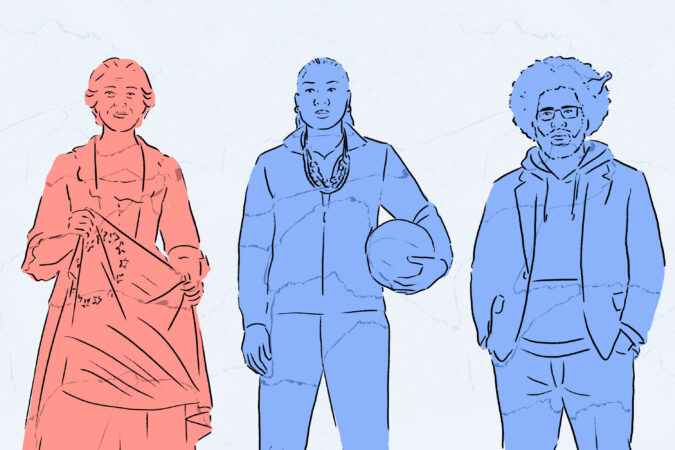
Philadelphia now has three Rocky statues. That is three statues celebrating a fictional Philadelphian. And while many great Philadelphians already have statues, there are so many who don't.
Who do you think should be Philadelphia’s Next Top Statue?
To decide, we’ll present you with two random Philadelphians from our list of just 26. For each matchup, you choose who deserves to be honored more. The winner will move on to the next round to face another Philadelphian.
You’ll keep going until we end up with your definitive Philadelphia’s Next Top Statue.
story continues after advertisement
story continues after advertisement
story continues after advertisement
If you're happy with , you can skip the remaining challengers, and lock them in as your choice.
story continues after advertisement
You think Philadelphia should build a statue of winner and percentageWinner of Inquirer readers agree with you. The most popular winning statues, so far, are popularWinners.
You stuck with longest for the longest, picking them over longestLength other statues.
(()=>{var be=(e,t)=>()=>(t||e((t={exports:{}}).exports,t),t.exports);var U=be(s=>{var Ae={0:”Jan.”,1:”Feb.”,2:”March”,3:”April”,4:”May”,5:”June”,6:”July”,7:”Aug.”,8:”Sept.”,9:”Oct.”,10:”Nov.”,11:”Dec.”};function $(e){return e===void 0&&(e=new Date),Ae[e.getMonth()]}var Ce={0:”Jan”,1:”Feb”,2:”Mar”,3:”Apr”,4:”May”,5:”Jun”,6:”Jul”,7:”Aug”,8:”Sep”,9:”Oct”,10:”Nov”,11:”Dec”};function O(e){return e===void 0&&(e=new Date),Ce[e.getMonth()]}function u(e){return e==null}function G(e){return typeof e==”number”&&isFinite(e)}function A(e){return G(e)&&Math.floor(e)===e}var Le=[“one”,”two”,”three”,”four”,”five”,”six”,”seven”,”eight”,”nine”],Pe=[“million”,”billion”,”trillion”,”quadrillion”,”quintillion”,”sextillion”,”septillion”,”octillion”,”nonillion”,”decillion”],z=[“th”,”st”,”nd”,”rd”,”th”,”th”,”th”,”th”,”th”,”th”],xe=[11,12,13];function _(e){if(u(e))return””;var t=+e;return A(t)?xe.indexOf(t%100)>-1?z[0]:z[t%10]:””}var Be=[“first”,”second”,”third”,”fourth”,”fifth”,”sixth”,”seventh”,”eighth”,”ninth”],je=new RegExp(/s+([^s]*)s*$/);s.apdate=function(e){return e===void 0&&(e=new Date),$(e)+” “+e.getDate()+”, “+e.getFullYear()},s.apdatetab=function(e){return e===void 0&&(e=new Date),O(e)+” “+e.getDate()+”, “+e.getFullYear()},s.apmonth=$,s.apmonthtab=O,s.apnumber=function(e){if(u(e))return””;var t=+e;return A(t)?t=10?e.toString():Le[t-1]:e.toString()},s.aptime=function(e){e===void 0&&(e=new Date);var t,o,n=e.getHours(),i=e.getMinutes(),a=i===0;if(a){if(n===0)return”midnight”;if(n===12)return”noon”}return n0?n:12):(t=”p.m.”,o=n===12?n:n-12),a?o+” “+t:o+”:”+(i<10?"0"+i:i)+" "+t},s.capfirst=function(e){if(u(e))return"";var t=String(e);return""+t.charAt(0).toUpperCase()+t.slice(1)},s.intcomma=function(e){if(u(e))return"";var t,o=+e;return G(o)?((t=o.toString().split("."))[0]=t[0].replace(/B(?=(d{3})+(?!d))/g,","),t.join(".")):e.toString()},s.intword=function(e){if(u(e))return"";var t=+e;if(!A(t))return e.toString();var o=Math.abs(t);if(o<1e6)return e.toString();var n=Math.ceil(Math.log(o+1)/Math.LN10)-1,i=n-n%3,a=t/Math.pow(10,i);return(a=Math.round(10*a)/10)+" "+Pe[Math.floor(i/3)-2]},s.ordinal=function(e,t){if(t===void 0&&(t=!1),u(e))return"";var o=+e;return A(o)?t&&o{let t=document.querySelector(`.js-reveal[data-id=”${e}”]`);t?t.classList.add(“is-hidden”):console.log(“No reveal component found with the id”,e)},Se=e=>{let t=document.querySelector(`.js-reveal[data-id=”${e}”]`);t?t.classList.remove(“is-hidden”):console.log(“No reveal component found with the id”,e)},T={init:()=>{},show:Se,hide:ve};var M,ke=(e,t)=>{M=M||window.PMNdataLayer,M?M.push({event:”misc_event”,eventAction:e,eventLabel:t}):window.location.hostname.includes(“localhost”)?console.log(“Analytics event:”,e,t,”(not actually being sent due to localhost)”):console.log(“Failed to push analytics event”,e,t)},b={event:(e,t)=>{ke(e,t)}};var p,J,Ne=()=>{p=document.getElementById(“js-inno-toast”)},Te=e=>{if(!p)return;p.innerHTML=e,p.classList.add(“is-active”);let t=()=>{p.addEventListener(“transitionend”,Me,{once:!0}),p.classList.remove(“is-active”)};clearTimeout(J),J=setTimeout(t,5e3)},Me=()=>{p.innerHTML=””},c={init:()=>{Ne()},showToast:Te};var gt=U();var y=e=>{if(e)return e.trim().toLowerCase().normalize(“NFD”).replace(/[u0300-u036f]/g,””).replace(/[^A-Z0-9 ]/gi,””).trim().replace(/ /g,”-“).replace(/–/g,”-“)};var C=()=>/Android|webOS|iPhone|iPad|iPod|BlackBerry|IEMobile|Opera Mini/i.test(navigator.userAgent);var x=(e,t=null,o=null)=>{o||(o=document.querySelector(“head”));let n=document.createElement(“script”);n.type=”text/javascript”,n.src=e,t&&(n.onload=t),o.appendChild(n)},K=()=>(window.PMNdataLayer?.[0]!==void 0&&window.PMNdataLayer[0])?.analytics?.user?.state===”Subscribed”,V=()=>{let t=(window.PMNdataLayer?.[0]!==void 0&&window.PMNdataLayer[0])?.analytics?.user?.state;return window.location.host.includes(“zzz-systest”)||window.location.host.includes(“pmn.arcpublishing.com”)||window.location.host.includes(“stage.fusion.inquirer.com”)||typeof t>”u”},Y=()=>{let t=(window.PMNdataLayer?.[0]!==void 0&&window.PMNdataLayer[0])?.analytics?.user?.hasAdsFreeReading;return!!(t&&t==1)},B=()=>window.location.host.includes(“localhost”),Z=(e,t=””)=>{let o=document.querySelector(`template#${e}`);if(!o||!(o instanceof HTMLTemplateElement))return console.log(`Couldn’t find .`),null;let n=o.content.cloneNode(!0).childNodes;if(n.length==0)return console.log(`Template ${o} has no children, returning null.`),null;n.length>1&&console.log(`Template ${o} has multiple children, only returning the first.`);let i=n[0];return i.setAttribute(“data-id”,t),i},j=(e,t)=>{let o=[…e.querySelectorAll(“[data-populate]”)];e.dataset.populate&&o.unshift(e);let n=o.filter(i=>{let a=i.closest(“[data-populate-context]”);return!a||a==e});for(let i of n){let N=i.dataset.populate.trim().split(/s*,s*/).map(w=>w.split(/s*:s*/));for(let[w,m]of N){let f=w.split(“.”).reduce((d,we)=>d?.[we],t),F=f==null||f==null,ge=m?.split(/s+/)||[“innerHTML”];for(let d of ge)d.startsWith(“.”)&&i.classList.toggle(d.substring(1),F?!1:f),!F&&(d==”innerHTML”?i.innerHTML=f:d.startsWith(“@”)?i.setAttribute(d.substring(1),f):d.startsWith(“–“)&&i.style.setProperty(d,f))}}};var Q=e=>{for(let t=e.length-1;t>0;t–){let o=Math.floor(Math.random()*(t+1));[e[t],e[o]]=[e[o],e[t]]}return e};var Ee=()=>{document.querySelectorAll(“.js-share”).forEach(e=>{e.addEventListener(“click”,()=>{qe(e)})})},De=()=>{document.querySelectorAll(“.js-share”).forEach(e=>{let t=e.dataset.url||[location.protocol,”//”,location.host,location.pathname].join(“”);e.dataset.url=t})},He=(e,t)=>{navigator.clipboard.writeText([e,t].join(” “)),b.event(“click”,`copied share text to clipboard | ${[e,t].join(” “)}`)},qe=async e=>{let t=e.dataset.text,o=e.dataset.url;if(!navigator.canShare||!C())He(t,o),c.showToast(“Copied to clipboard!”);else try{await navigator.share({text:t,url:o})}catch(n){console.log(n),c.showToast(“Hmm, something went wrong…”)}},Ie=(e,t,o)=>{let n=document.querySelector(e);n?n.classList.contains(“inno-share__button”)?(n.dataset.text=t,o&&(n.dataset.url=o)):console.warn(`${e} is not a share button`):console.warn(`${e} not found`)},L={init:()=>{Ee(),De()},updateTextToCopy:(e,t,o)=>{Ie(e,t,o)}};var X=async(e,t)=>(await fetch(`https://inq-junto.herokuapp.com/${e}`,{method:”POST”,headers:{“Content-Type”:”application/json”},mode:”cors”,body:JSON.stringify(t)})).json(),E=()=>{let t=document.querySelector(“.js-inno”).dataset.junto;if(t)return t;throw new Error(“no junto id found”)},v={getDefaultId:()=>E(),vote:(e,t=E())=>{X(“vote”,{poll:t,ballot:e})},results:async(e=E())=>await X(“results”,{poll:e})};var ee=[{name:”Betsy Ross”,category:”Civil”,born:”1752″,died:”1836″,placement:”Betsy Ross House”,bio:”She may not have actually made the first U.S. flag (according to the Smithsonian), but she did make U.S. flags for 50 years and is a Philly and national icon.”},{name:”Boyz II Men”,category:”Music”,born:”1985″,died:””,placement:”CAPA (where they formed)”,bio:’These “Motownphilly” icons started in 1985, when the Boyz met at Philadelphia High School for the Creative and Performing Arts (CAPA).’},{name:”Cecil B. Moore”,category:”Civil”,born:”1915″,died:”1979″,placement:”21st Street & Cecil B. Moore Avenue”,bio:”A leader in Philadelphiau2019s Civil Rights Movement in the 1960s who successfully campaigned to desegregate the cityu2019s building trades unions and expanded opportunities for Black workers.”},{name:”Chase Utley”,category:”Sports”,born:”1978″,died:””,placement:”Citizens Bank Park”,bio:`”The Man” helped the Phillies win it all in 2008, played in six All-Star Games, and is an important plot point in an episode of It’s Always Sunny in Philadelphia.`},{name:”Chubby Checker”,category:”Music”,born:”1941″,died:””,placement:”Italian Market”,bio:`Before the “Twist” icon made it big, the South Philly-raised musician worked at a produce stand in the Italian Market. He’s now in the Rock & Roll Hall of Fame.`},{name:”Dawn Staley”,category:”Sports”,born:”1970″,died:””,placement:”Murrell Dobbins Vocational High School”,bio:”Raised in North Philly, she transformed the University of South Carolina into a womenu2019s basketball powerhouse, winning multiple NCAA championships while also earning Olympic gold medals as both a player and coach.”},{name:”Dr. Drew Weissman & Dr. Katalin KarikxF3″,category:”Science”,born:”1959, 1955″,died:””,placement:”James G. Kaskey Memorial Park”,bio:”These Penn researchers won the Nobel Prize for Physiology or Medicine in 2023 for their work that made the mRNA COVID-19 vaccines possible. Those vaccines saved an estimated 2.5 million lives, according to a JAMA study.”},{name:”Gamble & Huff”,category:”Music”,born:”1943, 1942″,died:””,placement:”309 S. Broad St. (where Philadelphia International Records was located)”,bio:”The songwriting and production duo created the Philly sound and built Philadelphia International Records, which produced a string of hit records that helped define 1970s R&B and soul.”},{name:”Guion Bluford”,category:”Science”,born:”1942″,died:””,placement:”Overbrook High School (which he attended)”,bio:”The Overbrook High grad was an Air Force officer and pilot before becoming the first Black astronaut in space, flying aboard the space shuttle Challenger in 1983. He logged more than 688 hours in space.”},{name:”Daryl Hall & John Oates”,category:”Music”,born:”1970″,died:””,placement:’The steps of Mitten Hall at Temple: “If I had a picture of Temple, it is hanging outside of Mitten Hall and singing … hanging on those steps with friends, street corner singing.” — Daryl Hall’,bio:”They may be in the midst of a feud, but these maneating, dream-making Philly icons who have delighted the city, and the world, started at Temple University.”},{name:”Hercules Posey”,category:”Civil”,born:”1748″,died:”1812″,placement:”The President’s House Site (where he was enslaved)”,bio:”The enslaved chef who ran President George Washingtonu2019s household kitchen, both in Mount Vernon and at the President’s House in Philadelphia, later escaped to freedom.”},{name:”Isaiah Zagar”,category:”Art & Culture”,born:”1939″,died:”2026″,placement:”Palumbo Rec Center (a park near Magic Gardens)”,bio:”Philadelphia would suddenly look naked without Zagar’s tile-junk-and-mirror murals. His masterwork, Magic Gardens, is rightfully beloved, but he was also a great champion of South Street, the city, and Philadelphians.”},{name:”Jason Kelce”,category:”Sports”,born:”1987″,died:””,placement:”Philadelphia Museum of Art steps or Lincoln Financial Field”,bio:”It is only a matter of time before this Super Bowl champ is honored with a metal likeness. The question is: Do you put it next to the Linc or atop the Art Museum steps in his Mummer-celebration attire?”},{name:”Jill Scott”,category:”Music”,born:”1972″,died:””,placement:”Reyburn Park (near her childhood home)”,bio:”The Grammy winner helped define the neo-soul movement of the early 2000s with her blend of soul, hip-hop, jazz, R&B, and spoken word.”},{name:”Jim Gardner”,category:”Civil”,born:”1948″,died:””,placement:”Jim Gardner Way”,bio:”He was Philadelphiau2019s leading news anchor for more than four decades and became one of the most trusted and recognizable figures in the city.”,Notes:’for category, maybe something like “Media” or “News”?’},{name:”John Coltrane”,category:”Music”,born:”1926″,died:”1967″,placement:”The Yard on John Coltrane Street”,bio:”He developed his groundbreaking style while living and performing in Philly during the 1940s and 1950s, before becoming one of the most influential musicians in jazz history.”},{name:”K. Barry Sharpless”,category:”Science”,born:”1941″,died:””,placement:”Outside the Science History Institute”,bio:”A pioneer of u201Cclick chemistry,u201D a revolutionary method for quickly and reliably joining molecules together, he has earned not one but two Nobel Prizes in chemistry.”},{name:”Kevin Bacon”,category:”Art & Culture”,born:”1958″,died:””,placement:”Rittenhouse Square (two blocks from his childhood home)”,bio:’The Philly-grown actor is beloved for hits like “Footloose,” “A Few Good Men,” and “Apollo 13.” His father, Edmund Bacon, is referred to as “the father of Modern Philadelphia,” making Kevin true Philly royalty.’},{name:”M. Night Shyamalan”,category:”Art & Culture”,born:”1970″,died:””,placement:”Avenue of the Arts”,bio:’The king of plot twists directed many Philly-based movies, including “The Sixth Sense,” “Unbreakable,” and “Split.” He is not a favorite to win this competition, but what if … he pulled it off at the last second?’},{name:”Oscar Hammerstein II”,category:”Art & Culture”,born:”1895″,died:”1960″,placement:”Avenue of the Arts”,bio:’The Doylestown-raised songwriter composed the lyrics to classic Broadway musicals such as “Oklahoma!,” “Carousel,” and “The Sound of Music,” helping redefine the American musical. His father built the Met.’},{name:”Patti LaBelle “,category:”Music”,born:”1944″,died:””,placement:”John Bartram High School (her high school)”,bio:’The u201CGodmother of Soulu201D is known for her powerhouse vocals, hits like “Lady Marmalade,” and her famous sweet potato pie.’,Notes:’maybe add “and her famed sweet potato pie” to the bio?’},{name:”Questlove”,category:”Music”,born:”1971″,died:””,placement:”CAPA (where the Roots were formed)”,bio:”The drummer and cofounder of the Roots helped redefine hip-hop with live instrumentation while building a celebrated career as a producer, filmmaker, and cultural historian.”},{name:”Sheryl Lee Ralph”,category:”Art & Culture”,born:”1956″,died:””,placement:”Avenue of the Arts”,bio:’The actress, who has adopted Philly as her home when she is not filming, originated the role of Deena Jones in “Dreamgirls” and won an Emmy for her performance on “Abbott Elementary.”‘},{name:”The Delfonics”,category:”Music”,born:”1965″,died:””,placement:”Overbrook High School (where they met)”,bio:”The Delfonics are known for their lush harmonies and romantic hits like u201CLa-La Means I Love Youu201D and u201CDidnu2019t I (Blow Your Mind This Time),u201D which helped define the Philadelphia soul sound.”},{name:”Wanda Sykes”,category:”Music”,born:”1964″,died:””,placement:`2000 block of Sansom Street (“Philly’s Funniest Blocku201D)`,bio:”The comedy legend is known for her sharp standup and her Emmy-winning work as a writer, actor, and comedian. She was also instrumental in bringing the WNBA to Philly.”},{name:”Will Smith”,category:”Art & Culture”,born:”1968″,died:””,placement:”Tustin Recreation Center (where he shot some b-ball outside of his school)”,bio:’The Oscar- and Grammy-winning actor and rapper was, famously, born and raised in West Philadelphia. The Fresh Prince is known as much for “Men in Black” as he is for “Miami.”‘}];var We=[1,5,10],l=new Array,r=new Object,h=new Array,S=null,D=0,q,te,Fe=async()=>{l=Je(),q=await $e(),te=Oe(3),r.red=l.shift(),r.red.side=”red”,r.blue=l.shift(),r.blue.side=”blue”,H()},Je=()=>{for(let e of ee){let t={…e,id:y(e.name),marbleBaseSrc:`https://interactives.inquirer.com/projects/2026/06/statues/1782400824702/assets/_resized/statues/${y(e.name)}–marble–1200px.webp`,marbleColorSrc:{red:`https://interactives.inquirer.com/projects/2026/06/statues/1782400824702/assets/_resized/statues/${y(e.name)}–marble–red–1200px.webp`,blue:`https://interactives.inquirer.com/projects/2026/06/statues/1782400824702/assets/_resized/statues/${y(e.name)}–marble–blue–1200px.webp`},outlineSrc:`https://interactives.inquirer.com/projects/2026/06/statues/1782400824702/assets/_resized/statues/${y(e.name)}–outline–1200px.webp`,chosenCount:0};l.push(t)}return l=Q(l),l},$e=async()=>{let t=(await v.results()).ballotAsPercentages.winner;return Object.entries(t).map(([i,a])=>({id:i,count:a})).sort((i,a)=>a.count-i.count)},Oe=e=>{let t=q.slice(0,e);return t=t.map(n=>{let i=l.find(a=>a.id==n.id);if(i)return i.name}),new Intl.ListFormat(“en”).format(t)},H=()=>{let e=Z(“js-picker-stub”);return j(e,{…r,index:D,readableIndex:D+1}),D++,e.querySelectorAll(“.js-picker-button”).forEach(o=>{o.addEventListener(“click”,()=>{ze(e,o.dataset.side)},{once:!0})}),document.querySelector(“.js-pickers”).appendChild(e),e},ze=(e,t)=>{let o=t==”red”?”blue”:”red”;e.classList.add(“is-complete”),e.querySelector(`.js-picker-side[data-side=”${t}”]`).classList.add(“is-selected”),e.querySelector(`.js-picker-side[data-side=”${o}”]`).classList.add(“is-unselected”),r[t].chosenCount++;let a=r[t],N=r[o],w=[a.id,N.id].sort((m,W)=>m.localeCompare(W)).join(“-“);if(v.vote({[`${w}`]:a.id}),v.vote({side:t,[`${a.id}-streak`]:a.chosenCount},”2026-statues–FULL”),b.event(“click”,`Voted | ${a.name}`),h.push(N),l.length>0){r[o]=l.shift();let m;We.includes(h.length)?(m=_e(),H()):m=H(),document.querySelector(“.js-pickers-left”).textContent=l.length,document.querySelector(“.js-pickers-current”).textContent=a.name.trim(),h.length>12&&document.querySelector(“.js-picker-skip”).classList.add(“is-visible”),ne(m,3e3)}else oe()},oe=()=>{document.querySelector(“.js-picker-skip”).classList.remove(“is-visible”);let e=r.red.chosenCount>r.blue.chosenCount?r.red:r.blue;h.push(e),h=h.sort((i,a)=>a.chosenCount-i.chosenCount);let t=q.find(i=>i.id==e.id),o=t?Math.round(t.count):0,n=document.querySelector(‘.js-reveal[data-id=”post”]’);j(n,{winner:e.name,longest:h[0].name,longestLength:h[0].chosenCount,percentageWinner:o,popularWinners:te}),L.updateTextToCopy(“.js-share”,`I think Philadelphia should build a statue of ${e.name}. Choose your Philadelphia’s Next Top Statue.`),v.vote({winner:e.id}),T.show(“post”),ne(n,50)},_e=()=>{let e=document.querySelector(“.js-pickers”),t=e.querySelector(“.js-adbox:not(.is-visible)”);return t&&(e.appendChild(t),t.classList.add(“is-visible”)),t},ne=(e,t)=>{S&&clearTimeout(S),S=setTimeout(()=>{e.scrollIntoView({behavior:”smooth”,block:”start”})},t),window.addEventListener(“scroll”,()=>{S&&clearTimeout(S)},{once:!0})},Ge=()=>{window.addEventListener(“scroll”,()=>{Ue()}),document.querySelector(“.js-picker-skip-button”).addEventListener(“click”,()=>{b.event(“click”,`Skipped | ${l.length} candidates left`),oe()})},Ue=()=>{let e=document.querySelectorAll(“.js-picker:not(.is-in-view)”);e&&e.forEach(t=>{t.getBoundingClientRect().top{Fe(),Ge()}};var Ke=()=>{Y()&&document.querySelectorAll(“.js-adbox”).forEach(t=>{t.classList.add(“is-hidden”)})},ae={init:()=>{Ke()}};var P,se=!1,Ve=async()=>new Promise(e=>{setTimeout(()=>{console.log(“simulating createShareLink for localhost”),e(“https://inquirer.com/interactives”),Ye()},100)}),Ye=()=>{let e=document.querySelector(“.js-gift-toast-receiver”);!e||!(e instanceof HTMLElement)||setTimeout(()=>{let t=e?.querySelector(“span”);t&&(t.innerHTML=”Gift link copied to clipboard“)},20)},Ze=()=>{let e=window.services?.createShareLink;e&&(P=e),B()&&(P=Ve),P&&Xe()},Qe=async e=>{let t=”text/plain”,o=async()=>{try{return await P(window.location.pathname)}catch{e.dataset.state=”error”,c.showToast(“Hmm, we couldn’t generate a gift link…”)}},n=new ClipboardItem({[t]:o()});await navigator.clipboard.write([n]).catch(i=>{console.log(i),c.showToast(“Couldn’t copy to clipboard, try again?”),e.dataset.state=”error”}),c.showToast(“Gift link copied to clipboard!”),e.dataset.state=”complete”},Xe=()=>{document.querySelectorAll(“.js-gift”).forEach(t=>{(K()||B()||V())&&t.classList.add(“is-available”)}),document.querySelectorAll(“.js-gift-button”).forEach(t=>{t instanceof HTMLButtonElement&&t.addEventListener(“click”,()=>{t.classList.contains(“disabled”)||(t.dataset.state=”loading”,se=!0,Qe(t),setTimeout(()=>{t.dataset.state=”ready”},2e3))})});let e=document.querySelector(“.js-gift-toast-receiver”);!e||!(e instanceof HTMLElement)||et(e)},et=e=>{new MutationObserver(o=>{for(let n of o){let i=[…n.addedNodes].at(0);if(!(i instanceof HTMLElement))return;se&&c.showToast(i.outerHTML)}}).observe(e,{subtree:!0,childList:!0})},re={init:()=>{Ze()}};var tt=()=>{window.addEventListener(“message”,e=>{if(e.data[“datawrapper-height”]){let t=e.data[“datawrapper-height”];for(let o in t)document.querySelector(`#datawrapper-chart-${o}`).setAttribute(“height”,t[o])}})},ot=()=>{document.querySelectorAll(“.js-datawrapper-graphic”).forEach(e=>{x(`https://datawrapper.dwcdn.net/${e.dataset.id}/embed.js`,null,e)})},nt=()=>{window.addEventListener(“message”,e=>{let t=e.data;document.querySelectorAll(`iframe[src*=”${t.id}”]`).forEach(n=>{n.style.height=`${t.height}px`})},!1)},it=()=>{document.querySelectorAll(“.js-pym-graphic”).forEach(e=>{if(typeof window{new window.pym.Parent(e.id,e.dataset.iframe)};typeof window.pym>”u”?x(“https://pym.nprapps.org/pym.v1.min.js”,t):t()}})},le={init:()=>{tt(),ot(),it(),nt()}};var k,at=()=>{document.querySelectorAll(“.js-hover”).forEach(e=>{e.addEventListener(“click”,()=>{ce(e)}),e.addEventListener(“mouseenter”,()=>{ce(e)}),e.addEventListener(“mouseout”,()=>{de(e)})}),window.addEventListener(“scroll”,()=>{k!==null&&st()})},st=()=>{(k>window.scrollY+100||k{de(e)})},ce=e=>{e.classList.add(“is-visible”),k=window.scrollY},de=e=>{e.classList.remove(“is-visible”),k=null},ue={init:()=>{at()}};var g,I,R=!0,rt=()=>{g=document.querySelectorAll(“.js-video-autoplay”)},lt=()=>{window.addEventListener(“resize”,()=>{he()}),window.addEventListener(“scroll”,()=>{he()}),g.forEach(e=>{e.addEventListener(“volumechange”,t=>{e.muted!==R&&!C()&&(R=e.muted,ct())})})},he=()=>{let e;g.forEach((t,o)=>{let n=t.getBoundingClientRect(),i=n.height/2;n.y-i&&(e=t)}),e!==I&&(I=e,g.forEach(t=>{t.pause()}),e?e.play():I=null)},ct=()=>{g.forEach(e=>{e.muted=R})},me={init:()=>{rt(),g&<()}};var pe={init:()=>{ie.init?.(),ae.init?.(),re.init?.(),le.init?.(),ue.init?.(),T.init?.(),L.init?.(),me.init?.(),c.init?.()}};var dt=()=>{},fe={init:()=>{dt()}};var ut=document.querySelector(“.js-inno”),ye=()=>{pe.init(),fe.init()};ut?ye():new MutationObserver((t,o)=>{if(document.querySelector(“.js-inno”)){o.disconnect(),ye();return}}).observe(document,{attributes:!0,childList:!0,subtree:!0});})();
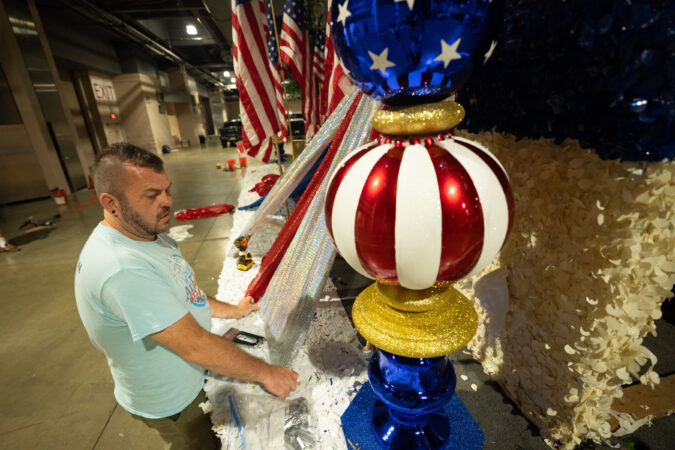
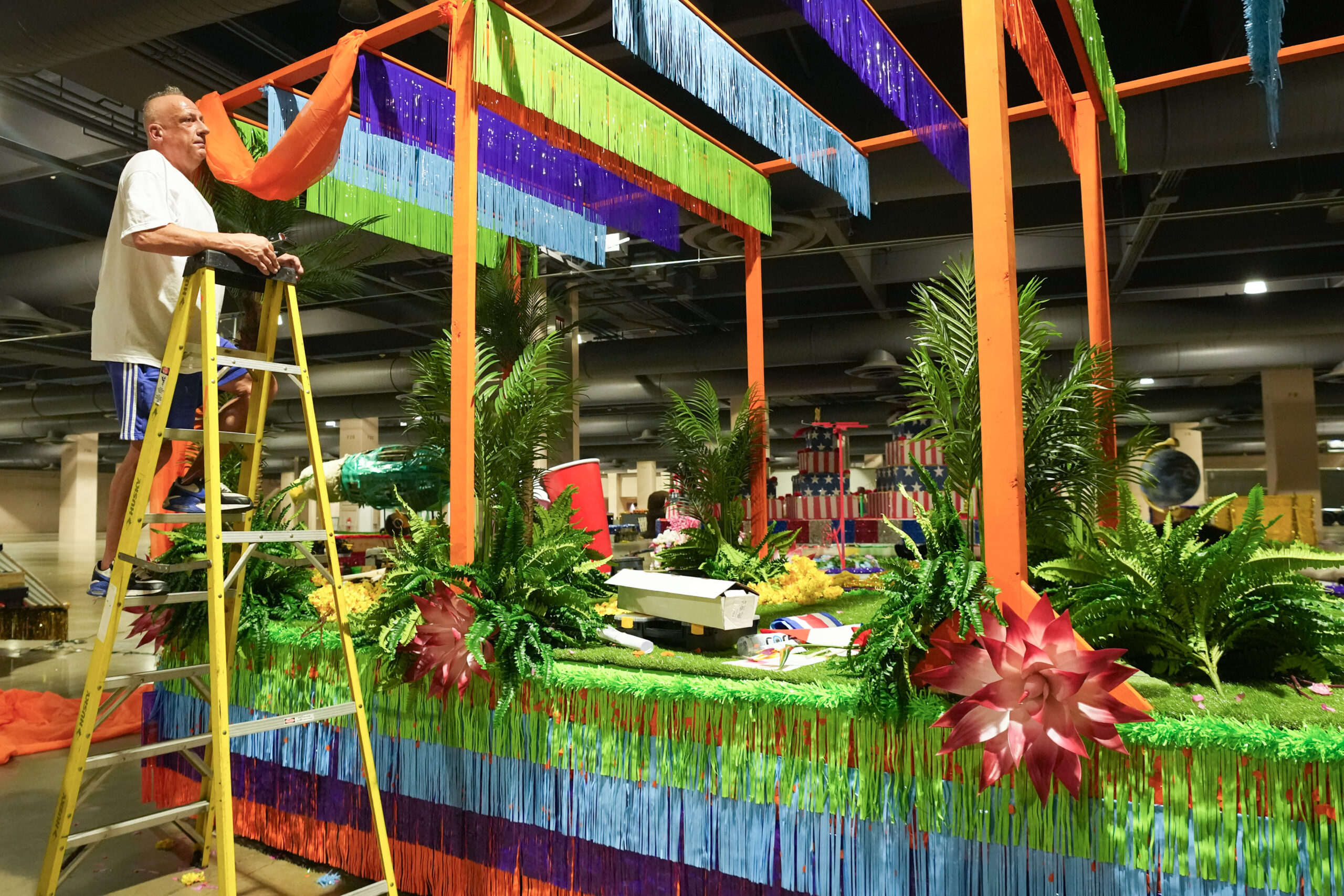
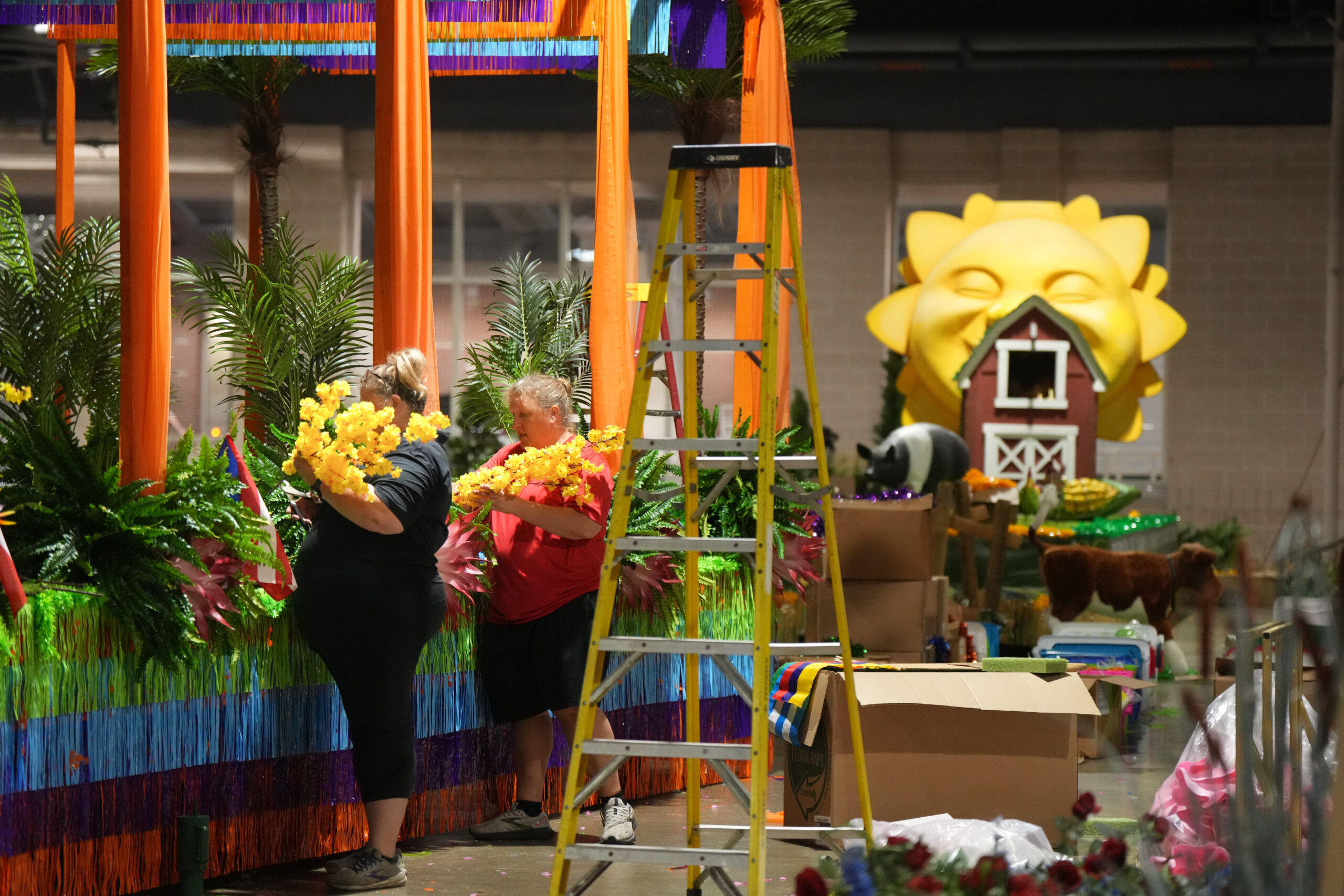
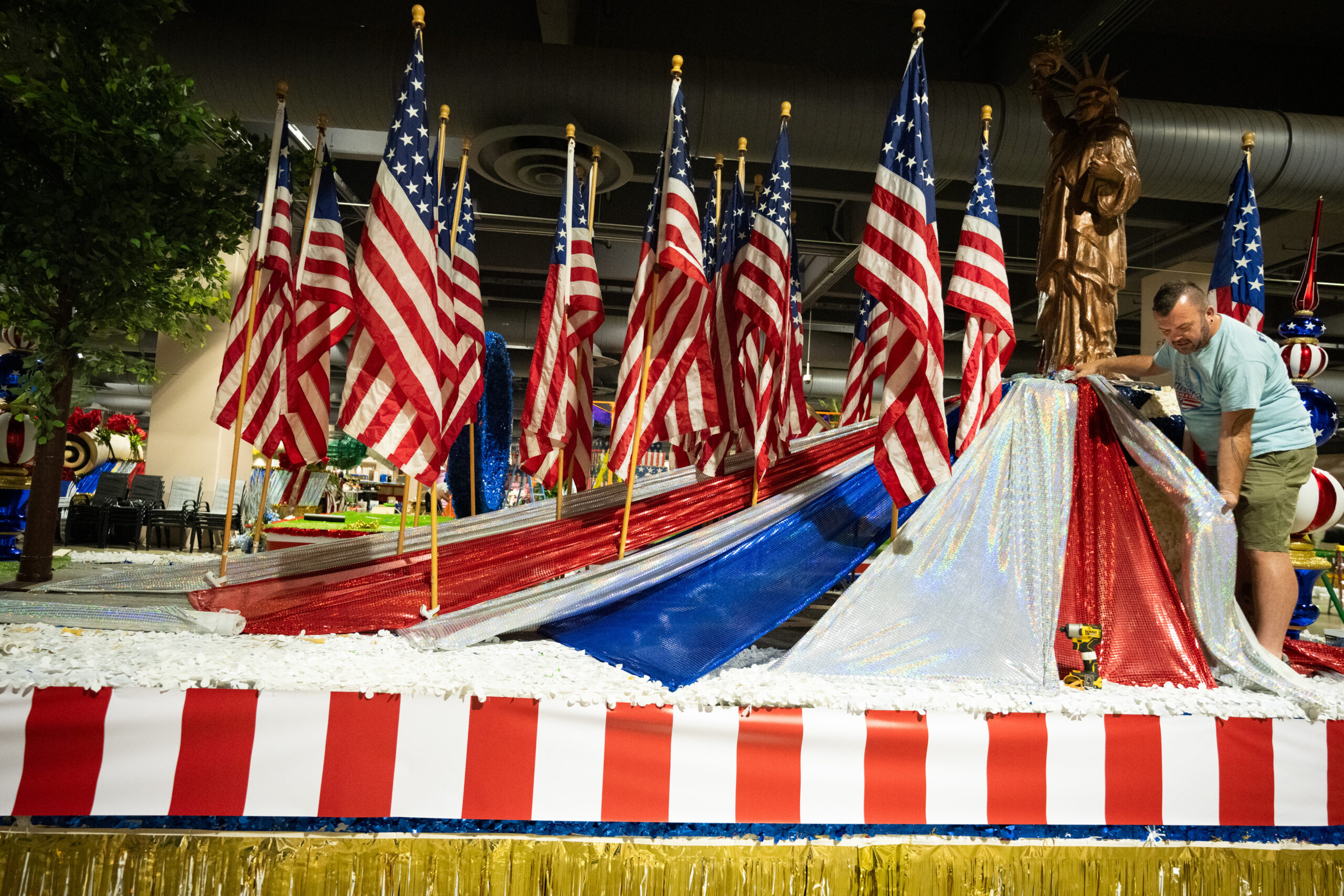
In the dull glow of the overhead Convention Center lights, Todd Marcocci and a band of craftspeople stood next to large wheeled platforms, some housing floral gazebos, others a recreation of a Pennsylvania farm. Sweat dripping from his brow, Marcocci intently drilled palm tree crowns into the base of a platform dedicated to Central and South America.
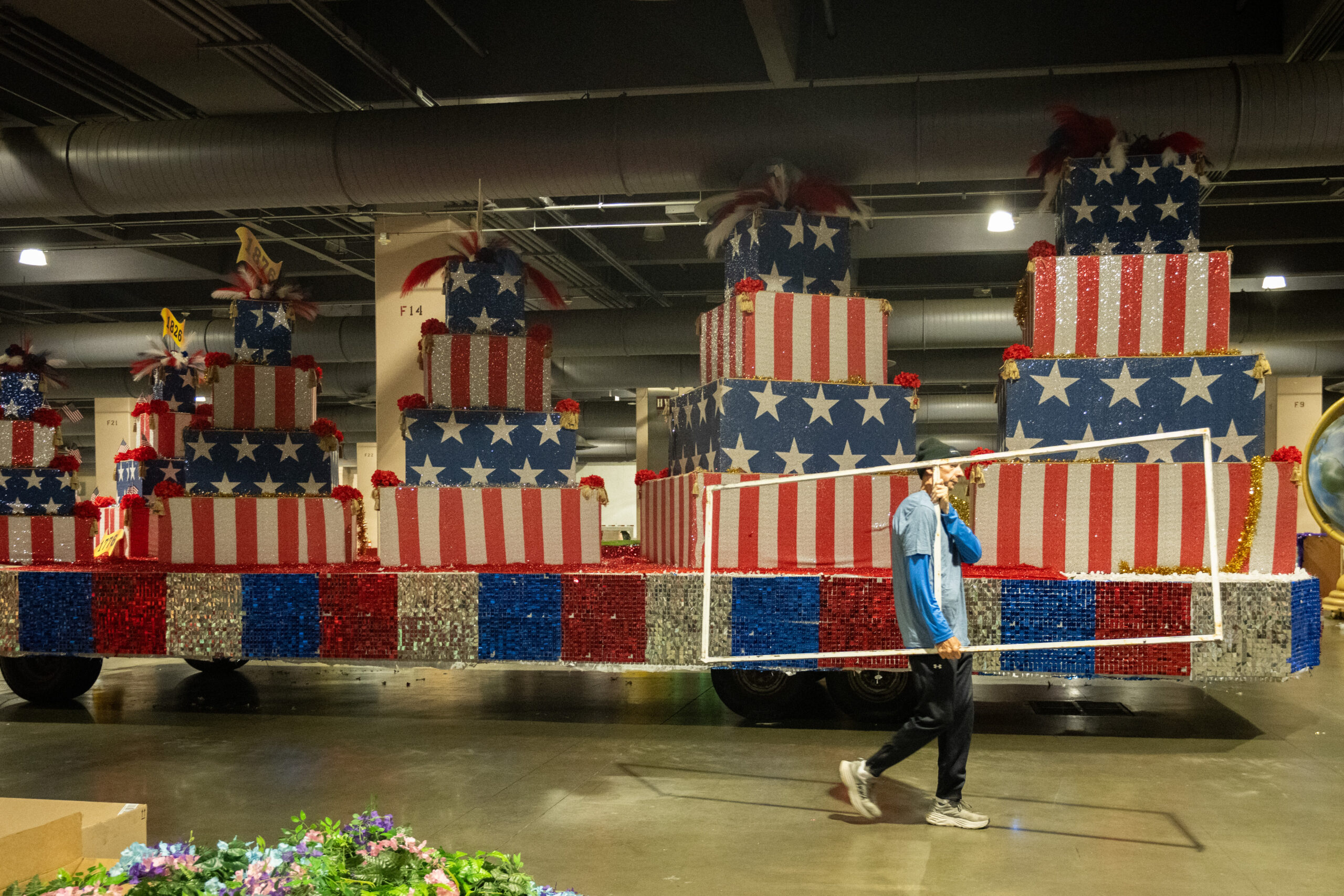
With just days until Philadelphia’s Semiquincentennial parade, Marcocci, alongside his crew and John Shaw of Shaw Parades, is assembling 19 parade floats to commemorate the United States’ 250th birthday.
Todd Marcocci works on a float back stage with the crews of Friday’s parade and festival.
The “Salute to Independence” Semiquincentennial Parade is scheduled to begin at noon Friday nearwhere the Declaration of Independence was signed in 1776, which Marcocci reminded himself of while he designed a historical parade.
“I told all the groups who signed on for the parade that we’ll be lining up in the footsteps of the Founding Fathers,” Marcocci said. “We’ll walk through history.”
In the halls of the Pennsylvania Convention Center, where float builders worked on Monday, larger-than-life recreations of Martin Luther King Jr. and Harriet Tubman awaited placement on a platform celebrating the Civil Rights movement.
Mike Oyer works backstage on the floats.
The next float over was bathed in white sequins, where a giant “peace dove” sculpture accompanied by a globe would rest. A few paces over sat a 6-foot-tall Wawa smoothie and coffee cups, and right by that were multiple United States-themed layered birthday cakes marking the various anniversaries of the country.
Shaw worked a blade saw, slicing through two-by-fours to construct the float frames that Marcocci and Co. were painstakingly deciding the minutiae of, such as how many American flags or sequins can be threaded through a float.
Annie Woods (left) and Johanna Gelber working on the floats.
Shaw, whose parade float company has passed down through four generations, said Philly Fourth of July parades usually average seven floats. “This year it’s almost tripled,” he said. “Todd designs everything in his head, and then we collaborate back and forth to come up with the plan to actually make these ideas work.”
Mayor Cherelle L. Parker will be on board the “One Philly — A United City” float, which features a large sculpture in the shape of the number 1 and a butterfly-and-floral gazebo symbolizing the city’s commitment to a clean and green city, Marcocci said.
Jeremy Williams, works on a float back stage.
A Liberty Bell float will commemorate some of the Founding Fathers and Betsy Ross with an Independence Hall backdrop. Another celebrates Philadelphia Pride with prominent LGBTQ figures and pride flags atop a vibrant rainbow platform.
“The most important thing for me is that people, whether they’re watching on TV at home across the nation or here in person, is that they see themselves in our parade,” Marcocci said of representing the diversity of America’s history.
Philadelphia’s Semiquincentennial Parade on Friday starts at noon at Fifth and Chestnut Streets, passing such historical landmarks as Independence Hall before heading to Sixth and Market Streets and then west on Market to circle City Hall before ending at Broad and Chestnut Streets after a heat emergency was declared, cutting short the route that was to continue to Logan Circle and loop around before heading back to City Hall.
Fan zones are at Sixth and Market Streets , 11th and Market, and the northeast side of City Hall, where a bar is available for those 21 and over.