A month and a half after Collingswood’s mayor defiantly disagreed with a solicitor’s opinion that she should recuse herself from a vote to grant an ambulance-services contract to Virtua Health, which employs her husband, Daniela Solano-Ward signed a settlement agreement nullifying the vote and recusing herself from the matter.
The shift followed a lawsuit filed by James Maley, who sits alongside Solano-Ward on the South Jersey borough’s three-person commissioners board, accusing the mayor of a conflict of interest. The lawsuit asked a judge to discard a Dec. 1 vote outsourcing Collingswood’s EMS services to Virtua Health.
A Superior Court of Camden County judge, Francisco Dominguez, issued a temporary restraining order on Jan. 5 prohibiting Collingswood from executing the contract with Virtua or making changes to the borough’s EMS services.
The borough settled the lawsuit Jan. 16, in an agreement that voided the contract with Virtua, and requires Solano-Ward to recuse herself from all EMS-related matters, according to a copy of the settlement obtained by The Inquirer.
The settlement instructs Maley and Commissioner Amy Henderson Riley, Solano-Ward’s political ally and the borough’s director of public safety, to devise a plan to select an independent consultant to assist in deciding the future of Collingswood EMS services and a schedule for a public process.
“Today’s settlement allows us to move forward as an elected body in a way that reflects the values of Collingswood,” Maley said in a statement. “My concerns in filing this action were rooted in two core principles: avoiding conflicts of interest under the law and ensuring that major decisions, especially those involving essential services like Fire and EMS, are made with full public awareness and engagement.”
Solano-Ward confirmed she would limit her involvement with the EMS process moving forward, but said she trusted Henderson Riley and Maley to “roll up their sleeves and work together to find a resolution in a timely manner.”
The catalyst for the dispute was concerns that Solano-Ward heard from the borough’s fire chief over his department’s lack of capacity to respond to the 4,000 calls it receives annually, the mayor said in a December commissioners meeting. The emergency medical services generate $450,000 a year, the lawsuit says.
The mayor held a meeting with Collingswood’s fire chief in August, the suit says, and brought her husband, a Virtua critical-care physician, Jared Ward. He does not hold leadership positions in the South Jersey health system.
Virtua was one of two entities that responded to a request for proposals to provide ambulance services for the borough.
At the Dec. 1 commissionersmeeting, Solano-Ward defended her husband’s involvement, saying the borough does not have a medical officer and she wanted to be sure no question went unasked.
“We reached out to our attorney and he agreed that there could be a conflict of interest,” the mayor said in the meeting. “To which I respectfully disagree and I will be voting on the matter.”
The commissioner’s board approved the contract in a 2-1 vote, with Maley opposing. Before the vote, the former long-time mayor, who held the position from 1997 until May, expressed outrage at the lack of transparency during the process and Solano-Ward’s participation.
“It’s absurd, it is wrong, it’s unethical,” Maley said.
The contentious lawsuit spilled into the January commissioners meeting, in which residents seemed divided on the issue. Some complained about the perceived lack of transparency by Solano-Ward in the decision to privatize the borough’s EMS department, while others accused Maley of neglecting the ambulance services during his tenure as mayor.
The French developer of South Jersey’s first large-scale AI data center made his case to residents on Wednesday, saying his massive under-construction facility will benefit them in ways unprecedented in the emerging industry.
But at a contentious town hall, several residents said they’re not taking his word for it, especially given the timing at which the developer was asking for their input.
“You couldn’t do this before the building was built?” asked one resident, who spoke during public comment but declined to give their name. “You kind of took our voice away.”
Located on South Lincoln Avenue, off State Route 55, the site was formerly a private industrial park.
DataOne, a French company that manages advanced data centers, is the owner, operator, and builder. Its client, Nebius Group, an Amsterdam-based AI-infrastructure company, will operate the center’s internal technology, which will fuel Microsoft’s AI tools.
Located on South Lincoln Avenue, off State Route 55, the site was formerly a private industrial park. It was sold to DataOne in a private transaction, the details of which Charles-Antoine Beyney, DataOne’s founder and chief executive officer, declined to disclose.
At city council meetings and on social media, some residents have voiced concerns about the environmental, financial, and quality-of-life impacts of the site. Prior to Wednesday’s meeting, residents were prompted to submit questions online that were then addressed in a presentation. Dozens also took to the mic afterward.
Beyney said he understood their concerns, but they don’t apply to his center, which will use “breakthrough” technology to reduce its environmental impact.
“Most of the data centers that are being built today suck, big time,” Beyney said Wednesday. “They consume water. They pollute. They are extremely not efficient. This is clearly not what we are building here.”
“No freaking way am I am going to do what the entire industry is doing … just killing our communities and killing our lungs to make money,” he added.
Developers tout promises of data centers
Data centers house the technology needed to fuel increasingly sophisticated AI tools. In recent years, they have been proliferating across the country and the region.
In June, Gov. Josh Shapiro announced a $20 billion investment by Amazon in Pennsylvania data centers in Salem Township and Falls Township.
A 560,000-square-foot data center is being built in Logan Township, Gloucester County, and is set to have a capacity of up to 150 megawatts once completed in early 2027, according to the website of its designer, Energy Concepts. There are also smaller, specialized data centers in Atlantic City and Pennsauken, according to Data Center Map.
In Vineland, Beyney said his gas-powered center will have nearly net-zero emissions, not consume water while cooling the equipment, and generate 85% of its own power. He told residents: “You will not see your bill for electricity going and skyrocketing.”
Opponents of data centers worry their electric bills will rise due to the centers. The developer in Vineland says that won’t happen in South Jersey.
The facility will be 100% privately funded, he said, after the company turned down a nearly $6.2 million loan from the city amid resident backlash. The loan was approved at a December council meeting, and Beyney said DataOne would have paid about $450,000 in interest, money that could have gone back into the community.
“That’s a shame,” Beyney said, “but we follow the people.”
At a meeting next week, Vineland City Council could approve a PILOT agreement that would give DataOne tax breaks on the new construction in exchange for payments to the city.
Beyney said DataOne plans to be a good neighbor. Across the street from the data center, he said they will build a vertical farm — which grows crops indoors using technology — and provide free fruits and vegetables to Vineland residents in need.
Residents voice concerns about Vineland data center
Several residents expressed skepticism, and even anger, about Beyney’s data-center promises, noting that Cumberland County already has plenty of farms.
Regarding the data center itself, they asked how Beyney could be so confident about new technology, questioned the objectivity of his data, and accused him of taking advantage of a city where nearly 14% of residents live below the poverty line.
Beyney denied the allegations.
At least one resident said he was moved by Beyney’s assurances.
“I was a really big critic of [the data center all along], but I think what you said tonight has alleviated a lot of my concerns,” said Steve Brown, who lives about a mile away from the data center. He still had one gripe, however: The noise.
“What I hear every night when I wake up at 2, 3, 4 o’clock in the morning is this rumble off in the distance,” Brown said. “When I get out of my car every day when I get home, I hear it.”
Brown invited Beyney and his team to come hear the noise from his kitchen or back patio. Beyney said they would do so, and promised to get the sound attenuated as soon as possible, certainly by the end of the project’s construction.
A high-profile bill to ban Philadelphia from incinerating its trash was put on hold Thursday after intense lobbying by residents, activists, and industry put its future in doubt.
The bill’s sponsor, Councilmember Jamie Gauthier, made a last-minute decision to pull the measure, which wouldprevent the city from shipping its trash to be burned for energy at the Reworld Delaware Valley Resource Recovery Facility in Chester.
“I made the difficult decision to hold the bill today because my colleagues have asked for more time with it,” Gauthier said, noting she had not given up on the bill.
Gauthier said the bill would prevent “dumping on cities that are more vulnerable than us.”
“This would never happen in a community that wasn’t populated mainly by Black people, and mainly by poor Black people,” she said of Chester. “The people that are lobbying otherwise — they know that they would never accept this where they live.”
The move to hold the bill came after hours of public testimony by people speaking for and against it.
However, almost all of those speaking against the bill either work for Reworld, the Chester waste-to-energy plant, or represent labor unions. Reworld employees could be seen lobbying Council members in the hallways.
Gauthier’s “Stop Trashing Our Air Act” would prohibit the city from contracting with companies that incinerate solid waste or recyclables. Gauthier said that 37% of the city’s trash is incinerated.
The bill, she has said, is designed to combat environmental injustice, contending incineration has been particularly harmful to the Chester area.
Chester Mayor Stefan Roots and local activists expressed support for the legislation on Thursday, citing health and environmental concerns.
“I’m asking you and begging you,” Roots said in asking Council to vote in favor of the bill. “We’re counting on all of you to support it.”
Chester resident Zulene Mayfield, left, Philadelphia Councilmember Jamie Gauthier, right, and Chester Mayor Stefan Roots meet to discuss Gauthier’s “Stop Trashing Our Air Act,” which would ban the city from incinerating waste, during a visit with lawmakers and staff in Chester, Pa., on Friday, Nov. 7, 2025.
Roots said the Reworld plant burns more trash than all of Delaware County produces.
Multiple Chester and Philly residents say the emissions from Reworld either caused or exacerbated asthma and other health conditions.
Andrea Robinson moved to Chester three years ago, she testified to Council. But she was unaware of the Reworld facility when she moved there.
“I walk out my door and smell the stinky odor. I’m embarrassed to invite family and friends over. There are dust and dirt all over the car and windows,” she said.
Fierce lobbying
Gauthier’s bill ran up against a fierce effort to prevent its passage.
Alex Piscitelli, facility manager at Reworld, testified that theplant operates under “the strict requirements of the Clean Air Act.”
He said claims that the facility causes human health issues “are simply not supported by the data” and emissions “operate well below federal limits.”
Multiple representatives of the company spoke, including workers who lived in Chester and Philadelphia.
Ramona Jones, who lives in Chester and works at Reworld, said the job allows her to be close to her children and family. She said the company has given her ”a livable wage, a higher wage.”
Matt Toomey, a business agent for the operating engineers union, told Council that “up to 120 family-sustaining jobs” were at stake, and noted the Reworld plant is heavily regulated and located in an already industrialized area.
Political reality
Aides for Mayor Cherelle L. Parker, whose administration opposes the legislation, also worked the room.
Council members hardly ever call for votes on doomed bills. But Gauthier initially appeared to be willing to roll the dice by calling the measure up for a vote despite its uncertain fate.
As the morning progressed, however, it became clear she did not have the nine votes needed for passage and almost certainly did not have the 12 votes that would be needed to overcome a likely veto by Parker.
Insisting on the vote would mean that Gauthier was putting colleagues in the uncomfortable position of choosing between environmental advocates and trade unions, two important constituencies in Democratic primaries.
But Gauthier pledged to push for the bill.
“I am committed to this,” she said. “At the City of Philadelphia, we have to be a model for brotherly love, sisterly affection.”
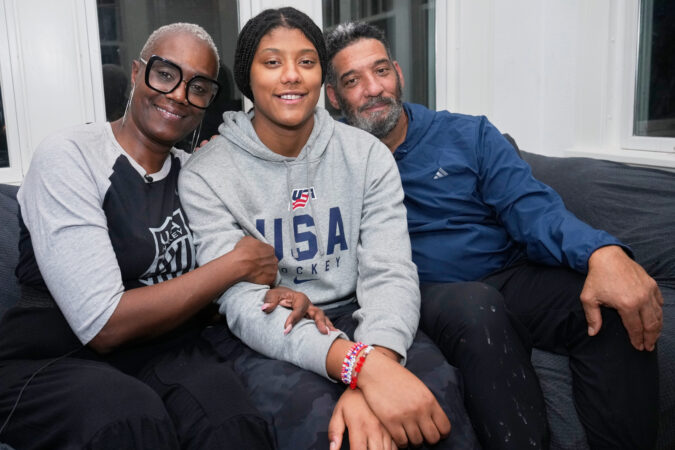
Laila Edwards, the first Black player to make the U.S. women’s Olympic hockey team, could become one of the breakout stars of the upcoming Winter Olympics in Milan and Cortina, Italy.
She’s also from Cleveland Heights, Ohio, the hometown of Jason and Travis Kelce. The brothers experimented with hockey growing up before committing to football, and they remain fans of the game.
In November 2023, when Edwards first made the women’s national team, they gave her a shout-out on New Heights.
“I thought, ‘I’ll just message them thanking them, they’ll never see it,’” Edwards told People. “And then Travis and I had a full conversation over DM, and that was super cool. He was a really down-to-earth, humble guy who was super supportive and had really good things to say. They shouted me out again recently for making the Olympic team.”
Their support didn’t end there. Edwards told People that Travis made a large donation to her family’s GoFundMe page, which has raised over $50,000 to help her family fly to Milan to support her and the U.S. women’s national team.
Kylie Kelce will be on-site in Milan, after NBC named her as part of its Creator Collective. Jason and Kylie attended the Paris Olympics, and supported field hockey, volleyball, and women’s rugby. This time, Edwards hopes to see them at some of her games.
“Travis was saying that Jason and Kylie are big fans of mine, and I’m hoping to meet them all in Italy,” Edwards said.
Jason and Travis Kelce did not immediately respond to a request for comment.
The management of shuttered Philadelphia law firm Schnader Harrison Segal & Lewis has just settled with a group of partners who sued over unpaid retirement funds but continues to face separate allegations that the firm failed to properly pay some lawyers in its last year open.
In a class action over allegedly mismanaged retirement funds, the former firm’s top leaders agreed to a settlement last year of $675,000, which was approved Thursday in federal court in Philadelphia. Lawyer Jo Bennett, who left Schnader Harrison in early 2023, filed the suit on behalf of several dozen former colleagues.
It’s hard for anyone to sue their former employer, said R. Joseph Barton, one of Bennett’s lawyers. “It’s also hard for an active, practicing attorney to sue her former colleagues.”
U.S. District Judge John Milton Younge said Thursday that he had expected the case might be held up because the law firm, as a business, had closed. He asked the lawyers, “Where did the fund come from?” in reference to the settlement money. Barton said some likely came from insurance, and some may have come from individual shareholders of the former firm.
During Thursday’s hearing, lawyers for Schnader Harrison said they would not oppose any of the conditions Bennett’s lawyers asked for.
Before that settlement’s final approval, several former partners of the firm asked the judge to ensure the agreement wouldn’t stop their other lawsuit against the shuttered firm, filed in the Philadelphia Court of Common Pleas in April. That suit alleges that the firm withheld their bonuses during its final year in business, violating their employment contracts. The six lawyers suing the firm each allege that they missed out on between $40,000 and $200,000 of compensation.
Leslie Corwin of law firm Duane Morris, who is handling Schnader Harrison’s dissolution, said “Schnader disputes the claims” in the Philadelphia suit. “It’s part of the windup process, which is still ongoing.”
Corwin declined to comment on Bennett’s settlement and did not represent Schnader Harrison in that case. He noted that the shuttered firm is currently in the process of paying its secured creditor, WSFS Bank.
The six former Schnader Harrison lawyers suing in Philadelphia court were based in other cities — four in New York, one in Pittsburgh, and one in San Francisco. As in the retirement funds case, these lawyers did not have an ownership stake in the firm.
Each of the lawyers was entitled to additional compensation each year beyond their base salary, the lawsuit says, but the year Schnader Harrison closed, the firm failed to pay those bonuses. The six lawyers allege that was a violation of their employment contracts.
Suing former colleagues
The retirement funds settlement is expected to be split among 76 people after the class’ lawyers are paid one-third of the settlement as their fee. The amount paid to each class member is based on how much their retirement fund should have grown during the time in question, Bennett’s lawyers said, with a minimum payout of $25.
Bennett is also set to receive a $10,000 service award from the settlement fund for bringing the case on behalf of her colleagues.
“It takes quite a bit of nerve to sue your former colleagues,” Adam Garner, one of Bennett’s lawyers, said during Thursday’s hearing. “It takes chutzpah to do what Ms. Bennett did.”
Bennett had alleged that Schnader’s equity partners — the lawyers who shared ownership of the firm — did not put employees’ retirement contributions into its 401(k) plan as promptly as it should have. Instead, Bennett alleged, the firm “commingled the employee contributions” with the firm’s other assets and used them “for their own purposes, including funding Schnader’s operations and funding the distributions made to the firm’s equity partners.”
The firm’s equity partners did not put in their own money to help the firm pay its bills, she alleged, as it faced lawsuits over missed rent on its offices in Philadelphia and San Francisco. The firm announced its plans to dissolve in August 2023.
The Eagles reportedly are going to be on the market for a new defensive backs coach.
Christian Parker, who has served in that role with the Eagles under Vic Fangio for the last two seasons, is expected to become the next Dallas Cowboys defensive coordinator, according to multiple reports.
Parker, 34, had become a hot commodity this offseason, as he was also reportedly slated to interview for the Green Bay Packers’ defensive coordinator vacancy. He has risen quickly through the ranks, as he began his NFL coaching career with the Packers seven years ago as a defensive quality control coach.
In 2021, Parker joined Fangio’s staff with the Denver Broncos as defensive backs coach and followed him to the Eagles in 2024. Parker also held the title of passing game coordinator with the Eagles.
The Cowboys are working to hire Christian Parker as their defensive coordinator, sources tell me and @RapSheet.
Just 34 years old, Parker spent the past two seasons as passing game coordinator/DBs coach under Vic Fangio with the Eagles. Now gets his first DC job in the NFC East. pic.twitter.com/boxhtCnEvk
In a short stint in Philadelphia, Parker helped develop a pair of young, standout cornerbacks in Quinyon Mitchell and Cooper DeJean. The second-year players earned their first All-Pro and Pro Bowl nods under Parker this season.
The Eagles have boasted a strong secondary with Parker at the helm for the last two years. Last season, the Eagles defense conceded the fewest passing yards in the league (174.2 per game) and the sixth-fewest passing touchdowns (22). In 2025, the Eagles allowed the eighth-fewest passing yards (189.8) and the fewest passing touchdowns (14).
“I could say a lot of things about him, what he’s meant to me and Q, too,” DeJean said at locker clean out on Jan. 12. “We’ve had a routine of me and Q go meet with him two or three times a week just to go over the team we’re playing. Talk about different looks.
“I don’t think I’d be the player I am or I’d have the success that I’ve had without him. He’s poured a lot into me and Q, too, ever since we got here. I appreciate him for that. Not everybody notices him, and he doesn’t get the recognition that I think he should. But him and [safeties] coach [Joe] Kasper, what those guys mean to us in the DB room, how they coach, the intensity they bring, the passion they have for the game, means a lot to us. Doesn’t go unnoticed.”
Parker reportedly will replace Matt Eberflus, whom the Cowboys fired in January after one season leading one of the worst defenses in the organization’s history.
The Eagles could promote internally to replace Parker. Kasper is in his second stint with the Eagles, rejoining the staff in 2024 to serve as safeties coach. He had previously worked with Fangio in 2023 in the same role with the Miami Dolphins.
Kasper began his NFL coaching career with the Eagles in 2021 as a defensive quality control coach, a position he held for two seasons.
Main Line restaurateur Alessandro “Alex” Fiorello — who is slowly growing a suburban Italian portfolio, with a Wayne osteria and West Chester pizzeria — is preparing to open a new, bar-forward concept at Bryn Mawr Village, 915 Lancaster Ave.
The Bryn Mawr space, which opened in 2022 as the short-lived Marc Vetri-operated Fiore Rosso, most recently was Il Fiore. It closed last month.
The bar at Fiore Rosso in Bryn Mawr, which was operating most recently as Il Fiore. It closed at the end of 2025.
The new project will sit at the top of Fiorello’s three-tier restaurant lineup. His Wayne restaurant, Alessandro’s Wood Fired Italian, opened in 2020 as an upscale-casual neighborhood osteria with a strong takeout business and a busy dining room. Alessandro’s Pizzeria, which the self-taught chef opened in April, is positioned as a casual lunch and slice shop serving pizza, cheesesteaks, and salads.
Fiorello grew up in the restaurant business. His father ran Fiorella’s Café in West Chester, while his mother’s family operated pizza shops in New York. Raised in Brooklyn, Fiorello worked in kitchens from a young age before returning to Chester County as a teenager.
Fiorello said Enoteca Alessandro’s or Alessandro’s Enoteca were in the running for the name of the new Bryn Mawr spot.
Fiorello, who said he is backed by investors, plans to maintain the restaurant’s industrial look, adding that the restaurant’s solid infrastructure would allow for a relatively fast turnaround.
Dining room at Alessandro’s Wood Fired Italian, 133 N. Wayne Ave. in Wayne.
“This new place will be a step up from Wayne,” Fiorello said. “Still approachable but more bar-focused, with a great bar scene.”
The menu will remain Italian at its core, built around house-made pasta, wood-fired pizzas, and a wood-fired grill, with several signature dishes from Alessandro’s Wood Fired Italian carrying over. The new kitchen will also feature dry-aged proteins, using on-site aging refrigerators inherited with the space, and may incorporate subtle Japanese influences, including a small number of sushi-style items.
In the sweltering August heat of the West Texas desert, U.S. Immigration and Customs Enforcement — through a $1.2 billion private contract that was awarded under some strange circumstances — in 2025 opened up a large tent city detention camp near El Paso to take some of the thousands swept up in Donald Trump’s mass deportation raids.
It took just a matter of days for horror stories to begin leaking out of the sprawling camp on the grounds of Fort Bliss.
A Cuban refugee identified as Isaac, a pseudonym, told investigators from a coalition of human rights groups that guards had violently assaulted him as part of a campaign to convince him and other detainees to be dumped in Mexico rather than tocontest their deportation.
Isaac told the groups’ lawyers in a sworn declaration that “the guards hit my head” and “slammed it against the wall approximately ten times” before grabbing and crushing his testicles, then handcuffing him and putting him on a bus with 20 other detainees that was driven to the border. They were told, according to Isaac, “If we don’t want to go to Mexico, then we would either be sent to a jail cell in El Salvador or Africa.”
This undated photo provided by Jeanette Pagan-Lopez shows Geraldo Lunas Campos with his three children. Lunas Campos died Jan. 3 at an ICE detention facility in El Paso, Texas.
The implication was that if the Trump regime did not act, things at Camp East Montana would get worse.
They did.
Over a 33-day stretch that straddled the arrival of the new year, three ICE detainees at the Texas camp died under murky circumstances. One of the cases — the Jan. 3 death of 55-year-old Geraldo Lunas Campos, also a Cuban immigrant — was on Wednesday ruled a homicide by the county medical examiner, citing efforts by camp guards to restrain him. The medical examiner wrote in his report that Campos died from “asphyxia due to neck and torso compression.”
The U.S. Department of Homeland Security, which oversees ICE, has continued to maintain that Campos’ death was “a suicide,” and that any encounter he had with guards was an effort to prevent him from taking his own life. Two fellow detainees who reported seeing guards choking Campos have now received deportation notices. The mother of two of Campos’ children told the New York Times, “He was being abused and beaten and choked to death.”
The alleged killing of Campos is arguably the worst example of what many critics predicted when Trump won the presidency in 2024, behind supporters waving placards, “Mass Deportation Now.” The squalid, hastily erected tent city in the Texas desert is the flagship of what experts describe as a growing network of concentration camps. And now, one year into Trump’s second term, people are dying in them.
“It’s everything that we warned it would be, even before it opened,” Haddy Gassama, a senior policy counsel at the ACLU who’s been working on the issues around Camp East Montana, told me this week. “I think their goal is still to put 5,000 people in this space with inadequate healthcare, inadequate food, and inadequate recreation.”
The high-profile, increasingly violent immigration raids that have been taking place in Minneapolis, Chicago, and other U.S. cities have swelled the number of detainees in ICE custody to more than 73,000, an all-time record. DHS is currently planning a large-scale 2026 expansion of its gulag archipelago that would even include repurposing remote rural warehouses for holding human beings.
In such a large population of detainees, some deaths would be inevitable, but the current ongoing spike in fatalities has shocked and alarmed experts. The sixth ICE detainee death of 2026 took place on Sunday, which is a rate of one every three days. That extrapolates to more than 120 deaths over a year, which would be more than 10 times the rate in the last year of the Biden administration, when only 11 detainees perished.
Parady La, of Upper Darby, died while in ICE custody in Philly.
That Jan. 18 fatality also occurred at Camp East Montana, when Victor Manuel Diaz, 36, of Nicaragua, died of what government officials called a “presumed suicide.” Unlike Campos, the autopsy on Diaz will not be done by the county medical examiner, but by government doctors at an Army medical center. Diaz was one of many migrants swept up in the current ICE operation in Minnesota.
The third recent death tied to the Texas concentration camp — Francisco Gaspar-Andres, 48, of Guatemala, who wastaken to an El Paso hospital — was determined by an autopsy to have been caused by complications of alcohol-related liver disease.
That the majority of ICE custody deaths are linked to medical causes doesn’t necessarily exonerate either the agency or its private contractors. A 2024 report by Physicians for Human Rights that looked at 52 deaths in ICE custody from 2017 to 2021, or during Trump’s first term, found that 95% were preventable, or possibly preventable, if appropriate medical care had been provided.
One such medical death occurred here in Philadelphia earlier this month when Parady La, a 46-year-old Cambodian refugee who lived in Upper Darby, died after he was taken from the city’s federal detention center to Thomas Jefferson University Hospital. ICE said La was suffering from severe drug withdrawal symptoms, but family members are questioning whether the feds paid enough attention to his illness, or even administered the right treatment.
Human rights watchers insist that the spike in ICE detention deaths cannot be viewed as a coincidence, but as an outgrowth of problems that include not only medical neglect but also squalid conditions, substandard food, rancid water, and patterns of physical and sexual abuse by guards. They say the problems are not new, but have substantially worsened as the Trump regime hastily expands its networks of detention centers and camps.
In December, another Camp East Montana detainee — Thomas, also a pseudonym — told human rights lawyers that “he was beaten by officers so severely he sustained injuries across his body, lost consciousness, and had to be taken to a hospital in an ambulance.” Like his fellow detainee Isaac, he alleged guards grabbed his testicles and crushed them.
Today, I was notified of yet another death at Camp East Montana.
This is the 3rd person who has died in the $1.24 billion privately-run facility that focuses on profits instead of meeting basic standards. https://t.co/pZuXwfNS1T
Gassama, the ACLU attorney, said the horrific track record of ICE detention raises all kinds of red flags about its current plans, aided by its $175 billion windfall in Trump’s “Big Beautiful Bill” that was signed last year, to house as many as 80,000 detainees in a new network of revamped warehouses. “You can only imagine what a remodeled warehouse would be like to detain people, human beings, long term,” she said.
It’s true that — as right-wing pundits are always quick to point out — the U.S. mass deportation regime offers nothing that comes close to the death camps Nazi Germany established at the end of the Holocaust. But experts like author Andrea Pitzer say the similarities to concentration camps that Adolf Hitler set up for his political enemies after taking power in 1933 are too many to ignore.
History has shown again and again that rounding up masses of people based on their identity strips them of their basic humanity. And that becomes the sick justification for violent abuse, neglect, endemic disease, and, ultimately, death.
The most famous victim of the Nazi Holocaust, the teenage diarist Anne Frank, wasn’t killed in a gas chamber, but died from typhus at the Bergen-Belsen concentration camp, which was the result of unsanitary conditions and medical neglect.
Now, people are dying in record numbers in “the camps” on sunbaked U.S. soil. This is shameful beyond words.
In this photo provided by the National Archives, Japanese Americans, including American Legion members and Boy Scouts, participate in Memorial Day services at the Manzanar Relocation Center, an internment camp in Manzanar, Calif., in May 1942.
These human rights abuses now occurring at Camp East Montana are also a tragic echo of the longer arc of history of its Fort Bliss location. In 1942, thousands of detainees — mostly Japanese Americans, with some people of German or Italian descent — were shipped from the West Coast to be held in a barbed-wire camp under constant watch by armed guards. Over the course of World War II, some 1,862 Japanese Americans died in the broader network of internment camps, many from harsh conditions.
One by one, offensive coordinator candidates that have been tied to the Eagles have been taken off the big board.
The latest is Zac Robinson, who is finalizing a deal, according to multiple reports, to be the next coordinator in Tampa. Robinson, who interviewed with the Eagles, joins Mike McDaniel, who talked to the Eagles, as candidates who are no longer in the pool. McDaniel will head west to the Los Angeles Chargers.
Another name to potentially cross off is Brian Daboll, who, according to The Athletic, wants to be the next head coach of the Buffalo Bills and otherwise plans to head to Tennessee to be the offensive coordinator under new defensive-minded head coach Robert Saleh.
The Eagles are the only team that didn’t make a head coaching change to still have an offensive coordinator opening. Eight teams that fired their head coach still have an opening at offensive coordinator.
Who’s left among the candidates the Eagles either interviewed or planned to? Another name popped up on the list Thursday morning. Let’s start there …
Declan Doyle
The Eagles, according to ESPN, requested to interview the 29-year-old Chicago Bears’ offensive coordinator. Doyle was hired by Ben Johnson last offseason after serving as the tight ends coach in Denver for the previous two seasons. The Iowa native and 2018 Iowa graduate worked as a student assistant with the Hawkeyes from 2016 to 2018 and then was an offensive assistant with the New Orleans Saints from 2019 to 2022. Talk about a fast riser.
Johnson, of course, has a big hand in the offense and calls plays for the Bears. But Doyle had a hand in the Bears’ sixth-ranked offense by yards per game. Chicago was 32nd a year ago. Johnson gets a lot of credit for that, but Doyle’s role can’t be discounted.
Doyle has never been a play-caller, which makes him an outlier among the other candidates the Eagles have been in contact with. The Eagles seem to be targeting coaches with more experience than Doyle, but there is value in meeting and talking to a young coach like him. Even if it’s not for this job at this juncture.
Jim Bob Cooter
Cooter was a consultant when Nick Sirianni first got the Eagles job in 2021 and has been Shane Steichen’s offensive coordinator in Indianapolis since 2023. The Eagles, according to Sports Illustrated, interviewed Cooter on Friday. Like Doyle in Chicago, Cooter does not call plays for the Colts, which is why the Eagles job would be a promotion.
Brian Daboll was one of Jalen Hurts many offensive coordinators over the years. The pair was together during the 2017 Alabama season.
Brian Daboll
It’s still worth putting Daboll here, despite the report from The Athletic. Until a deal is done, he’s still a candidate. The Eagles, sources said, interviewed Daboll on Tuesday. Daboll was most recently the head coach of the New York Giants, a position he was fired from in November. Daboll wants to be in Buffalo probably for a few reasons: He’s from the area, and his best stretch of coaching came as the OC in Buffalo, where he helped develop Josh Allen.
The Eagles, NFL insider Jordan Schultz reported a few days ago, plan to interview Grizzard, who was let go by Tampa Bay. Grizzard, 35, was the offensive coordinator for one season after joining the Bucs in 2024 as a passing game coordinator. Before Tampa Bay, Grizzard worked with McDaniel in Miami and was with the Dolphins during stints with Adam Gase and Brian Flores, too.
Mike Kafka
The Eagles have already interviewed Kafka, who was Daboll’s coordinator in New York before taking over as interim head coach. Kafka is a familiar name around here, having spent two seasons as a backup quarterback after the Eagles selected him in the fourth round of the 2010 draft. During his 10-year coaching career, Kafka has spent time with Patrick Mahomes in Kansas City. He was Mahomes’ quarterbacks coach from 2018 to 2021.
Kansas City Chiefs offensive coordinator Matt Nagy (left) has been with Andy Reid for most of his career, starting as an intern in Philadelphia.
Matt Nagy
The Eagles interviewed Nagy on Wednesday, according to sources. Kansas City just hired his replacement in Eric Bieniemy. Nagy, unlike in Kansas City, would call plays with the Eagles. Nagy, who went to high school in Lancaster County and attended the University of Delaware, got his start in the NFL as an intern under Andy Reid with the Eagles in 2008. Nagy followed Reid to Kansas City, then returned to the Chiefs after his four-year stint as the head coach of the Bears. He had been the Chiefs’ offensive coordinator for the last three seasons.
Bobby Slowik
The Eagles, according to ESPN, requested to interview Slowik, Miami’s senior passing game coordinator. Slowik is another branch on the Shanahan tree. He worked with the Shanahans in Washington from 2011 to 2013 and then was a Pro Football Focus analyst. Kyle Shanahan hired Slowik in 2017 as a defensive quality control coach in San Francisco. Slowik jumped to the offensive side of the ball with the 49ers in 2019. He was the passing game coordinator for the 2022 season before Houston hired him to be its offensive coordinator in 2023. He held that position and called plays for two seasons.
Charlie Weis Jr.
It’s unclear if the Eagles have interviewed Weis, who helped Lane Kiffin run an explosive Ole Miss offense that has been at or near the top of the NCAA rankings in offense the last few seasons. They at least reportedly had interest in Weis, who will join Kiffin in his same role at LSU.
Staff writer Jeff McLane contributing reporting to this story.
The Pennsylvania Academy of the Fine Arts has named an art museum veteran to be its next leader.
Kristen Shepherd will become president and CEO of the oldest art museum and school in the U.S. effective Feb. 9, PAFA announced Thursday.
Shepherd was executive director of the Museum of Fine Arts in St. Petersburg, Fla., for more than 5½ years, and previously held posts at the Los Angeles County Museum of Art and the Whitney Museum of American Art.
She takes over PAFA as it faces financial challenges, remakes aspects of the institution, and prepares to cohost a major show this spring featuring works from the collection of Phillies managing partner John Middleton and his wife, Leigh.
Shepherd, 54, said that she had a “long-standing love affair with PAFA and its mission” that began when she was studying art history at George Washington University, where she earned her bachelor’s and master’s degrees in art history.
“I remember learning about PAFA as a student and just being absolutely floored at the idea of it. The fact that the founders, at the birth of our country practically, made an extraordinary statement about the importance of the fine arts in our young country that continues today.”
The name over the front entrance of the Pennsylvania Academy of the Fine Arts’s 1876 building at Broad and Cherry Sts., Sept. 29, 2025.
Facing a $3 million deficit and enrollment numbers that had shrunk by about half since 2017, PAFA announced in January 2024 that it would be ending its degree programs at the end of the 2024-25 school year. This past fall it launched a new certificate program that leaders hoped would net more income.
The institution — which was founded in 1805 — began drawing more heavily on its endowment than industry guidelines suggest is prudent. To boost revenue, it has marketed rental of its art-making facilities and spaces in its Samuel M.V. Hamilton Building to outside groups.
Last summer, PAFA shut down its historic North Broad Street museum building for a year to replace the HVAC system and make other improvements, and leaders have been stumping for a donation in exchange for naming rights to the building.
The Pennsylvania Academy of the Fine Arts Furness and Hewitt-designed building (left), with banners announcing the building’s reopening in Spring 2026, and the Samuel M.V. Hamilton Building (right) on N. Broad St., Sept. 28, 2025. In between is the 51-foot-high ‘Paint Torch’ sculpture by Claes Oldenburg.
PAFA’s previous president and CEO, Eric G. Pryor, stepped down more than a year ago, and the museum and school has been run by a team of three administrators in the interim.
Last fall, PAFA and Temple University announced a new affiliation whereby Temple leases the 10th floor of the Hamilton Building, bringing PAFA much-needed revenue. The Center City site gives Temple a home for new programs, including a curatorial studies certificate program. It also gives students access to PAFA’s art-making equipment and its important collection of American art.
Shepherd says not only was she familiar with PAFA’s challenges and ongoing retooling, but they were a factor in her interest in the post.
“That’s actually attractive to me rather than being daunting,” she said. “There’s a lot to be thought through and analyzed, from risk assessments to financial stability and how to create the right financial scenario for the institution’s longevity.”
Sculptures used to instruct students at the Pennsylvania Academy of the Fine Arts, July 16, 2025.
Elliot Clark, a PAFA trustee and cochair of the search committee, said that in Shepherd, PAFA had found someone who can “expand membership and bring in new donors, new participants into the community.”
Clark said Shepherd’s “very keen financial mind” impressed PAFA’s leaders during the hiring process.
“She was a business analyst at Sotheby’s, and one of her roles was in strategic operations, and she’s very financially savvy. So she made us dance during the Q&A about financials.”
Clark called her “incredibly diplomatic — she’s a really talented communicator. She’s going to be a great ambassador both locally and nationally to the art community and the Philadelphia community.”
“And you know,” he said, “we’re not always an easy city to deal with.”
Shepherd led St. Petersburg’s relatively small Museum of Fine Arts (with a $6 million annual budget) from 2016 through 2022, and has run an arts consultancy since then with business partner Veronica Lane. At the Los Angeles County Museum of Art, she was associate vice president, head of audience strategy services. And, for 4½ years before that, she was director of the membership and annual fund program at the Whitney Museum of American Art. She worked at Sotheby’s for 9½ years in a variety of positions on the business side.
The Pennsylvania Academy of the Fine Arts, Oct. 22, 2024.
Her first few months at PAFA promise to be eventful. Clark says work on the Furness and Hewitt-designed museum building is on budget and on time; it is slated for a reopening celebration April 10. “A Nation of Artists” opens April 12.
The show, which takes place at both PAFA and the Philadelphia Art Museum, features more than 1,000 works curated by the two museums alongside those from the Middleton collection.
Temple’s programs at PAFA are expected to launch in late spring.
PAFA’s fiscal year ends June 30, which will reveal the direction of its finances.
“We’ll see where we are at the end of the year,” Clark said. “Some things have gone better, some things are not coming in as strongly as we would have liked. But overall, we’re still hopeful that we can get to break even this year.”