Tag: topic-link-auto

  • J.T. Realmuto is glad to be back with the Phillies and believes he can bounce back at the plate

    J.T. Realmuto is glad to be back with the Phillies and believes he can bounce back at the plate

    Just a few hours after J.T. Realmuto’s new contract became official Tuesday morning, he was at the Phillies’ facilities in Clearwater, Fla.

    Pitchers and catchers don’t report until Feb. 11, but Realmuto’s family typically heads to Florida in mid-January. Not only does it offer a reprieve from chilly weather of his offseason home in Oklahoma, it also gives him a head start on his preparation for the year.

    The routine seems like it will hold for the next few years after Realmuto re-signed with the Phillies for three years and $45 million. The new deal will take Realmuto, who turns 35 in March, through his age-37 season. To clear a spot on the 40-man roster for Realmuto, the Phillies designated utility man Weston Wilson for assignment.

    “I’m glad we’re back here, and this is where we wanted to be the whole time,” Realmuto said. “My focus was just on my legacy here and being able to finish my career with the Phillies and not having to uproot my family and start over.”

    But the veteran catcher conceded Tuesday that there were points during his free agency when it felt like an agreement wouldn’t come together. While both parties had been interested in a reunion from the beginning, they disagreed on the dollar amount.

    “In my opinion, catchers are just undervalued in this game, as far as contracts and dollars go,” Realmuto said. “I truly believe it’s one of, if not the most important position on the field.”

    Phillies catcher J.T. Realmuto struggled at the plate last season but believes he can get back on track with a few tweaks.

    The Phillies were prepared to move on from Realmuto last week as discussions intensified with free-agent shortstop Bo Bichette and had contingency plans in place at catcher. President of baseball operations Dave Dombrowski said they had other targets they could have added to their mix of Rafael Marchán and Garrett Stubbs.

    But when the New York Mets swooped in with a shorter-term, higher-dollar offer for Bichette — which Dombrowski described as a “gut punch” — the Phillies then called Realmuto back with an improved offer.

    “We’re thrilled that J.T. is back because that was always a priority for us over the wintertime,” Dombrowski said. “We think he was the best catcher out there, as far as free agency was concerned.”

    Realmuto posted one of his worst offensive seasons in 2025, hitting .257 with a .700 OPS over 134 games. But he remained elite defensively at catching runners stealing, catching plus-6 runners above average, according to Statcast.

    For his pitching staff, most of Realmuto’s value comes from the work he does behind the plate and behind the scenes.

    “Every time that I walk in, J.T. is already in the kitchen. He has a laptop in his hands. He’s looking at the opposing team, coming up with the report, helping us out,” Cristopher Sánchez said through a team interpreter. “And I just think that’s a testament to him and the preparation that he puts [in] for us to go out there and [be] able to thrive.”

    Added reliever Tanner Banks: “After games, [he’s] doing workouts when guys are showering to go home. He’s a bulldog behind the dish.”

    Realmuto said he was “self-aware” about his offensive decline over the last few seasons, but he believes he can turn it around.

    “I know that I haven’t had my best years [the] last couple years, but I do believe that it’s not, like, age or physically related,” he said. “It’s something that I can improve on and work on and be better for the years to come.”

    His training regimen is a big part of that, and it has evolved over the years. Rather than lifting as heavily as possible and bulking up, as he did when he was younger, Realmuto now focuses on training for mobility and longevity.

    The aging curve typically is unforgiving for catchers. Yadier Molina is the only other catcher in baseball history to start more than 130 games behind the plate in his age-33 season or beyond.

    Realmuto played 132 games behind the plate last season, at age 34, and stayed healthy. With a multiyear deal, the Phillies are betting that Realmuto can continue to defy the odds.

    “He’s a great athlete. I mean, a lot of times you don’t see catchers in that same type of situation,” Dombrowski said. “… It wouldn’t shock me if you’re sitting here in another three years, and J.T. is talking about a multiyear contract beyond that. He’s that type of individual. You look at historical aspects, but I also think you’re talking about a unique individual that will continue to perform very well.”

    Extra bases

    Zack Wheeler continues to progress in his rehab from thoracic outlet decompression surgery and has thrown up to 90 feet. “He looks good, but there’s no guarantees when he’s going to get up on the mound. He eventually will,” manager Rob Thomson said. … There is mutual interest between Sánchez and the Dominican Republic national team for the World Baseball Classic, but Sánchez said he still is discussing it with the Phillies and has not made a decision on his participation.


  • Tyrese Maxey beats out Cooper Flagg to crack top 10 of NBA’s jersey sale list

    Tyrese Maxey beats out Cooper Flagg to crack top 10 of NBA’s jersey sale list

    Halfway through the regular season, with All-Star Weekend slowly approaching, the NBA has announced its best-selling jerseys from the season thus far — and Sixers guard Tyrese Maxey has cracked the top 10 of the sale list.

    The 25-year-old has easily become a fan favorite throughout his six seasons in Philadelphia. And following Monday’s announcement that the former league’s Most Improved Player will be starting in his first All-Star Game this year — earning his second All-Star nod — those jerseys will most likely be even more in demand.

    Maxey, who currently averages 30.2 points, 6.7 assists, and 4.4 rebounds, was followed on the list by Dallas Mavericks rookie Cooper Flagg, and Houston Rockets star Kevin Durant. Golden State’s Stephen Curry and the Los Angeles Lakers’ Luka Doncic top the list.

    Nine players on the list have been named starters for the 2026 All-Star Game, with Lakers star LeBron James as the only player to miss the cut.

    Here’s the full top 15:

    1. Stephen Curry, Golden State Warriors
    2. Luka Doncic, Los Angeles Lakers
    3. Jalen Brunson, New York Knicks
    4. Victor Wembanyama, San Antonio Spurs
    5. LeBron James, Los Angeles Lakers
    6. Anthony Edwards, Minnesota Timberwolves
    7. Shai Gilgeous-Alexander, Oklahoma City Thunder
    8. Jayson Tatum, Boston Celtics
    9. Nikola Jokic, Denver Nuggets
    10. Tyrese Maxey, Philadelphia 76ers
    11. Cooper Flagg, Dallas Mavericks
    12. Kevin Durant, Houston Rockets
    13. Giannis Antetokounmpo, Milwaukee Bucks
    14. Cade Cunningham, Detroit Pistons
    15. Donovan Mitchell, Cleveland Cavaliers

    Meanwhile, the Sixers were named one of the teams with the top-selling NBA merchandise, coming in at No. 5 above the Boston Celtics and the Minnesota Timberwolves.

    Here’s the full top 10:

    1. Los Angeles Lakers
    2. New York Knicks
    3. Golden State Warriors
    4. San Antonio Spurs
    5. Philadelphia 76ers
    6. Boston Celtics
    7. Minnesota Timberwolves
    8. Oklahoma City Thunder
    9. Dallas Mavericks
    10. Denver Nuggets
  • SEPTA Regional Rail delays this morning are due to a train pulling down overhead wires

    SEPTA Regional Rail delays this morning are due to a train pulling down overhead wires

    SEPTA Regional Rail riders experienced significant delays — at times, 30 minutes to an hour — at the peak of morning rush hour on Tuesday morning, after a train pulled electrical wires down.

    A West Trenton Line train struck overhead electrical wires near Wayne Junction train station in the Nicetown section of Philadelphia at 7:45 a.m., said SEPTA officials.

    The train lost power and was tangled in the wires it had pulled down.

    Marie Pollock, 24, who was on board, felt the train start to gradually slow down before quickly and forcefully coming to a stop. Pollock could see wires hitting the train windows and noted that other passengers were startled during the collision.

    “We were keeping the doors closed because it was so cold,” Pollock said. “We were on kind of a hill, so there wasn’t any room for SEPTA to get a shuttle, and the power was out on both tracks, so we couldn’t get a typical rescue train to us.”

    Pollock, who had already been waiting a half-hour in 20-degree chill for her 6:17 a.m. West Trenton Line train before the ordeal, said passengers waited inside the stuck train for an hour and a half.

    SEPTA crews had to cut through the downed wires to free the train and then used a diesel-powered train to tow the disabled one to Wayne Junction, where passengers took other trains into Center City.

    Pollock’s four-hour journey didn’t end until 10 a.m. when she finally arrived at Jefferson Station.

    Since then, service interruptions have been occurring primarily on the Warminster, Lansdale/Doylestown, and West Trenton lines. However, delays cascade throughout the rail system, leading to 15 to 45-minute delays on other lines, said SEPTA spokesperson Andrew Busch.

    “Repairs are still continuing,” Busch said Tuesday afternoon, “but service has improved. Some minor delays, and we are advising passengers to plan for some extra time during rush hour, but we expect the evening commute to be better than this morning.”

    There is currently no timeline for completed repairs.

    SEPTA urges riders to use the SEPTA mobile app and septa.org for the latest updates.

    Today’s service interruptions follow a streak of solid performance by SEPTA after months of disruptions while SEPTA rushed to inspect and repair a fleet of 223 trains after five caught fire last year.

  • Penn calls federal commission’s request for personal employee information ‘unconstitutional,’ ‘disconcerting’ and ‘unnecessary’

    Penn calls federal commission’s request for personal employee information ‘unconstitutional,’ ‘disconcerting’ and ‘unnecessary’

    The University of Pennsylvania in a legal filing Tuesday pushed back against a federal commission’s demand that in effect would require it to turn over lists of Jewish faculty, staff, and students, calling the request “unconstitutional,” “disconcerting,” and “unnecessary.”

    The filing comes in response to a lawsuit filed against the university in November by the Equal Employment Opportunity Commission, asserting that Penn failed to comply with its subpoena. The commission is seeking employees’ names, home addresses, phone numbers, and email addresses to further an investigation it began in 2023 over the school’s treatment of Jewish faculty and other employees regarding antisemitism complaints that emerged following Hamas’ attack on Israel.

    In its quest to find people potentially affected, the commission demanded a list of employees in Penn’s Jewish Studies Program, a list of all clubs, groups, organizations, and recreation groups related to the Jewish religion — including points of contact and a roster of members — and names of employees who lodged antisemitism complaints. It also sought names of participants in confidential listening sessions held by the school’s task force on antisemitism.

    The request has spurred a backlash from some student and faculty groups, including Penn’s chapter of the American Association of University Professors, arguing that the names and personal information should not be turned over to the government.

    Penn has refused to provide the information, and the school doubled down on that position in Tuesday’s legal filing.

    “The EEOC insists that Penn produce this information without the consent — and indeed, over the objections — of the employees impacted while entirely disregarding the frightening and well-documented history of governmental entities that undertook efforts to identify and assemble information regarding persons of Jewish ancestry,” the university wrote in its filing. “The government’s demand implicates Penn’s substantial interest in protecting its employees’ privacy, safety, and First Amendment rights.”

    Also on Tuesday, the Penn Faculty Alliance to Combat Antisemitism, a group of more than 150 primarily Jewish professors, filed a brief in support of the university’s decision not to comply with the commission’s demand.

    “While the Alliance supports the EEOC’s efforts to combat antisemitism at Penn, its members are gravely concerned that the scope of the EEOC subpoena … invokes the troubling historical persecution of Jews and threatens the personal security of the Alliance’s members,” the group wrote in the brief.

    The alliance includes members who have had concerns about antisemitism at Penn, including faculty who were harassed online after attending a trip to Israel following Hamas’ Oct. 7, 2023, attack on the country, said Claire Finkelstein, a professor at Penn Carey Law School, member of the alliance, and faculty director of the Center for Ethics and the Rule of Law.

    Among its members are faculty “who have been really on the side of remediating antisemitism, do not believe that concerns about antisemitism are pretextual, do not think that it is a sham issue, and think there are real … issues to address at universities in general.”

    Finkelstein said the alliance has not taken a position on whether the EEOC’s investigation is warranted or needed.

    But the group is adamantly opposed to the subpoena and believes it could discourage membership in Jewish groups at Penn. In its brief, the group notes “the dark historical legacy associated with government lists of Jews,” including how Nazis “frequently demanded that others identify the Jews among them.”

    Penn said in its filing that it had complied with the subpoena except for the list of names and contacts, noting it had provided over 900 pages of materials to the commission. The school noted that it even offered to send notices to all employees about the EEOC’s request to hear about antisemitism concerns with the commission’s contact information.

    The university also asserted that the commission’s demand “is a particularly unjustified use of enforcement authority given the weakness of the underlying charge.”

    The commission, the university argued, has not identified a “single allegedly unlawful employment practice or incident involving employees.”

    “The charge does not refer to any employee complaint the agency has received, any allegation made by or concerning employees, or any specific workplace incident(s) contemplated by the EEOC, nor does it even identify any employment practice(s) the EEOC alleges to be unlawful or potentially harmful to Jewish employees,” Penn said in its response.

    The original complaint was launched by EEOC Commissioner Andrea Lucas, now chair of the body, on Dec. 8, 2023, two months after Hamas’ attack on Israel that led to unrest on college campuses, including Penn’s, and charges of antisemitism. It was also just three days after Penn’s then-president, Liz Magill, had testified before a Republican-led congressional committee on the school’s handling of antisemitism complaints; the testimony drew a bipartisan backlash and led to Magill’s resignation days later.

    Lucas, whom President Donald Trump appointed chair last year, also brought similar antisemitism charges against Columbia University that resulted in the school paying $21 million for “a class settlement fund.”

    EEOC complaints typically come from those who allege they were aggrieved. Lucas, according to its complaint, made the charge in Penn’s case because of the “probable reluctance of Jewish faculty and staff to complain of harassing environment due to fear of hostility and potential violence directed against them.“

    The commission’s investigation followed Lucas’ complaint to the commission’s Philadelphia office that alleged Penn was subjecting Jewish faculty, staff, and other employees, including students, “to an unlawful hostile work environment based on national origin, religion, and/or race.”

    The allegation, the complaint said, is based on news reports, public statements made by the university and its leadership, letters from university donors, board members, alumni, and others. It also cited complaints filed against Penn and testimony before a congressional committee.

    In its brief, the faculty alliance also asserted that the commission could have used other voluntary and informal methods to obtain contact information for Penn faculty and staff, such as setting up a website where people could report concerns.

    Finkelstein, the Penn law professor, said she understands that the commission generally guarantees anonymity to witnesses or complainants, but leaks can occur.

    “When state force extracts sensitive, personal details, those details could (and often do) become public, turning group members into targets for their enemies,” the group states in its filing.

    Penn has done a lot to address antisemitism concerns, said Brian Englander, president of the alliance and a professor of clinical radiology who has been at Penn for 22 years.

    In its brief, the alliance listed antisemitic incidents that occurred on Penn’s campus in 2023, including a swastika left on a Penn building and messages that Penn called antisemitic that were light-projected onto several Penn buildings.

    “Penn is a very different place than what we were experiencing in the fall of 2023,” he said.

    Finkelstein agreed.

    “Penn is not Columbia or Harvard or UCLA,” she said. “The problems that have appeared on those campuses have been much more extreme than what happened on Penn’s campus.”

    “I also think there may be a limit to what university leadership can do in the face of widespread antisemitism that has really affected university campuses all over the country.”

    But there is always room for improvement, she said.

    “To the extent that there is an atmosphere that has made Jewish students and faculty feel unwelcome, or not heard, or vilified, that is something the university has to continue to address and I believe they will continue to address it,” she said.

    Finkelstein was among about 40 faculty who took a four-day, personal trip to Israel in January 2024 and said hey felt attacked for supporting academics there and trying to learn more about the Oct. 7 attacks. An Instagram account by Penn Students Against the Occupation was critical of the trip and accused faculty of “scholasticide.” The EEOC referred to that incident in its complaint.

    “My dean got hundreds of letters,” she said, protesting faculty going on the trip.

    Englander said there probably are members of the alliance who would be interested in talking to the commission.

    “But they would want to do it voluntarily,” he said.

    The alliance, he said, is “straddling this middle line” in that it supports Penn’s refusal to turn over the names, but also recognizes “that antisemitism is a massive problem in the United States right now.”

    “So having government support, whatever the motivation for that, is meaningful,” he said.

  • PennDot plans changes to U.S. 30 interchanges in Chester County

    PennDot plans changes to U.S. 30 interchanges in Chester County

    Changes are coming to several interchanges in Chester County that could affect commuters in roughly a decade, under projects aimed at improving a 7.5-mile stretch of U.S. Route 30.

    Pennsylvania’s Department of Transportation is nearing the end of the conceptual design period for proposed changes to interchanges affecting Caln, East Brandywine, Easttown, West Brandywine, Uwchlan, and Downingtown in a project that seeks to reduce traffic congestion and collisions.

    PennDot presented the alternatives for the eastern section of the bypass during an online session last week. An in-person poster session is scheduled for Tuesday evening at Pope John Paul II Regional Catholic Elementary School in West Brandywine. But breaking ground remains years out: Construction is expected to start in spring 2034, costing roughly $874 million. The federal government is slated to pick up the bulk of the cost, with the state taking a sliver, officials said last week.

    “The purpose is to provide a safe and efficient transportation system by improving safety, reducing future congestion, accommodating planned growth, and improving deficiencies,” said Bruce Masi, consultant project manager with GFT, an engineering consulting firm.

    The eastern section of the Coatesville-Downingtown bypass corridor runs from just west of the Reeceville Road interchange, east to the Quarry Road interchange, where it becomes the Exton Bypass, heading toward U.S. Route 202.

    Changes to U.S. 30

    Under the plan, PennDot would widen the road by up to 35 feet. It would also introduce flexible-use lanes on the left sides to function as needed during high traffic volume.

    A regional transportation center, based in King of Prussia, would monitor the flexible lane through cameras along the route. The flexible lane would likely be used eastbound during the morning commutes, and westbound in the evenings. But it could also be used to facilitate traffic flow after crashes or incidents, Masi said.

    Heading west, the flexible lane would begin around the Quarry Road interchange and taper back to a median as you approach State Route 82. Heading east, it would return to a median around the Exton Bypass.

    Changes to access points

    When it comes to actually getting on U.S. 30, changes are coming at different junction points: Reeceville Road, Pennsylvania Routes 340, 322, and 133, and Norwood Road.

    Masi presented a slew of options for Norwood Road and Route 113’s interchange, which PennDot is accepting public comment on.

    One alternative would leave the existing location for westbound and eastbound on- and off-ramps, updated to meet current standards. It would also create two new “movements” that do not currently exist: Drivers headed west would exit onto a bridge that crosses over U.S. 30, and then tie back in with State Route 113; another ramp would run drivers eastbound. This model has the fewest predicted crashes, and wiggle room for cars to weave, but would potentially have a higher environmental impact.

    “What that does is creates a full interchange — all movements at 113, but in this alternative, we retain the Norwood Road ramps as well,” Masi said.

    Other alternatives would remove the existing ramps at Norwood Road for the public, and traffic using those ramps would redistribute through the region, Masi said.

    Removing the ramps on Norwood Road would also go against the wishes of the public, emergency services, and the municipalities. PennDot was looking to mitigate those effects, Masi said.

    In another alternative, Norwood House Road would be relocated north of an existing apartment complex, into the side of a hill.

    The last alternative would tweak the configuration of Norwood House Road to use it as a direct connection between Norwood Road and State Route 113.

    While PennDot awaits public review and input on Norwood Road, its selected alternatives would affect several other interchanges.

    Near Caln, at Reeceville Road, PennDot would replace the current structure and add traffic lights for westbound and eastbound drivers on Reeceville Road.

    Fisherville Road would be relocated north, to sit between the CVS and Wawa, but a remnant of the road would connect to the existing properties.

    On State Route 340 between Caln and Downingtown, PennDot would scale up the current interchange for longer ramps, and add a single-lane roundabout to eliminate the traffic signal at the U.S. 30 westbound intersection.

    West Bondsville Road would be moved north to maintain access to residences.

    Continuing east, State Route 322 around Downingtown would create a new traffic flow with traffic lights at either end of the interchange, to prevent left-turning cars from crossing paths with approaching vehicles. The change would affect drivers stopping for coffee or gas at the Royal Farms or heading to PennDot’s park-and-ride, however. It would become a right-turn-in and right-turn-out only traffic flow.

    Lloyd Avenue would also be relocated.

    What comes next

    Electronic comments are being taken through Feb. 6. Paper comment forms are available at Tuesday’s open house.

    Property impacts are not yet known, officials said. If a property is needed for the project, PennDot will reach out.

    Once PennDot closes out its conceptual design, it will start preliminary engineering and environmental evaluation. The public will be able to weigh in again between that period and the final design period, before the plans go out for construction bids.

    This suburban content is produced with support from the Leslie Miller and Richard Worley Foundation and The Lenfest Institute for Journalism. Editorial content is created independently of the project donors. Gifts to support The Inquirer’s high-impact journalism can be made at inquirer.com/donate. A list of Lenfest Institute donors can be found at lenfestinstitute.org/supporters.

  • New Jersey will now require cursive writing for some elementary school students

    New Jersey will now require cursive writing for some elementary school students

    Beginning in September, New Jersey public schools must begin teaching cursive writing to students in grades three to five.

    A bill signed by Gov. Phil Murphy on Monday makes cursive instruction mandatory for some elementary students. The requirements take effect immediately and apply to the 2026-27 school year.

    New Jersey joins Delaware and at least two dozen other states that require cursive writing. Similar legislation proposed in Pennsylvania did not advance.

    In pushing the mandate, New Jersey State Sens. Angela McKnight (D., Hudson) and Shirley Turner (D., Mercer), the bill’s sponsors, have said students should be able to write in cursive to sign legal documents and read personal keepsake letters and historic documents.

    Murphy, who signed the bill on his last full day in office, also cited America’s 250th anniversary this year. Students should also be able to sign a check, he said.

    “We owe it to our students to give them a well-rounded education that ensures they have the tools to fully understand our rich history and become competent leaders,” Murphy said in a statement.

    Experts say cursive writing improves fine motor skill development and eye-hand coordination. It is also believed to boost spelling and writing skills and overall learning and to encourage discipline and patience.

    However, in 2010, cursive writing was eliminated from the state’s common core standards and many districts stopped teaching it. Many Catholic schools in the region have kept the tradition to promote good penmanship.

    Critics believe cursive writing is antiquated and learning should focus more on technology such as AI. They believe incorporating cursive lessons would take valuable time from other subjects.

    Some South Jersey districts like Shamong, Cherry Hill and Winslow never stopped teaching cursive writing. .

    “Handwriting is something that has always been important,” said Nicole Moore, principal of the Indian Mills School in Shamong. “We never got rid of it.”

    Moore said students in her school in Burlington County learn cursive in third and fourth grades. She believes it will be easy to extend the instruction to fifth graders in the middle school.

    The biggest challenge facing schools implementing the new mandate will be funding and finding time in the school day to add another subject, Moore said.

    “You need resources to teach handwriting,” Moore said Tuesday. “That’s just one more thing as schools we have to figure out how to pay for it.”

    Moore said teachers must find creative ways to make learning cursive writing engaging and not simply have students write the same passage several times.

    At Indian Mills School, the school year begins with cursive writing instruction twice a week and then shifts to independent learning later in the year. A program called “Handwriting Without Tears” is used to teach students basic strokes and how to connect letters.

    McKnight has said cursive could be incorporated during writing or spelling lessons. She first introduced the bill several years ago, but it didn’t get traction.

  • K.C. Keeler addressed Temple’s needs in the transfer portal. First, he recruited his locker room.

    K.C. Keeler addressed Temple’s needs in the transfer portal. First, he recruited his locker room.

    After Temple football signed the top-ranked high school class in the American Conference last month, coach K.C. Keeler said the program was just beginning its recruiting process.

    The Owls started their second phase on Jan. 2 when the transfer portal opened. Temple landed 22 transfers while also retaining most of its core pieces from this season.

    “There’s really three phases to this whole recruiting process,” Keeler said. “The first phase is recruiting your locker room. I thought we did a phenomenal job. We’re probably one of the only [non-Power Four] schools in the country that didn’t lose a single starter. … Then the third phase is the portal. The portal’s unique in that it’s not just like who you get in terms of what their ratings are and those things. It’s a lot [of] what your needs are and are you meeting your needs. We graduated a bunch of starters, especially on defense. I thought we did a great job of filling those needs.”

    The priority for Keeler was finding a quarterback for next season. Owls starter Evan Simon and backup Gevani McCoy will graduate this spring, and third-stringer Tyler Douglas entered the transfer portal.

    Temple landed two quarterbacks from the transfer portal in Jaxon Smolik from Penn State and Ajani Sheppard from Washington State. They will compete for the starting role. Sheppard spent two seasons at Rutgers before transferring to the Cougars last year and was recruited by the Owls when he was in the portal last season.

    Temple general manager Clayton Barnes says former quarterback Jaxon Smolik didn’t get his opportunity at Penn State but has the skill set to be an elite quarterback.

    Smolik visited Temple in early January and became friends with tight end Peter Clarke, who hosted him. General manager Clayton Barnes said Smolik has a similar personality to Simon.

    “So [Smolik is] a guy that things didn’t time up. He was behind a three-year starter the whole time he was there” at Penn State, Barnes said. “[He] really just needed that opportunity. So when we checked the box from a skill set, personality, all that kind of stuff, he’s a guy that we felt would be a great fit for us and was one of those first few guys we got on campus. And by the time he was there, it was like, ‘Hey, this is our guy.’”

    Smolik was one of four players to join Temple from Penn State during the offseason. Since the programs have the same recruiting pool, Temple often uses Penn State coaches to source intel on prospective transfers. Two former Nittany Lions, defensive tackle Kaleb Artis and safety Kolin Dinkins, are among 11 defensive players the Owls brought in.

    Artis is among six brought in to bolster the defensive line after Temple lost Sekou Kromah, K.J. Miles, Cam’Ron Stewart, and Charles Calhoun to graduation or the portal.

    “So you look at what we graduated from the rush spot this past year,” Barnes said. “We had two seniors that played and another guy that sought other opportunities. We knew we needed to bring in guys to play that position.”

    Keeler also wanted continuity along the offensive line after losing starting right tackle Diego Barajas to graduation. Left tackle Giakoby Hills and left guard Eric King stayed with the program on multiyear deals.

    The Owls also brought in offensive linemen to add depth. Former Rutgers lineman John Stone will compete for the starting center role with Grayson Mains.

    “How do we bring in guys to compete for that right tackle spot? We don’t want to just rest on our laurels,” Barnes said. “We want to get better. So we brought in a couple other guys that have multiple years that not only can push those current starters, but also give us guys that can play for us next year if they don’t end up being the guy.”

  • A N.J. power broker’s son was convicted in a fatal hit-and-run. Former Gov. Murphy pardoned him on his last day.

    A N.J. power broker’s son was convicted in a fatal hit-and-run. Former Gov. Murphy pardoned him on his last day.

    The governor’s pardon was issued Tuesday even before a jury convicted Harris Jacobs, 28, for a hit-and-run in Atlantic City that killed a pedestrian.

    The pardon was one of 97 issued by former Gov. Phil Murphy in his final hours in office. Jacobs’ attorney, Lou Barbone, told the news site BreakingAC that his client was notified even before the jury came back with its verdict on Tuesday.

    Gov. Mikie Sherrill was sworn in at noon Tuesday to be New Jersey’s 57th Governor.

    Jacobs is the son of attorney and Atlantic City power broker and Democratic fundraiser Joe Jacobs, who has longstanding ties to Murphy and his wife, Tammy.

    Harris Jacobs was involved in a fatal hit and run at 3:30 a.m.on Sept. 4, 2022 outside the Dunkin’ Donuts at Atlantic and Indiana in Atlantic City, according to the Atlantic County Prosecutor.

    Jacobs spoke to his father 10 times after the crash, but never called police, according to testimony reported by BreakingAC.

    The pedestrian, Orlando Fraga, 76, was pronounced dead at the scene. Both Fraga and Jacobs were from Atlantic City.

    Seven hours after the accident, Jacobs was arrested and charged with leaving the scene of an accident. He was initially jailed is in the Atlantic County Justice Facility, but later released pending his trial.

    Surveillance video showed Harris stopping at the Dunkin’ Donuts and rushing to the injured man. He told his roommate what happened, according to BreakingAC’s account of the trial, and repeatedly called his father, but did not call police.

    A first trial in May ended without a verdict. But the retrial ended in conviction on Tuesday, which was immediately nullified by the governor’s pardon.

    Barbone did not immediately return a request for comment. The governor’s office also did not respond to a request.

    The second-degree conviction would have carried a sentence of five to 10 years under New Jersey law.

  • Arrest made in the fatal hit-and-run of beloved Philly DJ

    Arrest made in the fatal hit-and-run of beloved Philly DJ

    A 17-year-old Philadelphian turned himself in on Monday in connection with the fatal hit and run of June Rodriguez, a beloved and decades-long presence at Bob & Barbara’s Lounge.

    Philadelphia police said they had already obtained a warrant for the teen’s arrest when he turned himself in, accompanied by his mother and attorney.

    The teen, whose name is not being released because he is a minor, was charged with multiple felonies, including homicide by vehicle, as well as involuntary manslaughter, reckless driving, driving without a license, and related offenses.

    But for the victim’s son, Skye Rodriguez, the arrest brings little solace.

    “I feel relieved, but I’m still angry,” he said in between sobs. “I know I’m called to forgive because that’s my faith, I just don’t know how to. It’d be different if this kid hit my dad and went straight to the police station.”

    But the teen didn’t.

    The younger Rodriguez said his father did everything right as he rode his bike home after a shift at Bob & Barbara’s on Dec. 20.

    “My father was very cautious — he even had reflectors on his boots,” said Skye Rodriguez, who learned of the added precaution when the morgue gave him his father’s things.

    June Rodriguez, 54, was turning onto North 56th Street from Lancaster Avenue in Overbrook around 3:45 a.m. when the driver of a red SUV swerved into him and drove away, according to Philadelphia police.

    Rodriguez’s death devastated Philadelphia’s queer community, where he was a known DJ, and the city’s house music scene. Friends remembered Diaz as a warm, welcoming individual, and a strong ally and presence in the LGBTQ+ community, though he was straight himself.

    One remembrance feature on a GoFundMe page for Rodriguez’ funeral expenses said the DJ created “a sanctuary on the dance floor.”

    His death also mobilized safe-streets advocates, who noted that stretch of Lancaster Avenue is one of the city’s most dangerous, part of the 12% of city streets that account for 80% of traffic deaths and serious injuries.

    Rodriguez’s son said he had yet to watch the surveillance video procured by investigators. Police have told him that his father had his reflectors on and was in the bike lane.

    Still, Rodriguez doesn’t know if he wants to see the moment of impact. His father’s belongings were covered with blood, he said. He doesn’t want to see the severity of the impact play out.

    For now, he is grateful to have a break in the case.

    “If it wasn’t detectives or police making it a big deal, what if it had been swept under the rug?” he said.

  • Tyrese Maxey addresses viral argument with VJ Edgecombe: ‘That’s my little brother’

    Tyrese Maxey addresses viral argument with VJ Edgecombe: ‘That’s my little brother’

    There will be times when passionate teammates have heated exchanges.

    One of those occasions happened Friday night between the 76ers’ backcourt mates, Tyrese Maxey and VJ Edgecombe, during a loss to the Cleveland Cavaliers.

    The two were spotted arguing near the bench during a break in action after Edgecombe left Cavs standout Donovan Mitchell wide-open for a three-pointer. Maxey yelled something to Edgecombe after the made basket, and the discussion continued on the sideline during a timeout. The two-time All-Star point guard even rose from the bench to further explain his point to Edgecombe, leading to a spirited discussion in front of teammates, coaches, fans, and cameras.

    A video of the exchange, which circulated on social media, has gone viral.

    “I was not aware until my dad called me and was like, ‘Hey, you and VJ good?’” Maxey said. “I was like, ‘Uh, yeah. Why?’ A couple of people sent [the video] to me, and I kind of just laughed at it. We want to win so, so bad. And we talked about the scenario of, like, not leaving Donovan Mitchell. … I didn’t want him to leave Donovan Mitchell.”

    With Mitchell running down the court, Maxey wanted Edgecombe to switch off Craig Porter Jr., the ball handler. Instead, both players followed Porter, who passed to a wide-open Mitchell.

    After catching the pass, the six-time All-Star stepped into a 27-foot three-pointer to knot the score at 16 with 6 minutes, 52 seconds remaining in the first quarter. The Sixers held Mitchell to 13 points on 4-for-13 shooting that night after he tormented them for 35 points two nights before.

    Aside from the miscommunication, the Sixers guards did a solid job defending him. However, they struggled offensively. Maxey had 22 points on 9-for-23 shooting. Edgecombe scored 10 points on 4-for-5 shooting. He didn’t attempt a shot in the third quarter and scored three points on 1-for-2 shooting in the fourth.

    But a lot of attention went to their exchange in the video.

    “I just told him, like, man, in certain scenarios, certain principles go out the window,” Maxey said of wanting Edgecombe to switch on to Mitchell. “Like, this dude is really good, and he had 35 on us last night. I say all that to say, we just want to win. Like, we laughed about it after the game. I was the first person to tell him, like, ‘Dude, you shooting five times in a basketball game is not going to cut it for us. Like, we need you. You’ve got to be up to 10, 12. Like, you’ve got to be aggressive.’

    “So, man, that’s fine. That’s my dog. That’s my little brother.”

    McConnell’s milestone

    On Friday, T.J. McConnell joined another former Sixer, Lou Williams, as the only players in NBA history to record 3,000 assists off the bench.

    McConnell, who’s in his seventh season with the Indiana Pacers, reached the milestone with two assists in the first quarter of the Pacers’ 129-117 victory over the New Orleans Pelicans.

    Williams, who played a combined 17 seasons with the Sixers, Atlanta Hawks, Toronto Raptors, Los Angeles Lakers, Houston Rockets, and Los Angeles Clippers, recorded 3,262 assists as a reserve and added 527 as a starter.

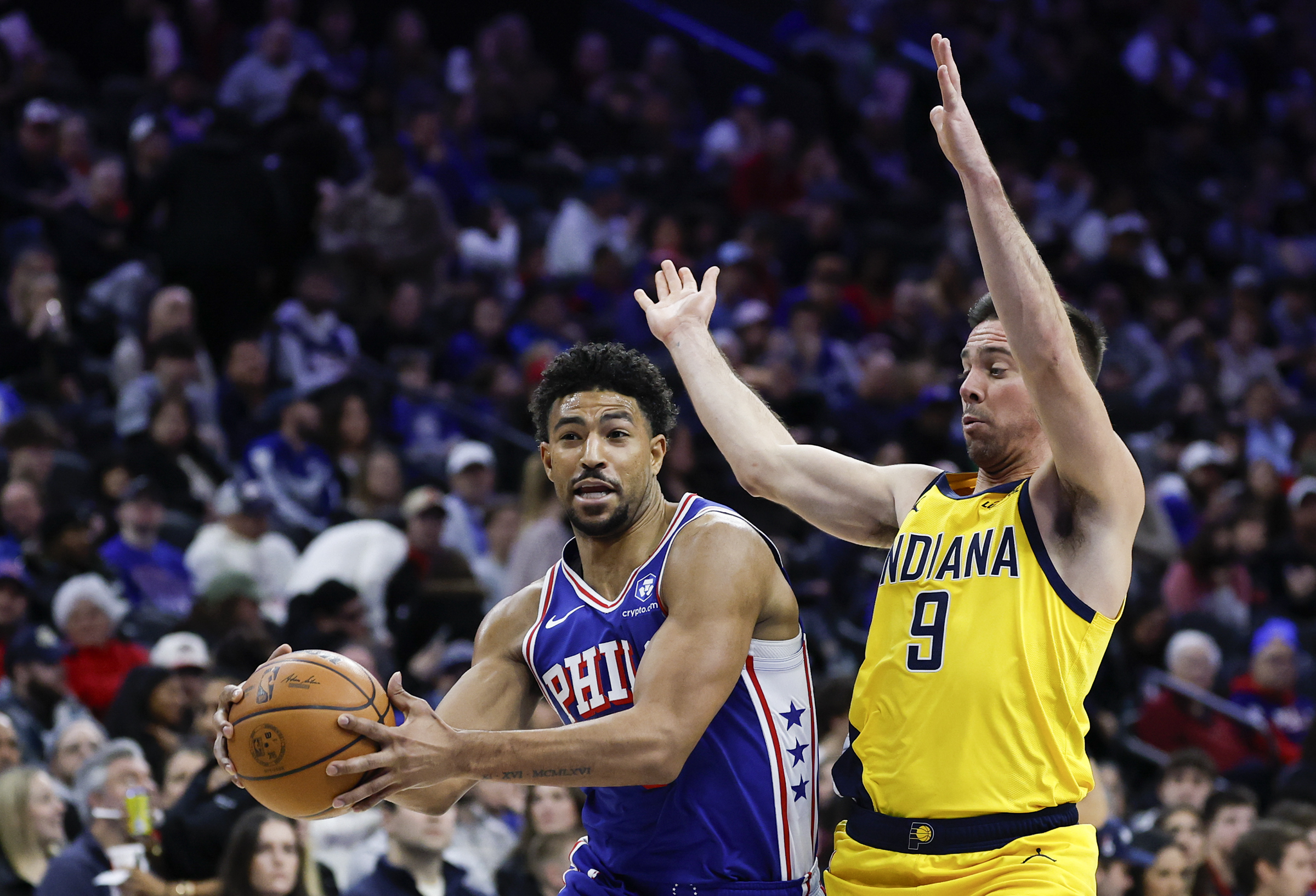
    Former Sixers guard T.J. McConnell (9), now with the Indiana Pacers, posted a stat that is unique to only two players who spent time in Philly.

    After adding three assists in Monday’s 114-103 loss to the Sixers, McConnell has 3,010 assists off the bench. The 11th-year veteran is just one of five players to reach career marks of 3,000-plus points, 2,000-plus assists, 1,500-plus rebounds, and 500-plus steals as a reserve.

    “I feel like my playing here established the player I was going to be throughout my career,” McConnell said of spending his first four NBA seasons with the Sixers. “It established a mindset on how I’m going to play, how I’m going to go about it, and how I’m going to be a pro.

    “Obviously, I’m very thankful for my time here, because I wouldn’t have been put in a position to play as many years as I did. For them to take a chance on me and establish the type of player I want to be, I’m thankful.”

    Undrafted out of Arizona, McConnell began his NBA journey as the Sixers’ fifth-string point guard during training camp in 2015. At the time, the 6-foot-1, 190-pounder didn’t even have a locker.

    The former Sixers fan favorite averaged 6.4 points and 4.7 assists in 314 games with 72 starts before signing a free-agent deal with the Pacers on July 29, 2019.