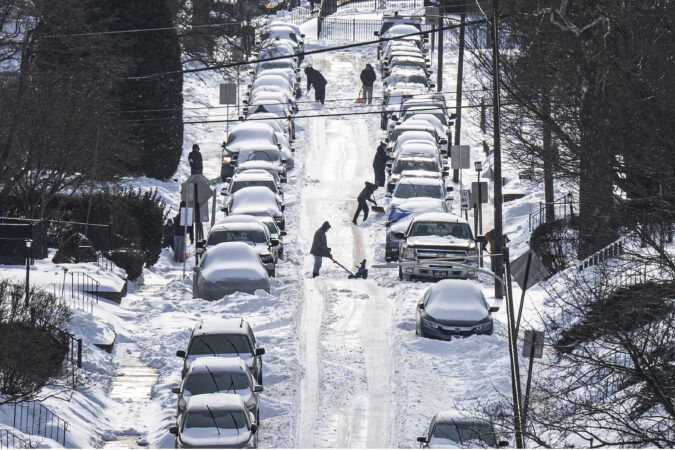
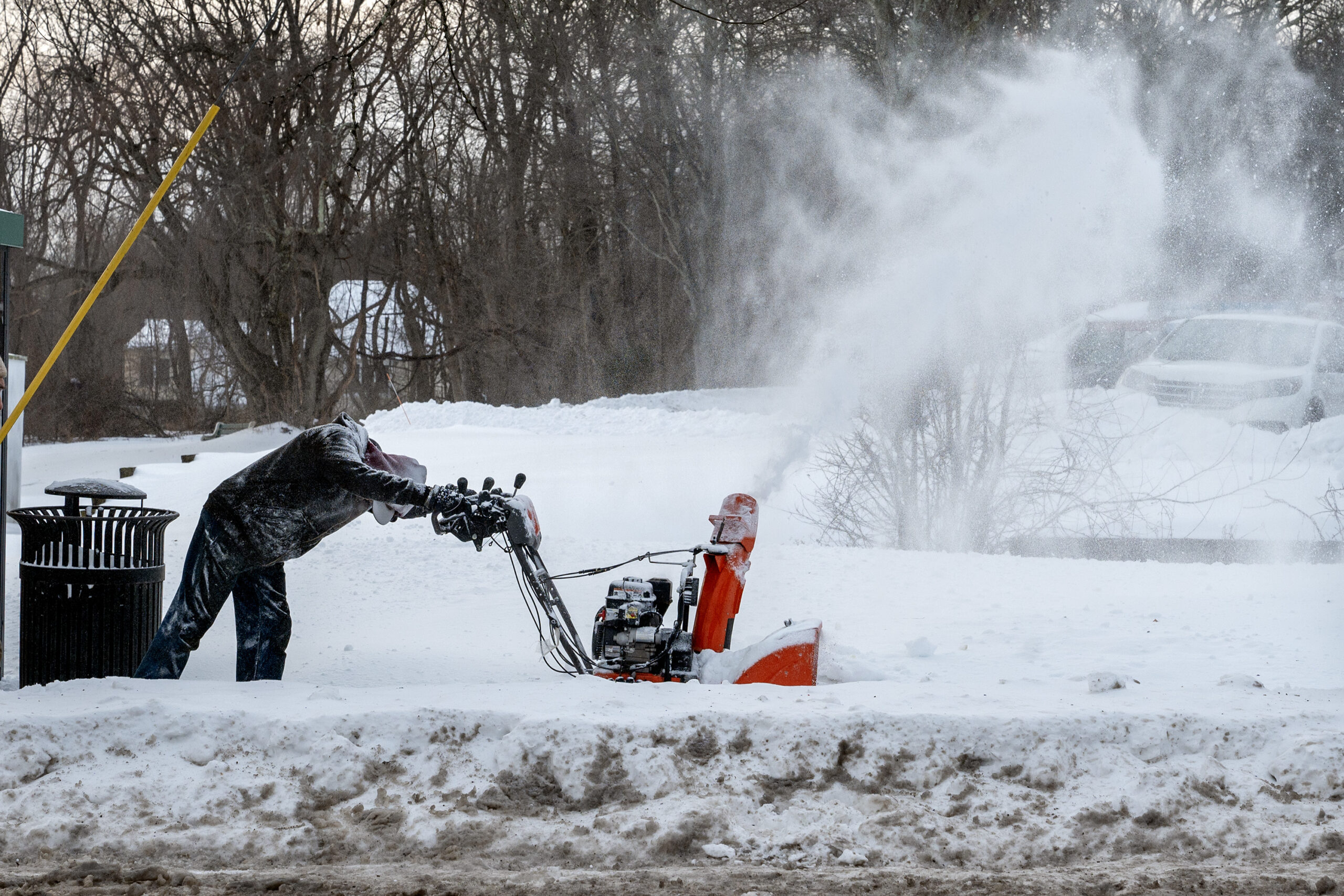
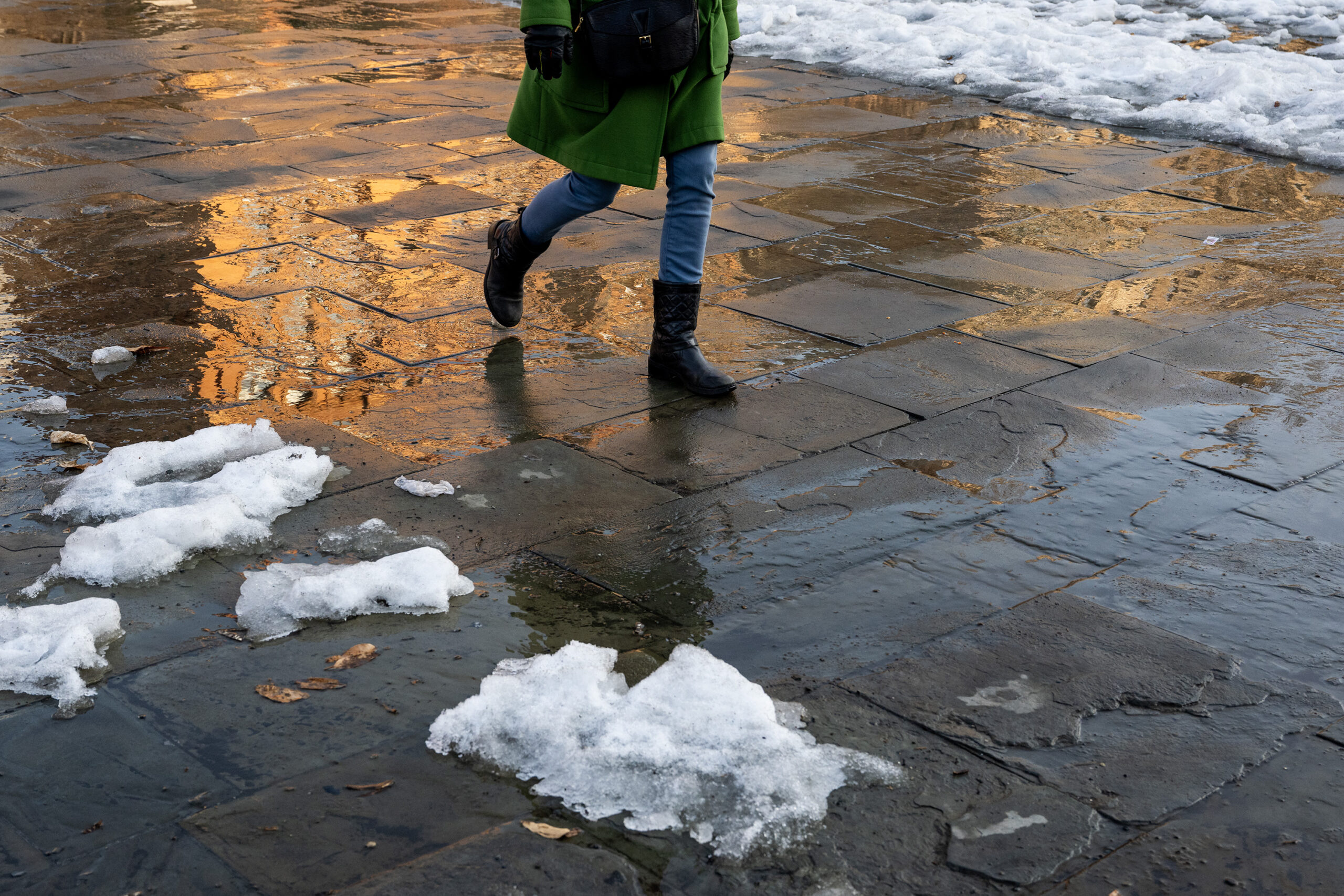
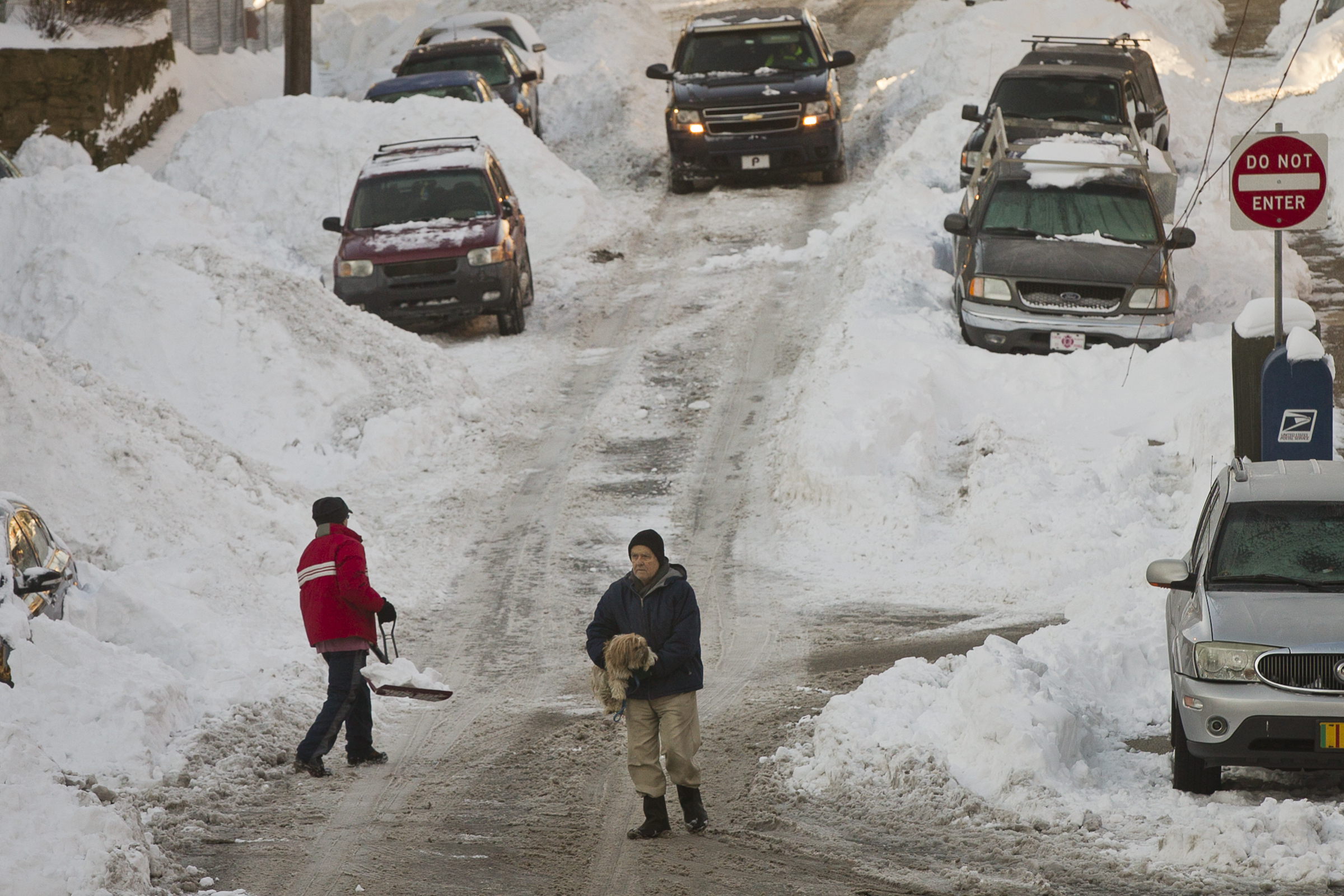
Collections are suspended Monday and Tuesday, the city announced. As of now, service will resume Wednesday on a two-day delay, with Monday collections picked up Wednesday and subsequent days following the same schedule.
“Mother Nature has spoken again and made it clear that winter is not over,” Mayor Cherelle L. Parker said during an emergency news conference Saturday, declaring a citywide snow emergency beginning 4 p.m Sunday.
The city is also suspending collections in rear driveways for the entire week, due to the possibility of trucks getting stuck in the snow. Residents are asked to set their materials in front of their homes for pickup.
“We do not plow out driveways. It makes it difficult for our trucks to navigate those areas,” said Carlton Williams, the director of the city’s Office of Clean and Green.
Second trash collection is also suspended this week.
Philadelphia, Bucks, Delaware, and eastern Montgomery Counties, and all of New Jersey and Delaware, are currently under blizzard warnings through 6 p.m. Monday. That’s prompted by forecast wind gusts of up to 45 mph, combined with the heavy snow. The western suburbs are covered by a winter storm warming, with slightly lower wind speeds forecast.
The storm is expected to begin as rain before shifting to snow by midday Sunday. It’s forecast to strengthen overnight, possibly at a rate of more than 2 inches an hour, which would make driving dangerous and nearly impossible.
The last time the city experienced more than two feet of snow was 2010, when nearly 29 inches fell in early February 2010. Over a five-day period, the city was buried under 44 inches of snow, which thankfully isn’t expected this time due to a warm-up in the middle of next week.
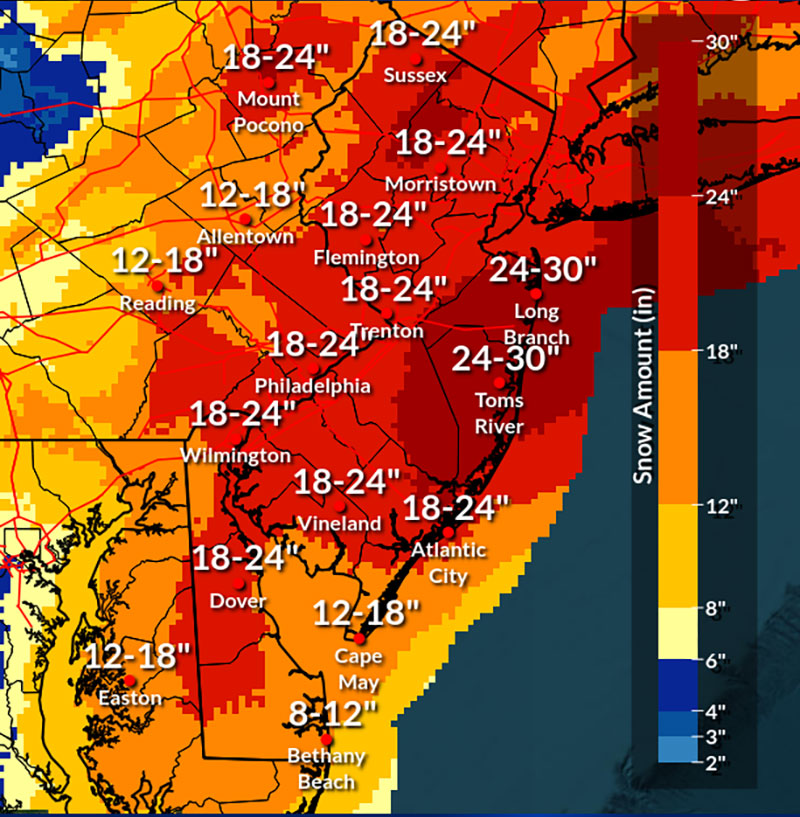
This time around, the Jersey Shore is expected to be hit hardest, with snowfall totals in and around Toms River forecast to reach as high as 30 inches.
The National Weather Service puts out forecasts for every few square miles of land in the United States four times a day through a system called the National Digital Forecast Database.
The maps below display that data. Use it to find how much snow is expected anywhere in the eastern United States. It will show the most recent forecast over the next few days.
(function () {window.addEventListener(‘message’, function (e) { var message = e.data; var els = document.querySelectorAll(‘iframe[src*=”‘ + message.id + ‘”]’); els.forEach(function(el) { el.style.height = message.height + ‘px’; }); }, false); })();
As a blizzard expected to dump significant snowfall on the region bore down, school districts across the region made the call: Monday classes are canceled — or shifted to online instruction.
The Philadelphia School District made the call early — on Saturday — calling a virtual instruction day for Monday.
“While we work to the greatest extent possible to keep schools open for in-person learning to accelerate student achievement, we also consider the staff members who are commuting from across the region and keep the safety of students and staff as our top priority,” Superintendent Tony B. Watlington Sr. said in a message to families and staff.
The district gave students one full snow day in January but has no more cushion built into its calendar to meet the Pennsylvania Department of Education’s requirement for 180 instructional days.
Any further inclement weather days will also be virtual learning days, Watlington said.
“After Monday, if schools need to remain closed due to inclement weather, the district will provide an update to parents, guardians and employees regarding remote learning,” Watlington said.
Among other districts that called for no school Monday: Camden, Cherry Hill, Evesham, Moorestown, and Washington Township in New Jersey; and Downington, Lower Merion, and Neshaminy in Pennsylvania.
Central Bucks, Pennsbury, Rose Tree Media, and Upper Darby moved to virtual instruction.
NEW ORLEANS — Bryce McGowens extended his right arm for the “ice in his veins” celebration directly in front of the 76ers’ bench after draining a corner three-pointer as part of the Pelicans’ long-range onslaught.
New Orleans looked like the playoff contender with fresh legs Saturday night at the Smoothie King Center, not the Western Conference bottom-dweller playing short-handed on the second night of a back-to-back. The Pelicans bulldozed the Sixers in the second half of an eventual 126-111 result, handing them their fourth consecutive loss and perhaps their most troubling defeat of the season.
That puts the 30-26 Sixers at an inflection point, and they know it.
Coach Nick Nurse initially called it the “toughest moment of the season, for sure. All year. Without question” during his postgame news conference. And though the visitors’ locker room was not overly tense, panicked, or dejected, veteran wing Kelly Oubre Jr. also offered a blunt assessment of the state of his team and this suddenly teetering season with 26 regular-season games to play.
“I don’t think anything’s funny right now. I don’t think anything is fun,” said Oubre, the New Orleans native who scored 25 points Saturday. “I just hope that we get mad. I think we’ll play better if we’re mad. We’ll play better if we’re desperate.
“I think we’re a little too entitled right now. Teams aren’t going to roll over and let us win any of those games. … We’ve got to whoop them the same way people come into our house and whoop us.”
Perhaps most frustrating for the Sixers is that this skid comes on the heels of what Nurse believes was his team’s best stretch this season — even after starting wing Paul George was abruptly suspended for 25 games for violating the NBA’s anti-drug policy.
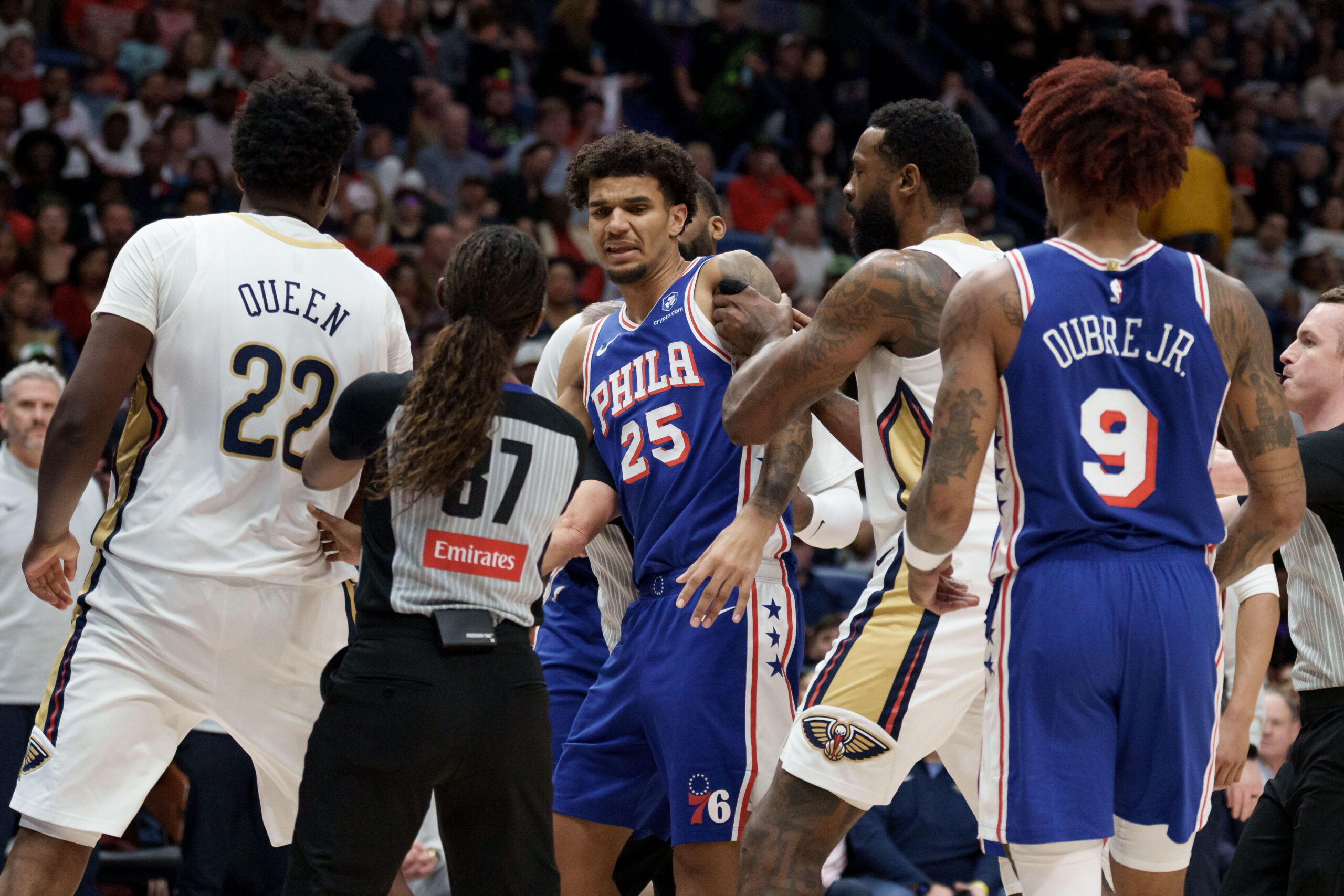
Pelicans center DeAndre Jordan (center right) holds back Sixers forward Dominick Barlow during a scuffle on Saturday in New Orleans.
The Sixers headed West on Feb. 1 for a five-game road trip and won three of their first four matchups. Starting forward Dominick Barlow said “the vibes were great” throughout that jaunt, even with the trade deadline — and the emotional departure of second-year guard Jared McCain — plopped in the middle.
But after a Feb. 8 victory at the Phoenix Suns, the Sixers were blown out at the Portland Trail Blazers and at home against the rival New York Knicks. In their first game after the All-Star break, the Sixers lost to an Atlanta Hawks team that has overhauled its roster and is fighting for a spot in the play-in tournament. Then came Saturday’s defeat to a Pelicans team that entered the game with a 15-42 record, at a rest disadvantage — and set to start veteran center DeAndre Jordan, who had not played since Oct. 29, in a jumbo lineup.
About 90 minutes before tipoff, Nurse vocalized the Sixers’ need to halt this “hiccup.” He also was honest about his team’s inconsistency throughout the season, saying that “we can play at the highest levels. We can play at the lowest levels” regardless of opponent.
“It wouldn’t matter where we were or who we were playing,” Nurse said. “ … We’ve got to get ourselves corrected.”
It would be easy to blame this slide solely on the absence of former MVP Joel Embiid, who has missed all four games with knee and shin issues after a dominant month-plus stretch. These Sixers have resembled the team that rapidly torpedoed when Embiid and George were sidelined for the bulk of last season, with All-Star point guard Tyrese Maxey manufacturing points (and playing tons of minutes) but struggling with efficiency while getting swarmed defensively. Maxey totaled 27 points, seven assists, and five steals Saturday, but went 2-of-11 from three-point range and 9-of-23 overall from the floor.
And Saturday night, the 2025-26 Sixers’ most glaring problem arose again.
Tyrese Maxey scored 27 points against the Pelicans, but went 2-of-11 from three-point range and 9-of-23 overall from the floor.
They surrendered 40 points during a dreadful third quarter, swiftly reversing an 11-point advantage early in the frame into an eight-point hole. That deficit continued to balloon to 21 points in the final period, thanks to the Pelicans’ 12-of-20 three-point barrage after the break. The Sixers made only three of their 24 long-range attempts in the second half, providing New Orleans with consistent opportunities to push the ball off misses, penetrate the lane, and kick out to open shooters.
“We just didn’t make any of them, and they made them all,” Nurse said, “It really flipped the game really quickly, and we just could never really get back on track.”
The Sixers exited the All-Star break with a strength of schedule that ranked 23rd out of the NBA’s 30 teams, according to Tankathon. That theoretically should prove beneficial in the Eastern Conference postseason race, where the Sixers entered Sunday in danger of slipping into play-in territory. They were percentage points ahead of the seventh-place Miami Heat (31-27), and a half-game up on the eighth-place Orlando Magic (29-26).
Following Wednesday’s practice, Maxey emphasized that the regular season’s home stretch is when playoff teams “take advantage of whoever they’re playing against.”
“If it’s a team that’s at the bottom of the standings,” Maxey added, “playoff teams normally go out there and handle their business professionally. … It’s time to buckle down. It’s time to go out here and increase our seed, increase the way we’re playing and figure it out, and get ready for this postseason run.”
After Saturday’s failure in that exact scenario, Maxey understood why a reporter circled those words back to him. He stressed that the Sixers must stick together and are the only ones who “can climb ourselves out” of this four-game slump. Barlow cautioned against overreacting, yet acknowledged that “getting a win after each loss becomes harder and harder.” Nurse audibly exhaled as he left the room housing his postgame news conference.
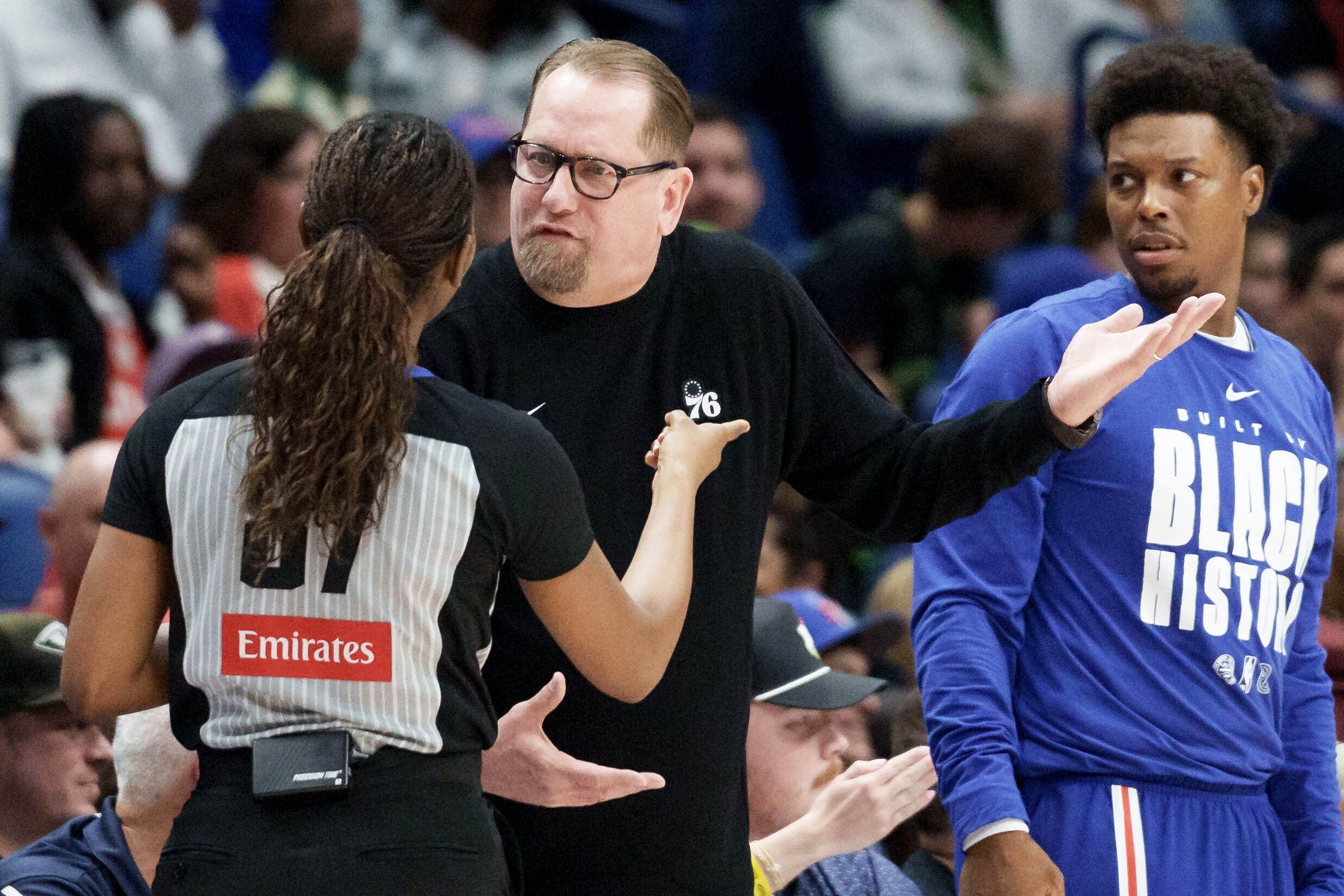
Sixers coach Nick Nurse talks to referee Danielle Scott during Saturday’s loss to the Pelicans.
The beauty (and curse) of the NBA schedule? The Sixers play again Sunday night at the Minnesota Timberwolves, before a Tuesday game against an Indiana Pacers team with the worst record in the Eastern Conference (15-42).
Oubre hopes that, for those matchups, his team plays mad.
“Now is the time to not make any more excuses,” he said. “ … It’s just do-or-die time. It’s time for us to muscle up, put our hard hats on, and actually learn how to win NBA games — and do it efficiently and consistently.”
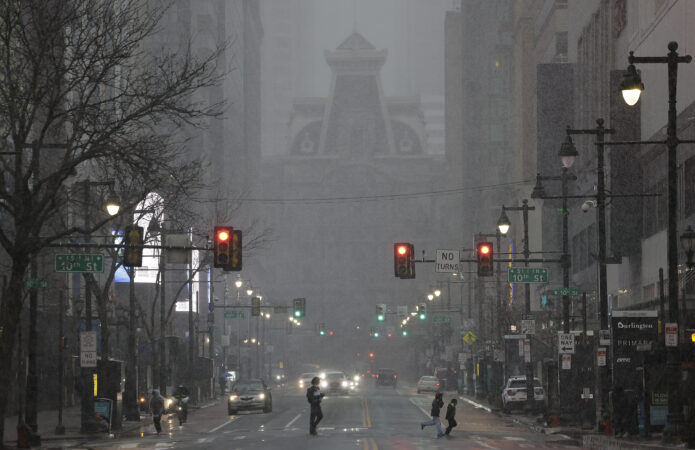
Snow began falling in Philly early Sunday evening and is expected to continue through Monday afternoon, with the heaviest snowfall overnight into the morning. Here’s the latest map.
A citywide snow emergency is in effect in Philadelphia, while both New Jersey and Delaware have declared a state of emergency.
DoorDash, the food delivery service, has suspended operations in Philadelphia and New Jersey amid the snow storm.
According to a company press release, DoorDash deliveries have ended as of 9 p.m. on Sunday and will not begin again until at least 12 p.m. Monday, depending on conditions at that time.
“We’re suspending operations across impacted areas to keep our community safe,” said company spokesperson, Julian Crowley, in a press release. “This is a serious storm — we’ll resume when it passes.”
At least 15,000 without power across Southern and Central New Jersey
At least 15,000 people were without power in Southern and Central New Jersey on Sunday evening around 8 p.m., according to outage maps from energy providers Jersey Central Power & Light and Atlantic City Electric.
In the Philadelphia area, as snow blanketed the region, roughly 1,500 Peco customers were affected by outages around 7:50 p.m., the company’s outage map indicated. Residents can monitor the company’s outage map to see where an outage has happened and the estimated restoration time.
Residents can receive outage alerts from Peco by texting “ADD OUTAGE” to 697326. To report an outage, text “OUT” to the same number or call 1-800-841-4141 or use the company’s online portal. For downed power lines, call the same number.
PSE&G customers in New Jersey can check the energy company’s outage map. As of 8 p.m., the utility provider had restored service to some 4,600 customers who had lost power on Sunday, according to a company press release. Around 8:50 p.m. nearly 2,800 customers were impacted by outages in the energy provider’s service area which includes parts of Burlington, Camden, and Gloucester Counties and stretches up to Newark.
To report an outage or downed line to PSE&G, call 1-800-436-7734. For hazards that result from a downed line, call 911, said Marijke Shugrue, senior director of communications at PSE&G during a virtual press conference on Sunday.
Never use a power generator indoors during an outage, said Shugrue.
Downed power lines can be very dangerous, and people should stay away from them, Shugrue added, advising people not to touch anything that is in contact with that downed line.
If you can smell gas indoors, exit the building, move at least 350 feet away and call 911, said Shugrue. Peco also advises customers to leave the area immediately if gas is suspected. For an emergency related to gas specifically, customers can call Peco at 1-844-841-4151.
Outside homes, snow should be cleared from pipes, vents, and meters so that carbon monoxide doesn’t accumulate inside, PSE&G advises.
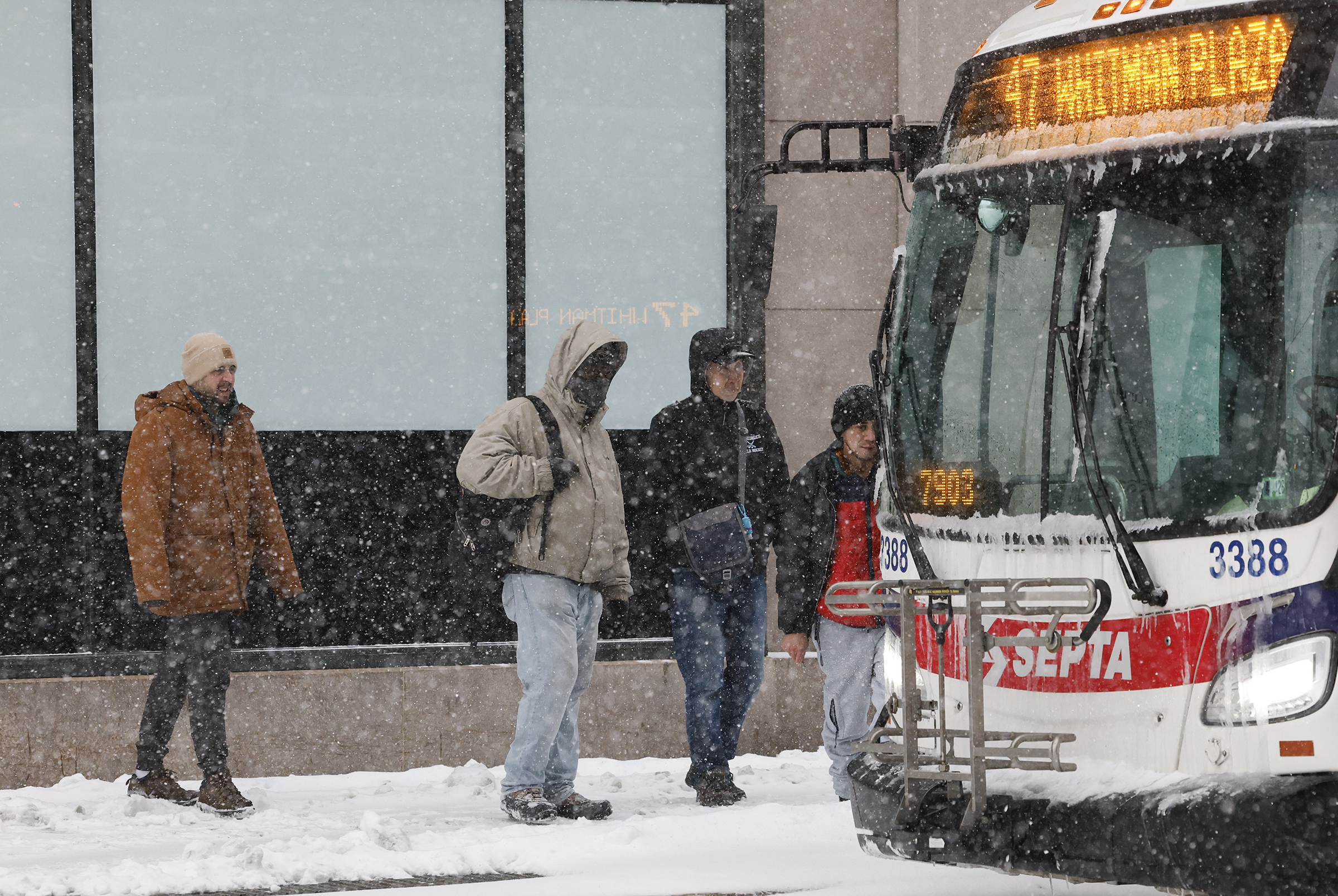
SEPTA riders board the 47 bus at 8th and Market Streets in January.
On Sunday evening SEPTA issued updated guidance on available service for the rest of the day.
All SEPTA bus routes will be suspended at 10 p.m. Sunday, the transit agency announced.
Regional Rail trains and the Norristown High Speed Line will operate until the end of scheduled service on Sunday evening.
The Center City Trolley Tunnel will close at 9 p.m. Sunday. Service on trolleys will continue until the scheduled end of service on Sunday evening or until conditions permit it.
The D Line Trolley route is currently being operated by a bus. That service will conclude at 10 p.m. Sunday and the trolley service by train will resume in the morning weather permitting.
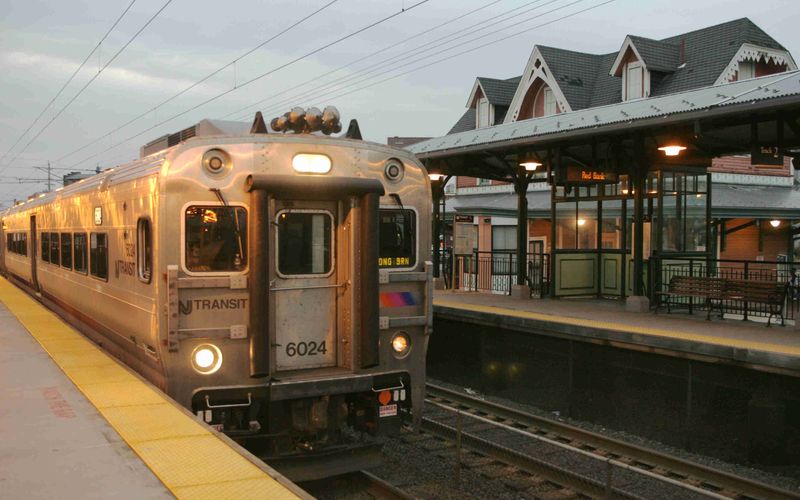
An NJ Transit train pulls into the Red Bank station.
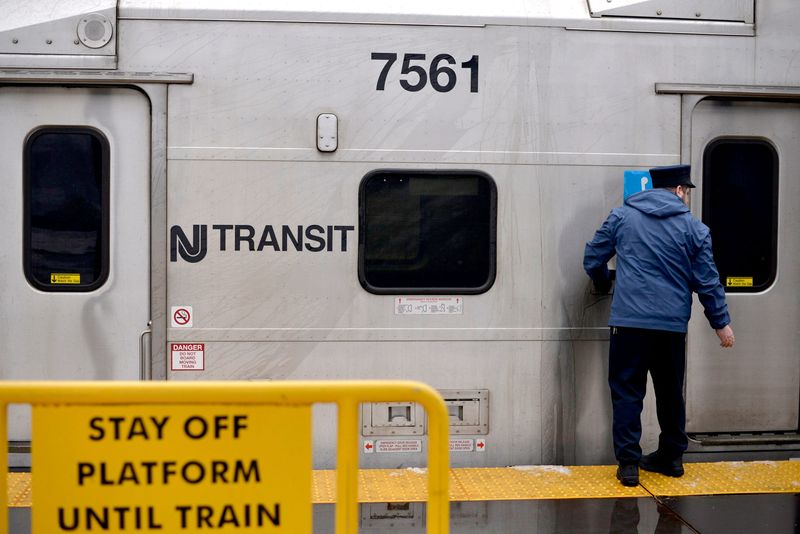
NJ Transit will suspend its all rail service by 9 p.m. Sunday, the agency announced in a news release.
Earlier, the transportation agency stopped its bus, light rail, and Access Link services. Trains were initially excluded from the closures, but Gov. Mikie Sherrill warned the shutdown was likely.
Some routes will end service before 9 p.m., but no trains will leave their origin point after 9 p.m. Customers should check the transit authority’s website or social media for updates.
Bands of heavy snow moving across the Philly region
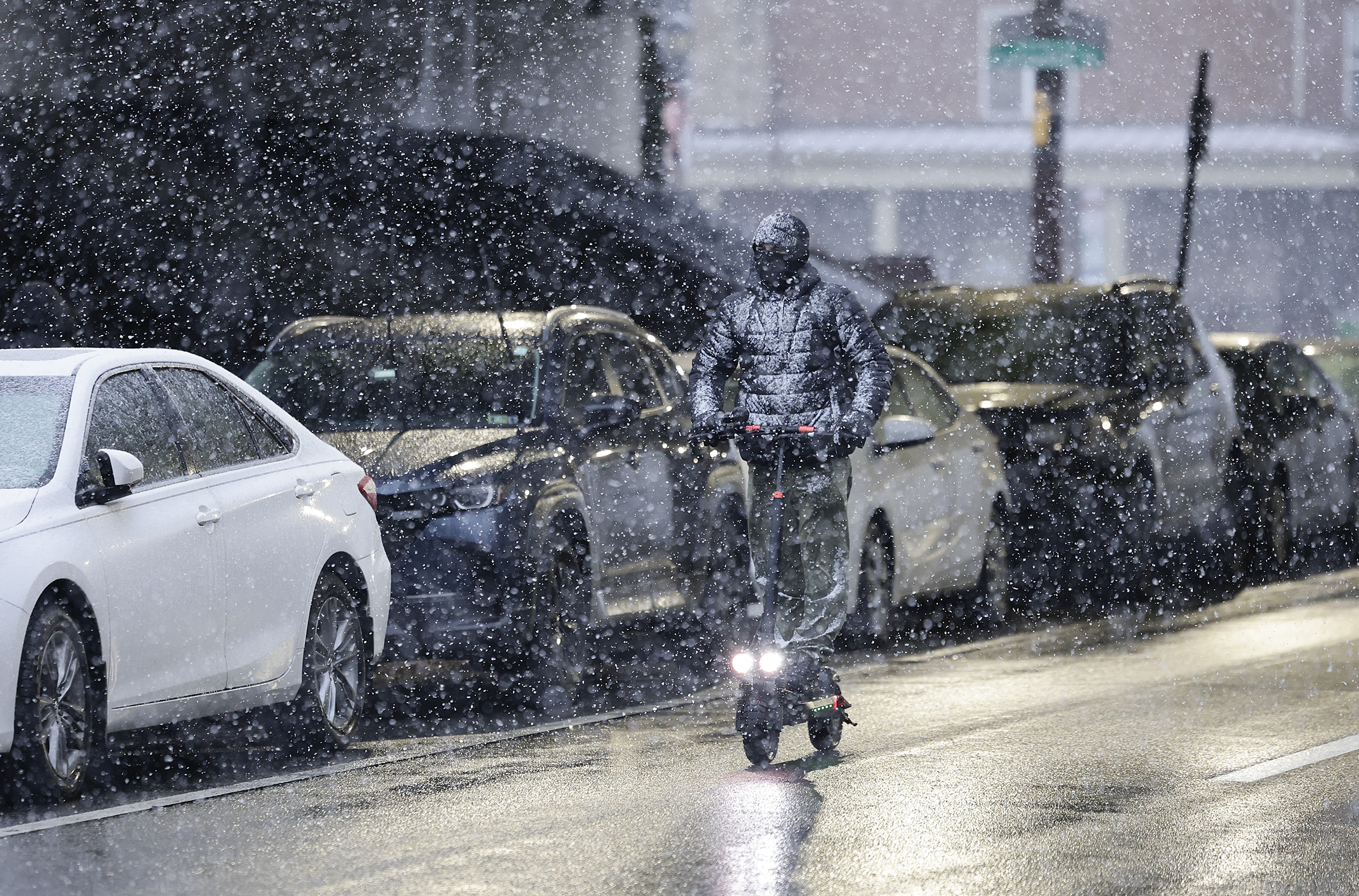
A man rides his scooter along N. 4th Street as snow falls.
Some “bands” of heavy snow were moving across the region Sunday evening, and that is likely to continue through the night, said Nick Guzzo, meteorologist with the National Weather Service in Mount Holly.
“Banding,” in which narrow corridors of heavy snow migrate from place to place, are common during winter storms. Areas under the bands can receive a quick couple of inches of snow.
By nightfall some totals of 1 to 2 inches were reported in the Philadelphia area and at the Shore. Forecasters said rates of two inches an hour were possible at times.
Totals are likely to vary around the region, in part to the randomness of banding, said Guzzo.
Banding or not, everyone is going to be seeing a whole lot of snow before it ends Monday, he said.
The weather service is calling for 12-18 inches in the immediate Philadelphia area, with as much as two feet in parts of South Jersey.
Some drifting is possible later when winds – gusting up to 45 mph inland, and 60 mph at the Shore – kick up and the snow becomes drier, said Guzzo.
(function () {window.addEventListener(‘message’, function (e) { var message = e.data; var els = document.querySelectorAll(‘iframe[src*=”‘ + message.id + ‘”]’); els.forEach(function(el) { el.style.height = message.height + ‘px’; }); }, false); })();
A slew of travel restrictions put in place across the Philly region
PennDOT reduced the speed limit on a number of Philadelphia-area highways Sunday evening, including I-95 and the Schuylkill Expressway.
The speed limit is now 45 mph on the following Philly-area roadways:
Interstates 76, 95, 295, 476, 676
U.S. Routes 1, 30, 202, 422
State Routes 63, 100 Spur and 309
PennDOT also issued Tier 4 restrictions on major roadways in Eastern Pennsylvania, which prohibits all commercial vehicles from driving. It also restricts buses, motorcycles, RVs, and passenger vehicles towing trailers.
New Jersey issued a travel ban on all non-exempt vehicles from driving on major roadways beginning at 9 p.m. The New Jersey Turnpike is not includes in the restriction.
Delaware issued Level 1 driving restrictions, which calls on residents residents not to drive “unless there is a significant safety, health, or business reason to do so.”
All Philadelphia City Council offices will be closed Monday as a massive winter storm makes its way across the region, President Kenayatta Johnson’s office announced Sunday afternoon.
A Public Health and Human Services Committee hearing on reproductive health scheduled to take place Monday will be postponed to a later day, .
Philadelphia Mayor Cherelle L. Parker had previously announced all city offices and schools would be closed Monday due to the storm.
Hundreds of flights canceled at Philadelphia International Airport
Philadelphia airport crew plow snow during last month’s storm.
356 flights had been cancelled at Philadelphia International Airport on Sunday as of 5 p.m., as snow started to blanket the city. Another 579 flights were cancelled for Monday, according to FlightAware, which tracks flights.
“Passengers should check on the status of their flights with their airlines—the airlines will also provide guidance on what passengers should do in the event their flights are cancelled,” said airport spokesperson, Heather Redfern on Sunday afternoon via email.
Some 40 million square feet need to be cleared at the airport when snow falls, including on airplane runways and taxiways. The airport also has an additional 11.9 million square feet of space on roadways, ramps and parking lots.
While airplanes are deiced by the airlines, the department of aviation is required to ensure runways and taxiways are clear.
More than two inches of dry snow or half an inch or wet snow trigger closing a runway, according to regulations by the Federal Aviation Administration (FAA), noted Redfern. Even if flights are canceled by airlines or in the event that the FAA issues a ground stop, the airport does not close, Redfern noted in January ahead of another snowfall.
The machinery that has been used at the airport to tackle snow in the past sports weather related names: Snow Angel, Ice Wookie, Multifarious, Snowmizer, Snow Slayer, Time Bandit, Arctic Fox, Snow Jawn, Nor’easter, Yeti, Storm Breaker, Terra Hawk, Silver Hawk, Heatwave, Tropic Breeze, and Heatmizer.
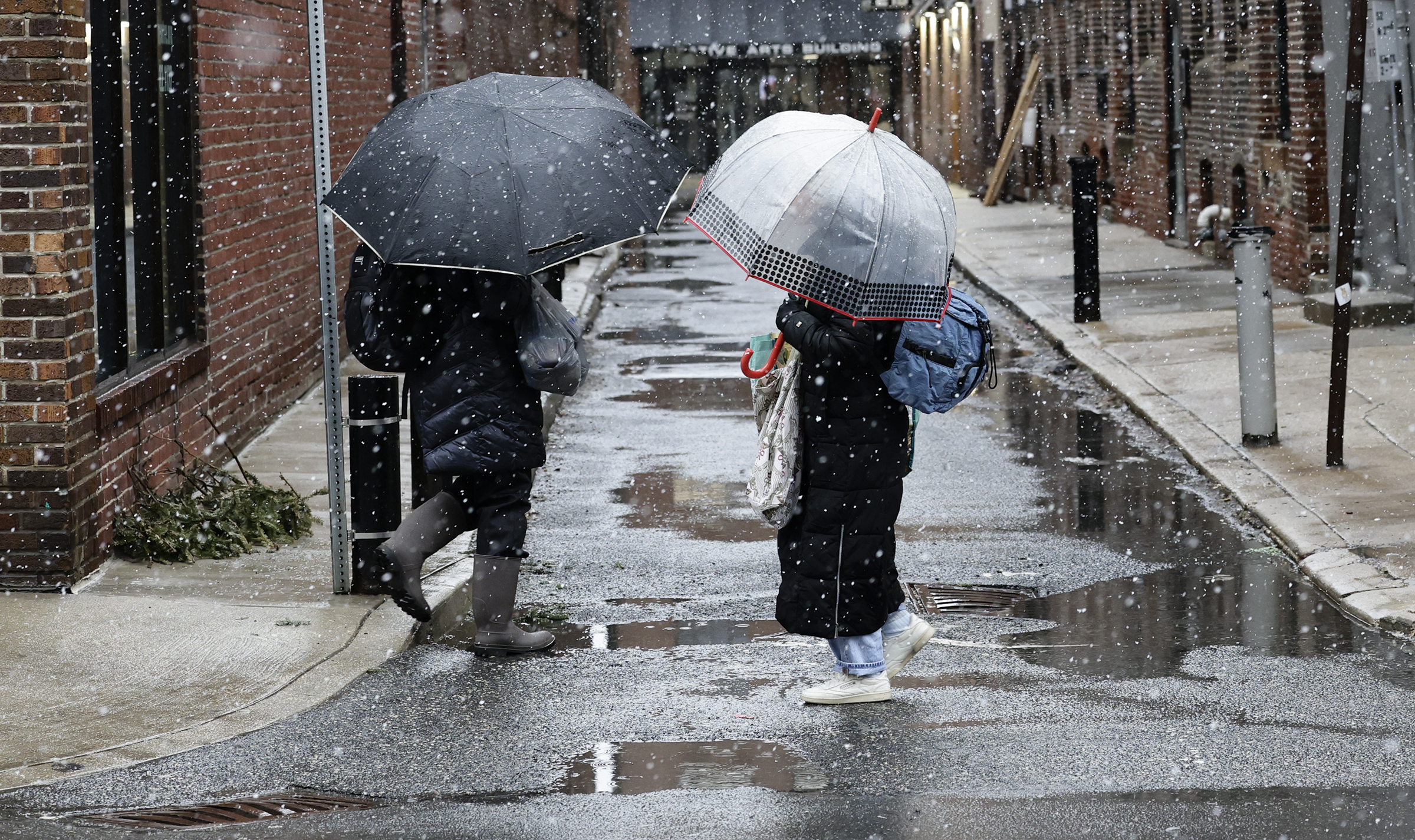
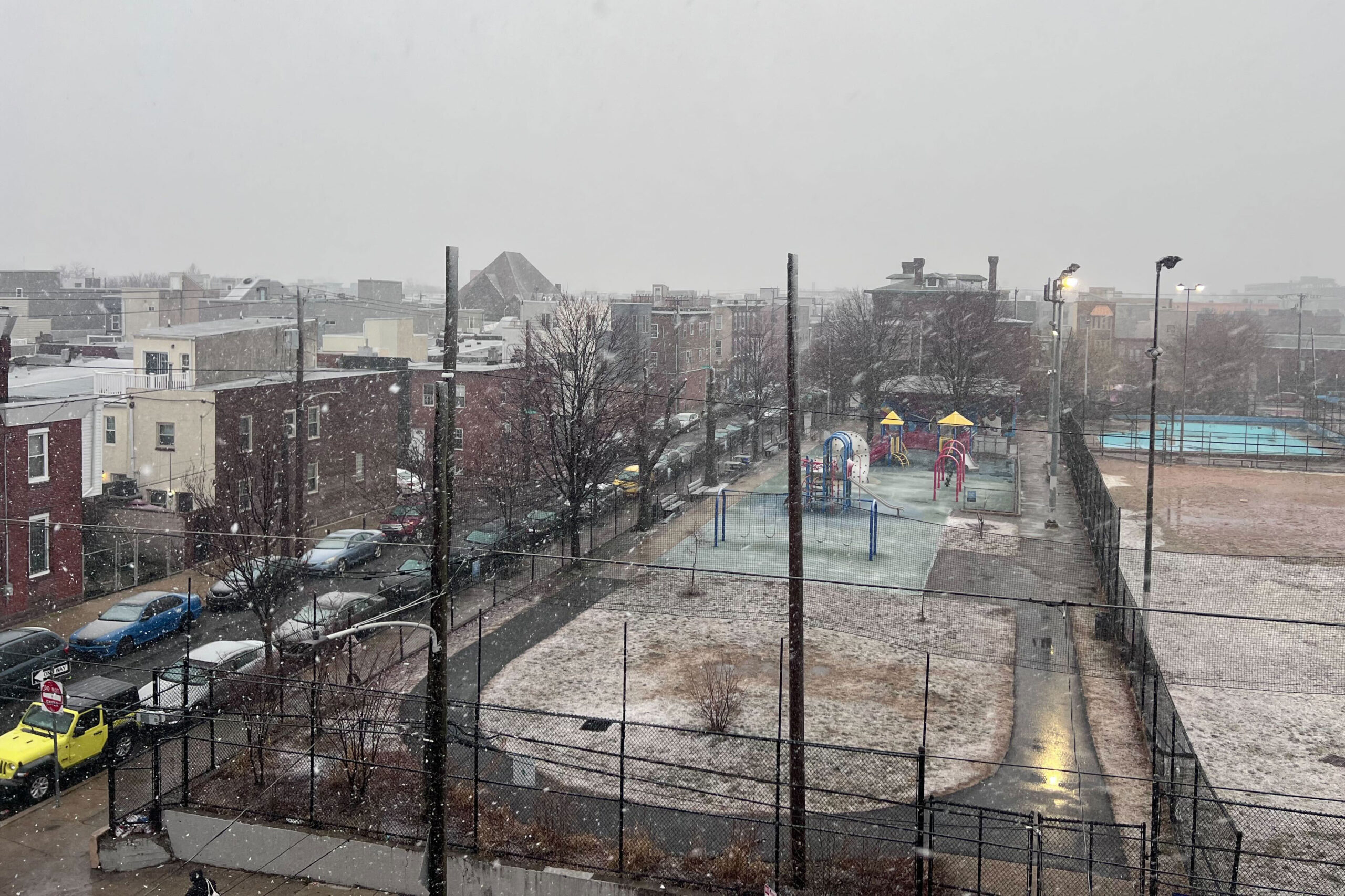
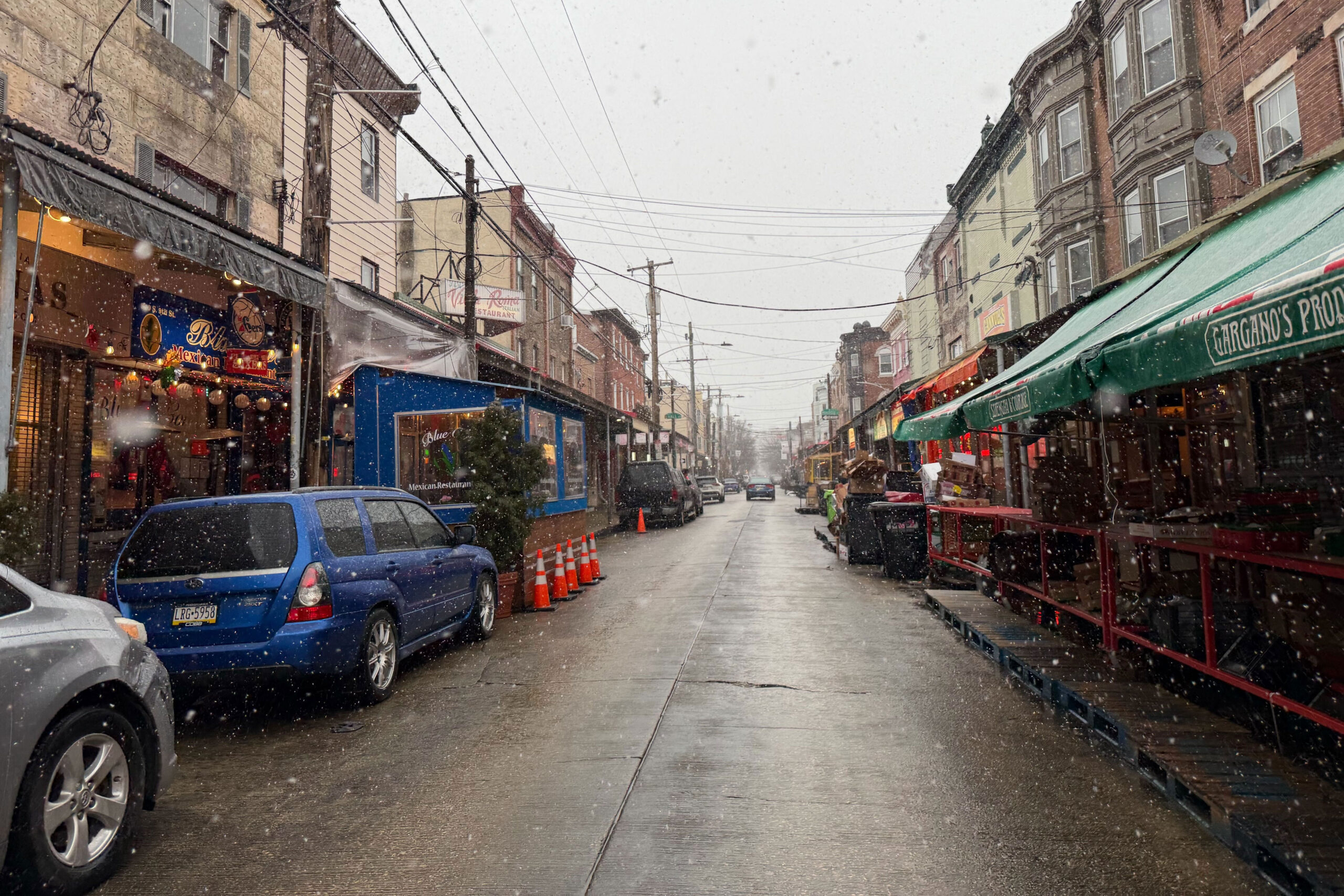
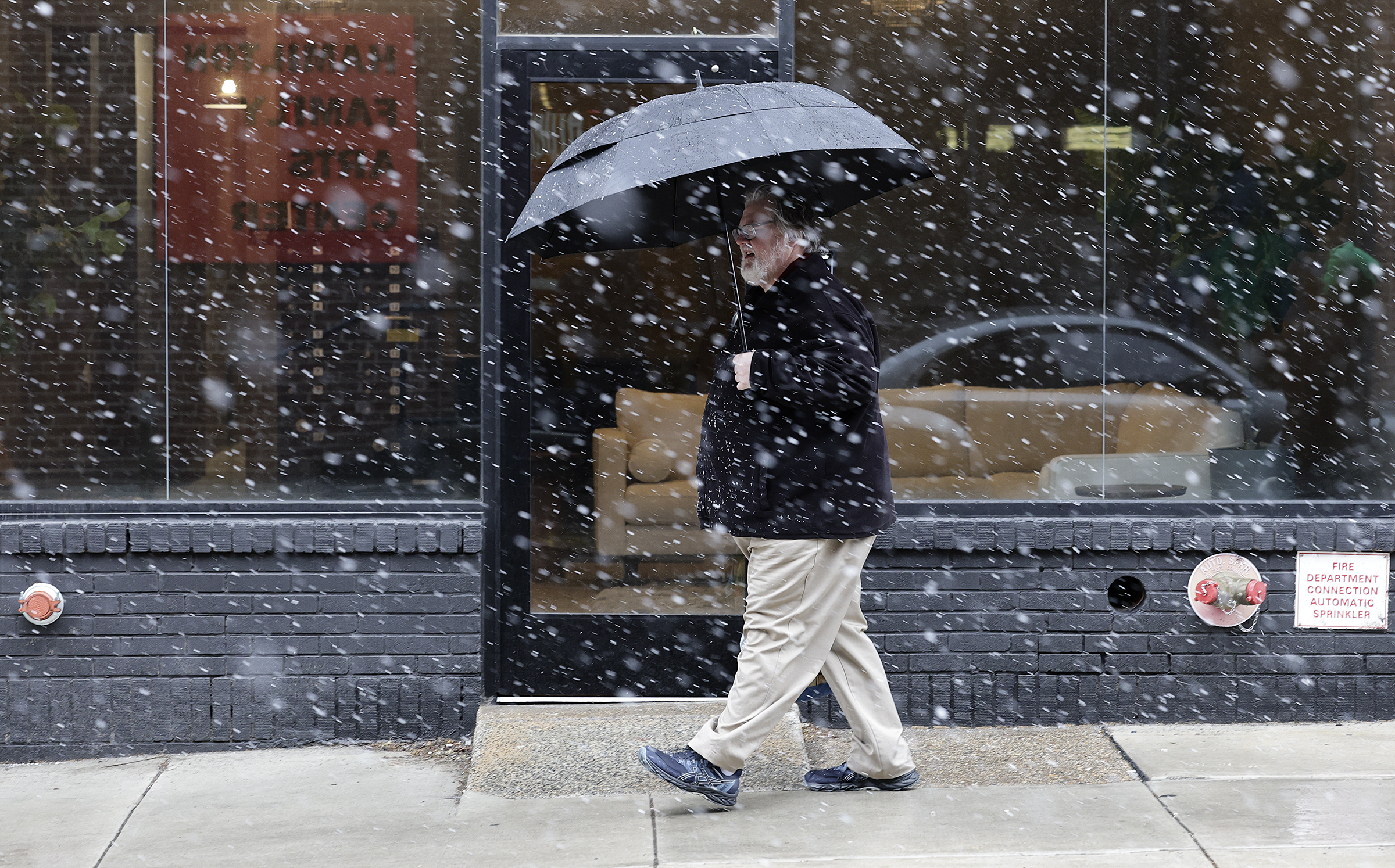
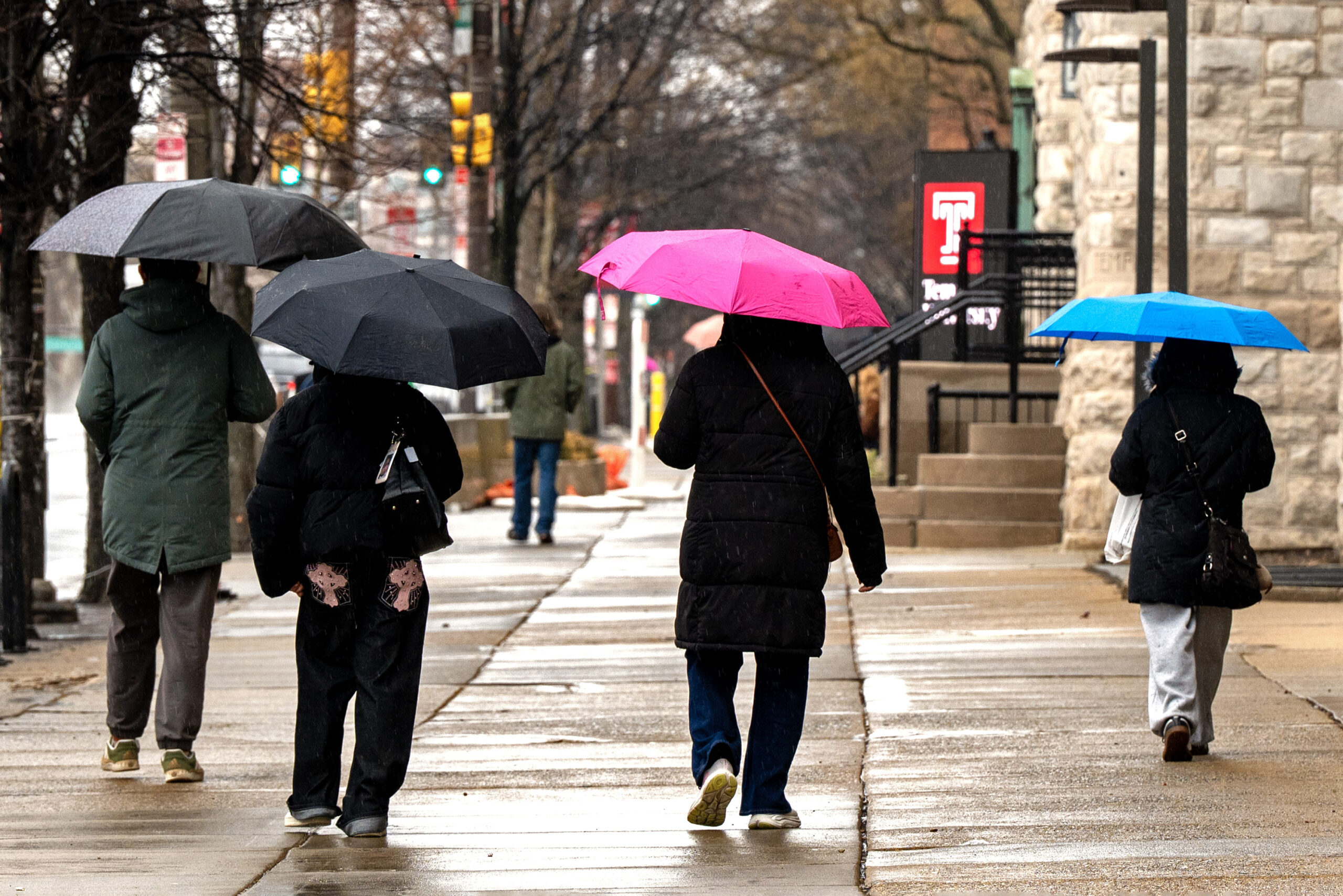
A man rides his scooter along N. 4th Street as snow falls Sunday. Rain turns into snow late Sunday afternoon in Haddonfield. Pedestrians use their umbrellas to shield themselves from the snow in Old City Sunday. Snow falls at Chew Playground in South Philadelphia. Rain shifts to snow in the Italian Market at 9th and Carpenter Streets.
// Timestamp 02/22/26 4:42pm
PSE&G prepares for outages due to ‘heavy wet snow and elevated winds’
Snow begins to pile up in Wayne, Delaware County Sunday afternoon.
Outages due to the snowstorm are expected, Brian J. Clark, senior vice president of PSE&G, the energy company based in Newark, said in a press conference around 3:45pm on Sunday.
PSE&G, which provides electricity and gas, services parts of Burlington, Camden, and Gloucester Counties.
“The increased heavy wet snow and elevated winds remain our major concerns,” said Clark on Sunday. “We may see large limbs and possible decayed trees fall and make contact with our lines.”
Roughly 3,000 PSE&G electric field personnel were on hand to help restore service on Sunday, which includes tree trimmers and line workers.
Restoring service includes clearing wires that have fallen and may be blocking roads, to ensure emergency responders can circulate. The utility company focuses on restoring service to “the largest blocks of customers first, and working concurrently with other crews downstream to restore individual homes and businesses,” said Clark.
Customers can check the company’s outage map to find out how long restoring service is estimated to take in their area.
“We’re fully staffed, which includes strategically placing folks at different points in our service territory to respond quickly to emergencies,” said Clark. “At PSE&G, our service to our customers, businesses and governmental locations is extremely important to us. Our team will be fully engaged around the clock until everyone is restored.”
‘Code Blue’ for Philadelphia, city to open warming sites
The Hub of Hope will serve as a warming site during the storm.
City officials on Sunday instituted a “Code Blue” that’s set to last until 9 a.m. Tuesday.
A Code Blue is declared when precipitation is falling and temperatures are 32 degrees or lower, or when temperatures feel close to or below 20 degrees due to the wind chill. The designation means that the city sends out outreach teams 24 hours a day to find people without shelter and take them to “safe indoor spaces.”
It also opens up additional shelter beds, and residents in emergency housing are allowed to stay inside all day. (Some shelters require residents to leave in the morning and return at night.)
On Sunday afternoon, the city announced that warming sites would open at several locations across the city on Sunday evening:
Hub of Hope, 4 p.m.: 15th Street trolley entrance in Dilworth Park, 1 S. 15th Street
Samuel Recreation Center, 7 p.m.: 3539 Gaul St.
Kensington Wellness Support Center, 9 p.m. to 9 a.m.: 265 East Lehigh Ave.
Prevention Point, 9 p.m. to 6 a.m.: 2913-15 Kensington Ave.
People who need shelter or who see someone sleeping outdoors should call the city’s homeless outreach hotline at 215-232-1984. People can also visit a homeless intake center; the city’s after-hours intake centers are open 24/7 during a snow emergency. The city will also open its Appletree Family Center at 1430 Cherry Street, at 6 p.m. through Monday.
The city said capacity at the warming centers is 280 and shelter beds also had room to take people; typically, the city operates 3,000 shelter beds year round and adds at least 400 extra during the winter. During Code Blue, another 50 beds are added.
Some advocates said early Sunday the city should do more to get people sleeping on the streets inside. Declaring an “enhanced Code Blue,” which typically occurs after three days of Code Blue conditions have passed, would open warming centers, which allow people spaces to sit to get out of the cold. During the last cold snap, libraries served as warming centers during the day and rec centers opened to shelter people at night.
Some staff at libraries said they had been overwhelmed during this month’s unusually long enhanced Code Blue, and that the city had not provided enough resources or staff to help warming center clients. Still, advocates for homeless Philadelphians say the warming centers are a lifeline in potentially dangerous weather conditions, especially for people who are wary of entering shelters.
Rain switches over to snow in Philly; nearly 2 inches already in Somers Point
Snow falls as a pedestrian walks along N. 2nd Street in Old City Sunday afternoon.
Rain began switching over to snow in Center City Philadelphia and across the region just before 4 p.m. Sunday as residents brace for snowfall totals of a foot or more.
The agency is still calling for 14 to 20 inches of snow to fall in and around Philly through Monday morning, with the heaviest snowfall expect to take place this evening.
Heavy snow could be seen on webcams up and down the Jersey Shore, from Wildwood to Seaside Heights, areas expected to be hit the hardest by the massive storm. All of New Jersey’s 21 counties are expected to get a foot or more of snow, Gov. Mikie Sherrill warned during a news conference earlier in the day.
Camden, other school districts announce snow closures
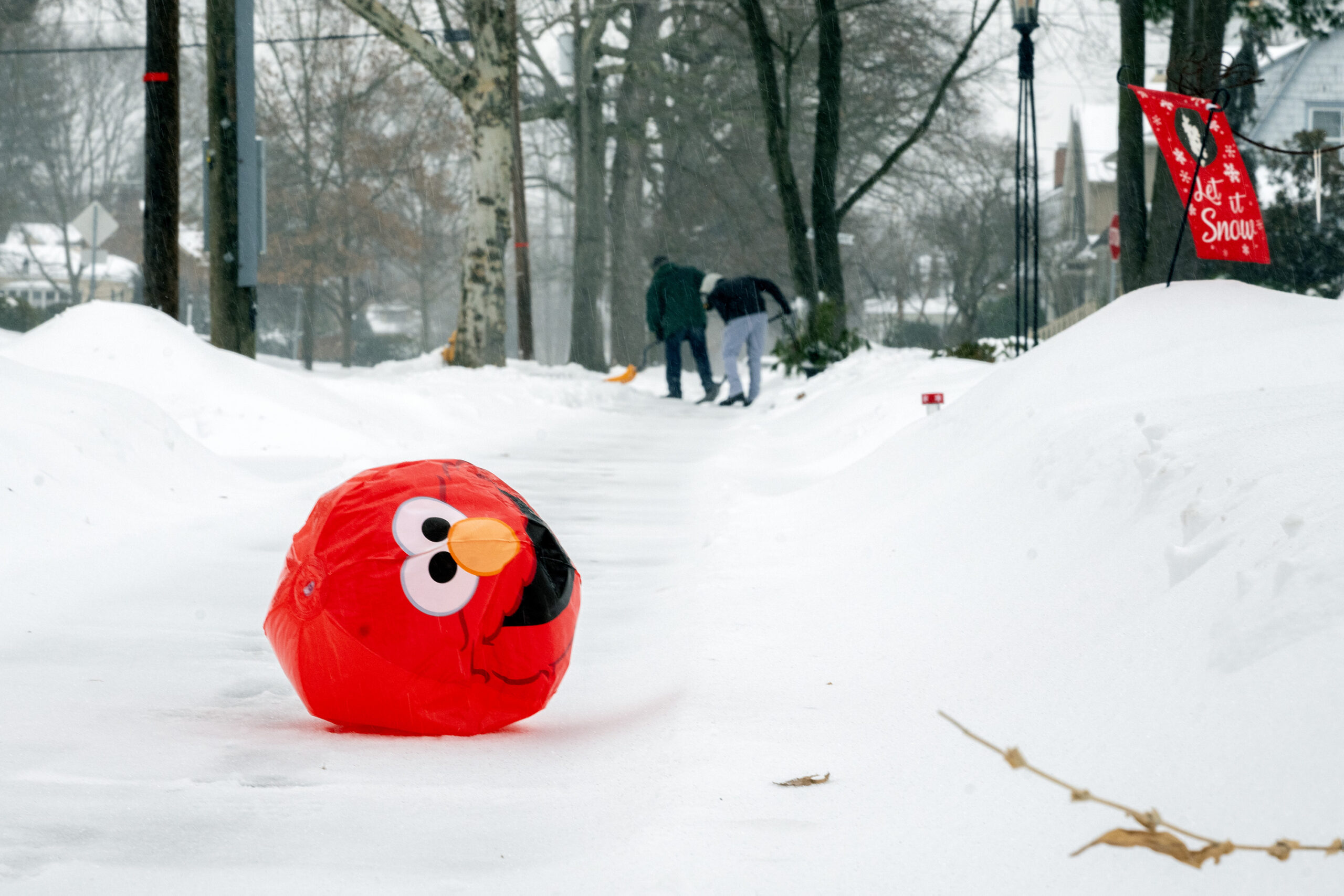
An Elmo balloon rolls along a sidewalk in Haddonfield during last month’s snowstorm.
As the blizzard bears down, school districts across the region have announced either pivots to virtual instruction or full closures.
Cherry Hill, Moorestown, and Evesham are closed, for instance; so are Lower Merion, Neshaminy and Downingtown. Pennsbury and Central Bucks have called virtual instruction days, while Upper Darby will move to a remote learning day.
Camden schools will be closed. The district has amended the school calendar, tacking on an extra day to the end of the school year. Elementary students will now finish the school year on June 24, and high school students on June 25.
In Delaware, all districts in New Castle County have announced they will be closed Monday. Because of Delaware’s state of emergency, it will be a true snow day for students – no Zoom required.
Philly residents ‘snowload’ ahead of Sunday’s storm
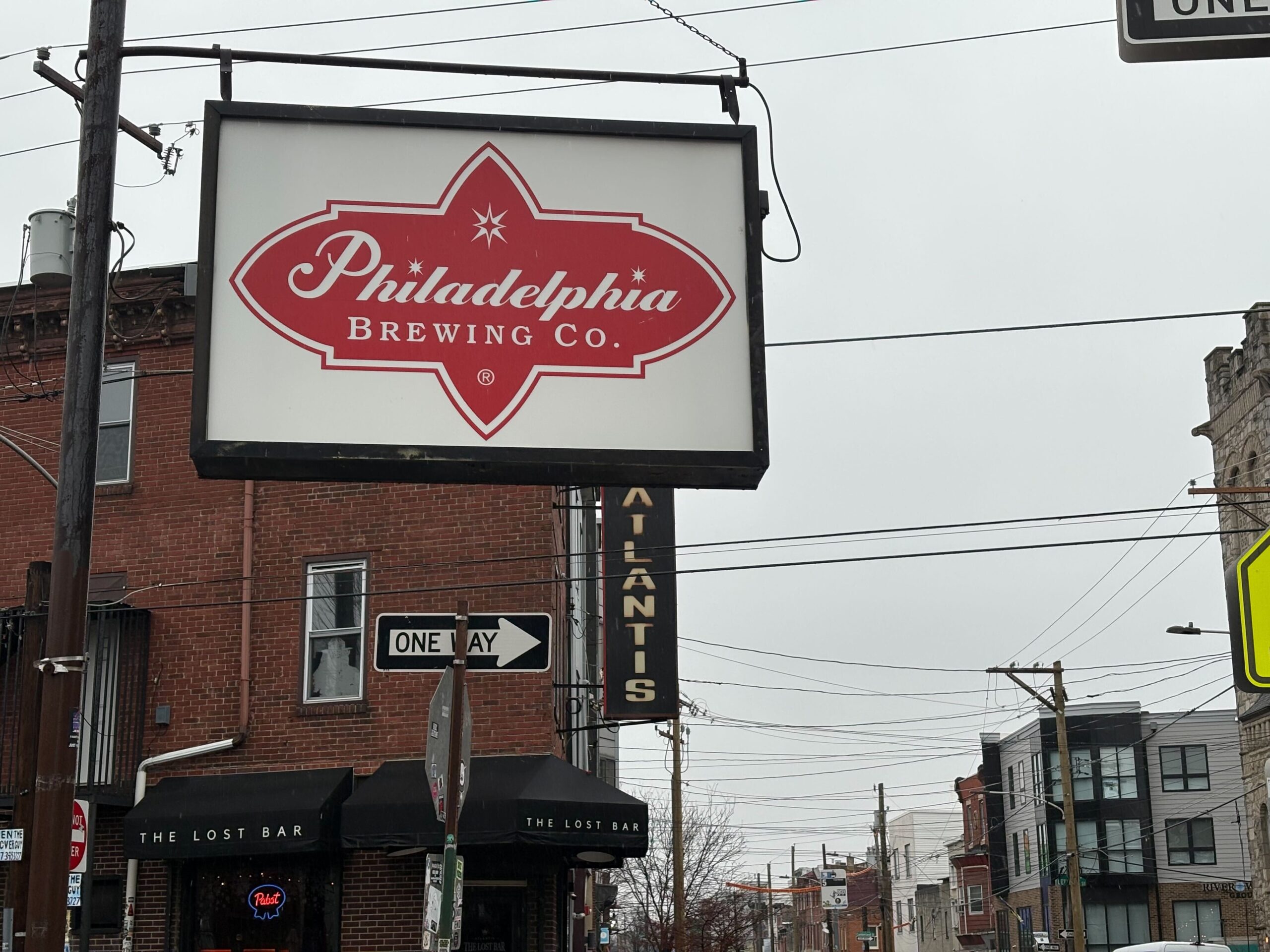
Philadelphia Brewing Co. on Frankford Avenue
The precipitation had yet to shift from rain to snow Sunday afternoon, but patrons at neighborhood bars were already buttoning up their beer coats.
It’s a phenomenon called a “snowload” — when people flock to barstools and find solace from bad weather at the bottom of a citywide special or hot toddy, according to Les & Doreen’s Happy Tap bartender Bill Coburn and others.
With the city shut down and some workplaces closed for inclement weather Monday, blizzards and beer just make for the perfect adult snow day, bargoers said.
“I think it comes from when you’re a kid — you have a snow day and you all go out somewhere, go sledding,” said James Brenner, 43, who lives above Atlantis, The Lost Bar in Kensington. “It’s just an adult version of that.”
Bartender Michelle Graser agreed – barhopping and snow frolicking brings out camaraderie between neighbors.
The crowds weren’t out in earnest just after noon Sunday; there were some stragglers who came to watch the U.S.A.-Canada Olympic men’s hockey matchup. Some of the bars expected business to pick up later Sunday evening and into Monday.
Nearly everyone who spoke with The Inquirer advised “snowload”-ers to tip their bartenders handsomely and avoid drinking and driving. Ideally, they said, to stick to your walkable, corner bar.
Slightly less snow in latest Philly forecast as heavy snow falls in Delaware
Still no snow in Philadelphia as of Sunday afternoon, but forecasters still predict about a foot will fall.
At midafternoon the nor’easter was intensifying off the coast of Virginia, and heavy snow had moved as far north as southern Delaware.
Rain continued in the Philly region, and snow was likely to hold off until 5 or 6 p.m., said Tom Kines, senior meteorologist with AccuWeather Inc.
AccuWeather’s forecast amount, 10 to 14 inches, was more conservative than the National Weather Service’s call for 14 to 20 inches. The weather service had shaved off a few inches from its earlier forecast as updated computer guidance was less bullish on the amounts.
Kines added that if the snow were to hold off until later, amounts would be lower.
(function () {window.addEventListener(‘message’, function (e) { var message = e.data; var els = document.querySelectorAll(‘iframe[src*=”‘ + message.id + ‘”]’); els.forEach(function(el) { el.style.height = message.height + ‘px’; }); }, false); })();
PATCO to operate on snow schedule Sunday and Monday
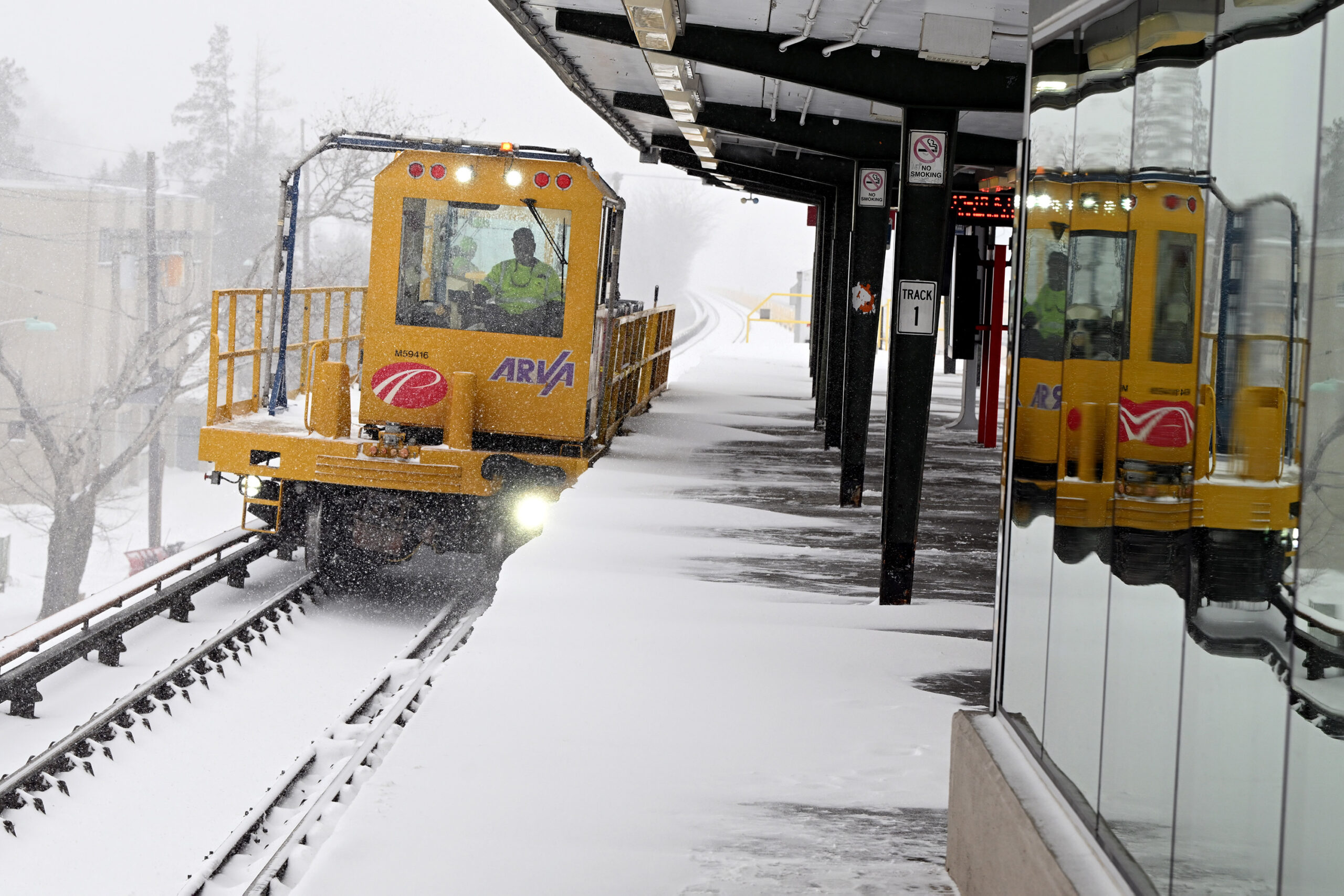
A track utility vehicle moves along the PATCO train line earlier this month.
PATCO trains will run at reduced speeds on Sunday and on an abbreviated schedule on Monday as the region braces for a significant winter storm.
On Sunday, trains will operate on a typical Sunday schedule but trips may take up to 10 minutes longer in order to maintain the safety of passengers and crew, the agency said.
On Monday, trains will operate every 12 minutes for most of the day, as opposed to the typical 5-7 minutes at peak times and every 15-30 minutes at other times.
An NJ Transit employee opens a train door at the Hamilton Train Station.
NJ Transit will suspend its bus, light rail, and Access Link service at 6 p.m. Sunday, the agency announced.
Trains will continue to run, but both the agency and Gov. Mikie Sherrill warned a shutdown later this evening was likely.
Speed restrictions of 35 miles per hour will go into effect on the New Jersey Turnpike, Garden State Parkway, and other highways through the state at 3 p.m.
“In our last storm, I said, ‘don’t travel if you don’t have to.’ Now, I’m saying, ‘don’t travel tonight.’ It’s dangerous,” Sherrill said at a Sunday afternoon news conference.
‘These kind of winters were common when I was a kid’
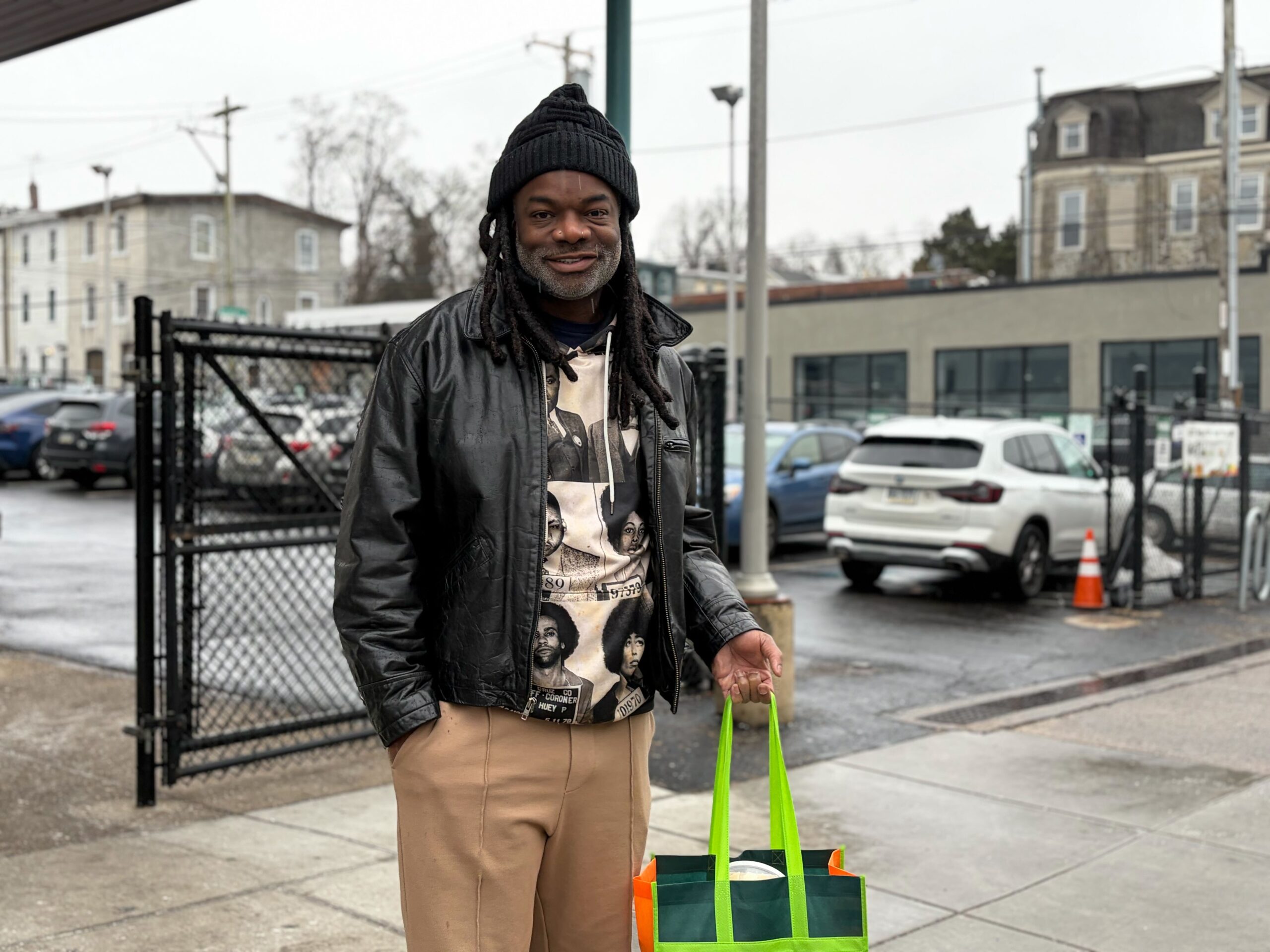
Eric Dobson, 57, went shopping for groceries in Germantown Sunday before the snowfall began.
Holding a single grocery bag, Eric Dobson, 57, was taking the impending storm with calm and nostalgia.
“These kind of winters were common when I was a kid,” said the Germantown resident. “I guess we have become soft, so we panic.”
With enough salt still stocked up at his home from last month’s storm, Dobson’s mind was on getting some groceries at the Germantown Weavers Way Co-op.
“I don’t know why we always get milk and bread in the storms,” said Dobson with a laugh. “I don’t even think we eat that much bread.”
A last-minute food craving sent Norman Bayard, 52, to the grocery store.
“I’m ready to hunker down,” Bayard said. “My family is at home; we have water and flashlights, but we didn’t have all the ingredients for the chili.”
Ashley Ellis Gitongu, 33, brought her three boys to the grocery store as a last outing before the storm.
“I’m not too worried, but we are going to be stuck inside for two days,” Gitongu said, looking at her 8- and 5-year-old boys roughhousing.
With schools closing in Philly, she predicts “a lot of arts and crafts are in our future.” Her husband, she said, will take the children sledding. But if snow fun isn’t possible, they found a solution during the last storm, turning their home into an “open house.”
“All the furniture is out of the way in the living room, so they can play soccer inside,” Gitongu said. “We have softballs, legos, anything to keep them active and distracted.”
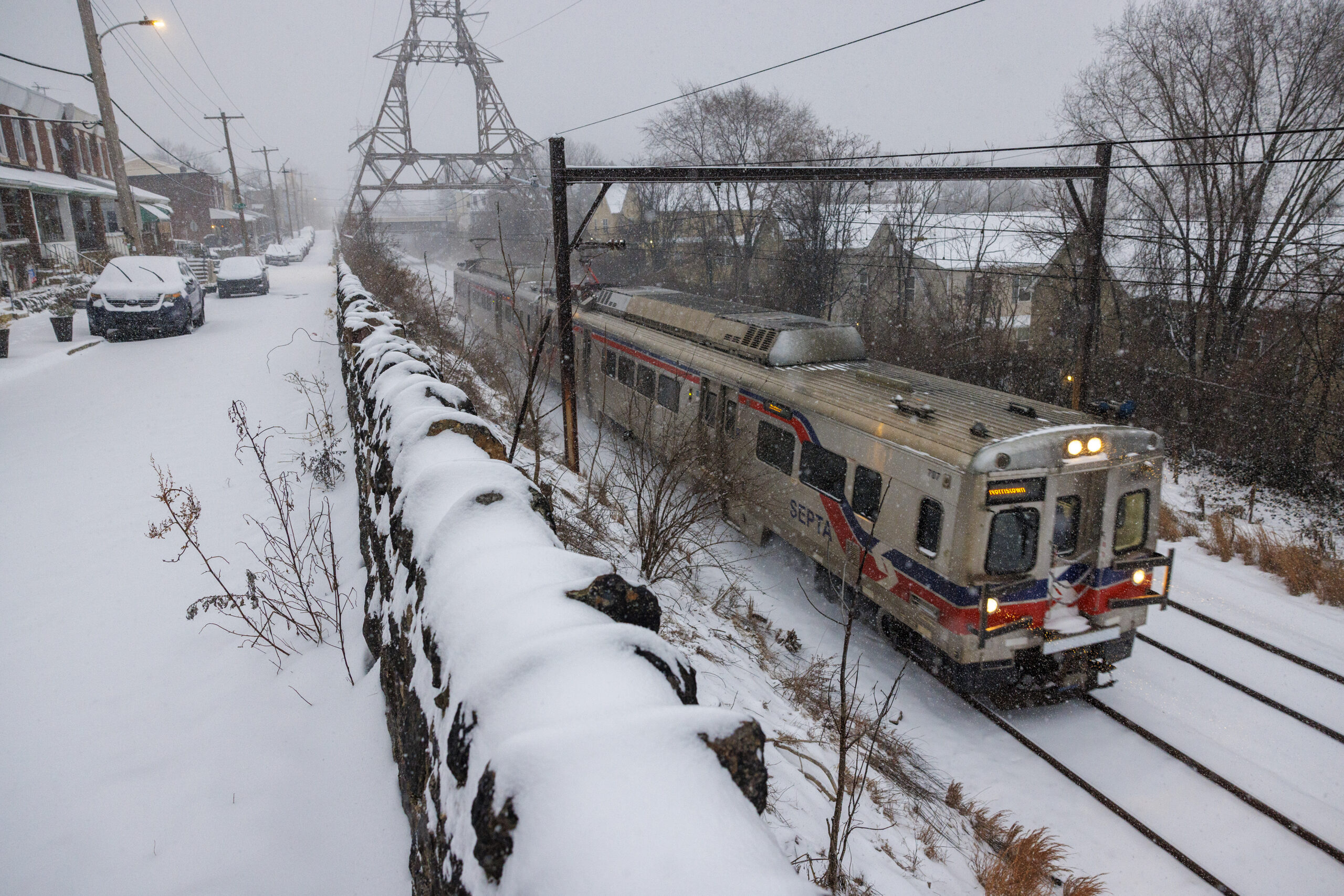
A SEPTA Regional Rail train heads through East Falls during a snowstorm last month.
As the region awaits the arrival of a snowfall that is expected to be in the double digits, SEPTA is warning riders that transit will be impacted.
“We want to be clear with our customers – there are going to be significant service disruptions,” said SEPTA General Manager Scott A. Sauer in a statement. “This is going to include delays, trip cancellations, and likely shutdowns of routes and entire modes of travel.”
Whenever possible, SEPTA will provide customers with at least two hours’ notice before service suspensions, the agency said.
SEPTA has also pretreated parking lots and tracks, tapping into the agency’s stock of 4,000 tons of rock salt. Depending on when the snow stops, SEPTA officials anticipate it could take until midweek to clear the nearly 300 Metro and Regional Rail stations throughout the five-county region.
Pennsylvania issues disaster declaration; commercial driving restrictions begin at 3 p.m.
A line of PennDot salt trucks line up ahead of a storm in December.
Gov. Josh Shapiro announced a disaster emergency during a new conference Sunday afternoon ahead of a massive snowstorm expected to blanket most of Eastern Pennsylvania, including Philadelphia.
The declaration allows state resources to be activated and enables local governments to activate their own emergency plans to respond to the storm, which is expected to drop a foot or more of snow in and around Philadelphia.
Shapiro said state officials expect the heaviest snow — potentially one to two inches an hour — to begin around 5 p.m., and urged drivers to travel only if absolutely necessary.
“I ask you to stay off the roads, particularly when the snow begins,” Shapiro said, “so that the plows can get out there, clear the roads and get you back moving as quickly as possible.”
PennDot Secretary Michael Carroll said commercial truck restrictions will begin at 3 p.m. He also said he expects tighter rules on more motorists during the heaviest portions of the storm.
Despite rain, more than a foot of snow still expected to fall in Philly
Rain falls Sunday afternoon on Cecil B. Moore Avenue in North Philadelphia.
Rain continued to fall Sunday afternoon with temperatures well above freezing, but forecasters say a drastic change for the worse is coming.
Blizzard warnings are in effect for the Philly region and all of New Jersey and Delaware for wind gusts to 45 mph and 14 to 20 inches of snow.
Those estimates may be “a bit high,” said Ray Martin, lead meteorologist with the National Weather Service Office in Mount Holly, but a “bit high” still would be quite a boatload of snow, the most since February 2010.
Sunday updated forecast from the National Weather Service.
Moderate to major flooding was forecast at the Shore with onshore winds howling up to 60 mph.
The snow will be wet and heavy, ideal for accumulating on trees and wires, and combined with the winds may cause some power outages.
This is the first time ever that all of New Jersey has been under a blizzard warning, said Judah Cohen, a Massachusetts Institute of Technology research scientist.
Philadelphia has not experienced a verifiable blizzard in 33 years. A blizzard is defined as heavy snow with winds of 35 mph an/or quarter-mile visibility for three consecutive hours.
(function () {window.addEventListener(‘message’, function (e) { var message = e.data; var els = document.querySelectorAll(‘iframe[src*=”‘ + message.id + ‘”]’); els.forEach(function(el) { el.style.height = message.height + ‘px’; }); }, false); })();
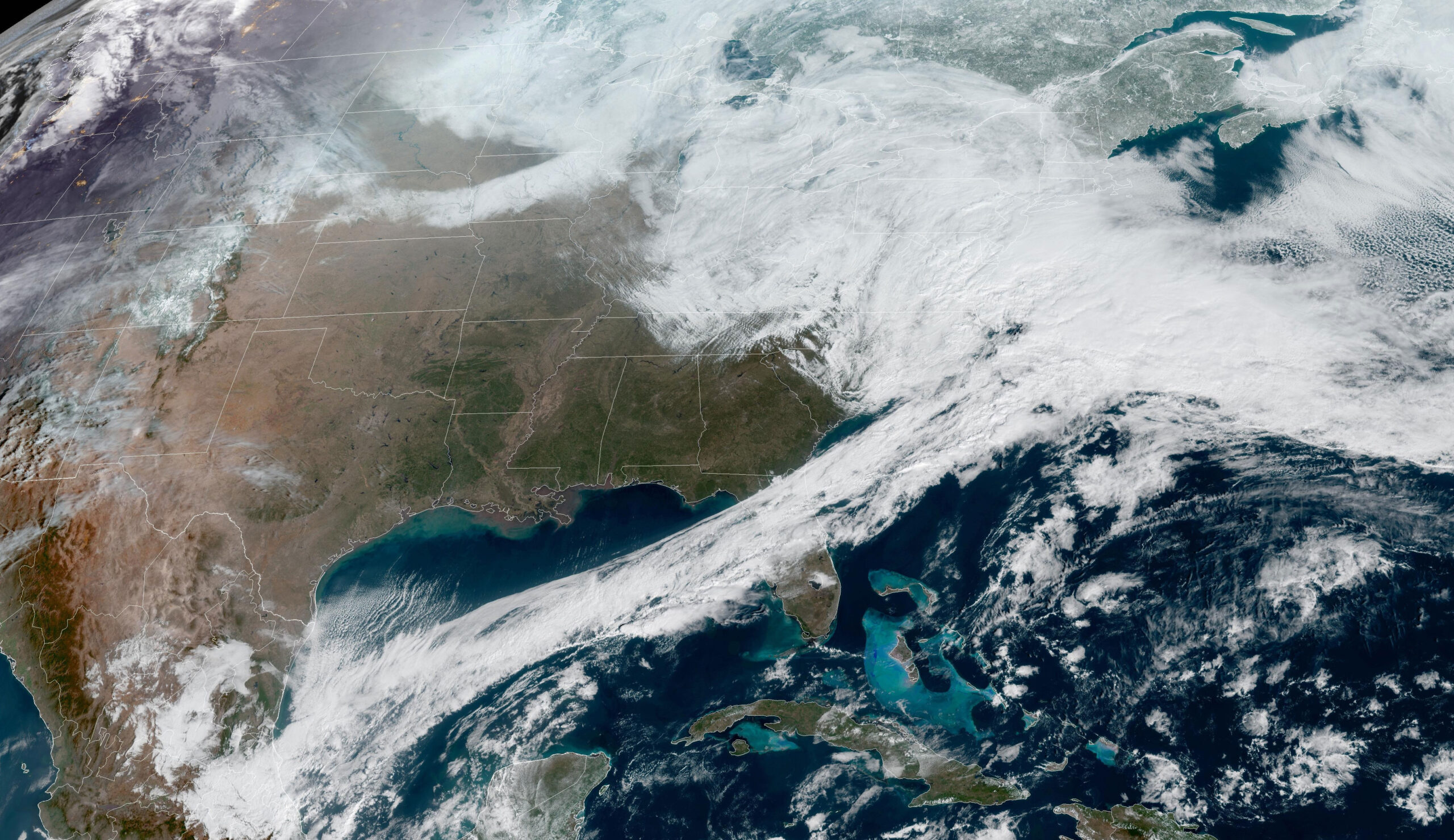
A satellite view of a massive winter storm making its way through the Northeast Sunday.
The storm developing off the Southeast Coast will qualify as a meteorological “bomb cyclone,” said Cody Snell, meteorologist with the Weather Prediction Center.
Just what does that mean? The technical description is on the geeky side — a barometric pressure drop of 0.7 inches in the center of a cyclone in a 24-hour period. Unofficially, it’s one mighty intense storm.
It so happens that the U.S. East Coast is in a prime area to experience the effects of those storms, according to the atmospheric scientists who are credited with minting the term in a 1980 paper, John Gyakum and Frederick Sanders.
The warm waters of the Gulf Stream are breeding grounds for potent storms that can form when cold air bounds off the coast.
Gyakum, a professor at McGill University in Montreal, recalled that well before the paper was published, the term “bomb” was used commonly in the halls of the Massachusetts Institute of Technology, where he was a grad student under Sanders.
The term has taken some blowback, but Gyakum argues that given the potential damage these storms can cause, “bomb” is appropriate.
Trash collection in Philly suspended through Wednesday
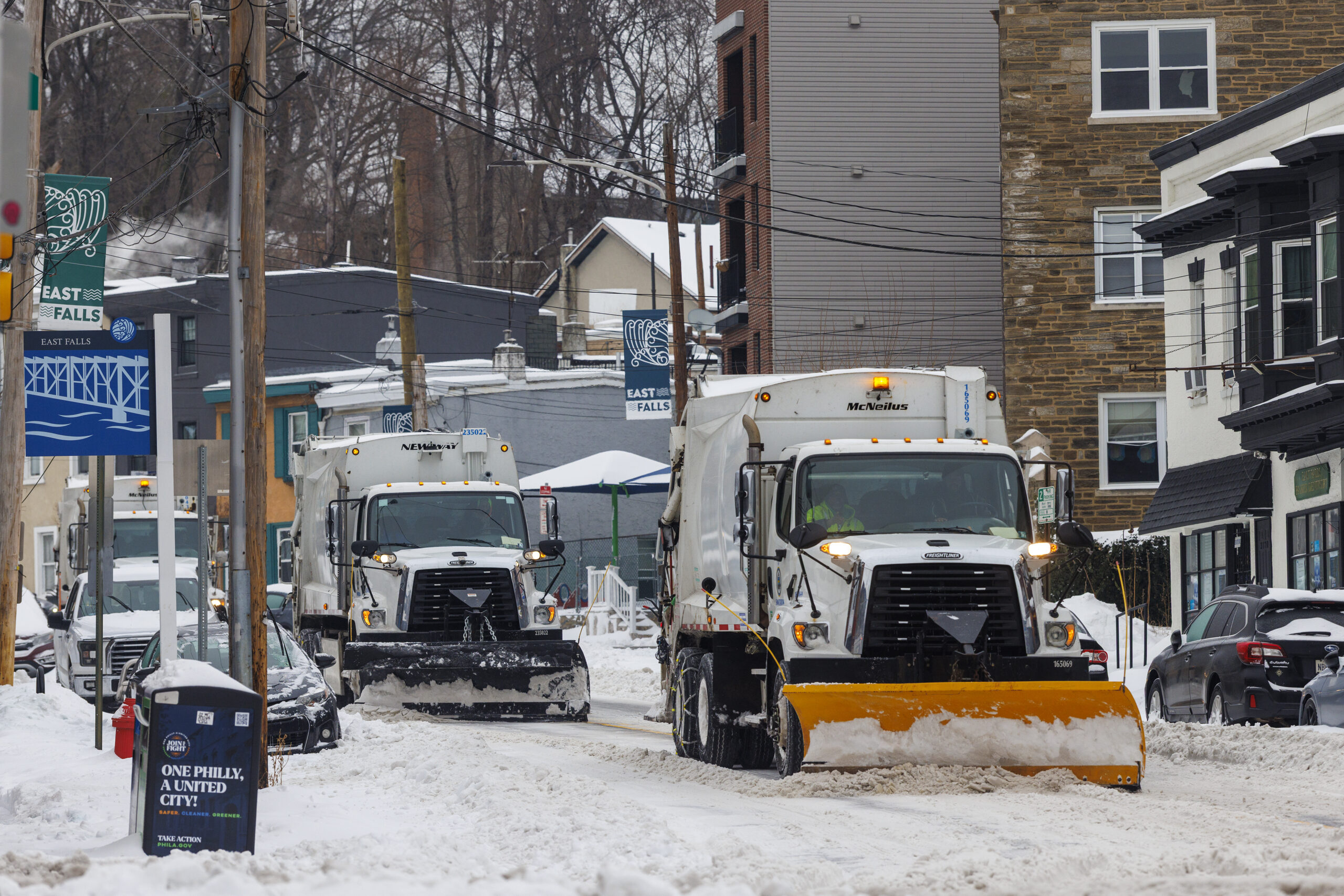
Sanitation Department trash trucks with plows clear snow during last month’s storm.
Trash and recycling collection in Philadelphia will be suspended the next few days as the city braces for as much as two feet of snow.
Collections are suspended Monday and Tuesday, the city announced. As of now, service will resume Wednesday on a two-day delay, with Monday collections picked up Wednesday and subsequent days following the same schedule.
The city is also suspending collections in rear driveways for the entire week, due to the possibility of trucks getting stuck in the snow. Residents are asked to set their materials in front of their homes for pickup.
Second trash collection is also suspended this week.
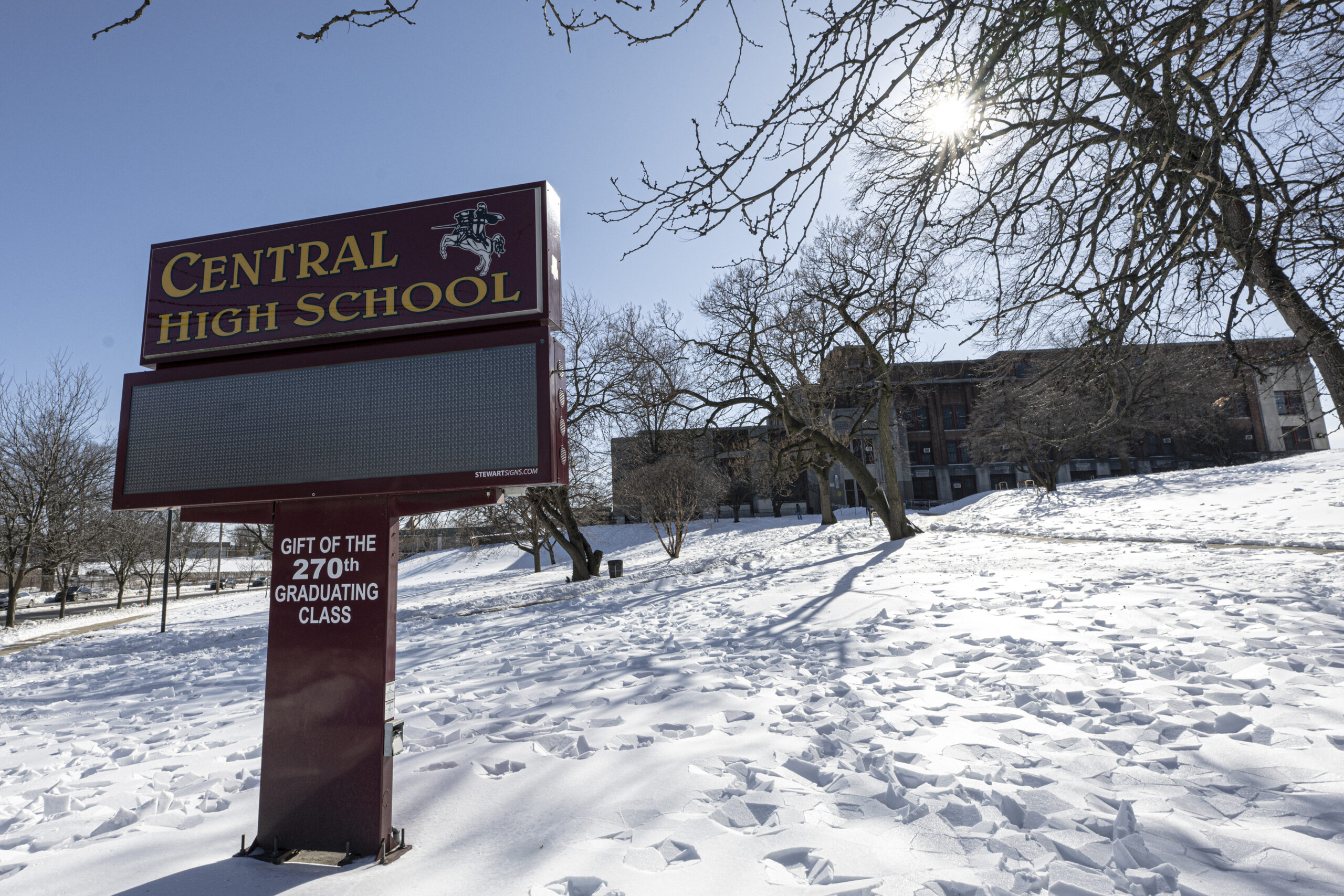
Central High School and the rest of the schools in Philly will be empty Monday.
With an eye toward the coming blizzard, the Philadelphia School District has already called a virtual instruction day for Monday.
All district offices will also operate virtually.
“While we work to the greatest extent possible to keep schools open for in-person learning to accelerate student achievement, we also consider the staff members who are commuting from across the region and keep the safety of students and staff as our top priority,” Superintendent Tony B. Watlington Sr. said in a message to families and staff.
The district gave students one full snow day in January, but has no more cushion built into its calendar. Any further inclement weather days will also be virtual instruction days, Watlington said.
“After Monday, if schools need to remain closed due to inclement weather, the district will provide an update to parents, guardians and employees regarding remote learning,” Watlington said.
Snowfall totals increase in latest forecasts; blizzard warnings expand
Up to two feet of snow could fall in Philly.
The National Weather Service expanded its blizzard warnings to include Philadelphia Sunday morning, as a “potentially historic winter storm” makes its way towards the Northeast.
Philadelphia, Bucks, Delaware, and eastern Montgomery Counties, and all of New Jersey and Delaware, are now under blizzard warnings through Monday.
Predicted snowfall has also increased in the past few hours, with as much as two feet of snow possible in the city. Winds gusts up to 60 mph and snowfall rates exceeding one to two inches per hour are also expected, forecasters said.
Blowing and drifting snow could create whiteout conditions, making driving dangerous and nearly impossible. The storm will certainly impact the Monday commute, with the strongest winds expected to occur Sunday night into the morning.
People are encouraged not to travel. Those who must do so should carry a winter survival kit.
“Travel could be very difficult to impossible,” NWS said. “Areas of blowing snow could significantly reduce visibility. The hazardous conditions will impact the Monday morning and evening commutes. Gusty winds could bring down tree branches and result in isolated power outages.”
Timing
Rain is expected to shift to snow by midday Sunday, and will continue through Monday afternoon. The heaviest snowfall is expected Sunday evening and overnight.
The blizzard warning remains in effect from 10 a.m. Sunday to 6 p.m. Monday.
The weather service included the Philly area in its blizzard warning after getting “higher confidence” data showing a likelihood of heavy snowfall and whiteout conditions in the region, said NWS meteorologist Ray Martin.
“Really, the bulk of the snow will start falling after sundown,” Martin said.
Philly snow emergency goes into effect Sunday afternoon; city government closed Monday as schools go virtual
Just as last storm’s snow has finally melted, Philly is expected to be covered with more than a foot of snow.
“Mother Nature has spoken again and made it clear that winter is not over,” said Mayor Cherelle L. Parker during an emergency press conference, declaring a citywide snow emergency, starting 4 p.m Sunday. “Yet another big winter storm is coming. It’s a major snow storm with real accumulation anticipated, and it’s heading our way.”
City government and courts will not open Monday, while public schools will switch to virtual learning. SEPTA riders should expect significant service disruptions over the next three days, said officials, who implored drivers to stay off the road Sunday.
Dominick Morales, the city’s emergency management coordinator, described the expected storm as “dangerous,” adding that heavy, wet snow could threaten trees and power lines.
“Dangerous because of the amount of snowfall that is being forecast in about a 24-hour period, but it’s also dangerous because of high winds — and for Philadelphia — near blizzard conditions. When this storm picks up, we have to take it seriously,” he said.
When all is said and done, the total snowfall may be closeto 18 inches in the city, and could surpass20 inches in South Jersey, where high winds are forecast to create blizzard conditions, according to the National Weather Service. Early Sunday morning, the weather service extended a blizzard warning to cover Philadelphia and Bucks and Delaware Counties, as well as eastern Montgomery County and all of South Jersey.
“It does look like it’s going to be quite an impactful storm for the whole [I-]95 corridor and further east,” said Sarah Johnson, warning coordination meteorologist at the weather service’s Mount Holly office, on Saturday.
This will lead to potentially dangerous driving conditions starting Sunday into Monday. And the Shore and Delaware Bay could experience flooding duringhigh tide Sunday evening.
The last time Philadelphia saw more than a foot of snow was 2016, when 22.4 inches fell in the city on Jan. 22-23.
Officially Philadelphia has not recorded a blizzard since March 1993.
To meet the criteria – three consecutive hours of winds of 35 mph or greater and/or heavy snow reducing visibility to a quarter mile for three straight hours – the conditions would have to be observed at the first-order measuring station, which is at Philadelphia International Airport.
The criteria weren’t met during the record 30.7-inch snowfall of Jan. 7-8, 1996, but at the time many meteorologists at the National Weather Service in Mount Holly argued that in the court of common sense it was indeed a blizzard.
It certainly acted and felt like on to those who experienced it.
Snow, after it hits 52 degrees? It’s happened before
On Saturday it reached 52 degrees in Philly as more snow vanished (not the mountains), and here we are a day later with a major snowstorm expected.
A warmup preceding a snowfall isn’t all that unusual this time of year, when the battles between the encroaching warm seasons and the retreating winter can be intense. Storms tend to form along thermal boundaries, and this is a prime for those contrasts. In today’s case an invasion of cold air is interacting with warmer air over the Atlantic Ocean.
Once powerful storms get going they can draw in cold air. Plus the upper air this time of year can be quite cold, and heavily falling snow can bring some of that to the surface.
One prime example of a snowstorm following a warmup occurred on Feb. 23, 1987. High temperatures the day before reached the low 50s. During the early morning hours of Feb. 23, heavy snow fell, accumulating 6.5 inches at Philadelphia International Airport, with totals several inches higher elsewhere in the city, and two feet in Downingtown.
On the plus side, a warmup after a snowfall isn’t all that unusual in late winter.
MUNICH — When Russia invaded Ukraine on Feb. 24, 2022, no one imagined Moscow would be enmeshed in a quagmire four years later, having lost nearly 1.2 million killed, wounded, or missing soldiers to an army a fraction of its size.
The price Ukraine has paid for its defiance was written on Volodymyr Zelensky’s face — weary, puffy, aged dramatically beyond his 48 years — as he took the stage at the Munich Security Conference last weekend.
“I want you to understand the real scale of these attacks on Ukraine,” he told an attentive audience, bluntly detailing the 6,000 attack drones, 150-plus missiles, and more than 5,000 multiton glide bombs Russia had dropped on civilian targets in January alone.
“Imagine this over your own city,” Zelensky demanded. “Shattered streets, destroyed homes, schools built underground, not a single power plant in the country that has not been damaged by Russian attacks.”
Yes, imagine those bombs dropping on Temple University and Jefferson Hospital, on apartment towers on Broad Street, and on William Penn atop City Hall. Imagine living under mounds of quilts in your home because power infrastructure had been deliberately destroyed.
And yet, as Zelensky made clear, Ukraine won’t surrender to Vladimir Putin — nor to Donald Trump.
Kyiv will not bow to shameful White House demands that it cede critical, fortified territory in the Donbas region to Russia, with no solid U.S. security guarantees to stop Putin from swallowing this gift and attacking again.
Based on Zelensky’s words, and what I heard from other European leaders, tech executives, Ukrainian military officers, poets, and tech innovators in Munich, here are my takeaways on what to expect in Ukraine as the fifth year of war begins.
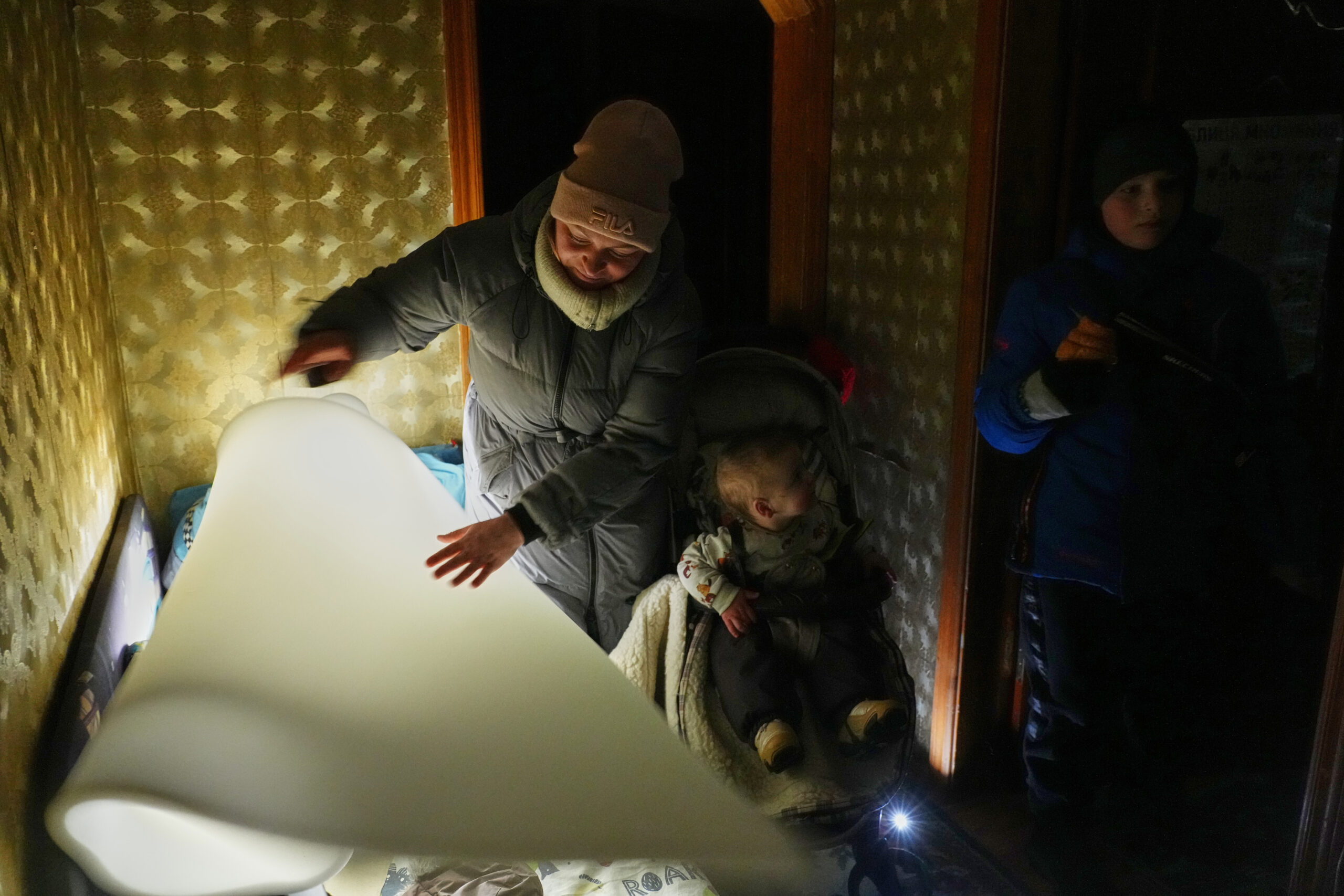
Yuliia Dolotova, 37, uses foam rubber to insulate her children’s bed in her apartment during a power outage caused by Russia’s repeated air strikes on the country’s power grid, in Kyiv, Ukraine, Feb. 2.
No end in sight
The war will not end in 2026. Putin isn’t winning, and Ukraine is holding on. Kyiv’s current strategy — as its army eliminates more Russian troops each month than the number of fresh recruits Moscow can send to the battlefield — is to increase that kill ratio, and to batter Russia’s military and economy until the Kremlin is finally forced to negotiate seriously.
But U.S.-brokered peace talks, whose second round in Geneva broke up abruptly on Wednesday, are headed nowhere so long as Trump only pressures Ukraine.
Russia hasn’t changed its hard-line demands one iota, still demanding Ukraine slash the size of its army, get rid of Zelensky, and forgo Western security guarantees. In other words, commit suicide.
Equally absurd, as Zelensky pointedly noted, is that Putin has rejected any European participation in peace talks, with Trump’s acquiescence. Never mind that the European Union and member countries now pay 98% of the cost of military and economic aid to Kyiv, including payments to Washington for limited amounts of U.S. weapons. Meantime, Trump cut off 99% of U.S. aid to Kyiv in 2025.
“We don’t hear any compromises from Russia,” Zelensky said, citing Moscow’s “strange” demand that Kyiv hold elections amid Russian bombing — a demand that received buy-in from U.S. negotiators.
“Give us a two-month ceasefire before elections,” Zelensky proposed. “Or we can also give Russia a ceasefire if they will have [free] elections in Russia.”
The Munich audience cheered.
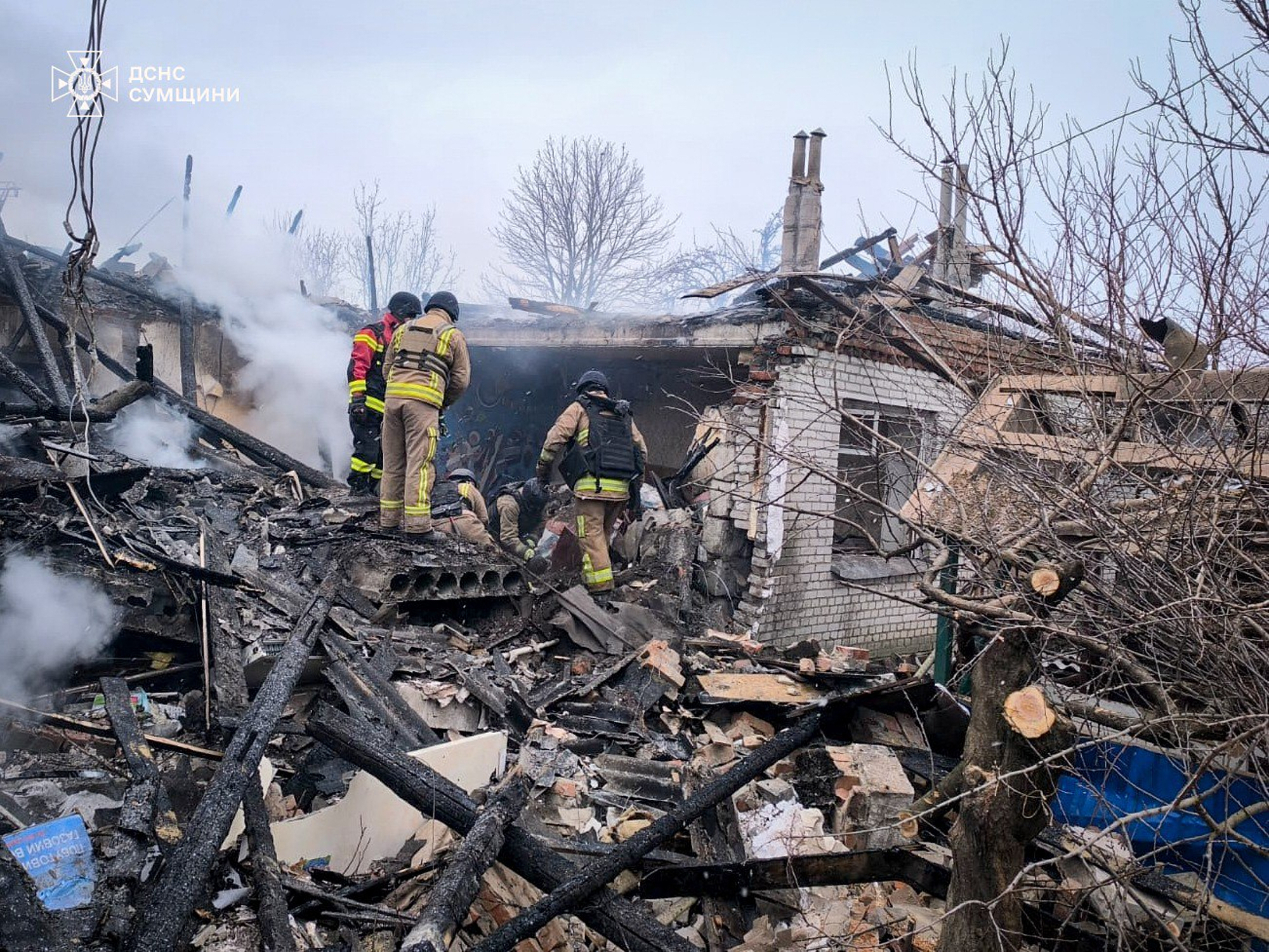
In this photo provided by the Ukrainian Emergency Service, firefighters put out the fire in private houses following a Russian air attack in Sumy region, Ukraine, Tuesday.
“Peace can only be built on real security guarantees,” Zelensky rightly insisted on stage, given that Putin has broken every previous accord Russia has made with independent Ukraine over the past three decades.
Since NATO membership is not on the table, Ukraine requires a legal commitment, not just verbal “assurances” that it will continue to receive European weapons and support for a strong army — along with expedited admission to the European Union. Kyiv also needs a firm U.S. commitment to back up European support before Ukraine makes any compromises on territory.
When I asked Ukrainian Foreign Minister Andrii Sybiha whether such security guarantees should include the presence of allied troops in Ukraine, he said sharply, “Boots on the ground are essential” in order to encourage investors in a postwar nation.
Yet, it is still unclear whether any European countries will agree to base military forces on Ukrainian soil, rather than just send “peace monitors.” Moreover, Russia rejects any security guarantees at all, and the White House still won’t spell out what kind of security backstop it will provide for the Europeans, and when.
Ukrainian President Volodymyr Zelensky (right) and German Defense Minister Boris Pistorius visit a drone-producing company, Quantum Frontline Industries, near Munich, on Feb. 13.
High-tech weapons
Ukraine will press forward with its efforts to promote joint weapons production with European — and American — firms to advance its amazing innovations in unmanned drone warfare. This tech savvy has enabled Kyiv to push back against Russia’s superior number of troops and increasing number of drones. But Kyiv badly needs more long range missiles (way past time for Germany’s Taurus and U.S. Tomahawks) and more air defenses to take out Russian missiles.
Representatives of Ukrainian and European military production companies swarmed the sidelines of the conference. Ukrainian officers from specialized drone units displayed their products’ prowess on video screens at side conferences organized by Ukrainian companies and think tanks.
The annual Munich Ukraine lunch sponsored by the Victor Pinchuk Foundation included attendees such as former Google CEO Eric Schmidt, whose Swift Beat company is working with Ukrainian partners to produce hundreds of thousands of AI-enabled long-range drones and drone interceptors that are the new weapons of modern war.
Schmidt expressed the opinion heard throughout the conference: When it comes to these weapons, Ukraine “will be the primary producer for all Europe.”
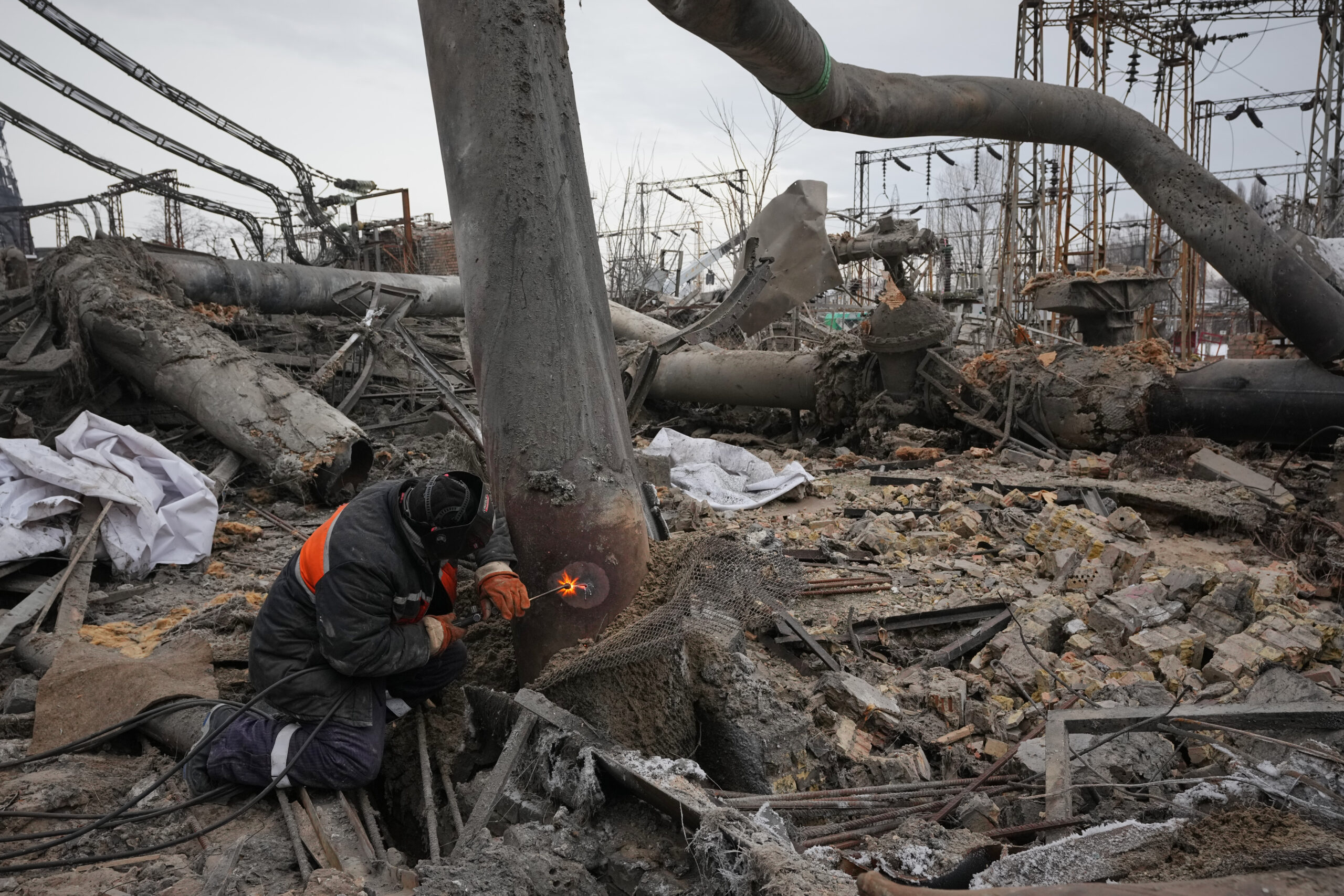
Workers clean up damage at Darnytsia Thermal Power Plant after a Russian attack in Kyiv, Ukraine, Wednesday, Feb. 4, 2026.
The will to go on
The Ukrainian public is demonstrating amazing fortitude, despite the Russian onslaught, and despite Trump’s refusal to support a tough new secondary sanctions package on Russia that a bipartisan Senate majority has had ready for months.
Zelensky paid tribute to the thousands of energy workers, repair crews, and rescue teams who have been working around the clock to restore heat and electricity each time Russia hits another power plant.
“Ukraine still has power because of our people,” he said with emotion. “Many politicians could learn how to act immediately … from ordinary electricians.”
The conference recognized ordinary Ukrainians’ heroism by awarding its annual Ewald von Kleist Award to the people of Ukraine for their “unwavering determination to defend their freedom and all of Europe.” The award is named after the Munich conference’s founder — who participated in the failed 1944 German plot to assassinate Adolf Hitler — and honors outstanding contributions to international peace and conflict resolution.
What sticks in my mind are the words of Ukraine’s premier poet, songwriter, and novelist Serhiy Zhadan, whose Kharkiv home I visited early in the war, and who spoke to a rapt audience at a Munich cultural center about his beloved city. Kharkiv’s citizens, he said, “reject the Russian goal to make them despair of life.”
“There is still a huge cultural life in Kharkiv,” he said, “and people refuse to let themselves be scared. At every cultural event, money is collected for kids and soldiers. But the whole society is tired. We want to go back to a normalcy where kids can return to school.”
The world’s double standards are painful, he continued, citing the ban by the International Olympic Committee on participation by a Ukrainian athlete because he wanted to memorialize his fellow athletes killed by Russia by putting their pictures on his helmet. “This is not a local war,” Zhadan insisted, “this war is about us all.”
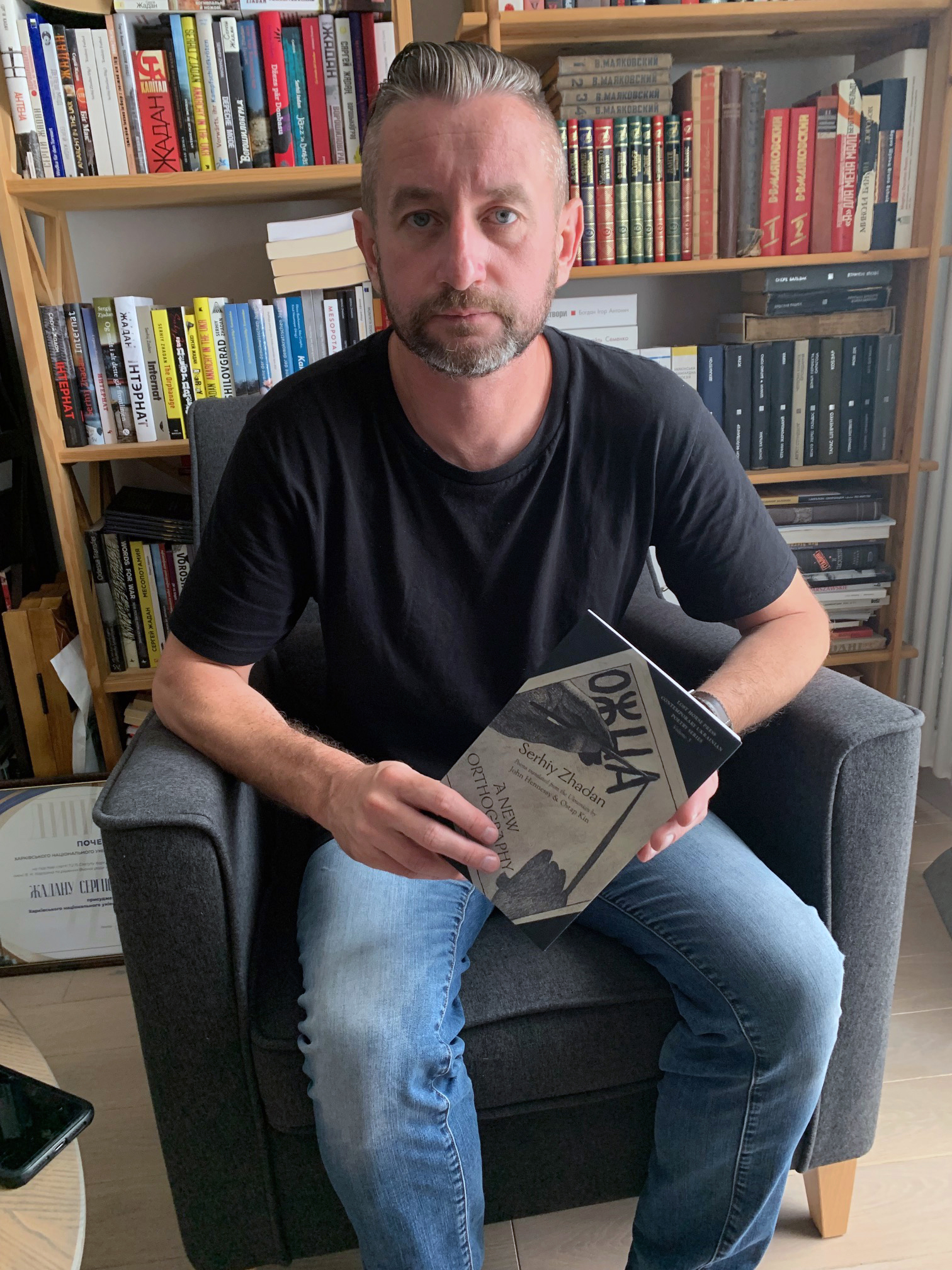
Serhiy Zhadan sits inside his home in Kharkiv, Ukraine, in 2022.
“We try to cling to the moments we live in, and not to think of the future,” he explained, in speaking of survival strategies. “If you think of the future, you become vulnerable. If you focus on the need to survive, you might get through.” Yet, he added, “We will enter the future from [this] darkness. This is part of our Ukrainian history. We will marvel at how beautiful the world will be if we only manage to endure this little bit of darkness.”
Zelensky translated Zhadan’s poetry into hard reality when he reminded a main stage audience that “Putin hopes to repeat 1938, when a previous Putin [Hitler] began dividing Europe.”
As Zelensky reminds us, it was a historic tragedy for Britain’s Neville Chamberlain to acquiesce to Hitler’s demand to seize part of Czechoslovakia. Far from bringing “peace in our time” Chamberlain’s blindness brought on World War II.
It is an error of far greater magnitude for Trump to press Zelensky to cave to Putin’s demand that he be handed key Ukrainian territory Russia hasn’t been able to conquer. Unlike Hitler in 1938, Putin has already begun his wider military attack on Europe.
Such signs of Trumpian weakness only encourage further Putin aggression as well as Xi Jinping’s plans to subdue Taiwan.
The ultimate message of Munich this year was that Europe needs to step up, and the White House needs to wake up and stop denying the importance of Ukraine. The Russia-China-North Korea axis is already feeding off of Trump’s misunderstanding of Putin in order to undermine U.S. power.
“Our world of drones is your world of drones,” Zelensky offered. “Our ability to stop [Russian] sabotage is yours. Please pay attention to Ukraine. If this [attention] had happened before this war started, the war would never have begun.”
The first sign of an American awakening will emerge if GOP members of the large bipartisan congressional delegation at Munich finally blast past Trump’s objections and bring a tough new package of secondary sanctions on Russian energy exports to a floor vote — soon.
It abuts an internationally famous garden. It may well be the most affluent community in the nation that hosts a prison, a source of some unwanted attention a few years back.
And, according to recently released U.S. Census data, picturesque Pocopson Township is in a rarified zone for wealth in the eight-county Philadelphia region, with an annual median household income of $230,000.
Chester County towns dominated the top 50 list in ananalysis of incomes in the region’s municipalities — compiled from self-reported American Community Survey data — calculated for the five-year period that ended in 2024.
But the analysis also showed that not only has Bucks County been gaining star power, some of its towns may merit the label “Big Bucks County.”
Legendary locale New Hope and neighboring Solebury — places associated with Real Housewives of Beverly Hills alumna Yolanda Hadid and actor Bradley Cooper — are among the towns that have made significant moves up the income chart, compared with the five-year period that ended in 2014.
Inflation-adjusted median annual incomes jumped 58% in New Hope, to $175,000. Incomes were up nearly 30% in Solebury, to $196,000,among the highest in the region.
The national median income was around $80,000, according to census figures.
Income figures are estimates, rounded to the nearest hundred, and are subject to margins of error. A total of 286 municipalities were included in the analysis; those with fewer than 2,500 residents were excluded. Here are some key findings.
window.addEventListener(“message”,function(a){if(void 0!==a.data[“datawrapper-height”]){var e=document.querySelectorAll(“iframe”);for(var t in a.data[“datawrapper-height”])for(var r,i=0;r=e[i];i++)if(r.contentWindow===a.source){var d=a.data[“datawrapper-height”][t]+”px”;r.style.height=d}}});
Chester County still has the wealthiest towns
Chester County towns held six of the top 10 spots, including Birmingham, adjacent to Pocopson.
The county evidently is rich in an amenity attractive to the wealthy — and to others.
“Chester County has been a leader in terms of the amount of land preserved,” said Andrew Svekla, Office of Smart Growth manager with the Delaware Valley Regional Planning Commission. “The availability of open space is an amenity that everyone is looking for.”
While the natural environment is an understandable attraction, not everyone who spends time in Pocopson comes for the green space: The Chester County Prison has been a mainstay in the township since 1959.
In August 2023, Pocopson and Longwood Gardens became international news when inmate Danilo Cavalcante escaped and set off a two-week investigative frenzy that mutated into a massive exercise of Where’s Danilo? He spent time hiding in Longwood and was eventually captured in South Coventry Township, about 20 miles away.
Otherwise, the likes of Pocopson and Birmingham have not exactly been centers of media attention, and the towns even have avoided the development-vs.-open-space conflicts that have erupted elsewhere, said Matthew J. Edmond, executive director of the Chester County Planning Commission.
“They aren’t in the path of growth,” he said. “These areas are off the beaten path.” The residents represent a mix of old and new money, he said.
He likened Chester County to a macro-version of Lower Merion Township, where neighborhoods vary from ultra-wealthy Gladwyne to the middle-class sections of Ardmore.
While overall the county has the highest median income in the state, “when you get down to the granular level, it’s a very diverse county,” he said.
Incomes in other counties in the region have grown
The overall picture of wealth in the eight-county region was quite a diverse one in the census survey, ranging from Pocopson’s median income to the $40,000 levels of Camden, the City of Chester, and Darby Borough.
But the preponderance of the higher incomes clearly were west of the Delaware River.
Jersey’s wealthier municipalities tend to be clustered in the New York metro area, Svekla said, and only six were on the top 50 list in the Philly region. They included Camden County’s Haddonfield, with a median income of$200,500, and Moorestown, at$160,000 anda favorite of professional athletes. They include ex-Phillie Nick Castellanos, onetime 76er Ben Simmons, Flyers legend Bobby Clarke, and former Eagle Terrell Owens, who famously drew media attention by doing push-ups on his driveway.
It also is the home of Kevin Patullo, the Eagles’ former offensive coordinator whose house was pelted with eggs in October after one of the team’s lackluster performances.
Haddon Heights and Haddon Township did not join Haddonfield in the top 50 but were high on the list of towns where incomes had grown substantially in the last 10 years.
Other places that experienced substantial paycheck bumps in the last 10 years included the Blue Route towns of Conshohocken and West Conshohocken. Both are close to I-476 interchanges and have experienced growth spurts in population and wealth since the highway connecting the Pennsylvania Turnpike to I-95 opened in the 1990s.
Bucks lags in population growth, but not wealth
Led by Chester County, population increased in all eight counties between the 2010 and 2020 census counts. “We’re growing mainly due to international immigration,“ said Greg Diebold, the Delaware Valley planning commission’s senior data analyst.
“Bucks has been one of the slower-growing counties,” he said, having added only about 4% to its population between 2010 and 2020.
In terms of median-income growthover the last 10 years, however, it had seven municipalities in the top 20, more than any other county.
window.addEventListener(“message”,function(a){if(void 0!==a.data[“datawrapper-height”]){var e=document.querySelectorAll(“iframe”);for(var t in a.data[“datawrapper-height”])for(var r,i=0;r=e[i];i++)if(r.contentWindow===a.source){var d=a.data[“datawrapper-height”][t]+”px”;r.style.height=d}}});
Not all the gainers were wealthy towns
One Delaware County town, Upland Borough, adjacent to the City of Chester and the location of part of the closed Crozer-Chester Medical Center, made the biggest-growth list with incomes up more than 40% to $61,000.
Bankrupt Chester itself, with one of Pennsylvania’s highest poverty rates, reported a 10% gain, to $41,000.
However, half of the 10 towns where incomes decreased the most were in Delaware County.
Speaking to the region’s overall prosperity, fewer than 25% of the 286 towns showed drops in income in the period that ended in 2024, compared with the five-year period that ended in 2014.
And only 20% this time around reported incomes below the national median.
Julius Erving will celebrate his 76th birthday on Sunday, just a few weeks after the 50th anniversary of the event that led to his milestone signing by the 76ers: the American Basketball Association’s Slam Dunk Contest. Erving’s victory in the five-man competition — held in Denver on Jan. 27, 1976, during the ABA’s final season, while he was starring for the New York Nets — marked his breakthrough into America’s sports and pop-culture consciousness.
In this excerpt from his book “Magic in the Air: The Myth, the Mystery, and the Soul of the Slam Dunk,” Inquirer columnist Mike Sielski details why the contest was so significant to Erving, to the Sixers, and to the evolution of professional basketball.
Julius “Dr. J” Erving celebrated his 76th birthday this week.
The people in charge of the ABA were under no illusions about the condition of their league as it entered its ninth season. Despite its star power — Connie Hawkins, George McGinnis, Erving, more — franchises were folding, or relocating then folding, every year. Two, the San Diego Sails and Utah Stars, went under during that 1975-76 season. Rather than committing to keep the league afloat, its top-drawing teams — the Nets, with Erving, and the Denver Nuggets, with their sky-walking star, David Thompson — were eyeballing the NBA, looking to bolt to a stabler, more lucrative situation.
To juice interest, and with less to lose with each passing day, the league’s decision-makers tried a new format for its midseason All-Star Game at McNichols Arena: The Nuggets, as the defending champions and the game’s hosts, would take on a squad of players picked from the ABA’s other six teams. That wasn’t all. The country-western singers Glen Campbell and Charlie Rich would perform before the game, and, at the suggestion of Jim Bukata, the league’s public-relations director, there would be a slam-dunk contest at halftime.
Five players, all of whom would already be in Denver for the game, would take part: Erving, Thompson, George Gervin, Artis Gilmore, and Larry Kenon. Including a non-All-Star in the contest would have required flying in a non-All-Star for the contest, and no one in the league was about to spend that extra money. Erving asked Kevin Loughery, the Nets’ head coach, if the contest ought to have a white participant, and in fact, the league invited the Nuggets’ Bobby Jones to compete. Jones declined. “I wanted to win the All-Star Game,” he told me. “I didn’t have the energy to do what those guys did.”
On Jan. 27, 1976, with 17,798 — the largest crowd in ABA history — on hand, with $1,200 in prize money at stake, the five competitors were briefed on the rules before commencing with the contest. Each of them could attempt up to five dunks in a two-minute span. One of the dunks had to be from a stationary position; one had to have the player start his move from the foul line, 10 feet away, or beyond. Two contestants would dunk on one basket and three would dunk on the other, the public-address announcer told everyone, “to take pressure off the rims and backboards.”
Based on “artistic ability, imagination, body flow, and fan response,” four judges would determine the winner. The panel: former Knicks star and Nuggets general manager Vince Boryla; Nuggets super-fan Alberta Worthington; high school standout LaVon Williams, who was “Mr. Basketball” in Colorado before heading off to the University of Kentucky; and Barry Fey, a former guard at Penn who, as a concert promoter, had set up the pregame festivities with Campbell and Rich.
Gilmore, the tallest competitor at 7-foot-2, appeared unsure of what to do, as if he hadn’t practiced or planned his dunks or was, for whatever reason, holding back. Gervin and Kenon were a little looser, but there was a mood of tentativeness in the arena until Thompson got the ball.
Fresh from a remarkable career at North Carolina State and in his rookie season with the Nuggets, he had been nervous throughout the days leading into the contest, so eager was he to live up to the home crowd’s expectations and hopes. His teammates had been pumping him up, encouraging him, letting him know which of his dunks they thought were his best. From the right side, he charged toward the hoop and hammered down a powerful right-handed slam. Working quickly, he ripped off a double-pump two-handed reverse and, from the left baseline, a 360-degree spin and jam, establishing himself as the man to beat.
But now, it was Erving’s turn. Standing directly under the basket, he dunked two balls at once — a nod, perhaps unconsciously, to his days at Roosevelt High School on Long Island, when he pulled off the trick as a teenager. Then he walked out to halfcourt, then back to the free-throw line, then back to the opposite free-throw line, counting and measuring his steps as he went.
Before the contest, he had made a $1,500 bet with Doug Moe, then an assistant coach with the Nuggets, that he could take off from the foul line and dunk during his descent. He paused, bent at the waist, then started, a slight stutter step, then a sprint into four floor-eating strides from the midcourt stripe to just inside the foul line, then … whoosh. Up.
“I’ve described Julius as more of a glider than a jumper,” Jones told me. “He was more of a long jumper.”
New York Nets forward Julius Erving, left, raises his arms as he is hugged by a teammate following the Nets victory over the Denver Nuggets at the Nassau Coliseum, Uniondale, N.Y., on May 7, 1976.
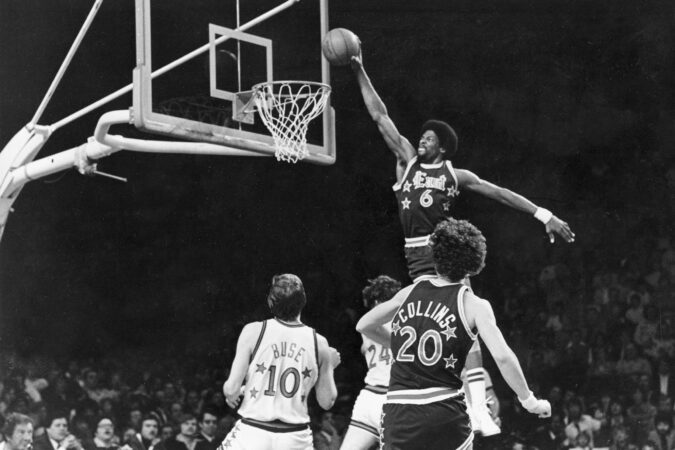
The crowd let out a communal Whoa. Erving lost the bet to Moe, but he didn’t need another dunk to win the contest. After a reverse from the right side, he swooped in from the left side, grabbing the rim with his left hand and windmilling the ball through the hoop with his right, then finishing with an “Iron Cross” dunk from the right baseline, spreading his arms and dunking the ball without looking at the basket. All the game’s players greeted him at halfcourt to congratulate him. The judges’ decision was a formality.
“It was something else,” Erving told me. “It’s still talked about today. I didn’t know it would have such a lasting effect on basketball history, and neither did any of the other players. I don’t think any of us really knew. We were the ABA, and we were crowd-pleasers. Yes, we made history, but the intention wasn’t making history.”
The All-Star Game — and, in turn, the dunk contest — was supposed to have been broadcast nationally but ended up being televised in just five markets: Denver, Indianapolis, Louisville, San Antonio, and St. Louis. Since the game didn’t end until after 2 a.m. Eastern time, the ripples from the contest didn’t start spreading immediately. Only after Good Morning, America and The Today Show featured Erving and Thompson did the magnitude of the event begin to reveal itself.
“Merger plans had long been in the works between the ABA and the NBA,” ESPN’s Eric Neel once wrote, “but the contest no doubt hastened them.”
Afterward, Erving said that he was unlikely to compete in another dunk contest ever again, that his knees were “75 percent of what they used to be.” (He did, in fact, compete in another: the NBA’s 1984 contest, where he finished second to the Phoenix Suns’ Larry Nance.) But he and the ABA had already ignited, or at least accelerated, an insurrection within pro basketball. The slam dunk was cool, and the ABA had embraced it, which made the ABA cool, which made the NBA seem stuffy and stiff in comparison, mostly because it didn’t have the athlete who, more than anyone, had made the slam dunk cool.
Julius Erving of the New York Nets, known as “Dr J,” scores during an ABA game at Nassau Coliseum, in Uniondale, N.Y., on Nov. 29, 1975.
In Philadelphia, 76ers general manager Pat Williams had watched those TV highlights of the contest.
“That,” he told me, “is what really put Julius on the stage.”
Erving never missed a game during his three-year career with the Nets, leading them to the league championship in 1974 and 1976, and was at times seemingly too good to be true. Long before San Antonio Spurs coach Gregg Popovich figured out that he could scream at his franchise centerpiece, Tim Duncan, and that Duncan would take the criticism without complaint, and that the other, lesser players would understand Popovich gave the team’s superstar no special dispensation, Kevin Loughery used the same psychological tactic with Erving. Doc messed up, even when he didn’t. Doc was no different, even if he was.
One night, Erving dunked over three defenders, and Loughery called a timeout for no reason other than to pull Erving aside and tell him, You just played the greatest three-minute stretch of basketball I’ve ever watched. Rod Thorn, an assistant under Loughery, had never seen a player catch and dunk an alley-oop pass with one hand until he saw Erving do it. The shame was that his exploits took place so often under the blanket of the ABA’s obscurity.
In Game 6 of the ‘76 ABA Finals, Erving scored 31 points, pulled down 19 rebounds, and blocked four shots as the Nets rallied from a 22-point deficit in the third quarter to beat the Denver Nuggets, 112-106, and win the series in six games. As they stormed the Nassau Coliseum court, Nets fans nearly trampled Nuggets’ play-by-play voice Al Albert, who climbed atop a table to escape. Albert lost his microphone and headset. The phone and cable lines he needed for his broadcast were cut. His television monitor crashed to the floor.
The chaotic scene was a bittersweet valedictory for The Doctor’s tenure: The passion and adoration that he would earn over his career in the NBA, with the Sixers, would manifest itself in that final game … and never again with the Nets. Attendance was low throughout the ABA. So was revenue. The franchises were too regional. The league was falling apart.
“Everybody thought we were in the hinterlands,” Bill Melchionni, a member of that ‘75-75 Nets team, told me. “We were minor-league.”
Four ABA teams merged with the NBA in June 1976. “I can say without a doubt,” broadcaster John Sterling, who was the Nets’ radio play-by-play voice at the time, once said, “that what finally convinced the NBA to merge was a chance to get Julius in the league.” Melchionni, who had become the Nets’ general manager immediately after that championship series, began fielding phone calls from civic leaders and chambers of commerce around the country, begging to have Erving and the Nets come to their cities to play exhibition games, offering as much as $50,000 as enticement.
“We were scheduled to play two games in Vegas,” Melchionni told me. “Guys would ask, ‘How many minutes is he going to play?’ And I’d say, ‘It’s an exhibition game. He’s not going to play 48 minutes.’”
The calls stopped, of course, after Wednesday, Oct. 20, 1976. The last day that Julius Erving belonged to the ABA. The first day that the NBA belonged to Julius Erving.
Julius Erving wakes up each morning and begins taking notes to prepare for the day.
It is his way to, in his words, “put my focus on keeping the carrot out in front.
“… and somewhere in there might be that best day [of my life].”
Right now, there is a milestone birthday for “Dr. J” to celebrate. The ultimate 76er turned 76 years old on Sunday. The team recognized such symmetry throughout Thursday’s home loss to the Atlanta Hawks, illustrating the continued connection between Philly and one of its most revered athletes.
“He’s got a lifetime membership here,” Clint Richardson, Erving’s former teammate, said from Xfinity Mobile Arena. “They just continue to acknowledge him. This place is very special to him. I know that.”
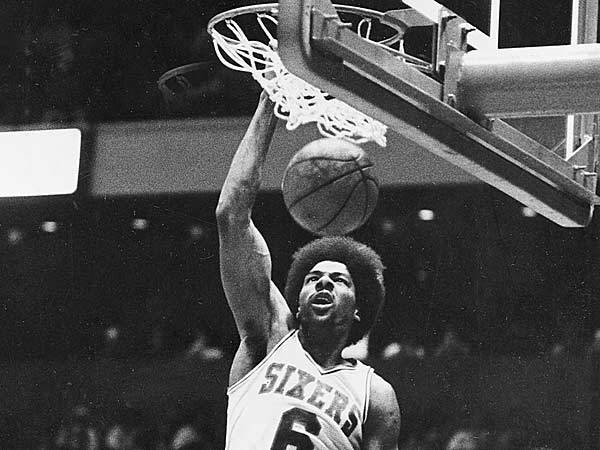
It is obvious why Erving’s transformational, Hall of Fame career remains so beloved in this city, where he spent all 11 of his NBA seasons. The eye-popping athleticism channeled into glorious dunks. The 1981 NBA MVP Award and five first-team All-NBA selections. The hip and classy persona. And, on his fourth trip to the NBA Finals, the 1983 title he finally helped bring to Philly.
Beyond those accolades and highlights, though, Erving and Richardson recalled the pressure and responsibility “Doc” shouldered as the face of the NBA-ABA merger. He also went from being the bona fide leader of the New York Nets to sharing that responsibility with the Sixers alongside Doug Collins and George McGinnis.
“Pat Williams clearly said, ‘I don’t need a guy who can score 30 points a game,’” Erving said of the Sixers general manager who acquired him. “Thirty points wasn’t a big deal for me, the way that I played. … I don’t talk about it a whole lot because you can’t change it. But the journey could have been different. The NBA was different.
“I think I made a big sacrifice when I came to Philadelphia. And it paid off in the end because the seventh year, we won a championship. But I think we could have won it sooner.”
Richardson, whom Erving calls his little brother, idolized him in college. Then becoming teammates, Richardson said, “was kind of mind-blowing.” Off the court, he came to know Erving as the man who lent him a car and welcomed him into his family.
Former Sixers star Julius Erving delivers a slam dunk at the NBA All-Star Game in Milwaukee in 1977.
But road trips with Erving were “like being with Mick Jagger.”
“Traveling with Julius, it was like traveling with the Rolling Stones,” Richardson said. “Every night. Everywhere we went.”
That gravitas holds long into retirement, with everyday folks and celebrities alike.
Erving said he does not mind being approached in the airport for conversations he describes as typically “pleasant” and “joyful.” He still is a compelling media and entertainment subject, with the Prime Video docuseries Soul Power about the ABA, in which he is prominently featured, premiering earlier this month.
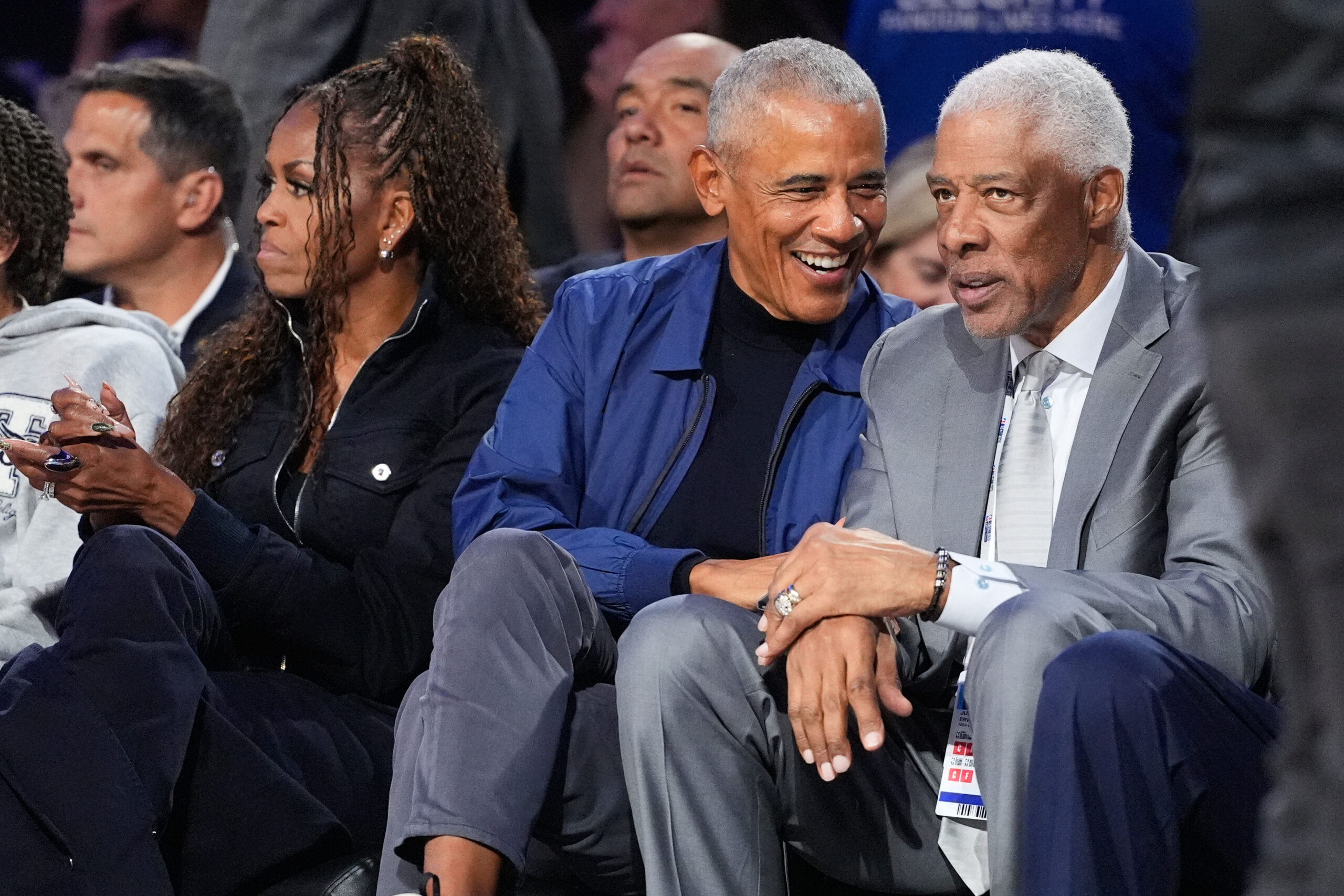
And at last weekend’s NBA All-Star Game in suburban Los Angeles, Erving sat courtside with Barack and Michelle Obama. It was the third time he had met the former president, Erving said, including at a planned White House visit and an impromptu crossing of paths on a Washington golf course.
Barack Obama talks to Julius Erving during the NBA All-Star basketball game on Feb. 15.
“He told me about growing up in Hawaii and admiring my style of basketball,” Erving said. “The things that I brought to the game. That I was a contributor, not a taker. And that helped to inspire him because he was still in high school.
“It was quite a thing to hear from someone who is as accomplished as he is and loved and admired as he is.”
Erving’s public life still regularly brings him to Sixers home games. He said his palms no longer begin sweating when a matchup gets tight and that he can now view the action as more of an outside critic. Though he calls interactions with the current iteration of the Sixers “sporadic,” he has formed a friendship with coach Nick Nurse and has participated in some of the coach’s foundation events in his home state of Iowa.
“He’s a super gracious person,” Nurse said.
And Erving’s nonbasketball life? He said that is “on the rebound.”
“I’m happy about that,” Erving said. “And deserving.”
He publicly shared some of the more vulnerable experiences — including his infidelity and the accidental drowning of his son, Cory — in his 2013 autobiography he said was written to be passed along to future generations of family. There are other private moments that Richardson knows about Erving that he said he will “go to my grave with. I don’t even share with my family.”
“I sense him being a little bit more guarded,” Richardson said. “When I see him doing that, that lets me know that I need to be a little bit more guarded, too.”
Last year, Erving had a “big” party in Fort Lauderdale, Fla., for his 75th birthday, the more commonly celebrated milestone. This year, he wanted to keep the hoopla a bit quieter. But he understands this age’s endearing parallel with his NBA franchise.
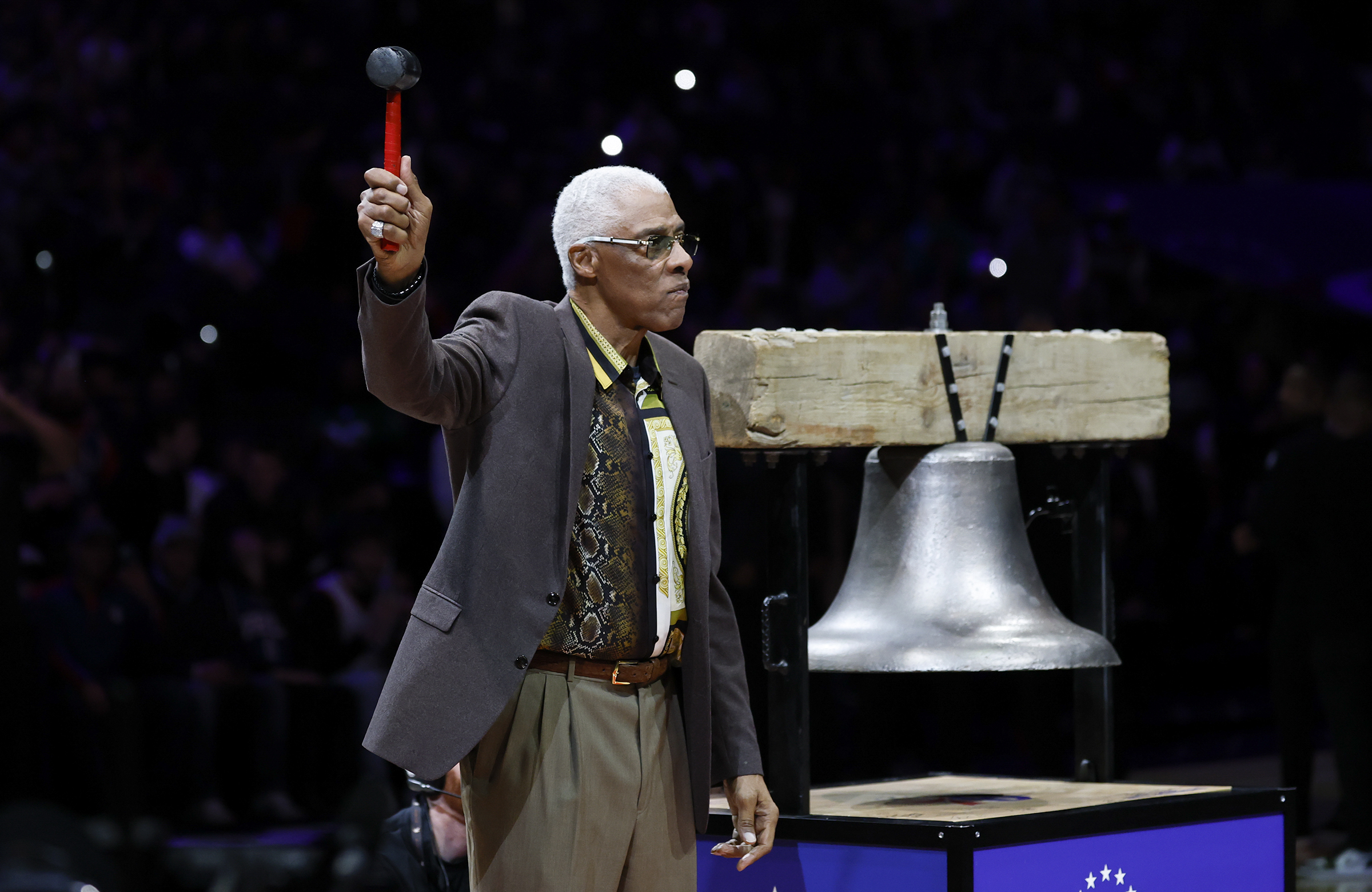
Former Sixers Julius Erving waves to fans before ringing the ceremonial liberty bell before the Sixers play the Atlanta Hawks on Thursday.
So he rang the bell before Thursday’s game and received a custom portrait during a first-half timeout. Later, he was up in a suite with a cake with candles shaped like the number 76, before the home crowd was encouraged to sing along to “Happy Birthday.”
Yet about an hour before those festivities began, Erving dipped into a quiet, back-of-house room. He held a notebook while reminiscing about his legendary career with the Sixers and this stage of his life.
That is where he can keep writing each morning, while looking forward to 76 and beyond.
“I want to put my focus on keeping the carrot out in front,” Erving said, “and tomorrow being the best day of my life.”