Donald Trump gathered U.S. energy executives on Friday to tell them of the nice crude, heavy oil he had procured for them by invading Venezuela — killing dozens of people and kidnapping President Nicolás Maduro and his spouse in the process — only for the men to respond that they couldn’t invest in that country because they’d spent all their money getting Trump elected.
It was a twist right out of an O. Henry story. Call it, The Gift of the Megalomaniac.
Well, not quite. While Big Oil did indeed spend at least around $500 million last year on the presidential campaign and other lobbying efforts, it fell short of the reported $1 billion Trump asked oil executives for during his run for the White House. And even that amount would hardly make a dent in industry profits, which in 2022 reached nearly $200 billion.
I’ll get to Trump’s deranged, illegal attack on Venezuela and its larger implications for Latin America — which plays less like literature and more like a bad ‘80s sitcom episode (“The Dumbroe Doctrine,” Season 2, Episode 1) — in a bit. First, let’s talk oil.
The reason why energy executives didn’t jump at Trump’s offer for them to spend $100 billion in Venezuela to boost oil production is that while there may be massive, untapped potential there, it’s going to take a long time to realize, said Harold York, a fellow at the Center for Energy Studies at Rice University’s Baker Institute.
To start, York told me, companies need a technical assessment of the state of the Venezuelan oil industry’s infrastructure, which is believed to be in serious disrepair. Then, the U.S. must help establish a credible and trustworthy legal and fiscal framework for international companies to participate in Venezuela. After that, executives will begin to figure out what a development plan looks like.
A local walks past a mural featuring oil pumps and wells in Caracas, Venezuela, on Jan. 6.
While some have pointed to the current low price of oil as a roadblock, York doesn’t believe that’s an impediment, since the decision to embark on a yearslong project would consider what the price will be in the future, not what it is now.
“I think there will be appetite precisely because they may not need the production today,” York said. “If you’re looking to keep your portfolio diversified, then Venezuela is something you would look at as one of your long-run assets.”
What will most likely temper that appetite is that the requirements that need to be met for Big Oil to return in earnest to Venezuela also depend on the kind of stability no one can guarantee. You don’t even need to get to the unknown unknowns, as one former failed nation builder once coined. In Venezuela’s case, it is the known unknowns that will get you first.
Trump is offering companies security guarantees, but can a president who routinely reneges on agreements promise a subsequent administration won’t do the same? Future leaders in Venezuela may decide to take back their oil with minimal compensation to U.S. companies, as the government did in 1976, and America could just shrug its shoulders. Or even a pro-U.S. Venezuelan government may decide it wants to renegotiate at some point.
All of that to say, if Trump removed Maduro from power to gain control of Venezuela’s oil, the administration did not seem to give the plan much thought.
What Trump was successful at, other than violating international law and the Constitution — no matter how coyly the administration insists that what it did was a law enforcement action and not an act of war — is in bringing the Monroe Doctrine back to bloody life.
A man wears a T-shirt with a image of President Donald Trump during a government-organized rally against foreign interference, in Caracas, Venezuela, in October.
As presented by President James Monroe in 1823, it was a warning to European powers to stay out of the Western Hemisphere, and an assertion of the United States’ sphere of influence. By the start of the 20th century, the doctrine was used as an excuse to exert power in Latin America to protect U.S. interests as Washington saw fit, including using the military.
Trump allowing Venezuela’s authoritarian regime to continue in every way except having Maduro at the top is in keeping with Cold War U.S. interventionism in Latin America, when U.S.-friendly forces were backed at the expense of civil rights and liberties.
Even before he ordered the kidnapping of Venezuela’s leader to kick off 2026, the president had already spent his first year back in the White House punishing his perceived enemies (imposing sanctions and tariffs on Colombia and Brazil, bombing alleged drug boats) and rewarding his friends (bailing out Argentina, paying for prisoners in El Salvador).
In retrospect, the escalation to full military invasion should not be that surprising, even as the long-term consequences remain uncertain, both for America as a continent and for the system of laws and alliances that has kept the world from war for 80 years.
After Venezuela, Trump threatened Cuba, Colombia, and Mexico. Hearing from friends from Latin America, the feelings that have emerged there in the last week over U.S. actions seem to be fear and loathing.
There is much more to say about this in a future column, but ultimately, neither sentiment is in America’s best interest.
We’ve asked where South Philly starts, and about the Eagles-Steelers divide, but now it's time to answer an even more controversial question: Where does South Jersey end and North Jersey begin?
It’s a toughie, even entire movies have tried to answer this question. Is it just Eagles country vs. Giants country? Or maybe area code based? Turnpike exits? Or just simple geography of towns and counties? We want to hear from you.
story continues after advertisement
Use the sliders below to draw the dividing line. Submit your pick and see how other Inquirer readers voted.
The Rest of New Jersey
Central Jersey
South Jersey
You think South Jersey includes south_city_marker.
If we averaged out the votes from Inquirer readers, South Jersey would include south_city_average.
We’re not done yet, though. Now you’ve told us where South Jersey starts, we have another question for you: If it exists, where does Central Jersey start?
selection_answer
Of those that voted, central_votes believe there is a Central Jersey. The average Inquirer reader placed north_city_average in North Jersey and central_city_avg in Central Jersey.
Thank you for taking our quiz. If you want to weigh in more (like Pork Roll or Taylor Ham) let us know!
Staff Contributors
Design, Development, and Reporting: Garland Fordice
Editing: Sam Morris
Copy Editing: Brian Leighton
Illustration: Julia Duarte
(()=>{var Ft=(t,e)=>()=>(e||t((e={exports:{}}).exports,e),e.exports);var at=Ft(p=>{var Ot={0:”Jan.”,1:”Feb.”,2:”March”,3:”April”,4:”May”,5:”June”,6:”July”,7:”Aug.”,8:”Sept.”,9:”Oct.”,10:”Nov.”,11:”Dec.”};function rt(t){return t===void 0&&(t=new Date),Ot[t.getMonth()]}var Ct={0:”Jan”,1:”Feb”,2:”Mar”,3:”Apr”,4:”May”,5:”Jun”,6:”Jul”,7:”Aug”,8:”Sep”,9:”Oct”,10:”Nov”,11:”Dec”};function ot(t){return t===void 0&&(t=new Date),Ct[t.getMonth()]}function S(t){return t==null}function lt(t){return typeof t==”number”&&isFinite(t)}function O(t){return lt(t)&&Math.floor(t)===t}var Nt=[“one”,”two”,”three”,”four”,”five”,”six”,”seven”,”eight”,”nine”],It=[“million”,”billion”,”trillion”,”quadrillion”,”quintillion”,”sextillion”,”septillion”,”octillion”,”nonillion”,”decillion”],it=[“th”,”st”,”nd”,”rd”,”th”,”th”,”th”,”th”,”th”,”th”],Dt=[11,12,13];function ct(t){if(S(t))return””;var e=+t;return O(e)?Dt.indexOf(e%100)>-1?it[0]:it[e%10]:””}var Bt=[“first”,”second”,”third”,”fourth”,”fifth”,”sixth”,”seventh”,”eighth”,”ninth”],Ht=new RegExp(/s+([^s]*)s*$/);p.apdate=function(t){return t===void 0&&(t=new Date),rt(t)+” “+t.getDate()+”, “+t.getFullYear()},p.apdatetab=function(t){return t===void 0&&(t=new Date),ot(t)+” “+t.getDate()+”, “+t.getFullYear()},p.apmonth=rt,p.apmonthtab=ot,p.apnumber=function(t){if(S(t))return””;var e=+t;return O(e)?e=10?t.toString():Nt[e-1]:t.toString()},p.aptime=function(t){t===void 0&&(t=new Date);var e,s,n=t.getHours(),r=t.getMinutes(),i=r===0;if(i){if(n===0)return”midnight”;if(n===12)return”noon”}return n0?n:12):(e=”p.m.”,s=n===12?n:n-12),i?s+” “+e:s+”:”+(r<10?"0"+r:r)+" "+e},p.capfirst=function(t){if(S(t))return"";var e=String(t);return""+e.charAt(0).toUpperCase()+e.slice(1)},p.intcomma=function(t){if(S(t))return"";var e,s=+t;return lt(s)?((e=s.toString().split("."))[0]=e[0].replace(/B(?=(d{3})+(?!d))/g,","),e.join(".")):t.toString()},p.intword=function(t){if(S(t))return"";var e=+t;if(!O(e))return t.toString();var s=Math.abs(e);if(s<1e6)return t.toString();var n=Math.ceil(Math.log(s+1)/Math.LN10)-1,r=n-n%3,i=e/Math.pow(10,r);return(i=Math.round(10*i)/10)+" "+It[Math.floor(r/3)-2]},p.ordinal=function(t,e){if(e===void 0&&(e=!1),S(t))return"";var s=+t;return O(s)?e&&s{F=F||window.PMNdataLayer,F?F.push({event:”misc_event”,eventAction:t,eventLabel:e}):window.location.hostname.includes(“localhost”)?console.log(“Analytics event:”,t,e,”(not actually being sent due to localhost)”):console.log(“Failed to push analytics event”,t,e)},E={event:(t,e)=>{$t(t,e)}};var et=async(t,e)=>(await fetch(`https://inq-junto.herokuapp.com/${t}`,{method:”POST”,headers:{“Content-Type”:”application/json”},mode:”cors”,body:JSON.stringify(e)})).json(),H=()=>{let e=document.querySelector(“.js-inno”).dataset.junto;if(e)return e;throw new Error(“no junto id found”)},v={getDefaultId:()=>H(),vote:(t,e=H())=>{et(“vote”,{poll:e,ballot:t})},results:async(t=H())=>await et(“results”,{poll:t})};var nt=1,st=[],R=class{constructor(e){this.el=e,this.contentPosition=”default”,this.possibleSteps=new Array,this.currentStep=null,this.offset=window.innerHeight*.9,this.instanceOfSteps=nt,nt++,this.setPossibleSteps()}start(){this.el.classList.add(“is-visible”),this.updateContent(),this.bindings()}setPossibleSteps(){this.el.querySelectorAll(“.js-steps-step”).forEach(e=>{e.dataset.step&&this.possibleSteps.push(e.dataset.step)})}bindings(){window.addEventListener(“scroll”,()=>{this.updateContent()}),window.addEventListener(“resize”,()=>{this.updateContent()})}updateContent(){this.updateCurrentStep()}updateCurrentStep(){let e;if(this.el.querySelectorAll(“.js-steps-step”).forEach((n,r)=>{n.getBoundingClientRect().top{let o=”is-“+r,c=”is-“+i;this.possibleSteps.indexOf(r){document.querySelectorAll(“.js-steps”).forEach(t=>{st.push(new R(t))})},start:()=>{st.forEach(t=>t.start())}};var je=at();var ut=()=>/Android|webOS|iPhone|iPad|iPod|BlackBerry|IEMobile|Opera Mini/i.test(navigator.userAgent);var Y=(t,e=null,s=null)=>{s||(s=document.querySelector(“head”));let n=document.createElement(“script”);n.type=”text/javascript”,n.src=t,e&&(n.onload=e),s.appendChild(n)},dt=()=>(window.PMNdataLayer?.[0]!==void 0&&window.PMNdataLayer[0])?.analytics?.user?.state===”Subscribed”,pt=()=>{let e=(window.PMNdataLayer?.[0]!==void 0&&window.PMNdataLayer[0])?.analytics?.user?.state;return window.location.host.includes(“zzz-systest”)||window.location.host.includes(“pmn.arcpublishing.com”)||window.location.host.includes(“stage.fusion.inquirer.com”)||typeof e>”u”},ht=()=>{let e=(window.PMNdataLayer?.[0]!==void 0&&window.PMNdataLayer[0])?.analytics?.user?.hasAdsFreeReading;return!!(e&&e==1)},V=()=>window.location.host.includes(“localhost”);var C=(t,e)=>{let s=[…t.querySelectorAll(“[data-populate]”)];t.dataset.populate&&s.unshift(t);let n=s.filter(r=>{let i=r.closest(“[data-populate-context]”);return!i||i==t});for(let r of n){let o=r.dataset.populate.trim().split(/s*,s*/).map(c=>c.split(/s*:s*/));for(let[c,d]of o){let l=c.split(“.”).reduce((u,b)=>u?.[b],e),f=l==null||l==null,m=d?.split(/s+/)||[“innerHTML”];for(let u of m)u.startsWith(“.”)&&r.classList.toggle(u.substring(1),f?!1:l),!f&&(u==”innerHTML”?r.innerHTML=l:u.startsWith(“@”)?r.setAttribute(u.substring(1),l):u.startsWith(“–“)&&r.style.setProperty(u,l))}}};var Rt=(t,e)=>{let s=[];return e.forEach(n=>{let r=new DOMPoint(n.getAttribute(“cx”),n.getAttribute(“cy”));if(t.isPointInFill(r))s.push(n);else return}),s},Yt=(t,e)=>{let s=[];return e.forEach(n=>{let r=new DOMPoint(n.getAttribute(“cx”),n.getAttribute(“cy”));if(!t.isPointInFill(r))s.push(n);else return}),s},g=(t,e,s)=>Rt(t,e).sort((o,c)=>s===”north”?o.getAttribute(“cy”)-c.getAttribute(“cy”):c.getAttribute(“cy”)-o.getAttribute(“cy”)).slice(0,2).map(o=>o.getAttribute(“data-name”)).join(” and “),k=(t,e,s)=>Yt(t,e).sort((o,c)=>s===”north”?o.getAttribute(“cy”)-c.getAttribute(“cy”):c.getAttribute(“cy”)-o.getAttribute(“cy”)).slice(0,2).map(o=>o.getAttribute(“data-name”)).join(” and “),G=(t,e,s)=>{let n=document.createElementNS(“http://www.w3.org/2000/svg”,”line”);return n.setAttribute(“class”,s),n.setAttribute(“x1”,0),n.setAttribute(“y1”,t),n.setAttribute(“x2”,531.5),n.setAttribute(“y2″,e),n},J={behavior:”auto”,block:”center”,inline:”center”},z=(t,e,s,n)=>{let r=(h,l)=>{let f=”http://www.w3.org/2000/svg”,m=document.createElementNS(f,h);for(let u in l)u===”href”||u===”xlink:href”?m.setAttributeNS(“http://www.w3.org/1999/xlink”,”xlink:href”,l[u]):m.setAttribute(u,l[u]);return m},i=t.querySelector(“defs”),o=r(“path”,{id:`${n}Path`,d:`M -20,${e} L 551.5,${s}`,stroke:”transparent”,fill:”none”});i.appendChild(o);let c=r(“text”,{class:`average-line-label average-line-label-${n}`});t.appendChild(c);let d=r(“textPath”,{href:`#${n}Path`,startOffset:”50%”,”text-anchor”:”middle”});d.textContent=`${n===”south”?”South”:”Central”} Average`,c.appendChild(d)};var x=document.querySelector(“.js-slider-section-wrapper”),T=document.querySelector(“.js-slider”),N=document.querySelector(“.inno-slider__map”),A=document.querySelector(“.js-slider-jersey-test-line”),D=document.querySelectorAll(“.js-slider-grabber”),y=document.querySelector(“.js-slider-jersey”),Vt=””,mt=””,X=”south”,I=!1,a=new Object,Gt=()=>{let t=!1,e=!1,s,n,r=515.91,i=700;D.forEach(o=>{let c=o.dataset.type;o.addEventListener(“mousedown”,d=>{I=!0,document.querySelector(“.js-slider-instructions”).classList.add(“is-hidden”);let h=()=>{t=!1,e=!1,o.style.cursor=”grab”,document.removeEventListener(“mousemove”,l),document.removeEventListener(“mouseup”,h)},l=f=>{if(!t)return;let m=f.clientY-n,u=12,b=950,j=w=>w>=u&&w<=b?w:w{document.querySelector(“.js-slider-instructions”).classList.add(“is-hidden”);let h=d.touches[0],l=()=>{t=!1,e=!1,o.style.cursor=”grab”,document.removeEventListener(“mousemove”,f),document.removeEventListener(“mouseup”,l)},f=m=>{if(!t)return;let b=m.touches[0].clientY-n,j=12,w=950,tt=M=>M>=j&&M<=w?M:M{document.querySelector(“.js-slider-instructions”).classList.add(“is-hidden”),Vt=y,X=”north”;let o={south_city_marker:g(y,document.querySelectorAll(“.inno-slider__city-points”),”north”),south_city_average:g(document.querySelector(“.js-slider-south-avg”),document.querySelectorAll(“.inno-slider__city-points”),”north”)};C(document.querySelector(“.step-group-0 .js-steps-steps”),o),W({area:”south”}),x.classList.remove(“is-picking”)}),T?.querySelector(“.js-slider-north-submit”)?.addEventListener(“click”,()=>{mt=y,X=”north”;let o=document.querySelector(“[data-step=’central_choice’]”).getAttribute(“data-central-pick”),c={north_city_marker:g(y,document.querySelectorAll(“.inno-slider__city-points”),”south”),north_city_average:g(document.querySelector(“.js-slider-north-avg”),document.querySelectorAll(“.inno-slider__city-points”),”south”),selection_answer:o.replace(“%%north_city_marker%%”,`${g(y,document.querySelectorAll(“.inno-slider__city-points”),”south”)}`).replace(“%%central_city_average%%”,`${k(document.querySelector(“.js-slider-north-avg”),document.querySelectorAll(“.inno-slider__city-points”),”north”)}`),central_votes:`${a.centralPercentage?a.centralPercentage?.toFixed():0}%`,central_city_avg:k(document.querySelector(“.js-slider-north-avg”),document.querySelectorAll(“.inno-slider__city-points”),”north”)};C(document.querySelector(“.step-group-1 .js-steps-steps”),c),W({area:”north”,central:!0}),document.querySelector(“body”).style.overflow=””,x.classList.remove(“is-picking”)}),document.querySelector(“.js-slider-north-start”)?.addEventListener(“click”,()=>{x.classList.add(“is-picking”),document.querySelector(“body”).style.overflow=”hidden”,Z(),document.querySelector(“.js-central-label”).classList.remove(“is-hidden”),T.scrollIntoView({behavior:”instant”})}),document.querySelector(“.js-slider-north-skip”)?.addEventListener(“click”,()=>{Z(“skip”);let o=document.querySelector(“[data-step=’central_choice’]”).getAttribute(“data-no-central-pick”),c={north_city_marker:g(y,document.querySelectorAll(“.inno-slider__city-points”),”south”),north_city_average:g(document.querySelector(“.js-slider-north-avg”),document.querySelectorAll(“.inno-slider__city-points”),”south”),selection_answer:o.replace(“%%north_city_marker%%”,g(y,document.querySelectorAll(“.inno-slider__city-points”),”south”)).replace(“%%central_city_average”,k(document.querySelector(“.js-slider-north-avg”),document.querySelectorAll(“.inno-slider__city-points”),”north”)),central_votes:`${a.centralPercentage?a.centralPercentage?.toFixed():0}%`,central_city_avg:k(document.querySelector(“.js-slider-north-avg”),document.querySelectorAll(“.inno-slider__city-points”),”north”)};C(document.querySelector(“.step-group-1 .js-steps-steps”),c),W({area:”north”,skipped:”skipped”,central:!1}),x.classList.add(“is-central-skipped”)})},U=()=>{A.setAttribute(“y1”,document.querySelector(“.inno-slider__circle-grabbers-left”).getAttribute(“cy”)),A.setAttribute(“y2”,document.querySelector(“.inno-slider__circle-grabbers-right”).getAttribute(“cy”)),ft()},ft=()=>{let e=y.getAttribute(“points”).split(” “).map(r=>{let i=r.split(“,”);return{x:parseFloat(i[0]),y:parseFloat(i[1])}}),s=[];X===”south”?s=[0,1]:s=[3,2],e[s[0]].x=A.getAttribute(“x1”),e[s[1]].x=A.getAttribute(“x2”),e[s[0]].y=A.getAttribute(“y1”),e[s[1]].y=A.getAttribute(“y2″);let n=e.map(r=>`${r.x},${r.y}`).join(” “);y.setAttribute(“points”,n)},W=({area:t,skipped:e,central:s})=>{T?.classList.add(“is-answered”),x.classList.add(`is-picked-${t}`),yt(),document.querySelector(“.js-south-slider-submit”).classList.add(“is-hidden”),document.querySelector(“.js-north-slider-submit”).classList.add(“is-hidden”),document.querySelector(“.js-slider-jersey”).classList.add(“is-set”);let n=[],r={};if(e||D.forEach(i=>{let o=i.dataset.type;n.push(i.getAttribute(“cy”)),I&&(r={…r,[`${t}-${o}`]:parseFloat(i.getAttribute(“cy”))})}),t===”south”)$.start(),document.querySelector(“.step-group-0”).querySelector(“[data-step=’south_choice’]”)?.scrollIntoView(J),I&&(v.vote({…r}),v.vote({[`${t}-line`]:n.toString()},”2025-south-jersey-line-tbd–STARTER-COMBINED”));else{let i=document.querySelector(“.step-group-1″);i.style.display=”block”,document.querySelector(“.step-group-0”).classList.remove(“is-hidden”),i.querySelector(“[data-step=’central_choice’]”)?.scrollIntoView(J),I&&(v.vote({…r,central:s}),v.vote({[`${t}-line`]:n.toString()},”2025-south-jersey-line-tbd–STARTER-COMBINED”))}},Z=t=>{mt||(x.classList.add(“is-picking-north”),document.querySelector(“.js-jersey-label”).innerHTML=”North Jersey”,T?.classList.remove(“is-answered”),yt(“restart”),document.querySelector(“.js-slider-north-jersey”)?.classList.remove(“is-hidden”),y=document.querySelector(“.js-slider-north-jersey”),t||D.forEach(e=>{currentY=e.getAttribute(“cy”),e.setAttribute(“cy”,Number(currentY)-50)}),U(),document.querySelector(“.js-north-slider-submit”).classList.remove(“is-hidden”))},yt=()=>{A.classList.toggle(“is-hidden”),D.forEach(t=>t.classList.toggle(“is-hidden”))},Jt=async()=>{let t=await v.results();a.results=t;let e={northLeft:Object.entries(t.ballot[“north-left”]),northRight:Object.entries(t.ballot[“north-right”]),southLeft:Object.entries(t.ballot[“south-left”]),southRight:Object.entries(t.ballot[“south-right”])},s=Object.entries(t.ballot.central).reduce((c,d)=>{let h=d[0],l=d[1];return{…c,total:c.total+l,central:h==”true”?c.central+l:c.central}},{total:0,central:0}),n=s.central/s.total*100;a.centralPercentage=n,Object.keys(e).map(c=>{let h=e[c].reduce((l,[f,m])=>({countNum:l.countNum+m,sum:l.sum+Number(f)*m}),{countNum:0,sum:0});return h.sum/h.countNum}).map((c,d)=>{a[Object.keys(e)[d]]||(a[Object.keys(e)[d]]={}),a[Object.keys(e)[d]].avg=c});let i=G(a.southLeft.avg,a.southRight.avg,”inno-slider__south-avg”);N.append(i),z(N,a.southLeft.avg,a.southRight.avg,”south”),document.querySelector(“.js-slider-south-avg”).setAttribute(“points”,`0,${a.southLeft.avg} 531.5,${a.southRight.avg} 531.5,1031.82 0,1031.82`);let o=G(a.northLeft.avg,a.northRight.avg,”inno-slider__north-avg”);N.append(o),z(N,a.northLeft.avg,a.northRight.avg,”north”),document.querySelector(“.js-slider-north-avg”).setAttribute(“points”,`0,0 531.5,0 531.5,${a.northRight.avg} 0,${a.northLeft.avg}`)},gt={init:()=>{Gt(),ft(),Jt()},restartCentral:()=>{Z()}};var zt=()=>{},vt={init:()=>{zt()}};var Wt=()=>{ht()&&document.querySelectorAll(“.js-adbox”).forEach(e=>{e.classList.add(“is-hidden”)})},St={init:()=>{Wt()}};var Xt=()=>{document.querySelectorAll(“.js-form”).forEach(t=>{t.addEventListener(“submit”,e=>{e.preventDefault(),Ut(t)})})},Ut=t=>{let e=t.dataset.id,s=new FormData(t),n=new Object;for(let r of s)n[`form-${e}-${r[0]}`]=r[1];v.vote({…n,[`form-${e}`]:Object.values(n).join(“///”)}),t.classList.add(“has-submitted”),t.querySelector(“.js-button-label”).textContent=”Form submitted!”,setTimeout(()=>{t.querySelector(“.js-form-button”).disabled=!0},500)},bt={init:()=>{Xt()}};var L,wt,Zt=()=>{L=document.getElementById(“js-inno-toast”)},Kt=t=>{if(!L)return;L.innerHTML=t,L.classList.add(“is-active”);let e=()=>{L.addEventListener(“transitionend”,Qt,{once:!0}),L.classList.remove(“is-active”)};clearTimeout(wt),wt=setTimeout(e,5e3)},Qt=()=>{L.innerHTML=””},q={init:()=>{Zt()},showToast:Kt};var B,At=!1,te=async()=>new Promise(t=>{setTimeout(()=>{console.log(“simulating createShareLink for localhost”),t(“https://inquirer.com/interactives”),ee()},100)}),ee=()=>{let t=document.querySelector(“.js-gift-toast-receiver”);!t||!(t instanceof HTMLElement)||setTimeout(()=>{let e=t?.querySelector(“span”);e&&(e.innerHTML=”Gift link copied to clipboard“)},20)},ne=()=>{let t=window.services?.createShareLink;t&&(B=t),V()&&(B=te),B&&re()},se=async t=>{let e=”text/plain”,s=async()=>{try{return await B(window.location.pathname)}catch{t.dataset.state=”error”,q.showToast(“Hmm, we couldn’t generate a gift link…”)}},n=new ClipboardItem({[e]:s()});await navigator.clipboard.write([n]).catch(r=>{console.log(r),q.showToast(“Couldn’t copy to clipboard, try again?”),t.dataset.state=”error”}),q.showToast(“Gift link copied to clipboard!”),t.dataset.state=”complete”},re=()=>{document.querySelectorAll(“.js-gift”).forEach(e=>{(dt()||V()||pt())&&e.classList.add(“is-available”)}),document.querySelectorAll(“.js-gift-button”).forEach(e=>{e instanceof HTMLButtonElement&&e.addEventListener(“click”,()=>{e.classList.contains(“disabled”)||(e.dataset.state=”loading”,At=!0,se(e),setTimeout(()=>{e.dataset.state=”ready”},2e3))})});let t=document.querySelector(“.js-gift-toast-receiver”);!t||!(t instanceof HTMLElement)||oe(t)},oe=t=>{new MutationObserver(s=>{for(let n of s){let r=[…n.addedNodes].at(0);if(!(r instanceof HTMLElement))return;At&&q.showToast(r.outerHTML)}}).observe(t,{subtree:!0,childList:!0})},Lt={init:()=>{ne()}};var ie=()=>{window.addEventListener(“message”,t=>{if(t.data[“datawrapper-height”]){let e=t.data[“datawrapper-height”];for(let s in e)document.querySelector(`#datawrapper-chart-${s}`).setAttribute(“height”,e[s])}})},ce=()=>{document.querySelectorAll(“.js-datawrapper-graphic”).forEach(t=>{Y(`https://datawrapper.dwcdn.net/${t.dataset.id}/embed.js`,null,t)})},le=()=>{window.addEventListener(“message”,t=>{let e=t.data;document.querySelectorAll(`iframe[src*=”${e.id}”]`).forEach(n=>{n.style.height=`${e.height}px`})},!1)},ae=()=>{document.querySelectorAll(“.js-pym-graphic”).forEach(t=>{if(typeof window{new window.pym.Parent(t.id,t.dataset.iframe)};typeof window.pym>”u”?Y(“https://pym.nprapps.org/pym.v1.min.js”,e):e()}})},qt={init:()=>{ie(),ce(),ae(),le()}};var P,ue=()=>{document.querySelectorAll(“.js-hover”).forEach(t=>{t.addEventListener(“click”,()=>{jt(t)}),t.addEventListener(“mouseenter”,()=>{jt(t)}),t.addEventListener(“mouseout”,()=>{xt(t)})}),window.addEventListener(“scroll”,()=>{P!==null&&de()})},de=()=>{(P>window.scrollY+100||P{xt(t)})},jt=t=>{t.classList.add(“is-visible”),P=window.scrollY},xt=t=>{t.classList.remove(“is-visible”),P=null},_t={init:()=>{ue()}};var _,K,Q=!0,pe=()=>{_=document.querySelectorAll(“.js-video-autoplay”)},he=()=>{window.addEventListener(“resize”,()=>{Et()}),window.addEventListener(“scroll”,()=>{Et()}),_.forEach(t=>{t.addEventListener(“volumechange”,e=>{t.muted!==Q&&!ut()&&(Q=t.muted,me())})})},Et=()=>{let t;_.forEach((e,s)=>{let n=e.getBoundingClientRect(),r=n.height/2;n.y-r&&(t=e)}),t!==K&&(K=t,_.forEach(e=>{e.pause()}),t?t.play():K=null)},me=()=>{_.forEach(t=>{t.muted=Q})},kt={init:()=>{pe(),_&&he()}};var Tt={init:()=>{gt.init?.(),vt.init?.(),St.init?.(),bt.init?.(),Lt.init?.(),qt.init?.(),_t.init?.(),$.init?.(),kt.init?.(),q.init?.()}};var fe=()=>{},Pt={init:()=>{fe()}};var ye=document.querySelector(“.js-inno”),Mt=()=>{Tt.init(),Pt.init()};ye?Mt():new MutationObserver((e,s)=>{if(document.querySelector(“.js-inno”)){s.disconnect(),Mt();return}}).observe(document,{attributes:!0,childList:!0,subtree:!0});})();
The Mediterranean-style stucco home in Montgomery County was ringed by maple and oak trees. A tri-level deck with a hot tub and covered porch faced a sylvan pond on an adjacent property.
Inside, the house had oak flooring, Amish-crafted red oak kitchen cabinets, two fireplaces, and a family room with a beamed cathedral ceiling.
The almost 5,000-square-foot home Casey Lyons and her husband, James, purchased in 2021 also had a basement with a sauna, gym, full bath, and a great room opening out into a patio where their two young sons could play.
On the second floor were four bedrooms and three baths and abundant closets fitted with drawers and shelving. Previous owners had installed a sophisticated sound system to play music.
The 1988 structure was dated, though. The kitchen had “peachy” squares of tile for a backsplash, Casey said. The 1½-acre property was attractively landscaped, but the outdoor decks were stained a worn rust color.
The home has a three-level deck in the backyard. It was painted green to play off the surrounding trees.
To give the first-floor living spaces a contemporary look, Casey reached out to interior designer Val Nehez through a mutual friend. Nehez remembers, “Casey asked me, ‘Can you make me love this house?’”
Nehez, owner of Studio IQL, and her senior designer, Ulli Barankay, were up to the challenge.
In the kitchen they kept most of the cabinetry but replaced one wall with white subway tile and open shelves. They installed a white marble island, new globe light fixtures, and curved black faucets. Mustard-colored chairs surround a white table.
“We turned a Lancaster County country kitchen … into a Southern California kitchen,” Nehez said.
With two active boys and a chocolate lab, Casey has to clean the chairs once a month. Still, she said, “I love the color.”
The renovated kitchen features white subway tiles and a marble island.Lyons loves the mustard color of the chairs in her kitchen.
In the center hall, red oak entry doors, adjacent closet doors, and the staircase were painted dark green to match the slate floor.
The dining room decor was inspired by a large abstract painting of white swirls on a green background from James’ family’s art collection. The walls are hunter green, and the “Flock of Light” curved metal chandelier from Design Within Reach complements the swirls in the painting.
Nehez found upholstered chairs for the walnut table, which Casey had custom-made by John Duffy, owner of Stable Tables in Flourtown.
For the formal dining room, Lyons chose a large abstract painting from her husband’s family collection and a “Flock of Light” chandelier.
The dining room’s vintage apothecary cabinet and heavily carved buffet had been in her previous home.
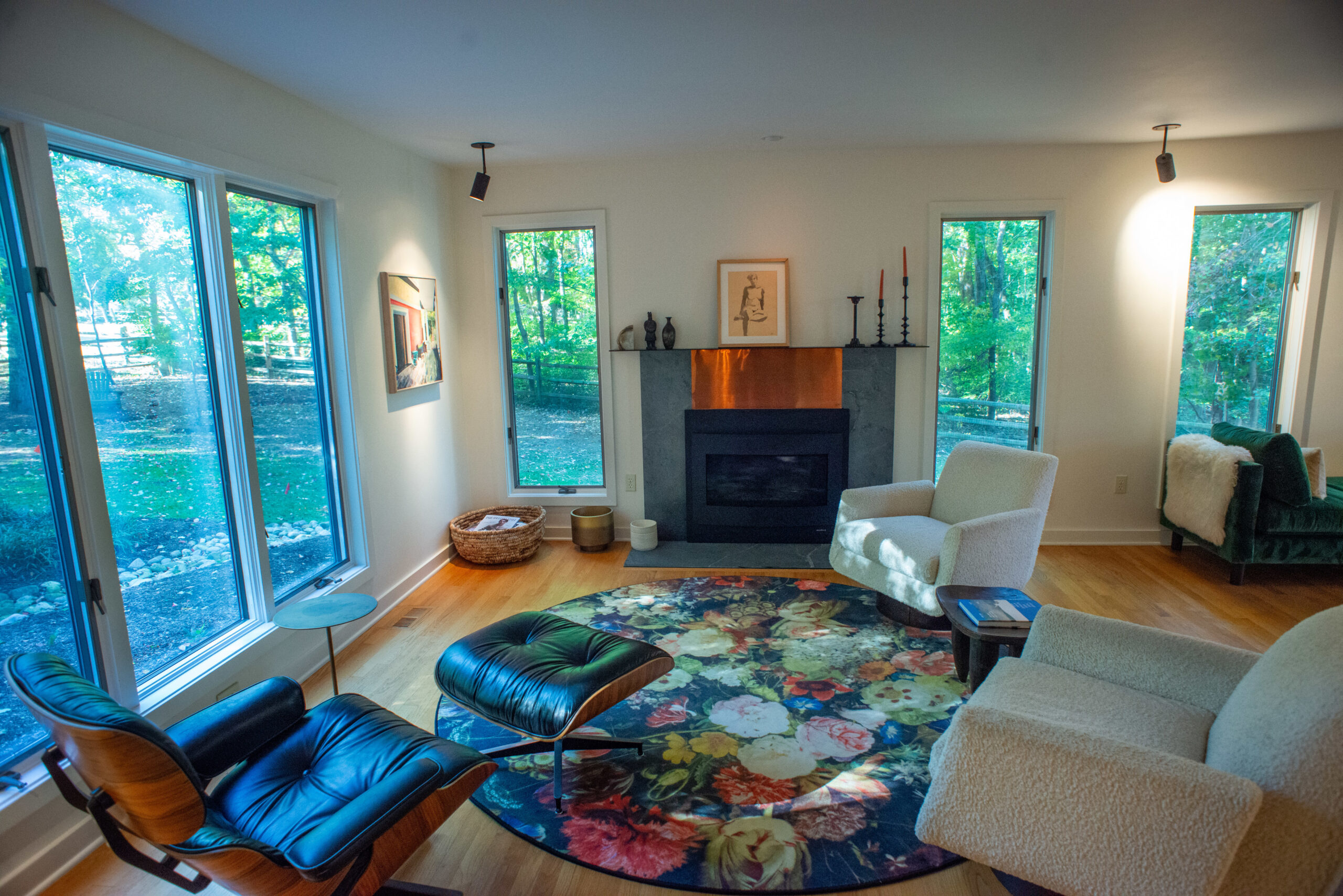
A copper plate and new mantle were added to the living room fireplace to make it more distinctive. The stone fireplace in the family room was whitewashed to blend with the white walls and emphasize the height of the cathedral ceiling. Furnishings include a tan leather sofa in the family room and white chairs, and a green velvet sofa and floral-pattern rug in the living room.
The fireplace stone in the family room was whitewashed to accentuate the tall ceilings.A copper plate and mantel were added to the living room fireplace.
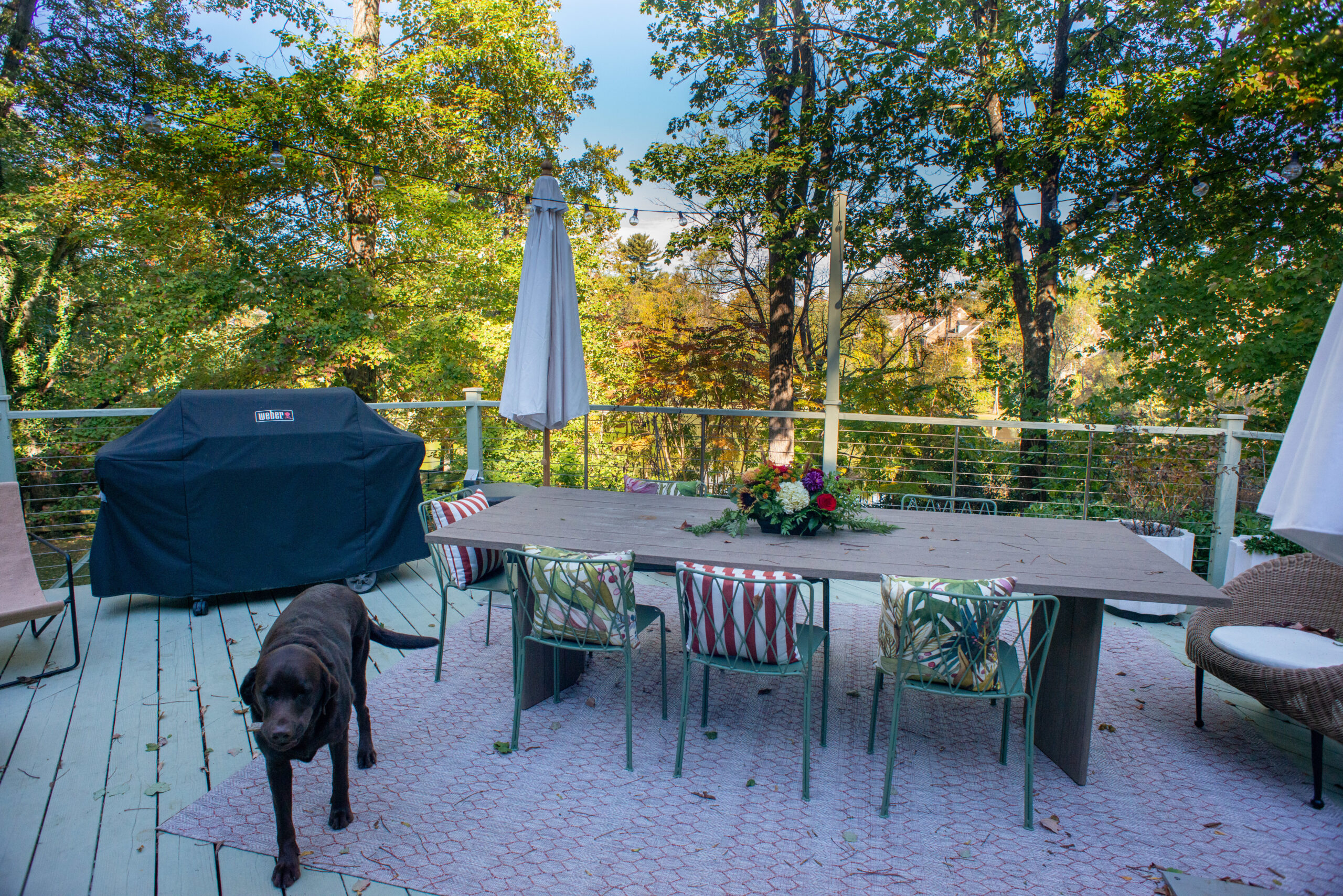
Outside, the decking was painted a moss green to blend with the surrounding foliage. The back wall of the covered porch was covered with glazed green tiles. The porch features a maroon-and-white-striped sectional and blue, beige, and purple lantern-shaped lights. “It’s a beautiful place to sit” and admire the pond and the changing colors of the leaves in late autumn, Casey said.
Some furnishings came from Material Culture, an antique store in Germantown. Other items and lighting came from Minima, a contemporary lighting and furniture store in Old City. Nehez said items were selected to “reflect the owners’ taste.”
She and Barankay chose black porcelain fixtures for the powder room and wallpaper patterned with black and white zebras on a red background. In a happy coincidence, after the powder room remodeling was completed, the designers found a print of two zebras in the families’ art trove, which they hung in the hall nearby.
The view of the nearby pond from the deck outside Lyons’ home.Lyons’ dog, Joe, walks along the three-level deck.
As is their custom, with some exceptions such as the dining room painting, they waited until all the furnishings were in place to hang the art.
Finding the right piece to blend in, Nehez said, is “like finding the perfect pair of earrings after getting dressed.”
Since the remodeling Casey, her sons, and husband “have a space where we can cook, watch, television, and dance,” she said, in a home she now loves.
Is your house a Haven? Nominate your home by email (and send some digital photographs) at properties@inquirer.com.
The worst kind of mob is the one that is displacing its aggression. Then again, maybe every mob is that kind of mob. The more unhinged the vitriol, the more concentrated its direction, the more likely it is driven by fears and frustrations that are much more difficult to reconcile than the ones that have bubbled to the surface. The easier the target, the more likely it is the wrong one. Because the fixes are rarely easy.
Kevin Patullo isn’t the first person to experience the downside of this city’s manic emotional instability when it comes to professional sports. He might be the first one to have his house egged, and he almost certainly is the first one to have his image offered as a target by a golf simulator company. But the general phenomenon is something that we see any time a Philly sports team underperforms expectations to the extent that the Eagles offense did this season. Frustration is a lot easier to process if you can convince yourself that it would not exist but for the gross incompetence of one person. It is even easier when that person has a job that is relatively easy to replace.
My point here isn’t to shame anybody. Actually, my point is to lobby the Eagles to spend whatever it takes to hire Mike McDaniel as their offensive coordinator. It’s a move that would give them a radical upgrade in play-calling and game-planning expertise and that would give them a fighting chance at reinventing a scheme that has stagnated under Patullo and Nick Sirianni and may be obsolete due to some serious personnel regression. But I also feel a little bit guilty expressing an opinion that legitimizes or adds to the unrestrained and oftentimes unthinking pile-on of poor Patullo that we’ve witnessed here over the last month-plus. It should be possible to criticize and/or question a person’s professional performance without disregarding the person part of it, especially when that person is someone who lives among us in the community and whose kids attend our schools.
I’m not suggesting that everybody, or even most people, have crossed the line into gratuitous abuse/humiliation. It sure feels that way in the aggregate, though. I don’t have a personal relationship with Patullo. If I did, I would certainly apologize to him on the city’s behalf. I actually think most people would do the same if they randomly found themselves talking to him one-on-one, maybe in an airport bar, or at their kid’s CYO game. I suppose that’s another funny characteristic of mobs.
I wasn’t going to bring up any of this. Mostly because I don’t want a mob to come after me. I know I’ll be accused of saying something I’m not actually saying, a common mob tactic that serves to stake out a defensible rhetorical position and reframe an argument into one that can actually be won. So, although it won’t matter, I will say it again. I agree with a lot of the criticisms of the Eagles’ offense, and that Sirianni’s decision to make a change at offensive coordinator is both warranted and necessary.
Kevin Patullo (center) talks with quarterback Jalen Hurts on Sunday in what was his final game calling plays for the Eagles.
That said, Eagles fans and media will be setting themselves up for a self-perpetuating cycle of offseasons like this one if they will not acknowledge the very obvious structural problems that exist well below the play-calling level on this Eagles offense. Even when this unit was at its best, it was trying to score points the same way it did under Patullo this season. The formula is the same as it was under Sirianni or Shane Steichen or Brian Johnson or Kellen Moore. The scheme and the personnel structure are built to stay ahead of the sticks with dominant run-blocking and to fill in the blanks with big plays from their elite talent at wide receiver and running back.
Listen to what DeVonta Smith said on Sunday when somebody asked him if the Eagles’ scheme needed to change after their season-ending loss to the 49ers.
“This the scheme that we’ve been in the whole time [since I’ve been here],” the receiver said. “Whatever anybody thinks, nothing changed. It’s the same scheme.”
Other players and coaches have said it countless times. Nobody seems to want to accept it. Yes, the Eagles have had four offensive coordinators in four seasons. And, yes, the offense was markedly worse this season than it was in the past. But it was the same scheme. It was the same philosophy.
The biggest difference between the Eagles offense this season and last season? On Sunday against the 49ers, Eagles running backs had eight carries that gained zero or negative yards. They had 20 such carries all last postseason, over four games. Eight on 30 carries against the dilapidated 49ers defense vs. 20 on 108 carries against the Rams, Packers, Chiefs, and Commanders last year.
Lane Johnson, one of the NFL’s ultimate warriors, is battling a foot injury that kept him from playing Sunday. Landon Dickerson basically shrugged when somebody asked him if he could get his body back to where it was last season. Cam Jurgens was pushed around all afternoon against the 49ers.
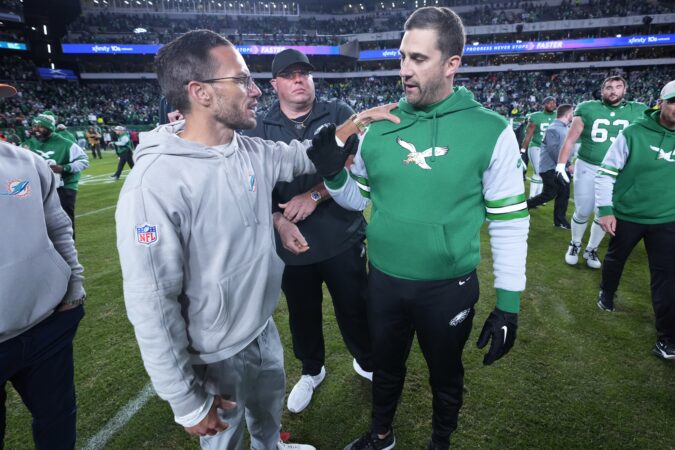
Mike McDaniel spent four seasons as Miami’s head coach and is a highly coveted candidate for several head coaching and offensive coordinator openings.
The Eagles’ only option is to bring in a fresh set of eyes and a proven track record of inventive run-scheming. They need to reinvent this offense, and McDaniel is the perfect mind to do it. Since he arrived in Miami in 2022, the Dolphins rank sixth in rushing average at 4.5 yards per attempt. He did this while also calling an offense that saw quarterback Tua Tagovailoa throw for 4,624 yards and go 11-6 in 2023.
There are all kinds of reasons to think it won’t happen. McDaniel is an eccentric personality who has spent the last four seasons with total control. Vic Fangio lasted less than one season as his defensive coordinator. McDaniel already reportedly has an interview scheduled with the Lions, who can offer him a good offensive line, excellent pass-catchers, and a running back that has the Devon Achane mold in Jahmyr Gibbs. That’s if McDaniel doesn’t land one of the remarkable nine head-coaching jobs that are currently open.
All the more reason for the Eagles to be aggressive. Howie Roseman and Jeffrey Lurie pride themselves on being ahead of the curve. They’d rather be a year early than a year late. Right now, it is getting late early. McDaniel or not, they need a new voice, an inventive mind, and a fresh set of eyes. Anybody else will end up right where Patullo is. And that’s not fair to anybody.
OpenTable has begun adding a 2% service charge on transactions made through the reservations site, including no-show penalties, deposits, and prepaid dining experiences such as special events.
An OpenTable spokesperson said the restaurants can absorb the 2% charge or pass it along to customers. The fee is part of what OpenTable called an overhaul that began rolling out to most U.S. restaurants in the second half of 2025, with the remainder scheduled for early 2026.
As before, patrons are not being charged directly for ordinary reservations; the restaurants continue to pay OpenTable to use the platform as part of their service agreement.
Davide Lubrano of Pizzata Pizzeria & Birreria with a Roman pizza, topped with mixed organic wild mushrooms, organic leeks, low-moisture mozzarella, prosciutto cotto Italian ham, stracciatella, pickled chiodini mushrooms in oil, chives, aged Parmigiano Reggiano, and truffle caviar pearls.
“Online payments are important for restaurants and, together with our restaurant partners, we’ve learned that they help reduce no-shows, improve cash flow, and increase revenue,” the OpenTable representative said. “By applying a standard service fee structure across all transaction types, we can continue to support new tools that help restaurants protect and unlock revenue.”
At Pizzata Pizzeria & Birreria on East Passyunk Avenue in South Philadelphia, co-owner Davide Lubrano said the restaurant recently turned to OpenTable in an effort to control persistent no-shows.
With just 48 dining-room seats split between two floors — plus a 12-seat bar that is first come, first served — missed reservations ripple through Pizzata’s service.
“What was happening is that we were turning away walk-ins, and then the reservation wouldn’t show up,” Lubrano said. “We ended up losing tables, basically.”
Pizzata just began requiring a credit card to hold OpenTable reservations, which call for a $15-per-person no-show fee.
But Pizzata is generous about it. Lubrano said customers get a 20-minute grace period, along with three reminder texts and a courtesy call. “If you don’t respond to the texts and don’t answer the call, that counts as a no-show, and that’s when the charge applies,” he said. “But if you answer and say you need to cancel, there’s no charge.”
As for the new 2% fee that would be tacked on to the $15 no-show charge, Lubrano emphasized that OpenTable and not the restaurant is assessing it.
He added that diners who prefer to avoid entering a credit card online can still call the restaurant directly. “You can always call us and avoid a credit card fee, and we put a reservation in for you,” he said.
In the final scene of Burn After Reading, the Coen brothers’ brilliant comedy about government espionage and … divorce, a CIA administrator, played by J.K. Simmons, listens as a subordinate named Palmer lays out a wild sequence of events. To sum it up: Tilda Swinton is married to John Malkovich but has been having an affair with George Clooney, who himself is married but has been dating Frances McDormand, who is friends with both Brad Pitt, who gets shot in the face by Clooney, and Richard Jenkins, who is in love with McDormand but gets hacked to death with an ax by Malkovich, who is left in a coma after getting shot by a CIA agent. At the end of the story, a dumbfounded Simmons finally rolls his eyes and asks, “What did we learn, Palmer?”
I don’t know about you, but that scene makes me think of the 2025 Eagles.
So, what did we learn from this season? Here’s what:
The offensive line has been the key to the Eagles’ success for years. This year, they lost that key.
The debates around Jalen Hurts, Nick Sirianni, Kevin Patullo, and A.J. Brown — and around what Jalen Hurts, Nick Sirianni, Kevin Patullo, and A.J. Brown might have said to one another on the sideline during the Eagles’ loss Sunday night to the San Francisco 49ers — are all, to a large degree, academic. If the team’s offensive line had played at the level that it did in 2024, or anywhere close to that level, the entire scope of the season, let alone Sunday’s result, would have been different. One statistic clarifies how great the falloff was: Last season, Saquon Barkley averaged 3.8 yards before contact. This season, he averaged 1.4, according to TruMedia.
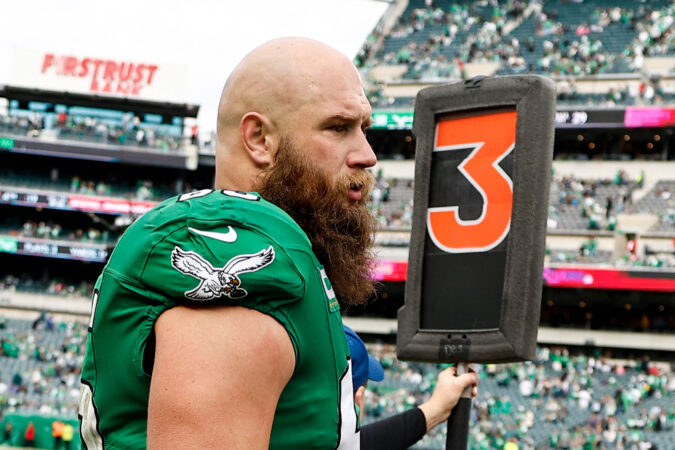
Eagles linemen (from left) Tyler Steen, Cam Jurgens, and Landon Dickerson had their ups and downs this season.
There are obvious explanations for the line’s regression: injuries, general wear and tear, replacing a road-grading guard in Mekhi Becton with a lesser run-blocker in Tyler Steen. Demoting Patullo, as the Eagles did Tuesday, was the predictable and correct move. Still, there’s no getting around the reality that one of the reasons few people complained about Kellen Moore’s play-calling in 2024 is that the 2024 OL could create holes and lanes for Barkley anytime, anywhere. Patullo did not have that luxury, and it’s unlikely the next conductor of the Eagles offense will, either, because …
… Lane Johnson has been the franchise’s most important player for a long time, and his future is murky. He turns 36 in May. He didn’t play after mid-November because of a Lisfranc sprain in his right foot. He is a surefire Hall of Famer. Since the Eagles drafted him in 2013, their record with him is 110-57-1, and their record without him is 18-27. The end of a great career is approaching, perhaps not next season but certainly sometime soon, and the franchise has to start making plans to replace him or to mitigate the effect of his absence. One way would be to draft some promising offensive linemen. Another would be …
… for the Eagles to set themselves up as a defense-first team. That’s where their best young players are, and there are such players at every tier of the unit: Jalen Carter, Jordan Davis, and Moro Ojomo at tackle; Jalyx Hunt and Jihaad Campbell on the edge; Zack Baun and Nakobe Dean (if they can keep him) at linebacker; Quinyon Mitchell and Cooper DeJean in the secondary. Plus, well, Vic Fangio. And the Eagles are going to need that defense to be elite, or as close as possible, because …
… the questions about Jalen Hurts aren’t going away. The biggest of them, ahead of the 2025 season, was whether the Eagles could rely on him more than they once did. In ’24, their running game was so dominant that they could get away with throwing the ball less often than any other team in the NFL and still win the Super Bowl. This season — without Barkley ripping off 6 yards every carry, with Hurts himself running less frequently and without the same explosiveness he had in the past — the offense sputtered and stalled. Given that Hurts will turn 28 in August and has absorbed his share of punishment over his five years as the Eagles’ starter, it’s fair to wonder whether that dynamism with his legs is gone forever.
Jalen Hurts is tackled by San Francisco’s Keion White and C.J. West during the fourth quarter of the playoff loss on Sunday.
It’s not that the Eagles can’t win a championship with Hurts. Of course they can. They did. It’s that they have to ask themselves, What conditions do we have to create to ensure that Hurts will be at his best, and can we create them? The Eagles and everyone around them have to set their expectations for Hurts and the entire franchise accordingly, for these last five-plus months proved that …
… Philly fans are at their worst when their teams don’t meet expectations. Based on the collective outrage since Sunday’s game, you’d never know that the Eagles won a Super Bowl less than a year ago and haven’t had a losing season in five years.
Eagles fans react during the wild-card playoff loss to San Francisco.
There seems to be a repulsive sense of entitlement and hair-trigger anger growing within the fan base, symbolized by a Bucks County indoor golf course whose owners allowed customers to drive balls at a projection of Patullo’s face. Patullo already had someone chuck eggs at his house in November, and if that incident could be dismissed as dumb kids doing dumb things, this one had a calculated maliciousness to it, especially considering the way it spread over social media.
You want to be a jerk in the privacy of your own home? Go for it. But a business or anyone else doing something like this for the likes and the attention is lousy, and it has the potential to snowball into something worse. It doesn’t matter how bad a play-caller Patullo was or wasn’t. Cut out the juvenile crap. The Eagles lost. Grow up and get over it.
Jihaad Campbell’s rookie season with the Eagles did not follow a conventional trajectory.
The first-round pick out of Alabama was touted as a versatile defensive weapon who offered the Eagles the ability to line him up in multiple spots. He could align inside or outside, off the ball or on the ball. Nakobe Dean’s injury rehabilitation, however, meant Campbell worked exclusively inside during training camp and started there next to Zack Baun for the first seven games of the season.
Then Dean returned, forced himself back into a permanent role, and the Eagles toyed with Campbell on the edge a little more, at a position that lacked depth, before eventually cutting his playing time when reinforcements emerged. Then Campbell was back to starting inside after Dean suffered a hamstring injury in Week 16. Overall, it’s hard to judge how the 21-year-old’s season with the Eagles went.
“Some adversity points,” Campbell said when asked to summarize his season Monday as the Eagles cleaned out their lockers after their playoff exit. “But when you look back at it, the only thing I can think about is being grateful, being thankful for the opportunities that I learned throughout the season, and just being able to be utilized and be trusted to be on the field.”
Campbell, who’s from Erial in Camden County, played in all 17 games and started 10 of them. He accumulated 80 tackles and had one interception to go with a fumble recovery and one forced fumble. Pro Football Focus graded him as the 13th-best of 88 linebackers. He excelled in pass coverage and was solid against the run.
Campbell is embarking on his first real NFL offseason, and it is an important one. He likely will be, as he said, utilized and trusted more next season because Dean is a pending free agent whose return to the Eagles seems unlikely. The Eagles paid Baun a premium price and have Campbell on a rookie deal waiting in the wings to replace Dean.
“Just hungry,” Campbell said of his offseason approach. “Of course, I’m going to give myself some grace and relax and get my mind off of things, but stay sharp spiritually, stay sharp physically, stay sharp mentally, and really do what I have to do to be the best absolute version of myself so when I come back I’m making sure that I’m staying on top of everything I have to do.”
Jihaad Campbell’s fumble recovery against the Bills was one of his highlight reel-worthy moments of 2025.
Campbell said he wasn’t given specific things to work on from the Eagles’ coaching staff, but he planned to work on “everything.” There were things he learned with the Eagles and from Vic Fangio that he “never really knew.” He learned plenty from Dean, too.
“That’s a damn good football player,” Campbell said. “I learned a lot from that guy, man, in the run game, blitzes, in the passing game. Really just being a baller, a person who knows football in general. It’s hard to come around guys who really know football and really dissect it in a simple format. That’s what he does, and that’s why he’s one of the best linebackers in the world.”
Campbell took his midseason demotion in stride. He said in November that his focus was on helping the Eagles win games in whatever way he could and staying prepared for when his number was called. The Eagles needed him to start their final two regular-season games. He was credited with two quarterback pressures in each of those games and had seven tackles vs. Buffalo and 10 vs. Washington.
How did Campbell handle the ups and downs with ease?
“I think it’s just all about controlling the things that you can control, and only that,” he said. “I make sure that I come in this building every day with a smile on my face, with a getting-to-work mentality, whatever it is.”
Jihaad Campbell’s role increased during the latter stages of the season.
It was unsurprising, then, that Campbell didn’t put himself in a box when asked Monday about his positional future. Nine months ago, the Eagles lauded his ability to be a chess piece at different spots. Where does Campbell see himself long term?
“I think it’s all about the value and how good you can be at anything you can be put in, whether that’s being an R3 or L3 on kickoff or punt return or any of those things on special teams,” he said. “For me, it’s all about just being trusted and being able to be utilized in this scheme wherever they want me to be at, whether that’s inside linebacker, outside linebacker, just making sure that I’m on top of my things and having continuous improvement.”
As he did this past season, Campbell seems content to go with the flow.
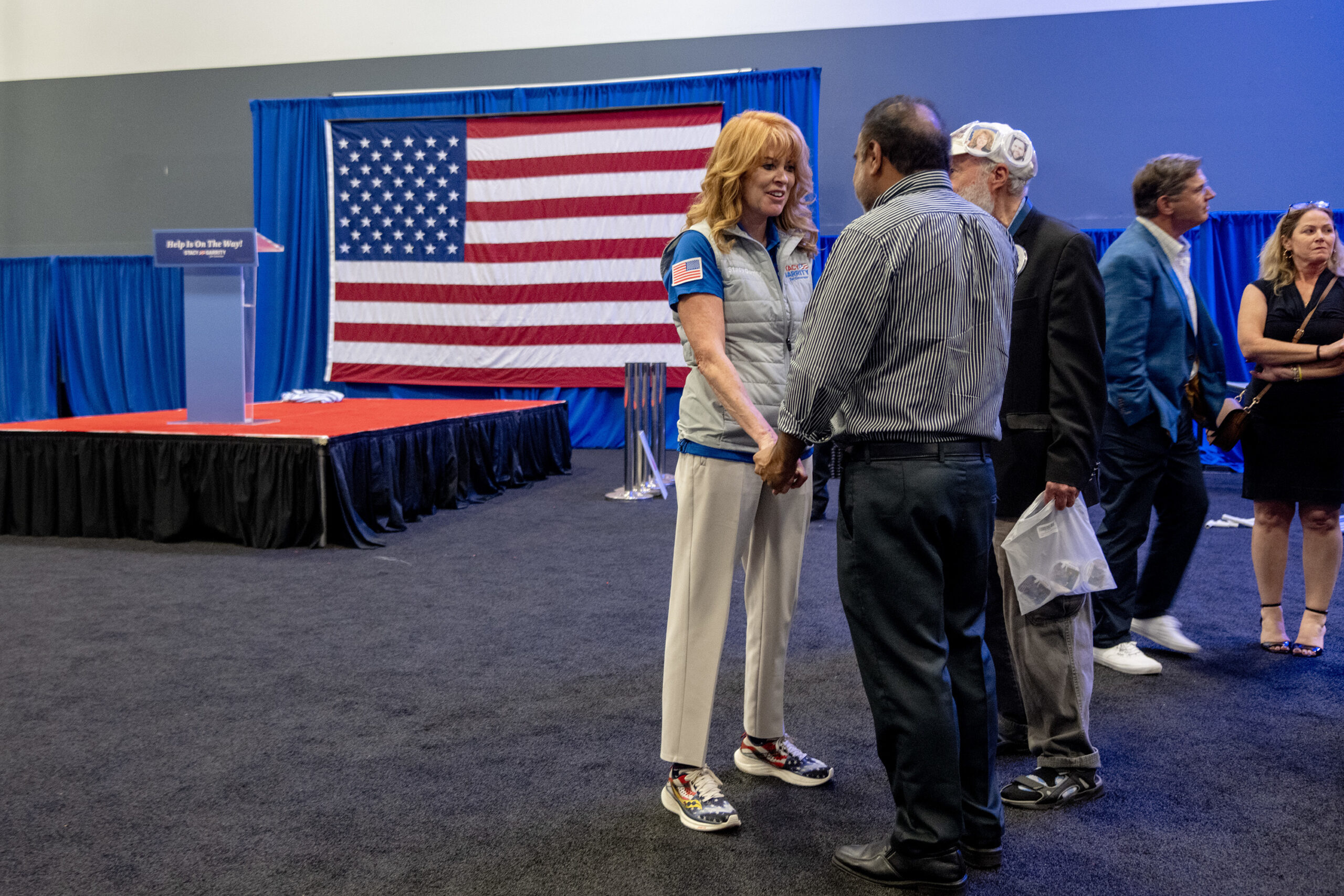
HARRISBURG — State Treasurer Stacy Garrity has been the Pennsylvania Republican Party’s endorsed candidate for governor since September, but few candidates have stepped up to run alongside her for lieutenant governor.
Only two candidates have officially thrown their hats in the ring for Republican lieutenant governor, as Garrity faces the uphill battle of running against a popular incumbent in Democratic Gov. Josh Shapiro. And despite amassing unusually early support from the state party, recruiting someone to run as her No. 2 has proven challenging, as some potential candidates have declined to run.
Garrity said Monday at the Pennsylvania Press Club luncheon she’s in talks with “a lot of people,” and she’s confident she’ll find a running mate “perfect for the ticket.”
But time is of the essence, as she has less than a month until the state GOP meets for its winter meeting, where the party is expected to endorse a lieutenant governor candidate. Whomever she picks is likely to get the nod.
“In many respects, it’s up to Stacy Garrity,” said GOP strategist Charlie Gerow. “The lieutenant governor candidate has to not only be a good political fit, but has to be a good personal fit for her. Otherwise, the ticket falls apart before you get to Election Day.”
So far, the only two GOP candidates to formally announce their campaigns for lieutenant governor are State Sen. Cris Dush (R., Jefferson), who is one of the most conservative members of the Senate GOP caucus, and Bucks County businessman and political newcomer Brian Thomas. Dush said he’d likely pursue the GOP primary nomination even if he isn’t endorsed by the state party, while Thomas announced his candidacy last week in a press release and said he is now reaching out to party leaders seeking their support.
And more far-right Republicans have publicly floated a run, teeing up a potential battle among some of the state’s most conservative members to run alongside Garrity on the November ballot.
In Pennsylvania, candidates for lieutenant governor face their own primary races separate from the candidates for governor. After the primary, the winners are joined onto one ticket and run together in the general election.
Former State Rep. Rick Saccone, who previously ran for lieutenant governor and was on U.S. Capitol grounds during the Jan. 6, 2021 riot but did not face criminal charges, has publicly stated his interest in the role. Saccone said he would not enter the race if the state party backed another candidate.
And State Sen. Doug Mastriano, a far-right Republican who lost to Shapiro in 2022 and last week ruled out a second run for the GOP nomination, later claimed on a local radio station that Garrity would need him as her running mate if she wants to win.
Few more moderate options have emerged.
Montgomery County Commissioner Tom DiBello, a Republican from Shapiro’s home county, said in an interview that he had been approached about pursuing the role. DiBello said he received a positive reception when he traveled the state contemplating a run, but he implied Monday that he’d moved on. On Tuesday night DiBello lost his bid to be the next chair of the county party to his former running mate, Liz Ferry.
“I had a lot of support out there as far as potentially running for lieutenant governor, but I’m right now very dedicated to Montgomery County,” DiBello added.
A number of other officials are rumored to have withdrawn themselves from consideration or are still in talks with Garrity’s campaign, several Republican insiders said.
This time around, the sense among Pennsylvania state party members is that Garrity should be given leeway to choose her running mate and party faithful will endorse her choice.
Many hadn’t even heard who might be in the running. But several Republicans who spoke to The Inquirer said they think Garrity needs to pick someone who will appeal to Democrats and independents who voted for Shapiro four years ago.
“We’re a purple state, and my sense is a more moderate candidate that appeals to a bigger swath of the electorate would be, if I were selecting, would be a preference here,” said Jason Richey, the chair of the Allegheny County GOP.
Or, as Val Biancaniello, a Republican state committeewoman from Delaware County, put it, a candidate needs “statewide appeal.”
State Treasurer Stacy Garrity greets supporters following a campaign rally in Bucks County on Sept. 25, 2025. The GOP gubernatorial candidate visited the Newtown Sports & Events Center, in one of Pennsylvania’s top swing counties.
DiBello argued that Garrity’s running mate needs corporate and government experience, though he refused to name anyone else being considered behind the scenes. Garrity said she believed that DiBello was no longer “in the mix” for the job, but she did not expand further.
“I’m not putting my finger on the scale,” DiBello said before joking: “I’ve heard this Montgomery County commissioner would be awesome. I’ll put my finger on that scale.”
Garrity largely declined to comment on the candidates whose names have been circulating for her running mate, except for Mastriano.
“I didn’t even know he wasn’t running for governor until last week,” Garrity told reporters, noting her friendship with Mastriano. “We’re in discussion with a number of people, and I know that we will have the absolute best partner as lieutenant governor when the time is right.”
In his campaign launch Thursday, Shapiro tied Garrity to the extremes of her party, asking voters to choose between “getting stuff done” and “chaos.” A far-right running mate will make that message easier for Democrats as they work to secure the governor’s mansion for another four years.
Despite this, Mastriano was bullish Friday morning speaking on WEEO News Talk 103.7 FM in central Pennsylvania.
“That’s a possibility,” Mastriano said about a potential lieutenant governor run. “To be honest, that probably [is] the only way to generate some excitement for the Garrity ticket, and we know Garrity being on top of the ticket, that’s probably the only way the party would win if I did that.”
Phillies president of baseball operations Dave Dombrowski has said repeatedly over the offseason that bringing back Realmuto, who has backstopped the team since 2019, remains a priority. And that isn’t just the sentiment in the front office. Shortly after Kyle Schwarber signed his own five-year extension in December, he shot a text to Realmuto to try to coax him to do the same.
“He’s one of the best catchers in the game,” Cristopher Sánchez said in September. “We’re basically nothing without him.”
Five years ago, when Realmuto signed his last contract with the Phillies, they didn’t come to an agreement until Jan. 26. But if the sides don’t reach a deal this time, what happens at catcher?
Here’s a breakdown of the Phillies’ options behind the plate if they don’t reunite with Realmuto:
Rafael Marchán made just 30 starts as the backup to J.T. Realmuto last season.
Option 1: Internal
Entering the 2025 season, the Phillies anticipated giving Realmuto, who will be 35 in March, more time off to prioritize his health. In spring training, manager Rob Thomson even floated the idea of Realmuto seeing time in left field, since the designated hitter spot was taken by Schwarber.
That suggestion never went anywhere. And in fact, rather than cut back, Realmuto played 134 games in 2025 and avoided spending any time on the injured list. Of those games, 132 were behind the plate, which tied him with 26-year-old Patrick Bailey of the Giants for most defensive games played as a catcher in the National League.
That also meant that backup catcher Rafael Marchán made only 30 starts.
The Phillies agreed to terms on 2026 contracts with Marchán and Garrett Stubbs this offseason, and they are the only catchers on the Phillies’ 40-man roster. If bringing back Realmuto isn’t in the cards and the Phillies stick with the status quo, it likely would mean a large increase in workload for the 26-year-old Marchán, who also has an injury history.
Marchán, a switch-hitter, had a .210 batting average and .587 OPS in 118 plate appearances last season. He was solid defensively in a small sample size, with a 96th percentile pop time of 1.88 seconds and catching four runners stealing above average.
In 2024, Marchán was limited to 55 games between the minors and majors because of lower back and shoulder injuries.
Stubbs saw more consistent at-bats in triple A, where he spent most of the season before being called up in September when rosters expanded. He hit .265 with a .754 OPS for Lehigh Valley, where he also developed a rapport with top pitching prospect Andrew Painter.
Neither has played more than 54 major league games in a season. It would be a significant gamble for the Phillies to rely on a Marchán-Stubbs tandem without bringing in an external option.
Stubbs and Marchán are out of options in 2026, and the catching depth beyond them is thin. To bolster it, the Phillies signed Mark Kolozsvary to a minor league deal in December and René Pinto to a minor league deal last week. They likely join Paul McIntosh and Caleb Ricketts as depth options in the minors next season.
Kolozsvary, 30, played 30 games last season between the Boston Red Sox’ double-A and triple-A affiliates and landed on the full-season injured list in June. He hasn’t made a major league appearance since 2023.
Pinto played 19 games for the Rays in 2024, hitting .214 with a .721 OPS. The 29-year-old spent the majority of last season in triple A between the Diamondbacks and Blue Jays organizations. He slashed .259/.309/.498 in 64 games.
Veteran catcher Victor Caratini posted 0.9 WAR with the Astros in 2025.
Option 2: Free agency
Realmuto remains the top catcher available in free agency ranked by wins above replacement (2.5 bWAR in 2025).
Several other options are off the board in an overall thin market for catchers this winter. Danny Jansen signed a two-year contract with the Rangers, and James McCann signed a one-year deal with the Diamondbacks.
After Realmuto, Victor Caratini, 32, is one of the more established names remaining. The switch-hitter slashed .259/.324/.404 in 114 games for the Astros in 2025 with 12 homers. He posted 0.9 WAR in 2025.
Jonah Heim is another veteran option after he was nontendered by the Rangers in November, two seasons removed from being an All-Star selection and Gold Glove winner in 2023. He hit .213 with 11 home runs in 124 games and posted 0.4 WAR last season.
Heim averaged minus-1 blocks above average and caught minus-1 runners stealing above average.
Option 3: Trade
The most likely path to find a catching replacement comparable to Realmuto would be via trade. There’s already been some movement elsewhere, with the Nationals acquiring the Mariners’ top catching prospect, Harry Ford, in exchange for reliever José A. Ferrer in December.
There hasn’t been much buzz lately around the Orioles’ Adley Rutschman, who was the subject of trade rumors after Baltimore signed top prospect Samuel Basallo to an eight-year extension in August.
Orioles president of baseball operations Mike Elias told reporters at his season-end news conference that “Adley’s the guy. He will be our front-line catcher.”
The Twins have so far retained catcher Ryan Jeffers, who is entering his final season of team control. But dealing the 28-year-old could be a way for the Twins to recoup some assets as they continue building for the future after their trade-deadline fire sale in 2025. Jeffers hit .266 with a .752 OPS in 119 games last season.
Reds catcher Tyler Stephenson, 29, also becomes a free agent in 2027 and could be a trade chip for Cincinnati, which has some flexibility at the position. The Reds have locked up Jose Trevino as their backup and also claimed Ben Rortvedt off waivers from the Dodgers in November.
Stephenson hit .231 with a .737 OPS over 88 games in 2025.
When Cherelle L. Parker was a City Council member, she championed a strict residency rule that required city employees to live in Philadelphia for at least a year before being hired.
Amid protest movements for criminal justice reform in 2020, Parker said stricter residency requirements would diversify a police force that has long been whiter than the makeup of the city, and ensure that officers contribute to the tax base.
“It makes good common sense and good economic sense for the police policing Philadelphia to be Philadelphians,” she said then.
But today, under now-Mayor Parker, more police live outside Philadelphia than ever before.
About one-third of the police department’s 6,363 full-time staffers live elsewhere. That share — more than 2,000 employees — has roughly doubled since 2017, the last time The Inquirer conducted a similar analysis.
(function() {
var l2 = function() {
new pym.Parent(‘ppd_zips’,
‘https://media.inquirer.com/storage/inquirer/projects/innovation/arcgis_iframe/ppd_zips.html’);
};
if (typeof(pym) === ‘undefined’) {
var h = document.getElementsByTagName(‘head’)[0],
s = document.createElement(‘script’);
s.type = ‘text/javascript’;
s.src = ‘https://pym.nprapps.org/pym.v1.min.js’;
s.onload = l2;
h.appendChild(s);
} else {
l2();
}
})();
Today, the percentage of nonresidents is even higher among the top brass: Nearly half of all captains, lieutenants, and inspectors live outside the city, according to a review of the most recent available city payroll data.
Even Commissioner Kevin Bethel keeps a home in Montgomery County, despite officially residing in a smaller Northwest Philadelphia house that he owns with his daughter.
Most municipal employees are still required to live within city limits. Across the city’s 28,000-strong workforce, nearly 3,200 full-time employees listed home addresses elsewhere as of last fall. Most of them — more than 2,500 — are members of the police or fire departments, whose unions secured relaxed residency rules for their workers in contract negotiations. About a quarter of the fire department now lives outside the city.
Philadelphia Mayor Cherelle L. Parker and Police Commissioner Kevin Bethel speak before the start of a news conference.
Proponents of residency rules in City Hall have long argued they improve rapport between law enforcement and the communities they serve, because officers who have a stake in the city may engage in more respectful policing.
But experts who study public safety say there is little evidence that residency requirements improve policing or trust. Some say the rules can backfire, resulting in lesser quality recruits because the department must hire from a smaller applicant pool.
A survey of 800 municipalities last year found that residency requirements only modestly improved diversity and had no measurable effect on police performance or crime rates.
“It’s a simple solution thrown at a complex problem,” said Fritz Umbach, an associate professor at John Jay College of Criminal Justice. “It doesn’t have the impact people think it will.”
Parker, a Philadelphia native who lives in the East Mount Airy neighborhood, says she would still prefer all municipal employees live in the city.
“When I grew up in Philadelphia, it was a badge of honor to have police officers and firefighters and paramedics who were from our neighborhood,” she said in a statement. “They were part of the fabric of our community. I don’t apologize for wanting that to be the standard for our city.”
‘Where they lay their heads at night’
What qualifies as “residency” can be a little pliable.
Along with his wife, Bethel purchased a 3,600-square-foot home in Montgomery County in 2017 for over a half-million dollars. Although he initially satisfied the residency rule by leasing a downtown apartment after being named commissioner by Parker in late 2023, he would not have met the pre-residency requirement the mayor championed for other city employees while she was on Council.
Today, voter registration and payroll data shows that Bethel resides in a modest, 1,800-square-foot rowhouse in Northwest Philadelphia, which he purchased with his daughter last year. While police sources said it was common for Bethel to sleep in the city given his long work hours, his wife is still listed as a voter in Montgomery County.
Police Commissioner Kevin Bethel speaks during the 22nd District community meeting at the Honickman Learning Center on Dec. 2, 2025.
Sgt. Eric Gripp, a spokesperson for the department, said in a statement that Bethel is a full-time resident of Philadelphia, and that while he owns a property outside the city, his “main residence” is the home in Northwest Philly.
Although sources say it was not unheard of for rank-and-file officers to use leased apartments to satisfy the requirement on paper, Gripp said “only a small number” of residency violations had required formal disciplinary action following an investigation by the department’s Internal Affairs Division.
That likely owes to officers’ increasing ability to reside elsewhere legally. The Fraternal Order of Police Lodge 5, which represents thousands of active and retired Philadelphia Police officers, won a contract provision in 2009 allowing officers to live outside the city after serving on the force for at least five years.
The union didn’t respond to a request for comment.
Few of the cops who left the city went very far.
While Northeast Philly and Roxborough remain the choice neighborhoods for city police, the top destinations for recent transplants were three zip codes covering Southampton, and Bensalem and Warminster Townships, according to city payroll data.
A few officers went much farther than the collar counties.
Robert McDonnell Jr., a police officer in West Philadelphia’s 19th district with 33 years on the force, has an official address at a home in rural Osceola Mills, Pa., about 45 minutes north of Altoona in Centre County.
A person who answered a phone number associated with McDonnell — who earned $124,000 last year between his salary, overtime, and bonus pay — declined to speak to a reporter.
Asked about the seven-hour round-trip commute McDonnell’s nominal residence could entail, Gripp said the department doesn’t regulate the manner in which employees travel to and from work.
“Our members serve this city with dedication every day,” he said, “regardless of where they lay their heads at night.”
A long and winding history
Versions of residency rules can be found as far back as the 19th century, when police recruits were required to live in the districts they sought to work in.
But when Mayor Joseph S. Clark pushed to reform the city charter in the 1950s, he sought to abolish the rules as an impediment to hiring, saying “there should be no tariff on brains or ability.”
Instead, City Council successfully fought to expand the restrictions. And, for more than five decades, the city required most of its potential employees to have lived in Philadelphia for a year — or obtain special waivers that, in practice, were reserved for the most highly specialized city jobs, like medical staff.
Many other big cities enacted similar measures either to curb middle-class flight following World War II or to prioritize the hiring of local residents. But the restrictions were frequently blamed for causing chronic staff shortages of certain hard-to-fill city jobs.
Officers Azieme Lindsey (from left), Charles T. Jackson, and Dalisa M. Carter taking their oaths in 2023.
Citing a police recruit shortage in 2008, former Mayor Michael A. Nutter successfully stripped out the prehiring residency requirement for cadets. Recruits were required only to move into the city once they joined the force.
A year later, the police union attempted to have the residency requirement struck from its contract entirely.
Nutter’s administration objected. But an arbitration panel approved a compromise policy to allow officers to live elsewhere in Pennsylvania after five years on the job. By 2016, firefighters and sheriff’s deputies secured similar concessions.
But experts say there’s little research showing that to be true.
“I am unsure if requiring officers to reside in the city is a requirement supported by evidence,” said Anjelica Hendricks, an assistant law professor at the University of Pennsylvania who worked for the city’s Police Advisory Commission. “Especially if that rule requires a city to sacrifice something else during contract negotiations.”
FOP leaders have long opposed the rule and said it was partly to blame for the department’s unprecedented recruitment crisis and a yearslong short-staffing problem that peaked in the aftermath of the COVID-19 pandemic.
In 2022, facing nearly 1,500 unfilled police jobs, former Mayor Jim Kenney loosened the prehire residency rule for the police department again, allowing the force to take on cadets who lived outside the city, so long as they moved into Philadelphia within a year-and-a-half of being hired.
Since then, recruiting has rebounded somewhat, which police officials attribute to a variety of tactics, including both the eased residency rules and hiring bonuses. The force is still short 20% of its budgeted staffing and operating with 1,200 fewer officers than it did 10 years ago.
Umbach, the John Jay professor, said the impact on recruiting is obvious: Requiring officers to live in a city where the cost of living may be higher than elsewhere amounts to a pay cut, which shrinks candidate pools.
“Whenever you lower the standards or lower the appeal of the job, you’re going to end up with people who cause you problems down the road,” he said. “A pay cut is just that.”