Tag: topic-link-auto

  • The 1873 painting that is being seen for the first time in 152 years

    The 1873 painting that is being seen for the first time in 152 years

    Back in September 1873, the New York Herald announced that the Hudson River School painter Jasper Francis Cropsey had a new painting. Autumn in the Ramapo Valley, Erie Railway, which would be open to public viewing for “only a day or two longer” at the Wall Street office of Charles Day, the article said.

    The painting was commissioned by investor James McHenry, who, with Day, was director of Erie Railway. McHenry, who had been a director of the Atlantic and Great Western Railway before that, had his eye set on the Erie Railway, which was founded in 1832.

    In 1872, in what is best described as a corporate coup, McHenry ousted the railroad magnate Jay Gould and took full control over Erie Railway. In celebration, he commissioned the Cropsey painting, which, after those few days on Wall Street, made its way to McHenry’s home in London and remained in private collections, away from the public eye since.

    Until now.

    In 2024, philanthropists J. Jeffrey and Ann Marie Fox, who live in Bucks County, bought the painting and brought it back to the United States. It is on view at the Brandywine Museum of Art, some 150 miles away from the original setting of the painting, where flatlands west of the Hudson River meet steep hills near the town of Sloatsburg, N.Y.

    Here, it can be seen by an American audience for the first time in 152 years.

    The Foxes and American art

    J. Jeffrey Fox has built a successful career in finance and education and his wife, Ann Marie, has worked with several nonprofits, often focusing on children with special needs. Together, in 2024, they made a $20 million gift to endow the J. Jeffrey and Ann Marie Fox Graduate School at Pennsylvania State University.

    The couple, said Jeffrey Fox, have always been interested in American history.

    “We used to collect art as souvenirs. We would go to estate sales and garage sales and sometimes buy a piece of art,” he said. “It wasn’t a collection that was of any significance. So once we got a little bit more money, we wanted to buy one painting that’ll be the centerpiece for the rest of our collection.”

    They bought Frederick Childe Hassam’s The Cove, Isles of Shoals (1901) at an auction in 2015.

    The discerning eye in the couple has always been Ann Marie’s. She spent 15 years volunteering at the Walters Art Museum in Baltimore, and when the couple lived in Annapolis, Md., she took classes under Matt Herban, a retired professor of art from Ohio State University.

    After that first Hassam, the couple wanted a Cropsey. But not just any Cropsey.

    “We went to the National Gallery and they had a fabulous Cropsey [Autumn — On the Hudson River (1860)]. It just took our breath away. And we were like, ‘Wow, how could we ever get something that good.’ That’s why it took us this long,” said Ann Marie.

    “We were very picky. Every artist has great days, and every artist has OK days. We wanted Cropsey on a great day,” her husband said.

    Finding Cropsey on a great day

    Last year, the Foxes’ art adviser came to know from a friend in Europe that Autumn in the Ramapo Valley was coming up for auction in London in September. Believing that the painting was best sold to an American buyer, this friend approached the adviser before the painting went under the hammer.

    The Foxes had 48 hours to make a decision to buy, never having seen the painting, aided only by a high-quality photograph and a condition report.

    Cropsey’s catalog raisonné, put together by the Newington Cropsey Foundation in Hastings-on-Hudson, N.Y., says the painting left the country in September 1873. Documents said the painting has been in an undisclosed buyer’s family since the 1950s.
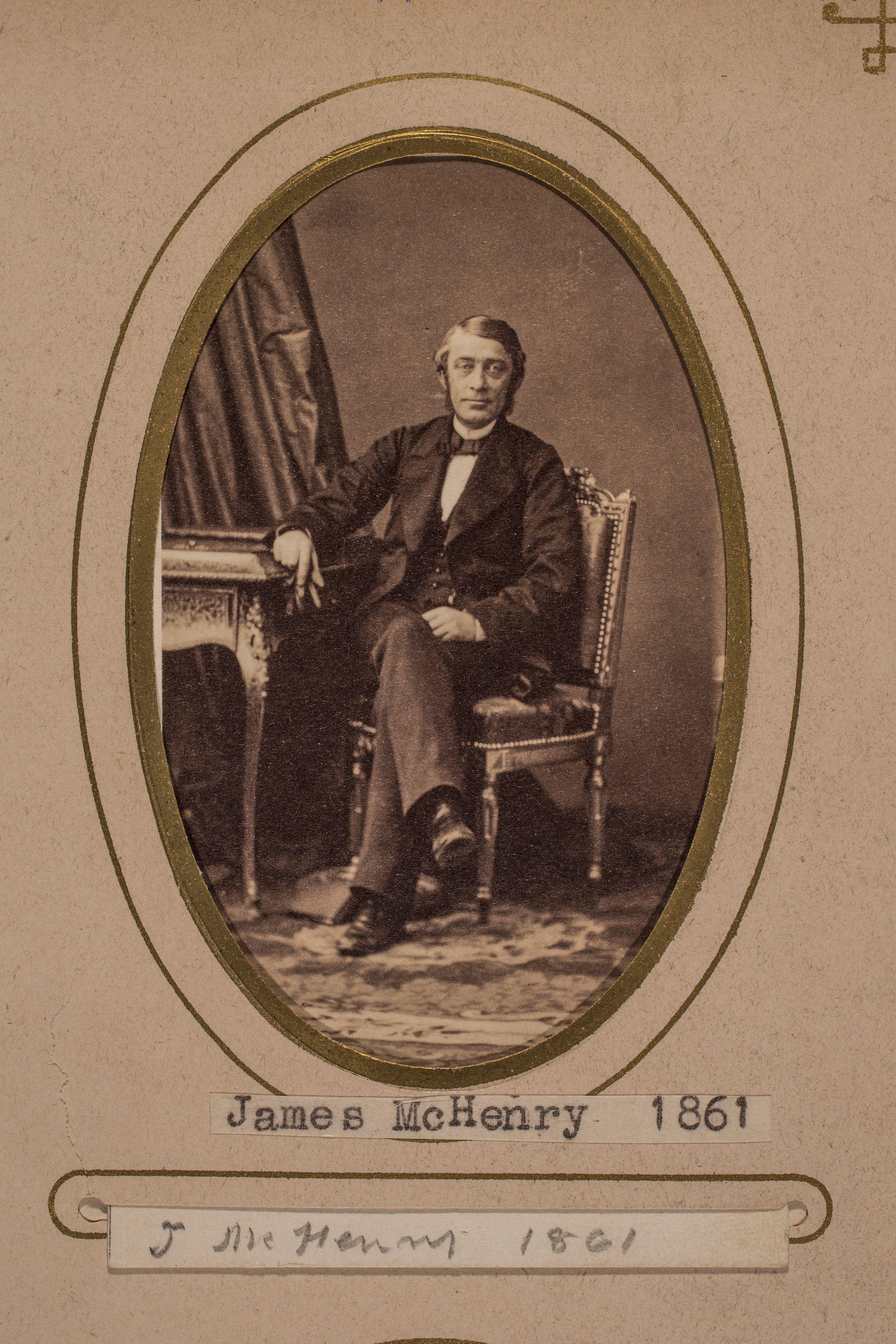
    James McHenry’s carte-de-visite,
    1861.

    McHenry died in 1891 and “we don’t really know what happened from 1891 to the mid-’50s, but we do know that it never left England,” Jeffrey said. “And we don’t think it was ever shown in England. There are no records that we were able to find.”

    Ann Marie said yes, and the couple wrote up a letter of intent.

    “We were a bit concerned,” said Jeffrey. Another Cropsey — Richmond Hill in summer of 1862, also owned by McHenry — that came up in an auction in 2013 was deemed a “national treasure” by the U.K. and was not allowed to leave the country.

    The clearance for Autumn in Ramapo to leave England took a little over three months.

    “The English let that out of England because it was an American artist, and an American scene,” Jeffrey said.

    The couple bought the painting in January 2025. Once the artwork arrived in the United States, a restorer found it to be in exceptional condition, exactly as advertised. In March, the conservator finished assessing the painting, and the Foxes traveled to New York to see it in real life.

    “It just displayed so much grandeur. I thought it was wonderful,” Anne Marie said. “The autumn colors … just stunning. And the size of it is amazing. The first thing I said when I saw it was, ‘It can’t come to my house. It’s going to tear down my wall.”

    Including the frame, the artwork measures 4.75 feet by 7.16 feet.

    “Our house isn’t that big, we probably couldn’t get through the door,” Jeffrey said.

    The couple couldn’t ship it to their foundation office, either. “We needed a museum that would be willing to show it and buy into the story, because it’s a phenomenal story,” Jeffrey said.

    That museum was the Brandywine.

    The “Cropsey, Wyeth, and the American Landscape Tradition” exhibition runs through May 31 at the Brandywine Museum of Art.

    The painting and the painter

    It’s easy to miss the “Erie Railway” part in Autumn in the Ramapo Valley, Erie Railway. Cropsey paints an idyllic fall scene with the Ramapo Valley bathed in yellow, red, and, orange foliage. Bits of green peep out, the sky is clear and a light blue, a waterfall flows gently on the left, the Ramapo River sits still.

    The smoke-billowing train chugs through the valley in the distance, but in the center of the painting. Black rails of the railway bridge run parallel to the river and disappear into the leaves.

    The setting of the painting falls between what is New York’s Orange and Rockland County, on the western side of the Hudson River, and north of Suffern.

    “This painting … really helps in telling a fuller story of the history of American art, and particularly, this brief moment, in the third quarter of the 19th century, when huge sums were being spent on huge paintings,” said William L. Coleman, curator at the Wyeth Foundation and director of the Andrew & Betsy Wyeth Study Center.

    “This is part of a larger story with artists like Frederic Church, Albert Bierstadt, and Thomas Moran.”
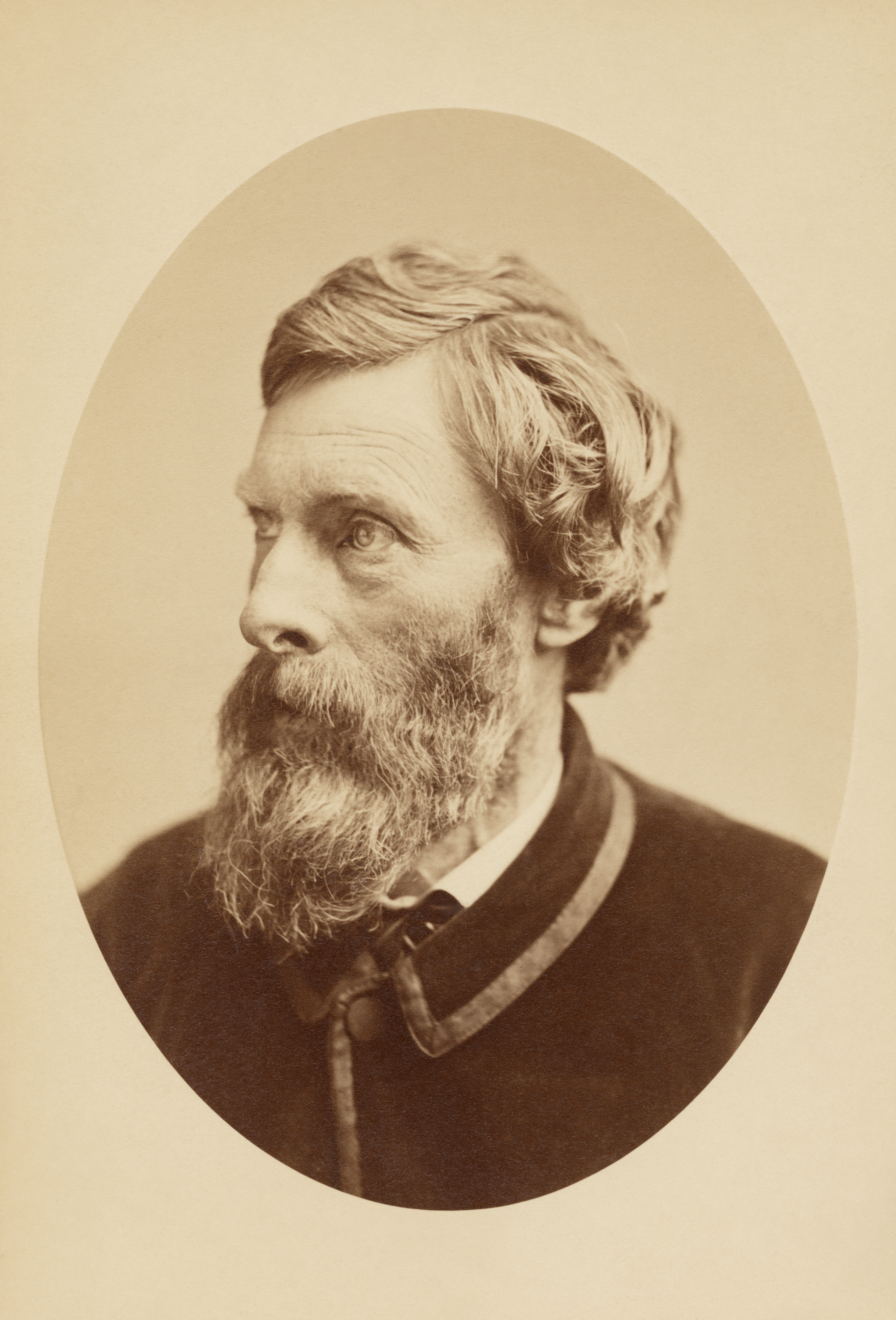
    Jasper Francis Cropsey by Napoleon Sarony, circa 1870.

    Cropsey, an architect who had designed several railway stations himself, was part of a line of artists who “engaged with the new fortunes being made from the transportation industry, making images of new railroads traveling through the landscapes,” Coleman said.

    The artists enjoyed generous patronage and lived well. Cropsey lived in a mansion he built, called Aladdin, less than 10 miles away from the site of the painting. Here he built himself a studio that doubled as a gallery and art marketplace.

    The Philadelphia story

    Cropsey’s patron James McHenry was born in Ireland in 1817 and was raised in Philadelphia. He moved back to England, living primarily in London, where he made a fortune raising money and investing it in developing railways in America.

    His sister remained in Philadelphia until her death.

    Jeffrey Fox calls McHenry “notorious,” adding that he often worked against other equally infamous “robber barons” like Cornelius Vanderbilt and Gould.

    “He paid $25,000 on a Bierstadt painting in 1865, so he was quite an art collector himself,” Jeffrey said. McHenry, who already owned Richmond Hill in Summer of 1862, perhaps had gotten acquainted with Cropsey when the artist visited England in 1856.

    Cropsey had already made a name for himself painting Starrucca Viaduct, Pennsylvania (1865) —where, too, a distant train almost merges into the green slopes of the mountain behind it — when McHenry wanted an artist to commemorate his pushing Gould out of the Erie Railroad directorship in 1873.

    “He had already gotten a national reputation for painting part of this exact railroad, and so James McHenry went to the railroad guy,” said Coleman, “and commissioned Autumn in Ramapo.

    Artists like Bierstadt and Sanford Robinson Gifford were also working on similar railroad commissions at the time.

    “Most of their stock and trade are images that make use of the aesthetic value of the sublime, the power of the natural world against the small scale of human existence. So they give us that feeling of awe, of wonder,” Coleman said.

    Landscape paintings, he said, “tell stories about belonging, about ownership, about your place in a wider society. … And they often risk being underestimated. These are pleasant, old pictures that we see on calendars and postage stamps, but they have a lot to tell us about how we became the nation we are today.”

    The model train at Brandywine Museum’s holiday showcase in 2018.

    An irrelevant cost

    At Brandywine, Cropsey’s train speaks to the museum’s beloved holiday train display, posing questions of tradition and modernity as the nation enters its 250th year.

    It will stay at the museum through May and then travel to the Dixon Museum in Memphis, Tenn. Then it heads to the Seed Art Museum in Louisville, Ky.;, Rockwell Museum in Corning, N.Y,; University of Georgia Museum of Art in Athens, Ga.; and the Newington Cropsey Foundation.

    The Foxes wanted this piece of American history to be witnessed by Americans.

    What they paid for it, Jeffrey Fox said, is irrelevant.

    “If you put a value to it, that’s what you’re going to talk about, as opposed to the painting,” he said. “We’re a foundation and at the end of the day, we’re not going to sell it. So it doesn’t matter what we paid.”


    “Cropsey, Wyeth, and the American Landscape Tradition,” continues through May 31 at the Brandywine Museum of Art, U.S. Route 1 at Hoffmans Mill Road in Chadds Ford, Chester County. Information: brandywine.org or 610-388-2700.

    This article has been updated with the correct year of James McHenry gaining control of the Erie Railway. It was 1872.

  • At SEAMAAC, long-settled immigrants devote themselves to helping new arrivals | Philly Gives

    At SEAMAAC, long-settled immigrants devote themselves to helping new arrivals | Philly Gives

    To escape the soldiers, Mai Ngoc Nguyen swam across the Mekong River as Laotian snipers on the riverbank fired into the water. She and four others fled Laos together, but only Nguyen made it to safety in Thailand. The rest drowned before they could reach the opposite shore.

    On her first night in Philadelphia, Kahina Guenfoud, an Algerian immigrant eight months pregnant with her first child, was exhausted. When it was time to sleep, she pulled what she could out of her single suitcase and tried to get comfortable on the floor of an empty house.

    To this day, Thoai Nguyen remembers how he, his parents, and seven siblings were airlifted from South Vietnam to an aircraft carrier in the ocean. As the North Vietnamese moved into the area at the end of the Vietnam War, there would have been no mercy for his father, who had worked for the American government.

    Every immigrant has a story and SEAMAAC can hold them all, serving the city’s low-income and immigrant community in more than 55 languages from its headquarters in South Philadelphia — just blocks from where Guenfoud spent her first night. Thoai Nguyen, the chief executive officer, still lives nearby in the South Philadelphia house where his family found refuge in 1975.

    The majority of people who work for SEAMAAC (Southeast Asian Mutual Assistance Associations Coalition) are immigrants in an organization that began in 1984 by serving people from countries like Vietnam and Cambodia and now assists all low-income and marginalized people, including immigrants from Asia, Africa, Europe, and South and Central America.

    A half century ago, Thoai Nguyen, his parents, and seven siblings were airlifted from South Vietnam to an aircraft carrier in the Pacific. Today, he is SEAMAAC’s chief executive officer.

    “It’s about the feelings,” Guenfoud, SEAMAAC’s adult literacy and access coordinator, said. “We feel what they feel. We have all left our families. We still have that emptiness inside.”

    It’s why staffer Biak Cuai, SEAMAAC’s outreach worker to Philadelphia’s Burmese community, keeps her phone next to her bed at night. Everyone has Cuai’s number and they call when there is an emergency. “They call me and ask me to call 911: `My stomach hurts and I can’t breathe.’”

    The hour doesn’t matter, she said, because she understands.

    Many of the people who come to Philadelphia from what is now known as Myanmar are illiterate in their own language because education is no longer readily available back home, Cuai said. Here, even the basics, like opening a bank account, using email, or dealing with paperwork from their children’s schools, seem insurmountable.

    “They come here because they feel America is the top country in the world, but the problem is that everything is new and unfamiliar,” she said. “They have fear. They are scared.

    “I feel the same way because I am an immigrant,” she said.

    Biak Cuai, SEAMAAC’s outreach worker to Philadelphia’s Burmese community, works with a client.

    “I prayed to my God to guide me to my dream job, so I can serve my people,” she said. “They knock on my door. I tell them, ‘if you have any problem, you can reach out at any time.’”

    The stories are dramatic and the help is real.

    In broad strokes, SEAMAAC provides education with classes in digital literacy and English as a second language (although for most immigrants, it’s English as a third, fourth, or fifth language).

    “It’s about feeling and belonging,” Guenfoud said. “When you learn English you learn the culture, and if you learn the culture, you belong in this country. You’ll find your place here.”

    There’s social work and legal assistance to help people obtain benefits or apply for citizenship. A separate stream of funding finances SEAMAAC’s support for children who are missing school due to difficult family situations.

    SEAMAAC works with domestic violence survivors and has co-produced a short, animated film offering hope and support in 10 languages — Lao, Cantonese, Hakha Chin, Nepali, Bahasa Indonesia, and Khmer, among others.

    Laura Rodriguez, from Colombia, discusses food for the Thanksgiving holiday during an English as a second language class at SEAMAAC. Seated behind her is Leo Boumaza, from Algeria.

    Art therapy helps survivors cope with trauma. A domestic violence survivors group produced a collection of mosaics, each with a teacup, surrounded by shards of glass. What was broken, explained Christa Loffelman, health and social services director, can become something beautiful.

    Many of the people who come to SEAMAAC have experienced trauma. “Everyone’s been through multiple layers of trauma,” she said. “You are displaced from your home country — not by choice — and you are going to a refugee camp in a different country. Their entire system has been disrupted.”

    Traditional Western-style talk therapy doesn’t help. For one thing, the language isn’t there, and secondly, it’s not part of many cultures. What has worked, Loffelman said, is expressing feelings through art, and being together while doing it.

    To counter the social isolation of seniors, SEAMAAC organizes meetings of “the Council of Elders.” They gather in a drafty gym at the Bok building, a former high school in South Philadelphia where SEAMAAC offers classes and counseling.

    Often, the elders practice qigong, a form of movement meditation, or on a less esoteric level, enjoy multicultural bingo. Languages may be different, but when someone holds up a G-32 poster, everyone understands. If they don’t, Mai Ngoc Nguyen, a volunteer who can speak Laotian, Thai, Vietnamese, and English can help.

    She has experienced plenty of trauma and heard plenty of traumatic stories. She’ll never forget the mother who gave her baby medicine so it wouldn’t cry in a boat carrying refugees away from their country. The boat capsized. The baby drowned.

    “She comes into the refugee camp and she became crazy, yelling `Where is my baby?’ Her brain got messed up” and she never recovered.

    Luckily for Mai Ngoc Nguyen, then age 12, she was a strong swimmer and ready to cross the Mekong as she made her escape. But she had to kick away a friend who was clinging to her, dragging her under. Her friend never made it to the opposite shore.

    “If you ask me, I’ll talk about it,” she said. “But if you don’t ask, I won’t talk.”

    But she will joke, saying that she knows the Mekong alligators didn’t get her because they knew she needed to help her family back home.

    It’s a lot of trauma, but every day at SEAMAAC isn’t full of anxiety. The elders coming out of the gym after bingo were smiling. And in a nearby classroom, students practicing their English last month traded jokes as they learned about Thanksgiving.

    Fatma Amara, from Algeria, has been here long enough that she’ll serve a turkey on Thanksgiving, but the apple pie she makes will be Algerian, with seasoned apples layered among thin sheets of dough.

    For her, SEAMAAC is more than a language class.

    “At first, you feel lonely. You’re anxious. It’s stressful,” said Amara, who works in a hospital and is getting better and more confident with her English. “I take the classes, and we talk together and I feel better.

    “Thanksgiving is my favorite holiday in America. It’s an international holiday. It’s about food and God and family,” she said. “You thank God for all you have.”

    For all the blessings SEAMAAC provides, these days, funding is a struggle.

    In 2024, SEAMAAC learned that the federal government had approved its application for a $400,000 multiyear federal grant to improve digital “equity.” But after President Donald Trump took office, federal staffers targeted “equity” programs. “That’s $400,000 we’ll never see,” said Thoai Nguyen, the executive director. “We would have had some of that money by now.”

    Federal cuts since Trump took office have slashed SEAMAAC’s budget by 20%, he said. Hunger relief programs had to be curtailed, with 1,500 families who relied on SEAMAAC for food losing that lifeline.

    “We’re in a moment,” he said, “where intentional cruelty is considered an acceptable form of political discourse.”

    This article is part of a series about Philly Gives — a community fund to support nonprofits through end-of-year giving. To learn more about Philly Gives, including how to donate, visit phillygives.org.

    For more information about Philly Gives, including how to donate, visit phillygives.org.

    About SEAMAAC

    Mission: To support and serve immigrants and refugees and other politically, socially, and economically vulnerable communities as they seek to advance the condition of their lives in the United States. Services include ESL classes, job readiness, domestic violence survivor support, services for low-income elders, food assistance, public benefit counseling, health and nutrition education, and civic engagement.

    People served: 8,000 families

    Annual spend: $3,360,401 in fiscal year 2024

    Point of pride: SEAMAAC plans to increase our impact to serve even more Philadelphians at its new South Philly East (SoPhiE) Community Center on Sixth Street and Snyder Avenue, scheduled to open in December 2026. In January, SEAMAAC, partnering with the American Swedish Historical Museum, will welcome visitors to “Indivisible: Stories of Strength,” an art exhibition showcasing the art and stories of South Philadelphians.

    You can help: SEAMAAC provides many volunteer opportunities through our work in beautifying and improving Philadelphia’s neighborhoods through our work in urban gardening, tree planting, neighborhood and public park cleanings, and beautification of public schools and places of worship. Additional opportunities are available through our civic engagement and neighborhood unity events as well as by delivering groceries in our hunger relief efforts.

    Support: phillygives.org

    What your SEAMAAC donation can do

    • $40 provides shelf stable foods for a family impacted by the SNAP shutoffs for one week.
    • $50 provides holiday presents for two children.
    • $100 helps maintain one plot in SEAMAAC’s community garden for an entire growing season, providing tools, culturally appropriate seedlings, and soil.
    • $100 covers the full cost of supplies for one youth participant in SEAMAAC’s summer programs — giving young people the tools they need for career and college readiness.
    • $200 covers four hours of ESL instruction.
    • $250 provides 50 elders with a freshly made breakfast.
    • $250 provides a family with emergency food, hygiene items, diapers, and social service support for one month.
    • $300 supports a domestic violence survivor moving into safe housing, by covering the cost of utility hookups and household supplies.
    • $300 provides ingredients and cooking supplies for a nutrition education workshop.
    • $1,000 covers the full cost for one high school student to participate in SEAMAAC’s eight-week summer career exploration program.
  • Letters to the Editor | Dec. 21, 2025

    Letters to the Editor | Dec. 21, 2025

    Nonviolent model

    In her recent op-ed about suspending military aid to Israel, Rabbi Linda Holtzman recognizes the need for another model that is nonviolent to resolve the situation in the Middle East.

    I think nearly everyone would support her view, but the threat of violence may be the only thing that works to bring lasting peace anywhere. Unfortunately, history has shown us that whenever there is a “nonviolent” model, without stipulations, it rarely works.

    Since Israel was created in 1948, it has been repeatedly attacked. Whenever it prevails, and subsequently withdraws from Gaza (a nonviolent solution), Israel gets attacked — again and again. Ukraine gives up its nuclear weapons to Russia, what happens? A nonviolent model results in a weakened Ukraine being attacked. The threat of nuclear retaliation was removed and Russia made its move.

    Munich 1938 — there was an agreement for “peace in our time” and what happened? One year later, on Sept. 1, 1939, Hitler invaded Poland. The United States stayed out of the war and “nonviolently” aided the United Kingdom in its fight against Germany. Then, the U.S. was attacked on Dec. 7, 1941 by Germany’s Axis partner Japan.

    The only ”model” that works after a peace agreement is that there is the threat of a consequence for the aggressor if it resorts to violence. Post-World War II, a combination of the creation of NATO and President Ronald Reagan’s “peace through strength” initiatives kept the Soviet Union reasonably in check. When I served in the Navy, I made seven submarine Polaris patrols and we never fired a missile, but the U.S.S.R. knew we could do so at any time — and with devastating accuracy.

    The rabbi is well intentioned in her thinking, but totally unrealistic.

    Tom Elsasser, Capt. (ret.), United States Navy, elsasser64@aol.com

    In response to Henry Maurer’s recent letter to the editor, the writer says the “real aim” of Rabbi Linda Holtzman’s organization, Jewish Voice for Peace is “the destruction of the state of Israel as a homeland for the Jewish people.”

    Jewish Voice for Peace, and its allies, are bent on creating in Israel-Palestine a state where all are treated equally, regardless of religion, ethnicity, nationality.

    How this would result in, in his words, “the destruction of the state of Israel as a homeland for the Jewish people” is beyond me.

    Since when does a “homeland” require long-term residents to be treated in an abjectly discriminatory manner?

    Jews, Muslims, and Christians lived in peace and harmony for many years before the refusal of the West to accept the Jewish survivors of the Holocaust resulted in the flood of Jewish refugees to Palestine at the end of World War II, and the routing of Palestinian families from their homes.

    Why is Israel not the “homeland” of these Palestinians, while those of us Jews in the diaspora, who have no memory of life in Jerusalem, are afforded that claim?

    Are we to forget “Love thy neighbor as Thyself” (Leviticus 19:18)? A shanda.

    Barbara August Walker, Downingtown

    Join the conversation: Send letters to letters@inquirer.com. Limit length to 150 words and include home address and day and evening phone number. Letters run in The Inquirer six days a week on the editorial pages and online.

  • Dear Abby | Remarried Dad’s behavior repeatedly makes daughter cringe

    DEAR ABBY: My parents were married for 50 years. My dad remarried a nice lady a year after Mom died. Within two months of meeting her, they were engaged.

    Dad made more than a few missteps, including announcing the engagement on Facebook before informing Mom’s sister, inviting the new wife to Mom’s delayed out-of-town memorial service, bragging about his “child bride” (she’s 72, and he’s 82) to the priest at my nephew’s hospice death bed, ignoring Mom’s wishes to have her ashes placed in a sectarian columbarium rather than scattered in her favorite state park, and other actions that felt like a slap in our faces and disrespect for Mom’s memory. I’ve had therapy over this.

    My latest headache is Dad is constantly bragging about his new wife. Every single time I call, he puts her on speakerphone, and he has to call her “child bride,” “beloved bride,” “blushing bride” or something else equally revolting. He can’t just call her by her name, which also happens to be the same name as my mom’s.

    The straw that broke the camel’s back for me was when he referred to her as his “lover.” By the way, she once forgot her estrogen cream on a trip, and I had to ship it to them overnight. (I can’t believe I had to ship my stepmom’s sex cream!)

    Do I have the right to ask him to stop calling her weird lovey-dovey names and just use her name? These nicknames are a stab in my heart. I’m OK with him being remarried — happy for him — but it feels like he’s bragging about his ability to remarry or something. It’s gross, and I find myself afraid to even call him anymore.

    — YUCK FACTOR IN TEXAS

    DEAR YUCK FACTOR: Your father is still in the “honeymoon” phase of his marriage, and love has been known to make people goofy. While it may have been insensitive for you to have been asked to ship estrogen cream to his “lover,” there are other things that could have been even more embarrassing. You may have been the only person they could ask. (Imagine how it would have gone over if they had contacted your aunt.)

    It may take another round of therapy for you to quit taking your father’s comments to heart as you have. I am sure he isn’t being intentionally disrespectful of your mother’s memory. I sincerely hope you will avail yourself of counseling before you resent your father even more for his happiness.

    ** ** **

    DEAR ABBY: When we mail a sympathy card to a grieving friend many miles away, we often enclose a check to help finance a memorial to their church or other favored institution. Our problem comes three or more months later, when the check still hasn’t cleared. What is the socially appropriate way of reminding them to cash the check short of calling and saying, “Hey, get with the program and cash the check!”?

    — UNCLEARED IN THE MIDWEST

    DEAR UNCLEARED: Contact the person and say, “I notice that the check I sent for “—-’s” memorial still hasn’t been cashed. Did you receive it, or could it have been lost in the mail?” Phrasing it this way is not a breach of etiquette.

  • Villanova falls to Illinois State, gets eliminated in semifinals of FCS playoffs

    Villanova falls to Illinois State, gets eliminated in semifinals of FCS playoffs

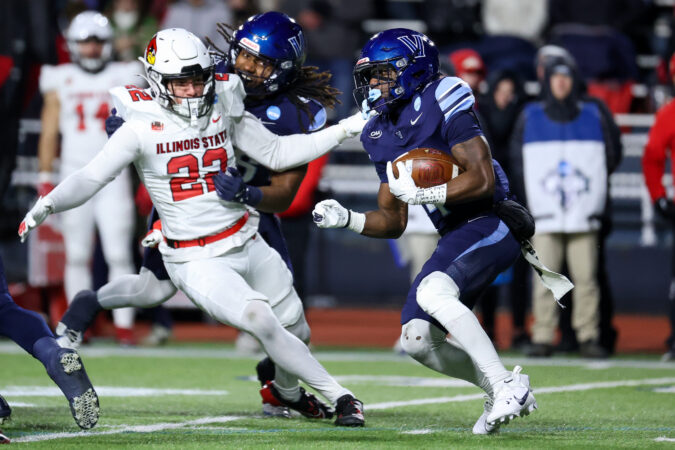
    No. 12 Villanova was out-played at home on Saturday night by unseeded Illinois State, resulting in a 30-14 loss in the FCS semifinals.

    Villanova’s loss ended its 23-game home win streak, which was the longest active streak in college football. The Wildcats found the end zone once in the game’s final minutes and managed to knock in two field goals while in the red zone. Illinois State totaled 426 yards of total offense, in comparison to Villanova’s 300.

    Illinois State (12-4) won the first down battle, 30-14. It tied a season-low for Villanova (12-3) on first downs in FCS play. The Wildcats’ semifinal appearance marked their first since 2009, when Villanova won its first and only FCS championship.

    For Illinois State, Saturday’s 16-point margin win marked the largest semifinal victory by a road team in the last 30 seasons. The Redbirds are also the first team in FCS history to win four consecutive road wins in the postseason. They will face Montana State in the championship on Jan. 5 at FirstBank Stadium in Nashville, Tenn.

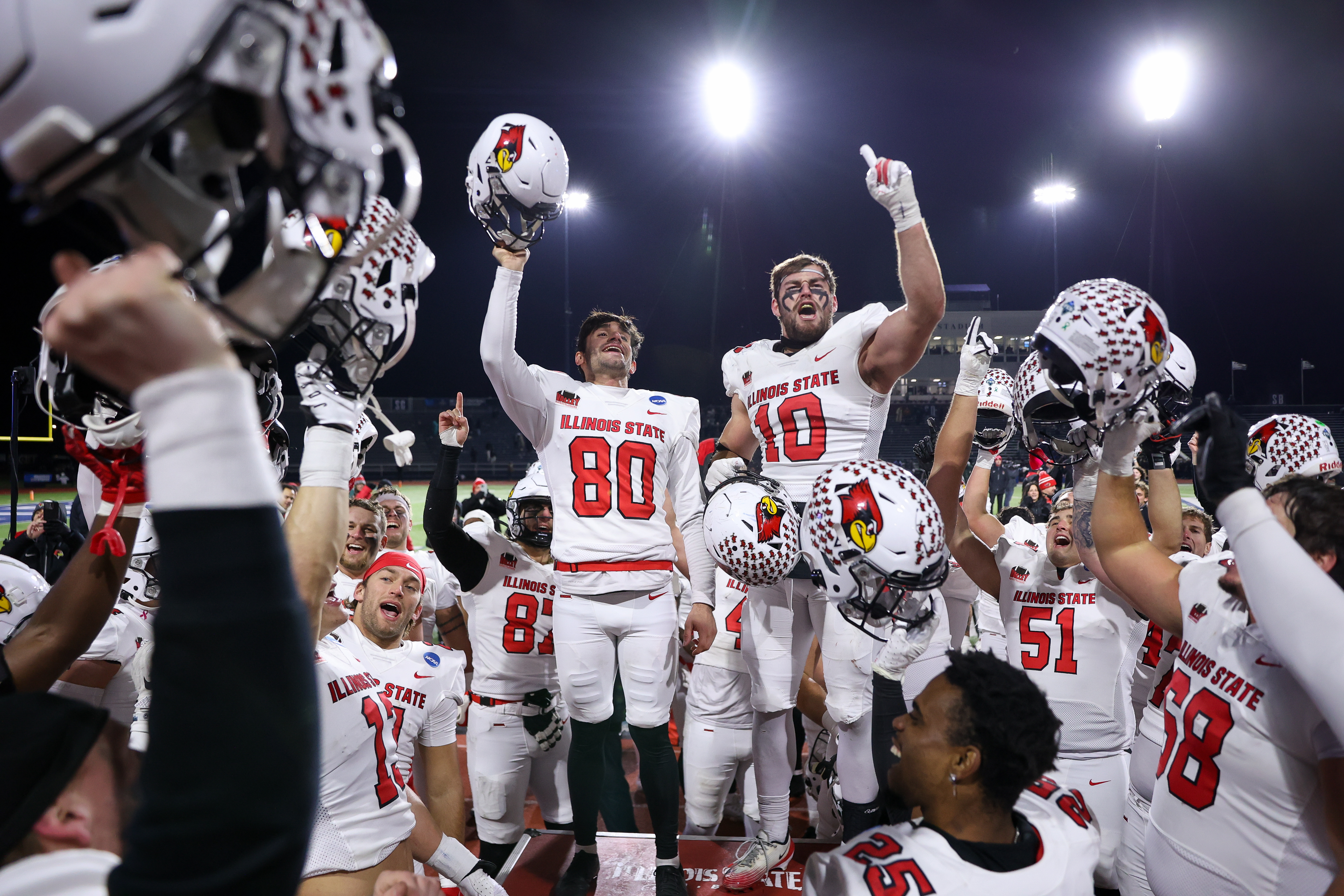
    Illinois State celebrates after defeating the Villanova, 30-14, in the FCS semifinal at Villanova Stadium on Saturday.

    Passing game struggled

    While Villanova’s passing attack guided the offense through its three playoff wins, the Wildcats were held to just 68 yards in the first half.

    Graduate quarterback Pat McQuaide threw for 199 yards on 13-for-30 pass attempts. On the opening drive, he threw an interception in the end zone while attempting to extend a play. Illinois State scored off the turnover.

    It wasn’t till the end of the fourth quarter when McQuaide connected with his primary target, graduate receiver Luke Colella, one time for six yards.

    “Pat looked like he was a little off today with some of the throws,” Ferrante said. “[Illinois State] blitzed more than, I don’t want to say more than we anticipated, because we kind of had a feeling that they we’re going to. They play fundamentally sound football.”

    Penalties prove to be costly

    After giving up nine penalties against Tarleton State last weekend, Villanova was called for six on Saturday and gave Illinois State a crucial 46 yards.

    Three of Villanova’s penalties came from the same Illinois State scoring drive in the second quarter. Villanova got a stop on 3rd and 11, but an offsides call gave Illinois State five yards and a first down to keep the drive alive.

    Then a Villanova pass interference and facemask added on, giving Illinois State 35 yards on the drive. The Redbirds capitalized on the free yardage with a 2–yard rushing touchdown by Victor Dawson. The scoring drive stretched Illinois State’s lead to 21-6.

    In the second half, Villanova picked up its second pass interference penalty, but held Illinois State to a field goal.

    “We gave them a little extra yardage on some penalties, which keeps those drives alive,” Ferrante said. “I say pretty much each and every week, we can’t shoot ourselves in the foot with penalties. We had too many of those that either slow drives down for us on the false start or extended drives for them, on the roughing the kicker, and those types of things.”

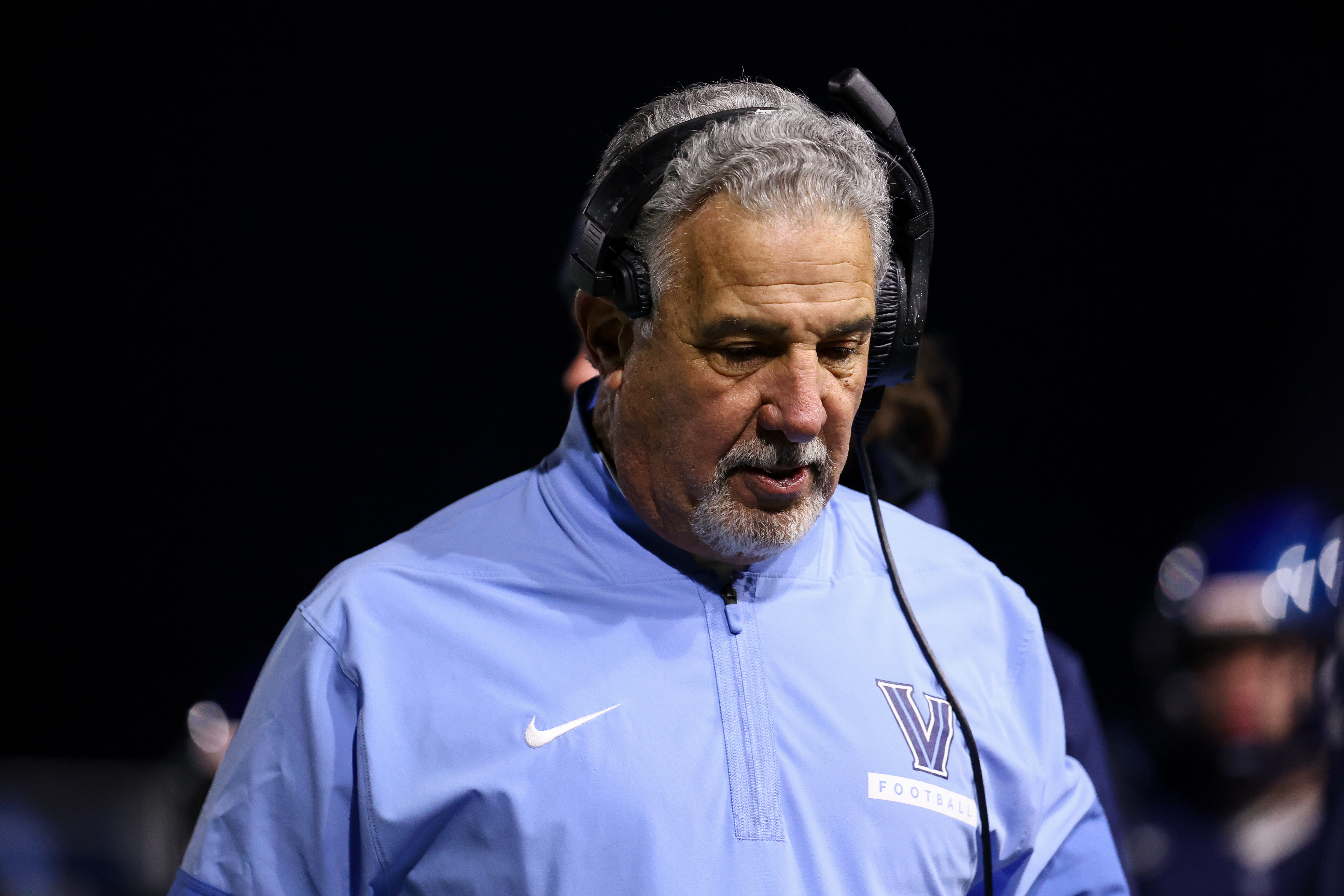
    Villanova head coach Mark Ferrante watches the action during the third quarter of his team’s 30-14 loss to Illinois State on Saturday.

    Battle of third downs

    Both teams had opposite outcomes on third downs.

    Villanova completed a season-low one of 10 third downs. It was the lowest since the Albany game on Oct. 25, when Villanova converted two of 12 third downs.

    The inability to convert third downs forced Villanova to punt and settle for two field goals.

    For Illinois State, it converted 11 of 20 third downs. Some were converted with the help of Villanova’s defensive penalties.

    “I think it was a combination of multiple things,” said senior linebacker Shane Hartzell. “One, I think we weren’t able to get enough pressure on the quarterback, and then that made the [defensive backs] have to stay in coverage longer.”

    Up next

    With its season over, Villanova will prepare to move from the Coastal Athletic Association (CAA) to the Patriot League next season.

  • Horoscopes: Sunday, Dec. 21, 2025

    ARIES (March 21-April 19). The vibe: The list of things you could be doing is long, but there’s only one thing you want to do. The only thing keeping you from it is that you don’t know where to start. Dare to choose what you want. That’s when the path starts to take shape.

    TAURUS (April 20-May 20). It’s a day to avoid taking things literally. That will limit your understanding, as well as your capacity for emotional connection. Before you consider the words someone is saying, you’re wise to get an overall feel for the intent and then go from there.

    GEMINI (May 21-June 21). The problem is not you; it’s the load. You are a single human carrying way too much responsibility for one person. But this is only a season. Believe this: You are already mid-transformation. Keep going.

    CANCER (June 22-July 22). You’ll be reminded how having a front-row view of events doesn’t necessarily mean you can see everything. Every seat in the house has only one point of view. So, in a sense, everyone is seeing a different show.

    LEO (July 23-Aug. 22). It would be easy to indulge or accumulate too much, but a simple rule will keep the balance: Let everything be an exchange. For everything you bring in, give something away. It keeps you streamlined, focused and in control.

    VIRGO (Aug. 23-Sept. 22). A situation that feels risky to you isn’t really. The only thing on the line is your emotions. Sure, you could get a “no,” which will sting only for a moment. The best-case scenario? A door opens, and it’s life-changing.

    LIBRA (Sept. 23-Oct. 23). It’s one of the many ways you show love — you extend hospitality to the people they care about. Today, that will be fun, and maybe a little challenging, but you’ll handle all with grace and your famous diplomacy.

    SCORPIO (Oct. 24-Nov. 21). You’ll be reminded that your ideas are not entirely self-generated. They come from somewhere. Everything you create is influenced by what you’ve absorbed. The world sends you signals, clues and nudges, and you’ll be responding as much as you are initiating.

    SAGITTARIUS (Nov. 22-Dec. 21). You’ll play your cards right, and luck has nothing to do with it. Your wins come from knowing the rules, studying the game and committing to steady improvement. That persistence pays off now, turning skill and discipline into victory.

    CAPRICORN (Dec. 22-Jan. 19). Even when you think you’re inconsistent, you never abandon the dream. You always circle back to it. And devotion wins over time. Stop worrying about perfect output. Your long-term commitment is the thing that will change your life.

    AQUARIUS (Jan. 20-Feb. 18). Protect unstructured time like a dragon guards treasure. Your creative flow depends on long, empty spaces. So, if saying yes would shrink your creative world, it’s a no. Don’t explain your choices. The moment you justify, you lose mystique.

    PISCES (Feb. 19-March 20). You’re a tall ship on the mighty ocean of life, with the winds of responsibility in your sails speeding you along. But what if you want to go another way? You can, but only if you have your own motor.

    TODAY’S BIRTHDAY (Dec. 21). This is your Year of Magnetism. You walk into rooms differently — not performing confidence but embodying it. You’ll also pick up a new skill that changes how you work, play and love. More highlights: luxury experiences you didn’t plan for, friendships that feel like soulmate connections and financial wins that let you breathe easier. Scorpio and Gemini adore you. Your lucky numbers are: 2, 18, 27, 38 and 44.

  • Jabari Walker shuts down Cooper Flagg, Tyrese Maxey gets hot when it counts, and other takeaways from a Sixers win over Dallas

    Jabari Walker shuts down Cooper Flagg, Tyrese Maxey gets hot when it counts, and other takeaways from a Sixers win over Dallas

    As much as the 76ers may want things to change, they’ve remained the same. Yet it has yielded positive results.

    Meanwhile, VJ Edgecombe and Dallas Mavericks guard Cooper Flagg are far from ordinary rookies. But on Saturday, Edgecombe shone brighter.

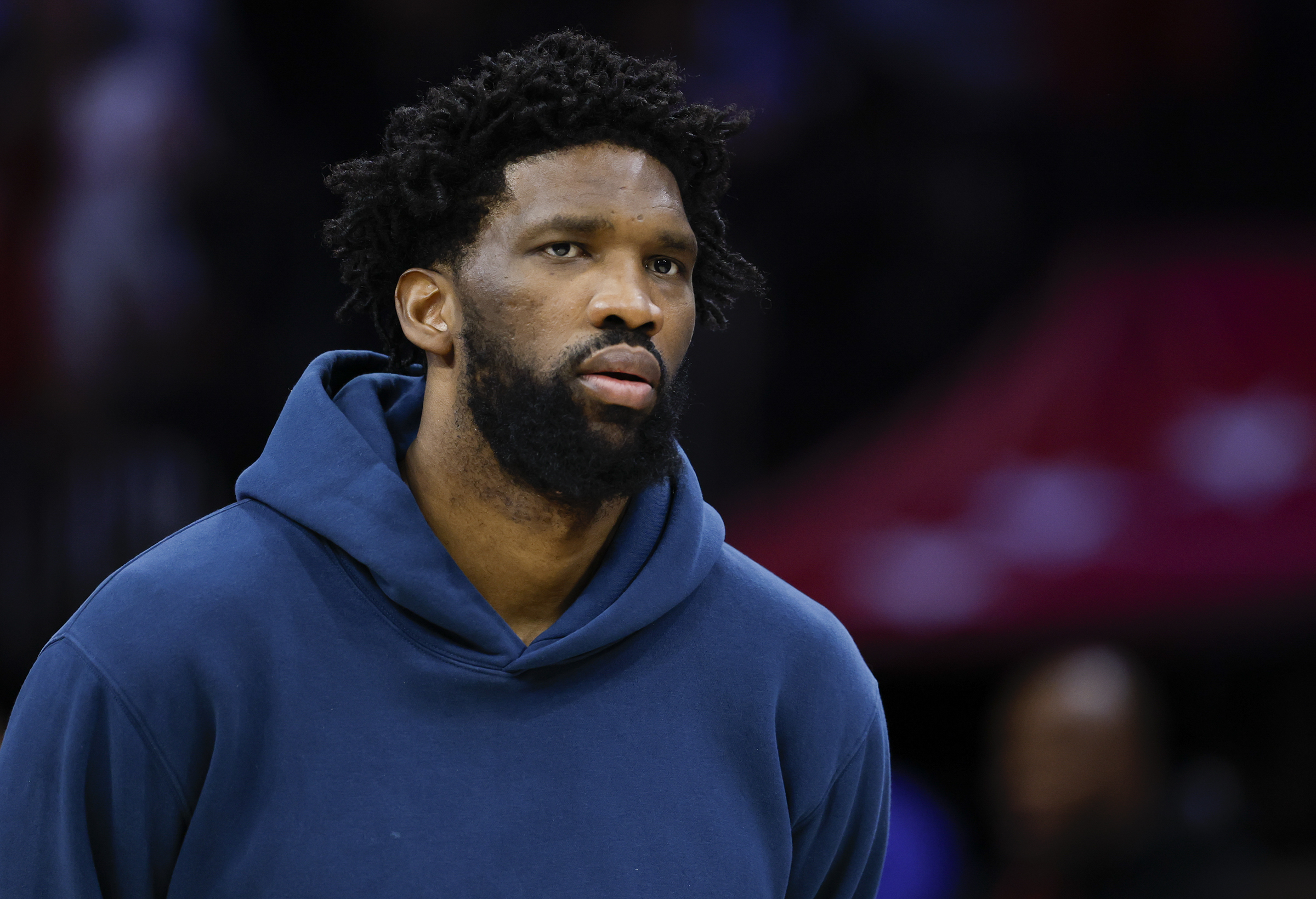
    And Joel Embiid is, once again, wading into the dangerous territory of being disqualified for regular-season awards.

    Those things stood out in the Sixers’ 121-114 victory over the Dallas Mavericks on Saturday at Xfinity Mobile Arena.

    According to the script

    Coming off Friday’s 116-107 statement victory over the New York Knicks, the Sixers (16-11) were expected to have a comfortable win over the Mavs. But they once again struggled in the third quarter and needed to mount a fourth-quarter comeback.

    The Mavs shot 78.9% (15-for-19) in the third quarter to outscore the Sixers, 35-23, and take a 97-91 advantage into the fourth. In addition to not getting stops, the Sixers hit just 8 of 23 shots.

    But the Sixers opened the fourth quarter with a 24-7 run to take a 115-104 lead on Tyrese Maxey’s three-pointer with 6 minutes, 35 seconds remaining in the game.

    Maxey scored 16 of his game-high 38 points in the fourth quarter on 6-for-10 shooting. The Sixers went with a lineup of Jared McCain, Jabari Walker, Adem Bona, Edgecombe, and Maxey for the final 13:11. That grouping shot 50% from the field in the fourth quarter while holding the Mavs to 30.4%.

    Coach Nick Nurse stuck with that lineup because he felt his trio of guards in McCain, Maxey, and Edgecombe were all impacting the game.

    “As far as the two bigs, I felt Jabari was playing Flagg super physical,” the coach said. “And the other thing, we started doing some switching between the four and five. Jabari also would get switched onto [Anthony] Davis and was playing him physically to get him off the block and battle him.

    “I don’t know how many rebounds Jabari got. But it sure seems like he snatched a bunch of them down there, that was also critical.”

    Adem Bona played all of the fourth quarter when the Sixers rallied for the victory.

    Walker, a power forward, grabbed six of his eight rebounds in the fourth quarter. He also scored his only two points and recorded his steal in the quarter. On a two-way contract, Walker also helped hold Flagg to four points on 2-for-6 shooting in the final quarter.

    “We got a great scout report,” Walker said. “ … I think [Dominick] Barlow started off on him. Big credit to him. He had a great night tonight also. I want to show him some love with that. I think either one of us could have finished the game. We both understand that about each other. So, some games it is going to be [like that]. So I just tried to feed off the energy he had tonight.”

    He also studied how Barlow forced Flagg into certain spots defensively, and implemented that in the fourth quarter.

    Barlow, the starting power forward who is also on a two-way contract, tied a career high with 21 points on 9-for-13 shooting.

    The Sixers have won seven games this season while trailing at the start of the fourth quarter, which is tied for first in the NBA.

    Not your ordinary rookies

    Sixers fans know Edgecombe is special. And they were aware of all the hype surrounding Flagg, the No. 1 overall pick, coming into the game.

    The 19,056 in attendance found out Saturday that the hype surrounding Flagg is legit. At 6-foot-9, Flagg, who turns 19 on Sunday, is a mix of explosiveness, power, and a solid basketball IQ.

    Before Walker kept him in check late, Flagg had his way with Barlow through three quarters, scoring 20 of his 24 points on 6-for-10 shooting. He also went 8-for-8 from the foul line and recorded all three of his assists during that time.

    But even before the fourth quarter, Flagg took a backseat to Edgecombe.

    The 6-5 , 195-pound shooting guard got things going early for the Sixers, scoring 14 points on 5-for-7 shooting in the first quarter.

    “He’s making all kinds of plays,” Nurse said. “I think that’s the big thing. Where do you want to start? Big rebounds? Knocking the ball away? But probably the offensive rebounds [three], the biggest ones are you get a tough stop. It’s a fairly close game. We get the ball out, he takes it coast to coast and moves through for an easy bucket when scoring is pretty hard in the fourth, right? Those are like super momentum plays.”

    Cooper Flagg of the Mavericks lays the ball in as the 76ers’ Andre Drummond looks on.

    He and Flagg don’t play like rookies, which has been indicative of how several of the league’s top rookies have performed this season.

    “It’s amazing,” Nurse said. “You are right on with your point. The rookies that have impacted in a big way is really something. Especially considering those two guys are really young. I guess they’re really good. I think most rookies, you will see flashes. You will see one great game, then six go by. These guys are starting to do it like night in, night out. And to me, that’s like what the NBA is.”

    No awards for Embiid

    Saturday marked the 16th game that Embiid has missed this season because of left knee injury management, right knee injury management, right knee swelling, and an illness.

    He sat out Friday and Saturday because of right knee injury management and an illness.

    Nurse was asked whether Embiid had a setback with his health.

    “Nah, he went into last night with both of those things,” the coach said of the knee and illness. “He just didn’t have a great week with the illness and a little bit of soreness in the right knee. And fortunately, we can get through the week and … get another couple of days, and hopefully get him going.”

    The NBA, in cooperation with the National Basketball Players Association, instituted a 65-game rule two seasons ago for players to qualify for awards, hoping it would deter players and teams from relying on load management.

    Sixers center Joel Embiid missed his 16th game of the season on Saturday.

    Embiid was disqualified in each of the last two seasons. He played in 39 games in 2023-24 and 19 in 2024-25. The most games Embiid can play this season is 66 if he doesn’t miss another game, starting with Tuesday’s home game against the Brooklyn Nets. But his availability for many of those games is doubtful since Embiid is not expected to play back-to-back nights.

    Nurse’s first season was in 2023-24. Embiid was playing better than his MVP season before having the first of two left knee surgeries in 14 months.

    “He had a serious injury and hasn’t quite been able to get back,” Nurse said. “You asked me if I’m empathetic, absolutely. You know, I thought we were going [upward] for a bit. I think we’ve got to try to keep going that way.”

  • Let us raise a glass to the Tush Push. It’s dead, and the Eagles have to find an alternative.

    Let us raise a glass to the Tush Push. It’s dead, and the Eagles have to find an alternative.

    We are football followers, Eagles followers, so … no lies between us.

    The Tush Push had its moments. Yes, it did. You remember the first touchdown of Super Bowl LIX, the ease with which Jalen Hurts slipped through the Kansas City Chiefs’ defensive line and into the end zone? The Tush Push was the first sign of the rout to come. And the fourth-and-1 from the Eagles’ 26-yard line against the Miami Dolphins two years ago? In a one-score game? That was the Tush Push at its best. And the NFC championship game in January. The two Hurts TDs from the Washington 1-yard line. The Frankie Luvu leaps. The high comedy.

    The Tush Push took a lot of close games and put them away. Yes, indeed. It won more games for the Eagles than it lost, as much as any strategy or ploy. Did it tick off an NFL coach or three? No doubt. I think the league actually kind of got used to it, thank God. Did it cause controversy and enrage owners and get people in the media saying silly things about “nonfootball plays?” Hell, yes. Was it as much a fad, a passing fancy, as the run-and-shoot and the Wildcat and an RPO-based offense? Abso-freaking-lutely. But the Tush Push stood against that dark tide, and it helped make the Eagles of Philadelphia a great team. A championship team.

    ♦ ♦ ♦

    LANDOVER, Md. — Here at Northwest Stadium, just 35 miles from the city that was the setting for David Simon’s magisterial series The Wire, it is only fitting that, as if attending a barstool wake among Baltimore po-leece, we eulogize the Tush Push. The play that once gave the Eagles a physical, psychological, and strategic edge over every opponent they encountered is, by all available indications, dead.

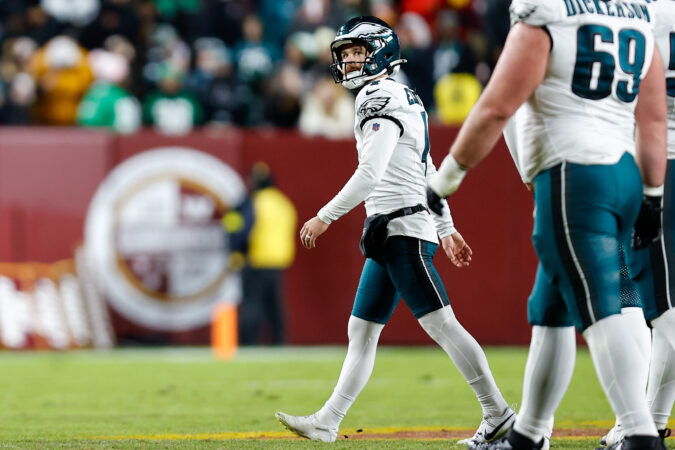
    Three times during their 29-18 victory Saturday over the Commanders, the Eagles tried to run their unique and once-unstoppable version of the quarterback sneak. Three times, it failed. Once, tackle Fred Johnson committed a false-start penalty. Once, Hurts gained no yardage. Once, guard Landon Dickerson committed another false-start infraction. And with his offense facing a (relatively long) fourth-and-1 on its first possession, coach Nick Sirianni had the Eagles punt from their own 41 instead of attempting the play.

    This was the flat line across the electrocardiogram screen. In 2023, the Eagles led the NFL in fourth-down conversion percentage, at 67.9%. Last season, they were third, but their efficiency rate (71%) was higher. This season, they entered Saturday at 61.1%, seventh-best in the league — good, but not dominant, not close.

    “Teams adjust; we’ve got to continue to adjust,” Sirianni said. “Credit to them. They did a really good job of stopping us there. … We have to get this play working the way it’s been in the past, which we’ll work our butts off to do. But we were really able to overcome.”

    They were. They got Hurts’ 15-yard touchdown pass to Dallas Goedert late in the third quarter — a nifty bit of improvisation after Dickerson’s penalty and a holding call against Johnson had pushed them back from the Commanders’ 1. They got Saquon Barkley gaining 132 yards and running like all the members of Washington’s defense had insulted his mother. And they got the benefit of playing a bad team that started its backup quarterback (Marcus Mariota) and had to turn to its third-stringer (Josh Johnson).

    But the demise of the Tush Push is real, and it has to be a worry as the Eagles look ahead to the postseason. Hurts has made it clear that he had grown tired of running it anyway, and the league officials had raised their level of scrutiny of it, calling more penalties against the Eagles this season. It has gone from an automatic first down to an unreliable chore. They will have to find a new way to remain aggressive, and to succeed, in fourth-and-short situations.

    “The play might not even be around next year, to be honest, the way they’re officiating it,” tackle Jordan Mailata said. “Last week, it was that our shoulders have to be parallel to the line of scrimmage. They can’t be angled in. Great. They’re officiating us a little harder. If this is the last year that we can run it, we’ll just run it till we can’t run it anymore.

    “The history that we have with that, we’re pretty successful, so when we lean on that play, you expect us to convert. One-yard line — we just didn’t do it. I was pretty happy that Dallas and Jalen could bail us out on that one, but sometimes, that’s just how it goes. Teams this year have done a great job of stopping that play, so we’ve got to do a better job of executing it and go from there.”

    Understand: The Eagles brought these challenges upon themselves, in the best way possible. They pioneered the Tush Push, then perfected it, then used it so frequently in the course of winning a Super Bowl that they inspired a campaign against it. Teams are better prepared for it now, and the officials are eyeballing the Eagles every time they line up to run it. And yet, like mourners over a casket, they spoke Saturday as if they haven’t reconciled themselves to the hard, heartbreaking truth. “It’s in a good place,” Hurts said, and center Cam Jurgens insisted, “It’s still our bread and butter. It might get a little dry at times, but bread and butter is bread and butter.” But these words seemed the bittersweet valediction for a play that will send an opposing defense to its knees no more.

    The Tush Push worked, and now its prime has passed. Raise your glass. It was called. It served. It is counted.

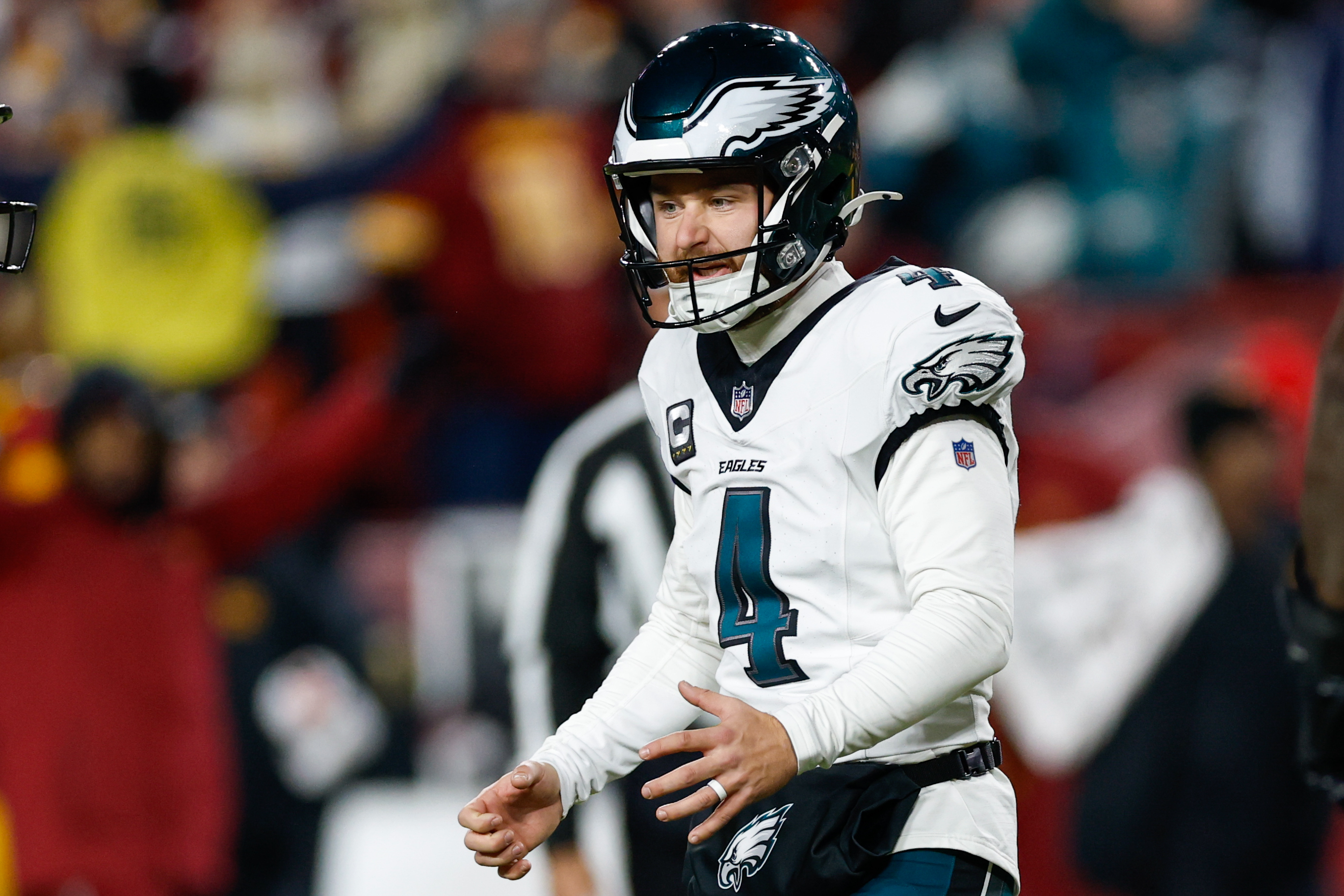
  • Jake Elliott is frustrated. Nick Sirianni says he has ‘ton of confidence’ in the Eagles kicker.

    Jake Elliott is frustrated. Nick Sirianni says he has ‘ton of confidence’ in the Eagles kicker.

    LANDOVER, Md. — There is an isolating nature to Jake Elliott’s job.

    Hundreds of micro moments impact a given game. There are passes and runs and blocks and tackles and situational coaching decisions. All of those things can work in harmony on a given day and success or failure could still hinge on your swinging foot.

    The Eagles won going away, 29-18, over the Washington Commanders on Saturday night and clinched the NFC East title along the way. But inside a happy locker room was a frustrated kicker who missed two field goal attempts, who has missed five over the last five games, who also missed a point-after attempt during that stretch.

    It is not the isolating part that is getting to him, Elliott said. In fact, the soon-to-be-31-year-old kicker in his ninth NFL season wishes it were a mental thing at this point.

    “It would be easier to fix,” Elliott said.

    “It’s just frustrating.”

    Saturday’s frustration was amplified by the fact that Elliott struck the ball well during warmups, he said. He hit from 52, 55, 58, and 60 yards during pregame. He entered the game, he said, with a good plan, “and when they don’t go through in the game it’s no one to blame but yourself. That’s where we’re at. I got to figure some stuff out.”

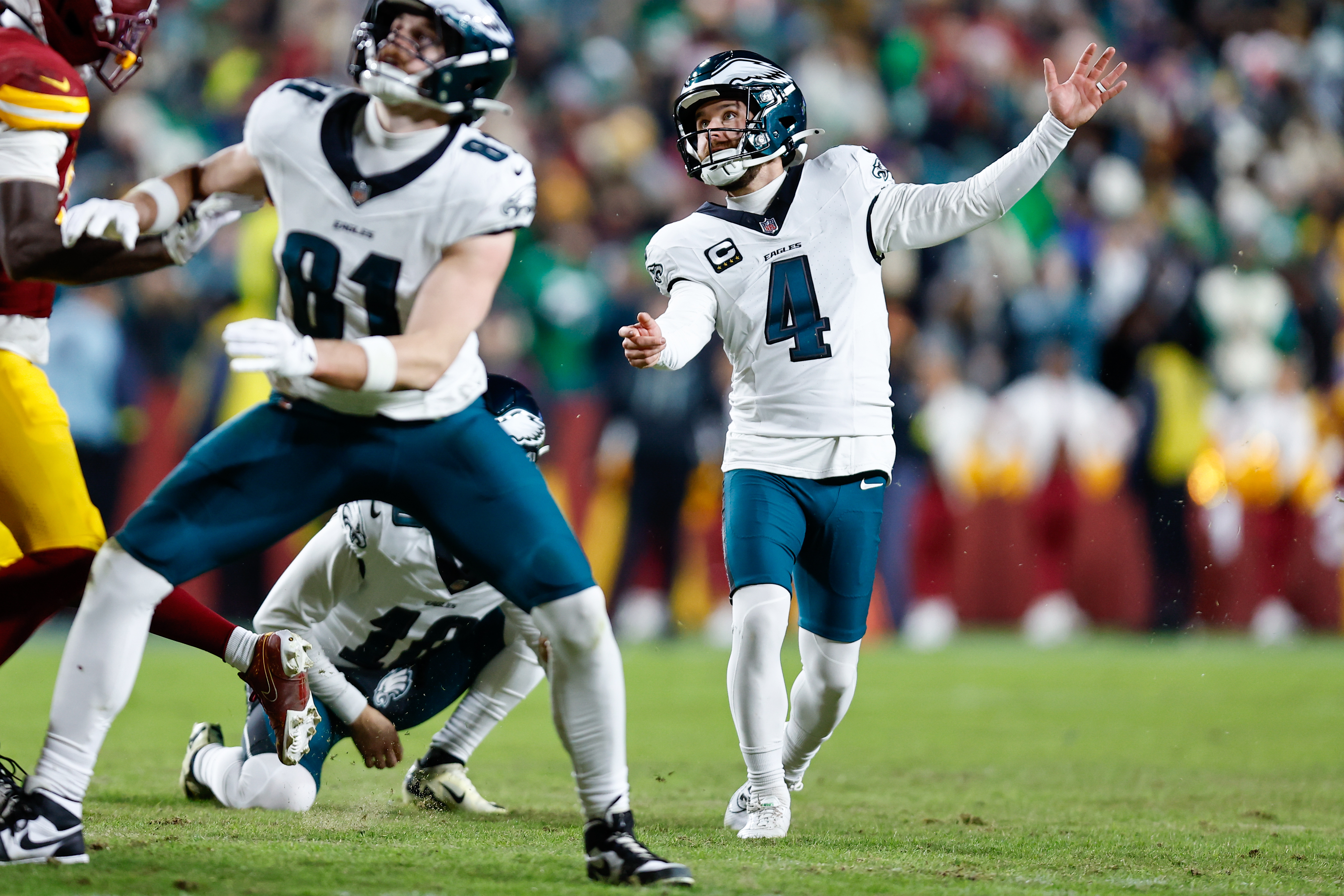
    Elliott’s first miss was a 43-yard attempt with the Eagles leading, 7-3, six minutes into the second quarter. He was “a little quick” on his swing and hooked it left. It was just his second miss of the season inside 50 yards.

    The next, with the Eagles trailing 10-7, came near halftime. There were two, but only one of them counted. He first missed from 57 yards but Washington was offside, which gave the Eagles a first down. The Eagles could not get any positive yardage on the next play and they sent Elliott back on the field to kick from 52 yards out. Elliott was happier with his kick, but he thought the wind took it late.

    Elliott is now 17-for-24 on the season. His success rate of 70.8% is the worst of his career.

    Jake Elliott kicks an extra point after a Dallas Goedert touchdown during the third quarter against Washington.

    Elliott, a two-time Super Bowl champion, a second-team All-Pro in 2023, and a Pro Bowler in 2021, is under contract through the 2028 season. He came back after the All-Pro selection in 2023 with an inconsistent 2024, when his make percentage dropped from 93.8% to 77.8%. It is not out of the realm of possibility that the Eagles explore other kicking options after the season. It’s not out of the realm of possibility that the Eagles explore bringing a kicker in for the homestretch here, either.

    “I understand it’s a production-based business,” Elliott said when asked if he was worried the Eagles could bring in a new kicker. “You see it all the time. That’s out of my hands, that’s out of my control, all I can do is kind of put my head down and keep pushing.”

    Nick Sirianni said he has the “utmost confidence in Jake.”

    “I have a ton of confidence in him that he’ll respond and rebound from this because he’s mentally tough and a great kicker,” Sirianni said.

    Punter and holder Braden Mann does, too.

    Mann said Elliott has consistently carried the right mindset into his job. His next-kick mentality has been a constant.

    “He’s got the history,” Mann said. “His confidence is through the roof. Everyone here, all of our confidence is high for him. He’s just a consistent guy. He doesn’t get too high or too low in big moments, and he’s come through in big moments a lot in the past. It’s easy to rely on a guy like that who really wants the big moment.”

    Jake Elliott reacts after his missed 52-yarder.

    Elliott hit a similar rough patch late in the season last year. He missed four field goals over the final five games of the regular season, then missed an extra point in a wild-card round win over Green Bay. Then, in the snow, he missed two extra points but was 3-for-3 on field goals in a divisional-round victory over the Rams. He then missed from 54 yards in the NFC title game but made seven point-after tries.

    It was a bumpy ride that ended with perfection in the Super Bowl: 4-for-4 on field goals, including two makes from 48 and another from 50, and 4-for-4 on extra points.

    Will he lean on that experience?

    “It’s all the same thing,” Elliott said. “It’s dealing with success, it’s dealing with failure. It’s all the same. I feel proud that I’ve handled all that kind of the exact same over the years. I’ve had a long career and have learned a lot throughout that on both sides of it.”

    Elliott wasn’t interested in getting overly philosophical about the mental part of the game, the isolation of being a kicker, and what happens next.

    “I just got to put the ball through the uprights,” he said. “That’s my job, man. That’s it. It’s not any deeper than that.”

  • Brawl leads to a Big Dom sighting, officiating the Tush Push, and more from the Eagles-Commanders broadcast

    Brawl leads to a Big Dom sighting, officiating the Tush Push, and more from the Eagles-Commanders broadcast

    The Eagles officially clinched the NFC East with a 29-18 win over the Washington Commanders on Saturday in Landover, Md.

    If you want to relive the big win, here were the best and worst moments from the broadcast:

    Tush Push

    Surprisingly, on an early fourth-and-1 near midfield, the Birds didn’t line up for their signature Tush Push play. Instead, Jalen Hurts set up in shotgun, and the Eagles unsuccessfully attempted to draw the Commanders offside.

    Analyst Greg Olsen didn’t hate the decision to fake the fourth-down attempt — but thought the Birds tried it with the wrong formation.

    “If you’re going to do it, make it look like quarterback sneak,” Olsen said. “Get under center. Those defensive linemen are champing at the bit trying to defend the Tush Push. Maybe a little more likely. You line up in the gun, you do some shifts and motions, it doesn’t have the same effect.”

    Brawl breakdown

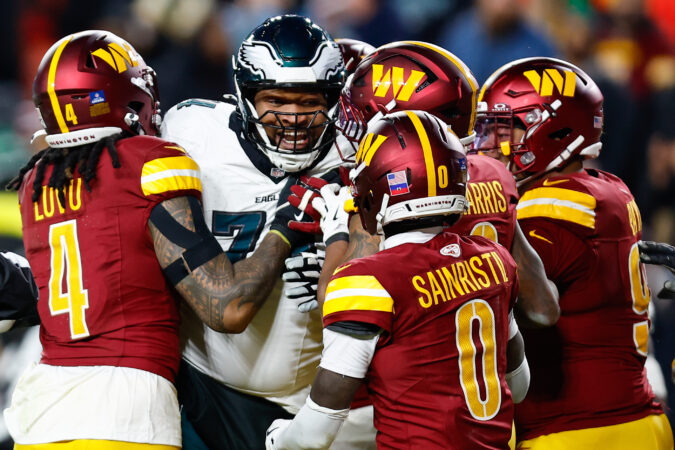
    After the Birds’ successful two-point conversion made it 29-10 with 4 minutes, 26 seconds left in the fourth quarter, we got a full-scale brawl worthy of the Broad Street Bullies.

    “This has turned into a full-blown shoving match,” play-by-play broadcaster Joe Davis said. “Tyler Steen is throwing punches.”

    “We’ve got flags, we’ve got hats,” Olsen said.

    “There are no flags left in the belts,” Davis said. “They’re all on the field.”

    It led to three ejections, including Steen, and plenty of screen time for Big Dom. These teams play again in just two weeks.

    Trust the replay

    After Commanders running back Chris Rodriguez appeared to gain a first down on a second-quarter rushing play, replay review overturned it, forcing a fourth-and-1. Dan Quinn elected to challenge the call anyway.

    “They’re going to challenge the challenge!” Davis said. “Replay, take a look at the replay that you just replayed.”

    After a commercial break, the call stood, as expected.

    “Replay room saying, ‘Did we stutter?’” Davis said, after returning from commercial to the call standing on the field.

    The Commanders still converted the fourth down and scored a touchdown on that possession, though.

    Tush Push Part 2

    There’s never been more attention on the Tush Push than this season, after the NFL spent the offseason debating whether to ban the play.

    But as the season began, the conversation shifted toward the Eagles’ offensive line, and whether the Birds were gaining their advantage by jumping early on the play. Since then, it’s been officiated pretty harshly, including two false-start penalties on Saturday.

    “These officials have incredible eyes, because we’re looking, I don’t know the fancy terms of frames per second, but we’re looking at super slow-mo, and he is moving a frame early,” Olsen said after Landon Dickerson’s third-quarter false start. “That’s how they want this enforced. If they’re going to let Philly continue to run this, which I am a huge proponent of the quarterback sneak and the way Philly does it, I think it’s a huge weapon and they should be allowed to do it, but obviously they’re going to officiate it very tightly.”

    Has the discourse over the play moved it too far in the opposite direction? Olsen wasn’t sure.

    “That is a fraction, I think we can get carried away trying to overdo it, but his hands do move,” Olsen said. “That official’s got good eyes.”

    Marcus Mariota’s injury

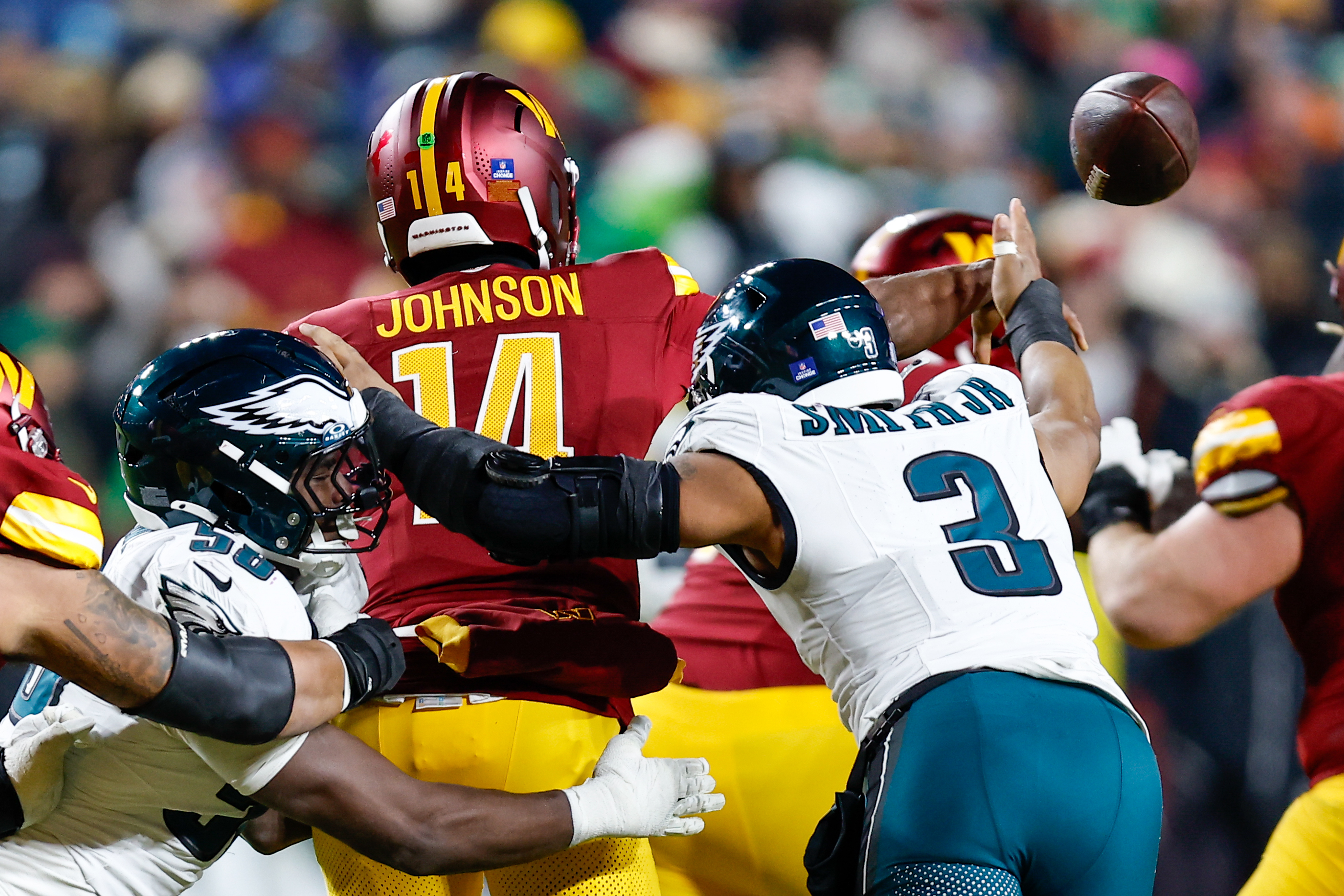
    Josh Johnson, famous to Eagles fans for his appearance in the NFC championship game for the 49ers following the 2022 season, made an appearance of his own after Marcus Mariota suffered an injury.

    Footage later showed that Nolan Smith accidentally stepped on his hand, and Mariota was seen with a bandage on his right hand on the bench later in the game.

    Josh Johnson was pressed into action after Commanders starting quarterback Marcus Mariota went down. Here, he’s being tackled by Jalyx Hunt and Nolan Smith.

    Road warriors

    After the Birds’ third touchdown, Davis remarked on the game as a reflection of their 2025 season.

    “This game is kind of emblematic of the whole year for Philadelphia — not easy, but they’re in front,” Davis said. “They’ve grown this lead, silenced this crowd.”

    The first part is mostly true, but Joe, I don’t know what stadium you were in, but it sounded pretty darn loud every time the Eagles did anything on the broadcast. The “COOP” after the Cooper DeJean interception spoke for itself.

    The Eagles also hit a great celebration afterward.

    Jordan Davis’ day

    2025 has been Jordan Davis’ breakout year, but Joe Davis said Saturday was “the game of his life,” with six tackles and two tackles for losses.

    “He’s having an unbelievable season,” Olsen said.

    “I don’t know if he’s making that tackle in previous years,” Joe Davis said. “He dropped about 25 pounds this offseason, and he’s been a different guy. He thanks Peloton and Ally Love rides for helping him drop all that weight.”

    If you haven’t read this great Alex Coffey story about Love, you’re missing out.

    Not-so offensive

    The last team to win a Super Bowl with as large a disparity between the defense and the offense was the 2015 Denver Broncos, who rode an elite defense to victory.

    But Olsen is not as concerned with the offense as it seems like a lot of the fans are.

    “This offense is better than people give it credit,” Olsen said. “There’s something about this Eagles offense that, I think they’re better than their stats; I think they’re better than their trends. The talent, the fact that they just went on a historic run just a year ago.”