Philadelphia police are investigating two hit-and-run crashes that left a pedestrian and bicyclist dead.
At 3:44 a.m. Saturday, a bicyclist was struck by an SUV as he turned on to North 56th Street from Lancaster Avenue, police said.
Following the impact, the SUV appeared to swerve and continued on Lancaster Avenue, police said.
Philadelphia Fire Department medics responded to the scene and took the bicyclist, a 54-year-old man, to Lankenau Hospital. He was pronounced dead at 4:47 a.m., police said.
At approximately 8:56 p.m. Friday, a 63-year-old woman was struck by a car headed northbound on Whitaker Avenue as she crossed in a crosswalk at Wyoming Avenue, police said.
Police said the driver of the car, a white 2012 Infiniti M37, briefly looked at the victim and then fled the scene, continuing northbound on Whitaker Avenue.
The woman was taken by a medic unit to Temple University Hospital, where she was pronounced dead at 9:34 p.m.
The car was later found unoccupied in the area of A and Loudon streets and will be seized for further investigation, police said.
The police Crash Investigation Division is conducting ongoing investigations into both incidents.
The victims’ identities were not immediately available Saturday.
Like much on the mind of the general public, climate change is now in the voices of Opera Philadelphia in The Seasons, an ambitious opera/dance expansion of Vivaldi’s The Four Seasons warning of a time when seasons cease to exist.
Sounds like a virtuous West Coast “granola opera”? Not quite. But the Friday opening at Kimmel Center’s Perelman Theater wasn’t as effective as it wanted to be.
The piece’s secondary purpose as a showcase for Vivaldi’s music actually became primary, going beyond the composer’s popular four-violin concertos, collectively known as The Four Seasons, and exploring some great, rarely heard arias from his many operas.
And luckily so.
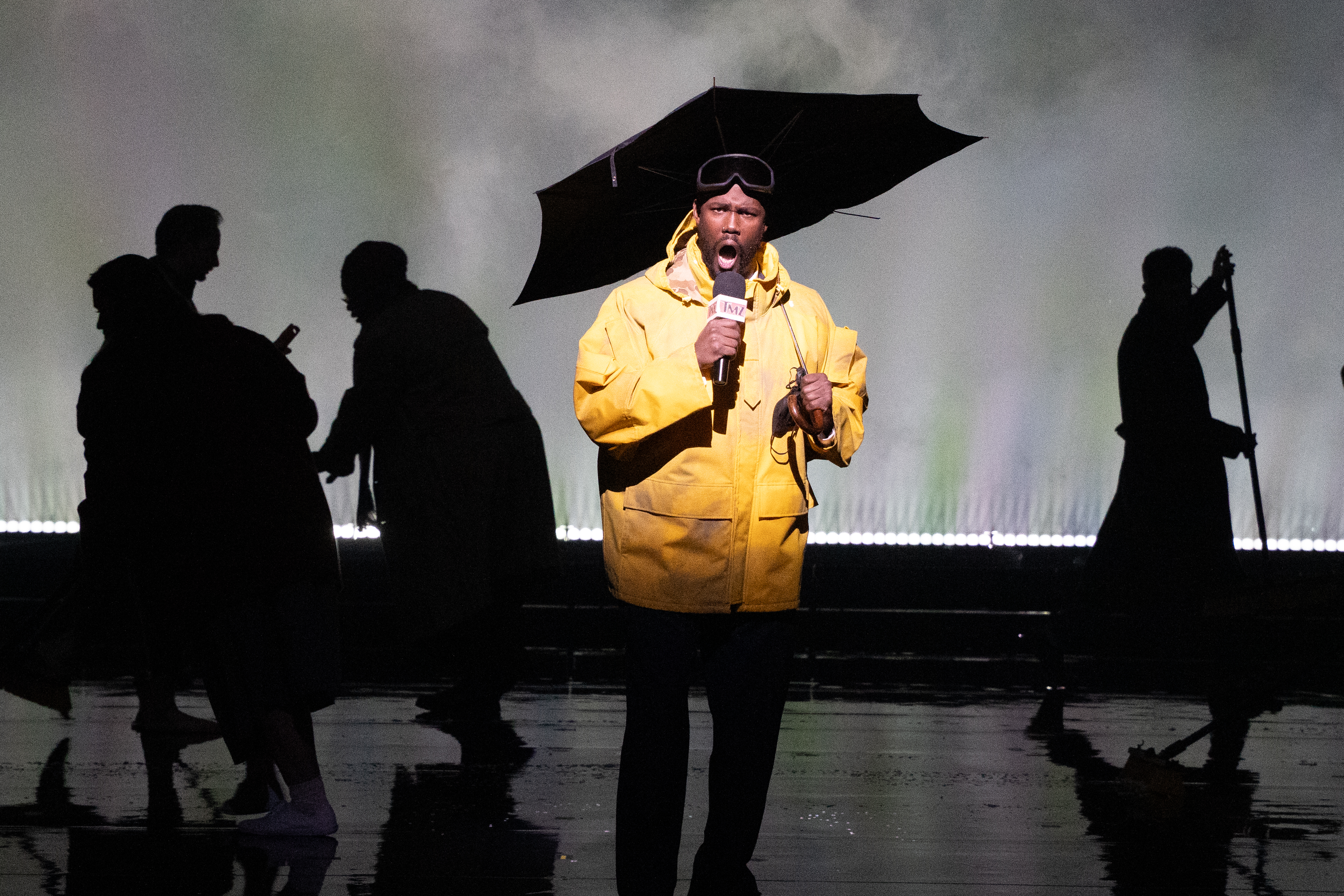
Bass John Mburu delivers the forecast as the Cosmic Weatherman in “The Seasons,” where the seasons are completely out of order.
Vivaldi’s innately agitated rhythms convey the urgency of climate change in a much more visceral manner than the often on-the-nose libretto by playwright Sarah Ruhl.
That’s a surprising reversal of artistic priorities considering that her 2003 play Eurydice is one of the best works of its decade (especially as seen several years ago, across the street at the Wilma Theater).
Vivaldi wrote 50 or so operas in the capitals of 18th-century Europe, and the pieces from them, employed by The Seasons, were often dark-night-of-the-soul arias that reveal depths not apparent in the composer’s short-breathed concertos.
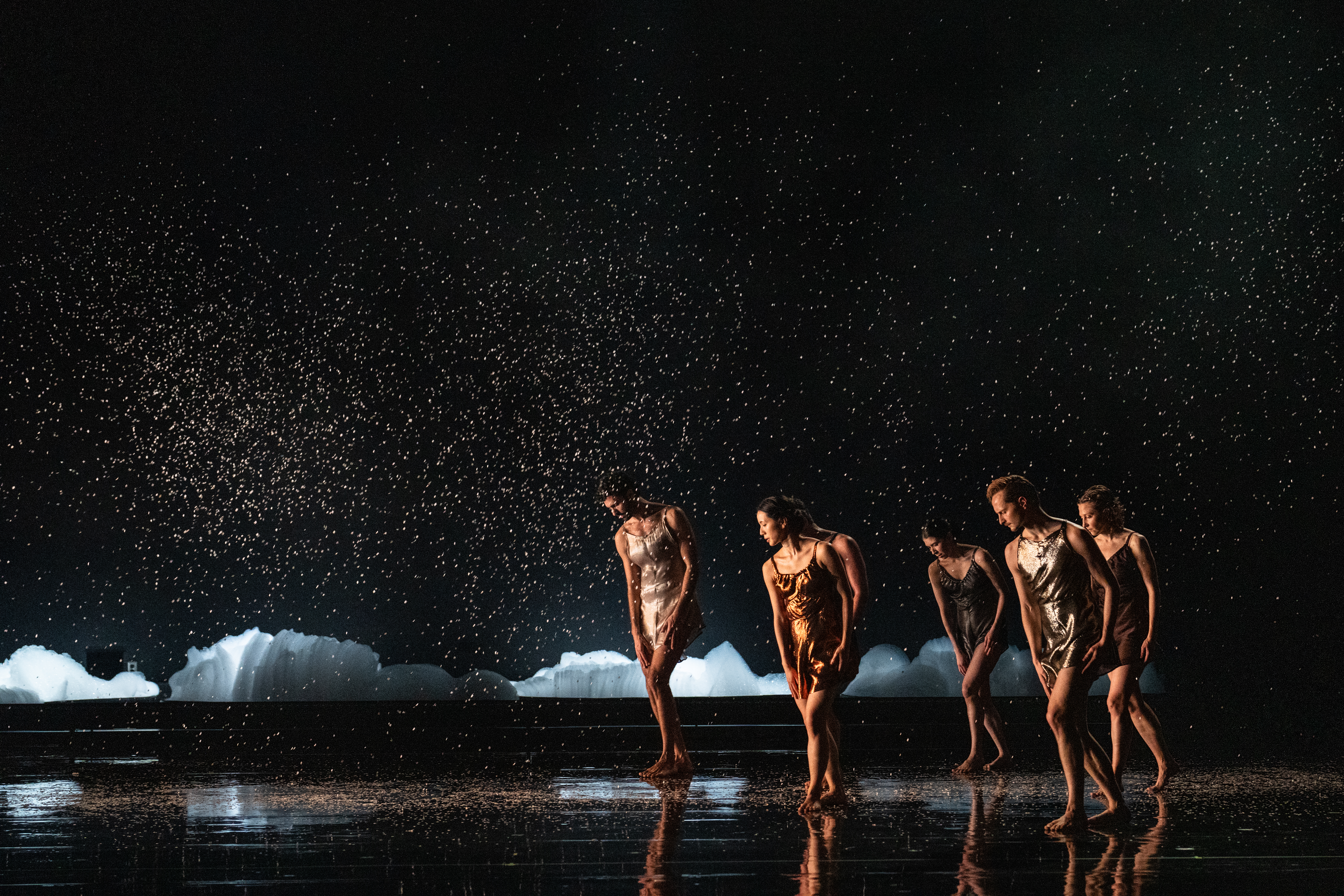
Dancers Marc Crousillat, Stephanie Terasaki, Brian Lawson, Taylor LaBruzzo, Anson Zwingleberg, and Maggie Cloud in the Philadelphia premiere of “The Seasons,” directed by Zack Winokur and choreographed by Pam Tanowitz
These operas have been major discoveries over the last few decades in Europe, and Opera Philadelphia’s presentation constitutes a significant addition to the local operatic culture.
Fitting arias into a new plot was fairly common in 18th-century opera, though The Seasons, conceptualized by Ruhl and Opera Philadelphia chief Anthony Roth Costanzo, is best taken in by those who have missed climate-change news of fish frying in warm ocean water and frozen iguanas falling out of unseasonably cold Florida trees.
The Seasons has somebody resembling a TV weatherman (bass John Mburu) appearing periodically, lecturing the audience to not ignore or forget the dire planetwide shifts in weather (as if we could!).
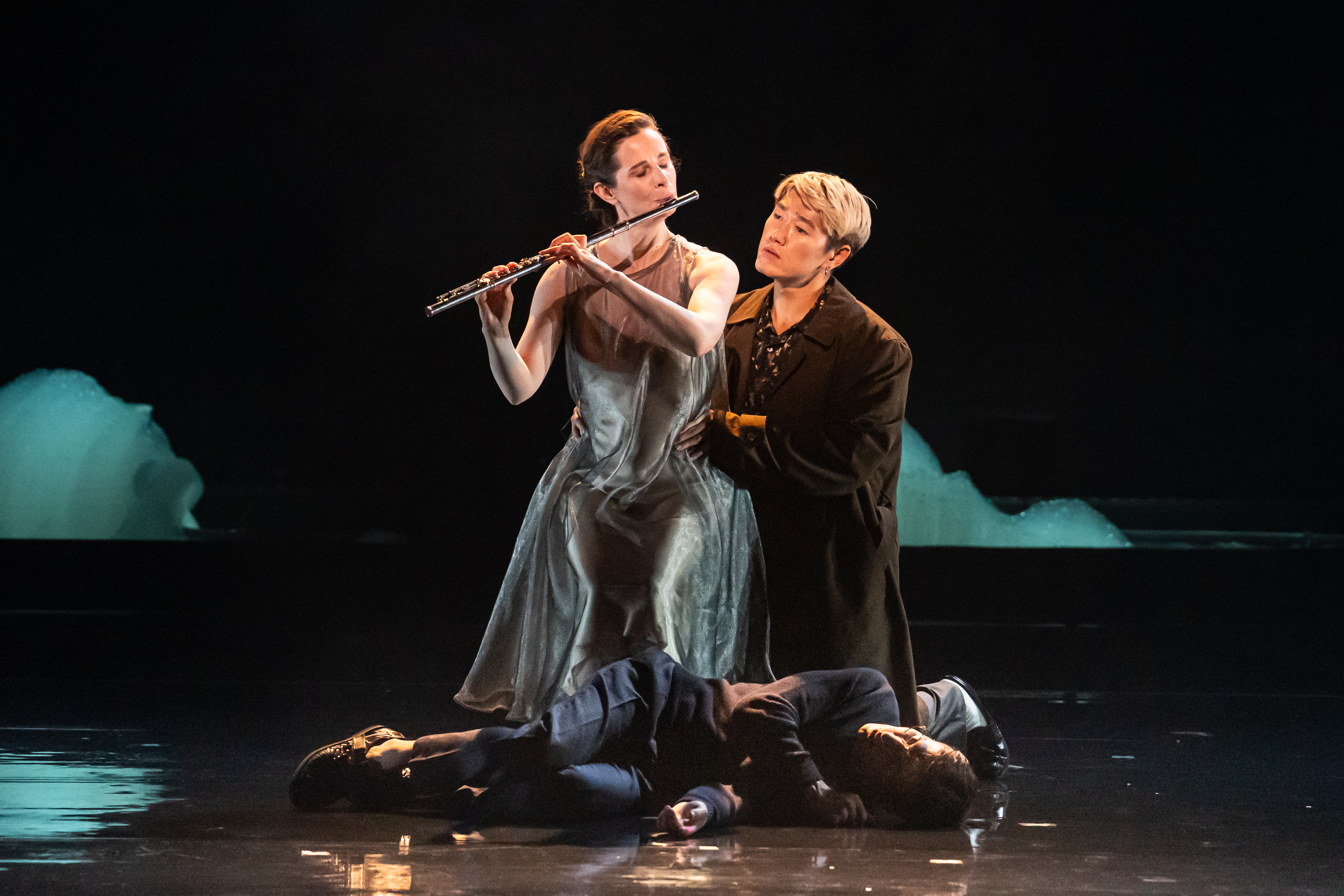
Flute Soloist Emi Ferguson with Kangmin Justin Kim and Anthony Roth Costanzo in the Philadelphia premiere of “The Seasons.”
Other characters are sociological touchstones: A poet, a painter, an actress-turned-farmer, a performance artist, and a choreographer (none with specific names) share the stage, some having troubled same-sex romances — though the purpose of their artistic affiliations had little consequence.
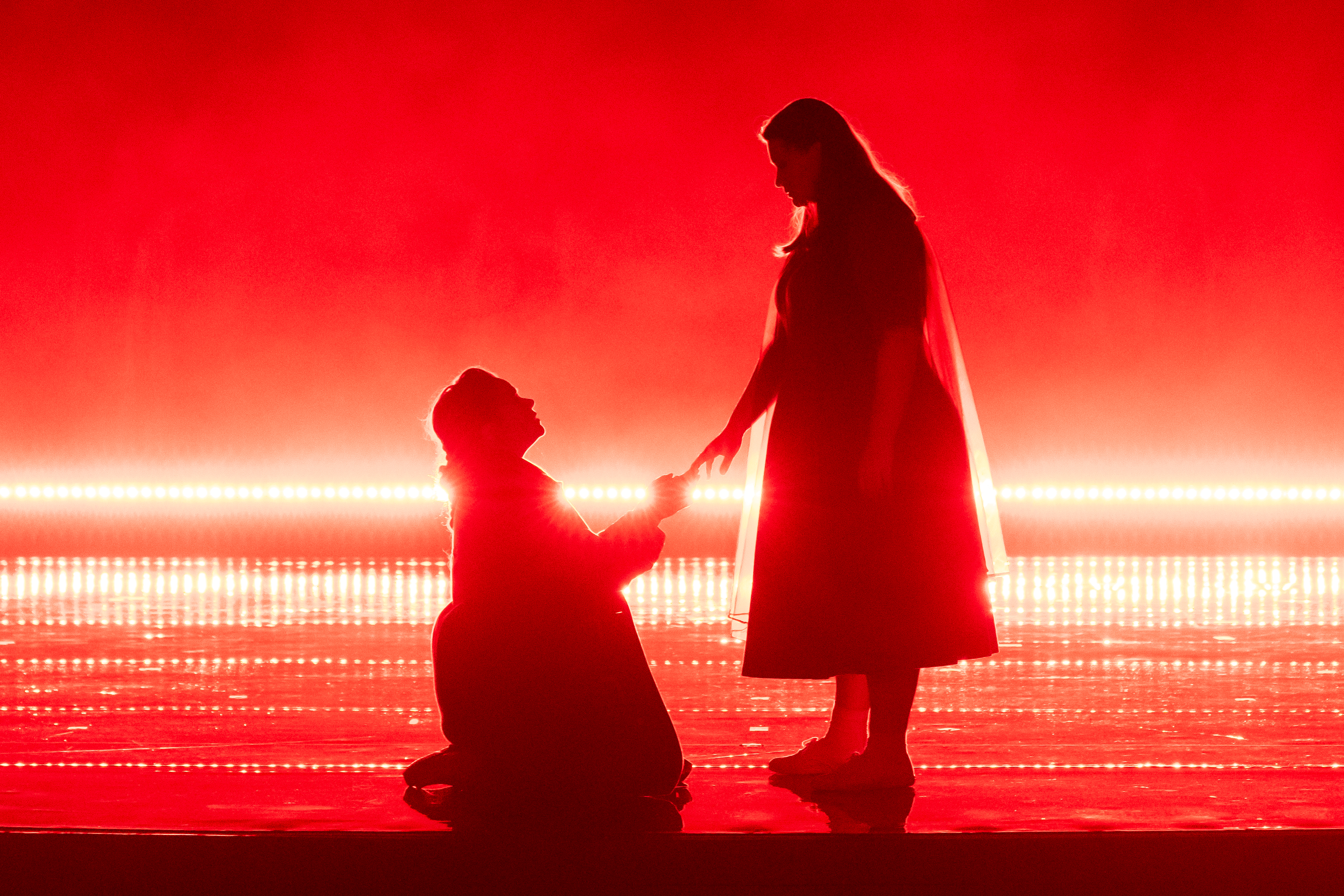
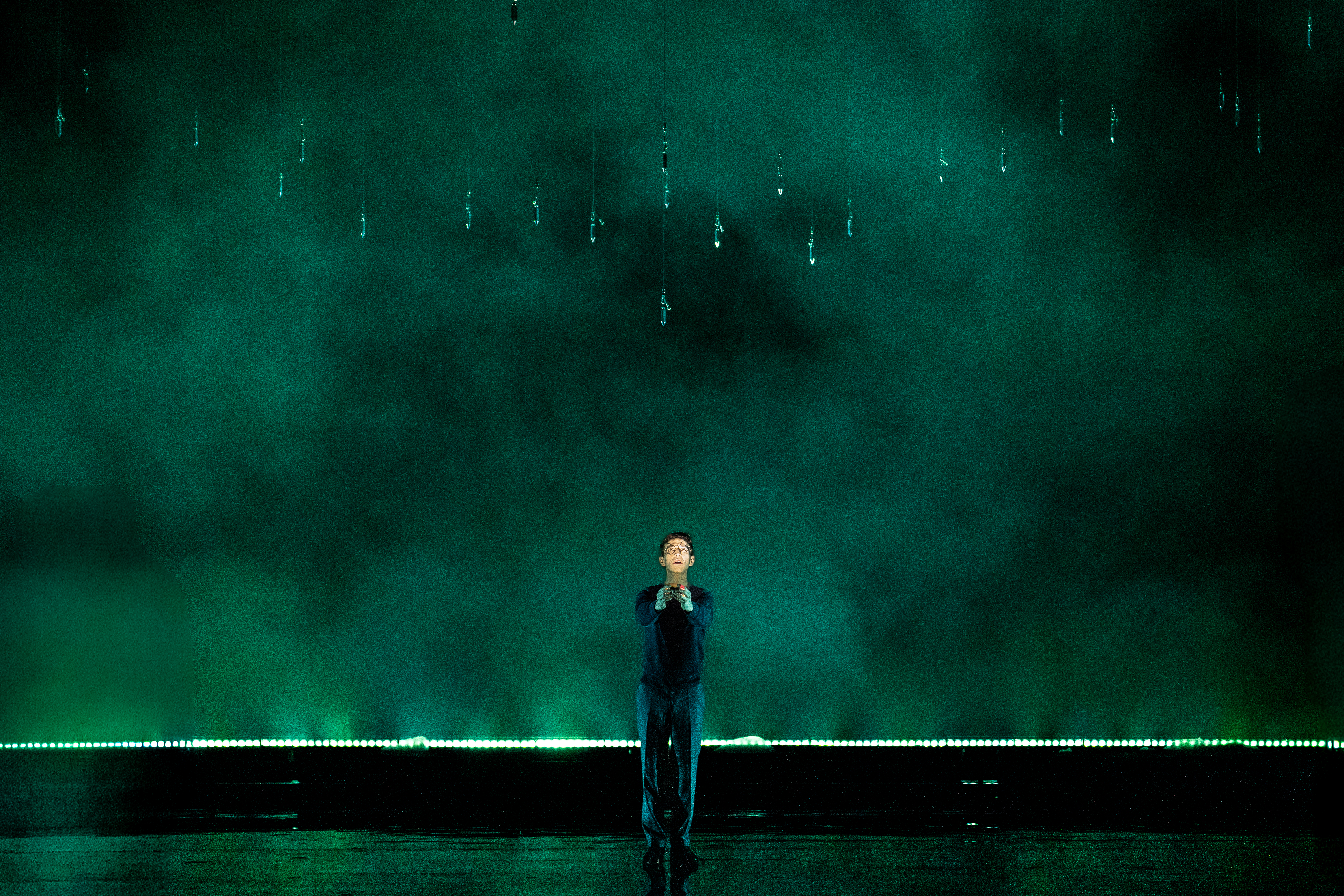
Vivaldi’s Four Seasons was often used as dance interludes in choreography by Pam Tanowitz. Under the overall direction of Zack Winokur, various screens and lighting effect conspired to convey stars, wildfire, and aurora borealis — as characters become climate refugees and, presumably, move north.
It’s not a spoiler to say that the opera ends with a hope-inspiring children’s chorus (Commonwealth Youth Choir and Philadelphia Youth Choral Ensemble) that has an unexpectedly visceral impact. It’s a reminder that their generation is tasked with cleaning up the ecological mess made by their elders.
Abigail Raiford (The Farmer) and Megan Moore (The Choreographer) during a fire.
Amid isolated strong points, The Seasons also showed signs of quick assemblage.
Besides having English lyrics that could certainty be improved with more revision time, the different elements didn’t always flow together comfortably.
The Act I choreography that had the six dancers gracefully balletic from the waist up but appropriately earthy from the waist down tended to slip into and out of obscurity in Act II.
One has to respect the effort put into the production, but the singers’ performances (in arias from Tito Manlio, Giustino, and many others) saved the day — supported by excellent orchestra playing. Conductor Corrado Rovaris instilled a proper baroque style and manner that unlocked the music’s considerable value.
All of the singers had fairly adept coloratura abilities that are necessary with baroque-period opera, including Mburu, who used the vocal passage work in a suitably reckless fashion conveying his character’s distress.
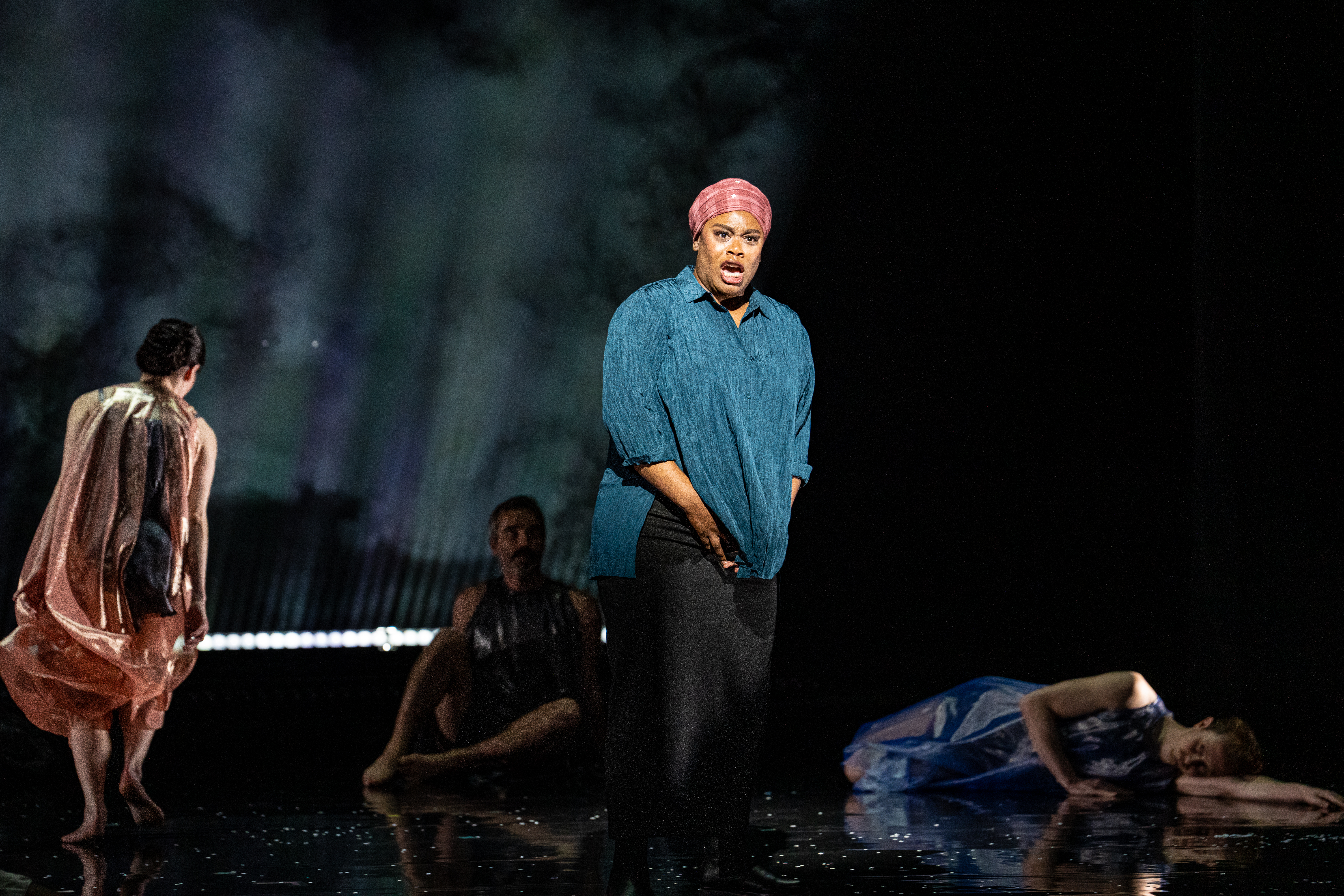
Soprano Whitney Morrison, the Performance Artist, sings about how she used to be an activist upon arriving at an artist retreat in “The Seasons.”
Kangmin Justin Kim (the Painter), Whitney Morrison (the Performance Artist), Abigail Raiford (the Farmer), and Megan Moore (the Choreographer) all had star-turn moments, some gathering momentum in Act II, others audibly tiring as the opera went on.
Costanzo couldn’t help being a dominant presence, not just because he’s a key figure in the opera’s conception (as well as Opera Philadelphia as a whole) but because he is such an accomplished actor and singer.
Countertenor Anthony Roth Costanzo is the Poet in “The Seasons,” based on Vivaldi’s music and a new libretto by playwright Sarah Ruhl.
At times, he actually made the lesser moments in the character dialogue work. He still has one of the most natural and pleasing countertenor voices currently before the public, plus a fine legato line and telling use of words. It’s great to have him at the helm of Opera Philadelphia, but it’s greater just to hear him.
Repeat performances of “The Seasons” are Dec. 20, 8 p.m., and Dec. 21, 2 p.m., at Perelman Theater, 300 S Broad St. The shows are currently sold out. operaphila.org
During the second night of the War on Drugs’ three-show “A Drugcember to Remember” run at Johnny Brenda’s on Friday, there were two kinds of special guests.
The first was deeply satisfying, really cool, and not entirely unexpected.
It was Craig Finn, the front man for the Hold Steady, whose superb new album, Always Been, was produced by Drugs leader Adam Granduciel.
Finn does have a track record of showing up at Drugcembers past, so the second guest was a tad more surprising.
It was a genuine “Holy [cow]! What just happened?” moment that gobsmacked a crowd that was already pinching itself — it’s not every day you are lucky enough to see Philadelphia’s most acclaimed rock band in peak form in a 250-capacity room, many times smaller than the capacious spaces they play in around the world.
It was Joe Walsh. Yes, that Joe Walsh, the James Gang founder, solo artist, and guitarist for the Eagles — the band, not the football team.
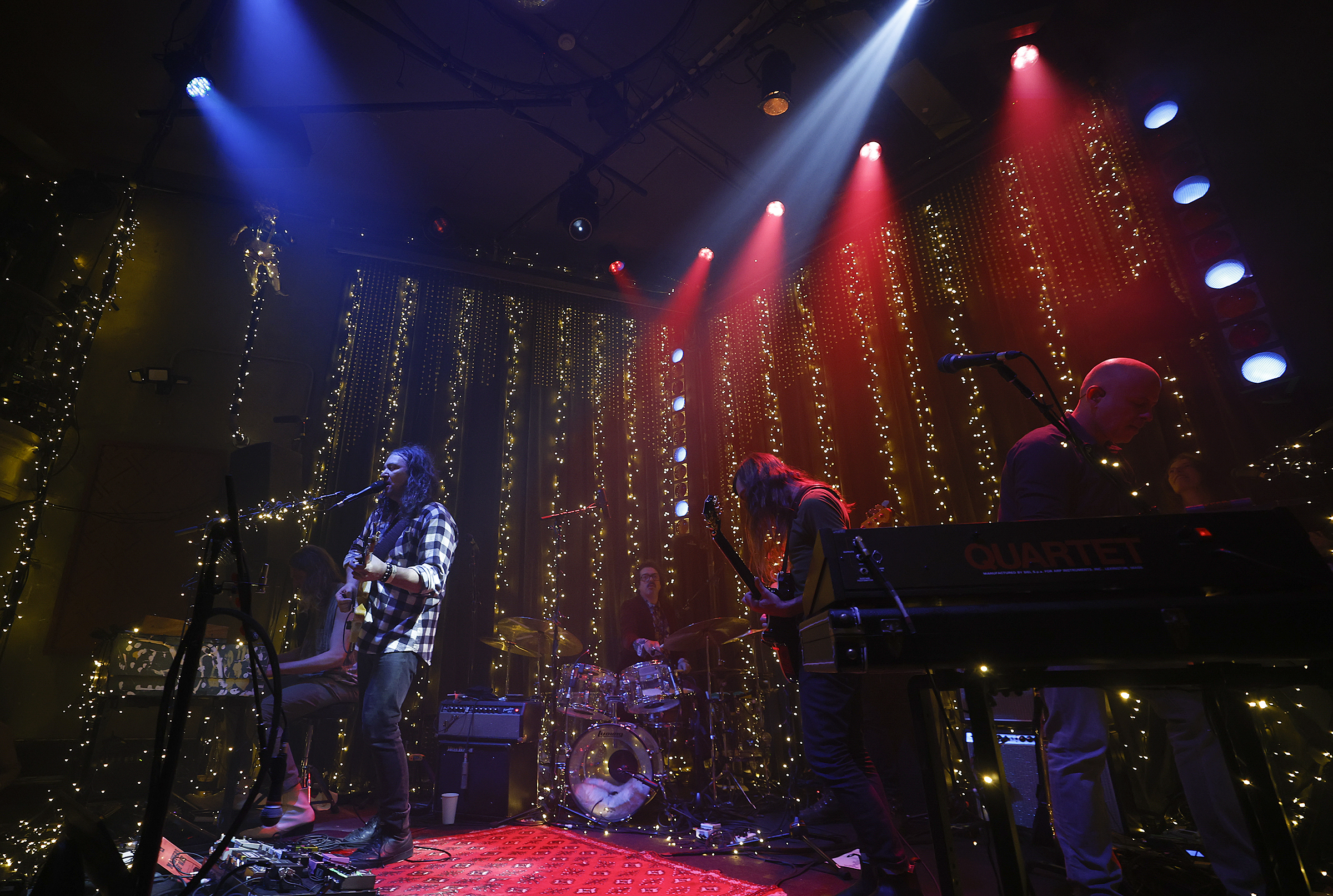
Special guest Joe Walsh performs with War on Drugs during the “A Drugcember To Remember” show at Johnny Brenda’s in Fishtown on Friday, December 19, 2025.
But the night would have qualified as an unforgettable Drugcember to Remember even without the out-of-the-blue rock star appearance.
The show’s earlier highlights included a roaring cover of Tom Petty’s “Love is a Long Road” and a goose bump-inducing 17-minute motorik version of “Harmonia’s Dream,” from the band’s 2021 album I Don’t Live Here Anymore, that spotlighted keyboard player Robbie Bennett.
War on Drugs frontman Adam Granduciel performs during the groups “A Drugcember To Remember” show at Johnny Brenda’s in Fishtown on Friday, December 19, 2025.
It leveled up to a higher plane with the arrival of Walsh, the 78-year-old powerhouse slide guitar player who seemed thrilled to be playing with a decades younger vise-tight group of simpatico musicians.
The Walsh-Drugs mini-set kicked off with “Rocky Mountain Way,” the extra-crunchy 1973 hit that turned Walsh into a solo star. He was joined by an arsenal of guitarists onstage including Granduciel, Anthony LaMarca, and, at times, newest band member Eliza Hardy Jones, who also played percussion and sang backup throughout the evening.
On “Rocky Mountain Way,” which has gotten new life in the last year as a TikTok phenomenon, Walsh employed a talk box, using a tube in his mouth to manipulate and distort the sound of his guitar in ways that still sound futuristic 50 years later.
It also meshed perfectly with the audio geek aesthetic of Granduciel, who is an expert at layering guitar and keyboard sounds to transporting effect.
Before the band leaped into that song, though, Granduciel and Walsh explained to the nonplussed crowd how the seemingly unlikely collaboration came to be. How did Walsh wind up onstage at the Fishtown club that has been the Drugs’ spiritual home since they played there on the venue’s opening weekend in 2006?
Here’s the story: In 2023, the band played Walsh’s VetsAid concert for military veterans in Los Angeles.
“We became friends, we stayed in touch,” Granduciel said. “And he wanted to come to Drugcember, he wanted to see all you guys. He wanted to breathe the air that we’re breathing.”
During the Drugs’ set at VetsAid, Walsh said, “I was walking around backstage and I listened to ’em. And I never heard them live. They make nice records. But, boy, this thought: I couldn’t help it. ‘Damn! I’d sure like to play in a band like that.’ Be careful what you … wish for!”
The War on Drugs perform during the group’s second of three sold-out “A Drugcember To Remember” performances at Johnny Brenda’s in Fishtown on Friday, December 19, 2025. “A Drugcember To Remember,” a series of holiday shows directly benefit The Fund for the School District of Philadelphia, a nonprofit that raises and coordinates investments into the Philadelphia public schools.
“Rocky Mountain Way” was followed by “In the City,” Walsh’s song written for the 1979 action movie The Warriors that he also recorded with the Eagles. His craggy and Jones’ dulcet vocals made for a captivating blend, while the rhythm section of bassist Dave Hartley and drummer Charlie Hall powered the song forward.
As exciting as it was to hear the Drugs back up Walsh on his own hits, it was more compelling still to watch him engage with the band on the closing number of the night, “Under the Pressure,” from 2014’s Lost in the Dream.
That song is combustible under normal conditions, but it moved from a simmer to a boil in a flash with Walsh added to the mix. He and Granduciel were hunched over their guitars on the lip of the stage, illuminated by the strings of holiday lights on the mic stands and on the balcony railings above them in the intimate club.
It was like a one-of-a-kind Fishtown version of what Keith Richards and Ronnie Wood of the Rolling Stones call their “guitar weave,” and it was a kick to watch Walsh so enthusiastically just want to be one of the boys in the band.
As mentioned, pre-Walsh, the show was terrific on its own terms. And a special shout out goes to Jon Natchez, the Drugs’ multi-instrumentalist, who played keyboards and baritone sax.
Special guest Craig Finn performs during “A Drugcember To Remember” show with War on Drugs at Johnny Brenda’s in Fishtown on Friday, December 19, 2025.
The latter instrument’s honking added extra force to typically meticulously arranged songs like the Phil Collins-evoking “I Don’t Wanna Wait,” a highlight of the band’s opening set, which was followed by a 15-minute intermission.
In introducing Natchez, Granduciel mocked his Boston sports fandom. “He wouldn’t be caught dead in an Eagles jacket,” the bandleader said. “I’m out of Boston, too” — Granduciel grew up in Dover, Mass. — “but I bleed green.”
The evening began three hours before it ended with Finn walking onstage with an acoustic guitar and wearing a Natural Light ball cap. He warmed up an attentive crowd with songs and stories, mostly from Always Been, his superb song cycle that’s partly set outside Philadelphia and mostly at the Delaware shore.
Special guest Craig Finn performs with War on Drugs during the “A Drugcember To Remember” show at Johnny Brenda’s in Fishtown on Friday, December 19, 2025.
Finn was followed on stage by seven members of the Drugs, who reached back to open with “Arms Like Boulders,” from the band’s 2008 debut Wagonwheel Blues.
“Pain,” from 2017’s Grammy-winning A Deeper Understanding, outlined the idea of the unending quest that’s an animating concept in Granduciel’s lyrics. “I want to find what can’t be found,” he sang. And later, in “Strangest Thing,” also from Deeper, he sang about still not finding resolution: “I’m just living in the space between the beauty and the pain.”
Seven songs in, the Drugs brought Finn back out for a three-song interlude that closed the first set.
Two of those were from Always Been, including the engrossing “Bethany,” which took off into the stratosphere with a Granduciel solo midway through. Then it lingered with an image in the closing line: “But the sunset looks like blood from the window of the bus, somewhere between Harrisburg and Bethany.”
The third song in the Drugs-Finn collab on Friday was “Sweetheart Like You,” featuring Finn and Granduciel trading vocals on Bob Dylan’s philosophical barroom come-on.
That was a treat, with Finn being very much himself, gesticulating his way through his verses while Granduciel slipped into his best sneering Dylan voice. It was an exquisite combo, and just one of many indelible moments in an evening that for all concerned will surely be the Drugcember they remember.
The final sold-out night of “A Drugcember to Remember” was scheduled for Saturday night at Johnny Brenda’s. No special guests have been announced.
NEW YORK — There’s been some movement with the Flyers’ 23-man roster in recent days, but before a question could even be asked about Egor Zamula clearing waivers, Tyson Foerster undergoing surgery, or Denver Barkey’s first call-up, Flyers general manager Danny Brière started things off with some news.
Goalie Aleksei Kolosov was with the team for Saturday’s matinee against the New York Rangers as an emergency recall and backed up starter Sam Ersson. Goalie Dan Vladař “has got a little, little boo-boo,” he said, adding his upper-body injury is “Nothing too serious” and “he should be back, we hope by Monday.” But added that they don’t know for sure.
Vladař last played on Tuesday in Montreal, backstopping the Flyers to a 4-1 win against the Canadiens. The Czech netminder is 12-5-3 this season with the sixth-best goals-against average (2.41) and tied for the ninth-best save percentage (.910) in the NHL among goalies who have played at least 15 games.
And then there was more. Forward Christian Dvorak, who has been centering one of the Flyers’ top lines and serving as a key penalty killer, is out with a lower-body injury. He did not dress against the Rangers, but “according to our trainers, shouldn’t be long-term.”
Here are three more questions answered by Brière on Saturday afternoon.
Why was Denver Barkey recalled and not Alex Bump?
Called up from Lehigh Valley on Friday, Barkey delivered two assists in his NHL debut Saturday.
Drafted by the Flyers in the third round of the 2023 NHL draft, the 5-foot-10, 173-pound forward, who is known for his grit, moxie, and determination, turned pro this season and has been impressive in the minors. The 20-year-old has 16 points (seven goals, nine assists) in 26 games for the Phantoms, primarily playing on the wing with center Lane Pederson and winger Alex Bump.
“He came in. He played extremely well. I think the biggest thing from the report is his consistency; he was good night after night and earned the right to get a look,” Brière said.
Barkey has looked impressive since the Flyers’ rookie camp in early September, but everyone outside the organization expected Bump to be the one getting the call-up. Brière did say, “It could have also been one of those two guys,” meaning Pederson or Bump, as the line has been dominating in the AHL, “but we decided to go with Barkey.”
I don't see Alex Bump out there to start the second period here in Allentown. He took kind of a weird hit on his first shift, and looked like he was working his shoulder on the bench? He did take a couple more shifts after that, but went down the tunnel later in the period. pic.twitter.com/z9hSBxRLO2
A highly touted prospect, Bump was someone many thought would break camp with the Flyers. Instead, after a solid rookie camp, he was sent down after a poor main training camp. After a slow start in Lehigh Valley, he now has 20 points (seven goals, 13 assists) in 27 games in Allentown.
“We’re very happy with Alex,” Brière said. “Unfortunately, he got injured [Friday] night. He’s going to be out for a short period of time, maybe seven to 10 days. He didn’t have a great camp, and he knows that. But since then, he went down there, and he’s been working hard as well. He’s a guy we considered, and he’s not that far off.”
What’s next for Egor Zamula?
The Flyers defenseman cleared waivers on Friday afternoon and has been assigned to Lehigh Valley.
Zamula last played on Dec. 7 and has skated in 13 of the Flyers’ first 33 games this season, registering one assist. Averaging a few ticks above 14 minutes a night, he had a plus-minus of plus-4, only boosted by a plus-5 night when he returned to the lineup on Nov. 22 against the New Jersey Devils.
Flyers defenseman Egor Zamula cleared waivers on Friday and was assigned to Lehigh Valley.
“The biggest thing with Egor is that he needs to play,” Brière said. “It doesn’t really help him sitting game after game, and we figured if he clears waivers, it’s going to give him the chance to play some games, maybe find his game again.
“We expect to have some adversity there on defense at some point, too, where injuries are going to come — what was it two, three weeks ago, we didn’t have Cam York and Rasmus Ristolainen, and now they’re back in the lineup. So things change fast. Hopefully, he can find his game, and we could very well see him back with the big team at some point.”
A mainstay last season, skating in 63 games, Zamula has dropped down the depth chart this season. He has been passed by Emil Andrae, offseason acquisition Noah Juulsen, and, more recently, Ty Murchison.
A long-standing criticism, dating back to former coach John Tortorella, has been Zamula’s pace of play. Coach Rick Tocchet also said he wanted to see the 6-foot-3, 200-pound defenseman move the puck more quickly. Although he did not play for the Phantoms on Friday night, and while the AHL has a slightly slower pace of play, the hope is that he can refind his game.
“It’s up to him,” Brière said. “We hope that he kind of takes charge down there. That’s up to him to decide how he’s going to play, but I think just going on the ice and getting the reps is more important than sitting around and just practicing day after day.”
Why the change in status for Tyson Foerster?
Originally, the winger was expected to miss two to three months after suffering an “upper-body” injury on Dec. 1 against Pittsburgh. However, on Wednesday, the Flyers announced that Foerster will miss the next five months after undergoing arm surgery on Monday. It is likely that his season is over.
“Just more in-depth examinations, and after talking to different people, and just to make sure it was decided that, at the moment, the best thing was to take care of it with surgery,” Brière said.
The GM added that it is an approximate timeline and “it could be a little less, could be a little bit more.”
At the time of his injury, Foerster led the Flyers in goals (10), leaving a huge hole in the lineup. Brière is hoping the Flyers can fill the spot from within.
“It’s a pretty good player that you’re trying to replace, so that’s obviously not easy, but it’s a chance for other guys to step up, get more ice time, and take advantage of it,” he said.
“So that’s the way we see it. It’s a great opportunity for a lot of guys to see what they can do. [Carl] Grundström’s recall, since then, he’s played extremely well, so that’s good to see, but it’s never easy to replace a guy like Tyson, who’s becoming a huge part of our offense.”
Thousands of households in Philadelphia’s collar counties remained without power a day after wind gusts downed trees and caused hundreds of electrical outages throughout the region.
More than 2,230 customers, mostly in Bucks, Chester, Delaware, and Montgomery Counties, still did not have electric service as of Saturday evening, according to Peco.
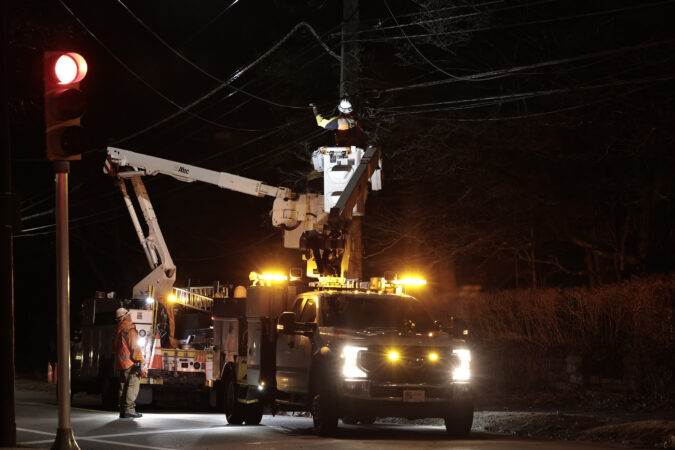
Nearly half the outages were due to fallen trees and branches interfering with electrical systems, Peco spokesperson Tom Brubaker said Saturday afternoon. As a result, suburban counties saw far more outages than Philly, he said.
Winds registered as high as 62 mph Friday afternoon. Around 7 p.m., a pine tree fell on a Chestnut Hill apartment, CBS3 reported, while in Roxborough, a tree fell on a vehicle, sending two people to the hospital.
Temperatures plummeted into the 20s Friday night, and, according to Brubaker, about 80,000 homes lost power.
Crews faced challenges from the weather, with wind gusts frequently topping 40 mph, Brubaker said.
“When wind gusts are that high, we can’t take our bucket trucks to repair lines,” he said.
An additional 135 Peco employees from Virginia and North Carolina have traveled to the region to assist in the recovery, Brubaker said.
He said he expected most of the remaining outages to be resolved by Saturday evening, though “a few rural, isolated customers” may face longer waits.
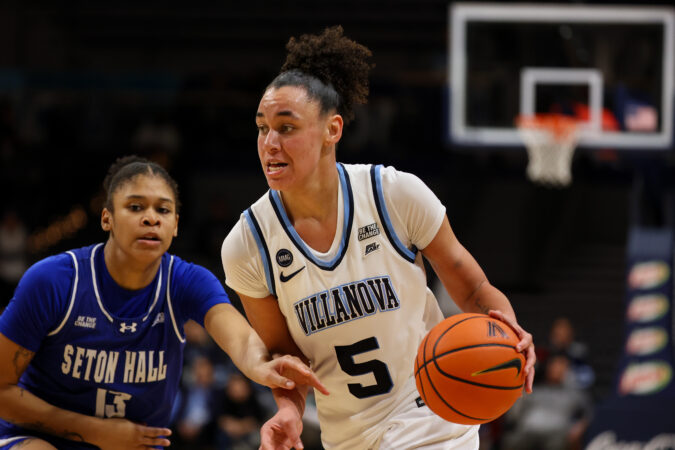
With a 72-55 win over Seton Hall in its conference home opener, Villanova’s winning streak reached seven on Friday night.
The Wildcats (9-2, 2-0 Big East) made an early statement at Finneran Pavilion against one of their prime conference rivals. Seton Hall (7-4, 1-1 Big East) was third in the conference preseason poll, while Villanova was ranked fourth.
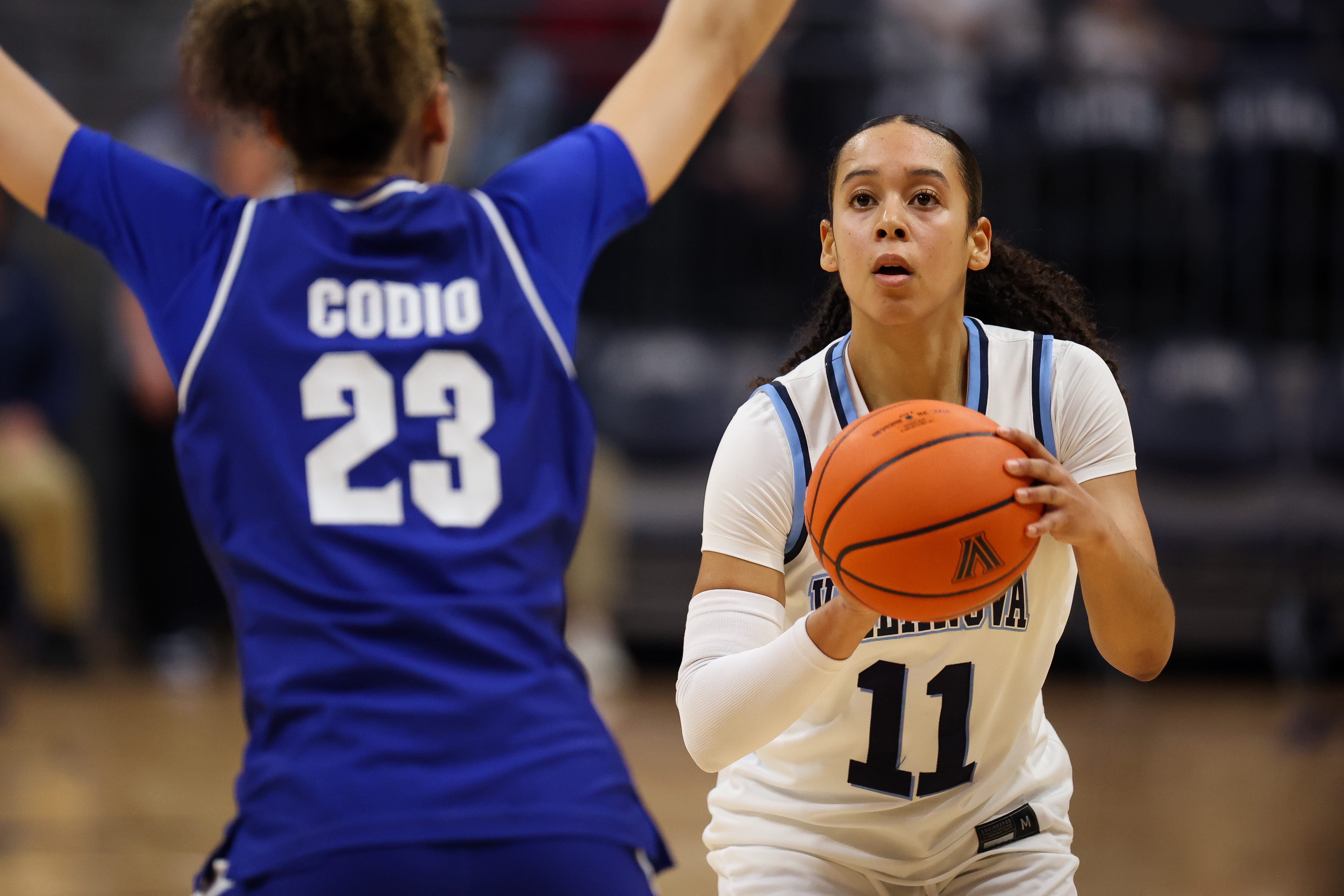
Sophomore guard Jasmine Bascoe led the way with 20 points and seven rebounds. Senior guard Ryanne Allen added 19 points.
Villanova guard Jasmine Bascoe (11) prepares to shoot a three-point basket against Seton Hall on Friday.
The Pirates were paced by sophomore guard Jada Eads, who scored 12 points and grabbed four rebounds.
It wasn’t one of Villanova’s strongest shooting nights. The Wildcats went 30-for-68 (44.1%) from the field, including 12-of-34 on three-pointers. But they thrived on defense to claim a double-digit victory over their Big East foe.
Villanova’s success in the turnover battle was key, as they scored 18 points off 15 Seton Hall turnovers. Meanwhile, the Pirates managed four points from Villanova’s 12 turnovers.
Shaking off the rust
It took some time for the Wildcats to find their rhythm after a nearly two-week hiatus from competition. Villanova last played on Dec. 7, when it beat St. Joseph’s to claim the Big 5 Classic championship.
The Wildcats shot just 5-for-18 from the field in the opening 10 minutes.
However, Villanova leaned on its steady defense, notching six steals in the first quarter and holding Seton Hall to 5-for-14 shooting from the field.
As Villanova trailed, 11-7, with 49 seconds left in the first quarter, Bascoe stole the ball and drove in a layup. Freshman forward Brooke Bender then sank a three-pointer to give the Wildcats a one-point edge heading into the break.
Allen heats up
Allen fueled the scoring in second quarter, making all five of her three-pointers.
The Wildcats continued to control possession as 12 of their 23 points came off turnovers.
With 1 minute, 23 seconds remaining in the first half, junior forward Brynn McCurry grabbed a steal and passed it to Bender. She then assisted Allen’s fourth three-pointer to secure a 35-25 halftime lead.
Using offensive depth
Villanova pulled away from Seton Hall in the third quarter. A three-pointer from Bender gave the Wildcats a 21-point advantage in the period’s final seconds.
The Wildcats shot just 3-for-14 on three-pointers in the final 20 minutes, but Bascoe and McCurry were effective in distributing the ball.
Villanova finished with 20 assists, and McCurry dished out a team-high eight.
Meanwhile, Villanova limited Seton Hall’s movement, holding the Pirates to just six assists.
Up next
Villanova will host St. John’s (11-2, 1-1 Big East) on Monday (noon, ESPN+).
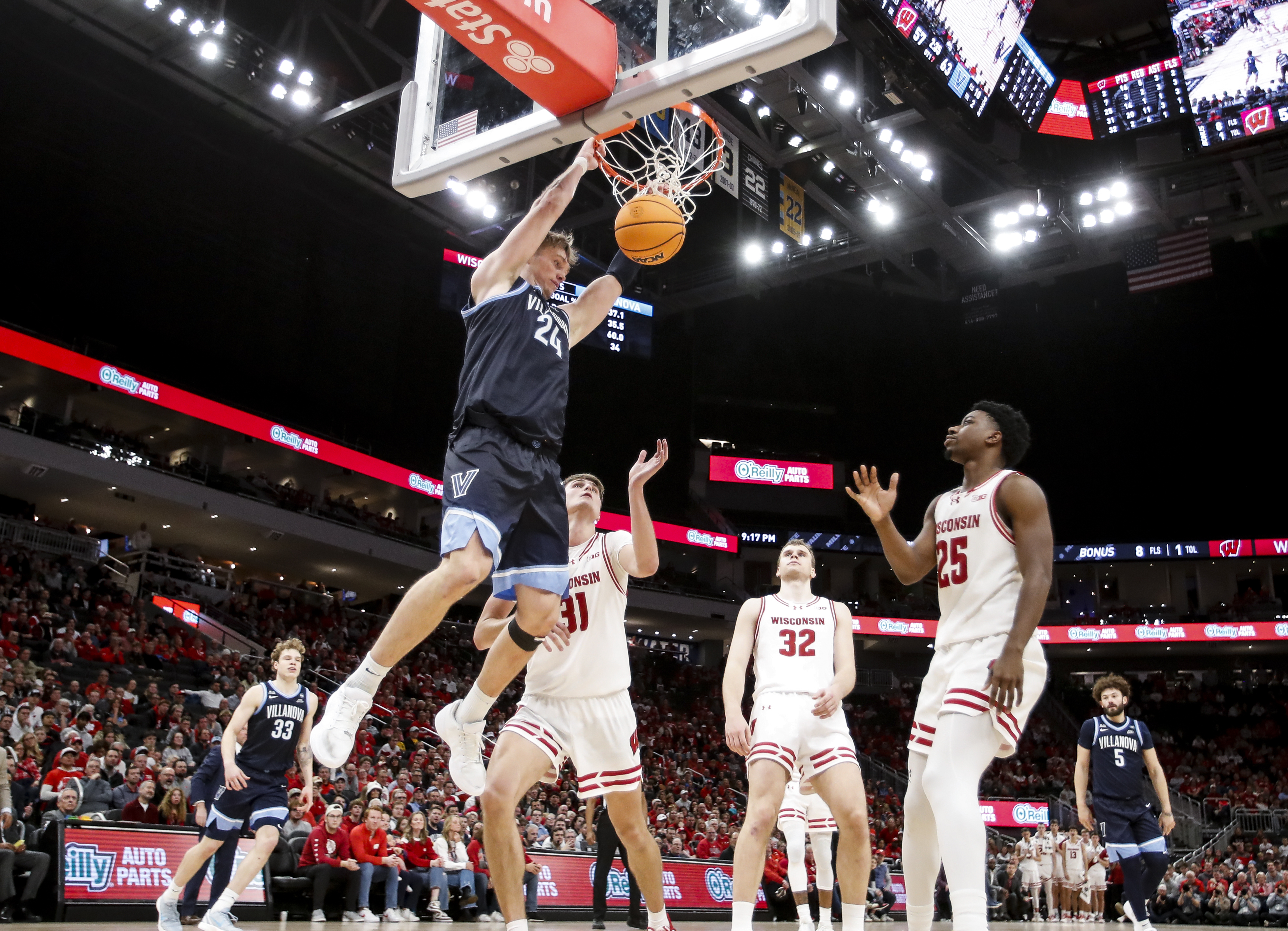
MILWAUKEE — Duke Brennan came up to the top of the key and set a screen for Devin Askew, rolled to the paint, and rose for a two-handed dunk to put Villanova up eight in overtime, sending Wisconsin fans to the exits.
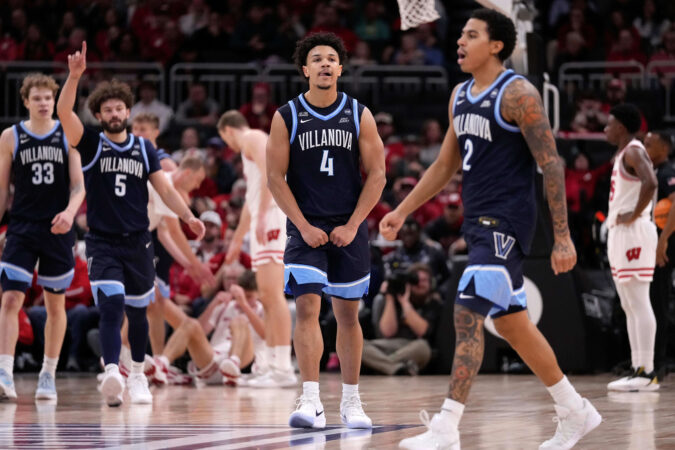
The inside of Fiserv Forum on Friday night felt more like a Wisconsin home game than a neutral-site nonconference matchup. It was a tale of two halves for Villanova, but when the clock hit zero, the Wildcats picked up a resumé-boosting 76-66 overtime win against the pesky Badgers, who had beaten Big East foes Providence and Marquette.
The win moved Villanova (9-2) into the 29th spot of KenPom’s rankings and sends the Wildcats into the Big East slate on a high note.
“I thought they did a really good job of extending their halfcourt defense on us, which kind of surprised us a little bit,” Villanova coach Kevin Willard said postgame. “We had opportunities in the second half to win the game. And when you have two freshmen and a sophomore out there, sometimes you have to live through those mistakes.”
Live by the three, die by the three
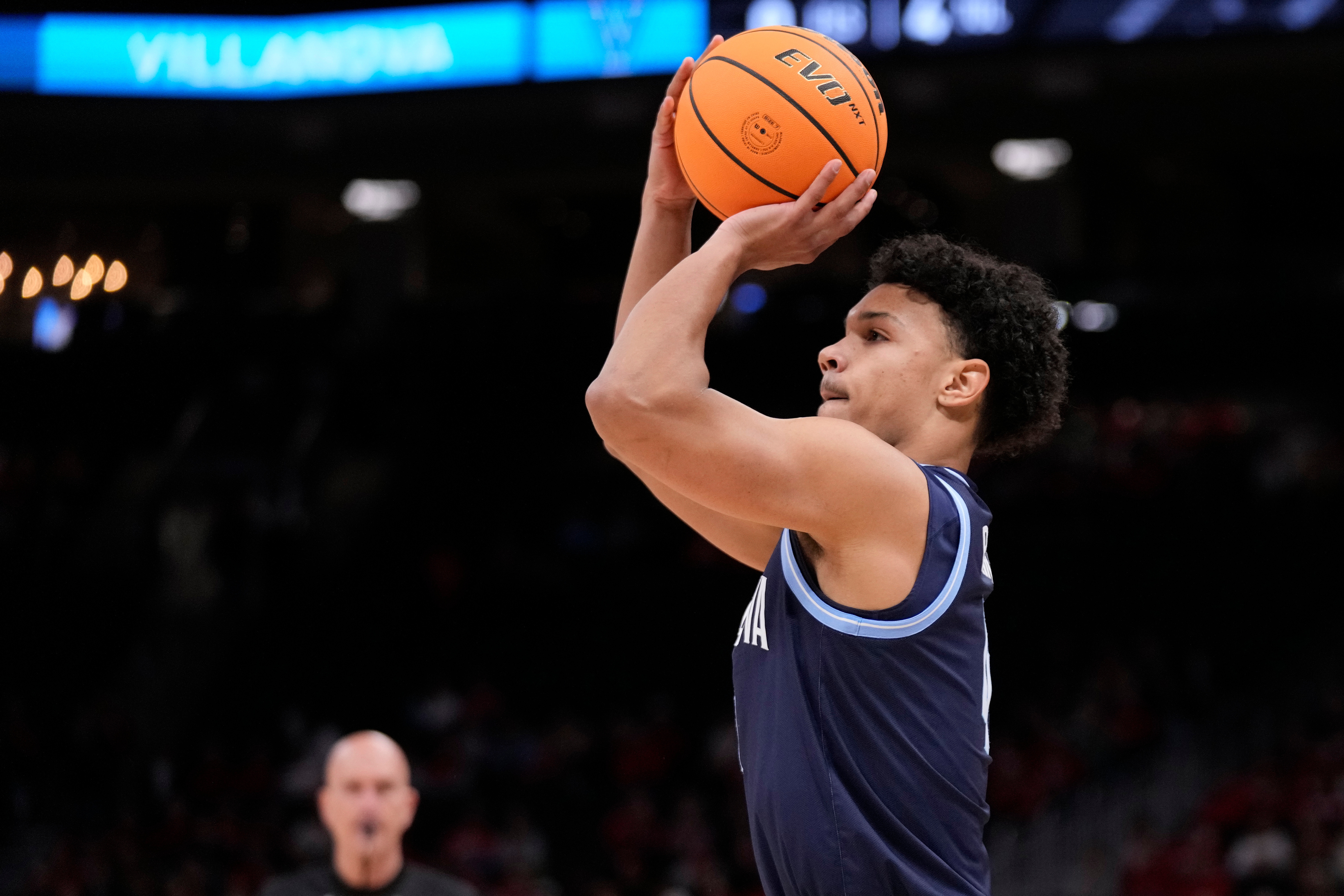
The Wildcats got off to a hot start from the three-point line, hitting 8 of 19 attempts in the first half, led by Tyler Perkins’ barrage. He came into the game making 40.5% of his three-pointers, and his third three-pointer of the half from the top of the key pushed Villanova’s lead to 13 before the break.
Perkins paced the Wildcats with 19 points and earned praise from his coach afterward.
“I like the fact that Perk’s looking to shoot the basketball,” Willard said. “He’s shooting a high percentage. He does all the little things that most people don’t see. But when he’s aggressive out there, it gives us another scorer.”
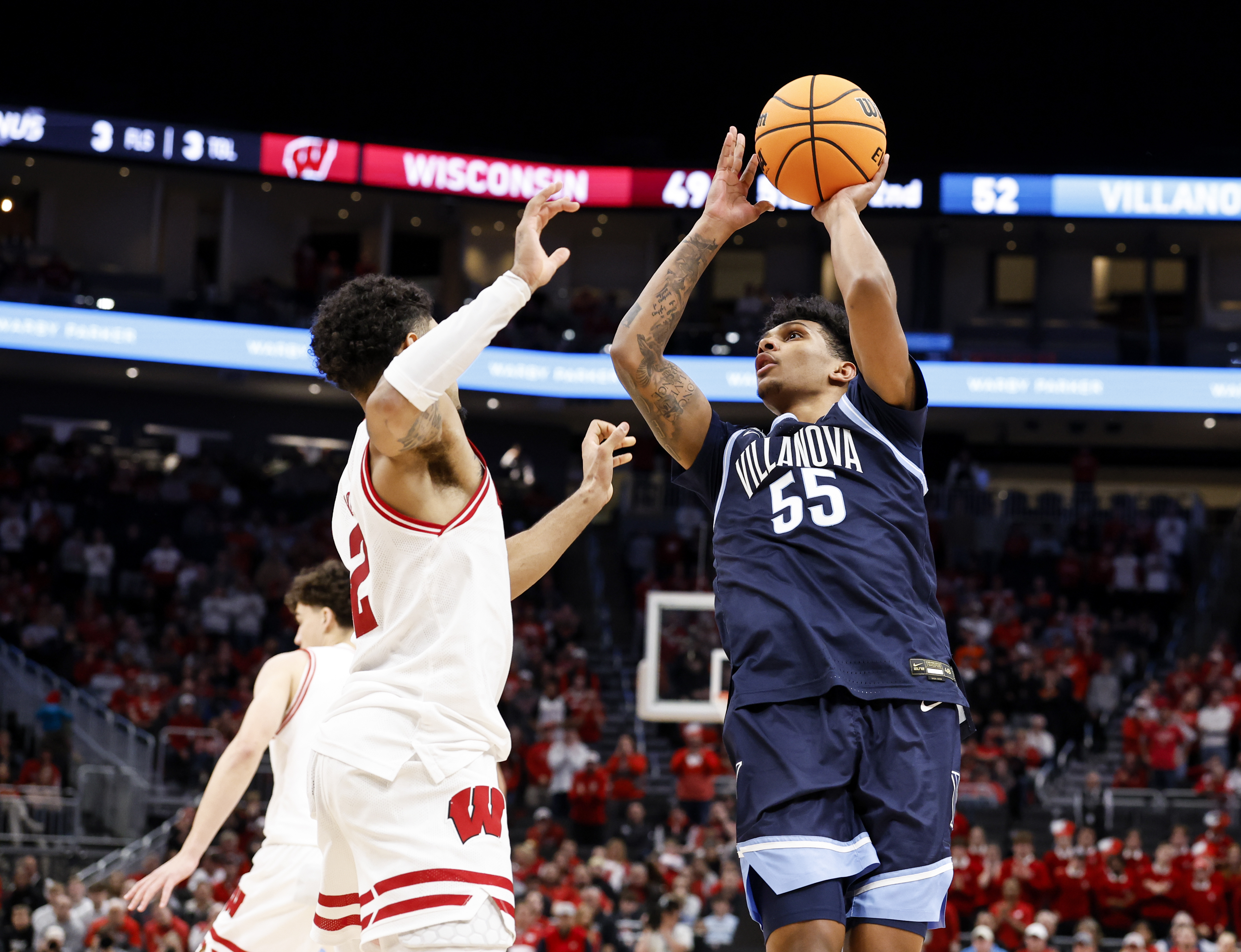
Villanova guard Tyler Perkins prepares to shoot a three-pointer against Wisconsin on Friday.
But the second half was a different story. The three-point shots weren’t falling (1-for-10 in the second half), and the pressure Wisconsin (7-4) put on Villanova’s ballhandlers, like freshman Acaden Lewis and transfer guard Bryce Lindsay, left little room to operate.
A lead that had ballooned to 15 early in the second half was slowly whittled to three with less than seven minutes remaining in regulation. After a Brennan layup with 6 minutes, 16 seconds left, the Wildcats did not score a field goal for nearly five minutes. Villanova was outscored, 34-21, in the second half and shot just 8-for-29 from the field.
“We knew they [were] going to go on that run,” Lindsay said. “They got everybody in the crowd [into it], their fans. We just had to stay [together] as a team and play together.”
Wisconsin tied the game with 31 seconds left, and Lewis’ contested stepback jumper fell short right before the buzzer to send the game to the extra frame.
But in overtime, it was Lindsay, who shot 1-for-9 from the field through the first 40 minutes, who ignited the Wildcats. He opened the scoring with a curling three from the top of the key after a Brennan screen freed him. A dribble handoff with Villanova’s big man got Lindsay loose again two minutes later, pushing the Wildcats up seven with 2:59 left in overtime.
“I see one fall, the hoop gets a little bigger for me,” said Lindsay, who finished with 12 points.
Brennan’s battle on the boards
Brennan was tested by the size of Wisconsin big men Nolan Winter (7-foot) and Aleksas Bieliauskas (6-10). The 6-10 Brennan, who entered the night averaging 11.6 rebounds, second-most in college basketball, pulled down seven of his 11 rebounds in the first half and outrebounded Winter and Bieliauskas combined.
He also found soft spots in the middle of Wisconsin’s defense on pick-and-roll action. Lindsay found him in the lane for an and-one layup to open the second half, and Lewis found him on a similar action to end a scoring drought later in the half.
Villanova’s Duke Brennan dunks the ball during overtime of a 76-66 win over Wisconsin.
He played a team-high 39 minutes finished with his fourth double-double of the season.
Turning up the heat defensively
It was a shame that Lewis got into foul trouble in the first half because he was a big reason Wisconsin turned the ball over.
His full-court pressure, along with Lindsay and Askew, made the Badgers uncomfortable in the first 20 minutes, which was part of Villanova’s game plan. The Wildcats scored 15 points off 16 Wisconsin turnovers, eight of which came in the first half.
“That’s a Wisconsin team that can put up a lot of numbers,” Willard said, “and to have them struggle and turn them over like that, to me, was huge.
“If you let them just run their offense, they will pick you apart. And really early in the game, we wanted to get them uncomfortable.”
Free basketball at Fiserv Foum. Villanova and Wisconsin tied at 56 heading into extra period.
Friday was another learning experience for Lewis, who had opportunities to close out the game for Villanova. He missed the front end of a one-and-one with the Wildcats up three with 59 seconds left, committed a foul on the other end to give Wisconsin two free throws, then missed the potential game-winning shot and didn’t play most of the overtime period.
However, he didn’t turn the ball over and finished with seven points and two assists on 3-for-9 shooting.
Villanova freshman Acaden Lewis attempts a shot over Wisconsin’s Nick Boyd on Friday at Fiserv Forum in Milwaukee.
“I thought he played great,” Willard said. “This is a great learning experience for him of what to do at the end of the game. But he had two huge steals in the end of the second half. And he’ll make his free throws next time, and he’ll make a better play at the end of the game.
“That’s why you got to put him in those situations, and he’ll learn from it. He’s done it every game.”
Added Perkins: “He’s so mature. … He got in foul trouble early. And a lot of freshmen would dig in their head, not be ready, not stay in the game. But he had some great stops at the end of the game.”
Before the game, Villanova announced that freshman guard Chris Jeffrey underwent right knee surgery and is out indefinitely. Jeffrey, a Brooklyn native, had a knee injury before he arrived on campus that “recently flared up,” the program said.
In nine games this season, Jeffery was averaging 4.2 points across 10.6 minutes. The team also announced that walk-on Wade Chiddick also had right knee surgery and has no timetable to return.
Up next
Villanova will open conference play at Seton Hall on Tuesday (7 p.m., Peacock). The Wildcats hope to ride the momentum they gained through their tough stretch of nonconference play.
“The schedule we inherited, didn’t give us a whole ton of games in November to test ourselves,” Willard said. “And I think going through Michigan, [Pittsburgh], now Wisconsin, and now we got a really good Seton Hall team on Tuesday, now we’re testing ourselves, and I like the way these guys are going.”
The intersection of Shelbourne and Willard Streets is known by neighbors as an illegal dumping corner, where debris, trash, and weeds are part of the scenery.
A $17,000 grant from the pilot program Revive and Thrive could change that, as the teenagers from nonprofit Klean Kensington are set to turn the vacant lot at 859 E. Willard St. into a public park.
In Upper Kensington, the typical block has, on average, three or four vacant buildings or lots, an Inquirer investigation found. The problem has been identified as a contributing factor to the open-air drug trade.
Since 2022, Klean Kensington has been trying to address the issue by employing local teens to transform trash-filled parcels into community gardens on Madison, Westmoreland, and Hilton Streets, providing food for neighbors, and offering young residents a way to stay occupied.
For Jeremy Chen, the group’s executive director, the Willard Street project is an opportunity to “activate the corner” by creating a garden that neighbors feel is their own while recognizing the community work.
“The teens have been doing this work for a while, but it’s always encouraging to have their work recognized,” Chen said.
The idea is to keep children and youth at the center of the garden, Chen said. Pollinator flowers, benches, bright art, planter boxes, and a durable trash setup are among the features being considered. Klean Kensington will employ 25 teens for the project, and two or three local high school students will be hired as park ambassadors.
Thomas Jefferson University’s Park in a Truck (PIAT) program, Circular Philadelphia, Trash Academy, and Glitter will partner for the program, providing dumping-prevention workshops, facilitating the design process, documenting the effectiveness of the project, and aiding in weekly cleanups.
Cleanup activities are expected to start early in the spring. And community members will gather to decide what they envision for the 16-by-60-foot space owned by Esperanza Health Center.
For Lois Williams, Trash Academy codirector, this initiative is an opportunity to benefit both the city and neighbors in the fight against illegal dumping.
“This project can demonstrate how neighbors with low budgets, on privately owned lots, can make a difference,” Williams said.
Keeping neighborhoods clean and ending the sprawling drug market have been a focus of Mayor Cherelle L. Parker’s administration. Chen hopes this initiative can show City Hall that funding local organizations to do cleaning in their neighborhoods instead of hiring contractors can give them a sense of ownership, preventing dumping recurrence.
“When it’s locals taking care of their community, it’s more likely for them to care and to self-monitor so it doesn’t become a dumping ground again,” Chen said.
The garden is scheduled to open in the summer of 2026.
During the Christmas holidays, the word peace makes a frequent appearance, in sermons and carols and frequent performances of Handel’s Messiah, with its glorious Hallelujah Chorus praising “the Prince of Peace.”
That makes it even more infuriating to watch President Donald Trump demanding that Ukraine (and American’s European allies) agree to a so-called peace deal by the new year that guarantees more war and killing. Equally depressing is to watch much of the media buy the premise that the U.S. and Russia are actually conducting peace talks.
Baloney. What is going on in Berlin, Miami, Washington, and Moscow is a Trump-led farce. Ukrainian President Volodymyr Zelensky and European leaders are forced to play along lest POTUS cut off crucial U.S. intelligence sharing and halt critical (but limited) sales of U.S. weaponry. They know Trump seeks a deal, any deal, even one on Kremlin terms, in order to claim he achieved peace in Ukraine. Yet the gleam of a Nobel Peace Prize and rare earth business deals with Moscow override any concerns about helping Moscow crush Kyiv.
Vladimir Putin, on the other hand, has shown no interest in negotiating, but just waits for more Trump concessions. Any deal that protects Kyiv’s future will be rejected by Vladimir Putin, but Trump, following past practice, will likely blame Ukraine.
That is why many more Americans, and security conscious Republicans in Congress must recognize that Trump is no worldly prince (or king) of peace. Rather, he is a poseur who must be prevented from sacrificing Ukraine on the altar of his ego and endangering the security of Europe and the United States.
You doubt me? Then read Part Two of the notorious Vanity Fair interviews with Trump’s chief of staff and right-hand woman Susie Wiles, in which sherevealsTrump’s mindset regarding Ukraine. Despite debates within Trump’s team over whether Putin wants the whole of Ukraine, she admits, “Donald Trump thinks he wants the whole country.”
In an interview with Vanity Fair, White House chief of staff Susie Wiles said of the president’s talks with Vladimir Putin about Ukraine: “Donald Trump thinks he wants the whole country.”
Vanity Fair asked Secretary of State Marco Rubio if he felt the same. He responded that, after watching Putin repeatedly reject freezing the war at the line of conflict, “You do start to wonder, well, maybe what this guy wants is the entire country.” Presumably, the secretary has bothered to read Putin’s speeches in which the Kremlin leader has said over and over again that Ukraine has no right to be a state,
However, Rubio has been pushed aside as negotiator in favor of the supremely naive and ill-informed real estate mogul Steve Witkoff, who keeps insisting Putin wants peace, an argument repeated by POTUS. Trump initially signed off on a 28-point “peace” plan that was handed by a Putin emissary directly to Witkoff.
Even though Zelensky and European leaders have gotten some of the most egregious points eliminated, the two biggest obstacles still remain: Putin’s demand that Kyiv turn over critical territory that Russia hasn’t been able to capture in nearly four years, and strategic guarantees of Western military aid to prevent Russia from violating any agreement.
On both sticking points, the Trump negotiators continue to play into Putin’s hands.
On the question of territory, what Putin demands is that Kyiv turn over a belt of fortified cities on high ground in the Donetsk region. Moscow has been unable to make major territorial gains in this area since near the beginning of the war, and the gains they have made have incurred terrible Russian casualties.
This belt “is not easy to conquer because [its cities are] well fortified militarily and naturally due to the landscape,” I was told by Yehor Cherniev, deputy chairman of the Committee on National Security and Defense of the Ukrainian parliament. “It would cost the Russians thousands and thousands of lives and months if not years to take it. I don’t see any compromise on this.”
From left, German Chancellor Friedrich Merz, British Prime Minister Keir Starmer, Ukrainian President Volodymyr Zelensky, and French President Emmanuel Macron meet at 10 Downing Street, in London earlier this month.
Yet Putin has persuaded Witkoff to demand that Kyiv turn it over for nothing, which would leave the flat farmlands of central Ukraine open to further Russian attack.
Compounding the insult, Witkoff has proposed that the area be made into a “demilitarized zone” from which Ukrainian troops would withdraw but Russian troops not enter. No one who has read anything on recent history could be unaware that Putin has zero respect for such nonsense. “We know the Russians would just use this to infiltrate soldiers in civilian clothing and then seize control of the area,” Cherniev said by phone from Kyiv. “It would just be a trap.”
The second, enormous sticking point, concerns security guarantees for Ukraine in case Putin violates any agreement.
Putin has broken every accord Russia has signed with modern-day Ukraine. This includes, most notoriously, the 1994 Budapest Memorandum, in which Ukraine handed over its Soviet-era nuclear weapons in return for pledges from Moscow, Washington, and London that Kyiv’s sovereignty would be respected.
No wonder Zelensky insisted on Monday: “There is one question I — and all Ukrainians — want to get an answer to. If Russia again starts a war, what will our partners do?”
Putin has made clear he accepts no NATO membership, no Western military guarantees and only a shrunken, disarmed Ukrainian military. As for the Witkoff team, they concur on no NATO membership for Ukraine, but have offered only puffery in its stead.
The big headline has been that Trump would agree to “Article 5-like” guarantees, a reference to the provision in NATO that an attack on one requires help from every member. But Trump has played up the ambiguity of Article 5, which doesn’t specify that the help needs to be military. “Depends on your definition,” he said in August. “There’s numerous definitions of Article 5.”
Moreover, Sen. Lindsey Graham (R., S.C.), a golf buddy of Trump, has made clear, that even if the Senate approves security guarantees, it wouldn’t be a treaty but “a congressional blessing, statutory in nature.”
A “blessing” won’t help Ukraine if Russia pauses, regroups, and attacks again.
It fascinated me that, after revealing Trump’s awareness of Putin’s goals, Wiles told Vanity Fair she thought Trump’s greatest achievement of 2025 was acting as “an agent of peace.”
The president’s claim that he ended eight wars is braggadocio: No wars were ended, including in Gaza, where a ceasefire is tottering. The list includes long-standing disputes that remain and outbreaks of fighting that continue, and even a Pakistan-India outbreak, where New Delhi denies Trump played a role in settling it down.
But if POTUS wants to be known as a peacemaker in Ukraine, it will only happen if he helps Ukraine convince Putin that a unified West will not permit Russia to crush Ukraine. That would require arming Ukraine to the hilt with U.S. and European weapons paid for by Europe, backed with frozen Russian assets or the European Union’s shared budget. It would also require U.S. enforcement of current and future sanctions, which the White House isn’t doing.
Most of all it would require Trump to pressure Putin, which he shows no signs yet of doing. The Russian despot is vulnerable economically and militarily, and Ukraine won’t lose if POTUS doesn’t betray the country. But Putin will only be persuaded to cease fire if Trump joins Europe in convincing him he can’t afford to continue the fight.
When Kevair Kennedy saw Ernest Shelton enter his name in the transfer portal after spending two years at Division II Gannon University in Erie, Pa., the Merrimack College pledge texted his former Father Judge teammate about joining him in Massachusetts.
“I was just telling him, if me and him team up again, we could cause so much damage,” said Kennedy, now a 6-foot-2 freshman point guard. “He’s familiar with my game, I’m familiar with his game. He knows that I like to drive, he like to shoot, so we got a good one-two punch. I also was reminding him about all the good times that we had at Father Judge, and he bought into it.”
That he did. Shelton, a 6-5 junior shooting guard who led Gannon with 17.4 points last season, didn’t have any Division I scholarship offers in high school. But after proving himself in the PSAC, Shelton wanted to move up a level.
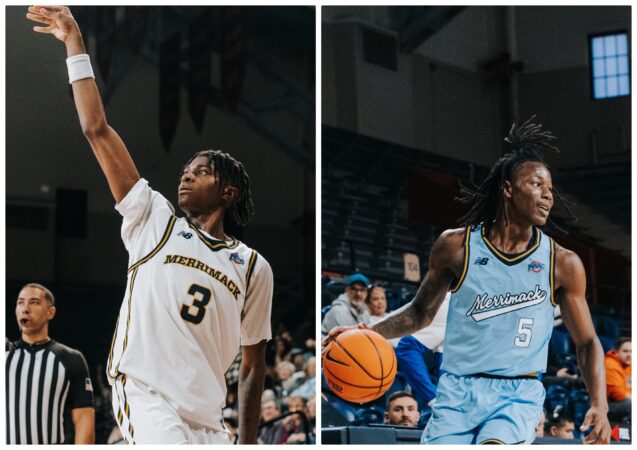
His name and background — being a Father Judge product coached by Chris Roantree — stood out to Merrimack head coach Joe Gallo, who heavily recruits the Philadelphia area and has built a relationship with Roantree. So with the push of a former teammate and the familiar ties to his hometown, Shelton landed with the Warriors, where he and Kennedy are the team’s leading scorers, averaging 14.6 and 15.2 points, respectively, for the 6-7 team.
The two have quickly emerged as impact players, and their addition to the program, which lost its top scorer last season in former West Catholic standout Adam “Budd” Clark, now at Seton Hall, has filled a large void.
“I knew Kev would probably have to carry a big load with us losing Budd, and we’re a pretty point guard heavy program,” Gallo said. “We always have a great guard, so I knew he’d have the opportunity to do it. He’s definitely exceeded expectations, and Ern the same thing. You never know when a player goes from Division II and transfers up a level if it’s going to translate. But they both hit the floor running right from the summer.”
Here’s a glimpse of their contributions so far: Shelton tied the single-season program record with 9 three-pointers against Boston on Nov. 15, where he finished with a career-high 33 points and was named MAAC Player of the Week. Kennedy also had his first career double-double (16 points, 11 rebounds) against the Terriers. He’s been selected as Rookie of the Week twice.
A familiar face played a major part in their success. Shelton and Kennedy met while playing AAU together on Philly Triple Threat. Shelton spent his first two years of high school at Bishop McDevitt in Wyncote, before it closed down at the end of the 2020-21 academic year.
He considered going to Archbishop Wood, where Roantree was a longtime assistant under John Mosco. But once Roantree landed the head job at Father Judge, Shelton decided to follow his coach there. He was reconnected with Kennedy, then a freshman who saw minutes. He later became a stater on the varsity team.
The team took some bumps in those first two years as the program underwent a rebuild under a new coach. The Crusaders finished 4-9 in the Catholic League in 2021-22. They were 6-7 in 2022-23. But last season Father Judge made school history, earning a Catholic League and state championship.
Kennedy played a large role in that achievement.
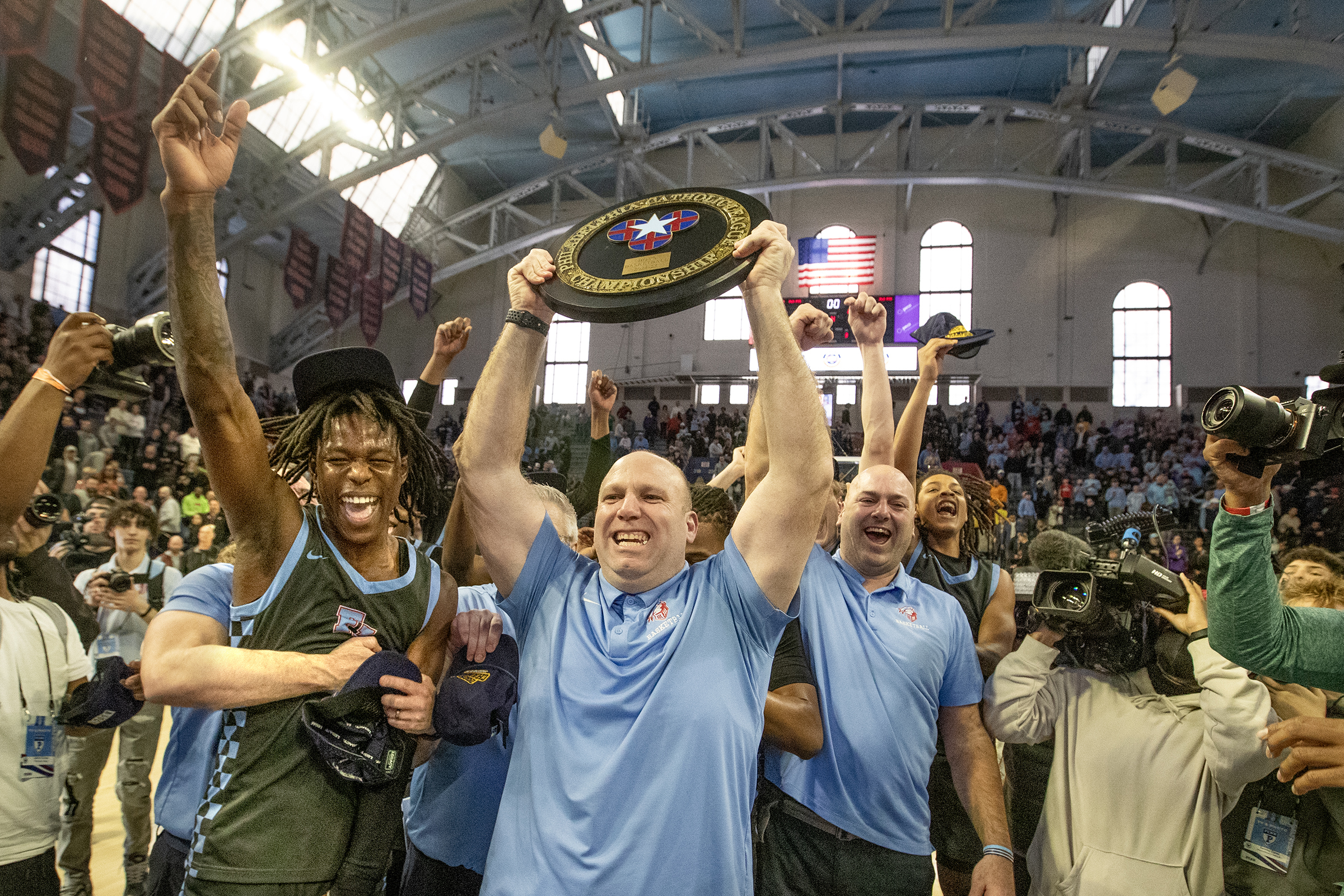
Coach Chris Roantree of Father Judge raises the trophy after his team defeated Roman Catholic in the Catholic League championship. Kevair Kennedy is on the left.
“I feel like I grew a lot in leadership there,” Kennedy said. ”Somebody had to be the leader, be the voice, and get us going on days when they didn’t feel like it. I feel like [Roantree] trusting me at an early age helped me with my accountability, not just hold others accountable, but hold myself accountable too.”
Kennedy, who held one other scholarship offer from Wagner, had the chance to play at the Plaestra as a college player when Merrimack competed in the Cathedral Classic from Nov. 28 to Nov. 30. It wasn’t the same as playing in front of 10,000 fans for the Catholic League championship, but it was “a special moment” as the current Father Judge staff and team attended some of the games.
The Warriors were riding a four-game winning streak before falling to Vermont on Dec. 14, thanks in part because of Shelton and Kennedy. The two would consider themselves to be more reserved, but on the court, they always seem to know where each other are.
“It’s a lot more eye contact then words,” Gallo said. “Kev gets Ern a lot of unscripted three-point shots in transition, where we don’t even have to call a play, because [Kennedy] knows where [Shelton] is.”
They aren’t the only Philly-area players on the team, either. Graduate student Jaylen Stinson is a former Archbishop Wood guard, senior forward Brandon Legris attended Perkiomen School, and next year, Rocco Westfield, a senior at Father Judge, intends to play for Merrimack.
Gallo likes to recruit the area because of the the high-level competition in the Catholic League, and earlier in the season, when Merrimack faced Auburn and Florida, Kennedy and Shelton looked unfazed.
“They’ve just been Philadelphia battle tested,” Gallo said. “Neither one of them blink at any of the competition we played against. I think that’s just going to continue to pay dividends.”
So would Shelton and Kennedy say their time at Father Judge is helping them now?
“For sure, definitely,” Shelton said. “It means a lot to have someone that you grew up with in college.”
Kennedy added: “Having him here, it made me break through the ice even easier than it would have been if he wasn’t here. It was easier for me to get out of my shell, knowing that if I don’t know anybody at least I have Ern.”