Musician, writer, journalist, DJ, and tastemaker Joey Sweeney has been having a conversation about Philadelphia with Philadelphians for more than 25 years.
The native Fishtowner broke into the Philly music scene in the ’90s, eventually fronting bands like the Barnabys, the Trouble with Sweeney, and Joey Sweeney & The Neon Grease, as well as recording and performing solo.
Founding and publishing Philly’s first cityblog, the now dormant Philebrity, in 2004, Sweeney wrote about Philly daily for a decade with signature snark. Before that, he wrote about music and culture for Philadelphia Weekly, City Paper, and national outlets.
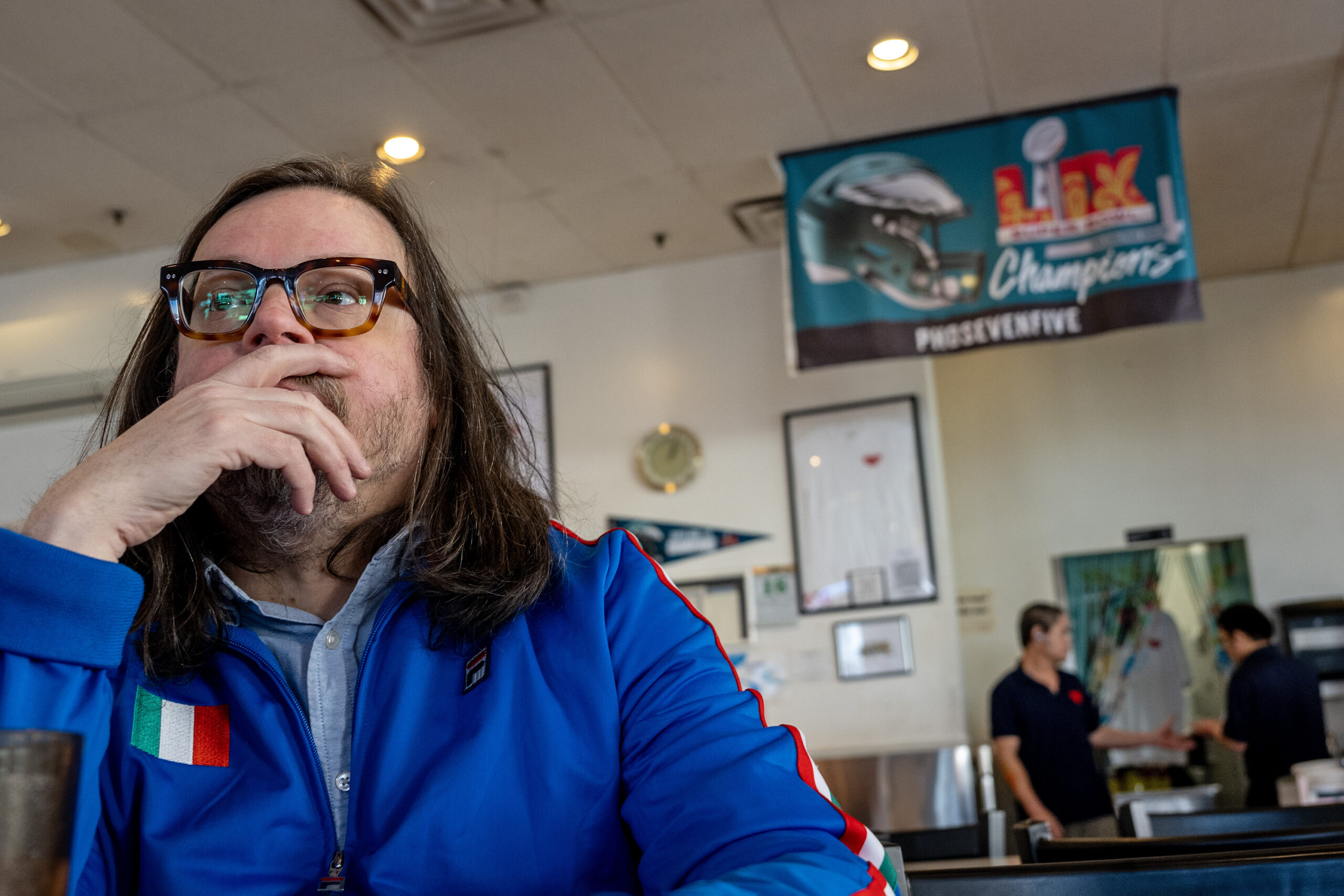
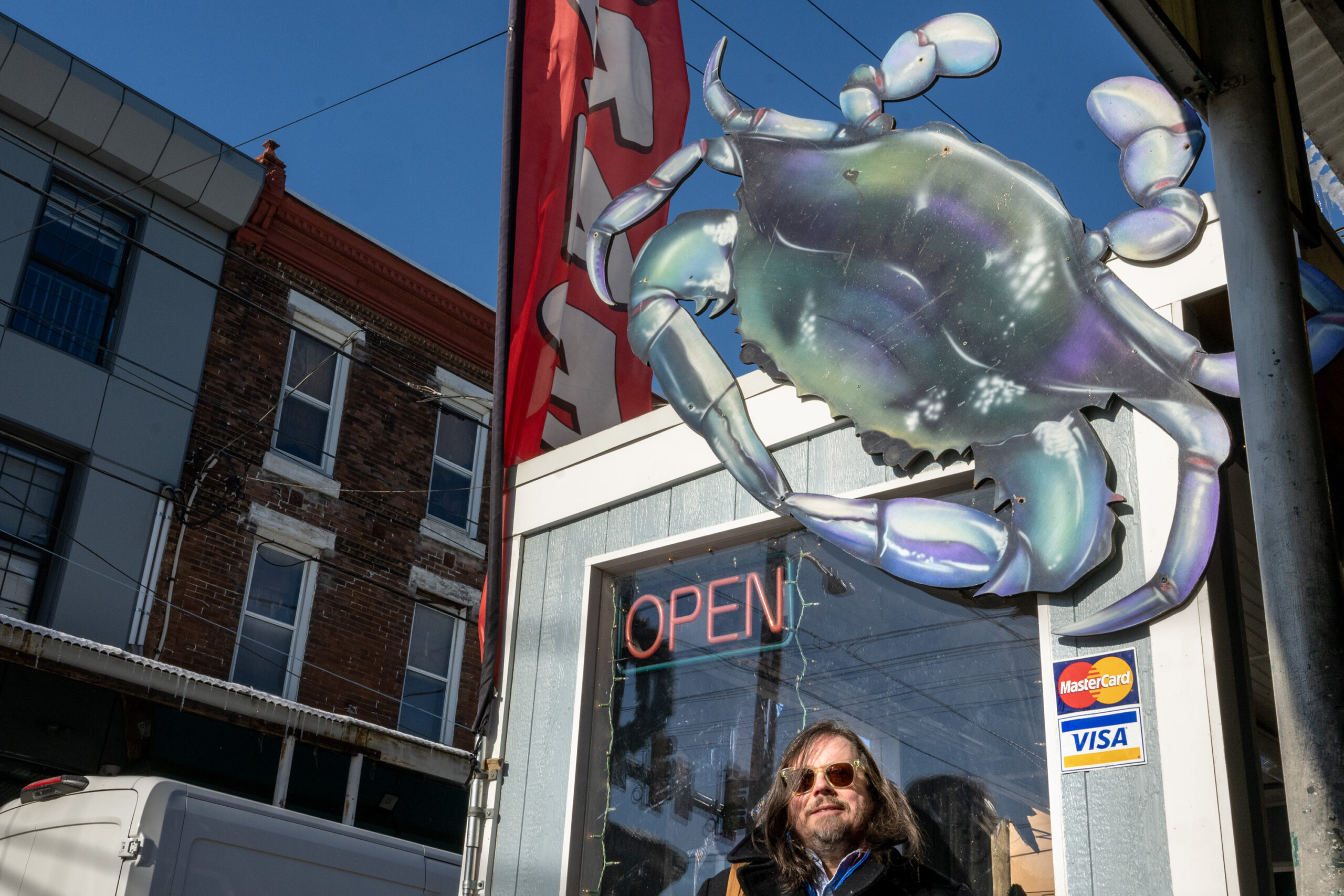
Joey Sweeney waits for his lunch at Pho75 on Washington Avenue.
In August, Sweeney, 53, joined WXPN as new Saturday morning host of Sleepy Hollow, one of the station’s longest running weekend programs, which has played an intimate, ambient blend of folk, jazz, New Age, and indie since 1973.
A definite change of pace for the longtime nighthawk — “I’ve only recently discovered mornings,” Sweeney said with a laugh — joining the iconic show has been a “dream,” he said.
“The biggest wallop of it is experiencing that WXPN community from the other side,” he said. “The staff is amazing. The listeners are really passionate about loving the station. They really give their love to it. Especially with Sleepy Hollow. It’s this legacy program, and you really want to honor that. The audience and the longevity and all the people who made it happen all those years. It’s a powerful thing.”
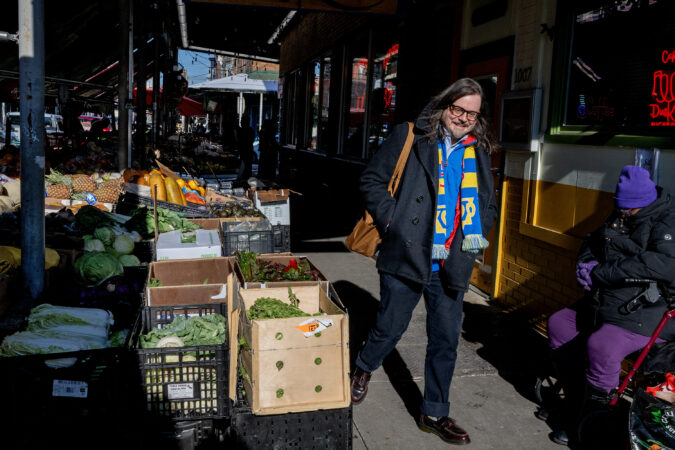
Sweeney, who lives in Society Hill with his wife, Elizabeth Scanlon, poet and editor in chief of the American Poetry Review, and stepson, Sully, 20, says his perfect Philly day would revolve around a diverse culinary excursion through the Italian Market, record store shopping, a corner bar pit stop, and some late-night guitar in his attic.
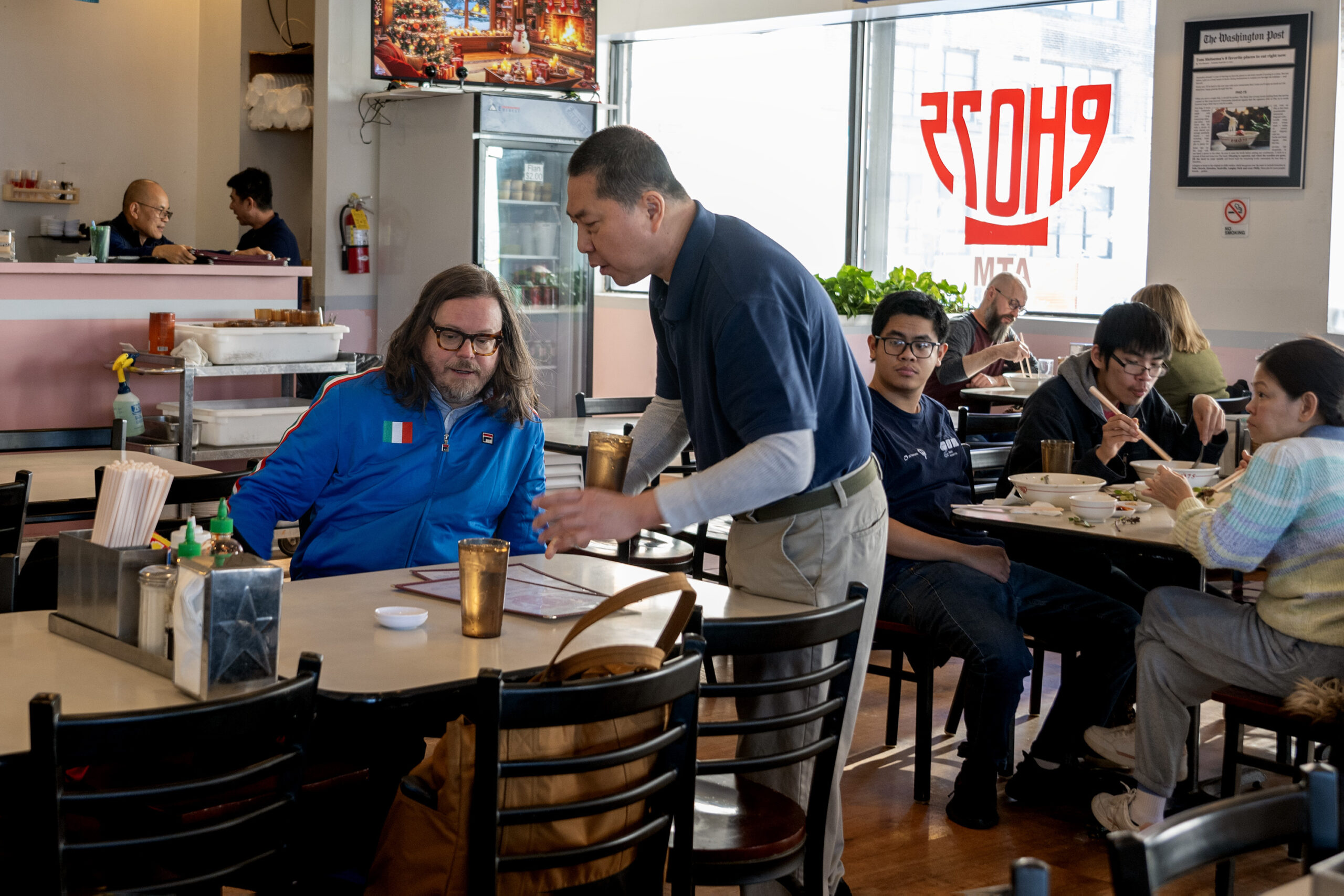
Joey Sweeney is greeted by server Kevin Trinh as he stops for lunch at Pho75 on Washington Avenue.
8:30 a.m.
I’m going to Loretta’s on Second Street. It’s the coffee shop closest to my house, and they do wonderful things. Generally for me, it’s coffee and pastry, usually a chocolate croissant. If I’m feeling extravagant, I’ll go for their Betty sandwich. It’s their breakfast sandwich, which is a really amazing riff on the classic bacon, egg, and cheese.
10 a.m.
Then I’ll head over to South Philly to Pho 75. I am a big pho-for-breakfast or pho-for-mid-morning-meal guy. I love Pho 75. Get the brisket with extra noodles.
11 a.m.
Then, I hunt and gather my way back to my house. I walk down Ninth Street and get all the food we need for the week. All of the things that we need and eat on the regular, that are good, come from a six-block area around Ninth Street. My whole palate lives on that street or thereabouts.
I’m going to the Hung Vuong Supermarket, at 11th and Washington. Hung Vuong has all the noodles and dumplings and the chili crisp and fish sauce — all that stuff you need.
At Ninth Street, it will be any combination of the following: Anastasi Seafood, where I will probably get a half dozen already cooked crabs, and whatever fish we need for the week. Cod. Maybe, Branzino. Anastasi always does me right. They are our household’s Seven Fishes place. God forbid they ever went away. I don’t know what happens to the fish order.
Joey Sweeney at Cappuccio’s Meats. He especially likes their chevalatta gourmet pork sausage with provolone and parsley.
Then, it’s Cappuccio’s Meats for their chevalatta. It’s this very thin sausage with greens and cheese. It’s a very Philly Catholic thing. And Esposito’s Meats. Because Esposito’s will grind meatball mix for you while you wait. The veal, beef, ground pork mix. They don’t put it out with the rest of the stuff. You have to ask for it, and they go in the back and grind it up for you. It’s the best way to make meatballs, by the way. My whole life, I’ve been searching for how to get my Grandma’s meatballs. She left us a long time ago, and I don’t have the recipe. I finally figured it out. You gotta get it ground right there, and not use the crushed tomatoes. Use the canned tomatoes you squeeze with your hands.
1 p.m.
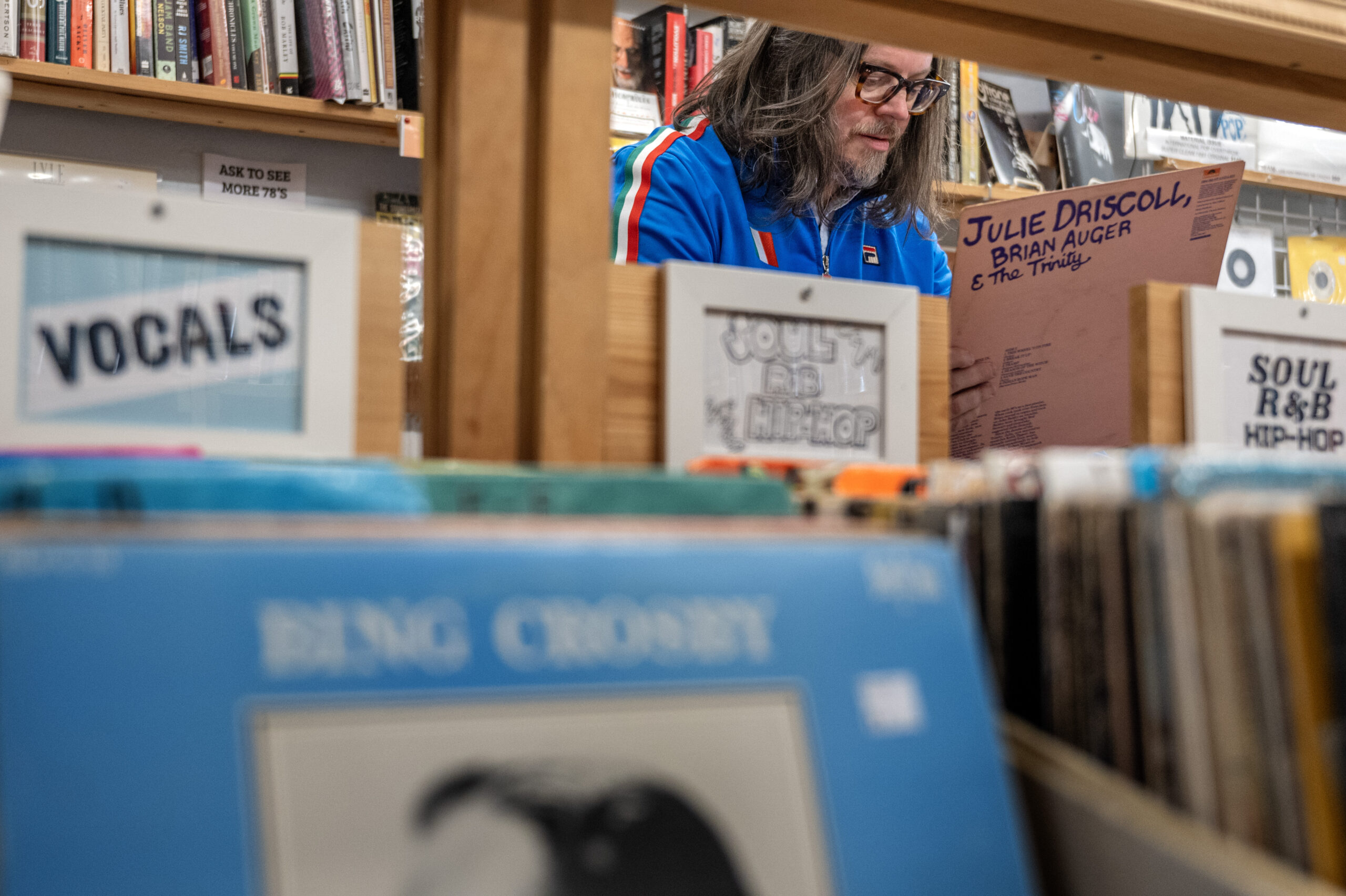
Somewhere in the middle there, I will pop across the street to Molly’s Books & Records. Pound for pound, Molly’s has the best used record selection in the city, and the inventory changes over frequently. They don’t gouge you on the prices. I’ve been going to Molly’s for as long as I can remember. I love giving Molly any shine.
I would also go to Tortilleria San Roman at Ninth and Carpenter. They have these tortillas that they make right there. If I am doing meatballs, I am going to Talluto’s, because they have cavatelli pasta, our house favorite.
Joey Sweeney looks through bins at Molly’s Books & Records.
2 p.m.
I’ve gotten my giant bag of food and records. At this point, I would like to go to Grace & Proper, over on Eighth. It’s a corner bar right off the market. They’re open Saturday and Sunday afternoons. It’s got this cafe kind of vibe and there’s something about it in the daytime. It depends how perishable the food is in my bag. But I might go there, have a drink, have a snack, before I come home and listen to whatever records I got.
6 p.m.
I cook. But my wife, Elizabeth, is the better cook. If we’re not cooking, I like an early bird dinner. Since I’m back in the neighborhood at this point, I’m going to either Cry Baby or Bloomsday.
Cry Baby, especially, is like a second home. Bridget Foy, who owns the place, was kind enough to let me shadow at Cry Baby before 48 Record Bar opened, because I had never had a proper hospitality job. She put me on every station in the place just about. It feels so casual and friendly, like a family spot. But you pop the hood on that place, and it runs like a machine. Her team is so amazing that by the end of it, I was like, oh, man, I would work here.
9 p.m.
Creative times usually come after dinner. Maybe I’ll put on a record or play some guitar. Or I will get on my computer in my attic office and start working on tunes. My wife and I had this really funny moment, like six months ago, where we were hanging out up in the office, and I started playing some of the songs that I’ve been recording up there after dinner. And she’s like, “You never played this for me. This is an album you’ve got. This might be one of the better things you’ve ever done. When are you doing this?” I’m like, “I do it after dinner.”
You may have received some gifts recently that you do not love. It happens! I invited two Inquirer staffers to help figure out what to do when it does.
Have your own thoughts or other questions? Fill in the box at the end!
.inno-chat__body {
border-radius: 12px;
}
Evan Weiss
Deputy Features Editor
The question is… My mother-in-law gifted me an ugly Eagles table runner. Do I have to keep it?
Zoe Greenberg
Life & Culture Reporter
My immediate response is …. absolutely not.
Astrid Rodrigues
Senior Video Editor and Producer
I'd say be polite and say "thank you." And then do what you'd like with it.
Zoe Greenberg
I did ask my little sister, who is perhaps more polite than me, and she said put it out once and then never again.
Zoe Greenberg
Which, to me, seems like a burden.
Astrid Rodrigues
I don't think I'd put it out necessarily. I'd probably keep it stored away in a closet though.
Astrid Rodrigues
You never know when you might need an Eagles table runner?
Astrid Rodrigues
Maybe your kid one day will want an Eagles-themed birthday party.
Zoe Greenberg
To be honest, I would put it on the street immediately.
Evan Weiss
You're not afraid the mother-in-law would come over some Sunday and ask where it is?
Zoe Greenberg
I don't like bad gifts. I like to just give them away. But it probably would bite me in the butt.
Zoe Greenberg
Thankfully my mother-in-law has much better aesthetics than me and would never do this (shout out to Kera).
Evan Weiss
Astrid, would you also like to put in a disclosure about your mother-in-law?
Astrid Rodrigues
My MIL has good taste and she actually loves to give gifts for any occasion.
Zoe Greenberg
We can't be getting in trouble with our mother-in-laws here.
Astrid Rodrigues
My MIL is thankfully not the type of person to ask where something is though.
Astrid Rodrigues
That’s a bridge too far!
Zoe Greenberg
That would be insane.
Evan Weiss
Okay, if the question asker takes Zoe's advice and puts it on the street… what should they say if asked about it at a later date?
Astrid Rodrigues
Lie.
Zoe Greenberg
"It must be around here somewhere!"
Zoe Greenberg
And then make the gestures of searching.
Astrid Rodrigues
I'm half-kidding. Honestly, it depends on your relationship with your mother-in-law.
Astrid Rodrigues
I've told mine that I didn't really need the gift or have one already.
Zoe Greenberg
Oh. I would not do that.
Zoe Greenberg
But I feel like in this city someone might love to find an ugly Eagles table runner on the street, so it's like a beautiful gift you're passing along.
Evan Weiss
Your advice went from "I hate it, give it away" to "I'm being generous to my fair city."
Astrid Rodrigues
Both can be true.
Zoe Greenberg
You can get rid of the trash and feel virtuous simultaneously.
Zoe Greenberg
I mean, I'm not saying sell it at a markup on Facebook or something!
Evan Weiss
Fair!
Evan Weiss
Any last advice for the question asker?
Astrid Rodrigues
Whether you keep it or not, just say "thank you" and hope it doesn't come up again.
Zoe Greenberg
I wonder if there's a way to redirect the gift giver for future gifts, without having to say anything.
Astrid Rodrigues
Maybe say, "Oh I'm a Cowboys fan now!"
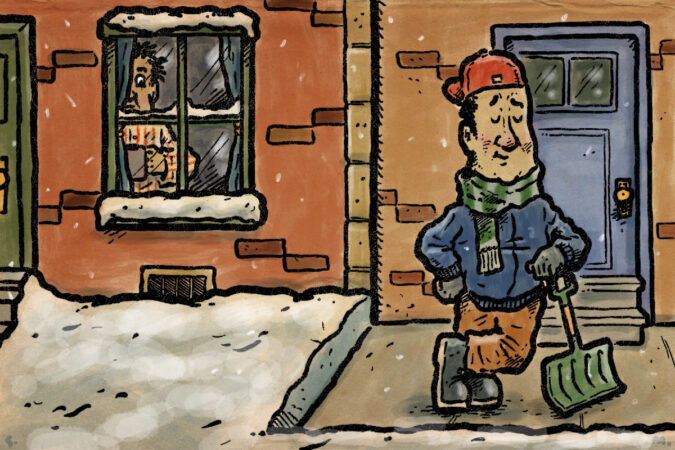
This conversation has been edited for length. Illustration by Steve Madden.
What other Very Philly Questions should we address?
Whenever Christian F. Martin IV hears a Martin guitar, whether it’s the timeworn piece Willie Nelson’s nearly strummed a hole through, or a customer nervously picking a D-300 that looks like fine art and costs $300,000, he beams with pride. Like a father.
Martin is the executive chairman of C.F. Martin & Co., the sixth generation of Martins to create arguably the world’s most-renowned acoustic guitars out of Nazareth, Northampton County. Founded in New York City in 1833 by German luthier Christian Frederick Martin, the company moved to Nazareth in 1839 and has crafted 3 million guitars, all of them intertwined with the family tree.
So when Martin took his daughter to a Post Malone concert in 2020 and watched the artist play a Martin, he smiled from afar. Later, when Malone dragged — yes, dragged — what appeared to be the same guitar across the stage, Martin’s heart dropped.
“I’m freaking out,” Martin said. “I’m looking at my wife, and she’s looking at me like ‘I don’t know.’”
Martin was still processing the trauma of a 145-year-old Martin guitar being smashed in the 2015 Quentin Tarantino film The Hateful Eight. So when Malone smashed the guitar onstage and poured a beer on it, Martin’s heart broke into small pieces, too.
“I need to leave,” he told his wife.
Luckily, before Martin could flee the concert in Hershey to process the trauma, he was told the smashed guitar was a prop, not a Martin.
That’s how seriously Martin, and its devotees, takes guitars. On a recent fall weekday in the Nazareth headquarters, tourists were lining up before the building opened for tours, taking selfies. Inside, guitars that belonged to Nirvana frontman Kurt Cobain and Hank Williams, two of thousands of artists who played Martins, sat in glass cases.
(Later that day, Martin flew to London to give a special presentation about the Martin D-18 Cobain played during Nirvana’s famed Unplugged set in 1993.)
“I’ve always just gravitated toward playing Martins,” said Delaware County musician Devon Gilfillian. “When I first started playing, that was just always the goal. The tone is just so perfect and warm. Plus, it’s from Pennsylvania.”
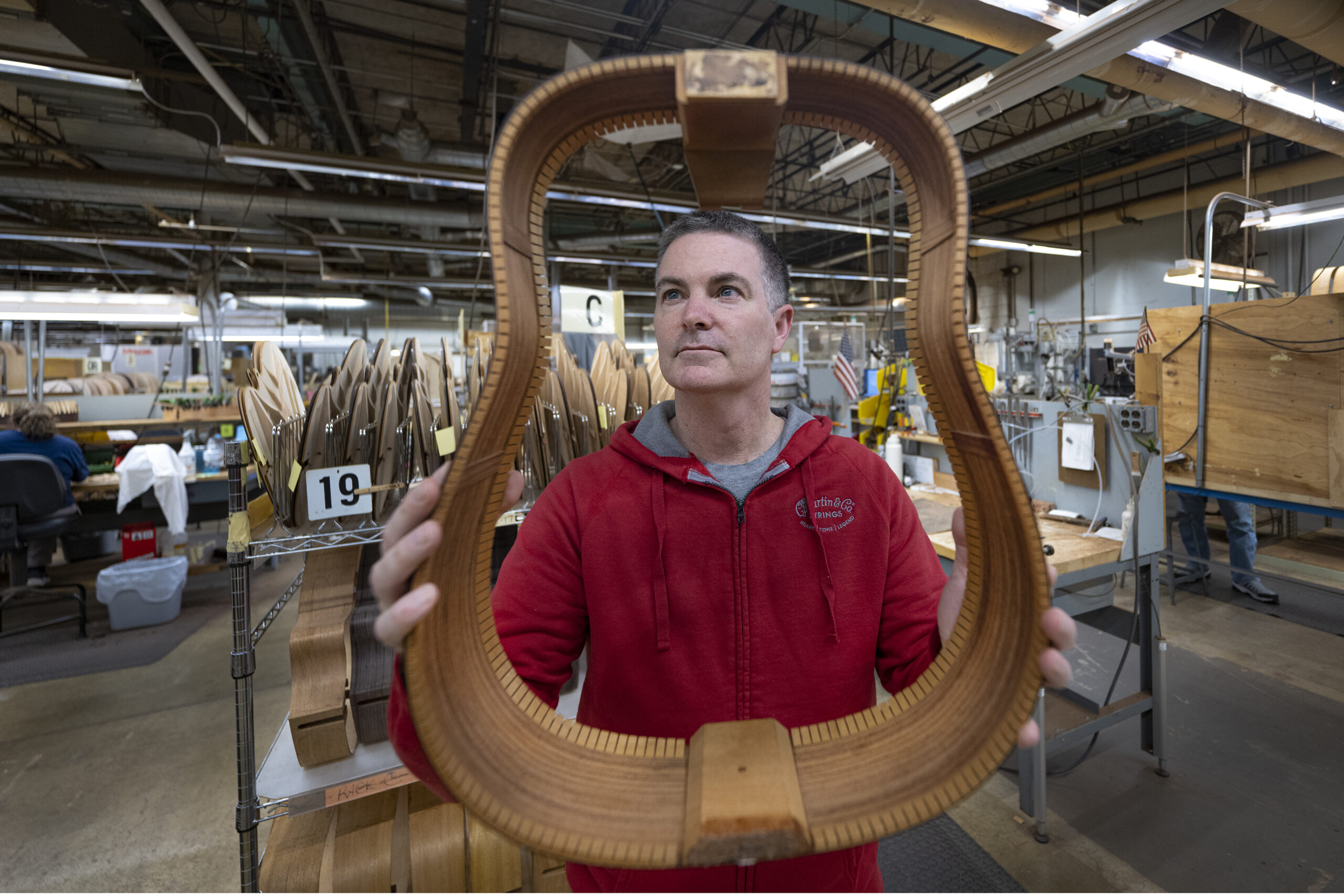
Mike Nelson inspects a guitar frame at C.F. Martin & Co.
Martin said guitar sales booms are usually tied to specific cultural moments or trends in popular music. Folk music in the 1960s, for example, or the popularity of MTV’s iconic Unplugged series that featured Nirvana, Eric Clapton, Alice in Chains, and countless others.
Today, Martin is still feeling the effects of the COVID-19 pandemic, when many workers were forced to stay home and went looking for something to do. The company is producing approximately 500 guitars per day in Nazareth and a plant in Navojoa, Mexico.
“We’re on a bit of a roll,” Martin said.
“I think it’s important to show people this is where a Martin guitar is made and this is what it takes to make a Martin guitar,” he said. “For many guitar players, coming to the Martin factory is like going to mecca.”
Inside, the factory floor is divided into sections, an assembly line of sorts, with some specialists focusing on fretboards, others on the necks. Some were spraying lacquers, with ventilation masks on, while other lucky employees — musicians themselves — do sound checks, strumming chords for tone. Few guitars are rejected.
The factory is both high and low tech, with robotic arms meticulously sanding bodies while workers use ancient woodworking tools to shape some parts.
That level of specialization, Martin said, makes Martin’s craftsmen the best in the business.
“You’ll see what it takes,” he said. “You’ll see why we’re the best.”
Most Martin guitars are made with various timbers, including a slew of different spruces, along with rarer mahogany and rosewood.
All businesses change, subject to the whims of markets and greater global issues. While the overall design of a guitar hasn’t changed all that much over the centuries, newer and different materials may be in the pipeline, due to issues with climate change and deforestation. The tropical hardwoods grow slowly and are under threat.
Temperate hardwoods like maple and walnut are more abundant, and the company is exploring them, Martin said. The use of alternate materials might be possible, but they would all fall under the same standard: the guitar would need to sound like a Martin.
“We would not use a material that doesn’t work,” he said.
Martin has committed to reforestation projects in Costa Rica and the Republic of the Congo. Martin’s sustainable Biosphere III, with a polar bear design by company artist Robert Goetzl, benefits Polar Bears International and retails for $2,399.
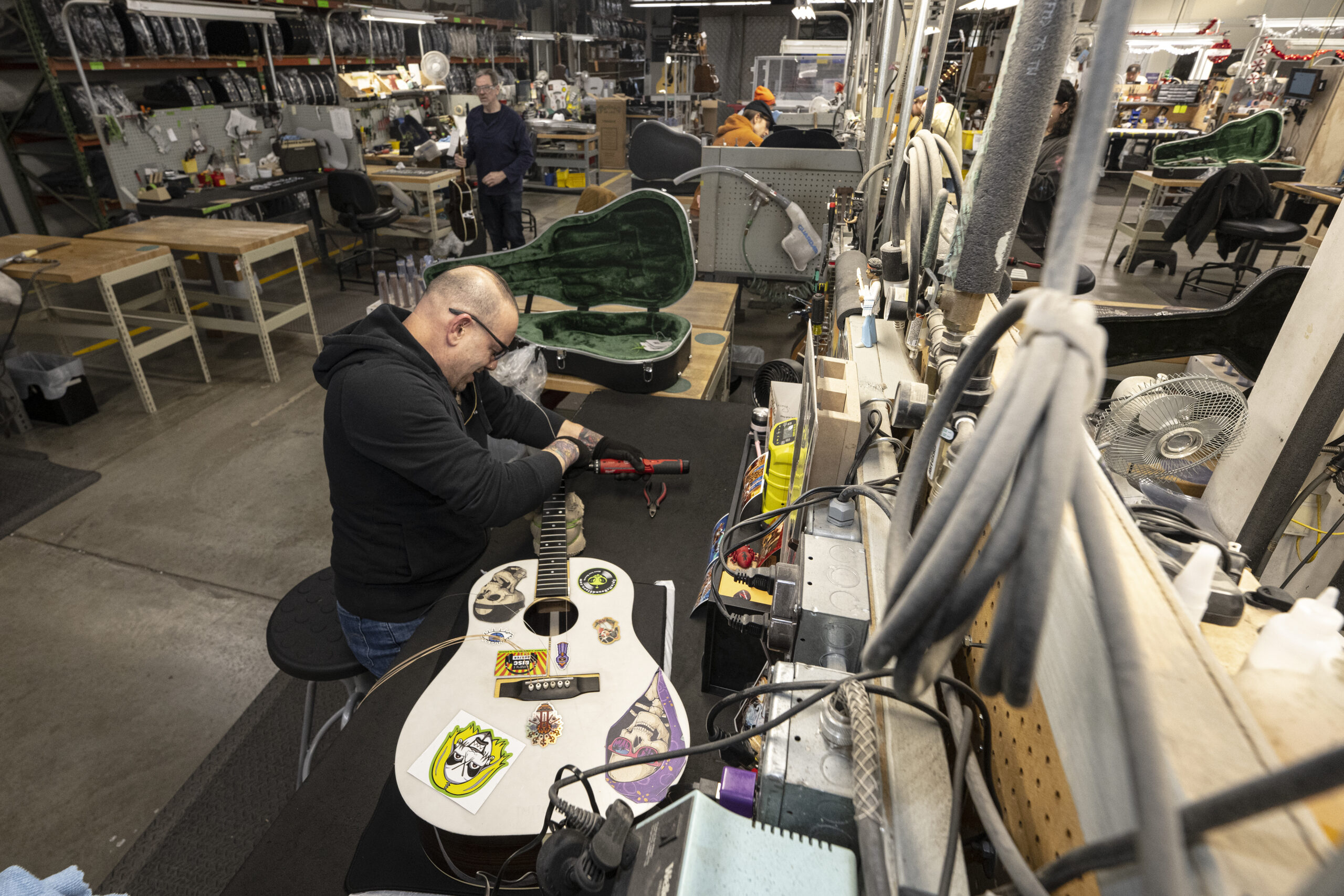
Gregory Jasman strings a guitar. The list of musicians who play Martins could fill a music hall of fame.
Goetzl has been responsible for most of Martin’s “playable art,” and he cherishes the idea that his art will make art.
“It is art, and it could be hung on a wall, but that would kind of be a shame,” he said on the factory floor, holding a guitar featuring owls and the northern lights. “It’s not cheap. It’s a very real instrument with a beautiful design.”
On this weekday, a buyer had come to Martin to possibly purchase a guitar worth more than a quarter-million dollars.
The list of musicians who play Martin is endless, enough to fill a music hall of fame — Nelson and his famous “Trigger,” Bob Dylan, Johnny Cash, Ed Sheeran, Joni Mitchell, and so many others.
Thomas Ripsam, president and CEO, at the C.F. Martin assembly line.
“We are very intentional about who we want to work with,” said Thomas Ripsam, who assumed the role of CEO in 2021. ”We don’t really pay artists for playing our guitars, so we are looking for artists who have a sincere connection.”
One of them is Billy Strings, a popular, Nashville-based guitarist who combines bluegrass, rock, and even metal.
“When you think of the word guitar, I think of a Martin D-28,” Strings said in a promotional video for guitars that the company designed for him. “It’s so American. It’s like baseball or something.”
An A-frame guitar adorns the museum entrance Thursday, Dec. 18, 2025, at C. F. Martin & Co. Inc. in Nazareth, Pa.
There’s a whole lotta shakshuka going on at Café La Maude, Nathalie and Gabi Richan’s snug, perpetually busy French-Lebanese bruncherie in Northern Liberties. In fact, the café offers two varieties of the comforting sunny-side-up-egg-topped dish that traces its roots to Amazigh (also known as the Berbers of North Africa). The red shakshuka, more prevalent on local menus, floats beef sausage, crispy chickpeas, pesto, sliced fingerling potatoes, and harissa labneh atop a rich, spiced tomato sauce studded with onions and peppers. Café La Maude’s green version sits on the opposite side of the color wheel: green tomatoes, spinach, kale, and green fava beans, plus sweet potatoes and fried cauliflower, with a drizzle of carrot tahini sauce and a sprinkle of toasted almonds. Budgeting your pita consumption is essential so you can be sure to get every drop of sauce.
Café La Maude, 816 N. Fourth St., 267-318-7869, cafelamaude.com
— Michael Klein
The candied ginger scone from The Bread Room, Ellen Yin’s new-ish bakery at 834 Chestnut St.
Candied ginger scone at the Bread Room
There’s a lot to love about Ellen Yin’s new-ish bakery The Bread Room — the fudgy olive oil brownie, the large hoagie salad with capicola, and the holiday pies — but perhaps the menu’s most overlooked gem is the humble candied ginger scone. I’ve been getting it almost weekly as a reward for braving the cold (and my perpetually late SEPTA bus) to go into the office, and it’s often the best bite of my week. What makes the Bread Room’s scone so distinct is the texture, dense enough to verge on a biscuit with an outer crust only made better by a light pink ginger glaze. It feels like biting into just-hardened royal icing, and reveals a soft and sweet crumb. The ginger is potent but never overpowering, more sweet than zesty.
The Bread Room, 834 Chestnut Street Ste. 103, 215-419-5830, thebreadroomphl.com
— Beatrice Forman
The egg custard with uni and swordfish bacon (far left) was served as part of a platter of raw and cooked seafood for the first course at Heavy Metal Sausage Co.’s Feast of More Than Seven Fishes.
Egg custard with uni and swordfish bacon at Heavy Metal Sausage Co.
On Monday night, my partner and I got to experience the absolute feat that is Heavy Metal Sausage stuffing 14 people into their butchery for an honest and approachable — yet extremely technical — meal that adds layers to the Italian American tradition. Every bite was wonderful, including a key lime cured mackerel and an acidic eel stew over Bloody Butcher polenta. But the night’s showstopper was a velvety egg custard, served in a ramekin and finished with heaps of uni and cubes of swordfish bacon alongside a platter of other raw and cooked seafood.
Did you know swordfish bacon was a thing? I didn’t, and now I want it forever. Chef Pat Alfiero said he salted, cured and cooked his swordfish the same way he would for pork bacon. Perhaps pig bacon might be overrated.
I could go on and on about the amazing duck wings glazed with black pepper hoisin at Atlantic City’s Cardinal, a cavernous restaurant with an inventive menu from chef Michael Brennan. The kitchen and bar focus on the details (my reposado and biscotti liqueur cocktail came topped with a literal biscotti), but it was the main course that left me truly wide-eyed.
Behold the Halibut Schnitzel, two words I’ve never heard said together. It arrived with two meaty pieces of lightly pounded out and schnitzel-ed halibut perched happily atop a very caper-forward lemony sauce and a carpet of tiny bell peppers. A charred lemon sat beside them. It was a puckery, flaky, satisfying coat of many flavors. Delish.
Cardinal Restaurant, 201 South New York Ave., Atlantic City, N.J., 609-246-6670, cardinal-ac.com
— Amy S. Rosenberg
A Popeyes chicken sandwich and fries almost made Inquirer reporter Dugan Arnett miss his train to Boston. It was well worth it, he writes.
No. 1 Combo from Popeyes Louisiana Kitchen
As a kid, whenever I’d complain of being hungry, my dad would respond with one of his favorite idioms: “Hunger,” he’d say, “is the best sauce.” He was wrong, of course. The best sauce is the blackened ranch dipping sauce at Popeyes Louisiana Kitchen.
I was already running dangerously late to 30th Street Station to can an Amtrak train to Boston, when I stumbled upon a Popeyes on Market Street. In no world was this a responsible detour, particularly with a $200 train ticket hanging in the balance. But Popeyes is an American culinary institution, and when you come across one in the wild, you must take advantage. (After all, there’s a reason a trendy Long Beach, Calif. brunch spot once got caught serving Popeyes chicken with its dishes and then vehemently defended itself.) I ordered a spicy chicken sandwich combo meal with a biscuit and proceeded to eat it the way fast food is meant to be eaten: Out of the bag, standing, with only a modicum of self-shame. The chicken patty? Juicy and impossibly plump. The fries? Psoriasis-scabbed and fresh out of the fryer. The biscuit? A butter-kissed dream.
In the end, I still managed to make my train — though, after that meal, it would’ve been well worth it even if I hadn’t.
The salmon kebab from Kanella comes plated with grilled green lettuce, fiery red harissa, sweet purple onions, and a wedge of lemon.
Salmon kebab at Kanella
It’s not island weather, but the best thing I ate this week was the salmon kebab with a squeeze of sumac-sprinkled grilled lemon at Kanella in Center City. The salmon was a succulent orange-pink, crispy on the outside, tender and juicy within. Yes, my mom and I were the only patrons in the middle of a weekday afternoon. Yes, it was nearly sleeting outside, but the restaurant was so charming. And none of that mattered when this dish arrived. The salmon shared a plate with grilled green lettuce, fiery red harissa, sweet purple onions, and that wedge of bright lemon. The service was warm; holiday covers played on the sound system. I’d come back in any time.
Susanna Nolt grew up in Ephrata, the eighth in a family of 12 kids. They were Old Order Mennonites and lived similarly to the Amish, though Nolt said her community pushed back against the comparison: “Our buggies are black! The Amish buggies are gray!”
There weren’t arranged marriages, but Nolt knew what was expected: Around age 18, she could begin dating a young man who was baptized in the Church. After marrying, she would raise her own large family within the Old Order Mennonite community, just as her parents and grandparents and great-grandparents had done. A family tree Nolt made when she was 16 went 14 generations back, featuring almost all Mennonites.
When Nolt was 27, she had what she described as a “spiritual rebirth” and decided to leave. She was excommunicated and kicked out of her family’s home.
Nolt checks out her Christmas “ugly sweater” before the event.
After a few years of living in Lancaster and nannying in Reading, she moved to Roxborough.
Now 39, Nolt works as a nanny, drives for Lyft, and is earning an online master’s degree in art education from Liberty University. She lives by herself, and is figuring out what romantic partnership might look like in her new future.
The following, as told to Zoe Greenberg, has been edited for length and clarity.
On growing up in a different world
We knew the Church’s rules better than we knew the Bible. They were read to us every half year, the day before Communion: how long the dresses need to be, how big the head coverings need to be.
You didn’t have to work hard to make friends. You had your neighbors, the girls from church. You would go to school in the one-room classroom. We only went till eighth grade; we were prohibited from going to high school or college.
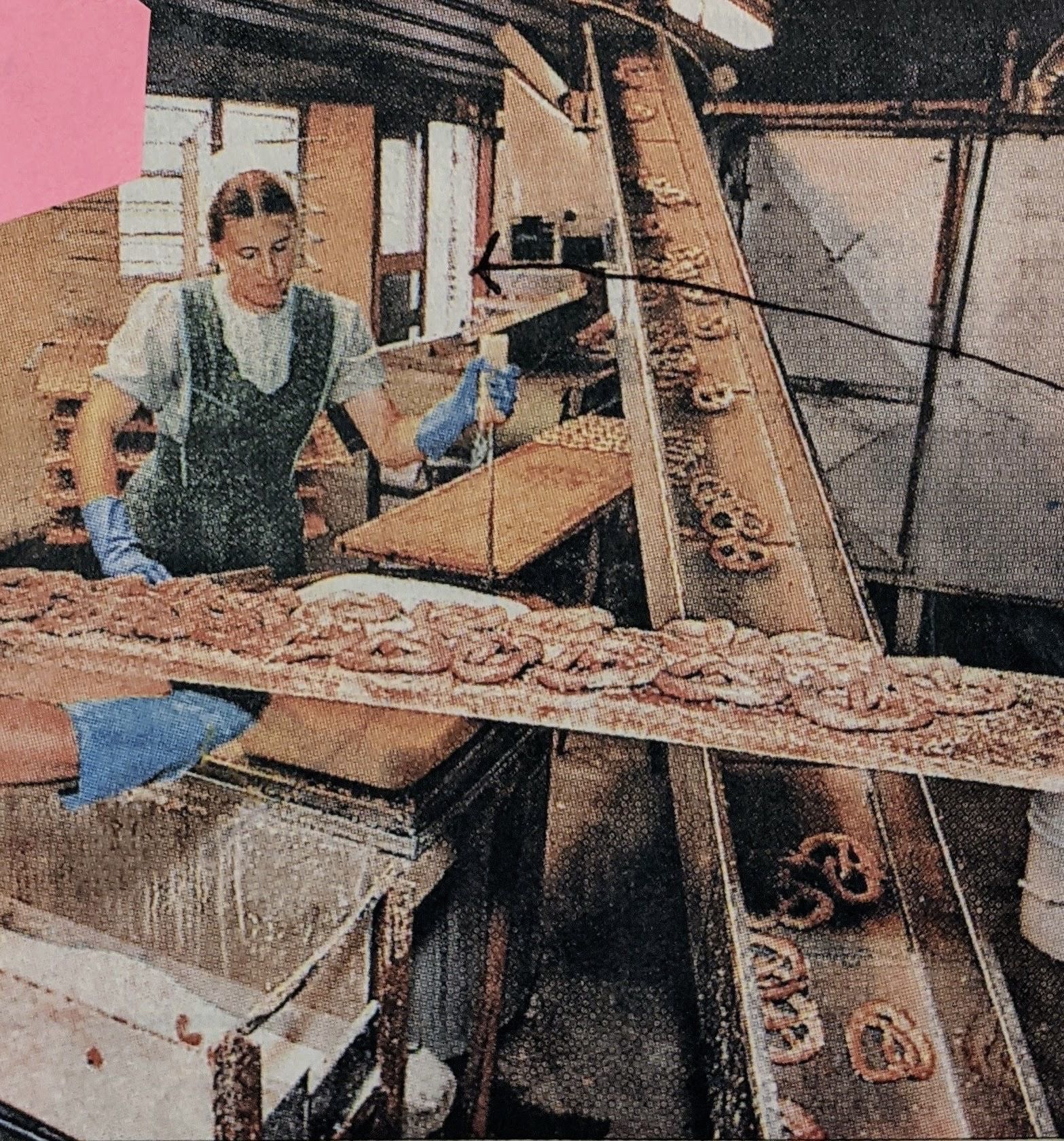
The earliest photo that Nolt has of herself is this newspaper clipping that shows her working at Uncle Henry’s Pretzel Bakery in Mohnton, Pa., when she was 19.
My mom was, obviously, a stay-at-home mom. We did all our cooking, canning, freezing, sewing, baking, gardening ourselves. So that was a full-time job for a mom. We had a ginormous garden.
My dad was a leather worker. He made harness parts for the horses. He was a deacon in the Church, so he was sometimes pretty busy with that, which made our income especially low, because positions in the Church do not pay.
On Sunday nights in the ‘dating parlor’
Young people were pretty much allowed to choose who they wanted to date, with the expectation that you date only someone who’s a baptized member of the Church, to ensure that you can build a good Mennonite family.
We had Sunday night dates, usually five-hour dates at the girls’ homes.
The house was very plain, no pictures. We had a dating parlor — it was the most decorated room of the house. The girls’ boyfriends would come over around seven o’clock on Sundays and stay ‘till 11 or 12.
The couple would sit on the couch and chat. Sometimes younger siblings would go in and play board games with them, or we’d play yard games like croquet or volleyball. Sometimes they would go on a walk in the woods. But most of the time they would spend in the parlor, getting to know each other and discussing their future.
Nolt had never been to a speed dating event before but wanted to try it.
On ‘courting buggies’ and Rumspringa
Sometimes the boys liked to decorate their buggies, to make them courting buggies. They would have a fancy varnished cabinet in the front, and maybe some dice or feathers hanging, and a nice afghan blanket or some kind of throw over the feet, because they wanted to impress their girls. They’d put reflectors on the buggy and some stripes, usually coordinating with the interior of the buggy.
In the outside world, I’ve learned they see Rumspringa as this year where you go out and experiment with the outside world, but that’s not really what it was to us. Rumspringa was just youth group, hanging out with our friends from church on Saturday nights.
Often it was hymn singing, and then afterward we would have a snack and play volleyball. There was usually a dance. We weren’t allowed to listen to music, so the dance itself was often kind of boring, because dance and music kind of need each other.
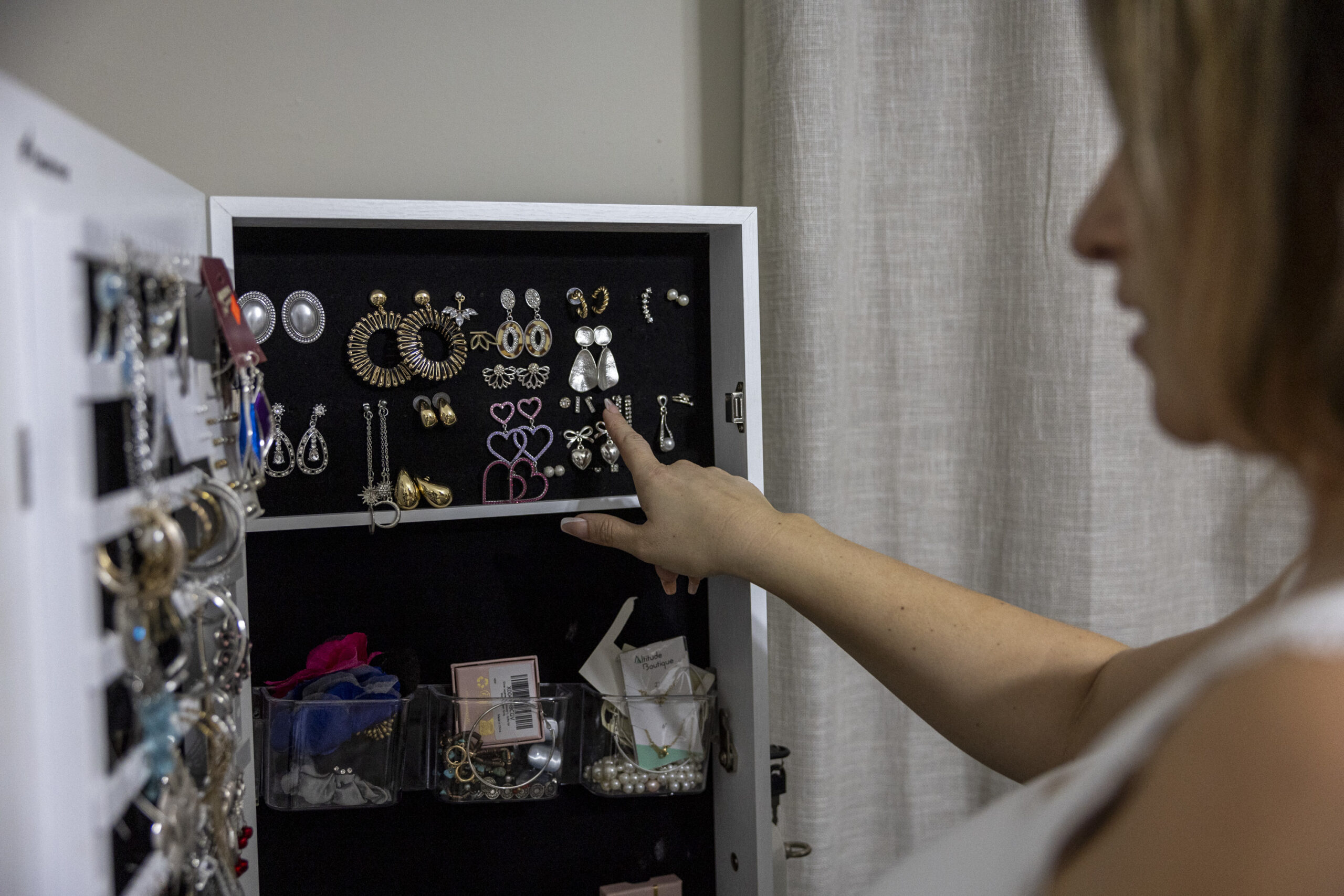
Nolt consulted her friend on which earrings she should wear.
I didn’t date much. In my time, guys didn’t really ask as easily, and the girls had no way of playing into it. You just had to wait until a guy would ask you. That felt very constricting to me.
Only about 50% of my friends were dating, if that. My mom especially, she had no problem with me being single.
Our weddings would happen on Tuesdays or Thursdays at the bride’s house. The bride’s family was responsible for hosting the wedding, which was all day: eight o’clock in the morning to at least eight o’clock at night. I never knew weddings were that expensive, because the family just provided it.
On choosing to leave
Ever since I was 10 years old, I had questions. I wouldn’t ask my questions, because that would make you a troublemaker. Ironically, I was afraid that our rules weren’t strict enough. For example, we weren’t allowed to have cameras or pictures because that was considered a graven image or an idol. I always loved playing with dolls, and I started thinking, “Maybe dolls are graven images or idols.” And I became so obsessed and bothered.
I tried to settle down by getting baptized at 17. But I felt like something wasn’t right, something was missing.
Then, when I was 27, I was teaching out in Kansas for a completely different set of Mennonites. I started realizing that bringing my rules to their community did not help anything. Like, nobody wants more rules.
I had this moment of rebirth in which I realized that Jesus is not the same as being Mennonite and all these rules really have nothing to do with Jesus.
At first I kept it to myself. I didn’t actually get excommunicated and kicked out of my parents’ house until soon after I was 28.
On losing everything
I learned that leaving is a much, much bigger deal than I ever realized, because those relationships were basically severed. I lost all my friends. I lost everything I had ever known. I had no idea how to drive a car. When I finally was able to get a car, it was like, No, you can’t drive it, you have to get a title, you have to get it notarized, you have to get insurance.
In my experience, you just get a horse and a buggy and you go drive.
A year or two after I left, my mom said that they’d been talking about it, and they decided they still want to be family. I’m still seen as the black sheep, but basically if they invite the family, they’re going to invite me. I can visit them, but of course I have to wear a long skirt or dress.
It doesn’t feel like family. It’s kind of this emotional distance.
On assimilating to the ‘English’ world
I had been nannying and I was looking for my next position and all the good ones were in Philadelphia. I moved to Philly, not knowing anyone.
I have to learn how normal people think. I grew up with no music, no media, no TV. A lot of conversations make all kinds of references to singers, actors, movies, shows. It’s a lot of researching all the time to understand what people are talking about.
I was enjoying Christian music already and I wanted to branch out, but found it difficult to connect with the music since it was overwhelmingly new. I could never recognize songs playing in public areas — it just sounded like noise. Until one day I did recognize a song and I felt so connected and happy I got tears.
Nolt in her home in Roxborough, where she lives alone.
So one of the guys I dated would send me playlists of 12 songs every time I requested a new list. I specifically asked to focus on songs that you hear in restaurants, malls, offices, etc. He would send me a list and I listened until I was familiar with each song.
My previous employer composed a list of 50 classic movies from the ‘70s to the current day so I could watch and slowly begin to catch on to references. Over the holidays that year when I was lonely, I binge-watched all those movies.
I found acquaintances in Philly who taught me about football, patiently explaining how the game works. I’ve become an Eagles fan.
On dating and ghosting
Most of the people I dated, I met online. I’ve used Upward, which is a Christian dating app; I’ve used Match. Even though I’m 39, in many ways, I’m just starting my life.
There was a guy who was in the film business, and I said, “I grew up without any of this, and so I’ve always been curious, how do they create this effect?” He got so freaked out that that was my background, and he sent me a long text afterward like, “I think you’re a really wonderful girl, but we’re just not compatible.” And he quickly blocked me.
Dating is much more inconsistent than dating in the Old Order Mennonite community. You think you’re dating them, and then all of a sudden they’re like, “Oh, never mind.”
I don’t expect perfectly scheduled dates like we had back there, but just some sense of consistency.
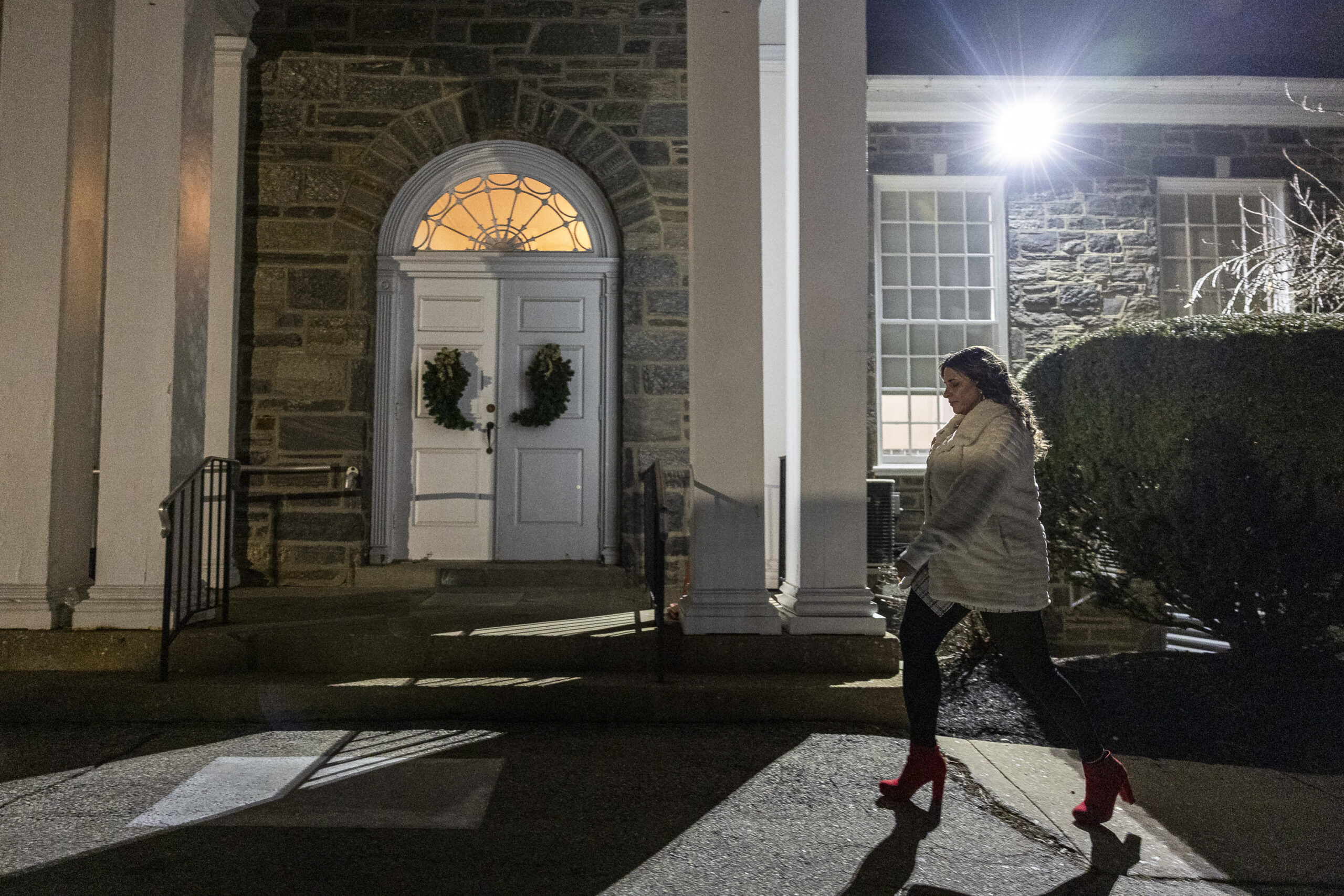
Nolt headed to the church where the speed dating event was held.
There’s some pretty serious genetic diseases among my people because the gene pool is so small, so I’m really not interested in dating someone from my background. Another reason I’m not interested is that many of them do not really assimilate to the extent that I have.
I’ve taken a number of the people I’ve dated out to Lancaster. They met my parents, and some of them did really well. Others were more just glad when it was over.
I don’t hide my background, because it’s part of who I am. Sometimes I wish it wasn’t, but that doesn’t change the fact that it is.
If I have a long-term committed relationship, I’m going to need to have someone who can be OK with that.
This is the first in an occasional series about life partners across the Philadelphia area. If you want to share your story about who you’re navigating life with romantically, write to lifepartners@inquirer.com. We won’t publish anything without speaking to you first.
BRANDYWINE, Md. — No one knows exactly when Terrence Butler began keeping a journal, but there is a best guess. The first and only time someone noticed that he was writing something that he clearly wanted to keep private was the evening of Saturday, July 29, 2023, four days before he died.
He had spent that morning and afternoon at his mother’s townhouse here, curling and bending his 6-foot-7 body to lounge on the couch, cozy in a hoodie, gym shorts, and white socks, quiet, sometimes reading his Bible. His behavior was nothing out of the ordinary for whenever he was in town, though there was something about her son’s visit, this particular visit, that Dena Butler thought strange. Throughout Terrence’s two years at Drexel University, before and after he had stopped playing for the men’s basketball team, he merely had to call Dena whenever he had wanted to come home, and she would drive the 150 miles north to West Philadelphia to pick him up. This time, though, he had taken an Amtrak train from 30th Street Station, arriving in New Carrollton, Md., at close to 11 o’clock Friday night. He had never done that before.
His older sister Tiara was with him all day at Dena’s, happy to dote on her little brother, helping Dena prepare his favorite meals — bacon and eggs for breakfast; chicken fingers with his favorite condiment, Sweet Baby Ray’s barbecue sauce, for lunch — the two of them good-naturedly complaining that the Jamie Foxx movie they were watching was too slow and not all that funny.
It started to rain in the afternoon, and Terrence walked over to the wide window at the front of the house. He stood there for a while, leaning back a bit, his eyes turned to the charcoal clouds outside. Tiara remembers that moment still. “He loved the rain,” she said. “It wasn’t odd for him to do, but now, looking back on it, he was very somber, looking into the sky.”
A journal that belonged to Terrence Butler at his mother’s home reads, “I’m sorry. I really tried.”Some of Terrence Butler’s notes displayed at Dena Butler’s home in Brandywine, Md.
She drove Terrence back to their house; he would stay there that night, with Tiara and her husband, Arthur Goforth, to wake up for a 6:32 train back to Philadelphia the next morning. Before he went to bed, he sat on a barstool at Tiara and Arthur’s island, the farthest seat in their kitchen from their living room. In his hands were a black-ink pen and a notebook with a sky-blue cover.
Tiara assumed that he was finishing up some schoolwork. “After I got a little closer, he slowed down with the writing,” she said. “When I was further away, he was hunched over, writing.” She didn’t think anything of it until Wednesday, Aug. 2, when she and her family were combing through Apartment 208 of The Summit at University City, Terrence’s apartment, desperate for any clue that might tell them why he had shot himself.
Terrence Butler appeared in just eight games for the Drexel men’s basketball team over his two years at the university.
The story of a young life
Twelve photographs on a wall in Zach Spiker’s office at Drexel tell the story of his decade as the university’s men’s basketball coach. There was Matey Juric, the 5-11 backup guard who was an “empty-chair kid” when Spiker recruited him: “I went to watch him play, and there were four chairs for college coaches, and they were all empty.” He’s in medical school now. There were team photos from the Dragons’ recent trips to Australia and Italy, from their celebration of their 2021 Colonial Athletic Conference Tournament championship. And there — in the picture from Italy, blending in among his friends and teammates — was Terrence Butler. It’s the only photo on the wall that Spiker took himself.
“It’s there for a reason,” he said, “and it will be as long as I’m here.”
Terrence Butler’s college basketball career comprised just eight games over two seasons at Drexel. His death at age 21, on Aug. 2, 2023, was at once core-shaking to those who knew and cared for him and, after a few days, just another speck of troubling news during troubling times to those who did not. It marked one of the rare occasions in which someone, especially someone so young, had died by suicide and the manner of death was immediately acknowledged and publicly revealed.
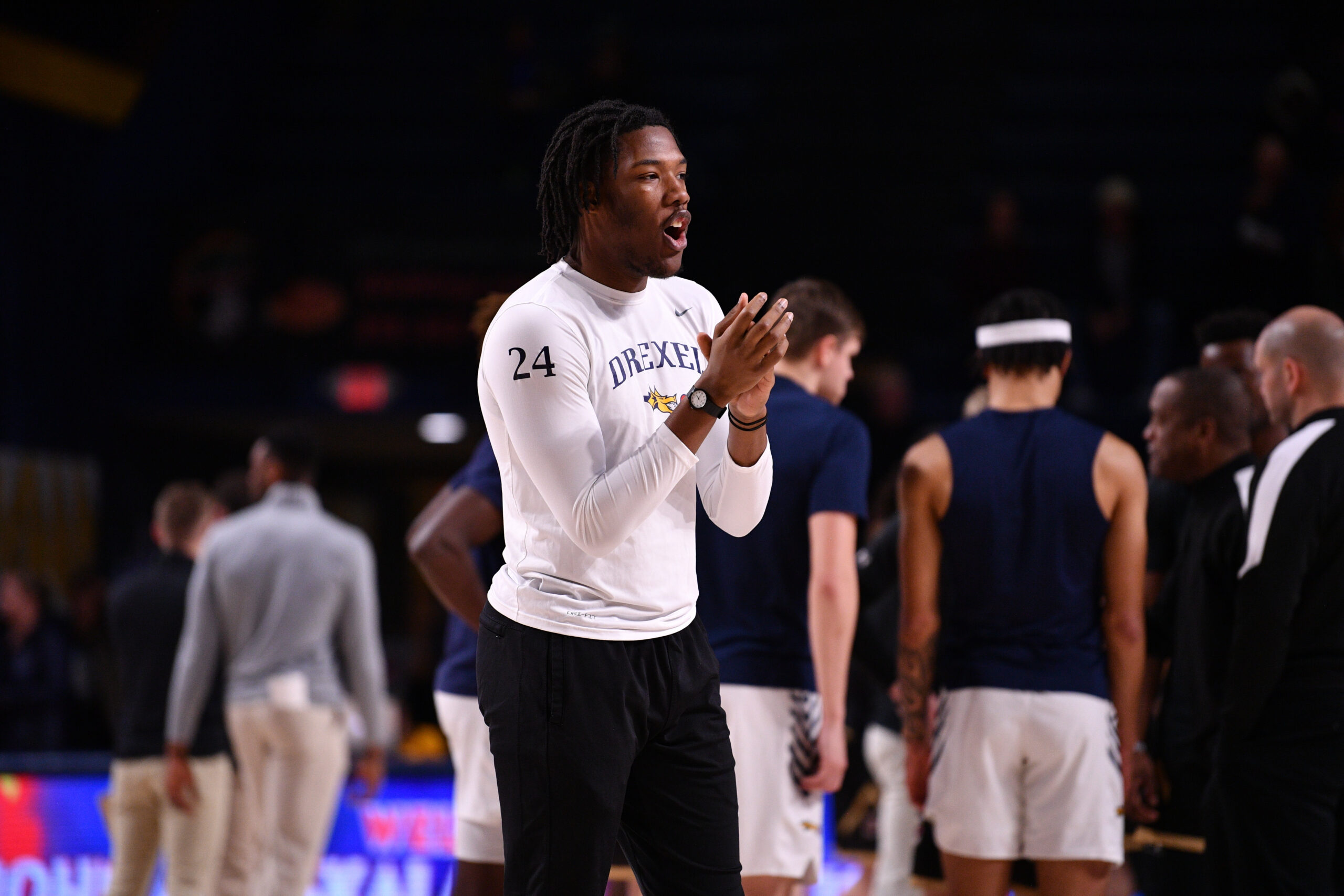
Terrence Butler spent two seasons with the Drexel Dragons from 2021 to 2023.
Within 48 hours of the discovery of Terrence’s body, the Philadelphia Department of Public Health confirmed to media outlets that he had killed himself, for there was no way to euphemize it and no point in trying. The cold and clinical language of the medical report — that a “normally developed, well nourished … black man whose appearance is consistent with the reported age of 21 years” had died — left no space for doubt.
The reasons that Terrence had died … they were a different matter. They would remain shrouded in grief and incomprehension, in blindness born of love and admiration and disbelief that he was capable of such an act — in an innocent unwillingness or inability to see.
Like all those who die at their own hands, he was locked in battle with himself. It was a struggle whose scope and depth he alone knew, and only by tugging a thread of the tapestry of circumstances and events and achievements that were sewn together to form his too-brief life can anyone even attempt to make sense of its ending.
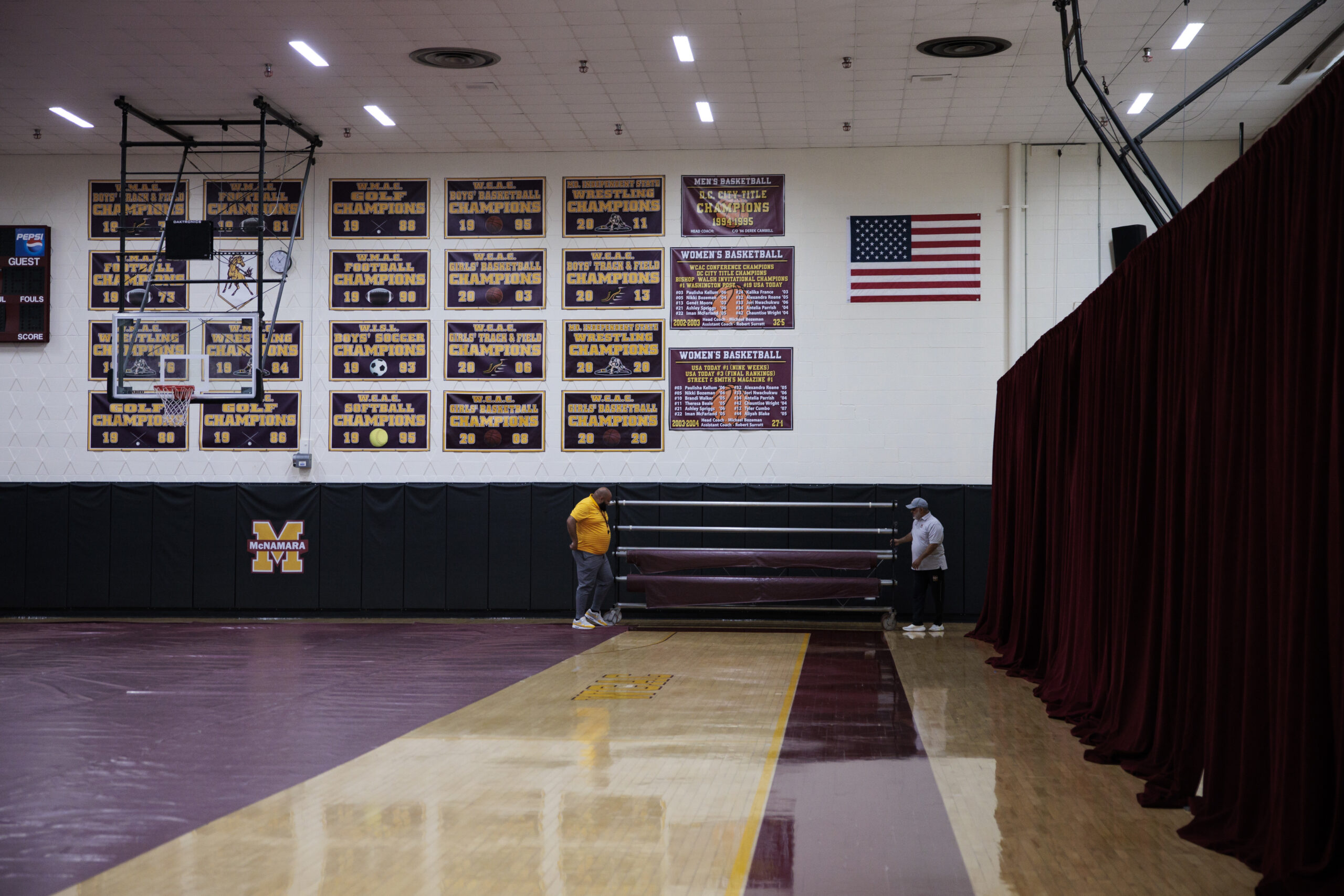
The gym at Bishop McNamara High School in Forestville, Md.
Why would anyone want to see the signs, after all? And who would have been capable of seeing them? Spiker couldn’t spot them on the day he met Terrence. No coach could. It was a camp at Drexel, just one stop on a tour of colleges and universities and programs for Terrence, and there he was, in the summer after his sophomore year at Bishop McNamara High School in Forestville, Md., grabbing a rebound in one pickup game inside the Daskalakis Athletic Center, scanning the court to throw an outlet pass, seeing no one open, pulling the ball down and dribbling the length of the floor to throw down a dunk himself. Spiker offered him a scholarship then and there. Take your tour. See those schools. Go through your process. Just remember: You have a home here at Drexel.
“We loved the skill set,” Spiker said. “We loved his motor, his size, typical basketball things. He was big. He was strong. He was respectful, a super-engaging, super-likable, smiling guy. Man, TB, he was a very impressive young man.”
Terrence’s parents, Tink and Dena, had charted a particular course for him and his sisters to try to prepare them for the demands and rewards of the pursuit. Tink saw sports as the children’s primary path. Growing up near Washington, D.C., he had boxed in the AAU and Golden Gloves programs before entering the Army, which promptly sent him to Colorado Springs to train to make the 1988 U.S. Olympic team as a light heavyweight.
“Was doing well,” he said. “Winning all my fights.”
Except he dislocated his left shoulder. No one knew; he popped it back in and hid the injury from the coaches, for a while. He started fighting southpaw, throwing all his real punches with his right hand, faking haymakers with his left … except the shoulder popped out again, and he couldn’t hide it any longer, and he had to have surgery, and his Olympic dream vanished. “I don’t know how far I could have gone,” he said one day in his living room. “I probably would have won a gold medal.”
Dysfunction framed Dena’s early life. She was 2 when her parents split up, both of them alcoholics, her mother moving from Memphis to the D.C. region to escape Dena’s father. Tall for her age, Dena began driving when she was 10 and working when she was 14, putting the money she earned from fast food restaurant and retail jobs toward rent.
“I didn’t sleep as a child,” she said. “I never slept. I just couldn’t. There was always something happening, and I just decided not to live like that when I had kids. I didn’t want that for them. These can be cycles if you’re not intentional and deliberate about your choices. Your choices affect your kids. Every choice my parents made affected me.”
Tasia (left), Dena, and Tiara Butler pose for a portrait in front of their family wall at Dena’s home in Brandywine, Md.
Once Dena and Tink met and got married and started their family, as he moved from one solid job to another — from a power-company technician to a crane operator to a D.C. government supervisor — and she settled in as a resources analyst for NASA, they established a certain culture, with certain norms and standards, for their children. There would be a consuming emphasis on academics and athletics and, more importantly to Dena, a balance of those two foci.
Tiara was born in 1992, and a second daughter, Tasia, arrived three years later, and the sisters grew up hearing the same daily phrases from Dena: TV will kill your brain. … Go look it up in the dictionary. … Smart people ask questions. … “But the biggest philosophy we learned,” Tasia said, “was ‘Work first so you can play later.’”
Dena Butler with her daughters, Tasia (left) and Tiara (right).
The playing came naturally to all of them. The only driving Tiara did when she was 10 was when she had a basketball in her hands and an open road to the hoop. She got her first Division I scholarship offer when she was 14, then picked Syracuse. Tasia preferred dancing — hip-hop, ballet, tap, jazz — to dribbling, but she followed Tiara to Syracuse on a full ride for basketball before transferring to James Madison.
The understanding that sports could be a vessel shepherding the two of them to college, to a terrific education, to stability and success in their lives was doctrinal among mother, father, and daughters. Family time morphed into basketball time, and basketball time morphed into vacation time, and there was less vacation time as life went on.
Tink, in fact, spent so many mornings and afternoons and nights in gymnasiums and arenas with Tiara and Tasia, became so familiar a presence at AAU tournaments and all-star camps, chatted with so many coaches and recruiters and shared so many tidbits and observations about players that he parlayed his daughters’ careers into a new profession. Into a scouting service. Into a subscription-based website: prepgirlshoops.com. Into more than $100,000 in annual revenue. After Terrence was born in 2002, he was a fixture in those gyms and near those courts just like his parents and sisters were.
“When he first started playing,” Tiara said, “he would run up and down the court, saying, ‘Look at me,’ smiling and leaping. Always passed the ball. So kind to teammates and opponents. He really just wanted the snacks afterward.”
He wanted to be “T.J.,” but it never stuck. His sisters shortened the nickname they had given him when he was a baby, “Man-Man,” to just “Man.” It was all they called him. By age 10, he was playing high-level AAU ball, growing on a vegetable-free diet of chicken nuggets and french fries. Heredity was on his side. Tink was 6-3. Dena was 5-10. “I’m thinking he’s going to be 6-6 or 6-7,” Tink said, “and Michael Jordan was 6-6.”
Tink took him to one football practice when Terrence was 11, to try to toughen him up. All it took was a helmet to the stomach in his first tackling drill to get him coughing and wheezing and whining, to have him decide he hated football. Good, Tink thought, now we can concentrate fully on basketball. So Tiara and Tasia — don’t let those soft features and sad eyes, just like their brother’s, fool you — would roughhouse Terrence in their one-on-one games.
“May have gotten carried away,” Tasia said.
Tiara Butler, a visual arts teacher at Bishop McNamara High School, wears a T-shirt in remembrance of her brother, Terrence, at the school in Forestville, Md.
‘We were a unit’
His sisters’ recruiting visits were groundwork-layers for him, at least in his father’s eyes. When he was 9, he got pulled out of the crowd at a Towson University game for a free-throw contest. He sank 12 straight, right in front of the cheerleaders. When he was in sixth grade, the family joined Tasia for a visit to the University of Miami, and men’s coach Jim Larrañaga took one look at Terrence, at a pair of prepubescent arms already showing muscle and definition, and said, I’m giving you an offer!
He did the AAU circuit: DC Thunder, DC Premier, Team Takeover, Team Durant. Tink would bounce from Tiara’s game to Tasia’s to Terrence’s; Dena was always at Terrence’s. So he’d call her for updates.
How’s he doing?
OK … Oh, wait. He just scored.
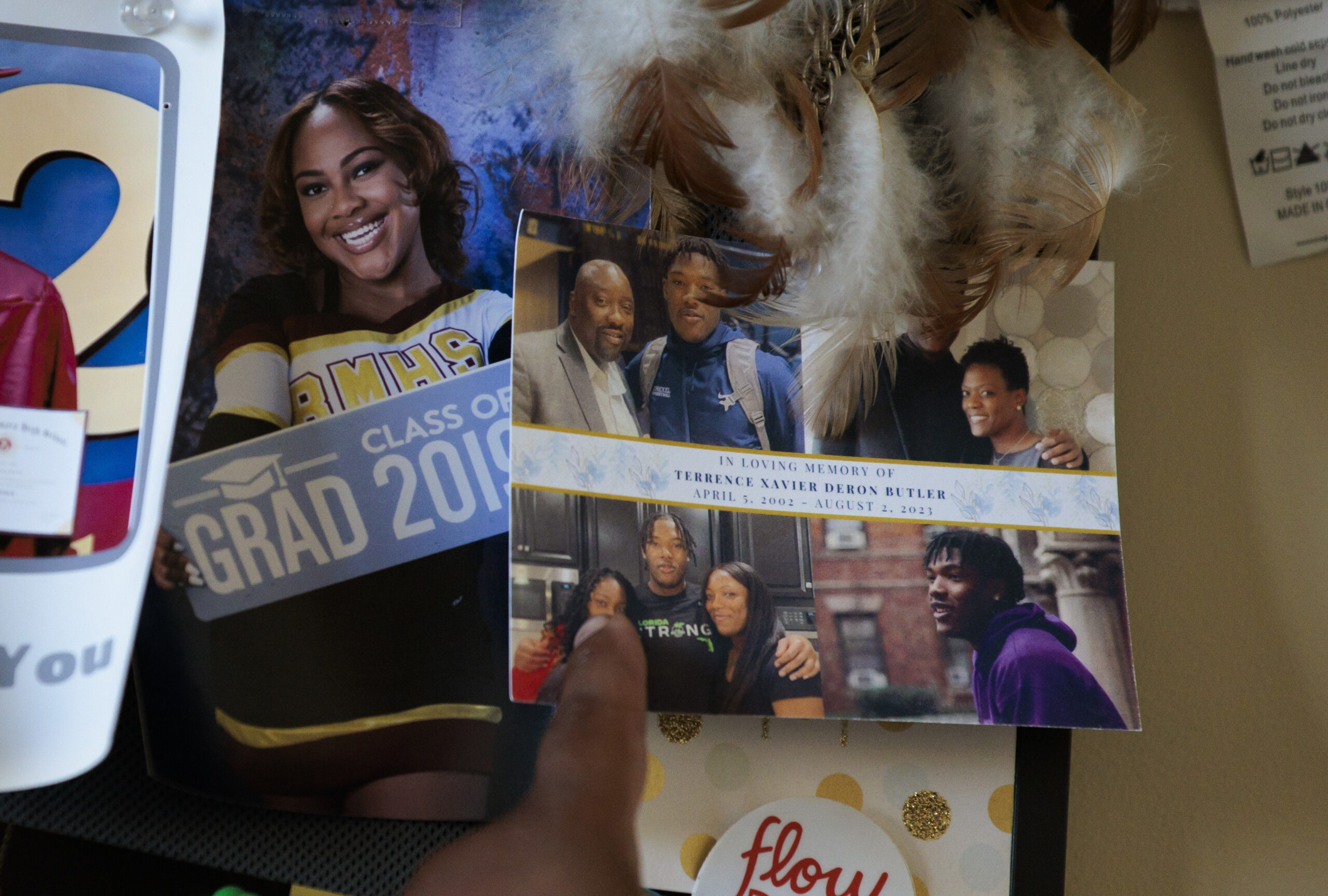
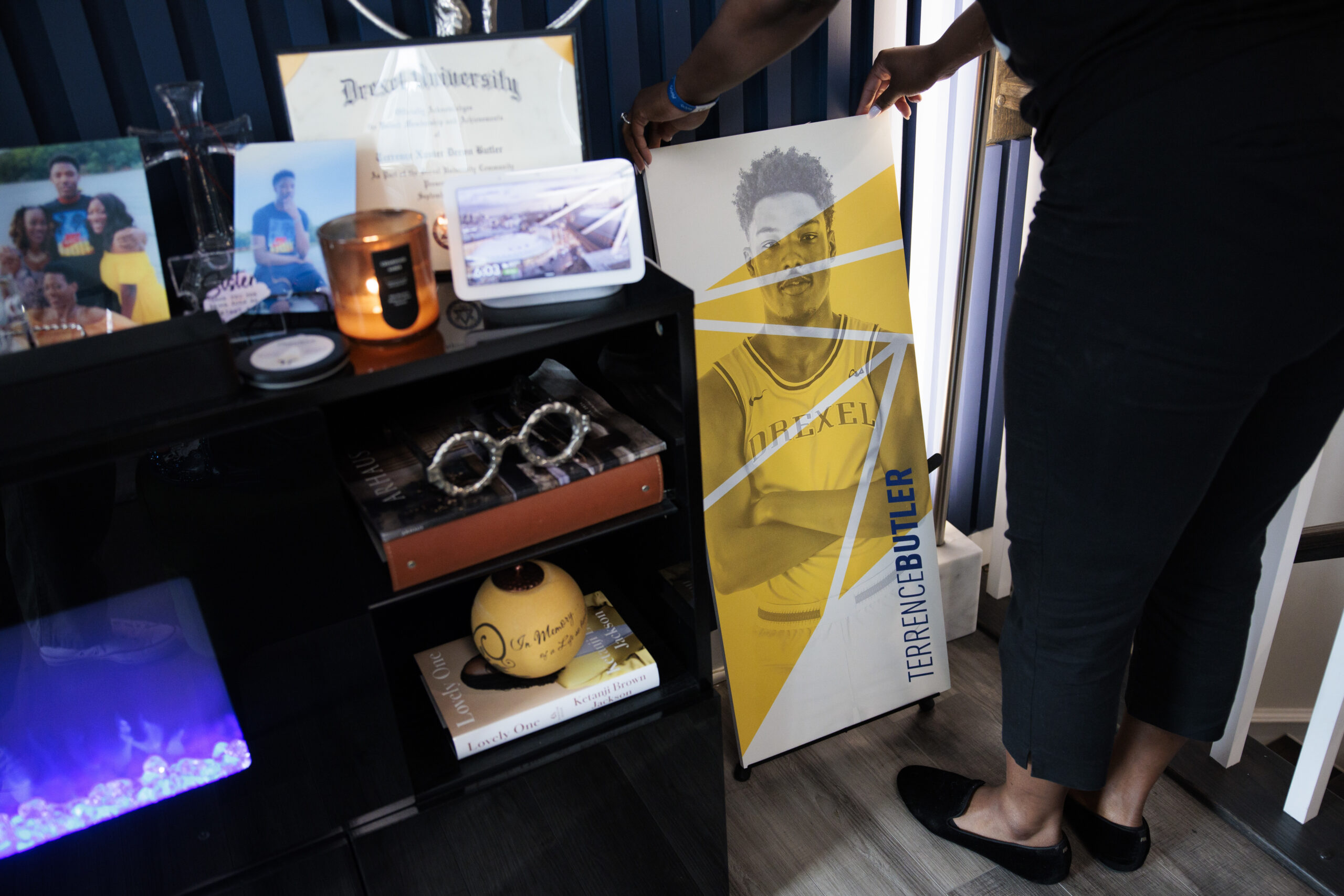
A necklace features charms with photographs of Terrence Butler and his grandmother, Connie S. Hill, at Dena Butler’s home.
As the kids’ basketball schedules, especially Terrence’s, took up more days on the calendar, there were more dinners in restaurants, fewer at home around the table. But Tink and Dena still made time to serve in ministry at The Soul Factory, an evangelical church in Largo, Md., even serving as premarital counselors to engaged couples. “We were always on the road,” she said, “but we lived selflessly. We were a unit.”
Then, a potential setback: July 2016. The summer between his seventh- and eighth-grade years. An AAU tournament in Atlanta. He jumped, landed on someone’s foot, wrenched his right knee. A torn meniscus. Surgery. Nine months of rehabilitation.
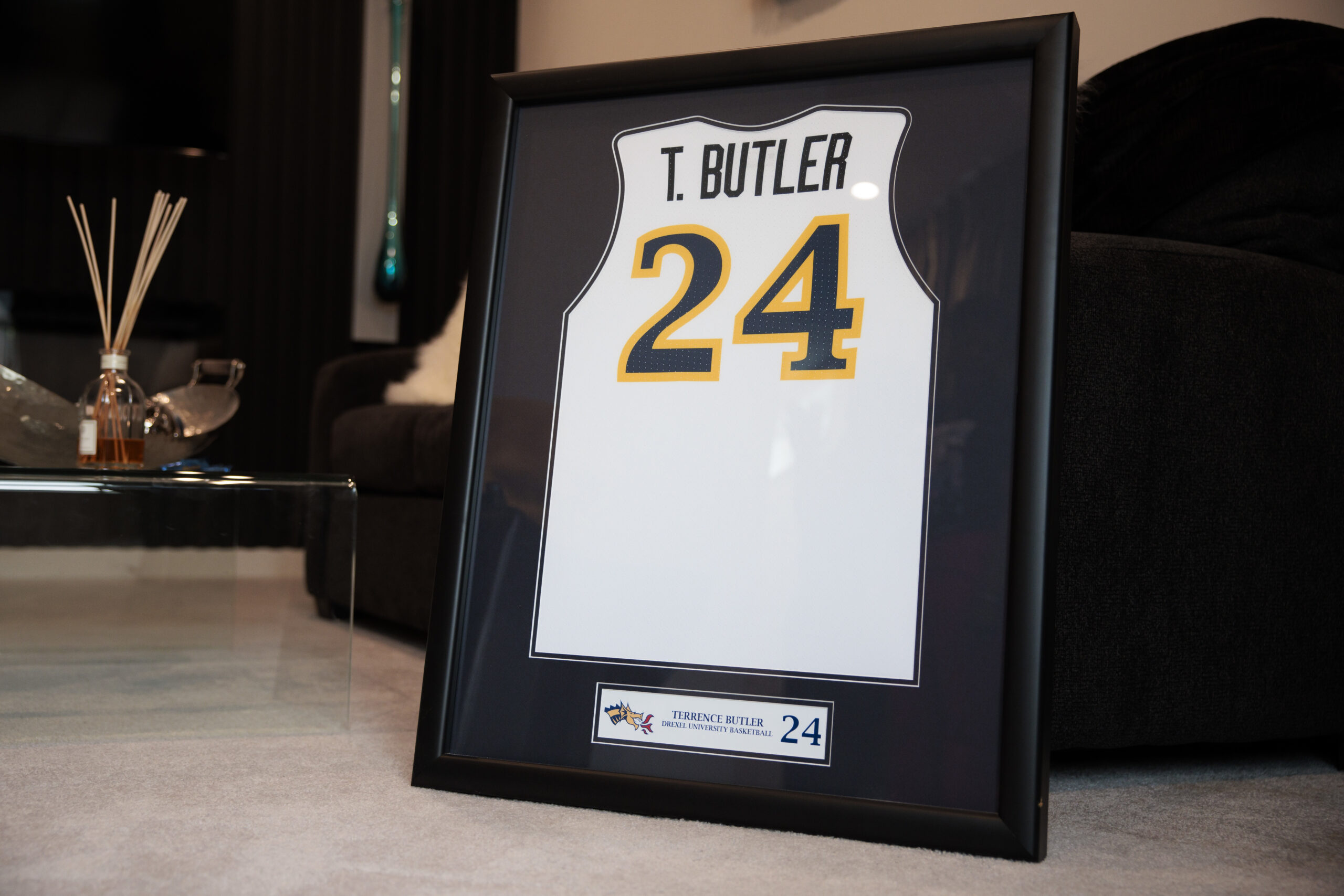
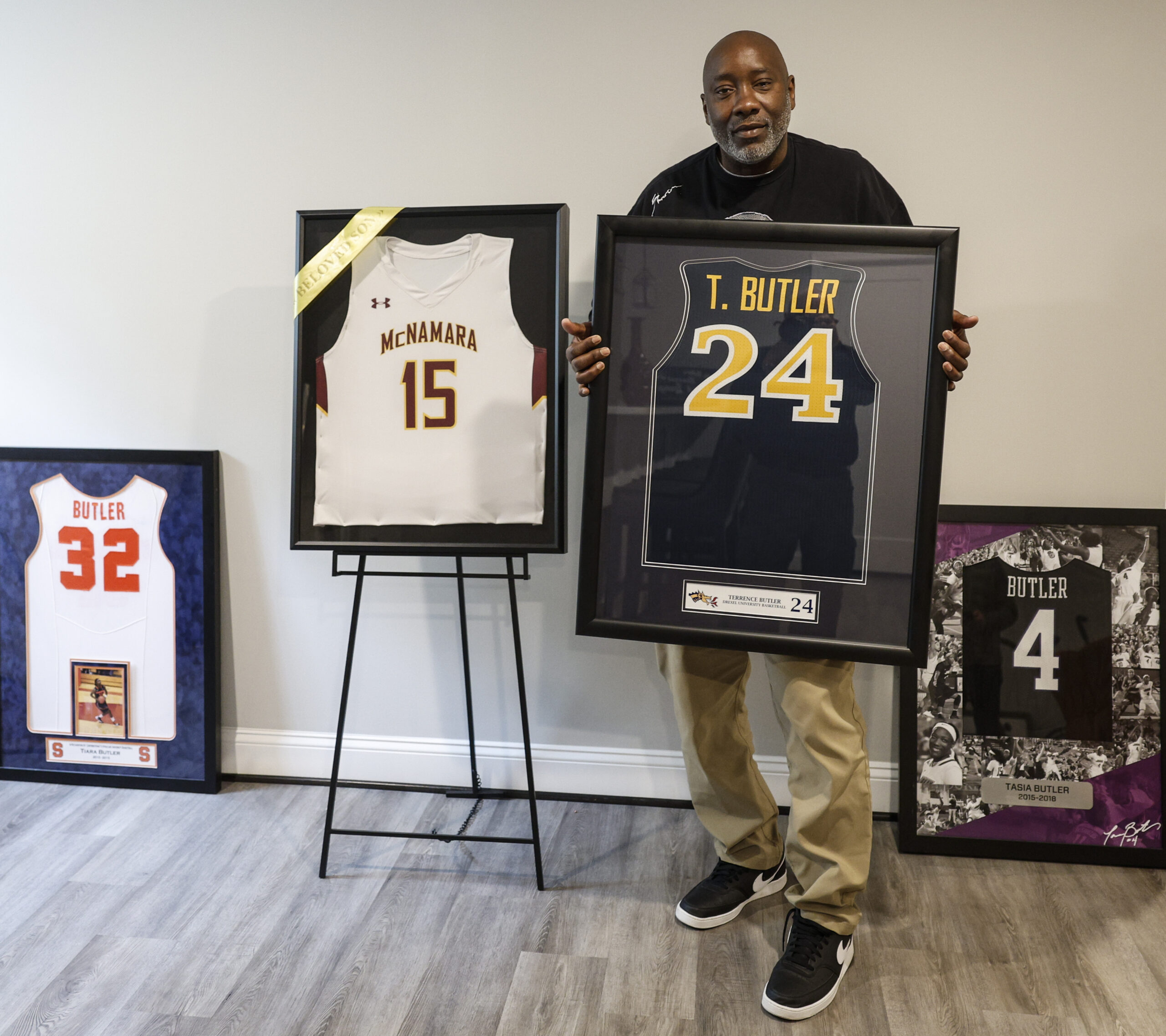
Tink Butler with framed jerseys honoring his son, Terrence, in Clinton, Md.
The big private high schools in and around D.C. had been scouting him; the injury might scare them away. No. Bishop McNamara, just a five-minute drive from the Butlers’ house, followed through with a basketball scholarship. Affiliated with the Congregation of the Holy Cross, its campus a strip of gleaming modern architecture and emerald land in Prince George’s County, with an enrollment that its admissions officers limit to roughly 900 students in grades nine through 12, McNamara is one of the most respected high schools in Maryland. Its alumni include several professional athletes, an astronaut, and Jeff Kinney — the author of Diary of a Wimpy Kid. The school fit perfectly with Dena’s plan for her children, with the idea of segueing from sports to a career or vocation beyond sports.
In his first year at McNamara, Terrence was the only freshman to play varsity basketball. The following year, the school hired a new head coach, Keith Veney, who immediately made Terrence the centerpiece of the team. He called Terrence “T-Butts” and would push him to shoot more frequently, questioning him every time he passed the ball and ending up half-impressed and half-exasperated at the answer Terrence always gave: Because the guy was open, Coach.
Still, Terrence had the ball in his hands often enough to be named the Mustangs’ most valuable player as a sophomore. “He would pass up those shots on purpose,” Tink said, “so that it wouldn’t be about him. He liked the accolades, but he didn’t want the attention.”
What did he want? It was hard to know sometimes. From the time Terrence began playing, Tink would give him a dollar for every rebound he grabbed in a game. One day, he opened up Terrence’s bank and found $1,200. Other than the occasional game of Fortnite, the kid didn’t buy anything for himself, didn’t crave the trendy clothes or the coolest sneakers. “He was the banker,” Tasia said. “We’d ask him, ‘You have change for a $50?’”
He embraced McNamara’s dress code: shirt, tie, hair cropped close. At home, he’d sit down and read the Bible, watch CNN, make an offhand joke whenever Dena would wonder how he had done on a school assignment. Got an A. Could’ve gotten an A+ if I tried. He had one girlfriend in high school, but Tink was pretty sure that Terrence hadn’t done much more with her than carry her books to class and sit with her on a stoop. “Waiting for marriage,” Tink said.
Terrence towered over the student body yet managed to keep himself on his peers’ level. “He was just a cool guy,” said Herman Gloster, McNamara’s dean of students. “You would see him before he’d see you. He was a kid who you could feel coming down the hallway — tall, always smiling. It was like a light force was behind him. Very respectful. Never had a detention. Just a great spirit. If you didn’t like Terrence Butler, something was wrong with you.”
A memorial card for Terrence Butler hangs on the wall in dean of students Herman Gloster’s office at Bishop McNamara High School in Forestville, Md.
When McNamara shut down its building for the COVID-19 pandemic in March 2020, it kept its doors closed and its students learning virtually for 12 months, from the middle of Terrence’s junior year to the middle of his senior year. The administration created “The Mustang Mix,” clusters of faculty and students who would gather on Zoom calls to stay connected with one another.
“A lot of people were complaining that seniors weren’t coming to the mixes,” said Dian Carter, McNamara’s principal. “Terrence came every day faithfully. He was always on camera, making breakfast, frying eggs.”
Once the school reopened, it did so partially. Students returned on a staggered schedule based on where their last names fell alphabetically. Plexiglas dividers separated them at each cafeteria lunch table. The entire building was cleaned every Wednesday. “It was the craziest thing,” Carter said, and she could sense Terrence’s hunger to be around and engage face-to-face with his friends and classmates again. Ms. Carter, he’d ask her, can’t we come here every day?
Terrence Butler was troubled by knee injuries throughout his time at Drexel.
Injury problems
The court was hardly a refuge for him. Throughout the first month of the lockdown, he and Tink searched for places where he could play and train. They found one guy who had a small private gym and was willing to open it. On a Sunday, Terrence was going full-court against some eighth and ninth graders, players younger and less skilled than he was, and one of them bumped into Terrence, and that brief contact was all it took. No, my knee! An MRI test confirmed it: He had retorn his right meniscus.
Another surgery, this one in April 2020. Another nine months without basketball. OK, Terrence could still be a McDonald’s All American nominee his senior year at McNamara … and was. Terrence could still be ready for the start of his freshman season at Drexel, and Spiker had remained loyal to him, had been the first coach to offer him a scholarship and had never rescinded it, had shown that he was authentic and real and that his word meant something. Terrence could still stand there inside the DAC in June 2021, alongside Drexel’s other incoming recruits, for a private ceremony honoring the Dragons’ conference-tournament title three months earlier, and he could hear Spiker say, I know you guys didn’t play in these games, but you’re part of this program. I’m super-excited you’re here to see this, and this is the standard we’re shooting for. Terrence could …
… no, maybe he couldn’t. During a workout just weeks after the ceremony, he tore his left meniscus — not as severe as his previous injuries, just a two-to-four-month rehab this time, but … Lord, three knee operations, and he hadn’t suited up for a single official practice for Spiker yet.
Terrence Butler cheering on his Drexel teammates during his time on the sideline.
Rough as that misfortune was, Dena trusted that her son could handle it. “It was almost like he was always doing a self-examination to see if something resonated with him,” she said. “He had a mentality of ‘I could take it or leave it. I’m good wherever I am. If I choose to go to school, I can do that. If I choose to play ball, I can do that. If I choose to write novels, I can do that.’ He was never a person you could put in some type of box. He was completely different. You could not read him in that manner. He was like, ‘Wherever God leads me.’ He would just be in that moment. If he’s playing ball, he’s going to give you ball. If he’s in school, he’s going to give you school.”
These were more than a proud mother’s words. Terrence wrote biblical verses in pencil on index cards and carried the cards with him. Galatians 5:16: So I say, let the Holy Spirit guide your lives. Then you won’t be doing what your sinful nature craves. There was no preaching or proselytizing, just the self-assurance of a person who appeared fully comfortable with himself. Is there a more appealing quality in a human being? It didn’t take him long to become one of the most popular figures on campus. He majored in engineering, joined Drexel’s chapter of the Fellowship of Christian Athletes, and had the time and the opportunities to move within the university’s varied worlds.
Spiker would stop in at a coffee shop to grab a drink, and a student would recognize him and say, Coach, I know Terrence Butler. He’s one of the nicest guys I’ve ever met. So Spiker would take a selfie with the student and text it to Terrence, and Terrence would respond, One fan at a time, Coach. One day, the two of them strolled across campus, and Spiker felt like he was with a celebrity.
“It was two girls from the lacrosse team: ‘Hey, TB,’” he said. “It was two girls from the dance team. It was two guys from FCA. A lot of people identified with him. He knew as many people as the rest of our team combined. This dude was very outgoing and had a big reach.”
Imagine if he had been playing any meaningful minutes for the Dragons. Imagine what his reach would have been then. He’d set the coaches’ grease board in his lap, pick up a marker, and design plays for his teammates. He’d call his brother-in-law, Arthur, who was a personal trainer, and press him for insights and advice: What can I do to be the best athlete I can be, to strengthen my body so I won’t get injured again? Push-ups, sit-ups, stretching — he devised his own exercise routines.
Luke House, one of Terrence’s teammates and roommates, would join him for long weightlifting sessions that they’d pause only when Terrence set his face in “The Look,” House once wrote, which meant “it was time to tuck our shirts in because the weights were getting heavy.”
After one victory over Towson, after Terrence had spent two days of practice dragging his damaged leg up and down the floor, refusing to sit out, insisting on suiting up for the Dragons’ scout team, Spiker turned to one of his assistant coaches and said, I don’t think we win that game if TB doesn’t give us all he had. He was doing his best to contribute, to get back on the court. Everyone could see that.
Then in January 2022 he was running during a pickup game and felt his right knee pop and found out that he had torn that damned right meniscus for a third time.
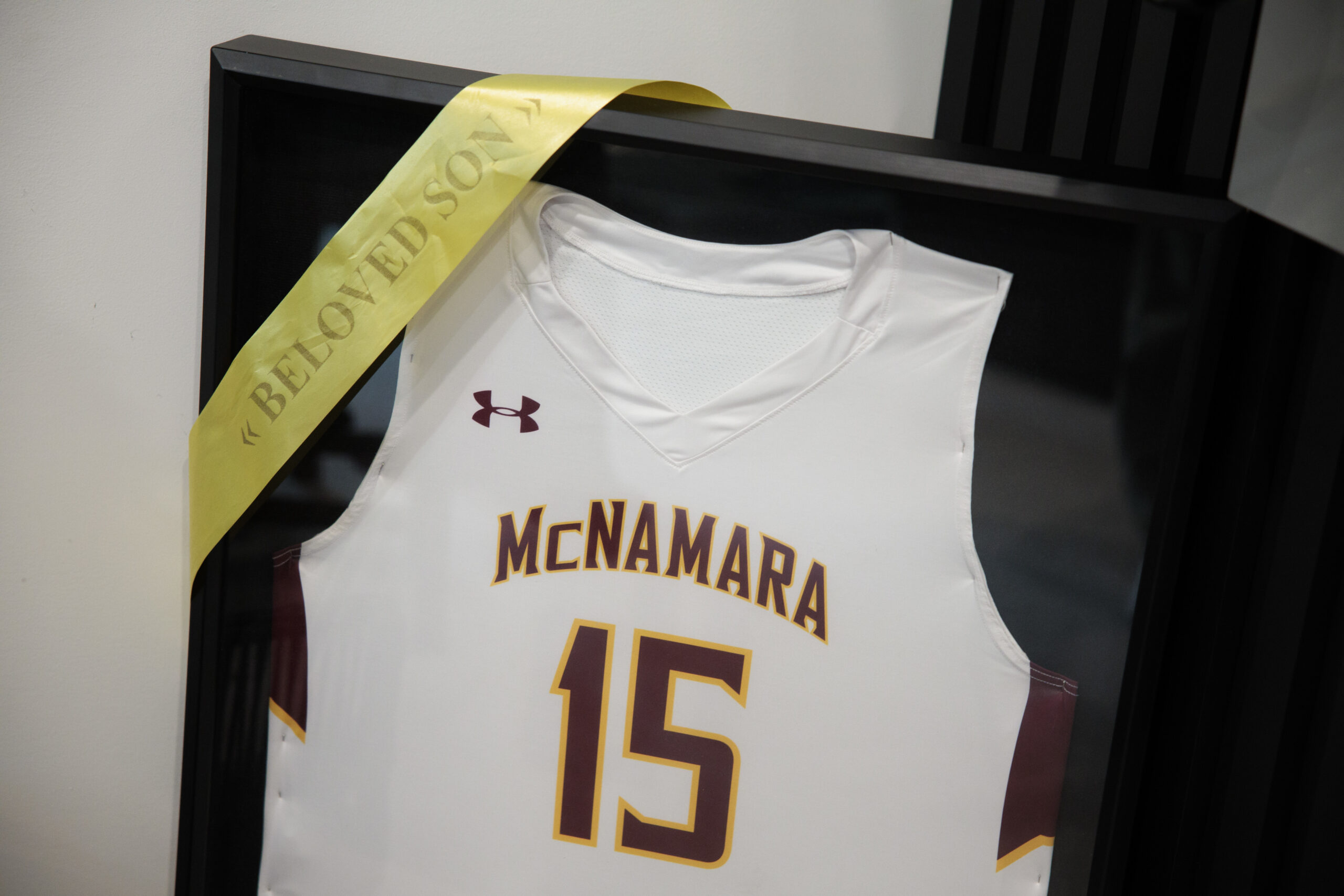
Terrence Butler’s Bishop McNamara High School basketball jersey is framed at his mother’s home.
The doctors and trainers recommended that he not play anymore. Tink called him. Did he want to transfer? Tink had been working the phones, talking to coaches in other programs. No, Terrence wanted to stay. Spiker and Drexel put him on a medical hardship scholarship. He could get his engineering degree, be part of the team in another role or capacity. I’m good, Dad, he said. I’m good.
Dena … well, it never crossed her mind that Terrence might transfer. She had attended all of his games at McNamara, and she attended every Drexel home game whether he played in any of them or not. And he would play just those eight times, never seeing the floor for more than 12 minutes in any of them, never pulling down more than five rebounds, never scoring more than two points. She attended every game even though she and Tink had been drifting from each other for a while, even though he was spending more time at work and at games — among Tiara and Tasia and Terrence and his scouting service and his tournaments and his website, where did business end and family begin? — even though they divorced in 2021.
It was raw. It was painful. It was the breakup of The Butlers — that’s how everyone knew them, spoke of them. The Butlers. They had been a unit, as Dena said, and now they weren’t.
Terrence was managing to handle it, as she trusted he would. At least he seemed to be managing. Spiker noticed nothing out of the ordinary. Still the same old TB. Still in good spirits. Still the same terrific student — he made the Colonial Athletic Association’s honor roll in 2022, the same year basketball stopped for him. In June 2023, he was taking a summer class, Introduction to Africana Studies, and earned an A on a five-page paper about the corrosive effects of American slavery. He wrote in part:
Dena Butler and Tiara Butler stand in front of the family wall.
The solution begins with education and must start at a young age. … Until we start to seek knowledge and dig up the roots of America rather than trimming branches, black people will always be disproportionately affected, with no understanding why.
A month and a half later, Terrence took that train ride down to Maryland to visit his family. Tink was hosting a party at his house on the night of Saturday, July 29, for a world welterweight championship bout between Errol Spence Jr. and Terence Crawford — 70 people, food, drinks, a television on the outside deck. Terrence declined to attend, which didn’t strike anyone as unusual. People would have asked him about Drexel and basketball, would have made a fuss over him, and he wouldn’t have wanted to be an object of attention at such a large gathering. He preferred a quiet night at his sister’s house. Arthur offered to cut his hair.
Just before Terrence and Tiara left Dena’s house, the three of them gathered on the front stoop to snap a photo of themselves in the summertime’s evening light. But as he stepped outside, Terrence paused. Hold on, he said. I forgot something. He went back inside, reemerging after a few moments. The picture, in hindsight, is telling. Dena is in the middle. She smiles wide, her teeth sparkling white. Tiara, on the left, has a knowing, closed-mouth grin. Terrence towers above them. His face is stone.
Tiara (left) with mom Dena and Terrence Butler.
He texted Dena at 9:19 a.m. Sunday to let her know that he had arrived safely. But on Wednesday, Aug. 2 — a cerulean, temperate, just perfect Aug. 2 in Philadelphia — Terrence missed a team breakfast. He was tracing a different academic arc from most of the other players, taking a full schedule of summer classes, on track to graduate in a year, while his teammates were taking a course or two. So Spiker chalked up his absence to his study habits, and it wasn’t until the guys started to murmur that they hadn’t seen him in a few days that Spiker began to wonder and worry.
He called and texted Terrence immediately. No response. He called Dena, who told him that she hadn’t heard from Terrence since he got back to Drexel. He called campus security and requested a wellness check and stayed on the phone while the officers unlocked and opened the door to Terrence’s bedroom and discovered that something horrible had happened.
When her phone buzzed and a police detective told her that her son was dead, Dena managed to ask, How? She listened to the answer, then ran upstairs. After she and Tink had divorced, she knew that she would be living alone, in a new house, in an unfamiliar neighborhood. So she had purchased a black .357 revolver for self-defense. All three of her children knew exactly where she kept the gun: out of sight, on the floor, under the headboard of her bed. She looked there. It was gone.
Photos of Terrence Butler on display at Dena Butler’s home in Brandywine, Md.
A terrible conundrum
At Terrence’s funeral, inside Zion Church in Greenbelt, Md., Tink and Dena stood side by side behind a lectern, holding hands, eulogizing their son. “I thank God for loaning him to us for 21 years,” Tink said during his short speech. Dian Carter, McNamara’s principal, had been on vacation, sunning herself on a beach near Houston, when she heard the news of Terrence’s death. No, she thought, that can’t be right. Terrence must have been attacked. Suicide? Terrence? What were the signs?
Now here she was, sitting and weeping among the congregation at Zion, and she had never seen anything like Tink and Dena’s gesture, their grip, that coming together of a couple who were now separate. She found it comforting, but it did not answer the question that Carter was still asking herself, the question that everyone in the church had to have been asking themselves: The worst thing that can happen to a family, to a young person in the prime of life, had happened to this family, to this young man. Why?
That is the conundrum that cuts to the core not just of Terrence’s death, but of suicide in the United States. There are so many contextual factors and contradictory trends that anticipating when someone might end his or her life or reaching a definitive conclusion about why someone did is akin to grasping at vapor.
Kelly Green, a psychologist and senior researcher at the University of Pennsylvania’s Perelman School of Medicine, said in an interview that the most recent available data on suicides are from the same year that Terrence died: 2023. Medical examiners must report suicide deaths to states, and states must report them to the Centers for Disease Control, and the slow grind of that bureaucratic machinery causes an information lag.
“One of the frustrations is that we’re always a couple of years behind what’s happening now,” Green said. “We’re always playing catch-up.”
Though Green noted that suicide “is still a very low base rate event — it happens rarely” — its current has been flowing in a concerning direction. The overall national rate jumped 37% from 2000 to 2018, according to the CDC, dipped by 5% between 2018 and 2020, then peaked in 2022. It held relatively steady in 2023, when 14.2 out of every 100,000 deaths were suicides.
Terrence fell within the age range, 15-24, with the second-lowest suicide rate, which would cast his death as an awful anomaly. But the CDC has reported that, although men make up 50% of the population, they account for nearly 80% of all suicides, and among Black men, according to the American Foundation of Suicide Prevention, the rate climbed from 9.41 per 100,000 deaths in 2014 to 14.59 in 2023, which would cast Terrence’s death as one stirring of the sea in a destructive tide.
“I would go even a step further,” Derrick Gordon, an associate professor of psychiatry at the Yale School of Medicine, said in an interview. “In the Black community, the data show that, traditionally, suicide was not seen as a Black thing. The norm has been, ‘That’s a white thing.’ It’s sometimes seen as the antithesis of the Black faith tradition. ‘My faith isn’t strong enough to help me get past this thing, and it should, and it’s not working.’ Faith doesn’t reduce the burden. It adds to the burden.
“For a long time, there was this myth: ‘We don’t have to worry about Black people and suicide. They’re at low risk. They have more community or are more connected to their faith — a lot of buffers to protect them.’ Well, we’re seeing that’s not true.”
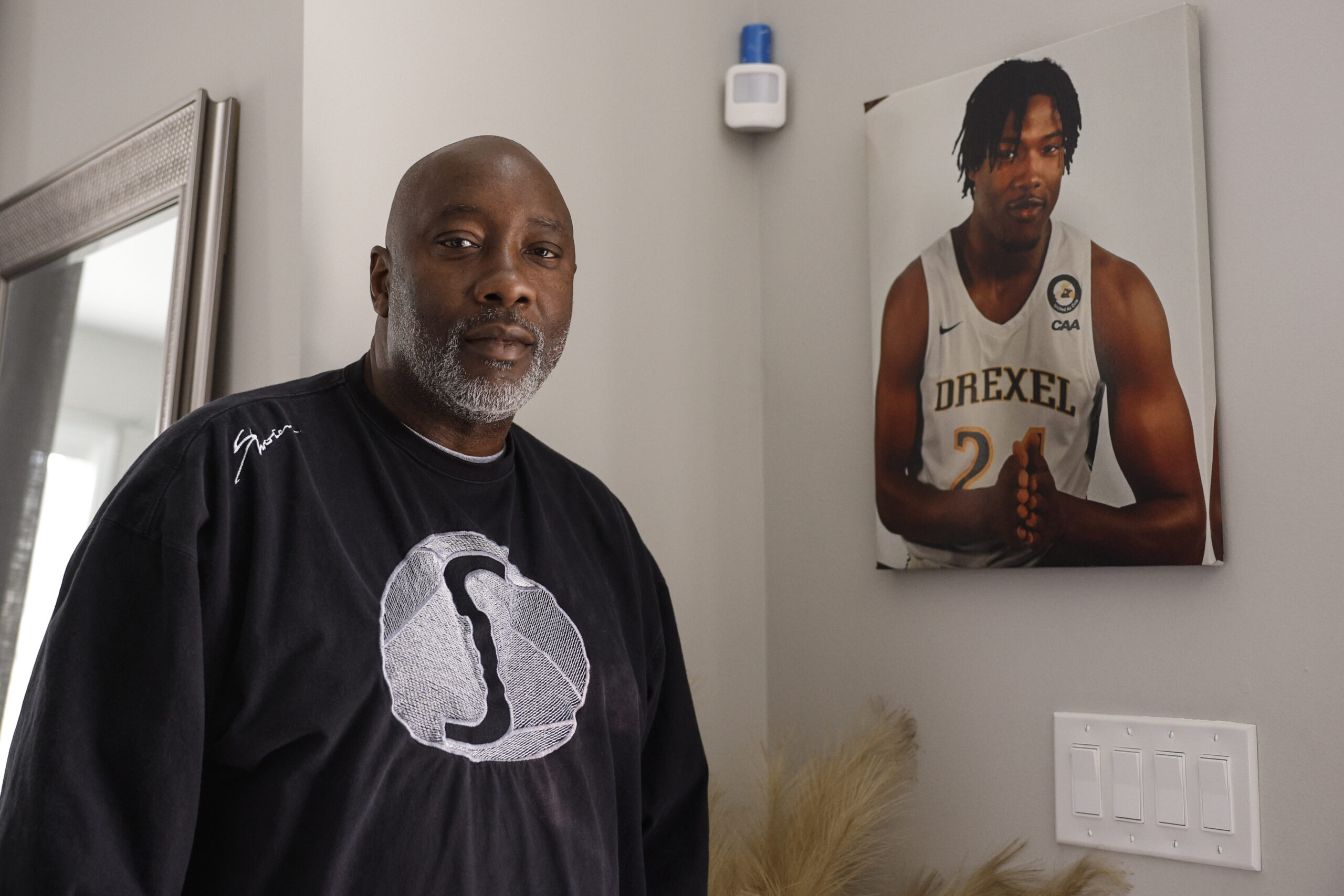
Tink Butler at his home in Clinton, Md. He remains involved in basketball.
Parents, siblings, loved ones: These would presumably be the strongest guardrails. But as Gordon noted, the factors that compel a person to attempt suicide are always unique to that person, and since even those closest to him or her often don’t pick up on any indications of deep distress, predicting or preventing a suicide is challenging at best and impossible at worst.
“Families never think of suicide as a possibility,” Gabriela Khazanov, a clinical psychologist and assistant professor at Yeshiva University in New York, said in an interview, and they can inadvertently create conditions that heighten the risk.
Terrence was one of the more than 49,000 people who died by suicide in 2023, according to the CDC … and one of the more than 55% of those who used a firearm to do it. The combination of suicidal thoughts and easy access to a gun can be lethal, in part because “it’s not that people who are suicidal want to die,” Green said. “It’s that they want to stop an intolerable situation or problem. They seek an escape,” and they are often willing to act without hesitation to relieve their pain.
A January 2009 study published by the Journal of Clinical Psychology showed that half of all suicide attempts result from less than 10 minutes of planning.
“The impulse might be quick, but the issue is, do you have means?” Gordon said. “I can think about it all I want to, but if I don’t have access to means, that’s an issue.”
Terrence Butler did have means, but it would be wrong to call his decision to use his mother’s gun impulsive. He had carried the revolver with him in his navy blue Drexel backpack on the ride from Dena’s house to Tiara and Arthur’s. He had kept it in that backpack for several hours at their home — kept it there overnight, in fact. He kept it there during the short car ride to New Carrollton Station and throughout the 1-hour, 45-minute train ride back to Philadelphia. He kept it there as he walked the three-fifths of a mile from 30th Street Station to The Summit, to a vibrant college setting in a vibrant city, and he kept it there as he opened the door to Apartment 208, to his living space with his personal effects and the memories they inspired.
It is one of the most excruciating aspects of his death: Terrence Butler had time to consider what he was going to do. He also had time to consider all the reasons, in his mind, that he had no choice but to do it.
“I thank God for loaning him to us for 21 years,” Tink Butler said during his son’s memorial service.
Signs no one could see
Inside the dimly lit auditorium of Archbishop Carroll High School in Washington, some 150 parents, coaches, teachers, and administrators gathered on a night in October 2024 and learned about Terrence Butler from the women who knew him best. The school was holding a symposium about athletes’ mental and emotional health, and Dena, Tiara, and Tasia were the first speakers. They wore black T-shirts with his picture on them. Behind a table atop a stage, Dena sat between her daughters, one arm draped over Tiara’s shoulders, one arm draped over Tasia’s. There was an empty chair next to them, for Terrence.
Three siblings. Three honor students. Three Division I basketball players. A veneer of perfection, or as close to it as a family can get. And now …
“You can have all that,” Dena said to the audience, “and your child may not want to be there.”
Tiara and Tasia did not want to be there. Over the two years since Terrence’s death, the Butlers and others have plumbed their memories and searched within themselves for hints and connections that might help them explain the inexplicable. The sisters keep returning to their own childhoods and adolescence — to Tiara’s desire to draw and paint and write and Tasia’s to dance, to Tink training them to be competitive and never treat their opponents as friends, to Dena reminding them that athletics was their conduit to college, to the pressure they felt to perform.
Before every basketball game he played, Terrence would dash to the bathroom, as if he were seasick, and his hands would sweat so much that he could barely grip the ball. He’d douse them in powder to dry them only to have it turn into paste in his palms.
At Syracuse, Tiara often couldn’t eat before games because she was so nauseous from nervousness, then would shake as she sat on the bench. And it was only after her brother had died that Tiara confessed to her family that in her instances of greatest stress she would hear noises in her head — loud, indescribable noises — that she could not quell.
“I don’t really know where it came from,” she said, “but it showed itself in my body. It showed itself in my handshake. It showed itself with me being out of breath, with my voice shaking.
“I know what that feels like, what he was feeling. You can’t really control it. If you’re not playing, there’s that daunting feeling on top of that. Am I good enough to get on the court? Part of you is like, ‘OK, I didn’t play today, so I didn’t mess up today.’ But the other part, especially when you’re away from home and you didn’t play, is that you have to explain yourself to someone who’s not there and asks, ‘Hey, what’s going on?’ You’re thinking, ‘I’m working hard, doing all that I can do. It’s someone else’s decision.’ Now you’ve got to listen to that voice, too: ‘Hey, what’s really going on?’ It’s just a tough balance, especially as a kid. Then you’re going off to be by yourself, high level, lights always on …”
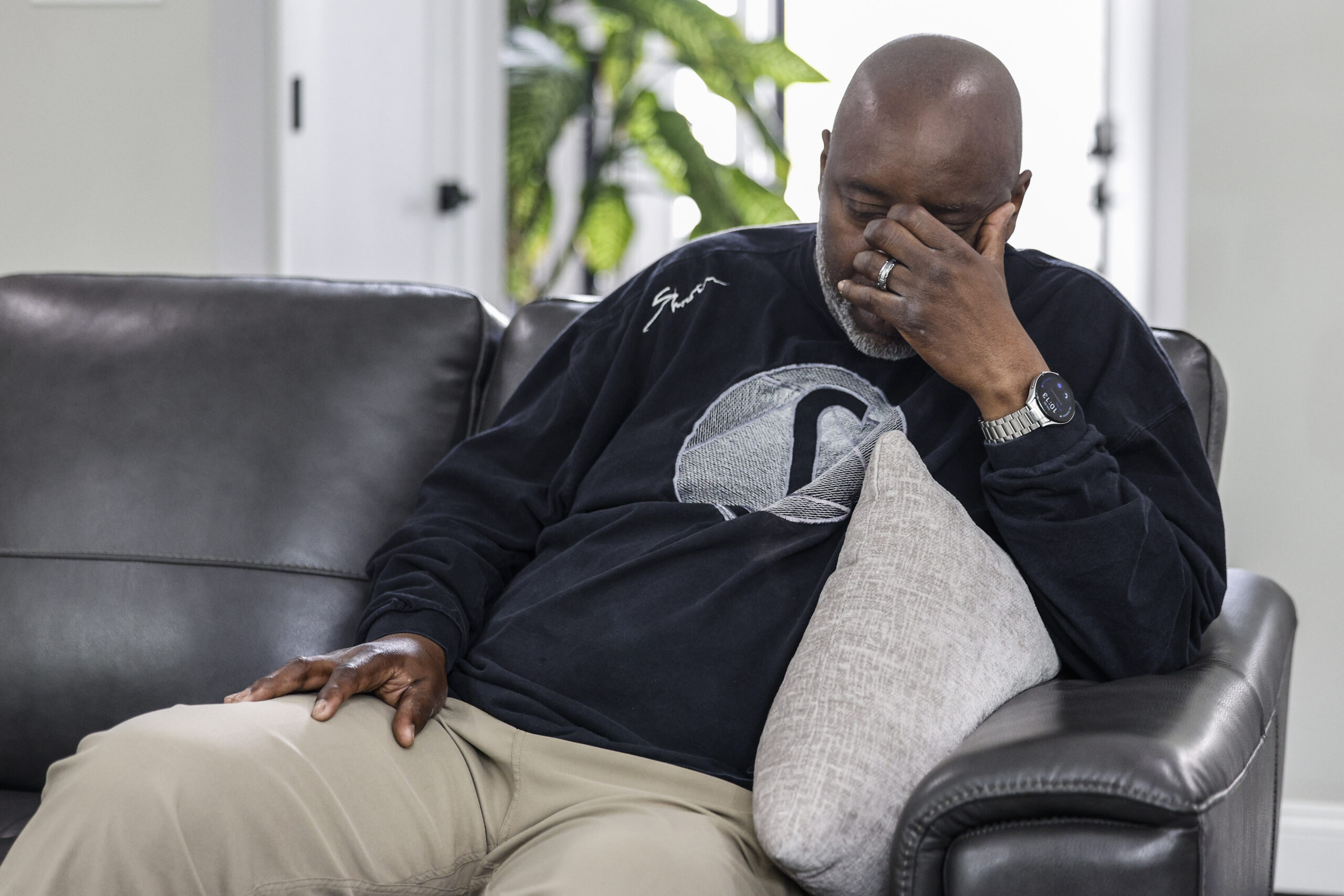
Tink Butler says he remains troubled daily by his son’s death.
Guilt creeped into Tink’s thoughts. Was his children’s performance anxiety purely genetic, or had he pushed them too hard? Once, when Tiara wasn’t yet a teenager, she had moseyed after a rebound during a workout, and he chucked the ball to the opposite end of the gym and bellowed at her, “RUN!” When she came back, there were tears in her eyes and a whimper in her words. You yelled at me. He backed off some with Tasia, then backed off even more with Terrence — in his tone, but not in the time, the effort, the aspirations.
“My whole life was basically getting rebounds for him,” Tink said. “That was the plan from the time I saw I was having a son: I’m going to mold this guy into a basketball player.”
Dena second-guessed herself about how she and Tink handled their divorce. She had filtered all her parenting decisions through the lens of her own childhood, through the experience of growing up in a broken home, and she wanted to spare Tiara, Tasia, and Terrence any trauma. She and Tink had taken care never to argue in front of them, hiding the hard reality of their disintegrating marriage, opening up fully about the divorce only after Tink had remarried.
“I was playing God,” she said, “in trying to control everything so they wouldn’t see certain things.”
But the upshot was that, when the three kids finally found out their parents were splitting up, they were shocked. They never saw it coming, and Terrence was the youngest, the most impressionable, the baby of the family. In trying to protect them, had Dena failed to prepare them? Had she failed to prepare him?
“It could have handicapped them,” she said. “I’m supposed to be their training ground.”
She carried similar concerns once he went off to Drexel, and she wasn’t the only one. The pandemic had already isolated Terrence, pulling him away from his friends and his social life while he was still at McNamara, from an environment and experience that, even if the lockdowns hadn’t disrupted it, would have been its own kind of cocoon.
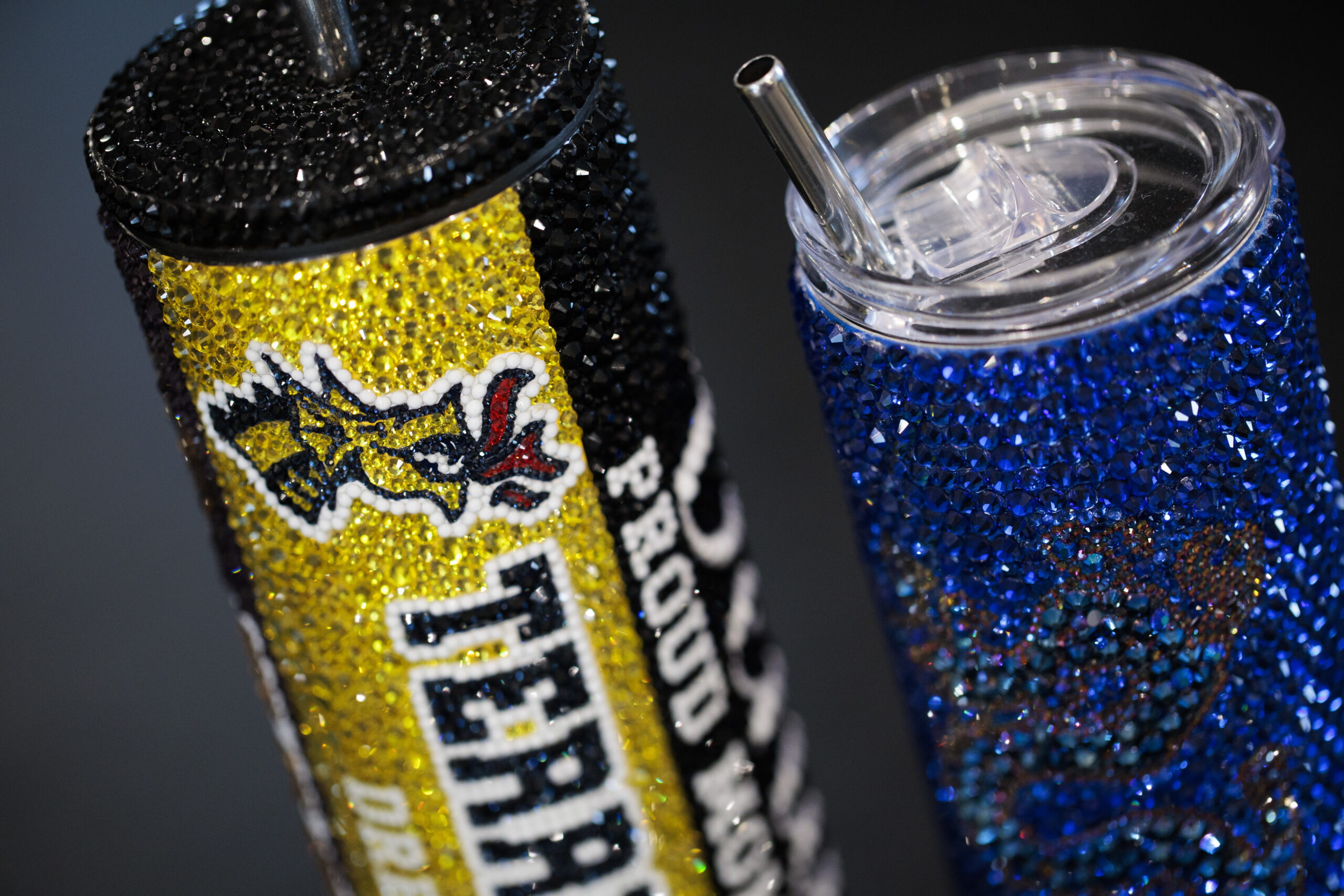
Dena Butler’s “Proud Momma” cups featuring the school colors and logos for her three basketball-playing children.
“Prince George’s County can give you a false sense when you leave here,” said Gloster, the McNamara dean — and a former police officer. “It’s a county of wealthy African Americans, and you don’t find many Catholic schools with so many Black students where parents are paying a tuition of $22,000. Then they get out in the real world, and it’s, ‘Maybe I’m too Black. Maybe I’m not Black enough. Maybe I didn’t realize there was a lot of racism in the world. Maybe I didn’t realize I had demons inside that hadn’t surfaced.’”
Now Terrence was living in an unfamiliar campus in an unfamiliar, more economically distressed neighborhood in an unfamiliar city, and whenever Dena or Tiara or Tasia saw a news story about violence in Philadelphia, one of them would call him. Hey, don’t go outside today. Dena would warn Terrence — 6-foot-7, 235-pound, Division I athlete Terrence — not to get into a stranger’s car, and Tasia would remind him that, as a Black male college student, he “fit the description of someone who could be in trouble.”
He could be a target for a criminal or a cop, could be taken for an easy victim or presumed to be a thug, so he should get to know as many people at Drexel as possible, make sure that everyone knew his face … starting with the campus police. His popularity was based on his personality, yes, but also on self-preservation.
Near the end of his freshman year, he confessed to Arthur that he was contemplating giving up basketball after college, even during college. He had realized that the sport at these levels was a business, and he wanted to enjoy the game, not have it be his job.
He had considered transferring from Drexel when Tink pitched him the idea, but no, he told his family — and himself — that being around the team, contributing to it whenever and however he could, and graduating with his engineering degree would satisfy him.
Drexel basketball player Terrence Butler (left) and his father, Tink, on artwork at his home in Clinton, Md.
Besides, what guarantee would there be that he wouldn’t be trapped in limbo in another program just like he was at Drexel? Would transferring allow him to say goodbye to all the rehab and the ice packs and those platelet-rich-plasma injections, all those needles to his knees to stem the swelling and stoke some healing, and become the player he might have been? Would anything be different anywhere else?
But maybe he needed basketball more than he let on, more than even he understood or acknowledged. His faith calmed him only so much. Those biblical excerpts weren’t the only index cards he kept on his person at all times. He had others that were daily reaffirmations, prompts to remember that he mattered: I AM Valuable. I AM A Masterpiece. Even the white throw pillow on his bed, with a single word stitched across it, seemed to carry a double meaning. Whether asleep or awake, Terrence should RELAX.
He couldn’t. He asked Tiara to put him in touch with a therapist. She did, paying for his sessions. How much progress he was making, only he knew. He sought the counsel of Jordan Lozzi, the director of the Fellowship of Christian Athletes at Drexel and at Penn. On Nov. 28, 2022, Terrence sent a text message to Dena.
I do think I have a lot of unchecked thoughts. There are times where I know the truth but I try to solve everything on my own without guidance. I’ve been taking some baby steps here and there but I feel like I’m moving in slow [motion].
On March 10, 2023, he texted Dena again, confirming what he had earlier said to Arthur about his future, or lack of one, in basketball.
To be honest, it does not necessarily bother me that I’m not playing because I don’t have a passion to continue playing basketball after college. I’m still in the process of learning that my identity and worth [do] not come from basketball.
Later, another message to his mother:
I’ve always had this idea in my head that I needed to be perfect, and whenever I miss the mark or mess up in any way it messes with my head. It kind of reminds me of how I would feel after most games I played growing up. It’s difficult for me to focus on the good that comes out of situations. I may recognize it but the overwhelming negativity clouds the positive.
Dena responded at length.
I appreciate your honesty and transparency. You are not in denial about where you are which gives the Holy Spirit something to work with. Here is something that should support you in dealing with the spirit of perfectionism.
Possible things you’ll need to accept: that you’ll never be perfect and neither will your projects, but since life is about God — not perfect projects — this isn’t really a big deal.
Possible things you’ll need to confess: that you’re making something more important than God wants you to make it, that you’re seeing yourself through the culture’s eyes rather than God’s eyes, that you’re hurting others in your quest for perfection, and that you don’t have time to do the things God wants you to do because you’re too busy trying to be perfect.
She suggested that he consult the Gospel of Matthew, to remind himself that God would comfort him. Then she concluded her text:
Your goal is to please God. He is your source and once you understand that and align with His trust and what He says about you, He will cause the people to follow His plan for your life.
Dena Butler at her home in Brandywine, Md.
She keeps screenshots of these messages on her phone. They provide her no solace, no consolation, and no explanation. In November 2024, she contacted Lozzi, texting him four questions about what Terrence might have shared with him during their conversations and what actions Lozzi did take or could have taken to help him. The answers were revealing.
Terrence, Lozzi told Dena, “disclosed that he had harmed himself” sometime in April 2023, not long after he turned 21; Lozzi provided no details about how. Terrence had said it was the first time he had done anything like that.
Dena asked Lozzi if he was mandated to report any such occurrences of self-harm to a licensed therapist.
“In the college space,” Lozzi wrote, “we are mandated reporters, but I believe there is no mandated reporting for self-harm with adults. The mandated reporting in the college space is around sexual violence or relational abuse. To connect someone to suicide watch from my understanding they must be a present danger to themselves. In any of my interactions with Terrence I don’t believe there was anything that would have qualified to admit him to suicide watch.”
Lozzi was asserting that he wasn’t allowed to tell anyone that Terrence had committed harm to himself — that because Terrence was an adult, either Lozzi or a mental-health professional would have needed Terrence’s consent to disclose the incident to Dena, to another therapist, to anyone else, and Terrence had not given that consent. In his final text to Dena, Lozzi wrote that he “did propose for [Terrence] to see Drexel’s school counselors.”
When asked via email earlier this year if he would speak on the record about Terrence’s death, Lozzi responded that he had “sent your request to the appropriate person to get in touch with you right away.” He had forwarded the message to Hamilton Strategies, a public relations firm that represents the Fellowship of Christian Athletes. “Unfortunately,” an executive with the firm said in an email, “Jordan is unable to interview for your story. Thank you!” A second request for comment, sent in November to Lozzi and the executive, went unanswered.
Terrence Butler at a game with his Drexel teammates.
The struggle of hope
The why of Terrence Butler’s suicide eludes everyone who loved him. Tiara teaches art at Bishop McNamara, her brother’s alma mater, and most of her students don’t know about Terrence’s death unless she mentions him, and once she does, sometimes one of them will approach her in her classroom and say, I just wanted to give you a hug. Tink will break down over his son once or twice a day, then just continue with his office work. He still asks himself haunting questions: How much did the divorce affect Terrence? How much did the knee injuries affect him? Did he consider himself a burden to his parents, as if he owed them a debt for all the time they had spent with him and money they had spent on him — a debt that he could never repay?
After Philadelphia police had ruled Terrence’s death a suicide, Dena said, she pleaded with them to unlock his cell phone. Perhaps he had written something in his notes app. Perhaps he kept a meaningful or revelatory photo stored in it. But the police, she said, told her that they would do that only in an open investigation — a homicide, for instance, in which they were trying to find and extract evidence. Here, they already knew what had happened, even if no one else really does. The department’s public affairs office did not respond to an inquiry about how, in general, police handle such situations.
Having the service provider unlock the phone wouldn’t accomplish anything either, Dena said, because only Terrence knew the passcode; resetting the phone without the code would erase all its data. She recently had the phone disconnected. It was a bitter symbol of the absence of closure.
“What I struggle with the most to understand in all this,” she said, “is that my son was devoid of hope, that he was in such despair, and he didn’t want anybody to help him. As a mom, to know your child didn’t have hope anymore … and hope is what gets us. Hope is what propels us. Hope is the motivator for why we keep going. And to know he didn’t have that, that’s hard.”
Zach Spiker finds himself slower to anger whenever one of his players happens to be late for a team meeting, for a practice, for anything. “I just want to make sure they’re safe,” he said. “Then we talk about it.” He saw a counselor himself, just a few sessions. “I had to,” he said. “I need to figure out things. I still have questions. There are still breadcrumbs, and you want to solve the mystery.”
They hoped that they had on the day that Terrence died. That night, 11 people crowded into his apartment: Dena, Tiara, Tasia, Tink and his wife, cousins and close family friends. Everything in the place was clean. There was nothing on his bed but a bare mattress. “You would have never known,” Tiara said later.
Tasia peered into the bedroom trash can. It was empty. She noticed Terrence’s Drexel backpack next to his bed. She picked it up, brought it into the living room, plopped it on the floor, and began rifling through it. She found random items, things that one would expect to find in a college student’s backpack: Terrence’s schoolwork, his headphones. Then she found something else.
Dena Butler touches a journal that belonged to her son, Terrence.
The spiral 5×7 notebook, more than a half-inch thick from its 160 pages, was buried at the bottom of the bag. Tasia stopped. Tiara recognized the book, that sky-blue cover that she had glimpsed just four days before: It’s the same one he was writing in when he was at my house. Across the cover, Terrence had printed two words in black marker: My Brain.
This was it. This had to be it. This was Terrence’s journal, so this had to be the missing piece, the unknown explanation. Everyone in the apartment froze, went silent, then sat down. Tasia opened the book.
On the first page, on the top line, Terrence had written, I’m sorry. I really tried.
On the second page, on the top line, he had written, The noise is too loud.
On the third page, on the top line, in the top left-hand corner, he had written just one letter, just one word: I.
Tasia turned the page. And the next page. And the next. The family waited for a revelation that would never come. There were 157 pages remaining in the notebook. Terrence Butler had left all of them blank.
Back in September 1873, the New York Herald announced that the Hudson River School painter Jasper Francis Cropsey had a new painting. Autumn in the Ramapo Valley, Erie Railway, which would be open to public viewing for “only a day or two longer” at the Wall Street office of Charles Day, the article said.
The painting was commissioned by investor James McHenry, who, with Day, was director of Erie Railway. McHenry, who had been a director of the Atlantic and Great Western Railway before that, had his eye set on the Erie Railway, which was founded in 1832.
In 1872, in what is best described as a corporate coup, McHenry ousted the railroad magnate Jay Gould and took full control over Erie Railway. In celebration, he commissioned the Cropsey painting, which, after those few days on Wall Street, made its way to McHenry’s home in London and remained in private collections, away from the public eye since.
Until now.
In 2024, philanthropists J. Jeffrey and Ann Marie Fox, who live in Bucks County, bought the painting and brought it back to the United States. It is on view at the Brandywine Museum of Art, some 150 miles away from the original setting of the painting, where flatlands west of the Hudson River meet steep hills near the town of Sloatsburg, N.Y.
Here, it can be seen by an American audience for the first time in 152 years.
The Foxes and American art
J. Jeffrey Fox has built a successful career in finance and education and his wife, Ann Marie, has worked with several nonprofits, often focusing on children with special needs. Together, in 2024, they made a $20 million gift to endow the J. Jeffrey and Ann Marie Fox Graduate School at Pennsylvania State University.
The couple, said Jeffrey Fox, have always been interested in American history.
“We used to collect art as souvenirs. We would go to estate sales and garage sales and sometimes buy a piece of art,” he said. “It wasn’t a collection that was of any significance. So once we got a little bit more money, we wanted to buy one painting that’ll be the centerpiece for the rest of our collection.”
They bought Frederick Childe Hassam’s The Cove, Isles of Shoals (1901) at an auction in 2015.
The discerning eye in the couple has always been Ann Marie’s. She spent 15 years volunteering at the Walters Art Museum in Baltimore, and when the couple lived in Annapolis, Md., she took classes under Matt Herban, a retired professor of art from Ohio State University.
After that first Hassam, the couple wanted a Cropsey. But not just any Cropsey.
“We went to the National Gallery and they had a fabulous Cropsey [Autumn — On the Hudson River (1860)]. It just took our breath away. And we were like, ‘Wow, how could we ever get something that good.’ That’s why it took us this long,” said Ann Marie.
“We were very picky. Every artist has great days, and every artist has OK days. We wanted Cropsey on a great day,” her husband said.
Finding Cropsey on a great day
Last year, the Foxes’ art adviser came to know from a friend in Europe that Autumn in the Ramapo Valley was coming up for auction in London in September. Believing that the painting was best sold to an American buyer, this friend approached the adviser before the painting went under the hammer.
The Foxes had 48 hours to make a decision to buy, never having seen the painting, aided only by a high-quality photograph and a condition report.
Cropsey’s catalog raisonné, put together by the Newington Cropsey Foundation in Hastings-on-Hudson, N.Y., says the painting left the country in September 1873. Documents said the painting has been in an undisclosed buyer’s family since the 1950s.
James McHenry’s carte-de-visite,
1861.
McHenry died in 1891 and “we don’t really know what happened from 1891 to the mid-’50s, but we do know that it never left England,” Jeffrey said. “And we don’t think it was ever shown in England. There are no records that we were able to find.”
Ann Marie said yes, and the couple wrote up a letter of intent.
“We were a bit concerned,” said Jeffrey. Another Cropsey — Richmond Hill in summer of 1862, also owned by McHenry — that came up in an auction in 2013 was deemed a “national treasure” by the U.K. and was not allowed to leave the country.
The clearance for Autumn in Ramapo to leave England took a little over three months.
“The English let that out of England because it was an American artist, and an American scene,” Jeffrey said.
The couple bought the painting in January 2025. Once the artwork arrived in the United States, a restorer found it to be in exceptional condition, exactly as advertised. In March, the conservator finished assessing the painting, and the Foxes traveled to New York to see it in real life.
“It just displayed so much grandeur. I thought it was wonderful,” Anne Marie said. “The autumn colors … just stunning. And the size of it is amazing. The first thing I said when I saw it was, ‘It can’t come to my house. It’s going to tear down my wall.”
Including the frame, the artwork measures 4.75 feet by 7.16 feet.
“Our house isn’t that big, we probably couldn’t get through the door,” Jeffrey said.
The couple couldn’t ship it to their foundation office, either. “We needed a museum that would be willing to show it and buy into the story, because it’s a phenomenal story,” Jeffrey said.
The “Cropsey, Wyeth, and the American Landscape Tradition” exhibition runs through May 31 at the Brandywine Museum of Art.
The painting and the painter
It’s easy to miss the “Erie Railway” part in Autumn in the Ramapo Valley, Erie Railway. Cropsey paints an idyllic fall scene with the Ramapo Valley bathed in yellow, red, and, orange foliage. Bits of green peep out, the sky is clear and a light blue, a waterfall flows gently on the left, the Ramapo River sits still.
The smoke-billowing train chugs through the valley in the distance, but in the center of the painting. Black rails of the railway bridge run parallel to the river and disappear into the leaves.
The setting of the painting falls between what is New York’s Orange and Rockland County, on the western side of the Hudson River, and north of Suffern.
“This painting … really helps in telling a fuller story of the history of American art, and particularly, this brief moment, in the third quarter of the 19th century, when huge sums were being spent on huge paintings,” said William L. Coleman, curator at the Wyeth Foundation and director of the Andrew & Betsy Wyeth Study Center.
“This is part of a larger story with artists like Frederic Church, Albert Bierstadt, and Thomas Moran.”
Jasper Francis Cropsey by Napoleon Sarony, circa 1870.
Cropsey, an architect who had designed several railway stations himself, was part of a line of artists who “engaged with the new fortunes being made from the transportation industry, making images of new railroads traveling through the landscapes,” Coleman said.
The artists enjoyed generous patronage and lived well. Cropsey lived in a mansion he built, called Aladdin, less than 10 miles away from the site of the painting. Here he built himself a studio that doubled as a gallery and art marketplace.
The Philadelphia story
Cropsey’s patron James McHenry was born in Ireland in 1817 and was raised in Philadelphia. He moved back to England, living primarily in London, where he made a fortune raising money and investing it in developing railways in America.
His sister remained in Philadelphia until her death.
Jeffrey Fox calls McHenry “notorious,” adding that he often worked against other equally infamous “robber barons” like Cornelius Vanderbilt and Gould.
“He paid $25,000 on a Bierstadt painting in 1865, so he was quite an art collector himself,” Jeffrey said. McHenry, who already owned Richmond Hill in Summerof 1862, perhaps had gotten acquainted with Cropsey when the artist visited England in 1856.
Cropsey had already made a name for himself painting Starrucca Viaduct, Pennsylvania (1865) —where, too, a distant train almost merges into the green slopes of the mountain behind it — when McHenry wanted an artist to commemorate his pushing Gould out of the Erie Railroad directorship in 1873.
“He had already gotten a national reputation for painting part of this exact railroad, and so James McHenry went to the railroad guy,” said Coleman, “and commissioned Autumn in Ramapo.”
Artists like Bierstadt and Sanford Robinson Gifford were also working on similar railroad commissions at the time.
“Most of their stock and trade are images that make use of the aesthetic value of the sublime, the power of the natural world against the small scale of human existence. So they give us that feeling of awe, of wonder,” Coleman said.
Landscape paintings, he said, “tell stories about belonging, about ownership, about your place in a wider society. … And they often risk being underestimated. These are pleasant, old pictures that we see on calendars and postage stamps, but they have a lot to tell us about how we became the nation we are today.”
The model train at Brandywine Museum’s holiday showcase in 2018.
An irrelevant cost
At Brandywine, Cropsey’s train speaks to the museum’s beloved holiday train display, posing questions of tradition and modernity as the nation enters its 250th year.
It will stay at the museum through May and then travel to the Dixon Museum in Memphis, Tenn. Then it heads to the Seed Art Museum in Louisville, Ky.;, Rockwell Museum in Corning, N.Y,; University of Georgia Museum of Art in Athens, Ga.; and the Newington Cropsey Foundation.
The Foxes wanted this piece of American history to be witnessed by Americans.
What they paid for it, Jeffrey Fox said, is irrelevant.
“If you put a value to it, that’s what you’re going to talk about, as opposed to the painting,” he said. “We’re a foundation and at the end of the day, we’re not going to sell it. So it doesn’t matter what we paid.”
“Cropsey, Wyeth, and the American Landscape Tradition,” continues through May 31 at the Brandywine Museum of Art, U.S. Route 1 at Hoffmans Mill Road in Chadds Ford, Chester County. Information: brandywine.org or 610-388-2700.
This article has been updated with the correct year of James McHenry gaining control of the Erie Railway. It was 1872.
Tomorrow is the first day of winter, but the snow has already started. I invited two Inquirer staffers who have to shovel their sidewalks to answer the seasonal issue.
.inno-chat__body {
border-radius: 12px;
}
Evan Weiss
Deputy Features Editor
The question is…
I usually shovel beyond my own sidewalk, but my younger neighbor only does his patch. Am I expecting too much from him?
Tommy Rowan
Programming Editor
It depends on the type of youngin' we're talking about. If they have a Doordash order on their stoop after it already snowed 4 inches and it's still coming down, then yes, you're expecting too much.
Sam Ruland
Features Planning and Coverage Editor
Yeah, that’s exactly it. I still feel like a jerk if I only shovel my own sidewalk, that’s just how I was raised. But I also know that’s not the default anymore. Some people are strictly “my patch is clear, my work here is done,” and apparently that’s acceptable now.
Sam Ruland
I just can’t stop at the property line without feeling weird about it… especially when I live on a block where neighbors will bring your trash cans back to your house if they get to them first.
Tommy Rowan
Yeah and if there are elderly people on your block, that should just be automatic. You know, we're trying to live in a society!
Sam Ruland
Once elderly neighbors are involved, pretending you didn’t notice becomes embarrassing.
Evan Weiss
Maybe your neighbor was in a rush one time or their back hurt, but if you know they're physically capable and they always stop at the border… that's being a bad neighbor.
Sam Ruland
Totally. One time, fine. Life happens. But if you’re physically capable and it’s every storm, people notice. And once it becomes a habit, I’m gonna feel a lot less bad about moving your cone and parking in your spot when the snow melts.
Tommy Rowan
I was one of those kids who would grab their plastic shovels during snowstorms and go around with a few buddies to knock on doors and offer our shoveling services for a few dollars. Then we'd get pizza and a few cool, refreshing glasses of Mountain Dew.
Tommy Rowan
I may sound old, but I don't see those kids around anymore.
Sam Ruland
What REALLY gets me is watching the single mom on my block out there shoveling by herself while her three sons are completely MIA. I don’t know about you, but that would not have stood in my house. And Philly notices stuff like that.
Tommy Rowan
Yeah, that ain't right.
Sam Ruland
My dad had three daughters, and if he was home, he took the lead on shoveling. And if he was at work? There was no way my mom (with her forever aching back) was going to be out there alone.
Tommy Rowan
Yeah and if a neighbor saw your mom or you doing it alone they would have yelled at you for not asking for help!
Sam Ruland
That public scolding was mortifying and honestly enough to shape my entire personality. Which is basically how I operate now. I don’t want to shovel. I hate it. But I’d rather suffer for 20 minutes than be silently judged by my neighbors all winter. I don’t shovel because I love it. I shovel because I fear the block.
Evan Weiss
Okay, if a few kids knock on your door asking for money to shovel, how much do you give them?
Tommy Rowan
Depends on the size of the property.
Sam Ruland
I want to say $5.
Evan Weiss
Yeah, $5 seems fair for a rowhouse.
Tommy Rowan
And $10 for a rowhouse if they also dig out the car. If we're talking a Northeast house, with a full driveway, sidewalk, and steps, that's at least $20. And possibly a hot chocolate Mountain Dew break.
Evan Weiss
Any final advice?
Sam Ruland
Snow melts. Reputation doesn’t. Help your neighbors.
This conversation has been edited for length.
What other Very Philly Questions should we address?
Can you see all four? There is one “real” image of SEPTA trolley operator Victoria Daniels and three different reflections.
I only saw two reflections as I was trying to focus and compose while bracing my camera on the back of a seat to stabilize myself on the moving trolley. I wanted to photograph the light at the end of the tunnel (the metaphor was apt, as tens of thousands of riders are hoping for some relief as service in the Center City Tunnel has been shut down for weeks.)
Trolley slider parts are on display as Jason Tarlecki, acting SEPTA chief engineer of power, talks with the news media at the 40th Street trolley portal.
More than just a “talker” the SEPTA folks first showed lots of equipment parts and then we got to take a field trip, riding a trolley into the closed tunnel to see where they were repairing the overhead wire.
While, for most of the media, the ride was just a way to get to the closed station for the show-and-tell, for me it was an opportunity to take pictures out the windows — something I like to do anytime I am on public transit. And play around with exposures …
…which sometimes just doesn’t work out.
Two things that did work out photographically this week; the first snowfall of the season:
And, on the same day, a firefighter Santa riding through the neighborhood.
Since 1998 a black-and-white photo has appeared every Monday in staff photographer Tom Gralish’s “Scene Through the Lens” photo column in the print editions of The Inquirer’s local news section. Here are the most recent, in color:
December 15, 2025: A historical interpreter waits at the parking garage elevators headed not to a December crossing of the Delaware River, but an event at the National Constitution Center. General George Washington was on his way to an unveiling of the U.S. Mint’s new 2026 coins for the Semiquincentennial, December 8, 2025: The Benjamin Franklin Bridge and pedestrians on the Delaware River Trail are reflected in mirrored spheres of the “Weaver’s Knot: Sheet Bend” public artwork on Columbus Boulevard. The site-specific stainless steel piece located between the Cherry Street and Race Street Piers was commissioned by the City’s Public Art Office and the Delaware River Waterfront Corporation and created and installed in 2022 by the design and fabrication group Ball-Nogues Studio. The name recalls a history that dominated the region for hundreds of years. “Weaver’s knot” derives from use in textile mills and the “Sheet bend” or “sheet knot” was used on sailing vessels for bending ropes to sails. November 29, 2025: t’s ginkgo time in our region again when the distinctive fan-shaped leaves turn yellow and then, on one day, lose all their leaves at the same time laying a carpet on city streets and sidewalks. A squirrel leaps over leaves in the 18th Century Garden in Independence National Historical Park Nov. 25, 2025. The ginkgo (Ginkgo biloba) is considered a living fossil as it’s the only surviving species of a group of trees that existed before dinosaurs. Genetically, it has remained unchanged over the past 200 million years. William Hamilton, owner the Woodlands in SW Phila (no relation to Alexander Hamilton) brought the first ginkgo trees to North America in 1785.November 24, 2025: The old waiting room at 30th Street Station that most people only pass through on their way to the restrooms has been spiffed up with benches – and a Christmas tree. It was placed there this year in front of the 30-foot frieze, “The Spirit of Transportation” while the lobby of Amtrak’s $550 million station restoration is underway. The 1895 relief sculpture by Karl Bitter was originally hung in the Broad Street Station by City Hall, but was moved in 1933. It depicts travel from ancient to modern and even futuristic times. November 17, 2025: Students on a field trip from the Christian Academy in Brookhaven, Delaware County, pose for a group photo in front of the Liberty Bell in Independence National Historical Park on Thursday. The trip was planned weeks earlier, before they knew it would be on the day park buildings were reopening after the government shutdown ended. “We got so lucky,” a teacher said. Then corrected herself. “It’s because we prayed for it.” November 8, 2025: Multitasking during the Festival de Día de Muertos – Day of the Dead – in South Philadelphia.November 1, 2025: Marcy Boroff is at City Hall dressed as a Coke can, along with preschoolers and their caregivers, in support of former Mayor Jim Kenney’s 2017 tax on sweetened beverages. City Council is considering repealing the tax, which funds the city’s pre-K programs. October 25, 2025: Austin Gabauer, paint and production assistant at the Johnson Atelier, in Hamilton Twp, N.J. as the finished “O” letter awaits the return to Philadelphia. The “Y” part of the OY/YO sculpture is inside the painting booth. The well-known sculpture outside the Weitzman National Museum of American Jewish History was removed in May while construction continues on Market Street and has been undergoing refurbishment at the Atelier at the Grounds for Sculpture outside of Trenton.October 20, 2025:The yellow shipping container next to City Hall attracted a line of over 300 people that stretched around a corner of Dilworth Park. Bystanders wondered as they watched devotees reaching the front take their selfies inside a retro Philly diner-esque booth tableau. Followers on social media had been invited to “Climb on to immerse yourself in the worlds of Pleasing Fragrance, Big Lip, and exclusive treasures,” including a spin of the “Freebie Wheel,” for products of the unisex lifestyle brand Pleasing, created by former One Direction singer Harry Styles.October 11, 2025: Can you find the Phillie Phanatic, as he leaves a “Rally for Red October Bus Tour” stop in downtown Westmont, N.J. just before the start of the NLDS? There’s always next year and he’ll be back. The 2026 Spring Training schedule has yet to be announced by Major League Baseball, but Phillies pitchers and catchers generally first report to Clearwater, Florida in mid-February.October 6. 2025: Fluorescent orange safety cone, 28 in, Poly Ethylene. Right: Paint Torch (detail) Claes Oldenburg, 2011, Steel, Fiberglass Reinforced Plastic, Gelcoat and Polyurethane. (Gob of paint, 6 ft. Main sculpture, 51 ft.). Lenfest Plaza at the Pennsylvania Academy of the Fine Arts on North Broad Street, across from the Convention Center.September 29, 2025: A concerned resident who follows Bucks County politics, Kevin Puls records the scene before a campaign rally for State Treasurer Stacy Garrity, the GOP candidate for governor. His T-shirt is “personal clickbait” with a url to direct people to the website for The Travis Manion Foundation created to empower veterans and families of fallen heroes. The image on the shirts is of Greg Stocker, one of the hosts of Kayal and Company, “A fun and entertaining conservative spin on Politics, News, and Sports,” mornings on Talk Radio 1210 WPHT.September 22, 2025: A shadow is cast by “The Cock’s Comb,” created by Alexander “Sandy” Calder in 1960, is the first work seen by visitors arriving at Calder Gardens, the new sanctuary on the Ben Franklin Parkway. The indoor and outdoor spaces feature the mobiles, stabiles, and paintings of Calder, who was born in Philadelphia in 1898, the third generation of the family’s artistic legacy in the city.September 15, 2025: Department of Streets Director of Operations Thomas Buck leaves City Hall following a news conference marking the activation of Automated Speed Enforcement (ASE) cameras on the Broad Street corridor – one the city’s busiest and most dangerous roads. The speed limit on the street, also named PA Route 611, is 25 mph.
Every Philly-adjacent viral saga eventually ends the same way: not with a plot twist, but with probation.
The Delco Pooper (a title no one asked for but Delaware County fully delivered) finally reached the unglamorous end of her moment in the internet sun this week. Instead of a trial, Christina Solometo entered a first-time offender program that includes probation, community service, anger management, and a strict “no posting about this” rule that feels tailor-made for someone who briefly became a meme.
If she completes it all, her record could be wiped clean. Which feels… both reasonable and deeply unceremonious, given how loudly this story echoed across the internet.
Here’s the thing: This was never really a crime story. It was a spectacle. A perfect storm of road rage, cell phone video, Delco energy, and a news cycle that will absolutely stop to rubberneck if given the chance. The moment went viral because it was shocking and absurd, not because anyone was asking for a legal reckoning.
And now, like most viral Philly chaos, it fizzles out in a courtroom with no cameras and a lot less laughter.
The C grade isn’t about whether the punishment fits the offense. It’s about the strange disconnect between how massive this story became and how ordinary its ending is. Two years of probation and some mandated self-reflection doesn’t feel dramatic. But maybe that’s the point. Real life isn’t a meme, and viral notoriety doesn’t translate to anything meaningful once the internet moves on.
Philadelphia Eagles quarterback Jalen Hurts (1) scores a touchdown against the New York Giants during the third quarter of an NFL football game, Sunday, Dec. 11, 2022, in East Rutherford, N.J. (AP Photo/John Minchillo)
Taking back a Jalen Hurts touchdown ball: D
If a quarterback hands you a touchdown ball, that’s not a loan. That’s a gift. And if the allegations in this lawsuit are even mostly true, what followed was one of the most aggressively uncool things the NFL industrial complex could’ve done to a fan.
Jalen Hurts scored, made history, and chose a guy in an Eagles jersey to share the moment with. That should’ve been the end. Instead, according to the suit, it turned into security, state police, and multiple officials allegedly insisting the fan return the ball, including being told he’d be “breaking the law” if he didn’t.
Yes, historic game balls matter. Yes, teams want them back. But there is a time-honored, normal-person solution here: You ask nicely, you offer a jersey or autographs, everyone leaves happy. What you don’t do is allegedly escalate a good-vibes moment into a stadium-security fever dream.
If this played out the way it’s described, the failure wasn’t policy. It was vibes. You can’t spend all week saying fans are the heart of the game and then, on Sunday, treat one like he stole the Declaration of Independence.
That said — and this is where Philly clears its throat — declaring you’re no longer an Eagles fan over it is… a lot. We’ve survived the Vet, Santa, and several entire seasons of Chip Kelly. Eagles fandom is not something you simply return at the gate like a confiscated football.
So yes: If the ball was forcibly taken back, that’s deeply uncool and deserves a D. But also: Buddy, you still bleed green. You just had a very bad day at MetLife.
Every winter, Philadelphia relearns the same brutal lesson: The stoop is not a safe place, especially in December. This week’s Philly Reddit reminder came courtesy of a transplant who made it almost a full year without incident, a rare and beautiful run, only to have a Christmas package stolen. Not electronics. Not sneakers. Homemade cookies from an aunt. The kind of theft that doesn’t just steal stuff, but steals joy.
The comments quickly turned into a familiar group therapy session: delivery drivers who won’t ring the bell, packages sitting untouched until they’re suddenly gone, neighbors debating whether knocking on strangers’ doors makes you a Good Samaritan or a suspect on Ring footage. One person suggested fake poop packages. Another admitted they stopped ordering anything between Thanksgiving and New Year’s. Several people basically said, “Welcome. This is Philly.”
The unofficial Philly solution, as always, is community. Grab your neighbor’s packages. Knock if you see a box sitting too long. Use lockers if you can. Put up a sign that says “PLEASE RING THE BELL” and hope for the best.
The two most-beloved Pennsylvania convenience store chains are just .3 miles apart – with a CVS in between – Thursday, Sept. 19, 2024, as the first Wawa in Central Pennsylvania – solid Sheetz territory – had its grand opening in the Dauphin County borough of Middletown.
Wawa absolutely cooking Sheetz: A+
Wawa once again reminded Pennsylvania who the main character is. The Delco-born convenience store giant is still the state’s largest private company. And while Sheetz’s revenue took a 20% tumble, Wawa kept cruising, widening the gap like a hoagie wrapper slowly unpeeling in victory.
Sure, Wawa’s revenue dipped slightly on paper. In reality? The lights were on, the coffee was hot, and no one has ever stress-cried in a Wawa parking lot at 2 a.m. wishing they were at Sheetz instead. That’s brand power you can’t spreadsheet.
Sheetz hired more people. Wawa hired none of our doubts. It’s expanding, it’s everywhere, and it continues to dominate the only metric that truly matters in this region: where people go when they’re tired, hungry, and emotionally fragile.
The Christmas Village mystery package hut: A
Only in Philadelphia would one of the longest lines at the Christmas Village be for a booth selling completely unknown items in heavily taped boxes. No cocoa, no ornaments, no guarantees. Just curiosity, chaos, and the real possibility you’re paying $25 for either a diamond bracelet or a deadbolt.
Hundreds of people a day are voluntarily handing over cash for packages nobody ordered, nobody claimed, and nobody is allowed to peek inside. It’s reckless. It’s hopeful. It’s the purest form of “eh, sure” spending this city has ever embraced.
Watching grown adults aggressively shake mystery mail like they’re working airport security is peak Philly behavior. So is opening it immediately, accepting your fate, and announcing it’s “actually perfect” no matter what comes out. Lacy lingerie? Seasonal. Random hardware? Useful. Animal pregnancy tests? That’s a story you’ll be telling for years.
This hut works because it removes all the pressure of gift-giving. You didn’t pick a bad present — the box did. And now it’s everyone’s problem.
Some cities do traditional Christmas markets. Philly sells you a taped-up question mark and says, “Good luck.”
FILE – Chicago Cubs closing pitcher Brad Keller celebrates after the Cubs defeating the Pittsburgh Pirates in a baseball game, Aug. 16, 2025, in Chicago. (AP Photo/Paul Beaty, File)
Phillies landing Brad Keller: A-
Credit where it’s due: The Phillies actually identified a problem and spent real money fixing it. That alone deserves applause.
Brad Keller isn’t a flashy closer signing or a back-page splash, but he’s exactly what this bullpen has been screaming for: a legit, high-leverage righty who doesn’t make everyone start bargaining with the universe in the seventh inning. A 2.07 ERA, a fastball that suddenly touches 97, and proof he can handle pressure without combusting? We’ll take it.
This is also a refreshing break from the Phillies’ recent bullpen habit of “maybe this guy will be fine” optimism. Keller isn’t a flier. He’s a bet. And at two years, $22 million, it’s a smart one. Not cheap, not reckless, just intentional. That’s new.
Is there risk? Of course. Relievers are famously fragile creatures. But after last postseason’s bullpen roulette wheel, it’s hard to argue this team didn’t need another arm they can trust when the game tightens and the stadium starts vibrating.
The best part: This move signals awareness. Dave Dombrowski didn’t pretend last year’s formula was good enough. He didn’t wait for July. He didn’t say “internal options” and hope everyone forgot October.
No parade yet. But for once, the Phillies didn’t ignore the fire and buy another rug.
Donna Kelce and Jason Kelce pose for a photo at the premier of Jason Kelce’s documentary at Suzanne Roberts Theater in Philadelphia on Friday, Sept. 9, 2023. The film, “Kelce,” is a feature-length documentary featuring Jason Kelce and the Eagles’ 2022-23 season.
Donna Kelce on ‘The Traitors’: A (Philly claims her, sorry not sorry)
Donna Kelce entering a Scottish castle to scheme, lie, and possibly backstab for $250,000 feels less like reality TV casting and more like destiny. Yes, she technically gave birth to two NFL stars in different cities. But let’s be clear: Jason Kelce played his entire Hall of Fame career here, wore a Mummers parade costume, screamed about underdogs, and permanently imprinted his mom onto the city’s cultural fabric. Donna Kelce is Philly now.
Watching her plot alongside Johnny Weir (a Coatesville native, also claimed) is just icing on the Tastykake. While the rest of the cast is stacked with reality-show professionals who’ve been training for deception their whole lives, Donna’s superpower is subtler: calm mom energy and the ability to disappoint you with one look. That’s lethal in a game like this.
Also, the idea of Donna Kelce quietly maneuvering through a castle while reality stars spiral feels extremely on brand. She has raised elite athletes, survived Super Bowl media weeks, and somehow stayed likable through all of it. A few traitors don’t stand a chance.
If she wins, we’re counting it as a hometown victory. If she betrays someone? Even better.