South Philly-raised director and actor Amina Robinson is one of the region’s most celebrated theater makers, known for directing major productions including Fat Ham, Once on This Island, and The Color Purple. Now based in Cherry Hill with her husband and son, Robinson was just named the new artistic director of Norristown’s Theatre Horizon, where she’ll take the helm later this year.
When she’s not directing plays and musicals like this spring’s Ain’t Misbehavin’, the Temple University professor spends her days walking around Philadelphia and visiting family in West Philly. On her perfect Philly day, she takes her family for cheesesteaks at Jim’s before walking around the Schuylkill and, of course, catching a show at her soon-to-be artistic home, Theatre Horizon.
8 a.m.
I get up and I wake up my son and my husband. We decide to get ready and go to Philly for breakfast. We’re gonna go to Eggcellent Cafe on Chestnut Street and I’m gonna eat their truffle avocado toast — it’s so big and good. I’m gonna have their golden turmeric latte, too.
Families and friends gather from all over to watch the firework show over the Delaware River on New Years Eve at Penn’s Landing in Philadelphia on Wednesday, Dec. 31, 2025.
10:30 a.m.
We’ll walk breakfast off by taking a nice little walk down Penn’s Landing, right along the water.
11 a.m.
After that, we’ll go visit my mom in Overbrook Park. I would bring her decaffeinated Dunkin’ Donuts coffee, that’s a must. Then we’ll sit and talk with my mom for a little bit. I would see my brother and my stepdad, and probably my nephew, and maybe my brother’s girlfriend would be there, but I really would be going to visit my mommy.
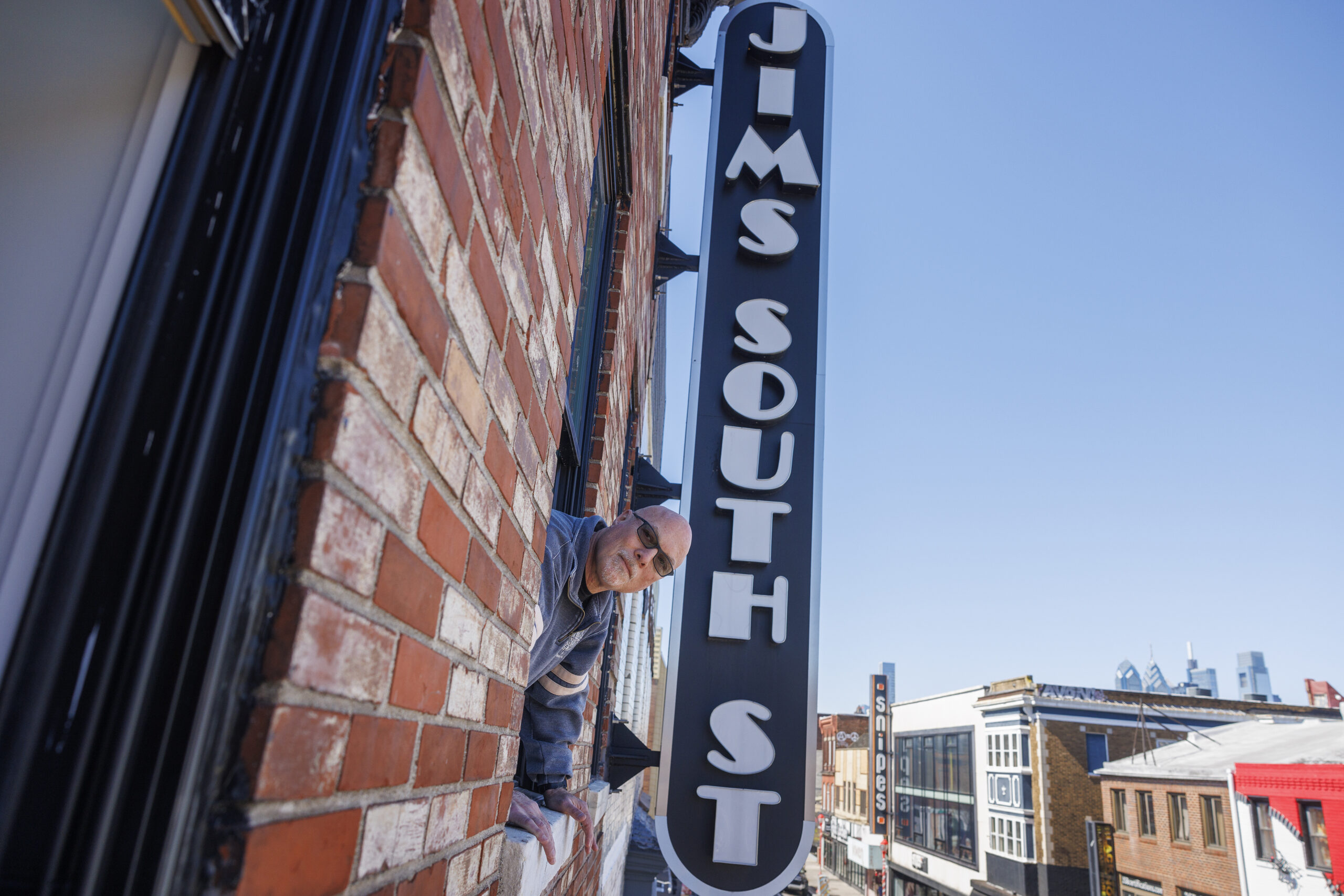
Ken Silver, owner of Jim’s Steaks, corner of 4th and South Street with sign on front of building.The restaurant is under construction after 2022 fire destroyed the cheesesteak restaurant. Photo taken on Monday, March 25, 2024.
1 p.m.
For lunchtime I want to go down to Jim’s on South Street and get a cheesesteak with whiz and fried onions. I probably need to walk off my cheesesteak, but I’m not going to walk off my cheesesteak. I’m going to let it just sit in my belly for a while.
3 p.m.
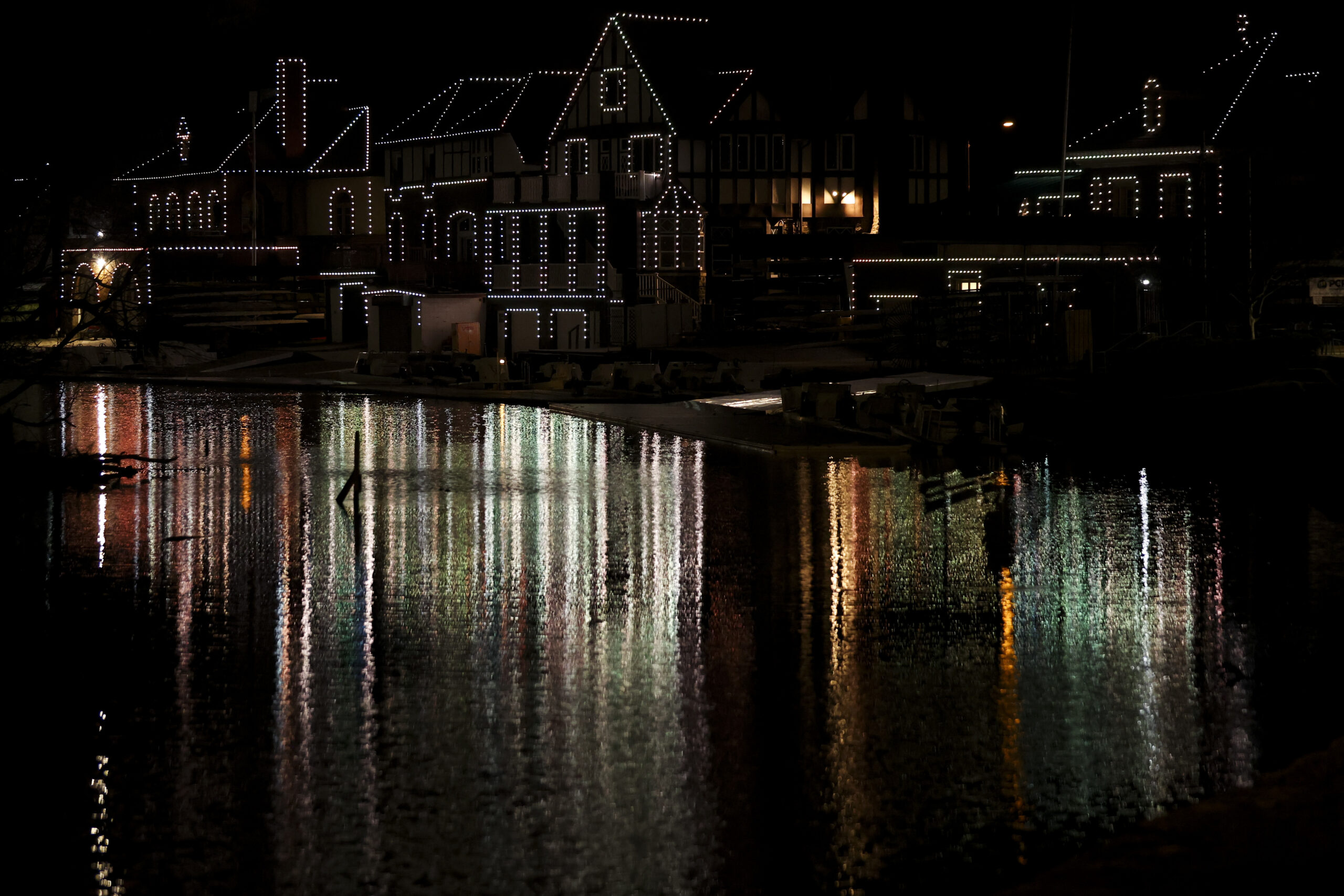
Then we’ll go out to the Art Museum area and chill out and walk around. Maybe we’ll have ice cream, there are usually ice cream trucks out there. I love walking around that area so much — I’ve always loved West River Drive and Kelly Drive. When I was a kid, I didn’t know that Boathouse Row was like boathouses, even though it’s called that — I used to always say, when I grew up, I’m gonna live in one of those houses.
Boathouse Row is relit with a new programmable system containing 6,400 LED lights that allow for 16 million color combinations in Philadelphia, Pa. on Thursday, March 7, 2024.
5:30 p.m.
At night, I’m gonna go to Norristown. There’s this Mexican restaurant on Main Street that’s so freaking good, Taqueria La Michoacana. I would definitely have their beans and rice, and tacos, and I don’t know what else.
7:30 p.m.
I would go see a show at Theatre Horizon. They want to foster empathy and edify the people who come to see the theater. As the incoming artistic director, I’d love to start programs like that to grow the artistic community there, all the while supporting the community that’s already been built there.
New artistic director Amina Robinson at an event for Theatre Horizon’s 2018 production of ‘The Color Purple.’
10 p.m.
I’d head home to sit outside and watch the cars go by, just like chill out and relax. Then I’ll lay on the couch and fall asleep watching a television show, probably a Lifetime Movie Network movie.
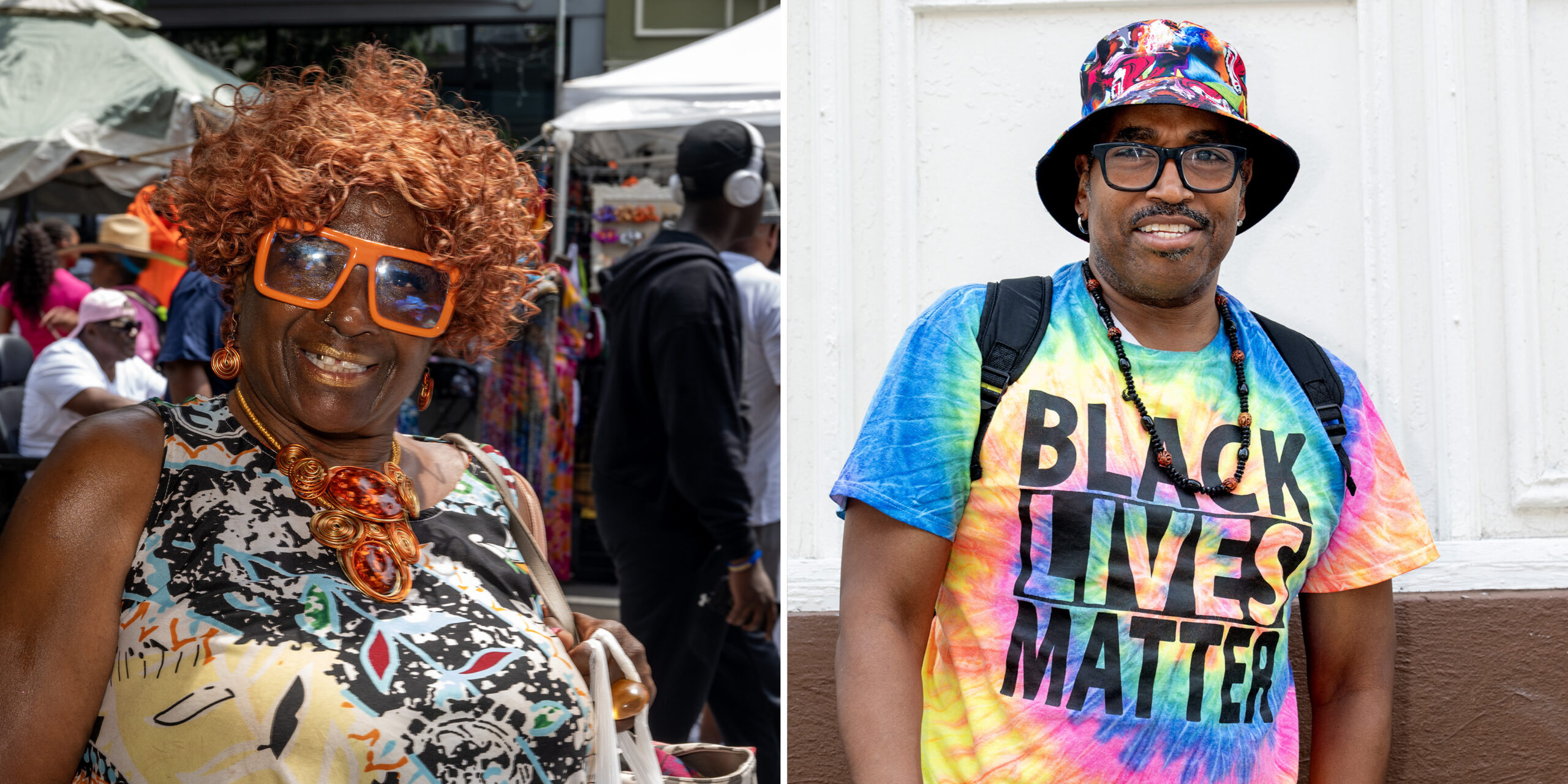
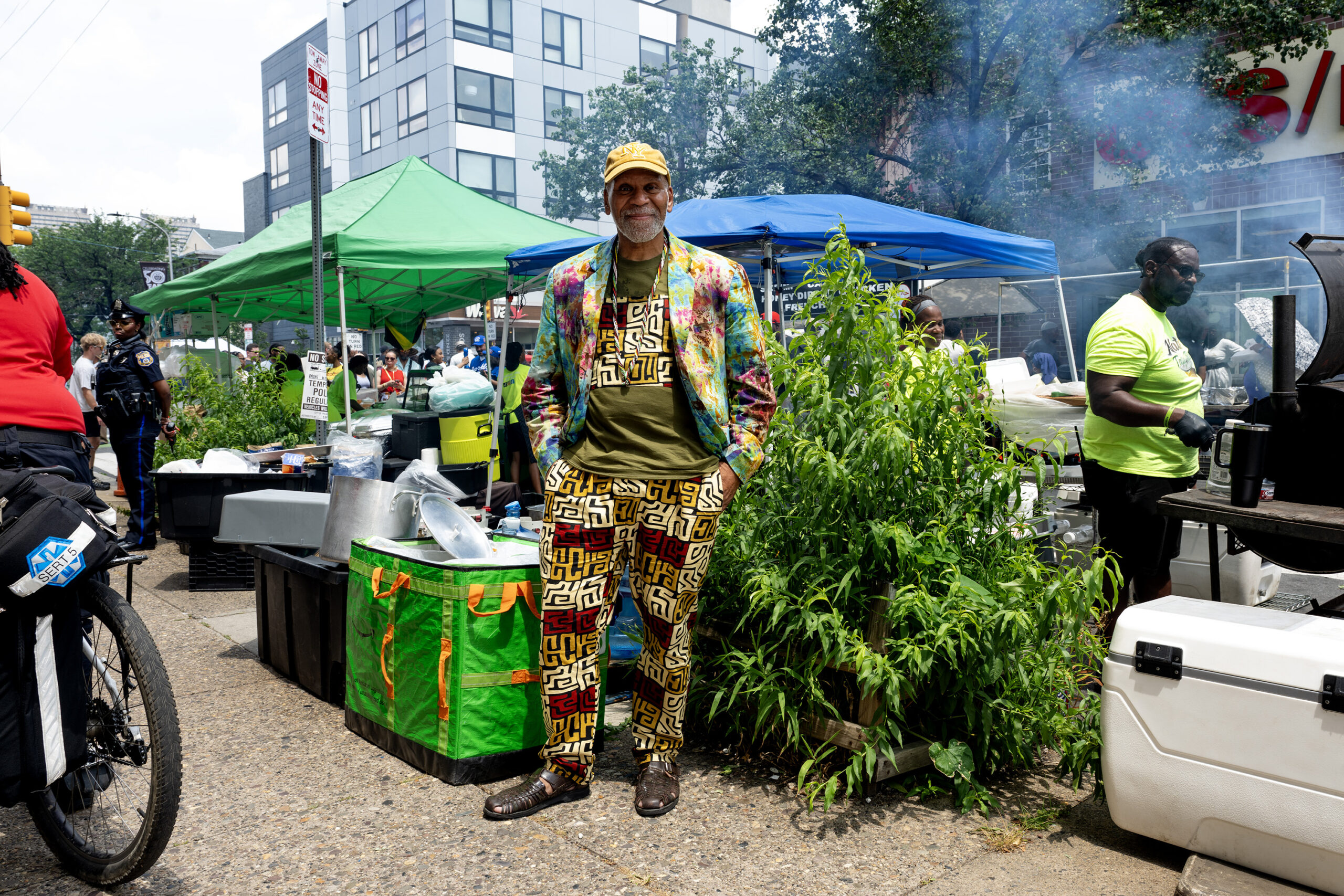
The Odunde Festival began in 1975 as a community event in South Philadelphia inspired by Yoruba traditions from Nigeria. It has since grown into one of the largest Black cultural festivals in North America.
“Odunde”is often translated as “the celebration has arrived.” The festival is rooted in the Yoruba New Year celebration and honors African heritage, history, and spirituality.
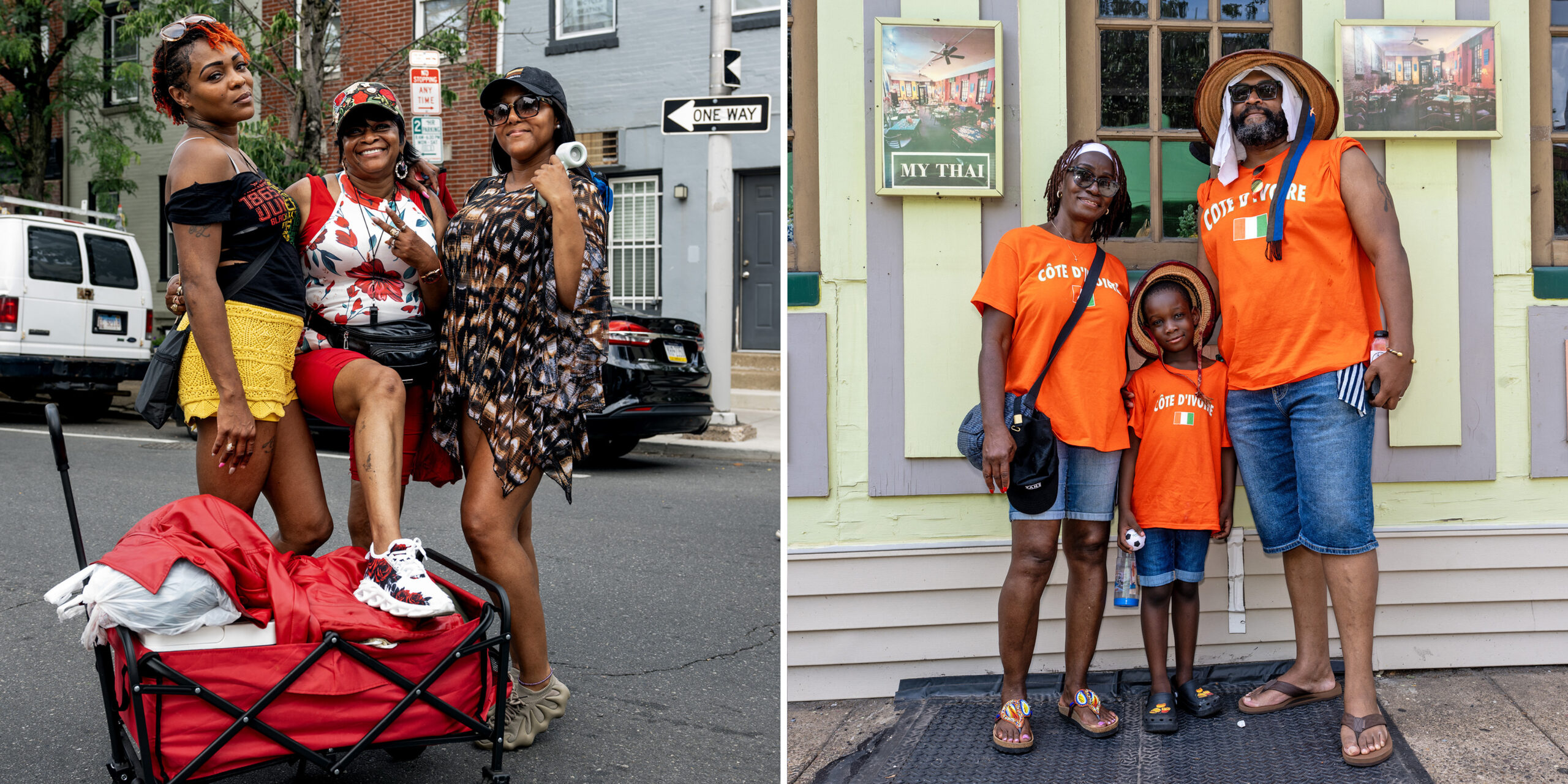
LEFT: Vonetta Jones, (from left), Cynthia Johnson and Alexis Murray. RIGHT: Lea and Damon Cunningham and their grandson, Noah, 6.
As a photographer working a Sunday-to-Thursday shift for decades, I’ve covered this and many other Sunday ethnic, religious, historic, and cultural festivals — always with a street-photographer vibe.
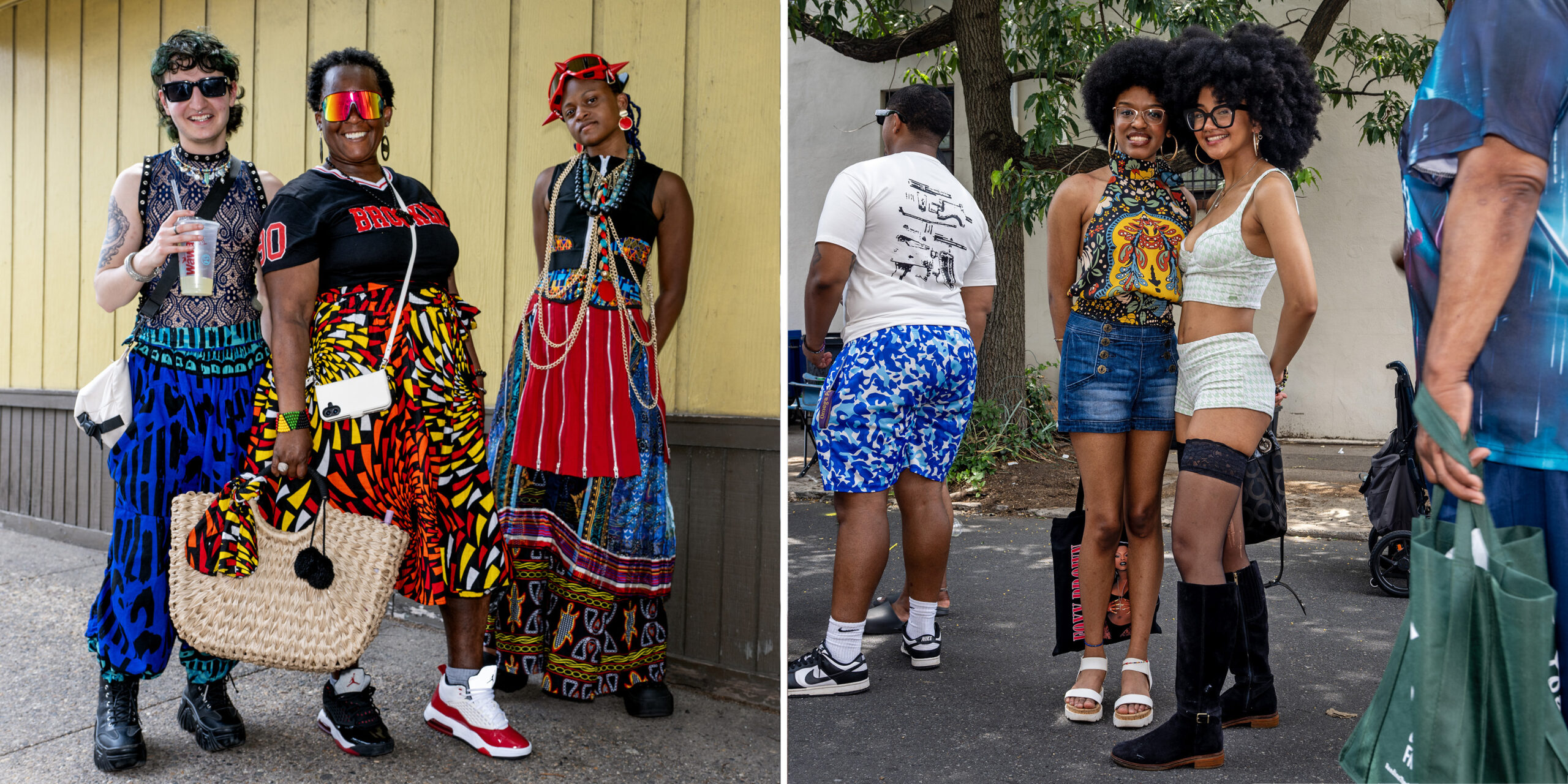
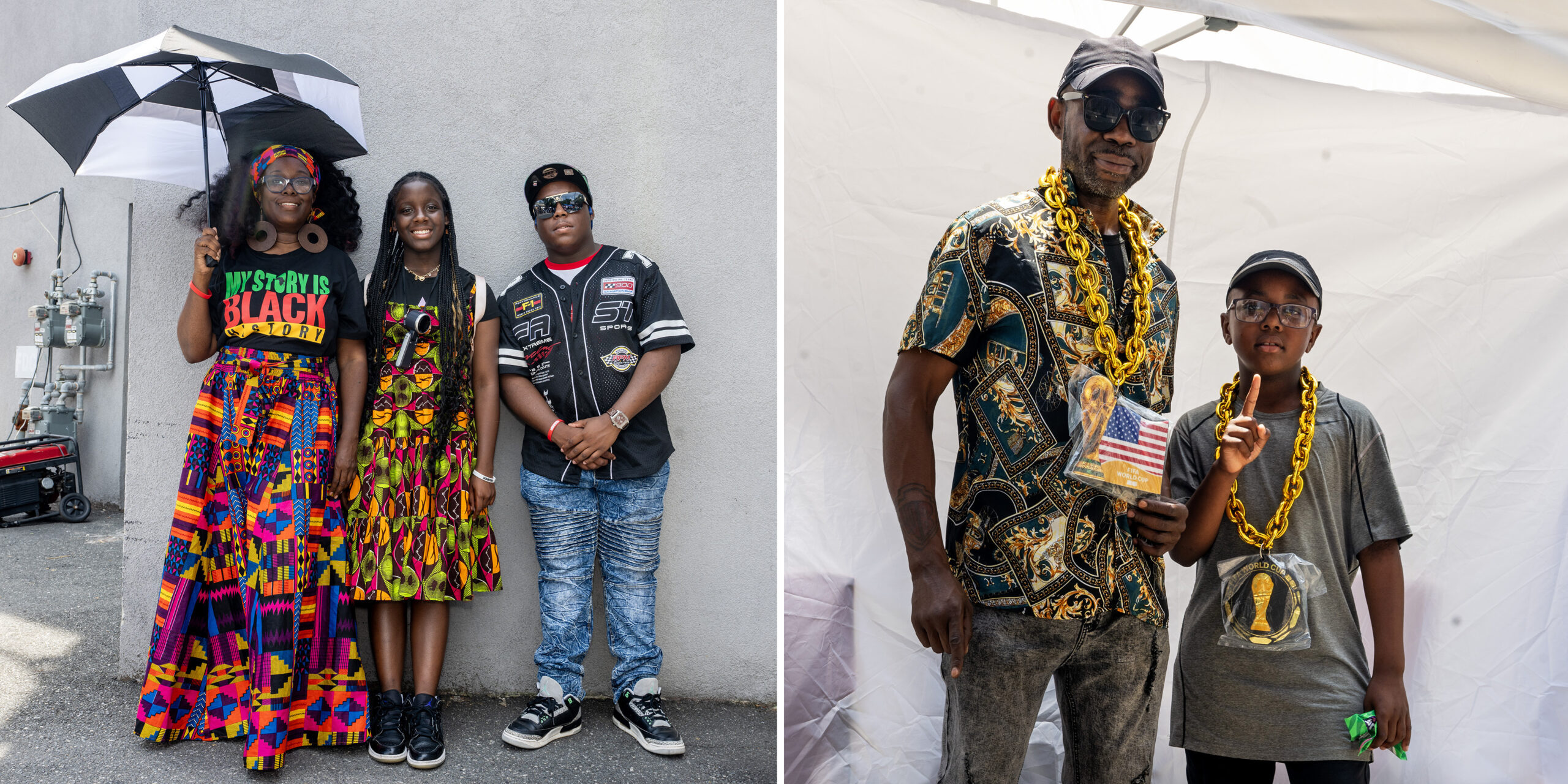
When I was assigned to photograph stylish clothing last Sunday — festivalgoers are known for expressing their cultural identity, heritage, and pride through fashion — I saw it as fun challenge to work outside my comfort zone and channel a bit of Philly influencer Big Rube or Humans of New York creator Brandon Stanton.
LEFT: Penny Thompson RIGHT: Kelvin Beck
Something I am always asked when speaking to camera clubs or groups of amateurs photographers is: “Do you have to ask people permission to take their picture?” Others ask, “Do you need to get their names?” The most consistent question, though, is: “How do you approach people you don’t even know?”
Joe Quinones.
I am not an extrovert, but early on I realized that “hiding” behind my camera gave me the confidence to meet and build rapport with strangers.
LEFT: Partners Julian Livingston (left) and Nyobi Nashedeem-Murphy (right) and Nyobi’s mother, Stacey Daniels. RIGHT: Tyanna Man and Bella Reina (right).
After years of doing it, talking to people has never been a concern. But using a flash outdoors to fill in shadows while also worrying about visual variety — different ages, genders, couples, individuals, and backgrounds — was not the way I usually work.
LEFT: Angelina Fletcher (left) and her niece and nephew, Leah Fletcher and TJ Fletcher. RIGHT: Jamar Williams and Jamar, Jr., 9.
I think it turned out OK, and I look forward to trying something similar with my visual coverage of the many events ahead this summer. Bring on the World Cup, America 250, the All-Star Game, and everything else.
Since 1998 a black-and-white photo has appeared every Monday in staff photographer Tom Gralish’s “Scene Through the Lens” photo column in the print editions of The Inquirer’s local news section. Here are the most recent, in color:
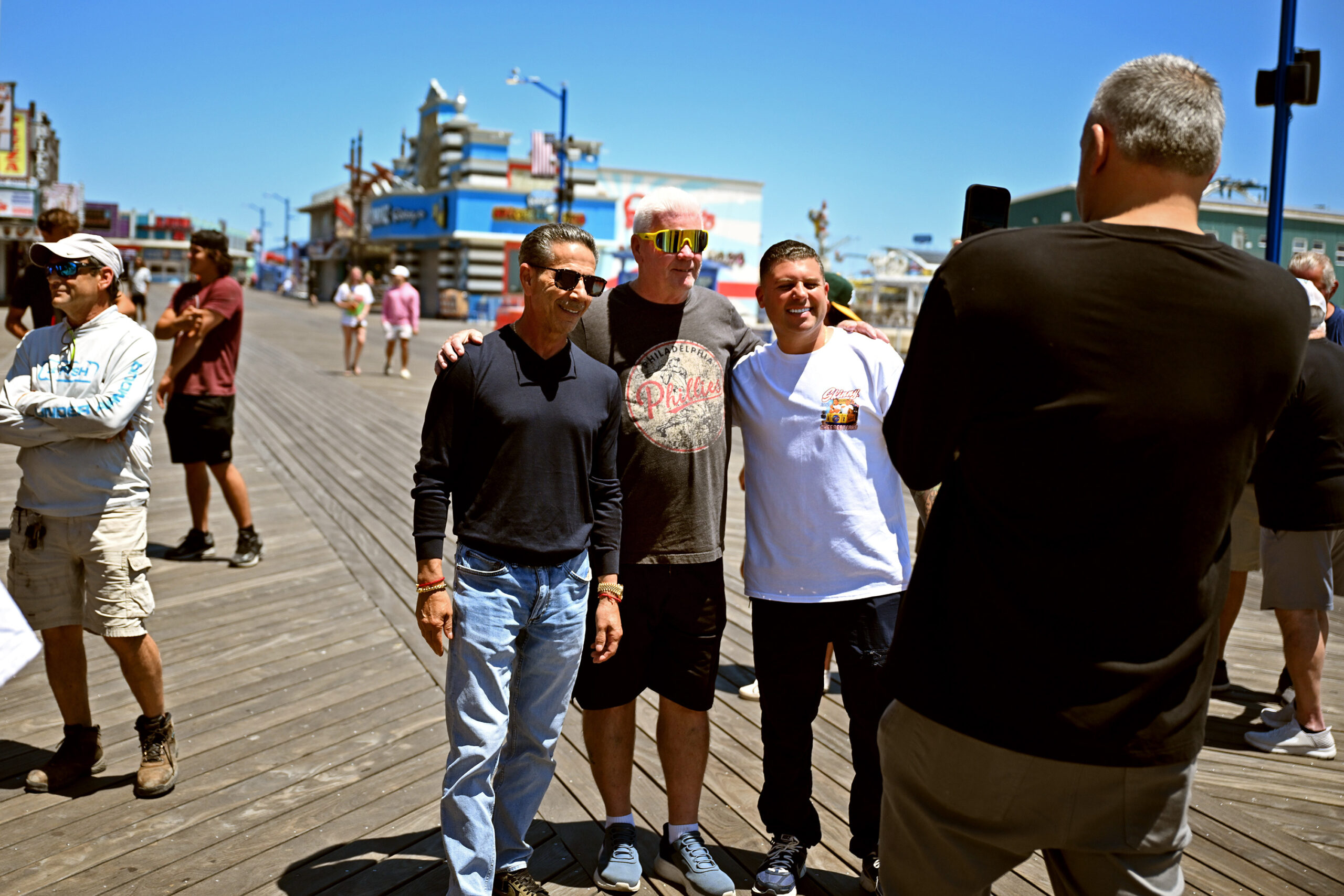
At noon on a bright June Tuesday, the scene at Skinny Joey’s Cheesesteaks & Pizza on the Wildwood boardwalk felt more like a South Philly block party than a soft opening.
Joseph “Skinny Joey” Merlino worked the crowd at his new shop — hugging, shaking hands, posing for photos — moving easily among his friends and admirers. At 64, five years removed from the criminal justice system, the onetime alleged head of Philadelphia’s underworld is enjoying a second act that few could have predicted: cheesesteak entrepreneur, podcaster, and social-media personality.
Joseph “Skinny Joey” Merlino (left) and Joe “Lil Snuff” Perri Jr. (right) posing with a customer outside the Skinny Joey’s Cheesesteaks & Pizza shop in Wildwood.
Orbiting him with a phone and a grin was Joe “Lil Snuff” Perri Jr. — 30 years his junior — Skinny Joey’s collaborator and the man who helped set him up with a new career. While customers lined up out front for steaks, slices, photos, $35 hats, and $25 T-shirts, Perri was shooting clips for social media.
Their partnership has transformed Merlino from a flashy, polarizing tabloid fixture into a flashy, polarizing Instagram-age brand. Merlino provides the mythology, while Perri supplies the algorithm.
Symbiotically, they are building an unlikely enterprise. Merlino gives Perri access, credibility, and a bigger stage. Perri gives Merlino comic relief, social-media fluency, and a way to be seen as entrepreneurial rather than simply infamous as a reputed former mob boss.
“Without me, there’s no him,” Perri said. “Without him, there’s no me. It’s just a good mix.”
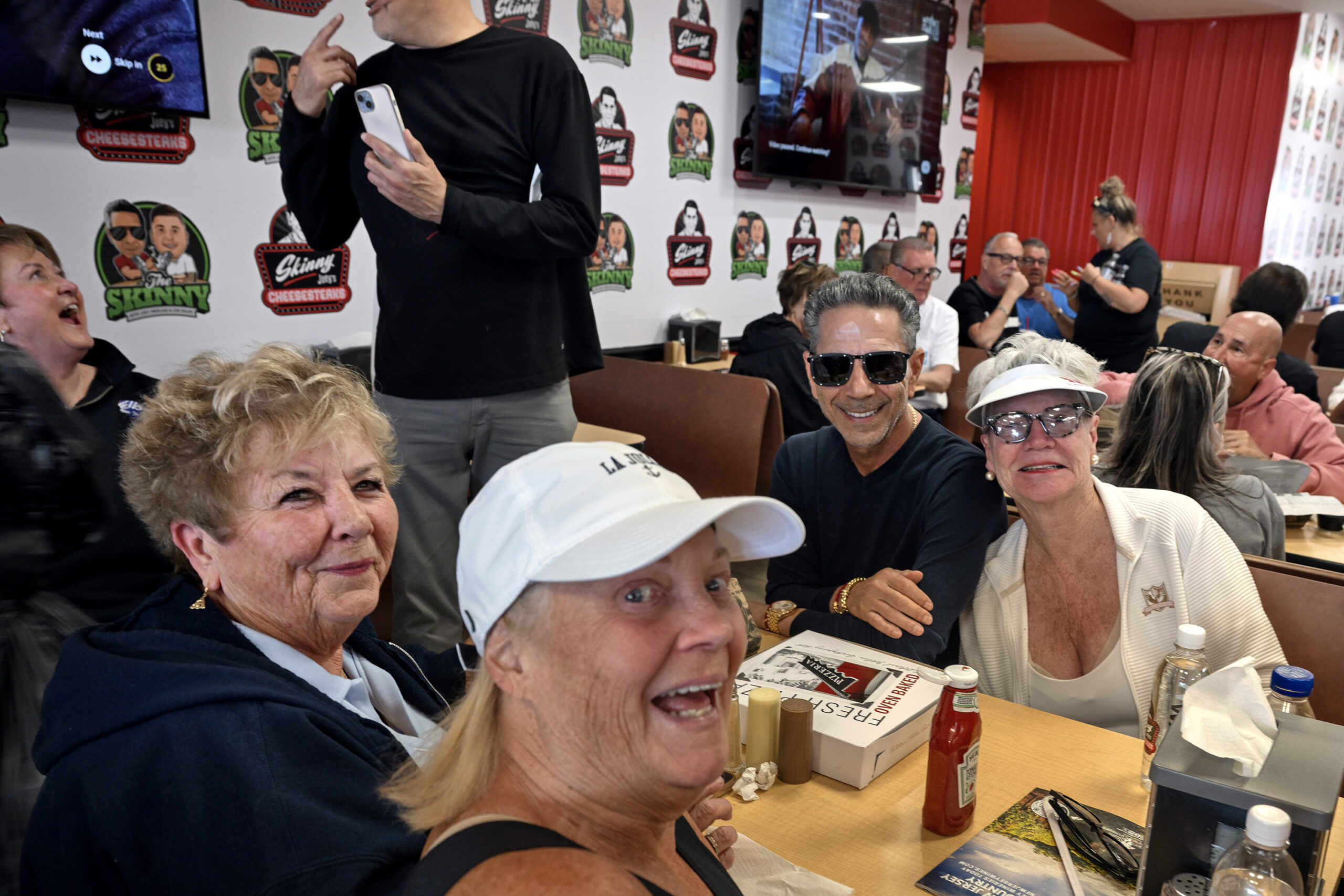
Joseph “Skinny Joey” Merlino joining customers at Skinny Joey’s in Wildwood during its soft opening on June 2. They call themselves “the Schuylkill Girls” (from left): Julie Shelton, Cindy McCullough, and Terry Landy, all of whom now live in Wildwood.
A ‘mob media’ moment
George Anastasia, who covered organized crime for more than 30 years at The Inquirer and now teaches an organized-crime course at Rowan University, said Merlino’s new career fits a broader moment in mob media.
Former wiseguys, associates, historians, and fans now gather in a true-crime subculture known online as “MobTube,” where the lore is packaged into YouTube shows, Patreon feeds, podcasts, clips, and merch.
Merlino has lived the story that fuels the genre. One of Philadelphia’s most recognizable organized-crime figures, Merlino was convicted in 1990 for his role in a $352,000 armored truck robbery in 1987.
In 2001, he and six co-defendants were tried on federal racketeering charges, including three counts of murder and two of attempted murder. Merlino was acquitted on those counts, but served about 12 years on other charges, including gambling and extortion. A supervised-release violation briefly returned him to prison in 2014, and a second major racketeering case ended in 2018 with a guilty plea to a single illegal-gambling charge after a mistrial. In a separate trial in 2004, he was acquitted of the 1996 killing of Joseph Sodano, an underling in North Jersey. Merlino completed federal supervision in 2021, but he’s been banned from New Jersey casinos since 1988 and from Pennsylvania casinos since a 2016 incident at the former SugarHouse Casino.
And Merlino has made it no secret that he is different from many of the former figures who populate the MobTube genre. Unlike Sammy “The Bull” Gravano, John Alito, and Jimmy Calandra, Merlino never cooperated with prosecutors.
“He saw guys who cooperated come back and become media sensations,” Anastasia said. “And I think he got [annoyed] that these are all guys who, in his view, violated the code, and now they’re making money on that old life. He did his time as a stand-up guy. ‘So [to heck with that] — I’m going to make money, too.’ And he created this brand.”
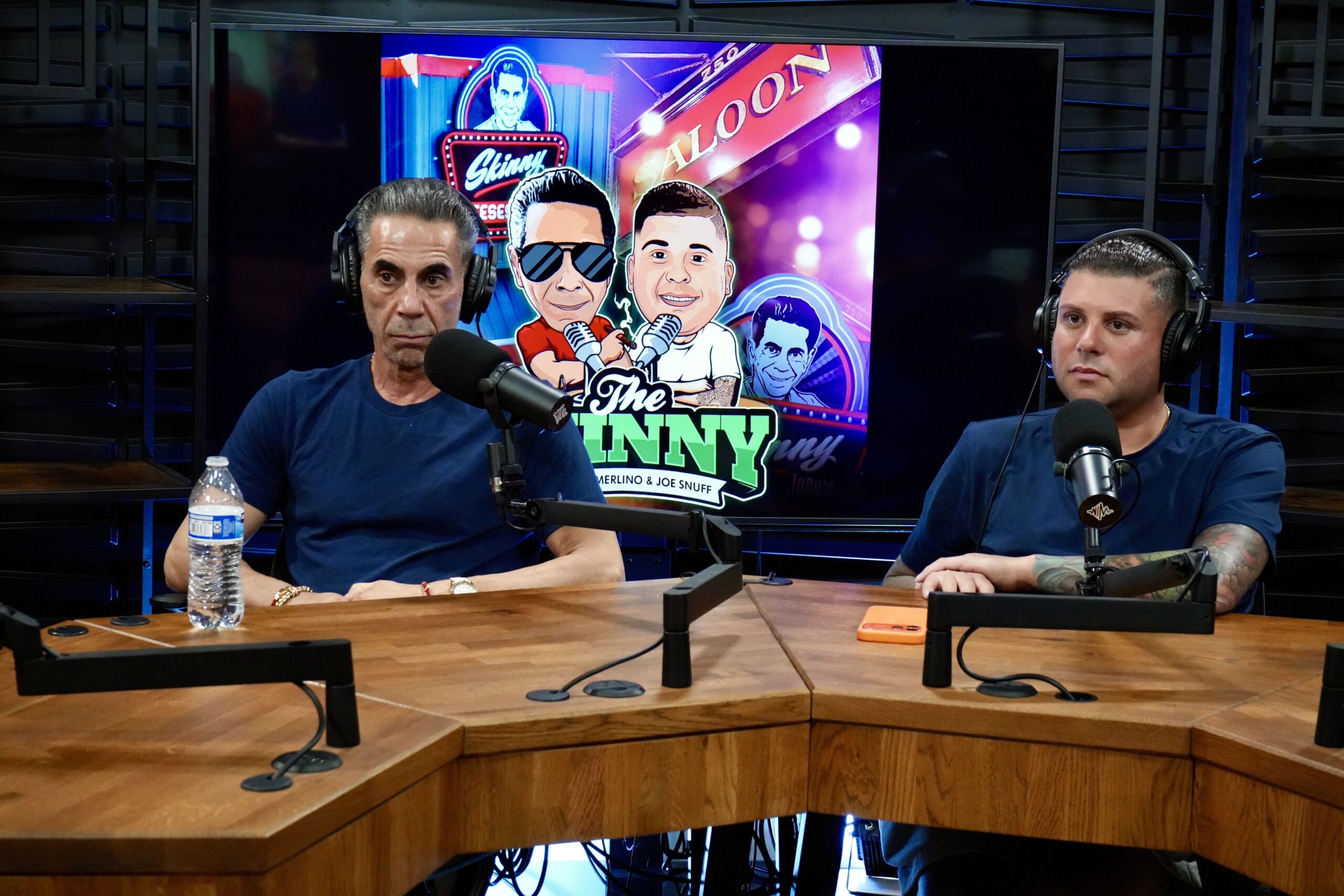
Joseph “Skinny Joey” Merlino (left) and Joe Perri Jr. on the set of “The Skinny” podcast.
Perri helped make that legible to a younger audience.
“Lil Snuff is part sycophant and part guide,” Anastasia said. “He’s the one who, in a lot of ways, sets the flow. Joey is going to be Joey, but somebody has to keep bringing him back to the point.”
The rise of Lil Snuff
Before he was Merlino’s co-host, Perri was Lil Snuff.
The nickname came from his father: As a 10-year-old, Joe Sr. turned around when a cousin was calling for a dog named Snuffy. Boom. He was Snuff. When his son was born at Methodist Hospital in 1992, Snuff became Big Snuff.
As a teenager, Lil Snuffbussedtables at Stogie Joe’s, the Saloon, and Fitzwater Cafe. At 18, he joined the stagehands union. At 21, he got a job at Mall Chevrolet in Cherry Hill. The older salesmen had relationships and repeat customers. Perri’s mentor told him that he needed a lane.
It was 2013, and social media was beginning to reshape promotion. Perri started making his own brassy, unscripted commercials. “Selling Chevys for less” became his tagline.
He also made videos about gambling and food, his two passions. He was not famous, but he was visible in the South Philly-to-South Jersey social media corridor where restaurants, sports, betting, family, and neighborhood identity blur into one feed.
At the same time, Perri said, he was abusing pills. In 2014, at 22, his parents found him a rehab center in South Florida. To make sure he got there safely, they called a family friend whose Italian restaurant in Boca Raton had recently opened:
Joey Merlino.
“My father grew up with his grandfather,” Merlino said, explaining the bond. “I grew up with his father. I’ve known him since he was born.”
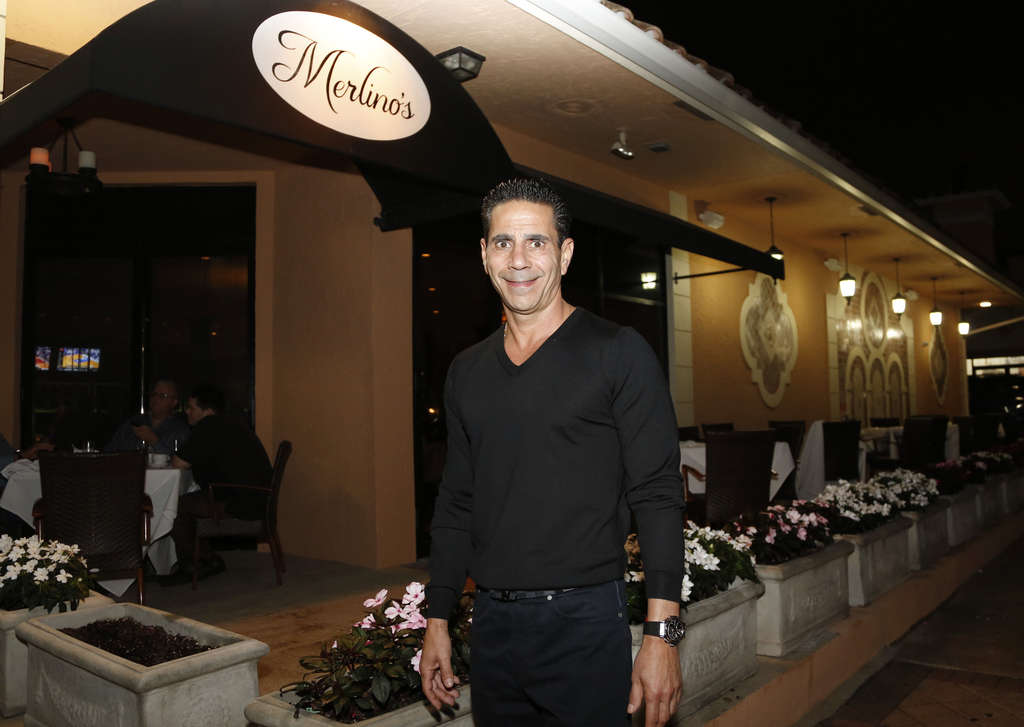
Joseph “Skinny Joey” Merlino in 2014 at the Boca Raton restaurant bearing his name.
Perri said it took several attempts before recovery stuck. He has been sober since Sept. 11, 2016. “I’m big with recovery,” he said. “That’s the main thing in my life. I put sobriety first and then everything after that.”
Merlino’s — where Merlino was maitre d’ because his legal situation then precluded ownership — closed in 2016, just before the feds arrested Merlino at his home in Boca in the lead-up to his second racketeering case. “If I didn’t have this trouble, it would still be open,” Merlino said earlier this month.
After Merlino attained freedom in July 2021, producers called with movie, television, and book deals. Merlino turned them all down. “Nothing seemed right,” Merlino said. Someone brought up the idea of a podcast.
“I didn’t even know what that was,” Merlino said.
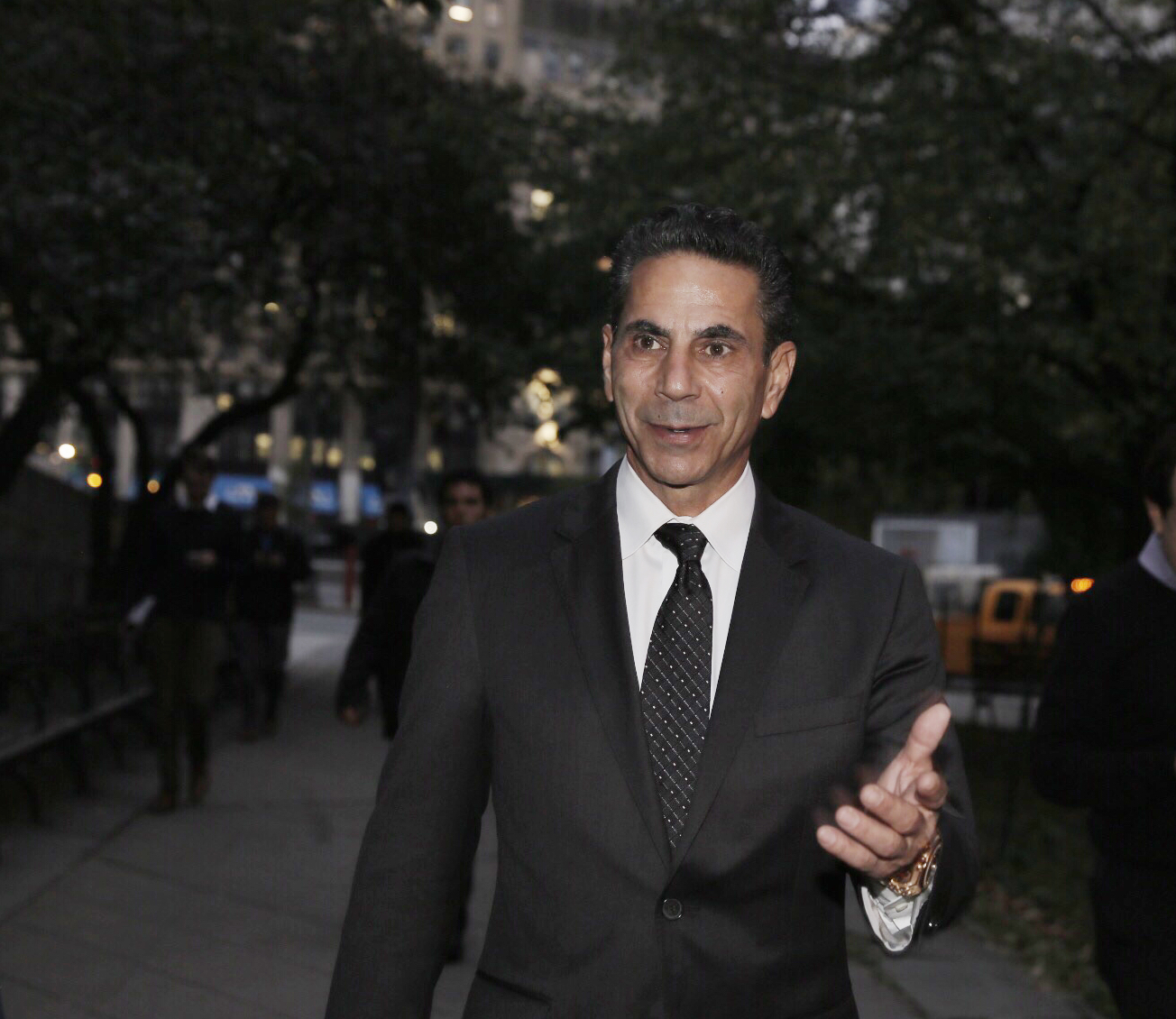
Joseph “Skinny Joey” Merlino leaving the federal courthouse in Manhattan after being sentenced on Oct. 17, 2018.
His friend Raymond “Wags” Wagner explained the concept and suggested a loose format built around food and sports betting. Actor Kevin Connolly of Entourage fame, who was involved early as a producer, told Merlino that he needed a co-host.
“They said, ‘Who would you want?’” Perri said. “They were sending him people, and he was like, ‘I’m not doing nothing with these people.’”
Then Ray Wags suggested Perri.
“Joey was like, ‘100 percent. Get him on the phone,’” Perri said. “Kevin Connolly said, ‘Send me your videos.’ I sent him my videos, and he said, ‘You’re the guy.’ The rest was history.”
The world of ‘MobTube’
Merlino and Perri launched the video podcast in 2023. Viewers are not just watching Merlino talk about the old life. They see him bust Perri’s chops about eating too much and mock his parlays. They get gambling tips, watch them interview athletes and celebrities — all part of a South Philly generational comedy.
Perri describes it in family terms. “My dad’s my dad, but he’s also my best friend, too,” Perri said. “We gamble together. We go out together. We have fun together. So they see me and Joey as that, and they can’t figure out how we mix so good.”
“He’s good,” Merlino said. “I’m old, he’s young. He talks good, he’s funny. He’s a pain in the balls, but it’s a good fit.”
They began The Skinny podcast on YouTube, but now focus more on Patreon, where the content is unfiltered. And better monetized. Perri says TheSkinny has 1,600 Patreon subscribers paying $15.95 a month. He said their social-media pages combined average 30 million views a month.
Perri’s wife, Danielle, handles bookings and schedules. “I produce,” Perri said. “I cut the clips. I do everything. It’s me and Joey. Two-man show.”
A wider audience
When they started, Perri was still selling cars at Mall Chevrolet. But the now-shuttered dealership got tired of people showing up hoping to see Merlino instead of test-driving a Suburban.
Perri quit. The show grew.Merlino’s reinvention has coincided with a broader shift in the gambling world. Legal sportsbooks, now ubiquitous on television and online, have largely supplanted the corner bookmaker, turning an activity once associated with organized crime into a mainstream consumer business. Guests span sports, hip-hop, gambling, and entertainment, including Wallo267, Fat Joe, Ric Flair, and Bernard Hopkins.
Each booking widened his audience, and Merlino was being absorbed into a broader celebrity ecosystem.
Last October, Netflix released Mob War: Philadelphia vs. The Mafia, a docuseries revisiting the violent 1990s power struggle between John Stanfa and Merlino’s younger faction. It steered even more viewers to Merlino and Perri’s world.
‘Skinny Joey,’ wit’
Then came the cheesesteaks.
One night, Perri, Merlino, and friends were playing poker. Merlino wanted cheesesteaks. Perri said he’d make them.
“He’s like, ‘You can’t make cheesesteaks,’” Perri said. “I said, ‘Are you nuts? I’ve been making them my whole life.’”
Perri cooked some. “He was like, ‘This is the best f— cheesesteak ever,’” Perri said. “He said, ‘Let’s open up a cheesesteak place.’ I said, ‘All right. Call it Skinny Joey’s Cheesesteaks.’ And that was it.”
The first shop opened in March 2025 at 3020 S. Broad St., near the sports complex. From the start, Skinny Joey’s was more than a sandwich shop. It was a set. The shop leaned into Merlino’s notoriety; the sandwiches are wrapped in a collage of newspaper articles about his past.
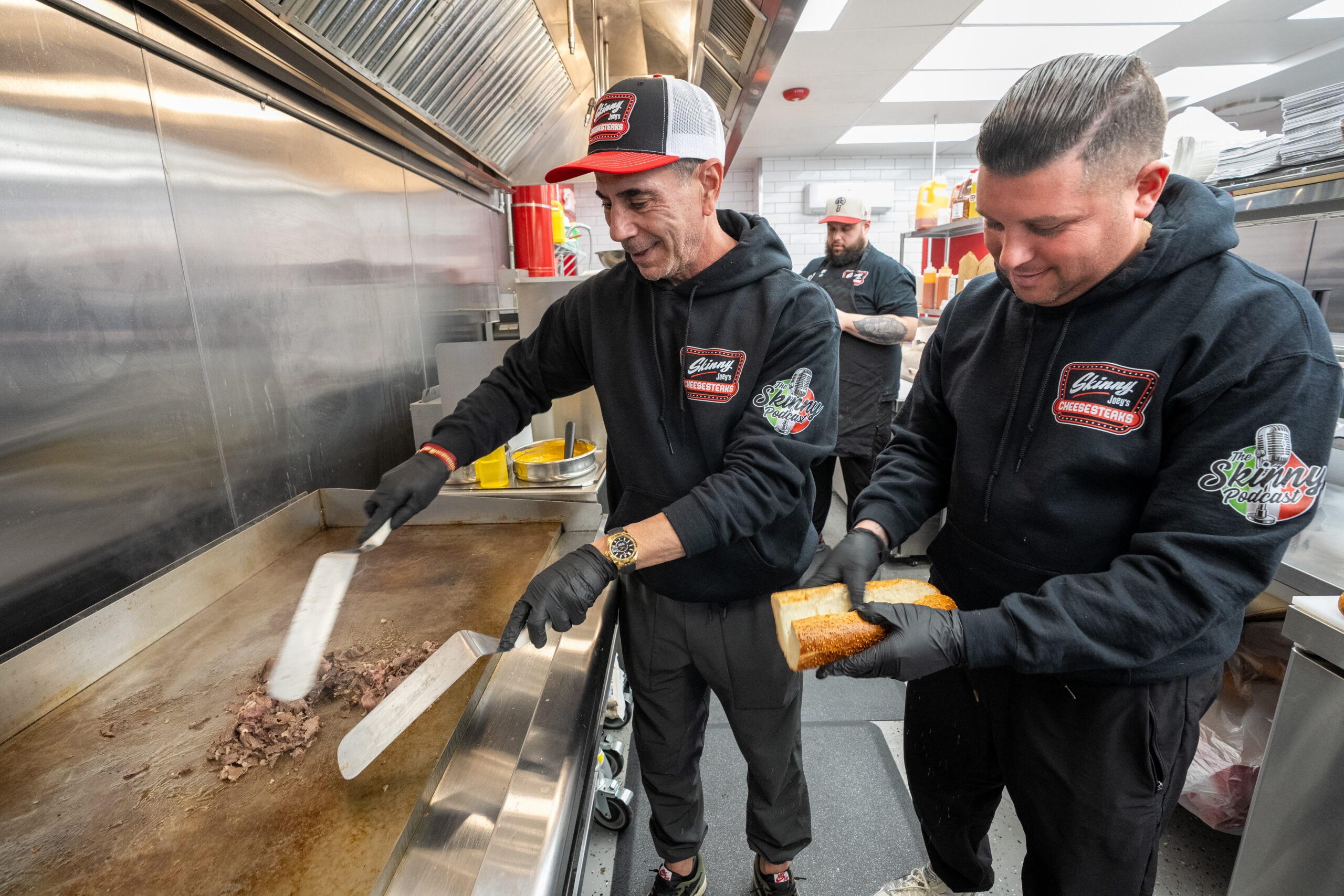
Joseph “Skinny Joey” Merlino (left) working the grill beside Joe “Lil Snuff” Perri Jr. at the Skinny Joey’s Cheesesteaks in Philadelphia at its opening in March 2025.
Celebrities showed up: Jason Kelce, Landon Dickerson, Mack Wilson. A customer eating a cheesesteak was good content. A recognizable person eating one on camera was better.
The restaurant also became a magnet for the kind of drama that fuels digital engagement: online beef. Podcaster Gene Borrello, a former Bonnano crime family associate and Merlino antagonist, weighed in last year on an apparent feud between Skinny Joey’s camp and Frank Olivieri of Pat’s King of Steaks. Merlino and Perri had taken issue with a video posted by Olivieri — whose great-uncle invented the steak sandwich — in which he chided shops that chop the meat on the grill. Like most online food feuds, this seems to have subsided.
Then came the deal for Wildwood, where Skinny Joey’s replaced Joe’s Pizzeria, which had been on the boardwalk at Magnolia Avenue for 15 years. There, Skinny Joey’s added pizza and stromboli, which are not sold at the South Philadelphia location.
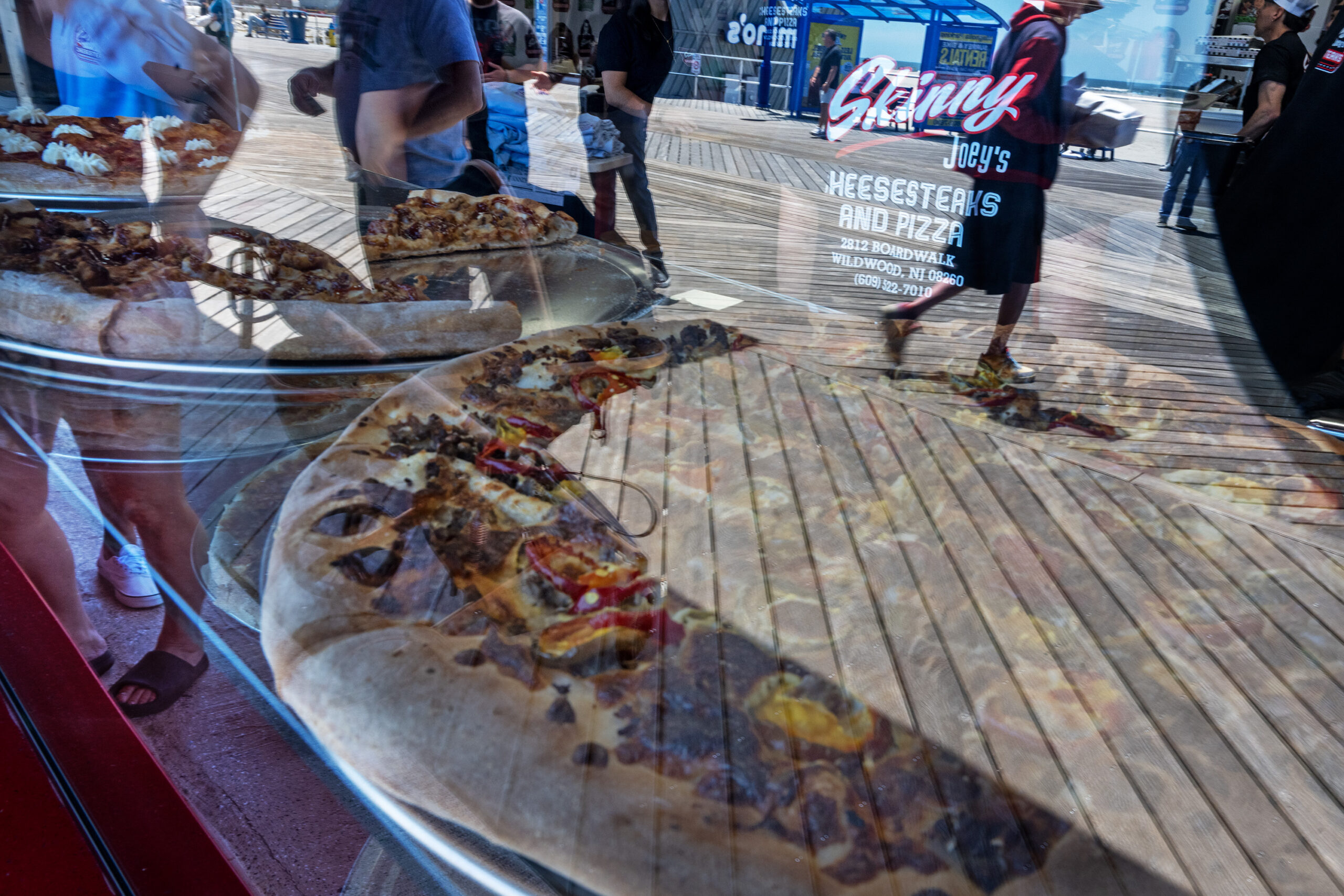
Reflections in the pizza display case on the boardwalk at Skinny Joey’s Cheesesteaks & Pizza in Wildwood.
The pizza recipe comes from Vito’s on Haddonfield Berlin Road in Cherry Hill, and the stromboli from Pizza Shack at 15th and Oregon in South Philadelphia, both owned by Skinny Joey’s business partners Stephen Casasanto and John Fioravanti, whom Merlino also described as longtime friends.
More locations are planned. Perri said a Boothwyn shop is expected around Sept. 1, and several others are in the pipeline.
Bypassing the gatekeepers
Merlino is an extreme case of a recent phenomenon. People with complicated histories — criminal, scandalous, controversial, or simply overexposed — no longer need traditional gatekeepers to reintroduce themselves. They can speak directly to followers and monetize the attention.
Perri is not a journalist, of course, or a publicist, exactly. He is not merely a manager, producer, or sidekick. He is something in between — a new kind of local media operator.
He knows the scene, and how to make content feel unscripted even when the business behind it is deliberate. He is close enough to Merlino to bust his chops and deferential enough to preserve the hierarchy. He can translate Merlino to younger audiences without making him seem managed.
Perri softens Merlino without sanding him down. Merlino still curses, rants, and mocks rivals. Anyone they disagree with is a “bedbug.”
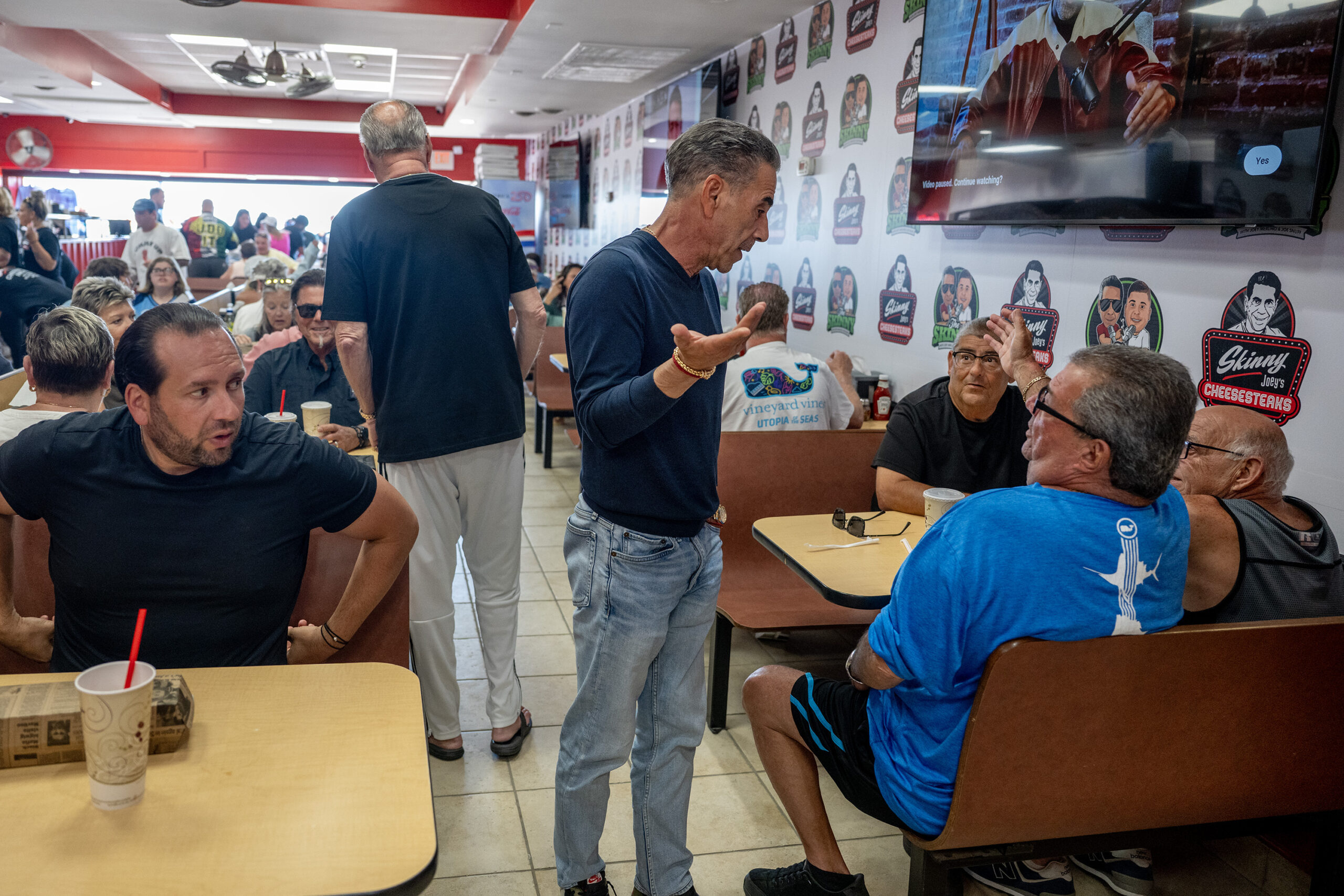
Joseph “Skinny Joey” Merlino greets a table of customers at Skinny Joey’s Cheesesteaks & Pizza in Wildwood.
“At the end of the day, Joey isn’t going to change who he is for anybody,” Perri said. “If he can’t talk the way he wants to talk, what’s the point?”
That is part of the appeal and part of the discomfort. The audience knows Merlino’s history. They may see him as funny, defiant, loyal, misunderstood, or simply entertaining.
“There’s a segment of the American population that has always been fascinated with the outlaw: Billy the Kid, Jesse James, Don Corleone, Al Capone,” Anastasia said. “What the internet has provided is: Here are these guys in their own words. Are they being genuine? I don’t know. You can say that about any personality. But here’s a look at them without any filter.”
The filter used to be people like Anastasia.
“I was, in a lot of ways, the middleman between the people who were interested in this and the guys who were doing it,” he said. “And people who are interested in this don’t need the middleman anymore. They just go online and listen to whoever they want to listen to.”
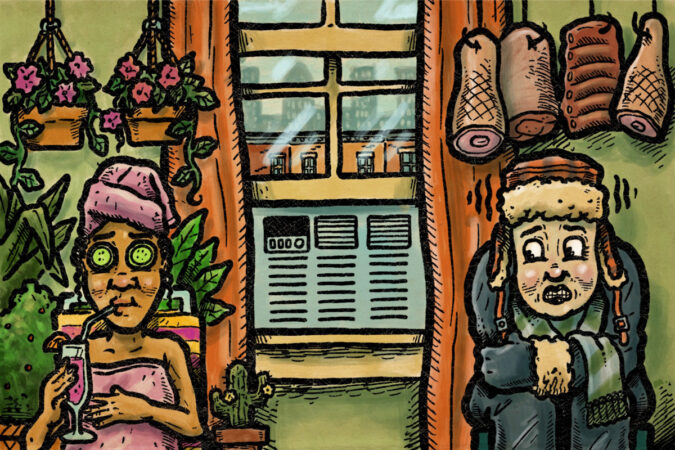
Hi we decided to write this together so you have both sides fairly represented. We recently moved in together and it’s going great (young, gay, in love!), but we only have AC in the bedroom. One of us prefers the room wayyyy hotter than the other at night (80 degrees vs. 70 degrees). One of us argues that at 70 degrees, the other person can just wear sweatpants. The other one argues that at 80 degrees it’s not that hot, it saves money, and the other person can focus the fan on themselves. What do we do?
Earl Hopkins, Arts & Entertainment Reporter
As someone who naturally runs hot, especially during the summer months, anything above 76 degrees is an absolute no go. I never understood why some people like to bake under their covers, but our bodies all operate differently.
I think an easy compromise is to place the AC somewhere in the middle. Maybe around 75? That seems reasonable to me.
Stephanie Farr, Features Columnist
First, I love that they wrote this together. It shows they communicate well and are willing to face problems openly and honestly, which is a great foundation for any relationship.
Second, it’s often said that one of the things couples argue about most is money, but I’m of the firm belief ambient room temperature ranks pretty high up on that list, too. It’s something you may not even think about until you move in with someone and realize they are the Human Torch or Mr. Freeze.
In my house, I am Mr. Freeze, so I’m fully siding with the partner who has the totally reasonable request to keep the AC at 70. 80 is way too hot. Heck, thanks to the Human Torch I live with I’ve discovered even 75 is too hot at night for me to sleep with a blanket on — and I need a blanket to sleep.
What’s your opinion on putting on more clothes vs. using a fan?
Earl Hopkins
I think it’s way easier to add a layer of clothes than it is to have the sound of a fan buzzing in your ear all night. It’s OK when there’s a heatwave and broken AC. But beyond that, I recommend throwing on a pair of sweats, a long sleeve shirt, or a beanie.
Also, I’m no electrician or HVAC specialist, but are you really saving that much money? I don’t know. Stephanie, how do you feel about cuddling as an alternative to 80-degree temps? I think there’s a cheat code there.
Stephanie Farr
Oh I love the cuddling idea! It promotes intimacy and is a good argument against keeping it warm in the room. Nobody wants to cuddle someone when they’re all hot and sweaty.
And I’m with you on more clothes vs. fan. You can always put more clothes on when you’re cold or pile up the blankets (and cuddle!), but when it’s getting so hot in there you’ve already taken off all your clothes and you’re still sweating, what then? Are you supposed to sleep with ice packs because a fan alone will not cut it?
Do you think that only having one room with AC — aside from the whole house — should factor into the decision?
Earl Hopkins
I think so! If there’s only one room your partner can truly get cozy in, give them free rein. It’s like giving your loved one the last slice of pizza or chocolate cake. Of course you want it, but it’s a lovely gesture that doesn’t require much sacrifice. A little chill at night won’t hurt!
Stephanie Farr
Agreed! The AC room should be considered a human refrigerator in this home — an arctic oasis where the one who’s Mr. Freeze can escape and find solace. The Human Torch partner already has all the other rooms nice and toasty, so they can go to sleep in one of them if they don’t like the cold.
I wonder if the partner who wants it 80 degrees at night may not be from the U.S. In that case, this makes a bit more sense. We’re very spoiled here. I remember a great column last year by Adrian Schulz, a journalist from Berlin who did a fellowship with us at The Inquirer last summer. He expressed shock, confusion, and mild horror at our AC habits here, writing: “Am I in a restaurant or in the Siberian Tundra? Am I at an airport gate or in a cryogenic chamber? Am I on the Broad Street Line or the Polar Express?” Meanwhile, when I went to Germany in September 2024, I was shocked, confused, and mildly horrified by the lack of AC everywhere amid sweltering heat.
It’s what you’re used to, I guess, but living with a partner means getting used to new things. I think Earl has the best idea — a compromise at 75 — to start out (then slowly inch the temp down from there by dangling the possibility of more cuddles).
People have been bragging about their trips to the Outer Banks since I moved to the Shore three decades ago. Quieter, cheaper, more laid back, more of a relaxing vacation than anything you’ll find in, say, Sea Isle.
Last summer, with an increasingly unaffordable Jersey Shore spawning a subculture of people swearing by other places, we looked at the cost of vacationing in Hawaii and Paris, along with Margate. Deals could be had.
This summer, as gas prices are on the rise, the appeal of an eight-hour drive to North Carolina might give even a priced-out Margatian pause.
Is it worth the drive to get to Duck, N.C.? What about flying to Dublin? Has the “We’re going to Europe instead” crowd thinned out?
We priced options for a family of four and targeted a week in July, the 11th to the 18th.
Rental inventory at the Jersey Shore is rapidly depleting, said Duane Watlington, the CEO and founder of Vacation Rentals Jersey Shore LLC. As of April 1, Long Beach Island is 83% booked for the eight summer weeks, June 27-Aug. 22, he said.
But Watlington said rental prices were looking better, with “Most listings … the same price or up to 10% lower for weekly rentals due to the soft market we had in 2025.”
Everything is relative, of course. Available rentals for that week on LBI can range from a four-bedroom Harvey Cedars charmer at $11,000 to a cozy two-bedroom Beach Haven duplex available Friday to Friday for just $3,000.
The real value, Watlington advised, is in September, with rentals as much as half the price of peak summer weeks, a warm ocean, and the joys of “locals summer.”
Data from HomeToGo showed that Sea Isle City rentals ranged from $6,745 to a whopping $18,828, with an average of $9,389.10 for available properties during that peak July week.
Bethany Beach, Del., ($5,537.59) and Duck, N.C., ($5,361.90) had similar average weekly rentals. Ocean City averaged $6,321.53 for that week, according to Berger Realty data.
Watlington said the median price on LBI for a July or August rental is $7,000 per week, with a range of $1,000 to (yikes) $55,000 week.
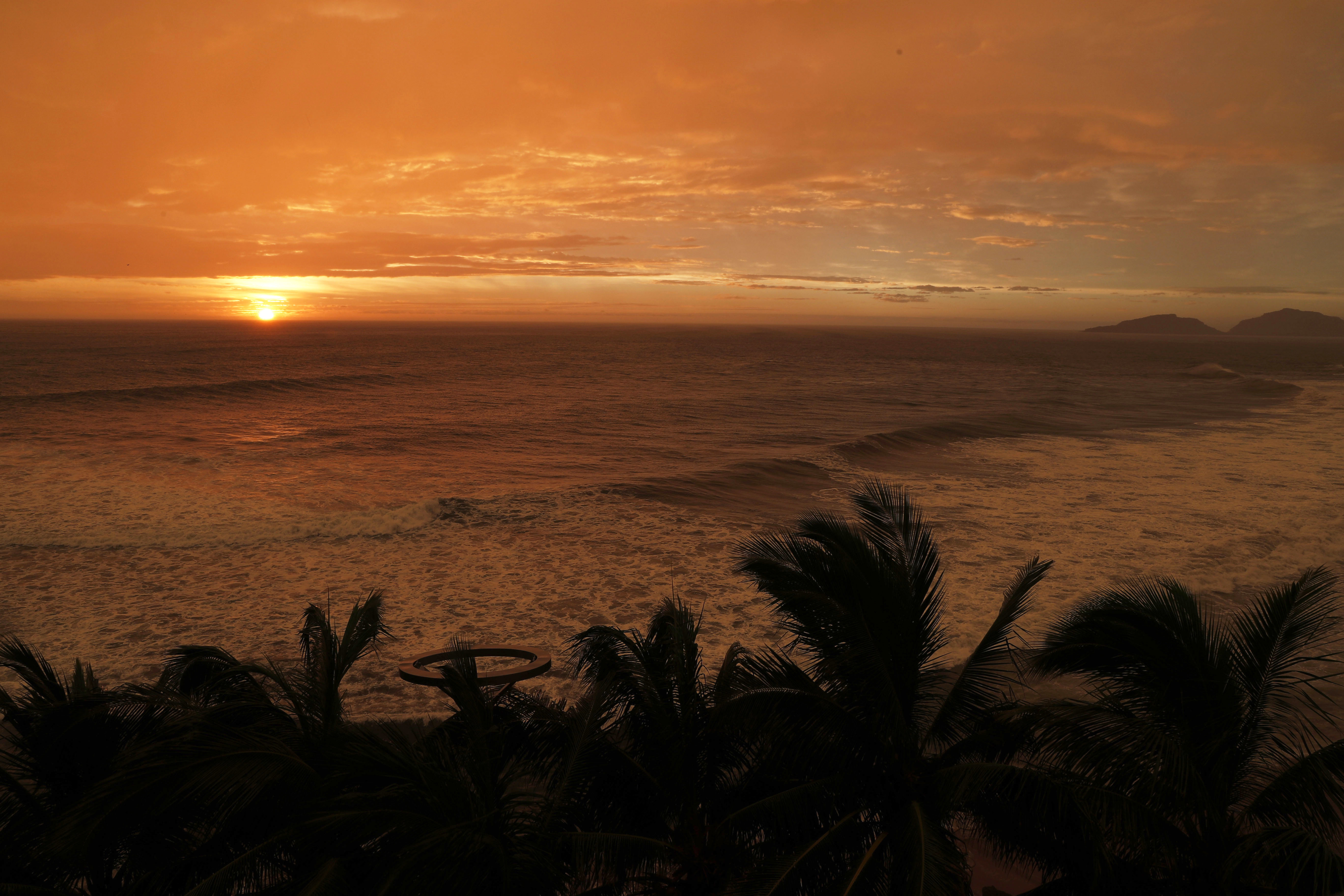
The sun peeks out from under the clouds as it sets in Mazatlan, Mexico (AP Photo/Marco Ugarte)
Looking abroad
Paul Ferdinand of Rainbow Voyages in Philadelphia found little available in Dublin during July, “regardless of price.”
He advised switching to early August, and came up with a very competitive trip, detailed below.
Mezgaron James of YouBeEverywhere Travel suggested Mazatlán, Mexico, which she said combines the charm of a Jersey Shore boardwalk with the luxury of a hotel on Mexico’s Pacific coast.
In the end, results were undeniable: The total cost of the more adventurous destinations like Ireland or Mexico was comparable, or even less, than a typical weekly rental at the Shore.
Here are the details.
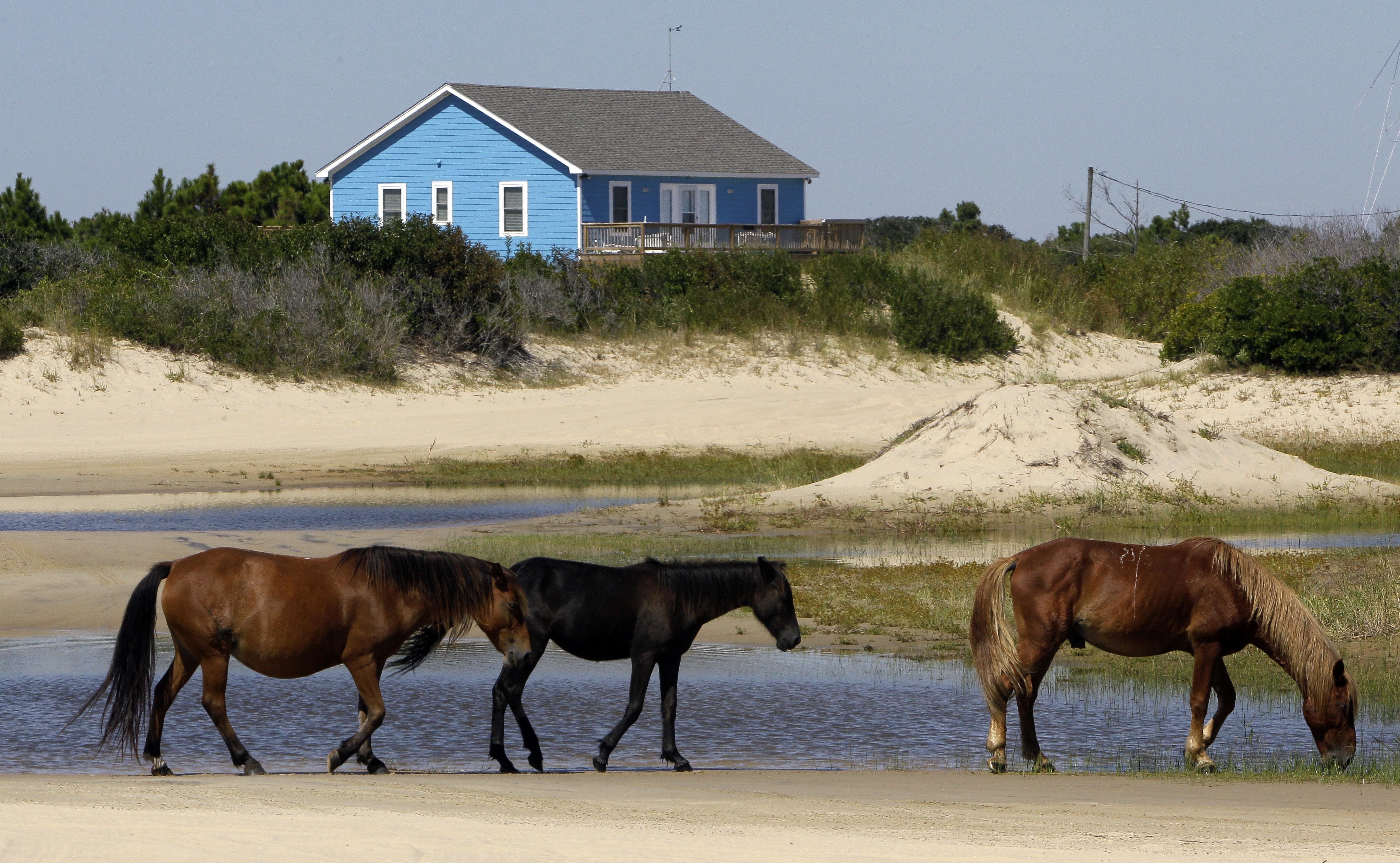
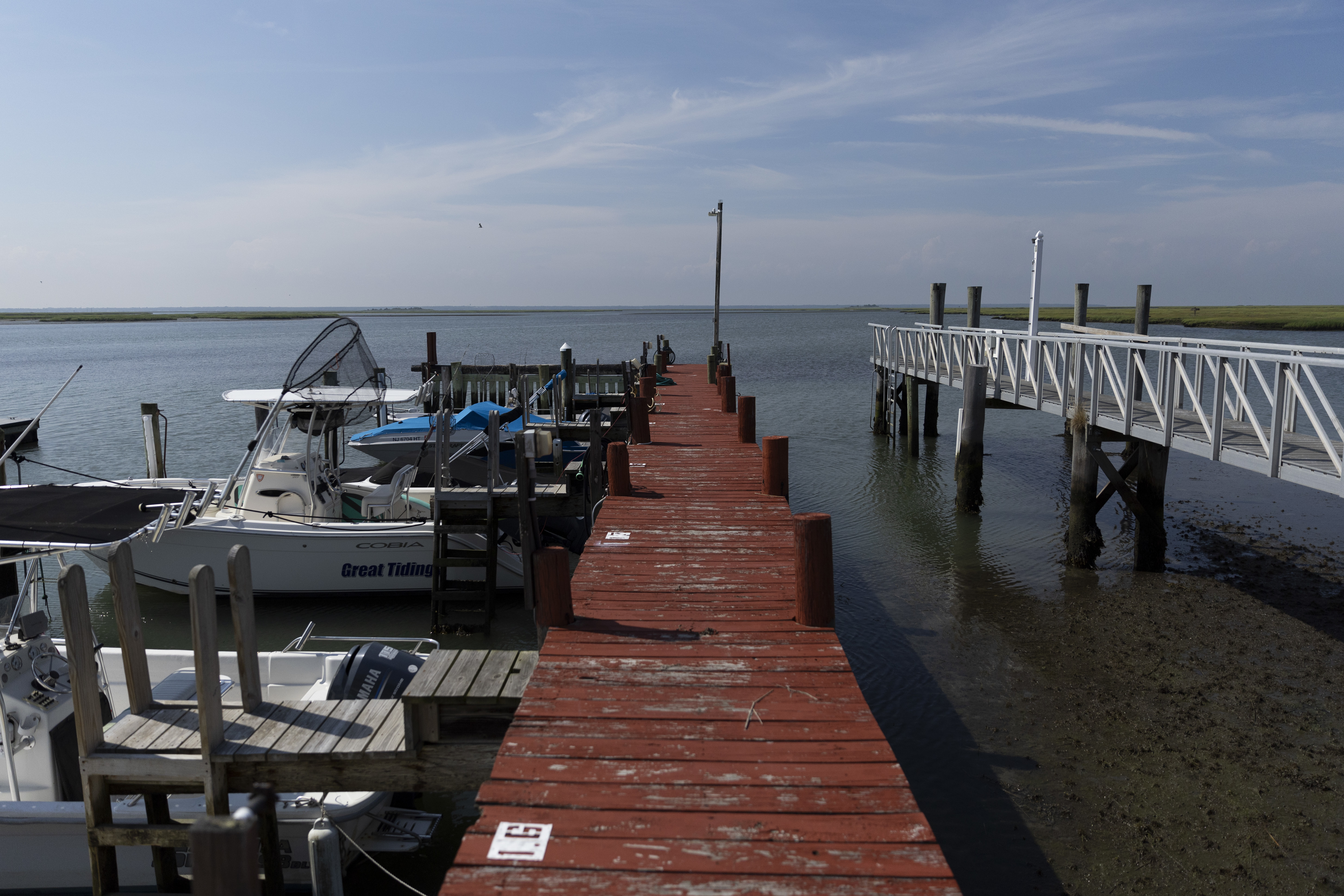
In this Tuesday, Sept. 14, 2010 photo, wild horses are seen in Corolla, N.C. A boom in vacation homes in the last 25 years in this remote place has seen the descendants of colonial Spanish mustangs confined to a 7,500-acre sanctuary on the northern tip of North Carolina’s Outer Banks, and now the herd itself may shrink along with its habitat. (AP Photo/Gerry Broome)
Outer Banks: Linens included
Outer Banks rentals trend toward the larger side, so the trick might be to vacation with that other family whose kids like your kids.
Myles Wood, of Shoreline OBX, said his company includes a friendly $250 credit for beach gear rental during your stay.
Jersey Shore veteran renters, used to having to (literally) bring their own sheets, find this extremely attractive.
“One of the things we aim to do if someone comes down, everything’s taken care of,” Wood said.
Rental prices have crept up a bit, he notes, but said those priced out of buying a beach house in New Jersey will be pleasantly surprised to see a lower bar of entry, like this Duck beach cottage listed at $650,000.
Sample food: At Aqua, $34 gets you Chef Cory Bryant’s Shrimp and Grits, with smoked pork belly lardons, sun-dried tomatoes, and a creamy lobster sauce.
Vibe: Personal space-y. Says Wood: “Our beaches are wide enough and plentiful enough. You get a slice of personal heaven.”
What’s free? Beaches and parking, oh my.
Drawbacks: No true boardwalk scene. Long, and increasingly expensive, drive for a week’s vacation.
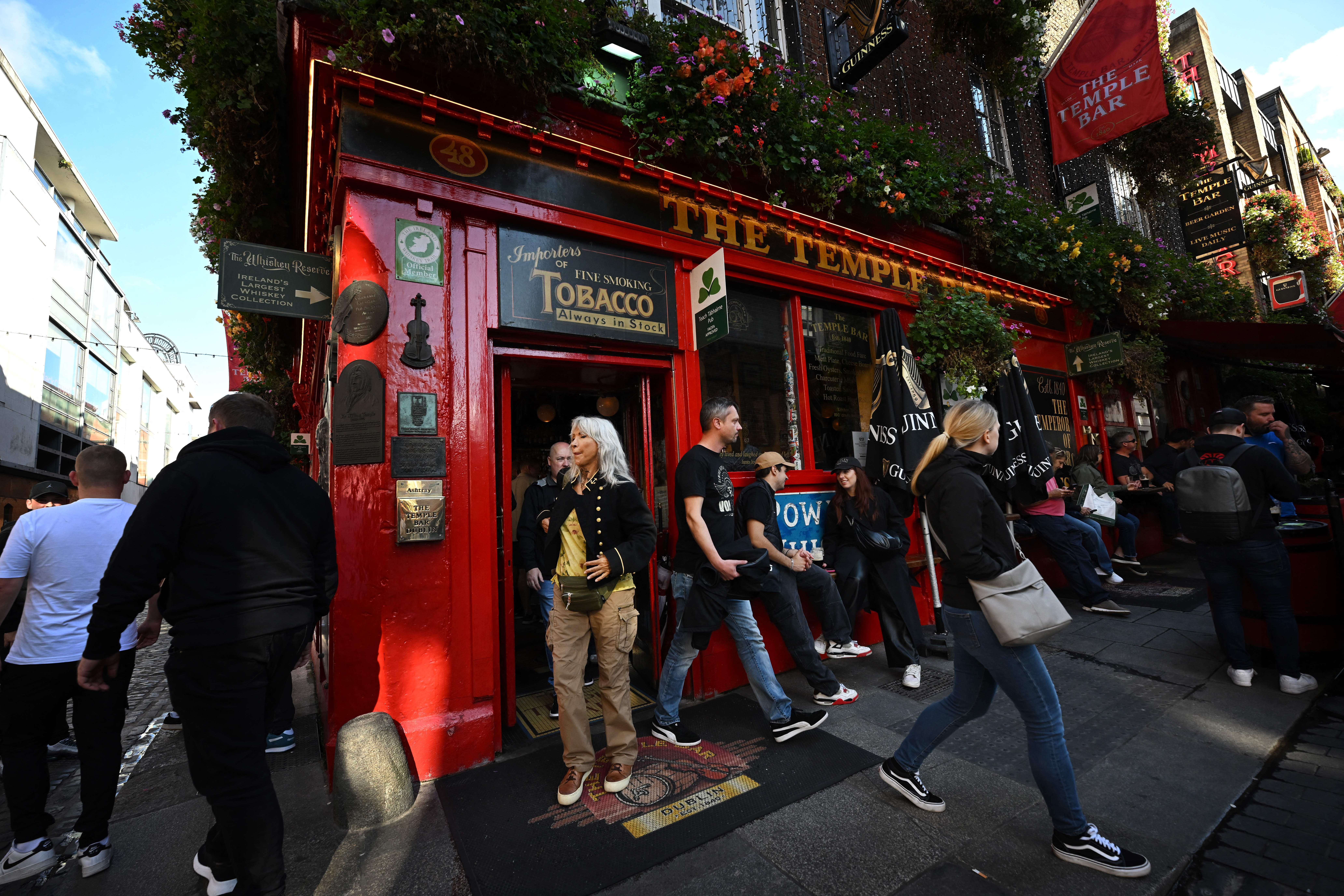
Drinkers and tourists visit the Temple Bar pub in the Temple Bar area of Dublin on September 15, 2024.
He found a “stylish one-bedroom apartment” for four at the Dublin City Center location of the Staycity chain that will rent for a week for $1,996. If it’s just for two, he recommends the Hoxton Hotel for its “tasteful decor and fawning service,” which will run about $2,029 mid-August, “a steal for that hotel group,” he said.
Airfare round-trip from Philly on Aer Lingus Irish Airlines will run you around $929 per person, including a seat assignment, checked bag, and in-flight meal.
Vibe: Sea Isle meets James Joyce. Cliffs!
Sample food: Three-course menu at Vintage Kitchen in Dublin for 72 euros features theSkeaghanore duck with miso, sprouting broccoli, sweet potato, and samphire (sea beans).
What’s free? At the Guinness Storehouse, take the basic tour where mom and dad get a free stout.
Drawbacks: Peak Dublin Bay temps are about 59 degrees.
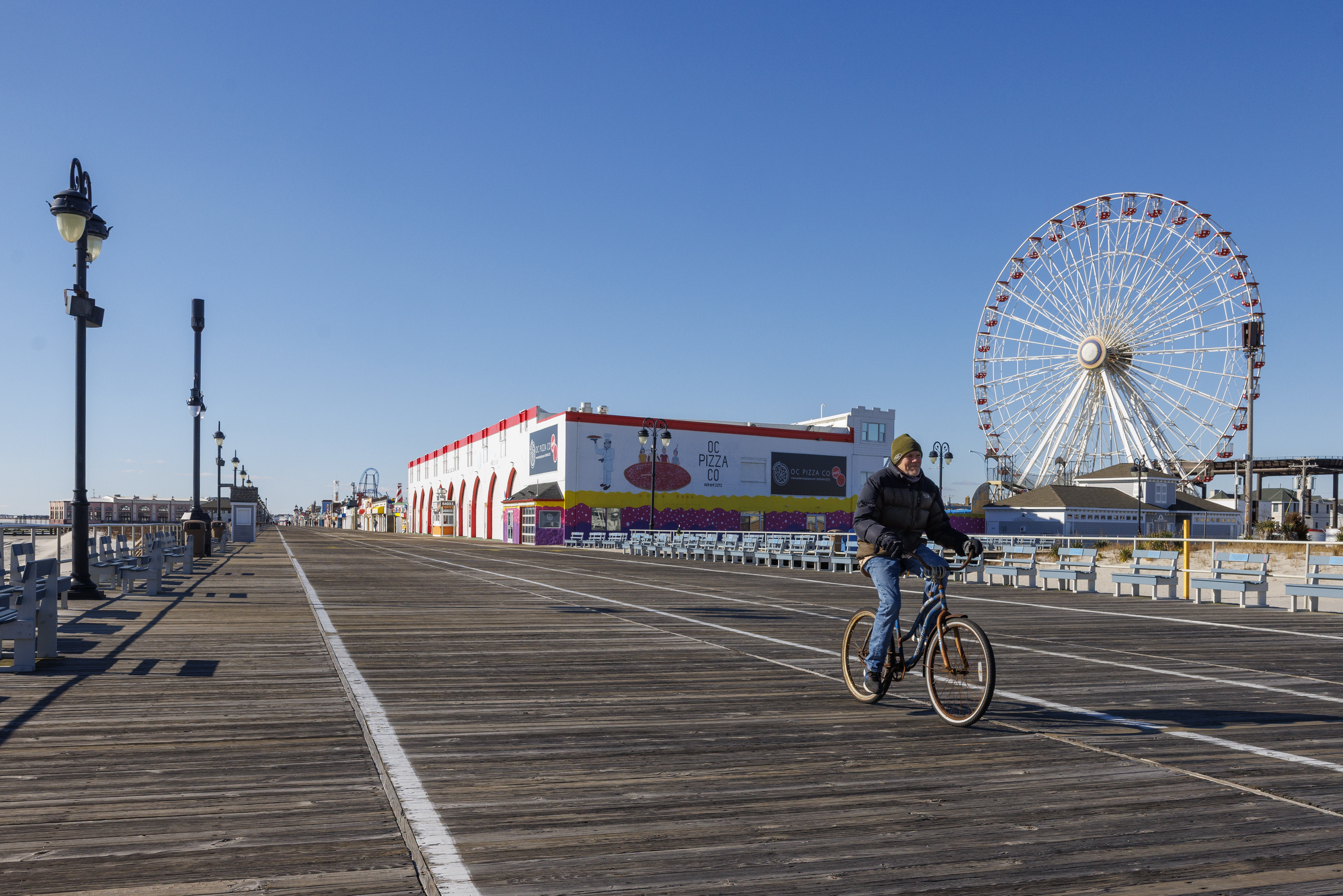
Boardwalk near 6th Street, Ocean City, NJ.
Ocean City: Nostalgia — for a price
Brian Logue, of the Anchor Group in Ocean City, notes that Ocean City has had some record sale prices. But that hasn’t affected rental prices, he said. “The upside for tenants is that rental prices have not kept up with value.”
He’s not sold on the North Carolina alternative.
“From experience, I have clients who love the Outer Banks,” he said. “But unless you have your own plane, it’s eight hours in the car each way.”
He thinks people may think they want an alternative to their ancestral Shore destinations, but in the end, they really don’t.
“There’s not a boardwalk,” he said of the Outer Banks. “The things that make Ocean City ‘America’s Greatest Family Resort,’ it doesn’t exist there. It doesn’t have that nostalgic Jersey feel.”
Maria Sacco Handle, of the Shore House Team, said the snowy winter has spurred interest in Jersey Shore rentals. She said prices have stayed “fairly steady,” with some early booking incentives that will disappear as the season approaches.
“Believe it or not, we love a snowy winter at the Jersey Shore — it reminds everyone how amazing a week at the beach will feel,“ she said. “My advice to anyone thinking about renting this summer: Don’t sit on the fence — the best weeks always go first.”
A typical week in Brigantine in July comes out as about the same as the Outer Banks, minus the cost of driving and plus the cost of a beach tag ($15 per week per person).
In a time-honored Jersey Shore tradition, you’ll have to bring your own bed linens or rent them (no Outer Banks-y credit included).
A four-bedroom, two-bath charming blue rental house in Brigantine’s “A zone,” in the middle of the island, is listed for $5305, a bargain by current Jersey Shore standards.
Sample food: Spicy tuna with Caribbean jerk seasoning at La Scala Beach House will run you $25.
Vibe: With one way on and off, Brigantine is its own insular vibe. All-terrain vehicle holders can go tailgate at the cove.
What’s free?Hmm. An early morning around the island bike ride, as always.
What’s not? Linens! BYO.
Perks: The Borgata is just a short hop over the bridge, and you can visit some stranded marine mammals at the Marine Mammal Stranding Center. Also, golf.
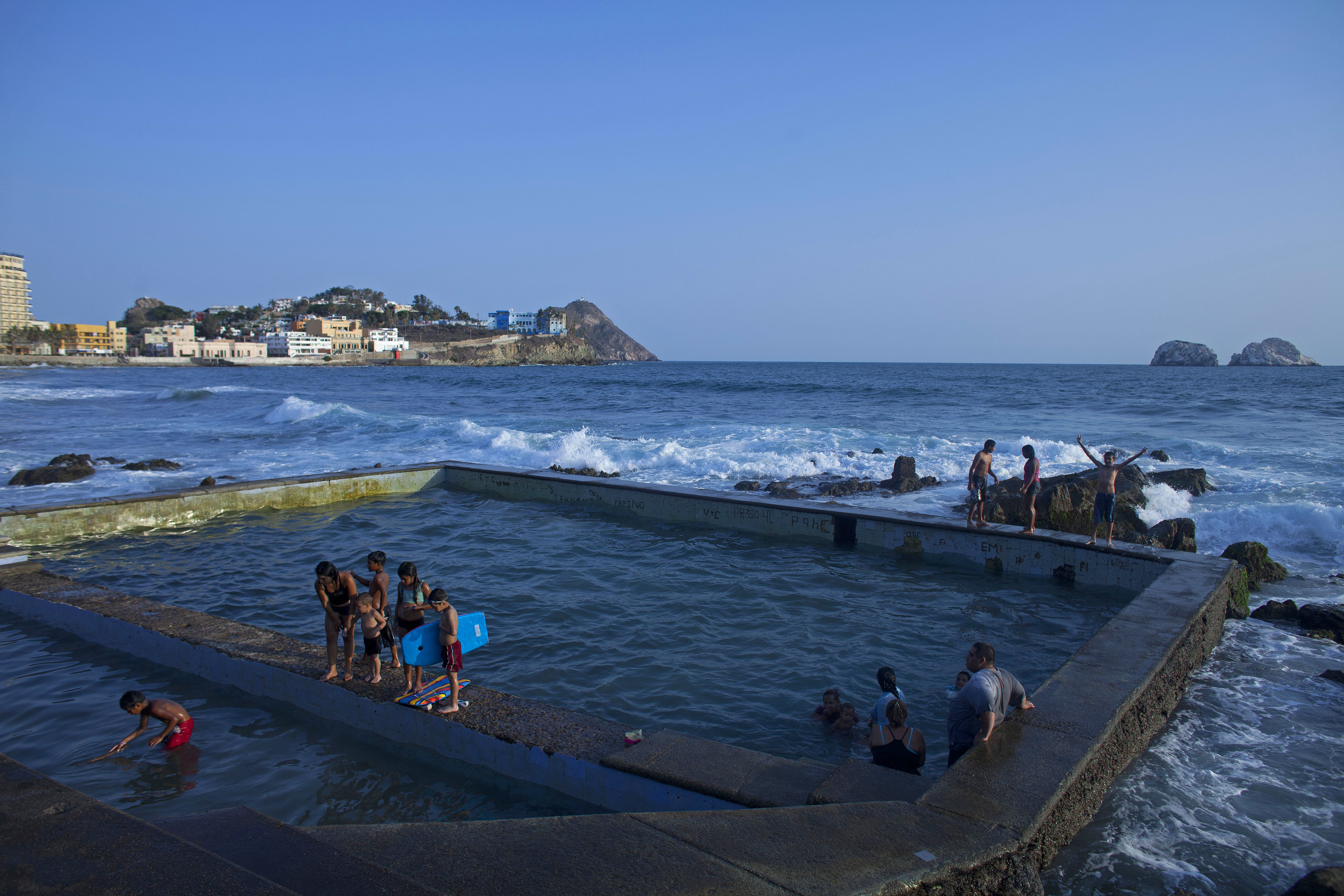
Frolicking in a beachside seawater pool in Mazatlán, Mexico.
Mazatlán, Mexico: 13-mile boardwalk
“This was the first thing that popped in my mind,” said Philadelphia travel agent Mezgaron James.
She’s referring to Mazlatán, Mexico, a resort town on Mexico’s Pacific coast. “A lot of people don’t know they have the longest boardwalk in the world, a 13-mile boardwalk. It’s a place that’s untouched.”
James priced out seven nights in our target week, July 11 to 18, at Costa de Oro Beach Hotel, including round-trip tickets on American Airlines from Philadelphia for … $4,000.
“It’s family-friendly,” James said. “There’s a lot of things to do. It’s still lively like the Jersey Shore, but you’ll see a nice mix of people, fishermen hauling the morning’s catch, people bicycling and jogging, catch a coffee and pastry. There’s zip-lining. There’s open air taxis.”
The hotel provides direct access to the beach at no extra cost.
“It’s actually a four-star hotel with a pool right by the beach,” she said.
Sample food: I’m ordering the Zarandeado fish, a whole grilled fish available at multiple places.
Vibe: The 13-mile boardwalk will meet all your Jersey needs.
What’s free? Beaches.
Drawbacks: Check with the U.S. Department of State’s travel advisory to see about impacts from any nearby (but not in tourist areas, typically) cartel violence.
Inquirer staff writer Chris A. Williams contributed to this article.
The future of a family farm in rural Salem County was at stake, and after multiple meetings and hours of presentations, questions, pleas, and complaints, a local planning board was set to vote.
Before the vote, one longtime resident of Mannington Township came to the podium with a warning. In preparation for this crowded, mid-March meeting, Alice Waddington, 98, said she’d made a list of dairy farms she remembered from her decades in the little town.
At one time, she said, there were close to a dozen.
“There’s only one farm left milking cows,” Waddington told the board, “and that’s the Cadwalladers.”
The Cadwalladers were struggling in the volatile dairy industry, though, and believed a large solar project could be a lifeline, a way to avoid shuttering and selling to developers eager to build warehouses, data centers, and housing in the nation’s most densely populated state.
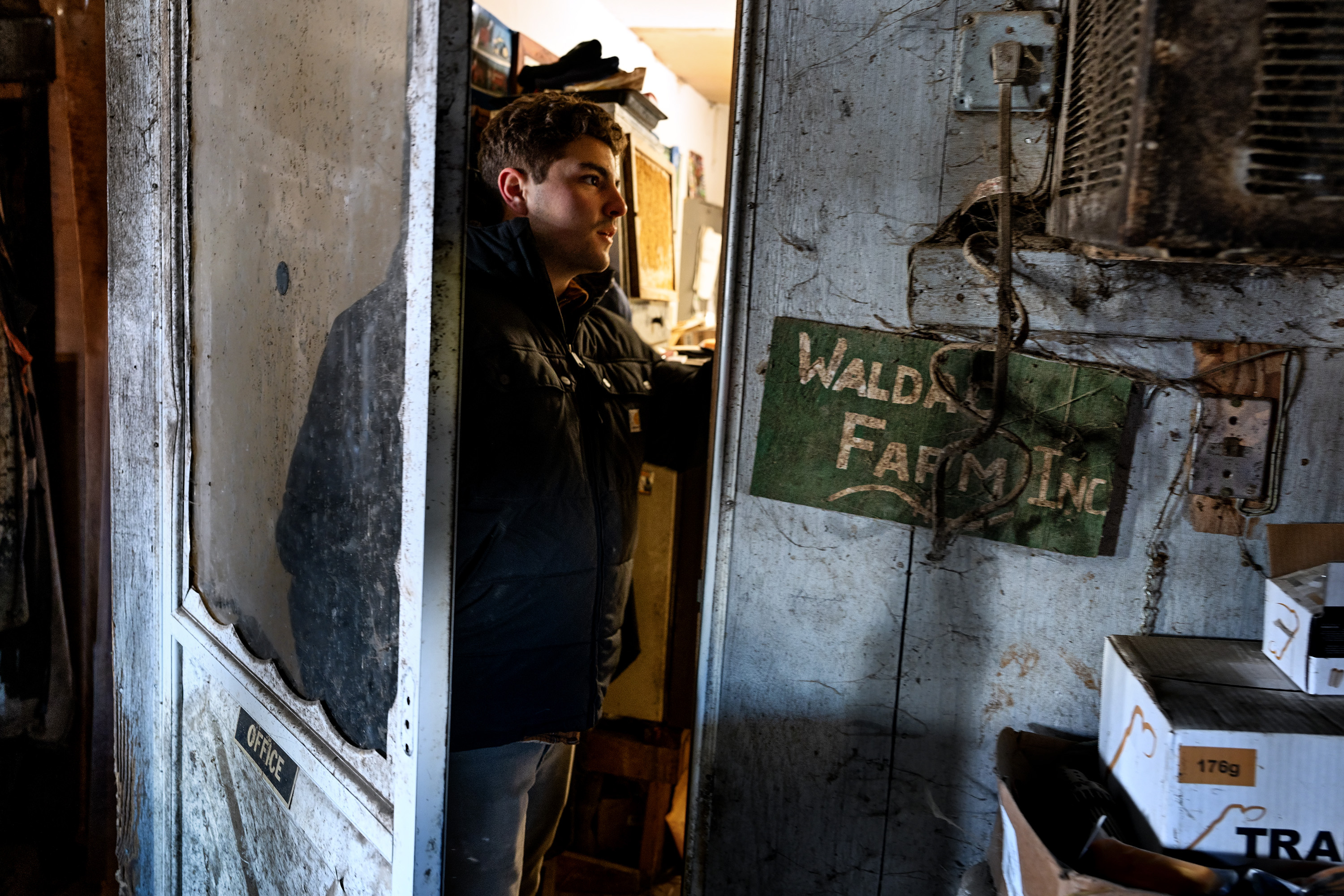
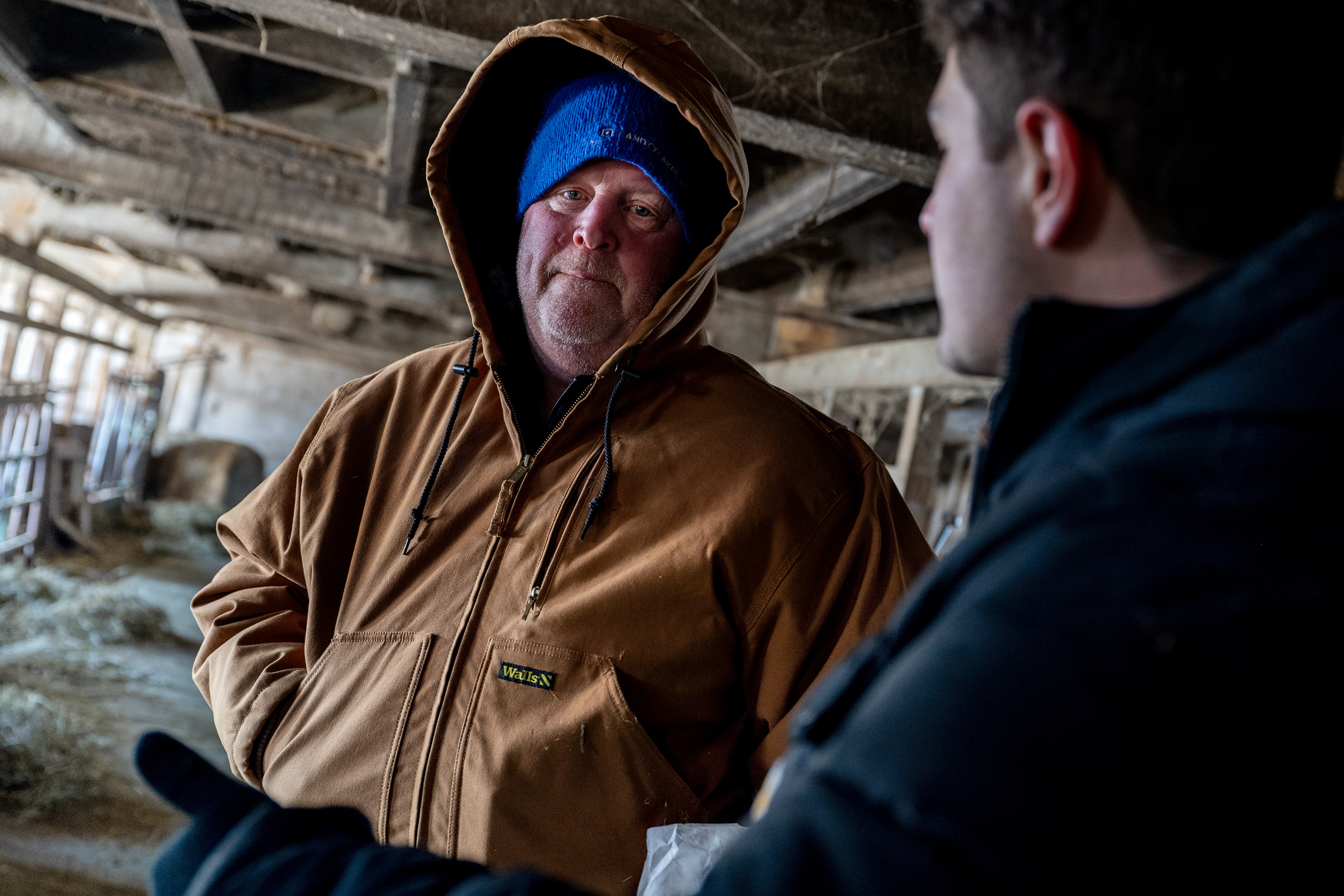
Farmer David Cadwallader at Waldac Farms in Salem, N.J., on Jan. 29.
This was the fourth Mannington Township planning board meeting for the Cadwalladers, who were seeking a variance to install 300 acres of solar panels on Waldac Farm that would, eventually, generate enough energy to power 19,000 homes annually.
Some board members and locals questioned the environmental impacts, whether it would affect the soil, injure the abundant wildlife in the area, or taint the nearby Delaware River watershed. Representatives from AES Corp., a Virginia company that would build the solar project and pay a lease to the Cadwalladers, had answers for all of them.
“Whether we all, in this room, agree with it or not, it is the state’s policy to advance these types of solar energy uses to meet the energy demands that we need,” Keith Davis, an attorney representing AES, told the planning board.
What they couldn’t seem to quell, however, were the repeating concerns about how a solar farm would look in New Jersey’s most rural county. Those concerns raised open-ended, philosophical questions: What’s a working farm supposed to look like? What exactly does rural mean?
“It will destroy property values and will be an eyesore for our township,” a neighbor of the Cadwalladers commented on a 2025 Facebook post about the project.
Similar situations have played out nationwide. A recent Associated Press story from Ohio highlighted a struggling farmer’s solar project that also faced community pushback and was ultimately blocked.
In Salem County, Mannington planning board member Joanne Wright was the most vocal at the meeting. She mentioned, often, that Mannington’s master plan called for maintaining “scenic vistas” and its rural, agricultural characteristics.
The Cadwalladers said they would plant pollinator habitats and plants on the solar farm, and introduce roughly 300 sheep to graze around and under the panels. The combination of solar and agriculture — “agrovoltaics” — is supported by the New Jersey Farm Bureau, Andrew Cadwallader pointed out.
Wright, however, thought solar panels would break up the township’s “contiguous farmland.”
“I’m just wondering how you see that the positive outweighs the negative,” Wright asked representatives from AES.
Farmer Andrew Cadwallader at Waldac Farms in Salem, N.J., on Jan. 29.
A picturesque farm
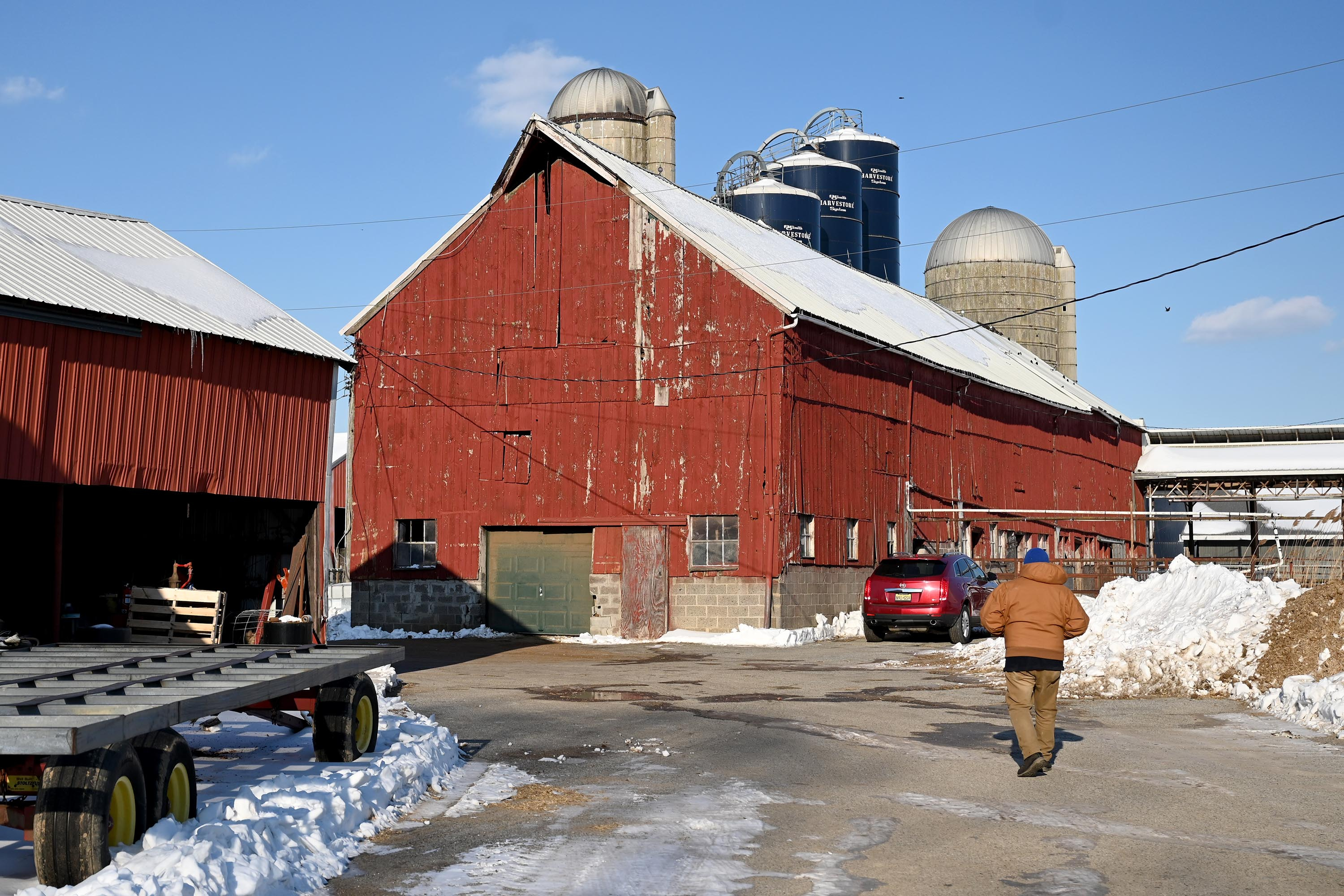
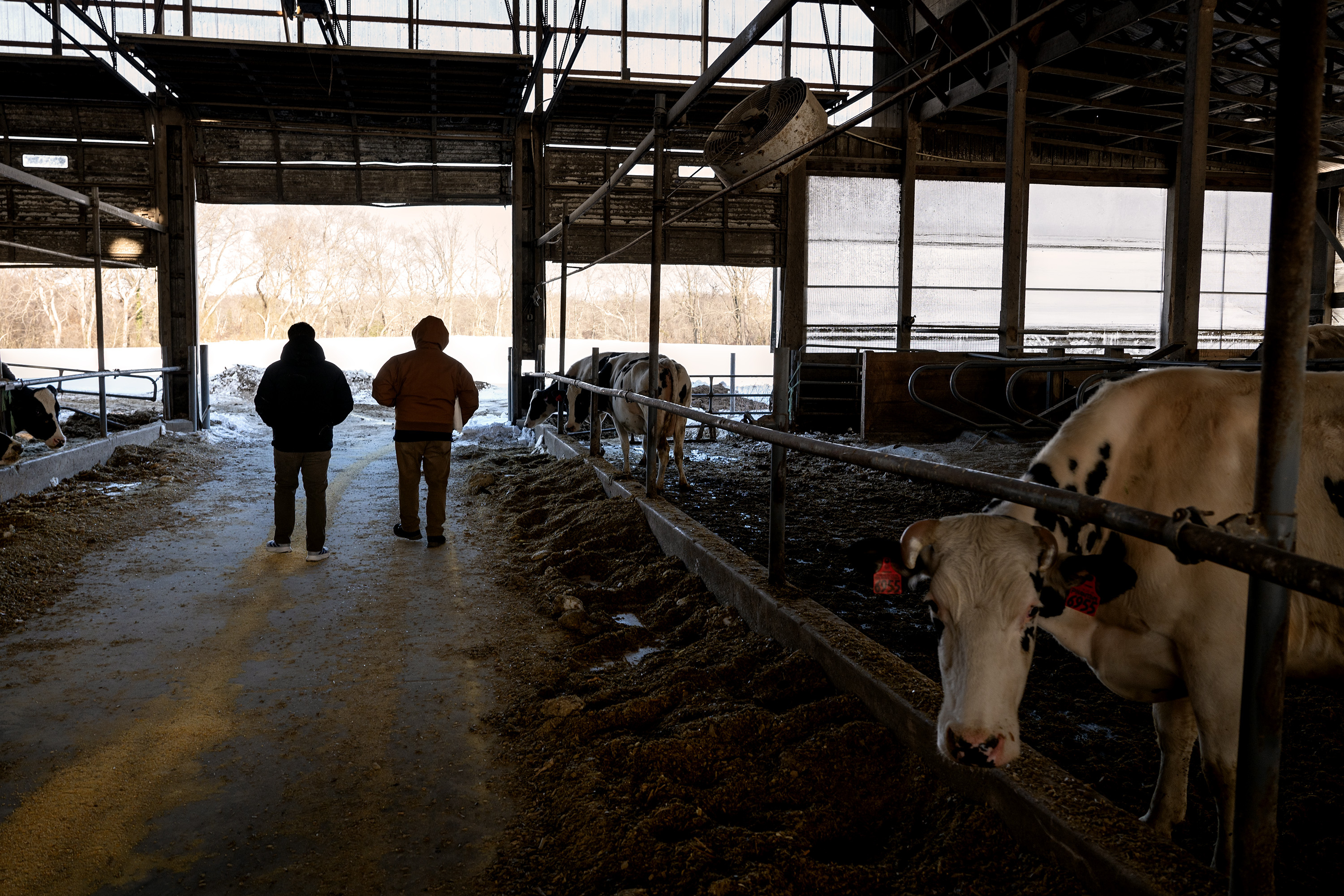
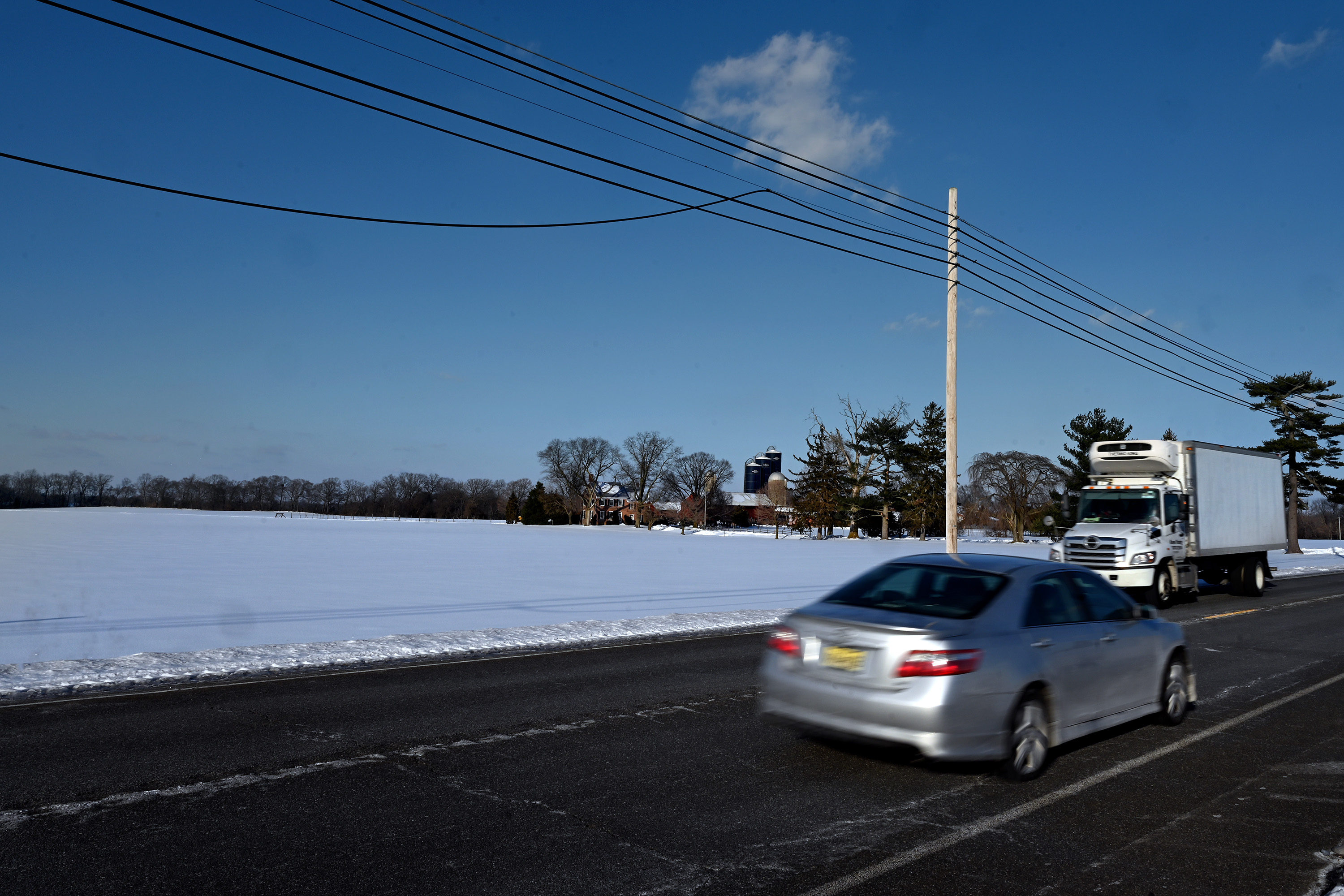
The Cadwallader family has been farming since the 1860s, and Waldac Farms certainly looks the part: There’s a circa-1790 farmhouse down a long dirt road, a slew of silos dotting the flat landscape, and big red barns, faded by time, that are full of cows and cats.It was mostly silent there, too, aside from the winter wind.
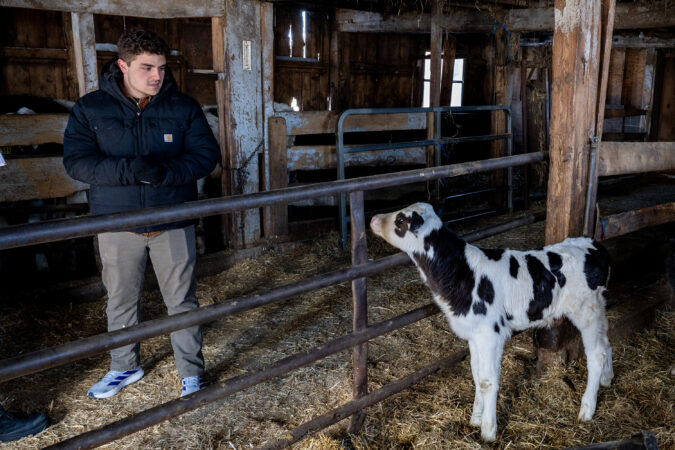
The only thing that seems out of place on the family farm on a frigid afternoon is Andrew Cadwallader. The college senior looks younger than 22, and his sneakers and pants were impeccably clean.
Andrew’s been milking cows since before his baby teeth fell out, though.
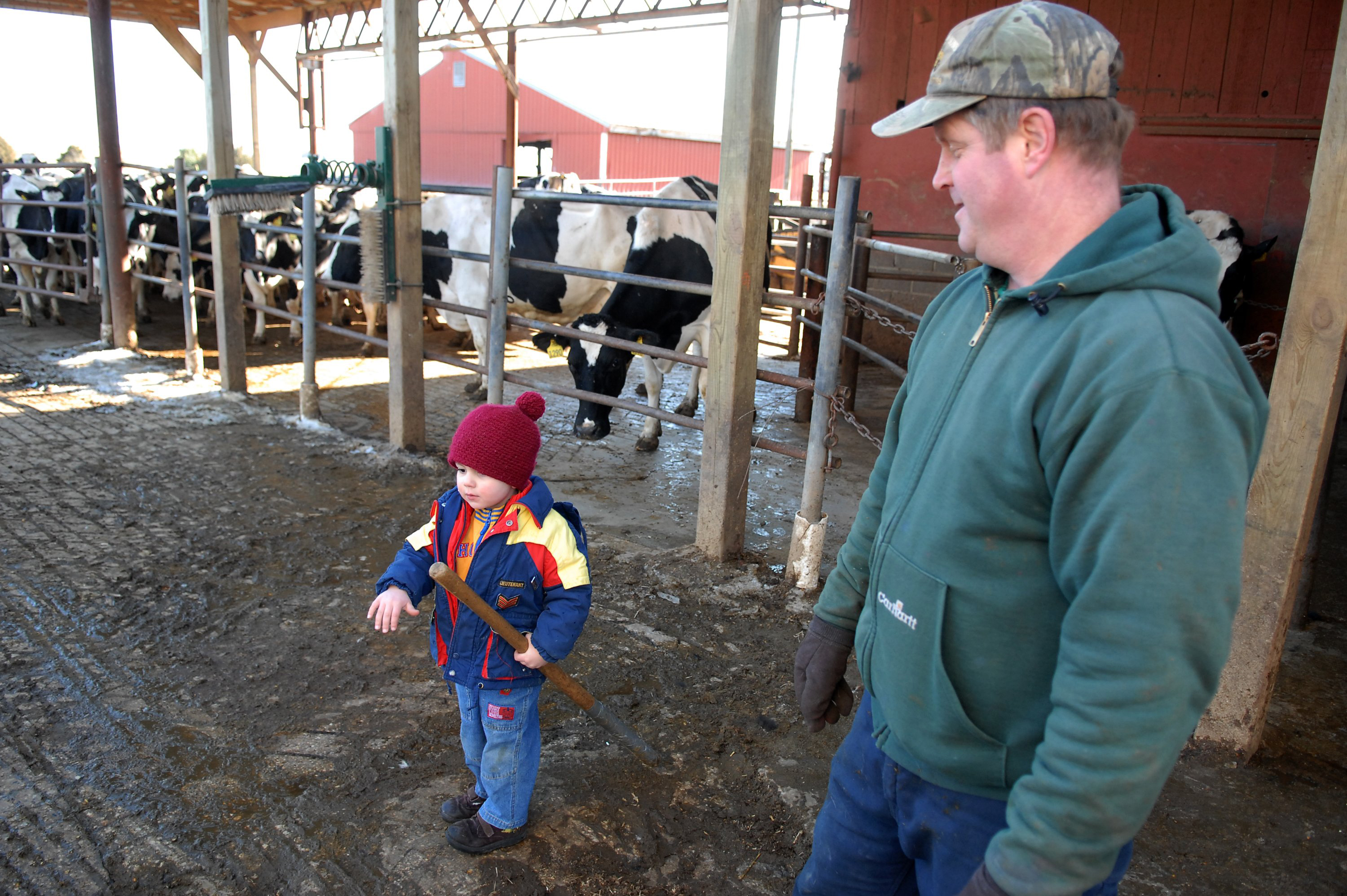
In 2007, a South Jersey newspaper visited the Cadwalladers to discuss the dismal state of dairy farming at the time. The newspaper took a picture of Andrew, then 3, surrounded by cows in a pen. His father, David, told the newspaper he’d love to pass the farm down to his son.
“If he wants it,” David Cadwallader said.
From the Press of Atlantic City on March 12, 2007: The state is trying to revitalize its dairy farm industry. With his 3-year-old son Andrew, David Cadwallader prepares his cows for their 3 p.m. milking at Waldac, his Woodstown dairy farm.
Andrew is set to graduate from Haverford College with a degree in political science. He’s merged his life history — agriculture and geology — with his interests in politics and government, and recently began an internship for CNN’s Michael Smerconish, a Bucks County native.
Andrew’s an only child, and, yes, he wants to farm, bucking a trend that’s seen the average age of farmers, 58.1, rise steadily, according to the 2022 U.S. Census of Agriculture Data.
“I’m coming back here after I graduate,” he said.
Nationwide, small dairy farms like Waldac have continued to shutter at a rapid rate since Andrew was in the local newspaper.
Overall, milk production is up in the United States. That’s because modern genetics has produced cows that make more milk than their ancestors. Those big production numbers are coming from massive farms with large herds, too.
The Cadwalladers milk about 130 dairy cows on approximately 500 acres, and small farms like theirs have been decimated. In 2005, according to the USDA, there were 78,295 dairy farms in the United States. In 2025, that number was 23,609, a 70% decrease in just 20 years.
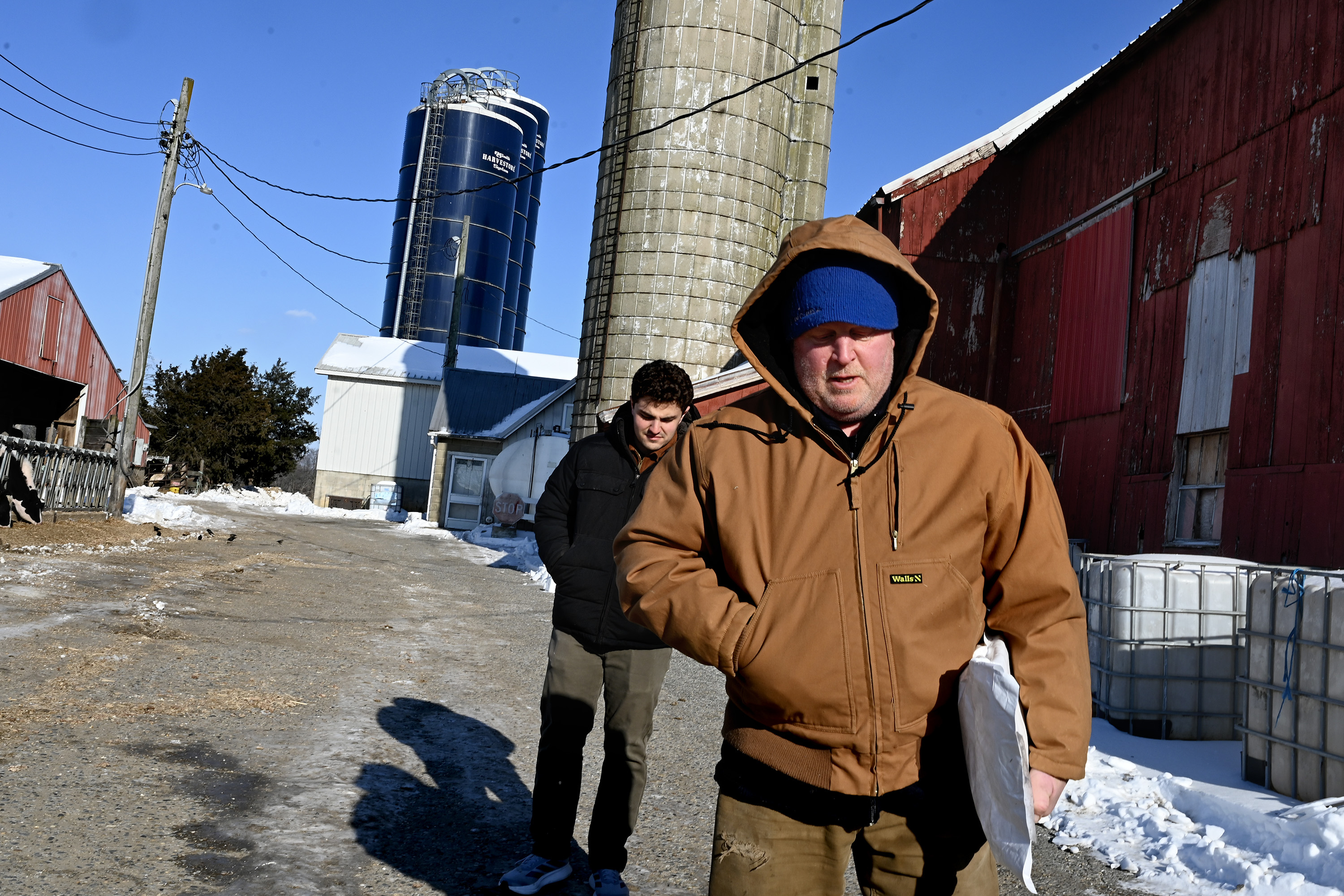
Farmers Andrew Cadwallader and his father David Cadwallader (front) at Waldac Farms in Salem, N.J., on Jan. 29.
Andrew Cadwallader declined to go into exact figures but said the family would be “paid well” by the AES lease. Waldac Farms would pivot to sheep and the sale of their lambs, while possibly still milking cows on a smaller scale.
“We have been losing money for the last 10 years,” Andrew said of the dairy operation.
AES approached the family about “solar grazing” during the pandemic, Andrew said, and as they sought a use variance from the Mannington planning board to move forward, he became the project’s public face. Andrew made numerous, lengthy Facebook posts in local groups about the project to be transparent.
“Will we continue to hope that the price of milk goes up and risk failure, or will we pivot and change?” Andrew wrote in the Salem County Advocates group in November.
Many comments were supportive or neutral, in a libertarian “it’s your land” way. There was plenty of pushback, though, and Andrew said it was disheartening to see how many comments focused on visual impact.
“I’m glad people can worry about the look of the farm,” he said in late January. “We have to worry about making a living.”
Cadwallader said flat farmland is not a natural part of landscapes in South Jersey. People have just gotten used to seeing it. His farmland was likely cleared of trees by the native Lenni-Lenape centuries ago, he said. Barns and tractors are industrial buildings and commercial machinery, he said, not quaint antiques.
“They are prioritizing the look, and it’s not reality,” he said. “It’s not a natural feature.”
Still, Cadwallader felt confident, on a late January afternoon on his farm, that the planning board might approve the project.
Jennifer Kugler, founder of the nonprofit South Jersey Preservation, visited Andrew’s farm shortly before the planning board meeting with her children and wrote a lengthy Facebook post in support of his plan that received 573 likes.
“The Cadwalladers want to evolve,” Kugler wrote. “This means new solutions are necessary to ensure the continued viability of the farming operation. For farmers, this can be incredibly scary.”
Kugler, 42, lives in Pilesgrove, Salem County, home to America’s oldest continuously-operating rodeo. She was raised on a dairy farm in Lackawanna County. That farm closed in the 1990s and never reopened, and part of her goal with South Jersey Preservations, she said, is to prevent more small farms from folding.
“We support farmers continuing to farm,” she told The Inquirer.
Farmers Andrew Cadwallader and his father David Cadwallader (left) at Waldac Farms in Salem, N.J., on Jan. 29.
To preserve or not to preserve
While the Cadwalladers would prefer the solar project, there are other options to keep farms afloat in New Jersey. The state’s Farmland Preservation Program is a common way to ensure that housing and warehouse developers don’t buy up farms. It’s a relatively simple process.
The program uses a combination of federal, state, county, municipal, and nonprofit funds to buy a farm’s development rights. The purchase price, according to the program’s website, is “based on the difference between what a developer would pay for the land and what it is worth for agriculture.”
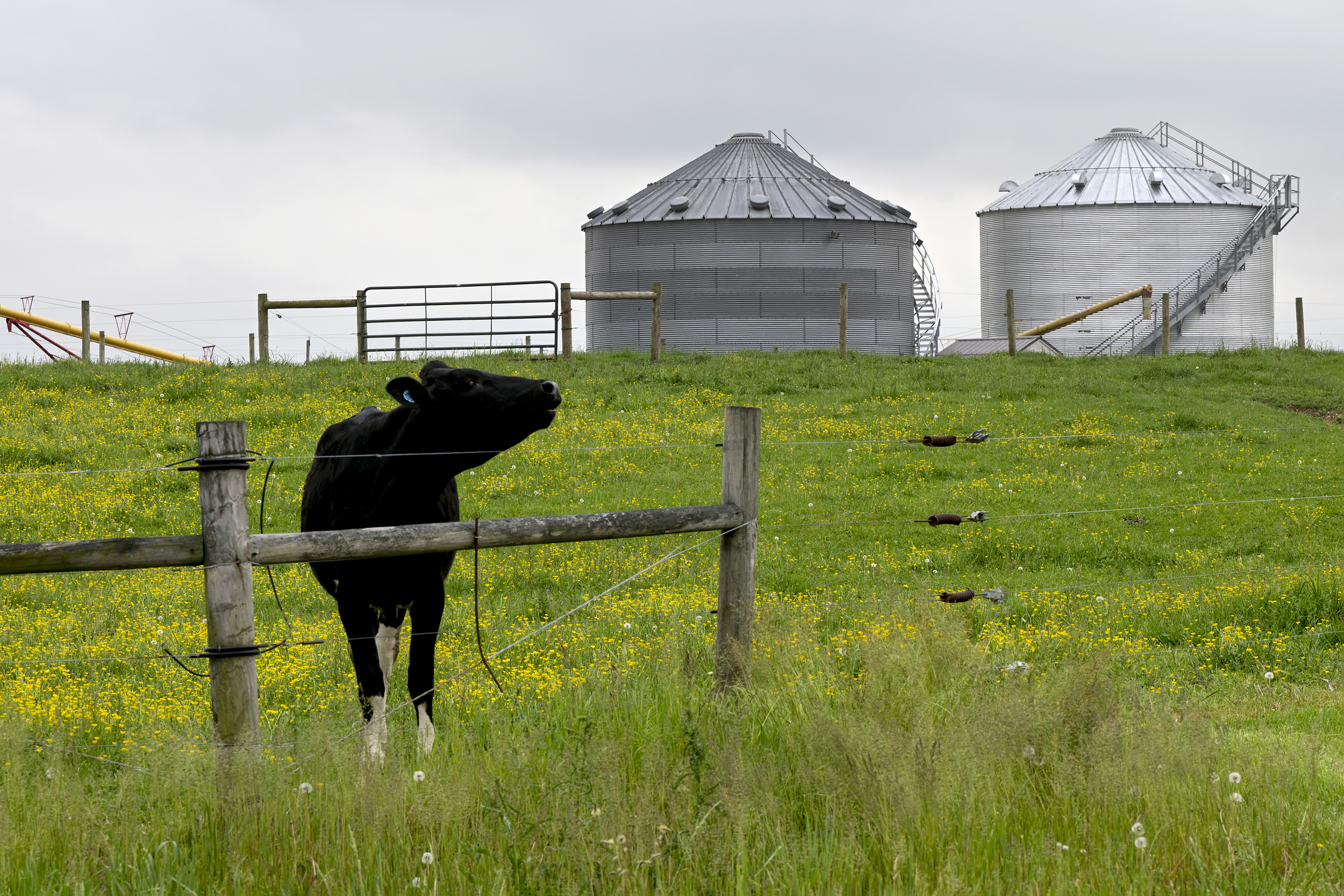
A cow at a farm along Route 49 in Salem County, N.J., on May 6, 2024.
In turn, farmers get a much-needed payout while keeping their agricultural operation running. If those farmers choose to sell their land someday, deed restrictions require the property to be used for agricultural purposes or otherwise remain undeveloped.
“You can’t do additional residential or commercial improvements. You can’t turn it into a housing development or a Walmart,” said Charles Roohr, executive director of the New Jersey State Agriculture Development Committee.
Since the program began in 1984, Roohr said New Jersey has preserved 250,000-plus acres, with a goal of 500,000 acres. Salem County leads the way among counties, with more than 43,000 preserved acres.
The family has not ruled out farmland preservation if the solar project is rejected, but they were concerned about some of the potential restrictions and complications.
“It’d be like a bailout, but we have 500 acres,” Andrew said on the farm in late January. “We need to figure out what the heck we’re going to do with the 500 acres that’s going to actually make us some money.”
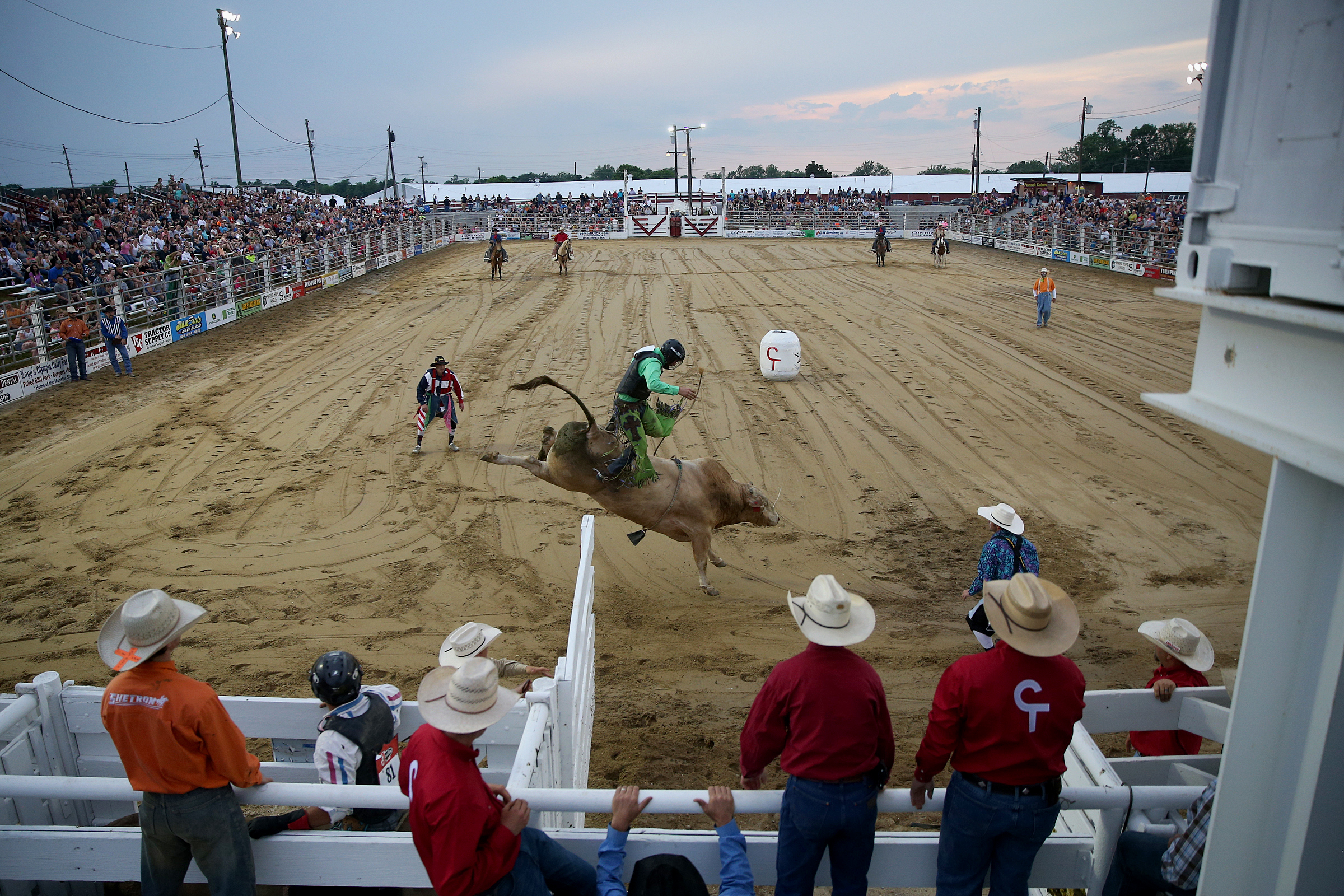
Cowtown Rodeo in Pilesgrove, N.J.
A complicated farmland preservation issue played out right in Mannington in recent years, when Mannington Deputy Mayor Robert DiGregorio filed a civil rights lawsuit against local and county officials in 2021. According to the lawsuit and Transparency NJ,, DiGregorio was holding weddings, private parties, and nonprofit functions on his preserved, 78-acre farm, but was told by officials that he would need variances and site plan approvals or waivers to continue. The back-and-forth between those officials and DiGregorio, according to Transparency NJ, almost grew physical.
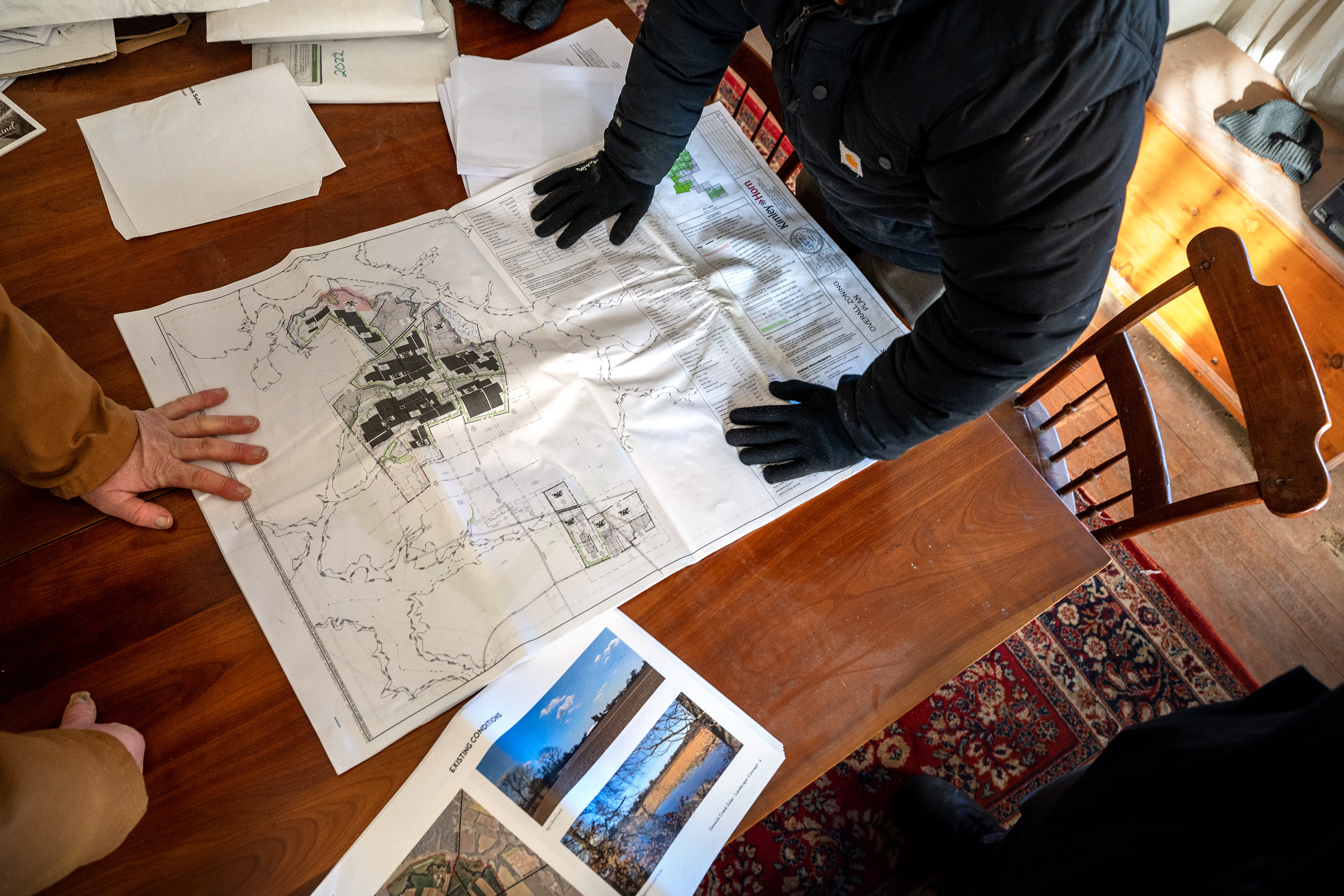
Farmers Andrew Cadwallader and his father David Cadwallader (left) with plans at Waldac Farms in Salem, N.J., on Jan. 29.
In April, Mannington agreed to pay DiGregorio $55,000 to end the lawsuit, according to an article in NJ.com. Neither DiGregorio, who is on the planning board, nor his attorney returned requests for comment. It’s unclear if he will continue to host events on his farm.
Roohr, commenting on farmland preservation restrictions in general, said events are allowed if “the purpose of the event is to sell the things that you’re producing on your farm.”
A tomato festival on a tomato farm would be fine, for example. A folk festival on a tomato farm would probably require a special-use permit.
“If the main purpose of the event is some other focus and your stuff ‘might’ get sold as a side benefit, then we consider that a non-agricultural use. And so the greatest example of that would be a wedding.”
Roohr said the preservation program is more important than ever, as data centers look to build in rural areas nationwide.
“We have over 200 applications [for farmland preservation] in our office right now,” he said.
The Cadwalladers said they have no plans to sell to a developer.
Farmers Andrew Cadwallader and his father David Cadwallader (right) at Waldac Farms in Salem, N.J., on Jan. 29.
The vote
Along with Alice Waddington, numerous others spoke at the March planning board meeting. Union officials said the solar project would bring jobs (AES put the number between 75 and 100). Some spoke in support of Andrew Cadwallader and his love for the ecosystem. Still, others talked about protecting Mannington’s “rural identity” and fears that the project could affect property values.
Andrew Cadwallader was the last member of the public to speak.
“As a family, we’re at a crossroads,” he said. “We can’t risk volatility anymore as a family and as a farm.”
When he was finished, Davis gave a final summation on behalf of AES and the Cadwalladers. Minutes later, the planning board made a resounding 6-1 vote, shooting down the project.
Cadwallader hung his head and gave a half-smile and some quiet “thank yous” to the attendees who patted his shoulder and shook his hand.
Laura Kellogg, a development manager for AES, said the team was disappointed but would continue to “evaluate next steps for the project.”
A week later, Andrew Cadwallader said he and the family were still dealing with the disappointment and contemplating their next move.
“People like this area so much, but we love it. No one loves this land more than my family,” he said. “People have to understand that a working farm is not a museum.”
Cadwallader’s life was getting busier at Haverford, too. He was taking geology classes and working on a senior thesis about preserving “the agricultural viability of mid-sized farming operations in the United States.”
Andrew drives the 38 miles south from college, back to Salem County, every weekend. A week or so after the meeting, though, Alice Waddington’s warning to the planning board, and the people of Mannington, proved prophetic.
Waldac still looked like a farm to neighbors and motorists passing by, but the Cadwalladers had stopped milking cows.
Correction: This article has been corrected to reflect that AES Corp. is based out of Virginia.
Last weekend I photographed members of the group Philly Iranians at the museum steps calling for a “free, secular, democratic Iran — united for human rights and against gender apartheid.” (They used cigarettes to burn a sheet of paper representing the Islamic Republic. The smoking symbolized and celebrated the “power of women” they told me, as under Iran’s Islamic penal code, women’s rights are severely restricted.)
The flag with the Lion and Sun emblem was the official flag of Iran since 1907. It was changed following the 1979 Islamic Revolution is strictly banned from public use in the Islamic Republic. Iranian opposition groups use the old flag in protests.
I even mentioned the art museum in this space in January.
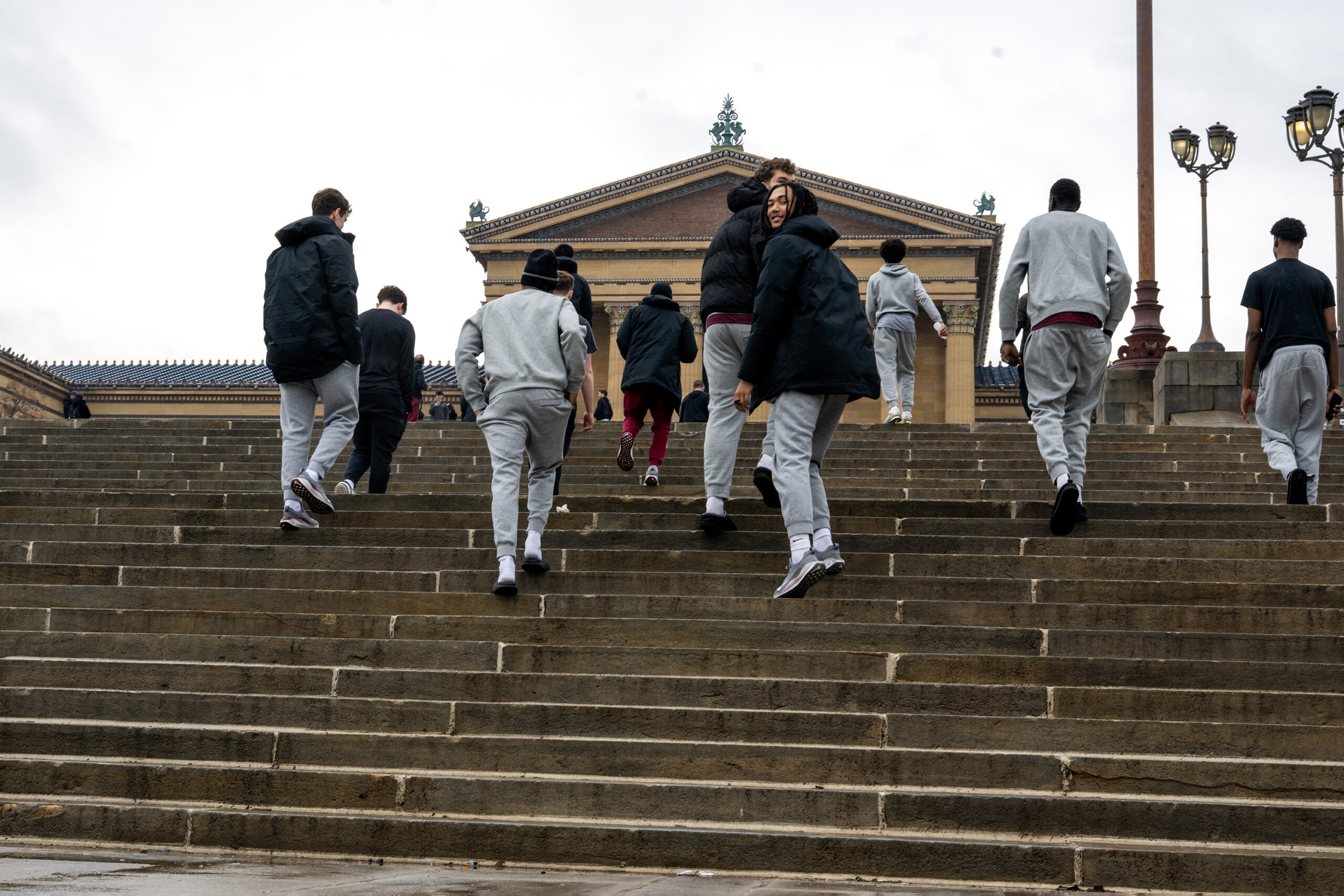
Workers reinstall the Young Meher statue behind construction fencing outside the museum along Kelly Drive. The work by Armenian artist Khoren Der Harootian was presented to the city in 1976 for the Bicentennial. It was reconditioned and will be the centerpiece of the Armenian Heritage Walk to be unveiled in April for American’s 250th anniversary. Student athletes from Fordham University in the Bronx visit the Philadelphia Museum of Art. The steps, anyway. The grey sweats are their “normal travel attire.”
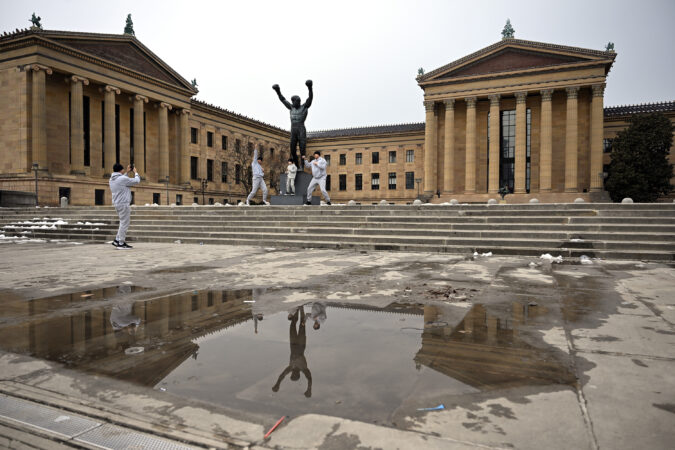
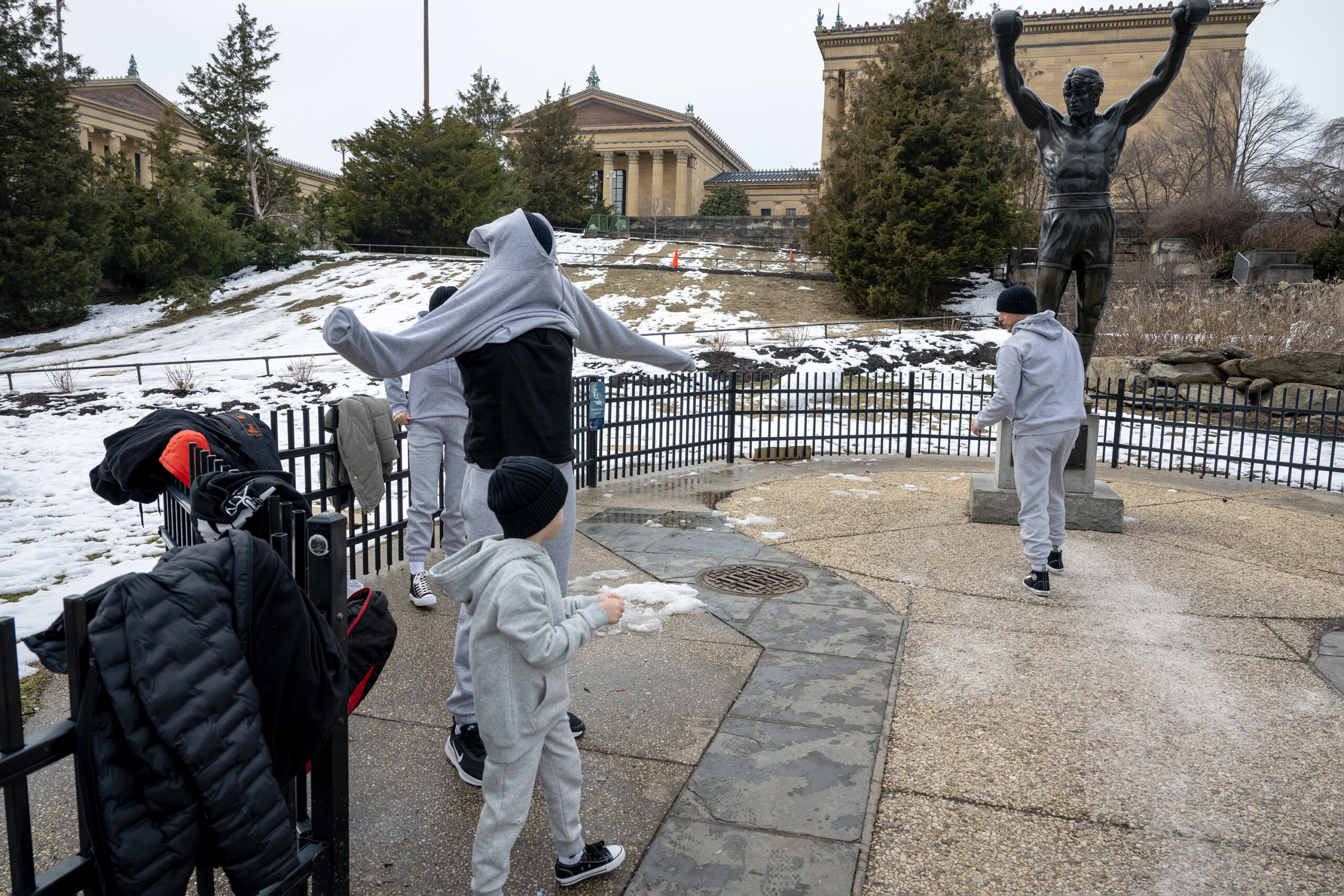
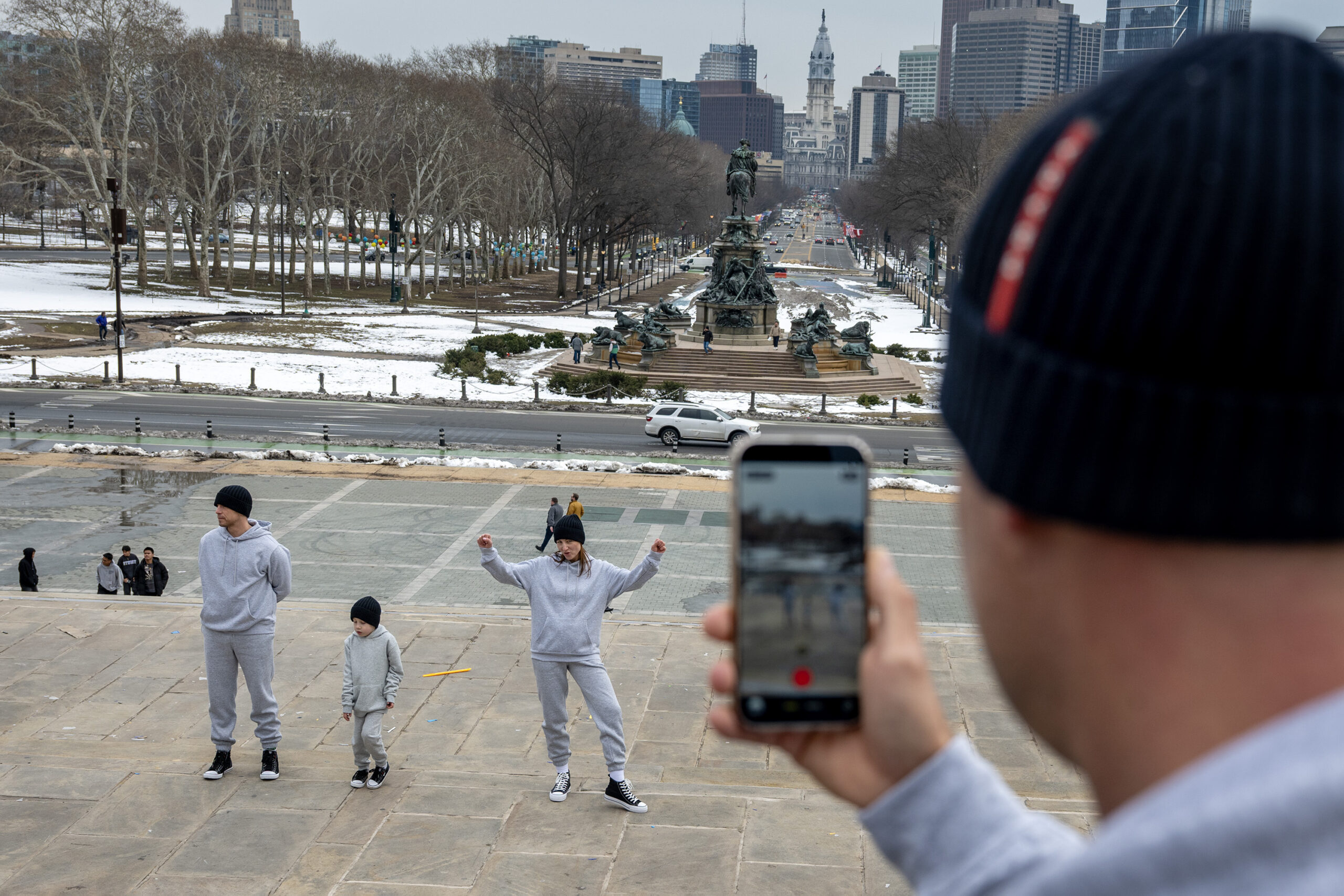
Being there so often, I knew exactly what was going on as I saw three adults and a kid changing clothes next to the Rocky statue. I didn’t have to ask, as I knew exactly what was coming next as they got decked out in gray cotton sweats, black stocking watch caps, and high-top black Converse All-Star Chuck Taylors.
Mariusz Sliwa, his wife Magdalena, and their six year-old son Tymek came from Poznan, Poland. Marcin Danych, a friend now living in Chicago, joined them for what is now a classic pilgrimage.
When he was a boy, Mariusz’s father was “a typical factory worker … worked seven days a week,” he told me. But when he was with his father at night they would watch Rocky — “Playing it over and over, in the VHS.” It was just a part of Mariusz’s childhood, so he wanted his own son to experience it.
I see it every time I am at the steps, people of all ages, from all over sprinting up those 72 steps, “Gonna Fly Now” playing in their heads. It’s why writer Michael Vitez asked me to join him, to spend a year at the steps meeting people just like Mariusz, seeking a tangible way to inhabit a universal story of hope. As Michael often says, “It’s like the ocean; the waves keep crashing on the beach, they never stop.”
Mariusz wanted to bring his father with him from Poland, but he is unable to travel. With his friend Danych’s help, he recorded video — over and over — running up the steps with Magdalena and Tymek. And with just Tymek. And only Magdalena and Tymek together. Finally, Tymek alone. He was making his own Rocky movie. Recasting the scene, as it is etched in his mind.
I hope he sends me a copy. After he shares it back home with his dad.
Since 1998 a black-and-white photo has appeared every Monday in staff photographer Tom Gralish’s “Scene Through the Lens” photo column in the print editions of The Inquirer’s local news section. Here are the most recent, in color:
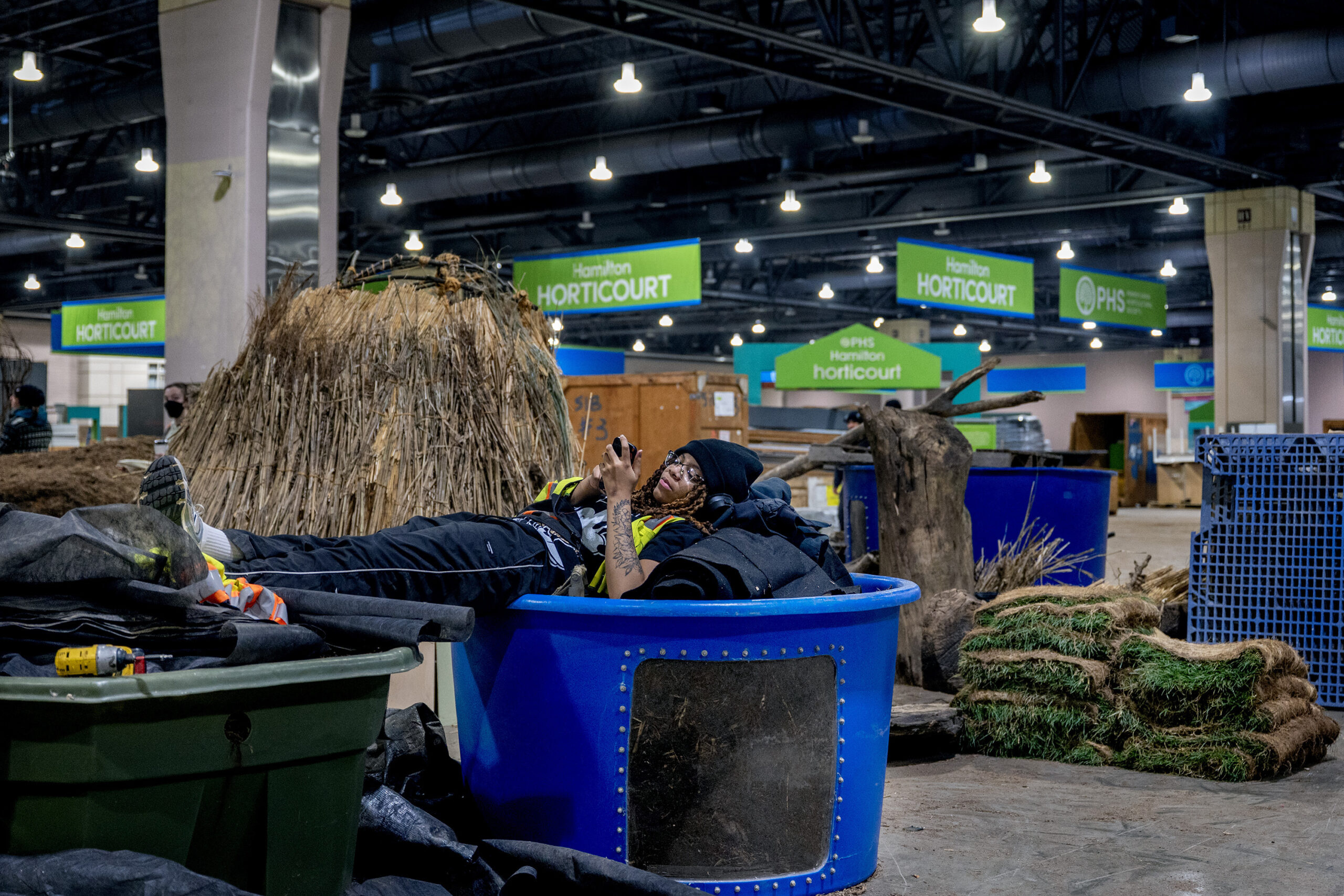
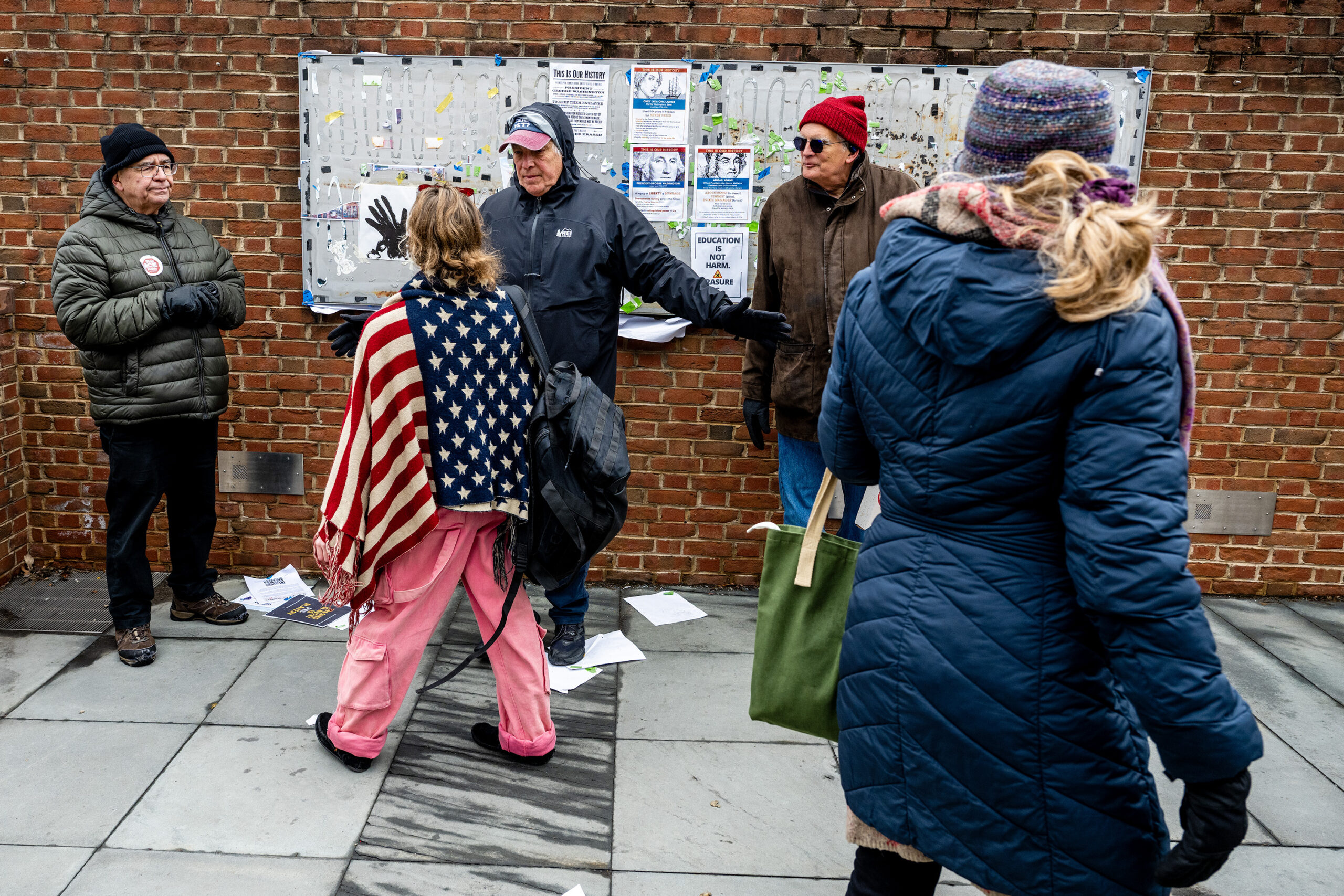
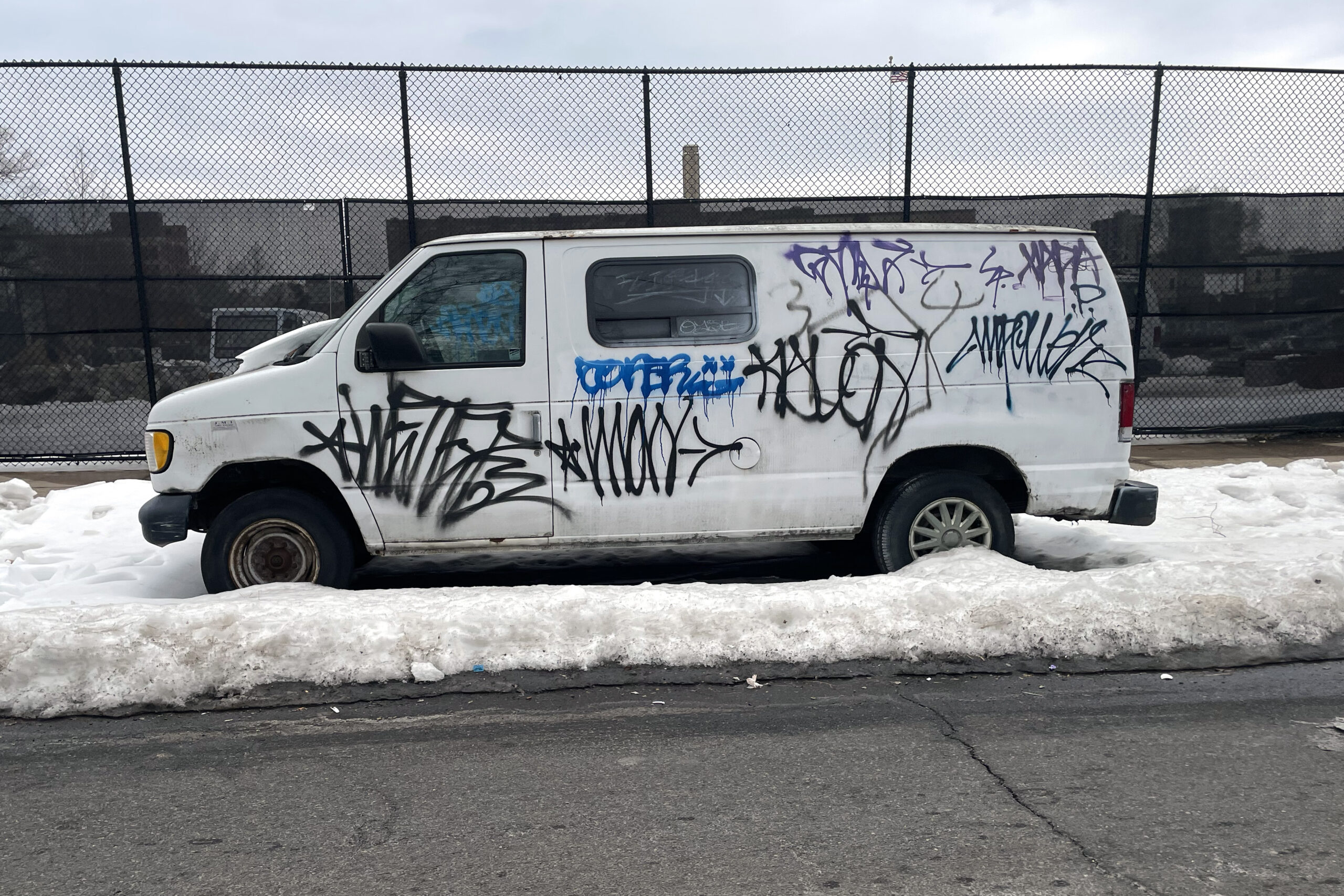
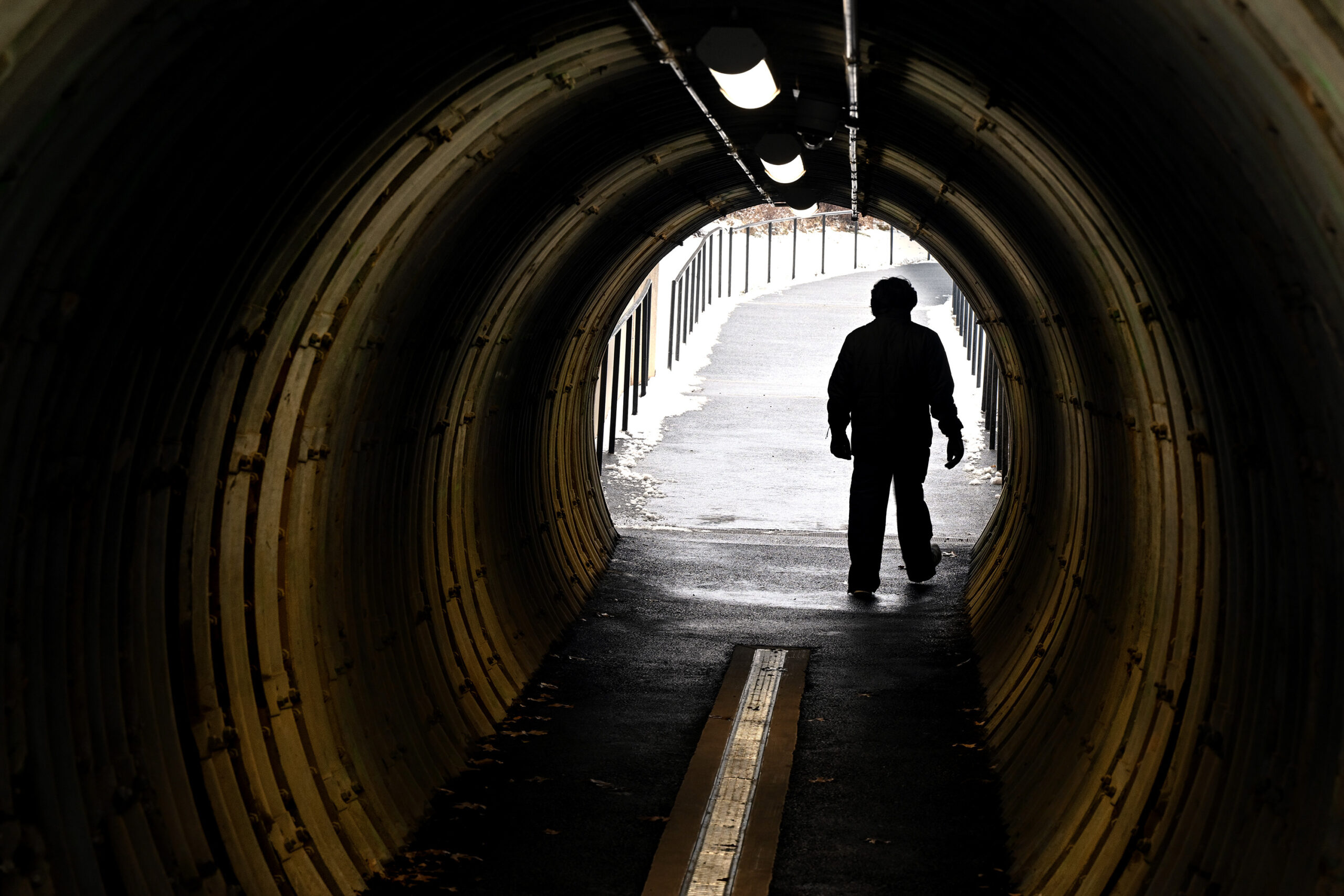
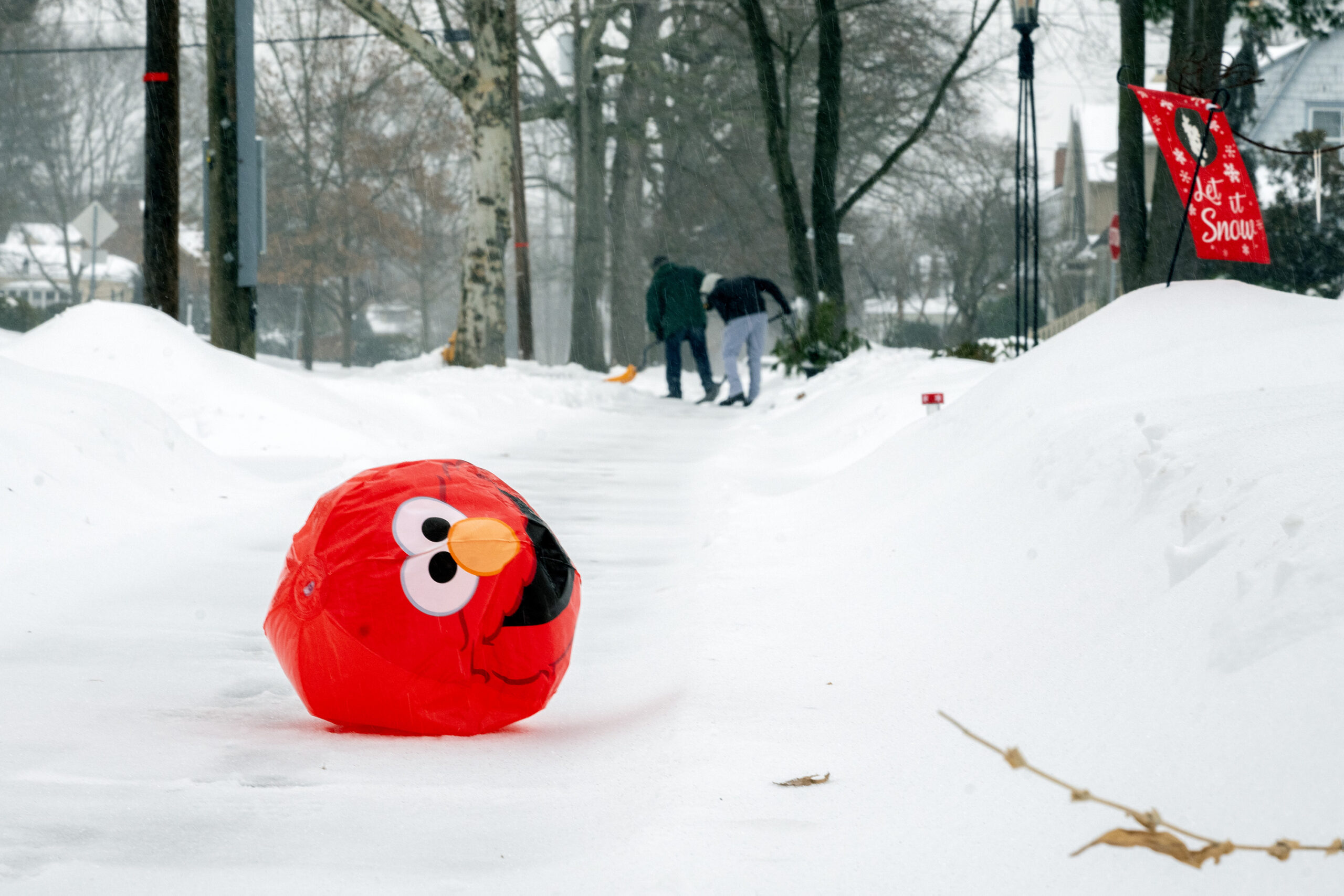
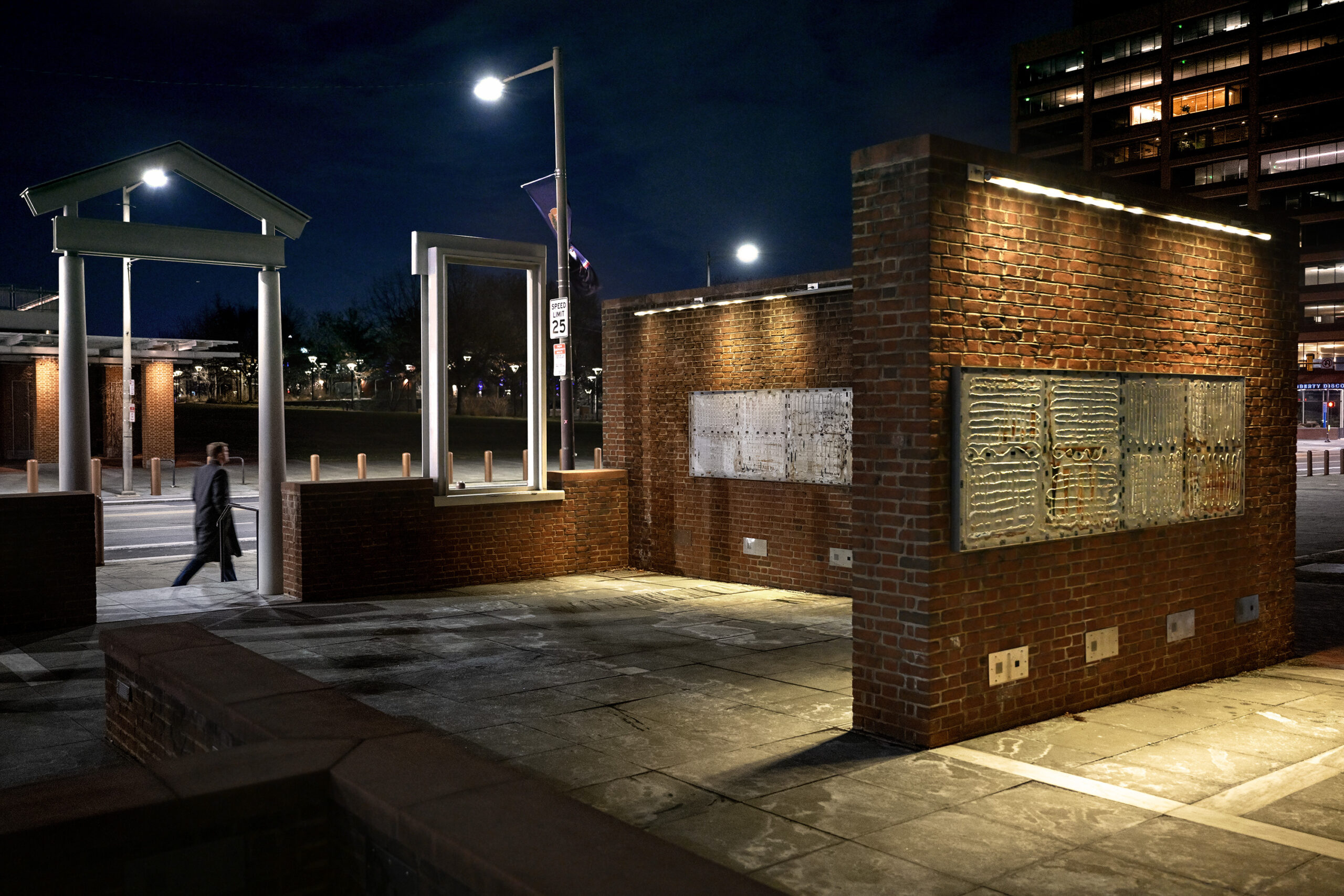
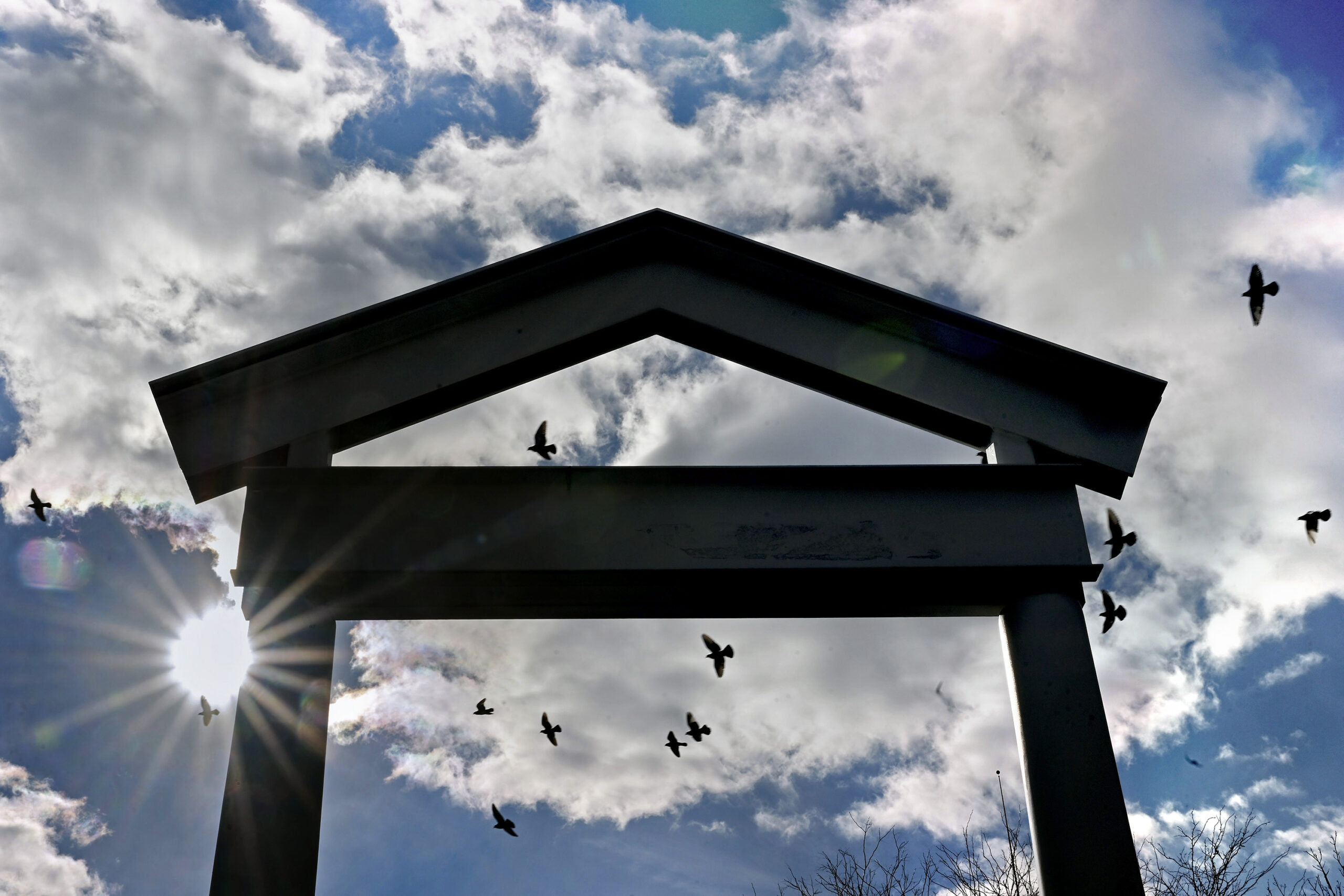
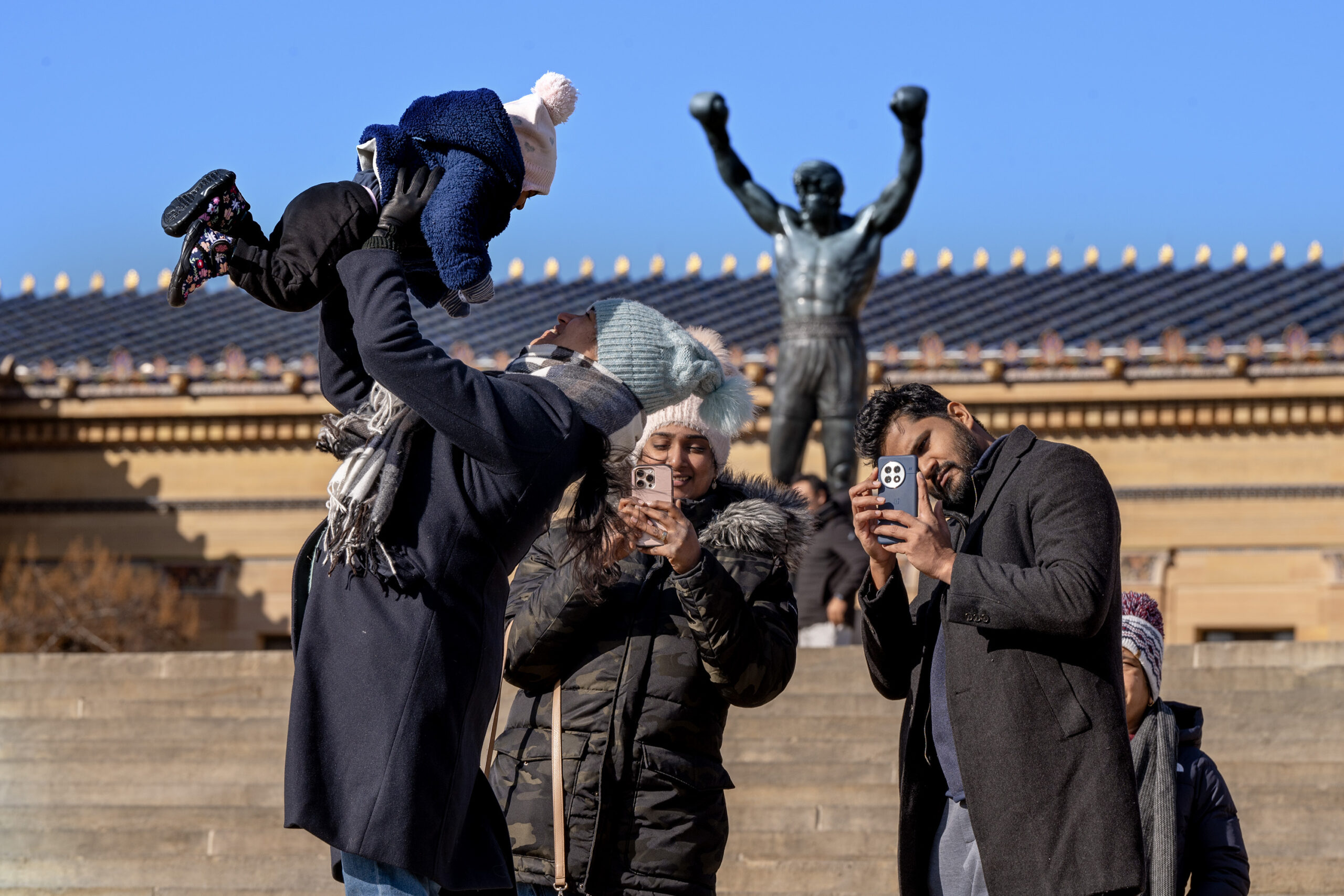
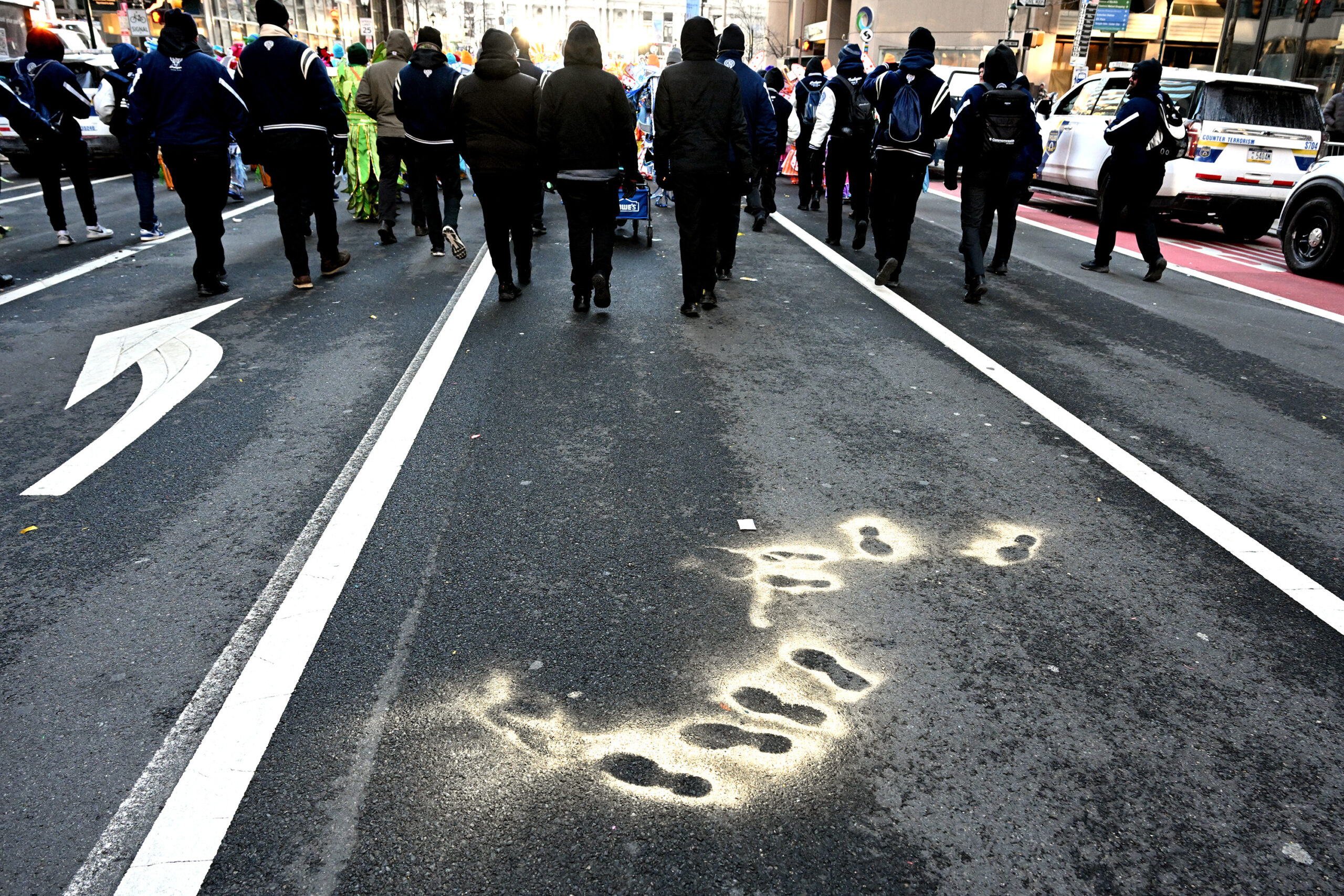
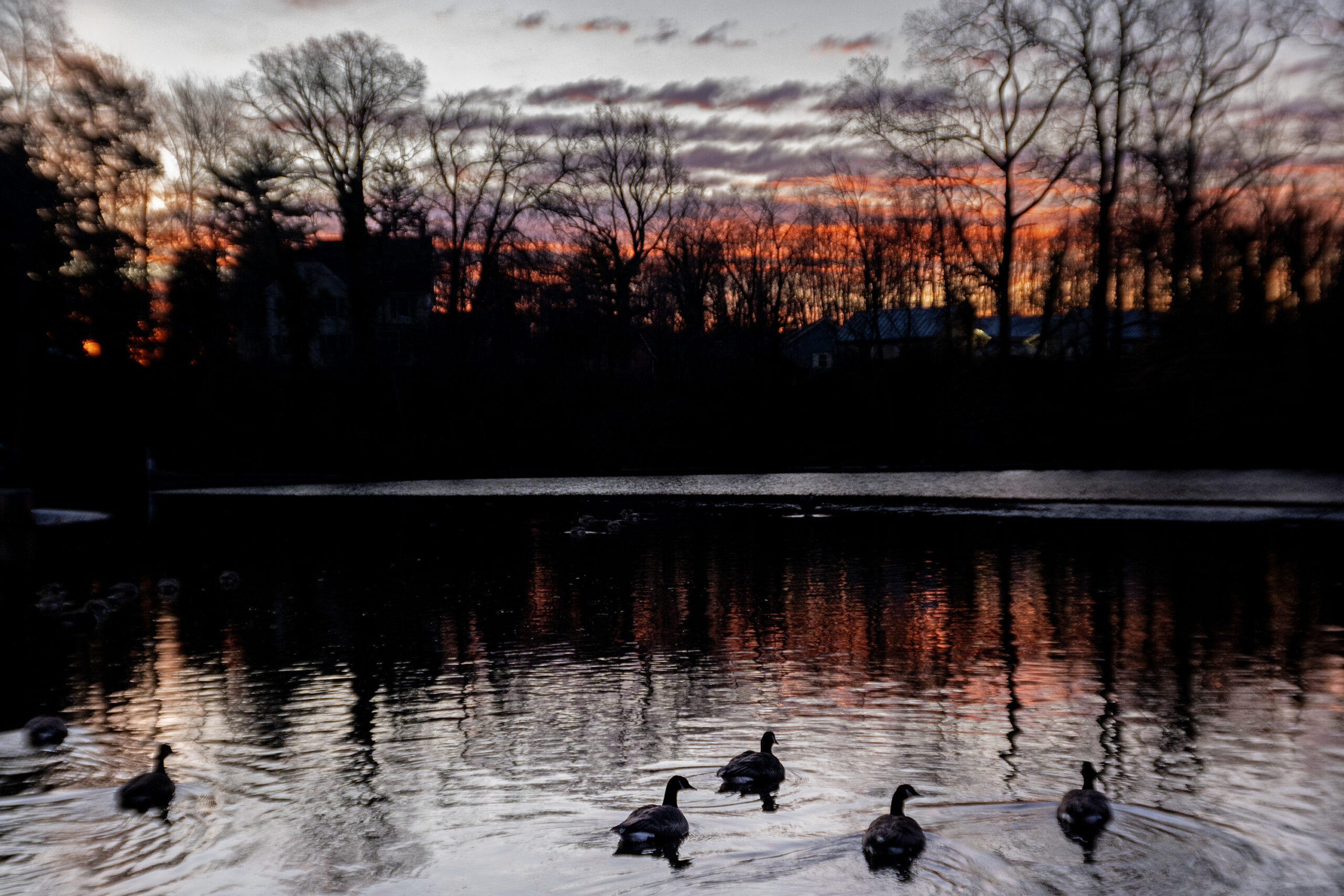
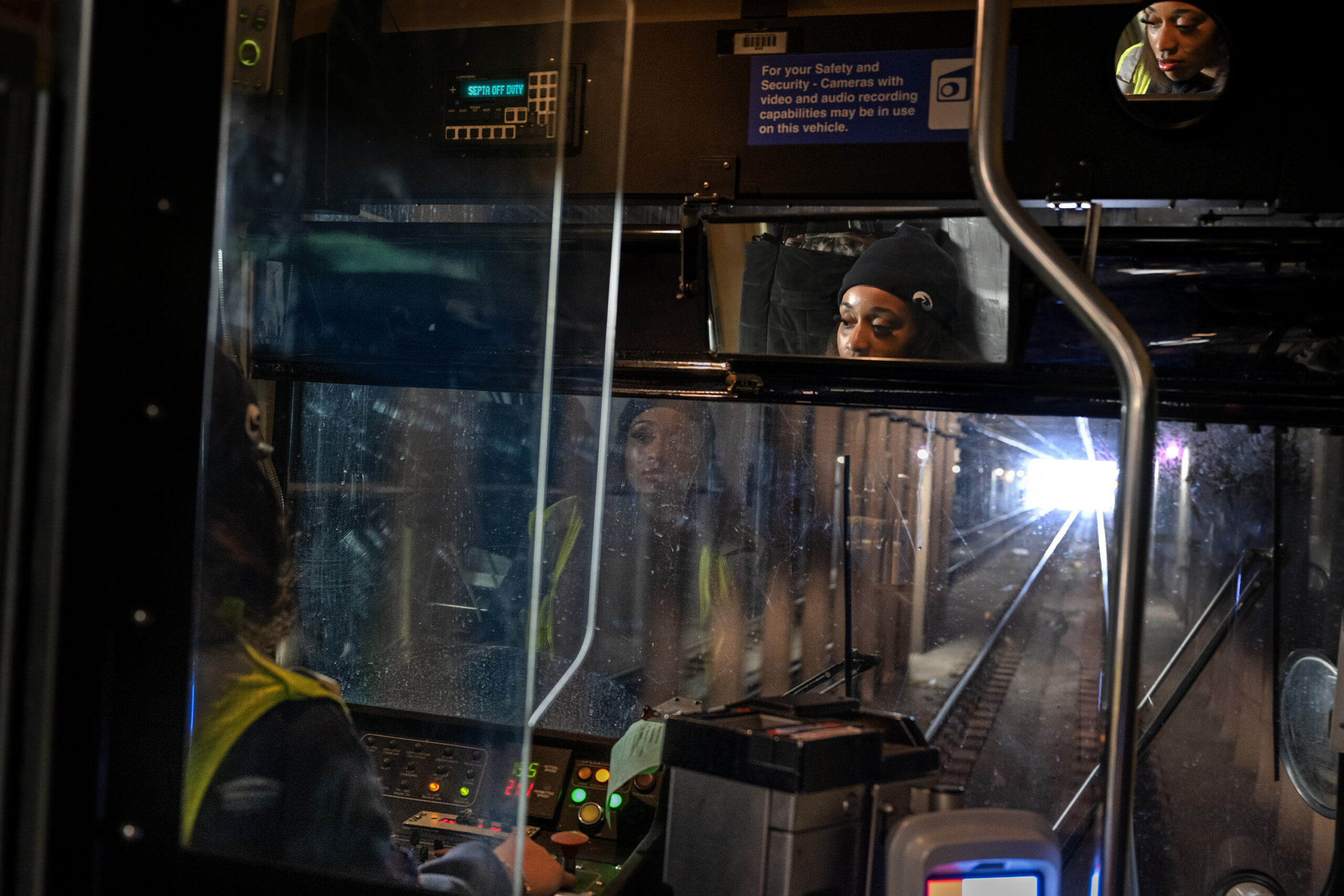
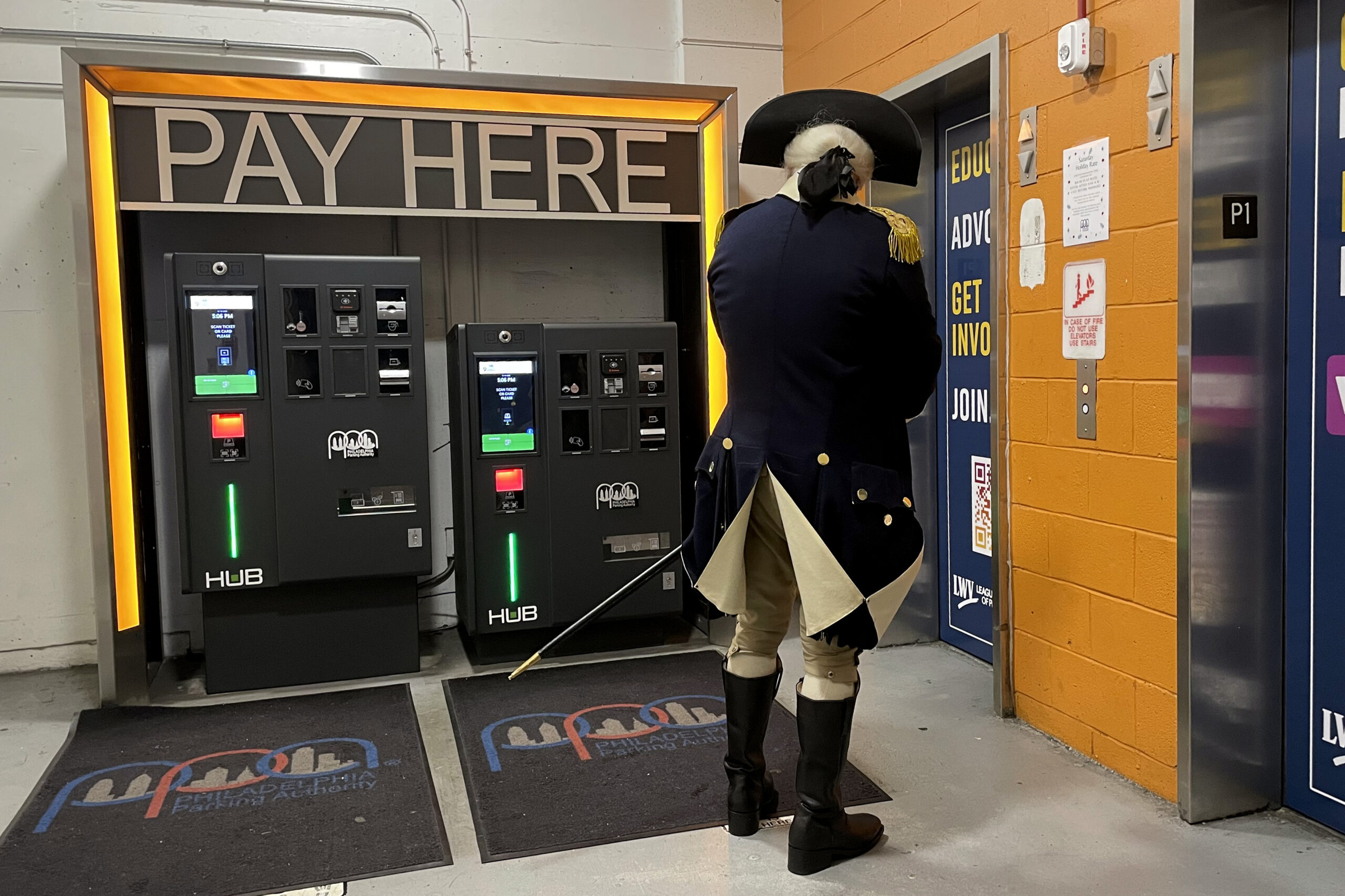
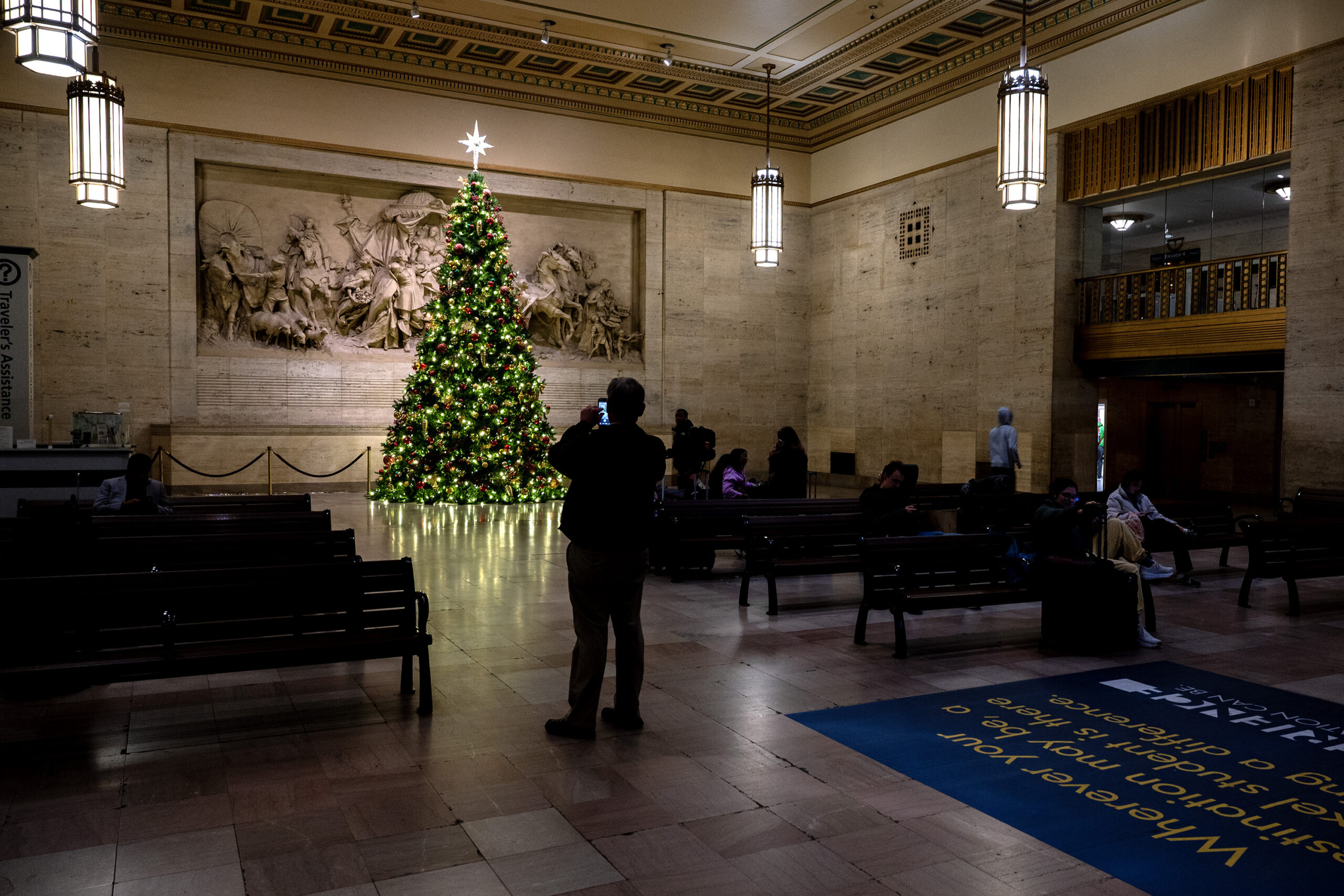
March 2, 2026: Lynasia Allen, a junior horticulture student at W.B. Saul High School is on lunch break at the Convention Center while setting up for the PHS Philadelphia Flower Show before it opened to the public. Her school’s exhibit is titled, “Up-Rooted, Re-Planted.” February 23, 2026: Bystanders at the President’s House try to prevent a “counter-protester” from ripping off notes posted by visitors where panels about slavery had been removed by President Donald Trump’s administration.February 16, 2026: What came first? The dirty snowpacked berm of frozen slush or the graffiti? February 9, 2026: Walking through a corrugated metal culvert called the “Duck Tunnel,” a pedestrian navigates the passageway under the SEPTA tracks on the Swarthmore College campus. February 2, 2026: A light-as-air Elmo balloon rolls along a sidewalk in Haddonfield, propelled by the wind as Sunday’s heavy snow starts to turn to ice and sleet. January 26, 2026: The President’s House in Independence National Historical Park hours Jan, 22, after all historical exhibits were removed following President Trump’s Executive Order last March that the content at national parks that “inappropriately disparage” the U.S. be reviewed. The site, a reconstructed “ghost” structure titled “Freedom and Slavery in the Making of a New Nation” (2010), serves as a memorial to the nine people George Washington enslaved there during the founding of America.January 19, 2026: A low-in-the-sky winter sun is behind the triangular pediment of the “front door” of the open-air President’s House installation in Independence National Historical Park. The reconstructed “ghost” structure with partial walls and windows of the Georgian home known in the 18th century as 190 High St. is officially titled, “Freedom and Slavery in the Making of a New Nation” (2010). It is designed to give visitors a sense of the house where the first two presidents of the United States, George Washington and John Adams, served their terms of office. The commemorative site designed by Emanuel Kelly, with Kelly/Maiello Architects, pays homage to nine enslaved people of African descent who were part of the Washington household with videos scripted by Lorene Cary and directed by Louis Massiah. Deepika Iyer holds her niece Ira Samudra aloft in a Rockyesque pose, while her parents photograph their 8 month-old daughter, in front of the famous movie prop at the top of the steps at the Philadelphia Art Museum. Iyer lives in Philadelphia and is hosting a visit by her mother Vijayalakshmi Ramachandran (partially hidden); brother Gautham Ramachandran; and her sister-in-law Janani Gautham who all live in Bangalore, India.January 5, 2026: Parade marshals trail behind the musicians of the Greater Kensington String Band heading to their #9 position start in the Mummers Parade. Spray paint by comic wenches earlier in the day left “Oh, Dem Golden Slippers” shadows on the pavement of Market Street. This year marked the 125th anniversary of Philly’s iconic New Year’s Day celebration.Dec. 29, 2025: Canada geese at sunrise in Evans Pond in Haddonfield, during the week of the Winter Solstice for the Northern Hemisphere. December 22, 2025: SEPTA trolley operator Victoria Daniels approaches the end of the Center City Tunnel, heading toward the 40th Street trolley portal after a tour to update the news media on overhead wire repairs in the closed tunnel due to unexpected issues from new slider parts.December 15, 2025: A historical interpreter waits at the parking garage elevators headed not to a December crossing of the Delaware River, but an event at the National Constitution Center. General George Washington was on his way to an unveiling of the U.S. Mint’s new 2026 coins for the Semiquincentennial, December 8, 2025: The Benjamin Franklin Bridge and pedestrians on the Delaware River Trail are reflected in mirrored spheres of the “Weaver’s Knot: Sheet Bend” public artwork on Columbus Boulevard. The site-specific stainless steel piece located between the Cherry Street and Race Street Piers was commissioned by the City’s Public Art Office and the Delaware River Waterfront Corporation and created and installed in 2022 by the design and fabrication group Ball-Nogues Studio. The name recalls a history that dominated the region for hundreds of years. “Weaver’s knot” derives from use in textile mills and the “Sheet bend” or “sheet knot” was used on sailing vessels for bending ropes to sails. November 29, 2025: t’s ginkgo time in our region again when the distinctive fan-shaped leaves turn yellow and then, on one day, lose all their leaves at the same time laying a carpet on city streets and sidewalks. A squirrel leaps over leaves in the 18th Century Garden in Independence National Historical Park Nov. 25, 2025. The ginkgo (Ginkgo biloba) is considered a living fossil as it’s the only surviving species of a group of trees that existed before dinosaurs. Genetically, it has remained unchanged over the past 200 million years. William Hamilton, owner the Woodlands in SW Phila (no relation to Alexander Hamilton) brought the first ginkgo trees to North America in 1785.November 24, 2025: The old waiting room at 30th Street Station that most people only pass through on their way to the restrooms has been spiffed up with benches – and a Christmas tree. It was placed there this year in front of the 30-foot frieze, “The Spirit of Transportation” while the lobby of Amtrak’s $550 million station restoration is underway. The 1895 relief sculpture by Karl Bitter was originally hung in the Broad Street Station by City Hall, but was moved in 1933. It depicts travel from ancient to modern and even futuristic times.
The buyers: Katherine Rumble, 38, public engagement manager; Benjamin Rumble, 39, graphic designer
The house: a 960-square-foot-home near South Philly’s Marconi Plaza with three bedrooms and one bathroom, built in 1957
The price: listed for $259,000; purchased for $259,000
The agent: Sue Liedke, Compass
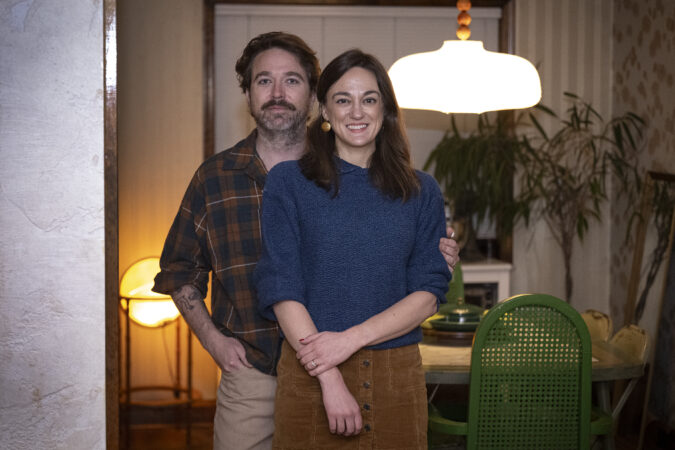
Benjamin and Katherine Rumble pin their new home in South Philadelphia.
The ask: Katherine and Benjamin Rumble were looking to leave Nashville. They wanted a city that was affordable, walkable, and had decent public transit. “Philadelphia was pretty much the only option,” said Katherine. After falling in love with South Philly, they moved in 2023 and rented a place in Point Breeze.
Two years later, they started searching for their forever home. Their wish list was specific: proximity to the Broad Street Line, central air, office space for both of them, and ideally a home that hadn’t been gutted, flipped, and turned “millennial gray.”
“We did not want to live in a doctor’s office,” Katherine said. “We wanted to live in a place that felt warm and welcoming like your grandma’s house.”
Benjamin and Katherine Rumble’s dog, Miller, relaxes in their living room.
The search: The couple already had a habit of checking Zillow regularly, but the listing that caught their attention came through Instagram.
They had long followed the account of Sue Liedke, a Philadelphia real estate agent who highlights vintage homes across the city. “We were obsessed with her account,” Katherine said. When Liedke posted a house near Oregon Station, they reached out.
The home checked many boxes. It was close to the Broad Street Line and near Marconi Plaza, which was a major plus for the couple, who have two dogs. It also had central air and enough space for both of them to work from home.
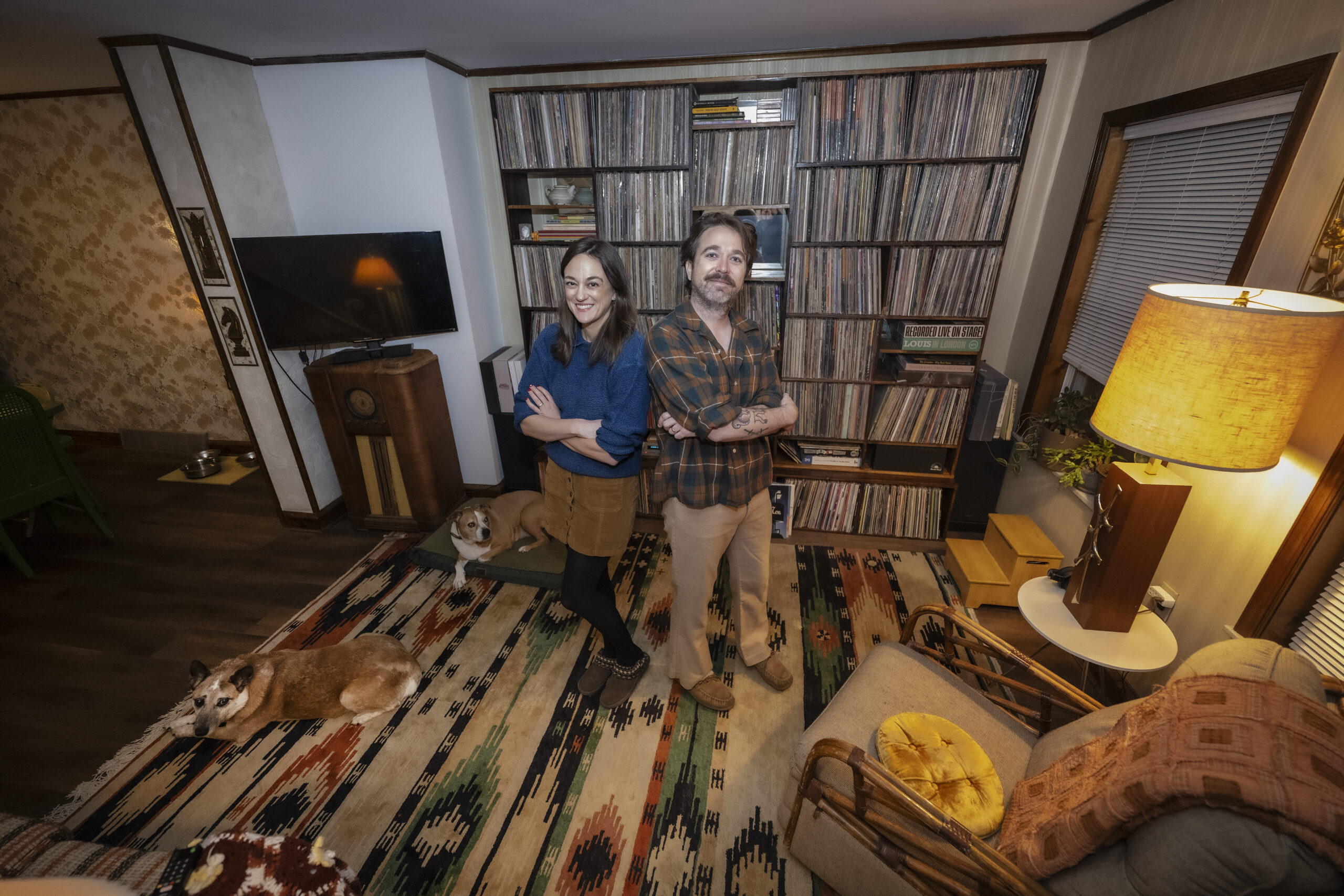
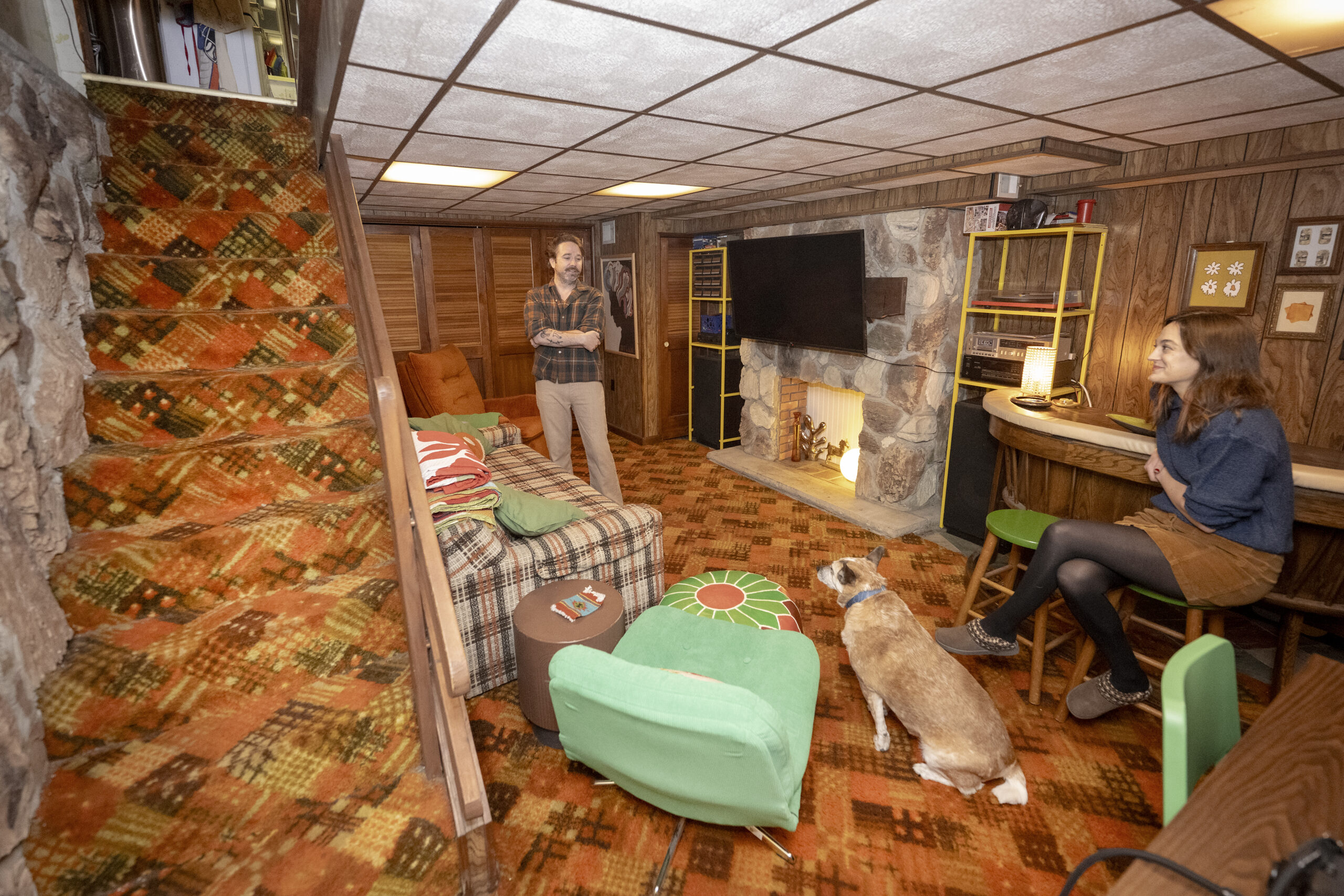
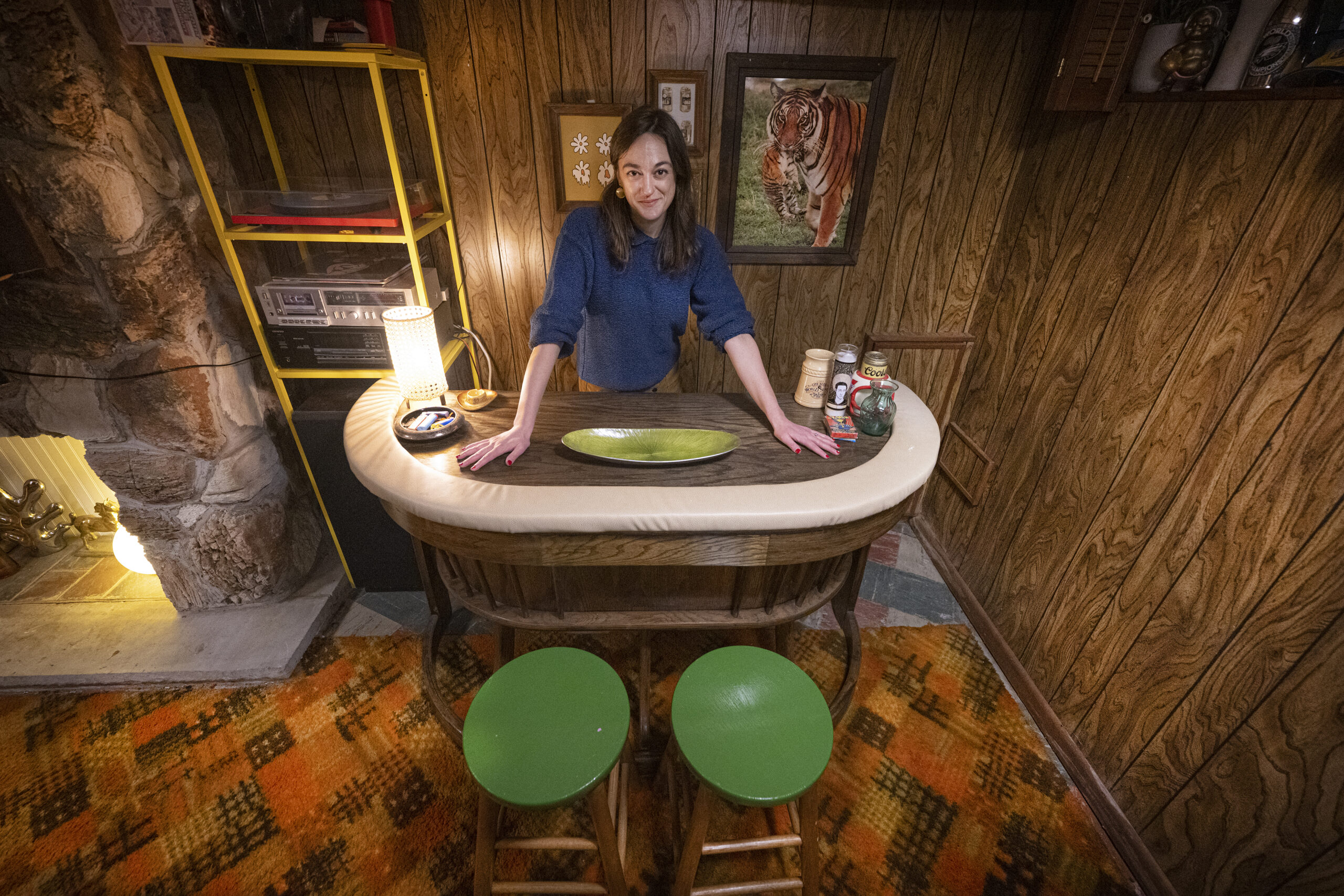
The appeal: They went to see the house immediately and loved it. “It had vibes,” Benjamin said. “The basement looked like people had been watching Eagles games down there since 1974.”
“The basement looked like someone had been watching Eagles games down their since 1974,” said Benjamin.
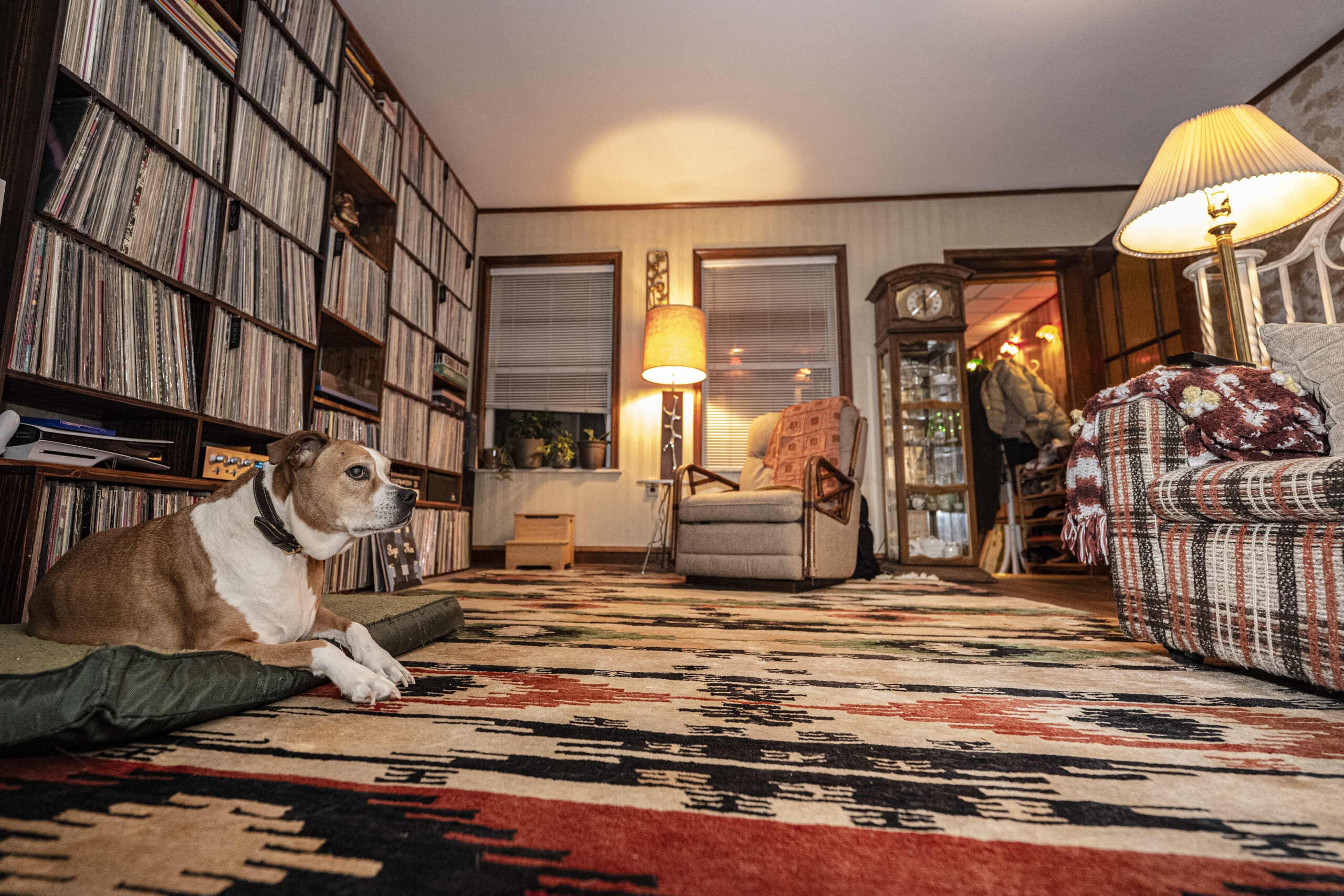
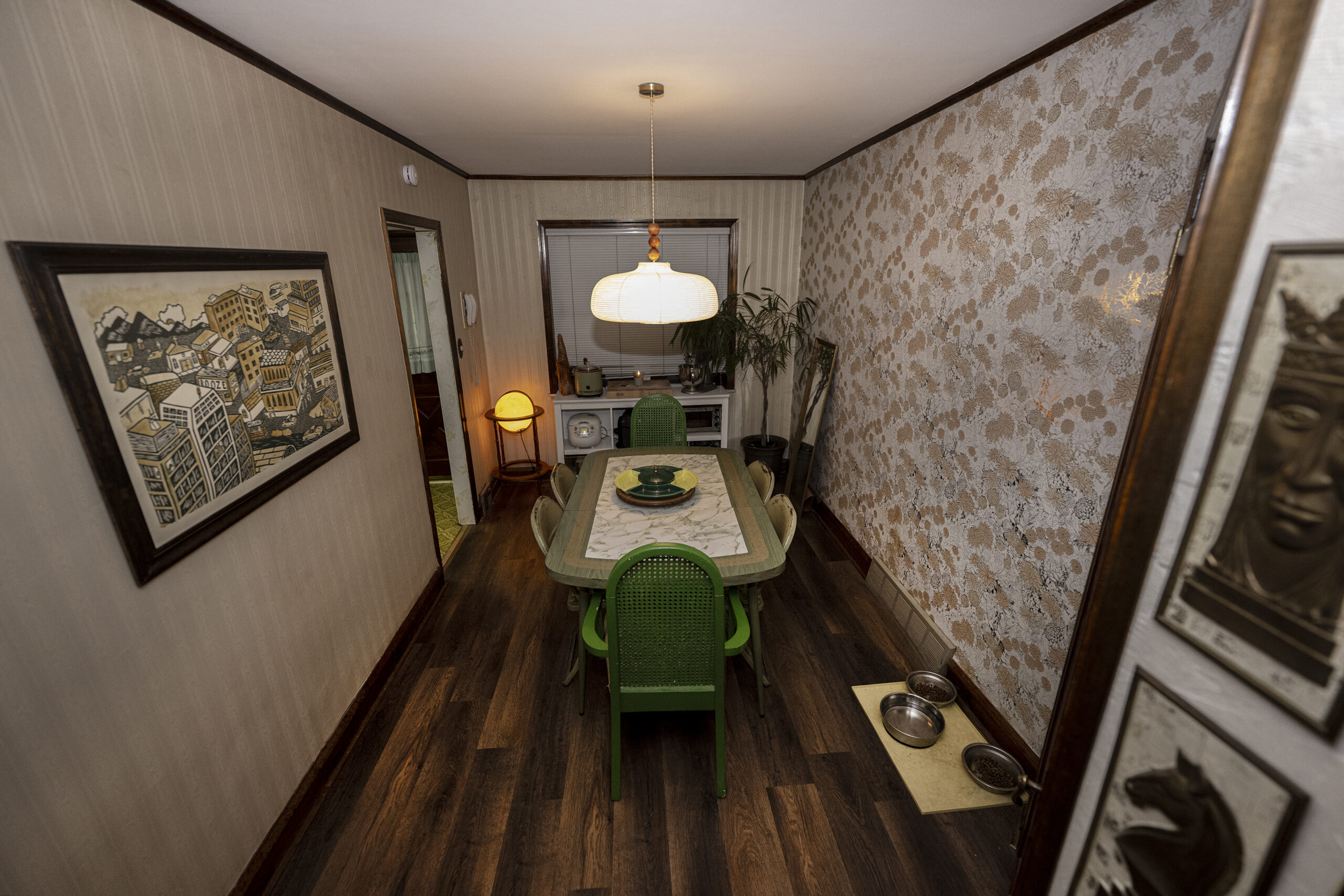
Upstairs, there were original wood doors, wood trim, and wallpaper that appeared decades old. The bathroom featured seafoam-green and pink tile and a skylight.
“We loved everything already in it,” Benjamin said. “I thought I wanted to buy a house so I could paint the walls. Then we bought this house and realized we didn’t want to change anything.”
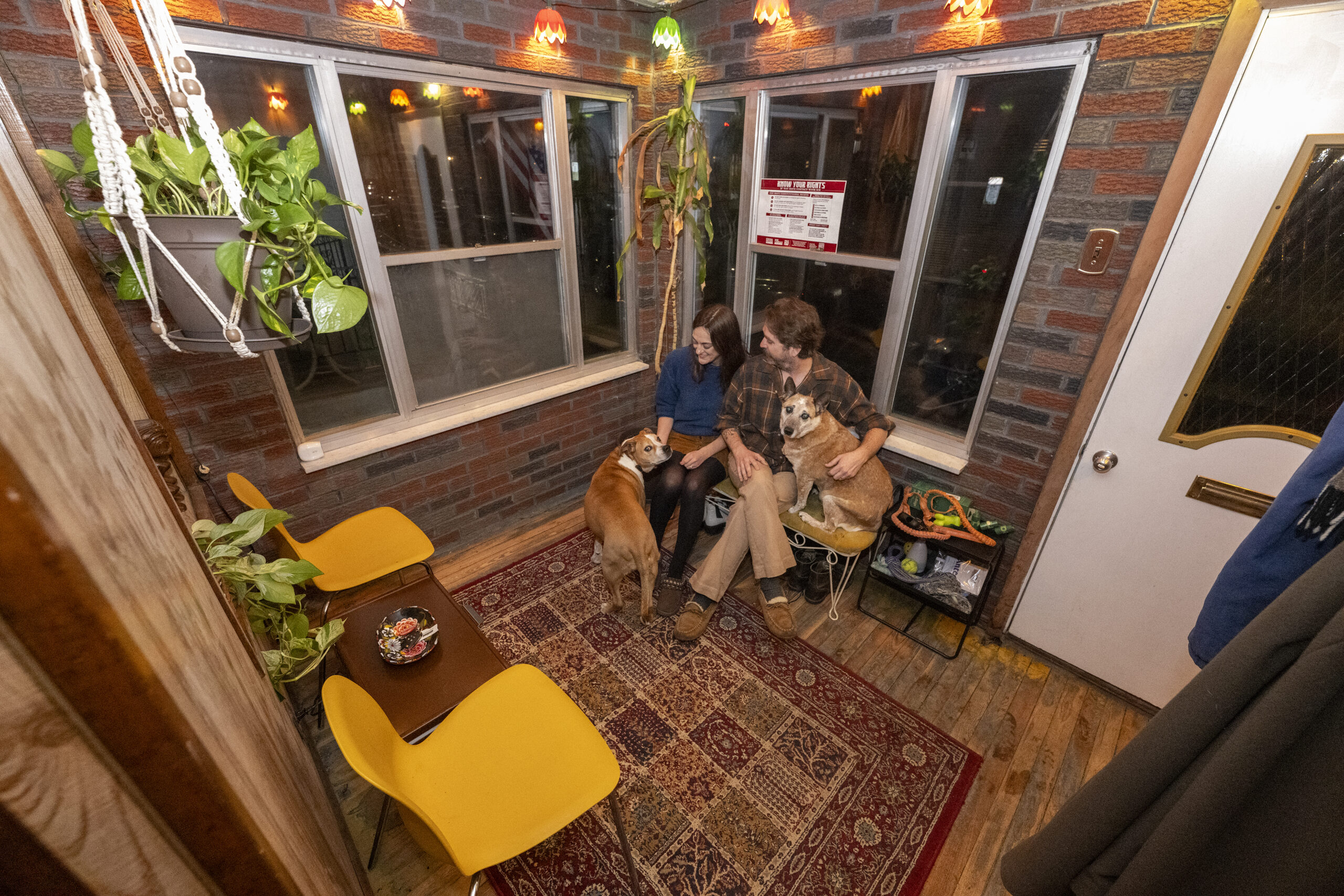
At the front of the house was a small screened-in room sometimes referred to as a Florida room, a term Katherine rejected immediately. “I said, ‘We’re not calling anything Florida in this house,’” she recalled. They renamed it “the eagles’ nest.”
For all its charm, the house did still have its drawbacks. There was only one bathroom, and the kitchen was tiny. But “it had so many of the things we wanted that it felt worth it,” Katherine said.
The deal: The house had been on the market for only a few days when they saw it. The listing price was $259,000, and it was being sold as-is, meaning the seller was not required to pay for any issues uncovered during the inspection. “It was a risk,” Katherine said.
They offered the full asking price and requested a $5,500 seller’s assist to help cover closing costs. The seller agreed and even repaired a plumbing issue that came up during the inspection, despite selling the house as-is. In the end, the appraisal came in $5,000 above the asking price, which reassured the couple that the deal made financial sense.
The money: The couple put down 5%, or $12,590.
The money came from a second retirement account Katherine opened several years earlier. “It wasn’t really making any money,” she said. She decided cashing it out to buy a home was a better investment.
Benjamin and Katherine Rumble and their dogs, Miller and Bambi, in the eagle’s nest.
After the seller credit and deposit adjustments, the couple needed $24,225 in cash to close. They used almost all their personal savings to cover the remaining costs. They are rebuilding their nest egg from $2,000.
One thing boosting their savings is their low mortgage payment. They purchased mortgage points, an upfront fee paid at closing that lowers your interest rate, to get their monthly payment below $2,000. “That was our big goal,” Katherine said. “It’s a miracle.”
The move: To save money, the couple moved themselves. They couldn’t get a full-sized truck down their narrow street, so they rented a U-Haul van and shuttled their belongings back and forth across four weekends. They also had to get rid a lot of their existing furniture, requiring extra trips to 2A Thrift and Philly AIDS Thrift. “It was harder moving 10 minutes down the road in South Philly than it was moving from Nashville to Philadelphia three years ago,” Katherine said.
Benjamin and Katherine fell in love with the home’s original details, like the wallpaper in the dining room.
Any reservations? One thing the couple wasn’t prepared to deal with was a private neighborhood sewer line. It connects all the houses on the block before linking up with the main public sewer line. The couple both grew up in parts of the country where individual houses connect directly to the main sewer line. After moving in, neighbors explained the history of the sewer line. It hasn’t caused any major issues yet, but if something goes wrong, the neighbors will have to pay for the repairs together.
Life after close: The house has influenced their interior design choices. Because it was built in the 1950s, the couple has tried to source furniture from the 1960s and 1970s.
They regularly browse thrift stores, Facebook Marketplace, and vintage shops such as Thunderbird Salvage and Jinxed.
“We’re trying to find things that fit the character of the house,” Katherine said. “It takes time to find the things you want. But it’s really exciting when you do.”
Katherine Rumble behind the bar.
It also helped that the previous owner let them keep somefurniture, including, said Benjamin, “a really rad set of couches.”
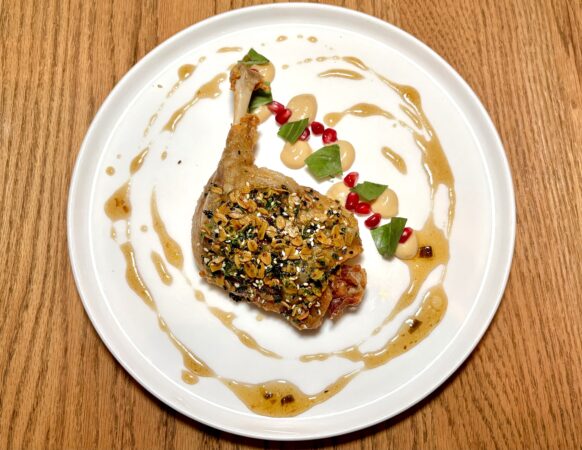
I never thought about eating duck with my granola. But adding granola to a leg of duck confit has turned out to be one of the most enduring ideas executive chef Dwain Kalup has brought to La Fia since arriving at this globally inspired bistro in downtown Wilmington, Del., almost six years ago. Kalup, who was recently named a James Beard semifinalist in the Best Chef, Mid-Atlantic category, has plenty of excellent dishes with diverse inspirations on the ever-changing menu, including a fabulous update of old-school shrimp toast (topped with crunch green papaya salad), kojinut squash-stuffed agnolotti, and irresistible deep-fried brioche beignets with herb butter.
But I can understand why this duck is one dish that never changes. It is a classic preparation at its heart, the meaty Pekin duck legs cure overnight in herbed salt with garlic before slowly simmering to tenderness in a crock of molten duck fat. The finished appetizer is all about contrasting modern flavors and textures: A glaze of yuzu koshu blends sweetness and citrusy spice while dabs of miso-mustard aioli add richness and zing. The crunch of savory granola scattered over top — oats and sesame bound with honey and tahini — lends a toasty snap to each bite of that meltingly soft duck. Add the juicy pop of tart pomegranate seeds along with the minty whiff of freshly torn Thai basil for a final flourish, and this duck has it all. La Fia, 421 N. Market St., Wilmington, Del., 302-543-5574, lafiawilmington.com
— Craig LaBan
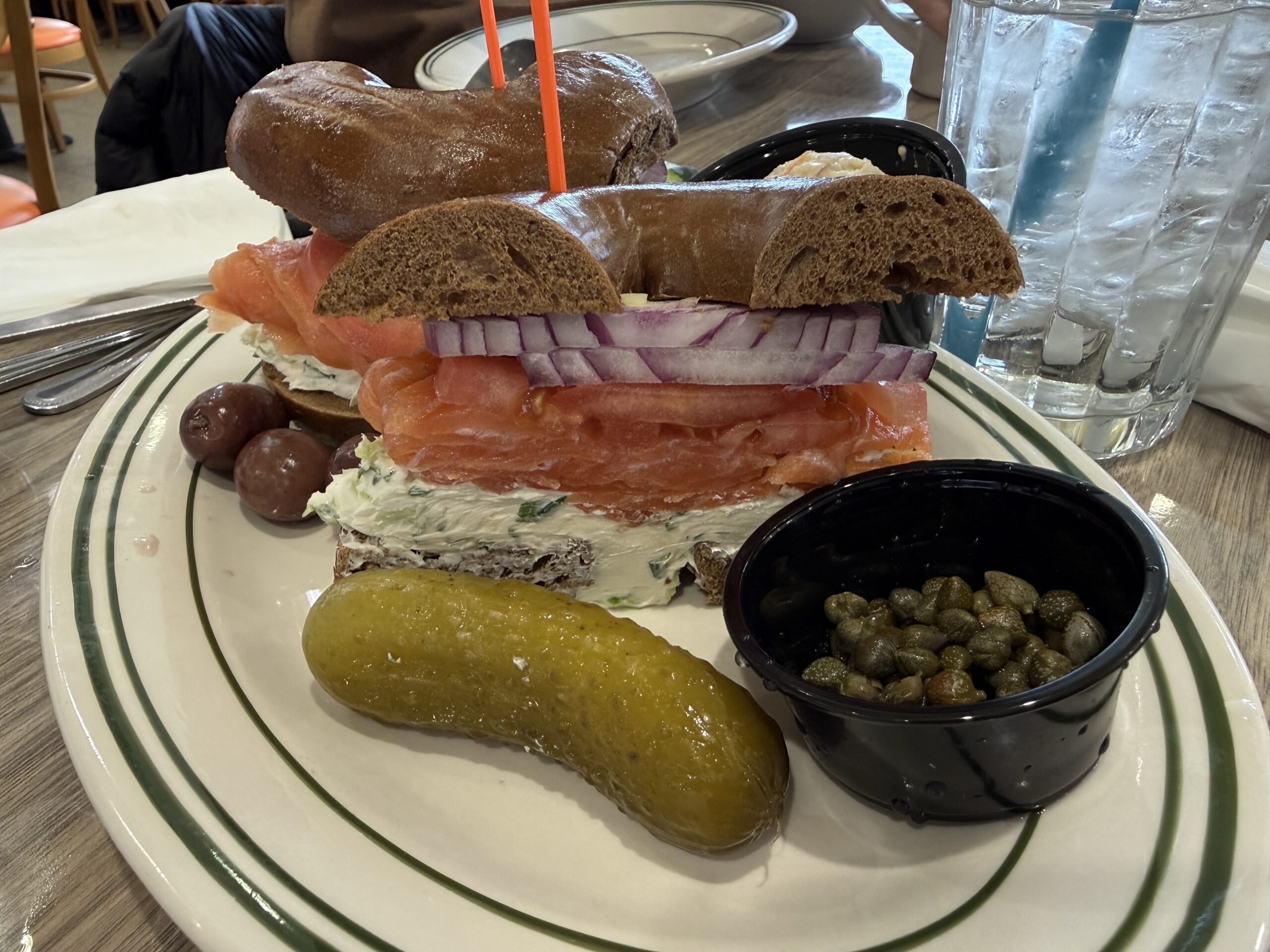
The Nova salmon bagel from Radin’s Delicatessen topped with tomato and red onion.
Nova salmon bagel at Radin’s Delicatessen
Radin’s in Cherry Hillis known (maybe even notorious) for mind-bogglingly enormous portions that make one question their economic viability, but their bagel sandwiches are perfectly portioned and surprisingly easy to tackle. This Nova salmon bagel was no exception. Baked that day, the pumpernickel bagel was warm and springy, with no need for toasting. The red onion and tomatoes — my accoutrements of choice —were crisp and fresh. The salmon was buttery, and the generous layer of chive cream cheese had just the right amount of fluff. I could taste a little bit of everything in each bite, resulting in bagel perfection. Radin’s Delicatessen, 486 Evesham Rd., Cherry Hill, N.J., 856-509-5492, radinsdelicatessen.com
— Kiki Aranita
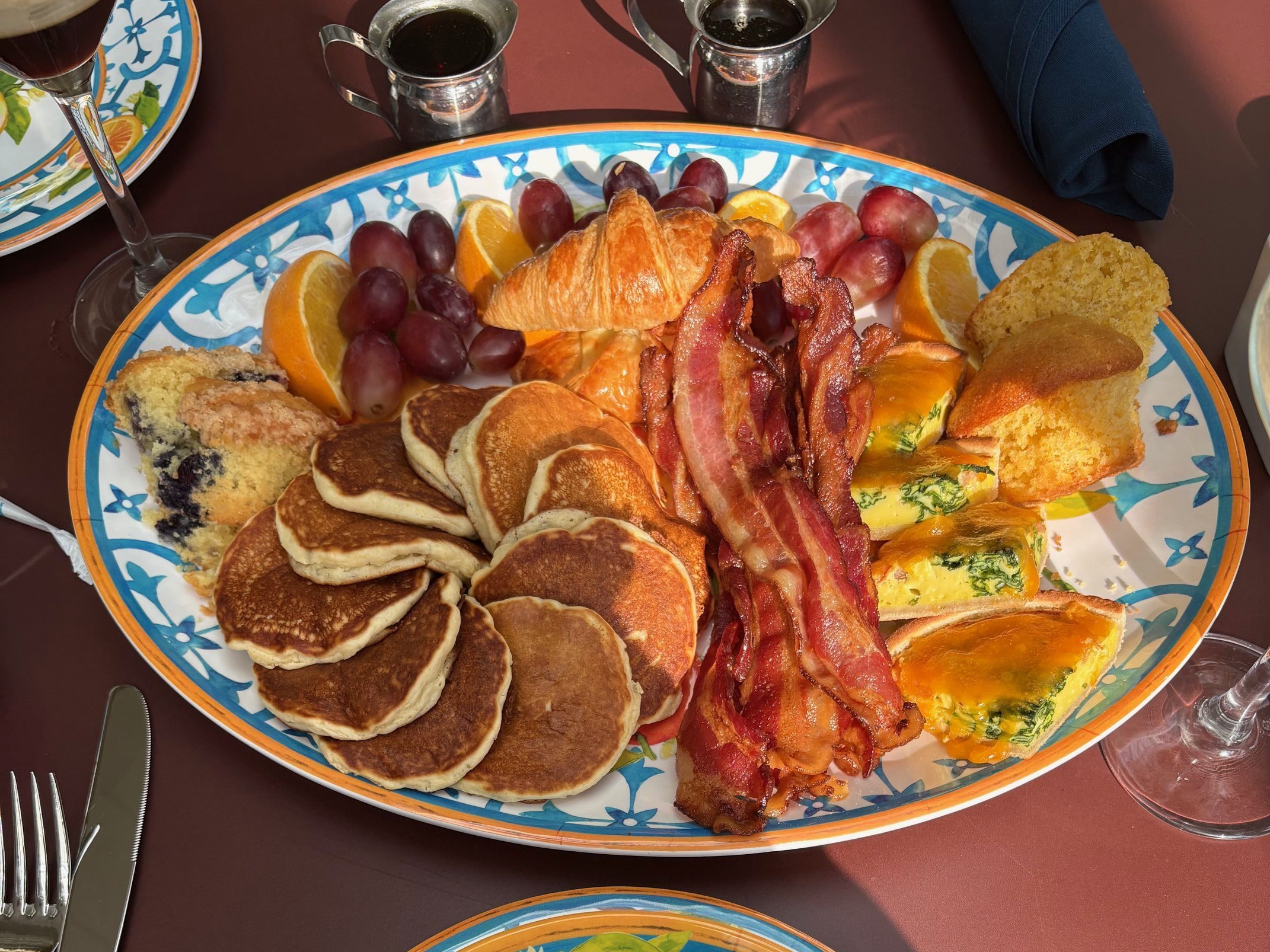
The Breakfast Board at the Sunroom at the Borgata with tasty tater-tots and espresso martinis. A pleasant start to a slow Saturday morning.
Breakfast board for two at the Borgata
A habitual nibbler, uncontrollable snacker, and expert nosher, there are few things I love better than a charcuterie board. Having so many options at my fingertips lights up my tastebuds. Up until recently I thought this rush only came from hard cheeses, jellies, and salty processed pork. Then I visited the Sunroom Lounge in Atlantic City’s Borgata Hotel and discovered its “Breakfast Board For Two.” I waited for it with bated breath.
Arrive it did. There weregenerous portions of bacon, pancakes, croissants, and sugar-topped blueberry muffins. A buttery, cheesy, melt-in-your-mouth quiche was stacked next to a hefty helping of cornbread muffins. A side of golden tater tots made this a totally-worth-the-guilt breakfast experience.
If you are going all in on a totally lazy Saturday morning, wash it down with the Sunroom Lounge’s espresso martini. The splash of vanilla vodka makes it a breakfast-cocktail winner — as in move over, mimosas. Sunroom Lounge in the Borgata Casino Hotel and Spa, 1 Borgata Way, Atlantic City N.J.; 609-317-1000, borgata.mgmresorts.com
— Elizabeth Wellington
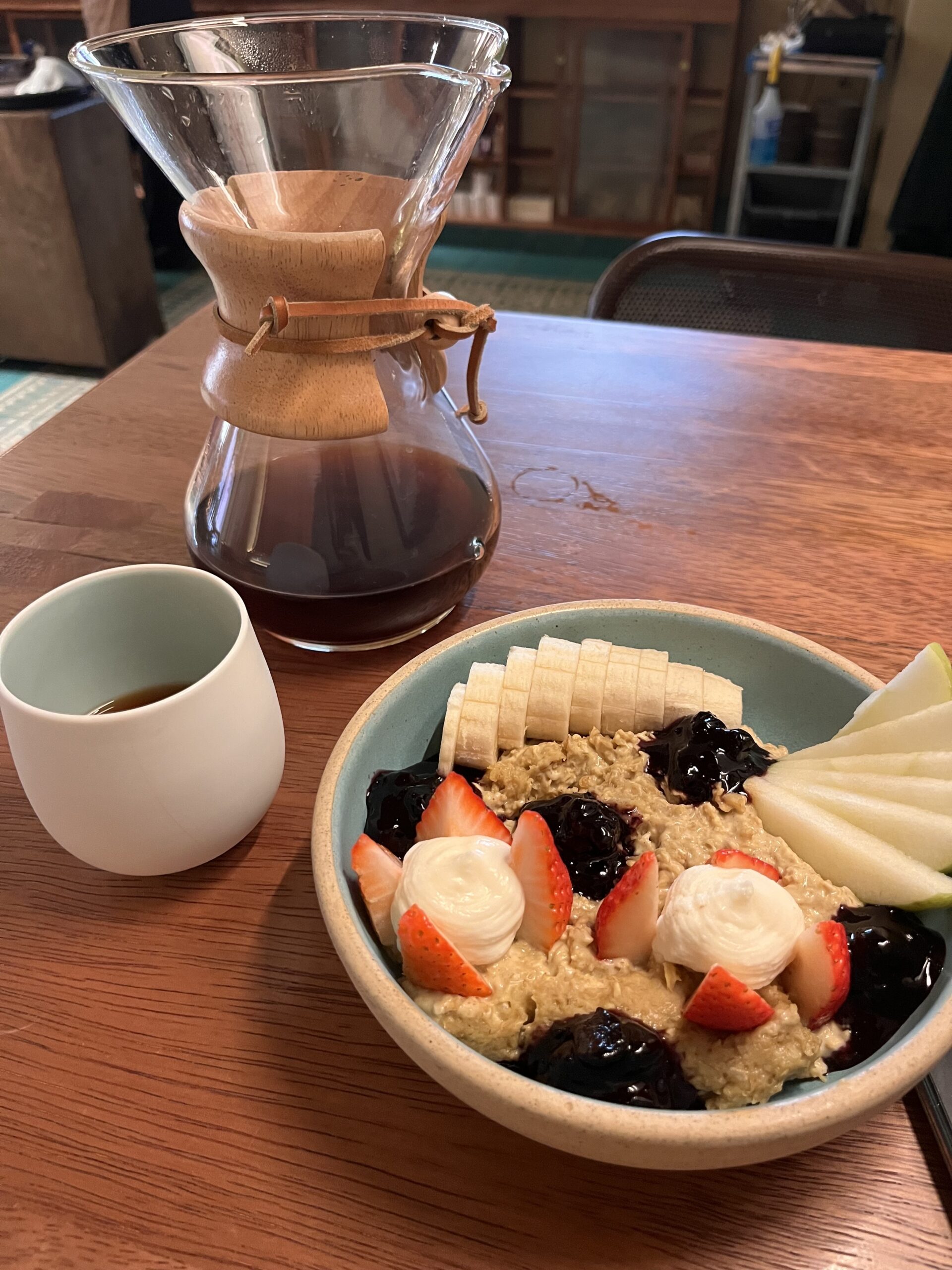
The Bowl de Avena oatmeal at La Jefa.
Bowl de Avena at La Jefa
Mornings at La Jefa are usually reserved for coffee and a little treat, like a hibiscus and raspberry concha or a dulce de leche doughnut dusted with pistachio sugar. But on the first warm Saturday in months, I was feeling alive and craved something heartier. This is where the Bowl de Avena came in, an oatmeal that feels special, much like everything else at the cafe from the family behind the historic Center City Mexican restaurant Tequila’s. The oats are steeped in golden milk, dotted with dollops of ricotta and raspberry jam, and then topped with fresh bananas, green apple, and strawberries. Paired with a natural-process pour-over from Guadalajaran coffee roaster Cafe Estelar, it made for the perfect cozy morning with a book and some sunshine. La Jefa, 1605 Latimer St., 215-475-5500, lajefaphilly.com
John Schaeffer was at a crosswalk on Main Street in Manayunk a few years ago when the walk sign illuminated and a prerecorded audio announcement told him it was safe to cross the street.
But what he heard, instead, stopped him dead in his tracks.
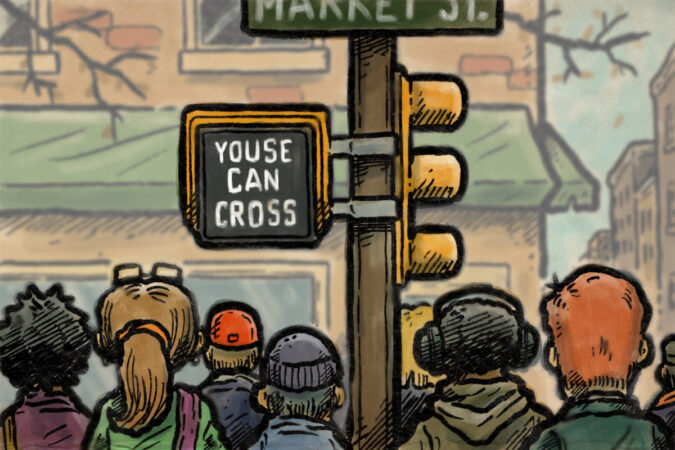
“All of a sudden it just goes, ‘Main. Wawk sign is awn ta crawss Main,’” Schaeffer said. “I was like, ‘Does this crosswalk have a Philly accent? Did I hit my head? Am I losing my mind?’”
Audible Pedestrian Signals on Philly crosswalk signs, in Philadelphia, PA, March 2, 2026.Jessica Griffin / Staff Photographer
He pulled out his phone, took a video, and sent it to a friend in Canada, who confirmed Schaeffer’s suspicions that the crosswalk indeed hadhoagiemouth.
“It feels like one of those many only-in-Philly things, of course even our crosswalks have a thick Philly accent,” Schaeffer said. “It’s mind-blowing and insanely cool. Obviously cool enough that I’ve been holding onto it for years and when you came along I thought I needed someone to get on the case and get to the bottom of this.”
Mawrket, wawk sign is awn ta crawss Mawrket.
00:00
I met Schaeffer while covering the opening of the Philly Phlush standalone public bathroom in Clark Park last year. He was the inaugural user and aftermy story published he reached out with some kind words (I’m flushed with honor that his partner got him a framed copy of the story that now hangs in his own bathroom) and with the tip about the crosswalks.
Somehow, my ears hadn’t registered the Philly accent at our crosswalks before, but that’s not a surprise. Just last weekend I asked my husband to push a button on a crosswalk sign on the Parkway only to have him tell me that it was not a button, but rather, a well-placed googly eyed sticker.
View on Threads
Once Schaeffer brought the accent to my attention though, I couldn’t stop myself from hitting the crosswalk buttons at every intersection to hear it more, like a kid on an elevator lighting up every floor.
Sampson, wawk sign is awn ta crawss Sampson.
00:00
Of course, there is no ‘p’ in Sansom Street (unless drunken revelers are celebrating an Eagles Super Bowl win), but that doesn’t stop the Philly accent from adding one because just like the people who speak it, it does whatever it wants.
I can differentiate at least two different male voices narrating these announcements, possibly three, but the enthusiasm level of all of them is like “some guy shows up at 5 a.m. with a Wawa coffee, plugs the mic in, and is like ‘Keep it moving,’” as Schaeffer so aptly put it.
No auditions
The purpose of the announcements, which are part of the city’s Audible Pedestrian Signal (APS) systems, is to let people with visual impairments know when it’s safe to cross the street.
The APS systems are administered by the Philadelphia Streets Department, whose director of operations, Thomas Buck, answered questions for me via email through a spokesperson.
Chestnut, wawk sign is awn ta crawss Chestnut.
00:00
Citywide there are 135 APS systems, but questions about exact intersections or the neighborhoods where they are located were not answered. According to Buck, intersections are chosen to receive APS systems based on upgrades, reconstruction, or “a need for enhanced pedestrian safety.”
I’m sad to report there are no tryouts to be the voice of Philadelphia’s crosswalks. The dulcet, Philly-accented audio announcements are voiced either by Streets Department employees or by staffers with the department’s equipment suppliers who are responsible for programming and assembling the APS units.
Stephanie Farr
“The individuals providing the messaging are either Philadelphia residents or in the case of the equipment suppliers, may be residents in the surrounding areas,” Buck said.
The announcements are either recorded in the traffic engineering division’s signal and sign shop in Juniata Park or in the assembly shops of the Streets Department’s respective suppliers, according to Buck.
Audible Pedestrian Signals on Philly crosswalk signs, in Philadelphia, PA, March 2, 2026.Jessica Griffin / Staff Photographer
While the intent of the message is clear, “The Philly accent was completely unintentional,” he said.
Isn’t it always.
Wooder the odds
I’ll never forget when I first heard myself say “wooder” a few years after moving here. I was so shocked I turned around to see who said it. Now, I don’t even notice when the accent comes out of me.
I was interviewed for a documentary last year and my husband’s proudest moment was when I said “mewvement” instead of “movement.” I didn’t even catch it until he pointed it out.
“You’re one of us now!” he said.
To be honest, I was proud too. The Philadelphia accent is one of the many things that gives this city such a wonderful sense of place. I never set out to procure one, it just happened through sheer osmosis of the culture over time, like becoming a Philly sports fan or bringing pretzel nugget trays to parties.
Stephanie Farr
University of Pennsylvania researchers even found that thePhiladelphia accent appears in American Sign Language , with different signs for words like ice cream, squirrel, and river being used in this region than in standard ASL.
Interestingly enough, the voice of the first APS system in the city had no Philly accent at all. In 1997, a recorded announcement telling people it was safe to cross Broad Street at Montgomery Avenue in North Philly wasvoiced by former Secretary of State Colin Powell. Over the years, Philly APS systems have also usedautomated voices and “chirping” sounds.
Earned addytood
I asked users onBluesky andThreads whose voice they’d want to convey messages to the people of Philadelphia. The clear favorite was retired 6ABC anchor Jim Gardner (no surprise there), followed closely by Eagles broadcaster Merrill Reese. Other nominees included Patti LaBelle, Terry Gross, Tariq “Black Thought” Trotter, Quinta Brunson, Jason Kelce, Gillie da King, Tina Fey, Leslie Odom Jr., Patti Jackson, Ukee Washington, Lady B, and John Kruk.
While any of them would be great, the regular Fulladulfya guys they have voicing the systems now possess a perfect mixture of Philly apathy and annoyance that I’m not sure any celebrity could duplicate — and one that certainly could never be duplicated by AI. Such an addytood can only be earned by dealing with jabronis on the streets of Philly every day.
Thurd, wawk sign is awn ta crawss Thurd.
00:00
But if the Streets Department wants to make the announcements even more beeyoodeeful, which they should, I suggest they have those who voice them start the messages off with “Gah-head” and end them with “havagudwun.”
Gah-head awn Sampson. Wawk sign is awn ta crawss Sampson. Havagudwun.
Audible Pedestrian Signals on Philly crosswalk signs, in Philadelphia, PA, March 2, 2026.Jessica Griffin / Staff Photographer
Today, looking for the Philly-accented APS systems has become “like a treasure hunt” for Schaeffer when he walks the city’s streets and he takes joy in pointing the accent out to others, all of whom think “it’s absolutely wild.”
“There’s not been a single person I’ve talked to that’s like ‘Oh yeah, that makes complete sense,’” he said.
Subscribe to The Philadelphia Inquirer
Our reporting is directly supported by reader subscriptions. If you want more journalism like this story, please subscribe today