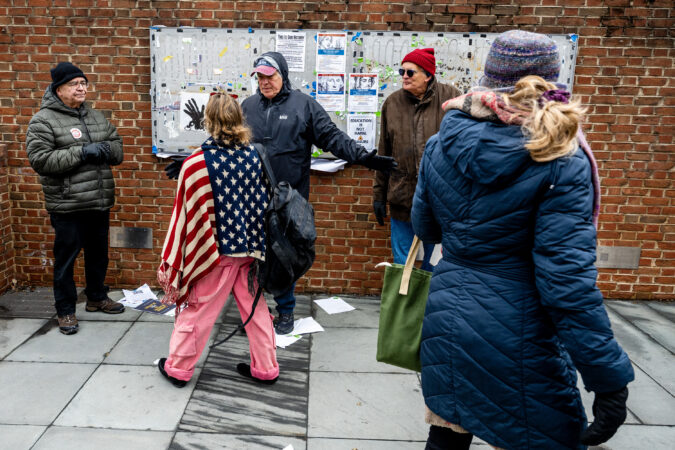
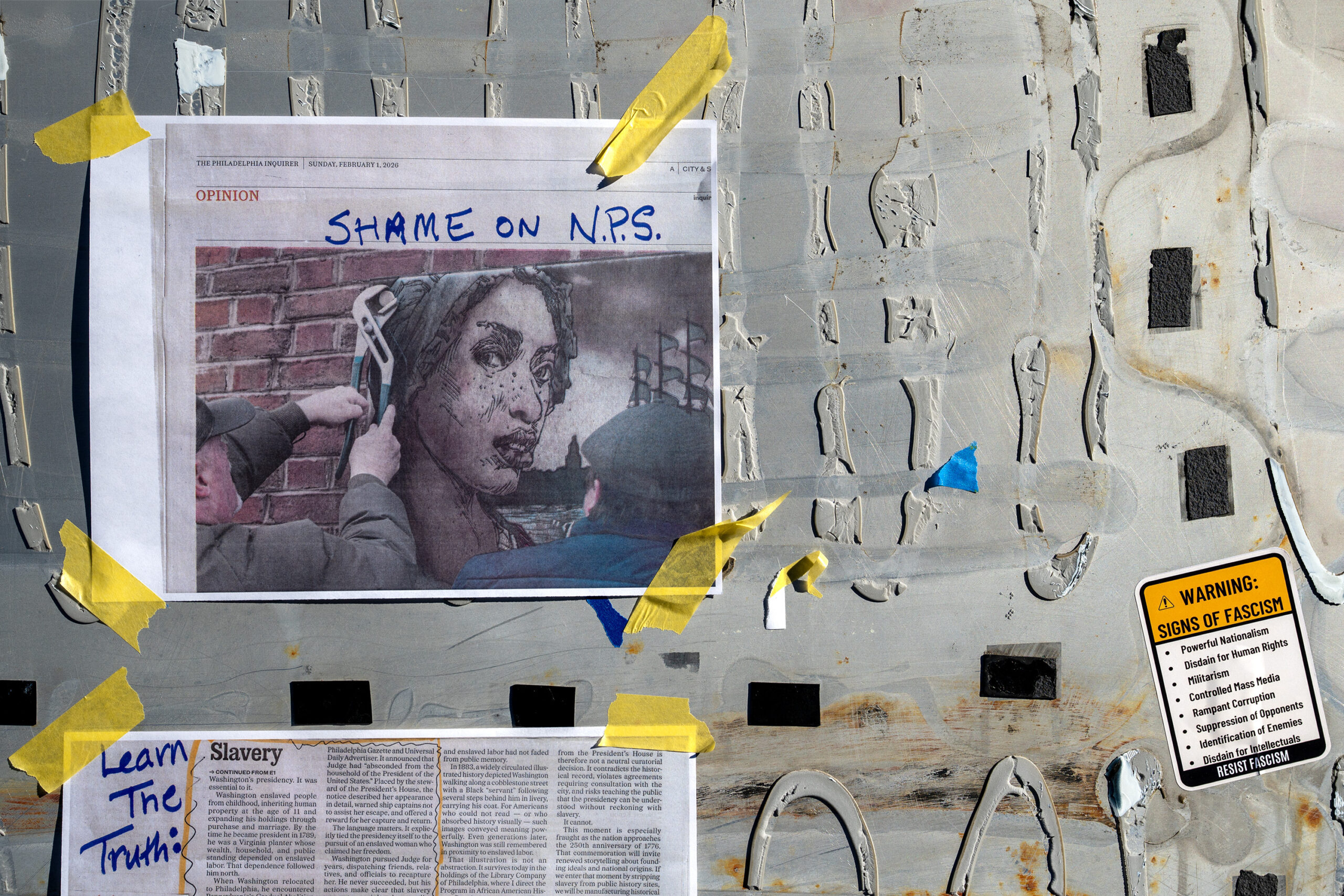
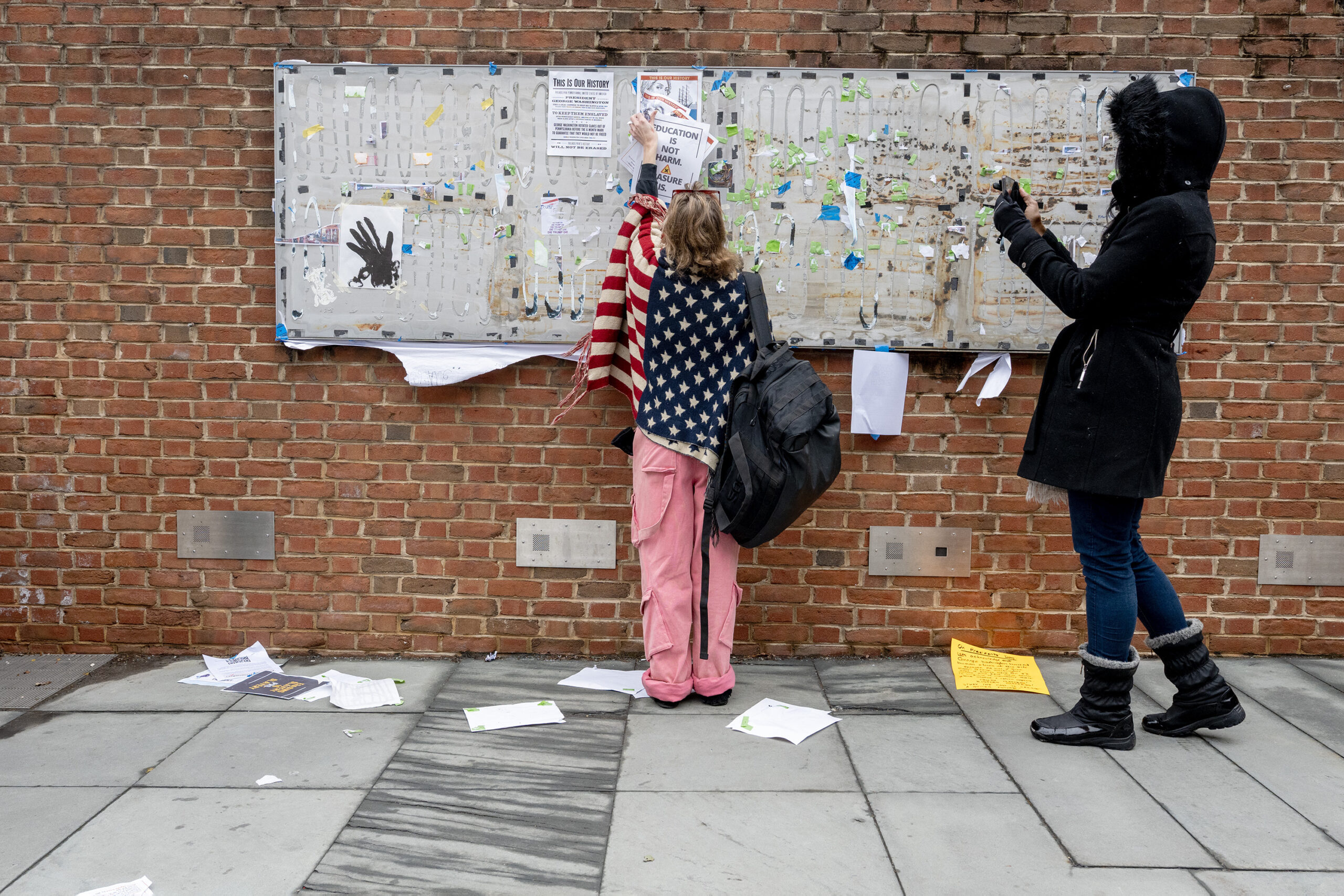
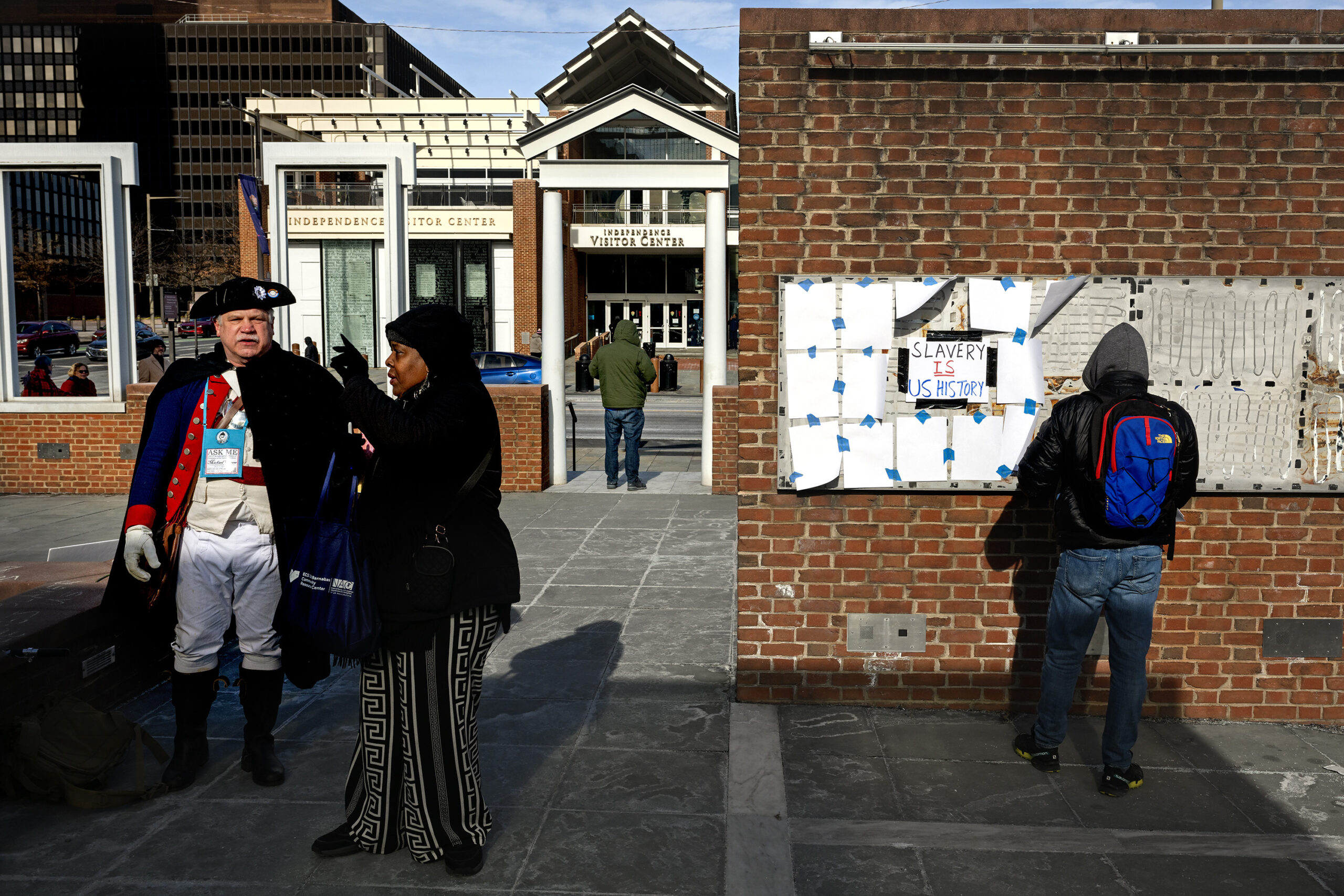
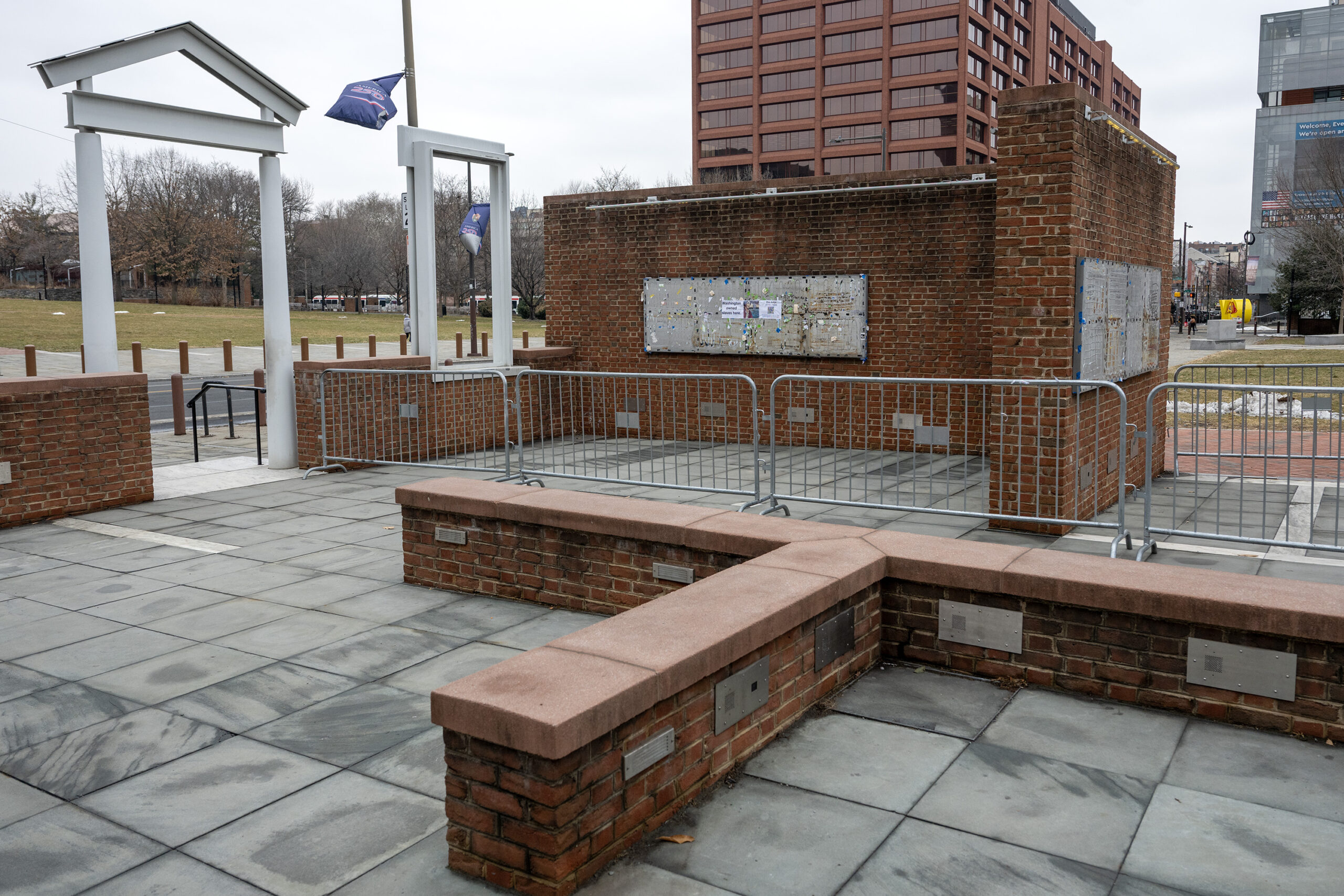
The brief confrontation came this week in front of the empty frames where visitors had been taping informal signs to fill the void where the original panels hung at the President’s House, after President Donald Trump’s administration removed the slavery exhibits last month.
Signs and notes placed by visitors at the President’s House in Independence National Historical Park.
Glenn Bergman and his wife Dianne Manning were just arriving at the Avenging the Ancestors Coalition’s annual Presidents’ Day observance. They had earlier attended the weekly ICE vigil a few blocks away. Bystanders yelled at the woman to stop as she declared it was her “First Amendment right” while tearing off the notes.
Bergman stepped in to block her, saying later, he “had to do something.” After a few seconds everyone stepped away, accusing her of “littering.”
She grabbed the papers off the ground and left abruptly, shouting “George Washington made this country great… for white people.”
The entire interaction lasted less than three minutes — and unfolded right on the other side of the wall from where the main advocacy organization leading the fight to protect the President’s House was gathered.
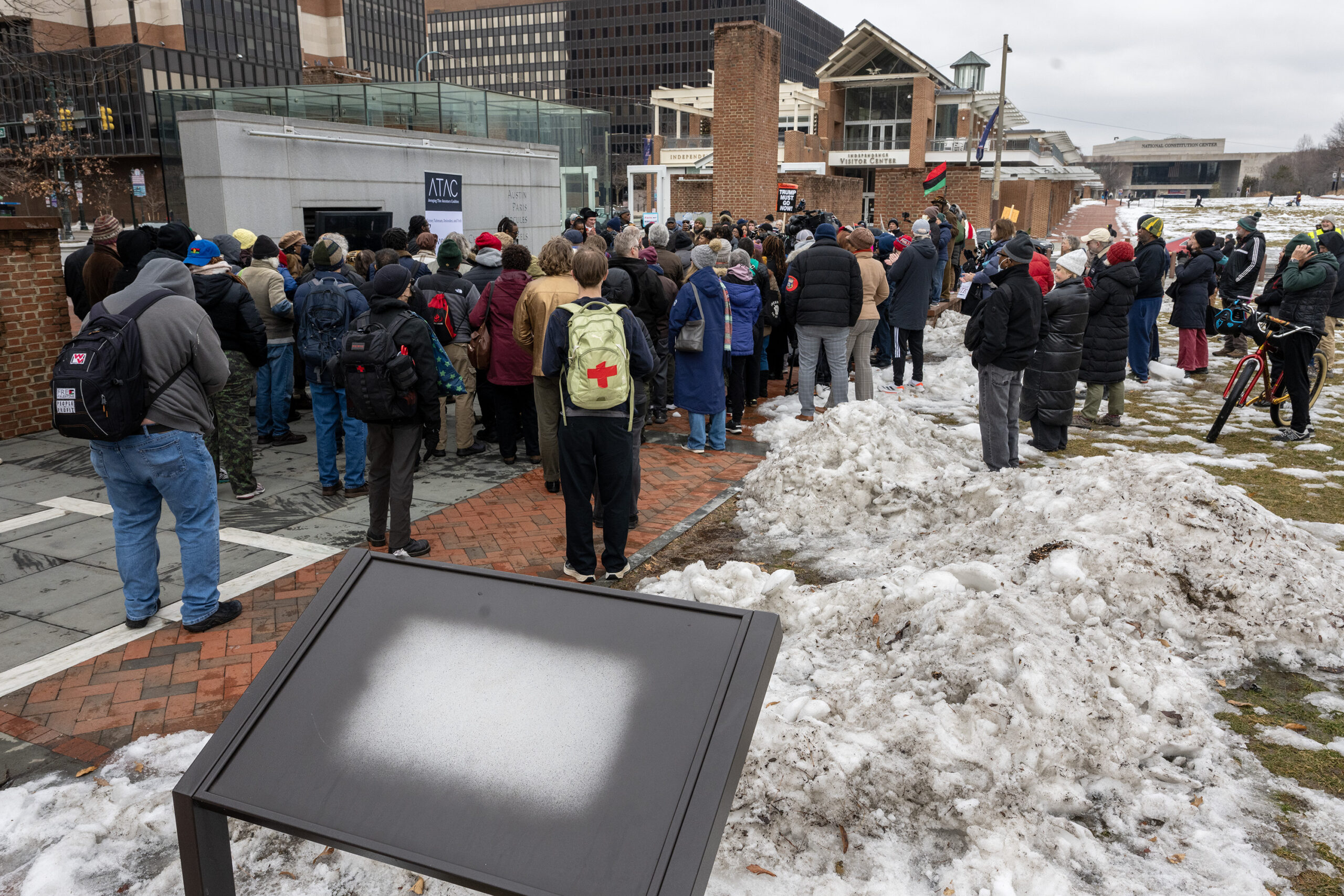
The Avenging the Ancestors Coalition holds their annual Presidents’ Day observance at the President’s House Monday, Feb. 16, 2026. The empty frame in the foreground held a panel about slavery that was removed.
As the week of Presidents’ Day ends, I’m moving that presidential apostrophe back a letter and remembering my time photographing at the President’s House.
It is almost a year since our current President signed Executive Order #14253, titled “Restoring Truth and Sanity to American History,” on Mar. 27, 2025.
In addition to requiring the Secretary of the Interior to develop a plan to improve Independence National Historical Park in preparation for our 250th birthday, he directed National Park Service staff to identify language and historical depictions that “inappropriately disparage Americans past or living.”
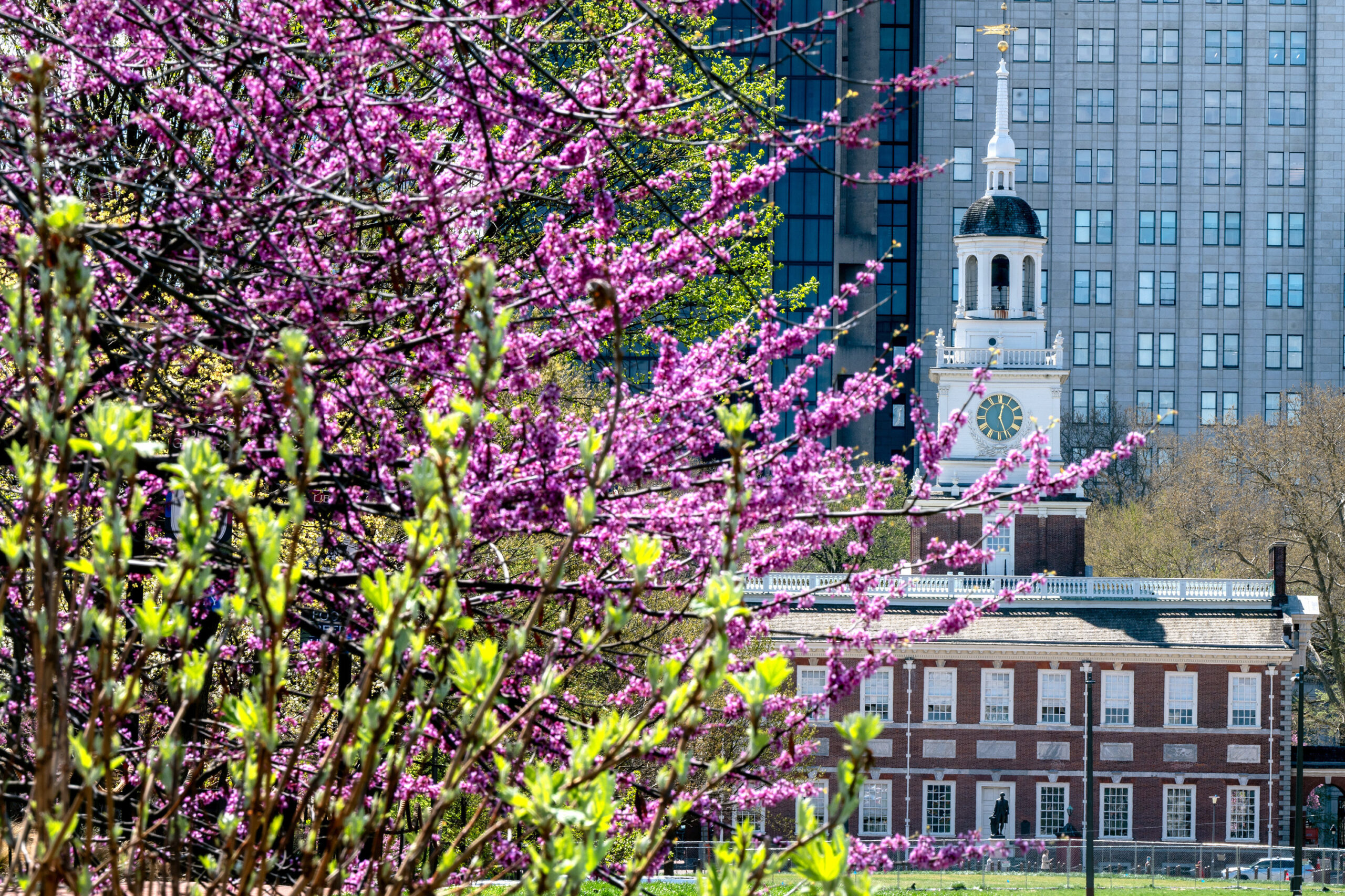
Flowering trees by Independence Hall in spring, 2025.
In May, Interior Secretary Doug Burgum issued an order that signs be posted in all National Park asking employees and visitors to report any negative information.
A sign and QR code located in Independence National Historical Park inviting the public to submit feedback on repairs, improvements, and content that is “negative about either past or living Americans.”
In July, President Donald Trump’s administration started taking steps to review or remove materials key to understanding the history of race in America.
But it didn’t happen until last month.
I was on another assignment nearby when the newspaper received a tip workers were on the site “with tape measures.”
They weren’t talking to our reporter, already on the site, when I arrived to find park service workers indeed examining the panels. So I just assumed if they would be dismantling the exhibits it would happen in the middle of the night — like when the statue of former Mayor Frank Rizzo was “disappeared” and his Italian Market mural was erased under cover of darkness in 2020.
I made a few photos then left to edit and upload, only to get a text, “it’s happening now.”
It was awkward as the workers asked me to “give us a break,” while I hovered around — not right on top of them — watching every move. I replied we were both doing our jobs.
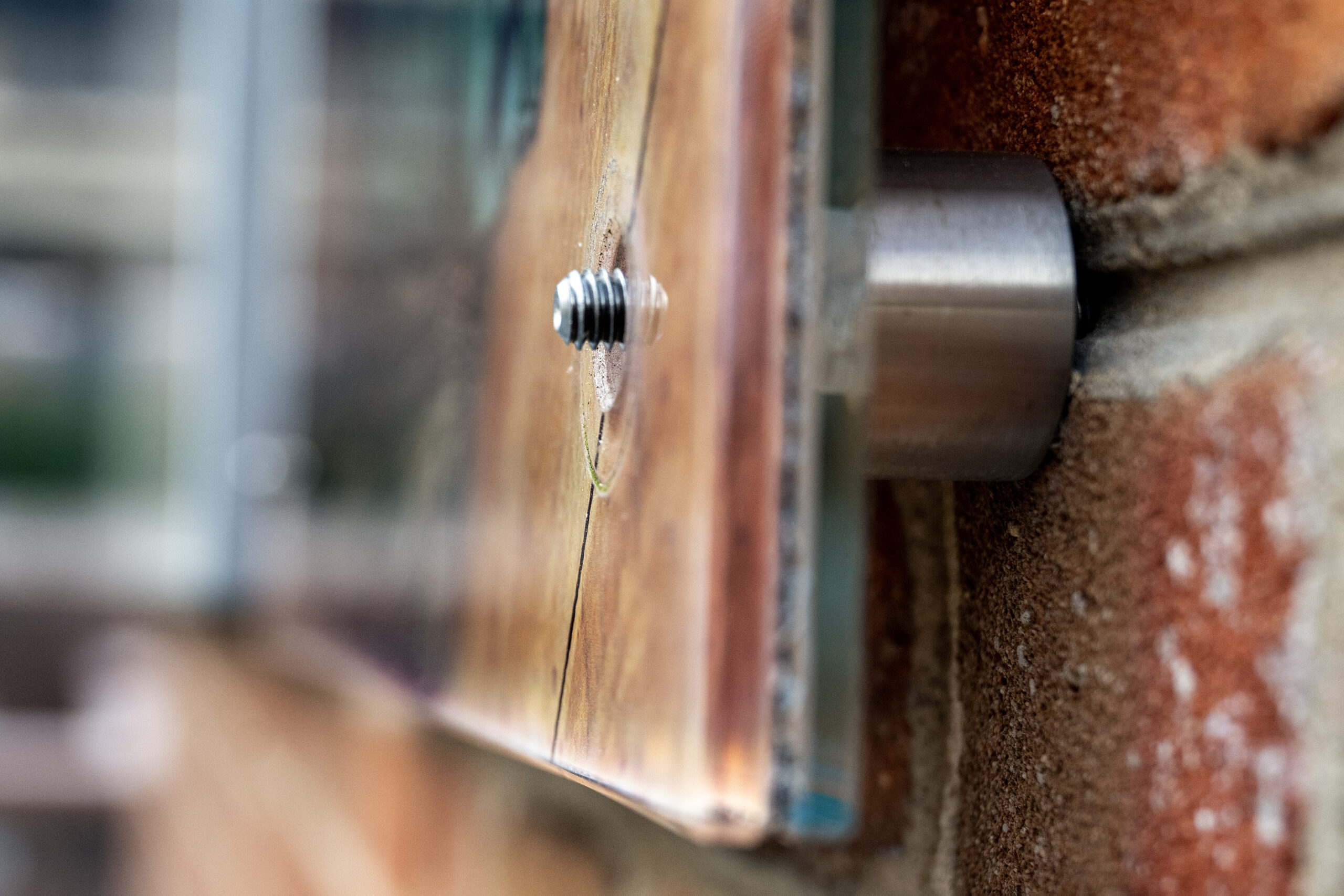
Bolts are removed from Interpretive panels as the exhibits are taken off the walls in Independence National Historical Park Thursday, Jan. 22, 2026.
It wasn’t long before other news media arrived, and I continued to document the entire removal. I was joined by photographer Elizabeth Robertson who made a photo from our newsroom overlooking the site. Later that evening, I returned to a much quieter scene.
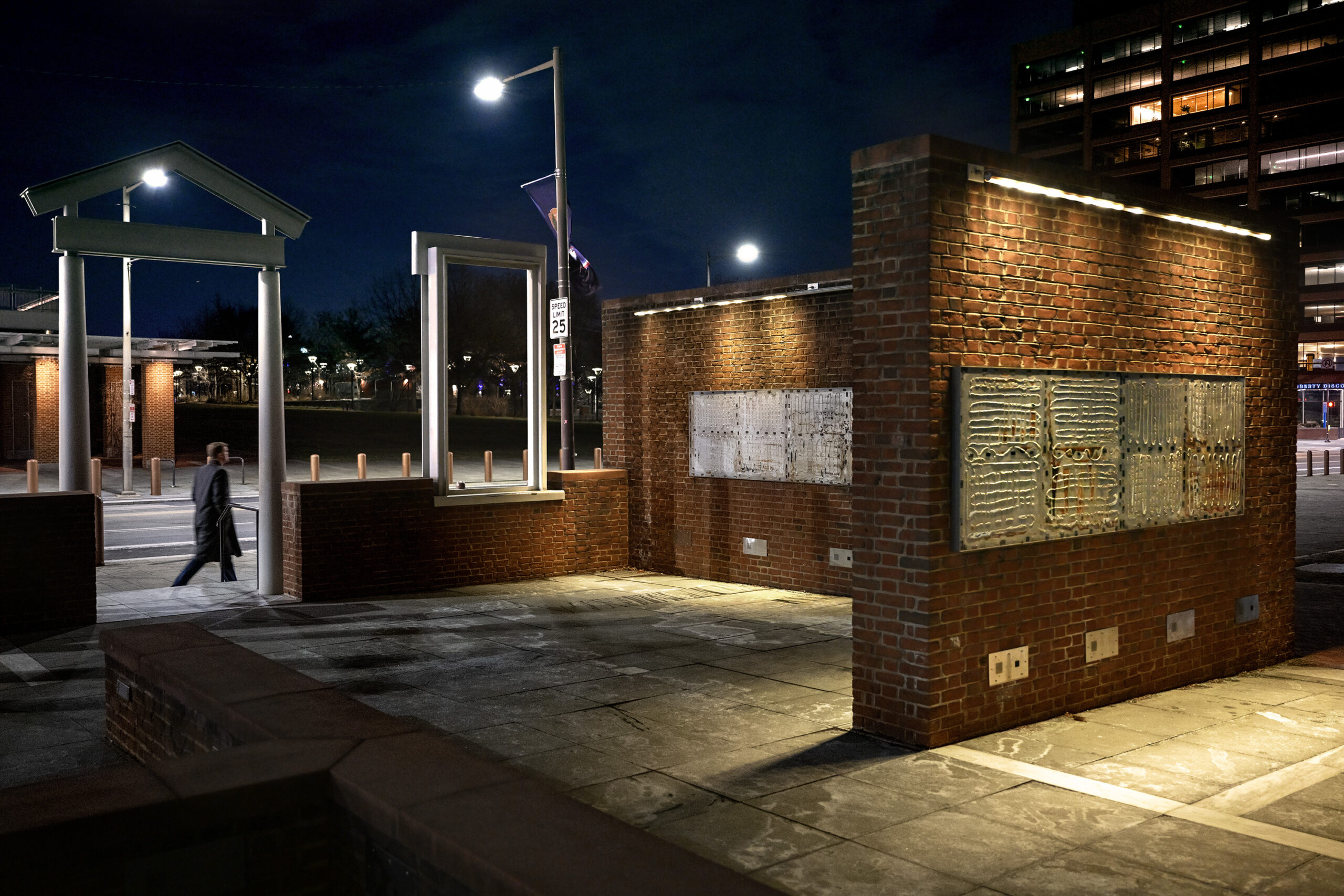
The President’s House Historical Park Jan. 22, 2026, after all historical exhibits were removed. The site, a reconstructed “ghost” structure titled “Freedom and Slavery in the Making of a New Nation” (2010), serves as a memorial to the nine people George Washington enslaved there during the founding of America.
That wasn’t the end of it. Protests continued…
Historical interpreter Michael Carver talks with visitors while he and other members of the Association of Philadelphia Tour Guides host “History Matters” offering “Free Talks with Tour Guides” Jan. 24, 2026 at the President’s House site two days after more than a dozen educational displays about slavery were removed from the site.
… and the City of Philadelphia sued the National Park Service and Department of Interior. District Judge Cynthia M. Rufe inspected the removed panels in storage for herself, visited the President’s House site, then ordered the federal government “restore the President’s House Site to its physical status as of January 21, 2026,” which is the day before the exhibits were removed.
Trump administration officials appealed her ruling calling it “unnecessary judicial intervention” and on Presidents’ Day, when Glenn Bergman and Dianne Manning of Mt. Airy were attending the Avenging the Ancestors Coalition rally, Judge Rufe issued an injunction that required the federal agencies to restore the interpretive panels.
So we all waited to see what happened next. The “what’s next?” was two days later the federal judge, citing the agencies’ “failure to comply” set a deadline of 5 p.m. Friday.
A spokesperson for the White House defended their inaction saying removal of the exhibits is not final because the Department of the Interior is “engaged in an ongoing review of our nation’s American history exhibits in accordance with the President’s executive order to eliminate corrosive ideology, restore sanity, and reinstate the truth.”
A cleaded up and power-washed President’s House site the day after a federal judge ordered the Trump administration to restore the slavery exhibits that the National Park Service removed from the President’s House in January.
Upon hearing the news I thought, “Friday is my day off. I will just have to read what my excellent reporting colleagues Fallon Roth, Maggie Prosser, and Abraham Gutman write about it. And live vicariously through the photos by whichever of my photo co-workers gets the assignment.“
I just couldn’t stay away, so I returned to the site early Thursday morning, just to “babysit.”
After about 30 minutes and only seeing two visitors, a park service worker arrived with a 5-gallon Lowe’s plastic blue bucket ($4.95, lid sold separately) and another, plain white plastic pail full of rags. More prep work for Friday, my day off, I figured.
When he returned with a six-foot Little Giant ladder ($255.99, King Kombo), I asked “so you’re not just doing more cleaning, right?”
I alerted my newsdesk, and spent the next six hours there.
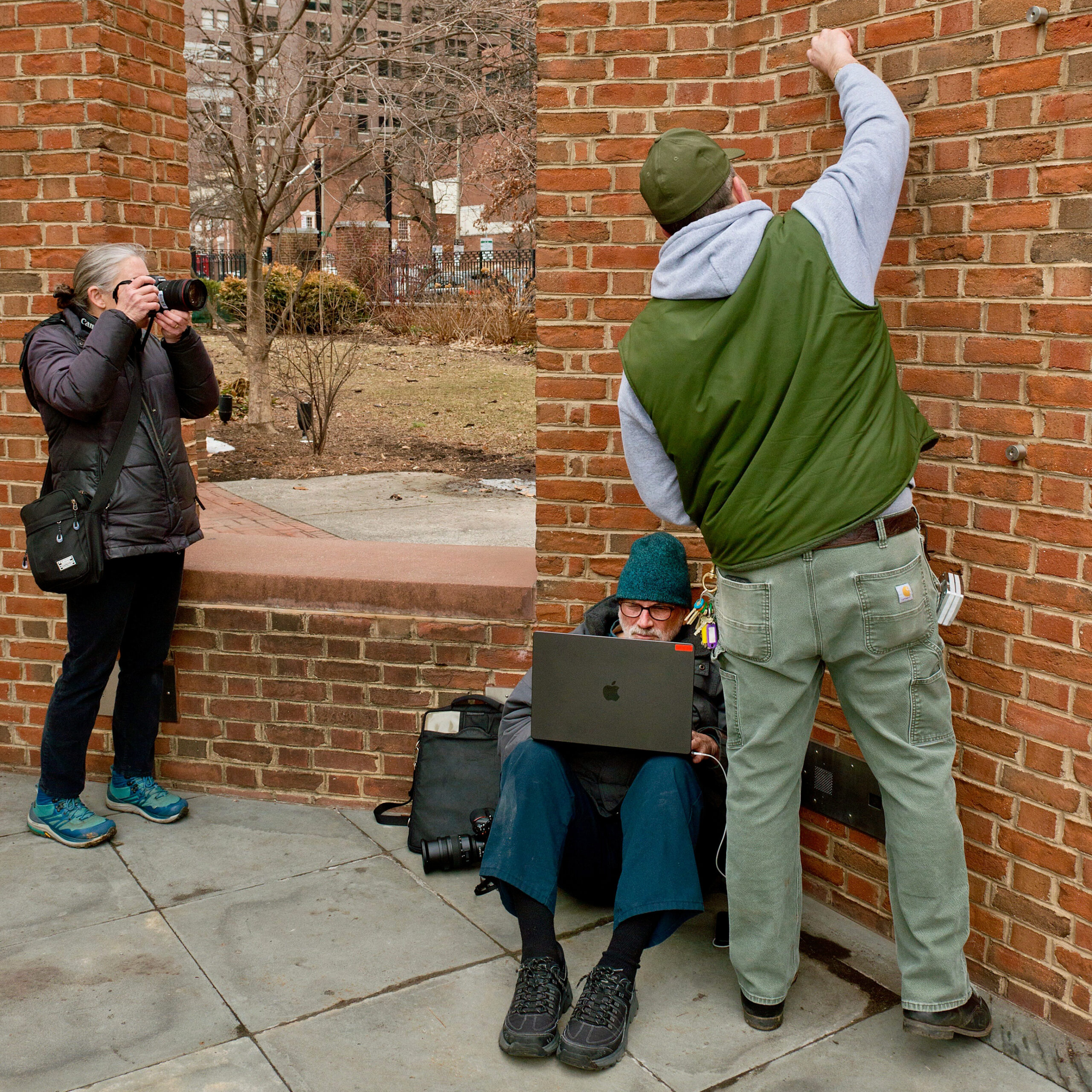
Philadelphia Inquirer staff photographer Tom Gralish edits his news photos at the President’s House site in Independence National Historical Park Thursday, Feb, 19, 2026 as park service workers restore the slavery exhibits that were removed in January. Gralish had met and talked with the NPS employee earlier in the morning before other news media arrived at the site, and hadn’t noticed a panel would be going back up later where he was sitting. “You’re okay,” the worker said, “you were here first.”
Since 1998 a black-and-white photo has appeared every Monday in staff photographer Tom Gralish’s “Scene Through the Lens” photo column in the print editions of The Inquirer’s local news section. Here are the most recent, in color:
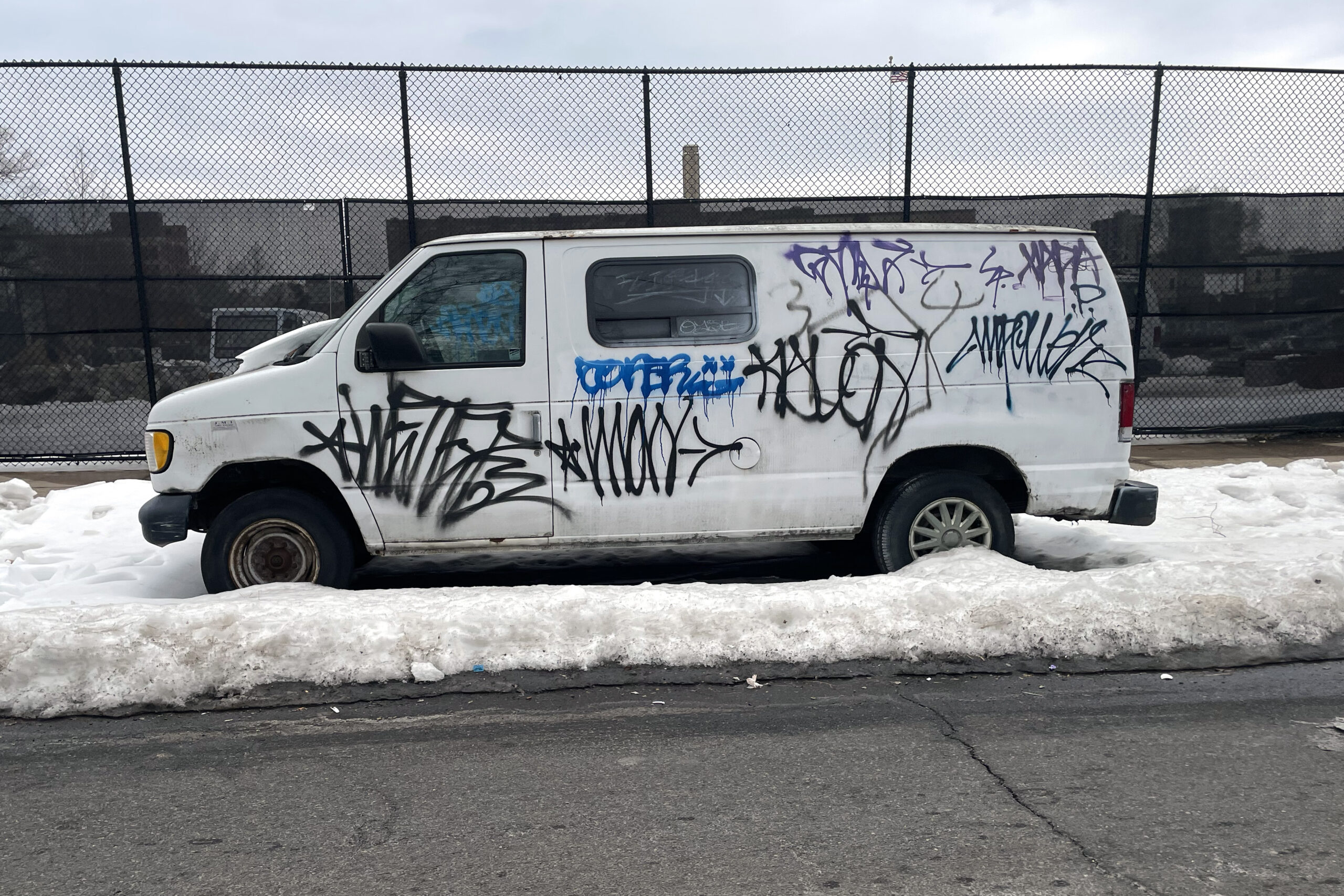
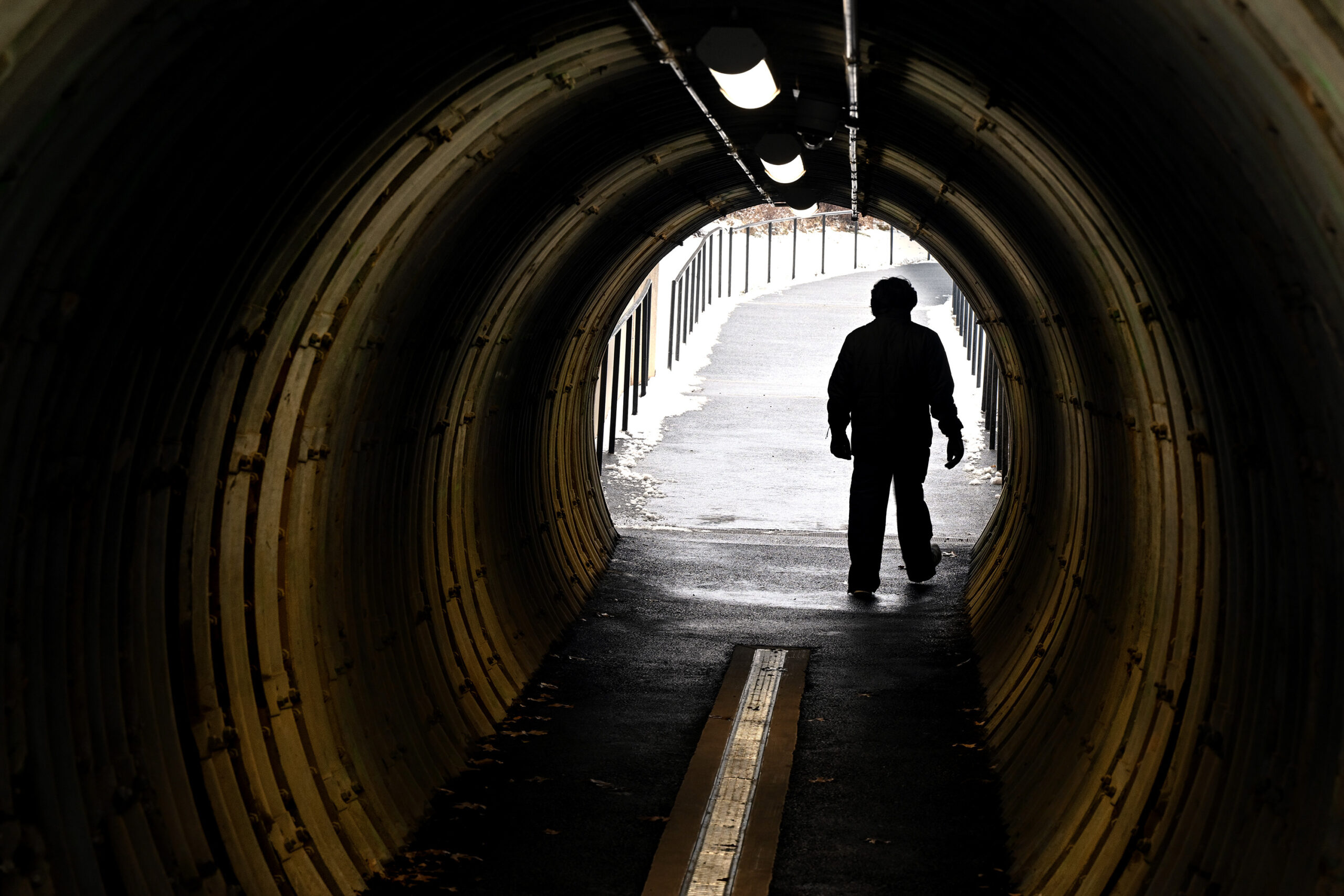
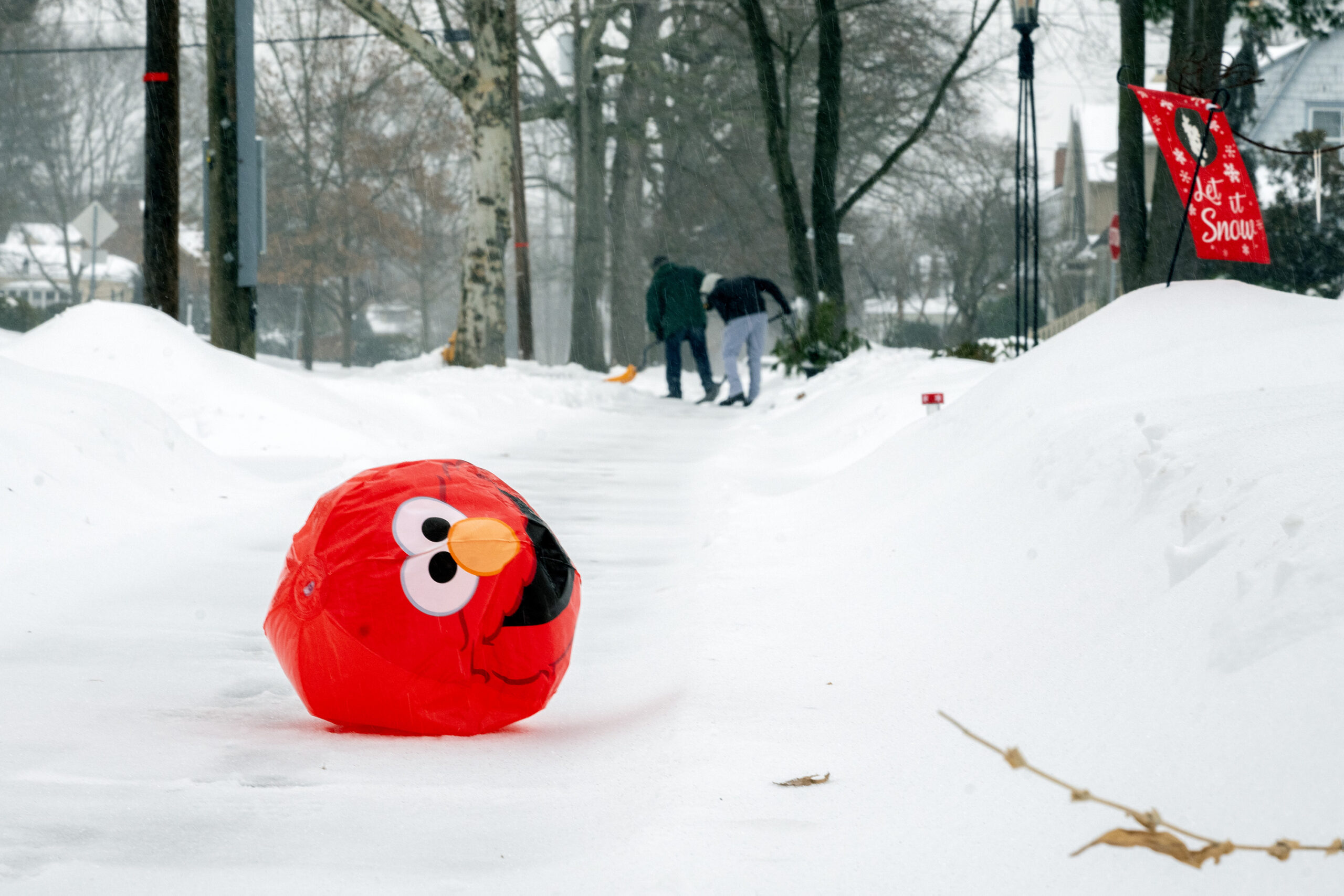
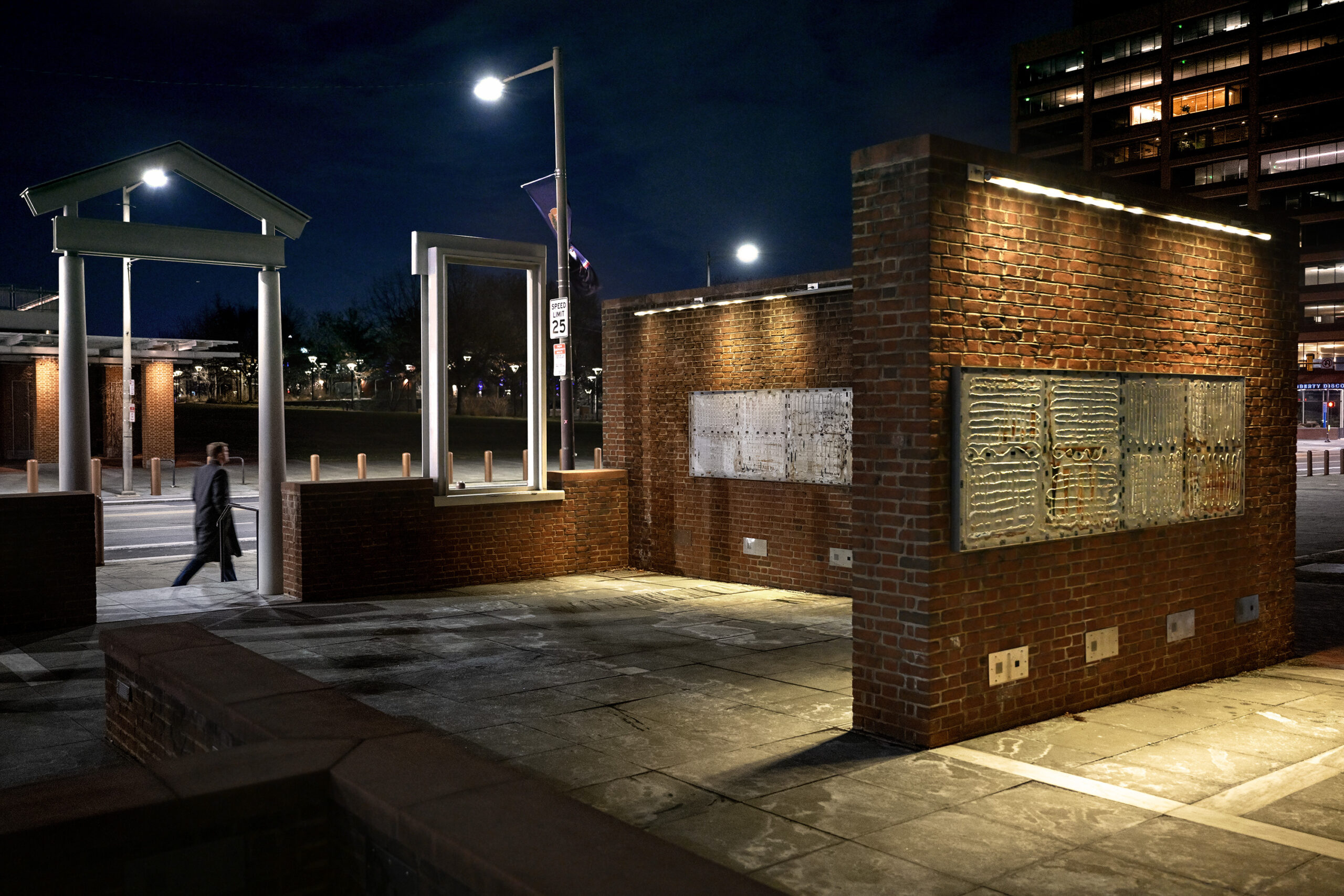
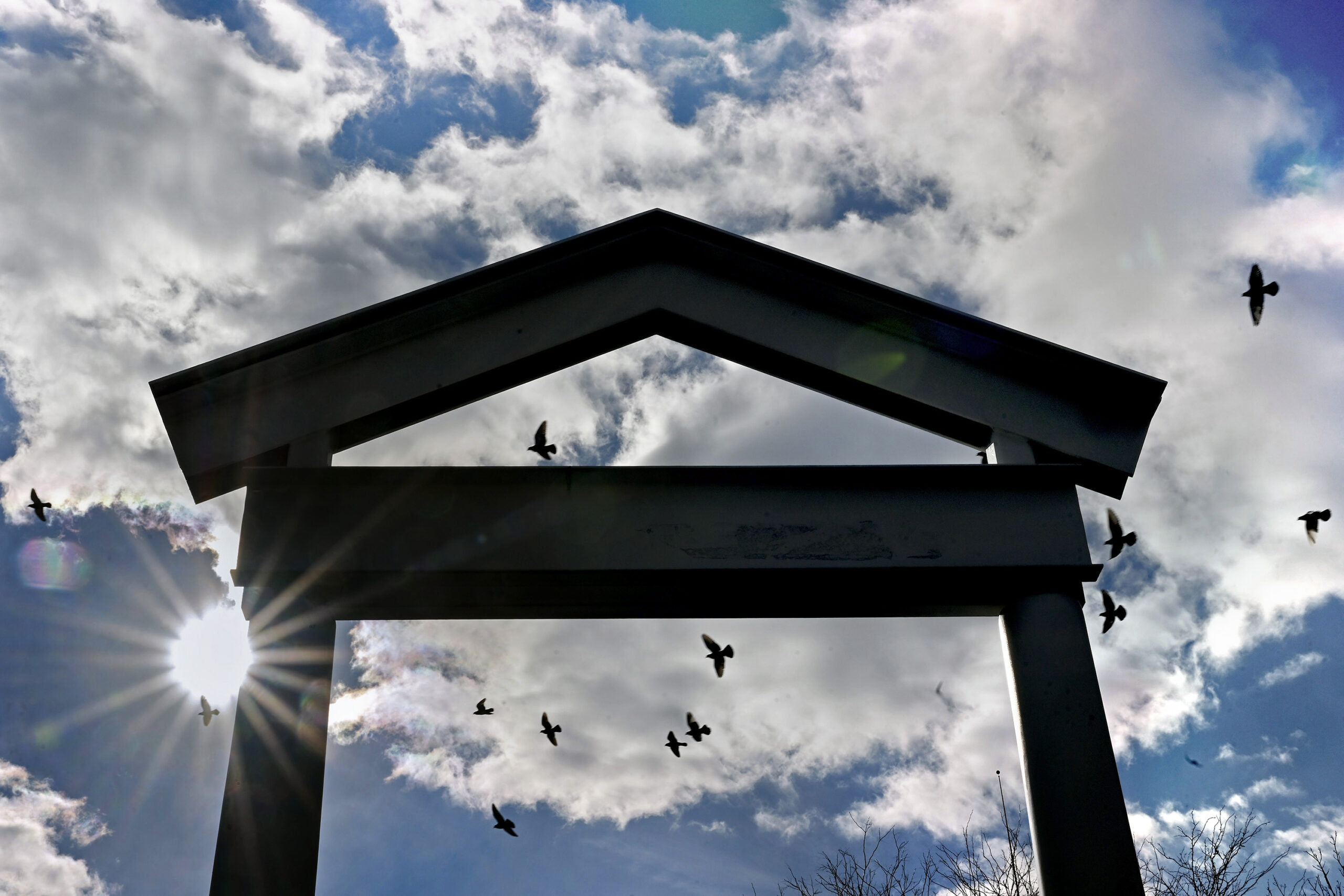
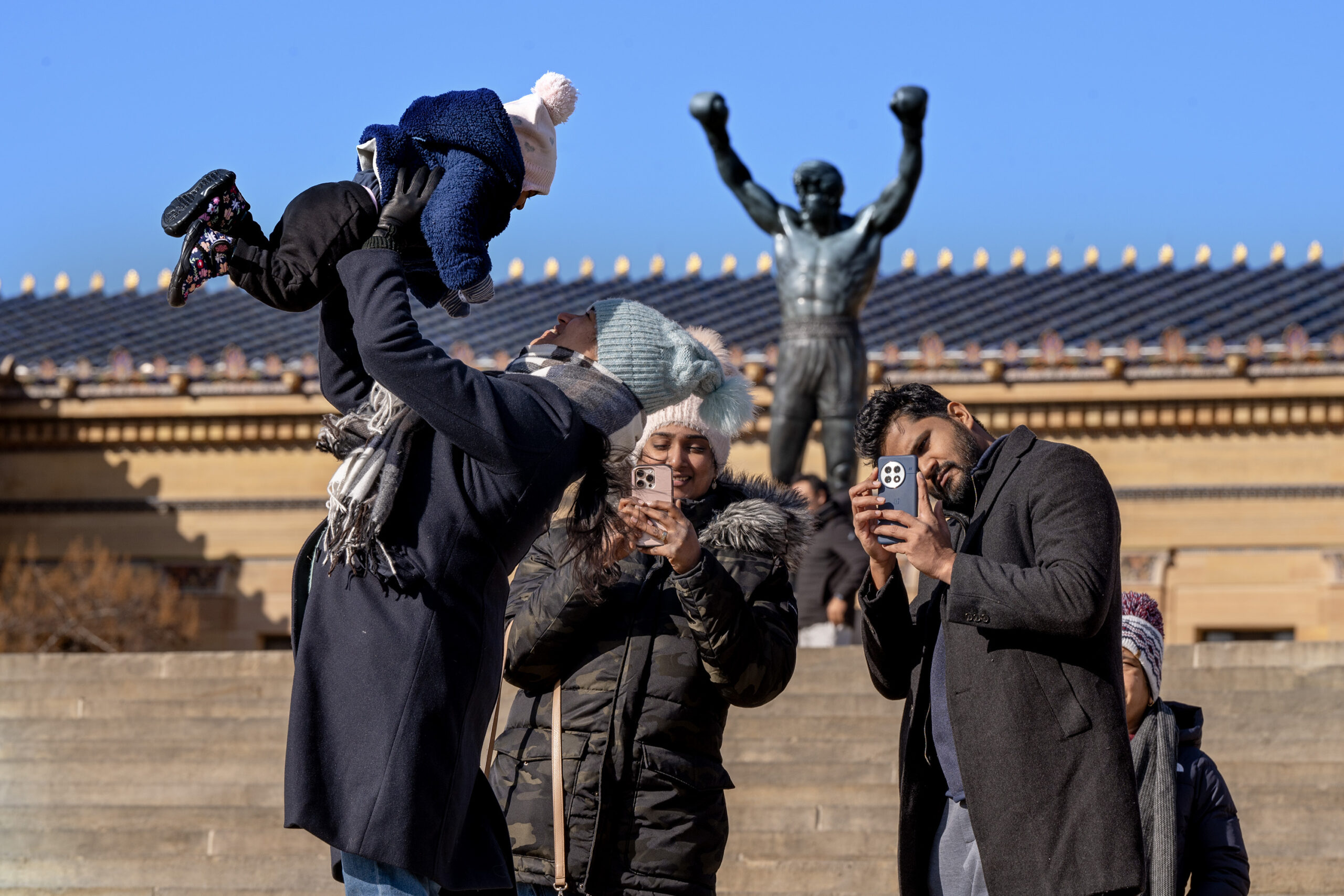
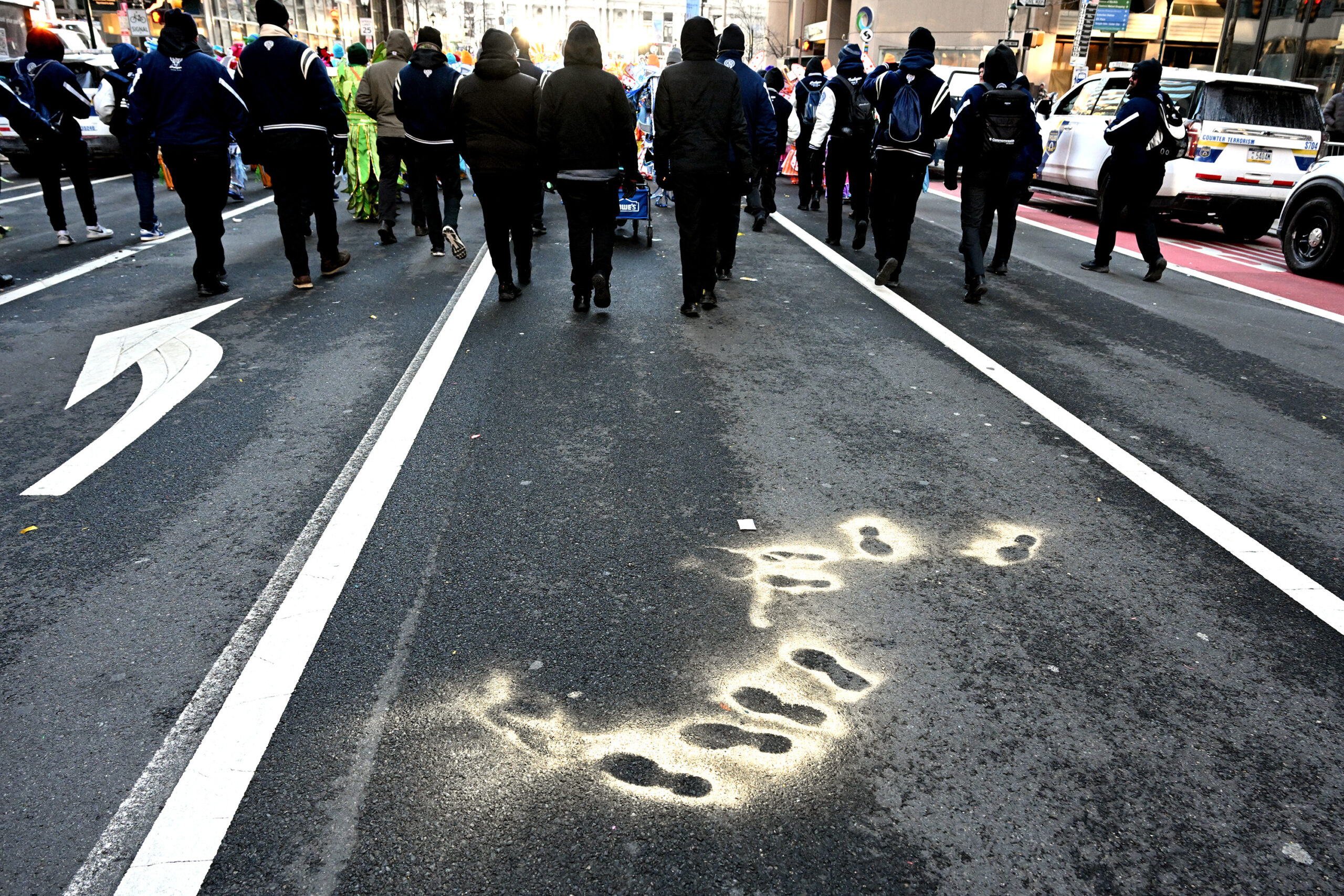
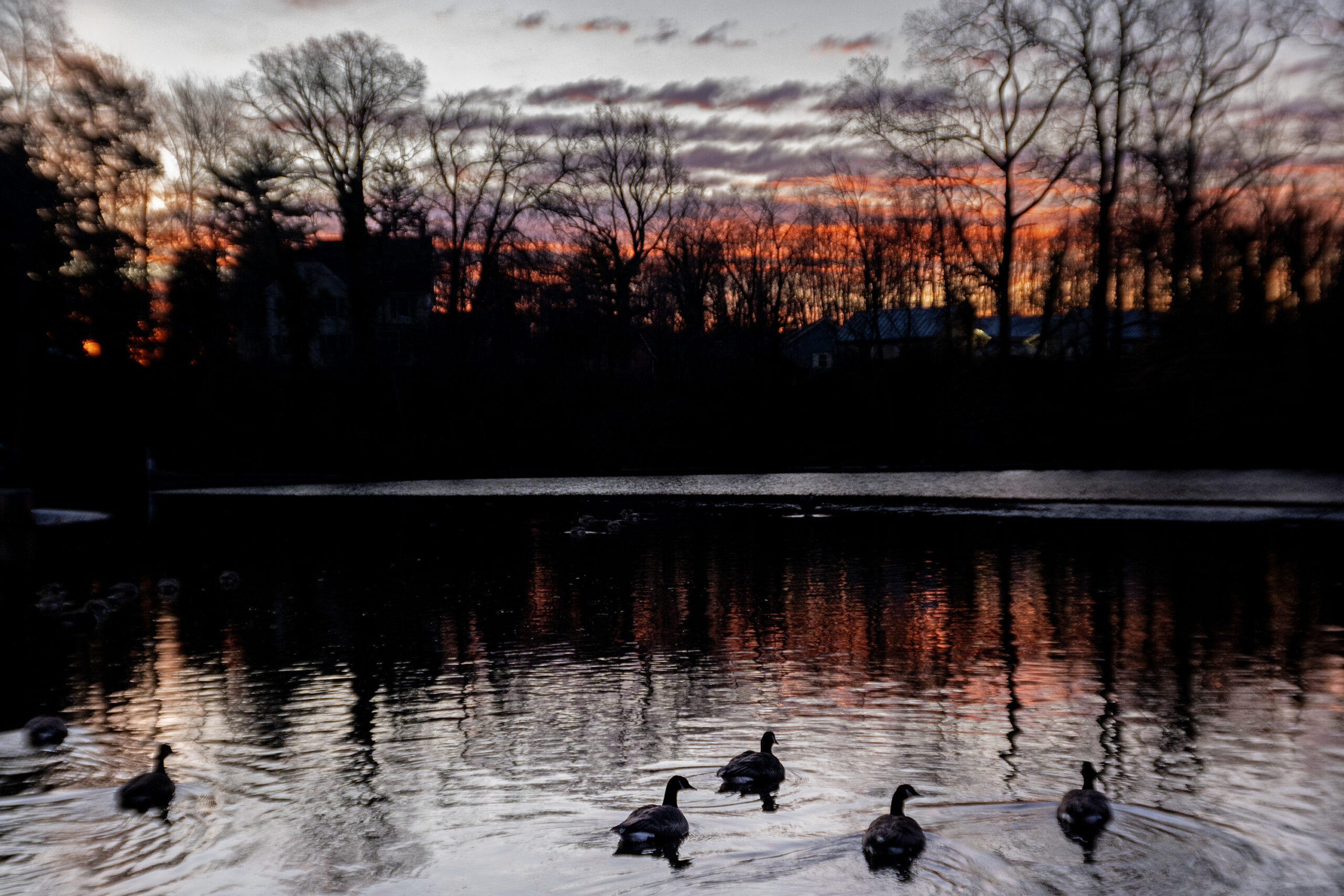
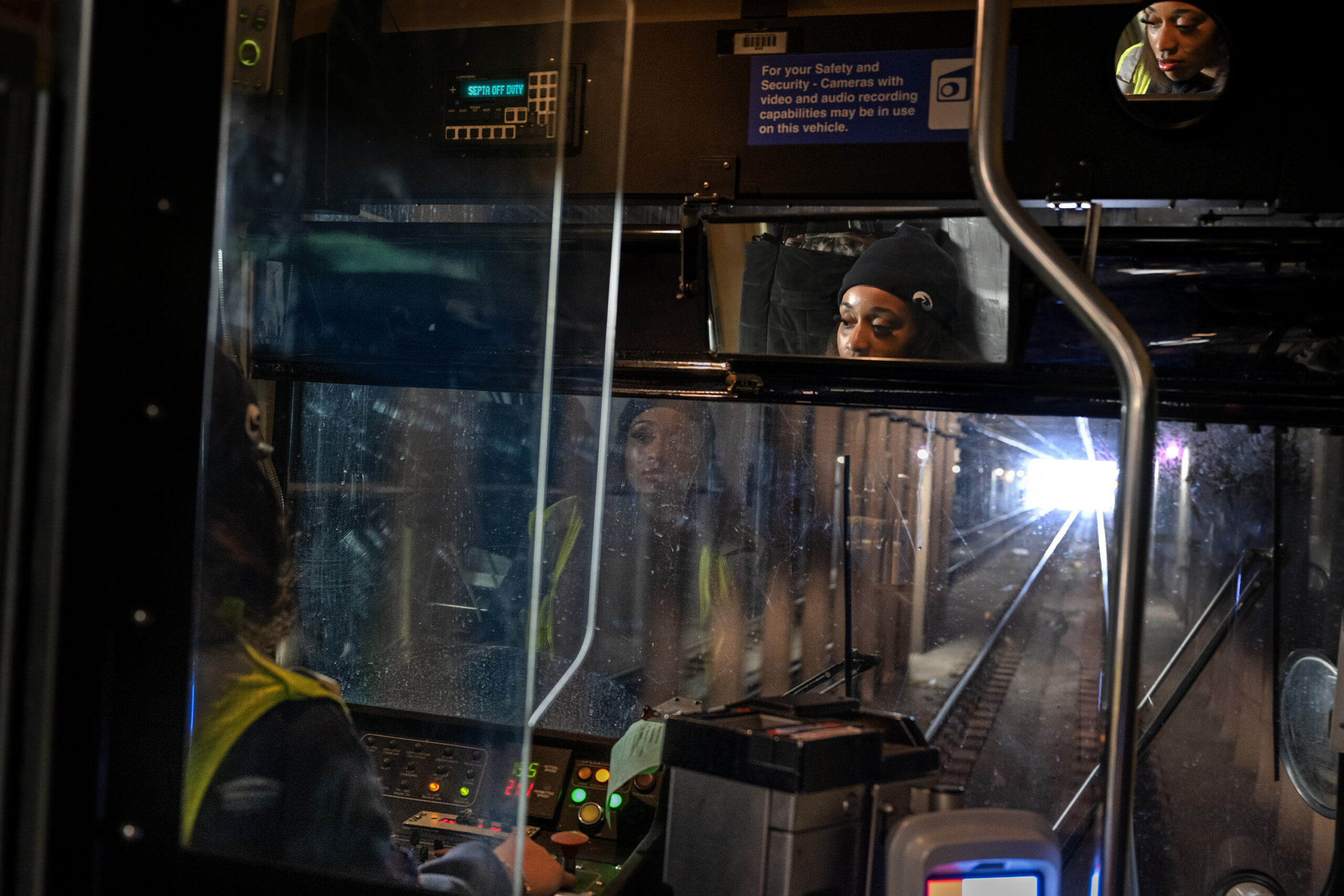
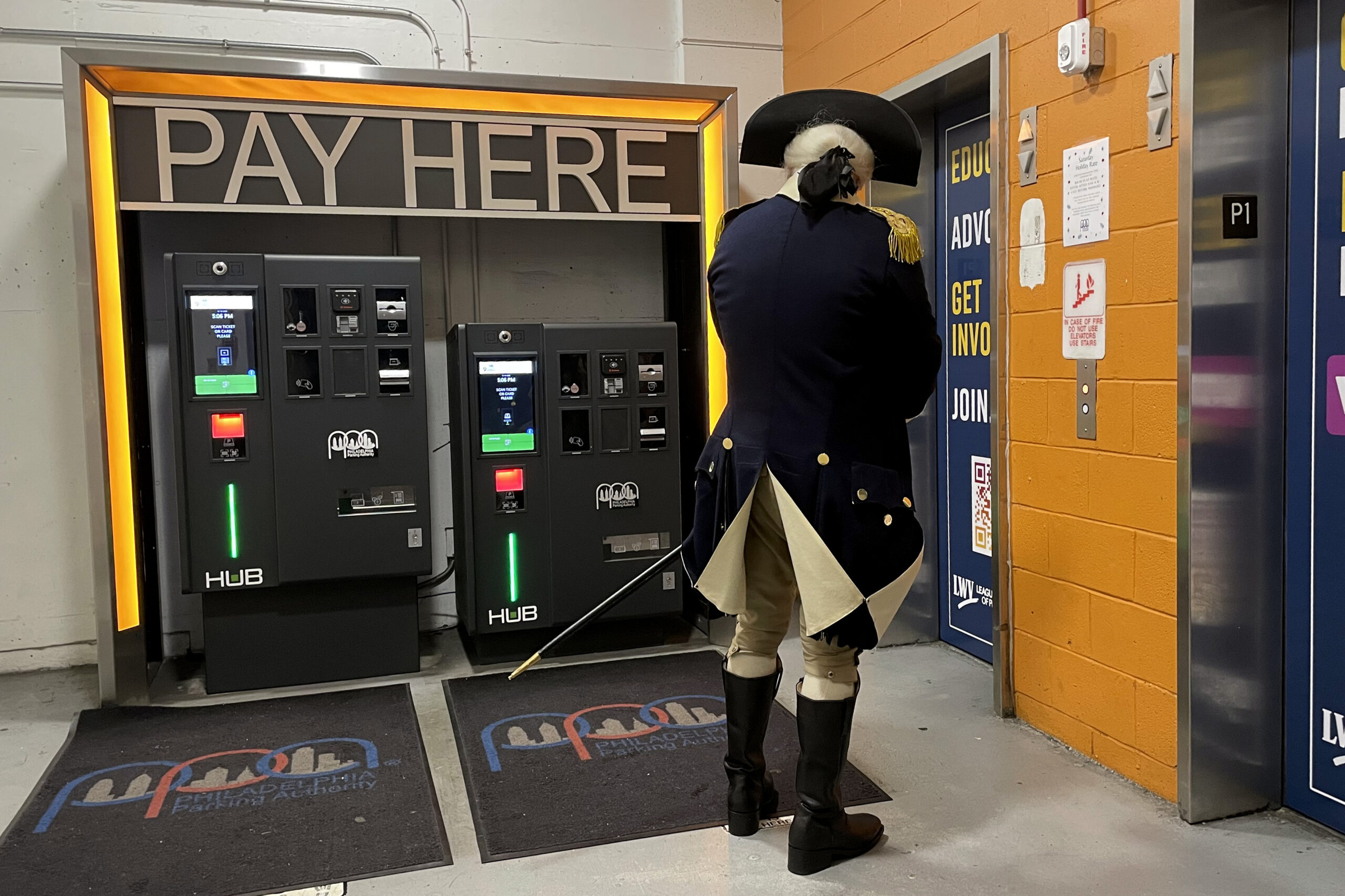
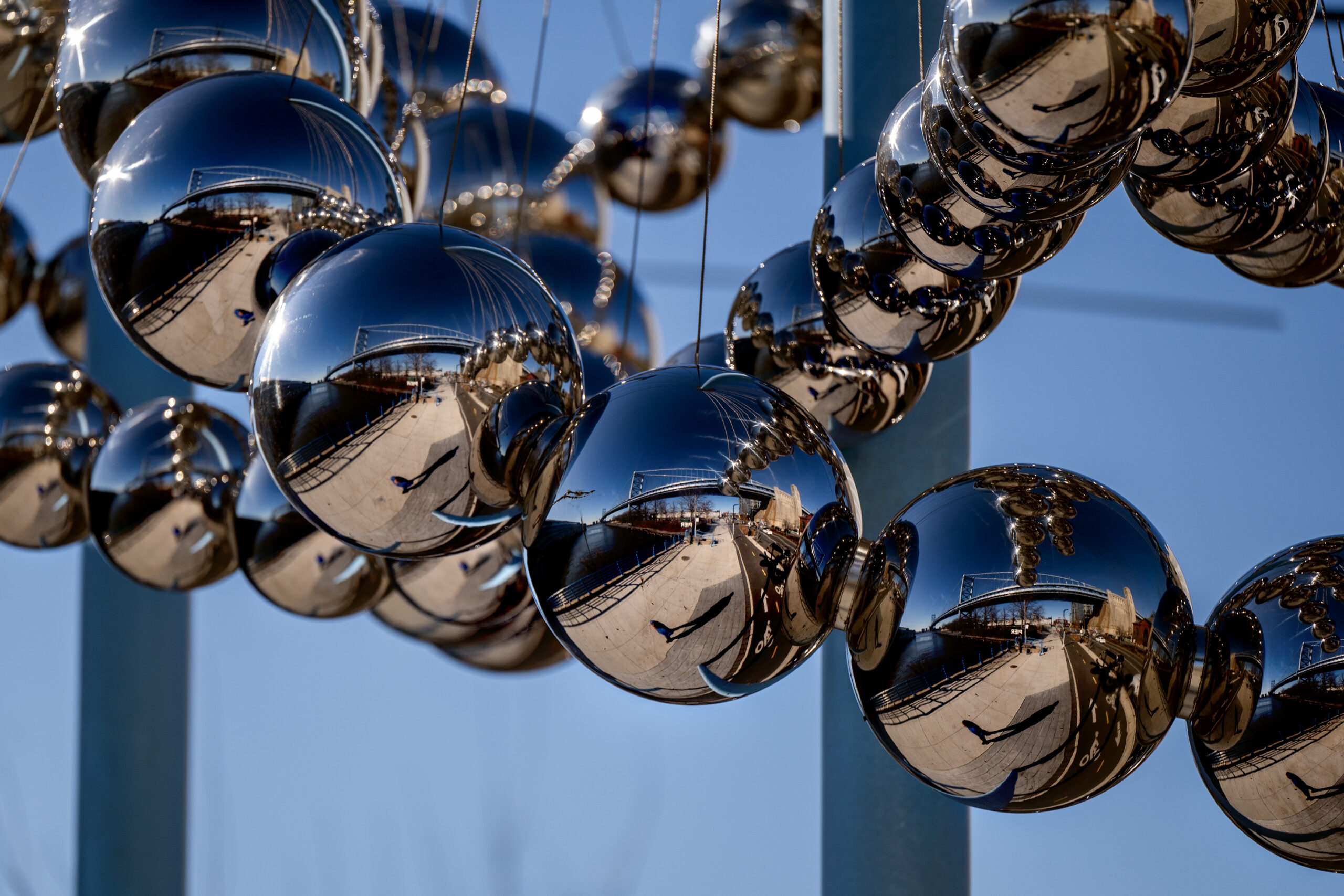
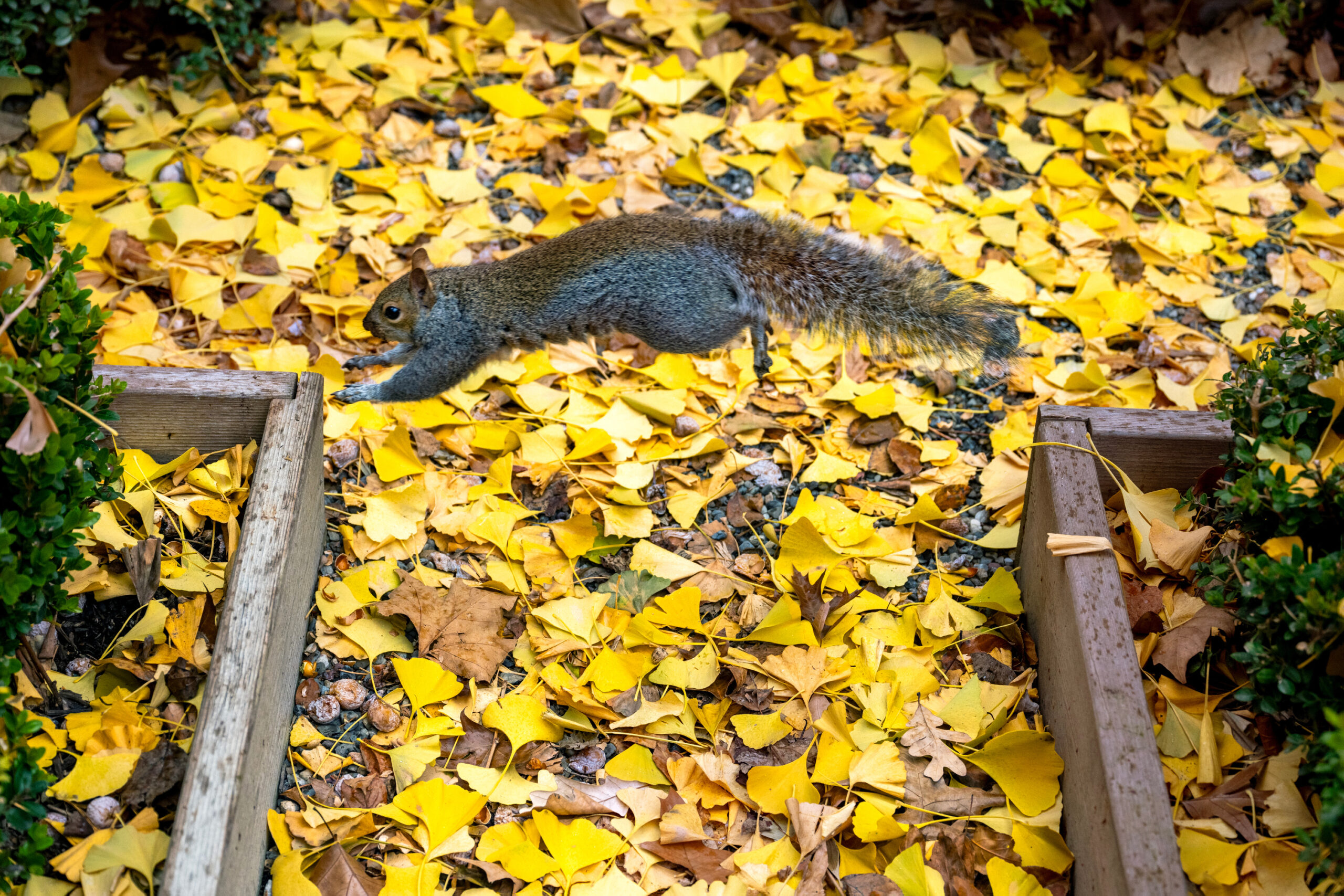
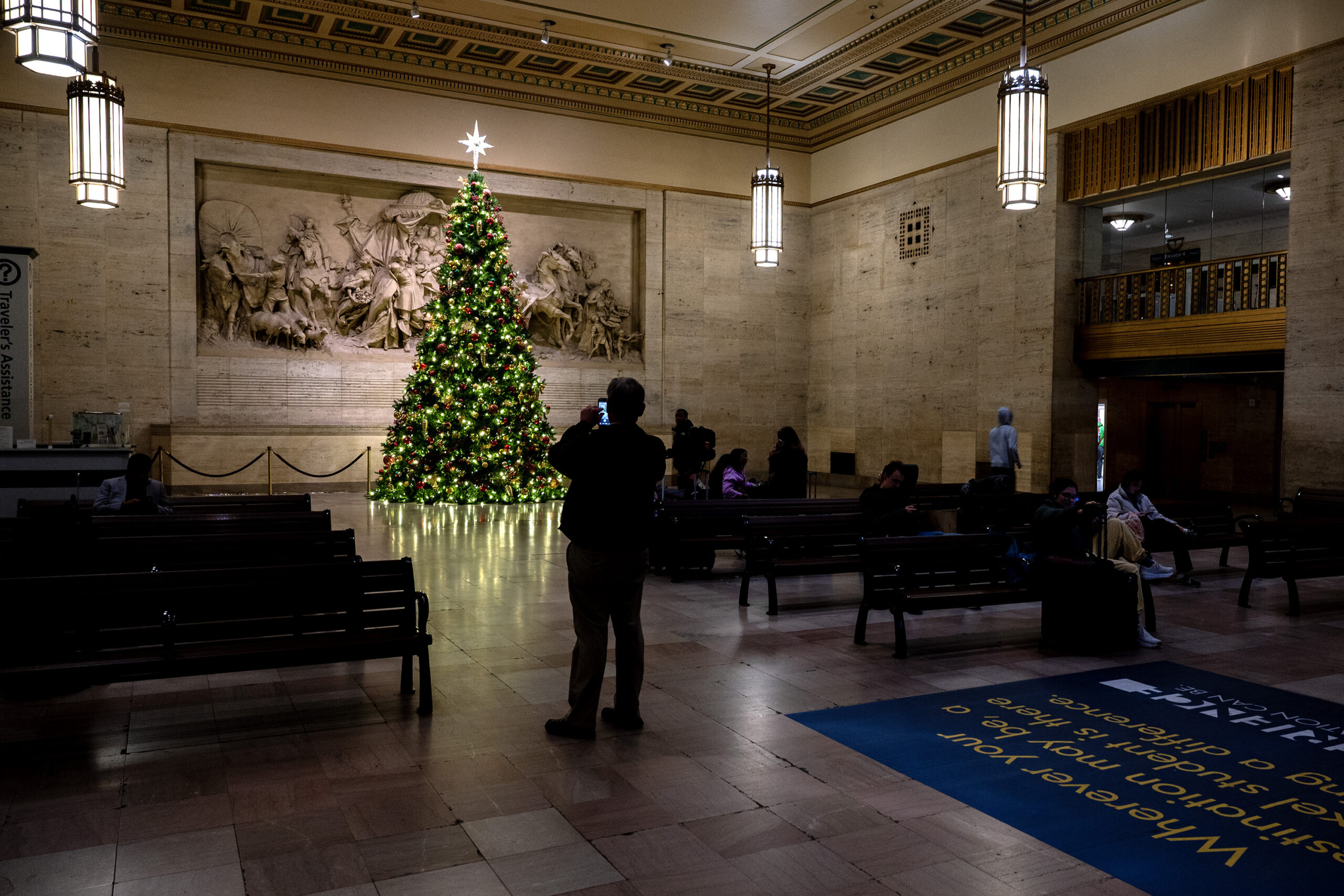
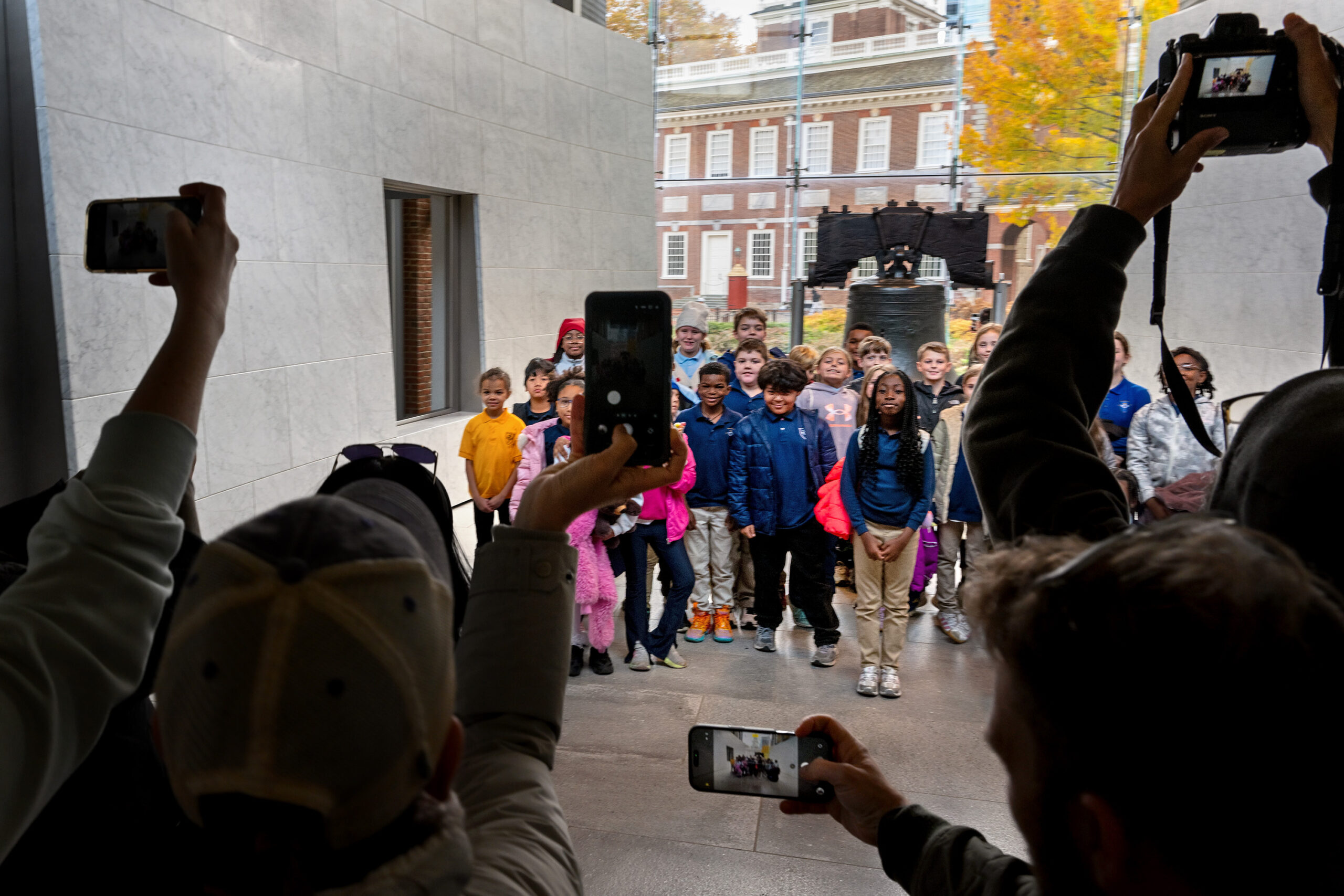
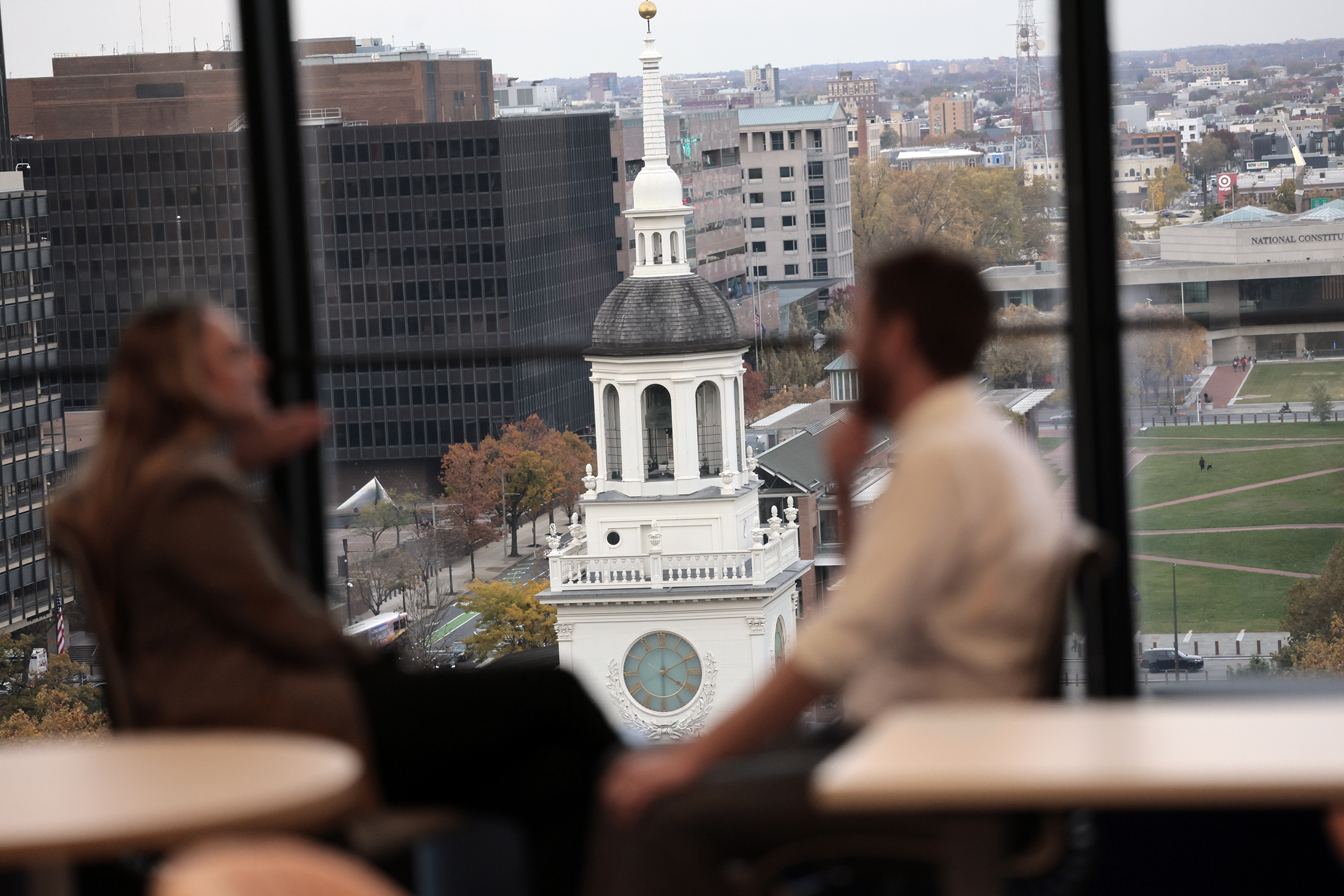
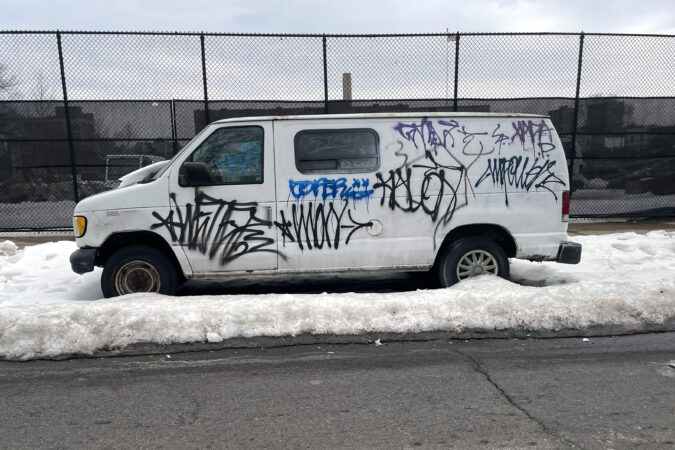
February 16, 2026: What came first? The dirty snowpacked berm of frozen slush or the graffiti? February 9, 2026: Walking through a corrugated metal culvert called the “Duck Tunnel,” a pedestrian navigates the passageway under the SEPTA tracks on the Swarthmore College campus. February 2, 2026: A light-as-air Elmo balloon rolls along a sidewalk in Haddonfield, propelled by the wind as Sunday’s heavy snow starts to turn to ice and sleet. January 26, 2026: The President’s House in Independence National Historical Park hours Jan, 22, after all historical exhibits were removed following President Trump’s Executive Order last March that the content at national parks that “inappropriately disparage” the U.S. be reviewed. The site, a reconstructed “ghost” structure titled “Freedom and Slavery in the Making of a New Nation” (2010), serves as a memorial to the nine people George Washington enslaved there during the founding of America.January 19, 2026: A low-in-the-sky winter sun is behind the triangular pediment of the “front door” of the open-air President’s House installation in Independence National Historical Park. The reconstructed “ghost” structure with partial walls and windows of the Georgian home known in the 18th century as 190 High St. is officially titled, “Freedom and Slavery in the Making of a New Nation” (2010). It is designed to give visitors a sense of the house where the first two presidents of the United States, George Washington and John Adams, served their terms of office. The commemorative site designed by Emanuel Kelly, with Kelly/Maiello Architects, pays homage to nine enslaved people of African descent who were part of the Washington household with videos scripted by Lorene Cary and directed by Louis Massiah. Deepika Iyer holds her niece Ira Samudra aloft in a Rockyesque pose, while her parents photograph their 8 month-old daughter, in front of the famous movie prop at the top of the steps at the Philadelphia Art Museum. Iyer lives in Philadelphia and is hosting a visit by her mother Vijayalakshmi Ramachandran (partially hidden); brother Gautham Ramachandran; and her sister-in-law Janani Gautham who all live in Bangalore, India.January 5, 2026: Parade marshals trail behind the musicians of the Greater Kensington String Band heading to their #9 position start in the Mummers Parade. Spray paint by comic wenches earlier in the day left “Oh, Dem Golden Slippers” shadows on the pavement of Market Street. This year marked the 125th anniversary of Philly’s iconic New Year’s Day celebration.Dec. 29, 2025: Canada geese at sunrise in Evans Pond in Haddonfield, during the week of the Winter Solstice for the Northern Hemisphere. December 22, 2025: SEPTA trolley operator Victoria Daniels approaches the end of the Center City Tunnel, heading toward the 40th Street trolley portal after a tour to update the news media on overhead wire repairs in the closed tunnel due to unexpected issues from new slider parts.December 15, 2025: A historical interpreter waits at the parking garage elevators headed not to a December crossing of the Delaware River, but an event at the National Constitution Center. General George Washington was on his way to an unveiling of the U.S. Mint’s new 2026 coins for the Semiquincentennial, December 8, 2025: The Benjamin Franklin Bridge and pedestrians on the Delaware River Trail are reflected in mirrored spheres of the “Weaver’s Knot: Sheet Bend” public artwork on Columbus Boulevard. The site-specific stainless steel piece located between the Cherry Street and Race Street Piers was commissioned by the City’s Public Art Office and the Delaware River Waterfront Corporation and created and installed in 2022 by the design and fabrication group Ball-Nogues Studio. The name recalls a history that dominated the region for hundreds of years. “Weaver’s knot” derives from use in textile mills and the “Sheet bend” or “sheet knot” was used on sailing vessels for bending ropes to sails. November 29, 2025: t’s ginkgo time in our region again when the distinctive fan-shaped leaves turn yellow and then, on one day, lose all their leaves at the same time laying a carpet on city streets and sidewalks. A squirrel leaps over leaves in the 18th Century Garden in Independence National Historical Park Nov. 25, 2025. The ginkgo (Ginkgo biloba) is considered a living fossil as it’s the only surviving species of a group of trees that existed before dinosaurs. Genetically, it has remained unchanged over the past 200 million years. William Hamilton, owner the Woodlands in SW Phila (no relation to Alexander Hamilton) brought the first ginkgo trees to North America in 1785.November 24, 2025: The old waiting room at 30th Street Station that most people only pass through on their way to the restrooms has been spiffed up with benches – and a Christmas tree. It was placed there this year in front of the 30-foot frieze, “The Spirit of Transportation” while the lobby of Amtrak’s $550 million station restoration is underway. The 1895 relief sculpture by Karl Bitter was originally hung in the Broad Street Station by City Hall, but was moved in 1933. It depicts travel from ancient to modern and even futuristic times. November 17, 2025: Students on a field trip from the Christian Academy in Brookhaven, Delaware County, pose for a group photo in front of the Liberty Bell in Independence National Historical Park on Thursday. The trip was planned weeks earlier, before they knew it would be on the day park buildings were reopening after the government shutdown ended. “We got so lucky,” a teacher said. Then corrected herself. “It’s because we prayed for it.”
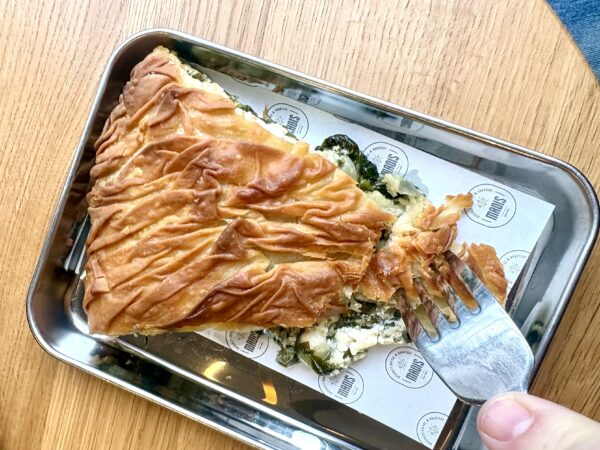
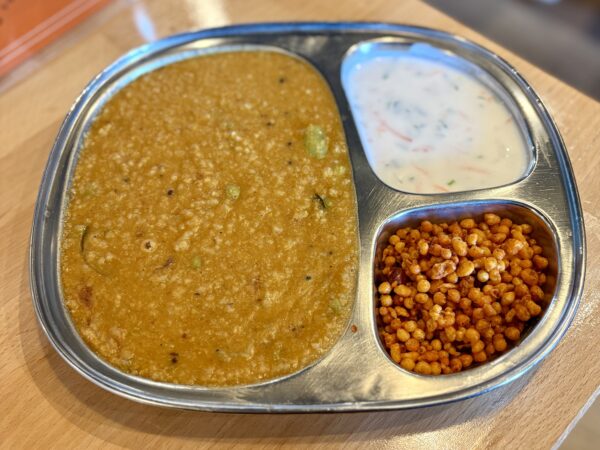
Country-style spinach pie at Madis Coffee Roasters
I’ve been devoted to spanakopita since growing up in Metro Detroit, where Greektown was among my favorite downtown haunts. Philadelphia has great spinach pies, too, from Zorba’s Tavern in Fairmount to Stina near West Passyunk. But lately, I’ve become obsessed with the big round pans of spanikopita served at Madis Coffee Roasters, the fast growing local trio of modern cafes owned by the Navorsidis family. Their coffee is also excellent, by the way, including a well-balanced “Four Seasons” blend that’s become a regular in my house rotation of morning brews, as well as quality pour-overs of single-origin beans.
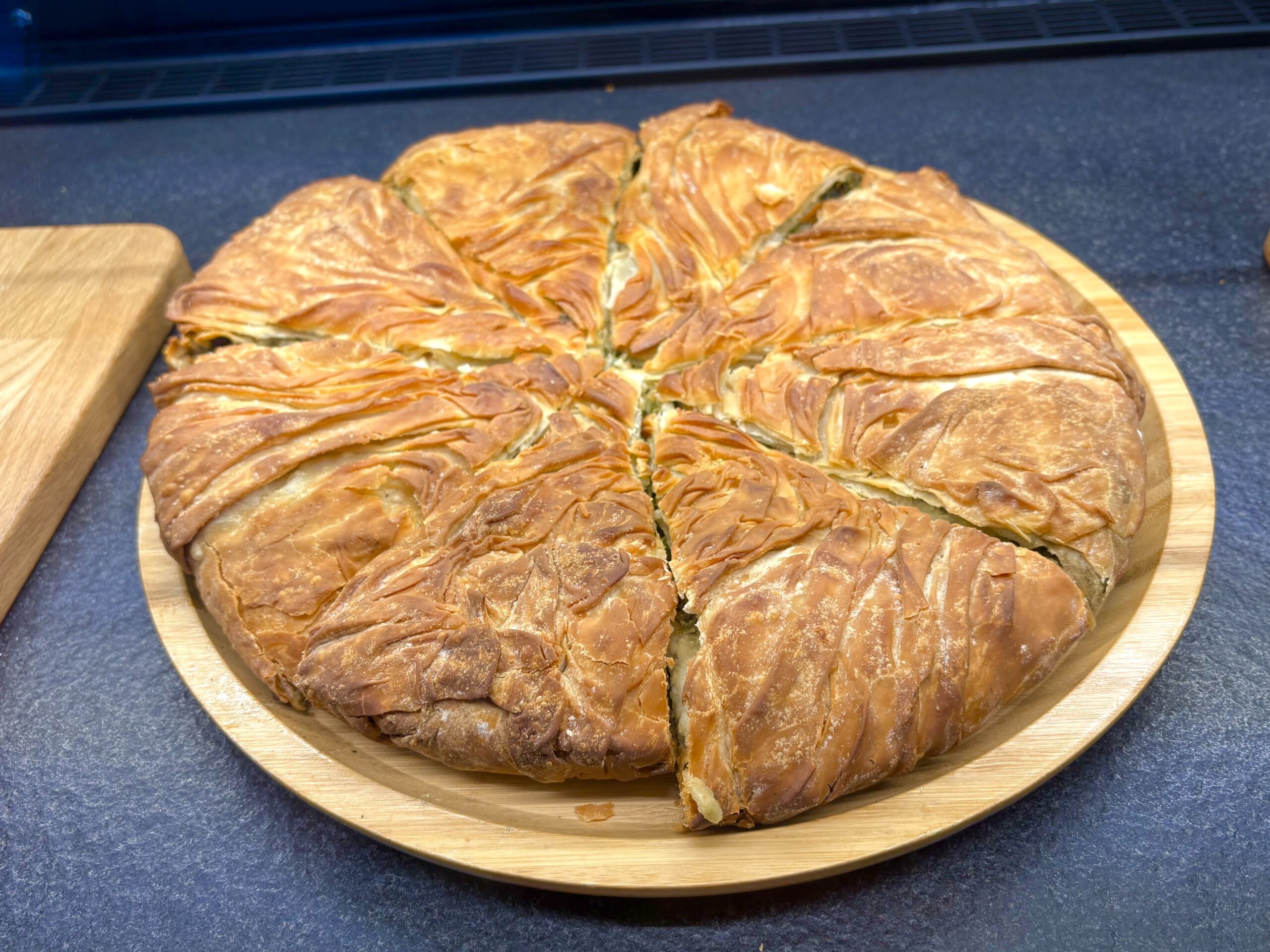
But the spanakopita the cafes import from Greece is one of the main reasons I frequently stop at Madis’ spacious Curtis Center location beside Independence Hall for breakfast before heading into The Inquirer newsroom nearby. Unlike the vast majority of spinach pies made in the U.S., which feature ultra-flaky and delicate phyllo, these big round pies made by Rodoula in Athens are encased in crispy waves of thicker phyllo sheets that are typical of the more rustic country style, especially when shaped into rounds.
An imported round spinach pie made by Rodoula in Athens, this one stuffed with extra feta, is warmed to a crisp and served at Madis Coffee Roasters locations across Philadelphia.
I give credit to Madis for warming it correctly, since I’ve had other versions of the same pie elsewhere (at a local gyro chain) where the same pastry was hastily underbaked and chewy. At its toasty, tawny prime, a crusty wedge of this pie shatters beneath fork and knife around a luxuriously soft filling of spinach, leeks, and extra cheese — a particularly creamy blend of tangy sheep and goat’s milk feta. Straight from Athens to the cradle of Liberty, it’s the spanakopita breakfast of champs. Madis Coffee Roasters, 601 Walnut St., 3527 Lancaster Ave., 1441 Chestnut St.; madiscoffee.com
— Craig LaBan
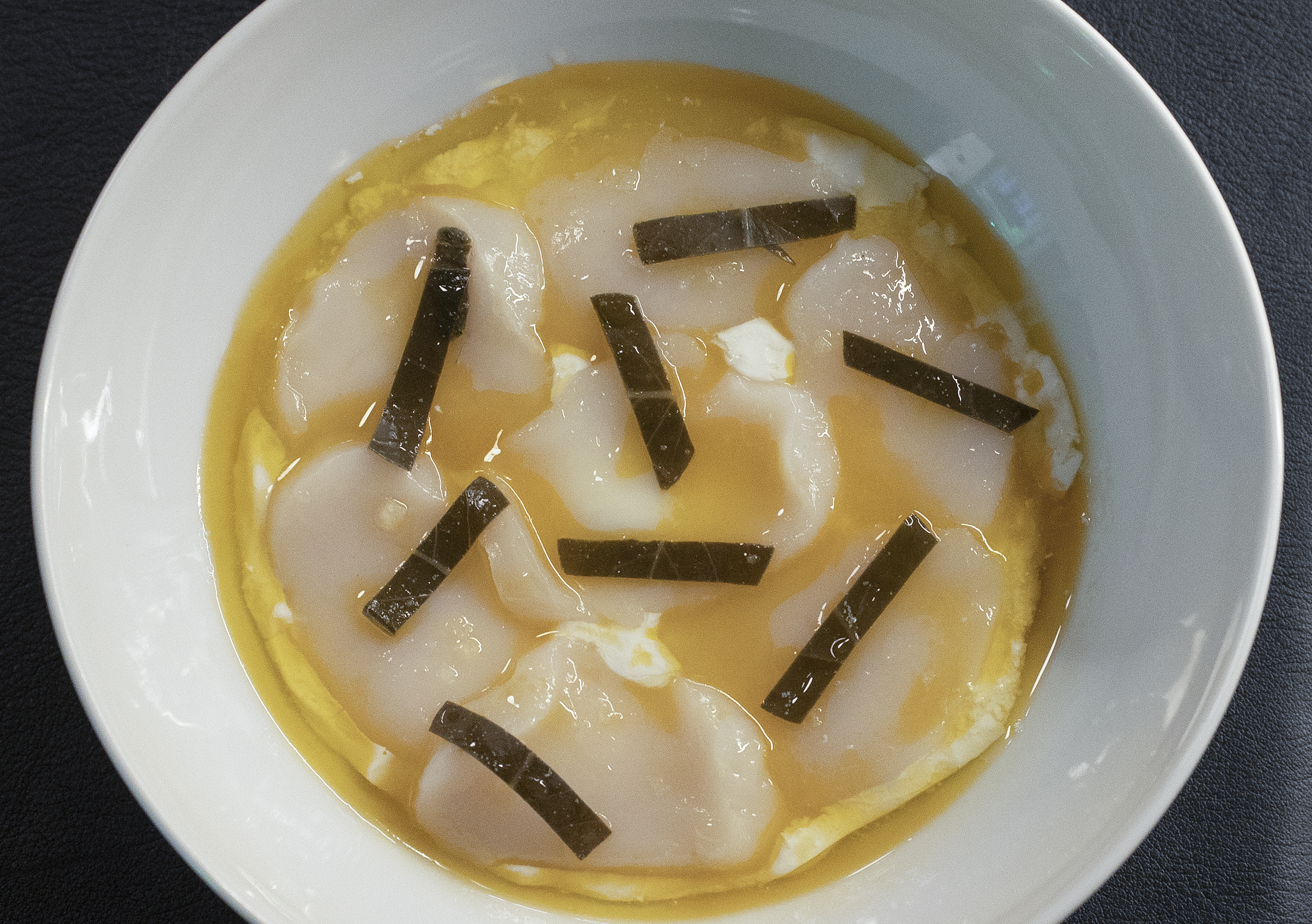
The sea scallop crudo and burrata served at Emilia, the Italian restaurant from Greg Vernick, in Kensington on Friday, January 23, 2026.
Scallops and burrata at Emilia
When Greg Vernick and Meredith Medoway were previewing the menu at Emilia, their new Italian restaurant in Kensington, they seemed proud of a dish pairing scallops and burrata in a caper vinaigrette. “That surprises people at first because of the similar textures,” Vernick said. Oh, it’s a surprise, all right. What it lacks in crunch it more than makes up for in lusciousness. The kitchen thinly slices day-boat sea scallops from Viking Village in Barnegat Light, N.J., and fans them over a puddle of burrata cheese and a vinaigrette made of capers and Calabrian chili oil. Sea salt goes on top. And here’s a tip to get the most of it: Your Emilia meal will start with house-made focaccia, Italian breadsticks, and a slice of Mighty Bread’s sesame ciabatta. Put aside some ciabatta. After you finish the scallop, you’ll use it for mop-up duty. Emilia, 2406 Frankford Ave., 267-541-2360, emiliaphilly.com
— Michael Klein
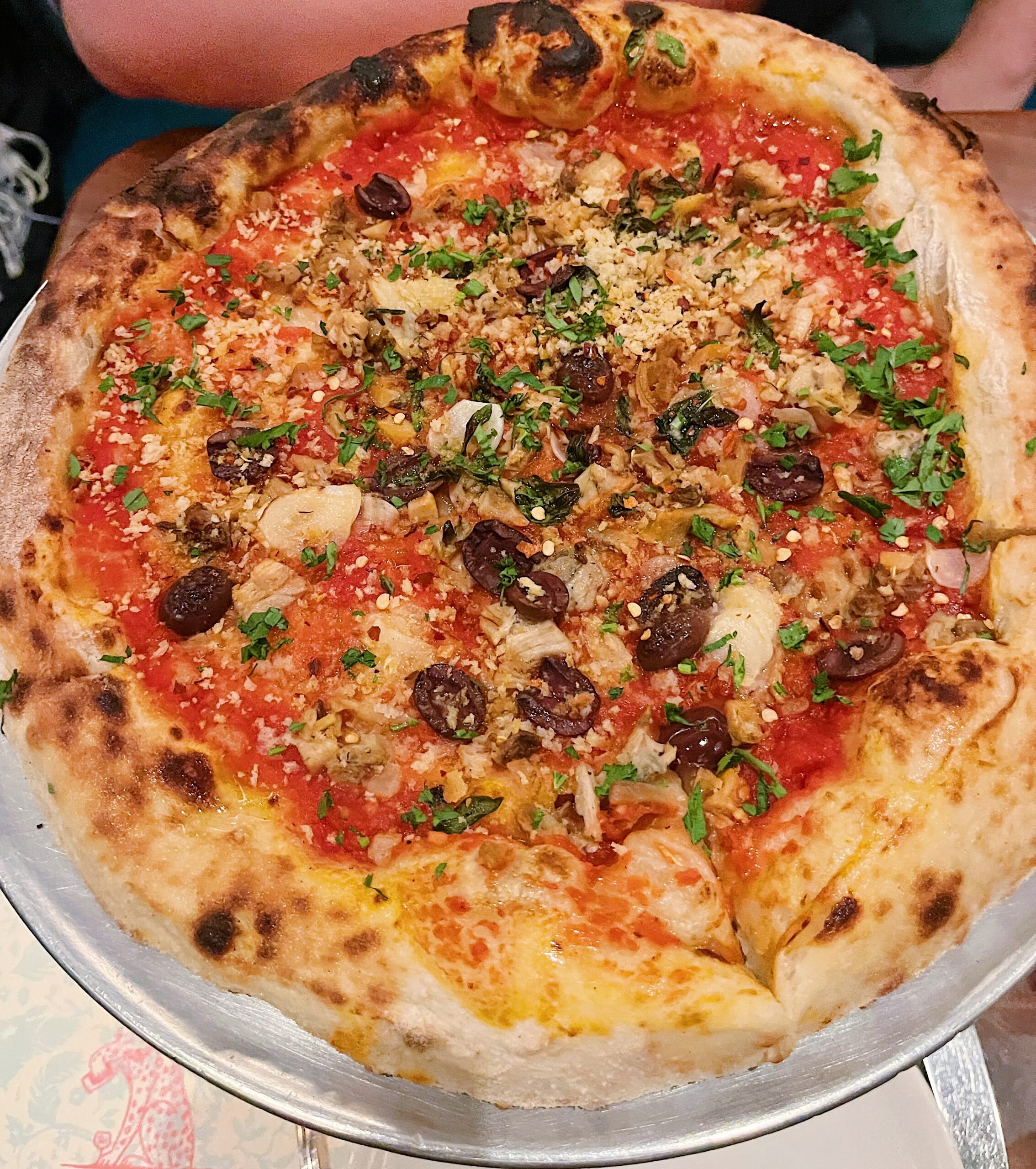
The Clam Posillipo pizza from Wilder.
Clam Posillipo pizza at Wilder
To me, Valentine’s Day has always been about celebrating the things I already love about my life — my partner, my cat, and all the restaurants I depend on for date-night specialness — so I rarely want to go some place I’ve never tried before for the holiday. That changed this year when my partner and I went to Wilder for the first time and tried a pizza so good it has converted us to wannabe regulars.
Wilder’s clam Posillipo pizza is a take on the classic Italian American dish (and Frank Sinatra favorite) wherein littleneck clams are steamed in a light, garlicky tomato sauce. For the pizza version, Wilder sprinkles briny Taggiasca olives, breadcrumbs, and parsley atop a vibrant tomato sauce. The clams’ contribution wasn’t fishy — they created an experience more like eating a pie by the beach in the summer: fresh and a little salty, with a delectably doughy crust. Wilder, 2009 Sansom St., 215-309-2149, wilderphilly.com
— Beatrice Forman
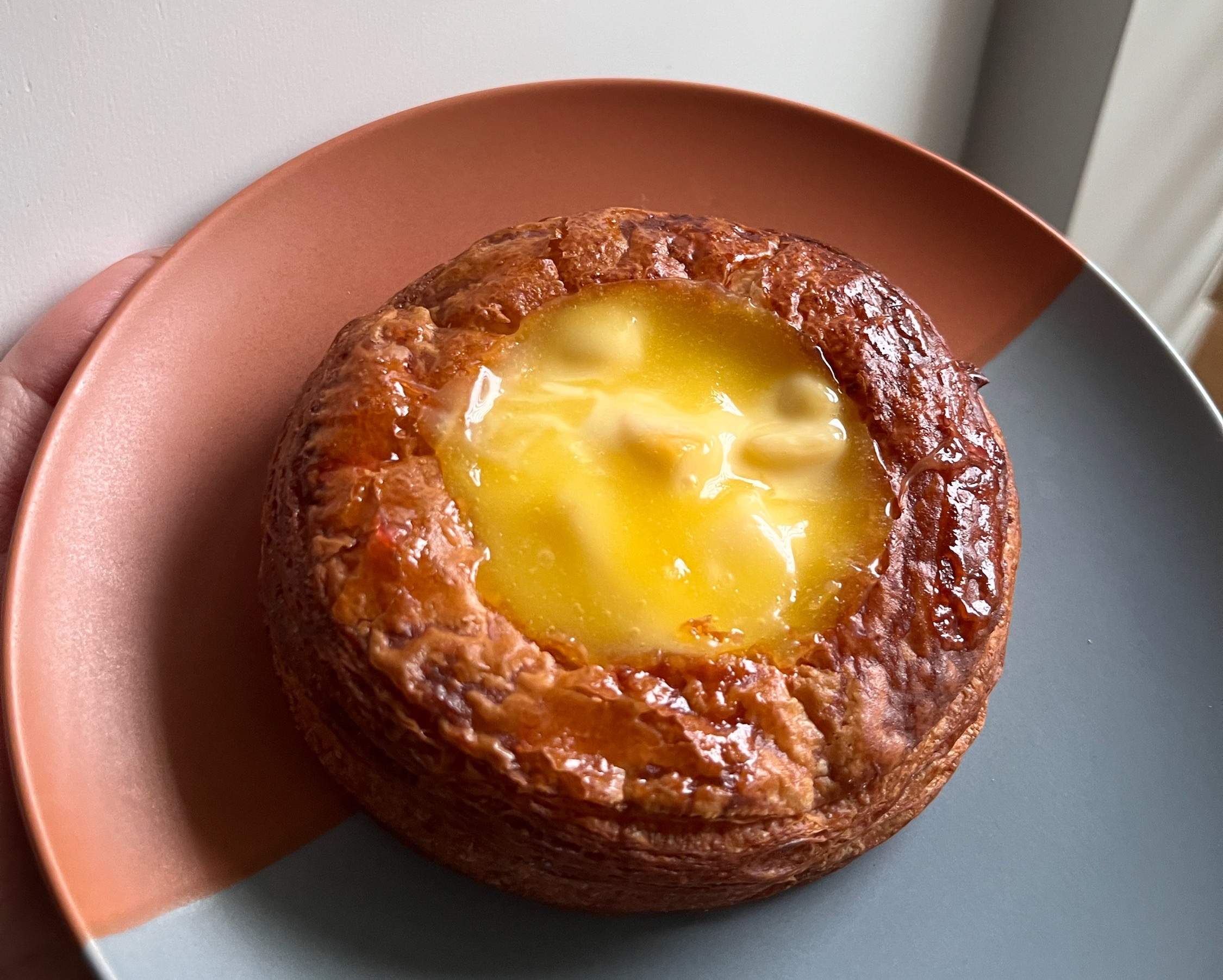
A mango calamansi danish from the Sir/Mom Tour pop-up at Small Oven Pastry Shop.
Mango calamansi danish from the Sir/Mom Tour pop-up at Small Oven Pastry Shop
It’s still gray and cold out, but a limited-time pastry offering helped me briefly forget. As part of their “Sir/Mom Tour,” chef Mike Strauss of Sidecar Bar & Grille (and formerly Mike’s BBQ) and his wife, Eylonah Mae Strauss, staged a Point Breeze kitchen takeover last week, sharing their love of Filipino cuisine with a slate of specials served at chef Chad Durkin’s Porco’s Porchetteria/Small Oven Pastry Shop and Breezy’s Deli. I went specifically for the mango and calamansi danish — a burst of citrus and sunshine that sold out both days. The silky yellow custard encrusted in golden flaky pastry with small bites of fruit laced throughout made for a gorgeous pick-me-up. I hope we see another collab soon, but given the Strausses live in the Philippines — where they run Sugaree Gelato Bakery Cafe in Bacolod — I expect a long wait. Small Oven Pastry Shop, 2204 Washington Ave., 215-545-2939, smallovenpastryshop.com.
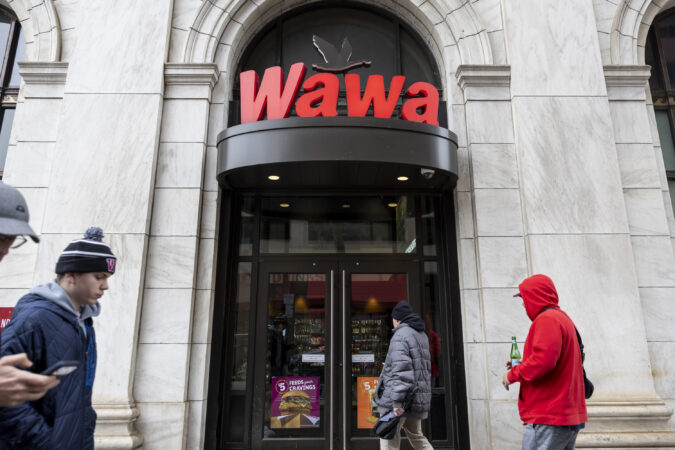
Wawa customers have been able to order roasted chicken on sandwiches, salads, burritos, and more since summer 2024. Hoagie-loving Philadelphians may scroll past the high-protein option on Wawa’s trademarked built-to-order screens, while others tap its icon instinctively in their rush to order lunch.
Wawa CEO Chris Gheysens said he sees the chicken breast differently.
From idea to inception, “that was a labor of love for quite a long time,” Gheysens said in a recent interview. “It’s 37 grams of protein, something consumers are really looking for today.”
And, he added, “it’s still highly customizable, which our customers love doing at Wawa.”
To Gheysens, the menu addition shows how the Delaware County-based company responds to consumer demand. Just as it did decades ago when Philly-area store managers began brewing coffee for customers on the go, and in 1996, when Wawa executives decided to start selling gasoline.
Even now, with nearly 1,200 stores in 13 states and Washington, D.C., Wawa is still listening to consumer feedback, Gheysens said. And despite expanding as far away as Florida and Kentucky, the CEO said, the convenience-store giant remains especially in tune with its hometown fans.
“For a lot of people, it’s their daily routine,” said Gheysens, a South Jersey native. “It becomes a part of their neighborhood. It’s a relationship that’s built on consistency, on trust” — and on getting customers out the door in five minutes or less, depending on the time of day.
(function() { var l = function() { new pym.Parent( ‘wawa-stats__graphic’, ‘https://media.inquirer.com/storage/inquirer/ai2html/wawa-stats/index.html’); }; if(typeof(pym) === ‘undefined’) { var h = document.getElementsByTagName(‘head’)[0], s = document.createElement(‘script’); s.type = ‘text/javascript’; s.src = ‘https://pym.nprapps.org/pym.v1.min.js’; s.onload = l; h.appendChild(s); } else { l(); } })();
Customers say they are drawn to the homegrown chain for its convenience, consistency, quality, and wide-ranging menu of grab-and-go and made-to-order items (even though some miss the old Wawa delis where lunch meat was sliced on the spot).
In Runnemede, 78-year-old Barbara MacCahery said she goes to her local Wawa at least a couple of times a week — “sometimes for breakfast, sometimes for a sandwich, a lot of times for coffee.”
In MacCahery’s mind, she said, the chain has proven itself time and time again for decades: “It’s very rare that you’ll have a bad experience.”
Wawa’s ‘secret sauce’ for success
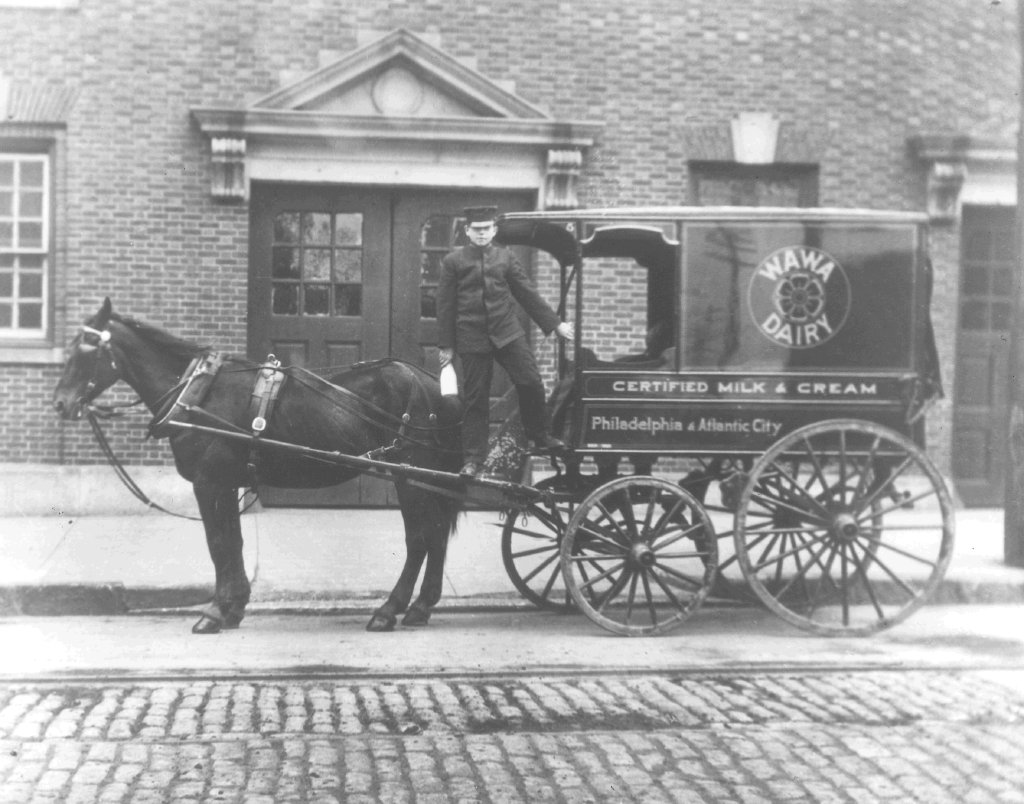
More than 100 years ago, Wawa started out as a dairy, delivering milk to Philadelphia-area households.
Wawa has set a national standard for success in the convenience-store industry, said Z. John Zhang, a marketing professor at the Wharton School of the University of Pennsylvania.
“It really is some kind of a secret sauce,” said Zhang, who studies retail management. “For many people, Wawa has become a destination store,” one that combines “speed, customization, and perceived high quality” with near-constant availability — many Wawa stores are open 24/7.
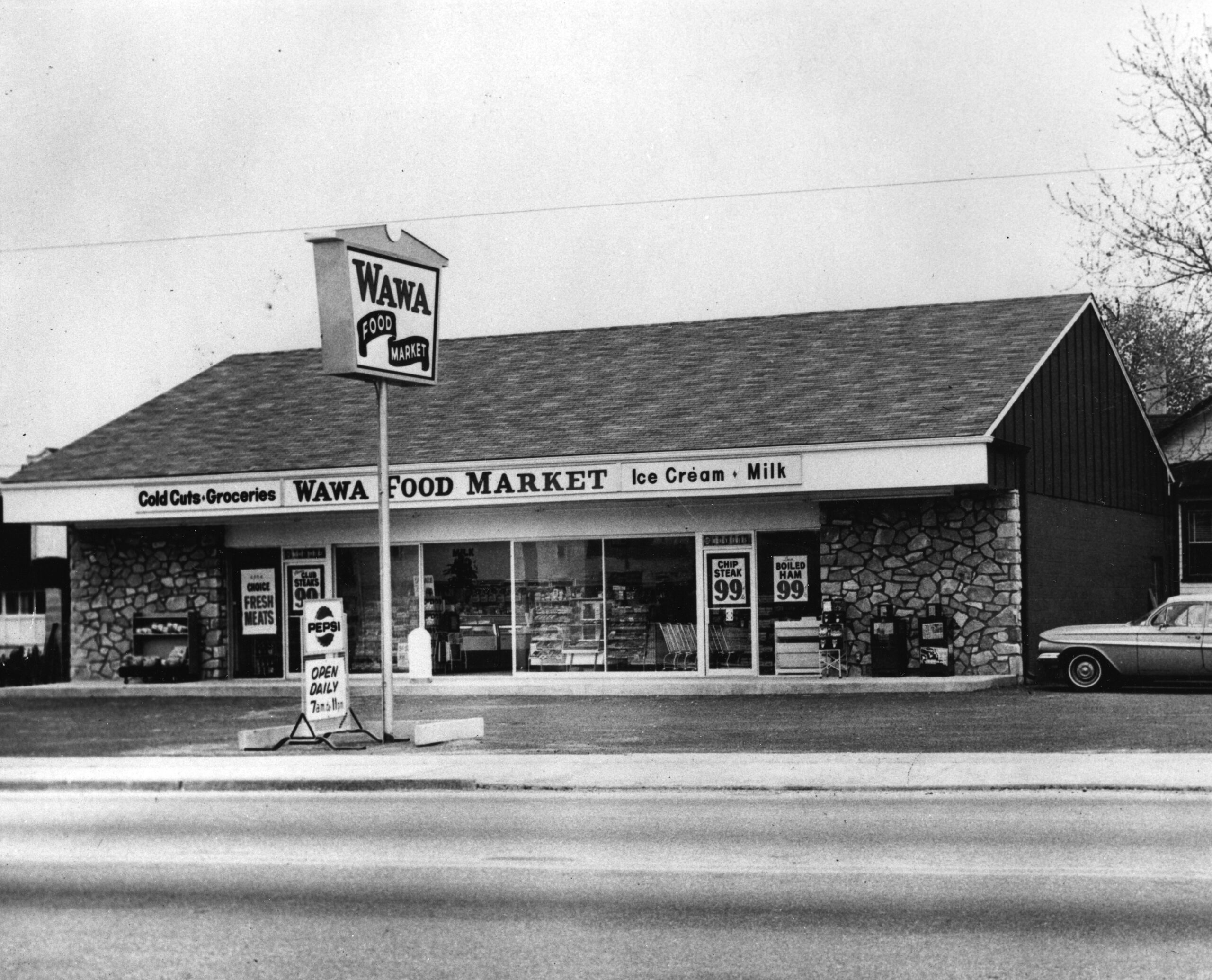
The company got its start as a dairy, delivering milk to Philly-area households. In 1964, it opened its first store in Folsom. Soon, the family-owned company expanded into New Jersey and Delaware, and established a reputation for quality and speed, with slogans like “People on the Go — Go to Wawa Food Markets.”
Wawa’s first convenience store opened in Folsom, Delaware County in 1964.
Wawa is privately held, owned in part by workers who get a percentage of their earnings contributed to an employee stock-ownership plan. Zhang said this program likely leads to more-invested employees who provide better customer service.
Because Wawa is not public, it is not required to disclose its finances, and company executives declined to discuss them.
But by many appearances, Wawa seems to be doing well: Over the last decade, the company has increased its store count by about 65% and doubled its workforce to about 50,000 associates.
Philly-area Wawas are often crowded, too, which is key to making money in the convenience-store industry.
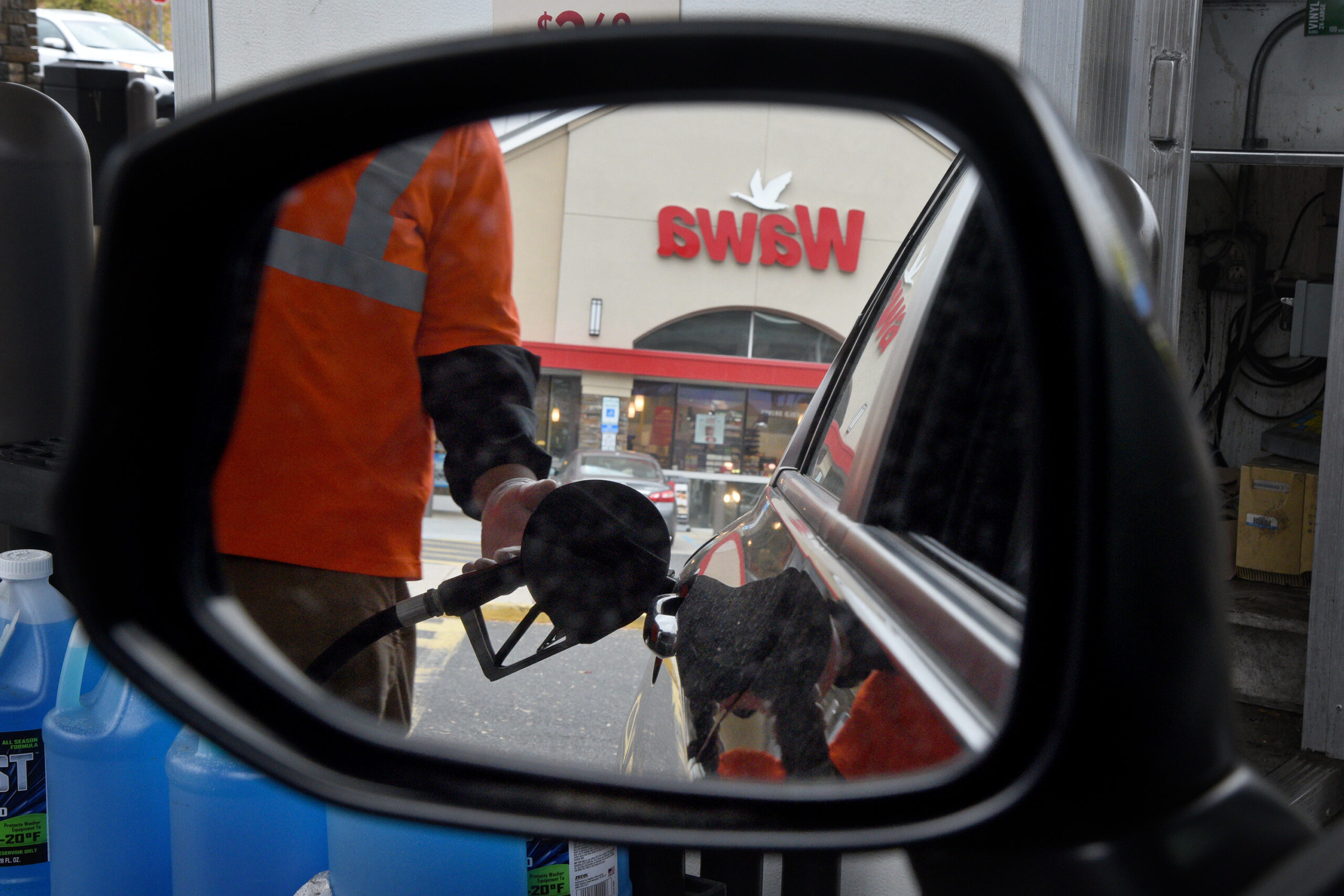
A gas attendant fills up a customer’s tank at a Wawa in Pennsauken in 2020.
“We think it’s high-impulse, but 80% of all people who walk into a convenience store pretty much know what they want,” said Zelinski, who consults with retailers. (He declined to discuss specific companies and said he has never worked for Wawa.)
Successful operators have encouraged customers to spend more by adding seating and improving their food service, Zelinski said. And stores with better food see higher profit margins.
“Once you have somebody that’s addicted to your food service program, they’re more likely to come back to your store vs. a competing store,” he said.
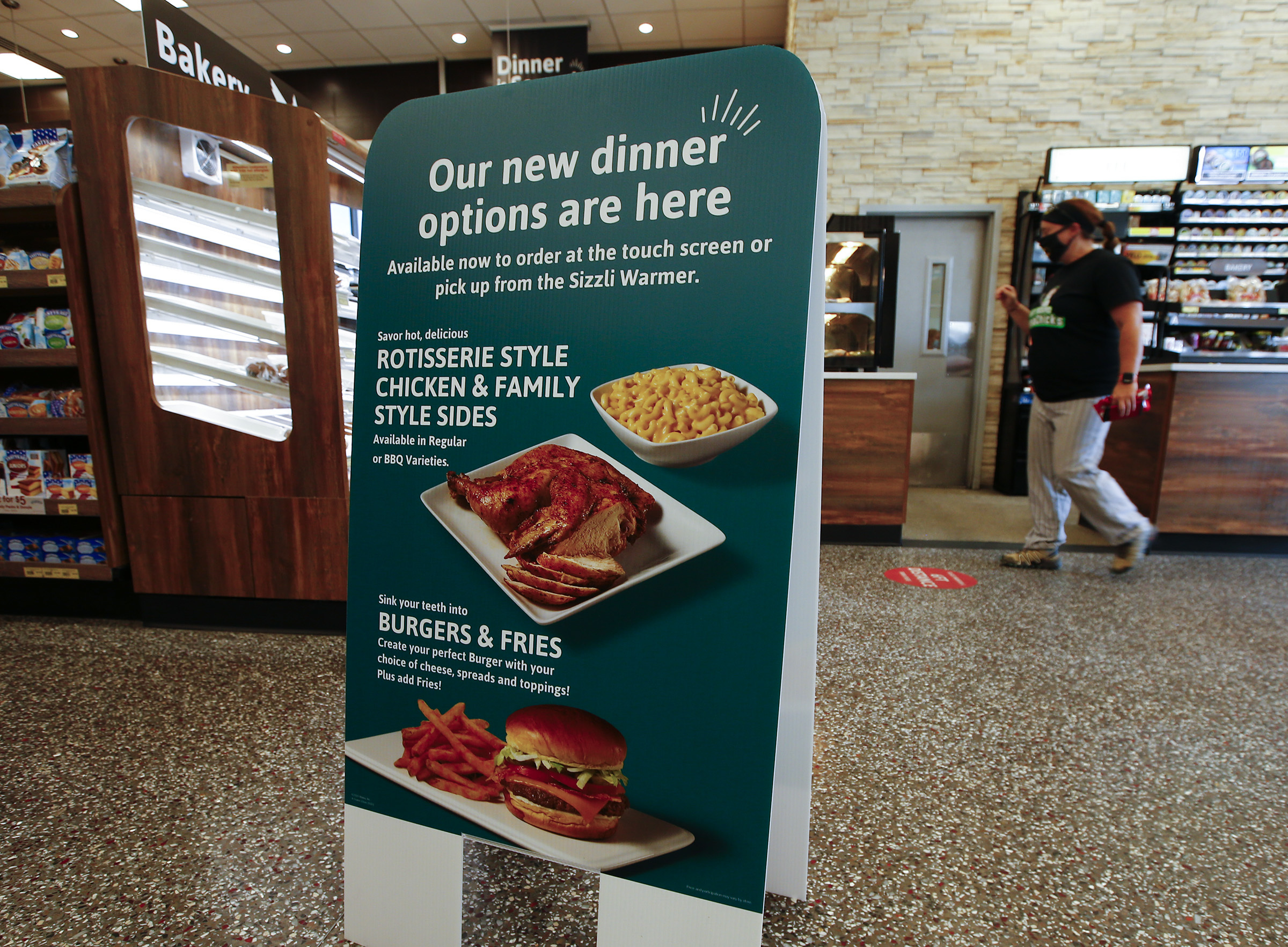
In 2020, Wawa debuted new menu offerings, including hamburgers, pot roast, rotisserie chicken, pasta alfredo, and kids meals, at a tasting in Media.
Wawa has certainly gotten people hooked on their coffee, hoagies, and ever-expanding menu, Zhang said. Options added in recent years include pizza, wraps, protein-packed “power meals,” limited-edition coffee flavors, and smoothies “boosted” with protein, vitamins, and minerals.
This older Wawa in Cherry Hill closed in 2024. The township has six remaining Wawas.
Despite Wawa’s best efforts, not all stores thrive, Gheysens said. But “luckily for us, we’re still in growth mode, and don’t have to worry about closures in a broad way.”
Gheysens said he sees room for more Wawas in the Philadelphia market — even as convenience-store competitors like Maryland-based Royal Farms and Altoona-based Sheetz have opened new stores in the region.
Wawa executives want “to make sure that we are the number-one convenience store in the area, that’s important to us,” Gheysens said. “These are our hometown counties.”
What keeps Philly-area consumers going to Wawa
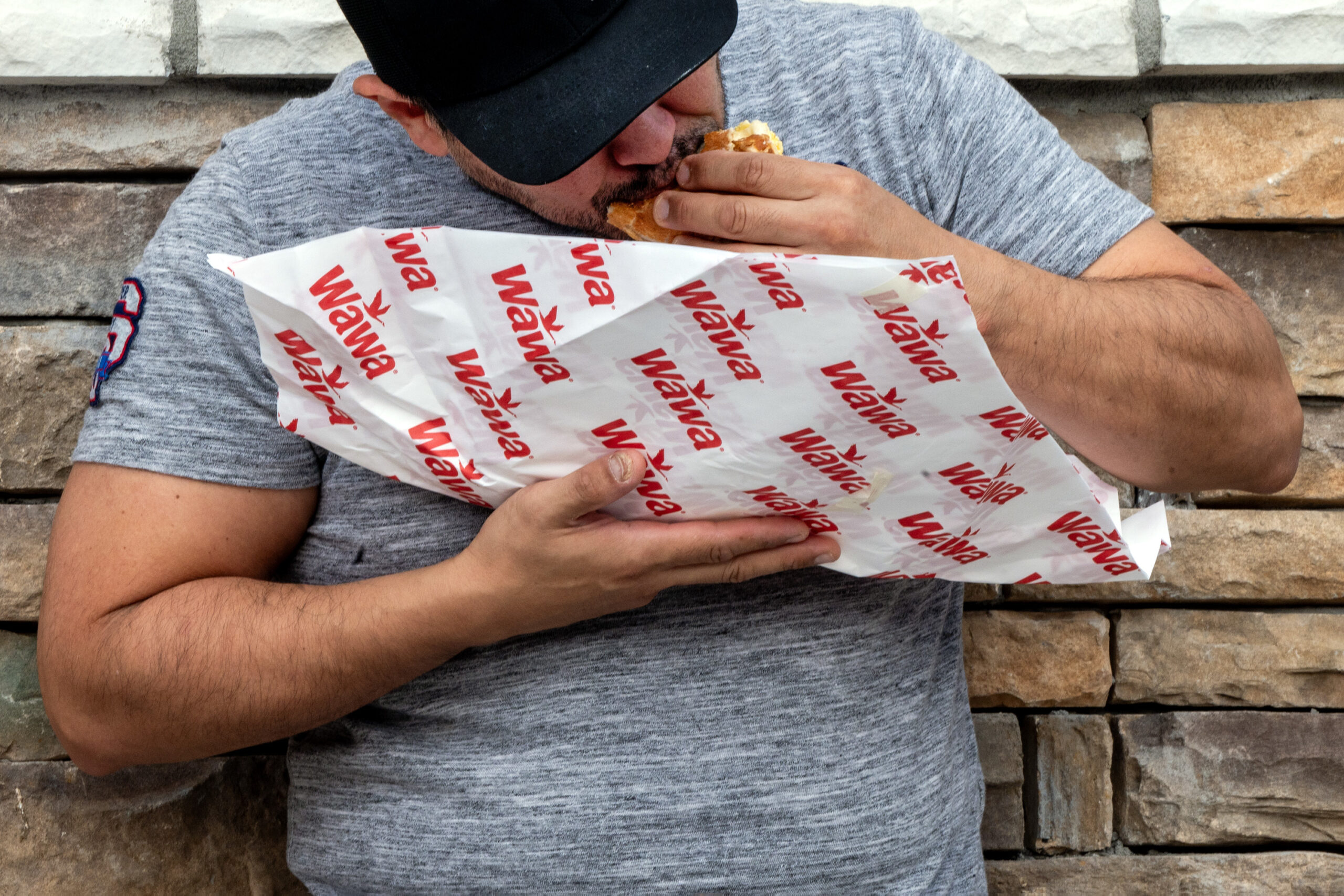
A Wawa customer eats a breakfast Sizzli during the 2024 grand opening of the company’s first central Pennsylvania store.
Many Philly-area consumers grew up alongside Wawa.
In interviews with nearly a dozen of them, some were quick to reminisce about early memories of their local stores, such as the distinct smell of coffee and deli meat or the excitement of a Wawa run with high school friends. Others bemoan what has changed with the company’s expansion, including more congested parking lots.
Most have a quick answer when asked what their Wawa order is.
Rick Gunter, 45, of Royersford, misses the Wawa of his youth. Back in the day, he said, the Wawa hoagies “hit different,” with lunch meat fresh off the slicer.
Contrary to some customers’ beliefs, most stores still bake Amoroso rolls — a custom recipe made exclusively for Wawa — fresh in store multiple times a day, Gheysens said. As for the deli meat, the CEO said that was another decision rooted in customer preference.
When customers have participated in blind tests of the pre-sliced meat Wawa uses today against a fresh-sliced alternative, “they can’t tell the difference,” Gheysens said. “They would choose our pre-sliced meats, because of what we’ve done in terms of quality and the supply chain and the ability to deliver them at such a pace.”
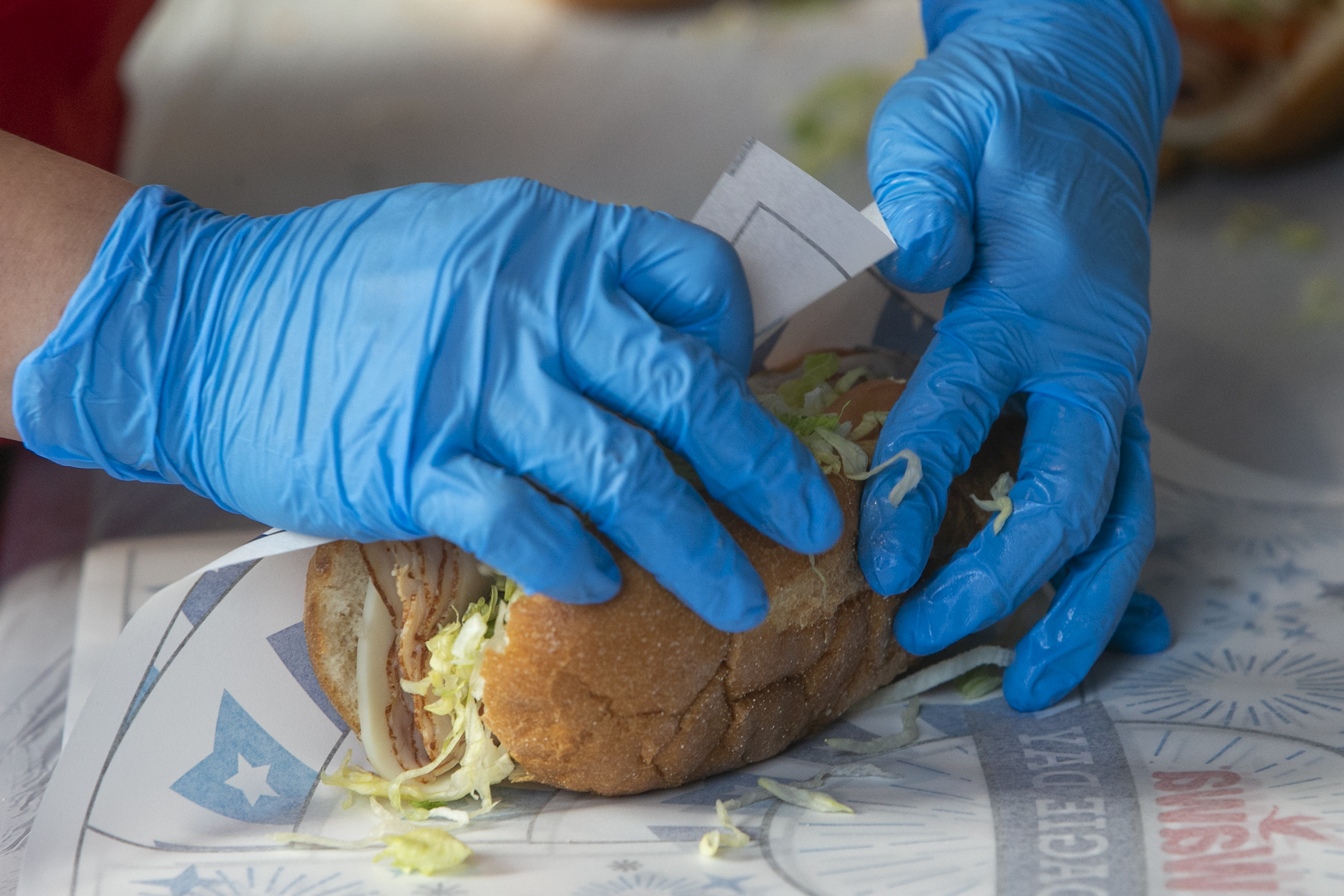
A sandwich maker at Wawa wraps a hoagie with turkey, provolone, tomato, and lettuce in this 2020 file photo.
Some customers disagree.
“It was way better when it was kind of also a deli. Now they try to make everything for everybody,” said Bill Morgan, 79, of East Coventry Township. “I’m within five miles of three Wawas, but I rarely eat their food. Only under extreme duress.”
Morgan acknowledged he must be in the minority, given how crowded Wawas are at lunchtime. And despite his distaste for much of their food, he said he still gets gas there and loves their coffee. And he can’t help but admire their business model.
Nestled in the foothills of the Blue Ridge Mountains, Charlottesville is ready for spring. The season there comes a little earlier than ours — cherry blossoms popping, birds trilling — so those planning a March getaway should consider the Virginian city, where the weather is often mild enough to spend serious time outside. Rails and walking paths wind like shoelaces through downtown and into the surrounding countryside. As a university town, C’ville is also packed with arts, music, shopping, and dining, and Thomas Jefferson’s Monticello estate sits just on the outskirts of town, high on a hill.
The first stop in town, Oakhurst Cafe, announces you’ve arrived in the South with a house-baked buttermilk biscuits layered with country ham, apple butter and mustard. There’s also strawberry shortcake French toast, sweet potato hash with chorizo and fresh-fried beignets, served in a sunny room whose generous windows make the tangerine walls and hardwood floors gleam.
📍 1616 Jefferson Park Ave, Charlottesville, Va. 22903
Stay: Graduate Charlottesville
Charlottesville is a college town, with the University of Virginia’s idyllic and historic campus right downtown. Lean into it and stay at the Graduate, a newer property from the collegiate-themed brand under the Hilton umbrella. Opened in 2015, the hotel is still super fresh, with a game room, scenic rooftop, and rooms dressed in soothing blue walls, Cavalier-print curtains, and bolster pillows embroidered with “Wah-hoo-wa,” the university’s sports cheer.
A short walk from the Graduate, Charlottesville’s pedestrian Downtown Mall offers a solid orientation to the city’s commercial core. Visit shops like C’Ville Arts, a co-op gallery representing over 50 Virginia artists, or catch a show at the historic Paramount Theater, which opened in 1931, closed in 1974, and reopened after a $17-million restoration in 2004. When the biscuit craving returns, hit Miller’s Downtown for lunch. It’s famous for the Charlottesville Nasty chicken biscuit, but the pimento-cheese BLT is the actual move.
📍 East Main Street, between Second Street NW and Ninth Street NE, Charlottesville, Va.
Whether you think history is a snooze or can quote Hamilton from memory — “Thomas Jefferson’s coming home!”— Monticello is must-visit. Set on 2,500 bucolic acres, the estate features multiple exhibits inside, outside, and even beneath the mansion, with thoughtful attention paid to the enslaved people who worked Jefferson’s plantation, including Sally Hemings, with whom he fathered six children.
Beyond the landscaped gardens of Monticello proper, the fairytale woods and meadows of the estate beg for exploring. The Saunders-Monticello Trail is an easy lift for all activity levels, with a maximum 5% incline and two miles of wheelchair-accessible paved paths and boardwalks winding through forest and over ravines. Stop at Carter Overlook for panoramic views of Charlottesville and the Blue Ridge Mountains.
📍 Parking: 503 Thomas Jefferson Pkwy., Charlottesville, Va. 22902
Drink: Blenheim Vineyards
Dave Matthews Band got its start in Charlottesville, gigging at Miller’s on the mall and other stages around town. Though the singer now lives in Seattle, he maintains a strong connection to Virginia. One touchpoint is his winery, Blenheim Vineyards, situated on 32 acres of rolling chartreuse hills stitched with sauvignon blanc, chardonnay, and albarino vines. Giant windows in the wood-clad A-frame frame the landscape during guided tastings of five wines (just $25). Consider this your predinner drinks.
Back downtown, Smyrna’s oysters with ramp mignonette, hamachi crudo with anise-compressed melon, and manti dumplings dabbed with garlic yogurt earned chef Tarik Sengul a semifinalist nod from the James Beard Foundation this year. You’ll have to wait till April to find out if he advances to the finalist round of the awards — making right now an ideal time to check this sharp Aegean restaurant out for yourself.
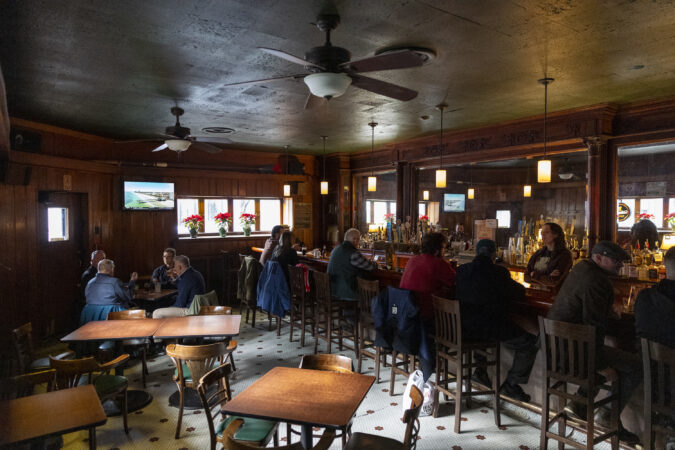
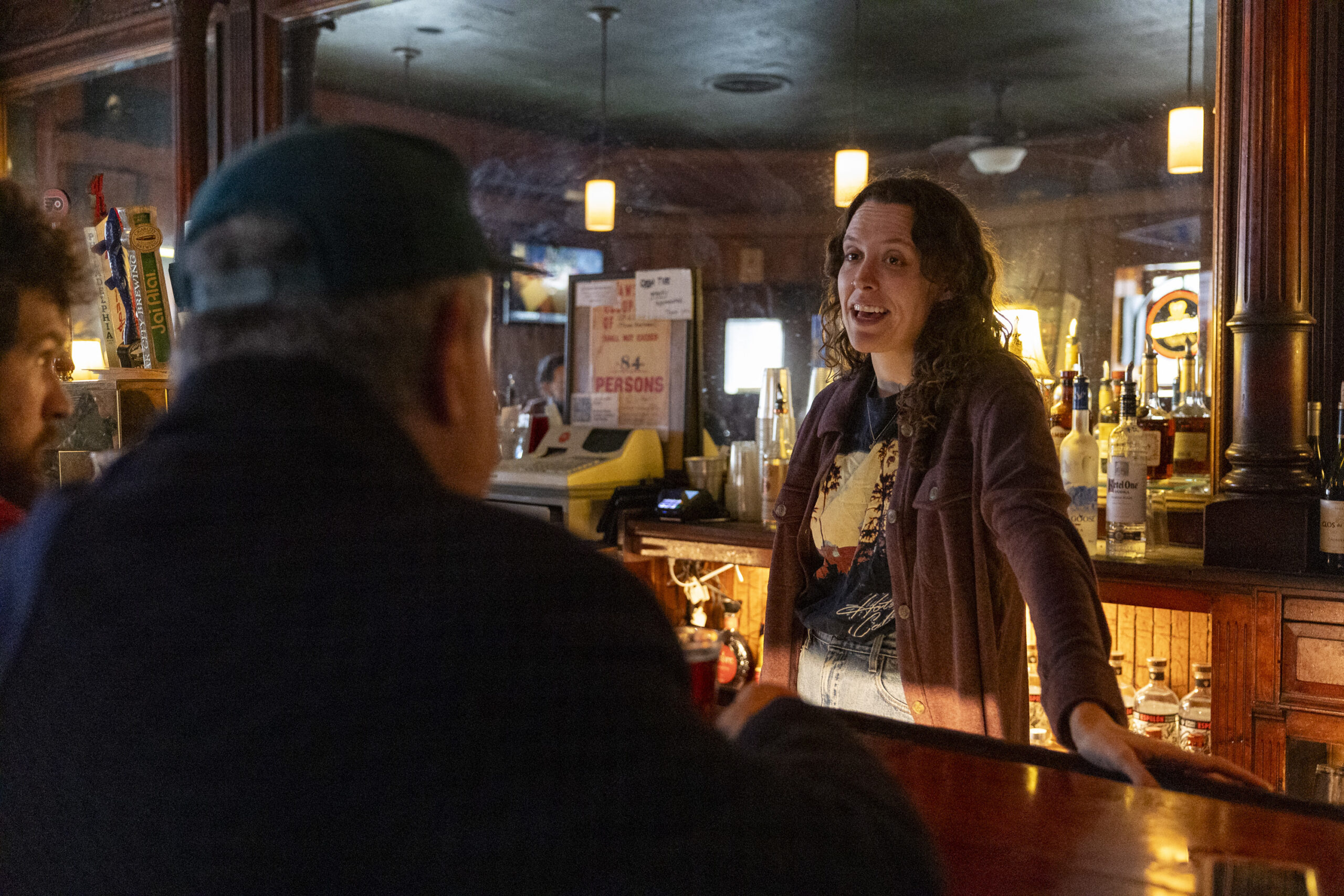
In 1976, when Bill Loughery was a rookie bartender at Cherry Street Tavern, the old-world saloon seemed as abandoned as the neighborhood around it. Back then, the streets around 22nd and Cherry in Logan Square were littered with abandoned warehouses, rusting textile mills, and crumbling body shops.
First operated as a bar around 1902 and surviving Prohibition as a barbershop — at least one where regulars swilled hooch in the back room — the tavern had retained much of its bygone charms into the ’70s. It had an elaborately carved mahogany backbar, vast beveled bar mirrors, pearly white tiled floors, and an old-timey phone booth. Even the tiled water trough running the length of the floor under the bar — a no longer operational relic from the barroom’s pre-World War II days designated for fedora-sporting patrons to spit tobacco juice and relieve themselves — had survived the decades.
But like the neighborhood, business had faded.
Bill Loughery, then 24, and his younger brother, Bob, had scored the bartending gigs from their former coach and mentor, legendary La Salle High School football coach John “Tex” Flannery, who purchased the bar in the early 1970s. Serving 25-cent Schaefers, rocking their favorite Grateful Dead tunes, and warmly greeting the newbies filling the barstools, the Lougherys brought life to Cherry Street Tavern, eventually buying it from Flannery in 1990.
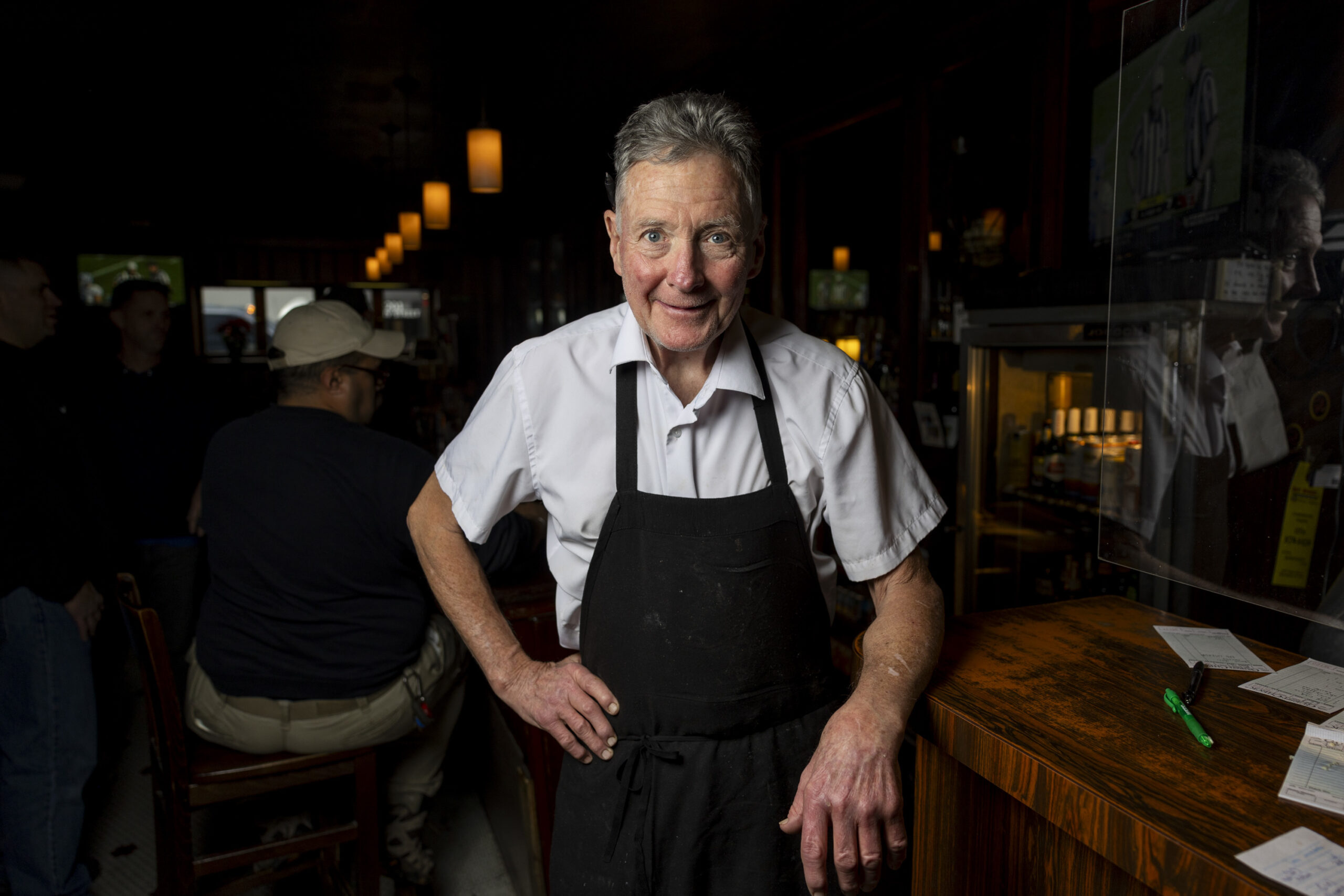
Bill Loughery, co-owner of Cherry Street Tavern, inside his bar in Philadelphia on Friday, Dec. 19, 2025.
While burnishing its old-world grace, they had transformed the timeworn taproom into a thriving, in-the-know spot for eating and drinking, with a diverse, dedicated, and colorful cast of regulars from all over. Everyone from construction workers and electricians to lawyers and bankers to art students and professors came to the bar — even rock icons like Jimi Hendrix, who, as the legend goes, knocked on the side door wearing a cape in 1968 after playing a show at the original Electric Factory, just blocks away; he palmed the bartender $100 for a case of Bud and a bottle of Jack Daniels. There were also visiting sports legends like Larry Bird, who would drink at Cherry Street with his staff when he came through town as a coach in the 1990s and 2000s.
“He’d say, ‘Billy, let me know when you’re closing that kitchen,’” Bill Loughery remembers. “And then he would go back to the Four Seasons with bags of roast beef and roast pork.”
And always, there were Bill and Bob Loughery, either toiling in the tavern’s tiny kitchen before dawn to prepare steaming cauldrons of Irish potato soup and huge slabs of beef for the bar’s signature sandwiches, or working the wood until closing.
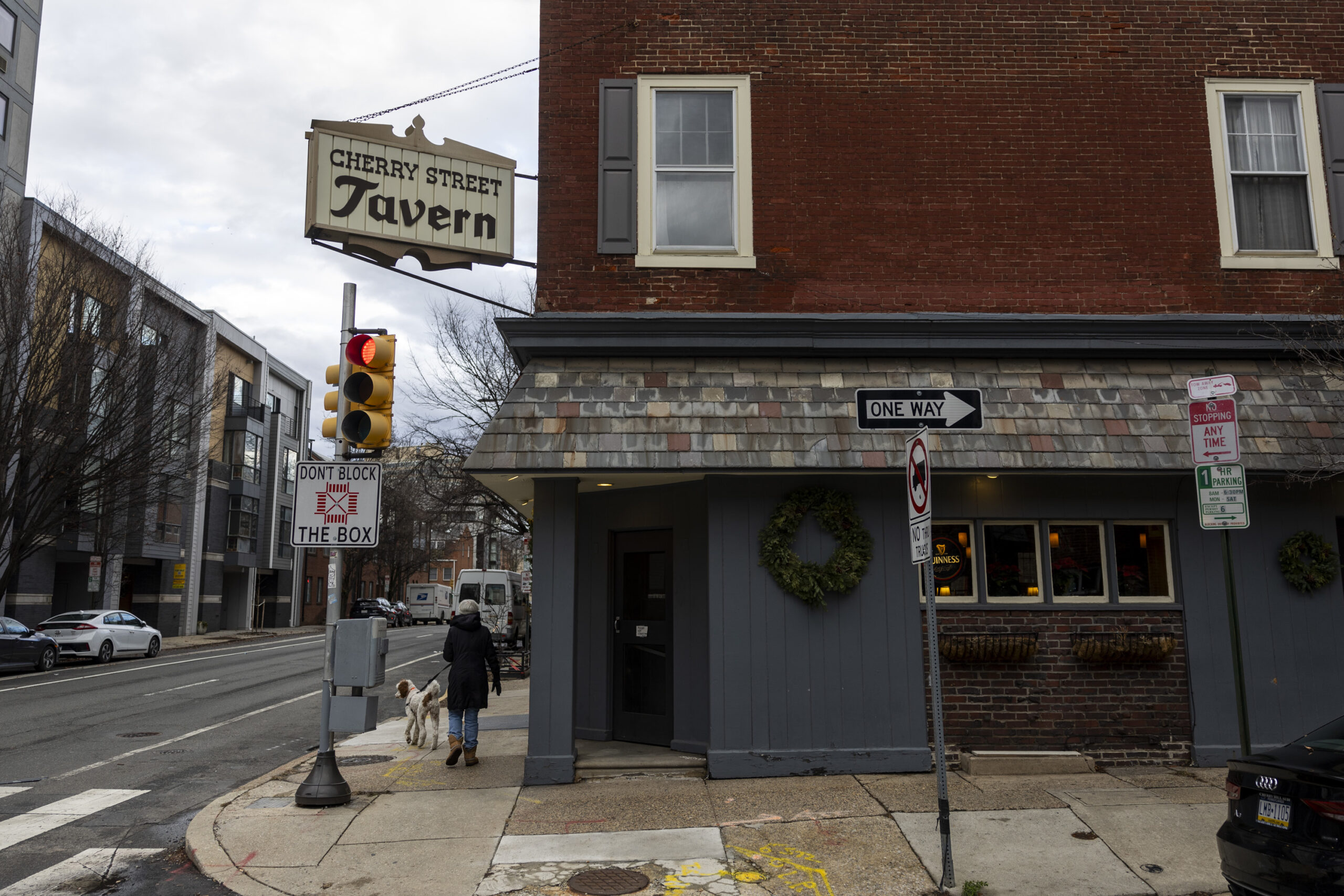
The outside of Cherry Street Tavern in Philadelphia on Friday, Dec. 19, 2025.
After 50 years devoted to a tavern that always felt more like a labor of love — and bearing witness to the change all around it — Bill and Bob Loughery have decided it’s time.
“Time to take off the apron,” said Bill Loughery, taking a quick break on a recent afternoon to sit in the soft sunlight slipping through Cherry Street’s bottle-height barroom windows. “It’s just time.”
History, for sale
It’s been time for a few years, but the Lougherys— wanting to preserve the understated elegance and identity of the shot-and-a-beer saloon, especially after revitalizing the bar once again as a popular meeting spot for locals after COVID-era restrictions dried up lunchtime and commuter crowds — have never officially listed the tavern and its upstairs apartment for sale. They began whispering to friends and regulars about selling around 2024.
“People were always asking us to let them know when we were ready,” Bill Loughery said.
After months of talks with prospective purchasers, the Lougherys are now in talks with a buyer who theysay is interested in expanding the bar’s kitchen and making other renovations.
The Lougherys’ efforts to find a buyer committed to keeping the spirit of the bar alive have eased the worries of regulars old and new, and loyal staff.
Kira Baldwin, 27, chats and makes drinks for folks at Cherry Street Tavern.
“There’s just something sacred about the place,” said Kira Baldwin, 27, of Ardmore, who tends bar at Cherry Street Tavern, along with her brother, Jack, 24, and her mother, Juanita Santoni, with whom she sometimes shares a shift.
For Baldwin, it’s personal. As a child, she cherished special occasions when her mother allowed her to visit the bar. (Santoni has worked nights and weekends at Cherry Street Tavern since 1991, when she was a part-time child life therapist at CHOP.) On those nights, Baldwin would do her homework in the quiet of the ancient phone booth and swing from the brass dining rails. At the annual Christmas parties, when Bill Loughery hired Moore College of Art & Design students to paint the windows for the holidays, she and her brother received gifts from a regular dressed up as Santa.
Now, she watches new regulars fall in love with a bar she’s been coming to since “the womb.”
“People treat it with reverence,” she said. “When they come in, they understand it completely. They have a deep and profound respect for the place.”
Prohibition, the food, and the regulars
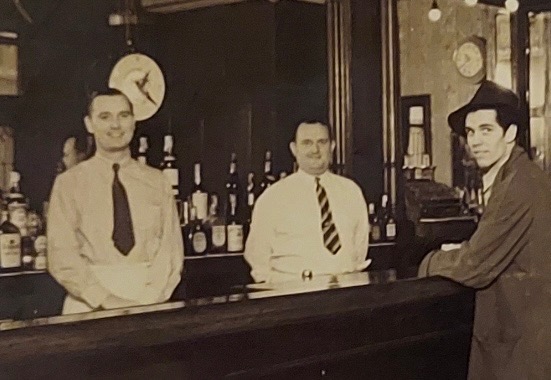
Little is known about Cherry Street’s earliest days, but by Prohibition, it was known as Dever’s, operated by John “Jack” Dever, a dapper barman who lived above the tavern with his wife and two children, and whose father, Joseph, had run it before him. (Like Flannery and the Lougherys after him, Dever happened to be a La Salle High alum.)
The barbershop speakeasy had been Jack Dever’s idea, said his grandson, Michael Dever.
Before it became Cherry Street Tavern, John “Jack Dever (left) operated the tavern for years, living upstairs with his family, and eventually dying behind the bar.
“The story always went that, when Prohibition came about, he closed the front door and opened the back door,” said Dever. “It became dangerous. The story was that you were either buying from the mob or dirty politicians.”
Dever reopened the bar after Prohibition, sponsoring a bar baseball team. But dangers persisted. In 1940, two robbers broke into the bar while Dever and his family slept upstairs, briefly making off with 25 quarts of high-quality whiskey before their bulging bag of booze crashed to the pavement. Nearby patrolmen ran to the scene, “their noses guiding them unerringly as the liquor spilled into the gutter,” The Inquirer reported.
Dever, who soon moved his family out of the upstairs apartment, ran Cherry Street until 1967, when he died of a heart attack behind the bar, according to granddaughter Maureen Ginley. At first, customers assumed her grandfather had just stepped down a hatch behind the bar, leading to a liquor cellar.
“But he didn’t,” she said.
After keeping the bar afloat for five years, Dever’s widow, Mary, sold the bar to Flannery. A local high school football legend who coached at La Salle for nearly 30 years, Flannery operated a no-frills, old-school establishment, refusing to allow a jukebox. Under Tex, the tavern’s old-world grace peeked out from behind a dusty veneer and faded Venetian blinds.
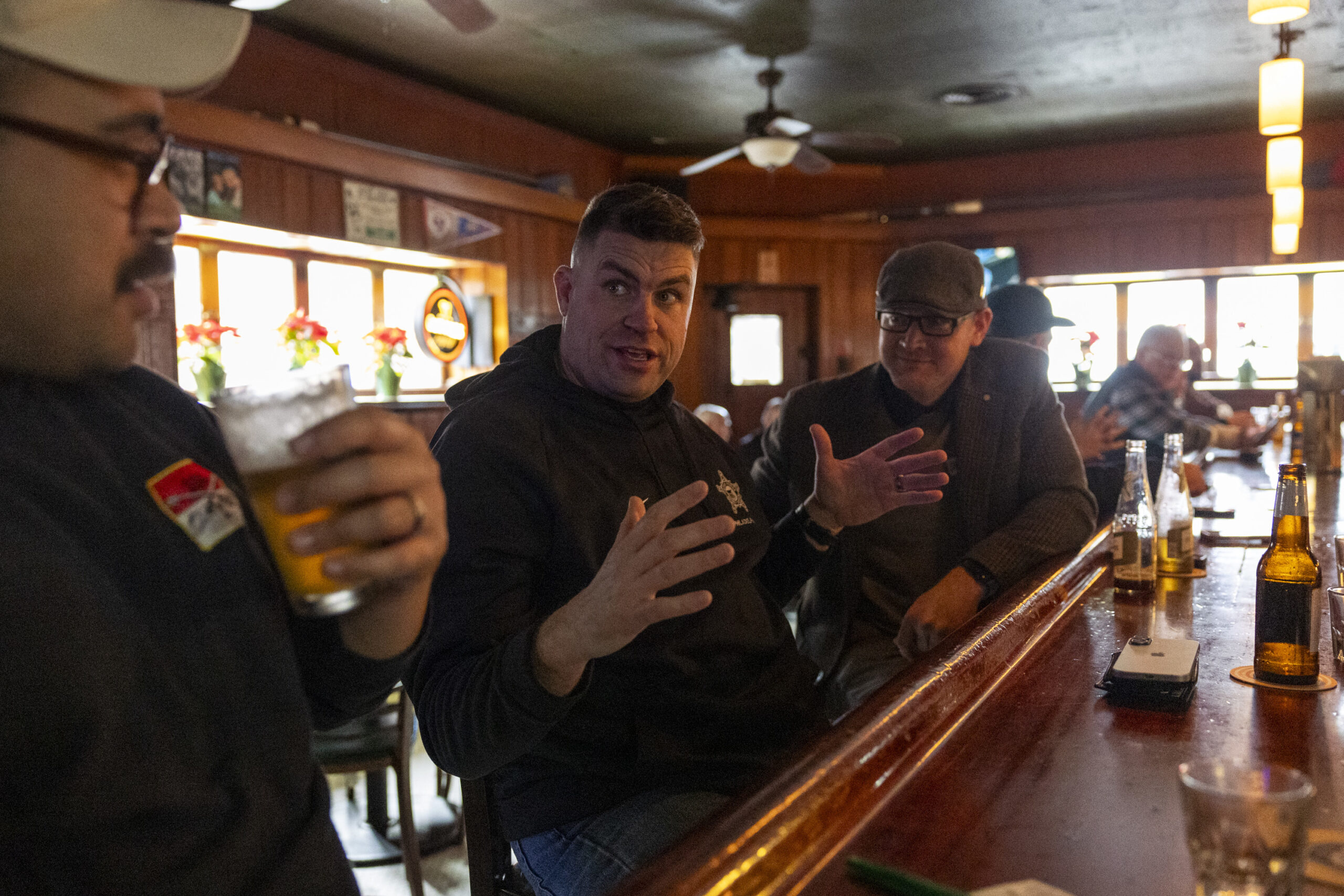
Kevin Sanders, of Quakertown, Pa., first time at the bar, sharing a story with friends as they enjoy drinks at Cherry Street Tavern in Philadelphia on Friday, Dec. 19, 2025.
A 1981 Daily News article described the bar “as cave-dark, cave-cool, cave-quiet.”
“Let’s face it, a guy comes in here, he wants to drink,” the article quoted Flannery.
For a while, it was just the old-timers, said Bill Loughery.
“We had the senior citizens from the neighborhood who started drinking right in the morning and went home before lunchtime,” he remembered.
One Friday during Lent in 1977, Flannery summoned the brothers to a sit-down fish cake dinner and laid it out straight. “He said, ‘Listen, the future of the bar business isn’t 25-cent beers,’” remembers Bill Loughery. “‘You got to come up with a food angle.’”
With the help of a regular, Bill and Bob Loughery introduced the tavern’s signature hot roast beef and roast pork sandwiches, chili, and daily soups.
A roast beef sandwich at Cherry Street Tavern in Philadelphia on Friday, Dec. 19, 2025.
By the 1980s, when condos and townhomes and office buildings and new life began to fill the neighborhood, the Lougherys were ready.
Soon, the expanded back room was packed at lunch and the stools were filled with regulars who Bill Loughery blessed with nicknames: Happy Bob and Sleeping Charlie, Big Tom and Buddy Bud, Catfish and Canadian John (who eventually became American John). Joe Watson — a beloved old-timer who lived upstairs, and became a “patron saint” to the bar, said Bill Loughery — took a busload of regulars to a Phillies game for his 89th birthday. There were St. Patrick’s parties and fishing trips and softball teams and marriages and births and deaths. It was their “Cheers,” one regular said.
“What’s Cheers?” Bill Loughery would ask, unironically.
It was Bill and Bob who brought everyone back, said Frank Oldt, 81, who has been a Cherry Street regular since the days of Tex.
“They just made it such an easy place to be,” he said.
It’s bittersweet, said Santoni, who remembers how the bar regulars threw her not one — but two — baby showers when she was pregnant with Kira. She has been trying to get Bill and Bob Loughery to slow down for years. But she understands the special pull of the place.
“It gets in your bones,” she said.
Last call
It all took a toll on Bill Loughery’s bones, who still works 12-hour shifts, splitting days and nights with his brother. Bill’s back is hunched from those endless hours in the kitchen. He doesn’t want to become the second person to die behind the bar at Cherry Street. Sitting down, he flipped through photo albums from the bar’s heyday. They’ll be the last things he takes with him when he leaves, he said.
“It’s like the Old and New Testament,” Bill Loughery said, opening a near-to-bursting photo album.
For a few minutes, he allowed himself to recall the faces and the nicknames and the good times.
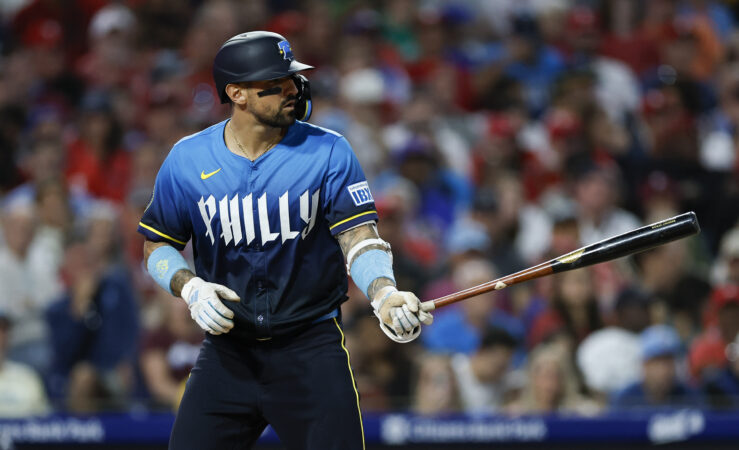
In the note, he finally filled in the blank: “Ok apparently I need to address the Miami incident.”
For eight months, the “Miami incident” hovered over the franchise without much other information. It was a turning point, but no one outside the clubhouse knew why.
Now we know his side of the story: After being pulled late in a June game in Miami, he brought a can of Presidente into the dugout and confronted Rob Thomson about what he saw as inconsistent standards. Teammates took the beer before he drank it. He apologized. The next day, his starting streak ended. And after that, the relationship was never the same.
But still, this ending lands with nostalgia.
This was the guy who turned tragic news cycles into accidental baseball folklore. The timing of his biggest hits was just uncanny. The day I-95 collapsed, or the day a president was shot at, or the day another dropped out of a race.
Then there was Liam, andthe joy of getting to experience Red October with his son in the stands. Back-to-back postseason multihomer games with his kid watching. Whatever else you thought about Castellanos, those nights felt special.
He was never boring, and that counts for something.
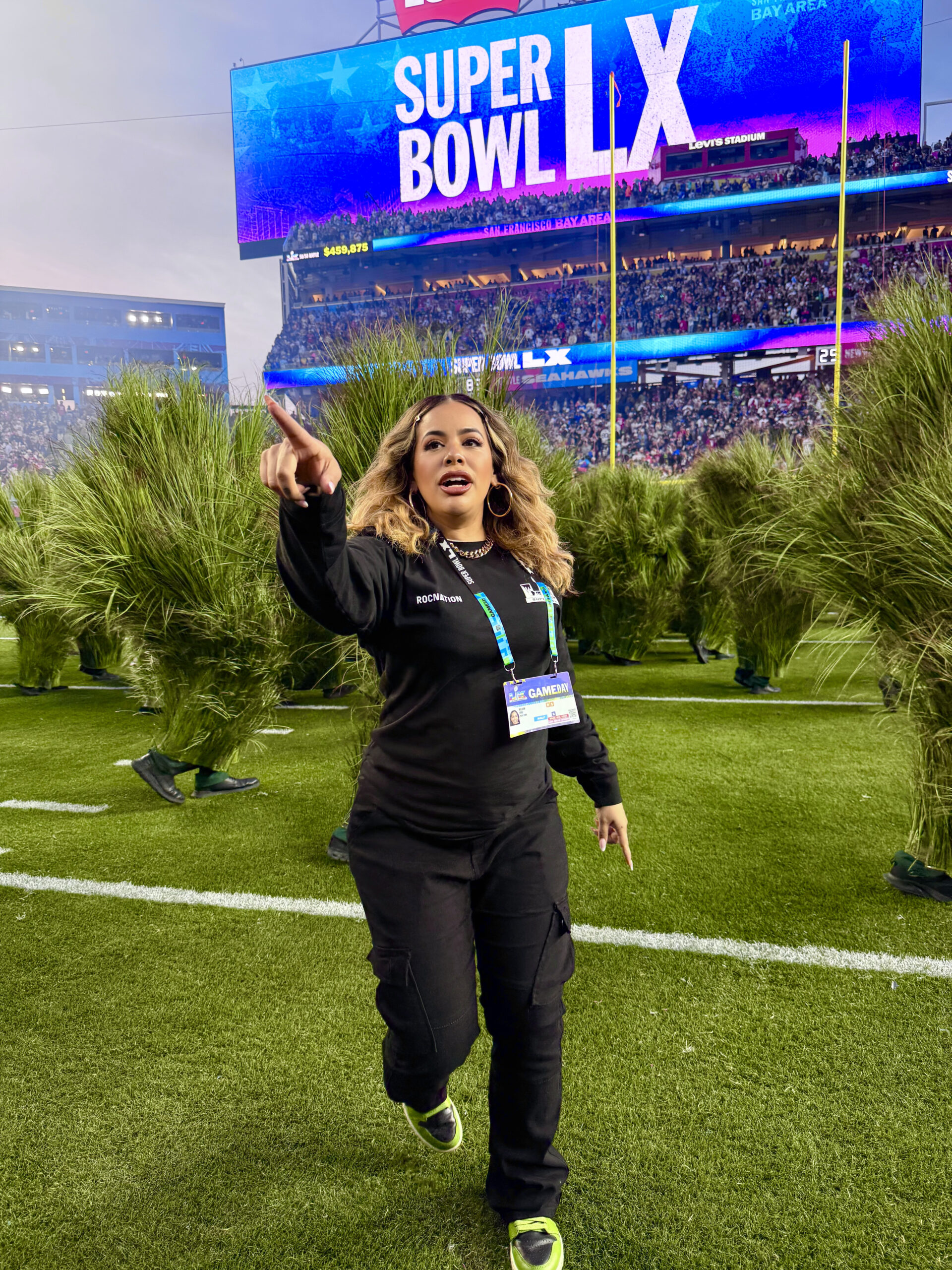
Northeast Philadelphia’s Delilah Dee walks through Bad Bunny’s halftime show stage at Santa Clara’s Levi’s Stadium, on Feb. 8 2026
An Eagles fan from Fishtown spent weeks rehearsing in a 50-pound grass suit, keeping the secret, grinding through 12-hour days, then waddling past Pedro Pascal and Cardi B on global television. A Northeast Philly marketing pro manifested her way onto the field crew and helped execute one of the most high-pressure seven-minute turnovers in live entertainment.
The plant story is peak Philly optimism: “The Eagles didn’t go, so I went for them.” That’s delusional in the best way. That’s Broad Street confidence. The field-team story hits deeper. In a halftime show centered on Latino pride and visibility, a Mayfair native who’s built community through Latin culture here in Philly ends up helping pull off the mechanics of the moment.
Would it have been better if it were an Eagle-and-Benito Bowl? Obviously. But Philly showed up anyway. Grass suit. Stage crew. Go Birds.
It hits 40 degrees and Philly declares emotional spring: A-
People are planning vacations, talking about the Cherry Blossom Festival, and declaring the worst is behind us while carefully sidestepping three-foot snowbanks and skating past frozen crosswalks. Someone said, “It’s gorgeous out,” and meant it sincerely.
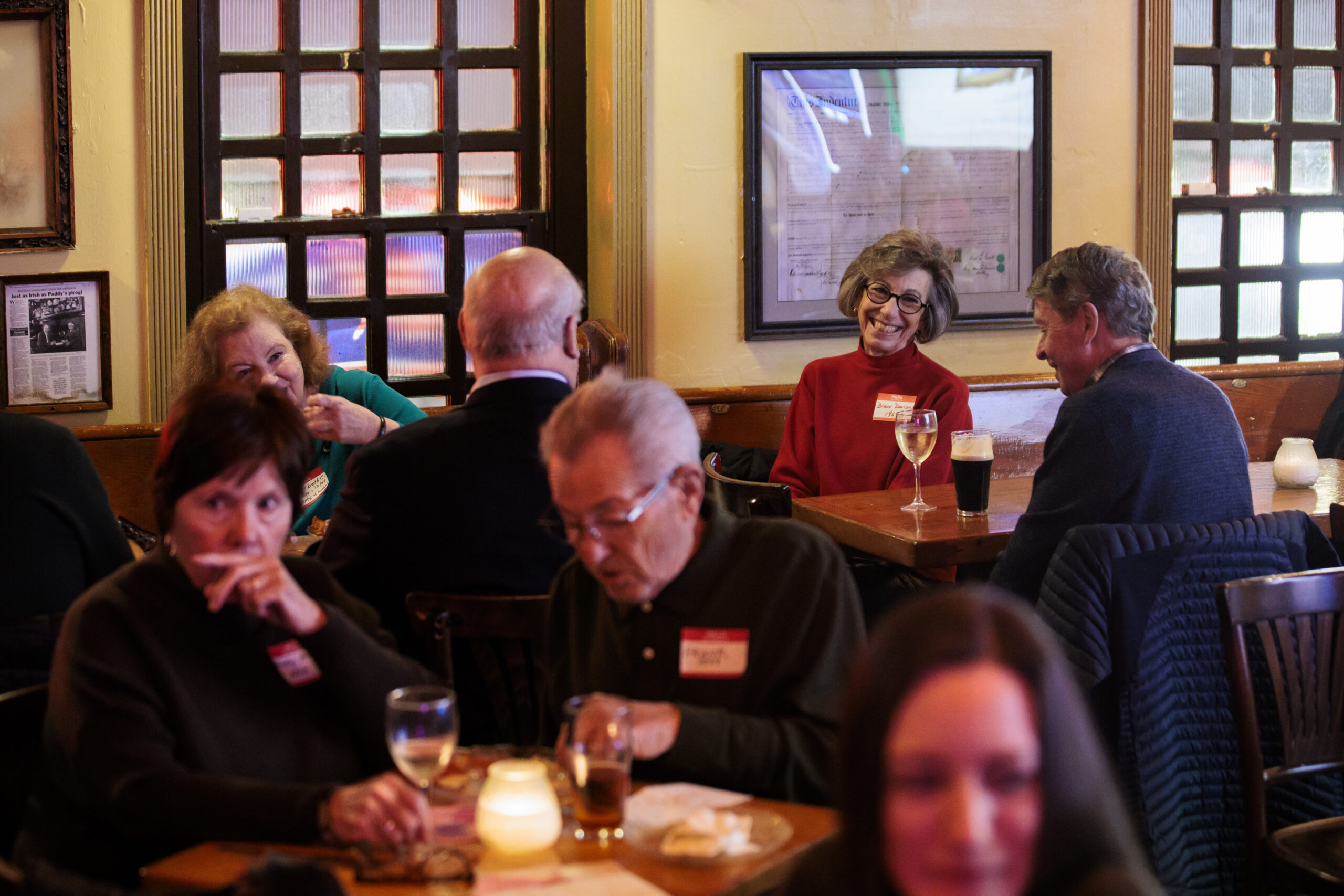
Diane and John Davison (back, right), who met here in 1969, laugh with other attendees at McGillin’s on Feb. 3, 2026. Attendees gathered for a book talk on “Cheers to McGillin’s: Philly’s Oldest Tavern.”
McGillin’s proves love doesn’t need an algorithm: A
The 166-year-old pub gathered dozens of couples this month who found love under its low ceilings and tinsel hearts. Some have been married 50-plus years while others are newlyweds who matched over wings and Yuenglings. The upstairs bar looked like a class reunion for romantics.
In a city that loves to argue about everything, this one’s hard to fight: Proximity still works. (Eye contact and beer don’t hurt, either).
There’s something deeply comforting about the idea that the most reliable matchmaker in Philly isn’t an app. It’s a place with oak tables, framed liquor licenses from the 1800s, and bartenders who’ve seen it all. At some point, the legend becomes self-fulfilling. If everyone believes McGillin’s is where love happens, eventually it does.
Pennsylvania watching eagle eggs hatch on a livestream: A
There is something deeply Pennsylvania about thousands of people spending their morning refreshing a live webcam of a bald eagle nest in an undisclosed Lancaster County tree.
More than 100 live viewers at mid-morning, with nearly 700,000 views last year. The chat section is full of viewers who are emotionally invested in avian domestic life.
There’s something quietly moving about it. Bald eagles were nearly wiped out here with just eight known active nests in 1990. Now there are more than 300.
Spring is coming. And until baseball starts, this is what we’ve got.
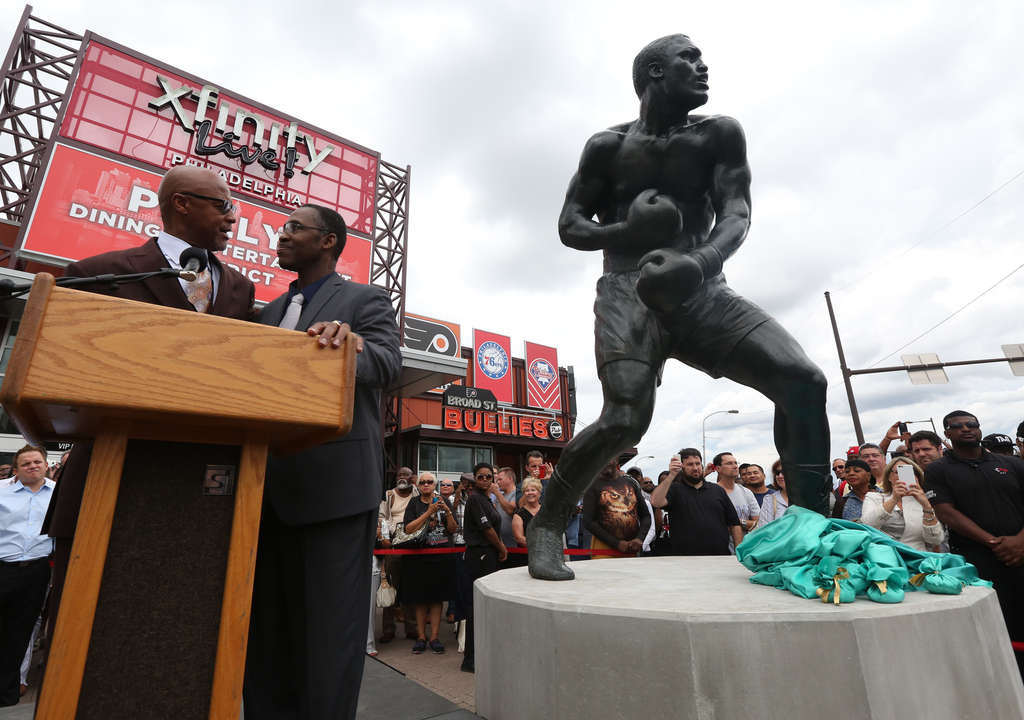
FILE – His son, and former heavyweight boxer Marvis Frazier (right), and Rev. Blane Newberry from Enon Tabernacle Baptist Church bless a 12-foot-tall 1,800-pound bronze statue of “Smokin’ Joe” Frazier after it was unveiled Saturday, September 12.2015 at XFinity Live in South Philadelphia.
The Art Commission voted unanimously to relocate Frazier’s 12-foot bronze statue from the sports complex to the base of the museum steps — the spot Rocky has occupied for two decades. Rocky, meanwhile, is headed back to the top.
On one level, the move feels overdue. Frazier wasn’t a metaphor. He was a real Philadelphian, an Olympic gold medalist, a heavyweight champion, the man who handed Muhammad Ali his first professional loss. Meanwhile, Rocky, beloved as he is, is a fictional character who may have beeninspired in part by Frazier’s life.
There’s something quietly powerful about visitors encountering Joe first, before heading up top to take a selfie with a myth.
Yes, there are valid conversations about symbolism, especially in Black History Month, about a real Black champion standing below a fictional white character. The city’s explanation is practical: Frazier’s statue is physically larger and not structurally suited for the top. Rocky’s footprint is smaller and easier to manage up there.
Logistics matter, but narrative does too, and this move reshapes the narrative. You climb the steps for the movie moment, but you pass the real champion on the way.
World Cup wants 4 a.m. last call. Philly isn’t sure it even wants 2: B-
On paper, this is easy. The World Cup is coming, and along with it comes half a million tourists and a global spotlight. Other host cities pour until 4 a.m. Philly shuts it down at 2.
The pitch is simple: if Brazil and Haiti kick off at 9 p.m., and knockout games can run long, why send thousands of fans back to their hotels when Miami and New York are just getting started?
The last time Pennsylvania tried this, during the 2016 DNC, the response was tepid, reported Philly Voice. Businesses had to deal with expensive permits and confusing rules, and the result wasn’t exactly a citywide bacchanal. And even now, bar owners quietly admit the late-night crowds aren’t what they used to be.
There’s also the Philly tension underneath this: We want to be global, but we also want to sleep. Would it be cool to say Philly partied like a World Cup city? Sure.
But it’s also true that if bars will be pouring until sunrise, at least half the neighborhoods would immediately be on 311, complaining about all the drunk and noisy tourists.
Nestled in the crook of the Lehigh and Delaware Rivers, Easton’s manufacturing might was powered by its waterways during the Industrial Revolution in the early 20th century. Tanneries, flour and silk mills, distilleries, breweries — these were the big businesses in town.
Now, those old industrial shells and the former mansions of tycoons house cafés and galleries, boutique hotels, and French-inspired markets.
Easton sits just 90 minutes from Philly, making it an easy weekend getaway. Take the Turnpike north, hook a right at Allentown, and head toward the river.
In dining, shopping, and arts, Easton way overdelivers. Hotels are still catching up. Fortunately, the popular Gusto Hospitality Group (see Dine, below) opened the Townley House Hotel several years ago, and the 16-room boutique remains the best place to stay in town. An original mahogany staircase links the levels of this restored brick townhouse on Easton’s historic Millionaire’s Row. There’s a sun-dappled courtyard, Mercer-tiled fireplaces, maximalist wallpapers and custom headboards — a different one for each room.
📍 130 N. 3rd St., Easton, Pa. 18042
Stroll: Karl Stirner Arts Trail
Running nearly two miles along scenic Bushkill Creek to Lafayette College’s William Visual Arts Building, the Karl Stirner Arts Trail weaves through 27 works of public art. The trail is named for the German-born sculptor and metalsmith largely credited for making Easton an arts destination in the 1980s. You’ll find his untitled steel arch, painted an unmissable scarlet, about two-thirds of the way down the path.
In this world, there are people who love pie, and then there are monsters. Don’t be a monster. On Northampton Street, Easton’s main drag, Pie + Tart is charming spot with exposed brick walls and Shaker-style chairs from bakers Lisa Yelagin and Anne Gerr. Savory pies (coq au vin) and sweet ones (Mexican chocolate chess, cherry cheesecake) rotate weekly, alongside soups, quiches, and other cozy blackboard specials.
If you’re bringing kids — or you simply have strong feelings about Burnt Sienna and Tickle-Me-Pink — meet the Crayola Experience. The king of crayons was born — and still manufactured — right here in Easton. The four-floor experience mixes analog crafts and digital diversions, including an 85-foot water table and a photo booth that generates a coloring-book selfie. Great opportunity to see what you’d look like as a Mango Tango redhead.
Men’s shearling-lined shackets, watercolor paint-by-numbers journals, irreverent incense (“Chai-Scented Laziness,” “Burn Away the BS”), and more fill Belleville Market, a three-level department store inspired by the marketplaces the owners fell for in France. Keep an eye on their events page to see whether your Easton trip lines up with the shop’s happenings, like the upcoming Moka pot demonstration and tasting and floral-filled spring open house.
📍 20 S. 3rd St., Easton, Pa. 18042
Drink: Kabinett
We don’t need to tell you: The PLCB does not make sourcing great wine easy. Which makes Kabinett, a Bavarian-inspired refuge furnished with warm woods, wishbone chairs, and framed botanical prints all the more impressive. A grandly antlered stag skull presides over the bar. The Wine Spectator-recognized list ranges from whole-cluster Santa Barbara Sangiovese and South Australian Riesling from 175-year-old vines. It’s deep but playful, organized under headings like:“Reds ~ OK, Boomer. Safe Cabernet & oak space for full-throttle bottles.”
📍 125 Northampton St., Easton, Pa. 18042
Dine: Albanesi Restaurant & Bar
Italian restaurants run by Albanians form their own industry sub-genre. At Albanesi Restaurant & Bar, Gusto Group’s Mick Gjevukaj, who grew up in the war-torn former Yugoslavia, is putting his heritage center stage with dishes like harissa-spiced rib-eye qofte (kofte), veal goulash, and braised lamb shoulder lacquered in pomegranate. Climb into one of the camel-colored clamshell banquettes, order some samuna bread and hummus swirled with ajvar, a Balkan condiment of roasted peppers and tomatoes, and settle in for culinary geography lesson. Who knew you’d learn it in Easton?
The sleek, modern offices of the Foundation for Individual Rights and Expression, or FIRE, sit on the southernmost edge of Independence Square. The enormous glass windows of a conference room called the Marketplace — a nod to the “marketplace of ideas” — perfectly frame Independence Hall.
The view is no coincidence. The free-speech organization, founded in 1999 and long known for decrying illiberalism and so-called cancel culture on American college campuses, is deliberate in the stories it tells.
In addition to the thousands of case submissions FIRE receives each year, staffers scour social media and news reports for compelling free-speech violations, partly looking, as legal director Will Creeley explained, for “cases you can tell a story with.”
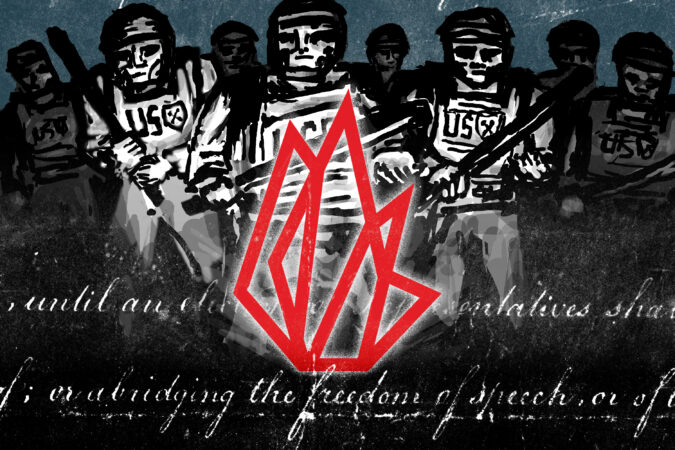
For years, FIRE warned about threats to free speech, primarily on college campuses. Now the crisis it was preparing for has arrived.
The issue today is no longer one of cultural differences — students protesting controversial speakers or agitating for more diverse curricula.
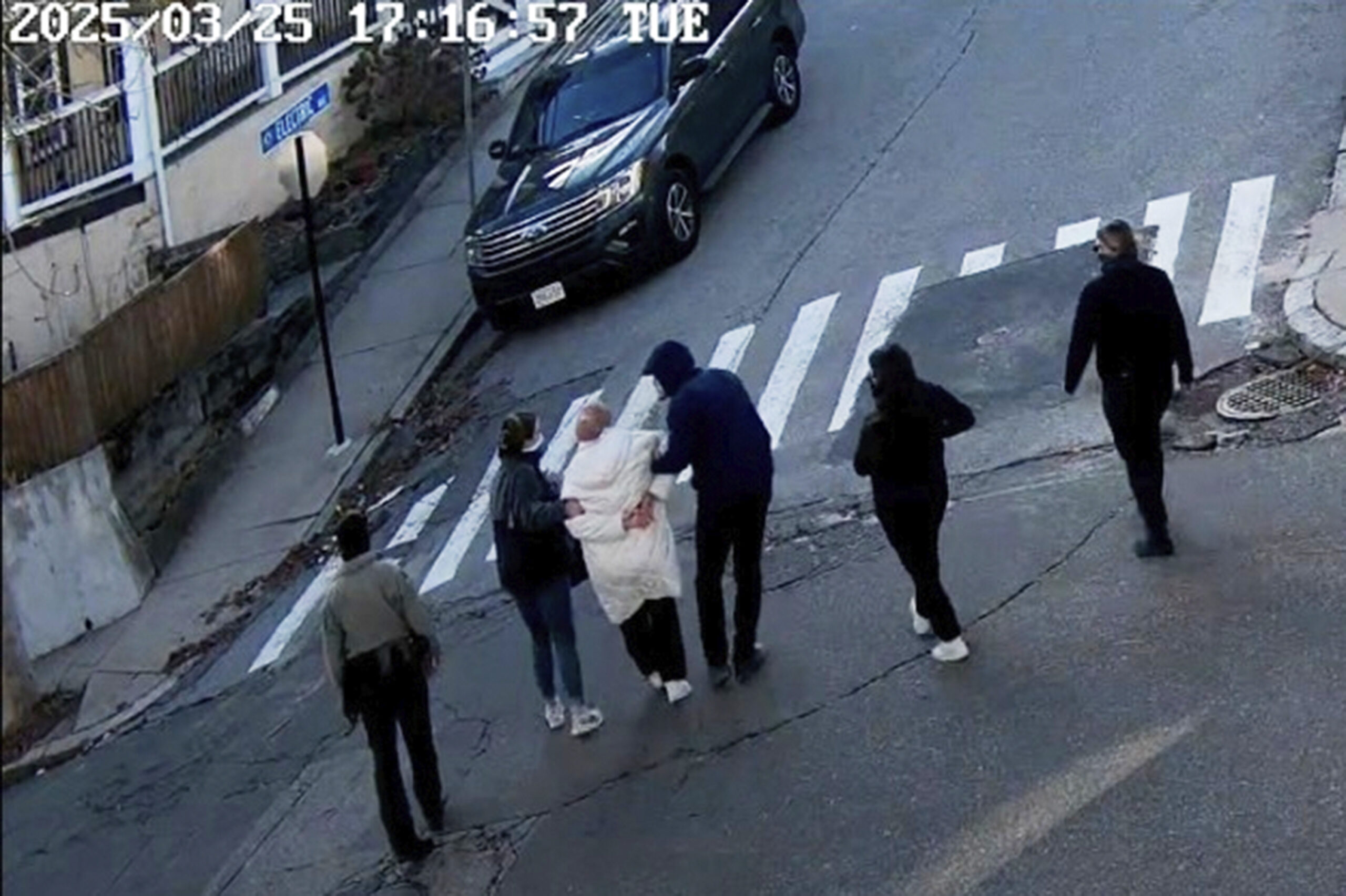
Rumeysa Ozturk, a 30-year-old doctoral student at Tufts University, was detained by Department of Homeland Security agents in March, an arrest captured by security camera footage.
Instead, the full power of the federal government is trained on universities and individual students who disagree with it. The stakes have grown exponentially, as became clear early on when federal agents detained Rumeysa Ozturk, a Tufts University Ph.D. student on a visa, after she cowrote an op-ed in a student newspaper. She then spent 45 days in Immigration and Customs Enforcement detention in Louisiana. (FIRE submitted an amicus brief in Ozturk’s ongoing federal case, in which a federal judge ruled last month that the administration had no grounds to deport her.)
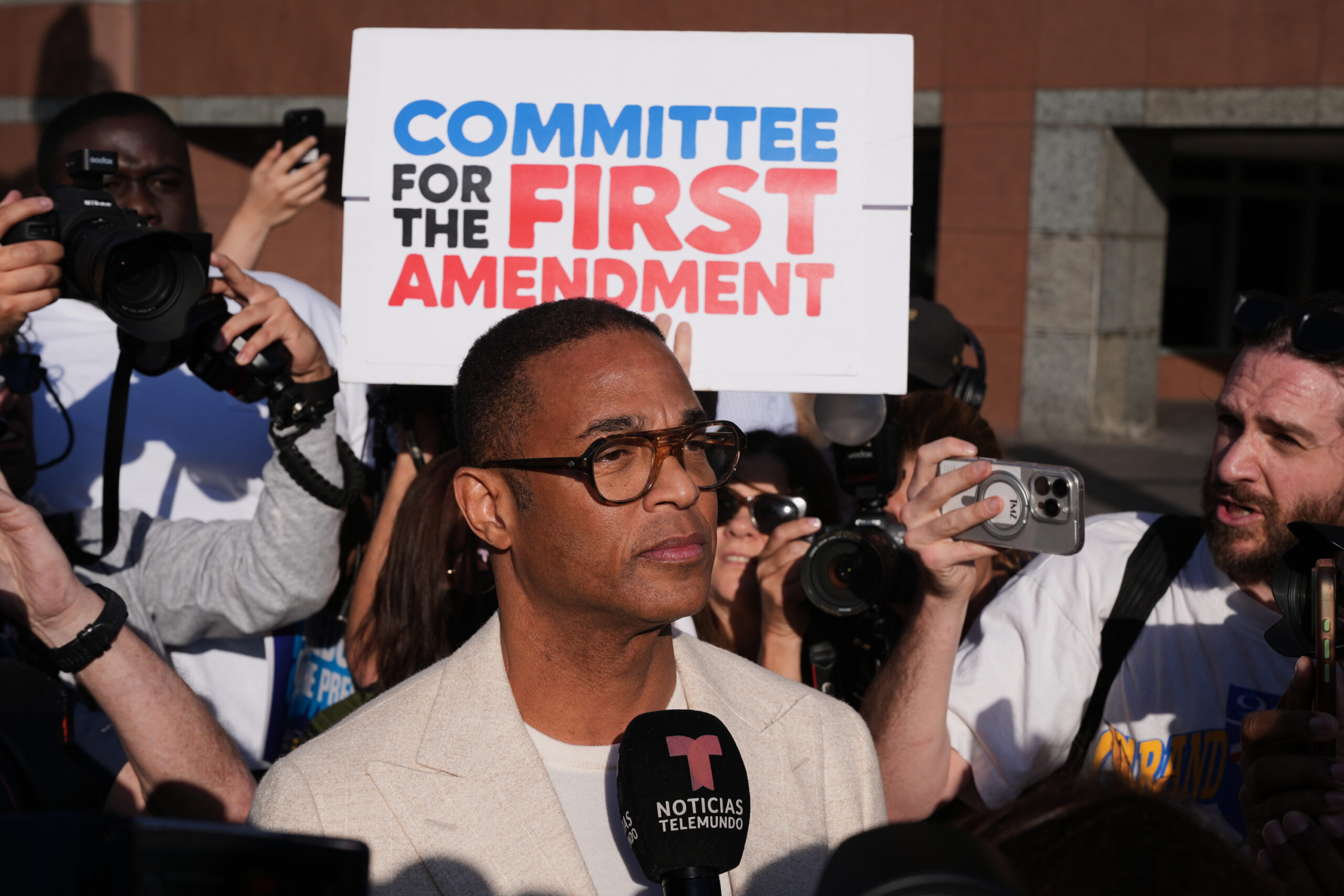
More recently, federal agents arrested and charged journalist and former CNN anchor Don Lemon with federal civil rights crimes for his coverage of an anti-ICE protest inside a Minnesota church. Of his arrest, the organization wrote, “FIRE will be watching closely.”
Journalist and former CNN anchor Don Lemon talked to the media after being detained for covering a protest inside a Minnesota church.
The question FIRE faces today is whether it can effectively meet the moment, and overcome skepticism from the left and from other free-speech advocates, some of whom argue the group helped lay the groundwork for an authoritarian crackdown.
Those critics say the present free-speech crisis is partly the predictable result of FIRE stoking a conservative panic over campus politics, effectively handing the federal government a well-crafted rationale for suppressing progressive voices.
FIRE’s leaders say they were not wrong before about cancel culture. Things were bad, they argue. But this is far worse.
“The threats we’re seeing right now, to me, often feel damn near existential,” Creeley, 45, said in a recent interview. “The incredibly important distinction is that what we’re seeing now from the right is backed by the power of the federal government.”
FIRE described the federal government’s demands on Harvard as “wielding the threat of crippling financial consequences like a mobster gripping a baseball bat.”
When the government becomes the censor
It can sometimes feel as if FIRE has been involved in nearly every major free-speech flash point of the last year — part of an intentional strategy to build the organization’s profile and raise awareness about speech violations, said Alisha Glennon, 41, the group’s chief operating officer.
Among dozens of ongoing cases, FIRE is suing Secretary of State Marco Rubio in federal court over the administration’s targeting of international students who reported on or participated in pro-Palestinian campus activism.
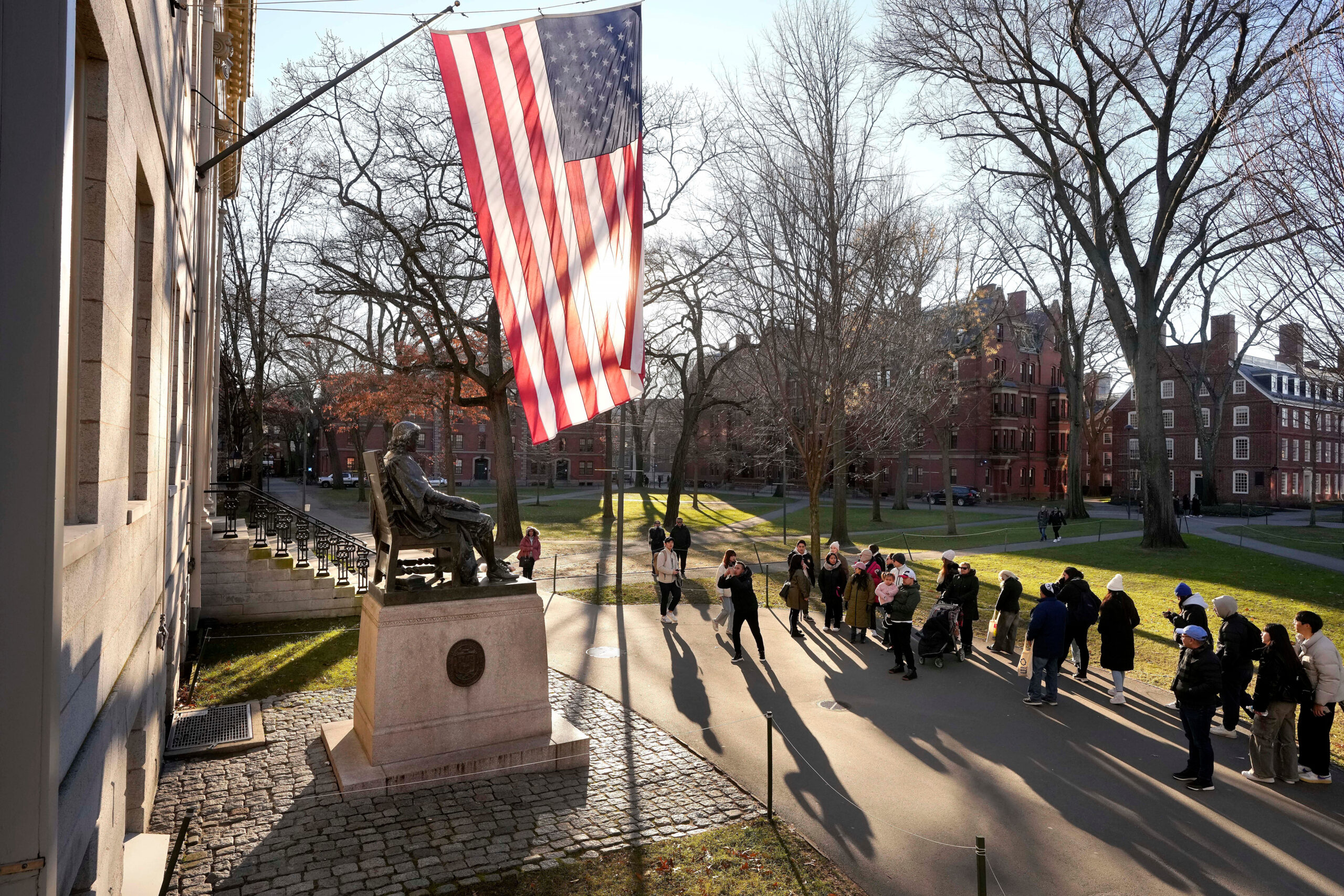
FIRE has also been outspoken in its defense of Harvard University. After the Trump administration sent Harvard a list of demands this spring — including banning some international students based on their views, appointing an outside overseer approved by the federal government to ensure “viewpoint diversity,” and submitting yearly reports to the government — the university refused to comply. Trump then sought to cut off billions of dollars of federal funding in response.
Harvard sued, and FIRE submitted an amicus brief supporting the university, noting that because of its own “longstanding role as a leading critic” of Harvard as a center of cancel culture, it was not less but more alarmed by the government’s “wielding the threat of crippling financial consequences like a mobster gripping a baseball bat.”
FIRE is also preparing to potentially sue Texas A&M University after the university instructed a philosophy professor in January to remove some teachings of Plato from an introductory philosophy course, citing new rules barring public universities in the state from offering classes that “advocate race or gender ideology.” FIRE wrote to the university, calling the move “unconstitutional political interference.”
Removing Plato from an intro philosophy class is the type of absurd, taken-to-the-extreme free-speech dispute that has long been FIRE’s bread and butter, and Creeley was particularly agitated about it.
Will Creeley, FIRE’s legal director, pictured here at the FIRE offices in Philadelphia. He was drawn to First Amendment work partly because his father was a poet.
“What the hell is ‘race and gender ideology’?” he said. “That’s a term so vague you could drive a truck through it.”
He had seen commentary about how 2,400 years ago, Socrates was put to death for corrupting the youth of Athens — and now administrators were, in effect, trying to run Socrates’ student out of College Station, Texas, too.
Creeley was almost laughing, but he was also feeling apocalyptic.
He has been half-joking with his staff that FIRE’s entire litigation program could be dedicated just to Texas. Yet he was also stewing over a decision by the University of Alabama in December to suspend two student publications, one focused on fashion and the other on Black culture and student life.
The university said both violated the Justice Department’s guidance on diversity, equity, and inclusion by narrowly appealing to female students and Black students. FIRE sent an outraged letter to the school, often a precursor to litigation.
“It’s one thing to say, ‘Hey, administratively, we’re not going to have an office of DEI,’” Creeley said. But to say, “‘And students can’t talk about these things.’ … That just drives me nuts.”
Off campus, FIRE is suing Perry County, Tenn., on behalf of Larry Bushart, a retired police officer who spent 37 days in jail after reposting a meme following the assassination of right-wing political activist Charlie Kirk. The meme depicted then-presidential candidate Donald Trump urging people to “get over” a separate shooting the year before.
Defending free speech is notoriously unpopular, and FIRE has leaned hard into a narrative of itself as a pure, principled defender of free speech, regardless of the consequences.
“We always say we just call balls and strikes, no matter what team is up to bat,” Glennon said. “If you are being criticized by both sides and praised by both sides every single day — well, then, that’s something that I wear as a point of pride.”
“Sometimes, if everybody’s criticizing you, you are screwing up,” Creeley acknowledged, and they both laughed. “But here I would say we’re doing it right.”
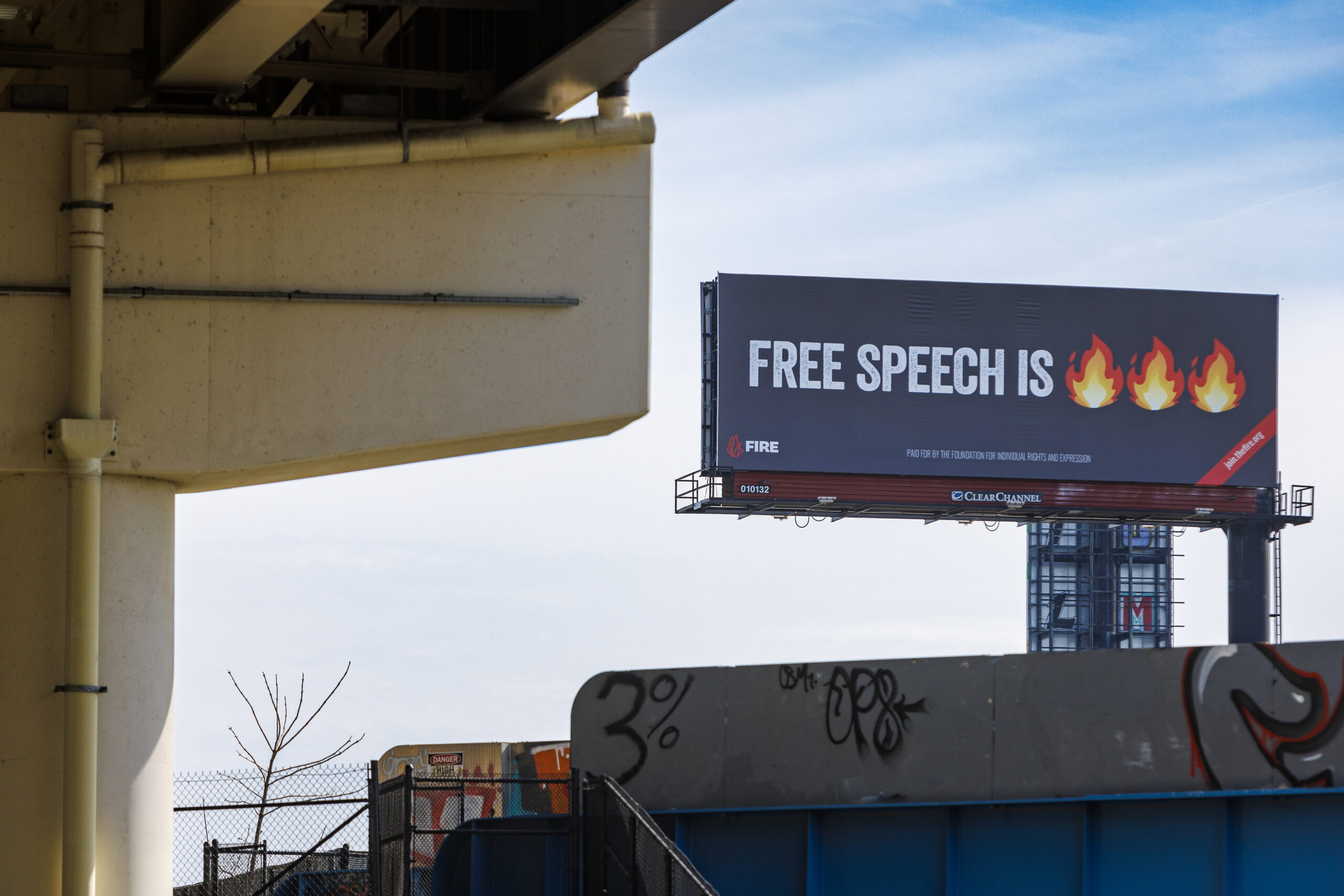
In 2022, FIRE expanded its purview beyond college campuses, including through a massive media campaign. One of its billboards is pictured here, visible heading north on I-95, in 2023.
From scrappy watchdog to national player
FIRE is insistently nonpartisan; staffers acknowledge the organization’s erstwhile conservative reputation but say it was never accurate.
And under the second Trump administration, it has become one of the most outspoken voices in the country for free expression. The nonprofit has a $32 million budget, about 130 staffers, and roughly 12,000 members paying a $25 annual fee.
Both Creeley and Glennon have been with the organization for nearly two decades, helping it grow from a small advocacy group into one garnering increasing mainstream attention. They said FIRE based itself in Philadelphia, not Washington, so that it would remain free from political interference. (One of the cofounders of the organization, Alan Charles Kors, an emeritus history professor at the University of Pennsylvania, is also based in Philly.)
At the Philly office, copies of the Wall Street Journal and the Chronicle of Philanthropy greet visitors. The conference rooms are named after free-speech references. (“It’s a little kitschy, but it’s cute,” Glennon said of the “Crowded Theater” room.)
One afternoon this fall, Glennon, in an oversized tan blazer, black pants, and stilettos, her blond hair loose, and Creeley, in a white button-down and purple tie, his auburn beard neatly cropped, were quick to laugh, prone to peppering famous quotes about free speech throughout the conversation.
They appeared to be true believers — in free expression, in their work, in America.
Glennon said she fears “that people will become accustomed to a society that is less free, and that with every generation, we’re losing a little bit of that love for American exceptionalism and what free speech is.”
Creeley nodded.
“What’s the Kors quote? ‘A nation that does not educate in liberty will not long enjoy it, and won’t even know when it’s lost,’” he said, paraphrasing a quote from FIRE’s cofounder.
“‘Won’t even know when it’s lost,’” Glennon echoed. “Gave me chills.”
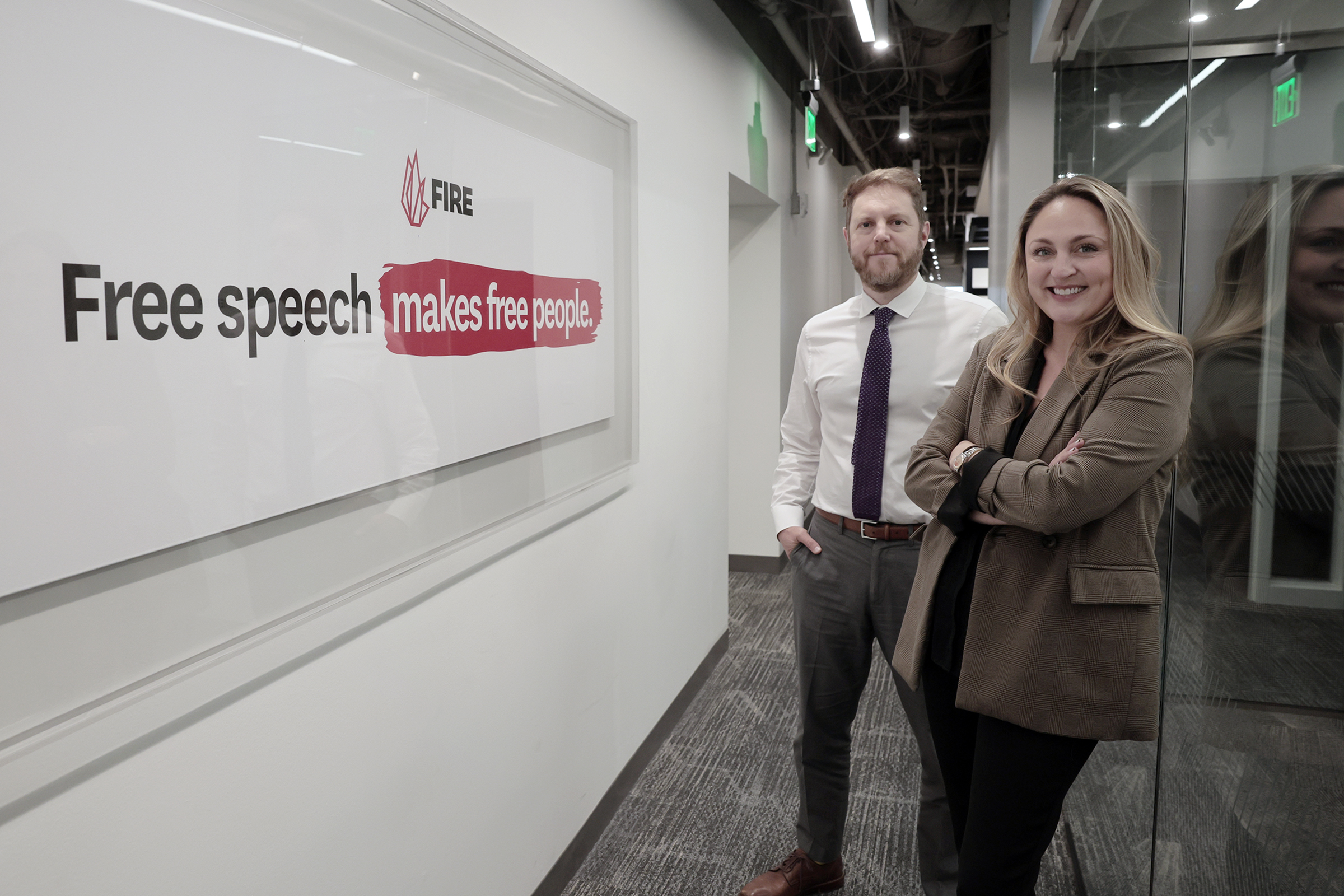
FIRE’s legal director Will Creeley and FIRE’s chief operating officer Alisha Glennon, pictured here at the Philly offices in November, have both been at the organization for nearly two decades.
From pressure campaigns to the courtroom
FIRE was founded by two civil libertarians who wrote one of the defining campus-panic books of the 1990s, The Shadow University: The Betrayal of Liberty on America’s Campuses, which Publishers Weekly at the time described as a polemic about how “the ‘political and cultural left’ is today the worst abuser of the principles of open, equal free speech.”
Creeley joined FIRE as a law school intern before becoming a full-time staffer in 2006. He comes from a long line of pacifist Quakers and was involved in the campus Green Party as an undergrad at New York University. He said he was drawn to First Amendment work because his father was a poet; words were important.
“I remember the first couple years, I was like, ‘Boy, I’m doing this free-speech work, I’m defending an awful lot of evangelical conservative Christians who I really don’t have much in common with,’” Creeley said. But that was the principle of the thing.
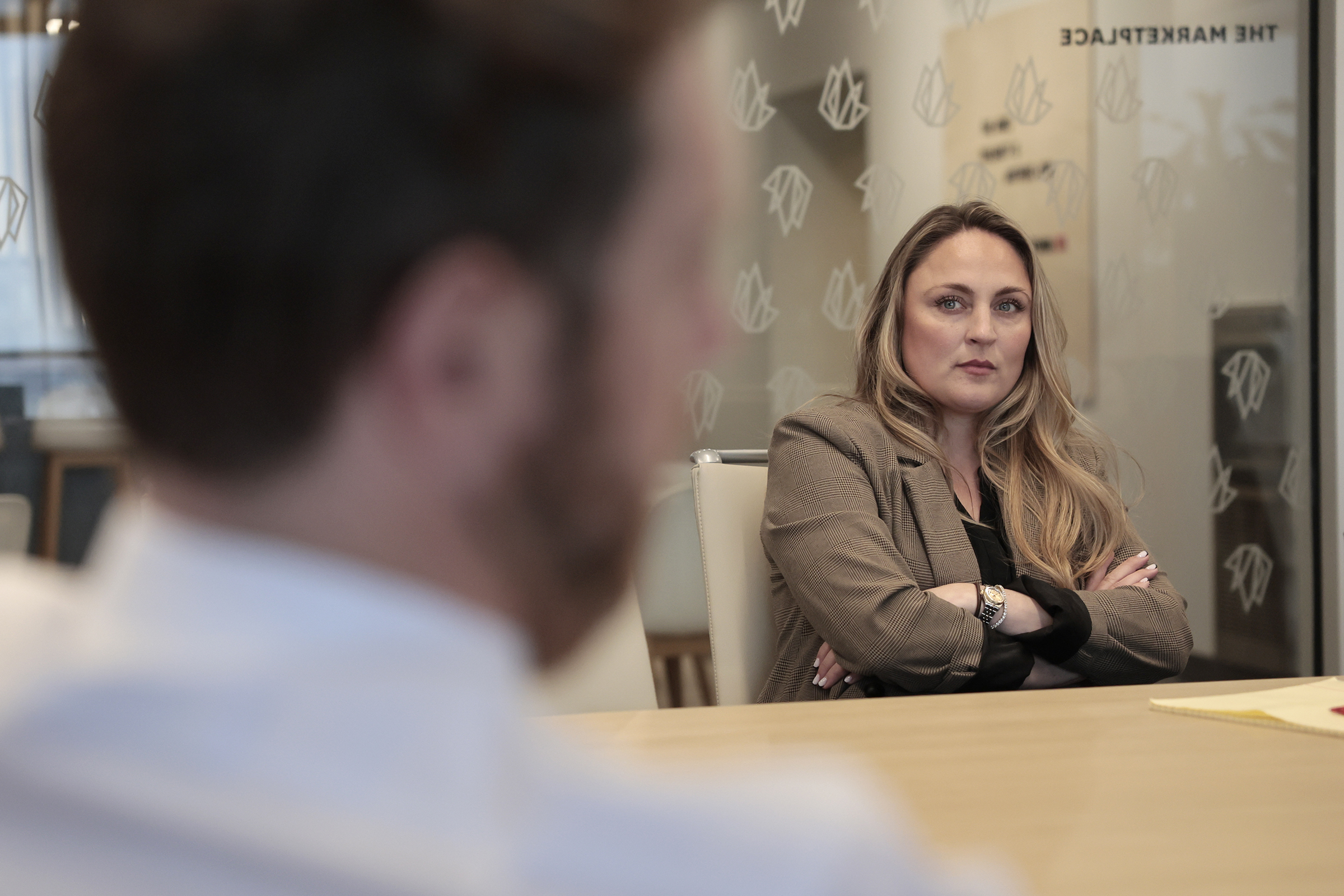
FIRE’s chief operating officer Alisha Glennon in “The Marketplace” conference room overlooking Independence Hall. All the conference rooms are named after free speech references.
Glennon, who was born and raised in Mayfair, joined FIRE around the same time. She had recently graduated from the College of William and Mary and was waitressing while applying for development jobs. “I was like, ‘Free speech! Everybody likes free speech!’” she said, laughing.
For more than a decade, FIRE focused exclusively on advocacy, aiming to “make rights violations so painful for a school that they just would abandon it,” Creeley said. Litigation was plodding and costly, and the awareness campaigns seemed to have an impact.
In 2008, for example, a student-janitor at Indiana University-Purdue University Indianapolis was accused of racial harassment after a coworker saw him reading Notre Dame vs. the Klan: How the Fighting Irish Defeated the Ku Klux Klan, a nonfiction book that depicted robed Klansman and burning crosses on the cover. FIRE took up the cause, and the university eventually apologized to the janitor.
Other early advocacy cases included defending a professor at a New Jersey community college over a photo he posted of his daughter wearing a Game of Thrones T-shirt, and intervening on behalf of a University of Alaska Fairbanks student newspaper accused of sexual harassment for publishing a satirical article about a new building shaped like a vagina.
Then in 2014, FIRE began suing schools. The effort launched with four cases, including one about an unconstitutional “free speech zone” at a college in California and one on behalf of students at Iowa State University who were told they could not use the university’s name while wearing T-shirts representing their chapter of the National Organization for the Reform of Marijuana Laws.
FIRE eventually won all four.
These days, staffers at the ACLU of Pennsylvania and FIRE work closely together, talking weekly and sometimes daily.
“I honestly don’t remember a time where we had a disagreement about how to analyze the case,” said Witold Walczak, the ACLU of Pennsylvania’s legal director.
Despite its ideologically broad legal work, FIRE perhaps became most famous in the mainstream for its conservative-leaning culture work. In 2015, executive director Greg Lukianoff cowrote an Atlantic article — and later a book — titled The Coddling of the American Mind, arguing that efforts to create “safe spaces” on campuses had gone awry. Cowritten with social psychologist Jonathan Haidt, the book portrayed campus identity politics as bordering on the surreal.
That was also the year Lukianoff helped to disseminate one of the defining “cancel culture” artifacts of the decade. He filmed a Yale student, who came to be known online as “shrieking girl,” screaming at a professor in the middle of a simmering debate on campus over what constituted racially sensitive Halloween costumes. The video made national news, eventually racking up nearly 2 million views on FIRE’s YouTube page.
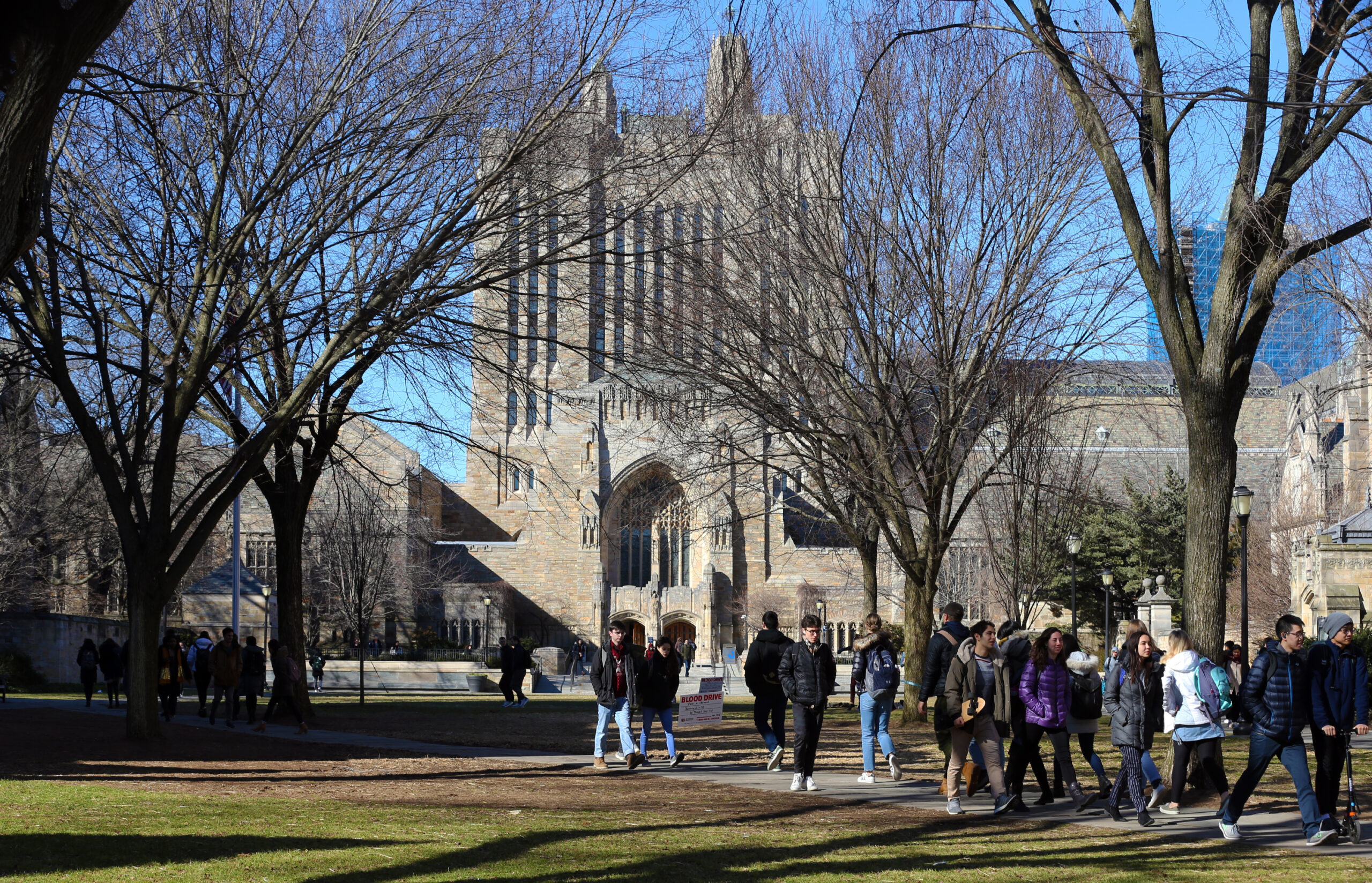
The campus of Yale University in New Haven, Conn.
The rankings — and the reckoning
These days, the organization tracks speaker disinvitations and scholars and students “under fire” through its public databases. Since 2020, it has also published annual “free-speech rankings” based on the databases and student surveys — rankings that have repeatedly placed Harvard at or near the bottom for free speech.
Those efforts underpin one of the central critiques of FIRE: that it has focused not only on government restrictions but also on the actions of private actors, including students.
“The rankings are based on those ideas of ‘cancel culture’ and shaming others and so on. And they’re not based on the First Amendment,” said Charles Walker, a retired attorney based in Maryland who published multiple critiques of FIRE’s rankings last year. “First Amendment law restricts what the government can do with regard to individual speech. It doesn’t address individuals speaking to each other.”
Bradford Vivian, a professor at Pennsylvania State University and the author of Campus Misinformation: The Real Threat to Free Speech in American Higher Education, described FIRE’s databases as “totally subjective, arbitrary, politically motivated tools.”
He argued that FIRE cherry-picks sensational incidents that do not necessarily have anything to do with true First Amendment violations, and prioritizes rankings that will make headlines over those that would be more accurate.
“FIRE has produced misinformation that others can easily use for nefarious purposes,” Vivian said.
FIRE for years whipped up a frenzy over liberal excess on elite college campuses, Vivian and other critics say. The Trump administration seized on that frenzy to slash federal funding and even imprison its detractors. Yet FIRE staffers do not see themselves as part of that story.
Even as FIRE insists it merely “calls balls and strikes,” critics note that state legislatures and the Trump administration have cited FIRE’s rankings as justification for punitive actions against universities.
Adding insult to injury, FIRE staffers have not always expressed much sympathy for the universities that now find themselves in the administration’s crosshairs.
“Administrators, colleges, universities have in some ways done plenty to bring this on themselves,” Sean Stevens, FIRE’s chief research adviser, told The Inquirer. “There was a lot of downplaying or ignoring of the concerns about the homogeneity of politics among the professorate or some of the curriculums.”
Still, Stevens, who oversees the annual rankings, said he disagrees with the Trump administration using his work to cut funding or shut down certain speech or academic departments. “That’s not anything we would advocate for,” he said.
In December, Lukianoff doubled down, publishing what amounted to an “I told you so” essay, arguing that universities now face a “worst of both worlds” scenario, in which government pressure combined with lingering cancel-culture dynamics are producing the “bleakest speech landscape imaginable.”
Creeley and Glennon said they never anticipated their work being used to justify repression.
“It’s galling to me to see our work invoked to justify that kind of illiberal crackdown,” Creeley said, pointing specifically to U.S. Rep. Elise Stefanik (R., N.Y.), who previously said she was a free-speech ally, using FIRE’s rankings in her anti-higher education campaigns.
If onetime allies now seem to have never cared much about free speech to begin with, that’s not on FIRE, they said.
“What we had been saying over the years was true‚” Glennon said. “We’re to blame now for the government overreach? I don’t think it’s a fair assessment.”
“I mean, that’s all we can do: Call out the abuses as we see them,” Creeley said. “If somebody wants to use our work for bad ends, we’ll fight you on it.”
FIRE was based in Philadelphia to avoid the political interference of Washington, D.C.
Can a referee still matter when the rules change?
At FIRE’s daily morning meetings to discuss pressing free-speech problems across the country, the agenda has grown longer. The scope, severity, volume, and nature of the cases they are seeing have changed, Creeley said. (He noted — twice — that an Alexandria Ocasio-Cortez presidency would likely keep FIRE busy as well.)
“In some places, the law is just getting flat-out ignored,” he said.
After two decades defending the First Amendment, Creeley has begun to reflect on whether placing his faith in the collective commitment to the law and the Constitution was the right choice. Still, he remains an optimist. He believes that such a commitment will prevail. That’s the whole promise of the country.
FIRE continues to see itself as a principled referee. Whether a referee still matters when the most powerful player insists the rules no longer apply — that remains an open question.
I don’t know why this scene caught my eye. I have seen graffiti-tagged walls on roll-down metal storefronts and yes, even panel trucks and vans before.
And in the past few weeks since our biggest snowfall in a decade — followed by a brutal freeze that locked in all the plowed piles — I have certainly seen enough streets lined with snowed-in vehicles. Maybe it was the combination of the two.
I was stopped because the dirty snowpack on street shoulders reduced traffic lanes and created gridlock. But while I waited through not one or two, but three traffic light cycles, I had the time to look, pick up my phone, roll down my window and take a picture.
Not the kind of image I usually look for.
Then that got me thinking, “What kinds of pictures do I like? What came first, the snow or the graffiti?” (I was at that light a long time.)
I clearly like photographing people. That’s why I got into journalism.
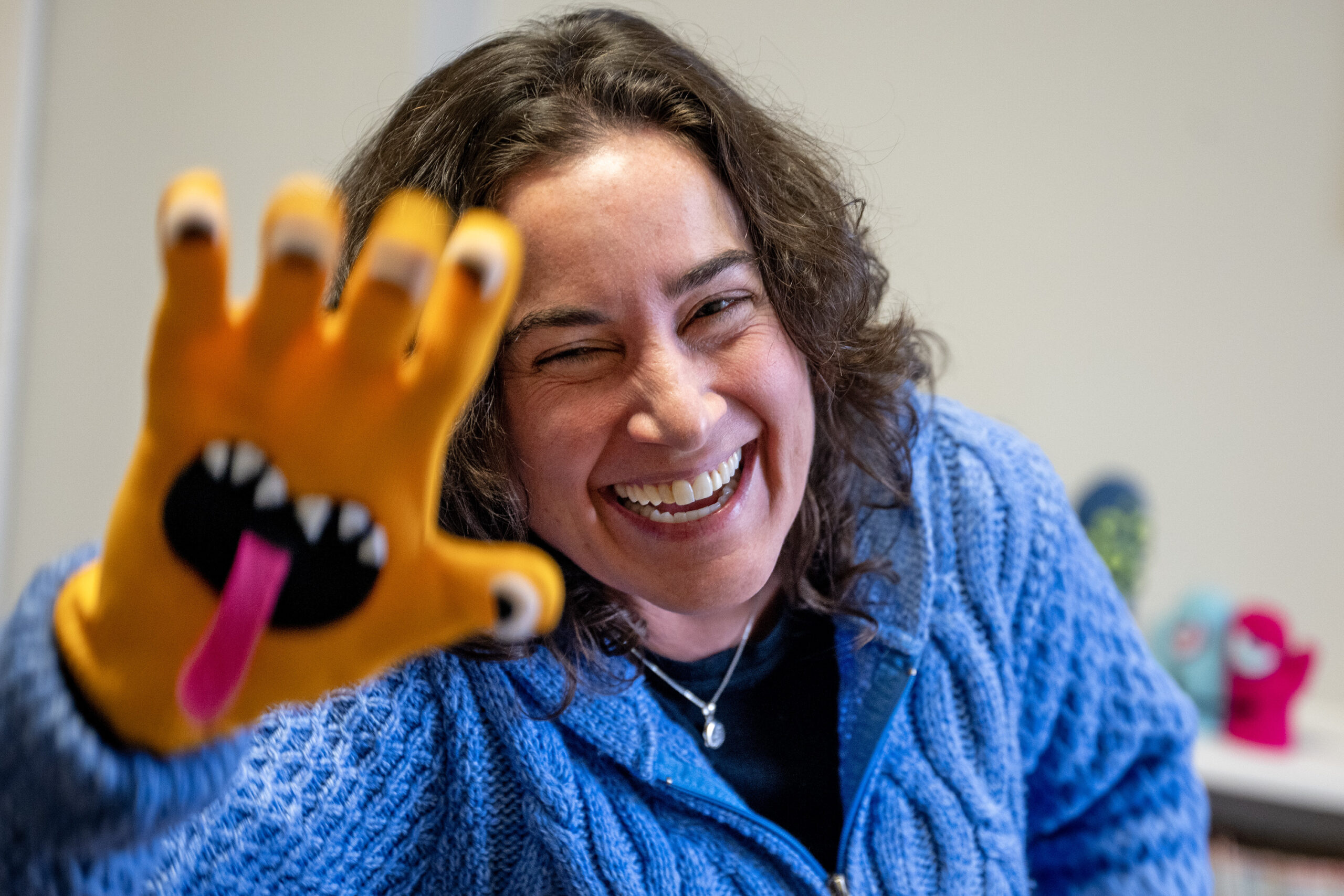
Highlights editor Judy Burke, last month at the editorial offices of America’s most beloved and respected educational magazines for kids.
When doing portraits on assignments I have always tried to get people comfortable with being themselves. I have always had a hard time “directing” them. It is especially difficult when the story I’m trying to illustrate is not about them, but about where they work, or what they are doing.
Trying avoid posing subjects by saying “just do whatever you’d be doing if I — and a reporter, and the public relations person(s) — wasn’t here,” doesn’t help. And just makes it awkward for all of us.
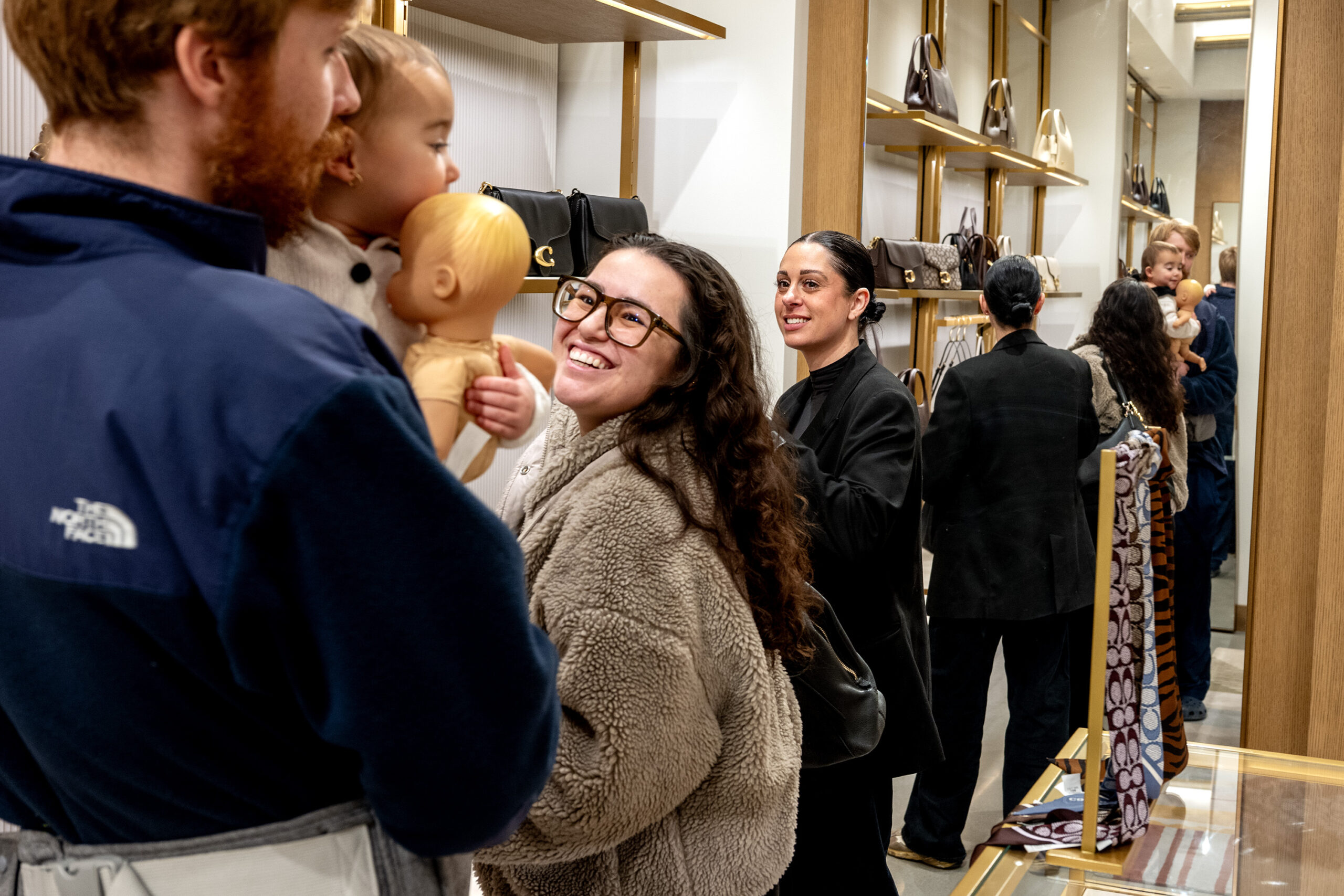
Employee Alex Costa (right) assists Alessandra Bruno as she tries out purses with husband Luke Baur and their 20 month-old daughter Rosalina at the Coach store at the Cherry Hill Mall on Monday.
Walking into a room where everyone is ready and waiting to be photographed — but unsure of what the photographer will do — is also hard for them. If possible I get them to interact with each other, even if it’s just sharing what they had for breakfast. In public spaces I will often enlist customers or passersby, asking if I can photographed over their shoulders. Then wait — and hope — for a genuine moment. Like in the mall retail shop, a customer interaction is much better than five salespeople standing among the merchandise looking at the camera.
That is also why I most enjoy assignments where I am just there, observing an event trying to capture something that will make readers click on a link or pause to read a story. And I keep myself enthused while doing it. Like the many public appearances of our mayor.
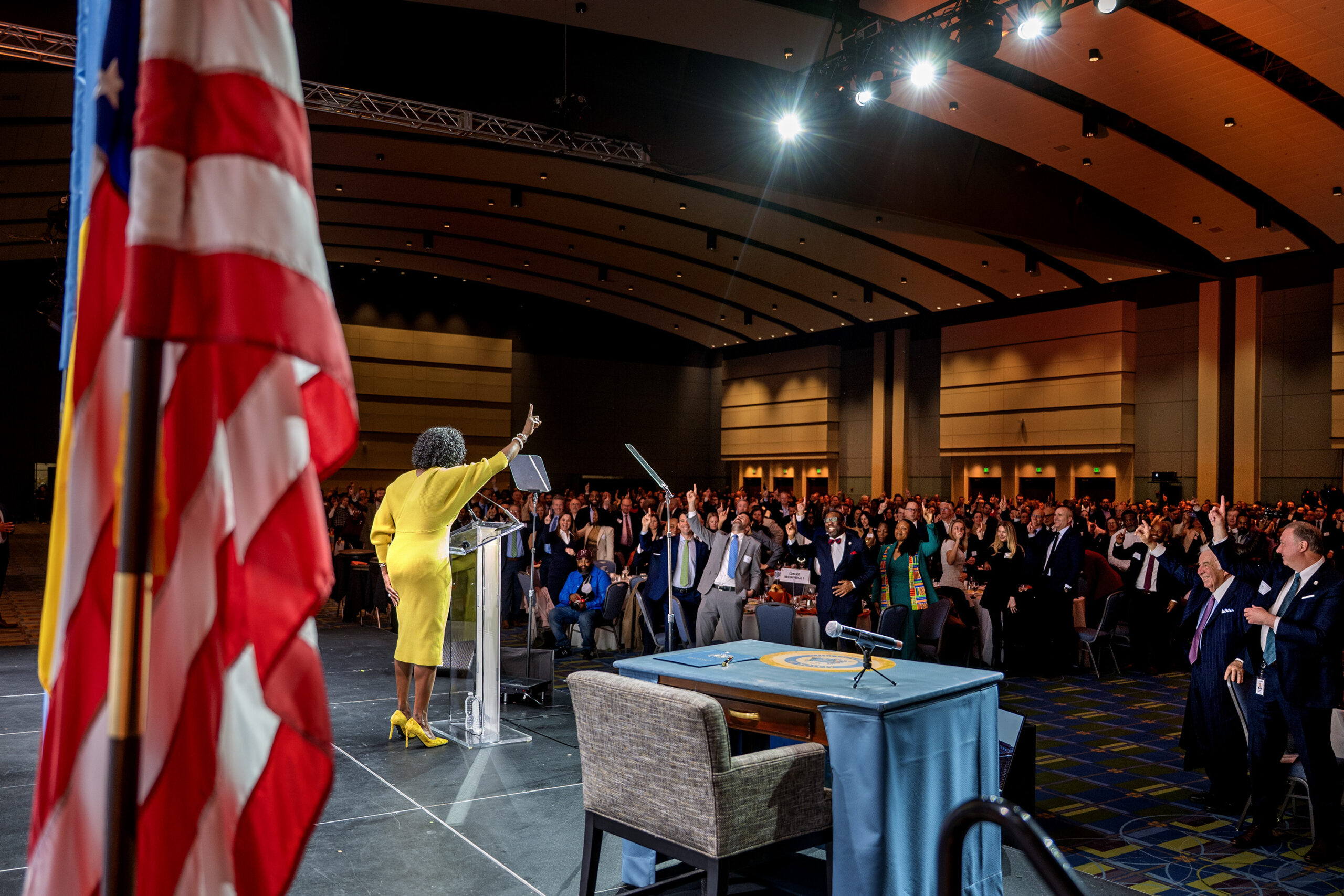
Mayor Cherelle L. Parker has the whole room of business leaders standing with her and her “One Philly” chant as she finishers her keynote address at the Chamber of Commerce for Greater Philadelphia’s Annual Mayoral Luncheon Wednesday.
That goes for ordinary people too, not just politicians or executives or sports or entertainment celebrities. And what is more normal and everyday than stopping at your regular convenience store?
I also photographed Wawa’s excursion into Sheetz land in 2024. For decades, it was assumed there were unspoken boundaries in Pennsylvania between Wawa in the East and Sheetz in the West. But representatives of both chains deny they are rivals and as my colleague Stephanie Farr points out, they have worked together to support various nonprofits.
Next stop for me (soon, I hope) a photographic road trip to the nearest Buc-ees.
Since 1998 a black-and-white photo has appeared every Monday in staff photographer Tom Gralish’s “Scene Through the Lens” photo column in the print editions of The Inquirer’s local news section. Here are the most recent, in color:
February 9, 2026: Walking through a corrugated metal culvert called the “Duck Tunnel,” a pedestrian navigates the passageway under the SEPTA tracks on the Swarthmore College campus. February 2, 2026: A light-as-air Elmo balloon rolls along a sidewalk in Haddonfield, propelled by the wind as Sunday’s heavy snow starts to turn to ice and sleet. January 26, 2026: The President’s House in Independence National Historical Park hours Jan, 22, after all historical exhibits were removed following President Trump’s Executive Order last March that the content at national parks that “inappropriately disparage” the U.S. be reviewed. The site, a reconstructed “ghost” structure titled “Freedom and Slavery in the Making of a New Nation” (2010), serves as a memorial to the nine people George Washington enslaved there during the founding of America.January 19, 2026: A low-in-the-sky winter sun is behind the triangular pediment of the “front door” of the open-air President’s House installation in Independence National Historical Park. The reconstructed “ghost” structure with partial walls and windows of the Georgian home known in the 18th century as 190 High St. is officially titled, “Freedom and Slavery in the Making of a New Nation” (2010). It is designed to give visitors a sense of the house where the first two presidents of the United States, George Washington and John Adams, served their terms of office. The commemorative site designed by Emanuel Kelly, with Kelly/Maiello Architects, pays homage to nine enslaved people of African descent who were part of the Washington household with videos scripted by Lorene Cary and directed by Louis Massiah. Deepika Iyer holds her niece Ira Samudra aloft in a Rockyesque pose, while her parents photograph their 8 month-old daughter, in front of the famous movie prop at the top of the steps at the Philadelphia Art Museum. Iyer lives in Philadelphia and is hosting a visit by her mother Vijayalakshmi Ramachandran (partially hidden); brother Gautham Ramachandran; and her sister-in-law Janani Gautham who all live in Bangalore, India.January 5, 2026: Parade marshals trail behind the musicians of the Greater Kensington String Band heading to their #9 position start in the Mummers Parade. Spray paint by comic wenches earlier in the day left “Oh, Dem Golden Slippers” shadows on the pavement of Market Street. This year marked the 125th anniversary of Philly’s iconic New Year’s Day celebration.Dec. 29, 2025: Canada geese at sunrise in Evans Pond in Haddonfield, during the week of the Winter Solstice for the Northern Hemisphere. December 22, 2025: SEPTA trolley operator Victoria Daniels approaches the end of the Center City Tunnel, heading toward the 40th Street trolley portal after a tour to update the news media on overhead wire repairs in the closed tunnel due to unexpected issues from new slider parts.December 15, 2025: A historical interpreter waits at the parking garage elevators headed not to a December crossing of the Delaware River, but an event at the National Constitution Center. General George Washington was on his way to an unveiling of the U.S. Mint’s new 2026 coins for the Semiquincentennial, December 8, 2025: The Benjamin Franklin Bridge and pedestrians on the Delaware River Trail are reflected in mirrored spheres of the “Weaver’s Knot: Sheet Bend” public artwork on Columbus Boulevard. The site-specific stainless steel piece located between the Cherry Street and Race Street Piers was commissioned by the City’s Public Art Office and the Delaware River Waterfront Corporation and created and installed in 2022 by the design and fabrication group Ball-Nogues Studio. The name recalls a history that dominated the region for hundreds of years. “Weaver’s knot” derives from use in textile mills and the “Sheet bend” or “sheet knot” was used on sailing vessels for bending ropes to sails. November 29, 2025: t’s ginkgo time in our region again when the distinctive fan-shaped leaves turn yellow and then, on one day, lose all their leaves at the same time laying a carpet on city streets and sidewalks. A squirrel leaps over leaves in the 18th Century Garden in Independence National Historical Park Nov. 25, 2025. The ginkgo (Ginkgo biloba) is considered a living fossil as it’s the only surviving species of a group of trees that existed before dinosaurs. Genetically, it has remained unchanged over the past 200 million years. William Hamilton, owner the Woodlands in SW Phila (no relation to Alexander Hamilton) brought the first ginkgo trees to North America in 1785.November 24, 2025: The old waiting room at 30th Street Station that most people only pass through on their way to the restrooms has been spiffed up with benches – and a Christmas tree. It was placed there this year in front of the 30-foot frieze, “The Spirit of Transportation” while the lobby of Amtrak’s $550 million station restoration is underway. The 1895 relief sculpture by Karl Bitter was originally hung in the Broad Street Station by City Hall, but was moved in 1933. It depicts travel from ancient to modern and even futuristic times. November 17, 2025: Students on a field trip from the Christian Academy in Brookhaven, Delaware County, pose for a group photo in front of the Liberty Bell in Independence National Historical Park on Thursday. The trip was planned weeks earlier, before they knew it would be on the day park buildings were reopening after the government shutdown ended. “We got so lucky,” a teacher said. Then corrected herself. “It’s because we prayed for it.”
I’ve never arrived to Exton’s Malgudi Cafe and not found a line out the door, whether for a late-night dinner or a blizzard-weekend brunch. That initially surprised me considering Malgudi appears at first glance to be an unassuming restaurant in a Chester County strip mall.
But this cafe is a special place, not only because it’s one of the region’s few Indian restaurants dedicated to vegetarian cooking, but because it may also be the only one focused specifically on the cuisine of the city of Bangalore, in the South Indian state of Karnataka.
I have loved virtually everything I’ve ordered here, from the crunchy stuffed pani puri puffs with sour-and-spicy green mint water to pour inside, to the lacy-crisp crepe roll of its onion rava dosa. But for a true immersion into the homey essence of Malgudi, which was launched in 2023 by four South Indian families, dive into a tray of bisi bele bath.
Known by its loyal customers as “Triple B,” this Karnataka comfort classic is a soulful stew of rice and toor dal (split pigeon peas) that are cooked down with seasonal vegetables until they essentially melt together into a soothing porridge. While the word “bisi” means “hot” in Kannada, this one-pot dish is not fiery so much as it is vivid with fragrant spice — tangy with tamarind and tomatoes then flared with the aromatics of Malgudi’s house masala, a punchy blend of dried red chilies, cinnamon, cloves, and coconut ground fresh. Served hot on a stainless-steel thali tray, there are sides of tart raita yogurt and crunchy boondi pastry beads to add more textures and flavors. On the off chance they’re already out of Triple B (as they were on my first visit), go for the khara pongal porridge of yellow moong lentils cooked down with cumin, cashews, chilies, and curry leaves. Malgudi Cafe, 10 W. Lincoln Hwy., Exton; 484-874-2124, malgudicafe.com
— Craig LaBan
Crab cakes at the Bomb Bomb, the classic Italian seafood joint revived by chef-owner Joey Baldino in deep South Philly.
Crab cakes at Bomb Bomb Bar
There’s a loose guideline followed by many people who dine out a lot: Get the most adventurous things on the menu. They’re often the best reflection of the kitchen’s passions.
So it was with a little sheepishness that I ordered, among other items, the “classic crab cake” at Bomb Bomb Bar, the deep South Philly institution that Zeppoli and Palizzi Social Club chef-owner Joey Baldino revived last fall. Crab cakes are frequently delicious, but they are also extremely common and seldom edgy, especially next to, say, whole Dungenesse crab and mom’s stuffed calamari.
But I’ll be forever content with my decision-making, for chef Max Hachey’s crab cakes are maybe the best ones I’ve ever had — a paean to blue crab, simply treated. To make them, Hachey combines crab meat from three different parts of the crab with reduced, onion-infused cream plus Dijon mustard, roasted-garlic aioli, chives, lemon zest, egg, and some crumbled Club Crackers (“just a few to held hold it together,” Hachey says). The mixture is scooped into dumpling-sized parcels, brushed with butter, then broiled. The cakes are plated, two to an order, on top of a swirl of basil vinaigrette, then garnished with confit cherry tomatoes still clinging to their crispy vines.
The meal at Bomb Bomb was full of hits, from the zippy antipasto salad to the oil-slicked Italian tuna spaghetti and the lobster and shells in a blush sauce, not to mention those torpedoes of sausage-stuffed squid doused in deep-red gravy. We were too full for dessert, but I didn’t feel so bad skipping it, as it was about as approachable as it gets: an ice cream sundae. Bomb Bomb Bar, 1026 Wolf St., bombbombbar.com
— Jenn Ladd
Goat in spicy scallop creole at a recent Honeysuckle x Kabawa collaboration dinner in Philadelphia.
Goat with spicy scallop creole at Honeysuckle x Kabawa popup
After eating an extremely gamey Kashmiri goat curry in high school, I had given up eating goat. I use the past tense because more than a decade later, I have relented on my goat fast. Last week, North Broad Street’s Honeysuckle restaurant hosted a popup with chef Paul Carmichael, who runs Kabawa in New York City’s East Village and presented some of his signature Caribbean dishes.
The goat shoulder was a perfect cube of meat, slow-cooked and succulent, bathed in a fiery gravy of habaneros and dried scallop. Glistening like a crown on top of the cube were fried curry leaves. It was absolute perfection, complemented beautifully by the collaborative dessert by Carmichael and Honeysuckle chef-owners Omar Tate and Cybille St.Aude-Tate: a decadent, mousse-y Marquise au Chokola dessert with rum, chocolate, dulce de leche, and djon djon — a rare mushroom from Haiti. Honeysuckle Restaurant, 631 N. Broad St., 215-307-3316, honeysucklephl.com