Tag: Weekend Reads

  • One-stop shopping for the Phillies at the trade deadline again? Here’s three teams that could be a fit

    One-stop shopping for the Phillies at the trade deadline again? Here’s three teams that could be a fit

    Last summer, at a win-now moment in their competitive cycle, the Phillies addressed two holes in the roster with one-stop shopping at the trade deadline.

    Sort of.

    Priority No. 1 felt familiar. Despite trading for a reliever at other recent deadlines, the Phillies’ playoff runs in 2023 and ’24 were torpedoed by the bullpen. So, they went in search of a lockdown late-inning anchor.

    But they had another obvious shortcoming: a righty-hitting outfielder to platoon in left field or, better yet, stop the revolving door in center.

    For weeks, Dave Dombrowski and his front office made calls and put out feelers. But gridlock in the wild-card standings — think of the Schuylkill Expressway at rush hour — led to market fluidity until a few days before the July 31 deadline.

    After fence-sitting amid ownership uncertainty, the Twins finally decided to break up their roster. On the eve of the deadline, the Phillies landed Jhoan Duran for two top-100 prospects (pitcher Mick Abel and teenage catcher Eduardo Tait), a steep price for a closer, albeit a star who came with two full seasons of club control.

    Harrison Bader’s name came up in the Duran talks, a source with knowledge of the conversations said, but the Twins kept the center fielder out of the deal as they orchestrated an everything-must-go bonanza in which they wound up unloading 11 major league players. The next day, Bader went to the Phillies for two minor leaguers.

    Two trades. One-stop shopping.
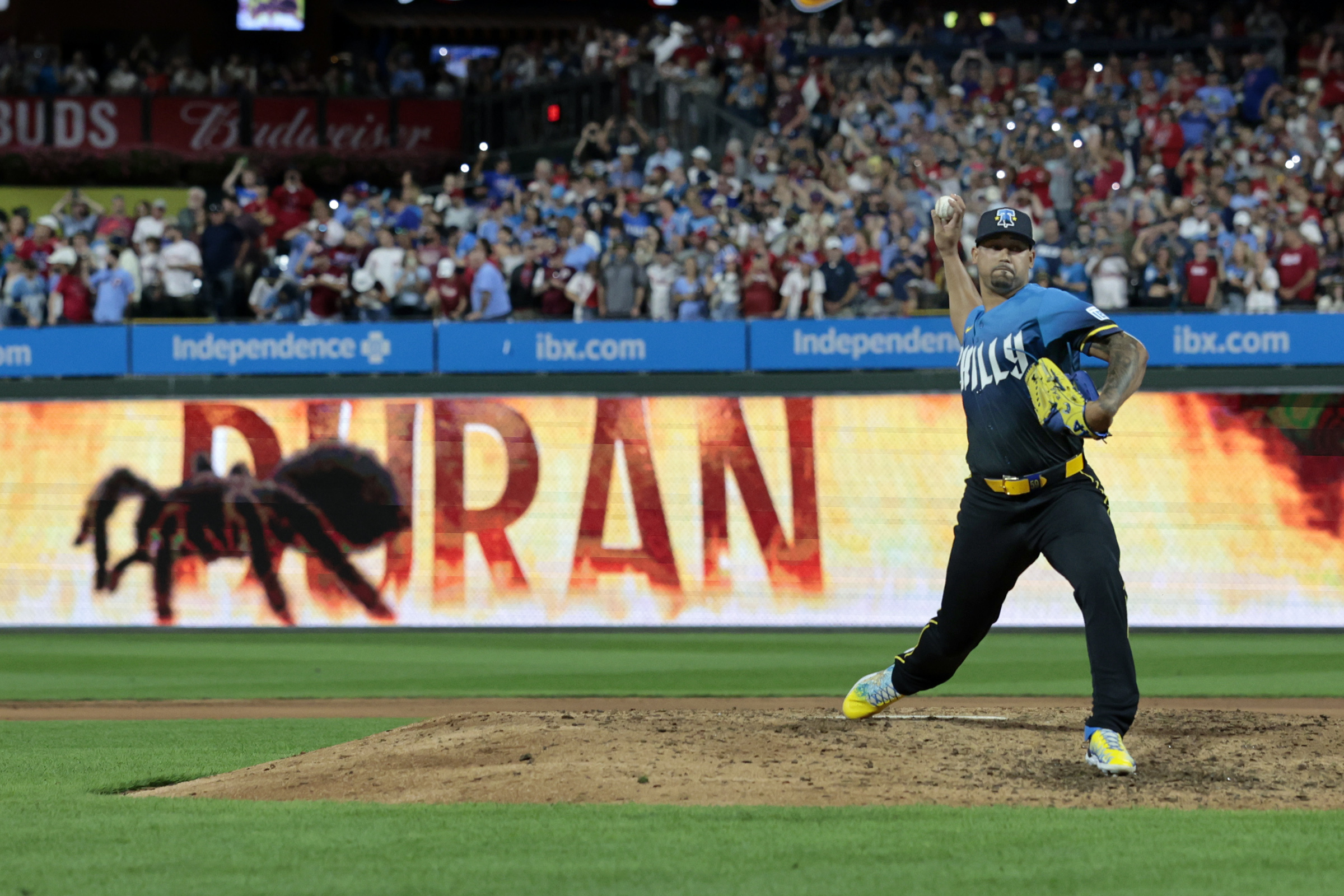
    Jhoan Duran has locked down the ninth inning for the Phillies since he was acquired at the trade deadline last year.

    Eleven months later — still in win-now mode, and back on a 90-win pace at the mathematical midpoint of the season after a 9-19 start that cost manager Rob Thomson his job — the Phillies again have multiple needs. The top priority is up for debate, even among some in the organization, but in some order:

    • Right-handed hitter
    • Back-end starting pitcher
    • Late-inning bridge to Duran

    And with the trade deadline a little more than five weeks away — jot it down: Aug. 3, 6 p.m. — it’s worth wondering if they can one-stop shop once again.

    Before we explore a few potential trade partners, a few caveats:

    1. Across the sport, right-handed hitters had a .703 OPS through Thursday, which would be the third-lowest mark since 1991. Righty-hitting outfielders had a .709 OPS, tied for the second-lowest in the last 70 years. And two of the best, Mike Trout and Byron Buxton, have no-trade clauses and no interest in waiving them.

    2. That said, the easiest place for the Phillies to add a right-handed bat is in the outfield … unless they move Bryce Harper back to right field and open first base (or third, if they shift Alec Bohm to first). Harper recently reiterated that he’d be open to it “for the right player.”

    Dombrowski, on the other hand …

    “We haven’t talked to him about it, and I really don’t contemplate it because I really like the way he goes about his business at first base,” he said recently. “I look at him as being our first baseman.”

    The Phillies plan to keep Bryce Harper at first base, president of baseball operations Dave Dombrowski reiterated recently.

    3. Over the last few years, the Phillies traded Abel, Tait, and fellow prospects Hendry Mendez, Starlyn Caba, William Bergolla Jr., George Klassen, Sam Aldegheri, Hao-Yu Lee, Mickey Moniak, Ben Brown, Logan O’Hoppe, and TJ Rumfield, among others. The teams hasn’t been burned, but it has drained the farm system.

    Andrew Painter (starting Sunday in triple A), Justin Crawford (graduated to the majors), and Aidan Miller (injured) were largely untouchable in previous talks. If that’s still the case, the best chips in a top-heavy system are right-hander Gage Wood, infielder Aroon Escobar, outfielder Dante Nori, and 17-year-old outfielder Francisco Renteria, off to a flying start in the Dominican Summer League.

    It begs the question of whether the Phillies have the prospect capital to fill each of their needs.

    “We feel good where our system’s at,” general manager Preston Mattingly said recently on Phillies Extra, The Inquirer’s baseball podcast. “We’re not concerned about a lack of assets in the minor leagues. A lot of times you see that top-100 [prospects] list. That’s not necessarily what teams internally talk about, and those are not the players they ask about.”

    4. Remember that Schuylkill-style traffic jam in the standings last July? Well, entering the weekend, 24 teams were in a playoff spot or no more than five games out. Only four American League teams — four! — were even above .500.

    Given the dearth of obvious sellers, one league source predicted that contenders may have to trade with each other. Think of the 2024 deadline, when the Phillies got outfielder Austin Hays in a buyer-to-buyer swap with the Orioles.

    5. Oh, and did we mention there’s a work stoppage looming in December? The owners and players are at odds over, well, everything. And regardless of whether the owners get their salary cap, the sport’s economic system will change in ways that front offices can’t possibly anticipate as they maneuver at the deadline.

    Got all that? Amid that backdrop, here’s a look at three teams that might match up with the Phillies on one or more of their needs.
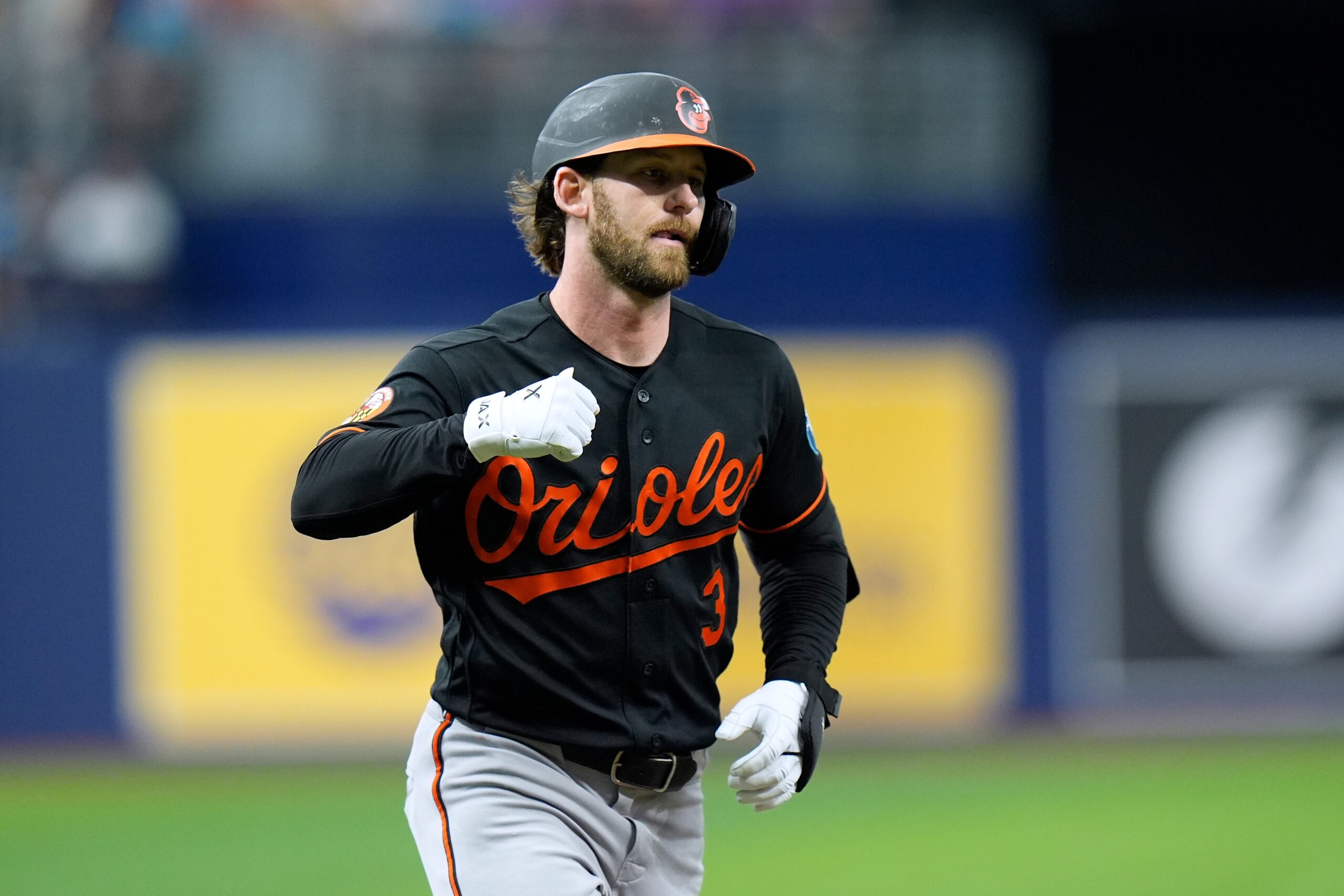
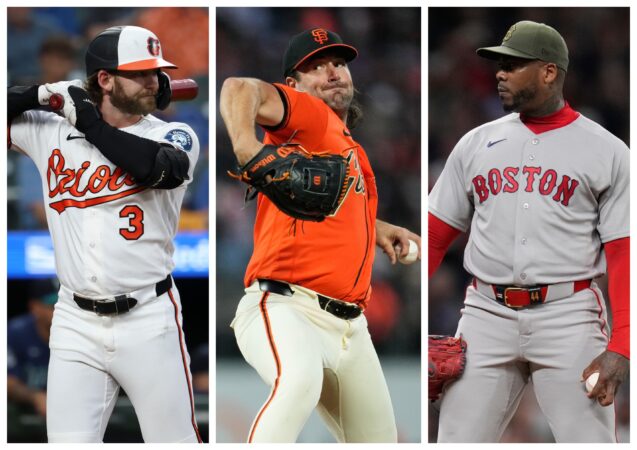
    Despite not hitting for as much power as usual, Orioles outfielder Taylor Ward is reaching base at a .389 clip entering the weekend.

    Baltimore Orioles

    Here’s all you need to know about the state of play in the AL: The Orioles haven’t been over .500 since April 14, but were only 1½ games out of a wild-card spot entering the weekend.

    No wonder a white flag isn’t flying over Camden Yards.

    The next two weeks may determine which trade-deadline lane the Orioles choose. They play 12 of 15 games before the All-Star break at home, where they were 22-19 with a plus-13 run differential going into the weekend.

    And if they’re still undecided on a path as the deadline approaches, the Phillies will visit Baltimore on July 31.

    Maybe they can take Taylor Ward home with them?

    Ward, 32, was popular in trade rumors for years with the Angels before finally getting dealt to the Orioles in the offseason. He entered the weekend with only five homers after averaging 24 in the last four seasons, but appears to have traded power for on-base ability, reaching at a .389 clip.

    (Phillies right-handed hitters had combined for a .269 on-base percentage, last in the majors.)

    Ward would fit atop the order ahead of Kyle Schwarber and Harper, enabling interim manager Don Mattingly to finally slide Trea Turner down. Or the Phillies could put Ward in the cleanup spot behind Harper and work on restoring his fly-ball and barrel rates to his career levels.

    As a free agent after the season, Ward probably won’t come at a high acquisition cost. But the Orioles would get a better return if they package him with rental starter Trevor Rogers or controllable relievers Yennier Cano or Rico Garcia.

    Potential trade: Ward and Cano for Nori and right-hander Ramon Marquez.
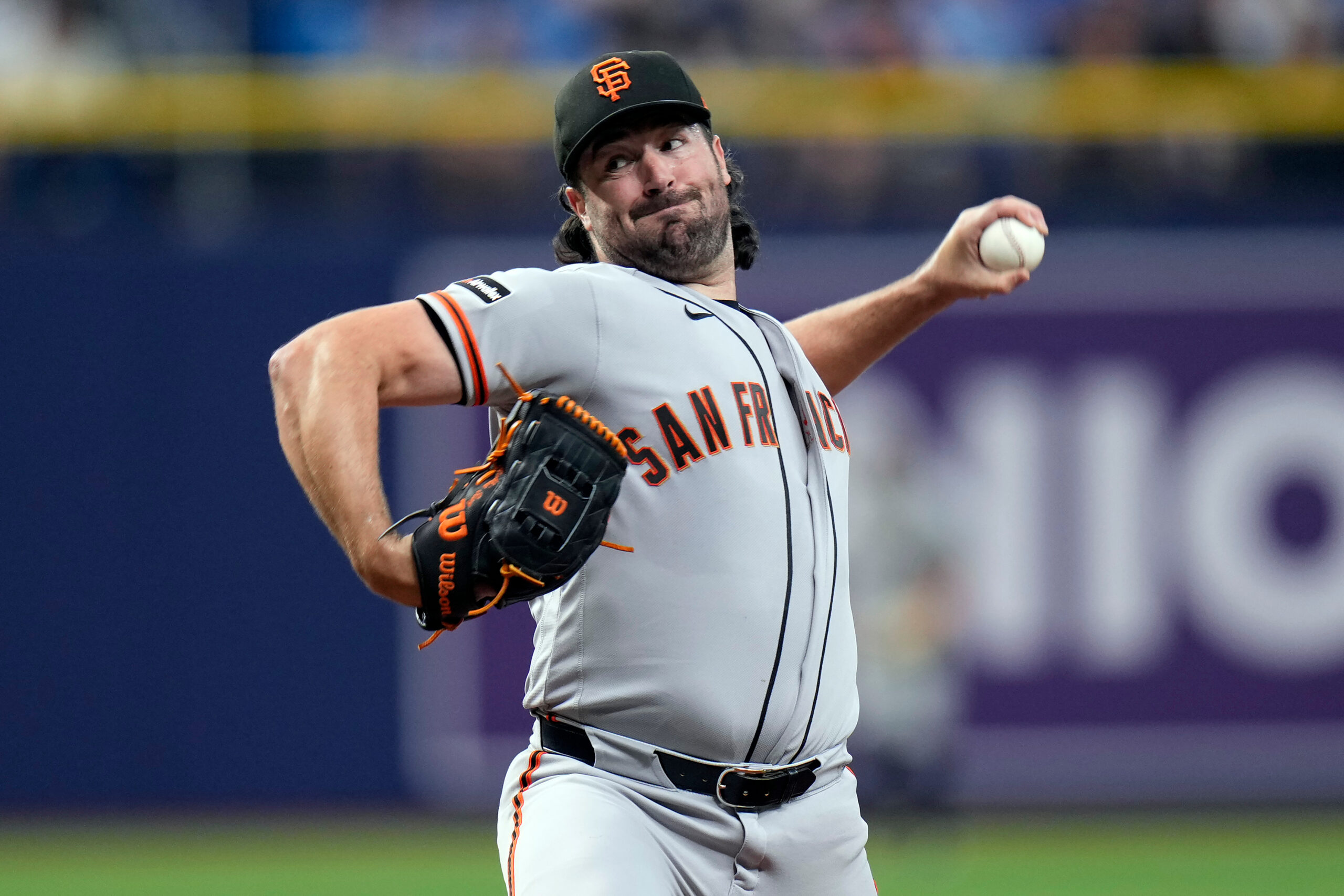
    Giants lefty Robbie Ray has allowed one earned run or fewer in four of his last five starts.

    San Francisco Giants

    Two years ago, the Phillies raced to a big lead en route to an NL East title. But they went 33-33 after the All-Star break and lost their momentum in part because they lacked a competent No. 5 starter.

    Dombrowski regretted not getting one at the deadline.

    “I’ll take the responsibility,” he said after a divisional-round knockout. “When you look at the fifth spot that we had, that was not a good spot at all for us the last two months of the season.”

    Maybe it will inform how Dombrowski acts now, with Painter back in triple A and a hole at the back of the rotation. But teams don’t use five starters in the postseason. So, unless the Phillies can upgrade from Aaron Nola, or even Jesús Luzardo, they won’t want to give up an asset.

    In that case, the rental market is an option. And the Giants’ Robbie Ray is a classic rental. The 34-year-old lefty will be a free agent after the season. He has pitched well lately, too, allowing one earned run or fewer in four of his last five starts.

    In lieu of what the Giants really want to do — offload unwieldy long-term contracts for Matt Chapman, Willy Adames, and Rafael Devers — they almost certainly will move Ray.

    If the Phillies take on the $12.5 million that Ray is owed through the end of the season, the return would be minimal. But the Giants can get a better prospect by including, say, controllable outfielder Heliot Ramos, who is nearing a return from a quadriceps strain.

    Potential trade: Ray and Ramos for outfielder Gabriel Rincones Jr. and righty Jean Cabrera.
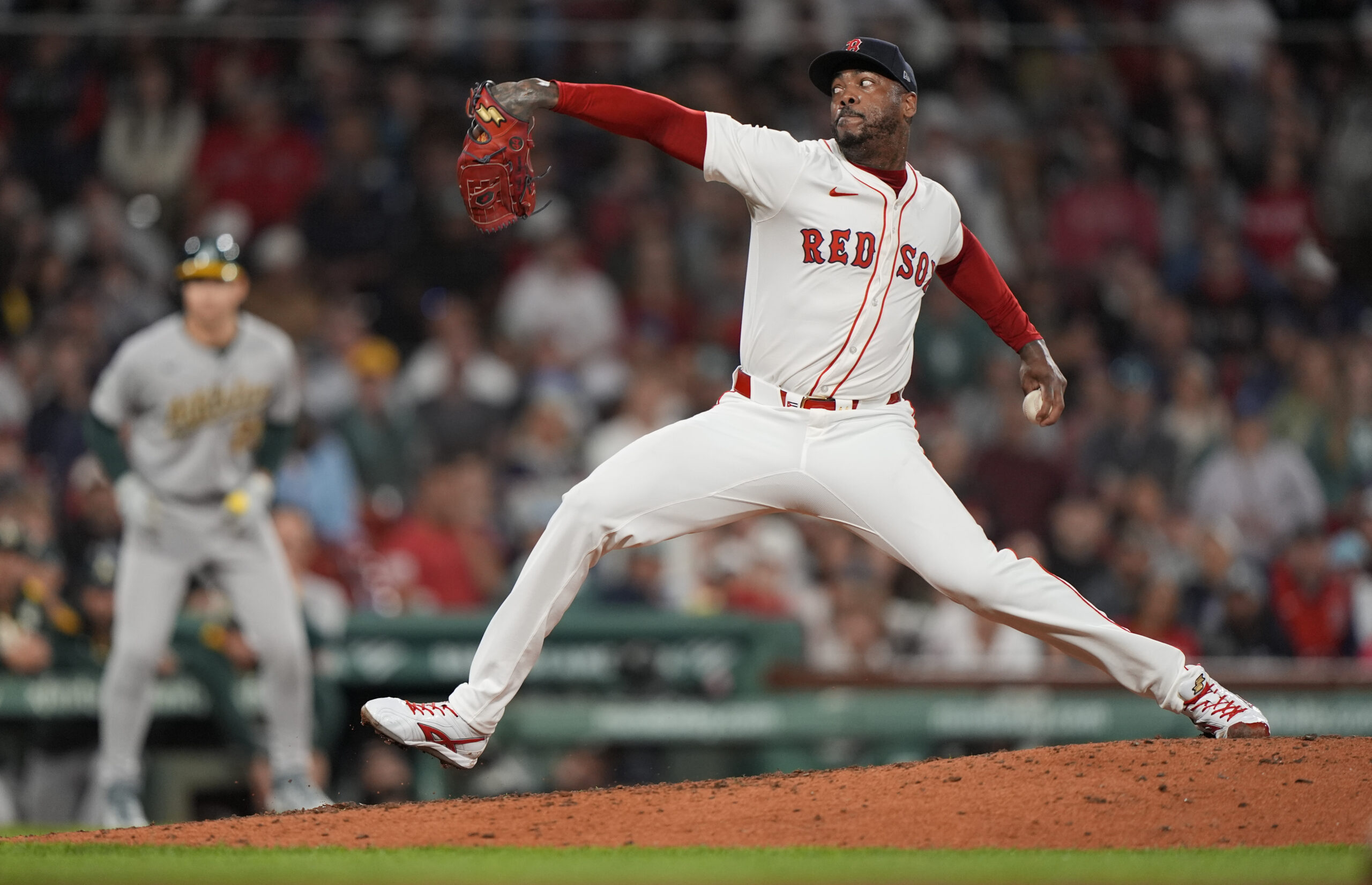
    Aroldis Chapman has a 1.41 and 46 saves for the Red Sox over the last two seasons.

    Boston Red Sox

    When the Red Sox finally accept reality and go into sell mode, they will have players who are in demand.

    Atop the list: fire-breathing closer Aroldis Chapman.

    Even at age 38, Chapman is lighting up radar guns and overpowering hitters. Entering the weekend, these were his numbers in two years with the Red Sox: 1.39 ERA, 47-for-50 in save chances, 114 strikeouts, 25 walks in 84 innings. His fastball still averages 97.4 mph.

    Chapman has 382 career saves, 10th on the all-time list. With the Phillies, he would supplant José Alvarado as the high-leverage lefty and set up for Duran. He has filled a setup role before, notably in 2023 for the World Series-winning Rangers.

    Two years ago, the Phillies acquired walk-year closer Carlos Estévez from the Angels for two pitching prospects (Klassen and Aldegheri). The Sox will likely seek a similar haul for Chapman, a free agent at season’s end.

    They will have a harder time maximizing the value for outfielder Jarren Duran. Although he’s under team control through 2028, the 29-year-old’s production has dropped off since his All-Star season in 2024.

    Duran is a left-handed hitter, not an ideal fit for the Phillies. But given the lack of righty-hitting outfield options, he’s worth considering as a buy-low candidate.

    Potential trade: Chapman and Duran for Escobar, Marquez, and righty Matthew Fisher.
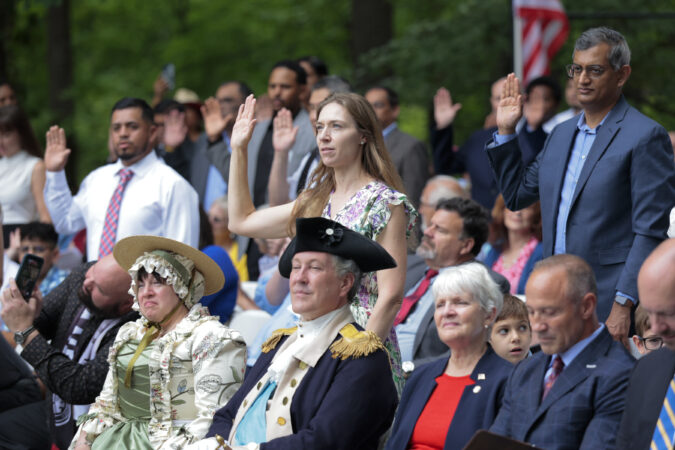
  • Gov. Shapiro welcomes 63 new U.S. citizens from 17 countries in Chesco alongside a George Washington reenactor and bald eagle

    Gov. Shapiro welcomes 63 new U.S. citizens from 17 countries in Chesco alongside a George Washington reenactor and bald eagle

    It’s been a long time coming, Matthew Mckena reflected. There were hiccups in the process. But by midday Friday, he was officially a U.S. citizen, in time for the country’s 250th birthday, and welcomed by Gov. Josh Shapiro, a George Washington reenactor, and even a bald eagle.

    “It just became a battle of perseverance, but also we’ve come so far,” he said. “The hope in itself is also in the waiting, and so it’s now coming in full circle. It’s just unbelievable of having waited for so long for something, and then finally having it.”

    Mckena, 21, was one of 63 people from 17 counties to take their oaths as new citizens in Valley Forge on Friday. For many of them, who ranged in ages 18 to 87, the day was a culmination of years of effort and lives they’d built in the country.

    Mckena’s siblings were born in the United States, before his family moved back to Kenya, where he was born. When he was in high school, his family returned to the U.S. He’s now a college student pursuing a degree in mechanical engineering.

    “[There are] so many opportunities that have been afforded with this move to be at a place where it’s so easy to access education infrastructure,” he said.

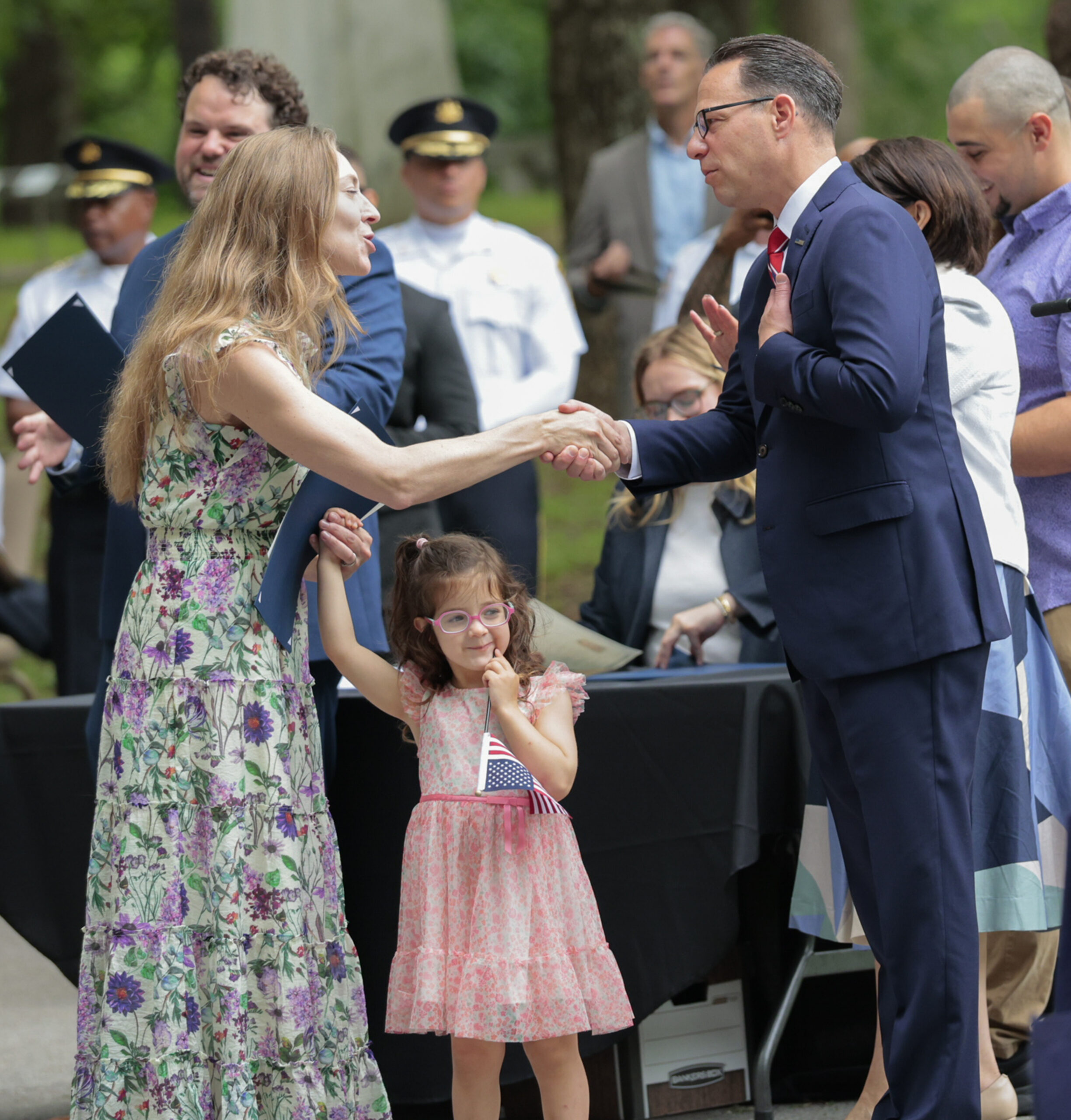
    New citizen Helene Hartmann Dirani with her 3-year-old daughter Victoria are greeted by Gov. Josh Shapiro as he welcomes 63 new citizens from 17 countries at the historic Founding Forward in Phoenixville.

    Helene Hartmann Dirani, 42, has called a few nations home: Originally from Kazakhstan, she moved to Germany at 13 years old, and then studied in Austria. She later met her now-husband in the United States. After years of long-distance dating, they settled down, and she moved to the country 13 years ago. Three children later, the ceremony felt like a special moment for Hartmann Dirani.

    “Being with my husband and my children, and settling down is really what makes it so special,” she said.

    The naturalization ceremony was held one week before America’s Semiquincentennial in historic Valley Forge. Chester County Court of Common Pleas President Judge Ann Marie Wheatcraft called the new citizens’ attention to that legacy.

    “Valley Forge reminds us that citizenship is not simply inherited, it is claimed often at a great cost, and many of the many of us take that for granted. You understand better than most,” she said. “You chose America. You worked hard for this. … Bear with us your gifts, your culture, and all that makes you unique.”

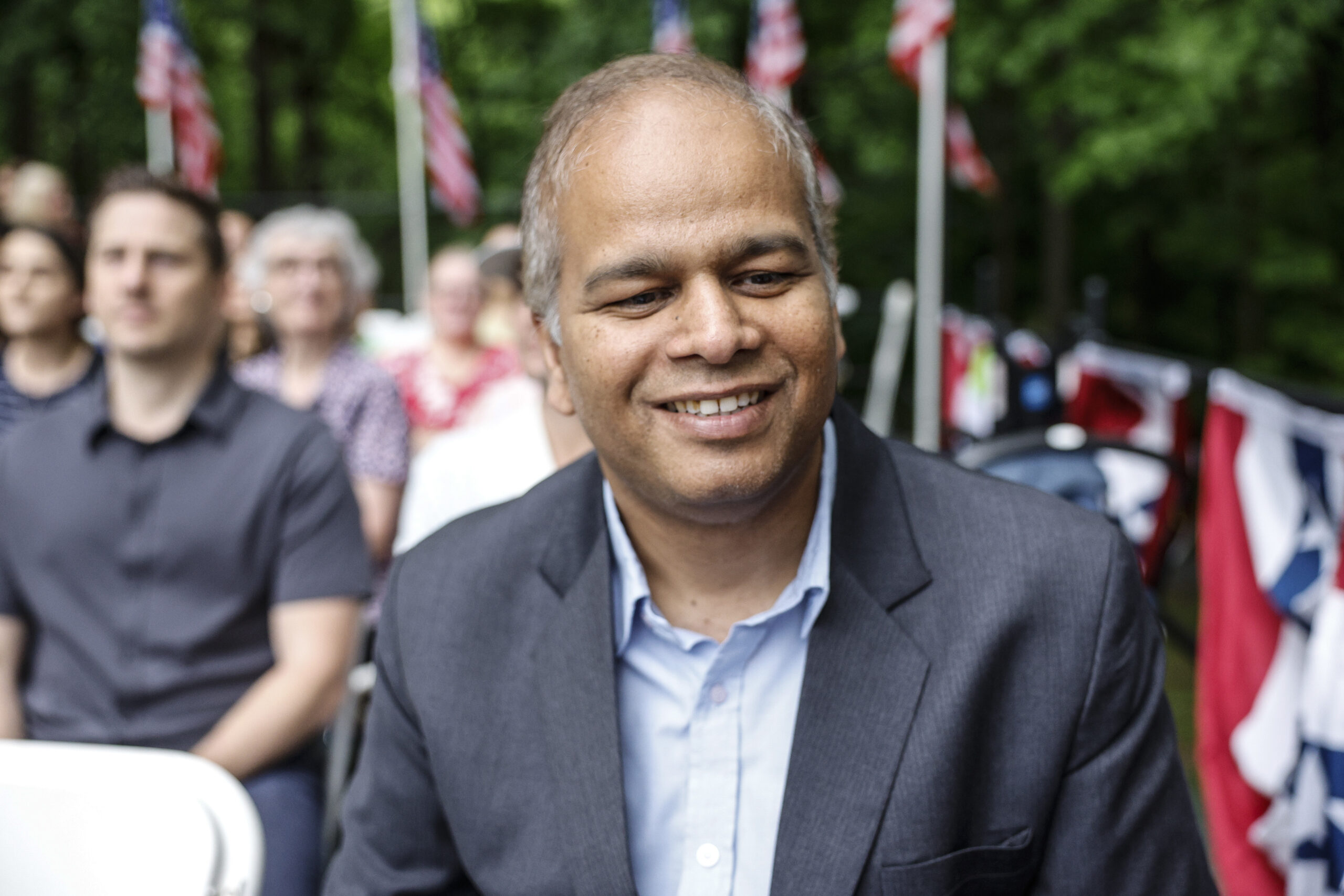
    Rohan Bakshi talks about becoming a new citizen before Gov. Josh Shapiro welcomed 63 new citizens from 17 countries at the historic Founding Forward in Phoenixville on Friday, June 26, 2026.

    America has always been “a land of dreams” for Rohan Bakshi, 45. He came to the country from India in 2012, and has felt a part of the country. He built a life, family, and career here. After so many years, this was a “dream come true,” he said.

    “This is the best country to live in,” said Bakshi, whose wife will be sitting in his seat soon, as she pursues her own citizenship. “I’ve seen other countries as well. It’s a privilege to be an American citizen.”

    Lina Zhang, 41, felt emotional as she waited to take her oath. Roughly 14 years ago, she moved from China to the United States. In the beginning, her English “sucked,” she said. But she learned fast: attending GED classes, using her translator app to translate English to Chinese, and then translating back to English, so she could take her exams.

    Her hard work earned her some of the highest marks her teacher had seen in years, she said. She went on to college, majoring in accounting and minoring in finance, landing a job with a public accounting firm.

    Surrounded by her family Friday, she was glad to be sitting at the ceremony.

    “I’m proud of myself,” she said.

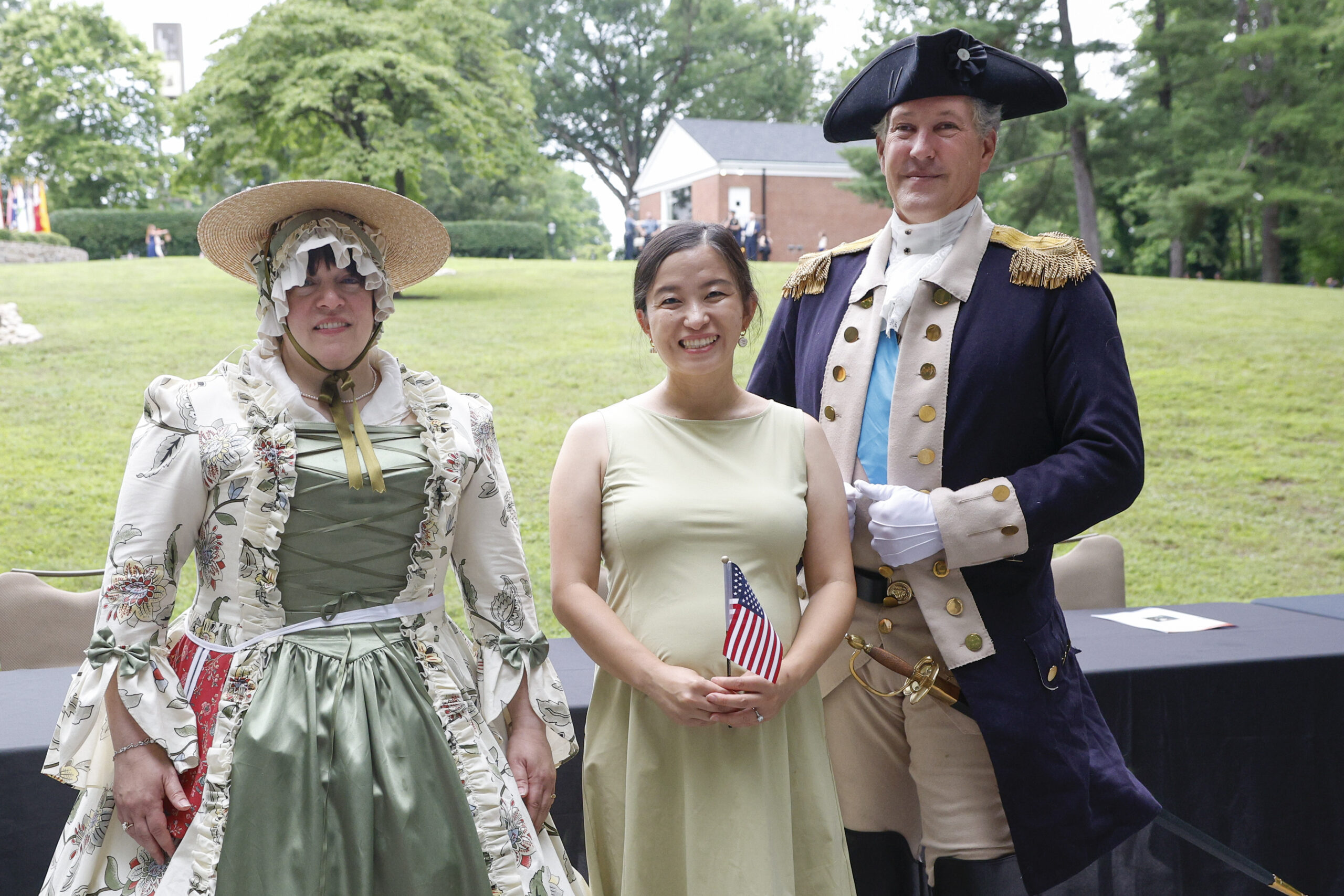
    New citizen Lina Zhang poses with George and Martha Washington reenactors Randall Spackman and Karyrn Saece before taking the oath of citizenship with 63 new citizens from 17 countries at the historic Founding Forward in Phoenixville.

    Speaking to the new citizens, Gov. Josh Shapiro recognized the work each person had put in to reach this moment. But, he warned: “As new Americans, your work is just beginning.”

    Recalling Ben Franklin’s famous quote, “A Republic, if you can keep it,” Shapiro told them those words — “if you can keep it” — was their charge.

    “Each successive generation of Americans have continued that work, caring for their neighbors, standing up for freedoms that our founding fathers fought for, taking an oath of citizenship, working in the halls of Congress, the halls of our state capitol, the halls of our county — that work now falls to each of you to be engaged American citizens,” he said.

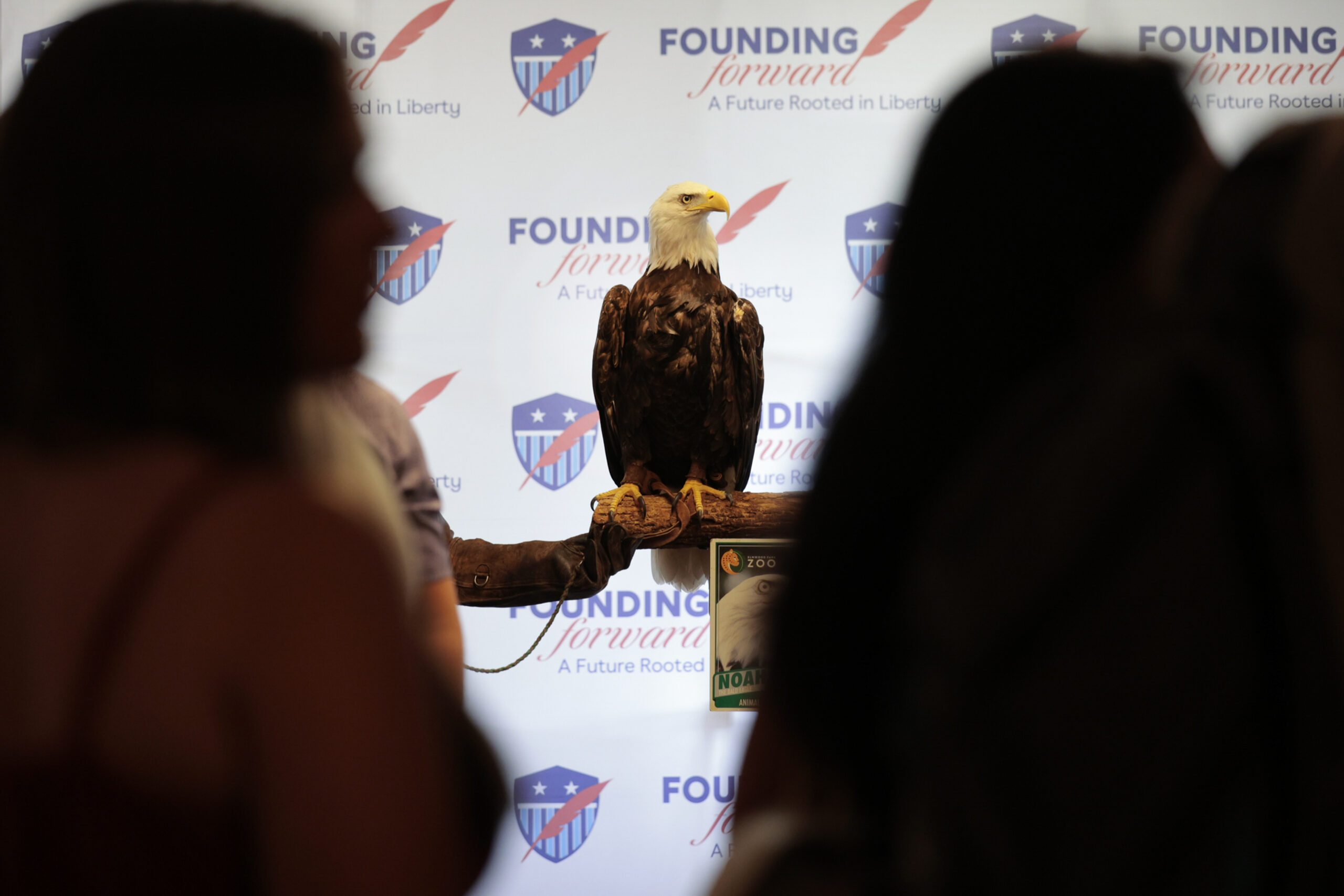
    New citizens got to visit with Noah the bald eagle from the Elmwood Park Zoo after some 63 new citizens from 17 countries took the oath of citizenship at the historic Founding Forward in Phoenixville.

    After the ceremony, Mckena said, from his experience, a lot of people discount the value of American citizenship.

    “There really is a high cost that a lot of people pay, and there really is a huge disparity in what democracy offers and what the rest of the world offers, and so really it’s a special opportunity,” he said. “People who already had it [should] really treasure and understand it. And for those who don’t, seek after it.”

    This suburban content is produced with support from the Leslie Miller and Richard Worley Foundation and The Lenfest Institute for Journalism. Editorial content is created independently of the project donors. Gifts to support The Inquirer’s high-impact journalism can be made at inquirer.com/donate. A list of Lenfest Institute donors can be found at lenfestinstitute.org/supporters.

  • City officials plan to revamp Market Street from Sixth Street to City Hall

    City officials plan to revamp Market Street from Sixth Street to City Hall

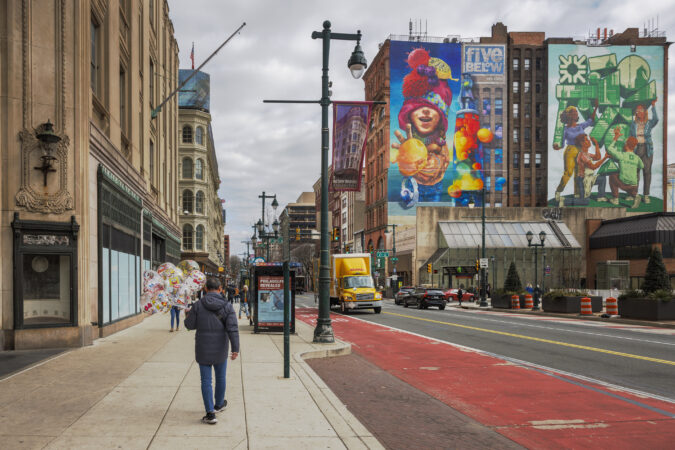
    Philadelphia officials are planning a major renovation of Market Street’s sidewalks, landscaping, and streetscapes, from Sixth Street toward City Hall.

    The announcement of a $2.5 million federal grant to begin the planning and design comes on the heels of the recently completed renovation of the thoroughfare in Old City from Second to Sixth streets. That effort took 18 months of construction and $16 million.

    The stretch to City Hall poses more logistical problems and could prove a heavier lift because of its dense use.

    The planned revamp is part of Mayor Cherelle L. Parker’s pledge to revitalize the Market East corridor.

    Most recently, the row of storefronts on the 900 block of Market owned by Comcast and Harris Blitzer Sports & Entertainment have begun hosting small pop-up businesses for the summer, as the city celebrates the 250th anniversary of the Declaration of Independence.

    The Department of Planning and Development is overseeing the revitalization, and the public-private Market East Corridor Advisory Group is helping to craft a vision.

    The new $2.5 million grant from the U.S. Department of Transportation, which the city will match, is limited to planning the streetscape along Market Street between 6th and Juniper Streets.

    Construction is years away, said Kelley Yemen, Philadelphia’s director of the Office of Multimodal Planning. Her office is gathering information to evaluate everything from traffic patterns to potential road diets and bike lanes.

    “Everything’s on the table at this point,” Yemen said.

    Safety remains a primary driver, she said, given that the section of Market Street is situated on the city’s “high-injury network.”

    However, she said redesigning the corridor poses unique logistical challenges compared with the recent improvements in Old City.

    Market East serves as a major commercial hub with heavy transit use, requiring planners to balance the needs of transit riders, pedestrians, and cyclists.

    Additionally, the shallow depth of the underground subway system may constrain surface-level landscaping.

    Yemen explained that any trees or plantings must account for the height of the subway ceiling, potentially leading to elevated planters rather than vegetation that’s rooted in the ground.

    The city is working with the consulting firm WSP and a team of subconsultants to develop design options.

    Yemen anticipates the design will take two to three years, as the city also has to navigate federal environmental reviews.

    Though the planning phase is now paid for, the city does not yet have money to fund construction and will likely look to federal or state grants for help in the future.

    Public involvement will be a key next step, she said.

    The planning commission is expected to launch a broader public engagement push this July to gather community input on the larger Market East revival.

  • Josh Shapiro says progressives’ wins in New York show voters ‘are channeling that pain into purpose’

    Josh Shapiro says progressives’ wins in New York show voters ‘are channeling that pain into purpose’

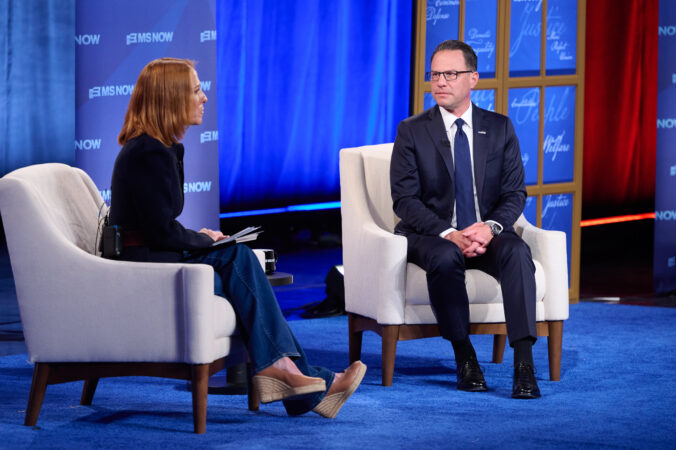
    The Democratic Party should be a big tent and welcoming to a diversity of voices, Gov. Josh Shapiro told MS NOW’s Jen Psaki in a live event in Philadelphia on Thursday.

    Following Tuesday’s primary races in New York that saw the elections of more progressive and socialist candidates, Shapiro said the results there and around the country show that voters are eager for change.

    “I appreciate the passion that we are seeing from voters all across this country,” Shapiro said during the event at the Academy of Music, part of MS NOW’s celebration of America’s 250th birthday.

    People are feeling the strain and opting to support more progressive candidates, Shapiro said, because of rising health insurance costs, struggles to purchase a house, and the feeling that their rights are being stripped away.

    “They are channeling that pain into purpose, they’re channeling that into showing up at the ballot box, they’re channeling that into showing enthusiasm,” he said. “That is a good thing.”

    But he stopped short of explicitly endorsing more left-leaning ideologies. In a separate interview with CNN on Thursday, Shapiro added that the successful candidates must now deliver results.

    “I get that there are some candidates out there that just say a lot words and attract a lot of attention but what we need to do as a party is drill down on how we take those words turn them into actions and make people’s lives better,” he said.

    In Philadelphia, voters elected Chris Rabb, the democratic socialist who has challenged the city’s political establishment, in May’s Democratic primary for Pennsylvania’s 3rd Congressional District. Shapiro did not get directly involved in Rabb’s district, despite making endorsements in other races.

    He also dodged direct criticism of Sen. John Fetterman, a fellow Pennsylvania Democrat who has become increasingly unpopular among the party’s voters, after Psaki posed some of the senator’s recent comments to Shapiro.

    Fetterman referred to the New York congressional candidates, endorsed by Mayor Zohran Mamdani, as “the dirtbag left” and “outrageous” on Fox News. (The phrase “dirtbag left” comes from the leftist podcast Chapo Trap House and refers to a strand of democratic socialism that counters the political right by mimicking its dark humor, among other tactics.)

    Shapiro said “John should answer for himself.”

    In both Philadelphia and New York, the victorious progressive candidates during their campaigns heavily criticized Israel’s war in Gaza and the United States’ role in supporting its material.

    Psaki did not ask Shapiro, who supports Israel but has been critical of Prime Minister Benjamin Netanyahu, about the issue during the event. And he did not refer to it when talking about the New York results.

    To show voters that Democrats hear their pain, the party needs to get “real stuff done to make people’s lives better,” he said.

    Sandra Dungee Glenn, who attended the event Thursday, said Shapiro could have been even more forceful against Fetterman, who is viewed unfavorably by 43% of Philadelphia residents, according to a recent poll.

    “Don’t even mention that name,” said Glenn, who lives in West Philadelphia, referring to Fetterman. “He’s a big disappointment.”

    In addition to his own reelection campaign in November, Shapiro is focused on getting Democrats elected in four competitive congressional seats and flipping the Pennsylvania state Senate, which has been under Republican control for three decades.

    Should the chamber flip, Shapiro said his immediate priority would be raising the state’s minimum wage and codifying the right to access abortion — blaming Republicans for standing in his way.

    But Shapiro, a first-term Democrat, is also looking ahead, past 2026 and Donald Trump’s presidency, as he builds a national profile and becomes a likely contender for the presidency in 2028.

    He said Congress should pass a 28th Amendment to the U.S. Constitution that guards against corruption and gerrymandering, and railed against the 2024 U.S. Supreme Court decision that gave presidents absolute immunity from criminal prosecution for actions taken within their constitutional authority, following Trump’s efforts to overturn the 2020 election.

    Shapiro said he is also open to adding more justices to the Supreme Court, which has been set at nine justices since 1869.

    “I think we’ve got to have everything on the table. We’ve got to be bold,” he said.

    Expansion has been pushed by progressives as a way to reform the court and end its conservative majority.

    Leslie Berger, 69, who attended MS NOW’s event Thursday said she supports adding more justices to the court.

    “These norms we have aren’t etched in stone,” she said. “We need to change this justice system and more justices would be a great start.”

    Democrats, Shapiro said, need to be aggressive and elevate candidates who will drive down costs, increase access to healthcare, repair the country’s standing in the world and rein in artificial intelligence.

    “We’ve got to understand that our sole mission right now is winning in these midterms and providing a check against Donald Trump at the state and the federal level,” he said. “Then as we go forward, I think we have to understand that rebuilding a federal government like it was before Donald Trump showed up cannot be the answer to the Democratic Party.”

  • You gotta believe: Three miracle wins in D.C., led again by Bryce Harper, recall the 2022 never-say-die Phillies

    You gotta believe: Three miracle wins in D.C., led again by Bryce Harper, recall the 2022 never-say-die Phillies

    Maybe someday we will learn.

    We will learn to believe in these Phillies. These Bryce Harper Phillies. These Kyle Schwarber Phillies. These Zack Wheeler and Cristopher Sánchez Phillies.

    We will learn that, while they might occasionally lose, they are never defeated.

    We will learn that, until the last strike of the last out is recorded, they have not yet lost.

    We came to learn this about the core of these Phillies in the dead of summer in 2022, and perhaps we should relearn it as summer begins in 2026. Then, they sparked a drive to the World Series with a handful of exhilarating victories. Now, after a wild midweek series in Washington, they might be doing the same.

    We will come to accept that, as long as Harp and Schwarbs and Wheels and Sanchey are active and competing and leading the charge, the rest will follow until the very end.

    That quartet might not be the best players in baseball, but they are always the best players they can be, and that’s often all that matters, because it inspires their peers to be the same. That’s how the Phillies manage comeback miracles like they produced in D.C. this past week.

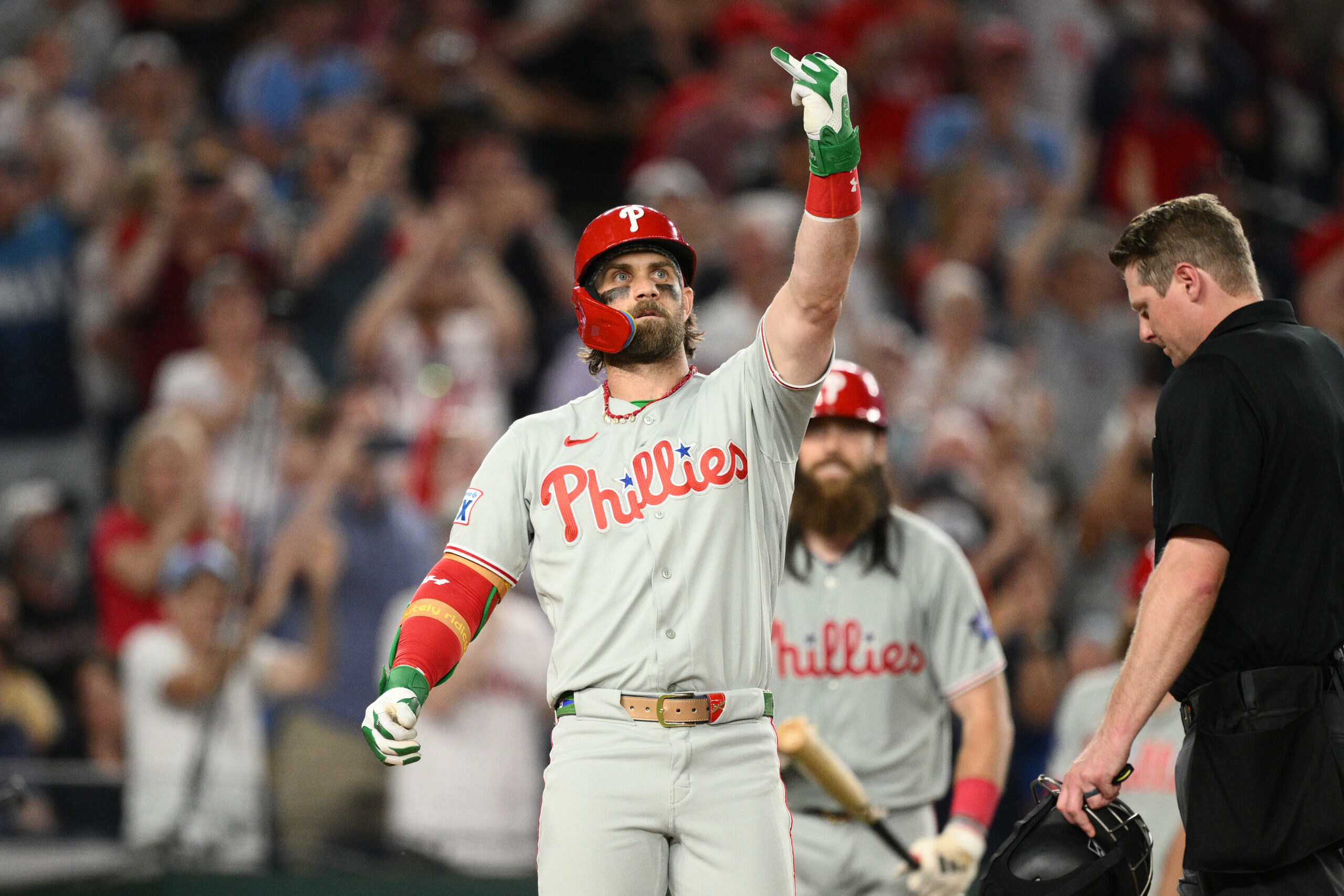
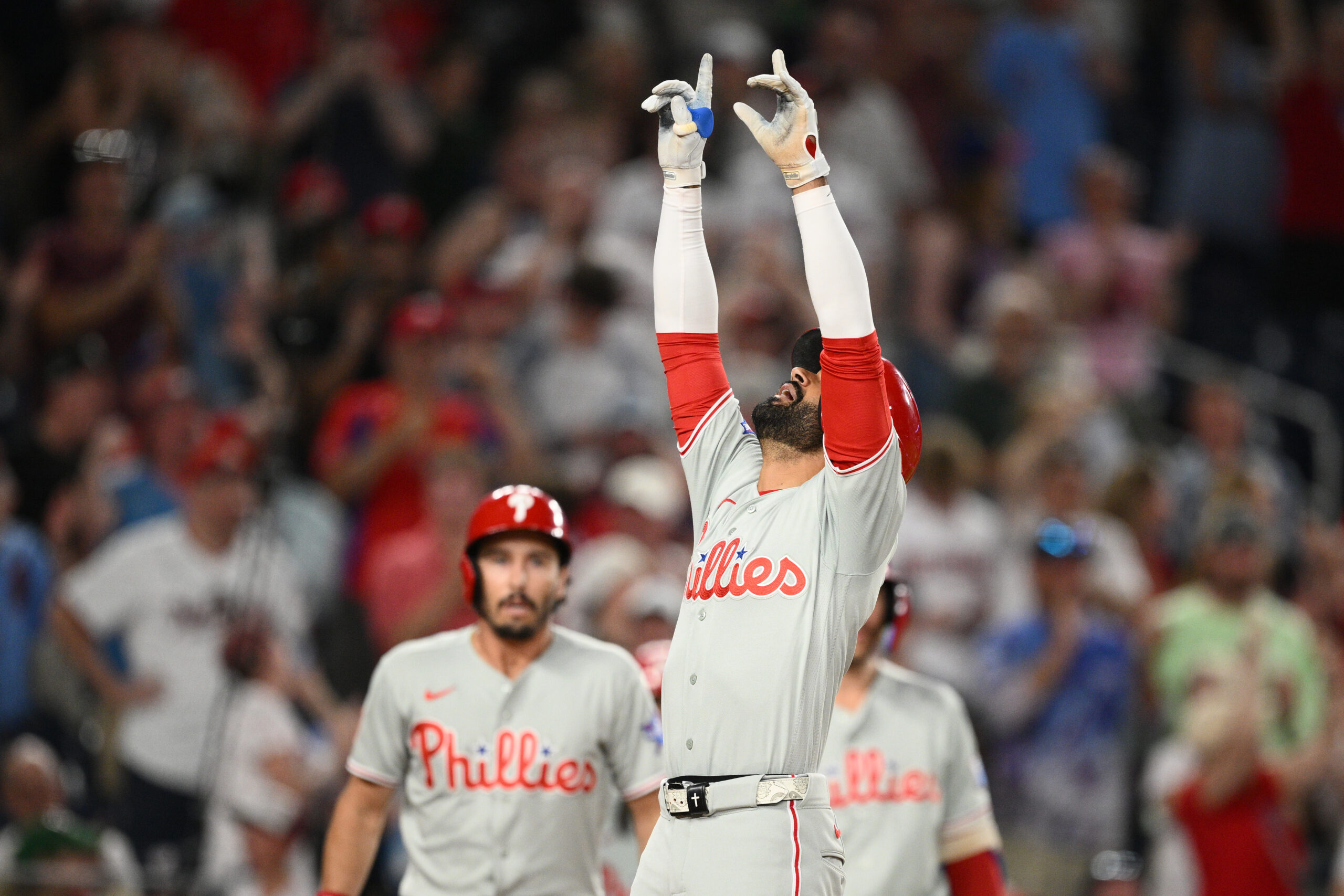
    Bryce Harper flashed a finger — which he clarified was his ring finger — toward the upper deck in right field as he rounded the bases of his go-ahead two-run homer on Thursday in Washington.

    It happened Tuesday. It happened Wednesday. Both nights, the Phillies were down to their last strike; in fact, on Wednesday, they were down to their last strike twice.

    Then, incredibly, it happened Thursday night, too, a 10-5 thriller that launched them to Queens for three against the last-place Mets, who, despite the presence of duplicitous error machine Bo Bichette, have lost six in a row, costing manager Carlos Mendoza his job on Friday.

    They won three of four in D.C. Wheeler was scheduled to start Friday in New York.

    “We’re coming. Watch out,” Harper told 94 WIP radio. “Obviously, we have a great ball club.”

    Great? Maybe.

    The momentum is palpable.

    Why?

    Because the Phillies hit go-ahead home runs in each of the ninth innings of those games, the first time that’s happened in Major League Baseball history.

    Harper, scorching, was in the middle of it all Thursday.

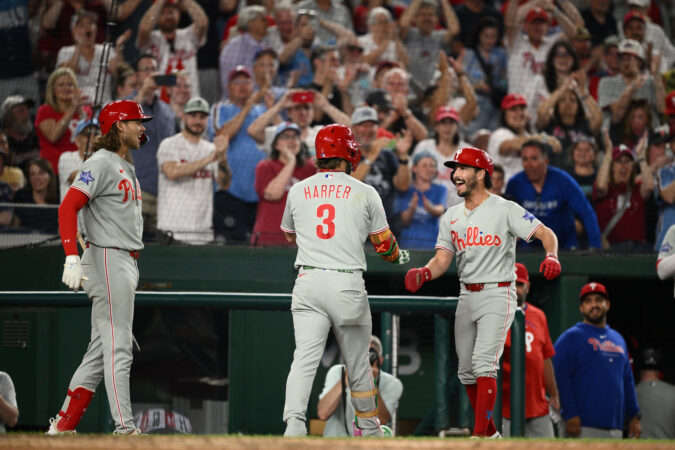
    Down 5-0 in the fifth, Harper beat out an infield single and scored the first run on Brandon Marsh’s third home run of the four-game series. Harper drove in the third run in the seventh with a 3-2 bases-loaded walk that began a three-run, game-tying frame. Then Harper drove in the go-ahead runs with a 390-foot blast to left-center, the surest sign that Harper’s hot: When he’s going “oppo,” he’s unstoppable.

    Harper is 13-for-31 with three homers and seven RBIs in his last eight games. The Phils entered the weekend having won five of six and sit four games behind the idle Braves, the closest they’ve been to the top of the NL East since tax day, when Rob Thomson was still their manager.

    They were 9-19 when Thomson was fired 12 days later, and they’re 36-17 since bench coach Don Mattingly took over as interim manager. Maybe it’s been addition by subtraction. More likely, it’s coincidence, since this core group of Phillies has been winning in heart-stopping fashion since it came together in 2022, when the Phils fired Joe Girardi and Thomson took over as interim manager.

    The DNA of this club seems independent of its boss.

    “Each team is different,” Harper told reporters afterward. “It’s how we are. It’s who we are.”

    There were other big moments from big names Thursday, and all week, really. Schwarber, who didn’t start Tuesday or Wednesday, worked a 10-pitch, two-out, pinch-hit walk in the ninth on Wednesday that framed a bigger moment for a lesser player. Trea Turner put his season from hell on hold for the ninth inning Tuesday, when his two-out single began an eight-run inning in which his second two-out single drove in the eighth run.

    How could something like this possibly happen again Thursday?

    “You’ve got to keep fighting back,” Harper said.

    Sánchez stumbled to a 5-0 deficit after 2⅔ innings but stabilized and faced just one batter over the minimum in recording the final seven outs. That preserved the bullpen, as four relievers pitched a scoreless inning apiece. José Alvarado finally looked untouchable in the seventh, and Orion Kerkering, who’d blown a save two days earlier, earned the win when, in the eighth, he stranded a leadoff double at second base and preserved the tie.

    It is contagious.

    How contagious?

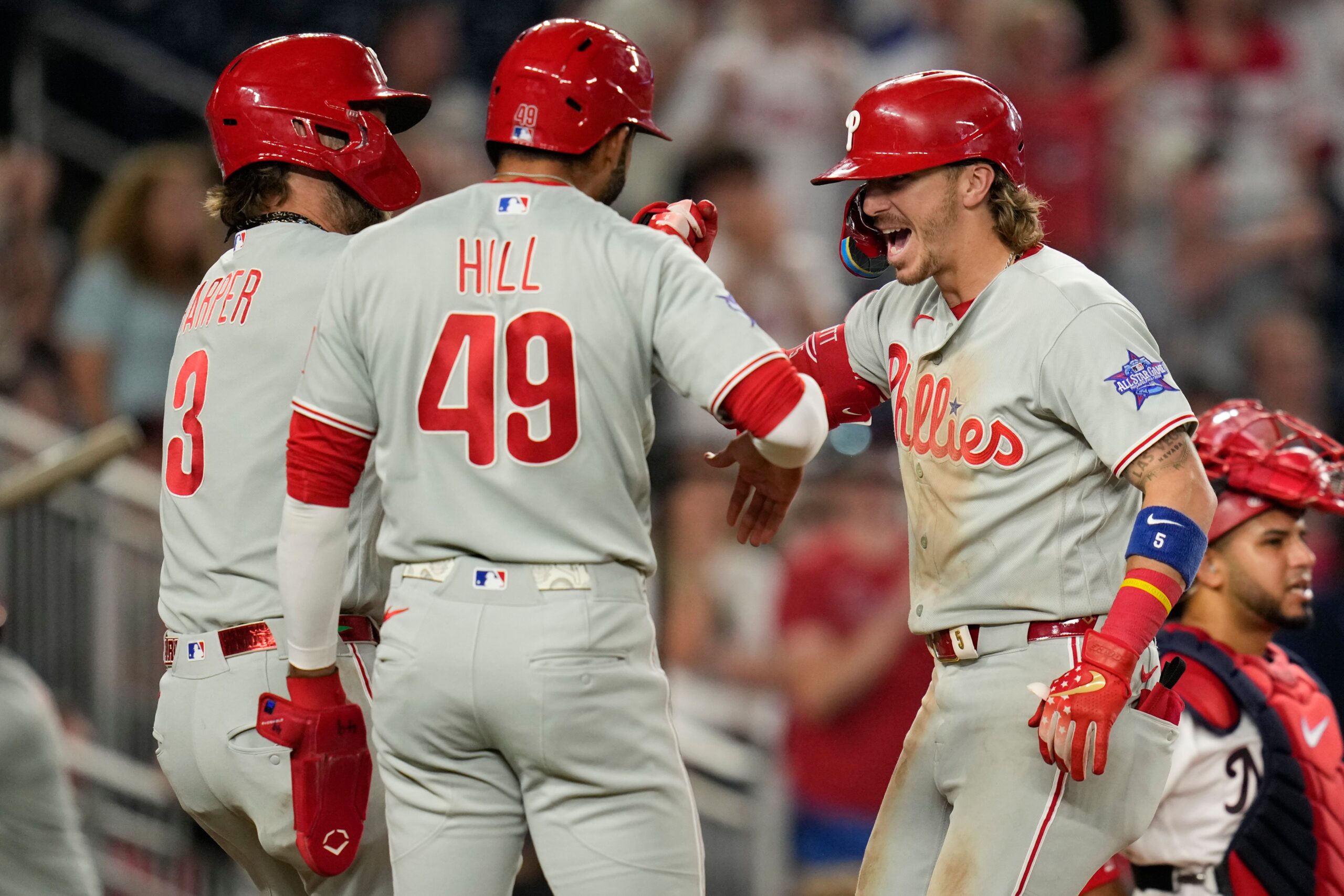
    Derek Hill celebrates his two-run home run during the ninth inning on Wednesday.

    Derek Hill, who was Wednesday’s hero with a pinch-hit, go-ahead, ninth-inning homer, padded the lead Thursday with a two-run shot for a five-run lead. He’s a journeyman outfielder who has been a Phillie for just two weeks, the roster replacement for the Phils’ latest free-agent outfield bust, Adolis García, who had latissimus dorsi repair surgery and is done for the season.

    How contagious?

    Edmundo Sosa had the first homer, double, and five-RBI night of his eight-year career in Tuesday’s 14-9 win, when they erased a two-run deficit in the ninth. Sosa has a knack for the dramatic. He ended May with a two-run homer in the eighth inning to complete a late comeback in Los Angeles.

    How contagious?

    Bryson Stott’s three-run homer on Tuesday was his first go-ahead homer in the ninth inning in four years.

    “We just have that never-quit mentality,” said Brandon Marsh, the team’s most consistent hitter this season.

    Marsh padded his unlikely All-Star resume with a two-run shot in the ninth inning Tuesday that re-tied the game, 8-8, and set up Stott’s moment. Marsh was 9-for-14 and scored five runs in the three comeback wins.

    Marsh knows of what he speaks because he’s lived this life before. It’s all he’s ever known, really.

    Marsh landed in Philly as a deadline trade piece in 2022 from the Angels having played just 163 games in the majors. He landed in the middle of the Phillies’ crucial surge.

    It began July 25, when Stott’s three-run home run in the eighth inning gave the Phillies a 6-4 lead over the visiting Braves. That was the first of 13 wins in 15 games, which allowed them to play .500 ball the rest of the season and still reach the playoffs for the first time in a decade.

    Bryson Stott (right) hit the go-ahead three-run homer on Tuesday in the Phillies’ 14-9 comeback win over the Nationals.

    It was the first of five games in that span that crackled with late-game electricity.

    On July 29, in the top of the 10th inning, Rhys Hoskins ripped an 0-2 fastball 410 feet over the centerfield wall in Pittsburgh for a 4-2 win. The next night, again in the 10th, Hoskins put a ball in play that the Pirates threw away, and that was the difference.

    On Aug. 3, the day after Marsh became a Phillie, he was in Atlanta and saw J.T. Realmuto drive in Hoskins with a fielder’s-choice grounder to tie it at 1 in the eighth, then saw the next batter, Nick Castellanos, blast a two-run game-winner.

    A week later the Phils managed six hits and three runs in the bottom of the eighth to win, 4-3, over the visiting Marlins.

    Does this recent competence mean that the Phillies will reach the World Series this season? Not necessarily.

    What it means is, with this Core Four, the faithful should never forsake the season … and they should watch every game until the very last out.

  • City budget cuts force Mural Arts and Philadelphia Cultural Fund to slash programs

    City budget cuts force Mural Arts and Philadelphia Cultural Fund to slash programs

    In past years, the city’s budget process has followed a certain pattern for Mural Arts Philadelphia and other groups.

    The mayor’s proposed budget lists city funding at one level; City Council and others advocate for modifications at a higher level; and the budget goes back to the mayor and is finalized with the higher allocation in place.

    This year was different.

    Philadelphia’s nationally acclaimed program that puts colorful murals in neighborhoods and provides jobs was hoping for a boost in city funding.

    Instead, the budget ultimately agreed to by Mayor Cherelle L. Parker’s administration and City Council cut funding to Mural Arts — from $5.1 million in fiscal year 2026 to $3.7 million in 2027.

    Likewise the Philadelphia Cultural Fund. The group — which awards hundreds of grants to arts groups throughout the neighborhoods — was looking for increased funding in the city’s newly approved $7.1 billion budget for the fiscal year starting July 1.

    But the arts nonprofit, established by the city recently, learned that it will get substantially less — $3.5 million instead of the $5 million it received from the city for the fiscal year now ending.

    As a result, both groups say they will have to make deep cuts to programs.

    Philadelphia’s arts and culture sector had greeted the start of Parker’s term 2½ years ago with optimism for increased funding. Today, it is “alarmed” by the cuts to Mural Arts and the Cultural Fund, said Patricia Wilson Aden, president and CEO of the Greater Philadelphia Cultural Alliance.

    “We always say that your budget tells a story, and I have to say that the cultural community is disappointed and frustrated with the story being told by this FY27 budget,” she said. “Cutting the budget of signature programs like Mural Arts by 26% or decreasing funding to the Philadelphia Cultural Fund, that’s going to have ramifications throughout the city.”

    Parker was not available for comment, a spokesperson said.

    Valerie V. Gay (left) chief cultural officer with the City’s Office of Arts, Culture and the Creative Economy, and finance director Rob Dubow (right) testify at a Philadelphia City Council hearing, Aug. 8, 2024 on the collapse of the University of the Arts.

    Valerie V. Gay, the city’s chief cultural officer, said it was the city’s view that funding for the two groups had remained flat from 2026 to 2027, since the base allocation stayed the same and it was only the added amount that did not come through — though she allowed that “absolutely I can see how it can be perceived.”

    A ripple effect

    The resulting cuts at both groups promise to be substantial. The Cultural Fund will be forced to reduce the number of grants it had been expecting to distribute in the coming year, from 332 to 232. It has changed its eligibility requirements, which will eliminate grants to a pool of midsize organizations currently eligible.

    “It’s going to be a ripple effect. People are going to feel it and communities are going to feel it,” said Philadelphia Cultural Fund executive director Gabriela Sanchez.

    “An investment in the Philadelphia Cultural Fund is more than a budget line item,” Sanchez wrote in a statement distributed by the group. “Funding to PCF represents how the city values neighborhood theaters, cultural centers, museums, arts education programs, festivals, dance companies, community storytelling initiatives, music programs, and cultural traditions that bring Philadelphians together. These spaces are where young people discover their creativity, where seniors find connection, where communities celebrate their heritage, and where residents gather across lines of difference.”

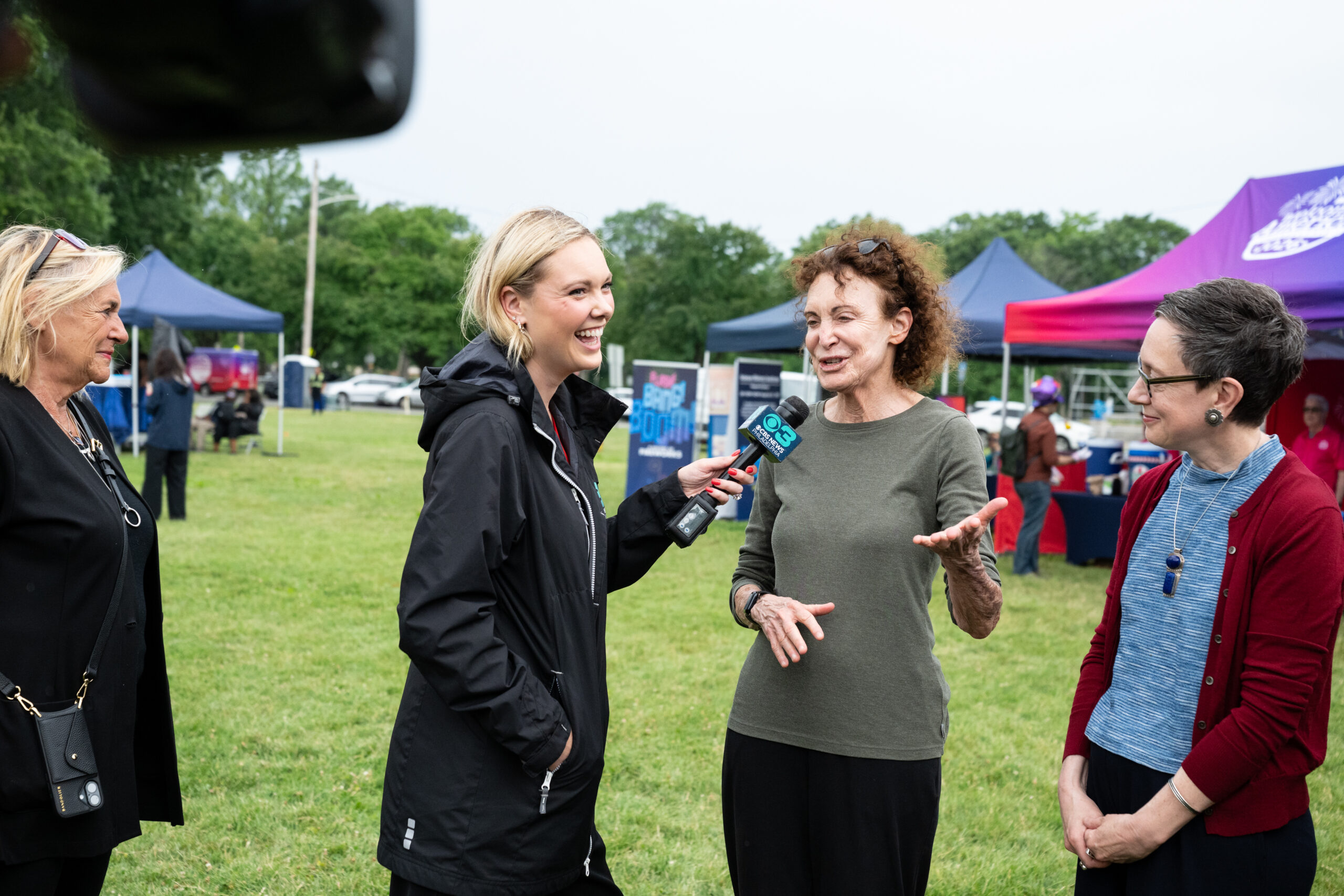
    Jane Golden (center right) speaks with press at the Wawa Welcome America media preview for the Philly Fair 250, outside the Please Touch Museum in West Philadelphia, June 18, 2026. Mural Arts held a ceremonial unveiling of a 10-story-high mural replica, originally titled ‘CityKids Speak On Liberty,’ and created by Keith Haring.

    Mural Arts director Jane Golden declined to comment, but an initial assessment from the group obtained by The Inquirer says that “hundreds of residents in at least 15 Philadelphia communities will lose the opportunity to develop public art projects,” and that opportunities for paid work, job training, and mentorship through the Mural Arts Restorative Justice program will be reduced by 25%.

    Mural Arts will also have to cut by 75% its program of restoring and preserving the city’s murals, “putting at risk community landmarks that took years and significant public investment to create,” the impact statement reads.

    Of the program reductions at both groups, Gay said: “I am always sad that any cuts are made or that any organizations are unable to do the work they thought they were going to be able to do. That’s always a sad time for us, and I’m looking forward to when we are a fully funded sector.”

    A city spokesperson was unable to provide a full list of groups that in past years had received higher allocations after advocacy from City Council and others, but this year did not.

    What’s behind the cuts

    Aden says arts and culture has seen some significant recent “wins” from city government. Among them is the advancement of a referendum that, if approved by the mayor and then by voters this fall, would enshrine the city’s office of arts and culture, called Creative Philadelphia, in the City Charter.

    The city has approved $500,000 a year to develop and implement a cultural plan for Philadelphia that would document financial needs and could identify potential pathways to establishing funding.

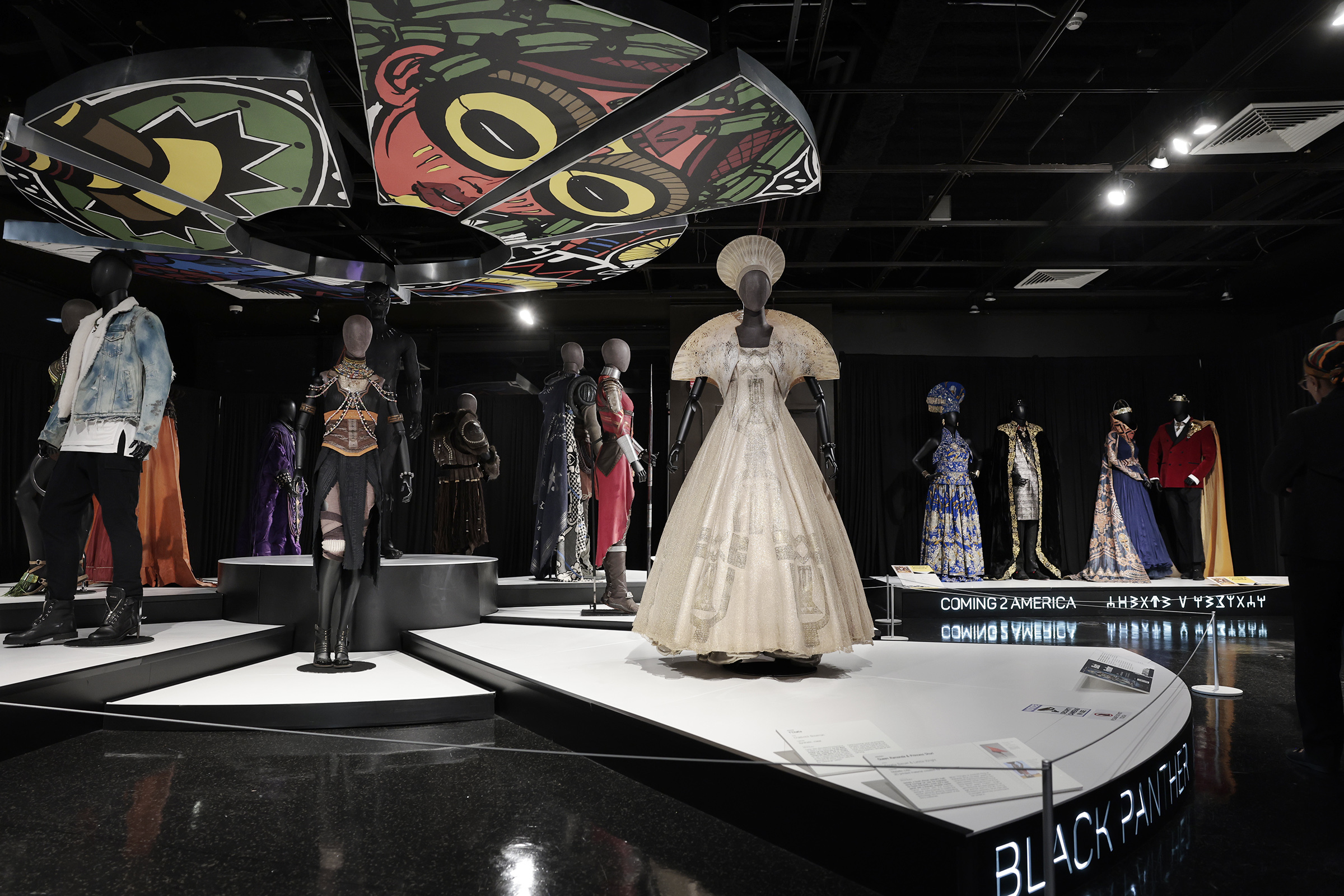
    The ‘Ruth E. Carter: Afrofuturism in Costume Design’ exhibition at the African American Museum in Philadelphia, Nov. 1, 2025.

    Sometimes the city’s support is for regular operations, and other times it is for specific capital projects. In an unusually large commitment, the city has pledged $50 million to the African American Museum in Philadelphia for its relocation to the Benjamin Franklin Parkway.

    The city is providing nearly $32.5 million to arts and culture in FY27, according to a list provided by Parker’s office. While that total includes small items that might seem mundane — paying utility bills at various facilities, for instance — it also shows multimillion-dollar allocations to the Philadelphia Museum of Art, Dell Music Center, and Philadelphia Zoo.

    But the arts and culture sector often finds itself fighting for adequate funding in the annual budget process. Arts leaders and others say it has been standard practice in recent memory that funding is listed at one level in the mayor’s proposed budget and after City Council testimony in budget hearings ends up being higher.

    This year, the mayor “could have funded [the arts] at a higher amount,” as she did last year, but did not do so, Councilmember Rue Landau said.

    The cuts came after a budget that passed without a series of tax increases proposed by Parker, including a $1 tax on rideshare services, after failing to win support from City Council. After Council signaled it would reject Parker’s tax proposals, the administration would not agree to any last-minute line items for new funding requests from lawmakers.

    Councilmember Isaiah Thomas, a consistent arts supporter who, like Landau, is an ex-officio Mural Arts board member, said that with the lack of new tax revenue and the city’s extra allocation of $48 million to cover the Philadelphia School District’s budget shortfall, the funding pie for other allocations got smaller.

    “This budget year, a lot of attention and advocacy went toward schools,” Thomas said. The funding cuts to Mural Arts and the Cultural Fund were “extremely unfortunate,” he said, “and I wish we could have done something different.”

    The need for ‘predictable, stable, reliable’ funding for the arts

    While the city’s budget is now final, there is another potential window of opportunity for funding through a midyear budget transfer process in which the city might see expenditures in certain areas coming in lower than expected, and then transfer money from those categories to other areas.

    Asked whether funds might be restored through a budget transfer to Mural Arts or the Cultural Fund, Gay said:

    “I think anything is on the table, but I also think nothing is guaranteed.”

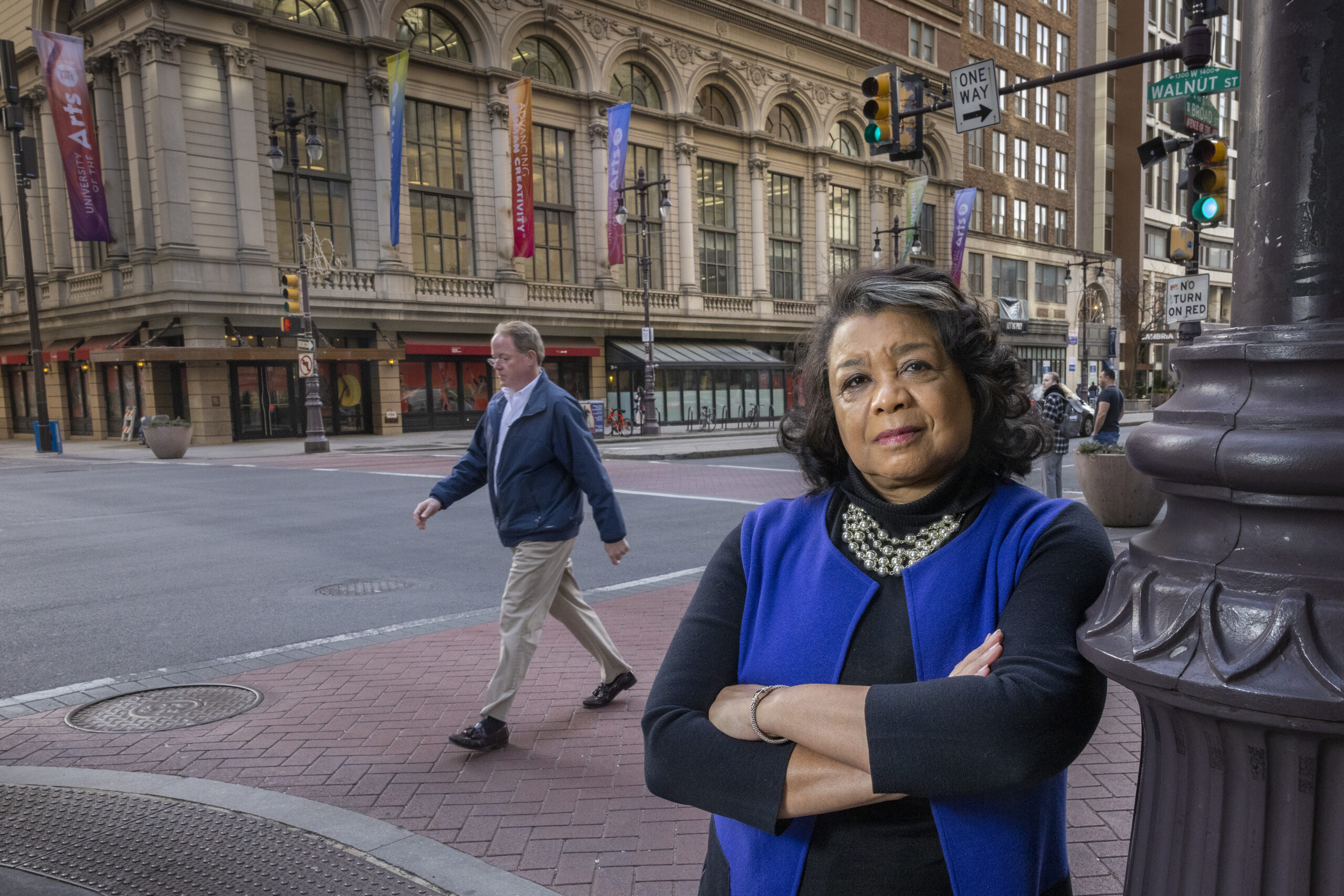
    Patricia Wilson Aden, president and CEO of the Greater Philadelphia Cultural Alliance, at S. Broad Street and Walnut along the Avenue of the Arts, Feb. 15, 2023.

    Any restoration of funds would happen after arts groups have already put cuts in place, and this kind of unpredictability “makes planning by these organizations very, very difficult,” Aden said.

    “The practice of underfunding the arts and having Council and other entities have to go on an advocacy campaign to increase funding is illogical,” Landau said. “It is clear as day that we should be supporting the arts with additional funding every single year, so we don’t have to go through this and it won’t ever be a question mark for them.”

    What is really needed, Aden said, is a dedicated arts fund in Philadelphia and the region.

    “We’ve seen other regions benefit from this predictable, stable, reliable funding. And instead, here in Philadelphia, each year we have this conversation about increases and decreases and their impact. We are sometimes left to the will and whim of elected officials, and we would like to take the creative economy out of the political realm and put it solidly within our larger civic interest, so that it is stable and has the investment that is required to reach its full potential.”

    Staff writer Anna Orso contributed to this article.

  • Corner stores say ‘skill games’ are an essential part of their business. A court ruling threatens that.

    Corner stores say ‘skill games’ are an essential part of their business. A court ruling threatens that.

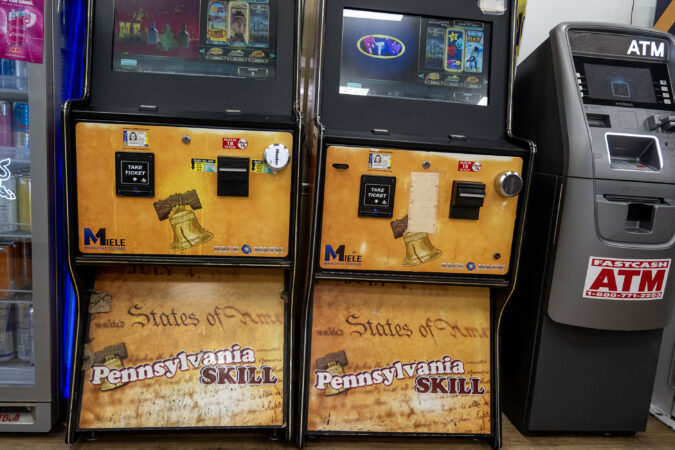
    Amid rising inflation and business costs, many Philadelphia corner stores, bars, laundromats, and smoke shops have turned to skill games, the slot machine look-alikes, to help keep their slim margins afloat.

    The machines, which shop owners say also encourage their customers to linger in stores and make additional purchases, are particularly profitable because they are not taxed or regulated like slot machines — and they have been operating without state oversight in a legal gray area for more than a decade. But a recent state Supreme Court ruling may force that to change.

    Last week, Pennsylvania’s highest court handed down a decision deeming skill games the same as slot machines. That means the skill game terminals proliferating around the state will soon be illegal if not operated and taxed at 52%, and housed in a highly regulated casino or truck stop with a license to carry slot machines. Those terms will take effect in less than four months unless the state legislature intervenes.

    Owners and clerks at several corner stores throughout Philadelphia that offer the games say they do not contribute a lot of revenue to their establishments directly, but they foster more of a lounge atmosphere in the shops that leads patrons to stay longer and purchase more snacks, drinks, lottery tickets, and other goods. Many of the business owners said they are willing to stomach a tax on skill games, but additional regulations would make them rethink keeping the machines.

    José Pérez, who runs a corner store on Opal Street in South Philadelphia, said his store runs on incremental profits. And, he said, when people play the skill game machines and start feeling lucky, they often are inclined to make other purchases there.

    “This business is about getting a little bit of money from every product, and the machines are a tiny source of income that adds up to that,” he said in Spanish between transactions at the store’s register. “While people play, they buy other stuff in the store. And if they win, they buy lottery tickets. Because when someone has one vice, they probably have two.”

    Tax proposals from Harrisburg

    Lawmakers in Harrisburg have for years failed to reach an agreement on how to tax and regulate the so-called skill games

    The issue has proved to be tricky in Pennsylvania’s split legislature, where Democrats narrowly control the House and Republicans control the Senate. The skill games industry leader, Georgia-based Pace-O-Matic, long maintained a friendly relationship with the Senate GOP, and the Republican lawmakers appeared willing to support policies that benefited them. But last year, the goodwill began to sour after the company backed political campaigns against incumbent Republican state lawmakers who did not support its requested low tax rate on the machines.

    State Rep. Danilo Burgos (D., Philadelphia) and State Sen. Anthony H. Williams (D., Philadelphia) have introduced a bipartisan bill in their chambers to impose a $500-per-month fee on each skill game machine operated in Pennsylvania, with a 50,000-machine cap across the state. There are currently an estimated 70,000 skill game machines in Pennsylvania, according to the state attorney general’s office.

    Skill games can be seen through the door of a mini mart on Kensington Avenue in the Kensington section of Philadelphia on Wednesday, July 30, 2025.

    The proposed legislation would split revenues among transit and infrastructure, local governments, and state police for enforcing the cap and fee. The bills also prohibit small businesses whose “primary source of net revenue” is from skill games, in an effort to prevent mini casinos in stop-and-go corner stores around the city. Burgos estimates the regulations would bring in $300 million in new revenue to the state in their first year.

    The bill includes additional protections for Philadelphia, where City Council voted in 2024 to ban the machines. The ban never went into effect, after a lawsuit was filed seeking to block it. In the legislation before the General Assembly, Philadelphia has specific carve-outs that would allow city officials to block stop-and-go businesses or “chronic nuisance” businesses from getting a license to carry the games.

    Surrounded by hundreds of skill games supporters at a news conference Wednesday on the Capitol steps in Harrisburg, Williams said rank-and-file lawmakers would hold up passing the state budget, due June 30, if there is not a deal to protect small businesses from losing their skill games altogether.

    “In this time when everybody talks about affordability, I can’t afford a 52% tax,” Williams said.

    The fee-per-machine option offered in the Democratic-sponsored bills is backed by Pace-O-Matic, which has spent millions of dollars on political campaigns and lobbying in the state, in addition to millions more spent by other parts of Pennsylvania’s booming gambling industry.

    Meanwhile, a separate proposal backed by the Senate GOP and penned last year would set the tax at 35% on gross terminal revenue, in addition to annual license fees. A small portion of those fees would go toward the state’s resources for problem gambling.

    Gov. Josh Shapiro, a first-term Democrat, has proposed taxing the machines at the same rate as slot machines — a hefty 52% levy on each machine’s net revenue — in his last two budget proposals. As the machines have continued to proliferate around the state, Shapiro’s office estimated the newly regulated industry could bring in nearly $800 million in revenue in its first year.

    Uncertain future with uncertain revenue

    Philly store owners were divided on whether it would be worth keeping the machines if they needed to pay a lofty tax on either housing the devices or the profits they made on them.

    Andrew Karki, who operates a laundromat near Pérez‘s store in South Philadelphia, said the machines occupy the customers while they wait for their laundry to finish and, as at Pérez‘s store, lead to purchases of candy and soda from the small bodega he runs inside the laundromat.

    He estimated the machines make up 15% to 20% of his monthly revenue, and he said he would likely be willing to take on a tax on the games, even a rather large one, to keep them around.

    “It’s hard, but we got to pay it. We got to pay it,” Karki said.

    For others, like Diego Reyes, who runs a secondhand shop on Kensington Avenue with about a dozen skill machines inside, taxing the small businesses for the machines does not seem fair. The terminals are often owned by small amusement companies, and are largely operated by Pace-O-Matic. The business owners get a cut from the machine’s revenue for allowing the terminal in their building.

    “They should tax the owner,” Reyes said in Spanish, wearing a Phillies cap and T-shirt with a size-medium sticker still stuck on the back, as three people played the machines.

    Pérez agreed that any tax should be on skill games companies and not on the businesses that carry them.

    It is frustrating to think another tax may be coming down the line, he said, when small-business owners already pay so many of them and see little return on the investment in the community.

    “Look outside, that pothole has been there for six months. We have no safety,” Pérez said. “What do you want me to pay more taxes for if you are not doing anything to better the conditions with it?”

    Staff writer Isabel Maney contributed to this article.

  • Roy Halladay was a high school pitching coach in 2017. It helped him enjoy baseball again, just before he died

    Roy Halladay was a high school pitching coach in 2017. It helped him enjoy baseball again, just before he died

    The night before Roy Halladay died, he was with his team. It was Nov. 6, 2017, and Calvary Christian High School was playing an exhibition game in Clearwater, Fla.

    Halladay, a pitching coach, showed up in baseball pants and a batting practice jacket, with a clipboard beneath his arm. This would not have been unusual for March or April, but fall ball was much more relaxed.

    The rest of the staff, which was dressed in shorts and T-shirts, erupted in laughter. Halladay didn’t hesitate to fire back. “Thanks for the heads up,” he said with a grin.

    As the Warriors jogged onto the field, just past 7 p.m., the future Hall of Famer sat on the bench. After a few innings, infielder Christian Cairo joined him.

    He liked watching games with Halladay. The former Phillie and Blue Jay brought the same intensity to coaching that he did to his 16-year MLB playing career, but with a newfound lightness.

    He’d routinely crack jokes from the dugout. Months earlier, a hitter from a local high school walked up to the plate. He had straight, long hair, all the way down to his back. Halladay turned to the mound.

    “Hey!” he yelled. “Look out for the bunt! This chick can run!”

    The high schoolers loved it.

    “Ridiculous stuff like that,” said Halladay’s 25-year-old son, Braden. “It was funny because he’s saying this to, like, 14-year-old kids.”

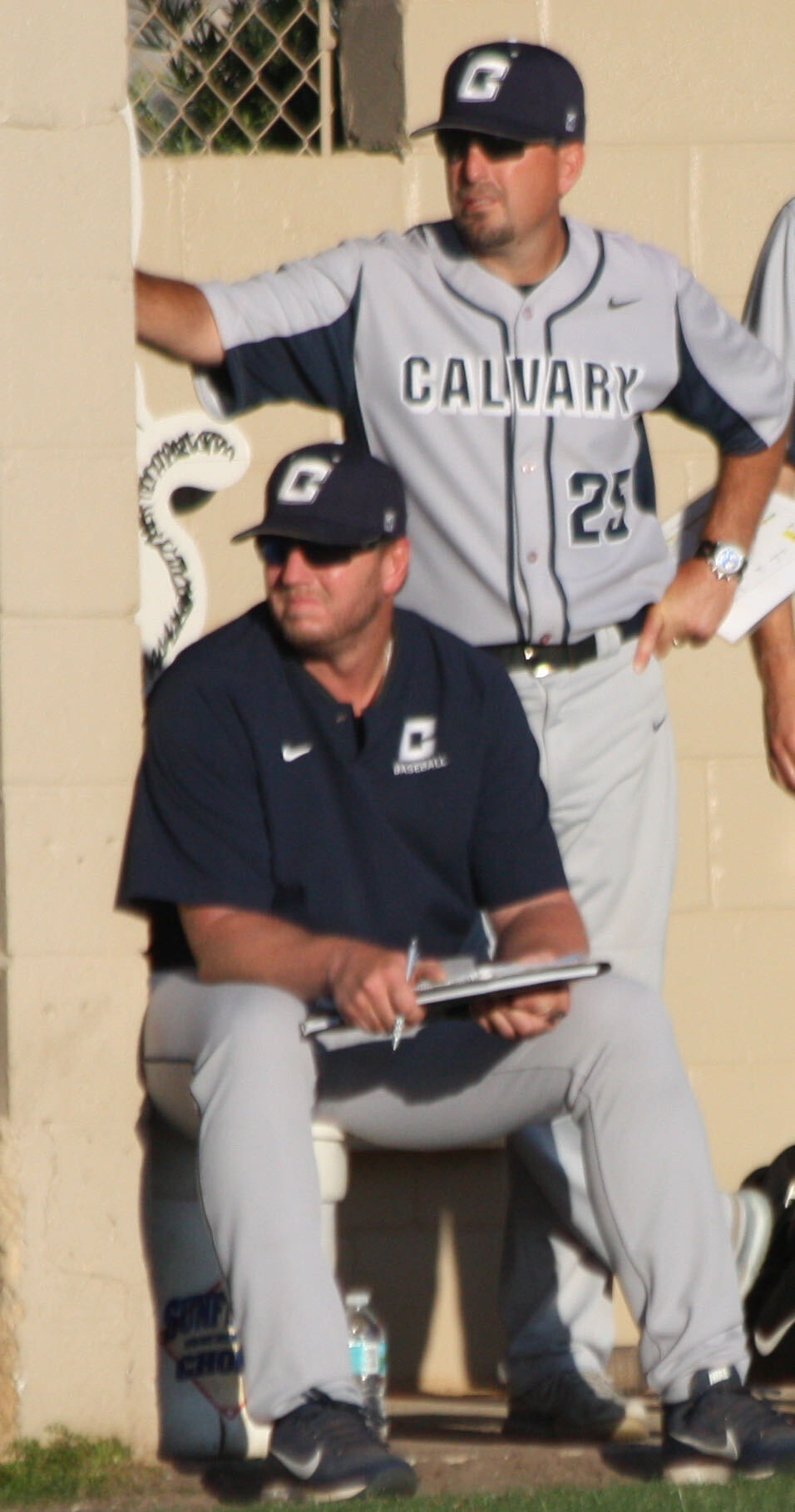
    Coach Greg Olsen (seated) and pitching coach Roy Halladay during a Calvary Christian game in spring of 2017.

    Halladay was in prime form on Nov. 6. The game wouldn’t count toward Calvary Christian’s record, but he was still taking notes and videos on his iPad.

    He was also razzing everyone in sight: his players, their players, umpires.

    “We were talking crap with each other,” Cairo said. “It was a lot of fun.”

    At 9:30 p.m., the two teams left the field. By the next afternoon, ominous rumors had started to spread. Braden, then 17, got a call from his mother. She told him to pick up his 13-year-old brother, Ryan, and drive them to their house.

    Pitcher Nolan Hudi texted Braden while he was in the car. He sent a link to a Twitter post: a selfie of him and Roy in the cockpit of his plane, taken three days prior.

    The photo had gone viral. People were commenting “RIP.”

    Hudi asked if people on social media had ever tweeted such morbid things about his father.

    “No,” Braden said.

    That morning, at 11:47 a.m., Halladay had flown his Icon A5 out of Brooksville-Tampa Bay Regional Airport. A few minutes after taking off, he crashed into the Gulf of Mexico.

    An autopsy showed he’d had amphetamine and morphine in his system, and a federal investigation into the crash found he was flying dangerously. He died of blunt force trauma and drowning. Halladay was 40.

    The boys he coached are now men. Braden works in data analytics for the Texas Rangers. Cairo, 25, is a minor leaguer in the Phillies system. Some have played for other affiliates; Hudi spent a couple of years pitching at the University of South Florida.

    They all cherish that 2017 season. Not just for what they learned (which was plenty) but for what they saw. As a big leaguer, Halladay was fierce and, at times, intimidating.

    But as a coach, he was more laid back. He’d play pranks. He’d chirp. He’d try goofy things to help his team win, like flying a drone over a rival’s batting practice.

    It was all refreshingly fun. What the players didn’t realize, though, was that they were giving Halladay something too.

    “A way for him to enjoy baseball,” Braden said, “in a very pure form again.”

    Roy Halladay won two Cy Young awards in his 16-year career, including in 2010 with the Phillies.

    Roy being Roy

    Halladay never liked the spectacle his success could bring. And it was difficult for him to escape.

    His sons started playing travel ball in the early 2010s, at the height of his career. The Phillie would frequently be stopped for autographs at games and tournaments.

    This attention got so bad that he started keeping a Groucho Marx-style disguise — black-rimmed glasses and a fake nose and mustache — in the back of his car.

    “He thought it was hilarious,” Braden said, “because it’s the stupidest disguise you can come up with.”

    But while Halladay didn’t enjoy the chaos, he did enjoy teaching. In 2011, Hudi played alongside Braden on a Florida team called the West Coast Warriors. Halladay, fresh off his second Cy Young Award, would stop by to help out.

    One day, he approached Hudi during a bullpen session in Tarpon Springs. Halladay asked what pitches he threw. The 11-year-old’s answer was essentially “nothing.” He asked if he’d ever tried a cutter. Hudi shook his head.

    Halladay grabbed a baseball and showed him a grip. Then he reached for a pen, and traced around Hudi’s hand, so the middle schooler could practice at home.

    “He outlined where my fingers were,” Hudi said. “I thought that was so cool.”

    Parents would ask Halladay if he’d be willing to coach, but he always demurred. The big leaguer wanted his son to carve out his own identity in the sport. Having a world-class athlete around would make that challenging.

    But in 2014, he had a change of heart. Halladay had recently retired. Braden was only a year and a half removed from high school, and had experienced a few seasons on his own.

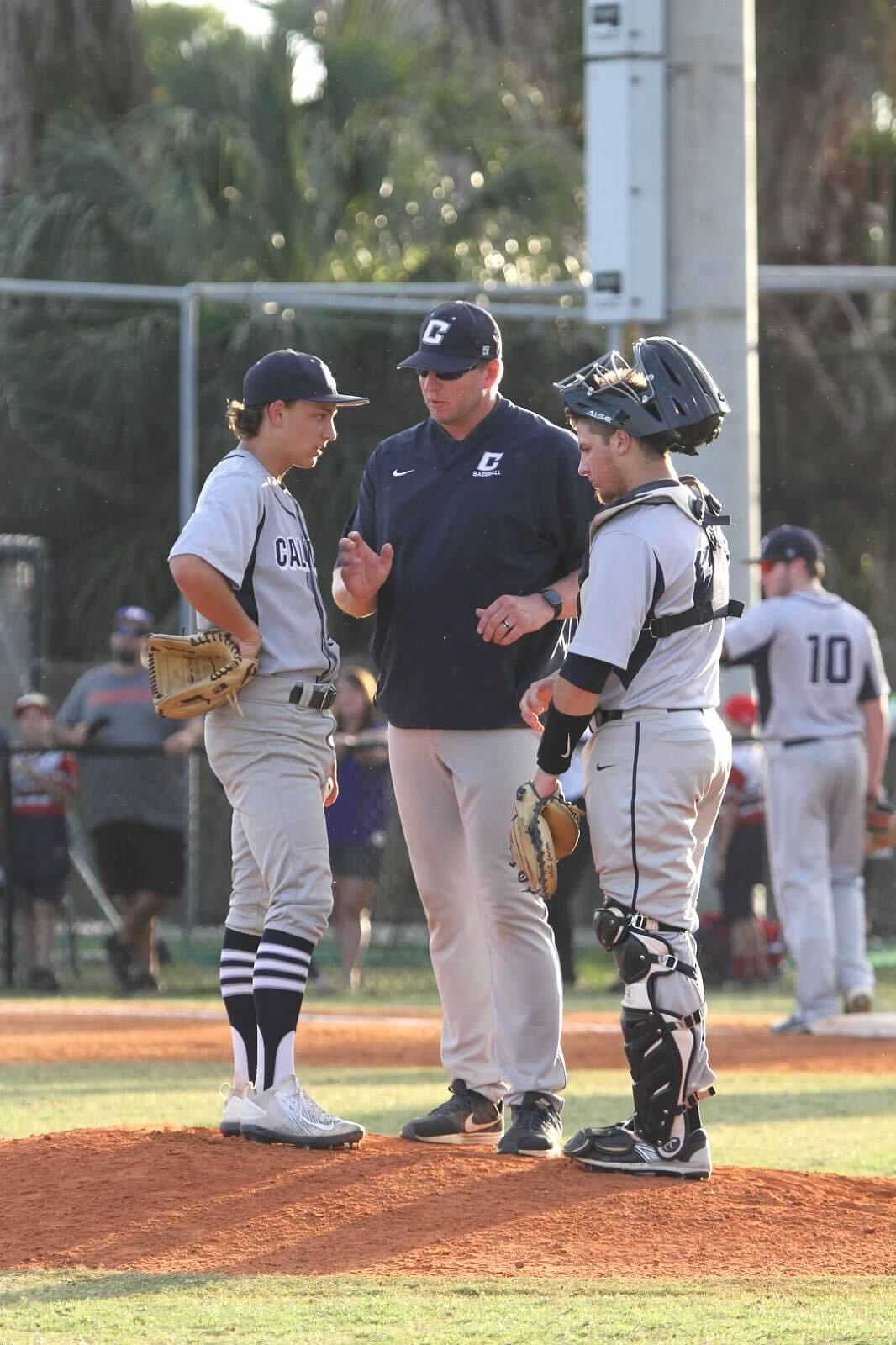
    Roy Halladay talking to pitcher Nolan Hudi during a game in 2017.

    The son encouraged his father to join the coaching staff of his travel ball team, the Dunedin Panthers. Halladay stayed through 2015, serving as pitching coach and later head coach.

    He did not take this role lightly. Once, a baserunner bowled over Dunedin’s catcher at home plate. The league’s rules stated this should be an automatic out, but the umpires didn’t call it.

    Halladay was furious. He explained to the crew that they’d made a mistake. One umpire, who didn’t recognize the eight-time All-Star, told him that he didn’t “know the rules of baseball.”

    This set off Halladay even more. He was ejected. Braden, who wasn’t standing far away, overheard a conversation between the officials not long after.

    “He goes, ‘Hey, dude, you know you just ejected Roy Halladay, right?’” Braden recalled. “And the umpire goes, ‘Oh my God.’”

    Halladay decided to have himself a day. He went to the concession stand and bought three cheeseburgers. He filled his big Yeti tumbler with Diet Coke, got in his truck, and pulled it behind the left field fence.

    He sat there for the rest of the game, scrutinizing the umpire’s every call. If he missed one, Halladay would let him know it, loudly proclaiming that the official didn’t “know the rules of baseball.”

    Braden enrolled at Calvary Christian in 2016. He spent his freshman year playing junior varsity, without his father, and was promoted to varsity as a sophomore.

    Halladay joined head coach Greg Olsen’s staff that year. Hudi transferred in from East Lake High School in Clearwater not long after. He and Braden were close friends; Hudi would sleep over at the Halladays’ house fairly often.

    To Hudi, the 6-foot-6 Halladay was not a star pitcher. He was an eccentric parent. One time, when the boys were older, Hudi made the mistake of drinking Halladay’s last Dr Pepper.

    Halladay barged into the game room, where Hudi and Braden were watching TV.

    “Who drank the last [expletive] Dr Pepper?” he asked.

    Hudi, holding the can with trepidation, said he didn’t know.

    The pitcher stormed out. He returned 30 minutes later with two six-packs.

    “He’s like, ‘This six-pack is yours,’” Hudi recalled. “And then he holds up another case, and he’s like, ‘Don’t [expletive] touch this. This is mine.’”

    Roy Halladay had a 3.25 ERA in four seasons with the Phillies and tossed a perfect game in 2010.

    Halladay brought the same attitude to the Warriors in 2017. Braden wasn’t used to seeing his father act this way on a baseball field.

    “Whenever he was home, he was kind of a funny, not-take-things-too-serious kind of person,” he said. “It was more so that you’d notice at the field that he wasn’t doing that. And he actually was kind of a little bit scary.”

    But at Calvary Christian, there was no pressure to uphold a persona.

    “I think he just got to be himself,” Braden said.

    A method to his madness

    Olsen had been around a lot of coaches at this point, some of them former big leaguers. But he quickly learned that reaching the pinnacle of the sport didn’t necessarily translate to on-field instruction.

    This was especially true when it came to resonating with kids. They could easily discern coaches who were sincere from those who were not. And if they deemed a coach insincere, it was over.

    Halladay didn’t have this problem. He could explain grips and mechanical adjustments with ease (and without condescension).

    Roy Halladay with his son Braden in 2017.

    He would go beyond telling a player what to do. He’d help them find their feel. That way, when the high schoolers were alone on the mound, they could throw a curveball or a splitter, or any other pitch, and make corrections in the moment.

    The coach showed no favoritism, not even to his son. He studied like he was still in the big leagues, sitting on a bucket with his enormous iPad, scribbling notes during games and practices.

    “It was like a 55-inch flat-screen TV,” Hudi said. “And he’s a big guy, so him holding that giant thing made it look even crazier. Nobody knew what he was writing down.”

    He didn’t need to show them. Halladay routinely proved he’d done his homework. In 2017, he helped Hudi redesign his entire windup, from stepping sideways to stepping behind the rubber, with his hands overhead.

    Halladay wanted the pitcher’s momentum going toward the plate; otherwise, his stride would be inconsistent.

    “The wealth of knowledge was crazy,” Hudi said. “And it went so much further than pitch grips.”

    Halladay helped his team with mental skills, too. Olsen would often see him talking to players between innings, to strategize for upcoming at-bats or guide them through a tough moment.

    He’d tailor his mound visits to whatever was needed, no matter how unorthodox it looked.

    Braden remembered one game when he was losing his command. Halladay walked out to the mound but didn’t say a word. He just stared.

    After the inning was over, the pitcher approached his father.

    “Hey man, what was that?” Braden said.

    “Were you thinking about throwing strikes?” Halladay asked.

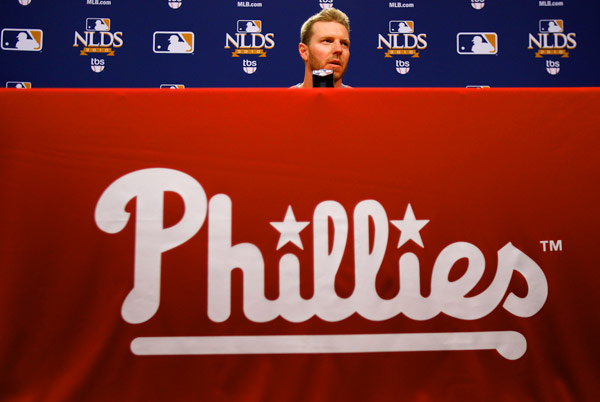
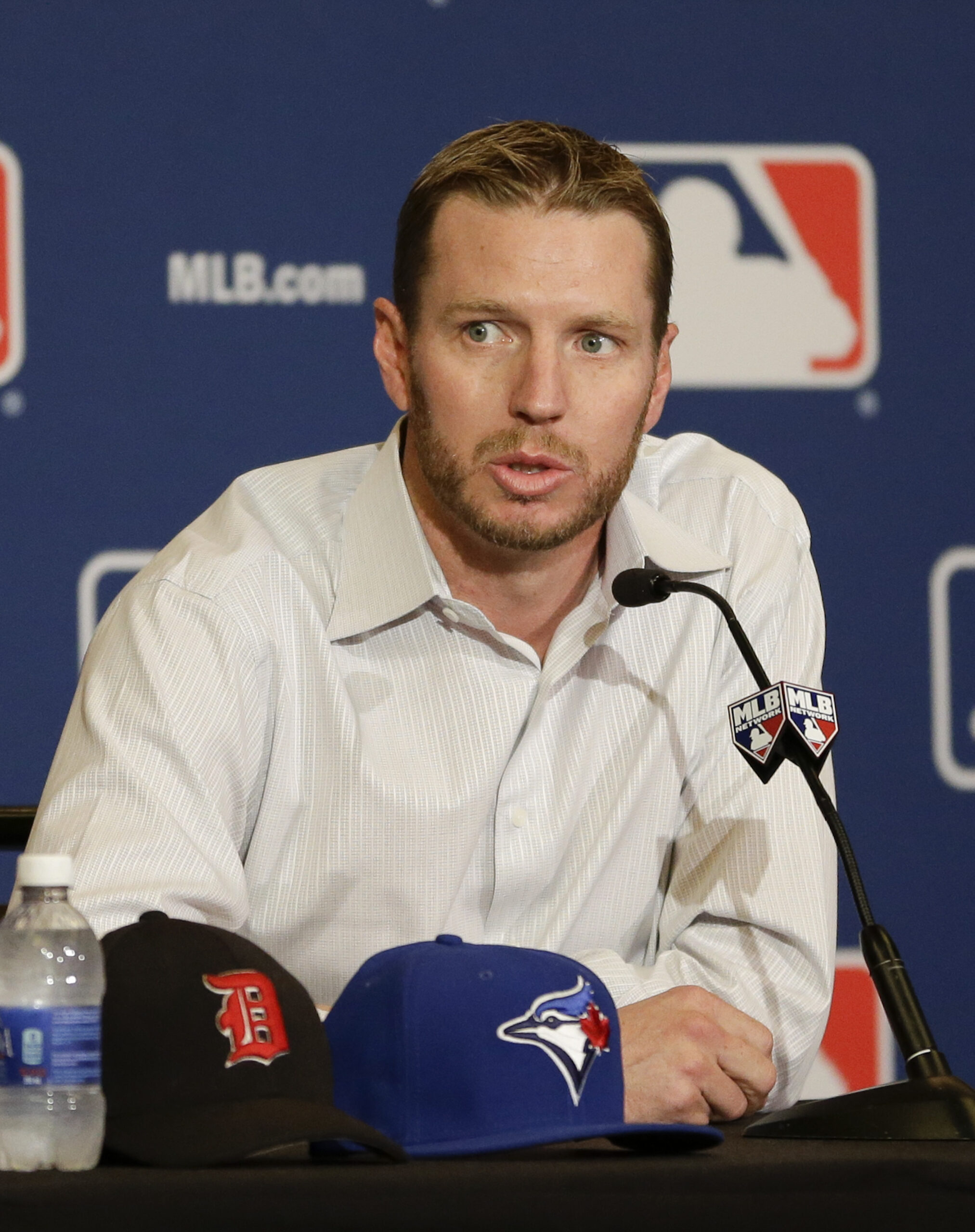
    At his retirement news conference in 2013, Roy Halladay had a Dunedin Panthers hat among the caps for the teams he played for.

    “No,” Braden said. “I was thinking about how weird that was.”

    His father smiled.

    “Exactly!” he said.

    This was just one of many instances when Halladay was validated for his quirky ideas. He and Olsen would stand next to each other in the dugout, signaling pitches to Calvary’s catcher.

    They usually agreed. But every once in a while, Halladay would propose something unusual. In the district semifinal, a formidable Tampa Catholic hitter took his final at-bat. He’d struck out twice earlier in the game on sliders.

    Halladay wanted a fastball down the middle.

    “He was like, ‘Look, we gotta go off script at some point,’” Olsen recalled. “And he was right. We threw a ball right down the middle, and the hitter froze. That was his genius of pitch calling.”

    Two weeks later, in the regional final, Halladay called for a splitter in the ninth inning with a runner on first and a one-run lead.

    There was one problem: The pitcher had never thrown a splitter in a game before.

    “In that moment, I felt like this is either going to work, or our season could be over,” Olsen said. “Because the kid’s gonna hit it out. But he made the right call. We jammed him, he grounded out, and we won the game.”

    Cairo, who was sidelined with a hand injury, had a front-row seat to all of this. Sometimes, the infielder would sit next to Halladay on the bench and go through pitch sequencing.

    Other times, they’d just talk crap.

    “I remember this one pitcher was talking a lot after we scored like six runs on him,” Cairo said. “Roy told him to go sit in his truck or something like that. That was fun.”

    Calvary Christian didn’t lose a game that year. The Warriors were perfect in the regular season — despite enduring injuries to multiple players — and made it to the state championship in Fort Myers in late May.

    By now, everyone knew of Halladay’s idiosyncrasies. So no one was surprised when he was caught flying a drone over Pensacola Catholic’s practice.

    The opposing coaches saw a metal device whizzing through the air. They told a security guard, who spotted Halladay in the dugout with a remote control and a grin.

    The security guard was not as amused. Had anyone else pulled this stunt, they would’ve been kicked out of the game. But Halladay knew the tournament officials wouldn’t do that.

    He got a slap on the wrist.

    “The official was like, ‘Hey, dude, like, you can’t spy on the other team with aerial equipment,’” Braden said. “And he was like, ‘Ahhhh … sorry, sorry.’”

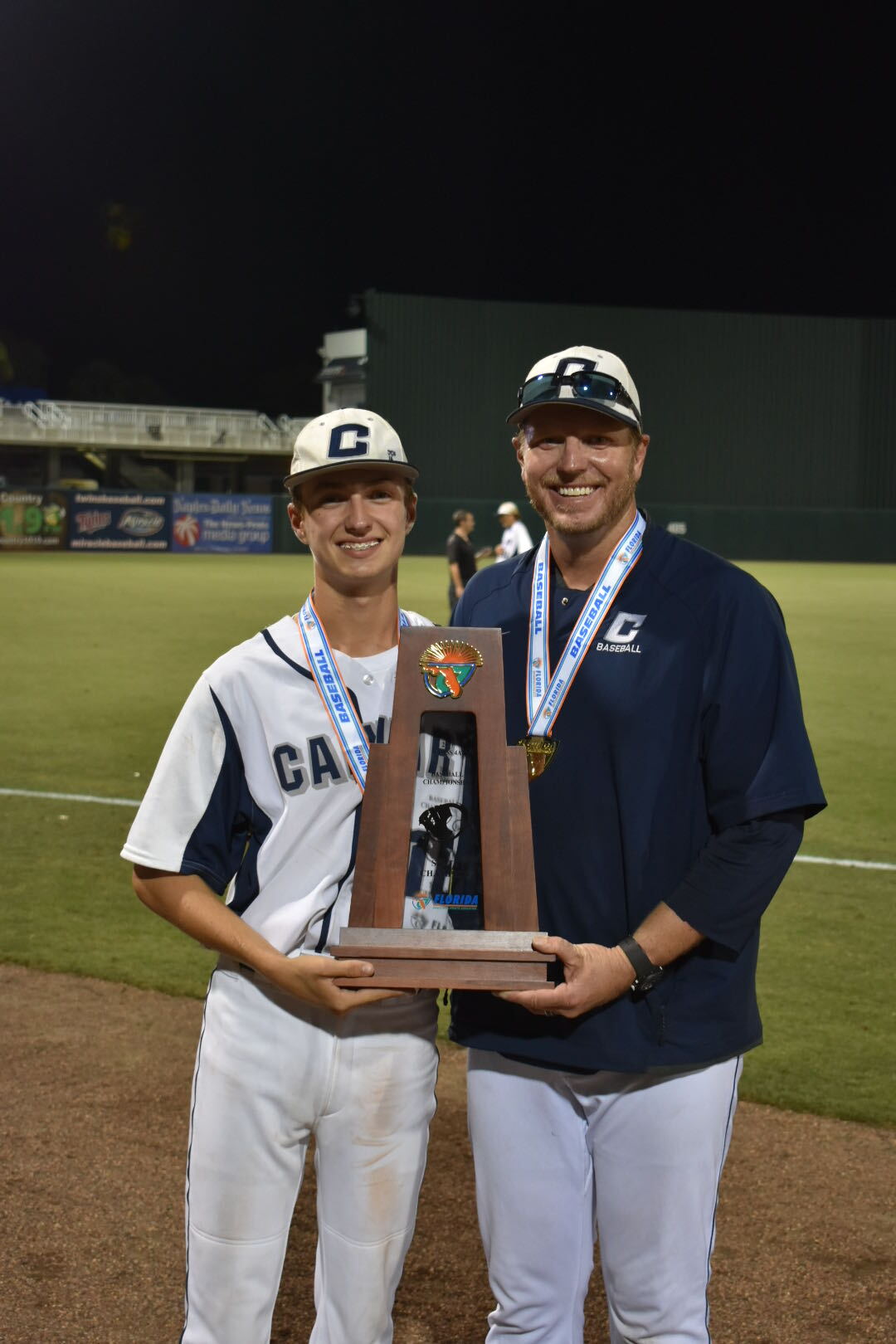
    Roy Halladay and coach Greg Olsen after winning the state championship in 2017.

    ‘I really felt him there’

    The drone surveillance didn’t end up being necessary. Calvary Christian won the Class 4A state baseball title handily. By the sixth inning, they’d amassed an 11-1 lead over Pensacola Catholic. The game ended by mercy rule.

    The high schoolers sprinted from the dugout, jumping into a dogpile. Halladay flitted around the group, giving bear hugs big enough to lift players off the ground.

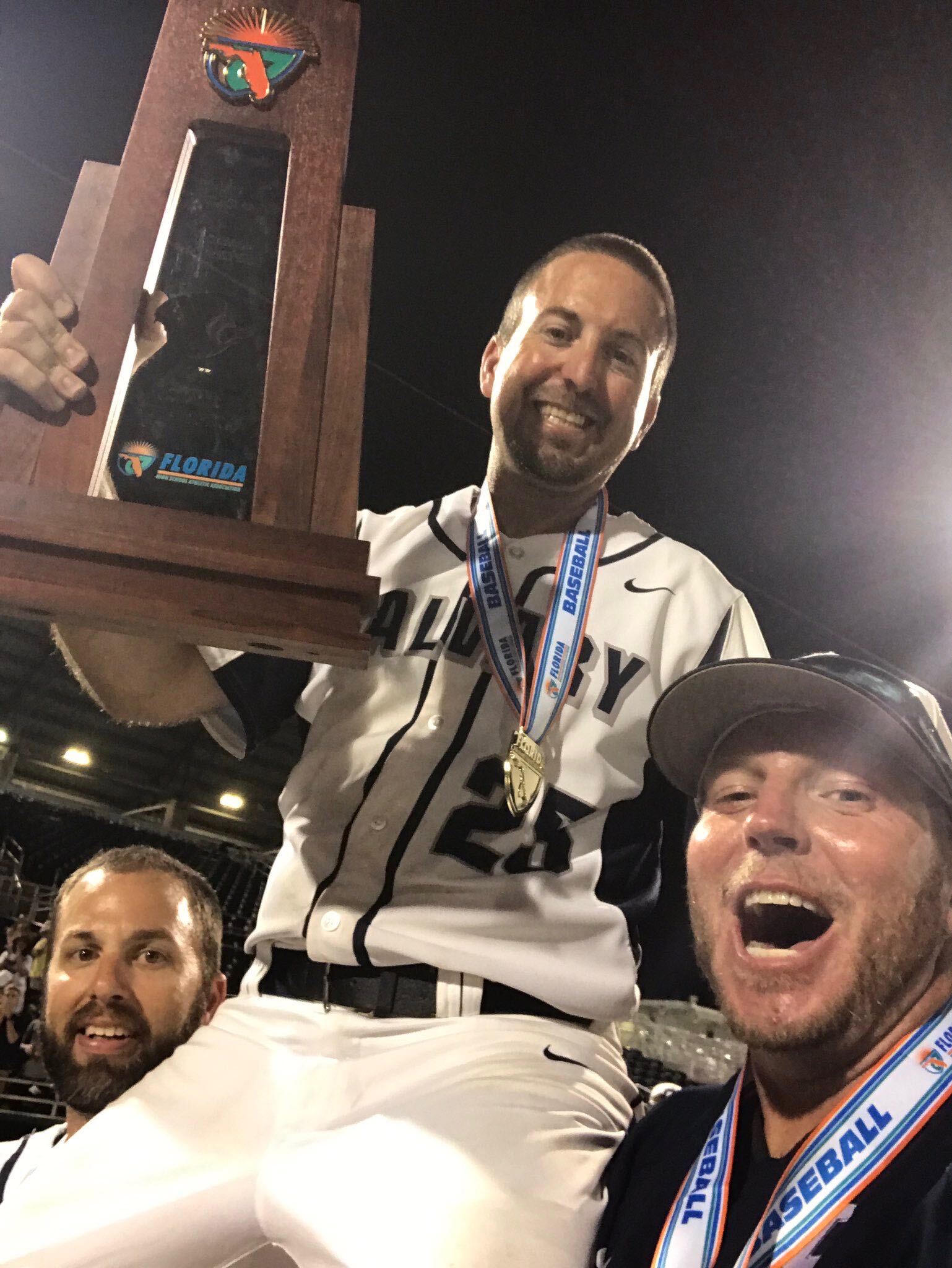
    He and assistant coach Mike White hoisted Olsen on their shoulders, as he carried a wooden trophy. The former Phillie beamed from ear to ear. This wasn’t a World Series. But it was sweet all the same.

    Halladay couldn’t wait to do it again next season, which is why he arrived to an exhibition game in full baseball garb in early November. But that would be the last time he’d see his team.

    Braden described the days after his father’s death as a blur. Teammates and coaches came by the house to express condolences. Cairo and Hudi barely left his side.

    On Nov. 8, Olsen gave the younger Halladay a call. Calvary Christian had another exhibition game scheduled for Nov. 9, against East Lake.

    Braden was supposed to start, but Olsen said they could cancel it altogether if he wanted. He told his coach he would think about it.

    Less than 24 hours later, Braden was in his car, driving to the ballpark. As he warmed up in the bullpen, he heard a loud noise.

    The high schooler looked toward the sky to find a small airplane flying overhead.

    “It looked exactly like my dad’s,” he said. “That brought me closer to him in that moment.”

    At 7 p.m., Braden stepped onto the mound, with his father’s Calvary jersey hanging in the dugout. A typical November game would draw about 30 to 40 people; on this night, there were four to five hundred.

    Braden insisted that he’d take it one inning at a time, but once he started, he couldn’t stop. Four frames later — a long outing by fall ball standards — he’d allowed one hit and no runs.

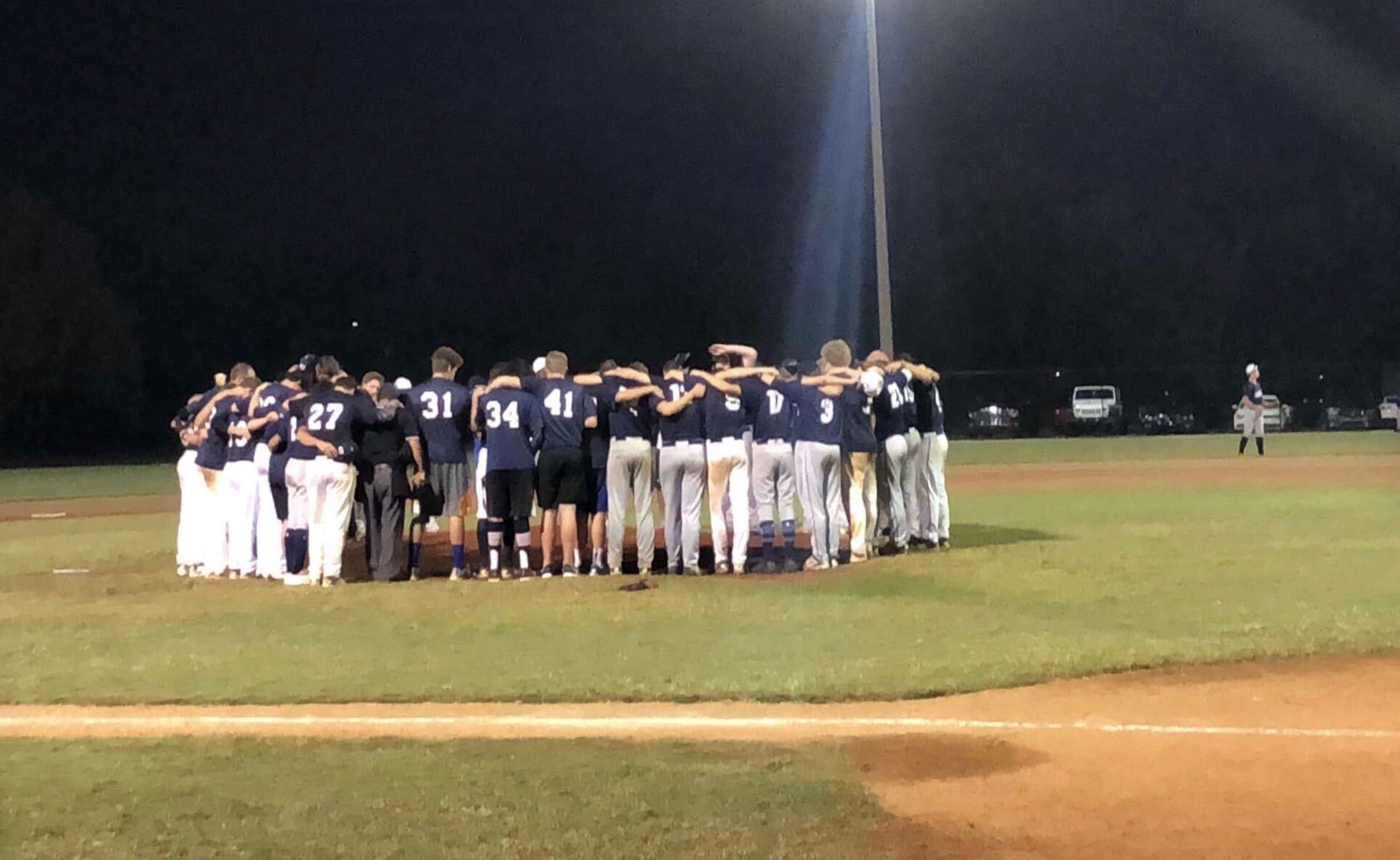
    The Calvary team gathers on the mound to say a prayer following Braden’s first start after his father’s passing in 2017.

    Braden told Olsen he was done. He walked off the mound, grabbed his father’s jersey, and began to cry.

    “Obviously when he passed away, my thought was, ‘I lost my father,’” he said. “But that was my first moment of … he’s still with me. I still have him. I really felt him there.”

    The players circled around the mound and said a prayer. Someone took a photo and sent it to Braden. Through the darkness, a ray of light shined down on his head.

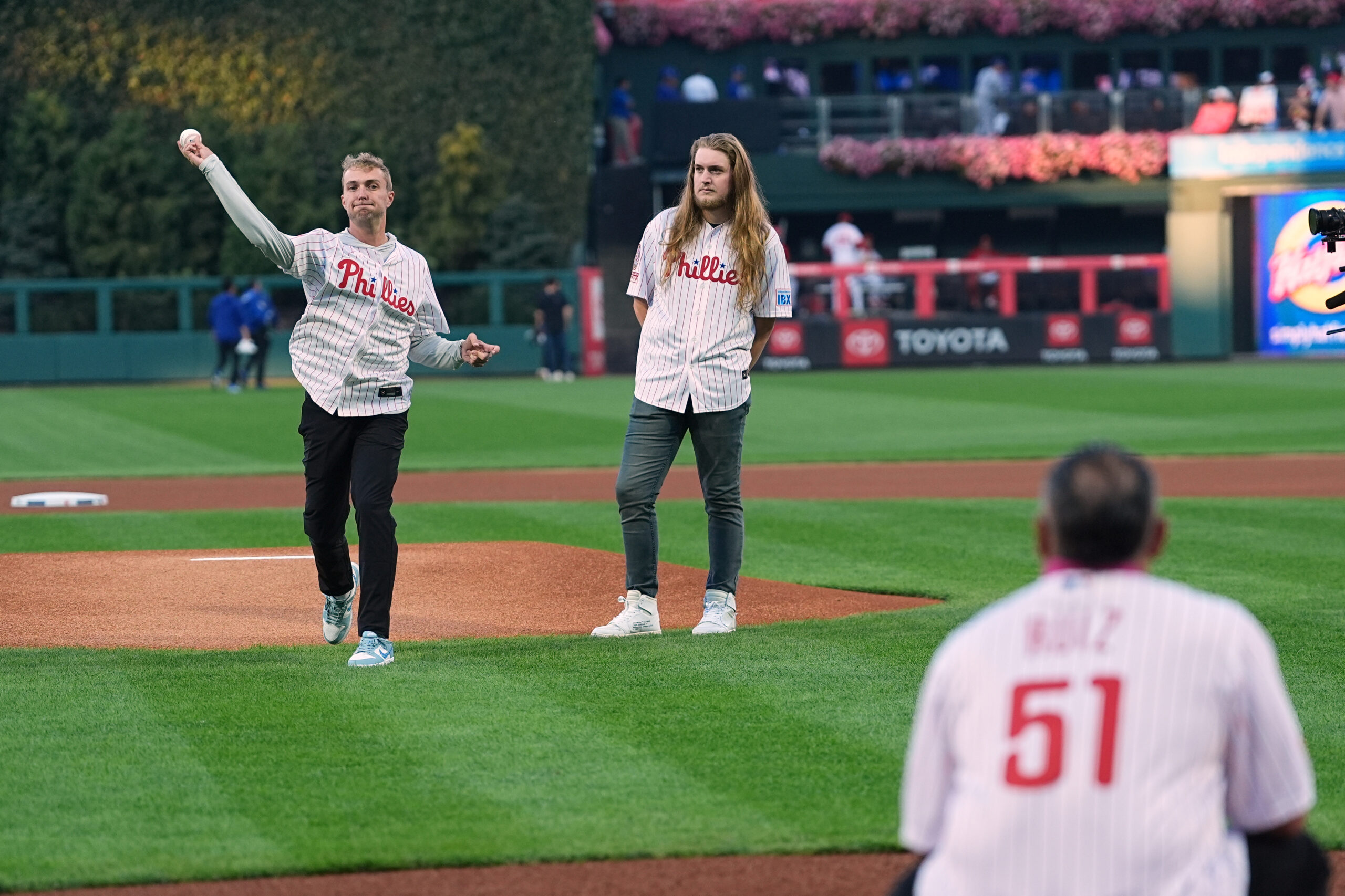
    Braden Halladay (left) accompanied by his brother Ryan, throws the first pitch to former Phillies catcher Carlos Ruiz, marking the 15th anniversary of their father Roy Halladay’s postseason no-hitter, ahead of an NLDS game against the Dodgers in 2025.

    A different side of Halladay

    On Nov. 14, 2017, the Phillies held a celebration of life at their spring training complex. It was open to the public; thousands of people attended.

    After the ceremony, Halladay’s friends and family moved to the batting cages beneath the stadium. Standing on bright green turf, with the nets pulled back, they grieved.

    This was the first time many of his players had met his Phillies and Blue Jays teammates. And as the high schoolers traded stories with Chase Utley and Ryan Howard and Cliff Lee, it dawned on them that they’d seen a completely different person.

    The former big leaguers painted a picture of a cutthroat competitor; a titan of the sport whose intensity seeped out. To the boys of Calvary Christian, he just was a goofy dad.

    This is how they will remember him. They’ll never forget the perfect game, or the postseason no-hitter, or the countless shutouts. But for those 17 high schoolers, who are now 17 men, the coach they knew meant so much more.

  • Ocean City Council moved forward on a plan to build a luxury hotel at the old Wonderland Pier site

    Ocean City Council moved forward on a plan to build a luxury hotel at the old Wonderland Pier site

    OCEAN CITY, N.J. — The proposal to build a luxury hotel on the site of the closed Gillian’s Wonderland Pier on Ocean City’s Boardwalk got a long-sought boost Thursday, 6/25.

    The City Council voted 5-2 to declare the site at 600 Boardwalk “in need of rehabilitation,” a designation sought by developer Eustace Mita.

    Council will now begin a process of negotiating with Mita over what ultimately gets built on the property, which for decades attracted families to its rides and arcades.

    Reached by text message, Mita called the action a “great vote for the populace of Ocean City ! A win for progress in the future of America’s greatest family resort.”

    He added, “But this is only the first step in the process.”

    Mita has proposed a seven-story luxury hotel, but a committee appointed by council to study the property suggested that a smaller hotel might be more suitable.

    Council member Dave Winslow, originally opposed to the designation, said he now saw the rehabilitation designation as a way for the City Council to have more input in what ends up being built.

    “There’s an urgency to restore the north end of the Boardwalk to its former glory,” Winslow said. “The designation gives zero approval to build anything. It puts the future development of the property in the hands of this governing body to make decisions on scope.”

    Council President Terry Crowley Jr. also stressed that the designation was the beginning of a process. He said the council would be mindful of the conclusions of a Boardwalk committee that urged the smaller footprint with public entertainment along the Boardwalk, and which would be mindful of neighbors.

    “We want a state-of-the-art product at that end of the Boardwalk,” he said.

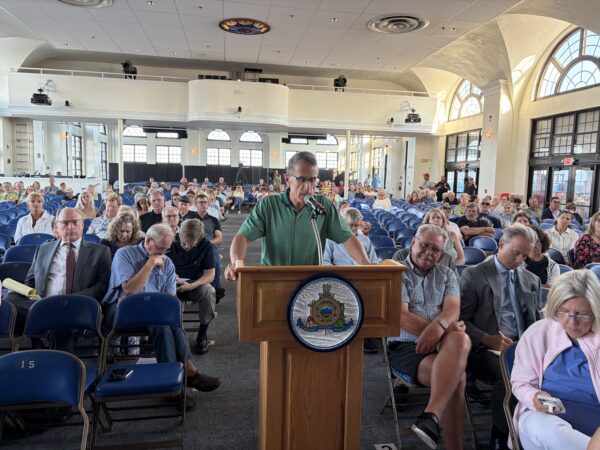
    The nearly three-hour meeting included numerous residents speaking against the resolution, suggesting there might be legal action taken if council passed it, and urging them to wait until July when a newly elected anti-hotel council member, Jim Kelly, will be sworn in.

    A rendering of the proposed new Icona in Wonderland Resort, which is proposed to be built on the site of the old Wonderland Pier. The proposal for a 252-room resort includes saving the iconic Ferris wheel and carousel.

    The meeting was moved to the city’s Music Pier to accommodate the number of people, and turned heated at times.

    Several speakers asked that several council members recuse themselves, accusing them of conflict of interests. Others said declaring Boardwalk frontage in need of rehabilitation in a wealthy beach town was illogical.

    “The rehabilitation designation was created to help struggling deteriorated communities revitalize themselves,” said resident Dave Hayes, during public comment. “It was never meant to apply to expensive beachfront properties so wealthy developers like Eustace Mita could further increase their profits.”

    Numerous business owners on the Boardwalk and elsewhere in town urged the council to move forward on the project.

    “It’s been the better part of a year,” said Caitlin Quirk, president of the Downtown Merchants Association. “You’ve done your due diligence. You’ve done your homework.”

    While neighbors argued the hotel idea was not in keeping with the family entertainment of the Boardwalk, business owners said the entire economic viability of the boardwalk was at stake.

    Mark Raab, whose family owns numerous Boardwalk properties, said one of the stores near the closed Wonderland has no tenant this summer and is boarded up.

    “Next year, it’s even dimmer,” he said. “We have five storefronts up for lease, two definitely not coming back. This is a crossroads that we are enduring. Thousands of people are going to walk by that boarded-up store and wonder why. We are out of time.”

    Council member Jody Levchuk, who runs Jilly’s Arcade on the Boardwalk, said all the planning reports point to “the demise of the north end of the Boardwalk” if action wasn’t taken.

    Mita, who has proposed back in November 2024 turning the property into Icona in Wonderland, had sought the designation initially as a way to fast track his hotel idea.

    That did not happen.

    In January, the city’s planning board deadlocked on whether to recommend declaring the site in need of rehabilitation and sent it back to Council.

    Mita in the meantime moved on to other projects, including a “Soul Sanctuary” Catholic retreat in Ireland on the former grounds of a notorious abbey.

    The future of Wonderland has generated protracted and heated debate in the Shore town, with residents initially vowing to save Wonderland and later arguing that “big hotel” would be a “big mistake.”

    While some cling to the idea that an amusement park could still be opened there, most opponents have tried to argue that Mita’s proposal is too big for the site, would compromise nearby residential neighborhoods, and is not in keeping with the Boardwalk town’s family vibe and need for family entertainment.

    How big the hotel will be remains a topic to be negotiated now between the city and Mita, who bought the land from Mayor Jay Gillian and initially leased it back to him to continue to run Wonderland.

    Gillian made the decision to close the 65-year-old institution in October 2024, saying it was no longer financially viable. He declared personal bankruptcy this year, in part from failed business ventures. Voters elected him to a fifth term in May.

    Council member Tony Polcini said his yes vote was “to give hope to the people that work hard,” in seasonal businesses.

    “The beach and the Boardwalk are a part of our livelihood and why our homes are worth so much,” he said. “I really truly feel that moving this process forward to a yes will allow us to negotiate and do what is best for Ocean City.”

    Voting no were council members Keith Hartzell and Sean Barnes, who said the regular zoning and planning process would be a better way to move forward.

  • Philly is defending an ICE Out law in court its top lawyer previously said wasn’t enforceable

    Philly is defending an ICE Out law in court its top lawyer previously said wasn’t enforceable

    There is no obvious way for a mayor to defend a law her lead attorney already said couldn’t be enforced legally.

    But that is the position Mayor Cherelle L. Parker found herself in when President Donald Trump’s administration sued her, the city, and other officials over an ordinance that bars law enforcement officers from concealing their identities as part of the ICE Out legislative package.

    Noted in the feds’ lawsuit: When the ordinance was making its way through the legislative process, City Solicitor Renee Garcia advised the mayor it would be “inaccurate” to suggest the city can “legally and practically enforce the Bill.”

    The city responded Thursday afternoon to the Trump administration’s request for an injunction preventing the ordinance from taking effect next month by arguing the federal government doesn’t have standing until the city attempts to enforce its provisions.

    Even if the administration had standing to sue, the bill’s provisions don’t interfere with the federal government’s work and “at most imposes an incidental burden,” the city’s response said.

    Additionally, the filing contended the Trump administration can’t show irreparable harm because of exceptions that allow officers to conceal their identity. The city, meanwhile, has “a significant interest in protecting its residents and law enforcement officers,” it said.

    “The Bill was enacted in response to the confusion and fear generated by the federal government’s deployment of large numbers of federal agents who subsequently applied aggressive enforcement tactics behind the mask of anonymity, undermining public safety and trust,” the city said.

    The defendants in the case — the city, Parker, Garcia, and District Attorney Larry Krasner — are represented jointly by attorneys from the law firm Ballard Spahr.

    “In essence, the city’s argument, which we have joined, is that this ain’t the right time,” Krasner said in an interview. “The City Council ordinance is not in effect yet. There has been no enforcement by the Philadelphia Police Department yet. You don’t even have a real case to consider.”

    Krasner added that while he was in lockstep with the Parker administration on Thursday’s filing, further developments could necessitate his office to seek separate representation.

    The Department of Justice declined to comment on the new filing.

    A city Law Department spokesperson did not immediately respond to a request for comment.

    The ordinance at the heart of the litigation makes it a crime for law enforcement officers, including Immigration and Customs Enforcement agents, to wear face coverings or conceal personal identifiers like badges and nameplates while carrying out their official duties in Philadelphia, and requires officers to identify themselves. It also prohibits the use of unmarked vehicles.

    The bill includes exceptions allowing officers to wear masks in certain circumstances, such as medical emergencies or SWAT operations.

    An officer who violates the ordinance could be prosecuted, and risks up to 90 days in jail plus a fine.

    The ICE Out package, including the mask law, goes into effect July 7.

    The Trump administration sued in Philadelphia’s district court last week, challenging the ordinance as “blatantly unconstitutional.”

    The bill’s requirements would “prevent effective federal law enforcement within Philadelphia” and put federal officers in harm’s way, the suit said.

    U.S. District Judge Chad F. Kenney, whom Trump appointed during his first term, will rule on the injunction without holding a hearing.

    The Trump administration has sued other jurisdictions, including New Jersey, over similar requirements. In April, the U.S. Court of Appeals for the Ninth Circuit found that a California bill requiring agents to “visibly display identification” violated the U.S. Constitution’s supremacy clause, which bars states from regulating federal government activities.

    An awkward position for Parker

    Defending the bill puts Parker and her administration in an awkward position.

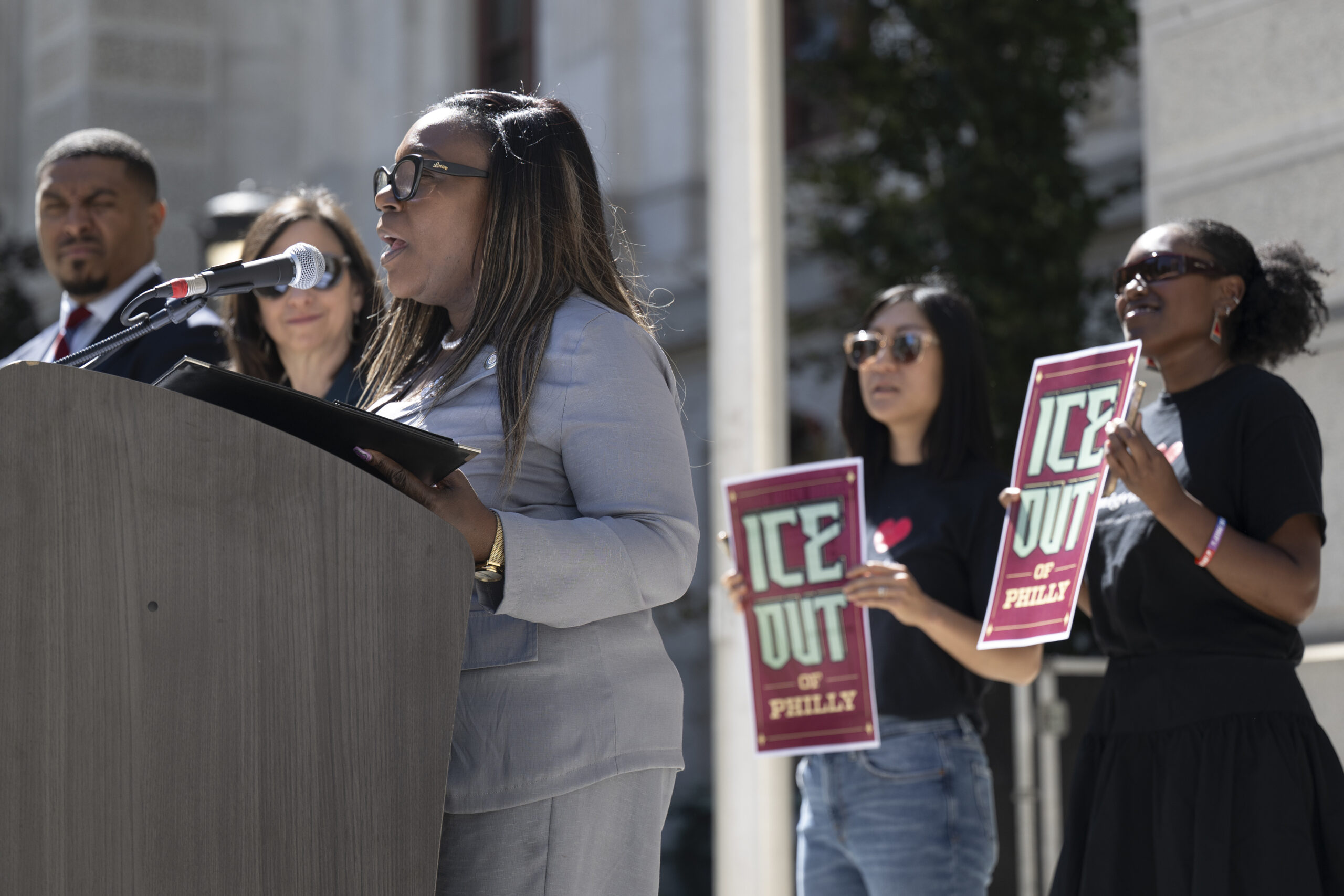
    The ordinance passed City Council with a veto-proof supermajority in April as part of a package of seven bills pitched as “ICE Out” by its authors, progressive lawmakers Rue Landau and Kendra Brooks. The other bills prohibit federal immigration agencies from staging raids on city-owned property, ban discrimination on the basis of citizenship status, and prohibit the city from engaging in most forms of information-sharing with ICE.

    Councilmember Kendra Brooks speaks during a news conference outside Philadelphia City Hall, Wednesday, June 3, 2026, in Philadelphia. Organizers called on local and state officials to restrict U.S. Immigration and Customs Enforcement involvement in public safety operations during the FIFA World Cup.

    The legislation also codified some of Philadelphia’s long-standing sanctuary city status, which a recent poll found most city residents support.

    Brooks said she did not want the lawsuit to hold up the Parker administration’s implementation of the law.

    “There is nothing in the lawsuit stopping the administration from implementing our ICE Out package on time,” she said.

    Brooks had good reason to question the administration’s commitment to the legislation given Parker’s handling of it.

    After the bills’ passage, Garcia advised Parker not to sign the bill banning law enforcement officers from concealing their identity, saying doing so “would send an inaccurate signal to the public that the Administration can legally and practically enforce the Bill.”

    Parker followed her solicitor’s advice, signing six bills and allowing the seventh to become law without her signature.

    As for Garcia’s concerns about the bill, the new filing from the city only notes that her letter advising Parker didn’t address the issue of standing or whether the issue is ripe for litigation.