If she makes it on the ballot, Karen Dalton will be U.S. Rep. Scott Perry’s first primary opponent since 2012 – the year he first won the seat.
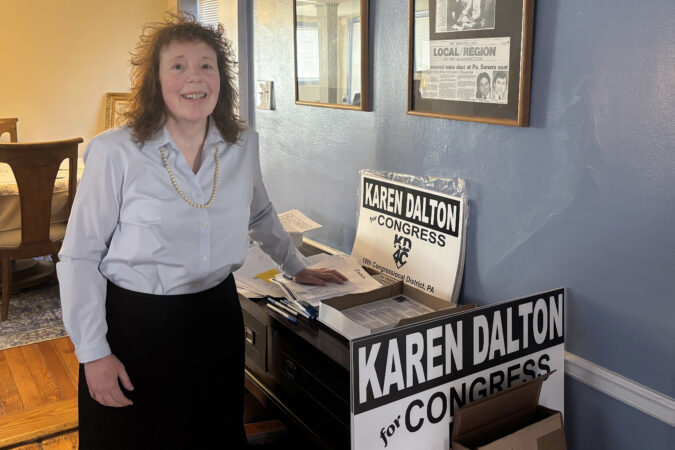
Dalton, a retired staff attorney for the Pennsylvania House Republicans, knows the odds are against her as she runs a solo campaign operation out of her living room. But she thinks she has a shot.
The 65-year-old Carlisle resident is irked byPresident Donald Trump’s policies both from a faith-based standpoint and a legal one.
She holds many views that align with Democrats, which may draw accusations that she’s a “RINO,” or Republican in name only. But she argues she’s a Republican at heart.
“I was talking to a senior citizen the other day, and the first thing he said to me was, ‘So you’re a RINO,” said Dalton, 65. “And my response to that was, well, if you mean ‘Respect for Individuals and Not Oligarchs,’ I’ll go along with that. He goes, ‘No, no, no, I’m a RINO too. I’m that old school Republican that believes in helping people.’ I’m like, ‘Yes, thank you. That’s what I’m talking about getting back to.’”
Perry, a longtime ally of President Donald Trump whosupported his unsuccessfulattempts to overturn the 2020 election, represents Dauphin County and parts of Cumberland and York Counties in Central Pennsylvania. He appears to be particularly vulnerable this yearas the district has shifted toward Democrats and Republican-turned-Democrat Janelle Stelson, a former local news anchor, had a razor-thin loss against him in the general election last year. She plans to run again in the Democratic primary.
Dalton, in a long-ranging interview with The Inquirer in her living room, called Donald Trump’s One Big Beautiful Bill Act the “Big, Brutal Betrayal of the American Dream Act,” because of its cuts to Medicaid and SNAP.
She believes formerVice President Kamala Harris should have pushed back more on Trump’s claims about transgender people in the 2024 election, argued that the term “illegal alien” is factually incorrect, and says on her website that climate change is a real threat.
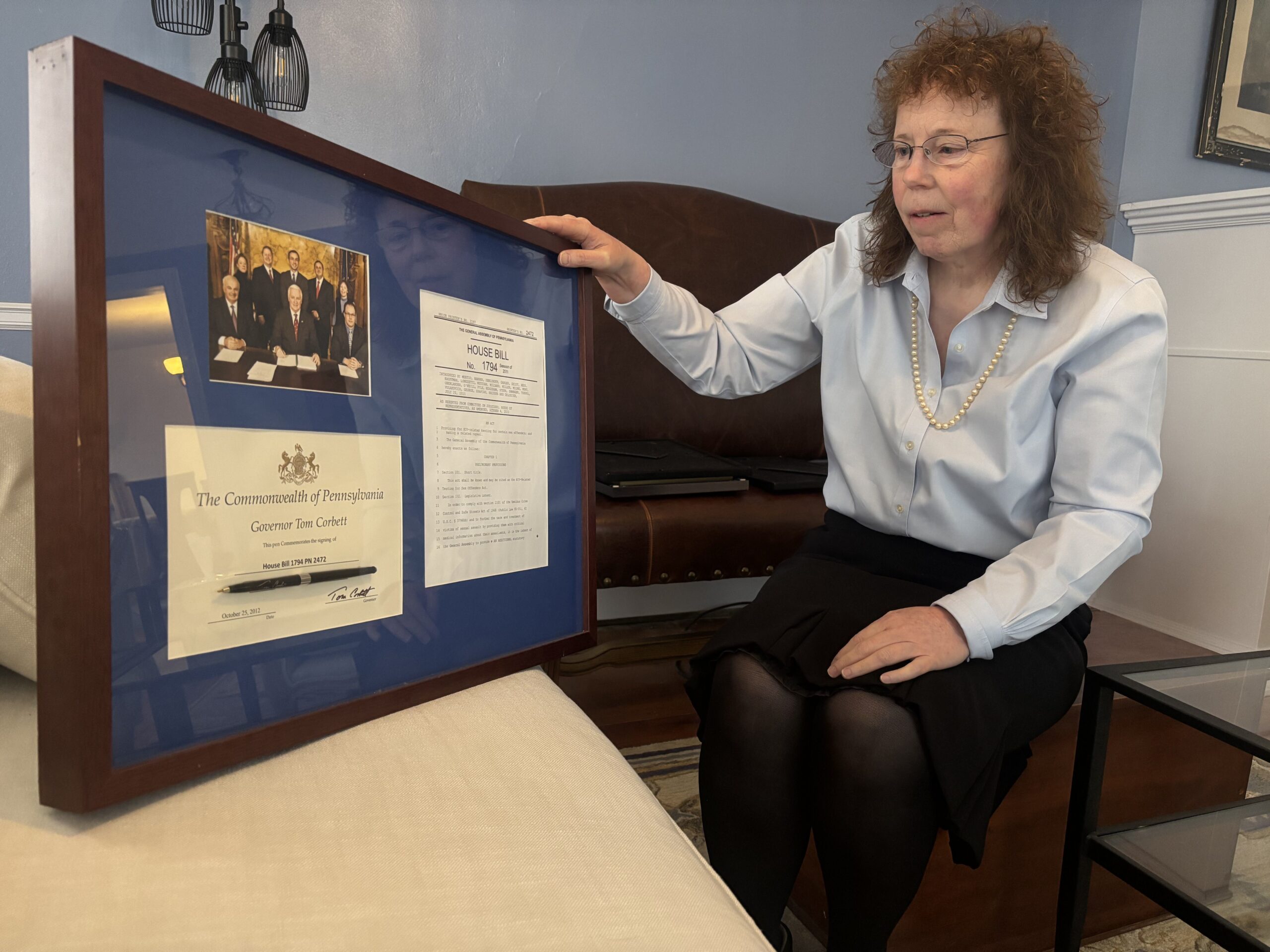
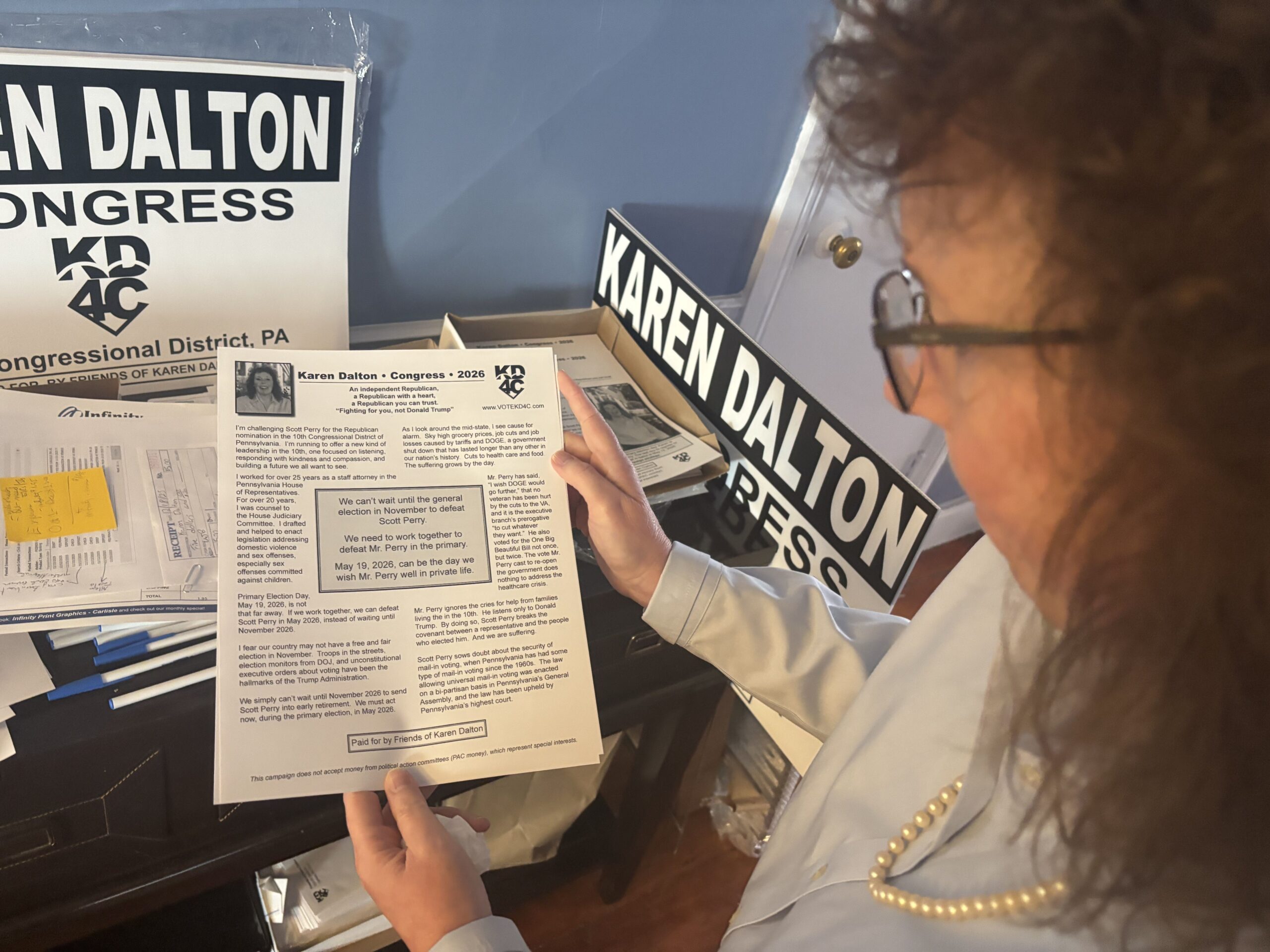
Karen Dalton, who plans to challenge Scott Perry in the Republican primary, holds materials from a bill she worked on in Harrisburg in her Carlisle home on Monday.
She supports a $15 federal minimum wage anda millionaire’s tax, and wants to raise the corporate tax rate. She supports abortion rightsand believes health care is a human right, though she’s fearful of what she views as over-regulation from Democrats.
Her walls are covered with Republican political memorabilia and a poster of the late Sen. Robert F. Kennedy, a Democrat who was assassinated during his 1968 presidential campaign.
She noted that she was a Republican when Donald Trump was a Democrat.
Her path to victory, she believes, is convincing enough independents and Democrats – particularly former Republicans – to change their registration to support her in the MayGOPprimary.
“You know, independents have been upset many years because Pennsylvania has a closed primary system … if they register as Republicans, they get to vote in a primary against Scott Perry and not wait until November,” she said.
Primary challengers are rarely successful. Dalton reported under $3,000 in contributions – and an approximately $6,000 loan from herself — through September, which is pennies compared to themore than $1 million Perry reported.
But she only needs to gather 1,000 signatures and pay a $150 filing fee to appear alongside him on the primary ballot.
Perry’s campaign did not respond to a request for comment about Dalton as of Wednesday.
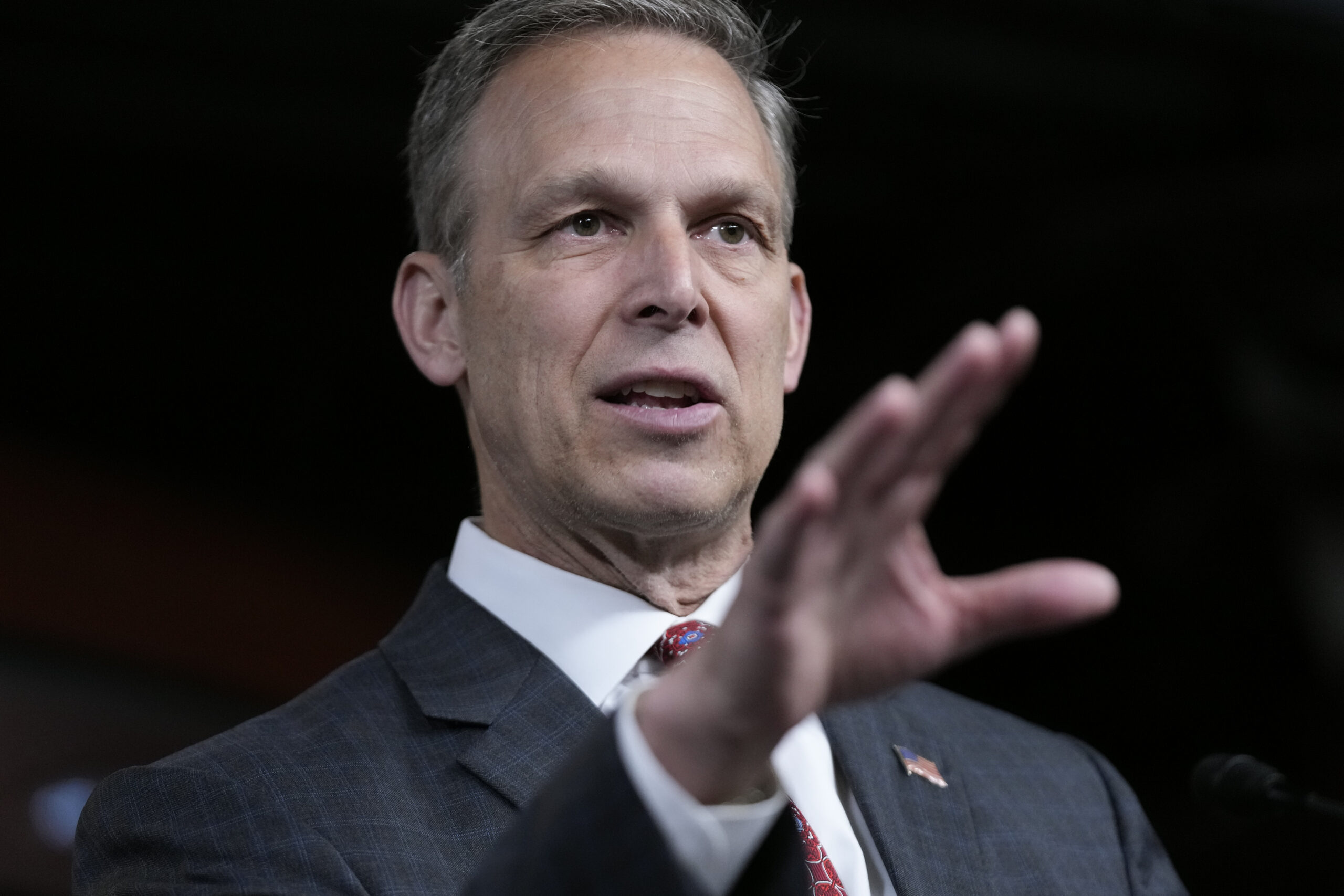
U.S. Scott Perry speaks during a news conference on Capitol Hill in Washington in July 2023.
Rosy eyed about the old Republicans
Dalton grew up in New Jersey and was the first in her immediate family to go to college, attending Montclair State University before getting her politics graduate degree at New York University and later attending law school.
She lives in Carlisle near Dickinson Law — her “beloved alma mater” — in a home she bought just four years ago at age 61. With student loans hanging over her head for the vast majority of her career, she couldn’t afford a down payment until her state retirement payday.
She has no kids and she’s never been married — “I spent a lot of time reading and studying and going to school,” she said. These days, she takes piano lessons and plays pickleball, and does pro bono legal work when she’s not knocking on doors for her one-woman campaign.
Dalton is rosy-eyed about moderates of the Republican Party’s past. She managed former U.S. Rep. Jim Greenwood’s (R., Bucks) successful state Senate campaign in 1986 and worked for New JerseyRepublicanGov. Tom Kean,who wrote The Politics of Inclusion. She later worked as a staff attorney for Pennsylvania House Republicans for 25 years, where she focused on domestic violence and child sexual abuse legislation.
“I’m convinced that if the Republican Party wants to survive and thrive, we need to give up what Donald Trump believes in, and return to our roots,” she said.
Dalton, whose parents were both Democrats, changed her registration from independent to Republican in 1984 at the age of 24 after her first job working for Ralph J. Salerno’s unsuccessful state Senate campaign in New Jersey. When he lost, “amazingly, nobody took up arms,” she said.
“I mean, I cried in his lapel, but you know, it’s just like he conceded, and everybody moved on,” she said. “There was no insurrection, there was no battle, there was no violence, there was no ‘Oh, there was voter fraud.’ None of that stuff happened, because that’s the way things used to be before Donald Trump was president.”
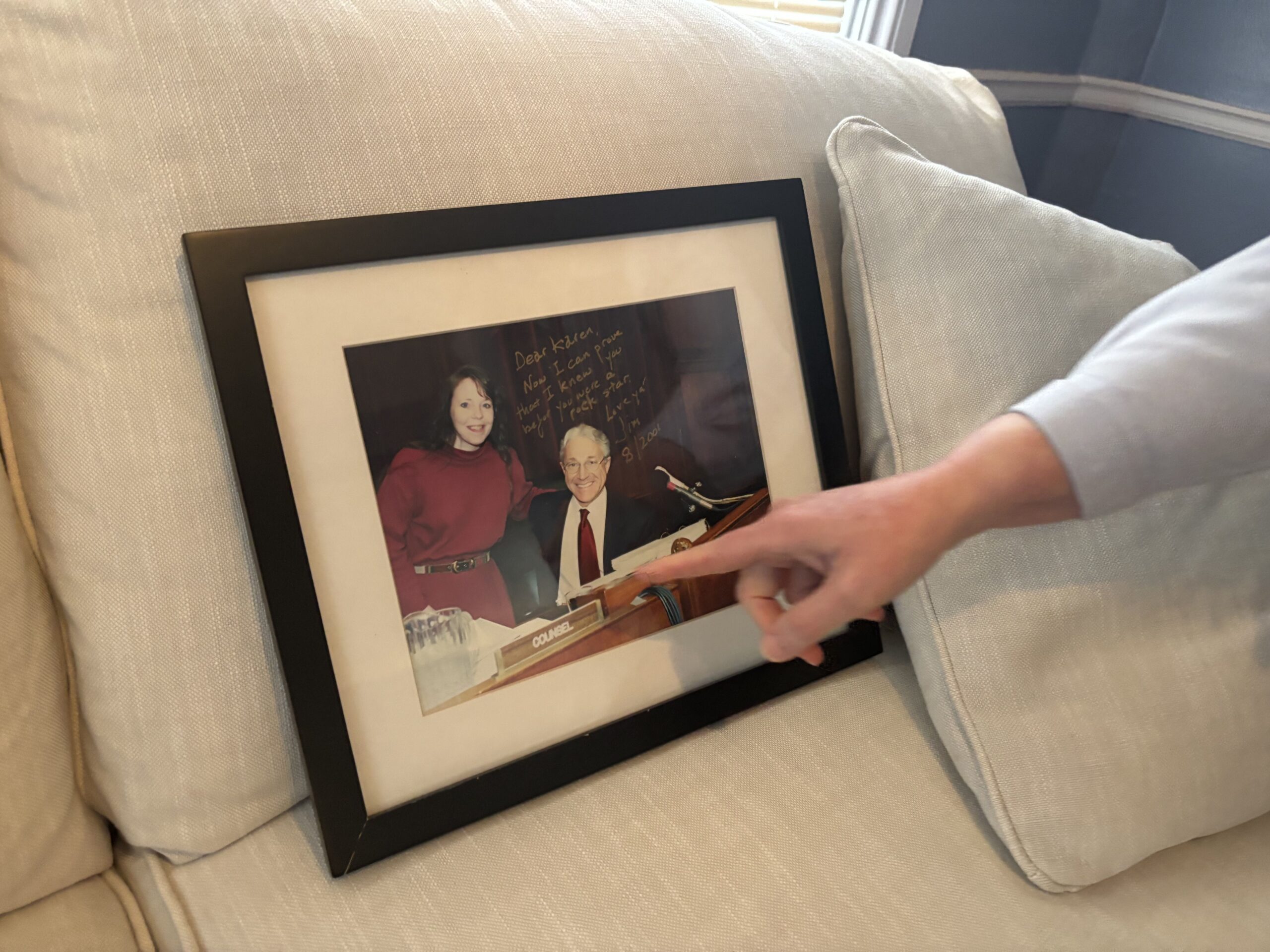
Karen Dalton points to a photo of herself and her old boss Jim Greenwood in her Carlisle home on Monday. A message from Greenwood says: “Now I can prove that I knew you before you were a rock star.”
Tired of yelling at the television
Dalton said she didn’t think she’d become a candidate herself during her years working for politicians. But she said “steam started to come out of my ears” when Trump tried to end birthright citizenship, and again when House Speaker MikeJohnson mused about defunding the federal judiciary.
“I just couldn’t sit back anymore … I got tired of yelling at the television,” she said.
While Dalton argued that Trump’s rise in 2015 has soured the Republican Party, much of her criticism concentrated on the Jan. 6, 2021 riot and what followed.
Dalton worked with Perry in Harrisburg when he was a state representative, and she described him as “an incredibly nice man” despite her misgivings about his efforts to overturn the 2020 election and continued alignment with Trump. (She calls him “morally blind” on her website.)
When asked if she ever supported Perry, Dalton said she wasn’t comfortable talking about who she voted for in the past because “ballots are private.” She did say that she didn’t vote for Trump in 2024, and shevotedfor Stelson, Perry’s Democratic challenger.
“I can tell you that I don’t vote for insurrectionists,” she said.
Karen Dalton, who plans to challenge Scott Perry in the Republican primary, calls a table in her living room her “campaign headquarters.”
Policy informed by faith
Dalton was raised Catholic, confirmed Episcopalian, and has attended the Unitarian Universalist Church. Though she hasn’t converted, she now identifies as Jewish, and was moved to tears while talking about a late mentor who introduced her to the religion – noting that speaking about the subject made her“verklempt,” a Yiddish term for emotional.
“One of the things I love so much about Judaism, in addition to its focus on social justice, is the idea that you get to disagree,” she said, a handful of crumpled tissues in her lap.
Her faith informs her approach to public policy, from opposing cuts to healthcare subsidies to appreciating ideas across the political spectrum.
One of her flagship policy proposals is creating a way for people to borrow up to two years worth of their own Social Security benefits before they reach retirement age to help with things like a down payment, tuition, or medical expenses – one that would have helped her buy a home earlier.
Another is a scholarship program that would allow students in any field to borrow the full amount of their education from the federal government through loans that would be forgiven if they serve “the public good,” a rebuke of Trump’s One Big Beautiful Bill’s borrowing limit on federal student loans.
She also wants to create a program to pay for the education of students who want to pursue careers in science and guarantee employment at national health or science institutions, including a new foundation for scientific discovery.
Dalton has brought her neighbors into her home to discuss her ideas, and plans to do it again.
She also held a town hall at Central Penn College in Enola that she said drew 15 people.
“That’s 15 more people than Scott Perry looked in the eye and talked to over the past five years at his town halls that didn’t exist,” she said.
It may be difficult to remember now — here at the end of 2025, with major sports so entwined with gambling as to make you wonder whether our games still exist to crown champions or merely as fodder for young, twitchy-fingered sportsbook customers — but not so long ago, sports leagues spoke of the gambling industry as if it were the devil itself.
“It’s evil,” Bud Selig, then MLB’s commissioner, said in November 2012 of the dangers of gambling. “It creates doubt, and it destroys your sport.”
“Gambling,” NFL Commissioner Roger Goodell said that same week when asked about threats to pro football’s integrity, “would be number one on my list.”
Both statements were made under oath, in depositions pertaining to a lawsuit filed by America’s major sports leagues against the state of New Jersey over its plans to legalize sports gambling. Eventually, that case would wind up before the Supreme Court, which in 2018 handed down a landmark decision, Murphy v. NCAA, that effectively legalized sports betting nationwide.
Faced with that new reality, those same American sports leagues didn’t merely shake hands with an industry they once regarded as the enemy; they leaped into bed with it — and in the process fundamentally altered the way sports are packaged, marketed, and consumed.
Stadiums plastered with ads for sportsbooks. Broadcasts filled with gambling commercials and commentary on betting lines and odds. An ever-growing menu of live, in-game microbetting opportunities — effectively giving fans a casino in their pocket. In 2024 alone, Americans legally wagered a record $148 billion on sports, more than 95% of it online, and they will almost certainly surpass that figure in 2025.
But 2025 may also be remembered as the year a reckoning began over the unholy marriage of sports and legalized gambling. Betting scandals rocked the NCAA, the NBA, and MLB. At the same time, the modern phenomenon of athletes being harassed and threatened online by angry bettors grew into something resembling an epidemic. In both cases, the driving force appeared to be the ubiquity and ease of prop bets — those focusing on a specific player’s events or performance as opposed to the outcome of a game.
Largely as a result, the integrity of games — perhaps the most precious commodity in sports and the one that once united the leagues’ commissioners against gambling — is increasingly being called into question, a trend some are calling an existential threat to the long-term viability of sports.
“It doesn’t matter if, as I believe, 99.99% of the competition is untainted by gambling,” longtime sports commentator Bob Costas said. “All you need are a few examples for people to make the leap of logic to ‘I can’t trust any of it.’ You have to literally put [the doubts] aside. You have to compartmentalize all of this stuff to have the same relationship you once had to what you’re watching.”
This month, a Washington Post-University of Maryland poll of 1,032 American adults found plummeting support for sports gambling nationwide, compared with a similar poll conducted in 2022, and widespread concern about the possibility of fixed or rigged outcomes. Some of the largest drops in support for legalized gambling came from frequent sports consumers and those who bet on sports — the ones who know best the havoc it has wrought.
Overall, 66% of respondents, including 72% of those who have gambled in the past five years, expressed concern that games could be fixed or rigged. If you think those numbers sound high, try this experiment: The next time you’re watching a big game, search for “rigged” along with one of the teams’ names on social media, and prepare to be amazed by the constant stream of users dropping that term as they decry each misplay or blown call.
“The integrity of American sports is plummeting in terms of public perception,” Sen. Richard Blumenthal (D., Conn.) said in a telephone interview. Blumenthal co-sponsored a bill, the SAFE Bet Act, that, while focusing largely on the public health issues surrounding gambling, also would restrict some in-game prop bets. “Americans are becoming cynical and disgusted after all these repeated scandals involving big money corrupting sports.”
‘People have been too greedy’
Americans long ago made peace with the post-reality media environment in which we are living. TikTok’s algorithm pumps fake videos into users’ feeds. Spotify is full of AI-generated pop songs interspersed with real ones. The federal government routinely disseminates altered videos. We can even accept feature-length documentaries “enhanced” with so-called “synthetic materials.” The financial success and relative lack of outrage suggest we have stopped trying to discern between real and fake. We have stopped caring.
But sports are required to be different. Reality, above all else, is what they are selling. It is the last remaining entertainment enterprise that demands to be viewed live. Remove the authenticity of the competition and the credibility of the outcomes, and the whole thing collapses.
Only in high-level sports — and only in the name of authenticity — would leagues ban specific drugs and even over-the-counter supplements because they might give one side an unfair advantage, or spend five minutes in the replay booth examining a play from seven different angles because it is imperative above all else to get the call right.
“No matter how unfair life may be in other arenas,” Costas said, “people turn to sports and expect them to be completely fair.”
The about-face on gambling is staggering. MLB once banned Mickey Mantle and Willie Mays for taking jobs as casino greeters. Now it tacitly accepts David Ortiz serving as a pitchman for DraftKings, offering new customers the chance to “win Big Papi’s money.”
The major American sports leagues would never acknowledge that aligning themselves with the gambling industry equated to an abandonment of the mission of integrity or even a compromise.
“Our highest priority has been protecting the integrity of the game” read a memo reportedly sent by the NFL to its 32 teams in the aftermath of this year’s NBA and MLB scandals.
“Obviously, our number one priority,” MLB Commissioner Rob Manfred told reporters during this fall’s World Series, “is to protect the integrity of the game.”
One bedrock axiom of the sports industry’s partnership with sportsbooks is the notion that it is far easier to catch cheaters under the regulated system of legalized sports betting than it was when everything was underground. The scandals making headlines, the industry says, only prove the system of regulation and monitoring is working.
But experts in the field of sports integrity and gambling say the monitoring entities tasked with flagging suspicious activity can be commercially conflicted because they are the same entities providing the data feeds fueling global betting — a case of “the fox guarding the henhouse,” according to Nick Raudenski, a former criminal investigator for the Department of Homeland Security who now runs a sports integrity consultancy firm. “Integrity and independence,” he said, “have to be championed as fundamental sporting objectives, not a form of detrimental risk to be buried far from view.”
“The people who should be guarding [sports leagues’] credibility are involved in multibillion-dollar deals with the very product that is bringing [the threat]. People have been too greedy, too fast on the legalization of sports gambling,” said Declan Hill, a professor at the University of New Haven and author of “The Fix: Soccer and Organized Crime.” “It desperately needs [enhanced] regulation. It desperately needs sports leagues to take a long step back.”
‘So easily lost and so hard to regain’
With the benefit of hindsight, the current predicament may have been the inevitable result of rushing to deliver a known addictive product, via an addictive personal device, into the hands of a cohort — young, male sports fans — that is predisposed to risky behavior. Imagine if, at the end of Prohibition, the alcohol industry had the data to know which customers were most susceptible to getting hooked on booze and the technology to put it within reach of those customers anytime, anywhere.
“This is the dance with the devil that the leagues are doing and have done,” Hill said. “It seemed really attractive at first … but now comes the payment. Now comes the cost.”
Hill believes one problem is that we have not come to terms with the problem of gambling addiction among the athletes themselves — who, after all, largely come from the same demographic as the consumers targeted by the industry. One study found athletes were four times as likely as the general public to become addicted to gambling.
Jontay Porter, the former NBA center who received a lifetime ban last year in part for feigning injuries to manipulate certain “under” bets on his performance — incidents that were caught in large part because of integrity monitors that flagged suspiciously large wagers on an obscure player — was addicted to gambling and deep in debt at the time of his transgressions, according to his lawyer.
“Everything that makes an athlete great makes them susceptible to gambling addiction,” Hill said. “They never give up. They isolate themselves and obsess on overcoming great odds, on doing things people wouldn’t believe were possible. That’s great if you’re an athlete. But it makes you a lousy gambler.”
The problem of “spot-fixing” — manipulating individual prop bets — has proved to be particularly insidious. Throwing a game or tilting a point spread requires scores of machinations, but prop bets can be swung in an almost undetectable manner by a single athlete: Just one missed free throw, one dropped pass or one double fault can make someone a fortune.
These prop bets, as well as multi-bet parlays in which bettors stack props and get a much larger payoff if they all hit, have become the sportsbooks’ biggest moneymakers — which is another way of saying they are unlikely to be legislated out of existence despite recent efforts such as state bans of college athlete props and MLB convincing sportsbook partners to cap pitch-level props at $200 each.
It remains to be seen whether 2025 — for all its upheaval, scandal. and shifting public sentiment — represents a turning point in the relationship between sports and gambling. If anything, the sports gambling industry is still growing, still reaching new customers — one study found gambling ads and logos were shown to viewers at a rate of one every 13 seconds during some broadcasts — and still exploring new products. One of the latest: the NHL’s recent partnerships with Kalshi and Polymarket, predictions markets that allow users to bet on yes-or-no outcomes ranging from sporting events to elections to who will win the latest season of “Survivor.” This fast-growing industry operates outside the licensing and regulatory systems that govern sportsbooks.
But new and bigger industry models undoubtedly will bring new and bigger opportunities for corruption.
“You ain’t seen nothing yet,” Hill said. “There is a wave of stuff to come.”
If that’s the case, it’s fair to wonder how close we are to a breaking point. Already, recent polling, such as the Post-UMD one, suggests the accumulation of scandals has led many sports fans to question the legitimacy of what they are watching. Once the possibility of spot-fixing nestles in your mind, it can be hard to shake. Suddenly, every time a pitcher unleashes a fastball to the backstop, it’s only natural to wonder whether it was an honest mistake — or a dishonest one.
Such questions, Blumenthal said ruefully of his own sports viewing, are “always in the back of my mind. There’s always something there if a pass is dropped or a pitch is missed. Trust and credibility are so easily lost and so hard to regain.”
Philadelphia juries issued only three verdicts of $10 million or more in 2025, less than a third of the so-called nuclear verdicts awarded in 2024. The decline was so pronounced, it knocked the city’s Court of Common Pleas from the top spot on an annual “judicial hellhole” list.
The overall amount doled out by Philadelphia Court of Common Pleas jurors declined by more than $3 billion this year compared to 2024, according to court data up to Dec. 19. The nearly $120 million awarded in 74 plaintiff verdicts represents largely a return to pre-pandemic norm.
Even the American Tort Reform Foundation, a group tied to an association that advocates for reform of civil litigation and represents business interests, took notice. Last year, the foundation blasted Philadelphia Common Pleas Court, along with the Pennsylvania Supreme Court, as the nation’s top “judicial hellhole.”
In the 2025-26 report, the Philadelphia court was dethroned and ranked fifth. (The Pennsylvania Supreme Court had its own entry this year, making the group’s “watch list.”)
“2025 did not bring the same level of activity, but this decline is not the result of positive reforms or improved legal activity, but rather a reduction of trials,” the report says on the fewer number of large verdicts in the Philadelphia Common Pleas Court.
This year had roughly 70 fewer trials that went to verdict, and no mass tort trials at all.
Mass tort is the umbrella name for how courts handle a large volume of cases that all allege similar injuries. For example, the dozens of lawsuits in Philadelphia accusing Roundup weedkiller of causing blood cancer. The cases are consolidated under one judge, and “bellwether trials” are held to get a sense of what the cost of a global settlement might be, if an agreement is ever reached.
Mass tort trials are scheduled for 2026, starting in January, and with them large verdicts could trend up again.
Attorneys say there is more to the story than counting trials, as the large verdicts of 2024 and 2023 shaped how cases are handled behind the scenes. And fewer large verdicts don’t necessarily mean that defendants in Philadelphia are paying less.
Robert J. Mongeluzzi, the founder of Saltz Mongeluzzi Bendesky, said defendants and insurers are agreeing to large settlements before any verdicts are delivered.
“Defendants and their insurance carriers have resolved catastrophic cases by offering tens of millions of dollars to resolve these cases in advance of trial,” Mongeluzzi said via email.
John Hare, a defense attorney with Marshall Dennehey, said that the large verdicts of recent years are prompting defendants to pay more, and more often, than they otherwise would.
“There is a correlation between a rise in nuclear verdicts and a rise in nuclear settlements,” Hare said.
The attorney also credits the court’s effort to mediate settlements in medical malpractice cases as one driver of the decline. But the key context is the historically high verdicts in 2023 and 2024, Hare said.
“I don’t think the era of nuclear verdicts is over,” he said.
Chef Chutatip “Nok” Suntaranon — the culinary genius behind the James Beard Award-winning restaurant Kalaya — is known for her delicious Thai cuisine and trotting her adorable Pomeranians, Titi and Ginji, around her Queen Village neighborhood.
That’s how Suntaranon caught the eye of sustainable fashion designer and Lobo Mau boutique founder Nicole Haddad.
“To me, she was the lady with the restaurant and the Pomeranians,” Haddad said. “I would see her walking around Fourth Street and she’d have her Pomeranians with her. I have an obsession with Pomeranians. They are the most adorable creatures on the planet.”
Nicole Haddad stands in front of her boutique, Lobo Mau, in Philadelphia before it closed in 2024.
So when a mutual acquaintance of Haddad and Suntaranon’s suggested the two entrepreneurs work together on a Philly fashion collaboration, Haddad jumped at the opportunity. She had the perfect project, a reimagining of Lobo Mau’s top-selling women’s swing coat, the Pom Jacket, named after Haddad’s favorite breed of dog.
“It felt like kismet from the beginning,” Haddad said.
The original
About 15 years ago, Haddad was in Venice visiting the Peggy Guggenheim Museum when she chanced upon a black-and-white photo of the New York heiress and art collector surrounded by her beloved Lhasa apsos.
“She was wearing a voluminous swing coat surrounded by five little dogs that reminded me of Pomeranians and I immediately thought, ‘I want to design something like this.’”
Back in Philly, Haddad made a black-and-white swing coat just like the ones popularized in the 1930s by jazz musicians. These coats were designed by the likes of Elsa Schiaparelli and Balenciaga and sold in the world’s top specialty stores, including Philadelphia’s Nan Duskin.
Haddad’s swing coat, the Pom Jacket, was tapered at the shoulders and flared at the waist, featuring a wide shawl collar and three-quarter-length cuffed sleeves. Priced at $398, it became a bestseller within weeks; finding a cult following, including NPR host Terry Gross, in the city.
Model Khalil Abner wears Nicole Haddad’s original Lobo Mau Pom Jacket.
In 2022, the Pom caught the eye of a buyer at New York’s Guggenheim Museum where it sold in the museum’s gift shop through 2024.
On a winter afternoon in 2019, Suntaranon stopped on a dime in front Lobo Mau’s then-Bainbridge Street boutique. She had to have the original black-and-white Pom Jacket in the window.
“Within two seconds, we sold her the jacket and she left,” Haddad said.
Suntaranon loved her jacket and has since been a supporter of Lobo Mau. It was Jesionka, a longtime Lobo Mau client who owned several iterations of the Pom, who suggested Suntaranon and Haddad collaborate.
Haddad knew Suntaranon gravitated toward bold-hued pieces that appeared architectural but flowed like liquid over women’s curves. She also knew that Suntaranon collected origami-inspired pieces by Japanese womenswear designer Issey Miyake.
“I’ve been collecting [Miyake] since I was 22,” Suntaranon, 57, said, mentioning the pleated teal, limited-edition Issey Miyake gown she wore to the 2025 James Beard Awards dinner in Chicago. “It’s timeless and beautiful.”
Suntaranon arrived at Haddad’s Bok Building studio in September 2025 — she closed her Bainbridge Street store in 2024 after landlords tripled the rent — with a clear idea of her dream Nok Pom.
She wanted a fuller silhouette that was longer in the back and had a button closure.
“I wanted a more dramatic look,” Suntaranon said.
Haddad created a print featuring a trompe-l’oeil 3D-effect that gave the illusion of Issey Miyake-style pleats. She had it digitally printed on cobalt blue sweatshirt material.
Kalaya’s chef Chutatip “Nok” Suntaranon poses in Lobo Mau’s exclusive Pom jacket. The acclaimed chef collaborated with local designer Nicole Haddad for an updated version of Hadddad’s original Pom Jacket. Styled by Nicole Haddad and Miranda Martel; jewelry by Feast and Forge and Finish; shoes by Elena Brennan; Hair and makeup by Tarah Yoder.
She added a box pleat in the jacket’s center back to create volume and drama, piping along the outer edge of the collar, and pockets on the inside and outside of the jacket. As a final touch, she put a big black button under the bustline.
The Nok Pom was ready.
“It’s beautiful,” Suntaranon said of her eponymous fashion piece. “It’s exactly how I envisioned it.”
The Nok Pom, priced at $450, is a limited-edition item and is available to order through Jan. 10.
In February , Haddad got a Pomeranian of her own that she named Johnny. She designed matching hoodies for Johnny, Titi, and Ginji, that are also for sale.
Suntaranon is flattered that she — and her pooches — are a part of the city’s food and fashion scene.
“Fashion — just like food — is a big part of my life,” Suntaranon said. “Fashion and food are an art. When the fashion industry is thriving and the food industry is thriving, the city is thriving.”
The Trump administration made sweeping changes in 2025, leading to layoffs, resignations, and early retirements.
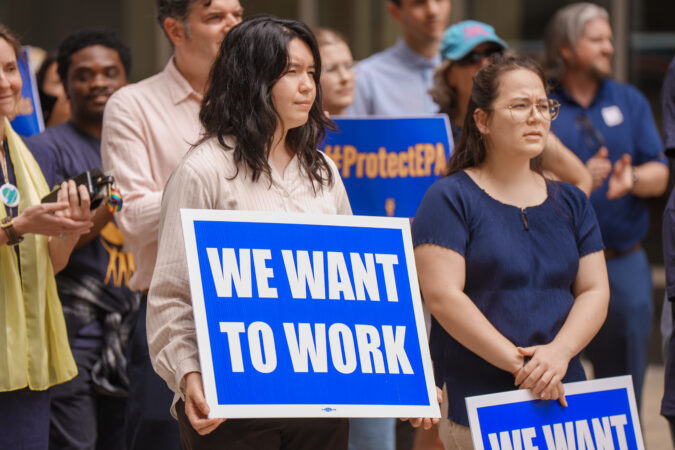
Employees and supporters at a Philadelphia rally for EPA workers being put on leave after signing a letter critical of the Trump administration on July 9, 2025.Jessica Griffin / Staff Photographer
For many federal workers, 2025 has been a year of massive change in the workplace. And for thousands of them, it was the year they quit working for the U.S. government.
That’s the result of the Trump Administration’s efforts to shrink and reshape the federal workforce through a deferred resignation program called “Fork in the Road.” First offered in January, it allowed employees to resign and stay on government payrolls through Sept. 30.
If they didn’t resign, they were told, there was no assurance their job would still be around.
After the “Fork in the Road” offer, President Donald Trump’s administration continued to shake up the federal workforce, with moves including layoffs, dismantling federal worker unions, and overhauling workplace policies.
Here’s a look back on how these changes have impacted Philadelphia-area federal employees this year.
President Donald Trump signs executive orders in the Oval Office at the White House on Jan. 20 after his inauguration. Credit: Jabin Botsford/The Washington PostJabin Botsford
Elon Musk during a trip with President Donald Trump to the NCAA Division I Men’s Wrestling Championship at the Wells Fargo Center in Philadelphia.Elizabeth Robertson / Staff Photographer
DOGE was tasked with reducing government spending and streamlining bureaucracy by July 4, 2026, encouraging mass layoffs and upheaval within the federal government.
Jan. 28
Trump administration offers a new resignation program
Federal workers received an email directly from the U.S. Office of Personnel Management (OPM), the government’s human resources agency, offering the opportunity to resign while continuing getting paid for several months. The agency encouraged federal workers to go from “lower productivity jobs in the public sector to higher productivity jobs in the private sector.”
Protestors hold signs at the Save Our Services day of action event at Independence Mall in Philadelphia on Feb. 19. They gathered to protest Elon Musk's push to gut federal services and impose mass layoffs.Elizabeth Robertson / Staff Photographer
Local workers and supporters gathered in subfreezing temperatures near Independence National Historical Park to protest the layoffs and other workforce shakeups.
On Feb. 26, a memo from OPM and the Office of Management and Budget gave agencies a March 13 deadline for submitting additional layoff and reorganization plans.
Musk said in a post on X that not responding to the email would be seen as a resignation, but some members of the Trump’s administration later said responding was voluntary.
March 5
Pa. government looks to hire federal workers
Gov. Josh Shapiro signed an executive order to streamline the hiring process for former federal employees. Nearly two weeks later, hundreds had applied.
Gov. Josh Shapiro delivers his budget address in February 2025.Tom Gralish / Staff Photographer
story continues after advertisement
March 7
Trump administration starts stripping union rights
The Department of Homeland Security canceled union rights for Transportation Security Administration employees. TSA union leaders and workers at the Philadelphia International Airport said the change caused morale to plummet.
TSA worker Devone Calloway at the Philadelphia International Airport soon after DHS revoked TSA employees' collective bargaining rights.Jose F. Moreno / Staff Photographer
A few weeks later, Trump issued an executive order to end union rights for federal workers across agencies, and union dues stopped being deducted from worker paychecks.
April 2
State officials express concerns over federal layoffs in Pa.
“What we’re seeing right now, in the last 72 days, is an unprecedented assault on organized labor, on working people, on working families and on Pennsylvanians of all different political stripes, from every single corner of our commonwealth,” said state Rep. Malcolm Kenyatta (D., Philadelphia) at a hearing. “It is an attack on their ability to have access to the necessary government services that they depend on every single day.”
Andrew Kreider, an environmental protection specialist at the EPA's Region 3 office, holds a sign reading “Thank You EPA” at a solidarity march around City Hall on March 25.Tyger Williams / Staff Photographer
In a late Friday email, the IRS asked employees to share their resumes so leaders could “determine [their] qualifications.” That included over 3,600 employees from the agency’s office at 30th and Market Streets.
IRS Union Rep. Alex Jay Berman, in front of the Philadelphia IRS building at 30th and Market Streets in April 2025.Jessica Griffin / Staff Photographer
April and May
Philly’s understaffed National Park Service faces “workforce optimization”
NPS workers were asked in late April to upload their resumes amid plans for “workforce optimization.” But administrative staff had already left the regional office in Philadelphia, leaving others to take on their work. At Independence National Historical Park, staffing was an issue even before the start of the second Trump administration, workers said.
At Independence National Park, a ranger casts shadow as they walk along S. 6th Street at Market Street in June.Alejandro A. Alvarez / Staff Photographer
“To work well, to perform, you have to be happy, you have to enjoy what you’re doing,” said Ed Welch, president of AFGE Local 2058, which represents employees at the NPS in Philadelphia. “There’s a horrible oppressiveness in government now, and it‘s unnecessary.”
story continues after advertisement
May 5
Philly-based VA workers return to offices full-time
Following orders from the VA, employees started coming in to work in-person full time but found challenges including insufficient parking and concerns about the confidentiality of work in a shared space.
Theresa Heard attends a rally of VA employees at the VA Medical Center in West Philadelphia in June 2025.Jessica Griffin / Staff Photographer
During a February protest in Philadelphia, retired federal worker Roseanne Sarkissian of Philadelphia holds a sign showing Elon Musk and the phrase “This man is not our boss.”Elizabeth Robertson / Staff Photographer
DOGE, Musk said, is “like a way of life.” The agency remains part of Trump’s government.
Late May
Laid-off employees return to work
Workers who’d been laid off across agencies were reinstated and placed on administrative leave following court rulings. As of late May, the “vast majority” of several hundred Philly-area IRS workers, who lost their jobs in the probationary worker layoff were back at work, union leader Alex Jay Berman estimated.
Yolanda Cowan, Mayra Gonzalez, and Michael Rosado were among the Philadelphia IRS workers who lost their jobs when probationary employees were laid off in February. Here, in February, they posed for a selfie outside the IRS offices.Tom Gralish / Staff Photographer
June 1
Over 100 federal workers find work for the Pa. government
By the first week of June, the state had hired 119 former federal employees across 22 agencies, according to Daniel Egan, a spokesperson for the Pennsylvania Office of Administration.
July 7
VA cancels mass layoffs after many employees leave voluntarily
The VA said it would forgo plans to cut the workforce by 15% after about 17,000 people left through the deferred resignation program, retirement and other attrition. The agency was on pace to have 30,000 fewer employees by the end of the 2025 fiscal year.
A rally of VA employees at the VA Medical Center in West Philadelphia on June 5, 2025.Jessica Griffin / Staff Photographer
August
Federal agencies cancel union contracts
Employees at the VA, the EPA, the U.S. Citizenship and Immigration Services, the Department of Agriculture (USDA), and the Federal Emergency Management Agency (FEMA) are stripped of their union contracts.
Brad Starnes, president of American Federation of Government Employees Local 3631, which represents EPA employees in Pennsylvania, Delaware and several other mid-Atlantic states.Jessica Griffin / Staff Photographer
story continues after advertisement
September
Thousands have left federal government employment
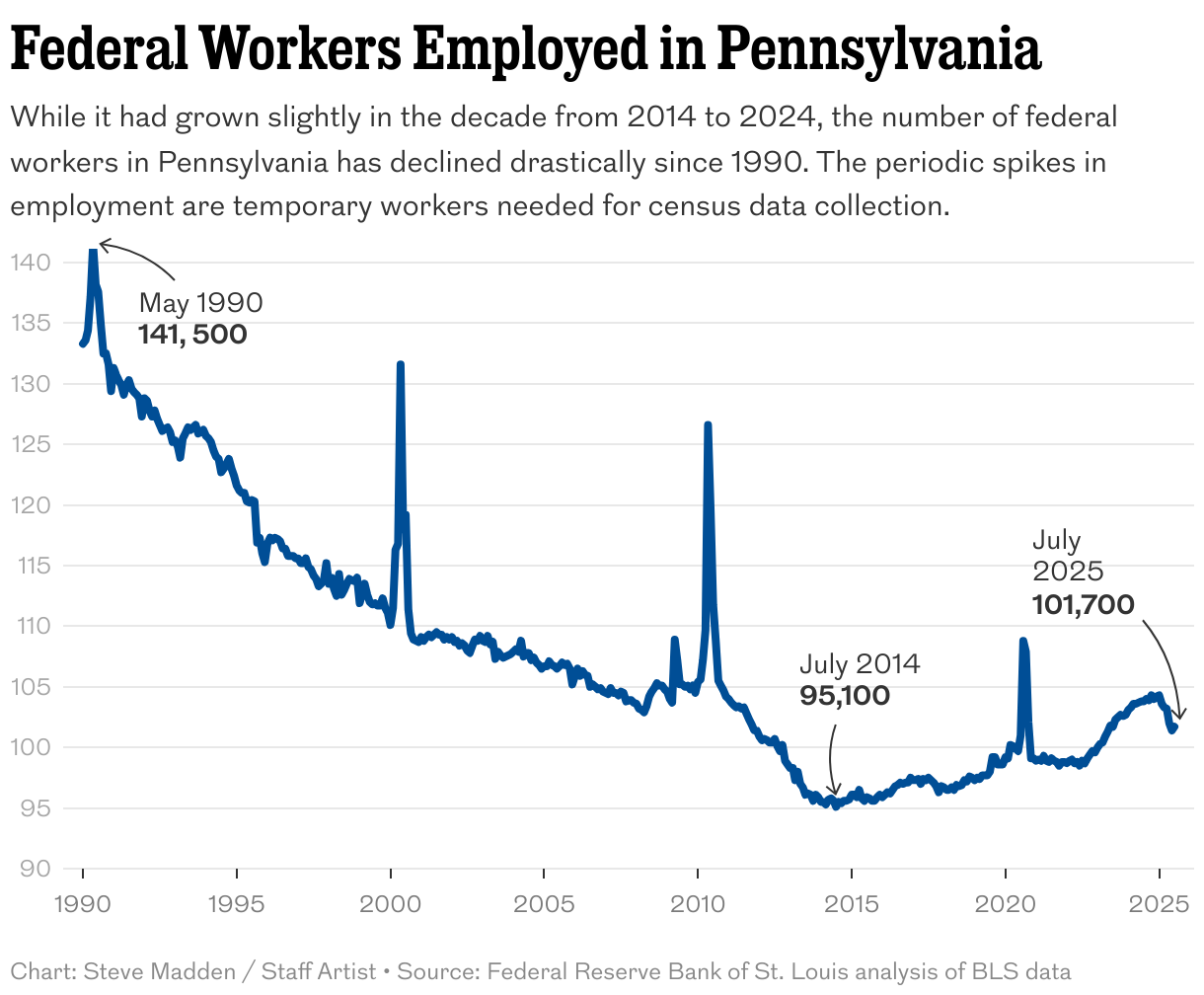
A few weeks before deferred resignations were expected to drop off payroll, new data showed the scope of the workforce shrinkage through mid-2025. In Pennsylvania, there were 2,600 fewer federal workers by the end of July than at the start of 2025.
Meanwhile, media reports said the government planned to call back some employees who took the deferred resignation program at the IRS and the U.S. Department of Labor.
Sept. 24
White House threatens mass firings if shutdown occurs
Federal agencies were asked to prepare plans to fire workers if legislation is not passed to keep the government open past Oct. 1. Philadelphia-area union leaders said they would push back on this effort, even as the Trump administration has moved to curtail their collective bargaining rights.
Oct. 1
A federal government shutdown begins
Lawmakers were unable to reach a deal to keep the government open, causing a shutdown. Agencies shared plans for how many employees were expected to continue working without pay and how many would be sent home on furlough. Air traffic controllers and TSA agents at Philadelphia International Airport, continued to work and so did employees at Philadelphia’s Social Security Administration building at Third and Spring Garden.
The Liberty Bell Center is closed Oct. 1, 2025 in Independence National Historical Park due to the federal government shutdown.Tom Gralish / Staff Photographer
Mid to late October
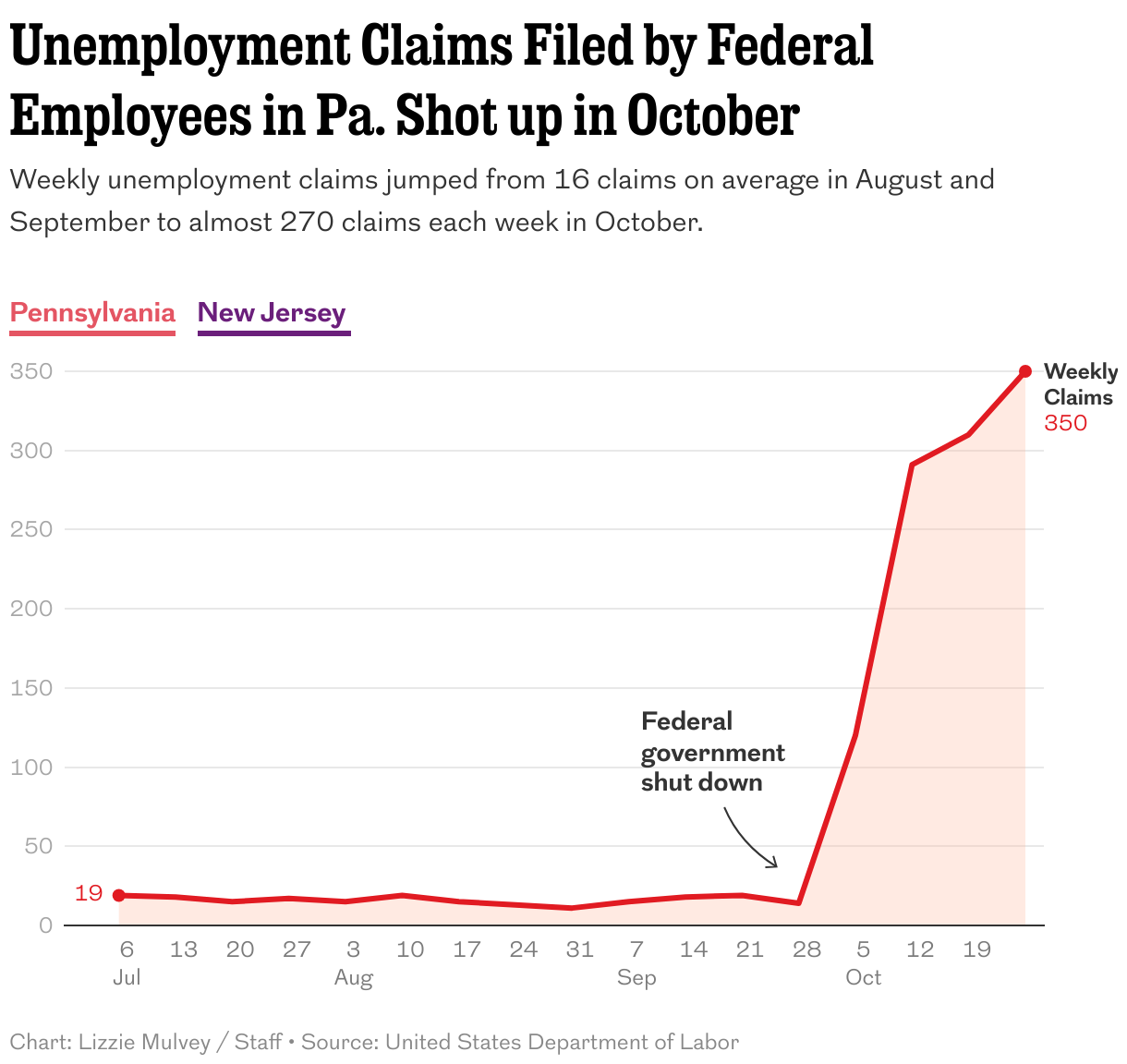
Unemployment claims increase in Pa. and N.J.
Uncertain when their next paycheck would arrive, federal workers applied to SNAP, put their mortgage payments on hold, negotiated with utility companies, and cut back on costs. At PHL, a food pantry was set up for airport government employees impacted by the shutdown. It served some 250 employees in its first two days.
Many federal workers in Pennsylvania and New Jersey filed for unemployment benefits.
Nov. 12
The end of the longest shutdown in history
Lawmakers reached a deal to reopen the government and keep it funded through Jan. 30, and President Donald Trump signed the legislation. The shutdown lasted 43 days, making it the longest in the country’s history.
The deal included protections from mass layoffs through Sept. 2026, and reversal of firings made during the shutdown — the administration sent 4,000 layoff notices during that time. Still, some worried about another potential government shutdown after Jan. 30.
December
Data on impact of resignations is still to come
Workers who took the government’s deferred resignation offer were expected to drop off federal payroll after Sept. 30, and be reflected in employment data from the Bureau of Labor Statistics.
Amid the shutdown, federal data releases were canceled or delayed. Insight on how many people have left the federal government since September is now expected in January.
story continues after advertisement
Staff Contributors
Reporting: Ariana Perez-Castells and Fallon Roth
Editing: Lizzy McLellan Ravitch and Erica Palan
Digital editing: Lizzy McLellan Ravitch
(()=>{var K=(e,t)=>()=>(t||e((t={exports:{}}).exports,t),t.exports);var A=K(r=>{var Q={0:”Jan.”,1:”Feb.”,2:”March”,3:”April”,4:”May”,5:”June”,6:”July”,7:”Aug.”,8:”Sept.”,9:”Oct.”,10:”Nov.”,11:”Dec.”};function L(e){return e===void 0&&(e=new Date),Q[e.getMonth()]}var X={0:”Jan”,1:”Feb”,2:”Mar”,3:”Apr”,4:”May”,5:”Jun”,6:”Jul”,7:”Aug”,8:”Sep”,9:”Oct”,10:”Nov”,11:”Dec”};function b(e){return e===void 0&&(e=new Date),X[e.getMonth()]}function s(e){return e==null}function T(e){return typeof e==”number”&&isFinite(e)}function f(e){return T(e)&&Math.floor(e)===e}var ee=[“one”,”two”,”three”,”four”,”five”,”six”,”seven”,”eight”,”nine”],te=[“million”,”billion”,”trillion”,”quadrillion”,”quintillion”,”sextillion”,”septillion”,”octillion”,”nonillion”,”decillion”],S=[“th”,”st”,”nd”,”rd”,”th”,”th”,”th”,”th”,”th”,”th”],ne=[11,12,13];function M(e){if(s(e))return””;var t=+e;return f(t)?ne.indexOf(t%100)>-1?S[0]:S[t%10]:””}var oe=[“first”,”second”,”third”,”fourth”,”fifth”,”sixth”,”seventh”,”eighth”,”ninth”],ie=new RegExp(/s+([^s]*)s*$/);r.apdate=function(e){return e===void 0&&(e=new Date),L(e)+” “+e.getDate()+”, “+e.getFullYear()},r.apdatetab=function(e){return e===void 0&&(e=new Date),b(e)+” “+e.getDate()+”, “+e.getFullYear()},r.apmonth=L,r.apmonthtab=b,r.apnumber=function(e){if(s(e))return””;var t=+e;return f(t)?t=10?e.toString():ee[t-1]:e.toString()},r.aptime=function(e){e===void 0&&(e=new Date);var t,n,o=e.getHours(),i=e.getMinutes(),u=i===0;if(u){if(o===0)return”midnight”;if(o===12)return”noon”}return o0?o:12):(t=”p.m.”,n=o===12?o:o-12),u?n+” “+t:n+”:”+(i<10?"0"+i:i)+" "+t},r.capfirst=function(e){if(s(e))return"";var t=String(e);return""+t.charAt(0).toUpperCase()+t.slice(1)},r.intcomma=function(e){if(s(e))return"";var t,n=+e;return T(n)?((t=n.toString().split("."))[0]=t[0].replace(/B(?=(d{3})+(?!d))/g,","),t.join(".")):e.toString()},r.intword=function(e){if(s(e))return"";var t=+e;if(!f(t))return e.toString();var n=Math.abs(t);if(n<1e6)return e.toString();var o=Math.ceil(Math.log(n+1)/Math.LN10)-1,i=o-o%3,u=t/Math.pow(10,i);return(u=Math.round(10*u)/10)+" "+te[Math.floor(i/3)-2]},r.ordinal=function(e,t){if(t===void 0&&(t=!1),s(e))return"";var n=+e;return f(n)?t&&n/Android|webOS|iPhone|iPad|iPod|BlackBerry|IEMobile|Opera Mini/i.test(navigator.userAgent);var g=(e,t=null,n=null)=>{n||(n=document.querySelector(“head”));let o=document.createElement(“script”);o.type=”text/javascript”,o.src=e,t&&(o.onload=t),n.appendChild(o)},q=()=>(window.PMNdataLayer?.[0]!==void 0&&window.PMNdataLayer[0])?.analytics?.user?.state===”Subscribed”,k=()=>{let t=(window.PMNdataLayer?.[0]!==void 0&&window.PMNdataLayer[0])?.analytics?.user?.state;return window.location.host.includes(“zzz-systest”)||window.location.host.includes(“pmn.arcpublishing.com”)||window.location.host.includes(“stage.fusion.inquirer.com”)||typeof t>”u”},j=()=>{let t=(window.PMNdataLayer?.[0]!==void 0&&window.PMNdataLayer[0])?.analytics?.user?.hasAdsFreeReading;return!!(t&&t==1)},v=()=>window.location.host.includes(“localhost”);var re=()=>{j()&&document.querySelectorAll(“.js-adbox”).forEach(t=>{t.classList.add(“is-hidden”)})},H={init:()=>{re()}};var a,y=!1,se=()=>{a=document.querySelector(“.js-appendix”)},C=()=>{let e=document.querySelector(“.js-appendix-static-content”),t=e.querySelector(“.js-appendix-static-items”).getBoundingClientRect().height;e.classList.remove(“is-collapsed”),e.style.maxHeight=t+”px”},B=()=>{a.classList.contains(“js-appendix-sticky”)&&(a.getBoundingClientRect().top{y=document.querySelector(“.js-appendix-static-content”).getBoundingClientRect().bottom{y&&document.querySelector(“body”).classList.toggle(“is-open-appendix”)},ae=()=>{window.addEventListener(“scroll”,()=>{B(),D()}),window.addEventListener(“resize”,()=>{B(),D()}),document.querySelector(“.js-appendix”).addEventListener(“click”,()=>{P()}),document.querySelectorAll(“.js-appendix-expand-static”).forEach(e=>{e.addEventListener(“click”,()=>{C(),window.addEventListener(“resize”,()=>{C()})})}),document.querySelectorAll(“.js-appendix-link”).forEach(e=>{e.addEventListener(“click”,()=>{P()})})},N={init:()=>{se(),ae()}};var m,ce=(e,t)=>{m=m||window.PMNdataLayer,m?m.push({event:”misc_event”,eventAction:e,eventLabel:t}):window.location.hostname.includes(“localhost”)?console.log(“Analytics event:”,e,t,”(not actually being sent due to localhost)”):console.log(“Failed to push analytics event”,e,t)},I={event:(e,t)=>{ce(e,t)}};var le=()=>{document.querySelectorAll(“.js-card-show-more”).forEach(e=>{e.addEventListener(“click”,()=>{de(e)})})},de=e=>{let t=e.closest(“.js-card”),n=t.querySelector(“.js-card-body”),i=n.querySelector(“.js-card-body-content”).getBoundingClientRect().height;t.classList.remove(“is-collapsed”),n.style.maxHeight=i+”px”,setTimeout(()=>{n.style.maxHeight=”none”},1e3),I.event(“expand_card”,`${t.dataset.id}`)},F={init:()=>{le()}};var c,$,ue=()=>{c=document.getElementById(“js-inno-toast”)},pe=e=>{if(!c)return;c.innerHTML=e,c.classList.add(“is-active”);let t=()=>{c.addEventListener(“transitionend”,fe,{once:!0}),c.classList.remove(“is-active”)};clearTimeout($),$=setTimeout(t,5e3)},fe=()=>{c.innerHTML=””},l={init:()=>{ue()},showToast:pe};var h,z=!1,me=async()=>new Promise(e=>{setTimeout(()=>{console.log(“simulating createShareLink for localhost”),e(“https://inquirer.com/interactives”),he()},100)}),he=()=>{let e=document.querySelector(“.js-gift-toast-receiver”);!e||!(e instanceof HTMLElement)||setTimeout(()=>{let t=e?.querySelector(“span”);t&&(t.innerHTML=”Gift link copied to clipboard“)},20)},ge=()=>{let e=window.services?.createShareLink;e&&(h=e),v()&&(h=me),h&&ye()},ve=async e=>{let t=”text/plain”,n=async()=>{try{return await h(window.location.pathname)}catch{e.dataset.state=”error”,l.showToast(“Hmm, we couldn’t generate a gift link…”)}},o=new ClipboardItem({[t]:n()});await navigator.clipboard.write([o]).catch(i=>{console.log(i),l.showToast(“Couldn’t copy to clipboard, try again?”),e.dataset.state=”error”}),l.showToast(“Gift link copied to clipboard!”),e.dataset.state=”complete”},ye=()=>{document.querySelectorAll(“.js-gift”).forEach(t=>{(q()||v()||k())&&t.classList.add(“is-available”)}),document.querySelectorAll(“.js-gift-button”).forEach(t=>{t instanceof HTMLButtonElement&&t.addEventListener(“click”,()=>{t.classList.contains(“disabled”)||(t.dataset.state=”loading”,z=!0,ve(t),setTimeout(()=>{t.dataset.state=”ready”},2e3))})});let e=document.querySelector(“.js-gift-toast-receiver”);!e||!(e instanceof HTMLElement)||we(e)},we=e=>{new MutationObserver(n=>{for(let o of n){let i=[…o.addedNodes].at(0);if(!(i instanceof HTMLElement))return;z&&l.showToast(i.outerHTML)}}).observe(e,{subtree:!0,childList:!0})},O={init:()=>{ge()}};var xe=()=>{window.addEventListener(“message”,e=>{if(e.data[“datawrapper-height”]){let t=e.data[“datawrapper-height”];for(let n in t)document.querySelector(`#datawrapper-chart-${n}`).setAttribute(“height”,t[n])}})},Le=()=>{document.querySelectorAll(“.js-datawrapper-graphic”).forEach(e=>{g(`https://datawrapper.dwcdn.net/${e.dataset.id}/embed.js`,null,e)})},be=()=>{window.addEventListener(“message”,e=>{let t=e.data;document.querySelectorAll(`iframe[src*=”${t.id}”]`).forEach(o=>{o.style.height=`${t.height}px`})},!1)},Se=()=>{document.querySelectorAll(“.js-pym-graphic”).forEach(e=>{if(typeof window{new window.pym.Parent(e.id,e.dataset.iframe)};typeof window.pym>”u”?g(“https://pym.nprapps.org/pym.v1.min.js”,t):t()}})},R={init:()=>{xe(),Le(),Se(),be()}};var p,Me=()=>{document.querySelectorAll(“.js-hover”).forEach(e=>{e.addEventListener(“click”,()=>{J(e)}),e.addEventListener(“mouseenter”,()=>{J(e)}),e.addEventListener(“mouseout”,()=>{V(e)})}),window.addEventListener(“scroll”,()=>{p!==null&&Te()})},Te=()=>{(p>window.scrollY+100||p{V(e)})},J=e=>{e.classList.add(“is-visible”),p=window.scrollY},V=e=>{e.classList.remove(“is-visible”),p=null},G={init:()=>{Me()}};var d,w,x=!0,Ae=()=>{d=document.querySelectorAll(“.js-video-autoplay”)},Ee=()=>{window.addEventListener(“resize”,()=>{W()}),window.addEventListener(“scroll”,()=>{W()}),d.forEach(e=>{e.addEventListener(“volumechange”,t=>{e.muted!==x&&!E()&&(x=e.muted,qe())})})},W=()=>{let e;d.forEach((t,n)=>{let o=t.getBoundingClientRect(),i=o.height/2;o.y-i&&(e=t)}),e!==w&&(w=e,d.forEach(t=>{t.pause()}),e?e.play():w=null)},qe=()=>{d.forEach(e=>{e.muted=x})},Y={init:()=>{Ae(),d&&Ee()}};var _={init:()=>{H.init?.(),N.init?.(),F.init?.(),O.init?.(),R.init?.(),G.init?.(),Y.init?.(),l.init?.()}};var ke=()=>{},U={init:()=>{ke()}};var je=document.querySelector(“.js-inno”),Z=()=>{_.init(),U.init()};je?Z():new MutationObserver((t,n)=>{if(document.querySelector(“.js-inno”)){n.disconnect(),Z();return}}).observe(document,{attributes:!0,childList:!0,subtree:!0});})();
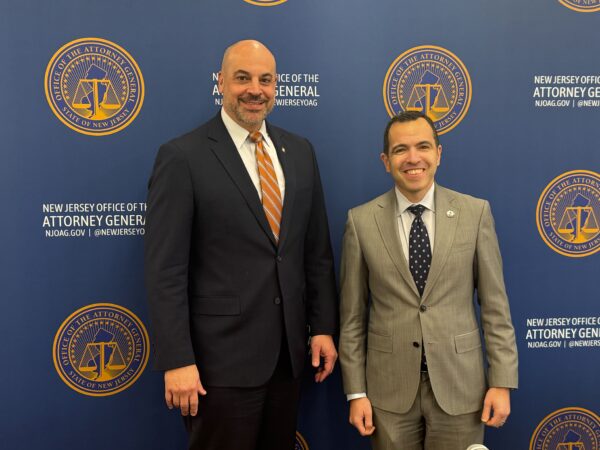
Right after Pennsylvania Attorney General Dave Sunday was sworn into office in January, he received a lunch invitation from across the Delaware River.
It didn’t matter that they came from different political parties, said New Jersey Attorney General Matthew Platkin, a Democrat appointed to his post by outgoing Gov. Phil Murphy.
Platkin wanted to get to know his neighbor, and invited Sunday out to lunch in Philadelphia.
The two men could not have more different approaches to their jobs. In a hyperpolarized political era, where attorneys general play an increasingly important role in national politics, Platkin has become a face of Democratic opposition to President Donald Trump’s administration. He has led or joined dozens of lawsuits by blue-state attorneys general and governors in arguing that the executive branch is acting unconstitutionally on issues like birthright citizenship, withholding congressionally approved funds, and more.
In contrast, Sunday, a Republican elected last year, has largely avoided suing Trump and has said he strives to be “boring,” focusing his efforts on oversight of his own office.
Even their jobs are different, despite sharing a title. New Jersey’s attorney general is in charge of the state’s 21 county prosecutors, oversight of state police, and protecting consumers, among other duties; Pennsylvania’s attorney general has wide-ranging powers to investigate corruption, enforce the state’s laws, represent the state’s agencies and interests in lawsuits, and more.
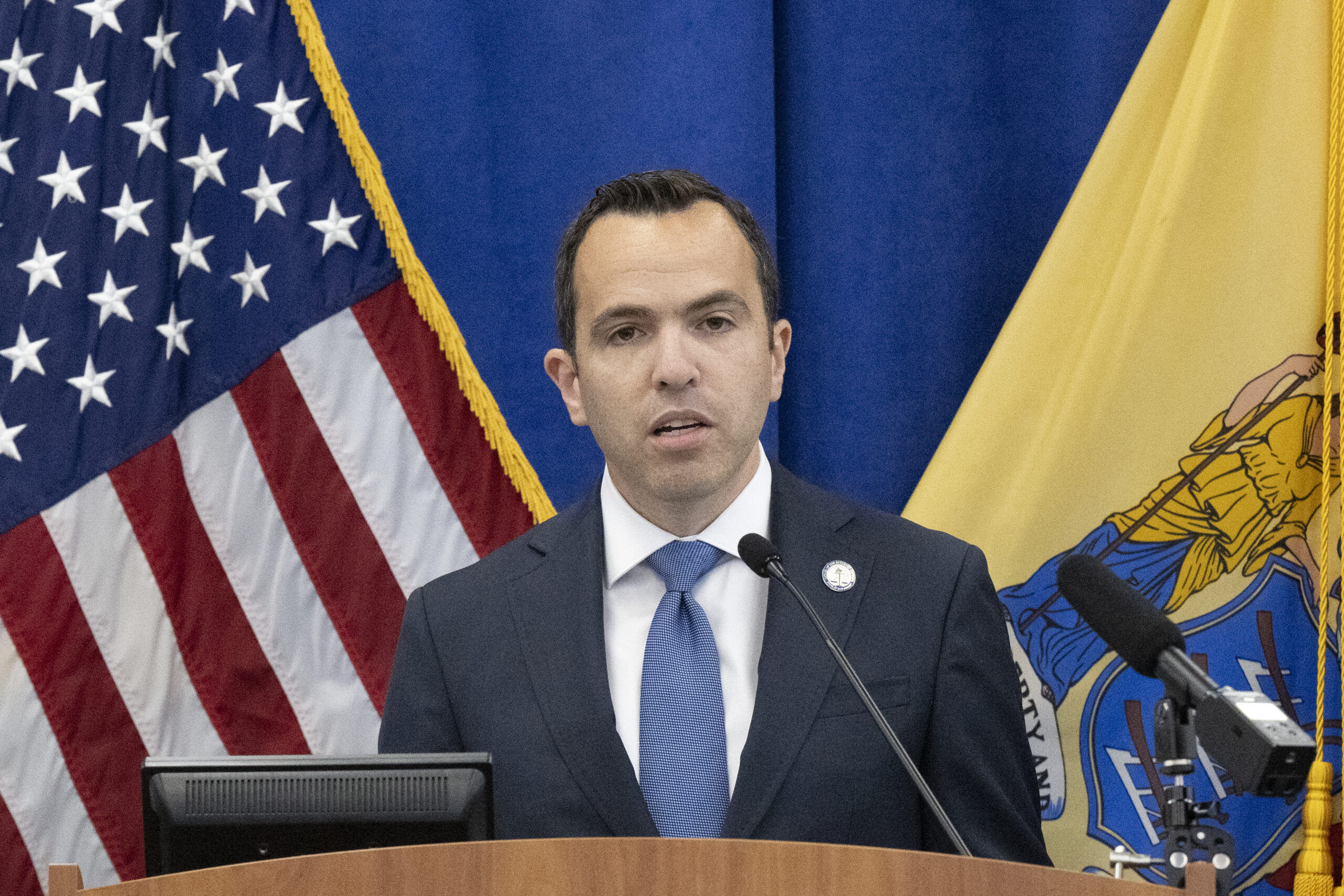
New Jersey Attorney General Matthew Platkin on Monday, June 17, 2024, at the Richard J. Hughes Justice Complex in Trenton, N.J.
Platkin, 39, is an ambitious lawyer who grew up in northern New Jersey and attended one of the best high schools in the state before attending Stanford University and Stanford Law School. He went on to work in private practice in New York and New Jersey before being appointed as chief general counsel to Murphy at 35 — the youngest person to ever hold the office.
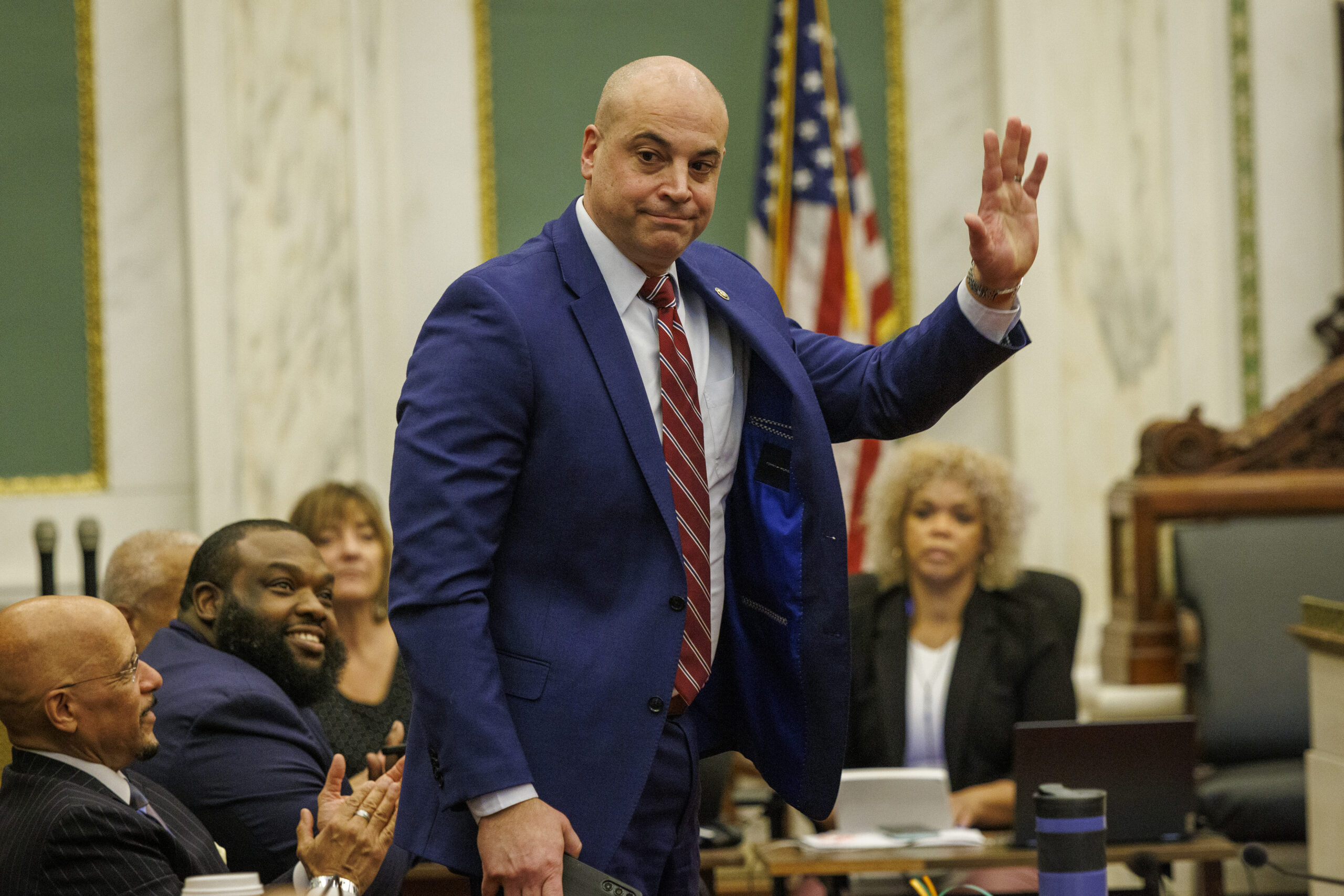
Sunday, 50, grew up in a suburb of Harrisburg and has described his high school years as lacking direction. He joined the U.S. Navy after high school before attending Pennsylvania State University for undergraduate and Widener University Law School for his law degree, working at UPS to help put himself through school. He returned to south-central Pennsylvania for his clerkship, and was a career prosecutor in York County until his election to attorney general.
Pennsylvania Attorney General Dave Sunday stands to be recognized by Council President Kenyatta Johnson before Philadelphia Mayor Cherelle Parker gives her budget address to City Council, City Hall, Thursday, March 13, 2025.
But over salads at the Mulberry, Platkin and Sunday found common ground. And ever since, the two said in a joint interview this month, they have worked closely on issues affecting residents in their neighboring states.
“Just because you may not see eye-to-eye on [Trump] doesn’t mean you can’t see or don’t see eye-to-eye on many, many other issues,” Sunday said.
“When we have an auto theft problem, [residents] don’t care if there’s a ‘D’ or an ‘R’ after your name,” Platkin added. “They just want to see us working to solve it.”
The two have since worked together on issues that stretch from criminal investigations and human trafficking cases to challenging Big Tech companies as artificial intelligence rapidly advances, Sunday said.
Earlier this month, Sunday and Platkin led national efforts of coalescing approximately 40 attorneys general across party lines on the issues they say are most pressing for residents. The group wrote a letter to Big Tech companies in mid-December, detailing concerns about the lack of guardrails for AI chatbots like those available from ChatGPT or Meta’s Instagram AI chats, and the potential harm they could cause people in crisis or children who use them.
In two more letters sent this month, the attorneys general also voiced support for a workforce reentry bill before a U.S. House committee and requested that Congress approve additional funding for courtroom and judicialsecurity to protect the nation’s judges from safety threats. Platkin and Sunday said they were some of the first attorneys general to sign on to the letters.
“While the undersigned hold differing views on many legal issues, we all agree that the legal system cannot function if judges are unsafe in their homes and courthouses,” the group of 47 attorneys general wrote in a Dec. 9 letter to top leaders of Congress.
When it comes to lawsuits against the Trump administration and other litigation authored by partisan attorneys general associations, Sunday has largely avoided the fray. Earlier this month, he was elected Eastern Region chair of the National Association of Attorneys General, a nonpartisan group composed of the 56 state and territory attorneys general.
Platkin, on the other hand, has led the charge in pushing back against the administration’s policies in New Jersey, signing onto dozens of lawsuits such as ones challenging Trump’s efforts to end birthright citizenship and to withhold SNAP funding if a state does not turn over personal information about its residents.
Still, Pennsylvania has joined many lawsuits, including several challenging the federal government for withholding congressionally approved funds for electric vehicles and more, as Democratic Gov. Josh Shapiro, formerly the state’s attorney general, has signed on in his capacity as governor.
Platkin, who has served as New Jersey’s attorney general since 2022, will leave office when Murphy’s term ends next month, and Gov.-elect Mikie Sherrill will appoint someone new to the post. Sherrill, a Democrat, earlier this month nominated Jen Davenport, a former prosecutor and current attorney at PSE&G, New Jersey’s largest electric and gas company, to be Platkin’s successor.
Sunday’s team has already been in touch with Davenport to forge a similar cross-state working relationship.
What’s next for Platkin? He said he’s a “Jersey boy” and will remain in the state but declined to say what his next move might entail.
And both Platkin and Sunday say they will maintain their bipartisan friendship going forward.
“It’s OK to say we don’t agree on everything. We shouldn’t hate each other,” Platkin said. “We should be open about the fact that we like each other. … I don’t think there’s anything wrong with that.”
She went by Dr. Mary, and her promise was a tantalizing medical breakthrough.
At clinics operated in Arizona and several other states, Mary Blakley and her husband, Fred, told patients that for just $300, they could provide a full-body scan that utilized a proprietary “smart chip” to detect a variety of potential illnesses, including cancer.
In addition, the Blakleys boasted, their technology could actually help cure some patients’ maladies — blasting away kidney stones with a laser, killing cancer cells by injecting a special cream, or cleaning out lungs with a prototype “sweeper” approach.
But in federal court in Philadelphia on Monday, the couple admitted that their clinics were a sham — that in reality, they only administered basic ultrasounds to patients while lying about the other fantastical benefits.
Their guilty pleas were the latest development in a fraud prosecution with a variety of unusual elements. Mary Blakley, for example, had not only lied about being a doctor to build her clinics, prosecutors said — her background included a prior federal conviction for manufacturing methamphetamine.
Fred Blakley, 61, meanwhile, also pleaded guilty Monday to a separate set of firearms charges, admitting that as he was perpetuating the healthcare fraud, he was also stockpiling dozens of guns and thousands of rounds of ammunition for what he said was a forthcoming civil war against the U.S. government.
Neither of the Blakleys said much in court Monday beyond responding to routine questions from U.S. District Judge Gerald McHugh. They pleaded guilty to counts including mail and wire fraud and conspiracy.
Prosecutors said the couple — from Lake Havasu City, Ariz. — generated more than $2 million in fraudulent billings over the years. Their clinics operated in places including their home state, California, and Colorado, prosecutors said, and some of their patients had ties to Pennsylvania, which is where they were ultimately prosecuted.
Their chief offering was a signature “full-body scan,” which they ran through a traditional ultrasound machine — but said had been enhanced with their proprietary smart chip technology. They told patients their machine could detect, treat, and cure a variety of illnesses, and also said the technology was a secret and should not be discussed with anyone.
The Blakleys would often go on to prescribe various creams or drugs that had little to no benefit, prosecutors said, and sometimes said a patient would need to continue using the prescription for life. One of the substances, fenbendazole, was approved for use in animals by the Food and Drug Administration, prosecutors said, but was not approved for use in humans.
To bolster her standing with clients, prosecutors said, Mary Blakley, now 66, lied about her background, falsely claiming she had worked at the MD Anderson Cancer Center in Houston; saying she had developed pharmaceuticals for Merck; and claiming she had received a Ph.D. in nuclear physics from the Karolinska Institutet in Sweden.
She hung a fake degree from the Swedish school on the wall of her clinic office, prosecutors said, along with others from Gatesville University and Almeda University — two online institutions that prosecutors described as “diploma mills.”
To try to avoid detection, prosecutors said, the Blakleys asked their patients to pay with cash or check, refused to keep client records, and avoided keeping records of the full-body scans, which they sometimes described as “research.”
They also sought to expand their empire, sometimes by selling their purported devices to others, or by charging trainees to open franchise branches of their clinics.
In the meantime, court documents said, Fred Blakley was amassing a collection of more than two dozen guns and 30,000 rounds of ammunition, some of which he stored in the garage of his pastor. He was not allowed to own any firearms because he had been convicted alongside his wife in the prior methamphetamine case.
As undercover FBI agents investigated the couple for their healthcare fraud, court documents said, Fred Blakley was captured on an audio recording in 2022 telling one of the agents he was “planning on shooting some humans.”
“We’re gonna have to go to war with our own government … a civil war,” he said, according to court documents, later adding: “You better arm up good. I’ve got thousands of rounds of ammunition, and I’m ready to rock.”
The couple’s downfall began several years ago, when local authorities in Arizona received complaints about the clinics, including from the couple’s estranged daughter.
The FBI then began an extensive investigation, court documents said, and the couple were indicted in federal court in Philadelphia earlier this year.
They are scheduled to be sentenced by McHugh in April. The couple are in custody at the federal detention center in Philadelphia. Each faces the possibility of being sentenced to more than 150 years behind bars.
Philly is a square kind of city. Plots and constructions fit between the perpendicular streets that form the blocks that feed the city’s grid.
Modern architecture reshaped some squares into rectangles. Nevertheless, the grid system persists, helping Philadelphians navigate.
But blocks aren’t an exact science, andsome don’t have an easily understandable name. Trying to figure out what areas encompass a block police and news outlets sometimes use to describe incidents, a reader asked Curious Philly, The Inquirer’s forum for questions about the city and region: What makes something a unit block in Philadelphia?
For Jeffry Doshna, associate professor of city planning and community development at Temple University, a unit block is a term associated with cities that operate on a grid. It refers to a particular block where the house numbers are less than a 100.
“When we say the 900 block of Girard Avenue, that would be the buildings between Ninth and 10th Streets on Girard,” Doshna said. “It’s a way to designate which block it is based on the numbering.”
However, the words “unit block” stop being used when house numbers exceed 99, according to the professor.
“Unit block is 0 to 99; the 100 block is 100 to 199; the 200 block is 200 to 299. It goes up as high as we have street numbers in the city,” Doshna said.
In the past year, Philadelphians may have heard the phrase “unit block” on news stories, describing an area where an incident happened without providing the specific house number. In September, a man was shot in West Philadelphia, with police reporting the shooting location as the “unit block of North Frazier Street.”
This doesn’t apply just for cities with widespread grid systems like Philly. Right before Christmas, a Bucks County man was struck by a wood chipper in Lower Southampton Township. Authorities reported the incident as on “the unit block of Valley View Road.”
“It’s just a way for us to say ‘where,’ to let people know what block something happened on, without giving a specific address,” Doshna said.
Spotlight PA is an independent, nonpartisan, and nonprofit newsroom producing investigative and public-service journalism that holds power to account and drives positive change in Pennsylvania. Sign up for our free newsletters.
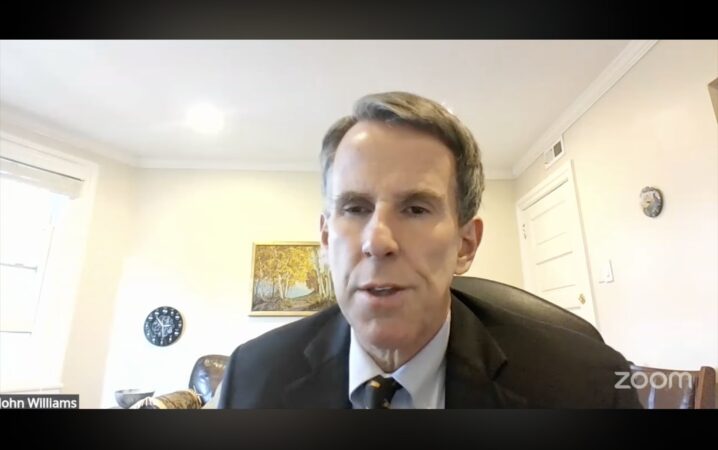
HARRISBURG — Gov. Josh Shapiro has not reappointed a longtime member of the Board of Pardons, a psychiatrist whom advocates have opposed for his votes against clemency applicants, lack of experience in criminal justice, and lines of questioning they find inappropriate.
John Williams, a child psychiatrist practicing in Montgomery County, has served on the board since former Gov. Tom Corbett appointed him in 2013. He was reappointed in 2019, under former Gov. Tom Wolf. His second six-year term expired in November, leaving a vacancy on the five-member body.
Williams did not return an email from Spotlight PA requesting comment.
A representative for Shapiro’s office said the governor is working with state Senate leadership to “restore the board to its full complement.”
Shapiro’s office would not confirm whether the governor may still nominate Williams. Spokesperson Kayla Anderson said, “No final decision regarding a nominee has been made at this time.”
The Board of Pardons makes the ultimate decision on both commutation and pardon applications from people who are seeking to either shorten a prison sentence or wipe clean a criminal history.
The board comprises two elected officials, the attorney general, and lieutenant governor, and three political appointees — a corrections expert; a medical doctor, psychiatrist, or psychologist; and a victim advocate.
Applications the board deems “meritorious” are given a public hearing, after which the body votes to either deny the application or approve it for the governor’s consideration.
While pardons are recommended by the board in a majority vote, life sentence commutations, which allow a person to get out of prison, require unanimous approval — just one no vote dooms an application.
Earlier this year, a coalition of pro-clemency groups organized the Commutation Now campaign to pressure Shapiro to replace Williams, who frequently voted against both commutations and pardons.
In a report released in June, the group criticized Williams for routinely asking “inappropriate questions reflecting ‘lurid curiosity.’”
During a public commutations hearing in September 2024, Williams asked a victim speaking against the applicant to give increasingly specific details about the sexual abuse he endured as a child. When the man wasn’t sufficiently specific, Williams pushed for additional details. After the questioning, he acknowledged the man’s discomfort.
There was no reason for the line of questioning, said Etta Cetera, a longtime board watchdog and member of the Commutation Now campaign. Williams’ single no vote would have been sufficient to deny the commutation, Cetera said, negating the need to put a victim through an invasive line of questioning.
“When you come into these cases, any of these cases for people with life sentences are extremely sensitive. Somebody lost their life, and in other situations, there was other abuse and even sexual violence involved,” Cetera said.
“And it’s irresponsible to not take seriously the trauma that comes up for people when these hearings happen. And the way that the psychiatrist questioned the victims is totally not trauma-informed.”
After a public pardons hearing in 2021, a viewer wrote to then-Lt. Gov. John Fetterman to complain about Williams’ conduct. The letter, which was also reviewed by Spotlight PA, expressed concern that “Williams questioned a pardon applicant about which sex positions he used during the commission of a decades-old sexual offense,” according to the report.
Williams then asked the applicant’s wife about her sex life with the applicant, including which sexual positions they used, the letter alleges.
Commutations interviews are not public, but attorneys interviewed for the Commutations Now study reported Williams consistently asked about an applicant’s sexual abuse “in excruciating detail,” and pursued invasive and humiliating questions.
Commutations Now hand-delivered the report to legislative leaders, including the state Senate Republicans who will have to confirm Shapiro’s new appointee.
The nomination must undergo two committee votes before the full chamber weighs in, said Kate Flessner, a spokesperson for state Senate Majority Leader Joe Pittman (R., Indiana).
Tobey Oxholm, who works with pardons applicants statewide, said in recent years the number of applications exploded, but the board held only nine days of hearings in 2025. The backlog of potential pardons keeps people with nonviolent felonies from working in roles the state needs, he said, such as home health, elder, and childcare.
“The crushing numbers really requires somebody who is a systems thinker as well as somebody who has experience with the populations that are coming before the board,” Oxholm said of the position.
The advocate community wrote a letter to Shapiro in October recommending David DeMatteo, an attorney and forensic psychologist teaching at Drexel University. State Sen. Maria Collett (D., Montgomery) wrote to the governor endorsing him as well.
In the meantime, the board will be able to proceed with four people, as four still constitutes a quorum for all votes.
But Oxholm questioned why the position was allowed to lapse.
When there are only four people on the board, a person seeking a pardon has a narrower chance to have their application receive the three votes they need to move on from their felony conviction, which can keep them from jobs and housing opportunities.
“This indicates that there isn’t a full appreciation by the governor and the senate about the importance of this position to individuals, families, and their communities,” he said.
BEFORE YOU GO … If you learned something from this article, pay it forward and contribute to Spotlight PA at spotlightpa.org/donate. Spotlight PA is funded by foundations and readers like you who are committed to accountability journalism that gets results.