Five police officers say in a new federal lawsuit they were skipped over for promotions because of a Philadelphia policy change to promote diversity, equity, and inclusion in the municipal workforce.
The officers — Christopher Bloom, Kollin Berg, Joseph Musumeci, Marc Monachello, and Leroy Ziegler — claim they were victims of an “illegal and discriminatory” policy change adopted by City Council and Philadelphia voters in the aftermath of Black Lives Matter protests that swept the nation.
The lawsuit is a proposed class action on behalf of “all white male employees” of the Philadelphia Police Department who were passed over for promotions since 2021 in favor of a candidate with lower exam scores. The complaint was filed by a team of attorneys affiliated with President Donald Trump who have sued the city previously over diversity initiatives.
The change at the heart of the latest lawsuit is related to the so-called rule of two that required city managers to choose between the two candidates with the highest Civil Service exam scores. The rule was an often-cited reason for the limited diversity in the city workforce.
Voters got rid of the requirement through a ballot question in 2021, giving the city more discretion to tailor the number of finalists for a position.
The five officers sought promotions in November, three from lieutenant to captain and two from sergeant to lieutenant. All were “passed over for one of these promotions on account of their race and sex,” the suit says.
The complaint, filed Wednesday in the Eastern District of Pennsylvania, quotes from legislative documents and statements from politicians to argue that the rule change was racially motivated.
A 2022 resolution calling on then-Mayor Jim Kenney to study the impact of the rule change “repeatedly bemoans the fact that white men were obtaining too many promotions under the city’s merit-based promotion system,” the suit says, calling it “one of the many examples of the city of Philadelphia’s determination to impose illegal DEI practices that consciously and intentionally discriminate against white men.”
Another example cited in the lawsuit is a statement by Mayor Cherelle L. Parker, a Council member at the time, who championed the change. She is quoted as saying that “for too long, the Rule of Two has held back Black and Brown employees.”
The suit is the latest filed by a team of conservative lawyers against Philadelphia over efforts to address racial inequity. The attorneys include Pennsylvania’s self-described “go-to” lawyer for Republicans, Wally Zimolong; Jonathan Mitchell, the former Texas solicitor general who is credited as the legal mind behind that state’s abortion ban; and attorneys from American First Legal, an organization formed by Trump adviser Stephen Miller.
In October, the group settled a lawsuit that claimed the city violated the Constitution by forcing bidders to sign agreements that included diverse workforce goals. The city agreed to pay $417,000 in attorneys’ fees and clarify that diversity benchmarks in project agreements were aspirational goals, not mandatory quotas.
Parker’s administration ended a Philadelphia policy prioritizing businesses owned by women or people of color in city contracting shortly after the settlement.
Delaware County-based attorney, Wally Zimolong, has been filing lawsuits challenging Philadelphia’s programs to increase diversity, equity, and inclusion in hiring and schools.
The attorneys are not targeting Philadelphia, according to Zimolong.
“Philadelphia just so happens to habitually enact policies that violate the United States Constitution,” he said.
Zimolong declined to comment on the current lawsuit, as did the city’s law department.
The complaint names as defendants the city, the police department, Police Commissioner Kevin Bethel, Deputy Commissioner Krista Dahl-Campbell, and Philadelphia Chief Human Resources Officer Candi Jones. It asks a judge to order the promotion of the officers and declare that the city’s current hiring policies are unlawful because they consider race and gender.
Passed over
Police lieutenants Bloom, Berg, and Musumeci sought promotions in fall 2025. There were 10 available positions, and the trio ranked eighth, 11th, and 13th, respectively, on the “captain eligibility” list based on exam scores.
After interviews, six candidates were passed over in favor of those with lower scores, according to the complaint. Five of those six were white males.
The lawsuit alleges a similar pattern when the department decided not to promote sergeants Monachello and Ziegler.
“Monachello and Ziegler were passed over for promotion in favor of lower-ranked female or minority candidates with lower scores on the civil-service examination,” the suit says.
The Fraternal Order of Police Lodge 5 blasted the police department in a statement following the November promotions, saying the union filed grievances and was considering other actions against “unfair DEI practices in law enforcement.” The FOP also sent a letter asking the U.S. Department of Justice asking to review the promotion criteria, the suit says.
The police department workforce is 50% white, 34% Black, 12% Hispanic, and 3% Asian, according to data from the city. Nearly 40% of new hires this fiscal year have been Black, compared with 33% white.
In comparison, the city’s population is 44% white, 42% Black, 16% Hispanic, and 9% Asian, according to the Census Bureau.
The department has faced racial discrimination lawsuits from employees, including regarding promotions. But usually the candidates allege they were passed over for a white candidate.
For example, in October, an Asian officer sued after not getting promoted to captain, noting in the complaint that “no person of Asian descent has been promoted to the rank of Captain since 1976.”
When Scott McElree was named Quakertown’s top cop in 2004, borough leaders saw a reformer who could boost public trust. And he did so well in the role that, three years later, they gave him a second job — borough manager.
It is rare for a municipality to appoint someone to both run the police department and oversee everyday municipal matters, from payroll to public records. But McElree embraced the challenge.
That unusual arrangement is now under scrutiny after a student protest over federal immigration enforcement escalated into a bloody clash last week involving McElree and his officers — as are social media posts in his name that have criticized Democrats, with one calling them a “domestic terrorist organization.”
Cell phone videos of the Feb. 20 walkout against U.S. Immigration and Customs Enforcement show the altercation began after McElree, 72, confronted a group of Quakertown Community High School students. In the footage, teenagers appear to strike the chief, who was not wearing his uniform, as he attempts to grab a student.
McElree is seen on the sidewalk placing a teenage girl in what appears to be a chokehold. Five teens were charged Tuesday with aggravated assault and related offenses. According to an affidavit of probable cause for the arrest of one of the teens, McElree left the scene bloodied, and later sought care at a local hospital for undisclosed injuries. The affidavit does not mention a chokehold.
The clash has raised questions over whether the plain-clothed McElree was identifiable as the borough’s top police officer when he intervened. The incident also has intensified calls for his resignation and focused a national spotlight on his unconventional dual authority.
“We have a 72-year-old white man, in flannel clothing, angry, unidentified, running into a crowd of children and tackling them,” said Timothy Prendergast, a defense attorney representing the 15-year-old girl witnesses captured on video being held in McElree’s chokehold.
Neither McElree nor the seven elected council members responded to requests for comment from The Inquirer. An attorney for the borough, Peter Nelson, declined to comment by email. He shared a statement from the council, which said its members are “very disturbed by the circumstances surrounding this incident” and have asked the Bucks County District Attorney’s Office to investigate.
Prendergast said the muted response from borough officials over the protest illustrates the conflict with the top manager: “If we wanted to get information on the chief of police, we couldn’t, because we’d have to go through the chief of police. It’s conveniently inappropriate.”
Prior to the protest, McElree did not have a record of aggressive policing. Court documents show he was sued three times in 20 years for alleged civil rights violations, mainly involving subordinate officers whom McElree was accused of failing to supervise. Two of those cases were dismissed. One ended with a $60,000 settlement offer, court records show.
McElree, of Lafayette Hill, has been a police officer in the Philadelphia suburbs for five decades. He graduated from the FBI National Academy in 1995, but his public service remained on the local level.
He served as a detective and sergeant in Whitemarsh Township for 29 years until his elevation to police chief in Quakertown — a rank he had aspired to since his youth. More than 70 police officers applied for the position.
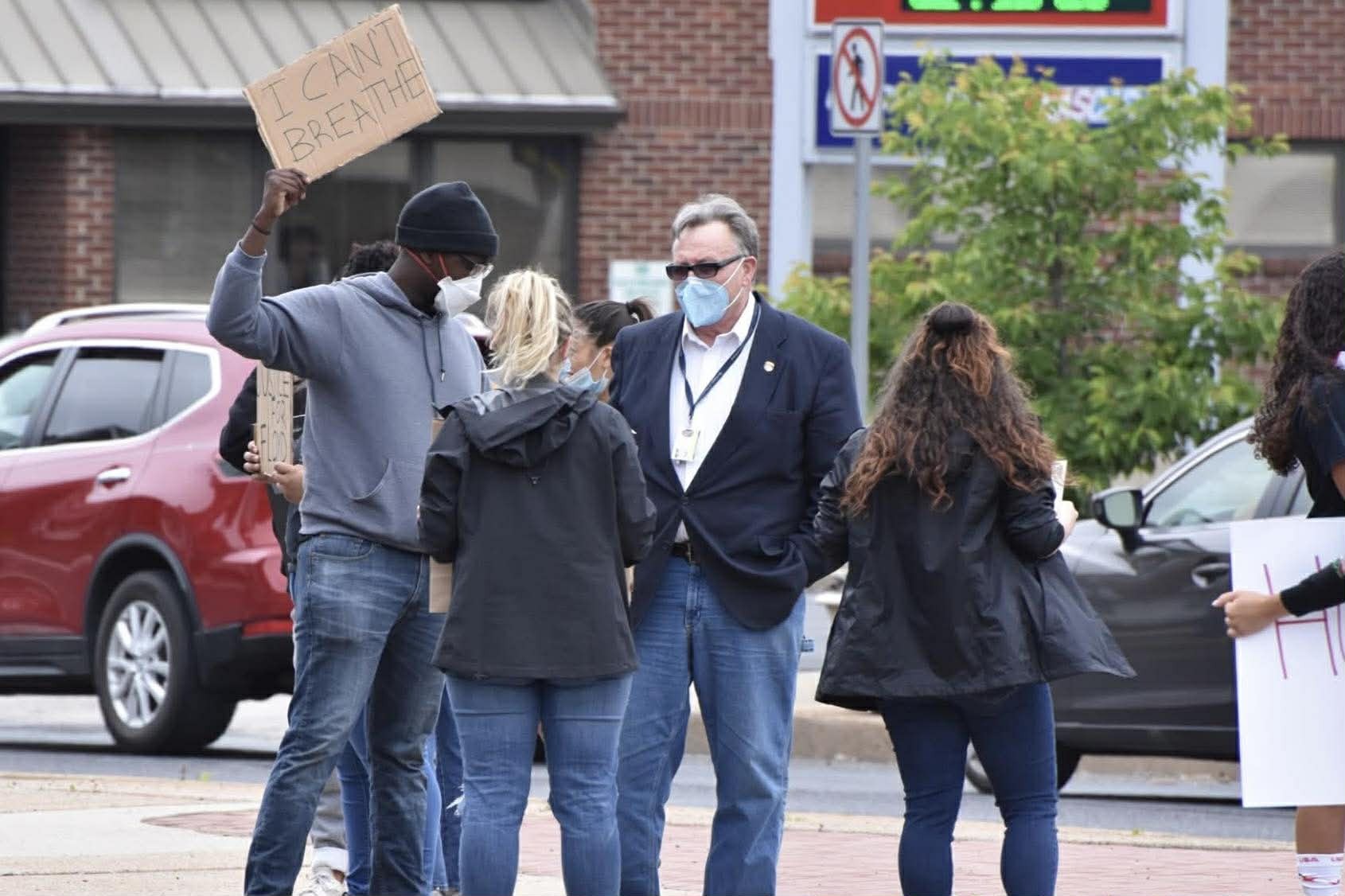
Some Quakertown residents defended police chief Scott McElree, pictured here interacting at a Black Lives Matter protest in 2020, as a thoughtful leader.
“When I was a young officer, I was very desirous of being a chief,” McElree said in 2004, according to an article in the Morning Call. “I wanted to stay in police work and ascend to the top.”
In 2007, Quakertown’s council appointed McElree as interim borough manager after the abrupt departure of longtime manager Dave Woglom. But the borough council never hired a new full-time replacement, instead naming McElree to take on both jobs.
McElree helped modernize the police department and improve morale among officers that had waned under prior leadership, according to a former township official, who spoke on condition of anonymity to frankly discuss his former colleagues.
But the former official said the current situation is an example of what can go wrong with a dual appointment. The borough manager should be able to oversee the actions of a police chief. But in this case, they are one and the same.
“There’s a reason you don’t see this [arrangement],” the former official said. “Council is having to make decisions without the direction of the borough manager, because he’s conflicted.”
Amid calls for his resignation and outrage from parents, speculation has swirled on social media about McElree’s political leanings.
Outside of police work, McElree obtained a master’s degree in business administration from Liberty University, an evangelical school in Virginia founded by Jerry Falwell that calls itself one of the “most conservative” campuses in the nation.
Voting records show McElree and his wife, Arlene Kosh McElree, are registered Republicans. A Facebook account under his wife’s name features a profile picture of a hand-drawn sign that reads: “When I die do not let me vote Democrat.”
McElree’s own social media footprint appears faint. But an account he shares with his wife on Truth Social, which President Donald Trump founded, has made a handful posts critical of Democrats and Democratic policies in recent years. The account features a photo of the couple, though it is not clear which of them penned the posts.
In August, responding to a Trump post criticizing Democrats, the McElree account wrote a screed that described the party as “a deep state oligarchy” and a “domestic terrorist organization.”
“Dem politicians should be impeached/fired and have their salaries & benefits cut off,” the post read. “Dem judges should be disbarred … all should be banned from politics for life.”
“NO MORE DEMS,” read another post, reacting to a Trump statement on the eve of the November general election.
According to open source data, McElree also used an official government email address to create an account on Rumble, a Canadian video-sharing platform that is popular in conservative and far-right circles. He has not posted any videos and his viewing history is not public.
Prendergast, the defense attorney, said he was concerned by the social media posts, which contained what he described as “literally every MAGA hard right-wing talking point.”
An organizer from Bucks Back the Blue, a police support group, stood by the chief and borough manager, describing him as a tireless and level-headed leader. The organizer recalled McElree attending Black Lives Matter protests during the pandemic, “engaging with our community members and listening to their thoughts and concerns.”
“Quakertown has always been an epicenter for peaceful protests,” said the organizer, who spoke on condition of anonymity due to fears of public retaliation. “Chief Scott McElree isn’t a bad cop. He isn’t a bad person. Just like those kids aren’t bad kids.”
Law enforcement officials on Wednesday announced sweeping charges against 19 people affiliated with several Philadelphia gangs they say are responsible for shooting nearly three dozen people in two years.
The indictment caps a more than two-year investigation into the Young Bag Chasers, or YBC, and rival crews including CCK and the Parkside Killers. Authorities say the groups traded gunfire in brazen retaliatory shootings — sometimes on consecutive days, often in broad daylight, and at times on the same blocks over and over again.
Below is a breakdown of the shootings included in the indictment and the defendants charged in each case, according to prosecutors:
Sept. 21, 2022 — Shots are fired at 1400 N. 75th St. No one is struck.
YBC members Mark “Yak Yola” Johnson and Kasim Brown, aka “FSdaBender,” have been charged.
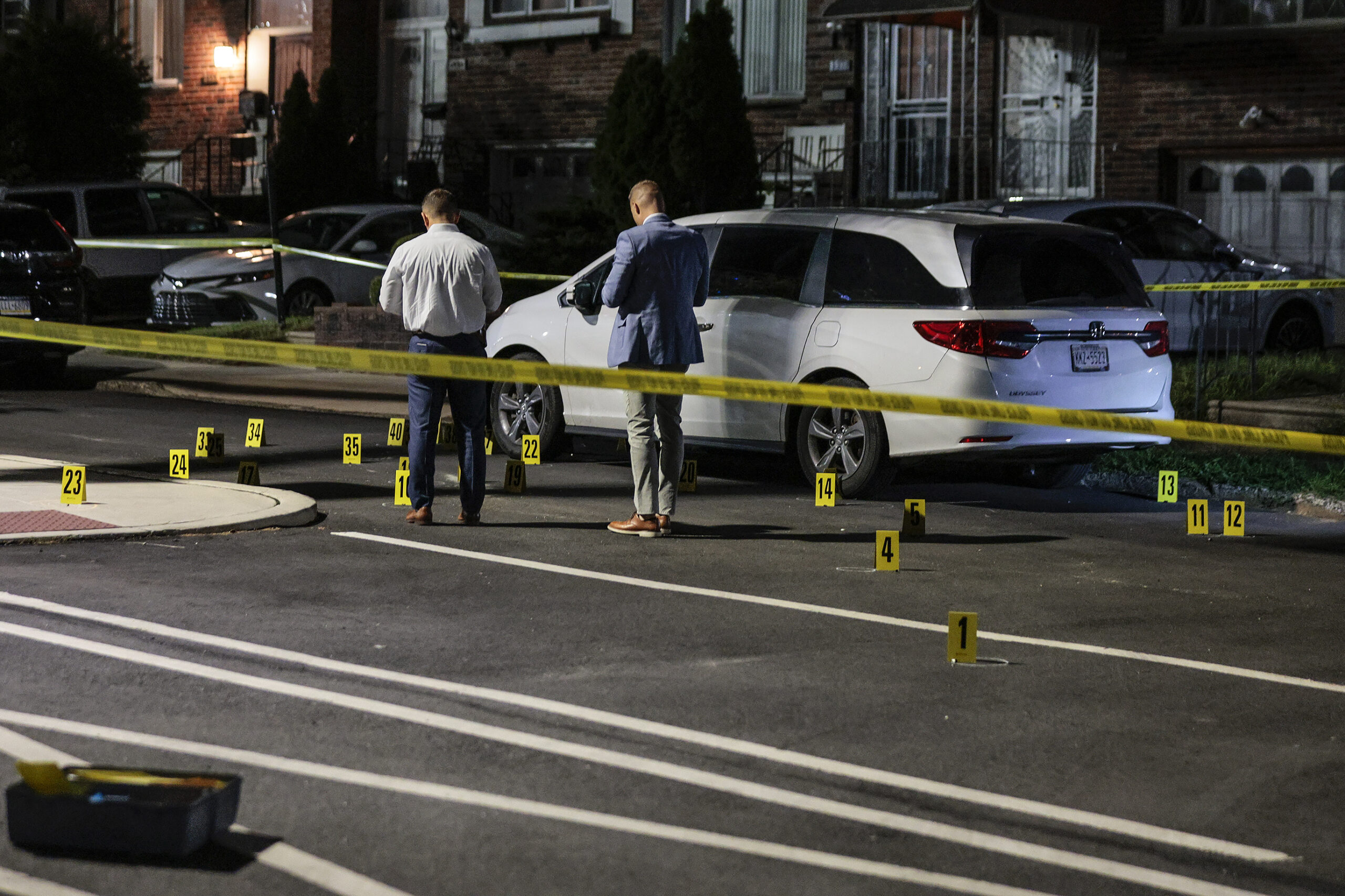
Police investigate a triple shooting in the 1500 block of N. 13th street, where an 8-year-old girl was grazed in the head by a bullet on Sept. 22, 2022.
YBC members Salahhuddin Carter, aka YFA4our, and Jymir “Lil Mir” Burbage have been charged.
Oct. 7, 2022 — Shots are fired at 3900 Wallace St. No one is struck.
YBC members Carter and Burbage have been charged.
Oct. 29, 2022 — Three people are shot at 3800 Aspen St.
YBC members Burbage and Jerwayne Haywood have been charged.
Nov. 30, 2022 — Shots are fired at 4300 Reno St. No one is struck.
YBC member Burbage has been charged.
In this music video filmed by Marlissa Monay, Tahjae Brooks sings his 2020 song “Hear Me Out.” Brooks, or “Jae100,” was a founder of YBC and the original face and talent of the group.
Dec. 5, 2022 — Tahjae Brooks, aka Jae100, is killed at 4300 Parrish St.
May 30, 2023 — Shots are fired at 5200 Jefferson St. No one is struck.
YBC members Burbage and Brown have been charged.
July 8, 2023 — Sharif King, 34, is killed at 5200 Jefferson St.
YBC members Stephen Weddington, Hall, and Johnson have been charged.
July 27, 2023 — Shots are fired at 100 Manton St. No one is struck.
CCK member Hasaan Stafford, aka “Saany Goon,” is charged. Kydair “Honcho” Strickland, a CCK/7th Street member who was killed in August 2024, was also involved, prosecutors said.
Oct. 5, 2023 — A 20-year-old man is shot at 5200 Jefferson St.
YBC members Weddington and Johnson have been charged.
Oct. 6, 2023 — A 20-year-old man is shot at 600 North Brooklyn St.
Parkside members Muhammad and Paul Beckwith are charged.
Oct. 10, 2023 — Shots are fired at 2100 N 53rd St. No one is struck.
YBC’s Weddington charged, and CCK affiliate Strickland also fired shots, prosecutors said.
Nov. 4, 2023 — Shots are fired at 1300 N 53rd St. No one is struck.
CCK’s Stafford is charged.
Dec. 7, 2023 — Zyir “Booga” Stafford is killed while leaving his work at McDonalds, at 29th and Clearfield Streets.
YBC’s Weddington and Burbage have been charged.
Zyir Stafford, a 22-year-old father of two, was shot and killed in December 2023. In this photo, he had just received his diploma from YES Philly High.
Dec. 11, 2023 — Shots are fired at 1400 S 56th St. No one is struck.
CCK’s Stafford, Stigall, and Nasir “Jefe” Wells — who is serving life in prison for a separate murder — have been charged.
Dec. 15, 2023 — Shots are fired at 2900 Girard Ave. No one is struck.
CCK’s Wells is charged.
Jan. 22, 2024 — Shots are fired at 1000 Arch St. No one is struck.
CCK’s Wells and Stafford are charged.
March 13, 2024 — Shots are fired at 4300 Lancaster Ave. No one is struck.
Parkside’s Muhammad is charged.
May 18, 2024 — Qaadir Cheeks, aka 55Qua, is killed at 5500 Baltimore Ave.
YBC’s Weddington, Burbage, Hamzah Curry, and Hasin “HassPNB” Muse, have been charged with murder. Tatiana Edwards has been charged with criminal conspiracy to murder after officials said she lured Cheeks outside to ultimately be shot.
Dec. 8, 2025 — A 24-year-old man is shot multiple times at 4800 Folsom St.
Hasaan Taylor, aka YBC Waters, who was recently released from federal custody, was arrested Wednesday and has been charged in the case outside of the grand jury indictment.
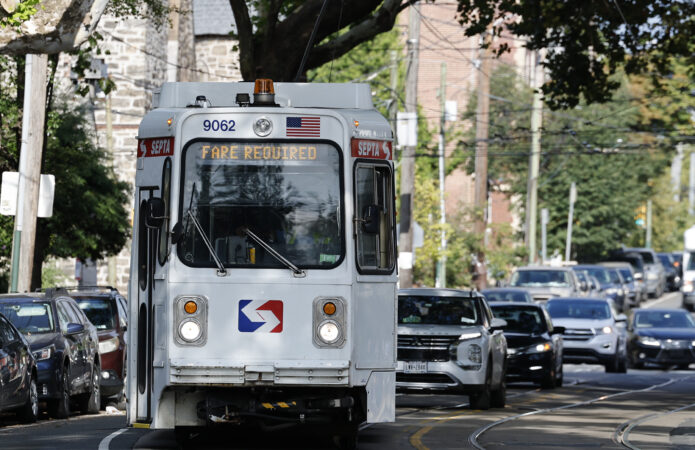
Beginning Monday, people who illegally park in SEPTA trolley lanes and stops could be caught in the act by automated enforcement cameras, the Philadelphia Parking Authority announced Thursday.
Plans call for installing AI-camera systems on 30 trolleys across the six lines in the city to identify and ticket the owners of vehicles obstructing the streetcars or making it hard for passengers to board by blocking stops.
Violations will carry a $51 fine as of April 1. Before then, warnings will be mailed instead of tickets.
Parking violations are the enemies of surface transit, slowing buses and trolleys, making them less reliable and putting riders in danger.
SEPTA, PPA, and the Philadelphia Office of Transportation and Infrastructure Systems are collaborating on the effort. It uses camera systems made installed and maintained by Hayden AI, a San Francisco-based tech company.
“A single illegally parked vehicle can disrupt service for thousands of riders and create unsafe boarding conditions that force passengers into moving traffic,” PPA executive director Rich Lazer said in a statement.
“This is more than a minor inconvenience,” he said.
Legislation sponsored by Councilmember Mark Squilla and enacted in 2023 authorized using cameras mounted on buses and trolleys to enforce no-parking rules in Philadelphia.
“One of the most annoying things about this city is people stopping their cars wherever they want to stop them, in bus lanes, double parking. It just screws everything up,” then-Mayor Jim Kenney said at a news conference.
According to a 2019 study SEPTA commissioned from Econsult Solutions, Center City congestion causes 1.7 million hours of passenger delays per year, adding $15.4 million to yearly operating costs.
And then there is the almost incalculable cost to people who depend on buses and trolleys.
“In a city where 42% of Black residents and 50% of impoverished households do not own a car, efficient public transit is paramount to creating a strong transportation network that better provides economic opportunity for all,” said Christopher Puchalsky, director of policy and strategic initiatives for OTIS.
In some situations, SEPTA bus operators can steer around parked cars. Trolleys, running on fixed rails, don’t have any real flexibility when they are boxed out of their lanes.
SEPTA officials say bus speeds have improved on routes using the cameras. An average of about 14,746 violations are issued each month, according to PPA.
The cameras use artificial intelligence to determine if a car is stopped or parked to obstruct transit lanes and stops. Then, the systems transmit the vehicle’s license plate number and precise location to the Philadelphia Parking Authority using cloud technology.
“Keeping trolley zones clear isn’t just about enforcing parking rules — it’s about keeping Philadelphia moving,” said Marty Beard, CEO of Hayden AI. He added that Philadelphia will be the first city to deploy the cameras on trolleys.
But six years later, some sprawling campuses in suburbs like Horsham, Plymouth Meeting, and Wayne have soaring vacancies — andthere are only a couple suburban conversions underway.
Developers agree that the primary challenge is the buildings themselves, which have more difficult floor plans for residential development than their urban counterparts, making demolition easier than conversion in many cases.
“Transforming an office building tucked inside a suburban office park is a completely different equation than converting a building on Walnut Street steps from Rittenhouse Square,” said Sarah Maginnis, executive director of the Philadelphia chapter of the Commercial Real Estate Development Association. “Location, context, and building design all matter a lot.”
The lack of suburban office redevelopment is partly due to the fact that many of the highest-vacancy buildings are in remote, less desirable corners of the region. The patchwork quilt of hyperlocal zoning regulations across dozens of municipalities is a challenge, too, as builders have to negotiate with officials on almost every project.
“A lot of townships are fighting residential development because it comes with burdens on the school systems. Office buildings don’t do that,” said Glenn Blumenfeld, principal with Tactix Real Estate Advisors. “Zoning is more liberal in the cities [which is why residential conversion] has not come to the suburbs.”
Architectural challenges of conversion
Most suburban office buildings date to an era when office and residential structures began to look very different from each other.
When office work began to move into undeveloped land surrounding cities in the mid-20th century, developers generally built out instead of up, taking advantage of the abundant space. Almost everyone commuted by car, so vast parking lots were required.
Suburban office buildings often have a lot of dark interior space. The windows that do exist mostly cannot be opened because of ubiquitous air-conditioning. The parking lots that wreath the buildings make for unsightly and dull vistas.
In large rectangular glass buildings, residential conversion would entail what longtime suburban developer Eli Kahn calls “bowling-alley-shaped apartments … that just don’t work.”
“In the city, a 30-story office tower doesn’t look a whole lot different from an apartment building,” said Kahn, president of E. Kahn Development Corp.
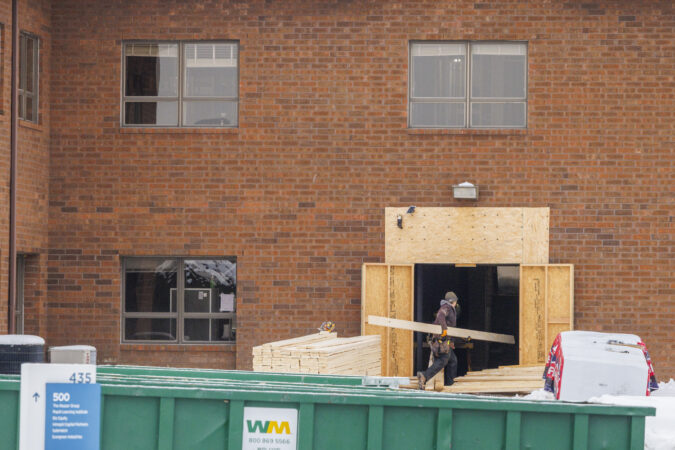
One of the eight two-story buildings at 435 Devon Park Dr. that have been used as offices and are being turned into apartments.
An exceptional suburban conversion
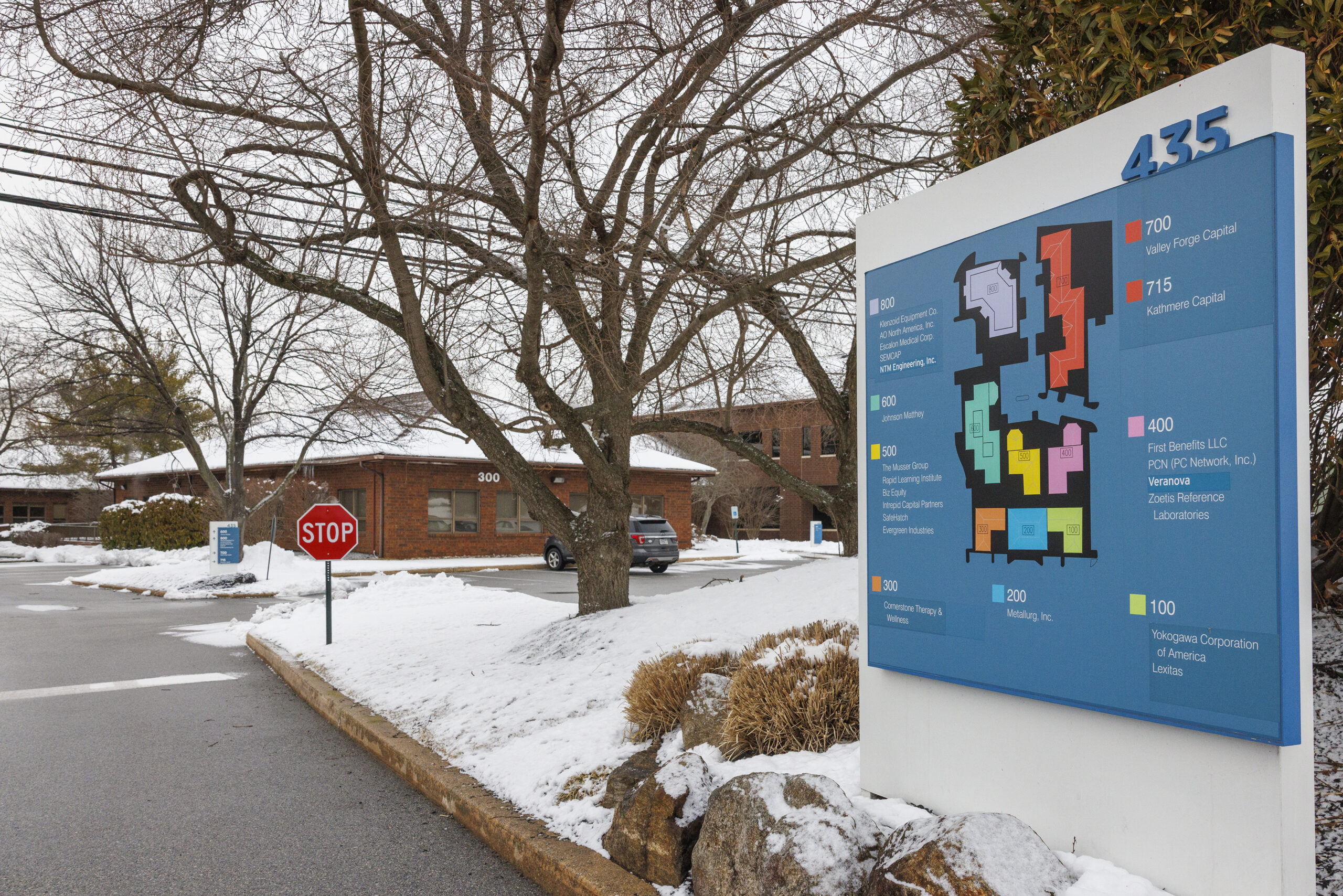
The redevelopment of an eight-building office complex at 435 Devon Park Dr. in Chester County’s Tredyffrin Township is one of the only suburban office-to-residential conversions underway right now.
Notably, none of its former office structures are big glass rectangles.
“This just happened to be perfect for conversion,” said Mark Thomson, founder of Love Communities, which is developing the project in partnership with E. Kahn Development Corp. and Triple Crown Corp.
“It’s going to be the largest garden-style suburban conversion in the whole Northeast, maybe even a bigger area than that,” Thomson said.
Kahn also is part of the team behind the conversion of 435 Devon Dr., and he developed the complex when it was built in the 1980s.
This office park broke from the standard big glass box model of suburban offices and instead offered two-story, L-shaped buildings with brick facades and windowsthat open.
That makes conversion cheaper, too. To make those big box buildings livable, the glass facade would need to be torn off and windows installed that actually open.
“The most expensive part of construction is the windows,” Thomson said. “If we had to do that, it would probably make this not economically feasible.”
The project is also able to move forward because it accords with the goals of local political leadership, who are wary of family-size apartments.
The 162-unit office-to-residential project will be largely composed of studio and one-bedroom apartments in an attempt to appease concerns about strains on the school district and to produce unsubsidized affordable housing in this wealthy township.
Zoning rules everything
In many suburbs, building apartments, townhouses, and other more modestly scaled housing is often not allowed by zoning laws. Office parks are usually zoned to exclude residential development.
That’s a sharp contrast with Philadelphia, which has few barriers to office-to-residential conversion in Center City, and a citywide10-year property tax abatement is available for building renovations. Wilmington also offers a variety of incentives.
In Tredyffrin, officials were opposed to the idea of either very high density apartments — at almost 10 acres, the site could support hundreds of units — or new single-family homes.
So to make 435 Devon Park Dr. work, the developers knew they couldn’t demolish the buildings and construct new homes.
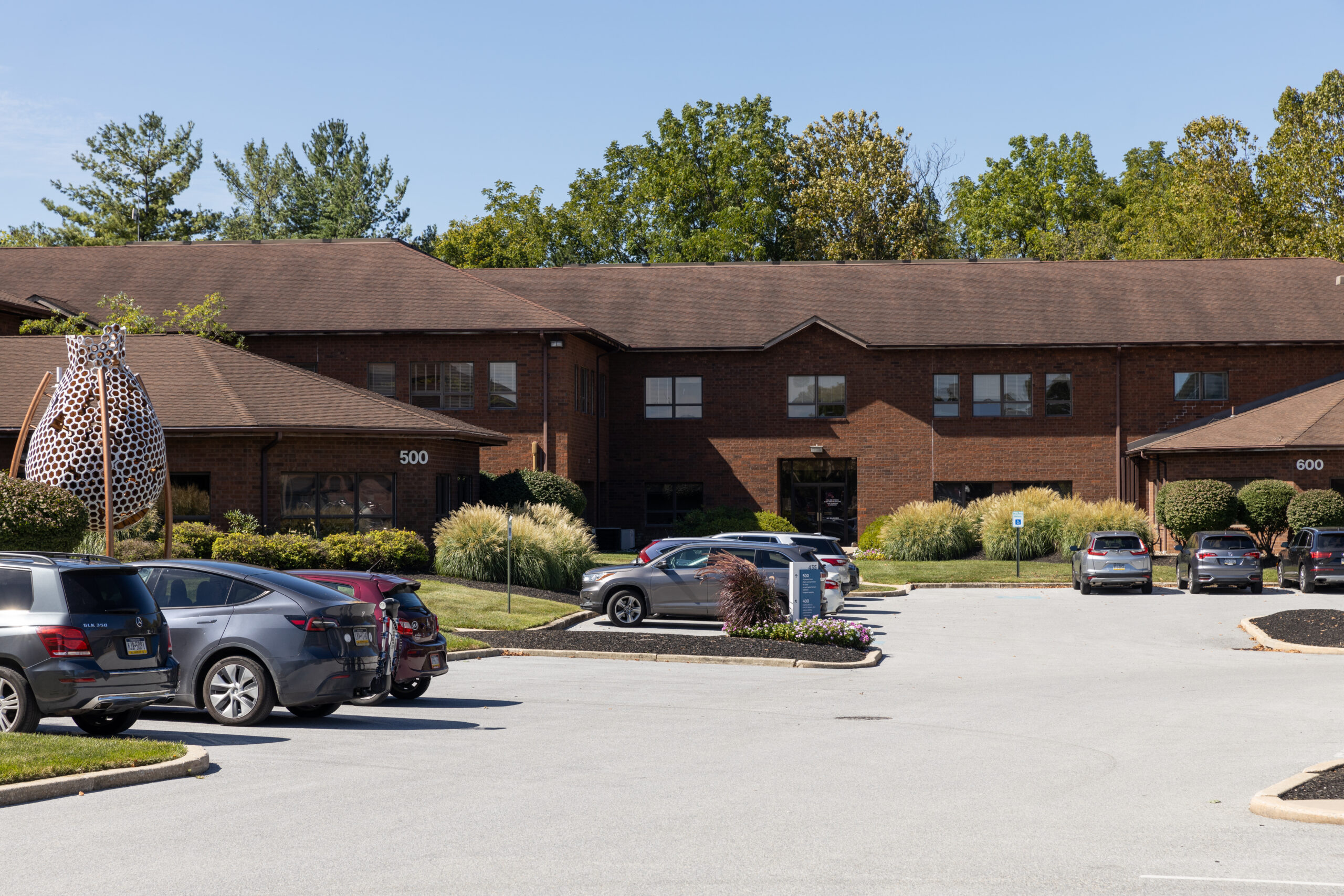
The entrance to 435 Devon Park Dr. with the brick office buildings, which are planned to be converted to residential in the background.
Instead, the developers pitched the conversion not as luxury apartments, but as affordable homes for nurses, teachers, and other middle-income workers in Tredyffrin. They also plan to convert some parking lots into green space for residents.
The units can be priced more affordably because of the relatively small scope of the conversion and because the developers essentially purchased the campus for its land value.
Working in partnership with Triple Crown Corp. also helps because the company has in-house contractors and architects.
The paucity of multi-bedroom units lowers rental costs, too, and assuages fears about overburdening schools.
“None of these communities have made it easy like Philadelphia, because they’re all their own fiefdoms,” Kahn said. “But if you make the right argument and you show them how it’ll benefit them financially, they generally come around.”
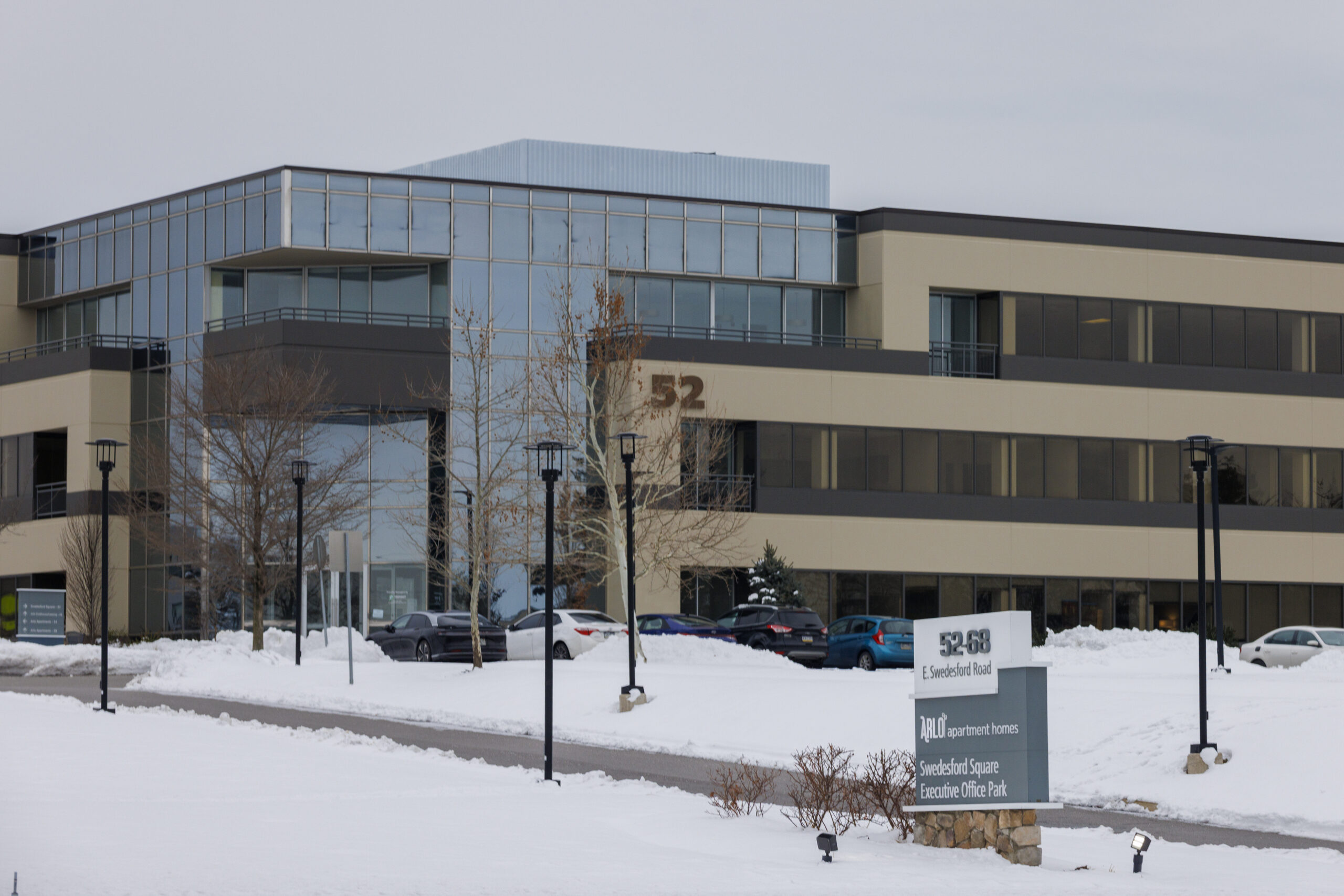
The East Whiteland office building at 52 Swedesford Rd., which is slated by TriPoint Properties for demolition and replacement with apartments.
The future of (some) suburban offices
There are few other conversion projectsunderway in Philadelphia’s suburbs.
Keystone Property Group has a more traditional office-to-apartment tower in the works at the Plymouth Meeting Mall. The Parkview Tower next to the Valley Forge casino was consideredfor conversion last year. The Buccini Pollin Group is weighing a conversion project at BNY Mellon’s old headquarters in Bellevue State Park, north of Wilmington, and is looking at opportunities in the Pennsylvania suburbs.
But it is more common for developers to consider demolishing old office buildings to make way for something new.
In Chester County’s East Whiteland Township, which contains the Great Valley Corporate Center, office-to-residential conversion proposals have met a chilly reception.
“The proposals to rezone large vacant office buildings for direct conversion to apartments were really viewed negatively,” said Scott Lambert, chairman of the East Whiteland Township Board of Supervisors. The plans were seen as “short-term fixes that created long-term challenges.”
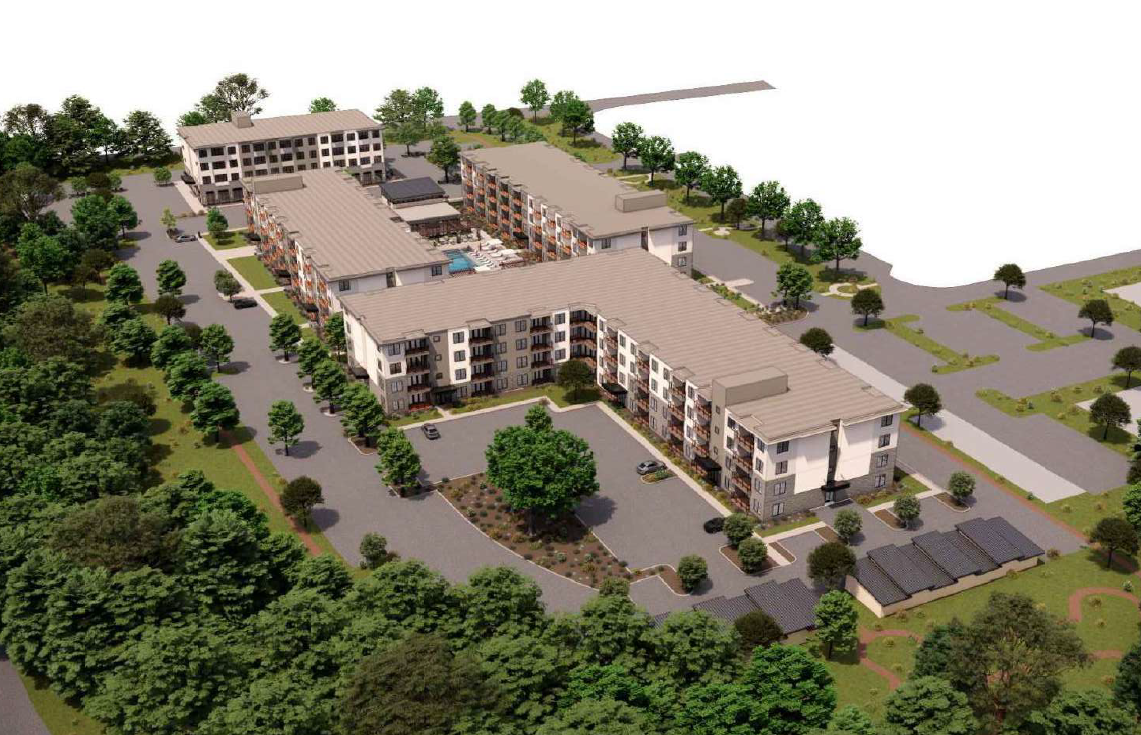
An overhead rendering of the 250-unit apartment project that will replace an old office building at 52 Swedesford Rd.
East Whiteland’s government looked more kindly on Tripoint Properties’ proposal to demolish a standalone office building at 52 Swedesford Rd. — outside the corporate center — and replace it with 250 apartments.
The vacant office building is surrounded by four-lane roadways, which eased congestion concern. Developers also proposed mostly small apartments, with 30 rented for below market rate, which helped earn support from the township.
“On the school side, they were OK with limiting the units to either one- or two-bedroom apartments,” Lambert said. “We would like to be in a position to limit the number of three-bedroom apartments in the township because of the impact it has on schools.”
But some real estate experts say eventually, municipalities will need to replace the tax revenue lost from dead office buildings.
“The centerpiece of tax bases in commercial areas has been office space,” Kahn said. “If the tax base goes down, and they can’t pay for the schools, who gets the burden? A couple years of 30% property tax increases on your constituents, you’re going to get voted out of office real quick.”
Lyric Jenkins is a strong student, with a report card full of As and Bs.
She approached her high school selection process seriously, finally zeroing in on a school that checked all her boxes. Jenkins chose Parkway Northwest High School for Peace and Social Justice, she said, because it was an academically rigorous magnet school, safe — and not huge.
“I wanted a small community where I could be seen,” said Jenkins, now a 10th grader at Parkway Northwest in East Germantown.
Last month, Jenkins was “shocked” to find her school was being targeted for closure, in part because of the very size that drew her to choose it.
Philadelphia School District officials have proposed closing Parkway Northwest and 19 other schools, colocating six more and modernizing 159 under a sweeping facilities plan. The proposal calls for closing Parkway Northwest in 2027 and making it an honors program inside Martin Luther King, a large comprehensive high school about half a mile away.
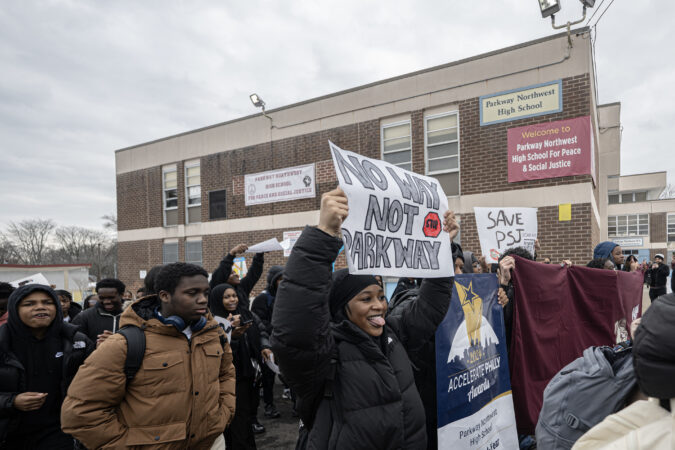
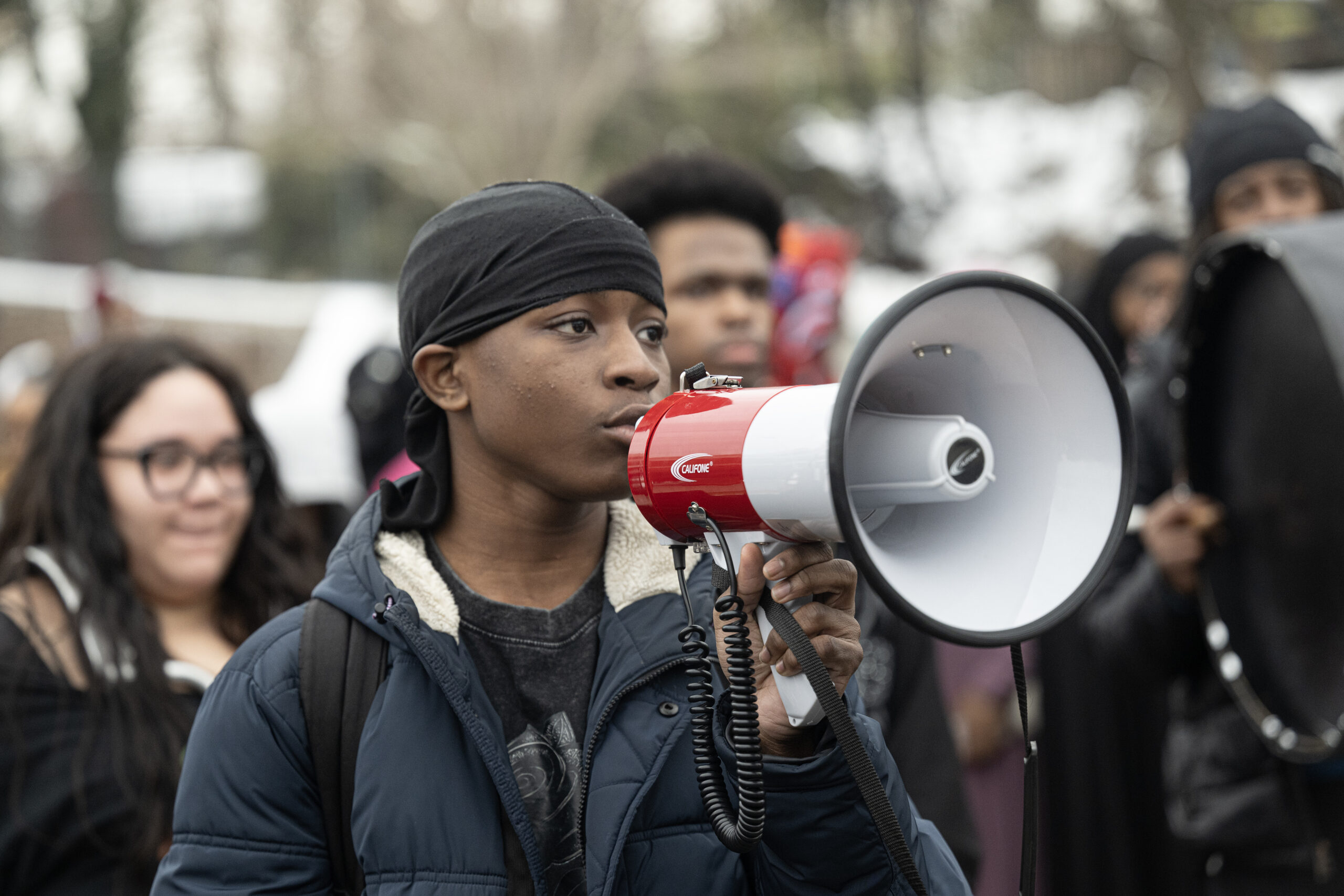
Student Alasia Payne speaks during a rally for peace and social justice on Wednesday outside Parkway Northwest in protest of its potential closure.
That plan has drawn fire from many, including more than 100 Parkway Northwest students, who walked out of school en masse Wednesday to protest — waving signs, singing, and banging drums.
Those fighting to save the school argue that its small size is an asset, and enrollment has been growing, and they have expressed safety concerns about sending children to Martin Luther King.
More students choosing Parkway NW
District leaders have said their plan is not motivated by finances, though there is clearly a desire to shrink the school system’s footprint, with 70,000 empty seats citywide. Some schools are less than a quarter full, and others, mostly in the Northeast, don’t have enough room to accommodate all the students enrolled.
Superintendent Tony B. Watlington Sr. said the plan will provide a stronger and more equitable education for students citywide.
Closing Parkway Northwest is part of a strategy to shut a handful of small district magnet or citywide schools, moving them into reinvigorate neighborhood high schools.
That strategy has been uniformly denounced by staff, students, and parents at Parkway Northwest and the other schools that would be forced to surrender their independence — Parkway West, Motivation, Lankenau, and Robeson. All have been affected by changes to the district’s special admission process, which shifted the district to a strict centralized lottery, stripping away from schools the ability to have any discretion over their incoming classes.
Student Dane McFarland speaks during a rally outside Parkway Northwest High School on Wednesday.
The school has worked diligently to build enrollment back up, said Beth Ziegenfus, Parkway Northwest’s school-based teacher leader and the coordinator of its robust dual enrollment program.
“More students have been choosing Parkway,” Ziegenfus said. “If you think about what our projected enrollment is for next year, we’re looking at an extra 150 kids that we could have here.”
The closure recommendation discounts that growth, Ziegenfus said, and it also threatens students like Jenkins.
“These small schools offer something to students who don’t thrive in large environments,” said Ziegenfus. “There is something to be said about kids knowing every single adult in the school — it contributes to the safety. When every child knows you and you know every child, you’re able to offer support, or redirect behaviors, or offer assistance.”
Ziegenfus spent years teaching at Frankford, another large neighborhood school. She said shecares about comprehensive high schools, sees their value, and believes they need more resources. But those resources shouldn’t come at the expense of Parkway and other small schools.
“We should invest in King, but two things can be true at the same time. We need Parkway,” said Ziegenfus. “They’re really disrupting the children here, and the children at King, and the incoming kids who are going through the school selection process.”
‘They’re going to flee somewhere else’
At recentdistrict meetings about the proposed Parkway Northwest closure, anger bubbled over.
Students, teachers, and community members disputed the district’s statistics around the school in a meeting with district officials, saying its 60% building capacity score was off.
But mostly, they raised alarms about safety.
“My question is, how will I be able to grow my education at a bigger school if I don’t even feel safe there?” said Sanai Williams, a Parkway Northwest 10th grader. “I don’t feel like I’m going to be able to grow my education if I’m watching my back, thinking I’m going to get attacked every which way at King.”
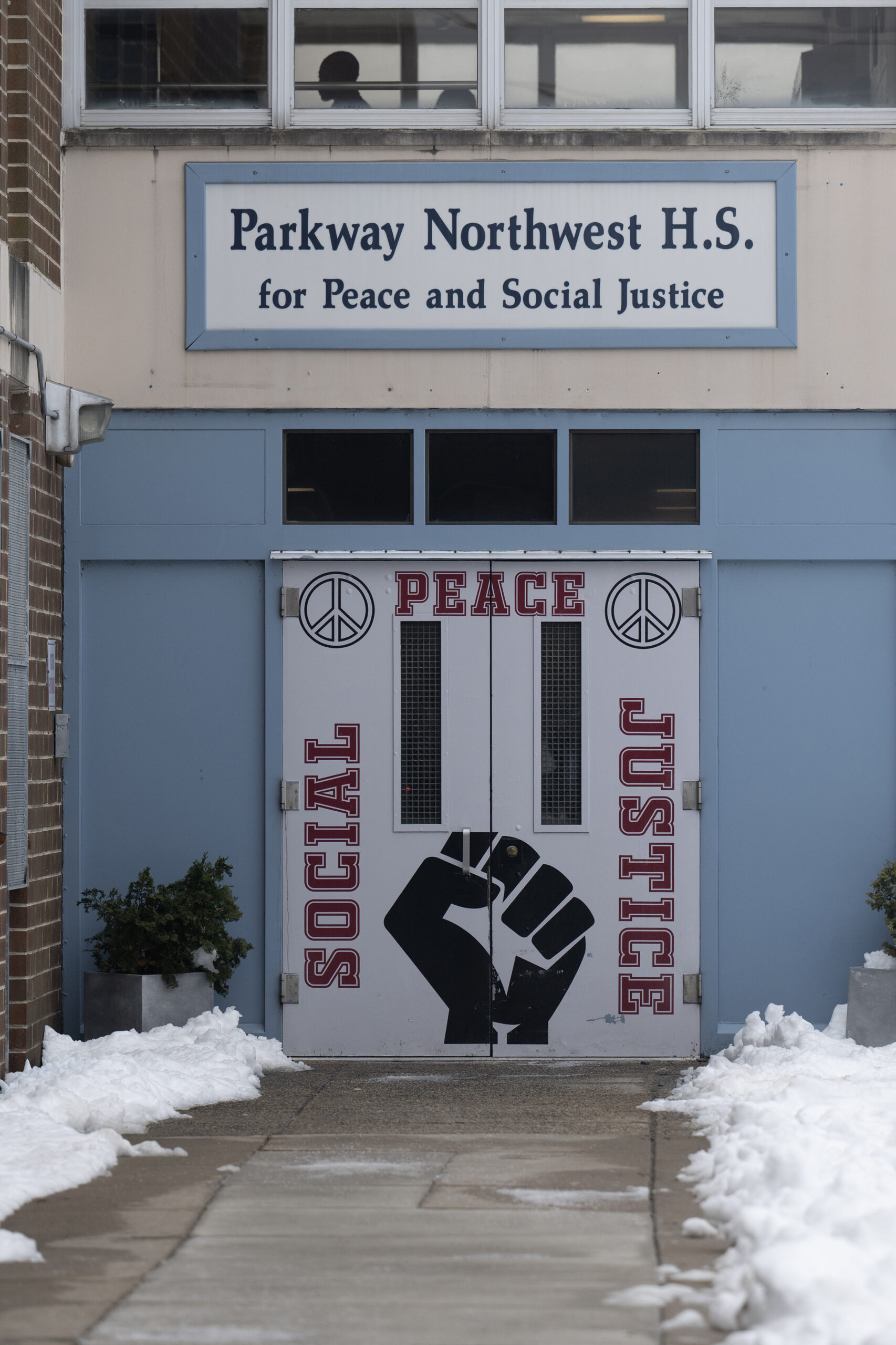
Parkway Northwest High School in Philadelphia.
Rodrigo Fernández, the Parkway Northwest Spanish teacher, said he was frustrated by a perceived lack of real opportunity to shape the plan.
“You are not listening to us,” Fernández said. “You haven’t heard one single person saying, ‘I am excited about this plan.’ If you want to retain our students, you won’t retain them by doing this. They’re going to flee somewhere else. They didn’t choose that setting.”
Over 1,500 community members have signed a Change.org petition calling for the district to reverse the closure recommendation.
A peace and social justice mission
Parkway Northwest, said Elliott Seif — a retired educator and author who’s volunteered at Parkway Northwest for 15 years — is being offered up as “sacrificial lamb to do something at Martin Luther King, which it may not be able to do.”
And Paula Paul, another longtime Parkway Northwest volunteer, said the very nature of the school makes it essential in the city.
Students walked out of Parkway Northwest on Wednesday to protest its closure.
“Does not our city need a school devoted to peace, social justice, and violence prevention, and one where people have formed a community that is functional, a school that works, a school where kids want to be?” Paul asked district officials. “We’ve been struggling to get schools that are functioning, not to lose students, for students to feel safe, to feel connected. Why would we close this school?”
Watlington is expected to present his plan to the school board Thursday, but the board will not vote then. A date for the final decision on closures and other changes has not yet been set.
Pennsylvania voters appear to be all in on Gov. Josh Shapiro’s reelection bid, while some are still warming up to the thought of him being president one day.
Among registered voters, the Democratic incumbent leads his Republicanchallenger, state Treasurer Stacy Garrity, 55-37%, according to a Quinnipiac University poll released Wednesday.
But 43% of the state’s voters do not think he would make a good president and 16% did not offer an opinion, despite his high overall approval.
A strong majority of Democrats and a plurality of independent voters both said he would be a good president, but a strong majority of Republicans disagreed.
The survey, conducted among 836 registered voters in Pennsylvania from Feb. 19 to 23, offers a glimpse of what voters in one of the most politically consequential states think of top elected officials a little more than eight months ahead of the high-stakes 2026 midterms.
Pennsylvania voters also shared their perceptions of U.S. Sen John Fetterman (D., Pa.), who has significant support among Republicans but a low rating with his own party, and President Donald Trump, whose job approval rating is sitting below 50% in a state he won two years ago.
Here’s what else to know from the Quinnipiac poll:
Sen. John Fetterman, D-Pa., left, and Sen. Dave McCormick, R-Pa., right, greet before participating in a debate moderated by Fox News anchor Shannon Bream, not shown, Monday, June 2, 2025, at the Edward M. Kennedy Institute for the United States Senate, Monday, June 2, 2025, in Boston, as livestreamed on Fox Nation. (AP Photo/Steven Senne)
Republicans support John Fetterman. Democrats don’t.
Fetterman has been known to cross the political aisle, and his willingness to embrace Trump and take key votes with Republicans appears to be costing him with voters in his own party.
Sixty-two percent of Democratic Pennsylvania voters disapprove of how Fetterman is handling his job, while only 22% approve.
Those dismal numbers with his own party are worse than Fetterman’s Republican colleague, Sen. Dave McCormick, who has a 54% disapproval rate with Democrats.
After three years in office, Fetterman does much better with Republicans than his own party. Among GOP voters, 73% approve of the Democratic senator, compared with just 18% who disapprove, according to the poll. Among independents in the swing state, 48% approve and 37% disapprove.
The progressive Working Families Party has said it will support and, if needed, recruit a challenger. Fetterman has repeatedly sparred with progressives on a range of issues from unconditional support for Israel’s military actions in Gaza to his stance on immigration enforcement.
He also drew ire from fellow Pennsylvania Democrats for crossing the aisle to support a Republican plan to end last year’s government shutdown without a deal to address expiring healthcare subsidies.
U.S. Rep. Brendan Boyle (D., Philadelphia), a potential primary challenger, has repeatedly called Fetterman “Trump’s favorite Democrat,” including on Tuesday night, when the senator shook the president’s hand at the State of the Union address.
Other names floated as potential contenders include U.S. Rep. Chris Deluzio (D., Beaver) and former U.S. Rep. Conor Lamb, who lost the 2022 primary to Fetterman.
Which party do Pa. voters want to win the midterms?
Forty-nine percentof Pennsylvania registered voters want to see Democrats win control of the U.S. House in November, while 43% want Republicans to maintain their advantage.
November’s midterms are consequential for both parties, especially in the House, where Republicans currently have a slim majority.
But voters in Pennsylvania have soured on Trump, who receives just 40% approval in the poll, compared with 55% disapproval. And he is losing ground on two key issues that propelled him to office: the economy and immigration.
According to the poll, only 28% of Pennsylvania voters think the economy is getting better, while 47% think it is getting worse and 23% think it is staying the same.
Additionally, 56% believe the Trump administration’s immigration enforcement is too harsh in how it treats undocumented immigrants. Meanwhile, 36% think the president is handling immigration correctly and 6% think the administration is being too lenient.
Democrats believe they can capitalize on these issues and defeatincumbents in key swing districts: Republican U.S. Reps. Brian Fitzpatrick in Bucks County, Ryan Mackenzie in Lehigh County, Rob Bresnahan in Lackawanna County, and Scott Perry in York County.
Trump has endorsed every member of the Republican U.S. House delegation in Pennsylvania except Fitzpatrick.
New Jersey lawmakers just got a nearly 70% raise when they took their oaths in January.
It’s their first pay bump in more than two decades. The state’s legislators had been paid a $49,000 salary since 2001, but this year they saw it jump to $82,000 under a law signed in 2024.
Despite the increase, their spending power isn’t any bigger than it was 25 years ago. But legislators giving themselves a raise is a politically fraught move.
Their new salaries fall below the state’s median household income of more than$100,000, though the legislature says most of its members have other employment. Garden State lawmakersare considered part-time, even though they meet throughout the year and some members say the job is a full-time commitment.
“They say it’s part-time but I would argue that people act like it’s full-time, and it really is a full-time job,” said Assemblymember Anthony Angelozzi, a newly elected Democrat who represents parts of Burlington and Atlantic Counties and also works as a Hammonton teacher and leads the Hammonton Education Association, the local teachers union.
“My term is two years, and I am in a swing district … so if I don’t work hard every day to do things in my district and to talk to people, build relationships, visit the 25 towns that I represent, I’m going to lose my seat,” he said.
window.addEventListener(“message”,function(a){if(void 0!==a.data[“datawrapper-height”]){var e=document.querySelectorAll(“iframe”);for(var t in a.data[“datawrapper-height”])for(var r,i=0;r=e[i];i++)if(r.contentWindow===a.source){var d=a.data[“datawrapper-height”][t]+”px”;r.style.height=d}}});
New Jersey legislators are now among the highest-paid in the country, but they’re still paid less than their counterparts in Harrisburg, whose salaries are more than $113,000, including per diems, above Pennsylvania’s median household income of roughly $78,000.
In New Jersey, each chamber was scheduled to meet for less than a dozen full sessions in 2025, but members met more frequently for committee meetings and quorums, in which lawmakers can conduct business if more than half are present.
Most New Jersey state lawmakers have other jobs, too
Along with Angelozzi, all of the other 19 state lawmakers who represent Camden, Burlington, and Gloucester Counties in the state House and Senate also received a paycheck from outside employment, according to 2024 financial disclosures. A handful of them also reported receiving Social Security or pension income.
Assemblymember Balvir Singh, a Burlington County Democrat who began his term last year, said he’s not sure he would have voted for the pay increase given the drastic jump at once, though he would have supported a formula with annual increases over time.
“I think not doing something for so many years and then doing it all of a sudden, definitely is a suspicion among people, and rightfully so,” he said.
Singh works as a public school curriculum and instruction supervisor, which gives him flexibility to plan his work hours around days he has to be in the legislature, though he still uses his time off for legislative matters and constituent services.
window.addEventListener(“message”,function(a){if(void 0!==a.data[“datawrapper-height”]){var e=document.querySelectorAll(“iframe”);for(var t in a.data[“datawrapper-height”])for(var r,i=0;r=e[i];i++)if(r.contentWindow===a.source){var d=a.data[“datawrapper-height”][t]+”px”;r.style.height=d}}});
Does better pay mean Trenton can better represent New Jerseyans?
Proponents of payingelectedofficials higher salaries argue thatitcan lead to a more diverse legislature that’s more representative of New Jerseyans, though the evidence is limited.
Anthony Campisi, a political consultant who works in both New Jersey and Pennsylvania, said higher legislative pay opens up the prospect of running for state office to those who aren’t independently wealthy or hold white-collar jobs, that come with the flexibility to go to Trenton regularly, like lawyers.
“I think it’s a good thing to pay legislators living wages,” he said. “They’re responsible for appropriating billions of dollars for overseeing important legislative work that impacts every aspect of our lives.”
But Peverill Squire, a national expert on legislative pay based at the University of Missouri, said pay increases lead to minimal changes in the makeup of legislatures because of the financial and time commitment that comes with running for office.
“It makes it more attractive for more people to think about, but it’s still a very difficult thing to run for office, and so in the final analysis, it doesn’t have as big an impact as one might have thought it would,” he said.
That being said, higher pay can incentivize legislators to remain in the job. Squire said state lawmakers who step down voluntarily often do so because of the financial impact on their families.
The average state legislator salary across the country hasn’t kept pace with inflation over the past few decades, according to the National Conference of State Legislatures(NCSL). In New Jersey, the old salary of $49,000 in 2001 had the buying power of roughly $90,000 today.
New Hampshire legislators receive the lowest annual salary of $100, which has not been changed since 1889. Meanwhile, New Mexico lawmakers do not receive a salary, but they receive per diems.
In 2025, only six states paid their lawmakers more than New Jersey lawmakers’ new salary of $82,000, while Pennsylvania lawmakers made the third most behind New York and California, according to NCSL data.
New Jersey Gov. Mikie Sherrill holds up a just signed executive order during her inauguration ceremony in Newark, N.J., Tuesday, Jan. 20, 2026. Sherrill will received a higher salary than her predecessor, former Gov. Phil Murphy, under a law taking effect this year.
Should New Jersey become a full-time legislature?
The 2024 law,which was signed by former Gov. Phil Murphy, also increased the salary for the governor and other public employees, including legislative staff, cabinet members, and judges.
Starting this year with Gov. Mikie Sherrill, the state’s top executive got a 20% pay increase from $175,000 to $210,000. For comparison, Pennsylvania Gov. Josh Shapiro’s salary has risen to nearly $254,000 this year.
The Office of Legislative Services estimated in 2024 that the increases altogether would bring a cost increase to the state of at least $9.8 million for 2026 and at least $12.4 million in 2027 and thereafter.
The bill faced opposition from some Republican lawmakers, including member Alex Sauickie, a Republican whose district includes parts of Burlington, Middlesex, Monmouth, and Ocean Counties. Sauickie said the billwas brought forward at a horrible time as New Jersey residents struggled with the high cost of living — an issue that persists as the law takes effect.
“We should fix the state for everybody else before we make adjustments for ourselves,” said Sauickie, whose district includes parts of Burlington, Middlesex, Monmouth, and Ocean Counties.
The GOP lawmaker said he does not believe higher wages lead to better legislators.
“Under the old salary we had questionable legislators, and out of the gate on the new salary I think we still have questions about certain legislators,” he added.
Antoinette Miles, the state director of the progressive Working Families Party, said New Jersey should have a full-time legislature with term limits, attractive pay, and limits on outside income.
“The real problem is that too many legislators are moonlighting as lawyers, lobbyists, or even at a second public job,” she said.
But even with a higher salary, the lack of job security as an elected official makes it a hard sell as an only source of employment, especially in a politically fickle district like Angelozzi’s.
“Nothing in politics is guaranteed … if I lose my job, I would have to be guaranteed to go back to my full-time day job, because, you know, I have bills to pay,” Angelozzi said.
About once a month, Brian Wanamaker drives toa cancer treatment center near his home in Crowley, Texas. He sits on a hospital bed as nurses inject needles into his arm and stomach; one for chemotherapy, the other to boost his immune system.
He can be there anywhere from one to four hours.Wanamaker is asleep throughout, but he doesn’t wake up rested. His stomach burns. His body feels fatigued.
After it’s over, he often goes straight to the gym at Texas WesleyanUniversity, where the North Philadelphia native coaches the NAIA men’s basketball program. Sometimes, he even beats his players to practice.
Since 2022, when Wanamaker was diagnosed with multiple myeloma, he has been balancing his job with the limitations of an incurable cancer. It is not easy. The head coach takes six pills a day to keep the disease in remission for as long as possible.
His doctors advise him not to engage in stressful activities (even if running a college basketball team is antithetical to this). Then, there is the matter of his schedule. Texas Wesleyan plays games mostly on Thursdays and Saturdays.
It doesn’t allow much time to undergo chemotherapy and fully recover. But the coach has an answer for that, too. He receives treatment early on Mondays, so he doesn’t feel sick later in the week.
If the Rams are on the road, he’ll reschedule.
“It’ll come back,” Wanamaker said of multiple myeloma. “But right now, I do maintenance.”
The 36-year-old doesn’t talk like someone who is worried about the future. If anything, his job has helped him stay grounded in the present. Coaching was a lifelong goal of Wanamaker’s, ever since he was a boy playing in the Sonny Hill League.
This is where he and his twin brother, Brad, first saw how basketball could change a life. Their coach, Rasool Hajj, was an alumnus of and former volunteer assistant coach at Roman Catholic High School. He helped the twins connect with the program, and they enrolled in 2003.
Brad and Brian Wanamaker (bottom) were stars at Roman Catholic High School and went on to play professional basketball.
The Wanamaker brothers quickly became standout players. In 2007, they led Roman to a Catholic League championship under coach Dennis Seddon. After that, their careers took divergent paths.
Brad starred in college at Pittsburgh en route to a seven-year stint in Europe, followed by a four-year stretch in the NBA. Brian struggled with injuries in college and bounced around, eventually finding a permanent home as a player at Texas Wesleyan.
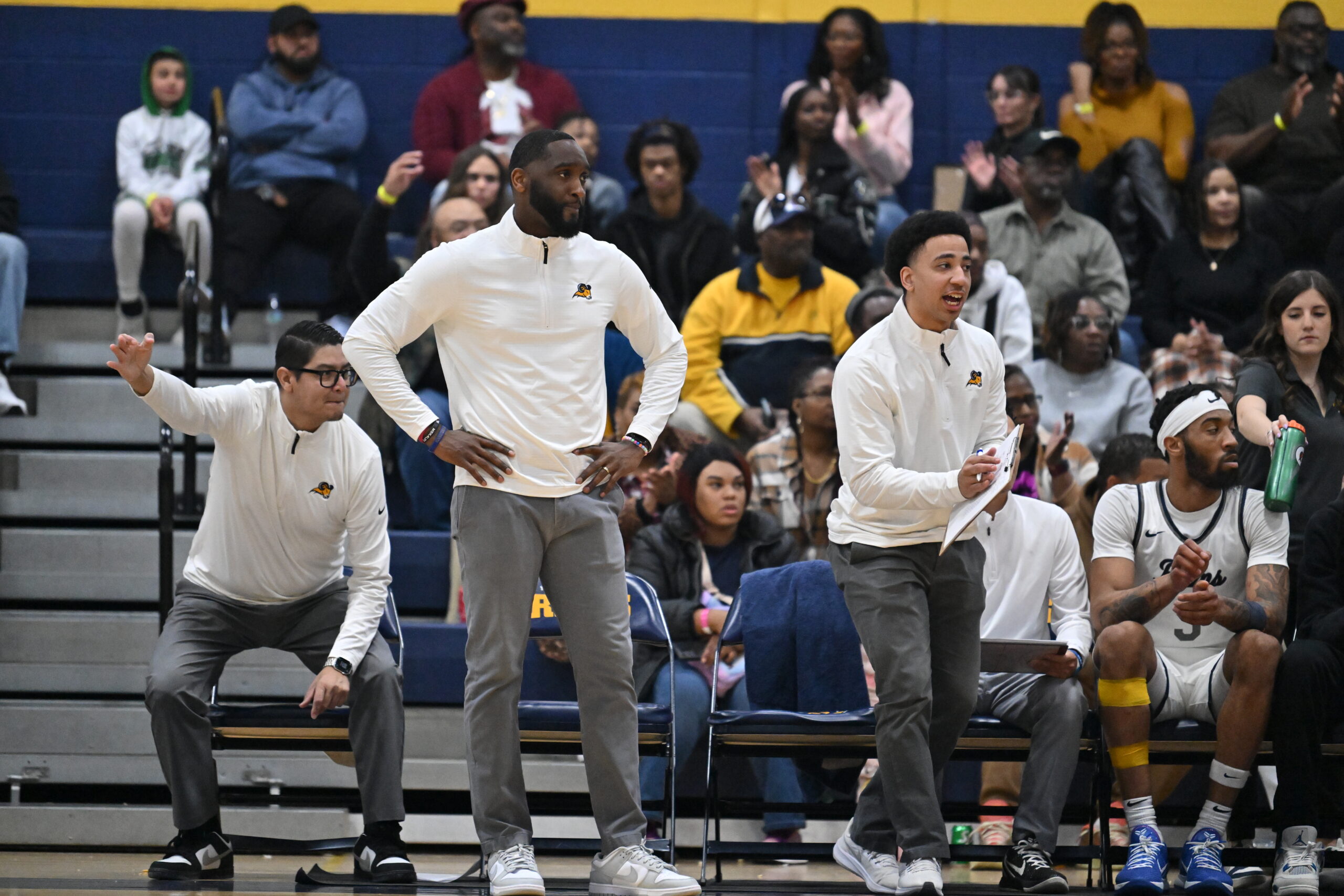
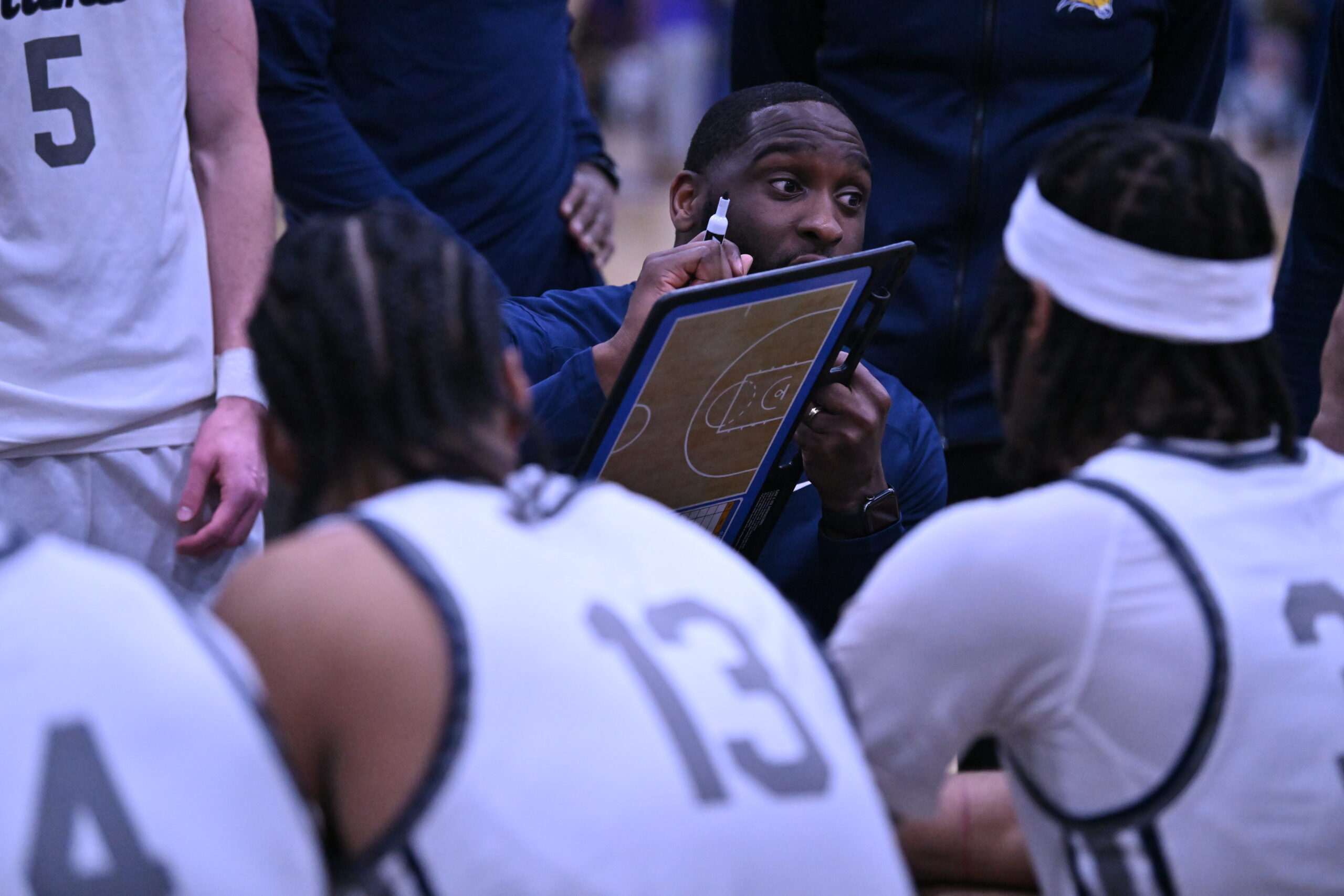
He spent a few years playing overseas but returned to the school as an assistant coach in 2019. The Philadelphia native was named head coach in 2024 and has made an immediate impact, leading the Rams to a 38-20 record since taking over.
He models his approach after Hajj’s. He checks on players’ mental health before berating them for a mistake. He routinely asks how things are going at home and at school.
The team is encouraged to be vulnerable and learn from one another, rather than to react in real time. Wanamaker tells the players to focus on “the person,” because everyone is going through something.
“But I also talk to them about reality,” Wanamaker said. “Yes, everybody wakes up with an excuse they can use, and it’s real. But you can either use it or you can fight through it. You know?”
Brad (left) and Brian (right) Wanamaker with fellow basketball-playing twins, Markieff (top center) and Marcus Morris (kneeling) of Prep Charter in 2006.
A North Philly upbringing
Brian and Brad grew up in a three-story house on 19th Street between Norris and Diamond. They were the second and third of five siblings — Brad is 1 hour, 11 minutes older than Brian — and shared a bedroom on the top level.
This had its shortcomings. The roof had holes, so when it rained, the boys put pots on the floor. Their neighborhood was perilous at times, and from an early age, they became aware of the poverty, gun violence, and drug use around them.
But their childhood was still full of joy. Nineteenth Street was home to a lot of young kids, many of them Brian and Brad’s age. They rode bikes, played tag, and staged impromptu football games outside.
Basketball was their favorite sport. The twins ventured to courts all over the city in search of the fiercest pickup battle: 16th and Berks, 16th and Susquehanna, 25th and Diamond, 22nd and Norris.
They’d shoot hoops before and after school. Local elders would organize basketball tournaments between blocks with trophies for the winners. In seventh grade, a friend, Saleem Elam, asked if they played AAU basketball.
Neither brother knew what that was. But they soon attended a tryout, held their own against more experienced players, and made the team. Before long, they were playing in leagues throughout the area — Gustine Lake, Sonny Hill, Belfield.
The Sonny Hill League was where they met Hajj, who seemed to be part basketball coach, part social worker. He allowed the twins to reimagine the bounds of what a coach could do, a template they’d lean on later in their careers.
The Wanamaker Brothers looked to Rasool Hajj (center) as a coach and mentor.
“He helped a lot of kids, but also a lot of families,” Brian said. “He helped parents get jobs. He would give people money if they needed it for something. He was always there. He was almost like a big brother to us.”
Hajj became a mentor to the twins. At the time, they were attending Gillespie Junior High School, which closed in 2011. Brian and Brad seemed to learn all the wrong lessons, like how to cut class and replace it with extra gym time.
Teachers wouldn’t enforce the rules, so to the twins, there was no reason to follow them.
“There wasn’t a lot of learning,” Brad said. “Not a lot of structure. I’d go to one class — Ms. Brown, because she knew my dad. So, I’m like, ‘I got to make sure I go to her class.’
“I’d go to homeroom and get marked absent for the day. Then I’m in my brother’s class, I’m at his lunch, I’m playing cards [with him].”
Hajj, who recognized the twins’ untapped potential, introduced them to Seddon and the other Roman Catholic coaches. That break altered their lives.
The high school brought a level of discipline that the Wanamakers weren’t used to. And when they arrived as freshmen, it was a tough adjustment.
Brian walked through the doors in September 2003 and looked at the students around him.
“We wanted to leave because we didn’t know it was an all-boys school,” Brian said. “We was like, ‘What? There’s no girls in the school?’ We were so confused.”
Brian Wanamaker and his brother were standout AAU players who had to adjust to Roman Catholic on and off the court.
They racked up demerits for every conceivable offense, from untucked shirts to facial stubble. Both brothers failed a class in their first semester and were ruled ineligible for the first half of the basketball season.
Because they were on academic probation, they had to go to summer school, wearing slacks, long-sleeved collared shirts, and ties in the sweltering heat. The lesson stuck.
“It just was like, ‘We got to be doing the right thing,’” Brad said.
In sophomore year, Brad started on varsity, and Brian on JV (with some varsity appearances mixed in). They fed off each other in practice and in games.
The players had different strengths. Brian, a 6-foot-2 combo guard, was a better defender and three-point shooter. Brad, a 6-4 shooting guard, was a “laid-back killer” who could score from midrange.
Brian showed all of his emotion. He wasn’t above “mugging a player,” in Brad’s telling, and wasn’t afraid of getting a technical foul. He’d scream and yell. Brad, by contrast, was quiet.
But occasionally, he would give his brother some in-game feedback.
“He’d be like, ‘Hey, play your role!’” Brian said. “He’d be like, ‘Pass it to me. Pass me the ball, and you play defense!’”
Added Brad: “He’d go, ‘Shoot the ball!’ And I’d tell him, ‘Calm down! I need you out here!’ Because sometimes he gets too emotional. And I’m like, ‘Before you get a technical foul, I need you to calm down.’”
Brian Wanamaker helped Roman win the Catholic League title.
The brothers racked up accolades, especially in 2006-07, their senior season. Brian was named second-team All-Catholic and All-City, as well as Defensive Player of the Year. Brad was named the Daily News’ Player of the Year, and was first-team All-State, All-City and All-Catholic as well.
The Cahillites parlayed this success into a historic campaign. The twins led Roman Catholic to a 28-3 record and its first Catholic League championship since 2000.
Rival Neumann Goretti, the No. 1 seed from the Catholic League South, came into the final favored. And the game, played at the Palestra, was close until the very end.
Brad had to sit for a stretch midway through the third quarter after picking up his fourth foul. Without its best player, Roman was at a disadvantage. Brian made sure everyone knew their defensive assignments, so the undermanned Cahillites could stay within striking distance.
His brother returned early in the fourth quarter, and spurred his team to a 17-4 run. With just over a minute remaining in the game, Brian hit a layup to widen Roman’s lead to 58-54. It finished with a 59-56 comeback win.
“I think [Brian] pointed to our student section,” said Brad, now the head coach at Roman Catholic. “We still have the picture at my mom and dad’s house. It was in the newspaper. It was a moment.”
Brian Wanamaker coaching at Texas Wesleyan University.
Coaching through chemo
After graduating, Brad played for Pitt when it was one of the top men’s basketball programs in the country. Brian bounced around; first to Central Connecticut State, then to Lon Morris Junior College in Jacksonville, Texas, and, finally, to Texas Wesleyan in 2009.
He struggled with foot injuries almost every year of his college career. This made it difficult to get steady playing time. But at Wesleyan, he found a fit.
A former coach had recommended the school to him, and Wanamaker initially was skeptical. He’d never heard of it. The campus was in Fort Worth, Texas, about 1,500 miles away from home.
“I didn’t know what Texas Wesleyan was,” he said. “My first semester, I played basketball, stayed in my room, and didn’t talk to teammates, coaches, anyone. I was just like, ‘Why am I here?’”
By his second semester, he realized this would be his last opportunity to play in college. So he decided to embrace the program and was happy he did. Wanamaker felt he could be himself in a way he couldn’t at his previous two stops.
During the summer of 2010, Brian visited Brad at Pitt and trained with him and his teammates. He returned to campus in the fall more confident than ever.
That season, he was named a first-team NAIA All-American and Red River Athletic Conference Player of the Year, averaging 19.1 points, 5.7 rebounds, and 5.0 assists.
The combo guard was drafted into what then was the NBA D-League and ended up playing six seasons in Germany and Lithuania.He returned to Texas Wesleyan in 2019 to finish his degree and work as an assistant coach.
Brian Wanamaker returned to Texas Wesleyan as a coach and has endured a trying off-court experience while leading the Rams program.
In late 2021, during his second season coaching, Wanamaker started to feel back pain. At first, he thought it was workout-related. Maybe he’d pulled or strained a muscle.
But the pain worsened, to the point where he had to stop exercising. He couldn’t sleep in a bed anymore because it would hurt his back, so he would lie flat on the floor.
Wanamaker underwent all sorts of testing, but the doctors didn’t find anything. They hypothesized that his pain was stress-related.
“And I would tell them,” he said, “‘I’m not stressed.’”
In September, after a litany of visits, his primary care doctor received MRI results that showed tumors all over Wanamaker’s back. He went to the hospital for further testing, and was told he had multiple myeloma, a cancer formed in plasma cells that is treatable but has no known cure.
He was a statistical anomaly. The disease is predominantly diagnosed in people 65 years or older. According to the American Cancer Society, only 1% of cases are found in those younger than 35.
Wanamaker was 33.
“That was really hard,” he said. “Because, obviously, when you hear cancer, you think death. And then you hear, ‘No cure.’ It was hard for me to process.”
Brian Wanamaker will lead Texas Wesleyan in the Sooner Athletic Conference Tournament starting Wednesday.
The next day, the coach started seven months of chemotherapy. Many on the team assumed he would be out for the rest of the year.
But Wanamaker was back in the gym that week, helping at practice and eventually sitting on the bench during games.
He had little energy and often felt sick. His immune system was at a higher risk than usual. But Wanamaker felt he needed to do it. So every day, he’d drive to Texas Oncology for his treatment, and would head to Texas Wesleyan afterward.
“I was probably more than half-asleep,” he said. “I was going through what I was going through, but I knew as a coach, players are going through stuff, too. It was just being there for them.”
Guard Akili Vining had recently lost his father to cancer. Point guard Matthias Nero had gotten into a severe car accident, which led to the death of his close friend.
Wanamaker was acutely aware of their struggles and those of other players. He decided to pour himself into his team.
“Coach B would probably text me every day,” Nero said. “He would make sure I was in the right headspace, to see if I needed help. He’d pull me aside and just tell me, ‘If you need anything — this isn’t about basketball. This is about the future and your mental health.’”
Wanamaker received a blood transfusion in May 2023. His father and brother visited him in the hospital shortly after. Seeing him hooked up to a cluster of machines was difficult.
“It was like, ‘I can’t lose my brother,’” Brad said. “‘Not the person I came into this world with.’”
Brad Wanamaker (left) has had to monitor his twin brother’s condition from afar.
Eventually, Brian’s chemotherapy schedule was reduced from daily to monthly treatments. Through it all, he rarely missed a practice or a game, which became a source of inspiration for his team.
The players could see their coach had changed. He’d lost hair and weight, and his skin looked dull. Sometimes, he’d arrive with a bandage on his arm to cover a needle mark.
But he was showing up, just like they were.
“If he can fight though chemo,” Vining told a local TV affiliate, “I can fight through practice.”
Brian Wanamaker has won the respect of his players by caring about them as players and people.
‘People are going to say I cared’
In April 2024, Wesleyan’s head coach, Brennen Shingleton, resigned to work for a business in Fort Worth. Wanamaker was named interim coach but also applied for the full-time job.
He wasn’t alone. Athletic director Ricky Dotson said he received “a ton” of applications, from former NBA assistants to former Division I head coaches. He narrowed it down to four finalists, interviewing them throughout the spring.
Despite the high caliber of candidates, Wanamaker still set himself apart. It wasn’t just that he was familiar with the team. It was that the players respected him, and looked to the Philadelphia native as a role model.
Dotson knew the coach’s character. He could see that this would not be a surface-level job for him. By the end of the interviews, he was convinced that Wanamaker was the best choice, even with the uncertainty about his health.
“I just never really doubted that he would be able to do it,” Dotson said. “And he’s moved right on through.”
That June, Wanamaker was officially named head coach. He immediately got to work, targeting bigger, more athletic players in hopes of building a hard-nosed, physical team.
One such player was Khalil Turner, a 6-8 guard from Northeast Philly who had shuffled through four colleges before taking a two-year hiatus. Like Wanamaker, Turner was a Hajj disciple in need of a new home.
The former Sonny Hill coach was confident that Wesleyan would be the right fit.
“Listen, man, I got a place for you,” Hajj told him. “It’s a Philly coach. He’s going to treat you like family. All you’ve got to do is just go out there and put the work in, and everything is going to fall into place.”
The two initially butted heads, usually over inconsequential things. Turner said that one day, in practice, they almost got into a physical fight. But Wanamaker never gave up on him. He didn’t suspend Turner or revoke his scholarship.
Brian Wanamaker connected with another former Philly star, Khalil Turner, who arrived in Fort Worth.
Eventually, the guard began to open up about his personal struggles. He had a family member who was sick at home. He told the coach that he needed a job to make some extra money. Wanamaker found him one at a local laundromat.
Now, Turner says they are “best buds.” Last year, when the incoming freshmen arrived on campus, the senior guard was the first to explain Wanamaker’s predicament.
“We told them, ‘Hey, Coach is dealing with this,’” Turner said. “‘So from time to time, he might be a little moody. But this is why he’s moody. He’s worried about his chemo. So don’t stress him out too much.’
“The vets feel like if Coach is giving his all, with his chemo, we should give it our all every day in practice,” Turner added, “and every day on the court. He’s going above and beyond for us, so we should do the same.”
After consecutive losing seasons, the Rams now look like a different team. They have adopted some of Wanamaker’s characteristics, playing a faster, tougher brand of basketball.
They set hard screens and make hard cuts. They dive on the floor for loose balls and swarm opposing offenses. And they are seeing results.
In 2024-25, Texas Wesleyan went 19-11, earning an NAIA National Tournament berth. This year, it is 19-9.
But Wanamaker isn’t just focused on the numbers.
He knows his players have changed as people, too. They are more emotionally available. They are better able to communicate their feelings. They are less reactionary than when they first arrived.
And to the Philadelphia native, that is more valuable than anything.
“It gives me my purpose,” he said. “And no matter what happens, I know that, when it’s all said and done, people are going to say I cared.”
When a messy land dispute between Gov. Josh Shapiro and his backyard neighbor poured into public view via federal court filings earlier this month, it jolted his sleepy Montgomery County neighborhood.
The picturesque suburban community tucked behind Penn State Abington is usually quiet and boring, current and former neighbors said, just the way they like it. It’s a great place to raise their kids, and where Shapiro’s four children have grown up. Among the biggest points of contention is when one neighbor fails to say hello to another. Many houses in the neighborhood sit a quarter-mile away from the main road, behind winding, tree-lined driveways. Some of the homes have been purchased in recent years for upward of $1 million. In many ways, the neighbors said, it’s the perfect picture of the suburban American dream.
But this month, the neighborhood also became the battleground for dueling lawsuits between Shapiro and his neighbors, Jeremy and SimoneMock, bringing tension to atranquil community.
What’s more: Shapiro’s office alleges the lawsuit against him is a political hit job to hurt him as he runs for reelection, citing the Mock family’s communications with the top Republican in the state Senate and his frequent sparring partner, President Pro Tempore Kim Ward. The family’s attorney in the lawsuit is also a local lawyer known to represent Republican causes, and whose former clients include the political campaigns of President Donald Trump and U.S. Sen. Dave McCormick.
The Mocks, meanwhile, argue in their lawsuit — filed in the U.S. District Court for the Eastern District of Pennsylvania — that Shapiro has used his powerful position as governor to infringe on their constitutional rights and take their land.
The disputed land — a 2,900-square-foot strip between Shapiro and his neighbor’s lawn — had not been an issue between them until security updates were proposed to Shapiro’s home after a Harrisburg man firebombed the state-owned governor’s residence last April while Shapiro and his family slept inside, both the Shapiros and Mocks said in court filings. The man, Cody Balmer, later pleaded guilty to attempted murder and related crimes for the attack, and was sentenced to 25 to 50 years in prison.
Afterward, state police proposed security upgrades to Shapiro’s personal residence and the state-owned governor’s mansion in Harrisburg, suggesting the installation of an eight-foot fence along the perimeter of Shapiro’s personal property, along with tree trimming, a new security system, and other landscaping efforts expected to cost more than $1 million, Spotlight PA reported. The proposed taxpayer-funded improvements to the Montgomery County home — criticized by the Republican-controlled state Senate — came in addition to the more than $32 million in repairs and security upgrades made to the governor’s mansion in Harrisburg, which included the replacement of an existing security fence there.
(function() { var l = function() { new pym.Parent( ‘shapiroyard__graphic’, ‘https://media.inquirer.com/storage/inquirer/ai2html/shapiroyard/index.html’); }; if(typeof(pym) === ‘undefined’) { var h = document.getElementsByTagName(‘head’)[0], s = document.createElement(‘script’); s.type = ‘text/javascript’; s.src = ‘https://pym.nprapps.org/pym.v1.min.js’; s.onload = l; h.appendChild(s); } else { l(); } })();
The Shapiros allege in a countersuit that they believed the disputed piece of lawn was theirs, and that they had maintained it for 22 years. When a land surveyor hired by the state to help with the security upgrade projects found that the Shapiros did not own the disputed part of the land, the Shapiros approached the Mocks in July to purchase or lease it.
Ultimately, the talks fell apart, as the neighbors blamed one another for being unwilling to make a deal.
Any resolution is now likely to be decided in court.
The Mocks in their lawsuit — represented by Delaware County attorney Wally Zimolong, who describes himself on his website as the “‘go-to’ lawyer in Pennsylvania for conservative causes and candidates” — accused Shapiro in his official capacity as governor of an “outrageous abuse of power” by illegally occupying a part of their yard that they pay taxes on. The Shapiro family quickly filed a countersuit in the Montgomery County Court of Common Pleas, arguing they have control of the land through adverse possession, a legal mechanism through which a person can gain ownership of a property they’ve actively used for at least 21 years.
The Mocks have asked a federal judge to find that Shapiro, as governor, violated their constitutional rights; as well as prohibit state officials from trespassing on their property moving forward; and to award them damages. Private attorneys representing Shapiro have asked the Common Pleas Court to find they are the owners of the disputed part of the yard and refund attorney fees.
‘Everybody got along’
Shapiro and his wife, Lori, have lived in the same home in the neighborhood for 22 years, purchasing the four bed, three-and-a-half bath property in June 2003 for $465,000 as the young couple wanted to move back to the Philadelphia suburbs after spending several years working as staffers on Capitol Hill. Shapiro ran for state House the following year and represented the area until 2011, in what was the beginning of his decades-long political career that has helped flip Montgomery County, the state’s third-most populous county, from red to blue.
Several current and former neighbors in the Philadelphia suburb raced to defend the Shapiros as great neighbors, adding they don’t mind the additional state police presence as his star rises as a top Democrat and after the governor and his family were victims of political violence. Others said they’ve had a good relationship with the Mocks so far.
“We had nothing but pleasant experiences with Josh. I have nothing that I can say negative in any way, shape, or form,” said Eileen Simon, who used to live next door to Shapiro until 2020. Simon lived in the neighborhood for 48 years. She hasn’t spoken to the Shapiro family in a few years, but recalled that her grandchildren would often play on the Shapiro’s backyard swing set.
“We were all neighbors together, and everybody got along,” Simon added. “I’m devastated that this has happened.”
Cathy Keim, who moved out of the neighborhood seven years ago and shared a boundary line with the Shapiros for some of the nearly 40 years she lived there, also recalled a neighborhood where everyone got along. Keim said she believes the current dispute is petty, and added thatwhen Shapiro first built his swing set behind her pool fence, he mistakenly put it on her property. When the Keims alerted him to it, Shapiro quickly moved it back onto his own backyard, she said.
“That area, it looked like it should be theirs because of the pool fence,” she said. “I had to tell them, ‘that’s our property,’ and they very quickly moved it.”
Stephanie Berrong, whose backyard also abuts the Shapiro’s property, said in a text message that after the arson attack, the Shapiros asked if they could remove a tree on her property to build the security fence. Berrong and her husband agreed, and said the Shapiros were “respectful of our time and our property” throughout the tree-removal process. She did not comment on the Mocks.
“We just felt it was the right thing to do, considering someone tried to burn down the governor’s mansion with them, and their kids, inside,” Berrong added.
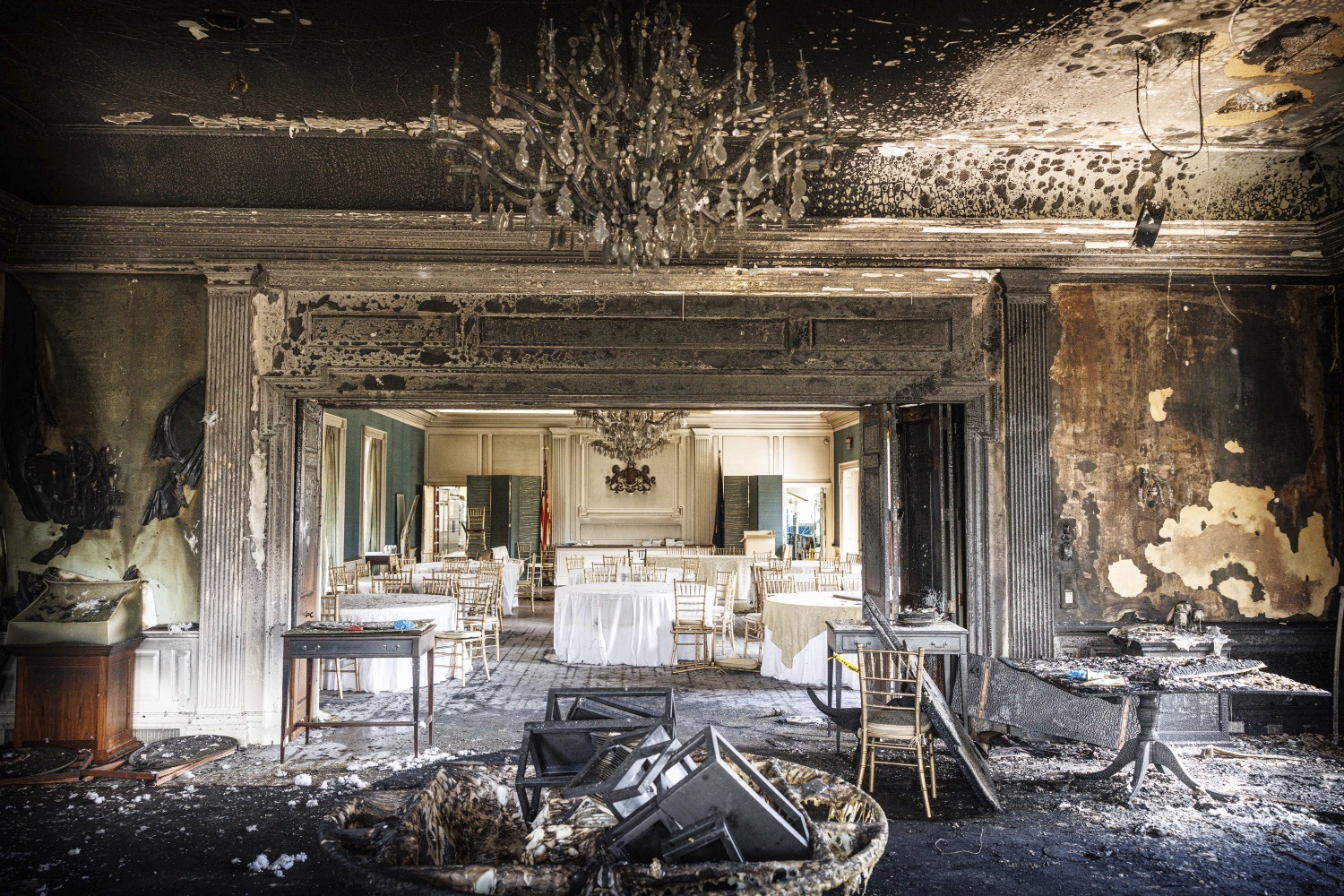
This image provided by Commonwealth Media Services shows damage after a fire at the Pennsylvania governor’s mansion while Democratic Gov. Josh Shapiro and his family slept inside on April 13, 2025, in Harrisburg.
State police never built the security fence that started the land feud, instead opting to surround Shapiro’s home with updated landscaping. That escalated the conflict with the Mocks. In their lawsuit, the Mocks allege that despite ongoing negotiations over the strip of land, the Shapiros began planting arborvitae-type trees and other plants on the Mocks’ property, flying drones over it, and threatening to remove healthy trees. The lawsuit also accuses state police of “chasing away” contractors who came to work in the Mocks’ yard.
The Shapiros, meanwhile, argue in court filings that the Mocks’ alleged harassment is causing them irreparable harm and further threatening their safety. According to a source briefed on the conflict, the Mocks at one point posted a series of signs on the land and a tree that read “Hippity hoppity, stay off my property,” and “This is my property,” among other efforts to antagonize the Shapiros.
John Ginsberg grew up in the home now owned by the Mocks during the 1970s and ‘80s, and said he never thought of their property as stretching into the land now owned by the Shapiro family.
“It just wasn’t an area that was used,” said Ginsberg, who now works as an attorney in Washington. “It wasn’t maintained, and it was brambly.”
Another man, who requested anonymity to speak freely about his neighbors, said he lived next to the Shapiros for more than 21 years, and has for decades shared the upkeep on a portion of the property highlighted in the lawsuit with Shapiro, taking turns clearing and replanting the area.
“I don’t think either of us thought twice about that little strip of land,” he said.
The Shapiros have been great neighbors, he said, and the Mocks have been “good neighbors to us,” describing them as a “nice young family.”
Political allegations
Shapiro has faced ongoing scrutiny from the state Senate for implementing the $1 million in security upgrades to his personal home, in addition to $32 million in repairs and security upgrades to the governor’s mansion following the arson attack. All of the upgrades were implemented without legislative approval due to their urgent nature.
A Senate committee in December took the unprecedented step to subpoena Shapiro over the security upgrades to his personal home, arguing that his administration had not been transparent in previous inquiries about how state taxpayer dollars were being used to upgrade security at Shapiro’s personal home.
Ward, the top official in the state Senate, has been critical of the state spending on security upgrades, saying that taxpayer dollars should not be funding security upgrades to Shapiro’s private residence.
Shapiro’s office is quick to note that Ward has been in contact with the neighbors taking the governor to court — saying that helps show the land dispute lawsuit is politically motivated.
Ward, of Westmoreland County, told ABC27 earlier this month that she had had contact with the Mock family on two occasions. A person close to Ward said that the senator is an acquaintance of the Mocks, but that the family had already obtained legal counsel by the time Ward reached out to them, and that the lawmaker did not encourage Shapiro’s neighbors to take any legal action against him.
Senate President Pro Tempore Kim Ward leaves the House chamber Feb. 3 following Gov. Josh Shapiro annual budget proposal in Harrisburg.
Jeremy Mock has owned a small coffee business in Ward’s legislative district in western Pennsylvania since 2022, according to public business filings. He and his wife moved to the Abington Township neighborhood in 2017, and have had no issues with the Shapiros until the fence feud, according to both parties’ lawsuits.
“This dispute over a small piece of the Shapiros’ backyard has been turned into a shameless political stunt by their neighbors and members of the Republican State Senate, who are now harassing and exploiting the Shapiros,” said Rosie Lapowsky, a spokesperson for Shapiro, without directly naming Ward.
Zimolong, the Mocks’ attorney, said the fact that the couple was willing to work with the Shapiros to find a solution dispels any claim that their suit is politically motivated. The Mocks could have said “no” from the outset when the Shapiros approached them, he argued, but instead participated in negotiations.
“At base, this is a straightforward defense of the property rights of two innocent owners, who were living peacefully next to the Shapiros for over nine years,” Zimolong added in a statement.
“Even today, the Mocks remain open to resolving the dispute,” Zimolong said.
Gov. Josh Shapiro and his wife, Lori Shapiro, depart a talk for his new memoir “Where We Keep the Light” on Jan. 29 in Washington, D.C
Zimolong says he has never discussed the lawsuit with Ward or coordinated with her staff over the issue, “and I have no intention of doing so.”
He saidhe is one of few attorneys in southeastern Pennsylvania who is “not afraid to hold a powerful governor accountable” and does not have work before the state that would present an ethical conflict.
Erica Clayton Wright, a spokesperson for Ward, noted that taxpayer funds have now been used to pay for security upgrades to Shapiro’s personal residence and the property of his neighbors, and argued that it’s “not the first time Gov. Shapiro’s team has been put in the awkward position of pointing fingers to distract from Gov. Shapiro’s questionable methods of operation.”
“It is important not to lose sight of the need to ensure the governor and his family are safe while also safeguarding the processes in place to manage taxpayer funds,” Clayton Wright said.
“Absolutely no one but Gov. Shapiro himself is responsible for trying to take his neighbor’s property via squatter rights, which has resulted in federal and state lawsuits,” she said.
Staff writer Abraham Gutman contributed to this article.