Tag: Weekend Reads

  • These Philly schools are slated for big upgrades as the district works to modernize buildings

    These Philly schools are slated for big upgrades as the district works to modernize buildings

    Nearly $58 million for South Philadelphia High School. Over $27 million for Forrest Elementary in the Northeast. Almost $55 million for Bartram High in Southwest Philadelphia.

    Ahead of a Tuesday City Council hearing on the Philadelphia School District’s proposed facilities master plan, district officials have dangled the carrot that would accompany the stick of 20 school closings.

    The district released Monday morning how much it would spend on modernization projects at schools in each City Council District if Superintendent Tony B. Watlington Sr.’s plan is approved by the school board this winter.

    The totals range from $443 million in the 9th District — which includes parts of Olney, East and West Oak Lane, Mount Airy, and Oxford Circle — to nearly $56 million for the 6th District in lower Northeast Philadelphia, including Mayfair, Bridesburg, and Wissinoming.

    The district’s announcement comes as the plan has already raised hackles among some Council members, and City Council President Kenyatta Johnson has said he’ll hold up the district’s funding “if need be” if concerns are not answered to Council’s satisfaction.

    Tailoring the release to Council districts — including highlighting one major project per district — appears to be an effort to calm opposition ahead of Tuesday’s hearing.

    Details on every school that would get upgraded under Watlington’s plan — 159 in total — have not yet been released.
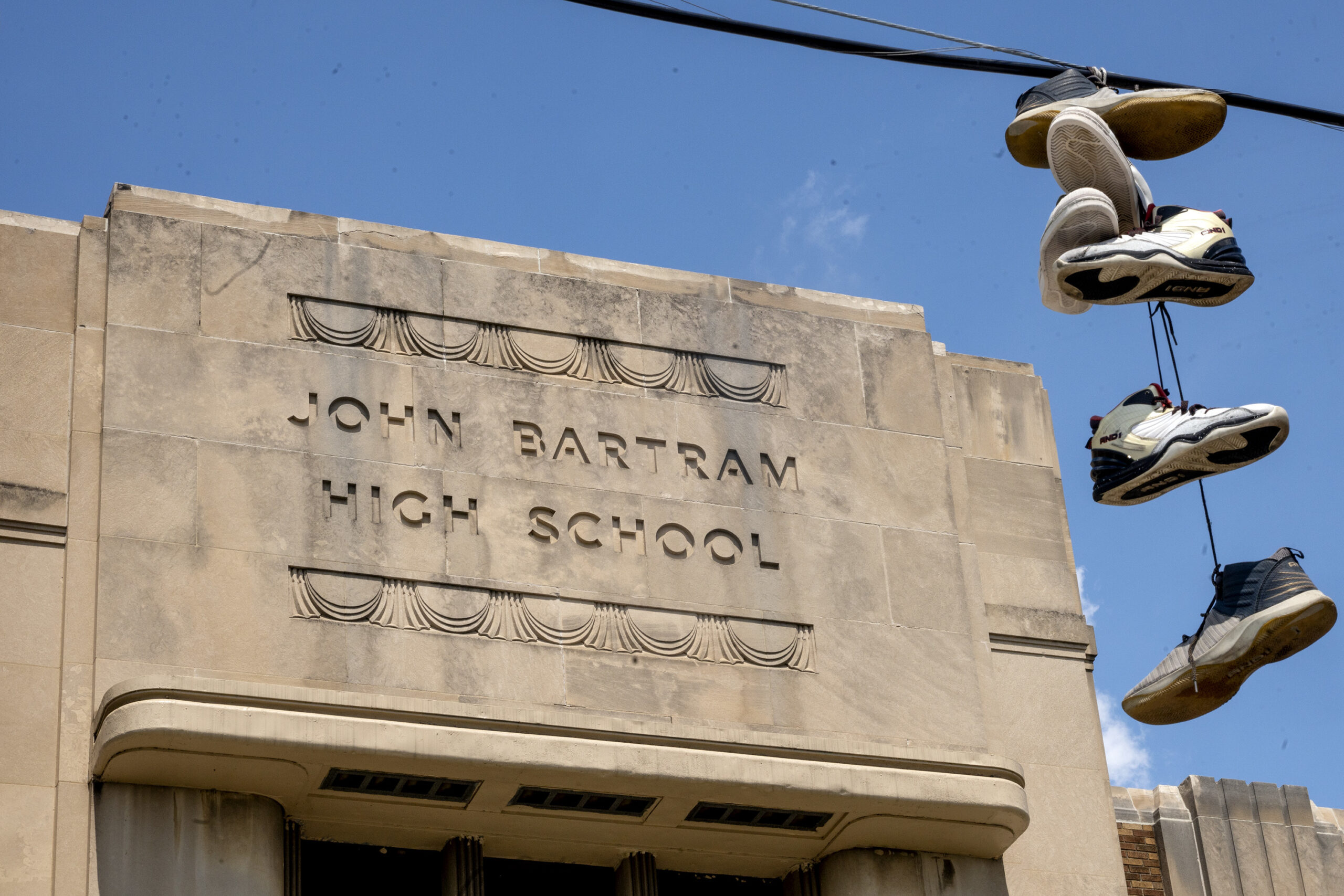
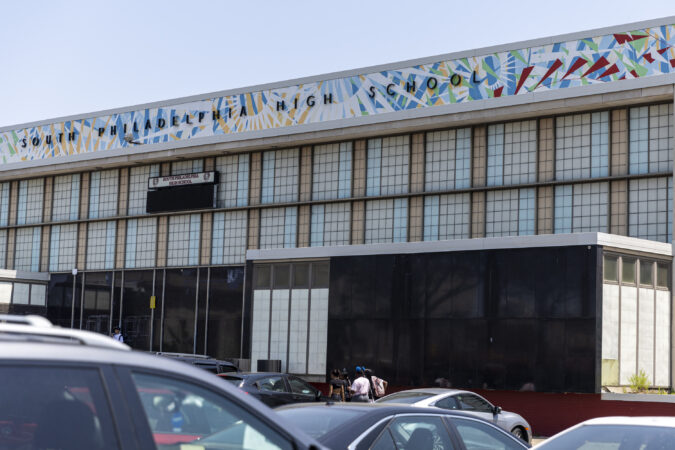
    John Bartram High School at 2401 S. 67th St in Southwest Philadelphia.

    Watlington has stressed that the point of the long-range facilities plan is not closing schools, but solving for issues of equity, improving academic programming, and acknowledging that many buildings are in poor shape, while some are underenrolled and some are overenrolled.

    “This plan is about ensuring that more students in every neighborhood have access to the high-quality academics, programs, and facilities they deserve,” Watlington said in a statement. “While some of these decisions are difficult, they are grounded in deep community engagement and a shared commitment to improving outcomes for all public school children in every ZIP code of Philadelphia.”

    But at community meetings unfolding at schools across the city that are slated for closure, Council members have expressed displeasure about parts of the plan — a preview, perhaps, of Tuesday’s meeting.

    Councilmember Quetcy Lozada, represents the 7th District, including Kensington, Feltonville, Juniata Park, and Frankford. Four schools in her district — Stetson, Conwell, Harding, and Welsh — are on the chopping block.

    “The fact that they are being considered for closure is very concerning to me,” Lozada said at a meeting at Stetson Middle School on Thursday.

    Councilmember Quetcy Lozada is shown in a 2025 file photo.

    Councilmember Cindy Bass, speaking at a Lankenau High meeting, objected to closing schools that are working well. (Three schools in Bass’ 8th District, Fitler Elementary, Wagner middle school, and Parkway Northwest High School, are proposed for closure. Lankenau is in Curtis Jones Jr.’s district but has citywide enrollment.)

    “I do not understand what the logic and the rationale is that we are making these kinds of decisions,” said Bass.

    While Council members will not have a direct say on the proposed school closures or the facilities plan, Council wields significant control over the district’s budget. Funding for the district is included in the annual city budget that Council must approve by the end of June.

    Local revenue and city funding made up about 40% of the district’s budget this year, or nearly $2 billion. Most of that is the district’s share of city property taxes which, unlike other school systems in Pennsylvania, are levied by the city and then distributed to the district.

    (function() {
    var l2 = function() {
    new pym.Parent(‘schools_districts2’,
    ‘https://media.inquirer.com/storage/inquirer/projects/innovation/arcgis_iframe/schools_districts2.html’);
    };
    if (typeof(pym) === ‘undefined’) {
    var h = document.getElementsByTagName(‘head’)[0],
    s = document.createElement(‘script’);
    s.type = ‘text/javascript’;
    s.src = ‘https://pym.nprapps.org/pym.v1.min.js’;
    s.onload = l2;
    h.appendChild(s);
    } else {
    l2();
    }
    })();

    Where will the money go?

    Despite city and schools officials saying in the past that the district has more than $7 billion in unmet facilities needs, Watlington has said the district could complete its plan — including modernizing 159 schools — for $2.8 billion.

    Officials said further details about modernization projects and the facilities plan will be released before the Feb. 26 school board meeting, where Watlington is expected to formally present his proposal to the school board.
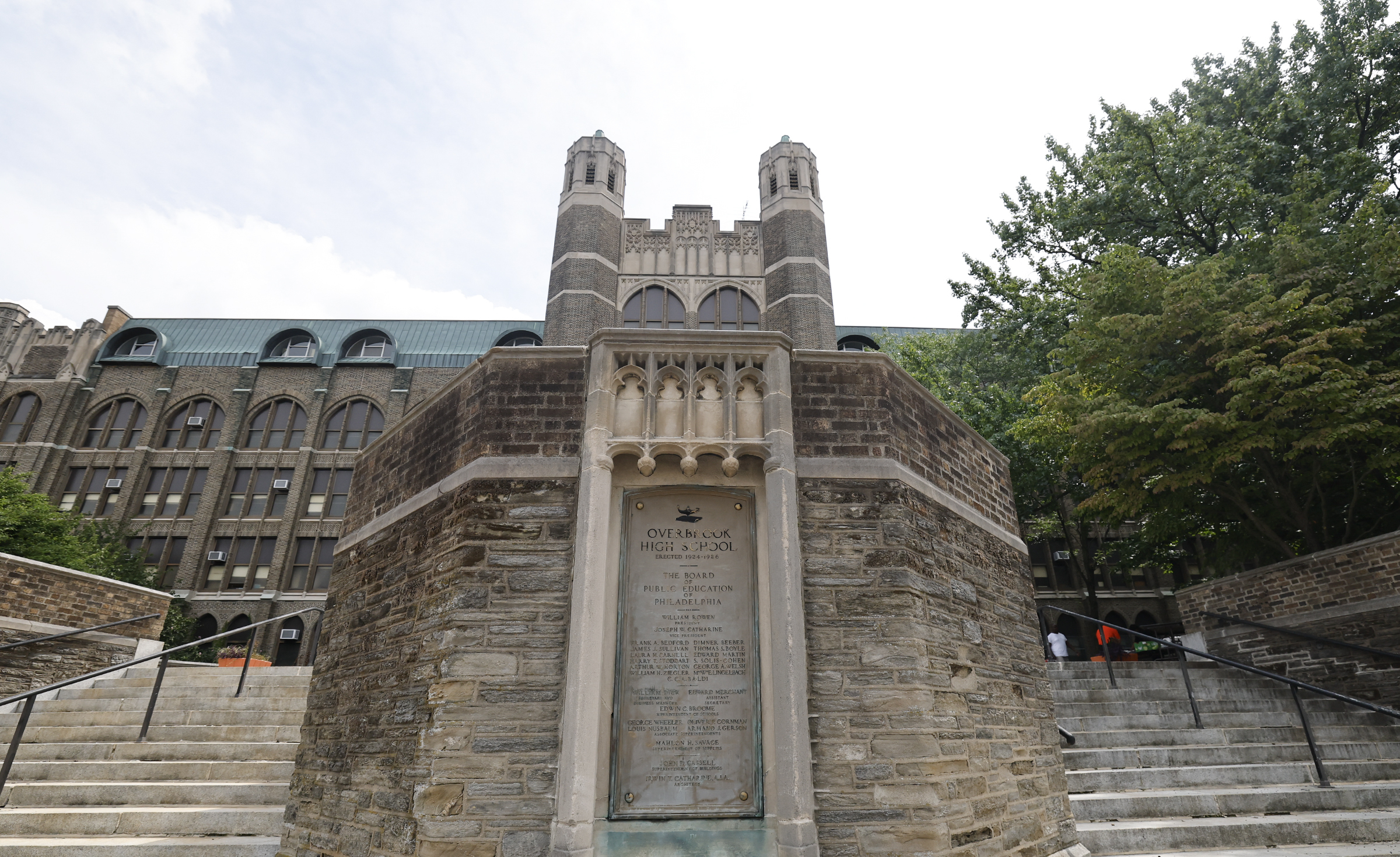
    Overbrook High School, in West Philadelphia, will get major renovations in preparation for The Workshop School, a small, project-based district school, colocating inside the building.

    Here are the total proposed dollar amounts per Council district and the 10 big projects announced Monday:

    • 1st District: $308,049,008. Key project: $57.2 million for South Philadelphia High, turning the school into a career and technical education hub and modernizing electrical, lighting, and security systems.
    • 2nd District: $302,284,081. Key project: $54.6 million for Bartram High, to renovate the school and grounds, career and technical education spaces, restroom and accessibility renovations, new painting, and new athletic fields and facilities (on the site of nearby Tilden Middle School, which is slated to close). Motivation High School would close and become an honors program inside Bartram.
    • 3rd District: $204,947,677. Key project: $19.6 million for the Sulzberger site, which currently houses Middle Years Alternative and is proposed to house Martha Washington Elementary. (It currently houses MYA and Parkway West, which would close.) Improvements would include heating and cooling and electrical systems, classroom modernizations, and the addition of an elevator and a playground.
    • 4th District: $216,819,480. Key project: $50.2 million for Overbrook High School, with updates including new restrooms, accessibility improvements, and refurbished automotive bays. (The Workshop School, another district high school, is colocating inside the building.)
    • 5th District: $290,748,937. Key project: $8.4 million for Franklin Learning Center, with updates including for exterior, auditorium, and restroom renovations, security cameras, accessibility improvements, and new paint.
    • 6th District: $55,769,008. Key project: $27.2 million for Forrest Elementary, including modernizations that will allow the school to grow to a K-8, and eliminate overcrowding at Northeast Community Propel Academy.
    • 7th District: $388,795,327. Key project: $32.3 million at John Marshall Elementary in Frankford to add capacity at the school, plus a gym, elevator, and schoolwide renovations.
    • 8th District: $318,986,215. Key project: $42.9 million at Martin Luther King High in East Germantown for electrical and general building upgrades and accommodations for Building 21, a school that will colocate inside the King building.
    • 9th District: $442,934,244. Key project: $42.2 million at Carnell Elementary for projects including an addition to expand the school’s capacity, restroom renovations, exterior improvements, and stormwater management projects.
    • 10th District: $275,829,539. Key project: at Watson Comly Elementary in the Northeast, an addition to accommodate middle grade students from Loesche and Comly, and building modernizations. District officials did not give the estimated cost of the Comly project.

    What’s next?

    The facilities Council hearing is scheduled for 10 a.m. Tuesday at City Hall. It will also be livestreamed.

    Members of the public also have the opportunity to weigh in on the facilities plan writ large at three community town halls scheduled for this week: Tuesday at Benjamin Franklin High from 4:30 to 6:30 p.m., Friday at Kensington CAPA from 4:30 to 6:30 p.m., and a virtual meeting scheduled for 2 p.m. on Sunday.

    Meetings at each of the schools proposed for closure continue this week, also; the full schedule can be found on the district’s website.

  • After a Philadelphia cancer patient ran out of options, a novel T-cell therapy at Rutgers kept her alive

    After a Philadelphia cancer patient ran out of options, a novel T-cell therapy at Rutgers kept her alive

    Jefferson Health oncologist Jennifer Johnson had exhausted all the standard treatment options for her 49-year-old patient with esophageal cancer, who was likely to die within months.

    Surgery, chemotherapy, radiation, and immunotherapy had kept the Northeast Philadelphia woman alive for six years after her diagnosis, but no longer were enough to stop her cancer from spreading.

    Johnson knew her patient needed something novel. She recalled a presentation several years prior at a conference for head and neck cancers, where a doctor discussed an experimental treatment called T-cell receptor (TCR) therapy.

    This type of cancer immunotherapy works by engineering the immune system to fight cancer, and falls into the same family of treatments as CAR-T, or chimeric antigen receptor (CAR) T cell therapy, an approach pioneered at the University of Pennsylvania that has revolutionized treatment for blood cancers.

    She thought TCR therapy’s clever approach could work against solid tumors, where CAR-T had not been effective.

    “I just remember sitting in the room and watching him present, thinking, I’m gonna use that one day,” the oncologist and cancer researcher recalled.

    As it would happen, the approach was being tested in a phase II clinical trial at Rutgers Cancer Institute against tumors just like her patient’s: metastatic cancers driven by a virus called human papillomavirus 16. One of the most common strains, HPV16 causes roughly half of cervical cancer cases worldwide, as well as cancers of the head and neck area, anus, and genitals.

    Cases that reach the metastatic stage like Johnson’s patient often run out of treatment options. Whether T-cell receptor therapy would work was unknown, but the alternatives were expected to fail.

    “Anything that you might offer them would definitely not be expected to make their cancer go away completely and do it for a long time,” said Christian Hinrichs, the oncologist and scientist heading the trial whose presentation Johnson saw.

    But interim results from the first half of the trial showed improvement in six out of 10 patients, whose tumors at least partially shrank. And two of them had no evidence of cancer after treatment.

    Johnson’s patient, Maria Pascale, was one of the two whose promising early results were presented at a medical conference and highlighted in a research abstract in the Journal for ImmunoTherapy of Cancer in November.

    She arrived at the health system in New Jersey in the summer of 2024 in such poor health that her lungs were starting to collapse.

    The therapy has enabled her to celebrate two birthdays, start martial arts classes, reunite with old friends visiting from Argentina, and see her 23-year-old son get engaged.

    “Imagine the wedding, then later the grandkids, I’m always thinking about [that],” she said.

    What is a T-cell receptor therapy?

    In the immune system, T cells act as frontline defenders against viruses, bacteria, and other threats.

    Sometimes, these cells aren’t great at their jobs.

    In the face of cancer, T cells can become exhausted over time, and fail to recognize invaders or mount attacks.

    The idea behind immunotherapy is to transform these regular immune cells into cancer-fighting super-soldiers.

    The Rutgers approach, an engineered TCR therapy, involves collecting T cells from a patient’s blood and genetically engineering them to better target a cancer cell for attack.

    Afterward, the scientists grow more of the enhanced T cells in the lab and infuse them back into the patient.

    The “prototype” for this style of therapy is CAR-T, a treatment that has saved tens of thousands of lives since the first FDA approval in 2017. Scientists have not yet been able to replicate the therapy’s success in blood cancers in solid cancers, although some early stage trials have shown potential.

    TCR therapy is thought to be more promising against the latter cancer type — which is what’s being treated in the Rutgers trial — due to differences in the way the engineered T cells identify cancer cells.

    CAR-T therapy uses what’s called a chimeric antigen receptor, a protein that recognizes a cell as cancer based on what’s on the outside of the cell.

    It’s like knowing you’re at your friend’s house because of a specific doormat or set of house numbers on the exterior.

    TCR therapy uses what’s called a T-cell receptor, which can recognize cancer cells based on what’s inside the cell.

    It’s like knowing you’re at your friend’s house because you can see your friend inside.

    Sometimes cancer cells have more unique identifiable elements on the outside, but other times they don’t. Imagine if multiple houses had the same doormat.

    “That target would be on other cells that aren’t cancer cells and cause lots of toxicity,” said Carl June, the pioneering cancer scientist at Penn who developed the first FDA-approved CAR-T therapy and was not involved in the Rutgers trial.

    That’s been the problem that’s held back CAR-T’s use in solid tumors.

    The target in the Rutgers trial is a protein called HPV16 E7, found inside the cell. In tumors driven by the virus HPV16, it plays a key role in turning a cell into cancer.

    “That’s like going after its Achilles’ heel,” June said.

    Swarming the cancer

    Pascale first arrived at Thomas Jefferson University Hospital in Center City in 2018 after suffering injuries in a car accident.

    Doctors found a mass in the 43-year-old’s neck that turned out to be cancer.

    Surgeons removed the mass, and she was fine until 2021 when doctors, including Johnson, found the cancer at the top of her esophagus.

    They treated her with a combination of chemotherapy and radiation, which worked until March of 2022, when the cancer started appearing in Pascale’s lungs.

    “All bets were off,” Johnson said.

    Doctors gave Pascale chemotherapy and immunotherapy over the next couple of years, but in the spring of 2024, she developed an allergy to one of her chemotherapy drugs.

    Around the same time, the cancer spread to the skin on Pascale’s back.

    That’s when Johnson transferred her care to Hinrichs’ team at Rutgers.

    Pascale started preparations for the treatment in July 2024, spending a couple weeks in the hospital.

    The Rutgers team took T cells from her blood, gave her chemotherapy to knock her immune system down, and then transfused the engineered cells back into her body.

    Within 48 hours, Pascale started feeling horrible.

    “It was painful. It was my whole body, like I had pneumonia,” she said.

    She had trouble breathing as the cells fought the cancer in her lungs. Hinrichs described it as “the T cells swarming the cancer,” leading to an inflammatory reaction.

    The same thing occurred on her back. When Pascale’s sister came over, she saw one of the tumors in her skin was suddenly the size of a lemon.

    Another one appeared red and felt like someone was burning a cigarette on her back.

    The pain continued for three days, and then she felt well enough to go home. Pascale and her sister could see and feel the nodules on her back get smaller, until eventually they were gone.

    Roughly five months later, Pascale’s scans showed no evidence of cancer. As of last month, a year and a half after she received the treatment, that was still true.

    “What’s three days of pain compared with the opportunity that I have to live a lot of beautiful things with my family and friends?” Pascale said.

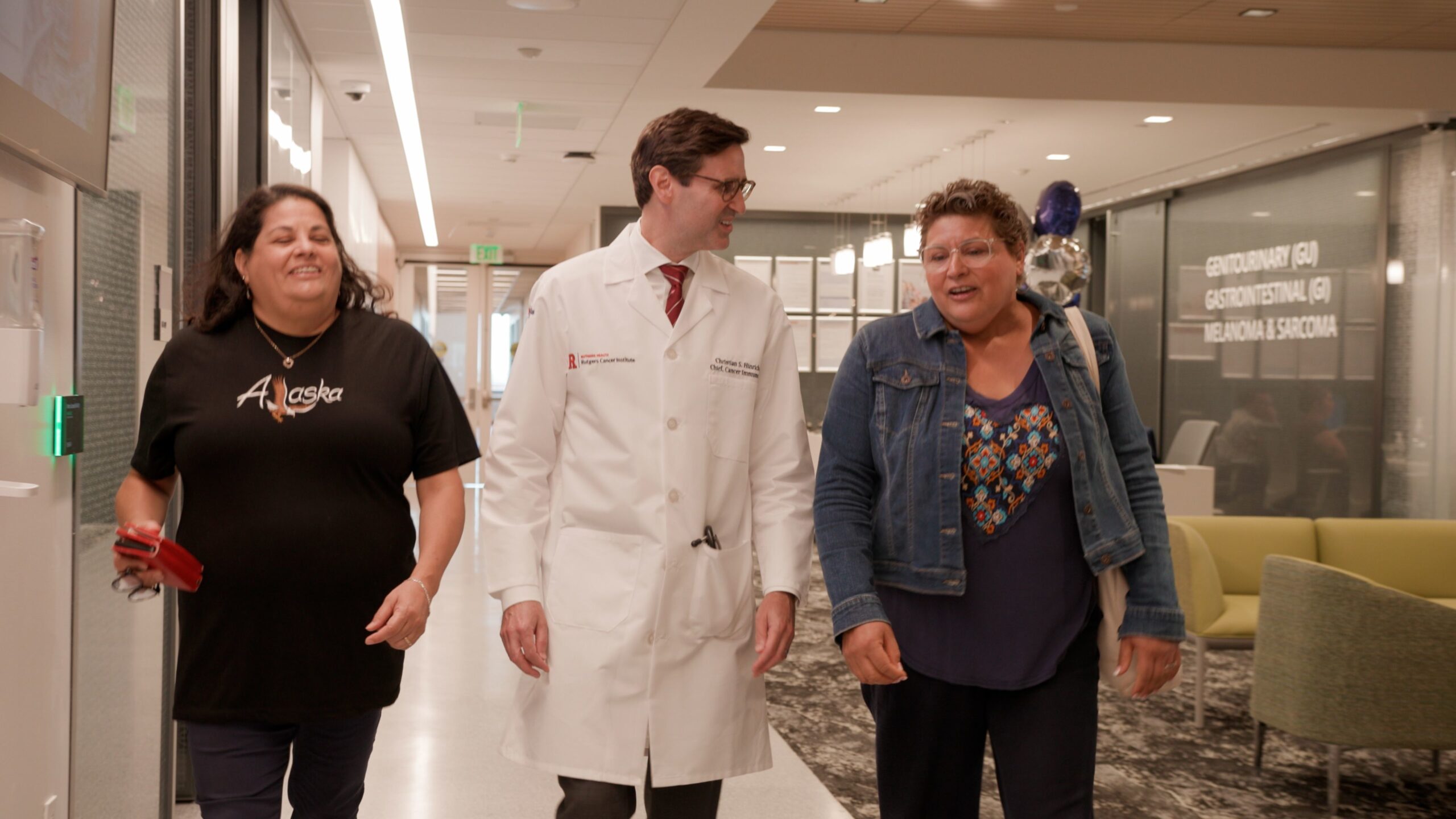
    Maria Pascale walks with her sister Maria Durante and her doctor Christian Hinrichs at Rutgers.

    The future of the treatment

    Hinrichs said his team is working to figure out why two of the patients, including Pascale and a patient with anal cancer, responded better to the treatment.

    He cautioned that it’s too early to draw sweeping conclusions since the sample size is small. (Researchers will seek to recruit another 10 patients for the ongoing trial.)

    The patients who had complete responses will need follow-up scans every few months to make sure their cancers have not returned.

    It will still take years to finish evaluating safety and efficacy. Treatments tested in clinical trials often do not advance to become standard practice.

    June, the Penn scientist, called the trial’s early results promising and noted that there weren’t any major safety problems reported.

    Adverse effects seen in the trial were mainly those caused by the chemotherapy.

    However, the drawback of using TCR therapy is that patients need a certain genetic background for it to work, June said. This is similar to how not every organ donor would be a good match for a recipient.

    The genetic profile chosen for the Rutgers therapy is the most common in America. However, it is less common in Black and Asian people compared to white people.

    Scientists hope it could one day be possible to manufacture the therapy with a warehouse approach, where TCR therapies that work across genetic backgrounds could be mixed and matched.

    “It’s a practical issue that the drug companies face,” June said.

    CAR-T, in comparison, can be used more broadly across different genetic backgrounds.

    What matters most, since the treatment is expensive to make, is that the responses hold up over time, June said.

    (The TCR therapy’s cost has not yet been set, Hinrichs said, since it is currently manufactured individually for each patient.)

    “If they’re long lasting, then it’s really going to be a huge advance because nothing else works in the patients he’s treated,” June said.

    At Jefferson, Johnson is cautiously optimistic about the treatment that has kept her patient alive.

    If the therapy makes it through the rest of the trial process and proves effective, she hopes it could become “another thing in our armamentarium against this type of cancer.” (A type that doctors would hope to see less of since the introduction of the HPV vaccine in 2006.)

    “I can’t tell you how wonderful it is to have a patient responding and living well when you saw things going the wrong way,” Johnson said.

    Editor’s note: This story has been updated to clarify where the research has been presented and a reference to the prevalence of the genetic profile used in TCR therapy.

  • The Philly School District tried to close Paul Robeson HS before. Now, it’s back on the chopping block.

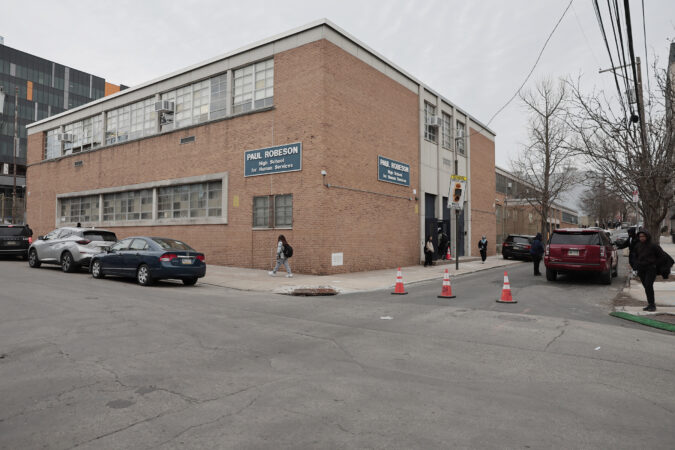
    The Philly School District tried to close Paul Robeson HS before. Now, it’s back on the chopping block.

    In 2022, the governor of Pennsylvania stood on a stage at Paul Robeson High in West Philadelphia and hailed the small school as “a model for what can happen in Pennsylvania.

    But four years later, the Philadelphia School District has recommended closing Robeson, suggesting its small size limited students’ opportunities. Superintendent Tony B. Watlington Sr. wants its students to attend Sayre High, where Robeson would become an honors program, losing its separate identity, administration, and staff.

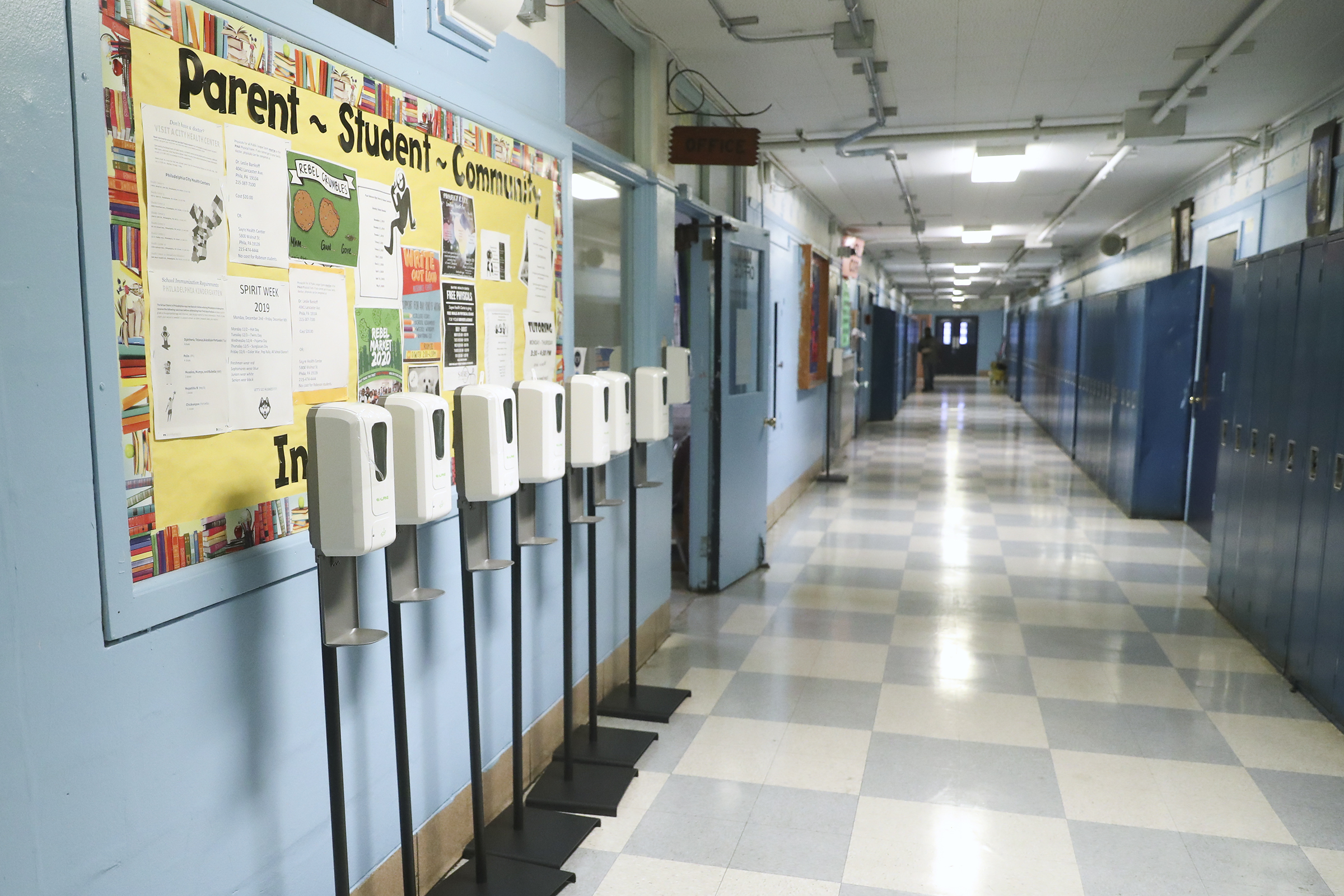
    A hallway at Paul Robeson High School, which the district is attempting to close for the second time.

    Having Robeson listed among 20 schools slated for closure was the worst kind of déjà vu for some in the Robeson community: In the last round of large-scale Philadelphia school closures, district officials recommended closing Robeson and sending students to Sayre, which is about two miles away.

    “This is the exact same plan,” said Andrew Saltz, who helped organize the Robeson community against closure in 2013 and who is doing it again 13 years later. “We need a different plan.”

    The community is speaking out, hoping to persuade the school board to save Robeson again when it votes on Watlington’s recommendations later this winter.

    An upward trajectory

    Robeson soared after successfully fending off its last attempted shutdown.

    By 2017, it was named the district’s most-improved high school. It built upon its core of dedicated teachers and students; though most Robeson students come from its own West Philadelphia neighborhood, it is a citywide school, meaning they have to apply to be there.

    Robeson expanded existing partnerships and formed new ones that gave students opportunities to get onto nearby college campuses. Richard Gordon, who came to lead the school in 2013, was recognized as national principal of the year. (Gordon has since been promoted to assistant superintendent in the district.)

    Multiple Robeson teachers have been honored as among the district’s best.

    The school sent a student to Harvard, a coup for any district high school, let alone one without strict academic criteria. Its students successfully pushed to get their school air-conditioned. School staff secured outside funding to renovate the cafeteria.

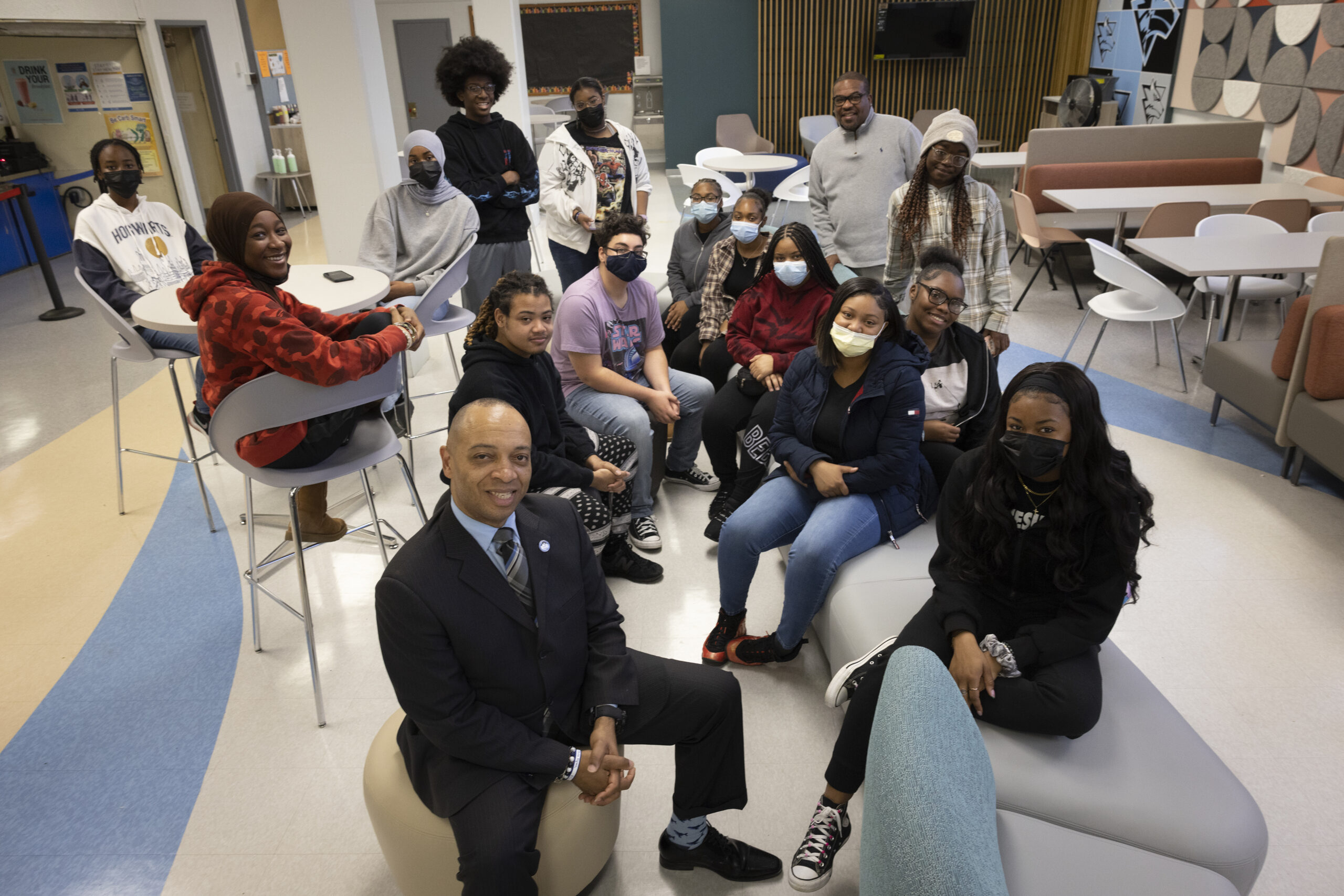
    Then-Principal Richard Gordon (front, tie), then-assistant principal Lawrence King (rear, gray sweater) and members of the Robeson High student body in the newly renovated cafeteria in this 2022 file photo.

    Then-Mayor Jim Kenney visited Robeson to tout its success. So did then-Gov. Tom Wolf.

    Elana Evans, a beloved Robeson teacher and the school’s special education compliance monitor, has already weathered one school shutdown — she taught at the old University City High School, closed in 2013

    That loss was brutal, Evans said. But she is proud of what the community has built at Robeson.

    “It’s an amazing story that continues to stay amazing because we still keep growing,” Evans said. “To say, ‘OK, you’re going to merge with this school, and your name is just going to fade to nothing,’ is, to me, disrespectful.”

    District officials are pitching Robeson’s closure — and the closings writ large — as a move to expand opportunities for all students.

    Sayre, with Robeson as a part of it, would get modernized career and technical rooms and equipment in the facilities plan, Sarah Galbally, Watlington’s chief of staff, told the Robeson community. Sayre would get more accessibility features; renovated stormwater management, roof, and restrooms; and new paint.

    But that didn’t convince Evans.

    “You say one thing, ‘This is how it’s going to look like,’ but for real for real, stop gaslighting me,” Evans said.

    ‘They needed something small’

    Samantha Bromfield homeschooled her twins for seven years, and was wary when she enrolled her children in public school — until Robeson made her believe.

    The move to shut the school frustrated and saddened her, Bromfield said. She and many other Robeson parents said they would not send their children to Sayre.

    “If you as a board choose to close Paul Robeson, I choose to pull my children from the public school system,” Bromfield said at meeting held at Robeson on Saturday. “They needed something small. They needed a family. They needed someone who could hold their arms around the children and say, ‘Hey, are you having a bad day?’”

    Multiple parents echoed Bromfield’s statements.

    The district is choosing to invest in some schools but not others under the facilities proposal, they said.

    Cassidy got a new school, why not us?” one parent told district officials, referring to a $62.1 million new building for a West Philadelphia elementary school.

    ‘Y’all don’t know’

    Ahrianna DeLoach, a Robeson ninth grader, struggled in middle school but is soaring at Robeson, she said, because of the nature of a place where teachers know every student’s name.

    “I don’t want it to close down,” DeLoach said. “I was looking forward to graduating from this school. It would devastate me if I couldn’t.”

    Antoine Mapp Sr., a West Philadelphia resident, expresses frustration that the Philadelphia School District is attempting to close Paul Robeson High School. Mapp spoke at a district meeting on the subject.

    West Philadelphia resident Antoine Mapp Sr. graduated from University City High, but has been spending time at Robeson since he was 11. Mapp’s West Powelton Steppers and Drum Squad rehearses inside the Robeson gymnasium.

    It feels especially cruel to lose Robeson as gentrification creeps in, Mapp said, and with gun violence still plaguing Philadelphia. He worries about the routes children would have to take to get to Sayre, and about neighborhood rivalries.

    “You guys don’t understand what it’s like living in the community or our neighborhood, or what we go through,” Mapp said. “Y’all don’t know how hard it is just to go to the store in our community. Y’all don’t know what it’s like trying to go to an activity in our neighborhood. We have none of those things. Now you want to take this school away from us and send our kids to different communities. I want you to know that the crime rate and the murders are going to increase and there’s nothing y’all can do about it.”

  • U.S. Army Corps official, congressman say help is on the way for N.J. beach erosion

    U.S. Army Corps official, congressman say help is on the way for N.J. beach erosion

    The federal official in charge of the U.S. Army Corps of Engineers visited Ocean City and other Jersey Shore communities Friday, along with U.S. Rep. Jeff Van Drew, pledging that beach replenishment help is on its way.

    Adam Telle, assistant secretary of the Army for civil works, came to New Jersey for a tour hosted by Van Drew. The Army Corps manages beach projects and puts up the majority of money. States and municipalities contribute the rest.

    “There’s emergency funding that’s available,” Telle said from Fifth Street on Ocean City’s boardwalk, adding that some beaches would see repairs by summer.

    Telle said the money does not hinge on legislation and has President Donald Trump’s support.

    The Army Corps will evaluate which beaches are in the most severe condition, he said, including Ocean City, which is among the top of the list. Telle and Van Drew did not cite a specific amount of money but indicated millions could be available.

    Telle, Van Drew, and other officials visited Strathmere, Avalon, and North Wildwood, which have all been heavily impacted by storm erosion over the last year. The short-term goal this year would be to take spoils from Army Corps projects and spread that on beaches.

    They said they plan to draw on a mix of funding, including money still remaining from Hurricane Sandy in 2012, other supplemental funds, and earmarks — language in appropriations bills to direct federal funds to state and local projects.

    Van Drew, a Republican, represents multiple Shore towns on the southern tip of New Jersey.

    Friday’s tour came on the heels of zero dollars earmarked for beach replenishment in 2025 — the first time that had happened since 1996. Up to $200 million annually has typically been awarded for beach erosion control projects.

    Van Drew also introduced a bill last week to establish a new source of continuous beach replenishment money through the Coastal Trust Fund Act.

    The bill would pay for ongoing coastal storm risk management by the Army Corps. U.S. Rep. Laura Gillen, a Democrat from New York, is a cosponsor.

    According to Van Drew, the legislation would use revenue from offshore energy leases to fund $1 billion a year into Army Corps of Engineers coastal storm management projects.

    He said his bill, if approved, would create a permanent source of funding so that it would not depend on yearly appropriations from Congress.

    “We need to get a permanent system in place so we aren’t riding this roller coaster,” Van Drew said.

    However, he acknowledged that getting any bill approved in Congress right now is difficult.

    “It’s going to be a labor of love,” Van Drew said, adding that he is gathering “support from all around the country.”

    There is no date for a vote on the bill.

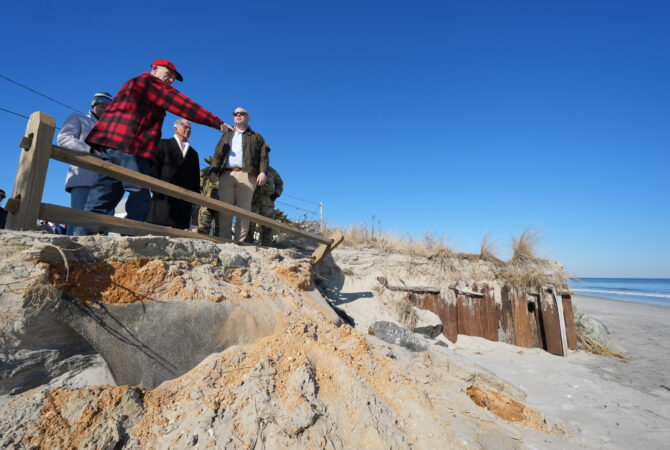
    U.S. Rep. Jeff Van Drew (center), Assistant Secretary of the Army for Civil Works Adam Telle (right) and Upper Township Mayor Curtis Corson Jr. discuss shore erosion and beach replenishment in Strathmere.

    A measure has been introduced by U.S. Rep. Chuck Fleischmann, a Republican from Tennessee, for $23 million to fund coastal replenishment projects this year. That would be supplemented by a Senate bill introduced by U.S. Sen. John Kennedy, a Republican from Louisiana, that would allocate $62.2 million. However, neither bill is scheduled for a vote.

    In 2025, multiple New Jersey Shore towns found themselves in a crisis over erosion as Congress and Trump pushed for a huge reduction in the federal budget.

    No money was made available for crucial beach nourishment projects. The lack of funding became a political issue in New Jersey, which depends heavily on its beaches for tourism revenue.

    For decades, beach projects have been a staple of coastal management in the United States. In 2025, projects were paused in New Jersey, Maryland, and Delaware.

    Projects set for Cape May, Stone Harbor, Avalon, Sea Isle, Strathmere, Ocean City, and Long Beach Island were stalled because of the lack of funding. Georgia and Florida also were affected.

    In October, Ocean City declared a local emergency over the severe erosion exacerbated by storms like Hurricane Erin and a potent nor’easter in October. The city was left grappling with sand cliffs upward of five feet high after the storms scoured its beaches.

    Mayor Jay Gillian and others pushed for urgent state and federal intervention, citing the difficulty of managing large-scale beach replenishments and dune restoration with city resources alone.

    Gillian said Friday at the tour stop in Ocean City that he welcomed any help from the Army Corps and Van Drew.

    “They’re working for a solution,” Gillian said of Telle and Van Drew. “The permanent funding, that’s huge because it stops the games, and it stops the politics.”

    Van Drew represents the largely conservative 2nd District, which spans mostly rural and Shore communities in South Jersey, including all of Atlantic, Cape May, Cumberland, and Salem Counties, plus parts of Gloucester and Ocean Counties. He remains optimistic for funding.

  • ICE operation causes students at Lindenwold bus stop to flee in panic, school district says

    ICE operation causes students at Lindenwold bus stop to flee in panic, school district says

    The Lindenwold School District reported Thursday that fourth- and fifth-grade students waiting at a bus stop ran away in a panic when a U.S. Customs and Immigration Enforcement operation occurred nearby.

    The incident happened in the morning as the students were waiting to take a bus to school from the Woodland Village Apartments, the district said in a statement.

    Superintendent Kristin O’Neil said about 44 students were waiting at the bus when unmarked vehicles arrived at the complex. Officers in tactical gear and wearing masks fanned out, she said.

    (function() {
    var l2 = function() {
    new pym.Parent(‘lindenwold’,
    ‘https://media.inquirer.com/storage/inquirer/projects/innovation/arcgis_iframe/lindenwold.html’);
    };
    if (typeof(pym) === ‘undefined’) {
    var h = document.getElementsByTagName(‘head’)[0],
    s = document.createElement(‘script’);
    s.type = ‘text/javascript’;
    s.src = ‘https://pym.nprapps.org/pym.v1.min.js’;
    s.onload = l2;
    h.appendChild(s);
    } else {
    l2();
    }
    })();

    “The presence of multiple enforcement vehicles caused significant fear and confusion, and several students ran from the bus stop. Our bus driver acted quickly and responsibly, circling back multiple times to ensure as many children as possible were safely transported to school,” the district said, also thanking the bus driver.

    A Ring video from the apartment complex provided to some news outlets shows the children running with some shouting: “ICE! ICE!”

    “Upon arrival to school, many children were understandably upset and emotional,” the district said.

    “All students currently in school are safe,” the district said. “ICE Agents are NOT at the Lindenwold School District.”

    O’Neil said the students attend the district’s school No. 5. About 20 students didn’t show up Thursday, she said. The district will work with families of students who will be marked absent, she said.

    “To us, these are our children,” O’Neil said.

    About 60% of the district’s 3,100 students are Hispanic, according to its latest school performance report. O’Neil said it is not unusual for parents to keep their children home when there are reports of ICE activity in the area.

    <iframe src="https://www.facebook.com/plugins/post.php?href=https%3A%2F%2Fwww.facebook.com%2FLindenwoldPublicSchoolDistrict%2Fposts%2Fpfbid0FnuXsFoCwr7uSvAwW9NPs4XcL4BgVQHwTVxycWvdUc5KWKJF76j389k8VMpVcsL8l&show_text=true&width=500" width="500" height="679" style="border:none;overflow:hidden" scrolling="no" frameborder="0" allowfullscreen="true" allow="autoplay; clipboard-write; encrypted-media; picture-in-picture; web-share"></iframe>

    A district leader reached out to county and state representatives to alert them about the incident and to advocate for protocols that prioritize the safety of children during any future ICE operations, the district said.

    “Our students deserve to feel safe while waiting for their school bus and while attending school each day,” the district said.

    A spokesperson for ICE could not be reached for comment Thursday night.

    U.S. Rep. Donald Norcross, (D., NJ), who represents the district, was among several dozen people who showed up Friday at an “ICE Out of Lindenwold” protest at Lindenwold Borough Hall. The protest was announced before the bus stop incident.

    “Schoolchildren are not criminals, and enforcement actions must reflect that,” Norcross said in a statement. “… Our community will not be terrorized, and we will keep fighting to protect our neighborhoods.”

    Lindenwold, located about 16 miles southeast of Philadelphia, has been among several communities in Camden County that have been subject to ICE operations.

    County Commissioner Director Louis Cappelli Jr. said in a statement Thursday night that “the absolute chaos sowed by this ICE operation in Lindenwold this morning was appalling.”

    Cappelli added that “we are short on facts and details about the intentions of ICE,” however at some point ICE called 911 to request local police assistance.

    “That said, the impact and fear that struck the children of our county was painful to watch, and I can’t imagine the anxiety and trauma that came from this incident,” Cappelli said.

    He added, “As a community, segments of our population are being terrorized and scared to leave their homes. This is no way for any of us to live.”

    County Commissioner Jonathan Young said in a statement: “As a former Lindenwold resident, I’m disgusted to watch the videos of children running in absolute terror along a busy county thoroughfare.”

    Young said that “no one wants criminals in their community,” but added that, “under Trump, ICE has been inhumane in how it conducts its operations. We’ve seen that firsthand throughout other cities in the country, and now it’s happening here.”

  • Josh Shapiro tells Kristi Noem he’ll ‘aggressively pursue every option’ to block new ICE detention centers in Pa., in letter to DHS

    Josh Shapiro tells Kristi Noem he’ll ‘aggressively pursue every option’ to block new ICE detention centers in Pa., in letter to DHS

    Gov. Josh Shapiro implored Homeland Security Secretary Kristi Noem this week to reconsider converting warehouses in Berks and Schuylkill counties into mass immigration detention centers, citing “real harms” to the communities.

    In a Thursday letter to Noem obtained by The Inquirer, Shapiro questioned the legality of the facilities, which the governor said could hold up to 9,000 people in total.

    Hinting at a possible lawsuit, Shapiro said if DHS goes through with converting the sites, his administration will “aggressively pursue every option to prevent these facilities from opening and needlessly harming the good people of Pennsylvania.”

    As part of President Donald Trump’s expanding deportation agenda, the federal government has started purchasing warehouses across the country to flip into U.S. Immigration and Customs Enforcement detention centers. ICE is planning to spend $38.3 billion turning warehouses into detention centers, The Washington Post reported.

    So far, two have been bought in Pennsylvania — a nearly 520,000-square-foot facility in Upper Bern Township and another in Tremont Township, where the purchase has drawn the ire of concerned residents.

    Shapiro slammed the department’s escalating immigration enforcement strategy, saying that ICE and other federal immigration agents “resort to unnecessary and excessive force, leading to innocent people being injured or tragically killed.”

    “Your Department’s record is reason enough to oppose your plan to use warehouses in Schuylkill and Berks Counties as detention centers,” Shapiro wrote, adding that the warehouses would also negatively impact residents’ health and safety, deplete tax revenue, and put extra stress on local communities and emergency response.

    Tricia McLaughlin, DHS assistant secretary for public affairs, confirmed ICE’s purchase of these two warehouses and the department’s plans to use them as detention facilities in a statement to The Inquirer Friday.

    She said that the sites will “undergo community impact studies and a rigorous due diligence process to make sure there is no hardship on local utilities or infrastructure prior to purchase” and that the facilities would create economic benefits, including bringing more than 11,000 jobs to the two Pennsylvania communities in total.

    “Thanks to the One Big Beautiful Bill, ICE has new funding to expand detention space to keep these criminals off American streets before they are removed for good from our communities,” McLaughlin said.

    At an unrelated event last week, the Democratic governor blasted the agency’s “secretive” purchase of the Berks County warehouse, saying he was not alerted of the decision ahead of time.

    At the time, Shapiro said the state was exploring “what legal options we may have to stop” the ICE purchase but said those options were slim.

    Shapiro has become more forceful in his opposition to federal immigration enforcement activities in recent weeks, especially since federal agents fatally shot Alex Pretti in Minneapolis last month.

    He’s said the Trump administration’s strategies in American cities make communities less safe, violate constitutional rights, and erode trust in law enforcement.

    Shapiro, who is seen as a likely contender for the White House in 2028, is up for reelection this year. His likely November opponent is Treasurer Stacy Garrity, a Trump-endorsed Republican who has urged cooperation with ICE.

    In his letter to Noem, Shapiro said that DHS has not engaged local leaders to discuss the warehouse purchases and that both Democratic and Republican state and local officials have objected to the department’s “plans to interfere with our communities because of the chaos and harm your actions will bring.”

    Some of Shapiro’s cabinet secretaries also penned an additional letter to Noem where they stressed that the facilities would be detrimental to the communities’ environment and public health and safety.

    “The stress each facility will place on local infrastructure will, among other things, jeopardize Pennsylvanians’ access to safe water, deplete resources and infrastructure needed for emergencies, and overextend already strained emergency response personnel,” wrote Pennsylvania Health Secretary Debra L. Bogen, Fire Commissioner Thomas Cook, Emergency Management Director Randy Padfield, Environmental Protection Secretary Jessica Shirley, and Labor Secretary Nancy A. Walker.

    In addition to the warehouses, DHS is also leasing new office space throughout the country, including in the Philadelphia area. The department said back-office staff, including lawyers and analysts, will be moving into a building in Berwyn, and the department will also share space with the Department of Motor Vehicles at Eighth and Arch Streets in Center City, WIRED reported.

    Despite the governor’s vocal opposition to Trump’s enforcement strategies, Pennsylvania still cooperates with ICE. Shapiro’s administration honors some ICE detainers in state prisons and provides ICE with access to state databases that include personal identifying information for immigrants.

    Immigrant rights groups have for months called on Shapiro to take more decisive action against federal immigration enforcement in Pennsylvania and end all cooperation with the agency.

    Staff writer Gillian McGoldrick contributed reporting.

  • Inaugural NFL draft was held at the Ritz-Carlton Hotel on this week in Philly history

    Inaugural NFL draft was held at the Ritz-Carlton Hotel on this week in Philly history

    More than 20 men crowded into a hotel room at the Ritz-Carlton on South Broad Street in the winter of 1936.

    They faced a blackboard listing 90 names of college football players from around the country.

    They took seats on the bed and on the bureau and passed around bottles as they kicked off the first draft in NFL history.

    Philly’s other famous Bell

    Bert Bell pulled the defunct Frankford Yellow Jackets out of bankruptcy, and started a new NFL franchise in Philadelphia in 1933.

    His wife, actress Frances Upton Bell, paid her husband’s share of $2,500 (more than $60,000 in today’s money) to seal the deal.

    Bell spotted a billboard for Franklin D. Roosevelt’s New Deal, which included the insignia of a bald eagle, and decided this new team should be called the Philadelphia Eagles.

    The NFL back then was a nine-team league. And for players it was a free market. The best and brightest could join whichever team they saw fit.

    Teams in Green Bay, Chicago, New York, and Washington were the winningest franchises, so that’s where the best players usually signed.

    The Eagles were the worst. And in 1935, Bell tried to sign Stan Kostka, a 6-foot-2 fullback from the University of Minnesota. After failing to close the deal, he decided there had to be another way.

    Bell came up with an idea whereby each team had a fair shot at the top players. His solution was a draft, in which teams would select from a pool of new players entering the league.

    And the key idea: The order of player selection would be in reverse order of the previous year’s standings. So the worst-performing franchise would pick first, and the league champions would pick last.

    They called it “the selection of players.” And the first iteration would be held during the owners’ meetings, Feb. 8 and 9, 1936.

    It made sense to hold the event in Philadelphia. It was a midway point among the nine cities, and Bell’s father owned the hotel.

    On the clock

    The Eagles held the first-ever pick in the NFL draft.

    They selected Jay Berwanger, Heisman Trophy-winning halfback from the University of Chicago. But his salary demands were high, reported at $1,000 per game. (That would be $25,000 per game today.)

    So immediately the team traded him to the Bears for veteran tackle Art Buss.

    Berwanger, unimpressed with the Bears’ contract offer, took a job with a rubber company instead.

    He never played a minute in an NFL game.

    In that hotel room, the nine owners drafted 81 players over nine rounds, kicking off what would become an industry unto itself and the league’s third marquee event, behind the NFL’s opening weekend and the Super Bowl.

  • Pennie cost hikes hit low-income families and older adults the hardest

    Pennie cost hikes hit low-income families and older adults the hardest

    Low-income Pennsylvania families and adults in their late 50s and early 60s have been dropping out of Affordable Care Act health plans at the greatest rates after a key financial incentive expired at the end of last year, causing insurance costs to double on average across the state.

    Some 98,000 people who bought health plans last year from Pennsylvania’s Obamacare marketplace, Pennie, have opted out of coverage for 2026, as of Wednesday. That means one in five previously enrolled Pennsylvania residents have dropped their coverage.

    The number is expected to continue growing, as people begin getting premium bills they cannot afford, Pennie administrators said. They have already seen a significant increase since the end of open enrollment on Jan. 31, at which time 85,000 people had not renewed coverage.

    The agency has estimated that up to 150,000 people may ultimately drop coverage if Congress did not renew a tax credit program that ensures no one pays more than 8.5% of their income on an ACA health plan. The tax credits, which were adopted in 2021 during the COVID-19 pandemic, had been renewed annually until now.

    “If the tax credits had stayed in place, we probably would have seen another record enrollment, further reducing the uninsured rate,” said Devon Trolley, Pennie’s executive director.

    The tax credits were a defining issue in last year’s longest-ever federal government shutdown. In that budget stalemate, Democrats wanted to permanently expand the enhanced subsidies, and Republicans refused.

    New Jersey has not yet released the final results for its ACA open enrollment period, which also ended Jan. 31.

    window.addEventListener(“message”,function(a){if(void 0!==a.data[“datawrapper-height”]){var e=document.querySelectorAll(“iframe”);for(var t in a.data[“datawrapper-height”])for(var r,i=0;r=e[i];i++)if(r.contentWindow===a.source){var d=a.data[“datawrapper-height”][t]+”px”;r.style.height=d}}});

    2026 Pennie enrollment

    The first look at the impact of the higher insurance costs comes from Pennie data at the end of open enrollment. As of Feb. 1, a total of 486,000 people had signed up for coverage in 2026, down from 496,661 the same time last year.

    Some 79,500 newcomers to the marketplace partially offset the people who dropped coverage.

    In the Philadelphia region, more than 27,000 people who were enrolled in Pennie last year dropped coverage for 2026. Philadelphia and Montgomery Counties saw the biggest impact, with enrollment dropping 18% in each.

    Pennie leaders said people dropping plans are not enrolling in another type of insurance.

    That’s notable because those who joined Pennie for 2026 were coming from another form of insurance, such as an employer-based health plan. The people leaving Pennie were expected to become uninsured, Trolley said.

    Now that open enrollment is over, most people who find their plan is too expensive and drop it will not have an opportunity to select new coverage until the fall.

    window.addEventListener(“message”,function(a){if(void 0!==a.data[“datawrapper-height”]){var e=document.querySelectorAll(“iframe”);for(var t in a.data[“datawrapper-height”])for(var r,i=0;r=e[i];i++)if(r.contentWindow===a.source){var d=a.data[“datawrapper-height”][t]+”px”;r.style.height=d}}});

    Lower-income families were the most likely to drop coverage

    Pennie administrators said they heard from many lower-income families and individuals that the cost increases for 2026 were too much of a strain for already tight budgets.

    Breaking down the terminations by income, the greatest drop was seen among people with incomes 150-200% of the federal poverty rate. That’s an annual income of between $23,475 and $31,300 for an individual. For a family of four, the equivalent income range would be $48,225 to $64,300.

    A total of 13,562 Pennsylvanians in this income bracket declined to renew their Pennie plans for 2026 as of Feb. 1, according to the most recent available data from Pennie.

    “The math just isn’t working for people in those households,” said Trolley.

    People in this income bracket still qualified for some financial assistance. The ACA includes tax credits for anyone with income below 400% of the poverty rate, and these tax credits did not expire.

    Higher earners who would now have to pay in full, without the help of tax credits, account for another large segment dropping coverage.

    This included 11,837 people who earn more than 400% of the federal poverty rate. In the past years, the enhanced tax credit helped families in higher income brackets afford marketplace insurance.

    window.addEventListener(“message”,function(a){if(void 0!==a.data[“datawrapper-height”]){var e=document.querySelectorAll(“iframe”);for(var t in a.data[“datawrapper-height”])for(var r,i=0;r=e[i];i++)if(r.contentWindow===a.source){var d=a.data[“datawrapper-height”][t]+”px”;r.style.height=d}}});

    Dropouts high among young adults and those near retirement age

    Just under 20,000 adults between the ages 55 and 64 canceled their Pennie plans for 2026, accounting for nearly one-quarter of dropouts as of Feb. 1.

    About two-thirds of individuals in this age group earn enough that they would have had to pay the full price of their health plan, without any tax credits. They already pay more than younger adults for the same plan, under rules that allow insurers to charge more to cover older adults, who are likely to have more medical expenses.

    “That group is where we were seeing the most significant price jumps — a couple hundred dollars to a couple thousand dollars,” Trolley said.

    Another 15,356 adults between the ages 26 and 34 — many new to buying health insurance on their own — also dropped out. The ACA allows young adults to be covered under a parent’s health plan until age 26.

    Graphics editor John Duchneskie contributed to this article.

  • Students and parents — joined by the Pa. House speaker — are fighting a plan to close Southwest Philly’s Motivation High

    Students and parents — joined by the Pa. House speaker — are fighting a plan to close Southwest Philly’s Motivation High

    Confronted with the possible closure of their beloved school, the Motivation High community came prepared to fight back.

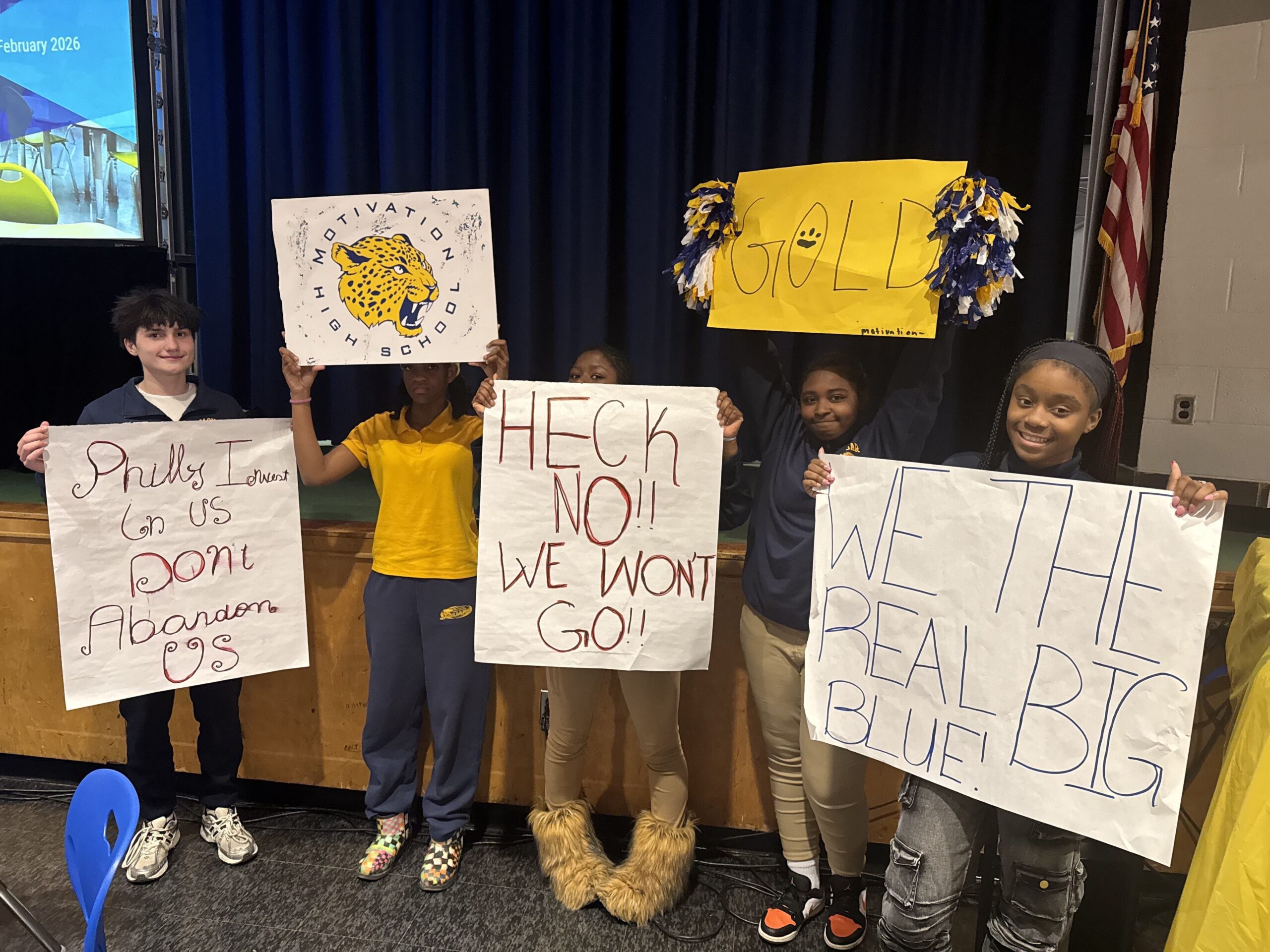
    As community members entered their Southwest Philadelphia school’s auditorium Wednesday night, students waving signs and carrying blue-and-yellow pompoms handed out leaflets: on one side were Motivation’s stats — building condition, graduation rate, attendance, suspensions.

    On the other were stats for Bartram High, the school they would be assigned to attend if their school closes in 2027, as proposed under the Philadelphia School District facilities plan. The data for Motivation, a magnet, are stronger across the board, sometimes starkly so — Bartram is a neighborhood school with no admissions criteria, and its attendance and graduation rates are lower, and its suspensions higher.

    Motivation High students hold signs they made to protest the Philadelphia School District’s planned closure of their school.

    Motivation has only 150 students enrolled this year. The school system cited low enrollment as one reason for the closure. But district officials have been clear: The recommendation was also driven by a desire to reinvigorate struggling neighborhood high schools.

    “Why are we put in with Bartram to make Bartram look good, when we stand out on our own?” one Motivation student asked district staff pointedly.

    The opposition from the Motivation community lays bare an issue at the crux of the school system’s plan: To reach its stated goal of advancing all students, the district says it must displace some. Often, that has pitted communities against one another.

    Residents in a restless crowd at Motivation on Wednesday, including one of the state’s most powerful politicians, Pennsylvania House Speaker Joanna McClinton (D., Philadelphia), said they were not having it.

    “It’s like you want us to water flowers that just weren’t growing from the beginning,” one parent told officials. “You want to uproot kids who have found their place. You can count my child right out of that plan. She ain’t going to Bartram.”

    ‘It’s the lottery system’

    Motivation began as a Bartram program, housed in a separate building, for academically talented students. But in 2004, Motivation became its own school, eventually moving to the former Turner Middle School building at 59th and Baltimore.

    Motivation thrived as the only criteria-based high school in Southwest Philadelphia. But like a number of smaller magnets, it was hit hard by 2021 changes to the district’s special admissions policy.

    The district that year moved to a centralized lottery system, taking away from principals any discretion over who got admitted to the schools. It said it did so for equity reasons and to solve for demographic mismatches at some schools — though Motivation’s student body had been representative of its neighborhood and the city as a whole.

    In the past, schools like Motivation filled most of their ninth-grade classes with students who met the district-set criteria, and also admitted students who were close but came with a strong recommendation from another school, or had compelling personal circumstances that explained why they missed meeting the magnet standards.

    Those extra admissions ended with the district policy change, and Motivation’s enrollment plummeted. It was never a huge school, by design — topping out at 400 students prior to the pandemic.

    It doesn’t seem fair, said Nehemiah Bumpers, a Motivation 10th grader.

    “Why are you guys moving us for having low enrollment scores?” Bumpers said. “It’s the lottery system that drastically changed our enrollment.”

    McClinton, who attended the Wednesday meeting, was similarly frustrated.

    “When you talk about the enrollment being diminished, it’s because you changed the playbook for principal Teli,” McClinton said of veteran Motivation principal Rennu Teli-Johnson, whom the House speaker praised.

    “She knows every one of these kids,” said McClinton, whose House district includes both Motivation and Bartram.

    Motivation students walk out

    The school board has yet to vote on the proposal to close Motivation and 19 other schools. But the possible closure has roiled the student body.

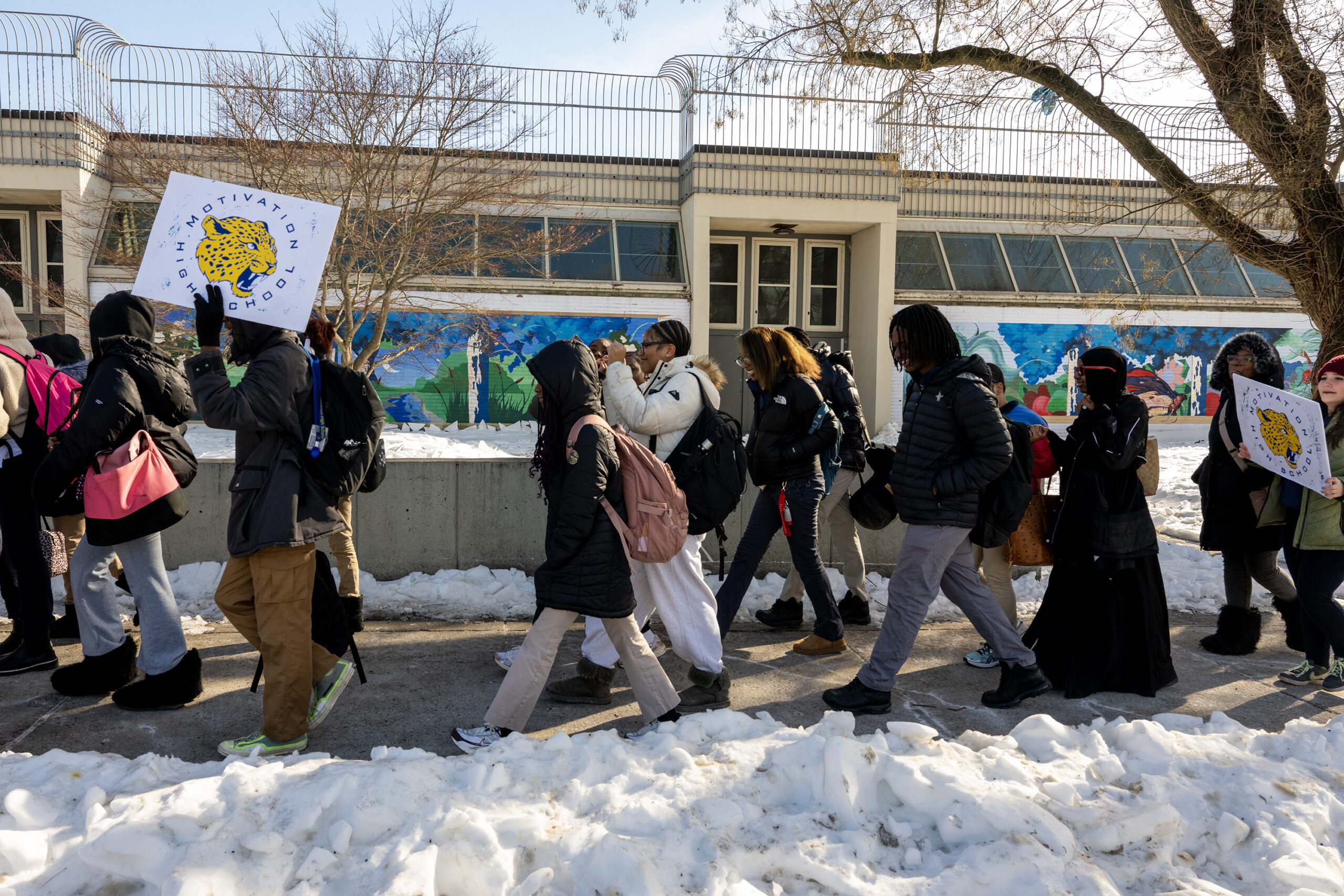
    This week, most Motivation students walked out of school, staging a protest over the district’s plan.

    Students walk out of Motivation High School in Southwest Philadelphia on Monday, protesting that their school is one of 20 that the Philadelphia School District has tagged for closure.

    Zanaya Johnson-Green, an 11th grader, said students were beside themselves, even those who will graduate before the school is planned to be folded into Bartram in the fall of 2027.

    “Motivation has given me so many opportunities, and I don’t want to see it go,” Johnson-Green said. “No one wants the school to close. This is having a bad effect on all of us.”

    The district has, in recent years, invested millions in sprucing up the Motivation building, which if the school does close would become district “swing space” — a place where schools can move to accommodate building repairs or other overflow needs.

    “Why spend all that money just to push us into Bartram and use this school as a swing space?” Bumpers asked.

    Motivation High School in Southwest Philadelphia, on Baltimore Avenue in Southwest Philadelphia, is shown in this 2025 file photo.

    But much of the energy at the meeting was spent talking about the safety at Bartram — with parents and students pressing the district on how they could guarantee staff and student welfare, and district officials saying they would use a planning year and community wisdom to address concerns.

    “Disaster!” someone in the audience shouted when Associate Superintendent Tomás Hanna talked about his hope that those with worries would step up to the plate to help plan for a Bartram transition.

    A Motivation student shook her head.

    “Why do we have to reap what you sow when you stopped paying attention to neighborhood schools all those years? Why do we have to suffer the consequences, lose opportunities?” the student said.

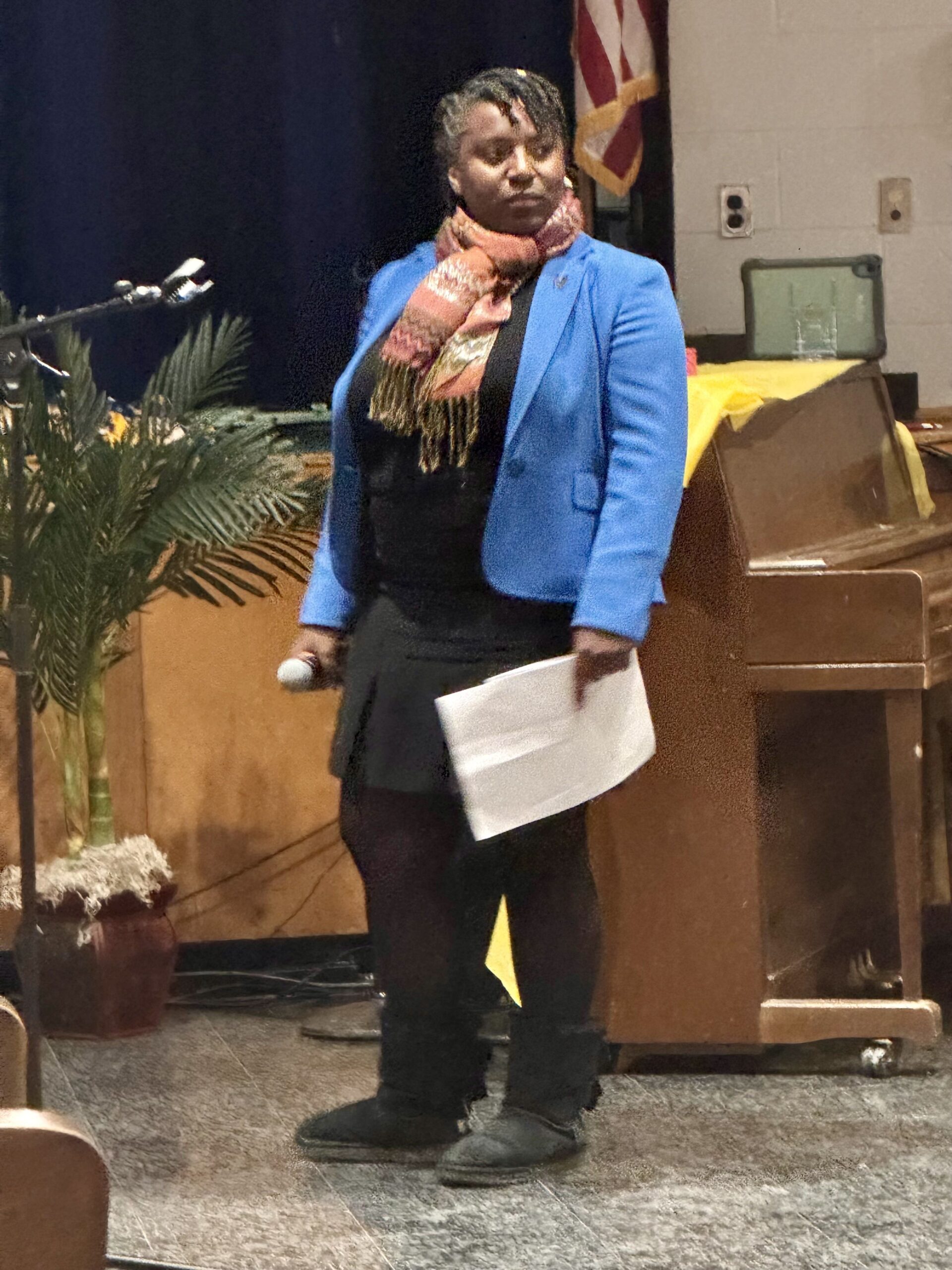
    Monica Allison, a Cobbs Creek neighbor and ward leader, made it clear that though she was fighting against the Bartram closure, wounds inflicted from prior school closures, dating back to John P. Turner Middle School and George Wharton Pepper Middle School, were also on people’s minds.

    “You closed John P. Turner and you didn’t ask us,” Allison said. “Now we’re back with another closure. It’s ridiculous. You keep talking about elevating Bartram at the expense of other kids. The neighbors are really tired of this.”

    The speaker speaks out

    John Young, a Motivation teacher for the last decade, said his students were living their civics lesson by protesting the district’s plan. The district is in a tough spot, he said — coping with the fallout of charter schools that took students from traditional public schools, dealing with its own decision to create greater high school choice.

    But, Young said, “this decision is going to continue that trend of pushing our students to homeschool, pushing our students to charter schools. This decision is not going to solve the problem, it is going to hollow us out.”

    Pa. House Speaker Joanna McClinton blasted the Philadelphia School District at a public meeting Wednesday night, saying its officials had disadvantaged Motivation High by changing rules around special admissions, then used low enrollment as one reason to close the school.

    A visibly upset McClinton spoke last on Wednesday night. The district must invest in both schools, she said — not just one.

    The district officials she addressed all had good jobs, McClinton emphasized. They could afford to send their children to whatever kind of school they felt was best for them. Southwest Philadelphia parents might not be wealthy, but they deserve to make choices, too, the speaker said.

    “It’s not fair that you’re pitting Black children in Bartram against Black children in Motivation,” McClinton said. “Not one of your children go to Motivation or Bartram. I don’t get millions of dollars in Harrisburg for you to waste it away to make this a swing space.”

  • Josh Shapiro’s clergy abuse investigation boosted his reputation. Years later, some survivors feel he abandoned them.

    Josh Shapiro’s clergy abuse investigation boosted his reputation. Years later, some survivors feel he abandoned them.

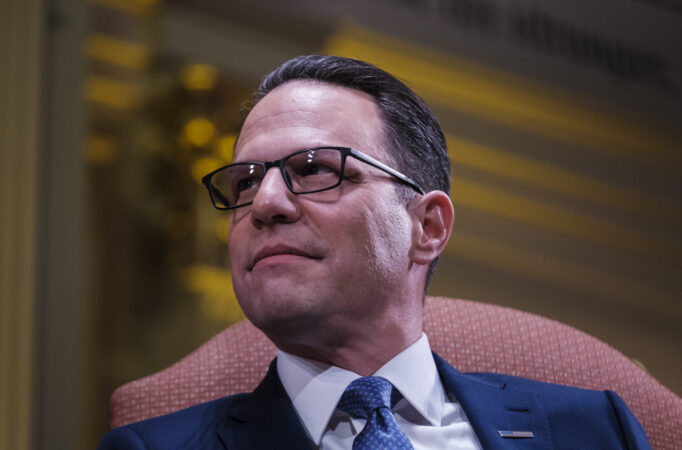
    Sitting onstage in an echoey historic synagogue, next to a U.S. senator and a cardboard cutout of his newly released memoir, Gov. Josh Shapiro reflected on the Pennsylvanians who give him hope.

    As he had in other stops on his book tour up and down the East Coast, Shapiro often referred to his book’s title, Where We Keep The Light, and the ways he finds hope in the “extraordinary impact” of Pennsylvanians. Among them, he said, were those who were sexually abused by Catholic priests in crimes covered up by the church until they were illuminated by the victims’ unrelenting quest for justice.

    In his book, Shapiro details his work as Pennsylvania attorney general to compile and release a bombshell grand jury report that in 2018 revealed thousands of cases of abuse by priests across the state.

    “I find hope in the people I met who were abused over years and years and years,” Shapiro told U.S. Sen. Raphael Warnock (D., Ga.) last month at an event at Sixth and I, a synagogue in Washington, “who still had the courage to show up in a grand jury room to testify and to challenge me to do something to make sure we righted a wrong and brought justice to them.”

    The nearly 900-page report was lauded as the most comprehensive review of clergy abuse across a single state and prompted new laws clarifying penalties for failure to report abuse and allowing survivors more time to pursue criminal or civil cases against their abusers.

    But a key step in delivering justice to those survivors — establishing a two-year window for the filing of lawsuits over decades-old abuse that falls outside the statute of limitations under existing law — remains unfinished.

    The proposal has become one of the most fraught issues in Harrisburg. After a devastating clerical error by Gov. Tom Wolf’s administration killed a proposed constitutional amendment in 2021, lawmakers have been unable to come together on a new path forward. Republicans who control the state Senate have tied the proposal to policies Democrats will not support. All the while, the Catholic Church and the insurance industry have lobbied hard against it.

    Nearly a dozen interviews with survivors, their family members, and advocates reveal a deep frustration with the inaction in Harrisburg. Even as Shapiro renews calls for the Senate to act, survivors are divided over whether he has done enough to use his power as governor to advocate for them.

    A key pledge in Shapiro’s bid for reelection — and his pitch to a national audience — is that he can “get stuff done” by working across the aisle. But some abuse survivors in Pennsylvania say the unfinished business in getting justice for them brings that record into question.

    “He got to where he’s at on the back of victims and survivors, and now he’s forgotten,” said Mike McIlmail, the father of a clergy abuse victim, Sean McIlmail, who died of an overdose shortly before he was supposed to testify in a criminal case against his alleged abuser.

    Shapiro, his spokesperson Will Simons said, has fought for survivors “publicly and in legislative negotiations” since 2018. He has promised to sign any bill that reaches his desk establishing the window.

    With a reelection campaign underway and his eyes on flipping the state Senate, the governor renewed that fight earlier this month. He used his budget address to blame Senate Republicans for the inaction thus far.

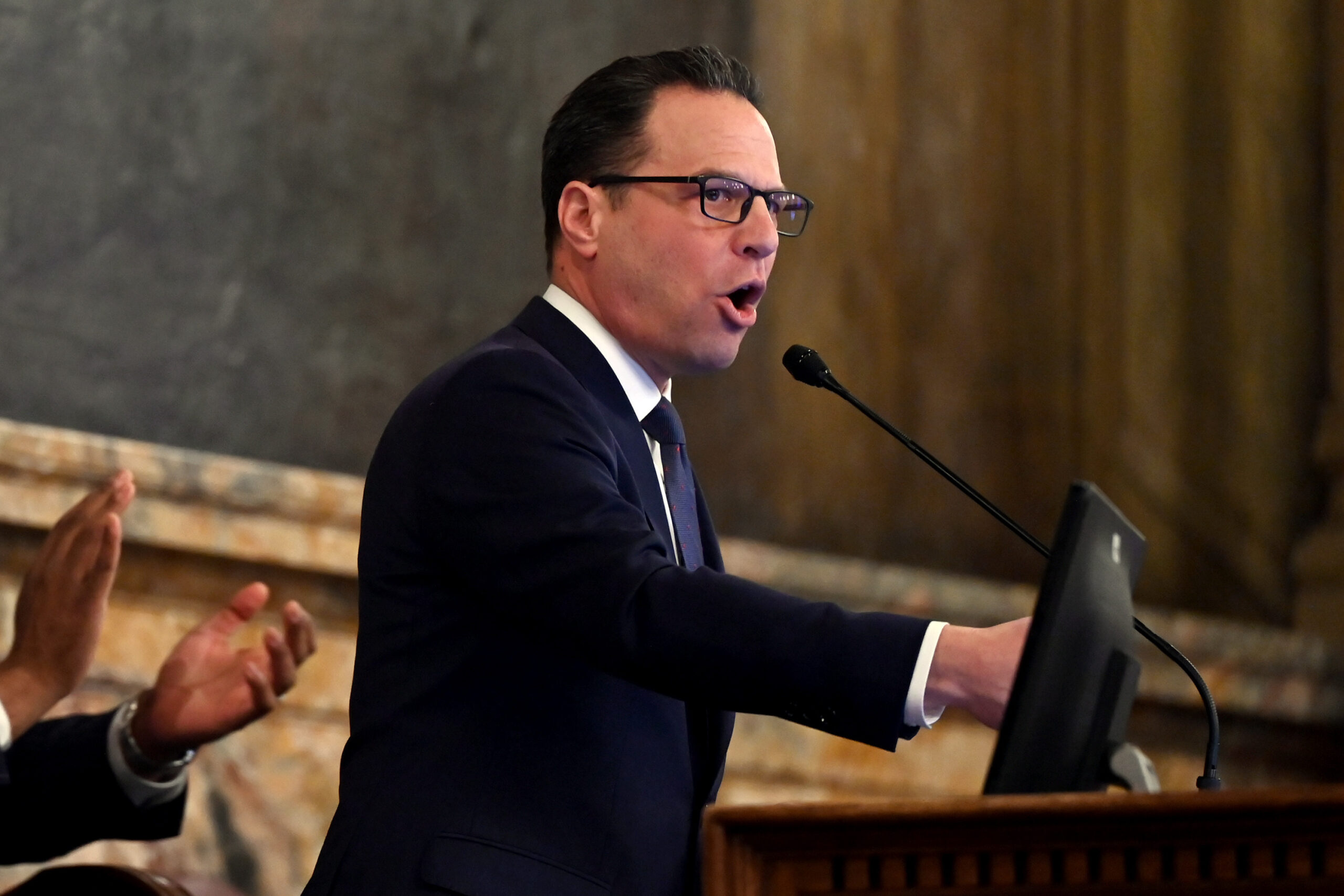
    “Stop cowering to the special interests, like insurance companies and lobbyists for the Catholic Church,” he said, his voice thundering in the House chamber. “Stop tying justice for abused kids to your pet political projects. And start listening to victims.”

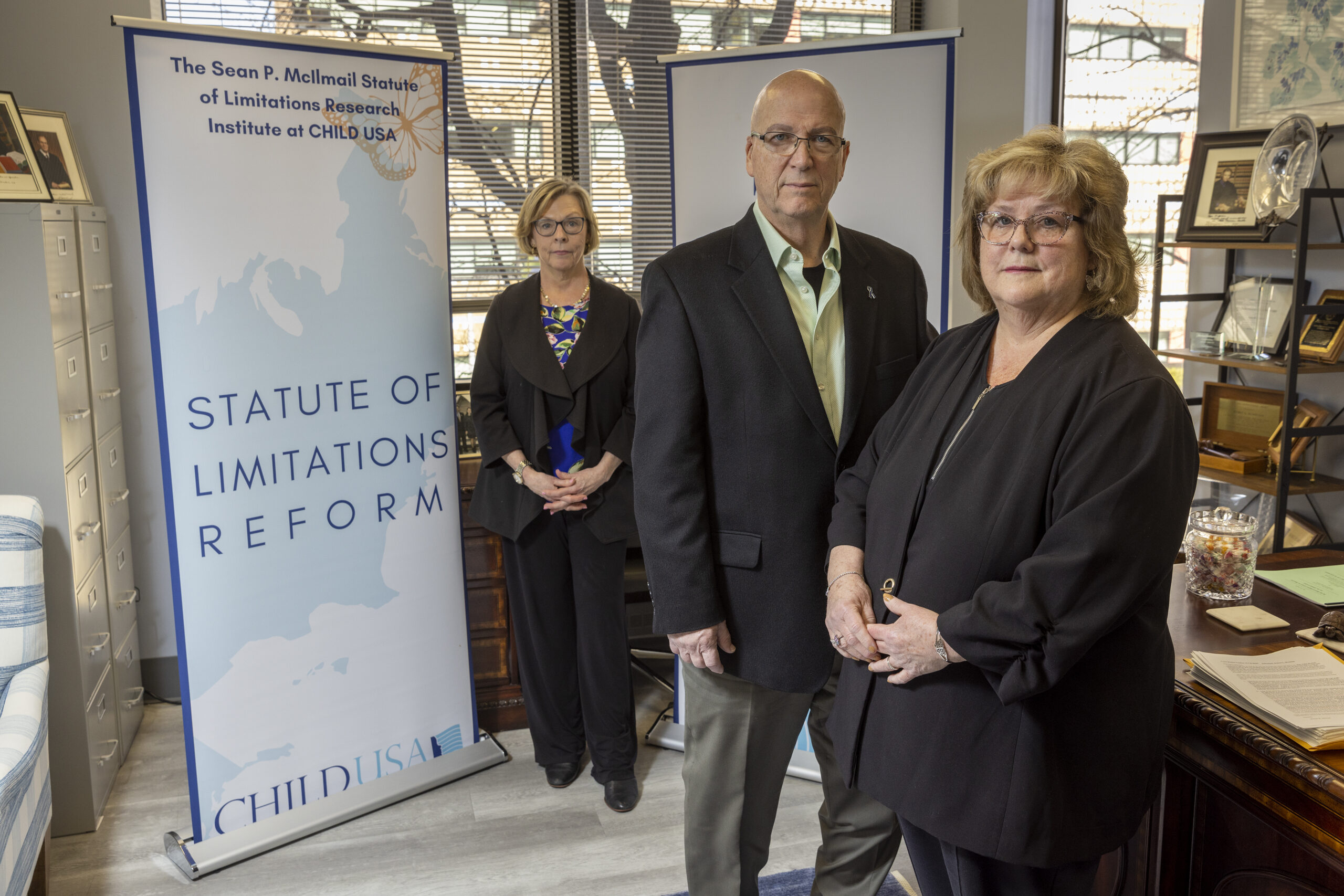
    Mike and Debbie McIlmail, parents of Sean McIlmail, in the office of (left) Marci Hamilton, in Philadelphia on March 29, 2022.

    Years of delay

    Pennsylvania’s extensive investigation, which Shapiro inherited when he became attorney general in 2017, chronicled more than 1,000 cases of abuse by more than 300 priests across the state dating back to the 1940s.

    For most of the cases in the report, the statute of limitations had passed, leaving no legal recourse for survivors.

    The report proposed that lawmakers create a two-year window to allow the filing of civil suits over cases that happened years, if not decades, ago. Despite Shapiro’s advocacy since releasing the grand jury report, the proposal has been trapped in a stalemate for years.

    Pennsylvania trails more than 30 other states that have approved similar legislation.

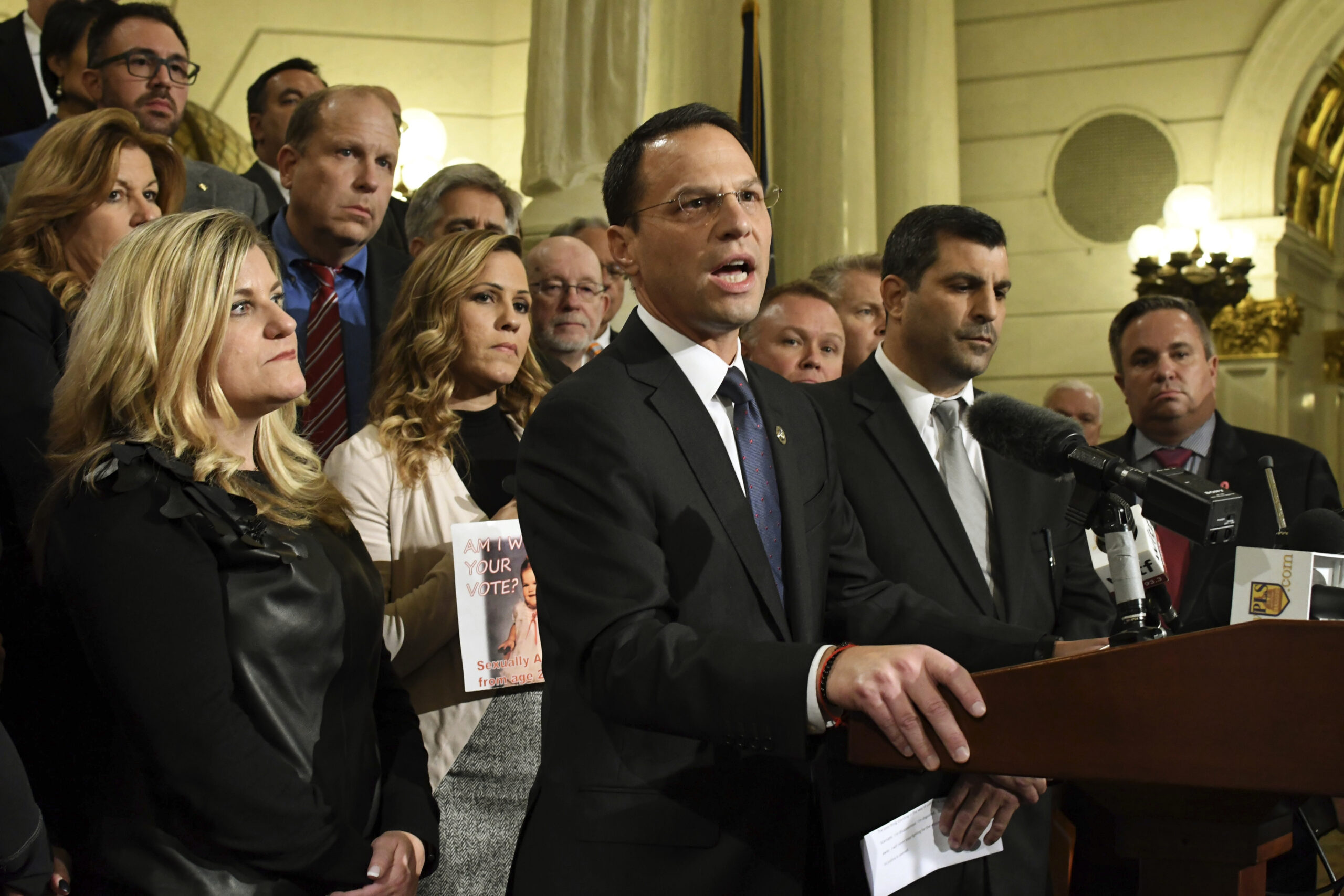
    Then-Attorney General Josh Shapiro speaks at a news conference in the state Capitol in 2018 about legislation to respond to a landmark grand jury report accusing hundreds of priests of sexually abusing children over decades stalled in the legislature.

    “It’s maddening to have people say, ‘We’re committed to this, this is going to happen, we’re committed to it,’ from both sides of the political spectrum and nothing ever gets done,” said Jay Sefton, who says he was abused by a priest in Havertown as a middle schooler in the 1980s. “It does start to feel like these are lives being used as its own sort of theater.”

    Gov. Josh Shapiro makes his annual budget proposal in the state House chamber Tuesday, Feb. 3, 2026.

    Speaking to journalists in Washington days before he targeted Republicans in his budget address, Shapiro tied the window’s prospects to Democrats’ ability to win the state Senate for the first time in more than three decades.

    “I’m confident with a Democratic Senate that will be one of the first bills they put on my desk,” Shapiro said.

    Senate President Pro Tempore Kim Ward, a Republican, leaves the House chamber following Democratic Gov. Josh Shapiro’s annual budget proposal speech in Harrisburg on Feb. 3.

    In an interview, Senate President Pro Tempore Kim Ward (R., Westmoreland) noted that the GOP-controlled Senate had approved a constitutional amendment to establish the window several times before, although it ultimately failed to ever reach the voters.

    She declined to say whether the state Senate would take up the amendment up this year but said creating the window through legislation, as Shapiro requested, would be unconstitutional.

    She accused the governor of using survivors to score political points as he tries to raise his profile for his reelection this year and rumored 2028 presidential ambitions.

    “He has decided that he’s going to be moral instead of follow the law. Look at his record in his own office,” Ward said, arguing Shapiro has a track record of fighting for some survivors but not others. She pointed to his office’s handling of sexual harassment allegations brought against a former top staffer and close ally. Documents showed that complaints about the staffer were made months before his abrupt resignation.

    For some clergy abuse survivors, the blame lands squarely on Ward and her Republican allies as they insist on a constitutional amendment, which requires two votes by both the House and Senate along with a ballot measure.

    “It’s the Republicans that are blocking it, and I think they’re blocking it because of the church,” said Julianne Bortz, a survivor who testified before the grand jury and whose experience was featured in the report.

    A portrait of former Pa. House Speaker Mark Rozzi hangs alongside painting of other former speakers in hallway at the state Capitol.

    Debate among survivors

    Despite Shapiro’s recent statements, there is a sense among some survivors that lawmakers, and Shapiro, have forgotten about them.

    Former state House Speaker Mark Rozzi, a Berks County Democrat and clergy abuse survivor, said Shapiro “betrayed” survivors and should be playing “hardball” with the Senate to ensure that the bill makes it to his desk.

    “Talk is cheap. Unless you come to the table and cut a deal, nothing else gets done,” Rozzi said.

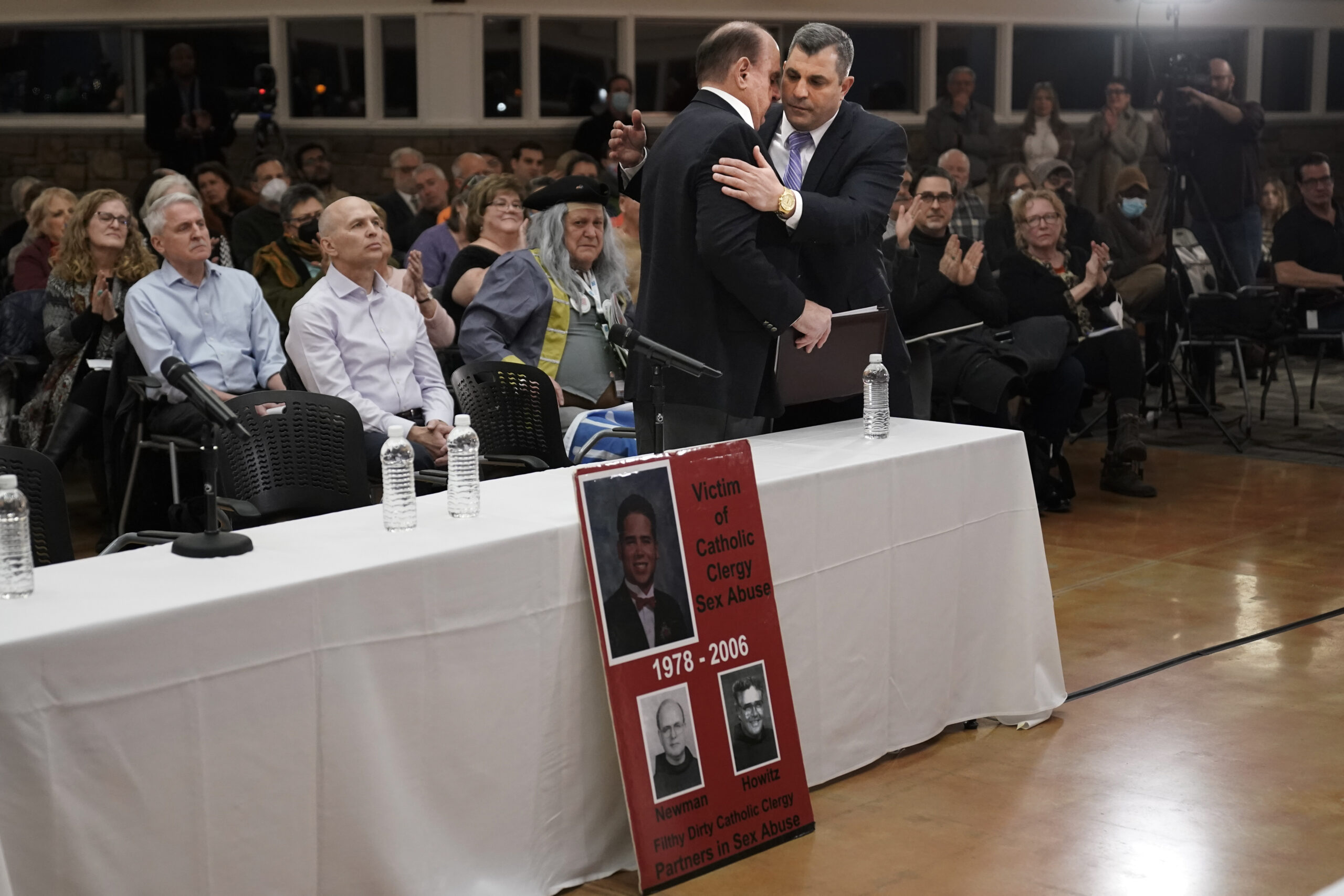
    Then-Pennsylvania House Speaker Mark Rozzi, center right, embraces Arthur Baselice, the father of Arthur Baselice III, after he testified at a hearing in Philadelphia on Jan. 27, 2023.

    Advocates have spent years pushing lawmakers in Harrisburg and have grown increasingly frustrated with the lack of movement.

    “We, being the victims, have always held our end of the bargain. Always. We’ve always shown up when we’ve asked to, we’ve testified when we were asked to, we interviewed, we discussed the worst moments of our lives when asked,” said Shaun Dougherty, who said he was abused by an Altoona-Johnstown priest.

    Now, he said, it’s the governor’s turn to get the work done.

    Former State Rep. Bill Wachob, a Democrat who worked in politics after leaving elected office in the 1980s, is convinced the governor could make it happen through negotiations if he wanted.

    “He and his team have made a calculated political decision that they have gotten as much mileage out of this issue as they’re going to get and they’re not doing anything more,” Wachob said.

    In Shapiro’s memoir, however, he wrote he expected that going up against the Catholic Church in pursuing the 2018 report “was likely the end of the road for me politically.”

    “I’d made my peace with being a one term Attorney General, if it meant that I could put my head on the pillow at night knowing I did my job and made good for these victims,” he wrote.

    Since Shapiro became governor in 2023, his efforts to fight for survivors have been waylaid by an increasingly tense relationship with the GOP-controlled Senate, as evidenced by last year’s nearly five-month bitter budget impasse.

    “I have no doubt that the governor has been doing what he can,” said Marci Hamilton, the founder of Child USA, which advocates for child sex abuse victims. She blamed the challenges in reaching a deal on Harrisburg’s partisan dynamics.

    Recent criticism of Shapiro has driven division within the survivor community in recent weeks, said Mary McHale, a survivor who was featured in a 2022 Shapiro campaign ad.

    “He cares. But he also has a state to run. This can’t be the No. 1 issue,” she said.

    Diana Vojtasek, who said she was abused by the same Allentown priest as McHale, said she worries frustration is being misdirected at Shapiro instead of Republicans.

    “I just don’t see the value in attacking the one who has vowed publicly that he will sign this legislation for us as soon as it’s across his desk,” she said.

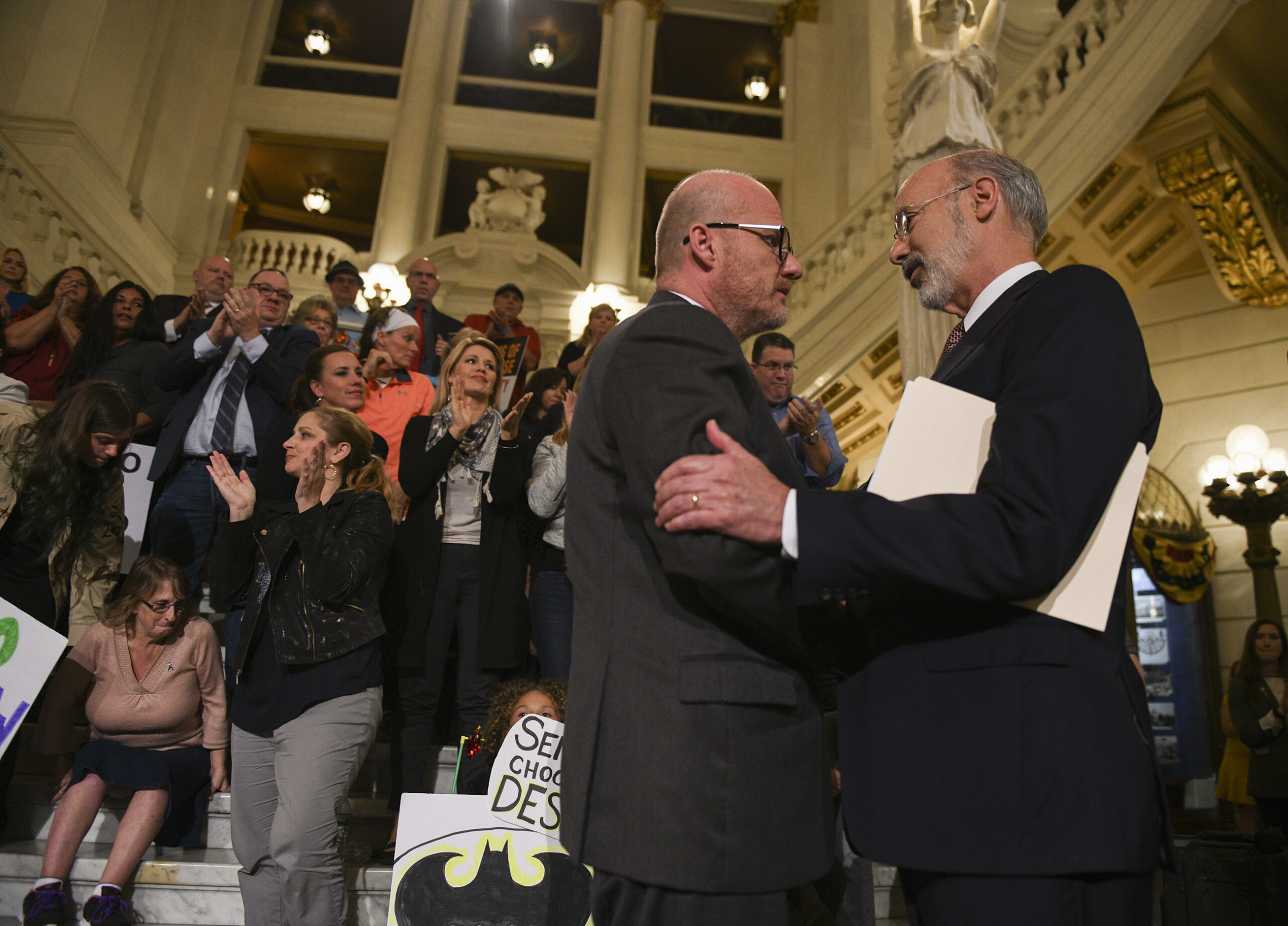
    Abuse survivor Shaun Dougherty (left) greets then-Gov. Tom Wolf in the State Capitol on Sept. 24, 2018.

    Could progress come this year?

    Advocates are hopeful that the national bipartisan effort to force President Donald Trump’s administration to release FBI files related to serial abuser and trafficker Jeffrey Epstein may spur new motivation to protect abuse victims in the state.

    “What the Epstein transparency act showed us is we are finally at a point where the protection of sexual abuse victims is nonpartisan,” Hamilton said. “I fully expect to see that that understanding for victims will happen in Harrisburg.”

    Rep. Nathan Davidson, a Dauphin County Democrat who introduced the House legislation to create the window, has scheduled hearings in April to bring renewed attention to the issue.

    Sefton, who said he was abused as a middle schooler in Havertown in the 1980s, will perform a one-man show about his experience in a theater just steps from the state Capitol the week of the hearings.

    He is done hoping lawmakers will establish the window but said it would make the state safer if they did.

    “Nobody is going to give anyone their childhood back. It can’t happen,” Sefton said.

    “There’s always going to be a part of me that’s filled with some rage about people blocking the energy here. If that were to go through, it’s a piece of energy that gets finally freed up.”