Have you been looking longingly at your fishing gear during the Philadelphia winter? Are Deadliest Catch reruns not hitting the same?
With the surface of the Schuylkill River still frozen solid and frigid temperatures returning this weekend, a reader asked through Curious Philly, The Inquirer’s outlet for answering questions, whether they were allowed to ice fish on it.
Ice fishing, after all, is a practice that began with subarctic Indigenous peoples thousands of years ago, well before the advent of the modern fishing rod in the late 1700s. Fishing along the Schuylkill is accepted and celebrated in warmer temperatures, so what about its frozen cousin?
Unfortunately for those Philadelphians dreaming about an Arctic lifestyle, the answer is no.
“Ice fishing is illegal in Philly,” Philadelphia Police Department spokesperson Sgt. Eric Gripp saidby email. The practice is not explicitly outlawed, but walking out onto the ice in order to carve a hole and cast a line underneath violates city rules.
A pedestrian walks past a large pile of snow and ice along the Benjamin Franklin Parkway on Monday.
“You can’t walk, swim, or be in/on the waterway — unless in a vessel — regardless as to whether or not it’s frozen,” Gripp said.
Philadelphia police began spreading the message to not venture out onto the frozen Schuylkill this week, after local CBS News video captured several adults and children walking across it Sunday. The Police Department’s directive on code violation notices lists ice skating, skiing, and sledding in some areas of Fairmount Park as potential offenses.
Ice fishing could put you in violation of a few city ordinances, too. While you would likely be subject only to a summary offense and a $25 fine for each violation, police say you would be breaking rules about using areas managed by Parks and Recreation outside of their approved use, and risk violating the ban on “swimming” or wading out onto any Philadelphia creek, lake, river, or stream.
Even though the Schuylkill’s frozen surface may be several inches thick in certain locations, ice’s integrity can’t be judged based upon only how it looks, how fresh it is, or the temperature outdoors, according to the Pennsylvania Fish and Boat Commission. Ice’s strength is alsoinformed by several other factors, including the depth of the water underneath the ice, and nearby fish activity.
“Anyone that walks onto the Schuylkill River, … they’re taking their life into their own hands. It’s not a smart thing to do,” said commission spokesperson Mike Parker. Parker said the commission highly advises against walking on top of or fishing on the frozen surface of any moving body of water, like a river.
“There’s no such thing as safe ice,” in those cases, he said.
A fisherman sits in the sun outside a pop up shelter while ice fishing on frozen Lake Wentworth in Wolfeboro, N.H.
But ice fishing can be relatively safe on still bodies of water, like lakes and ponds. As general guidelines, the fish and boat commission advises that anglers fish only on those bodies of water when ice is at least five inches thick, and never to go out onto ice alone.
About the new name for that big museum at the end of the Parkway: Never mind.
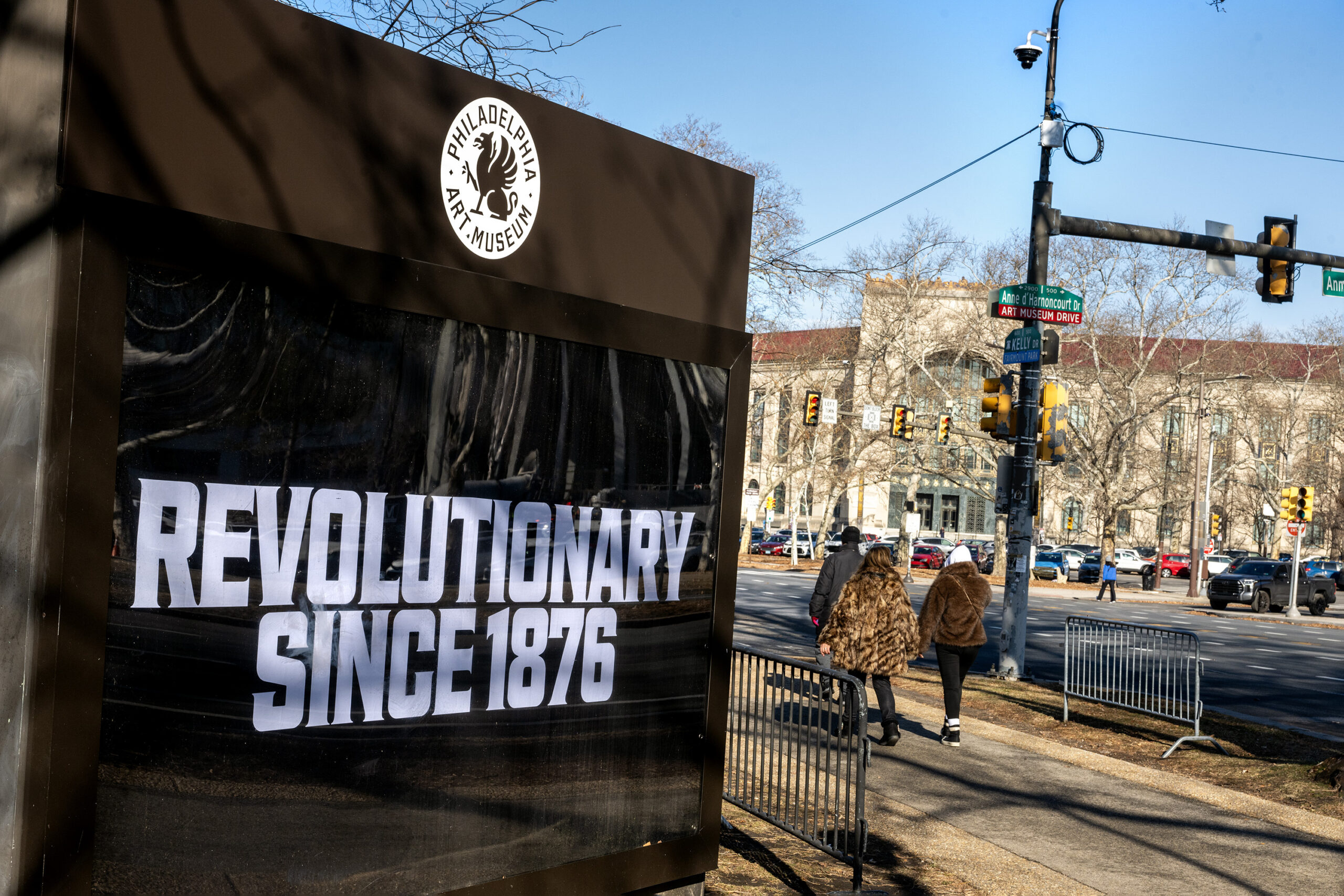
Four months after rolling out a new name with great fanfare, the Philadelphia Museum of Art is once again calling itself the Philadelphia Museum of Art. The museum’s board Wednesday afternoon voted unanimously at a special meeting to scrap the name Philadelphia Art Museum, which had been announced Oct. 8 as part of a larger rebranding.
Some signs and materials are being quickly changed over with the old-new name, while others will be reprinted or revamped in coming weeks. The new PhAM acronym used in marketing materials will be dropped, and the museum will once again refer to itself in shorthand as the PMA, as many Philadelphians long have.
Daniel H. Weiss, director and CEO of the Philadelphia Museum of Art, in the museum lobby, Jan. 7, 2026.
The museum spent the past several weeks surveying opinions, said director and CEO Daniel H. Weiss, and “I think what we learned from our survey, and it’s not surprising, is that people who have any knowledge of the institution — donors, staff, trustees, members — they know the name and it resonates with them. It’s something distinctive, it’s who we are. And changing the name for no obvious reason created a sense of alienation and didn’t make sense to a lot of people.”
Philadelphia Museum of Art had been the name of the nearly 150-year-old institution for 87 years until the change this fall.
The museum will, however, keep visual elements of the larger rebranding — the logo that echoes one of the griffin figures along the roofline of the museum’s main building, and bold fonts in signage and promotional materials.
A rolling video screen above the admissions counter at the West Entrance at the Philadelphia Museum of Art Oct. 6, 2025.
As for the continued use of slightly irreverent tag lines that came with the rebrand — phrases like “Youse should visit more often,” — “Probably not so much,” said Weiss. “We will modify those a little downstream, but the idea is to return to a slightly more aligned presentation more closely tied to our mission.”
The rebranding — which was widely, though not universally, criticized upon its rollout — was a major initiative of former director and CEO Sasha Suda and marketing chief Paul Dien.
When the museum announced the name change, Suda explained it by saying that it was “truly a reflection of what the community has called it for a long time,” and that it was “also a sort of significant way of starting a new chapter and saying, ‘Look, we’re definitely starting a new chapter here.’”
The north side of the Philadelphia Museum of Art, along Kelly Drive at 25th Street and Art Museum Drive, Jan. 7, 2026.
The decision around the controversial rebranding is the first visible test of Weiss’s leadership, and he chose the route of inquiry and shared responsibility, directing a nine-member task force to assess its reception. The original rebrand was launched after multiple internal meetings, but without final notification to the board, according to one trustee.
In a 3½-page note to staff Wednesday afternoon announcing the decision to keep the logo and reverse the name change, Weiss noted the “siloed process” in which the original rebrand was developed, and took pains to emphasize how the reconsideration of it has been, and will be, different.
“The work of the design team over the past two years was exhaustive, incorporating decades of museum history into their thinking and interviews with dozens of staff and trustees. Yet, the team did not have the benefit of a broad, interdisciplinary group to inform the work along the way, so when the final product was rolled out, many felt surprised or not sufficiently invested in the outcome,” the note reads.
A series of internal meetings with staff will explain the task force’s findings, Weiss wrote in his note.
“The task force did consider reverting completely to the prior brand, but ultimately felt strongly that the original reasons for the rebrand are compelling. It was time for the museum to update its look, and the griffin logo is a strong statement that can successfully strengthen and widen our audience.”
The museum’s new logo keeps the stylized griffin that was part of the rebrand unveiled in October 2025, but shows the return of the museum’s name to the ‘Philadelphia Museum of Art.’ The October rebrand included a renaming to ‘Philadelphia Art Museum,’ a change that has now been scrapped.
Surveys conducted in recent weeks revealed findings that “went in two very different directions,” Weiss wrote. “Staff, trustees, and members were opposed to the name change, the URL, and the look of the new brand, yet the public reacted positively to the new logo and overall look and feel.”
Art Museum fan Brian Forsyth, of Exton, said he felt “blindsided by the sudden and uncalled for rebrand,” and when it happened, he asked for (and received) a membership refund.
He disliked the rebrand in general and said that, while he sometimes called it “the art museum,” he mostly referred to it as “the PMA.”
“When they took that phrasing away from me, it hurt,” he said.
Now that the museum is changing its name back, he says he intends to restore his membership.
“I will not, however, purchase any of the new merch. I still have my classic PMA baseball cap, which I will wear into the ground, literally,” he said.
Inspiring the museum’s logo: a bronze griffin on the roof of the northern wing of the Philadelphia Museum of Art, Oct. 6, 2025.
Weiss said that the museum will not be disposing of current materials printed with the Philadelphia Art Museum name, such as brochures or maps. Rather, the change will be cycled through as items need to be replaced.
Gretel, the Brooklyn firm that designed the rebrand, is working with the museum on the current modifications.
The rebrand cost the museum about $1 million, Weiss said, and the total cost of the change-back may not exceed $50,000.
“The idea is to do this as cost-effectively as we can.”
Weiss called the entire rebrand episode “an unnecessary distraction for us. We want to move on and focus on things that matter most to our mission.”
Michael Bertrando’s first brush with Kennett Square’s council three years ago was to discuss a parking issue at his family’s legacy sandwich spot, Sam’s Sub Shop. He saw his neighbors, listened to them, and started to see how the council worked. Eventually, he became something of a regular.
When the issue of short-term rentals came up last month, Bertrando had a lot of perspective: As an actor — you might haveseen him on HBO’s Task — he has traveled extensively. He has seen the negative effects short-term rentals can have had on communities from New York to Argentina to Brazil. He spoke up.
And then people started to drop by the sandwich shop, which he runs alongside his parents, suggesting that he put his name in for a vacant seat on the council.
The council voted last month to appoint Bertrando, 52, from a crowded field of applicants to fill former council member Julie Hamilton’s seat through December 2027. He was sworn in Monday.
The seat will be on the ballot for a four-year term in the 2027 general election. Hamilton resigned for a job in Texas, the Daily Local reported.
Long ties to Kennett Square
Council member is another job title the local businessman and Task stuntman can add to his resumé.
“I’m volunteering to help the residents of my community; that’s my primary goal,” he said in an interview Tuesday.
Bertrando — an actor, director, and producer — has worked at his family’s 80-year-old sub shop for decades. It drew him back home a few years ago, so he could help his aging parents run the shop.
But in the years between, Bertrando left Kennett Square to pursue acting, appearing in commercials for brands like Mercedes, McDonald’s, Nintendo, and Oscar Mayer; traveling the world as a professional clown; and working the improv comedy circuit in New York and Chicago.
His film career has continued back in Pennsylvania; Bertrando served as Mark Ruffalo’s stand-in and stunt double in Task, the HBO crime drama set in Delco. In his own productions, his hometown has seeped into his work. A short film, Italian Special, is set within Sam’s Sub Shop and Kennett Square.
Since returning to the borough, Bertrando has been a frequent visitor to council meetings, and advised the borough alongside other business leaders on what was going well, and what wasn’t, in Kennett Square.
Priorities on council
His professional career and his family’s long lineage in Kennett Square have shaped his perspectives on the borough, and what he thinks he can add as a council member.
He is motivated by the possible development of a new theater. Infusing more arts into the community would be beneficial, he said.
Having worked on Task, he saw how other municipalities the show filmed in benefited from an influx of revenue: from parking to hiring police for traffic control, to renting out locations in town, to ordering food for lunches and snacks, to coffee runs, to overnight stays in hotels.
“We have all the infrastructure needed for that to happen here in Kennett,” he said.
Both Task and fellow Pennsylvania-based crime drama Mare of Easttown mention Kennett Square, but neither used the borough for filming.
“When you have a theater or something arts-driven in the town, I think that’s a signal,” he said. “I think a theater can work as a beacon for revenue from other sources, like film production.”
Beyond the intersection of his passion for film and the borough, he said the development of the former National Vulcanized Fiber land, a large undeveloped parcel that is being remediated for contamination in soil from the industrial site, has been of concern for residents.
While the project would be years out even if ultimately approved, Bertrando said he would advocate for environmental transparency and affordable development that respects the existing neighborhoods.
He would also like to improve communication between the municipality and its residents — the longtime community members, like Bertrando’s family, and those who are choosing to relocate.
As he began his term on the other side of public comment, he said, he focused in, listening closely to what his neighbors were saying. He feels the burden to pay close attention, since he was appointed to the role, rather than elected.
“I really have to make the effort to listen to their concerns and really try the best ways to help in their concerns,” he said. “Sitting on the other side was exciting. It was important. It’s serious. It’s my town. I really care about it.”
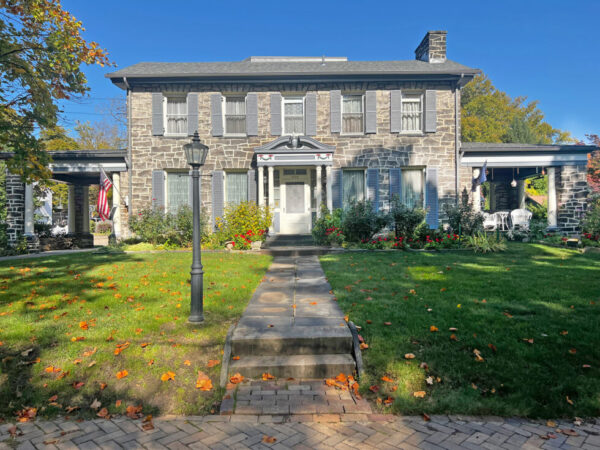
The property listing in Beaver, Pa., extolled the countless charms of the Colonial Revival. There was the “grand foyer with a handmade railing,” the built-in cabinets and “beautiful” hardwood floors, and the covered porch offering “stunning” views of the nearby Ohio River.
“This home adorns many wonderful features,” the listing read, “and outstanding details throughout.”
One detail, however, was notably absent from the listing: the sizable swastika arranged in permanent tile on the basement floor.
That omission has become the source of an unusual legal battle, a disturbing discovery that has weaved its way through the state court system and raised questions — legal and otherwise — about what represents a “material defect” in a property.
“I certainly have not seen [this] particular fact-pattern come up before,” said Hank Lerner, chief legal officer for the Pennsylvania Association of Realtors. “It’s a pretty specific one.”
When Daniel and Lynn Rae Wentworth closed on the five-bedroom home in 2023, for around $550,000, it was easy to see the draw. Anchored on a spacious lot, just a block from the river, the home was idyllic by just about any measure.
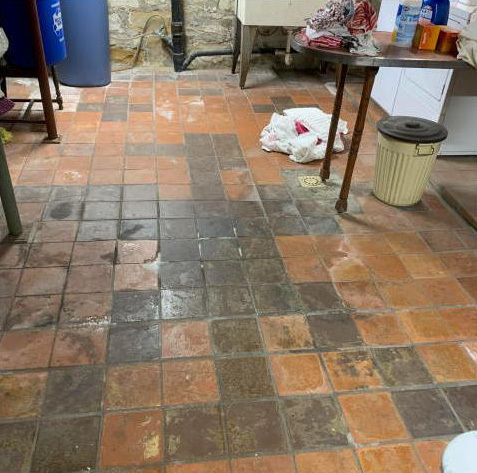
But shortly after moving in, the Wentworths were clearing out the basement when they discovered the grim iconography in tile — a swastika, along with, what appeared to the couple, to be an image of a Nazi eagle. (According to the Wentworths, the tiled images had been covered by rugs during the inspection of the home.)
After Daniel and Lynn Rae Wentworth purchased a home in Beaver, Pa., they discovered in the basement floor what they believed to be a tiled image of a Nazi eagle (pictured above) and a swastika.
“Mortified,” as they would later say, the Wentworths filed a complaint in Beaver County civil court, alleging the previous owner had violated the Pennsylvania Real Estate Seller Disclosure Law, and seeking monetary damages.
The Wentworths argued they would never have bought the home had they known about the tiled floor. Nor, they said, could they be expected to live in the home — or sell it — given its condition. In their complaint, the couple estimated it would cost roughly $30,000 to replace the floor.
“This … is just not something you’d ever expect to have to deal with,” said Daniel Stoner, an attorney for the Wentworths.
“They could have actual economic harm from the potential reputational damage if people thought they put it in themselves or were aware of it.”
The seller — an 85-year-old German immigrant who’d owned the home for nearly a half-century — did not share this view.
In response to the Wentworths’ suit, Albert A. Torrence, an attorney for the seller, argued in a court filing that “purely psychological stigmas do not constitute material defects of property … and a seller has no duty to disclose them.”
What’s more, he argued, the Wentworths had failed to identify any untruthful or inaccurate statements he’d made regarding the property.
In an interview, Torrence denied that the home’s previous owner was a Nazi supporter. Forty years ago, he said, the previous owner had been reading a book about the swastika symbol being co-opted by Germany’s Nazi Party; angry, he decided to include the symbol in a basement renovation project, placed a rug over it not long after, and forgot about it.
“And, of course, it fits into the narrative, ‘A Nazi lived in this house,’” said Torrence. “It’s just not the narrative that people want it to be.”
Regardless, the case raised an interesting question: When it comes to property sales, what, exactly, does rise to the level of a material defect worthy of disclosure?
Pennsylvania law requires sellers to disclose a laundry list of potential problems with a home — termites, structural or heating problems, sewage issues. “[Any] problem with a residential real property or any portion of it that would have a significant adverse impact on the value of the property or that involves an unreasonable risk to people on the property.”
Absent from that list? Hate symbols that had been permanently embedded.
In court filings, the previous owner cited an earlier case that had advanced all the way to the Pennsylvania Supreme Court.
In 2007, after a California resident purchased a Delaware County home, she learned from a neighbor that the property had been the site of a grisly — and highly publicized — murder-suicide. The new owner, Janet S. Milliken, sued.
In that case, the state’s Supreme Court ruled that the home’s unfortunate history did not represent a material defect, adding that it would be impossible to quantify the psychological impact of various events that might have occurred on a given property.
“Does a bloodless death by poisoning or overdose create a less significant ‘defect’ than a bloody one from a stabbing or shooting?” the court wrote. “How would one treat other violent crimes such as rape, assault, home invasion, or child abuse? What if the killings were elsewhere, but the sadistic serial killer lived there? What if satanic rituals were performed in the house?”
Leaning heavily upon the Supreme Court’s decision in the Milliken case, the Beaver County trial court dismissed the Wentworths’ complaint.
Unsatisfied with the ruling, the Wentworths appealed.
In a decision filed late last year, three Superior Court judges affirmed the initial ruling that the tiled imagery was not required to be disclosed in accordance with the state’s disclosure law.
“A basement that floods, a roof that leaks, beams that were damaged by termites … these are the conditions our legislature requires sellers to disclose if they are known,” the judges wrote in an 18-page ruling filed Nov. 12.
“We are not dismissive of the Wentworths’ outrage, nor their concern that the existence of the images could taint them as Nazi supporters,” the decision went on. “With this lawsuit, however, they have made a public record to counter any supposition in that regard.”
Though the couple could’ve appealed to the Pennsylvania Supreme Court, Stoner, their attorney, said this week that they had decided against doing so, citing the low likelihood that the case would’ve been heard by the court.
“I’ve only had one case in my entire career that they’ve actually taken up,” Stoner said. “So the chances of them even getting it heard weren’t the greatest.”
As for the home, Lynn Rae Wentworth told the Pittsburgh Jewish Chronicle recently that she and her husband planned to remove the tiling once they were sure the legal wrangling had concluded.
She said they were also considering approaching local legislators in hopes of changing the law, making hate symbols material defects that necessitated disclosure.
As she told the publication, “I don’t want anyone to have to go through this again.”
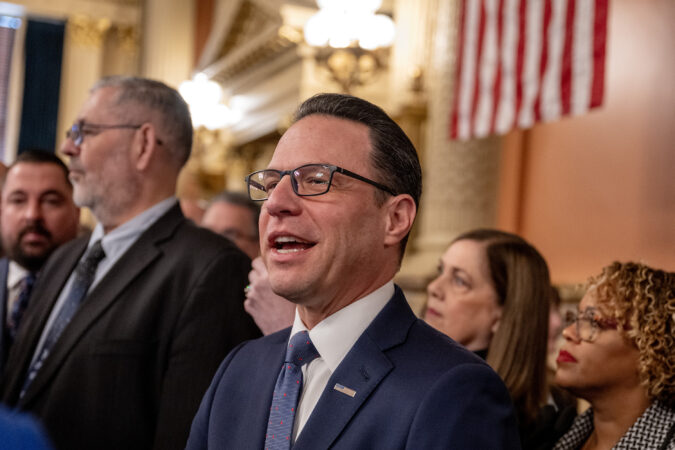
Gov. Josh Shapiro had a message for data center developers on Tuesday: Come to Pennsylvania, but bring your own energy — or pay up.
During his budget address, Shapiro said his proposal — the Governor’s Responsible Infrastructure Development (GRID) standards — will ensure center operators are “not saddling homeowners with added costs because of their development.”
Data centers, which house the technology to power cloud storage and other computing, have been proliferating across the country and the region due to the increasing demands of generative artificial intelligence, or AI.State and local officials are trying to keep up with the rapid pace of development, proposing new legislation — and updating existing measures — in an attempt to regulate the facilities.
Shapiro’s plan would require data centers to supply their own energy or pay for any new generation they need. It also calls on them to hire and train Pennsylvania workers and comply with “the highest standards of environmental protection,” including in water conservation, Shapiro said.
In exchange, the governor added, data center developers will get “speed and certainty” in the permitting process, as well as applicable tax credits.
The comments from Shapiro, a Democrat who has consistently encouraged data center development, come amid a flurry of legislative and executive action, as elected officials promise to keep Pennsylvania and New Jersey consumers from bearing the costs of these power-hungry facilities.
Data centers, the electric grid, and governors’ proposals
At the same time, some governors, including Shapiro, have criticized and sued PJM, the Montgomery County-based electric grid operator, over its annual capacity auction, which influences how much customers pay.
On Tuesday, Shapiro reiterated calls for PJM to speed up new power-generation projects and extend a price cap.
Separate from GRID, Shapiro also said electric companies, including Peco, should increase transparency around pricing and “rein in costs” for consumers, including low-income and vulnerable Pennsylvanians.
“These steps will save consumers money immediately,” Shapiro said. He announced an energy-affordability watchdog to monitor utility-rate requests and take legal action if necessary to prevent companies from “jacking up their rates and costing you more.”
Through several executive orders, she froze utility rates and expanded programs to spur new power generation in the state. She also ordered electric utilities to report energy requests from data centers.
“This is just the beginning,” Sherrill said in her inaugural remarks. “We are going to take on the affordability crisis, and we are going to shake up the status quo.”
In Pennsylvania, ‘Data Center Consumer Protection Bill’ advances
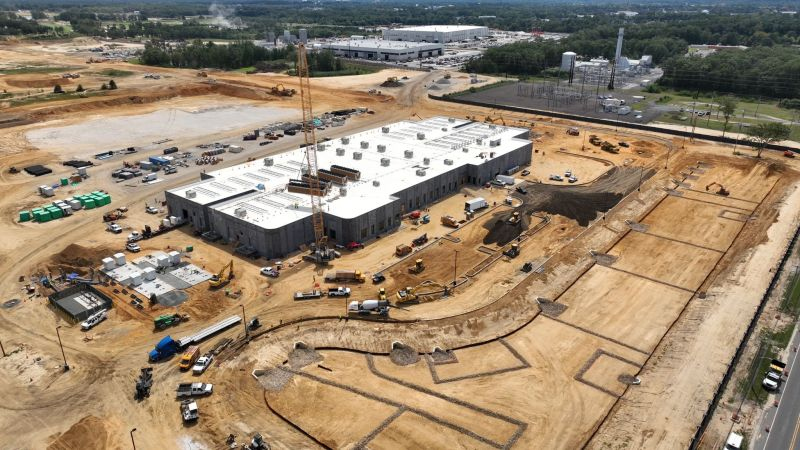
An Amazon data center is shown last year while under construction in front of the Susquehanna nuclear power plant in Berwick, Pa.
Meanwhile in Harrisburg and Trenton, some lawmakers have other ideas about how to keep residents from subsidizing data centers.
As of Tuesday, nearly 30 bills in the Pennsylvania and New Jersey legislatures mentioned data centers, according to online records. Many of those bills aren’t directly related to residents’ electric bills, and instead address the facilities’ energy sources, water usage, environmental impacts, and general regulation.
“Today’s vote brings us one step closer to protecting ratepayers,” Robert Matzie, the Beaver County Democrat who introduced the bill, said in a statement. “Data centers can bring jobs and expand the local tax base, but if unchecked, they can drive up utility costs. Electric bills are already too high.”
The bills were introduced by State Reps. Kyle Donahue and Kyle Mullins, both Democrats from the Scranton area, which has become a hot spot for data center development.
“There is a real concern and a sense of overwhelm among the people we represent,” Mullins said at the hearing. “The people of Pennsylvania have serious concerns about data center energy usage and water usage, especially as they see utility bills continue to rise rapidly.”
Dan Diorio, vice president of state policy for the Data Center Coalition, said he worried the bills would discourage operators from building in Pennsylvania. He said they are already incentivized to reduce energy costs, which are estimated to make up anywhere from 40% to 80% of a data center’s total operating costs.
“Data center companies strive to maximize energy efficiency to keep their costs low,” Diorio said.
Rep. Elizabeth Fiedler, the Philadelphia Democrat who chairs the energy committee, closed Monday’s hearing by reminding members of one of its main objectives: to “keep down the energy bills that are skyrocketing for people back home.”
A South Jersey lawmaker says his bill could help consumers
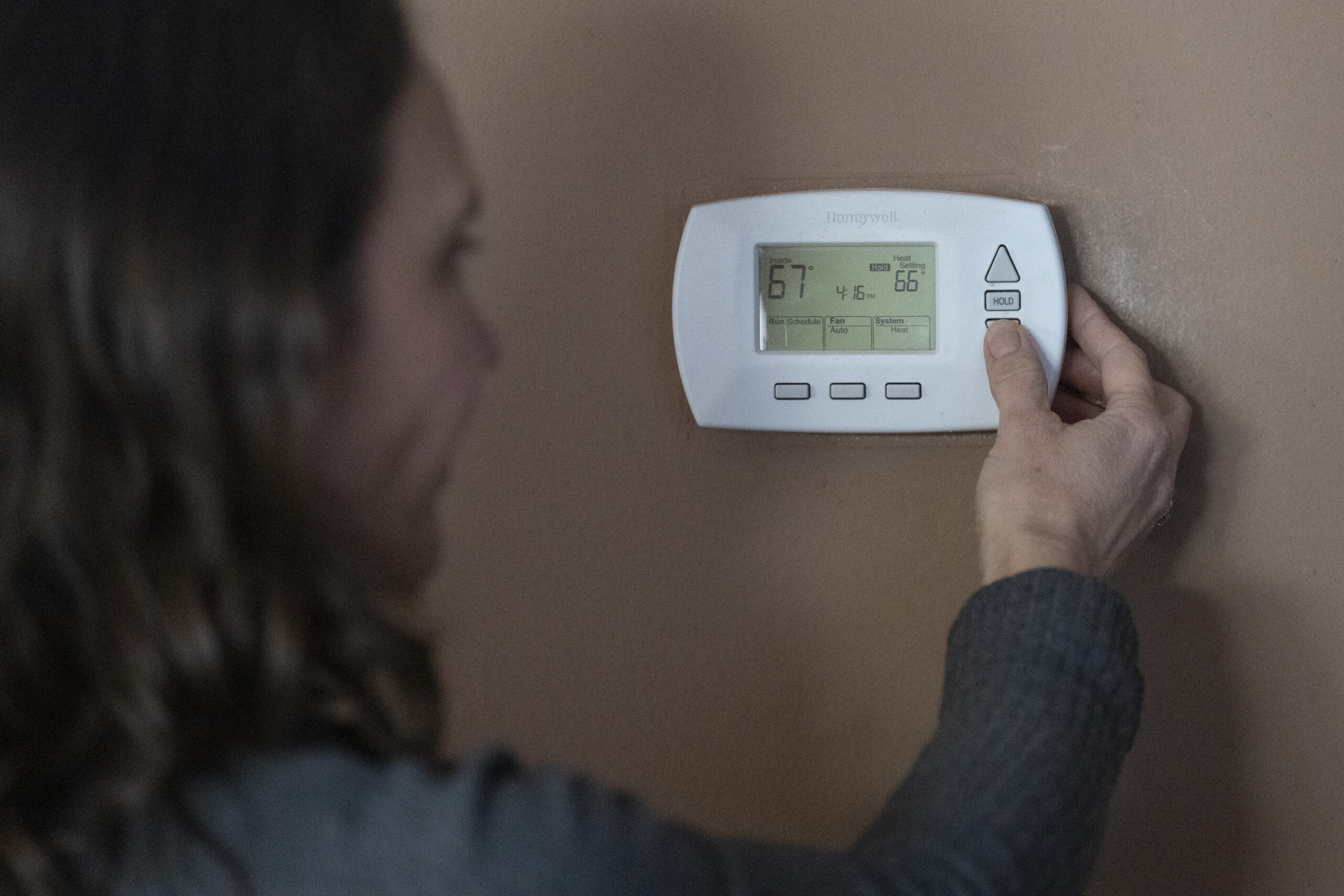
A Philadelphia-area woman woman turns down her thermostat in attempt to save on electricity in this January 2023 file photo.
The pain of skyrocketing utility bills has been felt acutely in New Jersey, which unlike Pennsylvania uses more energy than it produces.
Between 2024 and 2025, New Jersey residents’ electric bills rose more than 13% on average, the fifth steepest increase in the U.S., according to federal data analyzed by the business magazine Kiplinger. Pennsylvanians saw a nearly 10% increase during the same period, according to the data.
A bill sponsored by New Jersey State Assembly member David Bailey Jr., a Democrat from Salem County, attempts to prevent future price hikes.
The legislation would require data center developers to have “skin in the game,” as Bailey described it in a recent interview, and sign a contract to purchase at least 85% of the electric service they request for 10 years. He said it would also provide incentives for data centers to supply their own energy generation.
“I don’t want to come off as an anti-data center person,” said Bailey, who represents parts of Gloucester, Salem, and Cumberland Counties. “This is a very positive thing. We’re just saying we don’t want these big companies to come in and pass this [cost] on to our mom and pops, our neighbors, and our everyday ratepayers.”
Bailey said he was disappointed that his bill was pocket-vetoed by former Gov. Phil Murphy last month. Now, it has to restart the legislative process. But Bailey said he expects it to eventually pass with bipartisan support.
“No matter your party affiliation you understand the affordability issue,” Bailey said. “You understand your electric bill” — and how much it has risen recently.
HARRISBURG — Gov. Josh Shapiro on Tuesday unveiled a $53.2 billion state budget that focuses on making Pennsylvania a more affordable place to live — while proposing a 6.2% spending increase over last year and renewing his pitches to create new revenue streams to fill a significant budget deficit as he runs for reelection.
Shapiro’s fourth budget address attracted several standing ovations from Democrats as he stood before a joint session of the state House and Senate to pitch some of Democrats’ shared priorities, such as increasing the minimum wage to $15 an hour.
Afterward, Republicans decried the budget proposal as unaffordable, arguing such a steep increase in spending is unrealistic when the state is already poised to spend more than it brings in during the current fiscal year and in the future. Shapiro’s proposal would spend $4.6 billion more than the state is projected to bring in in the 2026-27 fiscal year, requiring officials to pull most new spending from Pennsylvania’s $7.7 billion Rainy Day Fund, or find funding from new revenue streams like the taxation of recreational marijuana that do not yet exist.
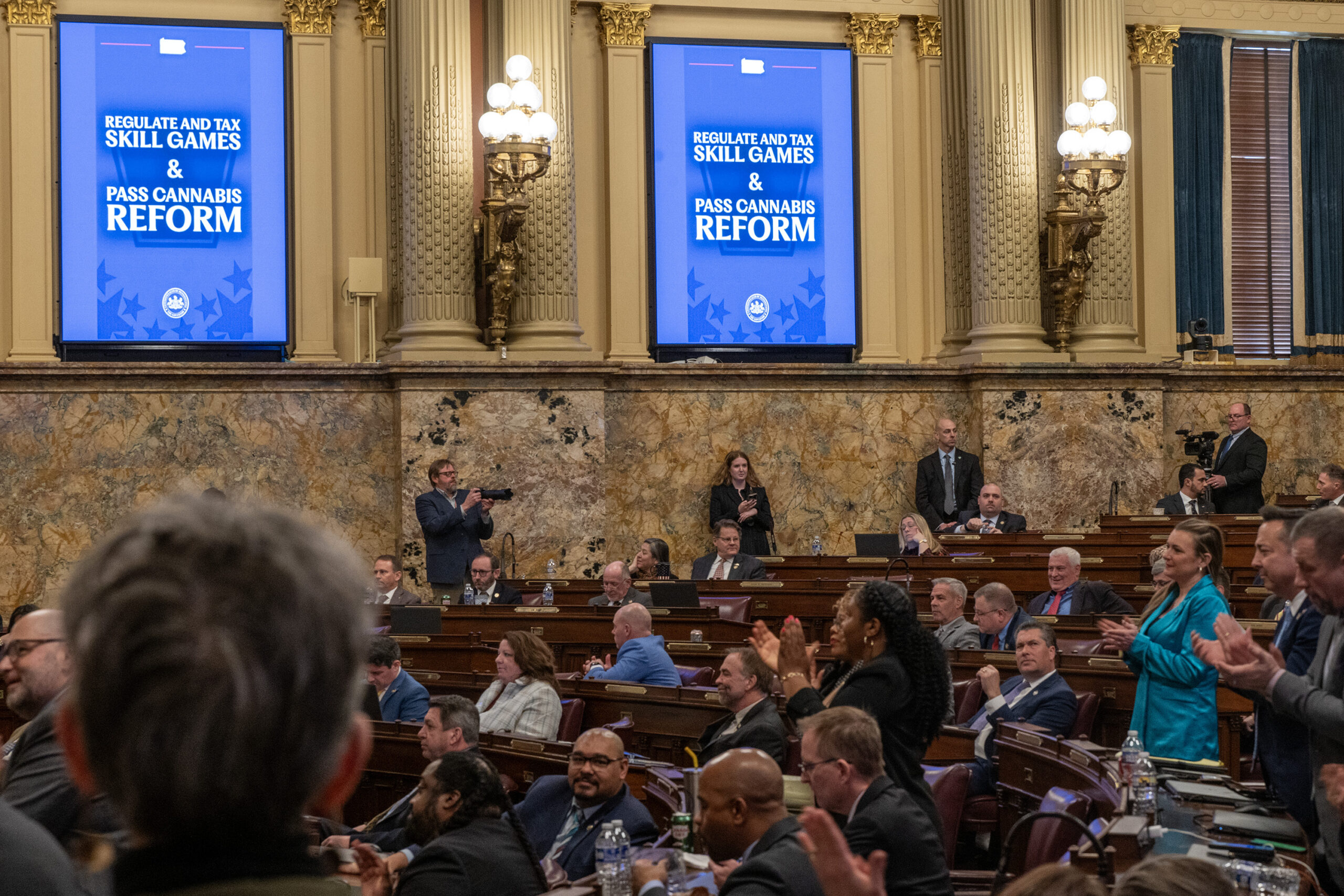
Screen shows skill games and cannabis regulation and reform as Gov. Josh Shapiro makes his annual budget proposal in the state House chamber in Harrisburg Tuesday, Feb. 3, 2026.
Shapiro’s proposed spending hike equates to a $2.7 billion total increase over the 2025-26 budget. Approximately $1 billion of that would fulfill increased federal Medicaid obligations, another $1 billion would be for new initiatives proposed by the governor, and $700 million would go to other funding increases, according to a Shapiro administration official.
The proposal does not include any broad tax increase on state residents. Instead, Shapiro’s budget pitch includes proposals to generate nearly $2 billion in new revenue, largely from the taxation and legalization of recreational marijuana and regulation of so-called skill games — suggestions that he put forward last year but that failed to gain traction within the legislature. He proposed taxing adult-use cannabis at 20% to generate $729.4 million. He is also seeking a 52% tax on skill games, the unregulated and untaxed slot-machine look-alikes that have proliferated around the state in corner stores, bars, and fraternal organizations, to generate an estimated $765.9 million in its first year.
“Everyone knows we need to get this done. So let’s come together and finally get it over the finish line,” he added.
Shapiro proposed the legalization and taxation of recreational marijuana in each of his prior three budget proposals. Last year, he pitched a 20% tax on the sale of legal marijuana that he estimated would bring in $535.6 million in its first year. This year’s projection of $729.4 million in that time frame would be a 36% increase without changing the proposed tax rate. A Shapiro administration official said Tuesday that the projected increase is due to more interest from marijuana companies that want to do business in Pennsylvania.
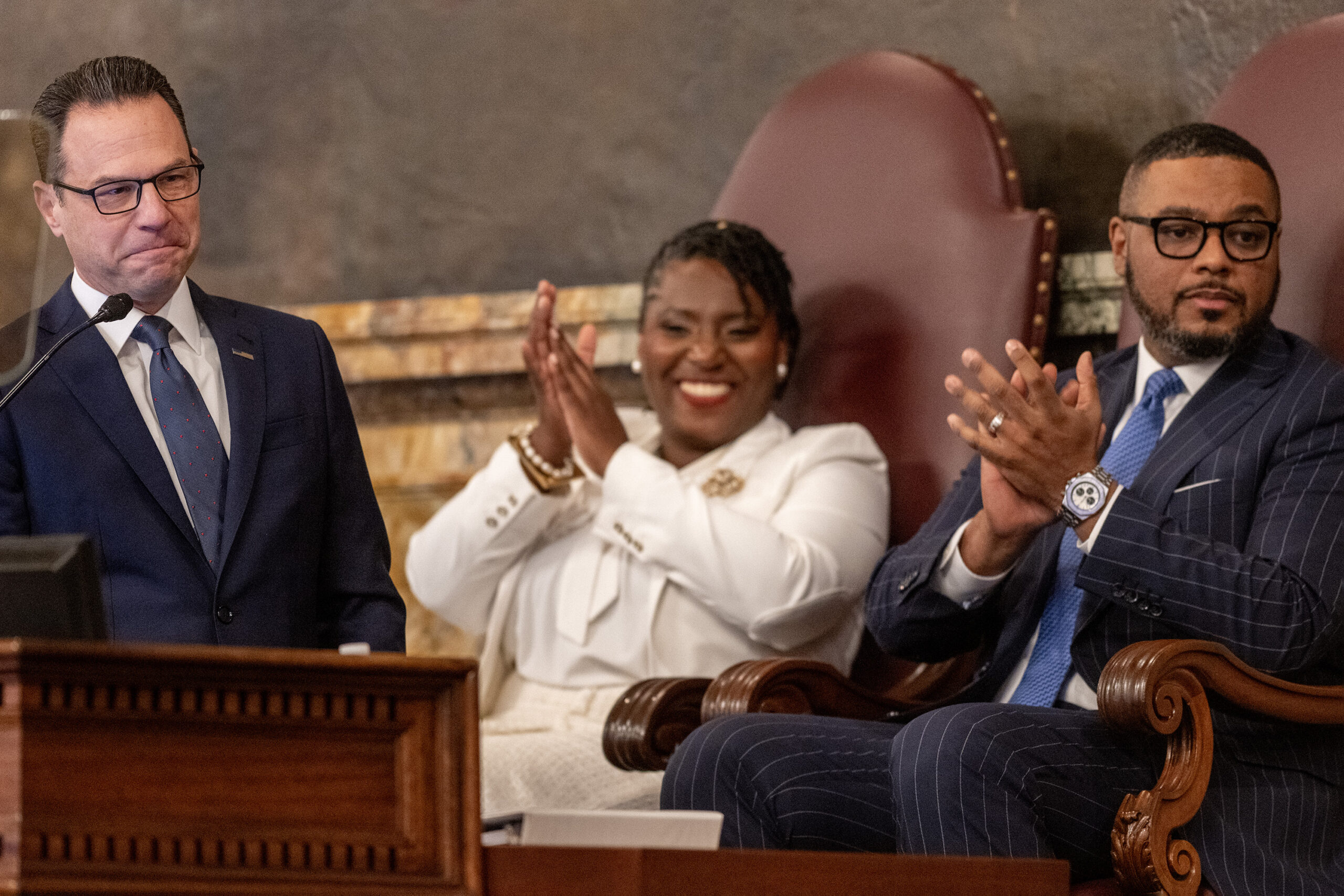
Gov. Josh Shapiro make his annual budget proposal in the state House chamber in Harrisburg Tuesday, Feb. 3, 2026. Pa. House Speaker Joanna McClinton (left) and Lt. Gov. Austin Davis (right) are seated behind him.
Shapiro’s budget also called for an additional $565 million for public schools toward the state’s new adequacy funding and tax equity formulas, in the latest installment of a nine-year plan to ensure students get an equitable education no matter their zip code. He requested $30 million in additional funding toward three of Pennsylvania’s state-related universities — the University of Pittsburgh, Pennsylvania State University, and Temple University — to be awarded based on a new performance-based funding mechanism.
The governor also pitched creating a “Federal Response Fund” in Pennsylvania, seeking to set aside a $100 million reserve to offset any impact from President Donald Trump’s administration, in the event the federal government moves to cut funding to social services programs and grants to state and local governments, as it has done several times over the last year.
A focus on affordability
As his reelection campaign ramps up ahead of November, Shapiro made a broad pitch for policies aimed at making Pennsylvania more affordable.
Shapiro said he was working with utility companies to rein in energy costs and called for the construction of new homes and a bevy of renter protections in a plan to expand the availability and affordability of housing across the state.
He proposed a $1 billion fund, supported by the issuing of bonds, to pay for a range of infrastructure projects relating to energy, housing, local governments, and schools. But he billed it largely as “a major investment in building new housing.”
“We need hundreds of thousands of new homes,” Shapiro said. “This is how we build them.”
Shapiro also called for the state to create a catalog of local zoning rules and to help local governments revamp ordinances to allow for more housing.
The governor again proposed raising Pennsylvania’s minimum wage to $15 an hour, billing it as a cost savings of $300 million to the state on entitlement programs such as Medicaid.
In a news conference hosted by Senate and House Republicans following Shapiro’s budget address, top legislative leaders contended that Shapiro’s affordability vision for the state is unnecessary.
“What we need to do is stand back and watch the private sector work, and watch the private sector grow the jobs that will support this economy,” said House Minority Leader Jesse Topper (R., Bedford). “What we need to do as a government is far less. We need to get our footprint down. That is what we believe will make things more affordable for Pennsylvanians.”
He announced a new plan he said would protect consumers against rising energy costs associated with data centers, while also easing a path for tech companies to build the centers.
The Governor’s Responsible Infrastructure Development (GRID) plan would make data center developers either bring their own power generation or pay for any new generation they will need, he said, “not saddling homeowners with added costs because of their development.”
Shapiro said that too many data center proposals have been “shrouded in secrecy” but that they are crucial for the country.
“The United States is locked in a battle for AI supremacy against China,” Shapiro said. “Look, I don’t know about you, but I’d much rather the future be controlled by the United States of America and not Communist China.”
Shapiro said Tuesday he wants to avoid another lengthy stalled budget, which forced schools, counties, and nonprofits to take out billions in loans to stay afloat during the four-month impasse.
He invited leaders of all four caucuses — Senate Democrats, Senate Republicans, House Democrats, and House Republicans — to meet on Wednesday to start budget talks much sooner than in past years. They all agreed to attend, he added.
“We all recognize it took too long last year and that had real impacts on Pennsylvanians, but we learned some valuable lessons through that process,” Shapiro said in his address, which lasted an hour and 24 minutes. “We learned that we all need to be at the table, and that we all need to be at the table sooner.”
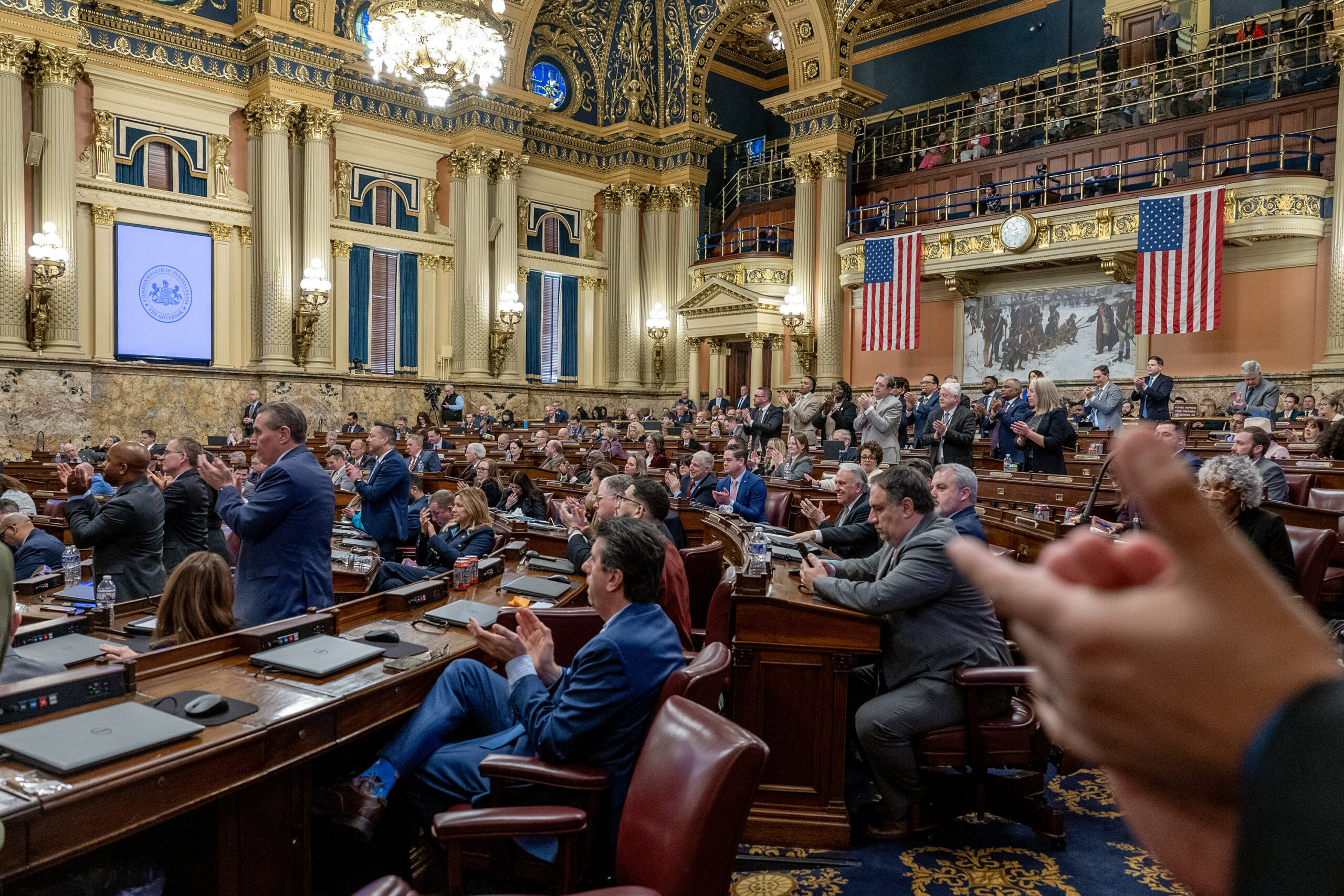
The state House chamber as Gov. Josh Shapiro makes his annual budget proposal in Harrisburg Tuesday, Feb. 3, 2026.
Budget negotiations will begin Wednesday, Shapiro said, before legislative committees begin meeting about the proposal later this month. The budget will be negotiated in closed-door meetings between top leaders and is due by the start of the new fiscal year, which begins July 1.
One contentious issue is off the negotiating table for the forthcoming fiscal year: funding mass transit. Shapiro again pitched the state to increase the share of the sales and use tax that goes to mass transit, including SEPTA, as the transit agencies desperately need a new recurring revenue source. Shapiro does not want that to begin until July 1, 2027, when his latest short-term transit funding fix is scheduled to run out.
Shapiro and most lawmakers in the General Assembly are up for reelection this year. In previous midterm election years, the electoral pressure has sped up negotiations, as legislators want to bring home results to their constituents before they return to the campaign trail in a year when the governor’s mansion and control of the state House and Senate are on the line. (Shapiro’s likely opponent, Republican State Treasurer Stacy Garrity, immediately criticized his budget proposal, saying the pitch “didn’t come nearly close enough” to bridging the state’s spending deficit.)
But even if lawmakers move with haste, this year’s budget negotiations may be tense as leaders try to reset spending to better align with how much the state generates in revenue.
“We’re going to do everything we can to protect the taxpayer and make sure that the dollars that are allocated are wisely used,” Senate Majority Leader Joe Pittman (R., Indiana) said. “We have to make sure we’re, again, stretching every taxpayer dollar we can and bringing the cost of government down as much as possible.”
But with the high-stakes election just months away, House Majority Leader Matt Bradford (D., Montgomery) cautioned Republicans against coming down hard on Shapiro, who has boasted consistently high approval ratings.
“I would argue the polls indicate that we have a very popular governor. They tried to obstruct him and his numbers only got more popular,” Bradford said. “My suggestion is it would be the political imperative, regardless of the policy implications, that they start working with this governor to pass things.”
Staff writers Thomas Fitzgerald, Maddie Hanna, Ariana Perez-Castells, and Susan Snyder contributed to this article.
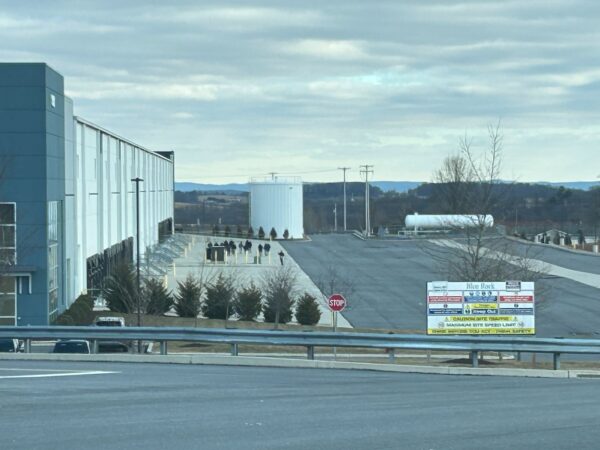
UPPER BERN, Pa. — The Trump administration has quietly purchased a nearly 520,000-square-foot warehouse in Berks County as it plans to convert such facilities into immigration detention centers across the U.S.
The warehouse, located at 3501 Mountain Rd. in Upper Bern Township, was sold to the U.S. government on behalf of the Department of Homeland Security and Immigration and Customs Enforcement for $87.4 million, deed records show. The purchase was recorded on Feb. 2.
Spotlight PA visited the warehouse, which is located about a mile from I-78, on Jan. 15 and witnessed about two dozen individuals touring the exterior of the building. One man who arrived early to the site that day identified himself to a reporter as ICE.
The property was most recently called the Hamburg Logistics Center, and before that was the site of the Mountain Springs Arena, a county landmark known for rodeos and demolition derbies. It neighbors an Amazon warehouse and the Mountain Springs Camping Resort.
The building is one of at least 23 that ICE plans to convert into immigration detention facilities, Bloomberg reports. The Berks County warehouse could house up to 1,500 beds.
ICE also finalized the purchase of a warehouse in nearby Tremont Township, in Schuylkill County, on Monday, according to a deed. The Tremont property is located less than 300 yards from a daycare center and has already faced fierce resident opposition.
A spokesperson for ICE did not answer any questions about the Berks County warehouse purchase and instead lauded the agency’s targeting of “vicious criminals.”
“Thanks to the One Big Beautiful Bill, ICE has new funding to expand detention space to keep these criminals off American streets before they are removed for good from our communities,” the spokesperson said.
Upper Bern Township’s solicitor said in an emailed statement that community leaders learned about the sale on Monday. They declined to answer questions.
“The township was not involved in this transfer and has not received any applications from either the prior or new owners regarding the future use of the property,” the statement reads. “The township has no further comment on this matter at this time.”
State Sen. Chris Gebhard and State Rep. Jamie Barton, Republicans who represent the area, said they have reached out to federal contacts to gather more information on how the Department of Homeland Security plans to use the warehouse.
“Our immediate concerns include the potential loss of property tax revenue for the host municipality, county, and school district, as well as security and perimeter considerations,” the lawmakers said in a joint statement. “We look forward to engaging directly with the appropriate federal officials to address these issues. Once additional information is available, we will provide an update.”
The property is assessed at $22 million and currently pays $198,286 annually in county property taxes under the current tax rate of 9.013 mills. Combined with Hamburg Area School District and township taxes, the loss of tax revenue from the federal government’s purchase would be about $624,000.
State Sen. Judy Schwank (D., Berks) declined to comment on the warehouse purchase on Monday. In an earlier interview with Spotlight PA, she called the then-potential sale “deeply concerning,” especially given the reports of mistreatment of people detained in ICE facilities. She released a statement about “ICE’s action in Minneapolis” on Jan. 27, shortly after federal agents killed Alex Pretti.
“My concern is, knowing the track record of some of these other facilities located throughout the country, it’s not good,” she said. “I don’t necessarily want to see something like that being housed in our county.”
The deed finalized on Monday shows the property was sold to ICE by an LLC connected to PCCP, a national commercial real estate equity firm. The firm purchased the warehouse in 2024 for $57.5 million, deed records show.
Reached by phone Monday afternoon, PCCP partner Greg Eberhardt — who is the authorized signatory for 3501 Mountain Road Owner LLC on the latest deed — denied knowledge of the property and its sale, and refused to comment further.
“I have no idea what you’re talking about,” Eberhardt said before hanging up on a Spotlight PA reporter. “I’m not making company comments.”
Upper Bern Township is situated on the edge of Berks and Schuylkill Counties, with a population of roughly 1,600 people. The community is mostly white, with only 2.8% of residents identifying as another race, according to the 2020 Census.
Bridget Cambria, an attorney with Aldea, a nonprofit that provides pro bono immigration legal services, said the detention center would have a “disruptive” and “chilling” impact on Berks County’s immigrant community.
“If there are people that live freely and at peace knowing that they do the right thing, they can do their immigration process or stay with their family or figure out a way to legalize their status, they’re going to be more afraid to do that with a giant detention center in their backyard,” Cambria said.
A 2022 study by the Detention Watch Center and the Immigrant Legal Resource Center found that immigrants were more likely to be arrested by ICE in counties with more detention bed space.
BEFORE YOU GO … If you learned something from this article, pay it forward and contribute to Spotlight PA at spotlightpa.org/donate. Spotlight PA is funded by foundations and readers like you who are committed to accountability journalism that gets results.
PJM Interconnection — the region’s dominant electric grid operator — is poised to play a central role in the expansion of data centers, as the independent organization has been shoved into the national spotlight and subjected to mounting pressure over the last year.
It has been a frequent target of Shapiro, officials from other states, consumer advocates, and the federal government.
In many ways, PJM may be one of the most consequential Philly‑area institutions that most residents have barely heard of, even though their electricity supply and monthly bills hinge on its decisions.
The organization has faced escalating scrutiny nationwide and across the region because of its position as the country’s largest independent grid operator and the challenges tied to surging energy demand.
What is PJM?
Based in Audubon, Montgomery County, PJM manages the minute-by-minute flow of electricity for 67 million people across 13 states and the District of Columbia.
It helps keep the lights on for 13 million Pennsylvanians.
Why are there concerns about PJM and data centers?
Concerns have risen over the cost to consumers posed by hyperscale data centers — the massive server farms needed to run artificial intelligence — that are poised to come online across Pennsylvania and the U.S.
PJM plays a major role in getting those data centers powered and connected to the regional electrical grid.
Consumer advocates say the data centers are forcing consumers to pay for the new power plants and equipment needed to keep up with that demand. And they fear that huge demand could result in electrical outages during times of peak demand.
Already, consumers have seen electricity prices spike — and that’s before most of the proposed data centers are even built.
How much consumers pay is influenced by an annual auction held by PJM designed to get enough commitments from power producers so that the electrical grid can meet forecast demand for several years and to ensure power during peak times. That is known as grid reliability.
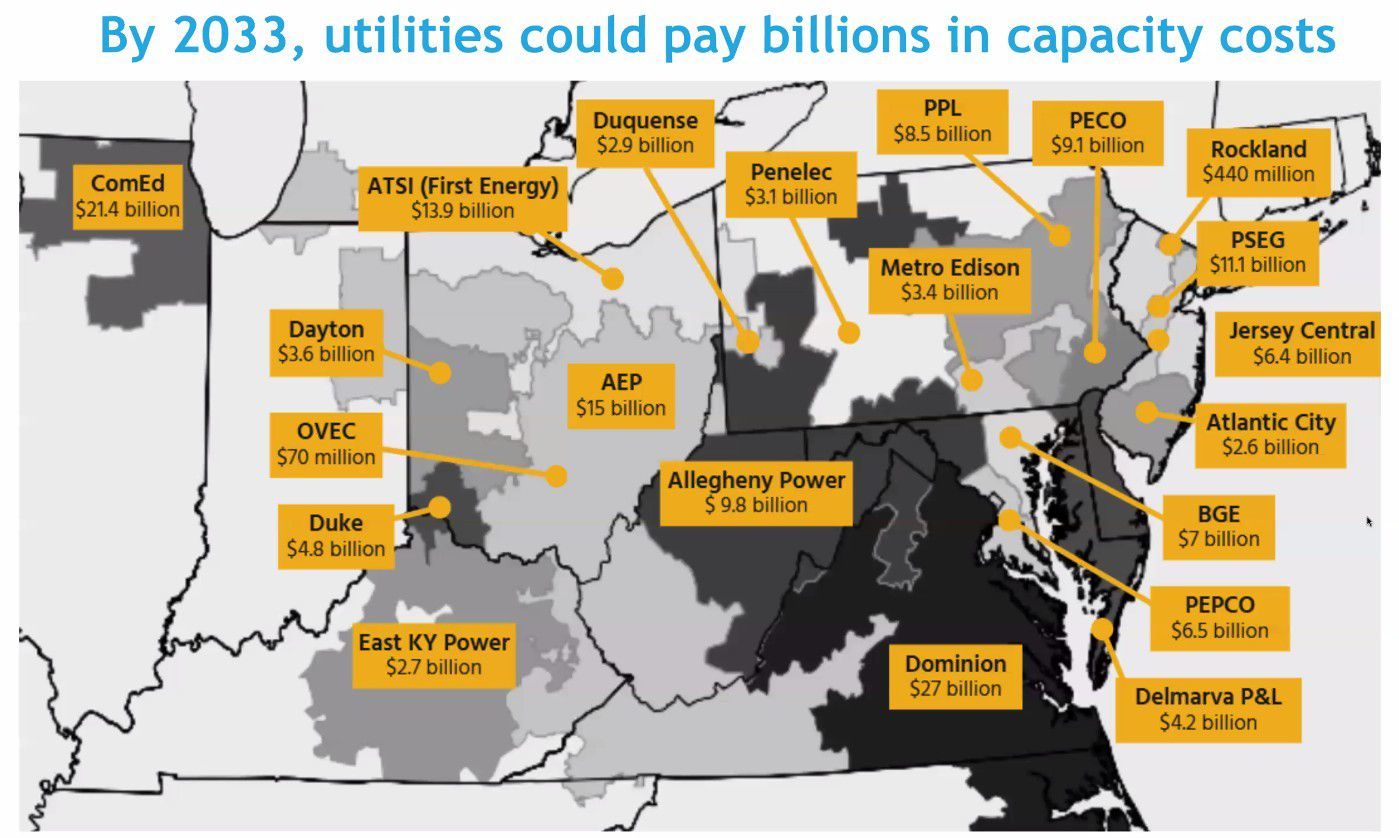
Map produced by The National Resources Defense Council estimates electricity capacity costs to utility companies based on PJM forecasts through 2032.
Why is Gov. Shapiro critical of PJM?
Shapiro and other governors have been sharply critical of how PJM has designed its auction, saying the process lacks transparency.
In a 2024 lawsuit, Shapiro’s office referred to PJM’s decisions as “inept” and responsible for “the country’s most snarled interconnection queue,” in reference to projects lined up for approval to be added to the grid.
After the 2025-26 auction, Shapiro reached an agreement with PJM on a price cap that he said would save consumers over $21 billion and avoid historic price hikes. The cap limited the increase of wholesale electricity payments to power plant owners.
PJM forecasts that data centers will drive a need for more than 30 gigawatts of peak electricity capacity by 2030 — enough to power more than 20 million households, or approximately all the homes in New Jersey, Pennsylvania, Ohio, Virginia, and Maryland, according to the Natural Resources Defense Council (NRDC).
The NRDC says that could lead to another spike in electricity costs through 2033 and cost homeowners and businesses an estimated extra $70 per month.
At the same time, however, officials are also pushing PJM to fast-track data centers.
Late last year, the Federal Energy Regulatory Commission issued an order on so-called colocation that will allow tech companies to plug their data centers directly into power plants.
In January, the Trump administration and a group of governors, including Shapiro, urged PJM to move quickly to boost power supplies and keep bills from rising.
They also want PJM to hold a separate power auction in which tech companies would bid on 15-year contracts to build new power plants. That way, data center operators, not regular consumers, would pay for the power.
Data centers that do not have their own power source and do not volunteer to be cut off from the grid during power emergencies should be billed for the cost of new power plants, they said.
Why do people resist data centers near their homes?
The quick rise of data centers has met stiff resistance from residents who fear the projects will radically alter the character of rural neighborhoods, increase electricity and water costs, and harm the environment.
Developers have submitted applications for at least 20 hyperscale data centers in Pennsylvania. PJM would have to find a way to make sure they can be powered and connected reliably to the grid, or provide their own power.
At least six data centers are being planned or proposed in the Philadelphia region, with some reaching 2 million square feet. Residents have fought the proposals, some of which have run into zoning and planning problems.
Residents of some of those communities are alarmed by a new Pennsylvania House bill (HB 2151), which is backed by Shapiro. It provides a model ordinance designed to speed data center development.
Opponents believe the bill is an attempt by the tech industry to get data centers approved.
“HB2151 would undermine Pennsylvanians’ herculean grassroots efforts to keep dirty data centers out of our communities — it must be stopped,”said Ginny Marcille-Kerslake, an organizer for Food and Water Watch, an environmental advocacy nonprofit.
“This bill pushes Shapiro’s reckless embrace of data centers even further onto communities struggling to grapple with Big Tech’s land, power, and water grab,” she said, calling it a part of “backroom deals” the state is making.
A vote on the bill before the House Energy Committee is scheduled for Wednesday.
What’s next?
Environmentalists and other groups, including some legislators, say a process by PJM to fast-track electricity-producing projects excludes clean energy and gives special treatment to fossil fuel power plants, allowing them to cut ahead in the queue over renewable sources that have waited years to connect to the grid.
That plan calls for changes in PJM policies to bring new power online quickly by providing a streamlined path for state-sponsored power generation projects, improving load forecasts, giving a bigger role in the process to states, and offering ways for data centers to bring in their own power generation while curtailing power in times of system need.
The plan, PJM said, “will also help address the supply-and-demand imbalance that has the potential to threaten grid reliability and is currently driving up wholesale costs that can impact consumer bills.”
Jeff Shields, a spokesperson for PJM, said the imbalance has been created as sources of power generation are being retired without enough new generation coming online to keep pace. At the same time, demand for electricity has increased substantially due to the proliferation of data centers.
“PJM is doing its part to bring new generation onto the system, and any suggestion otherwise is just not true,” Shields said.
He also noted that while PJM does run wholesale power markets, it does not directly set rates for residential, commercial, or industrial customers. Those rates are set by utilities, such as Peco, along with government agencies, such as the Pennsylvania Public Utility Commission.
A federal appeals court revived a lawsuit challenging the legality of Philadelphia School District’s special-admissions process Monday, ruling the policy could be seen as “blatantly unconstitutional” and ”race-based.”
The ruling could have long-term implications for the admission process for citywide magnet and special-admissions schools, which has been controversial since its inception.
While it will have no immediate impact on the school district’s process, the ruling means the case could now proceed to trial.
The district changed the way it admits students to criteria-based schools in 2021, moving from a system where principals had discretion over who got into the district’s 37 special-admissions schools to a centralized, computer-based lottery for any student who met academic criteria.
For the city’s five top magnets, all students who met the standards and lived in certain underrepresented zip codes gained automatic admission.
Officials at the time said they were changing the policy as they “made a commitment to being an antiracist organization” after an “equity lens review” of admissions practices.
The demographics of some selective public schools do not match the city’s demographics. Masterman, for instance, has much higher concentrations of white and Asian students than the district does as a whole.
Although the school district has defended its policy change, a panel of federal judges on Monday ruled that it could be viewed as discriminatory.
“School District officials made public and private statements — both before and after the enactment of the Admissions Policy — that could support a finding that the Policy was intended to alter (and did alter) the racial makeup of the schools,” Judge Thomas Michael Hardiman wrote for the three-member panel.
“So a reasonable fact finder could conclude that the School District acted with a discriminatory purpose,” the panel wrote. The panel included Hardiman, a George W. Bush appointee; Cheryl Ann Krause, a Barack Obama appointee; and Arianna Julia Freeman, a Joe Biden appointee.
A district spokesperson said Monday that the school system does not comment on ongoing litigation.
The legal team representing parents Sherice Sargent, Fallon Girini, and Michele Sheridan — including lawyers from America First, an organization formed by Stephen Miller, a top aide to President Donald Trump called the action “a major victory.”
“School officials don’t get to rig admissions systems to satisfy ideological goals,” said Gene Hamilton, America First Legal’s president, and a former Trump deputy counsel. “This ruling affirms a basic constitutional principle: government cannot discriminate by race, whether openly or by proxy. AFL will continue fighting to secure accountability and restore equal protection.”
What did the initial lawsuit argue?
Sargent, Girini, and Sheridan sued in 2022to end the policy, to stop the district from using “racially discriminatory criteria” for magnet school admissions, and to award damages to those who might have been damaged by the “gerrymandered lottery” policy.
A federal judge ruled in favor of the school district in 2024 without a trial, writing that “no fair-minded jury could find that the changes to the admissions process were implemented with racially discriminatory intent or purpose.”
The district has defended its position, saying it was geography, not race, that gave certain students preferential admission to magnets like Masterman, Central, the Academy at Palumbo, and George Washington Carver High School of Engineering and Science.
Five admissions cycles have happened since the overhaul.
Adjustments have been made since the initial rollout — including dropping a controversial, computer-graded essay, adding ranked choice, adding sibling preference, and giving automatic admission to students who attend middle schools with attached high schools and meet academic standards — but the underpinnings remain, as does the preference for qualified students from underrepresented zip codes at selected schools.
Sargent’s daughter, who is Black, qualified academically for the George Washington Carver High School of Engineering and Science; Girini’s son, who is white, qualified for Academy at Palumbo; Sheridan’s child, who is biracial, met standards for Palumbo. All were denied admission to their top-choice schools, though they gained admission to other district magnets.
As a result of the shift to the lottery — and changes to admissions criteria — admissions offers to Black and Hispanic students increased significantly at most of the highest-profile schools, and offers to white and Asian students decreased at most.
What did Monday’s ruling say about the admissions policy?
District lawyers havesaid the admissions overhaul “was race-neutral and motivated by legitimate goals, such as increasing objectivity and improving access for qualified students from underrepresented geographic areas.”
But the appeals panel found that the federal judge who dismissed the case “did not adequately consider the evidence of why the School District implemented the Policy in the first place, including the School District’s stated goals, the historical context behind the ‘equity’ aims, and statements made by School District officials.”
Before the admissions changes took effect, then-Superintendent William R. Hite Jr. issued an anti-racism declaration in 2020 following the killing of George Floyd by Minneapolis police and the resulting racial justice movement.
Hite said it was “imperative that we take a laser focus on acknowledging and dismantling systems of racial inequity. For us, this goes deeper and far beyond focusing on individual acts of prejudice and discrimination, but refers to uprooting policies, deconstructing processes, and eradicating practices that create systems of privilege and power for one racial group over another.”
“These statements and actions, taken together in context, could support a finding that the School District adopted the Admissions Policy to achieve racial proportionality,” the appeals panel wrote.
What comes next?
Monday’s ruling has no impact on the existing admissions process, which is already underway for the 2026-27 school year.
And it is not yet clear what will come of the case after it returns to a lower federal court, but it could potentially now proceed to trial.
WASHINGTON — In a string of public appearances since federal agents fatally shot Alex Pretti, Gov. Josh Shapiro has repeatedly decried the federal immigration operation in Minnesota as unconstitutional and called on President Donald Trump to “terminate the mission.”
The centrist Democratic governor leaned heavily into criticism of the Trump administration as he toured the East Coast —andnetwork and cable news shows — to promote his new memoir, Where We Keep The Light, last week.
“I believe this administration in Washington is using [government] for pure evil in Minnesota right now,” Shapiro, who is widely believed to be setting up a presidential run, told Late Show host Stephen Colbert last week. “And it should not be hard to say that.”
Known to be a careful messenger, Shapiro’s approach to the Immigration and Customs Enforcement and Border Patrol operations in Minneapolis evolved over the last week, from his initial decision over the first year of Trump’s second presidency not to aggressively speak out against ICE’s enforcement tactics to a hard-line approach condemning the Trump administration’s mission following the killing of another U.S. citizen by federal agents that became national tipping point.
When ICE agents killed Renee Good in early January, Shapiro issued a statement mourning her death, but made no broader conclusions about ICE and did not mention her by name.
Now, he has honed a clear and authoritative message that the Trump administration’s strategies are eroding trust in law enforcement, violating constitutional rights and making communities less safe. If Trump moves his focus and forces to Pennsylvania, he says, state officials are prepared to push back.
According to polling obtained by Puck News, Shapiro has landed on some of the most effective messaging on immigration in the country.
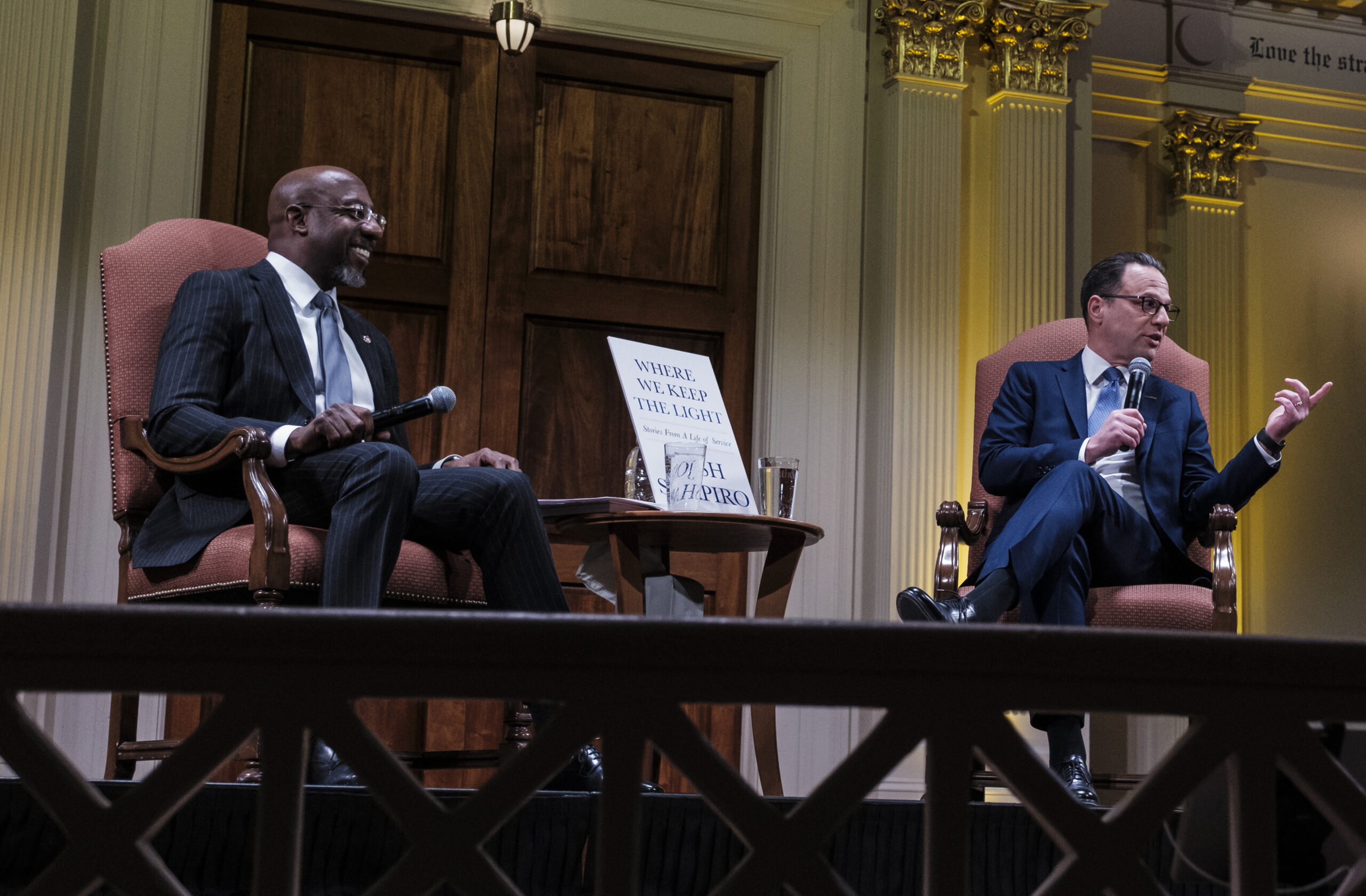
Governor Josh Shapiro (D-PA) and Sen. Raphael Warnock (D-GA) speak during a talk for his new memoir “Where We Keep the Light” on January 29, 2026 in Washington, D.C
But immigrant rights groups in Pennsylvania say the governor took too long to speak up and has yet to back his rhetoric up with concrete actions in his home state by ending cooperation with ICE.
“Because it is the topic of the day, he’s getting these pointed questions, and his answer to that is to point to what they’re doing wrong in Minnesota. Meanwhile, he’s over here telling us that he’s not going to stop collaborating with ICE,” said Tammy Murphy, advocacy manager at immigrant rights group Make the Road Pennsylvania. “It’s easy for him to point the finger to somebody else, but then what is he doing at home?”
At a roundtablewith journalists in Washington on Thursday, Shapiro said he didn’t view his new outspokenness against ICE’s operations in Minneapolis as a tone shift, but acknowledged that the situation had become more serious in recent days and he “reached a point where it was critically important” to comment on the situation in Minnesota and tell Pennsylvanians his views.
“I think I’ve been in the same place on this to protect our immigrant communities and also make sure that Pennsylvania is safe,” Shapiro said.
“Both [Good and Pretti’s deaths] told me the same story that you had people who were not following proper policing tactics. People who were in the field who seemingly, and it became more clear to me over the last week or two, did not have a clear mission and that the directive that they had clearly was not within the bounds of the constitution.”
“That’s people power right now, and this is a moment where we need to raise our voices,” Shapiro said. (His event was then promptly, but briefly, interrupted by climate protesters)
“It’s always good to cooperate with ICE, especially when they’re doing targeted actions,” Garrity said.
Samuel Chen, a GOP strategist, said Shapiro’s harsh rhetoric would create a clear distinction between him and Garrity while “endearing him to the Democrats should he run in 2028.”
Chen noted that even some Republicans have criticized Trump’s approach to Minnesota, which creates an opportunity for Shapiro to speak out.
“With that being public opinion the governor has a lot of cover to come out even harder,” Chen said. “It’s a win, win, win for him.”
Chalk on the sidewalk reading “Shapiro Stop ICE in PA,” during a protest outside the Free Library as Gov. Josh Shapiro promoted his new book “Where We Keep The Light” in Philadelphia, Pa., on Saturday, Jan. 24, 2026.
Even as he makes the case against ICE’s recent actions, Shapiro is still being careful not to go too far. He frequently mentions that Pennsylvania is not a sanctuary state. In an interview with Fox News last week, he criticized Philadelphia District Attorney Larry Krasner’s comments comparing ICE agents to Nazis as unacceptable rhetoric.
“It is abhorrent and it is wrong, period, hard stop, end of sentence,” Shapiro said.
What is most frustrating to immigrant rights groups is the Shapiro administration’s willingness to cooperate with ICE — even if on a limited basis — while other Democratic governors have taken strong actions against it. Gov. Maura Healy of Massachusetts, for example, banned ICE from state facilities.
Meanwhile, Shapiro’s administration honors some ICE detainers in state prisons and provides ICE with access to state databases that include personal identifying information for immigrants.
“You are still collaborating with the agency that is murdering our people, that you yourself have named as violating the constitution,” said Jasmine Rivera, the executive director of the Pennsylvania Immigration Coalition.
“You know, Parady La’s death was also bad,” said Murphy, who is with Make The Road. “That happened in this state at the hands of federal agents. And he’s silent about that, but then he’s got something to say about Renee Good or Alex Pretti. He’s talking about those people, but not the people here.”
The Shapiro administration says that outside agencies do not have “unfettered access” to state databases but may offer access to federal agents for “legitimate investigations that involve foreign nationals who have committed crimes.”
Furthermore, they say ICE detainers are honored only when a detainee has been convicted of a crime and sentenced to state prison.
In a letter to advocates last month, the administration vowed not to lease state property to ICE and reiterated that State Police are barred from conducting immigration enforcement and that federal agencies must obtain a warrant to access non-public space in state buildings.
Gov. Josh Shapiro speaks with Stephen Colbert last week.
This cautious approach is part of a balancing act Shapiro must handle as he pursues reelection in a politically split state and weighs a potential run for higher office, said Alison Dagnes, a political science professor at Shippensburg University.
“He is spinning plates and juggling flaming torches, all while he’s playing the kazoo,” Dagnes added “That combination is really important to consider as we look at his shifting rhetoric, his carefulness that moved into a louder stance.”
But advocates want Shapiro to take a firmer stance and say they won’t stop pushing until he does.
“Politically, he wants to be seen as ‘both sides,’” Murphy said. “He doesn’t want to be seen challenging Trump or this deportation machine.”