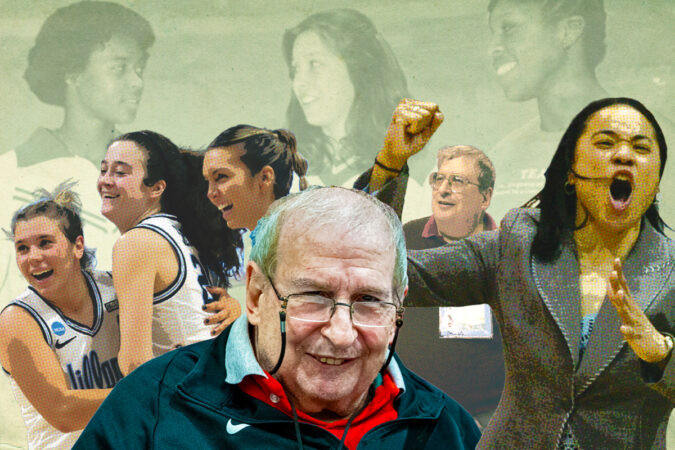
Paging through the bulky Sunday Inquirer on Nov. 28, 1976, readers encountered a sports section that might have been compiled in Mount Athos, the tiny Greek republic that’s been off-limits to women for centuries.
It was stuffed with man’s-world staples — stories, stats, and standings on the NFL, NHL, pro and college basketball. There were columns on hunting, golf, boys’ high school sports; features on boxing, men’s cross-country, minor league hockey; an entire page devoted to horse racing.
The ads were no less macho-flavored, promoting car batteries, rifles, tires. A prominent one hyped January’s U.S. Pro Indoor Tennis Championship at the Spectrum with its lineup of “50 of the world’s top male pros.”
About the only indications that women participated in sports were an account of a West Chester State field hockey game and, buried on the gray scoreboard page, a truncated leaders’ list from that weekend’s LPGA tournament.
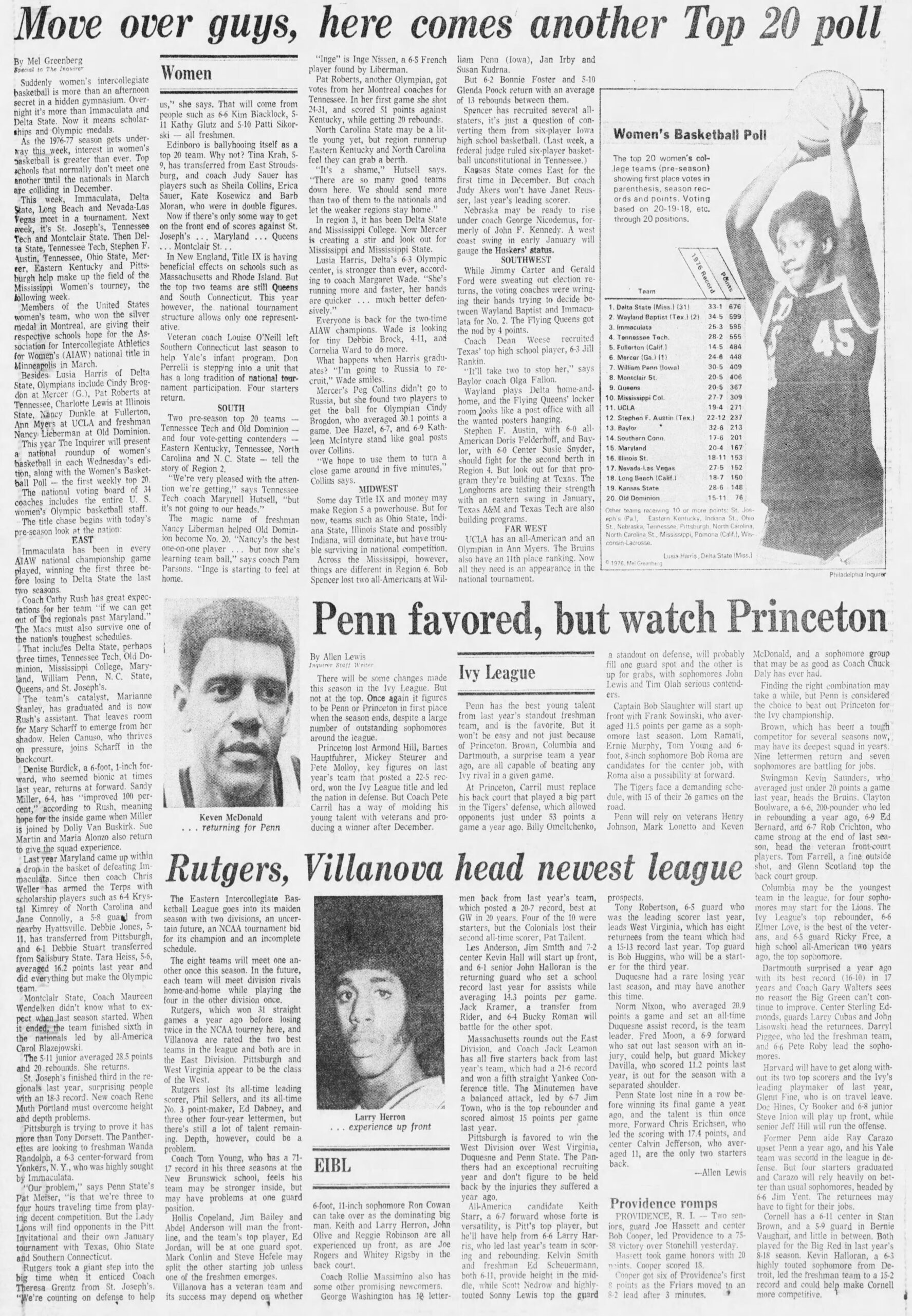
But for those who reached Page 16, a strange interloper awaited. Sandwiched between two men’s basketball previews, as if editors thought it incapable of standing alone, was one of the earliest and most consequential harbingers of a bubbling sports revolution — the first women’s college basketball poll.
Conceived by then-Inquirer sports editor Jay Searcy and obsessively nurtured by a Temple-educated newspaper clerk named Mel Greenberg, its headline read like a polite plea for recognition: “Move over guys, here comes another Top 20 poll.”
A clipping from the Nov. 28, 1976, edition of The Inquirer that features the first installation of what became the AP women’s basketball poll.
It came. And it stayed. Week after week, year after year, Greenberg’s poll accumulated popularity and heft, becoming a building block in the growth of women’s basketball. A sport that had been widely ignored and loosely governed by the Association for Intercollegiate Women’s Athletics now had validation, a common sense of purpose, and unity.
“That poll gave coaches and others around the country an opportunity to know what was going on everywhere with women’s college basketball,” said Marianne Stanley, a star on Immaculata’s 1970s championship teams and later a successful college and WNBA coach. “Prior to that, there was only word-of-mouth. Newspapers didn’t cover it, and no one was tracking what was happening nationally.”
Revisiting that debut poll in this, its 50th anniversary year, is eye-opening. Its top 10 might today be mistaken for a ranking of Division III field hockey teams — Delta State, Wayland Baptist, Immaculata, Tennessee Tech, Fullerton, Mercer, William Penn, Montclair State, Queens, and Mississippi College.
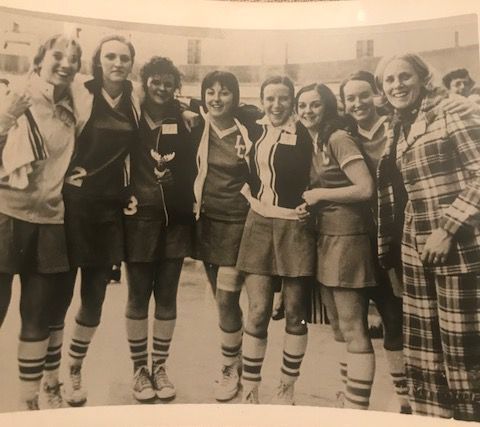
Theresa Grentz (second from left) and Marianne Stanley (fourth from right) with Immaculata teammates and coach Cathy Rush at right. Immaculata was one of women’s college basketball’s first powers.
The large state schools that dominate in 2026 mostly were absent.
But not for long.
Motivated by the mandates of 1972’s Title IX and by a desire to see themselves in the new rankings, many started to invest in the sport.
By 1981, when the NCAA replaced the AIAW as the game’s overseer, there were 234 women’s Division I programs. That jumped to 284 in 1991, 317 in 2001. Last season there were 325 D-I programs, and more than 1,000 when Division II and III are included.
“The fact that so many schools where women’s basketball was nonexistent or an afterthought went all in is a credit to Mel and his poll,” said Jim Foster, the retired women’s coach at St. Joseph’s, Ohio State, and elsewhere.
Deirdre Kane, the retired West Chester University coach, said that “until Mel’s poll, the NCAA wasn’t even acknowledging our existence. That poll made people realize, some of them for the first time, that women’s collegiate basketball was being played.”
Greenberg built a national network of coaches and administrators, contacting them weekly for information and input. As newspapers beyond Philadelphia added his poll, its significance deepened.
“We were all fighting for recognition, but none of us were getting much,” said Geno Auriemma, the Norristown-raised, spectacularly successful coach at Connecticut. “Mel came along, and he was one of the few who gave us a little. His poll helped us all grow the game.”
It grew so widely that in 1996 the NBA launched a women’s pro league, stocked with the stars of the college game. The WNBA now has a national TV contract, recognizable superstars, and a lineup of big-city franchises that in 2030 will include Philadelphia.
“When Philadelphia gets that team,” Foster said, “they ought to call it the Philadelphia Mels.”
It took 28 years after the inception of the Associated Press’ men’s college basketball poll for the women to get one. In 1976, Searcy, who before arriving at The Inquirer had covered women’s sports for the New York Times, decided the time had come. His motivation likely sprang from developments in that Bicentennial year.
Women’s basketball made its Olympic debut that summer in Montreal. A few months earlier, Immaculata had appeared in its fifth straight AIAW national title game. The Mighty Macs, who in 1971 played in the first nationally televised women’s game, had won the first three and were runners-up the next two years.
Searcy reached out to Greenberg, an editorial clerk who by then was the de facto Immaculata beat writer.
“Jay called me into his office and said, ‘What do you think of the idea of a women’s basketball poll?’” Greenberg said. “And I said, ‘I think you’re nuts.’”
As Greenberg prepared for the poll’s November launch, Searcy promoted it. He revealed his plan to Temple students during a campus visit. In that audience was Foster, then a physical education major who also coached Bishop McDevitt High School’s girls.
“It was really exciting news for anyone interested in the sport,” Foster said. “He told us he was going to start a women’s basketball poll that would be just like the men’s.”
Still, many scoffed. Women’s basketball, after all, existed deep in the shadows. Most newspapers and TV stations ignored it. With few exceptions, games were played before tiny crowds, often in substandard gyms. Rules weren’t standardized, qualified coaches and referees were in short supply, and, until the AIAW’s 1971 founding, there was no universally accepted end-of-season tournament.
“The only people who followed women’s basketball then were the people involved in the game,” Kane said.
But if there was a hotbed, it probably was the Philadelphia area. Numerous elementary schools, high schools, and colleges here had teams. West Chester State, with its strong physical education program, gained prominence in the 1960s under coach Carol Eckman, now known as “the mother of women’s college basketball.” And it was a West Chester grad, Cathy Rush, who turned Immaculata into the nation’s best team in the early 1970s.
“There was always a huge basketball presence in Philadelphia,” Stanley said. “But it wasn’t until Immaculata that many people noticed the women. Then, the AIAW was formed, and that was big. Now, here comes the poll, and suddenly we’ve got a way to track and pay attention to what was happening not just here but across the country.”
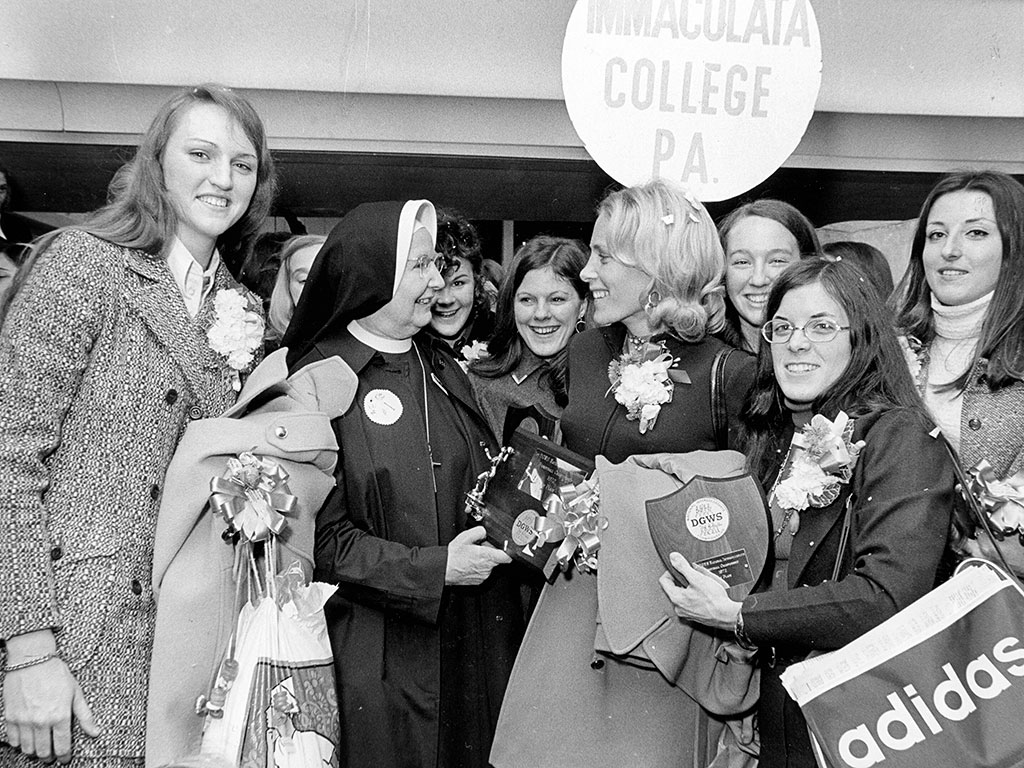
Members of the Immaculata College basketball team gather around their coach as they return after winning the first women’s collegiate national championship in 1972. From left in the foreground are Theresa Shank, college president Sister Mary of Lourdes, coach Cathy Rush, and Janet Ruch.
Despite Greenberg’s occasional stories on the Mighty Macs, few readers knew much of the women’s basketball world beyond. And few sports editors and writers besides Searcy and Greenberg saw its potential.
“I loved women’s basketball,” said Dick Weiss, a veteran sportswriter who then was covering men’s college basketball for the Philadelphia Daily News, “but most of us never saw it becoming a regular beat. All our energy went into the Sixers with Julius Erving and the Big 5, which still had NCAA teams filled with local talent.”
Launching the poll proved problematic. If women’s programs were second-class on most campuses, so were their support staffs. Gathering schedules and stats was nearly impossible. When Greenberg reached out to the AIAW for help, the organization balked.
“They told me women’s sports shouldn’t get involved in things like newspaper polls because that would lead to the evils of men’s athletics,” he said.
So he built a Rolodex of contacts, then he and some basketball contacts painstakingly collected information over the phones.
“Mel based the poll operation in our sports department,” said Gene Foreman, then The Inquirer’s managing editor. “His volunteer helpers were several tall women.”
Coaches telephoned in their votes on Sunday nights. One, N.C. State’s Kay Yow, provided an early indication of the poll’s impact.
On Jan. 2, 1977, Immaculata visited N.C. State, which typically played before small gatherings. But the new rankings promised a compelling matchup. The Wolfpack were ranked No. 15; Immaculata, which triumphed, 95-90, was No. 2.
“I remember Yow calling and talking about how excited she was,” Greenberg said. “It was snowing before the game, but there was a long line of fans outside the arena waiting for tickets.”
In 1978, the Associated Press began distributing the poll, giving most news outlets access. Then, in 1994, Greenberg ceded its compilation to the AP, and media members replaced coaches as the voters.
The poll was a cornerstone of the game, and in 2000, another Sunday Inquirer spotlighted women’s basketball’s maturity.
Philadelphia was hosting that year’s Final Four. Its lineup of Connecticut, Tennessee, Rutgers, and Penn State revealed the game’s progression from the days when little Immaculata could win three straight titles. Its two sessions attracted nearly 40,000 fans. Millions more watched on ESPN.
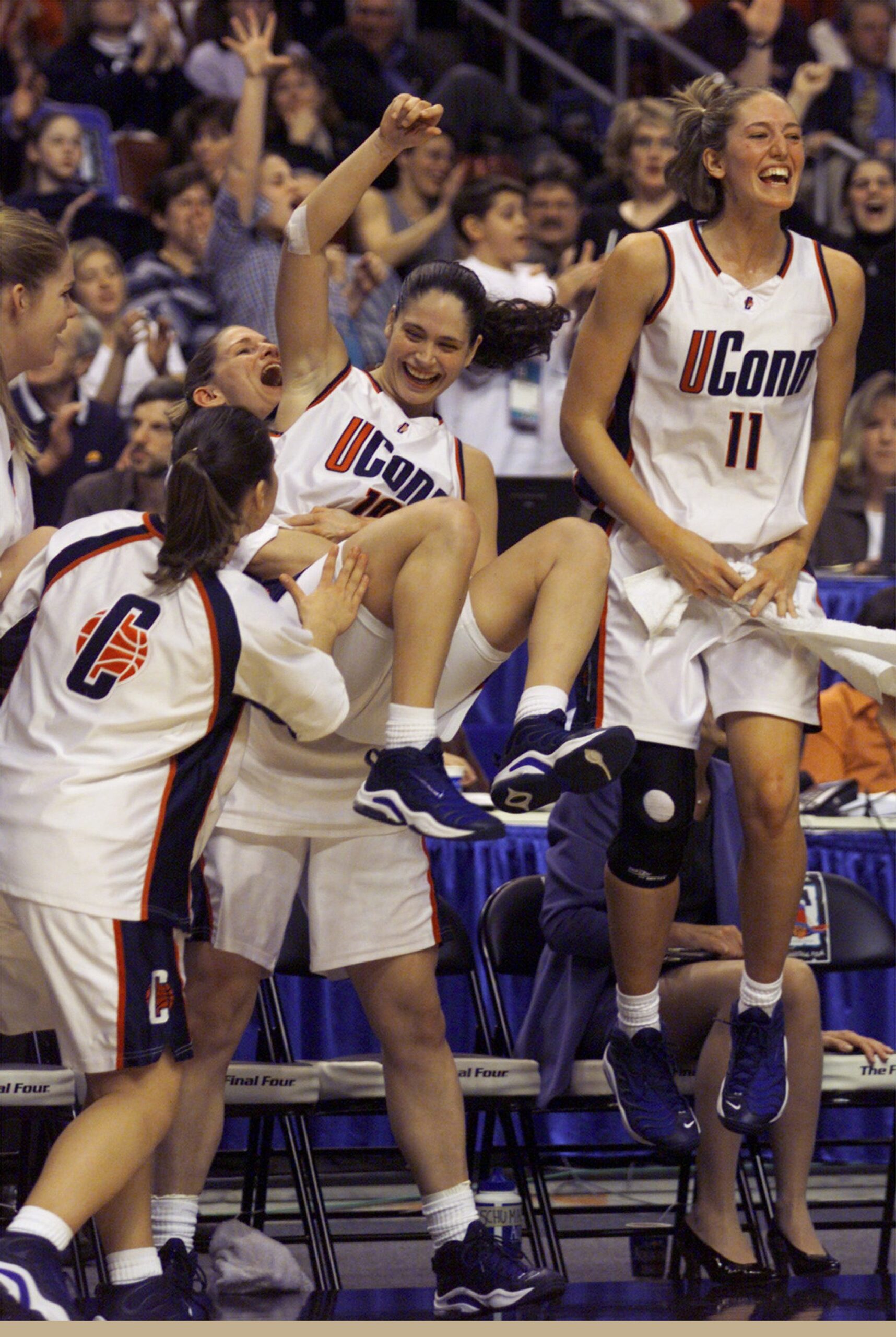
Stacy Hansmeyer, Sue Bird, and the UConn bench celebrate after Swin Cash makes a breakaway layup late in the second half of UConn’s Final Four game against Penn State on March 31, 2000, at what then was called the First Union Center.
The April 2 Inquirer ballyhooed that night’s title game on Page 1. Inside was an entire section previewing the event from every angle. There were profiles of coaches, players, even the referees. There were analyses, features, columns, statistics, photos and predictions.
And the poll?
Well, the championship game itself proved just how plugged in it was. Connecticut, the No. 1 team in the regular season’s final rankings, defeated No. 2 Tennessee.
Greenberg retired from The Inquirer in 2010 but still compiles a widely read blog. Organizations, including the Naismith Basketball Hall of Fame, have recognized him and his poll’s contributions.
“Mel was a gift to the women’s game,” Stanley said. “He was so passionate, and so dedicated and so single-minded. Who knows how long it otherwise would have taken for anything of substance to occur? Not many news outlets gave a crap about it, but Mel and The Inquirer decided to do something about women’s basketball. And that poll has stood the test of time.”
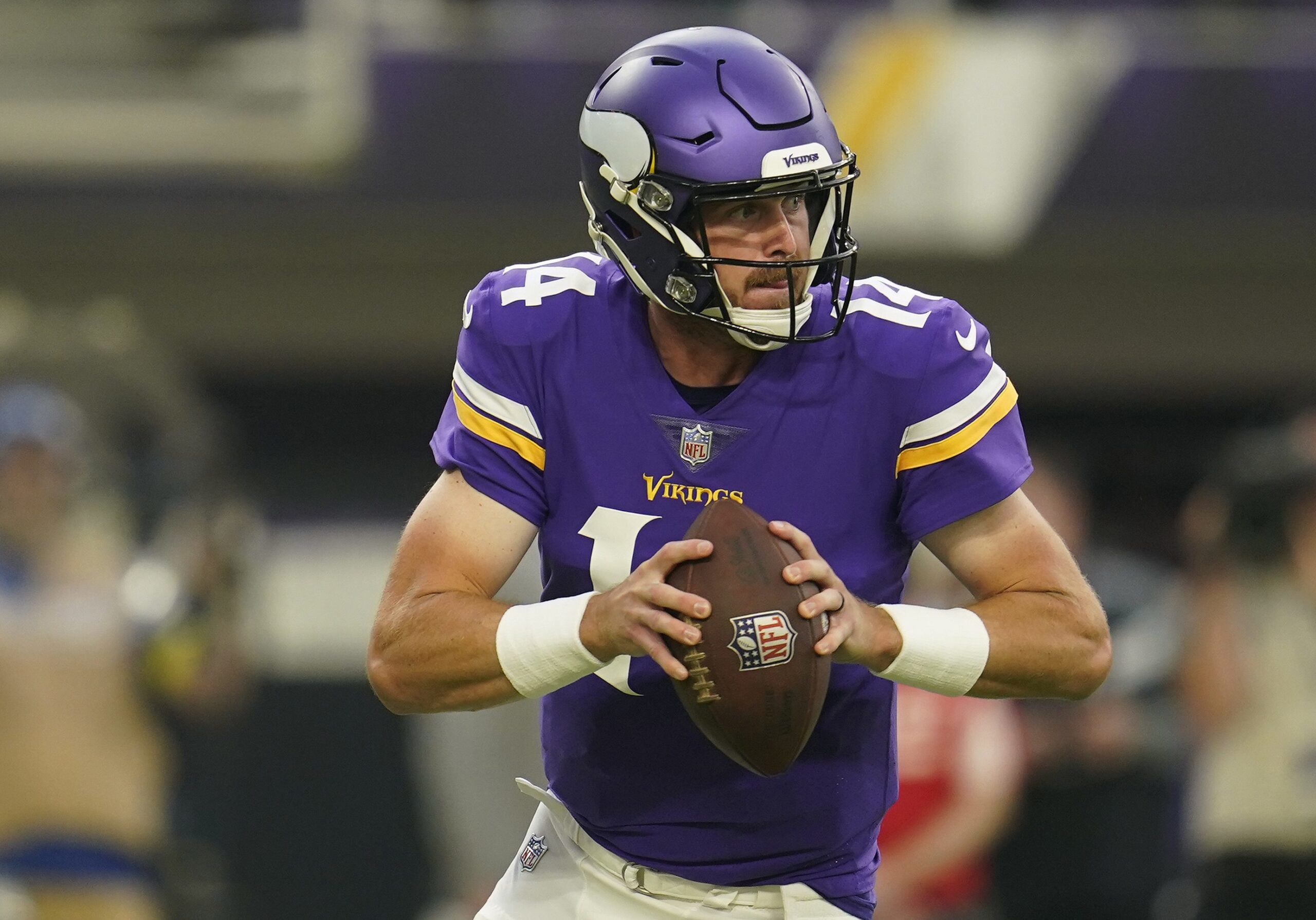
SAN JOSE, Calif. — When Sean Mannion was a quarterback with the Minnesota Vikings, his position room would play a game called “Stumpy.”
The objective was to be the last one to be stumped when then-position coach Andrew Janocko asked each quarterback the specifics of certain plays in Minnesota’s offensive playbook. Mannion might have been a journeyman backup in the NFL, but he had the recall of a Hall of Famer, his former coaches said.
“He was always the champion of that game,” Janocko said.
Mannion was hired as the Eagles’ offensive coordinator last week. He may have only two years of coaching experience, but Klint Kubiak and Janocko, who coached him with the Vikings and are now on staff with the Seahawks at Super Bowl LX, believe the 33-year-old is ready for the job.
Kubiak was Mannion’s first quarterbacks coach in Minnesota in 2019 and 2020. When he was promoted to offensive coordinator a year later, Janocko succeeded him. In September 2021, Kubiak said Mannion was one of the smartest players “he’d ever been around” and that he was like “an extra coach” on the field.
“I still feel the same way about that,” Kubiak told The Inquirer on Monday. “Sean’s a really bright guy. He’s extremely hardworking. He just understands football at a whole other level. He was trained by [Los Angeles Rams coach] Sean McVay early. He had really great coaching at Oregon State.
“He was our backup quarterback. He was always the guy bringing things up in the game-planning process that helped us make plays better, or get rid of bad plays. He just understands the whole picture.”
Kubiak and Janocko, who called the Mannion hire “a home run,” may be biased. But if Eagles coach Nick Sirianni hadn’t tabbed him to be Kevin Patullo’s replacement, it’s possible that Kubiak, who is slated to become the Las Vegas Raiders’ head coach after Sunday’s game vs. the New England Patriots, would have recruited Mannion from the Green Bay Packers.
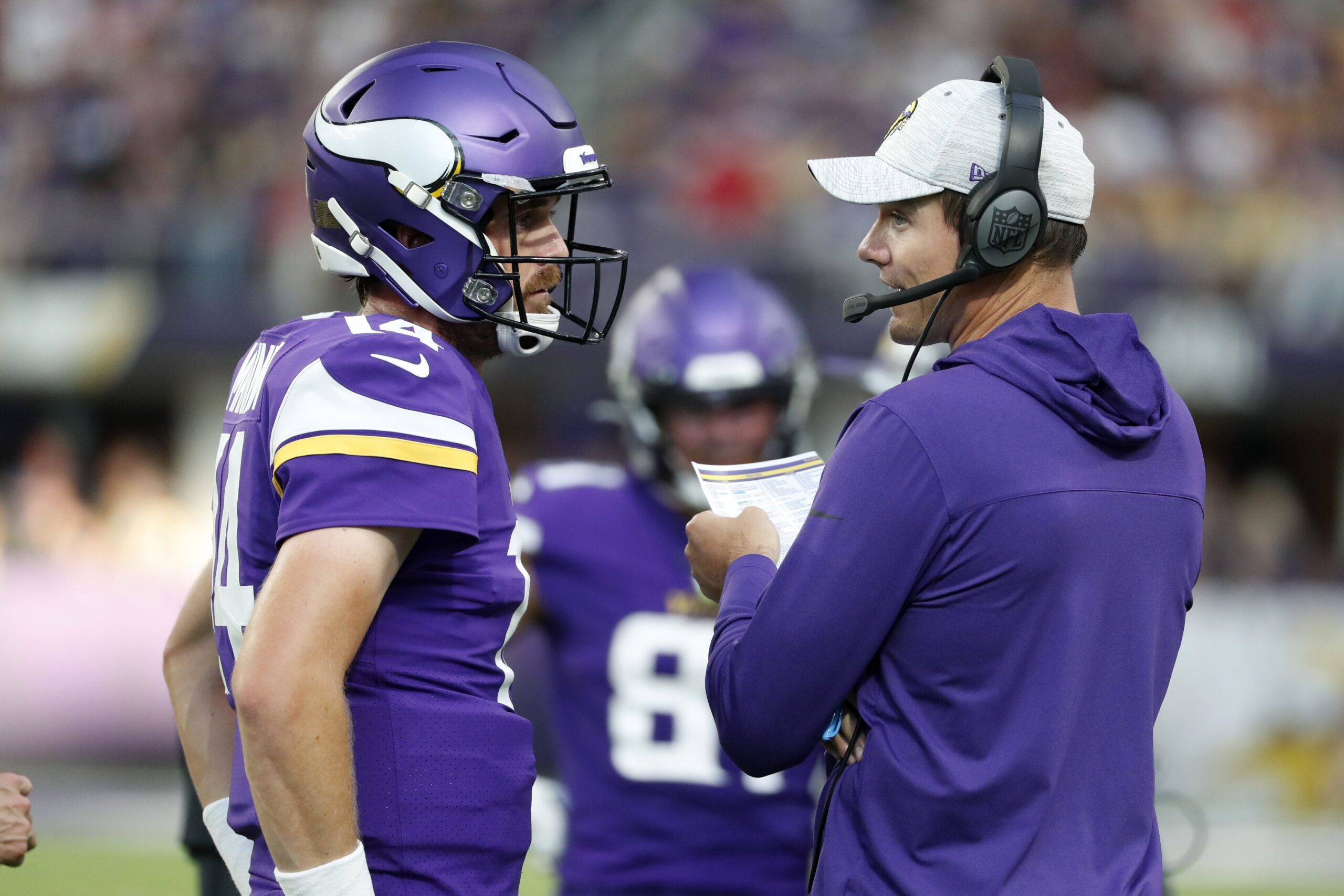
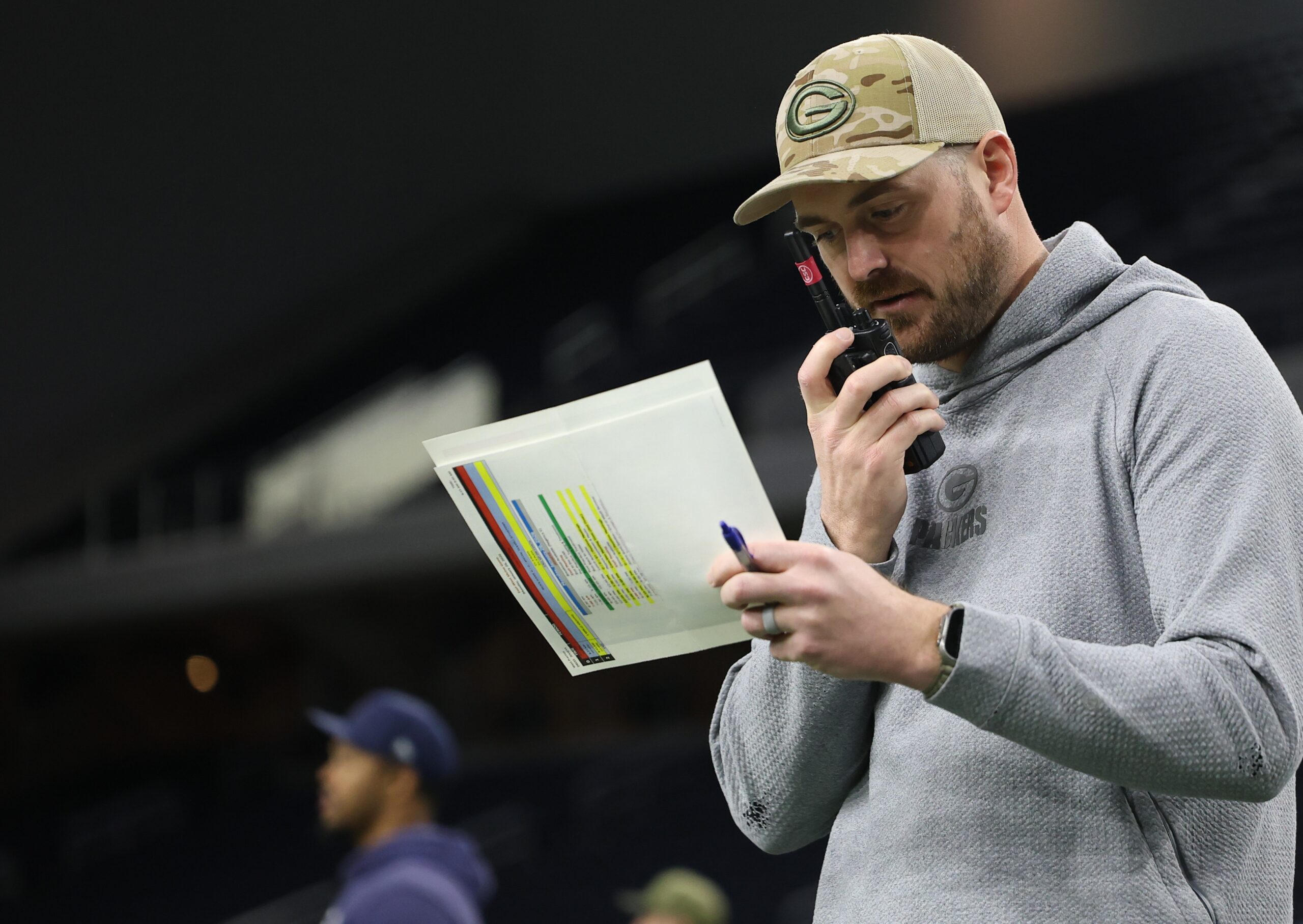
New Eagles offensive coordinator Sean Mannion (left) was coached by Kevin O’Connell (right), Andrew Janocko, and Klint Kubiak when he was a backup for the Minnesota Vikings.
“We always knew that someday when Sean was done playing, we would all want to hire him on our coaching staff,” Kubiak said.
Mannion likely wouldn’t have called plays in Las Vegas. But he will in Philadelphia, despite having never done it before.
“Everyone’s got to start somewhere,” said Kubiak, who’s been an offensive coordinator with three teams. “You learn on the job. When you’re the quarterback, all you do is call plays all day. You get it from the coach, but sometimes the coach screws it up, and you’ve got to fix it. It’s not your fault, but it is your problem.
“Sean will have no problem calling plays.”
Janocko, like Mannion, has never called plays. He’s the heir apparent to Kubiak in Seattle. He’s also an ex-quarterback. He said there are always growing pains for first-time play callers. But Mannion’s mind, he said, will give him an advantage over opposing defensive coordinators.
“The way he diagnoses and processes information, his internal memory is ridiculous,” Janocko said. “You could ask him things on the call sheet that maybe we hadn’t talked about since Wednesday, and he would know the little minutiae about it.
“Just his general understanding of coverages and what the defense was trying to do, in his mind he was always one step ahead. So I just see that translation to play caller going through the roof.”
Kubiak and Janocko said they can’t predict how Mannion’s offense will look. The Eagles clearly wanted to bring in someone who has had experience with the Kyle Shanahan system. Mannion spent two seasons with McVay and several others with Shanahan acolytes. But he was exposed to other schemes, too.
West Coast guy
Mannion was born in San Jose and played football at Foothill High School in nearby Pleasanton. He was a four-year starter in college for Oregon State before the Rams selected him in the third round of the 2015 draft.
He spent his rookie season in St. Louis but moved back to the West Coast when the Rams relocated to Los Angeles. Janocko, who was born in Clearfield, Pa., and played at Pittsburgh, said he teased Mannion about their geographical differences.
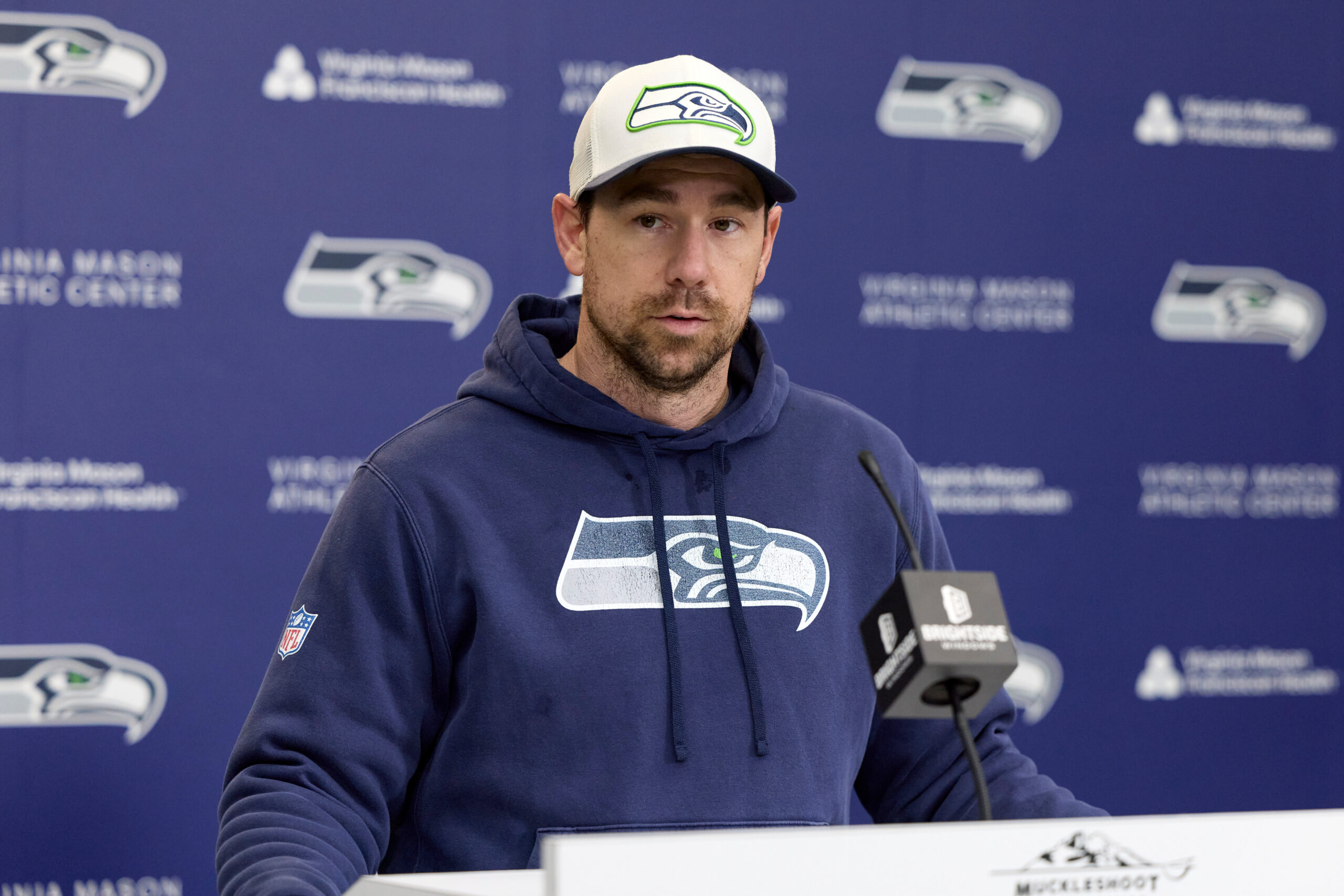
Seahawks offensive coordinator Klint Kubiak, soon to be the Raiders’ head coach, says new Eagles OC Sean Mannion “will have no problem calling plays.”
“Me being an East Coast guy and him being from the West Coast, I’d always rib him that he was going to open his own co-op,” Janocko said. “I’ll be interested to see how he does in Philly getting a cheesesteak.”
Kubiak said Mannion’s authenticity is one of his best traits. He said he’s built up thick skin from playing quarterback when his “back’s against the wall.” Philly’s different, of course. There might not be a job with as much scrutiny as Eagles offensive coordinator.
Shane Steichen, Kellen Moore, and Frank Reich were successful enough to become head coaches. Patullo, Brian Johnson, and Mike Groh suffered a far worse fate. Kubiak said Mannion can’t mentally shoulder all the burden.
Mannion is expected to make some changes to the offensive staff. Josh Grizzard has already been hired as pass game coordinator. Offensive line coach Jeff Stoutland is expected to stay, although he may no longer also be run game coordinator.
“Any time you’re in that role, you don’t do it by yourself. It’s all about having a great staff with you,” Kubiak said. “They have one of the best offensive line coaches in the NFL. They brought [Grizzard] from Tampa with him. Nick is an offensive coach.
“Great staffs do it together. One guy has his name on the job, but when I’m calling a game, there’s five other assistants talking to me on each play.”
Upon signing with the Phillies as a free agent in 2024, Whit Merrifield figured he would get regular at-bats at multiple positions.
It didn’t work out that way.
Surely, then, Merrifield could relate to the deterioration of Nick Castellanos’ relationship with manager Rob Thomson last season over playing time, the fallout of which will lead the Phillies to trade or release Castellanos before spring training.
Merrifield, who retired last season, recently joined Phillies Extra, The Inquirer’s baseball podcast, to discuss that topic and more, including how his close friend Brad Keller will fit into the Phillies’ bullpen and the team’s unexpected pursuit of his former teammate Bo Bichette.
Watch the full interview below and subscribe to the Phillies Extra podcaston Spotify or Apple Podcasts.
Q: What’s your view of the Phillies’ offseason? And where do you come down on how much change a team like that should be making to a roster that’s been together for a few years and had a lot of regular-season success, but just hasn’t gotten over the hump in October?
A: Well, there’s only one team that ends up winning the last game of the season. In baseball, man, that’s a hard thing to do. It’s such a volatile game. There’s so many ups and downs throughout the course of the year, so much has to go right at the right time for you to hoist that trophy at the end of the season. And for Philadelphia, they’ve got all the pieces. It just hasn’t quite peaked at the right time for them. But if you’ve got a team that’s consistently winning the division, it’s hard to fault the guys in the clubhouse and want to go with new guys. That’s a little unrealistic, in my opinion, especially if you’ve got guys that love being in Philly, love being in the clubhouse with the other guys, love playing for the other guys. It’s another thing if the guys feel like they’re going through the motions. But that’s not the feeling you get in that clubhouse. It’s a very driven group of guys. It’s a group of guys that want to bring a championship to Philly. And it just hasn’t quite happened yet. But there’s 29 other teams that are trying to do the same thing.
It’s not just a matter of, let’s go get all the best players. I mean, it’s easy to say because the Dodgers have done it the last two years. But they about met their match last year, really. They should have lost that series against Toronto, in my opinion. There were some things that happened that allowed L.A. to win over Toronto that probably should have gone the other way. But it’s just not as easy as going out and just being like, ‘Oh, we’re going to go get the best pitcher. We’re going to go get the best position player.’ You’ve got to have the right group of guys in every city. And I think Philly does. It’s just a matter of them getting over that hump.
Nick Castellanos (right) clashed with Phillies manager Rob Thomson last season and is not expected back in 2026.
Q: Nick Castellanos clashed with Rob Thomson a few times last year, especially after he lost his everyday job, and the Phillies are going to either trade him or release him before spring training. As a guy who was used to playing every day when you came to the Phillies and wound up coming off the bench, what was the communication about playing time like with Thomson?
A: It’s a big transition. It really is. Because as an everyday player, you’re used to the flow of the season. You’re used to the mindset of understanding that you’re going to have bad stretches, you’re going to have good stretches, but over the course of the full season, if you just keep doing what you’ve always done and what you’re used to doing, at the end of 162, everything will work itself out. As a bench guy, you don’t quite get that luxury. If you’re in a cold stretch, I might not play for another week unless something happens — somebody needs a day off or something. And if you catch a heater, it’s like, ‘OK, I might be able to earn some playing time, earn some at-bats doing this.’
And so, there’s a lot more innate pressure and focus on what you’re doing yourself vs. being in the flow of the game, trying to contribute to the team and almost like just playing the game. And it’s easy to sit back and say, ‘Oh, well, you should just always be playing to win’ and all that. And that’s not quite what I’m saying. What I’m saying is you don’t think about yourself as much and how you’re doing as much when you’re playing every day, because you know you’ll be in there the next day. And when you’re not, it’s just a different type of focus.
I’ve always said it’s why I wasn’t as good in the minor leagues because the minor leagues is all about you. It’s all about yourself. It’s all about getting your numbers so you can get the hell out of there and get to the big leagues. And my numbers in the minor leagues were not very good, except for I had one really good year. But besides that, they were very average to below average.
When I was in Philly, I’ve told people before, I think Rob Thomson was the best manager I ever had. My favorite manager of all time. I loved him. In any job there’s times when you’re going to disagree with your boss. Your boss has ultimately got to make a decision. And there’s times when you’re going to disagree. I thought that, coming into it, I had a chance to compete for an everyday outfield spot. And after the spring training I had, I thought maybe I had earned a good run to start the year, and didn’t quite get it. But Topper was very up-front with me about what was going on. And like, ‘You’re going to be playing three days this week. We got you [for] two games this series. Hey, we’re going to try to get you in the Sunday game of this series. But it depends on if this guy needs a day off, whatnot.’ And I felt like he was very up-front with me. And if he wasn’t, he’s got a lot going on.
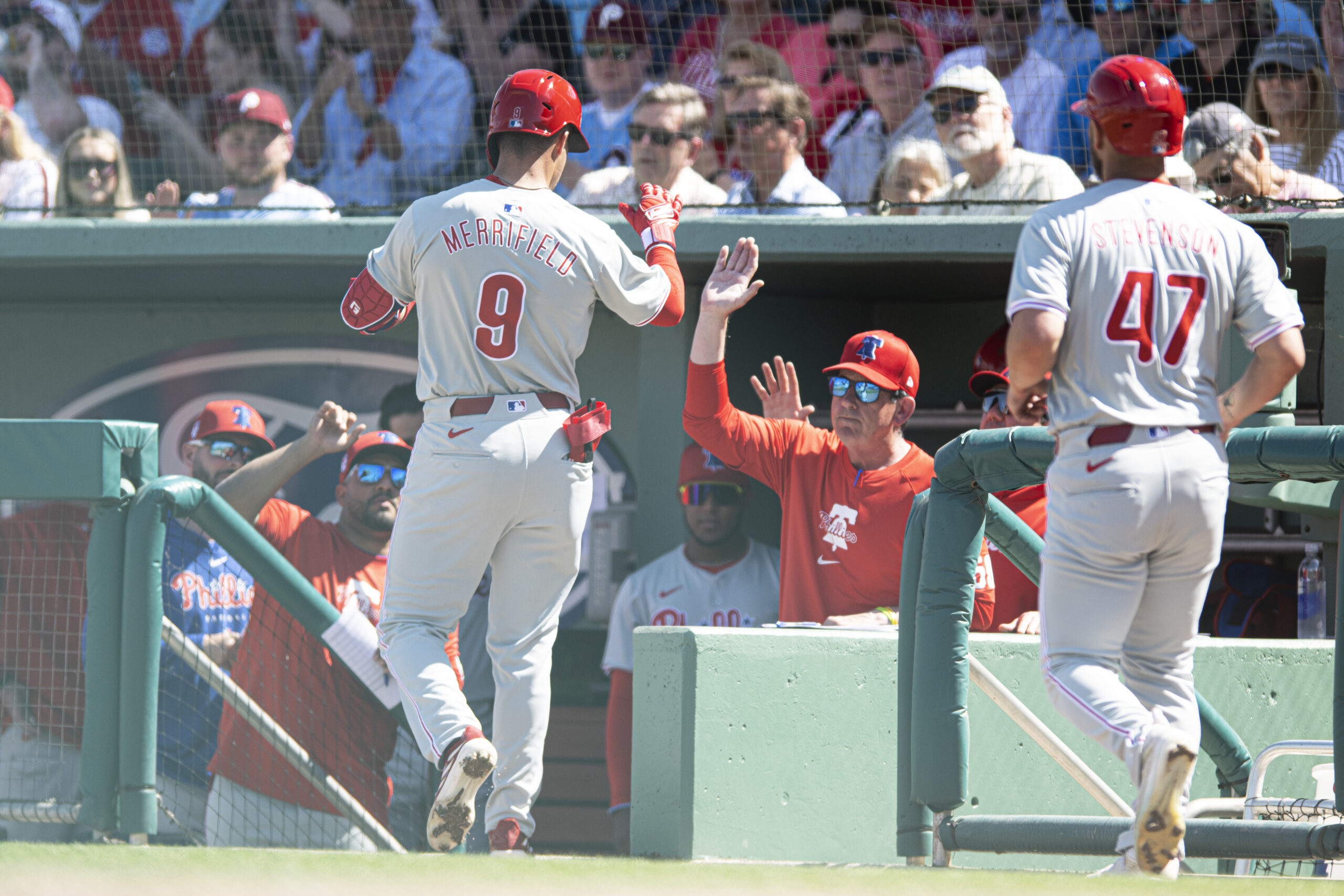
Whit Merrifield, being congratulated by Rob Thomson during a spring training game in 2024, said the Phillies skipper was always very candid with him about playing time.
Look, his worry is not catering to me and worrying about my playing time. He’s got a lot going on. But if I was at a point where I needed some knowledge of what they were thinking, he was the easiest guy to go in and talk to. It was never uncomfortable to knock on his door. ‘Hey, Topper, you got a second? What’s the deal? What’s going on? I haven’t played in three days? Is that what’s happening?’ And he was very communicative.
So, I don’t know how he and Casty’s relationship was. I think Casty is a genuinely good-hearted dude. He’s a little different, and he’ll tell you — he’s just a little different. He’s a little different guy, and he handles things a little differently. He’s very blunt. He’ll tell you exactly how he feels. There’s a little Zack Greinke in him, where he just tells you what he feels. And there’s usually not malicious intent behind it, but it can sound like that sometimes. And I think there are just some things that happen that Casty didn’t like along the way, and he’s not the guy to hide his feelings or sugarcoat it. And I think it just kind of came to a head.
Q: You were part of the players’ negotiating committee for the last collective bargaining agreement in 2022. With the owners supposedly pushing for a salary cap this time around, do you think baseball is headed for the cliff after the season?
A: I don’t know. I know that there is a hard no, a nonstarting conversation — unless that’s changed over the last couple of years — with the [players’ association] on a salary cap. And so, I don’t know if the league is just continuing to say it as a posturing stance, or what the serious level is behind a salary cap. And I know it’s a nonstarter for the PA. … It’s a weird thing now, because it seems like the owners have always been together, and the players have always been together. But now it seems like the owners have turned on the Dodgers, and so now, it’s like they’re fighting the Dodgers, along with fighting the players. I don’t know where that leaves us, and I’m not overly optimistic that there will be baseball on time in 2027.
I haven’t been a part of those conversations in two years, so I don’t know what’s going on behind closed doors. And frankly, I’ve spent enough time doing it; I don’t care to know anymore. I just sit back and watch from afar, because those were some long nights and long hours that I’m not missing being a part of. … I don’t think it’s in a good place. How bad it is, I don’t know. But I’m not optimistic that baseball will be starting on time in 2027.
Watch or listen to the full episode for Merrifield discussing what the Phillies are getting in reliever Brad Keller, one of his best friends, why he was surprised they pursued Bo Bichette, and more.
The ground and your toes aren’t the only things frozen in the Philadelphia region.
In the city and Delaware County last month, potential home sellers and buyers stayed on the sidelines, and sales were slow, according to a Redfin analysis of the 50 most-populous metropolitan areas for the four weeks ending Jan. 25. Pending home sales were down about 4% from the same time last year.
“You’re just not seeing a lot of activity happening,” said Chen Zhao, head of economics research at Redfin.
What has been heating up are prices. The market that Redfin defines as Philadelphia and Delaware County was in the top three areas where sale prices increased the most compared to the same time last year. The median sale price was up just over 10% to $294,125.
Limited home supply and rising home prices tend to go hand in hand, and that is what is happening in these markets, Zhao said.
Sales in January’s slow market happened at higher prices because buyers who are still in the market are willing to pay elevated prices.
The average number of new home listings ticked up slightly from last year, and it should continue to grow as the typically busy spring housing market approaches. So should the number of buyers looking for homes.
Any changes in affordability, Zhao said, will be “mostly driven by mortgage rates, not so much by prices.”
The average interest rate on a 30-year, fixed-rate mortgage was almost 7% at the end of January 2025, according to the government-backed mortgage buyer Freddie Mac. This year, it was 6.10% at the end of the month.
Zhao said she doesn’t expect mortgage rates to go much lower this year.
But buyers have more power than they think, especially now when sales are slow, Zhao said. They “really should be thinking about negotiating” with sellers.
Kai Lu and Edward Mendez had expected to spend many years in the spacious Media home, enjoying the easy access to Center City by SEPTA Regional Rail, the good schools for their two-year-old son and the second on the way, and its aura of history.
But in the words of Lu, who is in data analytics for a major communications company, “life intervened.”
Mendez landed his dream job as a data analyst for the Miami Marlins baseball team, and the couple are headed to Florida after two years in the house.
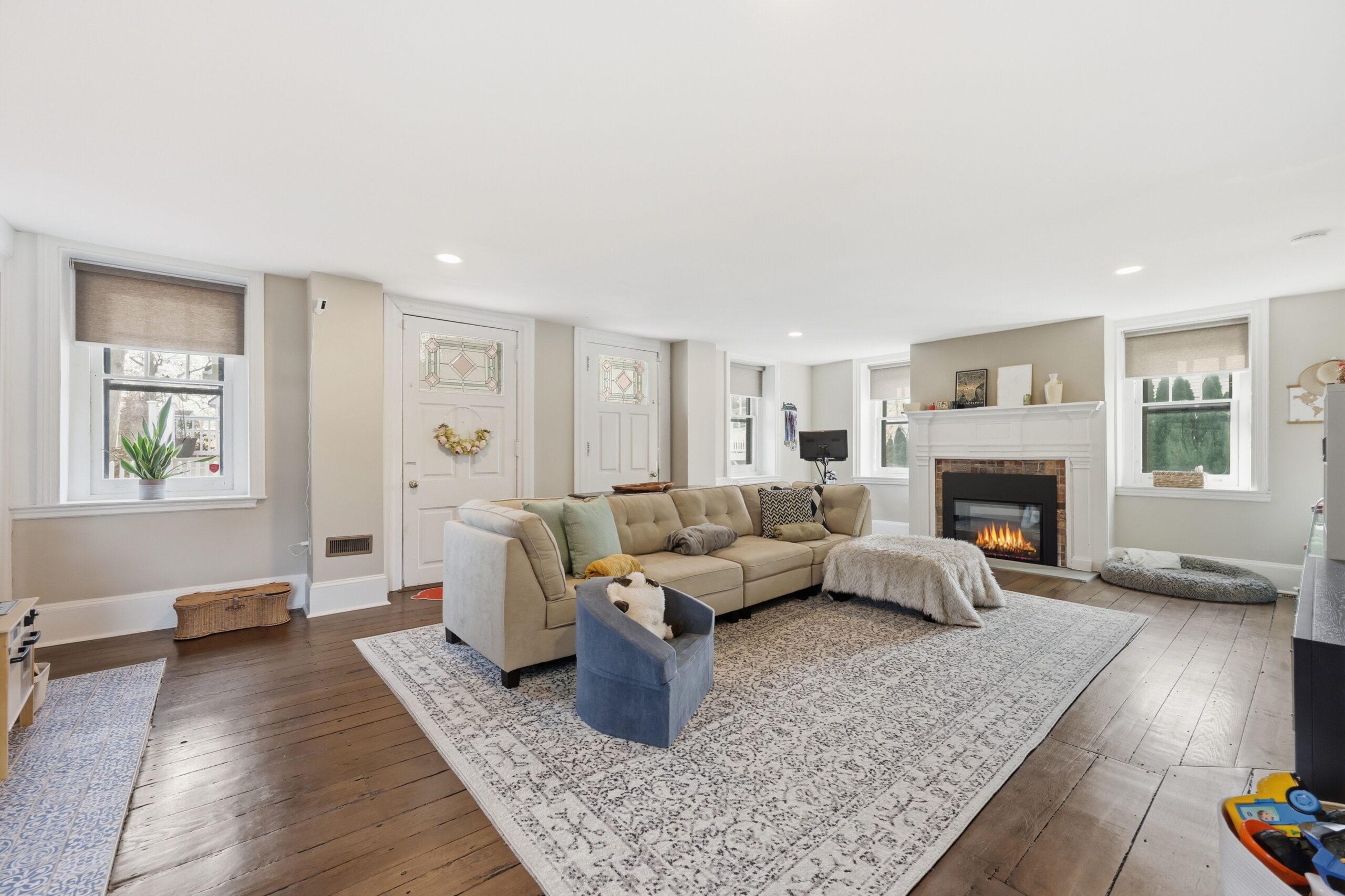
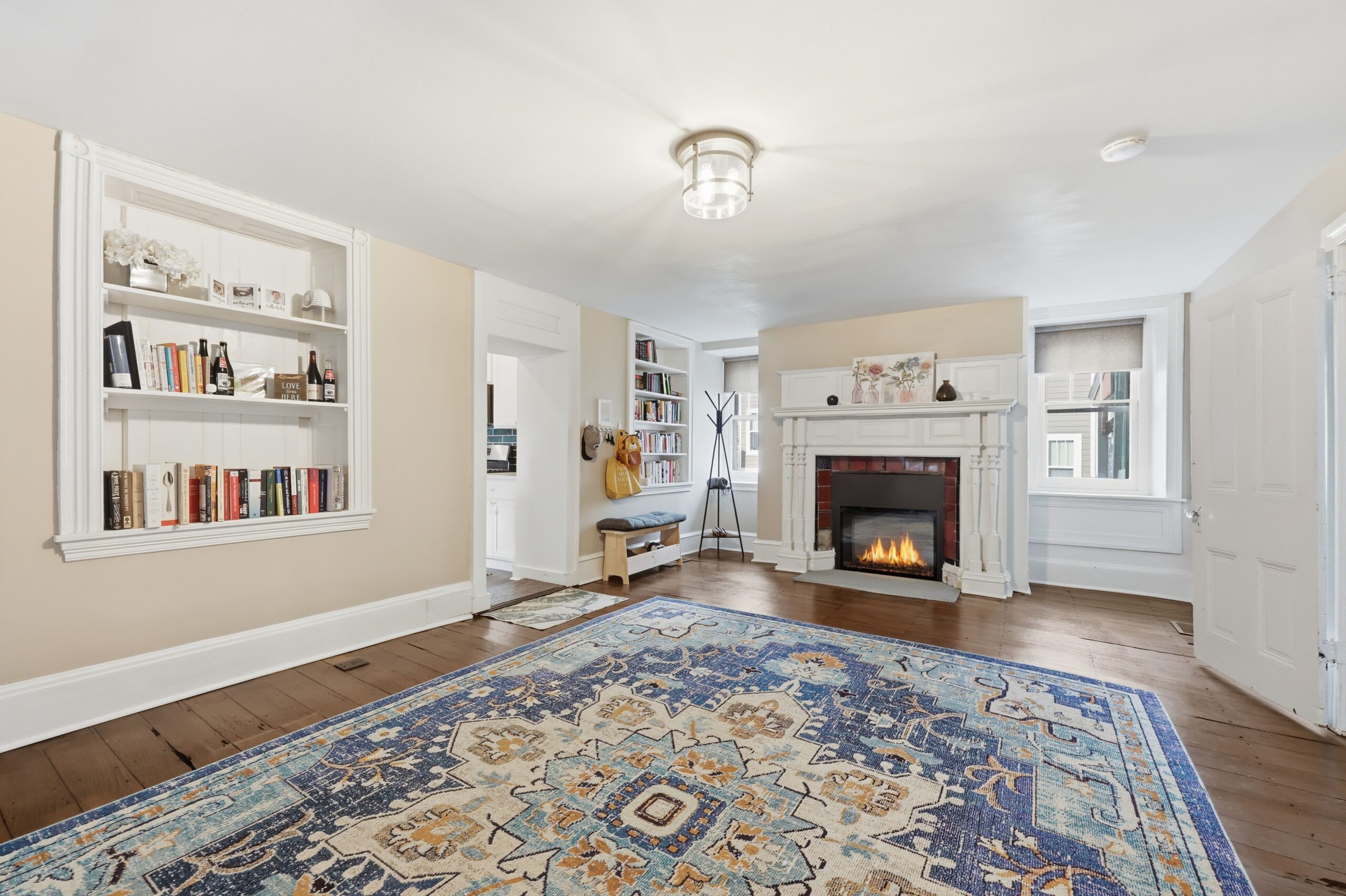
The living room. The home has four working fireplaces.
The five-bedroom, 4½-bathroom home was once the general store of Providence Village, and Lu says she doesn’t know when the changeover came.
The earliest part of the house dates to the 18th century, with some 19th-century additions.
The 4,334-square-foot house has three floors of living space plus an unfinished basement, and four working fireplaces powered by electric inserts.
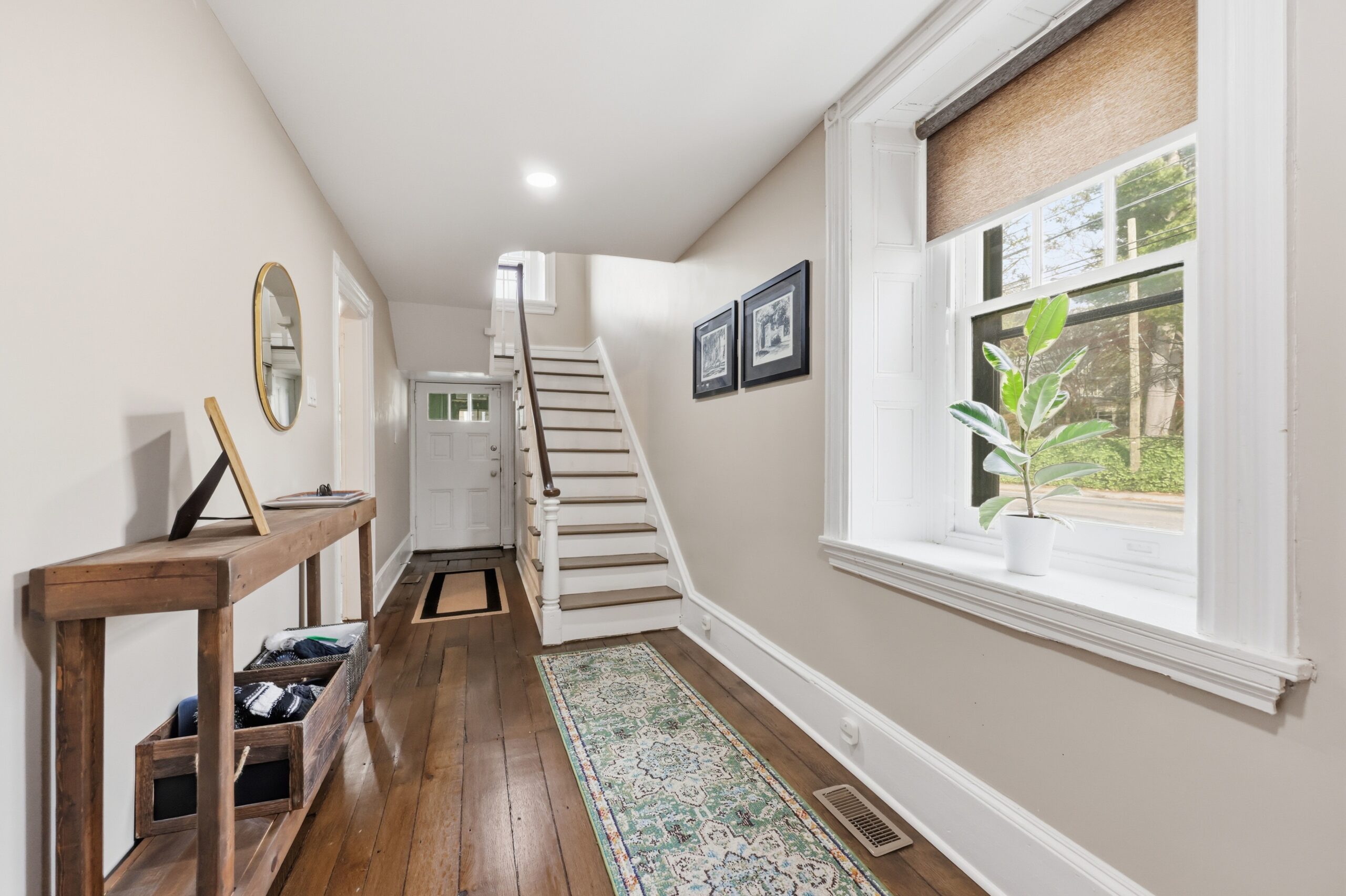
Front hall
The home has its original hardwood floors and a two-zone thermostat system with central air and forced heat.
The newly renovated kitchen has quartz countertops, stainless steel appliances, gas cooking, a separate coffee bar and pantry area, and an adjacent sunroom.
The formal dining room has built-in shelves and a fireplace.
The kitchen, which includes a dining area.
The primary bedroom and another bedroom are on the second floor, along with a laundry room.
The third floor has three additional bedrooms — one of which serves as an office — two full bathrooms, and a full-sized cedar closet.
The formal dining room has built-in shelves.
Updates by the current owners include partial roof replacement, resurfacing and staining the hardwood floors, new flooring in the kitchen, exterior stone repointing, custom window treatments, and a new sewer line.
The house is in the Rose Tree Media School District.
It is listed by Amanda Terranova and Adam Baldwin of Compass Realty for $785,000.
Sean Mannion, the Eagles’ new offensive coordinator, is 33 years old, has been a coach — not just an NFL coach, but a coach of any kind — for only two years, and reportedly will call plays next season even though he has never called plays before. If it sounds like the Eagles have entered uncharted territory here, if it seems they’ve brought on board a neophyte who’s too green to succeed in such an important role at such an important moment for the team, rest easy. Mannion’s youth and inexperience are nothing compared to the first OC the Eagles hired during Jeffrey Lurie’s ownership tenure.
Because that guy, in his first week in town, tried to buy a beer one night at a hotel bar. And got carded.
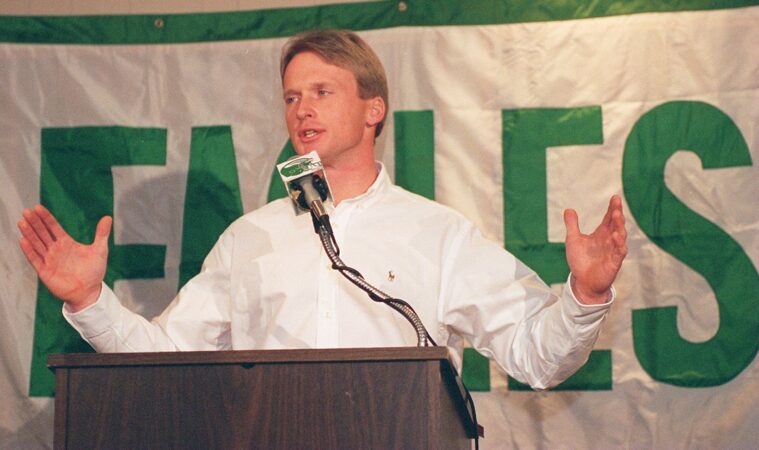
“I said, ‘Huh?’” Jon Gruden told the Daily News in February 1995. “I know I look young, but that young?”
Gruden was 31 when Ray Rhodes picked him to oversee and orchestrate the Eagles’ offense. The two of them had worked together in Green Bay, and though Gruden had coached in the NFL for four years — twice as long as Mannion has — he had never been a coordinator or called any plays with the Packers. Plus, Gruden was right. With his boyish face and while wearing his ever-present backward visor at practice, he looked like he might still be in college. He was younger than some of the Eagles’ offensive players, including two starting linemen — center Raleigh McKenzie and guard Guy McIntyre — and quarterback Randall Cunningham.
— Mike Lipinski | @SportsTalkPHL (@themikelipinski) January 30, 2026
“Age is not the issue,” Gruden said back in ‘95. “The issue is, ‘Can you do the job?’ … I’m not one of these guru kinds of guys who thinks he has all the answers. I’m just a guy who tried to learn as much football as he could in hopes that someday I’d get a chance to use it. And this is my shot.”
Mannion is in a similar situation — a better one, in fact. The notion that he is stepping out from under the safe cover of being the Packers’ quarterbacks coach into the tropical storm of serving as the Eagles’ OC has some truth to it, sure. The pressure that Mannion will feel from Lurie and Howie Roseman will equal or exceed any that the Eagles’ fan base might apply. But he is still accepting a plum job with an organization that won a Super Bowl last year and is coming off a season that was a disappointment by the standard that the Eagles have established for themselves.
They won 11 games. They finished first in their division. They have talent to spare on offense. “If I’m an offensive play-caller,” Fox analyst and former Pro Bowl tight end Greg Olsen said recently on the New Heights podcast, “I’m doing everything in my power to get that job.” This ain’t a bad gig.
Gruden’s was, or at least it wasn’t as good as Mannion’s. And it’s worthwhile to remind those Eagles fans and observers who either have forgotten or never bothered to familiarize themselves with the team’s history that yes, a relatively lengthy search for a new coordinator is not exactly a new low point for the franchise.
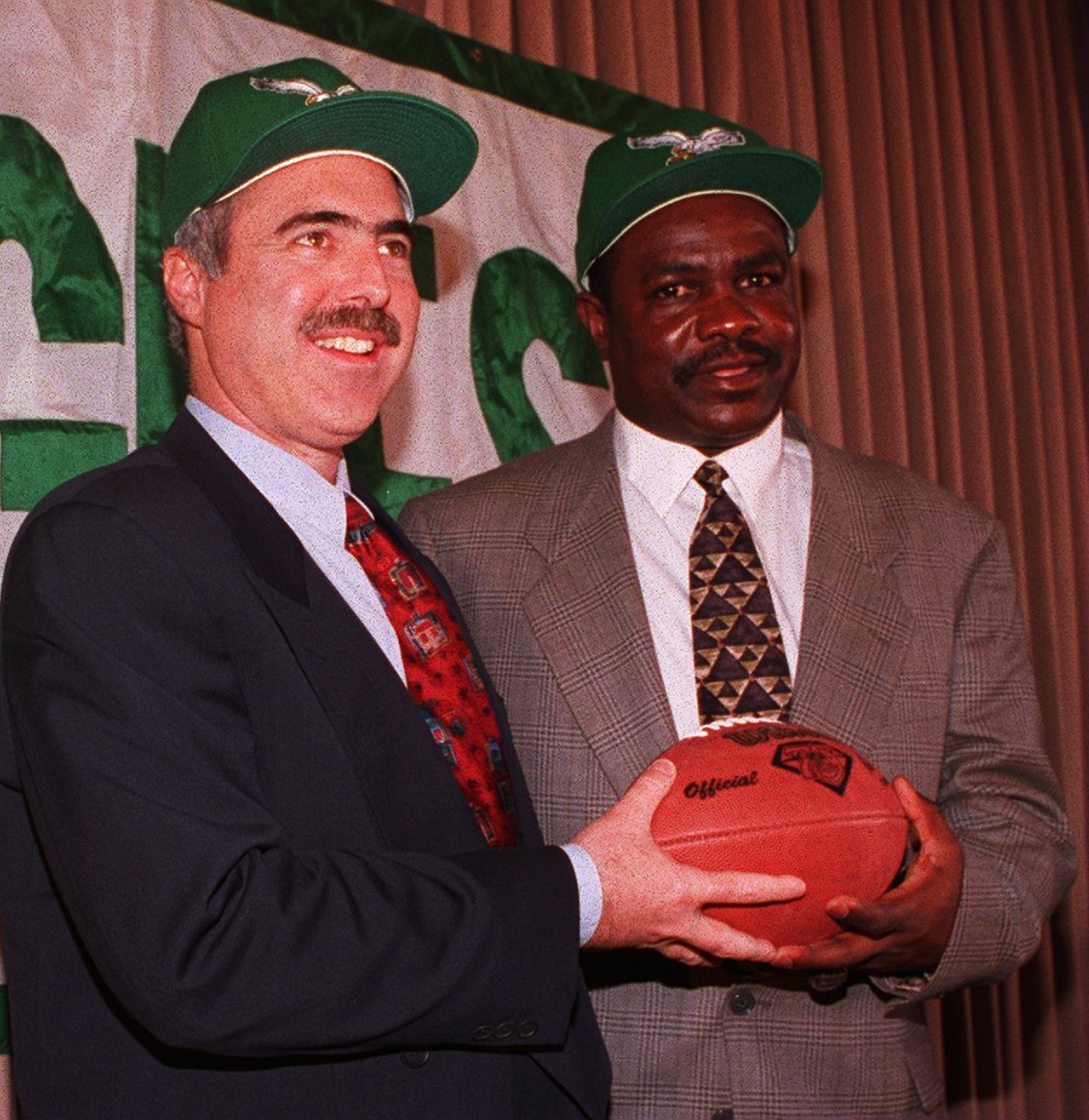
New owner Jeffrey Lurie (left) and coach Ray Rhodes were viewed with skepticism, and not just in their OC hire.
When Gruden was hired, Lurie had assumed control of the Eagles just eight months earlier. Rhodes not only had never been a head coach before, but he was the team’s first Black head coach, a distinction that in 1995 presented its own fierce set of pressures, expectations, and obstacles. The Eagles had not reached the Super Bowl in 14 years and had not yet won one. Veterans Stadium was decrepit, a dangerous place to play for its treacherous artificial turf, a horrible work environment for any coaching staff.
Cunningham’s skill set was not a fit for Gruden’s version of the West Coast Offense — a system based on three-step drops, perfect timing, and precision accuracy on short and intermediate passes — so backup Rodney Peete eventually replaced him as the starter. And still the Eagles went 10-6 in each of Gruden’s first two seasons as their OC, and in ‘96, they ranked fourth in the league in total offense and in passing yards, with Ty Detmer and Peete as their QBs. If Mannion can come close to matching that measure of productivity — even with Jalen Hurts, with Saquon Barkley, with DeVonta Smith, with (presumably) A.J. Brown — he’ll be doing just fine.
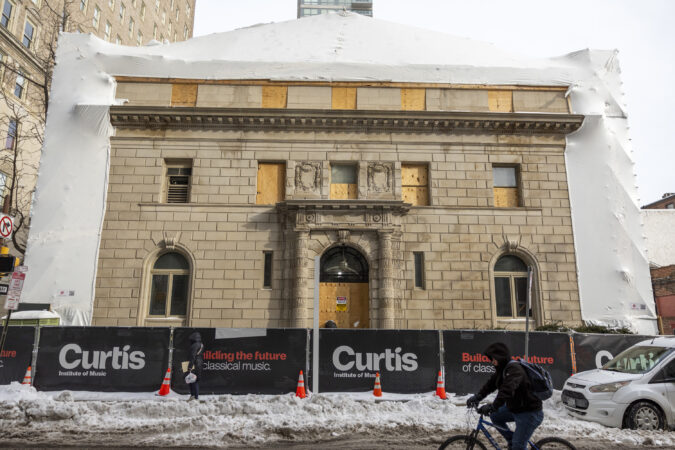
A temporary shrink-wrap covering has been draped over the Art Alliance building as damage is being assessed. The Curtis Institute of Music, which owns the historic, jewel-box structure on the southeast edge of Rittenhouse Square, is in the early stages of dreaming about the building’s eventual use.
Curtis had only recently taken over the Art Alliance, when, in the early hours of July 4, a blaze broke out that took more than 120 firefighters to extinguish. The building’s roof was largely destroyed, and other portions of the building were severely damaged by fire, smoke, and water.
The fire marshal categorized the cause of the fire as undetermined, and Curtis isn’t expecting to ever arrive at an answer.
“We haven’t thought much about it in a few months because it just hasn’t come up,” said Curtis chief financial officer Chris Dwyer, who is overseeing the building rehabilitation process. “What I’m concluding is that the damage is so bad that there’s no answer with a capital A.”
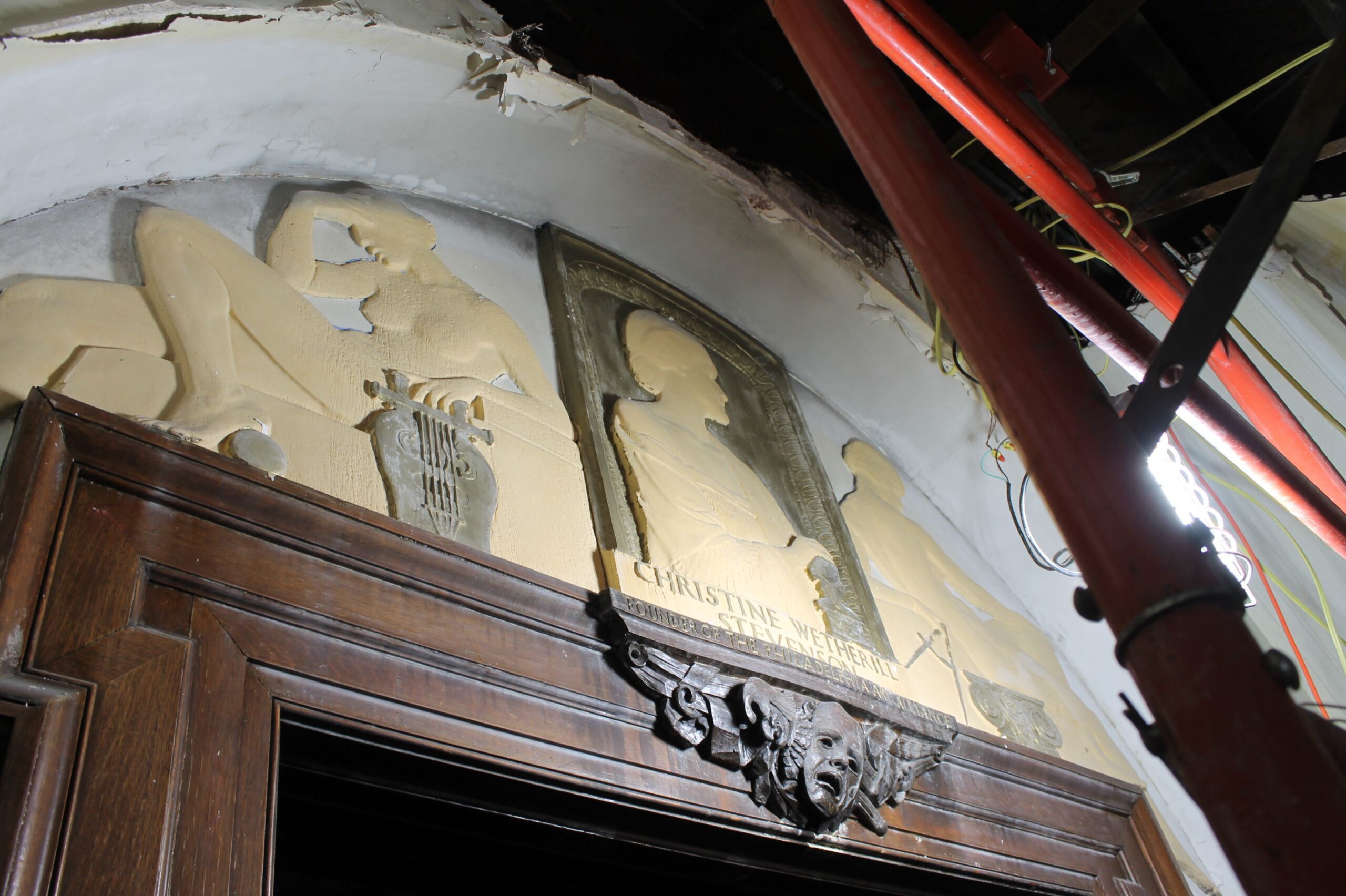
At the Art Alliance building on Rittenhouse Square, a detail of a memorial to Alliance founder Christine Wetherill Stevenson, on the first floor, Jan. 27, 2026. The building, owned by the Curtis Institute of Music, was damaged in a fire early on the morning of July 4, 2025.
At the time of the fire, Curtis was overseeing modest repairs and cleaning and transferring archival materials from the building to other institutions, with an eye toward being able to host a few small community gatherings, a school spokesperson said.
A full damage assessment is due shortly, and while it’s already clear that some historic elements of the interior survived, it is not yet known whether others were lost.
“The whole front of the building is more intact than you might have thought, but [there is] definitely a lot of water and smoke damage,” Dwyer said. “But things like the staircase is still there, the stained glass window [on the south side] is essentially intact.”
Curtis aims to incorporate the surviving historic elements into the design of a rehabilitated building, he said.
What exactly the renowned music conservatory will use the 15,000-square-foot building for is an open question at the moment.
“We’re definitely constrained as far as teaching space, rehearsal space, performance space, and places to welcome the community,” said Dwyer.
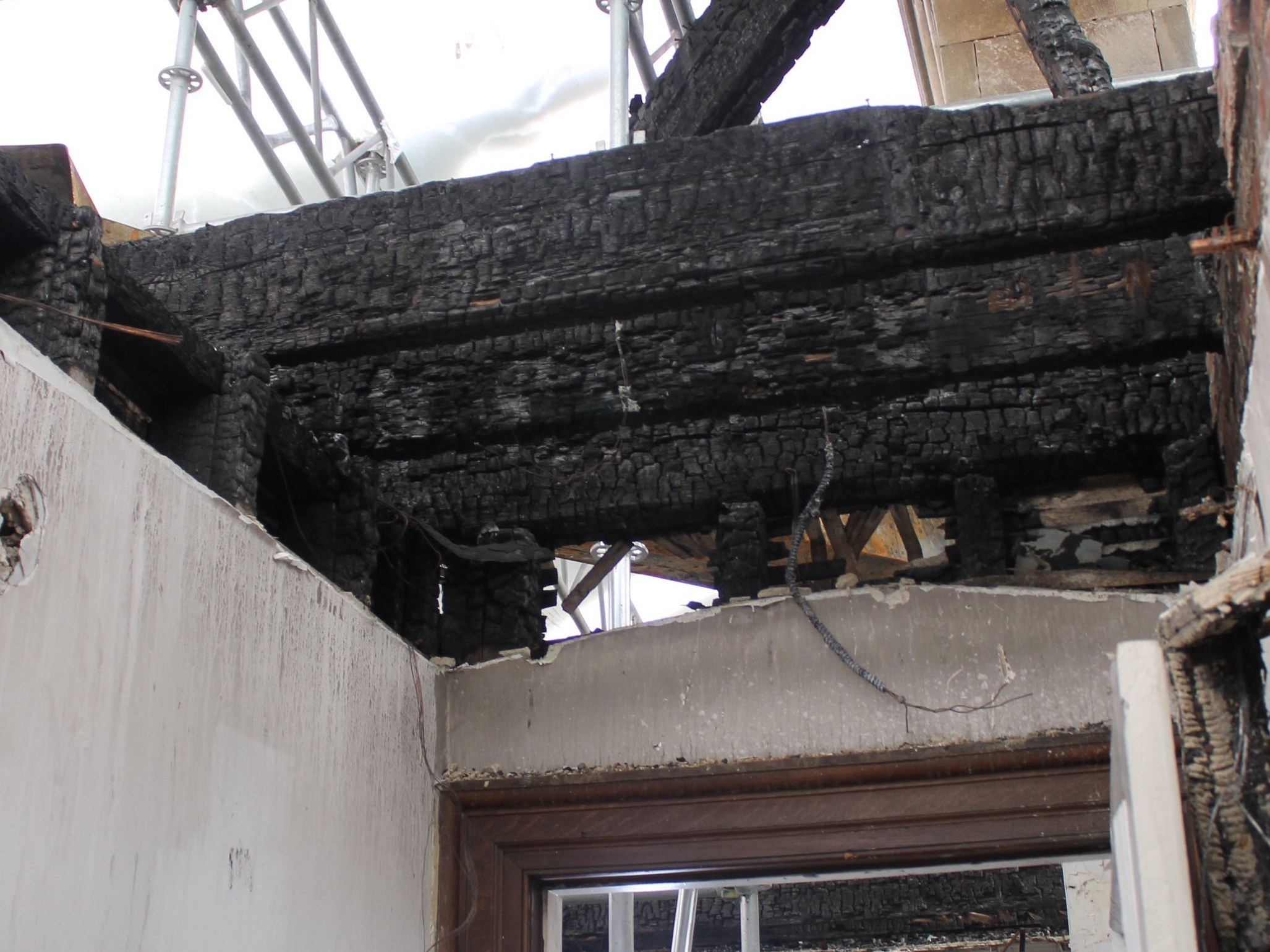
Looking through charred timbers and a destroyed section of the attic and roof to the underside of the shrink-wrap covering over the Art Alliance building, Jan. 27, 2026.
The fire has left the configuration of the building slightly changed. The third floor included an attic that was destroyed by the fire, which raises the possibility that a reconstructed third floor will offer higher ceilings than before.
VSBA Architects and Planners has been engaged to assess damage and develop some preliminary concepts for eventual reuse. The firm designed Curtis’ nearby Lenfest Hall on Locust Street, and has a long track record in historic preservation work.
Though reuse plans are still developing, some public-use element seems likely, Dwyer said.
“We’d love for the building to be used year-round. We’d be open to partnerships and rentals and maybe some new imaginative public programming. So it’s definitely on our minds that it would be public and in some way, shape, or form.”
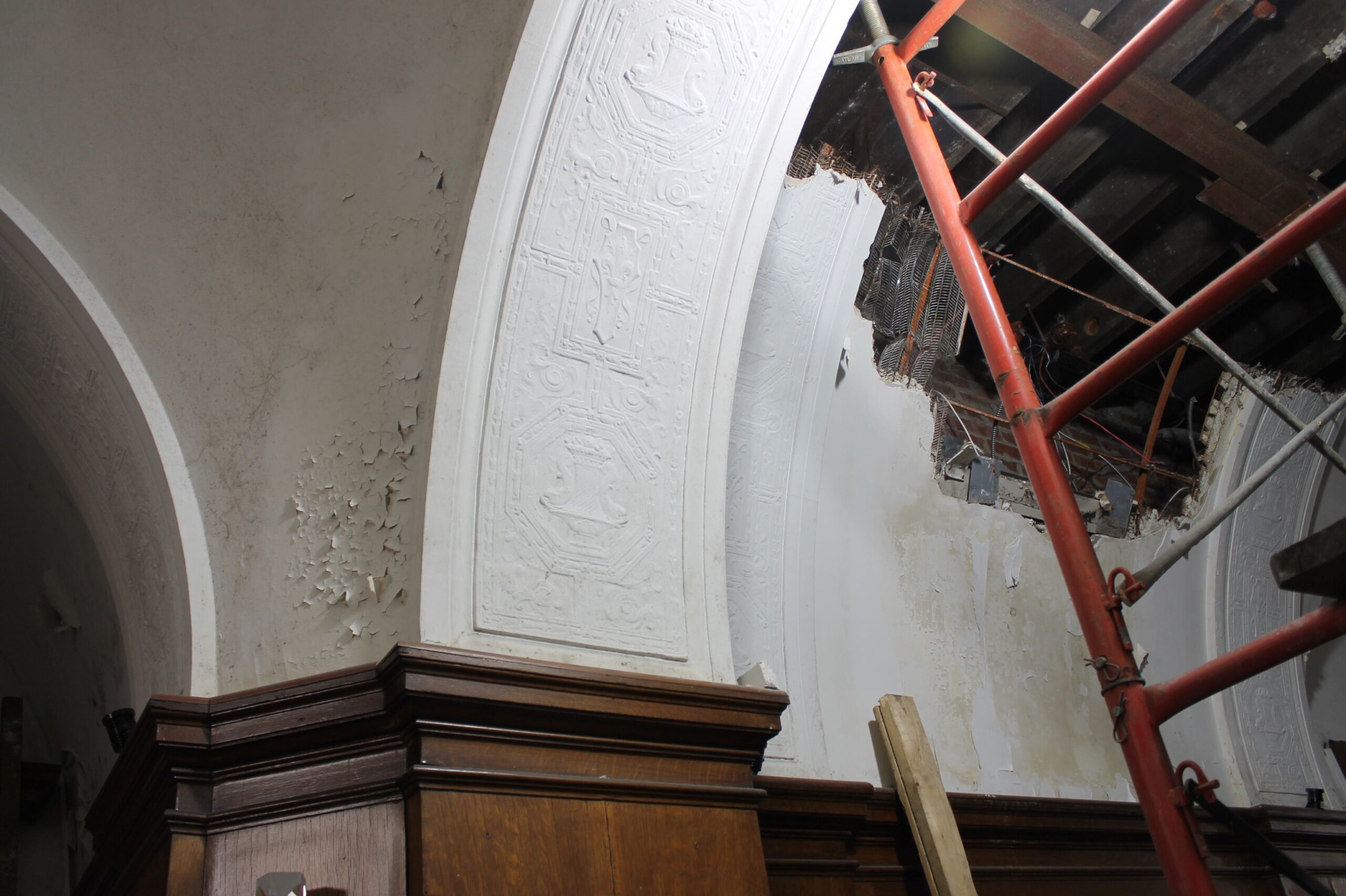
A detail on the first floor of the Art Alliance building on Rittenhouse Square shows some historic elements saved, others damaged, Jan. 27, 2026.
A timeline is far from certain, but if various elements fell into place quickly enough, the building — which was built in 1906 — could reopen by summer or fall of 2028, leaders say.
Curtis is aware of the place the Art Alliance holds in the hearts of many — “of all the nostalgia and the memories of the building that folks in the community cherish,” said Dwyer. “I was at a wedding there in the late ’90s. It seems like everyone has been in that building at least once.”
It has a “pretty special character that we think is possible to bring back.”
Curtis conducted a special fundraising campaign to acquire the building for $7.6 million from the bankruptcy estate of the University of the Arts. The conservatory and its insurance company are working toward arriving at a payout for the damage, but Curtis may want to do more to the building than simply what the insurance would cover.
That would mean more fundraising.
“It’s hard to see how we wouldn’t need to raise funds,” said Dwyer.
Think you know your news? There’s only one way to find out. Welcome back to our weekly News Quiz — a quick way to see if your reading habits are sinking in and to put your local news knowledge to the test.
Question 1 of 10
A pair of topiary bears went viral for their pose outside a Southwest Philly strip club. How much did the owner of Sin City Cabaret Nightclub pay for the bawdy bears?
CorrectIncorrect. XX% of other readers got this question right.
The 8-foot bears cost $18,000. They were designed by celebrity topiary artist Joe Kyte, whose 2-acre topiary garden in Tellico Plains, Tenn. has churned out larger-than-life dragons, Formula 1 cars, and semi-realistic bottles of booze for clients ranging from Legoland and Ferrari to Absolut Vodka since 1992.
Question 2 of 10
D.C. bagel chain Call Your Mother is opening its first Philadelphia location in Fishtown. What color are they painting the building?
CorrectIncorrect. XX% of other readers got this question right.
Most of the building will be painted pink, the owners say. The expansion comes amid a bagel boom in the Philly area, including viral bagel chain PopUp Bagels coming to town and Bart’s Bagels of West Philly expanding. Penny’s Bagels is coming to Haddonfield this year, as well.
story continues after advertisement
Question 3 of 10
RJ Smith, the 21-year-old chef who has established a reputation doing pop-ups as Ocho Supper Club, is taking on a six-month residency at the restaurant space here:
CorrectIncorrect. XX% of other readers got this question right.
Smith’s Ocho Supper Club will begin a six-month residency at the Rittenhouse Hotel on Feb. 1, taking over the Scarpetta space ahead of construction on the Ruxton, a steakhouse from Atlas Restaurant Group due to open in 2027. Ocho’s run is expected to continue through July 26 — a month after Smith graduates from Drexel’s culinary program.
Question 4 of 10
Which 57-year-old Philadelphia dive bar is both responsible for popularizing the Citywide and hosting the city's longest-running drag show?
CorrectIncorrect. XX% of other readers got this question right.
Scads of Philadelphians and passers-through have whiled hours away at Bob and Barbara’s, the 57-year-old South Street institution. The dive popularized Philly’s citywide: a PBR and shot of Jim Beam. It also hosts Philly’s longest-running drag show. It’s a bar for absolutely everyone and anyone, which readers love.
Question 5 of 10
Philly-born rapper Chill Moody has a new children’s book out. It’s all about Gia and her magical ___:
CorrectIncorrect. XX% of other readers got this question right.
The rapper wants Gia, the protagonist who rocks a red golf tee and wields magical golf clubs, to inspire more Black and brown children to take up golf. And be the next Dora, the Explorer.
Subscribe to The Philadelphia Inquirer
Our reporting is directly supported by reader subscriptions. If you want more journalism like this story, please subscribe today.
Philadelphia’s African American Museum is showcasing six costumes from a popular movie as part of a traveling exhibit. Which film are the costumes from?
CorrectIncorrect. XX% of other readers got this question right.
Ruth E. Carter's designs for Michael B. Jordan and the Sinners cast are a part of the museum's 250th birthday celebration, and will be on display through September. That includes Smoke and Stack’s (twins played by Jordan) memorable 1930s-era three-piece suits, with complementary fedora and newsboy cap, time pieces, and tiepins.
Question 7 of 10
Stephanie Stronsick of Berks County is intentionally housing, rescuing, and rehabilitating this animal — that is considered a pest by some — inside her home.
CorrectIncorrect. XX% of other readers got this question right.
Stronsick is the founder and executive director of Pennsylvania Bat Conservation and Rehabilitation (PA Bat Rescue), a nonprofit that underwent a major overhaul last year. She’d like the bats to leave, ideally, but only after they’ve healed. Currently, the facility is treating over 100 bats for injuries and illness.
Question 8 of 10
What activity does the University of Delaware's new president take part in with students and staff?
CorrectIncorrect. XX% of other readers got this question right.
On Thursdays at 7 a.m., Laura Carlson, faculty, staff, and students run a five-kilometer loop through campus. Typically, 10 to 20 people show. “Rain or shine, we run down to the track on South Campus, loop the track and come back,” said Carlson, 60, who began the treks as interim president last summer and is continuing them in her permanent role, which started earlier this month.
Question 9 of 10
A Super Bowl ad that’s already being previewed will feature Lincoln, the bald eagle who flies over Birds games, befriending whom?
CorrectIncorrect. XX% of other readers got this question right.
Lincoln, the 28-year-old bald eagle, will star alongside a Clydesdale in this year’s Budweiser Super Bowl LX spot titled “American Icons.” The ad follows Lincoln’s friendship with the iconic horse playing under the appropriate sounds of Lynyrd Skynyrd’s “Free Bird.” The 60-second in-game spot will air during the Super Bowl.
Question 10 of 10
Following a directive from the Trump administration, informational exhibits about slavery were removed by the National Park Service from the President’s House Site last week. The removal sparked outrage, national media coverage, and a lawsuit. As part of the city’s injunction, the fate of the removed panels has been revealed. What happened to them or where are they?
CorrectIncorrect. XX% of other readers got this question right.
The panels are being kept in storage at the National Constitution Center, according to a legal filing from the Trump administration. The exhibits will remain in the park service’s custody at the center, down the street from the President’s House, pending the outcome of the City of Philadelphia’s federal lawsuit against the Department of Interior and the National Park Service for taking down the exhibits.
Your Results
You have skipped .
You scored XX out of 10.
The average reader scored XX out of 10
Seems like you’ve been skimming more than reading there, buddy. There’s always next week.
You’ve read some articles (or made some educated guesses) but we wouldn’t come to you first for our local news recaps. Better luck next week!
Do you work here? You’re a local news stan with the latest updates on Philly happenings. Your friends definitely ask you for summaries on what’s going on and it shows.
Sean Mannion, for all intents and purposes, is an unknown. The Eagles’ new offensive coordinator has been a coach for just two seasons. The 33-year-old has never devised or implemented a scheme. He’s never authored a game plan. And he’s never called plays.
He could end up the next Bill Walsh or the next Tom Walsh. More than likely the former backup quarterback will end up somewhere between those polar extremes when it comes to offensive minds of the last four decades. But it’s nearly impossible to assess with any certainty how the neophyte will fare in Philadelphia.
The hire says more about Nick Sirianni’s future than it does about almost anything related to Mannion or the Eagles offense. Whether he made the ultimate decision or not, the coach will have to take ownership for selecting one of the least experienced coordinators in the NFL, if not the least experienced.
Sean Mannion will have a major challenge as he sorts out the Eagles’ offensive issues.
Sirianni could be rewarded with immediate success. The Eagles could even have marginal offensive improvement that would allow Sirianni to maintain Mannion for more than one season. But if there is further regression, or even sudden failure, the gamble could push Sirianni into a firing line that saw nine coaches lose their jobs over the past several months.
And here’s why: The line between success and failure for Sirianni is thinner than for most because he doesn’t have a discernible offensive philosophy or calls plays. He does a lot as a CEO-type coach, more than some on the outside are willing to concede.
But winning here is suddenly not like winning at most places. Sirianni helped raise those expectations. But clearing that bar or falling short of it would both seemingly have him back where he’s been four times before: having to replace an offensive coordinator.
Shane Steichen and Kellen Moore became head coaches, while Brian Johnson and Kevin Patullo ended up either fired or demoted. That disparity explains varying perceptions of the job, but ultimately Sirianni chose a candidate who didn’t interview for any of the other 14 coordinator openings.
That doesn’t mean the Eagles didn’t find a diamond. Mannion played under some of the brightest offensive minds in the game today. He rose to quarterbacks coach in Green Bay in just his second season and became an assistant the Packers didn’t want to lose.
“He’s seen as a climber,” said an agent who represents coaches, “and Nick might have gotten in on the ground floor.”
But the Eagles are again making a projection — one even bigger than those they made with first-time play callers Johnson and Patullo.
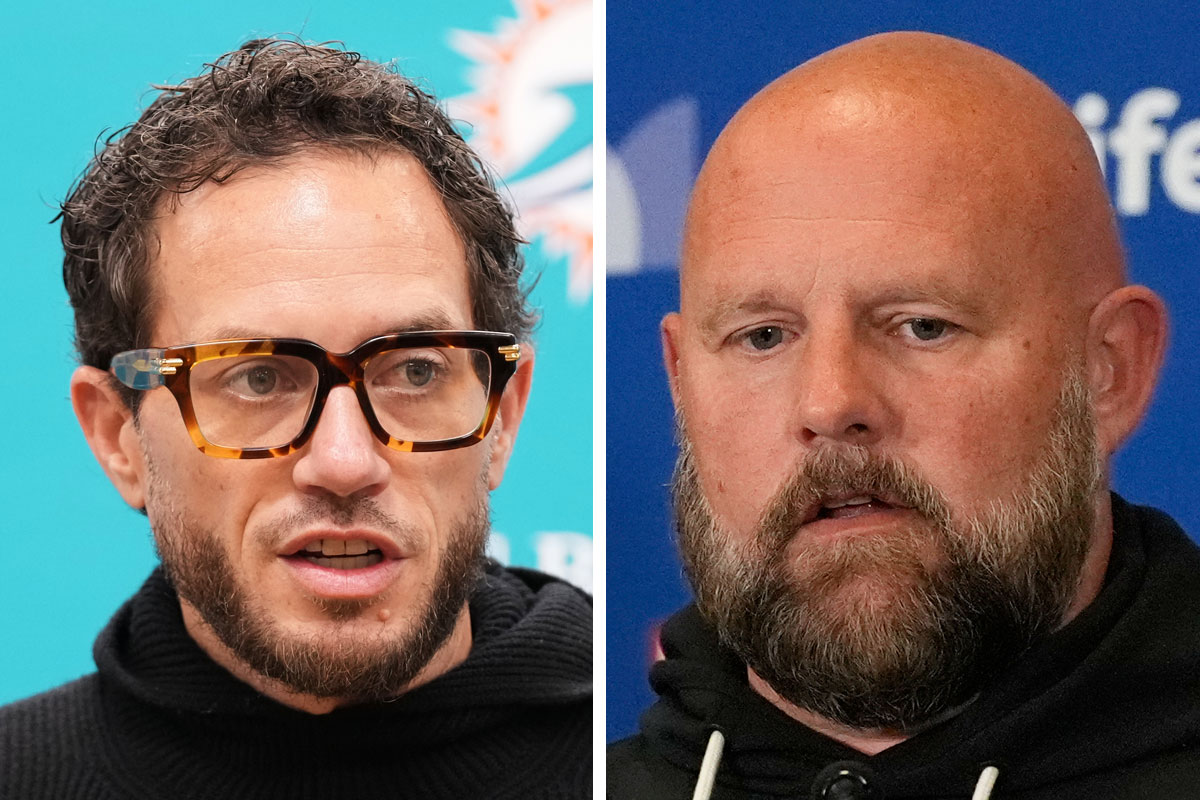
Former Dolphins coach Mike McDaniel (left) and former Giants coach Brian Daboll became offensive coordinators elsewhere.
They opened their search with former head coaches Mike McDaniel and Brian Daboll at the top of their list, sources said. That doesn’t mean the Eagles were ready with offers. They had an informal conversation with McDaniel over a video call and met in person with Daboll for a more formal interview.
McDaniel and Daboll eventually took coordinator jobs with the Los Angeles Chargers and Tennessee Titans, respectively. The Eagles interviewed others around the same time, but the search expanded and included more than a dozen coaches interviewed and others in which some form of contact was made.
Some made it clear they wanted to pursue other opportunities. Some declined to be interviewed and opted to stay in their current positions. And some the Eagles deemed not the right fit. Aside from Mannion, Indianapolis Colts offensive coordinator Jim Bob Cooter, former Tampa Bay Bucs offensive coordinator Josh Grizzard, and Houston Texans quarterbacks coach Jerrod Johnson met with the Eagles for a second time. A source told The Inquirer on Friday that Grizzard will join the Eagles as the team’s new pass game coordinator.
“Some came with years of experience running an offense and calling plays. Others were young, sharp, and dynamic coaches on the rise,” Sirianni said in a statement. “I felt it was important to be patient and thorough to allow the right fit to reveal himself to us. Sean did just that.”
Sirianni led the process, as he should. But general manager Howie Roseman was heavily involved. And owner Jeffrey Lurie, despite maintaining his winter residence in Florida, was conferenced into the interviews.
The Eagles will say that Sirianni made the final call, but recent history shows Lurie has asserted himself or Roseman’s connections when he has deemed it necessary. The Eagles’ track record in plucking head coaches from relative anonymity — e.g. Andy Reid, Doug Pederson, and Sirianni — is strong.
Sirianni did well with his first coordinator hires: Steichen, who had prior experience, and defensive coordinator Jonathan Gannon, who did not. He struck out with their replacements: Johnson and Sean Desai.
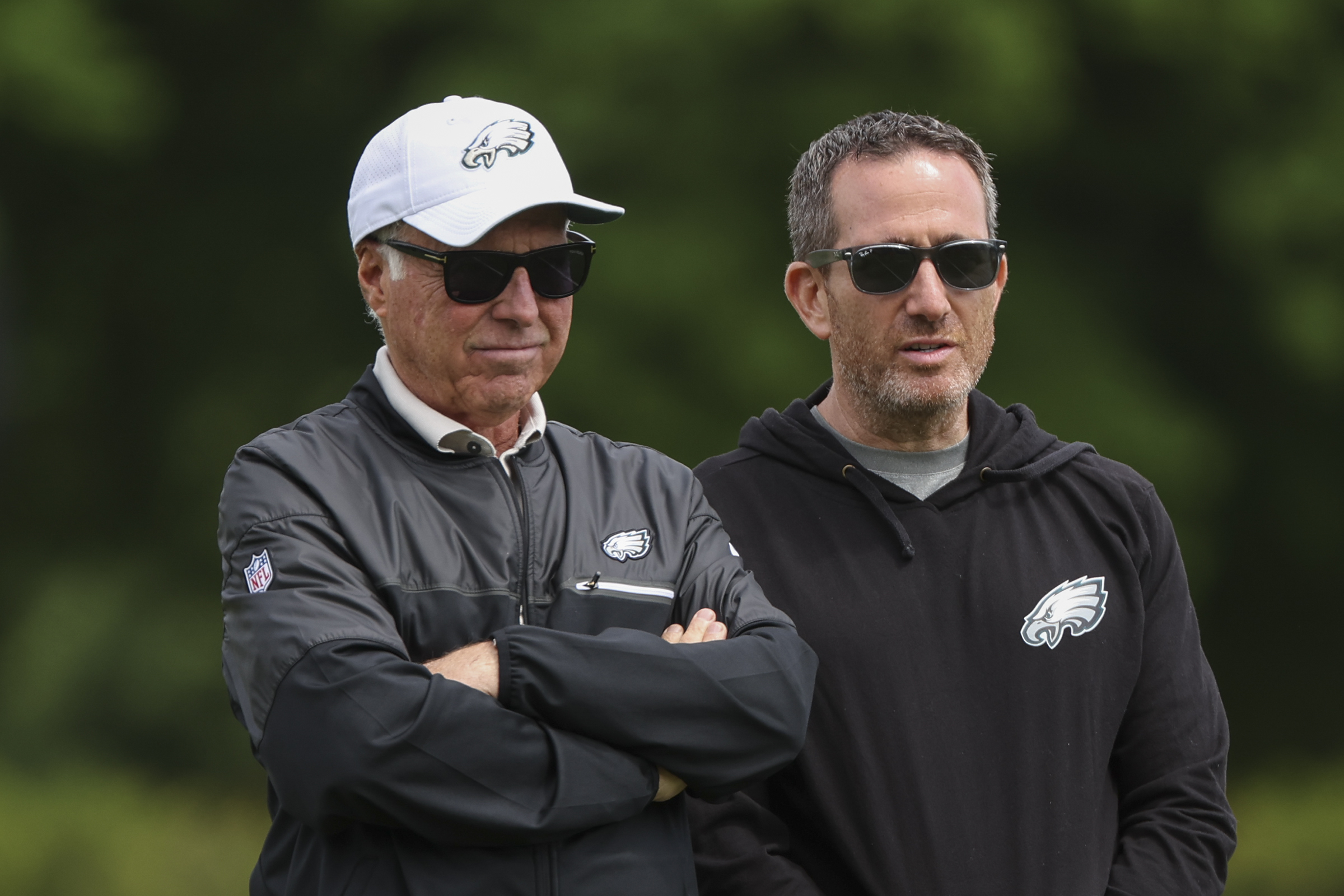
How much input did Jeffrey Lurie (left) and Howie Roseman have into the Sean Mannion hire? That answer could inform what happens after 2026.
Moore and Vic Fangio have been viewed as Lurie-Roseman-led correctives, and understandably so. The owner and GM interviewed Moore for the head coaching job in 2021, and Roseman made the initial calls to Fangio when the Eagles first tried to hire him in 2023 and when they finally did a year later.
They don’t have an obvious link to Mannion. Sirianni may have been permitted to make the decision all on his own. He did win a Super Bowl just a year ago, and earned a contract extension as a result. Lurie and Roseman may also be giving him all the rope he needs.
There are many unknowns at this stage, beyond Mannion’s qualifications. He will call plays, a source said. But will he have autonomy over the offense or will Sirianni oversee the operation? Will the scheme and terminology be his or will there be a meshing?
The Eagles aren’t planning to hold a news conference. Sirianni’s next media availability will probably be at the NFL scouting combine next month. Mannion will be shielded until the spring. They likely see little reason to divulge their plans unless required.
There’s also a lot to figure out. Beyond the Xs and Os, there’s the coaching staff and the roster. The Eagles do know who their quarterback will be, barring something unforeseen. It’s hard not to view the inability to snag a proven name as an indictment on Jalen Hurts, just as much as it was on Sirianni.
Locals may view Hurts through the prism of his excellence in the biggest games, but consensus from the rest of the league isn’t as generous. Of course, many of them don’t have his ring or Super Bowl MVP.
Mannion will be charged with elevating Hurts into being more consistent in the dropback game. He has been credited with helping Packers starter Jordan Love and backup Malik Willis advance and with helping them become better pocket passers.
Will Sean Mannion’s chops as a former QB help him win Jalen Hurts over?
It should matter that Mannion played the position and that he’s done it recently. But there could be the question of whether he has enough gravitas for the stoic old soul in Hurts. Sirianni might have suggested two weeks ago that he would include the quarterback in the coordinator search, but his involvement was minimal at best, sources close to the situation said.
Sirianni needs a modern passing game that utilizes under-center play action, not just for Hurts, but for the entire offense, especially the wide receivers. A.J. Brown may be more inclined to want to stay if he sees the possibility of an explosive air attack.
Mannion spent most of his formative playing years with Los Angeles Rams coach Sean McVay, but he also spent time with Kevin Stefanski, Matt LaFleur, Kevin O’Connell, Zac Taylor, Gary Kubiak, Klint Kubiak, Dave Canales, and Grant Udinski.
Most have fallen under the Kyle Shanahan umbrella. They’ve all deviated from the core principles in some form, but the marrying of the run and pass through under-center play action has been one of the foundations of its success.
Hurts has had to learn to play under center in the NFL and has made incremental improvements, but the Eagles have been far behind the curve. There are other facets as important in modern offenses, but that change should be coming to the Eagles.
It could affect offensive line coach Jeff Stoutland’s role. He has long been the run game coordinator, but he didn’t have as much input last season when the Eagles shifted their game planning and play calling to offset the early struggles on the ground, NFL sources said.
How does revered offensive line coach Jeff Stoutland fit into a Sean Mannion-guided staff?
Mannion could be allowed to bring in his own staff, but it’s unlikely he has assistants at the ready. Sirianni could use the new coordinator as an opportunity to make a few changes. It seems unlikely that the esteemed Stoutland would be one, although the new scheme could allow him to focus exclusively on the O-line.
In question is how involved Sirianni will be in the offense. He could act as a senior consultant to Mannion, or he could hire a trusted veteran to help the young coordinator. Sirianni might want to avoid someone who could be considered a threat or a break-glass-in-case-of-emergency alternative.
Or maybe he just reassigns Patullo to that role. There may not be anyone better suited to understand the rigors of being the Eagles’ offensive coordinator — both inside the building and out. Patullo had little margin for error.
Mannion should be granted a longer grace period. But how long is Sirianni’s? They’re likely bound together.
It’s finally happening, Eagles fans. It took eight years, but ESPN’s 30 for 30 documentary series is set to relive one of the most memorable moments in Eagles history: the Philly Special.
ESPN released the official trailer for the documentary, which is appropriately set to Boyz II Men’s “Motownphilly.” The film, titled The Philly Special, was produced by NFL Films and directed by Angela Zender and Shannon Furman. It will debut on Feb. 6 at 9 p.m. on ESPN and the ESPN app.
“Everybody loves the Rocky movies, but they were fiction,” Zender said in a release. “The amazing thing about The Philly Special is that it’s a real-life Rocky story. A group of five underdogs went up against the greatest dynasty in NFL history and pulled off an upset worthy of Hollywood. That underdog mentality is something that will resonate with people all over the country.”
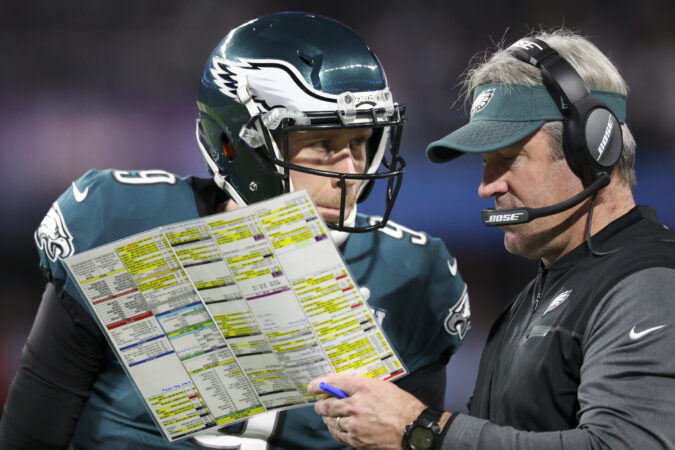
The film features several familiar faces to Philly fans, including former head coach Doug Pederson and the four Eagles players who touched the ball on that play in Super Bowl LII: Jason Kelce, Corey Clement, Trey Burton, and Nick Foles.
But there are many others: owner Jeffrey Lurie, former safety Malcolm Jenkins, former coach Chip Kelly, and former offensive coordinator Frank Reich. Several local and national media members also appear, including Angelo Cataldi, Ray Didinger, Sal Paolantonio, and Kyle Brandt.
With all that Philly flavor, it’s no surprise one of the directors is a Birds supporter.
“I grew up an Eagles fan, so The Philly Special has been a dream project,” Furman said in a release. “It was surreal to stand in front of the statue of Doug Pederson and Nick Foles at the Linc with the five men who made one of the most iconic plays in NFL history happen. There’s no doubt fans will enjoy reliving the Eagles’ first Super Bowl as much as I did.”
While it’s been the better part of a decade since the play helped lead the 2017 Eagles past Tom Brady and the New England Patriots dynasty — capping an improbable run for Foles, who took over as the starter less than two months earlier — it’s not hard to find reminders around the Philadelphia area, from the statue outside Lincoln Financial Field to a multistory mural to the name of a holiday band featuring Kelce and a pair of current Eagles players.
“It’s been everywhere and on everything, transcending football to become part of Philadelphia’s cultural identity,” ESPN said in its release describing the film. “It’s not just a play; it’s a rallying cry for a city used to being overlooked. While Philadelphia might be the birthplace of America, the sixth-most populous city in the country lives and dies with an underdog mentality — one epitomized by the Founding Fathers, Rocky Balboa … and the Philly Special.”
Two days before Super Bowl LX, there will likely be a few more reminders, as fans across the area tune in to relive the play — and learn the story behind it — one more time.