Tag: World Cup

  • Noahkai Banks knows he’s getting a lot of USMNT hype, but he isn’t thinking about the World Cup yet

    Noahkai Banks knows he’s getting a lot of USMNT hype, but he isn’t thinking about the World Cup yet

    You don’t have to watch Noahkai Banks for long to see why so much hype surrounds him.

    The 19-year-old centerback stands 6-foot-4 and around 200 pounds and has been a regular starter for Augsburg in Germany’s Bundesliga this season. Born in Hawaii and raised in Germany from a young age, he has been on the U.S. men’s national team radar for a few years now, including the 2023 under-17 World Cup squad.

    Last September, he earned his first call-up to the senior squad. Though he didn’t play in that month’s games and hasn’t been called up since, just that one invitation got a lot of attention.

    “He is a player that is really young, but with amazing potential,” U.S. manager Mauricio Pochettino said at the time. “He’s really young, but it’s good to see him, because he can go fast to the next level.”
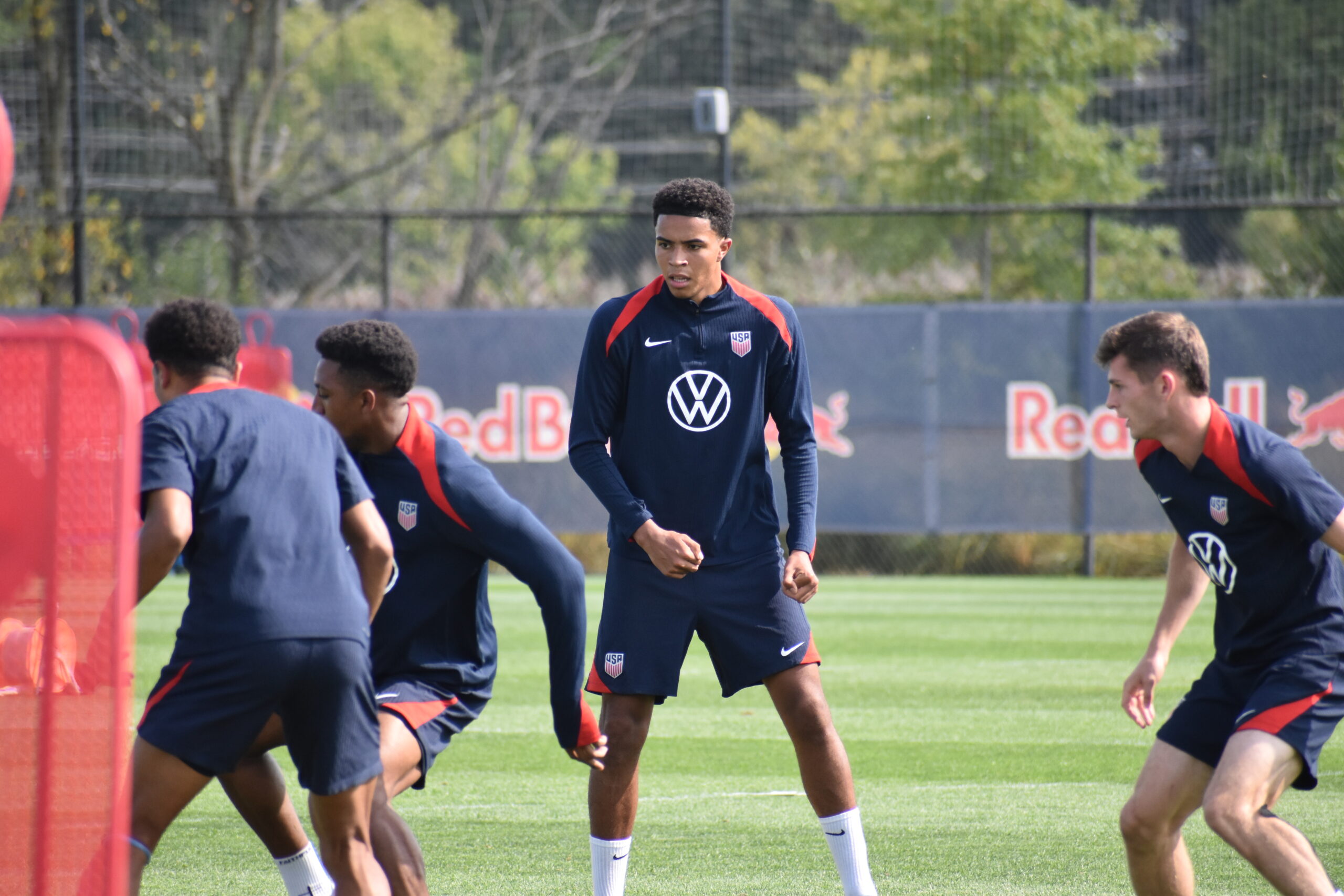
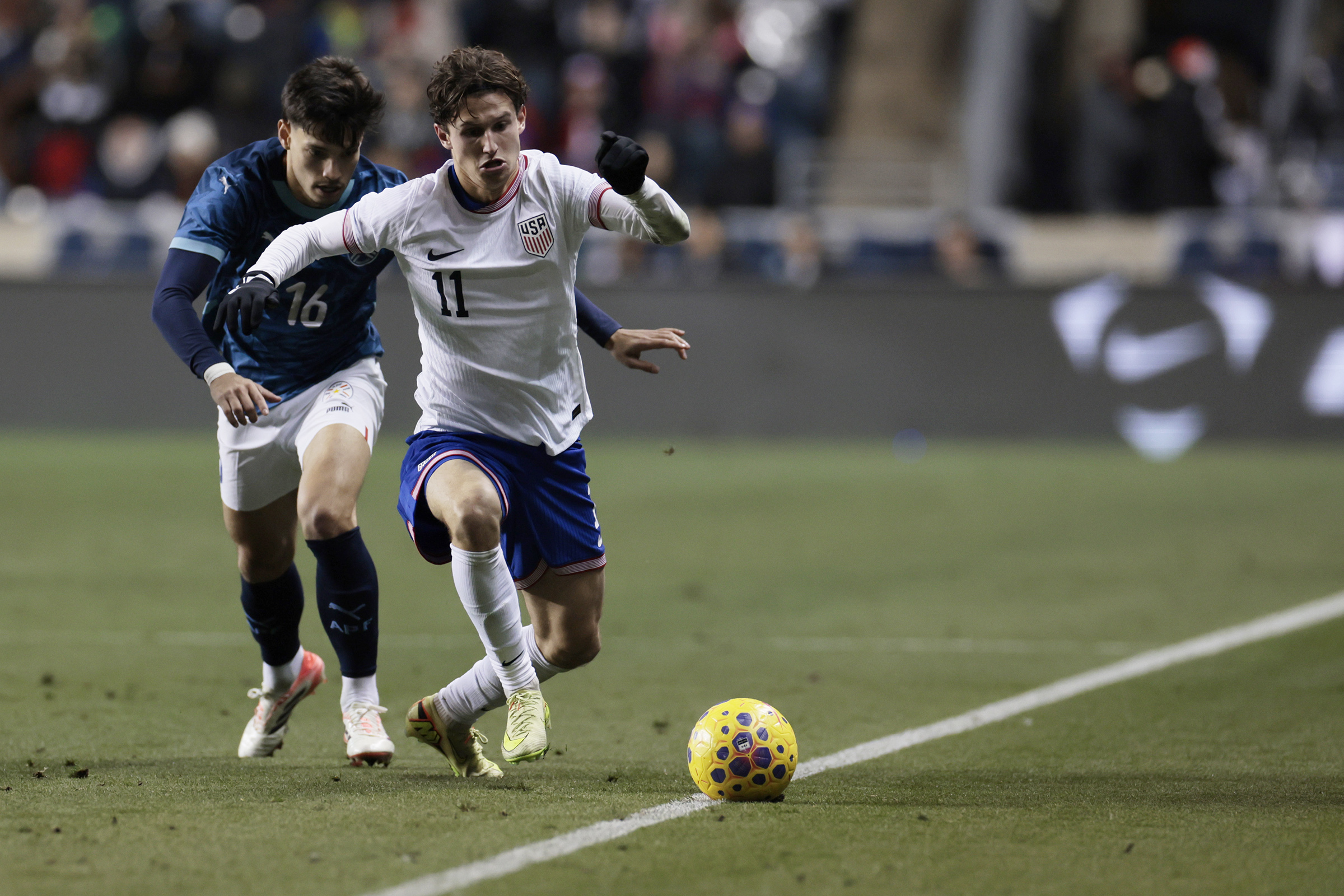
    Noahkai Banks (center) at work during his first senior U.S. men’s soccer team camp in September.

    It might be too soon for Banks to make this year’s World Cup team. Then again, the U.S. centerback depth chart isn’t in ideal shape right now, and the 26-player roster might be big enough to have room for him. The starting trio looks likely to be Chris Richards, Tim Ream, and Mark McKenzie, but no one has yet locked down a backup spot.

    That adds to the buzz around Banks right now, and he knows it’s out there.

    “I don’t read much, to be honest, but my mom always sends everything in the family chat because she uses a lot of Twitter and apps like this,” he said. “It’s cool. It’s a pleasure.”

    He said he enjoyed his senior U.S. camp, though he hasn’t had a one-on-one talk with Pochettino yet.

    “I’ve already felt the excitement during my training sessions, and I can see the team playing a strong role,“ Banks said. ”The national team boasts some excellent players — [Christian] Pulisic, [Malik] Tillman, Richards — and, of course, a highly experienced coach who has managed some of Europe’s top clubs. …

    “It was immediately clear that Pochettino is a world-class coach, but I wouldn’t presume to expect a personal one-on-one during my first training camp,” Banks said.

    Noahkai Banks (left) jumping for a header in front of the Union’s Nathan Harriel at U.S. camp.

    A touch of homespun warmth certainly won’t hurt his standing with fans, either. But asked if he’s thinking about the World Cup, he quickly tapped the brakes.

    “To be honest, I don’t think about the World Cup at the moment, because we have a difficult situation here at my club,” Banks said. “So it’s just about going from game to game here, and then let’s see what happens.”

    A sample of his play

    He was referring to Augsburg being in the thick of a relegation fight. The Fuggerstädter, whose ownership group includes 76ers part-owner David Blitzer, stand 15th in the 18-team table — the last spot where staying up is guaranteed.

    Augsburg fired manager Sandro Wagner in early December after just 12 games. The current boss, Manuel Baum, is an interim who coached just three games before the Bundesliga’s winter break arrived the weekend before Christmas.

    That’s enough for any player to handle, not just an 19-year-old. So perhaps you can take Banks’ patience as a sign of maturity.

    One of his best games this season so far was his next-to-last one before the winter break, on Dec. 13 at Eintracht Frankfurt.

    Amid the hothouse atmosphere of Frankfurt’s 59,500-seat stadium — perhaps you saw the NFL games it hosted in 2023, along with decades of big soccer tournaments — Banks was one of the best players on the field. Though Augsburg lost, 1-0, he had five tackles and six clearances, won eight of the 13 duels he contested, and completed 42 of 47 passes.

    It’s worth noting, too, that Banks played mostly as the right centerback in a 3-4-2-1 formation — the same setup the U.S. national team is using heading toward the World Cup. He even would have scored a late equalizer had he not been just barely offside when a corner kick was flicked on to him near the goal line.

    The Bundesliga season resumes this weekend, with Banks’ Augsburg coincidentally visiting two other Americans: Borussia Mönchengladbach’s Gio Reyna and Joe Scally (Sunday, 9:30 a.m., ESPN+). There are always lots of games around Europe for U.S. fans to watch, but that one might draw a little extra attention.

    It might also remind those fans that Germany has long been the top port of call for U.S. players who move abroad.

    Many aspire to play in England, and the doors there are much more open than perhaps they’ve ever been. Still, the Bundesliga’s track record of being a place where Americans cannot just move but actually play and develop remains the best of any top European league.

    ‘Give them the opportunity’

    Eintracht knows this as well as any Bundesliga club, as Philadelphia fans have seen from its preseason tours here in recent years. Former World Cup outside back Timmy Chandler has long called Eintracht home, as did Medford’s Paxten Aaronson for a while.

    There’s another young American playmaker in the club’s pipeline in Marvin Dills, and Eintracht tried to sign much-touted Union striker prospect Malik Jakupovic before he decided to turn pro at home first.

    “You have to give them the opportunity to grow and develop,” Eintracht sporting director Timmo Hardung said. “And I think this is what some of the clubs, us included, are trying to do: find players with top potential, with top talent, and ready to grow, ready to learn, ready to develop.”

    Speaking of the U.S. specifically, he said: “The sportsmanship and the athleticism in the United States is top, and that should produce a lot of players out of the soccer landscape.”

    Banks, who started in Augsburg’s youth academy at the under-10 age level, said the club has brought him along well.

    “FC Augsburg is a very well-run and family-oriented club,” Banks said. “The club gives me valuable playing time, which is crucial for my development.”

    Eintracht had Medford’s Paxten Aaronson (center) on its books until he left to return to MLS in late August.

    He praised the club’s managing director, Michael Ströll, for having “a clear vision: Young players should make their way into the Bundesliga, and the club is also striving to further develop its playing style — with a focus on more active football.”

    U.S. fans might remember that things didn’t go as well there for Ricardo Pepi in 2022, or for Michael Parkhurst in 2013. But Ströll didn’t take the job until after Pepi left, so we’ll see if things are different now. One piece of evidence is that Augsburg reportedly looked at signing 21-year-old Tampa native Santiago Castañeda in the summer.

    Banks said he’s also happy off the field at Augsburg, which is just over 70 miles from the town of Dietmannsried, where he grew up. Both towns are in the German state of Bavaria, where the most famous city is Munich.

    “I really appreciate being close to my family and the mountains,” Banks said. “Although I haven’t lived abroad yet, it is certainly a goal I hope to pursue in the future.”

    If he keeps playing this well, the odds of that will certainly go up. And so will the odds of another national team call-up.
  • Mark McKenzie’s plan to crack the USMNT’s World Cup roster? Sticking to what’s in his ‘control.’

    Mark McKenzie’s plan to crack the USMNT’s World Cup roster? Sticking to what’s in his ‘control.’

    Mark McKenzie needed November.

    When he returned to the Philly area for the U.S. men’s national team’s penultimate game of 2025 against Paraguay, it was a homecoming that he said grounded him.

    He was groomed in the Union’s academy system, having spent three seasons as a homegrown player on the club’s first team, but this marked the first occasion in quite some time that McKenzie, a native of Bear, Del., returned to his old grounds.

    Well, they were technically all-new grounds, considering that when he came up the ranks, Subaru Park was named Talen Energy Stadium, and the sprawling expanse that is now the WSFS Sportsplex was still a rendering.

    But being back, seeing familiar faces, training with the national team in Chester, and even briefly seeing a few family members brought perspective to what he’s ultimately trying to do: find his name among 25 other hopefuls eager to make the American roster ahead of June’s FIFA men’s World Cup.
    At the time, McKenzie, 26, noted that packing in all of that perspective was part of a “business trip,” one that has continued under the watchful eye of U.S. men’s manager Mauricio Pochettino as the starting center back for Toulouse, in France’s first division.

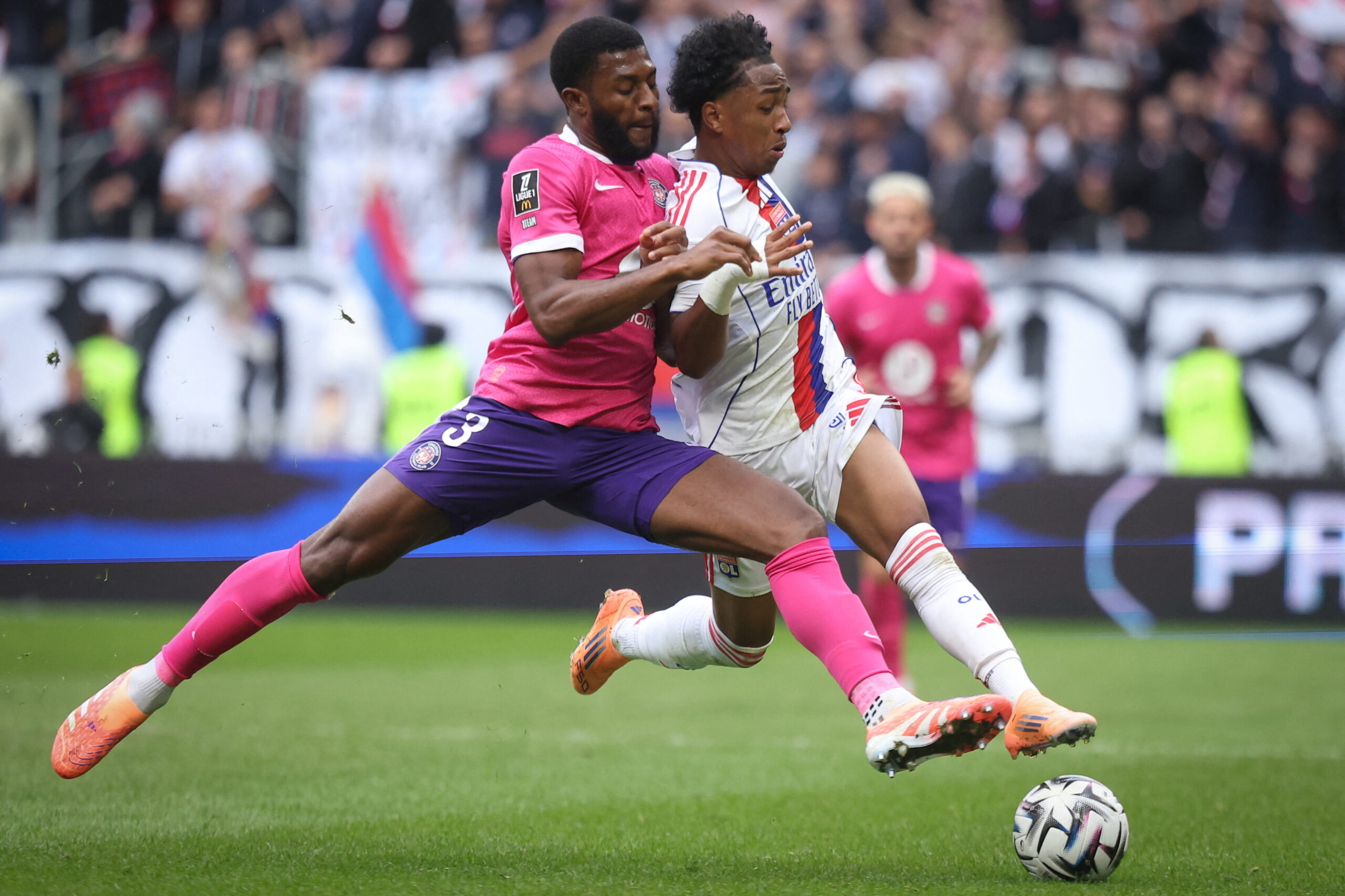
    Mark McKenzie (3) has appeared in 17 matches for Toulouse this season, with 16 starts at center back.

    “It’s always special coming back to Philly,” McKenzie said following the U.S. win against Paraguay at Subaru Park on Nov. 15. “I saw some old friends, my family came by the hotel, and just that time to take a little stroll and grab a bite to eat reminded me of who’s been behind me on this journey, and who I’m playing for.”

    Playing time has been consistent for McKenzie, who has appeared in 17 league matches for Toulouse this season, starting 16 at center back. That bodes well, as Pochettino has repeatedly noted that consistency in match play is a plus in his eyes. And considering there’s not a clear early favorite as the No. 2 center back on the field for the Americans, McKenzie has to know that his chances are as good as anyone’s.

    “The biggest thing is controlling what I can control,” McKenzie said. “Sure, I think about that stuff, but ultimately it’s not up to me. That’s my mentality, my attitude going into my performances.”

    Defensively, McKenzie is taking control of a Toulouse team that is eighth in the Ligue 1 standings, just two spots outside of qualifying for the UEFA Europa League next season. There’s still plenty of time for McKenzie and the team to climb before the season concludes in May, though it will take a better run than the seven points out of a possible 15 the club has collected in its last five league matches.

    “Going back to my [home] club [in Toulouse], that’s where a lot of the hard work is done,” he said. “So I’m just handling myself in those ways, and just not trying to worry about the things outside my control. My job is to keep getting selected for my club, play well, and hope it’s enough to prove that I deserve the opportunity to represent my country.”

    Trying to qualify for the second men’s World Cup in the United States isn’t the only thing on McKenzie’s mind. In October he became a dad, and he is trying to find the balance between those early days of fatherhood, his responsibilities to his club, and staying on Pochettino’s radar.

    It seemingly worked out as McKenzie was called up for every U.S. camp in the fall cycle in October and November. In October, he told CBS Sports that the birth of his son made him feel like he had “more to play for.”

    And even though his baby wasn’t old enough to understand the rigors McKenzie is going through, having his son while going through this process appeared to mean the world to the center back.

    “He can’t really hold his head up right now, and he’s not really watching …,” joked McKenzie on CBS Sports’ Morning Footy show in October, “but when we look back on these moments, this is something that I’ll cherish forever; just to say that he’s out there watching his daddy play is something that I’ll hold dear to my heart.”

    In just his second game with the national team since becoming a father, Mark McKenzie (left) battles Australia’s Connor Metcalfe in their meeting on Oct. 14, 2025.

    If fate has its way, McKenzie would be one of four players in the U.S. player pool who came up in the Union’s academy system or spent time on the club’s first team who could find themselves on the World Cup roster.

    That list includes Medford’s Brenden Aaronson, Wayne native Matt Freese, and Media’s Auston Trusty, the latter also vying for a spot along the back line. Each player has been invited to recent camps, and there’s a belief that one, if not all, has a good chance to crack Pochettino’s World Cup squad.

    But there’s still time before that happens. Six months, to be exact — meaning all McKenzie can do is focus on the now.

    After all, it is the only thing in his control.

    “Look, I’m trying to make the decision as difficult as possible [for the U.S. coaching staff],” he said. “I only do that by being at my best when I’m with my club and making the most of my opportunities when I get them. I just plan to do what I do and showcase my talent to the best of my ability, and hope that’s enough.”

  • Brenden Aaronson is on a hot streak with Leeds United at an ideal time for his World Cup hopes

    Brenden Aaronson is on a hot streak with Leeds United at an ideal time for his World Cup hopes

    LEEDS, England — When Brenden Aaronson joined Leeds United in 2022, the fans welcomed him in their traditional way: They wrote him a song.

    Come to Elland Road and you will see him play.

    Signed from Red Bull Salzburg and he’s here to stay.

    I really want to live in Beeston with you.

    You’ll be my American boy, American boy.

    Since then, relations between Leeds fans and the Medford native haven’t always been so warm. In Beeston, the Leeds suburb near the club’s Elland Road stadium, they remain scarred by his season-long loan to Germany’s Union Berlin after the Peacocks were relegated from the Premier League in 2023.

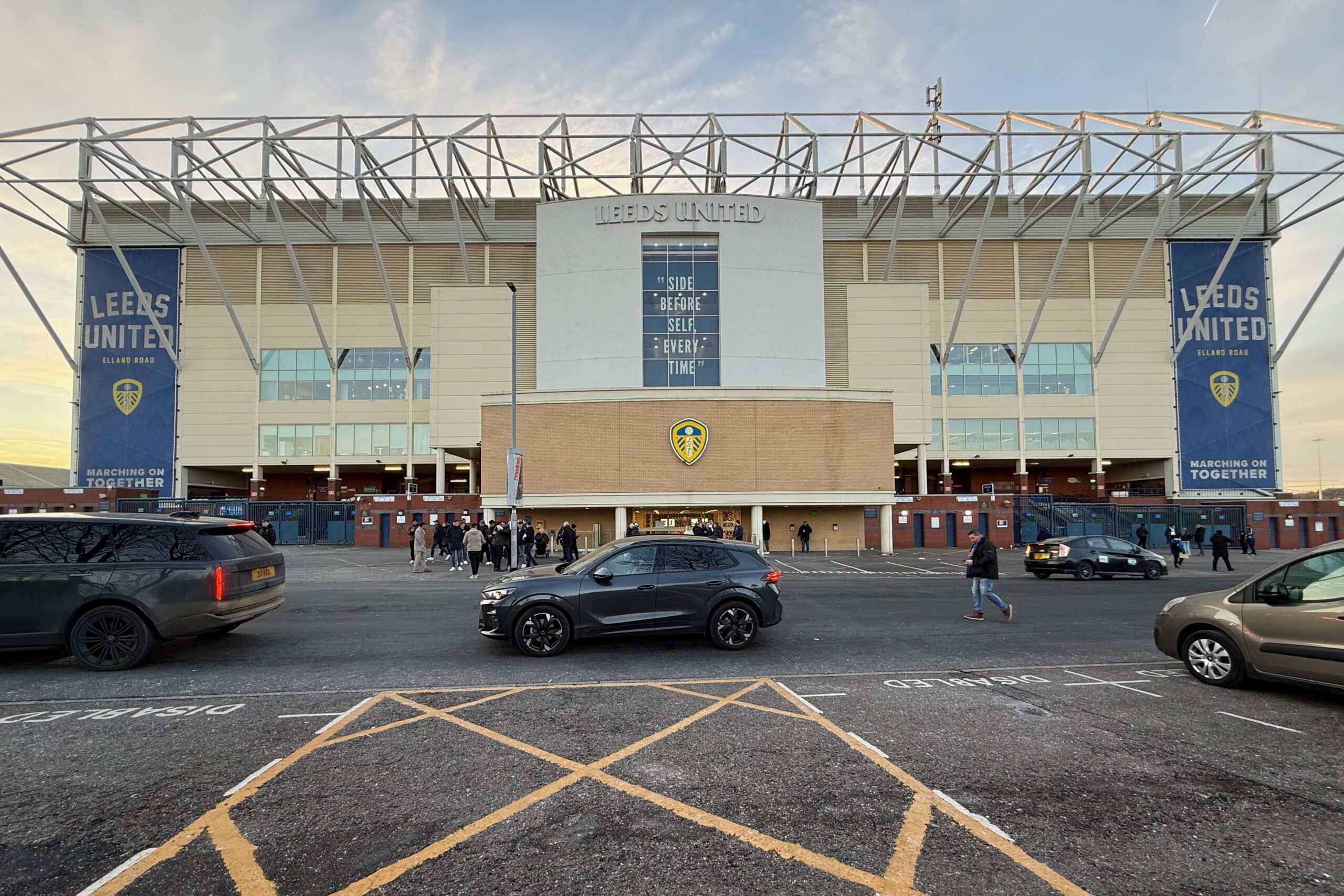
    A giant banner on the outside of Elland Road’s main stand proclaims “Side before self,” a quote from Leeds legend Billy Bremner. He captained the team during its most famous era, including league championships in 1969 and ’74, the 1972 FA Cup title and three more finals, and the 1975 European Cup final. Every player who has entered the gates since then has been held to his words.

    The banner with Billy Bremner’s famous “Side before self” quote at Leeds United’s Elland Road stadium.

    Aaronson is also chased by a criticism he gets from U.S. men’s national team fans, too: He doesn’t score enough goals as an attacking midfielder. That one carries more weight at the moment.

    Lately, though, the tides on both sides of the Atlantic have turned back in Aaronson’s favor.

    In the U.S., his high energy and pressing have earned Mauricio Pochettino’s respect. In Leeds, he had two assists and many more plays that could have added more as the club went seven games unbeaten from Dec. 3 through New Year’s Day.

    Then came this past Sunday, and perhaps the most famous game of all in these parts. Elland Road is an electric venue on any day, but it goes to another level when Manchester United visits from across the Pennine Hills.

    It was the 114th clash between the clubs, the modern version of a regional rivalry between Leeds’ Yorkshire and Manchester’s Lancashire that dates back to the 15th century. Though it was a 7:30 a.m. kickoff in Philadelphia, if you woke up in time, you’d have been jolted out of bed by Leeds’ fans singing their club anthem, “Marching On Together.”

    Scarves for sale from a street vendor near Leeds United’s Elland Road stadium on Sunday, including one with Brenden Aaronson’s name and face in the middle.

    Flying Philly’s flag worldwide

    With that as the backdrop, where better to start this World Cup year than at the home of the most successful men’s soccer player from the Philadelphia area?

    Yes, Aaronson has earned that title now. Though other local products have played on big stages, none has his trifecta of Premier League, Champions League, and World Cup experience. And if Aaronson makes this year’s World Cup squad, it will be his second — a feat Peter Vermes, Bobby Convey, and Chris Albright did not achieve.

    That counts for something, just like the ability to watch a hometown hero play on the Premier League stage on TV every week. Leeds might not be as big of a club in Philadelphia as longtime powers like Manchester United, Arsenal, Chelsea, and Liverpool, but children can grow up now wanting to emulate the 25-year-old whom Union fans once called “the Medford Messi.”

    “It means the world,” Aaronson told The Inquirer. “When I’m able to see young kids back home — it’s possible to get over here, you know. It might not be easy sometimes to get to Europe being an American, but it’s always possible to play in the best leagues in the world. And for the kids, just keep believing in themselves and keep chasing their dreams.”

    To some U.S. national team observers, Aaronson gets credit simply for being a regular player in the Premier League. Just four men have that status right now: he, Tyler Adams (Bournemouth), Chris Richards (Crystal Palace), and Antonee Robinson (Fulham).

    But if goals are what you care about most, you got what you asked for on Sunday. Aaronson scored his second of the season, sprinting past Ayden Heaven in the 62nd minute to grab a loose ball and slot it to the far corner. Elland Road roared as Aaronson sprinted to a corner of the Norman Hunter Stand, mock-shrugging in celebration then getting a hoist in the air from teammate Dominic Calvert-Lewin.

    “That one felt really good, to be honest with you,” Aaronson said. “Of course, to score against your rival is huge, and I’m really proud of it. And keep going from here.”

    Alas, Manchester United equalized just three minutes later, jumping on Leeds’ own defensive error. That was it for the day’s scoring, though Leeds had a few shots at a late winner that it couldn’t finish.

    Winning over critics in Leeds

    Aaronson had a strong day all over the field, throwing himself into eight defensive recoveries along with his attacking play. When he was subbed out in the 87th minute, the jam-packed crowd of 36,909 gave him a warm ovation.

    Asked if he noticed the fans’ change of mood, Aaronson said, “For sure — I think it’s really good. But for myself, I’ve kind of kept this mentality of just staying straight and not letting myself get too high, not letting myself to get too low.”

    Views on him have changed in the media, too. Graham Smyth, a veteran Leeds United beat reporter for the Yorkshire Evening Post newspaper, noted how Leeds manager Daniel Farke recently said Aaronson “polarizes opinion.” But Smyth’s player ratings for games show Aaronson’s rise in form and popularity. Aaronson earned an 8 out of 10 on Sunday, a level he has reached a few times recently.

    “Right now, I don’t think anyone would disagree that he’s probably in his best moment as a Leeds player,” Smyth said. “The performances he’s managed to put in over the last couple of weeks, the end product that he’s managed to add to it as well — I don’t think I can remember a period where he has silenced his critics quite as effectively as this last little period.”

    A moment later, he added something that would sound as familiar in Haddonfield as it does in Harrogate.

    “Leeds fans have very long memories, and they don’t forgive easily,” Smyth said. “They don’t suffer fools lightly, and they don’t forgive easily. But there is always a route back to popularity if you’re an attacker, and it’s very simple: Score goals, make goals, because everyone celebrates them. And that’s the way for Aaronson.”

    As coincidental as it was that Aaronson’s hometown newspaper watched him score, it also happened that some of his family were in attendance: father Rusty, mother Janell, sister Jaden (who just finished her freshman season on Villanova’s women’s soccer team), and fiancée Milana D’Ambra. While D’Ambra is able to spend a decent amount of time in England, Aaronson said his immediate family comes over “once or twice a year.”

    They picked a good one.

    Brenden Aaronson celebrates with the crowd after scoring his goal.

    “I think when they come out, to be honest, I probably have some of my best performances, so it was good,” Aaronson said. “It’s really good to have them out, always. It’s like home coming to you.”

    The race for the World Cup

    With six months to go until kickoff, the World Cup is also on his mind. There’s a big step to take before then, as he aims to make the squad for the U.S. team’s high-profile March friendlies against Portugal and Belgium. Those will be the last games before the tournament roster is named in late May.

    Aaronson politely said making the team is “out of my control, so [I] just keep trying to perform the best on the field and I just go from there.” He also has plenty on his plate right now as Leeds try to avoid relegation from the Premier League, after having returned this season. In the previous two campaigns, the three teams that came up went straight down again, so Leeds has to buck a trend.

    But he can hear two clocks ticking: the 154-year-old one on the Time Ball Buildings in Leeds’ city center, and the brand-new one at U.S. Soccer’s national training center in suburban Atlanta. The Premier League season ends on May 24, and the World Cup team will begin assembling the next day.

    Brenden Aaronson (right) in action for the U.S. men’s soccer team against Paraguay at Subaru Park in November.

    Pochettino and his staff will have noticed not just Aaronson’s good play lately, but how a tactical shift by Leeds manager Daniel Farke has helped. The 3-5-2 formation that Farke switched to recently puts Aaronson in a midfield spot that’s similar to where he plays for the U.S. — perhaps slightly deeper to start, but with latitude to press, get forward, and push the attack.

    “It’s nice when you can play three in the back, because you have a little more freedom as an attacking player where you’re not having to defend as much,” Aaronson said. “So you kind of have the energy and you kind of have the legs to then, with the ball, do things. I really like playing the position when we play in a three-back [setup].”

    On Sunday, Farke tweaked it a little, withdrawing one of the forwards to make it even more like Pochettino’s 3-4-2-1.

    “I think for Brenden, it’s just important that you use him where he can play to his strengths,” Farke said. “I would never use him as a winger who just runs to the corner flag and puts some crosses in. So if he plays as a winger, then he has to have license to move into the pocket, to play closer to the striker, to play give-and-goes, and to use his mobility, and also that he likes to open up between the lines.”

    Brenden Aaronson (right) on the ball against Liverpool on Jan. 4.

    He also said that Aaronson “deserves all the plaudits at the moment, because his work rate is and was never in doubt. He always works his socks off for the team.”

    It was not the first time Farke praised Aaronson publicly, and some of the past times were when the player wasn’t doing so well. Aaronson gave his boss thanks for the support.

    “It’s always great to know that the coach has your back, and for him to say the things that he’s said about me, it’s huge,” he said. “I think he really believes in me, he believes in my quality, and it means a lot when you’re a player because you feel like you can go out there and do your thing.”

  • SEPTA’s terrible, horrible, no good, very bad year

    SEPTA’s terrible, horrible, no good, very bad year

    Scott Sauer would like nothing better than to make SEPTA an afterthought.

    He doesn’t mean that the Philadelphia region’s mass transit agency should be neglected, but rather that it will come to do its job so seamlessly that its nearly 800,000 daily customers can rely on the service without worrying about breakdowns, delays and disruptions.

    Given the cascading crises that hit SEPTA in 2025, many people wondered if the place was hexed.

    “I hope not, because I don’t know how to get the curse off me,” Sauer said in a recent interview. “But listen, truth be told, there were days when I scratched my head and thought, ‘Oh, my goodness, what is going on?’”

    It was the year that a long-forecast fiscal cliff arrived in the form of a $213 million structural deficit in SEPTA’s operating budget. And it was a year of politics that failed to secure new money and a stable funding source for increased state mass transit subsidies. As usual.

    Service was slashed, but then a Philadelphia court, ruling in a consumer activists’ lawsuit, ordered the cuts reversed. Later, federal regulators cracked down on simmering safety issues. SEPTA had to inspect and fix all 223 of its 50-year-old Silverliner IV railcars after five Regional Rail train fires. The trolley tunnel was shut down and remains so.

    “We just couldn’t seem to get more than a day or two of relief before something else was causing a headache,” said Sauer.

    A bus passes the stop near Girls High at Broad and Olney Streets on Monday, Aug. 25, 2025. Thirty two SEPTA bus routes were cut and 16 were shortened, forced by massive budget deficits.

    Back to basics in 2026

    In the end, help from above and a new labor contract bought SEPTA at least two years to recover from its annus horribilis and stabilize operations.

    When the Pennsylvania legislature couldn’t get a transit funding deal done, Gov. Josh Shapiro shifted $394 million in state-allocated funds for infrastructure projects to use for operations — the third temporary solution in as many years. The administration also later sent $220 million in emergency money in November for the Regional Rail fleet and the trolley tunnel.

    And, early in December, SEPTA reached agreement on a new, two-year contract with its largest bargaining unit, Transport Workers Union Local 234.

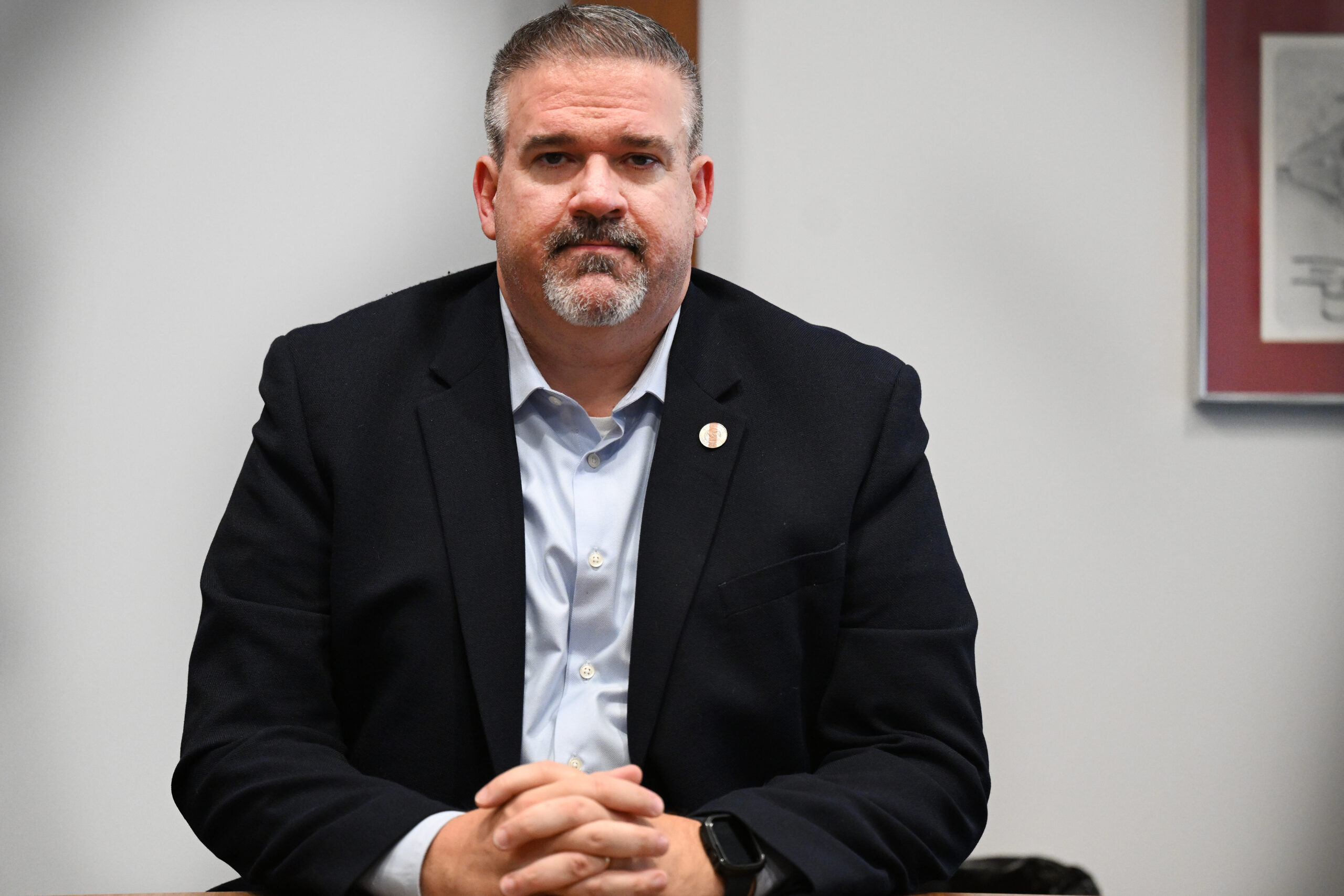
    Scott Sauer, general manager of SEPTA, admits that 2025 was an extremely challenging year.

    Sauer compared SEPTA’s position to football refs. When they are doing their jobs right, fans don’t have to think about them when watching the game. And when things are going well on the transit system, it becomes part of the background.

    “Let’s make sure we do the basics, and we do them really well, because at the end of the day, people want SEPTA to move them from one place to the other, right?” he said.

    The test of the focus on fundamentals comes soon, with millions of visitors expected in the region for the 250th anniversary of the Declaration of Independence, World Cup soccer, and other big events.

    2025’s cascading crises

    In December 2024, Sauer became interim general manager of SEPTA, replacing former CEO Leslie S. Richards. He was new in the top job, but not a rookie.

    Sauer, 54, began his career as a trolley operator more than 30 years ago. He had no political experience, though, and would quickly be thrown headfirst into those murky waters to swim with sharks.

    Storm clouds were already rolling in. Weeks before Sauer took the reins, Shapiro had flexed $153 million in state highway funds for SEPTA operations after a broader deal failed amid Senate GOP opposition.

    It’s a legal move, but often controversial, and Shapiro’s opponents were furious.

    Richards and her leadership team had been warning of a looming fiscal “doomsday scenario” for months. Officials were drafting a budget with service cuts and fare increases.

    On Feb. 6, a Wilmington-bound Regional Rail train caught fire as it was leaving Crum Lynne Station in Delaware County. It was worrisome, but at the time, nobody knew it would get worse.

    More than 300 passengers were safely evacuated after a SEPTA Regional Rail train caught fire near Crum Lynne Station in February.

    SEPTA successfully moved more than 400,000 people to the parade celebrating the Eagles’ Super Bowl LVII championship on Valentine’s Day, a high point. “We pulled off the parade near flawlessly,” Sauer said. With the flexed money, “It was exciting at first.”

    Then the state budget cycle started up again.

    Familiar battle lines were drawn. Senate Republicans, in the majority in the chamber, opposed Shapiro’s proposal to generate $1.5 billion for transit operations over five years by increasing its share of state sales tax income.

    They preferred a new source of income for the state’s transit aid and said SEPTA was mismanaged, citing high-profile crimes, rampant fare evasion, and lax enforcement.

    On a mid-August night, the Senate GOP came up with a proposal that would take money from the Public Transportation Trust Fund, a source for transit capital projects, and split it evenly between transit operations subsidies and rural state highway repairs.

    Senate Majority Leader Joe Pittman, a Republican from Indiana County, was a key player in budget negotiations, which ultimately did not yield additional funding for mass transit.

    “It was kind of quiet … and then we got alerted that a proposal was coming within minutes. And so everybody was scrambling to try to read through it,” Sauer said.

    In a quick news conference with Shapiro, Sauer opposed the idea of taking capital dollars for transit operations, as did the governor. Then he spoke with Senate Republicans and told reporters it could be worth considering, but he had questions. And by the end of the night, he walked that back and opposed the measure.

    “I guess if there was a lesson to be learned for me in August, it was I should have taken some [more] time reading through that proposal,” he said.

    There was not much time to reflect on what happened, though, because the hits kept on coming as the federal government ordered SEPTA to inspect all 223 Regional Rail cars.

    SEPTA’s Regional Rail fleet is the oldest operating commuter fleet in the country, and the fires highlighted the difficulty of keeping them maintained while needing to stretch limited capital funds to address multiple problems.

    The Market-Frankford El cars, though younger than the Silverliner IVs, have been beat up and unreliable. SEPTA is moving forward with replacing them, as well as the Kawasaki trolleys that are more than 40 years old.

    SEPTA had ordered new Regional Rail coaches from a Chinese-government-related manufacturer, but canceled the contract after the first few models, built during the pandemic, showed flaws. Now the agency is advertising for bids on a new fleet of Regional Rail workhorses — but it has to make them sturdier to last for at least seven more years before new cars would be on the way.

    Officials plan to use $220 million received from the state on that effort.

    Some of the money, about $48 million, is slated to help fix the trolley-tunnel issue. SEPTA is contending with glitches in the connection between the overhead catenary wires and the pole that conducts electricity to the vehicle.

    What SEPTA got done

    SEPTA has made some progress on some of its persistent issues, officials say, though the accomplishments understandably have been largely overlooked amid the urgent, existential crises of 2025.

    For instance, serious crimes on the SEPTA system dropped 10% through Sept. 30 compared to the same period in 2024, according to Transit Police metrics.

    And there had already been a sharp improvement. Serious crimes in 2024 dropped 33% compared to 2023 — from 1,063 to 711, year over year.

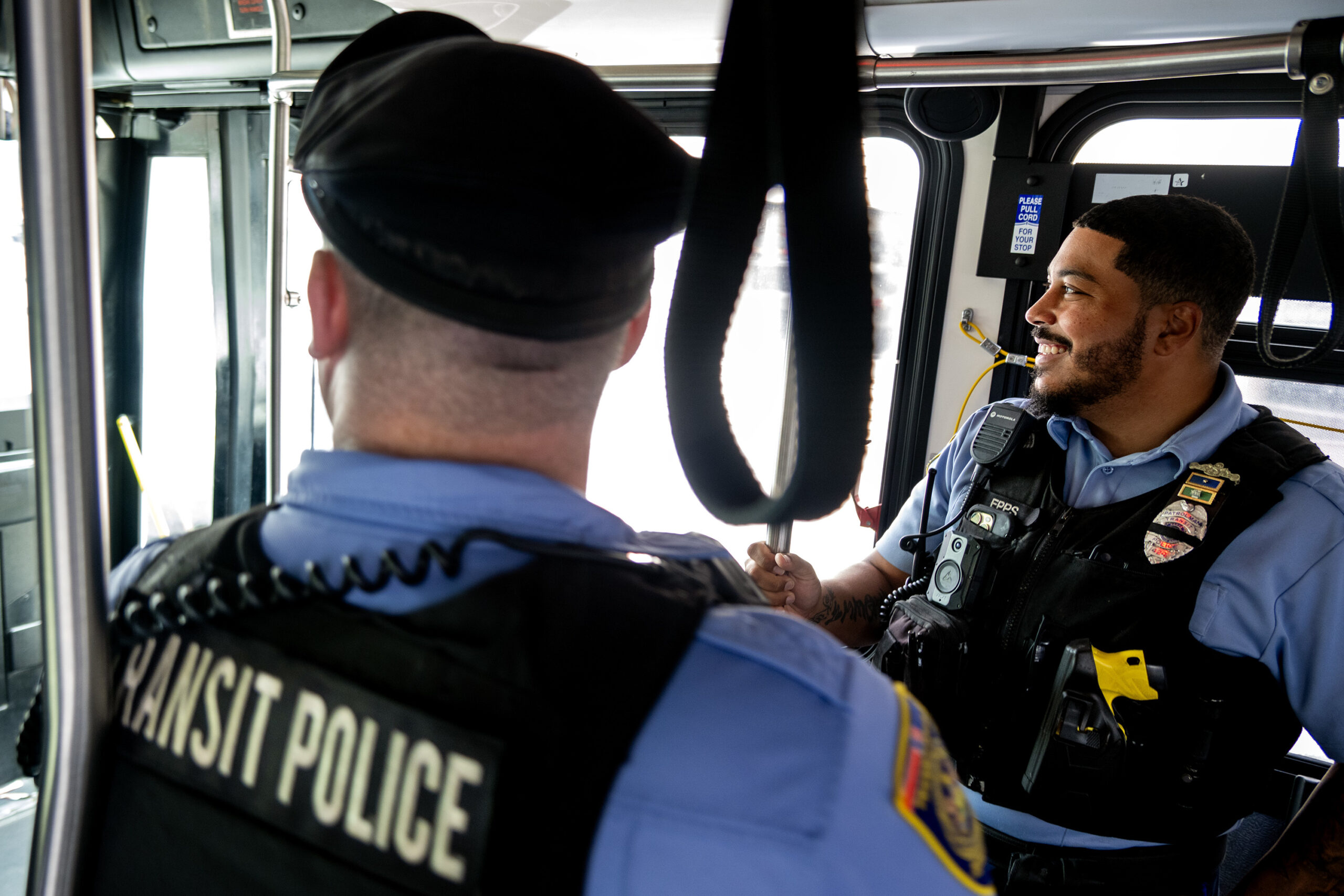
    SEPTA transit police police patrol officers Brendan Dougherty (left) and Nicholas Epps (right) with the Fare Evasion Unit ride the 21 bus.

    “If you think back to where we were in 2021 and 2022, the perception was bad things were happening on SEPTA, and you should steer clear of them,” Sauer said.

    The Transit Police have been hiring new officers, including a recently graduated academy class of nine, and has about 250 officers.

    SEPTA also installed 42 full-length gates designed to thwart fare evasion on seven platforms in five stations during 2025, spokesperson Andrew Busch said. Another 48 gates are coming in the first quarter of the year.

    Police are also issuing citations with an enhanced penalty of up to $300 for fare evasion.

    Prepare for déjà vu

    And yet, in 2027, it will be time to start the old SEPTA-funding dance once again, as transit agency advocates and supportive lawmakers work at getting a stable state funding stream for transit operations.

    State Democrats have said the transit issue could help them take control of the Senate from Republicans — a longtime goal but one that is difficult to achieve. One wild card is whether President Donald Trump’s slumping popularity will cause GOP congressional candidates to get swamped in the 2026 midterms, and whether that will translate into voters’ local senators.

    It likely would have to be a huge wave, and it’s a closely divided state.

    By 2027, Shapiro is expected to be running for president (if he is reelected next year), and it’s anyone’s guess how that could affect budget politics.

    “Not everybody wants to see us. I didn’t make a lot of friends,” Sauer joked after the TWU settlement.

    “We have more advocacy to do,” he said.

  • To kick-start a generation of city kids playing soccer, it will take more than just a place to play

    To kick-start a generation of city kids playing soccer, it will take more than just a place to play

    In the backdrop of the excitement surrounding the FIFA World Cup coming to Philadelphia is the question of what impact the tournament will have on soccer in the region.

    World Cups have long had the potential to be transformative for the hosting nations. The last men’s edition in the United States, in 1994, helped spur Major League Soccer. The women’s editions in 1999 and 2003 also spawned leagues, but more importantly, they fueled the grassroots growth of the game, benefiting both girls and boys.

    Over the course of those years, the youth game has morphed into a pay-for-play structure in which the best clubs are generally the ones that come at a high price, giving youth athletes whose parents have expendable cash — many times in the thousands — the opportunity to play consistently and thus reap the benefits of year-round exposure through tournaments and showcases.

    U.S. Youth Soccer is a network that oversees more than 10,000 such clubs, with local branches such as the Eastern Pennsylvania Youth Soccer Association, which govern clubs and leagues across regions under the umbrella of USYS. The thing is, many of those clubs and leagues don’t come from inner-city areas like Philadelphia, where the next great American star could be waiting to be discovered.

    But to find that kid, they need a place to play, and in Philadelphia, finding a spot to play organized soccer at times can be equally as tricky.

    It is a need that the city, alongside several foundations and organizations, is working to address, recognizing that the World Cup’s visit to Philadelphia may lead more kids to give futból a try.

    If you build it …

    Ahead of the World Cup, Philadelphia Soccer 2026 committed $2 million to the U.S. Soccer Foundation to support youth soccer initiatives, including the development mini pitches across the state.

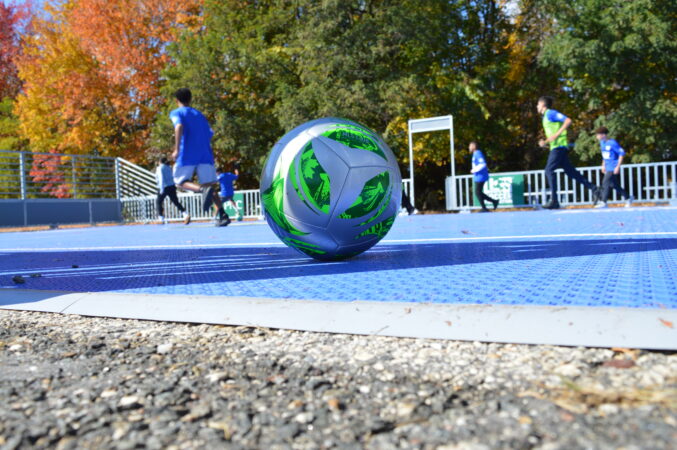
    In late fall, U.S. Soccer Foundation installed a pair of those mini-pitches in Philadelphia. The foundation, which was also created after the 1994 World Cup, has a goal to leave a lasting legacy in inner cities. It believes these mini-pitches offer not just a place to play but a place for local organizations to host programs.

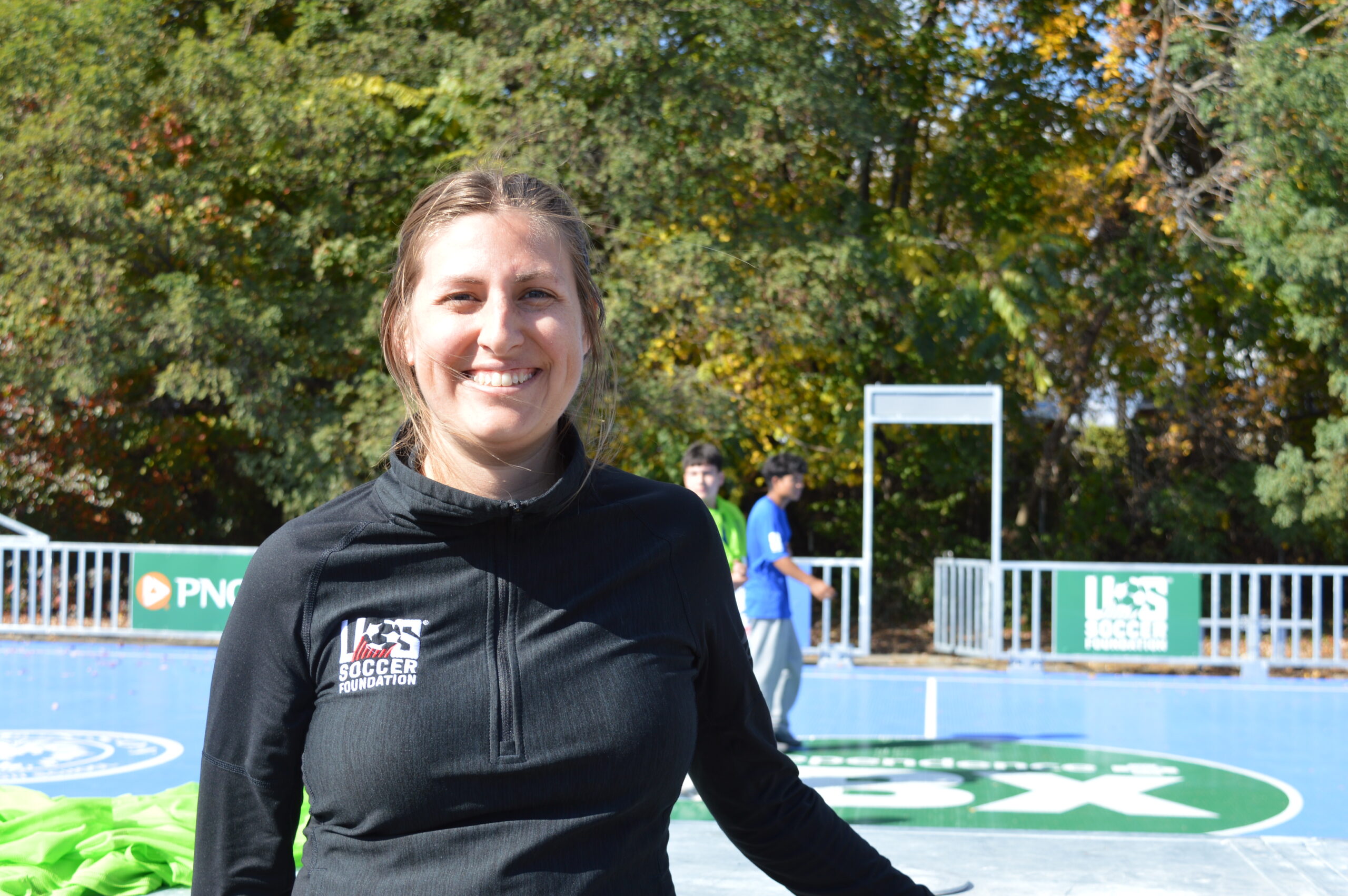
    Jen Arnold, vice president of communications and marketing at the U.S. Soccer Foundation, says that the foundation has a commitment to introducing the sport to more children in underserved areas.

    “When our current president and CEO [Ed Foster-Simeon] came into the role in 2008, he did a landscape analysis and showed it had grown … but in the suburbs and more affluent communities,” said Jen Arnold, vice president of communications and marketing for the U.S. Soccer Foundation.

    “So from the foundation standpoint, we want to make sure it’s growing equally across the ground. We’re here for the under-resourced communities, communities that might not have been part of that boom after 1994. We’re here to make sure that everyone can access the game.”

    Arnold spoke after the installation of one of the latest mini-pitches added to Philly’s soccer landscape, behind Swenson Arts and Technology High School in the Far Northeast. The installation was in collaboration with Independence Blue Cross, the School District of Philadelphia, and FIFA Philly 26, the local collective tasked with organizing Philly’s place in this summer’s World Cup.
    The fields, which cost $150,000 apiece to install, according to Arnold, are the latest additions to Philly’s sports landscape. They could be considered an addition to the city’s massive Rebuild program, a reported $500 million restoration project for area parks and playgrounds, of which $3.5 million was allocated to create 15 mini-pitches and two signature soccer fields across the city.
    Many recreation centers across the city are fenced off, only to be used under permit, which restricts the idea of open play, a key component of soccer.

    The idea is that these mini-pitches offer an opportunity for more children to be introduced to the game. They also offer a welcoming environment, unlike the scores of fields around the city that are fenced and kept under lock and key. Or recreation centers in which both indoor and outdoor surfaces get gobbled up often by other sports, or even pay-to-play youth and adult league soccer organizations, which serve to add to city coffers in exchange for monopolizing much-needed field time.

    But soccer organizers across the region believe that it’s not simply “If you build it, they will come.” It’s more like: “Build it and add programs and they might come.”

    That’s where the big challenge lies when it comes to introducing more city kids to soccer.

    … Will they come?

    For the better part of a decade, Dom Landry has made it a mission to bring soccer to North Philadelphia. A Philly native who played at St. Joseph’s University, Landry has dedicated time, intuition, and even his own dollars to introduce the sport to as many children in the city’s Fairhill section as possible.

    Landry founded AC Fairhill, the neighborhood club created in 2015 with just “three kids and an old bag of balls,” according to Landry. It has since become a recognized club that competes in tournaments across the region. His is one of a few clubs directly from the inner city that have funneled children from North Philly streets to top clubs and academies.

    His desire mirrors what the U.S. Soccer Foundation says it’s looking to do in developing the infrastructure, but Landry notes that it goes way beyond plopping a shiny new field in the middle of an underserved neighborhood.

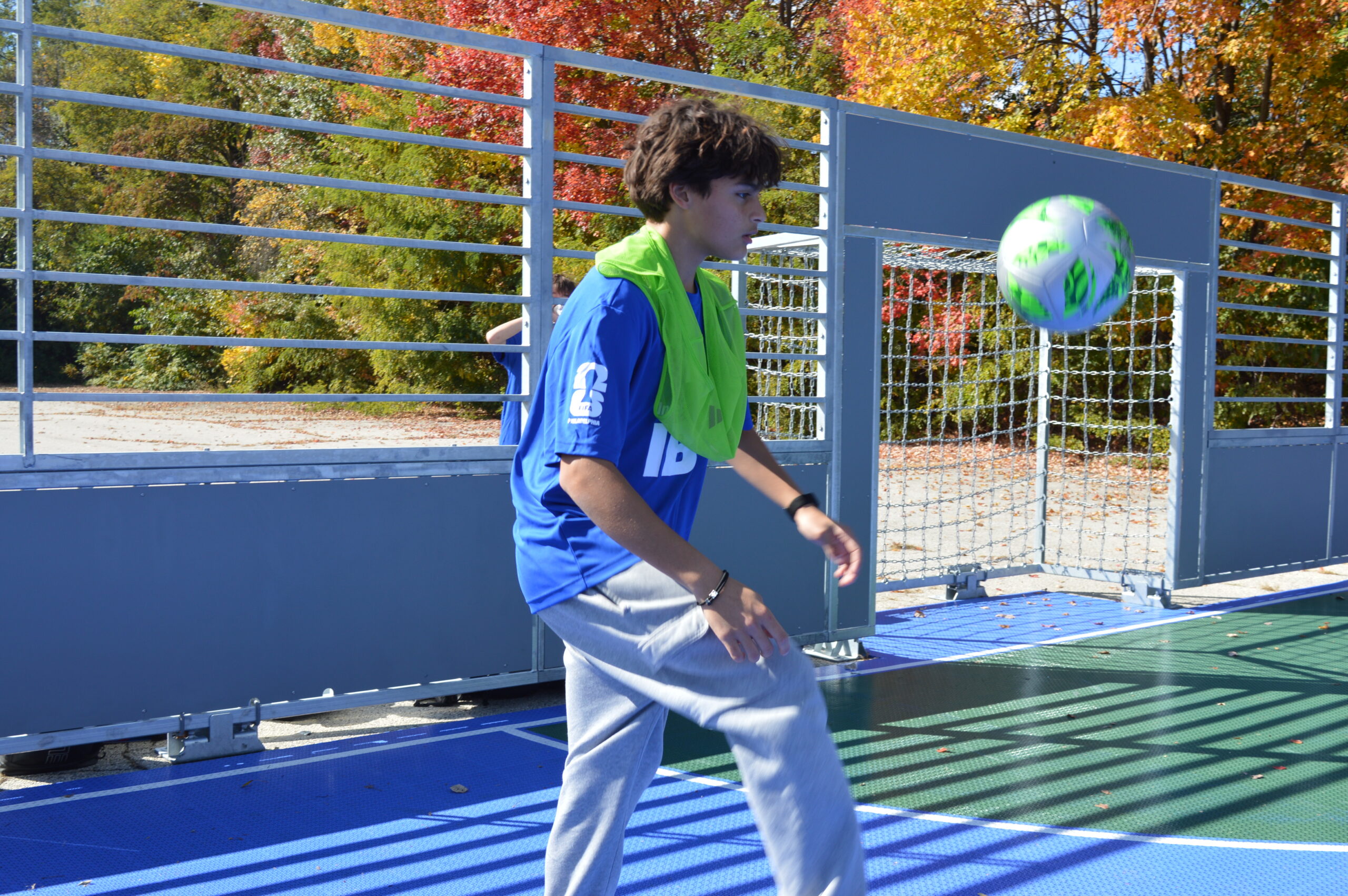
    Students at Swenson Arts and Technology School were the first to test out the new soccer mini-pitch that was installed at the rear of the school earlier this fall.

    “Putting infrastructure in for play is critically important, but it’s not the United States Soccer Federation or its foundation’s job to provide programming,” Landry said. “I know it’s part of their mission [at the U.S. Soccer Foundation], too, but it’s really the job of local organizations to bring the programming to those fields.

    “We don’t have the soccer culture here in America where kids are just going to grab a soccer ball and go to a soccer pitch because it was made; there has to be enough people to bring in that level of interest to them. It’s very much a multiprong approach, and these mini-fields are great, but they’re only scratching the surface.”

    Unlike other countries where soccer reigns supreme, in America it’s viewed as a sport for children, residing in the backdrop of football, baseball, and basketball. In other parts of the world, all that’s needed is a ball to get a game going, but here, it’s rare to see the sport being played without an organization tied to it.

    Having safe places to play is one thing, but experts say developing a love for the game in area children is up to organizers.

    ‘We need to do more’

    For Landry, it’s a simple thing that has been made to feel quite complex.

    “We have to teach kids how to love the sport,” Landry said. “Not necessarily just, like, go get cones and train, but have fun with the sport. Who’s going to be that coach, that parent who’s going to show a kid how to have fun with the sport, so they can go out with their friends and play it? To me, if anything, that’s the next step in the legacy and evolution of soccer here. But that ideology also tends to upset these clubs who spend a great deal of time in generating a living from it.”

    A host of organizations, both in the city and out, have taken soccer programming into schools, taking over gym classes or creating after-school outlets.

    To introduce the sport directly to more Black and brown youth, the annual Odunde Festival created a soccer pitch in the middle of South Street at this past summer’s event to get children and their families playing soccer, coupled with education on where they could find programs close to home.

    Jeremiah White III, a former professional soccer player turned entrepreneur, says he presented the idea to Odunde leadership and already has plans to grow Odunde Sports to align with this summer’s World Cup.

    Jeremiah White Jr. (right), with his son, Jeremiah III, kick-started Odunde Sports this past summer, a deriative of the larger Odunde Festival, designed to foster connection between community and sports, like soccer.

    “A big thing missing from soccer programming here is the importance of connection,” White said. “[When it comes to soccer in America], we tend to overvalue structural training, and in some cases disconnect training from culture entirely. It makes the game robotic and sucks out all of the passion. What kid is going to want to pick up a soccer ball over a basketball or a football, when that’s what they’re walking into?”

    It’s a well-known challenge, even one recognized by top youth organizations as a change agent.

    “The fields are great, but yeah, we need to do more,” said Chris Branscome, president and CEO of EPYSA, the organization that oversees club programming in the area. “Once they are built, you’ve got to get the kids there, you’ve got to program them. That’s perhaps the bigger piece of the puzzle: ensuring we have the opportunity to train more coaches and to deliver regular, consistent programming at these locations.

    “To me, that’s the big challenge we have over the next year.”

    It’s one that feels pretty integral once the noise the World Cup brings finally fades.

  • ‘Sibling’ Liberty Bell will ring on Cherry Street Pier to celebrate New Year’s Eve

    ‘Sibling’ Liberty Bell will ring on Cherry Street Pier to celebrate New Year’s Eve

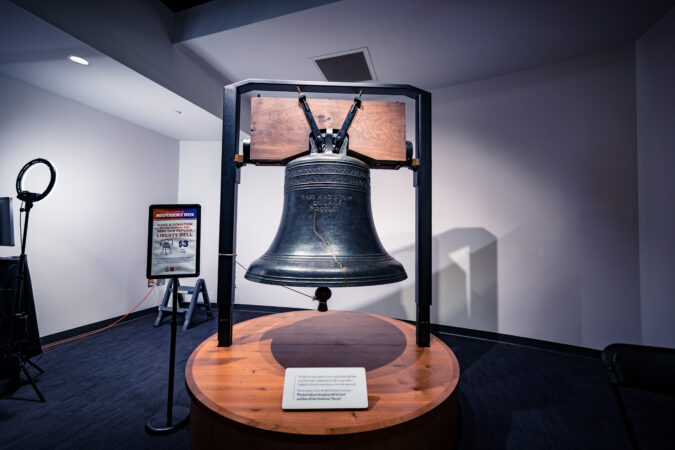
    A 2,000-pound “sibling” bell, typically displayed at the National Liberty Museum at Fourth and Chestnut, and produced by the same London-based foundry as the original, will be temporarily moved to the Cherry Street Pier as part of the city’s annual New Year’s on the Pier celebration Wednesday night.

    Getting it there, however, will be no easy task.

    “We’ve done a couple months of prep,” said Alaine K. Arnott, president and CEO of the National Liberty Museum, of the logistics of moving a one-ton piece of history for an outside event. “It’s the rental of a forklift, it’s getting a truck big enough to house it, it’s figuring out which route to take it through the City of Philadelphia.”

    The bell — which features a replica of the original bell’s famed crack, as well as the functionality its sibling lacks — will be on hand for a pair of ticketed New Year’s Eve events on the pier.

    The New Year’s Eve Kids Countdown — which includes music, crafts, and giveaways — runs from 5 p.m. to 7 p.m. on the pier, with tickets on sale now for $27 per person. (Children 2 years old and younger are admitted free). Tickets for the pier’s 21-and-older event, which runs from 10 p.m. to 1 a.m., are $32 and include a Champagne toast, cash bar, and optimal views of the fireworks.

    The festivities will be anchored by a pair of fireworks displays, part of Visit PA New Year’s Eve Fireworks on the Waterfront. The first display is set to begin at 6 p.m., and the other at midnight.

    (A third fireworks show will take place at midnight on the Benjamin Franklin Parkway, part of a free concert by headliner LL Cool J, with additional performances by DJ Jazzy Jeff, Adam Blackstone, Dorothy, and Technician The DJ.)

    “I think it is a fantastic symbol and representative of our country,” Arnott said of the bell. “It inherently reminds people that liberty is something we’ve got to protect or it will vanish.”

    “It’s also really fun” she added, “when you actually get to ring it.”

    This year’s New Year’s Eve events mark the official launch of the city’s much-anticipated Semiquincentennial celebration honoring the nation’s 250th birthday — and if Arnott has her way, the sibling bell could feature prominently into the yearlong slate of events.

    “Once we do it [for New Year’s Eve], we’re really hoping to kick it off with MLB, with FIFA,” Arnott said of Major League Baseball’s All-Star Game and the FIFA World Cup, both of which will be hosted next year in Philadelphia.

    “How cool would it be to do this for some of those events?”

  • SEPTA’s board approves 2-year contract with transit agency’s largest union

    SEPTA’s board approves 2-year contract with transit agency’s largest union

    SEPTA’s board on Thursday approved a new contract with the transit agency’s largest union, Transport Workers Union Local 234, and a second smaller union representing vehicle operators in the suburbs of Philadelphia.

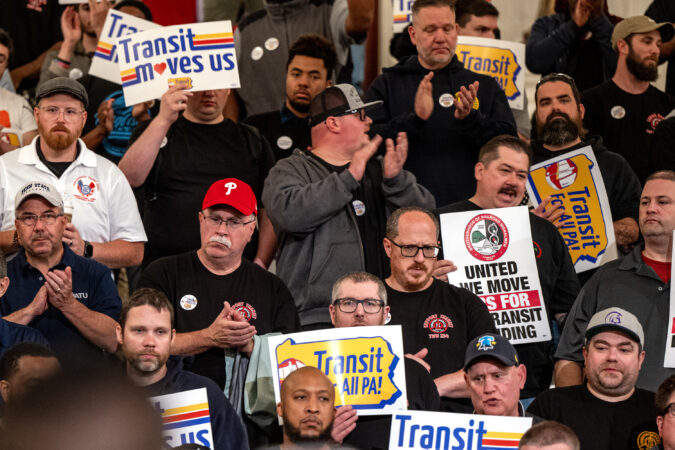
    Members of TWU Local 234 voted Wednesday night to approve a two-year contract that will deliver a 3.5% pay raise, bolster the union’s pension funds, and expand health benefits for new employees.

    SMART Local 1594, which represents approximately 350 operators, reached a deal with the transit agency earlier this month.

    “These contracts are fair to our hardworking frontline employees and fiscally responsible to our riders and the taxpayers who fund SEPTA,” said SEPTA General Manager Scott A. Sauer.

    For TWU Local 234, the two-year contract disrupts a pattern of three consecutive one-year contracts. TWU president Will Vera said that with the FIFA World Cup, MLB All-Star Game, and America’s 250th birthday coming to Philadelphia in 2026, both parties agreed to a two-year contract so as not to interrupt service during these global events.

    The union represents 5,000 operators, mechanics, cashiers, maintenance people, and custodians who work on SEPTA’s buses, subways, and trolleys. Before this latest deal, TWU members were working without a contract since Nov. 7, and members voted unanimously on Nov. 16 to authorize leaders to call a strike if contract negotiations didn’t go as planned.

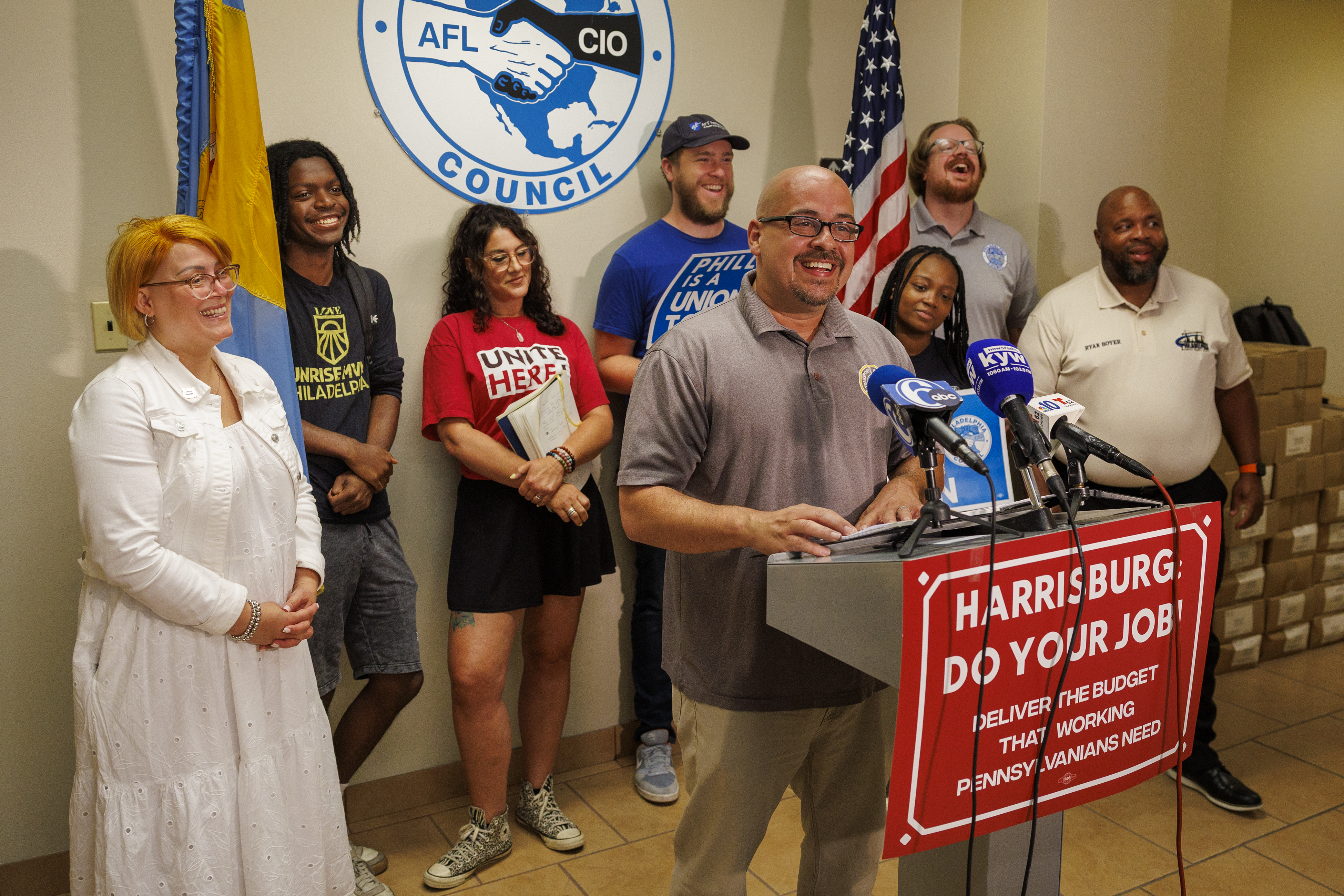
    Will Vera, vice president TWU Local 234, urged lawmakers in Harrisburg to deliver a budget during a speech in July at the AFL-CIO headquarters in Philadelphia.

    However, Vera said that this contract is a major win, especially for attracting new hires. Before this, new employees could not begin receiving dental and vision care until they completed 15 months on the job. The new contract shrinks that time down to 90 days.

    “I really got tired of explaining to the new hires for 15 months that they just have to clean their teeth,” Vera said. “I wanted this to be a retention contract, to not only keep people here, but to make this an attractive place to come work for SEPTA.”

    Philly’s transit unions don’t hesitate to strike if needs aren’t met. SEPTA unions have struck 12 times since 1975, earning SEPTA the title of one of the most strike-prone agencies in the country. Its last strike was a six-day effort in 2016 that ended one day before the presidential election.

    The negotiations come on the heels of SEPTA’s worst financial period in its history, the agency said. SEPTA isn’t alone, though. Transit agencies throughout the country are in funding crises as inflation rises, federal funding shrinks, and state subsidies fail to increase each year.

    Sauer, SEPTA’s general manager, added: “I am grateful to Governor [Josh] Shapiro and his team for their efforts to help us resolve differences and reach an agreement. Securing two-year contracts provides important stability as we approach the major events coming to Philadelphia in 2026.”

  • Middletown Township welcomes first full-service hotel ahead of major tourism events in Delco

    Middletown Township welcomes first full-service hotel ahead of major tourism events in Delco

    On a frigid Tuesday morning, stakeholders from across Delaware County toasted champagne and popped mini pastries under the roof of Middletown Township’s new Hilton Garden Inn.

    “We may be the only Hilton Garden Inn in the world that serves Wawa coffee and drinks it all the time,” quipped hotel owner Patrick J. Burns, standing before a sea of family members, hotel staffers, business associates, and elected officials.

    The 107-room, 67,000-square-foot Hilton, located off Baltimore Pike at the former Franklin Mint site, is open and welcoming guests. It’s the 42nd hotel in Delaware County and first full-service hotel in Middletown Township.

    The hotel features app-to-room device integration, mobile key and contactless check-in, meeting and banquet spaces, an outdoor patio with fire pits, a fitness center, and the Garden Grill, a restaurant serving “American cuisine with local flair” that will be open to the public.

    The hotel is long awaited, borne from a yearslong planning process and delayed by pandemic-era construction slowdowns. On Tuesday, attendees expressed gratitude that what was once an economic dream for the township was finally becoming reality.

    The Hilton marks an important expansion of the collar county’s tourism economy, according to Delaware County’s major economic stakeholders. And as far as tourism in Delco, they say, it’s only up from here.

    The bar area off of the lobby at the new Hilton Garden Inn of Middletown Township on Tuesday, Dec. 16, 2025.

    Delaware County hosted 4.5 million visitors in 2024, according to Steve Bryne, executive director of Visit Delco. Those visitors spent $860 million, generated $1.2 billion in economic impact, and sustained 13,000 jobs. In 2025, the county is on track to sell more than one million hotel room nights for the first time in its history.

    Representatives from the Hilton say it created 200 construction jobs and 40 new hospitality jobs.

    Bryne said tourism to Delaware County is a “combination of everything.” The county doesn’t have one major anchor (like Longwood Gardens in Chester County, for example). Rather, it’s home to 12 colleges and universities, major corporate employers like Wawa, and sports complexes like IceWorks and Subaru Park, home of the Philadelphia Union. That means regular tournaments, business conferences, parents weekends, homecomings, and graduations — events that, collectively, help power the county’s economy.

    Already, Penn State Brandywine, located down the road, has named the Hilton Garden Inn its host hotel.

    Delaware County also gets spillover from visitors to Philadelphia, especially those who want proximity to Philadelphia International Airport.

    The hotel is a property of Metro Philly Management, owned by Burns. Burns’ management company also owns the Courtyard by Marriott in Springfield, the Fairfield Inn & Suites in Broomall, and the Springfield Country Club, as well as numerous grocery stores and restaurants.

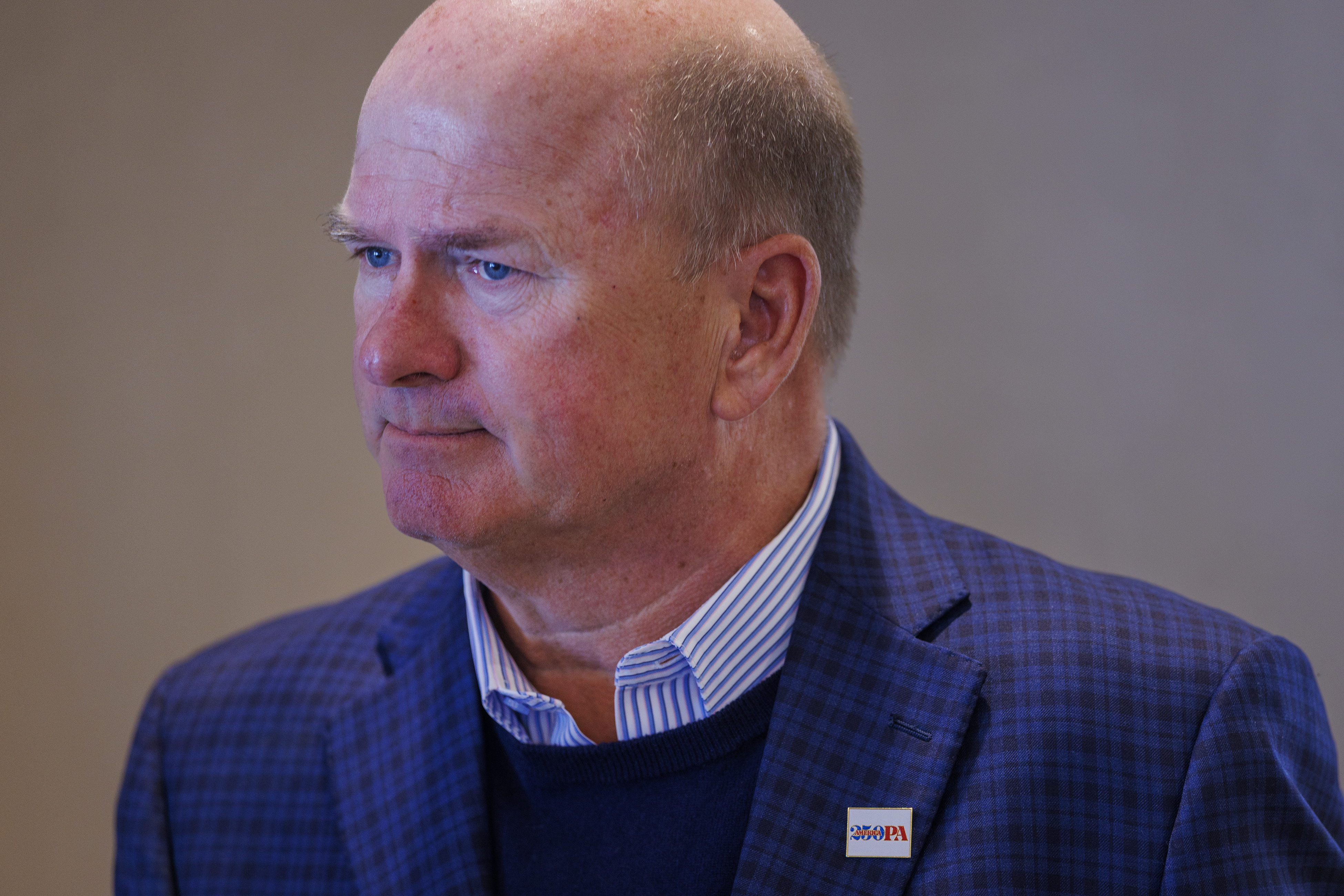
    Patrick J. Burns, pictured at Middletown Township’s new Hilton Garden Inn on Tuesday, Dec. 16, 2025. The hotel is owned by Burns’ company, Metro Philly Management.

    Stakeholders lauded the hotel’s location in a central, and rapidly developing, part of Middletown Township.

    The former Franklin Mint complex, now home to the Hilton, has been a hotbed of development in Middletown Township since the mint shuttered in 2004. Two newer housing developments — Pond’s Edge and Franklin Station — have added over 450 units of housing to the site. Middletown Township outpaced its neighbors — Media, Nether Providence, and Upper Providence — in population growth in 2024.

    “Middletown Township is such a vital corridor of Delaware County,” Burns said.

    The hotel’s opening coincides with major events coming to the region in the coming months: semiquincentennial celebrations in Philadelphia and in Delco, the FIFA World Cup, the PGA Championship at Aronimink Golf Club, and the MLB All-Star Game. For the PGA Championship alone, Delaware County is expecting 200,000 visitors and $125 million in economic impact.

    This suburban content is produced with support from the Leslie Miller and Richard Worley Foundation and The Lenfest Institute for Journalism. Editorial content is created independently of the project donors. Gifts to support The Inquirer’s high-impact journalism can be made at inquirer.com/donate. A list of Lenfest Institute donors can be found at lenfestinstitute.org/supporters.

  • The USMNT, USWNT, and your kid’s youth team are all different. U.S. Soccer is fine with that.

    The USMNT, USWNT, and your kid’s youth team are all different. U.S. Soccer is fine with that.

    Sometimes, it feels like there’s a distance between the U.S. men’s and women’s soccer teams, even though they wear the same crest.

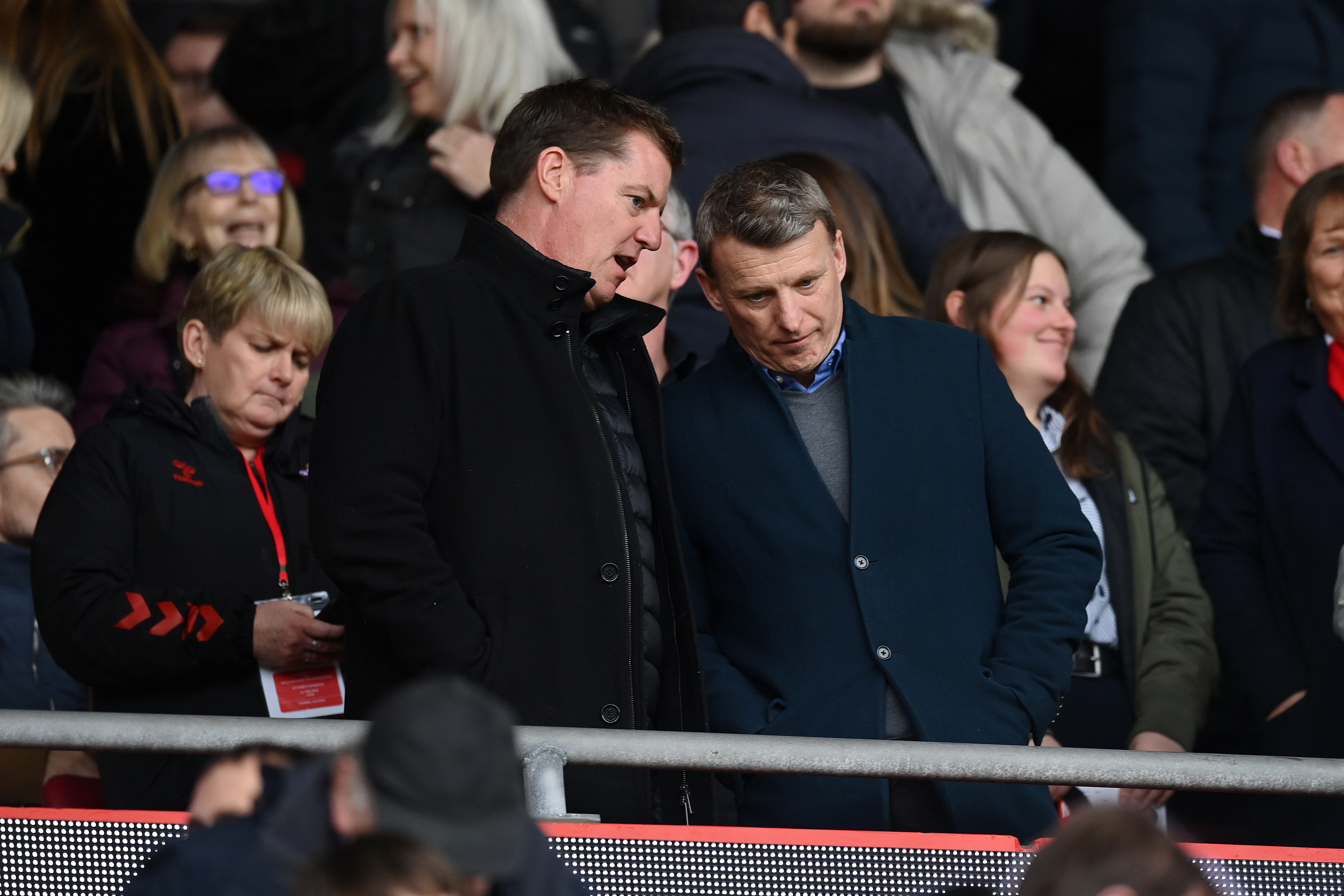
    Over the years, various people involved with both programs have tried to close that gap, including at U.S. Soccer headquarters. Sporting director Matt Crocker is definitely on that list, and high up on it.

    That’s especially true when he talks about his vision of “the U.S. Way,” the creation of an on-field guidebook for the whole governing body. Many people will instinctively conclude that Crocker is sending a sermon from the mount, given how often the governing body has tried to do that over the years.

    But it isn’t that simple, and it’s not just Crocker saying so. The last few months of on-field results at the senior levels have offered proof.

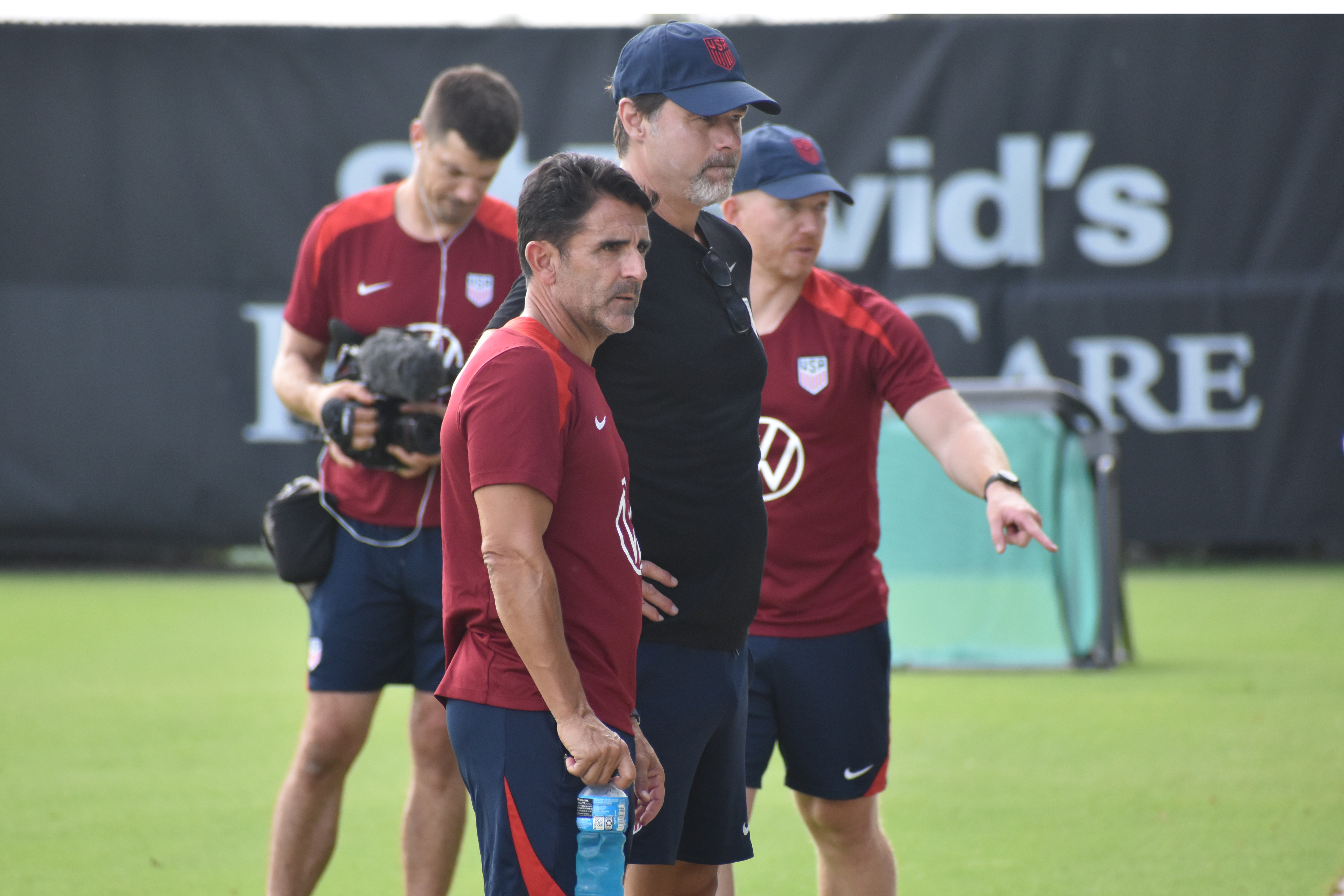
    Mauricio Pochettino (center) and his top assistant Javier Pérez (left) at a U.S. men’s soccer team practice in October.

    In some countries, every national team would be required to play the same way. Think of the Netherlands and Spain, for example, two programs with decades-long histories of putting philosophy over pragmatism.

    Crocker is more pragmatic. Once he hired Mauricio Pochettino to coach the senior men and Emma Hayes to coach the senior women, he wanted to get out of their way. He does not stop Pochettino from playing a 3-4-2-1 formation, and Hayes from playing a 4-3-3.

    “They are arguably two of the best coaches in the world,” Crocker told The Inquirer. “Who am I, in my experience, to dictate how they should be playing or not playing? I think the idea of that, for me, is not the way I work.”

    His experience gives him power if he wants to exercise it. Before joining U.S. Soccer in 2023, previous stops for the native Welshman included seven years at English soccer’s governing body, the Football Association. He planted seeds that have now made the nation elite on both the men’s and women’s sides.

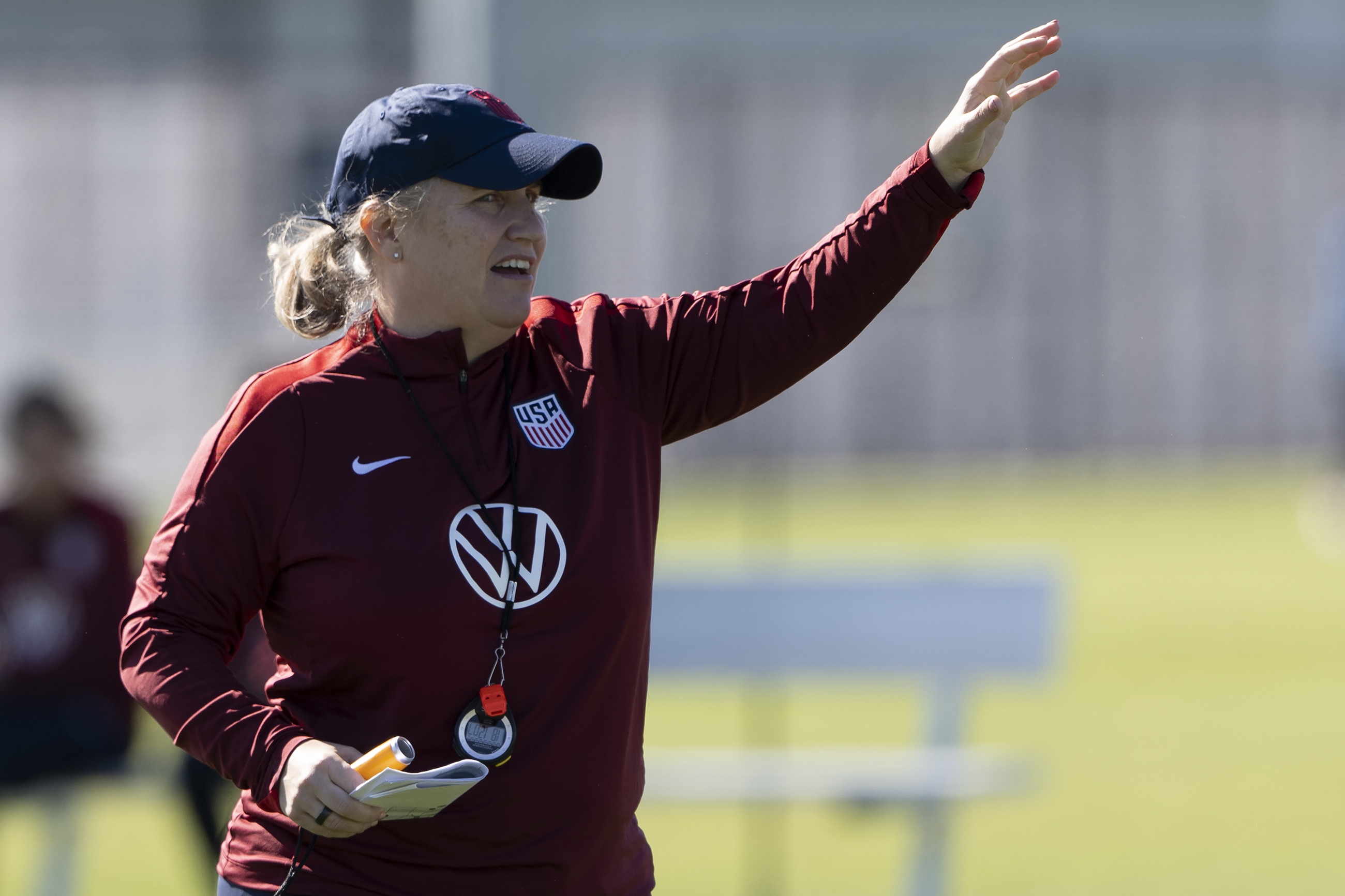
    Emma Hayes at a U.S. practice in Chester in October.

    But no, what Crocker said is what he meant.

    “Of course, there’s going to be a framework … of how we want them to work,” he continued. “But ultimately their job is to provide winning teams, and I think they’re doing a pretty good job at doing that. And my job is to make sure that they get what they need to be able to do that.”

    If you only follow soccer casually, you might not think much of this. If you’re deep in the sport, especially the American game, you know it matters to hear that from someone so high-ranking.

    “The way I see it is, my job is not to dictate every single detail of how everything needs to look or feel,” Crocker said. “I need to use their experiences, because they’ve got more than me in those areas of what winning looks like.”

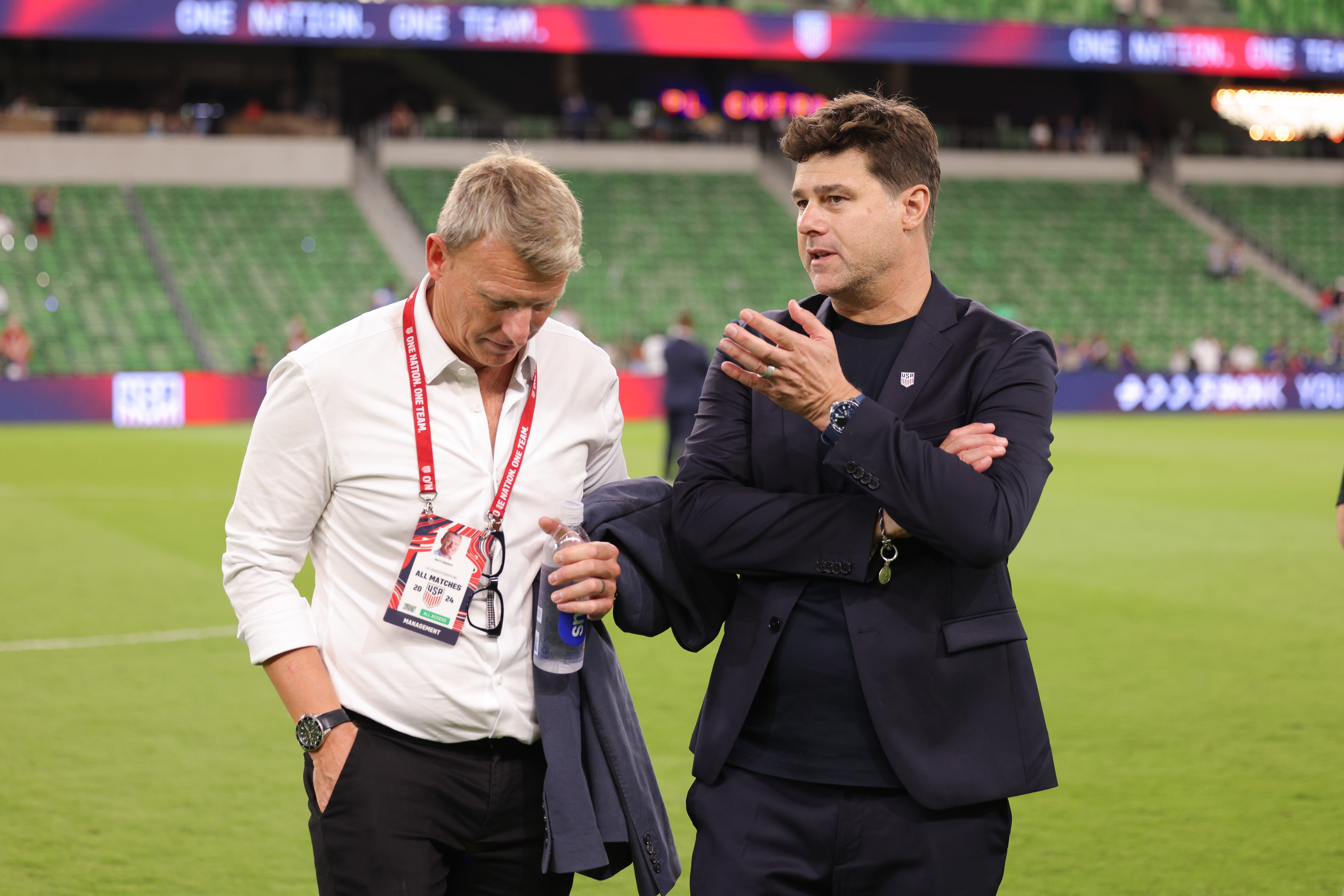
    Matt Crocker (left) listening to Mauricio Pochettino at a U.S. game last year.

    Hayes vouched for this, and not by making light of the size of her trophy mantel. She knew Pochettino before taking the U.S. job because they overlapped at English club Chelsea, and she knew American soccer from many years of working here before returning to her native London in 2012.

    “Mauricio’s ideas on how to win football matches might be different to mine, for example, but we both have ambition to win football matches,” Hayes said. “And we both have an appreciation that American players have their own unique set of qualities that we can lean into.”

    How they execute from there is up to them.

    “Yes, the U.S. Way is very clear and overarching — that sits above our WNT and MNT and all our other 27 teams,” Hayes said, using the abbreviations for the senior women’s and men’s teams. “But within that, some of those differences are in and around the game model.”

    That might not sound like much, but it really does matter.

    Emma Hayes has had immense success since arriving as the U.S. team’s manager two years ago.

    It all starts with youth soccer

    If there’s distance between the men’s and women’s teams, it often feels like there’s a canyon between the senior squads on TV and the youth teams your kids play on. That, too, has seemed deliberate at times, with so many factions in the sport wanting to do what they want instead of working together for the game as a whole.

    America’s youth soccer landscape, which better resembles an industrial complex — and really feels that big, in terms of scale — has a long history of rebelling against being told what to do by U.S. Soccer. Crocker quickly became well-versed in this when he took his job, and has spent a lot of time trying to change the tone.

    “I think we have to recognize that what we do in state X can’t just be replicated and put into state Y,” he said. “Everyone’s unique and individual, and we have to listen to their individual needs. But we’ve also got to be clear on the framework of the things that are fundamental, and that we are going to do irrespective.”

    He admitted that the scale of this country “scares you to death” for such a project, compared to how he built the England DNA program at the FA in 2013.

    Before joining U.S. Soccer, Matt Crocker (right) spent seven years at England’s Football Association, and also worked twice for English club Southampton.

    “You could bring every county FA to St. George’s Park, all of which were within a three-hour drive [from the national training center],” Crocker said. “You could mandate, you could then put people out into those environments to support it, and you could do it where you could really monitor something on a much smaller scale. Doing this is something I’ve never experienced before.”

    That literal geography, not just youth soccer politics, influenced his journey to now.

    “I don’t think there’s one silver bullet that you need to take, or you go, ‘It’s not going to work because of X,’” he said. “I just think we have to recognize the uniqueness of the country, build on that as a positive, but also remember not to make the same mistakes as others that have gone before us.”

    Then came words that a lot of people — especially the youth coaches out there — have wanted to hear.

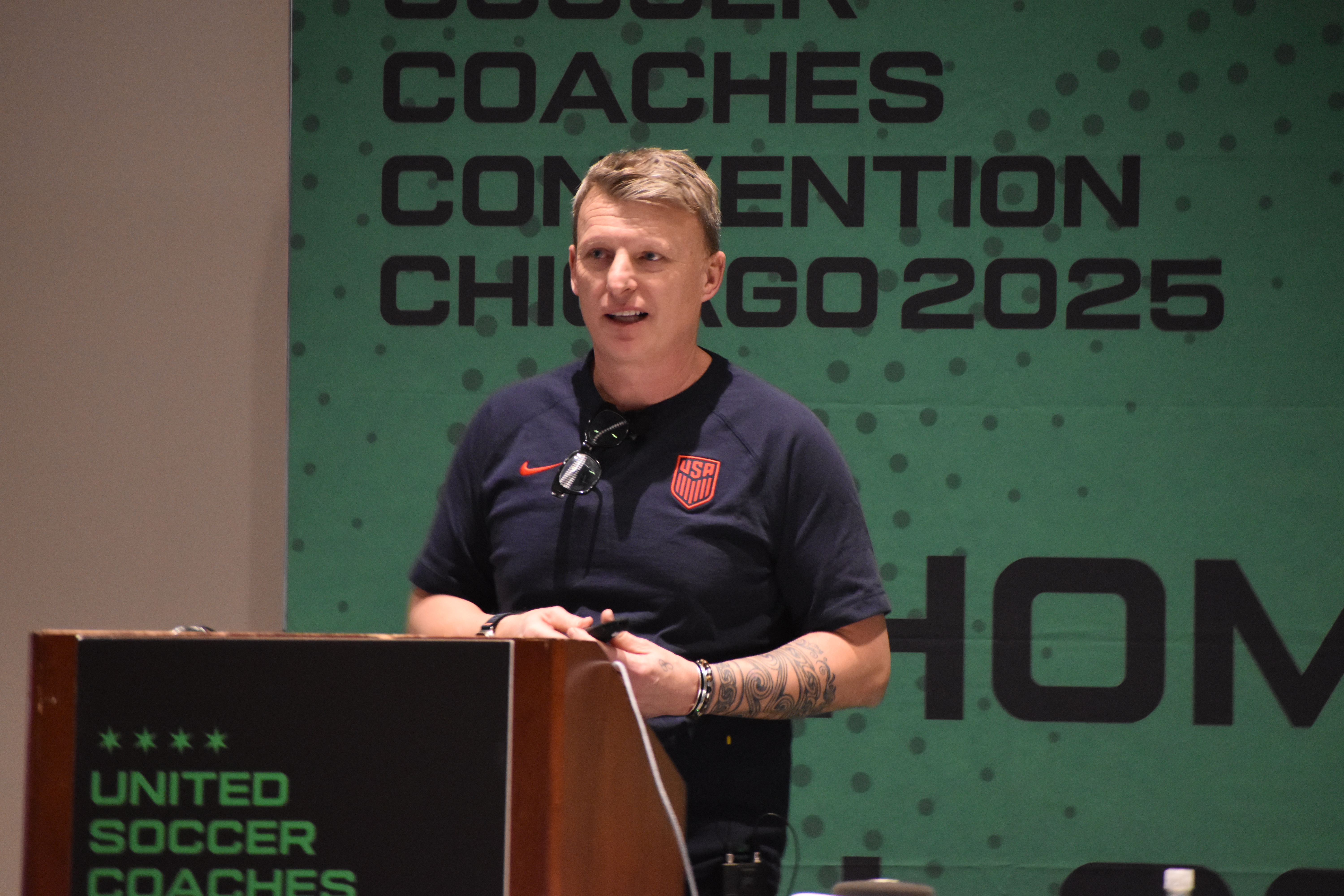
    Matt Crocker speaking at the United Soccer Coaches convention last January, to an audience that isn’t always on U.S. Soccer’s side.

    “I say this respectfully [because] I wasn’t here, but what I heard was U.S. Soccer was telling: We told, we told, we told,” Crocker said. “And now our job is to listen, to work, to problem solve, but to bring everyone together.”

    Anecdotally, it’s been working. At various events this year where Crocker has spoken to youth and amateur teams, he has been warmly received. But the hardest part is yet to come, as a recent moment showed.

    ‘More worried about their bottom line’

    Earlier this month, Crocker spoke to a crowd of the governing body’s sponsors and donors. Some of them wore track jackets of their youth clubs, but most were in business clothes. Crocker shared the stage with deputy sporting director and onetime Union centerback Oguchi Onyewu and U.S. men’s legend Landon Donovan.

    “For those who are not familiar with the youth soccer landscape in this country, it’s a bit of a disaster, right?” Donovan said. “It really is. There’s so many competing interests.”

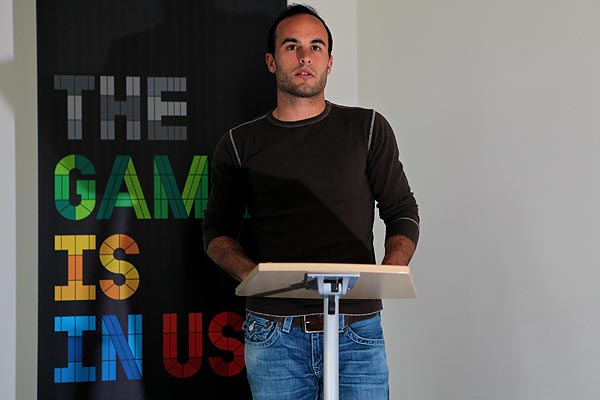
    U.S. men’s national team legend Landon Donovan says that the youth model might be too far gone to suggest anything that would affect their bottom line.

    He spoke of a local club near his home in southern California, but knew it could have been countless others.

    “People are very content with their little fiefdom and their little salary and their club and their control and their power,” Donovan said. “So what’s the incentive now for these clubs to change? … We do have national pride, but they’re more worried about their bottom line than they are [about] growing U.S. soccer.”

    The words were as true as they were damning.

    “I think the saying is, do what you’ve always done and you’ll get what you’ve always got,” Crocker said. “There’s been a lot of talk about, there’s a player that plays in this league over here that has to drive or fly thousands of miles because this league is falling out with this league, and they won’t play each other. And that’s not putting the child, that’s not putting the sport, at the heart of what we’re all about.”

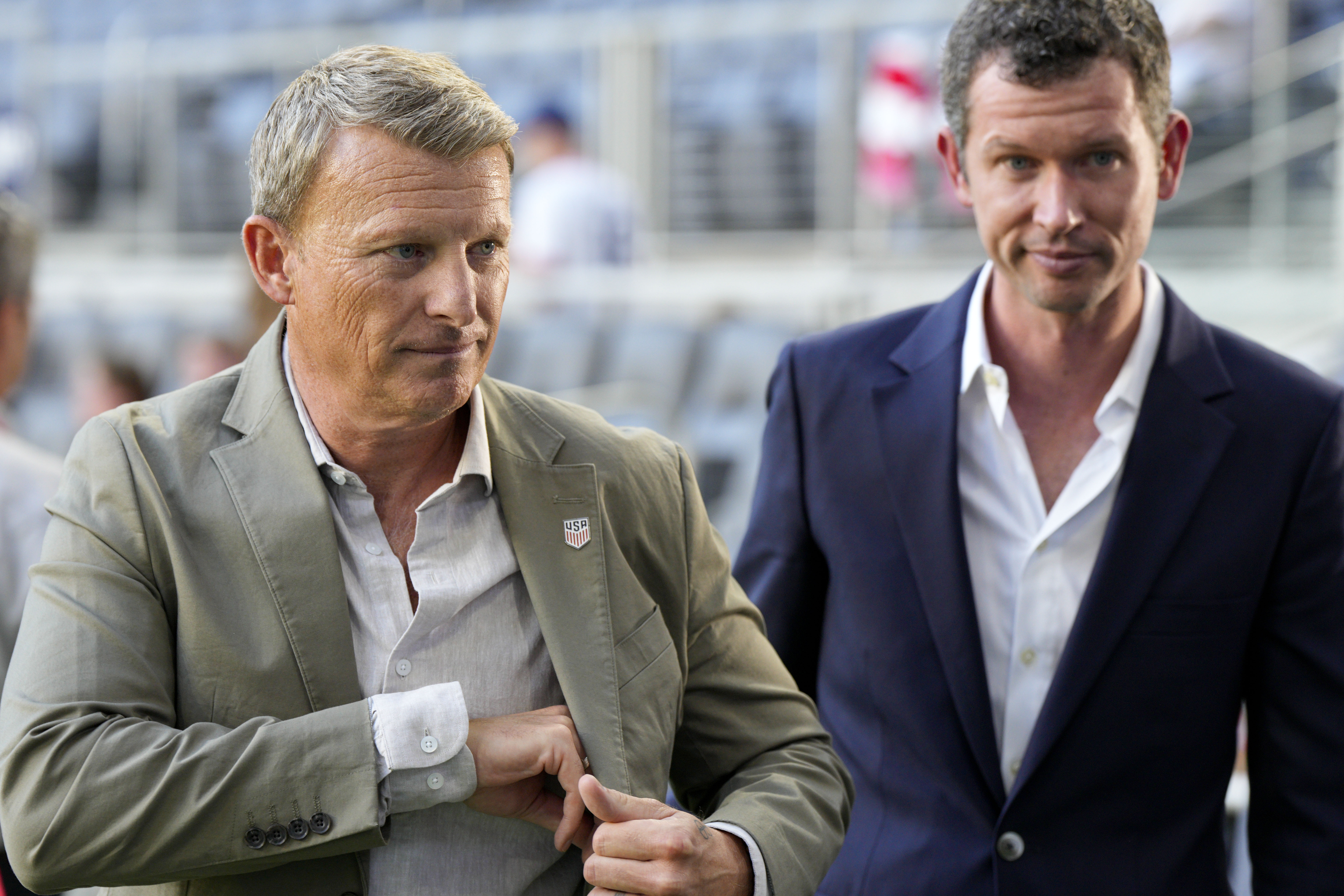
    Matt Crocker (left) with U.S. Soccer Federation CEO JT Batson.

    It’s true for the boys and men, and it’s true for the girls and women. It’s an enormous task, but Crocker is willing to give from his side, and that is noticed.

    “I think it’s being respectful to environments that have already been created,” he said. “Us as U.S. Soccer, being the national federation, the people that should be really saying, ‘Hey this is what player development and the game could look like in this country’ — it’s about time we spoke up and started to share some of that. But it’s not through a dictator approach, it’s through more of a collaborative way of doing things.”

    Crocker’s plans are due to be published in January, the same month Philadelphia will host the 2026 United Soccer Coaches convention. It won’t be easy for him to get that crowd on his side, for the reasons Donovan made clear. If Crocker can, though, the benefits could last long past the World Cup.

  • Here’s what ticket prices are looking like for World Cup games in Philly following FIFA’s latest presale

    Here’s what ticket prices are looking like for World Cup games in Philly following FIFA’s latest presale

    For those hoping to get into a World Cup game in Philly, the assumption was that obtaining a ticket, even at face value, would be costly.

    Well, that was correct, and on Thursday, fans interested in attending learned just how much.

    FIFA’s random selection presale was the third in a four-part lottery phase in which interested buyers from around the world were able to select their match by venue or by the team they’d most like to see.

    It also marked the latest opportunity to obtain tickets in the aftermath of last week’s World Cup draw.

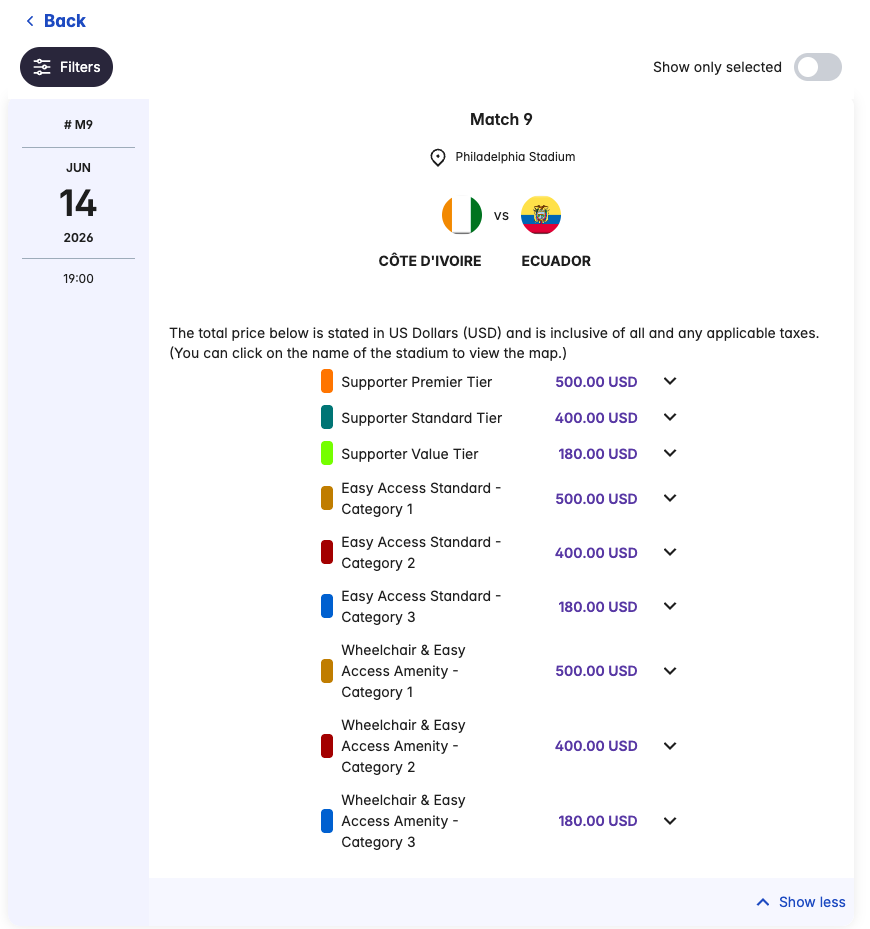
    Among the 72 group stage matches scheduled to be held in the United States, Canada, and Mexico this summer, five will take place at Lincoln Financial Field, with the Ivory Coast and Ecuador kicking off Philly’s slate of matches on June 14.

    So what’s it looking like?

    The least expensive seat for that match was $180 under Category 3 tiered pricing (which applies to upper-level seating and designated supporter sections). The most expensive ticket was $500 for a Category 1 seat (lower level, prime placement) or another section called a Supporter Premier Tier.

    The cheapest ticket price was $180 for upper deck seats at Lincoln Financial Field for the World Cup opener between the Ivory Coast and Ecuador.

    The costliest tickets were for the June 19 match between Brazil and Haiti, with the cheapest seat coming in at $265 and the priciest Category 1 tickets at $700. Even Category 2 seats, which generally are still lower- to mid-level but have corner sightlines, were $500 per seat.

    While it remains to be seen, prices for France’s game in Philly on June 22 could mimic the Brazil game as both are high-powered nations in the top 10 of the latest FIFA World Rankings, complete with rosters expected to draw a crowd. France awaits whom it will play at the Linc, as a FIFA playoff in March will determine whether it will be Iraq, Suriname, or Bolivia.

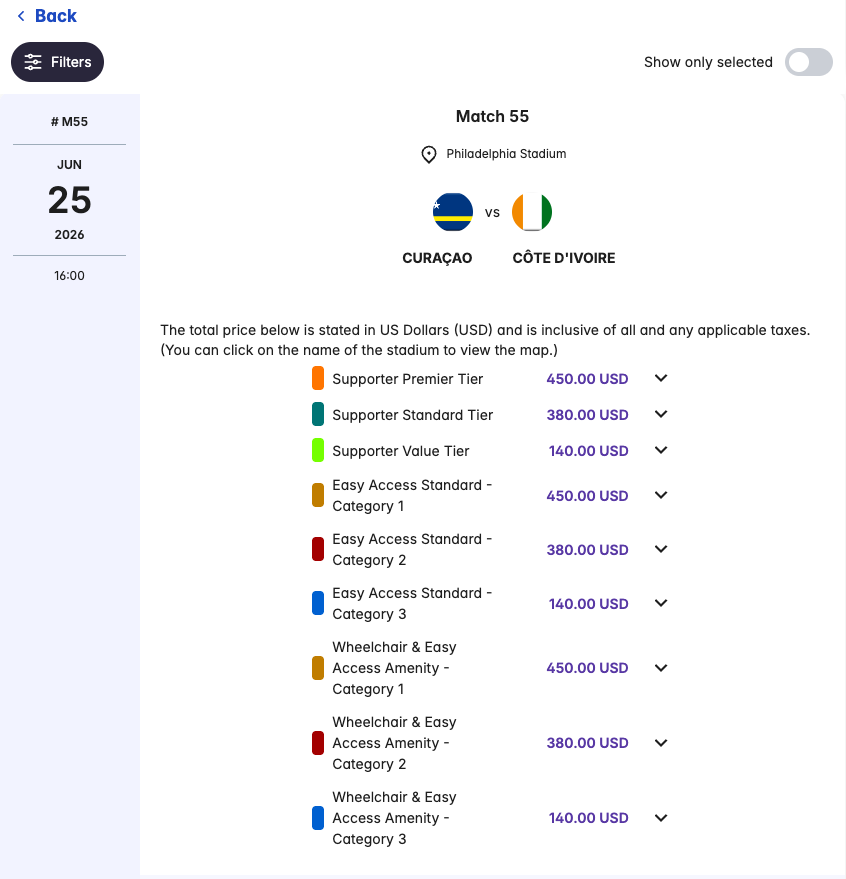
    The least expensive game in Philly as of Thursday’s presale was the June 25 match, which features Ivory Coast against Curaçao. Lower-level tickets were $450 for Category 1 and $380 for Category 2 seats. For those who don’t mind sitting in the 200-level section, the price is $140 each.

    The game between Ivory Coast and Curaçao on June 25 looked to offer the most affordable path to securing World Cup seats.

    It’s believed that with fan bases not as large as some of the other matches coming to Philly, this might be the best chance for people looking to obtain tickets, not just in the presale but perhaps when tickets officially hit the resale market.

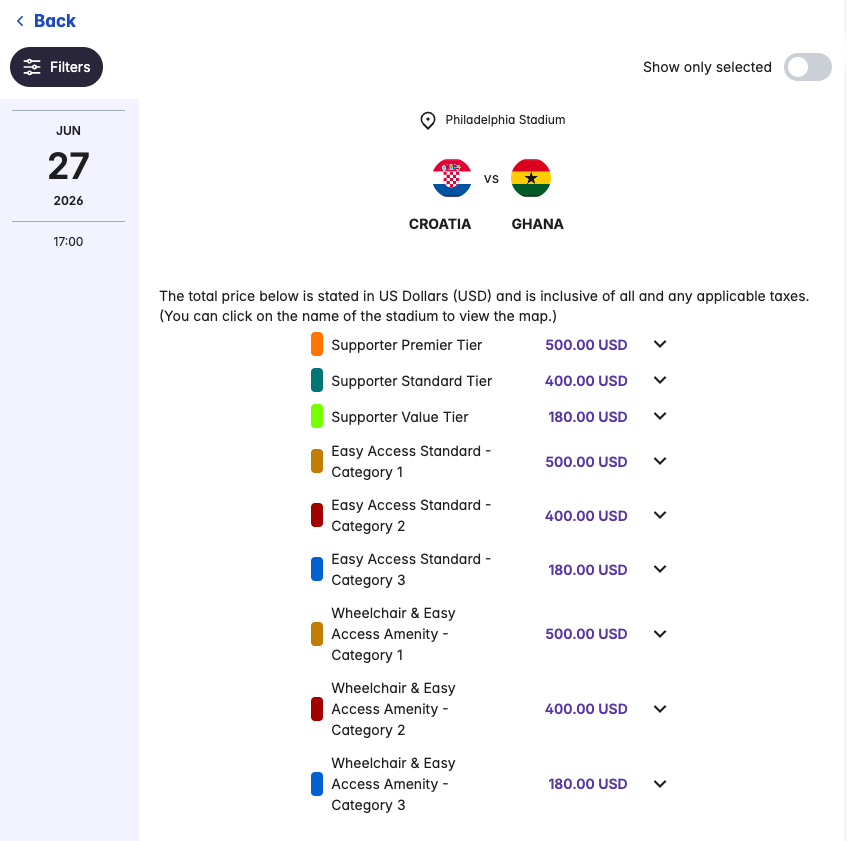
    The final group stage match at the Linc, Croatia against Ghana on June 27, offers a live look at Croatian midfield legend Luka Modric, who at age 40, will be playing in his final World Cup. Although Ghana has consistently been a strong nation in past World Cups and enters as one of the better nations throughout Confederation of African Football (CAF) qualifying, the draw is Modric — and FIFA knows that.

    Tickets for that match in the presale start at $500 for Category 1, and the least expensive ticket is $180 for a Category 3 seat.

    Croatia-Ghana on June 27 offers fans a live look at probably the last time Croatian midfield legend Luka Modric will chase World Cup glory.

    So how does it all work?

    Interested fans must create a FIFA ID. Creating one is quick, and once you do, you’ll be able to enter the lottery, which runs through 11 a.m. on Jan. 13. FIFA says it will alert people who have won by Feb. 5 if they’ve earned the right to purchase tickets.

    Still, you could find out sooner by checking your bank or credit card statement and noticing a balance decrease of hundreds or thousands of dollars.

    In the process, fans are entered into a queue to buy, which on Thursday had potential purchasers experiencing wait times of up to 30 minutes. Once there, fans can access two ticket portals: the random selection draw, which allows them to choose one game or preferred venue, and another in which fans can select a preferred team and choose from that nation’s three matches throughout the group stage.

    From there, a debit or credit card goes on file, from which, if selected, FIFA will automatically pull funds from the account beginning on Feb. 9. Incidentally, there’s no guarantee that fans will receive their full allocation, as there are options for ticket sales to be “completely successful” or “partially successful.”

    What does the latter mean? Here’s is FIFA’s explanation:

    “‘Partially successful’ means you received some, but not all, of the tickets you applied for. For example, if you requested tickets for three different matches but were allocated tickets for only one or two of them, your application is considered partially successful. If you are allocated tickets for any match, you will always receive the full quantity you requested for that match; you will never receive fewer than requested.”

    The random selection draw is the last presale before FIFA will release remaining tickets in what’s sure to be a first-come, first-served frenzy. This late sales phase is expected to launch closer to the start of the tournament.