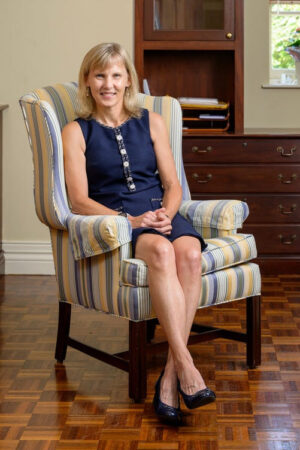
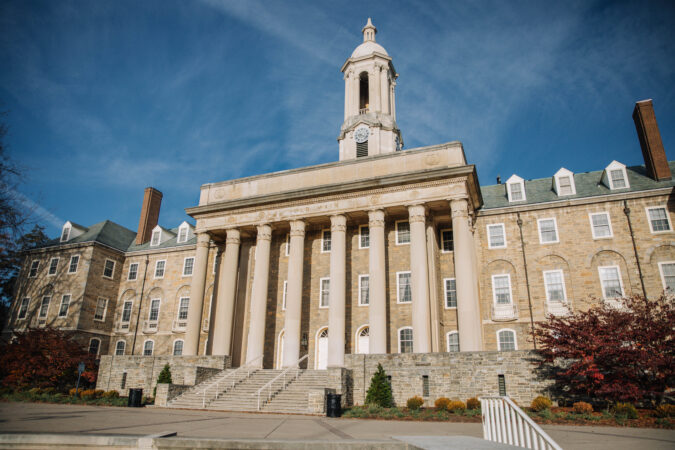
The University of Delaware on Tuesday appointed Laura A. Carlson, who had been serving as interim president, to the permanent post, effective Jan. 1.
Carlson came to the school in 2022 as provost after spending 25 years at the University of Notre Dame. She stepped into the interim presidency in July after former president Dennis Assanis announced he was stepping down last June with less than two months notice.
The university did not conduct a national search but rather engaged a consultant to help the school evaluate the qualities needed for the next president and assess Carlson’s ability to fit the role.
“Dr. Carlson has demonstrated a deep commitment to the advancement of our university and a clear passion for the success and wellbeing of our students, faculty, staff and alumni,” Terri Kelly, board of trustees’ chair, said in a statement.
As provost, Carlson, whose specialty is psychology, expanded courses offered in winter and summer sessions to give students the ability to graduate more quickly and prioritized bringing ideas from faculty and staff to fruition, the university said.
She’s a cum laude graduate of Dartmouth, where she got her bachelor’s in psychology of language and obtained her master’s from Michigan State University and her doctorate from the University of Illinois, Urbana-Champaign.
“I have fallen in love with UD, and I am deeply committed to its purpose and people,” Carlson, 60, said in a statement. “Together we can make the University of Delaware a place where we inquire with impact, create with connections, innovate with intention, grow with purpose, welcome with promise, educate with outcomes, work with trust, and belong with joy.”
A Pennsylvania State University faculty group has taken the next step to form a union across the system’s campuses, which eventually could represent some 6,000 faculty.
Officials from the Penn State Faculty Alliance and the Service Employees International Union said they had filed Tuesday with the Pennsylvania Department of Labor after having obtained at least the required signatures of 30% of eligible faculty.
The next step would be an election, and if approved by a majority, a union would be formed and contract negotiations could begin. How long it takes to schedule an election depends on whether the university opposes the move.
“It would be the largest single union election in the public sector in the history of the Commonwealth if not the last 50 years,” Steve Cantanese, president of SEIU 668 said at a news conference held at the Capitol building Tuesday in Harrisburg.
The announcement comes about a month after graduate student workers at Penn State voted to unionize, with 90% in favor. That vote came nearly a year after the Coalition of Graduate Employees at Penn State filed the required signature cards with the labor board. Their vote came amid a wave of graduate union workers’ efforts to unionize.
Penn State is the only state-related university of the four in the Commonwealth without a faculty union. Faculty concern about the university’s decisions began to accelerate during the pandemic and have continued to mount amid budget cuts and the decision in May to announce the closure of seven of the school’s Commonwealth campuses. A seeming lack of shared governance, salary, and workload inequities across campuses, and transparency are among other concerns cited by faculty involved in the effort.
“Penn State faculty are filing for a union election to bring transparency to their workplace, to bring job security to their workplace, to have an opportunity to have a greater voice at their workplace, to have some economic security at their workplace,” Cantanese said.
Julio Palma, associate professor of chemistry at Fayette, one of the campuses selected for closure, said faculty tried to fight the Commonwealth campus closure plan but didn’t have enough power.
“We organized,” he said. “We held rallies on campus. We talked to our elected officials. Nothing moved the needle.
“If we had a faculty union, we wouldn’t be in this situation… We need a faculty union now.”
Cantanese said SEIU reached out to the university in the hope that it will welcome faculty’s efforts to unionize.
Penn State in a statement said it would review the petition when it is received.
“Penn State deeply values the teaching, research, and service of our faculty, who play a critical role in fueling the success of our students and advancing our mission,” the school said.
Faculty at the press conference said a union is needed.
“As a teacher, I know that my working conditions are my students’ learning conditions,” said Kate Ragon, an assistant clinical professor of labor and employment relations at University Park, Penn State’s main campus. “We want a voice in the decision-making that affects us, affects our students, and affects our work.”
The three other state-related universities in Pennsylvania ― Temple, the University of Pittsburgh, and Lincoln ― already have faculty unions. Temple’s has existed for more than 50 years, and its graduate student workers have been unionized for about 25 years. Lincoln’s formed in 1972. Pitt’s is more recent. It was established in 2021.
Faculty at Rutgers, New Jersey’s flagship university, are unionized, too. So are the 10 universities in the Pennsylvania State System of Higher Education.
Faculty in the alliance have said they hope to secure better wages and benefits, job security protections, and a greater role in decision-making. When they announced plans to form a union last March, they said they wanted full and part-time, tenure, and nontenure faculty to be included as members and believed all campuses would be involved except for the medical school faculty at Hershey.
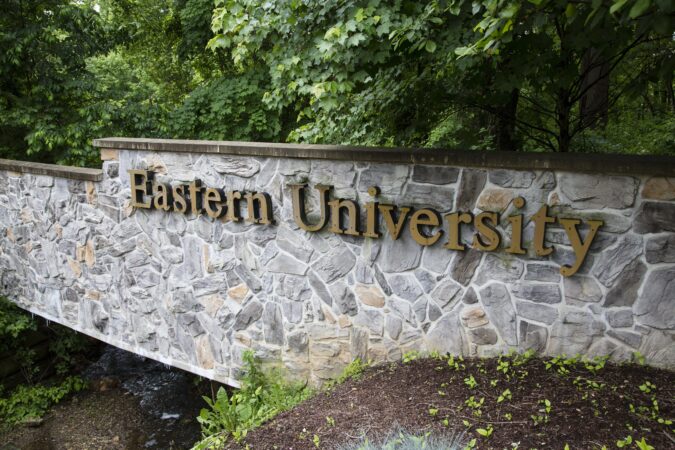
Eastern University has entered an agreement to buy nearly half the Valley Forge Military Academy property, which is less than a mile from the Christian university’s St. Davids campus in Delaware County.
The planned purchase, announced by Eastern on Tuesday, includes 33.3 acres encompassing the football stadium, track, and athletic field house, as well as multiple apartment buildings that will be used to house students. Eastern had been leasing the athletic properties from the academy since 2021. The purchase also includes additional fields, buildings, and a pickleball court, the school said.
The academy announced in September that it planned to close at the end of the 2025-26 academic year amid declining enrollment, financial challenges, and lawsuits over alleged cadet abuse, but that its college would continue to operate on the main campus. The boarding school announced last month it would go virtual after Thanksgiving and resume in-person classes on the 70-acre campus in January.
Eastern’s current campus is 114 acres, so the addition of the Valley Forge property will substantially increase its footprint.
“For Eastern, expanding our campus through this new property is a pivotal step in EU’s growth and vision for a flourishing future,” said Eastern president Ronald A. Matthews. “… We will be able to provide the space for our expanding student body to call Eastern’s campus ‘home.’”
The sale is subject to approvals and regulatory requirements and is expected to be completed over the next five months, the school said.
“Valley Forge Military Academy & College has enjoyed a mutually beneficial relationship with our neighbors at Eastern University for many years,” academy president Col. Stuart B. Helgeson said in a statement.
Eastern’s enrollment has continued to grow over the last six years, reaching nearly 10,000 students this fall, up 14% from last year. The growth is largely fueled by its low-cost, online “LifeFlex” programs, including a $9,900 master of business administration. But on-campus enrollment also has been rising in part due to the addition of new athletic and arts programs, the school said. Its football team is competing in the NCAA Division III championships on Saturday.
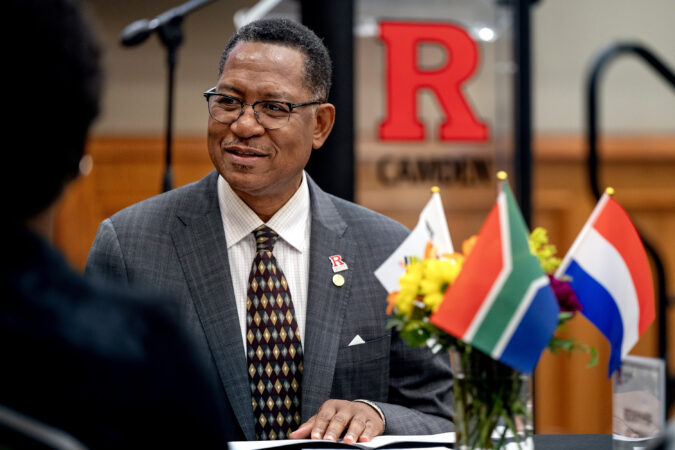
For years, Rutgers-Camden faculty and staff have complained that the school does not get its fair share from the main campus in New Brunswick.
Faculty in the past have asserted that their salaries are inequitable to counterparts on Rutgers’ other campuses — there’s a process in place to address that — and Chancellor Antonio D. Tillis has cited inadequate investments in campus facilities.
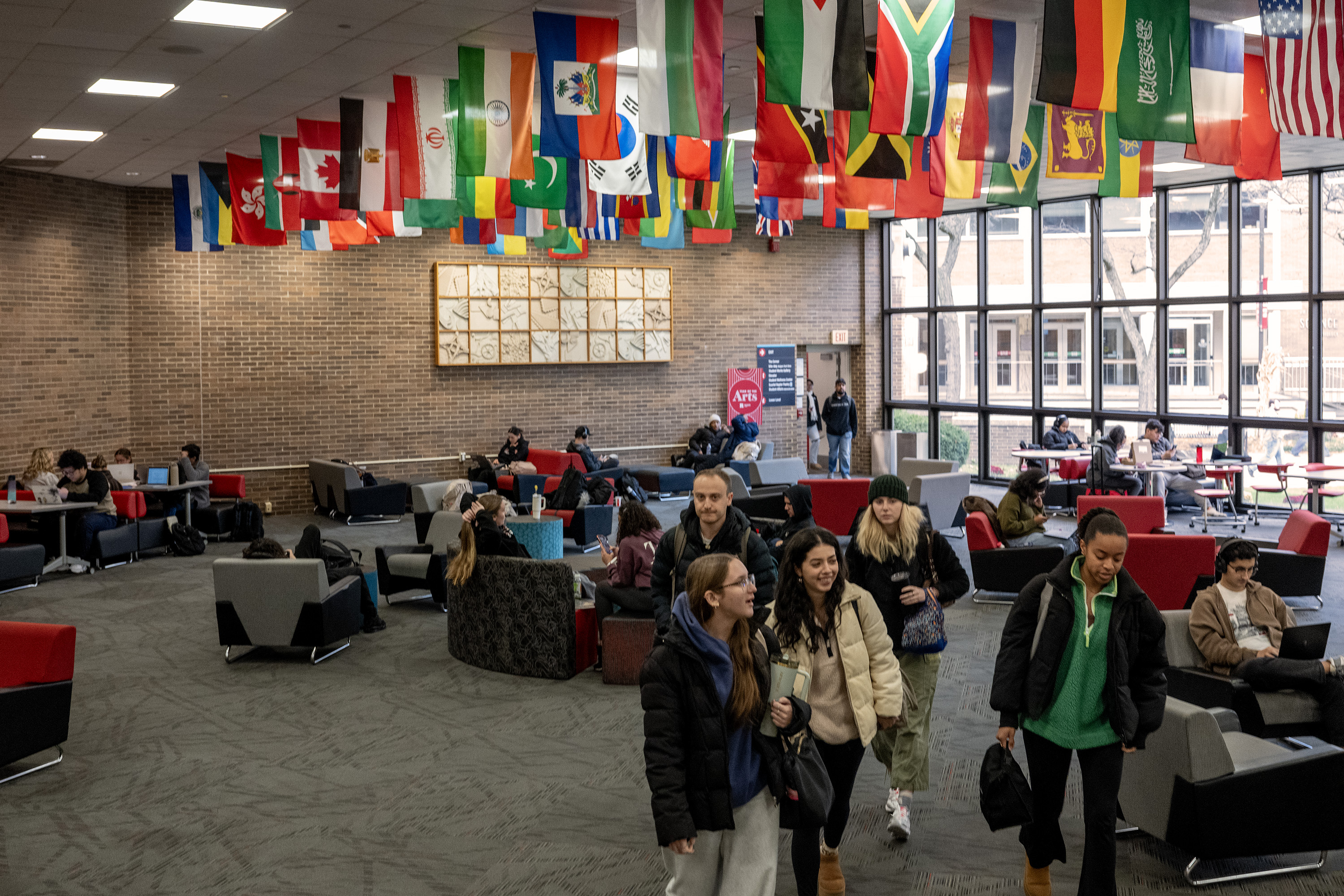
The Campus Center (student center) on the Rutgers-Camden campus with flags of students’ home countries.
“Since I’ve taken this job, I’ve had people say to me ‘Don’t invest in Camden,’” said Tate, a social scientist who grew up in Chicago and came to the job at Rutgers after serving as president of Louisiana State University. “I don’t think they know who they are talking to. … Do you think I have forgotten who I am?”
Tate, who became president in July, pledged during his inauguration speech to make the school a stronger competitor regionally.
“We’re going to build that Big Ten brand in Camden,” he said, referring to the NCAA athletic conference whose members are major research universities. “Look out Philadelphia, we’re coming for opportunity.”
His comments come as Rutgers-Camden is about to celebrate its 100th anniversary and as Tillis, in his fifth year, is nearing the end of his initial contract and aiming to receive a renewal.
Tillis touts 97% occupancy this year in the school’s residence halls, the highest since before the pandemic and up from 84% last year, and a boost in international students even while international enrollment declined 17% nationally, amid federal government policies including a pause of student visas earlier this year.
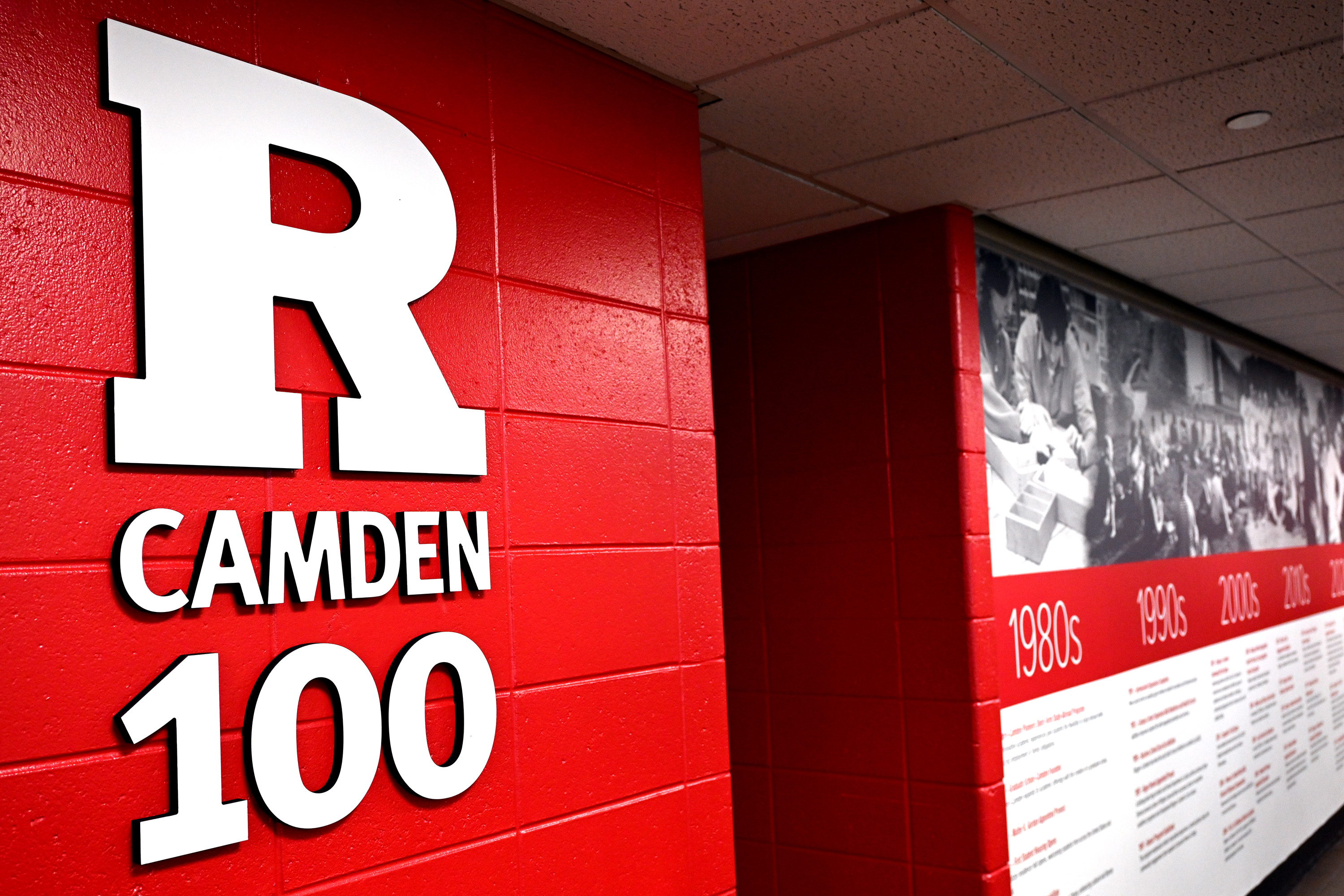
The Campus Center at Rutgers-Camden has a display showing some of the school’s 100-year history.
The school is also climbing in U.S. News rankings from 148th nationally among both public and private universities in 2021 — the yearTillis came — to 97th this year. It also rose from 18th to ninth in social mobility, meaning it enrolls and graduates large proportions of disadvantaged students.
“Rutgers Camden has just punched above its weight for such a long time and now the fruit are beginning to bear,” he said.
But Tillis’ relationship with some faculty has remained strained. Arts & Sciences faculty voted no confidence in him four months after he took the job and after he removedthe Arts & Sciences’ dean.
Since then, concerns have persisted about pay equity forRutgers-Camden professors compared to counterparts on the other Rutgers’ campuses, in New Brunswick and Newark, and what several faculty said was Tillis’ unwillingness to consult and communicate with faculty.
“There has been a real lack of communication between the chancellor and his office and the faculty, which has made it really hard to understand some of the decisions that have been made in regard to our budget cuts and campus priorities,” said Emily Marker, president of Rutgers-Camden chapter of the AAUP-AFT, the faculty union.
“If he were to be renewed, we would really hope that the communication, the consultation with and involvement of the faculty would improve in campus governance,” Marker said.
Tillis acknowledged a rough entry in part because of the pandemic but said from his perspective, things are better with faculty. He said he hosts regular “coffee with the chancellor” meetings where faculty and staff can come and talk to him.
If he gets a new term, Tillis said he would aim to grow enrollment, increase Rutgers-Camden’s share of out-of-state students from about 20% to 30% to generate more revenue, enroll more students from Camden, and increase internship opportunities.
There are plans to lease the former Camden Free Public Library building, a historic landmark on Broadway, and convert it into a center for the arts, including a bistro and wine bar.
Rutgers-Camden’s overall enrollment stands at 5,822, up 2.6% from last year. Overall, Rutgers’ enrollment neared 71,500 this year, up 3.2%.
Rutgers-Camden junior Mohammed Al Libaan Kazi, a transfer student from India, walks toward the stage to speak during a luncheon for international students hosted by Chancellor Antonio D. Tillis. International enrollment increased 6% on the campus this year.
At Rutgers-Camden, international student enrollment climbed 6% to 312, largely fueled by a jump in freshmen. That’s even though about 30 students deferred enrollment due to the visa holdup, said Carol Mandzik, director of international programs.
Tillis said the school has been recruiting more heavily from Nigeria and Ghana.
“I chose Rutgers-Camden because it’s close to Philadelphia,” said Bao Mai, 18 a freshman from Vietnam, who wanted what a big city has to offer.
But Mai, who spoke at an international student luncheon hosted by Tillis, said he also chose it because he likes the “small campus vibe” and array of business programs.
Tillis also has pledged to bring in more students from Camden. This year, there are 80, up from 53 last year.
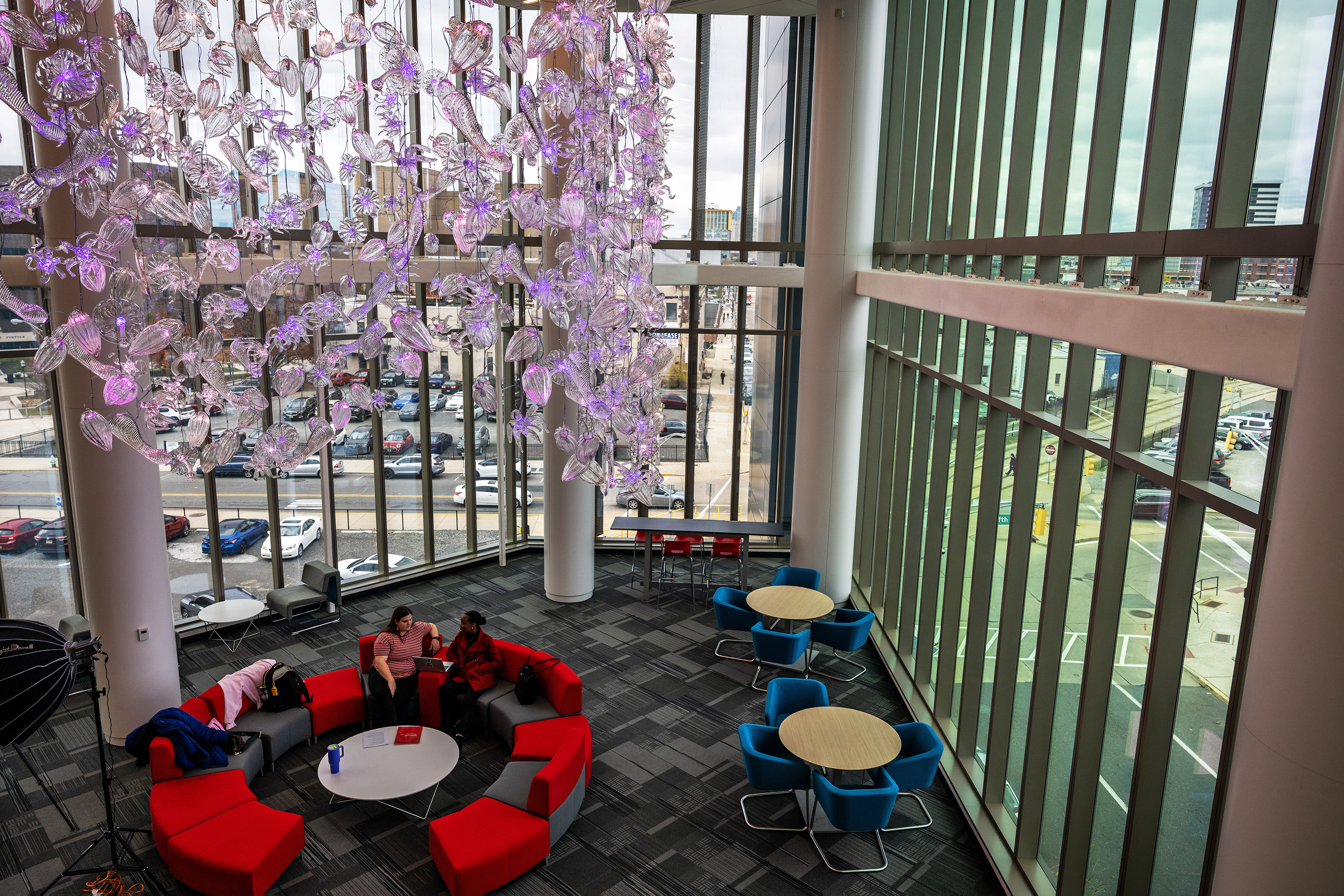
The atrium lobby of the Nursing and Science Building on the Rutgers-Camden campus.
He said he asked the admissions team to create more opportunities for students from Camden to come on campus so they begin “to feel as if the campus is theirs because it’s right in their backyard.”
The school, which is designated as a minority-serving institution — meaning at least 50% of students are minorities — also plans to begin to offer in-state tuition to students from Philadelphia and northern Delaware, Tillis said. Prospective students from Philadelphia who chose not to enroll cited the price tag, he said.
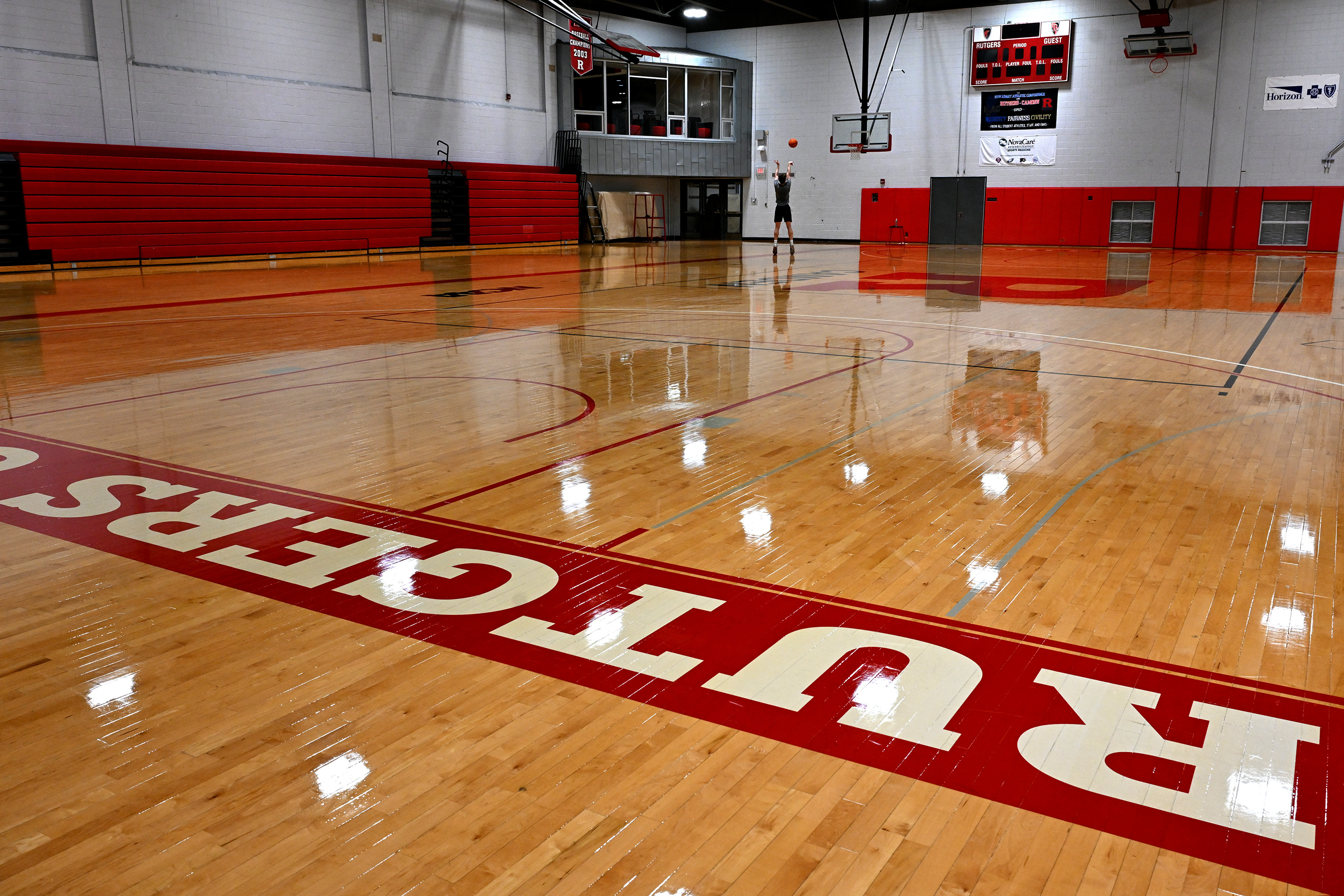
Rutgers-Camden sophomore basketball forward Robert Peirson from Toms River practices in the gym in the Athletic & Fitness Center.
Fostering campus culture
More than 710 students are living in the residence halls this year, representing the highest occupancy since 2019, Tillis said.
“Our campus is trying to create a sense of residential culture … even for our commuter students,” Tillis said, so that “they don’t just come here, go to class, and then go home.”
window.addEventListener(“message”,function(a){if(void 0!==a.data[“datawrapper-height”]){var e=document.querySelectorAll(“iframe”);for(var t in a.data[“datawrapper-height”])for(var r,i=0;r=e[i];i++)if(r.contentWindow===a.source){var d=a.data[“datawrapper-height”][t]+”px”;r.style.height=d}}});
The school held a welcome back barbecue during move-in and brought back homecoming last year; there was homecoming before the pandemic but not to the same degree, Tillis said.
The school also has spruced up residence halls and added evening events such as arts and theater performances, he said. There are little things, too, like plans to install hammocks on the quad.
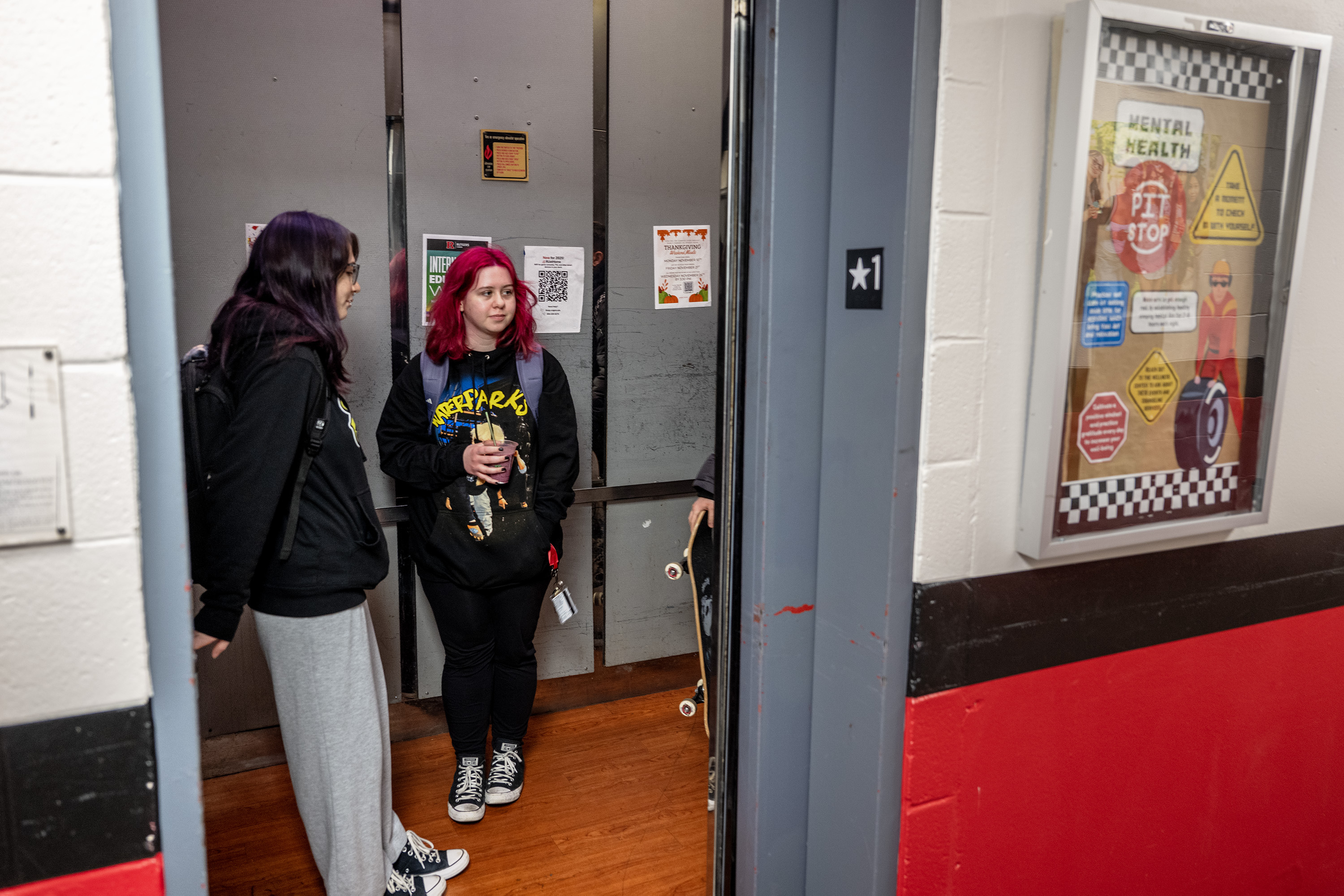
Freshmen Ollie McDermott (left), a psychology major from Buena and Remi Zebedies (right) an art therapy major from Mays Landing take an elevator in their residence hall at Rutgers-Camden.
Ollie McDermott, 22, a freshman psychology major from Buena, had decided against college, but McDermott’s stepfather, who recently graduated from Rutgers-Camden, convinced McDermott to try it.
“I’m kind of glad I did,” McDermott said. “I love it here.”
McDermott convinced a friend, Remi Zebedies, 19, an art therapy major from Mays Landing who also had been leaning against college, to try it, too. They became roommates.
The campus has enough beds to accommodate this year’s students, but if growth continues, it may need more housing, Tillis said. He’d like to open a residential space for students with children and/or spouses.
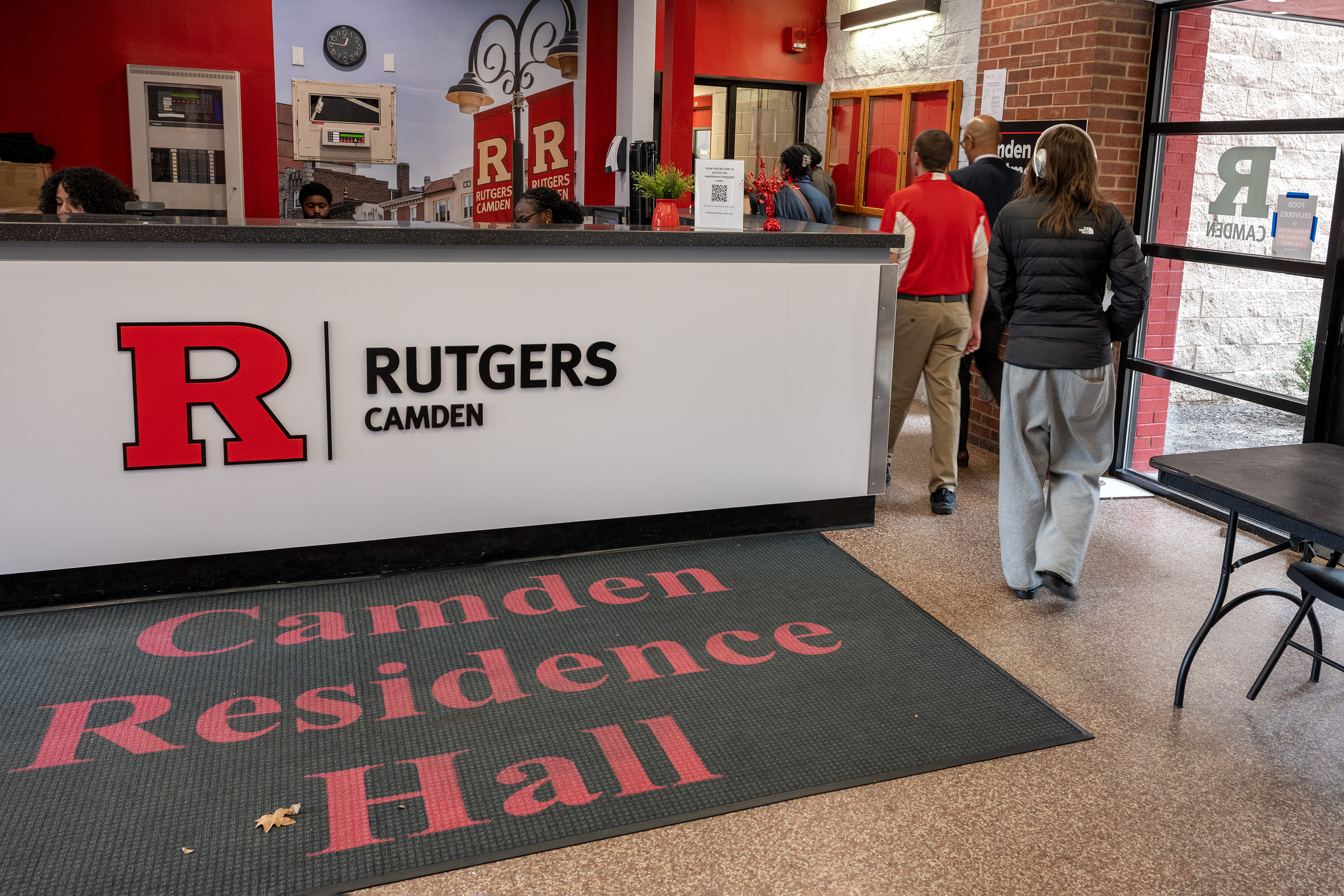
The lobby entrance between the Towers and Apartments resident halls at Rutgers-Camden.
Working on graduation and retention rates
In the school’s strategic plan approved in 2023, Tillis set improvement in graduation and retention rates as primary goals.
The school’s retention rate from first-year students to sophomores has increased from 71% in 2021 — the year he came — to 73.4% this fall. The six-year graduation rate decreased from 63.6% in 2021 to 61.5% in 2024. (The school said that 2025 data had not been verified and that the 2024 dip reflects lingering pandemic-related challenges.)
Tillis also discussed the Cooper Gateway Project, which will renovate four properties to add event halls, a new space for Arts & Sciences, and pedestrian walkways and courtyards. It’s expected to be completed by early 2027.
A new athletic field house also is in the works, and there are plans for a new building for business students to live and learn in, he said.
Pay equity was a sore spot with faculty for years, despite the process put in place under which they could be compared to peers at the New Brunswick and Newark campuses.
The university said in a statement that since 2021, the vast majority of faculty who petitioned for equitable pay got increases. The requests are reviewed by a committee of faculty experts who look at the professor’s classroom instruction, research, and scholarly activity.
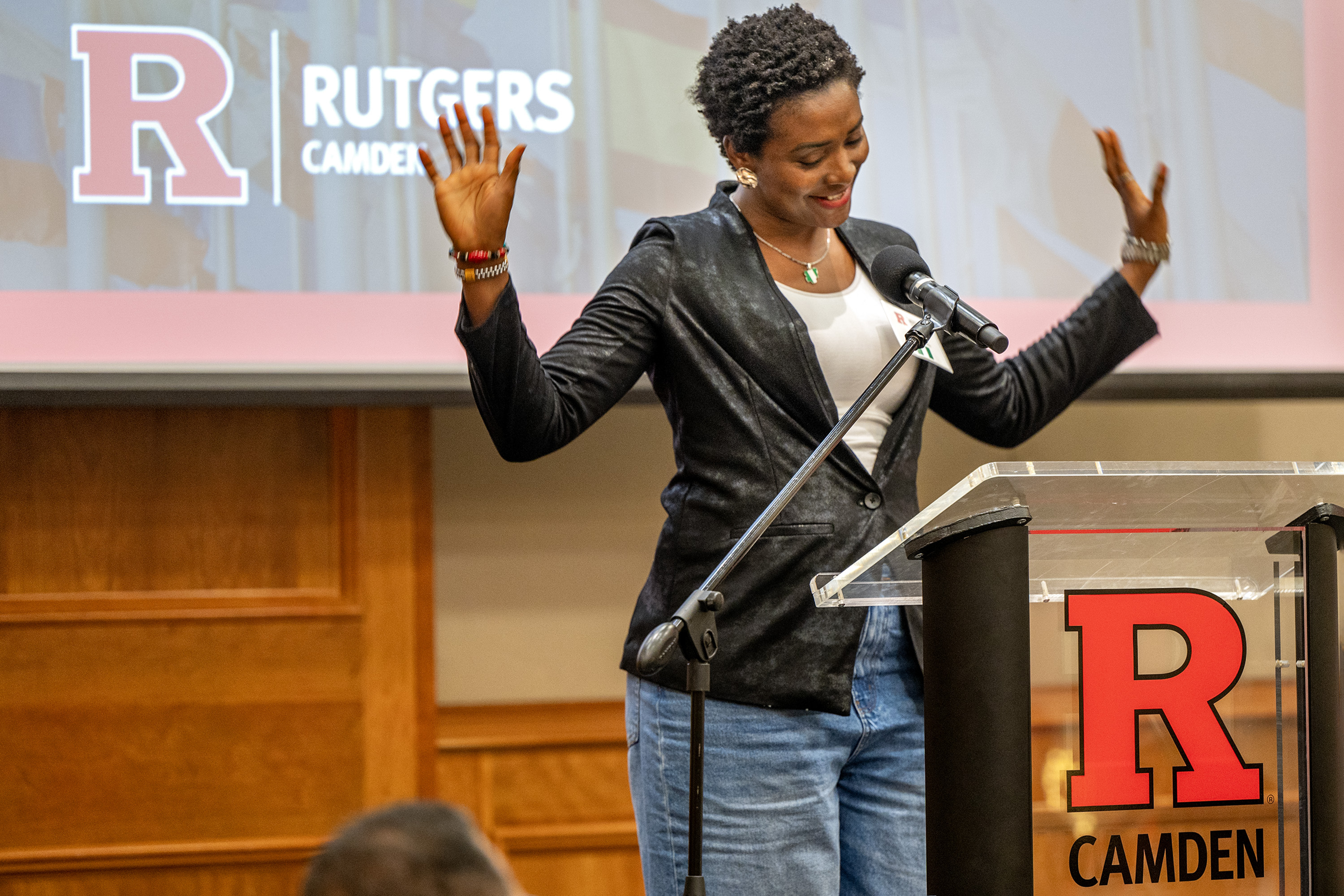
Rutgers-Camden graduate student Funmi Adebajo, from Nigeria, speaks during a luncheon for international students hosted by Chancellor Antonio D. Tillis.
Tillis said sometimes faculty were seeking to compare themselves to peers who were not really comparable.
Marker, the Rutgers-Camden AAUP-AFT president, said through a grievance, the union negotiated a change to the process that will make it harder for Tillis to overrule recommendations by the committee.
In the last cycle, the vast majority of professors with equity claims received “meaningful” pay adjustments, said Marker, an associate professor of European and Global History.
As for the comments about Camden by Tate, the new Rutgers president, Marker said she is hopeful they lead to action.
“If it actually results in a massive investment in Camden, in our students, in our faculty, in our facilities, I would be delighted,” she said. “But we’ll see. That has really not been the orientation of any of the central administrations since I was hired in 2017.”
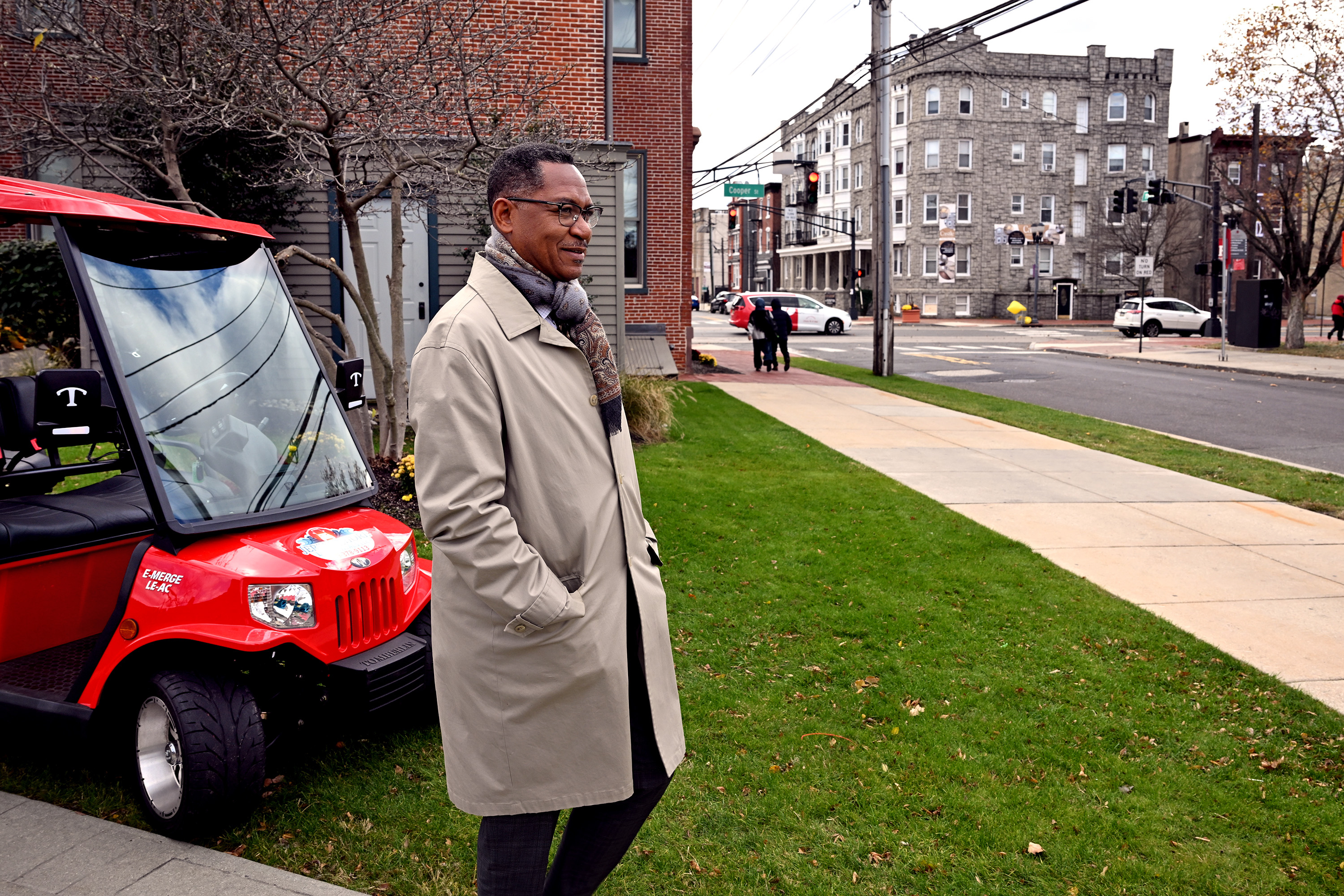
Rutgers-Camden Chancellor Antonio D. Tillis walks rather than rides in the offered golf cart to a luncheon he hosted for international students.
Tillis said he is hopeful that Rutgers-Camden will get more support under Tate. He got to know Tate in 2020 when they were both in a program at Harvard for new presidents and chancellors.
“We have a beautiful campus, but it’s stuck between the 1950s and the 1970s,” he said. “Certain types of innovative spaces for 21st century instruction needs to happen.”
“Helping others is something I thought about a lot,” said Kang, a Rutgers-Camden assistant psychology professor and the creator of a new mobile app called Daily Compassion that she believes may lead to a path to help a lot of people, if only in a small way.
She and her graduate researchers are studying how to spread kindness digitally and in everyday life through the use of the app. She defines compassion as “having genuine concerns for the well-being of others and having desire to alleviate their suffering.”
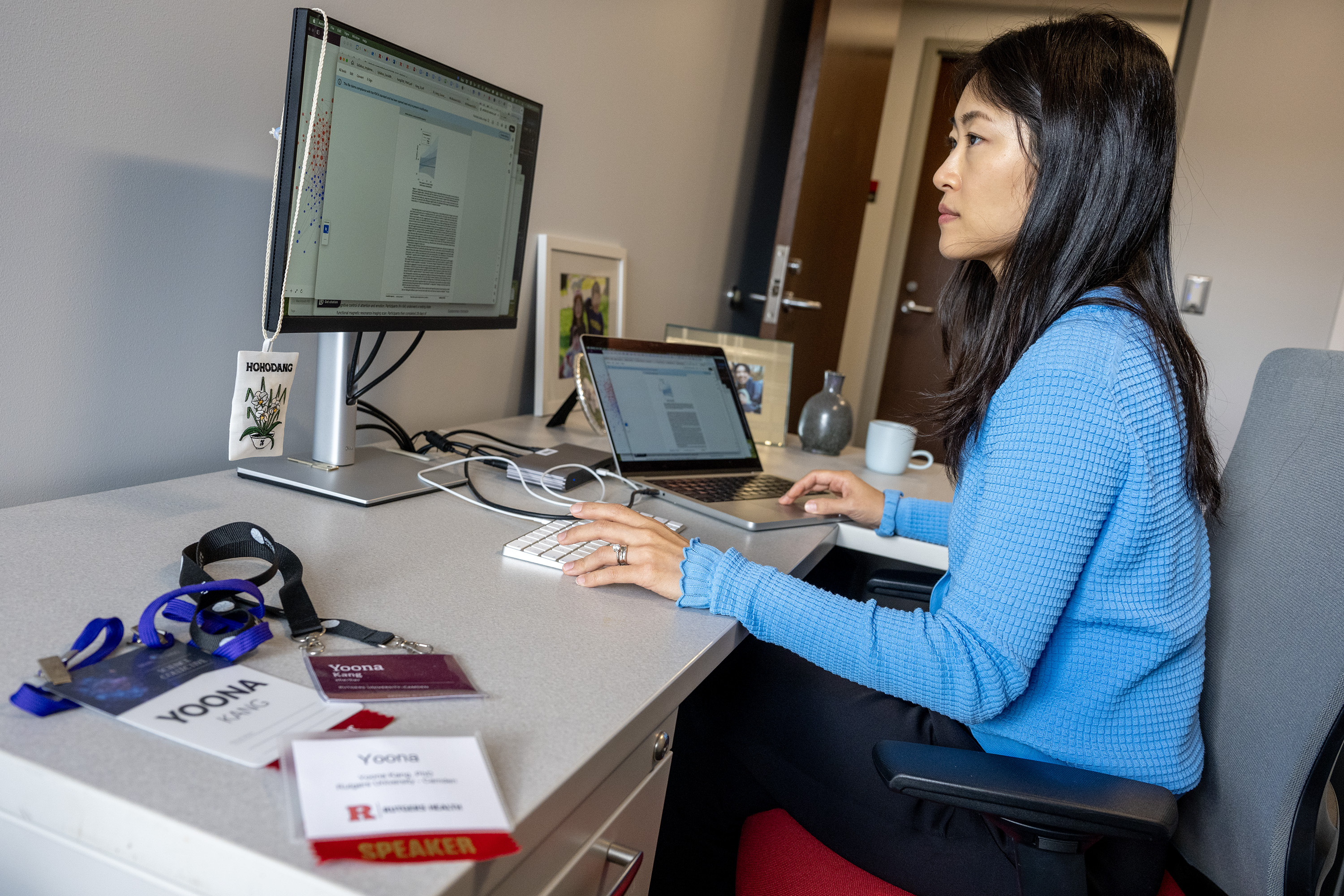
Rutgers-Camden assistant psychology professor Yoona Kang works in her office.
The app measures, tests, and encourages the spread of kindness — quite the opposite of the nasty doxing and mean-spirited online messaging that occurs today.
People send messages anonymously on the app and can see, via a world map, messages being sent from one location to another.
“Our data does show that kindness indeed spreads,” said Kang, 41. “Whether/if you receive more messages yesterday or more positive wishes yesterday, then you are likely to send more the day after.”
That’s even though there is no pressure to reciprocate, she said, because of the anonymity of the messages.
The research is being conducted through the school’s Compassion and Well-Being Lab, which was started by Kang, who is also a professor of prevention science.
Her group recruited and paid 400 people across the United States to test the app in March and studied their usage. The app allows people to send messages that Kang created, including: “May you appreciate beauty.” “May you feel brave enough to begin again.” “May you experience kindness.”
Users reported they enjoyed participating. “This app made me feel GOOD,” one wrote. “Favorite part was being able to send them, hoping someone would benefit from it,” another wrote. “Wishing people well has been a very important part of healing,” wrote a third.
Even after using the app as little as four times on average, users reported higher feelings of well-being, she said. At 20 times or more, they reported decreased depression, she said.
Study participants also were asked to share their political party. People living in blue and red states were sending well wishes to each other, though they didn’t know it, she said.
Participants can send messages through the app, but they do not choose who they message because everyone is anonymous, Kang said. In some cases, the app randomly determines the user who will receive the message. In the meditation part of the app, users can send well wishes to a particular participant, as identified by an avatar, but they don’t actually know who that person is.
“The goal was to show that people from different backgrounds, regardless of where they are located, were willing to express compassion and kindness to one another,” she said.
Kang said her interest in kindness and compassion stems from her own experience. Her family came to America when she was 19, she said, and her parents opened a restaurant in California.
“Suddenly, I was here working as a waitress, working 50 hours a week while going to community college full time,” she said. “From midnight to 4 a.m. or 5 a.m., I would study.”
She had to learn basic things about living in America.
“It really shook my foundation about my worldview, and it really motivated me to help people like me who were going through similar challenges,” she said.
After community college, Kang got her bachelor’s degree in psychology at UCLA and her doctorate in cognitive psychology at Yale. Her dissertation was on whether compassion meditation decreased negative bias against people who experience homelessness.
Kang then spent a decade at the University of Pennsylvania, first as a postdoctoral researcher and then as a research director. She explored the neuroscience of compassion, something that not everyone was ready to accept.
“They thought it was a really soft concept,” she said. “I wanted to show this is science. This is quantifiable.”
She said the team’s data show how meditation, even as little as three minutes twice daily, has an overall positive impact on well-being and decreases depression and anxiety.
There really had not been studies that tried to quantify the spread of kindness. There is older work on the spread of loneliness and happiness, she said.
Now that the initial study is complete, the app is available via iPhone, but Kang said she has not advertised it because she is working on making it better, based on feedback from the user study. Still, about 20 people in countries including the United States and England have found it and are using it, she said.
While users can only send phrases she created, she wants to allow them to author their own at some point.
“We are working on that now,” she said.
She hopes the app eventually will encourage more people to consciously spread kindness. She would like for it to become a “quick micro-practice” daily, like teeth brushing.
“I do see a lot of potential where this can change a lot of people’s lives,” she said, “not in a dramatic way, but in little and consistent ways. My goal is really to make small changes in the largest possible population.”
Biology professor Jody Hey was lecturing on human evolution one recent day at Temple University.
His students vigorously took notes by hand in paper notebooks.
There wasn’t a laptop in sight. Nor an iPhone. No student’s face was hidden by a screen.
Hey said he stopped allowing them about a year and a half ago after seeing research that students are too often distracted when laptops are open in front of them and actually learn better when they have to distill lectures into handwritten notes.
“The clearest sign that it’s making a difference is that students are paying attention more,” said Hey, who has taught at Temple for more than 12 years. “And they want to participate much more than before.”
Hey is among a seemingly growing number of professors who have chosen to keep laptop and phone use out of class, with exceptions for students with disabilities who require accommodations. Several said they made the decision after seeing what some students were doing on their laptops during class.
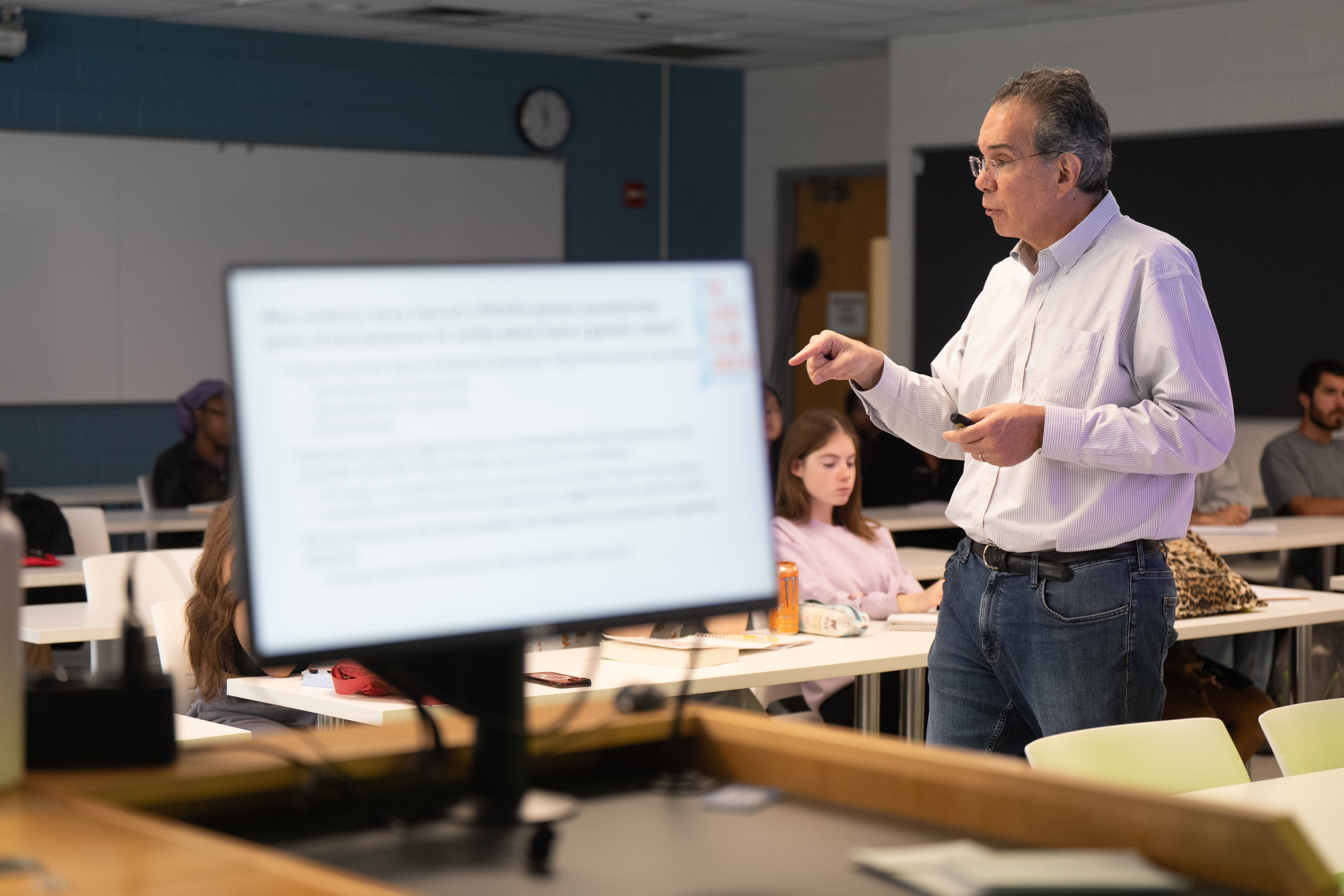
Temple University biology professor Jody Hey stopped allowing laptops to be used in class about a year and a half ago. He said he’s noticed improvement in student performance.
Jessa Lingel, an associate professor of communication at the University of Pennsylvania and director of the Gender, Sexuality, and Women’s Studies Program there, stationed teaching assistants in the back of her room to observe.
Students “were out there booking flights and Airbnbs,” Lingel said. “Fun fall cocktail recipes. They were online gambling in class. I thought, ‘This is not acceptable.’”
She originally disallowed laptops in 2017, but decided to go easy in 2021 as students returned after the pandemic, she said. She reinforced the ban after her teaching assistants’ observations.
“It’s a movement,” Lingel said. “More and more people are headed in this direction.”
In Hey’s class, students have warmed up to the laptop ban.
“At first I didn’t like it,” said Jess Nguyen, 20, a junior genomic medicine major from Broomall, “because I kind of organize all my notes on my laptop. But I feel I’ve been learning better by writing my notes.”
When she took notes on her iPad, she sometimes got distracted and played computer games, she said. In Hey’s class, that’s not an option.
Students said it takes more time to write notes and sometimes their hands get tired.
“After a couple classes, you kind of get used to it,” said Sara Tedla, 22, a senior natural sciences major from Philadelphia.
She’s on the fence about which way she prefers to take notes.
“It’s good that for an hour and 20 minutes you can just sit down and, without any technological distractions, focus because that’s a part of your brain you can work on,” said Quinn Johnson, 20, a senior ecology major from Philadelphia. “The more you do it, the easier it becomes to focus on something for a long period of time.”
‘Students learn better’
Professors say laptopsare pretty ubiquitous in the classroom when they are permitted.
Hey conducted research on laptop use and presented it at a Temple department faculty meeting earlier this year.
“As early as 2003, a study was done contrasting the retention of lecture material by two groups of students, one who had laptops and unrestrained internet access and a second who worked without laptops,” he said. “In that study, students with laptops scored 20% lower on average in the subsequent exam.”
Four of every five students who used laptops in a general psychology class said they checked email during lectures, another study showed, while 68% used instant messaging, 43% surfed the net, 25% played games, and 35% said they did “other” activities.
He also cited studies showing students who took notes by hand performed better on tests. Others cited that research, too.
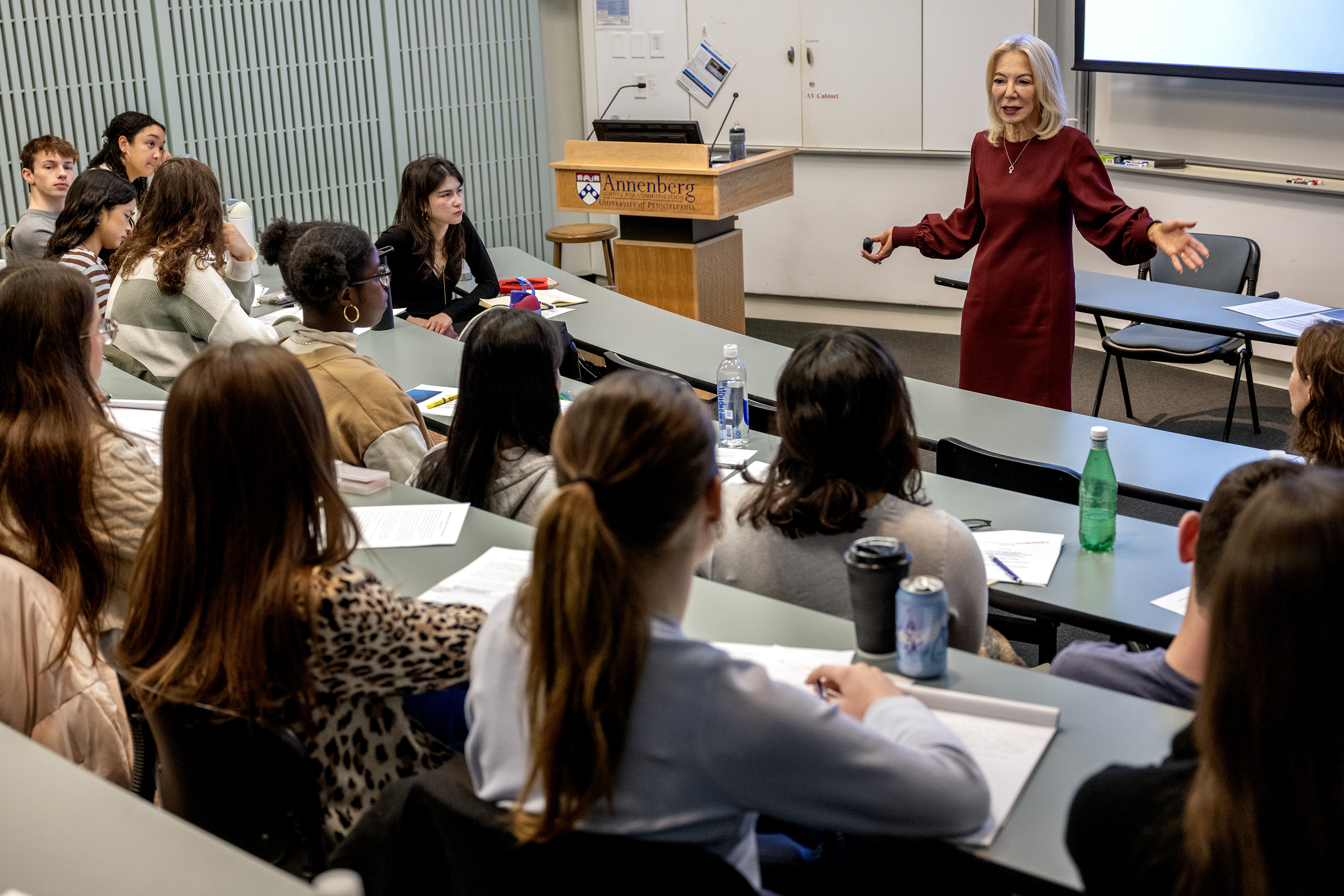
Penn President emerita Amy Gutmann co-teaches a class at Penn’s Annenberg School for Communication with the dean Sarah Banet-Weiser. They don’t allow laptops or phones to be used in the classroom.
“I read the literature on it and it really showed that students learn better when they’re taking notes rather than trying to type as fast as they can verbatim what you say,” said Amy Gutmann, Penn president emerita, who is co-teaching a class at the Annenberg School for Communication this fall.
Some professors say laptop use in class can be beneficial.
Sudhir Kumar, a Temple biology professor, said he asks his class of 150 students to respond to questions on their laptops every 10 minutes. Their answers count toward their grades.
“It’s constantly keeping them on their toes,” he said.
He would not want to see everyone give up on laptop use in class.
“We cannot fight technology,” he said. “Teachers have to embrace technology, whether it is artificial intelligence or computers. That is a standard mode of operation for most people today.”
(Left to Right) Jess Nguyen, 20, a junior from Broomall, Allan Thomas, 22, a senior from Philly, and Sara Tedla, 22, a senior from Philly, in a class taught by Temple University biology professor Jody Hey last month.
In Cathy Brant’ssocial studies methods classof 20 to 25 students at Rowan University, laptops are key. Brant, an associate professor of education, saidthere are lots of hands-on group projects, and she frequently asks students to check New Jersey standards online as they prepare their lessons. She also teaches them how to use AI appropriately in the classroom.
One of her students, she said, recently handed in a paper with very detailed notes from Brant’s lecture that she probably got only because she was able to type quickly on her computer.
“You’re responsible for paying attention in class,” she said. “Maybe it’s a little harsh, but I’m just like, ‘If you want to be on Facebook the entire time during class, that’s on you.’”
Jordan Shapiro, an associate professor at Temple, more than a decade ago used to make a point of having his students post on Twitter, now X, during class and counted it toward classroom participation.
Now, he tells students to put their laptops away during class.
“I tell them I have no problem with tech or laptops,” he said. “I just think that none of us get enough time in our lives to just focus on ideas or to listen in a sustained way to the people around us.”
He also became concerned about students doing homework during class, he said, and usingartificial intelligence to supply them with questions and comments to ask in class. They were “outsourcing class participation to the robots,” he said.
Mark Boudreau, a biology professor at Penn State Brandywine, disallowed laptops for the first time this semester.
“I thought I would get real pushback … or people might even drop the class,” he said. “But … a lot of students have had other faculty who have this policy.”
Exam scores in his three courses are better this year, he said.
Hey noted student grades have gone up, too. But he can tell some students struggle with note-taking; some just listen and don’t take notes.
“That’s better than sitting there and going on Facebook,” he said.
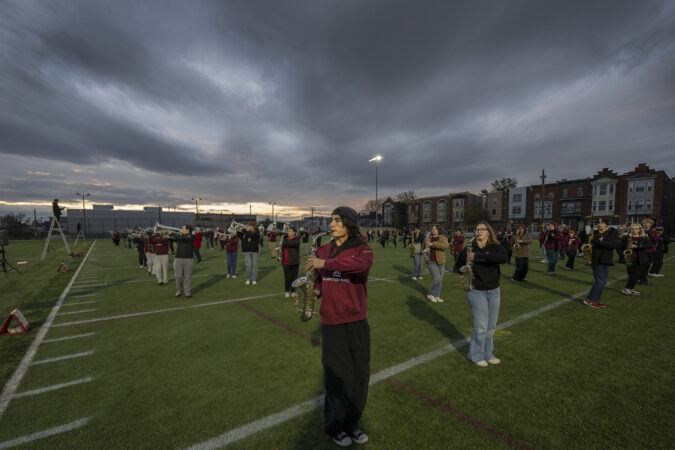
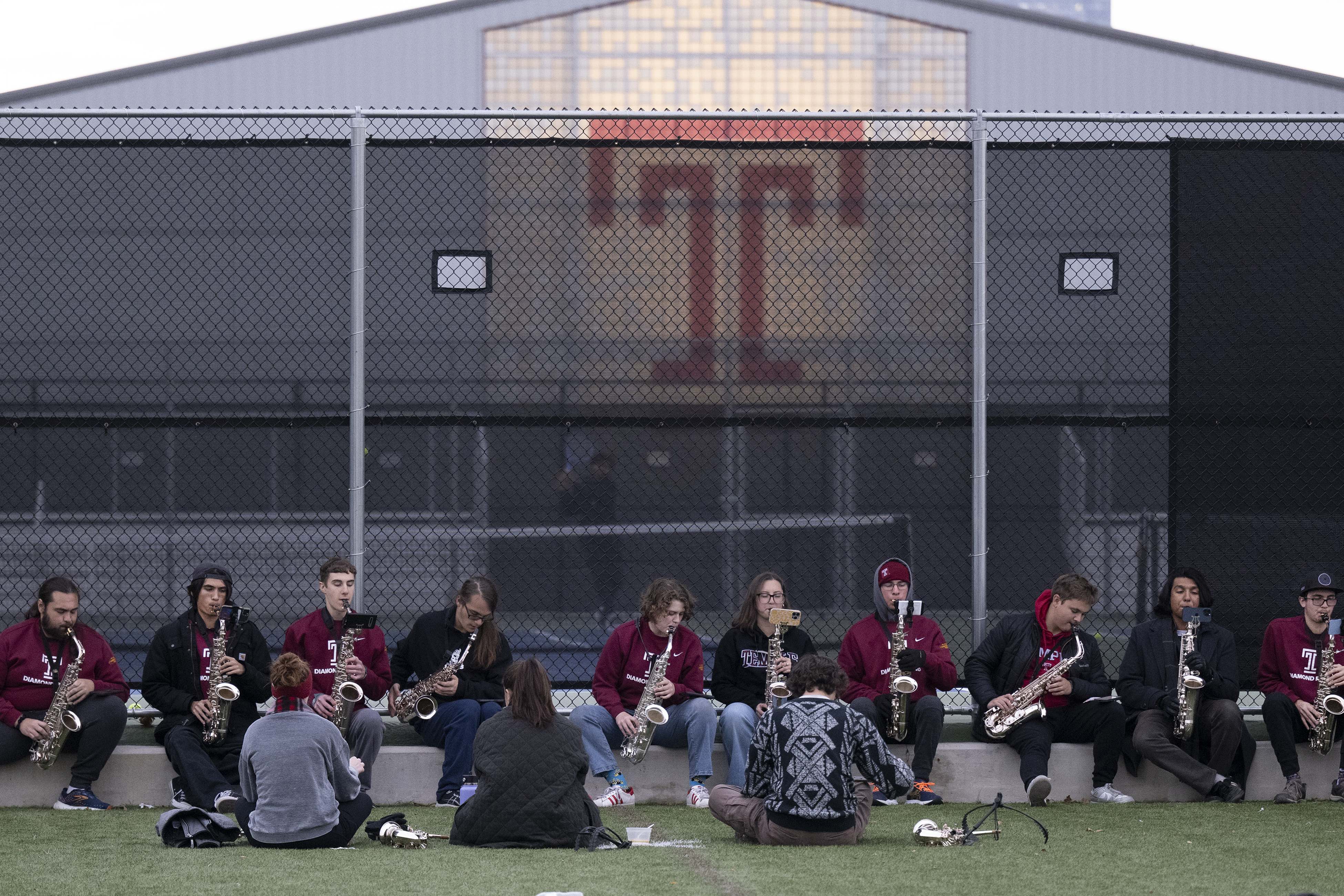
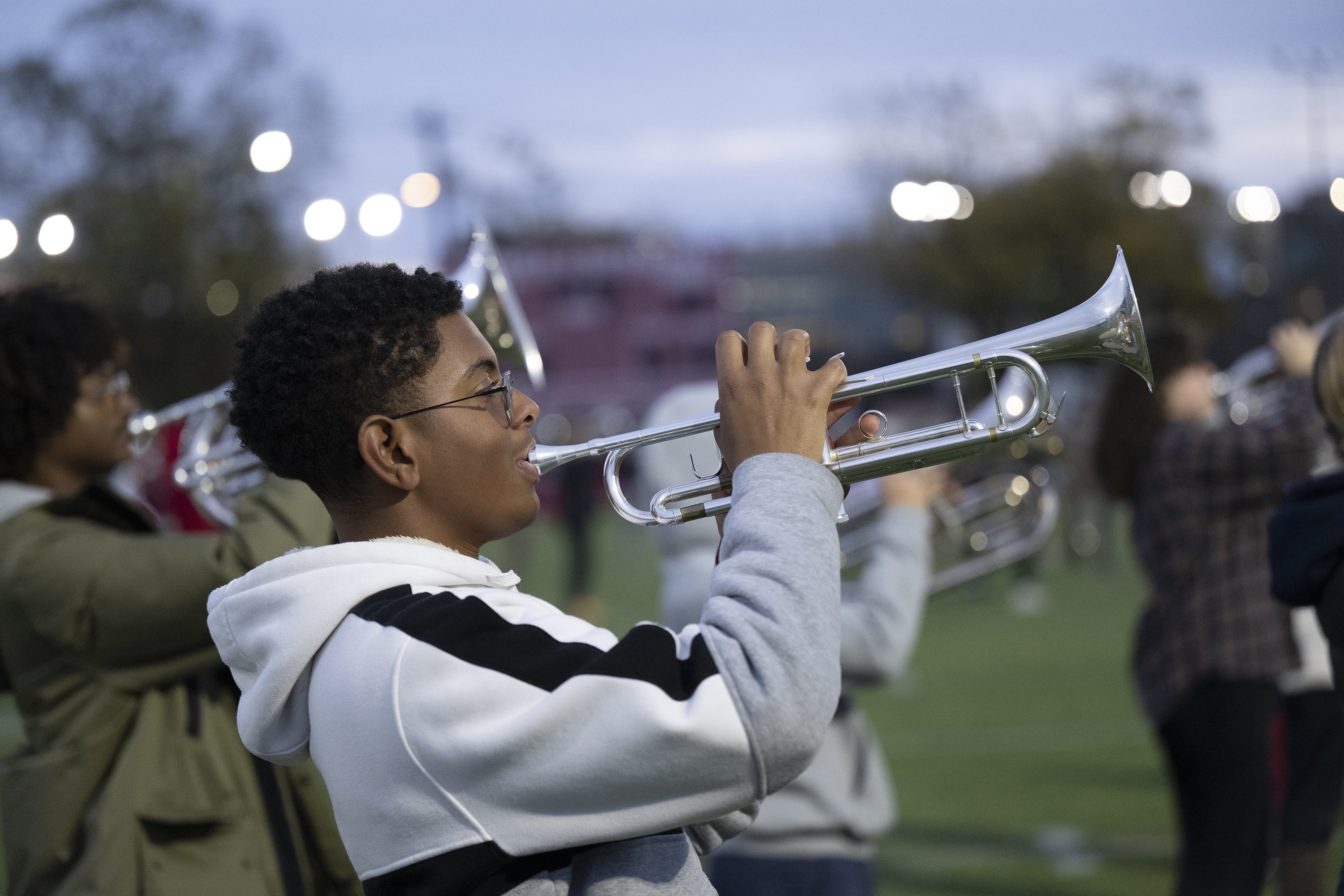
As the pink of twilight peeked through the November clouds, Temple University’s Diamond Marching Band, instruments and flags in tote, practiced on the campus’ Geasey Field.
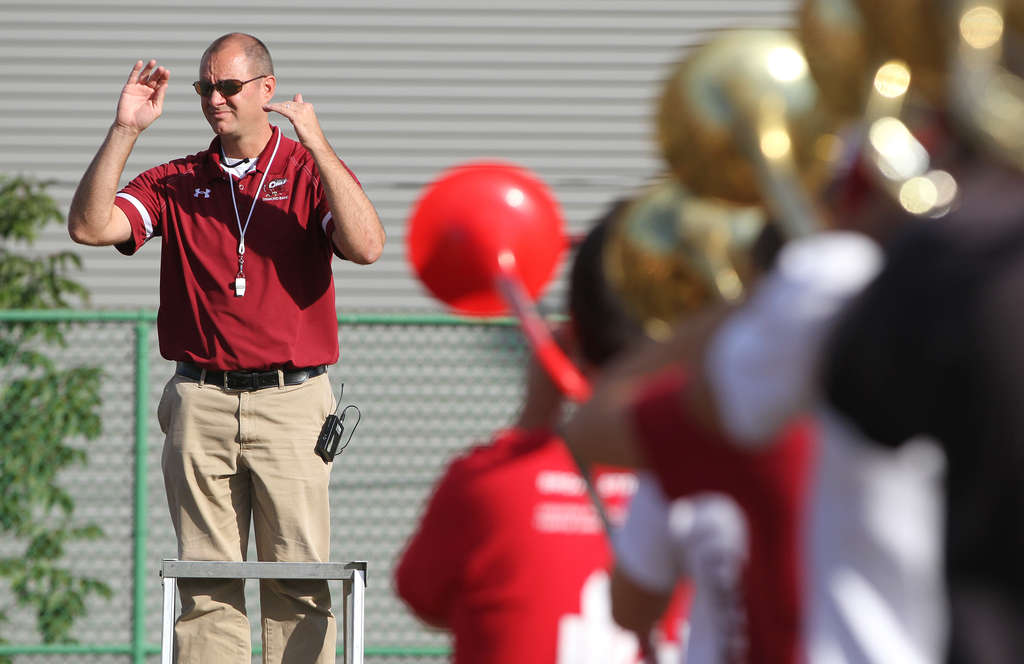
They ran through selections by Taylor Swift and from the movie KPop Demon Hunters while athletic bands director Matthew Brunner studied their sound and formation from a scissor lift 25 feet in the air.
“Notes should be long,” Brunner called out over a microphone after one selection. “Don’t try to play them too short.”
There were few spectators that afternoon. But that’s about to change in a big way.
The 200-member band is one of only 11 that have been selected to participate in the Macy’s Thanksgiving Day Parade in New York City. It’s a first for Temple, which will be the only band from Pennsylvania or New Jersey in this year’s parade. More than 30 million people likely will be watching from home and 3.5 million in person, if prior numbers are any indication.
Members of the Temple University Marching Band prepare to practice. The band will perform in the Macy’s Thanksgiving Day Parade this year.
That’s a lot of exposure for the Cherry and White, which could be a boost for recruitment and fundraising.
“I can scarcely think of a better way to bring visibility to Temple,” said John Fry, Temple’s president.
And that visibility could lead to more people visiting Temple’s website and seeing what the university has to offer, he said.
“It’s going to be incredible for the university,” said Brunner, who initially announced Temple’s band had been selected for the parade in August 2024. “There’s no television event, other than the Super Bowl, that is bigger.”
The excitement is palpable among students, some of whose families plan to attend the parade.
“It’s a once-in-a-lifetime opportunity,” said Erin Flanagan, 21, who grew up watching the parade with her family and notes she wanted to march in it since she was 6. “I mean, the Macy’s parade is iconic.”
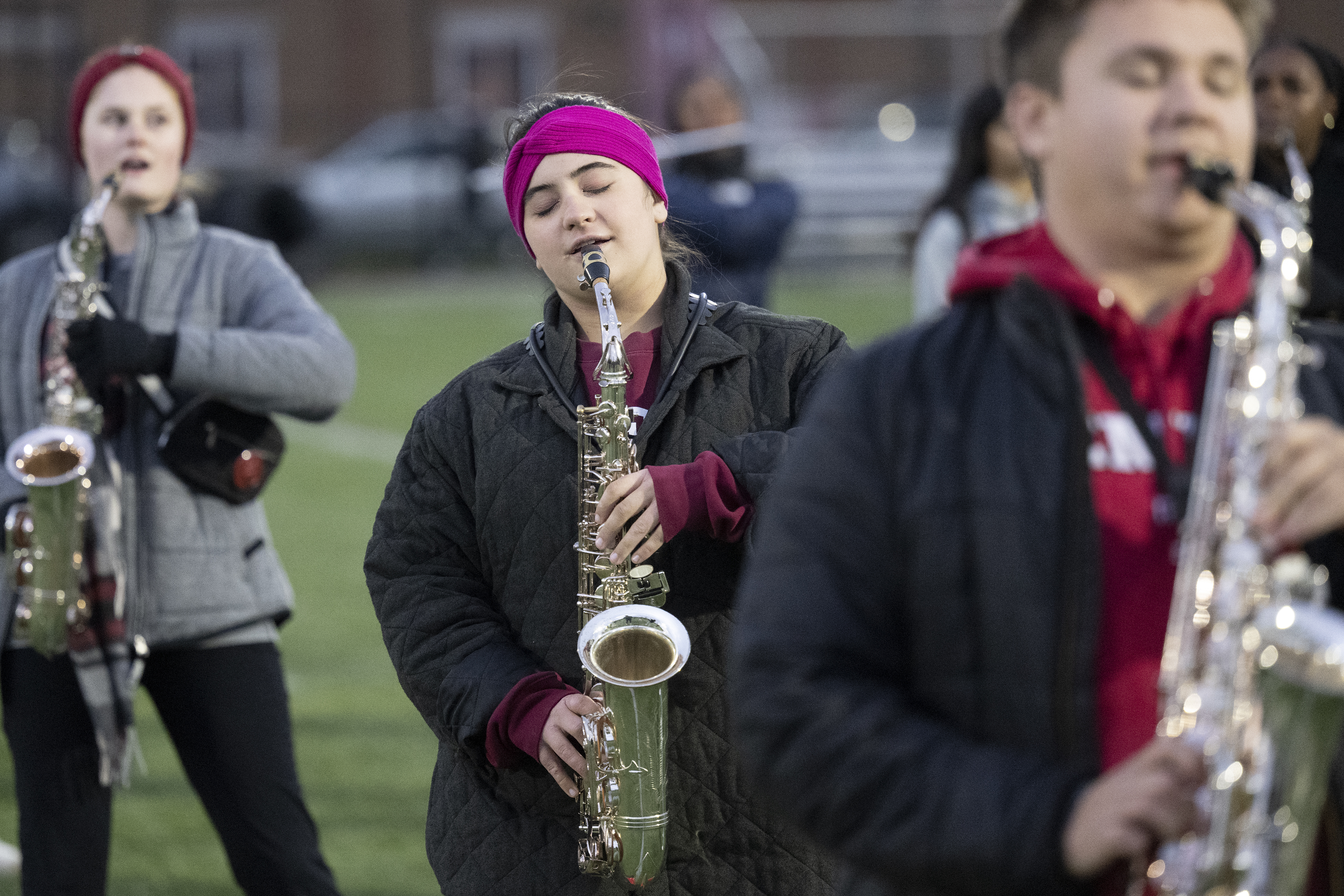
Temple University alto saxophone player Erin Flanagan rehearses with the marching band.
The music education major from Manasquan, N.J., who is a senior, said it likely will be her last performance with the band, and she could not have scripted it better.
“I get to go to this awesome performance and just show everybody what Temple stands for,” said Flanagan, an alto saxophone section leader.
It’s the 99th anniversary of the 2.5-mile parade, which kicks off about 8:30 a.m. on Thanksgiving Day on NBC and Peacock, hosted by Savannah Guthrie, Hoda Kotb, and Al Roker.
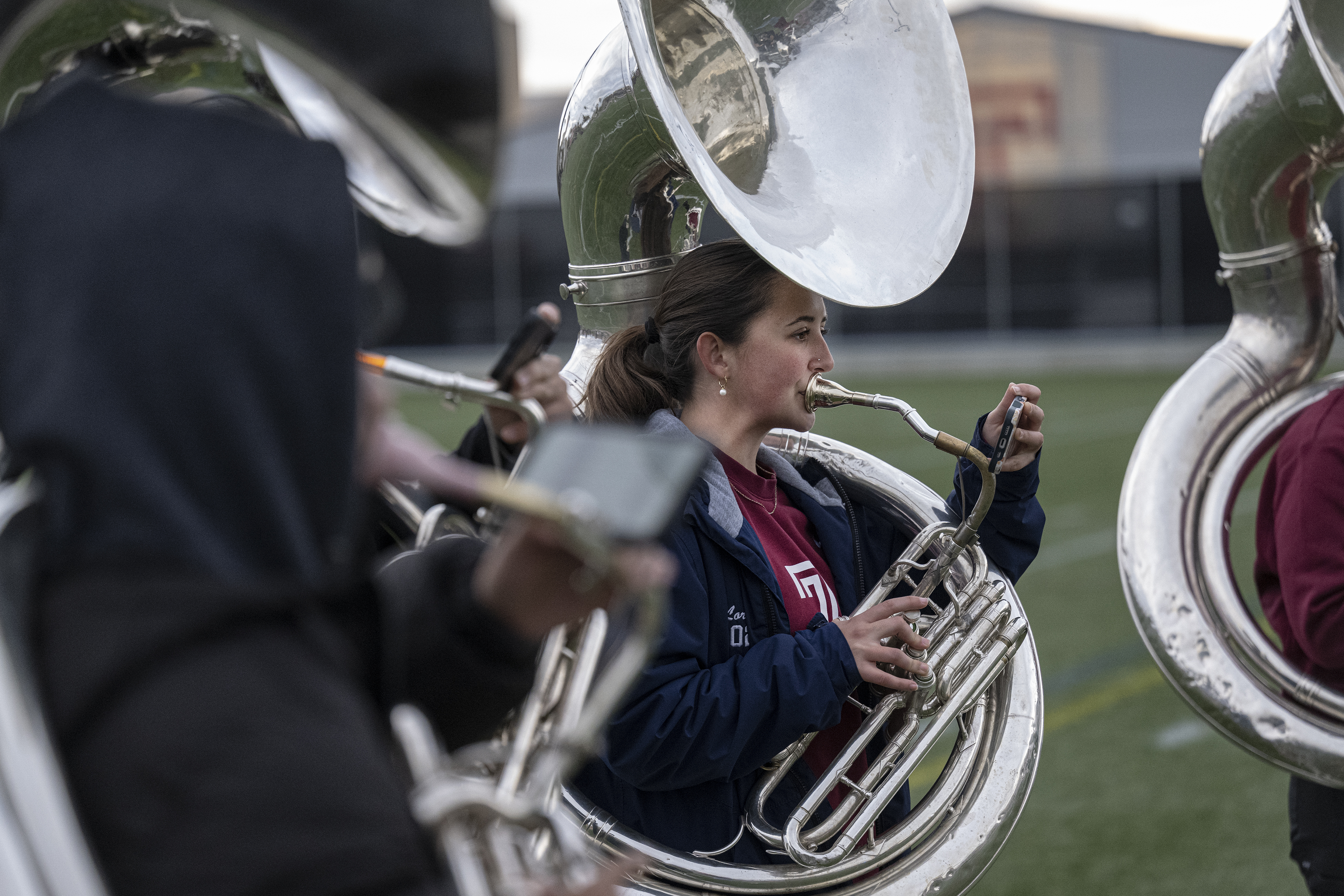
Temple University tuba player Lorali Minde plays the tuba in the marching band.
Lorali Minde, 18, a freshman from Levittown, will be marching while playing the tuba, a 36-pound instrument.
“You kind of get used to it,” she said. “It’s like carrying a really heavy purse.”
Brunner, who has led the marching band for 18 years, said he had applied to be in the parade several times before. It’s a competitive process, with more than 100 applicants vying for a spot. He had to submit video of a performance — he sent the 10-minute show the band did off the Barbie movie soundtrack — pictures of the band in uniform, reasons that Temple deserved a shot, and the band’s resume and biography.
Matthew Brunner, athletic bands director, leads a practice in 2018.
When his wife saw the Barbie show, Brunner said, she texted him: “That’s the show you need to send to Macy’s.”
It proved a winner.
“They loved the fact that the music we play is current,” he said.
The honor comes at a special time for the band, which is celebrating its 100th anniversary. Brunner played that fact up in the application, too.
Under Brunner, the band has grown and has been hitting high marks. Over the years, the school has been recognized as one of the top collegiate marching bands in the nation by USA Today and Rolling Stone, appeared on Good Morning America, The Tonight Show Starring Jimmy Fallon, and an episode of Madam Secretary, and was featured in two Hollywood movies, The Wolf of Wall Street, starring Leonardo DiCaprio, and the remake of Annie. Some of its performances have received millions of views on YouTube, including a 2018 performance of “Idol” by the K-pop group BTS, which currently has more than five million views on Ricky Swalm’s YouTube channel.
The band includes a color guard, a baton twirler, brass and woodwind instruments, a drum line, and a dance team. The group typically practices three times a week for two hours at a time.
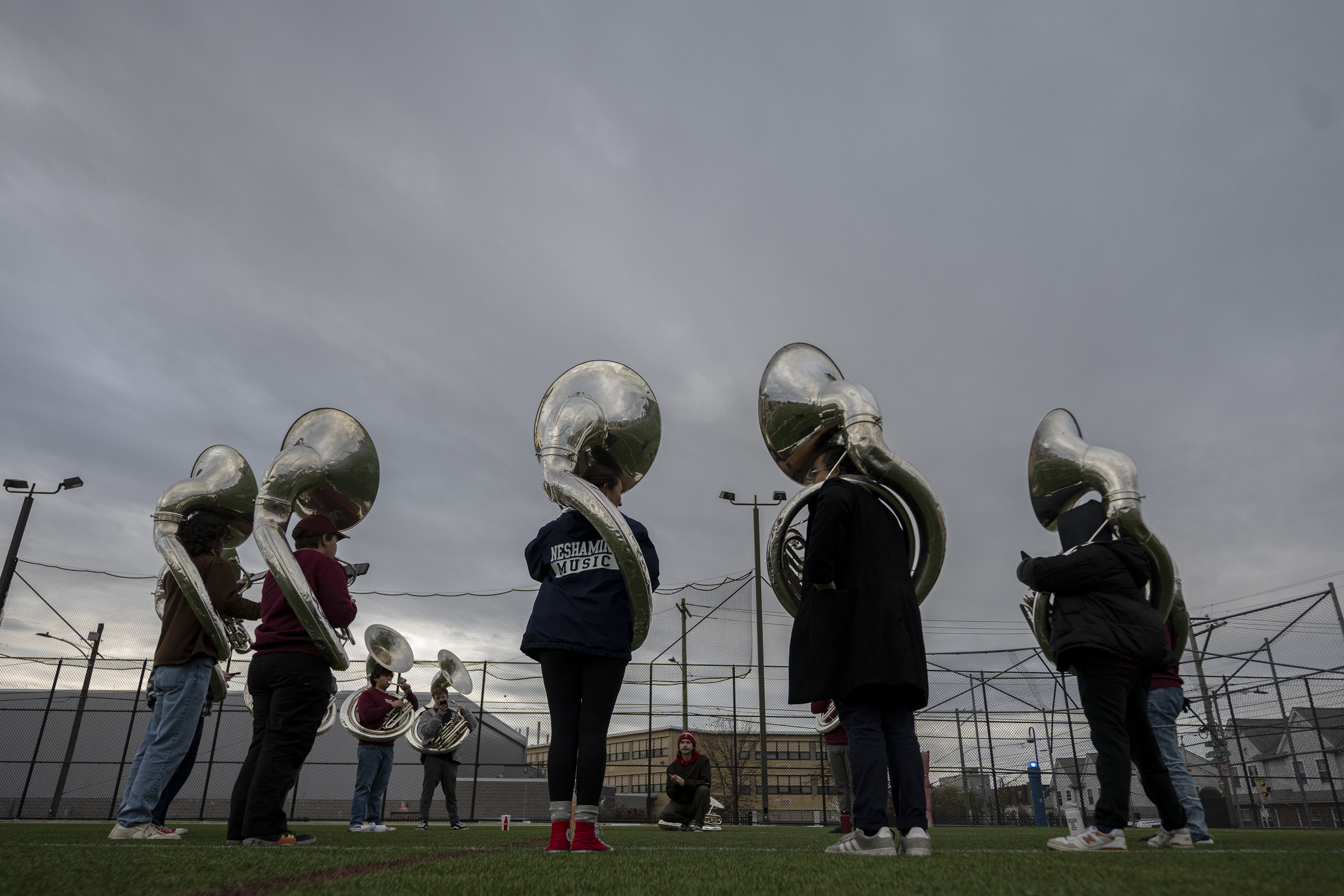
Temple University Marching Band tuba players practice.
“The band is infectious,” Brunner said. “When you see them perform, you can’t help but smile.”
Students have been eying the parade opportunity for a while.
When Flanagan was a sophomore, she asked Brunner point-blank: “When are we doing the Macy’s parade?”
Recently, she and her roommates, also band members, have been counting down the days on a whiteboard.
Brunner declined to say exactly what the band will perform on Thanksgiving, but promised a mix of holiday, audience participation, and Temple songs.
“We’re hoping for no wind,” he said.
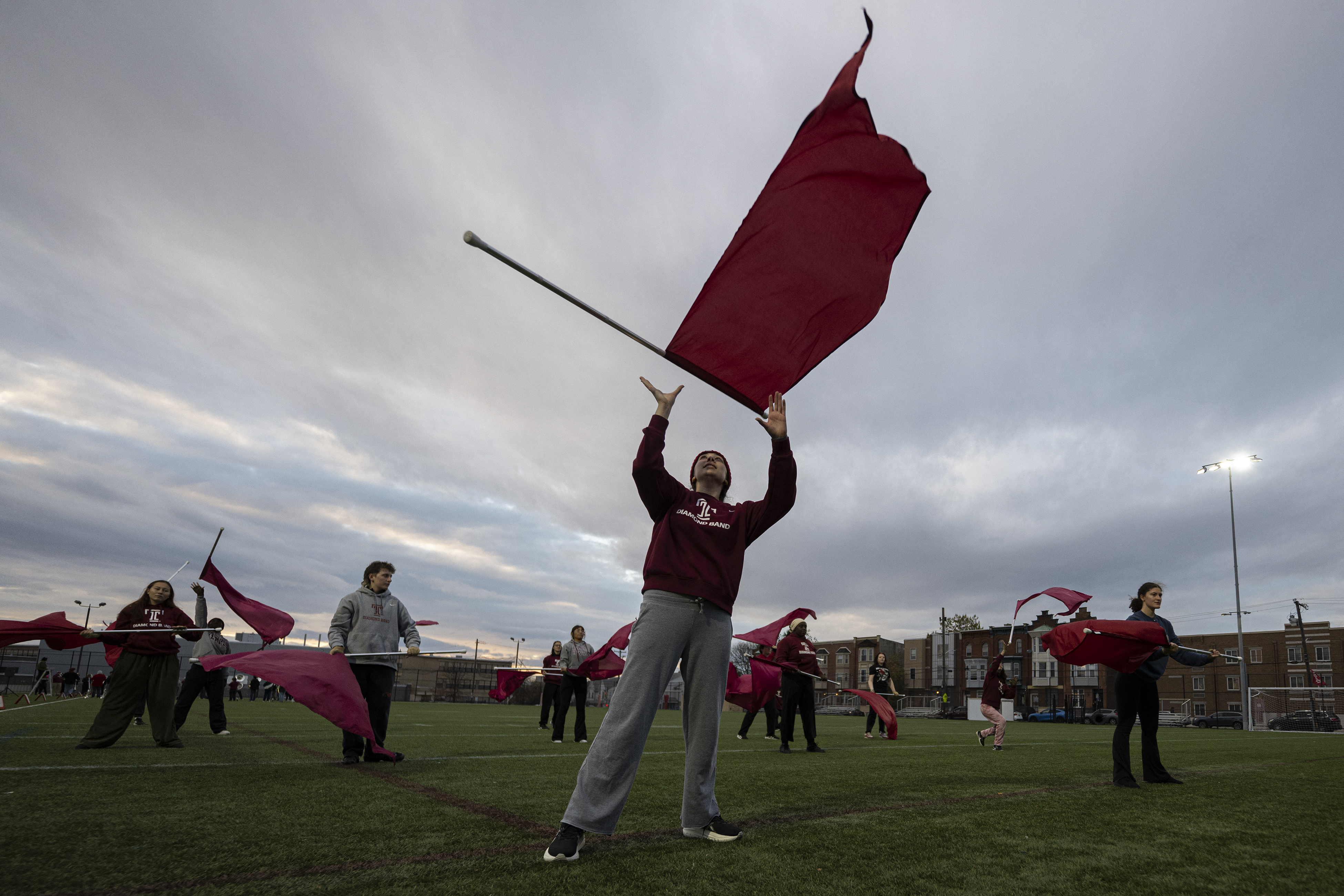
Temple University Marching Band Color Guard Captain Abigail Rosen practices with her flag.
Abigail Rosen, color guard captain, and her cocaptain are planning an “epic toss” of their flags over other band members, and wind could hinder it, he explained.
“It’s an exchange toss,” said Rosen, 20, a junior advertising major from Abington. “So I toss my flag to Dana [Samuelson] and she tosses her flag to me, and we catch each other’s flags.”
Bands selected received $10,000 from the retailer, which Temple officials said helped them get started on fundraising to pay for the trip.
The band will be heading to New York on Tuesday for an alumni event, then a performance on the Today show Wednesday. Band members will be up in the wee hours of the morning Thursday for a rehearsal, and after the parade, they will be treated by the school to a Thanksgiving dinner cruise along the Hudson River.
Andrew Malick, 20, a music education major from Carlisle, Pa., who plays the tuba, can’t wait.
“It will be cool to say you’ve done it for the rest of your life,” he said.
Jeremiah Murrell, a freshman trumpet player from Savannah, GA, rehearses with the Temple University Marching Band Thursday, Nov. 13, 2025.
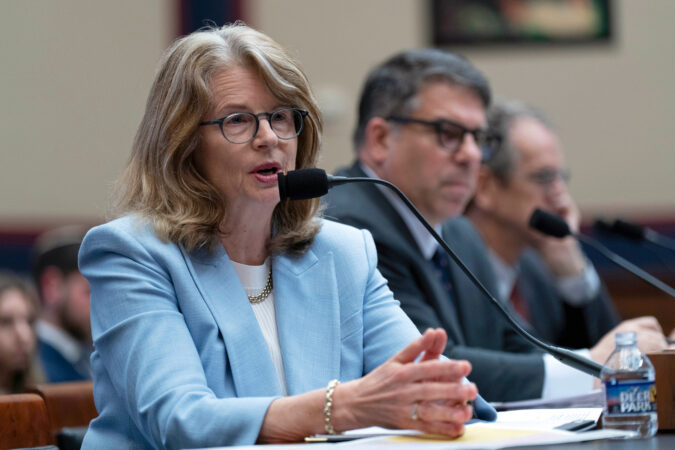
Haverford College president Wendy Raymond announced she will retire in June 2027, and the college plans to launch a search for her replacement early in the new year.
The announcement comes after a particularly difficult year for the college and Raymond, who faced intense grilling in May by a Republican-led congressional committee probing antisemitism complaints on college campuses. The school also is under investigation by the U.S. Department of Education over its handling of antisemitism complaints.
“This was not an easy decision, but after more than three decades in higher education, I am ready to step away from academia,” Raymond said in her message to campus.
Her news comes just two days after she announced John McKnight, the dean of the college, would be leaving in June for a new role at Dartmouth College.
Raymond said she wanted to give the college’s board of managers time to search for a replacement.
Raymond, 65, a molecular biologist, became president of the 1,470-student liberal arts college on the Main Line in July 2019. She came to Haverford from Davidson College in North Carolina, where she had been vice president for academic affairs and dean of faculty.
She has been in the job longer than her three most recentpredecessors, Kim Benston, who served four years; Daniel Weiss, who was there two; and Stephen G. Emerson, who had four years.
In her announcement, she noted accomplishments including the completion of a strategic plan, efforts to advance diversity, equity, and access, the launch of the Institute for Ethical Leadership and Inquiry named for board chair Michael B. Kim, and the new recital hall.
She also acknowledged challenges, including the pandemic, the strike for racial justice in 2020 in which students refused to attend class and demanded that Haverford do more to support its Black and brown students, and “more recent times of social unrest and public scrutiny.”
Raymond earlier this year in a message to the campus acknowledged that she “came up short” in dealing with conflict over antisemitism complaints and said both she and Haverford can do better.
“To Jewish members of our community who felt as if the College was not there for you, I am sorry that my actions and my leadership let you down,” she said in that message.
Haverford was the only local college earlier this year to receive an F on a report card by the Anti-Defamation League for its response to antisemitism — a rating given to less than 10% of schools nationwide. The ADL’s methodology for categorizing antisemitism has been questioned, and critics have argued that criticism of the state of Israel and its government have been wrongly conflated with antisemitism.
But the F rating caught the attention of the congressional Committee on Education and Workforce, which called on Raymond and two other college presidents to testify in May. Raymond took the worst of the grilling, largely because she was reluctant to answer questions about discipline for alleged antisemitism, especially in specific cases. Raymond testified that the college does not release data on student suspensions and expulsions.
In June, the committee demanded answers about faculty and student discipline. And in August, the education department, which has launched a flurry of investigations of colleges regarding antisemitism, said it would probe Haverford.
The investigation follows “credible reports that Haverford has failed to respond as required by law to multiple incidents of discrimination and harassment against Jewish and Israeli students on its campus,” the department said at the time.
In her testimony to the congressional committee, Raymond noted the college had made a plethora of changes to address concerns about antisemitism, including changes in the antibias policy and rules around protesting, steps to revise the honor code, and increases in campus safety at events.
Kim, the board chair, thanked Raymond for her service amid a difficult time in a message to campus Thursday.
“She has guided the College with great care during periods of both remarkable growth and significant challenge,” he said. “During her tenure, Haverford has welcomed two of its largest incoming classes, increased support for student resources, access, and engagement, and continued to graduate students who use their liberal arts education to effect positive change in the world.”
Raymond said in her Thursday message that through the challenges, “ … the College has remained strong and resolute in its mission to foster a campus culture of belonging and respect, where academic freedom and freedom of expression remain fundamental to Haverford’s nearly 200 years of academic excellence and open inquiry, and where our values guide us through new territory.”
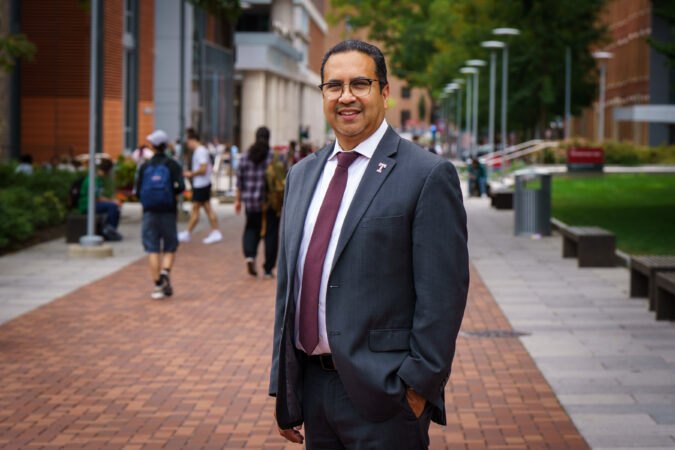
Temple University’s vice president for enrollment and student success resigned abruptlythis week after only 2½ years in the post.
Jose Aviles’ resignation is effective Dec. 2, the university said in a message to the campus Wednesday.
“It is very difficult to leave, but I have a life-changing opportunity that awaits me,” Aviles said, adding that he would share details when able. “Serving the Temple University community has been an extreme honor, as I am deeply grateful to have had the chance to fulfill the mission of Russell Conwell and expand access and opportunity to this world-class institution.”
Temple did not respond to questions on why Aviles is leaving midyear, with the university in the midst of another application cycle.
“Jose has reimagined enrollment management at the university over the last couple of years, helping move us to a modern, technology- and data-driven approach that has delivered results,” Temple president John Fry and interim provost David Boardman said to the campus community.
They noted the university achieved growth in first-year enrollment the last two years, with this year’s group reaching a record high of 5,379.
The university also under his tenure started the Temple Promise program, which makes tuition and fees free for first-time, full-time college students from low-income families who live in Philadelphia, and the Temple Future Scholars program, a mentoring and college-readiness program.
Aviles, who came to Temple from Louisiana State University, where he had served as vice president for enrollment management and student success since 2017, was recently promoted from a vice provost to a vice president.
He said in his statement that he “received great support from this university and its leaders” and would “continue to cheer on Temple from the sidelines.”
While Temple’s first-year class was strong, the school fell short of its initial overall enrollment projection by about 700 students, which translates to about $10 million in lost revenue.
The university had been estimating it would enroll a total of 30,100 to 30,300 students, which would have been its first enrollment increase since 2017.
Instead, enrollment came in at 29,503, down about 500 from last year and further declining from its high of more than 40,000 eight years ago. (That does not include enrollment on its Japan and Rome campuses, which increased. Including those campuses, Temple’s overall enrollment was over 33,000, a slight increase from last year.)
There have also been concerns about sophomore retention and a higher percentage of third- and fourth-year students not returning.
And in September, the Temple News, the student newspaper, reported that more than 25 admissions counselors, directors, and staff left the department or were laid off over the two years that Aviles led enrollment. Students experienced delays in receiving their admissions decisions, problems with credit transfers, and difficulty with advising and financial aid packages, the Temple News reported.
“I’m proud of the work that we’ve done,” Aviles told the Temple News at the time. “We definitely walked into a challenging time for admissions but when you look at what’s really happened in the last two years, I think I’m most proud of the foundation that we’ve set.”
The U.S. Equal Employment Opportunity Commission is suing the University of Pennsylvania for failing to release information related to an investigation it began in 2023over the school’s treatment of Jewish faculty and other employees regarding antisemitism complaints.
Penn, according to the complaint filed in federal court Tuesday, has not complied with a subpoena for information, including the identification of employees who could have been exposed to alleged harassment and the names of all employees who complained about the behavior.
In its quest to find people potentially affected, the EEOC demanded a list of employees in Penn’s Jewish Studies Program, a list of all clubs, groups, organizations and recreation groups related to the Jewish religion — including points of contact and a roster of members — and names of employees who lodged antisemitism complaints.
Penn usually does not comment on litigation, but in this case, the school ardently objected to the EEOC’s characterization of its cooperation and the personal nature of the material it was still seeking.
The school said in a statement it has cooperated extensively with the EEOC, including providing more than 100 documents and over 900 pages.
But the private university said it will not disclose personal information, specifically “lists of Jewish employees, Jewish student employees and those associated with Jewish organizations, or their personal contact information” to the government.
“Violating their privacy and trust is antithetical to ensuring Penn’s Jewish community feels protected and safe,” the university said Tuesday.
Penn also provided information on employees who complained and agreed that it could be shared, the school said, but the school would not provide information on those who objected.
“Penn also offered to help the EEOC reach employees who are willing to speak with the agency by informing all employees of the investigation and how they could reach out to the agency,” the university said. “The EEOC rejected that offer.”
The original complaint was launched by EEOC Commissioner Andrea Lucas, now chair of the body, on Dec. 8, 2023, two months after Hamas’ attack on Israel that led to unrest on college campuses, including Penn, and charges of antisemitism. It was also just three days after former Penn President Liz Magill had testified before a Republican-led congressional committee on the school’s handling of antisemitism complaints; the testimony drew a bipartisan backlash and led to Magill’s resignation days later.
Lucas, who was appointed chair this year by President Donald Trump, also brought similar antisemitism charges against Columbia University that earlier this year resulted in the school paying $21 million for “a class settlement fund.”
EEOC complaints typically come from those who allege they were aggrieved. Lucas, according to the complaint, made the charge in Penn’s case because of the “probable reluctance of Jewish faculty and staff to complain of harassing environment due to fear of hostility and potential violence directed against them.“
The EEOC’s investigation ensued after Lucas’ complaint to the EEOC’s Philadelphia office that alleged Penn was subjecting Jewish faculty, staff, and other employees including students “to an unlawful hostile work environment based on national origin, religion, and/or race.”
The allegation, the complaint said, is based on news reports, public statements made by the university and its leadership, letters from university donors, board members, alumni and others. It also cited complaints filed against Penn in federal court and with the U.S. Department of Education over antisemitism allegations and testimony before a congressional committee.
The EEOC complaint pointed to public comments by Magill, addressing antisemitism while she led Penn.
“I am appalled by incidents on our own campus, and I’ve heard too many heartbreaking stories from those who are fearful for their safety right here at Penn,” Magill said in 2023. “This is completely unacceptable.”
Magill also in a message had addressed “a small number of Penn staff members” who “received vile, disturbing antisemitic emails that threatened violence against members of our Jewish community,” in November 2023.
The complaint cited incidents of antisemitic obscenities being shouted on the campus, destruction of property in Penn’s Hillel, a swastika painted in an academic building, graffiti outside a fraternity and a pro-Palestinian encampment on the campus in 2024 that eventually was dismantled by police.
“Throughout its investigation, the EEOC has endeavored to locate employees exposed to this harassment and to identify other harassing events not noted by respondent in its communications, but respondent has refused to furnish this information, thereby hampering the EEOC’s investigation,” the complaint said.
Penn said it had received three antisemitism complaints, according to the federal complaint, but the EEOC questioned that number given the university’s workforce of more than 20,000. It demanded that the school provide names of all people who attended listening sessions as part of the school’s task force on antisemitism and all faculty and staff members who took the task force’s survey.
Penn objected to the subpoena and the commission partially modified it in September, ordering the school to comply within 21 days, the complaint said.