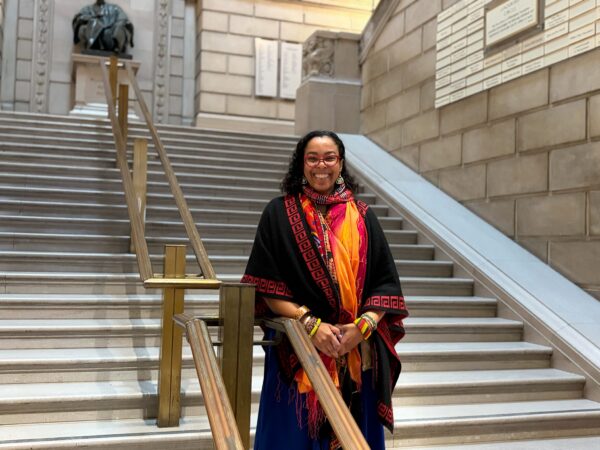
Norma Thomas had been keeping a secret since mid-January. At Saturday’s Passing the Pen ceremony, she was ready to shout it from the Central Library rooftop:
“My daughter, Raina León, is the poet laureate of Philadelphia,” Thomas said, chest puffed out and brimming with pride. “She is effervescent, outgoing, and loves the city of Philadelphia.”
Raina J. León, 44, was one of 32 applicants citywide, the largest number of candidates the city has had for the role, said Adam Feldman, the Free Library of Philadelphia department head of art and literature, and a poet laureate governing committee member.
Born in Upper Darby, León is a Black, Afro Boricuan poet, writer, educator, and cultural worker raised in Southwest Philadelphia. She speaks English, Spanish, and Italian, and believes in a world where diversity can strengthen communities.
Still unable to believe her achievement, the University of Southern Maine professor recalled lighting candles nervously, hoping to get the email bearing the news.
“I keep thinking, ‘Maybe this isn’t my time,’” León said. “But, no, DéLana would want me to dream big and to walk on assurance of my voice having a space,” she added, remembering her late friend, the poet DéLana R.A. Dameron, who died in November.
Creating a space where people feel that their voices are welcome is the legacy León wants to leave during her two-year tenure as poet laureate.
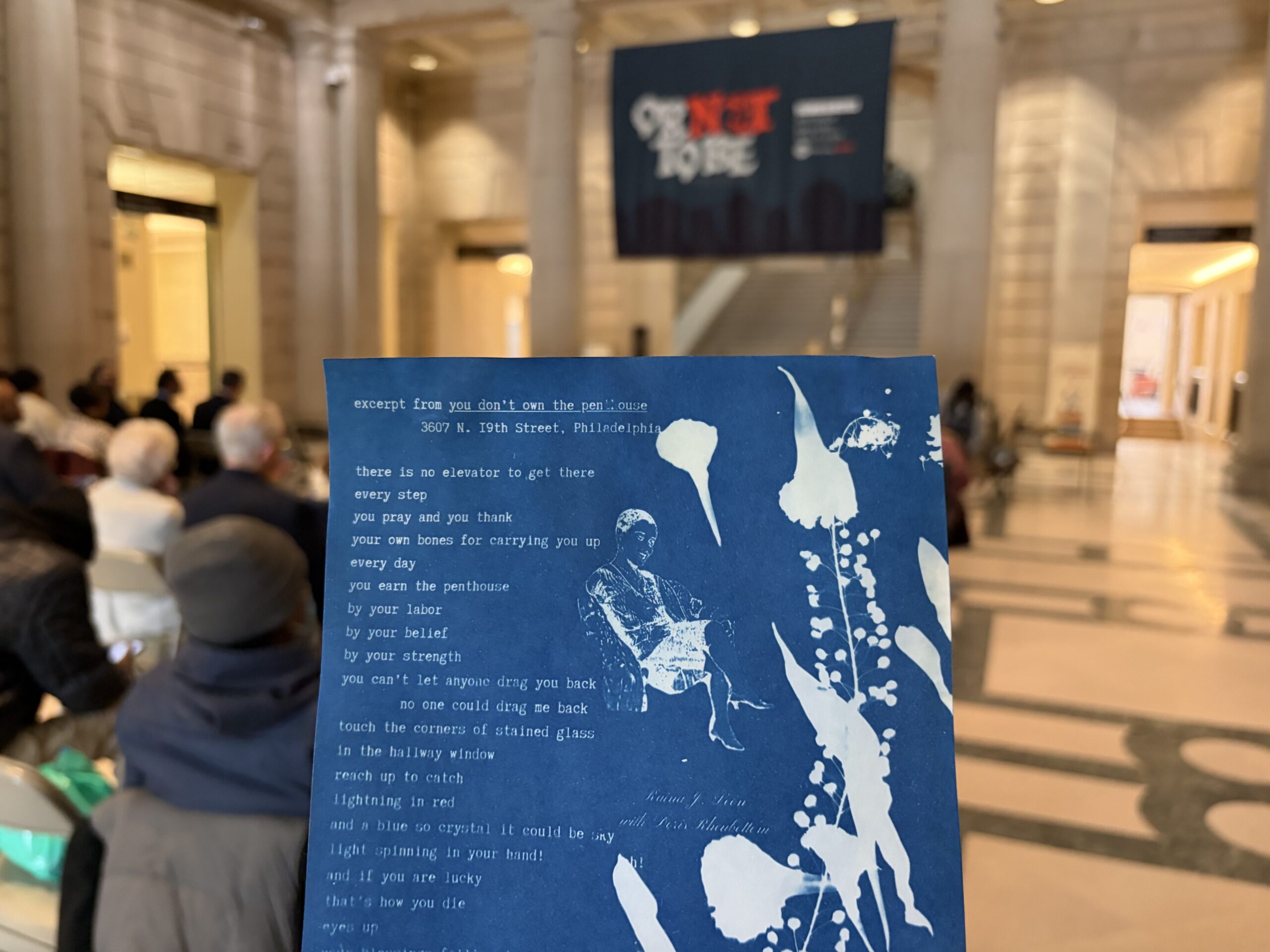
An extract from Raina León’s poem “you don’t own the penthouse.”
The poet laureate is an ambassador for poetry in the city, participating in community engagement, speaking at events, and mentoring the youth poet laureate,Rashawn Dorsey. But what excites León the most is helping Philadelphians see storytelling as a liberating practice.
“Poetry is all around you. Even if you are like, ‘I don’t understand poetry’ — it understands you,” León said. “In these times of great volatility, with attacks on history and attacks on communities, there is a desire to preserve oneself by becoming numb, and poetry says, ‘No, you can’t be numb in life. You can’t be numb and observe the world.’”
The poet laureate role comes with a $5,000 stipend, paid in two installments. But León says she isn’t in it for the money. She wants to provide language access to amplify Philadelphia’s diverse community of voices.
She plans on holding open hours once a month at the Central Library of the Free Library for people to work on writing with her. For those who cannot come in person, León also wants to do online workshops.
More importantly, she wants to work on writing projects across multiple languages, including American Sign Language, to ensure diversity opens doors in Philadelphia.
“It’s like Bad Bunny said during the ‘Benito Bowl,’ what matters is that we are alive and we should be pouring [love] into one another and caring for one another,” León said. “Only love counters hate, and that is a revolutionary thing that is activating this, something that changes and pushes back on the nihilistic threat.”
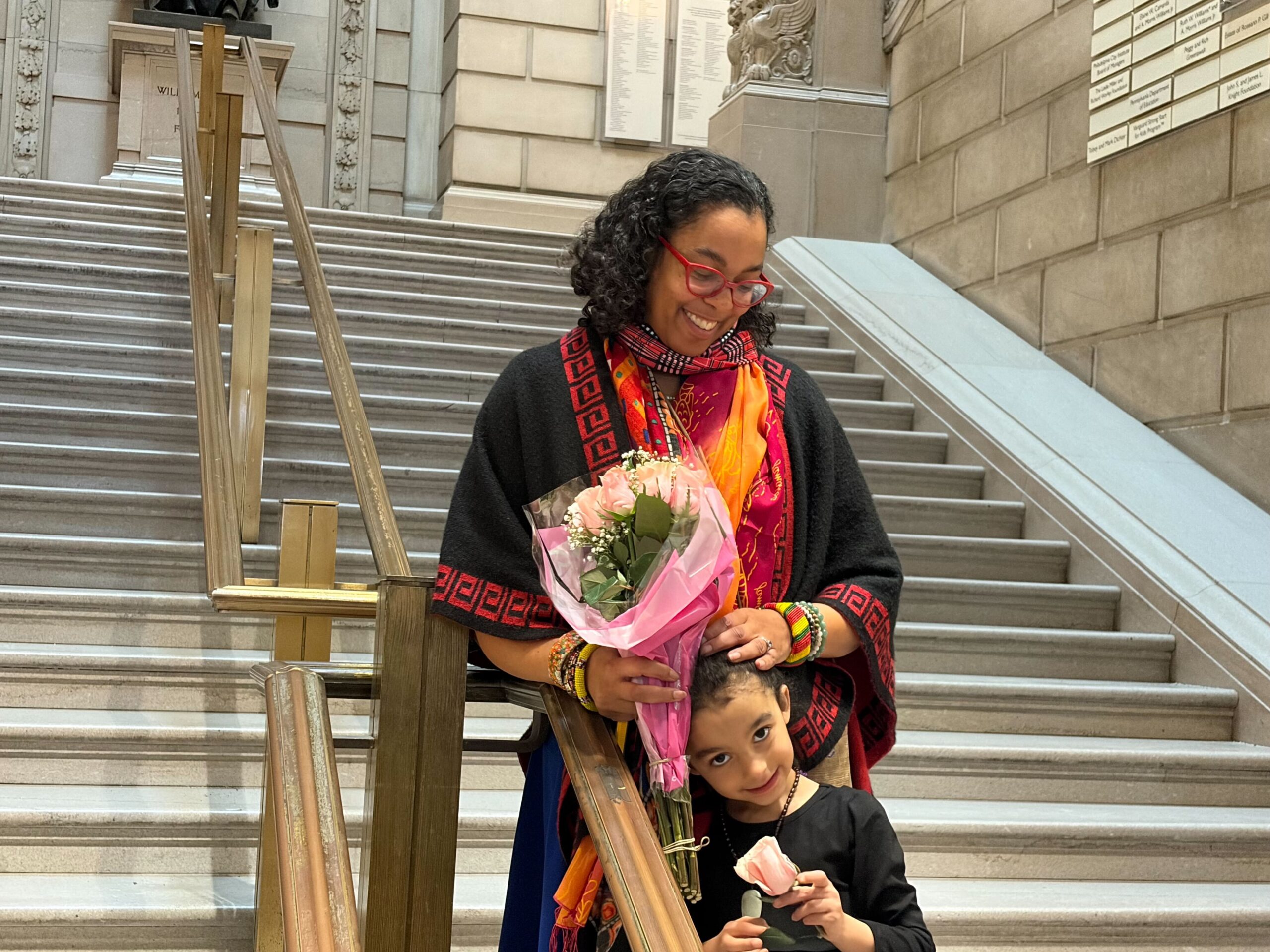
Raina León and her daughter at the Passing the Pen ceremony, in the Parkway Central Library on Saturday, Feb. 14, 2026.
Little Yenta has to be the tiniest used bookshop in Philly. And it’s certainly the only one located in the back of a 40-year-old children’s dressmaking studio.
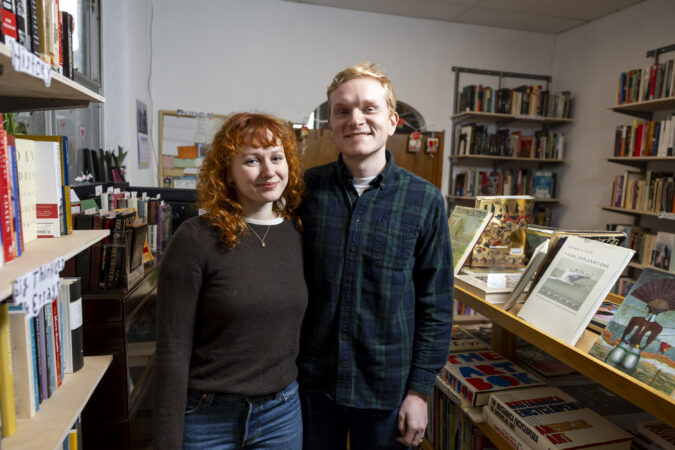
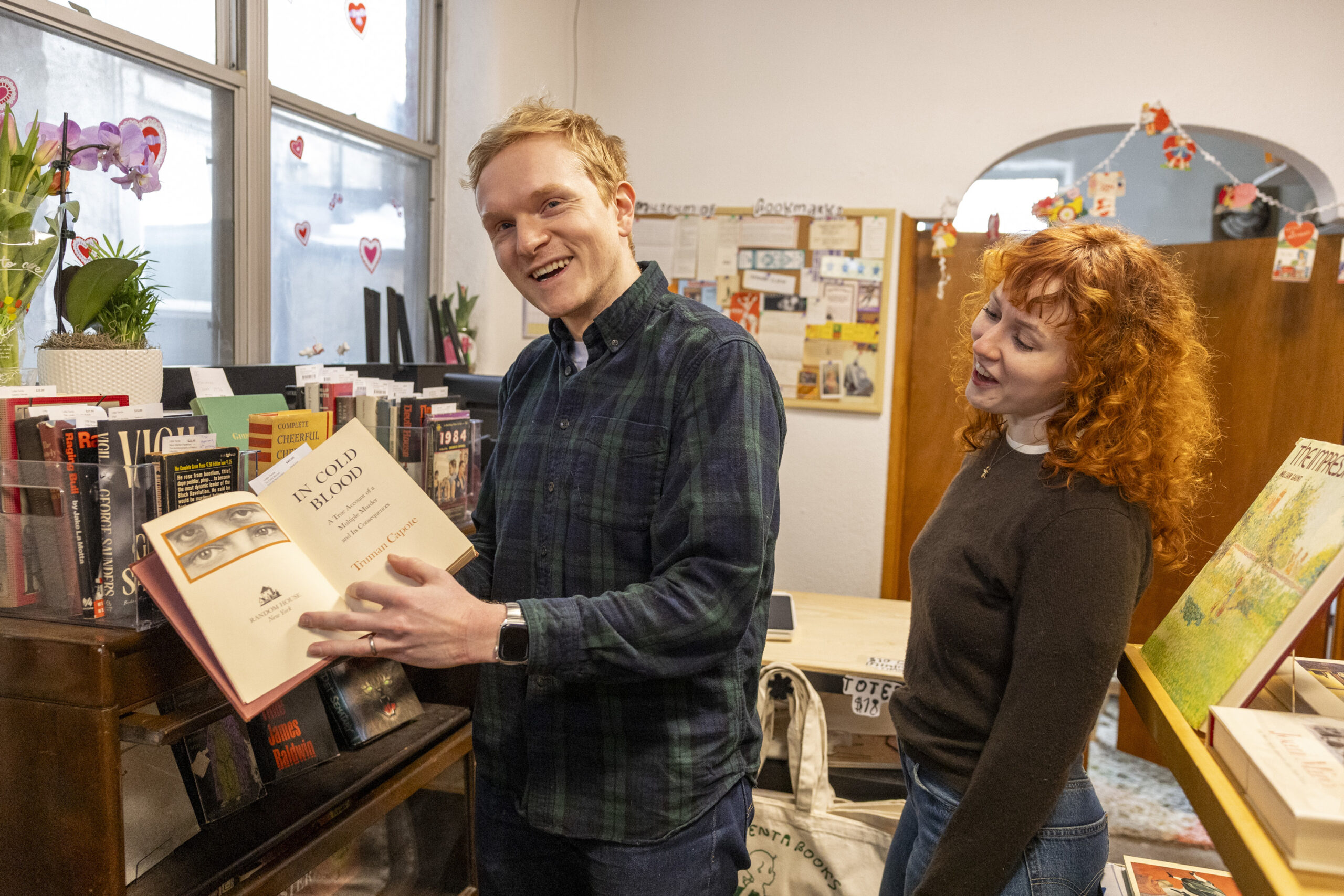
Ariel and Simon Censor, partners in life and now books, opened Little Yenta Books, their self-described “micro-bookstore,” on East Passyunk Avenue in South Philadelphia on Saturday.
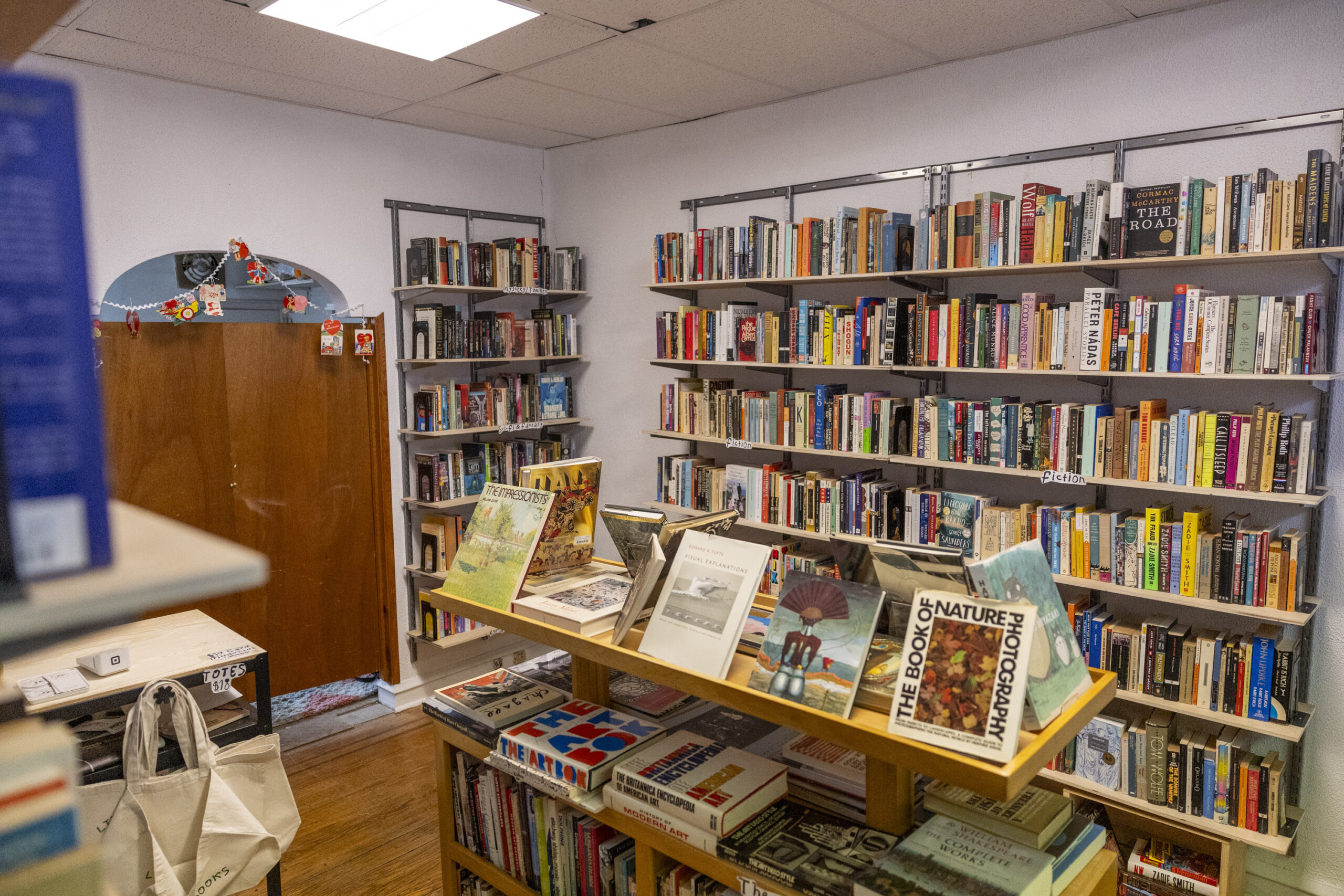
Situated, speakeasy-style, in a postage-stamp-sized loft above the Painted Lady children’s boutique, the 150-square-foot shop is nearly bursting with over 1,500 titles, including literary fiction, science fiction, poetry, history, graphic novels, plays, and first-edition classics.
Simon and Ariel Censor, owners of Little Yenta Books, showing one of their favorite books they acquired, “In Cold Blood,” a novel by Truman Capote, in their small bookshop in Philadelphia, Pa., on Friday, Feb. 13, 2026.
“We can’t be everything to everyone,” said Ariel Censor, 27, preparing the spine-packed space with her husband on a recent afternoon. “But we want to be something to most people.”
The shop is a passion project.
The Haverford College graduates have long been aficionados of used bookshops — believers in the magic of unexpectedly stumbling upon a literary treasure in a sea of cast-off paperbacks. Their South Philly rowhouse could double as a secondhand store itself, the couple jokes.
“You really couldn’t use the living room anymore,” Ariel Censor said with a laugh. “It was all books.”
Last year, they decided to host pop-up used book sales around the neighborhood, including at the popular Cartesian Brewery. It was a hit.
“We got lots of people coming and saying that they wished there was a permanent used bookstore around here,” said Ariel Censor, who works as an associate communications director at the Penn Center for Impact Philanthropy.
Molly’s Books & Records on Ninth Street in the Italian Market has long been an iconic South Philly used book spot. A Novel Idea, a popular independent bookshop, opened on East Passyunk Avenue in 2018 and mostly deals in new books.
The couple believed South Philly could handle another used book destination. Selling nearly 100 books at the brewery event, the couple decided to make their dream a reality.
Searching for a brick and mortar space they could afford — and that boasted a little South Philly charm — they found it in the back of Painted Lady. It’s in a small storefront at 1910 E. Passyunk, where dressmaker Angela D’Alonzo has made custom baby outfits for decades.
Little Yenta Books is a small bookshop in Philadelphia, Pa., on Friday, Feb. 13, 2026.
It’s a case of old South Philly meeting new South Philly. For $400 a month, she offered the couple a little loft area storage space five steps above her shop, with no heat or hot water. Warmth creeps up from the basement, explained Simon Censor, 29, who works for a real estate firm. And hot water is not a must for book buying, they added.
“Your hands are just a little cold, and that’s OK,” Ariel said.
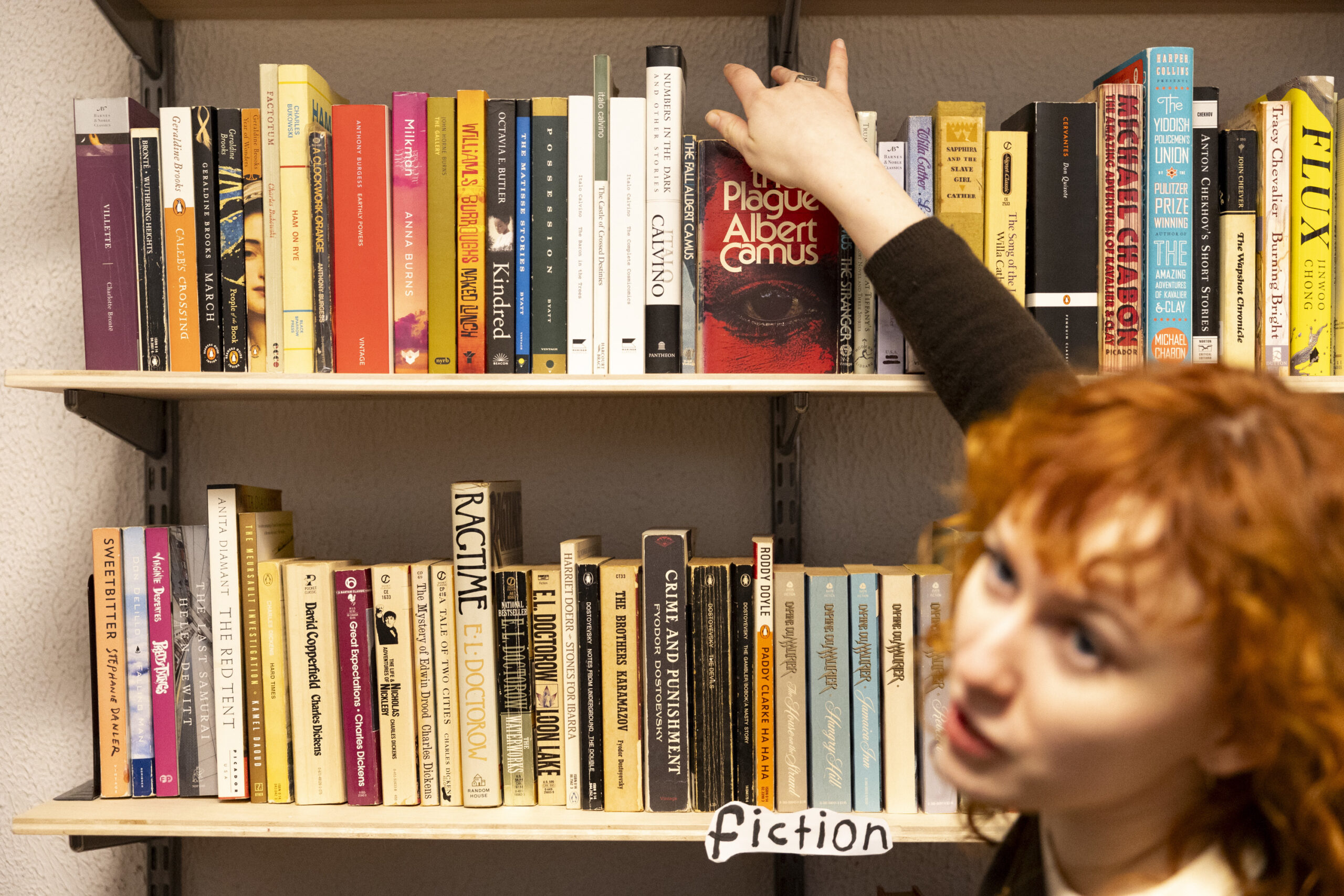
Ariel and Simon Censor have transformed the tiny space into a literary thicket, with shelves and stacks of titles from their home collections, and ones they’ve purchased from estate sales and sellers. Rare early editions and classics by Truman Capote, James Baldwin, E.L. Doctorow, Octavia Butler, and Willa Cather. Hard-to-find paperback editions of George Orwell, Albert Camus, Italian novelist Elena Ferrante, and cult favorite Charles Bukowski.
“I always want to fit more books in here,” said Ariel Censor.
Ariel Censor shows one of the books she and Simon Censor acquired, “The Plague,” by Albert Camus, in their small bookshop in Philadelphia, Pa., on Friday, Feb. 13, 2026.
On a bulletin board hang keepsakes the couple have discovered in the books, including notes, prayer cards, letters, poems, baseball cards, a high school class schedule from the 1990s, and a vintage recipe for triple chocolate cake.
“I actually want to make that someday,” said Ariel Censor.
Opened Thursdays and Fridays from 4:30 to 7 p.m., and weekends from noon to 6 p.m., the spirit of the shop is found in its name, the couple said. In American Yiddish parlance, Yenta can mean matchmaker. For Ariel and Simon Censor, that means that special feeling of playing matchmaker between a reader and a book.
“Just coming in and stumbling upon a book that you will love,” said Ariel Censor.
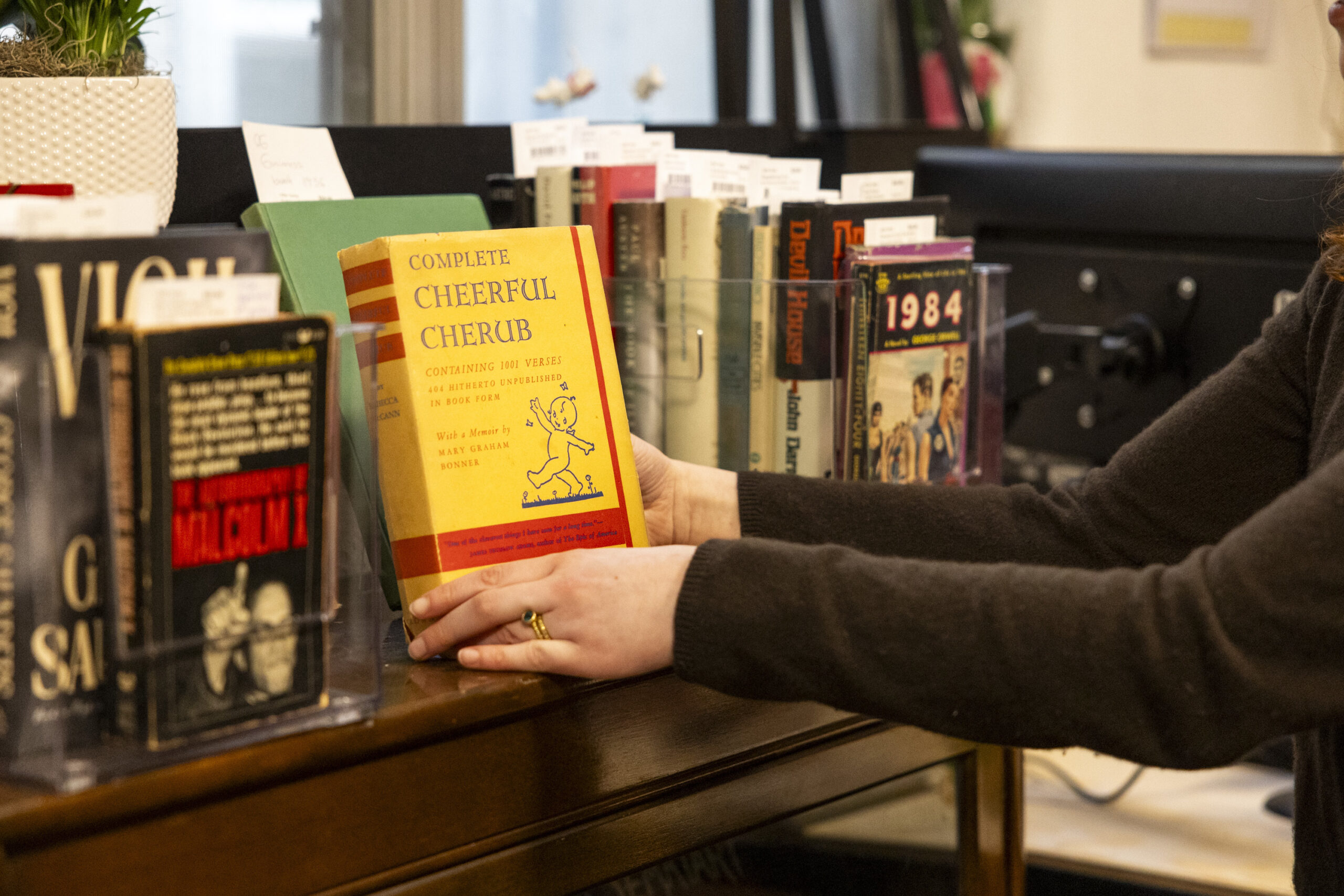
“Complete Cheerful Cherub” by Rebecca McCann is a book in Little Yenta Books in Philadelphia, Pa., on Friday, Feb. 13, 2026.
The hit Netflix series Tires is returning to the Philadelphia area, with more than a few extra dollars to spare.
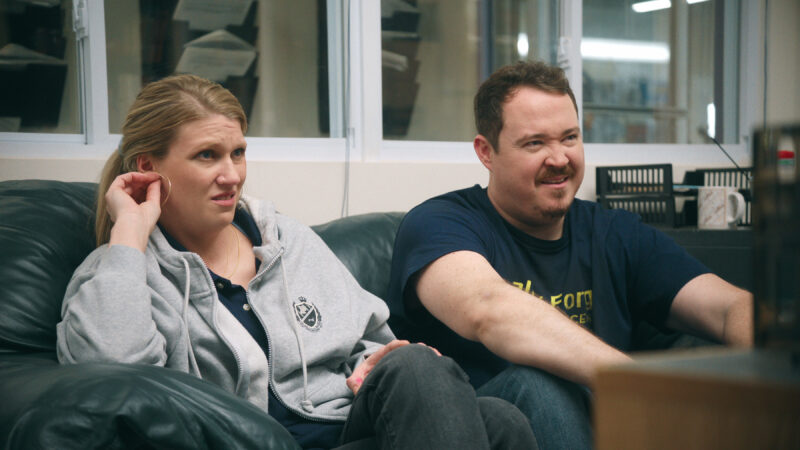
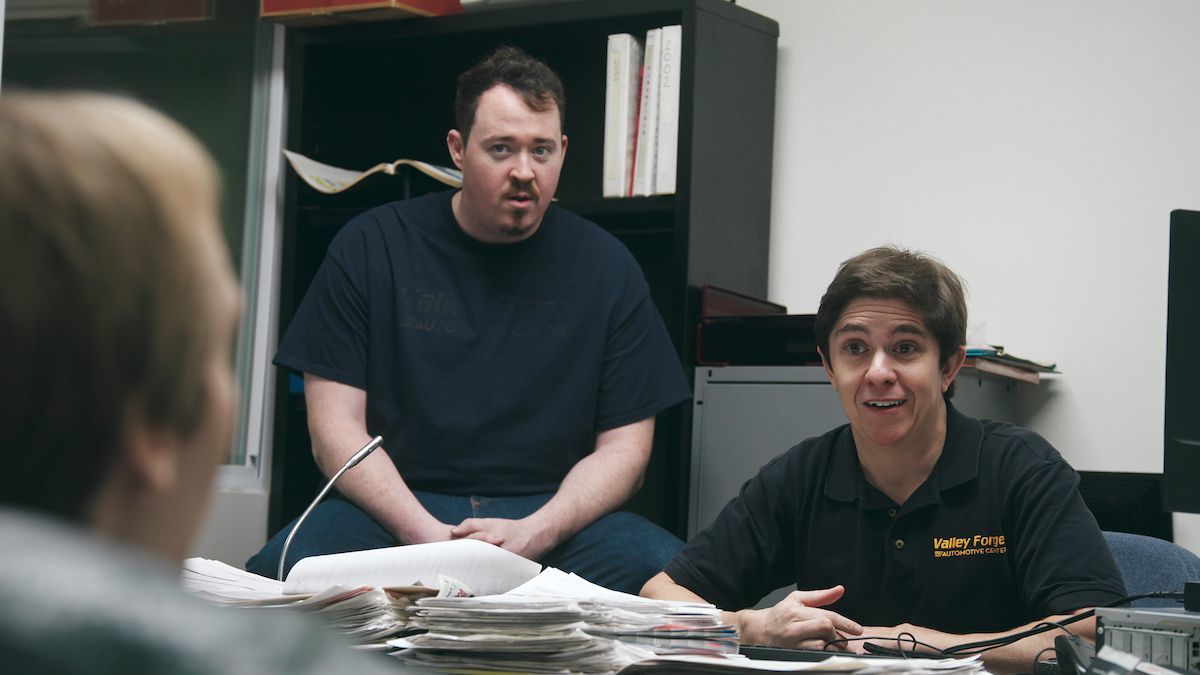
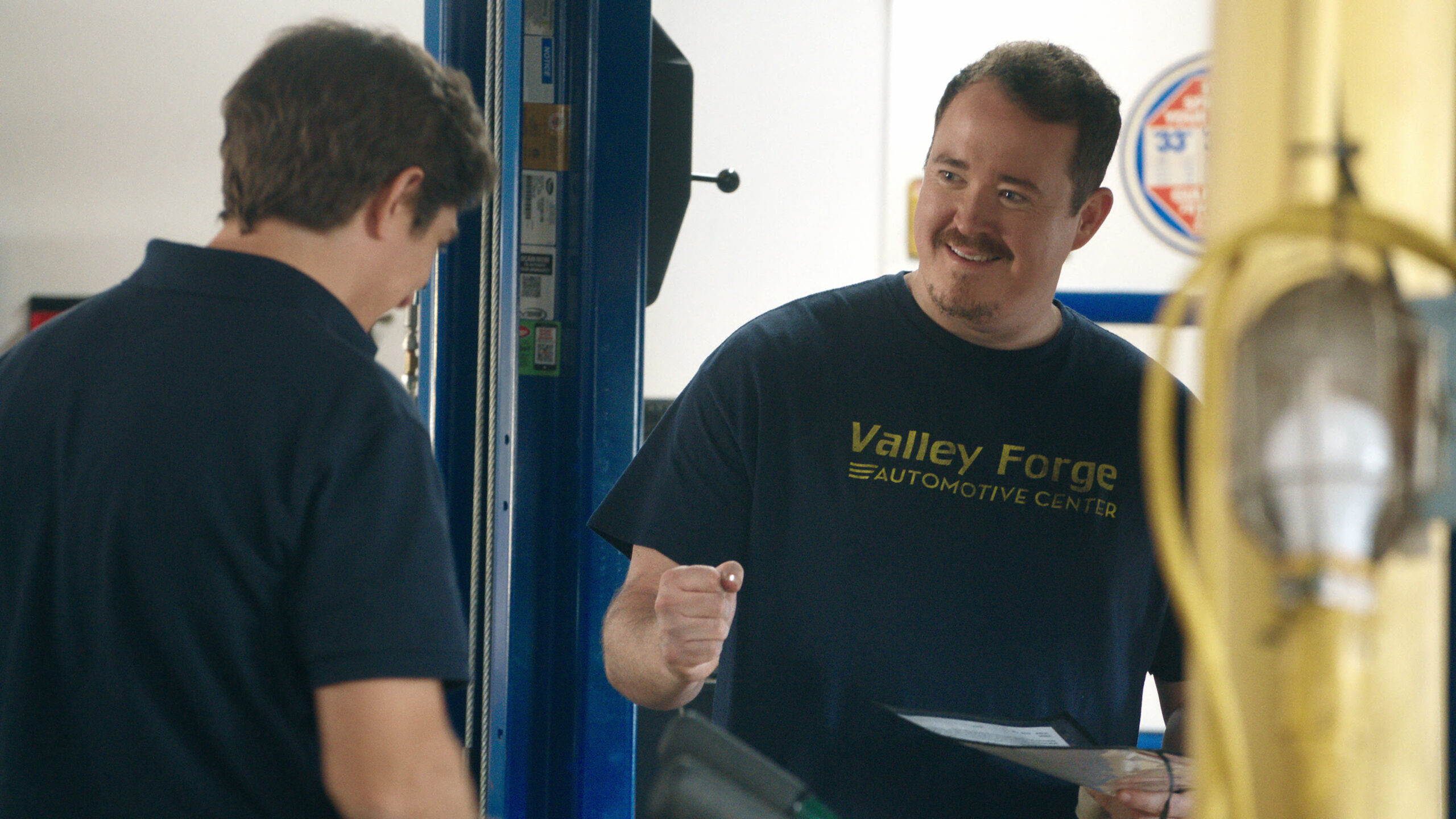
The show, starring Mechanicsburg, Pa., native and former Mantua resident comedian Shane Gillis was approved for a $6 million tax credit for its forthcoming production in the Philly region.
The tax credit was issued through the state’s Film Production Tax Credit Program, which is overseen by the Pa. Department of Community and Economic Development.
A still from Mechanicsburg native Shane Gillis’ Netflix comedy “Tires” in 2025.
The program offers a 25% to 30% tax credit to productions that spent at least 60% of their total operational budget in the state.
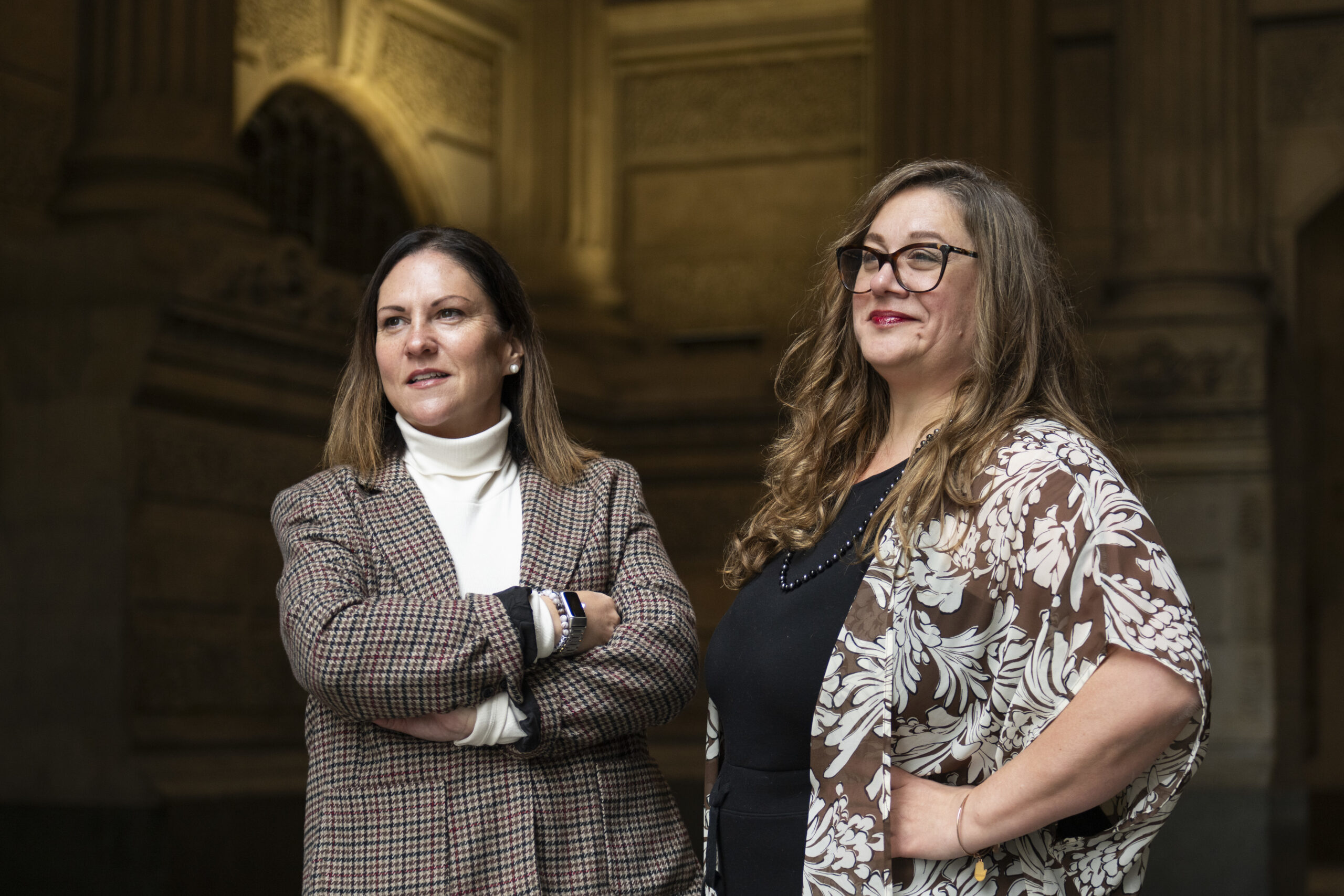
Nicole Shiner, co-executive director of the Greater Philadelphia Film Office alongside Erin Wagner, said incentives like these are vital for large-scale productions like Tires to land and remain in the region..
“The tax credit program is the primary economic development tool that allows Pennsylvania, and Philadelphia specifically, to compete nationally and internationally for projects the tax credit supports,” Shiner said.
“Film and TV production is very mobile, and production companies compare states based on infrastructure, financial competitiveness, workforce in the area, and overall reliability,” she said. “Without a strong incentive program, we simply wouldn’t be competitive in attracting major episodic TV or studio features.”
Tires, created by Gillis and his longtime collaborators Steven Gerben and John McKeever, is set and filmed in West Chester. It premiered on Netflix in May 2024 and was soon renewed for a second season. In July 2025, the show was renewed for a third season.
“When a series returns for additional seasons, that signals the area has stability,” Shiner said. “That consistency is what allows businesses and workers to grow with our industry. People can stay, create families, make plans, and pay mortgages.”
The Greater Philadelphia Film Commission co-executive directors Erin Wagner (left) and Nicole Shiner pose for a portrait outside Philadelphia’s City Hall on Wednesday, Oct. 29, 2025.
She is glad the show is shooting on location. “When you see stuff on location, it gives you a Pennsylvania authentic feel that you really can’t make up. We love that,” she said.
Pennsylvania Film Office officials expect the forthcoming production to generate an estimated $24 million to the local economy in return, including 1,709 jobs.
Based on the local film office’s projections, Shiner said the show’s economic impact could reach as much as $50 million across the region.
The estimate is based on professional services, goods, and production costs linked to shows of this magnitude. These operational costs include local cast and crew wages, equipment rentals, construction, transportation, catering, security, lodging, and other expenses, which are then injected into the regional economy.
The state film office awarded $28 million to the Pittsburgh-set and shot series Mayor of Kingstown, starring Jeremy Renner, Dianne Wiest, and Edie Falco.
Pennsylvania Film Office officials said the two productions combined are expected to inject more than $131 million into the economy in direct expenditures, creating and supporting nearly 3,500 state jobs.
Shane Gillis as Shane in the second season of “Tires.”
Since the beginning of Gov. Josh Shapiro’s administration, the state’s Film Office has approved 135 new productions through the tax credit program.
These productions are projected to inject over $1.34 billion in direct spending in over 34 counties in Pennsylvania, while supporting nearly 40,000 jobs and $505.3 million in state resident wages.
“We are sandwiched between New York and New Jersey, and the tax credit program has been increasing astronomically over the last few years,“ Shiner said. ”It’s really important that Pennsylvania pays attention to this, if we’re going to remain competitive.”
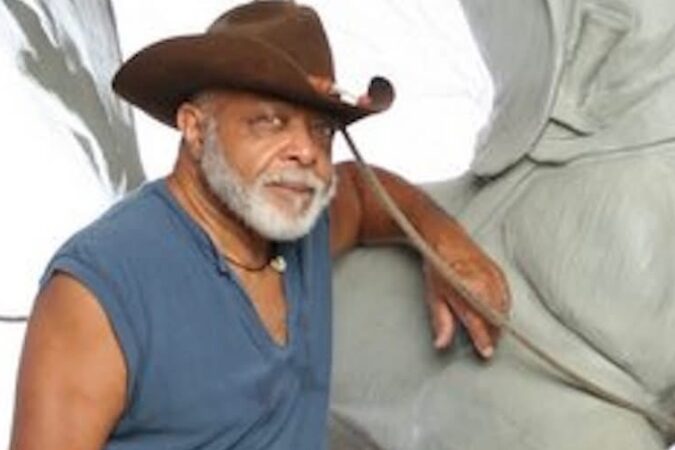
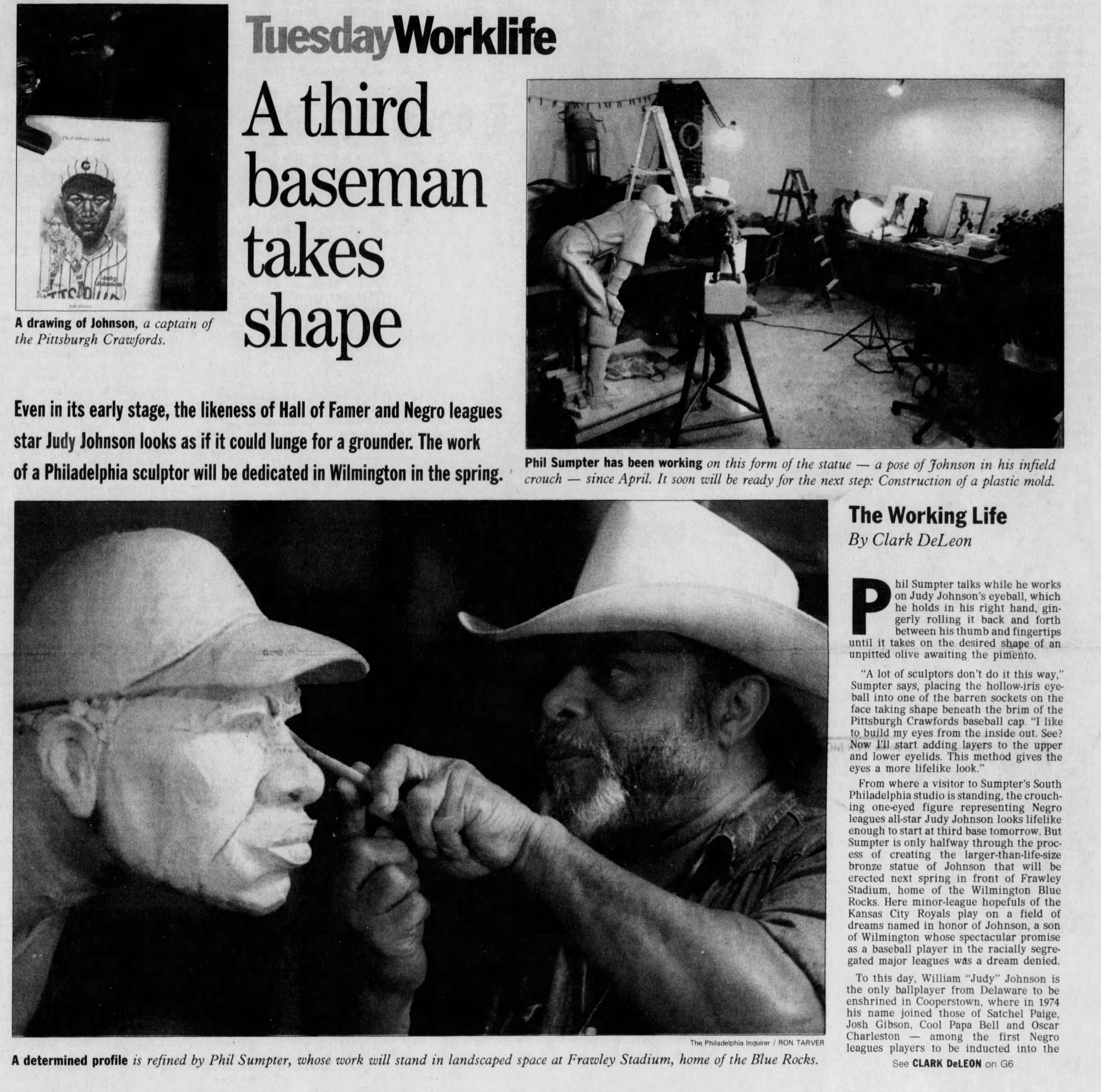
Phil Sumpter, 95, formerly of Philadelphia, celebrated sculptor, artist, art teacher, TV station art director, veteran, mentor, urban cowboy, and revered raconteur, died Thursday, Jan. 1, of age-associated decline at his home in San Juan, Puerto Rico.
A graduate of John Bartram High School and the old Philadelphia College of Art, Mr. Sumpter taught art, both its history and application, to middle and high school students in Philadelphia for 27 years. He was an engaging teacher, former students said, and a founding faculty member at the Philadelphia High School for the Creative and Performing Arts in 1978.
He started teaching in 1955 and, after a break in the 1960s and ’70s, finally retired in 1992. “You are very lucky to have a teacher in your life that believed in you, nurtured you, challenged you, and loved you,” a former student said on Facebook. “Mr. Sumpter did all that and more.”
Other former students called him their “father” and a “legend.” One said: “You did a lot of good here on earth, especially for a bunch of feral artist teenagers.”
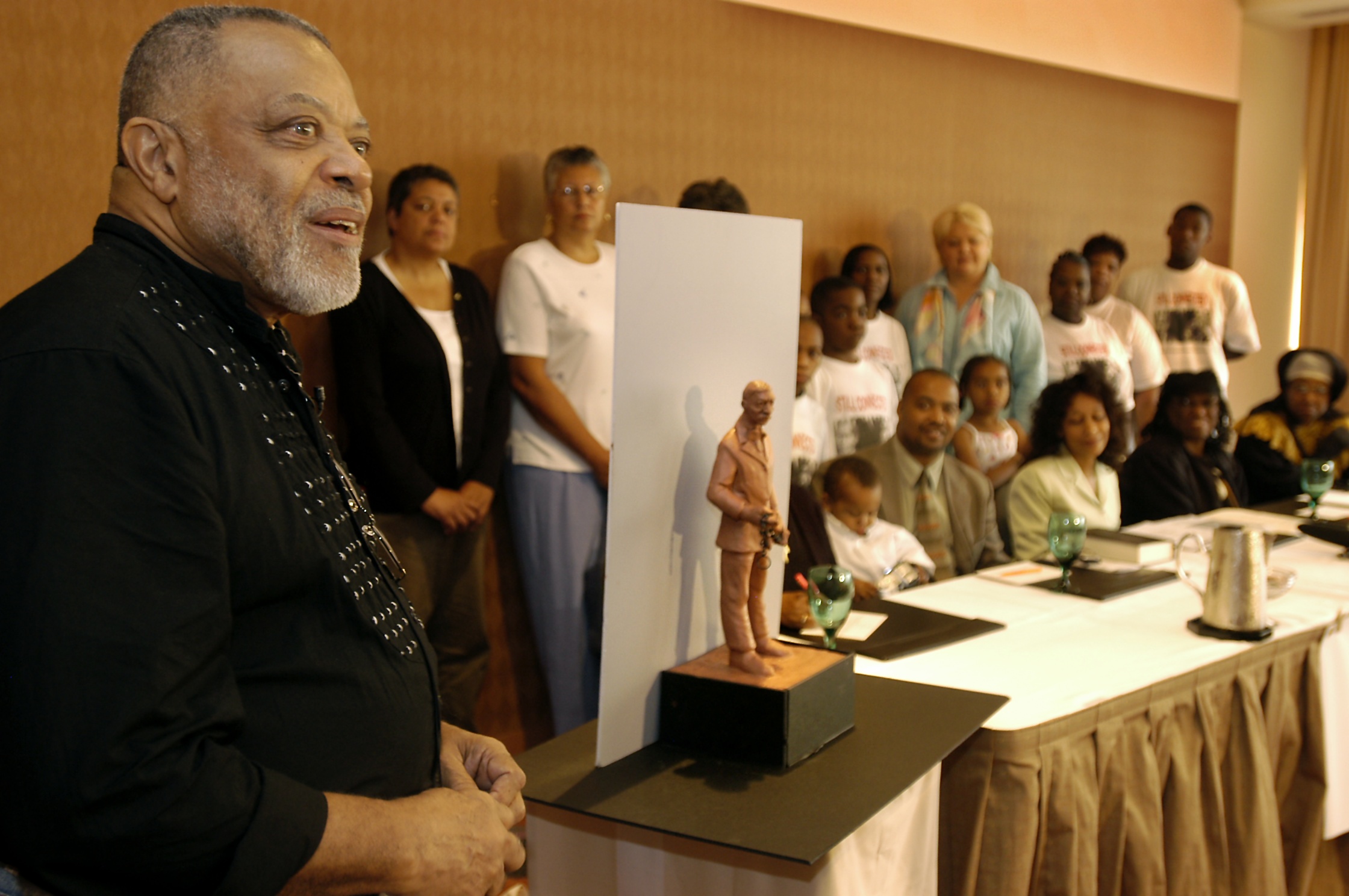
Mr. Sumpter (left) talks about his sculpture of Underground Railroad organizer William Still in 2003.
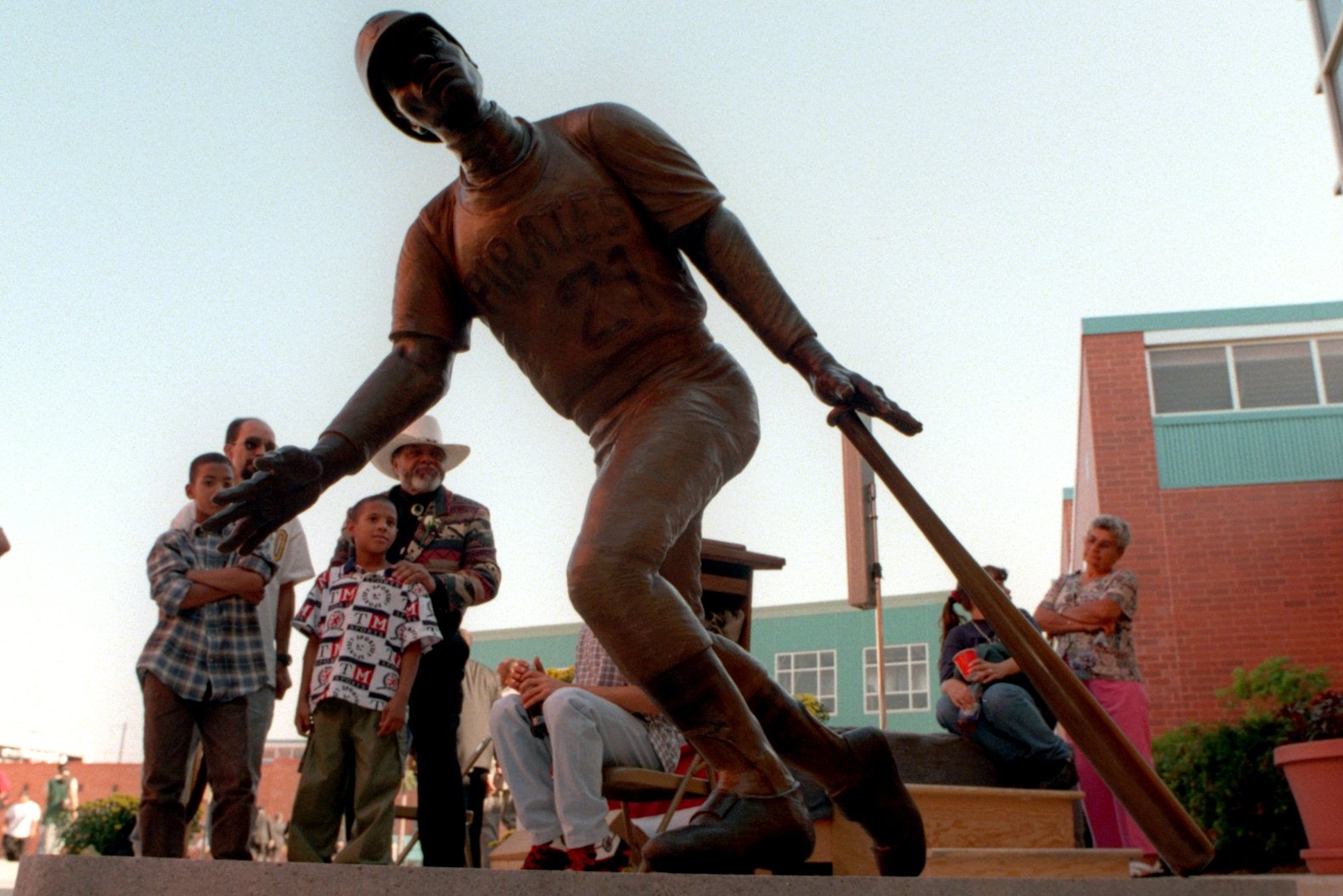
Outside the classroom, Mr. Sumpter sculpted hundreds of pieces and painted and sketched thousands of pictures in his South Philadelphia stable-turned-studio on Hicks Street. Prominent examples of his dozens of commissions and wide-ranging public art presence include the bas-relief sculpture of Black Revolutionary War soldiers at Valley Forge National Historical Park in Montgomery County, the action statue of baseball star Roberto Clemente in North Philadelphia, the Negro Leagues baseball monument in West Parkside, and the Judy Johnson and Helen Chambers statues in Wilmington.
He worked often in clay and paper, made murals, and designed commemorative coins and medals. He especially enjoyed illustrating cowboys, pirates, Puerto Rican jibaros, and landscapes.
His statue of Clemente was unveiled at Roberto Clemente Middle School in 1997, and Mr. Sumpter told The Inquirer: “I think I’ve captured a heroic image, an action figure depicting strength plus determination.”
He was among the most popular contributors to the Off the Wall Gallery at Dirty Franks bar, and his many exhibitions drew crowds and parties at the Bacchanal Gallery, the Free Library of Philadelphia, the Plastic Club, and elsewhere in the region and Puerto Rico. He hung out with other notable artists and community leaders, and collaborated on projects with his son, Philip III, and daughter, Elisabeth.
Mr. Sumpter worked often in clay and paper, made murals, and designed commemorative coins and medals.
He even marketed a homemade barbecue sauce with his wife, Carmen. His family said: “He is remembered for mentorship, cultural fluency, and presence as much as for material works.”
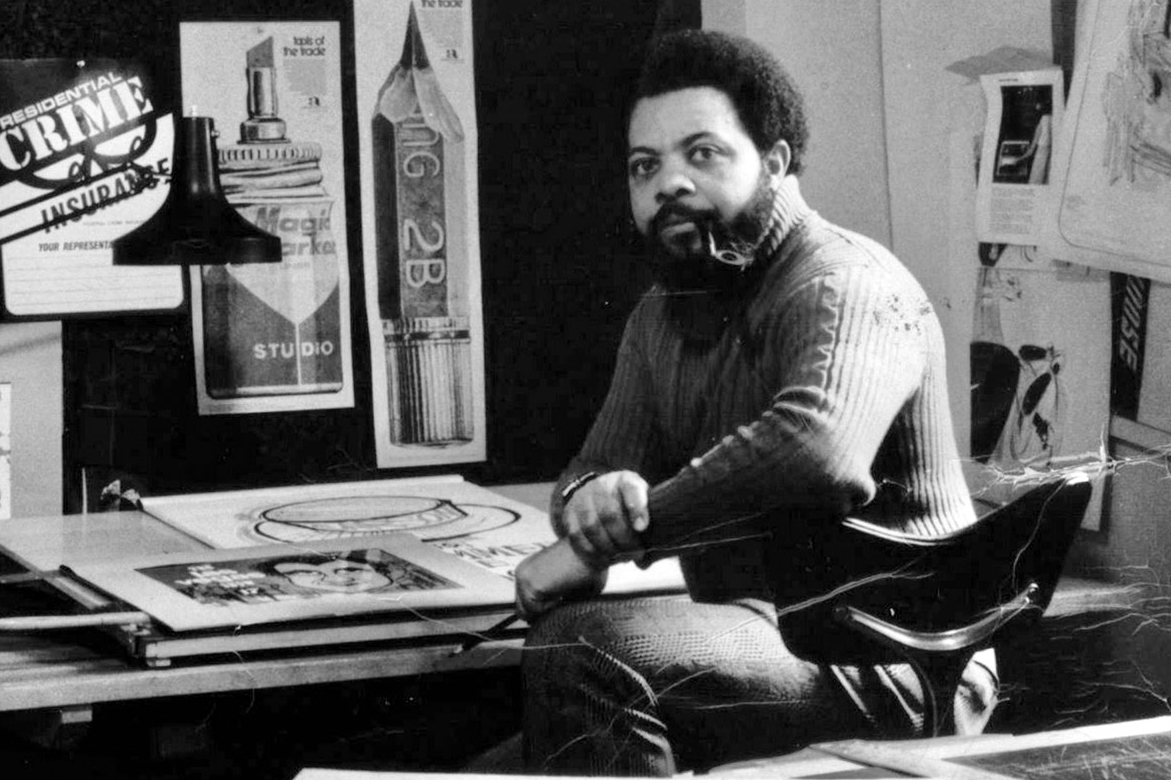
He founded Phil Sumpter Design Associates in the 1960s and worked on design and branding projects for a decade with institutions, educational organizations, and other clients. He was art director for WKBS-TV, WPHL-TV, and the Pyramid Club.
“The word for him,” his son said, “is expansive.”
Mr. Sumpter was friendly and gregarious. He became enamored with Black cowboys and Western life as a boy and went on to ride horses around town, dress daily in Western wear, and depict Black cowboys from around the world in his art. His viewpoints and exhibits were featured often in The Inquirer, the Philadelphia Tribune, Philadelphia Magazine, Dosage Magazine, and other publications.
Mr. Sumpter (in white cowboy hat) views his statue of Roberto Clemente in 1997.
He was an air observer for the Air Force during the Korean War and later, while stationed in England, studied sculpture, ceramics, and drawing at Cambridge Technical Institute. His daughter said: “He taught me how to open the portal to the infinite multiverse of my own imagination, where every mind, every soul can be free.”
Philip Harold Sumpter Jr. was born March 12, 1930, in Erie. His family moved to segregated West Philadelphia when he was young, and he earned a bachelor’s degree in art education at PCA.
He married and divorced when he was young, and then married Florence Reasner. They had a son, Philip III, and a daughter, Elisabeth, and lived in Abington. They divorced later, and he moved to Hicks Street in South Philadelphia.
He met Carmen Guzman in Philadelphia, and they married in 2001 and moved to San Juan for good in 2003. He built a studio at his new home and never really retired from creating.
Mr. Sumpter (second from left) enjoyed time with his family.
Mr. Sumpter enjoyed singing, road trips to visit family in Pittsburgh, and bomba dancing in San Juan. He was a creative cook, and what he called his “trail chili” won cook-offs and many admirers.
“He was a larger-than-life person,” his son said. “He was fearless in his frontier spirit.” His wife said: “His joy for life was contagious, as was his laughter.”
In addition to his wife, children, and former wife, Mr. Sumpter is survived by other relatives.
A celebration of his life was held earlier in Puerto Rico. Celebrations in Philadelphia are to be from 2 to 5 p.m. Saturday, March 14, at Dirty Franks, 347 S. 13th St., Philadelphia,Pa. 19107, and from 2:30 to 4:30 p.m. Sunday, March 15, at the Plastic Club, 247 S. Camac St., Philadelphia, Pa. 19107.
Mr. Sumpter’s work was featured in The Inquirer in 1994.
South Jersey native Jordan Gershowitz is no stranger to the bright lights.
In fifth grade, he wrote, cast, and directed his first musical at WestamptonMiddle School. Named Trial of Treason, the play was a “loose” retelling of the Revolutionary War, with the kind of sci-fi elements only true ’90s kids will appreciate.
Gershowitz’s story starred two characters whobuild a machine to travel back to the time American traitor Benedict Arnold was court-martialed for abusing military power. Gershowitz gave his actors ketchup packets to smear on their shirts to act out battle scenes.
“I don’t remember how we split up the viewing audience, but it was definitely a one-day-only production,” he joked.
South Jersey Jordan Gershowitz is the story editor and co-developer of Netflix’s new kids series “Hot Wheels Let’s Race.” The show premiered on March 4, 2024.
Years later, Gershowitz became the bassist for the neon pop-rock band Rushmore. They opened for the likes of the Plain White-Ts and Justin Bieber, and were nominated for best breakout artist at the 2009 MTV Video Music Awards.
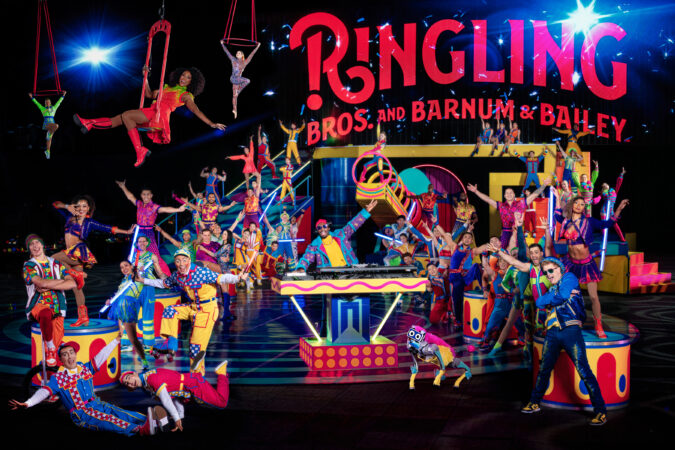
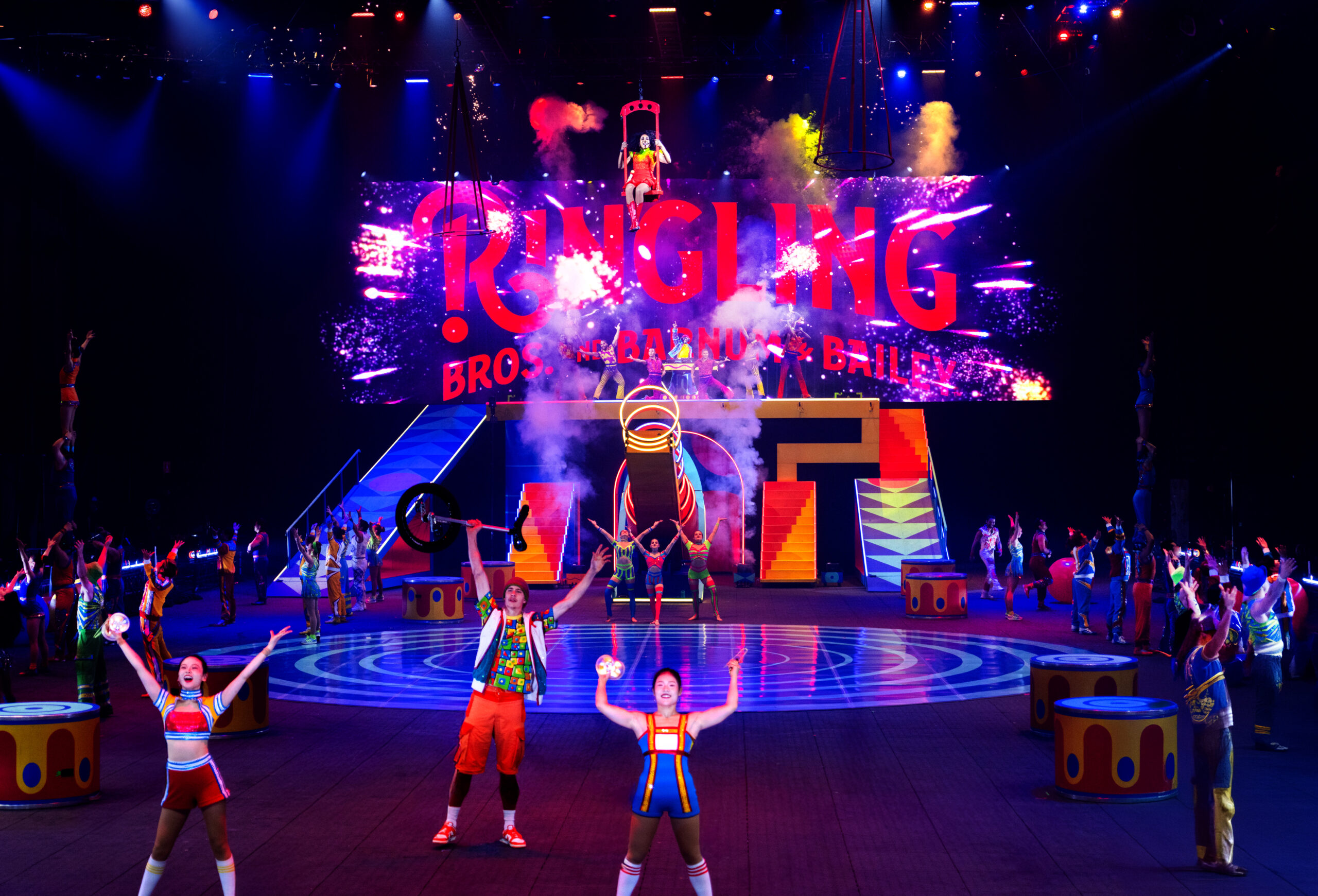
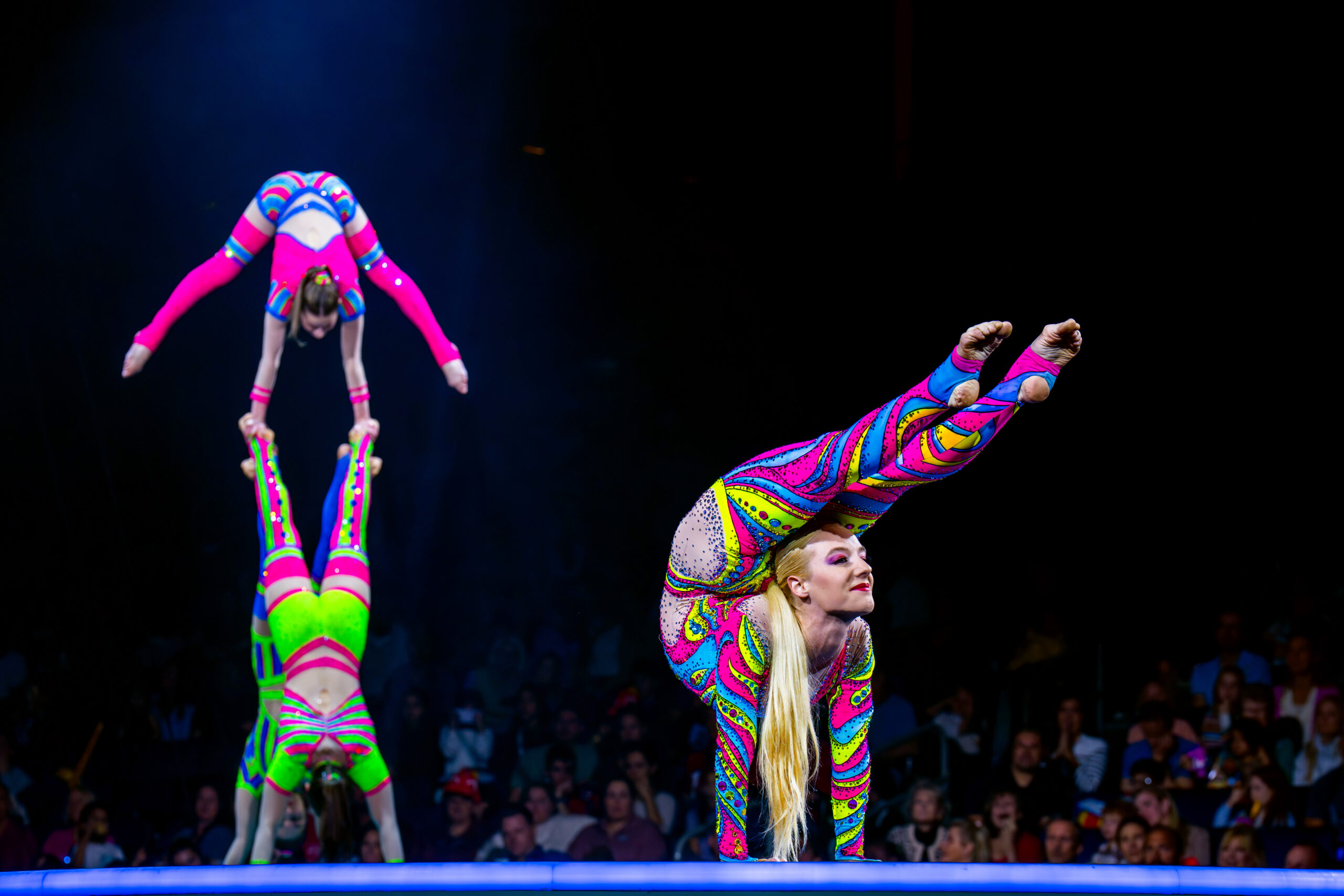
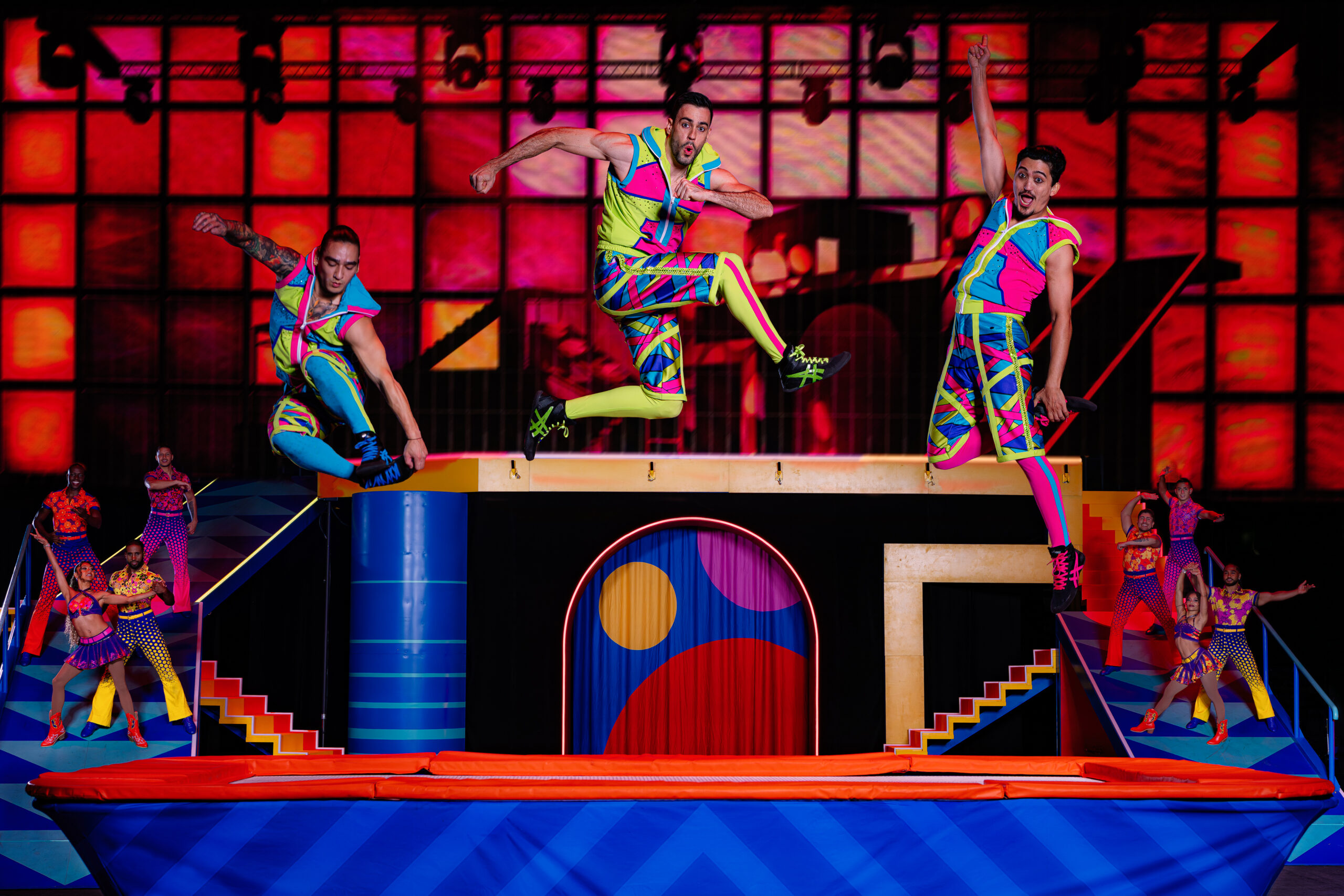
The iconic traveling circus, billed as “The Greatest Show on Earth,” opens at Xfinity Mobile Arena on Friday. All eight shows will feature dancing acrobats, nimble trapeze artists, and Skylar “the human rocket” Miser, among other performers.
Gershowitz, who has previously written forNetflix’s Hot Wheels Let’s Race, Sharkdog, The Snoopy Show, and other shows, penned the script for the 148th edition of the longest-running circus in American history.
Gershowitz has written all the dialogue for the show guides and characters, including the robo-puppy named Bailey Circuit, and sequenced all the performing acts to establish the overall vibe of the show.
“Ringling Bros. is like the gold standard of family entertainment,” he said. “It was a fantastic opportunity to be a part of it.”
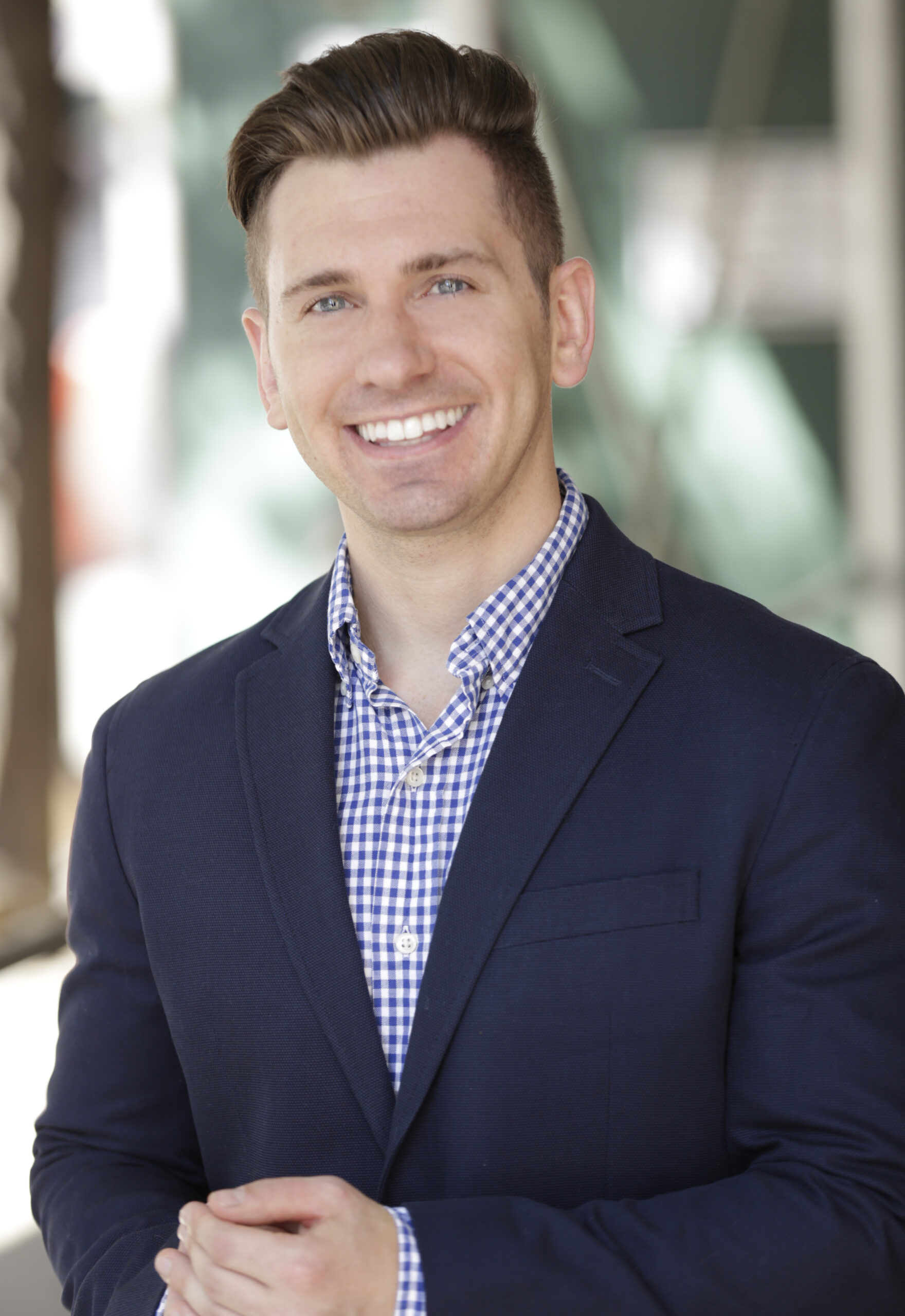
The man behind the newest rendition of Ringling Bros. is South Jersey native Jordan Gershowitz. The iconic touring circus opens at the Xfinity Mobile Arena on Friday. The show runs through Feb. 16.
None of his previous writing credits transported him back to childhood in the same way as Ringling Bros., he said.
“Ringling is just one of those rare American institutions that I think everyone has a personal memory of,” Gershowitz said. “And for me, it wasn’t just an opportunity to write a circus. It was a really compelling opportunity, and something the entire team was mindful of as we went into this.”
Before starting the writing process a year ago, he remembered the days he attended Ringling Bros. circuses growing up in Westampton. With his parents, he marveled at the gravity-defying stunts and masterful crowd interactions performed by artists from all corners of the world.
“I really loved the spectacle of it. Being a kid in the early ’90s, at least in South Jersey, you had to make a lot of your own fun,” Gershowitz said. “So, getting to go to a really big communal experience like Ringling Bros. was just eye-opening.”
The man behind the newest rendition of Ringling Bros. is South Jersey native Jordan Gershowitz. The iconic touring circus opens at the Xfinity Mobile Arena on Friday. The show runs through Feb. 16.
With a project as historic as Ringling Bros., Gershowitz said the challenge was reimagining the circus for modern audiences.
“I didn’t approach it necessarily trying to replace what came before,” he said. “I tried to look at what made it meaningful in the first place to so many people, and then worked with director Michael Schwandt to look at what does that mean for a new generation with social media and TikTok clips.”
Gershowitz lined up a series of electrifying acts back-to-back, making audiences question which direction the show would go next. He also incorporated more audience engagement, ensuring it felt more like the “Greatest Party on Earth” than a standard circus act.
The goal, he said, is to keep people off their cellphones and to fully immerse them into the music, the movements, and visual art illuminating the show’s 60-foot screen.
“You’re weaving all these amazing acts together, so you’re always thinking about pacing, emotion, and how each moment flows into the next,” he said. “It’s a really unique puzzle that you don’t get in other formats, so hopefully the audience is coming away feeling energized and connected.”
The man behind the newest rendition of Ringling Bros. is South Jersey native Jordan Gershowitz. The iconic touring circus opens at the Xfinity Mobile Arena on Friday. The show runs through Feb. 16.
Gershowitz’s script has transformed the circus into a more-interactive and “fun-filled” experience for generations of crowd-goers to enjoy, said Ringling Bros. DJ Lucky Malatsi.
“He made sure that we were able to connect with the audience, not only with the slang, but with all the conversation pieces,“ Malatsi said. ”It’s not your traditional, ‘Welcome to the circus.’ It’s more, ‘Come vibe with us. We’re having a party.’”
Since the tour opened Jan. 2, Gershowitz has enjoyed seeing audiences react to his work in real-time. He still loves writing for TV, but he said there’s nothing like seeing an arena filled with families cheering and dancing to a show like the Ringling Bros.
“When you’re writing for television, it takes a really long time for the audience to watch. Watching TV is also very solitary,” he said. “But the cool thing about Ringling, you’re watching the show along with the audience, and you can feel the energy.”
The man behind the newest rendition of Ringling Bros. is South Jersey native Jordan Gershowitz. The iconic touring circus opens at the Xfinity Mobile Arena on Friday. The show runs through Feb. 16.
Their reactions remind him of his own as a young circus fan, which later inspired his own performances in school plays and at music venues as one-fifth of Rushmore.
With the production’s Philly tour stop, he hopes to forge similar memories for young crowd-goers, and remind longtime circus fans of the magic that first struck them in their youth.
“Ideally, everyone is going to leave post-show talking to each other about what they saw and how it made them feel,” he said. “[Ringling] opened my eyes to larger possibilities, so hopefully it does the same for kids in the area. Whether they’re a future performer, or they start to see the world is much larger than their neighborhood.”
The Ringling Bros. tour stop runs through Feb. 16, Xfinity Mobile Arena, 3601 S. Broad St., Phila. Tickets at ringling.com.
When we first meet Bok High graduate Ozzie Phillips — one of three protagonists in Sadeqa Johnson’s latest novel, Keeper of Lost Children — a block party on South Philadelphia’s Ringgold Street is just winding down. In between the last dollops of creamy potato salad and sips of clear corn liquor, Ozzie’s friends and family wish the young serviceman a bon voyage.
He spends the last few weeks with his girlfriend, Rita, picnicking at the Lakes in FDR Park and walking through Center City department stores like Wanamaker’s and Strawbridge’s. One night the couple go to Ridge Avenue’s Pearl Theater to see Pearl Bailey perform.
The next morning, Ozzie’s Uncle Millard picks him up in a Vagabond-blue Oldsmobile and the two cruise down Broad Street, Count Basie tunes playing on WHAT AM. Uncle Millard circles City Hall, depositing Ozzie at Reading Terminal Station, where he hops on a train to Trenton’s Fort Dix Army Base before embarking on a steam boat to Germany.
It’s Ozzie’s time in Germany that fuels the plot of the sentimental historical novel.
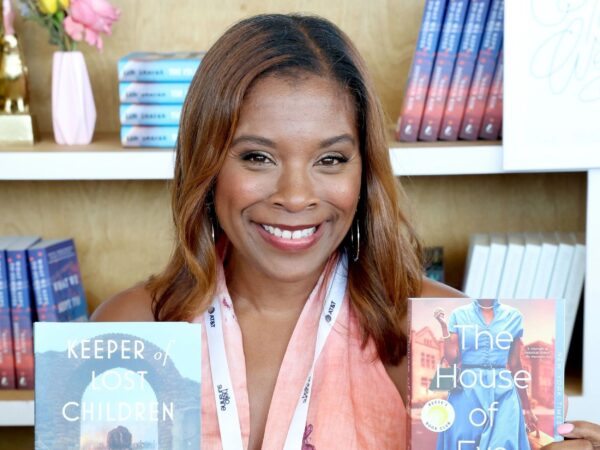
“It’s such a joy for me to write the Philly scenes,” Johnson said, during a recent video chat. The book publicist turned New York Times best-selling author was born in South Philadelphia, grew up in North, and graduated from George Washington Carver High School of Engineering and Science. Today, the married mom of three writes from her home in Virginia, right outside Richmond.
“I left Philly when I went to Marymount Manhattan College in New York,” Johnson said. “But where you grow up is always in your DNA. Philly is in my soul. When I sit down and paint pictures of historical moments in Philadelphia, I get to go home.”
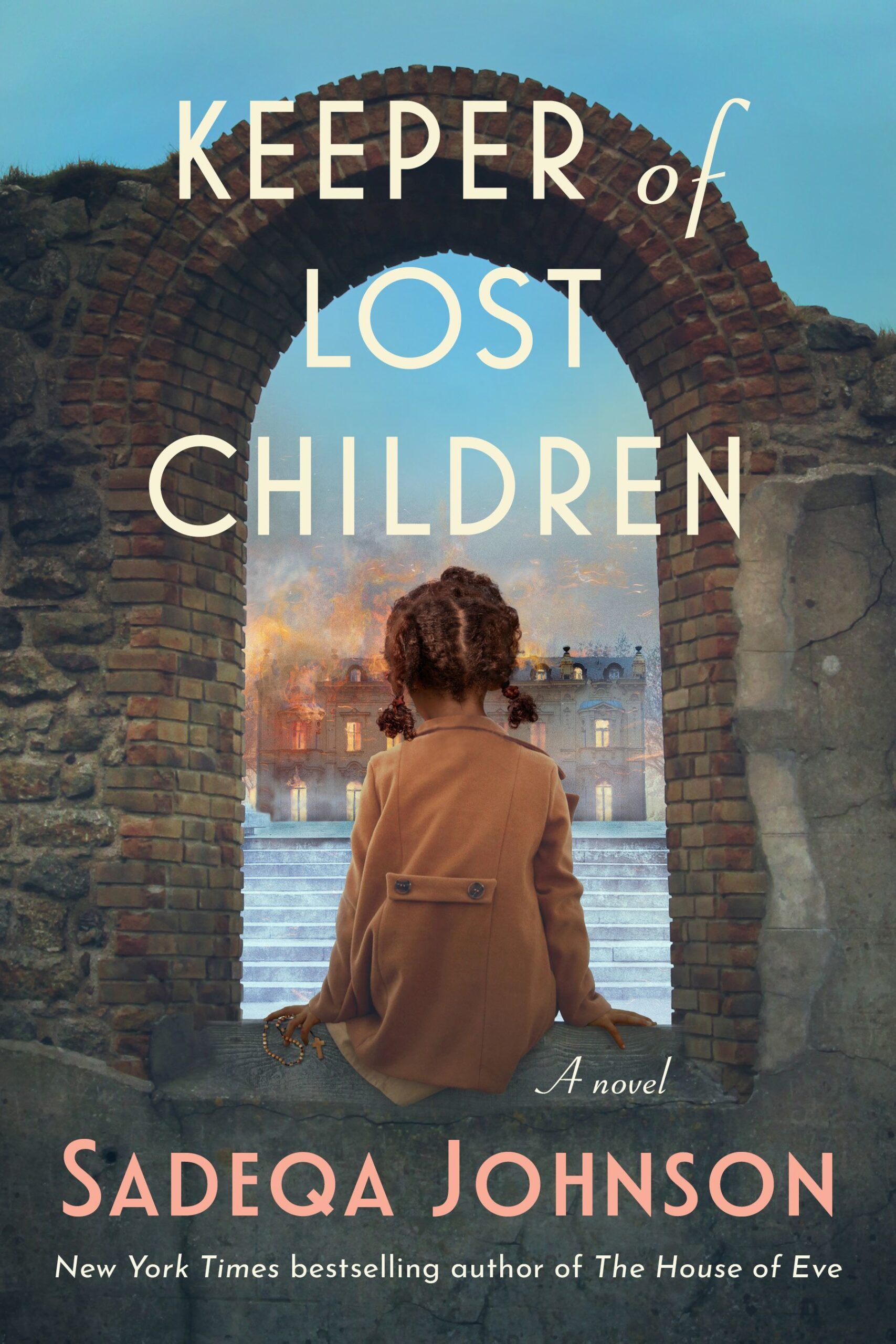
Cover art for Sadeqa Johnson’s 2026 novel, “Keeper of Lost Children” One of the main characters, Ozzie Ozbourne grew up in 1940s South Philadelphia.
Johnson has six books out in the world. She self-published her first,Love in a Carry-On Bag, in 2012.
Her books center young Black women in old-school and modern times trying to do the best with what they got. But in most of her works — especially the captivating historical fiction novels through which she’s made a name for herself on BookTok, podcasts, and traditional bestseller lists — her heroines face overwhelming odds.
Take theYellow Wife’s Pheby Delores Brown. Set in antebellum Virginia, Brown’s story is based on the harrowing real-life experience of enslaved woman Mary Lumpkin, who is forced into a relationship with her enslaver for whom she bears five children.
“I have this propensity to tell the story of young women 15, 16, 17, who are in a situation that feels insurmountable,” said Johnson, who, until 2023, taught creative writing in Drexel University’s master’s of fine arts program. “And I really love developing those stories that show how those young women get to the other side.”
The House of Eve, a 2023 New York Times bestseller and a Reese Witherspoon Book Club of the Month pick centers 1950s North Philadelphia teen Ruby Pearsall who falls in love with a Jewish boy whose family runs a corner store. In the book, Ruby must choose between a free ride to Cheyney University and motherhood.
“I love the research,” Johnson said. “I love learning interesting things about this city that I was brought up in.”
In Keeper — released this month by 37 INK, a division of Simon & Schuster — Ethel Gathers, a journalist and wife of an Army officer, also stationed in post World War II Germany, is the central character. There, she chances upon a group of multiracial children who she learns are the offspring of Black servicemen and German women.
Gathers, whose story is based on the life of journalist Mabel Grammer, adopts eight of the “Brown Babies” and starts an adoption agency, ultimately placing hundreds of the children with Black families in the United States. In the book, Grammer visits Philadelphia from her Washington home and books a room at the Divine Lorraine, the country’s first fully racially integrated hotel.
“I stumbled upon Ms. Grammer while researching The House of Eve,” Johnson said.“And in that moment, I knew I wanted to tell that story.”
Johnson breathes life into her fictional characters through extensive research, adding vivid details that take the readers back in time and thrust them into the rich tapestry of her story. Fans will often find connections to characters from previous books where they least expect it.
Ozzie’s military time and South Philly swag is based on Johnson’s great-uncle, 94-year-old Edgar Murray, who, like Ozzie, grew up in South Philly and spent the latter part of the 1940s in Germany. (For the record, Johnson said, her uncle didn’t suffer with alcoholism like Ozzie does in the book.)
It was Murray who suggested Ozzie live on Ringgold Street and take his date to the Pearl Theater.
“I like the factual things she puts in there,” said Murray, who lives with family in Denver, Colo. “It makes it more interesting.”
Philadelphia readers with an eye for history will enjoy seeing the city unfold through Ozzie’s eyes after his 1952 return.
He leafs through The Philadelphia Inquirer, reading detailed accounts of white veterans securing “large mortgages and moving out to lofty suburbs” on the GI bill that he too applied for. He works a job at the Navy Yard, gets married at Tasker Baptist Church, and experiences a miracle at West Philly’s Mercy-Douglass Hospital.
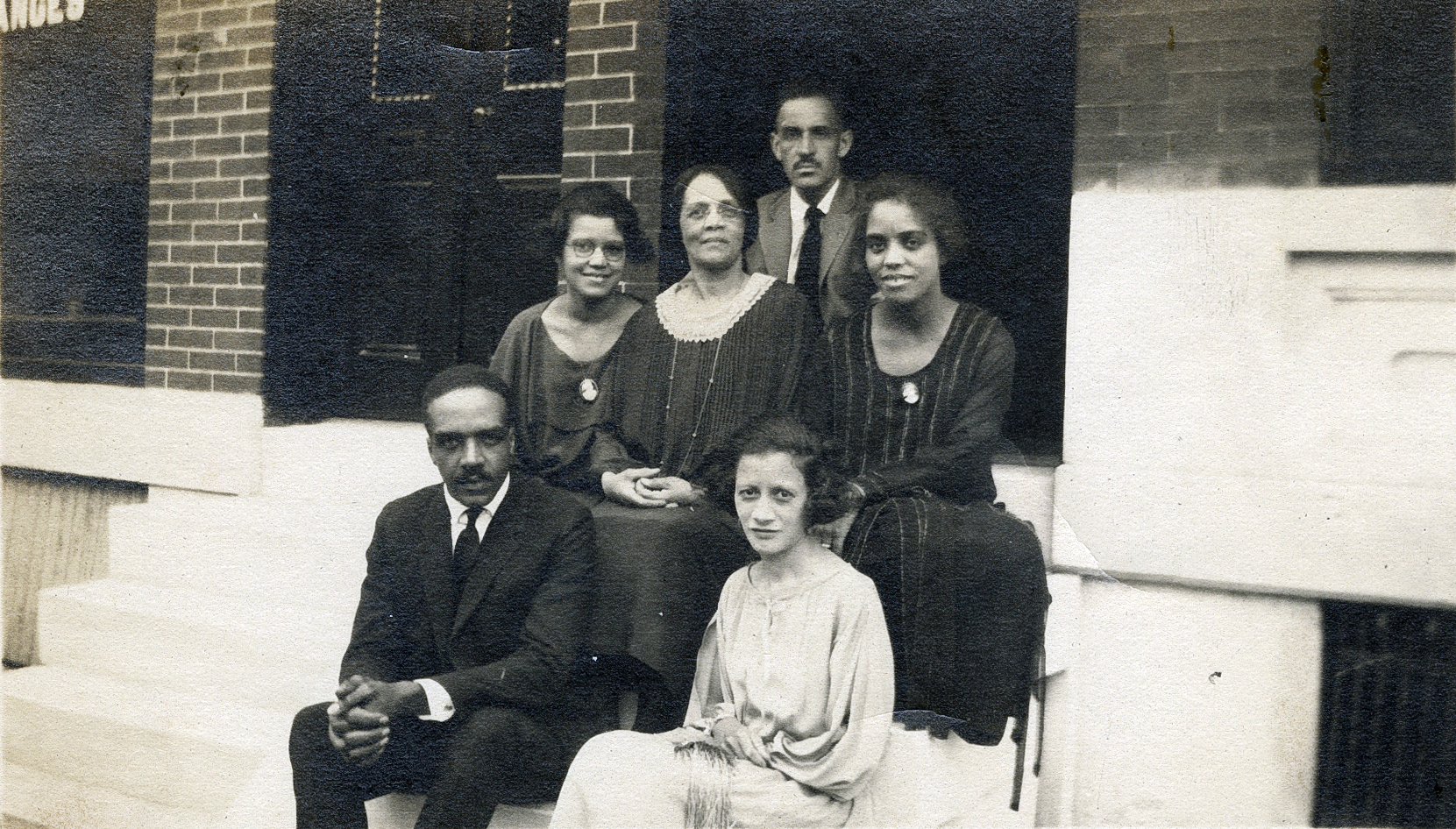
Tanner family members gather on the front steps of the Tanner House, at 2908 W. Diamond St. in Philadelphia, in this photo taken circa 1920. They are: Bottom row (l-r) Aaron A. Mossell Jr., and his wife, Jeanette Gaines Mossell; Middle row (l-r): Sadie T. M. Alexander, her mother, Mary L. Tanner Mossell, and Sadie’s sister, Elizabeth Mossell Anderson. Top row: Page Anderson, Elizabeth Anderson’s husband.
Halfway through Keepers, Ozzie attends a party thrown by elite Civil Rights husband-and-wife-team Raymond Pace Alexander and Sadie Tanner Mossell Alexander at their swanky home at 17th and Jefferson.
Attorneys John Francis Williams and Lewis Tanner Moore Sr., cofounder of the Pyramid Club and whose son, art collector Lewis Tanner Moore Jr. died in 2024 — shoot the breeze about an NAACP fundraiser and Buddy Powell, a 1940s jazz musician who was so severely beaten by the Philadelphia railroad police that he ended up in an asylum.
“In The House of Eve, I got to dig around in my mom’s memory for Ruby,” Johnson said. “This time around I got to dig around in my dad and Uncle Edgar’s head to get South Philly down. Let’s see what happens in the next book.”
Sadeqa Johnson will give an author’s talk at the Philadelphia Ethical Society, 1906 Rittenhouse Square, Friday, Feb. 13, 6:30 p.m. to 7:30 p.m. Tickets are $35 and include a copy of “Keeper of Lost Children”
Throughout basketball history, few players have been as transformative a talent and cultural figure as NBA Hall of Famer Julius Erving.
Footage of the former Philadelphia 76er’s thunderous dunks, stylish finger rolls, and suave demeanor off the court still draw applause from basketball fans, decades after his 1987 retirement. The iconic forward is still championed by Sixers fans for bringing the city an NBA title in 1983.
It was in Philly where Erving embraced one of the world’s most impassioned fan bases and learned of the phrase, “You owe us one,” after falling short in the NBA finals three times between 1977 and 1982.
“I was like, ‘What the hell does that mean?’” he said to The Inquirer. “I was getting pissed. I was not happy with the situation.”
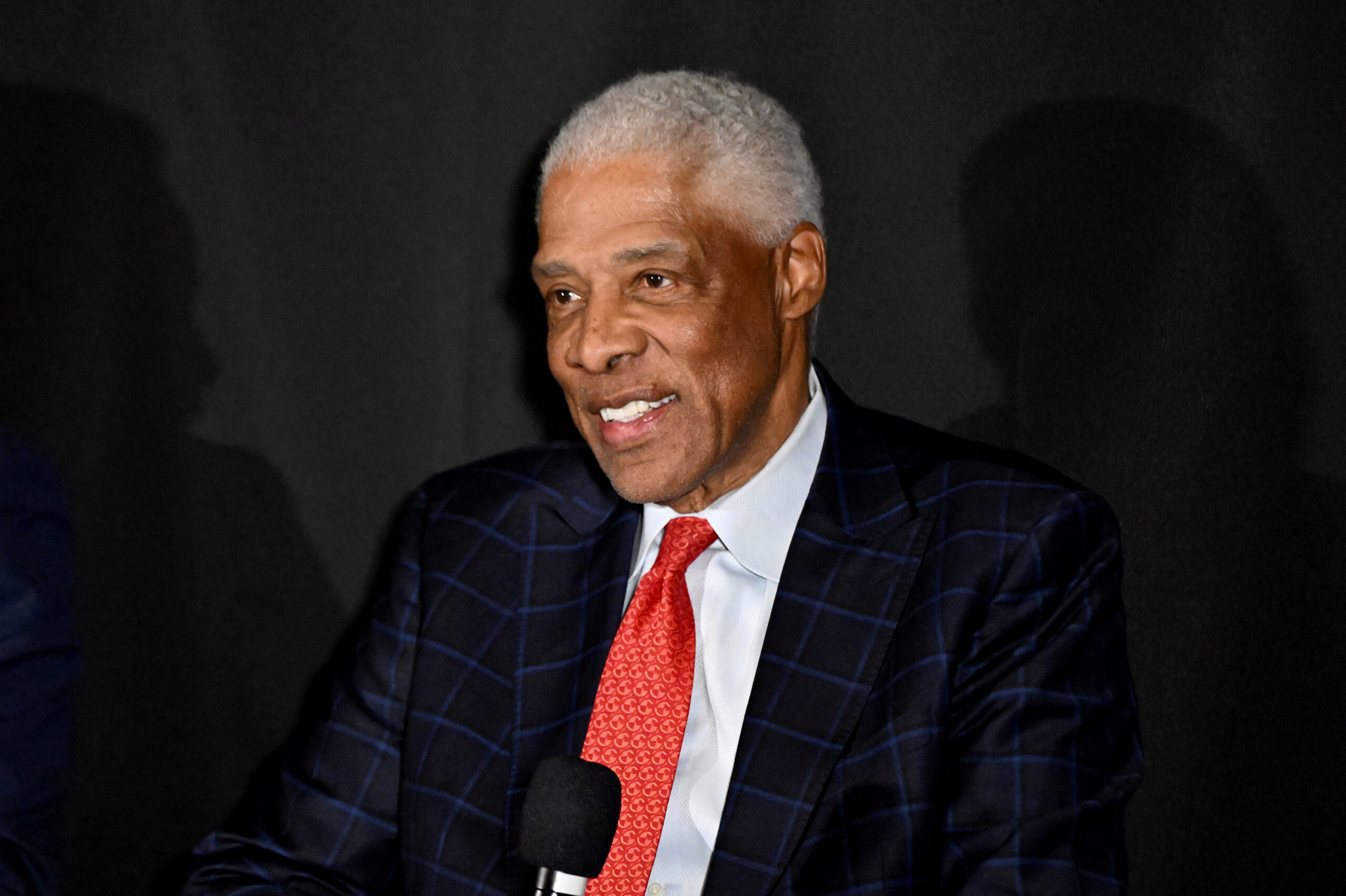
Julius Erving speaks during the “Soul Power: The Legend Of The American Basketball Association” world premiere at Regal Cinemas Union Square on February 10, 2026 in New York City. (Photo by Slaven Vlasic/Getty Images for Prime Video)
The fans were reminding Erving that he owed the city a championship. It was only after he and fellow Hall of Famer Moses Malone swept the Los Angeles Lakers in the 1983 finals that he paid his debt to the City of Brotherly Love. Fans shouted out the words that have stuck with him all these years on: “Paid in full.”
Erving, affectionately and fittingly known as “Dr. J,” surgically dissected opposing defenses. He and fellow NBA star David Thompson went on to inspire talents like Michael Jordan and Kobe Bryant.
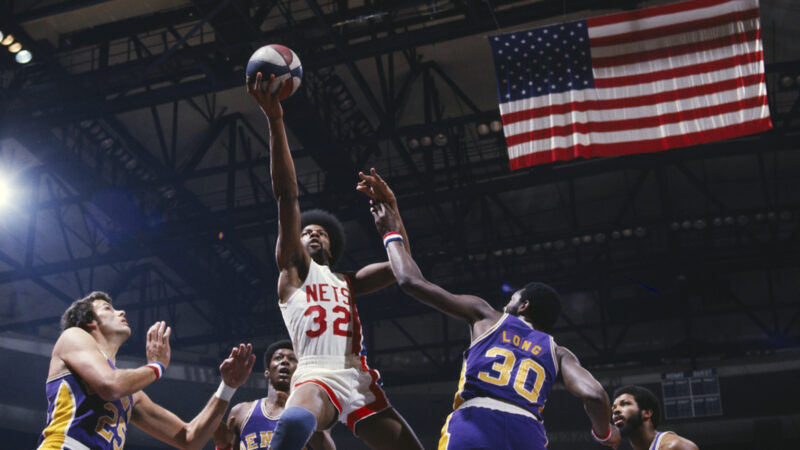
But veteran sports fans know Erving’s legacy was cemented years before he took his first steps on the floors of South Philly’s Spectrum. One of his early visits to Philadelphia was in April 1971, when he signed to the American Basketball Association to play for the Virginia Squires.
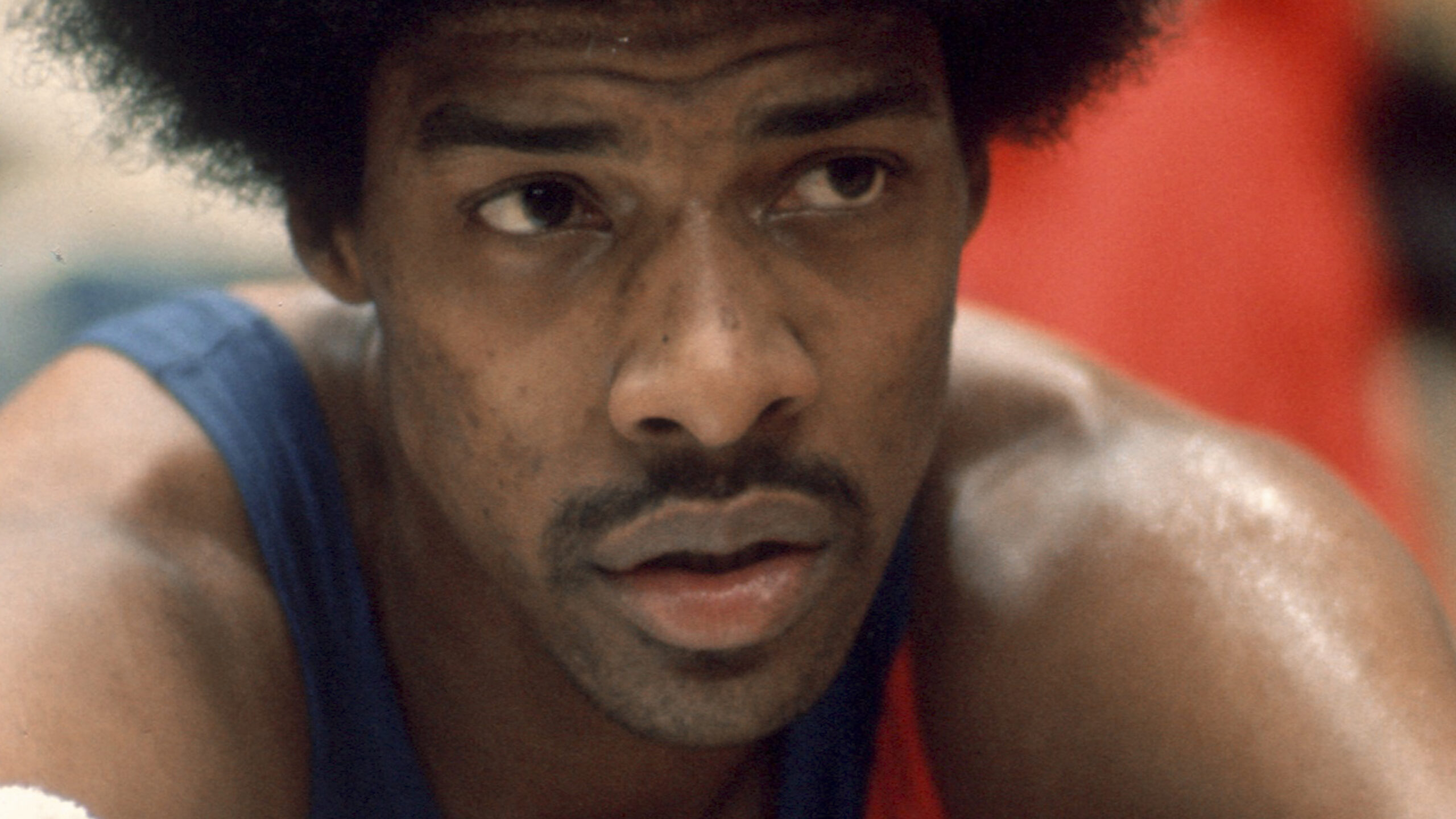
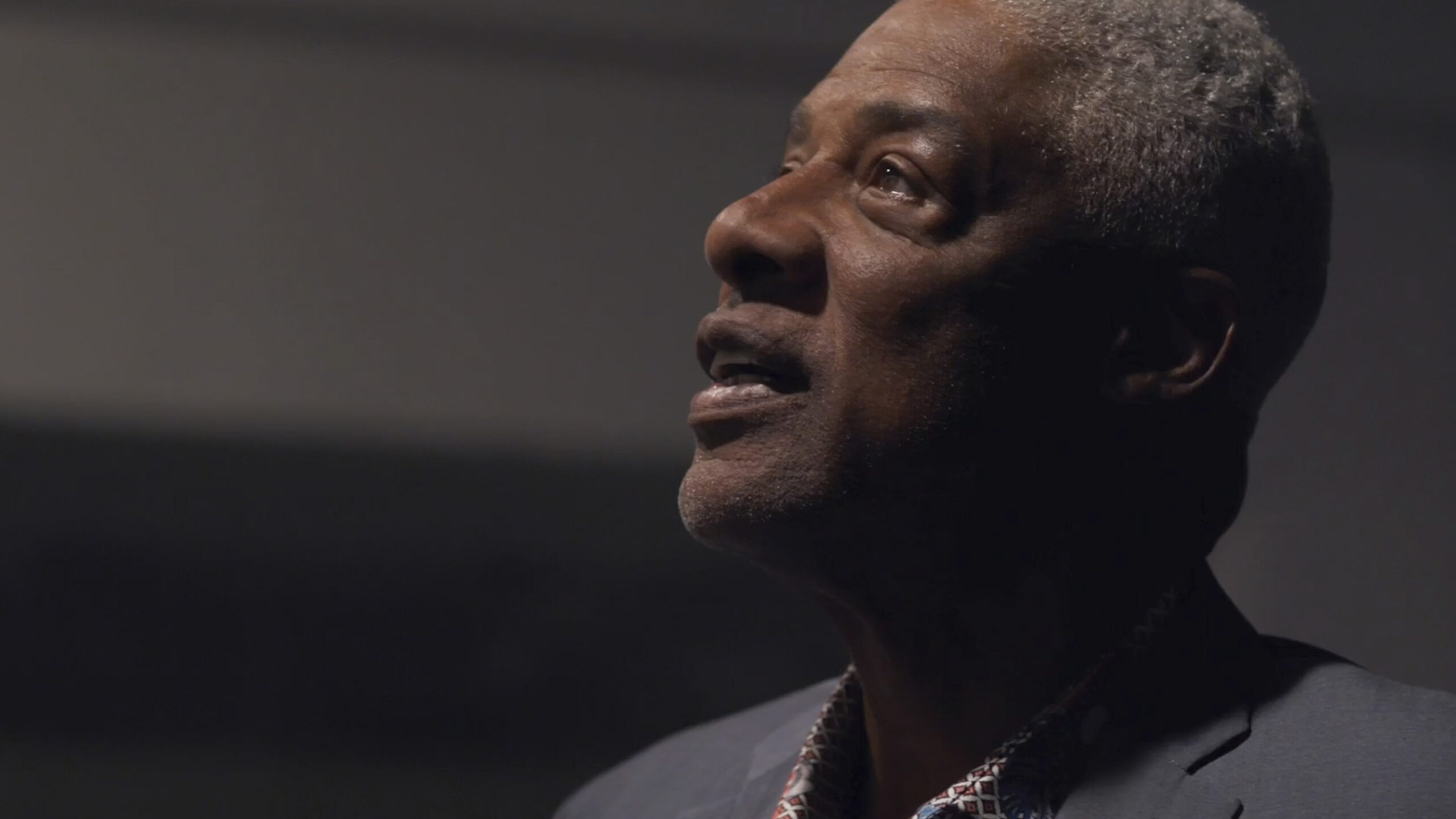
An image of Julius “Dr. J” Erving from the Prime Video docuseries, “Soul Power: The Legend of the American Basketball Association.”
Erving went on to win two ABA championships and three MVP awards in five seasons. He joined ABA greats Rick Barry, Artis Gilmore, Connie Hawkins, and Spencer Haywood as the faces of a league that would soon merge with the NBA in 1976.
The merger brought a new brand of fast-paced, high-flying action to the NBA, and elements like the three-point line, dunk contest, underclassmen signees, and other additions that continue today.
“It just sets the stage for the memories that I have, the friendships that were developed, and the history that was established with the ABA,” Erving said.
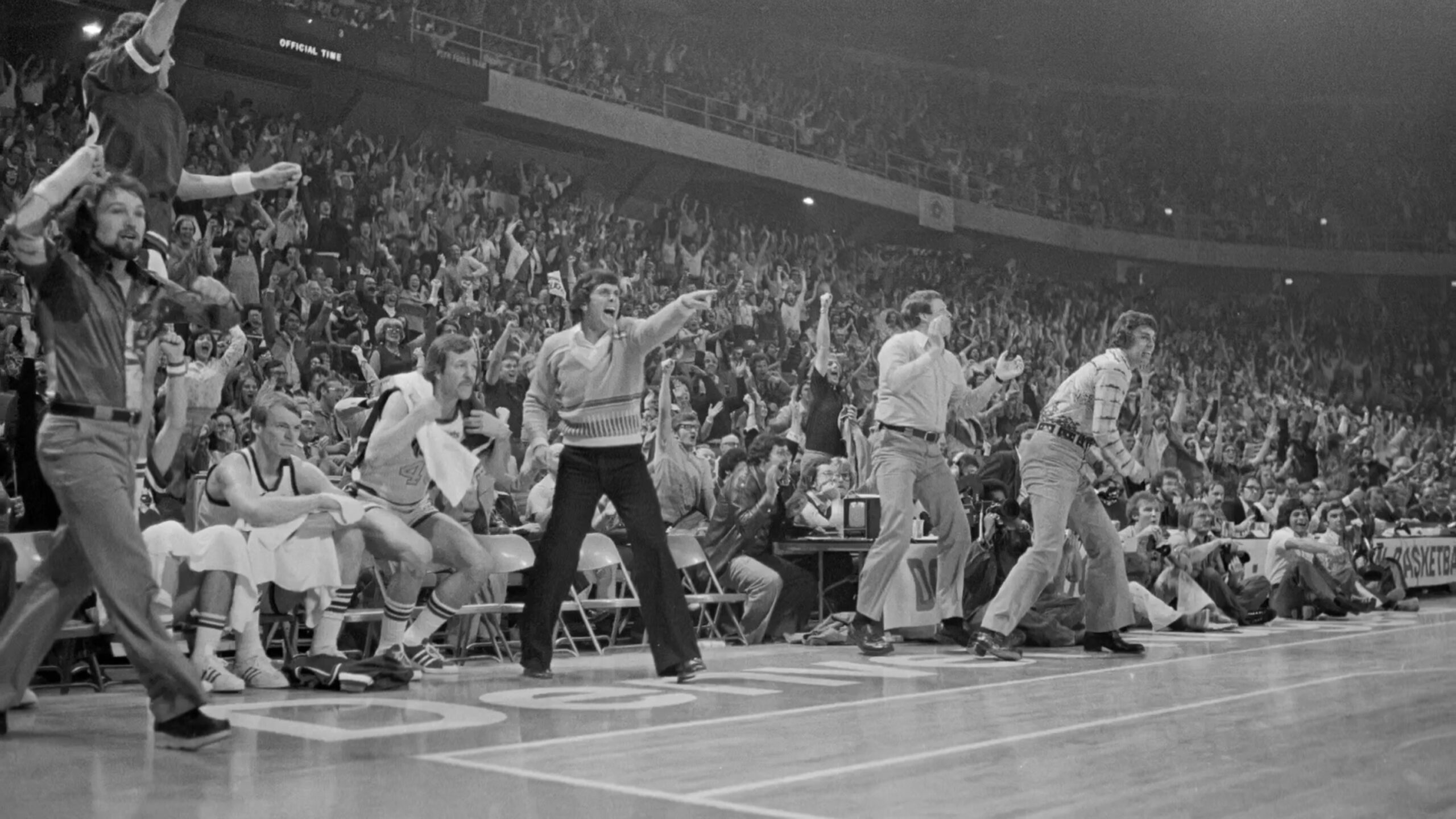
Image of ABA coaches and crowds from the Prime Video docuseries, “Soul Power: The Legend of the American Basketball Association.”
The four-part series, streaming on Amazon Prime Video to commemorate 50 years of the ABA-NBA merger, chronicles the ABA’s formation, triumphs, and challenges during the late 1960s and ’70s.
Emmy-winning director Kenan K. Holley said he wanted the series to be a “player-driven” story that addressed the league’s on-court innovations and debunked the idea that the ABA was an inferior semipro league.
“Amazon executives saw the vision. They saw the ABA story was worth telling, and told us to lean into the characters,” he said. “That gave my team the North Star creatively. We knew we had the goods because of all the guys in the league, from Rick Barry to George ‘the Iceman’ Gervin, Dr. J, and others. That was the key.”
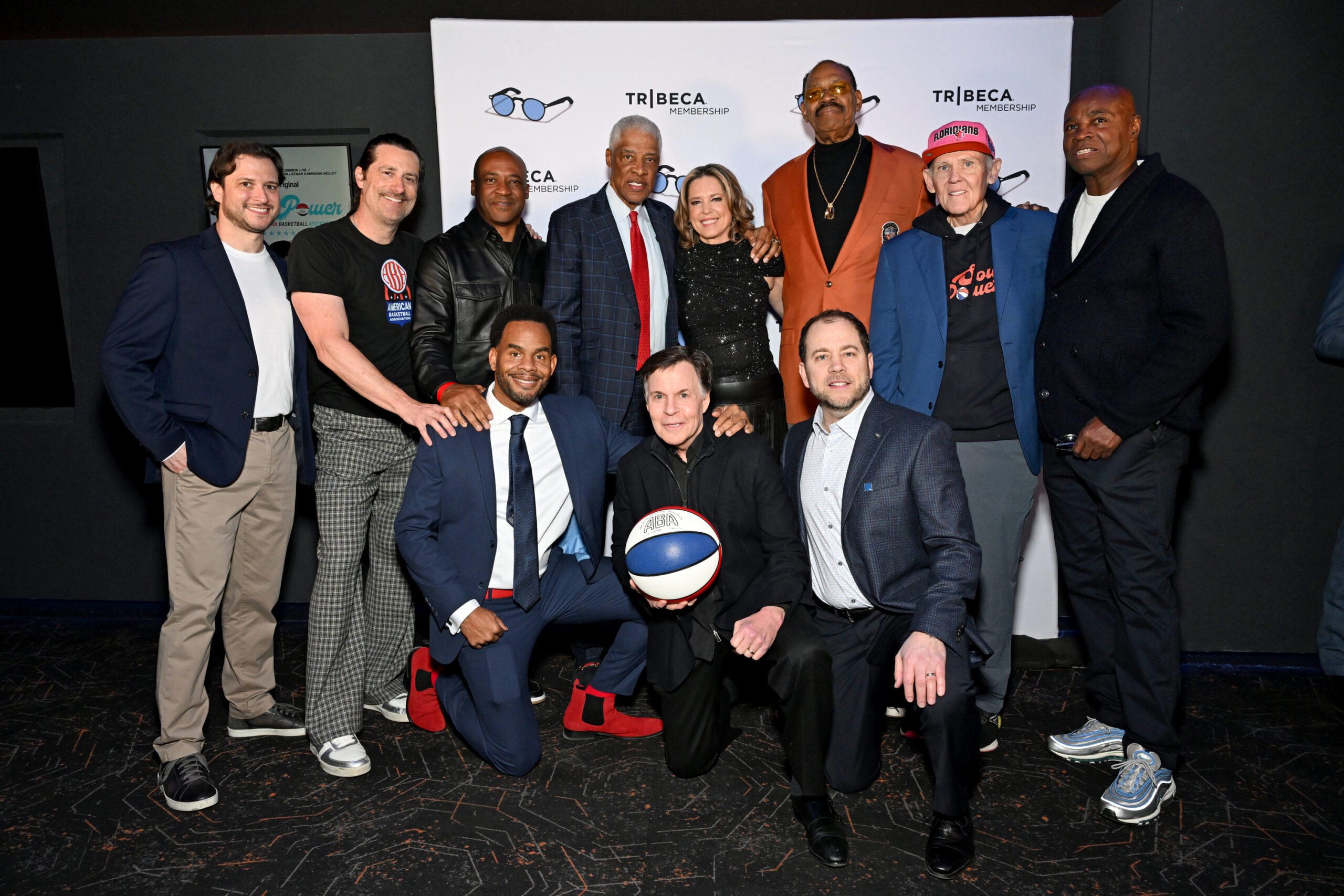
(L-R) Tony Curotto, Todd Lieberman, Derrick Mayes, Kenan Kamwana Holley, Julius Erving, Bob Costas, Hannah Storm, Brett Goldberg, Artis Gilmore, George Karl and Brian Taylor attend the “Soul Power: The Legend Of The American Basketball Association” world premiere at Regal Cinemas Union Square on February 10, 2026 in New York City. (Photo by Slaven Vlasic/Getty Images for Prime Video)
The series highlights the hotly-contested rivalry between ABA and NBA players, the personal, financial, and legal battles ABA stars faced, and the early advancements in women’s team ownership.
There are even brief flashes of downtown Philadelphia and City Hall, depicting the moments leading up to Erving’s ABA signing.
Soul Power shows how players like Erving were trying to save a league that made such an imprint on sports, but it was faltering due to disinvestment.
“It wasn’t a fun position to be put in, especially if you know you’re trying to fight for rights of players who gave a commitment to the league and made the sacrifices to keep it afloat for the years that it was around,” Erving said.
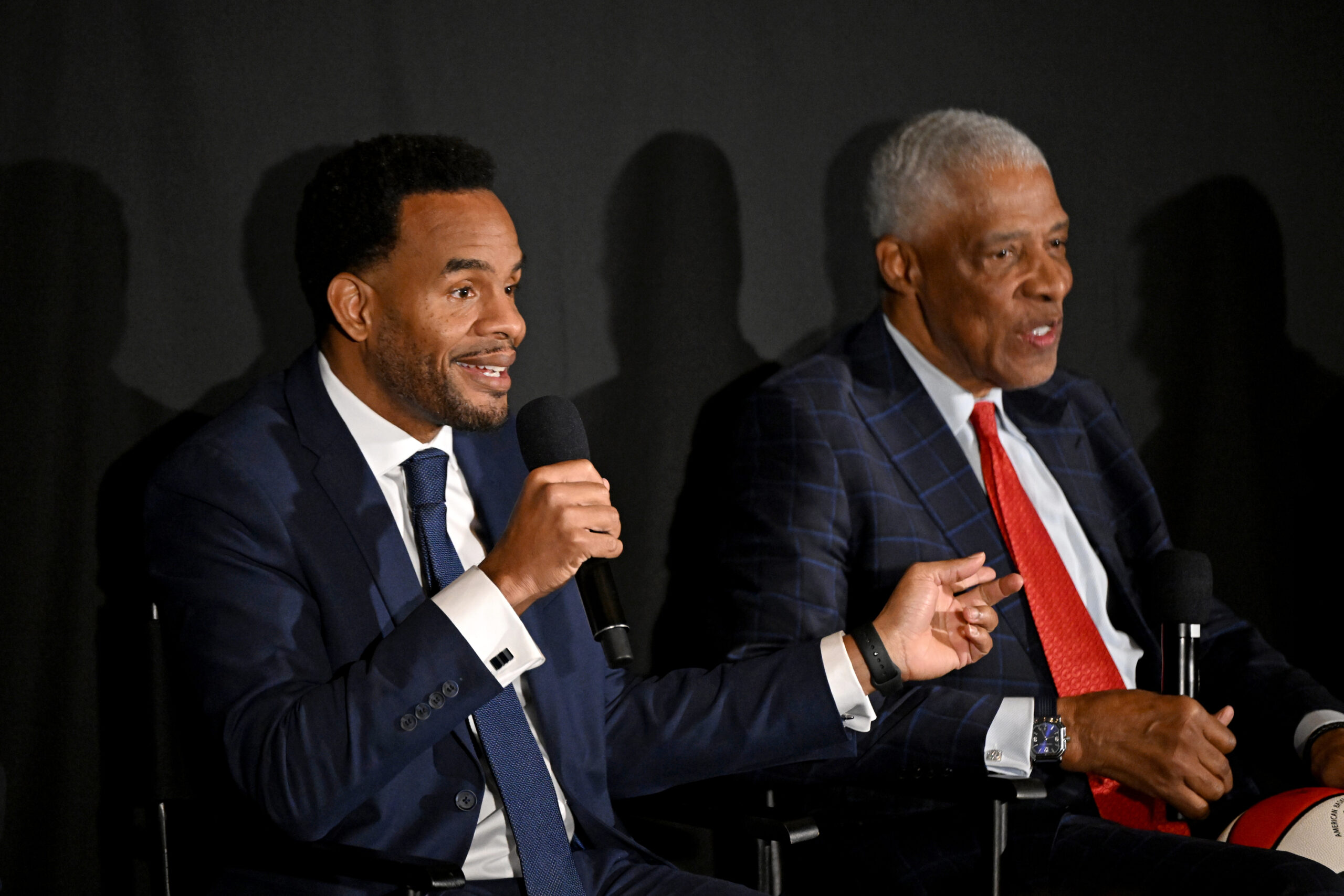
(L-R) Kenan Kamwana Holley and Julius Erving speak during the “Soul Power: The Legend Of The American Basketball Association” world premiere at Regal Cinemas Union Square on February 10, 2026 in New York City. (Photo by Slaven Vlasic/Getty Images for Prime Video)
Holley also wanted Soul Power to right the wrongs of past depictions of the ABA. To do that, he needed to earn the trust of figures like George Karl, Barry, Ralph Simpson, and Erving.
“They have a chip on their shoulder because the way the league’s been handled in the past with certain documentaries,” Holley said. “There was a serious trust-building period where we had to let them know look, ‘If I tell your story, it will be a player-driven story.’”
Erving was approached about the project five years ago. The first year was largely information gathering, Erving said, but Holley soon stepped in to tie all the narrative threads together.
Julius “Dr. J” Erving pictured during the filming of the Prime Video docuseries, “Soul Power: The Legend of the American Basketball Association.”
To be among the leading voices in the series, which earned him an executive production credit, Erving said, was a “gift.” And at the core of the project, he’s proud to see the series reflective of the brotherhood shared between him and the other pioneers who contributed to the series and ABA history.
“It was a one for all, all for one approach we shared,” he said. “There was no hating. It was a genuine feeling of relief like, ‘Wow, they’re recognizing my guy or us,’ and it was shared.”
Holley said he’s excited for younger sports fans to see how influential the ABA was, not just in basketball, but the sports world at large.
“It does my heart good, and I feel grateful to have played any part in helping bring these guys the validation that they deserve,” Holley said.
“Soul Power” is available to stream on Amazon Prime Video.
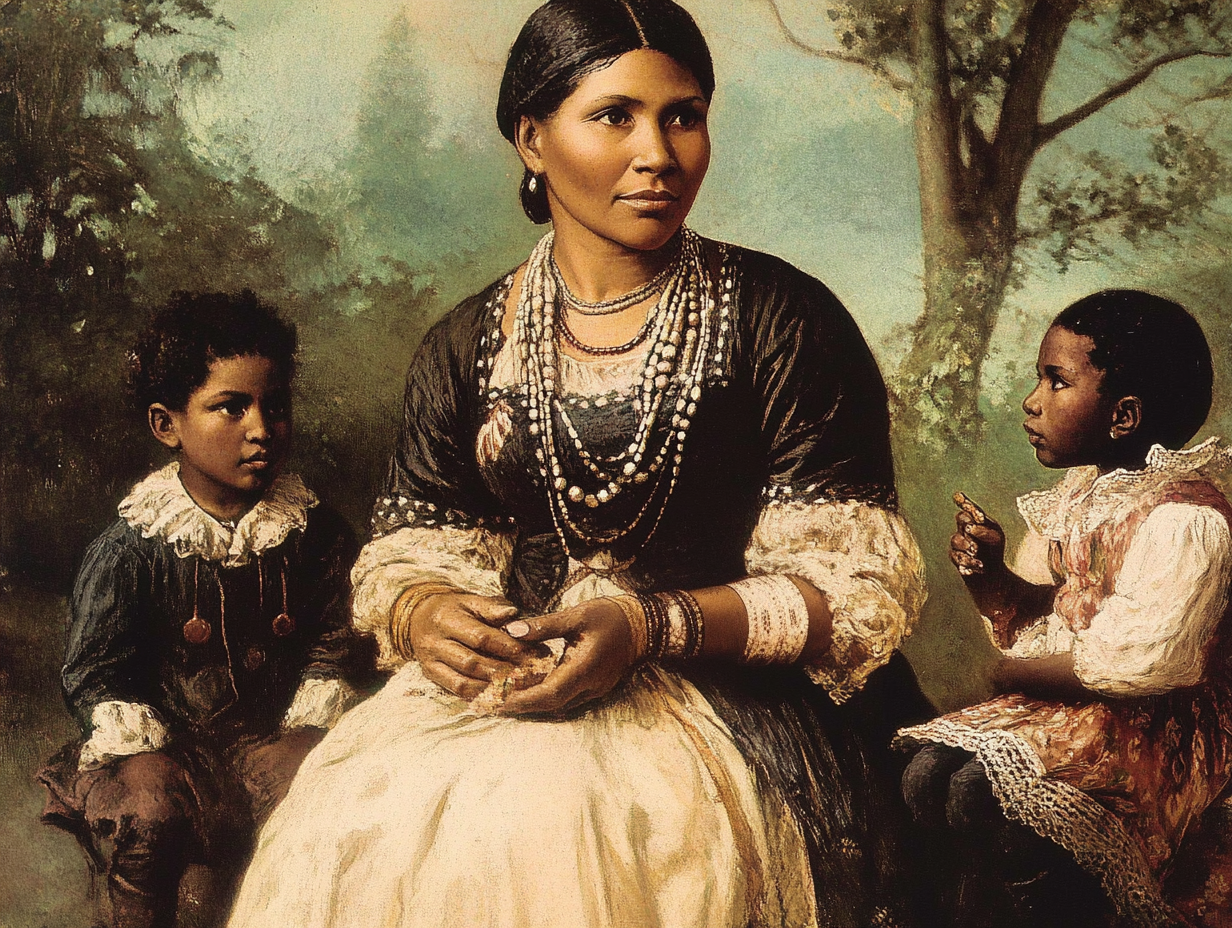
In 1773 Dinah Nevil, an Indigenous, Black, and European multiracial woman and her four children arrived in Philadelphia from Flemington, N.J, under orders from a slave trader who intended to eventually sell Nevil to the Deep South, or perhaps the Caribbean.
Nevil protested.
Philadelphia authorities sympathetic to her plight, kept her in a work house for two years while figuring out the next steps to her freedom. The conditions were so horrid two of her children died.
An image of Dinah Nevil imagined by the 1838 Black Metropolis.
Enter Israel Pemberton Jr. and Thomas Harrison, Quakers who, like most Quakers in colonial Philadelphia, actively fought slavery. Keeping people in bondage was considered immoral in their religion.
Pemberton and Harrison filed a lawsuit against Nevil’s enslaver because they sought to set a precedent by making it unlawful to sell Black people into slavery on free soil, not just in Pennsylvania, but in all of the colonies.
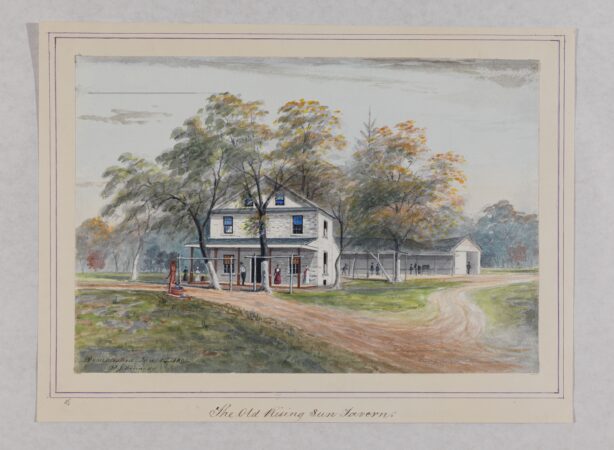
So, on April 14, 1775, Quaker leaders and educators Anthony Benezet and John Woolman gathered 24 men — 17 of whom were Quakers — at the Rising Sun Tavern to discuss legal strategies on how to make that happen.
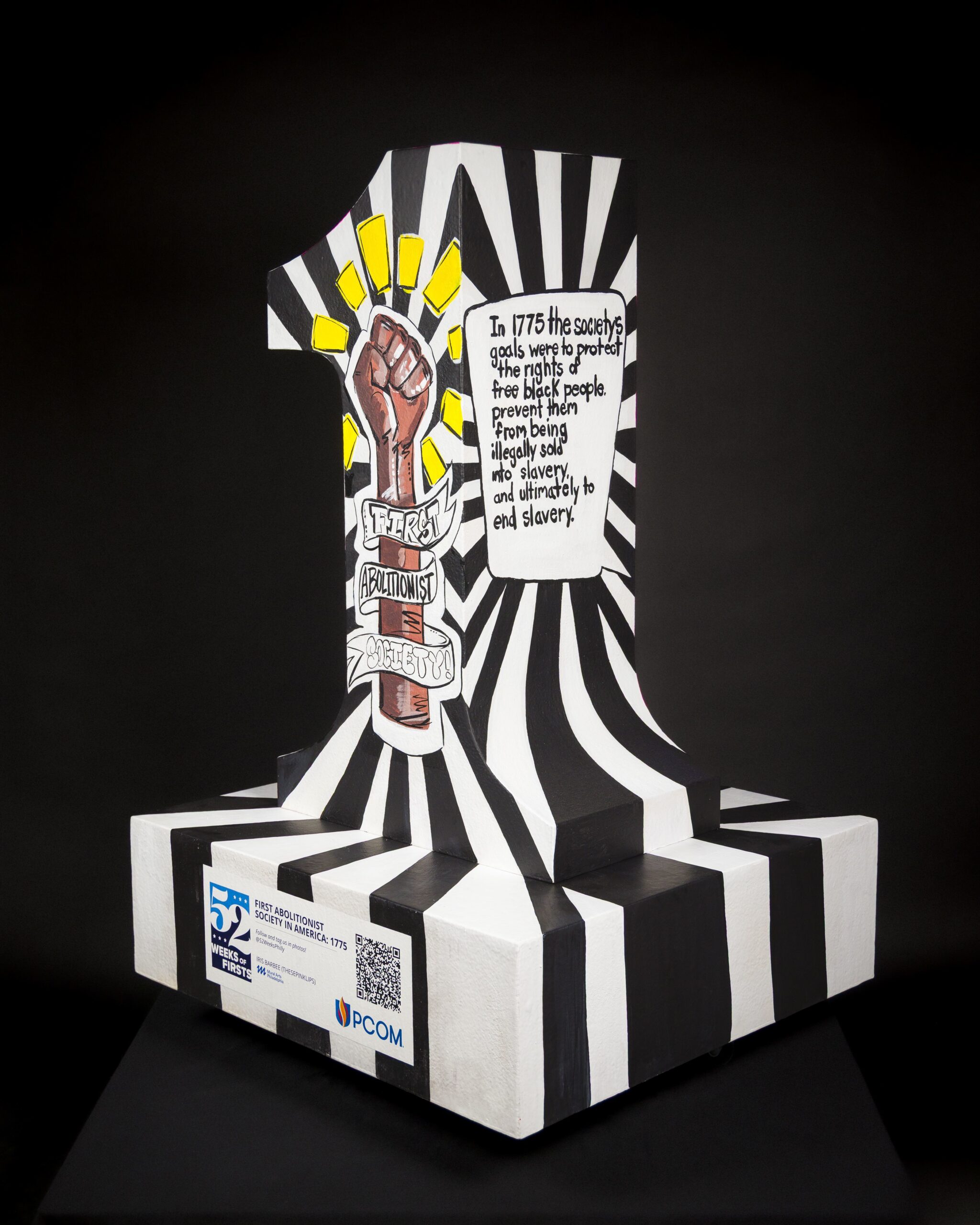
Artist Iris Barbee Bonner’s No. 1 statue pays homage to William Still, an Underground Railroad conductor and key member of the Pennsylvania Abolitionist Society.
That was the first gathering of an antislavery society in America and it will be celebrated Saturday at the African American Museum, part of the Philadelphia Historic District’s weekly firstival day party. Firstivals are a yearlong celebration of America’s 250th birthday marking events that happened in Philadelphia before anywhere else in America and often the world.
The group led by Benezet and Woolman named themselves the Society for Relief of Free Negroes Unlawfully Held in Bondage. In addition to Nevil’s case, they advocated for four other people of color who were in the midst of being sold away from their families. Nevil was ultimately freed when Harrison bought her and within days, signed manumission papers.
In 1776, 18 years after Quakers told their members they could no longer participate in the slave trade, Quakers were forbidden from enslaving people. Thanks to the Quakers’ advocacy, Pennsylvania enacted the 1780 Gradual Abolition of Slavery Act, America’s first law to end slavery.
Four years later, 18 Philadelphians resurrected the Society for Relief of Free Negroes and renamed it Pennsylvania Abolitionist Society, or PAS. Their goal was to stop Black and brown people from being indiscriminately picked up and sold into slavery in what was now a free state, but also to end slavery all together.
“They knew they couldn’t do it overnight,” said Emma Lapsansky-Werner, an American history professor at Haverford College. “What they did was organize so that one-by-one Black people would find freedom.”
Within two years, the PAS grew to 82 members and inspired other cities like New York and Boston to establish branches of their own. In 1787 — the same year the delegates voted that Black people were three-fifths of a person — Ben Franklin became the society’s president and under his leadership, the society petitioned the legislature to amend the act of 1780. This included preventing enslavers from taking pregnant enslaved women to the South so their children would remain property.
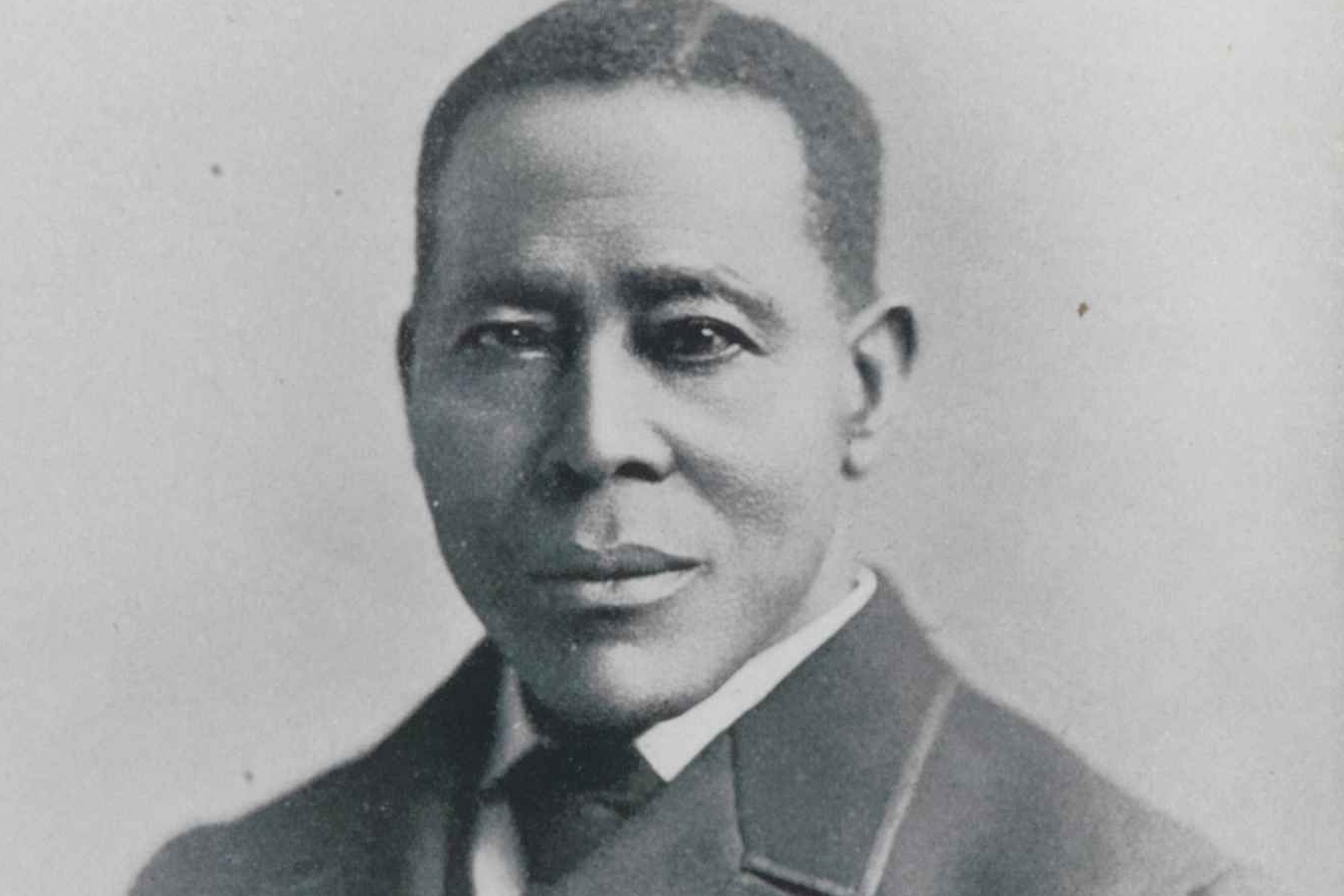
William Still was a member of the Pennsylvania Abolitionist Society and chair of the Vigilance Committee of the Pennsylvania Anti-Slavery Society.
The PAS still exists today and advocates for equal rights and opportunities for all Americans.
This week’s Firstival is Saturday, Feb. 14, 11 a.m.-1 p.m., The African American Museum Philadelphia, 701 Arch St. The Inquirer will highlight a “first” from Philadelphia Historic District’s 52 Weeks of Firsts program every week. A “52 Weeks of Firsts” podcast, produced by All That’s Good Productions, drops every Tuesday.
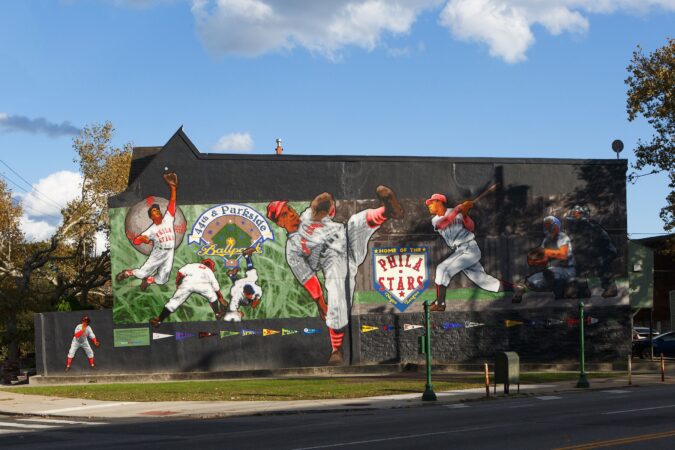
When a West Parkside mural honoring the Philadelphia Stars and Negro Leagues baseball was taken down last month, social media commenters were outraged as the news spread, fearing that Philadelphia had lost one of its iconic odes to Black history.
But the mural at 4304 Parkside Ave. won’t be gone for very long. In a collaboration among Mural Arts Philadelphia, Parkside community members, and the owners of its former building, a new version of the Stars mural will be re-created just across the street.
“It was put up over 20 years ago. We’ve been working really hard to spruce it up for the next 20 years,” said Marjorie Ogilvie, the president emeritus of the West Parkside Business Association, who helped erect the first mural in 2006.
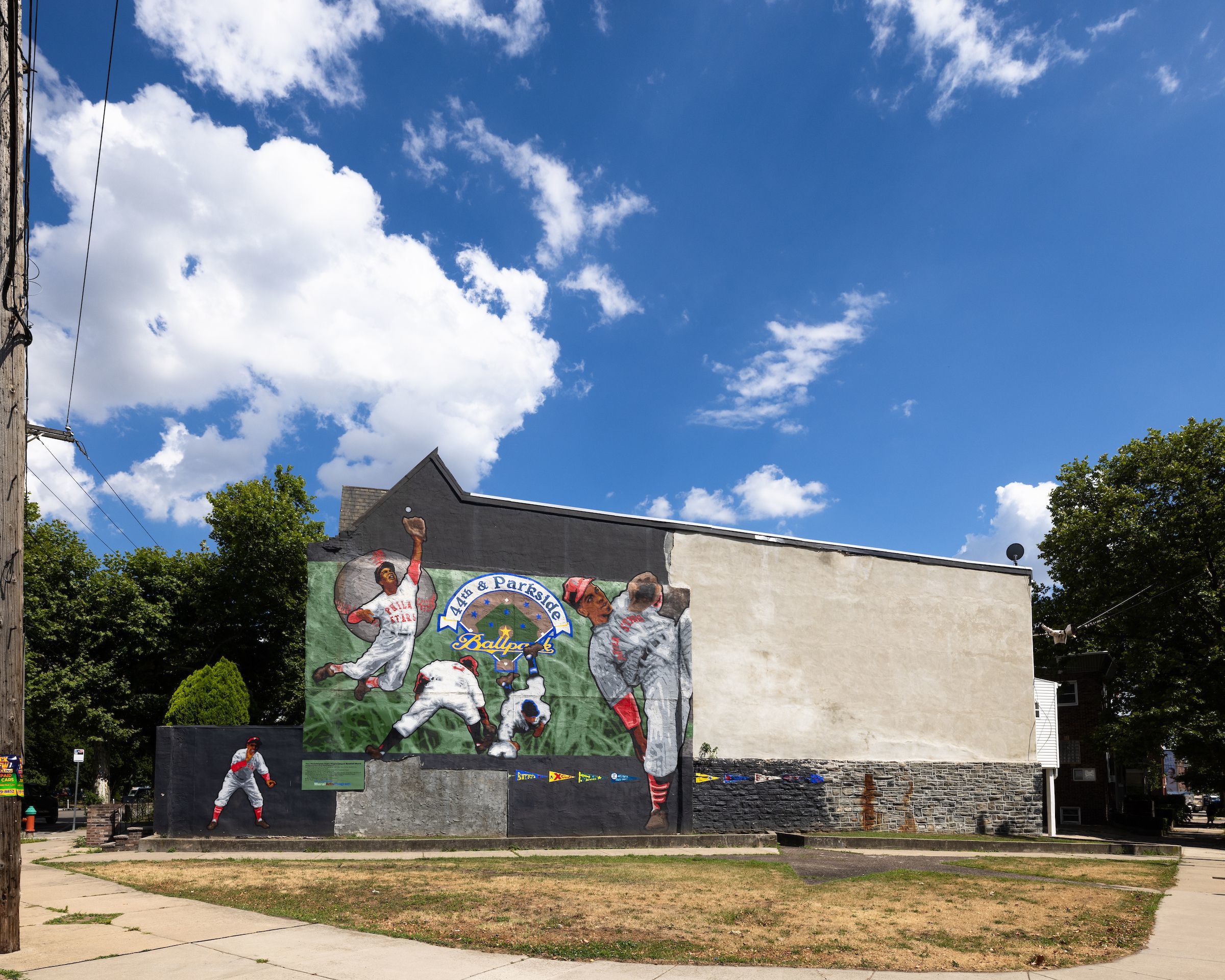
It seemed inevitable that the two-story mural would eventually be brought down. There was roof and wall damage to the home on which it is painted, and the building partially collapsed. Those repairs required the removal of half of the mural a few years ago, and it was never replaced.
And the possibility of development on the plot of land is now closer to being realized. The triangle-shaped grassy lot in front of the mural has been owned by developer Haverford Square Properties for several years, and it acquired the 4304 Parkside building in September.
Half of the mural was previously removed after repairs were needed for the damaged wall and roof of the property. This photo shows what remained of the mural in 2024.
Haverford Square planned to construct a six-story apartment building at the corner, but community members fought back, arguing that it would lead to overcrowding in the neighborhood. Haverford Square president German Yakubov said they have since reached something of a compromise on a smaller-scale development, which will include a baseball-themed coffee shop on the corner.
But Yakubov is helping to secure the long-term future of the mural. Haverford Square has donated $30,000 and design services to the project to create a new version across Belmont Avenue.
“I didn’t want to let it go,” he said of the mural he has been driving past since he was a student at St. Joseph’s University.
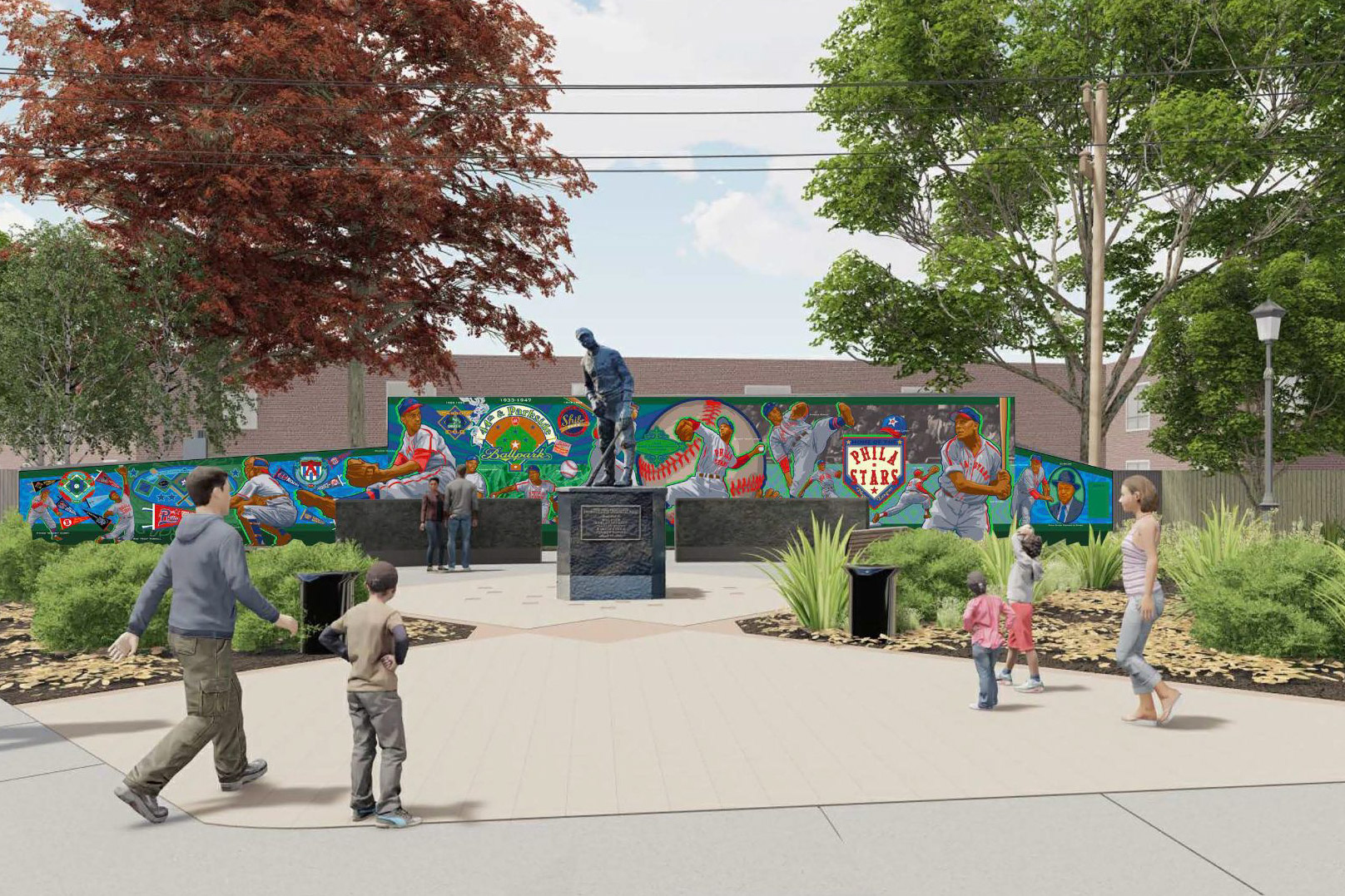
The mural will be painted on a yet-to-be-constructed wall in the Philadelphia Stars Negro Leagues Memorial Park, at the southwest corner of Parkside and Belmont Avenues. It will look slightly different from the previous version, since the new wall will be wider and shorter than the 4304 Parkside wall was. But the designs come from the artist who worked on the original mural, David McShane.
The park features a 7-foot bronze statue of a Negro Leagues baseball player, which was unveiled in a 2003 dedication ceremony at Veterans Stadium by five living Philadelphia Stars players —Bill Cash, Mahlon Duckett, Stanley Glenn, Harold Gould, and Wilmer Harris —before being placed at the park in 2005. The new mural will be raised behind the bronze statue.
A rendering of the proposed mural at the Philadelphia Stars Negro League Memorial Park. The recreated design is by the same artist, David McShane, behind the original mural. The proposed project will include the construction of a new wall behind the 7-foot bronze statue of a Stars player by Phil Sumpter.
“It’s great to see when everyone comes together to ensure that the story of the Negro League[s] and the Philadelphia Stars is not forgotten,” said Mural Arts Philadelphia executive director Jane Golden.
Many people reached out to Mural Arts once they heard in the fall that the mural was going to be removed, Golden said. They were furious and wanted to know what the organization would do to protect it.
Golden said she expects construction to begin early this spring after the project receives Philadelphia Art Commission approval, and for the mural to be completed by summer. Thousands of visitors are expected for numerous events in Philly, including the MLB All-Star Game in July.
The Stars are nearing their 100th anniversary, having played their first games in 1933. They joined the Negro National League the following season and won their first and only pennant, beating the Chicago American Giants in a controversial eight-game series, 4-3-1, after game 7 ended in a tie due to the state’s blue law curfew. Satchel Paige briefly played for the Stars, as did other Negro Leagues legends like Biz Mackey and Jud Nelson.
But after Major League Baseball was integrated in 1947, the popularity of the Negro Leagues dropped, and the Stars disbanded in 1952. They played the majority of their home games at the 44th and Parkside Ballpark, the site where the new mural will rise.
“Smokin’” Joe Frazier is heading to the Philadelphia Museum of Art.
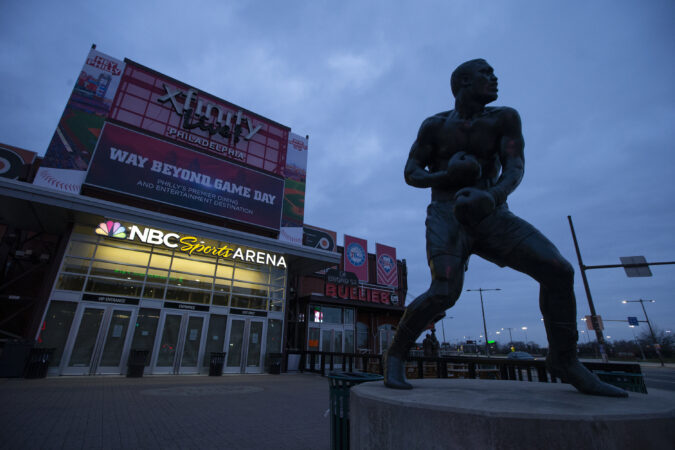
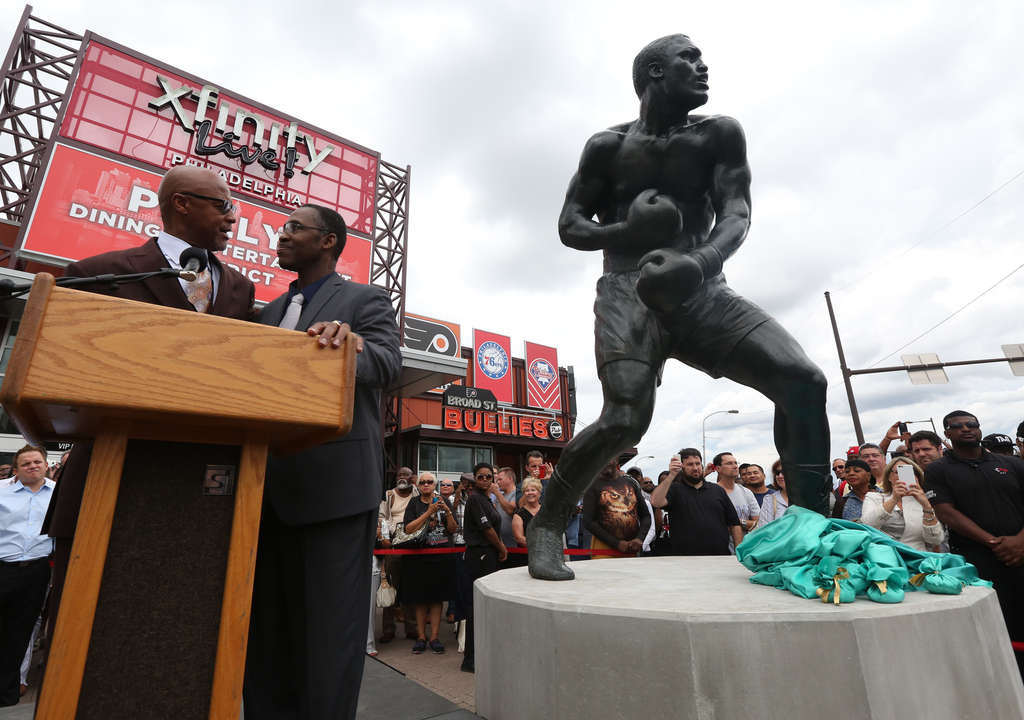
Philly’s statue of the famed heavyweight boxing champion is slated to be installed at the base of the museum’s steps later this year following a Philadelphia Art Commission vote Wednesday that approved the move. All five commissioners present Wednesday voted in favor of the statue’s relocation from its longtime home at the sports complex in South Philadelphia.
The proposal, presented by Creative Philadelphia, the city’s office for the creative sector, will see the Frazier statue installed where Philly’s original Rocky statue stands today. The Rocky statue, meanwhile, will be installed at the top of the museum’s steps.
“Placing the Joe Frazier statue at the Art Museum allows us to share a more complete history about Philadelphia’s spirit,” Marguerite Anglin, the city’s public art director, said Wednesday. “One rooted in real people, real work, and real pride in this city.”
The Frazier statue should move to the Art Museum sometime this spring, Anglin said. That relocation coincides with the move of the Rocky statue currently at the base of the steps, which is slated to be temporarily installed inside the museum for the first time as part of the forthcoming exhibition “Rising Up: Rocky and the Making of Monuments.” That Rocky statue will then be installed at the top of the museum’s steps in the fall, while the Rocky statue now at the top of the steps will go back into actor Sylvester Stallone’s private collection.
Created by sculptor Stephen Layne, the Frazier statue was unveiled in 2015 at what is now Stateside Live! at the sports complex in South Philadelphia. Its debut came years after Frazier’s death in 2011, which kicked off a campaign to erect the statue in his memory. Standing at 12 feet tall, it depicts the boxer moments after knocking down Muhammad Ali during the “Fight of the Century” — a famed March 1971 bout in which Ali suffered his first professional loss after a brutal 15-round skirmish.
For years before its creation, Frazier’s supporters lamented the fact that Philadelphia had long had a Rocky statue, but lacked one showing its own real-life champion. Our Rocky statue, in fact, has been around for more than 40 years, and has stood outside the Art Museum for two decades — about twice as long as the Frazier statue has even existed.
Creative Philadelphia’s plan featured widespread support from leaders including Mayor Cherelle L. Parker, as well as Frazier’s family and friends. It received little pushback at Wednesday’s meeting, with Gabrielle Gibson, a granddaughter of Frazier’s, asking what is perhaps the most obvious question about the placement: Shouldn’t the Frazier statue be at the top?
He was, after all, a real person, a real Philadelphian, and a real champion. Rocky, meanwhile, is a fictional character who appears to be an amalgamation of several real-life boxers’ stories — Frazier included, according to Creative Philadelphia. Many speakers Wednesday noted that, like Rocky, Frazier was known to run up the Art Museum’s steps and was said to have boxed sides of beef during his training, among other parallels.
And then there is the symbolism of where the Rocky and Frazier statues will stand.
“During Black History Month, I think we need to understand the new placement,” Gibson said. “A real boxer and a Black man’s image and likeness would be placed at a lower position beneath the fictional white character whose story was inspired by real boxers.”
The Frazier statue’s placement at the bottom of the steps, Anglin said, was for two main reasons. First, she said, having Frazier at the bottom makes it the first statue visitors will encounter at the Art Museum — even if they are there expressly to see Rocky — which will provide “an opportunity to be grounded in history.”
Second, the Rocky statue’s footprint is roughly half the size of the Frazier statue, which would not be “safe or feasible” to install on high, Anglin said. Putting Rocky at the top, Anglin said, allows for better circulation around the monument, and avoids the potential logistical and code-related issues putting Frazier there could present.
His son, and former heavyweight boxer Marvis Frazier (right), and Rev. Blane Newberry from Enon Tabernacle Baptist Church bless a 12-foot-tall 1,800-pound bronze statue of “Smokin’ Joe” Frazier after it was unveiled in 2015.
Jacqueline Frazier-Lyde, Frazier’s daughter, a retired professional boxing champion and a Municipal Court judge, expressed support for the move Wednesday, calling the statue a reminder that “we can overcome any obstacle and achieve.” She also recounted her father’s feelings on the Rocky statue, specifically when he would see tourists taking photos with Stallone’s character.
“At times,” she said, “he would say, ‘Don’t they understand that I’m the heavyweight champion?’”