LinkedIn now has more than 1.3 billion members by its own count. That includes millions in senior roles and C-level executives, according to a recent report from Search Engine Journal, “making it a hot spot for those aiming to connect with folks who have the power to hire your company, stock your product, or partner with your brand.”
I’ve personally used LinkedIn for years and have built up a large number of followers. The platform has helped me grow my business, find prospects, connect with potential employees, and create new relationships.
But, like many small-business owners, I could be doing more to increase my engagement and meet more people. Here are a few thoughts from local experts on how to maximize LinkedIn’s potential.
Engage thoughtfully
As with most social media sites, succeeding on LinkedIn is all about engagement. Just using the platform as a billboard for your product or services isn’t going to cut it. A LinkedIn relationship will grow when information is shared and conversation is open.
Kevin Homer, president of Navitas Marketing in Trooper, recommends taking the time to interact with other LinkedIn users’ content and leaving thoughtful comments.
“When you create real dialogue, LinkedIn expands your reach and strengthens your relationships,” he said.
“Fostering conversations is the most important thing,” said Courtney Thomas, who specializes in social media at locally based communications agency Aloysius Butler & Clark.
“If you’re regularly commenting — whether on your own posts or on other people’s or company pages’ posts — you’ll see your engagement rise,” Thomas said. “LinkedIn rewards people who participate, not just those who publish.”
Be authentic
Sometimes people treat LinkedIn like a vehicle to trumpet their personal and professional accomplishments. Experts warn that treating the platform in this manner can hurt your credibility and create the risk of public ridicule, which is not a good strategy for professional growth.
It’s important to treat this platform for what it’s meant to be — a business networking site. Be professional. Be real. Be humble, and don’t be a fake.
Nick Quirk, chief operating offer at digital marketing agency SEO Locale in Montgomeryville, says LinkedIn users should not “just broadcast information” but instead invite discussion.
“Engagement is a two-way street, and growth happens when you stop trying to sell and start trying to connect,” he said. “People don’t come to LinkedIn to be pitched — they come to learn and relate.”
If you’re not posting content people actually want to engage with, your engagement will tank, Thomas said.
“People can tell immediately when something is too salesy or reads as fake,” she said. “LinkedIn isn’t the place for constant promotion; it’s where you establish credibility, demonstrate expertise, and build relationships.”
Be consistent
What you get out of LinkedIn will depend on what you put into it. You can’t just post something once in a while or appear and then disappear for significant lengths of time. This is a community, and you’re expected to be involved.
“Both the algorithm and your audience reward consistency,” Quirk said, so you can’t build a following by just posting once a month.
Homer suggests posting at least once a week, which “creates more opportunities for engagement.”
“Helpful content that shows up regularly trains your audience to expect value from you, and engagement on those posts leads to even more visibility,” Homer said.
Use LinkedIn tools, but don’t go overboard
LinkedIn provides many tools for its users to accumulate more followers and spread awareness. These include video images, articles, and labels to optimize your profile, enormous amounts of online content for skill development, as well as functionality to help you create automatic replies and messaging, referrals, recommendations, and endorsements that will get you noticed and help to bolster your credibility.
The platform is a popular place to recruit talent and, with its Sales Navigator add-in, find and then nurture leads.
“Take advantage of everything LinkedIn lets you do,” Thomas said. ”Long-form articles, PDFs, videos, polls — there are so many features people ignore. The platform prioritizes content that keeps users engaged on LinkedIn instead of sending them elsewhere.”
Adding images and video to posts significantly enhances them and helps boost visibility, Homer noted.
“Think about keywords and hashtags the same way you would SEO on your website,” he said. “LinkedIn search works similarly.”
These capabilities are helpful, but it’s important not to be robotic. For example, Quirk’s biggest pet peeve is when someone sends a connection request and then follow it with an instant, multi-paragraph sales message.
“It’s spammy, disrespectful of time, and burns bridges,” he said. “Always personalize connection requests. Once they accept, you’ve earned a follower, not a lead.”
Homer says it is a “major mistake” to ignore replies and rely on automatic LinkedIn messages.
“Nothing turns people off faster than connecting and immediately receiving a generic sales pitch,” he said. “Real relationships require real conversations.”
LinkedIn is a great place to start and build relationships that could lead to new business or profitable partnerships. In my experience, people who use it every day to both get and share knowledge, without doing a hard sell, are the most successful.
“The businesses that get the most value out of LinkedIn understand that it’s a long game,” Thomas said. ”When you focus on contributing meaningfully instead of selling aggressively, you build an audience that actually wants to hear from you, and that’s far more valuable.”
NEW YORK — Elon Musk is joining his space exploration and artificial intelligence ventures into a single company before a massive planned initial public offering for the business later this year.
His rocket venture, SpaceX, announced on Monday that it had bought xAI in an effort to help the world’s richest man dominate the rocket and artificial intelligence businesses. The deal will combine several of his offerings, including his AI chatbot Grok, his satellite communications company Starlink, and his social media company X.
Musk has talked repeatedly about the need to speed development of technology that will allow data centers to operate in space to solve the problem of overcoming the huge costs in electricity and other resources in building and running AI systems on Earth.
It’s a goal that Musk said in his announcement of the deal could become much easier to reach with a combined company.
“In the long term, space-based AI is obviously the only way to scale,” Musk wrote on SpaceX’s website Monday, then added in reference to solar power, “It’s always sunny in space!”
Musk said in SpaceX’s announcement he estimates “that within 2 to 3 years, the lowest cost way to generate AI compute will be in space.”
It’s not a prediction shared by other many companies building data centers, including Microsoft.
“I’ll be surprised if people move from land to low-Earth-orbit,” Microsoft’s president, Brad Smith, told The Associated Press last month, when asked about the alternatives to building data centers in the U.S. amid rising community opposition.
SpaceX won’t be the first to explore the idea of putting AI data centers in space. Google last year revealed a new research project called Project Suncatcher that would equip solar-powered satellites with AI computer chips.
Mississippi officials last month announced that xAI is set to spend $20 billion to build a data center near the state’s border with Tennessee.
The data center, called MACROHARDRR, a likely pun on Microsoft’s name, will be its third data center in the greater Memphis area.
Foreign nationals are facing increasing challenges to working and studying in the U.S., but their contributions to the Philadelphia economy are critical, local business leaders say, painting a grim picture of Philadelphia’s future with fewer of them.
In Philadelphia, “immigrants are not a side factor when it comes to our economy. They are a main driver,” Alain Joinville, from the city’s Office of Immigrant Affairs, said at a panel discussion, hosted last week by the Economy League of Greater Philadelphia, in partnership with immigration-reform organization FWD.us.
The foreign-born population has supported Philadelphia’s workforce growth in recent years. Between 2010 and 2022, the immigrant workforce grew by 50% from 105,600 to 158,300, according to the Pew Charitable Trusts. In 2022, the foreign-born population represented 15.7% of the total Philadelphia population.
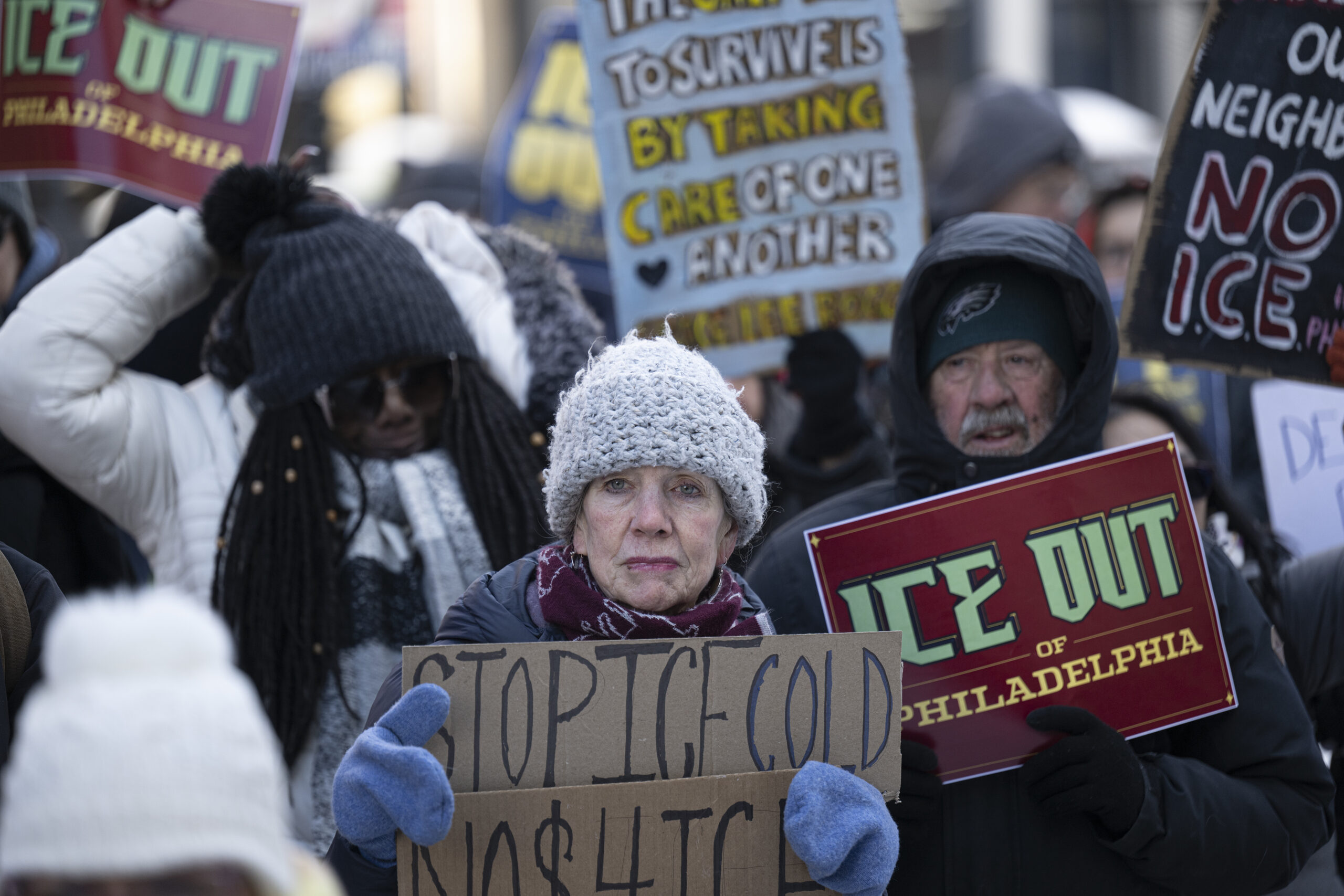
Anti-ICE activists demonstrate outside U.S. Sen. John Fetterman’s Philadelphia office on Jan. 27, 2026, calling for an end to federal immigration enforcement policies.
“If we have policies that are disrupting families, detaining people, sending people back, that’s a huge part of our economy that impacts manufacturing, transportation of all the goods and services that we manufacture,” said Elizabeth Jones, of immigrant-support nonprofit the Welcoming Center. “The ripple effect is scary in terms of how it’s going to impact the economy.”
While the U.S is a global leader in research universities, it could be losing that grip, said Amy Gadsden, from the University of Pennsylvania’s Global Initiatives. Having the best research universities in the world requires the best talent — namely international students that also become faculty, she noted.
Penn has roughly 9,000 international students and an additional 2,000 faculty, postdoc students, and others who “drive a lot of economic activity, both for Penn and for the city of Philadelphia — for the country, for that matter,” she said.
“There is not a guidance counselor around the world who is advising their student not to hedge their application to the United States with an application to another country,” she said.
A view over Walnut Street on the University of Pennsylvania campus, with the Philadelphia skyline at left rear.
Penn, Philadelphia’s largest employer, depends on international students, said Gadsden. “When we think about what is going on with visa policy in the United States, what we see is a decrease in international students, a decrease in international faculty, a decrease in research output, that will ultimately lead to a decrease in our position as a leading research university in the world,” she said.
Jennifer Rodriguez, president and CEO of the Greater Philadelphia Hispanic Chamber of Commerce, highlighted the challenge employers can face under the new fee for H-1B visas.
“Immigrants and the foreign-born population in general is one that is critical for the economic health of the city of Philadelphia and the region,” she said.
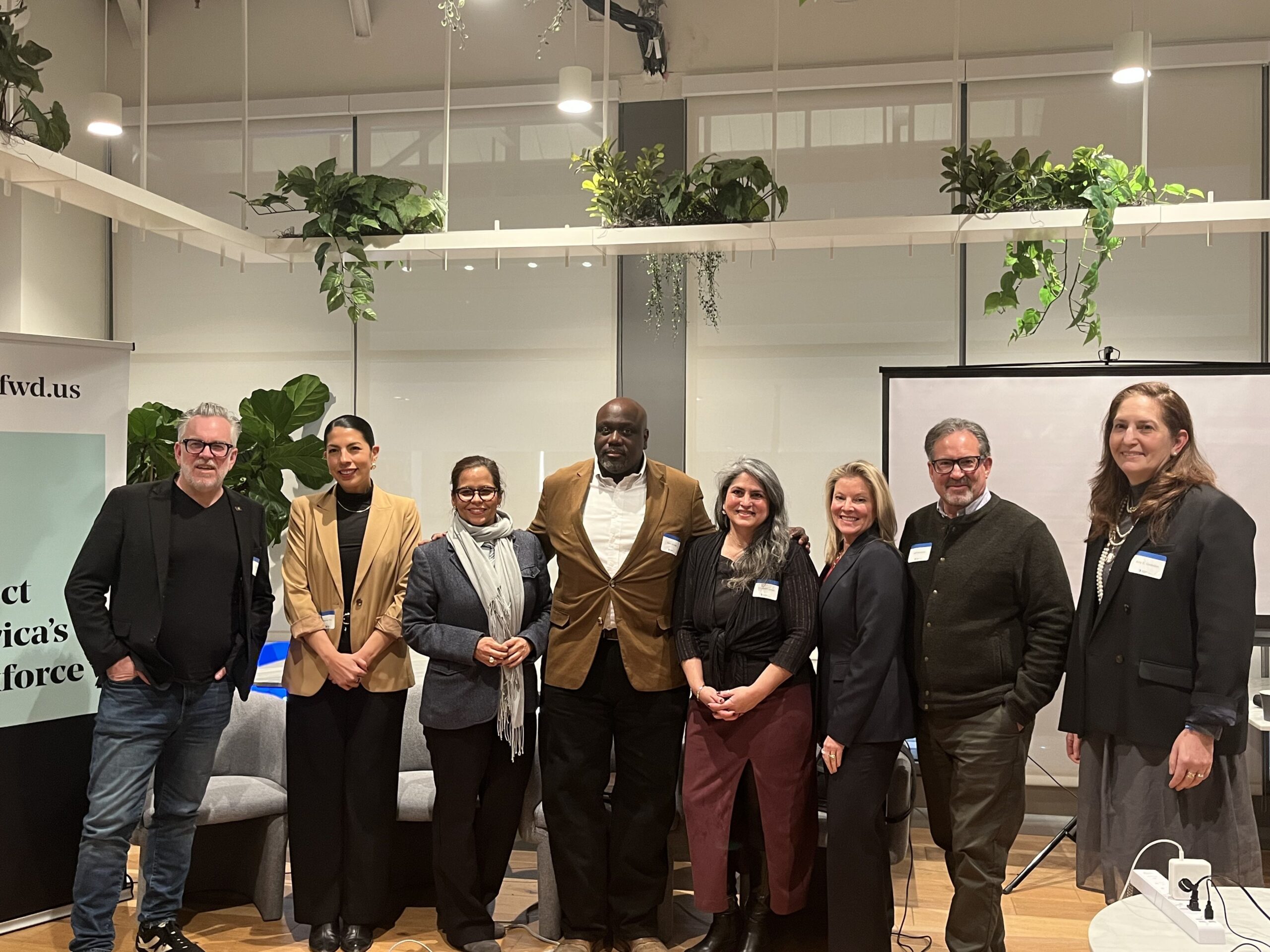
The Economy League of Greater Philadelphia held a panel discussion in collaboration with FWD.us. From left are Ben Fileccia, Pennsylvania Restaurant & Lodging Association; Maria Praeli, FWD.us; Jennifer Rodriguez, Greater Philadelphia Hispanic Chamber of Commerce; Alain Joinville, Philadelphia’s Office of Immigrant Affairs; Elizabeth Jones, the Welcoming Center; Tracy Brala, University City Science Center; Jeff Hornstein, the Economy League of Greater Philadelphia; Amy Gadsden, University of Pennsylvania.
Rodriguez described the additional $100,000, which is on top of other expected visa processing costs, as exorbitant. While some large businesses might have resources to handle it, she said, middle-market companies will be more challenged.
“Philadelphia is desperate to get more of those businesses to establish here, and now you’re making it that much harder,” said Rodriguez. “We are really curtailing the ability of these businesses to innovate, to hire, to really be the contributors to the economy that we want them to be.”
Immigrants in Philadelphia are of prime working age, noted Joinville, from the city’s Office of Immigrant Affairs.
“Without immigrants, we have a smaller workforce to drive and support our businesses locally,” he said, adding that immigrants start small businesses at a high rate in Philadelphia.
“As a child of immigrants, focusing on the economy can be a little tricky for me, because we’re not just data or money or economy,” said Joinville. “Yes, immigrants have an economic impact, but they are cultural leaders, civic leaders, and, yeah, just good people.”
Denise Bruce paid a stranger $75 to shovel out her Hyundai Venue, which was encased in snow and ice outside her East Kensington rowhouse.
“My car was really badly packed in on all sides,” said Bruce, 36, who works in marketing. “I just didn’t have the strength honestly to dig it out myself.”
The West Coast native also didn’t have a shovel.
So she was elated to find a woman on Facebook who agreed to dig out her compact SUV for between $40 and $60. After the endeavor took four hours on a frigid evening, Bruce thought it was only fair to pay more.
After Bruce forked over the money — digitally via Cash App — she asked herself: What should one pay to outsource the onerous task of shoveling?
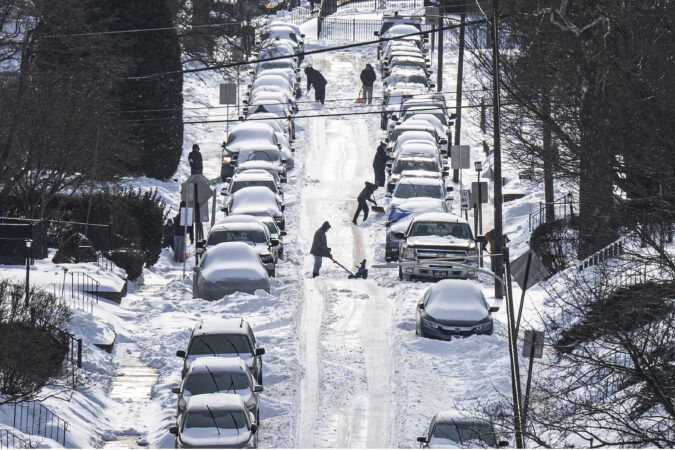
Snow-covered cars lined Girard Avenue in Brewerytown on Monday.
While some shoveled themselves or hired professional snow removal companies with fixed rates, others turned to an ad hoc network of helpers who hawked shoveling services on neighborhood Facebook groups, the Nextdoor app, and the online handyman service TaskRabbit.
On online forums, strangers agreed to dig out the cars of folks like Bruce, who didn’t have the strength, tools, or time to do so on their own. Others signed up to clear the driveways and sidewalks of older people, for whom shoveling such heavy snow can increase the risk of heart attacks.
Prices per job vary from $20 to $100 or more. Some freelance shovelers are upfront about their rates, while others defer to what their customers can afford.
Higher prices now for ‘trying to dig through concrete’
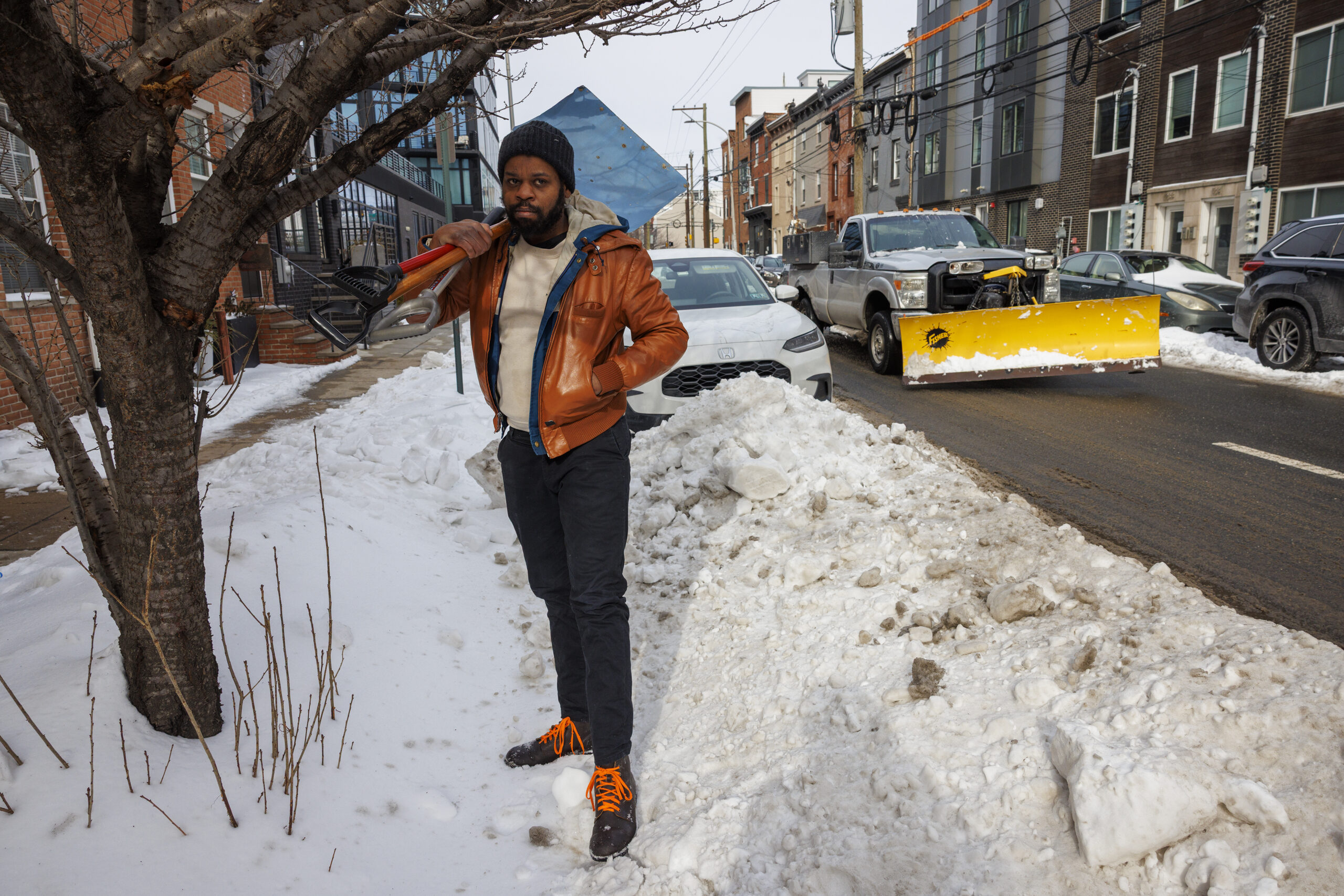
Alex Wiles stands on North Second Street on Tuesday before taking the bus to another snow-shoveling job.
On Monday, the day after the storm hit, Alex Wiles, 34, of Fishtown, shoveled out people’s cars, stoops, and walkways for between $30 and $40 per job. As the week went on, he increased his rate to about $50 because the work became more physically demanding.
“At this point, it feels like trying to dig through concrete,” Wiles said. As of Thursday, he had shoveled for nearly 20 people across the city and broken three shovels trying to break up ice. He said most people tip him an additional $5 to $20.
“I want it to be an accessible service,” he said, “but I also want to be able to make money doing it and remain competitive with other people,” including teenagers who often shovel for less.
For Wiles, who works in filmmaking and photography, his shoveling earnings go toward paying rent.
He said he sees his side hustle as essential service, especially since the city did “a terrible job,” in his opinion, with snow removal.
“A lot of the city looks like a storm happened 10 minutes ago,” Wiles said Thursday.
Shoveling is “necessary and people are just otherwise going to be stuck where there are,” he said. “They aren’t going to be able to get to work easily. They aren’t going to be able to walk down the street.”
Some adults see themselves filling in for ‘the young kids’
When Max Davis was a kid in Hopewell, N.J., he’d compete with his neighbors to see who could shovel the most driveways during snowstorms.
Now, the 28-year-old said he seldom sees or hears of kids going door to door when it snows.
That was part of the reason Davis got off his Northern Liberties couch on Monday and started shoveling out cars for a few neighbors who posted on Facebook that they needed help.
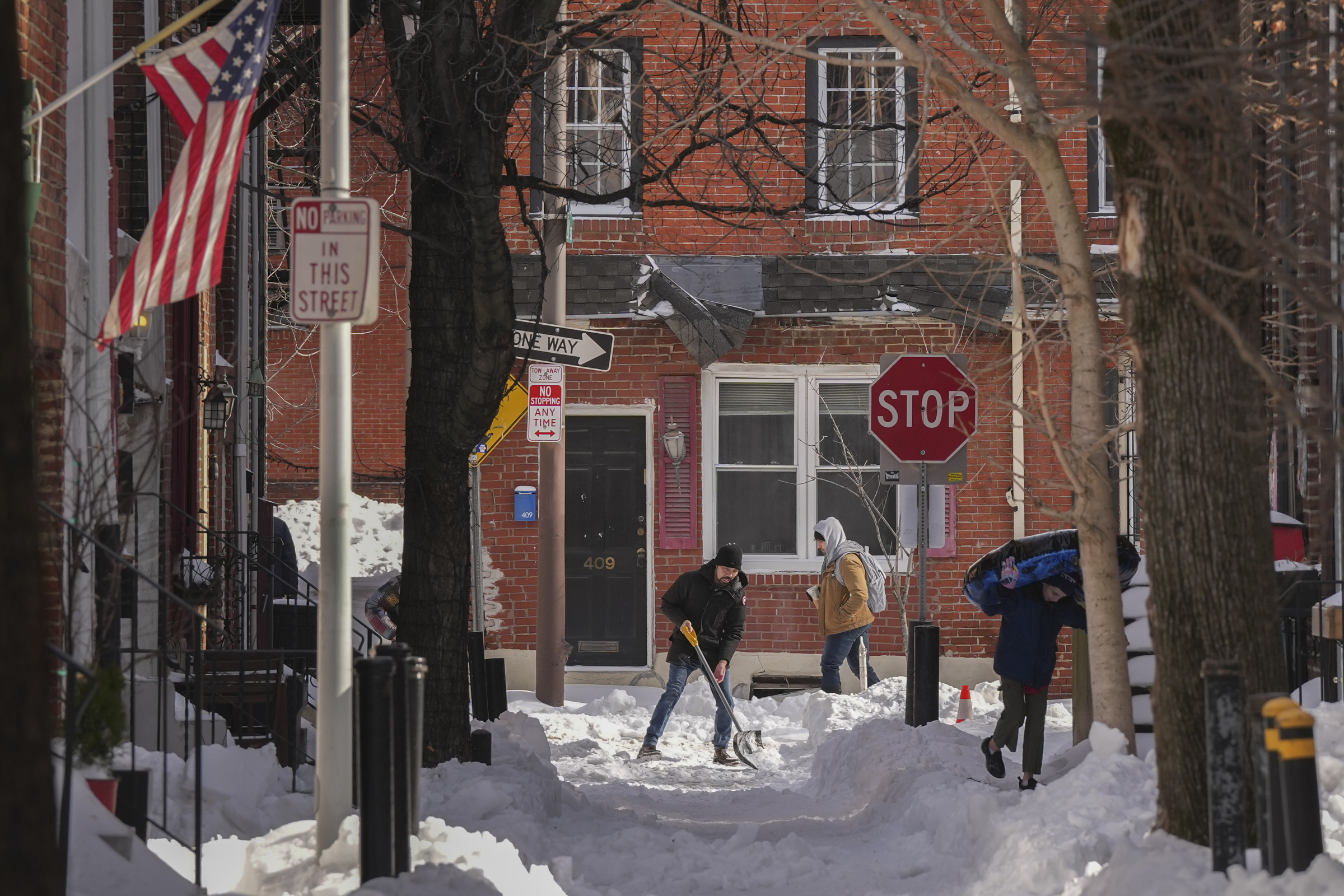
A snow shoveler on Waverly Street on Monday.
Davis, a founding executive at an AI startup, said he didn’t need the money, so he accepted however much his neighbors thought was fair. He ended up making about $40 to $50 per car, money he said he’ll likely use for something “frivolous” like a nice dinner out in the city.
If there is another snowstorm this winter, he said, he’d offer his shoveling services again.
“Why not?” Davis said. “I’d love to see the young kids get out there and do it. I think they’re missing out.”
In Broomall, Maggie Shevlin said she has never seen teenagers going door to door with shovels, but some of her neighbors have.
During this most recent storm, the 31-year-old turned to Facebook to find someone to clear her mother’s driveway and walkway in neighboring Newtown Square. Shevlin connected with a man who showed up at 6:30 a.m. Monday, she said, and did a thorough job for a good price.
“I figured it would be somewhere around $100. He charged me only $50,” said Shevlin, who works as a nanny and a singer. “Oh my god, [my mom] was so thankful.”
How a professional company sets snow removal prices
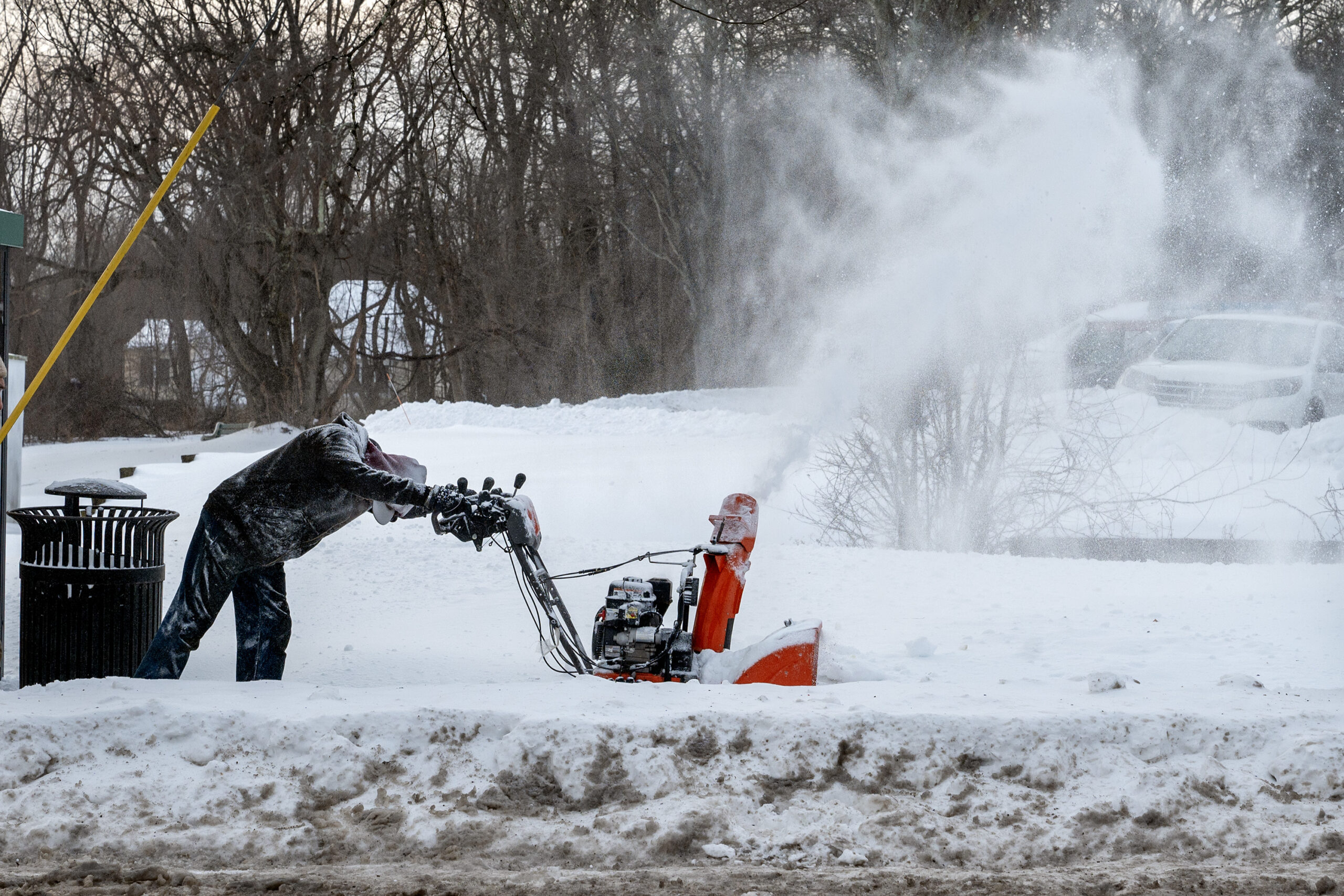
A snow removal contractor clears the sidewalk in front of an apartment building in Doylestown on Wednesday.
Some Philadelphia-area residents, especially those with larger properties, use professional snow removal services. They often contract with these companies at the start of the winter, guaranteeing snow removal — at a price — if a certain amount falls.
In Bristol, Bucks County, CJ Snow Removal charges $65 to $75 to remove two to four inches of snow from driveways, walkways, and sidewalks at a standard single-family home, said co-owner John Miraski.
The cost increases to $95-$115 for a corner house, he said, and all rates rise about $25 for every additional two inches of snow.
Last week, he said, several people called him asking for help shoveling out cars, but he was too busy to take on the extra customers. He passed those requests to other companies, he said, and recommended they charge “nothing less than $50 to $60, because you’re dealing with [nearly] a foot of snow plus a block of ice.”
Miraski said he recommends professionals because they are insured. That’s especially important, he said, in storms that involve sleet or freezing rain, as Philly just experienced.
“You start throwing ice, who knows where it is going and what it is hitting,” Miraski said.
Professionals are more expensive, he acknowledged, but often more thorough. “Some of my properties we went back to two or three times to make sure they were cleared.”
And sometimes, regardless of who shovels, a resident can find themselves unexpectedly stuck in the snow again.
In Northeast Philadelphia, J’Niyah Brooks paid $50 for a stranger to dig out her car on Sunday night. But when she left for her job as a dialysis technician at 3 a.m. Monday, her car had been plowed in.
“I was out there kicking snow,” said Brooks, who was eventually able to get to work.
Or carrying a salon’s worth of hair products through airport security?
Cruise ships used to be about sailing and the sea. If you wanted to rent a room, you went to a hotel. People wore hard pants on planes.
Those were such quaint times.
The past quarter-century has been a whirlwind of change. In the world of travel alone,there have been innovations and inventions, sobering tragedies and surprising trends.
Smartphones and other technological advances have completely altered how we move around the world and communicate with one another. New experiences have opened up for more diverse populations and in places once accessible only to penguins and extreme explorers.
In 2026, we can’t imagine traveling like it was 1999.
As we enter Q2 of the 21st century, our staff discussed the biggest moments and advances that took place between 2000 and 2025. Then we asked industry stalwarts for theirs. The list of 25 is a reminder that the business of travel takes us to places that we couldn’t imagine — and then makes them a given.
1. Smartphones put maps in our hands
In the old days, there was paper. Drivers referred to road atlases or marked routes on giant maps. Tourists explored new cities with walking routes laid out in guidebooks. Later, we printed out turn-by-turn directions from MapQuest.
Smartphones equipped with Google Maps gave us a new way to get around the world, on foot or by bike, car, or public transportation.
“All of a sudden, it’s there at your fingertips,” said Samantha Brown, host of Places to Love on PBS. “It’s like this whole world becomes opened to you.”
2. Everyone sees your vacations
Social media has forever altered travel — for better and for worse. It has widened the audience for your vacation photos from a slideshow party to everyone you’ve ever friended on Facebook.
With one click, you can keep tabs on a travel fling for the rest of your digital days. (Weird!) It has allowed us to learn about pockets of the globe we’d never find otherwise and has given a voice to the often-overlooked, such as disenfranchised locals and behind-the-scenes industry workers.
On the darker side, social media has fueled overtourism, FOMO, and trip envy. Influencers disrupt peaceful natural wonders. Viral posts cause long lines and traffic jams, and travel selfies have led to countless — and sometimes fatal — accidents. (Don’t get us started on AI travel influencers.)
3. The demise of customer service
Flight’s canceled? Wrong charge on your rental car bill? Good luck dialing zero: The age of the helpful human operator is over.
Talking to a human to solve your hotel, airline, cruise, or vacation package problem has become Kafkaesque. Unless you’re traveling at the luxury level, the decline of front-desk workers and customer service centers in favor of artificial intelligence “solutions”is now ubiquitous — and often infuriating.
4. Cruises become floating theme parks
When the world’s largest cruise ship debuted in 2009, it visited some islands, but many people considered the behemoth Oasis of the Seas a destination of its own: The ship held 5,400 passengers at two to a room.
Megaships have gotten even bigger since — Icon of the Seas and Star of the Seas are now the world’s largest — and operators battle for onboard thrills. You can ride a roller-coaster around the top of some Carnival Cruise Line ships, simulate skydiving on Royal Caribbean, or navigate a go-kart on Norwegian. And yes, there are still pools and buffets if you’re old-school like that.
5. The ‘bucket list’ gives us a new framework
In the 2007 film The Bucket List, two men diagnosed with terminal cancer set off for an around-the-world trip to have as many adventures as possible before they “kick the bucket”: Visit the Taj Mahal. Go skydiving. Eat fine food in France. View wildlife on an African safari.
Before long, travelers and marketers turned “bucket list” into an adjective, applying the termto destinations, festivals, and natural phenomena. Travel became a checklist item in a new way — for better or for worse. (See: No. 6)
Visitors admire Rome’s Trevi Fountain, Friday, Dec. 19, 2025. Tourists are now being charged a fee to visit the fountain.
6. Overtourism clogs Europe’s icons
Europe has long had a popularity problem, but it has accelerated over the past 25 years. Blame it on social media or blame it on Hollywood, but these days, “everybody goes to the same places at peak times,” said guidebook author and tour company owner Rick Steves, “and it’s just insanity.” Travelers flock to Amalfi to get the same aesthetic beach-umbrella photos; they clog the streets of Santorini at sunset; they’re using up all the water in Sicily. Overtourism has become so untenable in European hot spots that authorities are now charging entrance fees for the Trevi Fountain and banning Airbnbs in Barcelona.
7. You can pay to skip the line
Hate waiting in line? Join the club. Have extra money to burn? Skip right on past the club through airport security and onto your plane, or through the throngs and onto your favorite theme-park ride.
TSA PreCheck, Global Entry, and Clear reduce airport waits for qualifying travelers willing to pay more. Some airlines offer priority boarding for a fee. At Disney parks, visitors who shell out extra cash can use “Lightning Lanes” to bypass lines.
The budget-minded among us can only wave and wait.
8. 9/11 creates the security state
Tragedy struck in 2001, and the airport experience has never been the same. The creation of the Transportation Security Administration and heightened security checkpoints — body scanners, X-ray machines, pat-downs, bomb-sniffing dogs — marked the end of regular-size liquids, foot modesty, and emotional send-offs at gates.
9. Your house is my hotel
Somewhere between the 2008 launch of AirBed & Breakfast and the global proliferation of Airbnb, short-term rentals transformed from a frugal traveler’s way to meet locals to rule-happy hosts’ way to get their linens washed before housekeeping arrives.
Like ride-hailing for car owners, short-term rentals gave anyone who owned property the ability to enter the hospitality business, creating new revenue streams — and new headaches for destinations with overtourism concerns and housing crises. Today, Airbnb’s market value is just a few billion shy of Marriott.
However, some bohemian networks (Couchsurfing, TrustedHousesitters, Reddit groups for apartment swaps) keep the dream of bed-bartering alive.
This image released by Focus Features shows Anthony Bourdain in Morgan Neville’s documentary “Roadrunner.”
10. Anthony Bourdain becomes the world’s travel host
In 1999, a brasserie chef gets published in the New Yorker, and all of his dreams come true. That article turns into a book. That book turns into another book, and then multiple TV series. “Bourdain” becomes bigger than life.
No television host before or since has connected with audiences the same way. Tall, devious, and handsome, Bourdain disarmed viewers with swagger and snark, then endeared himself to them with earnestness and humanity. He lauded haute cuisine and holes-in-the-wall with equal reverence. Behind the gross-out jokes and knife-sharp takes, there was a champion of the working stiff, a keen observer of history, a self-conscious artist with a deep love for writing and filmmaking.
He was a caricature in cowboy boots, a never-ending stomach, the collective id for everyone who dreams of going everywhere. He made us feel like we knew him. We didn’t.
11. Airlines abandon the middle class
Carriers once welcomed regular Joes and Janes with reasonable fares that included a seat roomy enough for their limbs. Carry-on bags, seat selection, and food and beverage service were on the house.
Then ultra-low-cost airlines — looking at you, Spirit and Frontier — upended the social order with a la carte pricing for nearly every amenity and transaction. The major carriers, meanwhile, adopted the unbundling model, turning the cabin into a real-life version of Downton Abbey.
12. COVID takes the workcation mainstream
The coronavirus pandemic sent many of us home. When we got tired of our own walls, we realized we could work from anywhere. It turned out that we liked the change of scenery.
Enter Zooms from the beach house, workdays wrapped up in time for sunset walks, and notes typed up from a sidewalk cafe. Some of us were brazen enough to take a “quiet vacation.”
Return-to-office mandates might be on the rise, but workcation habits will probably stick around, creating a new perk (or pain) for employers.
13. Points people gamify rewards
Gone are the days of mileage runs to nowhere and cashing in rewards for flights. Today’s Jedi masters of points and miles open new credit cards (those signing bonuses!) and charge all of their restaurant meals, groceries, travel reservations, and dog grooming appointments on high-yield cards, such as the Chase Sapphire Preferred or Capital One Venture X.
You can find these winners gloating in the airport lounge or in their premium seats at a World Cup match.
14. Anybody can explore Antarctica
Antarctic explorers don’t need Endurance — just several thousand dollars, seasickness patches, and a bathing suit for the polar plungeaboard an expedition cruise from Argentina.
15. The rise of the layover trip
Once considered dreaded pit stops, layovers have emerged as destinations unto themselves. Airlines such as Icelandair, Turkish Airlines, and Qatar Airways now pitch their hubs as a side trip or bonus adventure.
For the same ticket price, travelers can sample the local cuisine, soak up some culture, and sleep horizontally before returning to the airport and resuming their regularly scheduled vacation.
16. In-flight WiFi ends the age of unplugging
The airplane used to be one of our last sanctuaries from the connected world. A flight — or a cruise or a hike or a trip aboard — once offered a break from texts, emails, and conference calls. But thanks to advancements in technology, the untethered era is over.
Today, multiple airlines offer “fast, free” in-flight WiFi, and satellite internet makes it possible to work everywhere, whether on a yacht or in a yurt.
17. Hotel brands multiply like rabbits
We knew what we were getting into with a Courtyard by Marriott, a Hilton Garden Inn, or a Motel 6. But then came the hotel brand explosion: Your destination might offer an Aloft, a Spark, a Motto, or a Moxy.
You might wonder, Aren’t those just nouns? No, they’re part of hotel companies’ ever-growing ambition to get more heads into their beds.
18. Airlines tell passengers: BYO screen
Once upon a time, airlines put on a movie for the whole plane to watch from dangling monitors or, on a long-haul flight, a big, boxy TV screen. The in-flight entertainment situation got more glamorous when airlines began installing screens in seat backs in the late ’80s.
It was a luxurious shift, one that led to the discovery of a new societal phenomenon: the absolute pleasure of watching someone else’s airplane movie. But in the past decade, we’ve started seeing those screens disappear. Airlines claim they’re following passenger behavior: If we’re more likely to watch reruns of Lost on our personal devices than engage with seat-back screens, why keep investing in them?
19. Boeing tests our faith in air travel
Back-to-back crashes of Boeing 737 Max jets in 2018 and 2019 killed 346 people, shaking travelers’ confidence in the company while triggering the temporary grounding of the jet and years of scrutiny. Investigators pointed to flaws in a flight-control software system.
In 2024, a door panel missing key bolts broke off from a Max jet midflight, leading to new questions about the plane manufacturer’s safety culture. The company agreed to plead guilty to fraud later that year in a criminal case connected to the crashes, but instead reached a non-prosecution agreement with the Justice Department last year.
20. Athleisure takes over
The hordes of people flying, cruising, and sightseeing in yoga pants, moisture-wicking tops, sweatpants, and tracksuits are not part of a fitness flash mob. They’re today’s comfy travelers.
As millennials became the generation of leggings, the world followed suit. Some see this as a decline in civility, but travelers aren’t sweating it.
21. Southwest sells out
Southwest Airlines was always proud of standing out.
It didn’t do boarding like other carriers, didn’t slice up its cabins to charge more for the fancy front. It kept offering two (two!) free checked bags long after its competitors were raking in the cash for luggage.
But under pressure from investors, Southwest announced that it would shed its quirks and start acting like every other airline. Farewell, seating scrum. We miss you, free bags.
22. YouTube replaces travel TV
Turn on the Travel Channel, and you’re more likely to catch an episode of Ghost Adventures than your typical hosted travelogue. That sort of content has been democratized by social media.
Now, when travelers need information and inspiration for an upcoming trip, they’re turning to DIY creators on YouTube and TikTok. It’s where they’ll find (sometimes) realistic reviews alongside expert insights from the pros, no monthly subscription fee necessary.
23. Tripadvisor trumps guidebooks
Since Tripadvisor launched in February 2000, it has racked up more than a billion reviews, travel tips, photos, comments, and forum threads, making it one of the most abundant travel resources on the internet. (One of its most reviewed destinations? Pastéis de Belém in Lisbon, Portugal, famous for its egg tarts.)
The website and tour marketplace has been criticized for driving travelers to tourist traps, but it has also provided essential information to travelers since its founding. It’s one of the many crowdsourced platforms — like Yelp, Google Maps, and Reddit — that have turned guidebooks from must-have resources to old-fashioned extras.
24. More accessibility for people with disabilities
Innovations such as lightweight power chairs, adaptive adventure gear, sensory rooms, and navigational devices have cracked open the world for travelers with disabilities.
Travel is slowly becoming more inclusive as destinations, hotels, the transportation industry, parks, and attractions invest in accessible features for their tours, trails, and guest rooms.
25. Climate change
Where some see an existential threat, the travel industry sees an opportunity. Tourists are traveling to see “dying glaciers.” In Venice, Steves, the guidebook author, recently went on a walking tour with the theme “indicators of climate change.”
“This is something that really is taking its toll on Europe and impacting the way people travel,” Steves said.
Every year, Steves’s tour company takes tens of thousands of travelers to Europe, and every year, he notices that extreme weather is increasing. Now, as his company plans guided trips, it must factor in the potential for wildfires in Greece, heat waves in London, and sudden storms in Germany.
Comcast owes a California company $240 million for infringing on its patent when rolling out a voice-activation feature on television remotes over a decade ago, a Philadelphia federal jury decided.
Promptu Systems Corporation “pioneered” the technology that allows users to control their TVs through voice commands spoken into a remote control in the early 2000s, the company said in legal filings.
After Comcast launched its voice remote in 2015, Promptu sued, accusing the telecommunication giant of utilizing patented technology. Comcast executives were aware of the patents, expressed interest in Promptu’s capabilities as early as 2001, and took steps to launch a remote in collaboration with Promptu, the 2016 lawsuit said.
But Comcast ended up launching a voice-controlled remote on its own, which the suit says was based on technology that Promptu shared with Comcast in demonstrations.
“Promptu technology was exploited without permission over a 10-year period,” said Jerry Ivey, an attorney at the law firm Finnegan who represented the company in the trial.
Propmtu’s attorneys asked the jury to award $346 million, based on a calculation that the company was owed 30 cents per month for each Comcast cablecustomer over a 10-year period.
At the conclusion of a six-day trial in the Eastern District of Pennsylvania, on Jan. 23, jurors found that Comcast infringed on two patents but that only one of them was valid. The jury deliberated for less than three hours and awarded $240 million.
The verdict will have no impact on Comcast’s customers, a company spokesperson said.
“We will continue to pursue our claim in court against Promptu to show that these expired patents are unenforceable and appeal this decision if necessary,” the spokesperson’s statement said.
During the 10 years of litigation, Comcast attacked the validity of the patents. It is pursuing a separate claim arguing that the patent that led to the verdict is not enforceable.
Promptu technology wasn’t ahead of its time, the attorney representing Comcast told the jurors, and the start-up did not succeed in becoming a big player in the TV remote market.
“Investors from Promptu have come here to ask you to not only bail them out of their investment in Promptu but to give them an enormous windfall in profits that they didn’t earn in the marketplace and for technology that they didn’t invent,” said Douglas Lumish, a Weil Gotshal & Manges attorney representing Comcast, according to court transcripts.
By 2017, Comcast said it had voice-activated remotes in about 12 million homes — roughly half its subscribers at the time — and the company expected to process 4 billion voice commands that year. In a 2024 meeting with investors, Comcast said their remotes were processing about 50 million voice commands daily in five languages, allowing users to quickly access cable and streaming content.
The company also developed a large-button voice remote with accessibility in mind. Both have been provided to their cable subscribers at no additional cost.
Comcast’s large-button remote with added accessibility features, as released in 2022.
Even if they don’t directly bring in revenue, these kinds of tech features can help a company keep customers. (In recent years, Comcast has been losing more cable customers than gaining, but it counts its Peacock streaming service among areas of growth.)
On Thursday, Comcast reported its 2025 financial results, showing flat revenue from the year before. The company touted Peacock’s 22% increase in paid subscribers, the release of Wicked: For Good from its studios division, and growth in its mobile phone business.
Its count of cable customers decreased — again — to 11.2 million.
Also this month, Comcast agreed to a $117.5 million settlement to resolve 24 lawsuits surrounding a 2023 data breach. The settlement received initial approval from a judge, with a final approval hearing scheduled for July.
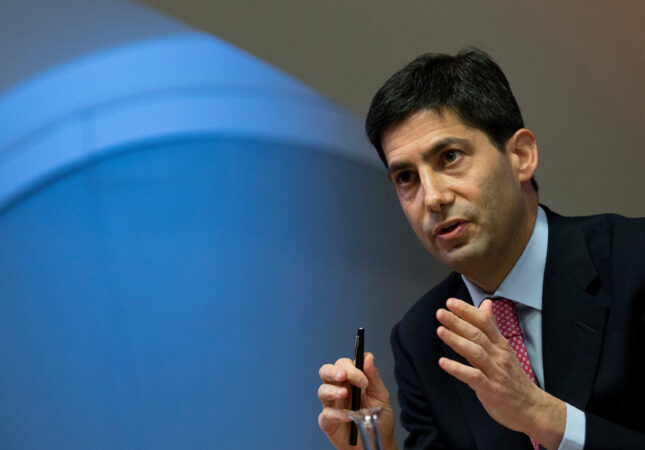
WASHINGTON — President Donald Trump said Friday that he will nominate former Federal Reserve official Kevin Warsh to be the next chair of the Fed, a decision likely to result in sharp changes to the powerful agency that could bring it closer to the White House.
If approved by the Senate, Warsh would replace current chair Jerome Powell when his term expires in May. Trump chose Powell to lead the Fed in 2017 but this year has relentlessly assailed him for not cutting interest rates quickly enough.
“I have known Kevin for a long period of time, and have no doubt that he will go down as one of the GREAT Fed Chairmen, maybe the best,” Trump posted on social media. “On top of everything else, he is ‘central casting,’ and he will never let you down.”
The appointment, which requires Senate confirmation, amounts to a return trip for Warsh, 55, who was a member of the Fed’s board from 2006 to 2011. He was the youngest governor in history when he was appointed at age 35. He is currently a fellow at the right-leaning Hoover Institution and a lecturer at the Stanford Graduate School of Business.
In some ways, Warsh is an unlikely choice for the Republican president because he has long been a hawk in Fed parlance, or someone who typically supports higher interest rates to control inflation. Trump, by contrast, has said the Fed’s key rate should be as low as 1%, a level few economists endorse, and far below its current level of about 3.6%.
During his time as governor, Warsh objected to some of the low-interest rate policies that the Fed pursued during and after the 2008-09 Great Recession. He also often expressed concern at that time that inflation would soon accelerate, even though it remained at rock-bottom levels for many years after that recession ended.
More recently, however, in speeches and opinion columns, Warsh has voiced support for lower rates.
Financial markets reacted in ways that suggest investors expect that Warsh could keep rates a bit higher over time. The dollar and yields on long-term U.S. Treasurys rose, although that moderated a bit.
The 10-year yield is at 4.26%, up from 4.23% Thursday. U.S. stock futures saw losses of around 0.5%. The biggest moves were in the suddenly volatile metals markets, where gold dropped more than 5% and silver sank more than 13%.
In Congress, Sen. Thom Tillis, a North Carolina Republican who is retiring, reiterated in a social media post that he will oppose Warsh’s nomination until a Justice Department investigation into Powell is resolved.
Tillis is a member of the Senate Banking Committee, which will consider Warsh’s nomination.
He added that Warsh is a “qualified nominee” but stressed that “protecting the independence of the Federal Reserve from political interference or legal intimidation is non-negotiable.”
Tillis’s opposition could complicate the confirmation process. Asked late Thursday whether Warsh could be confirmed without Tillis’s support, Senate Majority Leader John Thune said, “Probably not.”
Democratic Sen. Elizabeth Warren of Massachusetts, the highest-ranking Democrat on the Banking Committee, said, “This nomination is the latest step in Trump’s attempt to seize control of the Fed.”
Warsh beat out several other candidates, including Trump’s top economic adviser, Kevin Hassett, investment manager Rick Rieder, and current Fed governor Christopher Waller.
Controlling the Fed
Warsh’s appointment could be a major step toward Trump asserting more control over the Fed, one of the few remaining independent federal agencies. While all presidents influence Fed policy through appointments, Trump’s rhetorical attacks on the central bank have raised concerns about its status as an independent institution.
The announcement comes after an extended and unusually public search that underscored the importance of the decision to Trump and the potential impact it could have on the economy. The chair of the Federal Reserve is one of the most powerful economic officials in the world, tasked with combating inflation in the United States while also supporting maximum employment.
The Fed is also the nation’s top banking regulator.
The Fed’s rate decisions, over time, influence borrowing costs throughout the economy, including for mortgages, car loans, and credit cards.
For now, Warsh would likely fill a seat on the Fed’s governing board that was temporarily occupied by Stephen Miran, a White House adviser whom Trump appointed in September. Once on the board, Trump could then elevate Warsh to the chair position when Powell’s term ends in May.
Trump has sought to exert more control over the Fed. In August he tried to fire Lisa Cook, one of seven governors on the Fed’s board, in an effort to secure a majority of the board. Cook, however, sued to keep her job, and the Supreme Court, in a hearing last week, appeared inclined to let her stay in her position while her suit is resolved.
Powell revealed this month that the Fed had been subpoenaed by the Justice Department about his congressional testimony on a $2.5 billion building renovation. Powell said the subpoenas were “pretexts” to force the Fed to cut rates.
Trump’s economic policies
Since Trump’s reelection, Warsh has expressed support for the president’s economic policies, despite a history as a more conventional, pro-free trade Republican.
In a January 2025 column in the Wall Street Journal, Warsh praised Trump’s deregulatory policies and potential spending cuts, which he said would help bring down inflation. Lower inflation would allow the Fed to deliver the rate cuts the president wants.
Trump had said he would appoint a Fed chair who will cut interest rates to lower the government’s borrowing costs and bring down mortgage rates, though the Fed doesn’t decide those costs directly.
In December, he wrote on social media of the need for lower borrowing costs and said, “Anyone who disagrees with me will never be the Fed chairman!”
Potential challenges and pushback
Warsh would face challenges in pushing interest rates much lower. The chair is just one member of the Fed’s 19-person rate-setting committee, with 12 of those officials voting on each rate decision. The committee is already split between those worried about persistent inflation, who’d like to keep rates unchanged, and those who think that recent upticks in unemployment point to a stumbling economy that needs lower interest rates to bolster hiring.
Financial markets could also push back. If the Fed cuts its short-term rate too aggressively and is seen as doing so for political reasons, then Wall Street investors could sell Treasury bonds out of fear that inflation would rise. Such sales would push up longer-term interest rates, including mortgage rates, and backfire on Warsh.
Trump considered appointing Warsh as Fed chair during his first term, though ultimately he went with Powell. Warsh’s father-in-law is Ronald Lauder, heir to the Estee Lauder cosmetics fortune and a longtime donor and confidant of Trump’s.
Warsh in recent years has become harshly critical of the Fed, calling for “regime change” and assailing Powell for engaging on issues like climate change and diversity, equity and inclusion, which Warsh said are outside the Fed’s mandate.
His more critical approach suggests that if he does ascend to the position of chair, it would amount to a sharp transition at the Fed.
In a July interview on CNBC, Warsh said Fed policy “has been broken for quite a long time.”
“The central bank that sits there today is radically different than the central bank I joined in 2006,” he added. By allowing inflation to surge in 2021-22, the Fed “brought about the greatest mistake in macroeconomic policy in 45 years, that divided the country.”
Eli Lilly & Co. plans to build a $3.5 billion pharmaceutical plant in the Lehigh Valley to expand manufacturing capacity for next-generation weight-loss medicines, the Indiana company announced Friday in Allentown.
The decision by Lilly to build one of its four new U.S. factories in Lehigh County marks a significant win for Pennsylvania as states compete for the billions Big Pharma, under pressure from Washington, is spending to boost domestic manufacturing.
“The Mid-Atlantic, Northeast in recent years hasn’t seen this type of mega-plant investment. Most of that has gone to the South and the Southwest,” Don Cunningham, CEO of Lehigh Valley Economic Development Corp., said in an interview.
The Lehigh Valley sits in the middle of a pharmaceutical manufacturing belt that stretches from Montgomery County into central New Jersey, but historically has been known for steel, cement, and Mack Trucks. The Lilly plant will put it on the map for life sciences, said Cunningham, whose agency helped recruit Lilly.
Montgomery County, a major drug and vaccine manufacturing hub, secured another significant project during the ongoing pharmaceutical investment push. The British company GSK said in September that it will build a biologics factory in Upper Merion Township, but did not specify how much it would spend there.
Merck, the New Jersey-based drug giant, announced plans for a $1 billion factory and lab near Wilmington, beyond its existing major operations in Montgomery County.
Until now, Lilly has been busy in the South. Last year, Lilly announced plans to spend a total of $17.5 billion on three factories in Alabama, Texas, and Virginia. The Lehigh Valley was in the competition for the Virginia project, which will be built west of Richmond, Cunningham said.
The 150-acre Lehigh Valley site, in Upper Macungie Township, was selected from more than 300 applications for one of the four new Lilly plants. Ohio was among the other finalists, Cunningham said. The property Lilly is acquiring is adjacent to Interstate 78 on the north side just west of the Route 100 interchange.
Pennsylvania boosted its chances of landing the Lilly project by offering up to $50 million in tax credits and $50 million in grants. An additional $5 million will go to a local community college for a job-training program.
Gov. Josh Shapiro played an important part in securing the Lilly commitment, Cunningham said, with “his team bringing to bear every resource the state could.”
When fully operational in 2031, the Lilly complex is expected to employ 850. The average annual pay in a Lilly facility is $100,000, Lilly’s chair and CEO David A. Ricks told a crowd gathered at the Da Vinci Science Center in downtown Allentown.
“Those are high-value jobs that I can say with a lot of confidence change the trajectory of families,” Ricks said.
Among the products Lilly anticipates manufacturing at the plant are Zepbound, which Ricks called the world’s best-selling medicine, and retatrutide, a type of weight-loss medication dubbed “triple G” that acts on three aspects of appetite regulation.
Early results suggest such next-generation medications may lead to more weight loss than seen with the current drugs on the market, such as Novo Nordisk’s Ozempic and Lilly’s Mounjaro, which target one or two metabolic drivers.
New flights will take off soon from Atlantic City International Airport.
Breeze Airways, an airline launched in 2021, is adding two direct flights from Atlantic City to Charleston, S.C., and Raleigh-Durham, N.C. A flight with a stopover is also being added to Tampa, Fla.
“Atlantic City is not only a great destination for travelers but also a gateway to many other metro areas,” David Neeleman, founder and CEO of Breeze Airways, said in a statement Wednesday. “We know Atlantic City will be a welcome addition to our guests in Charleston, Raleigh, and Tampa, and we look forward to introducing our new guests in Atlantic City to Breeze.”
Breeze, which is focused on underserved markets, will start flying to the new destinations this spring. The Charleston route will begin May 6 and operate on Wednesdays and Saturdays. Raleigh-Durham and Tampa routes will begin June 11 and be offered on Thursdays and Sundays.
Travelers can book their flights at the Breeze Airways website. The airline ranks its ticket tiers from a “No Flex Fare” to “Nice” to “Nicer” to “Nicest” depending on flexibility to change or cancel travel, as well as bags included in the fare, legroom, and other features. A roundtrip ticket to Charleston from June 17 to June 20 costs $118 with no changes and no carry-on bag as of Jan. 29.
“For an airport of our size, expanding service in a way that directly benefits our passengers is especially meaningful, and this announcement reflects our continued focus on delivering a simple, accessible, and customer-friendly travel experience,” Stephen Dougherty, executive director of the South Jersey Transportation Authority, said in a statement.
Breeze has over 170routes including seasonal and year-round flights. The airline’s founder, Neeleman, is also the founder of JetBlue. Breeze reported its first full quarter of operating profit in 2024, the Wall Street Journal reported last year.
Atlantic City’s airport is also serviced by Spirit Airlines, American Airlines, and Allegiant.
American launched a program in 2022 to shuttle passengers on a bus from the Atlantic City airport to Philadelphia International Airport to catch flights. Spirit has seen a decrease in scheduled flights from Atlantic Cityin recent years and announced in 2024 that it would close its crew base there but continue servicing the airport. Allegiant started offering flights out of Atlantic City last year.
A faster way to get through airport security may be coming to an airport near you.
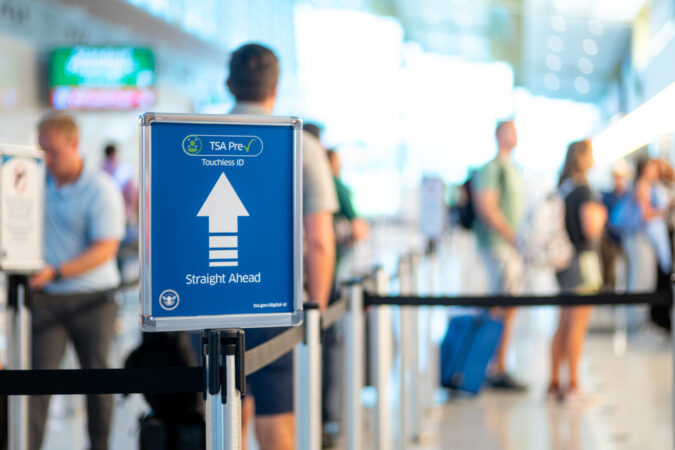
TSA PreCheck Touchless ID, a new program that uses facial recognition, is expanding to 65 airports this spring. The expansion will prioritize 2026 World Cup host cities, where travel is expected to surge, said Transportation Security Administration spokesperson R. Carter Langston.
“Passengers seem to absolutely appreciate it — the speed, the efficiency,” Langston said. “All they show is their face, and the officer just waves them right into the checkpoint. No hassling with passports or IDs or phones.”
TSA launched the first iteration of the program in 2021 in partnership with Delta Air Lines at Hartsfield-Jackson Atlanta International Airport. It’s now available for five airlines across 22 airports.
Critics worry that the program raises privacy concerns. It is voluntary, and travelers can opt out at any time and use a standard ID verification instead.
What is PreCheck Touchless ID?
TSA said in an email that the initiative is a joint effort from U.S. Customs and Border Protection, airports, and airlines that allows travelers “to move through dedicated lanes with ease, enjoying a smoother and more convenient airport experience.”
The program uses the CBP Traveler Verification Service to create “a secure biometric template of a passenger’s live facial image taken at the checkpoint and matches it against a gallery of templates of pre-staged photos that the passenger previously provided to the government (e.g., U.S. Passport or Visa),” the agency website said.
Who is eligible for PreCheck Touchless ID?
To use the program, fliers must be a current TSA PreCheck member with a valid “known traveler number” and an active airline profile (such as being enrolled in a loyalty program). They must also have a valid passport uploaded to their airline profile.
The airlines currently participating in the program include Alaska, American, Delta, Southwest, and United.
TSA PreCheck Touchless ID offers current TSA PreCheck members an expedited airport security screening by way of “facial comparison technology.”
It’s only available at select airports, through participating airlines — which vary. For example, travelers at John F. Kennedy International Airport, but only if they are flying with Alaska, America, or Delta. It is available at George Bush Intercontinental in Houston, but only for passengers flying with American. For a list of availability, visit the TSA website.
How can travelers opt in?
To use the program, travelers must first opt in through their airline’s website or app before checking in to their flight.
The process varies by airline, but you can generally find the prompt under a “travel documents” section (where you add your known traveler number or passport details) of your airline loyalty program app or website.
American Airlines customers, for example, will find the opt-in choice toward the bottom of the “Information and password” page of their AAdvantage profile, while Alaska Airlines customers should go to their account settings, then click into the “travel documents” section.
Once travelers have opted in, then checked in for their flight, a TSA PreCheck Touchless ID symbol should then appear on their boarding pass. If the symbol is not on your boarding pass, you won’t be able to use the lane, even if you show an employee that you are enrolled in the program.
At the airport, travelers should follow signs to a separate TSA PreCheck Touchless ID lane. Instead of handing an ID over to an officer to verify your identity, you’ll instead pause to scan your face, then keep moving.
Is it really faster?
It can be, for two reasons.
First: There is no slowdown to hand over and scan your ID; travelers must only pause during their walk through the line dividers before proceeding to the X-ray machines.
Second: Because the program is new, requires signing up in advance, and is not available for every airline, it’s getting a fraction of the traffic that regular security, Clear, or PreCheck lanes are.
We’ve had mixed results. When it works, it’s incredible; you really are through in seconds.
But we’ve also been delayed whenthe facial comparison machine was undergoing maintenance and out of use, sending us back into the longer PreCheck lane.
Which airports offer PreCheck Touchless ID?
TSA PreCheck Touchless ID is already available at 22 airports (however, participating airlines will vary; check the TSA website for more information):
Boston Logan International Airport
Charlotte Douglas International Airport
Chicago O’Hare International Airport
Dallas-Fort Worth International Airport
Denver International Airport
Detroit Metropolitan Wayne County Airport
Dulles International Airport
George Bush Intercontinental Airport
Harry Reid International Airport in Las Vegas
Hartsfield-Jackson Atlanta International Airport
John F. Kennedy International Airport
LaGuardia Airport
Los Angeles International Airport
Minneapolis–Saint Paul International Airport
Newark Liberty International Airport
Palm Beach International Airport
Philadelphia International Airport
Portland International Airport in Oregon
Ronald Reagan Washington National Airport
Salt Lake City International Airport
San Francisco International Airport
Seattle-Tacoma International Airport
What are the privacy concerns?
The TSA is using more facial recognition at the airport, including in regular security lanes and CBP checks.
The CBP says its Enhanced Passenger Processing involves taking a traveler’s photo using “auto capture technology” to simplify the inspection and adjudication process.
Travelers can also use biometric screenings to speed through Global Entry, using a CBP app.
TSA says on its website that it may share your information with “CBP, DHS S&T, or others as necessary.” The agency confirmed that includes sharing information about travelers with Immigration and Customs Enforcement to check for deportation orders.
There has been a bipartisan effort to put more guardrails on its use at airports.
In 2019, the Department of Homeland Security said that photos of travelers were taken in a data breach, accessed through the network of one of its subcontractors. (TSA says its databases are encrypted).
A new Senate bill would allow officers to continue scanning travelers’ faces if they opt in; it would ban the technology’s use for anything other than verifying identities. It would also require the agency to immediately delete the scans once the check is complete.
If you change your mind about TSA PreCheck Touchless ID, you can opt out at any time and ask for standard ID verification instead. You can opt out of any facial recognition at the airport by saying, “I’d prefer a standard ID check.”
The agency also says it deletes photos and personal data within 24 hours of scheduled flight departures. The TSA website’s FAQ section addresses some privacy concerns and says that all data collected during facial comparison checks is protected.