Category: Business

Business news and market updates

  • Grocery Outlet is closing stores in South Jersey, Philadelphia, and Kennett Square

    Grocery Outlet is closing stores in South Jersey, Philadelphia, and Kennett Square

    Grocery Outlet bargain market is closing dozens of stores nationwide, including eight in the Philadelphia area.

    The closures were first referenced earlier this week in the company’s earnings report. The California-based grocer recorded an operating loss of $221.7 million last year, much of which it attributed to “certain underperforming stores” that will now close.

    These include five Grocery Outlets in South Jersey, two in Philadelphia, and one in Kennett Square, according to real estate marketing released Thursday.

    A company spokesperson did not return a request for comment about when the stores would close.

    The impacted Philly-area stores are located at:

    • 4004 U.S. Route 130, Delran
    • 401 Harmony Rd., Gibbstown
    • 345 Scarlet Rd., Kennett Square
    • 190 Hamilton Commons Dr., Mays Landing
    • 2017 W. Oregon Ave., Philadelphia
    • 2524 Welsh Rd., Philadelphia
    • 3174 U.S. Route 9 S., Suite 5, Rio Grande
    • 677 Berlin-Cross Keys Rd., Sicklerville
    People shop at a Grocery Outlet in Philadelphia in 2022.

    Gordon Brothers, a Boston investment firm, is looking to sublease all 36 closing Grocery Outlets. The Philadelphia-area properties range in size from 14,000 to 21,000 square feet.

    After the closures, the chain will still have several locations in the city, collar counties, and South Jersey.

    Grocery Outlet calls itself an “extreme value retailer.” It was founded in 1946, and has expanded from 128 stores to 570 stores over the past two decades. Many locations are operated by entrepreneurs who live nearby.

    In recent months, Grocery Outlet’s bottom line was impacted by economic uncertainty, as well as the November suspension of SNAP benefits that tens of millions of U.S. consumers rely on, according to president and CEO Jason Potter.

    “Consumer pressure intensified, federally funded benefits were delayed, and competition grew more promotional in the fourth quarter,” Potter said in a statement. “In response, we have begun to sharpen our focus on what matters most: delivering clearer value and a better in-store experience.”

    Customers and employees inside a Grocery Outlet in Philadelphia in 2023.

    While the grocery industry remains relatively resilient, it has faced a challenging few years with persistent inflation, tariffs that further drove up prices on some products, and continued competition from other retailers and restaurants.

    In recent weeks, Amazon closed all of its brick-and-mortar Amazon Fresh stores, including six in the Philadelphia region. The company says it plans to expand grocery-delivery services and open more Whole Foods markets, to the dismay of some Amazon Fresh customers who said they were drawn to the low prices at the smaller-format stores.

    Gourmet markets have been impacted, too. Three Di Bruno Bros. locations in Ardmore and Wayne closed last month, two years after being acquired by Wakefern Food Corp., the North Jersey-based supermarket cooperative that operates ShopRite.

    A Wakefern spokesperson said the company planned to refocus on its flagship stores in South Philadelphia and Rittenhouse, as well as its growing online business. The move, spokesperson Maureen Gillespie said, would be “a positive reset that allows us to preserve and elevate the in‑store tradition while growing the brand’s reach in meaningful new ways.”

  • Girl Scouts of America isn’t happy with cookie sales at a South Jersey weed dispensary

    Girl Scouts of America isn’t happy with cookie sales at a South Jersey weed dispensary

    Girl Scouts of America is not a fan of a popular weed strain using the name of their iconic cookies, nor are they comfortable with Girl Scouts selling cookies outside of weed dispensaries, which has been an unsanctioned practice among some Scouts for at least a decade.

    The conversation reared its head again this week after a New Jersey Girl Scout troop set up shop outside of a Mount Laurel recreational marijuana dispensary to sell Thin Mints and Caramel deLites. Owners of Daylite Cannabis dispensary had been trying for years to make this possible, and were excited to share the news of a “pilot program” at their store, owner Steve Cassidy said in an article for NJ.com.

    “Being community-minded is a core part of our mission at Daylite. We’re a locally and family-owned business, so supporting local organizations and helping them raise funds in the community is very important to us,” Cassidy said, who runs the dispensary alongside his wife and parents.

    What they didn’t expect was for it to become a national and global headline, upsetting higher-ups at the Girl Scouts of America. A representative for the Girl Scouts of Central and South Jersey said that there was no formal agreement to allow Girl Scouts to sell cookies in front of a dispensary and don’t approve of the practice.

    “Our guidance for Girl Scout cookie booths is that girls should not set up booths in front of any businesses that they themselves could not legally patronize,” the representative said. “It’s just unfortunate that [the owner] was quoted as saying this is a ‘trial’ because that is factually incorrect.”

    The Girl Scout troop, which Cassidy did not identify, sold cookies outside the dispensary on NJ Route 73 in February to much enthusiasm from customers, Cassidy said. Some customers even bypassed the marijuana to go to the cookies first, he told NJ.com.

    Girl Scouts of Central and South Jersey said they do not know how the miscommunication occurred. Cassidy said he was told by a member of a local Girl Scout organization that a “small pilot program” had been approved.

    “Our intention was simply to support a local troop and be part of our community. We’ve seen an overwhelmingly positive response from people who enjoyed supporting the girls, and we hope that enthusiasm helps encourage similar community partnerships in the future.”

    Girl Scout cookie season runs from January to April, providing young girls the chance to exercise the entrepreneurial spirit and engage with their community. Girl Scouts started selling cookies in 1917, but Girl Scouts selling cookies in front of weed dispensaries has been making headlines for more than a decade.

    In 2014, Girl Scout Danielle Lei garnered national media attention for selling out of cookies in 45 minutes when she opened up shop in front of San Francisco’s Green Cross medical marijuana dispensary.

    At the time, Lei’s mom told press that she encourages her daughters to “set up shop at various points around San Francisco so they can learn about different environments while earning some cash” and to use it as an opportunity, “to start a conversation about drugs and how some people use marijuana as medicine while others just get high.”

    A 9-year-old San Diegoan sold 300 boxes in less than six hours outside of a weed shop in 2018. Right before the pandemic, a Chicago dispensary went viral for hosting a rotation of Girl Scout troops selling cookies out front. Girl Scouts did the same at a Portland dispensary in 2016, a Michigan dispensary in 2021, and in Arizona in 2022.

    In each case, the respective regional Girl Scouts organization disavowed the practice.

    The Girl Scout troop that sold cookies at Daylite in February was scheduled to return Friday, but that has now been canceled.

  • People with prior convictions can work as unarmed private security guards, Philly court says

    People with prior convictions can work as unarmed private security guards, Philly court says

    Jamar Patterson, now 40, was up for a job in 2022 as an unarmed security guard.

    But the offer was rescinded when he informed his prospective employer, Allied Universal, of a previous drug conviction from when he was 19, despite having a clean record since 2005.

    Similarly, Abron Ash, 49, lost his job after his employer, McGinn Security, learned of his conviction on three misdemeanors related to a fight in 2006.

    Both lost their jobs because of a Pennsylvania law that applies to people who have been convicted of certain crimes, banning them for life from working as private unarmed security guards.

    Last week, the Philadelphia Court of Common Pleas ruled that the state’s Private Detective Act is unconstitutional.

    The ruling was the result of a 2023 civil suit Patterson and Ash filed against the Commonwealth of Pennsylvania and District Attorney Larry Krasner, whose office enforces the Private Detective Act in Philadelphia. They asked the court to block enforcement of the law.

    Krasner said in a statement Friday that he agrees with the court’s decision and will not appeal it.

    “The Private Detective Act’s extreme, irrebuttable lifetime ban on employment in private security swept too broadly constitutionally,” Krasner said. “The ruling will now open doors for qualified Philadelphians who were previously barred from entering the security industry due to old or irrelevant convictions, giving more individuals the right to work and earn a living.”

    It’s unclear whether the Philadelphia court’s ruling would eventually apply statewide.

    As of now, the decision prevents enforcement of the law in Philadelphia, say attorneys for the plaintiffs. The two men filed the suit with the help of the Public Interest Law Center and Community Legal Services (CLS) of Philadelphia.

    “I’m very excited to hear the news that I was a part of making change. It’s almost like making history — I guess it is history in Philadelphia,“ Patterson said in a statement. ”And I’m looking forward to the case becoming a part of a statewide solution.”

    Patterson’s attorneys also say more effort is likely needed to extend the ruling to the rest of the state.

    Though many states have restrictions on security guard licensing for people with criminal convictions, they often have time limits on the restriction or have processes in place for authorities to give exceptions.

    Pennsylvania’s lifetime ban, however, is among the most restrictive.

    The recent ruling means Philadelphia employers can no longer deny people jobs as unarmed private security guards because of old, minor, and “irrelevant” convictions, according to the Public Interest Law Center and CLS.

    “We have had hundreds of clients over the years who have come to Community Legal Services because they are interested in working in the security field but have been unable to do so because of old and irrelevant convictions,” said Jamie Gullen, a managing attorney at CLS.

    Gullen said the court’s decision “will open the door to opportunity for hard-working, qualified Philadelphians.”

    Ben Geffen, senior attorney at the Public Interest Law Center, said evidence showed that the law is, “over broad, unconstitutional, and does not further public safety.”

    The Private Detective Act was passed in 1953 and includes a long list of minor offenses, including many misdemeanors, that bar workers from employment in the security and protection industry for life. The convictions include simple drug possession, pickpocketing, and a catchall category of “any offense involving moral turpitude.”

    Because of those broad prohibitions, most security employers will not hire workers with any kind of conviction history, attorneys for the CLS and Public Interest Law Center said.

    Security jobs can be vital for some workers because they don’t often require a college degree and offer better wages than other entry-level work. The median annual income for a security guard is $31,470, or about $15 per hour. That’s double Pennsylvania’s $7.25 per hour minimum wage.

    Kiminori Nakamura, Ph.D., filed a report to the court on behalf of Patterson and Ash noting that the risk of recidivism for individuals with criminal history seeking such jobs is relatively low.

    Editor’s Note: This story has been updated to include a statement from District Attorney Larry Krasner.

  • As Trump shrank the federal workforce, Pennsylvania hired hundreds of former federal employees

    As Trump shrank the federal workforce, Pennsylvania hired hundreds of former federal employees

    More than 800 former federal workers have been hired by the Pennsylvania government in the last year, as thousands of Pennsylvania-based federal government employees quit or lost their jobs.

    Pennsylvania’s Office of Administration announced the count this week. It’s been one year since Gov. Josh Shapiro signed an executive order streamlining the hiring of former federal workers to state-government positions.

    At that time, the Trump administration had just offered federal workers a deferred resignation program to leave their positions with the promise of several months’ pay. The Trump administration had also begun laying off workers across agencies, touting plans for further workforce reductions.

    Pennsylvania employment data showed roughly 4,800 fewer federal government jobs in October, as the deferred resignation program took effect. From January through November last year, the U.S. overall cut 271,000 federal jobs.

    “Federal employees bring world-class training and a deep commitment to public service,” Neil Weaver, secretary of the Office of Administration, said in a statement this week. “By tapping into their expertise, we’ve strengthened our workforce and improved the delivery of programs and services that Pennsylvanians depend on every day.”

    window.addEventListener(“message”,function(a){if(void 0!==a.data[“datawrapper-height”]){var e=document.querySelectorAll(“iframe”);for(var t in a.data[“datawrapper-height”])for(var r,i=0;r=e[i];i++)if(r.contentWindow===a.source){var d=a.data[“datawrapper-height”][t]+”px”;r.style.height=d}}});

    The 800 former federal employees who now work for Pennsylvania are in law enforcement, public safety, human services, health care, and other areas.

    The Office of Administration said it had “moved at the speed of business to implement the executive order and capitalize on the opportunity to hire displaced federal workers to fill existing, funded vacancies in state agencies.”

    Pennsylvania partnered with Civic Match, a job-seeking platform focused on state and local government positions, and which hosts virtual job fairs. The platform is managed by national nonprofit Work for America. Since it launched in 2024, the platform has shown almost 900 Pennsylvania job listings.

    As of Thursday afternoon, Pennsylvania’s own online job board showed 657 vacancies. They include an aquatic biologist, police cadet, accountant, and an air monitoring equipment specialist.

  • Dow drops 900 after oil prices jump to highest in nearly 2 years amid Iran conflict

    Dow drops 900 after oil prices jump to highest in nearly 2 years amid Iran conflict

    NEW YORK — U.S. stocks are falling sharply Friday after getting a whiff of a worst-case scenario for financial markets: a weakening economy combined with high inflation.

    The S&P 500 dropped 1.6% after a report showed U.S. employers cut more jobs last month than they created and after oil prices jumped to their highest level in nearly two years because of the Iran war. It’s a combination that investors hate because no one in the world has a good tool to fix both a weak economy and high inflation at the same time.

    The Dow Jones Industrial Average was down 909 points, or 1.9%, as of 9:35 a.m. Eastern time, and the Nasdaq composite was 1.6% lower.

    “You can’t sugarcoat this report,” according to Brian Jacobsen, chief economic strategist at Annex Wealth Management. “A negative payrolls number combined with a big jump in oil prices will have traders worrying about stagflation risks.”

    Stagflation is what economists call a stagnating economy combined with high inflation, and a separate report released Friday added to the sour mix after showing that U.S. retailers made less money last month than economists expected. It raised the possibility that spending by U.S. households, the main engine of the economy, may be stretched near its maximum.

    Usually when the economy is unsteady and the job market is weakening, the Federal Reserve cuts interest rates to give things a boost. Lower rates can make it more affordable for borrowers to get mortgages or to raise money to build factories, while also helping prices for stocks and other investments. The Fed cut its main interest rate several times last year and had indicated more were to come this year.

    But lower interest rates can also make inflation worse. And the Fed’s hands may be increasingly tied because oil prices are spiking and pushing inflation higher due to disruptions for the energy industry because of the war.

    The price for a barrel of Brent crude, the international standard, jumped another 5.7% to $90.25. A barrel of benchmark U.S. crude climbed 8.9% to $88.20.

    Oil prices have surged, with Brent up from near $70 late last week, as the war has expanded and targeted areas critical to the production and movement of energy in the Middle East. Much will depend on what happens with the Strait of Hormuz. Roughly a fifth of the world’s oil typically sails through the narrow waterway off Iran’s coast.

    The conflict also halted exports of Iranian gas to much of Asia. If that stoppage is drawn out, it will likely lead to a bidding war between Europe and Asia that would send energy prices even higher, said Fatih Birol, chief of the International Energy Agency.

    If oil prices spike further, like to $100 per barrel, and stay there, some analysts and investors say it could be too much for the global economy to withstand.

    To be sure, the U.S. stock market has a history of bouncing back relatively quickly following conflicts in the Middle East and elsewhere, as long as oil prices don’t jump too high for too long. The uncertainty about what will happen has caused frenetic swings across financial markets this week, sometimes hour by hour.

    President Donald Trump’s most recent signal was that he wants an “unconditional surrender” of Iran, apparently ruling out negotiations.

    In the bond market, Treasury yields rose further as the jump in oil prices pushed harder on upward inflation pressures. More traders are betting on the possibility that the Fed will cut interest rates just once this year, instead of at least twice, according to data from CME Group.

    The yield on the 10-year Treasury climbed to 4.17% from 4.13% late Thursday and from just 3.97% before the war with Iran started.

    In stock markets abroad, indexes slumped in Europe following a better finish in Asia. France’s CAC 40 fell 1.6%, and Germany’s DAX lost 1.8%, while Hong Kong’s Hang Seng jumped 1.7% and Japan’s Nikkei 225 added 0.6%.

  • Supply chain disruptions from the Iran war could raise prices for drugs, electronics, and more

    Supply chain disruptions from the Iran war could raise prices for drugs, electronics, and more

    NEW YORK — The Iran war has effectively halted oil tanker movement in the key Strait of Hormuz. But it’s also disrupting the wider global supply chain beyond oil, affecting everything from pharmaceuticals from India, semiconductors from Asia, and oil-derived products such as fertilizers that come from the Middle East.

    Cargo ships are stuck in the Gulf or making a much longer detour around the southern tip of Africa. Planes carrying air cargo out of the Middle East are grounded. And the longer the war drags on, the more likely that there will be shortages and price increases on a wide range of goods.

    “This is really causing some major impacts within the global supply chain,” said Patrick Penfield, professor of supply chain practice at Syracuse University. “As this conflict keeps progressing, you’ll start to see some shortages, you’ll see some major price increases.”

    Stalled at sea

    Clarksons Research, which tracks shipping data, estimates that about 3,200 ships, or about 4% of global ship tonnage, are idle inside the Persian Gulf, but that includes about 1,231 that likely only operate within the Gulf. About 500 ships, or 1% of global tonnage, are currently “waiting” outside the Gulf in ports off the coast of the United Arab Emirates and Oman, according to the firm.

    While those may seem like small percentages, they have a domino effect that will lead to congestion elsewhere, said Michael Goldman, general manager North America of CARU Containers.

    “The supply chain is kind of like a long train with many cars and each car represents, let’s say, a port in the world. Well, if one car gets derailed, it can very often have a domino effect to many other cars behind it or in front of it,” he said. “So although we only have a small number of ports affected by this military action, it can really have a big effect on the total supply chain.”

    On Tuesday, President Donald Trump pitched a plan aimed at getting oil and trade moving again through the Strait.

    Trump said on social media he ordered the U.S. International Development Finance Corp. to provide political risk insurance for tankers carrying oil and other goods through the Persian Gulf “at a very reasonable price.”

    Political risk insurance is a type of coverage intended to protect firms against financial losses caused by unstable political conditions, government actions, or violence. Marine insurers had been canceling or raising rates for insurance in the region.

    He said that, if necessary, the U.S. Navy would escort oil tankers through the Strait of Hormuz. The Navy has at least eight destroyers and three, smaller, littoral combat ships in the region. These ships have previously been used to escort merchant shipping in the region and in the Red Sea.

    Computer chips, pharmaceuticals, and other goods face delays

    A wide range of products are shipped through the Mideast region. Along with about 20% of the world’s oil that comes from the region, products made with natural gas such as petrochemical feedstock — used to make plastic and rubber — and nitrogen fertilizer come from the Middle East. Pharmaceuticals exported from India and semiconductors and batteries exported from Asia to the rest of the world are all shipped through the region and could face delays.

    Limited routes, higher costs

    In addition to constraints on the Strait of Hormuz, the instability has put a damper on transit in the Red Sea and the Suez Canal, which had just begun to see more transit after years of instability due to Houthi attacks on ships in the region. Shipping company Maersk had resumed transit in the Suez Canal and Red Sea but said Sunday that it was rerouting that traffic around the Cape of Good Hope in Africa, a move other companies have been making to avoid the volatile region.

    That journey adds 10 to 14 days to the trip and about $1 million extra in fuel per ship, Syracuse’ Penfield estimates.

    With higher fuel prices, longer routes, and higher risk in the region, shippers have begun adding fuel and “war risk” or “emergency conflict” surcharges to what they’re charging clients, leading to higher costs all around, he said.

    Air cargo under pressure

    Air cargo has also been constrained. Closed airspace and airports in countries including UAE, Qatar, Bahrain, Kuwait, Iraq, and Iran have stranded tens of thousands of people — and cargo.

    Each of the three major Middle Eastern airlines — Emirates, Qatar Airways, and Etihad Airways — operate fleets of cargo aircraft, and the airlines also transport goods in the belly of their passenger planes.

    The amount of goods that travels through the air typically accounts for less than 1% of all freight moving globally, but the products that do travel by air tend to be perishable or high-value goods like pharmaceuticals, electronics, and produce that together account for about 35% of the world trade value, Boeing estimated in its World Air Cargo Forecast.

    The longer these airports in the Middle East remain closed the greater the potential disruption to the economy if these sensitive shipments don’t arrive or have to be rerouted around the conflict. Even before the war in Iran began over the weekend, air freight and airlines were already contending with closed airspace over Ukraine and Russia.

    Flights through these Middle Eastern airport hubs are a key route for passengers and cargo from India. Henry Harteveldt, an airline industry analyst with Atmosphere Research Group, said it’s going to be hard to get to India now, and passengers may have to switch to different routes that fly west across Asia. Airlines may have to resort to longer flights, and in some case even add fuel stops on some routes.

    “Remember, there’s a lot of pharmaceutical products that are made in India and then exported to different countries around the world. If that’s disrupted, that has a huge, huge, huge impact,” Harteveldt said.

    Air cargo costs are expected to rise due to reduced capacity, increased demand, and surcharges.

    Maersk said in an operational update Tuesday that it expects air freight rates to rise due to capacity constraints.

    “Airlines are also introducing or reviewing the possibility of introducing war risk surcharges on shipments routed through or near the impacted regions,” Maersk said in a statement. “There may also be added costs linked to jet fuel which in turn can push up costs.”

    An industry that ‘runs on disruption’

    Despite the supply chain upheaval, however, Michael Goldman, general manager North America of CARU Containers, said the industry will adjust. Over the past few years it has faced other major disruptions like COVID supply shortages and other recent Mideast conflicts and has become more nimble.

    “The specific situation that’s happening is pretty unprecedented, so it’s very unique from that perspective,” he said. “[But] for the last few years the industry just kind of runs on disruption. So in terms of our industry having disruption, that is nothing new. That’s more of the same.”


  • Jefferson Health will close four Einstein pediatric practices and move three others to True North Pediatrics

    Jefferson Health will close four Einstein pediatric practices and move three others to True North Pediatrics

    Jefferson Health is closing four legacy Einstein pediatric practices, including one at Jefferson Einstein Hospital Philadelphia in a low-income area of the city, and moving three others to True North Pediatrics, a private group with a dozen mostly suburban locations.

    The nonprofit health system did not respond to questions Thursday about how many children the practices serve, how many jobs will be cut, or why it was making the change, which is expected to significantly reduce the amount of pediatric care in North and Northeast Philadelphia.

    This week’s pediatric cutbacks are a significant move affecting patient care amid a yearslong effort to make the system with more than $15 billion in annual revenue financially sustainable. From 2015 through 2024, Jefferson grew from three hospitals to more than 30 and now stretches from South Jersey to near Scranton.

    The locations scheduled to close June 30 are the Pediatric & Adolescent Ambulatory Center at Einstein Philadelphia and three Holland Pediatrics locations (Center One/Bustleton in Northeast Philadelphia, Buck Road in Southampton, and Frankford in Torresdale), Jefferson said in a statement.

    The three clinics going to True North are Trappe Pediatric Care at Iron Bridge, Pennypack Pediatrics, and Einstein Pediatrics Elkins Park. Jefferson did not provide details on transaction terms.

    A practice manager at True North, which is based in suburban Philadelphia, did not respond to a request for more information. True North’s website said the practice is independent, “not managed by any big business or larger institution.”

    Jefferson said in a statement that it will continue offering pediatric services through its primary care network, urgent care centers, emergency departments, and Lehigh Valley Health Network’s Reilly Children’s Hospital.

    The pediatric clinics affected had been part of the former Einstein Healthcare Network when Jefferson acquired the system in 2021.

    “With three excellent inpatient pediatric hospitals right here in our region, partnering with True North Pediatrics — an organization whose singular focus is pediatric care — allows us to ensure that families across our region continue to receive the specialized, dedicated attention they deserve,” Jefferson said in an internal communication Monday.

    It’s possible that St. Christopher’s Hospital for Children, which is about 3½ miles by car from Einstein Philadelphia, will pick up many of the thousands of dislocated patients.

    St. Chris already serves almost exclusively patients with Medicaid insurance for low-income families and struggles to make ends meet because of the low rates it receives.

    “We are committed to delivering trusted, compassionate care for every patient who walks through our doors,” St. Chris said in a statement. “Families can access care at our nearby locations, including our Center for the Urban Children and Northeast Pediatrics office.”

  • Pension advisers reach $30 million settlement over teachers’ complaint they invested poorly

    Pension advisers reach $30 million settlement over teachers’ complaint they invested poorly

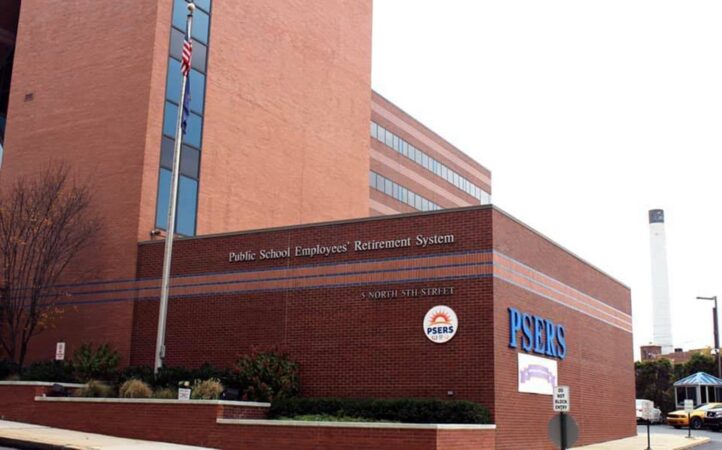
    Three investment firms that advised Pennsylvania’s largest pension system have agreed to pay $30 million to settle legal claims alleging that their bad advice cost Pennsylvania teachers far more.

    The firms had pumped billions of dollars into often poor-performing “alternative” investments such as hedge funds, private equity, urban demolition sites, and an illegal Kurdistan pipeline.

    The investment firms are Chicago-based Aon Investments USA, West Conshohocken-based Hamilton Lane Inc., and Portfolio Advisors LLC, now part of FS Investments of Philadelphia. Lawyers for school staff had alleged that they helped the PSERS public school pension fund select hundreds of high-fee but collectively underperforming investments when they could have been making more owning U.S. stock-index funds, according to a complaint initially filed in 2021.

    PSERS’ performance was so weak in 2011-20 that the state’s “shared-risk” law, which requires teachers to pay more for their future pensions when investments perform poorly, kicked in for the first time.

    That law compelled 176,000 Pennsylvania school employees hired since 2011 to pay an extra $87 million in payroll-deduction surcharges from 2021 to 2024. The pensions are financed mostly by investment profits and state treasury payments, with a smaller portion from school staff’s standard payroll deductions of around 7.5%.

    Teachers and other school staff paid extra charges of 0.5% to 0.75%, averaging nearly $500 each over the three years, to help cover PSERS’ poor performance. They each will recover an average of around $112.

    “The lawsuit shined a light on the industry and will result in a significant recovery to these hardworking teachers. Our work on this case will result in better decision-making for this fund and other funds,” said Gerard Mantese, the teachers’ lead counsel along with John J. Conway and Gregory B. Heller.

    The lawyers will be paid $10 million from the settlement for their five years of work on the case.

    The former PSERS advisers had denied in a pre-settlement court filing “that their actions and/or inactions caused an increased contribution” from the teachers. They maintained they did the work, for which PSERS paid them millions, “fully and lawfully.”

    FS and Hamilton Lane officials agreed to settlements last fall. Checks began arriving at teachers’ homes in February.

    “We have consistently denied the assertions in this lawsuit” and “are glad to put the matter behind us” with a settlement that ends the claims, Hamilton Lane said in a statement. FS declined to comment.

    Aon, whose recent settlement is awaiting court approval, didn’t respond to queries.

    “Teachers across the state of Pennsylvania should be thrilled” — even if the checks, averaging enough to pay for a restaurant dinner for two, are mostly “symbolic,” said Kevin Steinke, the lead plaintiff in the teachers’ suit.

    Steinke teaches anthropology, sociology, and law at Springfield High School in Delaware County, and coaches middle-school track.

    “Anything that can be done to reassure younger teachers these days they are getting into a field where someone is looking out and caring for them is important,” he said. “There is still work to be done — in police pensions, in hospital pensions — but it’s a start.”

    Kevin Steinke at Springfield High School in Delaware County, where he teaches anthropology, law, and sociology.

    Steinke said he decided to sue after reading about PSERS’ unusual investments and weak returns in The Inquirer.

    He said he hasn’t discussed the lawsuit with leaders of the Pennsylvania State Education Association, the union representing staff at most suburban and upstate schools, including Springfield.

    Local union leaders held five seats on the 15-member PSERS board and regularly supported hiring high-fee private managers, even when state treasurer Stacy Garrity and her predecessor, Joe Torsella, warned that the high fees and low returns endangered the fund.

    Daniel Reyes, a language teacher at Roxborough High School in Philadelphia, is among the Pennsylvania teachers who sued advisers to the PSERS pension fund for making expensive but poor-performing investments.

    In 2021, The Inquirer reported two federal investigations of the fund. No one was charged, but top officials left PSERS, and trustees agreed to drop hedge funds, reduce private-equity investments, and sell unproductive investments such as a declining Florida mall.

    Performance improved and the surcharge was dropped in July 2024, though PSERS returns have continued to trail those of more mainstream investors like the Philadelphia city pension fund, which divested of most of its private assets years ago and has bet heavily on U.S. stocks, which have reached record levels in the long bull market.

    Steinke and a handful of other named plaintiffs who spent many hours reviewing the litigation and settlement as it progressed over five years will receive at least $10,000 each under terms of the settlement.

    Mantese said his fees would cover costs including expert witnesses, such as labor economist Teresa Ghillarducci and former Harvard endowment tech fund manager Marty Dirks, who confirmed PSERS’ poor performance. Their analyses, along with comments from officials of the three firms, were redacted from the public record at the parties’ request by Philadelphia Common Pleas Court Judge Nina W. Padilla, who oversaw the cases.

    A fourth adviser, Aksia LLC of New York, hasn’t settled and still faces a pending complaint.

    The lawsuit also cited public reports critical of PSERS and its advisers, including conclusions of the 2019 state pension study commission (PPMAIRC) report, which found that PSERS and the smaller Pennsylvania State Employees’ Retirement Fund owned far more private “alternative” fund investments, paid some of the highest investment fees to private managers, and posted some of the lowest returns, among state pension funds over the previous decade.

    PSERS hired hundreds of specialized U.S. and foreign firms recommended by staff and advisers. Bridgewater Associates, the world’s largest hedge fund manager, collected over $700 million in Pennsylvania pension management fees. By the late 2010s Bridgewater managed one-tenth of PSERS’ outside investments, far more than any other firm, before PSERS began canceling its contracts due to poor returns. Bridgewater’s former chief executive, David McCormick, now serves as one of Pennsylvania’s U.S. senators.

    The settlements include:

    • $15 million, paid by Aon, which served as PSERS’ general investment adviser, collecting $7.2 million in PSERS fees from 2010 until it was fired for poor results in 2023. Aon was hired to recommend how PSERS should invest its assets, which now total $80 billion. But in its “willful blindness,” Aon did “little or nothing to recommend that PSERS reduce the [proportion] of its risky and expensive alternative investments,” according to the complaint. Aon had previously paid PSERS $7 million to compensate for “miscalculation” that exaggerated PSERS’ performance for 2011-20 and $1.5 million to the SEC for failure to investigate “discrepancies” between PSERS’ annual reports and the unaudited data used to calculate long-term results.
    • $11.25 million to be paid by Portfolio Advisors, which Steinke and his fellow teachers accused of recommending “numerous investments that were inappropriately and unduly expensive.” The payment almost equals the $11.45 million that Portfolio Advisors collected from PSERS to advise on private investment purchases in 2010-17.
    • $4 million to be paid by Hamilton Lane, a publicly traded advisory firm that replaced Portfolio Advisors as PSERS’ private investment adviser from 2017 to 2023 and collected $10.2 million in PSERS fees over that period. “Hamilton Lane’s failure to keep a close eye on the private market returns” resulted in “excessive” fees — and the firm “took virtually no action” to secure lower fees, even though that’s one of the things it was hired to do, according to the complaint.
  • Joseph E. McGettigan III, longtime trial lawyer and celebrated former prosecutor, has died at 76

    Joseph E. McGettigan III, longtime trial lawyer and celebrated former prosecutor, has died at 76

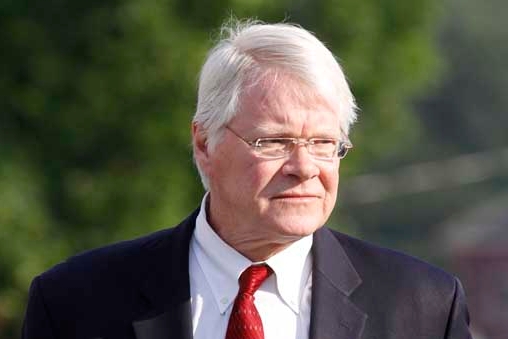
    Joseph E. McGettigan III, 76, of Media, longtime trial lawyer and legal consultant, former Philadelphia assistant district attorney, former Pennsylvania chief deputy attorney general, former Delaware County first assistant district attorney, former assistant U.S. attorney in Philadelphia, former Philadelphia first assistant district attorney, and former Pennsylvania senior deputy attorney general, died Thursday, Dec. 31, of lung inflammation at Lankenau Medical Center.

    Born in West Philadelphia and a graduate of Temple University, Mr. McGettigan was a legal expert in sexual assault and murder cases. He litigated in hundreds of trials over more than three decades as a prosecutor for city, county, state, and federal governments, and won notable convictions in the murder case against multimillionaire philanthropist John E. du Pont in 1997 and the child sexual abuse case against then-Pennsylvania State University assistant football coach Jerry Sandusky in 2012.

    He was, then-Delaware County District Attorney Patrick L. Meehan said in 1998, like “a fascinating character in a crime novel.”

    He worked for four Philadelphia district attorneys over two stints in City Hall and spent a year in Iraq in 2008 and 2009 as a U.S. government resident legal adviser working to reestablish a criminal justice system after the fall of Saddam Hussein. For most of the last decade, he worked for the Philadelphia law firm of McAndrews Mehalick Connolly Hulse & Ryan P. C. “He was a wonderful guy, a faithful citizen, and an incredible lawyer,” Dennis McAndrews, founder of the firm, said in an online tribute.

    The grandson of a Philadelphia police officer and son of a lawyer, Mr. McGettigan prosecuted one of the first sex-abuse cases involving a priest from the Archdiocese of Philadelphia in 1985 and oversaw a state Senate absentee-ballot scam case in 1993. “I’m not shocked by much of human depravity,” he said in a 2018 video interview with lifelong friend Dom Irrera. “I’ve seen a fair amount of it.”

    In an online tribute, Judge Jack Stollsteimer of Delaware County Court called Mr. McGettigan a “legendary prosecutor, a larger-than-life personality, and an avenging hero to crime victims across our Commonwealth.” He was a favorite of the City Hall crowd, and colleagues called him “a true public servant,” “a great guy with a wonderful heart,” and “an extraordinary presence in the courtroom.”

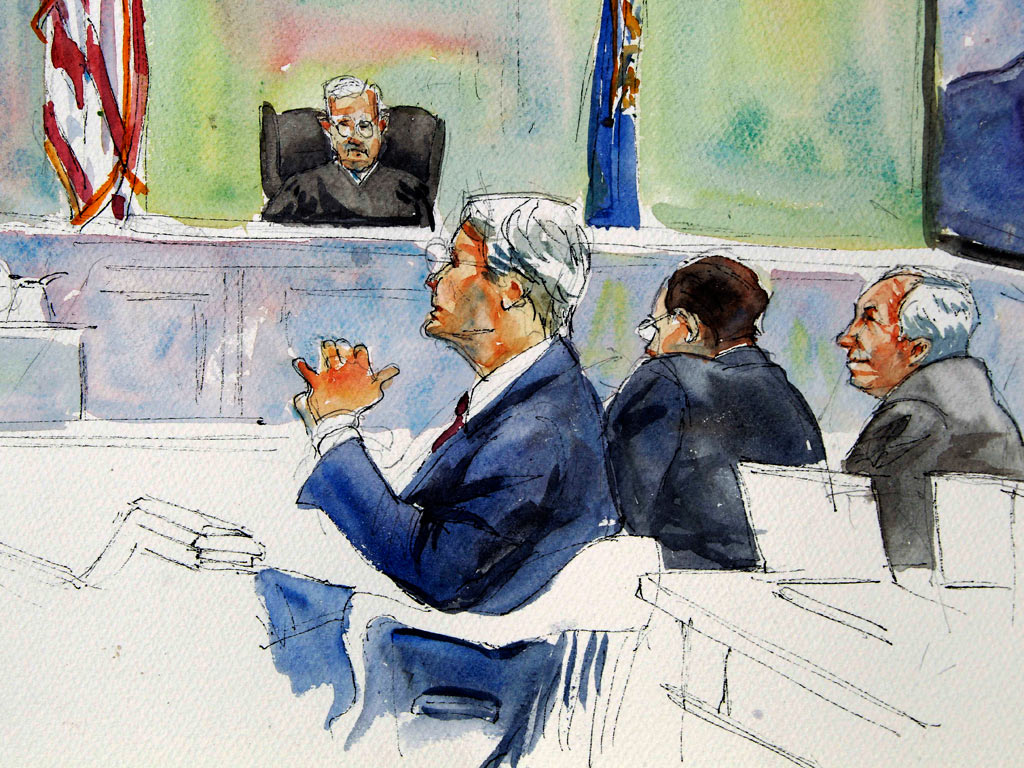
    Mr. McGettigan (foreground) is shown in this courtroom sketch during the Jerry Sandusky trial in 2012.

    Even those with whom he clashed praised Mr. McGettigan. Thomas A. Bergstrom, the Philadelphia lawyer who represented du Pont, said in 2011: “He’s a formidable adversary … very principled. If Joe doesn’t agree with you, he’ll let you know. If he’s going to hit you, it will be a punch in the nose, not a stab in the back.”

    Witty and naturally engaging, Mr. McGettigan interrupted his legal career after the du Pont case to work briefly in Hollywood as a legal content adviser for the short-lived TV series Philly. The show starred Kim Delaney as a tough defense attorney in Philadelphia, and Mr. McGettigan played a police detective, not a prosecutor, in a courtroom scene in one episode in 2002.

    He also worked briefly as a consultant and manager for a private security company in Virginia, was a legal analyst for TV talk shows, and mentored other lawyers. He graduated summa cum laude with a bachelor’s degree in English literature from Temple and earned his law degree at the University of San Diego School of Law in 1982.

    Mr. McGettigan played basketball in high school, on Philly playgrounds, and later whenever he could. Longtime college basketball coach and lifelong friend Fran O’Hanlon called him “a great friend who would do anything for you.”

    His sister Mary said: “He was complex. He appeared often to be a hard-nose tough guy. But there was a soft side to him. He wanted to help people who were vulnerable.” His sister Patty said: “He left the world a better place.”

    Joseph Edward McGettigan III was born March 5, 1949. An altar boy at church, he grew up with six sisters and a brother, and he instigated many dinner-table debates with his siblings and parents about all kinds of subjects.

    “He kept us on our toes,” his sister Mary said. “He had a strong sense of justice, of doing the right thing.”

    Mr. McGettigan (second from right) liked nothing better than playing hoops with friends.

    He married Gay Warren, and they lived in Media and Naples, Fla. “Gay was Joe’s rock,” his sister Mary said. “He was devoted to her, and she to him.”

    Mr. McGettigan loved music, reading, and writing, and told Irrera in 2018 that his favorite authors were William Shakespeare and Joseph Conrad. He was fun and funny, his siblings said, a raconteur with a large personality.

    “Joe was an outlier in a family of bookish nerds,” his sister Jeanne said. “We followed his youthful adventures with great amusement and his later accomplishments with pride and respect. His generosity changed lives for the better.”

    Mr. McGettigan spent a year in Iraq helping local officials revive their justice system.

    One time, when they were young, his brother Michael tried to lie about losing Mr. McGettigan’s football. So Mr. McGettigan grilled him about the details and eventually extracted a confession.

    “I gave it all up,” Michael McGettigan said, “the first of many malefactors to find relief in telling the whole truth and nothing but to Joseph E. McGettigan III.”

    In addition to his wife and siblings, Mr. McGettigan is survived by his mother, Ruth, and other relatives. A sister died earlier.

    Mr. McGettigan (front right) always seemed to be surrounded by friends.

    Visitation with the family is to be from 10 to 10:45 a.m. Saturday, March 7, at St. Francis de Sales Church, 4625 Springfield Ave., Philadelphia, Pa. 19143. A Funeral Mass is to follow at 11 a.m.

    Donations in his name may be made to the Tunnel to Towers Foundation, 2361 Hylan Blvd., Staten Island, N.Y. 10306.

    “Everyone wanted to be Joe’s friend,” a colleague said in a tribute. 
  • Pennsylvania’s minimum wage has been $7.25 since 2009. Who actually earns that much?

    Pennsylvania’s minimum wage has been $7.25 since 2009. Who actually earns that much?

    Pennsylvania’s minimum wage hasn’t budged from the $7.25 federal minimum that was set in 2009. But the number of Pennsylvanians actually making that much per hour is small and shrinking.

    Last year, some 42,900 Pennsylvania workers earned the minimum wage or less, according to the Pennsylvania Department of Labor and Industry’s annual report on the minimum wage, published this month.

    That’s about a 9% decline from 2024. This group makes up less than 1% of all Pennsylvania workers. The state’s population of minimum-wage workers has dropped by roughly 42% in the last five years.

    Still, hundreds of thousands who make more than minimum wage would see their wages rise if the Pennsylvania’s wage floor was set to $15 an hour.

    Last year, 189,900 people in Pennsylvania (6.4% of hourly workers) earned at least $7.26 and up to $12 per hour.

    Another 320,900 (10.8% of hourly workers) earned between $12.01 and $15 per hour.

    Each of these groups making low wages in Pennsylvania — up to $7.25, up to $12, and up to $15 per hour — was smaller in 2025 than the year before.

    That’s due in part to increasing wages across the state, the report said, as well as a lower number of hourly wage earners and a shrinking workforce overall. Pennsylvania’s median wage rose to $20.95 per hour last year — roughly a $1 increase from 2024.

    The report is based on data from a U.S. Census Bureau survey. Last year’s data is missing October figures due to the government shutdown, the report noted.

    Some are exempt from federal and state minimum wage such as farmworkers, some seasonal workers, and newspaper delivery people. Workers who make much of their money in tips have a lower minimum wage. Workers from these categories were not excluded from data in the report.

    Pennsylvania’s minimum wage is not enough money to cover a person’s basic needs, according to a living wage calculator developed at the Massachusetts Institute of Technology. It estimates that the living wage for a single adult without a child in Pennsylvania is $23.32 per hour.

    Mayor Cherelle L. Parker speaks during a rally in support of raising the minimum wage and also freeing the city to set its own minimum wage separate from the state, at City Hall, in Philadelphia, April 29, 2025.

    Who actually made minimum wage last year?

    In 2025, workers who made at or below the minimum wage in Pennsylvania were predominantly women. While they make up roughly 51% of the state’s working population, they represent a disproportionate 81% of workers who earned $7.25 or less last year.

    Nearly 79% of these workers are white, and roughly half have a high school diploma or less education.

    window.addEventListener(“message”,function(a){if(void 0!==a.data[“datawrapper-height”]){var e=document.querySelectorAll(“iframe”);for(var t in a.data[“datawrapper-height”])for(var r,i=0;r=e[i];i++)if(r.contentWindow===a.source){var d=a.data[“datawrapper-height”][t]+”px”;r.style.height=d}}});

    Nearly three-quarters of them work in food preparation and serving jobs. Though it should be noted that tips and overtime for restaurant workers are not accounted for in the report’s data, and tipped restaurant workers’ minimum wage is $2.83 by law.

    Unmarried people and young workers aged 16 to 24 also make up a disproportionately large segment of Pennsylvanians making minimum wage or less, the report says.

    Working full time at the minimum wage, a worker would make $15,080 annually. But 80% of Pennsylvania workers who made minimum wage or less last year worked part-time.

    Other sectors that employ these low-wage workers in Pennsylvania include hotels and lodging, retail, art and entertainment, hospitals, educational services, construction, and manufacturing.

    window.addEventListener(“message”,function(a){if(void 0!==a.data[“datawrapper-height”]){var e=document.querySelectorAll(“iframe”);for(var t in a.data[“datawrapper-height”])for(var r,i=0;r=e[i];i++)if(r.contentWindow===a.source){var d=a.data[“datawrapper-height”][t]+”px”;r.style.height=d}}});

    Pennsylvania’s neighboring states have higher minimum wages

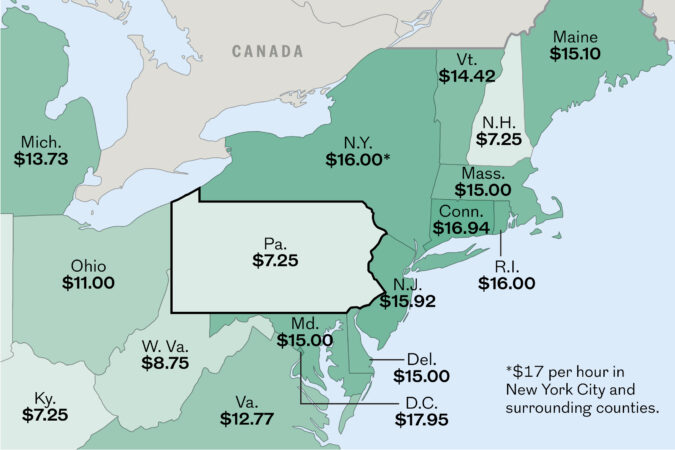
    Despite efforts to raise Pennsylvania’s minimum wage, it lags behind that of neighboring states.

    New Jersey’s minimum wage, which increased in January to $15.92 per hour, is over double that of Pennsylvania’s, and 22 states are soon increasing their minimum wage or have done so already this year. In Delaware, the minimum hourly wage has risen from $9.25 in 2021 to $15 in 2025, thanks to legislation mandating the gradual increase.

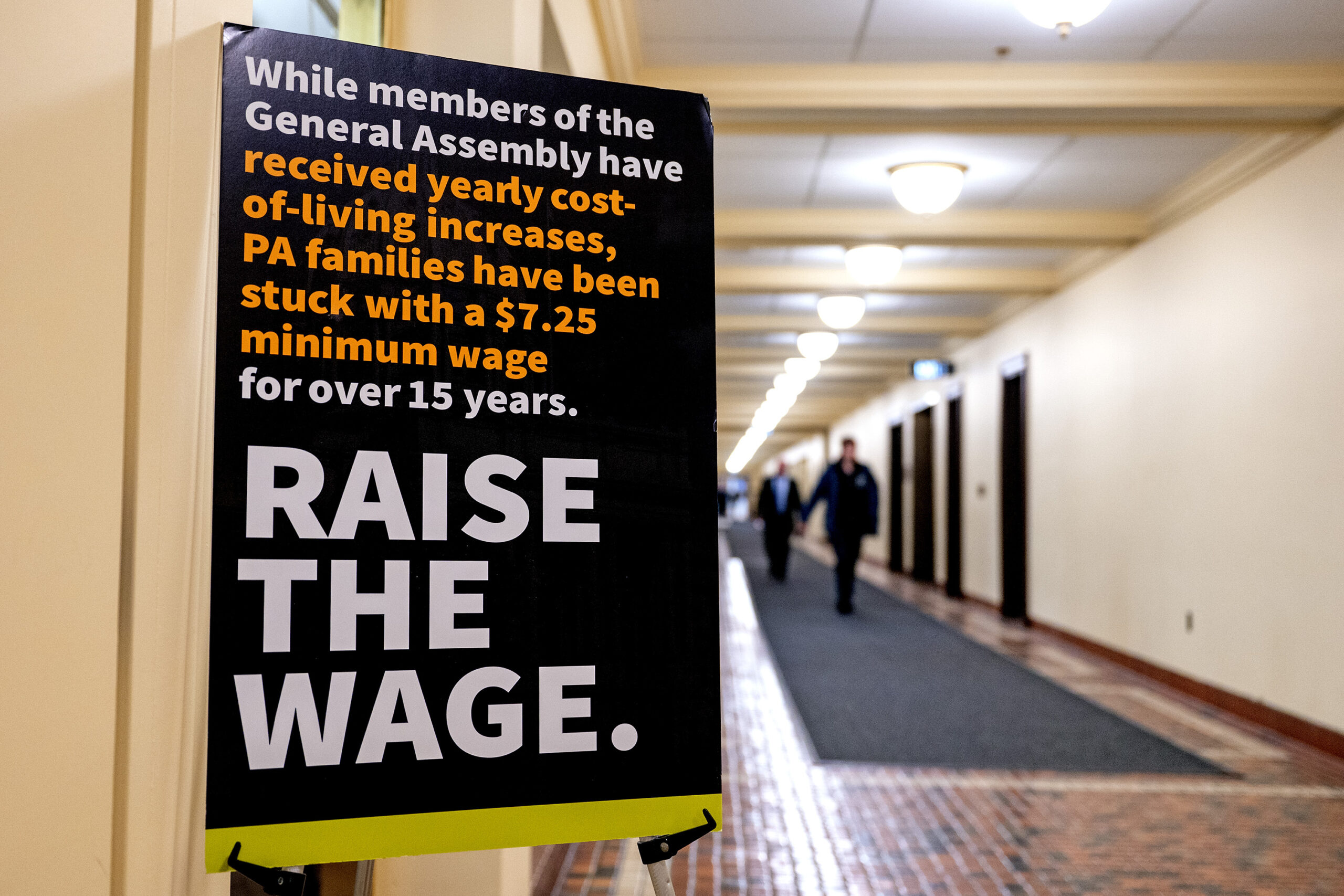
    A sign in support of an increase in the state’s minimum wage in the state Capitol Feb. 3, 2026.

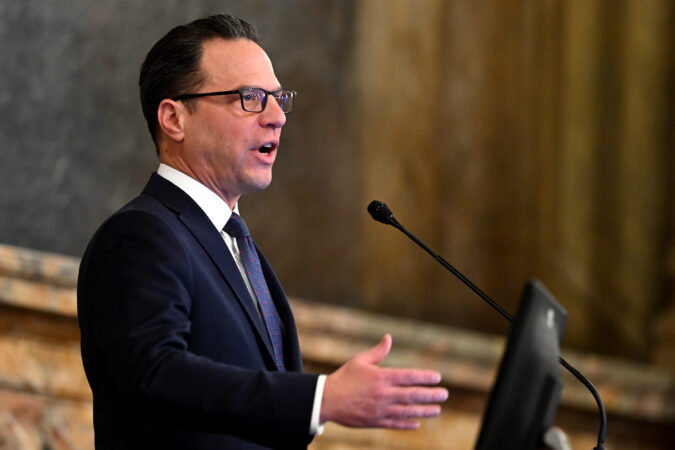
    Gov. Josh Shapiro has backed raising the minimum wage at every annual state budget address since he was elected. In February he called on the General Assembly to advance minimum wage legislation, adding that raising it to $15 an hour would save the state millions on entitlement programs like Medicaid.

    “If you aren’t going to do this because it’s the right thing to do, or because it would let more families put food on the table for their kids, then do it because it’s going to save us $300 million, shrink our entitlement budget by growing our workforce and putting more money back in workers’ pockets,” he said.