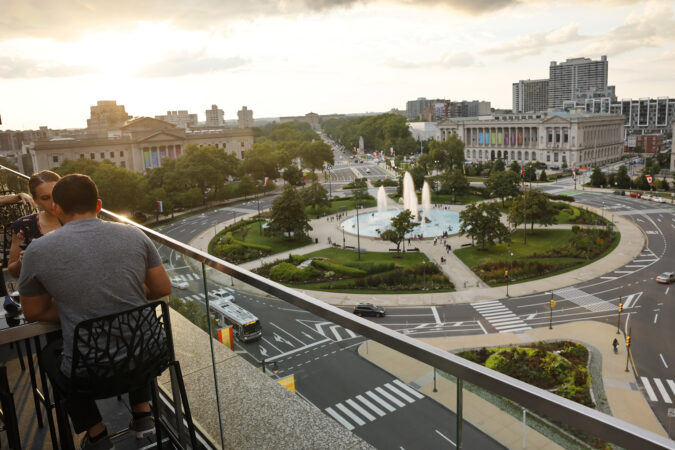
Drivers in Philadelphia’s Logan Square neighborhood should expect new delays as the city continues to prepare for America’s 250th birthday next summer.
Construction is set to cause lane closures in both directions on weekdays from Dec. 1 until May 19, Pennsylvania Department of Transportation officials said in a statement.
“This project will improve the safety and accessibility for Logan Square residents and the increased number of visitors during 2026 events,” city officials said Saturday.
Drivers won’t be able to use the interior lane around Logan Circle, the left inbound lane on the Benjamin Franklin Parkway, and the left lane on 19th Street north of the circle, according to the city.
The work is set to occur between 7 a.m. and 3:30 p.m. on weekdays, according to PennDot, and will be weather dependent.
“Motorists are advised to allow extra time when traveling through the work area because backups and delays will occur,” PennDot officials said.
During construction, pedestrians will also be unable to use the sidewalk around the circle or access Swann Memorial Fountain at its center, according to the city.
The beloved 101-year-old fountain hasn’t been fully operational since 2023 due to vandalism. Philadelphia Parks and Recreation Commissioner Susan Slawson said in September that the city is making repairs, with plans to have the fountain completely restored by May 2026.
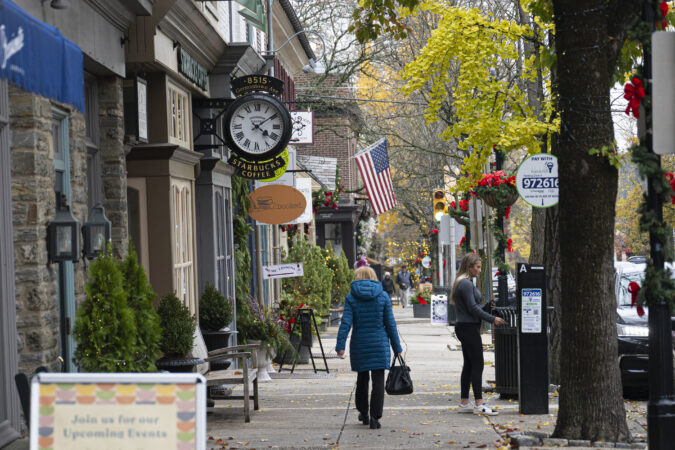
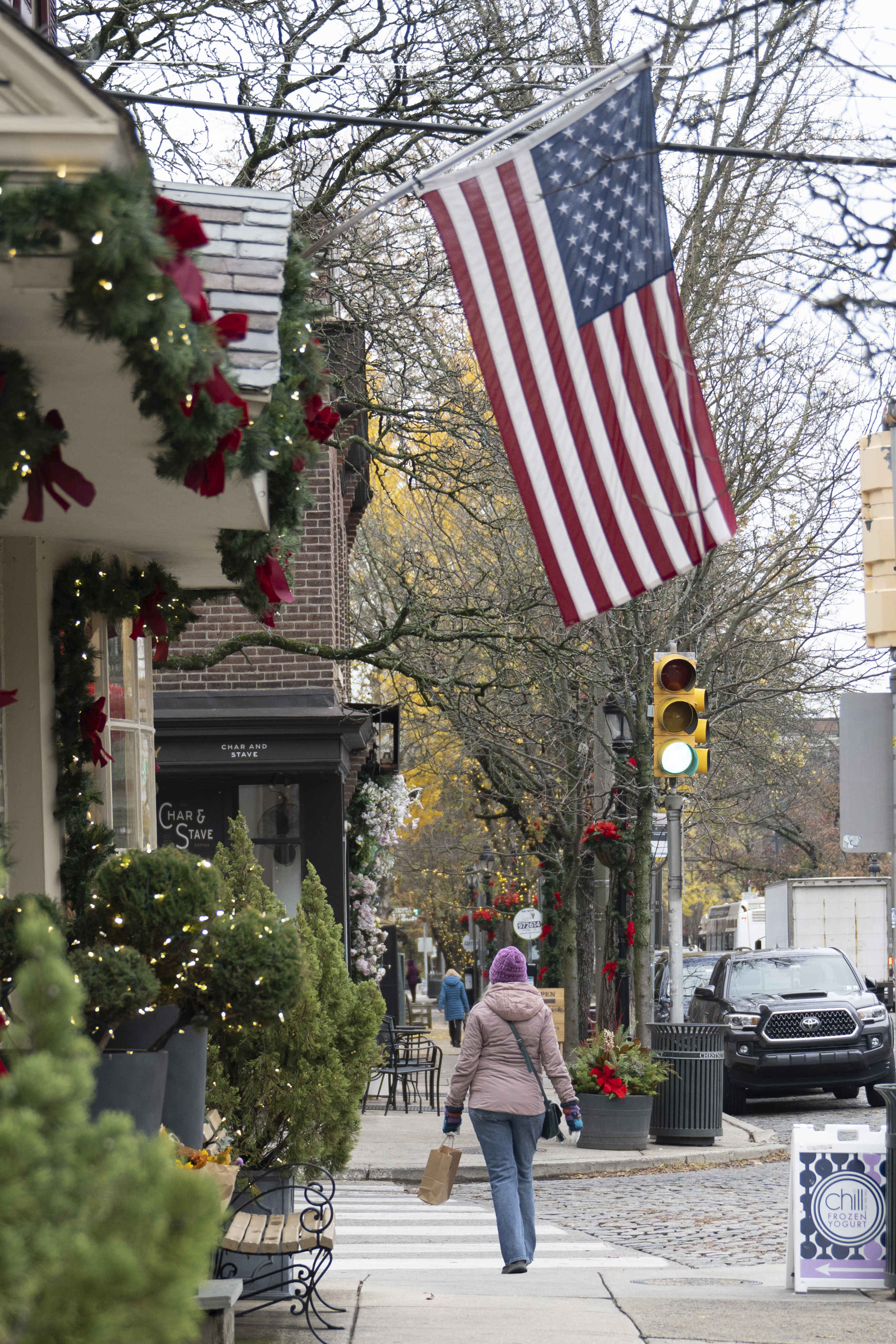
At lunchtime on a Thursday, a week before Thanksgiving, Chestnut Hill was buzzing.
Inside the newly expanded Matines Café, almost every table was full. People sipped warm drinks from large mugs and ate Parisian croissants and quiche. Bottles of prosecco sat on ice by one large table adorned with Happy Birthday balloons.
McNally’s Tavern was bustling, too, with regulars sitting at the bar and at tables inside the cozy, nearly 125-year-old establishment atop the hill. Multiple generations gathered — a son taking a father out to lunch, a mother with a baby in a stroller, and two sisters, Anne and Meg McNally, running the place.
Behind the storefronts along Germantown Avenue’s main drag, some people perused the boutiques, while others typed away on laptops in coffee shops.
In the northwest Philadelphia neighborhood known for its wealth and postcard-picturesque aesthetic, the small-town charm of longstanding establishments — four are more than 100 years old — is now complemented by the shine of some newer shops and restaurants. Several Chestnut Hill business owners said the variety has helped both old and new spots succeed despite broader economic challenges, including inflation and tariffs, and the loss of a few restaurants.
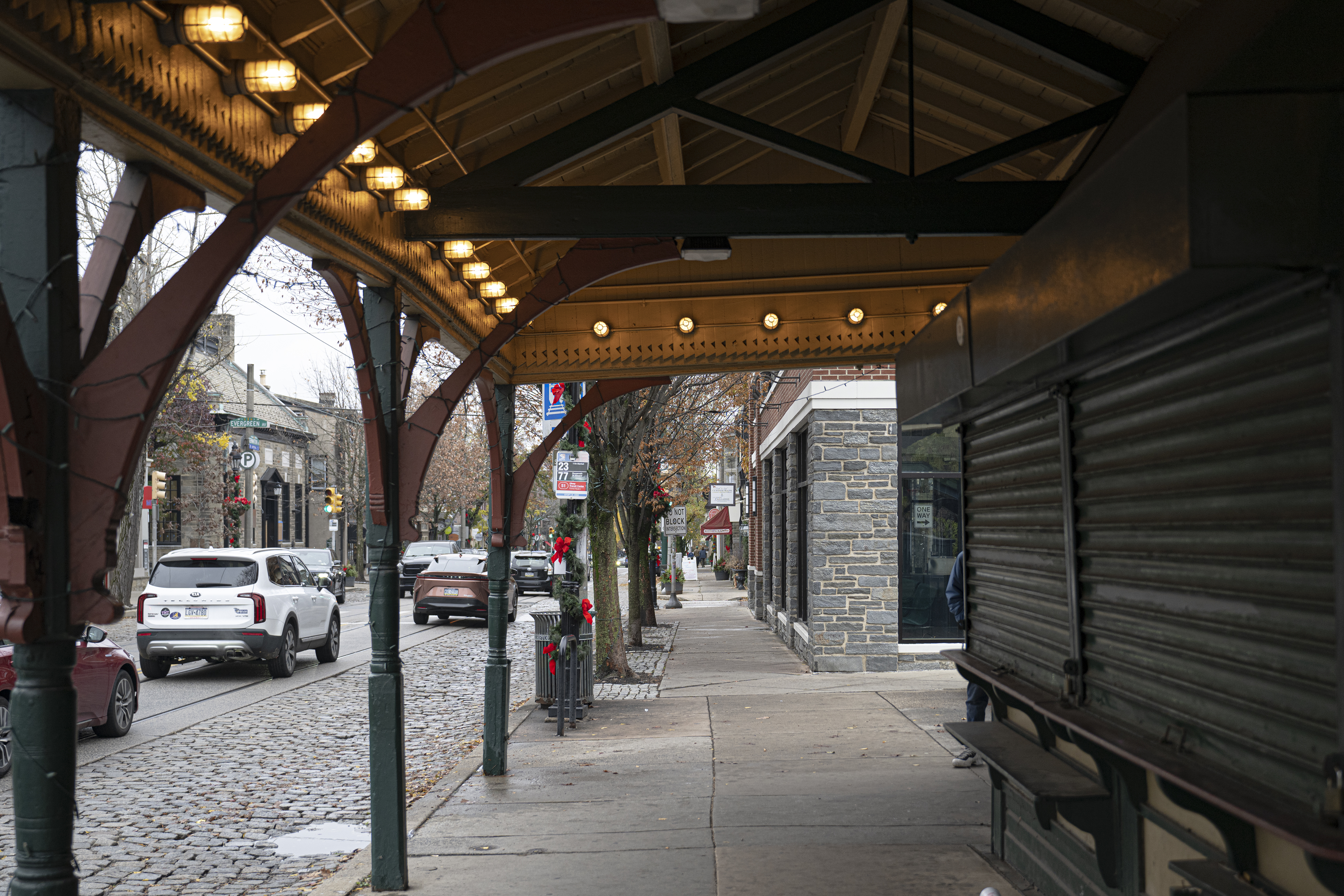
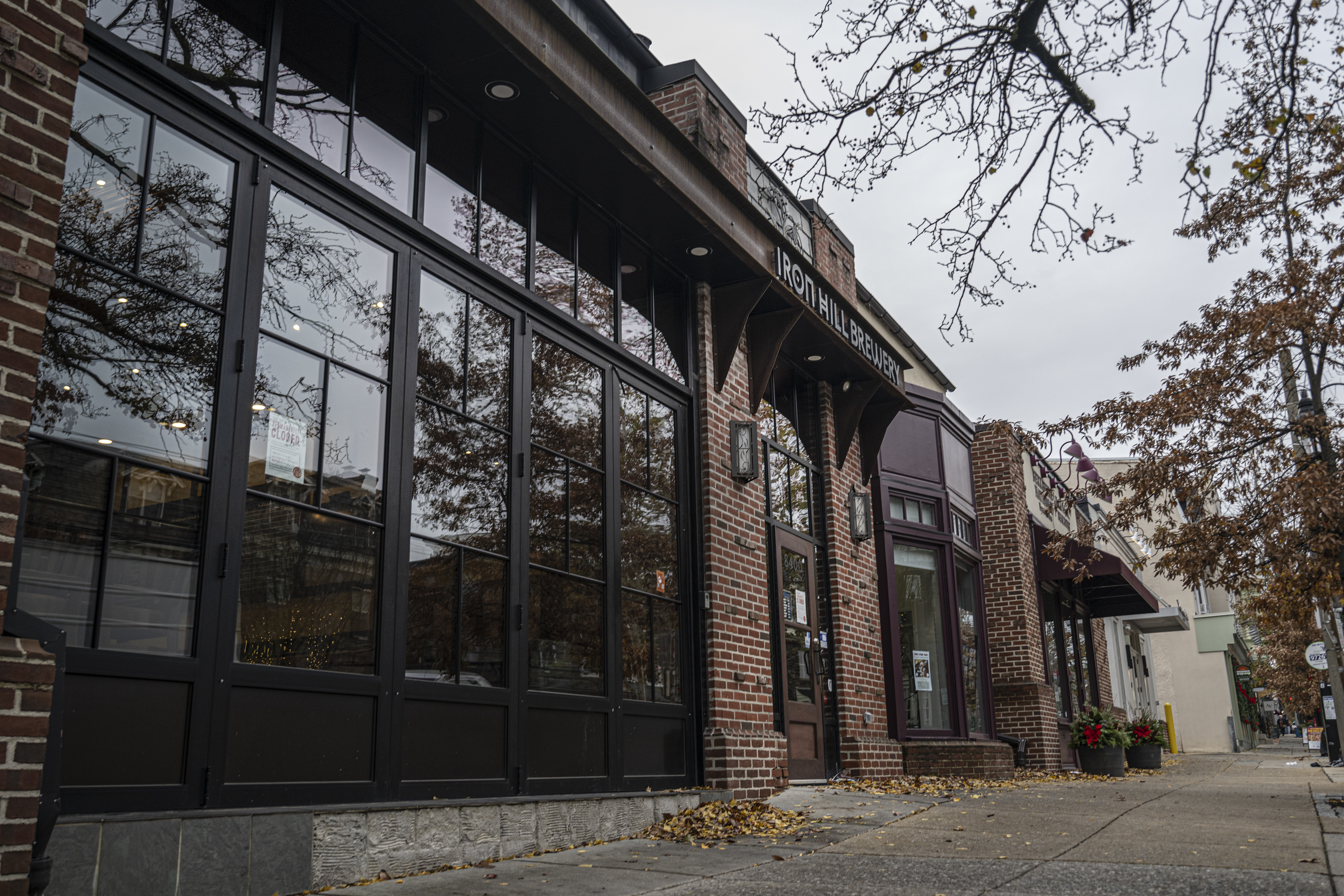
A view down Germantown Avenue from the Chestnut Hill SEPTA Regional Rail station.The closed Iron Hill Brewery is shown in downtown Chestnut Hill on Nov. 19.
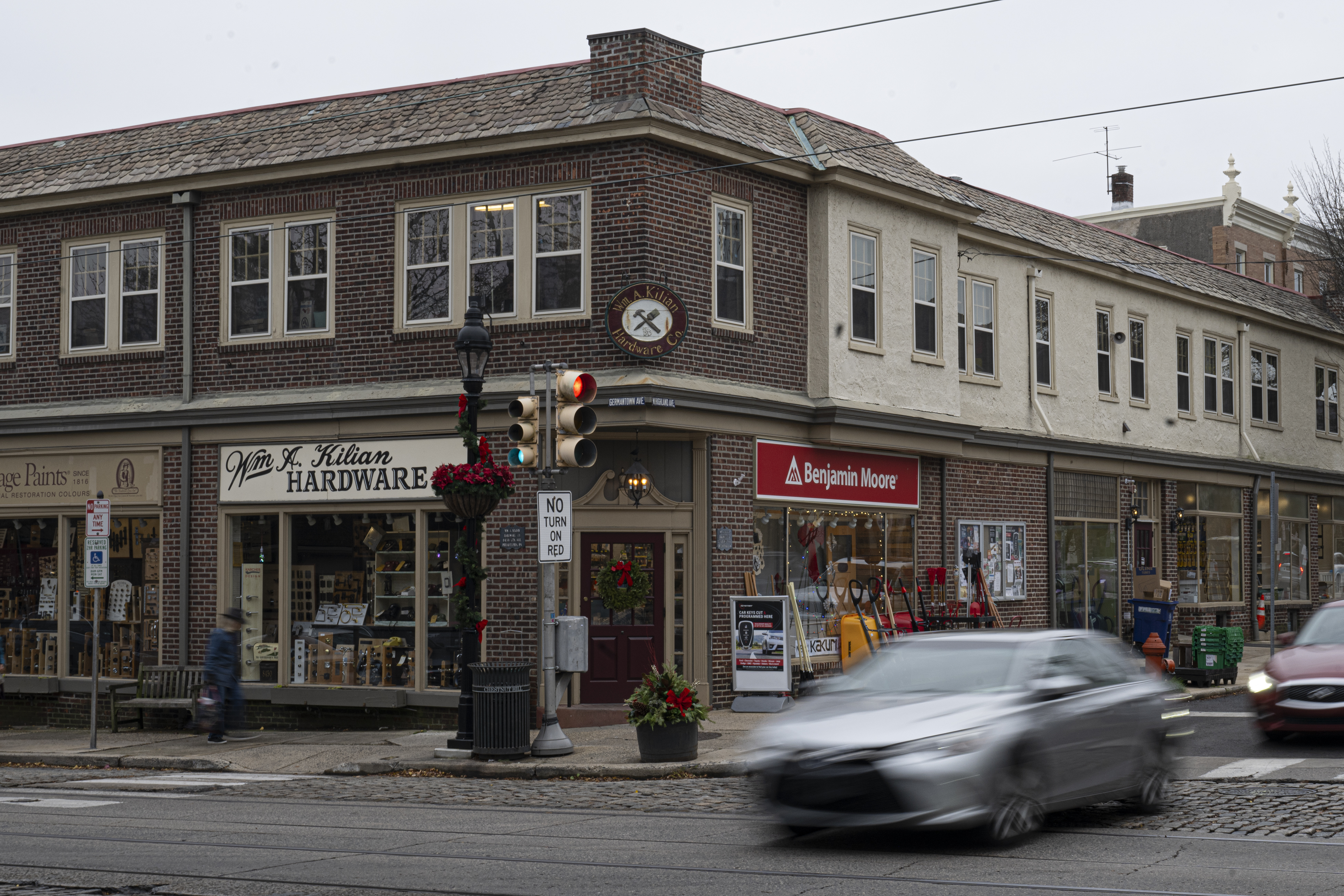
As the owner of Kilian Hardware, which has been in business for 112 years, Russell Goudy Jr. has watched the avenue change. Fifty years ago, he said it was “basically like a shopping mall,” a one-stop shop for everyday needs.
In recent years, however, the neighborhood has focused on attracting and retaining unique food and beverage businesses, “quaint, specialty shops,” and service-oriented businesses, which Goudy said offer experiences Amazon and other e-commerce platforms can’t replicate.
“If you’re not giving people an experience in today’s economy, it’s very tough to compete,” said Nicole Beltz, co-owner of Serendipity Shops, which for a decade has had an expansive store on Germantown Avenue. And providing a memorable experience is never more important than during the lucrative last few months of the year.
“When you come to Chestnut Hill over the holidays, you get what you came for,” Beltz said. “You get that charming feeling of being somewhere special for the holiday.”
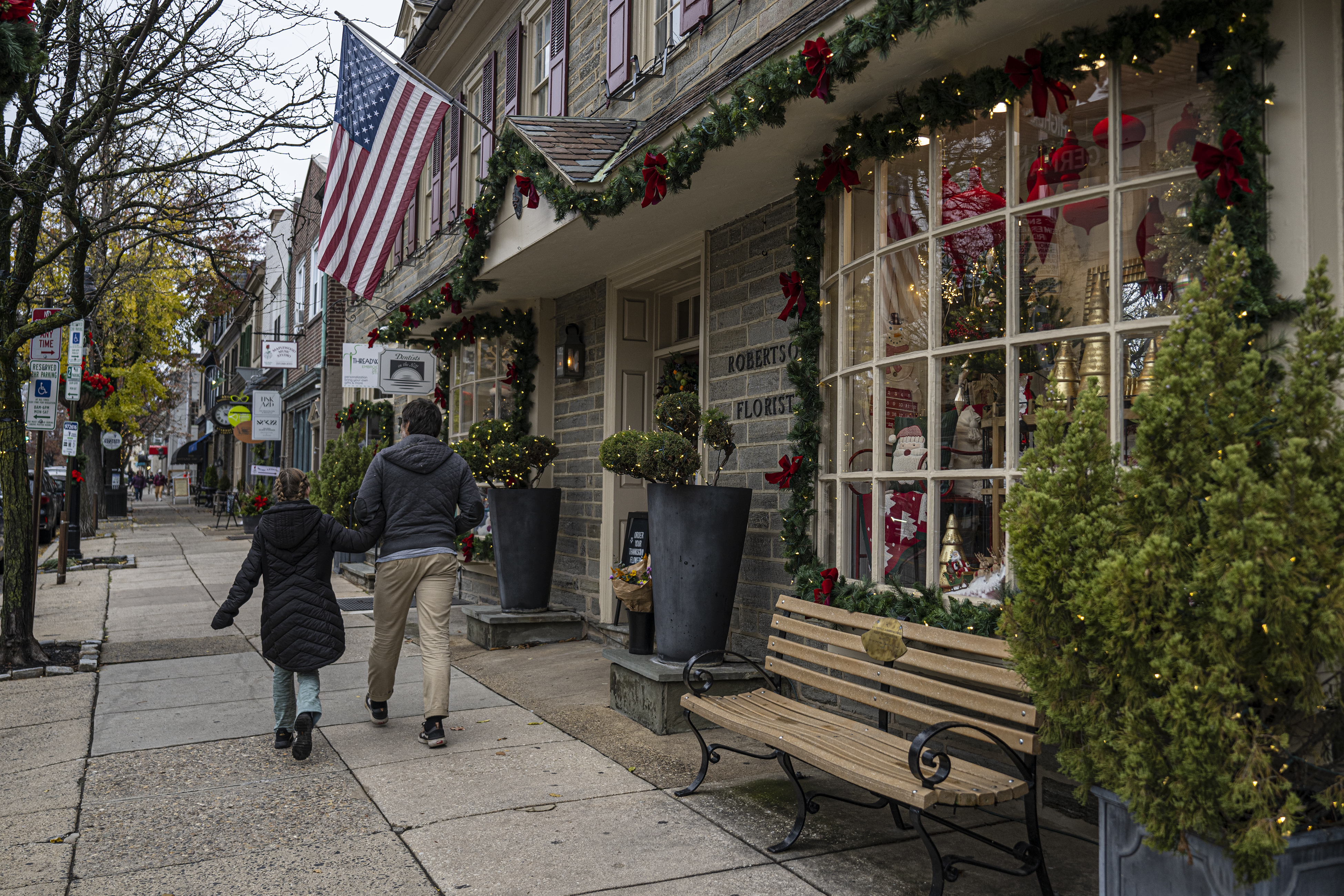
People walk by holiday decor outside Robertson’s Flowers & Events in Chestnut Hill earlier this month.
‘New vitality’ coming to the Chestnut Hill restaurant scene
During the holidays and all year long, Chestnut Hill business owners said they’re grateful that the neighborhood has held onto its charm despite recent challenges.
During the pandemic, “it definitely felt a little grim and dark,” said Ann Nevel, retail advocate for the Chestnut Hill Business District. “The impressive thing is the old-timers, the iconic businesses, and some of the newer restaurants … pretty much all were agile enough to tough it out.”
And a slew of other businesses have moved into the community since then. In the last four years, 20 retail shops, 20 service businesses, and 10 food and beverage spots opened in Chestnut Hill, Nevel said, while several existing establishments expanded.
Among them was Matines Café, which opened a small spot on Bethlehem Pike in 2022 and expanded this fall to a second, much larger location on Highland Avenue. The café serves 500 people or more on weekdays, according to its owners, and even more on weekends.
Sitting inside their original location, which is now a cozy children’s café, Paris natives Amanda and Arthur de Bruc recalled that they originally thought they’d open a café in Center City, where they lived at time. Then, they visited Chestnut Hill and fell in love, despite “a lot of empty spots” there around 2022, Amanda de Bruc said.
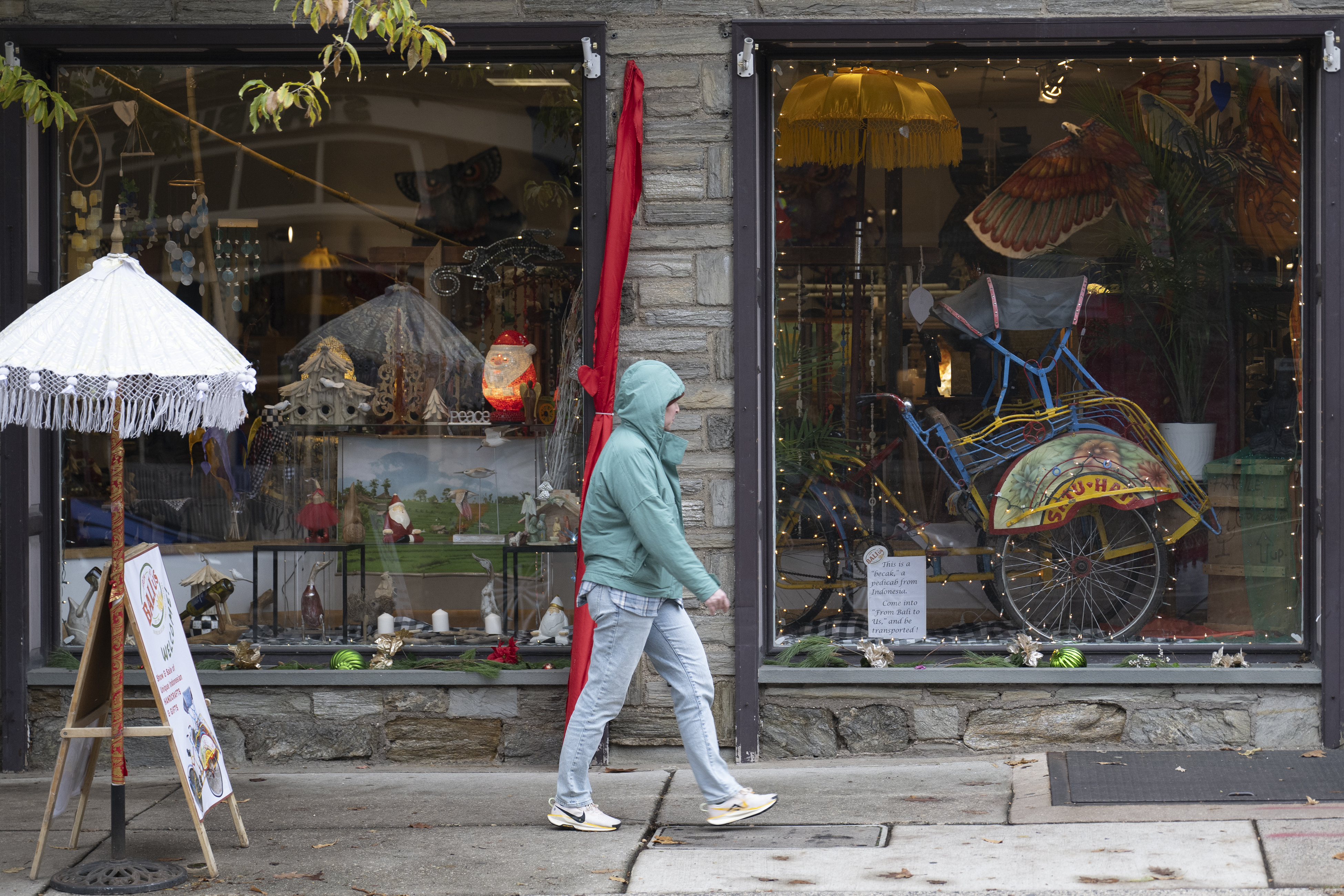
A colorful storefront along Germantown Avenue in Chestnut Hill.
“We liked the idea of living in the suburbs, which technically Chestnut Hill is not the suburbs, because it’s still Philly,” she said. But “we were looking for something that we were more used to, like Paris. There are so many boutiques in such a small area,” and everything is walkable.
The opening of shops and cafés like Matines became a “catalyst for this new vitality, a new, more contemporary energy that has taken hold in Chestnut Hill,” Nevel said. Soon, “we’re going to see that new vitality in the restaurant scene,” including in some long-vacant storefronts.
In 2026, former Four Seasons sommelier Damien Graef is set to open a wine bar, retail store, and fine-dining spot called Lovat Square off Germantown Avenue, Nevel said. On the avenue, a café-diner-pub concept called the Blue Warbler is under construction and also slated to open sometime next year.
Kilian Hardware in Chestnut Hill has been in business for 112 years.
In downtown Chestnut Hill, there are still a few empty spots, including those left by Campbell’s Place, a popular restaurant that closed this summer; Diamond Spa, which closed this fall; Iron Hill Brewery, which closed in September (right before the regional chain filed for bankruptcy); and Fiesta Pizza III, which closed last year.
Kismet Bagels, a popular local chain, was set to fill one of the spots this summer, but its deal fell through, co-owner Jacob Cohen said in a statement. He said they could “revisit the Chestnut Hill neighborhood” in the future.
While the future of Iron Hill will be dictated by bankruptcy proceedings — which include an auction of assets set for next month — stakeholders say conversations are ongoing about some of the other vacancies.
Steve Jeffries, who is selling the Campbell’s building for $1.5 million, said he’s gotten a lot of interest from people who want to revive the nearly 3,000-square-foot space as a neighborhood pub, but one that is “more cutting edge.” Perhaps, he said, one that is not focused on craft beer, which has decreased in popularity, especially among younger generations.
“The town is just screaming for other opportunities for nightlife and sports bars,” said Jeffries, executive vice president of Equity CRE. “There has been a connotation in the market that Chestnut Hill was kind of older, stuffy, that it wasn’t a nightlife town.”
But that’s changing, Jeffries said.
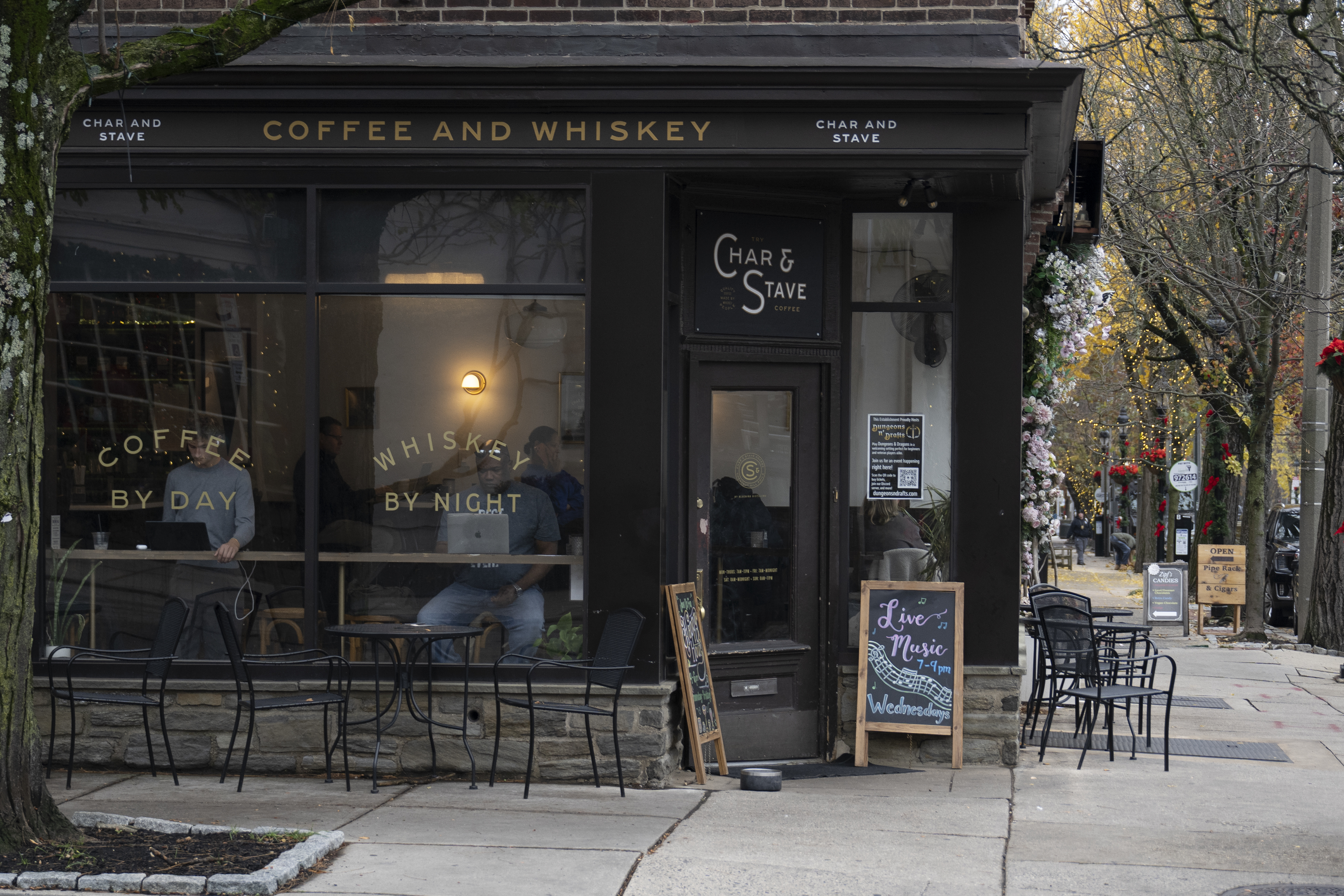
Char & Stave, an all-day coffee and cocktail bar, has done great business since moving into Chestnut Hill, its owner, Jared Adkins, said.
Just ask Jared Adkins, owner of Char & Stave, an all-day coffee and cocktail bar at the corner of Germantown and Highland Avenues.
After Nevel visited Ardmore and saw the success of Adkins’ original Char & Stave, she recruited him to open a Chestnut Hill location. It started as a holiday pop-up in 2022, then became a permanent presence the next year.Since he moved into town, Adkins said, business has been booming.
“We’re really just busy all day long,” said Adkins. The café is open until 11 p.m. during the week, midnight on the weekends, and it often brings in musicians and hosts events.
Adkins describes Char & Stave as a place where drinkers and nondrinkers alike can spend time together, and where people can get work done with coffee or a cocktail beside them: “It’s really a gathering place that fills a niche of a nice cocktail place.”
More changes to come for Chestnut Hill
Businesses along Germantown Avenue in Chestnut Hill are decorated for the holidays.
Chestnut Hill business leaders and community members say they’re optimistic about the neighborhood’s continued evolution.
As Brien Tilley, a longtime resident and community volunteer, ate lunch inside Cosimo’s Pizza Cafe, he said the community is doing well. But, he added, “it could always do better. It’s always in transition.”
Nevel noted that restaurants require more capital to open than other businesses, so it can take awhile to fill those larger holes downtown.
“The economy is tough,” said Anne McNally, a fourth-generation owner of McNally’s, as she sat by the tavern’s front window overlooking Germantown Avenue. But in Chestnut Hill, she gets the vibe that the community “wants us to be successful.”
McNally and Goudy, of Kilian’s, both noted that their families bought their buildings decades ago. That has contributed to their longevity, both said, as has evolving with the customer base.
For the McNally family, that meant transitioning from a “bar-bar,” with no clock or phone, to a bar-restaurant that closes at 10 p.m. For Goudy, it meant soliciting online orders and walk-in business from out-of-town and even out-of-state customers whose older homes require unique hardware.
“Everything is changing,” Goudy said. “It’s important to keep changing and not to try to go back to where you were before.”
Even after more than two decades of operating a financial advisory in the Philadelphia region, Joel Steele is inspired when clients tell him they want to donate money to charity.
“But the problem is that it’s gotten much more difficult to know if your donations are going to the people you are directly trying to help,” said Steele, co-owner and financial adviser with Steele Financial Solutions in Cherry Hill. “Charity scammers are running rampant.”
Solicitors are on the phone, at your door, in your email, and in your mailbox.
“We’re constantly inundated with people looking to take our money and put it in their pockets for the wrong reasons,” Steele said. “This has led many people to back off — in part or in full from — donating to charities.”
One way to reduce the chance of misappropriation is to contact the charity directly, Steele said. “Yes, it’s easier to put cash in a tin can or buy things from a stranger, but these are more likely to end up in that person’s pocket.”
Also, he recommends, when you donate directly to charities, get a receipt and check with your income tax preparer or review deduction guidelines to understand potential tax benefits.
Evaluating Giving Tuesday solicitations
Everyone knows about Black Friday shopping, and recent years have seen the additions of Small Business Saturday and Cyber Monday in the days after Thanksgiving.
In 2012, Giving Tuesday joined the lineup, promoted by the 92nd Street Y in New York and the United Nations Foundation. It caught on quickly, as more organizations joined in on the opportunity to fundraise.
Giving Tuesday encourages generosity, but it’s also a time for scammers to ramp up fraud tactics. Scammers may use fake charities or misuse real ones to take advantage of donors.
If you get direct mail or a call, text, email, or social media message asking you to donate to a nonprofit, pause for a moment to dig deeper.
Your heart immediately wants to say “yes,” said Katherina ‘Kat’ Rosqueta, founding executive director of the Center for High Impact Philanthropy at the University of Pennsylvania. But unless you have personally been helped by that nonprofit or know someone who was, it’s hard to know whether the nonprofit is actually making a difference.
“That’s where your head comes in,” Rosqueta said. Consider running a quick Internet search for the charity’s name, along with “scam” or “complaints” to see if there have been any negative feedback or investigations, she said.
Katherina Rosqueta is the founding executive director of the Center for High Impact Philanthropy at the University of Pennsylvania.
Of course, most donors want to do more than just avoid fraud.
“They want their donation to make a real difference,” Rosqueta said.
Her center at Penn created a “High Impact Giving Toolkit,” updated each year and available for free. It highlights vetted nonprofits and provides links to organizations like Candid, Charity Navigator, and BBB Wise Giving Alliance, where potential donors can learn about organizations’ programs, team, and finances.
“Once you feel confident about a nonprofit’s work, consider donating online through an official, secure nonprofit website that uses HTTPS encryption,” Rosqueta said.
“Avoid links in unsolicited emails or social media posts. Credit cards and checks offer better fraud protection than debit cards or wire transfers,” Rosqueta said.
How to make online donations safer
The key to understanding fraud is that most scammers prey on your emotions.
“Fear, urgency, and promise of a quick win are some elements that exist in so many scam scenarios,” said Christopher Blackmore of TD Bank in Mount Laurel, who works in customer education in financial crimes prevention.
Blackmore said most “bad actors” will reach out and provide a number to call, link to click, or instructions for payment. “The goal is to make scenarios seem so real that you feel you must reply or something will happen.”
Financial industries should never ask for login credentials, passwords, or one-time pass codes, Blackmore said. “Technology is making it very difficult to identify what is real vs. fake.”
A text, email, or phone call is a very quick and easy way to contact a lot of people quickly and ask for a donation.
“These tactics are known as phishing, vishing, and smishing,” Blackmore said. A newer tactic, known as “Quishing,” utilizes QR codes.
When a donation ask includes a request for payments using gift cards, wires, and cryptocurrency, that should immediately raise caution, Blackmore said.
Donors might want to consider a third-party platform like PayPal, which safeguards sensitive financial information.
“Donors should stay mindful online and keep an eye out for the warning signs of common scams, including being wary of unexpected messages from strangers,” said Nick Aldridge, Global CEO of PayPal Giving Fund.
“We always encourage supporting causes you care about through trusted channels like PayPal Giving Fund, the PayPal Cause Hub, and Venmo Charity Profiles,” Aldridge said.
The electric-vehicle business has been an unpredictable venture. Analysts and automakers have long been forecasting the downturn of the EV market.
The end of EV rebates in September seems to have finally made for a downward trend in U.S. EV sales. But on the other side of the equation, EV charging stations are forging ahead, and EV charging suppliers are not losing their motivation.
Public and private investment have helped take one of the EV’s two biggest snags — range anxiety — out of the equation. And that’s despite the Trump administration’s failed attempt to halt a federal charging station program. (The as-yet unresolved snag: price.)
The U.S. Department of Energy’s Alternative Fuels Data Center’s website shows 16,579 high-speed charging stations across the United States with a total of over 71,000 charging ports. Pennsylvania has 382 stations with nearly 1,700 high-speed charging ports. New Jersey has 389 stations with more than 1,800 ports. The New York Times reported last month that EV fast-charging stations in the U.S. soared from 1,000 in 2015 to 12,000 now.
“Every time I open this map, the number has gone up,” said Ingrid Malmgren, senior policy director for the EV advocacy nonprofit Plug in America.
Private investment
There’s plenty of private investment in charging for EVs, and convenience stores are at the forefront.
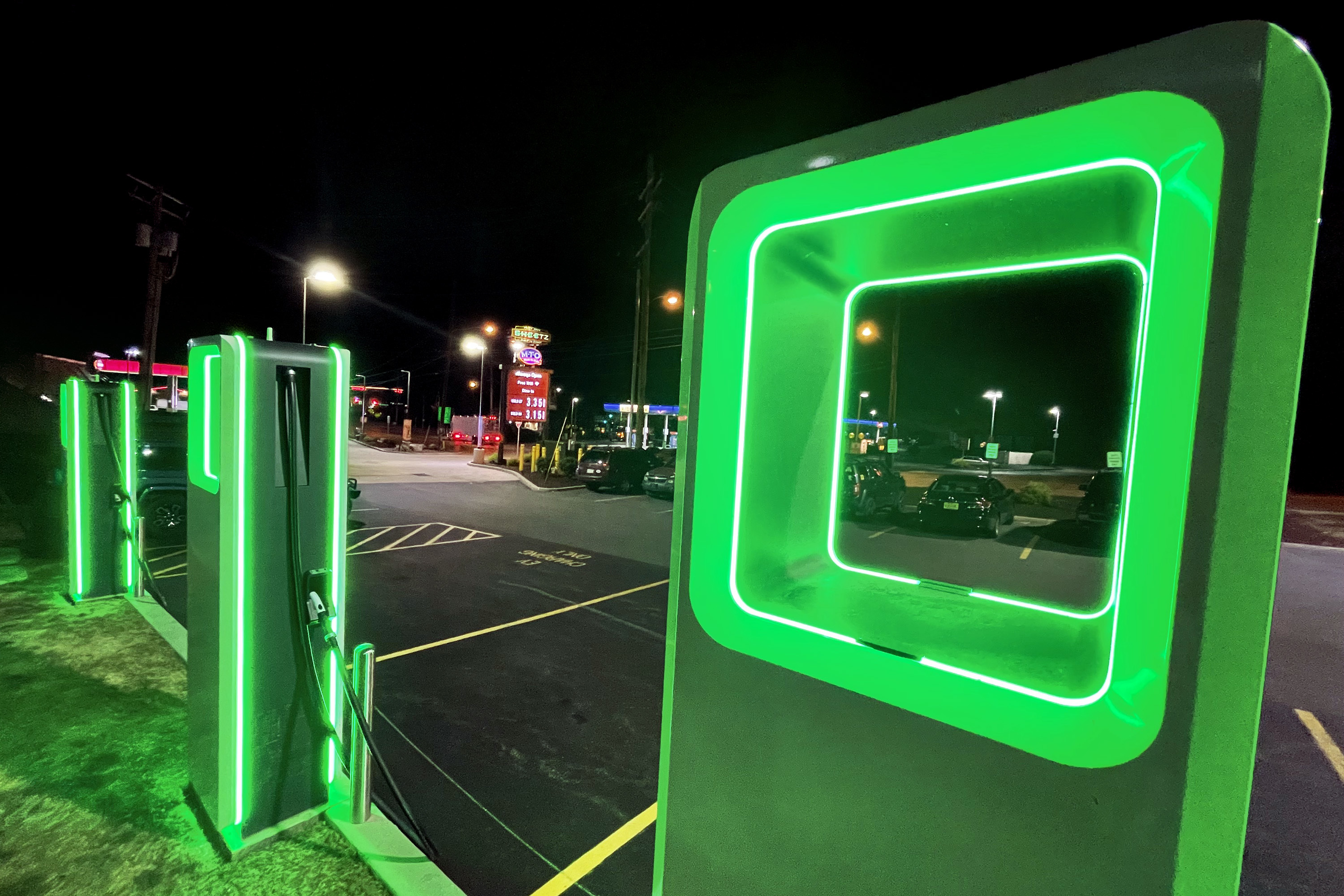
Wawa, Sheetz, and Pilot are deep into the EV charging game, and the Transportation Energy Institute — a research arm of the National Association of Convenience Stores — said this month that charging remains a focus of the industry.
“Despite recent news indicating a slowdown in vehicle electrification, the data is clear that electric vehicles will continue to gain ground, although at a slower than anticipated rate,” said a white paper released earlier this month. “This means that the demand for reliable charging infrastructure will also continue to grow.”
Wawa currently has 210 EV charging locations, Sheetz more than 125, and Pilot 218.
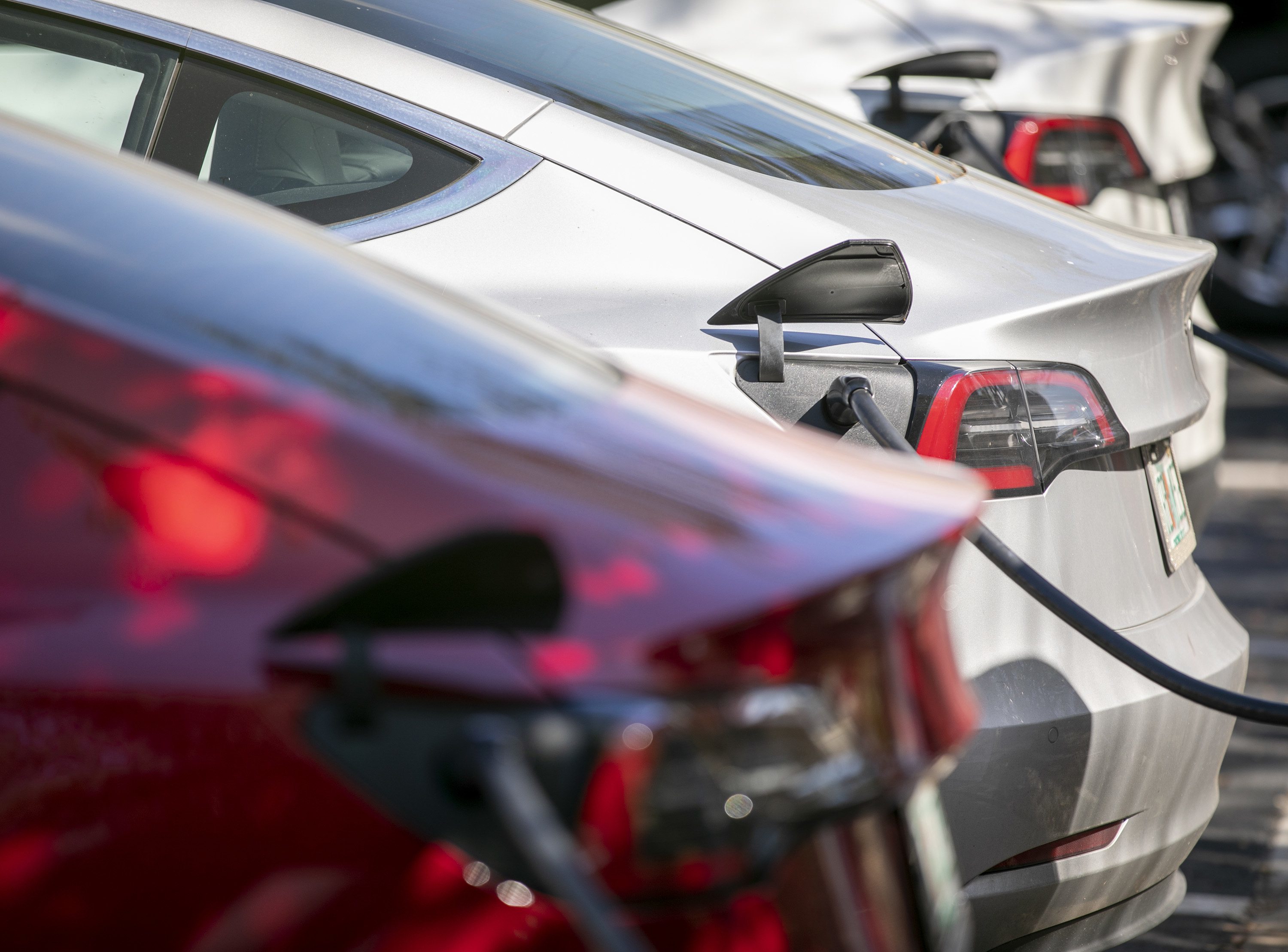
Tesla vehicles at charging stations in 2022 at a Wawa gas station in Clearwater, Fla.
“The convenience industry is an industry built on mobility, so, yeah, they will have to figure this out,” said Karl Doenges, executive director of the Transportation Energy Institute’s Charging Analytics Program and liaison to the EV industry for NACS. “They’re going to deal with refined products, and they’re going to deal with electrons.”
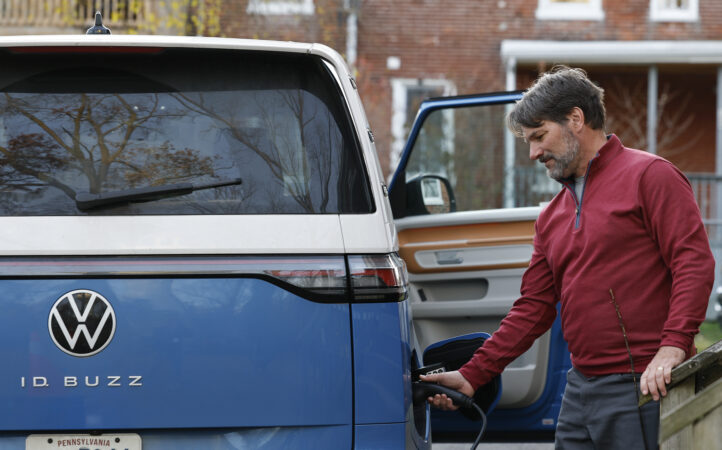
EV owners like Peter Doehring of Kennett Square are noticing the changes. He has owned four EVs in total since 2019 and currently has a Ford Lightning, Tesla Model Y, and a VW ID. Buzz.
“We’ve done a bunch of road trips for each of the vehicles,” Doehring said. “So for the Tesla, that network was not great when we started — like [when] we had a long-distance trip we really had to plan in advance.”
Now, though, “I feel pretty comfortable I can find a charger almost anywhere unless I’m really out of the major areas,” Doehring said.
Outside the Tesla network, though, it’s not so good.
Public investment
The Trump administration in February froze funding for the $7.5 billion National Electric Vehicle Infrastructure (NEVI) program and Charging and Fueling Infrastructure (CFI) grant program, part of the Bipartisan Infrastructure Law passed in 2021. The NEVI program planned a network of charging stations every 50 miles on major highway corridors, and CFI will fill in EV charging gaps.
The end of the NEVI program didn’t survive a court challenge after 14 states sued. A judge in the Western District of Washington ordered funds to be released in late June, according to NPR.
Pennsylvania was among states that forged ahead regardless because it already had its funds obligated for its 86 stations. In March, eight charging stations were in place and operational; 22 are online now, according to PennDot, which expects another dozen stations online shortly. (True to Malmgren’s word, this number rose twice in two days the week before Thanksgiving.)
Still, there’s a question of how effective federal dollars will be.
“Frankly, if you can’t make a charger work without government subsidies, then you need to take a hard look if it’s a good investment regardless, because at some point it has to stand on its own two feet,” Doenges, of the Transportation Energy Institute, said.
But chargers in remote areas become a lifeline for travelers. The more recent NEVI-funded stations arose in remote, highway-adjacent places like Chambersburg, Altoona, and Slippery Rock, and in Clearfield, Clinton, and Lebanon Counties.
The Department of Transportation did announce slightly adjusted rules in August, allowing states more control, specifically easing the rule that stations must be available every 50 miles.
Electric-vehicle charging stations at a Bedford gas station in 2021, just off the milepost 145.5 exit of the Pennsylvania Turnpike.
The new Trump administration guidance “has been helpful‚” said Andrew Wishnia, a senior vice president at Boundary Stone Partners, the former deputy assistant secretary for climate policy at the U.S. Department of Transportation, and a principal architect of the Bipartisan Infrastructure Law.
Wishnia said the more flexible rules make it easier for states to address their individual needs, pointing in particular to Wyoming’s approved NEVI plan as one example. That sparsely populated state popular with tourists was able to count privately funded charging stations already in place along some corridors in its plan and instead build more public chargers near national parks and other sites. “It’s totally consistent with the design and architecture of a national EV charging network,” he said.
A PennDot spokesperson said there has been no change in the map for Pennsylvania based on those new guidelines.
The end of rebates
Two months after EV rebates ended, EV futures can appear quite bleak. Malmgren said some reports show October sales were down 50% compared to September, and average prices in October hit an all-time high.
Car and Driver reported sales of the Hyundai Ioniq 5 dropped 63% and the Kia EV6 was down 71%.
Getting a clear picture before the end of 2025 is difficult because not all carmakers report monthly sales. Also, the drop-off in October followed a spike in September, as buyers rushed to grab rebates.
Still, consumer interest remains strong. A Nov. 7 J.D. Power report shows that 24.2% of active new-vehicle shoppers “very likely” will consider buying or leasing an EV in the next 12 months, up from 21.6% in September, the highest level since January.
“We’ll see the shakeout of supply and demand in the next year,” said Sam Fiorani, vice president of AutoForecast Solutions in Chester Springs.
Peter Doehring plugs the charger into his electric Volkswagen ID. Buzz van.
Federal funds slowdown
So despite the turmoil and changes of 2025, 2026 holds the promise of more EV charging money for Pennsylvania.
This second part of the NEVI program is designed to fill in the gaps around the original 86 NEVI stations along major highway corridors. PennDot will accept new proposals until Jan. 30, according to a PennDot spokesperson.
Public or private, adding charging stations remains important, even to those who have already purchased EVs.
John Fetters of Kennett Square bought his 2023 Hyundai Ioniq 5 new. He loves the smooth ride and being able to start from home with a full charge, thanks to a simple 220-volt outlet he had installed. And yet he relies on the family’s Subaru Outback for long trips.
“As much as we’re loving the EV, I’m just not always having full confidence on availability and accessibility of charging stations,” Fetters said.
Still, the selling points of EVs for consumers like Fetters and Doehring show there’s still room for growth.
“We definitely believe that EVs are the future,” Malmgren said. “The rest of the world is moving forward with EVs. We’d like to see policies that accelerate it.”
How they’re communicated matters, according to a recent study by Sunil Wattal, associate dean of research and doctoral programs at Temple University’s Fox School of Business.
Wattal found that users of an online forum, Stack Overflow, were more likely to return after their submissions were rejected if they had received a detailed reason for their rejection.
Stack Overflow has been known for “treating its contributors harshly” because of its “rigorous quality control,” the study said, but in 2013, its rejection notice language changed to be more explanatory. Wattal compared the before and after and found that newusers were more likely to return when they knew more about why their submission was rejected.
Wattal’s findings were recently published in the study “Not Good Enough, but Try Again! The Impact of Improved Rejection Communications on Contributor Retention and Performance in Open Knowledge Collaboration.” The coauthor of the study is Aleksi Aaltonen of the Stevens Institute of Technology in Hoboken.
While Wattal’s study focused on rejection in one online platform, he says the findings could apply in many other settings. The Inquirer spoke with him about the implications for rejection in the workplace. The conversation has been edited for length and clarity.
What was your main finding?
We found overall that the platform was better off — that Stack Overflow is better off — because it increased the quantity of the postings but did not decrease the quality. So there was no significant impact on the quality of posting. The net effect is the platform gained more content without really losing any quality.
So you found that people returned more often if they were told why they were being rejected.
Yes, the likelihood of returning was much higher if they were told more clearly why they were being rejected.
Obviously nobody likes rejection, but sometimes, if they feel that they know the reason why it was rejected and they get a sense that they were being treated fairly, I think that kind of softens the blow in a way.
What can your findings tell us about communicating rejection in the workplace, such as not getting hired or getting laid off?
You see rejection in all kinds of different applications — in business, in society. Rejections are everywhere.
E-commerce sites like Amazon, Etsy, eBay, every now and then, they encounter a product which doesn’t comply with either the ethical standards or for some other reason, and they have to take down some of those listings. Or even in companies, somebody thinks they come with a great idea, and their boss just says, No, this is not great.
Even in those cases, I think it really helps if you give them an explanation of why their idea was rejected, and it encourages them to come back in the future and still be engaged with either the organization or the website.
In customer service, sometimes people have to hear a “no,” that their complaint isn’t legitimate, or they’re not getting that refund. In those cases, communicating well and giving a more informative explanation of why they’re being denied is always a good idea.
In your study with Stack Overflow, that platform wants users to keep coming back to the website to contribute to the online forum, so there’s a vested interest in sending a rejection notice that would get people to return. In business, what kind of incentive does an employer have to explain a rejection?
In the case of, say, for example, job postings, maybe that applicant was not a good fit with that particular posting, but they could still be valuable to the company in a different role.
It’s not a good idea, basically, to burn bridges, and it doesn’t cost a whole lot to be nice or to give a decent explanation. In terms of the cost-benefit analysis even, it’s always a good idea to give a more informative explanation just to maintain the relationship.
Does it matter whether it’s a human that’s delivering a rejection notice, versus a computer or automated response, in terms of the outcome?
There’s a lot of work going on right now about exactly these things, like: How do people feel about interacting with computers when computers make decisions that affect their lives in some way? I’m not sure exactly if anybody has studied rejections by computers, but I would expect that there would be some difference in the way people take rejection from humans versus computers.
Some companies use applicant tracking systems for hiring, which screen applicants and filter candidates out. And we know that some applicants never hear back about their application. Can your study tell us anything about the effect of ghosting?
Especially in some cases where companies receive tens of thousands of applications [for just a few open roles], probably, from a very myopic perspective, they don’t care about a lot of them. But again, from an overall brand perspective, it doesn’t take a whole lot to send out that rejection in a timely way, in a way that seems fair, to explain why it was rejected — maybe there were other better applicants, or it was not the right fit. People want to know so that they can maybe improve in the future.
Stephanie Greenleaf has Black Friday down to a science.
Every year, the Moorestown resident hosts Thanksgiving. The next morning, she, her sister-in-law, and her mother hit the Cherry Hill Mall early. They start at Nordstrom, then head to Soma for pajamas, Urban Outfitters for her teenagers, and anime stores for the younger kids.
“We have it down,” she said, standing next to a Christmas ornament display around 8:30 a.m.
“As my mom always says, ‘I just want to be out in it,’” she added. “It’s not the same when you’re sitting on your couch.”
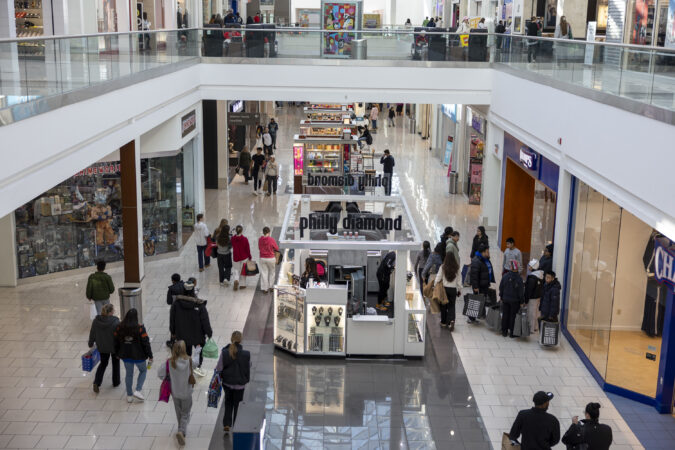
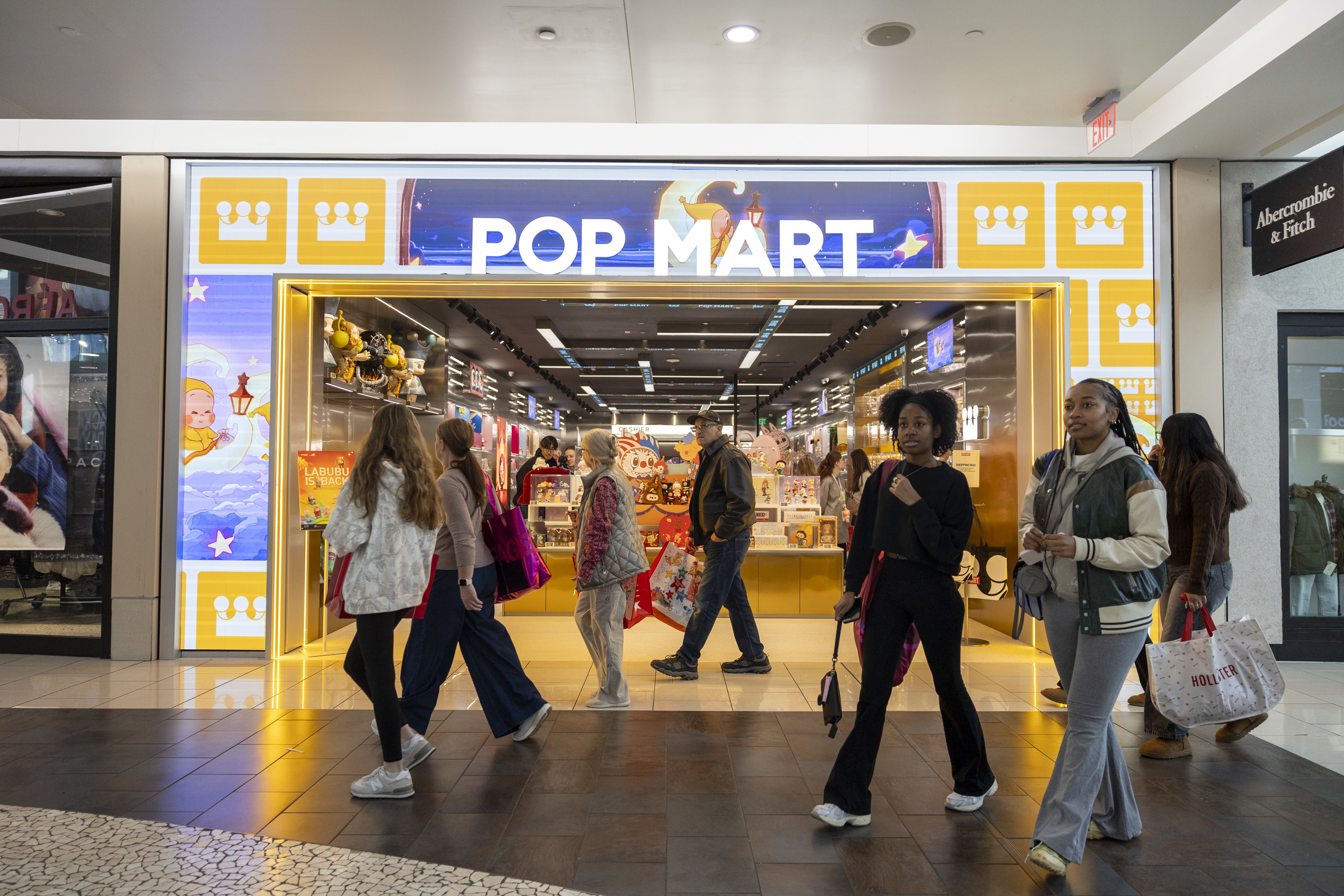
Despite inflation, rising prices, and the omnipresent e-commerce ecosystem, a familiar Black Friday hustle was in the air at the Cherry Hill Mall on Friday morning. Shoppers filed into the parking lot early, toting shoppingbags and holiday-flavored lattes. Labubus and puffer jackets were displayed in store windows.Teenagers flocked to Abercrombie and Zara.
While some retailers reported business as usual, others described the South Jersey shopping destination as more subdued than in years past as consumers contend with an uncertain economic landscape and e-commerce giants continue to cut into a market long dominated by malls.
People walk pass Pop Mart during their shopping on Black Friday at the Cherry Hill Mall in Cherry Hill, N.J., on Friday, Nov. 28.
Black Friday, then and now
The term “Black Friday” has Philly origins. Beginning in the 1960s, tourists would descend on Philly the day between Thanksgiving and the annual Saturday Army-Navy football game. Philadelphia police reportedly began calling the day Black Friday after they were forced to work long hours and manage heavy traffic and unruly crowds. Years later, Americans would latch onto the tale that Black Friday got its name because it was the day retailers would move from being “in the red” to being “in the black” (finally making a profit after running a loss).
The retail-oriented holiday has morphed over the years from a one-day shopping bonanza to a month of deals. Now, the pervasiveness of e-commerce has muddied the Black Friday tradition, forcing retailers to attract shoppers both online and in stores.
Barbara Kahn, professor of marketing at the University of Pennsylvania’s Wharton School, calls this an “omni-channel experience.”
“It’s really more of an integration between both modalities now‚” Kahn said.
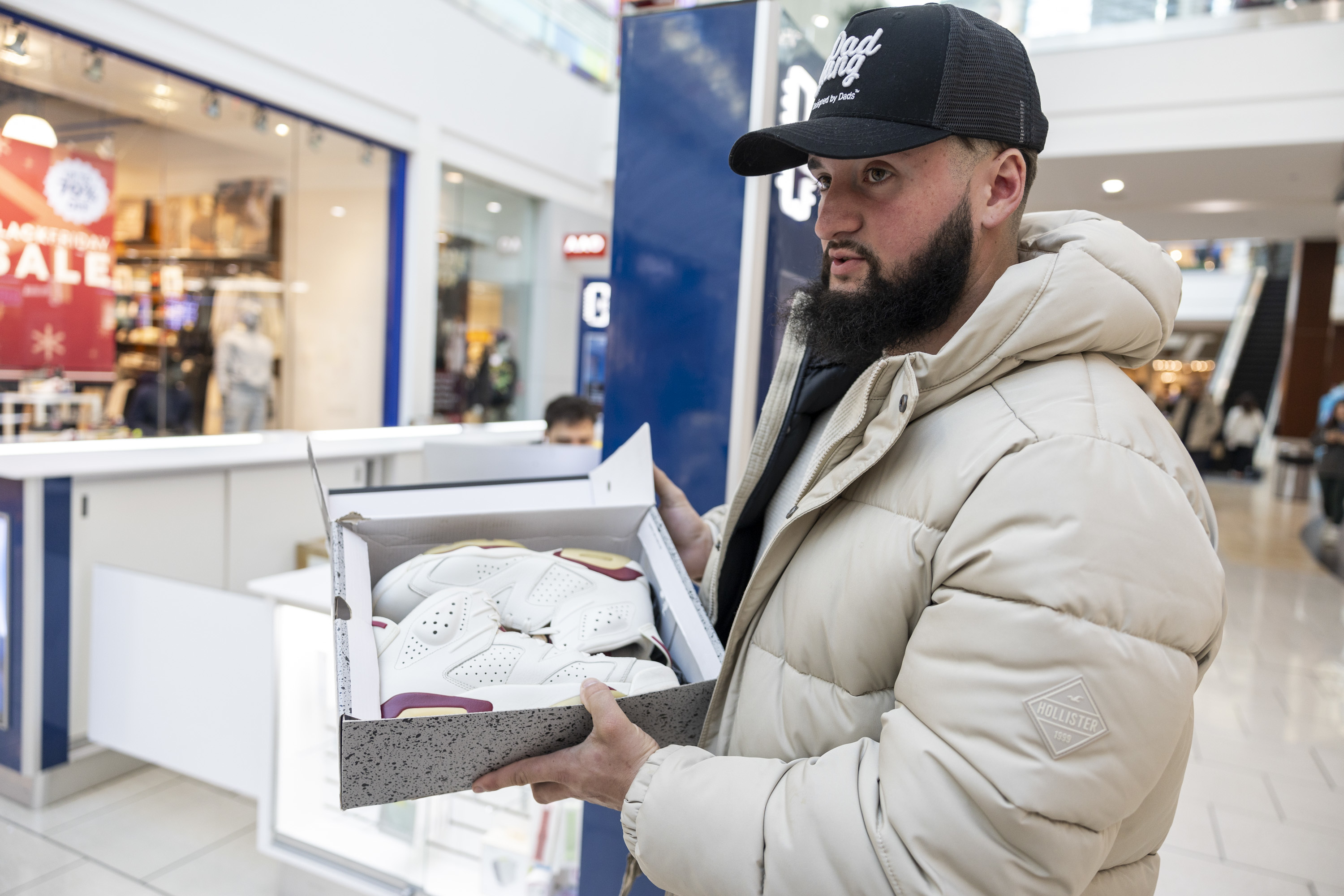
Daniel Leslie, 23, of Franklinville, N.J., showing off a pair of Maroon Jordan 6’s he bought on Black Friday at the Cherry Hill Mall.
Two major changes stick out to Kahn. First, the ability to compare prices online (and now with AI) has made shoppers more “price sensitive,” forcing retailers to stay competitive. Second, stores are turning to “experiences” to draw people in through giveaways, events, or exclusive items.
“Part of what people are shopping for is not necessarily the utility of buying a particular item,” Kahn said. Rather, it’s the experience “wrapped around the actual purchase.”
Shoppers at the Cherry Hill Mall said they had come out onBlack Friday for the nostalgiamore than for once-a-year deals.
Karrim Gordon, 48, said he is “not at all” a regular Black Friday shopper. But, with his young son in tow, the South Philly dad said he wanted to give his kids the true “Black Friday experience.” They got to the mall when it opened at 7 a.m. and hoped to hit Psycho Bunny for his son, then Aéropostale and Pop Mart for his daughter.
Daniel Leslie, 23, of Franklinville, said an Instagram ad for a sneaker deal had caught his eye. He was the first in line at a shoe store Friday morning, walking away with a pair of Timberland boots and a pair of Nike Air Force 1 sneakers for $20 each.
Was economic anxiety curbing his holiday shopping? Not really, Leslie said.
“The deals are just too good to pass up.”
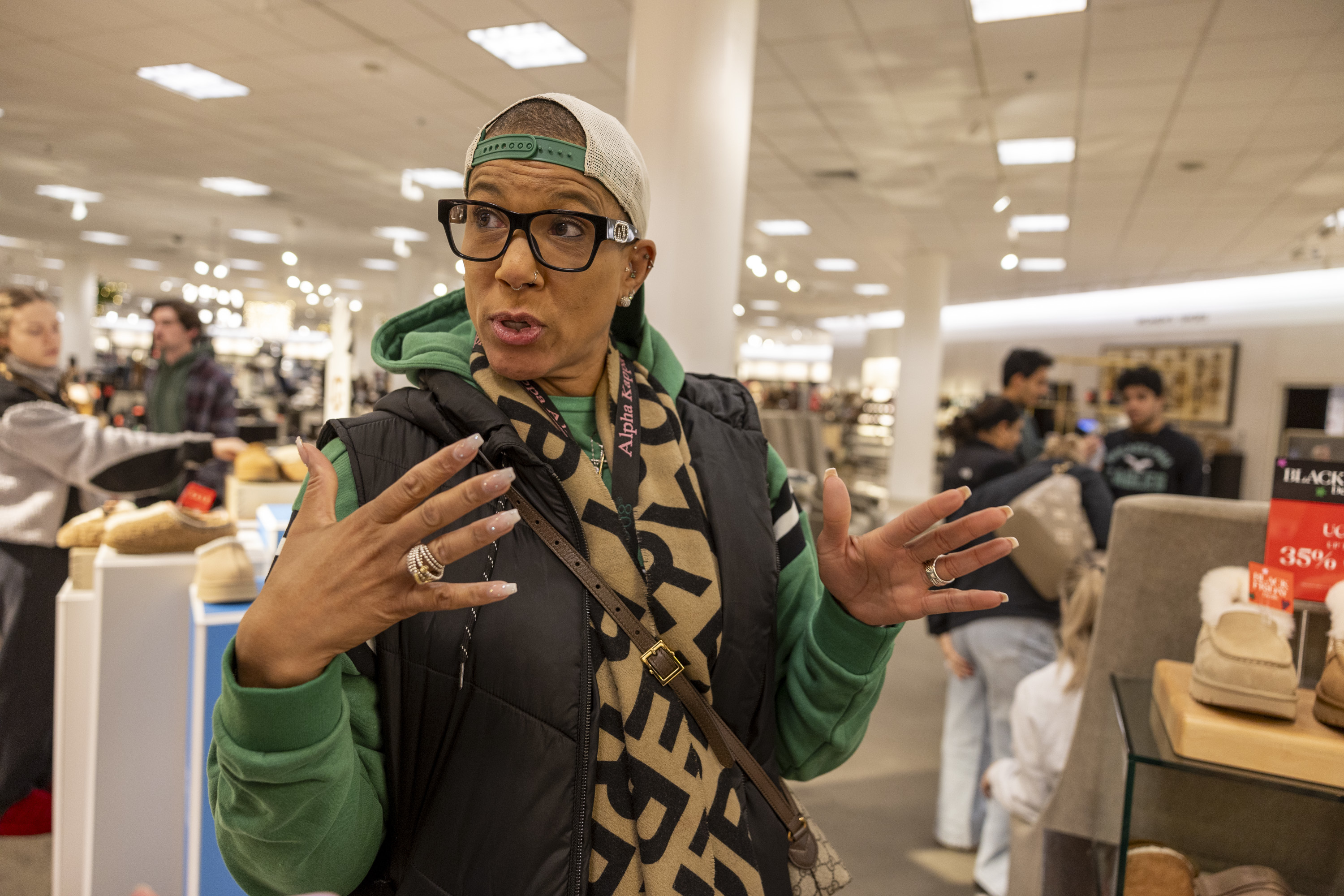
Alicia Hall, of Philadelphia, shops at Nordstrom at the Cherry Hill Mall on Friday, Nov. 28. Hall is a regular at the mall, but said the Black Friday shopping experience isn’t what it used to be.
Economic doom and gloom didn’t deter Alicia Hall, 54, from hitting the mall, either.
Hall is a Cherry Hill Mall regular, driving over from Philly a few times a month to browse. For years, she would wake up early and wait in line for the big sales. Now, she said, “nothing is open like it used to be.”
Though she sometimes thinks about looming economic concerns, “retail therapy” remains an important part of her life.
“I go to work every day, and I work hard,” she said. “I might as well spend it.”
This suburban content is produced with support from the Leslie Miller and Richard Worley Foundation and The Lenfest Institute for Journalism. Editorial content is created independently of the project donors. Gifts to support The Inquirer’s high-impact journalism can be made at inquirer.com/donate. A list of Lenfest Institute donors can be found at lenfestinstitute.org/supporters.
Mark Hallett, 82, of Bethesda, Md., world-renowned scientist emeritus at the Maryland-based National Institute of Neurological Disorders and Stroke, former chief of the clinical neurophysiology laboratory at Brigham and Women’s Hospital in Boston, associate professor of neurology at Harvard Medical School, groundbreaking researcher, prolific author, mentor, and world traveler, died Sunday, Nov. 2, of glioblastoma at his home.
Dr. Hallett was born in Philadelphia and reared in Lower Merion Township. He graduated from Harriton High School in 1961 and became a pioneering expert in movement, brain physiology, and human motor control.
He spent 38 years, from 1984 to his retirement in 2022, at the National Institutes of Health in Bethesda and was clinical director and chief of the medical neurology branch of the National Institute of Neurological Disorders and Stroke. He and his colleagues examined the human nervous system and the brain, and their decades of research helped doctors and countless patients treat dystonia, Parkinson’s, and other neurodegenerative diseases.
“When I met him, I was in bad shape,” a former patient said on Instagram. “I’d also been told … that no one would ever figure out the source of my illness. … He and his team diagnosed me, and thereby, I’m pretty sure, saved my life”
Dr. Hallett told the Associated Press in 1992: “The more that we know about the way these cells function, the better off we are.”
Barbara Dworetzky, current president of the FNDS, said Dr. Hallett was a “brilliant scientist, visionary leader, and compassionate physician whose legacy will endure.” Former NIH colleagues called his contributions “astounding” and said: “The scope and impact of Dr. Hallett’s work transcend traditional productivity metrics.”
He chaired scientific committees and conferences, and supervised workshops for many organizations. He earned honorary degrees and clinical teaching awards, and mentored more than 150 fellows at NIH. “Our lab’s demonstration of trans-modal plasticity in humans was another milestone,” he told the NIH Record in 2023. “And, of course, I am particularly proud of the fellows that I have trained and their accomplishments.”
In a tribute, his family said those he mentored “valued his intellect, his encouragement, his kindness, and his humor.”
Dr. Hallett and his wife, Judy, married in 1966.
Dr. Hallett had planned to study astronomy at Harvard University after high school. Instead, he earned a bachelor’s degree in biology in 1965 and a medical degree at Harvard Medical School in 1969. He completed an internship at the old Peter Bent Brigham Hospital, now part of Brigham and Women’s, and joined a research program at the NIH in 1970 to fulfill his military obligation during the Vietnam War.
A fellowship in neurophysiology and biophysics at the National Institute of Mental Health sparked his interest in motor control, and he served a neurology residency at Massachusetts General Hospital in 1972 and a fellowship at the Institute of Psychiatry in London in 1974.
He returned to Brigham and Women’s in 1976 to supervise the clinical neurophysiology laboratory and rose to associate professor of neurology at Harvard. In 2019, he earned the Medal for Contribution to Neuroscience from the World Federation of Neurology, and former colleagues there recently said his work “had a lasting global impact and shaped modern clinical and research practice.”
He also studied the scientific nature of voluntary movement and free will. He wrote or cowrote more than 1,200 scientific papers on all kinds of topics, edited dozens of publications and books, and served on editorial boards.
He was past president of the International Federation of Clinical Neurophysiology and the International Parkinson and Movement Disorder Society, and vice president of the American Academy of Neurology.
At Harriton, he was senior class president, a star tennis player, and a leading man in several theatrical shows. “The only time he disobeyed his parents,” his family said, “was when he decided to leave Philadelphia to attend Harvard College.”
Mark Hallett was born Oct. 22, 1943. The oldest of three children, he was a natural nurturer, a longtime summer camp counselor, and the winner of an Alfred P. Sloan Foundation national scholarship award in high school.
He grew up in Merion and met Judith Peller at a party in 1963. They married in 1966 and had a son, Nicholas, and a daughter, Victoria.
Dr. Hallett (center) was a star on the Harriton High School tennis team.
Dr. Hallett was an avid photographer and a master of the family group shot. He championed a healthy work-life balance, and his family said: “He eagerly built sand castles, skipped stones, and started pillow fights. His easy laugh was contagious.”
He enjoyed hiking, biking, jazz bands, and organizing family vacations. “He was a natural leader,” his son said, “self-assured and patient of others, with a deep sincerity and a desire to help people.”
Many Americans are deeply unhappy with their financial situation, and with good reason. They are grappling with a serious affordability squeeze.
Prices for many things, from groceries to car insurance, are high and continue to climb. Meanwhile, pay increases are slowing as job growth has stalled and unemployment is on the rise.
Americans’ unease with their finances is apparent in the long-running University of Michigan survey of consumer sentiment. This survey of consumers’ financial well-being has been conducted monthly since the early 1950s, and in the past few weeks, the responses have been about as weak as ever.
The survey likely overstates consumers’ collective gloominess, as political biases are increasingly shaping people’s feelings about almost everything, including their finances. Democrats have been more glum than Republicans since President Donald Trump’s election, whereas the opposite was true under President Joe Biden. Even so, the survey results send a loud and clear message.
The angst over affordability was also front and center in the recent election results. The cost of living was far and away the top concern of voters in New York City’s mayoral race, and in the governors’ races in New Jersey and Virginia. The high and rising cost of electricity, healthcare, and housing were especially prominent in voters’ decisions.
The affordability squeeze has been a long time in the making.
Prices jumped during the COVID-19 pandemic, as global supply chains and labor markets were upended. Then, the Russian invasion of Ukraine drove up food prices, and at the height of the economic fallout from that war, the cost of a gallon of gasoline reached a record $5 in some U.S. locations.
Adding to Americans’ financial pain, the Fed aggressively raised interest rates in an effort to slow the economy down and rein in the high inflation. This exacerbated the affordability squeeze, particularly with the cost of homeownership.
Prior to the pandemic, the typical monthly mortgage payment was no more $1,000. Once the Fed had finished increasing rates, the monthly payment was well over $2,000. Homeownership, a key part of Americans’ definition of financial success, is completely out of reach for most.
Despite all of this, it did appear, coming into this year, that the worst of the affordability squeeze had passed. Inflation was quickly receding and headed back toward the Fed’s inflation target. Fed officials were so confident in this forecast that they began cutting interest rates.
But, alas, the forecast was wrong. The Trump administration’s higher tariffs, highly restrictive immigration policy, and broader de-globalization efforts have upended that outlook.
De-globalization scrambles global supply chains, which raises costs, reduces competition, weakens productivity growth, and leads to labor shortages. Inflation now appears set to remain uncomfortably high for the foreseeable future. The affordability squeeze is intensifying again, leading to renewed anguish among consumers and voters.
De-globalization is also weighing heavily on the job market and incomes, adding to the country’s affordability woes. Job growth has come to a virtual standstill, as businesses, unsure of how the tariffs and other policies will play out, enact hiring freezes. They aren’t all laying off workers — that would be a recession — but they’ve done everything but.
Unemployment remains low, but it is steadily increasing, particularly for younger workers seeking new employment opportunities. Wage growth is thus throttling back.
The upcoming cuts to federal government benefits for lower-income households, included as part of the One Big Beautiful Bill Act, will worsen the affordability problem. Tax subsidies to help pay for the cost of health insurance under the Affordable Care Act have been scaled back, and cuts to the Medicaid program and SNAP, the food assistance program, are looming. As these programs are cut back, the cost of living for families reliant on them will increase.
Congress appears to have taken the election results to heart and seems to be focused on ways to ease the affordability squeeze. Lawmakers are holding hearings on how to reduce the financial burden on Americans from electricity, food, healthcare, and housing costs. But this won’t be easy, as there are no slam-dunk legislative solutions.
Trump has proposed providing a $2,000 stimulus check to families with an annual income of less than $100,000 — similar to the checks sent during the pandemic. Of course, like then, this might merely provide temporary financial relief, as it boosts consumer spending, pumps up inflation, and ultimately worsens the affordability squeeze.
The quickest way to address the affordability squeeze is to relax tariffs and immigration policies. The president has taken this approach on a case-by-case basis, reducing tariffs on bananas, beef, and coffee, and halting some ICE raids on agricultural workplaces that heavily rely on immigrant workers.
However, it remains to be seen if he will further backtrack on his signature economic policies. If not, the affordability squeeze and the tough financial times facing many Americans are sure to persist.
Imagine walking out of a Walmart, Target, or Costco. As you push your large shopping cart to your car, you ask yourself: Did I really need all that stuff?
The answer is you probably didn’t.
In a recent study, my coauthors, Lina Wang and Sungho Park, and I found that the presence of supercenters — large retailers that sell groceries alongside general merchandise — results in a significant uptick in consumer waste due to overpurchasing.
These supercenters often sit on lots in excess of 150,000 square feet. But figuring out how all that real estate affects people’s shopping habits — if it does at all — is tricky. That’s because a lot of factors influence how much people buy on a single shopping trip.
To answer this question, we looked at the impact of the spread of Walmart supercenters across the U.S. over a decade, using a technique called difference-in-differences — an analytical method in which we compared consumer waste trends in counties that saw supercenter launches with “matched” counties that did not. This matching ensured that counties were otherwise closely comparable on socioeconomic factors such as housing, income, and education.
Our analysis showed that the launch of a supercenter results in an increase in consumer waste of up to 7%. Furthermore, this increase in consumer waste is larger for new supercenter openings compared with conversions, when existing regular stores are expanded into large-format ones.
Why it matters
For decades, neighborhood stores across the U.S. were edged out by large-format retailers: department stores, supercenters, and shopping malls. Although there is evidence that many of these big-name retailers are beginning to look toward smaller stores, the shopping landscape remains dotted by supercenters.
And these large stores stimulate mass consumption through gradual shifts in consumer behaviors. For example, in their attempt to generate more sales, large-format retailers often underprice smaller neighborhood stores.
Take, for example, Walmart’s “everyday low price” strategy, which is key to its business model. This pricing strategy offers shoppers a largely consistent year-round low price rather than relying on occasional sales and discounts.
Further contributing to overpurchasing is the supercenters’ typical location, which tends to be away from residential areas. Naturally, in their effort to avoid multiple trips, consumers tend to maximize the utility of each visit by making their basket sizes larger.
Unfortunately, this overpurchasing often leads to waste as more goods reach expiration date or sit unused in people’s homes.
While this may be a profitable strategy for retailers, it’s bad for society and the environment and creates billions of dollars in waste. To put this into context, the United States generates close to 300 million tons of consumer waste every year, and then spends billions of dollars managing this waste.
What still isn’t known
Now that we have measured the “supercenter effect,” we are keen to look at potential solutions to this problem. Some existing solutions are based on implementing policies that encourage behavioral shifts in consumers. For example, many cities have adopted a pay-as-you-throw policy that charges people based on the volume of waste generated.
Other solutions are more structural, such as bringing back neighborhood stores and developing stronger circular economy channels. For example, neighborhood stores can play an important role in mitigating the supercenter effect and could allow for smaller, more frequent shopping trips and significantly less waste.
In many cities, initiatives promoting localvendors and stores are gaining momentum. Such solutions would not only encourage sustainable consumption but also have benefits for local economic growth by promoting small businesses that have historically accounted for 62% of net new job creation.
A second solution entails leveraging the “reuse economy,” which can provide a back-end channel for circulating surplus and used goods. While both offline and online reuse channels exist – through the likes of thrift stores, food banks, and Facebook Marketplace, for example — they currently remain vastly underused.
Identifying and aggressively implementing such solutions might turn out to be both economically meaningful and environmentally beneficial. But more work needs to be done to figure out which solutions are more effective, and why.
Suvrat Dhanorkar is an associate professor at the Georgia Institute of Technology. This article is republished from The Conversation. Read the original article at theconversation.com/us.
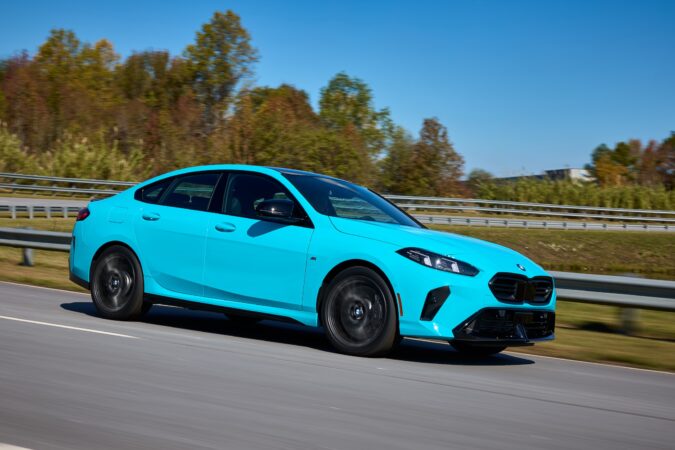
2026 Audi S3 Prestige vs. 2026 BMW 228i xDrive Gran Coupe: Battle of the little racers.
This week: BMW 228i
Price: Starts at $41,600 for both the 2025 and 2026 model years. Advantage, BMW.
Conventional wisdom:Car and Driver liked the “Refined balance of ride and handling, eager powertrains, purposeful near minimalist interior design and materials,” but not the “compromised cargo and rear passenger space,” and that the “front and rear fasciae appear a bit forced on otherwise sleek bodywork.“
Marketer’s pitch: “Strikingly sporty.”
Reality: “Striking.” I was afraid of striking things as I tried to make simple adjustments.
Catching up: Last week Mr. Driver’s Seat enjoyed the Audi S3 — until he landed on the highway, or tried to squeeze in some luggage.
What’s new: The 2 Series received more horsepower and a new look for 2025, and carries on pretty much unchanged for 2026.
Competition: In addition to the S3, there are the Acura Integra, Cadillac CT4, and Mercedes-Benz CLA.
Up to speed: The 2 Series’ speed would be the first question mark. The 2.0-liter TwinPower turbo provides 241 horsepower, almost 100 fewer than last week’s Audi S3; would it keep up?
Yet the version tested gets to 60 mph in 5.1 seconds, according to Car and Driver, just 0.7 seconds slower than the S3. A more souped-up model with a 3-liter six-cylinder engine gets there in just 3.6 seconds.
Shifty: The seven-speed dual-clutch transmission is super smooth, worlds above any attempt from Kia or some other inexpensive offerings.
The slider PRND operator looks cool but doesn’t offer much feel or add any usable space. Shift via the steering wheel paddles.
On the road: Handling is quite nice, perhaps in part because of the M Sport Package, which adds adaptive suspension along with other decals and stuff, plus the aforementioned dual-clutch.
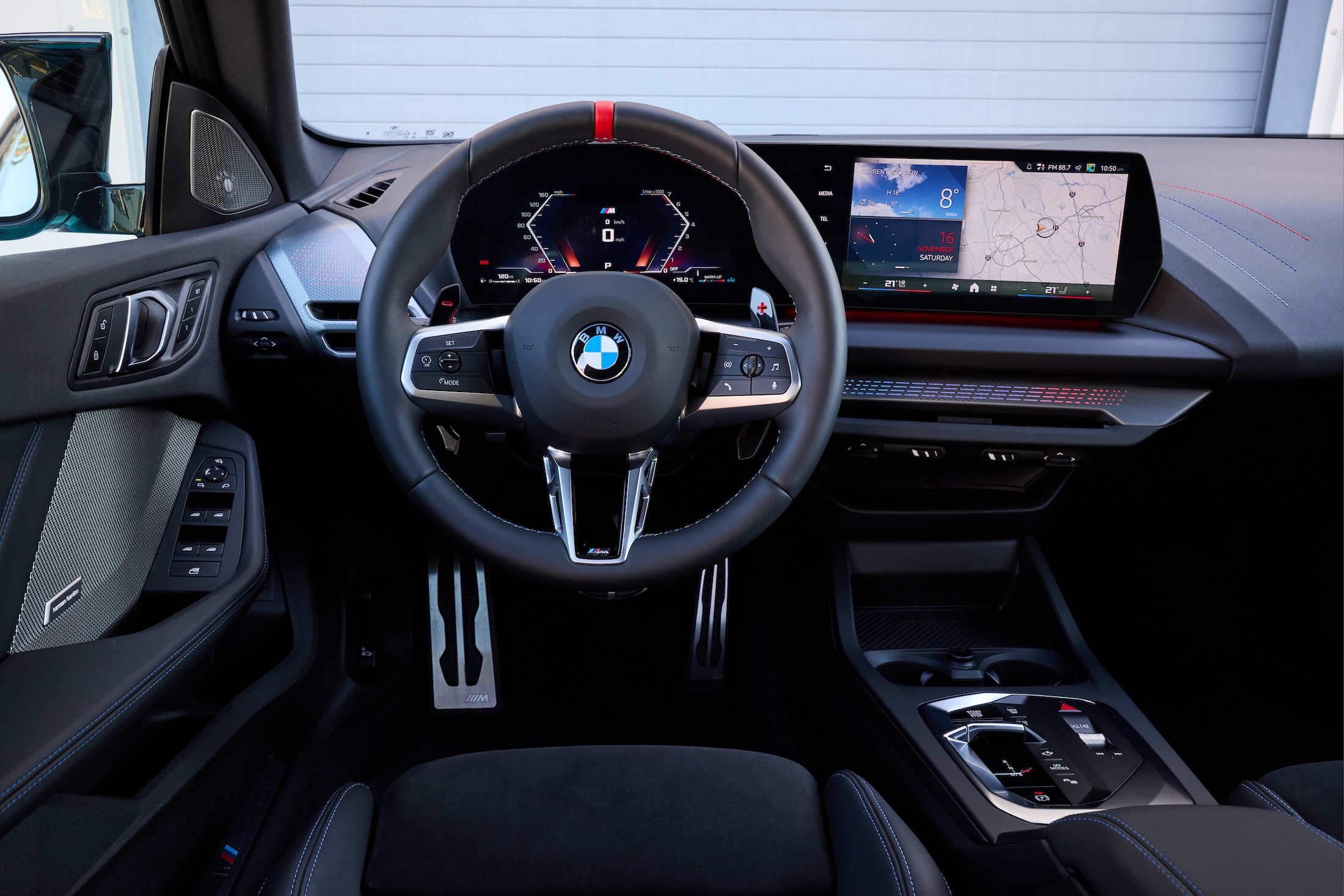
In the first of several “improvements” designed to make the interior feel more high tech, Sport mode requires finding the button on the console touch pad (no solid way to feel your way to it) and then pressing the large icon on the screen. So there’s two instances you’re looking away from the road while trying to operate the vehicle.
But at least compared to last week’s Audi S3, the BMW doesn’t rattle your brain on the highways at all.
The cockpit of the 2025 BMW 2 Series looks as inviting as ever but operation does not live up to expectations.
Driver’s Seat: The sport seats that come with the M Sport package are supportive and comfortable, and I never adjusted it beyond forward and backward. No annoying lumbar or grippy seat corners.
The materials all feel upscale, an improvement over the X2 SUV I tested this year. Everything about that small SUV felt cheap and plasticky.
The materials seem especially scuff prone, though. I brushed out the carpet and seats when I was done with my loan and it seemed the bristles and the plastic handle left marks on the seat and in the plastic door frame bottom. Be sure this fabric fits your lifestyle.
Friends and stuff: Sturgis Kid 4.0 laughed at how tight the rear seat was. He sat stretched into the middle just to make it workable.
He’s not wrong. My own head was squashed up against the ceiling in the corner, although foot room and legroom were pretty good. Entry and exit are challenging because the door is narrow and the seat actually sits up kind of high (not something I expected to write in this review). The middle seat is compromised by the hump and the console and the corner people trying to find a place for their heads.
Cargo space is 13.8 cubic feet, far higher than the S3.
Play some tunes: Sound from the Harman Kardon system might be better than I heard, but I could never find the audio tuning adjustment when I had CarPlay activated. It would only show up in the touchscreen when I left CarPlay off, so it was difficult to make the most of my favorite songs. B-, because why make it so hard?
BMWs once had a superb dial and button system for operating the infotainment, and some models still have it. It takes a bit of practice but you can really run it by feel after a while. Now it’s all about the touchscreen, with a roller dial on the console for volume.
Keeping warm and cool: The temperature controls appear as small +/- adjustments at the corners of the touchscreen. There’s no way to feel for them, and your eyes are off the road while you adjust.
But wait! There’s more! To make further HVAC adjustments, click on the tiny fan icon between them to open up all the controls. These are fairly clear, but I’ve already looked at the screen and away from the road twice now, just to cool off (or warm up).
Fuel economy: I neglected to note the fuel economy. (Hangs head in shame, then blames BMW for the confusion.) The window sticker says 30 mpg combined, but that seems optimistic.
Where it’s built: Leipzig, Germany. Germany is the source of 24% of the car’s parts. None of it comes from the United States or Canada.
How it’s built:Consumer Reports gives the 2 Series Gran Coupe a predicted reliability rating of 3 out of 5.
In the end: The 228i was definitely fun to drive, but too many drawbacks made me long for the real delight of the S3. Just pack ibuprofen for the highways.