One of my close high school friends from central Pennsylvania came to visit me last weekend with her daughter to celebrate the girl’s 12th birthday in Philly. Admittedly, I was a little nervous. I don’t have children, I don’t know what 12-year-olds like, and I don’t want to screw up anyone’s birthday, especially a kid’s.
Luckily, her mom provided advanced intel that this preteen is currently into K-pop and hopes to study abroad in South Korea someday. So after stopping by Philadelphia’s Magic Gardens on Saturday morning (where I take all first-time Philly visitors), we decided to surprise her by going to Chinatown that afternoon.
It was my friend’s daughter’s first trip to any Chinatown anywhere, and when she began to see the signs and people and asked where we were going, she let out the kind of joyful shriek preteen girls typically reserve for boy bands. I smiled at her joy and at my pride that I hadn’t messed this up — yet.
North 10th Street in Philadelphia’s Chinatown.
I told the girl in advance that she’d see some things on the streets of Philly she doesn’t see at home and that would be hard to see: people experiencing homelessness, people who are in addiction, and people who are suffering from mental illness. Part of living in a city, I told her, is to constantly be reminded of the struggles of others. Hopefully that makes you more compassionate toward all people and grateful for what you do have, but at the very least, it forces you to face the reality of our society and how difficult life is for some people.
What I didn’t warn her about were the robots.
‘Bodies in the Delaware’
We encountered our first Uber Eats delivery robot made by Avride while walking from the Fashion District parking garage to the Chinatown Friendship Gate. Thankfully, I knew what it was because of my colleague Michael Klein’s story on them last week, and because of a post about them on the Philly subreddit that garnered very Philly responses like: “Bodies in the Delaware. Heads in the Schuylkill.”
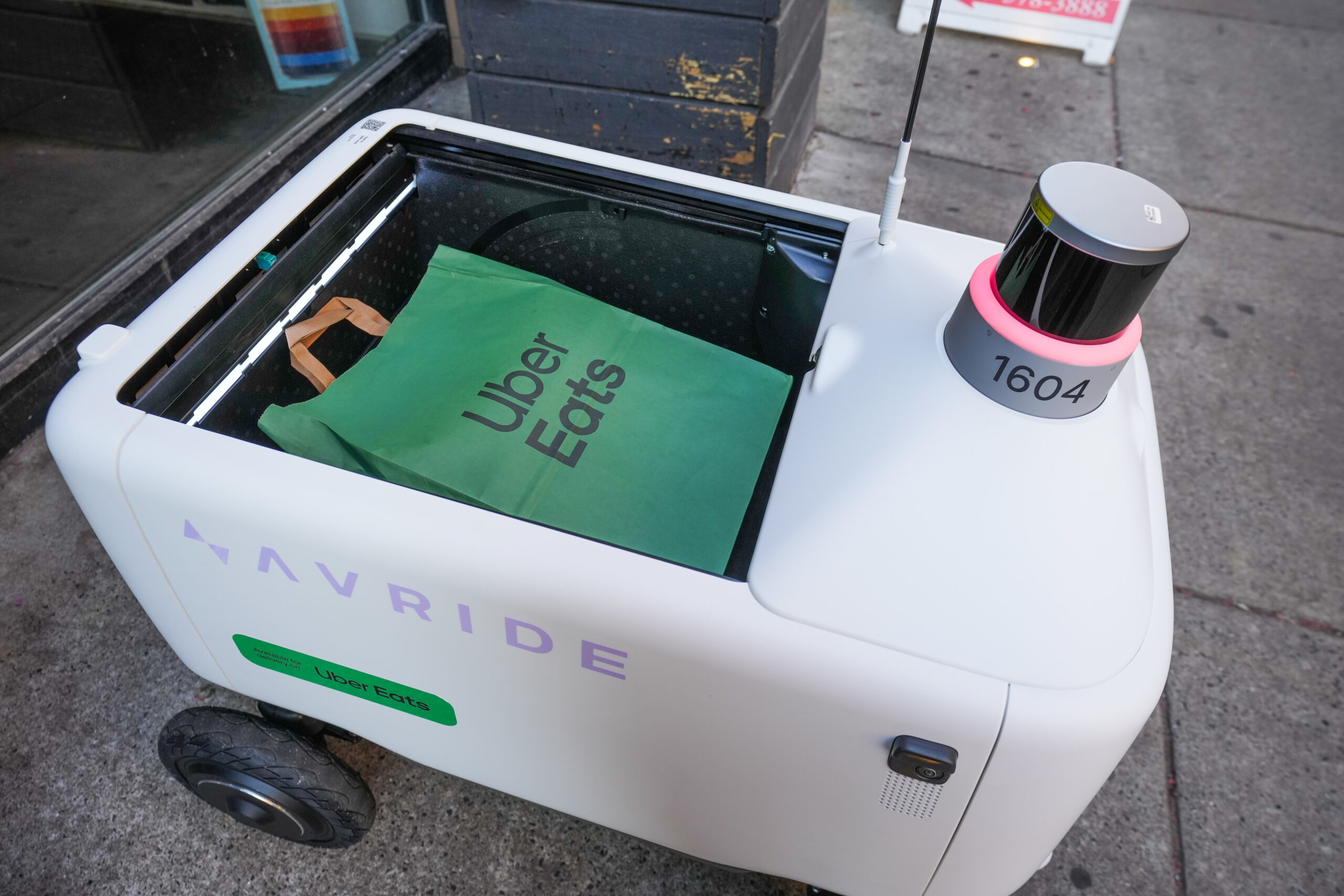
An Uber Eats delivery robot in Philadelphia.
Even though I knew what the robot was, it was still really weird to see this boxy thing on wheels navigating around people on the sidewalk and across city streets. My guests agreed and it seemed many people around us did too, because they were pointing and laughing as it passed.
These robots were breaking folks out of their everyday and pausing people in midconversation, and not in a good Philly way, like the unexpected art that adds whimsy and beauty to our city, but in a dystopian way. I found myself creeped out by the robots and what their presence here might portend.
Sure, I’ve seen Marty the robot at Giant supermarkets and I’ve written about the robot cat servers in a few area restaurants, but those are in private businesses. These delivery bots are out in public and unavoidable. It feels different, like Philadelphia’s murder of HitchBot didn’t prevent a robotic uprising, as we’d all hoped, it only delayed it for a while.
‘DESTROY ME PLZ’
In the nine hours we walked around Chinatown and Center City, we saw three Uber Eats delivery robots. On Filbert Street near the courthouse, one was rolling along ahead of us and a woman in a red shower cap who was parked across the street in an SUV yelled out her window that they were not delivery robots, but rather police surveillance bots keeping watch on us (while nothing seems impossible today, there is no proof of that).
Philly photographer HughE Dillon captured video of a delivery bot out on the streets of Philly Saturday night while St. Patrick’s Day revelers were bar hopping with the Erin Express. One person sat on one of the robots; someone else wrote “DESTROY ME PLZ” on it.
Here’s where it gets even weirder for me, because these robots are anthropomorphized with digital eyes that blink and wink and turn into hearts, I began to feel sorry for them. Maybe these robots don’t want to be here either, I thought, maybe they didn’t even want to be invented, but now they’re stuck with us without a choice, just like we’re stuck with them. Of course I know this is all highly illogical, that these are just machines, but emotions aren’t always logical. That’s what makes us human.
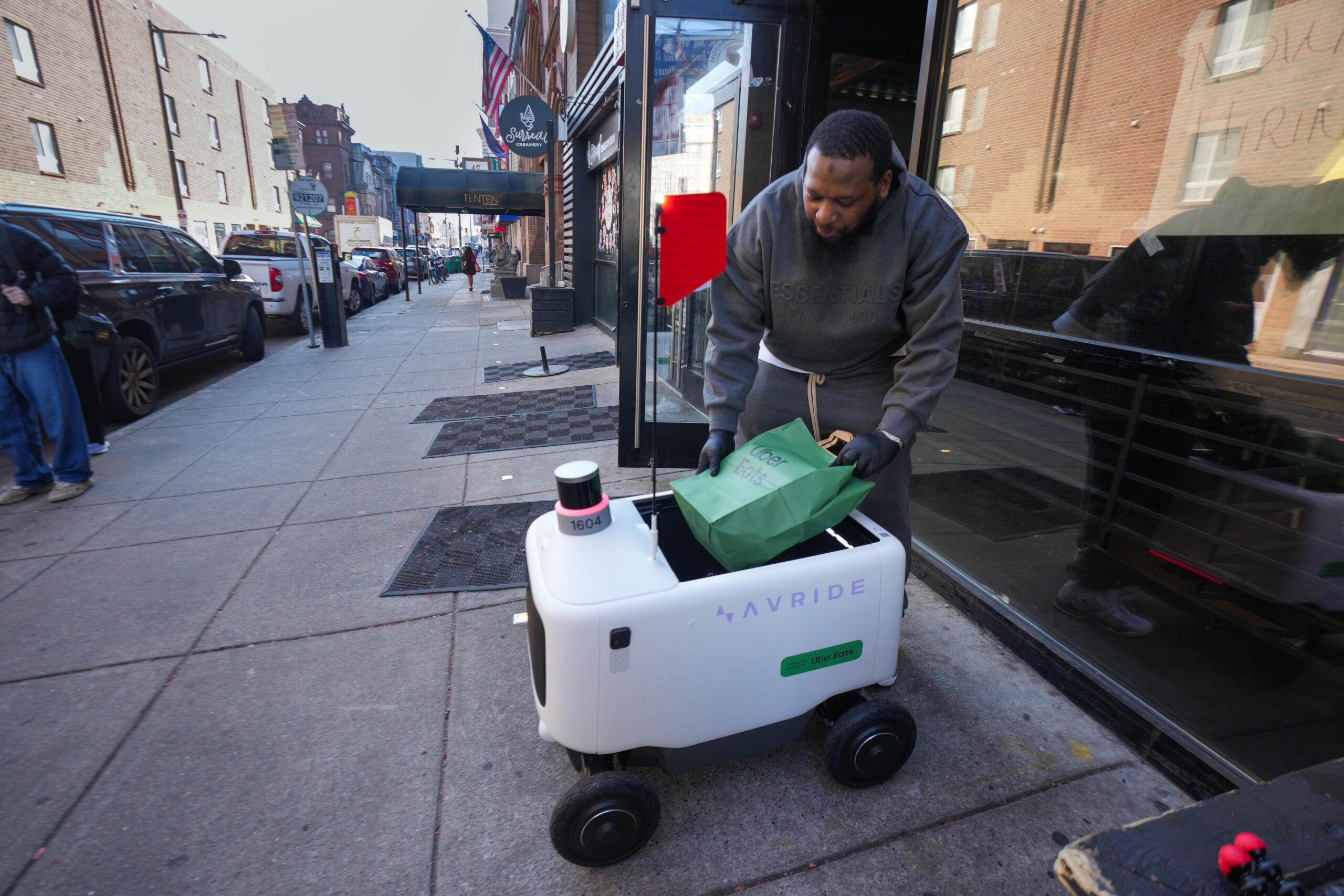
Uber Eats’ delivery robot.
Philly does its thing
When I took my friend’s daughter into You & Me, the Asian toy store with the secret basement-level grocery store, she announced that she had died and gone to heaven and I took great pride in knowing that I’d impressed a 12-year-old.
But what I was even more proud of was that Philly did it’s Philly thing, as I’d hoped. Strangers continually engaged with us, whether it was a customer at a store who saw my friend’s fair skin and, unsolicited, recommended the best sunscreen she’s ever used, or the server at Nine Ting who saw us struggling with the grill and helped us navigate our first Korean barbecue experience. Three people complimented my friend’s daughter’s outfit — a cute skirt, leg warmers, and Mary Jane combo she’d obviously put a lot of thought into — and it absolutely made her day.
While we encountered robots, our best interactions were with humans.
The TLC
I hope those robots are the last thing my friend’s kid remembers about her trip to Philly and I hope I don’t look back on that lovely day as a turning point in some larger evolutionary story about humanity and robots.
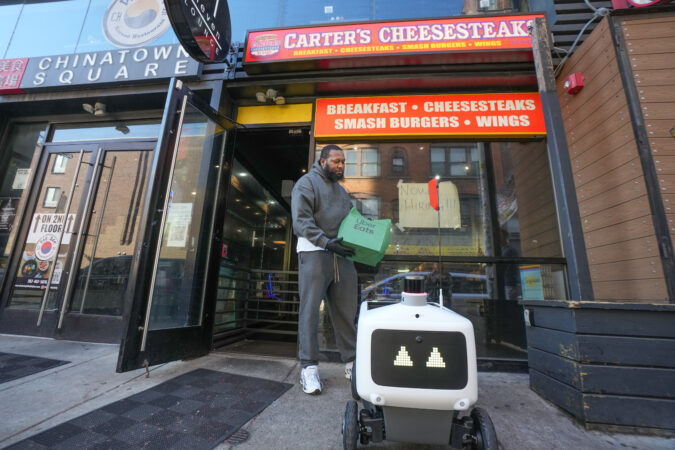
Lavelle “Garci” Peterkin, owner and CEO of Carter’s Cheesesteaks by Garci, places food inside of an Uber Eats delivery robot in Philly.
(I can hear myself now at 85, telling children in the future: “That was the first time I saw robots and humans interacting independently of one another, but it would not be the last!”)
We came home Saturday night to a homemade chocolate birthday cake with vanilla buttercream frosting my husband made. Our bellies already full, our sugar intake already high, we ate it with delight as we recounted the day. The cake dripped with what my husband says is the most important ingredient of any dish — the TLC.
A robot could never.
As I was cleaning Sunday, I found a note my friend’s daughter left in our guest room on a page she’d torn from one of my reporter’s notebooks. In the note, she talked about how thankful she was for the great cake, gifts, and wonderful day.
It seems the Philadelphia School District can’t win.
For years, folks complained about the poor quality of the school buildings. But the district’s ambitious plan to renovate, close, and merge schools, was met with swift pushback.
On paper, the $2.8 billion plan to revamp the schools makes good sense. But then there is the reality that closing a school leaves a void in a neighborhood. Moving students could result in longer commutes and impact learning.
So, what is the district to do?
Philly is infamous for resisting change, but the status quo is not a solution.
Many of the district’s 307 buildings were built more than 70 years ago and contain asbestos and lead and don’t have air-conditioning. Many schools lackteachers, libraries, playgrounds, STEM facilities, and music and art programs as well.
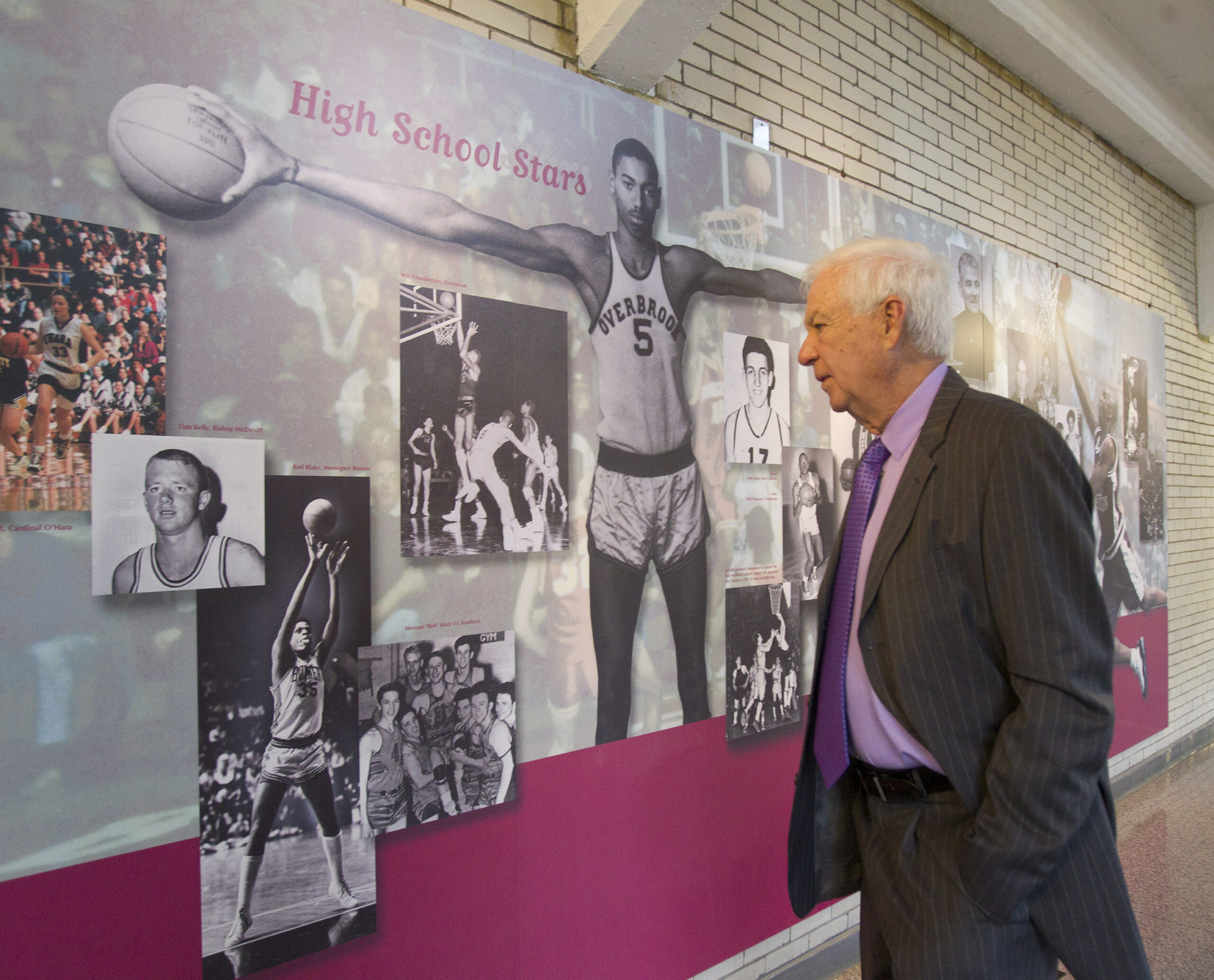
At the same time, the city has more space than it needs. Twenty schools are less than 30% occupied. For example, Overbrook High, where Wilt Chamberlain went, has capacity for 2,330 students but an enrollment of just 441. Operating mostly empty buildings is inefficient, unsafe, and unsustainable.
But Superintendent Tony B. Watlington Sr.’s initial plan to modernize 159 schools, close 20, merge six, and build one new facility over the next decade has been met with fierce opposition.
Two schools, Russell Conwell Middle School and Motivation High School, have already been removed from the closure list and will merge with other schools instead.
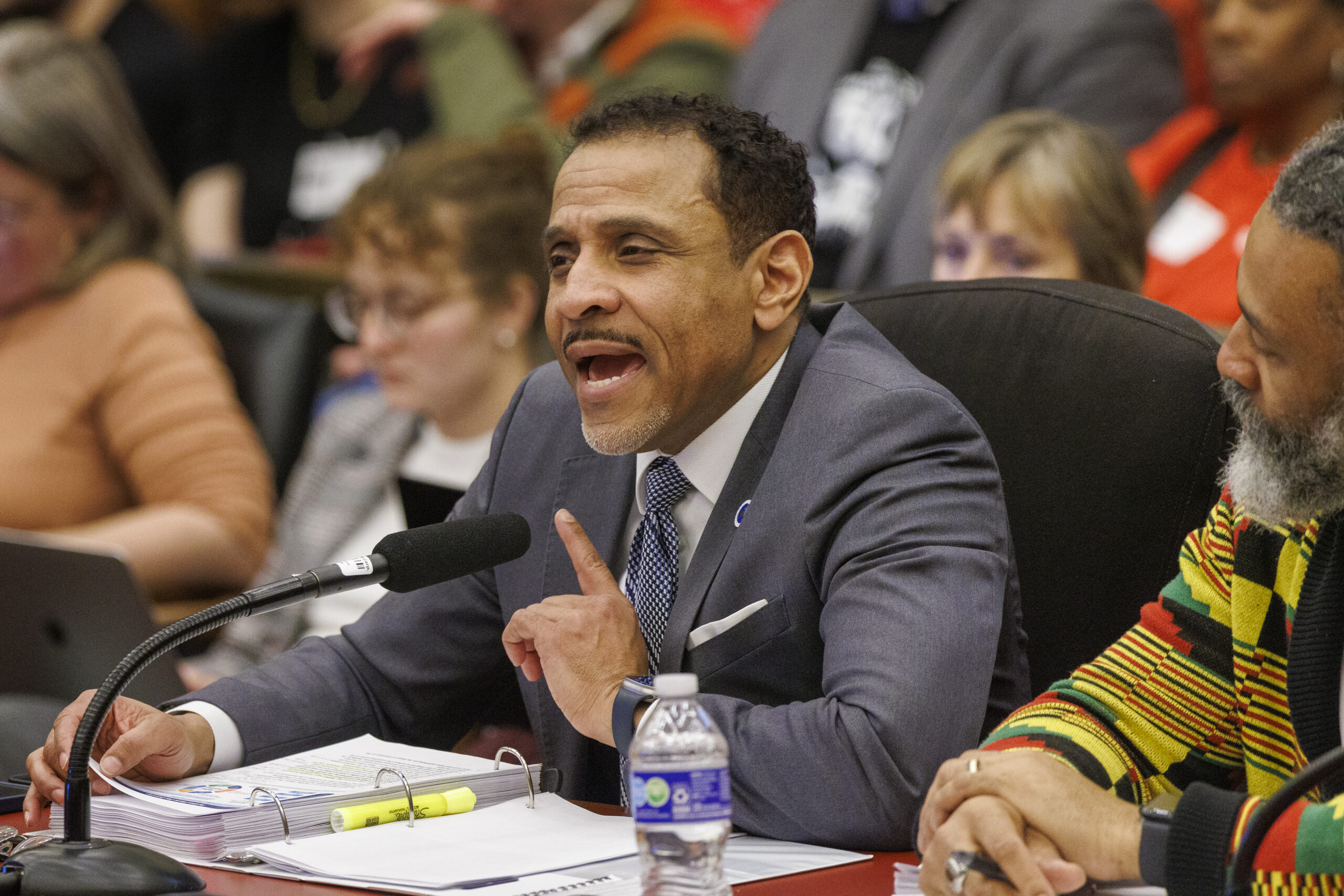
Last week, nearly 100 parents, teachers, and students turned out for a highly charged meeting to pressure the school board to reject the plan — or at least save their school.
Superintendent Tony B. Watlington Sr. has attended roughly 90 listening sessions — attended by about 4,000 people — about the closure plan in recent months.
“I don’t see nothing wrong with our school,” said Layla Hernandez, a third grader who attends Ludlow Elementary, a school in North Philadelphia slated to close.
It’s hard to say no to a precocious third grader. Or a parent like Darlene Abner, whose six children have attended the school. “I stay in this neighborhood because of Ludlow,” she said at a different meeting earlier this month.
The impact of students and parents is real, but Ludlow’s numbers tell a different story. The K-8 school has just 237 students — less than half of its capacity. The school opened almost 100 years ago and serves a number of special education students.
Ludlow’s performance is considered below average. Just 11% of students tested proficient on the state math exam and 24% in English.
It is expensive to staff and operate an old building that is more than half empty and delivering poor results. Indeed, the district faces billions in deferred maintenance and repairs to its aging infrastructure.
Operating buildings where enrollments are under 50% of capacity makes little sense. The problem will only get worse.
Over the past decade, the district’s enrollment declined by more than 17,000 students to around 117,000 students. Over the next decade, enrollment is expected to drop by another 10%.
At the same time, schools in some neighborhoods are filled to capacity, thanks largely to the influx of new immigrants. The explosion of charter schools in Philadelphia also contributed to the drop in enrollment and financial resources.
As a result, the district needs to rightsize to adjust for the enrollment declines in some areas and the increases in others. It also needs to modernize, so buildings have basics like heat, air- conditioning, and bathrooms as well as labs and tech spaces.
But renovating the schools takes time and money — two things the district lacks. The problem has been many years in the making. State lawmakers in Harrisburg contributed to the disrepair of schools by not adequately funding public education for decades — an issue a court found unconstitutional.
It is also unconscionable since investing in public education will go a long way to solving many of the city’s (and country’s problems), including poverty, crime, and workforce development.
This is where charter school advocates argue for more choice, but the hard reality is the test scores at most charters are no better. So, more charters is an empty promise and an argument for a different day.
The goal should be to replace or renovate obsolete and mostly empty schools with safe, clean, and modern facilities featuring all the necessary staffing and resources. Anything less impacts the entire city, whether you have kids in public school or not.
So far, a number of City Council members would prefer to scuttle the plan then find a positive solution. Same for the many state representatives who have voiced their opposition. This is not the time for political grandstanding.
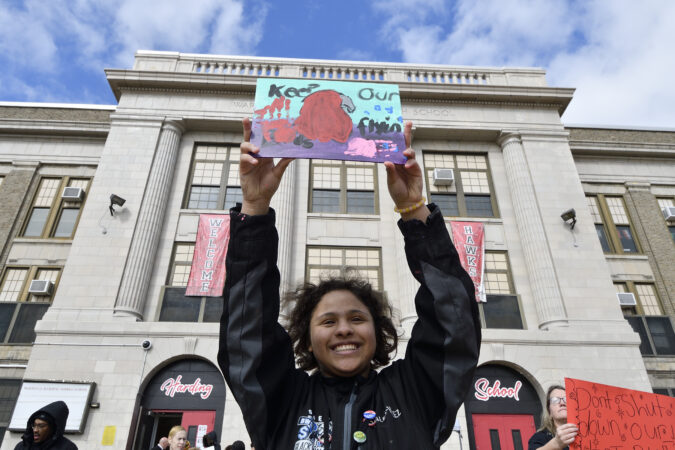
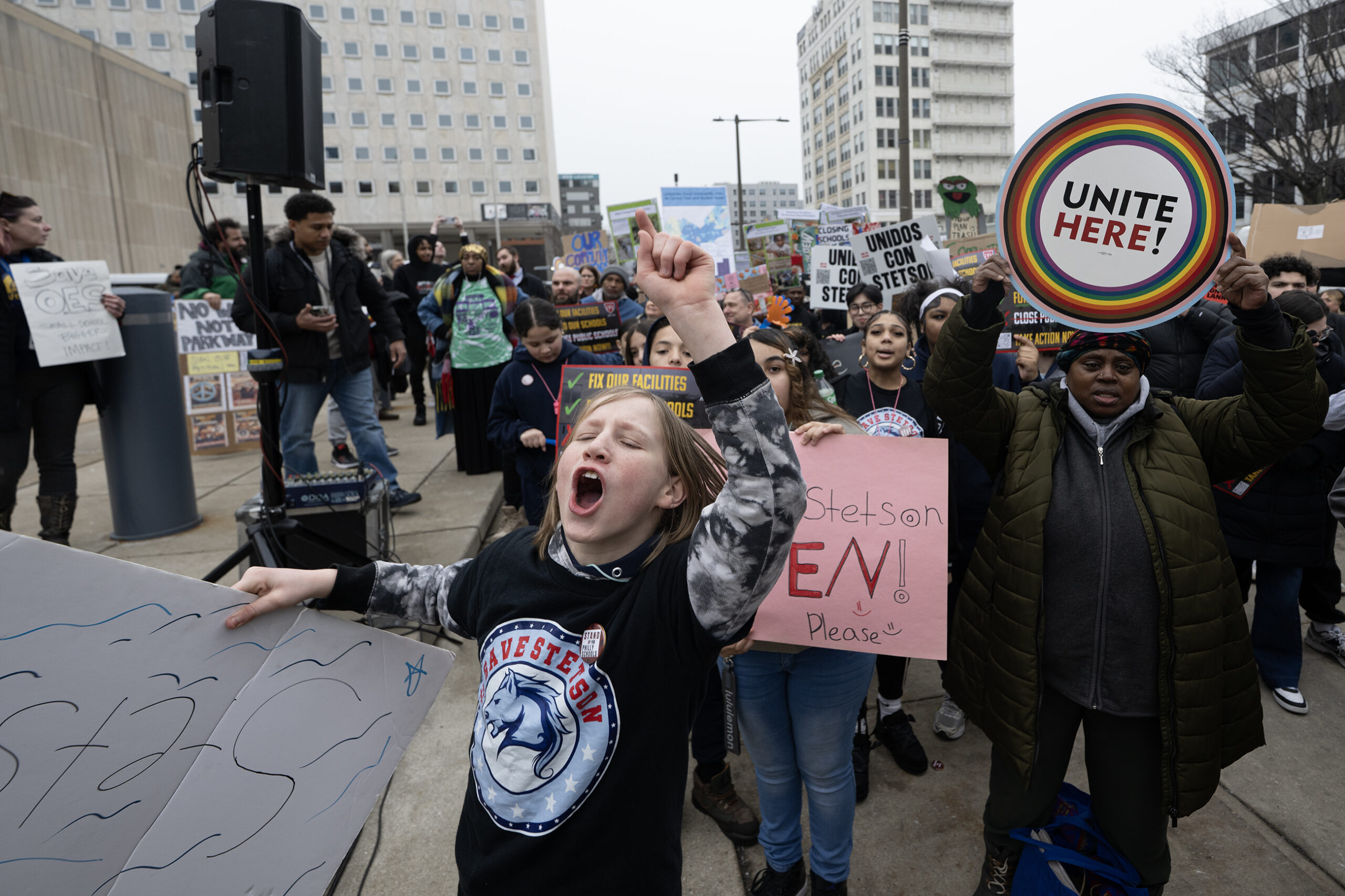
A Feb. 26 demonstration outside the School District of Philadelphia’s Center City headquarters opposed the planned closure of 18 schools.
Philadelphia Federation of Teachers president Arthur Steinberg said the plan lacked transparency and detail on how the changes will impact students.
Perhaps Watlington and Mayor Cherelle L. Parker could do a better job selling the plan. But Watlington told me the district has held 90 listening sessions attended by 4,000 residents and received more than 14,000 surveys from every zip code in the city.
“There’s no perfect master facilities plan,” he conceded, adding the district tried “to do the greatest good for the greatest number.”
The school district tried to be fair by ensuring closures and investments would be spread across all 10 Council districts.
At the same time, the critics have not offered any better solutions.
In 2012 and 2013, the district closed 10% of its school buildings. At the time, many feared the upheaval would undermine learning.
But a study by two University of Pennsylvania professors found the impact was mixed. Students who moved to higher-achieving schools saw their test scores go up. However, the displaced students had more absences and received more suspensions. The farther students had to travel to get to their new schools, the more they struggled.
This time, the district plans to create a one-stop shop to ensure students get all the help they need from transportation to social, emotional, and mental health support.
“We’re gonna wrap our arms around the children to make sure that performance increases and doesn’t decrease,” Watlington told me.
He added that there are no plans to lay off any principals or teachers at the schools slated to close. Instead, the rightsizing will enable the district to “push more resources into the remaining schools.”
In a perfect world, Watlington said, he would never close schools. But he is trying to position the district to do the best it can with the resources it is given.
“We can either use our resources more efficiently by driving more high quality, academic, and extracurricular resources into a smaller number of schools,” he said. “Or we could continue to spread our resources around less strategically.”
John Schaeffer was at a crosswalk on Main Street in Manayunk a few years ago when the walk sign illuminated and a prerecorded audio announcement told him it was safe to cross the street.
But what he heard, instead, stopped him dead in his tracks.
“All of a sudden it just goes, ‘Main. Wawk sign is awn ta crawss Main,’” Schaeffer said. “I was like, ‘Does this crosswalk have a Philly accent? Did I hit my head? Am I losing my mind?’”
Audible Pedestrian Signals on Philly crosswalk signs, in Philadelphia, PA, March 2, 2026.Jessica Griffin / Staff Photographer
He pulled out his phone, took a video, and sent it to a friend in Canada, who confirmed Schaeffer’s suspicions that the crosswalk indeed hadhoagiemouth.
“It feels like one of those many only-in-Philly things, of course even our crosswalks have a thick Philly accent,” Schaeffer said. “It’s mind-blowing and insanely cool. Obviously cool enough that I’ve been holding onto it for years and when you came along I thought I needed someone to get on the case and get to the bottom of this.”
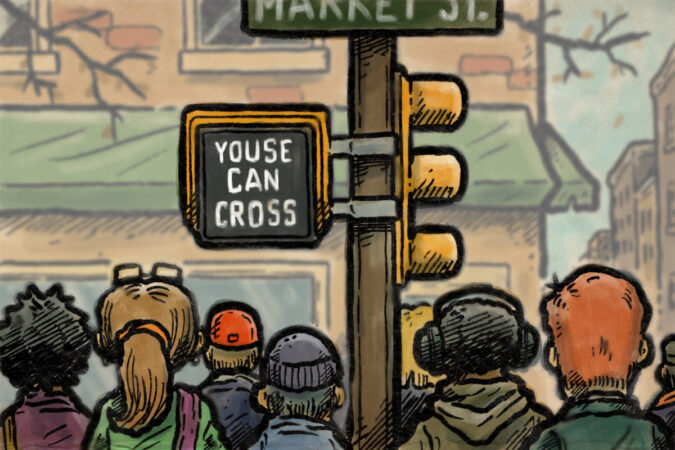
Mawrket, wawk sign is awn ta crawss Mawrket.
00:00
I met Schaeffer while covering the opening of the Philly Phlush standalone public bathroom in Clark Park last year. He was the inaugural user and aftermy story published he reached out with some kind words (I’m flushed with honor that his partner got him a framed copy of the story that now hangs in his own bathroom) and with the tip about the crosswalks.
Somehow, my ears hadn’t registered the Philly accent at our crosswalks before, but that’s not a surprise. Just last weekend I asked my husband to push a button on a crosswalk sign on the Parkway only to have him tell me that it was not a button, but rather, a well-placed googly eyed sticker.
View on Threads
Once Schaeffer brought the accent to my attention though, I couldn’t stop myself from hitting the crosswalk buttons at every intersection to hear it more, like a kid on an elevator lighting up every floor.
Sampson, wawk sign is awn ta crawss Sampson.
00:00
Of course, there is no ‘p’ in Sansom Street (unless drunken revelers are celebrating an Eagles Super Bowl win), but that doesn’t stop the Philly accent from adding one because just like the people who speak it, it does whatever it wants.
I can differentiate at least two different male voices narrating these announcements, possibly three, but the enthusiasm level of all of them is like “some guy shows up at 5 a.m. with a Wawa coffee, plugs the mic in, and is like ‘Keep it moving,’” as Schaeffer so aptly put it.
No auditions
The purpose of the announcements, which are part of the city’s Audible Pedestrian Signal (APS) systems, is to let people with visual impairments know when it’s safe to cross the street.
The APS systems are administered by the Philadelphia Streets Department, whose director of operations, Thomas Buck, answered questions for me via email through a spokesperson.
Chestnut, wawk sign is awn ta crawss Chestnut.
00:00
Citywide there are 135 APS systems, but questions about exact intersections or the neighborhoods where they are located were not answered. According to Buck, intersections are chosen to receive APS systems based on upgrades, reconstruction, or “a need for enhanced pedestrian safety.”
I’m sad to report there are no tryouts to be the voice of Philadelphia’s crosswalks. The dulcet, Philly-accented audio announcements are voiced either by Streets Department employees or by staffers with the department’s equipment suppliers who are responsible for programming and assembling the APS units.
Stephanie Farr
“The individuals providing the messaging are either Philadelphia residents or in the case of the equipment suppliers, may be residents in the surrounding areas,” Buck said.
The announcements are either recorded in the traffic engineering division’s signal and sign shop in Juniata Park or in the assembly shops of the Streets Department’s respective suppliers, according to Buck.
Audible Pedestrian Signals on Philly crosswalk signs, in Philadelphia, PA, March 2, 2026.Jessica Griffin / Staff Photographer
While the intent of the message is clear, “The Philly accent was completely unintentional,” he said.
Isn’t it always.
Wooder the odds
I’ll never forget when I first heard myself say “wooder” a few years after moving here. I was so shocked I turned around to see who said it. Now, I don’t even notice when the accent comes out of me.
I was interviewed for a documentary last year and my husband’s proudest moment was when I said “mewvement” instead of “movement.” I didn’t even catch it until he pointed it out.
“You’re one of us now!” he said.
To be honest, I was proud too. The Philadelphia accent is one of the many things that gives this city such a wonderful sense of place. I never set out to procure one, it just happened through sheer osmosis of the culture over time, like becoming a Philly sports fan or bringing pretzel nugget trays to parties.
Stephanie Farr
University of Pennsylvania researchers even found that thePhiladelphia accent appears in American Sign Language , with different signs for words like ice cream, squirrel, and river being used in this region than in standard ASL.
Interestingly enough, the voice of the first APS system in the city had no Philly accent at all. In 1997, a recorded announcement telling people it was safe to cross Broad Street at Montgomery Avenue in North Philly wasvoiced by former Secretary of State Colin Powell. Over the years, Philly APS systems have also usedautomated voices and “chirping” sounds.
Earned addytood
I asked users onBluesky andThreads whose voice they’d want to convey messages to the people of Philadelphia. The clear favorite was retired 6ABC anchor Jim Gardner (no surprise there), followed closely by Eagles broadcaster Merrill Reese. Other nominees included Patti LaBelle, Terry Gross, Tariq “Black Thought” Trotter, Quinta Brunson, Jason Kelce, Gillie da King, Tina Fey, Leslie Odom Jr., Patti Jackson, Ukee Washington, Lady B, and John Kruk.
While any of them would be great, the regular Fulladulfya guys they have voicing the systems now possess a perfect mixture of Philly apathy and annoyance that I’m not sure any celebrity could duplicate — and one that certainly could never be duplicated by AI. Such an addytood can only be earned by dealing with jabronis on the streets of Philly every day.
Thurd, wawk sign is awn ta crawss Thurd.
00:00
But if the Streets Department wants to make the announcements even more beeyoodeeful, which they should, I suggest they have those who voice them start the messages off with “Gah-head” and end them with “havagudwun.”
Gah-head awn Sampson. Wawk sign is awn ta crawss Sampson. Havagudwun.
Audible Pedestrian Signals on Philly crosswalk signs, in Philadelphia, PA, March 2, 2026.Jessica Griffin / Staff Photographer
Today, looking for the Philly-accented APS systems has become “like a treasure hunt” for Schaeffer when he walks the city’s streets and he takes joy in pointing the accent out to others, all of whom think “it’s absolutely wild.”
“There’s not been a single person I’ve talked to that’s like ‘Oh yeah, that makes complete sense,’” he said.
Subscribe to The Philadelphia Inquirer
Our reporting is directly supported by reader subscriptions. If you want more journalism like this story, please subscribe today
This week’s column covers an unproductive conversation about public transit in Harrisburg, historic preservation, and what to do with the city’s incoming fiscal windfall.
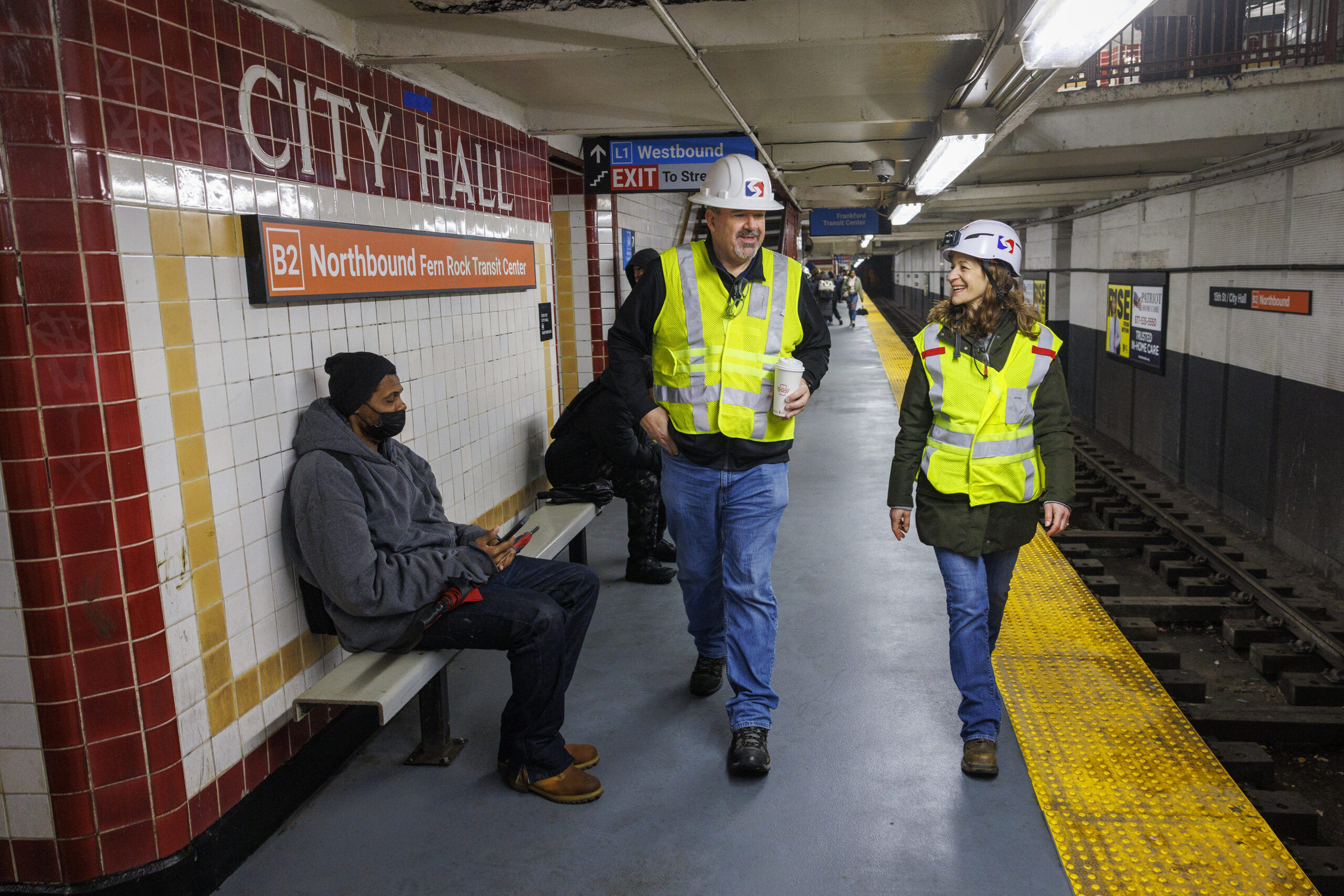
SEPTA General Manager Scott Sauer and Kate O’Connor, assistant general manager of engineer maintenance construction, make their way through City Hall Station in February.
Transit takeover
PennDot’s budget hearings are usually focused on the things the department has direct control over, i.e., Pennsylvania’s state-owned roads and bridges. On Monday, however, the hearing turned into a transit-bashing fest. Senate Republicans used the meeting to push their own plan to exhaust the state’s transportation reserves rather than adequately fund operations.
There’s just one big problem: The senators frequently did not know what they were talking about.
Republican State Sen. Tracy Pennycuick asked about the status of the King of Prussia rail project, which has been canceled for almost three years. Her fellow GOPState Sen. Jarrett Coleman asked if SEPTA considered raising fares, which climbed from $2 in November 2024 to $2.90 last year in September, a near 50% increase.
PennDot’s leaders could have done a stronger job defending themselves. In particular, their inability to produce a list of projects was mystifying. Many of the volunteer transit advocates I know could do so on the spot. It was clear to me that the most knowledgeable person in the room was Delaware County’s Democratic State Sen. Tim Kearney, himself a regular SEPTA rider. At one point, Harrisburg’s State Sen. Patty Kim, a Democrat, suggested that PennDot bring charts next time to help explain complicated financial maneuvers.
There’s a role Republicans in the General Assembly could play in ensuring SEPTA’s fiscal health, if they were willing to do their homework instead of grandstanding. While SEPTA is more efficient with its use of revenue than critics have claimed, there are still ways to save money and bring down the capital deficit. They are just politically difficult. It would be a lot easier for SEPTA’s board to tell the good people of Eddystone, Angora, or Eddington they are losing their low-ridership Regional Rail stops if they could add “because Harrisburg made us.”
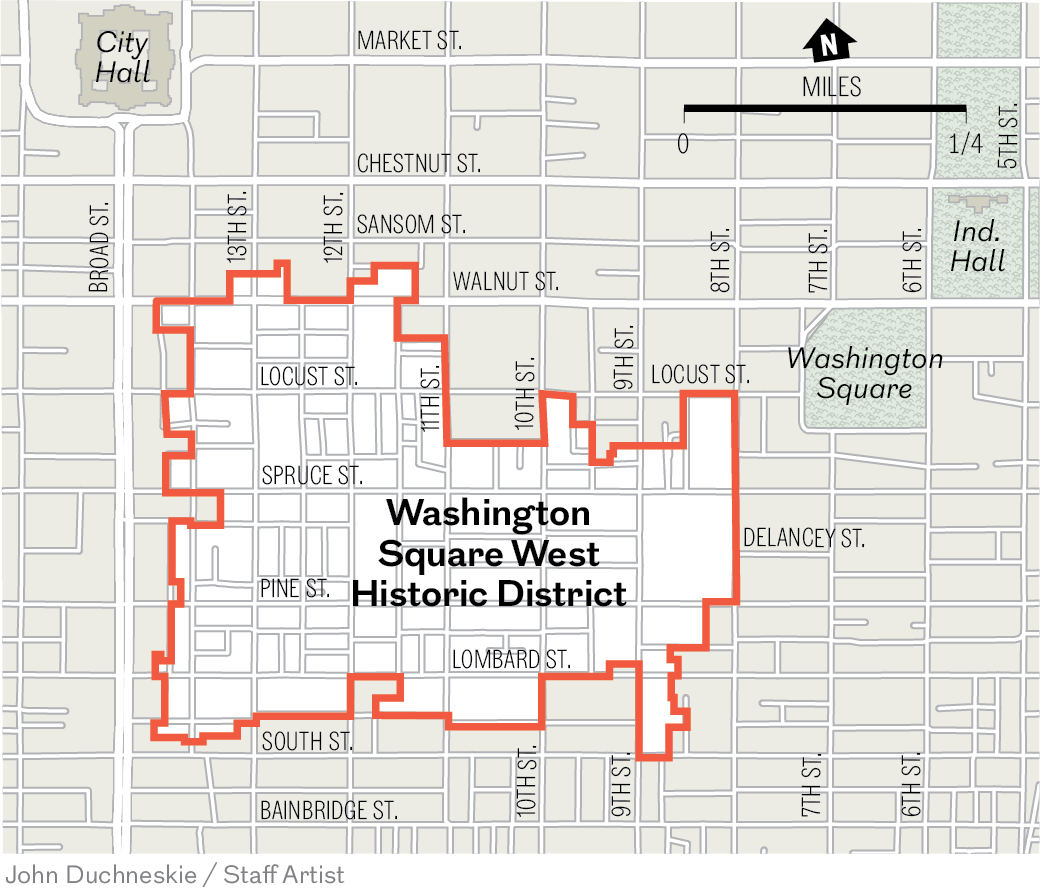
Map of the Washington Square West Historic District. After some neighbors sued, the district designation was recently revoked in court.
Historic revocation
Regular Shackamaxon readers know that while I love our city’s history, that doesn’t mean I expect everyone else to love it, too. After a coalition of neighbors challenged the Washington Square West Historic District, Common Pleas Court Judge Christopher Hallrevoked the district, granting a major victory to homeowners who resented their inclusion in the city’s largest and most nebulous historic zone.
Some residents objected to being part of the district because of the high costs usually associated with making the necessary modifications required to bring their properties in line with the city’s strict codes for historic properties.
Preservationists, to put it mildly, are miffed. They feel the ruling is deeply unfair and should be overturned.
Instead, they should treat this as a learning opportunity. The Washington Square West district really was a step too far. While historic districts typically focus on specific architectural styles and eras, this district covered more than a thousand buildings from before the Revolutionary War until after the Second World War. While advocates describe working with the historic commission as painless, everyday homeowners often disagree.
Additionally, covering the city in preservation districts will have an impact on overall housing supply and, as a result, costs. A recent analysis by CityLab shows how New York’s preservation rules have led to many smaller, more affordable apartment buildings being converted into urban mansions. This means exchanging multiple working- or middle-class residents for one extraordinarily wealthy household.
While local preservationists commissioned a study they claim debunks this concern, the document’s results fall into the category of correlation, rather than causation. If density and population are growing in historic districts, it is probably because people tend to put historic districts where development is most lucrative. If people truly believed that designation brought only benefits with no drawbacks, we may as well designate the entire city.
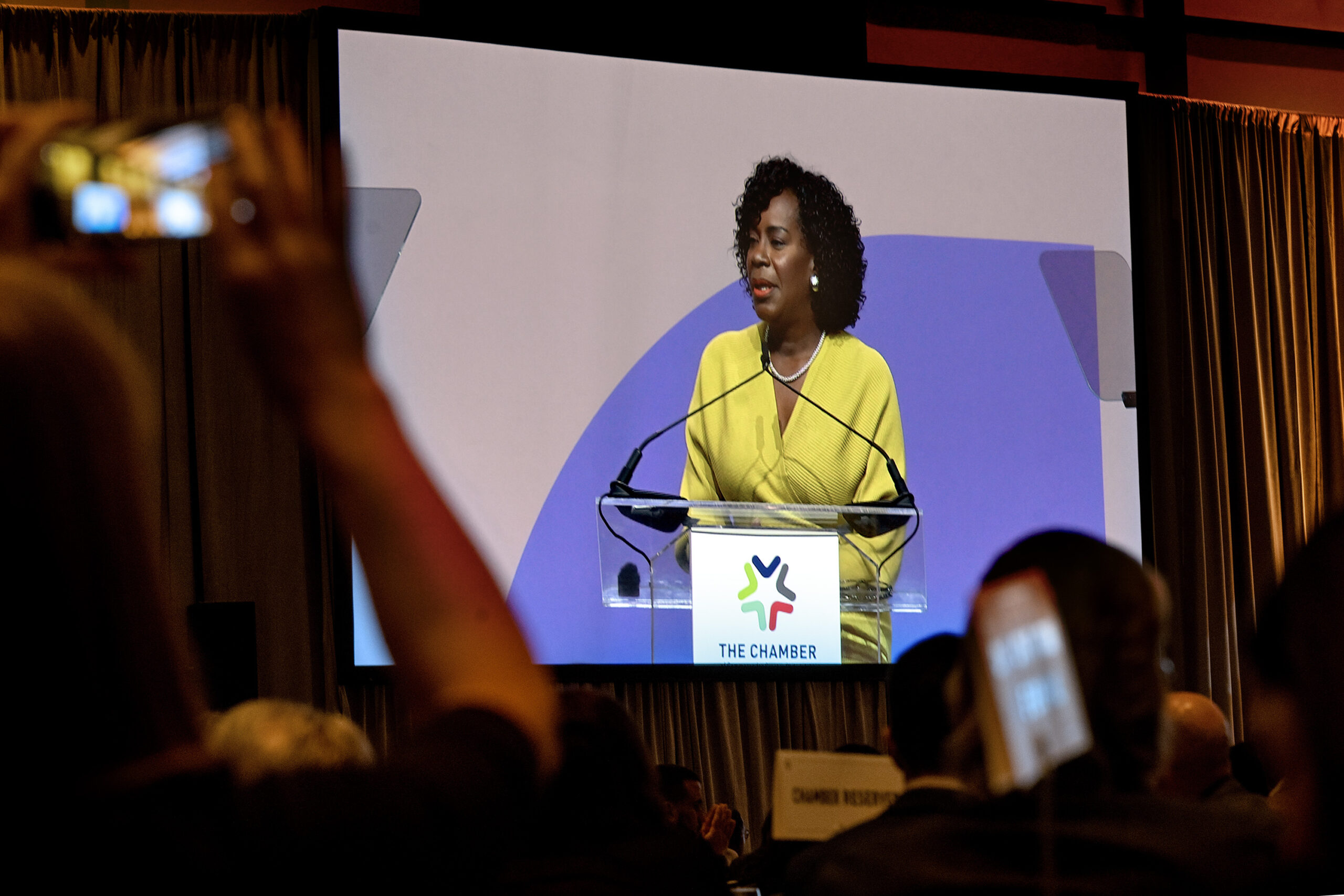
Attendees record Mayor Cherelle L. Parker as she delivers her keynote address at the Chamber of Commerce for Greater Philadelphia’s Annual Mayoral Luncheon in February.
Future flush
According to reporting by my Inquirer colleague Sean Collins Walsh, Philadelphians may soon experience a new reality in civic finance: extra cash.
For decades, City Hall struggled to pay the bills, as pension costs and low wages sapped the public purse. Now, the city is looking at the prospect of having a budget surplus of $400 million and a fully funded pension system by 2032.
It is important we begin the discussion now on what to do with that money.
There is no shortage of need in this city. The school district, affordable housing, SEPTA, parks and recreation, the libraries, and the city’s workforce all have strong arguments to make when it comes to which agencies should receive that money. The boldest course of action, however, might be to set the city on a new economic course entirely by reforming our local tax code.
Despite Philadelphia’s high tax rates, the city generates relatively little income. Boston spends just over $7,000 per resident, New York City spends over $13,000, and even Baltimore spends over $8,000. Philadelphia spends just $4,250. This gap can’t be fixed by raising our taxes even higher. It requires growing our economy.
Alongside tax reform — which should attract new businesses — the city should eliminate the restrictive zoning overlays that add significant costs for entrepreneurs in Philadelphia.
If the City of Brotherly Love could generate as much tax revenue per resident as Charm City or the Hub, City Hall would have more than $12 billion to spend each year. That’s enough money to make a major difference.
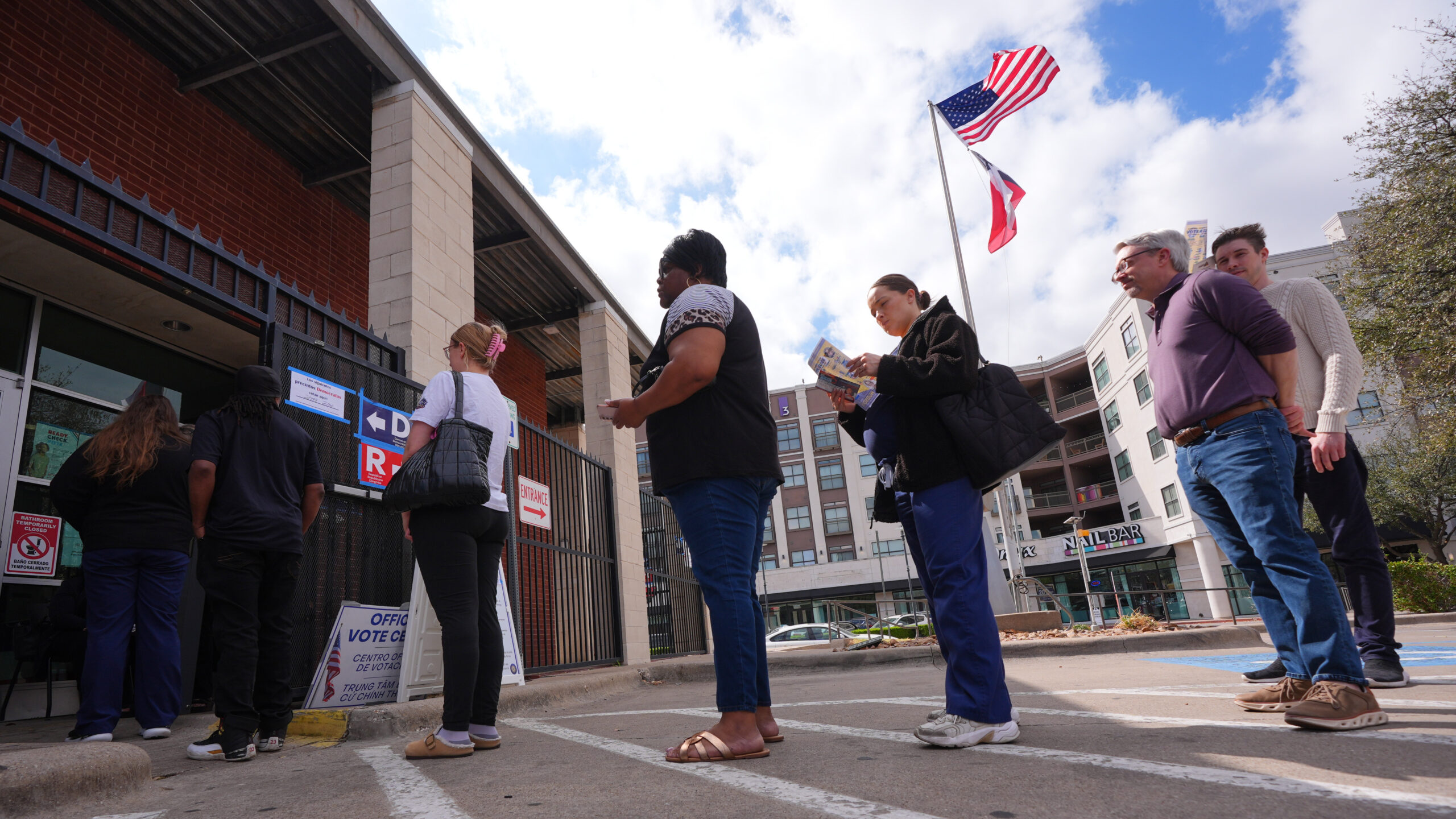
A man named Juston Marine had arguably the toughest job in America on Tuesday: “election navigator” in Dallas County, Texas, where a confusing, Republican-engineered change in voting rules for 2026 left many voters dazed, confused, and miles from the place where they were supposed to be casting ballots.
“There are a lot of infuriated voters,” Marine told a reporter for the Votebeat website as he struggled to do his job outside the Anita Martinez Recreation Center in West Dallas, where he encountered voters as they arrived at the large polling center. It seems this election worker heard a lot of words that aren’t found in the Bible, as he told every second or third voter that they were supposed to be somewhere else.
“I walked up here because I want to vote so, so bad,” Veronica Anderson told a reporter after traveling two and a half miles on foot to Dallas’ Martin Luther King Jr. Community Center, only to be told she could only cast a ballot at some other location she’d never heard of. She added that the rejection felt like “your self-esteem and everything is torn down.”
That level of despair is exactly what Donald Trump’s Republican Party is going for, as America this week kicked off an eight-month mad dash to a November midterm election that will be pivotal for the nation’s barely breathing democracy.
We’ll never know exactly how many intended votes weren’t cast on Tuesday at the site named for the civil rights legend credited for the 1965 Voting Rights Act, or other Dallas County polling places where scores of voters — primarily Democrats — were turned away from highly competitive primaries for a U.S. Senate seat and other key races.
Switch from vote-anywhere model to precinct-voting causes utterly predictable confusion in today's Texas primary.
And the poor Dallas County election workers have to deal with it.
It may have looked like chaos, but in many ways it all went down according to a Republican plan that will likely inspire further scheming from Trump and his MAGA minions as the general election draws closer.
With polls showing that an election held today — with the two-term president’s unpopularity at an all-time low — would result in a Democratic takeover of the U.S. House and possibly the Senate, perhaps in a landslide, Team Trump has spent months looking for any and every way to put its finger on the scale of democracy.
No one, other than some online Chicken Littles, believes Trump would go full banana republic and send in troops to cancel the 2026 midterms. But his attempted coup on Jan. 6, 2021, aiming to undo his 2020 loss, is an indication of how far this autocrat will go to retain power.
The Trump-led Republican scheme to make the 2026 elections less free and less fair started with a push for red states to do extreme gerrymandering, ripping up the maps drawn after the 2020 Census to make new districts crafted to maximize GOP power. (Texas was Ground Zero for this effort — more on this later.)
As the calendar flips toward the midterms and Republican popularity wanes, the push is likely to get more extreme. A legislative push for the so-called SAVE America Act, which would make voting harder with harsh ID requirements, has stalled, so Trump is now weighing an executive order to get the same results — which would surely trigger a legal fight — and possibly try to curb mail-in ballots, as well.
What just happened in Texas’ second-most populous county proved a case study in today’s brand of Republican voter suppression, so let’s unpack it.
Like much of what happens in a political party that still clings to the Big Lie of nonexistent voter fraud in that 2020 election that Trump lost, the problems in Dallas County all began with a conspiracy theory.
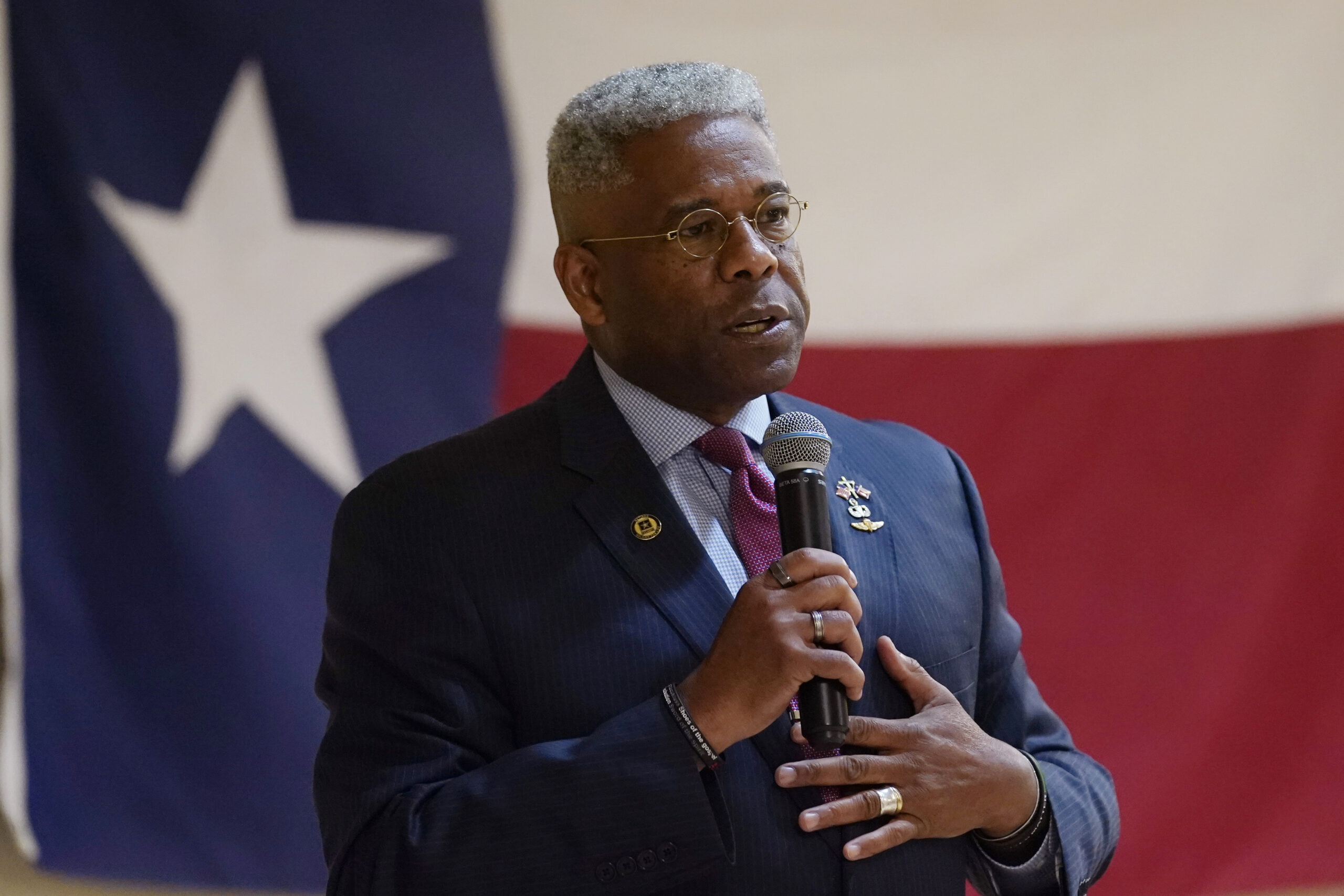
In this September 2021 file photo, Texas gubernatorial hopeful Allen West speaks at the Cameron County Conservatives anniversary celebration in Harlingen, Texas.
The county GOP leader in Dallas is a well-known conspiracy theorist, Allen West, an ex-congressman from Florida who moved to Texas and, for a time, ran the state Republican Party, where he adopted a slogan and a style from QAnon and seemed to favor secession, among other extreme views.
In 2024, West became chair of the Dallas County GOP and made election and voting machine conspiracy theories his prime focus, in a state where parties have a lot of say over how primaries are conducted.
What the local GOP pushed was for the county to count all of its paper ballots by hand — a laborious process that would also require abandoning the large countywide voting centers and a return to smaller neighborhood precincts. Ultimately, the ballot-counting idea proved not practical, but the switch back to local precinct voting stuck and was in effect Tuesday for both parties — even as Democrats struggled to inform their voters. (A similar change occurred in smaller Williamson County.)
Election experts note that the GOP generally opposes large centers where anyone in a jurisdiction can vote — much as it opposes early voting, mail-in ballots, or anything else that makes voting easier instead of harder, in an increasingly fragile democracy.
Voter suppression that unravels the gains from the 1965 Voting Rights Act — weakened and perhaps about to be gutted further by a right-wing U.S. Supreme Court — has been a Republican strategy for decades, but the Dallas debacle was a new low.
“The confusion is the point,” a Democratic Texas state lawmaker, Ana-María Rodríguez Ramos, posted on social media, noting further, “This is the GOP voter suppression that Dems must come together to overcome in November.”
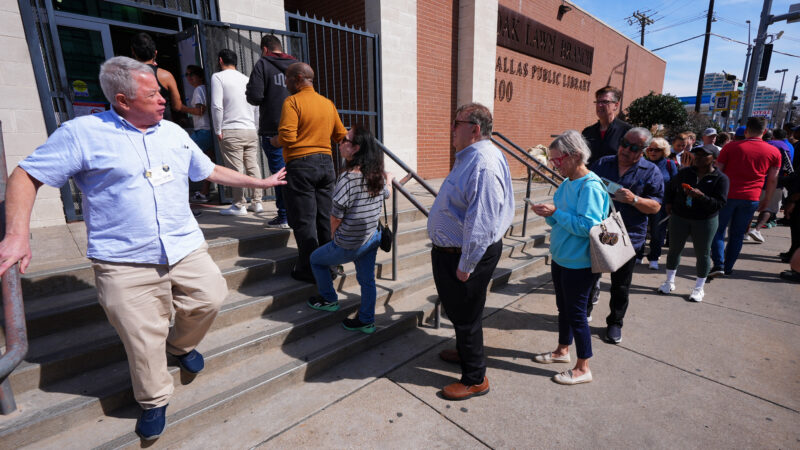
Primary voters line up to cast ballots at a voting center in Dallas on Tuesday, March 3.
Ramos also noted one other wrinkle that happened Tuesday. Democrats and fair-voting advocates in both Dallas and Williamson Counties went to court during the day, seeking an emergency order to extend voting hours. That push initially succeeded, and in Dallas County, a judge ordered the polls open for two additional hours.
But Texas’ right-wing extremist Attorney General Ken Paxton — also a leading candidate in Tuesday’s GOP Senate primary — appealed the ruling and got the state’s conservative Supreme Court to rule in his favor. Votes that were cast after the original 7 p.m. closing time were segregated and may or may not ultimately be counted.
Not surprisingly, West actually bragged about what looked to many folks like a voting fiasco, blaming the Democrats for not being informed about the confusing rules change. “It’s apparent that Democrats struggled with grasping basic civics and their usual attempt at lawfare backfired,” the GOP leader said in a statement.
It’s clear that what we saw in Dallas — balloting drenched in conspiracy theories from start to finish, new rules with the sole purpose of making it harder to vote, and an increasingly conservative judiciary making the final call — was clearly a test case for the national election in November.
It’s not hard to imagine a scenario in which Republicans will manufacture conspiratorial doubt about some of the ballots cast in the fall — as just happened with those post-7 p.m. votes in Dallas — as a pretext for some grander and potentially cataclysmic effort to nullify Democratic victories in Congress.
But Texas also provided a window into how this MAGA scheme might not work.
Remember that extreme gerrymander the Lone Star State enacted last year, which aimed to create five additional Republican seats in Congress? Much of the plan aimed to capitalize on a dramatic shift toward the GOP among Texas’ large Latino population during Trump’s last two runs in 2020 and 2024.
But polls and now early voting have shown the Hispanic vote swinging back toward Democrats since Trump returned to office, thanks to the sluggish economy and the brutal manner of his immigration raids. On Tuesday, Democratic turnout in Texas soared to levels not seen since the high-profile 2008 battle between Barack Obama and Hillary Clinton, in what was a very good year for their party. Voter suppression can be swamped by voter enthusiasm.
But it shouldn’t have to be that way. The right to vote is the fundamental building block of the American Experiment in democracy, and folks shouldn’t have to walk clear across town or stay up all night to exercise it. Dallas was a warning shot for every citizen: Do not let this nightmare go national in November.
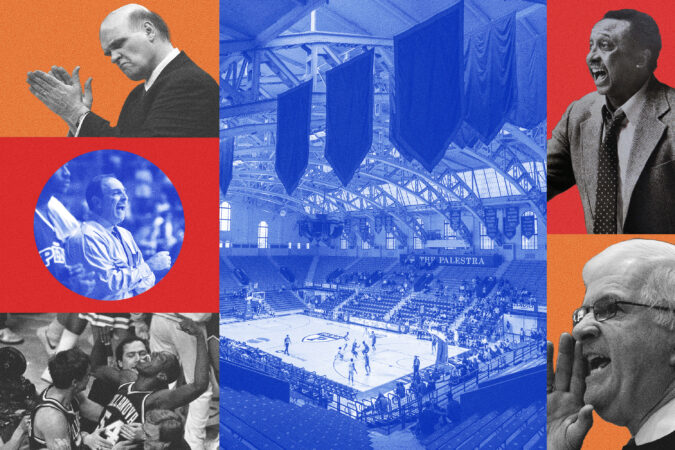
One afternoon in early December, Bill Raftery and Tim Legler, both La Salle alumni, returned to campus for an hourlong panel discussion about their careers in sports media, only to have the conversation shift to a topic with broader implications.
It was a point of pride for the university to welcome back Raftery, who has been college basketball’s preeminent analyst for more than a quarter-century, and Legler, who has reached a comparable status at ESPN with his insights into the NBA. But 33 minutes into the event, the first question from an audience member wasn’t about the origins of Raftery’s trademark catchphrases (The kiss! … Onions! … Laundry on the deck!) or Legler’s game-film breakdowns.
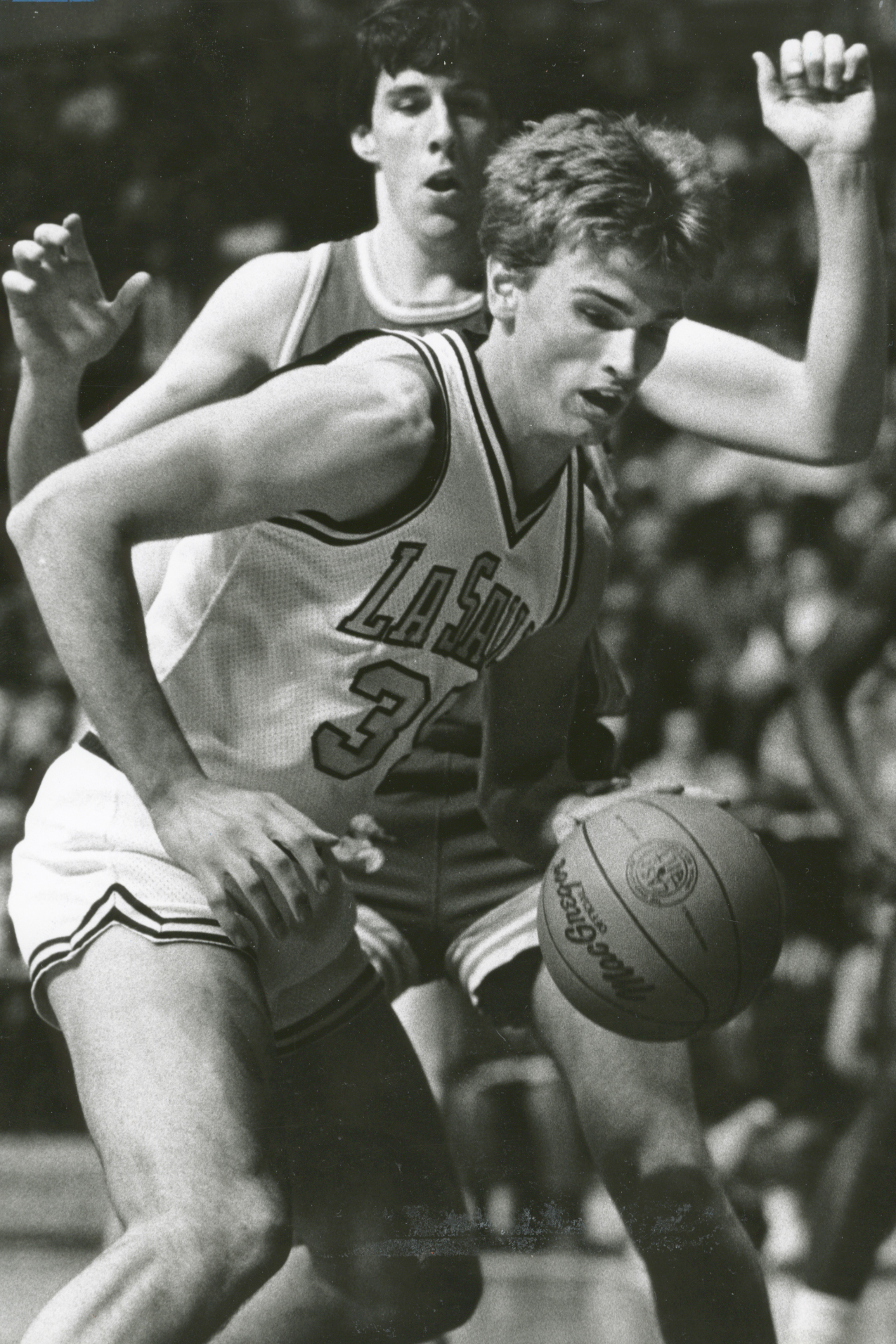
Bill Raftery, now broadcaster, graduated from La Salle and was inducted into the Big 5 Hall of Fame.
“Can we bring the Big 5 back to its glory?” a man in the auditorium asked. “Because it was a national thing, right? It wasn’t just a Philly thing.”
These days, most people who follow college basketball, if they’re being honest, have to acknowledge that the Big 5 isn’t much of anything anymore. The round-robin rivalries among La Salle, Penn, St. Joe’s, Temple, Villanova, and more recently Drexel have lost most of their juice.
That white-hot competition, fueled by the benign hatred that only proximity and familiarity can ignite, used to define Philadelphia hoops. It has cooled. Now, just one school, Villanova, enters each season with the baseline expectation that it will qualify for the NCAA Tournament, and the pipeline of local recruits that once sustained these programs has all but dried up.
window.addEventListener(“message”,function(a){if(void 0!==a.data[“datawrapper-height”]){var e=document.querySelectorAll(“iframe”);for(var t in a.data[“datawrapper-height”])for(var r,i=0;r=e[i];i++)if(r.contentWindow===a.source){var d=a.data[“datawrapper-height”][t]+”px”;r.style.height=d}}});
Three of the six schools — Drexel, La Salle, and Penn — don’t have a Philadelphia native on their rosters. Interest in the city series has plummeted. A 2022 doubleheader at the Palestra drew an official attendance of just 3,300 people. And the Big 5 Classic, conjured in the aftermath of that alarming display of indifference, hasn’t revitalized the rivalries or restored any prestige to them.
While this season has seen an uptick in the programs’ quality of play — Villanova is virtually assured of an at-large bid, and Penn, St. Joe’s, and perhaps Drexel could be strong enough to win their conference tournaments — that improvement hasn’t been enough to stem the dismal tide.
Tim Legler, who led La Salle to the 1988 NCAA Tournament, said the Big 5 was once a “transformative” environment to play in.
For their part, the panelists at La Salle mustered some nostalgia but weren’t optimistic. Legler, who grew up in Richmond, Va., remembered attending a Palestra doubleheader on a recruiting trip and marveling at the atmosphere: the streamers, the cheering, the chanting.
“I turned to my parents and said, ‘This is the environment I want to play college basketball in,’” he said. “It was literally that transformative.”
Still, he had no solution for salvaging the Big 5, and neither did Raftery, who suggested that smaller programs throughout the NCAA would soon be casualties of this new era of college basketball.
“They’re trying to freeze [out] a lot of programs and leagues,” he said, “and I can envision maybe two or three conferences. They’ll run the whole thing, and the networks will pay for it. That’s the way it is.”
It’s convenient to point to the sport’s lurch into modernity — into the era of Name, Image, and Likeness; of pay-for-play; of the permeable membrane of the transfer portal — as the cause of the decline. And it’s true: With the exception of Villanova, which is ensconced in the Big East and supported by engaged donors with deep pockets, college hoops’ evolution has made everything more difficult for the other, more vulnerable programs in the city. But this train has been rumbling down the tracks for a while, and its arrival should compel a reevaluation of the Big 5’s history, of the decisions and unstoppable forces that led it here, to the brink.
To those Baby Boomers and GenXers weaned on the Big 5’s traditions, it’s surely incomprehensible and saddening to hear Raftery contemplate a world without it. But if the institution as Philadelphia knew it is fading away — and it appears to be, if it hasn’t already — the proper question isn’t Can it be saved? That one has been asked and is on its way to being answered.
No, the better questions to chew on are these: How did the Big 5 survive, and at times thrive, as long as it did? And did any of the attempts over the years to preserve it and its identity actually contribute to its downfall?
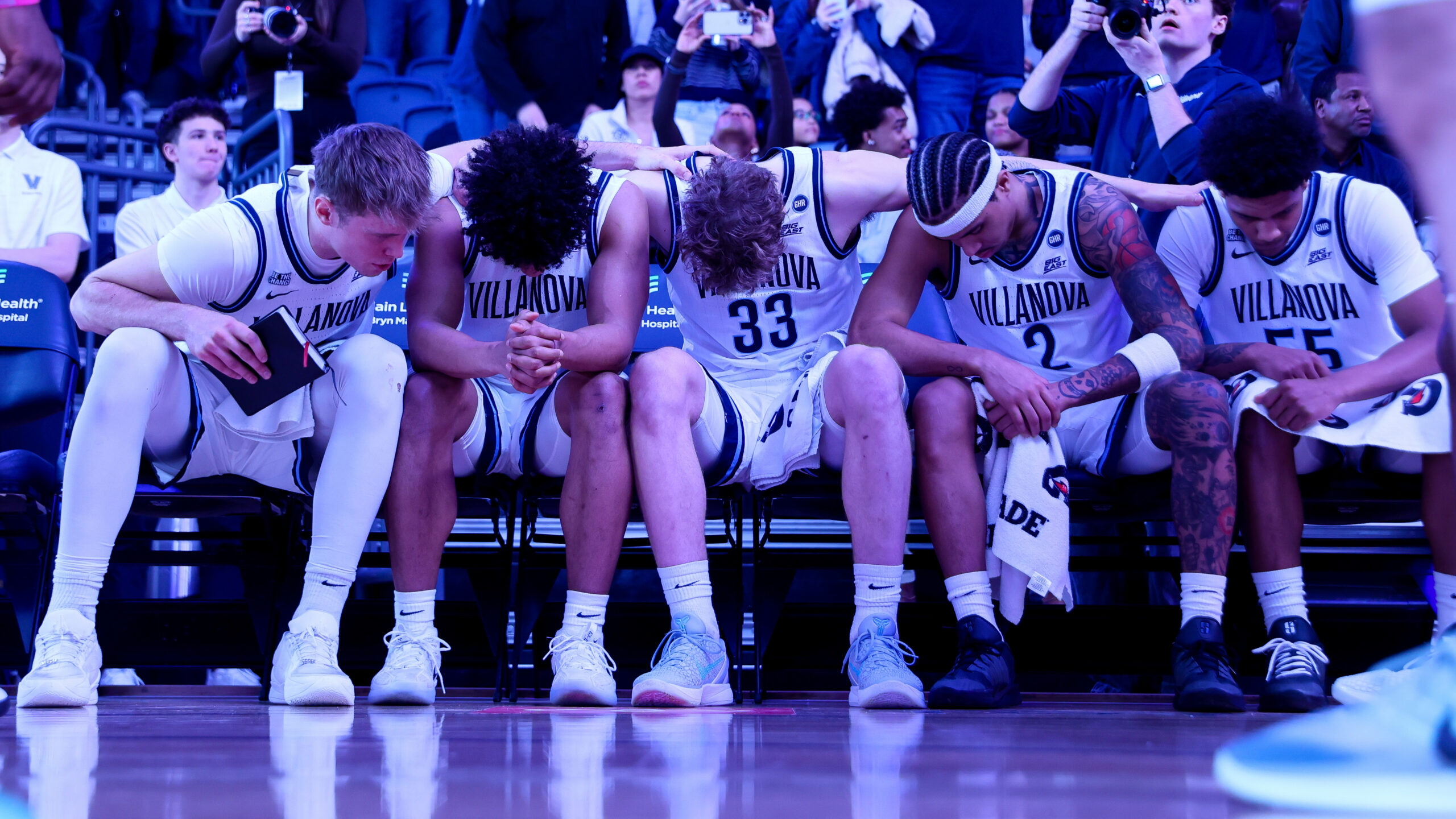
Villanova has become the only school in the Big 5 that enters each season with the baseline expectation that it will qualify for the NCAA Tournament.
The seeds of rebirth and decline
It’s tempting to picture the Big 5’s history as an unbroken string of unforgettable nights at the Palestra, great teams playing great games inside a gym packed to its uppermost corners with 9,000 people, give or take a few rascals who managed to sneak in for free. There were hundreds of such nights, to be sure. But it’s striking to put that past into a wider context and see how much certain changes and trends fostered and then jeopardized everything that made the Big 5 wonderful and unique.
Those fond memories often gloss over a relatively fallow period for the Big 5 during the 1970s. Villanova had three consecutive losing seasons from 1972 to 1975. Temple went 16-37 over the ’74-75 and ’75-76 seasons and qualified for the NCAA Tournament once in an 11-year span from 1972 to 1983. St. Joe’s went 8-17 in ’74-75, the first of six straight seasons in which the Hawks missed the NCAAs. Penn was the exception, and La Salle held its own, but a Daily News back-page photo captured the overall listlessness perfectly: Harry “Yo-Yo” Shiffern, the lovable vagrant who was the city series’ unofficial mascot, fast asleep during a Palestra doubleheader.
The Big 5 was in a collective funk, and it took a few pivotal developments to snap it back to prominence and position it to flourish further.
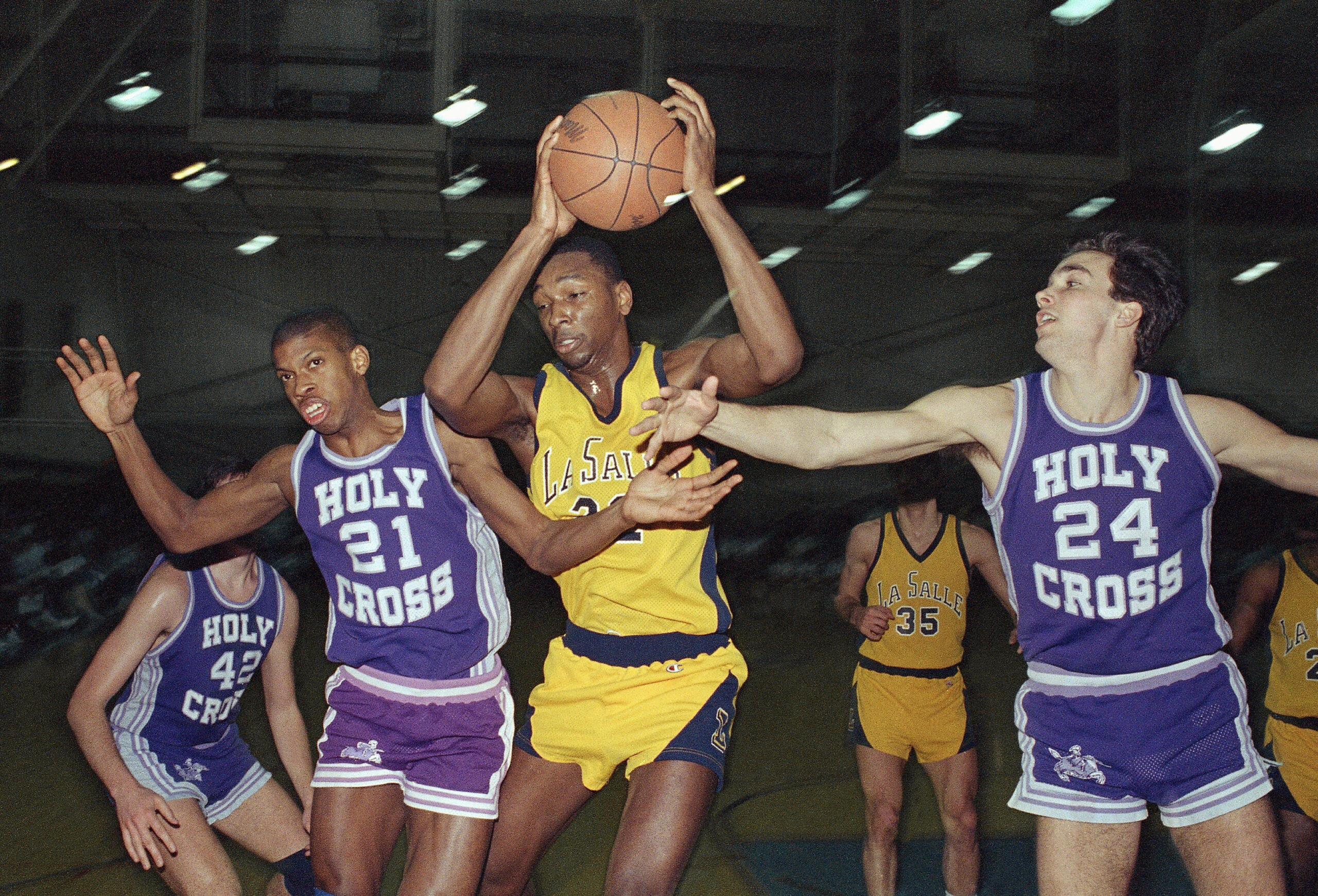
Lionel Simmons (center) is the Big 5’s all-time leading scorer and fifth in NCAA history with 3,217 career points.
College basketball’s landscape was flatter then. The NCAA Tournament went to 32 participants in 1975 and to 40 in 1979, and many of the qualifying programs were mid-majors. During the ’70s, each of these teams reached the Final Four: Jacksonville, St. Bonaventure, New Mexico State, Western Kentucky, Marquette, UNC Charlotte — and, in ’79, Penn. The Quakers upset North Carolina, Syracuse, and St. John’s before Magic Johnson and Michigan State pulverized them in the national semis. But their run was the most improbable of the decade, and their timing was impeccable.
The following season, after a star turn at the Pan-American Games in Puerto Rico, La Salle’s Michael Brooks was named the Kodak National Player of the Year. As terrific as Brooks’ senior campaign was — he averaged more than 24 points and 11 rebounds, scoring 51 points in a triple-overtime loss at BYU — his candidacy for the honor was buoyed by Indiana’s Bob Knight, who had coached him at the Pan-Am Games and touted him to reporters.
“If I were allowed to start my own team tomorrow,” Knight said in January 1980, “the first person I would pick would be Michael Brooks.”
Such praise from the best, the most famous, and the most temperamental coach in the country carried weight, and Knight’s words elevated the reputations of both Brooks and Philadelphia basketball. That ascendance continued in March 1981, when St. Joe’s, under Jim Lynam, won the East Coast Conference tournament, knocked off top-ranked DePaul in the second round of the NCAAs, and advanced to the regional final before losing to the eventual national champs: Knight, Isiah Thomas, and the Hoosiers.
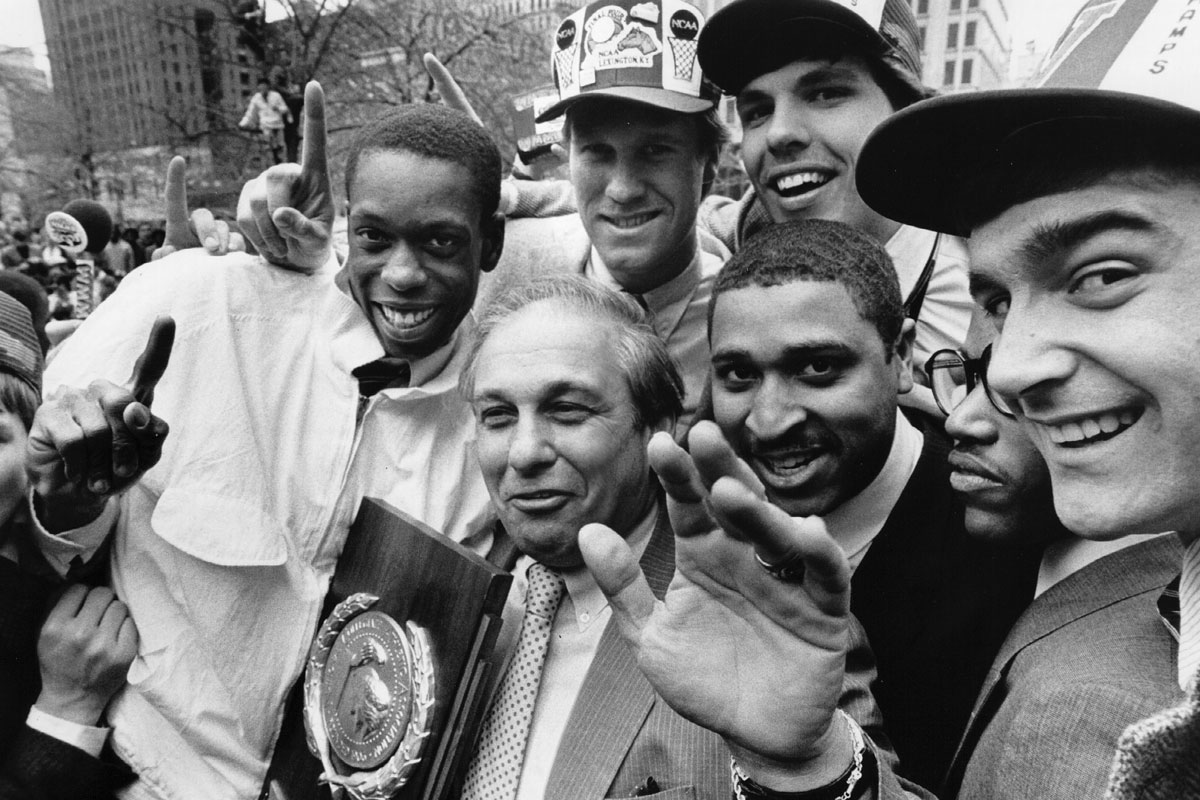
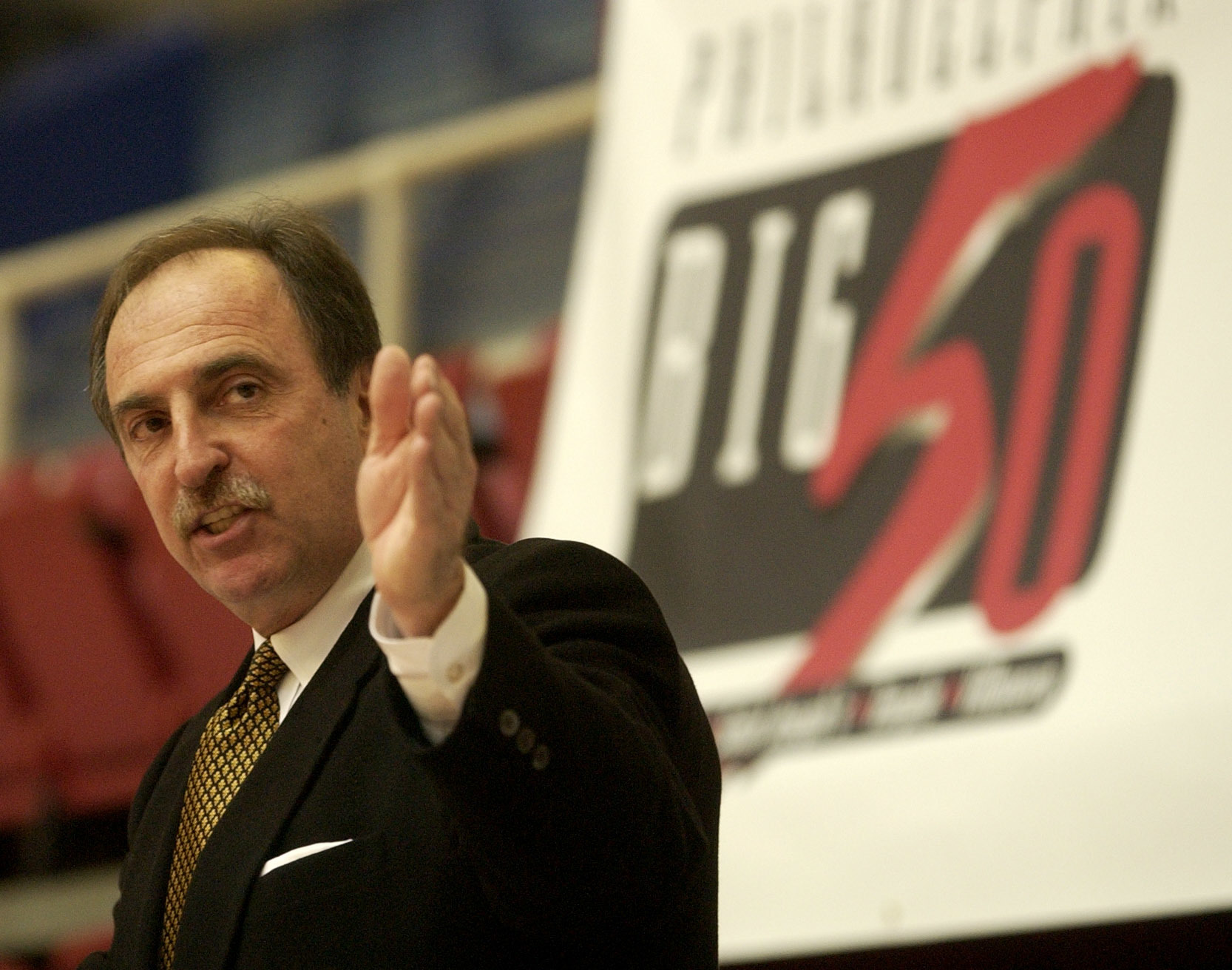
Fran Dunphy coached more than 1,000 games as a Division I head coach.Villanova coach Rollie Massimino gathers in Center City with players Ed Pinckney, Wyatt Maker, Chuck Everson, Dwight Wilbur, Veltra Dawson, and Brian Harrington in 1985 after winning the national title.
So the Big 5 was on its way back, regaining relevance among casual college hoops fans and among the sport’s cognoscenti. The two most significant factors in its renaissance, though, happened off the court. In March 1980, Villanova left the Eastern Eight and jumped to the Big East. And in August 1982, Temple hired John Chaney as its head coach.
Those moves and the rewards they wrought thrust those two programs, and in turn the entire Big 5, into a higher realm. Villanova won the national championship in 1985 — an underdog triumphant, a marvelous story enhanced by the Wildcats’ status as a program in a major conference in a sport whose vast national reach was still expanding: Magic vs. Larry Bird in ’79, North Carolina State surviving and advancing in ’83, Dick Vitale, CBS, ESPN, Big Monday, Selection Sunday, March Madness consuming a month’s worth of America’s attention.
Chaney was this wild-eyed, lesson-teaching, justice-preaching wizard, confounding opponents with his matchup-zone defense, crafting the hardest schedule in the nation every year to battle-test his teams, leading the Owls to a No. 1 ranking in 1988 and three Elite Eight appearances in a six-year span.
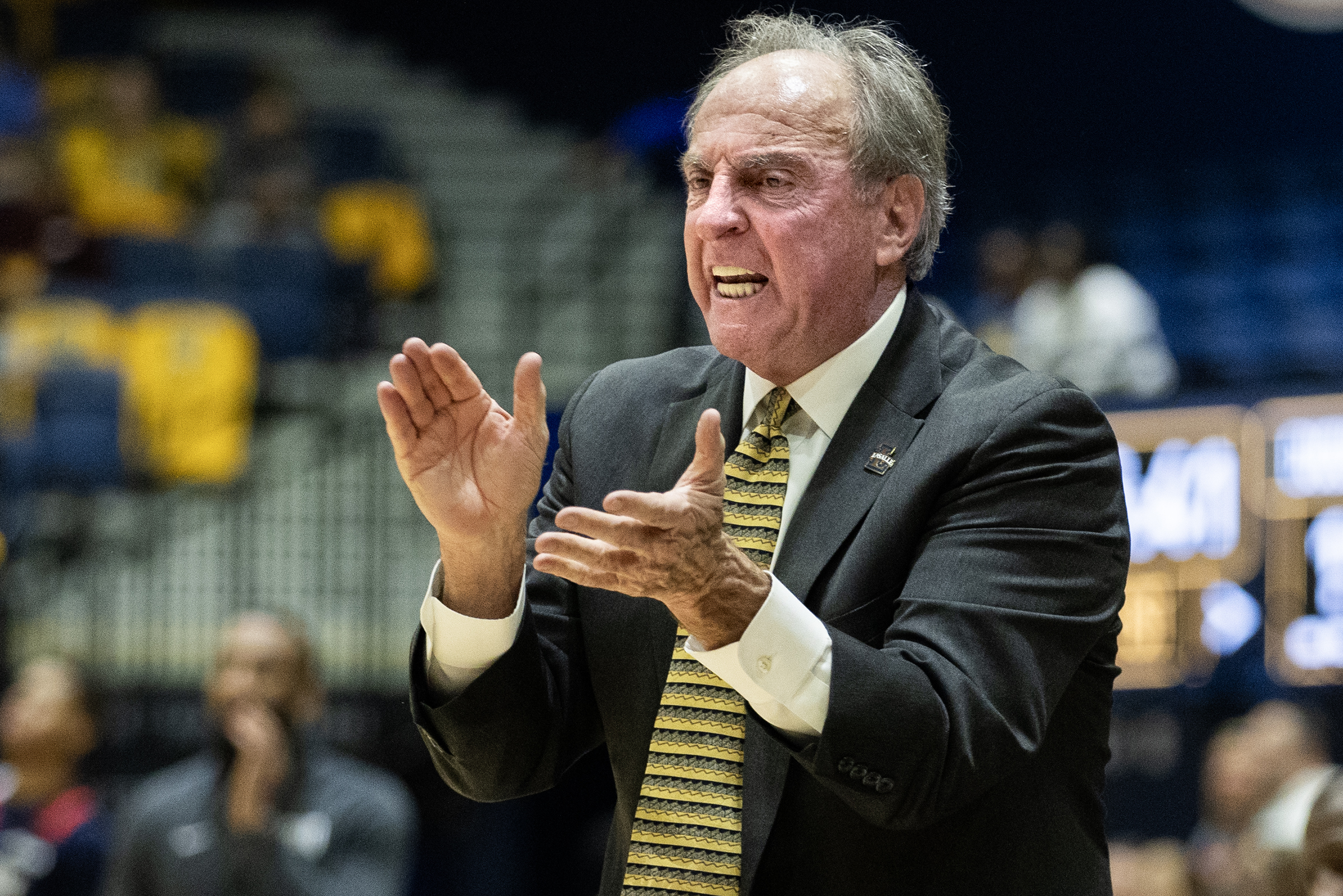
Fran Dunphy led Penn to a 69-14 record and three NCAA Tournament appearances from 1992 to 1995.
Nestled in the Metro Atlantic Athletic Conference (MAAC) with schools of similar profiles, La Salle went to the NCAA Tournament four times and the NIT twice in Speedy Morris’s first six years as head coach and had another national player of the year: Lionel Simmons. From 1992 to 1995, Penn dominated the Ivy League under Fran Dunphy: a 69-14 record, three NCAA Tournament appearances and a first-round victory over Nebraska, Jerome Allen and Matt Maloney forming one of the best backcourts in the country. St. Joe’s went 26-7 and advanced to the Sweet 16 in 1996-97, the season that introduced that notorious wallflower Phil Martelli to the rest of the country.
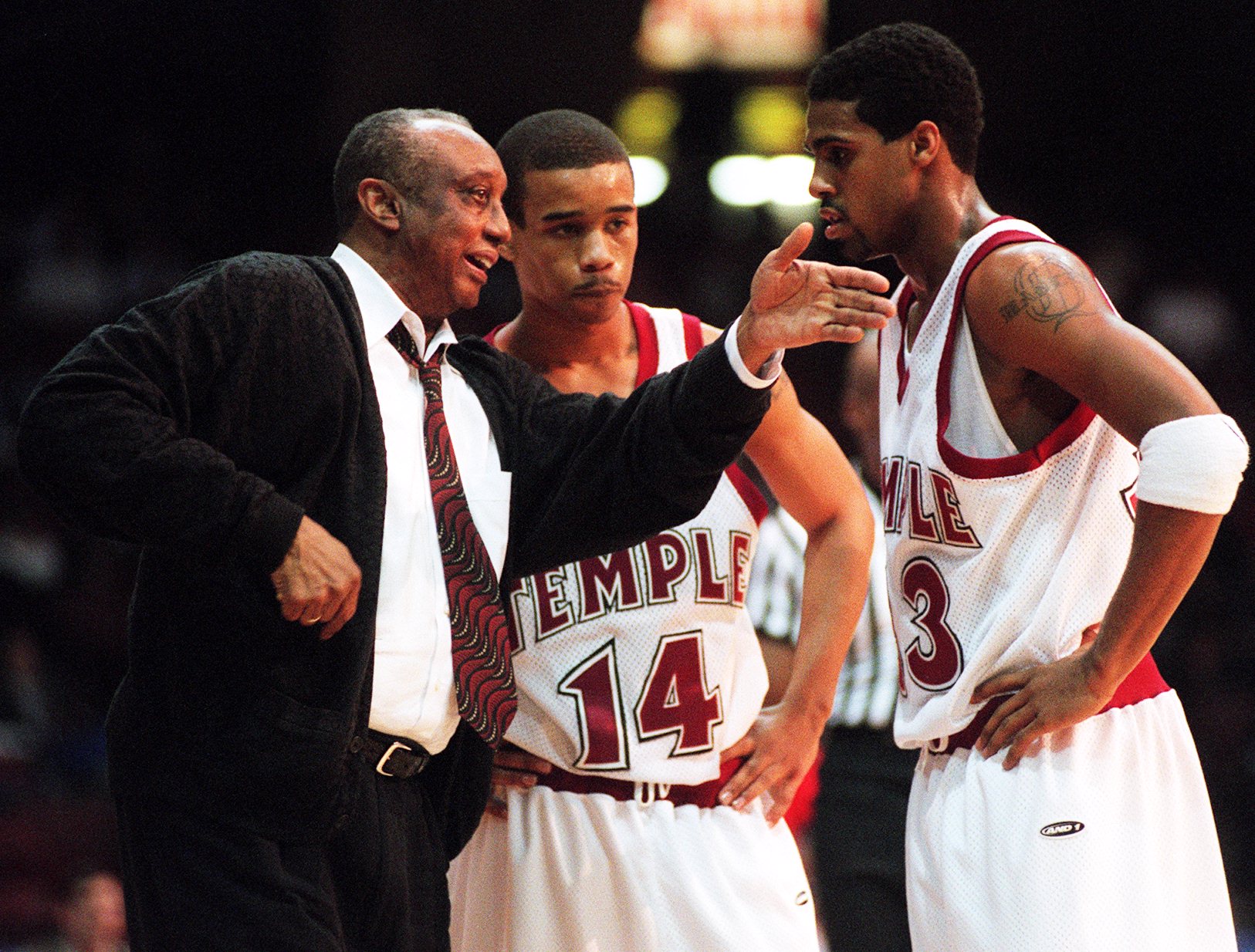
Former Temple coach John Chaney with players Lynn Greer and Quincy Wadley.
Hard circumstances and poor decisions
The factors that damaged the Big 5 were legion. Some applied to just one or two programs. Some applied to all of them. Some were mistakes, bad choices. Some were unavoidable and beyond the programs’ control.
Start with La Salle. Given an opportunity in 1990 to build an 8,000-seat on-campus basketball arena — Tom Gola offered to raise the funding for it — the university said no. Then its leadership made what is commonly considered the disastrous decision to relocate from the MAAC to the Midwestern Collegiate Conference. The program has never recovered.
Look at Temple. Chaney, a singular presence and attraction, retired in 2006. Though Dunphy, his successor, guided the Owls to six consecutive NCAA Tournament appearances, the university’s quest for football dollars led it to leave the Atlantic 10 for the American Athletic Conference — and abandon its basketball-first identity.
Again: individual schools, individual issues. But those problems were byproducts of college basketball’s overall reshaping during the 1980s and ’90s. In retrospect, the most infamous moment in Big 5 history — the dissolution of the round-robin, at the insistence of Villanova and coach Rollie Massimino, after the 1990-91 season — was an acknowledgment of those changes, and the attempts to preserve the Big 5 as it had always been would inevitably fail.
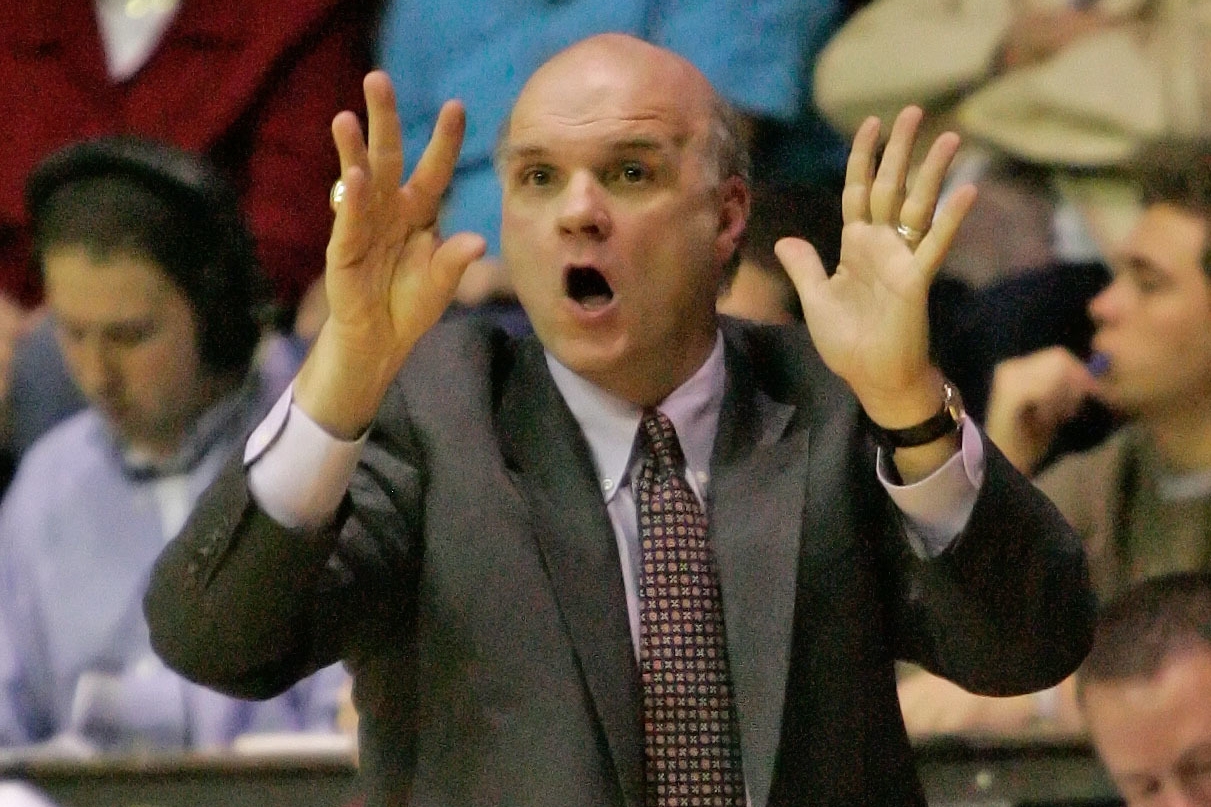
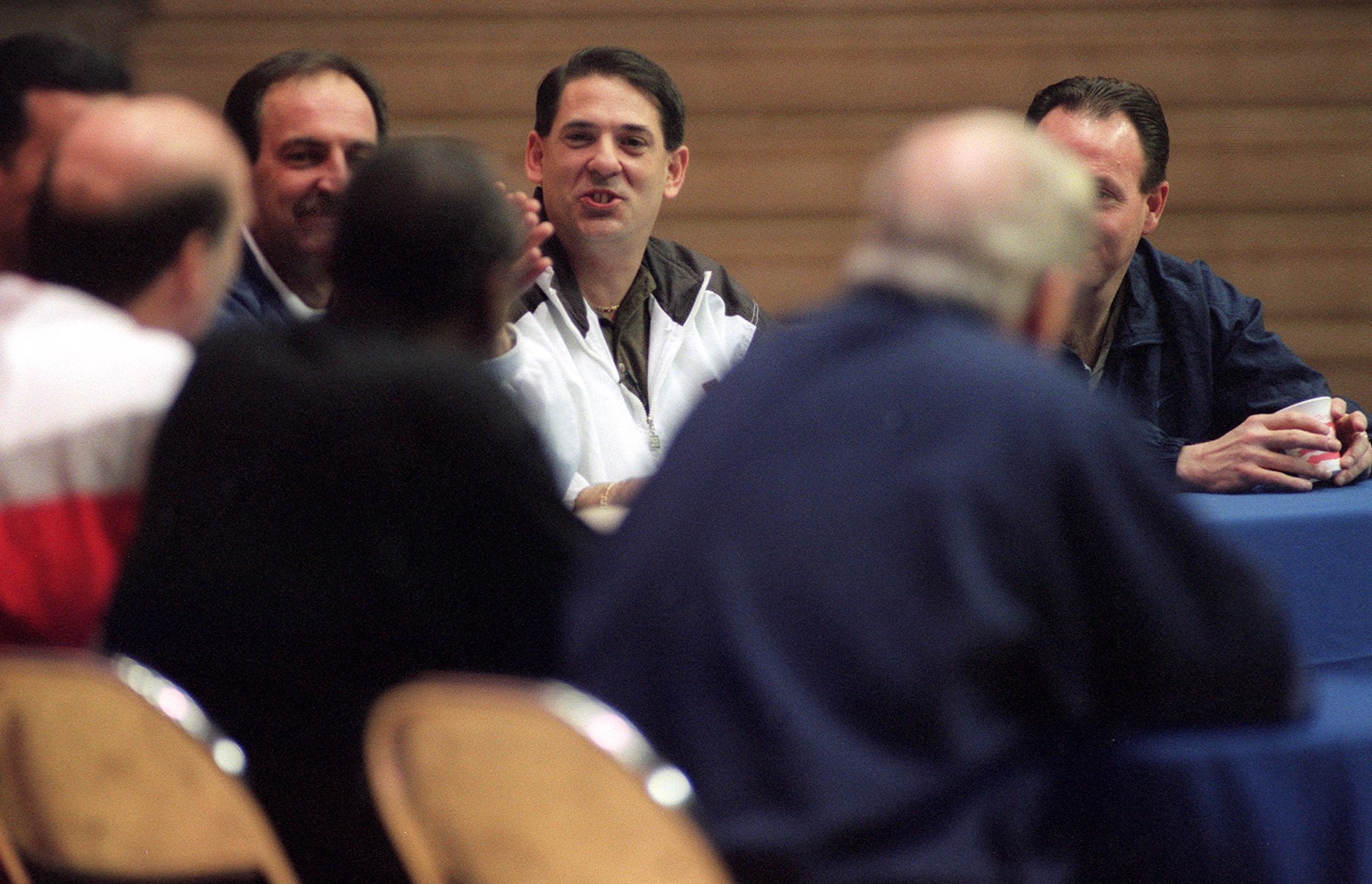
Phil Martelli led St. Joe’s to go 26-7 and advanced to the Sweet 16 in 1996-97.Former Villanova coach Steve Lappas jokes with the other Big 5 coaches during a taping of the Comcast basketball show in 1997.
When Villanova pushed to cut back on city series games and Temple pushed for more of those matchups to be played at campus sites other than the Palestra, they weren’t merely trying to make things easier for themselves. They were responding and reacting to college basketball’s new conditions for success.
Sneaker companies had begun financing all-star camps, AAU programs, and college programs. Now coaches didn’t have to rely on local high school teams to find players, and great Philly players were no longer making their names solely in the Public League, the Philadelphia Catholic League, or the Sonny Hill League. They were traveling to play AAU. They were seeing other cities, meeting other coaches. They weren’t as likely to stay home to play college ball.
“The most important recruiting device is recognition,” Chaney told author Bob Lyons in Palestra Pandemonium: A History of the Big Five, “and recognition comes from national TV. … They don’t know what the Big 5 is outside of this area. They knew who Villanova was when they won the national championship, so you could always attach yourself to them. But it wasn’t going to get you very far because no one knew the history and tradition of the Big 5.”
In that way and others, the inherent parochialism of the Big 5 worked against it. For instance, Dave Gavitt, the founding commissioner of the Big East, struck a deal in 1980 with ESPN, then a fledgling sports network hungry for programming, for the exclusive rights to televise the conference’s games. That arrangement made it difficult, if not impossible, for Villanova and any other Big East school to be involved in a 7 p.m./9 p.m. Palestra doubleheader and for a national television audience to watch that doubleheader.
“We needed the game between Villanova and Georgetown at 8 p.m. to go on our network,” Gavitt told Lyons. “We couldn’t clear games at 7 p.m. because of the game shows that all the local stations carried.”
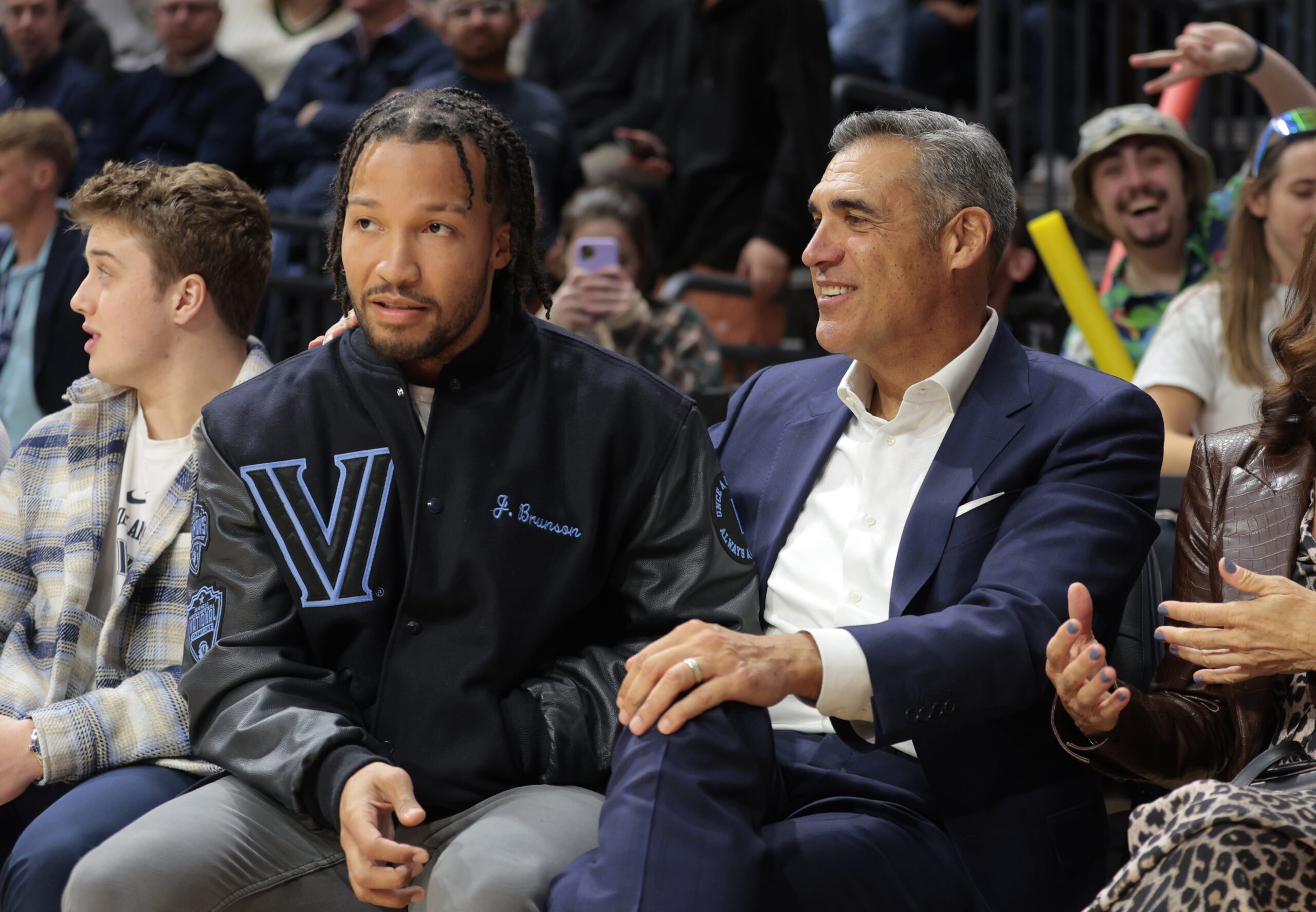
Jalen Brunson and former Villanova coach Jay Wright at the Finneran Pavilion on Feb. 8, 2023.
As it was, the Big 5 had a TV deal of its own, with the Philly-based premium cable channel PRISM, starting in 1978. Yet the PRISM commitment actually limited the exposure of some of the Big 5’s schools.
During the 1989-90 season, as one example, the Atlantic 10 wanted to place a Temple-La Salle game on ESPN so that it would be telecast nationally. “ESPN,” Lyons wrote, “subsequently refused to carry it, however, because it did not want to black it out in PRISM’s trading area.”
So hoops fans in the Delaware Valley could watch the game at home, but no one else could. At a time when college basketball was becoming more accessible, the Big 5 was cutting itself off from everyone who wasn’t already familiar with it.
That history might seem ancient. It’s not. Wright’s tenure and the economics of the sport have placed Villanova on a separate tier from the other programs. And now that he, Chaney, Dunphy, Martelli, and Morris — the local legends who were the backbone of the Big 5 — aren’t coaching anymore, the remaining infrastructure hasn’t been strong enough to restore the teams to excellence and maintain the intensity of the rivalries.
It’s a shame, but it was only a matter of time. Yes, the Big 5 was a Philly thing. Yes, it was a national thing. Yes, it was a glorious thing. And now it’s gone, and all the wistfulness and wishful thinking in the world won’t change the hard and inescapable truth: That glory isn’t coming back.
President Donald Trump and his administration insist their war of choice in Iran bears zero similarity to the bitter Iraq War the U.S. plunged into 23 years ago.
I disagree.
Both wars were based on lies about imminent threats from nuclear weapons to justify wars of choice.
In 2003, the intelligence on Saddam Hussein’s nuclear program was cherry-picked and false. In 2026, Trump told Americans in June that Iran’s nuclear program had been “obliterated” by U.S. and Israeli airstrikes. There is no evidence Tehran will be able to reconstitute the program in the foreseeable, or even the long term — so there was no “imminent threat” from Iran.
Today, as in 2003, the U.S. president has trouble clarifying the strategic goals of this war, or any plans for “the day after” the war stops. Trump’s aides say the aim is to destroy Iran’s military capacity with airstrikes, without sending in ground troops or conducting “regime change.”
Yet, POTUS is nurturing fantasies of regime change on the cheap. One day, he urges Iranian civilians to rise up and overthrow the regime, although they are likely to get slaughtered. The next, he demands the right to personally choose Iran’s next leader.
Such self-delusion propelled Americans to disaster in Iraq. As Trump directs policy solo, based on whim and ill-informed whispers from Jared Kushner and Steve Witkoff, it’s hard to see a happy ending in Iran.
Few Iranians will mourn the demise of the cruel and murderous Ayatollah Ali Khamenei or his cohorts, and a large segment of Iranians wants the corrupt religious regime gone. But Trump’s treacly protestations of sympathy with brave Iranian civilian protesters ring hollow.
All signs point to his willingness to abandon them if he needs a quick exit from his war as the U.S. supply of missile and drone interceptors runs short in the next few weeks.
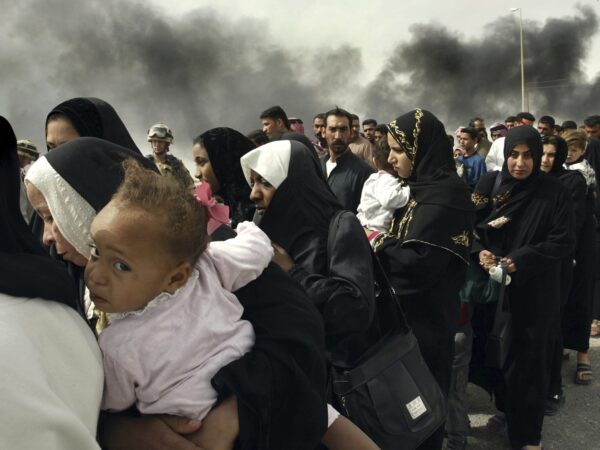
This potential betrayal of Iranian hopes hits my gut hard because I watched similar scenarios play out when I covered the 1991 and 2003 wars in Iraq.
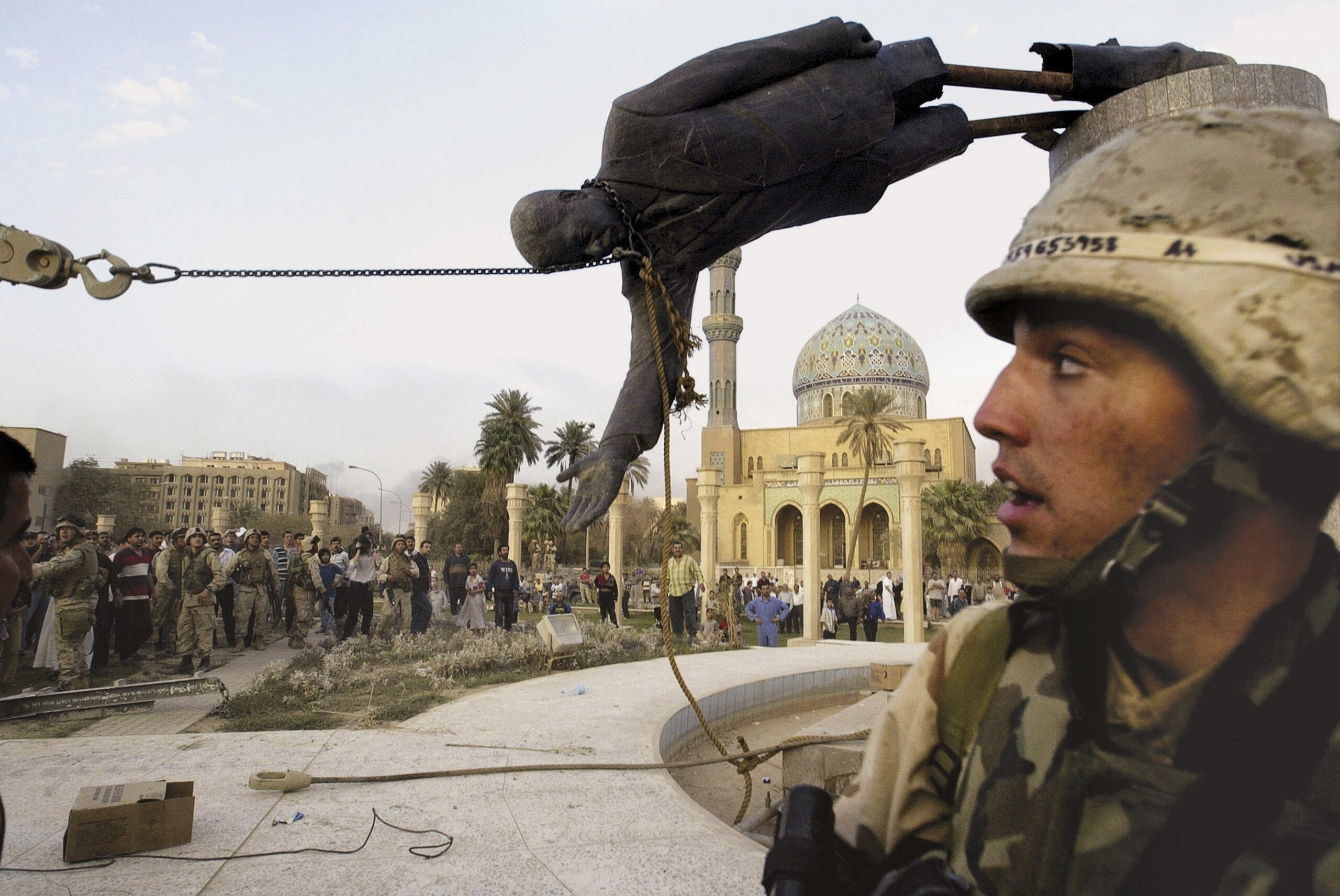
Iraqi civilians and U.S. soldiers pull down a statue of Saddam Hussein in downtown Baghdad, April 9, 2003.
In 1991, President George H.W. Bush called for Iraqi Kurds and Shiites to revolt against Hussein (whose mainly Sunni followers controlled Iraq). As the United States pushed into southern Iraq from liberated Kuwait, those Iraqis followed his call.
But Bush 41 chose not to continue on to Baghdad and depose the Iraqi regime; his advisers (rightly) warned this would spark an Iraqi civil war in which the U.S. would become entangled. When U.S. forces left, Hussein’s army slaughtered around 10,000 Shiites; several hundred thousand Kurds in Iraq’s north fled into the freezing mountains in winter, until the U.S. Air Force established a no-fly zone over Iraqi Kurdistan, and they could return home.
In February 2003, I crossed from Iran into Iraqi Kurdistan to await the invasion of Iraq by Bush 43, who claimed he had to destroy the (no-longer-existent) Iraqi nuclear program — and bring democracy to the country.
It was hard not to get swept up in the enthusiasm of Iraqi Kurds for the regime change the Americans were finally promising.
America’s regional allies, especially Israel, urged Bush to decapitate the Baghdad regime. White House hawks insisted “regime change” would quickly bring peace and democracy to the entire Mideast. So did exiled members of multiple Iraqi opposition groups, with whom I had been in contact since covering the 1991 Gulf War.
Bush 43 disbanded Iraq’s military and fired much of its government. But the White House had no grasp of the complex ethnic and religious politics of Iraq, which engulfed U.S. forces and ignited an internal Iraqi civil war between Shiite and Sunni Muslims. U.S. troops were caught in the middle, as Bush 41 had feared.
President George W. Bush speaks aboard the aircraft carrier USS Abraham Lincoln off the California coast on May 1, 2003.
Fast-forward to Trump. He says he won’t put U.S. boots on the ground but also says he’s not ruling them out “if they were necessary.” (“I don’t have the yips with respect to boots on the ground,” he said Monday. Figure that one out.)
However, the president has made clear, for now, that he won’t send U.S. troops to help unarmed Iranians retake their country, even as he keeps urging them to overthrow their leaders.
That may prevent the 2003-style quagmire Bush 43 blundered into. Yet, POTUS appears even blinder than Bush in Iraq about his ability to bend Iran’s future to his will.
Even though Iran’s 86-year-old supreme leader, Ayatollah Khamenei, was killed by an Israeli airstrike, along with dozens of other Iranian leaders, that’s not likely to end the regime.
The president has shown little interest — and advanced no concrete plans — for the future of Iran after the U.S. and Israel stop bombing. Trump has upturned the famous doctrine that the late Secretary of State Colin Powell applied to 2003 Iraq, namely, “If you break it, you own it.” The Trump Doctrine posits: “We break it, you own it. Goodbye and good luck.”
POTUS has stressed it is up to Iran’s people to rise and take over their country, even though civilians are bereft of leaders, organization, guns, or even internet connections (and Reza Pahlavi, the exiled son of the last shah, who hasn’t set foot in Iran for decades, has no armed forces of his own).
Squeezed by the MAGA faithful and partial to quick hits, Trump insists there will be no long-term U.S. involvement. This may avoid U.S. military casualties, but will probably leave Iran in chaos, ruled by regime holdouts who still retain the guns.
Indeed, the strongest remaining military force in Iran is the hard-line Islamic Revolutionary Guard Corps (IRGC), which is deeply rooted throughout the country. Behind them are hundreds of thousands of Basij militiamen, who have already killed thousands of unarmed regime opponents.
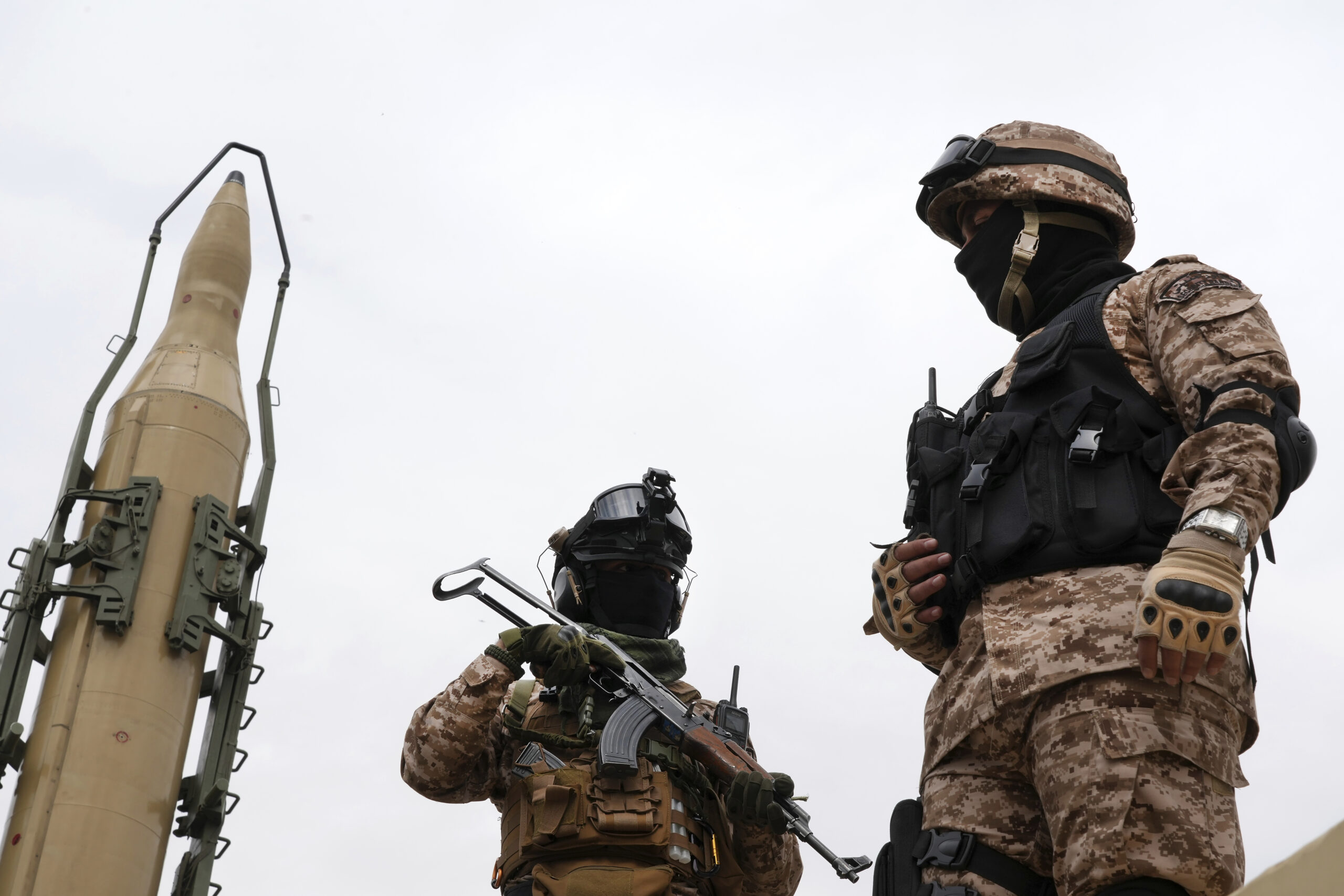
Iran’s Revolutionary Guard members stand in front of a Shahab-3 missile, which is displayed during the annual pro-Palestinian Al-Quds, or Jerusalem, Day rally in Tehran, Iran, April 29, 2022.
Perhaps Trump has devised a magical formula to profit from any such bleak denouement for the Iranian people: Iran will become Venezuela.
Trump has told journalists he wants to model his Iran venture on the U.S. intervention in Caracas, where the top leader, Nicolás Maduro, was kidnapped, and U.S. officials then made a deal with his vice president. Trump eliminated a dictator he disliked, but left in place the previous regime, which, in turn, handed him control over Venezuelan oil.
Sorry, even the most ill-informed observer can grasp that Iran bears no resemblance to Venezuela: The Islamic regime retains deep roots, many hard-line generals, hundreds of thousands of ideological purists, and many religious followers; it isn’t a one-man show.
Yet, POTUS insisted again Thursday that “what we did in Venezuela is the perfect scenario.” In an Axios interview, he said that he, personally, had “to be involved in the appointment [of Khamenei’s replacement] like with Delcy [Rodríguez] in Venezuela.”
In a godlike pronouncement, Trump expects Iran’s hard-line Shiite religious clerics to pick a new supreme leader who pleases him. Or what? He’ll send them to heaven as martyrs?
The president has already noted that “most people” he had considered for Iran’s top job “are dead” from the recent U.S.- Israel bombing. He speculated that Iran’s future leader could be “as bad” as the last.
More likely, Trump will try to cook a deal with a senior Iranian official, perhaps an IRGC general, to eliminate the remnants of Iran’s nuclear weapons program and its missile production. Perhaps he dreams of U.S. control of Iranian oil revenue as arranged with Venezuela’s new leader. Perhaps visions of “great U.S. deals” for Iranian oil dance like dollar signs in his head.
However, hard-line IRGC generals are more likely to fight to the end to hold power at home, even as Iran’s proxy militias in surrounding Arab countries are crushed. IRGC generals who were willing to gun down tens of thousands of Iranian civilians during recent Iranian protests would surely do so again to survive.
I worry that Trump’s continued call for a civilian uprising holds out the prospect that Iranian civilians will once again be mowed down — even as the president declares victory and sends the U.S. fleet home when his MAGA followers grow antsy. Israel may continue bombing, but that won’t help Iranian protesters topple the regime.
In a further sign of how the administration may use and abuse Iranians, news reports claim the CIA is arming Iranian Kurds to spark a wider uprising. This is cynicism to the max! Encouraging Iran’s ethnic minorities — Kurds, Azeris, Baluch, and Sunni Arabs — to fight will foment internal civil wars without changing the central regime or delivering a better one. Only a unified Iranian opposition can ultimately achieve that.
For POTUS, the Iran war is an exhibition of Trumpian power designed to bolster his strongman image, as the GOP faces dicey midterms and the Jeffrey Epstein hangover at home. For Iran’s people, Trump’s reality show is a life-threatening matter. His “we break it, you fix it” doctrine could consign many of them to death as he celebrates U.S. bomb strikes back home.
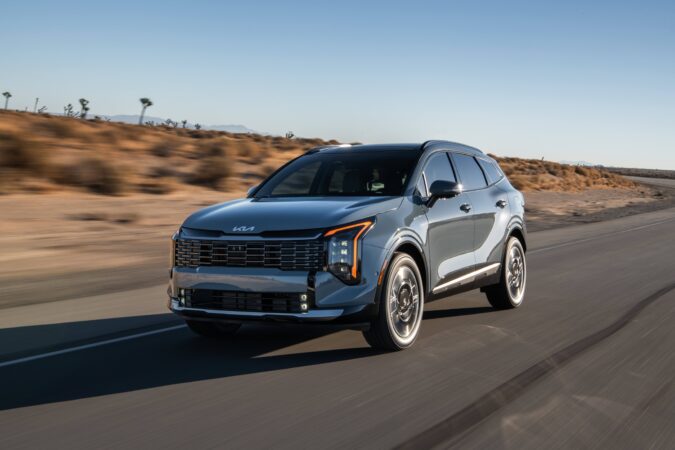
2026 Honda CR-V Hybrid AWD Sport Touring vs. Kia Sportage Hybrid SX-Prestige AWD: A challenger for the hybrid crown?
This week: Kia Sportage Hybrid
Price: $41,985 as tested
What others are saying: “Highs: Better acceleration than nonhybrid variant, well-mannered ride, plenty of space for people and cargo inside. Lows: Fuel economy isn’t as frugal as expected, not particularly entertaining to drive, exterior design isn’t for everyone,” says Car and Driver.
What Kia is saying: “Show up, show off.”
Reality: A hybrid challenger? There was much that was challenging about the Sportage Hybrid.
What’s new: The Sportage gets a new look, and some interior features. It comes in gasoline, hybrid, and plug-in models.
Up to speed: The Sportage Hybrid was a mostly pleasant companion to move about in. There were some hesitant moments as I pulled out and adjusted to hills over the first couple days, but those were on me. A last day trip to University City from West Chester was all smoothness and ease, both on the highways and in stop-and-go traffic. Eco mode was about the best all around, although I did pick Sport mode when I was really worried about cutting into traffic.
It takes 7.4 seconds for the 232-horsepower Sportage Hybrid to get to 60 mph, according to Car and Driver. That’s not stellar from the 1.6-liter turbocharged hybridized powertrain, but not too poky, and it’s faster than the 187-horsepower gasoline-powered 2.5-liter four-cylinder model.
A last-day pullout from 0-40 startled me with its quickness, so overall I’d say this midsize SUV is a peppy companion.
Shifty: The dial shifter works nicely, counterclockwise for Reverse and clockwise for Drive. Paddle shifters shift the 6-speed automatic transmission directly.
The transmission selection is what killed Sport mode for me. Many vehicles hold lower gears for a while in this mode, but the Sportage Hybrid always felt like it was stuck in 2nd when I’d be looking for 4th or 5th. Definitely less than ideal.
On the road: The handling in the Sportage Hybrid was not quite as enjoyable as the acceleration. Eco, Sport, or My Drive mode, nothing brought out the goose bumps as nicely as the S selection in the CR-V Hybrid.
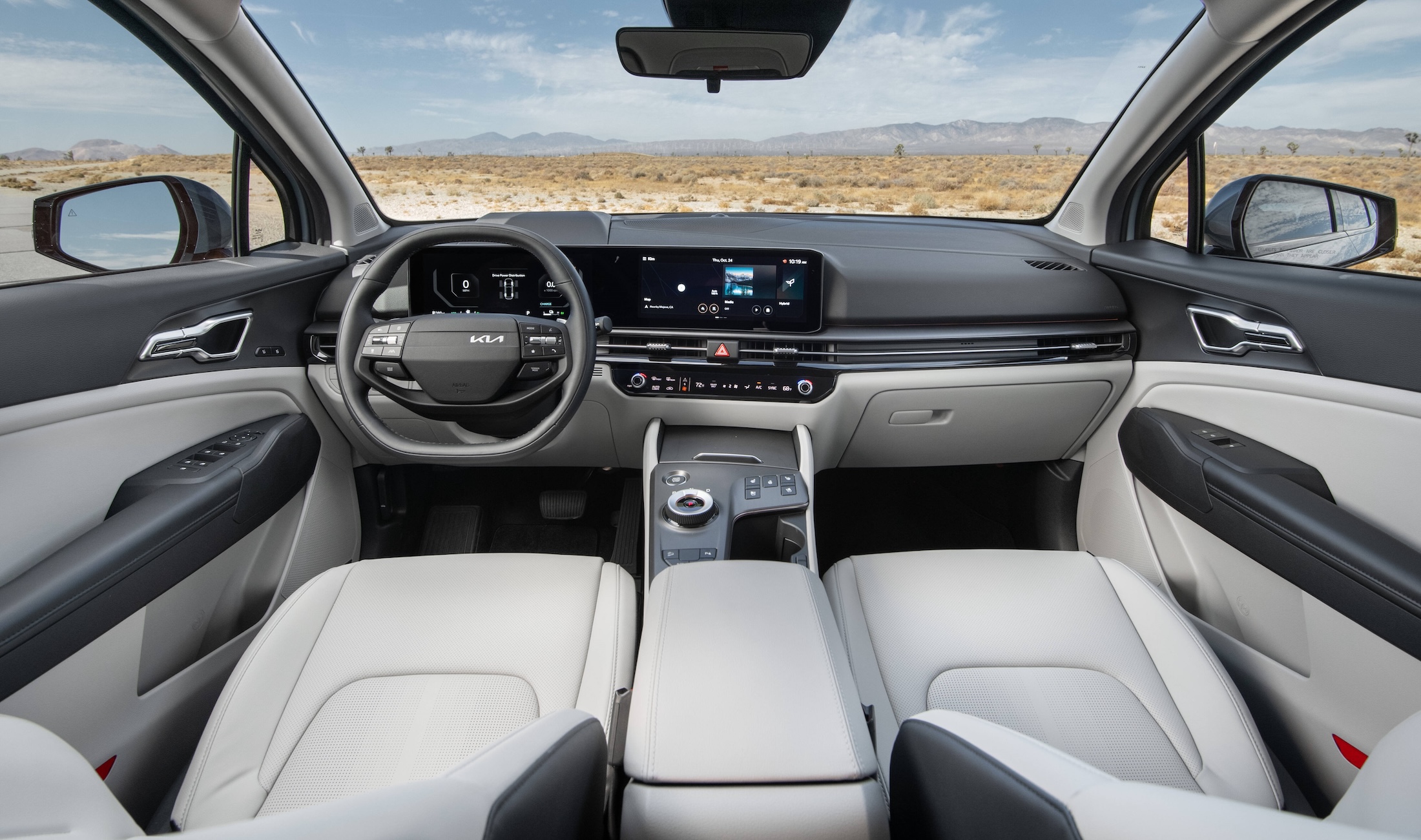
The interior of the 2026 Kia Sportage Hybrid is comfortable and the controls mostly easy to follow, except for the infotainment-HVAC button switch.
Driver’s Seat: Mr. Driver’s Seat put a lot of miles on the vehicle, and he never felt tired or sore.
The dashboard is standard issue Kia, which is clear and easy to set to your favorite info.
Friends and stuff: The rear seat in the Sportage Hybrid offers a comfortable place for passengers to ride. It’s fixed in place, but there’s plenty of legroom and foot room provided. The headroom is about the same as the CR-V, where my head is an inch away from the ceiling.
The Kia also offers several recline positions, as did the Honda.
Cargo space is 39.5 cubic feet in the rear and 73.7 with the rear seat folded, right in between the CR-V’s numbers.
In and out: The height of the Sportage matches the CR-V; it’s great for people who like to ride up high but not for people facing sore knees.
Play some tunes: The Harman Kardon stereo is an also-ran, like Kia audio systems tend to be. The clarity was fine for some songs and off for others, but the sound itself seemed just off throughout. Too much rattling bass and everything seemed to be in a minor key or something. B+.
The 12.3-inch touchscreen handles most of the controls well. You can use the dials, but you have to hit the switch to change them from HVAC controls. Kia thinks it’s clever or something with this system, because you can just take your eyes off the road to switch, right? What’s wrong with this picture?
The switch itself is very small and part of a touch pad, so it’s hard to pinpoint and unresponsive. So you make what you think are your adjustments, and then the stereo remains too loud, but you start feeling colder.
Keeping warm and cool: At least Kia has decided to let the controls default to HVAC. I’ve had other models where it stayed in the most recent selected, and I was always hitting the wrong thing. Owners may have their own perspective on this.
Dials control temperature, and the ebony touch pad handles everything else. Really, though, only the toggle between stereo and HVAC seemed to be the weak link.
Fuel economy: Speaking of weak links, the Sportage Hybrid fuel economy disappoints. Over the course of 400+ miles that include another driver — one who’s no doubt less inclined to race at stoplights — I could barely get this over 30 mpg. It’s disappointing, period. But it’s also no match for the CR-V Hybrid’s 35-plus. I’d averaged 35 in a 2023 Sportage Hybrid, so the upgrades are thirsty.
Where it’s built: Gwangju, South Korea. Ninety percent of parts come from South Korea, and less than 1% are from the U.S. or Canada.
How it’s built: The Sportage Hybrid gets a reliability rating of 3 out of 5 from Consumer Reports.
In the end: If you’re buying a hybrid to, you know, save fuel, then it’s CR-V Hybrid all the way. Consumer Reports claims to have gotten mid-30s, but Car and Driver and Mr. Driver’s Seat not so much.
Well, are you also denouncing the removal of the Caesar Rodney statue from a plaza in downtown Wilmington? You should.
The statue of Rodney — a signer of the Declaration of Independence who enslaved about 200 people — was taken down by city officials during the racial reckoning of 2020. And last month, the Trump administration said it would be displayed in Washington, D.C., as part of the nation’s 250th anniversary celebrations.
Cue the culture wars: One side says the statue symbolizes racism, and the other says it embodies patriotism.
They’re both right. And that’s why the statue of Rodney belongs back in Delaware, surrounded by displays about his past as an enslaver. We can’t make sense of the past unless we address its complexities. And we can’t condemn the erasure of history if we’re erasing it ourselves.
That’s what my fellow liberals have been doing since 2020, by demanding the removal of monuments to those who were enslavers. We should instead seek to add information to the memorials, so Americans receive a fuller picture of slavery and its role in our founding.
The Trump administration doesn’t want that, of course, which is why it removed the panels about the enslaved people who labored at the President’s House Site at Independence National Historical Park. Last month, a federal district court judge ordered the panels be reinstalled. Sixteen of the 34 panels were returned to the site before a circuit court judge placed a stay on that order. The other panels will remain in storage until the courts issue a full ruling on the matter.
Rodney was one of them. He raced on horseback from Dover, Del., to Philadelphia on July 2, 1776, to cast his state’s decisive vote in favor of the Declaration of Independence, which was adopted two days later. The town fathers of Wilmington erected a statue in his honor in 1923, shortly before the 150th anniversary of the declaration.
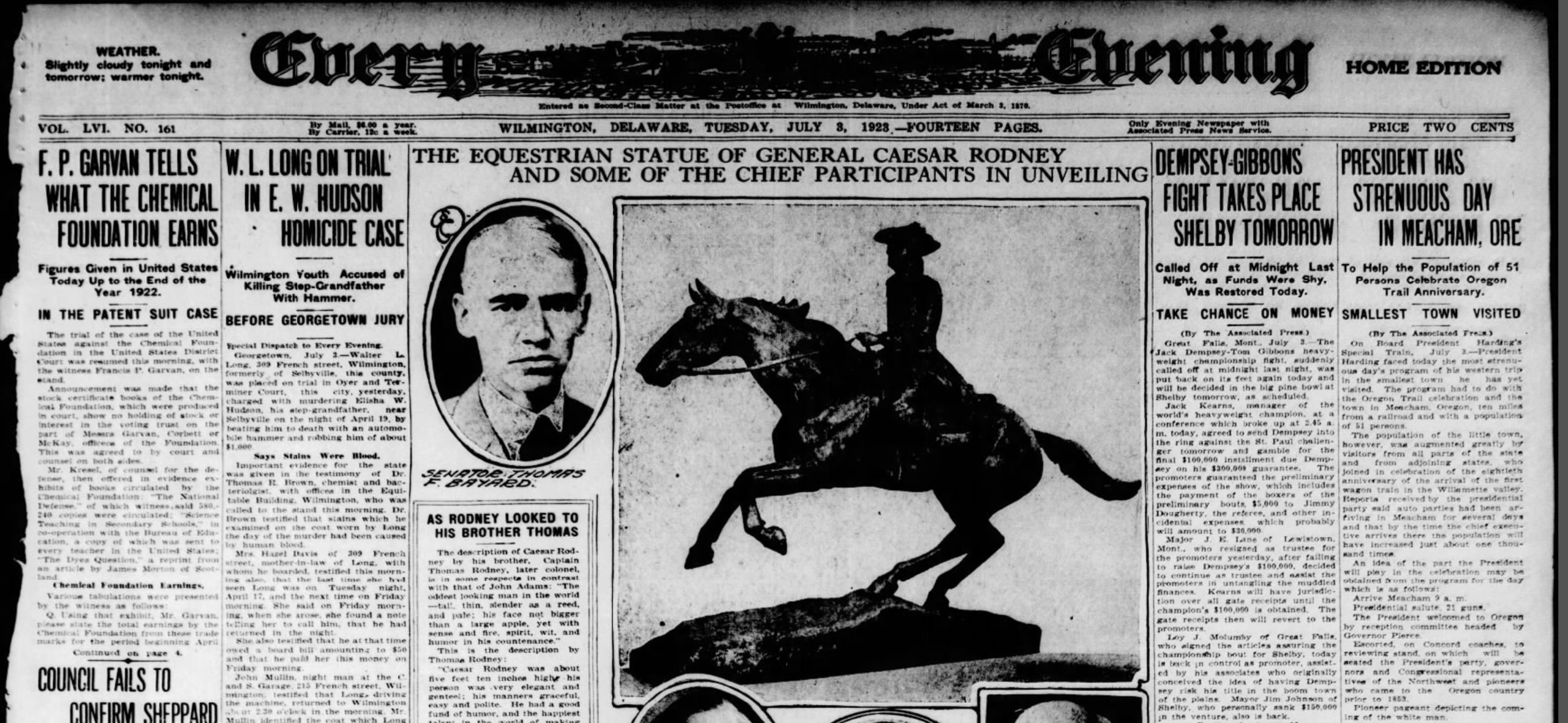
An image of the front page of the July 3, 1923, edition of the News Journal of Wilmington, which notes the dedication of the Caesar Rodney statue on the following day.
But Rodney also enslaved roughly 200 African Americans at his family plantation. That’s why protesters demanded his statue’s removal in 2020, when the police murder of George Floyd led many communities around the country to reconsider their connections to slavery.
In agreeing to remove the statue, Mike Purzycki — the mayor of Wilmington at the time — pledged to conduct a discussion about it. But it’s hard to talk about something when you have hidden it. It’s out of sight, out of mind.
And that’s where some liberals want it to remain. “You can have him, D.C.,” said Wilmington Councilwoman Shané N. Darby, reacting to the news that the statue of Rodney would be moved to Washington. “I do not think he needs to have a statue in his honor at all.”
But giving the statue to Washington concedes way too much to President Donald Trump, who issued a proclamation in October 2020 condemning its removal from Wilmington as “part of an ongoing, radical purge of America’s founding generation.”
The proclamation made no mention of Rodney’s past as an enslaver, because the Trump administration doesn’t want us to address that. All we need to know is that Rodney was a “patriot,” and that the people who denounced the Wilmington statue are engaged in “extreme anti-American historical revisionism,” Trump declared.
But the real revisionists are Trump and his disciples, who want to erase slavery from public memory. And that’s precisely what will happen if the Rodney statue disappears from Delaware.
Like the display at the President’s House, Rodney’s statue should include signage describing his complex relationship to slavery. Although he held human beings captive, Rodney introduced a bill to prohibit the importation of enslaved people into Delaware. And his will directed that the people he enslaved should be freed after he died.
Fewer people will know that history if the statue is gone. Even at Caesar Rodney High School in Camden, Del., students and recent graduates said they weren’t aware of Rodney’s past until the controversy flared over his statue in Wilmington.
So let’s bring it back, perhaps paired with a monument to enslaved people in Delaware. That’s what University of Delaware political scientist Theodore Davis Jr. proposed back in 2020, as the campaign to remove Rodney’s statue gained momentum. Davis, who is Black, understood that we should always be adding to history. Leave the subtracting to Trump.
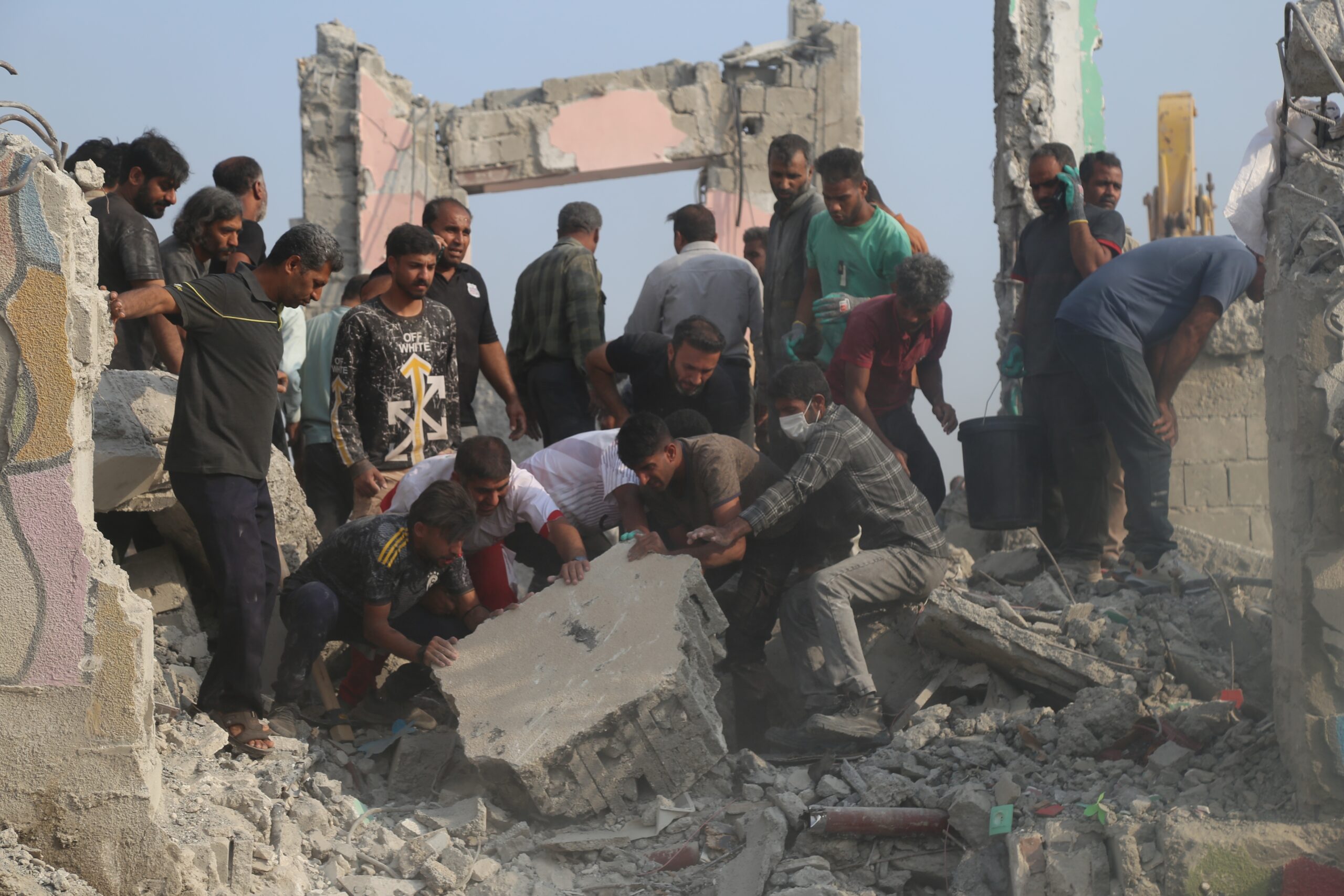
New York Times-verified images from a scene in southern Iran are horrific. A severed arm of a child lying in the rubble. Backpacks covered in ashes. The dead in body bags. Video of rescue workers digging through the remains of what had been a modest, two-story school near a military installation in southern Iran.
Please stop for a moment and think about the babies who died over the weekend. I call them that because that’s really what they were: elementary-age schoolchildren learning their lessons on what had started as a typical school day during their holy month of Ramadan, before turning into a nightmare.
Regardless of what you think about the joint U.S.-Israeli strikes against Iran, these girls were innocents. Students ages 7-12, they didn’t deserve this. Even growing up under the horribly repressive thumb of the late Iranian Supreme Leader Ayatollah Ali Khamenei, they had hopes and dreams for their lives that sadly now will never be realized. Their families must be out of their minds with grief.
It’s tempting to turn away from such a devastating tragedy, but America needs to bear witness to what has happened. President Donald Trump says the U.S. joined with Israel to bring about regime change and stop the production of nuclear weapons. Iranian security forces have reportedly killed thousands of their own people.
It’s still unclear exactly how many schoolgirls were killed, and which nation is responsible for the strike. The Times is reporting that at least 175 people altogether perished during the attack on the school, located in the city of Minab in southern Iran.
Rescue workers and residents search through the rubble in the aftermath of an Israeli-U.S. strike on a girls’ elementary school in Minab, Iran, Feb. 28.
According to the Times, the school is near a naval base where the Iranian Revolutionary Guards Corps is stationed. Reportedly, it was also struck that day. Various news sources reported that a spokesperson for U.S. Central Command said military officials are “aware of reports concerning civilian harm resulting from ongoing military operations” and are “looking into them.”
Meanwhile, the reports have sparked worldwide outrage. Nobel Peace Prize laureate and education activist Malala Yousafzai wrote on X, the social media site formerly known as Twitter, “I stand firmly against violence and the targeting of schools and civilians.” She was a child herself when she was shot while returning home from school in Pakistan in 2012.
Imagine the blanket news coverage that would have taken place if something even remotely like this had taken place at a school on American soil. It would have made the front page of every newspaper. But because it happened in a Muslim country thousands of miles away, it’s easier to act as if it never happened.
We can’t allow this kind of violence to be normalized.
Former Vice President Kamala Harris spoke for many of us over the weekend when she said, “Trump has dragged us into a war that we do not want.” The former Democratic presidential candidate added, “I unequivocally oppose this war of choice, and everyone should.”
Polls show most agree with Harris. Only one in four Americans approves of this war in the Middle East. I get it. We don’t want another drawn-out situation. We didn’t agree to this, and only Congress has the authority to authorize war.
We don’t even know what Trump’s endgame is, but he has let us know that the U.S. can expect more military casualties. More war means more airstrikes and more civilian fatalities — possibly even devastation like what happened at the girls’ school — where, as Yousafzai said on X, “every child deserves to live and learn in peace.”
Given the administration’s reluctance to share more about the planned scope and scale of our military engagement, there is little we can say with certainty. Except that Trump’s reckless war proves his “Board of Peace” is a farce.