Snow isn’t a constant in Philadelphia but after two big storms dumped on us just weeks apart this year, it’s clear some things remain predictably consistent during a snowstorm in Philly, no matter the year.
While all hail hasn’t broken loose yet, we have fallen right back into our classic winter storm habits, some of which aren’t snow great. So put on your parka, pull up your boots, and come traipsing through our winter tropes with me, because if there’s one thing that certainly isn’t predictable during a snowstorm it’s SEPTA.
Acting like the Philadelphia Museum of Art is Vail
A snow boarder goes down the steps of the Philadelphia Museum of Art.
I love that people sled and snowboard down the steps of the Philadelphia Museum of Art after a snowstorm like it was a ski resort. It’s one of those traditions that gives Philly such a wonderful, joyous sense of place, but, like many of our beloved traditions, it is also a highly dangerous activity.
There is no ground beneath the snow here, just pointy stone steps that could leave your face looking like a Picasso painting if you hit them the wrong way. Even if you manage to stay upright the entire way down, it’s a bumpier ride than Philly’s pothole-plagued streets (which are certainly going to get worse after this storm).
A sledder wipes out while sledding down the Philadelphia Museum of Art steps.
The substance
Throughout a snowstorm and for five minutes immediately following one, Philadelphia looks absolutely stunning. But after those five minutes are up, things get real gross, real quick. The snow turns into lakes of slush and large, gray mountains of immovable ice, making the city look like a dumpster site on Hoth for the next five weeks.
It reminds me of that movie The Substance with Demi Moore, except the substance for Philly is snow. It makes the city beautiful for a short time, but in the end, it just turns it into a bigger mess than it was to begin with.
A pedestrian walks past a large pile of snow and ice along the Benjamin Franklin Parkway this year.
Doggone dirty
Among the many reasons the snow gets so gross so quickly here is because some dog owners are under the impression that the laws of polite society freeze when the temperature does. Just because your dog left its pile on a pile of snow does not mean you don’t have to pick it up.
Trash spotted in the snow in Philadelphia. Photographed, but not pictured (as a courtesy to you), was also a pile of dog poo.
Then there are the really terrible, lazy owners who kick snow over their dog’s piles in an attempt to cover it up, thus leaving a nasty surprise for unsuspecting pedestrians. While all dogs may go to heaven, there’s a special circle of hell for those folks.
Snowstalgia
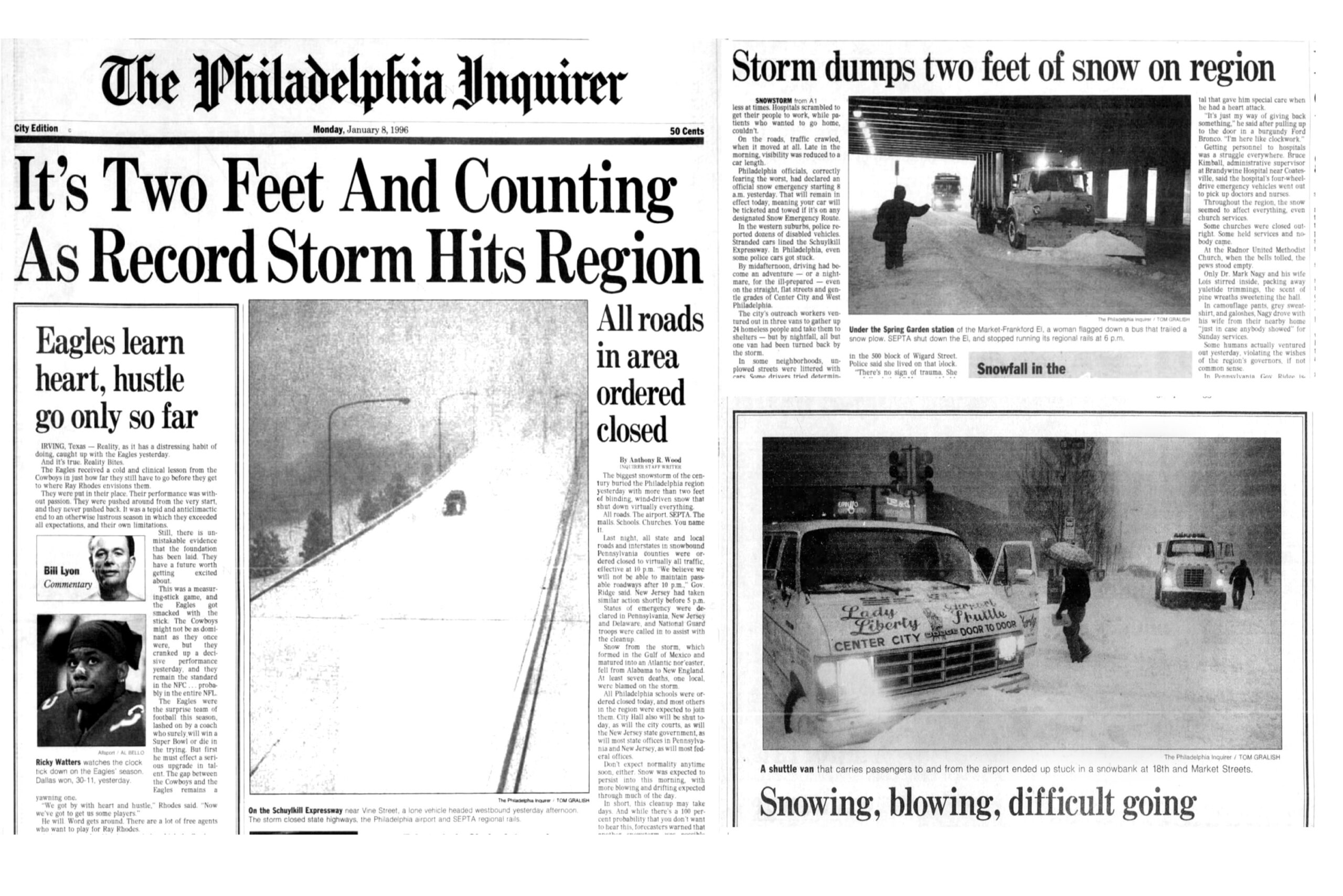
No matter how much snow is predicted or falls during a storm, it will inevitably be compared to the Blizzard of ‘96 by at least three people you speak you to, or three times by at least one person you speak to.
The Blizzard of ‘96 is pretty much our Beetlejuice, you have to say it three times or it doesn’t snow around here.
Front page and inside photos from The Philadelphia Inquirer. January 8, 1996. The Blizzard of 1996, or “Storm of the Century,” a severe nor’easter that was Philadelphia’s largest-ever snowfall of 30.7 inches Jan. 6-8, 1996.
Work or Wawa
There are two types of people who travel out in Philly during a storm: those who are going to work and those who are going to Wawa.
There’s absolutely no rational reason someone has to go on a Wawa run during a snowstorm — especially since everyone waited an hour in line at the Acme for milk and bread two days before it hit — yet there they always are, sometimes in flip-flops, just picking up a cup of coffee like it’s something they can’t get at home.
The flagship Wawa store near Independence Hall.
I’m sure some folks go just in the hopes of being interviewed by the 6ABC reporter who’s doing live shots from the Wawa parking lot, and some do it just to get out of the house while their kids are at home. Whatever the reason, if you’re one of those people, be nice to the Wawa workers who risked their lives to go to work so you had somewhere to go.
Savesies
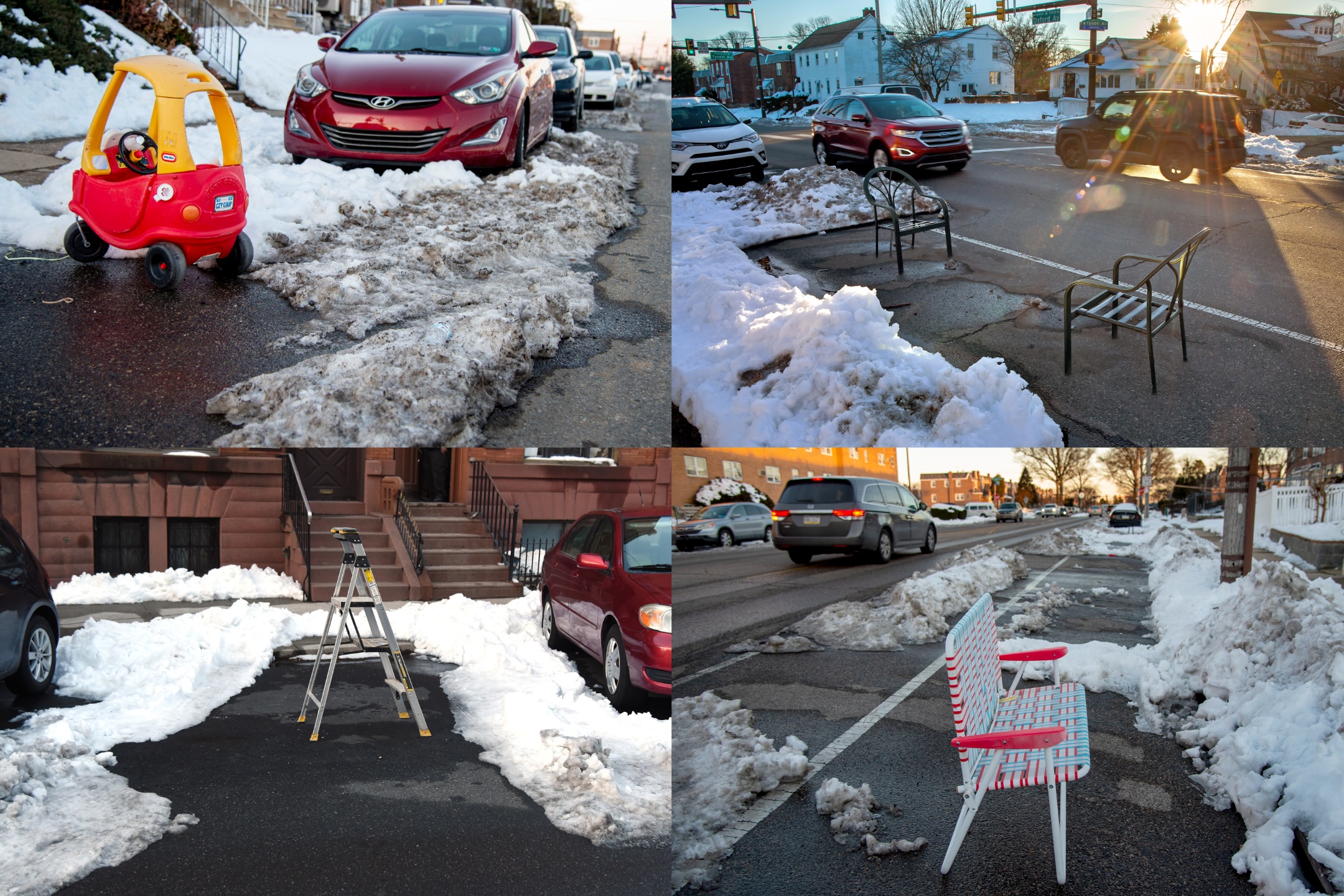
Few things will pit neighbor-against-neighbor in this city quite like savesies, the longstanding Philly practice of using an orange cone, folding chair, or any other inanimate object to save a parking space you’ve shoveled out.
Collage of savesies, a long-held parking tradition across Philadelphia.
Folks are either firmly for or against the tradition, but no matter which camp they land in, few are bold enough to mess around and find out by parking in a saved space, lest they become the recipient of a strongly-worded letter on their windshield, a knock at their door, or whatever curse has plagued the Flyers since 1976.
Shorts shovelers
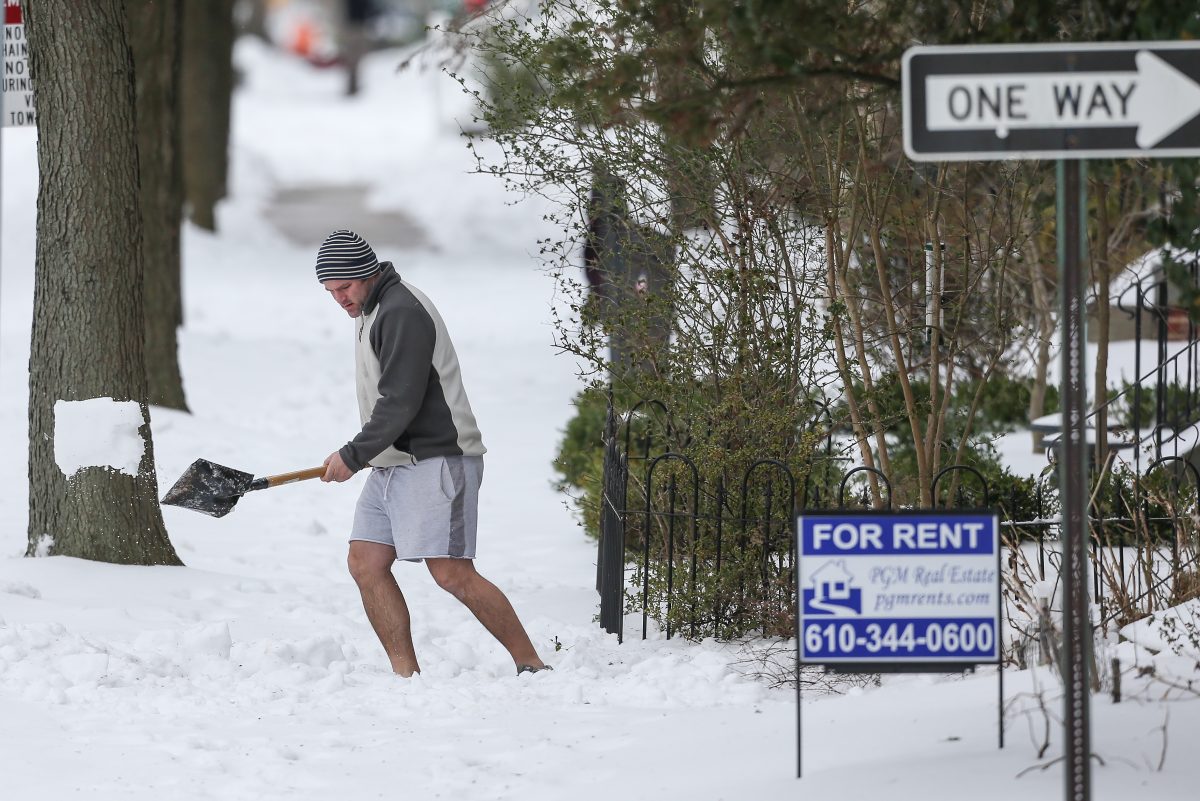
Shoveling in shorts is a long-standing tradition practiced by men in the Philadelphia region.
It could be 3 degrees out with a windshear of negative 10 and eight inches of snow on the ground and you will still see some dude out shoveling in shorts and an Eagles hoodie. In Delco, you will see several.
Do these men get hot flashes in their legs? Is their calf hair luxuriously thick? Did someone cut off the bottom half of all their pants? Inquirer minds (mainly mine) want to know!
Greetings from sunny Florida
During a snowstorm, someone you know will inevitable post a picture of themselves in Florida, where they snowbird in the winter or are visiting for Phillies spring training. The caption will say something like “Sorry to miss out on the storm!” or “Sending my friends in Philly sunny vibes from Florida!”
Philadelphia Phillies Trea Turner and Bryce Harper enter the field during the first full-squad workout of spring training Feb. 16, 2026, at BayCare Ballpark in Clearwater, Fla.
These are bold-faced lies. They are not sorry and they are not sending you anything but a hard time. Just rest assured in the knowledge that no matter what, you are in the greatest city in the world and they are still in Florida.
It is not unreasonable for people to be concerned about voter fraud or noncitizens voting. Not because it happens at a scale that could swing an election — researchers sayit is so rare as to be statistically insignificant — but because Republican leaders have been pounding on that drum for so long that some can’t help but sway to the beat.
“We have a duty to root out the source of this distrust and restore the integrity of our democratic process,” McCormick said, speaking on the Senate floor in defense of the SAVE America Act, the GOP’s latest effort to restrict voting.
If Pennsylvania’s junior senator will allow me, I think I’ve cracked the case.
Casting doubt on election security did not begin with Donald Trump and his bombastically false claims of hacked voting machines and millions of illegal immigrants voting. It started long before that, with “traditional” Republicans like McCormick legitimizing allegations of widespread fraud.
Under President George W. Bush, Attorney General John Ashcroft warned that “votes have been bought, voters intimidated and ballot boxes stuffed” at a 2002 Voting Integrity Symposium. Yet, bringing the power of the U.S. Department of Justice to investigate these allegations resulted in few prosecutions by the time Bush left office.
After 2013, when the U.S. Supreme Court removed a provision of the Voting Rights Act, thereby ending federal supervision of nine states with a history of racial discrimination, there was a slew of voting restrictions pushed by Republicans under the guise of voter integrity.
By the time Trump came along, GOP voters were more than primed to believe that an election could be stolen, with the nadir being the Jan. 6, 2021, attack on the U.S. Capitol.
Having learned no lessons from what happened, Republicans continue to stoke doubt about elections.
McCormick shamelessly used a November incident in Chester County, where independent and unaffiliated voters were left off the county’s poll books, to allege that “registered voters were turned away at the polls. And an unknown number of unverified voters cast regular ballots.”
There is no evidence that either of those claims is true.
What happened in Chester County was human error that was corrected later that day. In the meantime, anyone who wanted to vote but was not in the poll books was asked to fill out a provisional ballot that would later be verified for eligibility.
Elections are run by people, and mistakes happen. There are 3,069 counties in the U.S. in charge of administering elections. It’s a testament to the dedication of local officials that voting is as smooth and secure a process as it is.
McCormick is a smart man. He likely knows the facts. He also knows that nothing included in the SAVE America Act would have prevented what happened in Chester County.
What is included in the legislation requires people to show proof of citizenship when registering to vote and produceID when casting a ballot. It stiffens penalties against election officials for registering voters without proof of citizenship, and forces states to submit their voter rolls to the U.S. Department of Homeland Security to ensure only citizens are registered.
All of that seems reasonable, but seeing as how folks like McCormick are using deception in its promotion, you will forgive me for being skeptical. I don’t buy the catastrophism coming from Democrats, either, but there are valid objections.
For example, some people who could otherwise vote do not have ready access to the documents required in the law — that’s about 20 million Americans, according to some estimates. That the proposal would take effect immediately, just in time for the midterm elections, guarantees that millions would be disenfranchised.
Information sharing with DHS is also problematic, as the tool used to identify potential noncitizen voting registration “keeps making mistakes,” according to a ProPublica/Texas Tribune investigation.
None of these issues is insurmountable. Instead of blocking legislation like the SAVE America Act, Democrats should fight to improve it.
For example, if you need documentation to exercise your rights, then that documentation should be free, and requirements should be implemented after a reasonable grace period. Any mandate should come with the funding to ensure every American has access to their birth certificate, or that every citizen can easily obtain a passport. Congress should also make Election Day a holiday, while they’re at it.
Ironically, voter suppression efforts, which traditionally fall hardest on communities of color, come from the idea that the changing face of America would turn away from Republicans. Put another way, this line of thinking suggeststhat as the U.S. barrels toward becoming a majority-minority nation, the GOP would be at a disadvantage.
But some high-turnout elections, including the 2024 contest that put Trump back in the White House, have shown that less frequent voters — i.e., those least likely to jump through the hoops put up by something like the SAVE America Act — back Republicans.
Instead of making up stories and assuring the long-term erosion of democracy for short-term political gain, McCormick and his GOP colleagues should partner with Democrats to make elections secure and voting easy.
But sometimes evil is buried deep in the black-and-white paperwork of government bureaucracy.
A once sleepy rural town named Social Circle, Ga. — just over 40 miles east of Atlanta off Interstate 20 — has become the epicenter of the stealthy plan by U.S. Immigration and Customs Enforcement (ICE) to rapidly create an American gulag archipelago of massive former warehouses adapted into detainment camps for arrested immigrants.
The plan to convert a newly built 1.2 million-square-foot warehouse into a concentration camp where as many as 8,500 humans — double the size of the current largest federal prison — would be housed for as long as 60 days (or likely more) has riled up both residents and public officials in a place where 75% voted for Donald Trump in 2024.
The frustrated city manager of Social Circle, which was offered no input as a cash-flush ICE recently bought the spec warehouse for a whopping $128 million, told the Guardian that he’s denying the feds’ request to turn on the public water as they race to open their detention camp there as early as April.
“I told them I’m not going to do it,” Eric Taylor said. “Not until they come and talk to me.”
This is the floor plan for the conversion of a warehouse into an ICE detention facility in Social Circle, Georgia.
But officials in the small town of just 5,000 also did something else that probably raised some hackles at Kristi Noem’s ultrasecretive U.S. Department of Homeland Security. They made public what few documents DHS has so far been willing to share with Social Circle, including its blueprint for what the innards of an American gulag will look like.
Close to two-thirds of the massive, rectangular floor plan is divided into 80 squares separated by narrow corridors, each box with dozens of strike marks. The thousands of marks presumably represent bunk beds, but what they truly signify is human beings.
Based on the most recent statistics, as many as 70% of these arrested and handcuffed immigrants will have committed no crime after entering the United States — day laborers, restaurant workers, or Uber drivers now crammed into a prison camp unlike anything seen on U.S. soil since World War II’s immoral Japanese internment.
The new floor plan raises more questions than it answers. It’s not clear whether the small boxy rooms surrounding the rectangular detention space would be used for recreation, as no recreation space is explicitly marked. There are three cafeteria rooms and a medical space — a necessity in an instant town of 8,500 — yet still room for an indoor gun range where hundreds of guards will hone their shooting skills. Eight rooms are marked as handicap accessible, so there’s that.
This banal blueprint for inhumanity is the embodiment of the notorious words last April from ICE’s acting director, Todd Lyons, who said the Trump regime wants to make deportation “like [Amazon] Prime, but with human beings.” Indeed, the ultimate goal of stacking desperate people in dingy, dehumanizing concrete caverns built for bath mats or pet treats is to force them to abandon their legal right to fight for U.S. asylum and agree to leave the country, bringing Trump closer to his goal of one million deportations every year.
John Miller, an organizer with One Circle Community Coalition, shows a variance request while describing plans to oppose converting a warehouse into an ICE detention facility last month.
“The focus on speed is extremely concerning,” Sari Arvey of Human Rights First’s ICE Flight Monitor told Georgia Public Broadcasting, referring to the goals of getting detainees in and out in 60 days. “If they’re trying to speed up this process even further, it’s only going to extremely exacerbate the due process violations, the separation of families, [and] also conditions in detention centers.”
Online, the blueprint of detainees forced to live in such crammed conditions — a necessity to house 8,500 people in one building, even a warehouse the size of roughly 20 football fields — prompted comparisons to some of the worst of human history. Some on Bluesky linked the Social Circle blueprint to diagrams of tightly packed ships that brought enslaved Africans to America in the 18th century, while others wondered if the boxy quarters would look just like the rows of bunk beds inside Auschwitz, the Nazi death camp.
No one is suggesting ICE is planning anything close to mass extermination, but experts do say floor plans like this are more evidence that what the Trump regime, with its ambitions for a national network of as many as 24 converted warehouses, is racing to create is clearly comparable to history’s worst concentration camps.
In a conversation this weekend with New York Times columnist Jamelle Bouie, author Andrea Pitzer of One Long Night: A Global History of Concentration Camps called it “the purging of anyone that’s deemed the outsider or the foreigner. It has been weaponized into this much, much more dangerous state. And with the number of detention beds in terms of expansions and the warehousing, the potential for this, we’re really looking at stuff on the scale of the concentration camp systems that most people have heard of.”
As the existence of the ICE detention scheme has become a coast-to-coast controversy, Homeland Security has insisted these sites will be modern, well-run, and humane. “These will not be warehouses — they will be very well-structured detention facilities meeting our regular detention standards,” DHS said earlier this month.
The problem is that the recent history of ICE has shown its current “modern” detention sites are plagued by squalid conditions and rising rates of infectious disease and premature death. The idea that these same bad actors could achieve humane conditions in much larger, hastily assembled warehouses seems utterly ludicrous.
Earlier this year, Democratic U.S. Rep. April McClain Delaney visited an ICE detention center at a Baltimore federal building and reported “horrendous” conditions, with 50 people in a room with “concrete floors, a bench around the perimeter, and a makeshift bathroom in the middle that has minimal privacy.” Detainees recounted sleeping under foil blankets and experiencing hunger and thirst.
Leaked video from ICE detention shows 50 people crammed in cell with no beds or bathrooms—including U.S. citizens.
"They hit his face. They beat him until he can no longer stand."
"They have been here more than ten days without bathing and enduring hunger."
“Our patients are more frightened and sicker than ever,” three Philadelphia physicians who primarily treat immigrant communities wrote in a recent Times guest essay that described a variety of dire problems, including substandard treatment in ICE detention.
One case they described involved a stroke recovery patient who was arrested and detained by ICE for several weeks at the Moshannon Valley Processing Center in Central Pennsylvania before family members won his release.
“In detention he had missed weeks of medication, and he continues to deal with the undertreated effects of his stroke, which make walking difficult and returning to work impossible,” they wrote. “He told us he struggles to sleep through the night and often feels exhausted and depressed.” Meanwhile, large ICE detention camps in Texas have reported outbreaks of measles and tuberculosis.
The reality of the concentration camps that are planned for Social Circle or Tremont, Pa. — in a site that used to move cheap consumer goods for the now-bankrupt Big Lots — is that they are much more likely to breed disease and human misery than to alleviate them.
It’s not clear how far ICE can get with this scheme. Were ICE successful in its initial $38 billion plan to buy 24 facilities that could house as many as 76,500 detainees, it would need to arrest people in multiple cities on the scale that recently generated a national uproar in just one, Minneapolis. But the exposure of the detention proposal has also caused several planned purchases to collapse. This week, for example, officials in New York state claimed that a large, controversial site in the Hudson Valley town of Chester won’t be happening.
The irony is that what might be described as NIMBY (“not in my backyard”) issues — like not having enough drinking water or sewage treatment capacity for thousands of new arrivals, or the loss of tax revenue from warehouses meant for economic development — are giving permission to weak-kneed politicians afraid of the immigration issue to still oppose these sites without addressing the bigger human rights crisis.
To echo Malcolm X, these monstrosities should be stopped by any means necessary, even if it takes just turning off the water spigot. Still, the biggest reason to be outraged about this scheme for American concentration camps should not be infrastructure, but the rank immorality spelled out in the cold ink of the DHS floor plan.
It’s our challenge as the neighbors and allies of our nation’s immigrant communities to make sure those black marks on a page are never turned into the suffering of actual humans.
MUNICH — When Russia invaded Ukraine on Feb. 24, 2022, no one imagined Moscow would be enmeshed in a quagmire four years later, having lost nearly 1.2 million killed, wounded, or missing soldiers to an army a fraction of its size.
The price Ukraine has paid for its defiance was written on Volodymyr Zelensky’s face — weary, puffy, aged dramatically beyond his 48 years — as he took the stage at the Munich Security Conference last weekend.
“I want you to understand the real scale of these attacks on Ukraine,” he told an attentive audience, bluntly detailing the 6,000 attack drones, 150-plus missiles, and more than 5,000 multiton glide bombs Russia had dropped on civilian targets in January alone.
“Imagine this over your own city,” Zelensky demanded. “Shattered streets, destroyed homes, schools built underground, not a single power plant in the country that has not been damaged by Russian attacks.”
Yes, imagine those bombs dropping on Temple University and Jefferson Hospital, on apartment towers on Broad Street, and on William Penn atop City Hall. Imagine living under mounds of quilts in your home because power infrastructure had been deliberately destroyed.
And yet, as Zelensky made clear, Ukraine won’t surrender to Vladimir Putin — nor to Donald Trump.
Kyiv will not bow to shameful White House demands that it cede critical, fortified territory in the Donbas region to Russia, with no solid U.S. security guarantees to stop Putin from swallowing this gift and attacking again.
Based on Zelensky’s words, and what I heard from other European leaders, tech executives, Ukrainian military officers, poets, and tech innovators in Munich, here are my takeaways on what to expect in Ukraine as the fifth year of war begins.
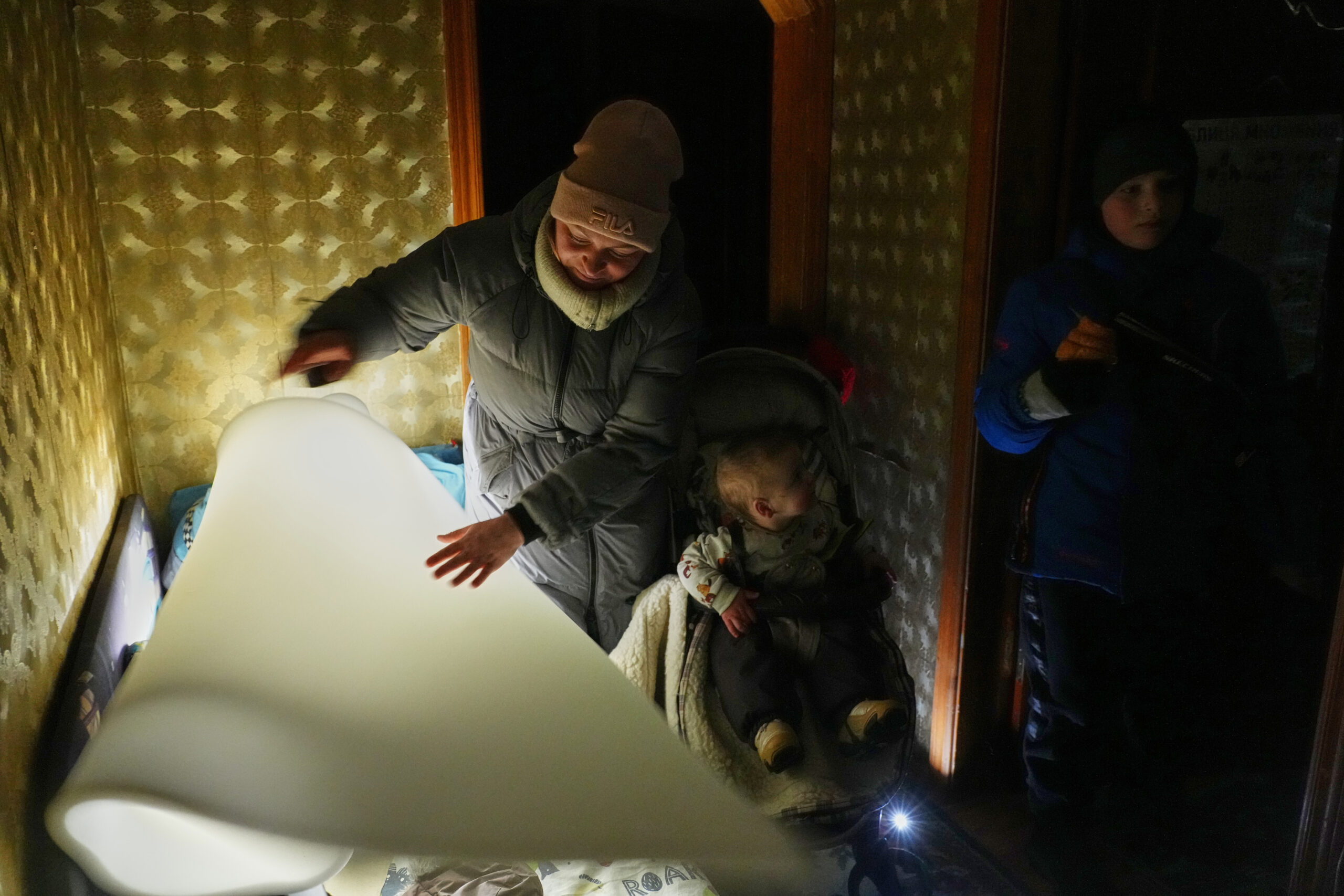
Yuliia Dolotova, 37, uses foam rubber to insulate her children’s bed in her apartment during a power outage caused by Russia’s repeated air strikes on the country’s power grid, in Kyiv, Ukraine, Feb. 2.
No end in sight
The war will not end in 2026. Putin isn’t winning, and Ukraine is holding on. Kyiv’s current strategy — as its army eliminates more Russian troops each month than the number of fresh recruits Moscow can send to the battlefield — is to increase that kill ratio, and to batter Russia’s military and economy until the Kremlin is finally forced to negotiate seriously.
But U.S.-brokered peace talks, whose second round in Geneva broke up abruptly on Wednesday, are headed nowhere so long as Trump only pressures Ukraine.
Russia hasn’t changed its hard-line demands one iota, still demanding Ukraine slash the size of its army, get rid of Zelensky, and forgo Western security guarantees. In other words, commit suicide.
Equally absurd, as Zelensky pointedly noted, is that Putin has rejected any European participation in peace talks, with Trump’s acquiescence. Never mind that the European Union and member countries now pay 98% of the cost of military and economic aid to Kyiv, including payments to Washington for limited amounts of U.S. weapons. Meantime, Trump cut off 99% of U.S. aid to Kyiv in 2025.
“We don’t hear any compromises from Russia,” Zelensky said, citing Moscow’s “strange” demand that Kyiv hold elections amid Russian bombing — a demand that received buy-in from U.S. negotiators.
“Give us a two-month ceasefire before elections,” Zelensky proposed. “Or we can also give Russia a ceasefire if they will have [free] elections in Russia.”
The Munich audience cheered.
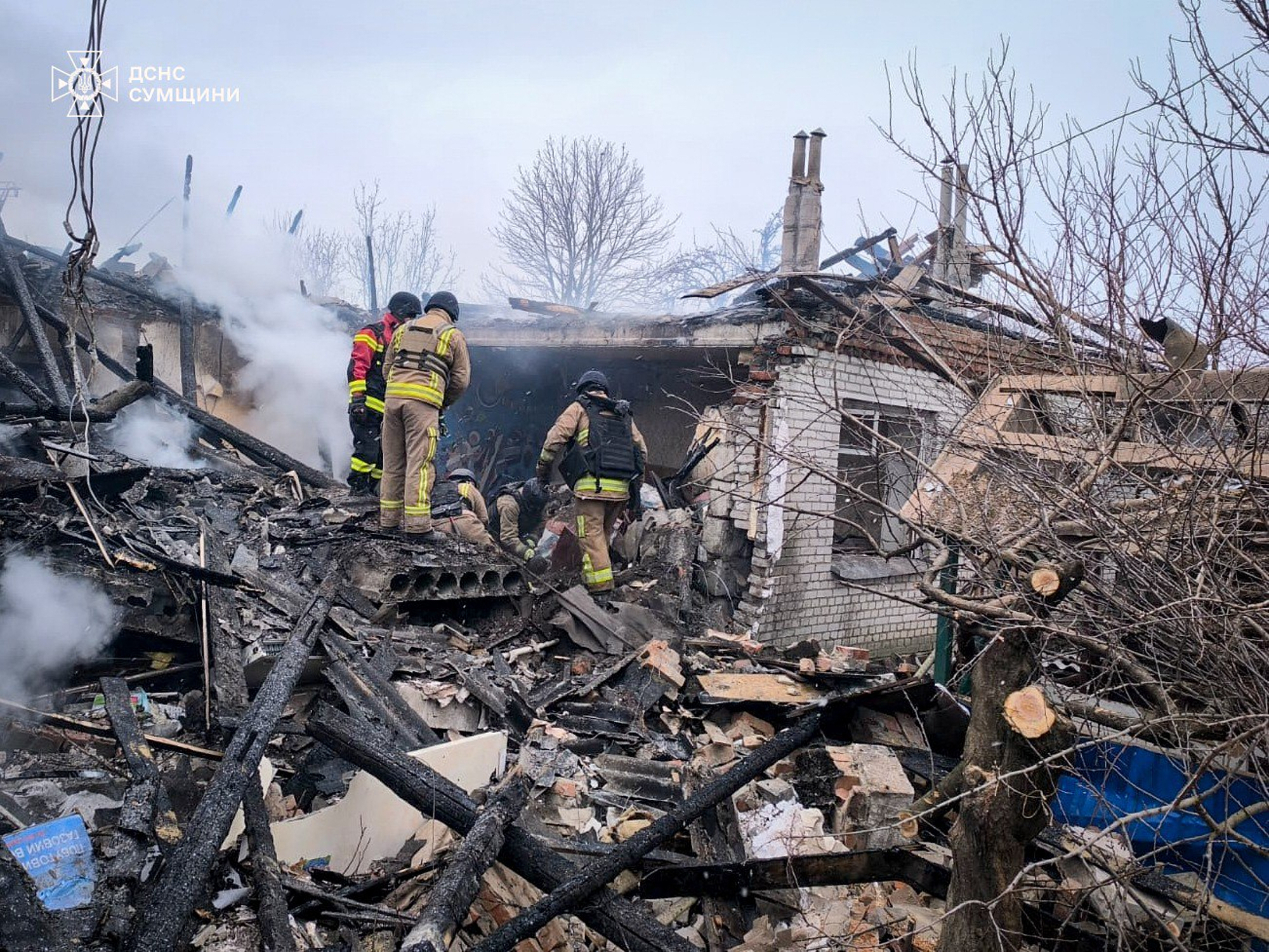
In this photo provided by the Ukrainian Emergency Service, firefighters put out the fire in private houses following a Russian air attack in Sumy region, Ukraine, Tuesday.
“Peace can only be built on real security guarantees,” Zelensky rightly insisted on stage, given that Putin has broken every previous accord Russia has made with independent Ukraine over the past three decades.
Since NATO membership is not on the table, Ukraine requires a legal commitment, not just verbal “assurances” that it will continue to receive European weapons and support for a strong army — along with expedited admission to the European Union. Kyiv also needs a firm U.S. commitment to back up European support before Ukraine makes any compromises on territory.
When I asked Ukrainian Foreign Minister Andrii Sybiha whether such security guarantees should include the presence of allied troops in Ukraine, he said sharply, “Boots on the ground are essential” in order to encourage investors in a postwar nation.
Yet, it is still unclear whether any European countries will agree to base military forces on Ukrainian soil, rather than just send “peace monitors.” Moreover, Russia rejects any security guarantees at all, and the White House still won’t spell out what kind of security backstop it will provide for the Europeans, and when.
Ukrainian President Volodymyr Zelensky (right) and German Defense Minister Boris Pistorius visit a drone-producing company, Quantum Frontline Industries, near Munich, on Feb. 13.
High-tech weapons
Ukraine will press forward with its efforts to promote joint weapons production with European — and American — firms to advance its amazing innovations in unmanned drone warfare. This tech savvy has enabled Kyiv to push back against Russia’s superior number of troops and increasing number of drones. But Kyiv badly needs more long range missiles (way past time for Germany’s Taurus and U.S. Tomahawks) and more air defenses to take out Russian missiles.
Representatives of Ukrainian and European military production companies swarmed the sidelines of the conference. Ukrainian officers from specialized drone units displayed their products’ prowess on video screens at side conferences organized by Ukrainian companies and think tanks.
The annual Munich Ukraine lunch sponsored by the Victor Pinchuk Foundation included attendees such as former Google CEO Eric Schmidt, whose Swift Beat company is working with Ukrainian partners to produce hundreds of thousands of AI-enabled long-range drones and drone interceptors that are the new weapons of modern war.
Schmidt expressed the opinion heard throughout the conference: When it comes to these weapons, Ukraine “will be the primary producer for all Europe.”
Workers clean up damage at Darnytsia Thermal Power Plant after a Russian attack in Kyiv, Ukraine, Wednesday, Feb. 4, 2026.
The will to go on
The Ukrainian public is demonstrating amazing fortitude, despite the Russian onslaught, and despite Trump’s refusal to support a tough new secondary sanctions package on Russia that a bipartisan Senate majority has had ready for months.
Zelensky paid tribute to the thousands of energy workers, repair crews, and rescue teams who have been working around the clock to restore heat and electricity each time Russia hits another power plant.
“Ukraine still has power because of our people,” he said with emotion. “Many politicians could learn how to act immediately … from ordinary electricians.”
The conference recognized ordinary Ukrainians’ heroism by awarding its annual Ewald von Kleist Award to the people of Ukraine for their “unwavering determination to defend their freedom and all of Europe.” The award is named after the Munich conference’s founder — who participated in the failed 1944 German plot to assassinate Adolf Hitler — and honors outstanding contributions to international peace and conflict resolution.
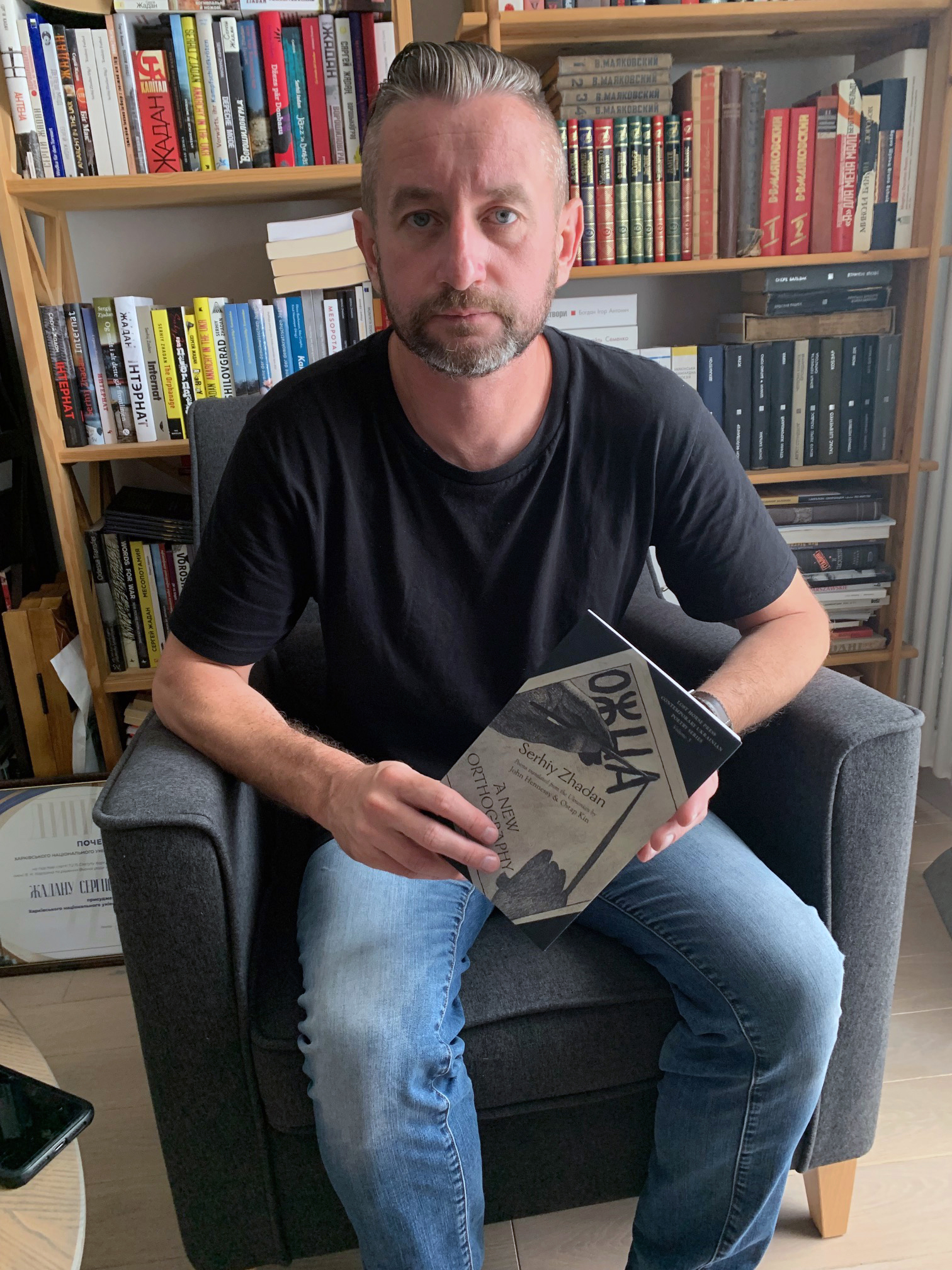
What sticks in my mind are the words of Ukraine’s premier poet, songwriter, and novelist Serhiy Zhadan, whose Kharkiv home I visited early in the war, and who spoke to a rapt audience at a Munich cultural center about his beloved city. Kharkiv’s citizens, he said, “reject the Russian goal to make them despair of life.”
“There is still a huge cultural life in Kharkiv,” he said, “and people refuse to let themselves be scared. At every cultural event, money is collected for kids and soldiers. But the whole society is tired. We want to go back to a normalcy where kids can return to school.”
The world’s double standards are painful, he continued, citing the ban by the International Olympic Committee on participation by a Ukrainian athlete because he wanted to memorialize his fellow athletes killed by Russia by putting their pictures on his helmet. “This is not a local war,” Zhadan insisted, “this war is about us all.”
Serhiy Zhadan sits inside his home in Kharkiv, Ukraine, in 2022.
“We try to cling to the moments we live in, and not to think of the future,” he explained, in speaking of survival strategies. “If you think of the future, you become vulnerable. If you focus on the need to survive, you might get through.” Yet, he added, “We will enter the future from [this] darkness. This is part of our Ukrainian history. We will marvel at how beautiful the world will be if we only manage to endure this little bit of darkness.”
Zelensky translated Zhadan’s poetry into hard reality when he reminded a main stage audience that “Putin hopes to repeat 1938, when a previous Putin [Hitler] began dividing Europe.”
As Zelensky reminds us, it was a historic tragedy for Britain’s Neville Chamberlain to acquiesce to Hitler’s demand to seize part of Czechoslovakia. Far from bringing “peace in our time” Chamberlain’s blindness brought on World War II.
It is an error of far greater magnitude for Trump to press Zelensky to cave to Putin’s demand that he be handed key Ukrainian territory Russia hasn’t been able to conquer. Unlike Hitler in 1938, Putin has already begun his wider military attack on Europe.
Such signs of Trumpian weakness only encourage further Putin aggression as well as Xi Jinping’s plans to subdue Taiwan.
The ultimate message of Munich this year was that Europe needs to step up, and the White House needs to wake up and stop denying the importance of Ukraine. The Russia-China-North Korea axis is already feeding off of Trump’s misunderstanding of Putin in order to undermine U.S. power.
“Our world of drones is your world of drones,” Zelensky offered. “Our ability to stop [Russian] sabotage is yours. Please pay attention to Ukraine. If this [attention] had happened before this war started, the war would never have begun.”
The first sign of an American awakening will emerge if GOP members of the large bipartisan congressional delegation at Munich finally blast past Trump’s objections and bring a tough new package of secondary sanctions on Russian energy exports to a floor vote — soon.
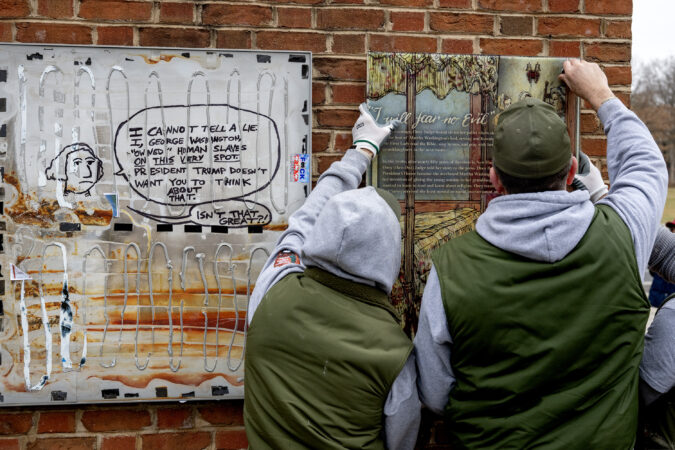
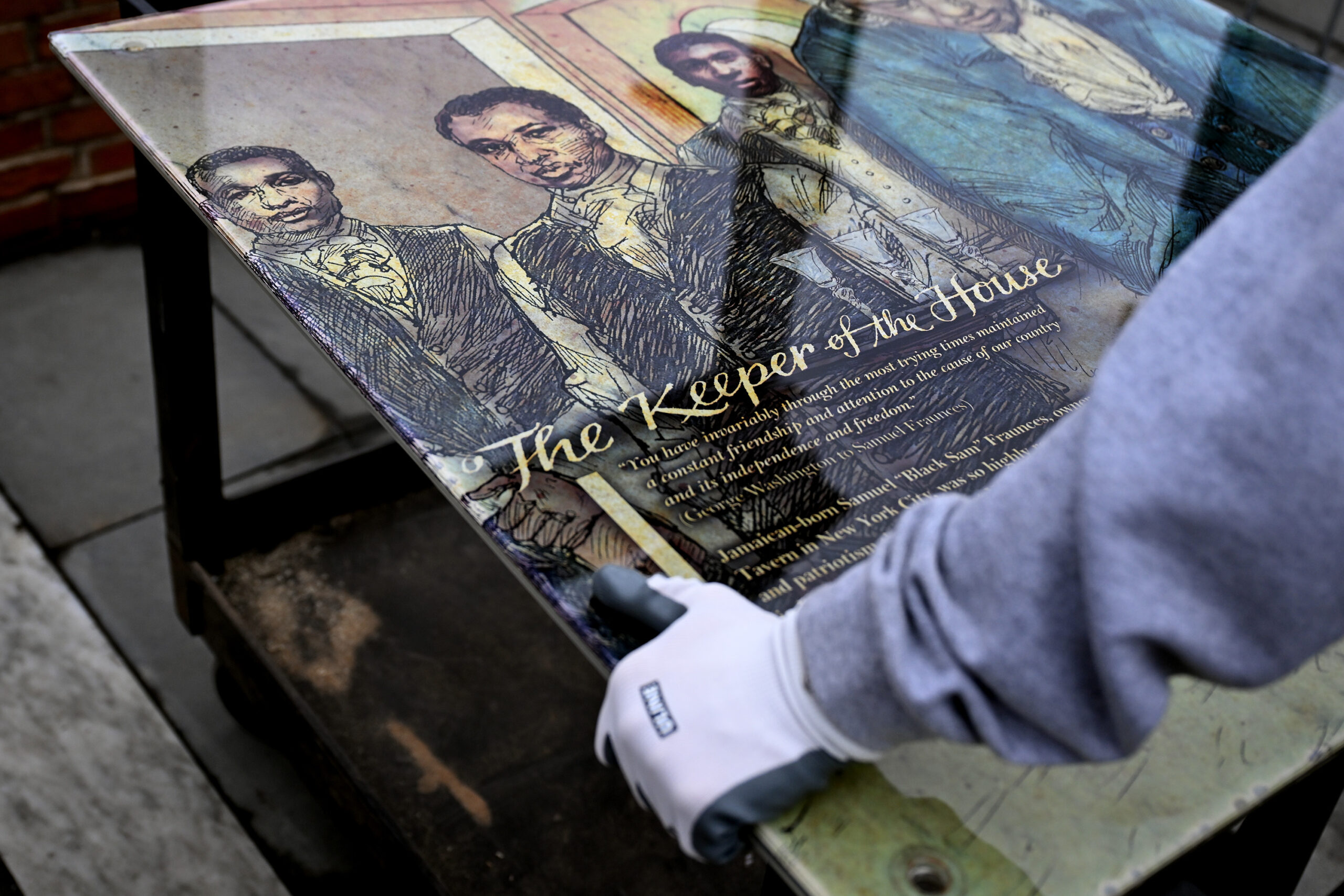
A worker carries one of the slavery-related exhibits, “The Keeper of the House,” before rehanging it at the President’s House in Independence National Historical Park on Thursday.
So yes, the federal government complied with the judge’s order, but only for the moment.
Like so many in Philadelphia, I have watched the fight for the President’s House unite people of all stripes. I’ve experienced the emotional victories and defeats.
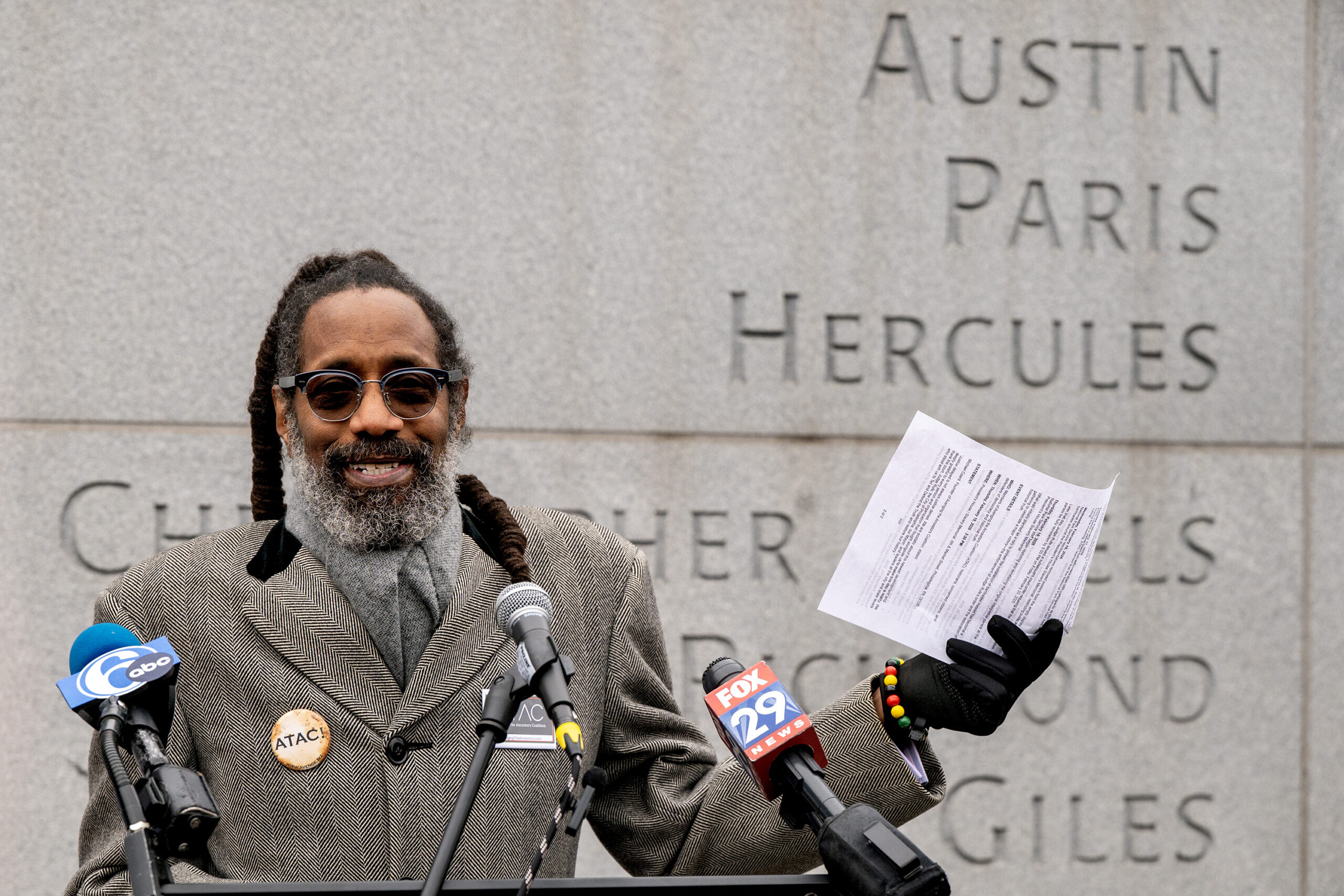
Attorney Michael Coard, leader of the Avenging the Ancestors Coalition, speaks during a rally at the President’s House in Independence National Historical Park on Thursday, after the return of some of the slavery exhibits the National Park Service removed last month. The names of nine enslaved people who lived and worked in the household of George Washington, engraved in stone behind him, were not among those removed by the NPS.
But even with the restoration of the panels, we are all left teetering on the razor-thin edge that separates celebration from grief, and elation from rage. We cannot stay there. We must continue to fight for the truth.
Here, in the place where the story of enslavement lived side by side with the struggle for freedom, we fight.
Here, in a place where a new generation of combatants joins a centuries-old battle for the truth, we fight.
More rallies will come, and in the shadow of Independence Hall, where wealthy white men declared their own freedom while withholding liberty from my ancestors, a new American Revolution will take shape from the same war of ideas Jackson fought. It will be based on the rhetoric of America’s founders.
If indeed all men are created equal, our history should be equally told. That idea cannot be contained by metal barriers. We’ll see if it can be enforced in the courts.
Still, truth is not about legalities or displays.
The truth of slavery in Philadelphia exists in the names of our neighborhoods, our streets, and even our schools. It exists in the very fabric of who we are.
The neighborhood of Logan is named for James Logan, who served as secretary to William Penn. He also enslaved people.
Chew Avenue is named for the Chew family, who lived in an estate called Cliveden, which is also the name of a street. The Chews enslaved people at Cliveden.
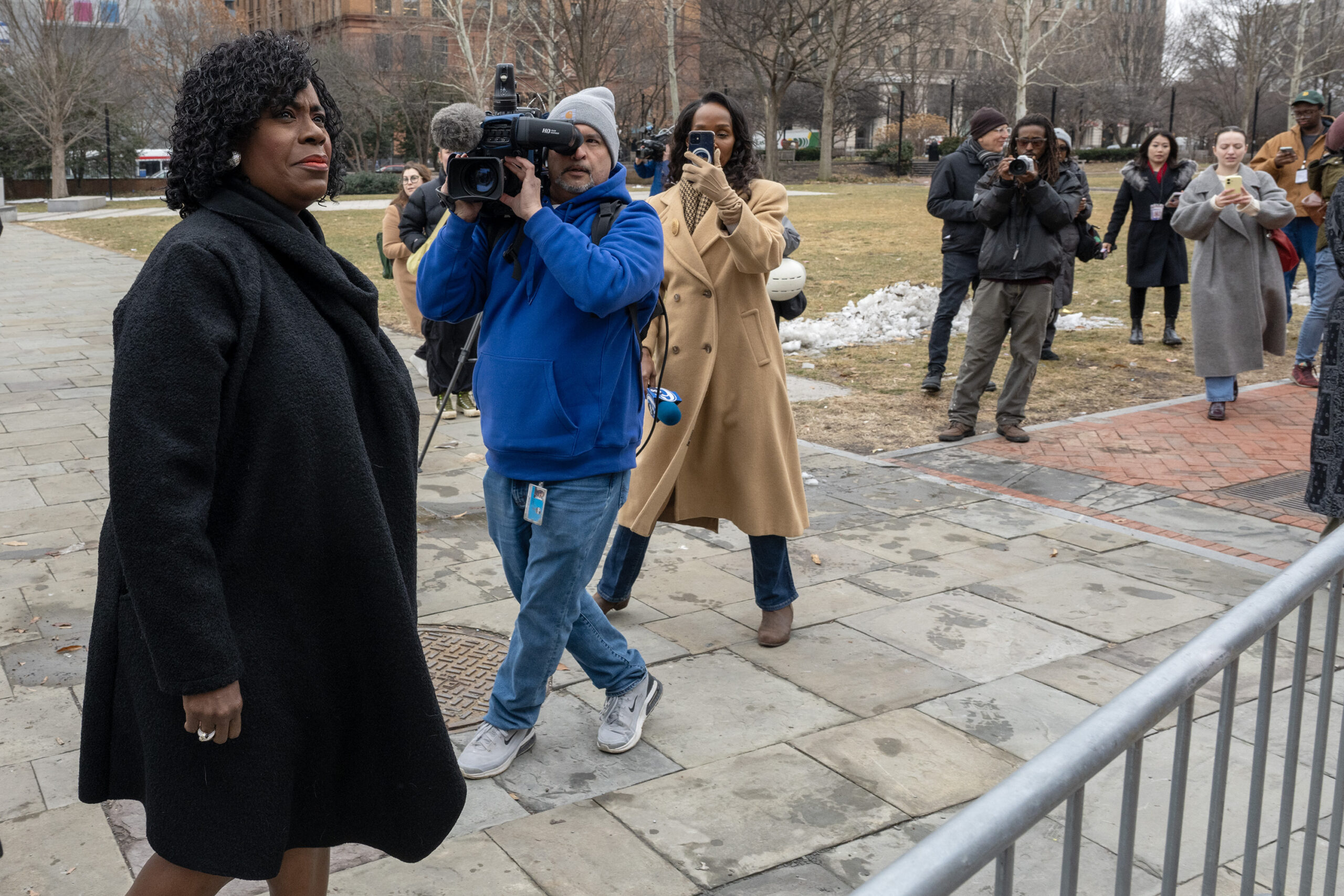
Mayor Cherelle L. Parker visits the President’s House as workers return the slavery exhibits at the site on Thursday. Parker thanked them, and one replied, “It’s our honor.”
Front and Market, home to the London Coffee House, once hosted a market of a different kind. People were sold there. It was a key element of the business of slavery.
Girard Avenue is named for Stephen Girard. He was a very rich man with a very complicated legacy, and yes, he was also an enslaver.
Perhaps that’s why I was so angry when I went to the President’s House in the days after the Trump administration pried truth from the walls.
It was almost like someone had taken something that belonged to me, and in truth, they did. They took my history, but as I stood in that barren space on a cold afternoon, it was as if my ancestors were all around me — like the great cloud of witnesses from Scripture — telling me all they had endured.
Perhaps the Trump administration will ultimately achieve its goal and remove the panels from the site. Or maybe the truth will prevail.
But our fight is about more than the nine people Washington enslaved. This is about all of us, and it will take all of us to win.
In the everyday chaos that characterizes President Donald Trump’s America, the news cycle changes faster than most of us can keep up with it.
But can we please pause for a moment and consider the gravity ofwhat happened to Nekima Levy Armstrong at the hands of the U.S. government? She led a group of activists who interrupted a worship service in Minnesota on Jan. 18. The demonstrators went to Cities Church in St. Paul to stage a protest in support of immigrant rights.
The choice of venue was very much intentional: One of the leaders at the church is an administrator at a local U.S. Immigration and Customs Enforcement office. Four days later, Levy Armstrong, a half dozen other protesters, and two journalists were arrested.
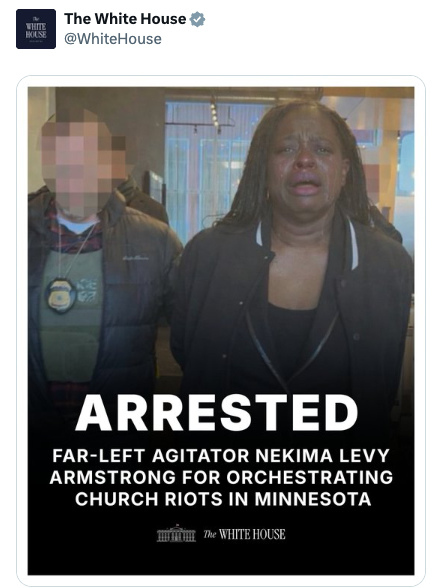
Afterward, while she was still in custody, Trump administration officials released an AI-manipulated image of her on X, the social media site formerly known as Twitter, on accounts for Homeland Security Secretary Kristi Noem and the White House.
The doctored image shows Levy Armstrong (no relation) with her mouth open as if she’s sobbing hysterically. Her face also appears to have been darkened. The photo caption reads: “ARRESTED far-left agitator Nekima Levy Armstrong for orchestrating church riots in Minnesota.”
It wasn’t a riot. Nor was she crying. But all that is beside the point. The Trump administration officials wanted to make her look bad, even if it meant reshaping reality to do so. What’s especially concerning is the dishonest way it went about it. According to photos and video of her arrest, Levy Armstrong maintained a mostly impassive expression on her face throughout the ordeal.
On Jan. 22, the White House posted an AI-altered image of Nikema Levy Armstrong on the White House’s official X feed. The altered image makes Levy Armstrong appear as crying, the original image shows no such emotion.
A lot of people might see the digitally altered image of her sobbing and assume that because it was posted on a verified social media channel from the highest levels of government, it is an accurate representation of what happened — when it’s anything but.
A New York Times analysis concluded that the photo had been manipulated — something the White House admits to doing, and is unrepentant about. The manipulated photo is a meme, according toWhite House spokesperson Kaelan Dorr, who doubled down on X, saying, in part: “Enforcement of the law will continue. The memes will continue.”
No one should be surprised at that reaction, considering how many questionable AI images Trump has shared. (And, although it wasn’t artificial intelligence, don’t get me started on his racist post about the Obamas earlier this month.)
He once posted an AI video of himself — with a crown on his head — flying a plane that dumps feces onto “No Kings” protesters. It was even more disturbing when he released a deepfake video of former President Barack Obama, who seems to live rent-free inside Trump’s head, being arrested in the Oval Office.
Imagine the uproar if another president had done such a thing. Many people have normalized this kind of corrosive behavior so much that Teflon Don usually gets off with a shrug. But those of us who care about accountability have to keep calling him out.
Dirty politics are one thing, but when Trump administration officials manipulated the photo of Levy Armstrong, a private citizen, it made my blood boil. It’s another reminder that there’s no bottom with Trump when it comes to how low he will go, and that’s really scary.
I recently had a chance to speak with Levy Armstrong, and can report that, despite the administration’s efforts, she is unbowed and unbroken.
She called the government’s use of the fake image “horrifying and deeply disturbing,” and insists “I was cool, calm, and collected” during the arrest.
“I guess because they didn’t see me broken, they needed to manufacture an image of me broken,” Levy Armstrong told me.
“This is not unlike what has happened historically to Black people with all of the Sambo imagery and the mammy imagery that’s out there, with exaggerated features and darkened skin,” she said. “That’s the same thing that I went through, and that’s what they did to me. Not to mention making me look hysterical.”
She added that “I felt caricaturized, just like our people have been during slavery and Jim Crow.”
While I had her on the phone, I also asked Levy Armstrong about the arrest of former CNN anchor Don Lemon, who covered the protest she organized.
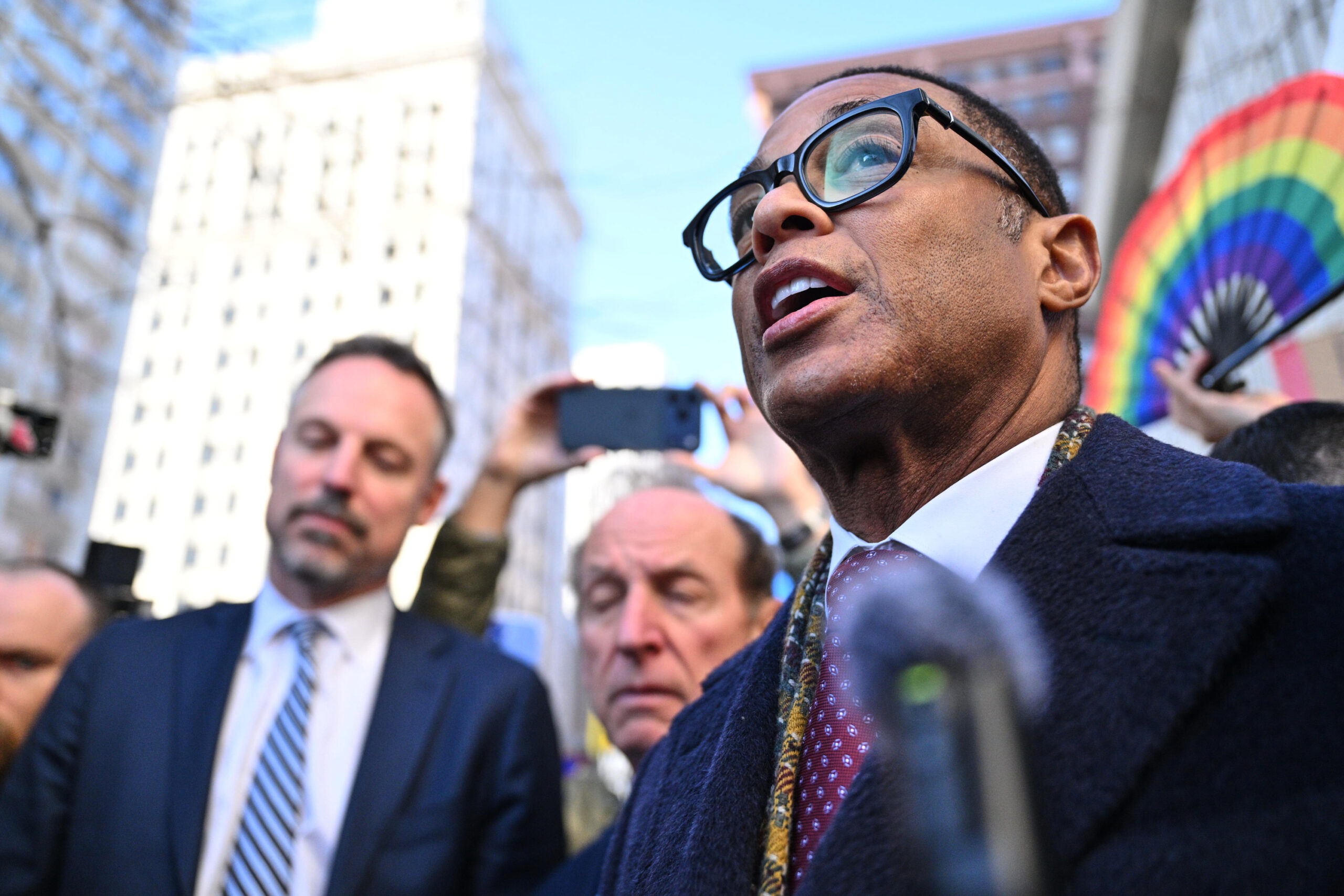
Journalist Don Lemon speaks to the media outside the U.S. District Courthouse in St. Paul, Minn., on Feb. 13.
Levy Armstrong disputes MAGA claims that Lemon was a participant in the demonstration, as opposed to being an observer. Levy Armstrong told me, “I just think it’s foolishness that they would try to rope him in as a protest organizer.”
“He’s not an activist. He’s not an organizer,” she pointed out. “He’s not a protester whatsoever.”
The former law professor said that referring to Lemon as an organizer was an excuse to attack him, as well as Georgia Fort, an Emmy Award-winning independent Black journalist based in Minnesota, who also faces federal charges after covering the protest.
Minnesota-based independent journalist Georgia Fort speaks to reporters and supporters outside the federal courthouse in St. Paul, Minn., on Feb. 17, after pleading not guilty over her alleged role in a protest that disrupted a Sunday service at a Southern Baptist church in St. Paul.
I’ve covered many protests throughout my journalism career, and find what happened particularly upsetting. Republicans talk a good game about upholding the Constitution, but the arrests were clearly an attempt to keep journalists from exercising their First Amendment right to freedom of the press.
Meanwhile, no arrests have been made in the fatal shootings by Border Patrol and ICE, respectively, last month of Alex Pretti, an intensive care nurse, or Renee Good, a mother of three.
But Levy Armstrong has been charged for her role in a disruptive but peaceful protest inside a church during which no one was physically harmed. (And, yes, although they are rare, demonstrations in churches happen. During the civil rights movement, demonstrators would hold “kneel-ins” to protest segregated churches in the Jim Crow South.)
An ordained minister, Levy Armstrong told me she draws strength from such icons of the civil rights movementas Fannie Lou Hamer, Rosa Parks, and the Rev. Dr. Martin Luther King Jr., all of whom had suffered the indignity of being arrested while fighting for their basic human rights.
“Everybody needs to wake up,” she said. “This is not just about immigration. This is about our constitutional rights. This is about our democracy. This is about our freedoms.”
Freedoms we stand to lose if we allow the Trump administration to try and silence us the way it has attempted to do with Lemon, Fort, and Levy Armstrong, among so many others.
Levy Armstrong has nothing but praise for Philadelphia District Attorney Larry Krasner, who is vocal about prosecuting ICE agents who run afoul of the law. Her suggestion for concerned Philadelphians? “Get some whistles,” she said. “Get some people organized. Hold your elected leaders accountable.”
As I write this column, that’s Philadelphia’s total number of homicides for the year so far. It is a 50% decrease from this time in 2025, and a stunning 79% drop from the pandemic-era spike in violence. While it is much too early to make projections, and snowy and freezing weather the last few weeks undoubtedly played a role in keeping people indoors, the decline is genuinely remarkable. Especially when it is accompanied by a similar decline in shooting victims, and double-digit declines in overall violent and property crimes.
In fact, on a per-capita basis, Philadelphia’s homicide rate is currently not that different from Bucks County’s.
Given the city just notched its safest year since the 1960s, this progress is exciting. So far, no one has an explanation for why homicide is declining. It may simply be a national trend back to normalcy. If so, it is time to extend it to more parts of life.
Killings may be down, but homelessness is rising. SEPTA’s Metro system is still overrun with smokers. And the melting snow has revealed that much of the city is covered in too much everyday grime.
A Sharon Hill trolley — now known as the D2 — on a low-speed section of track near the 69th Street Transportation Center in Upper Darby. The route, along with its counterpart, the D1, or Media trolley, will have longer trips next week after a safety upgrade to the signal system.
15
That’s how many additional minutes trolley trips to Media could take after implementing something called “communications-based train control” at a cost of $75 million. This system takes away discretion from operators, resulting in slower acceleration, longer braking periods, and slower overall speeds. SEPTA says a similar installation on its Regional Rail system also led to initial delays, but those challenges were overcome in time.
There’s a better solution. SEPTA should restore the gate system that was removed back in 2009. This would eliminate many of the needed slowdowns.
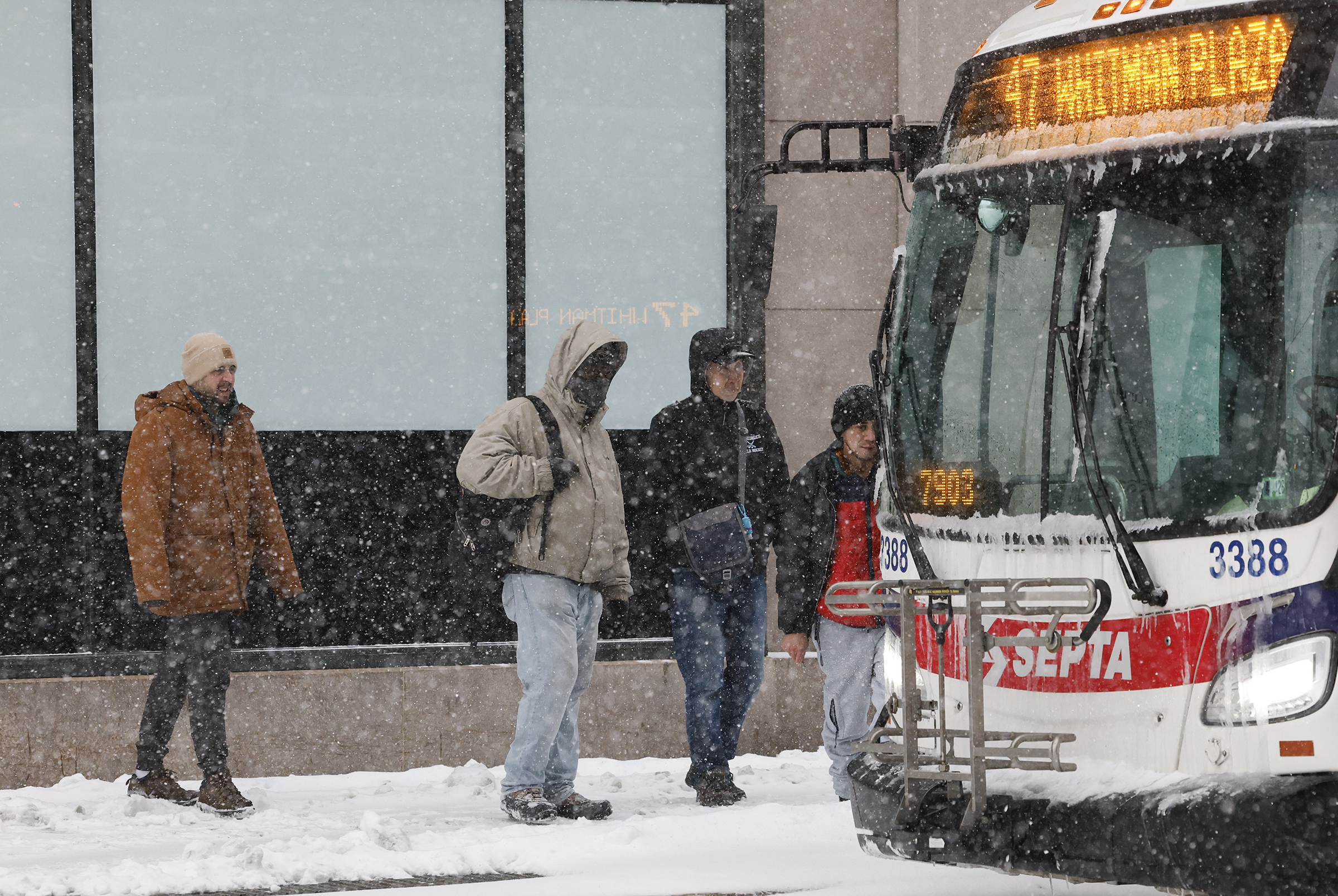
SEPTA riders board the Route 47 bus at Eighth and Market Streets in January.
714,475
That’s how many daily rides SEPTA provided on average last month, an increase of 1% over 2025. Given the struggles the agency went through last year, the fact that ridership continues to grow is remarkable.
In August, SEPTA scaled back overall service by 20%, before reversing the cuts weeks later under court order — and after a gubernatorial funds transfer. State Senate Majority Leader Joe Pittman essentially called the agency (and our entire region) a bunch of greedy moochers and blocked a plan for sustainable support.
The Regional Rail network was severely curtailed for months because of aging, exploding train cars. The Center City trolley tunnel was closed for weeks because of maintenance issues. In January, a brutal winter storm made getting to — and on — the bus a struggle. And yet, ridership grew.
In fact, since the pandemic, SEPTA has routinely been one of America’s strongest transit agencies when it comes to ridership growth. Given there have been zero additional dollars invested in operations for years, the system’s resilience may prove that Philadelphians need mass transit so badly that they’re willing to keep riding through the chaos.
From left, Joaquin Duato, J&J chairman and CEO, is with Gov. Josh Shapiro and Pennsylvania Department of Community and Economic Development Secretary Rick Siger on Wednesday after Johnson & Johnson announced it will spend $1 billion on a cell therapy plant on its campus in Lower Gwynedd Township.
5.5
That’s how much investment, in billions of dollars from pharmaceutical companies, is coming to Eastern Pennsylvania, according to Gov. Josh Shapiro. While this is great news for the Keystone State, it’s hard to avoid noticing that none of these investments are coming to Philadelphia itself. Neither is Merck’s $1 billion new biotech center, which is being built in Delaware. Given our city’s status as a hub for eds and meds — with multiple colleges and medical schools, and a high concentration of skilled workers — this is disappointing.
Illinois Gov. JB Pritzker speaks during a news conference in Chicago in 2025.
150
That figure, also in billions of dollars, is how much economic growth Pennsylvania needs in order to bridge the deficit without raising taxes or cutting services, according to an analysis by Athan Koutsiouroumbas, managing director of the Harrisburg-based lobbying and consulting firm Long Nyquist.
The easiest way to accomplish this is by being bolder on housing policy. As Shapiro has pointed out, Pennsylvania is currently 44th in the nation when it comes to new housing production. Unfortunately, current plans aren’t bold enough to meet the moment. They lack the significant forays into statewide zoning standards that have been embraced by figures like Illinois Gov. JB Pritzker. Shapiro likes to say he’s tired of losing to “frigging Ohio,” but without a more audacious approach to housing policy, he may have to add “frigging Illinois” to the list of states eating our lunch.
Philadelphia’s economy grew faster than Atlanta, Dallas, Denver, and Phoenix.
13.6
If we’re being optimistic, let’s call it almost 14%. That’s how much job growth Philadelphia has experienced since 2020. That’s better than the 11.7% average for the nation’s 25 most populous counties. It is better than the collar counties, and puts Philadelphia ahead of Montgomery County in office employment for the first time in decades.
Still, economist Mark Zandiurges caution. In the pages of The Inquirer, he points out that much of this has to do with the fact that the national economy is struggling. Given the city has lagged on growth for decades, even incremental steps forward may look more significant here than elsewhere.
There’s also the fact that much of this growth is in relatively low-paid work, rather than the high-wage “tradeable industries” the city needs to escape decades of economic stagnation.
Simply put, while working as a home health aide and working in a drone factory both put food on the table, only the latter helps make the regional economy healthier.
Like every other beleaguered top editor in a big-city newsroom these days, Chris Quinn — who leads Cleveland.com and the print Plain Dealer — has to deal with assaults from all sides.
In March 2024, Quinn briefly became a darling of the online left (not easy for a journalist to pull off these days) with a bold manifesto for how Cleveland.com would deal with one of those many threats: An authoritarian president who despises a free press.
“We tell the truth, even when it offends some of the people who pay us for information,” Quinn wrote that fateful spring in his “Letter From the Editor” column. “The truth is that Donald Trump undermined faith in our elections in his false bid to retain the presidency. He sparked an insurrection intended to overthrow our government and keep himself in power. No president in our history has done worse.”
Less than two years later, Quinn has gone viral again. But this time, instead of resisting a powerful force aiming to upend American life as we’ve known it, he’s embracing one: The power of artificial intelligence to transform the workplace … and just about everything else.
Quinn has said that steep job cuts (more on those later) have left just a skeleton crew covering Cleveland’s far-flung exurban counties, and using an AI tool to write stories based on the downsized staff’s reporting will result in more articles about these potential news deserts. When an anonymous college journalism student withdrew her application to Cleveland.com because she said she couldn’t work in a newsroom using AI to perform what was once a human task, the editor went off in his column.
“Journalism programs are decades behind,” wrote Quinn in arguing that technology is rendering such degrees as worthless. “Many graduating students have unrealistic expectations. They imagine themselves as long-form magazine storytellers, chasing a romanticized version of journalism that largely never existed.”
Seriously, how dare those young whippersnappers dream of creating beauty in their lives, instead of welcoming their new robot overlords and embracing their future as a cog in a faceless news machine?
But the dilemma facing Cleveland, Quinn, and the Unknown Job Applicant is the crisis that’s been thrust in the face of all Americans as the brutal winter of 2026 slowly melts into spring, and, it seems, a reality we’re truly not ready to confront — not practically, nor politically, nor morally.
People forget, but there was a brief moment in the mid-to-late 1990s when the internet was dismissed as a fad — clunky to use (remember dial-up?) and its abilities overhyped by Silicon Valley. But the internet radically changed how we live, as did thearrival of smartphones in the 2000s — not always for good. Yet, these seem like the warm-up acts for the life-altering conniptions caused by omnipresent AI.
Suddenly, there’s been a flood of essays trying to warn us that whatever one initially thought about programs like ChatGPT — and, yes, AI is still prone to “hallucinations” and other embarrassing errors — we need to adjust to the news that a new generation of AI tools is much more powerful, and better poised to replace many jobs.
“I am no longer needed for the actual technical work of my job,” an AI executive named Matt Shumer wrote in the most viral of these hot takes, titled “Something Big Is Happening.”
Experiments conducted with the A.I. system Claude are producing fascinating results—and raising questions about the nature of selfhood. Gideon Lewis-Kraus reports from inside the company that designed it, Anthropic. https://t.co/1liZNcoGoI
In describing how new AI programs rolled out by Anthropic, maker of Claude, and ChatGPT’s parent OpenAI can now perform complex coding tasks from the most simple instructions, Shumer warned the earthquake is coming to “[l]aw, finance, medicine, accounting, consulting, writing, design, analysis, customer service. Not in ten years. The people building these systems say one to five years. Some say less.”
This jibes with dire predictions from Anthropic’s CEO Dario Amodei, who has warned repeatedly of “painful” white-collar job losses caused by AI, and said in his most recent long-form essay that the new technologies are “acting as a ‘general labor substitute for humans.’”
I don’t have space here to go deep on the technology, but everyone should take a moment to learn what “vibe coding” and “agentic AI” are, and read the New Yorker on the rise of Anthropic’s Claude, or listen to a really good podcast explanation of AI and the labor market from the New York Times’ Kevin Roose. But we’re already overdue in addressing what this all means for everyday human existence.
The idea that eventually “everything you think, do, and say is in the pill you took today” — as Zager and Evans sang so presciently in their 1969 No. 1 smash, “In the Year 2525” — has been with us for decades. But there was also a sense that robots performing the worst drudgery of the workplace might be liberating, creating more leisure time and space for human creativity.
So far, that’s not what’s happening. Avoiding the poverty and deprivation that would be caused by massive job losses would require a government willing to pay people a universal basic income (UBI), but the current government has instead been dismantling the existing welfare state. And the workers creating AI are sleeping in their cubicles.
And creativity may become a fever dream, not just for that naive journalism student with her “romanticized” visions of telling stories. Did you read the Times profile of the romance novelist who’s relying on Claude to crank out new tomes in as little as 45 minutes? Did you watch the lifelike short movie of an AI-generated “Brad Pitt” fighting “Tom Cruise”?
Let me get this straight. AI is taking our jobs and ending artistic struggle to liberate us … for what, exactly?
I haven’t even discussed the other really bad things about AI, including the drain on electricity from massive data centers likely to unleash yet another form of tyranny, unbridled climate change, and the death of critical thinking as reliance on AI decimates the classroom. At a moment when we’re just coming to terms with the downside of smartphones — such as higher rates of anxiety and depression among teenagers — could we learn to avoid similar mistakes with AI before they start?
Dealing with all this would take political will. Yet, leaders in both parties — Trump, for sure, but also top Democrats like Josh Shapiro and Gavin Newsom — have embraced the data center and AI ambitions of their donor class, even though the majority of their voters want strict regulation. A pro-AI super-PAC raised $125 million last year to buy the midterm elections. Who is fighting for the about-to-be-starving artists?
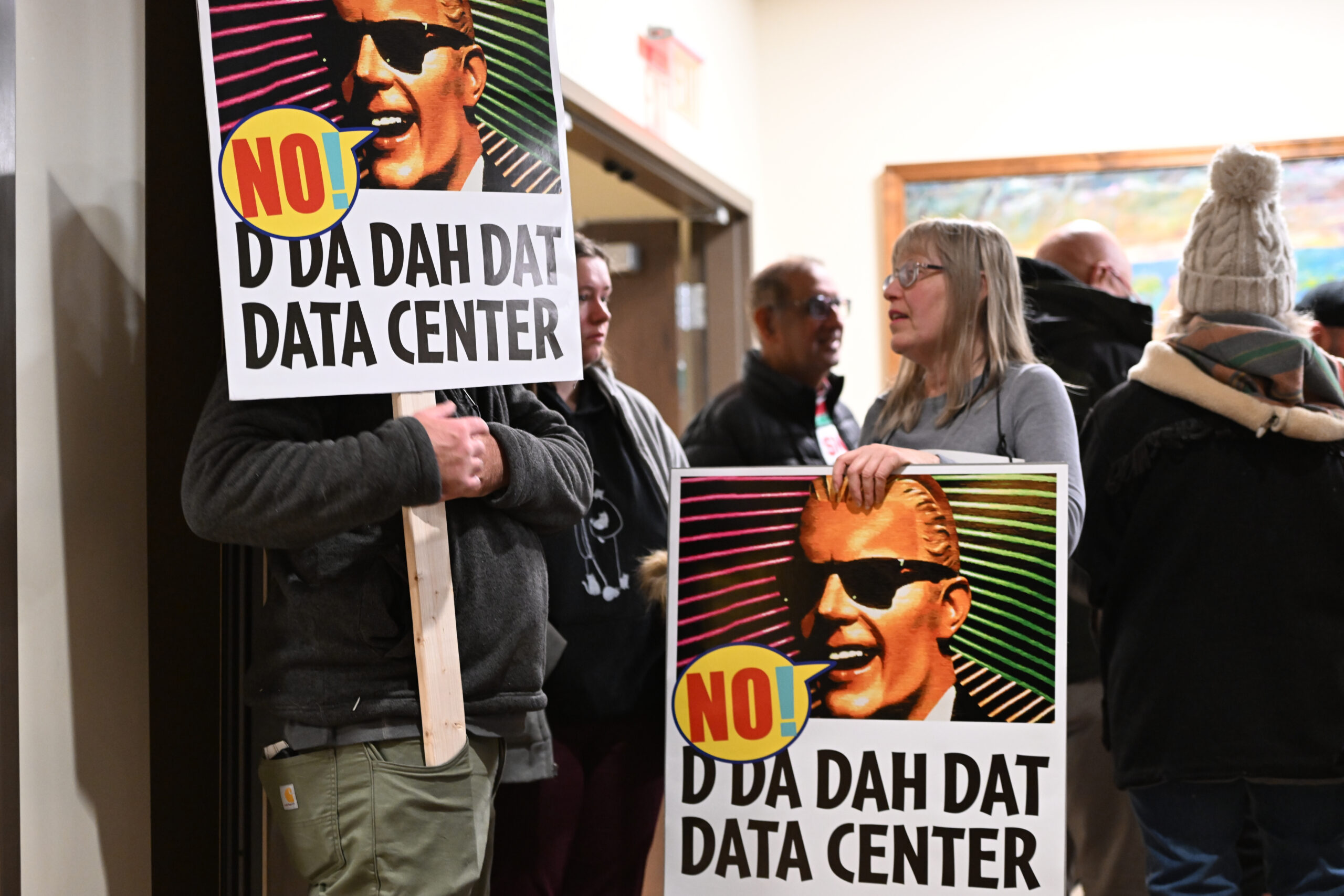
People opposed to a data center proposal at the former Pennhurst state hospital grounds talk during a break in an East Vincent Township supervisors meeting in December in Spring City, Pa.
It doesn’t have to be like this. The same better-late-than-never push to remove smartphones from classrooms can be used as a model for eradicating AI in K-12 schools as well as college, to give the next generation at least a fighting chance to learn to think for itself. The politicians don’t have to allow data centers that burn fossil fuels instead of clean energy and consume the lion’s share of water available to the communities where they’re located.
Nor do we need to embrace the late-stage capitalist ethos that if shareholders make more money employing robots than human beings, some invisible law forces us to do this. Remember Chris Quinn back in Cleveland? The reason he feels he needs AI to write up the news is because, back in 2019, he oversaw the layoff of one-third of his unionized newsroom, at the behest of the paper’s corporate parent.
Maybe robots are now “agentic,” but humans have always had agency. Here’s the perfect chance to use it: by encouraging the uses of AI that will be good for society — diagnosing sick patients and inventing medicines to cure them, for example — but regulating or banning the aspects of AI that will make life worse.
That’s partly up to the politicians, but it’s also up to us. Societal trends like the outbreak of “neighborism” — strangers forming new community bonds to beat back the fascism of immigration raids — or a rise in union membership are healthy signs that Americans are finally getting tired of technology driving us apart.
The fight against the authoritarianism of unchecked and often unwanted AI is the battle of the 21st century that will be waged long after the fight against political authoritarianism in Trump’s United States and elsewhere has been won.
Price: $38,809 as tested. Black dual exhaust added $1,700; Performance Package, $1,500; fancy paint, $475; floor mats, $299.
What others are saying: “Highs: Genuinely rewarding to drive, one of the last manuals available, remarkably affordable. Lows: Noisy cabin on the interstate, we dare you to sit in the back, unexciting exhaust note,” says Car and Driver.
What Toyota is saying: “Level up your drive.”
Reality: Even funner, ‘til you get on the highway.
What’s new: The GR86 gets a new Yuzu Edition for 2026, with yellow paint and black seats. Otherwise it’s pretty much as before, since its redesign in 2022.
Up to speed: The 2.4-liter four-cylinder engine makes 228 horsepower and gets the little sports car to 60 mph in 5.4 seconds, says Car and Driver, and I believe it. I’d think it’s a little faster, but we’ll stick with the facts.
It’s truly a sporty car to drive. It’s fine for passing on Interstate highways and such but it’s really at home on the back roads, racing up hills and back down again.
Shifty: You can get a GR86 with a stick, but Mr. Driver’s Seat didn’t. The six-speed automatic transmission is a nice facsimile, with Park up in the right corner so it looks like it COULD be a stick. I actually spent a couple seconds looking for a clutch until I realized there wasn’t one.
The shifter then snakes through Reverse and Neutral to get to Drive, another bit of stick-shift cosplay.
The manual setting works nicely, and really makes the little car even that much more fun. Use the lever to augment the engine’s power for any country road antics and you’ll feel nicely rewarded.
On the road: Did someone say fun? The rear-drive GR86 has plenty of it, snaking through turns and sliding around corners even at fairly low speeds, so you can feel like it’s a blast even when not going much beyond 40 or 45 mph — although faster is funner.
Less fun is the time spent on the highway; I found myself getting a bit of a headache during half-hour trips on Route 202 between King of Prussia and West Chester.
Off the road, the GR86 is great companion for tight parking lots, thanks to a turning radius of 35 feet and change.
The interior of the Toyota GR86 is snug and retro fun, unless you’re sat in the back. Then it’s snug, retro, and not at all fun.
Driver’s seat: The cloth seats offer great support and are comfortable enough. They feel firm and a little crowded, so some people might not appreciate the big wings. The Lovely Mrs. Passenger Seat found them as nice as I did.
The manual controls adjust height, fore-aft, and backrest simply.
The gauges and steering wheel controls are old-fashioned, looking like last-gen Lexus dials, but I call old-fashioned a good thing these days.
Friends and stuff: There’s a rear seat but it’s pretty cruel. Guests would have been harmed in the making of this review.
I finally build up the nerve to try it out on Day 6. The ceiling is so low that I had to cant my head to the side. Foot room and legroom look impossible, but I could actually get my legs in there by setting the front seat a few notches up from normal. But when I did that and tried out the front, my legs were more cramped than on a Frontier flight.
I would say only put kids in the back. Or maybe kid, singular.
Cargo space is 6.26 cubic feet. (I didn’t round it because you’ll need every .01 cube.) The seat folds (all in one complicated-to-open piece) to create more luggage space.
In and out: In and ouch. It’s way down there and requires a bit of undignified squatting, twisting, ducking, and scooching.
Play some tunes: Sad. Tinny. Sound gets a C grade, probably one of the lowest I’ve ever assigned.
Last-gen controls. You definitely won’t be distracted playing around with the touchscreen, though there is one, because it’s 2026 and I think it’s law now or something.
Keeping warm and cool: The heater controls feature dials for temperature and fan speed and buttons inside the dials for blower choice. It’s such a small car that it runs hot; the seat heaters offer nice support when it’s not too cold out, but the switches are awkwardly built into the armrest.
Fuel economy: I averaged about 26 mpg in spirited drives around Chester County’s old country roads every chance I could get. I would actually park and wait for certain roads to clear and then go make the most of the exhaust note. I guess the dual exhausts are worth $1,700.
Where it’s built: Ota, Gunma, Japan
How it’s built: Consumer Reports predicts the GR86 reliability is a 4 out of 5.
In the end: Definitely lots of joy to be had here, and I could get behind buying a GR86. But with the Mini Cooper and Volkswagen GTI, you get fun and some practicality as well, plus the delight doesn’t diminish at highway speeds.
I like to visit Tucson, Ariz., this time of year to get away from the cold. Winters are mild, and it hardly ever rains in the Sonoran desert there, averaging roughly 300 days of sunshine.
But when I was there last week, it felt as if a dark cloud were hovering. I kept being reminded about the disappearance of Nancy Guthrie, the mother of NBC’s Today show cohost Savannah Guthrie, who is a longtime resident. I checked for updates multiple times a day. Then, one overcast and rainy afternoon, I grabbed a notebook and went to Nancy’s home in the Catalina Foothills.
TV is a medium that creates false intimacy, making it feel as if we actually know the on-screen performers. I’ve watched Savannah Guthrie coanchor the Today show for years, but I have never met her. When I learned her mother had gone missing, my blood ran as cold as if she had been a closefriend.
I wondered if her family was targeted because of her work as a high-profile journalist. A Today show segment featuring Guthrie giving a tour of her hometown aired in November. It includes footage of the host’s mother and sister sipping tequila from teacups at a popular Mexican restaurant.
This image provided by the Pima County Sheriff’s Department shows a missing person alert for Nancy Guthrie.
The day I showed up outside the Guthrie residence, there were no law enforcement officials to interview about the status of the investigation. A lone sheriff’s vehicle was parked in the driveway, near Nancy’s front door, where a masked gunman had been caught on doorbell camera footage around the time investigators say she’s believed to have disappeared on Feb. 1. Blood splatters have been found outside.
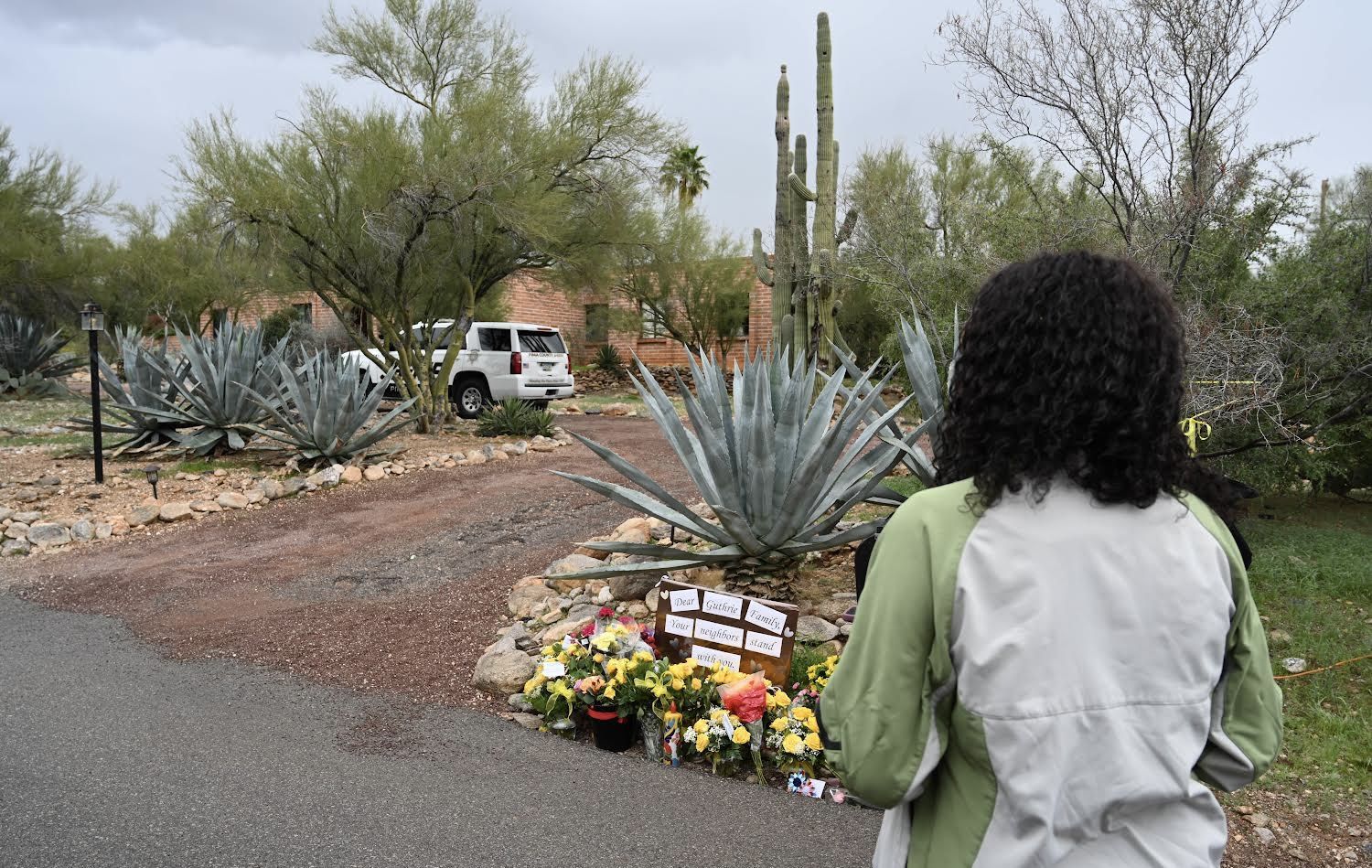
A handful of spiky agave plants flanked a red gravel driveway. People haddropped off yellowroses, potted plants,and other offerings at a makeshift memorial out front. A sign reads, “Dear Guthrie Family, your neighbors stand with you.” Saguaro cacti tower over the scene.
Meanwhile, reporters and social media influencers milled about on the street, waiting for answers that never came.
If this had been a targeted kidnapping, Guthrie had said on video, “We will pay.” Why hasn’t Nancy been released? And is she even still alive?
Inquirer columnist Jenice Armstrong stands next to the Tucson, Ariz., memorial honoring Nancy Guthrie — the mother of the NBC “Today” show cohost Savannah Guthrie — who went missing Feb. 1.
Two things can be true simultaneously: As much as I felt my heart ache for the Guthrie family, I also spared a thought for other families who are waiting for their missing loved ones to come home, too.
I also couldn’t help but think that ifNancy Guthrie weren’t related to a celebrity, or if shewere a person of color, it’s doubtful we’d even know her name, much less that she was missing.
It’s also unlikely President Donald Trump would have bothered to offer his condolences and as many resources as he has, posting on Truth Social, “ALL Federal Law Enforcement to be at the family’s, and Local Law Enforcement’s, complete disposal, IMMEDIATELY.”
Meanwhile, there are so many other missing people whose cases could benefit from just a fraction of the attention Nancy’s case has attracted.
An estimated 2,300 children are reported missing every day in America. The National Missing and Unidentified Persons Systems database currently lists 134 people — ranging from infantsto 85 years old — missing in Philadelphia County alone. U.S. Immigration and Customs Enforcement also snatches up countless undocumented immigrants whose loved ones frequently know only that they’ve suddenly gone missing.
Roz Pichardo, who runs the Missing in Philly page on Facebook, pointed out that when local people disappear, it often escapes the notice of the media or public officials. “No one is hardly looking at that page other than families who are searching for someone,” she told me.
Natalie Wilson, cofounder of the Black and Missing Foundation, agreed that not enough is done to find those who have disappeared. “Your observation about the media cycle is exactly why we stay so focused on our mission.”
None of this takes away from the Guthrie family’s nightmare. But their situation can help us understand how familiar the horror and accompanying heartache might be for people standing in line or sitting on the bus next to us.
What resources should we allocate locally to help those who are experiencing something similar to what the Guthrie family is going through? What ways can we make sure others who have disappeared get more attention and a share of our concern, as well?
My prayer is that any family with a missing loved one finds peace, including the Guthries. I hope my friend-in-my-head Savannah will wake up from this bad dream soon — and that Nancy will be safely returned to her beloved home in the Sonoran desert with her agave plants, cacti, spiny ocotillo, and some fresh yellow roses.