Category: Columnists

  • Death to prediction markets profiting on war | Will Bunch Newsletter

    Iranian schoolgirls, U.S. troops, Israeli villagers, random Emiratis, Pakistani rioters, and maybe a couple of folks in a bar in Texas. The deadly fallout from Donald Trump’s war of choice in Iran has spread halfway around the globe and back again. With each passing hour, it feels like more of the entire world is sucked into this war. If only there were a name for something like that.

    If someone forwarded you this email, sign up for free here.

    Why are Americans allowed to place bets on death and destruction?

    An advertisement by the American company Polymarket shows Zohran Mamdani and Andrew Cuomo ahead of the New York City mayoral election on Nov. 4, 2025, in New York.

    Donald Trump’s splendid and not-so-little war that started during a Saturday rush hour in Tehran and has spread like a coronavirus to numerous other countries is entering its fourth day on Tuesday — far too early for one of journalism’s oldest clichés: the “winners and losers” piece.

    Except for these winners: a few “lucky” — if that word can even apply to such a ghoulish enterprise — gamblers who woke up Saturday morning and learned that the first deadly explosions across Iran had already made them a lot richer, regardless of who wins or loses on the battlefield.

    The initial weekend of war wasn’t even over before we learned that Polymarket, one of the two leading prediction markets that are the inevitable next downward spiral of our national sports gambling addiction, was hit by suspicious trading by six individuals who showed up to bet big on when the war would commence.

    One trader up for particular attention earned a reported $553,000 over the weekend by placing large bets on when Iran’s supreme leader, Ayatollah Ali Khamenei — killed in the war’s initial minutes, reportedly — would be deposed. The handle on that well-timed, if macabre, gambler? “magamyman.”

    My man, you aren’t even trying to hide it.

    Polymarket’s brush with possible insider trading on predictive bets over the Iran war that is now a reality came as its customers bet a stunning half a billion dollars on the long-rumored conflict.

    Many of them, presumably, are just regular schlubs desperate to get ahead in a dog-eat-dog economy. But it’s also hard not to contemplate that some may have had real advance knowledge of Pentagon war planning that loose-lipped insiders were audibly discussing in Joe’s Stone Crab just hours before the first cruise missile was fired.

    I know … it’s shocking that something in America’s death spiral of late-stage capitalism is actually a rigged game, right? Still, it’s hard to decide which is worse about this new low of predictive betting on a war that’s already killed scores of innocent schoolgirls and hospital patients, and at least six U.S. service members: the rank immorality of wagering on death and destruction, or the insider trading that corrupts this already unholy process even further?

    Over the weekend, even with the main focus on the latest missile attacks and changing Trump regime explanations for this undeclared war, there was growing outrage over the popularity of predictive betting on the news, especially when the news is deadly. Or, there’s the word the chief U.S. government official tasked with regulating Polymarket, Kalshi, or their rival firms has used to describe what’s happening.

    Exciting.”

    Michael Selig, the lawyer tapped by Trump last year to head the U.S. Commodity Futures Trading Commission (CFTC), which — controversially — regulates these prediction markets, seems less a regulator and more of a cheerleader, maybe as much as “magamyman.” As several states have pushed to regulate or ban predictive markets as akin to sports betting sites, also under its purview, Selig has worked hard to override them with a claim of federal supremacy.

    “The CFTC will no longer sit idly by while overzealous state governments undermine the agency’s exclusive jurisdiction over these markets by seeking to establish statewide prohibitions on these exciting products,” Selig wrote in a Wall Street Journal op-ed.

    It’s worth noting Selig’s moves came at the same time that six Democratic senators wrote the CFTC chair to urge him to ban gambling on outcomes that result in death or physical harm — inspired by outrage that people were betting on whether a NASA spacecraft would fail to launch, as well as predictions around the fate of the former Venezuelan strongman Nicolás Maduro, seized in January by U.S. troops. Not surprisingly, the high volume of Iran war betting has sparked fresh calls to ban predictive market betting altogether.

    “Life stops being something we live, but something we sell and trade,” Connecticut Democratic Sen. Chris Murphy posted on X, before saying he is studying legislation to ban prediction markets. “It will breed both corruption [and] emptiness.”

    Unlike sporting events, betting on political or social developments whose occurrence and timing are controlled and known by humans is incredibly prone to insider trading. In a case that seems to typify the fundamental flaw of non-sports prediction markets, and which Kalshi was forced to acknowledge in an internal investigation, an editor for the wildly popular YouTube star Jimmy Donaldson, better known as MrBeast, was caught betting $4,000 on predictions about what MrBeast would say in his next video.

    Because betting on influencer video topics is how far off the deep end we are going here. The addictive nature of online sports betting, which was once mostly banned until elite schemers realized how much money was to be made from increasingly desperate people, was always pointing American society in this warped direction.

    Zoom out and there’s a much bigger picture here: A society where the traditional pathways to prosperity are rigged for the Epstein class has created an entire ethos that seeks to match that level of wealth through unconventional not-40-hour-workweek paths, like online influencers, or by hitting the big one, whether that’s through buying a meme stock, betting on college basketball, loading up on the right crypto, or — now — gambling on stuff like when Israel is going to bomb women and children in Gaza.

    It seems no one near the top of the American kleptocracy is immune to cashing in, including — sigh — Big Media. It was bad enough that CNN partnered with Kalshi to promote predictive odds on events like Tuesday’s Texas primary, but now the venerable Associated Press picked Monday — amid all the negative publicity about the Iran war wagers — to announce its own deal with the site.

    Meanwhile, the only safe bet would be a prediction that no one in Washington, D.C., will be able to successfully stop this in the near future. It’s not only that reckless and potentially corrupt get-rich-quick maneuvers like crypto, artificial intelligence, and now these “exciting” predictive markets are simply in the Trump regime’s toxic money-grubbing DNA.

    To seal the deal, Donald Trump Jr. joined the advisory board of Polymarket last August, and his venture capital firm, called 1789 Capital, has reportedly invested tens of millions of dollars in the firm, as well. In a remarkable coincidence, two federal investigations into predictive markets that began during the Joe Biden presidency were shut down around the same time.

    Today’s dollars stained with blood from the Middle East are the, dare I say it, predictable result. Why merely wage war when you can also wager on it? Our leaders, whether in D.C. or our 50 statehouses, can’t shut down Polymarket, Kalshi, and all their imitators fast enough.

    Yo, do this!

    • Escaping from a global crisis is always a good time to get back to the basics, and for boomers of a certain age, nothing is more fundamental than the power chords and pounding drums of Led Zeppelin. Listening to and thoroughly enjoying Andrew Hickey’s A History of Rock Music in 500 Songstwo-part episode on how the most classic of all classic rock bands came together at the end of the 1960s made me discover that there’s also an acclaimed 2025 documentary, Becoming Led Zeppelin, streaming on Netflix. Let’s watch it together.
    • The rising thermometer this week should serve as your reminder that the arrival of March means it’s also time for some baseball that actually counts. The World Baseball Classic, the sport’s World Cup knockoff that comes every three years, starts Thursday and runs through the March 17 final in Miami — site of 2023’s thrilling conclusion in which Japan’s Shohei Ohtani struck out the USA’s (and South Jersey’s) Mike Trout. Some 10 Phillies are competing, including Bryce Harper, Kyle Schwarber, and Brad Keller — on this year’s Team USA — and Dominican Republic ace Cristopher Sánchez, so let the games begin.

    Ask me anything

    Question: So one school of thought is that they are already trying to steal the midterms; another is that they really can’t. Where are you on the spectrum from mildly worried to totally anxious about this? Especially with Pa. being rather swingy. — Penthesilea (@hansklocker.bsky.social) via Bluesky

    Answer: Yes, this is something I’ve already thought about quite a bit, and my answer — for now, anyway — is pretty much smack in the middle of the spectrum. It’s clear Donald Trump intends to use every implement in the voter suppression toolbox — extreme gerrymandering, executive orders aiming to require voter ID, or banning mail-in ballots — that would warp the voting outcomes, without going full Mussolini and canceling the election altogether. But I don’t think that can work for him — partly because any orders will almost certainly be struck down in the courts, but mainly because it looks like a Democratic landslide too large to easily suppress is building momentum. Just look at Texas, where the scheme to gerrymander five new GOP seats depended heavily on Latinos continuing to shift Republican, when polls show the exact opposite happening. Of course, in 2020-2021, few folks thought he would go so far as an attempted coup (I did). Who knows how far he’ll go to maintain power this time around?

    What you’re saying about …

    Last week’s question about how to handle the new prediction markets — anticipating the mess that occurred with the wagers on the start of the Iran war — and the surge in sports betting drew a tepid response. But it was pretty unanimous that sites like Polymarket and Kalshi should, at the bare minimum, be regulated under state gambling laws, and not as commodities trades — if not banned altogether. Wrote Mary Clare Gumbleton, who would ban Polymarket and Kalshi: “It’s just unregulated corruption and an incredibly awful incentive to both lose your shirt (as it were) and game the system where a handful of corrupt people can make a lot of money.”

    📮 This week’s question: There’s only one thing on everyone’s mind: That crazy war in the Middle East. Now that Donald Trump and Benjamin Netanyahu have started it, how on earth do we end it? Please email me your answer and put the exact phrase “Iran war end” in the subject line.

    History lesson on when the Iran thing really started
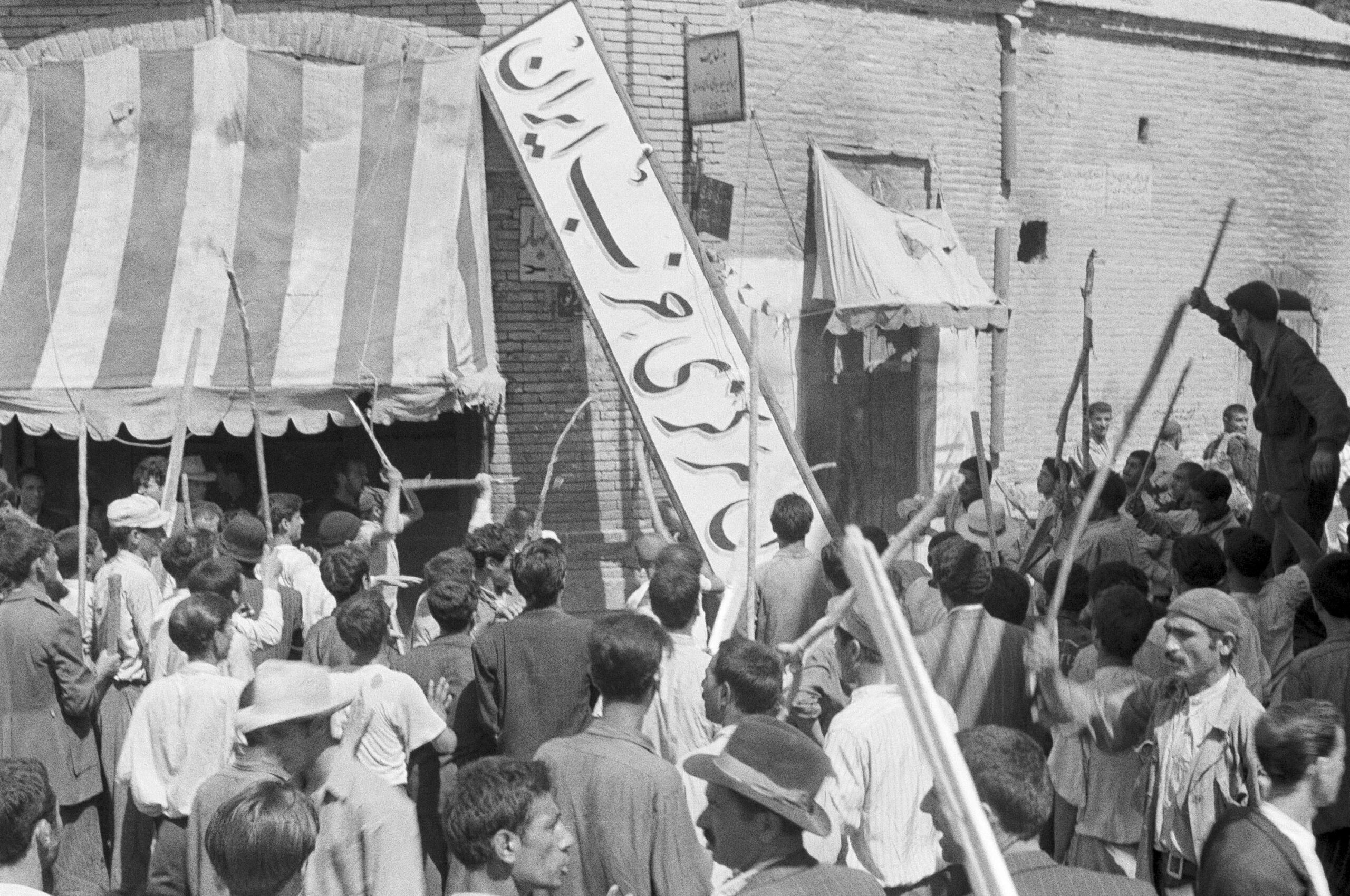
    A crowd of demonstrators tear down the Iran Party’s sign from the front of its headquarters in Tehran on Aug. 19, 1953, during the CIA-backed coup that ousted Prime Minister Mohammad Mosaddegh and his government. The operation cemented the rule of Shah Mohammad Reza Pahlavi for more than 25 years before the 1979 Islamic Revolution.

    It’s been a while since the last history lesson in this space, but the poor quality of the TV punditry about the four-day-and-counting Iran war screams out for better information. A lot of the folks advocating for this war of choice in the Middle East argue that we didn’t start the fire, that the roots go all the way back to the 1979 Iranian Revolution. That’s the year when Americans who never paid much mind to foreign affairs were shocked to see huge throngs in the streets of Tehran chanting “Death to America” and taking 52 hostages at the U.S. Embassy.

    What did we do to deserve this? Well …

    For most historians, and for many Iranians, the year that matters is not so much 1979, but 1953. In a post-World War II geopolitical environment where many nations sought to break free of imperialism, Iran in 1951 democratically elected a surprisingly left-leaning prime minister, Mohammad Mosaddegh, whose main project was to nationalize the then-British-controlled oil industry. This sparked great alarm in London, where U.K. leaders spent months lobbying Washington to join them in an effort to depose Mosaddegh in a coup that would advance Western oil interests.

    It’s a messy story. The United States wavered and even flirted with backing Mosaddegh for a time, according to histories of the period, but ultimately British leaders leaned on the Eisenhower administration and America’s ongoing anti-left “Red Scare” of that era to get the relatively new CIA and its man in Tehran — Kermit Roosevelt Jr., grandson of Teddy Roosevelt — on board with the plot. The Americans threw around money and anti-Mosaddegh propaganda, and eventually organized street protests ahead of the government’s ouster.

    To be sure, there is a never-ending debate over whether the U.S. involvement was central or just a subplot to the coup that gave power to the shah of Iran, Mohammad Reza Pahlavi, who ruled the nation with ruthless brutality for the next 26 years. Certainly, the nation’s Islamic clerics — powerful then, as now — played a key part in ousting a secular government. But the American role was so great that Barack Obama apologized in his 2009 Cairo speech, stating as fact that the CIA played a key role in the “overthrow of a democratically elected Iranian government.”

    Whether the U.S. led the coup or was a bit player, the Iranian people have never forgotten our involvement or our close ties to the eventually despised shah. “The rancor has never melted,” a 24-year-old Iranian woman told the Associated Press in 2023, on the 70th anniversary of the coup, as she compared the American meddling to being “like wishing for an earthquake to get rid of a bad neighbor.”

    So did a state of war between the United States and Iran start in 1979, as some GOP lawmakers insist, or in 1953, or on Feb. 28 of this year? In arguably the world’s most violent neighborhood, the cycles of violence often seem to have no beginning and no end. An imperial America chose to jump into the middle of this mess 73 years ago, and now getting out feels more impossible than ever.

    What I wrote on this date in 2016

    He’s all but forgotten now, but up until his mysterious death 10 years ago, the flamboyant Oklahoma natural gas mogul Aubrey McClendon had reshaped the Pennsylvania landscape as king of the commonwealth’s fracking boom. The company that McClendon (known to sports fans as an owner of the NBA’s Oklahoma City Thunder) cofounded, Chesapeake Energy, promised riches to Pennsylvania landowners, but left a trail of lawsuits and pollution. Less than 24 hours after his indictment by a federal grand jury, McClendon drove at full speed into a bridge embankment and was killed instantly. I wrote: “In Pennsylvania, Aubrey McClendon is survived by a legacy mostly of conflict, of thick lawsuits, of protesters facing off against armed marshals, of lawmakers and a governor at war over the taxes that gas drillers never had to pay, of brackish water and leaking methane adding to the greenhouse gases that may someday strangle the planet — of a promise of buried treasure that wasn’t really all it was cracked up to be.”

    Read the rest:The Greek tragedy of the billionaire who fracked up Pa.

    Recommended Inquirer reading

    • America is now at war on two fronts. In one column, I tackled the ongoing conflict in the streets of America, and looked at the tragic death on a frigid Buffalo street of the Rohingya refugee, Nurul Amin Shah Alam — a disabled and nearly blind man who was arrested by Border Patrol agents, and then dumped at a closed coffee shop five miles from his family’s home. It was a low point that spotlighted the unrelenting cruelty of a xenophobic mass deportation crusade by the Trump regime that has brought a mounting death toll. On Saturday morning, I knocked out my instant reaction to the news that the Trump regime had joined Israel in an all-out attack on Iran, which was that the war is both unconstitutional without the consent of Congress and also a clear violation of international law.
    • In moments of national and global crisis such as this, it’s easy to forget that many of the political decisions that shape people’s everyday lives occur on the local level. Here in Philadelphia, the school district’s plan to modernize its schools while closing 20 older buildings came as a shock to city parents, and The Inquirer’s coverage, anchored by our Pulitzer Prize-winning city public schools reporter, Kristen A. Graham, has been all over this story. The newsroom has explained the plan in detail, and covered the community protests and the fights over individual buildings, as well as Philly’s move away from middle schools. One advocate told me The Inquirer’s aggressive coverage of the story is why two schools have now been removed from the plan. A healthy community is one that has a vibrant news media. You nurture a better Philadelphia when you support The Inquirer by subscribing.

    By submitting your written, visual, and/or audio contributions, you agree to The Inquirer’s Terms of Use, including the grant of rights in Section 10.


  • Historic preservation isn’t the villain in the debate over housing affordability

    Historic preservation isn’t the villain in the debate over housing affordability

    No matter what folks in Boston tell you, Philadelphia is America’s most historic big city. So why is architectural preservation increasingly under attack here, especially as Philadelphia gets ready for its star turn in the nation’s 250th birthday celebrations?

    The movement to protect Philadelphia’s rich and varied architectural heritage was thrown into disarray Feb. 26 when a Court of Common Pleas judge invalidated the historic district created in 2024 to protect Washington Square West, a neighborhood that includes both Colonial-era masterpieces and nationally important infill buildings from the 1960s urban renewal period.

    Judge Christopher R. Hall’s decision primarily focused on procedural issues and could be reversed if it’s appealed. Yet it is just one of several existential threats facing the preservation regimen that has guided the city for the last 40 years.

    His decision is likely to encourage a group of developers who are challenging the Spruce Hill historic district, which also was created in 2024. It could similarly embolden Councilmember Mark Squilla, a former preservation champion who once created a controversial zoning carve-out to protect a one-story supermarket in Society Hill. Having jumped on the anti-preservation bandwagon, he’s now pushing legislation that many believe would gut the powers of the Historical Commission.

    While the issues driving each of these challenges vary, it’s no accident that they’re happening at a time when people are increasingly concerned about rising housing costs. For years, pro-development activists have argued that there is a link between the city’s historic preservation laws and the scarcity of affordable housing. By adding an extra layer of regulation, they contend, those laws restrict where people can build, limit new construction, and raise maintenance costs for homeowners.

    There’s no doubt that the city’s preservation laws require owners of historic properties to go through an extra step in the approval process. That takes time and can sometimes add to the cost of a project.

    Yet it seems odd that pro-development activists have cast historic preservation as the main villain when so many factors influence the city’s housing supply: zoning regulations, interest rates, availability of labor, cost of construction materials. President Donald Trump’s tariffs alone sent the price of lumber soaring in the last year.

    In an effort to put things in perspective, the nonprofit Preservation Alliance recently commissioned an economic analysis to explore its impact on housing prices. The report made two interesting observations: Apartments in older buildings rent for less than those in new ones. And protecting those older buildings actually helps maintain a supply of “naturally occurring affordable housing.”

    The study, prepared by the Washington-based Place Economics, also examined claims that historic districts are enclaves for the wealthy and exclude renters. Data show the opposite: Historic districts continue to gain new residents long after they been designated. In fact, between 2010 and 2020, the population of Philadelphia’s historic districts grew almost five times as fast as the city as a whole, which suggests new housing is being built despite the additional oversight.

    Not all that construction takes the form of new buildings, however. Even in the best of economic times, erecting a new apartment building in Philadelphia is far more expensive than fixing up an old one. As a result, the city has come to rely on older buildings to provide new housing. Without them, Philadelphia would be a much less affordable place.

    In the past, the city’s obsolete offices and factories were the main targets for housing conversion. Those buildings are relatively easy to adapt because they have large, rectangular footprints.

    But what about smaller, more irregularly shaped historic buildings? Are the city’s preservation and zoning laws flexible enough to allow more density in old townhouses, which, after all, constitute the bulk of Philadelphia building stock?

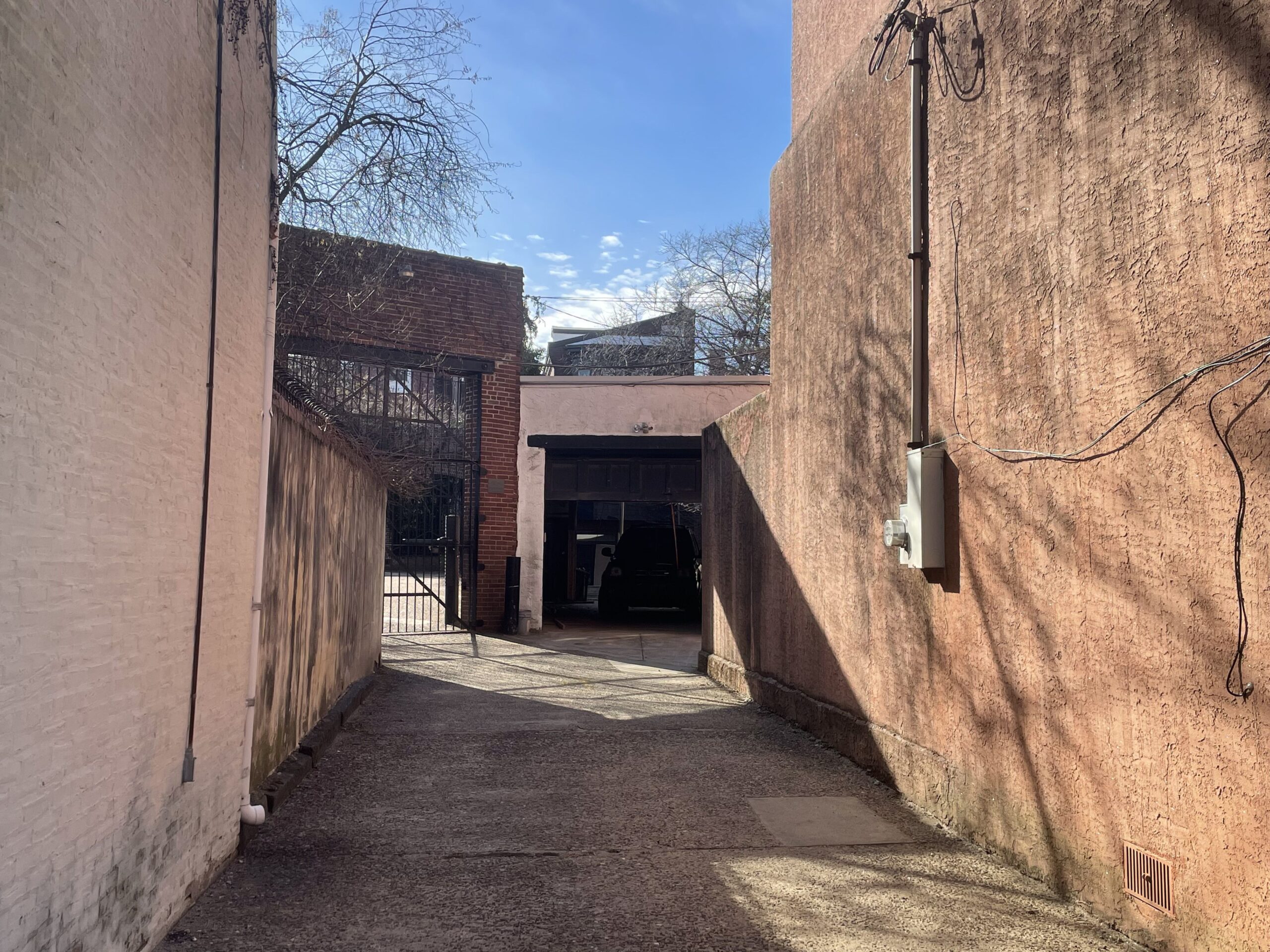
    This sprawling complex of 19th-century buildings at 15th and Waverly Streets is being converted to a 32-unit apartment building by Lo Design for developer Keith Alliotts. By installing a penthouse level over the former stable (rear left), the architects will be able to improve the interior circulation and increase the density.

    Converting townhouses into apartments

    To understand the role those buildings can play in the great Yimby-Nimby debates, I reached out to Lea and Evan Litvin, who run Lo Design, an award-winning firm that has its offices in the Rittenhouse-Fitler historic district. Lo Design started out doing single-family homes for developers, but lately they’ve taken on commissions to turn large townhouses into apartments.

    Small conversions are more labor-intensive than erecting a new townhouse on an empty site, but they allow the Litvins to do work that aligns with their architectural ideals. The conversions create more housing for less money, using fewer natural resources. “Saving an old building is the most sustainable form of construction,” Evan explained.

    Since Philadelphia’s historic townhouses were never meant for multiple tenants, and often have awkward layouts, the Litvins have developed architectural tricks to make them function as apartment buildings. Sometimes that means attaching a new wing on the back. In other cases, they’ve built freestanding structures in backyards.

    Their current project at 15th and Waverly Streets used a little of everything to transform a historic Greek Revival mansion into a 32-unit building.

    The brick building began its life in 1860 as a private home, complete with a stable. At some point, someone popped on a mansard roof to create a fourth story and added wings on the sides. Then, in the early 20th century, the mansion, stable, and a neighboring townhouse were fused into a single building that served as offices for what was then known as the Society to Protect Children from Cruelty.

    For the project’s developer, Keith Alliotts, the building’s main attraction was its size — 26,000 square feet, significantly larger than a typical townhouse, which might be 6,000 square feet. He also liked that the location, a few steps from the former University of the Arts’ Hamilton Hall, felt like part of the Rittenhouse Square neighborhood.

    Yet the challenges of transforming the awkward amalgamation into a coherent, multifamily residence soon became clear. None of the floors in the different buildings lined up. The U-shaped footprint complicated the flow through the building. The interior was a mashup of Victorian and post-modern details. On top of everything else, the project would need a zoning variance and approval from the Historical Commission.

    Lo Design plans to create an internal courtyard at the center of a new residential building at 15th and Waverly. The project will turn a group of historic 19th-century buildings into a 32-unit apartment building.

    Getting those permits turned out to be the easy part, the Litvins said. Because the complex had been empty for years and was starting to deteriorate, the neighborhood enthusiastically embraced the idea of using it for apartments.

    From the start, the Litvins knew they would have to expand the already sprawling complex to ensure the apartment layouts weren’t too eccentric. Fortunately, there was a large yard behind the house where they could add a new wing to turn the U into an O. They decided to install a large penthouse on top of the stable and insert several connecting passages to improve the interior circulation.

    This diagram shows how LoDesign plans to turn an awkward amalgamation of 19th century buildings at 15th and Waverly Streets into a coherent, multifamily building with 32 apartments. The portions in blue will be added during construction.

    While reusing these buildings was no easy feat, the project is a good example of “gentle density.” The neighborhood gets more rental housing, yet the look of the 19th-century mansion remains substantially the same.

    By comparison, the first collaboration between the Litvins and Alliotts was a breeze. Alliotts had spent most of his career developing single-family housing in North Jersey before “discovering” Philadelphia during the pandemic. Coming from such a pricey environment, he said, “I was really taken aback by the city’s affordability.” After studying the market here, he fell for an early 20th-century brownstone on the 2000 block of West Girard Avenue in Francisville.

    The townhouse could have been torn down

    Despite the house’s impressive architecture, it wasn’t listed on the city’s historic register. That meant Alliotts could have demolished the building for something new, an approach taken by several other developers on that once-elegant stretch of Girard Avenue.

    Alliotts liked the house too much to destroy it. And since the site was unusually deep, he knew he could fit the equivalent of a second house in the yard. But rather than build another stand-alone house, he asked the Litvins to fit a 12-unit condo building in the same space. Alliotts envisioned the condos — now called The Francis — as starter homes, so he wanted to keep the prices below $300,000 for a two-bedroom unit.

    Still, 12 units is a lot of density, even for a generous townhouse yard that was 200 by 31 feet. By making a donation to the city’s Housing Trust Fund, Alliotts was able to get a zoning bonus that allowed him to raise the structure’s height to 45 feet, enough for a fourth story.

    To avoid jamming the new, metal-clad building against the old brownstone, the Litvins decided to push the condos toward Cambridge Street, which was once a service street lined with carriage houses. That gave the architects space to create a landscaped courtyard between the two buildings.

    Lo Design was able to create nine apartments in the Spring Garden neighborhood by replacing a small garage with a three-unit apartment building in the garden of an early 20th-century townhouse at 2313 Green St. The project’s density was the result of a compromise with neighbors and the Philadelphia Historical Commission.

    After the success of the Francis, the Litvins had hoped to replicate the model for a new project at 2313 Green St. in the Spring Garden neighborhood. The main house there had already been divided into five apartments, but the site at 238 feet was even deeper than the Girard Avenue property. They proposed a five-unit stand-alone building in the garden, accessed from alley off Wallace Street.

    But this time the Historical Commission and neighbors rejected the proposal.

    So, the Litvins reduced the size of the building and turned it into a carriage-house-sized structure with three units. They offset the loss of units by adding a sixth apartment to the main house for a total of nine units.

    The garage on the right will be replaced by a three-unit building that is part of the redevelopment of 2313 Green St. It will be accessed through an alley off Wallace Street in the Spring Garden neighborhood.

    Some preservation opponents may see the outcome as an example of the nickel-and-diming that occurs when developers attempt to add density to historic properties.

    But the fact that a former single-family house will soon accommodate nine apartments reveals the untapped density in Philadelphia’s historic buildings. These conversions prove more housing can be created without sacrificing the city’s heritage.

  • Pope Leo’s pointed message to Catholics the day after the U.S. bombed Iran

    Pope Leo’s pointed message to Catholics the day after the U.S. bombed Iran

    The day after the United States bombed Iran in a military effort to forcibly change the nation’s regime, the most famous American global leader — outside of President Donald Trump — was speaking out about it.

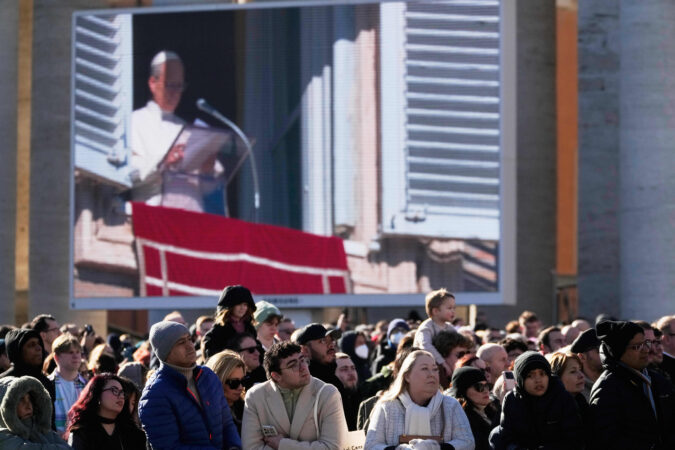
    “Faced with the possibility of a tragedy of enormous proportions, I am making a heartfelt appeal to the parties involved to assume their moral responsibility to stop the spiral of violence before it becomes an irreparable abyss,” Pope Leo XIV said in his weekly Angelus address Sunday morning.

    The American-born pope wasn’t speaking only to the thousands gathered in St. Peter’s Square, but to the more than 1.4 billion Roman Catholics in the world, including those in the Trump administration who self-identify as Catholics, such as Vice President JD Vance or Secretary of State Marco Rubio.

    “Stability and peace are not built with reciprocal threats or with weapons that sow destruction, pain, and death,” the pontiff said, “but only through reasonable, authentic, and responsible dialogue.”

    The joint U.S.-Israeli strikes have already claimed the lives of Iran’s Supreme Leader Ali Khamenei and numerous civilians, including, reportedly, more than 100 girls at an elementary school.

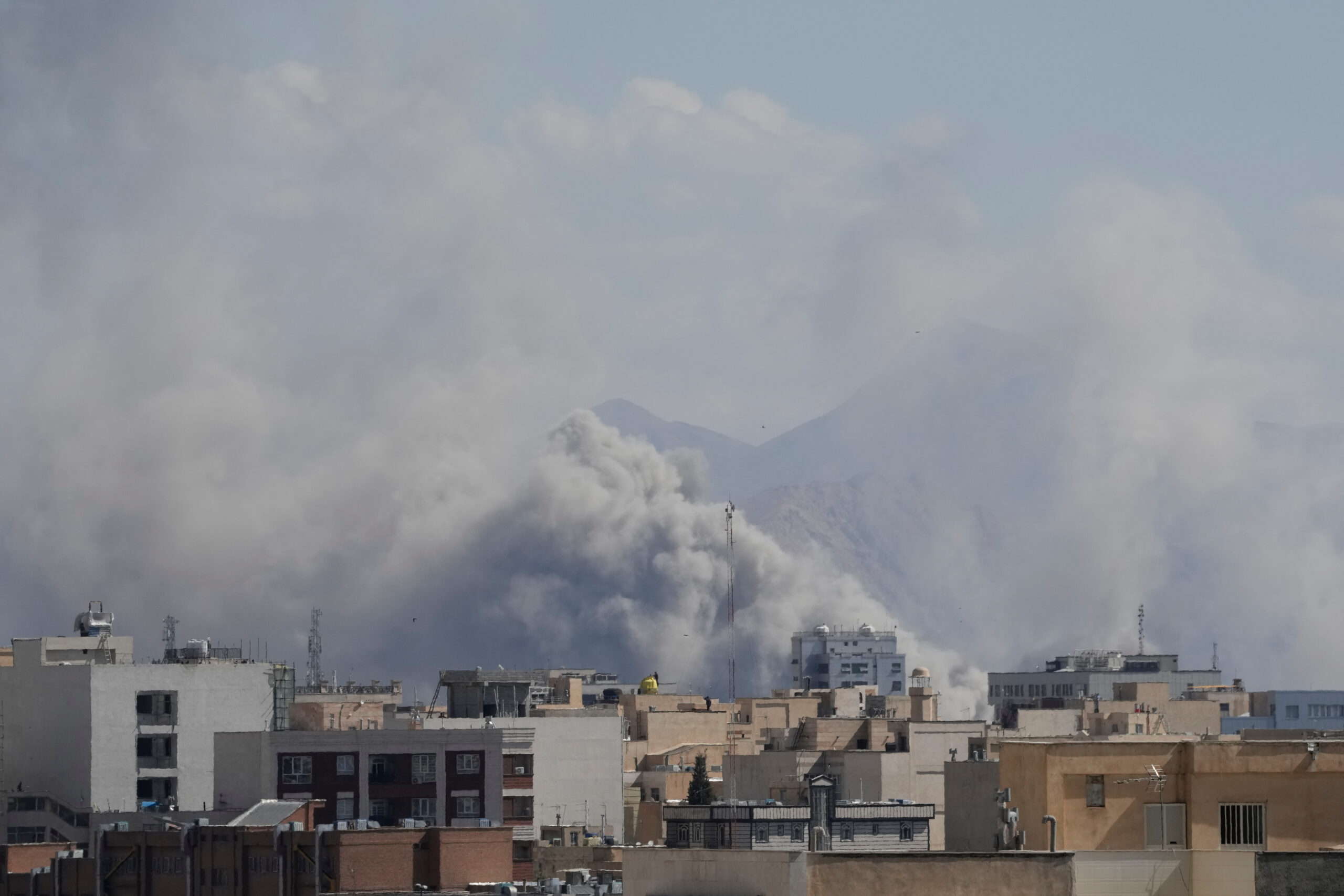
    Smoke rises up after a strike in Tehran, Iran, on Sunday.

    While the pope doesn’t wield the sort of temporal power that presidents and prime ministers do, his words carry moral weight for those within his religious tradition, and cannot be easily dismissed by politicians, nor the 52% of U.S. Catholics who still have a favorable view of Trump, according to a recent poll by the conservative EWTN News and RealClearPolitics.

    It is not the first time Pope Leo has called out the Trump administration’s efforts to force regime change in sovereign nations with leaders who have been accused of human rights abuses.

    “The good of the beloved Venezuelan people must prevail over every other consideration and lead us to overcome violence and to undertake paths of justice and peace, safeguarding the country’s sovereignty, ensuring the rule of law enshrined in the Constitution, respecting the human and civil rights of each person,” the pope said during the Angelus address Jan. 4.

    I often write about how religion impacts the lives of Latinas like me, who are trying to navigate a world that often seems to have eschewed moral clarity for political dissolution. As a Roman Catholic, I pay particular attention to the guidance offered not only by Pope Leo but also by the bishops who are tasked with providing moral counsel to their flock.

    No one who has remained a Catholic as the church has been wracked by an ongoing, self-made crisis of clerical abuse can ignore the fact that some bishops are as opportunistic and power-hungry as our politicians. But under the leadership of Pope Leo, more U.S. bishops than ever have chosen to speak out from a place of genuine moral authority, untainted by the gross partisan and ideological bias that had previously infected the U.S. Conference of Catholic Bishops.

    In January, three U.S. cardinals — whom some consider progressives — called on the administration to adopt a “genuinely moral” foreign policy with respect to Venezuela, Ukraine, and Greenland. Meanwhile, the archbishop for the U.S. military — widely considered a staunch conservative — reminded Catholic military personnel that it is “morally acceptable” for them to disobey an order that violates their conscience.

    At the same time, 18 bishops asked for the government to cut U.S. military spending to invest in eradicating poverty instead, and across the world, bishops have disavowed the appetite for war and domination by military force that the Trump administration has modeled.

    For example, the pope has declined to participate in a Trump-led “Board of Peace” that seems to be about anything other than peace. “A diplomacy that promotes dialogue and seeks consensus among all parties is being replaced by diplomacy based on force by either individuals or groups of allies,” Pope Leo said on Feb. 17.

    “War is back in vogue, and the zeal for war is spreading.”

    Cardinal Pierbattista Pizzaballa, Latin patriarch of Jerusalem, was more direct in his criticism of the board: “What do I think of the Board of Peace? I think it is a colonialist operation: others deciding for the Palestinians,” he told the Italian newspaper Il Sole 24 Ore.

    While the Vatican releases Pope Leo’s Angelus addresses without much fanfare, it is important for Catholics seeking moral guidance on world events like the U.S. war on Iran to listen to the address directly rather than rely on the interpretation of those who might alter the pope’s words for political convenience.

    In the instance of the pope’s Angelus address on Venezuela, for example, the Trump administration’s U.S. ambassador to the Holy See reportedly omitted the pope’s reference to safeguarding that nation’s sovereignty because it could not be aligned with the administration’s actions.

    And Vance last year offered a justification of Trump’s mass deportation policies based on his misunderstanding of a Catholic theological concept. The vice president’s error was corrected and addressed by Pope Francis shortly before his death in April.

    During Lent, we as Catholics are called to examine our habitual excuses, our profane tendencies, and our susceptibility to the spin of those with a stake in worldly power, to instead focus deeply on our spiritual life and its obligations.

    For Catholics, in particular, Pope Leo’s words Sunday cannot be explained away. We must demand that our nation’s leaders stop the spiral of violence and acknowledge that peace cannot be built with weapons.

    Swords into plowshares, mi gente, swords into plowshares. And we shall study war no more.

  • Forget State of the Union sideshow, MAGA’s real chilling message was delivered by Marco Rubio in Munich

    Forget State of the Union sideshow, MAGA’s real chilling message was delivered by Marco Rubio in Munich

    As a matter of journalistic duty, I forced myself to watch the endless State of the Union reality show.

    Punting on all serious issues, President Donald Trump stoked the applause meter by delivering awards to a 100-year-old vet and a brave U.S. pilot, and inviting the entire U.S. men’s Olympic hockey team to celebrate their gold medal win.

    Trump was relentlessly racist (with disgusting slurs against all Somali Americans in Minnesota). His lies were dangerously predictive about the 2026 elections, never tiring of the Big Whopper about winning in 2020 and claiming Democrats must be stopped because they “only win if they cheat.”

    In short, the union is in a dangerous state under an amoral, unprincipled, delusional commander in chief.

    What disturbed me most as I watched Trump rant on is how a president could be so wholly indifferent to the liberal democratic values that underlie the existence of our nation. Although often honored in the breach, they are what have made this country unique. Yet, the sycophants in his administration, along with most GOP legislators, have chosen to abandon those values, or never believed in them from the start.

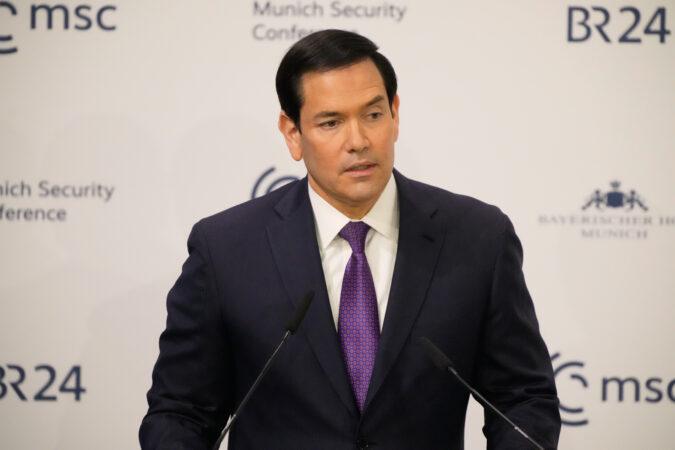
    For that reason, I’d rank Secretary of State Marco Rubio’s speech at the recent Munich Security Conference as far more important than Trump’s sad State of the Union guff.

    That’s because Rubio laid out an alternative set of U.S. values promoted abroad and at home by the political theologians of the Trump regime. Precepts that would make the Founding Fathers revolt anew.

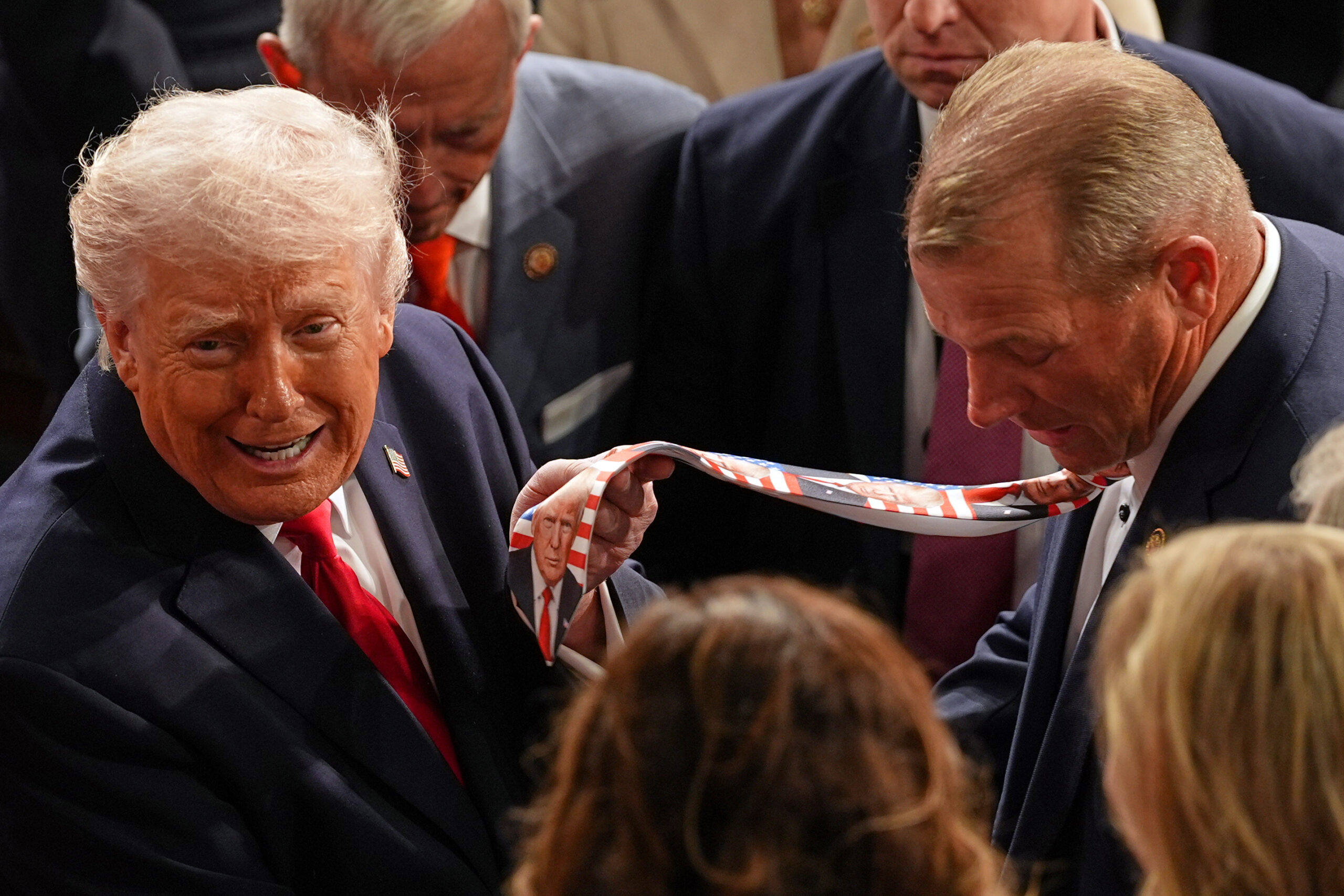
    President Donald Trump holds up U.S. Rep. Troy Nehls’ (R., Texas) tie with his face on it as he departs after delivering the State of the Union address to a joint session of Congress in the House chamber at the U.S. Capitol in Washington, Tuesday.

    The new theology revolves around the theme of saving “thousands of years of Western civilization” from the depredations of “woke” liberal democracy. It is an extension of language long used by white nationalists, and which came back to prominence during the rise of Islamist terrorism in the Mideast, which led to an influx of Syrian and Afghan immigrants into Europe fleeing civil wars at home. It became even more useful to Trumper populists when fanning fears of immigrants at home.

    Former Trump adviser Steve Bannon and current Deputy White House Chief of Staff Stephen Miller latched onto the “saving Western civilization trope” a decade ago, and have embraced its transition into saving Western “Christian civilization.” Somehow, the term, which had been commonly used to describe shared Western religious and cultural identity for decades — Judeo-Christian civilization — has conveniently been shortened.

    Never mind the historical inaccuracy of a term that tries to combine thousands of years of shifting, melding populations, ideas, and religions into one neat sum.

    Yes, there are obvious philosophical threads from Athens to Rome to the Magna Carta, and ultimately to the values of the Enlightenment. But there are centuries of religious, ethnic, and philosophical wars, as well.

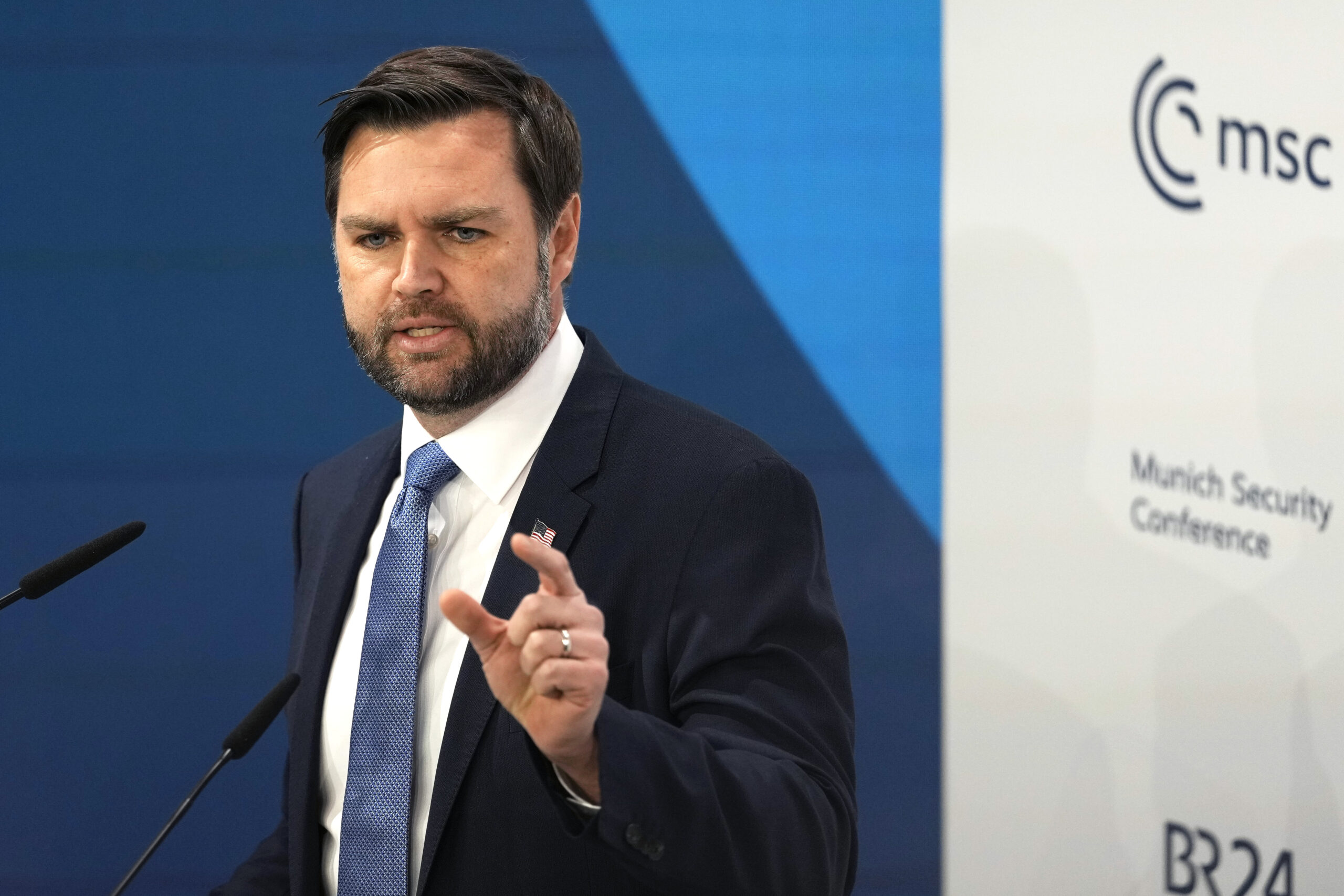
    When Vice President JD Vance tried to promote the concept at the Munich Security Conference last year — and to promote white Christian populist parties in Europe as the saviors of “Western civilization” — the audience of European leaders, officials, and think tankers reacted with shock. More so when he berated German leaders for not inviting the neofascist Alternative für Deutschland (AfD) party into the government, even though its leaders have downplayed Adolf Hitler’s crimes. To add insult to injury, he pointedly paid a visit to the AfD’s political leader.

    Vice President JD Vance addresses the audience during the 2025 Munich Security Conference at the Bayerischer Hof Hotel in Munich.

    But Rubio was supposed to be different: the realistic, savvy foreign policy adviser who tried to save Trump from his worst instincts. When the secretary of state delivered remarks that praised U.S.-European ties, the eager audience was at first won over — until reality sank in, and many participants read the text of his speech.

    Indeed, Rubio was warmed-over Vance, blaming liberal democracy (which, in the Enlightenment sense, means individual freedoms, human rights and rule of law, and observance of science) for all the West’s ills, and urging Europeans to junk “the global rules-based order.”

    It got tiresome hearing Rubio tout the dangers of Western “civilizational erasure.” As Hillary Clinton noted — on a panel titled “The West-West Divide” — “When Rubio talks about Western ‘civilization,’ I never knew he was so supportive of Native Americans.” Then she added, “He is wrong historically.”

    Indeed. “Western civilization” has become the MAGA dog whistle that stands for bashing all immigration and playing to racial fears.

    No surprise, Rubio had not a word of criticism for the Russian invasion of Ukraine as an attack on “Western civilization,” although Vladimir Putin’s war crimes have upended the relatively peaceful, post-World War II order. And not a word of apology for Trump’s threat to seize Greenland from a NATO ally, which also threatened that order.

    Nor any word of recognition that a dog-eat-dog world of unrestrained big power dominance resulting from an end to global “rules” will lead back to the violent era preceding World War II.

    Instead, Rubio urged the Europeans not to be “shackled by guilt and shame,” which is a key buzz phrase for the AfD, which urges its members to stop apologizing for Nazi crimes.

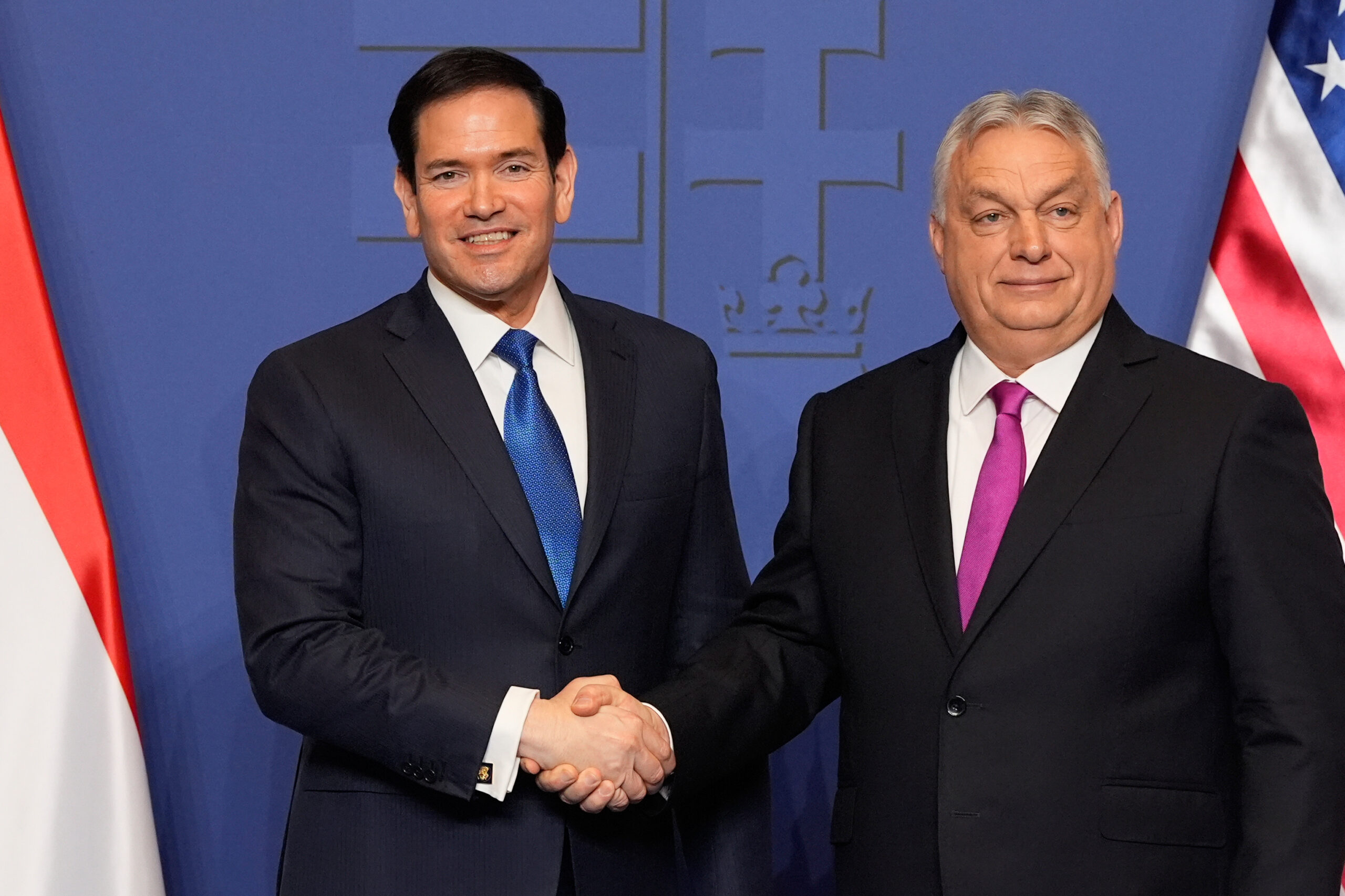
    Secretary of State Marco Rubio (left) and Hungarian Prime Minister Viktor Orbán shake hands after a news conference in Budapest, Hungary, on Feb. 16.

    And right after his speech, the secretary rushed off to Hungary to praise the pro-Putin Prime Minister Viktor Orbán, a Trump ally who has done his best to destroy Hungarian democracy, including press and judicial freedom — and is trying to block European Union aid to Ukraine.

    Yet, Orbán’s corruption and Hungary’s economic decline have become so overwhelming that he may be defeated in an April election. But Trump sent Rubio to bolster this antisemitic autocrat who repeats the “saving white Christian civilization” line.

    It is no wonder the Munich scene erupted into debate about the West-West division over democratic values. As Germany’s Green Party coleader and Bundestag member, Franziska Brantner, stated: “Our values are rooted in the Enlightenment, in reason, science, freedom of religion, equal rights. The Enlightenment is a project, not a period in history. It is about very concrete individual freedoms, about free elections dependent on the will of the people, not run by oligarchs.”

    “I don’t want to go back in history,” Brantner said flatly.

    Norwegian Finance Minister Jens Stoltenberg added, in a restrained poke at Trump, “For all those who believe in liberal values and protection of the truth, it is difficult when we see that not all of our allies agree on these values.”

    In Europe, at least, there is an active debate about the consequences of the junking of rules and history by the world’s most powerful democracy. The dangers to democracy are more immediately apparent to those who live closer to Russia and Ukraine.

    Watching Trump’s performance and Rubio’s subservience, those dangers may seem obvious to many Americans. But they must find a way to get that message across more clearly to those who still doubt the danger here.

  • A mad king’s illegal war on Iran is a cry for regime change … in Washington

    A mad king’s illegal war on Iran is a cry for regime change … in Washington

    It turns out that democracy really does die in darkness — at 1:30 a.m. Eastern time, to be exact.

    The pilastered chambers of the U.S. Capitol — where 535 lawmakers who, under the Constitution, wield the sole authority to send the nation to war — were empty when the first cruise missiles slammed into Tehran, 6,300 miles and eight-and-a-half time zones away.

    Like Congress, many Americans — only 27% of whom, according to a poll last week, have great confidence in Donald Trump’s ability to make the right decisions about using military force — were likely sound asleep when the war started, perhaps dreaming of the normality of brunch or the dog park on an unseasonably warm Saturday.

    Trump was not even in the White House Situation Room — the multimillion-dollar mancave that exists for a commander in chief to run our too-frequent military ops — but was instead ensconced at his gilded Florida palace at Mar-a-Lago, addressing the nation in an eight-minute video after a Friday night of partying. His wild, uncoiffed midnight hair was crammed under a hat hailing the country whose founding principles he’d just demolished, “USA.”

    It’s normal for invaders to attack under the cover of darkness, yet Saturday’s massive attack on Iran — launched jointly with our sister 2020s global pariah, Israel — occurred in bright morning sunshine in downtown Tehran, its streets packed with commuters and school buses at the start of the Arab world’s workweek.

    It seems that this time, the dead-of-night deception was aimed at the American people, in an assault on everything the United States was intended to stand for.

    While many words will be written or uttered in the coming days about who is winning this U.S.-Israel war of choice, the next military targets, the inevitable spike in the price of oil, and the fate of Iran’s tottering regime, there is one fact that matters more than any other.

    This war — and, yes, it is a “war,” with an expected loss of American blood, as Trump himself acknowledged from Mar-a-Lago — is illegal.

    Full stop.

    Article 1, Section 8 of the U.S. Constitution, hashed out here in Philadelphia, could not be more explicit on that point, stating in plain 18th-century English that only Congress has the power “To declare War, grant Letters of Marque and Reprisal, and make Rules concerning Captures on Land and Water.”

    America’s founders knew exactly what they were doing — seeking to prevent one unchecked or unhinged president from arbitrarily launching a lethal conflict that might be in his own best interest, but not the nation’s. “The constitution supposes,” James Madison wrote in 1798, “what the History of all Governments demonstrates, that the Executive is the branch of power most interested in war, and most prone to it.”

    David Janovsky, acting director of the Constitution Project at the Project on Government Oversight, told Time magazine last week that any attack on Iran ordered by White House fiat would be flat-out unconstitutional.

    “There’s no indication that there’s any sort of circumstance that would give the president the unilateral authority to order military action,” Janovsky said. “It’s true that presidents have some inherent authority to deploy the military as commander in chief, but that’s really limited to true emergency circumstances where there is an attack underway that needs to be repelled, or maybe an extremely clear imminent attack. But there’s no suggestion that that’s the case today — that would make the strikes illegal.”

    And it’s not only unconstitutional. An aggressive and unprovoked war — which this unambiguously is — is also a blatant violation of international law and the post-World War II global order that we once encouraged with the United Nations, in the hope of preventing the emergence of some future tyrant. Who knew that the greatest threat to world security in the 21st century would come from the current holder of the coveted FIFA Peace Prize™ and the chairman of his own much-ballyhooed Board of Peace?

    When the rise of our Cold War national security state after 1945 led to prolonged, unpopular, and undeclared wars in Korea and Vietnam, Congress passed the 1973 War Powers Act that meant to require consultation and its mandated involvement, a seeming solution that is now increasingly honored in the breach.

    It’s worth noting that when the George W. Bush regime decided to launch a war of choice against Saddam Hussein’s Iraq in the early 2000s, its case was larded with lies, including a 16-word whopper that the president uncorked during his 2003 State of the Union address. But a generation ago, Bush, Dick Cheney, and their merry band of war criminals at least felt it was necessary to get a congressional authorization, and to spend months wooing the public and the pundits.

    Trump had a similar chance to lobby the American people and the world in his State of the Union address last week, and he largely whiffed. He included only a brief and perfunctory recitation of the long-standing and, in fairness, justifiable grievances against Iran’s brutal repression of its own people, its nuclear ambition, and its backing of violent proxy groups.

    To be sure, we should be alarmed about the destructive threat of nuclear bombs in the hands of unconstrained strongmen backed by religious fanatics — whether that’s in Tehran, Jerusalem, or Washington. And most of the world wants freedom for Iran’s long-repressed masses, but U.S. and Israeli bombs might be the worst possible way to make that happen.

    Already, as I write this in the very early hours of the war, there are reports that the bombing of a girls’ school in southern Iran has killed as many as 85 people, most of them innocent children. We are spilling the blood of the very people we are promising to liberate. Are we really expecting to be someday greeted with rose petals?

    Again?

    Indeed, there are many painful echoes of Bush 43’s disastrous conflict with Iraq, including shameless lying by the commander in chief. Trump’s 3 a.m. claims that Iran poses an “imminent” threat to the United States and is close to developing ballistic missiles that can reach our shores are almost as ludicrous as his Big Lie about the 2020 election.

    Just like early 2003, when Iraq opened up to outside weapons inspectors, but we invaded them anyway, Trump’s all-out attack came in spite of reports that Iran was making “significant” concessions at the bargaining table in Geneva, regarding both the nuclear program and the kind of big-money stuff like oil and minerals that warm the heart of our corrupt kleptocracy. All this after Barack Obama had a successful deal, negotiated with years of hard work, to halt Iran’s nuclear enrichment that Trump 45 came in and scuttled because ¯_(ツ)_/¯.

    Trump seems to be bored with peace. For whom? For what?

    President Donald Trump is presented with the inaugural FIFA Peace Prize by FIFA President Gianni Infantino during the 2026 FIFA World Cup draw at the Kennedy Center in December.

    It seems way too spot on that the Pentagon is calling this massive attack “Operation Epic Fury” — a fitting tribute to a president who reportedly launched into an epic Downfall-level rage when even a right-wing U.S. Supreme Court struck down his also-unconstitutional tariffs, whose U.S. Department of Justice is covering up the Jeffrey Epstein files, and who is considering a “national emergency” around the 2026 midterms that smells like a Reichstag fire.

    Sure, the Iran war is a massive distraction from Trump’s cratering poll numbers at home, but aggressive war is also just a thing strutting strongmen do to consolidate their illegitimate powers. Bush’s Iraq War was the last throes of a decaying democracy, while Trump’s actions are those of an unrestrained dictator — exactly the mad king that Madison sought to warn us about 228 years ago.

    So now what?

    “Trump has launched an illegal regime change war in Iran with American lives at risk,” Democratic Rep. Ro Khanna of California, a Bucks County native and a top critic of unchecked militarism, posted on X after the attack. He said he and his GOP renegade ally, Rep. Thomas Massie of Kentucky, plan to go ahead Monday with a vote to invoke the War Powers Act — even as the prospect of that vote may be why Trump pushed the button now.

    Not only do the odds of success for Khanna and Massie seem dim, but the War Powers Act seems too late, yet also too little. In a nation that has pressed impeachment or resignation on four presidents, including Trump 45, Trump 47’s unlawful and murderous war on Iran already seems the worst abuse of presidential power in American history.

    A cruise-missile assault aiming to change the government in Iran is, in reality, a desperate plea for regime change in Washington, D.C. Democrats, who could gain power in the House as early as this year thanks to GOP scandals and illness, must make clear that Trump’s impeachment and an end to American autocracy are their main priority.

    For now, we have unnecessarily injected ourselves into a long-troubled corner of the world where there are almost no good guys, where theocratic dictators are unceasingly slaughtering the citizens of other theocratic dictators. Maybe that’s because, over the course of 250 increasingly tragic years, the United States has finally become exactly like them.

    The only epic fury should be our own.

  • Five things not to miss at the Philadelphia Flower Show this year

    Five things not to miss at the Philadelphia Flower Show this year

    Root systems are literal and figurative in our language — there are those you can see and touch and eat, and those invisible to the eye that connect us to the people and places that have brought us to this moment.

    Both type of roots are important to our past and future and both are explored at the Philadelphia Flower Show this year by gardeners and artists whose exhibits bring to life the show’s theme, “Rooted: Origins of American Gardening.”

    As the nation marks its 250th anniversary, the Flower Show celebrates its 197th year by looking back at the history of gardening in the United States. This is the “final chapter in a three-year trilogy” of themes that began in 2024 with “United by Flowers,” which explored current gardening connections, and continued last year with “Gardens of Tomorrow.”

    The most notable difference at this year’s Flower Show, which runs through March 8 at the Pennsylvania Convention Center, is that the marketplace has been moved out of the main exhibition halls on the upper floor to a separate space below. It’s a welcome change that provides more space for exhibits and visitors and makes the overall experience feel less crowded and commercial.

    I went rooting around the Flower Show during a media and members event on Friday. As always, the entrance garden — this year’s is “The Forest Floor” — is a can’t-miss, mainly because you have to walk through it to get in. But after that, here are five other interesting things I suggest making sure to see if you visit this year’s Flower Show.

    All the world’s a stage

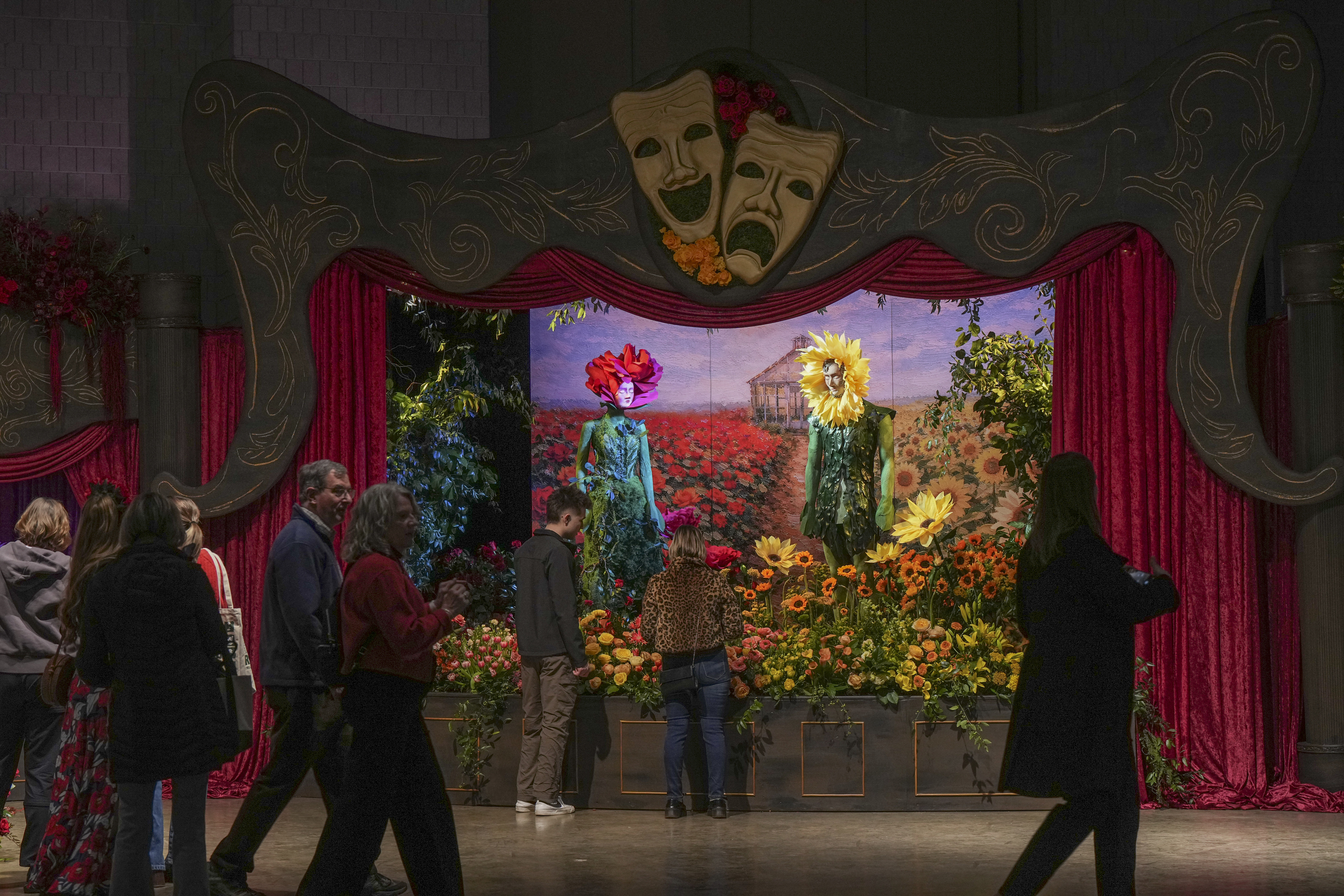
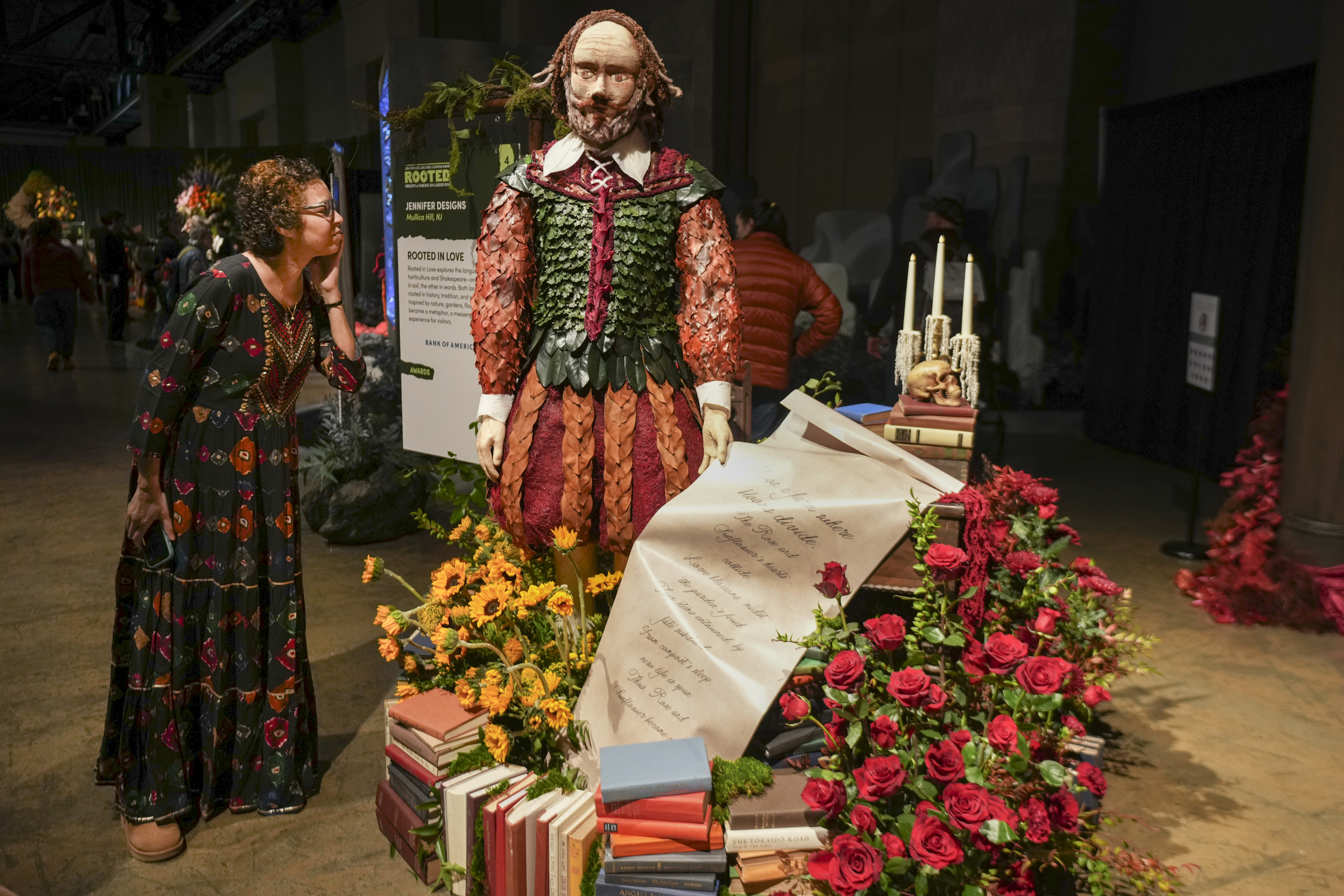
    “Rooted in Love” is a theatrical floral exhibit by Jennifer Designs of Mullica Hill that brings together horticulture and Shakespeare.

    That which we call a rose by any other word would smell as sweet, but what if a rose was chosen by central casting to play Juliet? How sweet would that be?

    Jennifer Designs of Mullica Hill shows us in its exhibit, “Rooted in Love,” in which an anthropomorphized rose and sunflower play the star-crossed lovers in William Shakespeare’s Romeo and Juliet on a stage overflowing with flowers.

    While the connection to this year’s theme is a bit tenuous — the exhibit “explores the language of horticulture and Shakespeare” — I’m giving it a pass, mostly because I love Shakespeare but also because this display is absolutely stunning.

    A Flower Show guest looks at William Shakespeare in the “Rooted in Love” exhibit by Jennifer Designs of Mullica Hill.

    Beyond the main scene, there’s a life-size recreation of the Bard made of flowers, a “Bloombill” complete with a cast and crew list, and flower box seats on either side of the stage.

    The shop around the corner

    Robertson’s Flowers & Events of Wyndmoor digs into its own roots — dating back 99 years — with a charming life-size recreation of its Chestnut Hill corner store.

    Each of the four window displays of the 360-degree exhibit celebrate a different era of floristry, from the formal and feather-accented styles of the early 20th century to the neon-lit early ’90s.

    Visitors look at Robertson’s Flowers & Events’ “Windows into the Past,” at the Philadelphia Flower Show.

    Just as impressive as the structure and display itself is the lush rooftop garden atop the entire building, which teems with orchids and greenery and metaphorically “extends its roots downward,” connecting the shop with the community.

    It’s so tiny!

    It is here I must make a confession: My favorite part of the Flower Show every year, without fail, is the “Miniature Settings” category, which I call “the dioramas.” This is because I love tiny things and because my dream when I retire is to search for seashells and make dioramas.

    I’ve hesitated putting it on my must-see list in previous years because I am 110% biased and because the line to see these mini scenes is always long (I waited about 15 minutes on Friday). But this year’s — which challenged participants to create a setting for an event that happened between the prehistoric era and 1900 — truly is a must-see for Philly lovers.

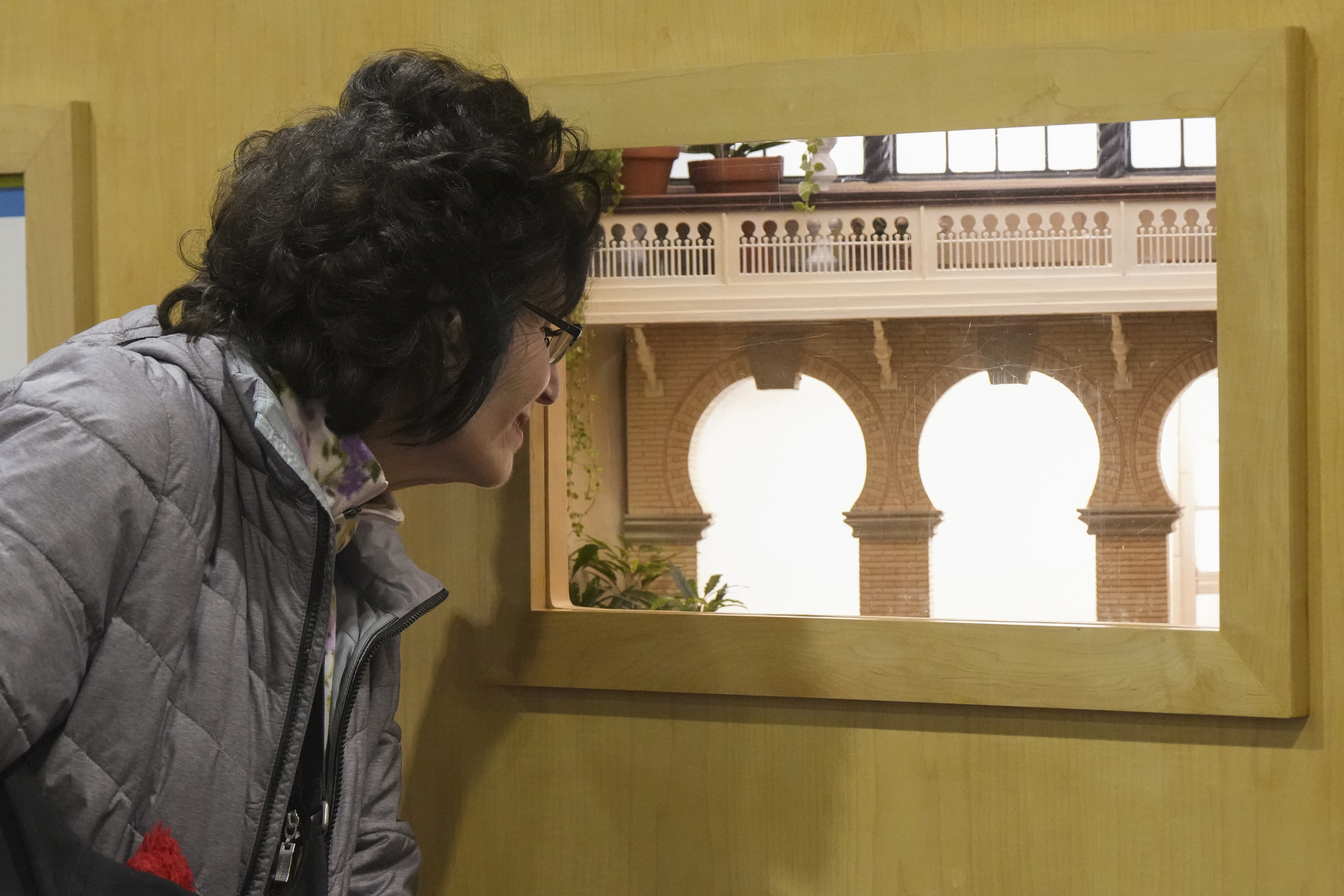
    A visitor to the Flower Show looks at the “Philadelphia’s Centennial Exhibition: Opening Day, 1875,” one of the exhibits in Miniature Settings category.

    While some folks made scenes of the last night in Pompeii or the Roswell UFO crash site, it’s the three Philly-themed dioramas that stood out to me. There’s Benjamin Franklin’s garden, with a floating kite and key and inventive lighting effects; the interior of Independence Hall; and Horticulture Hall at Philadelphia’s Centennial exhibition.

    Understood the assignment

    With it’s late fall setting and its stark use of flowers and color, the exhibit from W.B. Saul High School of Agricultural Sciences in Roxborough isn’t as eye-catching as many others, initially, but if you take the time to study it and read the placards, it’s by far the most moving, emotionally.

    “Up-Rooted, Re-Planted,” explores the roots of our region through the Lenape people, the original Indigenous inhabitants who lived here before being uprooted by European settlers.

    A babbling brook runs through a wooded autumn setting that seems just on the brink of winter. A placard in a dugout canoe tells the story of how the Lenape were forced to move westward. And a sturdy wigwam built by hand keeps the food and firewood within it dry.

    Andrew Luedders and Lukas Luedders look at W.B Saul High School of Agricultural Sciences’ exhibit “Up-Rooted, Re-Planted.”

    Out of all of the exhibits, this was the most on-point when it came to theme and the most profound when I spent some time with it. It’s also a really good learning moment for kids, which is particularly wonderful because it was built by students. I saw several adults kneeling down to read the placards to children and share the story of the people who first planted roots in what is now Philadelphia.

    The fun is in details

    Some of my favorite moments at the Flower Show this year were small ones I didn’t expect. Throughout the event hall, there are trash cans filled not with garbage, but with daffodils, tulips, and lilacs. It’s a small but sweet touch that adds a bit of whimsy.

    In the “Garden Design” section, there’s an exhibit which repurposes stone blocks as books with punny titles written on them like Where the Wild Plants Are, War and Peas, and A Kale of Two Cities.

    Tulips in a trash can at the Philadelphia Flower Show.

    At the American Landscape Showcase exhibit, there’s a display called “American Anemoia” featuring an overgrown ornamental garden at a vacant house. Nailed to the fading white picket fence of the house is a citation from the city of Philadelphia for weeds and mowing.

    If that isn’t rooted in truth, I don’t know what is.

    The Philadelphia Flower Show continues through March 8 at the Pennsylvania Convention Center, 11th and Arch Streets. Hours: 10 a.m. to 8 p.m., except until 6 p.m. on March 8. Ticket prices vary depending on person’s age and day and time of entrance. Information: phsonline.org or 215-988-8800.

  • Candidates line up to replace Rep. Dwight Evans | Shackamaxon

    This week’s column analyzes the city’s camera surge, the need for political challengers, and calls for some basic sense about security.

    Passengers board a SEPTA trolley along Baltimore Avenue in West Philadelphia.

    Trolley cams

    Over the last few years, Philadelphians have increasingly come under surveillance. Cameras enforce bus lane violations, issue speeding tickets, and help prevent and solve violent crime. Just this week, the Philadelphia Parking Authority announced it is now adding cameras to the city’s trolleys.

    This surge in surveillance has led to some residents bemoaning what they view as a cash grab. These worries were echoed last year by City Councilmember Jeffery “Jay” Young during a committee meeting in which he held up authorization for school zone cameras. Fortunately, these concerns are unwarranted.

    Our speed and red-light cameras are not designed to raise revenue. While camera systems in states like Illinois are used to pay for regular local government expenses, Pennsylvania’s are earmarked for traffic safety projects. Philadelphia is getting $13 million from the most recent distribution. This leaves politicians with little incentive other than to focus on safety and efficiency when choosing where and why to place the cameras. The system isn’t designed to take advantage of sudden speed traps, a problem that occurs with both automated and traditional traffic enforcement systems.

    Per a PPA spokesperson, 63% of vehicle owners who get a bus camera ticket don’t get a second one.

    In the case of the trolley cameras, it is also a question of basic fairness. If you ride the trolleys enough, you’ll eventually end up stuck. Almost always, it is because someone decided to inconvenience 20 to 40 people to avoid parallel parking or walking a short distance. While no one likes getting a ticket, motorists who opt to block trolleys should be happy with the fact that they aren’t being immediately towed.

    Candidates in the Democratic primary for Philadelphia’s 3rd Congressional District include, clockwise from upper left: State Sen. Sharif Street, State Rep. Chris Rabb, Ala Stanford, and State Rep. Morgan Cephas.

    Marquee matchup

    The race to replace U.S. Rep. Dwight Evans was always going to be close-fought. With the youthful Brendan Boyle occupying the city’s other congressional seat, this could be the best chance to represent Philadelphia in Washington, D.C., for decades. State Sen. Sharif Street (the son of former Mayor John F. Street) and State Rep. Morgan Cephas (who chairs the Philadelphia delegation in the state House) are both long-expected candidates for the job. They’ve been joined by progressive firebrand Chris Rabb, surgeon Ala Stanford, and a handful of other candidates with less funding and political support. For Southeast Pennsylvania politicos, it’ll have to do. There simply aren’t a lot of competitive races this year.

    In state Senate District 34, Towamencin Township Supervisor Kofi Osei is running against party-endorsed candidate Chris Thomas. There are also a couple of contested primaries for state House seats. That’s all, folks.

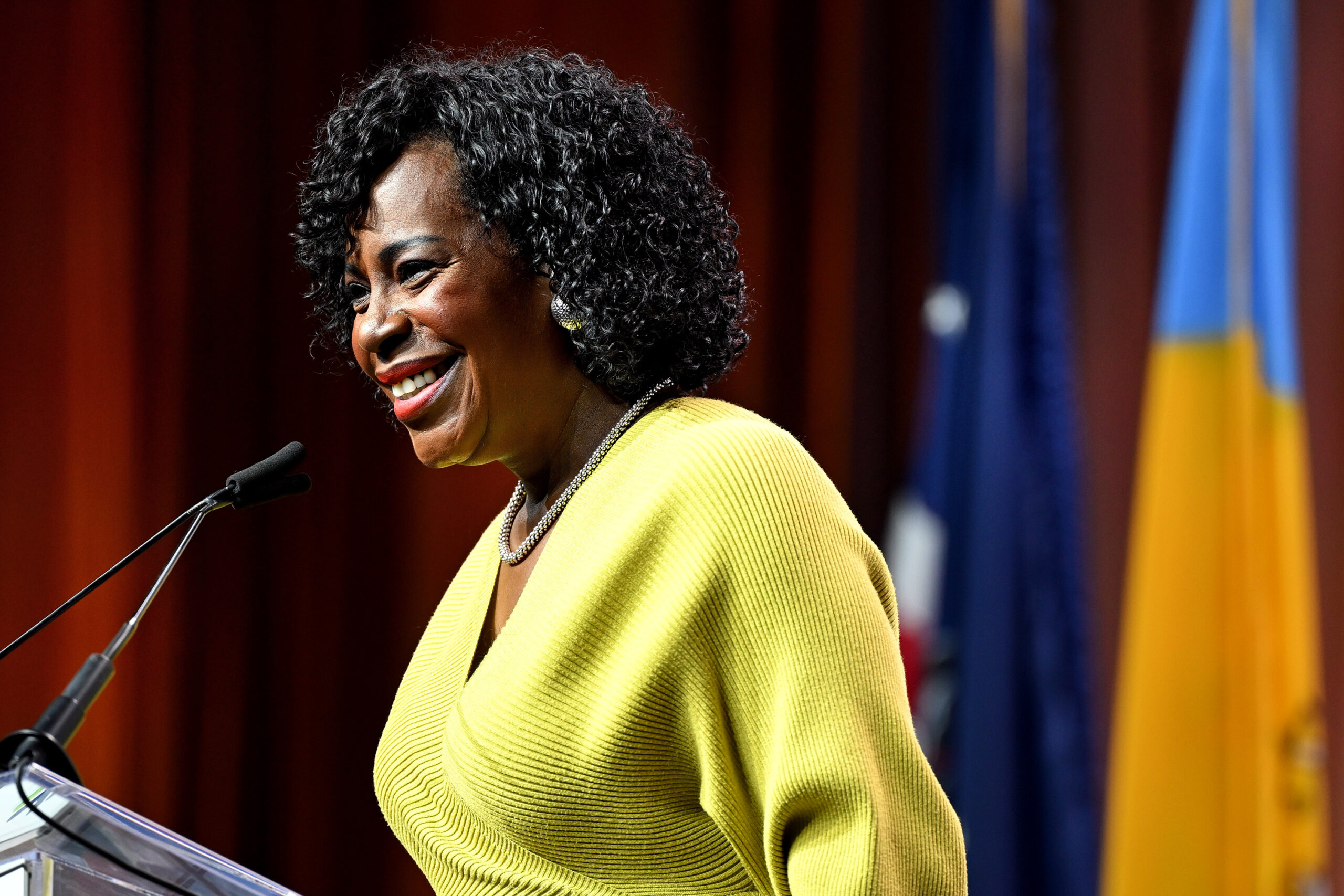
    Mayor Cherelle L. Parker delivers her keynote address at the Chamber of Commerce for Greater Philadelphia’s Annual Mayoral Luncheon, in February.

    Challengers needed

    Next year also looks fairly empty. While some progressive groups have polled residents to gauge the viability of defeating Mayor Cherelle L. Parker, few potential candidates appear eager to take her on. That’s perhaps not surprising. Only one Philadelphia mayor has failed to be reelected in the last 70 years. That includes W. Wilson Goode Sr., who bombed a city block during his first term, and Frank Rizzo, who failed a lie-detector test he himself had suggested.

    What the city really could use are more challengers for City Council seats. So far, I am aware of just one candidate, Jalon Alexander, who has put his hat in the ring. Alexander plans to challenge Young in the 5th District, citing capricious decision-making. But Young, while he may be the most egregious example, is not the only Council member who could use some competition.

    I expect the city’s progressive groups, like Reclaim Philadelphia and the Working Families Party, will eventually find candidates to challenge some of the weaker members, including Young, Cindy Bass, Nina Ahmad, and Jim Harrity. Last cycle, these groups organized around ideas, like rent control, that simply aren’t viable in Philadelphia.

    Despite being mostly frozen out by Council President Kenyatta Johnson and their colleagues, the current progressive delegation has been somewhat unwilling to challenge that body’s status quo. While Councilmember Kendra Brooks voted against a ban on safe injection sites, and Rue Landau voted against one of Young’s ill-considered moves, the city could use at least one councilmember who is willing to consistently challenge their colleagues’ bad decisions.

    Pennsylvania Gov. Josh Shapiro is seen after a B’nai B’rith Youth Organization International Convention on Feb. 12 in Philadelphia.

    Security snafu

    We call Gov. Josh Shapiro the Ambitious Abingtonian here for a reason. The governor is a hard-charging, elbows-up politician who has turned many friends into enemies over the years. Republicans seem to believe they have finally found a weakness in Shapiro’s political armor: the decision to spend taxpayer money to secure his home in Abington, and the seizure of a small strip of adjoining land that accompanied it. State Sen. Tracy Pennycuick, who represents western Montgomery County and eastern Berks County, even opined that Shapiro “put his family at a higher level of risk” by moving them home instead of to a bunker after the April arson attack at the governor’s mansion.

    Of course, the Shapiros just survived an attempted assassination. Let’s be human beings for one second. Shapiro’s shell-shocked children deserved to sleep in familiar settings.

    If Republicans want spending decisions to critique, they should start with Shapiro’s reliance on an opaque group called Team PA to pay for everything from travel to sporting events instead.

  • A Rohingya refugee wanted freedom. America left him for dead in frigid Buffalo.

    A Rohingya refugee wanted freedom. America left him for dead in frigid Buffalo.

    Like most of his Rohingya people — stripped of citizenship by Myanmar’s ruling junta and targeted by a brutal 2017 genocide — Nurul Amin Shah Alam and his family spent the last decade yearning to breathe free.

    A nomadic quest for liberty took Shah Alam, his wife, and the two youngest of his six children through the crowded camps of Bangladesh, on a boat escape to Malaysia, and finally to apparent refuge in the United States on Christmas Eve 2024.

    But the 56-year-old immigrant was almost never free on American soil.

    In February 2025, just 53 days after his family arrived in the refugee hub of Buffalo, Shah Alam — nearly blind, apparently lost, and using a curtain rod as a walking stick — found himself in an encounter with Buffalo police. He was tased during a scuffle that ended with the refugee charged with felony assault.

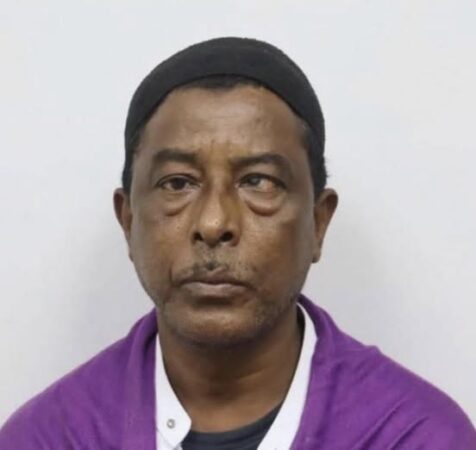
    After one year behind bars and a plea deal, relatives paid his bail on Feb. 19, and then waited for hours at the Erie County, N.Y., lockup, only to learn he’d instead been handed over to U.S. Customs and Border Protection (CBP) on an immigration detainer.

    During a frantic, five-day search on the streets of one of America’s coldest big cities, Shah Alam’s family and supporters were stunned to learn that Border Patrol agents — apparently after learning the stateless refugee could not be legally deported — drove this disabled and nearly sightless man with no phone to a Tim Horton’s doughnut shop and dumped him there, five miles from his family’s home.

    A Border Patrol spokesperson would later call this “a courtesy ride.”

    Finally, on Tuesday, Buffalo police were called to recover a dead body on a city street.

    It was Shah Alam.

    “He never had freedom in his life,” Imran Fazal, a leader of the Rohingya diaspora in Buffalo who knows his family, told me by phone Wednesday night. “He came to this country because he wanted to experience freedom. He didn’t have that chance … He came to this nation that was supposed to save his life — and that nation destroyed his life.”

    Sham Alam’s name will be added to the growing death toll of a dishonorable Donald Trump regime, alongside Ruben Ray Martinez, Renee Nicole Good, Silverio Villegas González, Alex Pretti, Keith Porter, Geraldo Lunas Campos, and scores of others who’ve been shot, chased down, or sickened and neglected in squalid camps.

    And now, abandoned on the subfreezing February streets of the snow capital of America. Because there is really only one point to the ethnic cleansing crusade that began with rabid Trump partisans waving their “Mass Deportation Now!” placards in a Milwaukee arena and ended with a cold, lonely corpse on Perry Street.

    That point is cruelty.

    Somehow, in this downward spiral that has seen Americans grow accustomed to masked, heavily armed goons in tactical gear snatching day laborers or Uber drivers off once-placid urban streets, the abandonment and death of Shah Alam still hits like a gut punch to the soul of a once-welcoming nation. Yet, it somehow feels even more inhumane when viewed through the tortured prism of the Rohingya people, among the most persecuted ethnic minorities on earth.

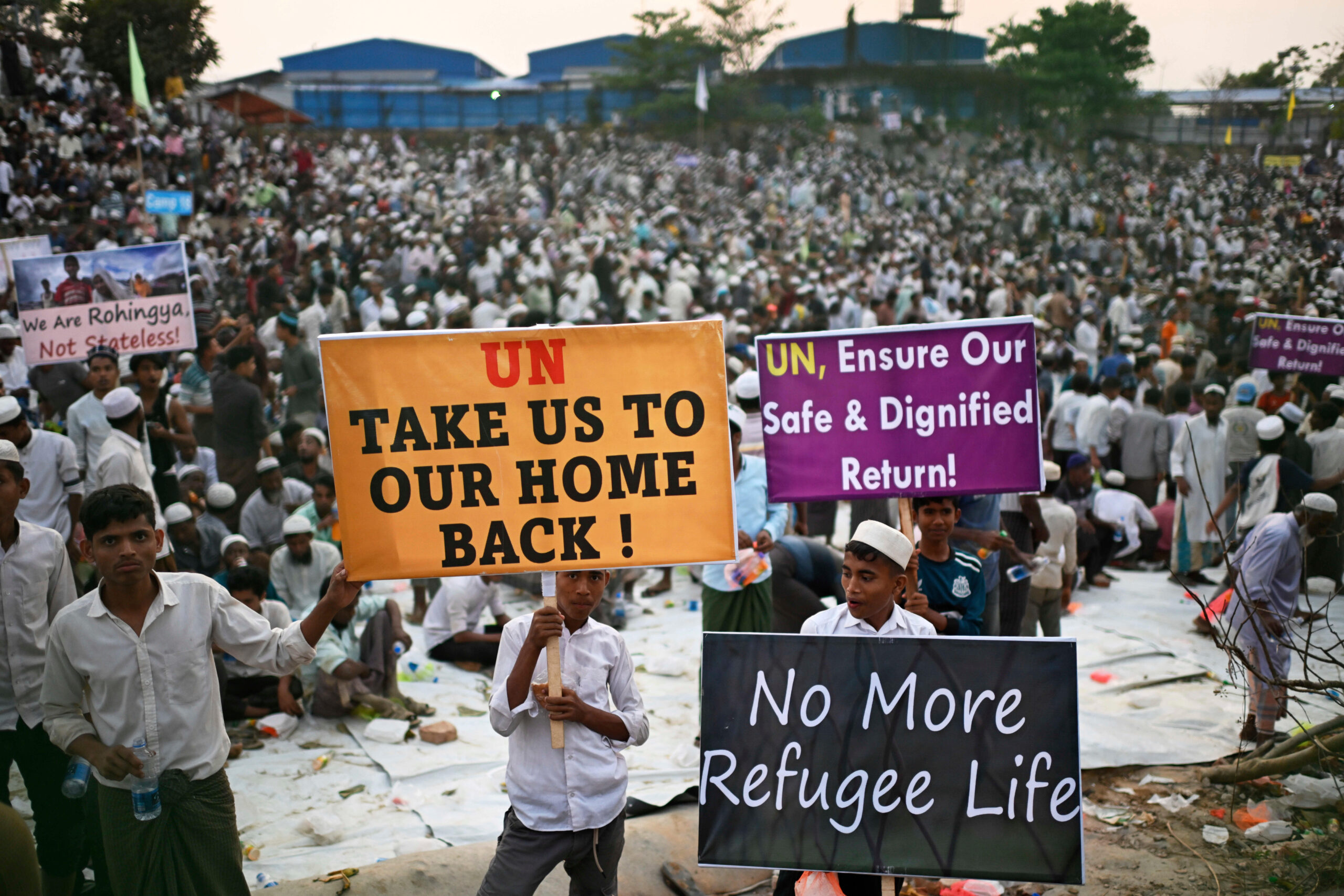
    Rohingya refugee children carry banners during a visit by U.N. Secretary-General António Guterres at the Ukhiya camp in Cox’s Bazar, in Bangladesh, in March 2025.

    The roughly 1.4 million, mostly Muslim, Rohingya people in Myanmar, formerly Burma, have been targeted for repression by that nation’s Buddhist majority for decades, culminating in the stripping of their citizenship in 1982 and its military rulers driving hundreds of thousands across the border into Bangladesh during 2017’s brutal campaign.

    In March 2022, during the Joe Biden administration, which was a brief window between the anti-refugee xenophobia of the two Trump presidencies, the U.S. government recognized the Rohingya as victims of genocide and, among other moves, expanded their resettlement opportunities in America. It’s estimated that at least 12,000 came to the United States during that short opening, and as many as 2,000 of them — perhaps lured by lower housing costs — have moved to Buffalo in the last couple of years.

    It has not been an easy journey. Denied schooling in their native Myanmar and lacking a formal written script for their language, the majority of Rohingya who arrive in the United States are illiterate and unable to speak English.

    The short, tragic American experience of Shah Alam reads like an allegory for the Rohingya plight on U.S. soil.

    The version of what happened to him on the night of Feb. 15, 2025, as told to me by Fazal and also recounted by his family and lawyers in the media, is that Shah Alam, walking in his new neighborhood with the aid of that curtain rod and likely getting lost, took shelter under a porch perhaps without realizing he was on private property.

    The woman who owned the property called the Buffalo police, who viewed the rod as a weapon and — when the non-English speaking Shah Alam failed to follow their commands — tased him and aggressively tried to arrest him. In a fight with the nearly blind immigrant whose awareness of the situation is in question, police said two officers suffered minor injuries. The ensuing criminal charges against Shah Alam — assault, trespassing, and possession of a weapon — were just the start of his Kafkaesque journey through American injustice.

    Trump had just become the 47th president, and family members didn’t post bail at first, mainly because of fears the new regime would seek to deport him. Fazal said the already ailing Shah Alam lost considerable weight in his year behind bars, as much of the food didn’t meet his Muslim dietary restrictions.

    Supported by the Rohingya diaspora community — Fazal said about 50 people attended one of his hearings — Shah Alam’s legal-aid attorneys eventually struck a misdemeanor plea deal. Then, on Feb. 19, family members arrived at the Erie County detention center expecting to take him home for a warm meal.

    After a number of hours, Fazal said, the family called the police and said, “‘He was supposed to come here. He’s not coming.’ And they said, ‘You know, he was taken by the [U.S.] Customs and Border [Protection].’ And they said, ‘What?!’”

    A CBP spokesperson told People magazine that Shah Alam was offered a “courtesy ride” from Border Patrol agents, “which he chose to accept to a coffee shop, determined to be a warm, safe location near his last known address, rather than be released directly from the Border Patrol station. … He showed no signs of distress, mobility issues, or disabilities requiring special assistance.”

    In fact, Shah Alam — completely blind in one eye and with limited sight in the other, according to family members, who didn’t have a cell phone and had never used one — was five miles from his family’s current home. When his relatives and attorneys learned belatedly of the Tim Horton’s drop-off and could not find him, they filed a missing persons report that — in one final injustice — was, for a time, accidentally listed as resolved by an officer who mistakenly thought he was at an immigration detention site.

    Instead, his body was found Tuesday night. The preliminary finding after an autopsy by the Erie County medical examiner is that Shah Alam died from medical causes and not from either exposure to the cold or intentional homicide. Nonetheless, his death is under investigation — yes, by the same Buffalo police who initiated this nightmare — and has sparked justifiable outrage from local officials like Buffalo Mayor Sean M. Ryan, who called the CBP actions “unprofessional and inhumane.”

    That’s a gross understatement. It’s not just that Shah Alam’s abandonment and death is a new twist on the roughly 40 immigrants who’ve died in federal detention since the start of 2025 from a mix of medical neglect, suicidal despair, and at least one homicide, along with the eight people fatally shot by CBP or U.S. Immigration and Customs Enforcement (ICE). All of it is proof that Trump’s immigration policy is written with the blood of innocents.

    We also need to ask ourselves how and why a nation that so blithely uses the Statue of Liberty for everything from car insurance ads to a morally empty 250th birthday party is now repressing some of the most mistreated humans on earth — people who honestly believed America would offer the freedom they were denied in their nation of birth.

    It’s a moral abomination to see the Hmong people who risked everything to side with the United States in Southeast Asia now dragged from their homes in Minnesota, or the Venezuelans who fled a strongman dictator only to be branded as criminal gang members, or the Haitians who escaped relentless violence only to now huddle in fear in heartland Ohio.

    And now the Rohingya, who were able to survive a genocide and inhumane refugee camps some 8,000 miles away, only to now find themselves in a country that is building concentration camps and forging a 21st-century Trail of Tears.

    Fazal — a 30-year-old recent Buffalo State grad whose seven-year stateless flight to freedom passed through Bangladesh, Malaysia, Indonesia (where he was detained for 17 months in an immigration prison), Australia, and Papua New Guinea — told me he feels anger over Shah Alam’s death, but also guilt, because he has gained U.S. citizenship while Shah Alam did not.

    “The system and the police should be accountable,” he said. “We need justice to be served.”

    When this newest stain on human existence is finally over, there won’t be enough courtrooms to try every masked idiot who shot an unarmed protester, or beat up an immigrant and swore he “ran into a wall,” or slammed a brain-injured woman to the asphalt.

    But years in prison would be too good for the soulless monsters who went on a doughnut run and left a good man to die. If there is any justice under God’s universe, they will be consigned for all of eternity to a snowdrift as large as Lake Erie in an unending and fruitless quest for the warmth and liberty they deprived Nurul Amin Shah Alam.

  • 2026 Honda CR-V Hybrid: Still the top of the hybrid heap?

    2026 Honda CR-V Hybrid: Still the top of the hybrid heap?

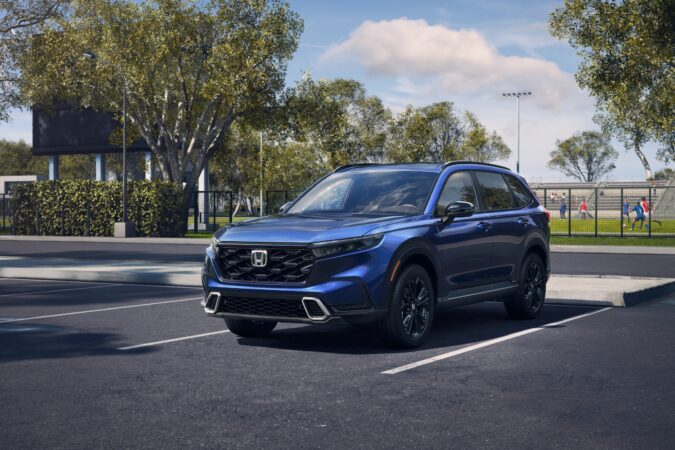
    2026 Honda CR-V Hybrid AWD Sport Touring vs. Kia Sportage Hybrid: A challenger for the hybrid crown?

    This week: Honda CR-V Hybrid

    Price: $42,550 for the trim level (which is top of the line)

    What others are saying: “Highs: Civilized and efficient hybrid powertrain, roomy interior, new larger standard infotainment touchscreen. Lows: Price premium over nonhybrid CR-V, could use a few more ponies,” says Car and Driver.

    What Honda is saying: “The hybrid that gives you more.”

    Reality: The Honda is still in the running.

    What’s new: When you have a vehicle Mr. Driver’s Seat rated as “so nice,” you’re wary of updates. Are they going to make this better?

    They haven’t changed too much about the underpinnings of this model — same powertrain, but with a new look. A TrailSport model gives it more Passport-type off-roady features.

    It really looked like a Passport parked in the driveway.

    Competition: In addition to the Sportage Hybrid, competitors include the Hyundai Tucson Hybrid, Mazda CX-50 Hybrid, Mitsubishi Outlander Hybrid, Subaru Forester Hybrid, and Toyota RAV4 Hybrid.

    Up to speed: The CR-V Hybrid feels like a surprisingly quick little SUV. The two-motor hybrid system creates 204 horsepower and is coupled to a 2-liter four-cylinder engine that gets updates for 2026.

    It got to 60 mph in 7.1 seconds, according to Car and Driver, about average for the vehicle type, and surprisingly almost a second quicker than the 2023 model with the same powertrain.

    In any case, the CR-V has a nice feel of momentum as it goes about daily driving, even if the hard numbers are actually kind of soft.

    Shiftless: A Honda with a shift lever continues to excite me far more than it really should. But that’s how disappointed I was with the old buttons. I just found them unattractive and cumbersome.

    The power band is fairly even in this hybrid version of the CR-V; gasoline-powered Hondas with CVTs can be a little uneven.

    On the road: The CR-V appeared quite mannerly and easy to drive.

    And then I found Sport mode. This really turns the small SUV into a Volkswagen or Mazda competitor. It doesn’t quite have the fun factor but it really wiggles through the curves nicely. Cornering is a real bright spot, as I made some left turns at stoplights far more enthusiastically than I’d have thought possible, and the tall SUV never even flinched.

    The CR-V also rates highly for maneuverability. With a backward-garage at Chez Sturgis, a lot of three-point runs happen, and the CR-V let me go from one corner to another in one swoop, much like the smallest vehicles out there.

    Honda favors basic black in its interiors and it gives the CR-V Hybrid a classic look.

    Driver’s Seat: The seat seemed a little stiff at first, and my time in the Civic Hybrid made me paranoid — Civic seats tend to jab me just the wrong way. But no Mr. Driver’s Seats were harmed in the making of this review, and a comfortable time was had by almost all.

    The gauges are clear and the default offers pretty much all the info you’ll need, which is how it should be.

    A heated steering wheel comes courtesy of the Sport Touring trim.

    Friends and stuff: The rear seat is where happy Honda seat dreams go to, well, not exactly die, but suffer a little bit. The seat back is flat except for an annoying lumbar bump near the bottom. At least there are several recline choices.

    Legroom is fantastic, as is foot room, while headroom is snug, about an inch from Mr. Driver’s Seat’s head.

    Cargo space is a whopping 36.3 cubic feet behind the rear seat and 76.5 with the seat folded; the seat bottom folds down with the back rest to maximize cargo space.

    In and out: It’s a slight step up into the CR-V. Not too much of a climb.

    Play some tunes: After experiencing true audio joy from the Honda Odyssey stereo once upon a time, I keep expecting dynamite sound from Hondas, but often I’m disappointed. The Bose premium system in the CR-V Hybrid Sport Touring performs OK, an A- or a B+. Sigh.

    Operation of the system is not bad, with dials for volume and tuning. Sound adjustments are in the larger 9-inch touchscreen but are unavailable when the vehicle is moving. This is a precaution I like for you and all the other drivers out there, but I’m special and don’t need it.

    Keeping warm and cool: Dials control temperature and fan speed while buttons handle the rest. It’s a pretty easy setup.

    Fuel economy: The CR-V hybrid averaged 35.2 mpg for almost the entire visit, a nice reward for the hybrid premium, and just the overall chance to feel smug.

    Where it’s built: Greensburg, Ind.; East Liberty, Ohio; and Alliston, Ontario.

    How it’s built: Consumer Reports predicts the CR-V Hybrid reliability to be a 4 out of 5.

    Next week: How does the Kia Sportage Hybrid compare?

  • Indiana won a title and lost its soul | Will Bunch Newsletter

    Does Donald Trump have to ruin everything? The answer is obviously yes, but this one was heartbreaking. Sunday’s overtime thriller over Canada, which gave U.S. men’s hockey its first gold medal since this senior citizen was a college junior, was a howl of joy in what’s been a dire year for America. But then (taxpayer-)Ka$h Patel showed up to party, and soon Trump was on the phone, egging on the boys with misogynistic trash talk about their gold medal compatriots, the women’s hockey team. Now the men are invited to Trump’s State of the Union address, the women “had other plans,” and I almost wish our Canadian friends had won the game.

    If someone forwarded you this email, sign up for free here.

    How Indiana University won a football crown and lost the plot

    Indiana University’s victory flag flies over Memorial Stadium in January in Bloomington, Ind.

    Even in a state where the sports miracles, from Rudy and The Knute Rockne Story to Hoosiers, are so big they tend to make it to Hollywood, there’s never been a feel-good script quite like Indiana University — with the most losses in college football history until this season, when it went 16-0 and won the national championship.

    “The energy is just absolutely insane,” Katie Shin, a recent Indiana alumna, told the Athletic as thousands of fans went wild on the Bloomington campus that night, saluting Heisman Trophy quarterback Fernando Mendoza and their unsmiling genius head coach Curt Cignetti. “The whole state is just rallying around IU.”

    But there’s a huge irony for anyone who’s a big fan of America’s colleges for more than just what happens on the gridiron. In the same season Indiana was slowly climbing to the top of the football polls, the flagship public university was also ranked dead last in the nation.

    For something arguably more important: free speech.

    The Foundation for Individual Rights and Expression (FIRE), the national campus speech group based here in Philadelphia, last fall ranked IU 255th on its 2026 ranking of universities over freedom of expression — the lowest-rated public institution in America, and only higher than the controversy-wracked private sister schools, Columbia University and Barnard College.

    Interestingly, the FIRE low-ranking came after a slew of campus controversies in which the silenced speakers or protesters were all over the map ideologically — a canceled Jewish speaker and a shout down of right-wing speakers, but also draconian moves against pro-Palestinian protesters, including harsh penalties for a 2024 encampment. Last month, a federal court ruled that IU’s punishments of the Gaza campers and its anti-protest policies were unconstitutional.

    FIRE’s lambasting of IU’s free speech transgressions was reported upon last Sept. 9 in the student paper, the Indiana Daily Student. The following month, school administrators ousted the faculty adviser to the IDS and told the student journalists they could no longer print the paper, and that news could only be published online. The university’s insistence that this was purely an economic move was a surprise to the ex-adviser, who sued and said he was fired “after he refused to censor the students’ work.”

    IU’s leaders did reverse course, but only after a wave of national bad publicity (they couldn’t censor the New York Times, it seems) and a blistering editorial from the IDS, which made clear that “telling us what we can and cannot print is unlawful censorship.”

    It ought to go without saying that curbing the free exchange of ideas is antithetical to the most sacred values of American higher education. But the free speech mess at IU is but one controversy at an iconic heartland university that has become a poster child for the moral crisis of U.S. universities, even as it celebrates football glory.

    Clearly, the leadership at IU — and this includes its board of trustees, with three new conservative, pro-MAGA members that GOP Gov. Mike Braun named in June under a law that also allowed him to boot three trustees elected by IU’s alumni — is eager to keep its pigskin prowess as the main thing America knows about the university.

    The school just signed its field general, Cignetti, to a contract extension that will pay him $13.2 million a year through 2033, making him one of the three highest-paid coaches in the nation. But his new deal flabbergasted a growing number of critics, who note the big raise came as IU — just days after the new conservative trustees were named — either eliminated or made deep cuts in nearly 250 academic programs such as French, art history, geography, and East Asian studies.

    In addition to the bracing liberal arts cuts, the Braun-allied university president, Pamela Whitten, also heavily pushed learning online, undermined faculty governance, and — in line with the wishes of the Trump regime — swiftly eliminated diversity programs.

    Meanwhile, Cignetti isn’t the only high-profile figure at IU to see a big raise. Also this weekend, the trustees gave Whitten a $100,000 pay hike, to an even $1 million a year — citing her willingness to work with industry.

    At least 250 IU alums, joined by current faculty and students, have signed on so far to an open letter and donation freeze demanding that, instead, Whitten step down. They also want the university to restore both its diversity programs and robust free speech protections, as well as the reinstatement of the three alumni trustee positions. But they are swimming against a red tide of conservatism that’s polluted the public college universe in Indiana.

    Cross-state public rival Purdue University is reeling from a recent report in its hometown newspaper that the school, under pressure from conservative lawmakers, has informally banned the admission of international students from China and a slew of other countries. Students and faculty have complained of an unwritten “soft ban” on many overseas applicants, although Purdue has denied that such a policy exists.

    Meanwhile, the regional campus of IU Indianapolis caused a stir and triggered a protest when it abruptly canceled the 57-year tradition of an annual Rev. Dr. Martin Luther King Jr. dinner — a move that was undertaken not long after the school removed campus signs that read “Black Lives Matter” and “Discrimination has no place here.”

    Indiana is hardly alone. The 2025-26 academic year has been marked by similar outrages against unfettered speech and racial inclusion, especially in the most pro-Trump red states. To cite just one of many examples, the University of Texas System just adopted a new policy aimed at limiting discussion of “controversial topics” in the classroom. Isn’t that the whole point of the college experience?

    The erosion of freedom at the American university has happened gradually and then suddenly, and it needs to be getting a lot more attention. That’s hard when the president is sending aircraft carriers to threaten Iran, imposing steep taxes for no reason, and generally acting and talking like the mad king he is.

    Yet, nothing is more important for MAGA’s authoritarian project than what is happening at Indiana University and other college campuses right now. As I wrote in my 2022 book, After the Ivory Tower Falls, higher ed is the fulcrum of America’s political divide, now more than ever.

    Every tactic — murdering the humanities and the social sciences, making campuses more white, ensuring our future elites aren’t exposed to “controversial topics” while entertaining them with the beer and circuses (a phrase, ironically, coined by an IU English professor) of big-time football — is another step toward MAGA’s strategic goal of an American electorate that cannot think critically.

    The fight for the soul of Indiana University is the fight for the soul of the United States, and it’s not what’s happening inside Memorial Stadium against Ohio State or Michigan.

    “We know that IU alums are smart enough to celebrate the success of the Football Hoosiers and condemn what Pamela Whitten is doing to degrade the prestige of our degrees,” the university dissidents write in their open letter. “Please help us take a stand against the debasement of our university and restore the glory of old IU.”

    Yo, do this!

    • You might have noticed that the late Jeffrey Epstein and his randy U.K. royal pal, the artist formerly known as Prince Andrew, have been in the news a lot lately. But did you know there’s an excellent 2024 Netflix movie called Scoop about the drama behind the disastrous 2019 BBC interview that started the long downfall of Andrew Mountbatten-Windsor, now arrested and under a British police investigation? I watched Scoop over the weekend, and it’s both an entertaining and highly relevant journalism thriller.
    • Since this space is devoted to my weird entertainment choices, and not what normal people are doing, I have to share that I’ve been escaping today’s banality of evil with a deep dive into the musical world of … mass murderer Charles Manson. My all-time favorite podcast, Andrew Hickey’s A History of Rock Music in 500 Songs, did a remarkable four-parter a couple of years ago about Manson and his shockingly close ties to the Beach Boys (and others like, sigh, Neil Young) that resulted in the murder mastermind’s uncredited cowriting of their 1968 song, “Never Learn Not to Love.” There’s also a compelling detour into the life of Black music pioneer Huddie “Lead Belly” Ledbetter, and a book recommendation that sounds equally incredible: Bring Judgment Day: Reclaiming Lead Belly’s Truth from Jim Crow’s Lies by Sheila Curran Bernard.

    Ask me anything

    Question: Update us on what is and what should be happening in Quakertown [please]. — @marco2751.bsky.social via Bluesky

    Answer: Thanks for this, Marco, because if readers aren’t up to speed on what’s been happening in Quakertown, an exurb nearly an hour’s drive north of Philadelphia, then they need to learn. Quick version: A peaceful Friday walkout by Quakertown High School students protesting U.S. Immigration and Customs Enforcement raids turned shockingly violent, highlighted by a grown man placing a teen girl in what appeared on video to be a dangerous choke hold. It turned out this man was the Quakertown police chief and interim borough manager, Scott McElree. Adding insult to injury, five students were arrested and spent the entire weekend in jail before they could see a judge. What should be done? Quakertown can’t fire McElree quickly enough. The right to peacefully assemble and protest the government is the heart of the First Amendment, and what makes America a democracy. A police chief who can’t honor the U.S. Constitution should not have a job.

    What you’re saying about …

    Last week’s take-a-step-back-from-the-madness question about who is the greatest living American (inspired by the passing of the Rev. Jesse Jackson) didn’t get a large response, but brought some compelling arguments. Two men were named twice: Pope Leo XIV, the Villanova alum who has shone as an advocate for immigrants and for peace on the world’s stage since last summer, and Sen. Bernie Sanders, who has never wavered in fighting for progressive values. Other suggestions included Bob Dylan, Edward Snowden, Barack Obama, and — in a show of respect for science under siege — the health experts Anthony Fauci and Peter Hotez, who, wrote Pat Eisenberg, “is trying to improve the health of Americans despite all the things the Trump administration is doing to ruin our health.”

    📮 This week’s question: I’m hopefully going to be writing soon about the scourge of prediction markets like Kalshi, and more broadly, the problem of sports betting. Should these forms of gambling be banned, or at least more strictly regulated? Please email me your answer and put the exact phrase “Betting bans” in the subject line.

    Backstory on what pundits don’t get about ‘28

    This photo combo shows Illinois Gov. JB Pritzker, left, speaking during the McIntyre-Shaheen 100 Club Dinner, April 27, 2025, in Manchester, N.H., and U.S. Rep. Alexandria Ocasio-Cortez (D., N.Y.) speaking during a “Fighting Oligarchy” tour event at Arizona State University, March 20, 2025, in Tempe, Ariz.

    Get 13 Democratic and left-leaning independent voters together in the same chat — as the New York Times did with a recent focus group, the latest in its running series — and you’d surely hear some harsh words about Donald Trump and the GOP. But ask them what they think about the Democratic Party, and you might want to cover your ears.

    “Spineless.” “More complacent than I thought they would be.” “Paralyzed.” “Afraid.” “Incompetent.” “I guess suffocated, or given up …” “Sold out.” I’m not leaving out the positive responses, because there weren’t any. You also won’t be surprised that these 13 Democratic or aligned voters — very diverse across racial, class, and age lines — want more radical leaders who will take the party, and hopefully the nation, in a bold new direction. There was positive buzz for the likes of new New York Mayor Zohran Mamdani and Texas Rep. Jasmine Crockett — anyone with fresh ideas and a willingness to mix it up with Trump. Said a 36-year-old independent woman from Washington state: “I still don’t agree with everything she’s doing, but Alexandria Ocasio-Cortez is a well-known name and seems to be fighting against Trump.”

    I thought a lot about the Times’ focus group last week as I heard or read two veteran pundits try, at this relatively early date, to handicap the 2028 presidential race. Mark Halperin (who’s somehow still around despite this) went on POTUS radio with Michael Smerconish to defend his picks: He included ex-Chicago mayor Rahm Emanuel, a center-right figure who is passionately hated by any real Democrat I’ve ever spoken with, and also overrated Kamala Harris (floating on the fumes of her name ID), as well as his No. 1 pick, California Gov. Gavin Newsom, with Pennsylvania Gov. Josh Shapiro at No. 2. He said he included AOC and upgraded Illinois Gov. JB Pritzker only because his “sources” told him to — because his sources understand the Democrats while the clueless Halperin does not.

    Ditto Nate Silver, who has magically reappeared in the Times, which first made him a star in 2012. Although Silver did place AOC in second, behind Newsom, he also — much like Halperin — uprated tired conventional wisdom candidates like Shapiro (No. 6) and Michigan Gov. Gretchen Whitmer (No. 4, despite being invisible recently), and grossly downrated progressive favorites like Pritzker (14) and Connecticut Sen. Chris Murphy (18), as well as more interesting and unorthodox names like Arizona Sen. Mark Kelly (12) and Kentucky Gov. Andy Beshear (15). He sees Newsom as the darling of “Resistance Libs,” the Trump-hating MS Now watchers who controversially get tagged as heavily “wine moms.” Said Silver of Newsom: “They want a fighter. And Newsom plays expertly into that.”

    True, but I expect Newsom’s standing among Democratic primary voters will crumble once voters learn more about his ties to Silicon Valley billionaires, or his verbal sellouts of the transgender community, or his “meh” popularity among the Californians who know him best. Readers of this newsletter were unanimous earlier this month in not wanting Shapiro to run. I’m not going to do a numerical ranking, but I would place Pritzker, who’s made all the right moves against Trump without Newsom’s train car of baggage, and AOC, who’s making all the right enemies, including the worst Beltway journalists, as my top two. I’ve covered presidential races since 1984, and I’ve learned the only thing that matters two years out is to listen to the people. The pundits know nothing right now.

    What I wrote on this date in 2019

    It’s impossible to top this anniversary: The day I appeared in the Epstein files. In February 2019, with the walls closing in, Epstein’s close adviser and quasi-journalist friend, Michael Wolff, wanted to make sure he saw my Feb. 24, 2019, column about elite male impunity that mentioned him and two billionaires in his orbit: Donald Trump and New England Patriots owner Robert Kraft. What did Epstein read, assuming he clicked on it? I wrote that “this isn’t really ‘a sex scandal.’ The real scandal here is the gross imbalance of power involving women who were held in a form of human bondage to serve as objects of gratification for powerful men intoxicated by their belief they can get away with anything.”

    Read the rest:Robert Kraft, Jeffrey Epstein, Donald Trump and a day of reckoning for America’s billionaires.”

    Recommended Inquirer reading

    • I took a short break from the relentless anti-Trump, anti-ICE beat last week to write about the other threat to the American way of life: artificial intelligence. Rapid advances in AI technology make it clear that robots and chatbots and the like are going to upend the economy — most importantly, the job market — sooner rather than later. Can wary voters find politicians who are willing to regulate AI and its threats to employment, education, and the environment, or will pols continue to prefer Silicon Valley’s campaign donations? Over the weekend, I highlighted the recently leaked ICE blueprint for an American concentration camp in Georgia, and what that document tells us about the moral depravity of mass deportation.
    • In a city as large and as history-bound as Philadelphia, all big stories are inevitably local. That was never truer than at the Winter Olympics in northern Italy, especially for the most-watched event on these shores: the U.S. men’s hockey’s thrilling overtime victory over Canada. The on-ice celebration blended with copious tears as Team USA teammates went into the stands and skated back with Johnny Jr. and Noa Gaudreau, the young children of late South Jersey NHL hockey icon Johnny Gaudreau. Their dad and their uncle Matty were killed by an alleged drunk driver while cycling on a South Jersey road in August 2024, as Gaudreau was training to hopefully make this Olympic squad. The players centered the Gaudreau family and his No. 13 jersey during the gold-medal celebration, and The Inquirer’s Alex Coffey captured the whole emotional story — one you won’t read anywhere else. “This is a history book [moment] that there will be a movie about,“ sister Katie Gaudreau told Coffey. ”And in that movie, Noa and Johnny will be on the ice.” You get the big, moving stories like this, and allow us to keep covering them, when you subscribe to The Inquirer.

    By submitting your written, visual, and/or audio contributions, you agree to The Inquirer’s Terms of Use, including the grant of rights in Section 10.