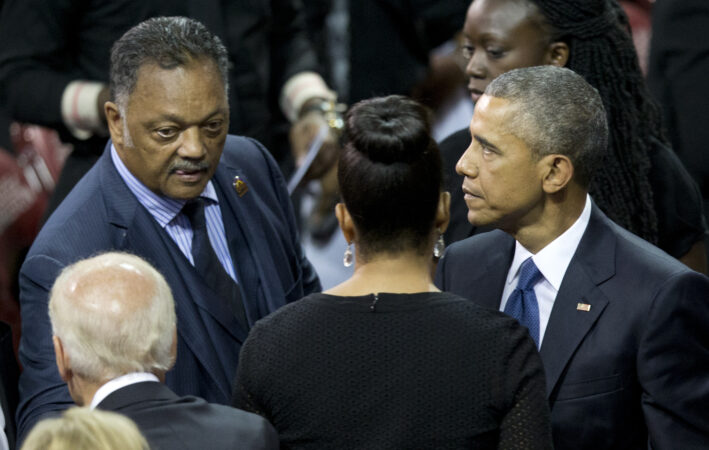
Pick any of the seminal moments from Black history over the last six decades — from the assassination of the Rev. Dr. Martin Luther King Jr. in 1968 to Barack Obama’s first speech as president-elect 40 years later — and the chances are that the Rev. Jesse Jackson Sr. was there, front and center.
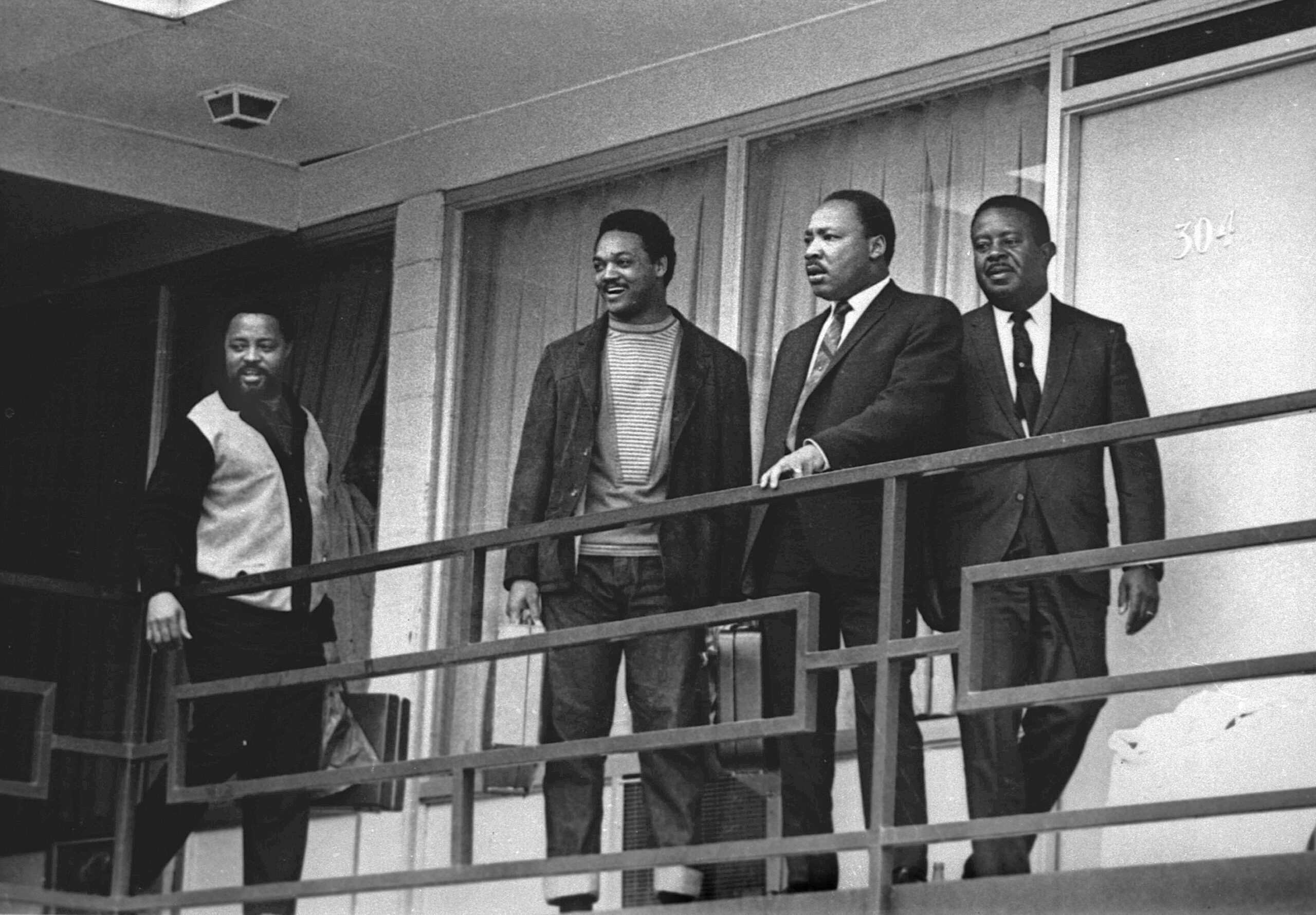
Jackson had spoken to King only moments before the civil rights leader was fatally shot while standing on a balcony of the Lorraine Motel in Memphis on April 4, 1968. Even though he was only 26 years old, Jackson went on to position himself to take up the mantle of leading the civil rights movement.
Years later, Jackson explained to an interviewer, “What I was clear on was that we could not let one bullet kill the whole movement.” He used the analogy of an athletic event during which the best player gets hurt. The answer, he said, isn’t to forfeit the game: “You can’t run away. You’ve got to keep fighting.”
The Rev. Martin Luther King Jr. (second from right) stands with Hosea Williams (left), Jesse Jackson (second from left), and Ralph Abernathy (right) on the balcony of the Lorraine Motel in Memphis on April 3, 1968, a day before he was assassinated while standing in approximately the same spot.
And that’s what he did for the rest of his life, advocating tirelessly for an end to racial injustice as well as for economic opportunities for poor people of all racial backgrounds through his iconic Rainbow coalition and during his two historic runs for the presidency.
Back when most Americans couldn’t conceive of a Black man becoming president of the United States, he could and tried to get the rest of us to believe in it, too. Jackson launched his first bid for the Democratic presidential nomination in 1984 and again in 1988.
Jackson rarely gets the credit, but his run for the White House helped lay the groundwork for the election of Obama, who fulfilled Jackson’s vision.
And, yes, when Obama gave his victory speech in Chicago’s Grant Park on election night 2008, Jackson was there, too. While Obama spoke, Jackson could be seen holding a miniature American flag with tears streaming down his cheeks.
“I wish for a moment that Dr. King or Medgar Evers” — the civil rights leader who was assassinated in Mississippi in 1963 — “could’ve just been there for 30 seconds to see the fruits of their labor,” Jackson later told the Associated Press about his emotions that night. “I became overwhelmed. It was the joy and the journey.”
Jackson’s death on Tuesday at the age of 84 came after years of illnesses, including a rare neurological disorder. Even in his later years, however, he stayed in the game — to continue his football metaphor — making an appearance onstage to thunderous applause during the Democratic National Convention in Chicago in 2024.
Inquirer columnist Jenice Armstrong interviews Jesse Jackson during the 50th anniversary commemoration of the assassination of the Rev. Martin Luther King Jr. on April 4, 2018.
News he had died hit me as hard as if I’d lost a dear relative. I didn’t know Jackson personally, but had the privilege of interviewing him multiple times during my career.
In fact, the first time I met him was asa student journalist on the campus of Howard University. The last time I’d actually gotten a chance to interview him was in 2018 during the 50th anniversary commemoration of King’s assassination in Memphis outside what had been the Lorraine Motel, which is now part of the National Civil Rights Museum. I wish I’d kept the recording of what he said.
As I processed the news of his death, I made a point of posting on Abby Phillip’s Instagram page a brief note ofthanks for her work chronicling Jackson’s life and legacy in her book, A Dream Deferred: Jesse Jackson and the Fight for Black Political Power. Phillip told me last year that she knew she was working against time and Jackson’s frail health to finish the project before his death.
Her goal, she said, “was to make sure that this chapter didn’t get lost to history.”
I was a kid in the 1970s during the Black Power era who repeated his chants, “I am somebody!”
Back then, it was affirming to see Jackson on TV with his then-signature Afro, or later delivering electrifying speeches during his groundbreaking runs for the presidency. We used to chant, “Run Jesse Run!”
One of the first articles I wrote for my student newspaper was about Jackson’s Operation PUSH, or People United to Save Humanity.
Jacksonspent his adult life at the forefront of the pursuit of equality for African Americans, and for that, we should always be grateful.
To me, losing this great leader in February during Black History Month — at a time when our people’s contributions to the nation’s history are being threatened with erasure — only magnifies the sense of loss. It should also remind those of us who care about civil and human rights that it’s our turn to take up the struggle — and keep fighting.
I was cranking out the newsletter in Tuesday’s predawn darkness when we learned that the Rev. Jesse Jackson Sr., who’d been our greatest living bridge to the civil rights heroics of the 1960s and ‘70s, had died at age 84. Covering his groundbreaking 1984 campaign as a cub reporter at the Birmingham News is still a career highlight four-decades-plus later — a memory that was reinforced recently listening to Abby Phillip’s excellent new book on Jackson. He leaves us right when his victories for African Americans in arenas such as corporate hiring and college admissions are under attack, and it challenges us to fight to preserve them. RIP to an American original.
How ICE protest by ‘an average Joe’ from Haddon Heights went viral
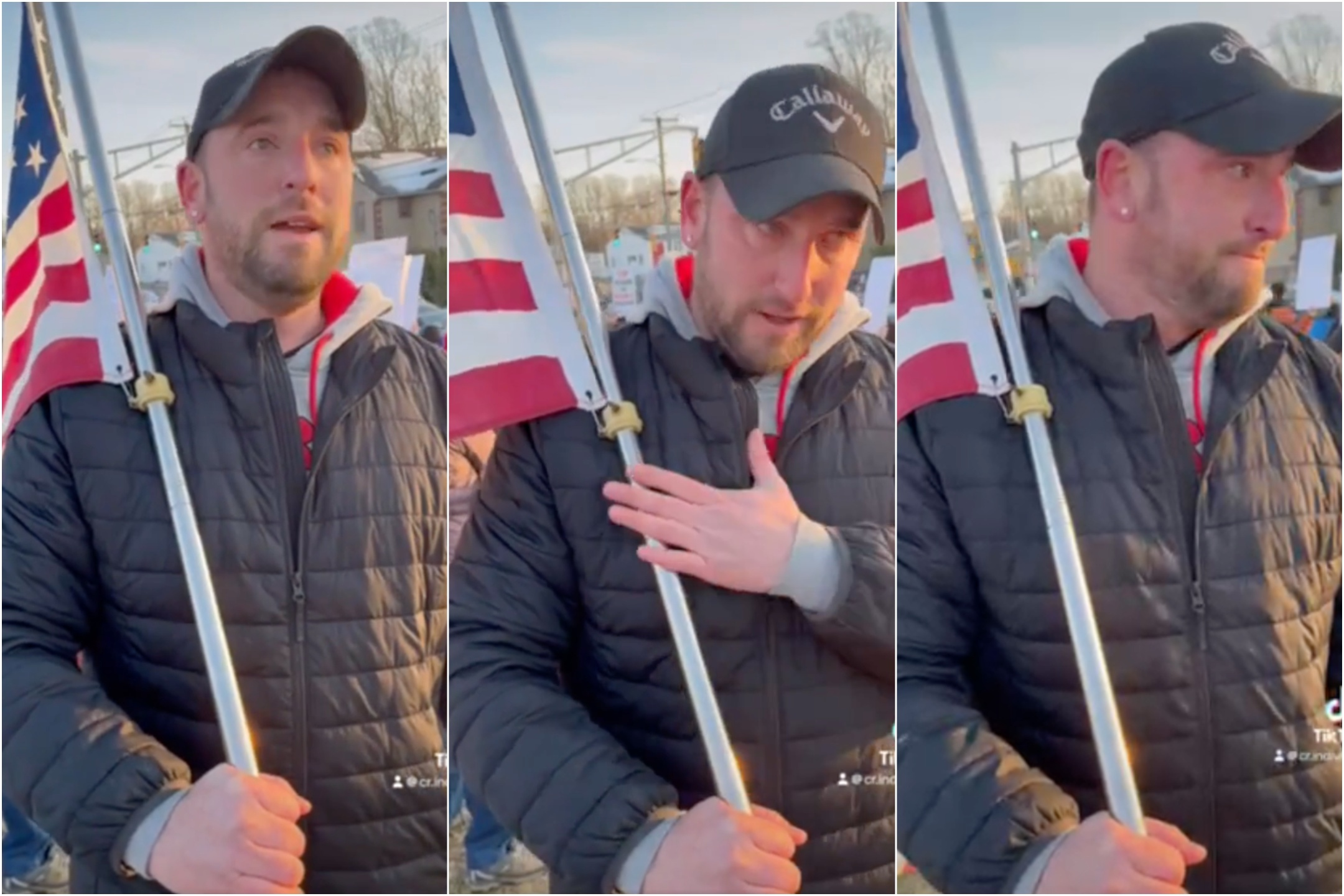
“I never want to see a child run away from our own government again,” said this self-described first-time protester, Joseph Zobel from Haddon Heights, at a rally in Lindenwold, N.J., the day after children ran from a school bus stop after ICE appeared to conduct an operation in the area.
Last Friday, “an average Joe who grew up in Haddon Heights” named Joseph Zobel was at work when he saw a viral video from the nearby South Jersey town of Lindenwold that shocked the nation, and shocked him.
The clip from a Ring doorbell camera showed a gaggle of fourth and fifth graders running in a panic, screaming, “ICE! ICE!” as masked federal immigration agents had approached their morning bus stop the day before.
“I just thought, ‘How can that be happening here in the United States?’” Zobel told me Monday in his first media interview, conducted by email. When he got home from work, he saw online that the group Cooper River Indivisible was holding an “ICE Out” protest at the Lindenwold municipal building at 4 p.m.
He looked at the clock. It was 3:58.
“Something inside of me said, ‘Go up there and stand with these people,’” said Zobel, a 36-year-old school coach who said he’s never been to a protest before in his life. “I wanted to stand for what is right.” As he dashed out, Zobel also grabbed one thing — the American flag he flies in front of his house most of the time (except during football season, when an Eagles flag replaces it).
As many as 300 people were at the protest, as Indivisible organizer Amber Clemments asked the flag-bearing Zobel if he’d be willing to film a video. Zobel’s raw emotion, choking back tears as he said, “I watched fourth- and fifth-grade kids run away from our own government,” soon ignited across social media over the long Presidents Day weekend.
By Tuesday morning, the 47-second clip of Zobel had been watched an astronomical 2.9 million times on TikTok — and liked by some 709,000 viewers — even as it also went viral on Bluesky, X, Threads, and other social media platforms.
It’s not hard to understand why. Zobel, who described himself as a patriotic regular voter but never very political, instantly became the bearded, baseball hat-wearing, anguished face of a new American majority — an Everyman shocked into action by the horror of immigration raids, wondering how best to protect his neighbors.
The two South Jersey viral videos — the one depicting the raid itself and Zobel’s raw reaction — revealed how both the terrorizing tactics of masked immigration cops and the powerful reaction from often nonpolitical Americans, dubbed “neighborism,” are spreading far beyond the Minnesota tundra where this battle was initially met.
Indeed, local activists say Lindenwold — last stop on the heavily traveled PATCO line, just over 15 miles southeast of Philadelphia — has been under a relentless siege from U.S. Immigration and Customs Enforcement (ICE) and other federal agents since last spring, not long after Donald Trump became president. The transit hub has become a magnet for immigrants in recent years, with a local school population that is just under 60% Latino.
Craig Strimel, a leader of Cooper River Indivisible, a local chapter of the group that organized the large “No Kings” protests, said activists first learned of the ICE activity when a Lindenwold immigrant couple escaped agents last year by taking refuge in the local high school, where the principal blocked the feds at the doorway. Since then, Strimel said, ICE watchers have seen frequent activity in and around a cluster of five apartment complexes with large immigrant populations, but few known arrests.
“It was becoming apparent early on that this was all about creating terror,” said Strimel of the frequent ICE sightings. Some local residents stopped leaving their apartments, he said, and a once-popular restaurant in Lindenwold just closed its doors amid rumors that the couple that owned it has returned to Mexico.
All of this set the stage for last Thursday, when masked federal agents wearing tactical gear arrived early in the morning at Lindenwold’s Woodland Village Apartments just as 44 elementary school kids were waiting for their school bus. The sighting triggered a panic that saw some kids running away and others frantically hustling onto the bus as the driver arrived. No one was apprehended or reported hurt.
On Monday, U.S. Department of Homeland Security officials said the agents went to the complex hoping to arrest a Honduran immigrant who’d once been convicted of aggravated assault. The man was not taken on Thursday and remains free.
Although some outlets reported the large protest was in response to the high-profile raid — which has been covered by the CBS Evening News, MS Now’sMorning Joe, and elsewhere — that took place just a day and a half earlier, the rally actually had been in the works for several weeks.
It had been organized by a young woman from Lindenwold named Tatiana — a 20-year-old business major at Camden County Community College who spoke with me Monday on the condition that I not use her full name — who’d been seeing the ICE activity in her hometown and felt it was time local people spoke out.
Tatiana told me that the idea behind the Lindenwold protest was “to give the community a voice — to be able to say, ‘No, we don’t stand for this.’ That’s the most important thing for me. It’s just bringing community together and deciding we’re not OK with this at all.” But she agreed the bus stop raid had given the event a boost from residents believing “that children should not be scared of federal law enforcement.”
Zobel was one of those neighbors. In the email interview, he described himself as “just your average Joe who grew up in Haddon Heights.” He did volunteer that he’s voted in every election since he turned 18, and that his first ballot was cast for Barack Obama, “and I felt proud walking out of the booth that day.”
Fittingly, Zobel sounded somewhat Obama-esque when he described his dismay over America’s bitter partisan divide. “We as a nation are so angry with one another, and that makes me so sad,” he said. Not surprisingly, he’s as stunned as anyone at the millions of views for Friday’s video, and somewhat concerned about the impact, saying, “I just hope this video does not divide people.”
But Zobel’s words and teary-eyed emotion went viral because it was such a shot of hope — that in a moment when hate is on public display in the streets of the United States, “your average Joe” who’d once stood on the sidelines is now grabbing the American flag and taking the field to fight for their neighbors. An authoritarian movement dependent on rage simply never counted on the brotherly love that sent this nonpolitical Eagles fan to his first protest.
It might not be his last. “I am always happy,” he said, “to help support humanity.”
Yo, do this!
With several inches of snow still on the ground, it might shock you to hear this, but American soccer is back! The Philadelphia Union — despite winning the 2025 Supporters Shield and boasting Major League Soccer’s best winning percentage in the 2020s — radically shook things up during the offseason. With new strikers Ezekiel Alladoh and Agustín Anello looking to amp up their attack, the Union’s quest for the CONCACAF Champions Cup begins Wednesday in Trinidad against Defence Force FC at 6 p.m. on FS2. Saturday night at 7:30 p.m., it’s back to the chillier climes of Washington for the MLS opener against DC United on Apple TV (with no need in 2026 for an additional Season Pass subscription, as in past years).
In the quest for what’s new in American popular culture, sometimes we take for granted the established jewels in our midst. I’ve long felt that MS Now’s 9 p.m. (now just on Monday nights) host Rachel Maddow is our best TV commentator because of the way she weaves the historical past into the headlines of America’s tortured present. But since last summer, she has upped her game. Maddow’s coverage of two stories underreported in most of the mainstream media — grassroots resistance to the Trump regime, and now the push for a nationwide network of warehouse concentration camps — has created appointment television every Monday.
Ask me anything
Question: What is your take on the latest CBS censoring of [Stephen] Colbert? — @bcooper82.bsky.social via Bluesky
Answer: Another Tuesday morning breaking story on deadline: The CBS overseers of Late Night with Stephen Colbert — the top-rated talk show that’s nevertheless ending this year in what critics see as genuflecting to the Trump regime that the program frequently mocks — would not air a recorded interview with Texas state lawmaker and Democratic Senate primary candidate James Talarico. The backstory here is that the Federal Communications Commission has long exempted late-night talk shows from its equal time rule about political candidates on licensed broadcast outlets, but last month, FCC chair Brendan Carr — a pro-Trump MAGA pit bull — said this is changing. That apparently was enough for CBS’s new Trump-friendly management, which would not broadcast the interview (available on YouTube, now certain to get more views than if it hadn’t been censored). This new flap just highlights what a perilous moment this is for the First Amendment and American democracy writ large. Government limits on what viewpoints you can see or hear are a sign of dictatorship, full stop.
What you’re saying about …
Last week’s question about a winning Democratic strategy for the 2026 midterms drew a robust response, and almost all of the replies were thoughtful and nuanced. If there was a consensus, it was that Democrats should tailor their candidates to the divergent views of the congressional districts they hope to win. As Naomi Miller stated, “I think progressive candidates should run in progressive districts, and mainstream democrats in mainstream, purple, and red districts.” Still, a number of you think America’s bad experience with MAGA extremism means a sharp left turn is warranted in response. “I’d like for the Democrats to become more progressive and combative toward Trump than they already are,” wrote Benjamin Spohn, voicing an opinion many share these days.
📮 This week’s question: Tuesday’s passing of the Rev. Jesse Jackson is one more reminder that many icons of America’s tumultuous 20th century are disappearing. So who do you think is the current greatest living American, and why? Please email me your answer and put the exact phrase “greatest living American” in the subject line.
Backstory on the main reason the media is not trusted
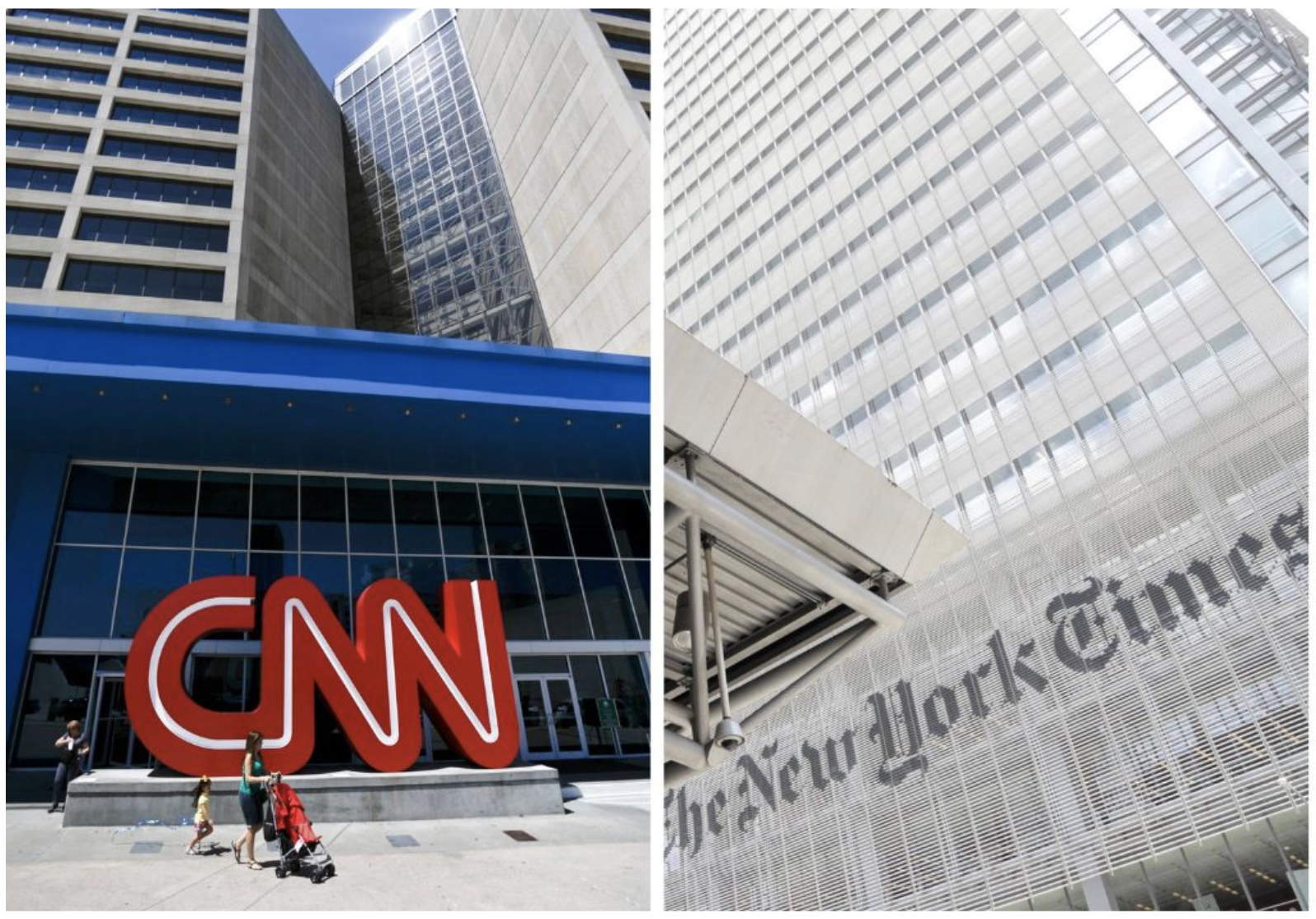
Exterior images of CNN headquarters in Atlanta and the New York Times Building in Manhattan.
It’s rare these days to write something that everyone can agree on, but here goes: Public trust in the media has never been lower than it is today. How low? A Gallup poll last fall found that public trust in the ability of newspapers, TV, and radio to fairly and accurately report the news had plunged to 28%, the lowest ever recorded. Why? It’s complicated. The people’s faith in every major institution has declined in the 21st century, after all. And it’s clear that in a deeply divided America, rage against the media machine looks different from the left than it does from the right.
This weekend, in a New York Times piece largely about the broken promises of one media-mogul billionaire — Washington Post owner and Amazon founder Jeff Bezos — columnist Lydia Polgreen put forth an explanation for sinking media trust that jibes with a lot of what I’ve witnessed since graduating into full-time journalism back in 1981. I believe it’s not the only reason — but the biggest, and maybe the most misunderstood.
Polgreen noted that the common theory for the public turning against Big Media — that journalists grew more partisan and biased after the tumult of the 1960s and ‘70s — doesn’t comport with the bigger reality. The era that peaked with the publication of the Pentagon Papers and the Watergate scandal launched a decades-long golden era of profitable news organizations spending big on investigative and accountability journalism — exactly what viewers and readers claimed they wanted.
Yet, trust declined as that happened. Polgreen cited a study in the late 1990s that compared then-contemporary media to 1960s newspapers and found the earlier times were “naïvely trusting of government, shamelessly boosterish, unembarrassedly hokey and obliging.” Polgreen wrote that moving “away from deferential stenography and toward fearless investigation … led to declining trust in the news media. Aggressive, probing and accountability-oriented journalism held up a mirror to American society — and many Americans didn’t like what they saw.”
I think this explanation is spot on, but before readers jump all over me, let me quickly add a couple of caveats. Starting way back in Ronald Reagan’s 1980s, there was also a response to the growing backlash — especially in elite, Beltway journalism — that resulted in too much groveling to authority, and thus stenography around government lies like the 2003 Iraq War. This has only gotten worse with the current wave of billionaire owners like the Post’s Bezos. This means many liberals now also distrust the media, but not for the same reasons as conservatives, who’ve long loathed journalism for probing America’s inequities around race or gender.
The explanation offered by Polgreen jumped out at me because it fit with what I explored in my 2022 book, After the Ivory Tower Falls, which looked at Americans losing trust in another large institution: colleges and universities. The liberal ideas that were nurtured on campuses in the postwar college enrollment boom — including the civil rights movement — triggered the same grievance-filled, largely white working-class backlash as did journalism about social injustice. Today, the only road back for the media is to hold the powerful to account — and understand that not everyone is going to like it.
What I wrote on this date in 2022
People can’t say they didn’t see America’s current crisis coming. On this date four years ago, I expressed my shock and amazement that little more than one year beyond Donald Trump’s attempted coup to stay in power, the right-wing’s creation of a political fantasy world was spiraling out of control, with lies about Hillary Clinton spying on Trump’s 2016 campaign and Joe Biden giving out free crack pipes (?!!). I wrote, “[Historian Ruth] Ben-Ghiat told me that the failure of the Jan. 6 insurrection only forced the GOP to double-down on embracing alternate realities, because ‘they have to reckon with the fact that [Trump] lost, that he’s no longer the leader.’”
There’s been no rest on themass deportation beat. In my Sunday column, I looked at the out-of-control lying from the Trump regime, with unbelievable fictions about everything from shootings and rampant brutality by masked immigration officers to Commerce Secretary Howard Lutnick’s whoppers about his friendship with Jeffrey Epstein. I argued that government lying is fundamentally unconstitutional and that the perpetrators need to be punished, including prison time. Over the weekend, I wrote about how, while Minneapolis was a victory for the forces resisting American authoritarianism, that won’t stop Homeland Security from putting thousands of new officers on the street and expanding its concentration camps. The fight for the soul of the nation has only just begun.
What was I saying higher up in this newsletter about accountability journalism? Ever since Lyndon B. Johnson’s Great Society push in the mid-1960s, community nonprofits have been a valuable source of urban renewal, yet aresometimes dragged down by waste, fraud, and abuse. It’s a problem that sadly persists, as shown last week by a major Inquirer investigation into Philadelphia’s NOMO Foundation, one of the best-funded nonprofits attacking youth violence and crime. Ace reporters Ryan W. Briggs and Samantha Melamed found that the foundation has received more than $6 million in public funds in recent years, but faced an IRS lien and eviction lawsuits while it was forced to close its housing program. This is why we have a First Amendment, so that a free press can report on the problems a corrupt or inept government refuses to deal with. Subscribing to The Inquirer gives you access to this type of essential journalism, and you’ll also feel good about supporting this vital work.
By submitting your written, visual, and/or audio contributions, you agree to The Inquirer’s Terms of Use, including the grant of rights in Section 10.
That’s one of my favorite questions to ask students. I want them to scrutinize their most deeply held beliefs. When you do that, I tell them, you sometimes find out you don’t believe them any longer.
A few weeks ago, a student put the same question to me. I thought about it for a few days, and then I came back with my answer: I changed my mind about protesters wearing masks on campus.
I used to think they should be allowed to cover their faces, and that it was a mistake for universities to prohibit them from doing so. But I think differently now.
And my reason has three letters: ICE.
Like many other Americans, I’m appalled by the presence of masked agents from U.S. Immigration and Customs Enforcement on our streets. Even before they killed two protesters in Minnesota, I was afraid of them. Now, I’m terrified.
And I’m proud of Democrats in Congress for demanding that ICE agents be prohibited from wearing masks that hide their identities. Blocking a GOP spending bill that lacked any new curbs on ICE, the Democrats forced a partial shutdown of the federal government over the weekend. They should hold out until the mask ban is in place.
I also support a proposed City Council measure that would block law enforcement officers in Philadelphia — including ICE agents — from obscuring their identities with facial coverings.
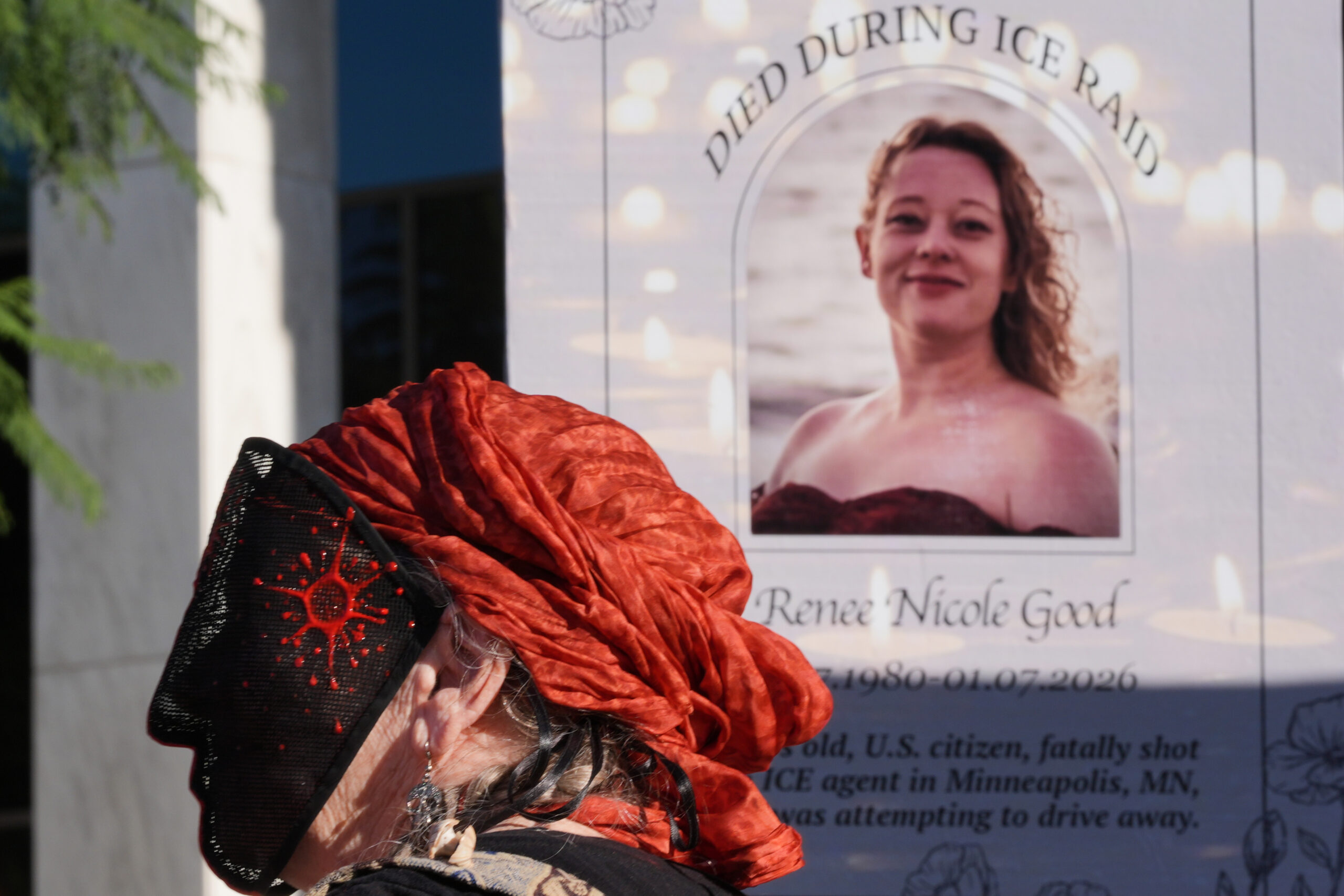
A demonstrator in Los Angeles wears a mask in front of an image of Renee Good during a protest last month to denounce the Trump administration’s immigration enforcement polices.
But now I believe campus demonstrators — like ICE agents — should also be barred from wearing masks. Their facial coverings stoke fear, too. And they make it next to impossible for officials to keep everyone else safe.
If you think otherwise, consider what happened at Haverford College earlier this month. Interrupting a talk by a pro-Israel speaker, several masked demonstrators burst into the room. One of them shouted into a bullhorn that “Israeli occupation forces” were killing children. “When Gaza is burned, you will all burn, too,” she said.
Most universities already have rules barring disruption of public events. But masks add something worse: intimidation.
When the masked protesters entered the room, a Haverford professor said he thought they were “terrorists trying to get in and kill us.” Another witness said she worried she might be attacked.
“No one knew who they were or whether they were armed,” the witness added. “Imagine fully masked people entering through emergency exits, hiding objects under their coats, blocking basic points of egress. It is reasonable to fear for your physical safety.”
And it’s also reasonable for colleges to ban masks. In a statement, Haverford officials said the protester carrying the bullhorn was not a member of their community. But nobody could know that when she entered the room.
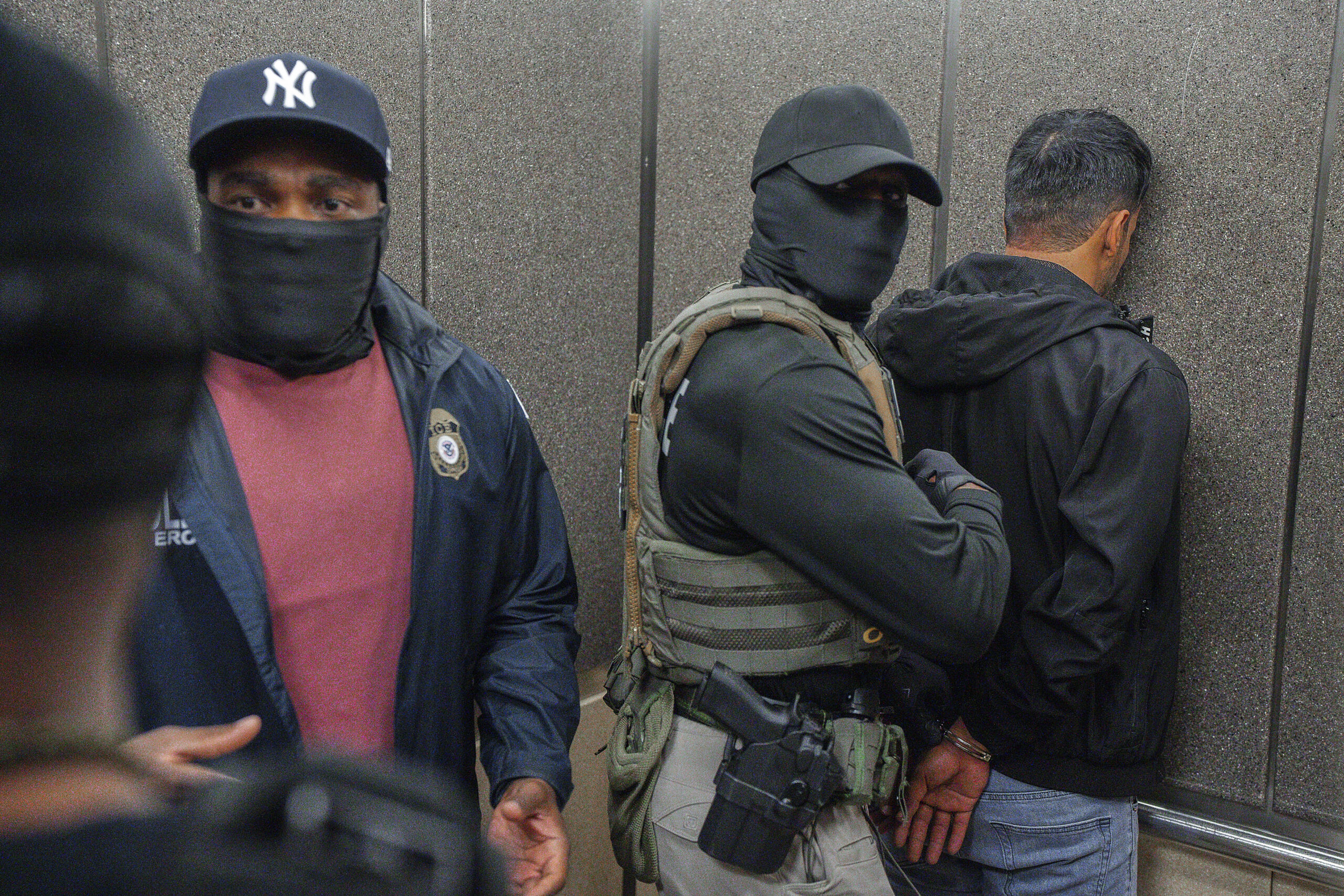
Masked U.S. Immigration and Customs Enforcement agents escort a detained immigrant into an elevator after he exited an immigration courtroom in New York in June.
How can we keep the university safe if we don’t know who is from the university and who isn’t?
At the University of Pennsylvania, where I teach, only nine of 33 people arrested during the clearing of pro-Palestinian encampments in May 2024 were students at the university. At Swarthmore, just two of nine arrested demonstrators were members of the college community.
It shouldn’t be. We need a free and open dialogue about Israel, and everything else. And that’s also why we should ban masks, which inhibit that same dialogue. You can’t have a conversation if you don’t know who is talking.
I used to think masks were a form of free expression, so universities should allow them. I also thought protesters needed to hide their identities so they wouldn’t get doxed, which would subject them to violence and harassment.
Then the Trump administration said the same thing about ICE agents — they need masks to protect them from doxing — and I changed my mind. Regular police officers don’t wear masks; instead, they wear numbers and name tags. That’s how we hold them accountable for their actions.
Putting masks on ICE agents does the opposite: It lets them act with impunity. The goal of the masks is not to protect the agents. It’s to foster fear in our communities and our nation.
They need to take their masks off. But so do we.
Of course, we should make exceptions for people who cover their faces for reasons of health, religion, sports, or entertainment. I’d hate to see a college kid barred from wearing a Halloween mask, for example.
But a protester? Let us see who you are. Don’t cower behind a mask. That’s what ICE does.
MUNICH — Last year, at the Munich Security Conference, where top U.S. and European leaders gather each year, Vice President JD Vance gave a shocking speech that nearly broke the NATO alliance of democracies that had kept the peace in Europe for 80 years.
Vance claimed the threat to Europe was “not Russia, not China,” but rather came “from within” our NATO allies themselves — falsely accusing European democracies of stifling the radical, pro-Russia, and sometimes neo-Nazi parties that the Trump White House openly supports. The veep never even mentioned the threat from Russia, or its war on Ukraine.
The acrid impact of that speech has hung over U.S.-European relations and the future of the NATO alliance over the past year.
“Under Destruction” was the title of this year’s conference, held at the elegant Bayerischer Hof hotel. Its annual security report opened with these grim words, aimed at the “current U.S. administration”: “The world has entered a period of wrecking-ball politics. Sweeping destruction — rather than careful reforms and policy corrections — is the order of the day.”
And yet, this year, I heard a startlingly different tone from European leaders. Stunned by Trump’s demands and disdain, awakened by Russian aggression against Ukraine and much of Europe, furious at President Donald Trump’s threats vs. NATO ally Denmark to seize its sovereign territory of Greenland, European leaders have woken up to the need for dramatic changes — though not in the way envisioned by Trump.
“Europe has just returned from a vacation from world history,” stated German Chancellor Friedrich Merz, who like other leaders here, recognized they had depended for too long on an American ally they trusted for their postwar defense.
Merz chose to speak first at the conference, taking a European leadership role (while insisting, with a nod to his country’s history, that Germany would “never again go it alone”).
“The international order based on rights and rules is currently being destroyed,” he said. “But I’m afraid we have to put it in even harsher terms. This order, as flawed as it has been even in its heyday, no longer exists.”
Merz added, “It does not mean that we accept it as an inevitable fate. We are not at the mercy of this world. We can shape it. And I have no doubt that we will preserve our interests and our values in this world if we step up together with determination, with confidence in our own strengths.”
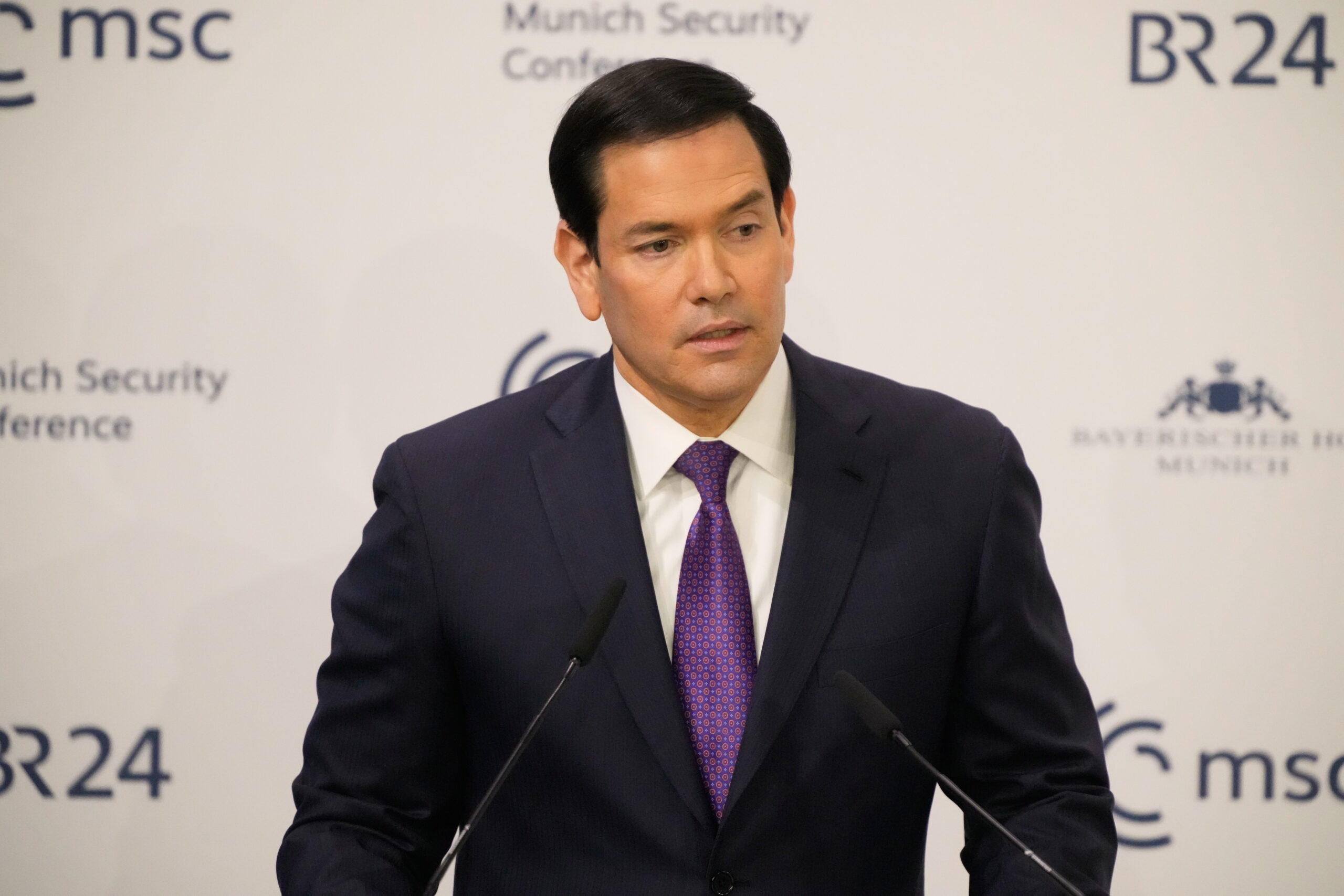
U.S. Secretary of State Marco Rubio speaks at the Munich Security Conference Saturday.
Indeed, the message of this European leaders meeting in Munich, in sharp contrast to European paralysis at Vance’s onslaught last year, was that they must and can organize to defend against Russia while protecting democratic values — and Ukraine — even if the United States won’t.
Of course, skeptics, including Trumpers, will claim that Europe has become irrelevant. But what I heard this weekend is far more realistic than Trump’s fantasies about a Ukraine deal that bows to Putin and envisions big business deals with Russia.
Pressed by Trump (and this was a good thing), NATO allies have significantly increased their defense budgets. Now that the U.S. has cut off almost all aid to Ukraine, Europe is paying for all U.S. weapons that are purchased for Kyiv, and the EU has pledged to cover most of Ukraine’s military budget for the next two years.
But, unlike the U.S. president, the Europeans recognize that Ukraine is a symbol of the threat posed by an imperialist, aggressive Vladimir Putin.
“With the beginning of Russia’s aggression, we entered a new phase of open conflict and wars, which changed the [security] situation more than we ever thought possible a few years ago,” Merz continued.
The Kremlin also pushes claims of defending its “Russian civilization” to include any territory where it falsely claims that Russians are mistreated. This could include the Baltics, Poland, parts of the Arctic, all of Ukraine, Moldova. The list goes on.
European officials are acutely aware of Russian threats, since they are the constant victims of Russian sabotage, underwater cable cutting, and political assassinations, all of which the White House downplays.
During the conference British intelligence announced they had proof that Russia had assassinated opposition leader Alexei Navalyny in prison with a rare toxin, just as Russian agents murdered a Russian dissident on British soil.
What I heard over and over was European astonishment that the White House ignores the massive slaughter of civilians by Putin, while pressing only for concessions by Ukraine. President Volodymyr Zelensky spoke bluntly at Munich about the need for more air defenses, but only Europe is responding.
Indeed, Ukraine was central to the whole conference, with many speakers, warm applause, and frequent sessions featuring Ukrainian military innovations, while Europeans emphasized the importance of Ukraine’s trained army to Europe in the future.
There was constant praise for Kyiv as the defender of Western values, holding the line between Russia and the democratic West.
Ukrainian President Volodymyr Zelenskyy, left, and German Defence Minister Boris Pistorius talk during their visit of drone producing company Quantum Frontline Industries near Munich Friday.
Yet, it was clear from the American position at Munich that the administration sees the world entirely in a different light.
No doubt aware that Vance redux would have been booed off the stage, the White House dispatched the somewhat more diplomatic (but far less powerful) Secretary of State Marco Rubio who soothed European fears slightly with an emphasis on continued U.S.-European ties. However, Rubio pointedly never mentioned the Russian threat hanging over Europe in his speech. He pushed the same nationalist MAGA line about the main threat to “thousands of years of Western civilization” coming from immigrants and multilateral ties.
More disdainful was Deputy Secretary of Defense Elbridge Colby, who praised Secretary Pete Hegseth repeatedly and fulsomely, and insisted that the essence of Trump foreign policy was “hard-nosed common sense.”
“You can’t base an alliance on sentiment alone,” he insisted, in a discussion held in the Bar Montez at the Rosewood Hotel, without taking any questions. “Maybe there is a difference in values.” Then he laughed that he had only heard the words “rules-based international order” once in Munich so “that is a piece of progress.”
It is not clear whether the Europeans can achieve the weapons production goals they discussed and develop an integrated military force that takes over ground protection of Europe within NATO by the end of this decade. And leaders I spoke with recognize they can’t succeed alone without active partnership with — not subordination to — the United States.
But what I heard in Munich made clear that they are far more aware of the threat democracies face and the values that need to be protected than is the White House.
“We will preserve our interests and values if we step up together,” said Merz.
That is wise advice that the White House continues to ignore.
It was understandable and probably justified when a surge of roughly 3,000 masked and gun-toting federal agents into Greater Minneapolis was described in martial terms, as a kind of modern-day Battle of Stalingrad fought in a snowbound U.S. prairie metropolis.
Watching the icy slips of the clumsy U.S. Immigration and Customs Enforcement (ICE) officers, and the remarkable pushback from whistle-blowing neighbors braving subzero cold, the writer Margaret Killjoy quoted a friend: “ICE made a classic Nazi mistake: they invaded a winter people in winter.” So when border czar Tom Homan stood at a Minneapolis podium last week and declared an end to “Operation Metro Surge,” many in the media raced to cast the move as a major pullback.
“The Occupying Army Retreats,” proclaimed the American Prospect, in a tone that was echoed across numerous outlets. “The announcement of ICE’s withdrawal from Minnesota, like that of the British from Boston 250 years ago, marks a victory for people power.”
But the smell of victory didn’t travel the nearly 1,200 miles east to the South Jersey suburb of Lindenwold, where on the very same morning Homan announced the end of the Minnesota surge, residents were shocked by an ICE raid that targeted a bus stop for an elementary school in a district that is 60% Latino.
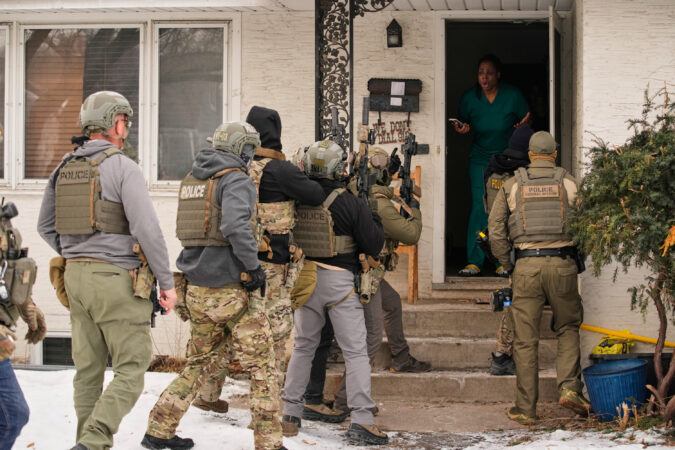
A Ring video from the Woodland Village Apartments, where about 44 kids were waiting for the bus, captured the alarming scene as fourth and fifth graders — some screaming “ICE! ICE!” — ran away from the masked agents in tactical gear who’d pulled up in unmarked vehicles. School officials believe no child was apprehended, although there were conflicting reports on whether any adult was arrested. But the suburban community, some 15 miles southeast of Philadelphia, was shaken to its core.
Thursday morning kids were sent running from their bus stop in panic because ICE showed up. This guy at yesterday's ICE Out of Lindenwold, NJ protest is a must watch
“I never protested before in my entire life but …,” he said, choking back tears. “I watched fourth- and fifth-grade kids run away from our own government. I never want to see that again.”
Unfortunately, America is all but certain to see this again. While Homan’s public proclamation of a drawdown in Minnesota seemed a small concession to crumbling political support for ICE, what happened in Lindenwold was a window into a dystopian near-future of more immigration raids — not fewer. This would allow an undeterred authoritarian Donald Trump regime to fill a $38 billion gulag archipelago of coast-to-coast warehouses with newly handcuffed human beings.
Even Homan said as much last Thursday, if you listened closely. “And let me be clear, mass deportations will continue, and we’re not rolling back,” he said. “President Trump promised mass deportations, and that’s exactly what the American people are going to get.”
Let’s also be clear. What happened in Minneapolis since the start of the year really was a landmark victory for democracy, and the notion that everyday Americans can defend their neighbors. At the cost of two lives, the great personal risks taken by Minnesota’s ICE resisters ended in both an unforgettable moral triumph and some real tangible gains.
The actions taken by ICE watchers — who blew their alert whistles, recorded the government’s maneuvers on their phones, or volunteered food and rides to help immigrants stay safe indoors — prevented the arrests of scores and maybe hundreds of law-abiding neighbors. The courage of their resistance drove a huge shift in public opinion against the immigration raids, forcing rare concessions from the Trump regime. This heroism probably did cause ICE to scale back its Minnesota operations sooner than planned, and even pressured the U.S. Department of Justice to investigate two agents whose version of a shooting didn’t fit reality.
But Trump’s mass deportation drive — with an inexorable inertia created when Congress threw a whopping $170 billion toward this effort last year — refuses to obey the normal laws of political gravity.
U.S. Border Patrol officers walk along a street in Minneapolis last month.
For starters, the U.S. Department of Homeland Security has lied repeatedly to the American people, which means there’s no way of truly knowing to what extent the Minnesota surge has even ended. The day after Homan’s announcement, a St. Paul-based journalist noted 100 reports of ICE activity, still more than any other state.
But even more importantly, a flurry of reports last week about a massive ICE expansion for the rest of the year with many more agents in the field, more offices to support them, and more detention camps to hold thousands of new arrestees showed that what happened on the streets of Minneapolis was not the beginning of the end.
The fact that ICE is ending its surge in Minneapolis — similar to what happened in 2025 in Los Angeles, Chicago, Charlotte, N.C., and New Orleans, albeit on a smaller scale — seems less significant than the fact that the agency has, under Trump, more than doubled the number of field agents from 10,000 to 22,000, with many just hitting the streets.
Indeed, the drive to recruit new agents isn’t letting up. A Times of London reporter described the push as “a breakneck operation” as he watched officers from U.S. Customs and Border Protection — which also had its biggest hiring year in a decade — work the crowd with promises of a $50,000 bonus at a sold-out professional bull-riding event in Salt Lake City.
Can we really celebrate a “retreat” from Minneapolis when WIRED reported last week that ICE is also rushing to close leases on as many as 150 new offices — an average of three in every single state — to house its growing roster of agents and the attorneys and other back-office staffers needed to process the thousands of new arrestees?
Barricades block a drive outside a warehouse as federal officials tour the facility to consider repurposing it as an ICE detention facility on Jan. 15.
For example, multiple outlets confirmed last week that Homeland Security just inked a lease for high-end office space in the Westlakes Office Park in Berwyn, in Philadelphia’s Main Line suburbs, reportedly to house ICE attorneys and related personnel. A planned office in Philadelphia’s Chinatown, at 801 Arch St., is also listed by WIRED.
Experts say the logistics of converting these rectangular behemoths — like the 1.3 million-square-foot warehouse in Schuylkill County, Pa., that used to distribute cheap consumer goods for Big Lots that DHS claims can house up to7,500 detained immigrants — into even remotely humane facilities is daunting, if not impossible. Yet, DHS is plowing ahead with stunning speed, clearly expecting a pending spike in arrests.
In rural Social Circle, Ga., ICE is claiming it will convert a one million-square-foot warehouse into a detention site for as many as 10,000 people — double the town’s population — as soon as two months from now. Project Salt Box, which is tracking the rapid gulag expansion, says DHS is using a legal maneuver to fast-track bidding to allow large private firms like the Geo Group to run these detention centers.
Neither Trump’s plunging approval rating, nor the rapidly rising level of ICE resistance from everyday citizens like that flag-waver in Lindenwold, nor the Democratic demands for major reforms that have caused a DHS shutdown (with, ironically, no impact on ICE or Border Patrol) has put a dent in this unyielding drive toward rank inhumanity.
A newly bloated ICE wants to create a Minneapolis in every state, even as more and more Americans are willing to take considerable risks to stop them. What we are witnessing just over one year into the Trump regime is less a retreat and more an escalating game of chicken — with the forces of democracy and fascism headed for a dangerous collision.
If you’re part of the growing American majority who is disgusted with what ICE is doing in our streets, now is the time to get your whistle, attend a training session on what to do when the secret police arrive at your kid’s bus stop, attend a protest like the next “No Kings” event on March 28, and join the movement to protect your neighbors.
In the spirit of John Paul Jones and the revolutionary American founders, we have not yet begun to fight.
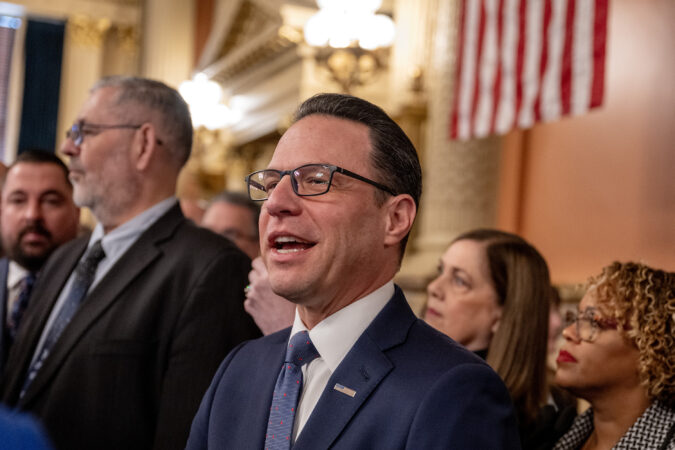
When Josh Shapiro first ran for state attorney general in 2016, I asked him during a meeting with The Inquirer Editorial Board what he thought about the spread of legalized gambling in Pennsylvania.
He gave a thoughtful and passionate response detailing the reasons why he hated gambling and thought it was bad public policy. It was music to my ears, which is why I still remember it nearly 10 years later.
So it is sad to see now-Gov. Shapiro roll out another state budget that proposes taxing skill games. For two decades, lawmakers in Harrisburg have turned to new ways to boost gambling tax revenues.
Funding the government with billions of dollars in gambling losses from individuals is beyond scuzzy. And of all the exploitative and predatory forms of gambling that exist, skill games are among the scuzziest.
Shapiro said as much years ago, but Harrisburg is hooked on gambling. It is a problem Shapiro inherited, but now he’s helping to fuel more gambling. Last year, Shapiro signed a bill designed to grow the lottery, and an agreement that allowed online poker players in Pennsylvania to compete with those in other states.
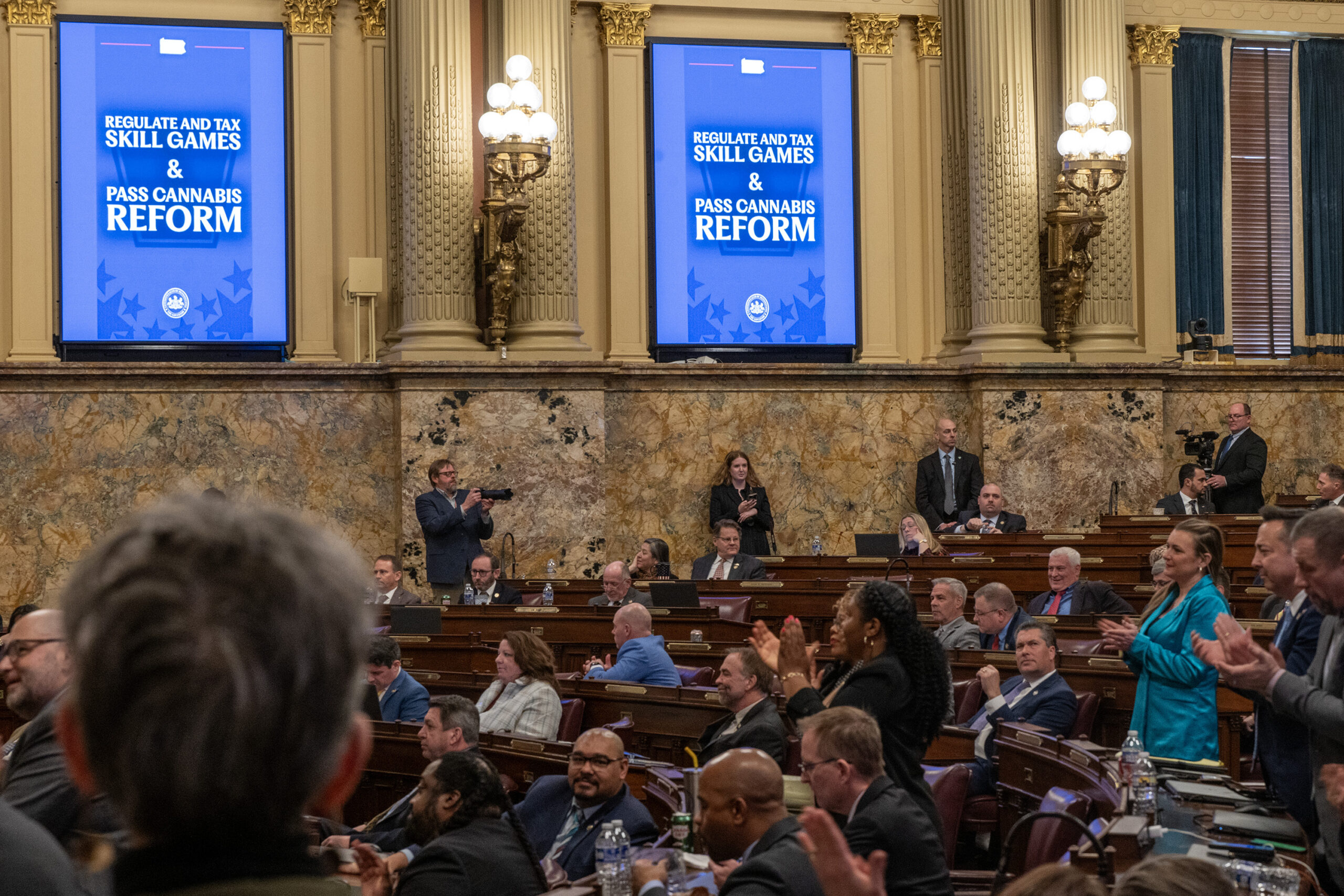
Screen shows skill games and cannabis regulation and reform as Gov. Josh Shapiro makes his annual budget proposal in the state House chamber in Harrisburg Tuesday, Feb. 3, 2026.
Here is why the gambling monster keeps growing: Gambling interests are among the biggest donors in Harrisburg and hold huge sway over lawmakers. Meanwhile, lawmakers reluctant to raise taxes find it easier to bleed more gamblers.
The latest golden goose is skill games.
Despite the name, there is not a lot of skill involved. The games are similar to slot machines, but only worse because of how they disproportionately target poor and working-class communities.
Like slots, skill games can be addictive. The Pennsylvania Council on Compulsive Gambling has received more than 400 calls about skill games since 2021, including from many already enrolled in casino self-exclusion programs, according to Josh Ercole, the gambling council’s executive director.
Skill games operate in a gray area. They are not taxed or regulated, but they have proliferated to nearly every corner of the state.
Unregulated gaming devices known as “skill games” in a gas station connivence store in Philadelphia in August.
There are more than 70,000 skill game machines in Pennsylvania. They can be found in bars, restaurants, gas stations, truck stops, VFW halls, and even at the end of a food aisle in a convenience store. By comparison, Pennsylvania has about 25,000 slot machines in 17 casinos.
The tax rate on slot machine revenues is 54%. Shapiro proposed a 52% tax on skill game revenues, while Senate Republican leaders backed a plan to tax skill games at 35% of gross revenue.
It is mind-boggling that Harrisburg is trying to tax and regulate skill games after allowing them to spread across the state. If lawmakers cared about protecting vulnerable communities, a better policy would be to ban skill games. That is what Kentucky did in 2023.
But Harrisburg has long turned a blind eye to the unsavory aspects of gambling.
Some of the initial slots licenses were awarded to politically connected operators who had never run casinos, including one man who had pleaded guilty to fraud and was later charged with lying about ties to mob figures. The charges were dropped.
Meanwhile, skill games have been allowed to operate in the shadows, even as they attract crime that has led to killings and a recent police shooting. Philadelphia City Council banned skill games in 2024, but the court lifted the measure while it is on appeal.
Pace-O-Matic, the leading developer of skill games, spends millions of dollars lobbying lawmakers in Harrisburg. The company’s former compliance director, who was also an ex-state police corporal, recently pleaded guilty to accepting hundreds of thousands of dollars in kickbacks in return for quashing complaints about illegal gaming machines.
Despite the sleaze and legal trouble, Harrisburg remains addicted to gambling. Since 2004, the state has legalized more and more gambling, starting with slot machines, then adding table games in 2010, and online gambling, sports betting, and mini casinos in 2017.
Pennsylvania rakes in more tax revenue from gambling than any other state in the country. In the last fiscal year, Harrisburg collected a record $6.4 billion from gambling.
The state celebrates the record tax haul as if it were a public good. The sad reality is that people lost billions of dollars. State lawmakers helped make their constituents poorer.
Casinos add little value to the local economy. In fact, they subtract dollars that could be spent on other goods and services.
Las Vegas, at least, attracts tourists who spend money on other things. Most of the gambling losses in Pennsylvania come from locals. Few tourists plan getaways to the casino in Chester or King of Prussia.
But here is the worst part: The business model for all forms of gambling largely depends on addiction. Casual players are not the target audience.
Casinos actively try to lure customers back with incentives, from free meals to free play certificates. Slot machines, which generate the majority of profits for casinos, are designed to addict users, research professor Natasha Dow Schull found.
A study in Massachusetts found 90% of casino revenues came from problem and at-risk gamblers. The industry argues addiction rates are low, but that is for the general population, not the customer base.
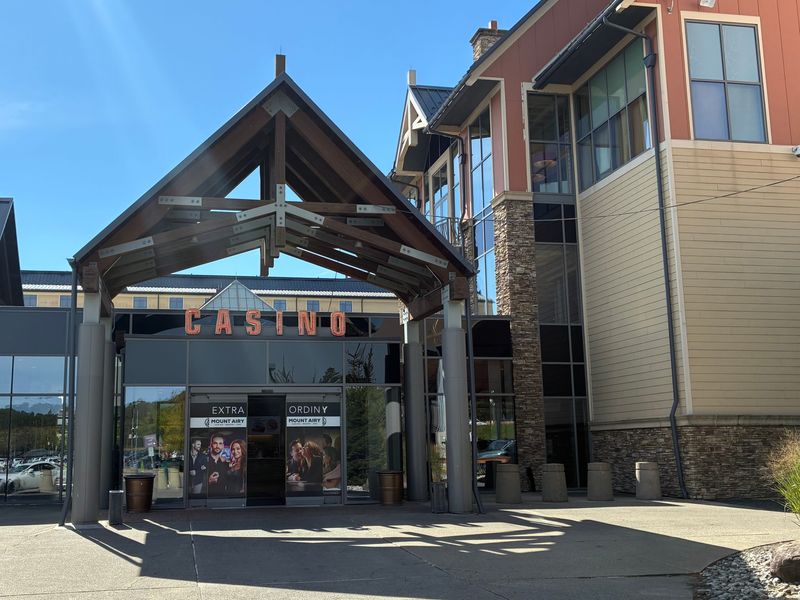
An entrance at Mount Airy Casino Resort in Mount Pocono, Pa. One study found that 90% of casino revenues came from problem and at-risk gamblers.
Years ago, an executive at the Parx Casino in Bensalem boasted that many of its customers visited more than 200 times a year — or five times a week.
That is quaint compared with online gambling. Smartphones allow people to bet 24/7. Gambling sites are engineered with sophisticated and predatory techniques, including frequent notifications, designed to keep users betting.
The Philadelphia region is the No. 1 market for online gambling companies, topping Las Vegas and New York. Since 2021, the number of calls about online gambling problems has increased 180% in Pennsylvania and 160% in New Jersey.
Harrisburg lawmakers are too busy counting the tax revenues and campaign contributions to consider the lives destroyed by legalized gambling.
An executive who helped run a large Black fraternity headquartered in Philadelphia pleaded guilty in 2022 to charges after embezzling nearly $3 million to fuel his gambling addiction.
That same year, a bookkeeper at the Delaware River Waterfront Corp. was sentenced to more than four years in prison for stealing more than $2.6 million to pay for her gambling addiction and trips.
A former judge in Chester County pleaded guilty in 2021 to stealing thousands of dollars in campaign funds to fuel a “six-figure” gambling habit at area casinos.
An attorney at a major Philadelphia firm who had a gambling problem was convicted in 2019 of stealing $100,000 from an 88-year-old client. A priest in Delaware County was sentenced to eight months in prison in 2018 after stealing $500,000 from a fund to care for aging priests that was used to cover gambling losses and pay for trips.
Most stories don’t make the police blotter, as thousands of other gamblers struggle in silence. Studies show that gambling problems lead to increased bankruptcies, suicide, and divorce.
The state Gaming Control Board website has a special section dedicated to the hundreds of people a year who leave their kids locked in cars or hotel rooms while they gamble for hours at a time. That is not entertainment; that is a problem.
Has anyone in Harrisburg ever wondered if the tax dollars are worth the harm?
Obviously, each person is responsible for their actions. But state lawmakers take an oath to protect the citizenry. Yet, they enabled the proliferation of gambling that has ruined many lives.
The same goes for the online sites and casinos that actively market to keep people gambling.
Just listing a toll-free number for people to call to get help is as disingenuous as the latest effort to tax predatory skill games.
This week, the Philadelphia School District and SEPTA find it hard to change, the cost of free rides, and City Council finds it hard to listen to public comments.
Schools and SEPTA in the same boat
The debate over the school district’s facilities plan is giving me déjà vu. That’s because the city has already had this conversation. It was just that last time, it was about SEPTA’s proposed Bus Revolution.
Like the facilities plan, Bus Revolution was designed to generate improvements within state-imposed fiscal constraints. By eliminating some bus routes and redrawing others to reduce delays, SEPTA aimed to provide more rides to more riders without hiring more operators or buying more buses. The new system — which is scheduled to debut later this year — promises faster and more frequent service.
Where both plans struggle is on the political end. After all, opponents have a relatively straightforward story to tell: “Don’t eliminate our bus stop” and “Don’t close our school” are arguments that require little explanation. The benefits, on the other hand, sometimes require a multipage document, and neither institution has done a good job of communicating its goals at public meetings.
That doesn’t change the fact that the proposed changes are for the better.
For transit riders, more frequency is life-changing. For schools, shrinking the amount of physical space that needs to be maintained will facilitate investments and upgrades elsewhere. The two beleaguered organizations should compare notes on how best to eliminate their empty seats without provoking public uproar.
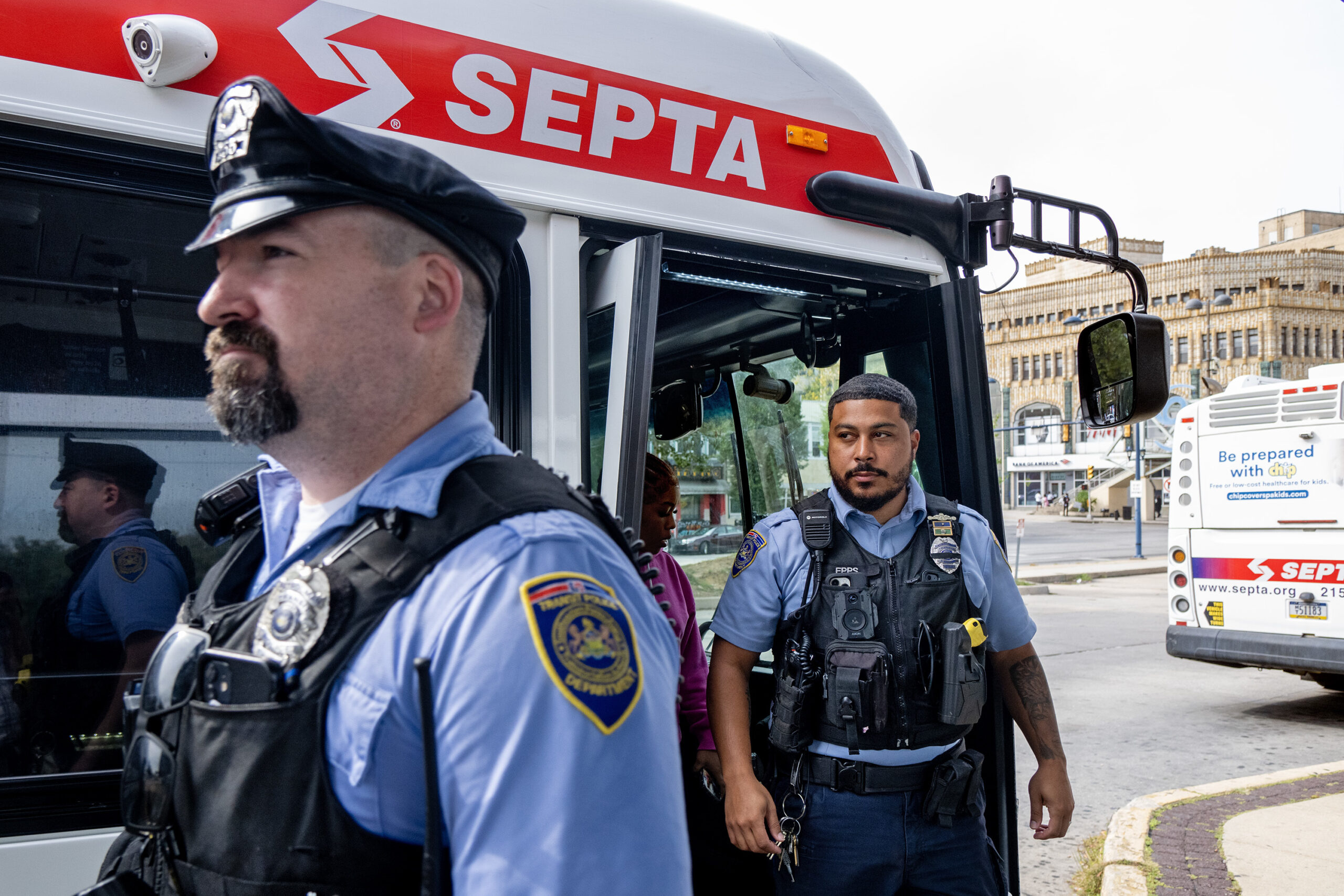
SEPTA Transit Police patrol officers Brendan Dougherty (left) and Nicholas Epps (right) with the Fare Evasion Unit leave a bus at the 69th Street Transportation Center in September.
No free rides
New fare evasion-resistant gates are slowly going up across the SEPTA Metro system, with the Frankford Transportation Center the newest recipient of the upgrades. As is the case when SEPTA tries anything new, this has generated some consternation from riders. Specifically, people have wondered why SEPTA is spending on new fare gates given its well-noted fiscal woes. Given how much is spent just trying to collect the fare, why not just make transit free? After all, New York’s new mayor, Zohran Mamdani, wants to make the buses in his city fareless.
While that all sounds exciting, it isn’t a good idea. Especially not here.
The most obvious reason is that SEPTA simply can’t afford to give up the hundreds of millions of dollars it generates in fare revenue each year. In fact, SEPTA is already operating with a deficit, forcing a raid on its (already underfunded) capital budget. Going fare-free would put the future of the system entirely in the hands of Harrisburg politicos, who have demonstrated repeatedly they can’t be trusted to adequately fund the system.
Plus, as New York’s Metropolitan Transportation Authority CEO Janno Lieber has said, transit is already affordable. A monthly bus pass is almost 90% cheaper than the average cost of car ownership. The biggest reasons people don’t ride are speed, frequency, and the behavior of other passengers, not fares.
This isn’t just a question of money; it is also about rider and employee quality of life.
In the Bay Area, the BART system has shown another benefit: reduced time spent on what it calls corrective maintenance. After installing new, evasion-resistant fare gates, the agency saw a 961-hour reduction in these issues over six months. That’s a serious drop in time spent cleaning up graffiti, fixing broken screens, and uh, picking up large messes. At many stations, the need was almost completely eliminated. As a regular transit rider, that sounds like it is worth a lot more than $3.
Don’t just take my word for it. Iconic Philadelphia journalist Dan McQuade — who left us far too soon — looked into it, as well. McQuade wanted to believe in the idea, only to find that “free transit is not the sunshine-and-rainbows image I had in my head.”
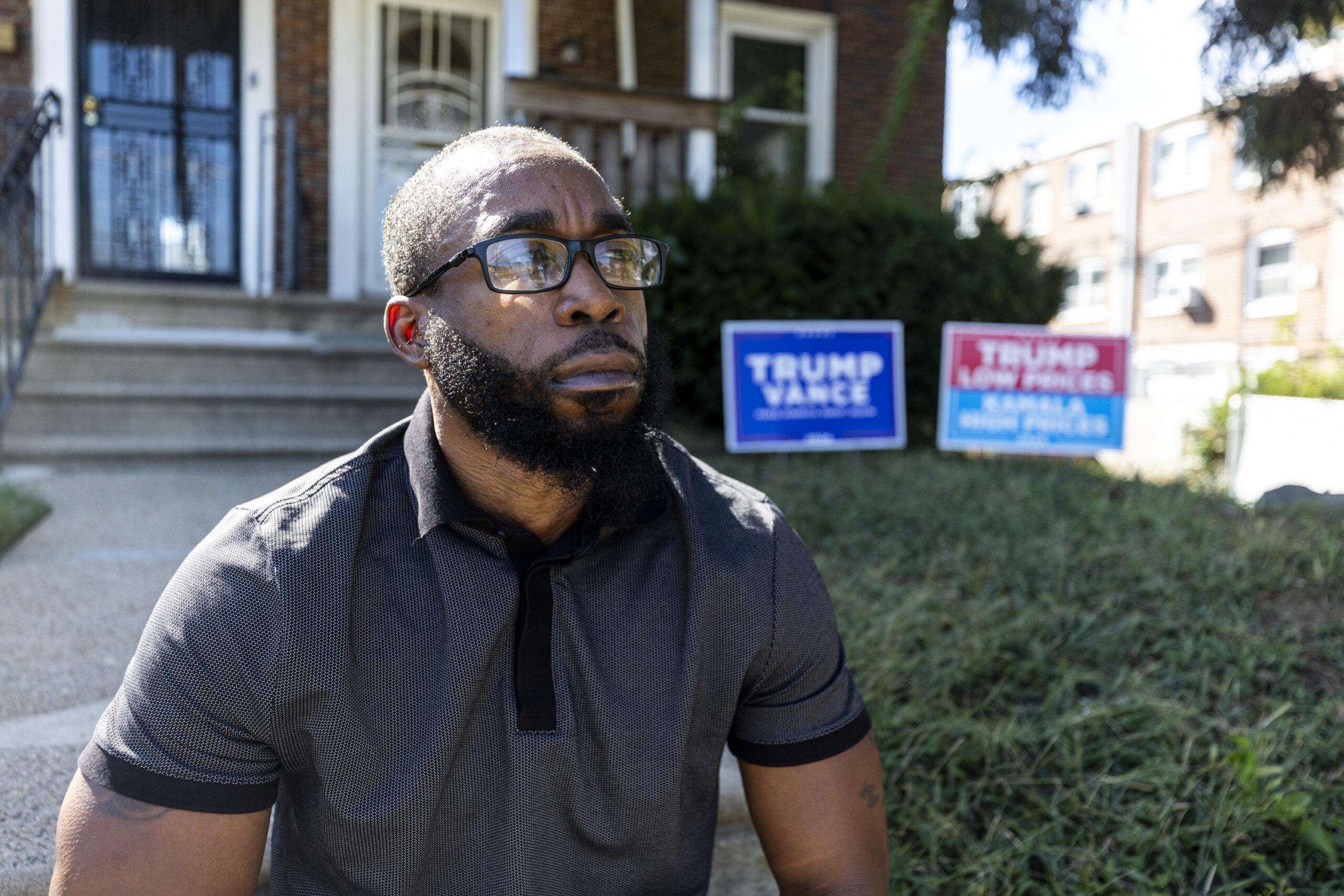
John McAuley, a Republican of Northwest Philadelphia, poses for a portrait outside his home in 2024.
Public revolt
One of the more entertaining parts of covering City Council is watching the public comment portion of its meetings. Council has attracted a growing chorus of regular speakers, many of whom have things to say that clearly frustrate the members. More recently, the Council’s peanut gallery has been joined by John McAuley, an activist with the Black MAGA group Flip Philly Red.
Council President Kenyatta Johnson, who is usually a deft hand while leading proceedings, found himself going viral on social media after contentious exchanges with McAuley and longtime speaker Lynn Landes. Johnson sought to keep McAuley on a germane topic and criticized Landes for using the word alien.
In general, Johnson and his colleagues are better off letting people speak and not reacting to what they have to say. Intervening ensured more people would see their speeches than would have otherwise.
Even by the pitifully low standards of the fact-free government of the United States, this one was a whopper.
Last month, agents from U.S.Immigration and Customs Enforcement (ICE) showed up at a Minneapolis hospital emergency room with a 31-year-old Mexican immigrant named Alberto Castañeda Mondragón who’d suffered severe head injuries.
The ICE agents told the ER nurses, according to the Associated Press, that Mondragón “purposefully ran headfirst into a brick wall.” But doctors could immediately see that the official version made zero sense, since their patient had multiple head injuries on the front, back, and side — not consistent with a fall or a collision.
Under oath, the feds suddenly switched to passive voice, as an ICE deportation officer said only in a sworn statement that Mondragón “had a head injury that required emergency medical treatment.” A judge ruled the arrest was unlawful — Mondragón had come to the U.S. legally and overstayed his visa — and ordered the man freed. Mondragón, who survived his eight skull fractures and brain bleeds and is suing the government, weeks later told an AP reporter his story of what really happened.
“They started beating me right away when they arrested me,” he recounted, describing how immigration agents pulled him from a friend’s car at a St. Paul, Minn., shopping center on Jan. 8, then slammed him to the ground, handcuffed him, punched him, and whacked him with a steel baton. Mondragón said he was beaten again at a federal detention center, where his pleas for mercy were met by laughter and more blows.
“There was never a wall,” he said.
Alberto Castañeda Mondragón, who says in a lawsuit that he sustained eight skull fractures when he was beaten by ICE agents, poses for a portrait earlier this month in St. Paul, Minn.
Mondragón’s narrative would be outrageous if it were an isolated incident, but this is simply one of the most egregious examples of falsehoods by an American secret police regime that has been caught in high-profile lies again and again. The best-known cases are the Minneapolis killings of Renee Good — where officials up to the president falsely claimed an agent was struck by a car and rushed to a hospital — and Alex Pretti, who was accused of brandishing a gun at federal agents, a lie that was instantly demolished when videos emerged.
And these are just three of the many instances where a U.S. Department of Homeland Security (DHS) agent or top official has offered a version of events — often backed up by sworn testimony — that soon fell apart.
On Wednesday, another woman DHS had described as “a domestic terrorist” — Mirimar Martinez, the Chicago Montessori schoolteacher who was shot five times after a vehicle collision with ICE agents — presented powerful evidence of government lies as she pursues legal action against DHS and the agent who shot her, Charles Exum.
Marimar Martinez (center) is greeted by her family after being released from the Metropolitan Correctional Center in October, after being shot by immigration agents and charged with assaulting federal officers in an incident in Chicago’s Brighton Park.
Martinez, whose federal charges stemming from the encounter were later dropped, and her lawyer said that a federal diagram of the crash scene presented in court showed three other vehicles that do not exist, that the shots did not come through the front windshield as claimed by Exum, and that another claim — that Martinez had “rammed” Exum’s vehicle — was also false. Said her lawyer, Christopher Parente, “This is a time where you just cannot trust the words of our federal officials.”
Let’s not pretend to be so naive as to act as if official deceit began on the June 2015 day that Donald Trump descended on that Trump Tower escalator. It was the late 1960s — the era of Lyndon B. Johnson’s Vietnam “credibility gap” — when the investigative journalist I.F. Stone famously wrote, “All governments lie.” I became an opinion journalist because of my disgust over George W. Bush’s lies that drove the Iraq War.
That said, the outrageous, Soviet-caliber falsehoods of the Trump regime feel much worse. These are not “plausible denial” fairy tales to push an unpopular policy or cover up some dirty deeds, like Watergate, but a vast empire of Big Lies — easily disprovable, about everything from election results to economic statistics — with a much more ambitious goal of undermining the very notion of objective reality.
Trump: "California is more corrupt than Minnesota. And I won Minnesota." (Trump has lost Minnesota three times.) pic.twitter.com/umCFf121vg
This fish stinks from the head. That Trump was elected a second time after the Washington Post (remember them?) chronicled some 30,573 false or misleading claims during his first four years was essentially America’s drive-through order of a Double Whopper.
The nation seems to have all but given up on challenging Trump’s absurd claims that he won Minnesota three times (although he actuallylost three times), or his fact-free insistence that his tariff policies have sparked $18 trillion in new investments, just to name two instances. But America’s liar-in-chief has also offered fresh inspiration to his underlings.
One would be hard-pressed to find a more blatant case of highest-level lying than the matter of Commerce Secretary Howard Lutnick and his friendship with Jeffrey Epstein, the deceased financier and sex trafficker. When the Trump regime’s cover-up of its massive Epstein files became a big story last summer, Lutnick, a former Wall Street CEO who lived next door to Epstein in Manhattan, told a podcast that he’d briefly visited Epstein’s home in 2005, and was revulsed atthe sight of a massage table. He insisted that he then decided, “I will never be in the room with that disgusting person ever again.”
This was an epic lie.
We now know — thanks to thecongressionally mandated (but still incomplete) release of the Epstein files — that Lutnick and his family and entourage stopped for lunch at Epstein’s Caribbean island in 2012, and that this was one of many contacts — about meeting for drinks, or philanthropic contributions — the two men had almost up until Epstein’s arrest and jail cell death in 2019.
There’s no evidence Lutnick committed any crime — beyond telling a massive and now discredited lie to the American people he purportedly serves. In Europe, heads are rolling for far less, but Lutnick has “the full confidence” of the president. That fact, bobbing above a vast MAGA sea of lies, should make us ask some hard questions as a nation.
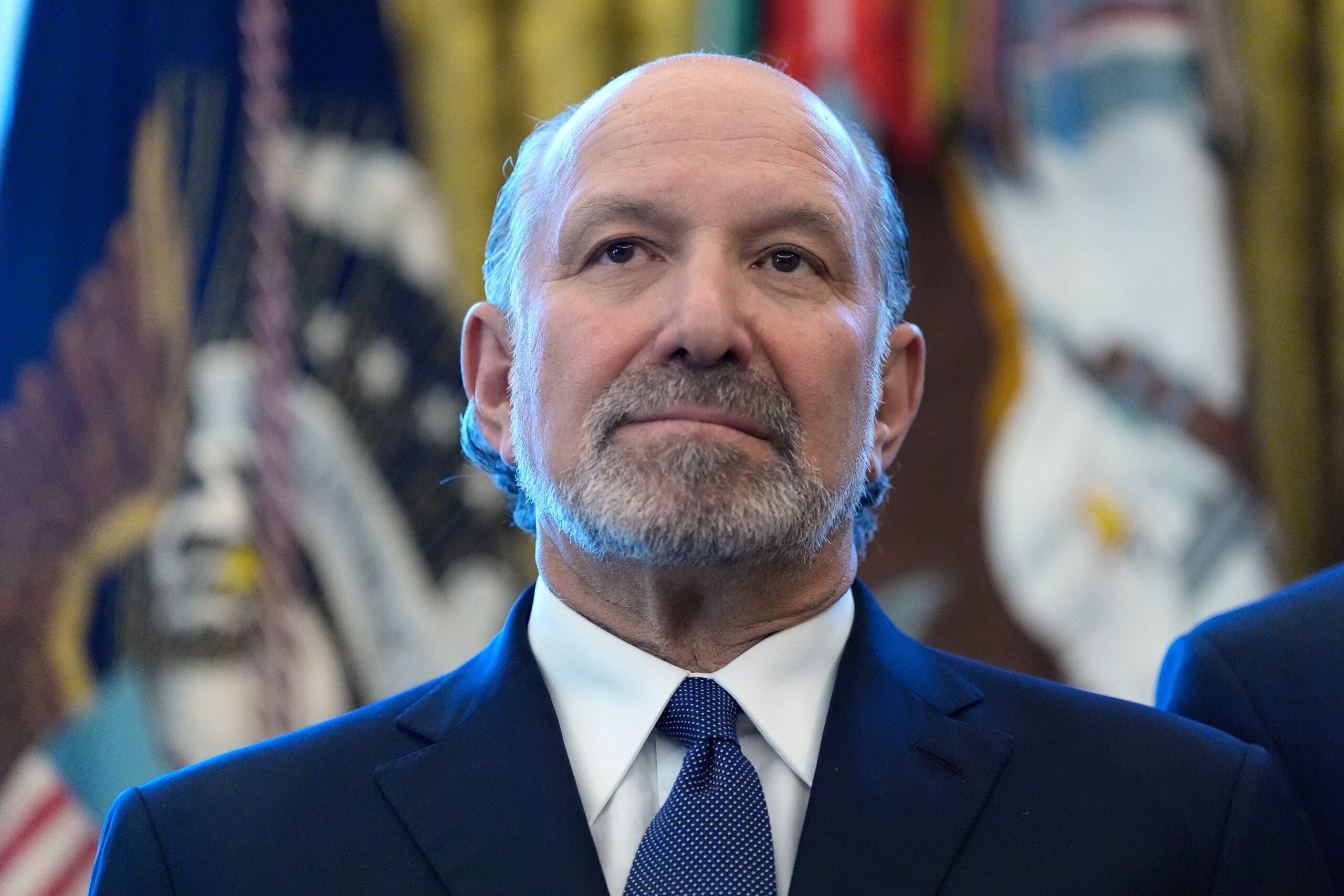
Commerce Secretary Howard Lutnick listens during an event with President Donald Trump in the Oval Office in February.
The current consensus — honored mainly in the breach — that lying is wrong, or bad, does not go nearly far enough. Perhaps it muddies the water that the U.S. Supreme Court has ruled it is First Amendment-protected free speech when private citizens utter things that aren’t true. But official deceit is a different category.
“The government’s lies can be devastating,” a leading scholar — University of Colorado law professor Helen Norton — wrote in a powerful 2015 article, arguing that official government dishonesty is fundamentally unconstitutional. Norton noted that false testimony and evidence in criminal cases — what we’ve seen frequently in the immigration terror campaign — is a violation of the Constitution’s due process clause, while invented allegations that aim to silence critics are offenses against constitutionally protected free speech.
It’s a felony to lie in federal court cases, or when testifying under oath before Congress, or in other types of governmental proceedings. And the federal statute of limitations for perjury is five years — plenty of time for a liberated U.S. Department of Justice to pursue these many cases if democratic forces can win back the White House in 2028.
But we should also recognize that top officials who tell deliberate lies are abusing their power in ways that, as Norton rightly argues, are grossly unconstitutional. When Noem lies to the American people about Good and how she was killed by ICE, she should resign or be impeached. When Lutnick looks into a camera and offers complete fiction about his friendship with the world’s most notorious sex trafficker, he, too, should quit immediately, or face impeachment.
Norton, in her prescient article from 11 years ago, notes that beyond the specific wrongs against individuals — such as Mondragón, Martinez, Good, and Pretti — that occur when the government lies, there is a much broader problem: the loss of public trust.
Indeed, the steep decline of public faith not only in government but in other civic institutions began with those official lies about Vietnam and Watergate, and the flawed probes into the John F. Kennedy assassination. It was those and other countless moments of scatheless lying by those in power that created the rubble Trump marched over in 2016.
We won’t get anything resembling democracy until we clear that widespread debris, and that means sending a bunch of these liars to prison, because they are the real criminals. America desperately needs truth and consequences.
2026 BMW iX xDrive45 vs. 2026 Cadillac Vistiq Platinum: A lot for a lot?
This week: 2026 Cadillac Vistiq
Price: $99,915 as tested. Red paint was the only upgrade.
What others are saying: “Highs: Cabin teeming with luxury details, smooth ride, nimbler than its size suggests. Lows: Uncommunicative steering, pricey top trims, shoddy main display control dial,” says Car and Driver.
What Cadillac is saying: “Luxury for your life.”
Reality: I guess if I had $100K I could pay someone to lie on the front seat trying to find the features I need.
What’s new: The whole thing. Here’s a three-row Cadillac SUV powered by the plug.
Competition: In addition to the iX, there are the Genesis Electrified GV70, Lexus RZ, Mercedes-Benz EQE, Tesla Model X, and Volvo EX90.
Up to speed: The Vistiq is in the class of premium EVs that really roars ahead when you press the accelerator.
The dual-motor SUV creates 615 horsepower, and gets to 60 mph in 3.6 seconds, according to Car and Driver.
You will have no issues pulling into traffic or passing in this SUV.
You’ll also save a lot over the iX, which requires an upgrade to match that acceleration. The price-matched iX took a full second more to get to 60.
Shiftless: The shift lever is on the steering column, where General Motors is putting most of them these days. Pull and lift to back up and pull and lower to move ahead.
On the road: The all-wheel-drive Vistiq handles quite well for a large SUV. It’s wide and it took me a minute to get used to that, but once I did, I could tell where the vehicle was in the lane, or in the parking space — which I find is often the hardest piece to figure out.
The vehicle modes are handled through the touchscreen; swipe to the right, choose drive modes, and pick what you like. Sport mode is best for performance, and Snow and Ice did a nice job during a heavy snowstorm and subsequent frigid days.
One big complaint — if you’re not going to put the controls on an easily grabbed dial, have them keep the previous setting, rather than default to Touring (which I never wanted). So many times I was tooling along on questionable road surfaces and then realized, “Dang! I’m not in snow mode.”
The interior of the 2026 Cadillac Vistiq has the look and feel of a Cadillac, but diminishes with each row.
Driver’s Seat: The command center is comfortable and Cadillacky. The seats are a little on the firm side, and I can’t say I spent enough time to see how long trips go, but they weren’t bad. (Some seats can be so firm as to make me angry in an instant.)
Friends and stuff: Sadly, the seats offer noticeably diminishing returns as you head farther back. The middle row is smallish and awkward and feels like some minivan seats from 1998. The rear row offers scant legroom, although there is some room for feet under the seats and good headroom. But the vehicle is kind of short for three rows, especially for a Cadillac.
Cargo space is 15.2 cubic feet in the back, 43 with the third row folded, and 80.2 cubic feet with both rows folded.
Play some tunes: Cadillac wants to dazzle with its 33-inch screen, but it appears the company has become hyperfocused on it, to the detriment of other features.
It took a couple searches and finally lying on the Driver’s Seat and peering into the recesses behind the console to find the USB-C outlets. I know I should be cool and get a phone I can lay on a charger, but why put these in here at all? This just seems snotty. Like they’re saying, “Haha, loser! Get a real phone!”
The connection ports never seemed to want to turn on the music system, either. Bluetooth is usually fine, except that the connection just randomly cut out on about half my trips. The only way to restore it was to shut down the Vistiq and restart it.
Sound from the 23-speaker AKG system with Dolby is less than you’d expect, about an A-.
General Motors would have done well to keep Apple CarPlay access. There’s no dedicated map program, just Google Maps and Waze, and neither looks as refined as a Cadillac screen should.
There’s a dial control with buttons as well, but the system is so bare-bones that I don’t see how that would help.
Night shift: The first time I drove the Vistiq I had to keep the maps turned off. Both programs feature bright white backgrounds, and they did not automatically adjust for the darkness outside and prevented me from seeing the road.
After another few minutes spent on my stomach trying to find controls, I noticed the old-fashioned light dimmer roller switch to the left of the steering wheel. That dimmed the whole dashboard, but not so badly that I couldn’t see. Still, you’d think this would adjust without me having to do anything, like it does in the Lovely Mrs. Passenger Seat’s Kia Soul, for about one-fourth the price.
Keeping warm and cool: HVAC controls get a separate touchscreen. They’re pretty but a little fussy and hard to adjust at a glance.
Range: The Vistiq advertises a 300-mile range, a match for most of the iX models available. It charges up to 80 miles in 20 minutes, which is no match for some of the best out there (Genesis, Hyundai, and Kia.)
Where it’s built: Spring Hill, Tenn. 43% of parts come from the U.S. and Canada; 18% from China; and 17% South Korea.
How it’s built: Consumer Reports predicts the Vistiq reliability to be a 2 out of 5.
In the end: It feels like Cadillac is giving up. No snazzy map program — when they used to have one of the most attractive options. No CarPlay. No drive mode switch, just use the touchscreen, which has a home screen that looks nice in photos but in person screams Windows 95. Critical items hidden like Easter eggs in a Jeep. It’s a shame, because there’s a nice vehicle here.
The iX is far from perfect, but I’d pick it over this. But among all the competitors, it’s GV70 all the way, even despite 10% less range.
I thought the absolute nonsense around the Rocky statue being permanently exalted to the top of the steps of the Philadelphia Museum of Art couldn’t be any more embarrassing for Philly. Then, the people in charge of these decisions ripped open my eyes, like Mick, to prove me wrong.
On Wednesday, the Art Commission approved a proposal from Creative Philadelphia, the city’s office of arts and culture that maintains and preserves Philly’s art collection, to move the statue of legendary Philadelphia boxer “Smokin’” Joe Frazier from the stadium complex, where it’s been since 2014, to the base of the steps of the Art Museum.
This would normally be a great thing — the Art Museum is in a much more prominent place in the city and Frazier deserves that honor — except that in this case, the Frazier statue is getting the Rocky statue’s leftovers. It’s a bigger smack in the face than a sucker punch in the ring.
Creative Philadelphia didn’t think the nice little cove at the base of the Art Museum steps where the city’s Rocky statue has been displayed since 2006 was good enough for it anymore. So last month — despite an informal Inquirer poll that showed it was the last thing Philadelphians wanted — the commission approved Creative Philadelphia’s proposal to permanently move the city’s Rocky statue to the top of the steps. (There are currently three Rocky statues in Philadelphia; don’t even get me started on that.)
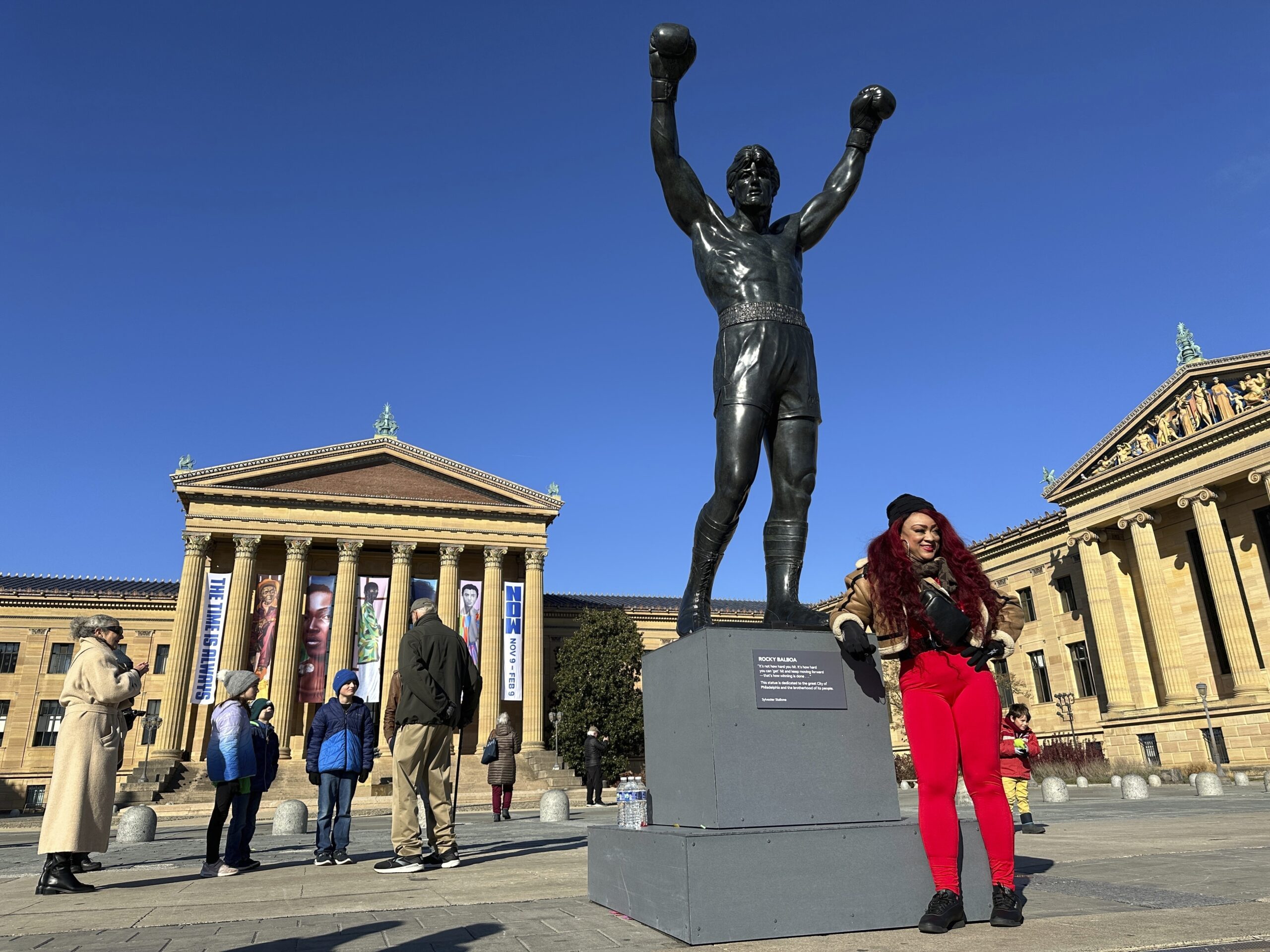
A visitor poses with the Rocky statue atop the Philadelphia Museum of Arts steps.
At the January meeting, commissioner Rebecca Segall said of the Rocky statue: “I believe it’s one of Philadelphia’s most meaningful monuments, and I believe we should just get him out of the bushes and put him up top.”
Creative Philadelphia and the Art Commission decided “the bushes” weren’t good enough for Rocky, but will be good enough for Joe Frazier. They will put the statue of the real legendary Black boxer right there near a shipping container called the Rocky Shop that sells Sylvester Stallone-licensed products, as if it were some Black History Month consolation prize.
I mean, c’mon! Do they even hear themselves?
If any statue belongs at the top of the steps, it’s Frazier’s.
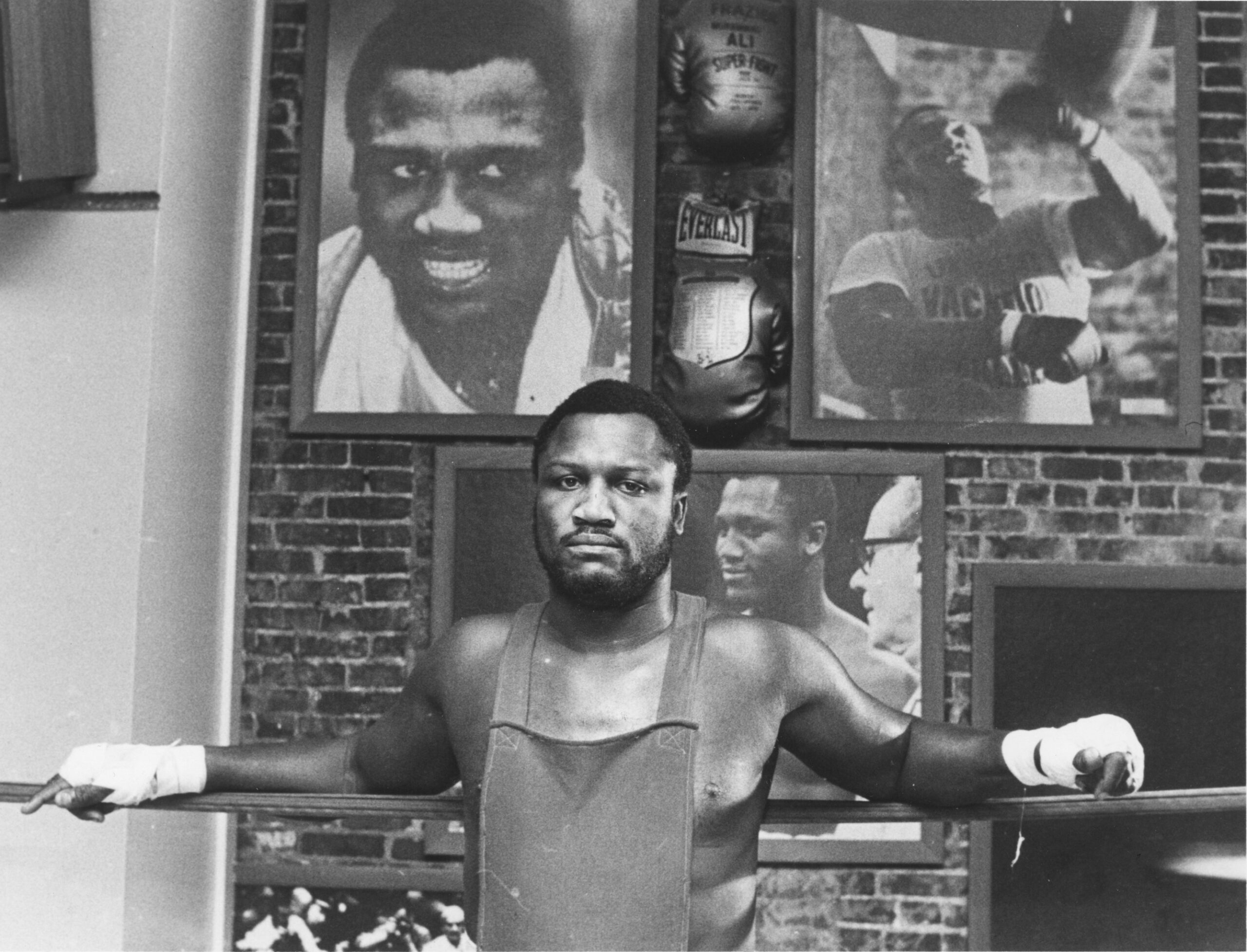
Joe Frazier poses in front of pictures from his career in an undated photo.
In a letter of support for the move of Frazier’s statue, Mayor Cherelle L. Parker wrote that putting it at the Art Museum “affirms Philadelphia’s commitment to honoring real-life achievement alongside cultural mythology.”
But when President Donald Trump’s administration is removing historical facts about slavery from the President’s House Site, why should mythology get top billing?
At this time, we should not be elevating fiction in Philadelphia as the federal government is attempting to erase our facts.
Yes, Rocky is a fictional Philadelphia icon, but Frazier, a former world heavyweight champ, was a real-life inspiration for the character, according to Creative Philadelphia, which mentioned it in its recent proposal.
Frazier, who worked at a Philly slaughterhouse, claimed in a 2008 interview with the Guardian that he’d “go down that long rail of meat and work on my punching.”
“That’s how [Sylvester] Stallone got the same idea for Rocky — just like he used the story about me training by running up the steps of the museum in Philly,” Frazier said. “But he never paid me for none of my past. I only got paid for a walk-on part. Rocky is a sad story for me.”
Joe Frazier
Frazier wasn’t just one of the inspirations for Rocky, he was one of the greatest heavyweight pugilists ever. In 1964, he won the Olympic gold medal in heavyweight boxing with a broken thumb, and in 1970, he won the world heavyweight title. Here in Philly he gave back, purchasing his own gym in North Philadelphia where he didn’t charge rent and trained a new generation of boxers who found community there.
Putting the Rocky statue at the top of the steps is clearly designed to appeal to tourists, but those steps are not just a tourist attraction. They are the very place where Philadelphians go to celebrate and protest.
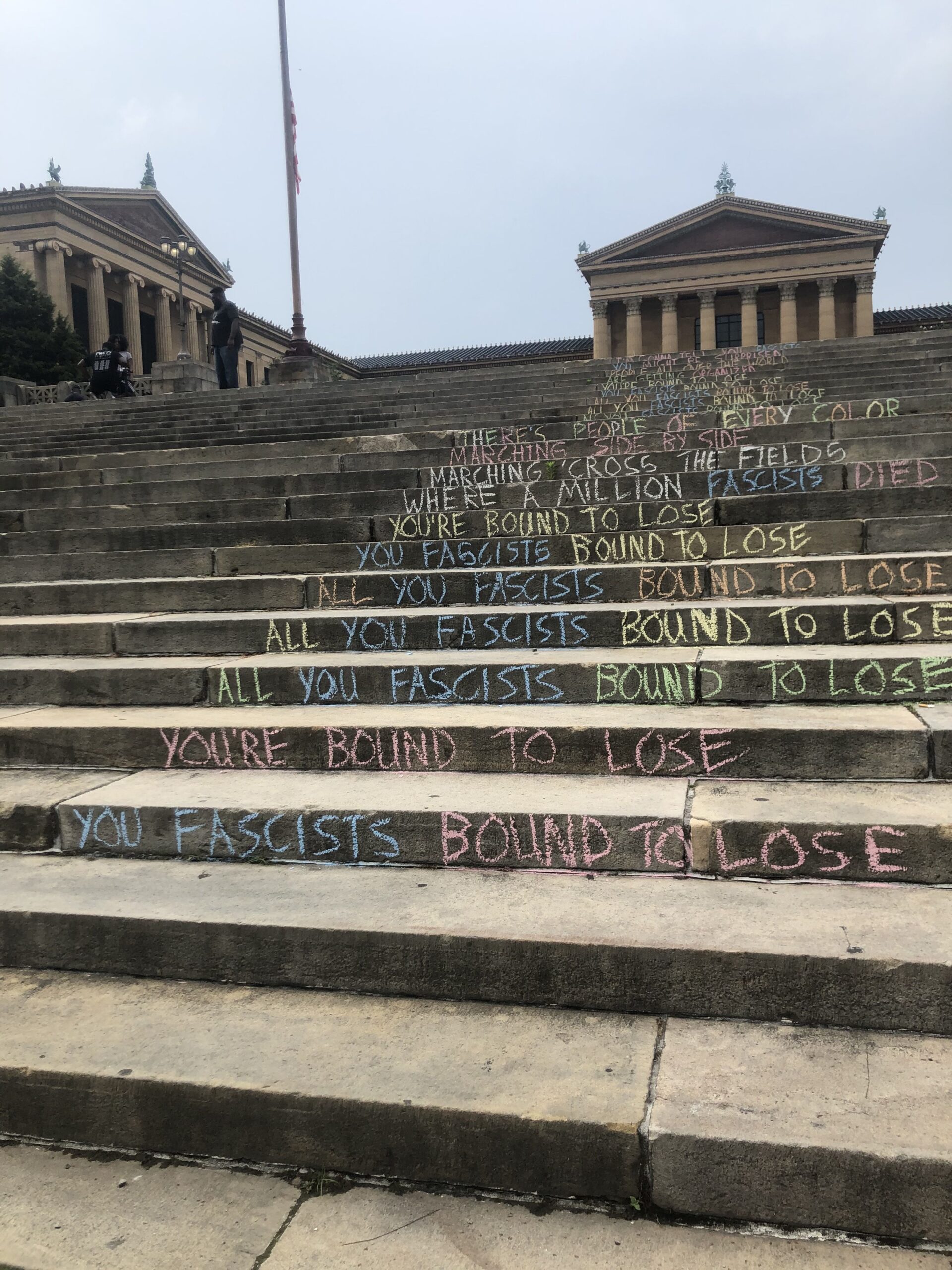
It’s where the Eagles celebrated their Super Bowl wins and where Live 8 took place. It’s where people gathered during the protests against the murder of George Floyd in 2020 and I saw the lyrics of Woody Guthrie’s “All You Fascists” written on the steps in chalk. It will be the center stage for the nation’s 250th birthday celebrations on July Fourth, and in the center of it all will be the Rocky statue.
The lyrics to Woody Gurthie’s “All You Fascists” written in chalk on the steps of the Philadelphia Museum of Art in 2020.
Did Frazier not suffer enough slings and arrows in his life that even in death, this city is choosing to exalt the fictional character he inspired over the very man himself?
That’s a sad story for Philadelphia.
I understand why those who love and respect Frazier wrote letters of support for his statue’s move from the sports complex to the base of the Art Museum, where it will have more visibility and more people will get a chance to learn about him.
Visitor pose with the Rocky statue at the base of the Philadelphia Museum of Art, the proposed location for Joe Frazier’s statue.
But we can and should do so much better to honor Frazier’s story, and Philadelphia’s. It should not have taken moving the Rocky statue to the top of the steps to get Frazier’s at the base, and when it does go there later this year, it should not be overshadowed by a fictional character based, in part, on him.
The truth — especially about Black history in this country — is too important.