When it’s cold outside, there’s no better way to warm up than sipping on hot chocolate. But a cup that showcases chocolate’s incredible depth of flavor really levels up the experience. Why settle for a mug of Swiss Miss when you could sip on velvety cioccolata calda, piquant cinnamon and chili dark chocolate, or creamy chocolat chaud in cozy cafes across the city? Take your pick and grab a treat.
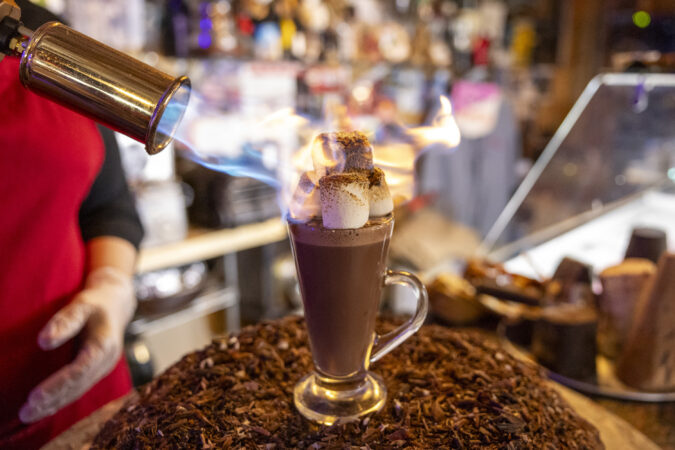
A hot chocolate at Rim Cafe made by Chara Bell Rowland, co-owner, in Philadelphia on Wednesday, Jan. 21, 2026.
Rim Cafe
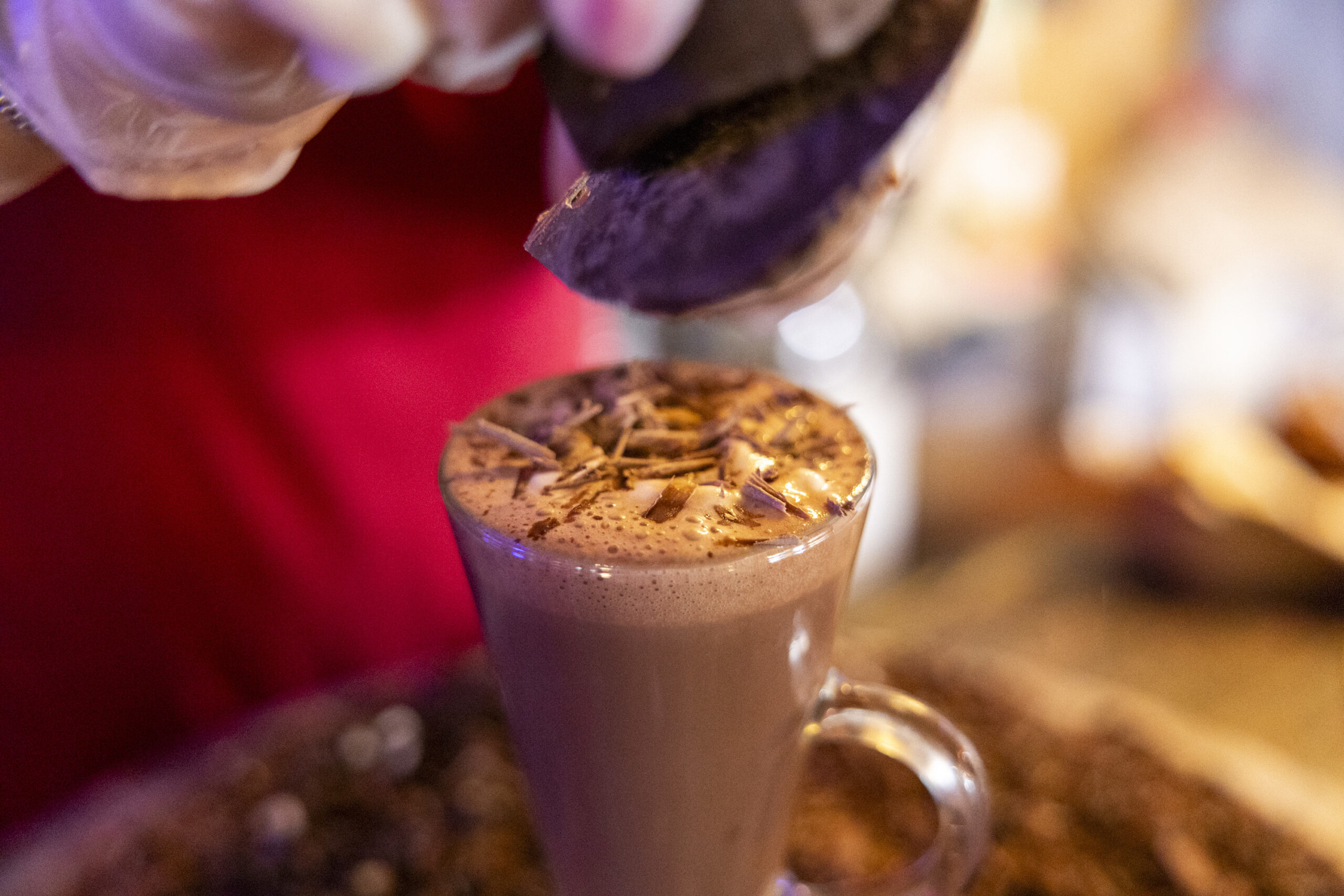
The maximalist, eclectic cafe, known for its gelato, at the corner of 9th and Federal peddles an impressive variety of over-the-top hot chocolates. You’ll spend a good 10 minutes deciding between drizzles of Nutella or white chocolate shavings. Once you’ve selected a cocoa, an attendant will validate your choice with a show, pouring creamy, bubbly liquid chocolate over a dollop of whipped cream in a tall glass mug that spins atop a bird’s nest-shaped turntable made of solid chocolate. Once the glass is filled to the brim, they’ll grate a large cone-shaped chocolate over top for the final touch. The result: A sweet, thick, silky drink that feels like a hug.
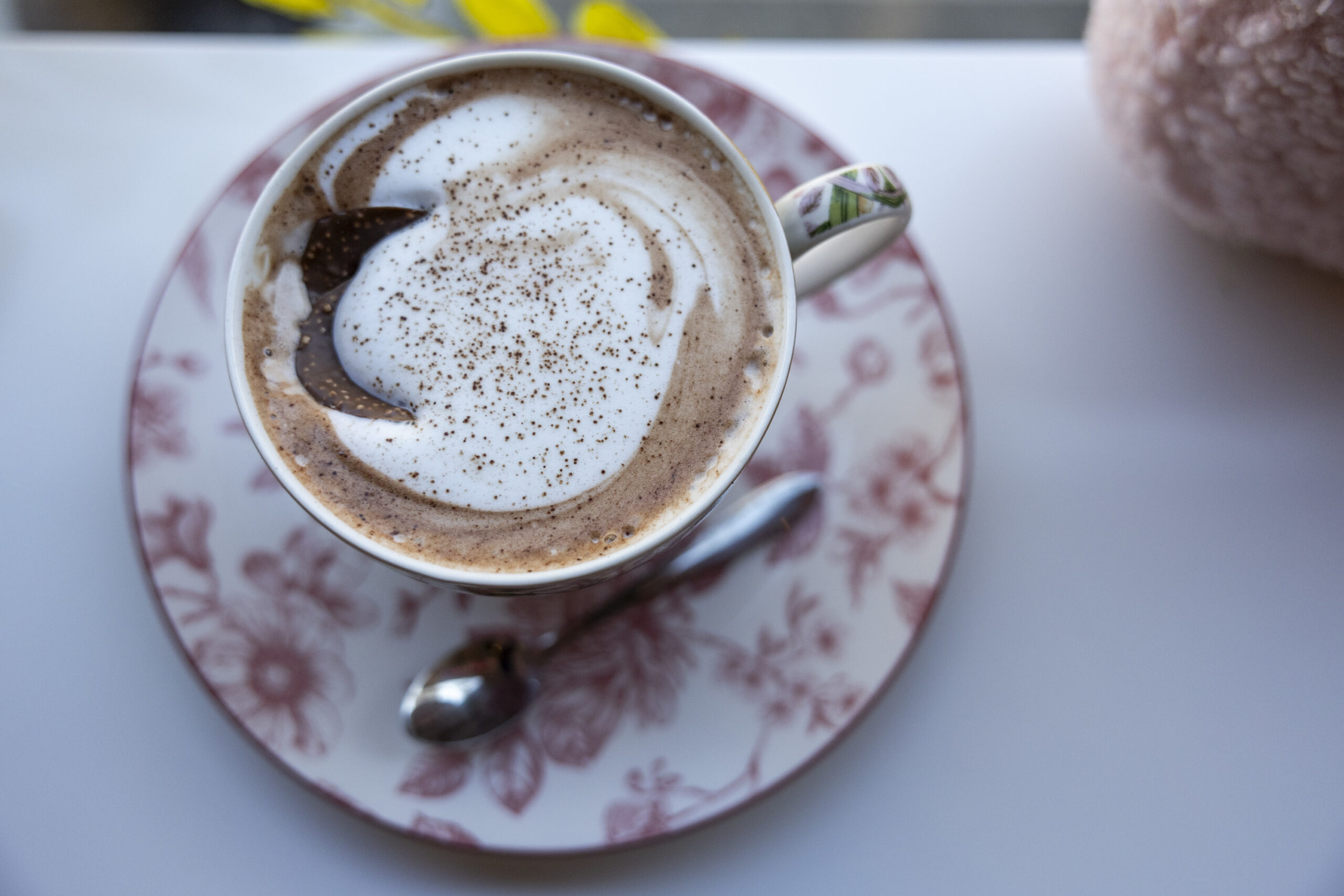
Hot chocolate at La Maison Jaune in Philadelphia on Tuesday, Jan. 20, 2026.
La Maison Jaune
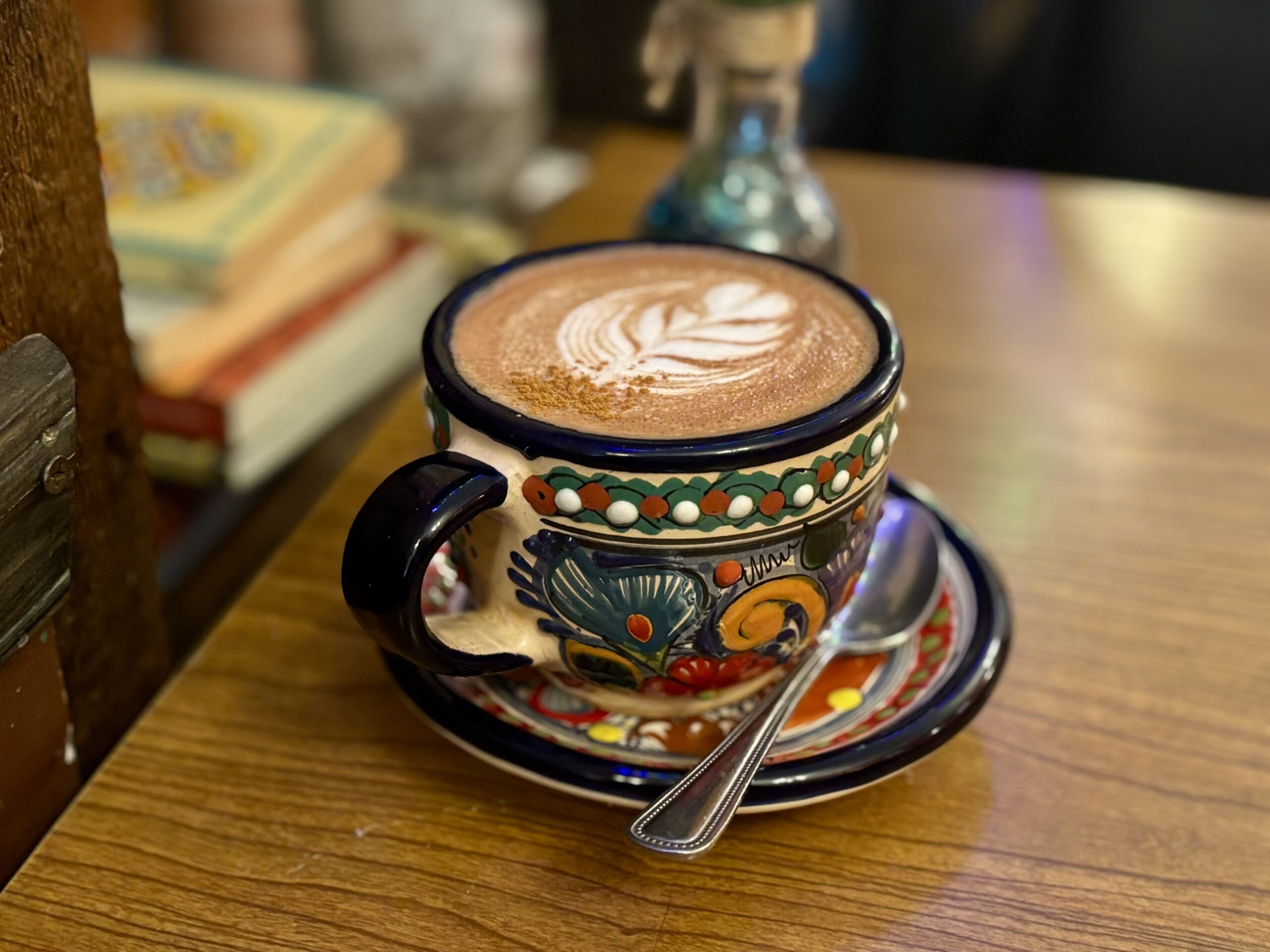
You’re guaranteed to find real French chocolat chaud at Fitler Square’s newest cafe. Velvety hot chocolate served in a delicate mug is made the French way at La Maison Jaune: chocolate melted directly into hot milk. With foamy cream on top, the chocolat chaud here is reminiscent of the luscious, creamy drink you can find at a Parisian cafe. Order some freshly made macarons de Nancy (chewy almond cookies from Nancy, France) to dunk as you people-watch through the windows.
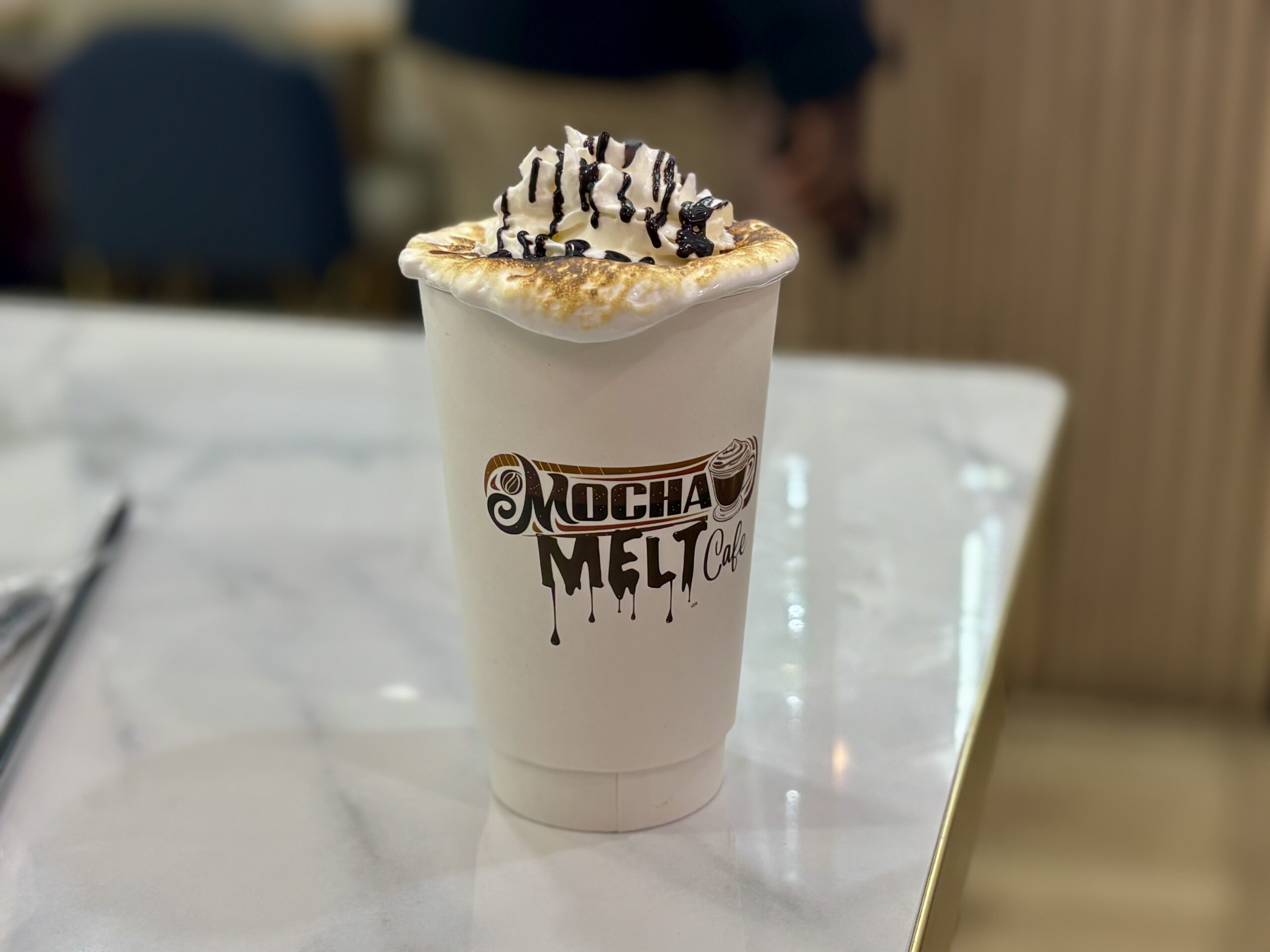
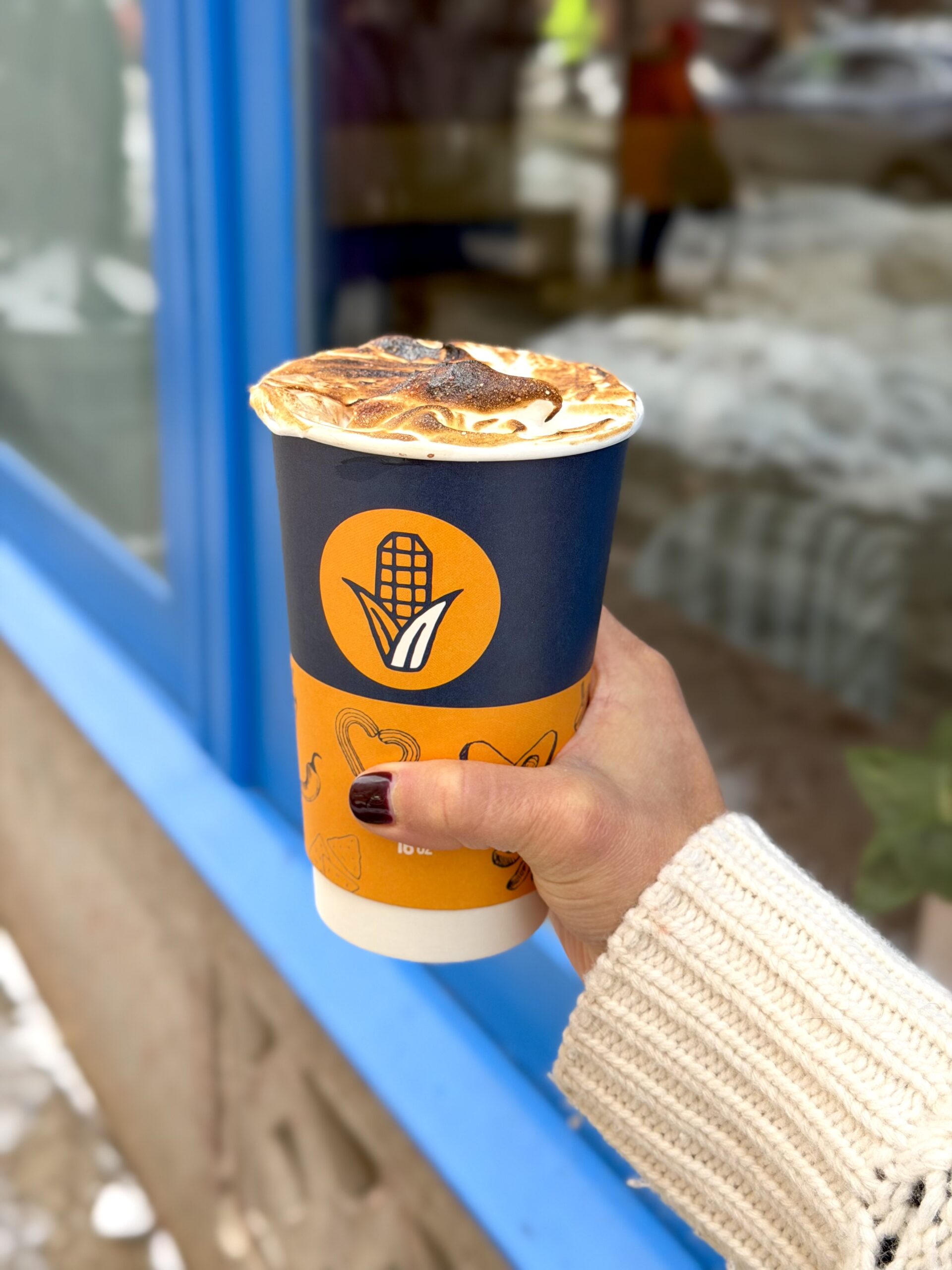
Equal parts milk and chocolate, the hot chocolate at Old City’s relatively new cafe is a great grab-and-go option. The balanced hot cocoa is pre-made and poured out quickly at Mocha Melt. But what sets it apart is the halal marshmallow topping. The thick, frosting-like marshmallow is piped in a swirl on the lip of the to-go cup and torched after the hot chocolate is added. The result is a s’mores take on hot chocolate.
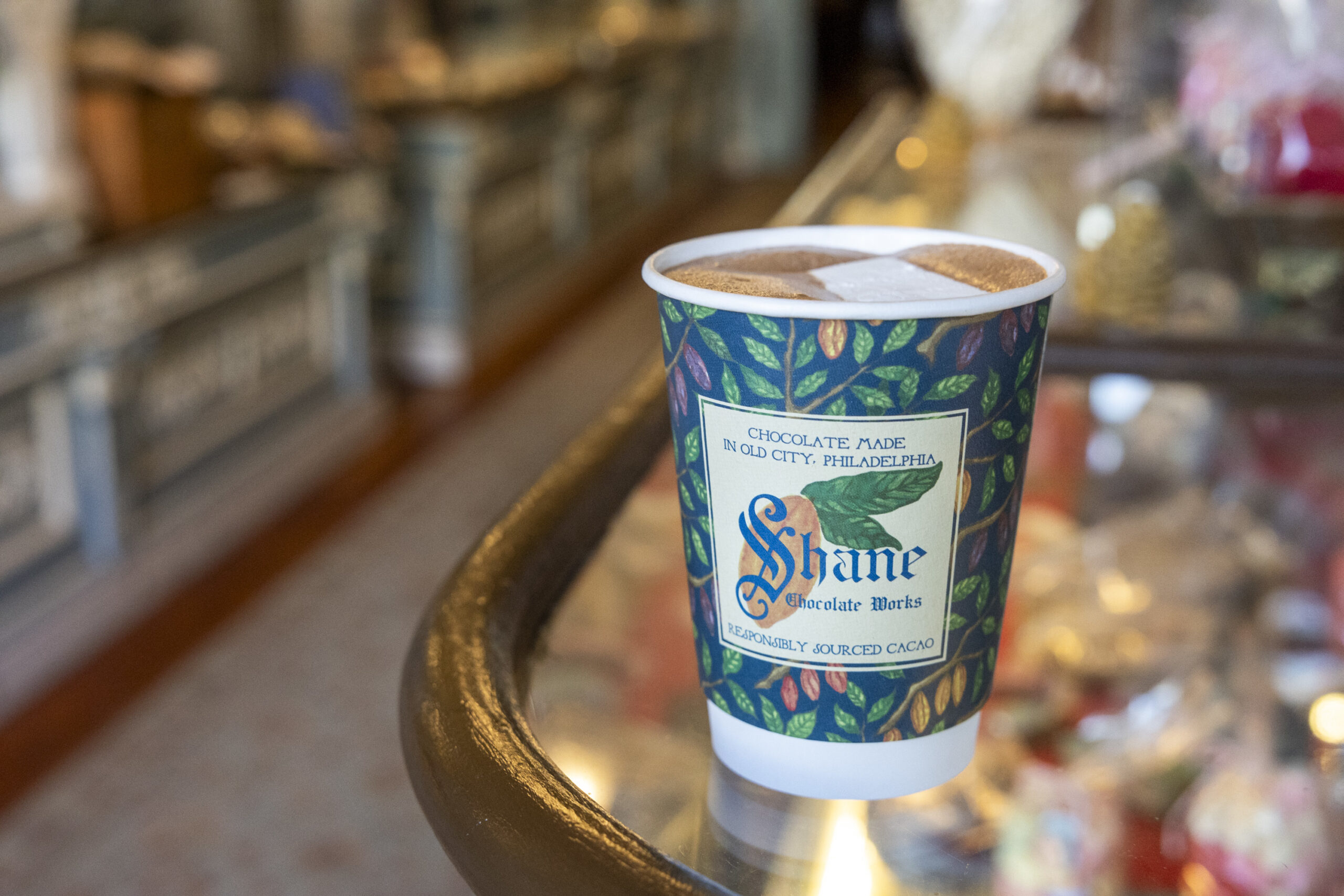
The Signature drinking chocolate with marshmallow at the Shane Confectionary in Philadelphia, Pa., on Wednesday, Jan. 21, 2026.
Shane Confectionery
Entering this Old City confectionary store is like venturing into Willy Wonka’s chocolate factory. Elaborate, visually stunning chocolates in glass cases lead through the store to a backroom cafe. On a recent visit, owner Eric Douglass Berley, dressed in a top hat and waistcoat, awaited to take my hot chocolate order. He walked me through the four drinking chocolates: sweet and bold signature milk chocolate, rich and fruity house dark, piquant cinnamon and chili dark chocolate made with guajillo chiles and chile de arbol peppers, and mocha made with Herman’s Coffee. While you wait for your drink of choice, take a peek behind the counter to see massive chocolate melanger machines churning fresh cacao nibs into the liquid chocolate you’ll savor with each sip. And remember, there’s whipped cream and house-made marshmallows to add to your cup, if you ask nicely.
Chocolate is in the name of this South Philly cafe and restaurant, which means they know a thing or two about a good cup of hot cocoa. Take a sip of Cafe y Chocolate’s chocolate Oaxaca and it’s as if you’ve taken a bite into the creamiest milk chocolate bar — the sweet cocoa flavor is subtle until it melts on the tongue and fills your mouth with that smooth, milky taste. The chocolate hails from Mexico and is similar in flavor to the popular Nestlé Abuelita brand but less sweet, one server told me on my latest visit. Panela, an unrefined whole cane sugar, and cinnamon are added to the thick chocolate base that’s mixed with milk. And if you’re looking for a caffeinated version, the cafe con chocolate comes with two shots of espresso.
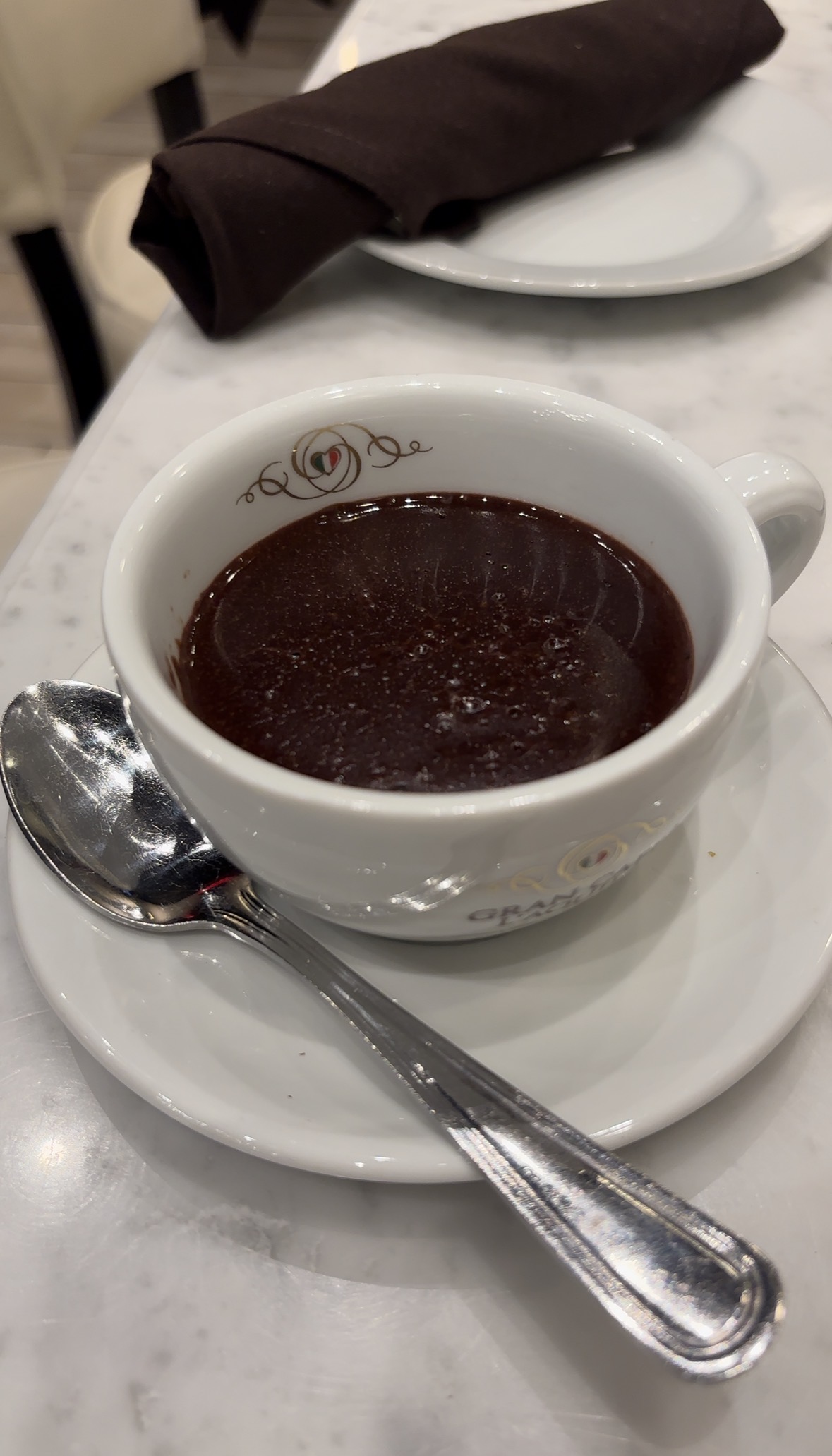
Sipping on smooth, silky Italian hot chocolate is possible any hour of the day at Center City’s Gran Caffè L’Aquila. To make the restaurant’s velvety cioccolata calda, a chocolate blend is whisked in milk on low heat until creamy. Served in a mug, the piping hot liquid chocolate is so thick, dark, and incredibly rich that you’ll need to pace yourself. Each sip coats your mouth in chocolate, and the whipped cream topping cuts through the bittersweet finish. It’s the perfect cup for those looking to experience just how rich chocolate can be.
On Chestnut Street, a few clicks on the self-order screens at this popular Central American restaurant will get you a cup of Guatemalan hot chocolate. The hot cocoa here leans heavier on the chocolate side, bringing forth the rich sweet notes of bitter Guatemalan dark chocolate bars melted into the milk with each sip. There’s no wrong order here: Enjoy the drink as is or add dulce de leche syrup for a nutty, caramel-like boost.
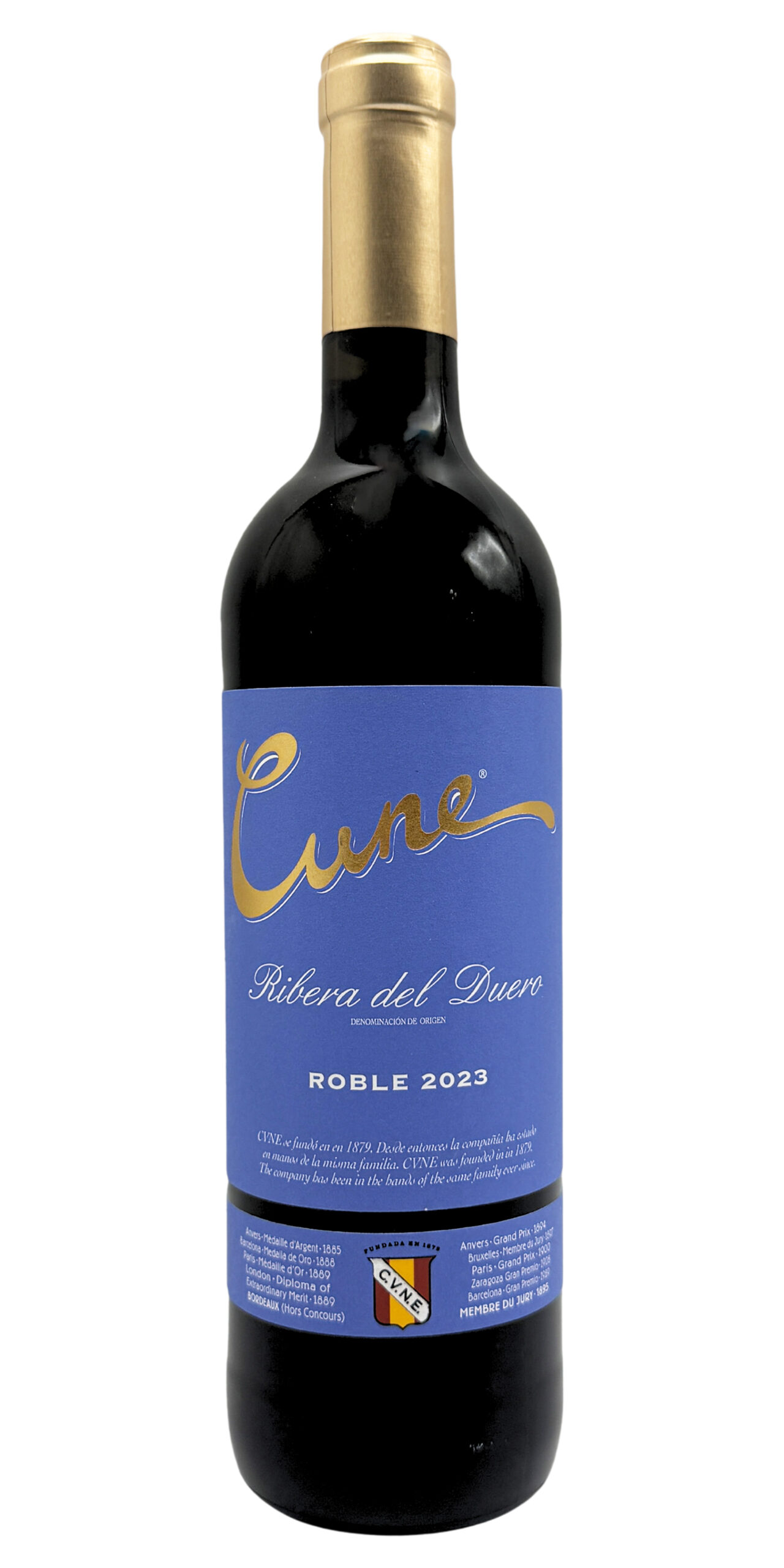
Spain is the world’s third largest wine producer, with a longer history of growing grapes and making wine than France. However, the region was slower to modernize due to its unique history, which included a teetotaling 20th century dictator who systematically forced the wine industry to churn out cheap wines rather than improve their quality during his 35-year rule. In a remarkably swift turnaround sparked by joining what is now the European Union, Spain is today making some of the most exciting world-class wines, many of which blend old-world traditions with new-world techniques to broaden their international appeal.
(Sadly, wines like this one — from one of Spain’s most respected appellations — have not been well represented in Pennsylvania wine stores, simply because the state-run system has also been slow to modernize.)
Most of Spain’s wines are red, and the vast majority are made with grapes native to their localities. The nation’s two most famous red wine appellations are Rioja and Ribera del Duero, which are both made using primarily tempranillo grapes and hail from neighboring regions. On the map, these zones appear to be separated only by a range of mountains, but their climates and cultures could not be more different, and these key factors shape the flavor of their wines.
Of the two, Rioja is better known and far better represented in our area. It is also the cooler of the two regions. Makers blend tempranillo with other grapes and have a tendency to age wines longer in barrels, often producing old-school wines that can be as delicate as French pinot noir. Ribera del Duero wines are usually denser, darker, and stronger and more often made with 100% tempranillo, as with this example. Since they are grown in warmer, drier conditions that amplify their ripeness, their winemaking is more likely to reflect modern sensibilities familiar to fans of California wines. This value-oriented example features tempranillo’s signature combination of red- and blue-fruit flavors like raspberry and blueberry. Being of the oaked “roble” style, it also features an overt gloss of new-oak aromas (think vanilla and coconut).
Cune’s Ribera del Duero ‘Roble’ (oaked tempranillo) from Spain.
Cune Ribera del Duero “Roble”
Castilla y León, Spain; 14% ABV
PLCB Item #100049322 — on sale for $14.99 through Feb. 1 (regularly $17.99)
No alternate retail locations within 50 miles of Philadelphia, per Wine-Searcher.com.
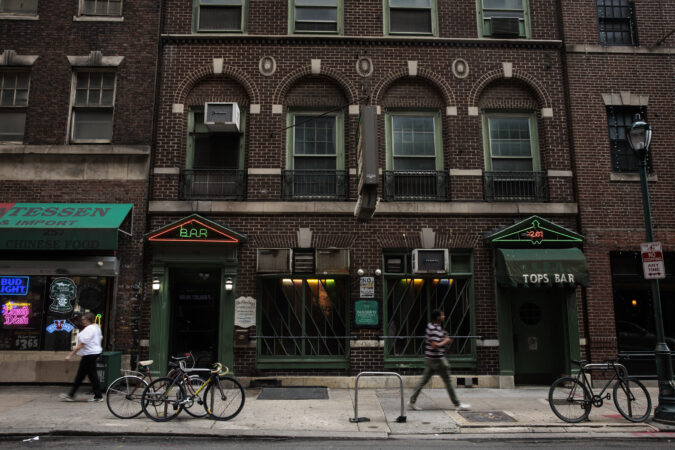
McGlinchey’s Bar, which survived decades of shifting tastes, smoking laws, and disco, is now on the market, five months after its closing.
The asking price for the property at 259 S. 15th St. is $2.45 million, according to the listing, which is being handled by Nadia Bilynsky and Dennis Carlisle of MPN Realty on behalf of the Sokol family, which has owned the building since 1968.
The family is selling not only the century-old building — with bars on two floors and a vacant third floor — but its liquor license and the McGlinchey’s name.
For generations of regulars, McGlinchey’s was known less for reinvention than for what it refused to give up: cash-only tabs, smoking long after most bars banned it, and prices that seemed detached from inflation. It seemed to outlast trends simply by ignoring them.
And if walls could talk, McGlinchey’s would probably ask for another shot before answering.
Its building, on 15th between Locust and Spruce Streets, opened in 1922. For the first decade, it housed offices for the Allen-Sherman-Hoff Co. In 1932, Joseph A. McGlinchey bought it, leasing the first floor to a book and gift store called the Odd Shop, opening McGlinchey’s Restaurant on the second floor, and living upstairs.
The bar downstairs opened in the 1950s, and Henry Sokol purchased the business in 1968. In 1976, he converted the second floor into Top’s Bar, which began as a disco, later hosted music and poetry, and eventually became an extension of McGlinchey’s itself.
Five decades ago, the neighborhood sat on the seam between old Center City grit and the city’s new, corporate face; the clientele continued to reflect a broad cross-section of society.
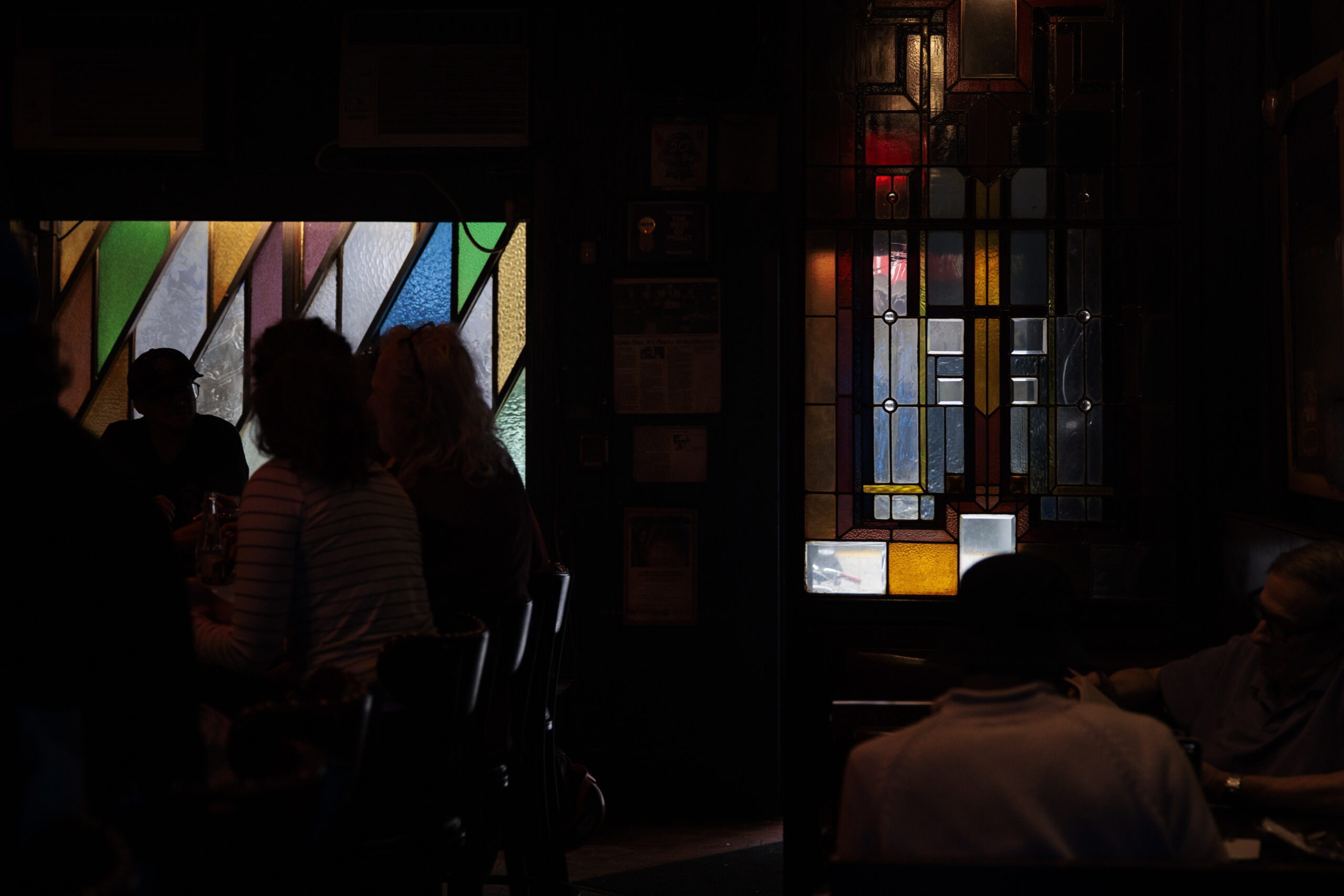
Stained-glass windows inside of McGlinchey’s on Aug. 18, 2025.
After Henry Sokol’s death in 1985 — the year construction began on One Liberty Place, the city’s first building taller than William Penn’s hat on City Hall — McGlinchey’s was passed along to sons Ronald and Sheldon.
Ron Sokol died in 2022, and last summer’s closing was prompted by Sheldon’s retirement.
“It was just time,” said Sandra Sokol, Ron’s widow.
Sheldon Sokol was the daytime manager, while Sandra Sokol said she handled administrative work behind the scenes. Douglas Sokol, Ron and Sandra’s son, worked at the bar, too.
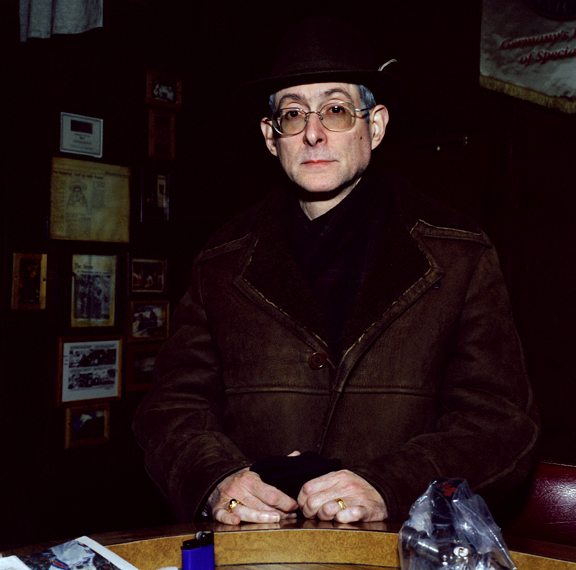
McGlinchey’s owner Sheldon Sokol in a 2004 photo taken for “The Regulars,” a series by former bartender Sarah Stolfa, who went on to publish the collection in a book of the same name.
For Sandra Sokol, the bar’s meaning extended well beyond its balance sheets. “We used to joke that we had two children, but McGlinchey’s was [Ron’s] third child,” she said. “It was that important to him. He was really responsible for what it became.”
Under Henry Sokol, she said, the business began as a more traditional restaurant and gradually evolved. “When Ronnie began hiring art students as bartenders and waitstaff, that’s when it started to shift into something more edgy,” she said. “What it became wasn’t planned. It just morphed that way, the way family businesses often do.”
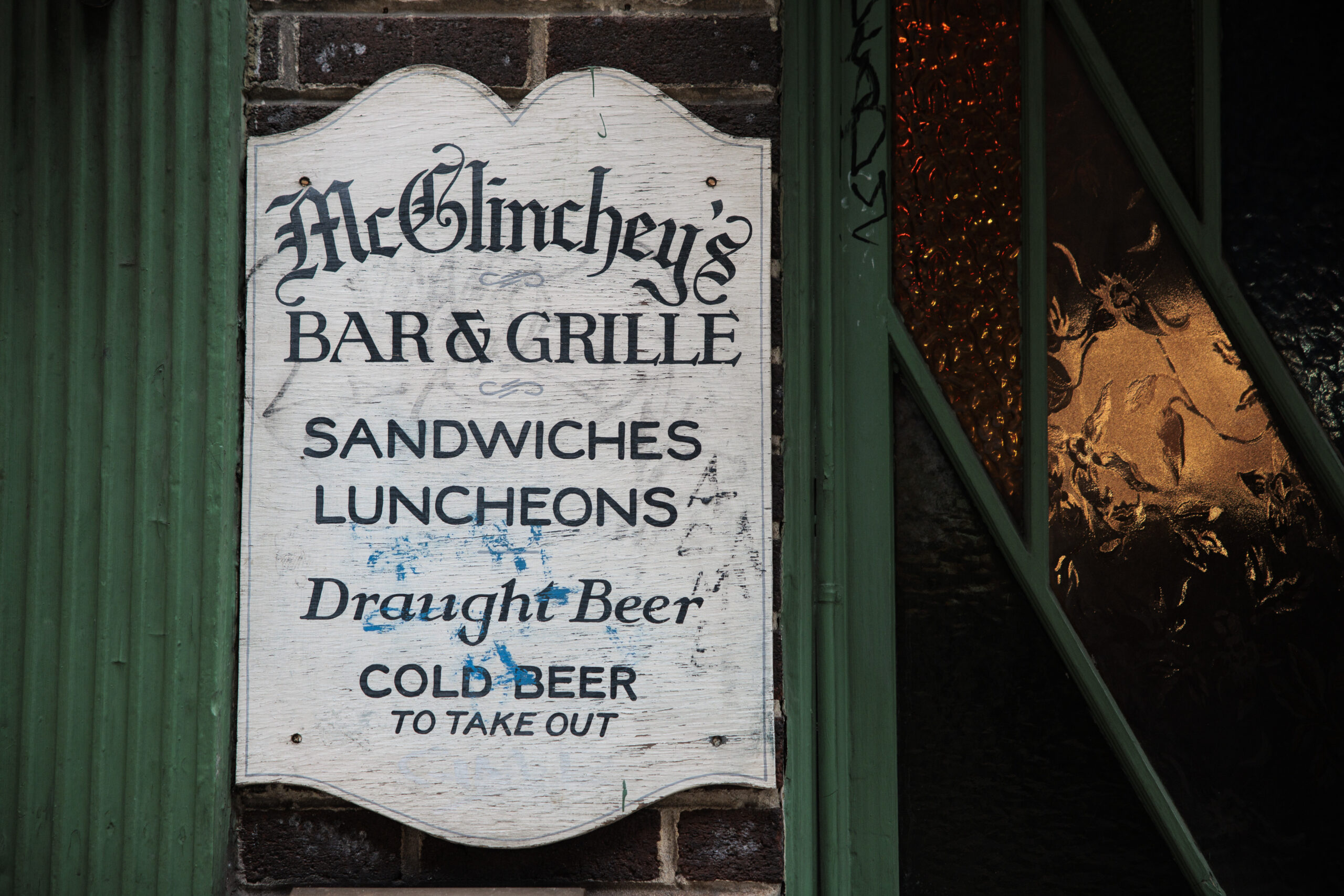
Sign at McGlinchey’s.
That evolution extended upstairs as well. Sandra Sokol recalled visiting Top’s in its early disco days. One night, her sister, visiting from out of town, was asked to dance by a man who turned out to be a carpenter, still wearing his tool belt — hammers and all — straight from work. “It was that kind of place,” she said. “Spontaneous, serendipitous moments.”
Those moments, she said, added up to something larger. “People would often say — and I agreed — that it was like the experience of Cheers,” she said. “It was more than a bar. More than a business. It became an institution — and in many ways, an extension of our family.”
Even the bar’s most controversial feature — smoking — was handled pragmatically. “It was a double-edged sword,” she said. “If they banned smoking, they might gain new customers, but they would lose longtime ones.”
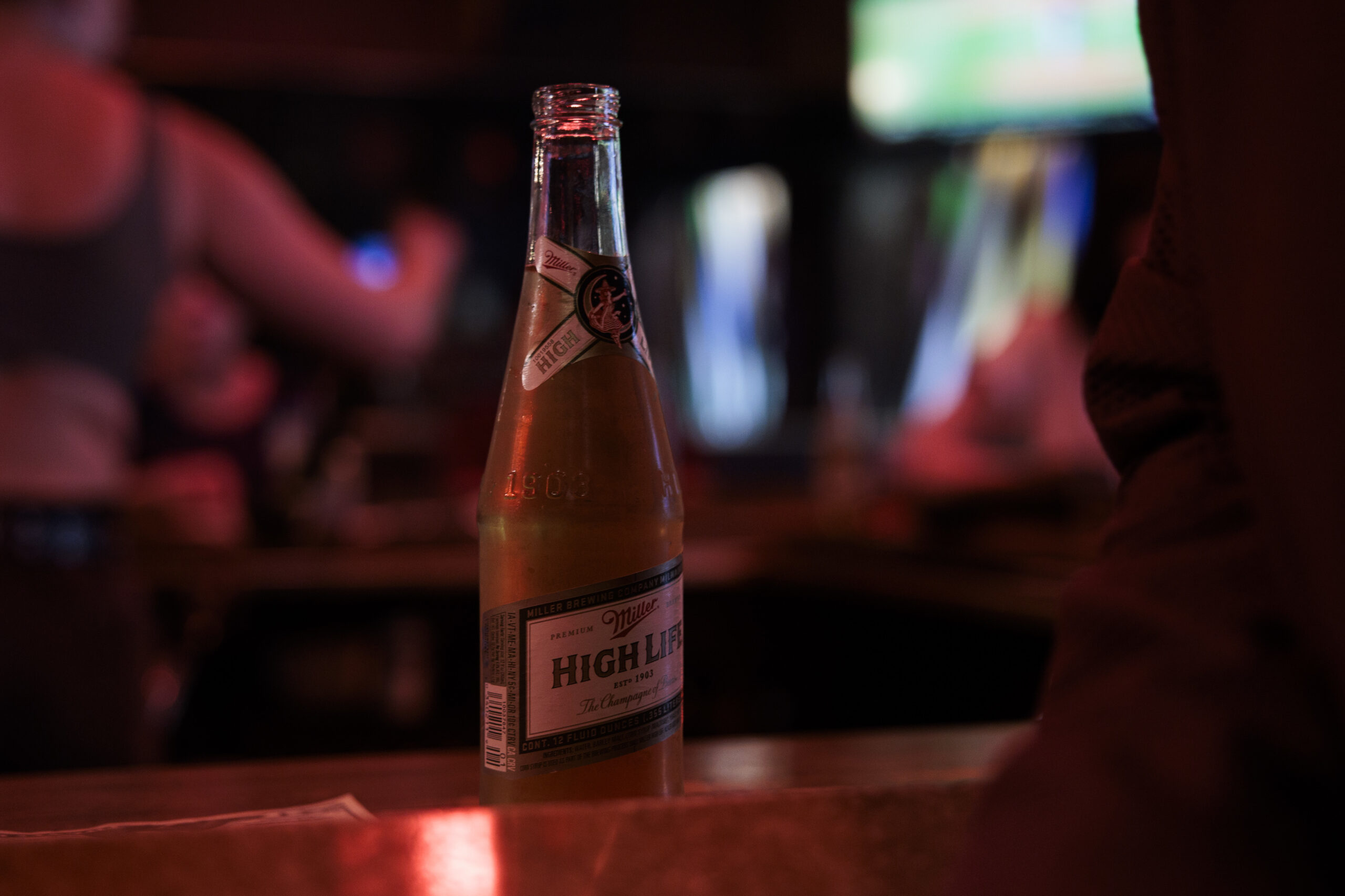
A Miller High Life on the bar inside McGlinchey’s on Aug. 18, 2025.
When Ron Sokol died, former employees turned out for the memorial. “So many people who had worked at McGlinchey’s over the years came and told me how important the bar had been in their lives,” she said. “I’m not really talking about the business side — I’m talking about the presence it had in people’s lives.”
Among its alumni was Fergus Carey, the serial Philadelphia bar owner, who got his start in the industry there, as did his business partner, Jim McNamara. Carey said they had considered putting in an offer on McGlinchey’s, “but at this point, Jim and I have let it go in our hearts. We met so many people there — people we worked with, people we served, people who became friends. It was an important steppingstone for both of us, professionally and personally. It’s a big part of our history in this business.”
As the property changes hands, Sandra Sokol said she hopes its identity survives the transition. “I would really like it to remain McGlinchey’s and for a new owner to keep it as close as possible to what it was,” she said. “I especially feel that way because I know Ronnie would have wanted it to continue into the next chapter.”
The recent wintry weather has prompted the Center City District to extend Restaurant Week by four days and the Girl Scouts of Eastern Pennsylvania to tack two weeks onto its cookie sales season.
Center City District Restaurant Week
The district announced Tuesday that all 122 participating restaurants were offered the option to extend the dining promotion — which had been slated to end on Jan. 31 — to Wednesday, Feb. 4.
As of 4 p.m. Tuesday, about 70 restaurants had opted in, with additional confirmations expected throughout the week, said spokesperson Giavana Pruiti.
Pruiti said she checked in with restaurants Sunday and Monday, and found that many had closed due to snow and hazardous travel. Those closures prompted the district to tack on extra days to the promotion, as it did for three days in January 2015 after a threatened snow that never materialized.
Among the restaurants that have confirmed participation in the extension are Alice Pizza, Bank & Bourbon, Barbuzzo, Bolo, Buca D’Oro, Darling Jack’s Tavern, Dizengoff, P.J. Clarke’s, Rockwell & Rose, Samba Steakhouse, Sura Indian Bistro, Vita, and Wilder.
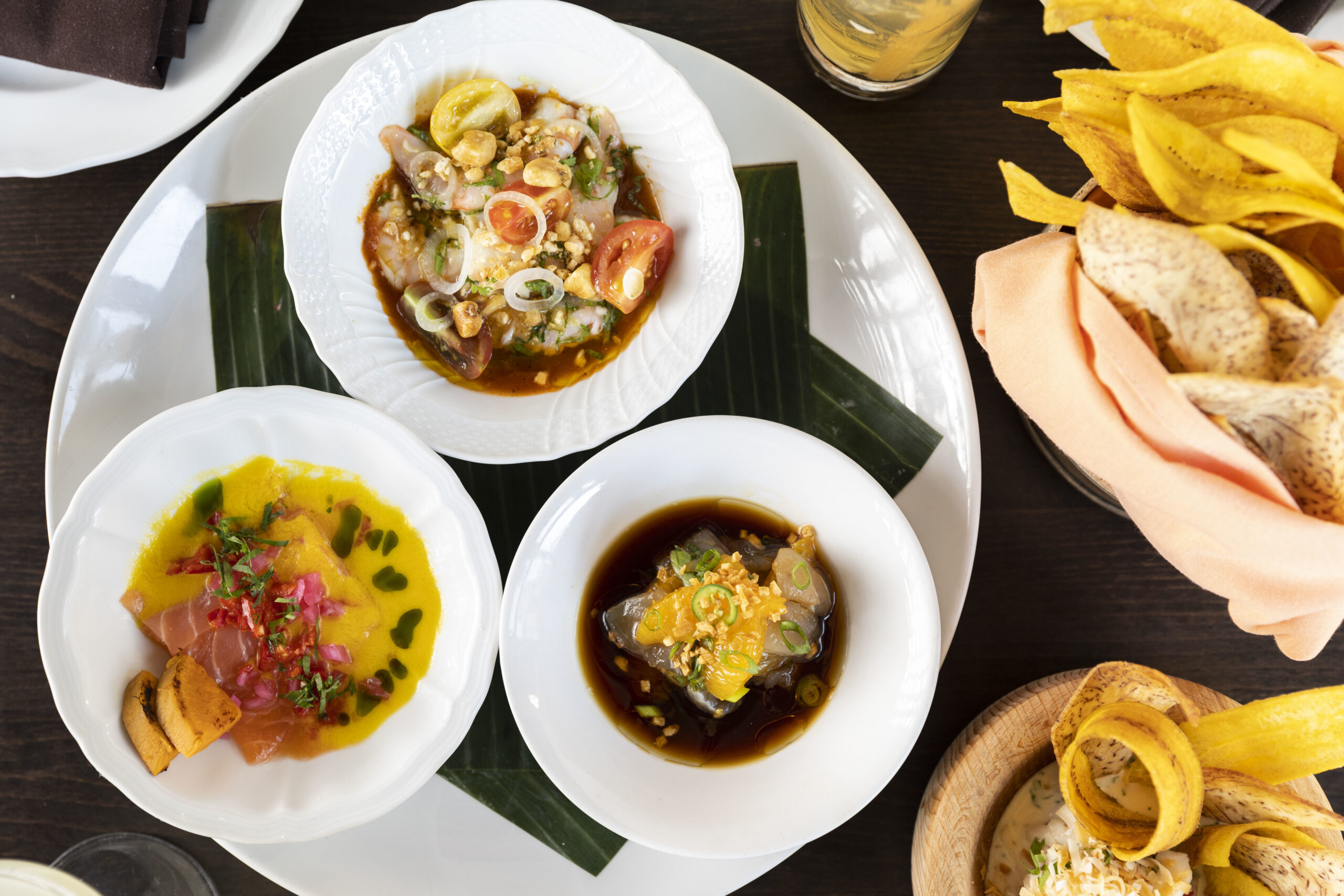
The ceviche trio at Bolo.
The district recommends customers check directly with restaurants to confirm operating hours, make reservations, and verify extensions. The most up-to-date list of extended participants is being updated on the Restaurant Week website, where individual restaurant pages will note whether they are offering menus through Feb. 4. A filter allowing diners to view only extended participants is expected to be added shortly.
The dining deals include three-course dinners priced at $45 or $60; some restaurants offer $20 two-course lunches. The district has arranged discount parking for $10 or less at participating BexPark by Brandywine Realty Trust, LAZ Parking, and Philadelphia Parking Authority parking facilities from 4:45 p.m. to 1 a.m.
The Girl Scouts of Eastern Pennsylvania last week announced that its cookie sales season would end March 22 “since a lot of cookie booths were snowed out and the temperatures look downright frigid this coming weekend.”
The idea, it said in a statement to Scout leaders, is to “help keep all Girl Scouts safe from the elements and give them plenty of time to reach their Cookie Season goals.”
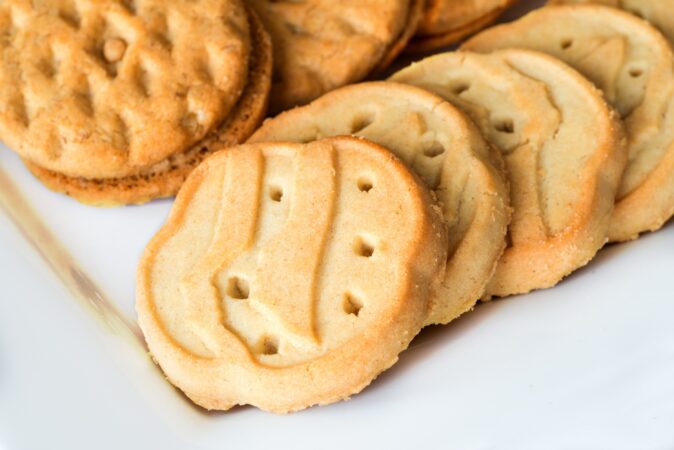
This year marks the debut of a rocky road-inspired cookie called Exploremores. Toast-Yays, inspired by French toast, were “retired” (in Scout parlance) to make room for it.
Our main feature this week is a roundup of Philly’s top dive bars — where we find cold beer, warm stories, and nothing curated. We’ve mapped them out for you.
Also in this edition:
Chef on the rise: He’s a 21-year-old college senior, and he’s cooking on Rittenhouse Square.
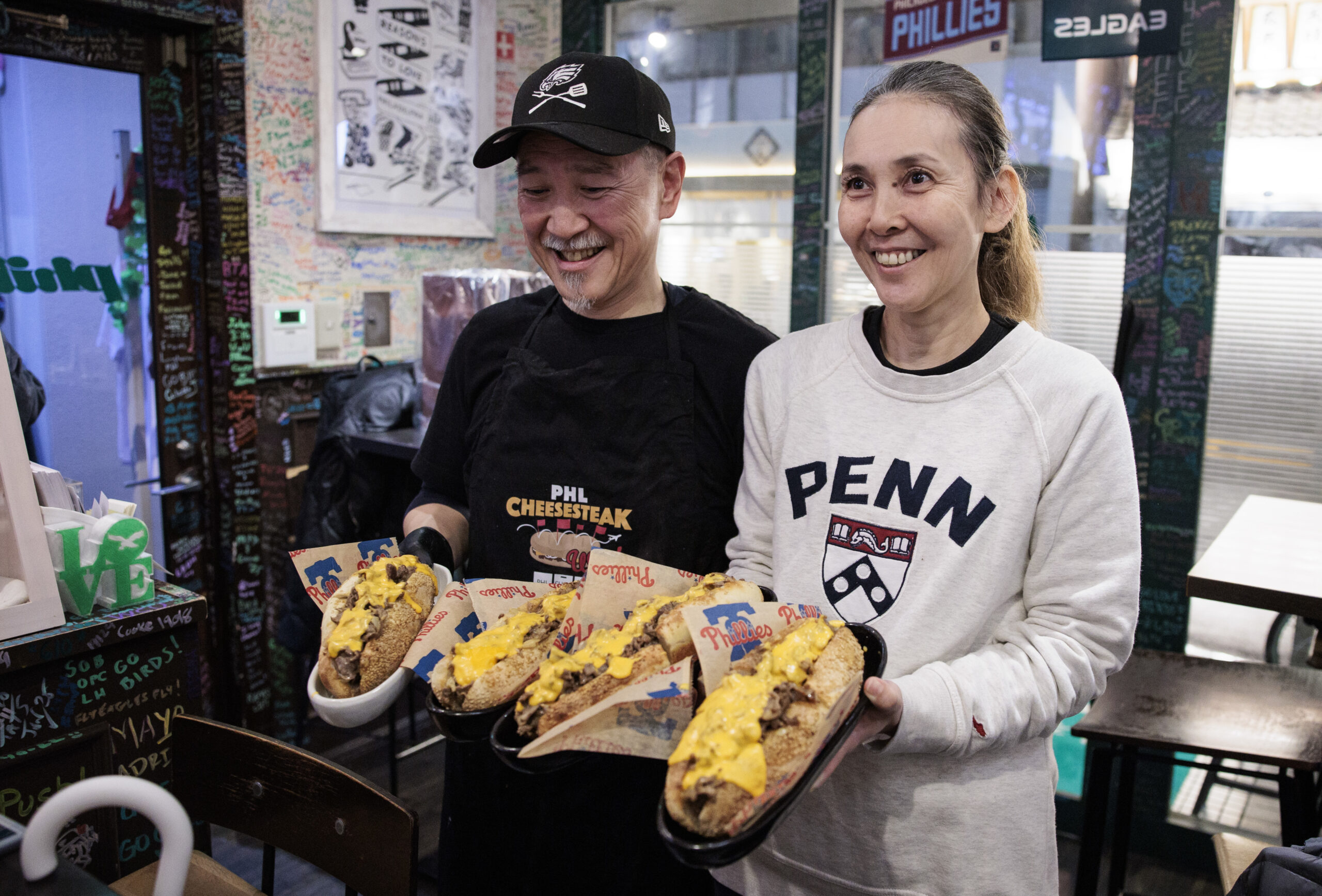
A yen for cheesesteaks: Craig LaBan gets a taste of Philly in Tokyo.
A good dive bar doesn’t try to impress — it just pours a drink, remembers your face, and lets the night take care of itself. We asked for ideas and got 400 responses. Here are 20 favorites in Philly.
To think that two years ago, culinary student RJ Smith was hosting four-seat dinners for friends. On Sunday, Smith begins a six-month chef’s residency at the Rittenhouse Hotel. Read on for the story — all the more remarkable when you realize that the creator of Ocho Supper Club is a 21-year-old college senior.
🧑🍳 Alex Fiorello, 28, is taking over the shuttered Il Fiore in Bryn Mawr for his third suburban restaurant. Like the others, it will carry the Alessandro’s name.
There’s a little bit of Philly in Tokyo: a bar called Nihonbashi Philly, where the cheesesteak is the go-to sandwich. Critic Craig LaBan happened to be in the neighborhood and stopped for a bite.
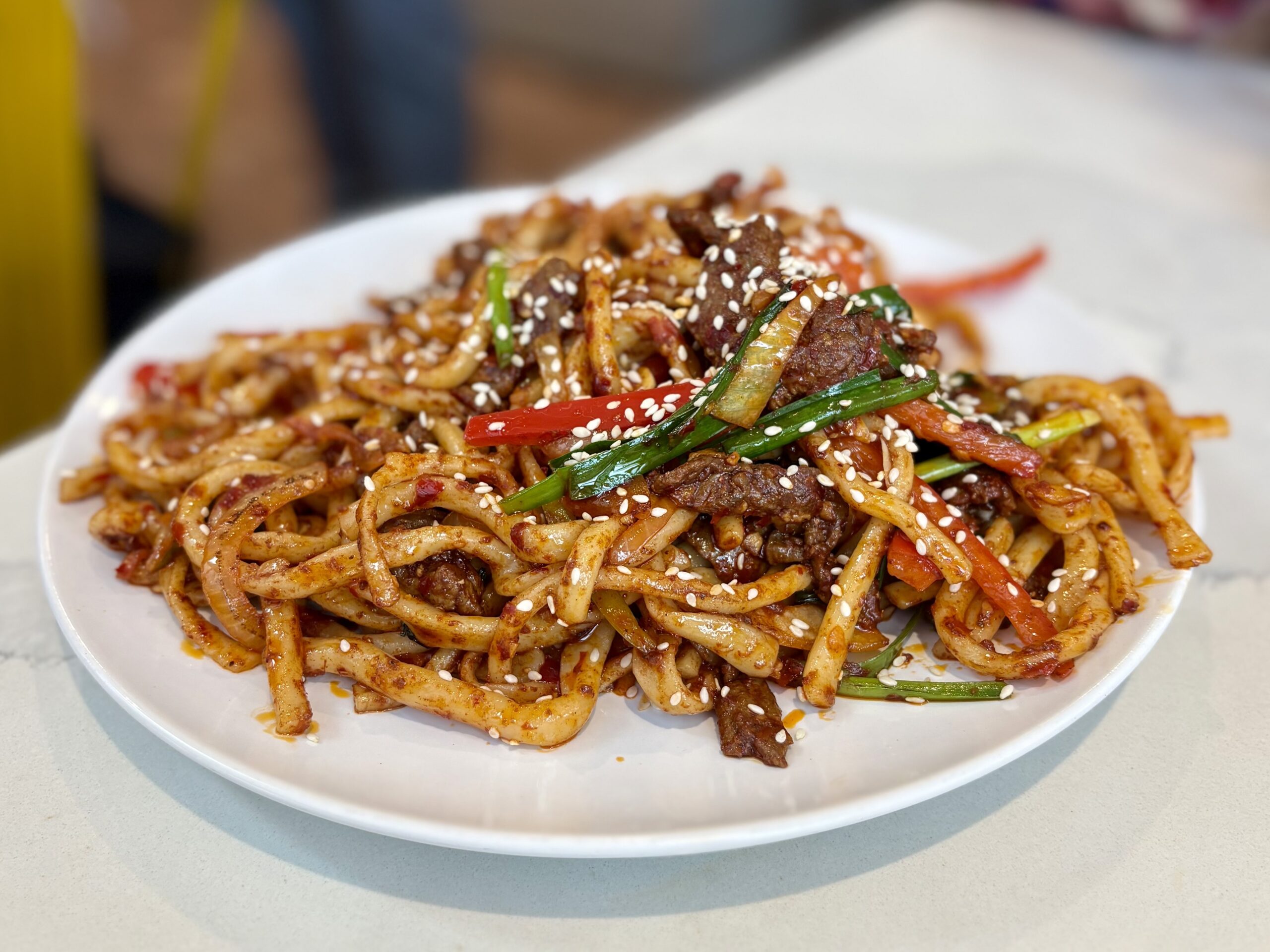
Now that we’ve dug out our sidewalks, we’re digging dishes, like these chewy, hand-pulled lagman noodles that wowed Craig LaBan. Meanwhile, Beatrice Forman found a pizza in Queen Village that is the real MVP and Patricia Madej capped off her meal in Kensington with caramel toast.
Scoops
Call Your Mother, a bagel shop and “Jew-ish” deli from D.C., is coming to Fishtown, and our Emily Bloch lox up the details: stuffed bagel sandwiches, babka muffins, and a special Philly menu item or two.
Fergus Carey and Jim McNamara of Fergie’s Pub, the Jim, and the Goat Rittenhouse, are headed to Old City for a yet-to-be-named pub at the former Mac’s Tavern.
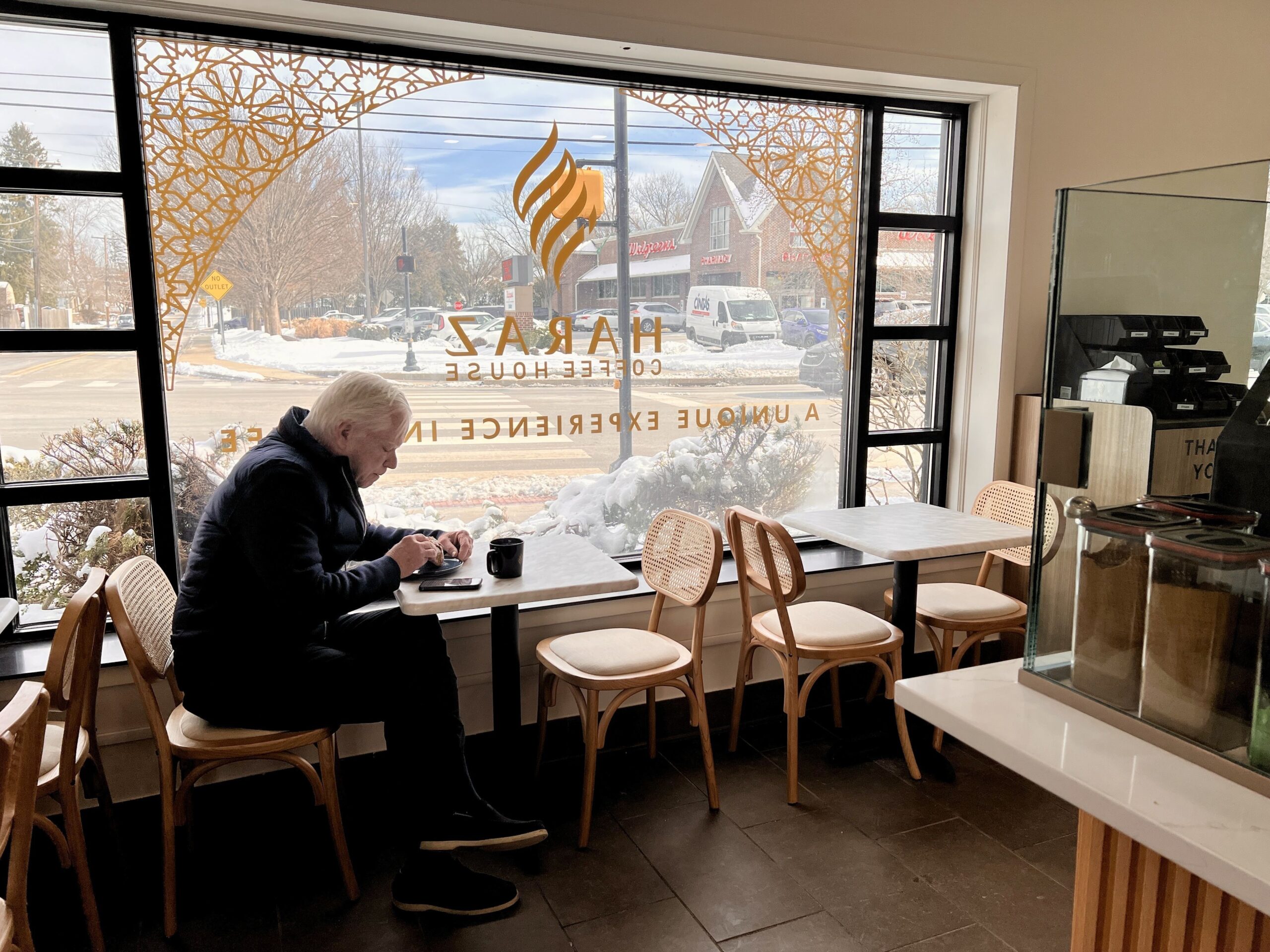
Haraz Coffee House — the Yemeni coffee franchise that opened its third area location last week in a former Starbucks in Flourtown and will soon open in Marlton Crossing Shopping Center under a different ownership group — has a deal in Center City. It’s seeking zoning approval at 1822 Chestnut St., next door to Boyds.
In other Rittenhouse little-treat news, I hear that Somedays Bakeryout of Queens, N.Y., has signed a lease at the former Republic Bank at 16th and Walnut, on the 16th Street side.
Restaurant report
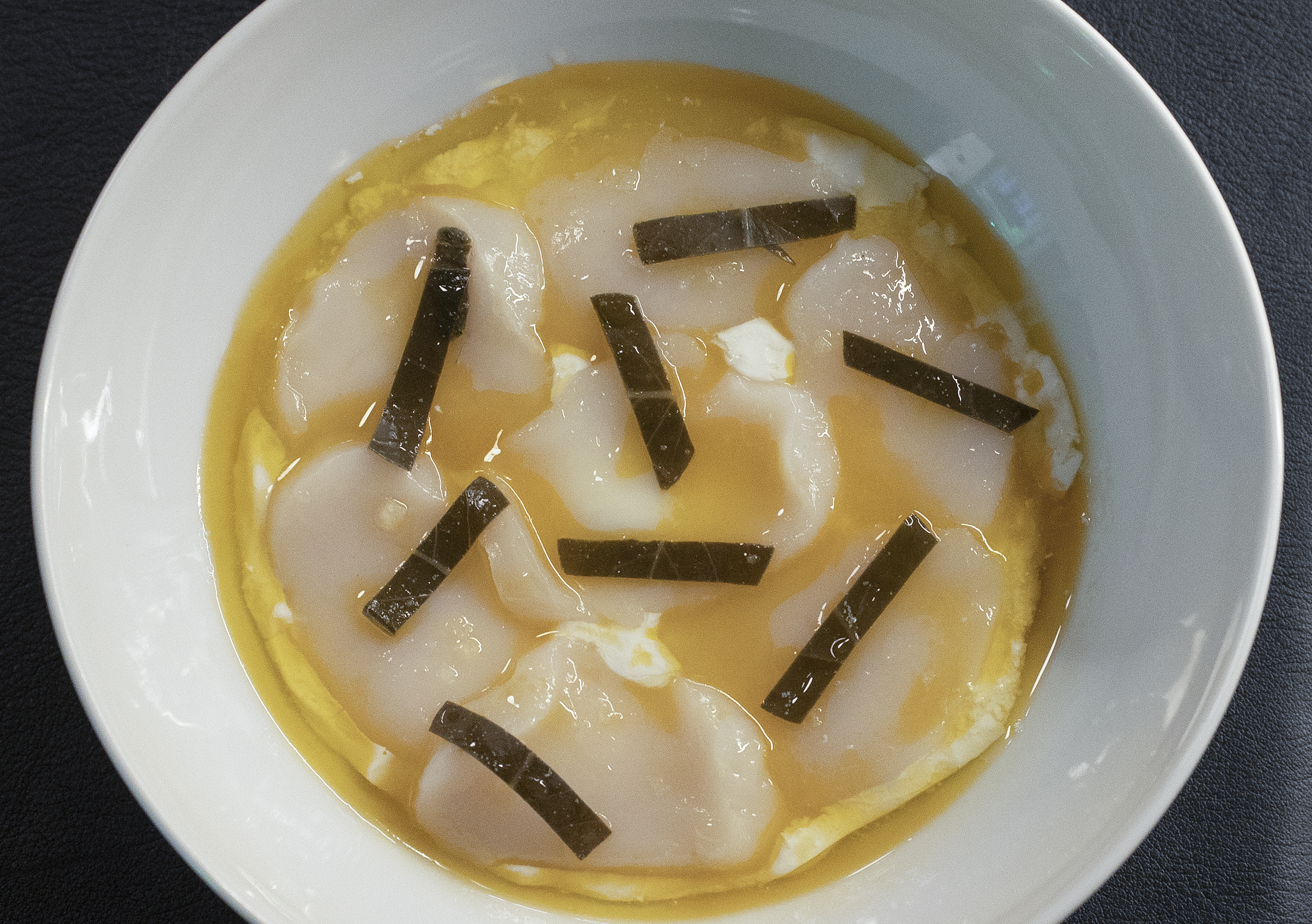
Greg Vernick is having a great week. He made the James Beard semifinals for Outstanding Restaurateur and he opened the cozy Emilia, an Italian restaurant in Kensington. (Shown above is the sea scallop crudo and burrata.) Walk-ins are welcome here; read on for the rundown.
Shiroi Hana, one of Center City’s oldest Japanese restaurants, closed Saturday after 41 years at 222 S. 15th St. Owner Robert Moon, who bought it in 1998, has decamped to his other restaurant, Doma (1822 Callowhill St.), which opened in 2010.
Briefly noted
Thirteen chefs and restaurants are in the running for James Beard Awards. Mark your calendars for the announcement of the finalists on March 31.
Honeysuckle chefs Omar Tate and Cybille St.Aude-Tate (on the Beard semifinalist list for Best Chef, Mid-Atlantic) will host an evening with culinary historian Jessica B. Harris, who will sign her latest cookbook, Braided Heritage, on Thursday from 6 p.m. Passed hors d’oeuvres, developed by Honeysuckle chef de cuisine Taylor Renée Threadgill, will be served, including beef boulettes with gravy aioli, wild rice-and-mustard green cakes, salt cod fritters with tomato sauce, calas fritters, cornbread dressing with marinated crab, fried catfish bites, and peanut brittle. Harris’ bestselling High on the Hog was turned into a four-part Netflix docuseries in 2021. Tickets are $135pp, bookable on OpenTable.
Front Street Café in Fishtown will host a vegan French dinner on Thursday, featuring a fully plant-based four-course menu (think brandade with nori-poached hearts of palm; salad Niçoise; grilled broccoli steak with turnip purée and black garlic molasses; and a pear crêpe dessert) and wine pairings with each course. It’s $65pp plus 20% gratuity and 2% service charge. Reservations (required) are up on OpenTable.
Milk Jawn will mark Ice Cream for Breakfast Day starting at 9 a.m. Feb. 7 at their East Passyunk and Northern Liberties locations with flights featuring four limited-edition, cereal-centric flavors for $12.50 apiece.
Northern Liberties Restaurant Week is on through Feb. 8 with two dozen restos offering two-course (or more) lunches for $10, $15 and/or $20 and three-course (or more) dinners for $25, $35 and/or $45. Details are here.
The Muhibbah Dinner series, founded by Ange Branca of Kampar, returns Feb. 16 from 6-9 p.m. at BLDG39 at the Arsenal, 5401 Tacony St. The family-style, multicourse charity dinner, benefiting Puentes de Salud, features Branca alongside chef Yun Fuentes (Bolo), Natalia Lepore Hagan (Midnight Pasta), Brizna Rojas and Aldo Obando (Mucho Peru), Enaas Sultan (Haraz Coffee House Fishtown), and David Suro (Tequilas and La Jefa). It’s BYOB. Tickets are $170pp and available here.
Uchi will partner its Philly chef de cuisine, Ford Sonnenberg, with chef Marc Vetri to host a one-night, nine-course dinner on Feb. 26 blending Vetri Cucina and Uchi sensibilities. Highlights include A5 wagyu cheesesteak corzetti, pesce marinato with squid, shrimp, and scallop, smoked duck breast riso al salto, kurodai sashimi, and turnip nerui. A few à la carte items, including Vetri’s rigatoni, will be available. It’s $175pp plus tax/tip, with staggered seatings from 4 p.m. bookable on Uchi’s website; a portion of proceeds benefits Vetri Community Partnership.
Cricket Club in Cape May will host a one-night, five-course pop-up dinner on March 1 honoring the cooking of the late local chef Joe Lotozo, with all proceeds benefiting the Cape May Food Bank. The menu ($188pp) revisits several of Lotozo’s specials from his time circa 1988 at the Bayberry Inn, the Congress Hall restaurant now known as the Blue Pig Tavern. Organized by his children, Eliza and Bo Lotozo — who, along with family and friends, will handle service — the dinner will be cooked by Lotozo’s former sous chef, Chris Shriver, a onetime Cape May restaurateur. The event is supported by the Cricket Club and its sister restaurant, the Mad Batter, where Lotozo, who died in 2018 at age 64, began his cooking career in the early 1970s and met his wife, Susan. Details are here.
❓Pop quiz
A Southwest Philadelphia strip club is attracting attention for what?
Foodie living in Blue Bell here. I noted that you mentioned new places in Chestnut Hill and Fort Washington but I have not heard of any new or exciting places nearby. I don’t understand why in an affluent place like this there is such a boring array of restaurants. I frequent the old standards here and in Ambler, but nothing is really exciting, fresh, or new. Why? My theory is that Blue Bell is charming but has no real town center but rather two small shopping centers at Routes 202 and 73. — Bob
Several factors may be at work, including your theory. Blue Bell, a slice of Whitpain Township, isn’t as walkable or dense as towns such as Ambler, Conshohocken, and Ardmore. Also, real estate is tight and expensive for independents, with few second-generation restaurant spaces to recycle and landlords seeking high rent and long-term leases. Labor is tougher in much of the burbs, where restaurants compete with hospitals, schools, corporate jobs, and other retailers for the same workforce. Also, customer patterns skew toward “known quantities” — e.g. chains. (Hence, the new Wonder in Centre Square Commons.) That makes opening a new independent restaurant feel riskier.
Plus, much of the demand is already met — but spread out, as Blue Bellians already drive the 10 to 20 minutes to Conshy, Ambler, Skippack, Wayne, or King of Prussia, siphoning “destination dining” energy.
Though not new, my own favorites include Blue Bell Inn, Radice, Saath Indian Grill, Su20 Sushi, and El Serape. While we’re at it, my kids are addicted to the fried chicken at Lovebird. And keep an eye on Fort Washington, where Academy Grill is taking shape st Cantina Feliz’s former location, as well as Ambler, where Dettera will give way this spring to a Mediterranean concept.
📮 Have a question about food in Philly? Email your questions to me at mklein@inquirer.com for a chance to be featured in my newsletter.
By submitting your written, visual, and/or audio contributions, you agree to The Inquirer’s Terms of Use, including the grant of rights in Section 10.
Chefs’ travels inspire their menus — for example, the konbini in Japan that Jesse Ito and Justin Bacharach visited for Dancerobot and the trattorias in Italy that Stephen Starr’s team scouted for Borromini, to name two just in the last year.
For Greg Vernick, the culinary inspiration for his first new restaurant in 6½ years — the casual Emilia, opening Tuesday in Kensington — was from a trip to Rome a few months ago with Meredith Medoway, Emilia’s chef de cuisine, and Drew Parrasio, culinary director for his restaurants.
Before they left, Vernick called chef friends like Marc Vetri, Jean-Georges Vongerichten, and Hope Cohen for recommendations: “Where do I need to eat? Street food, markets, trattorias, all of it.”
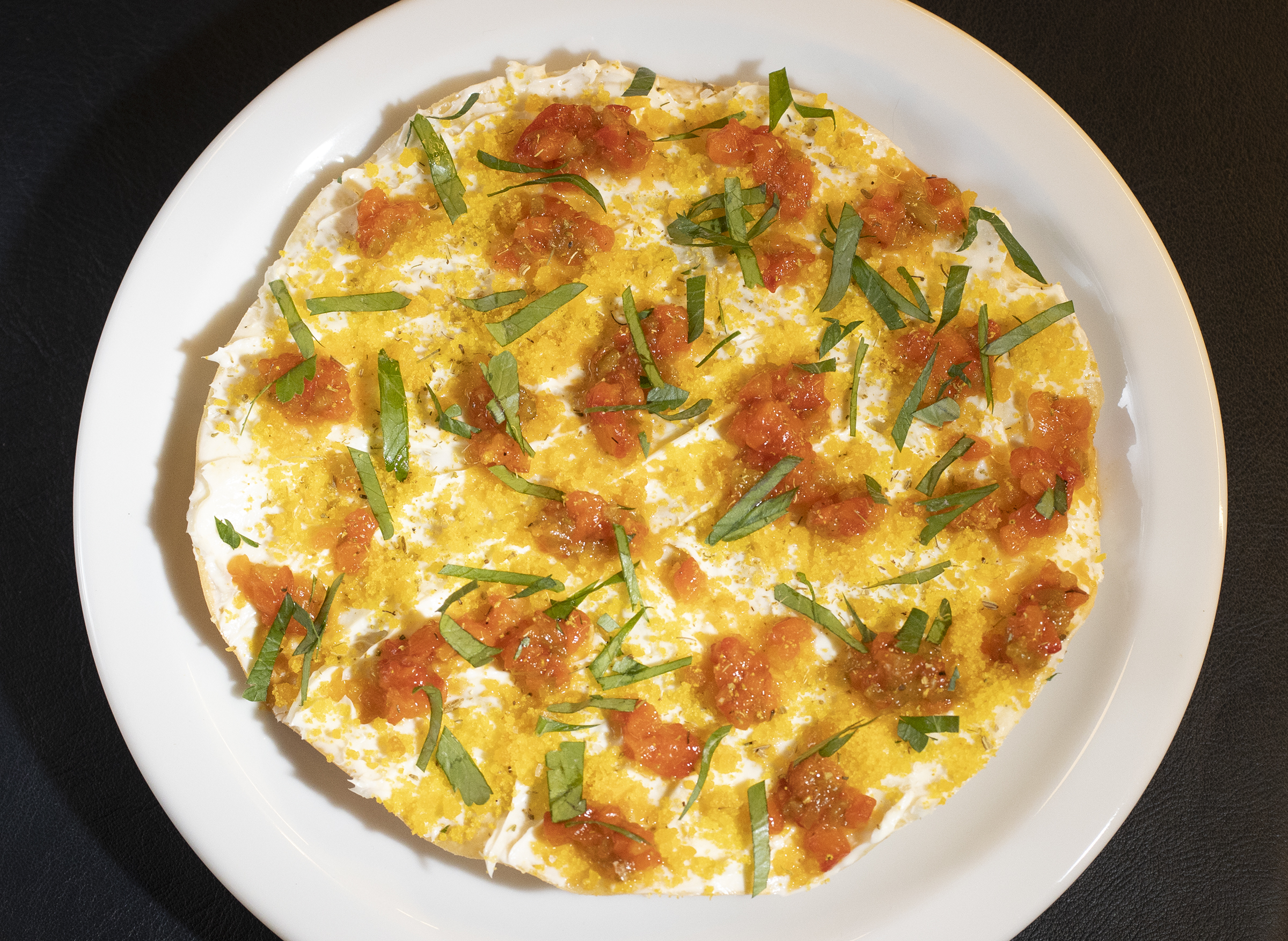
Carta di musica with butter, bottarga, and roasted chili at Emilia.
Emilia’s must-try dish came from a culinary school. Cohen’s suggestions included the American Academy in Rome. “We walked up one day thinking we’d just say hello and ended up spending the entire day there,” Vernick said. “They grow their own herbs and produce. We were eating arugula straight from the ground, picking rosemary and thyme — it felt cinematic.” Chef Sara Levi, who oversees the academy’s program, asked the three to join the students for the day’s family meal.
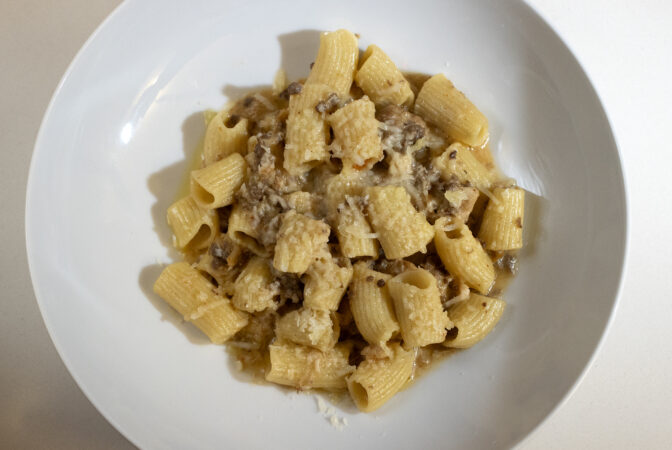
“One of the dishes was a simple chicken ragù pasta — hand-cut chicken, livers, hearts, very little sauce,” Vernick said. “Light, savory, a little gamey. We didn’t even talk much while we were eating it. Later, walking back into central Rome, we all realized: That was one of the best pastas we had on the trip, and we’d eaten three to five pastas a day for three days.”
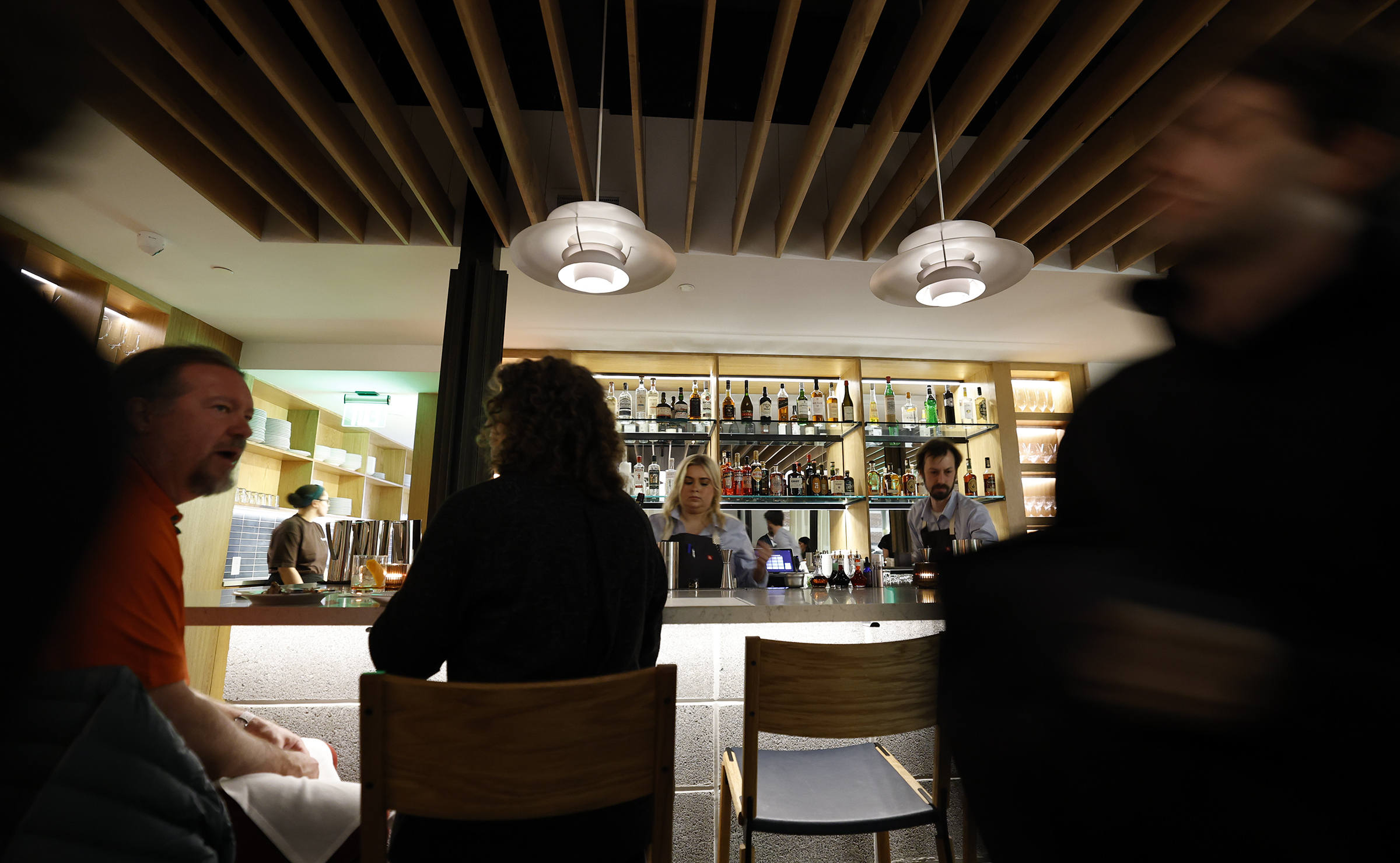
Chefs Meredith Medoway and Greg Vernick at Emilia.
Back home in Vernick’s kitchen, they tweaked it to “just honor the idea,” Vernick said. It’s on the opening menu as “rigatoni, ragù bianco.” It’s also Emilia’s lone chicken dish — a somewhat daring move.
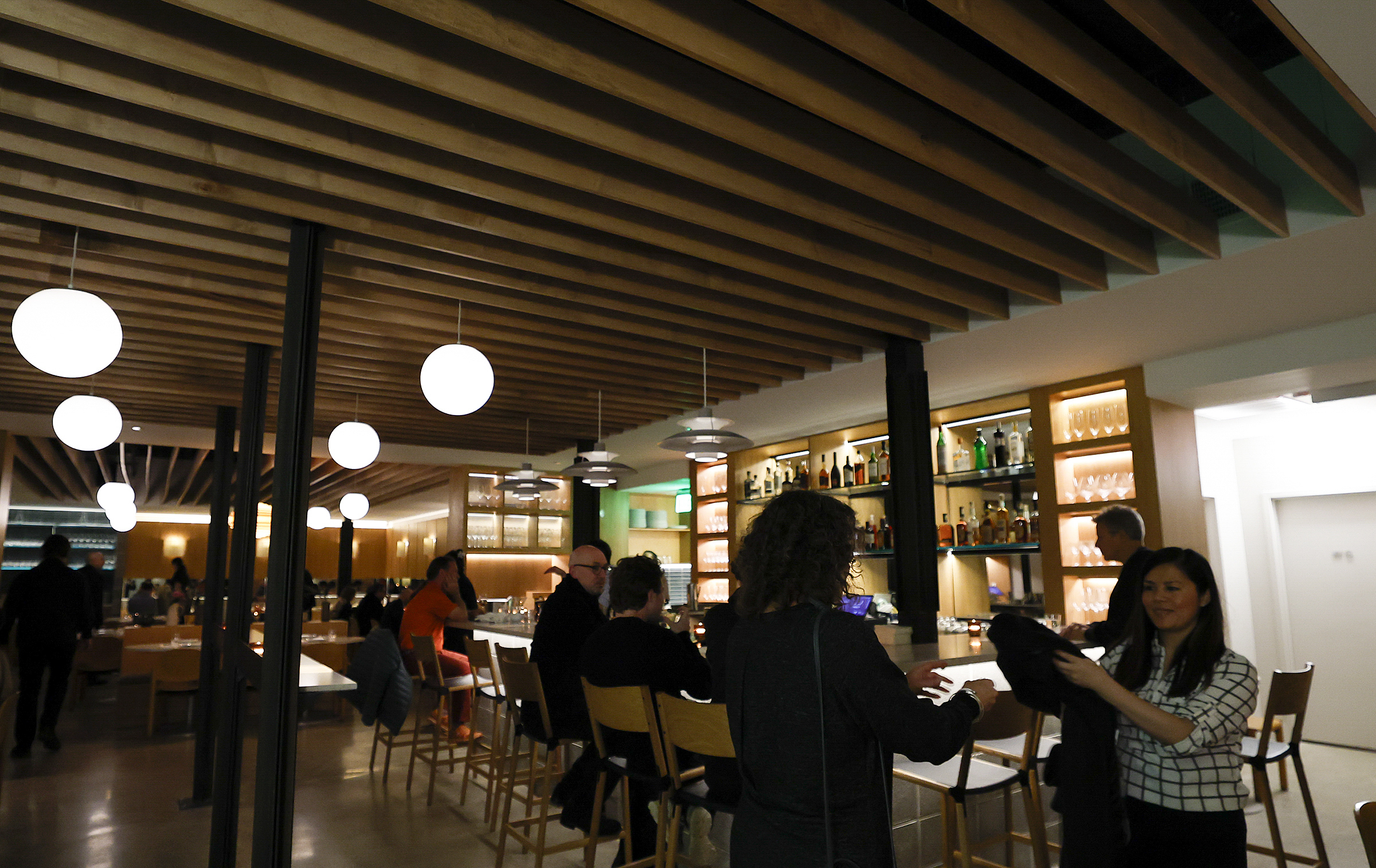
Emilia, just north of the York Street roundabout on Frankford Avenue, seats 60 in the dining room, with an additional 10 seats at the bar and 20 in a lounge area; in keeping with Vernick’s desire to make this a neighborhood place, some tables are held for walk-ins.
Canno Design’s Carey Jackson Yonce, working with California-based designer Bob Bronstein, has the lighting set to “subdued.”
“I wanted it to feel like the kind of place where you walk in and exhale and relax,” Vernick said. “Industry-friendly, not precious. We want to hit two markets from day one: the neighborhood and the industry. If you get those right, everything else falls into place.”
Arranged flowers in the dining room at Emilia.
Italian is a new turn for Vernick, who started here in 2012 with the New American Vernick Food & Drink before adding Vernick Coffee Bar in 2018 and Vernick Fish in 2019. The developers of Emilia’s building were keen on having an Italian restaurant, and Vernick’s thoughts naturally turned to Medoway, the longtime chef de cuisine at his flagship.
The bar program focuses exclusively on Italy, with low-intervention wines, amari, spritzes, and a rotating seasonal negroni, along with Italian sodas and zero-proof cocktails.
Sea scallop crudo and burrata at Emilia.
Much of the menu is coursed and priced as smaller plates (figure teens and $20s). The few entree-sized dishes, such as golden tilefish ribollita and grilled sea bream, start in the high $30s; top price is $53 for crispy veal with broccoli di ciccio.
There’s other house-made pasta on the menu, such as capellini with pesto, and radiatore in mushroom Bolognese. Much of Medoway’s cooking is centered on a 48-inch charcoal- and oak-fired grill. Each table receives complimentary breads — house-made focaccia, Mighty Bread’s sesame ciabatta, and the thin bread sticks known as grissini.
The bar area at Emilia.
Another anchor main course dish is rabbit Emiliana, a regional take on cacciatore from Emilia-Romagna that Medoway devised after a trip of her own. The braised rabbit is finished with roasted peppers, green olives, fresh orange, and vinegar, giving it a punchy, slightly sweet-sour profile.
Several smaller plates lean into texture and contrast. Carta da musica, a paper-thin Sardinian cracker, is spread with soft butter, dusted with grated bottarga, and topped with a relish of fire-roasted peppers. You crack it at the table and share the shards. “It’s about breaking bread together,” Vernick said.
A sea scallop crudo pairs raw scallop with burrata and a caper-chili vinaigrette, a combination Vernick said surprises people at first because of the similar textures. “It works, though,” he said. “It’s simple but exciting.” Grilled cabbage, blanched and then charred over the wood fire, is tossed with a colatura vinaigrette and finished with pecorino. “It reads ‘boring,’ but it eats incredibly well,” he said.
Emilia, 2406 Frankford Ave., 267-541-2360, emiliaphilly.com. Reservations open on Resy. Hours: 5 to 9:30 p.m. Sunday to Wednesday, 5 to 10 p.m. Thursday to Saturday.
Call Your Mother — the popular neighborhood bagel shop and “Jew-ish” deli from the District of Columbia — is headed to the Keystone State.
It’s part of a steady ongoing expansion, including about 25 locations across D.C., Maryland, Virginia, Colorado, and Illinois, plus more on the way.
The first Philly location will be in Fishtown, in the corner space of 1500 Frankford Ave., and is expected to open this summer, owners said.
“This will be the start of more shops in Philly,” co-owner Andrew Dana said. “But we’ve never had a master plan on how to roll out. We’ll go where people want bagels and where we’re excited to be, as long as our food quality and service stay the same.”
With colorful decor that would feel right at home in West Palm Beach and stuffed bagel sandwiches made with latkes, whitefish dips, and smoked salmon, Call Your Mother is popular across the DMV.
In the six years since Dana and his wife, co-owner Daniela Moreira, opened that first location, the shop has been praised across food publications like Bon Appétit and Eater for its vibe and sandwiches. Some critics say the menu is overpriced, but items on the D.C. menu — including sandwiches and loose bagels — appear similarly priced to most of Philly’s bagel outposts (and sometimes cheaper).
On that note, Dana says to expect the same Call Your Mother signature menu items — like its bacon, egg, and cheese sandwiches and its babka muffins. “But we’re in the lab trying to cook up some special Philly flair, too,” he said.
You can also expect a colorful buildout.
“Most of the building will be painted pink, but we’re on the hunt for a local muralist to put an extra stamp on the building,” Dana said. “We’re also looking for local Philly food products to showcase.” Locals interested in getting in on the mix are encouraged to direct message Call Your Mother on Instagram.
The expansion comes amid a bagel boom in the Philly area: Viral bagel chain PopUp Bagels is set to open its first Pennsylvania location in Ardmore with seven more locations on the way in the Philadelphia region, including Suburban Square and Center City. Bart’s Bagels of West Philly is opening its third location in Bala Cynwyd, and Penny’s Bagels is coming to Haddonfield this year, as well.
“It’s a rise of the tide situation,” Dana said. “We’re not trying to take anyone’s territory. We don’t want to threaten a local spot. People love carbs, people love bagels. There’s enough room for everyone.”
The Frankford Avenue spot is part of a surge of popular food options in the area. It’s right across the street from Marina’s Pizza and El Chingón, and down the road from the new Medium Rare location.
“The infusion of best-in-class national brands like Call Your Mother Deli represents Fishtown’s strength today,” said Stefanie Gabel of MSC, who represented both Call Your Mother and the building’s landlord in the transaction. Gabel will continue to represent Call Your Mother as the deli expands within the Philly region. “Their presence also serves as a catalyst for the continued growth and longevity of Philadelphia’s most explosive mixed-use ecosystem.”
Call Your Mother recently made national headlines when it filed a trademark lawsuit against New Jersey’s Call Your Bubbi, a beach town cafe and kosher-certified bagel shop in Long Branch. Dana and Moreira said the Jersey cafe, which also sometimes goes by Bubbi Bagels, intentionally used a “confusingly similar” name and branding at times.
The dueling shops settled outside of court in early January, according to court documents. Dana declined to comment on the terms. Bubbi Bagels owner David Mizrahi could not be reached for comment.
As for what drove the couple to come to Philly, Dana said it was a simple decision: He very literally called his mother, Mary Wilson.
Wilson’s parents lived in Mount Airy and growing up Dana would visit his maternal grandparents often. He would go to their house, venture downtown, and explore Chestnut Hill. One of his best friends attended Penn. His cousins live on the Main Line. His other best friend lives in Bryn Mawr. In many ways, Dana says Call Your Mother coming to Philly is a natural progression.
“I’ve spent an insane amount of time here. I love the culture, the food, the vibe. It’s a great place to be,” he said.
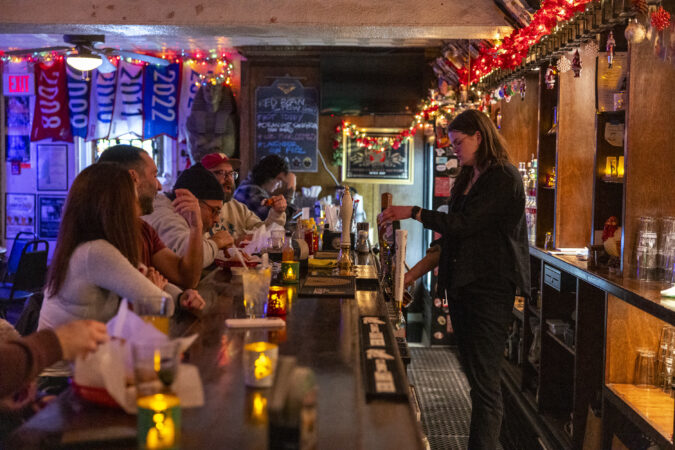
When The Inquirer put out a call for Philly’s favorite dive bars, people responded in droves: We received close to 400 responses praising all kinds of establishments, from well-trafficked Center City watering holes to humble corner bars tucked away in deep South Philly, the far corners of Kensington, and the slopes of Wissahickon. (There were also numerous suburban submissions, which we plan to feature at a later date.)
Several write-ins highlighted what are often considered essential trappings of a dive — dirty bathrooms, beat-up interiors, a jukebox, and the occasional slow-cooker — but many more cited something less reproducible: the feeling of community found inside these neighborhood haunts. Turns out Philly has a lot of places that feel like real-life Cheers, whether it’s thanks to a friendly owner or bartending crew, or regulars who readily welcome newcomers.
We built this 20-bar list based on the responses to our callout, but it comes with a caveat. There are degrees of diveyness, and some owners strenuously objected to being classified as such. We consider “dive bar” to be a compliment, not a pejorative.
Yes, there’s a smoking bar or three on this list, but there are also spots that serve craft beer and solid food (sometimes even salad), or have upholstery that hasn’t been worn through. Every bar we included, however, is cheap and cheerful, with a dedicated crowd of admirers.
12 Steps Down
Times do change, and this basement bar in Bella Vista is proof: “They don’t allow smoking inside anymore, but when they did I would still order the food because their kitchen was that talented,” writes Point Breeze resident Matteo Palmas. Yes, 12 Steps is a rare dive bar with food worth recommending, with a menu that ranges from hand-cut, Michael Solomonov-approved fries and a “bowl o’ balls” (meatballs, that is, topped with house gravy and ricotta) to $3 rotating tacos and $1 hot dogs during Phillies games. Whether you head down for a post-work game of pool, Quizzo, or karaoke, don’t be afraid to come hungry — or in search of a good time. “I have never had a bad time at that bar,” Palmas says. — Jenn Ladd
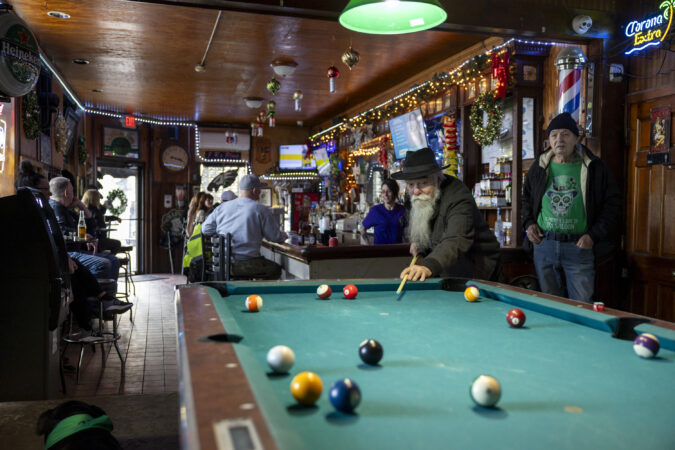
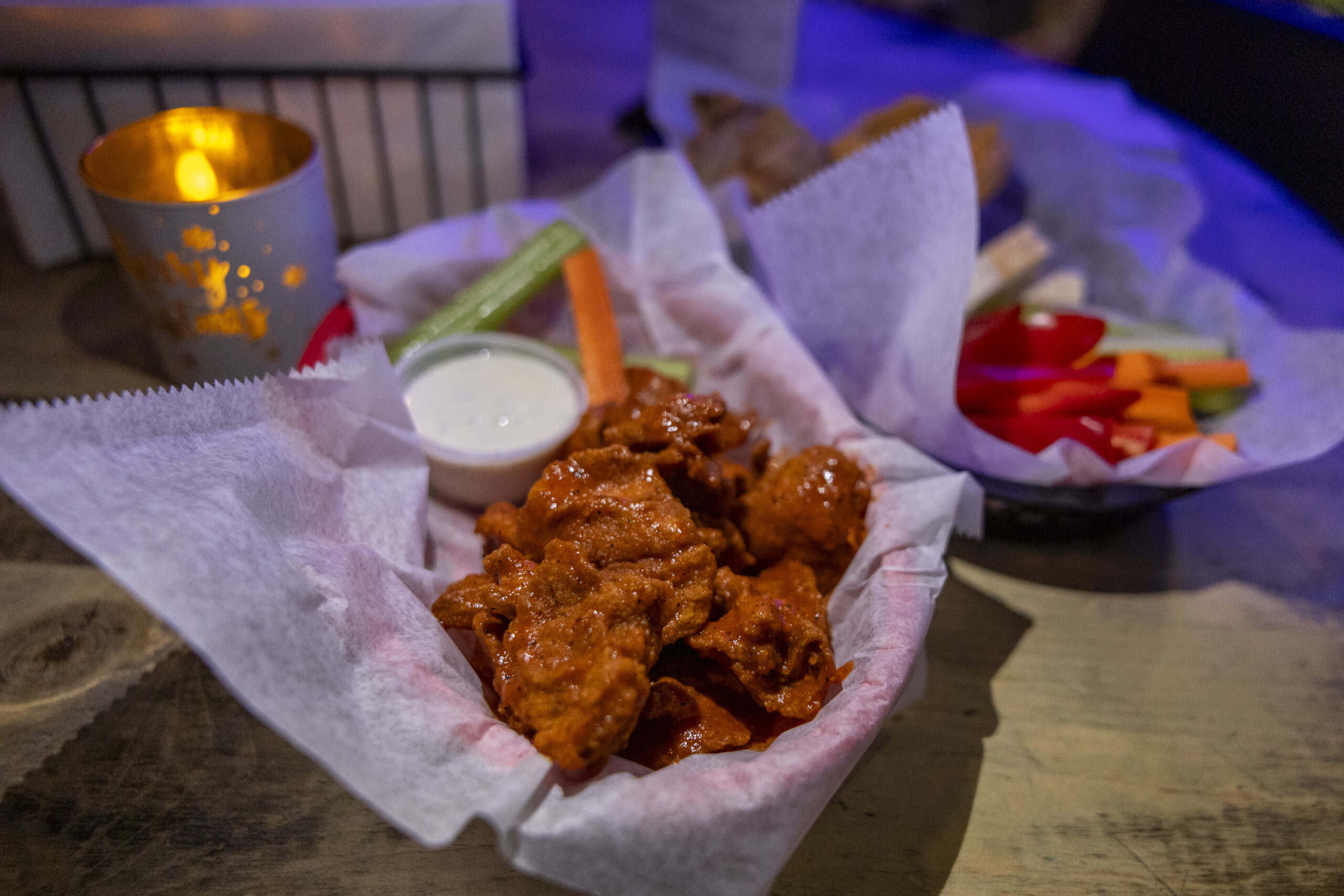
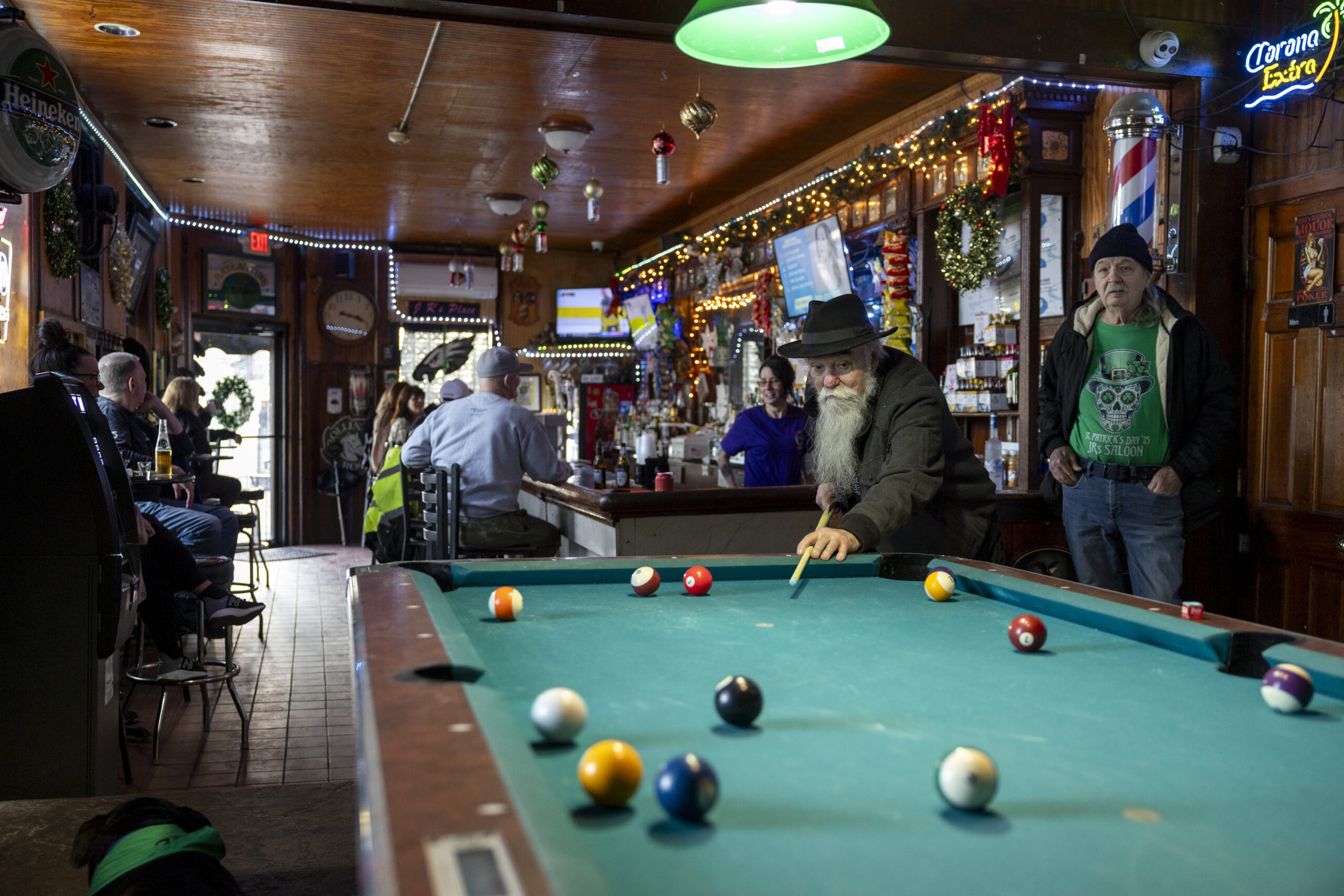
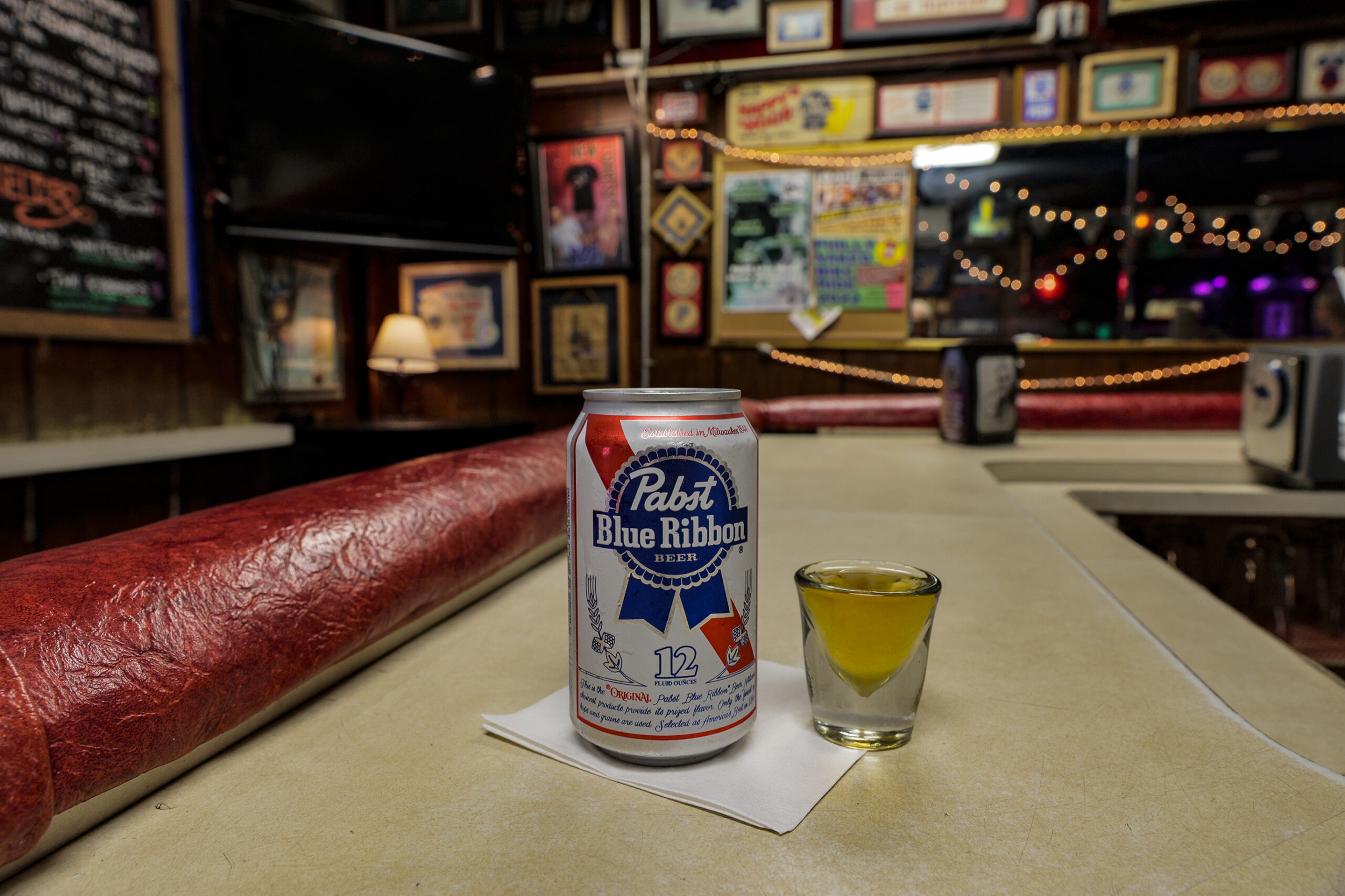
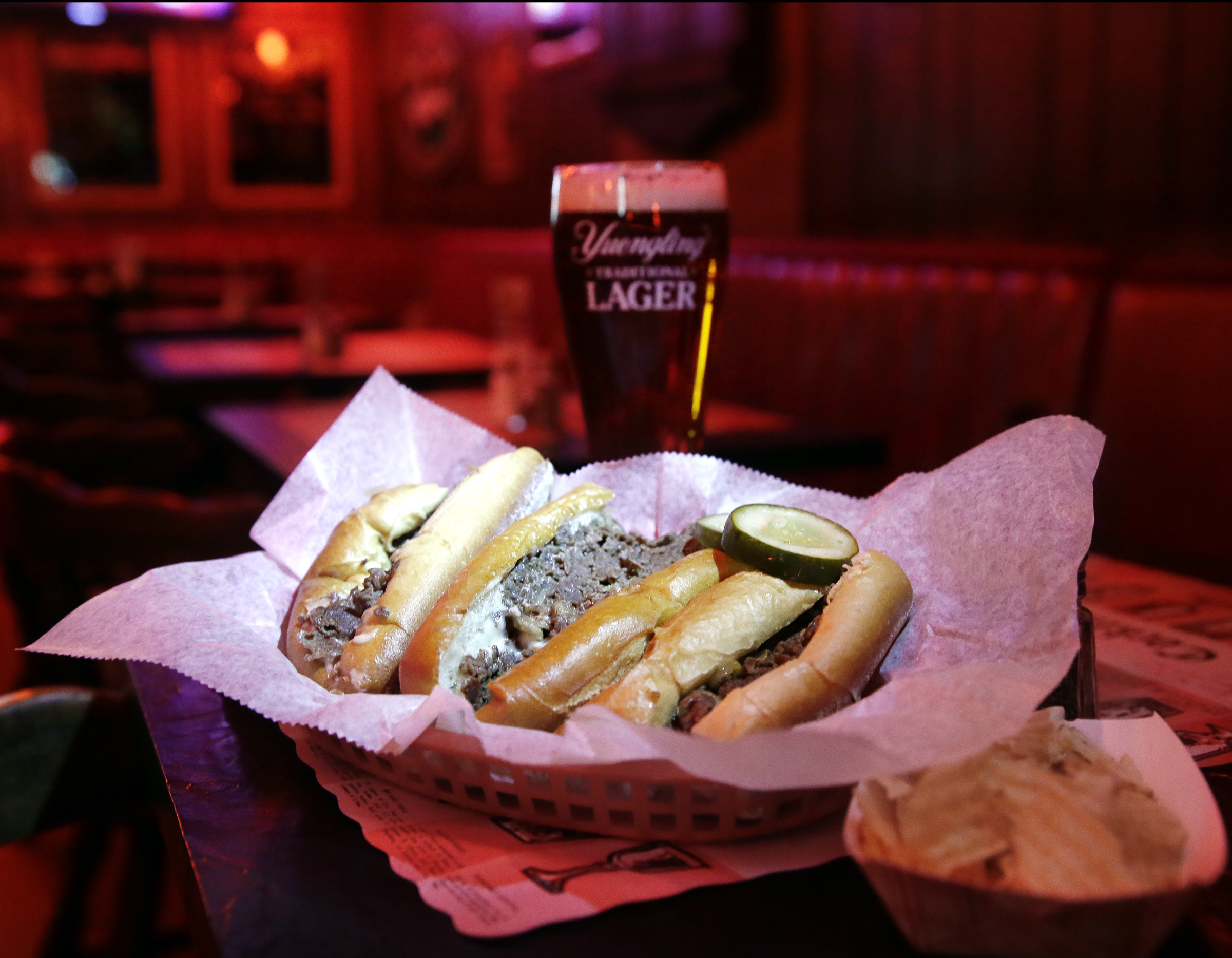
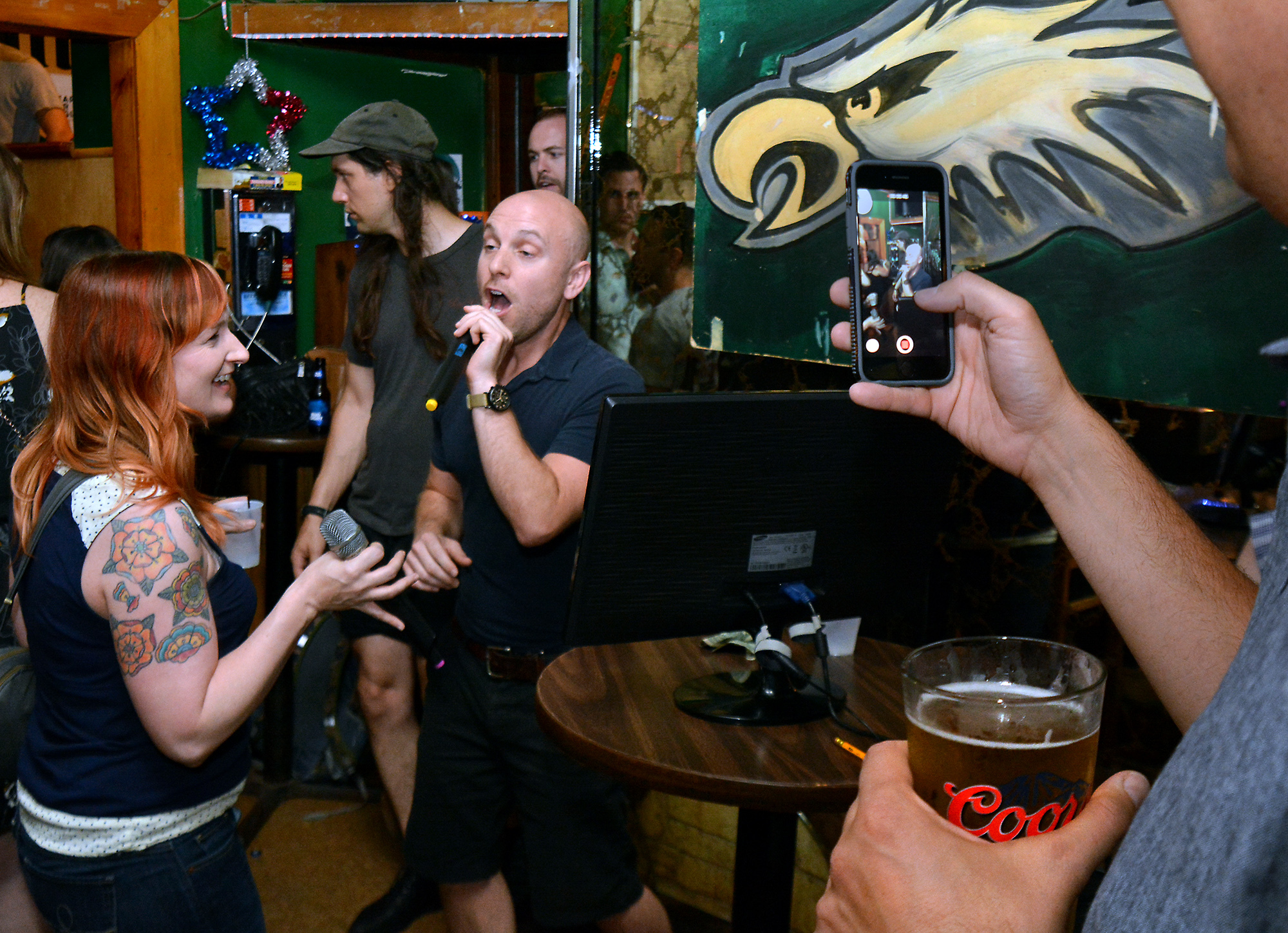
Buffalo Seitan Wings at Dawson Street Pub in Philadelphia on Friday, Dec. 19, 2025.Al Luecke, 77, of Fishtown, a regular at J.R’s Saloon for 25 years, playing pool on Thursday, Dec. 18, 2025.A shot and a beer at Bob & Barbara’s, 1509 South St., Wednesday, Aug. 24, 2022.Oscar’s cheesesteak-and-a-half and a tall Yuengling at Oscar’s Tavern on Sansom St. on March 22, 2018.Eric Miller and Becky Brighta are recorded by a friend as they perform a duet during karaoke night at Les and Doreen’s Happy Tap. Mark C Psoras / For the Inquirer
Billy Murphy’s
Wood-paneled, drop-ceilinged, and cluttered with old pictures and memorabilia, this corner bar tucked in the elbow of East Falls is “packed with neighbors every day,” says local Devin Van Gorden. The welcoming atmosphere is a legacy of the late William Murphy, who took over the former rough-and-tumble shot-and-a-beer bar with his wife, Patty, in 1977. Michael Murphy, their son, runs the bar today and has been working there since high school; he’s kept up the approachable attitude and expanded the food menu, which ranges from “pig wings” (flash-fried pork shank) and cheese curds to fish tacos and BLTs. Billy Murphy’s is as much a family-friendly neighborhood spot as it is a dive, but extremely reasonable prices (75-cent wing specials twice a week), weathered decor, and a cash-only policy tip the scales. — J.L.
Bob & Barbara’s Lounge
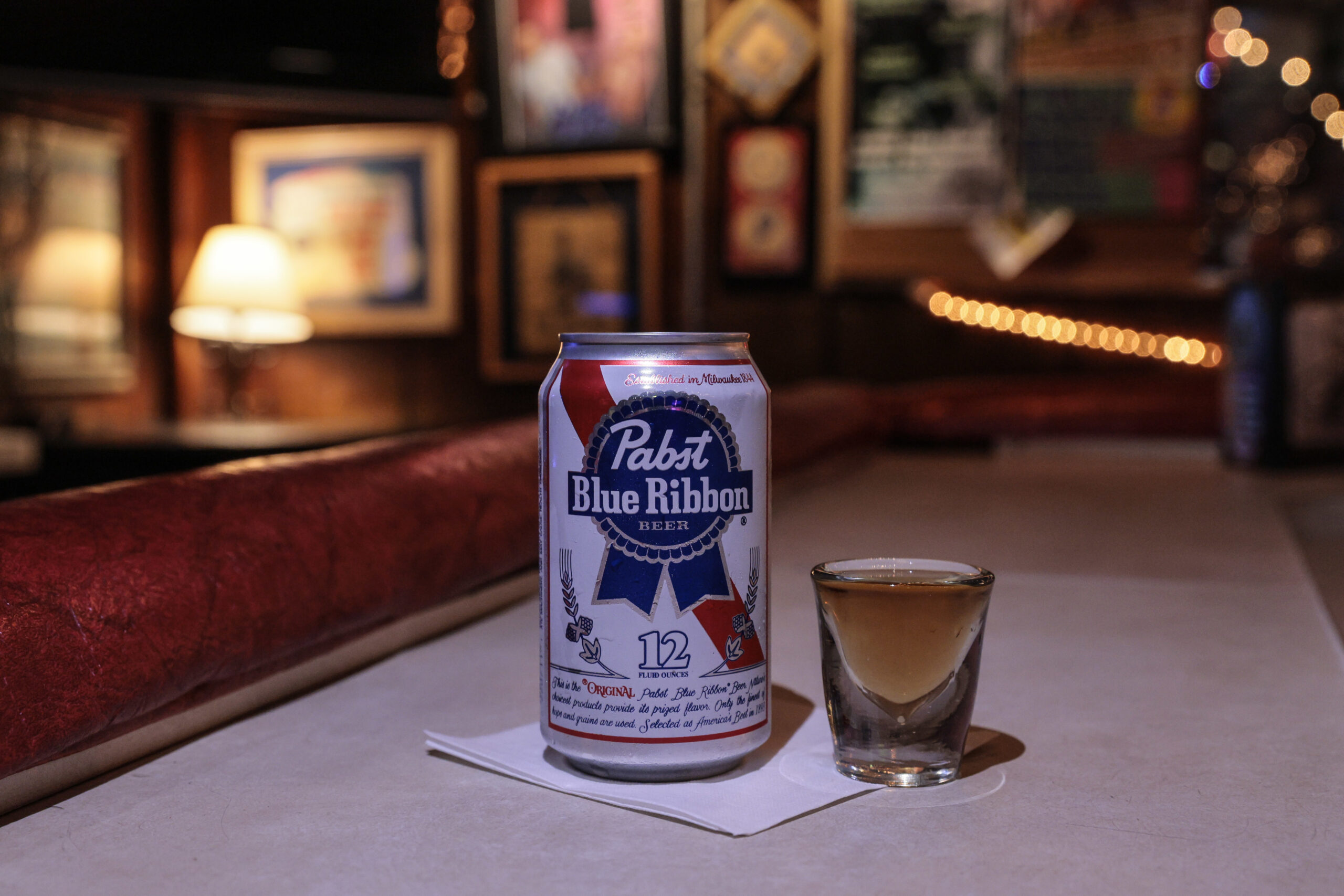
Scads of Philadelphians and passers-through have whiled hours away at this 57-year-old South Street institution, either perched on a swiveling barstool, knocking back a can of Pabst and a shot of Jim Beam, an iconic combo the dive popularized citywide; grooving to whatever free, live music (from jazz to “low-key house”) the bar’s savvy talent bookers tap on a near-nightly basis; or cheering on the charismatic performers in Philly’s longest-running drag show. It’s a bar for absolutely everyone and anyone, which readers love. “There’s a deep, almost sacred essence of cool there,” writes South Philly resident Collin Keefe. “You will find the most far-out, fascinating, diverse, and beautiful crowd [there] on any given night.” — J.L.
Bonnie’s Capistrano
Run by the same family for more than 50 years, Bonnie’s nearly blends into the rest of the well-kept three-story rowhouses on this East Passyunk block. But step inside and you’ll be thrown back to the era when formica-topped bars with drop ceilings reined. Here, you can still smoke a cigarette and down a $3 pint and $6 citywide, maybe over a bag of Combos. As Hawthorne resident Luca Serio puts it, “In a world of expensive breweries and designer rooftop bars, they don’t make ’em like Bonnie’s anymore.” — J.L.
Cherry Street Tavern
Don’t call this 125-year-old watering hole a dive bar in front of co-owners (and brothers) Bob and Bill Loughery, even if employees and regulars use the term as a compliment. The decor is a mashup of bygone eras — a back bar from the Civil War, tile flooring from the early 1900s, and even a classic phone booth — but the warm conversation and juicy roast beef sandwiches remain timeless. The sandwiches riff on a Loughery family recipe, and both brothers take turns slicing the roast thin and piling it onto a kaiser roll dripping with jus. Bob and Bill “[memorize] patron’s names and histories with an accuracy you can never comprehend,” writes bartender Kira Baldwin. “It’s a rare place of nostalgia and comfort. I feel lucky to be a part of it.” — Beatrice Forman
Dahlak
For some, getting called out by Gordon Ramsay on national television would be a nightmare. For Dahlak, it’s only added to their street cred. This family-run Eritrean and Ethiopian bar and restaurant has stood on Baltimore Avenue since 1983 and has had only a few upgrades since. You can thank Ramsay, who spent time there last year, for a refurbished dining and a revamped menu that includes fusion food like tibs sliders and a chopped cheese seasoned with mitmita. Yet what attracts regulars are Dahlak’s atmosphere of spontaneity, eclectic rotation of DJs, and late-night berbere-spiced chicken cheesesteaks. “Everyone goes to Dahlak,” writes Nina of West Philly. “There’s a real freewheeling, anything-might-happen feel on the weekends when the dinner service ends and the DIY live music, jukebox, and hookah come out.” — B.F.
Dawson Street Pub
It’s been 37 years since owner David Wilby converted what was once a stone-clad biker bar in the city’s hilly Wissahickon section into a tavern so welcoming, you can bring your kids here. For what it’s worth, the staff that make this compact corner bar so homey don’t count it as a dive. And there are some trappings of Dawson Street that, yes, could make you question that categorization — for one, how many dives serve a cheese plate (that you would actually order)? But for those that have ponied up to its polished wooden bar, the equation is simple: It’s a real lived-in neighborhood bar and it’s cheap. Why think harder about it? “Awesome live bands and good beer on tap. Nothing fancy, just pure class,” says Mike O’Brien of Manayunk. — J.L.
Dirty Franks
An essential entry in the Center City bar canon, Franks is an undisputed dive — just eyeball the bathroom to verify — but it’s also a hub for creatives, postgrads, industry folks, and down-to-earth Washington Square West residents (and their dogs). It’s host to rotating art shows, dart and softball leagues, chili cook-offs, and a customer hall of fame tradition that’s shockingly tender for a bar with occasional-to-often-bristly service. For decades it served as a twin pillar alongside McGlinchey’s (RIP) as the hazy, cheap default hangout in a drinking scene that had yet to explode. Under the stewardship of co-owner Jody Sweitzer since 2011, Franks is no less treasured in a scene with many more options. For some, like Scott Burger of Logan Square, an appreciation of its funky, memorabilia-stuffed environs is a personal barometer: “If you don’t like Dirty Franks, then we shouldn’t be friends.” — J.L.
The Dive
At just 21 years old, this Bella Vista bar is in league with Lorraine, the other relative newbie on this list, in that it’s a purpose-built dive, down to the on-the-nose name, that somehow sticks the smoky, dimly lit landing. Yes, it’s always had craft beer on draft — previous owner Jonn Klein, who opened the Dive in 2005, had a beer-bar background — but the three-story bar slings cheap drinks and microwaveable snacks, welcomes dogs, has a pool table, and insists on cash payment. It’s also probably the last bar in Philadelphia to have a smoking section, on the second and third floors. That’s one reason West Philly resident Garrett Carvajal makes the trek to South Philly to drink here: “I always feel really at ease there. The bartenders are cool and the patrons are welcoming. I feel comfortably enveloped by the cigarette smoke … plus, it has a solid queer scene while still being cheap and chill!” — J.L.
Grumpy’s Tavern
Grumpy’s Tavern has always been “South Philly distilled into a single bar,” wrote Inquirer reporter Samantha Melamed in 2019, regardless of whatever name it went by. As Pinto’s, the bar was allotted one of the first liquor licenses in Philly history when it opened in 1934. And when current owner Joe DeSimone re-christened it Grumpy’s in 2002, the bar earned one of the city’s last smoking variances — an honor Grumpy’s proudly clung to until it went smoke-free in 2025. Not that it matters. Patrons come to Grumpy’s for the pool tables (the “best in the city, possibly the universe,” according to Steve from East Passyunk) and the clientele (“old neighborhood Italians that have plenty of stories” writes John of Girard Estates). — B.F.
J.R.’s Saloon
Urban legend asserts that J.R.’s Saloon is “Fishtown’s oldest bar” (or so says patron Miriam Smith Dructor). The dive opened sometime in the ’80sand is named after owner James Rowson, who lives above the bar and puts together Christmas gifts for neighborhood kids every year. J.R.’s opens early — 7 a.m. except for Sundays, when it opens at 9 a.m. — and has the feel of a neighborhood living room due to what Kensington resident Max Tindall calls a “tough crowd” of area lifers who hold court at the bar and welcome transplants after some good-natured ribbing.Nearly everything at J.R’s is no frills — the well-worn pool table, the tiny wood-paneled bathroom — save the Bloody Marys, which punch well above their weight with skewers of bacon, hash browns, salami, and cheese cubes. Dave, a 56-year-old Fishtowner, perhaps put it best: “If you grew up around here, you feel right at home the second you walk in.” — B.F.
Kostas Bar Restaurant
$5 citywides and great homemade Greek food are what keeps Kostas buzzing until 2 a.m. daily. The dive bar-restaurant hybrid attracts all, from finance bros knocking back Miller High Lifes after work to construction workers scarfing down hulking beef gyro platters over lunch, to foodies in search of some of the city’s best straight-ahead Mediterranean food. Where else, after all, can you get a PBR and a saganaki plate with pan-seared Kasseri cheese? Or challenge a stranger to pool after pounding some baba ganoush with pita? Kostas’ back patio is oddly serene, even if you can hear revelers singing their hearts out to throwback pop hits on the jukebox indoors. “It’s the perfect mix of crazy and calm,” according to Fishtown resident Julia Drummond. — B.F.
Krupa’s Tavern
Despite being squarely in Fairmount, just blocks from the Water Works, Krupa’s has for decades remained a bare-bones, bargain-rate watering hole even as the neighborhood has grown leafier and leafier. The building at 27th and Brown has been in the same family for over 100 years, and three women have kept the bar chugging along for much of that time. That’s semi-detectable to patrons: “It feels like you’re a guest of someone’s old South Philly basement bar,” writes Emily Krause of Kingsessing. (Truly: How many bars have curtains on the windows in 2026?) There can be an air of frostiness about Krupa’s if you’re not a local, but stop in during an Eagles game and you’ll find “a crock pot of complementary meatballs in sauce with rolls and cheese along with soft pretzels and chips,” says neighbor Nick Petryszyn, who declares the bar “a much more charming alternative to a splashy prix fixe reservation.” — J.L.
Les and Doreen’s Happy Tap
“Everyone looks out for you” at Les and Doreen’s Happy Tap, writes Kris Reutlinger of Fishtown. Named after husband-and-wife owners Les and Doreen Thompson, the bar has remained practically unchanged since the sign went up on the corner of Susquehanna Avenue and Thompson Street in 1986. The green walls patterned with tiny shamrocks give it an Irish-pub aura, and the bartenders’ distinctly Philadelphian mix of kindness and gruffness couldn’t work anywhere else. Karaoke nights are a big draw, as is their use of Merrill Reese and Mike Quick Eagles broadcasts for game-day audio. — B.F.
Lorraine
What this Francisville corner bar lacks in experience — at just 10 years old, it’s the youngest establishment on this list — it makes up for in approachability. Curtis from Fairmount lists its many virtues: “Killer indoor and outdoor art by [Philly graffiti artist] Septic the Outlaw, smoking in the backyard with fellow patrons, solid bartenders, [plus] Kirin pitchers, 24-ounce Asahi cans, and Godzilla Pinball.” Don’t let the Japanese beer options mislead you, there is nothing fancy about Lorraine. Philadelphia-raised brothers Jimmy and Chris Lardani have pulled off a feat here that many modern bar owners aspire to but few achieve: creating a dive from scratch. What else would you expect from a pair of guys who got Gritty tattoos within days of the mascot’s public debut? — J.L.
Locust Rendezvous
Located across from the Academy of Music and a smattering of ritzy apartment buildings, Locust Rendezvous is “the grilled cheese on white bread of the neighborhood,” or at least that’s what longtime general manager Michele Recupido once told The Inquirer. The bar’s signature red awning has beckoned to passersby seeking an unpretentious place to drink in Center City since 1989, but the ’Vous, as fans call it, has a menu that catapults it to the upper echelon of dive bars: Think crocks of French onion soup with picture-perfect cheese pulls, wings coated in a Buffalo garlic sauce, and slices of homemade pie. “It’s one of the few places in Center City that still has that ‘how ya doin’, hun’ [vibe] when you walk in,” writes Rittenhouse Square resident Jackson Healy. — B.F.
Monkey Club
This two-floor East Kensington dive looks kind of like an unfinished fraternity house, featuring black-and-white checkered floors, with a clashing, half-done rock wall and folding chairs interspersed between pool and foosball tables. It’s the kind of place that inspires devotion: In 2020, East Kensington resident Jennie missed Monkey Club so much during COVID-19 shutdowns that she recreated the bar in the virtual reality game the Simsduring 2020. Originally just another cash-only dive with $5 citywides, the Monkey Club has started to level up thanks to food pop-ups and a frozen drink machine that spits out concoctions like guava margarita and boozy creamsicle slushies in the summer. The bathroom, however, has remained “disgusting” (in the best way), writes Port Richmond resident Kevin Hicks. — B.F.
Oscar’s Tavern
Few bars inspire the depth of affection as does this Center City landmark, whose red glow, vintage paper place mats, and low-slung booths have been a low-key constant on a bustling block of Samson Street since 1972. It’s where inveterate dive bargoers mix with the suit-clad white-collar crowd and everyone in between. “I hope we experience the heat death of the universe before we experience the end of Oscar’s,” writes Point Breeze resident Will Fenton. “Best bar in the country,” writes David Simon of Cherry Hill. “Absolute perfection. No notes,” says Gregory Maughan of Rittenhouse. There have been changes over the years — beloved longtime GM Joe Mullan passed, the bar experimented with outdoor seating (!) during the pandemic, and the tiny kitchen moved from the front window to the rear (adding more bar seating) — but the soul of Oscar’s is untouched. — J.L.
Ray’s Happy Birthday Bar
No, it does not have to be your birthday for you to have a good time at Ray’s Happy Birthday Bar (though it will earn you a free shot). This East Passyunk Avenue dive just turned 88 years old, and it’s the rituals that keep it timeless, like Friday night karaoke, a sandwich board that bartenders update daily with notable birthdays, and opening at 7 a.m. (even on Christmas!) Once a smoking bar, Ray’s did away with indoor cigs in 2011 at the behest of owner Lou Capozzoli (the bar was renamed after his dad, who died in 1997). Much else feels frozen in time, like the old-timey spittoon that runs beneath Ray’s original oak-and-tile bar and its $4 citywide. — B.F.
Rosewood Bar
If the unaffected nostalgia of Philly’s classic red-gravy restaurants strikes a chord, the Rosewood should be your kind of dive. Its old-school bar atmosphere is so pitch-perfect — down to the block glass, wood laminate bar, and the weathered checkerboard — that it has served as a backdrop not only in the Vince Papale/Eagles ode Invincible, but three other films beside it. This is a true mom-and-pop spot, run by Robert and Donna Kubicky and family since 1973. The Kubickys put out a free spread on holidays, providing a warm, welcoming landing place for customers who don’t have family get-togethers of their own to attend. The house rule is, appropriately, “be nice or leave.” No wonder, then, that the Rosewood casts a quick spell according to South Philly resident Michael Cahill: “Customers who are visiting for their first time usually become repeat customers because they are welcomed with open arms.” — J.L.
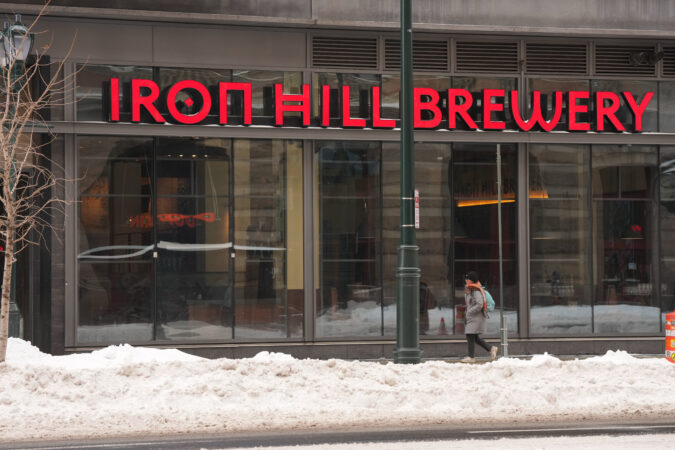
Four months after the chain closed nearly 20 locations and filed for bankruptcy, a federal judge has approved the acquisition of Iron Hill’s trademark and intellectual property in conjunction with the transfer of five restaurant leases, including one in Philadelphia, according to court documents filed over the weekend.
The shuttered brewpubs in Center City, Huntingdon Valley, Hershey, Lancaster, and Wilmington are set to be taken over by new tenants, each of which is referred to as “IHB” in the documents. Earlier this month, these tenants registered as business corporations under “IHB” and the name of each location, according to state records in Pennsylvania and Delaware.
Judge Jerrold N. Poslusny Jr. also approved a written agreement that allowed for “Rightlane LLC” to assume Iron Hill Brewery’s trademark and intellectual property, according to the same filing in U.S. Bankruptcy Court in New Jersey.
A view from the outside looking in on a closed Iron Hill Brewery.
On Monday, Crivello confirmed that the assets of his five remaining Iron Hills, along with the brand’s trademark and intellectual property, had been acquired by a buyer called Right Lane.
There are several companies that go by the name Rightlane or Right Lane. Attempts to reach representatives of the Right Lane that was involved in the Iron Hill deal were unsuccessful.
Iron Hill Brewery, which was founded in Newark, Del., developed a loyal following over its nearly 30 years in business. Fellow business owners and brewers considered it a pioneer in the local craft beer scene and a restaurant that helped put suburban downtowns like West Chester and Media on the map. Customers said they loved its family-friendly atmosphere.
Since then, massive shells of former breweries have sat vacant throughout the region. As the case made its way through bankruptcy court, landlords were delayed in their searches for new tenants.
Many locations still remain empty, with no word on what might fill the spaces. But in some spots, there are signs of life.
The company that owns P.J. Whelihan’s may be moving into the former Iron Hill in Newtown, Bucks County.
Last month, PJW Opco LLC, which is registered at the headquarters of PJW Restaurant Group, was approved to take over a lease for an 8,000-square-foot closed Iron Hill in the Village at Newtown shopping center.
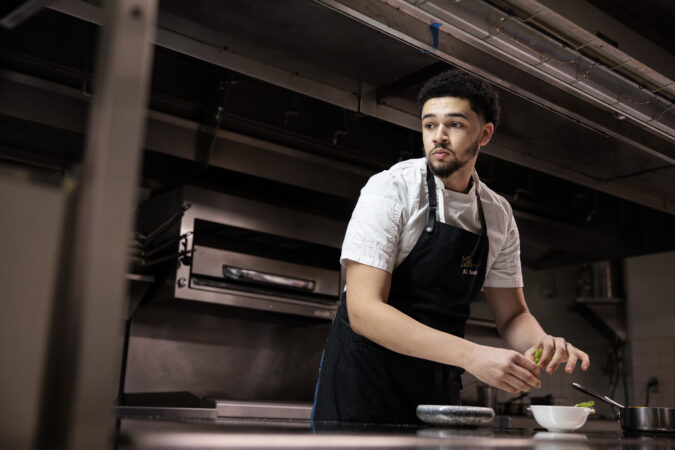
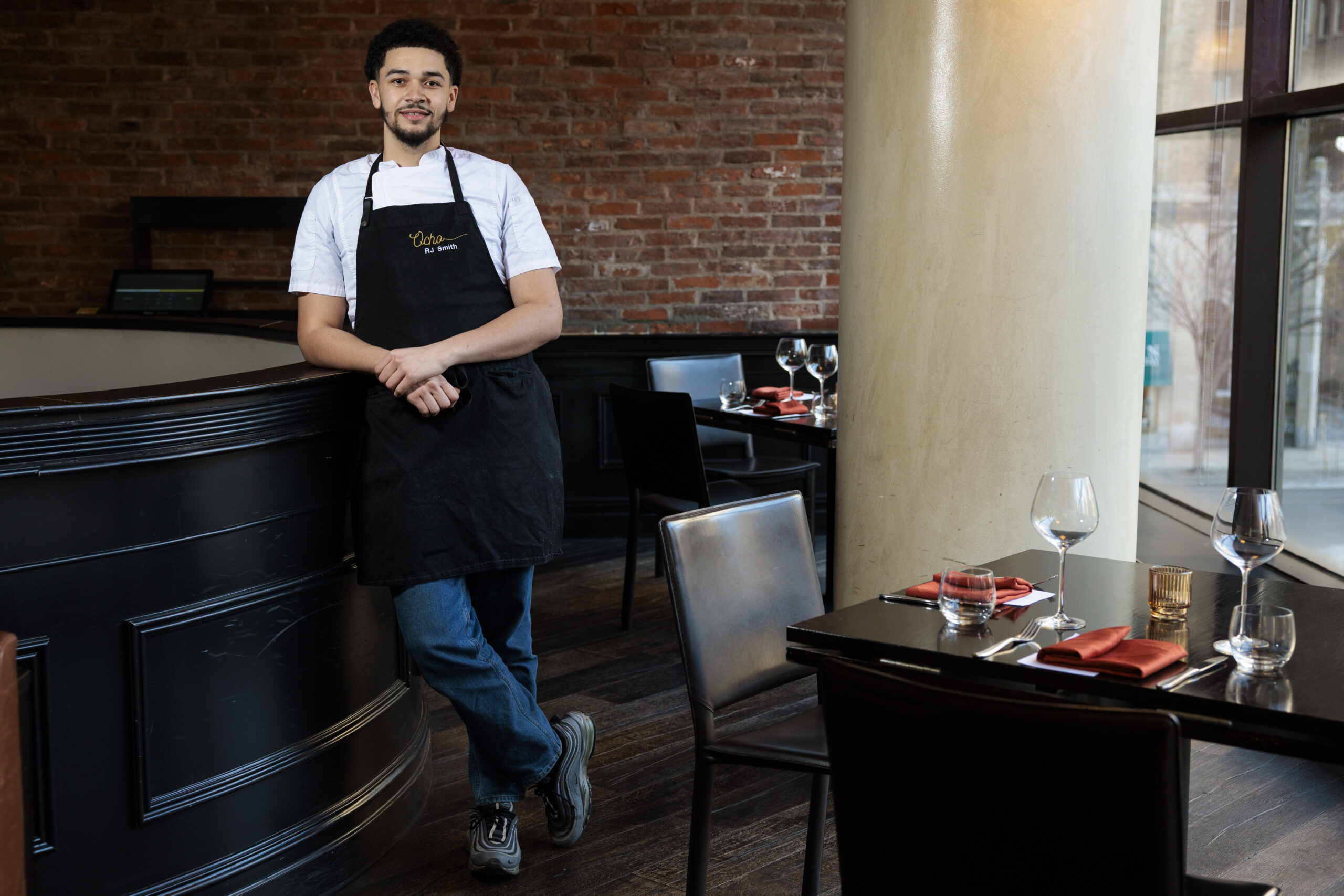
Less than two years ago, RJ Smith was cooking elaborate tasting menus for four people in his Drexel University dorm room. Now, the 21-year-old chef is about to step onto a far bigger stage: a 120-seat restaurant overlooking Rittenhouse Square.
Smith’s Ocho Supper Club will begin a six-month residency at the Rittenhouse Hotel on Feb. 1, taking over the Scarpetta space ahead of construction on the Ruxton, a steakhouse from Atlas Restaurant Group due to open in 2027. Ocho’s run is expected to continue through July 26 — a month after Smith graduates from Drexel’s culinary program.
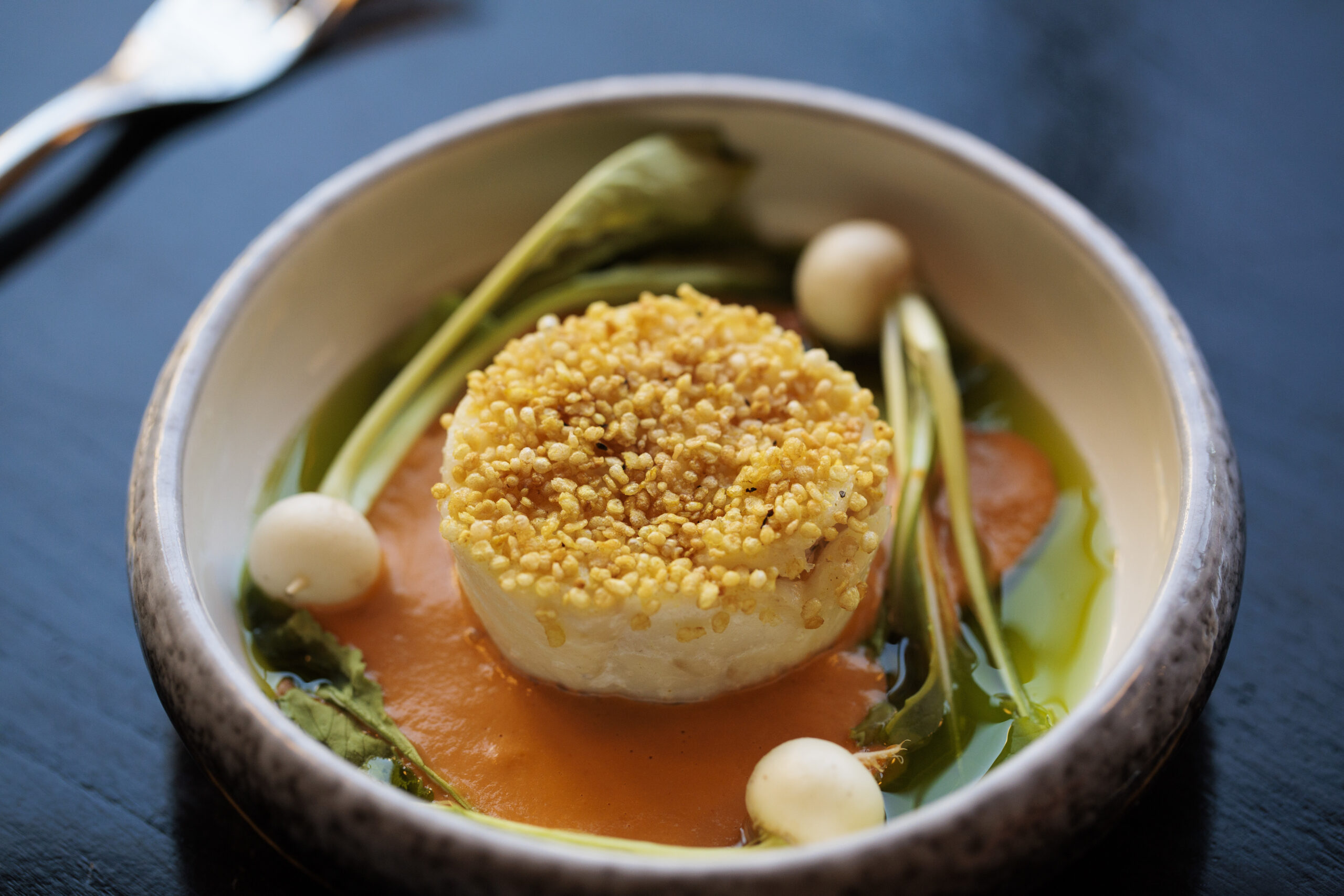
Atlantic cod on the Ocho Supper Club tasting menu at the Rittenhouse Hotel.
Ocho blends Afro-Caribbean flavors and fine-dining techniques. Since its premiere in April 2024, it has become one of Philadelphia’s most-subscribedunderground dining experiences, solidly booking venues including Forin Cafe, Fitler Club, Yanaga Kappo Izakaya, and Bolo.
Lanky and soft-spoken, Smith tours the dining room during each seating, explaining the menu, pouring sauces, and telling his story.
At the Rittenhouse, Ocho will offer a $130 eight-course tasting menu upstairs and a walk-in bar downstairs with à la carte options. James Beard Award-winning drinks author Danny Childs is developing a cocktail program centered on fermentation-driven and tradition-based Caribbean drinks. (The hotel’s Lacroix Restaurant is unaffected by the residency.)
The residency marks another “pinch me” moment for Smith, a Bay Area native who has cooked in Michelin-starred kitchens including Californios in San Francisco, Core by Clare Smyth in London, and Philadelphia’s own Provenance, as well as Jean-Georges at the Four Seasons and Royal Izakaya. Last fall, NBC’s Today show profiled Smith in a segment and brought on one of his idols, chef Daniel Boulud, who offered him a day in the kitchen of his New York City flagship, Daniel.
Smith launched Ocho as a sophomore, offering a six-course tasting menu for $35. “For the longest time, we were losing money every service,” he said. “But I saw it as a long-term investment.”
(He’s not the first Philadelphia chef to get their start via elaborate dorm-room dinners: Chef Amanda Shulman regularly hosted five-course dinners in her West Philly apartment while studying at the University of Pennsylvania; the meals eventually paved the way for the now-Michelin-starred Her Place Supper Club.)
As word spread, Smith moved Ocho off campus, upgrading to a $65 experience served at a six-seat table he had bought for $200 on Facebook Marketplace. By last summer, Ocho had segued into pop-ups, backed by a small core group of friends and restaurant professionals, including an assistant chef, Sokona Diallo, and pastry chef Marly Gates.
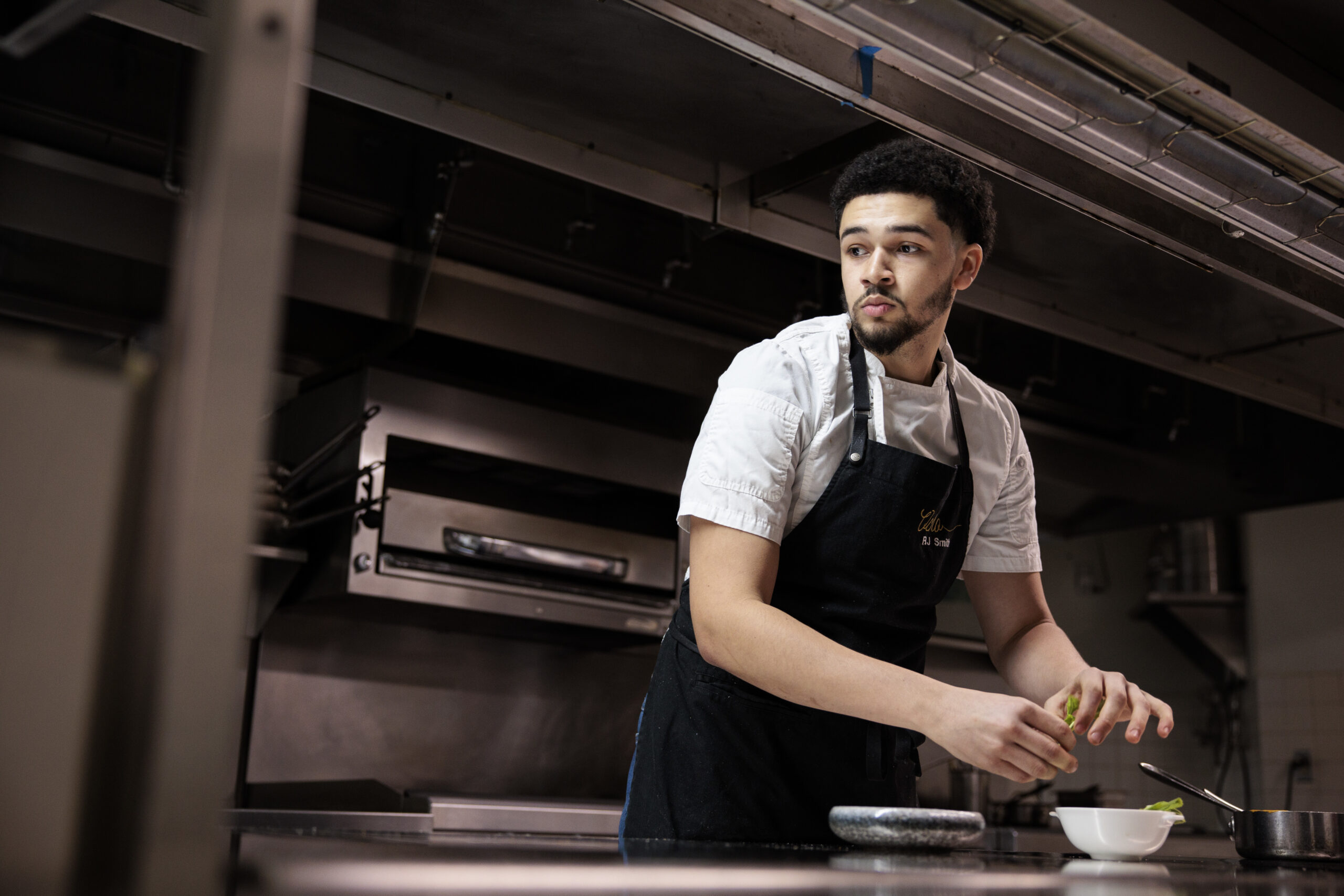
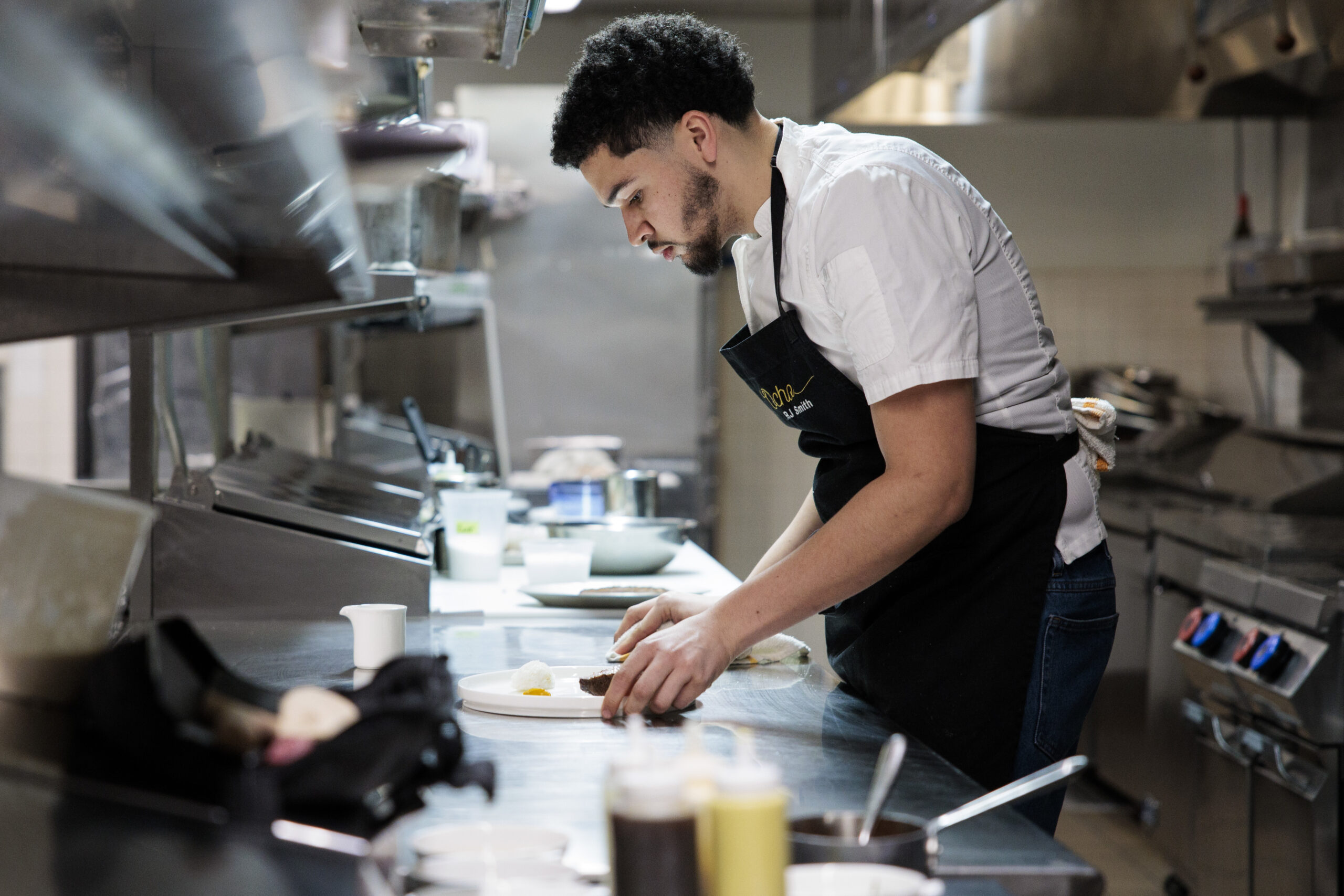
Chef RJ Smith working in the kitchen at the Rittenhouse Hotel to prepare for a photo shoot.
“We’ve been consistently trying to operate as close to a true restaurant as we can without having a brick-and-mortar space,” Smith said.
Ocho caught the attention of Gregg Skowronski, managing director of the Rittenhouse Hotel, who attended one of Smith’s dinners — after being shut out by sell-outs three times.
“When I finally went, I was blown away by his charisma, his talent, and the food,” Skowronski said. “But what really impressed me was watching him run the kitchen — seeing what he was able to produce with such limited equipment honestly blew my mind.”
After that dinner, Skowronski called Smith to float the idea of bringing Ocho to the hotel to fill the gap between Scarpetta and the Ruxton.
“What he’s doing is truly unique in the city,” Skowronski said. “I felt it could elevate our culinary program and open the Rittenhouse up to a more modern Philadelphian audience.”
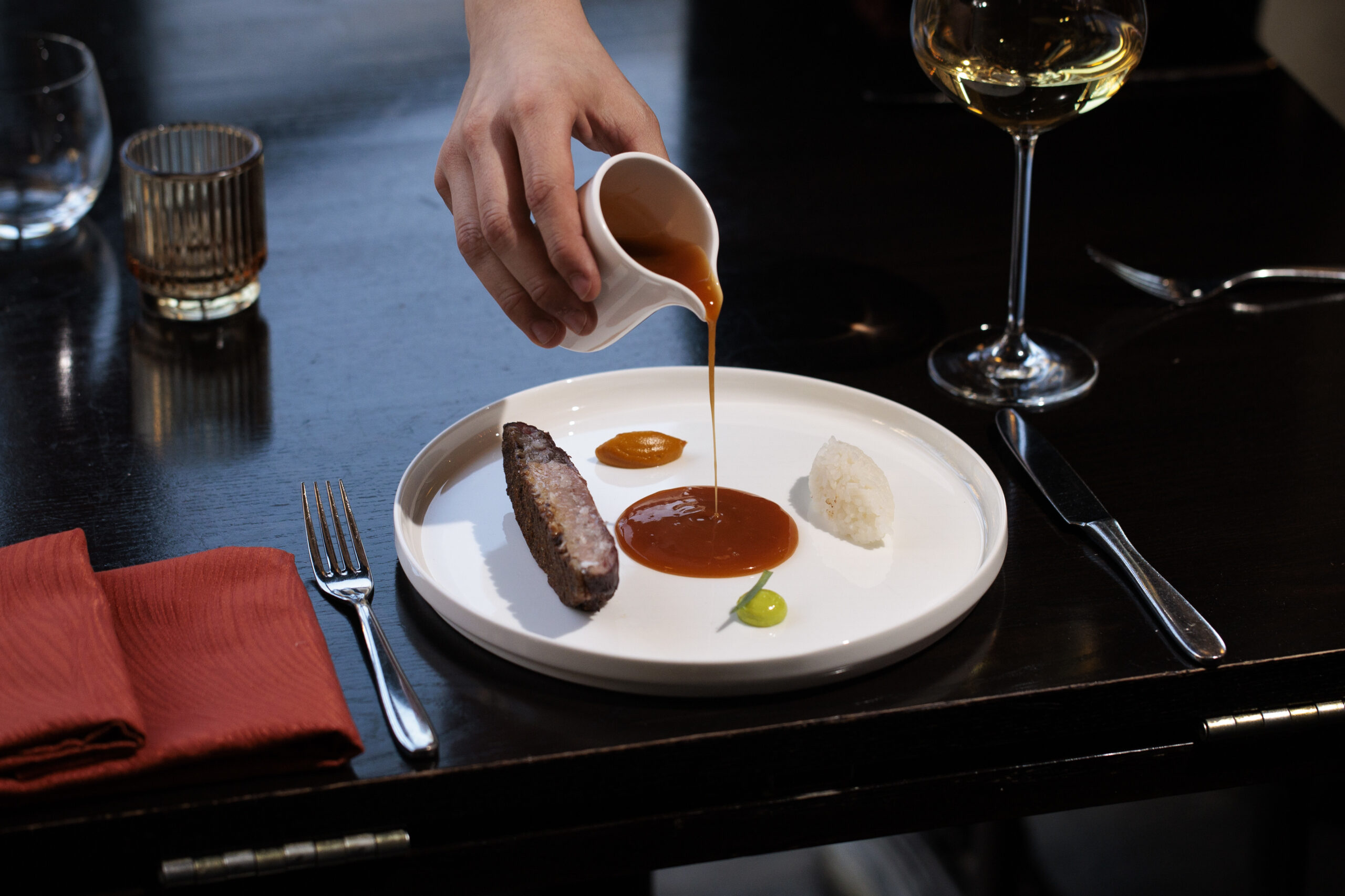
Chef RJ Smith pours a sauce on the jerked duck at the Rittenhouse Hotel.
Smith said he was stunned by the call. “The fact that he believed in me and my team enough to invite us into that space and say, ‘Do what you do and make it work,’ meant a lot,” he said.
His team includes Alex Ifill, a Four Seasons alumna who handles the front of house. (She said she slid into Smith’s DMs several months ago to offer to oversee service.) The hotel is also supporting Smith with staffing, Skowronski said.
The opening menu starts with an amuse-bouche or two, then segues from kanpachi to mole negro, Atlantic cod, and jerked duck, and finishes with a black cocoa tart and petits fours. Smith describes the experience as a journey through flavor, richness, and spice, shaped by his team’s African and Caribbean backgrounds and relationships with regional farmers and fishermen.
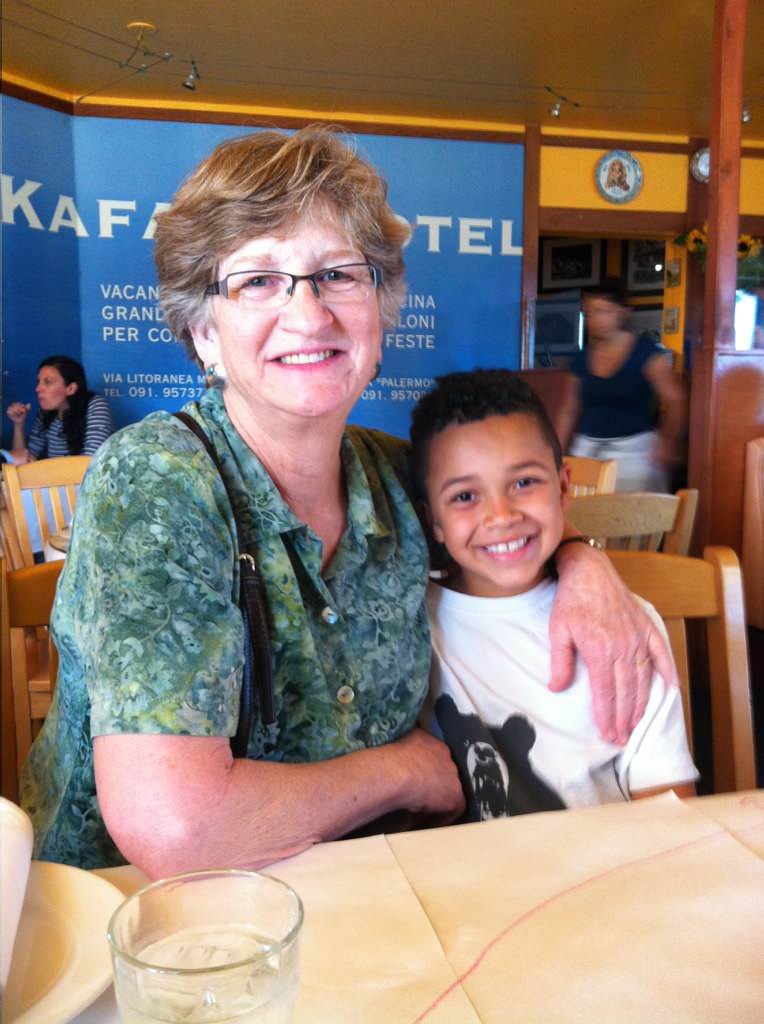
Chef RJ Smith as a boy with his grandmother, Rusty Keilch.
Smith credits the Oakland home of his maternal grandmother, Rusty Keilch, as the place where he first connected to cooking and hospitality.
“Whenever we went there, everything revolved around food,” Smith said. “That’s where I really understood the importance of a home base — of sitting down to a home-cooked meal and feeling the care that comes through it.”
But a trip to Jamaica at age 16 inspired both Ocho’s name and its approach. That’s where he got in touch with his father’s Afro-Caribbean heritage as well as the diverse food scene of Ocho Rios.
Smith chose Drexel so he could learn the business side of hospitality.
“I was 17, working at a two-Michelin-star restaurant, and everyone told me I was crazy for wanting to go to culinary school,” he said. “But I always felt there was something more than just being behind the line.”
Ocho remains entirely self-funded, with every dollar reinvested into the operation. “We’re not printing money,” Smith said. “But we’re floating, and that’s gotten us here.”
After the residency, Smith plans to open a permanent Philadelphia restaurant within 12 to 18 months; he is scouting locations near Rittenhouse Square. For now, besides the residency, his focus is on finishing school.
“I graduate in June,” he said. “My family is coming to Philly for the first time, and I’m excited for them to finally experience what we do.”
Chef RJ Smith in the dining room of what will be the Ocho Supper Club residency at the Rittenhouse Hotel.