Category: Health

  • A Chesco man’s heart stopped. His wife’s fast response — and a steady 911 dispatcher — saved him.

    A Chesco man’s heart stopped. His wife’s fast response — and a steady 911 dispatcher — saved him.

    Bob Borzillo has a deal with his wife Terri: She puts everything in the dishwasher, but he has to unload it.

    That’s what he was doing on a night in November, after the couple had arrived back home in Willistown from Barcelona. He was putting the very last thing — a wine glass — away. That’s where the 65-year-old’s memory stops.

    But for Terri Borzillo, also 65, that’s where a terrifying ordeal began.

    She had been just a few feet away, writing in her journal as her husband unloaded the dishwasher in the background. She heard him groan and glass shatter. She got up to help him, expecting to find him picking up glass shards. Instead she found him on the floor, unresponsive.

    What they did not know then was that a piece of plaque had broken off, completely blocking his artery. He was in cardiac arrest — not breathing, no pulse. After having walked around Barcelona, averaging 18,000 steps a day, he had no symptoms, no warning signs, until he collapsed in their kitchen.

    More than 350,000 people annually experience cardiac arrest outside hospitals, and only one in 10 survives, said Jeffrey Salvatore, the vice president of community impact for the American Heart Association of Greater Philadelphia.

    The association has been leading a campaign to teach more teens and adults hands-only CPR to increase bystander response rates. Nationally, 40% of those who experience cardiac arrest each year are helped by a bystander. The rate in the Philadelphia region is significantly lower: less than 26%.

    The association also holds telecommunicator CPR training, so dispatchers can instruct people over the phone on how to provide CPR, said Salvatore.

    “Cardiac arrest is 100% fatal without any intervention. If nobody does anything for the person, there’s no chance of survival,” he said. “By just calling 911 and just doing compressions, you can still double someone’s chance of survival.”

    Terri Borzillo immediately went into action, calling 911.

    “I think my husband’s having a heart attack,” she remembers screaming to the dispatcher.

    Calmly, the Chester County dispatcher, Kayla Wettlaufer, had Borzillo describe her husband’s condition.

    “She said, ‘OK, lady, get control of yourself. We’re going to do this together,’” Borzillo recalls. “By the command in her voice, and because there was no option, I had to do this.”

    Wettlaufer led Borzillo through CPR over the phone — telling her where to place her hands, when to compress. Wettlaufer even told her when it was time to unlock the front door so the nearby first responders could get in.

    “It was horrible to watch my husband in that condition, and it was horrible to know that I had the balance of his life in my hands,” Borzillo said.

    With Wetlaufer guiding her — and, she swears, every doctor in heaven — she did compressions until the EMTs arrived, using paddles to restart his heart.

    As the EMTs wheeled Bob Borzillo out, Terri Borzillo retrieved the bottles of holy water they had picked up at Our Lady Lourdes in Barcelona. She sprayed her husband and the EMTs.

    It got her an odd look, but, she said, “For somebody who has deep faith, I know all the angels and saints were there with us, and we’re smiling today instead of crying,” she said.
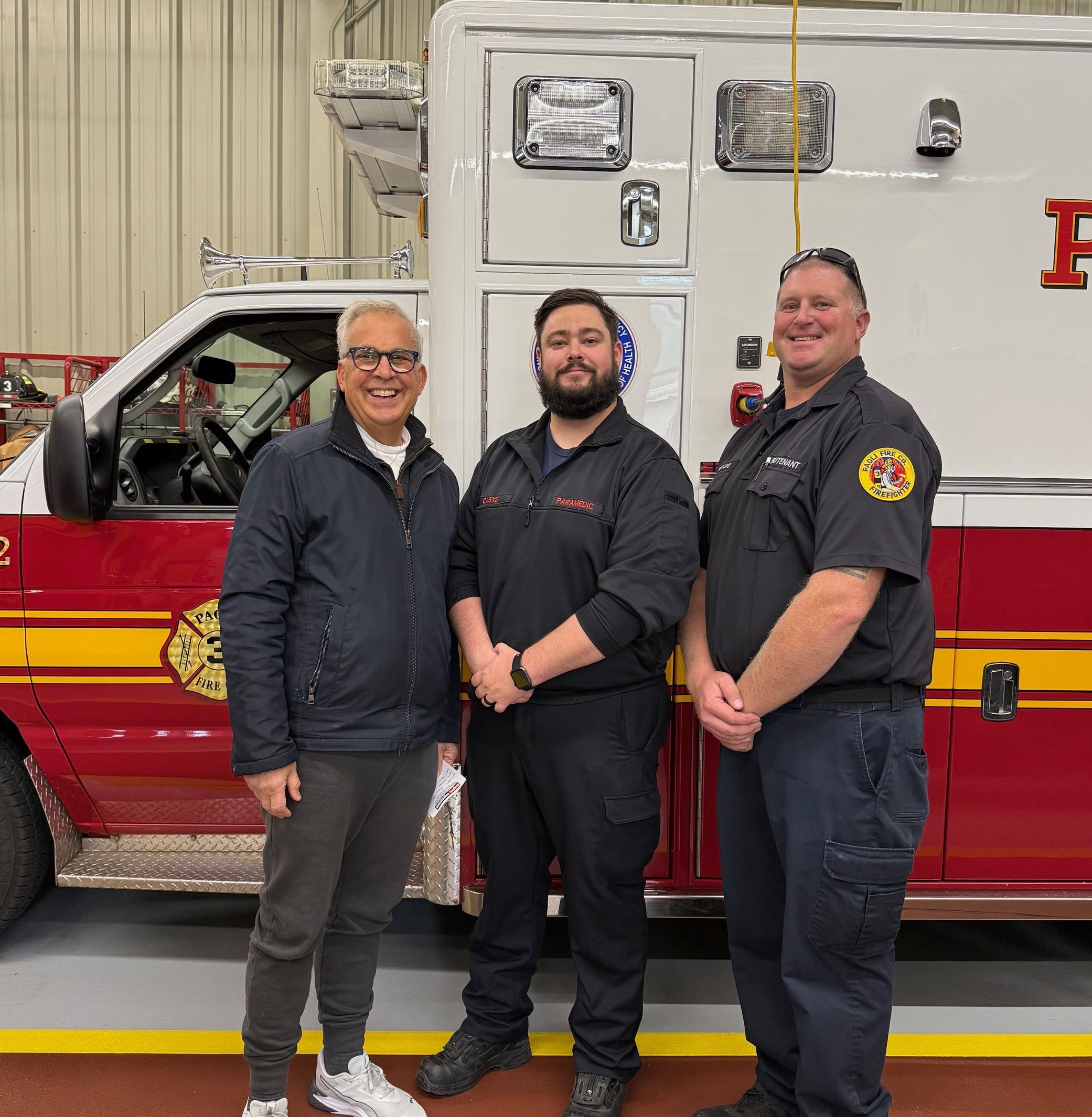
    Bob Borzillo, left, takes a photo with two first responders who arrived to his home in November when he was in cardiac arrest.

    Terri Borzillo’s faith runs back to their first date, more than 40 years ago. It was 1982, she was single, and her coworker asked her if she’d like to meet a nice guy. What do I have to lose? she thought. Acting as an intermediary, that colleague — a friend of Bob Borzillo’s family — told Bob about Terri. The young man’s father happened to know Terri’s father. He told his son, “Call that girl.” Bob listened.

    On their blind date, Terri Borzillo knew he was the one. There was something to how he talked, explaining — of all things — turbine generators.

    He really was a nice guy, she thought. (“I was a nerd,” he said.) She felt something click. Dear God, she thought, let him ask me out again.

    One big Italian wedding, three sons, and seven grandchildren later, the two have lived in Chester County for more than 40 years.

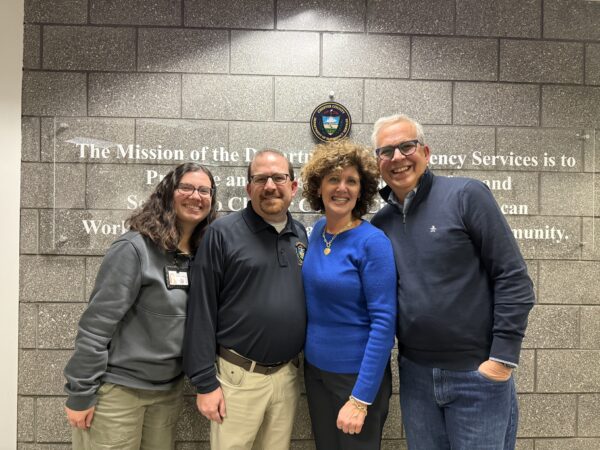
    This experience has made him proud to be a county resident, Bob Borzillo said. After he was released from the hospital a few days later, Borzillo went to the firehouse and met the first responders. He and his wife met Wettlaufer, and toured her workplace.

    Wettlaufer, an operator who has been with the county for almost five years and was honored by the county this month, was the start of a well-oiled machine, Borzillo said. Their proximity to the firehouse and Paoli Hospital helped get him professional care quickly.

    “If the Eagles offense executed that efficiently, we would have been in the Super Bowl,” he said.

    Terri Borzillo said meeting Wetlaufer helped ease the trauma of the situation.

    “She’s beautiful. And what they do there is amazing, and they get all of the credit,” she said.

    Saturday marks three months since Bob Borzillo’s cardiac arrest. He and his wife are in Florida while he recovers, and will celebrate Valentine’s Day with friends from Chester County.

    “Certainly the heart and what Valentine represents has a special meaning this year, and I am blessed to be here to celebrate it,” he said in an email.

    This suburban content is produced with support from the Leslie Miller and Richard Worley Foundation and The Lenfest Institute for Journalism. Editorial content is created independently of the project donors. Gifts to support The Inquirer’s high-impact journalism can be made at inquirer.com/donate. A list of Lenfest Institute donors can be found at lenfestinstitute.org/supporters.

  • Only 1 in 10 people survive cardiac arrest. Here’s how to help if you’re a bystander.

    Only 1 in 10 people survive cardiac arrest. Here’s how to help if you’re a bystander.

    When Bob Borzillo collapsed a few months ago, he could have become a statistic: More than 350,000 people go into cardiac arrest each year, with a 90% fatality rate. But his wife’s quick response — and a calm 911 dispatcher — saved his life.

    Bystanders could do this too, advocates say.

    But in the Philadelphia region, only 26% of people suffering cardiac arrest receive bystander intervention, said Jeffrey Salvatore, the vice president of community impact for the American Heart Association of Greater Philadelphia. That’s much lower than the national average of 40%.

    Though often used interchangeably, a heart attack and a cardiac arrest are not the same, and they warrant (slightly) different responses.

    A heart attack is a “plumbing issue,” where there’s some blockage in the arteries that supply blood to the heart, Salvatore said.

    But a cardiac arrest is an “electrical problem;” the heart pumps through an electrical system, and when something misfires or stops, that’s when a cardiac arrest occurs. It necessitates CPR.

    “When the heart stops doing its job, we have to take over, and that’s when CPR comes into play,” he said.

    That’s what happened to Borzillo.

    Someone in cardiac arrest is unresponsive, and requires immediate intervention to prevent death.

    You can check for unresponsiveness by tapping someone on the shoulder, rubbing their chest, or yelling loudly. If they don’t respond, call 911, and begin hands-only CPR, pressing hard and fast in the center of the chest.

    In many cases, 911 operators have been trained to walk callers through delivering CPR.

    A heart attack can lead to cardiac arrest, but it can also happen separately, and never result in the heart stopping, Salvatore said.

    If someone is exhibiting signs of a heart attack — chest discomfort; or discomfort in other areas of the upper body, such as arms, back, neck, jaw and stomach; shortness of breath; cold sweats; light-headedness; rapid or irregular heartbeat — call 911, Salvatore said.

    The American Heart Association is seeking to expand training in hands-only CPR for adults and teens, to increase low bystander-intervention rates.

    Just doing chest compressions — no mouth-to-mouth contact required — and calling 911 can double someone’s chance of survival, Salvatore said.

    “They are the first responder before EMS gets to the scene,” he said.

    For more information, or to get CPR certified, you can go to cpr.heart.org

  • Jefferson Health reported a $201 million operating loss in the first half of fiscal 2026

    Jefferson Health reported a $201 million operating loss in the first half of fiscal 2026

    Jefferson Health had an operating loss of $201 million in the six months that ended Dec. 31, compared to a $55 million loss the year before, the nonprofit health system said in a notice to bondholders Friday.

    The $201 million loss included a $64.7 million restructuring charge related to severance for 600 to 700 people laid off in October and other changes designed to improve efficiency in the 32-hospital system that stretches from South Jersey to Scranton.

    Excluding the restructuring expenses, Jefferson’s operating loss was $136.3 million in the first half of fiscal 2026.

    Jefferson said in a statement that it continues facing significant financial headwinds, like health systems nationwide, citing rising pharmaceutical costs.

    “We remain focused on driving efficiency, advocating for reimbursement rates that better reflect the true cost of care in Pennsylvania, and advancing the long-term stability of our academic health system,” the health system’s chief financial officer Michael Harrington said.

    Here are some details:

    Revenue: Patient revenue reached nearly $6 billion in the first half of fiscal 2026. The figure for the previous year is not comparable because it does not include Lehigh Valley Health Network for the full six months. Jefferson acquired the system on Aug. 1, 2024.

    Jefferson’s total revenue of $8.6 billion included $145.9 million of investment income that directly boosted operating income. Competitors who use heath-system reporting rules do not include investment income in revenue. Jefferson, by contrast, follows rules for higher-education reporting.

    Insurance business: Jefferson noted improvement in its health insurance arm. Jefferson Health Plans’ loss in the six months ended Dec. 31 was $90.7 million, compared to a $118.5 million loss in the same period the year before. The number of people insured in the plans climbed to 371,005 from 359,662. Medicaid recipients account for most of that enrollment.

    Notable: Both Moody’s Ratings and Standard & Poor’s Ratings Service in December and January revised their outlooks on Jefferson to negative, which means the agencies could downgrade the organization’s credit rating if Jefferson’s finances don’t improve over the next two years.

    “The negative outlook reflects the magnitude of current operating losses as well as anticipated difficulties in returning to or near operating profitability for several years,” Standard & Poor’s said.

  • Tower Health reported a $16 million operating loss in the first six months of fiscal 2026

    Tower Health had an operating loss of $16 million in the first six month of fiscal 2026, according to its report to bondholders Friday. In the same period a year ago, the Berks County nonprofit’s loss was $16.1 million.

    Here are some details:

    Revenue: Revenue from patient care rose less than 1% to $889.3 million, while total revenue climbed 4.3% to $1.03 billion, thanks to a 34% increase in other revenue.

    Cash reserves: Tower reported $244 million in cash reserves on Dec. 31. That translates into enough money to keep operating for 44 days without any new revenue. Both of those figures were at their highest levels since 2022.

    The quarterly low was in March 2024, when Tower reported $153 million in cash. That amounted to 30 days of cash on hand. Financially strong systems often have 200 days in reserve.

    Notable: In November, Tower announced that it was laying of 350 people, or about 3% of its workforce. Pottstown Hospital took the brunt of the cuts, though Tower also closed the bariatric surgery program at Reading Hospital in West Reading.

  • Pennie cost hikes hit low-income families and older adults the hardest

    Pennie cost hikes hit low-income families and older adults the hardest

    Low-income Pennsylvania families and adults in their late 50s and early 60s have been dropping out of Affordable Care Act health plans at the greatest rates after a key financial incentive expired at the end of last year, causing insurance costs to double on average across the state.

    Some 98,000 people who bought health plans last year from Pennsylvania’s Obamacare marketplace, Pennie, have opted out of coverage for 2026, as of Wednesday. That means one in five previously enrolled Pennsylvania residents have dropped their coverage.

    The number is expected to continue growing, as people begin getting premium bills they cannot afford, Pennie administrators said. They have already seen a significant increase since the end of open enrollment on Jan. 31, at which time 85,000 people had not renewed coverage.

    The agency has estimated that up to 150,000 people may ultimately drop coverage if Congress did not renew a tax credit program that ensures no one pays more than 8.5% of their income on an ACA health plan. The tax credits, which were adopted in 2021 during the COVID-19 pandemic, had been renewed annually until now.

    “If the tax credits had stayed in place, we probably would have seen another record enrollment, further reducing the uninsured rate,” said Devon Trolley, Pennie’s executive director.

    The tax credits were a defining issue in last year’s longest-ever federal government shutdown. In that budget stalemate, Democrats wanted to permanently expand the enhanced subsidies, and Republicans refused.

    New Jersey has not yet released the final results for its ACA open enrollment period, which also ended Jan. 31.

    window.addEventListener(“message”,function(a){if(void 0!==a.data[“datawrapper-height”]){var e=document.querySelectorAll(“iframe”);for(var t in a.data[“datawrapper-height”])for(var r,i=0;r=e[i];i++)if(r.contentWindow===a.source){var d=a.data[“datawrapper-height”][t]+”px”;r.style.height=d}}});

    2026 Pennie enrollment

    The first look at the impact of the higher insurance costs comes from Pennie data at the end of open enrollment. As of Feb. 1, a total of 486,000 people had signed up for coverage in 2026, down from 496,661 the same time last year.

    Some 79,500 newcomers to the marketplace partially offset the people who dropped coverage.

    In the Philadelphia region, more than 27,000 people who were enrolled in Pennie last year dropped coverage for 2026. Philadelphia and Montgomery Counties saw the biggest impact, with enrollment dropping 18% in each.

    Pennie leaders said people dropping plans are not enrolling in another type of insurance.

    That’s notable because those who joined Pennie for 2026 were coming from another form of insurance, such as an employer-based health plan. The people leaving Pennie were expected to become uninsured, Trolley said.

    Now that open enrollment is over, most people who find their plan is too expensive and drop it will not have an opportunity to select new coverage until the fall.

    window.addEventListener(“message”,function(a){if(void 0!==a.data[“datawrapper-height”]){var e=document.querySelectorAll(“iframe”);for(var t in a.data[“datawrapper-height”])for(var r,i=0;r=e[i];i++)if(r.contentWindow===a.source){var d=a.data[“datawrapper-height”][t]+”px”;r.style.height=d}}});

    Lower-income families were the most likely to drop coverage

    Pennie administrators said they heard from many lower-income families and individuals that the cost increases for 2026 were too much of a strain for already tight budgets.

    Breaking down the terminations by income, the greatest drop was seen among people with incomes 150-200% of the federal poverty rate. That’s an annual income of between $23,475 and $31,300 for an individual. For a family of four, the equivalent income range would be $48,225 to $64,300.

    A total of 13,562 Pennsylvanians in this income bracket declined to renew their Pennie plans for 2026 as of Feb. 1, according to the most recent available data from Pennie.

    “The math just isn’t working for people in those households,” said Trolley.

    People in this income bracket still qualified for some financial assistance. The ACA includes tax credits for anyone with income below 400% of the poverty rate, and these tax credits did not expire.

    Higher earners who would now have to pay in full, without the help of tax credits, account for another large segment dropping coverage.

    This included 11,837 people who earn more than 400% of the federal poverty rate. In the past years, the enhanced tax credit helped families in higher income brackets afford marketplace insurance.

    window.addEventListener(“message”,function(a){if(void 0!==a.data[“datawrapper-height”]){var e=document.querySelectorAll(“iframe”);for(var t in a.data[“datawrapper-height”])for(var r,i=0;r=e[i];i++)if(r.contentWindow===a.source){var d=a.data[“datawrapper-height”][t]+”px”;r.style.height=d}}});

    Dropouts high among young adults and those near retirement age

    Just under 20,000 adults between the ages 55 and 64 canceled their Pennie plans for 2026, accounting for nearly one-quarter of dropouts as of Feb. 1.

    About two-thirds of individuals in this age group earn enough that they would have had to pay the full price of their health plan, without any tax credits. They already pay more than younger adults for the same plan, under rules that allow insurers to charge more to cover older adults, who are likely to have more medical expenses.

    “That group is where we were seeing the most significant price jumps — a couple hundred dollars to a couple thousand dollars,” Trolley said.

    Another 15,356 adults between the ages 26 and 34 — many new to buying health insurance on their own — also dropped out. The ACA allows young adults to be covered under a parent’s health plan until age 26.

    Graphics editor John Duchneskie contributed to this article.

  • Family Practice & Counseling Services Network won a $3.4 million federal heath center grant

    Family Practice & Counseling Services Network won a $3.4 million federal heath center grant

    Family Practice & Counseling Services Network won a $3.4 million federal health center grant that will allow the nonprofit to continue providing medical and mental healthcare in Southwest Philadelphia and other low-income Philadelphia neighborhoods, officials confirmed this week.

    The clinic had been part of Resources for Human Development, a Philadelphia human services agency that a fast-growing Reading nonprofit called Inperium Inc. acquired in late 2024. As a federally qualified health clinic since 1992, the clinic had received an annual federal grant, higher Medicaid rates, and other benefits.

    Federal rules prohibited the clinic from continuing to retain that status and those benefits under a parent company. That meant Family Practice & Counseling Network had two options: close or spin out into a new entity that would reapply to be a federally qualified clinic.

    With financial and operational help from the University of Pennsylvania Health System, Family Practice & Counseling formed a new legal entity last July and reapplied for the grant. Last week, the organization’s CEO Emily Nichols learned that the federal agency that oversees federal health centers awarded it the grant.

  • Health department warns residents in Grays Ferry to avoid smoky air from a trash fire

    Health department warns residents in Grays Ferry to avoid smoky air from a trash fire

    The Philadelphia Health Department on Thursday evening issued a warning for residents in the city’s Grays Ferry section near a trash fire to “avoid unnecessary exposure to smoke.”

    The department said it had dispatched inspectors to collect air samples. “At this time, no specific hazardous substances have been identified, and the Department is taking this action out of an abundance of caution,” the department said.

    The air, however, “may be potentially hazardous for sensitive groups, including children, elderly people, people who are pregnant, and those with respiratory diseases or heart conditions,” the department said.

    The fire was reported around 5:30 p.m. on Grays Ferry Avenue near South 34th Street at the Philadelphia Transfer Station, which is operated by Waste Management. The company could not be reached for comment.

    The fire appeared to be contained to a large open building and no injuries were reported. An aerial image from NBC10 showed firefighters spraying a stream of water on a smoldering mound of trash.

    The health department asked residents to avoid going outdoors “as much as possible.” If they do go outside, avoid excessive physical activity and wear a mask, if available.

    Residents should close all window and doors to minimize air pollution into their homes, the department said.

    “The Health Department and the Office of Emergency Management will continue to monitor the air quality and provide updates as they become available,” the department said.

  • RFK Jr. promised to restore trust in U.S. health agencies. One year later, it’s eroding

    RFK Jr. promised to restore trust in U.S. health agencies. One year later, it’s eroding

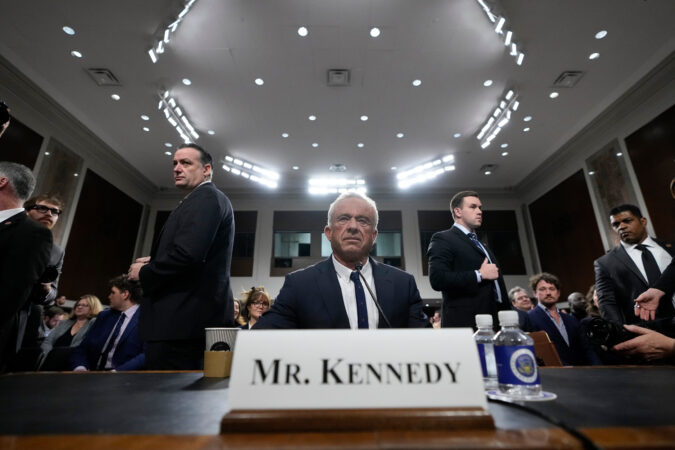
    NEW YORK — Since Robert F. Kennedy Jr. was sworn in to lead the U.S. Department of Health and Human Services one year ago, he has defended his upending of federal health policy by saying the changes will restore trust in America’s public health agencies.

    But as the longtime leader of the anti-vaccine movement scales back immunization guidance and dismisses scientists and advisers, he’s clashed with top medical groups who say he’s not following the science.

    The confrontation is deepening confusion among the public that had already surged during the COVID-19 pandemic. Surveys show trust in the agencies Kennedy leads is falling, rather than rising, as the country’s health landscape undergoes dramatic change.

    Kennedy says he’s aiming to boost transparency to empower Americans to make their own health choices. Doctors counter that the false and unverified information he’s promoting is causing major, perhaps irreversible, damage — and that if enough people forgo vaccination, it will cause a surge of illness and death.

    There was a time when people trusted health agencies regardless of party and the government reported “the best of what science knows at this point,” said Kathleen Hall Jamieson, director of the Annenberg Public Policy Center at the University of Pennsylvania.

    “Now, you cannot confidently go to federal websites and know that,” she said.

    HHS spokesman Andrew Nixon argued that trust had suffered during the Biden administration. “Kennedy’s mandate is to restore transparency, scientific rigor, and accountability,” he said.

    Trust slid during the COVID pandemic

    Historically, federal scientific and public health agencies enjoyed strong ratings in public opinion polls. The U.S. Centers for Disease Control and Prevention for decades scored above many other government agencies in Gallup surveys that asked whether they were doing a “good” or “excellent” job.

    Two decades ago, more than 60% of Americans gave the CDC high marks, according to Gallup. But that number fell dramatically at the beginning of the COVID-19 pandemic, amid agency mistakes and guidance that some people didn’t like.

    In 2020, the percentage of Americans who believed the CDC was doing at least a “good” job fell to 40% and then leveled off for the next few years.

    Alix Ellis, a hairstylist and mom in Madison, Georgia, used to fully trust the CDC and other health agencies but lost that confidence during the COVID-19 pandemic. She said some of the guidance didn’t make sense. At her salon, for example, stylists could work directly on someone’s hair, but others in the room had to be several feet away.

    “I’m not saying that we were lied to, but that is when I was like, OK, ‘Why are we doing this?’” the 35-year-old said.

    Kennedy helped create the trust problem, doctor says

    Part of Kennedy’s pitch as health secretary has been restoring Americans’ trust in public health.

    “We’re going to tell them what we know, we’re going to tell them what we don’t know, and we’re going to tell them what we’re researching and how we’re doing it,” Kennedy told senators last September, while explaining how he intended to make the CDC’s information reliable. “It’s the only way to restore trust in the agency — by making it trustworthy.”

    Before entering politics, Kennedy was one of the loudest voices spreading false information about immunizations. Now, he’s trying to fix a trust problem he helped create, said Dr. Rob Davidson, a Michigan emergency physician.

    “You fed those people false information to create the distrust, and now you’re sweeping into power and you’re going to cure the distrust by promoting the same disinformation,” said Davidson, who runs a doctor group called the Committee to Protect Health Care. “It’s upside-down.”

    Kennedy has wielded the power of his office to take multiple steps that diverge from medical consensus.

    Last May, he announced COVID-19 vaccines were no longer recommended for healthy children and pregnant women, a move doctors called concerning and confusing.

    In November, he directed the CDC to abandon its position that vaccines do not cause autism, without supplying new evidence. And earlier this year, the CDC under his leadership reduced the number of vaccines recommended for every child, a decision medical groups said would undermine protections against a half-dozen diseases.

    Kennedy also has overhauled his department through canceled grants and mass layoffs. Last summer, Kennedy fired his new CDC chief after less than a month over disagreements about vaccine policy.

    Confusion emerges as trust erodes

    Some have applauded the moves. But surveys suggest many Americans have had the opposite reaction.

    “I have much less trust,” said Mark Rasmussen, a 67-year-old retiree walking into a mall in Danbury, Connecticut, one recent morning.

    Shocked by Kennedy’s dismantling of public health norms, professional medical groups have urged Americans not to follow new vaccine recommendations they say were adopted without public input or compelling evidence.

    The American Academy of Pediatrics, along with more than 200 public health and advocacy groups, urged Congress to investigate how and why Kennedy changed the vaccine schedule. The American Medical Association, working with the University of Minnesota’s Vaccine Integrity Project, this week announced a new evidence-based process for reviewing the safety of respiratory virus vaccines — something they say is needed since the government stopped doing that kind of systematic review.

    Many Democratic-led states also have rebuffed Kennedy’s policies, even creating their own alliances to counter his vaccine guidance.

    “We see burgeoning confusion about which sources to trust and about which sources are real. That makes decision-making on an individual level much harder,” said Dr. Megan Ranney, dean of the Yale School of Public Health.

    She said she worried the confusion was contributing to the recent rise in diseases like whooping cough and measles, which were once largely eliminated in the U.S.

    Surveys indicate growing public wavering over support for the measles-mumps-rubella vaccine. Although a large majority of people support giving it to children, the proportion declined significantly in just over nine months, according to Annenberg research. An August 2025 survey finds that 82% would be “very” or “somewhat” likely to recommend that an eligible child in their household get MMR vaccine, compared with 90% in November 2024.

    Surveys show trust is declining again

    New findings from the healthcare research nonprofit KFF in January show that 47% of Americans trust the CDC “a great deal” or “a fair amount” to provide reliable vaccine information, down about 10 percentage points since the beginning of Trump’s second term.

    Trust among Democrats dropped 9 percentage points since September, to 55%, the survey found. Trust among Republicans and independents hasn’t changed since September, but it has declined somewhat among both groups since the beginning of Trump’s term.

    Even among MAHA supporters, the poll shows, fewer than half say they trust agencies like the CDC and FDA “a lot” or “some” to make recommendations about childhood vaccine schedules.

    Gallup surveys also show a drop in Americans who believe the CDC is doing a “good job,” from 40% in 2024 to 31% last year.

    Those results came alongside a decline of trust across the government — not just agencies under Kennedy’s oversight. Yet concerns about Kennedy’s trustworthiness also have emerged in the past year. Documents recently obtained by The Associated Press and The Guardian, for example, undermine his statements that a 2019 trip to Samoa ahead of a measles outbreak had “nothing to do with vaccines.” The documents have prompted senators to assert that Kennedy lied to them over the visit.

    HHS officials say they are promoting independent decision-making by families while working to reduce preventable diseases. They say reducing routine vaccine recommendations was meant to ensure parents vaccinate children against the riskiest diseases.

    HHS did not make Kennedy available for an interview, despite repeated requests. But as he has pledged to restore trust, he’s also urged people to come to their own conclusions.

    “This idea that you should trust the experts,” Kennedy said recently on The Katie Miller Podcast, “a good mother doesn’t do that.”

  • Puerto Rico governor signs law to recognize fetus as human being as critics warn of consequences

    Puerto Rico governor signs law to recognize fetus as human being as critics warn of consequences

    SAN JUAN, Puerto Rico — Puerto Rico’s governor on Thursday signed a bill that amends a law to recognize a fetus as a human being, a move doctors and legal experts warn will have deep ramifications for the U.S. Caribbean territory.

    The amendment was approved without public hearings and amid concerns from opponents who warned it would unleash confusion and affect how doctors and pregnant or potentially pregnant women are treated.

    The new law will lead to “defensive health care,” warned Dr. Carlos Díaz Vélez, president of Puerto Rico’s College of Medical Surgeons.

    “This will bring complex clinical decisions into the realm of criminal law,” he said in a phone interview.

    He said that women with complicated pregnancies will likely be turned away by private doctors and will end up giving birth in the U.S. mainland or at Puerto Rico’s largest public hospital, noting that the island’s crumbling health system isn’t prepared.

    “This will bring disastrous consequences,” he said.

    Díaz noted that the amended law also allows a third person to intervene between a doctor and a pregnant woman, so privacy laws will be violated, adding that new protocols and regulations will have to be implemented.

    “The system is not prepared for this,” he said.

    Gov. Jenniffer González, a Republican and supporter of U.S. President Donald Trump, said in a brief statement that “the legislation aims to maintain consistency between civil and criminal provisions by recognizing the unborn child as a human being.”

    The amendment, in Senate Bill 923, was made to an article within Puerto Rico’s Penal Code that defines murder.

    The government noted that the amendment complements a law that among other things, classifies as first-degree murder when a pregnant woman is killed intentionally and knowingly, resulting in the death of the conceived child at any stage of gestation. The law was named after Keishla Rodríguez, who was pregnant when she was killed in April 2021. Her lover, former Puerto Rican boxer Félix Verdejo, received two life sentences after he was found guilty in the killing.

    Some cheered the amendment signed into law Thursday, while opponents warned that it opens the door to eventually criminalizing abortions in Puerto Rico, which remain legal.

    “A zygote was given legal personality,” said Rosa Seguí Cordero, an attorney and spokesperson for the National Campaign for Free, Safe and Accessible Abortion in Puerto Rico. “We women were stripped of our rights.”

    Seguí rattled off potential scenarios, including whether a zygote, or fertilized egg, would have the right to health insurance and whether a woman who loses a fetus would become a murder suspect.

    Díaz said doctors could even be considered murder suspects and condemned how public hearings were never held and the medical sector never consulted.

    “The problem is that no medical recommendations were followed here,” he said. “This is a serious blow … It puts us in a difficult situation.”

    Among those condemning the measure was Annette Martínez Orabona, executive director for the American Civil Liberties Union in Puerto Rico.

    She noted that no broad discussion of the bill was allowed, which she said is critical because the penal code carries the most severe penalties.

    “There is no doubt that the measure did not undergo adequate analysis before its approval and leaves an unacceptable space for ambiguity regarding civil rights,” she said.

    “The legislative leadership failed to fulfill its responsibility to the people, and so did the governor.”

  • Trump’s EPA revokes scientific finding that underpinned U.S. fight against climate change

    Trump’s EPA revokes scientific finding that underpinned U.S. fight against climate change

    WASHINGTON — The Trump administration on Thursday revoked a scientific finding that long has been the central basis for U.S. action to regulate greenhouse gas emissions and fight climate change, the most aggressive move by the Republican president to roll back climate regulations.

    The rule finalized by the Environmental Protection Agency rescinds a 2009 government declaration known as the endangerment finding that determined that carbon dioxide and other greenhouse gases threaten public health and welfare. The Obama-era finding is the legal underpinning of nearly all climate regulations under the Clean Air Act for motor vehicles, power plants and other pollution sources that are heating the planet.

    The repeal eliminates all greenhouse gas emissions standards for cars and trucks and could unleash a broader undoing of climate regulations on stationary sources such as power plants and oil and gas facilities, experts say. Legal challenges are near certain.

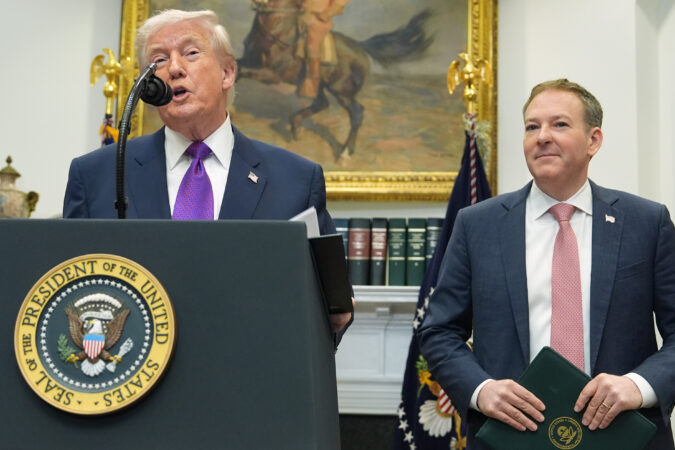
    President Donald Trump called the move “the single largest deregulatory action in American history, by far,” while EPA Administrator Lee Zeldin called the endangerment finding “the Holy Grail of federal regulatory overreach.”

    Trump called the endangerment finding “one of the greatest scams in history,” claiming falsely that it “had no basis in fact” or law. “On the contrary, over the generations, fossil fuels have saved millions of lives and lifted billions of people out of poverty all over the world,” Trump said at a White House ceremony, although scientists across the globe agree that carbon dioxide and other greenhouse gases are driving catastrophic heat waves and storms, droughts and sea level rise.

    Environmental groups described the move as the single biggest attack in U.S. history against federal authority to address climate change. Evidence backing up the endangerment finding has only grown stronger in the 17 years since it was approved, they said.

    “This action will only lead to more climate pollution, and that will lead to higher costs and real harms for American families,” said Fred Krupp, president of Environmental Defense Fund, adding that the consequences would be felt on Americans’ health, property values, water supply and more.

    The EPA also said it will propose a two-year delay to a Biden-era rule restricting greenhouse gas emissions by cars and light trucks. And the agency will end incentives for automakers who install automatic start-stop ignition systems in their vehicles. The device is intended to reduce emissions, but Zeldin said “everyone hates” it.

    Zeldin, a former Republican congressman who was tapped by Trump to lead EPA last year, has criticized his predecessors in Democratic administrations, saying that in the name of tackling climate change, they were “willing to bankrupt the country.”

    The endangerment finding “led to trillions of dollars in regulations that strangled entire sectors of the United States economy, including the American auto industry,” Zeldin said. “The Obama and Biden administrations used it to steamroll into existence a left-wing wish list of costly climate policies, electric vehicle mandates and other requirements that assaulted consumer choice and affordability.”

    The endangerment finding and the regulations based on it “didn’t just regulate emissions, it regulated and targeted the American dream. And now the endangerment finding is hereby eliminated,” Zeldin said.

    Supreme Court has upheld the endangerment finding

    The Supreme Court ruled in a 2007 case that planet-warming greenhouse gases, caused by the burning of oil and other fossil fuels, are air pollutants under the Clean Air Act.

    Since the high court’s decision, in a case known as Massachusetts v. EPA, courts have uniformly rejected legal challenges to the endangerment finding, including a 2023 decision by the U.S. Court of Appeals for the District of Columbia Circuit.

    The endangerment finding is widely considered the legal foundation that underpins a series of regulations intended to protect against threats made increasingly severe by climate change. That includes deadly floods, extreme heat waves, catastrophic wildfires and other natural disasters in the United States and around the world.

    Gina McCarthy, a former EPA administrator who served as White House climate adviser in the Biden administration, called the Trump administration’s actions reckless. “This EPA would rather spend its time in court working for the fossil fuel industry than protecting us from pollution and the escalating impacts of climate change,” she said.

    Former President Barack Obama said on X that repeal of the endangerment finding will make Americans “less safe, less healthy and less able to fight climate change — all so the fossil fuel industry can make even more money.”

    Dr. Lisa Patel, a pediatrician and executive director of the Medical Society Consortium on Climate and Health, said Trump’s action “prioritizes the profits of big oil and gas companies and polluters over clean air and water” and children’s health.

    “As a result of this repeal, I’m going to see more sick kids come into the Emergency Department having asthma attacks and more babies born prematurely,” she said in a statement. “My colleagues will see more heart attacks and cancer in their patients.”

    David Doniger, a climate expert at the Natural Resources Defense Council, said Trump and Zeldin are trying to use repeal of the finding as a “kill shot’’ that would allow the administration to make nearly all climate regulations invalid. The repeal could erase current limits on greenhouse gas pollution from cars, factories, power plants and other sources and could hinder future administrations from imposing rules to address global warming.

    The EPA action follows an executive order from Trump that directed the agency to submit a report on “the legality and continuing applicability” of the endangerment finding. Conservatives and some congressional Republicans have long sought to undo what they consider overly restrictive and economically damaging rules to limit greenhouse gases that cause global warming.

    Withdrawing the endangerment finding “is the most important step taken by the Trump administration so far to return to energy and economic sanity,” said Myron Ebell, a conservative activist who has questioned the science behind climate change.

    Tailpipe emission limits targeted

    Zeldin and Transportation Secretary Sean Duffy have moved to drastically scale back limits on tailpipe emissions from cars and trucks. Rules imposed under Democratic President Joe Biden were intended to encourage U.S. automakers to build and sell more electric vehicles. The transportation sector is the largest source of greenhouse gas emissions in the U.S.

    The Trump administration announced a proposal in December to weaken vehicle mileage rules for the auto industry, loosening regulatory pressure on automakers to control pollution from gasoline-powered cars and trucks. The EPA said its two-year delay to a Biden-era rule on greenhouse gas emissions by cars and light trucks will give the agency time to develop a plan that better reflects the reality of slower EV sales, while promoting consumer choice and lowering prices.

    Environmental groups said the plan would keep polluting, gas-burning cars and trucks on U.S. roads for years to come, threatening the health of millions of Americans, particularly children and the elderly.