A person infected with measles traveled through Philadelphia International Airport last week, city health officials are warning.
The infected person spent time in Terminal E of the airport between 1:35 and 4:30 p.m. Thursday.
Measles is highly contagious and spreads via airborne particles when an infected person coughs, sneezes, or talks. The virus can linger in the air for up to two hours after the infected person moves.
Palak Raval-Nelson, Philadelphia’s health commissioner, said he believed there was no threat to the general public, but encouraged those who are not protected against measles to take action.
Children under a year old, pregnant people without immunity, and those with a weakened immune system who were exposed and who develop symptoms through March 5 should call their doctor immediately. They’re also asked to call their local health department and Philadelphia’s Health Department if they live outside the city.
Symptoms of the disease are fever, runny nose, cough, and watery, red eyes — as well as a rash.
Those who have immunity do not need to do anything. Those with immunity include people born before 1957, those who have already had measles, and those who have received two doses of the measles, mumps, and rubella vaccine.
Measles, in some cases, can lead to pneumonia, brain infection, and death, health officials say.
Rebekah Stewart, a nurse at the U.S. Public Health Service, got a call last April that brought her to tears. She had been selected for deployment to the Trump administration’s new immigration detention operation at Guantánamo Bay, Cuba.
This posting combined Donald Trump’s longtime passion to use the offshore base to move “some bad dudes” out of the United States with a promise made shortly after his inauguration last year to hold thousands of noncitizens there. The naval base is known for the torture and inhumanetreatment of men suspected of terrorism in the wake of 9/11.
“Deployments are typically not something you can say no to,” Stewart said. She pleaded with the coordinating office, which found another nurse to go in her place.
Other public health officers who worked at Guantánamo in the past year described conditions there for the detainees, some of whom learned they were in Cuba from the nurses and doctors sent to care for them. They treated immigrants detained in a dark prison called Camp 6, where no sunlight filters in, said the officers, whom KFF Health News agreed not to name because they fear retaliation for speaking publicly. It previously held people with suspected ties to al-Qaeda. The officers said they were not briefed ahead of time on the details of their potential duties at the base.
Although the Public Health Service is not a branch of the U.S. armed forces, its uniformed officers — roughly 5,000 doctors, nurses, and other health workers — act like stethoscope-wearing soldiers in emergencies. The government deploys them during hurricanes, wildfires, mass shootings, and measles outbreaks. In the interim, they fill gaps at an alphabet soup of government agencies.
The Trump administration’s mass arrests to curb immigration have created a new type of health emergency as the number of people detained reaches record highs. About 71,000 immigrants are currently imprisoned, according to Immigration and Customs Enforcement data, which show that most have no criminal record.
Homeland Security Secretary Kristi Noem has said: “President Donald Trump has been very clear: Guantánamo Bay will hold the worst of the worst.” However, several news organizationshave reported that many of the men shipped to the base had no criminal convictions. As many as 90% of them were described as “low-risk” in a May progress report from ICE.
In fits and starts, the Trump administration has sent about 780 noncitizens to Guantánamo Bay, according to the New York Times. Numbers fluctuate as new detainees arrive and others are returned to the U.S. or deported.
While some Public Health Service officers have provided medical care to detained immigrants in the past, this is the first time in American history that Guantánamo has been used to house immigrants who had been living in the U.S. Officers said ICE postings are getting more common. After dodging Guantánamo, Stewart was instructed to report to an ICE detention center in Texas.
“Public health officers are being asked to facilitate a man-made humanitarian crisis,” she said.
Seeing no option to refuse deployments that she found objectionable, Stewart resigned after a decade of service. She would give up the prospect of a pension offered after 20 years.
“It was one of the hardest decisions I ever had to make,” she said. “It was my dream job.”
One of her PHS colleagues, nurse Dena Bushman, grappled with a similar moral dilemma when she got a notice to report to Guantánamo a few weeks after the shooting at the Centers for Disease Control and Prevention in August. Bushman, who was posted with the CDC, got a medical waiver delaying her deployment on account of stress and grief. She considered resigning, then did.
“This may sound extreme,” Bushman said. “But when I was making this decision, I couldn’t help but think about how the people who fed those imprisoned in concentration camps were still part of the Nazi regime.”
Others have resigned, but many officers remain. While they are alarmed by Trump’s tactics, detained people need care, multiple PHS officers told KFF Health News.
“I respect people and treat them like humans,” said a PHS nurse who worked in detention facilities last year. “I try to be a light in the darkness, the one person that makes someone smile in this horrible mess.”
The PHS officers conceded that their power to protect people was limited in a detention system fraught with overcrowding, disorganization, and the psychological trauma of uncertainty, family separations, and sleep deprivation.
“Ensuring the safety, security, and well-being of individuals in our custody is a top priority at ICE,” said Tricia McLaughlin, chief spokesperson for the Department of Homeland Security, in an emailed statement to KFF Health News.
Adm. Brian Christine, assistant secretary for health at the Department of Health and Human Services (HHS), which oversees the Public Health Service, said in an email: “Our duty is clear: say ‘Yes Sir!’, salute smartly, and execute the mission: show up, provide humane care, and protect health.” Christine is a recent appointee who, until recently, was a urologist specializing in testosterone and male fertility issues.
“In pursuit of subjective morality or public displays of virtue,” he added, “we risk abandoning the very individuals we pledged to serve.”
Into the unknown
In the months before Stewart resigned, she reflected on her previous deployments, during Trump’s first term, to immigration processing centers run by Customs and Border Protection. Fifty women were held in a single concrete cell in Texas, she recalled.
“The most impactful thing I could do was to convince the guards to allow the women, who had been in there for a week, to shower,” she said. “I witnessed suffering without having much ability to address it.”
Stewart spoke with Bushman and other PHS officers who were embedded at the CDC last year. They assisted with the agency’s response to ongoing measles outbreaks, with sexually transmitted infection research, and more. Their roles became crucial last year as the Trump administration laid off droves of CDC staffers.
Stewart, Bushman, and a few other PHS officers at the CDC said they met with middle managers to ask for details about the deployments: If they went to Guantánamo and ICE facilities, how much power would they have to provide what they considered medically necessary care? If they saw anything unethical, how could they report it? Would it be investigated? Would they be protected from reprisal?
Stewart and Bushman said they were given a PHS office phone number they could call if they had a complaint while on assignment. Otherwise, they said, their questions went unanswered. They resigned and so never went to Guantánamo.
PHS officers who were deployed to the base told KFF Health News they weren’t given details about their potential duties — or the standard operating procedure for medical care — before they arrived.
Stephen Xenakis, a retired Army general and a psychiatrist who has advised on medical care at Guantánamo for two decades, said that was troubling. Before health workers deploy, he said, they should understand what they’ll be expected to do.
The consequences of insufficient preparation can be severe. In 2014, the Navy threatened tocourt-martial one of its nurses at Guantánamo who refused to force-feed prisoners on hunger strike, who were protesting inhumane treatment and indefinite detention. The protocol was brutal: A person was shackled to a five-point restraint chair as nurses shoved a tube for liquid food into their stomach through their nostrils.
“He wasn’t given clear guidance in advance on how these procedures would be conducted at Guantánamo,” Xenakis said of the nurse. “Until he saw it, he didn’t understand how painful it was for detainees.”
The American Nurses Association and Physicians for Human Rights sided with the nurse, saying his objection was guided by professional ethics. After a year, the military dropped the charges.
A uniformed doctor or nurse’s power tends to depend on their rank, their supervisor, and chains of command, Xenakis said. He helped put an end to some inhumane practices at Guantánamo more than a decade ago, when he and other retired generals and admirals publicly objected to certain interrogation techniques, such as one called “walling,” in which interrogators slammed the heads of detainees suspected of terrorism against a wall, causing slight concussions. Xenakis argued that science didn’t support “walling” as an effective means of interrogation, and that it was unethical, amounting to torture.
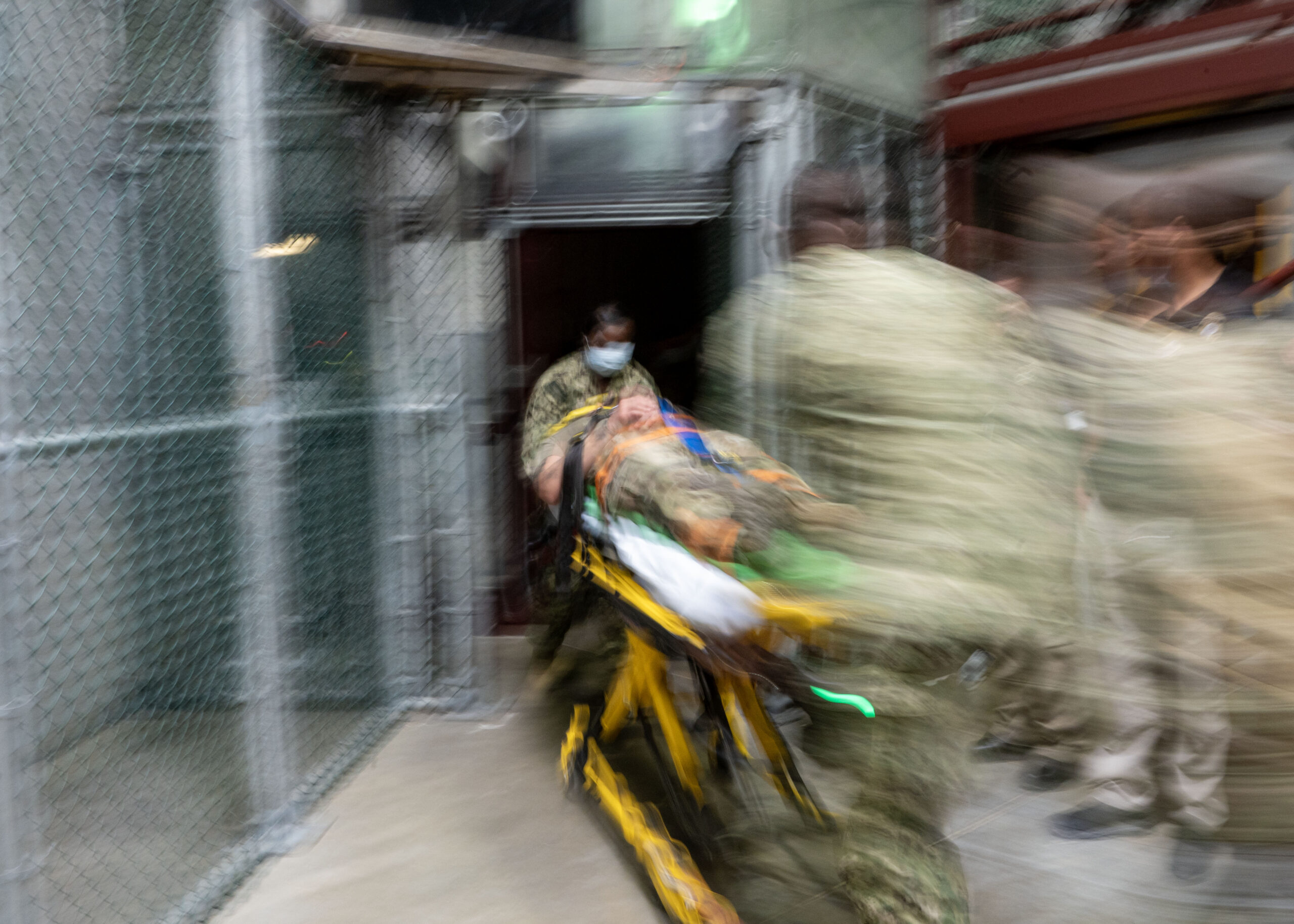
Medics practice evacuating a detained immigrant in a simulated exercise at Guantánamo in April 2025.
Torture hasn’t been reported from Guantánamo’s immigration operation, but ICE shift reports obtained through a Freedom of Information Act request by the government watchdog group American Oversight note concerns about detainees resorting to hunger strikes and self-harm.
“Welfare checks with potential hunger strike IA’s,” short for illegal aliens, says an April 30 note from a contractor working with ICE. “In case of a hunger strike or other emergencies,” the report adds, the PHS and ICE are “coordinating policies and procedures.”
“De-escalation of potential pod wide hunger strike/potential riot,” says an entry from July 8. “Speak with alien on suicide watch regarding well being.”
Inmates and investigations have reported delayed medical care at immigration detention facilities and dangerous conditions, including overcrowding and a lack of sanitation. Thirty-two people died in ICE custody in 2025, making it the deadliest year in two decades.
“They are arresting and detaining more people than their facilities can support,” one PHS officer told KFF Health News. The most prevalent problem the officer saw among imprisoned immigrants was psychological. They worried about never seeing their families again or being sent back to a country where they feared they’d be killed. “People are scared out of their minds,” the officer said.
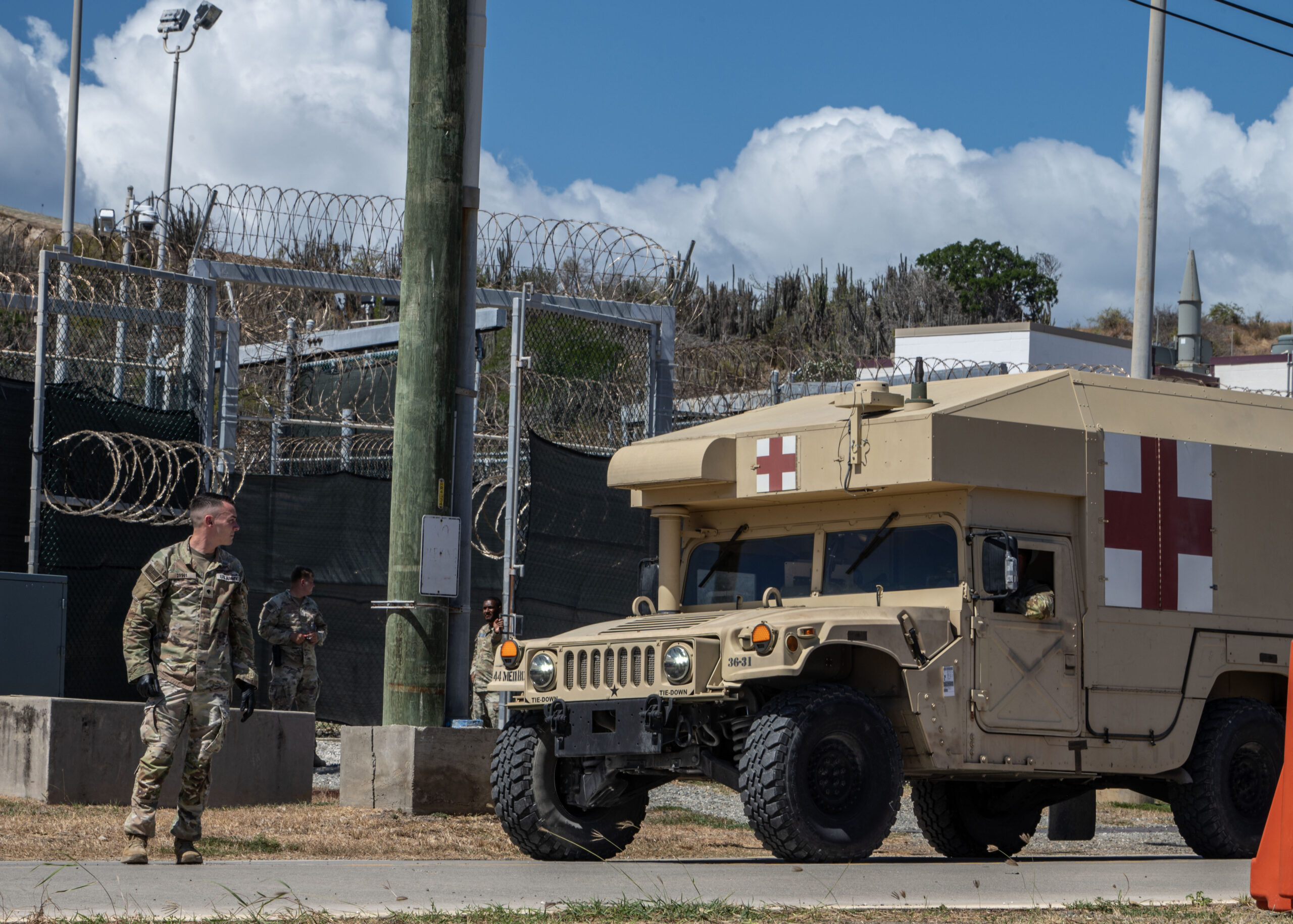
U.S. service members stand by during an April 2025 simulated medical evacuation of immigrants detained at Guantánamo.
No sunlight
The PHS officers who were at Guantánamo told KFF Health News that the men they saw were detained in either low-security barracks, with a handful of people per room, or in Camp 6, a dark, high-security facility without natural light. The ICE shift reports describe the two stations by their position on the island, Leeward for the barracks and Windward for Camp 6. About 50 Cuban men sent to Guantánamo in December and January have languished at Camp 6.
A Navy hospital on the base mainly serves the military and other residents who aren’t locked up — and in any case, its capabilities are limited, the officers said. To reduce the chance of expensive medical evacuations back to the U.S. to see specialists quickly, they said, the immigrants were screened before being shipped to Guantánamo. People over age 60 or who needed daily drugs to manage diabetes and high blood pressure, for example, were generally excluded. Still, the officers said, some detainees have had to be evacuated back to Florida.
PHS nurses and doctors said they screened immigrants again when they arrived and provided ongoing care, fielding complaints including about gastrointestinal distress and depression. One ICE monthly progress report says, “The USPHS psychologist started an exercise group” for detainees.
Doctors’ requests for lab work were often turned down because of logistical hurdles, partly due to the number of agencies working together on the base, the officers said. Even a routine test, a complete blood count, took weeks to process, vs. hours in the U.S.
DHS and the Department of Defense, which have coordinated on the Guantánamo immigration operation, did not respond to requests for comment about their work there.
One PHS officer who helped medically screen new detainees said they were often surprised to learn they were at Guantánamo.
“I’d tell them, ‘I’m sorry you are here,’” the officer said. “No one freaked out. It was like the ten-millionth time they had been transferred.” Some of the men had been detained in various facilities for five or six months and said they wanted to return to their home countries, according to the officer. Health workers had neither an answer nor a fix.
Unlike ICE detention facilities in the U.S., Guantánamo hasn’t been overcrowded. “I have never been so not busy at work,” one officer said. A military base on a tropical island, Guantánamo offers activities such as snorkeling, paddleboard yoga, and kickboxing to those who aren’t imprisoned. Even so, the officer said they would rather be home than on this assignment on the taxpayer’s dime.
Transporting staff and supplies to the island and maintaining them on-base is enormously expensive. The government paid an estimated $16,500 per day, per detainee at Guantánamo, to hold those accused of terrorism, according to a 2025 Washington Post analysis of Department of Defense data. (The average cost to detain immigrants in ICE facilities in the U.S. is $157 a day.)
Even so, the funding has skyrocketed: Congress granted ICE a record $78 billion for fiscal year 2026, a staggering increase from $9.9 billion in 2024 and $6.5 billion nearly a decade ago.
Last year, the Trump administration also diverted more than $2 billion from the national defense budget to immigration operations, according to a report from congressional Democrats. About $60 million of it went to Guantánamo.
“Detaining noncitizens at Guantánamo is far more costly and logistically burdensome than holding them in ICE detention facilities within the United States,” wrote Deborah Fleischaker, a former assistant director at ICE, in a declaration submitted as part of a lawsuit brought by the American Civil Liberties Union early last year. In December, a federal judge rejected the Trump administration’s request to dismiss a separate ACLU case questioning the legality of detaining immigrants outside the U.S.
Anne Schuchat, who served with the PHS for 30 years before retiring in 2018, said PHS deployments to detention centers may cost the nation in terms of security, too. “A key concern has always been to have enough of these officers available for public health emergencies,” she said.
Andrew Nixon, an HHS spokesperson, said the immigration deployments don’t affect the public health service’s potential response to other emergencies.
In the past, PHS officers have stood up medical shelters during hurricanes in Louisiana and Texas, rolled out COVID testing in the earliest months of the pandemic, and provided crisis support after the deadly shooting at Sandy Hook Elementary School and the Boston Marathon bombing.
“It’s important for the public to be aware of how many government resources are being used so that the current administration can carry out this one agenda,” said Stewart, one of the nurses who resigned. “This one thing that’s probably turning us into the types of countries we have fought wars against.”
KFF Health News is a national newsroom that produces in-depth journalism about health issues and is one of the core operating programs at KFF — the independent source for health policy research, polling, and journalism.
As a model of successful aging, you can’t beat 82-year-oldJuan López García.
Really, you can’t beat him.
Sixteen years ago, at age 66, López García first tried running a mile. He’d recently retired after spending his entire working life as a car mechanic in Toledo, Spain. In all those years, he’d never trained as an athlete or exercised much at all.
He couldn’t finish that first mile. He could barely start it.
Now, at age 82, López García is the world record holder in the 80-to-84 age group for the 50-kilometer (31-mile) ultramarathon. In 2024, he also won the world marathon championship for his age group, with a time of 3:39:10, setting a European record in the process.
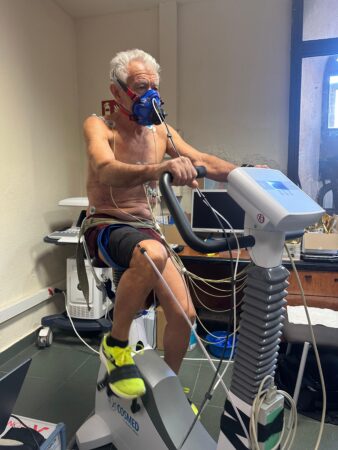
His outsize success caught the attention of a group of European scientists who study aging. They invited López García to their lab for extensive testing. Their findings, published in January in Frontiers in Physiology, are, at once, revealing and “inspiring,” said Julian Alcazar, an exercise scientist at the University of Castilla-La Mancha in Spain and a co-author of the study.
The researchers found that López García has the highest aerobic fitness recorded in an octogenarian, matching that of healthy 20-to-30-year-old men. His muscles also absorb and use oxygen unusually well. But in other ways, his biology, biomechanics, and training seem relatively ordinary.
Taken as a whole, López García’s physiology and performance in his 80s may help upend some common assumptions about what’s possible and normal as we age, the researchers concluded, including whether it’s ever too late for the rest of us to tackle that first mile.
What sets older athletes apart?
“There are still many questions about the trajectory of aging,” said Simone Porcelli, an exercise physiologist at the University of Pavia in Italy and senior author of the study.
To help answer them, he and colleagues in Italy and Spain recently began collaborating on a major research project about whether growing old necessarily involves steep, inevitable declines in muscle, speed, strength, and agency.
That interest led them, unsurprisingly, to older, elite athletes, whose trajectory of aging can seem almost otherworldly. Deep into their 70s, 80s, and even 90s, these men and women typically preserve or even add to their fitness and strength, and they rarely develop serious illnesses. Most appear younger than their birth years.
What sets them apart, the researchers wondered? Is it training, genetics, luck? How do their bodies differ from those of their peers, and what lessons can we take from their daily routines?
An unusual athlete
Enter López García, a man whose aging has been both ordinary and exceptional. Physically unprepossessing at about 5-foot-2 and 130 pounds, he once spent several weeks walking 500 miles of the Camino de Santiago pilgrimage route in France and Spain. But otherwise, exercise had always been, at best, an afterthought for him. Then, at 66, he tried running and slowly, stubbornly upped his mileage until, at 70, he began to compete, starting with the 800 meters, then longer distances and, eventually, ultras.
The older he got, the longer and faster he ran.
“That’s not,” Alcazar said, pausing for words, “ … usual.”
Intrigued, Alcazar and his Italian colleagues set up López García on a treadmill and a stationary bicycle at their lab and tested his endurance capacity, running economy, fuel usage, power, muscle oxygen uptake, and other measures of how his body responds to high-speed exercise. They also asked about his training and nutrition.
The greatest fitness ever measured
Some of the numbers proved eye-popping.
López García’s VO2 max, the standard gauge of aerobic fitness, was the highest the researchers had seen in someone in their 80s. A measure of how much oxygen the body takes in and delivers to muscles, VO2 max usually declines by about 10% each decade after middle age. But his almost certainly had been rising after he reached his mid-60s and began to train and is similar to someone a quarter his age.
His muscles also were better able than those of most older — or younger — people to absorb and use that oxygen, allowing López García to run for long periods at a fast, steady pace. He averaged a 9:14 mile during his record-setting ultramarathon. He also produced considerable power during each stride.
But he didn’t have an especially high lactate threshold or running economy, both of which contribute to endurance and speed. His were good, similar to those of competitive athletes in their 60s, but not spectacular, suggesting he still has room to improve as a runner.
How he eats and runs
Even López García was startled by his prowess. His only thought when he started to train, he said, “was to run a little to maintain my health, never to reach the level I have reached today.”
Now, he runs about 40 miles a week when he’s not readying for a competition and almost double that mileage in the buildup to a race. Most of his workouts are long and moderately taxing. But a few times a week, he does intervals of various lengths, sprinting at near or past race pace for a brief spurt, slowing and then sprinting again. (He has a professional coach guiding his workouts.)
He also weight-trains a few times a week, mostly at home, primarily with body weight exercises, and eats a “totally normal” Mediterranean-style diet, he said.
‘It’s never too late’
The big question with López García’s or any older athlete’s successful aging is whether the rest of us can replicate it. Or is he somehow unique, gifted with an ideal mix of genes and background unavailable to most people?
Alcazar suspects it’s both. López García was fortunate to have reached age 66 without serious illnesses or disabilities, Alcazar said, despite being sedentary, which might have been, in large part, because of his genetics, as well as lifestyle.
But Alcazar and his colleagues also believe López García’s successful aging is not just aspirational but achievable by most of us. “Not so long ago, it wasn’t really seen as possible or a positive for older people to do much exercise,” Alcazar said. López García shows otherwise. “It is not only possible. It should be recommended,” Alcazar said.
Begin slowly, if you are older and new to exercise, López García said, as he did. “Start by walking fast and then maybe start running, which is very beneficial,” he said.
“It’s never too late,” Porcelli said. He and the other scientists are continuing to study López García and other aging athletes, as well as more sedentary older people, to understand the molecular and functional differences between them. The researchers expect to publish more studies soon.
In the meantime, López García’s example is already a lodestar for the researchers. “I’m 35,” Alcazar said. “I’m thinking about how to age well. Having seen him, of course I exercise.”
For his part, López García has no plans to slow down. “When I think about the number 80,” he said, “I remember my grandparents. At this age, they were like little old people. Today, I do not feel old.”
Bob Borzillo has a deal with his wife Terri: She puts everything in the dishwasher, but he has to unload it.
That’s what he was doing on a night in November, after the couple had arrived back home in Willistown from Barcelona. He was putting the very last thing — a wine glass — away. That’s where the 65-year-old’s memory stops.
But for Terri Borzillo, also 65, that’s where a terrifying ordeal began.
She had been just a few feet away, writing in her journal as her husband unloaded the dishwasher in the background. She heard him groan and glass shatter. She got up to help him, expecting to find him picking up glass shards. Instead she found him on the floor, unresponsive.
What they did not know then was that a piece of plaque had broken off, completely blocking his artery. He was in cardiac arrest — not breathing, no pulse. After having walked around Barcelona, averaging 18,000 steps a day, he had no symptoms, no warning signs, until he collapsed in their kitchen.
More than 350,000 people annually experience cardiac arrestoutside hospitals, and only one in 10 survives, said Jeffrey Salvatore, the vice president of community impact for the American Heart Association of Greater Philadelphia.
The association has been leading a campaign to teach more teens and adults hands-only CPR to increase bystander response rates. Nationally, 40% of those who experience cardiac arrest each year are helped by a bystander. The rate in the Philadelphia region is significantly lower: less than 26%.
The association also holds telecommunicator CPR training, so dispatchers can instruct people over the phone on how to provide CPR, said Salvatore.
“Cardiac arrest is 100% fatal without any intervention. If nobody does anything for the person, there’s no chance of survival,” he said. “By just calling 911 and just doing compressions, you can still double someone’s chance of survival.”
Terri Borzillo immediately went into action, calling 911.
“I think my husband’s having a heart attack,” she remembers screaming to the dispatcher.
Calmly, the Chester County dispatcher, Kayla Wettlaufer, had Borzillo describe her husband’s condition.
“She said, ‘OK, lady, get control of yourself. We’re going to do this together,’” Borzillo recalls. “By the command in her voice, and because there was no option, I had to do this.”
Wettlaufer led Borzillo through CPR over the phone — telling her where to place her hands, when to compress. Wettlaufer even told her when it was time to unlock the front door so the nearby first responders could get in.
“It was horrible to watch my husband in that condition, and it was horrible to know that I had the balance of his life in my hands,” Borzillo said.
With Wetlaufer guiding her — and, she swears, every doctor in heaven — she did compressions until the EMTs arrived, using paddles to restart his heart.
As the EMTs wheeled Bob Borzillo out, Terri Borzillo retrieved the bottles of holy water they had picked up at Our Lady Lourdes in Barcelona. She sprayed her husband and the EMTs.
It got her an odd look, but, she said, “For somebody who has deep faith, I know all the angels and saints were there with us, and we’re smiling today instead of crying,” she said.
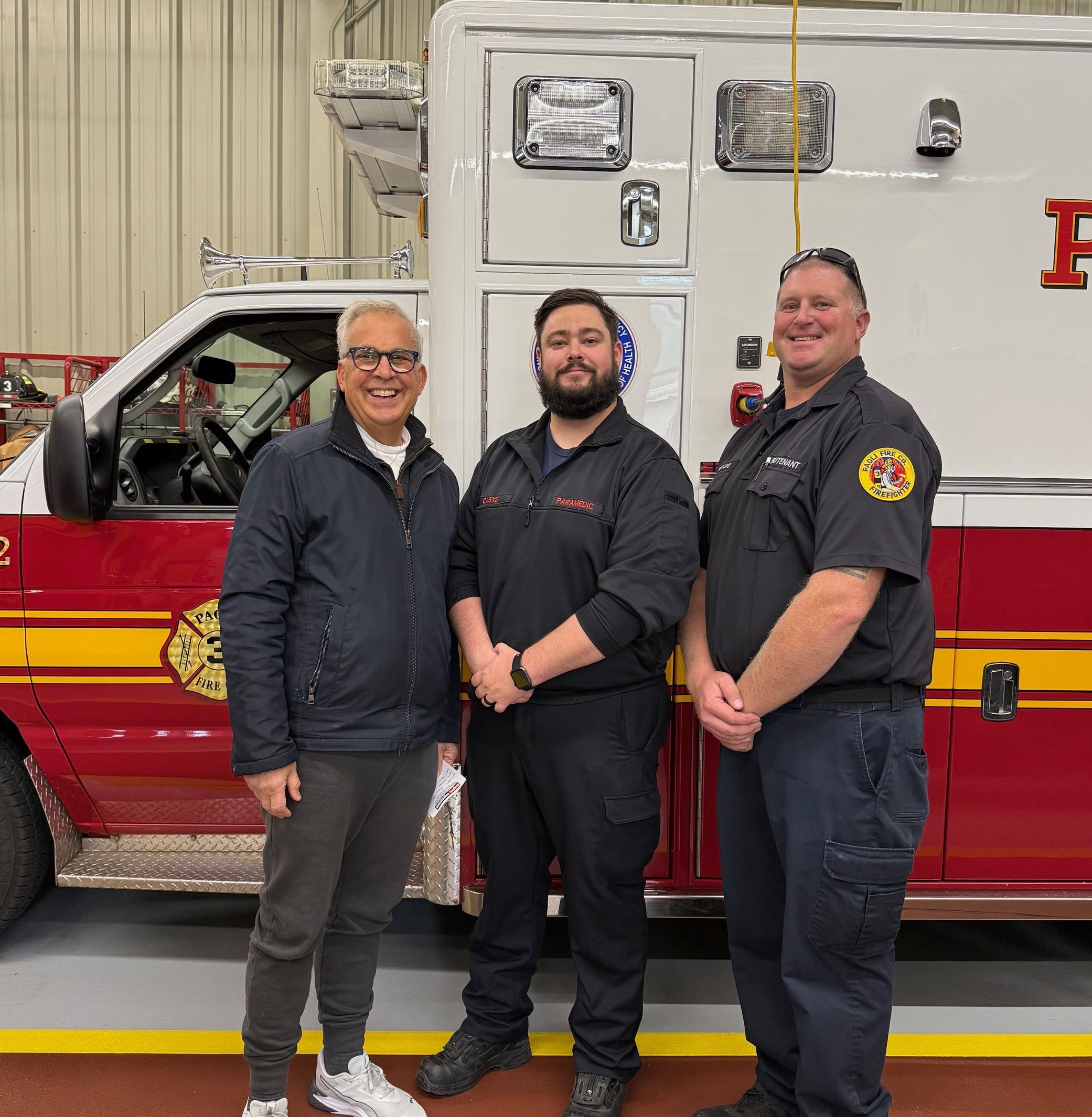
Bob Borzillo, left, takes a photo with two first responders who arrived to his home in November when he was in cardiac arrest.
Terri Borzillo’s faith runs back to their first date, more than 40 years ago. It was 1982, she was single, and her coworker asked her if she’d like to meet a nice guy. What do I have to lose? she thought. Acting as an intermediary, that colleague — a friend of Bob Borzillo’s family — told Bob about Terri. The young man’s father happened to know Terri’s father. He told his son, “Call that girl.” Bob listened.
On their blind date, Terri Borzilloknew he was the one. There was something to how he talked, explaining — of all things — turbine generators.
He really was a nice guy, she thought. (“I was a nerd,” he said.) She felt something click. Dear God, she thought, let him ask me out again.
One big Italian wedding, three sons, and seven grandchildren later, the two have lived in Chester County for more than 40 years.
This experience has made him proud to be a county resident, Bob Borzillo said. After he was released from the hospital a few days later, Borzillo went to the firehouse and met the first responders. He and his wife met Wettlaufer, and toured her workplace.
Wettlaufer, an operator who has been with the county for almost five years and was honored by the county this month, was the start of a well-oiled machine, Borzillo said. Their proximity to the firehouse and Paoli Hospital helped get him professional care quickly.
“If the Eagles offense executed that efficiently, we would have been in the Super Bowl,” he said.
Terri Borzillosaid meeting Wetlauferhelped ease the trauma of the situation.
“She’s beautiful. And what they do there is amazing, and they get all of the credit,” she said.
Saturday marks three months since Bob Borzillo’s cardiac arrest. He and his wife are in Florida while he recovers, and will celebrate Valentine’s Day with friends from Chester County.
“Certainly the heart and what Valentine represents has a special meaning this year, and I am blessed to be here to celebrate it,” he said in an email.
This suburban content is produced with support from the Leslie Miller and Richard Worley Foundation and The Lenfest Institute for Journalism. Editorial content is created independently of the project donors. Gifts to support The Inquirer’s high-impact journalism can be made at inquirer.com/donate. A list of Lenfest Institute donors can be found at lenfestinstitute.org/supporters.
But inthe Philadelphia region, only 26% of people suffering cardiac arrest receive bystander intervention, saidJeffrey Salvatore, the vice president of community impact for the American Heart Association of Greater Philadelphia. That’s much lower than the national average of40%.
Though often used interchangeably, a heart attack and a cardiac arrest are not the same, and they warrant (slightly) different responses.
A heart attack is a “plumbing issue,” where there’s some blockage in the arteries that supply blood to the heart, Salvatore said.
But a cardiac arrest is an “electrical problem;” the heart pumps through an electrical system, and when something misfires or stops, that’s when a cardiac arrest occurs. It necessitates CPR.
“When the heart stops doing its job, we have to take over, and that’s when CPR comes into play,” he said.
Someone in cardiac arrest is unresponsive, and requires immediate intervention to prevent death.
You can check for unresponsiveness by tapping someone on the shoulder, rubbing their chest, or yelling loudly. If they don’t respond, call 911, and begin hands-only CPR, pressing hard and fast in the center of the chest.
In many cases,911 operators have been trained to walk callers through delivering CPR.
A heart attack can lead to cardiac arrest, but it can also happen separately, and never result in the heart stopping, Salvatore said.
If someone is exhibiting signs of a heart attack — chest discomfort; or discomfort in other areas of the upper body, such as arms, back, neck, jaw and stomach; shortness of breath; cold sweats; light-headedness; rapid or irregular heartbeat — call 911, Salvatore said.
The American Heart Association is seeking to expand training in hands-only CPR for adults and teens, to increase low bystander-intervention rates.
Just doing chest compressions — no mouth-to-mouth contact required — and calling 911 can double someone’s chance of survival, Salvatore said.
“They are the first responder before EMS gets to the scene,” he said.
For more information, or to get CPR certified, you can go to cpr.heart.org
Jefferson Health had an operating loss of $201 million in the six months that ended Dec. 31, compared to a $55 million loss the year before, the nonprofit health system said in a notice to bondholders Friday.
The $201 million loss included a $64.7 million restructuring charge related to severance for 600 to 700 people laid off in October and other changes designed to improve efficiency in the 32-hospital system that stretches from South Jersey to Scranton.
Excluding the restructuring expenses, Jefferson’s operating loss was $136.3 million in the first half of fiscal 2026.
Jefferson said in a statement that it continues facing significant financial headwinds, like health systems nationwide, citing rising pharmaceutical costs.
“We remain focused on driving efficiency, advocating for reimbursement rates that better reflect the true cost of care in Pennsylvania, and advancing the long-term stability of our academic health system,” the health system’s chief financial officer Michael Harrington said.
Here are some details:
Revenue: Patient revenue reached nearly $6 billion in the first half of fiscal 2026. The figure for the previous year is not comparable because it does not include Lehigh Valley Health Network for the full six months. Jefferson acquired the system on Aug. 1, 2024.
Jefferson’s total revenue of $8.6 billion included $145.9 million of investment income that directly boosted operating income. Competitors who use heath-system reporting rules do not include investment income in revenue. Jefferson, by contrast, follows rules for higher-education reporting.
Insurance business: Jefferson noted improvement in its health insurance arm. Jefferson Health Plans’ loss in the six months ended Dec. 31 was $90.7 million, compared to a $118.5 million loss in the same period the year before. The number of people insured in the plans climbed to 371,005 from 359,662. Medicaid recipients account for most of that enrollment.
Notable: Both Moody’s Ratings and Standard & Poor’s Ratings Service in December and January revised their outlooks on Jefferson to negative, which means the agencies could downgrade the organization’s credit rating if Jefferson’s finances don’t improve over the next two years.
“The negative outlook reflects the magnitude of current operating losses as well as anticipated difficulties in returning to or near operating profitability for several years,” Standard & Poor’s said.
Tower Health had an operating loss of $16 million in the first six month of fiscal 2026, according to its report to bondholders Friday. In the same period a year ago, the Berks County nonprofit’s loss was $16.1 million.
Here are some details:
Revenue: Revenue from patient care rose less than 1% to $889.3 million, while total revenue climbed 4.3% to $1.03 billion, thanks to a 34% increase in other revenue.
Cash reserves: Tower reported $244 million in cash reserves on Dec. 31. That translates into enough money to keep operating for 44 days without any new revenue. Both of those figures were at their highest levels since 2022.
The quarterly low was in March 2024, when Tower reported $153 million in cash. That amounted to 30 days of cash on hand. Financially strong systems often have 200 days in reserve.
Low-income Pennsylvania families and adults in their late 50s and early 60s have been dropping out of Affordable Care Act health plans at the greatest rates after a key financial incentive expired at the end of last year, causing insurance costs to double on average across the state.
Some 98,000 people who bought health plans last year from Pennsylvania’s Obamacare marketplace, Pennie, have opted out of coverage for 2026, as of Wednesday. That means one in five previously enrolled Pennsylvania residents have dropped their coverage.
The number is expected to continue growing, as people begin getting premium bills they cannot afford, Pennie administrators said. They have already seen a significant increase since the end of open enrollment on Jan. 31, at which time 85,000 people had not renewed coverage.
The agency has estimated that up to 150,000 people may ultimately drop coverage if Congress did not renew a tax credit program that ensures no one pays more than 8.5% of their income on an ACA health plan. The tax credits, which were adopted in 2021 during the COVID-19 pandemic, had been renewed annually until now.
“If the tax credits had stayed in place, we probably would have seen another record enrollment, further reducing the uninsured rate,” said Devon Trolley, Pennie’s executive director.
The tax credits were a defining issue in last year’s longest-ever federal government shutdown. In that budget stalemate, Democrats wanted to permanently expand the enhanced subsidies, and Republicans refused.
New Jersey has not yet released the final results for its ACA open enrollment period, which also ended Jan. 31.
window.addEventListener(“message”,function(a){if(void 0!==a.data[“datawrapper-height”]){var e=document.querySelectorAll(“iframe”);for(var t in a.data[“datawrapper-height”])for(var r,i=0;r=e[i];i++)if(r.contentWindow===a.source){var d=a.data[“datawrapper-height”][t]+”px”;r.style.height=d}}});
2026 Pennie enrollment
The first look at the impact of the higher insurance costs comes from Pennie data at the end of open enrollment. As of Feb. 1, a total of 486,000 people had signed up for coverage in 2026, down from 496,661 the same time last year.
Some 79,500 newcomers to the marketplace partially offset the people who dropped coverage.
In the Philadelphia region, more than 27,000 people who were enrolled in Pennie last year dropped coverage for 2026. Philadelphia and Montgomery Counties saw the biggest impact, with enrollment dropping 18% in each.
Pennie leaders said people dropping plans are not enrolling in another type of insurance.
That’s notable because those who joined Pennie for 2026 were coming from another form of insurance, such as an employer-based health plan. The people leaving Pennie were expected to become uninsured, Trolley said.
Now that open enrollment is over, most people who find their plan is too expensive and drop it will not have an opportunity to select new coverage until the fall.
window.addEventListener(“message”,function(a){if(void 0!==a.data[“datawrapper-height”]){var e=document.querySelectorAll(“iframe”);for(var t in a.data[“datawrapper-height”])for(var r,i=0;r=e[i];i++)if(r.contentWindow===a.source){var d=a.data[“datawrapper-height”][t]+”px”;r.style.height=d}}});
Lower-income families were the most likely to drop coverage
Pennie administrators said they heard from many lower-income families and individuals that the cost increases for 2026 were too much of a strain for already tight budgets.
Breaking down the terminations by income, the greatest drop was seen among people with incomes 150-200% of the federal poverty rate. That’s an annual income of between $23,475 and $31,300 for an individual. For a family of four, the equivalent income range would be $48,225 to $64,300.
A total of 13,562 Pennsylvanians in this income bracket declined to renew their Pennie plans for 2026 as of Feb. 1, according to the most recent available data from Pennie.
“The math just isn’t working for people in those households,” said Trolley.
People in this income bracket still qualified for some financial assistance. The ACA includes tax credits for anyone with income below 400% of the poverty rate, and these tax credits did not expire.
Higher earners who would now have to pay in full, without the help of tax credits, account for another large segment dropping coverage.
This included 11,837 people who earn more than 400% of the federal poverty rate. In the past years, the enhanced tax credit helped families in higher income brackets afford marketplace insurance.
window.addEventListener(“message”,function(a){if(void 0!==a.data[“datawrapper-height”]){var e=document.querySelectorAll(“iframe”);for(var t in a.data[“datawrapper-height”])for(var r,i=0;r=e[i];i++)if(r.contentWindow===a.source){var d=a.data[“datawrapper-height”][t]+”px”;r.style.height=d}}});
Dropouts high among young adults and those near retirement age
Just under 20,000 adults between the ages 55 and 64 canceled their Pennie plans for 2026, accounting for nearly one-quarter of dropouts as of Feb. 1.
About two-thirds of individuals in this age group earn enough that they would have had to pay the full price of their health plan, without any tax credits. They already pay more than younger adults for the same plan, under rules that allow insurers to charge more to cover older adults, who are likely to have more medical expenses.
“That group is where we were seeing the most significant price jumps — a couple hundred dollars to a couple thousand dollars,” Trolley said.
Another 15,356 adults between the ages 26 and 34 — many new to buying health insurance on their own — also dropped out. The ACA allows young adults to be covered under a parent’s health plan until age 26.
Graphics editor John Duchneskie contributed to this article.
Family Practice & Counseling Services Network won a $3.4 million federal health center grant that will allow the nonprofit to continue providing medical and mental healthcare in Southwest Philadelphia and other low-income Philadelphia neighborhoods, officials confirmed this week.
The clinic had been part of Resources for Human Development, a Philadelphia human services agency that a fast-growing Reading nonprofit called Inperium Inc. acquired in late 2024. As a federally qualified health clinic since 1992, the clinic had received an annual federal grant, higher Medicaid rates, and other benefits.
Federal rules prohibited the clinic from continuing to retain that status and those benefits under a parent company. That meant Family Practice & Counseling Network had two options: close or spin out into a new entity that would reapply to be a federally qualified clinic.
With financial and operational help from the University of Pennsylvania Health System, Family Practice & Counseling formed a new legal entity last July and reapplied for the grant. Last week, the organization’s CEO Emily Nichols learned that the federal agency that oversees federal health centers awarded it the grant.
The Philadelphia Health Department on Thursday evening issued a warning for residents in the city’s Grays Ferry section near a trash fire to “avoid unnecessary exposure to smoke.”
The department said it had dispatched inspectors to collect air samples. “At this time, no specific hazardous substances have been identified, and the Department is taking this action out of an abundance of caution,” the department said.
The air, however, “may be potentially hazardous for sensitive groups, including children, elderly people, people who are pregnant, and those with respiratory diseases or heart conditions,” the department said.
In response to a large fire in Grays Ferry, the Health Dept is warning residents to avoid the area or try to stay inside out of an abundance of caution. Air samples are being collected. At this time, no specific hazardous substances have been identified: https://t.co/YrygitqBTR
The fire was reported around 5:30 p.m. on Grays Ferry Avenue near South 34th Street at the Philadelphia Transfer Station, which is operated by Waste Management. The company could not be reached for comment.
The fire appeared to be contained to a large open building and no injuries were reported. An aerial image from NBC10 showed firefighters spraying a stream of water on a smoldering mound of trash.
The health department asked residents to avoid going outdoors “as much as possible.” If they do go outside, avoid excessive physical activity and wear a mask, if available.
Residents should close all window and doors to minimize air pollution into their homes, the department said.
“The Health Department and the Office of Emergency Management will continue to monitor the air quality and provide updates as they become available,” the department said.