Category: Health

  • Take a breath: Medicaid hasn’t changed yet | Expert Opinion

    Take a breath: Medicaid hasn’t changed yet | Expert Opinion

    “Another month without insurance,” our patient’s mother sighed. She had brought her 18-month old to all his doctor’s appointments in his first year. Then his Medicaid coverage was cut off, and she had no idea why.

    She tried multiple times to contact Medicaid, but couldn’t get through, and assumed incorrectly that this must be due to changes in the state-federal insurance program she had heard about on the news. She spent a week’s wages on care so her baby would not fall behind on his recommended visits, but wondered if she could afford future appointments. What would happen if he needed emergency care?

    As pediatricians, we worry about kids not getting the care they need. Health insurance, particularly Medicaid and CHIP (Children’s Health Insurance Program), is essential to children receiving recommended care. Navigating insurance coverage is confusing on a good day. We know it’s about to become even more challenging for children to get and stay covered because of changes coming to the Medicaid program.

    Fortunately, there was positive news to share with our patient that we wanted to share with everyone: Medicaid has not changed yet. Plus, there are things families can do to prepare for upcoming changes.

    Medicaid is the federal and state insurance program that covers two in five Pennsylvanian children and over half of children nationally.

    What has happened, and what can you expect?

    • January 2026: Premium tax credits expired. These tax credits helped low- and middle-income people without affordable employer insurance pay for Affordable Care Act marketplace coverage, based on a sliding scale.
    • October 2026: Many legally residing immigrants previously eligible for Medicaid will lose coverage, including refugees, asylum-seekers, and victims of trafficking.
    • January 2027: Certain adults will have work requirements and need to prove Medicaid eligibility every six months rather than annually. This will apply to adults who are not pregnant, disabled, or the parents or caregiver for a child under 14 or foster youth under age 26. Six month redetermination will also apply to moderate-income Pennsylvanians who became eligible under Medicaid expansion a few years ago.

    What does this mean for families?

    • If you have private insurance with ACA tax credits, you may pay more for coverage.
    • Even if your own Medicaid eligibility changes, your child will likely remain eligible, and you must show they’re eligible annually, not every six months. .This is important as research shows that children are less likely to stay enrolled when parents lose coverage.

    How can Pennsylvania families prepare?

    In this changing policy landscape, pediatricians aren’t just clinicians — we’re essential partners in keeping children covered and cared for. We will always want to hear from you. So, tell your pediatrician about any insurance struggles. If you have questions or are confused by information you hear, visit Pediatric Health Chat and tell CHOP what topics you’d like to learn more about. Because we will always advocate for health insurance that covers all children and gives them a healthy future.

    Elizabeth Salazar and Diana Montoya-Williams are attending neonatologists at the Children’s Hospital of Philadelphia (CHOP), Assistant Professors of Pediatrics at the University of Pennsylvania, and health services researchers at CHOP PolicyLab and the Penn Leonard Davis Institute of Health Economics.

  • Library warming centers strained workers and left people without help for complex issues, staff say

    Library warming centers strained workers and left people without help for complex issues, staff say

    The bitter and persistent cold of recent weeks was so dangerous that various Philadelphia agencies coalesced around one mission: Get the city’s most vulnerable off the streets.

    Philadelphia libraries became a key piece in these efforts, with some branches doubling as so-called warming centers for more than 20 days straight in an effort to provide a respite to people who would otherwise be living outside.

    The mobilization of what can exceed 10 branches during life-threatening cold snaps is largely, though not universally, welcomed by library staff, the community groups that support the workers, and the people who use the spaces.

    As outdoor deaths mount in places like New York City, where at least 18 people have died on the streets since Jan. 19, Philadelphia library workers see the initiative as a way to prevent similar outcomes here, where there have been three cold-related deaths since Jan. 20.

    But employees say the warming center initiative, in only its second year as a formalized network, leaves branch staff, from librarians to security, unequipped to help some of the people walking through their doors with complex mental and physical health needs.

    “People are feeling tired, feeling very burnt out, the physical, the emotional, and the mental load of not just doing our regular work, but having like this critical service, like lifesaving service, being offered on top of that for 12-plus hours a day has been really, really hard to sustain,” said Liz Gardner, a library worker, speaking as a union steward in the American Federation of State, County and Municipal Employees District Council 47’s Local 2186, which represents first-level supervisors, including those at libraries.

    There’s the “little stuff,” like how an online map sometimes listed the wrong information in December. Last-minute location changes among the South Philly branches made it confusing for even the self-described information professionals to direct people where to go. At one point, a branch that was not Americans with Disabilities Act-accessible was cast as a warming center, to the chagrin of many.

    Library workers and community groups described having to lobby the Free Library to crowdsource snacks and water. The transportation that transfers people to nighttime warming centers after the libraries close has often been late, meaning staff have to decide between staying after their shift or leaving people outside, which they don’t want to do.

    What’s more, library workers and volunteers say, some people require more than a warm space. People in mental health crises, struggling with substance abuse issues, and requiring wound care need medical support, workers say.

    “What [the city is] continuing to do is take advantage of a group of people that care so deeply about the city of Philadelphia and the communities that they serve, and they’ll continue to do it, regardless of if they have the support or not,” said Brett Bessler, business agent for DC 47 Local 2186.

    Altogether, the concerns surrounding the warming center system yield existential and moral quandaries: Is this system the best and most humane way to treat some of the city’s most vulnerable people?

    Crystal Yates-Gale, the city’s deputy managing director for health and human services, acknowledged some of the challenges described by library staff and volunteers. Many logistical issues, such as location changes, food, and transportation woes, were improving or had been resolved, she said. Some of the concerns regarding staffing might be a matter of miscommunication, she said.

    “I think everybody’s exhausted. It’s like Groundhog Day,” Yates-Gale said. “It’s the same thing: Every day you wake up, they’re all just quite exhausted, but everybody’s working toward the same goal.”

    Kelly Richards, president and director of the Free Library of Philadelphia, echoed the sentiment that staff have been saving lives. In a statement, he said he appreciated staff efforts and feedback as the Free Library continues “making improvements to better serve our communities.”

    ‘They need more than a warm building’

    Details of who uses the warming centers are limited. Visitors are not asked if they are at a library to escape the cold or for regular library programming.

    Three library workers from various corners of the city described some of the daily challenges they have faced at warming centers to The Inquirer under the condition that they remain anonymous, fearing professional repercussions.

    One worker who has lived through various iterations of heating and cooling operations involving libraries described a catatonic man being brought into their branch by first responders, left for staff to figure out his care.

    “They need more than a warm building,” the worker said. “These are human beings, and we’re the wrong department to help.”

    A worker at a different branch described trying to persuade a man with a festering wound to seek medical intervention. In another instance, when staff told a man he could not set up his sleeping bag on the library floor, he began shouting, telling workers they had to accommodate him.

    Library staff say one of the biggest challenges is the lack of consistent support for people with complex medical issues.

    Yates-Gale said the Philadelphia Department of Behavioral Health and Intellectual disAbility Services staff focuses support on what are considered “high-volume” warming centers, including the Central Library and the Northeast Regional and Nicetown branches. Mobile teams are available by request.

    In other cases, through a partnership with Project HOME, the city’s homeless services office assigns what is called a restroom attendant.

    Library workers and volunteers say the current setup is unfair to all involved.

    At the South Philadelphia Library on a recent Friday afternoon, a woman yelped in pain as she rubbed a blackened, possibly frostbitten toe. Children played with blocks in a corner as others checked out books.

    Library staffers maintain similar scenes have played out at the various warming centers, with workers left to balance the comfort and safety of people there to check out books and use their computers with those of people who might die if kicked out and sent to the streets.

    The worker who told of trying to persuade a man to seek medical attention noted that staffers are behind on work and programming has taken a hit.

    Kelsey Leon, a harm reductionist who regularly works with homeless Philadelphians with addiction, has been visiting libraries during the cold snap after hearing concerns from librarians, and working to deliver wound care kits to the centers so people there can treat themselves.

    Librarians “are so clearly beyond their capacity to handle this,” she said.

    The city says it’s listening to feedback

    A battle for snacks, workers and volunteers say, has become emblematic of the disconnect between what the Free Library and the city want warming centers to be and what they actually are.

    Most people using the service do not bring their own food.

    The city initially provided snacks at the overnight warming centers in recreation centers but made no such offerings at the daytime ones at libraries.

    When staff and volunteers noted this would mean people going 12 hours without sustenance and offered to fill that gap with crowdsourced snacks and drinks, they faced resistance.

    “We were told repeatedly that warming centers at libraries are distinct from shelters, and that is the reason they couldn’t provide food,” said a third library worker, adding the Free Library and the city eventually allowed the outside snacks to come in.

    Part of the initial hesitation, according to Yates-Gale, was based on logistical considerations, including protecting library materials and adding cleanup to the plate of security officers who handle maintenance.

    The city provided library leadership with lists of food sites, the idea being that people could leave the libraries, get a meal close by, and come back.

    Still, Yates-Gale said, the city is listening and adjusting in real time.

    Last week, after two weeks of operations, the city brought water and cereal to warming centers. The city says people also have access to water fountains.

    The city said it is not giving up on improving warming center conditions. Yates-Gale said that starting Tuesday, the Philadelphia Office of Homeless Services would send reinforcement teams to daytime warming centers to get people to connect to additional services.

    The backup cannot come fast enough.

    Ibrahim Banch, 26, has been homeless before, but the cold he has experienced recently is something different.

    “The air feels solid. It stands your hair up,” he said. He knew he couldn’t stay outside, so he sought out the warming centers as temperatures dropped. Recently released from prison, he said, he is waiting to be placed in an emergency shelter bed. But the warming centers are a last resort.

    He said the city should staff all centers with workers equipped to deal with the mental health needs that many clients have.

    “People at the library shouldn’t have to take this responsibility,” Banch said. “It’s not a shelter or a caregiving place.”

    Volunteers still eager to help

    Erme Maula, with the Friends of Whitman Library in South Philadelphia, echoed the challenging conditions described by workers. She believes it doesn’t have to be this way.

    The city’s 54 branches are full of supporters who can coalesce around the warming centers with donations, she said. Volunteers continue to collect toiletries and other essential items for people using the branches for warmth.

    As an advanced practice community health nurse, she could see healthcare workers organizing to help people and ease the load of librarians. But it is the sort of effort that would need support from the city.

    “People are kind and want to be generous, but they didn’t know you have to take care of what they expected the city to be able to take care of,” Maula said.

    Maula and others who spoke to The Inquirer emphasized they want the warming centers to be improved — not to go away.

    As with the snack issue, Yates-Gale said the city is responding to feedback in real time.

    “Now that we know that there needs to be an adjustment for support staff, we’re ready and able to immediately begin staffing the libraries,” she said.

    But that might not be felt by library staff until the next warming center activation. With daytime temperatures finally warming up, the city is slated to begin winding down warming center operations at libraries; nighttime centers will remain open until those temperatures similarly rise.

    “I’m really hopeful that we see substantial improvements to make this a more sustainable practice that helps more people in a more meaningful way,” Local 2186’s Gardner said.


  • AMA joins effort to launch vaccine science review amid CDC turmoil

    AMA joins effort to launch vaccine science review amid CDC turmoil

    The American Medical Association and a leading public health research group focused on vaccines are teaming up to create a system to review vaccine safety and effectiveness, mirroring a role long played by the Centers for Disease Control and Prevention.

    The groups, which will operate independently from the federal government, say their work is needed because the CDC’s vaccine review process has “effectively collapsed.” The parallel effort will initially focus on reviewing immunizations for influenza, COVID-19 and respiratory syncytial virus, or RSV, ahead of the coming fall respiratory season.

    The groups will not be making vaccine recommendations but will provide the evidence reviews to state health officials, clinicians, and others making vaccine decisions.

    The nation’s largest physician organization and the Vaccine Integrity Project at the University of Minnesota will convene leading medical professional societies, public health groups, and healthcare organizations to “ensure a deliberative, evidence-driven approach to produce the data necessary to understand the risks and benefits of vaccine policy decisions for all populations — the approach traditionally used by the federal government,” according to a joint statement announcing the effort Tuesday.

    The involvement of the AMA is significant because the doctors group has traditionally focused on issues such as physician reimbursement, billing practices and the economics of medical practice — not on broad public health evidence reviews. Its decision to help stand up a parallel vaccine review process reflects how seriously medical leaders view the breakdown of confidence in the federal government’s vaccine system under Health Secretary Robert F. Kennedy Jr.

    “This signals a really important foray for them to come into this space,” said Jeanne Marrazzo, chief executive of the Infectious Diseases Society of America and the former director of the National Institute of Allergy and Infectious Diseases. “It shows the considerable concern around where we are going with evidence-based recommendations.”

    For decades, the CDC’s outside panel of vaccine experts — the Advisory Committee on Immunization Practices — set the standards for which vaccines the agency should recommend and who should get them. Even though the recommendations were guidance, not law, physicians, school systems, health insurers and others broadly adopted them. The vaccine panel, in coordination with CDC staff, conducted extensive data reviews of benefits and risks, and held exhaustive discussions during its public meetings before voting to make new vaccine recommendations or change existing ones.

    But Kennedy fired all 17 members of the vaccine panel in June and replaced them with a handpicked group that included several vaccine skeptics. The Department of Health and Human Services has also disallowed several doctors groups that had long provided input from participating in the panel’s work groups, the teams that do the detailed analysis for the full committee.

    Since then, the panel has made recommendations that have been strongly criticized by public health and medical experts, including voting in December to drop the long-standing recommendation that all newborns be given the hepatitis B vaccine.

    Andrew Nixon, an HHS spokesman, said the “claim that ACIP’s evidence-based process has collapsed is categorically false. ACIP continues to remain the nation’s advisory body for vaccine recommendations driven by gold standard science.” He added, “While outside organizations continue to conduct their own analyses and confuse the American people, those efforts do not replace or supersede the federal process that guides vaccine policy in the United States.”

    The new effort comes after the acting CDC director, a top deputy to Kennedy, took the unprecedented step of reducing the number of vaccines that the United States routinely recommends for every child. Leading public health experts and medical organizations raised alarms, saying the shift, which bypassed vaccine experts at CDC and its vaccine advisory panel, could weaken protections against preventable deadly disease.

    “Everything that has been done since the new ACIP has all been about ideology and not based on science,” said Michael Osterholm, director of the University of Minnesota’s Center for d Research and Policy, which established the Vaccine Integrity Project last year.

    Osterholm said the new initiative is an attempt to fill “a huge black hole in public health and medical practice.”

    “It is our duty as healthcare professionals to work across medicine, science, and public health to make sure the U.S. has a transparent, evidence-based process by which vaccine recommendations are made,” said Sandra Adamson Fryhofer, an AMA trustee and the organization’s liaison to the CDC vaccine panel. “Together, we are committed to ensuring the American public has clear, evidence-based guidance that inspires confidence when making important vaccination decisions.”

    The Vaccine Integrity Project published an evidence review and convened panels that looked at scientific studies on COVID-19, influenza, and RSV vaccines in 2025, and is conducting a review of the HPV vaccine.

  • Philly-area bariatric surgery programs face upheaval amid growing GLP-1 use for weight loss

    Philly-area bariatric surgery programs face upheaval amid growing GLP-1 use for weight loss

    At Roxborough Memorial Hospital in Philadelphia, surgeon Piotr Krecioch has his hands full launching a program offering surgical interventions to treat obesity.

    One in three Philadelphians are living with obesity, putting them at higher risk of chronic conditions like diabetes and heart disease, but these days fewer are seeking the bariatric surgical procedures long considered a leading medical treatment for the condition.

    “I’m trying to start a bariatric program at probably the worst possible time you can ever imagine because everybody’s losing patients, and I don’t even have a patient to begin with,” Krecioch said.

    Tower Health’s Reading Hospital recently closed its bariatric surgery program, and other local health systems have seen declines in weight-loss operations approach 50%.

    Independence Blue Cross, the Philadelphia region’s largest insurer, said the number of bariatric surgeries it paid for dropped by half in the five years ended June 30.

    Those shifts in the bariatric surgery landscape have followed the meteoric national rise in the use of GLP-1s and related drugs for weight loss.

    So far, the drugs have benefited patients by allowing them to avoid an invasive surgery. With bariatric surgery, people lose weight because the procedures restrict the amount of food a person can eat. Drugs in a class known as GLP-1s make people feel full longer.

    For hospitals, the upheaval in treatment options cuts into a profitable business line and adds to the financial pressure health systems have been experiencing since the pandemic.

    Despite the ever-increasing popularity of GLP-1s for weight loss like Novo Nordisk’s Ozempic and Wegovy and Eli Lilly’s Mounjaro and Zepbound, it’s too soon to write off bariatric surgery as an option, some doctors say.

    Insurers are imposing limits on coverage because of the long-term cost of the drugs compared to surgery, and doctors are watching for side effects that may emerge as more people take the drugs for longer periods of time.

    It’s not the first time a new technology has reduced surgical volumes.

    Whenever a less-invasive treatment has come along, “surgical volumes always have taken a beating,” said Prashanth R. Ramachandra, a bariatric and general surgeon at Trinity Health Mid-Atlantic’s Mercy Fitzgerald Hospital. Declines in peptic ulcer and open heart surgeries are past examples of the phenomenon, he said.

    Such industrywide moves away from profitable procedures can create financial challenges for individual clinics or independent hospitals, said Daniel Steingart, who leads the nonprofit healthcare practice at Moody’s, a major credit ratings agency.

    “But I also see it as an opportunity, because there’s other patients out there, there’s other services that can be provided. This is a matter of the management team being nimble,” he said.

    Sharp decline in bariatric surgeries

    National data show a 38% decline in bariatric surgeries from the beginning of 2024 through September, according to data firm Strata Decision Technology. Comparable local data were not available.

    A substantial portion of the drop is from patients who previously had bariatric surgery but regained weight, physicians say. In the past, they would have had a type of surgery called a revision. Now, those patients are more likely to start taking GLP-1s, local doctors said.

    Prashanth R. Ramachandra is a general and bariatric surgeon at Trinity Health Mid-Atlantic’s Mercy Fitzgerald Hospital in Darby.

    Only two Philadelphia-area health systems provided details on changes in bariatric surgery volumes in recent years as GLP-1s for weight loss took off.

    At the University of Pennsylvania Health System’s three Philadelphia hospitals, the annual number of bariatric surgeries has fallen by more than half, from a peak of 850 three or four years ago to around 400 in the year that ended June 30, said Noel Williams, a physician who leads Penn’s bariatric surgery program.

    At Mercy Fitzgerald in Darby, the number fell from an annual peak in the 220-230 range to about 125 last year, Ramachandra said.

    The volume at Mercy Fitzgerald was likely buoyed by the closure of the bariatric surgery program at nearby Crozer-Chester Medical Center in Upland.

    Tower did not provide details on the Reading closure, which was part of cutbacks Tower announced in early November. The program closed last month after a 60-day notice to the state health department.

    Main Line Health, which only offers bariatric surgery at Bryn Mawr Hospital, said surgeries have declined, but provided no details.

    Virtua Health did not provide comparable data but said that its Virtua Complete Weight Management Program, which opened in spring 2024 to expand into medication treatments, experienced a 35% increase in visits last year.

    The number of bariatric procedures is also down at Temple University Health System, but patients with complex conditions and more severe obesity are still coming to Temple for surgery, said David Stein, who is surgeon-in-chief at Temple University Hospital.

    To adapt to this rapid change in medicine, Temple is adopting a multidisciplinary approach to the disease, building on what is done in cancer care, Stein said.

    Jefferson Health did not respond to requests for information about its bariatric surgery program.

    How health systems are responding

    While full-scale closures like Reading’s are unusual, cutbacks are occurring broadly.

    When the bariatric surgeon at Penn Presbyterian Medical Center retired amid declining numbers of surgeries across the entire system, Penn did not replace him, Williams said.

    Penn does the procedures locally at the Hospital of the University of Pennsylvania and at Pennsylvania Hospital.

    “If the numbers were to continue the way they are now,” Williams said, “we may want to consolidate into one of our hospitals in the city.”

    Outside of Philadelphia, Penn has bariatrics programs at Lancaster General Hospital and Penn Princeton Medical Center.

    After Jefferson Health acquired Einstein Healthcare Network in late 2021, it consolidated bariatric procedures at Jefferson Abington Hospital, according an Inquirer analysis of inpatient data through 2024 from the Pennsylvania Health Cost Containment Council.

    Jefferson did not respond to a request for information about the changes.

    Piotr Krecioch is a bariatric and general surgeon at Roxborough Memorial Hospital in Philadelphia.

    Not the end for bariatric surgery

    GLP-1s don’t mean the end of bariatric surgery, even though the procedures are not likely to return to previous peaks, physicians said.

    Some patients don’t respond to GLP-1s and others can’t tolerate them, which means they remain candidates for surgery, Williams said. Surgery is still recommended for patients who are considered severely obese, with body-mass indexes over 50, he added.

    Outcomes cannot yet be compared over the long-term. Ramachandra and other doctors are keeping their eye on the ratio of fat loss and muscle loss in patients taking GLP-1s compared to those who have bariatric surgery. Losing muscle can lead to falls and fractures.

    A study published last month in the Journal of the American Medical Association found that bariatric surgery is associated with a favorable ratio of fat loss.

    At Roxborough Memorial Hospital, Krecioch, who also works as a general surgeon, sounds optimistic as he works on his new program. He became a Roxborough employee in April 2024 after eight years at Mercy Fitzgerald, where he worked with Ramachandra.

    Krecioch’s strategy for years has been to offer weight management services in addition to surgery. Patients come for a GLP-1, giving him a chance to build a long-term relationship.

    “I have a feeling that these people are going to come back to my office,” he said. ”I’m gonna keep seeing them, and that they will actually convert to bariatric surgery at some point.”

    Editor’s note: This article has been updated with information from Temple University Health System.

  • Philadelphia reports two deaths related to intense cold

    Philadelphia reports two deaths related to intense cold

    Philadelphia health officials have reported two deaths related to the city’s extraordinary stretch of freezing temperatures in recent weeks.

    City officials did not provide additional information on the deaths, which took place between Jan. 20, when the city first declared an “enhanced Code Blue,” and Feb. 6.

    An enhanced Code Blue is declared when the wind chill makes it feel like it’s 20 degrees outside or lower for more than three days. In response, officials open up more resources to protect Philadelphians from the cold, including additional shelter beds and warming centers at libraries and rec centers.

    As of Friday, the centers have logged 26,270 stays, said James Garrow, a spokesperson for the city health department.

    Temperatures were in the single digits on Sunday night, and the day’s average temperature of 14 degrees was 20 degrees colder than normal.

    Residents who see someone who appears to be unsheltered outside during Code Blue can call the city’s homeless outreach hotline at 215-232-1984. The city maintains a list of warming centers on its website.

  • 85,000 Pennie customers dropped health plans as tax credits shrank and costs spiked

    85,000 Pennie customers dropped health plans as tax credits shrank and costs spiked

    About 85,000 people who bought Pennie plans in 2025 did not renew for this year following the expiration of expanded tax credits that reduced what consumers had to pay, Pennsylvania’s Affordable Care Act marketplace announced Monday.

    That meant that 18% of previously enrolled Pennsylvania residents dropped their coverage as premiums doubled on average across the state, according to Pennie, the state’s Obamacare marketplace.

    Enrollment for 2026 totaled 486,000, down from 496,661 at the end of last year’s open enrollment period. For this year, roughly 79,500 newcomers to the exchange partially offset the people who dropped coverage.

    The agency warned, however, that the number of enrollees could continue declining for several months. There’s a three-month lag between when consumers stop paying premiums and coverage ends. Open enrollment ended Jan. 31.

    Pennsylvania already had more than 700,000 people without health insurance, according to the latest census data.

    The agency had predicted last summer that as many as 150,000 people would drop coverage if Congress did not renew the expanded tax credits that were adopted in 2021 during the coronavirus pandemic.

    New Jersey has not released final results for its ACA open enrollment period, which also ended Jan. 31.

    As of the start of January, 493,727 residents were signed up for 2026 health coverage with Get Covered New Jersey. That’s up slightly from the 481,151 people who were enrolled last year.

    Soaring costs for consumers

    Average out-of-pocket costs were expected to double on average for people who benefited from the enhanced tax credits, Pennie said last year.

    Under the ACA, people who earn less than 400% of the federal poverty level — about $64,000 for an individual and $132,000 for a family of four — are eligible for tax credits on a sliding scale, based on their income, to help offset the monthly cost of an insurance premium.

    That tax credit is part of the law, and therefore did not expire at the end of December. The change affects an expansion in 2021, when Congress increased financial assistance so that those buying coverage through an Obamacare marketplace do not pay more than 8.5% of their income.

    The expiration of the 8.5% cap means that a 60-year-old couple with household income of about $85,000 could see their premium triple to $22,600 this year from $7,225 last year, according to the nonprofit Bipartisan Policy Center in Washington.

    The tax credits were a key issue in the federal budget debate last year that ultimately led to the longest-ever government shutdown. Democrats wanted to permanently expand the enhanced subsidies, and Republicans refused.

    Weaker coverage

    About 33,000 more Pennie customers enrolled in plans that have lower monthly premiums, but typically come with high out-of-pocket costs in the form of deductibles and copays. That amounted to a 30% increase in the number of consumers choosing so-called Bronze plans, Pennie said.

    “As the costs of groceries, housing, utilities, and other necessities continue to rise, higher healthcare costs mean more people will delay care, skip treatments, or take on medical debt,” Antoinette Krause, executive director of the nonprofit advocacy group Pennsylvania Health Access Network, said in an email.

    Pennie noted that rural counties were particularly hard hit by coverage losses. Fifteen of the top 20 counties with the highest disenrollment on a percentage bases were rural, Pennie said.

    That could put more stress on rural hospitals if people have to resort more often to emergency departments for care and don’t have the means to pay.

    Inquirer staff writer Sarah Gantz contributed to this article.

  • Pink noise, a popular sleep aid, could disrupt sleep quality, Penn study suggests

    Pink noise, a popular sleep aid, could disrupt sleep quality, Penn study suggests

    Marketed as a ticket to deeper sleep, the soft hum of pink noise has become part of millions’ nightly routines.

    However, its use may come at the cost of sleep quality, a University of Pennsylvania study suggests.

    Published this month in the medical journal Sleep, the study found that the presence of pink noise at night reduced REM sleep — the stage when most vivid dreams occur and memory, emotional regulation, and learning are supported. This was based on a sample size of 25 healthy adults assessed over seven days in a sleep lab.

    To Mathias Basner, a Penn professor of psychiatry and lead author on the study, it’s evidence that background noise may not be risk-free.

    “The negative consequences of the pink noise far outweigh the positive ones that we saw,” he said.

    Pink noise vs. white noise

    Pink noise is what’s called a “broadband noise,” meaning sounds made up of a wide range of frequencies. The most well-known example of this, white noise, is considered the sound equivalent of the color white, which contains all colors combined.

    Pink, brown, and other colored noises differ based on the frequencies they boost.

    Pink noise, for example, emphasizes lower frequencies — making it sound similar to steady rainfall or ocean waves. It’s often used for sleep, although uses for focus and tinnitus have also been reported.

    These types of background noise can mask unwanted sounds — an appealing quality in an increasingly noisy world.

    Since the first white noise machine for sleep was released in the 1960s, hundreds of variations have spawned. Today, 10-hour videos of pink noise, which is often preferred over white noise for sleep due to its softer sound, pick up millions of views on YouTube.

    “So many people are using it, and it’s really indiscriminate use,” Basner said.

    Putting pink noise to the test

    Having studied the effects of noise his whole career, Basner was surprised to learn several years ago that some people used it as a sleep aid.

    That led him down a rabbit hole of research, where he found dozens of studies assessing the effects of broadband noise on sleep. However, most of them were considered to be low quality — sample sizes were small and the assessments were usually subjective.

    “We don’t know whether it’s working, whether it’s harmful or not,” he said.

    He designed his study to occur in the hypercontrolled environment of a sleep lab at the Hospital of the University of Pennsylvania, where participants were measured using polysomnography, a test that looks at brain waves, eye movements, and muscle tone.

    This allowed his team to differentiate sleep stages and figure out what was happening biologically as participants were exposed to a variety of conditions: no noise, environmental noise, pink noise, pink noise and environmental noise combined, or environmental noise with ear plugs.

    Each night, the 25 participants, comprised of 18 women and seven men, were given an eight-hour window to sleep. (Lights were out at 11 p.m. and back on at 7 a.m.)

    His team found that environmental noise — which ranged from the sound of a helicopter to a sonic boom — led to a 23.4-minute decrease in stage 3 sleep. This so-called deep sleep phase where recovery occurs is important for physical repair and immune function, as well as memory.

    And while pink noise didn’t affect deep sleep, it was associated with an average decrease of 18.6 minutes in REM sleep.

    “REM sleep is extremely important for a lot of things like memory consolidation, emotion regulation, brain plasticity, and neurodevelopment,” Basner said.

    Though the study didn’t look at children, he cautioned that babies spend around half of their time sleeping in REM, compared to a quarter in adults.

    Based on his findings, he would discourage parents from using broadband noise machines in the bedrooms of newborns.

    For adults who don’t want to forgo the noise, he would recommend using the lowest volume and setting a timer so it eventually turns off.

    However, the best option would be to use foam ear plugs, he said. When paired with environmental noise in the study, they were able to block out noise and recover 72% of the deep sleep time that had been lost — although they did start losing effectiveness at higher noise levels, around 65 decibels.

    “You didn’t get the REM sleep reduction because they didn’t play anything back,” Basner said.

    A limitation of the study is that it had a relatively small sample size comprised of younger, healthy people without sleep disorders or hearing loss. It also only looked at the short-term effects of pink noise, and was conducted in a lab setting, versus the participants’ homes.

    In the future, Basner hopes to study the long-term effects of pink noise on sleep, as well as test other types of broadband noise.

    “We need to do the proper research to make sure that it is actually, at least, not harmful,” he said.

  • Your brain can be trained, much like your muscles | Expert Opinion

    Your brain can be trained, much like your muscles | Expert Opinion

    If you have ever lifted a weight, you know the routine: challenge the muscle, give it rest, feed it, and repeat. Over time, it grows stronger.

    Of course, muscles only grow when the challenge increases over time. Continually lifting the same weight the same way stops working.

    It might come as a surprise to learn that the brain responds to training in much the same way as our muscles, even though most of us never think about it that way. Clear thinking, focus, creativity, and good judgment are built through challenge, when the brain is asked to stretch beyond routine rather than run on autopilot. That slight mental discomfort is often the sign that the brain is actually being trained, a lot like that good workout burn in your muscles.

    Think about walking the same loop through a local park every day. At first, your senses are alert. You notice the hills, the trees, the changing light. But after a few loops, your brain checks out. You start planning dinner, replaying emails, or running through your to-do list. The walk still feels good, but your brain is no longer being challenged.

    Routine feels comfortable, but comfort and familiarity alone do not build new brain connections.

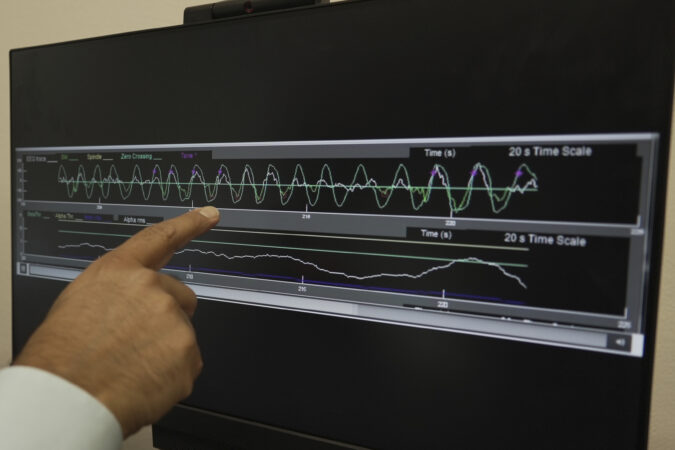
    As a neurologist who studies brain activity, I use electroencephalograms, or EEGs, to record the brain’s electrical patterns.

    Research in humans shows that these rhythms are remarkably dynamic. When someone learns a new skill, EEG rhythms often become more organized and coordinated. This reflects the brain’s attempt to strengthen pathways needed for that skill.

    Your brain trains in zones too

    For decades, scientists believed that the brain’s ability to grow and reorganize, called neuroplasticity, was largely limited to childhood. Once the brain matured, its wiring was thought to be largely fixed.

    But that idea has been overturned. Decades of research show that adult brains can form new connections and reorganize existing networks, under the right conditions, throughout life.

    Some of the most influential work in this field comes from enriched environment studies in animals. Rats housed in stimulating environments filled with toys, running wheels, and social interaction developed larger, more complex brains than rats kept in standard cages. Their brains adapted because they were regularly exposed to novelty and challenge.

    Human studies find similar results. Adults who take on genuinely new challenges, such as learning a language, dancing, or practicing a musical instrument, show measurable increases in brain volume and connectivity on MRI scans.

    The takeaway is simple: Repetition keeps the brain running, but novelty pushes the brain to adapt, forcing it to pay attention, learn, and problem-solve in new ways. Neuroplasticity thrives when the brain is nudged just beyond its comfort zone.

    The reality of neural fatigue

    Just like muscles, the brain has limits. It does not get stronger from endless strain. Real growth comes from the right balance of challenge and recovery.

    When the brain is pushed for too long without a break — whether that means long work hours, staying locked onto the same task, or making nonstop decisions under pressure — performance starts to slip. Focus fades. Mistakes increase. To keep you going, the brain shifts how different regions work together, asking some areas to carry more of the load. But that extra effort can still make the whole network run less smoothly.

    Neural fatigue is more than feeling tired. Brain imaging studies show that during prolonged mental work, the networks responsible for attention and decision-making begin to slow down, while regions that promote rest and reward-seeking take over. This shift helps explain why mental exhaustion often comes with stronger cravings for quick rewards, like sugary snacks, comfort foods, or mindless scrolling. The result is familiar: slower thinking, more mistakes, irritability, and mental fog.

    This is where the muscle analogy becomes especially useful. You wouldn’t do squats for six hours straight, because your leg muscles would eventually give out. As they work, they build up byproducts that make each contraction a little less effective until you finally have to stop. Your brain behaves in a similar way.

    Likewise, in the brain, when the same cognitive circuits are overused, chemical signals build up, communication slows, and learning stalls.

    But rest allows those strained circuits to reset and function more smoothly over time. And taking breaks from a taxing activity does not interrupt learning. In fact, breaks are critical for efficient learning.

    The crucial importance of rest

    Among all forms of rest, sleep is the most powerful.

    Sleep is the brain’s night shift. While you rest, the brain takes out the trash through a special cleanup system called the glymphatic system that clears away waste and harmful proteins. Sleep also restores glycogen, a critical fuel source for brain cells.

    And importantly, sleep is when essential repair work happens. Growth hormone surges during deep sleep, supporting tissue repair. Immune cells regroup and strengthen their activity.

    During REM sleep, the stage of sleep linked to dreaming, the brain replays patterns from the day to consolidate memories. This process is critical not only for cognitive skills like learning an instrument but also for physical skills like mastering a move in sports.

    On the other hand, chronic sleep deprivation impairs attention, disrupts decision-making, and alters the hormones that regulate appetite and metabolism. This is why fatigue drives sugar cravings and late-night snacking.

    Sleep is not an optional wellness practice. It is a biological requirement for brain performance.

    Exercise feeds the brain too

    Exercise strengthens the brain as well as the body.

    Physical activity increases levels of brain-derived neurotrophic factor, or BDNF, a protein that acts like fertilizer for neurons. It promotes the growth of new connections, increases blood flow, reduces inflammation, and helps the brain remain adaptable across one’s life span.

    This is why exercise is one of the strongest lifestyle tools for protecting cognitive health.

    Train, recover, repeat

    The most important lesson from this science is simple. Your brain is not passively wearing down with age. It is constantly remodeling itself in response to how you use it. Every new challenge and skill you try, every real break, every good night of sleep sends a signal that growth is still expected.

    You do not need expensive brain training programs or radical lifestyle changes. Small, consistent habits matter more. Try something unfamiliar. Vary your routines. Take breaks before exhaustion sets in. Move your body. Treat sleep as nonnegotiable.

    So the next time you lace up your shoes for a familiar walk, consider taking a different path. The scenery may change only slightly, but your brain will notice. That small detour is often all it takes to turn routine into training.

    The brain stays adaptable throughout life. Cognitive resilience is not fixed at birth or locked in early adulthood. It is something you can shape.

    If you want a sharper, more creative, more resilient brain, you do not need to wait for a breakthrough drug or a perfect moment. You can start now, with choices that tell your brain that growth is still the plan.

    is an associate professor of neurology at the University of Pittsburgh.

    Reprinted from The Conversation.

  • The cold’s toll: Woodcocks wiped out in Cape May, opossums frostbitten in Philly, robins struck on roads

    The cold’s toll: Woodcocks wiped out in Cape May, opossums frostbitten in Philly, robins struck on roads

    Steve Frates of Ocean View, N.J., was driving along Route 9 in Cape May County on a recent bitter cold day and noticed something strange: dead robins lying by the side of the road.

    Lots of them.

    Frates was even more startled when one flew into his Ford F-150 and died. The 72-year-old retired telecommunications manager wondered what was happening.

    “I noticed when it was really cold that I would see flocks of birds alongside of the road as I was traveling up and down Route 9 and the Garden State Parkway,” Frates said. “I would see a lot of birds that had been hit. I’d never seen anything at that scale. This was at a level I’ve never experienced before.”

    The winter has been hard on the region’s animals, wiping out 95% of the woodcocks in Cape May Point, fostering frostbite on opossums in Philadelphia, and freezing turtles in place in ponds.

    Experts say the animals are well adapted to survive the cold, but this winter has been especially harsh, producing a frozen snowpack that keeps animals from digging for food, and a prolonged cold that has pushed some to the brink.

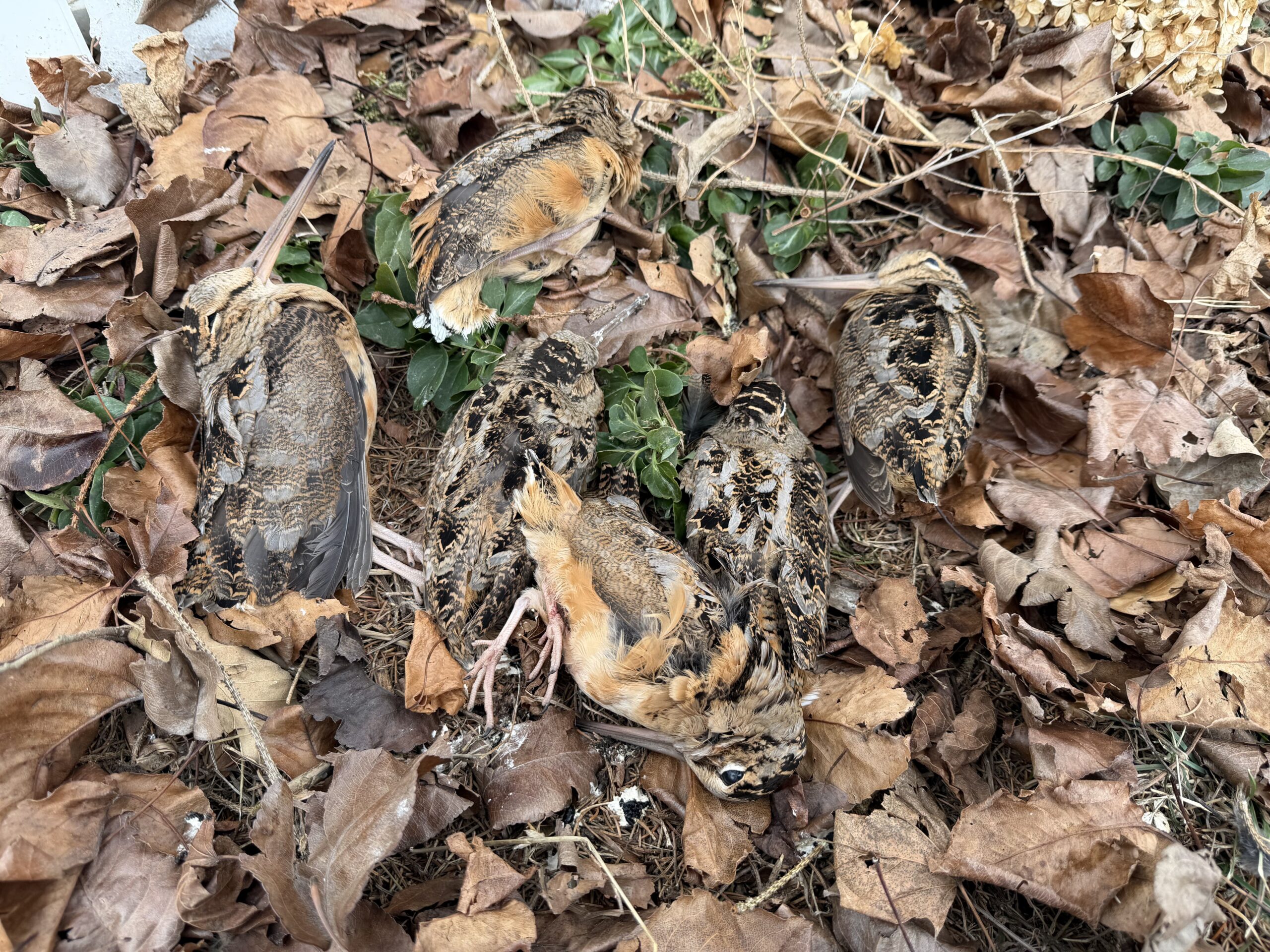
    About 200 woodcocks have died in the area of Cape May Point since the Jan. 25 snowfall that froze under a prolonged cold spell. These were found likely seeking food near the edge of homes.

    Woodcocks are starving

    Mike Lanzone, a wildlife biologist and CEO of Cellular Tracking Technologies, has been busy the last two weeks helping to gather hundreds of dead woodcocks in Cape May Point and West Cape May. His company makes products that track birds via GPS and other technology.

    He described a devastating die-off for the woodcocks, which depend on finding food by probing the ground to extract worms and invertebrates. They have been unable to penetrate the snow and ice, causing starvation.

    “They were losing a lot of muscle mass, and they weren’t able to eat anything,” Lanzone said. “We started seeing them die off. First it was just a few. Then 10. Then 15. Then 40. Then almost 100 woodcocks.”

    Lanzone said about 254 woodcocks had died as of Thursday.

    “There was at least a 90-95% die-off,” he said. “That is what we know for sure. At least in Cape May Point and West Cape May.”

    Lanzone said the woodcocks were being taken to the Academy of Natural Sciences of Drexel University in Philadelphia to be examined.

    Jason D. Weckstein, associate curator of ornithology at the academy, said such die-offs have happened before. He will examine the birds and, using chemical signatures in their bodies, determine where they were born.

    “They’re dying because they’re starving,” Weckstein said. “They can’t feed. Most of those birds were super emaciated and just died.”

    Robins are desperate

    Chris Neff, a spokesperson for New Jersey Audubon, said the robins that Frates saw along the side of the road had been driven there in search of food.

    “Birds are congregating along the melted edges of roads searching for bare ground on which to find food and even meltwater to drink,“ Neff said. ”Birds are desperate to consume enough calories each day during this extreme weather, and this makes them bolder, meaning they may not fly off when a car approaches if they have found something to eat.”

    American robins, he said, travel in large flocks. When their food is exhausted, a few will take off in search of the berries of American holly and Eastern red cedar. The rest will follow en masse, following a path that might lead them across a road.

    The chances of collisions with cars become much higher.

    Neff advises that people should slow down if they see birds congregating along a road and keep an eye out for any that might fly across.

    “Like deer,” Neff said, ”if one darts across the road, there are sure to be more following.”

    A grebe that was rescued amid the harsh winter weather and taken to the Wildlife Clinic at the Schuylkill Center for Environmental Education, where it is being fed and cared for until an open water source can be found for it to be released.

    Opossums and other animals

    Sydney Glisan, director of wildlife rehabilitation for the Wildlife Clinic at the Schuylkill Center for Environmental Education in Northwest Philadelphia, characterizes the severe winter conditions as a critical “make it or not” period for local wildlife.

    Some animals, such as deer, are well adapted to the cold and can eat fibrous bark and twigs to survive. Other species, however, struggle.

    She said Virginia opossums found in Philadelphia, despite being a native species, have physical attributes that “do not really work for this type of weather.” She has treated multiple opossums for frostbite. The latest patient arrived Friday.

    They are susceptible, she said, because their ears, tails, and paws have no fur for protection. Often, tails or fingers need to be amputated.

    Residents often find them curled up and immobile, mistakenly believing the animals are dead when they are actually just trying to stay warm or are in a state of shock.

    The weather also affects aquatic birds like grebes, which become stranded on land because they require open water to take off and cannot walk well on ice or ground.

    Even squirrels struggle, as the ice prevents them from digging up cached food, Glisan said.

    Glisan advises the public to be cautious about intervening for wildlife such as birds. She notes that even well-intentioned acts, such as providing heated birdbaths, can result in hypothermia if a bird’s wet feathers subsequently freeze in the air.

    “As much as it might sound rude, I always say doing nothing is the best thing that you can do,” Glisan said. “I recommend helping by not helping.”

    Reptiles and amphibians

    Susan Slawinski, a wildlife biologist at the Schuylkill Center, said the danger for reptiles and amphibians comes as lakes and ponds freeze over. Aquatic species such as green frogs, painted turtles, and snapping turtles overwinter at the bottom of ponds.

    There, the animals survive by slowing their metabolisms enough to eliminate the need to eat or surface for air. However, prolonged cold poses a specific danger as ponds freeze solid to the bottom. Those hibernating will perish.

    The Schuylkill Center uses a bubbler in its Fire Pond to maintain a gap in the ice to let in oxygen.

    Despite the risks, Slawinski emphasizes that native wildlife is historically resilient, though mortality is an unfortunate reality for animals that select poor hibernation spots.

    For example, the gray tree frog uses glucose to create a natural “antifreeze” that prevents its cell walls from bursting in freezing temperatures.

    “Native wildlife is very good at adapting to cold temperatures,” Slawinski said. “There have been colder winters, longer winters before. Unfortunately, there is always going to be a mortality risk.”

  • Reconciling with a difficult parent may seem impossible. Being their caregiver might help. | Expert Opinion

    Reconciling with a difficult parent may seem impossible. Being their caregiver might help. | Expert Opinion

    There are two remarkable scenes of family reconciliation in this past fall’s Bruce Springsteen biopic, Deliver Me from Nowhere. After years of alienation from his alcoholic, physically abusive father, Dutch, a slowly maturing Bruce begins to recognize that his father has struggled with lifelong mental illness. By this stage of his later years, Dutch has been diagnosed with bipolar disorder and is becoming increasingly confused as he ages.

    In the first reconciliation scene, Bruce searches for his father in bars and restaurants all over Los Angeles at the request of his mother after Dutch disappears for several days. Bruce finally finds him sitting at the bar of a Chinese restaurant. Rather than upbraiding him, Bruce sits down next to his father and asks, gently like an old friend, if he would like to go out for breakfast before heading home.

    In the second scene, a disoriented Dutch asks Bruce to sit on his lap — as if his son is 3 years old, not 32. Bruce obliges but feels awkward, telling Dutch that he never asked him to sit on his lap before. “I didn’t?” Dutch asks, appearing shocked and regretful that he hadn’t sought loving contact with Bruce when he was a child.

    These scenes come at the end of a narrative arc illuminating the surprising turnabout that can be achieved through family caregiving for an older adult: A harshly punitive parent can turn into a softer, “toothless tiger” as they become frail. An angry adult child can develop greater empathy for the vulnerability of that hated parent while witnessing their decline. The parent-child relationship is transformed through the giving and receiving of care. Reconciliation is possible, the scenes suggest, by letting go of the past and extending kindness and understanding to a now diminished and needy parent.

    Some viewers may regard this plot line as unrealistic, corny, and overly Hollywood. Our current cultural moment seems to favor alienation and complete estrangement, not reconciling. In our clinical psychology practices, we have also worked with adult children and parents who have decided to cease talking with one another after years of conflict, frustration, and continued emotional pain. These are not bad therapeutic outcomes. They represent hard, courageous work on the part of clients who now refuse to be hurt any longer. We respect their decisions.

    But as clinicians specializing in supporting family caregivers, especially those caring for aging parents, we have also seen ways that alienation can be surmounted and improved relationships formed. It requires adult children to risk getting hurt all over again by deciding to care for an aging parent who previously tormented them. Taking this chance in the hopes of forging something better doesn’t work out well in every case, but it does produce emotionally powerful results for some.

    We saw this happen with one of our patients, Gloria, who at age 43 never expected to find such healing. She had always felt belittled by her mean, narcissistic mother from whom she kept a healthy geographic and emotional distance to protect herself throughout her adult life. But then her aging mother developed diabetic complications, including sensory neuropathy in her feet, and suffered a series of harmful falls. After weighing the pros and cons, Gloria decided to become her mom’s caregiver.

    This could have gone disastrously. Gloria might have allowed herself to hope that she’d finally win her mother’s approval by being there in her hour of need — only to be rejected by her mother yet again. Like Bruce Springsteen in the biopic, Gloria avoided reliving this destructive family dynamic by being her own person, refusing to allow her hurtful parent to loom over her life. The twist here is that she managed this while immersing herself in her mom’s day-to-day care.

    To motivate her caregiving, Gloria drew on her moral convictions, not some old yearning for her mother’s love. Helping others had always provided her with a deep sense of meaning. It underpinned her successful career as a hospital floor nurse and, later, an administrative leader in her health system. She could tend to her mother’s needs because that was consistent with her values and core identity, not simply because her “patient” now would be the woman who gave birth to and raised her.

    Secondly, Gloria made a point of approaching the present as the present, not the past. Certainly, she still craved some measure of justice for the years of mistreatment that she endured as a child. An apology on her mother’s part would be a nice start. But the caregiving was not about winning justice; the current mission was limiting her mother’s falls to help her live out her final years with less suffering. Gloria had the skills and professionalism to achieve this goal.

    Perhaps most importantly, she decided to just accept her mother for the very flawed person she had always been. It no longer made sense to Gloria to wish her mother was kinder or to believe she had the power to make her happy. Mom was a sour person who inflicted her sourness on others, especially her only daughter, a personality that did not grow sweeter with her diabetic complications later in life.

    True to form, Gloria’s mother initially found a dozen ways to criticize Gloria for how she provided care. But Gloria now shrugged off her barbs, keeping her focus on helping a vulnerable older adult. To her great surprise, her mother responded by changing her behavior, too. It was akin to what happens when you steadfastly ignore the taunts of a schoolyard bully. Once her daughter stopped reacting emotionally, Mom began to respect her more. During the last two years of the mother’s life, the dynamic between them slowly shifted from mean mom/hurt child to appreciative mom/competent adult child. For the first time in her life, Gloria didn’t feel that her mother resented her. While not exactly love, it was pretty good.

    Just like there are not many Bruce Springsteens in the world, there aren’t that many Glorias so able to separate their past from present circumstances that they can turn caregiving into a transformative experience of reconciliation. But there is always that possibility. If you are like Gloria or Bruce and decide to provide some care, we have several suggestions to keep in mind:

    • Maintaining rage against a parent takes energy; it can be a relief to let it go.
    • Choosing to be a parent’s caregiver shouldn’t be undertaken with the intent of proving or winning anything; it should be about living your values.
    • You are not offering forgiveness — especially if, as is likely, your parent never expresses remorse. You are gaining pride in who you are, regardless of how your parent was or is.

    Barry J. Jacobs, Psy.D. and Julia L. Mayer, Psy.D. are clinical psychologists based in Media and the co-authors of the 2025 book, “The AARP Caregiver Answer Book.”