On Jeopardy!, contestants give their answers in the form of a question. Scott Riccardi’s should’ve been, “How do you pronounce Schuylkill?”
During Tuesday’s episode, the New Jersey native and his two competitors were given a U.S. geography clue close to home: “Pottsville & Reading both lie on this river that enters the Delaware at Philadelphia.”
Riccardi answered the clue correctly, but only after host Ken Jennings paused to determine if his pronunciation — “Skol-kull” — was close enough to award him $1,600.
As least he got the correct river. TJ Fisher, a marketing specialist from San Francisco, guessed “Lackawanna,” nailing the pronunciation but missing the answer by more than 100 miles.
Paolo Pasco, a puzzle writer originally from San Diego, Calif., didn’t buzz in.
For the record, it’s pronounced “Skoo-kl.” One 15th century mapmaker just cut to the chase and labeled it the “Scool Kill River,” which would’ve been much easier to say and spell.
Jeopardy! is in the finals of its annual Tournament of Champions, which featured the show’s most recent top contestants. Pasco won Monday and Tuesday, and needs just one more victory to win the tournament and collect its $250,000 prize.
Muhammad Ali’s one-time home has hit the market again, this time with a higher asking price. Also this week, The Kibitz Room’s future remains unclear after it unexpectedly closed last week, township council has approved over $15 million in bond ordinances, plus sewer work on Kresson Road has begun and will continue for several months.
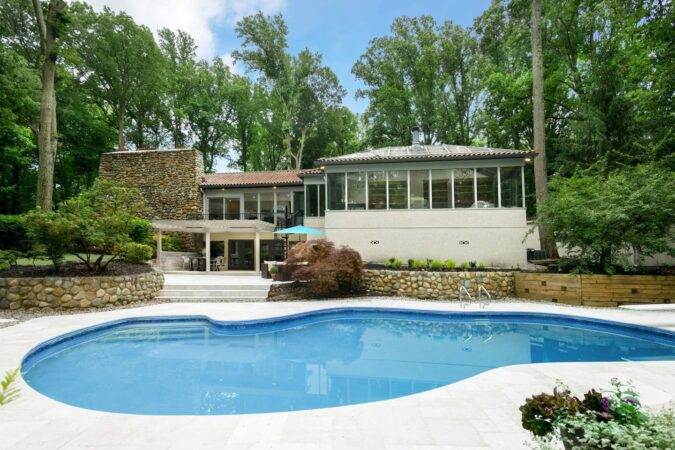
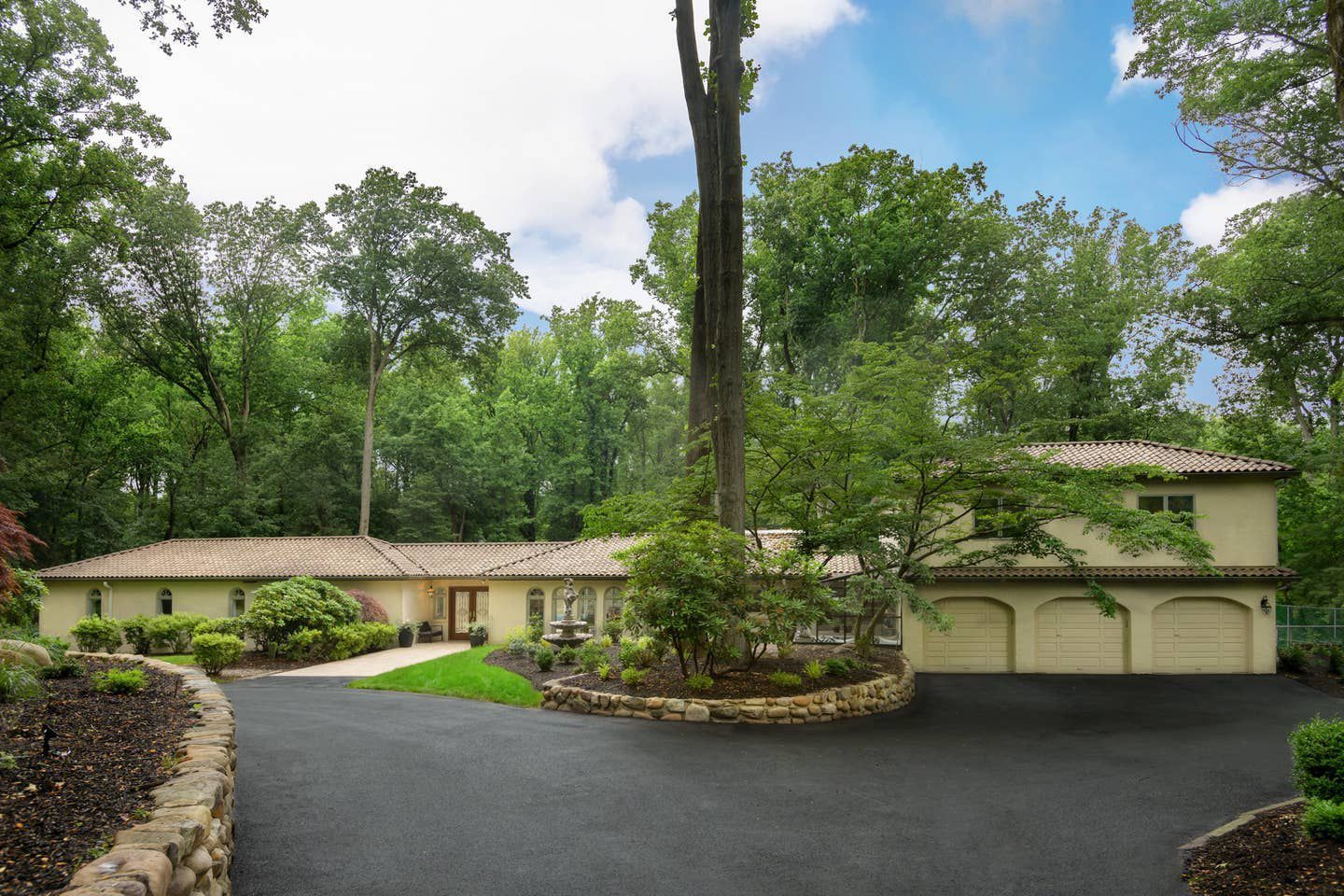
The Mediterranean-style home spans nearly 6,700 square feet and has a pool and tennis court.
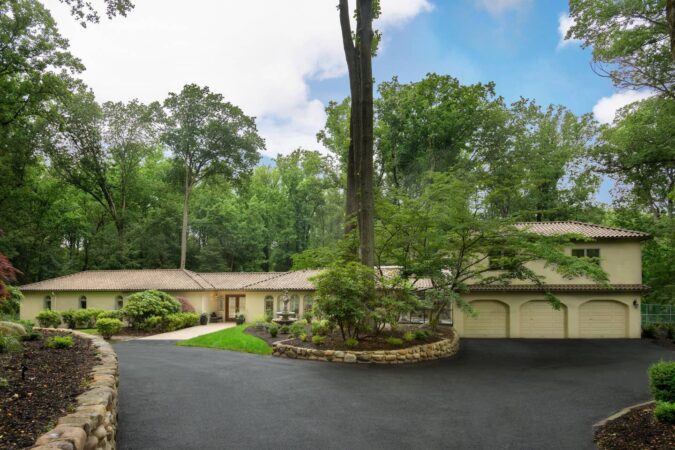
Champion boxer Muhammad Ali’s one-time Cherry Hill home has hit the market again, this time with an asking price of $1.975 million. That’s an increase from the last timethe Mediterranean-style home was listed three years ago.
The sprawling, nearly 6,700-square-foot Voken Tract home has six bedrooms, a greenhouse room, a gym, and a 12-foot wet bar. Situated on 1.5 acres, it also has an in-ground pool, a hot tub, and a tennis court.
While the home has been updated since Ali lived there over 50 years ago, his prayer room remains.
One person died and a firefighter was injured over the weekend after a fire broke out at a Cherry Hill home Saturday night. (Patch)
Township council last week voted unanimously to pass several ordinances appropriating over $15 million for improvements and purchases. The ordinances include nearly $5.6 million for township equipment, information technology equipment, parks and recreation site improvements, facility upgrades, and property or open space acquisition; over $7.7 million for road, sidewalk, and storm drainage improvements; and over $2 million for equipment upgrades and sewer improvements. Council also passed an ordinance appropriating an additional$50,000 for sewer improvements.
Beck Middle School Spanish teacher Kelly Harris is thanking members of the community for their emotional and financial support after a car crashed into her family’s Mullica Hill home several weeks ago, causing a fire and destroying nearly all their possessions. She and her husband Steve are also using the unexpected attention to remember their neighbors, Tom and Lisa Hengel, who were in the SUV and died that day. (Courier Post)
New Jersey American Water has begun construction to replace nearly one mile of an aging water main along Kresson Road between Springdale and Cropwell Roads. The $2.5 million upgrade is expected to take until June. Crews will be working most weekdays from 8 a.m. to 4 p.m.
This week, Red White & Blue Thrift Store announced an opening date for its Cherry Hill location. The store at 949 Church Rd., formerly a Big Lots, will host a grand opening on March 26. Red White & Blue Thrift is known for its selection of discounted clothing and accessories, houseware, toys, and sports equipment.
Preschool registration opened this week and continues through Feb. 13. Find more information on registration for 3- and 4-year-old preschoolers here.
Superintendent Kwame Morton released the district’s latest quarterly goals update last week, outlining this academic year’s initiatives. Recent highlights include integrating career readiness standards into the curriculum, launching a new online internship portal and tracking system, and adding over 200 new preschool students at the Malberg Early Childhood Center and Joyce Kilmer Elementary School. In the next couple of months, the district is planning pre-Advanced Placement training for middle school teachers, and focusing on more career readiness initiatives, including a district-wide framework with grade-specific benchmarks. The district continues to work on elementary enrollment balancing and construction work funded by bonds.
East boys basketball’s top scorer Jamieson Young was scheduled for surgery last week after suffering a fracture to the inside of his right ankle in a Jan. 17 game. Young was averaging 21.8 points per game. (NJ.com)
🍽️ On our Plate
Popular Jewish deli The Kibitz Room closed unexpectedly last week, and its future remains unclear, The Inquirer’s Michael Klein reports. Owner Sandy Parish has been running the Shoppes at Holly Ravine staple solo after her former husband, Neil, and son, Brandon, left to open a King of Prussia location last year.
Work continues on the H Mart on Route 70, including a new food court, and while there’s no reopening date yet, two new eateries have announced they’ll have locations there when it does. Jaws Topokki, which specializes in Korean dishes gimbap and topokki, is targeting a July opening date. It will be joined by Kyodong Noodles, which specializes in Korean-Chinese comfort foods like jjajangmyeon and jjambbong. Chain bakery Paris Baguette is also slated to have a location within H Mart.
Bahama Breeze at the Cherry Hill Mall is closing its doors this spring. Darden Restaurant Group, which owns the tropical-inspired brand, announced yesterday that it was closing or converting 28 restaurants nationwide. The Cherry Hill location is expected to remain open through April 5.
Looking to lock down your Super Bowl menu? The Inquirer’s reporters have put together guides to the best cheesesteaks, hoagies, tomato pies, and more. For party trays, Indeblue in the Barclay Farms Shopping Center offers an assortment of tandoori lollipop lamb chops, shashlik, and samosas, in addition to desserts. If you want wings, NJ.com put together a list of the best in the state, including two Cherry Hill spots, Dolsot House and Hen Vietnamese Eatery.
Looking for a romantic place to dine out this Valentine’s Day? The Courier Post recently rounded up several South Jersey spots, including Caffe Aldo Lamberti, noting the Marlton Pike spot has an award-winning wine list, seafood, steaks, pastas, and a raw bar.
Or if you want a sweet experience, Insomnia Cookies is offering 45-minute reserved seatings at its Cherry Hill outpost. The pop-up event takes place from 8 p.m. to midnight on Feb. 12 and 13, but seats are going fast. Order from the usual menu or try the holiday-themed pre-fixe menu that includes six cookies, three dips, and two bottles of milk.
🎳 Things to Do
💃 The Swing Loft Social Dance Party: Learn the popular “modern swing” at this all-levels dance class, where you can come alone or with a dance partner. ⏰ Saturday, Feb. 7, 7-11 p.m. 💵 $20 📍Storm Ballroom Dance Centre
🎨 I Heart Art: Check out works created by some of the township’s young artists in kindergarten through eighth grade. ⏰ Tuesdays and Thursdays, Feb. 10-19, 4-7 p.m. 💵 Free 📍Croft Farm Arts Center
🍿 Rom-Com Watch Party: Teens in sixth through 12th grade can watch a romantic comedy together. Registration is required. ⏰ Tuesday, Feb. 10, 7-8:30 p.m. 💵 Free 📍Cherry Hill Public Library
🧁 Cocktails and Cupcakes: Get tips and hands-on experience mixing up cocktails and decorating cupcakes at this 21-and-over event. Registration is required by Feb. 8. ⏰ Wednesday, Feb. 11, 7-9 p.m. 💵 $20 📍Congregation Kol Ami
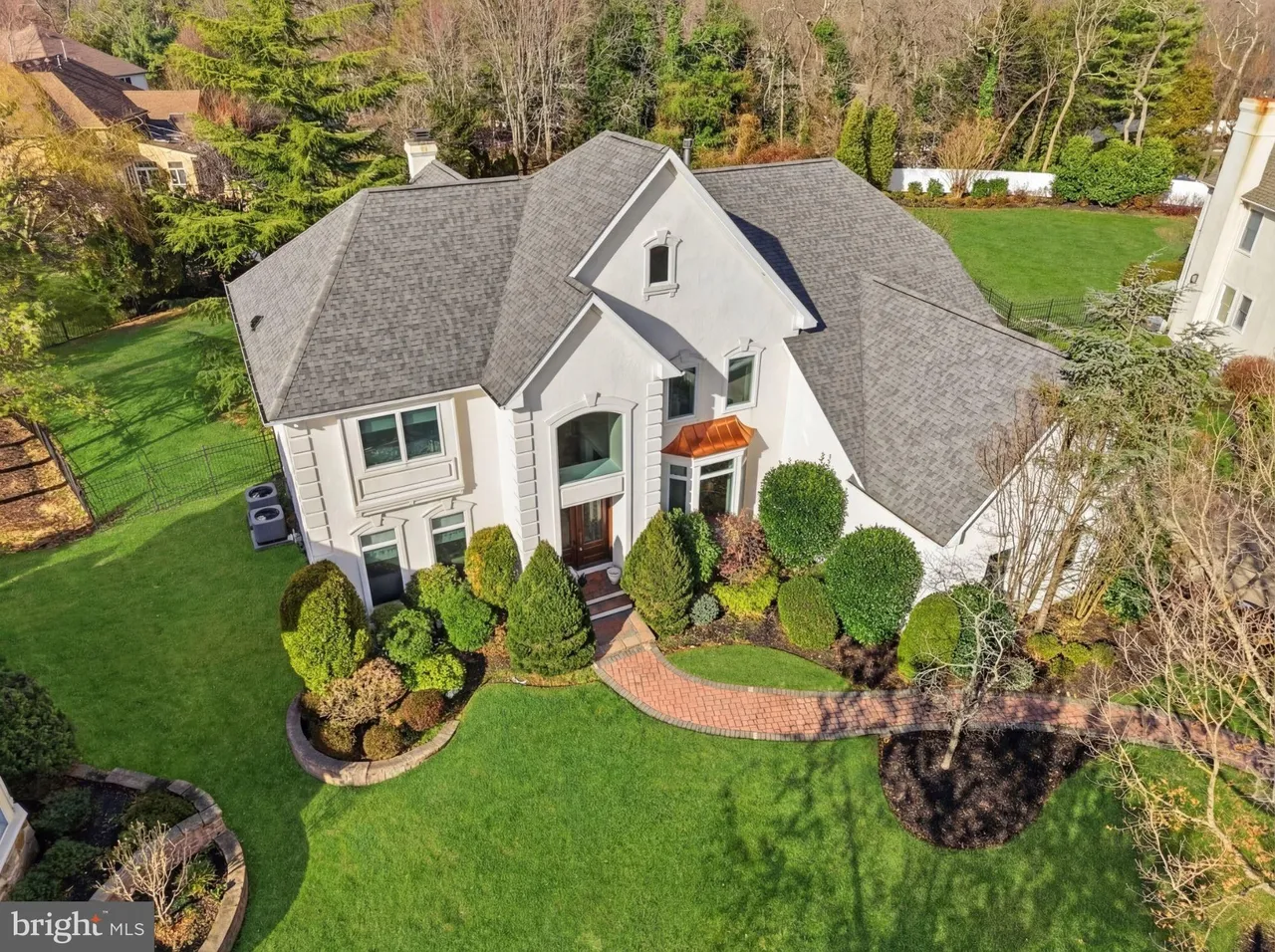
The four-bedroom home spans more than 4,200 square feet.
Located in Short Hills, this spacious four-bedroom, four-and-a-half-bathroom home features a two-story foyer, a living room, a dining room with coffered ceilings, a step-down family room with a fireplace, an office, a den, and an eat-in kitchen with an island, granite countertops, built-in wine storage, and high-end appliances. All four bedrooms are located on the second floor, including a large primary suite with a sitting room, dual walk-in closets, and a bathroom with dual vanities and a whirlpool tub. Other features include a finished basement with a wet bar, and a deck with a retractable awning.
By submitting your written, visual, and/or audio contributions, you agree to The Inquirer’s Terms of Use, including the grant of rights in Section 10.
This suburban content is produced with support from the Leslie Miller and Richard Worley Foundation and The Lenfest Institute for Journalism. Editorial content is created independently of the project donors. Gifts to support The Inquirer’s high-impact journalism can be made at inquirer.com/donate. A list of Lenfest Institute donors can be found at lenfestinstitute.org/supporters.
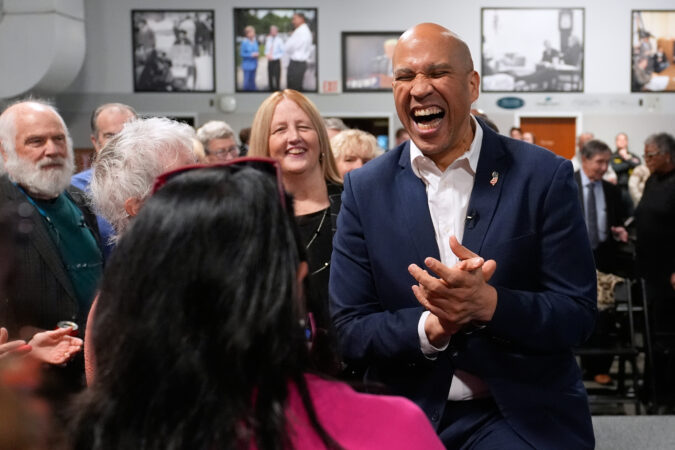
U.S. Sen. Cory Booker has raised more than $30 million for his reelection campaign, outdoing the vast majority of candidates running for either chamber ofCongress in 2026.
The New Jersey Democrat has raised the second-largest amount of money for the 2026 elections for U.S. House and Senateas of the end of last year, behind only Sen. Jon Ossoff (D., Ga.),according to Federal Election Commission reports.
Booker is widely considered a potential presidential contender for 2028, after unsuccessfully seeking the office in 2020.
The lawmaker has no serious challengers at this point for his Senate seat, and he could leave this cycle with extra money he could use for a presidential run.
His campaign has nearly $22 million cash on hand and no debt. He has been adding to his coffers since he began his most recent term in 2021.
More than 200,000 people donated to Booker in 2025, and roughly 80% of the donations were $25 or less, according to Booker’s campaign.
“Cory is backed by a grassroots movement that recognizes the importance of strong, principled leadership that stands up in this moment,“ his campaign manager, Adam Silverstein, said in a statement. ”We are grateful for this incredible outpouring of support and will keep building the infrastructure we need to win in 2026 and elect Democrats at every level.”
The New Jersey Democrat saw a fundraising spike when he delivered a record-breaking 25-hour speech on the Senate floor last year. He raised nearly $9.7 million in the second quarter of 2025, the period that included his speech, far more than any other quarter last year.
Booker criticized President Donald Trump on a host of issues in the speech and held up a pocket Constitution. He also acknowledged his own party’s failure to prevent Trump’s return to office.
“I confess that the Democratic Party has made terrible mistakes that gave a lane to this demagogue,” he said in his speech. “I confess we all must look in the mirror and say, ‘We will do better.’”
Laura Matos, a New Jersey Democratic operative, said Booker was already a “known entity,” and his speech came at a time when Democrats across the country were looking for someone to stand up to Trump.
“For 25 hours, his people could constantly churn out, like every hour, ‘He’s still on the Senate floor, show him you support him,’” said Matos, a partner at lobbying and public affairs firm MAD Global Strategy Group. “The way that fundraising works, you can really build upon things like that. He was prolific before that, and then that just kind of skyrocketed it.”
Ossoff, the 2026 federal candidate who reported more than Booker, has raised nearly $64 million and faces a more competitive race in a key swing state.
He began serving as mayor of Newark in 2006 untilhe was elected to the U.S. Senate in a 2013 special election.
Booker is also heading into a national tour to promote Stand, his new book, set to publish next month.
The book combines Booker’s personal reflections with stories of American leaders from President George Washington to Supreme Court Justice Ketanji Brown Jackson, and “offers a hopeful and practical path forward,” according to his publisher, Macmillan.
Most of Booker’s money comes from outside New Jersey.
According to FEC data, from January through September 2025, he received the most money from California, followed by New York.
While Booker is raking in money, he’s also spending it. He spent the fourthmost out of all 2026 Senate candidates, reporting $14 million in spending since 2021.
One of his biggest expenses was in April, when his campaign spent $1.2 million on an email list acquisition.
The only other candidate who has reporting fundraising for the New Jersey Senate race so far is Justin Murphy, a Republican from the Pinelands, who reported a little over $3,500.
Several other Republicans have expressed interest in running in the primary, and county parties will hold conventions in the coming weeks to endorse candidates.
Luke Ferrante, the executive director of New Jersey GOP, said the party is planning “a robust effort statewide” to unseat Booker.
“New Jerseyans across the state are eager to elect a statewide representative that is focused on delivering for its residents, not their greater Washington ambitions,” Ferrante said.
Gov. Josh Shapiro had a message for data center developers on Tuesday: Come to Pennsylvania, but bring your own energy — or pay up.
During his budget address, Shapiro said his proposal — the Governor’s Responsible Infrastructure Development (GRID) standards — will ensure center operators are “not saddling homeowners with added costs because of their development.”
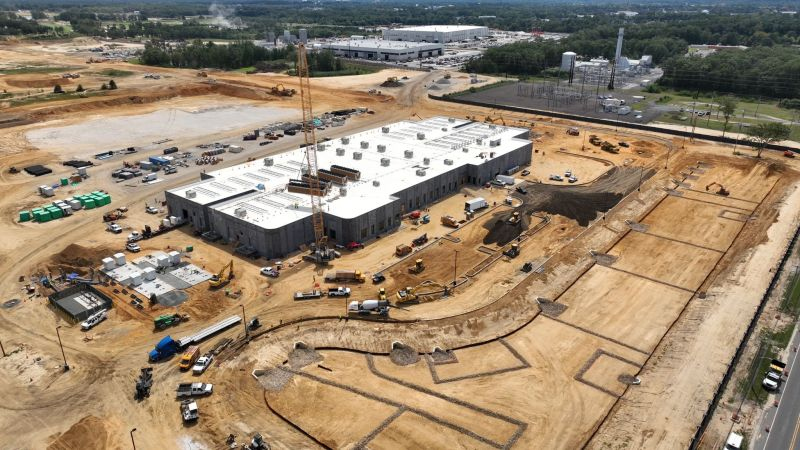
Data centers, which house the technology to power cloud storage and other computing, have been proliferating across the country and the region due to the increasing demands of generative artificial intelligence, or AI.State and local officials are trying to keep up with the rapid pace of development, proposing new legislation — and updating existing measures — in an attempt to regulate the facilities.
Shapiro’s plan would require data centers to supply their own energy or pay for any new generation they need. It also calls on them to hire and train Pennsylvania workers and comply with “the highest standards of environmental protection,” including in water conservation, Shapiro said.
In exchange, the governor added, data center developers will get “speed and certainty” in the permitting process, as well as applicable tax credits.
The comments from Shapiro, a Democrat who has consistently encouraged data center development, come amid a flurry of legislative and executive action, as elected officials promise to keep Pennsylvania and New Jersey consumers from bearing the costs of these power-hungry facilities.
Data centers, the electric grid, and governors’ proposals
At the same time, some governors, including Shapiro, have criticized and sued PJM, the Montgomery County-based electric grid operator, over its annual capacity auction, which influences how much customers pay.
On Tuesday, Shapiro reiterated calls for PJM to speed up new power-generation projects and extend a price cap.
Separate from GRID, Shapiro also said electric companies, including Peco, should increase transparency around pricing and “rein in costs” for consumers, including low-income and vulnerable Pennsylvanians.
“These steps will save consumers money immediately,” Shapiro said. He announced an energy-affordability watchdog to monitor utility-rate requests and take legal action if necessary to prevent companies from “jacking up their rates and costing you more.”
Through several executive orders, she froze utility rates and expanded programs to spur new power generation in the state. She also ordered electric utilities to report energy requests from data centers.
“This is just the beginning,” Sherrill said in her inaugural remarks. “We are going to take on the affordability crisis, and we are going to shake up the status quo.”
In Pennsylvania, ‘Data Center Consumer Protection Bill’ advances
An Amazon data center is shown last year while under construction in front of the Susquehanna nuclear power plant in Berwick, Pa.
Meanwhile in Harrisburg and Trenton, some lawmakers have other ideas about how to keep residents from subsidizing data centers.
As of Tuesday, nearly 30 bills in the Pennsylvania and New Jersey legislatures mentioned data centers, according to online records. Many of those bills aren’t directly related to residents’ electric bills, and instead address the facilities’ energy sources, water usage, environmental impacts, and general regulation.
“Today’s vote brings us one step closer to protecting ratepayers,” Robert Matzie, the Beaver County Democrat who introduced the bill, said in a statement. “Data centers can bring jobs and expand the local tax base, but if unchecked, they can drive up utility costs. Electric bills are already too high.”
The bills were introduced by State Reps. Kyle Donahue and Kyle Mullins, both Democrats from the Scranton area, which has become a hot spot for data center development.
“There is a real concern and a sense of overwhelm among the people we represent,” Mullins said at the hearing. “The people of Pennsylvania have serious concerns about data center energy usage and water usage, especially as they see utility bills continue to rise rapidly.”
Dan Diorio, vice president of state policy for the Data Center Coalition, said he worried the bills would discourage operators from building in Pennsylvania. He said they are already incentivized to reduce energy costs, which are estimated to make up anywhere from 40% to 80% of a data center’s total operating costs.
“Data center companies strive to maximize energy efficiency to keep their costs low,” Diorio said.
Rep. Elizabeth Fiedler, the Philadelphia Democrat who chairs the energy committee, closed Monday’s hearing by reminding members of one of its main objectives: to “keep down the energy bills that are skyrocketing for people back home.”
A South Jersey lawmaker says his bill could help consumers
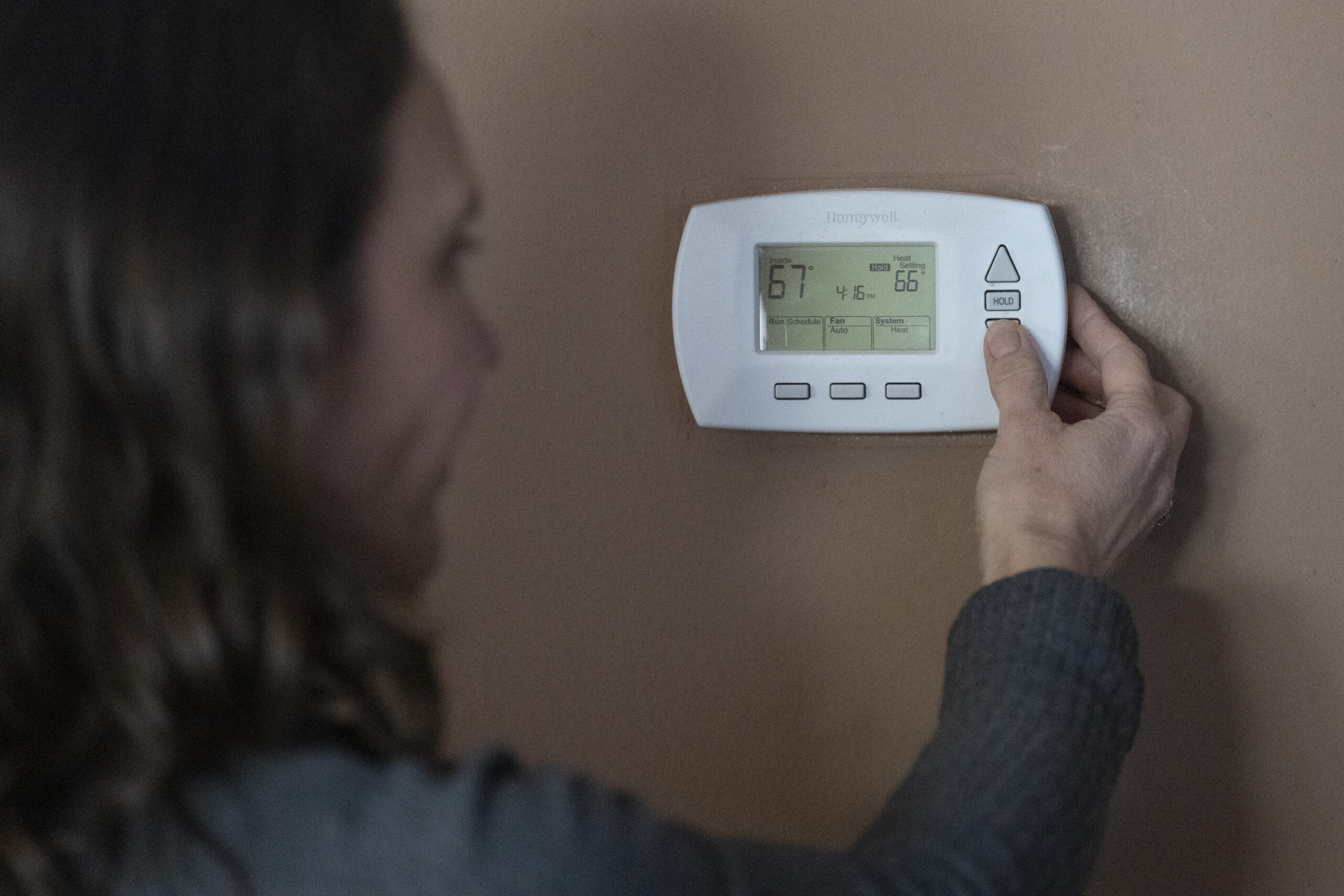
A Philadelphia-area woman woman turns down her thermostat in attempt to save on electricity in this January 2023 file photo.
The pain of skyrocketing utility bills has been felt acutely in New Jersey, which unlike Pennsylvania uses more energy than it produces.
Between 2024 and 2025, New Jersey residents’ electric bills rose more than 13% on average, the fifth steepest increase in the U.S., according to federal data analyzed by the business magazine Kiplinger. Pennsylvanians saw a nearly 10% increase during the same period, according to the data.
A bill sponsored by New Jersey State Assembly member David Bailey Jr., a Democrat from Salem County, attempts to prevent future price hikes.
The legislation would require data center developers to have “skin in the game,” as Bailey described it in a recent interview, and sign a contract to purchase at least 85% of the electric service they request for 10 years. He said it would also provide incentives for data centers to supply their own energy generation.
“I don’t want to come off as an anti-data center person,” said Bailey, who represents parts of Gloucester, Salem, and Cumberland Counties. “This is a very positive thing. We’re just saying we don’t want these big companies to come in and pass this [cost] on to our mom and pops, our neighbors, and our everyday ratepayers.”
Bailey said he was disappointed that his bill was pocket-vetoed by former Gov. Phil Murphy last month. Now, it has to restart the legislative process. But Bailey said he expects it to eventually pass with bipartisan support.
“No matter your party affiliation you understand the affordability issue,” Bailey said. “You understand your electric bill” — and how much it has risen recently.
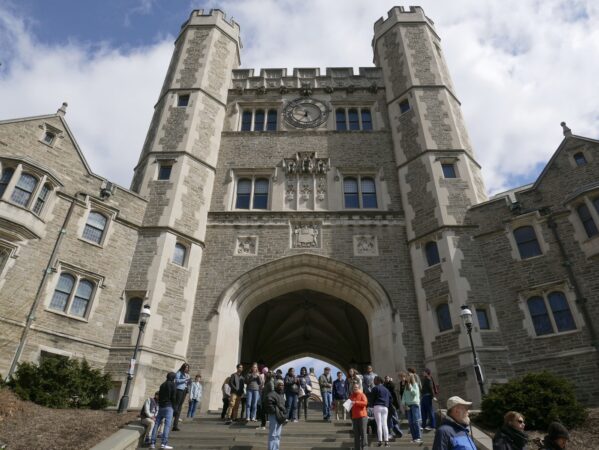
Princeton University’s president, in a message to campus, said the school will take the unusual move of consolidation and cuts, given federal policy changes and “political threats” to its financial model, as well as lowered expectations about future endowment returns.
“Changed political and economic circumstances require that we transition from a period of exceptional growth to one defined by steadfast focus on core priorities,” Christopher Eisgruber wrote Monday in his annual message to campus. “That shift is necessary for multiple reasons, including because it will help Princeton to stand strong for its defining principles and against rising threats to academic freedom.”
The Ivy League university, he wrote, “will have to look for areas where we can consolidate or cut, both to offset rising costs (including salaries and benefits) and to support the investments required for teaching and research excellence.”
Eisgruber’s announcement came days after the University of Pennsylvaniaannounced it would instituteanother round of budgetcutsin response to actions by President Donald Trump’s administration that threaten future funding and revenues, and because of rising legal and insurance expenses. The Trump administration has placed new caps on loans that graduate students can take out, temporarily paused student visa interviews, and sought to cut research funding to universities. Some colleges, including Penn and Princeton, also will see their endowment taxes rise.
Penn’s schools and centers were directed to cut 4% from certain expenses in the next fiscal year and keep in place financial cutbacks instituted last year, including a staff hiring freeze and freezes on midyear adjustments in staff salaries. Schools and centers also were asked last year to cut 5% of certain expenses, and the new 4% reduction would be on top of that.
The new Penn cuts come even though university officials said finances look better than they anticipated a year ago.
At Princeton, university officials also asked units across the school to make 5% to 7% cuts to their budgets over the last year, given an increase in the endowment tax that Princeton faces and federal threats to research funding. Eisgruber noted that the proceeds from its $36.4 billion endowment and sponsored research grants make up 83% of Princeton’s revenue.
The university’s endowment tax is scheduled to rise from 1.4% to 8% in 2026-27. (Penn’s tax on its $24.8 billion endowment is rising from 1.4% to 4%.)
Now, “more targeted, and in some cases deeper, reductions over a multiyear period” are likely required, Eisgruber wrote.
Last year, things were different.
In his 2025 message, Eisgruber noted that the school was “in the midst of an 18-month period in which the University will open more than a dozen substantial new facilities and spaces that enhance the University’s mission.”
Those include a new health center, a commons with a library, an art museum, student housing, and buildings that house an environmental institute and science and engineering programs.
“Princeton will continue to build, but more slowly in the years to come,” Eisgruber said in this week’s message. “Princeton will continue to evolve, but in the future it will more often have to do so through efficiency and substitution rather than addition. That will be a major change for most Princetonians, in comparison to not only the past five years but the last three decades.”
Princeton’s long-term endowment return assumptions have been lowered to 8% from 10.2% three years ago, Eisgruber wrote.
The university’s endowment returns in the three years following 2021 were “the second worst in more than four decades, better only than the returns in the years surrounding the Global Financial Crisis in 2008-09,” Eisgruber wrote. Two of those years saw negative returns.
Princeton spends about 5% of its endowment each year to support operations.
“An 8 percent return rate will require us to get the payout rate down below 5 percent even to cover payout plus inflation,” Eisgruber wrote.
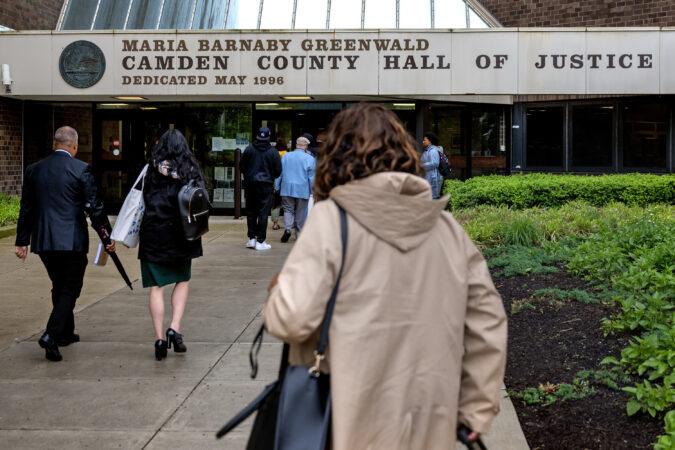
The Camden County Hall of Justice is closed through at least Wednesday after a sprinkler system pipe froze and then burst at the facility Sunday afternoon, said New Jersey courts spokesperson Pete McAleer.
The damage to the building was significant, McAleer said. Parts of the first floor and lower-level areas of the building were flooded. However, the courtrooms were unaffected, he said.
Courtroom operations will be held remotely as tests are conducted to assess if the damage created any environmental hazards.
The judiciary staff will continue coordinating with county officials and the county sheriff’s office as they relocate services temporarily, McAleer said.
If it appears that the tenacious meringue of snow and ice that landed on the region two weekends ago hasn’t budged, it hasn’t.
Among Philadelphia winters, this one is approaching a rarefied status.
Not long after Phil predictably saw his shadow in Punxsutawney, the National Weather Weather Service contractor at Philadelphia International Airport reported a snow depth of six inches on Monday.
That marked the eighth consecutive day of a snow cover of at least six inches, a streak unmatched since February 2010 — which included a five-day period in which 44 inches of snow had fallen.
And what’s out there now may get a fresh frosting on Tuesday night that could affect the Wednesday morning commute, and perhaps snow squalls on Friday with the approach of another Arctic front as the freezer reopens.
Don’t be surprised if next Monday morning looks a lot like this one.
“The snowpack is not going anywhere,” said Amanda Lee, meteorologist at the weather service office in Mount Holly.
What explains the durability of the snow cover
The primary factor locking in the regional glacier has been the obvious — the cold. Sunday marked the ninth consecutive day that temperatures failed to surpass freezing, the longest stretch since 2004. The temperature did reach above freezing at Philadelphia International Airport on Monday.
Temperatures since Jan. 24 have averaged 14 degrees below normal in Philly. January temperatures ended up finishing 2.2 degrees below normal, even though the month had a nine-day warm spell in which the highs went past 55 on five days.
In addition to the cold, the icy layers of sleet that have put a cap and a patent-leather sheen on the several inches of snow that fell Jan. 25, have limited melting. Ice is way slower to melt than snow.
Eight days after an official 9.3 inches of snow and ice was measured officially, about two-thirds of it has survived.
The forecast for the next several days
The region is in for a modest — very modest — warming trend. Readings cracked freezing Monday, reaching 35 degrees at 4 p.m. and are forecast to top out near 32 on Tuesday and Wednesday, and hold in the upper 20s Thursday. Those readings still would be several degrees below normal.
Some light snow is possible Tuesday night, “maybe up to an inch,” Lee said. The weather service on Monday was listing a 72% probability of something measurable — defined as 0.1 inches or more — falling in Philly.
Given the cold and the solidly frozen paved surfaces, “it could make things slippery for the morning commute on Wednesday,” said Matt Benz, senior meteorologist with AccuWeather Inc.
Friday afternoon, he said, the region could see snow squalls — brief, mini-blizzards that can come on without notice and reduce visibility dangerously.
Then it’s back to the freezer with expected weekend lows in single digits and highs struggling to reach 20.
For those ready for something completely different, NOAA’s Climate Prediction Center on Monday suggested the potential for significant pattern change, although this may require a little patience around here.
Its extended outlook for the six-to-10 day period that begins Sunday has most of the nation warmer than normal, with odds strongly favoring below-normal readings in the Philadelphia-to-Boston corridor. But a “rapid warmup” in the Philly region is possible around mid-month, the climate center says.
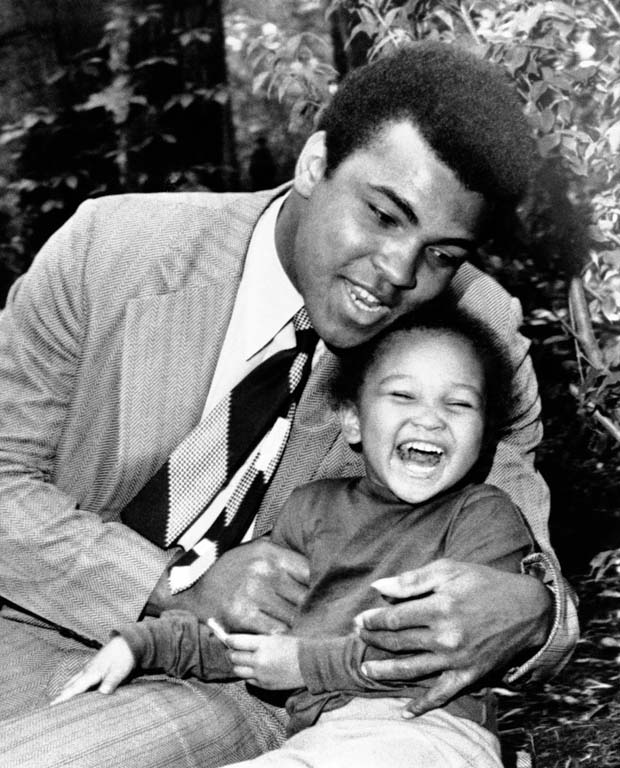
Muhammad Ali plays with his 3-year-old daughter Maryum at his home in Cherry Hill, N.J., on Monday, June 14, 1971.
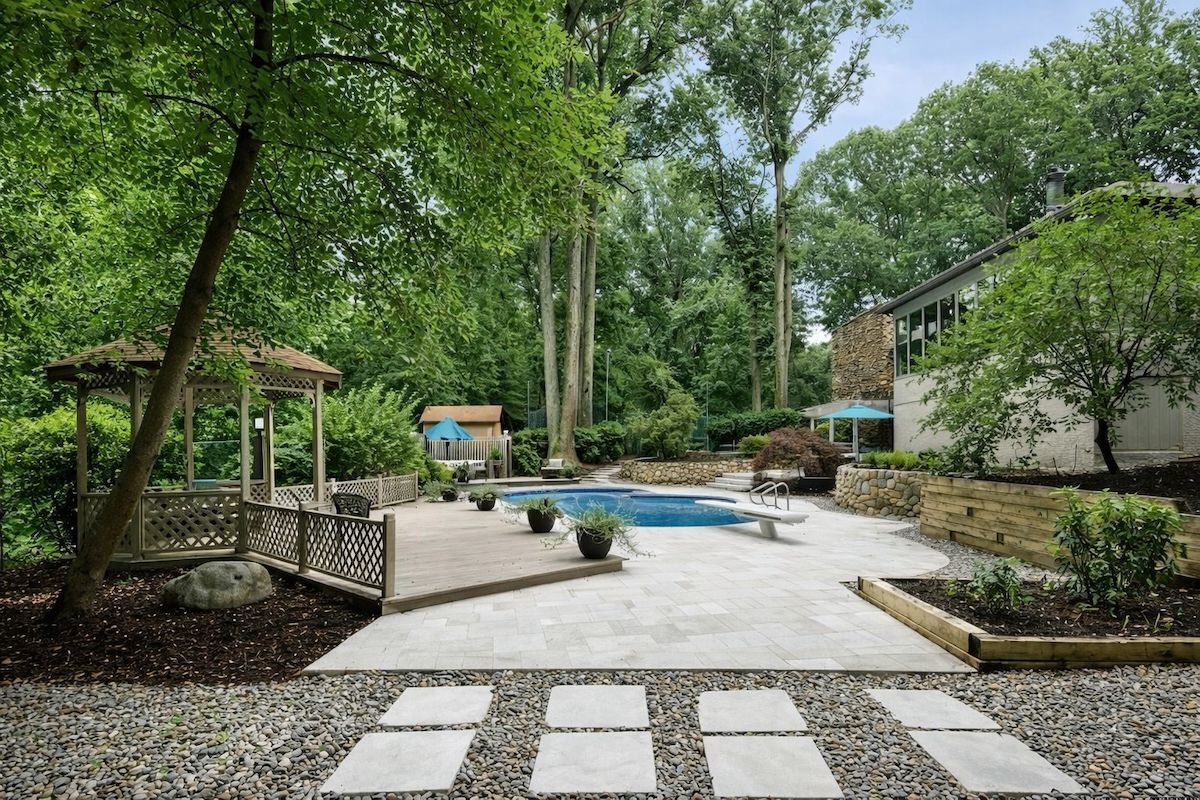
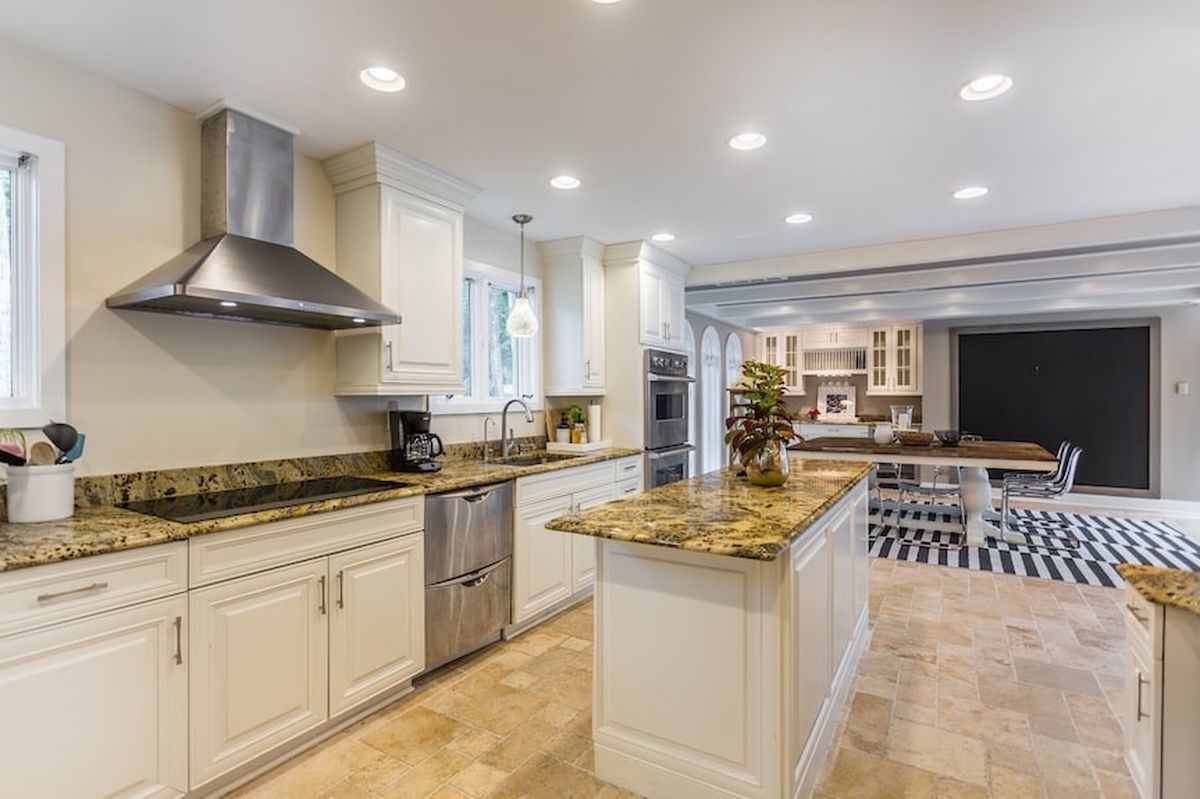
Sitting on 1.5 acres, the six-bedroom, five-bathroom estate features a kitchen with a large center island and custom cabinetry, a sun-filled greenhouse room, a spacious living area, and an in-ground pool and hot tub, with adjacent basketball and tennis courts. On the lower level of the home is a personal gym and a 12-foot wet bar.
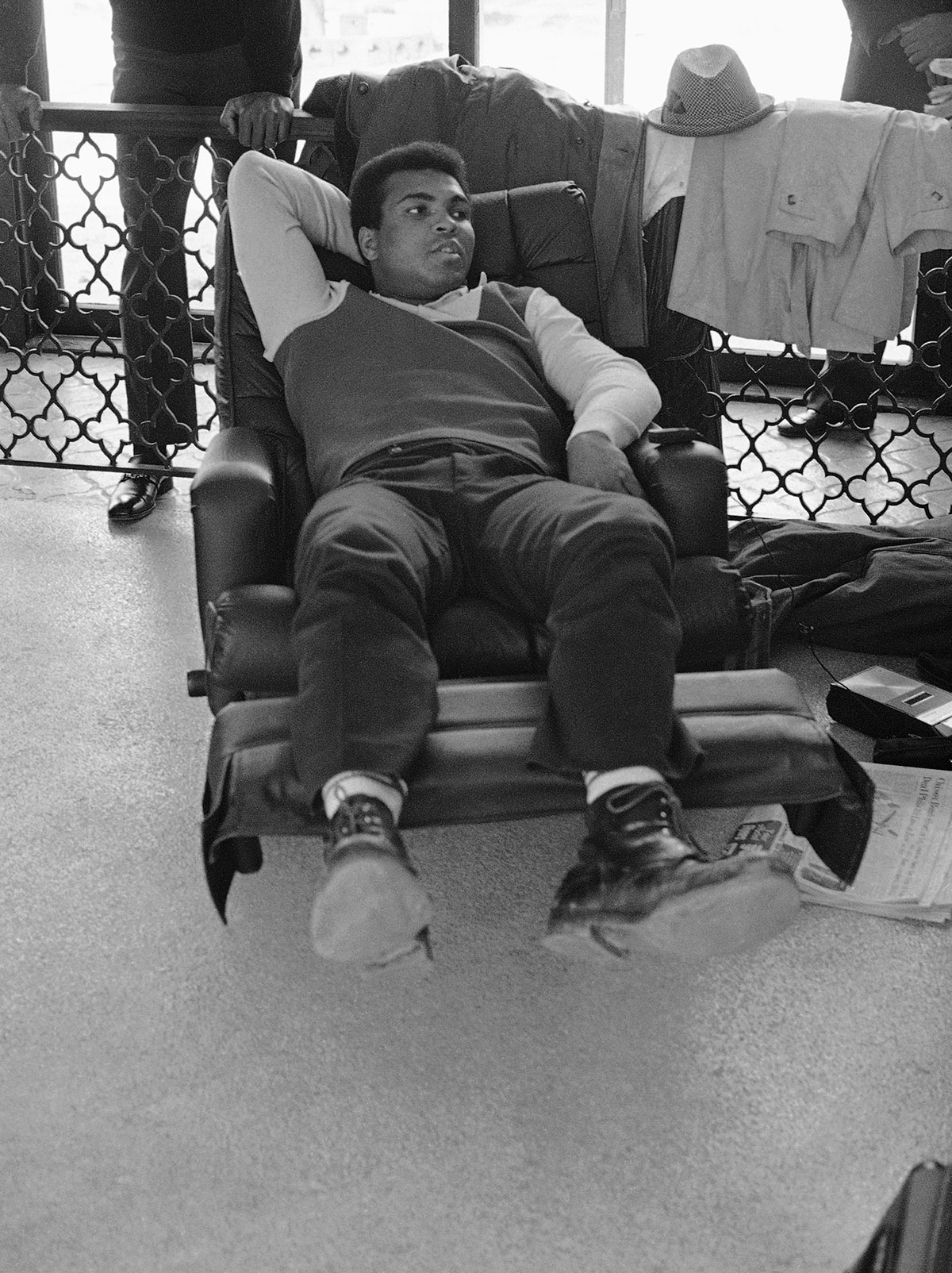
Muhammad Ali, who was defeated by heavyweight champion Joe Frazier, leans back in a reclining chair in his new home in Cherry Hill, N.J., March 10, 1971, as he answered Frazier’s promise to fight Ali again. “Good, we got a rematch, maybe in seven months, might be sooner,” Ali said.
The Champion bought the home for $103,000 in 1971. He moved to Chicago a few years later, according to the New York Times, after his friend, Camden power broker Major Coxson, was shot and killed in his home down the road from Ali’s. A major franchisee of local McDonald’s bought the home from Ali for $175,000.
The backyard and pool area of 1121 Winding Dr. in Cherry Hill, the former home of prizefighter Muhammad Ali from 1970 to 1973. It’s now up for sale for $1.9 million in 2026.
The current owners, who purchased the Cherry Hill homein 2014, traded in the 1970s decor and design for a modern look, converting Ali’s koi pond intoacenterpiece courtyard and fire pit. However, the home retains Ali’s prayer room, which can be found in the lower level, lined with bookshelves.
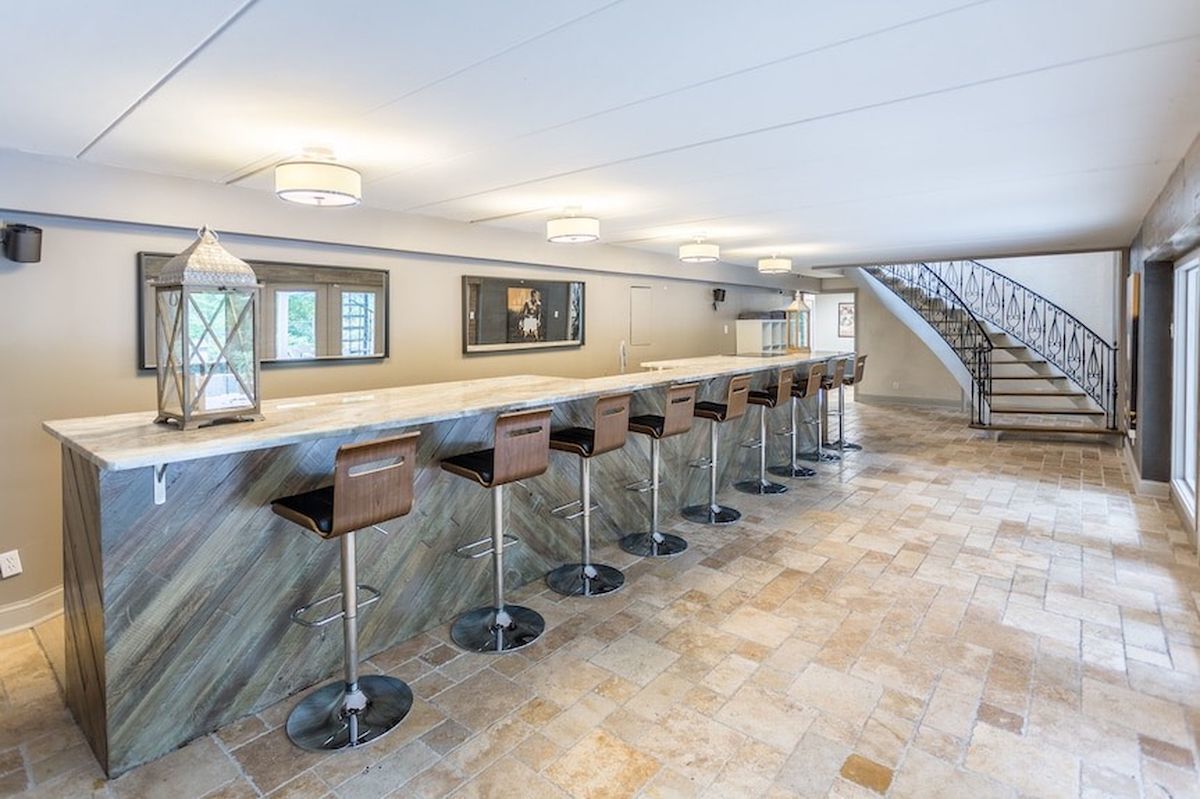
The main draw is the ample entertainment spaces, includingthe basement bar.
The downstairs bar area at 1121 Winding Dr. in Cherry Hill, the former home of Muhammad Ali from 1970 to 1973. It’s now up for sale for $1.9 million in 2026.
“There’s a spiral staircase from the main level to downstairs and you walk right into this large bar area, with tables, chairs, and a large TV setup,” Nicholas Alvini of Keller Williams said. “It really is a great entertaining house.”
The kitchen, including a large island, at 1121 Winding Dr. in Cherry Hill, the former home of prizefighter Muhammad Ali from 1970 to 1973. It’s now up for sale for $1.9 million.
In recent years, the home has been used for short-term rentals, and“wild parties” led police to visit the home 97 timesbetween 2018 and 2019, according to an Inquirer report. In response, Cherry Hill township councilalmost adopted a ban on Airbnb rentals before eventually tabling the idea after community members spoke against it.
I spoke with a Friends School class this week, primarily about my photos decades ago of unhoused men in Center City. It was part of their week working with PhotoVoice, a research method where participants photograph their own lives to highlight community strengths and challenges, and advocate for social change.
After the class, and following many thoughtful questions from the middle schoolers about how in general I approach people before I photograph them, and specifically people in vulnerable situations, a student came up to ask me a more practical question: “How do you take pictures in bad weather?”
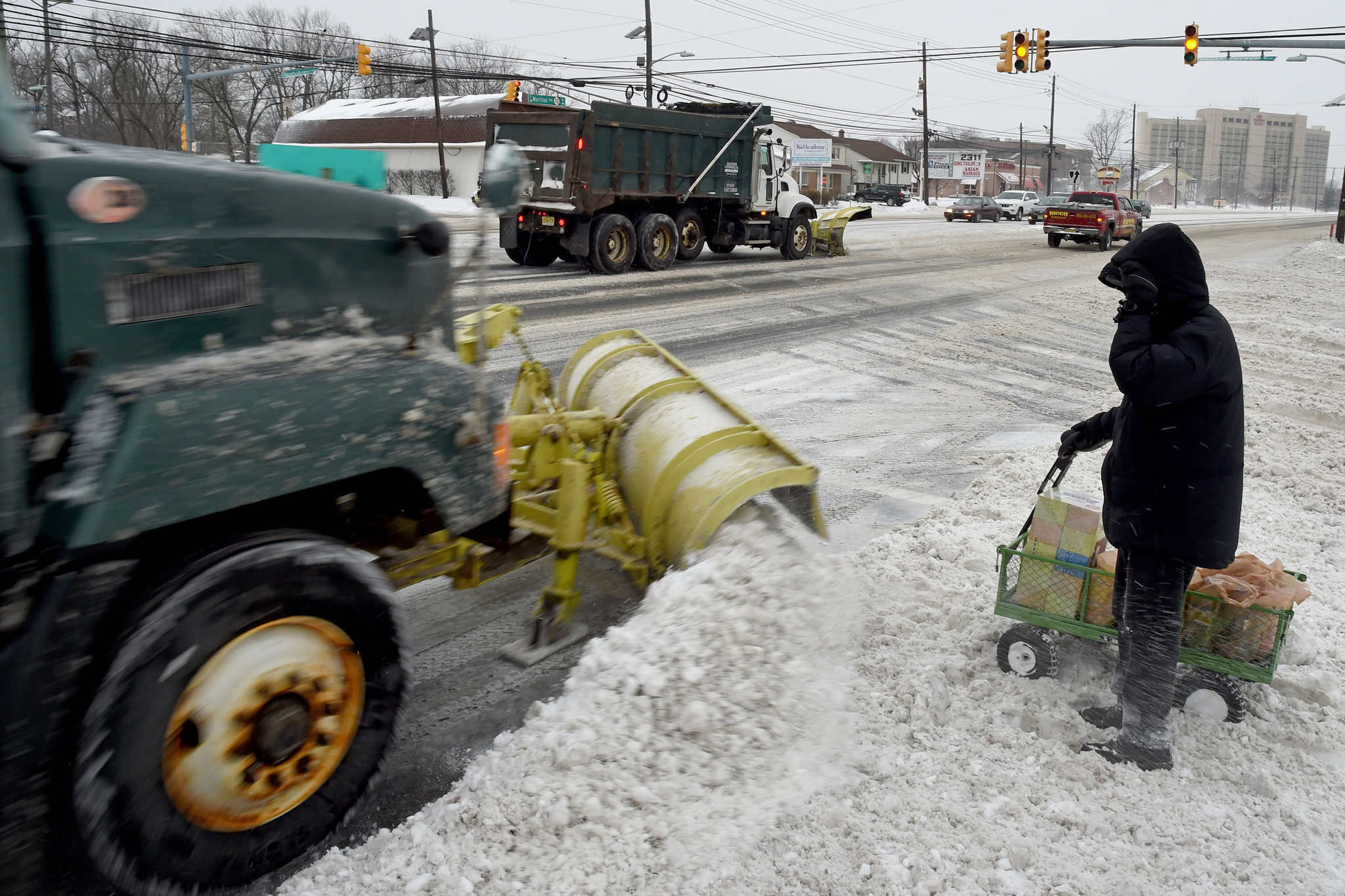
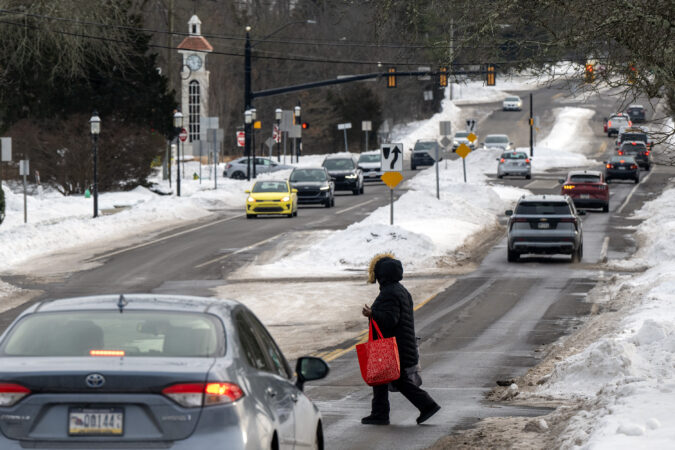
Pedestrians and plows on Rt. 70 in Cherry Hill in Januiary, 2018.
I don’t have an all-weather, sealed camera, so besides dressing as best I can for the conditions (and always having a spare pair of thick, dry wool socks in my car) keeping my camera protected is the biggest priority. I not only need to stave off mechanical/electronic breakdown, but have to keep my lens clear of the elements.
I told him I do have a dedicated rain sleeve but I’ve only used it once or twice at rainy sporting events (they’re priced from $2 each up to $200).
Mostly I use plastic bags or a large umbrellas (watching that I not catch the edges in my frame). I also try to find dry areas to stand in — while watching and photographing others out in the elements. I seek cover under a roof, awning, or doorway. I go into parking garages or subway entrances.
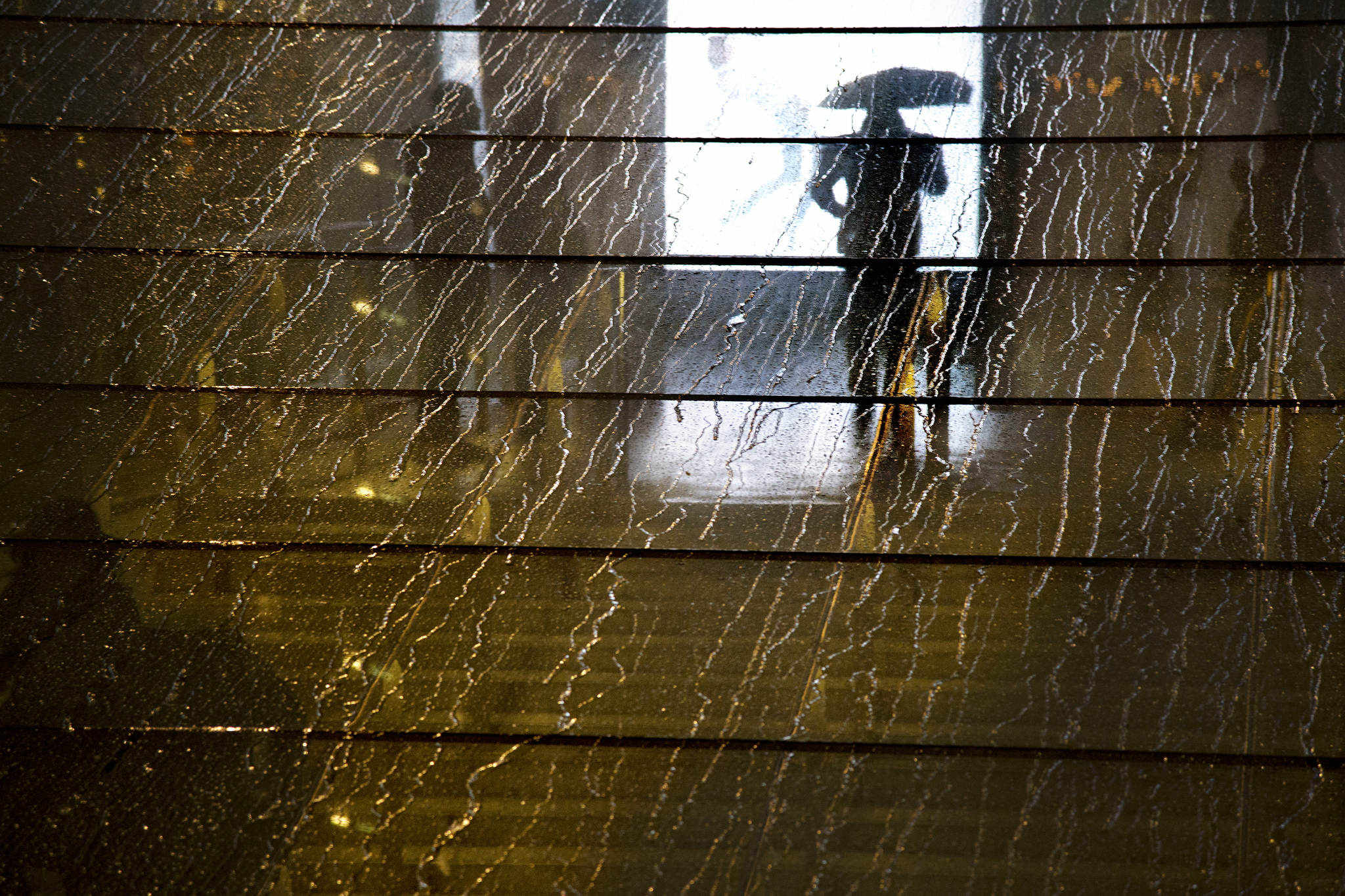
The glass entrance to SEPTA’s underground concourse at Dilworth Park by City Hall.
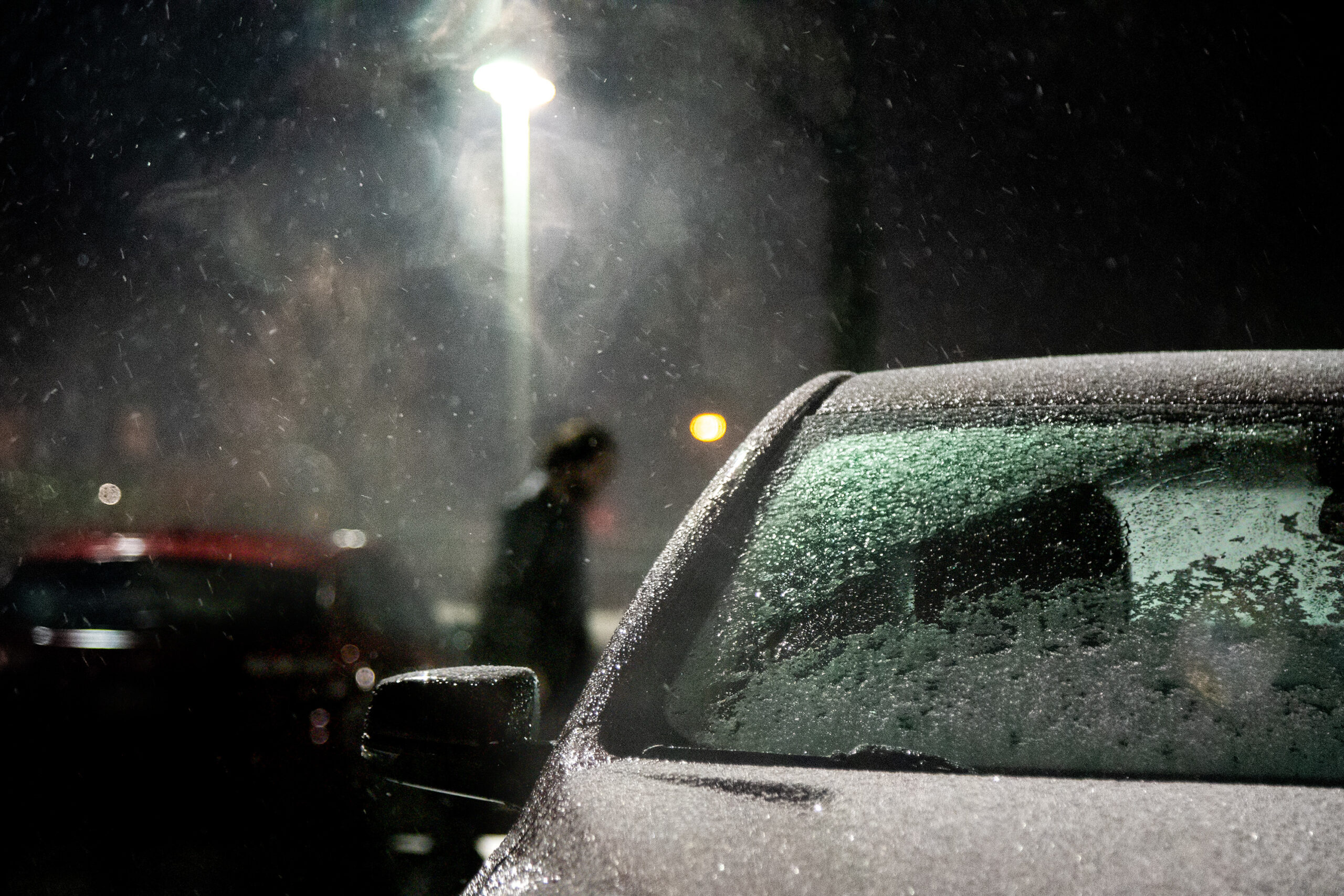
Sometimes I safely park my car where I can briefly open my leeward (downwind!) window. Other times the rain or snow on glass can even be an effective way to portray the “dab” weather. It can be in or out of focus to create a bokeh-like effect or blurred to convey mood. Your choice of a fast shutter or slow shutter can either stop the drops or show their movement.
Precipitation — some snow and some rain — falls on cars in a parking lot on City Avenue.
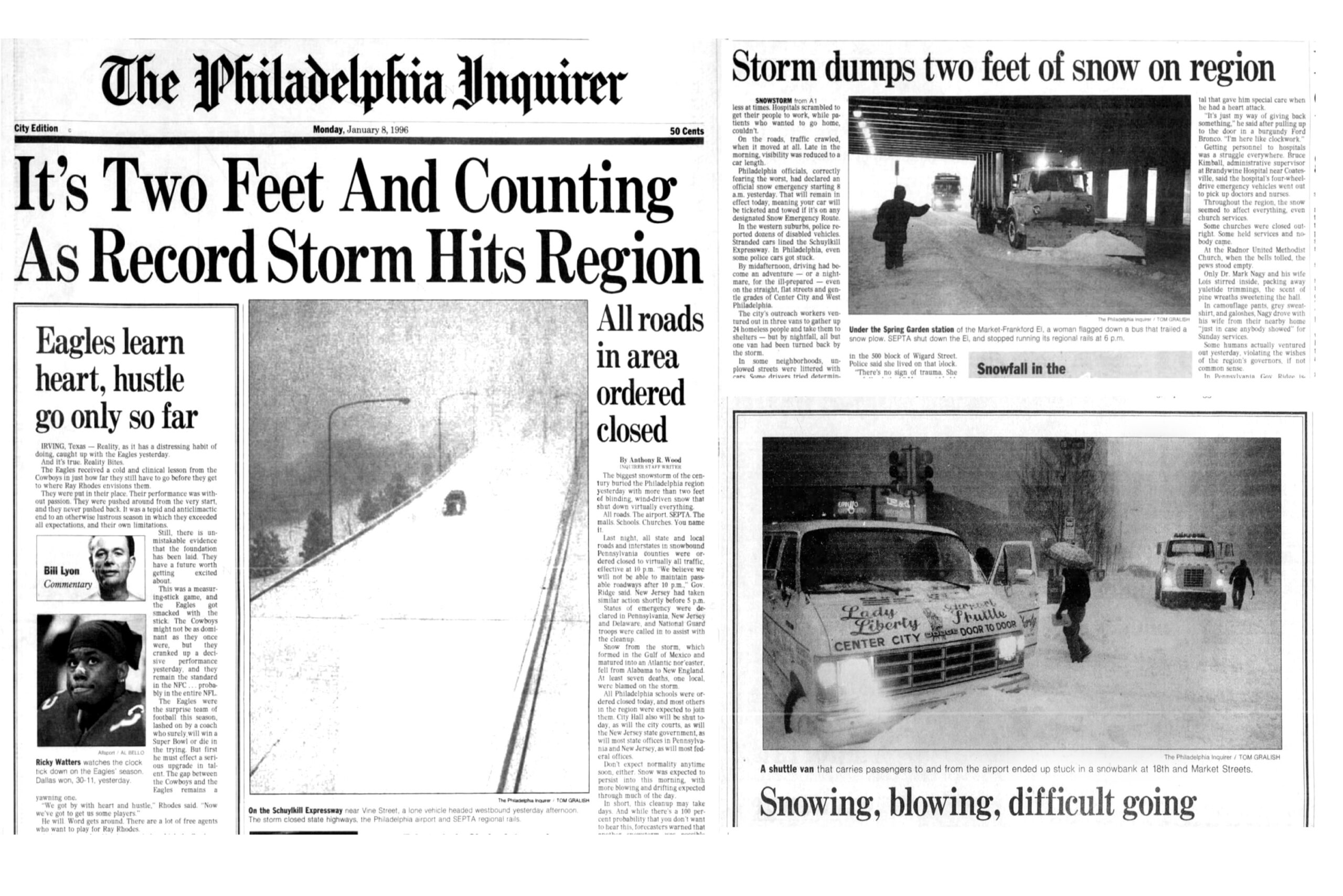
I’ve covered all of the biggest storms of the past few decades, including the historic “Blizzard of the Century” thirty years ago this month.
Front page and inside photos from The Philadelphia Inquirer. January 8, 1996.
So, I took my own advice while preparing to go out last Sunday. Knowing the roads would get worse as the day went on, I drove out of my South Jersey neighborhood while an early pass of the plows left main arteries somewhat passable, and headed straight to the nearest Wawa that I knew would have a clear-ish parking lot.
Stepping out from under the overhang — I made a few photos before walking out into on the wide street to get the few passing cars and plowing crews in a nearby shopping center.
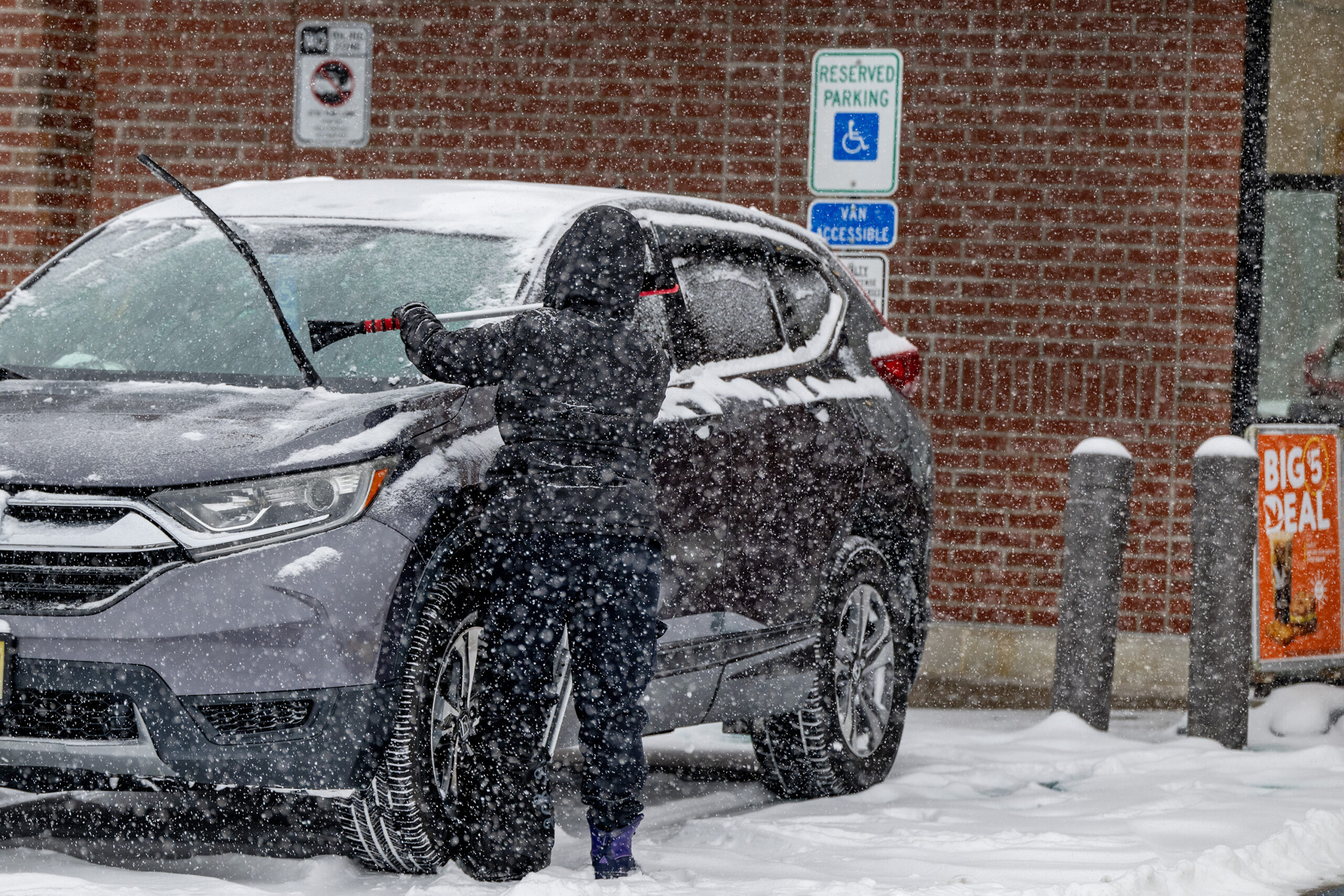
Carmen Roman clears snow off her car at a Cherry Hill Wawa early Sunday morning, Jan. 25, 2026, as heavy snow bands move through the region generating snowfall rates of 1 to 2 inches an hour.
From there, confirming my fears the roads would be more difficult to drive on, I headed the Westmont PATCO station, finding a safe place to park even as workers were hard at it, clearing the lot.
I made photos from the elevated platform before taking a train to Collingswood, where — standing on the leeward side of the stairwell shelter — I took more pictures then walked into downtown.
Haddon Avenue was plowed and relatively empty of cars, but the sidewalks were impassible. I sent in my best photo of people walking along the middle of the downtown street.
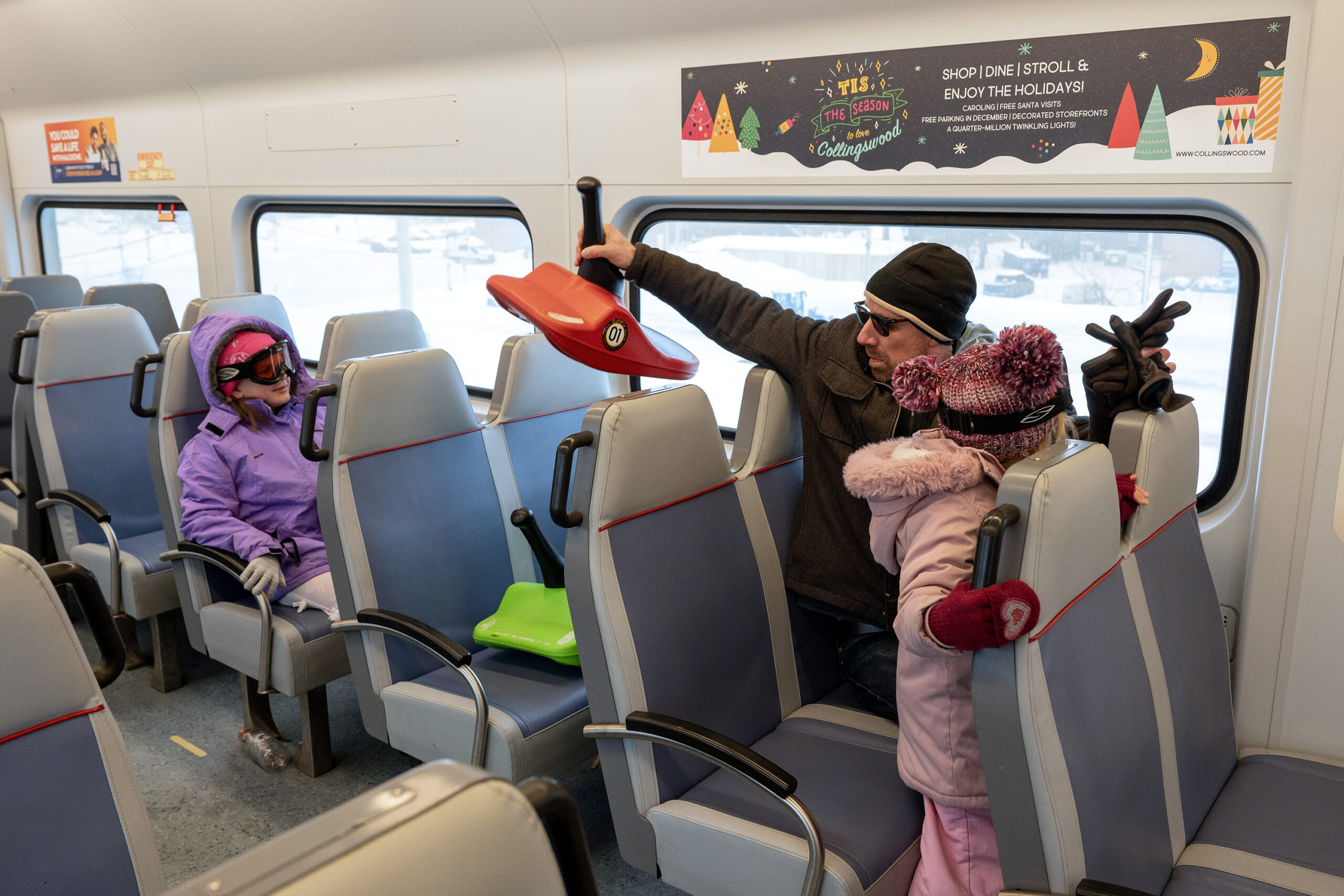
It was then I saw Mike Doveton and his daughters. Not wanting to repeat my earlier image, I asked if they were headed to or from sledding.
They were walking to the PATCO station to sled in Haddonfield, so I tagged along.
On the train headed to sled.
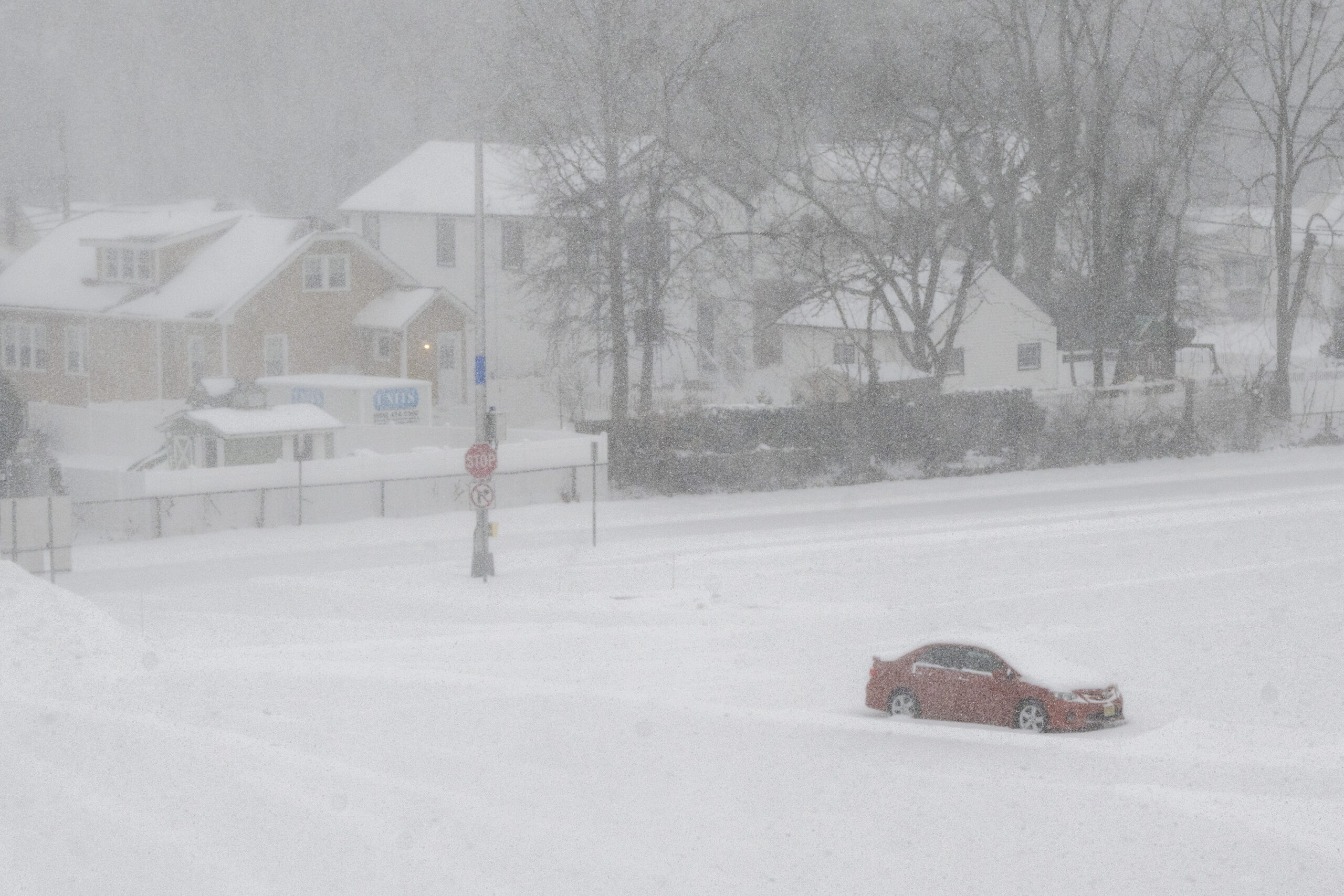
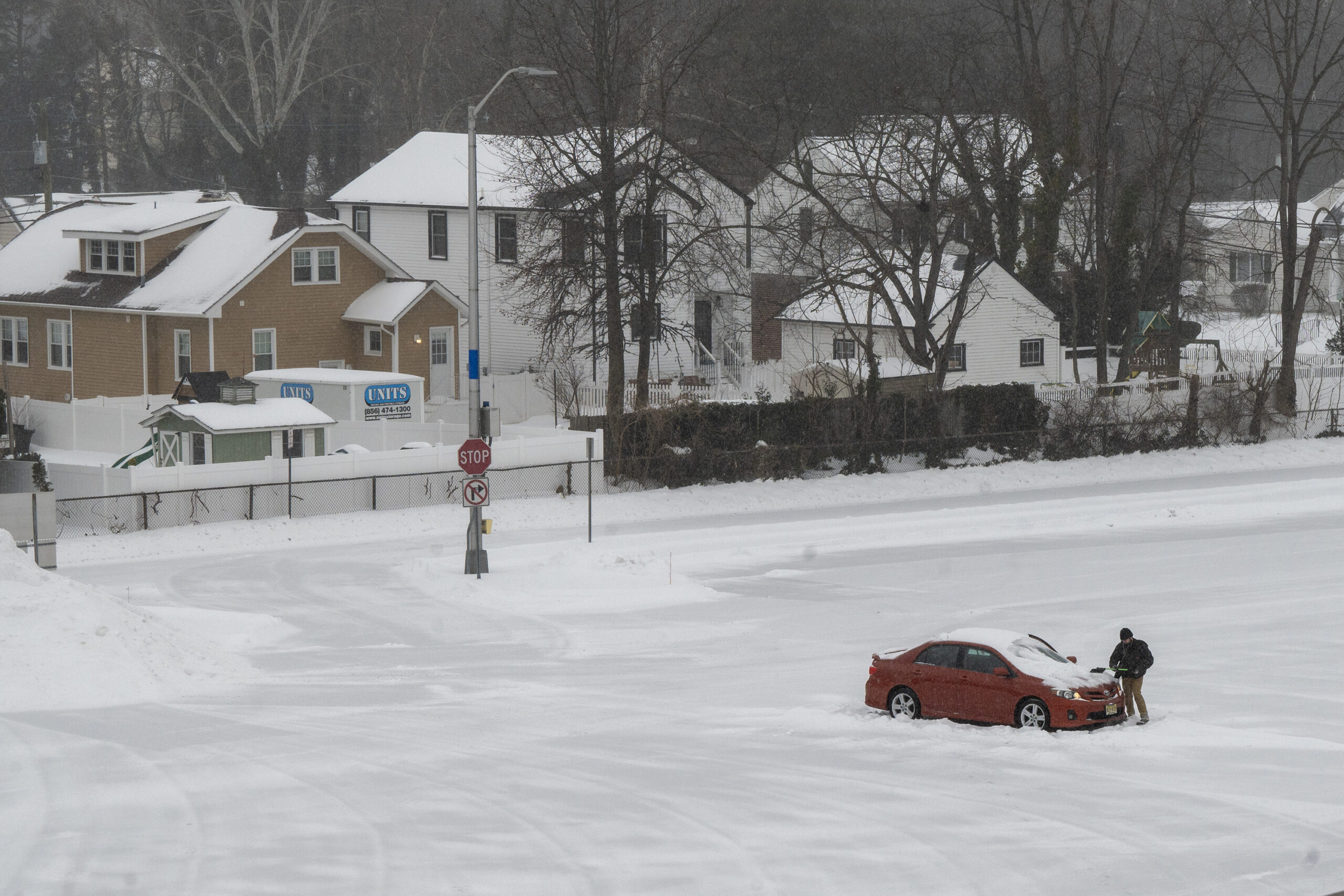
I went with them to their destination, but didn’t want another kids-on-a-hill photo, so I got back on the train returning to the Westmont station, and my car, calling it a day. Until I saw someone digging out their car — the same one I had photographed hours earlier. I got as close as I could to the spot on the platform and made an “after” photo.
Before and after in the Westmont PATCO station parking lot.
Luis Nova had left his car there on Friday, and was in Philadelphia all weekend helping friends move and going to a goodbye party. He spent the morning sledding with friends in Clark Park in West Philadelphia. Like me, he had experience with storms. “I spent four years in Rochester [NY],” he told me. “So I knew what I was signing up for and was ready. I left all my equipment to get myself out.”
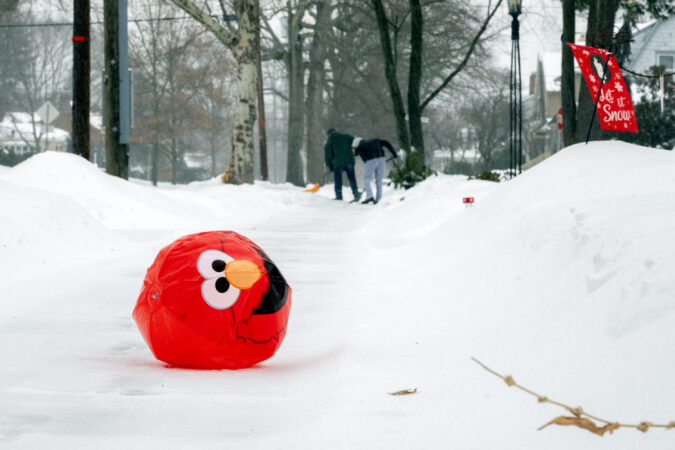
But the highlight of the day was at the very end, as I headed for home as the snow was turning to sleet. Two hours earlier, in the middle of the storm my grandson snapped a photo out our front window of an Elmo head in the middle of the street before the wind blew it away, and shared the picture with our family. As I approached my house, I see a red ball rolling fast down the street toward me. I almost drove into a snow bank laughing.
Not really, but I did pull into the driveway, grab a camera, jump out of my car and go chasing after it. The wind was really moving it, and I couldn’t see where it was, which was hard to imagine, being as the road and everything else was all white. I came up to a couple of guys shoveling and asked, “Did you see an Elmo head come this way?” They had, and said it went up a driveway and jumped onto the sidewalk. I found it and just as I was lining up my photo the wind took it again and it started spinning.
Since 1998 a black-and-white photo has appeared every Monday in staff photographer Tom Gralish’s “Scene Through the Lens” photo column in the print editions of The Inquirer’s local news section. Here are the most recent, in color:
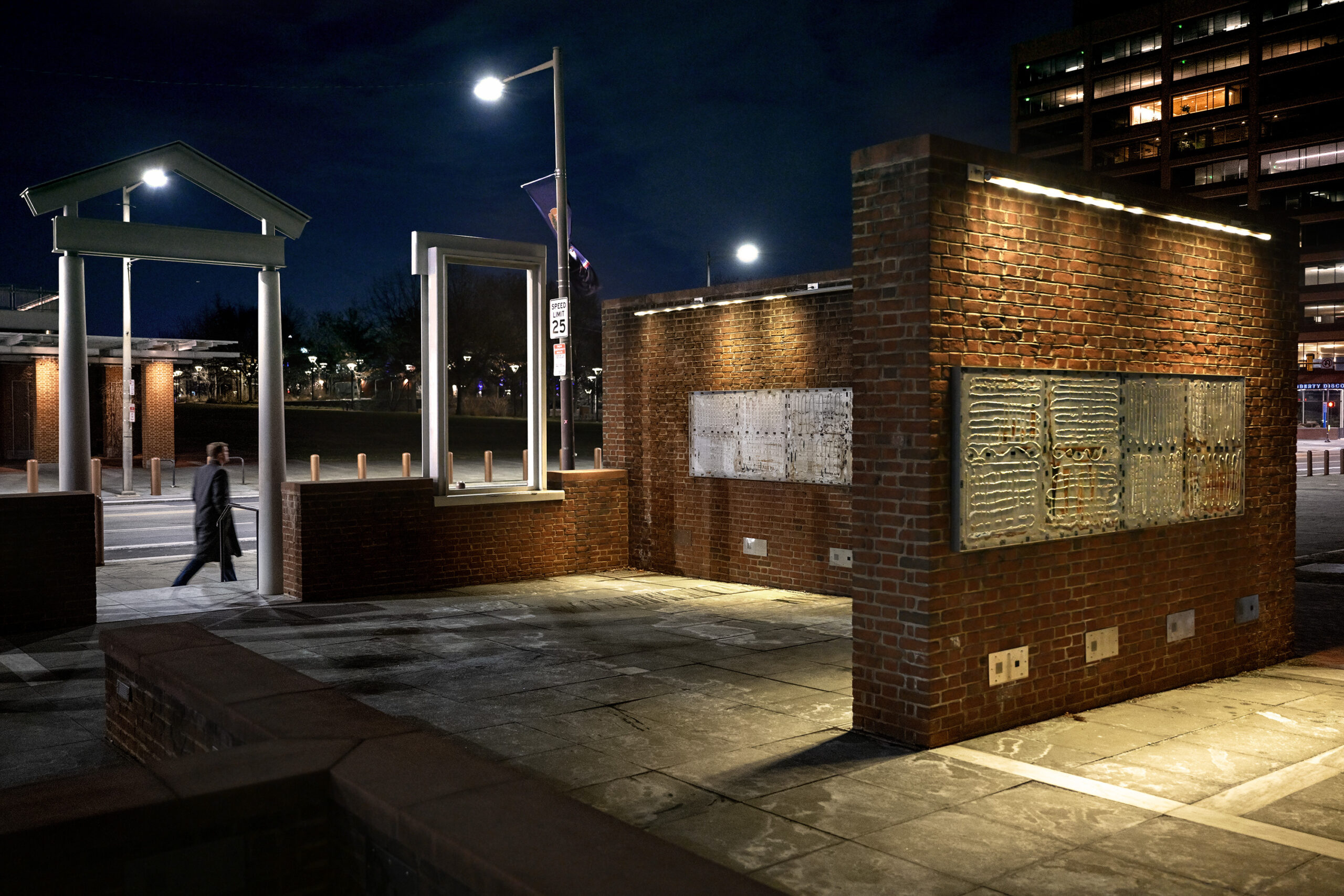
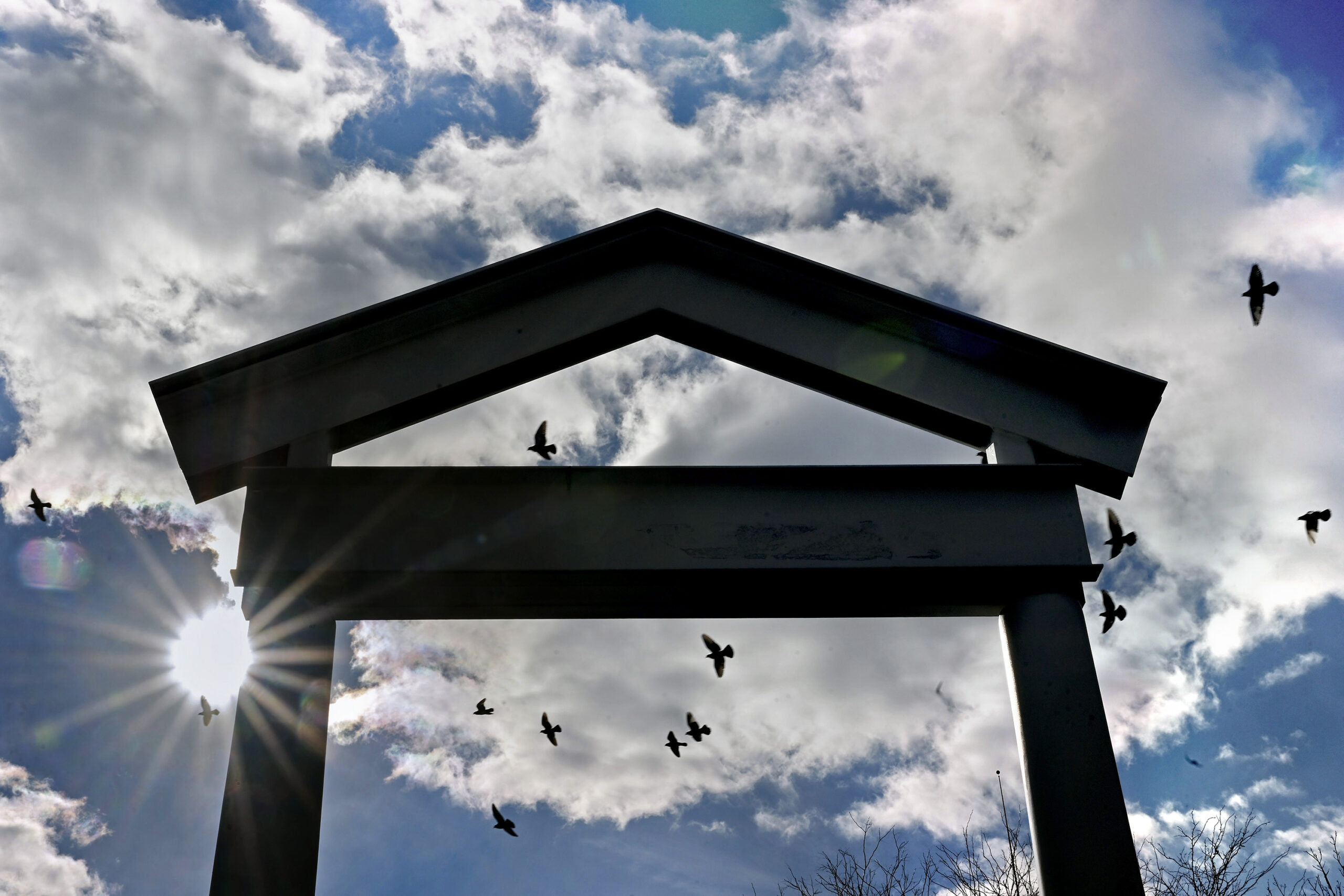
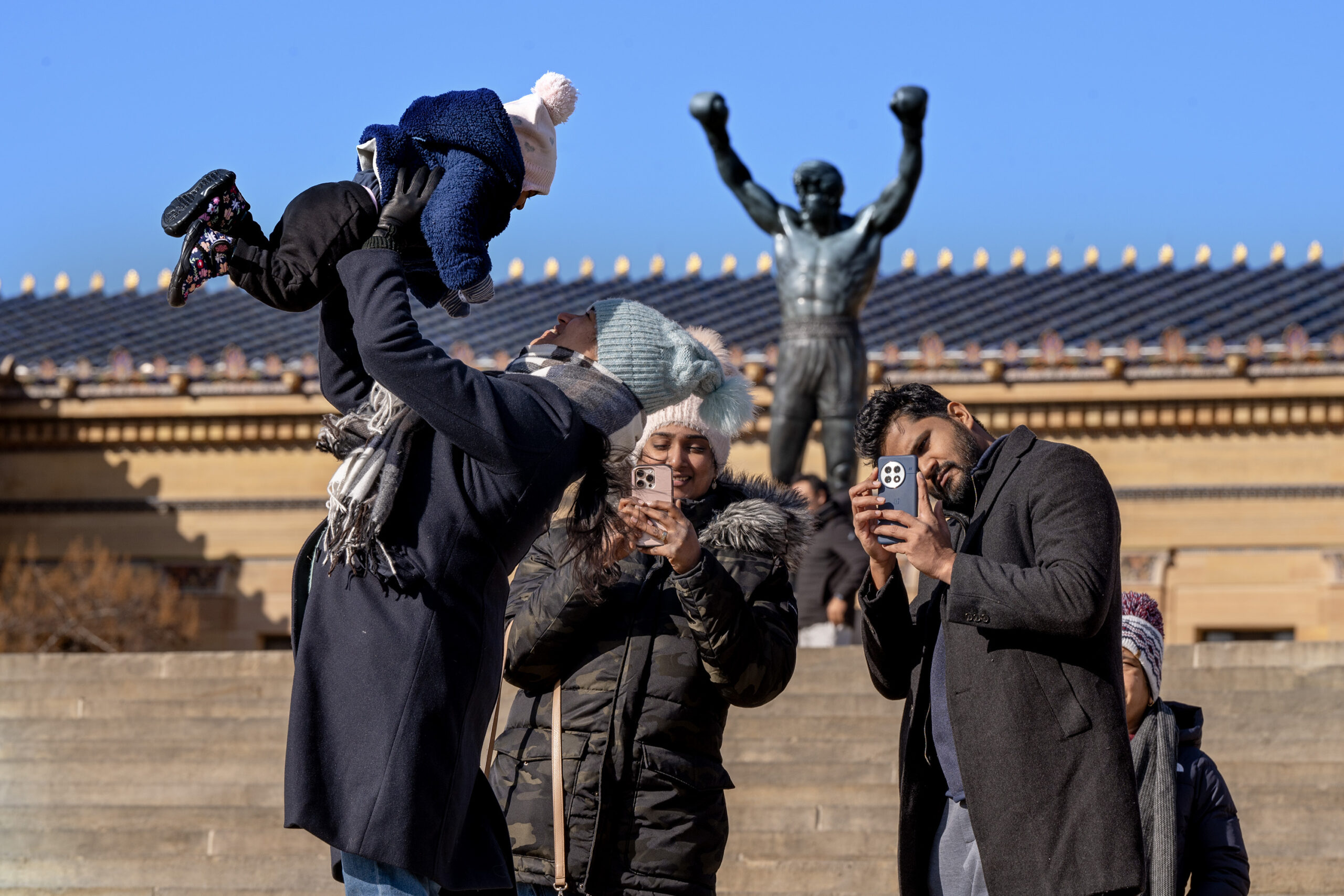
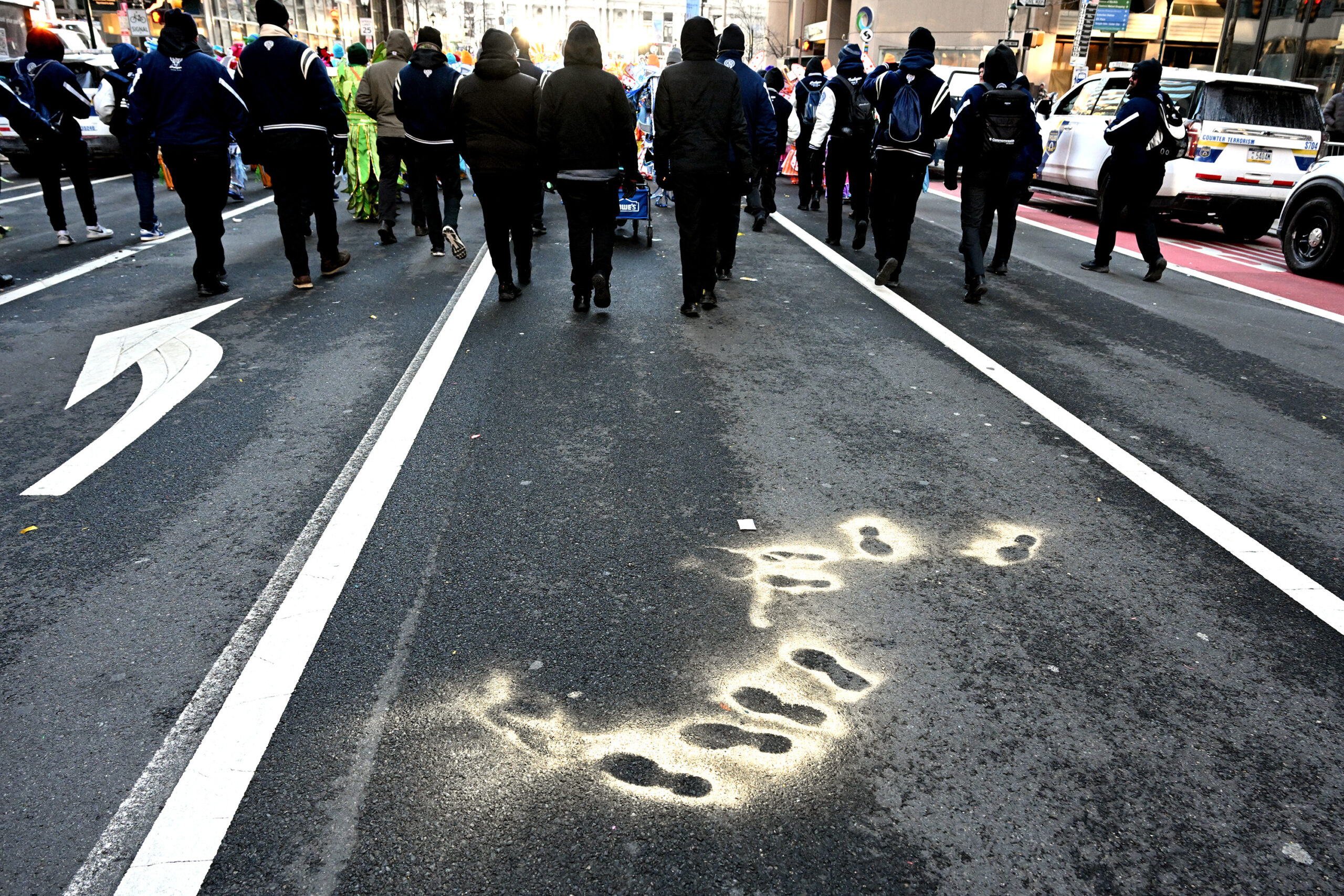
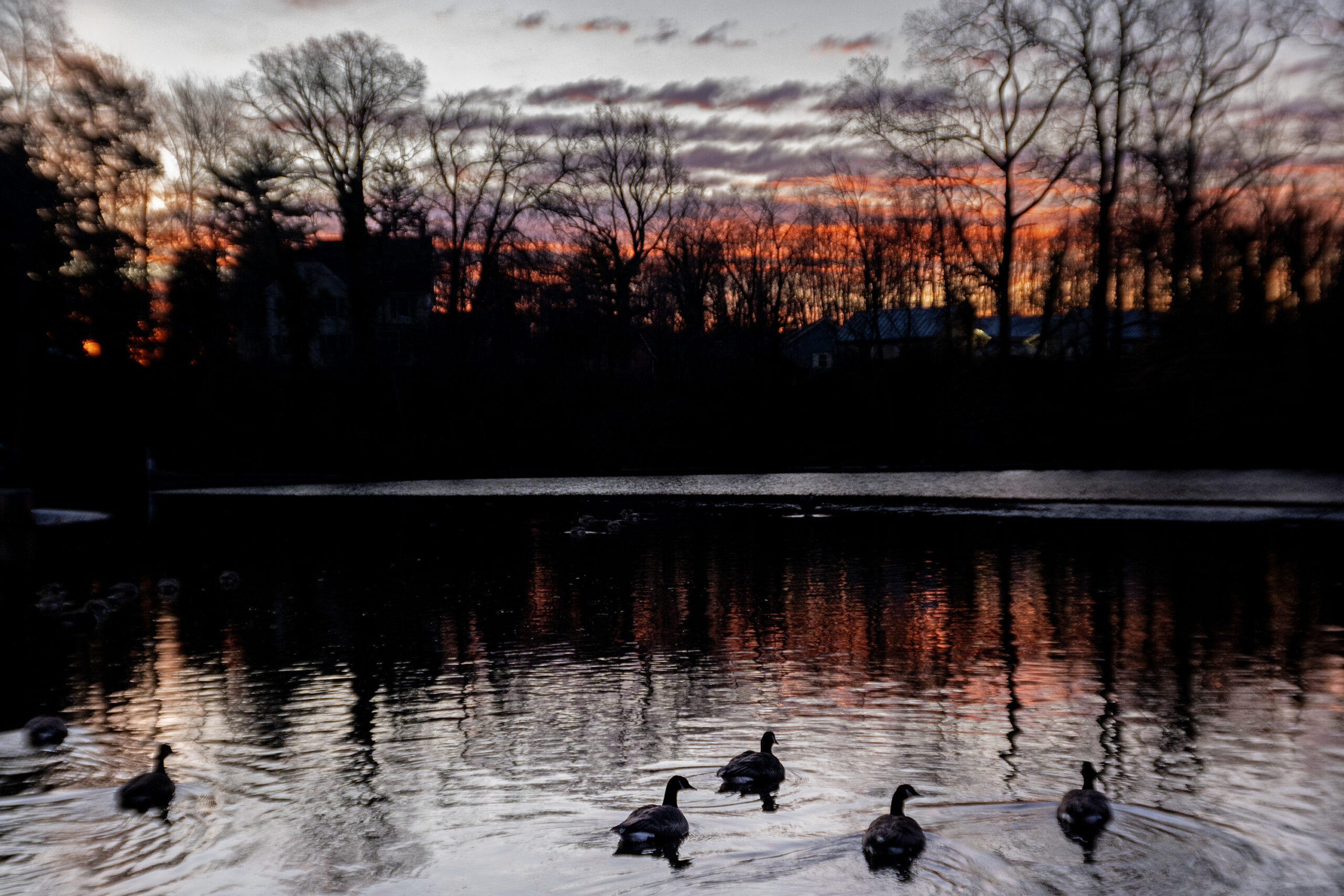
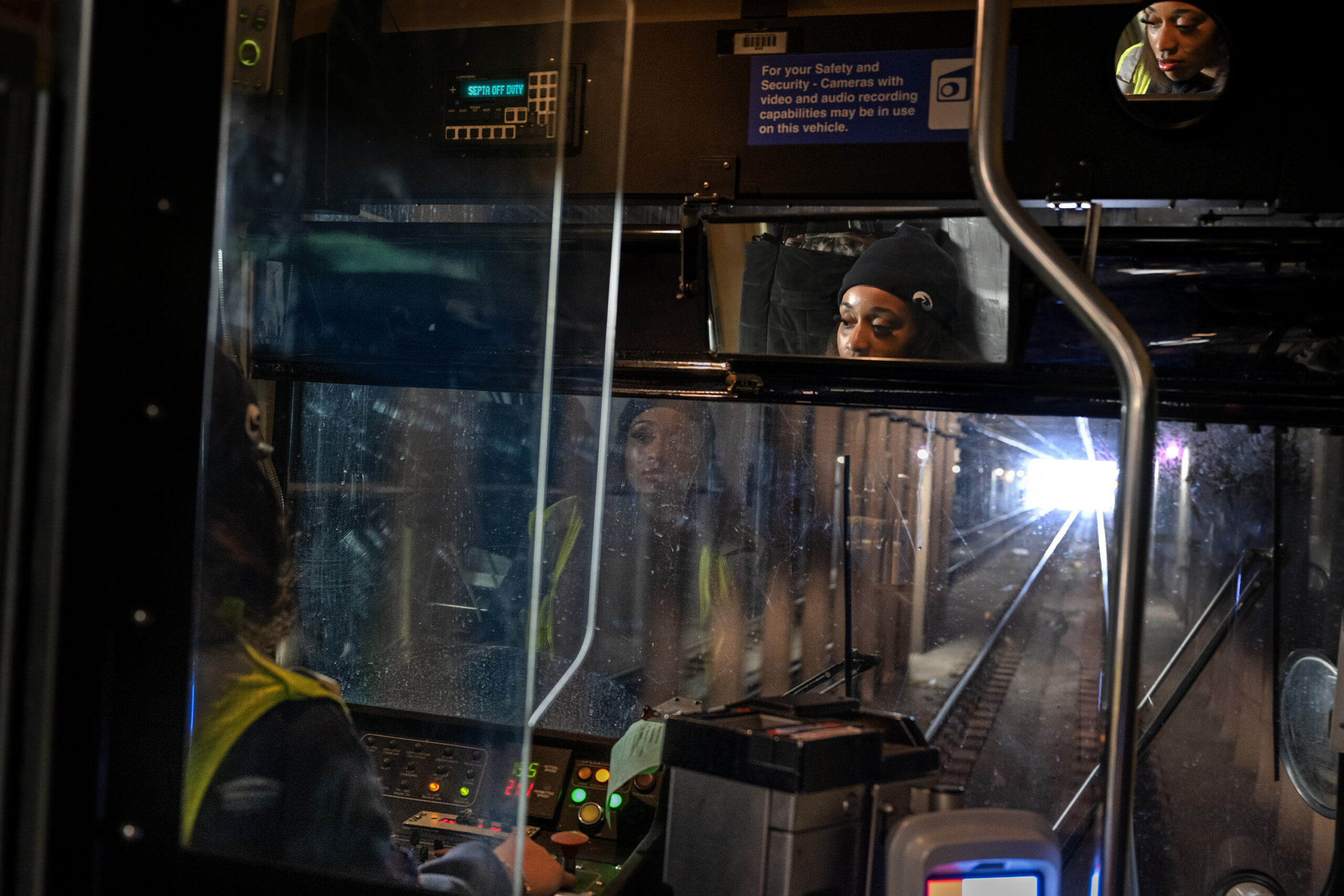
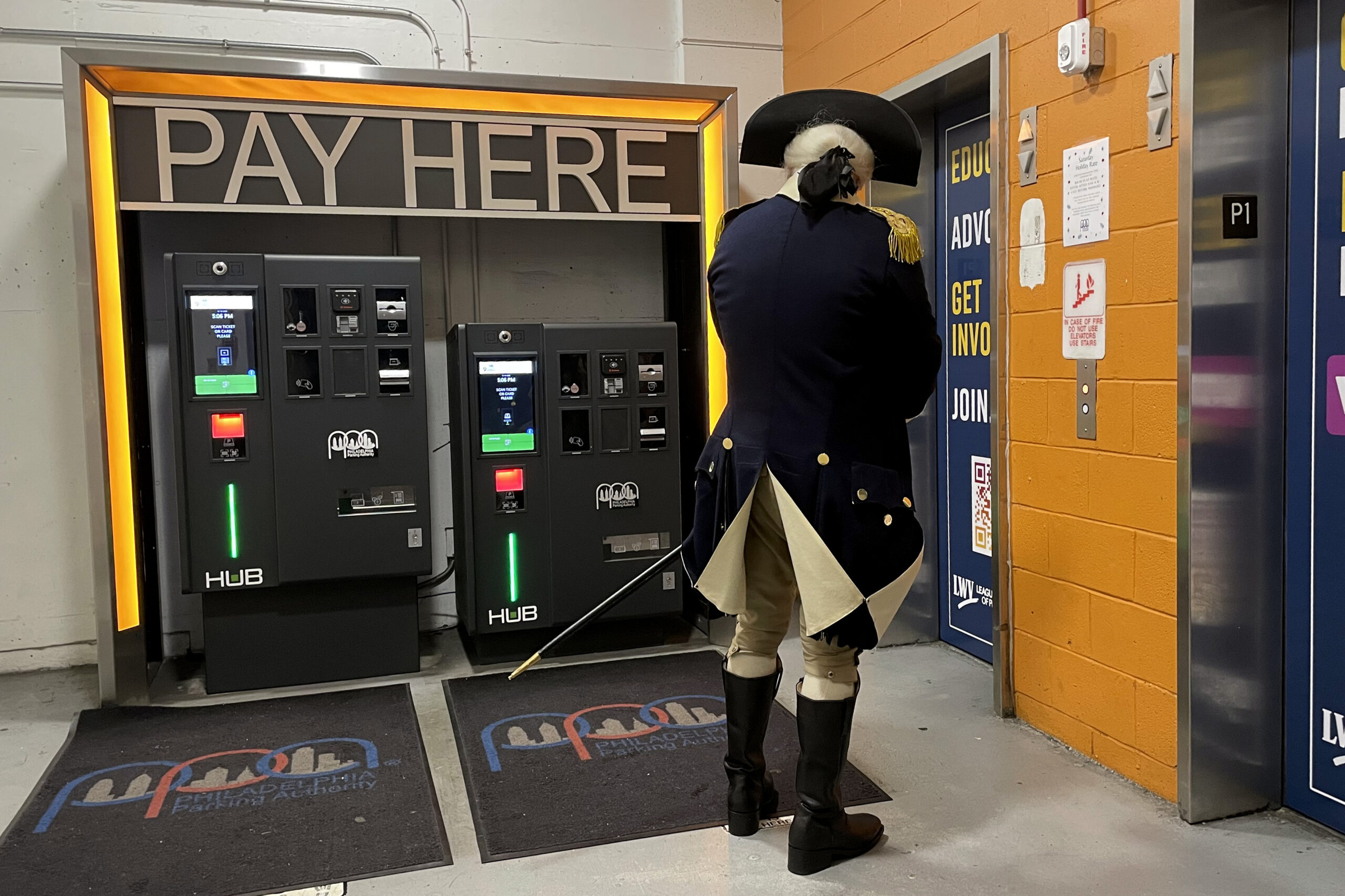
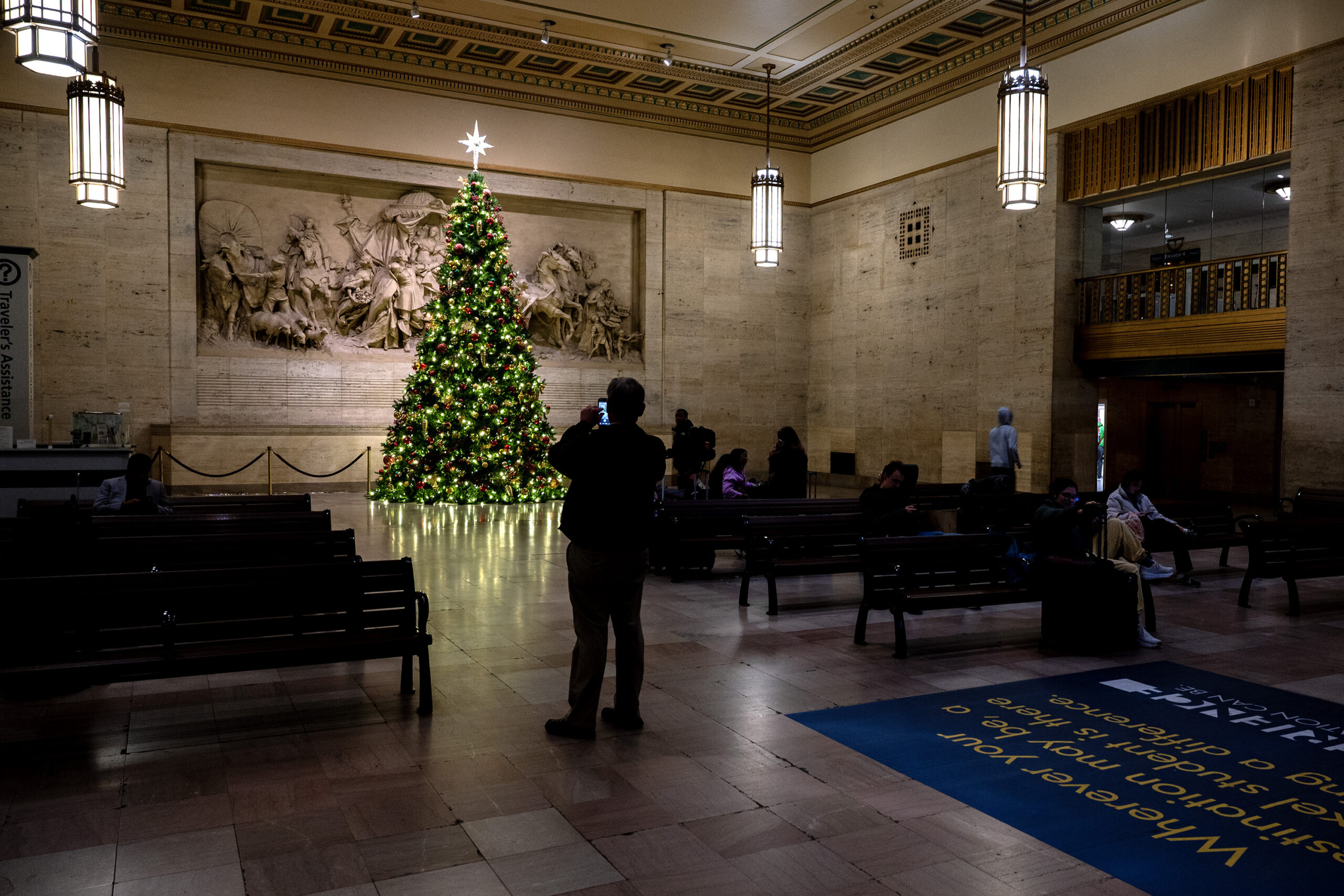
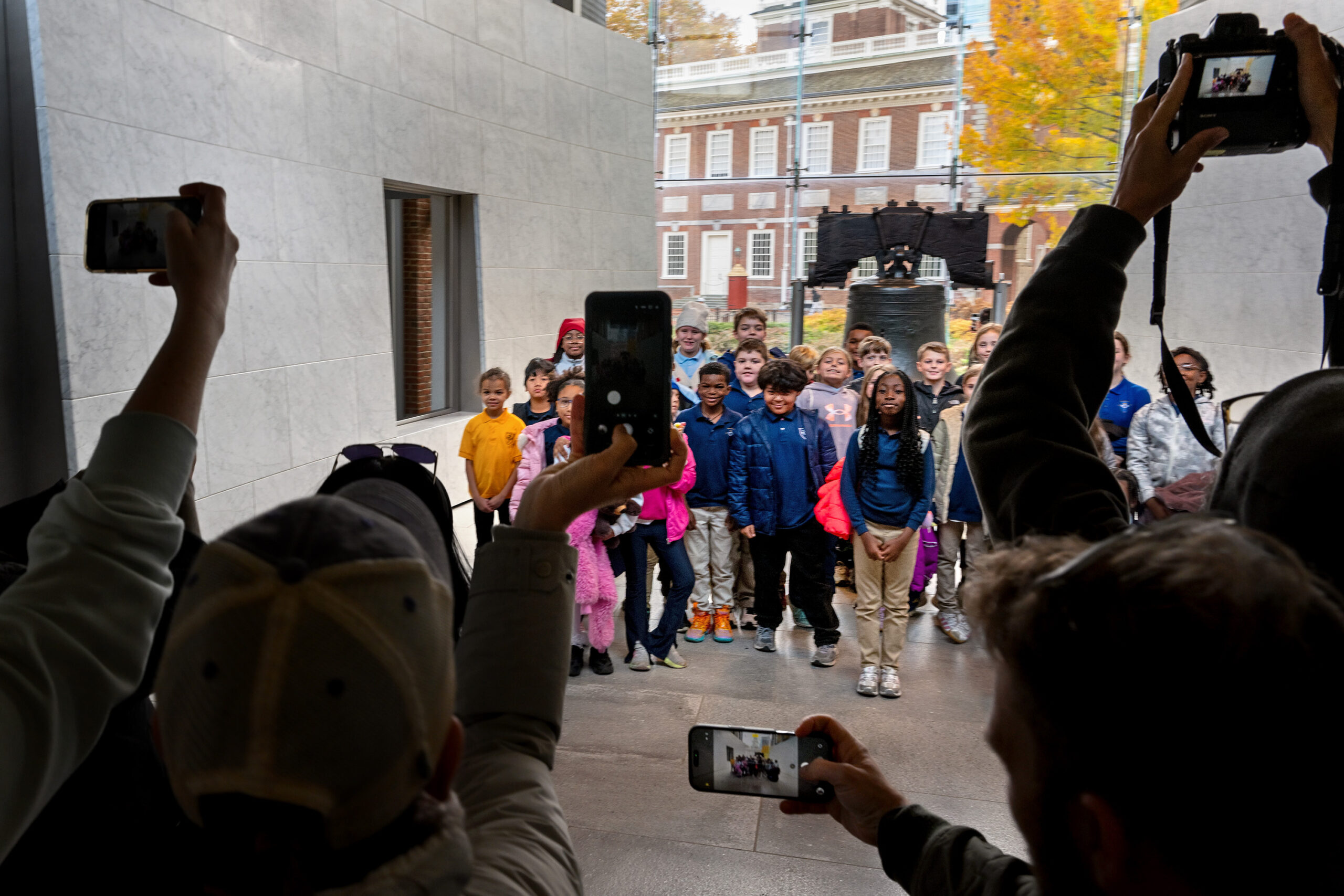
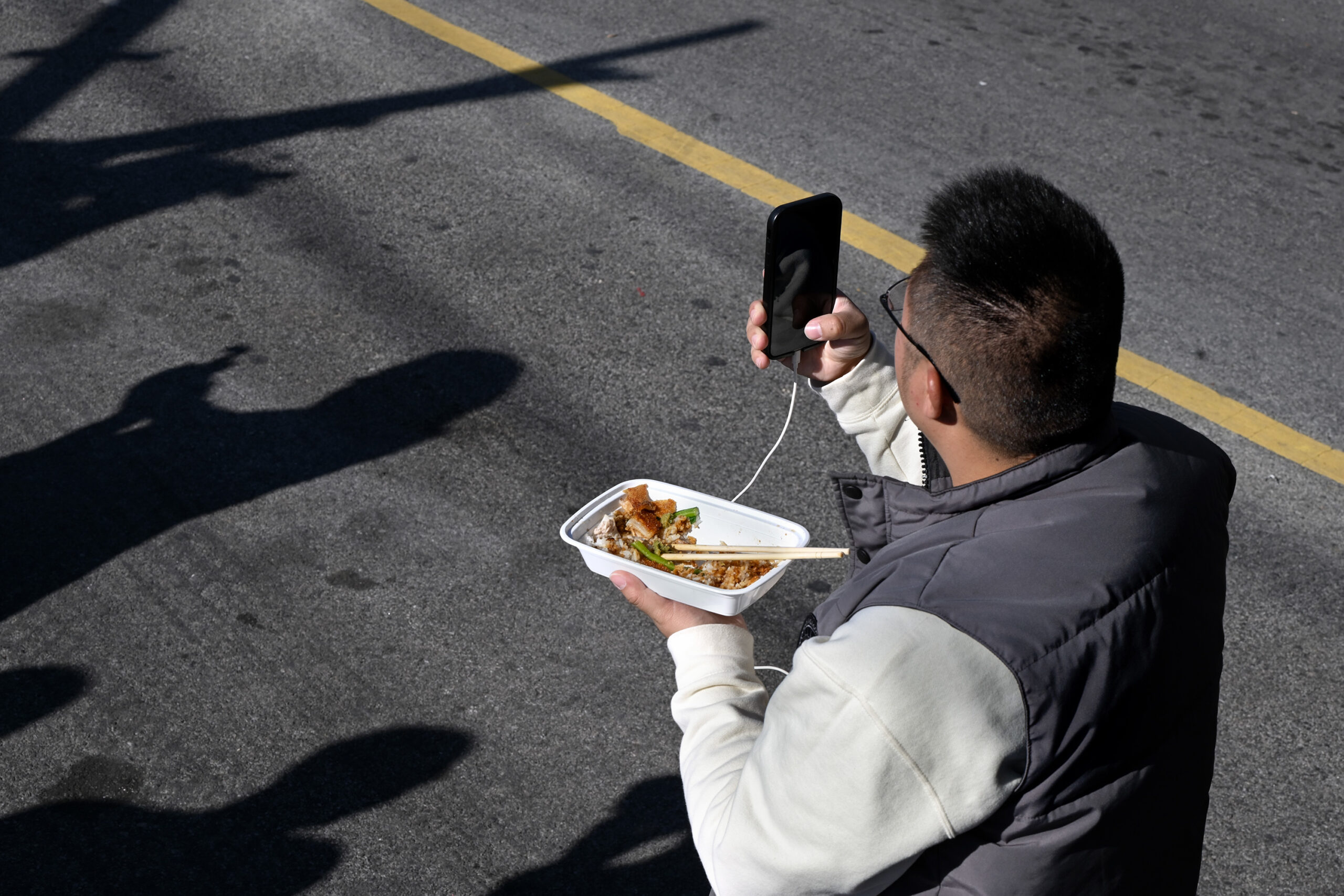
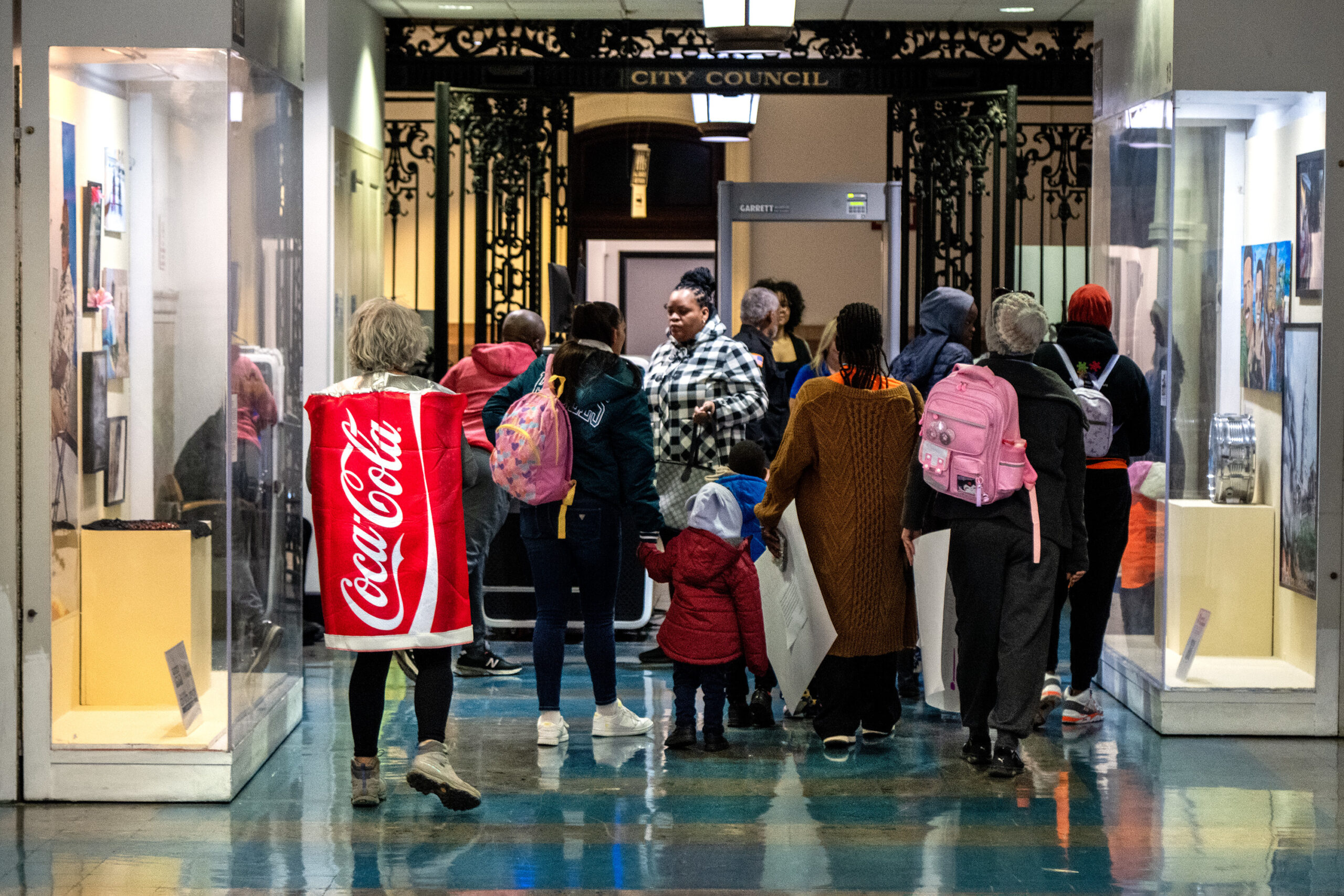
January 26, 2026: The President’s House in Independence National Historical Park hours Jan, 22, after all historical exhibits were removed following President Trump’s Executive Order last March that the content at national parks that “inappropriately disparage” the U.S. be reviewed. The site, a reconstructed “ghost” structure titled “Freedom and Slavery in the Making of a New Nation” (2010), serves as a memorial to the nine people George Washington enslaved there during the founding of America.January 19, 2026: A low-in-the-sky winter sun is behind the triangular pediment of the “front door” of the open-air President’s House installation in Independence National Historical Park. The reconstructed “ghost” structure with partial walls and windows of the Georgian home known in the 18th century as 190 High St. is officially titled, “Freedom and Slavery in the Making of a New Nation” (2010). It is designed to give visitors a sense of the house where the first two presidents of the United States, George Washington and John Adams, served their terms of office. The commemorative site designed by Emanuel Kelly, with Kelly/Maiello Architects, pays homage to nine enslaved people of African descent who were part of the Washington household with videos scripted by Lorene Cary and directed by Louis Massiah. Deepika Iyer holds her niece Ira Samudra aloft in a Rockyesque pose, while her parents photograph their 8 month-old daughter, in front of the famous movie prop at the top of the steps at the Philadelphia Art Museum. Iyer lives in Philadelphia and is hosting a visit by her mother Vijayalakshmi Ramachandran (partially hidden); brother Gautham Ramachandran; and her sister-in-law Janani Gautham who all live in Bangalore, India.January 5, 2026: Parade marshals trail behind the musicians of the Greater Kensington String Band heading to their #9 position start in the Mummers Parade. Spray paint by comic wenches earlier in the day left “Oh, Dem Golden Slippers” shadows on the pavement of Market Street. This year marked the 125th anniversary of Philly’s iconic New Year’s Day celebration.Dec. 29, 2025: Canada geese at sunrise in Evans Pond in Haddonfield, during the week of the Winter Solstice for the Northern Hemisphere. December 22, 2025: SEPTA trolley operator Victoria Daniels approaches the end of the Center City Tunnel, heading toward the 40th Street trolley portal after a tour to update the news media on overhead wire repairs in the closed tunnel due to unexpected issues from new slider parts.December 15, 2025: A historical interpreter waits at the parking garage elevators headed not to a December crossing of the Delaware River, but an event at the National Constitution Center. General George Washington was on his way to an unveiling of the U.S. Mint’s new 2026 coins for the Semiquincentennial, December 8, 2025: The Benjamin Franklin Bridge and pedestrians on the Delaware River Trail are reflected in mirrored spheres of the “Weaver’s Knot: Sheet Bend” public artwork on Columbus Boulevard. The site-specific stainless steel piece located between the Cherry Street and Race Street Piers was commissioned by the City’s Public Art Office and the Delaware River Waterfront Corporation and created and installed in 2022 by the design and fabrication group Ball-Nogues Studio. The name recalls a history that dominated the region for hundreds of years. “Weaver’s knot” derives from use in textile mills and the “Sheet bend” or “sheet knot” was used on sailing vessels for bending ropes to sails. November 29, 2025: t’s ginkgo time in our region again when the distinctive fan-shaped leaves turn yellow and then, on one day, lose all their leaves at the same time laying a carpet on city streets and sidewalks. A squirrel leaps over leaves in the 18th Century Garden in Independence National Historical Park Nov. 25, 2025. The ginkgo (Ginkgo biloba) is considered a living fossil as it’s the only surviving species of a group of trees that existed before dinosaurs. Genetically, it has remained unchanged over the past 200 million years. William Hamilton, owner the Woodlands in SW Phila (no relation to Alexander Hamilton) brought the first ginkgo trees to North America in 1785.November 24, 2025: The old waiting room at 30th Street Station that most people only pass through on their way to the restrooms has been spiffed up with benches – and a Christmas tree. It was placed there this year in front of the 30-foot frieze, “The Spirit of Transportation” while the lobby of Amtrak’s $550 million station restoration is underway. The 1895 relief sculpture by Karl Bitter was originally hung in the Broad Street Station by City Hall, but was moved in 1933. It depicts travel from ancient to modern and even futuristic times. November 17, 2025: Students on a field trip from the Christian Academy in Brookhaven, Delaware County, pose for a group photo in front of the Liberty Bell in Independence National Historical Park on Thursday. The trip was planned weeks earlier, before they knew it would be on the day park buildings were reopening after the government shutdown ended. “We got so lucky,” a teacher said. Then corrected herself. “It’s because we prayed for it.” November 8, 2025: Multitasking during the Festival de Día de Muertos – Day of the Dead – in South Philadelphia.November 1, 2025: Marcy Boroff is at City Hall dressed as a Coke can, along with preschoolers and their caregivers, in support of former Mayor Jim Kenney’s 2017 tax on sweetened beverages. City Council is considering repealing the tax, which funds the city’s pre-K programs. October 25, 2025: Austin Gabauer, paint and production assistant at the Johnson Atelier, in Hamilton Twp, N.J. as the finished “O” letter awaits the return to Philadelphia. The “Y” part of the OY/YO sculpture is inside the painting booth. The well-known sculpture outside the Weitzman National Museum of American Jewish History was removed in May while construction continues on Market Street and has been undergoing refurbishment at the Atelier at the Grounds for Sculpture outside of Trenton.
It looks like the Philly region will evade any snow generated by that coastal “bomb cyclone” during the weekend, but the disruptive snowpack on the ground continues to melt at a glacial pace. Maybe ever slower.
“For now, it’s not budging,” said David Robinson, the New Jersey state climatologist who is an international expert on snow cover.
And, ironically, that has a whole lot to do with what happened in the hours right after the snow stopped around 11:30 a.m. Sunday.
Add one of the more signifiant Arctic cold spells in Philadelphia’s period of record, and the entire region has endured a white and wintry week rarely experienced around here.
As of Friday morning, the official snow depth at the airport still was 6 inches, about two-thirds of what was measured when the storm ended five days before.
The cold won’t be as harsh during the workweek, but a thaw isn’t imminent, and some snow is possible Wednesday.
Temperatures are forecast to drop deep into the single digits Saturday morning, flirting with records. It is not due to get into the 20s until Sunday, when backlash winds from the potent coastal storm are expected to drive wind chills below zero.
Those winds may contribute to significant flooding at the Shore, where they could gust to 50 mph.
About last Sunday in Philly
About 7.5 inches of snow had fallen officially by 11:30 a.m. Sunday at Philadelphia International Airport, more in some other places, when it yielded to several hours of sleet that accumulated 2 to 3 inches, coating the snow with a sparkling, icy veneer.
“You can’t help but recognize the beauty of it,” said Robinson, a Rutgers University geography professor and keeper of the Rutgers Snow Lab.
While it may be an aesthetic pleasure, especially at night under the full “snow moon” rising this weekend, it has had a profoundly chilling effect on cleanup efforts.
The sleet, liquid that freezes before it lands, literally put an ice cap on the snow. “Ice pellets are tougher to melt,” said PennDot’s Thomas Rogal, a maintenance supervisor for the Philadelphia district. In a melting race, a homely sleet ball wouldn’t have a chance against a six-sided snowflake.
On Sunday, said Rogal, the sleet was a game-changer for the road crews. Instead of just plowing, crews were “scraping the road surfaces,” he said. Sleet added a stubborn stickiness to the mass of frozen material.
It also contained about as much liquid as several inches of snow, said Robinson.
The surprisingly cold temperatures, in the lower 20s and teens, inhibited the effectiveness of salt on Sunday. “The material just didn’t function,” said Rogal.
In the city, the glacial mass has been especially disruptive, a royal, inconvenient pain for people living on side streets, for street crews, for anyone who has tried shoveling, and for the schools.
A thermometer in a Central High School classroom on Friday read 39 degrees. That’s colder than the normal high for the date in Philly — outdoors.
When will all this go away?
Philly hasn’t had a stretch of days like this in which the temperature has failed to reach 30 degrees since 1979, according to records tracked by the Pennsylvania state climatologist.
And it likely is going to finish in the top 10 for consecutive days in which readings didn’t get past freezing, said Mike Silva, a meteorologist with the National Weather Service in Mount Holly.
Low temperatures Thursday and Friday morning, 13 and 11, respectively, were several degrees above the forecasts. That probably was related to the winds at the airport, he said.
It also may be related to the sleet, said Robinson: Ice doesn’t have quite the same chilling effect as fresh snow.
Conditions Saturday morning — clear skies and lighter winds — should be more conducive for daytime heating (we use the term loosely) to radiate into space. Morning lows could approach the record of 3 degrees, set in 1948.
Some moderation is expected with the workweek, but not much. “We were hoping to get to the mid-30s,” said Sliva, but “it looks like we may barely get to freezing.”
Even at those temperatures, some melting should occur.
The total daily solar energy beaming toward Philly now is about 30% higher than it was on Jan. 1, according to NASA’s calculations, and the sunrise-to-sunset time is increasing by about two minutes a day.
Even the cold has a bright side, said PennDot’s Rogal. Potholes, it turns out, have something in common with a lot of humans: “They aren’t particularly fond of this weather.”
“The freeze-thaw is what always gets us,” he said. “We’re actually in better shape when the cold sets and stays.”
Even if it snows next week — “There’s a couple of systems that could affect us,” said Silva — based on 150 years of official record-keeping for Philly, it is going to warm up and the ground will reappear.