NEW YORK — The nation’s highest court struck down some of President Donald Trump’s most sweeping tariffs on Friday, in a 6-3 decision that he overstepped his authority when using an emergency powers law to justify new taxes on goods from nearly every country in the world.
Trump has launched a barrage of new tariffs over the last year. Despite Friday’s ruling, many sectoral levies remain in place — and the president has already said that he’ll turn to other options for more import taxes, including plans to impose a new 10% tariff globally. But the Supreme Court decision upends a core set of tariffs that Trump rolled out using the 1977 International Emergency Economic Powers Act, or IEEPA.
IEEPA authorizes the president to broadly regulate commerce after declaring a national emergency. Over the years, presidents have turned to this law dozens of times, often to place sanctions on other countries. But Trump was the first to use it to implement tariffs.
Here’s a look at the now-overturned tariffs Trump imposed using IEEPA — and other levies that still stand today.
‘Liberation Day’ tariffs
Trump used IEEPA to slap import taxes on nearly every country in the world last spring. On April 2, which Trump called Liberation Day, he imposed “reciprocal” tariffs of up to 50% on goods from dozens of countries — and a baseline 10% tariff on just about everyone else.
The 10% tax kicked in early April. But the bulk of Liberation Day’s higher levies got delayed by several months, and many rates were revised over time (in some cases after new “framework” agreements). Most went into effect Aug. 7.
The national emergency underlying these tariffs, Trump argued at the time, was the long-running gap between what the U.S. sells and what it buys from the rest of the world. Still, goods from countries with which the U.S. runs a trade surplus also faced taxes.
Major trading partners impacted by Liberation Day tariffs include South Korea, Japan and the European Union — which combined export a range of products to the U.S., like electronics, cars, and car parts and pharmaceuticals. Following trade talks, Trump’s rates on most goods stood at 15% for the EU, Japan and South Korea ahead of Friday. But just last month, Trump threatened to hike levies on certain South Korean products to 25% — and countries worldwide still face sector-specific, non-IEEPA tariffs.
‘Trafficking tariffs’ on Canada, China and Mexico
At the start of his second term, Trump used IEEPA to impose new tariffs on America’s three biggest trading partners: Mexico, Canada, and China.
Ahead of Friday’s decision, “trafficking tariffs” on Canadian and Mexican imports were 35% and 25%, respectively, for goods that don’t comply with the 2020 United States-Mexico-Canada Agreement. China, meanwhile, faced a 10% fentanyl-related tariff. That’s down from 20% imposed by Trump earlier last year. Chinese goods also once saw sky-high levies after Liberation Day, but rates had since come down during trade talks.
Top U.S. imports from China include mobile phones and other electronics, as well as clothing, toys and household appliances. Meanwhile, Canada and Mexico are both major sources of cars and auto parts. Canada is also the U.S.’s largest supplier of crude oil. And Mexico is a key exporter of fresh produce, beverages and more.
Tariffs on Brazil over Bolsonaro trial
Trump also used IEEPA to slap steep import taxes on Brazilian imports over the summer, citing the country’s policies and criminal prosecution of former President Jair Bolsonaro.
Brazil already faced Trump’s 10% baseline Liberation Day rate. The Bolsonaro-related duties added another 40%, bringing total levies to 50% on many products ahead of Friday.
The U.S. has actually run a consistent trade surplus with Brazil over the years. But top exports from the country include manufactured products, crude oil and agricultural products like soybeans and sugar.
Tariffs on India linked to Russian oil
India has faced additional IEEPA tariffs, too. After Liberation Day, Trump slapped a 25% levy on Indian imports — and later added another 25% for the country’s purchases of Russian oil, while also citing the emergency powers law, bringing the total to 50%.
But earlier this month, the U.S. and India reached a trade framework deal. Trump said Prime Minister Narendra Modi agreed to stop buying Russian oil, and that he planned to lower U.S. tariffs on its ally to 18%. Meanwhile, India said it would “eliminate or reduce tariffs” on all U.S. industrial goods and a range of agricultural products.
India’s top exports to the U.S. include pharmaceuticals, precious stones, clothing and textiles.
What are other non-IEEPA tariffs that countries still face today?
Despite the Supreme Court knocking down sweeping import taxes Trump imposed with IEEPA, most countries still face steep tariffs from the U.S. on specific sectors.
Citing national security threats, Trump has used another law — Section 232 of the 1962 Trade Expansion Act — to slap levies on steel, aluminum, cars, copper, and lumber worldwide. He began to roll out even more Section 232 tariffs in September, on kitchen cabinets, bathroom vanities and upholstered furniture.
Amid pressure to lower rising prices, Trump has rolled back some of his tariffs recently. Beyond trade frameworks, that’s included adding exemptions to specific levies and scrapping import taxes for goods like coffee, tropical fruit and beef.
Still, Trump has threatened more sectoral levies are on the way. And following Friday’s decision, he said that he would sign an executive order to enact a 10% global tariff — using another federal law, known as Section 122. Those tariffs would be limited to just 150 days, unless they are extended legislatively.
Pennsylvania Gov. Josh Shapiro joined President Donald Trump at the White House for a breakfast on Friday, following weeks of uncertainty and strife over whether any Democrats would attend the traditionally bipartisan annual event after Trump reversed course on a decision to disinvite two other blue-state governors from the meeting.
A spokesperson forShapiro said he decided to attend the meeting at the White House once Maryland Gov. Wes Moore and Colorado Gov. Jared Polis were invited, despite Trump previously declaring the pair of Democratic leaders were not welcome.
“Gov. Shapiro chose to join his colleagues and go to the White House to raise real issues and harm the Trump administration is doing to Pennsylvania,” Rosie Lapowsky, Shapiro’s press secretary, said in a statement.
Trump initially planned to invite only Republican governors to the annual event that coincides with the National Governors Association winter meeting in Washington, D.C., but faced pushback by the group’s GOP chair. Trump then invited Democrats, as well, but rescinded the invitations for Moore and Polis. In a post on his Truth Social platform earlier this month, Trump wrote that the two Democratic governors were “not worthy of being there.”
The weekslong back-and-forth threatened the nonpartisan nature of the National Governors Association that represents 55 governors, including those from all 50 states and five U.S. territories. Ultimately, the NGA declined to facilitate the annual breakfast event, and Trump later re-invited Polis and Moore.
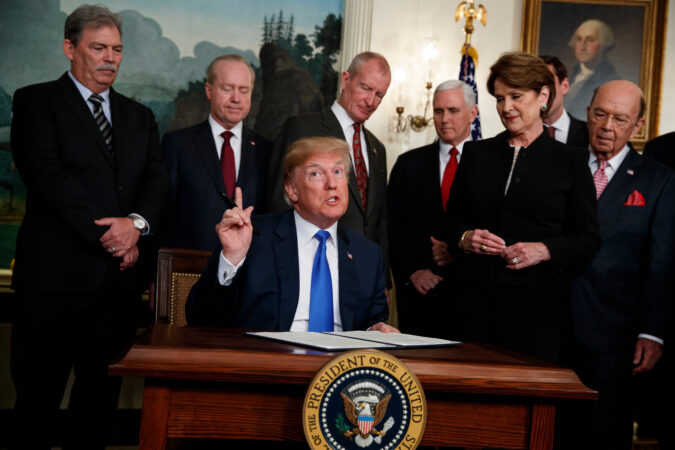
President Donald Trump arrives to speak during a breakfast with the National Governors Association in the State Dining Room of the White House, Friday, Feb. 20, 2026, in Washington. (AP Photo/Evan Vucci)
Moore, Polis, and Shapiro were among the more than two dozen governors who attended the White House breakfast Friday, where Trump delivered brief remarks. Other Democrats, including New Jersey Gov. Mikie Sherill, decided against going.
Sherrill, a former member of Congress who just began her term last month, said in a statement that she opted to skip the White House breakfast to “focus on other NGA meetings.”
“The president’s chaotic back-and-forth about the NGA was counterproductive and Gov. Sherrill decided not to attend,” said Sean Higgins, a spokesperson for Sherrill.
What Shapiro talked about
Shapiro described the closed-door meeting between Trump, the governors, and all of Trump’s cabinet as productive for him to advocate for specific issues directly with federal leaders.
“Folks were respectful to me,” Shapiro told reporters following the meeting. “I went there with a mission to talk about things that were important to Pennsylvania.”
Shapiro, who is currently running for reelection and touts his ability to work across partisan lines, has expressed an openness to working with Trump on issues specific to Pennsylvania, though he has challenged the president more than a dozen times in court since Trump took office last year.
Shapiro said he was able to discuss his top issues directly with federal officials. He said he spoke with U.S. Department of Agriculture Secretary Brooke Rollins about the reemergence of the avian flu in Pennsylvania; discussed releasing withheld broadband funding with Treasury Secretary Howard Lutnick about releasing withheld broadband funding; and talked with U.S. Secretary of Health and Human Services Robert F. Kennedy Jr. and Director of the Office of Management and Budget Russ Vought about the ways “their policies are hurting rural Pennsylvanians.”
New York Gov. Kathy Hochul, another Democrat who attended the meeting, said afterward in a news conference that she was glad to hear what lessons Trump said he learned from his administration’s immigration enforcement mission in Minneapolis that led to mass protests and the fatal shootings of two U.S. citizens by federal agents.
Hochul said Trump told the group that “we’ll only go where we’re wanted,” alleviating concerns among some Democratic governors that their states may be the next to see a full-scale federal presence upending daily life.
Weeks of back-and-forth ahead of the White House breakfast
“Democratic governors have a long record of working across the aisle to deliver results and we remain committed to this effort,” they said in a joint statement on Feb. 10 through the Democratic Governors Association. “But it’s disappointing this administration doesn’t seem to share the same goal. At every turn, President Trump is creating chaos and division, and it is the American people who are hurting as a result.”
They added: “Democratic governors remain united and will never stop fighting to protect and make life better for people in our states.”
In comments to CNN last week, Sherrill said that “worse decisions” would be made without all the governors there.
“For the president to pick and choose who he is going to have to sort of undermine the very focus of this, of coming together to get stuff done for the country just seeds more … chaos,” the New Jersey Democrat said.
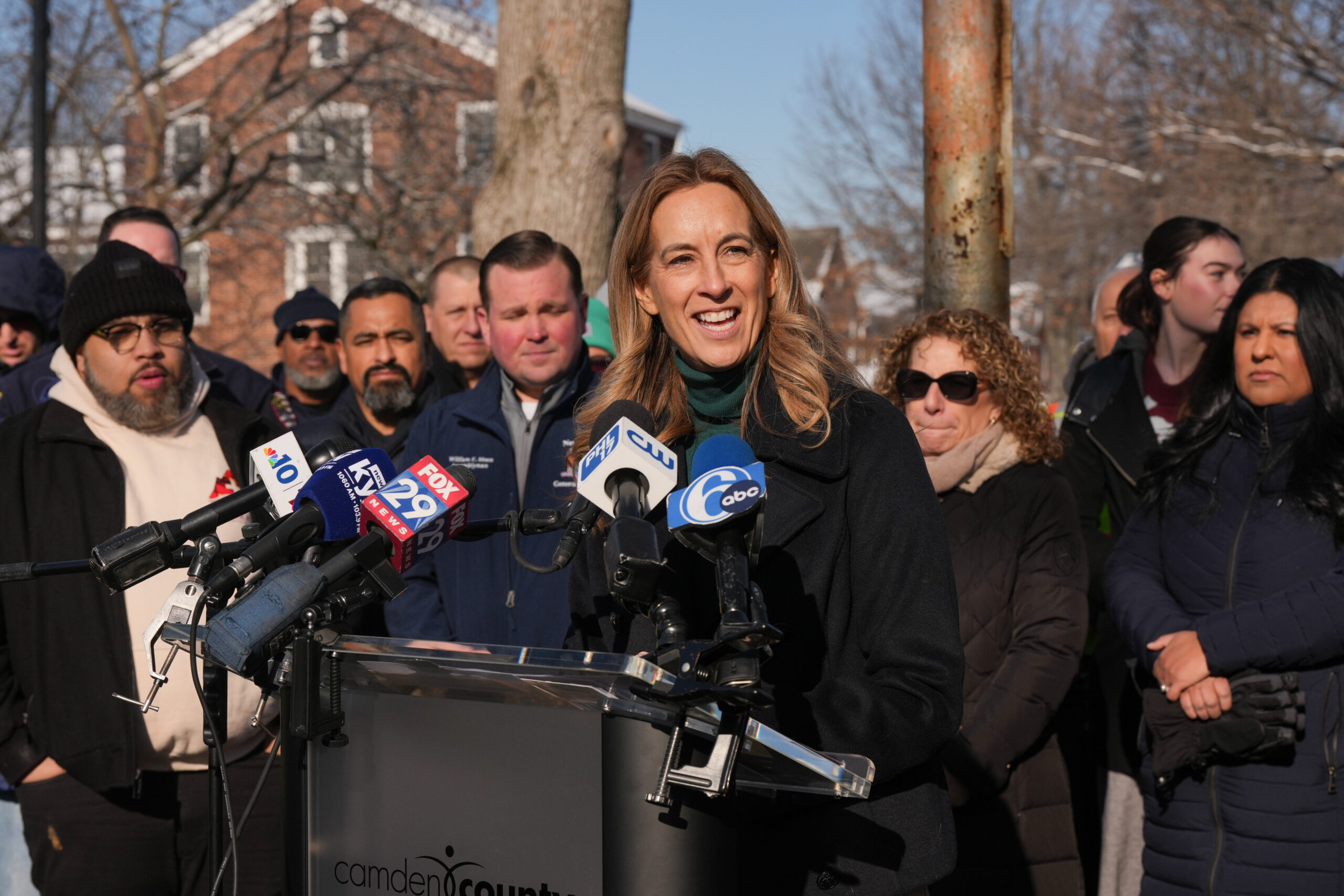
Gov. Mikie Sherrill, shown here at a news conference as volunteers gather prior to shoveling snow at Fairview Village on Martin Luther King Day during a day of service, in Camden, New Jersey, January 19, 2026.
Moore, the nation’s only Black governor, and Polis, the first openly gay man elected to U.S. governor, were the only two leaders Trump singled out, raising concerns by civil rights groups.
Trump, however, cited different reasons for his objections to Moore and Polis’ attendance. He said he wanted to exclude Polis because his state continues to incarcerate a former county clerk over her conviction related to allowing election-denier activists access to election data following the 2020 election. Trump also expressed a number of grievances toward Moore, including his handling of the rebuilding of the Francis Scott Key Bridge and Baltimore’s crime rates.
Following the meeting Friday, governors from both parties reaffirmed that they were still committed to working with Trump despite the turmoil.
“It’s really important imagery that we stand together as governors of our states and represent all of America, and just remind people that there’s really more that brings us together and unites us than divides us,” said Oklahoma Gov. Kevin Stitt, a Republican who chairs the NGA.
Shapiro separately told reporters that he has worked with directly Trump to “save steelworker jobs” but remains ready to challenge them in court if they threaten Pennsylvanians’ rights.
Asked whether he has a good relationship with Trump, Shapiro said: “We have a relationship where we can work for the people of Pennsylvania, that’s my job.”
Isaiah Zagar, 86, of South Philadelphia, the renowned mosaic artist who crafted glittering glass art on 50,000 square feet of walls and buildings across the city and founded Philadelphia’s Magic Gardens, has died.
Mr. Zagar died Thursday of complications from heart failure and Parkinson’s disease at his home in Philadelphia, the Magic Gardens confirmed.
“The scale of Isaiah Zagar’s body of work and his relentless artmaking at all costs is truly astounding,” said Emily Smith, executive director of the Magic Gardens. “Most people do not yet understand the importance of what he created, nor do they understand the sheer volume of what he has made.”
His art, Smith said, “is distinctive and wholly unique to Philadelphia, and it has forever changed the face of our city.”
saiah and Julia Zagar in their mosaic-adorned home in South Philadelphia in October 2024. The couple married in 1963 and moved to South Philly in 1968 after serving in the Peace Corps in Peru.
Mr. Zagar was born in Philadelphia in 1939, grew up in Brooklyn, N.Y., and received a bachelor of fine arts degree in painting and graphics at the Pratt Institute of Art in New York. He met his wife, artist Julia Zagar, in 1963. The couple married the same year and moved to South Philadelphia in 1968 after serving in the Peace Corps in Peru. Together, they founded Eye’s Gallery at 402 South St., focusing on Latin American folk art.
In the 1970s, the Zagars were part of a group of artists, activists, and business owners who pushed back against development of a Crosstown Expressway that would have demolished South Street. Their contributions helped lead to a neighborhood revitalization later called the South Street Renaissance.
“Philadelphia’s iconic South Street area has become inseparable from Isaiah Zagar’s singular artistic vision,” said Val Gay, chief cultural officer and executive director of Creative Philadelphia, the city’s arts office. “His mosaics redefine the very framework of the public space they inhabit. Isaiah Zagar reshaped the visual identity of Philadelphia, and his legacy will endure through all that he transformed.”
A self-taught mosaicist, Mr. Zagar used broken bottles, handmade tiles, mirrors, and other found objects to cover walls across the city, particularly in South Philly. The artist, who struggled with mental health over many years, found that creating mosaics was a therapeutic practice. He was inspired by artists Pablo Picasso, Jean Dubuffet, Kurt Schwitters, and Antonio Gaudí.
“He worked with found objects that he found everywhere and put them to use. So, [he thought], ‘Why is the thing a piece of trash? Well, it doesn’t have to be a piece of trash. It could be a piece of art, too, and still be a piece of trash,’” said longtime friend Rick Snyderman, 89, a renowned Philadelphia gallerist based in Old City. An object “in the hands of the right person changes your perspective about it. That’s, I think, what the greatest gift of Isaiah was — to change your perspective.”
Mr. Zagar’s son, the filmmaker Jeremiah Zagar, documented his father’s life in a 2008 documentary, In a Dream. Jeremiah Zagar recently directed episodes of the HBO miniseries Task. His father came to the show’s New York City premiere last September carrying a mosaicked cane.
Snyderman remembers Mr. Zagar as a big reader and world traveler who was “eternally curious” and created artwork to make people smile. They first met in the 1960s and their families were part of the South Street community of “creative thinkers” who bonded “because they were misfits in some other world, perhaps.”
“He was a man who just didn’t pay attention to his own world, he paid attention to the larger world. One of his favorite sayings was that ‘Philadelphia is the center of the art world, and art is the center of the real world,’” Snyderman said.
More than 200 of Mr. Zagar’s mosaics adorn public walls from California and Hawaii to Mexico and Chile. His artwork is in the permanent collections of the Philadelphia Museum of Art and the Pennsylvania Academy of the Fine Arts, among other museums, and has been shown in solo exhibitions at cultural institutions including Washington’s Hinckley Pottery Gallery and New York’s Kornblee Gallery.
“Isaiah Zagar was devoted to mosaic work and the creation of immersive art environments. Internationally recognized, he is proudly claimed by Philadelphia as our own,” said Elisabeth Agro, the Nancy M. McNeil curator of modern and contemporary craft and decorative arts at the Philadelphia Museum of Art. “Although his death is a profound loss to our city’s culture and creative economy, Zagar’s indelible imprint remains inextricably linked to Philadelphia’s soul.”
Synonymous with Philadelphia’s public art
Mr. Zagar’s colorful and eclectic mosaic murals have become synonymous with Philadelphia’s public art scene.
After arriving in the city, Mr. Zagar soon set about modifying Eye’s Gallery, which was then also his home. The building, the Daily News reported in 1975, was dilapidated when he took possession of it, and at one point lacked plumbing and had a wood-burning stove.
Several years into his ownership, the Daily News wrote, Mr. Zagar had evolved the rowhouse into a “womb-like living space with undulating cement walls.” Materials for its decoration were largely scavenged, and included thousands of pieces of broken glass and mirrors.
Changes, the People Paper reported, started with the cementing of a stairway wall that had become wet. Lacking experience in carpentry, plastering, and home repairs, Mr. Zagar said, he and a fellow artist cemented the wall to hide the leak, and covered it in mirrors to disguise the issue. That didn’t fix the leak, but it did inspire a kind of operating logic for his home repairs.
“We would do something artistic to hide a fault, then have to correct the fault to save the artwork,” Mr. Zagar said in 1975.
Isaiah Zagar in May 2004, in front of a wall he was working in Bella Vista, on Clifton Street between Fitzwater and Catharine.
His process included embedding everything from broken teapots and cups to plates and crystal into the cement while it was still wet. Mirrors, however, were an early favorite of Mr. Zagar’s.
That idea, he told the Daily News, came from Woodstock, N.Y.-based artist Clarence Schmidt, who covered the outside of his home in broken mirrors embedded in tar.
“Mirrors intercept space, they keep poking holes in things,” Mr. Zagar said. “If they’re in the sun, they throw prisms around. You can’t fashion a mirror into an anatomical human being. It freed me from the concept of what things were supposed to look like.”
Preservation challenges
New development in Philadelphia in recent decades has led to the demolition of many of Mr. Zagar’s mosaic murals, most of which have been on private property.
By the turn of the century, Mr. Zagar had covered about 30 buildings in the city — largely then in Old City and on South Street — in his distinctive mosaic work, according to reports from the time. Among his largest passions in that medium, he told The Inquirer in 1991, were the colorful mirror and tile murals that today dot the city.
“These materials have a lasting quality,” he said at the time. “I have never seen an ugly piece of tile, it’s all beautiful.”
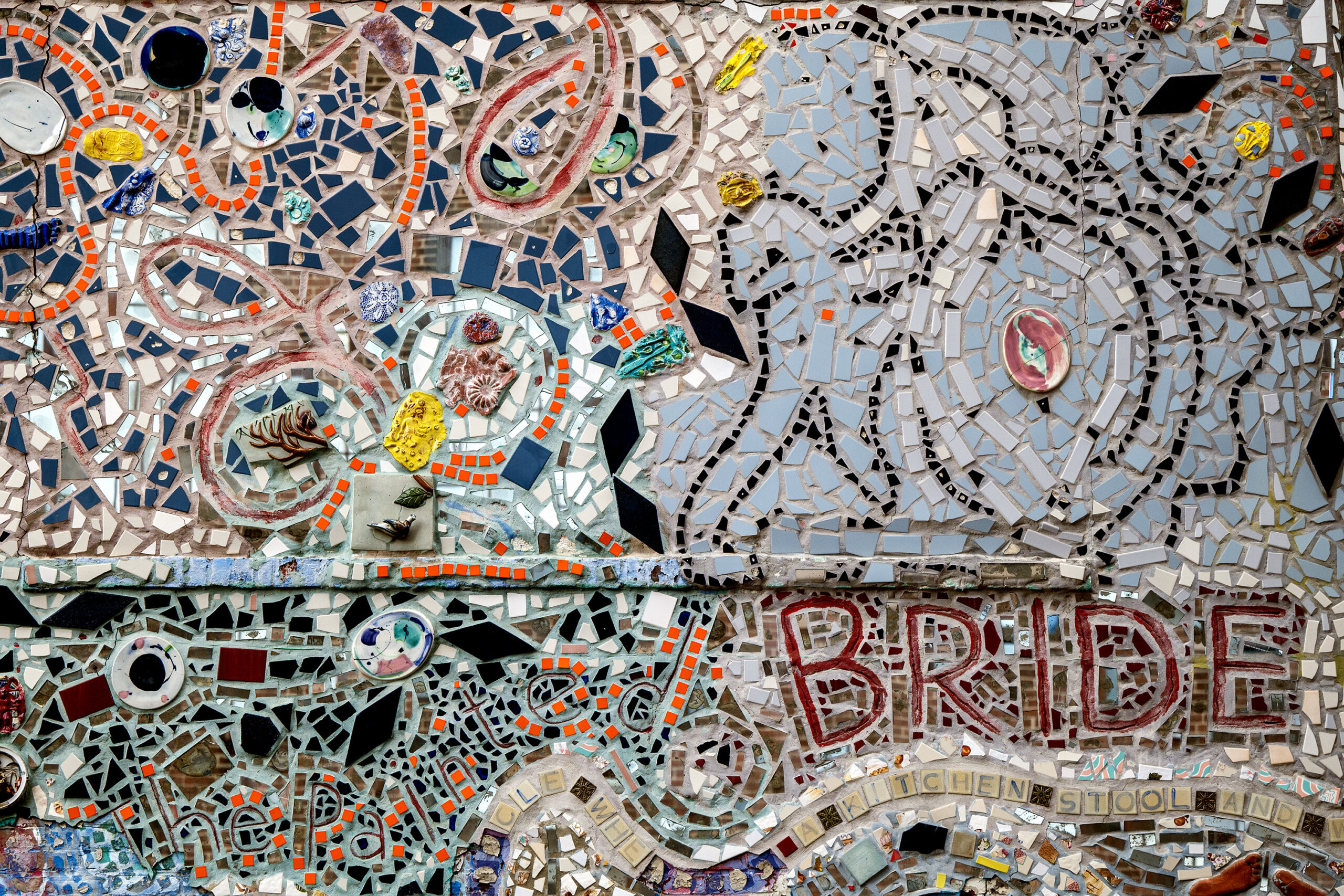
Detail of the wall of the former home of the Painted Bride Art Center at 230 Vine St. on Oct. 19, 2025. The building is covered by “Skin of the Bride,” a mosaic by Philadelphia artist Isaiah Zagar, created between 1991 and 2000.
Mr. Zagar held grand ambitions for Philadelphia as the home of his mosaics by the mid-1990s. As he told the Daily News in 1993, he hoped to see Philly changed “into a city of the imagination.”
“My dream is [to] turn all of Philadelphia into tile city — to turn all these ugly old brick and stucco walls into a manifesto of magic,” he said.
(function() {
var l2 = function() {
new pym.Parent(‘zagar_pmg’,
‘https://media.inquirer.com/storage/inquirer/projects/innovation/arcgis_iframe/zagar_pmg.html’);
};
if (typeof(pym) === ‘undefined’) {
var h = document.getElementsByTagName(‘head’)[0],
s = document.createElement(‘script’);
s.type = ‘text/javascript’;
s.src = ‘https://pym.nprapps.org/pym.v1.min.js’;
s.onload = l2;
h.appendChild(s);
} else {
l2();
}
})();
Perhaps the prototypical example of that dream was the Painted Bride Art Center, which once was home to Mr. Zagar’s Skin of the Bride — a massive, 7,000-square-foot mosaic work that came to envelop the exterior of the building. Demolition of the Painted Bride began in December after a lengthy legal battle, but members of the Magic Gardens Preservation Team had been able to remove about 30% of the tiles for reuse in new mosaics in 2023.
Mr. Zagar’s work on the Painted Bride began in 1991 and carried on for about nine years. The work was exhausting, and his wife recalled Mr. Zagar working up to 12 hours a day for years to create what he viewed as his masterpiece.
In 1993, however, he took some creative liberties with the number of tiles, mirrors, and pieces of pottery involved with its creation.
“I’ve counted them,” he jokingly told the Daily News. “There are exactly 3,333,333.”
In summer 2022, a fire at Jim’s Steaks damaged the neighboring Eye’s Gallery, requiring lengthy restoration work that Julia Zagar spearheaded. She called the space a landmark “for the creative spirit of South Street.” The fire eventually uncovered a hidden mural by Mr. Zagar from the 1970s that had been covered up by drywall.
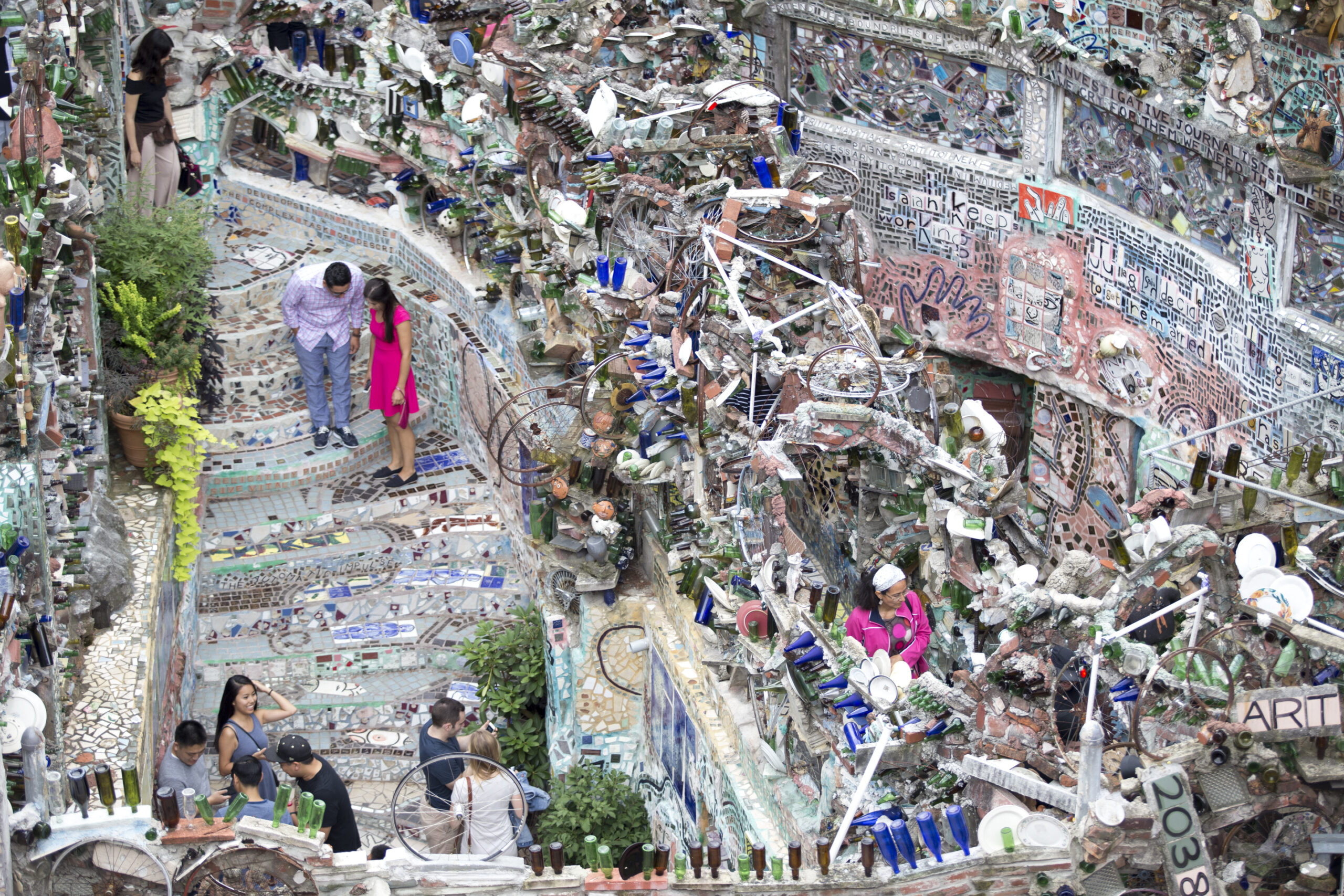
Tourists at Philadelphia’s Magic Gardens in July 2017. The Magic Gardens has become a Philadelphia landmark, attracting about 150,000 visitors a year to walk through the immersive, labyrinthine indoor and outdoor spaces.
The Magic Gardens
In the late 1990s, Mr. Zagar expanded his sculpture and mosaic art into two empty lots neighboring his South Street home. The lots were owned by a group of Boston businessmen who had abandoned them, so with permission from the owners’ agent, Mr. Zagar cleared and transformed the space.
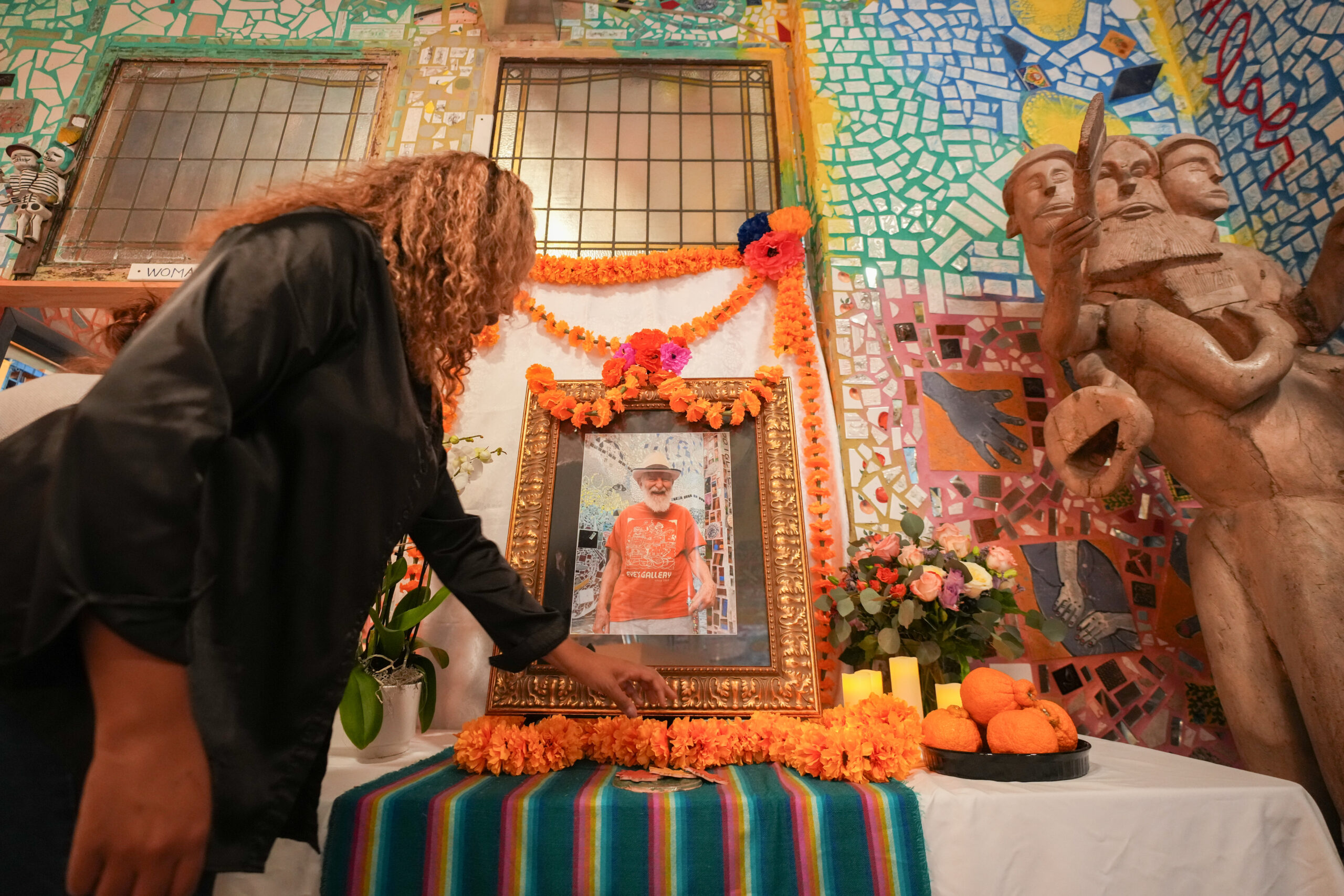
Chelsey Luster, Exhibition Manager at Philadelphia’s Magic Gardens, places flowers on an Ofrenda that friends and staff members are putting together in honor of artist Isaiah Zagar who passed earlier today, at Philadelphia’s Magic Garden, in Philadelphia, Thursday, Feb. 19, 2026, in Philadelphia
It would go on to become Philadelphia’s Magic Gardens, but it took a legal battle in the 2000s to keep it there.
In 2004, about a decade after Mr. Zagar started building in the space, the owners of the land ordered the artist to dismantle and remove the work ahead of plans to market the property for sale.
Mr. Zagar and a group of volunteers formed the nonprofit organization known as Philadelphia’s Magic Gardens and, with help from an anonymous benefactor, purchased the lot for $300,000, The Inquirer reported that year. The nonprofit had begun collecting donations and was tasked with raising a majority of the funding, and, if successful, the benefactor planned to donate $100,000 to the cause.
“Why it’s so important for me to save the garden is that it’s not finished,” Mr. Zagar told The Inquirer in late 2005. “The too-muchness of it is the artist’s life.”
Isaiah Zagar in April 2007, applying colored cement to his mosaic on the 300 block of Christian Street. He was perched in a cage of a 90-foot boom truck reaching to the top of a 60-foot wall.
By that time, the garden was open on a limited basis for visitors to help with fundraising efforts, and adopted a more regular schedule several years later. A swing-top trash can was placed just inside the property’s front fence to collect donations from passersby, collecting about $100 a month in its early days, The Inquirer reported.
“I make art voluminously,” Mr. Zagar told The Inquirer in 2005. “The common man is clear about it: This is art.”
The Magic Gardens has become a Philadelphia landmark, attracting about 150,000 visitors a year to walk through the immersive, labyrinthine indoor and outdoor spaces.
In 2020, after allegations of sexual harassment were leveled against Mr. Zagar, the Magic Gardens issued a statement from its board and staff reacting to concerns raised over “inappropriate past behavior.”
“Though the Gardens were originally created by Isaiah Zagar, he does not own the Gardens or have a vote on its Board of Directors,” the statement read before clarifying that the Magic Gardens operated as an independent nonprofit with its own staff and board of directors.
The allegations, the statement said, left the staff and board “hurt, angry and confused as we confronted a reality that was in every way the opposite of what we stood for.”
When asked if there was a formal investigation into Mr. Zagar’s behavior, Leah Reisman, board member of Gardens said on Friday, “Isaiah Zagar experienced mental health struggles throughout his life. While this experience often propelled his artmaking, it also at times led to challenges and repercussions in his personal and professional relationships.”
In 2020, she said, the Gardens’ staff and board “brought these concerns directly to Isaiah and assisted him in accessing professional support to address these concerns.” Mr. Zagar’s presence on site, she added, was “carefully scaffolded through the years.”
In 2023, the Zagars donated his Watkins Street Studio to Philadelphia’s Magic Gardens to open a secondary space — also entirely covered in mosaics, of course — to host arts workshops and educational programming.
Several students at Quakertown High School were taken into custody on Friday after a student walkout protesting federal immigration enforcement escalated into a confrontation that left at least one teenager bloodied and in handcuffs, according to witnesses and video footage from the scene.
School officials said the episode began shortly before noon, when dozens of students left campus without permission to demonstrate along Front Street in opposition to the policies of U.S. Immigration and Customs Enforcement. What followed, according to videos posted widely on social media, was a chaotic scene involving students, an unidentified man, and local police officers.
By late afternoon, authorities had released few details about what prompted officers to intervene or how many students were detained.
In a letter to parents, Lisa Hoffman, the acting superintendent of the Quakertown Community School District, said 35 students left school grounds at about 11:30 a.m. to stage the protest. She said district officials were informed by the Quakertown Police Department that the students were “engaging in unsafe and disruptive behavior,” though she did not elaborate on what that behavior entailed.
The school also went on a short lockdown as a precaution, she said.
Quakertown police contradicted the account offered by school officials, saying in a statement that as many as 50 students were involved in the protest, which “began peacefully” but became dangerous when students entered traffic, threw snowballs, kicked cars, and damaged property, including a car’s sideview mirror.
“Officers issued additional warnings to maintain civil,” the statement said, before “confrontation escalated, and some individuals assaulted officers.”
Police said “five to six juveniles and one adult have been taken into custody,” but offered no additional information.
Videos circulating online offer a fragmented glimpse of the confrontation. In one clip, a man is seen grabbing a teenage girl and placing her in a chokehold. A male student rushes in and strikes the man, after which police officers move in and take the student into custody. Other footage shows protest signs scattered across the sidewalk, speckled with blood, and a teenage girl in handcuffs with blood visible along the side of her face.
A woman who was dining inside a restaurant along Front Street said she watched the confrontation unfold just outside the window.
“This man was easily twice her size,” said the woman, who asked not to be identified for fear of reprisal. “She couldn’t have been much more than 100 pounds.”
When a male student stepped in to help the girl, she said, the scene quickly spiraled. Another woman in the restaurant recalled that several adults — including police officers — forced the boy to the ground.
“The situation completely escalated,” said the second woman, who also asked not to be identified out of fear of reprisal. “There were multiple grown men getting in the faces of the children, spit flying out of their mouths.”
It remains unclear what role the man played in the altercation. Both women said they later saw him drive away from the scene in a police vehicle.
The statement by police made no mention of the man, nor did it include details about any injuries sustained by the students.
Messages seeking comment from the school district were not immediately returned Friday afternoon.
The Buck’s County District Attorney’s Office said in a statement Friday that it was aware of the incident and was “gathering information.”
“We are committed to ensuring public safety and will provide updates if and when legally appropriate,” the office said.
By late afternoon, the number of students taken into custody had not been disclosed, and school officials had not said whether any would face disciplinary action.
Videos also showed papers and books scattered on the sidewalk next to dropped and bloodied signs. “These children were thrown around and brutalized by these officers,” said one of the women.
School officials had been aware of the planned student walk-out, according to the high school’s Facebook page, and canceled it Friday morning.
“While we respect students’ rights to express their views, our first priority is to ensure a safe and secure environment for all,” House Principal Jason D. Magditch wrote in a letter posted on the Facebook page. “At this time, we believe canceling the protest is the most appropriate course of action in the interest of student safety and well-being.”
In response to a reporter’s question on whether the U.S. could take limited military action as the countries negotiate, Trump said, “I guess I can say I am considering that.” A few hours later, he told reporters that Iran “better negotiate a fair deal.”
Earlier Friday, Iranian Foreign Minister Abbas Araghchi said in a TV interview that his country was planning to finalize a draft deal in “the next two to three days” to send to Washington.
“I don’t think it takes long, perhaps, in a matter of a week or so, we can start real, serious negotiations on the text and come to a conclusion,” Araghchi said on MS NOW’s “Morning Joe” show.
The tensions between the longtime adversaries have ramped up as the Trump administration pushes for concessions from Iran and has built up the largest U.S. military presence in the Middle East in decades, with more warships and aircraft on the way.
On Friday, the USS Gerald R. Ford carrier strike group passed through the Strait of Gibraltar and entered the Mediterranean Sea after being sent by Trump from the Caribbean, according to images of the ship by maritime photographers posted to social media.
Both Iran and the U.S. have signaled that they are prepared for war if talks on Tehran’s nuclear program fizzle out. “We are prepared for diplomacy, and we are prepared for negotiation as much as we are prepared for war,” Araghchi said Friday.
Ali Vaez, an Iran expert at the International Crisis Group, said Iran “would treat any kinetic action as an existential threat.”
Vaez said he doesn’t think Iran’s leaders are bluffing when they say they would retaliate, while they likely believe they could maintain their hold on power despite any U.S. airstrikes.
What Iran and the U.S. are negotiating
Trump said a day earlier that he believes 10 to 15 days is “enough time” for Iran to reach a deal following recent rounds of indirect negotiations, including this week in Geneva, that made little visible progress. But the talks have been deadlocked for years after Trump’s decision in 2018 to unilaterally withdraw the U.S. from Iran’s 2015 nuclear deal with world powers. Since then, Iran has refused to discuss wider U.S. and Israeli demands that it scale back its missile program and sever ties to armed groups.
Araghchi also said Friday that his American counterparts have not asked for zero enrichment of uranium as part of the latest round of talks, which is not what U.S. officials have said publicly.
“What we are now talking about is how to make sure that Iran’s nuclear program, including enrichment, is peaceful and will remain peaceful forever,” he said.
He added that in return, Iran will implement some confidence-building measures in exchange for relief on economic sanctions.
In response to Araghchi’s claim, a White House official said Trump has been clear that Iran cannot have nuclear weapons or the capacity to build them and that it cannot enrich uranium. The official wasn’t authorized to comment publicly and spoke on condition of anonymity.
Tehran has long insisted that any negotiations should only focus on its nuclear program and that it hasn’t been enriching uranium since U.S. and Israeli strikes last June on Iranian nuclear sites. Trump said at the time that the strikes had “obliterated” Iran’s nuclear sites, but the exact damage is unknown as Tehran has barred international inspectors.
Although Iran insists its nuclear program is peaceful, the U.S. and others suspect it is aimed at eventually developing weapons.
What Congress has to say
Trump’s comments have faced pushback from some lawmakers who say the president should get Congress’ approval before any strike.
Democratic Sen. Tim Kaine of Virginia said Friday that he has filed a war powers resolution that would require that step. Though it has no chance of becoming law — in part because Trump himself would have to sign it — some bipartisan consensus has arisen recently among senators who forced votes on previous resolutions on military action in Venezuela.
None of those resolutions passed, but they were successful in showing how lawmakers are troubled by some of Trump’s aggressive foreign policy maneuvers.
“If some of my colleagues support war, then they should have the guts to vote for the war, and to be held accountable by their constituents, rather than hiding under their desks,” Kaine said in a statement.
CAPE CANAVERAL, Fla. — NASA aims to send astronauts to the moon in March after acing the latest rocket fueling test.
Officials announced the decision Friday, two weeks ahead of the first targeted launch opportunity on March 6.
“This is really getting real, and it’s time to get serious and start getting excited,” said Lori Glaze, NASA’s exploration systems development chief.
Administrator Jared Isaacman noted that launch teams made “major progress” between the first countdown rehearsal, which was disrupted by hydrogen leaks earlier this month, and the second test, which was completed with exceptionally low seepage Thursday night.
The test was “a big step toward America’s return to the lunar environment,” Isaacman said on the social media platform X. Astronauts last ventured to the moon more than half a century ago.
While more work remains at the pad, officials expressed confidence in being ready to launch four astronauts on the Artemis II lunar fly-around as soon as March 6 from Florida’s Kennedy Space Center. To keep their options open, the three Americans and one Canadian prepared to go into the mandatory two-week health quarantine Friday night in Houston.
The space agency has only five days in March to launch the crew aboard the Space Launch System rocket, before standing down until the end of April. February’s opportunities evaporated after dangerous amounts of liquid hydrogen leaked during the first fueling demonstration.
Technicians replaced two seals, leading to Thursday’s successful rerun. The countdown clocks went all the way down to the desired 29-second mark.
The removed Teflon seals had some light scratches but nothing else noticeable that could have caused such heavy leakage, officials said.
A bit of moisture also was found in the area that could have contributed to the problem. The fixes worked, with barely any leakage detected, said launch director Charlie Blackwell-Thompson.
Commander Reid Wiseman and two of his crew monitored Thursday’s operation alongside launch controllers. The astronauts will be the first to fly to the moon since Apollo 17 closed out NASA’s first chapter in moon exploration in 1972.
Still ahead is the flight readiness review, scheduled for late next week. If that goes well, the astronauts will fly back to Kennedy around the beginning of March for a real countdown.
“Every night I look up at the moon and I see it and I get real excited because I can really feel she’s calling us, and we’re ready,” Glaze said.
The nearly 10-day mission is considered a test flight with astronauts soaring atop the 322-foot SLS rocket for the first time. The only other SLS flight, in 2022, had no one on board.
The next mission in the series, Artemis III, will attempt to land a pair of astronauts near the moon’s south pole in a few years.
Given all the details still to be worked out for that mission — including whether Elon Musk’s SpaceX or Jeff Bezos’ Blue Origin will provide the lunar lander — Glaze said it will be months, perhaps even a year, before NASA selects that first moon-landing crew.
Famed mosaic artist Isaiah Zagar left a legacy shaped by the glimmering murals and large-scale tile works he created throughout Philadelphia.
Zagar, who died at 86 on Thursday due to complications of heart failure and Parkinson’s disease, will be remembered for his striking works and unrelenting mission to beautify the city he called home for more than five decades.
Zagar’s nearly 200 works can be found throughout the country but the bulk of his famed mosaics are within city lines.
Here’s some of the largest and boldest works the iconic artist handcrafted in Philadelphia.
(function() {
var l2 = function() {
new pym.Parent(‘ZAGARMAP.html’,
‘https://media.inquirer.com/storage/inquirer/projects/innovation/arcgis_iframe/ZAGARMAP.html’);
};
if (typeof(pym) === ‘undefined’) {
var h = document.getElementsByTagName(‘head’)[0],
s = document.createElement(‘script’);
s.type = ‘text/javascript’;
s.src = ‘https://pym.nprapps.org/pym.v1.min.js’;
s.onload = l2;
h.appendChild(s);
} else {
l2();
}
})();
Philadelphia’s Magic Gardens
1020 South St.
Tourists visit Philadelphia’s Magic Gardens, which was built by Isaiah Zagar, in 2017.
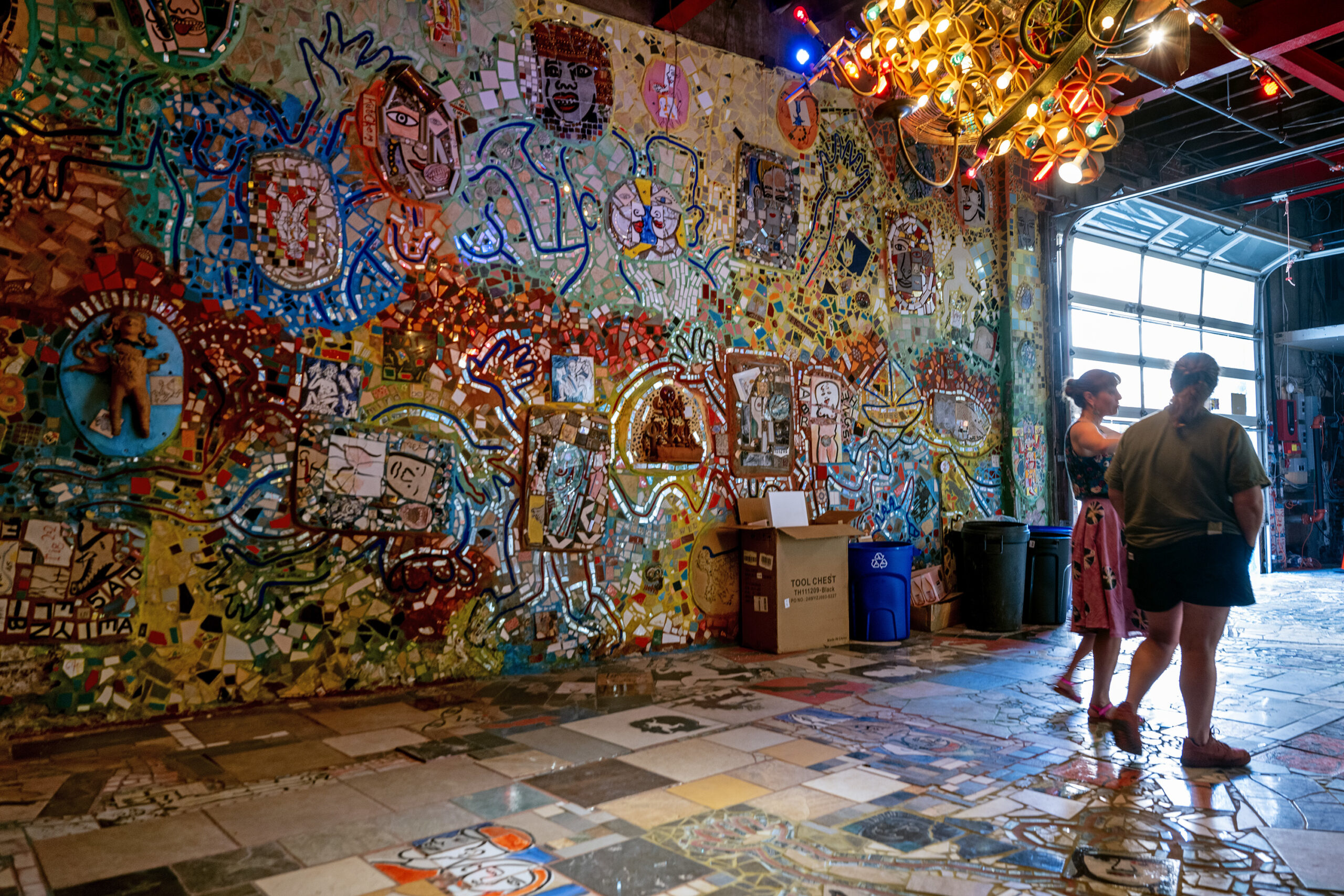
As inescapable as Zagar’s work is in Philadelphia, the Magic Gardens serves as the artist’s grandest, most well-known project. Dating back to 1994, it consists of thousands of square feet of entirely mosaicked space stretched across three city lots, showcasing what Zagar once referred to as his “voluminous” output of art.
Magic Gardens Studio
1002 Watkins St.
Philadelphia’s Magic Gardens executive director Emily Smith (left) and Preservation and Facilities manager Stacey Holder stand in the former studio of mosaic artist Isaiah Zagar in 2024.
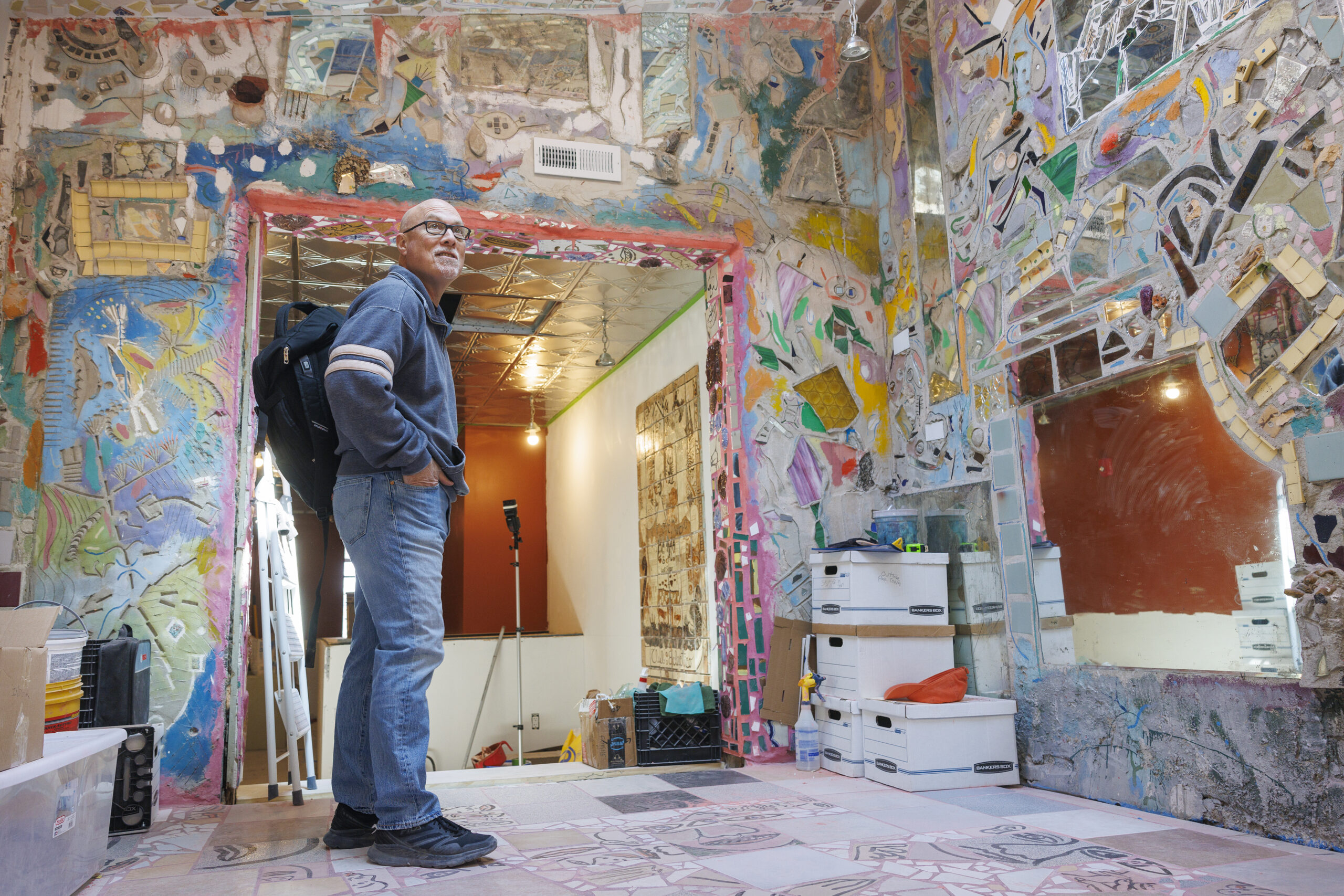
If the Magic Gardens is the heart of Zagar’s output, his Magic Gardens Studio is the brain. Purchased in 2007, this 10,000-square-foot South Philly warehouse stands virtually covered — inside and out — in Zagar’s mosaics, and long served as his studio and storage space.
Home of Isaiah and Julia Zagar
826 South St.
Isaiah and Julia Zagar are photographed in front of their home in South Philadelphia in 2024.
It doesn’t get much more personal than the Zagar’s home, where he and his family lived for about 40 years. Similar to his South Philly studio, the space is mosaicked inside and out in Zagar’s signature style, including a roughly 544-square-foot piece across the building’s façade.
‘This Is the Day, Jesus Journey’
1036 South St.
Just steps from the Magic Gardens sits the Waters Memorial African Methodist Episcopal Church, its side showcasing the 2006 mosaic Jesus Journey. At more than 400 square feet, it uses excerpts from the Bible detailing the life of Jesus Christ. Across the street, another similarly sized installation titled Bilal From Pakistan was completed in 2012 alongside artist Bilal Khan.
‘Rose and the Firefighters’
600 block of Alder Street
Among Zagar’s most iconic murals, this piece stretches some 6,000 square feet along Alder and Kater Streets, just east of the Magic Gardens. Completed in 2004, this piece adorns the former headquarters of Engine Company 11, a celebrated Black fire company in Philadelphia between 1919 and 1952.
Jim’s Steaks
400 South St.
Ken Silver, owner of Jim’s Steaks, in a room filled with mosaic tile by Philadelphia artist Isaiah Zagar in the former Eyes Gallery, run by Julia Zagar for decades.
Blocks from Zagar’s home, Jim’s Steaks showcases the artist’s mosaic work in a space formerly occupied by the Eyes Gallery, which Julia Zagar ran for decades. A 2022 fire damaged both the gallery and the neighboring original Jim’s building, prompting the cheesesteak shop to expand next door — revealing a treasure trove of interior artwork that had long been covered.
Schell Street Walls
600 S. Schell St.
Vacant lots, rowhouses, and cheesesteak shops weren’t Zagar’s only canvasses — he also covered entire side streets in his mosaics. Completed over nearly 30 years, the 600 block of Schell Street showcases the artist’s work on both sides of the street. Many pieces were created during community workshops Zagar held there over the years.
Fitness Works
714 Reed St.
There are better known murals than the one that occupies the lower facade and parking lot of this South Philly gym, but few are as large. At roughly 1,500 square feet, this piece was completed in 2014 as part of a mosaic mural workshop, and has since come to serve as a landmark.
‘Homage to Mike Mattio, Master Plumber’
700 block of Reese Street
Occupying the side of a number of rowhouses, this Zagar mosaic serves as a tribute to its eponymous Mike Mattio, a former plumber of the artist’s. The piece, with Mattio’s portrait included, is something of a high-brow installation, thanks to references calling out artists ranging from William Blake to Duke Ellington.
‘Hip Hop Café’
705 Passyunk Ave.
This building has housed quite a few businesses over the years. At least since 2002, it has showcased Zagar’s Hip Hop Café mosaic mural. The piece covers the structure’s 500-square-foot front, which today is home to Momoka Ramen Skewers’ Queen Village location.
Tired Hands Brewing’s Ardmore Brewing Company brewpub has been turned into a private event space, for now, as its owner navigates the future of the beer company.
Tired Hands’ Kennett Square taproom and bottle shop is permanently closed, owner Jean Broillet confirmed to The Inquirer on Feb. 19. Tired Hands’ Beer Park in Newtown Square also will not reopen this summer as the property’s owners are looking to redevelop it, Broillet said.
Tired Hands’ Ardmore Fermentaria and Fishtown restaurant and brewpub St. Oner’s remain open for business. The brewing company’s MT. Airy Biergarten is a seasonal operation scheduled to reopen inthe spring.
Broillet said the decision to shift to private events at the Ardmore Brewing Company location was born out of a number of factors: having two Tired Hands locations in Ardmore was confusing for customers; ongoing construction in Ardmore created a “prohibitive environment” for doing business; and the changing landscape of brewing has prompted Tired Hands to begin reimagining parts of its business model.
The changing face of Ardmore, and of Tired Hands
When Broillet opened the first Tired Hands location, the BrewCafé, in 2012, he said there was little by way of interesting, high-quality food and drink in Ardmore. At the time, he said, Tired Hands’ craft beer and artisan meats and cheeses stood in stark contrast to the Wawas and Irish pubs the area was accustomed to.
Ardmore “went from zero to 60 really quickly in terms” of dining and entertainment options, Broillet said. He added that Tired Hands was a catalyst for that progress.
In 2015, Broillet and business partner and wife Julie Foster opened the Fermentaria at 35 Cricket Terrace, just blocks from Tired Hands’ first location at 16 Ardmore Ave.
The Fermentaria was a major expansion for Tired Hands. It offered food options that extended beyond the BrewCafé‘s sandwich-and-salad-based menu, like steak frites and baby back ribs. It also quadrupled Tired Hands’ production capacity.
At the BrewCafé, Tired Hands’ brewers were able to produce 1,000 barrels of beer annually. At the time of its opening, Broillet anticipated that the Fermentaria would increase production to 4,000 barrels per year.
Tired Hands opened St. Oner’s in Fishtown in 2020.
In the years that followed, Tired Hands opened the seasonal Biergarten in Mount Airy, the Kennett Square taproom, and theBeer Park in Newtown Square.
Broillet said that “lots of valuable lessons, worldly lessons, were learned during that process” and that Tired Hands is doing everything it can to “prevent that from ever happening again.”
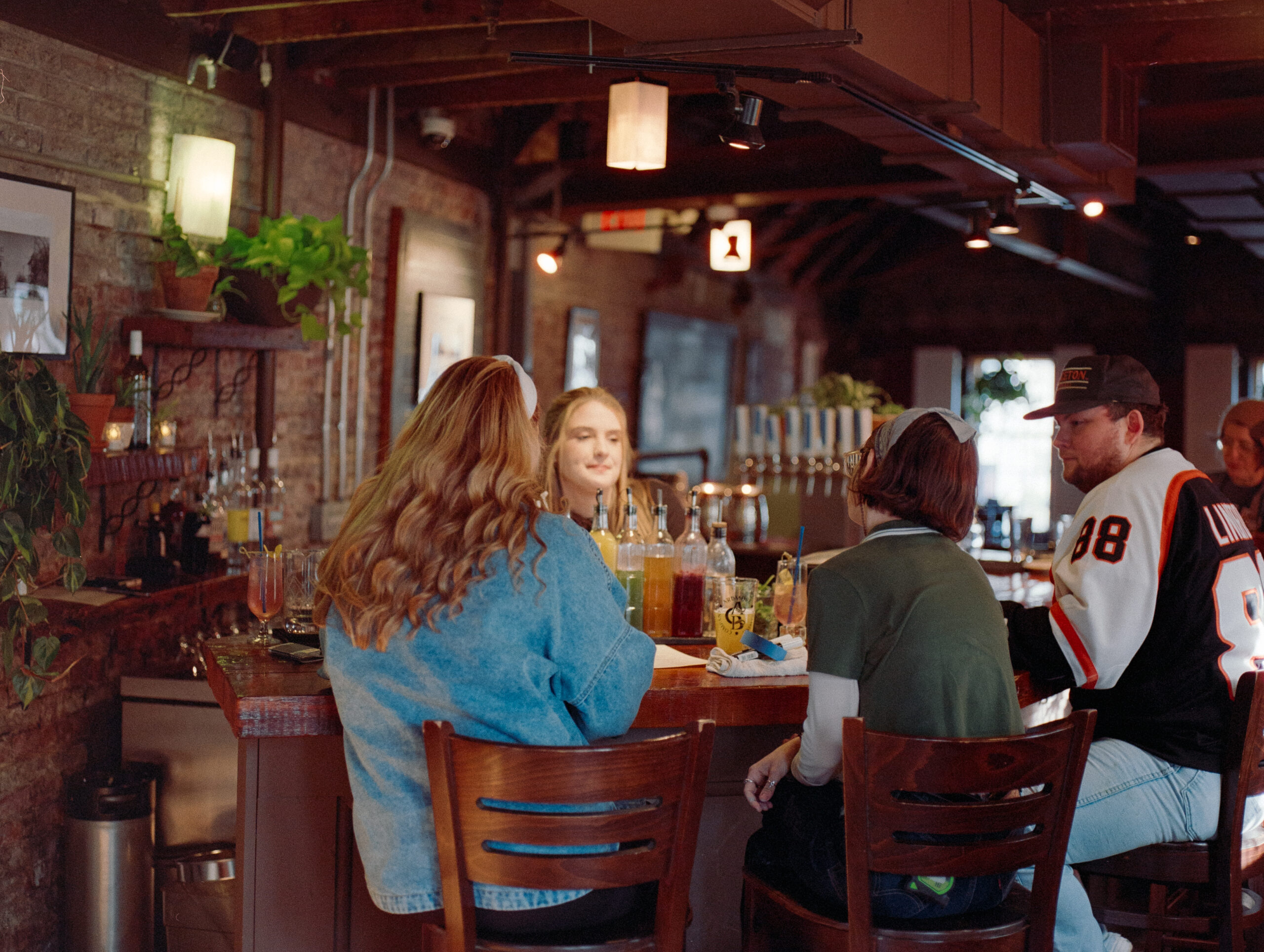
Ardmore Brewing Company, located at 16 Ardmore Ave. in Ardmore. Owner Tired Hands Brewing has transitioned the brewery into a private events space.
Changes in Ardmore, closure in Kennett Square
Though opening a second Ardmore outpost helped grow Tired Hands’ footprint on the Main Line, having “two of the same company” also made things “pretty confusing for people,” Broillet said.
In efforts to iron out the confusion, Tired Hands rebranded its BrewCafé last spring, renaming it the Ardmore Brewing Company, upgrading its interior, and adding more food and cocktail options while cutting down its beer list.
“The confusion was still there,” Broillet said.
Broillet alsobrought on a culinary team that had extensive experience with private events. They began to host a handful of events at the brewery — retirement or birthday parties, for instance — which were a success.
At the same time, major construction had created a “prohibitive environment for us to do business here on Ardmore Avenue,” Broillet said. Construction on the mixed-use Piazza project and Ardmore Avenue Community Center are ongoing, both of which are proximate to Ardmore Avenue and the businesses that operate there.
The brewery shifted to exclusively hosting private events in the last few months, a decision Broillet said he “couldn’t be happier” with.
The brewery owner said the Ardmore Avenue location will be open to the public again in the future, but did not specify in what form.
The taproom and bottle shop in Kennett Square will not reopen.
Broillet said he opened a Tired Hands outpost in Kennett Square, in part, to have a presence near his family members who lived there. Though it was a “fun” chapter, Broillet said it no longer made sense to operate in Kennett Square, where Tired Hands already has a strong network of distributors that can get their beers into people’s hands without making them trek to the bottle shop.
What comes next?
Broillet offered assurances that Ardmore Brewing Company will open up to the public again but said specifics aren’t clear yet. Tired Hands also plans on expanding its Mount Airy footprint with a permanent restaurant space.
For brewers across the country, the specter of people drinking less alcohol looms large. Sales of craft beer fell 4% in 2024, and there were more brewery closings than openings in late 2024 and early 2025, the first time in 20 years such circumstances occurred.
Brewerytown’s Crime & Punishment Brewing shuttered last April, with its owners citing a shifting culture around alcohol among the reasons for its closure. Iron Hill Brewery & Restaurant, a Philly-area craft brewing pioneer, abruptly shuttered all of its locations in September.
Broilletsaid that though the changing dynamics of the industry remain on his mind, Tired Hands was not “acutely a victim of that downturn.” Sales had been down slightly over the past few years, but Broillet attributes that more to having two locations in Ardmore than to the state of the industry. He’s bullish about Tired Hands’ ability to distinguish itself and sees excitement in the changes.
“Those sentiments have a way of just propelling you forward,” Broillet said.
This suburban content is produced with support from the Leslie Miller and Richard Worley Foundation and The Lenfest Institute for Journalism. Editorial content is created independently of the project donors. Gifts to support The Inquirer’s high-impact journalism can be made at inquirer.com/donate. A list of Lenfest Institute donors can be found at lenfestinstitute.org/supporters.
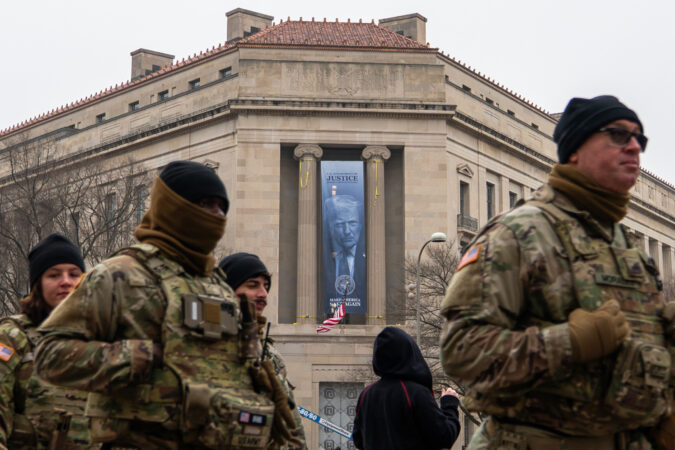
A new banner hanging along the facade of the Justice Department’s headquarters in Washington is sparking criticism from Democrats and a former FBI director, who suggest that it exemplifies President Donald Trump’s encroachment on the agency, which has long prided itself on being independent from the White House.
The tall banner displays a portrait of Trump, cast in a dark blue hue, staring down at tourists, commuters and cars along Washington’s bustling Pennsylvania Avenue. “MAKE AMERICA SAFE AGAIN,” reads the banner, which is emblazoned with the Justice Department’s seal.
A Justice Department spokesperson said the banner was hung in commemoration of the United States’ Semiquincentennial, writing in a statement: “We are proud at this Department of Justice to celebrate 250 years of our great country and our historic work to make America safe again at President Trump’s direction.”
Similar banners have appeared recently on other government buildings in Washington. But Democrats said that the decision to install one at the Justice Department symbolizes the influence Trump has wielded over the agency during his second term and that the display is comparable to the imagery deployed by authoritarian regimes.
“The irony of a twice-impeached, convicted felon putting his own picture on the wall of the Department of Justice,” Sen. Ben Ray Luján of New Mexico wrote on X. “President Trump is weaponizing the DOJ as his own personal law firm.”
Rep. Mike Quigley of Illinois shared an image of the banner online and wrote: “POTUS is putting his face on the Justice Department. … This is not the work of an independent and impartial justice system.”
“Ok Kim Jong Un,” Rep. Jim McGovern of Massachusetts wrote.
A pair of similar banners hung at the U.S. Department of Agriculture showed Trump and Abraham Lincoln’s portraits emblazoned with the phrase: “Growing America Since 1862.” (A government purchase order for the pair of banners at USDA showed they cost $16,400.) And banners hung on the Labor Department’s building featured portraits of Trump and Theodore Roosevelt that read, “American workers first.”
The addition to the Justice Department building follows a pattern of norm-breaking efforts that critics say amount to Trump using the agency as a personal cudgel against his political enemies.
In a speech delivered inside the building last year, Trump declared himself the nation’s “chief law enforcement officer.” Attorney General Pam Bondi rarely misses an opportunity to praise the president and credit him with the department’s success, including at a contentious congressional oversight hearing last week in which she repeatedly described him “the greatest president in American history.”
To Trump’s critics, the banner is also striking given his status as a felon. He was found guilty in 2024 in a New York state case on 34 counts of falsifying business records to conceal a hush money payment to an adult-film actress.
Less than two years ago, Justice Department prosecutors had been pursuing two federal cases against him led by former special counsel Jack Smith. One focused on efforts to overturn the 2020 election, while the other related to Trump’s handling of classified documents.
Trump is continuing to appeal his state court conviction in New York. A Georgia criminal case against Trump related to efforts to change the 2020 election result was dismissed last year.
The two federal cases were also dismissed. One ended because of issues with Smith’s appointment. The other Smith withdrew after Trump’s 2024 election victory, in line with long-standing Justice Department policies preventing prosecution of a sitting president.
Trump and his Justice Department appointees have contended that the prosecutions arose out of a Biden-era weaponization of the justice system to punish political foes.
Since his return to the White House, Trump has ordered several prosecutions of political rivals on social media. Federal prosecutors brought charges against former FBI Director James B. Comey and New York Attorney General Letitia James last year — both of whom Trump had demanded Bondi move swiftly to prosecute. Those cases were later thrown out over issues with the appointment of the U.S. attorney selected to oversee them.
Comey, in a social media post Thursday, called the installation of the banner outside the Justice Department headquarters “sickening.”
“But they forgot to cover the inscription on the Pennsylvania Avenue side: ‘WHERE LAW ENDS TYRANNY BEGINS,’” he wrote.
The banner is hardly the first time the Trump administration has been accused of adopting aesthetics and deploying imagery typically associated with imperialism or authoritarianism since his return to office last year.
The administration, for example, roiled the art world when the Department of Homeland Security used images of Americana paintings to bolster support for Trump’s large-scale deportation campaign.
There was also a massive military parade in Washington last year, which ran against an American tradition of avoiding public displays of martial strength more common in authoritarian regimes. The president is also planning a giant triumphal arch across from the Lincoln Memorial, which could dwarf the size of that and other monuments.
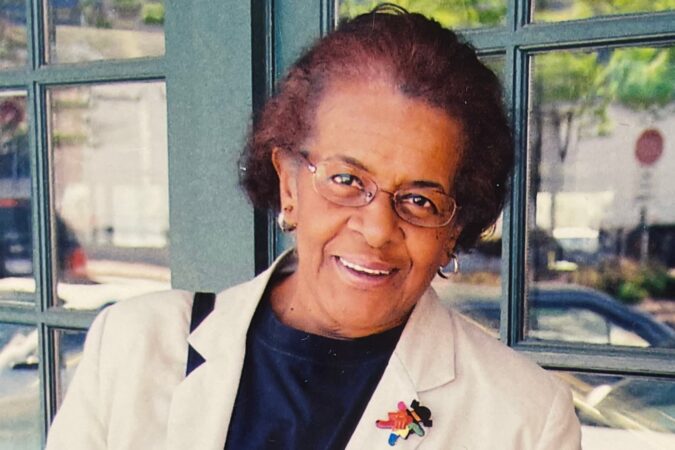
Mae Laster, 87, of Philadelphia, retired French, algebra, and photography teacher for the School District of Philadelphia, longtime president of Friends of Wynnefield Library, award-winning committee chair for the Philadelphia section of the National Council of Negro Women Inc., community center adviser, church trustee, volunteer, and undisputed Laster family Scrabble champion, died Friday, Jan. 2, of age-associated decline at Lankenau Medical Center.
Born in Philadelphia, Ms. Laster earned academic degrees at West Philadelphia High School and Temple University. She was a lifelong reader and stellar student, and she tutored her high school classmates in math and later taught elementary and middle school students for 30 years.
“She was a firm and no-nonsense kind of teacher,” a former student said in an online tribute. “But she was a lot of fun. As an adult, she always offered guidance and advice.”
Her daughter, Lorna Laster Jackson, said: “She had a passion for learning and sharing with others. She was always an advocate for children.”
Ms. Laster chaired community service and Founder’s Day committees for the National Council of Negro Women Inc.
Ms. Laster served as president of Friends of Wynnefield Library for more than 20 years and was active at its many book readings, content discussions, concerts, and fundraisers. She earned several important financial grants for the library, and her personal collection of books at home numbered more than 1,000.
“She loved reading to our young patrons, especially during our Dr. Seuss birthday celebrations,” library colleagues said in a tribute.
She chaired community service and Founder’s Day celebration committees for the National Council of Negro Women and earned the local section’s achievement award in 1998. “Mae was a blessing to the Philadelphia section,” colleagues said in a tribute. “We will always remember her feisty way of asking questions and not easily put off.”
Ms. Laster was an advisory board member at the Leon H. Sullivan Community Development Center and a trustee at Zion Baptist Church. Colleagues at the community center called her “a very thoughtful and talented person.” They said: “She was always forthright and had a strong opinion.”
Ms. Laster (center) especially enjoyed reading to young people at the Wynnefield Library.
At church, she was a member of the New Day Bible Class and proofreader for the newsletter. She also volunteered with the Wynnefield Residents Association, the Girl Scouts, and the 4-H Club.
In a citation, City Council members praised her achievements regarding “education, community service, and all those whose lives were enriched by her wisdom, kindness, and unwavering faith.” In a resolution, members of the state Senate noted “her extraordinary life, her enduring contributions, and her lasting impact on education, community, and faith.”
Friends said in online tributes that she “had a great sense of humor” and was “the sweetest mom on the planet, who was always like a mom to me.” One friend called her “a community-minded leader who advocated tirelessly to preserve the quality of life in Wynnefield.”
At home, Ms. Laster studied the dictionary, knew words that nobody else did, and became the undisputed Scrabble champion of her family and friends. She was so good, her daughter said, that nobody volunteered to play against her. “It was humiliating,” her daughter said.
Ms. Laster was a lifelong advocate for children.
Mae R. Johnson was born June 5, 1938, in Philadelphia. She grew up in Winston-Salem, N.C., with her grandmother and returned to Philadelphia in the 1950s to live with her mother and begin high school.
She was an excellent student, especially good with words and numbers, and she graduated from West Philadelphia High in 1956 and earned a bachelor’s degree in early childhood education at Temple.
She met Francis Laster in the neighborhood, and they married, and had a daughter, Lorna, and sons Francis Jr., Charles, and Ahman. Her husband owned and operated the popular Rainbow Seafood Market, and they lived in West Philadelphia and Wynnefield. They divorced later. He died in 2020.
Ms. Laster enjoyed bowling, photography, and horticulture. She listened to jazz, classical, and gospel music. She collected butterflies and stamps.
Ms. Laster was “all about positive change,” her daughter said.
She shared recipes with friends and kept in touch through memorable phone calls. She helped organize high school reunions and appreciated the educational TV shows on the Public Broadcasting System.She retired from teaching about 20 years ago.
“She was all about positive change,” her daughter said. “She spoke from compassion and her truth. She did more good than she knew. She was dynamite.”
In addition to her children, Ms. Laster is survived by six grandchildren, three great-grandchildren, three great-great-grandchildren, a sister, and other relatives. A brother died earlier.
A celebration of her life was held earlier.
Donations in her name may be made to Friends of Wynnefield Library, Attn: Terri Jones, 5325 Overbrook Ave., Philadelphia, Pa. 19131.
Ms. Laster graduated from West Philadelphia High School in 1956 and earned a bachelor’s degree in early childhood education at Temple.