A Main Line developer’s plan to turn a shuttered steel mill into a 2-million-square-foot AI data center on the outskirts of Conshohocken was stymied Monday when he was forced to withdraw his application over legal issues.
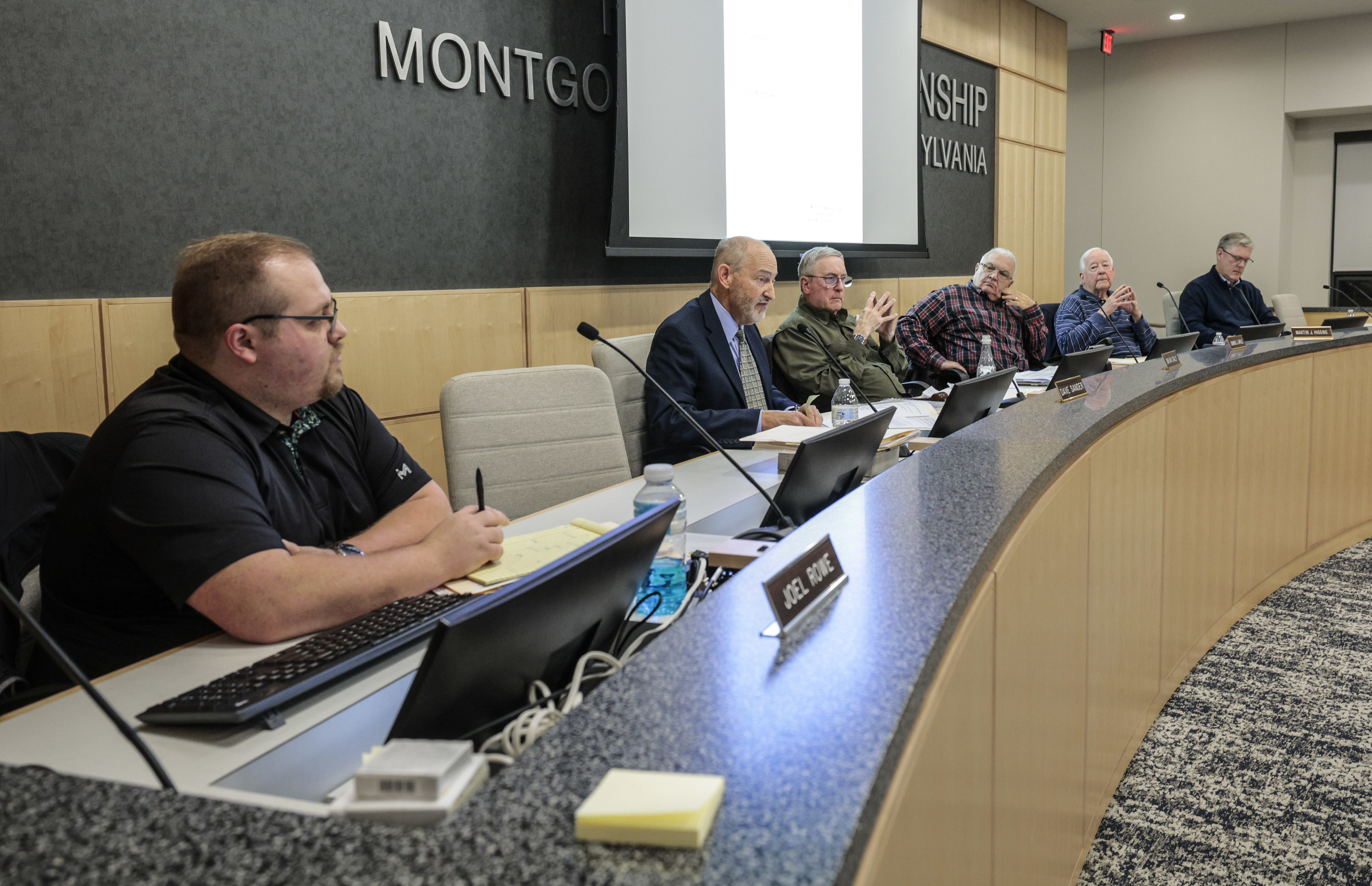
At the Plymouth Township zoning hearing board meeting, Brian O’Neill’s team had been set to make their case for an exception that would allow a data center to be built at 900 Conshohocken Rd.
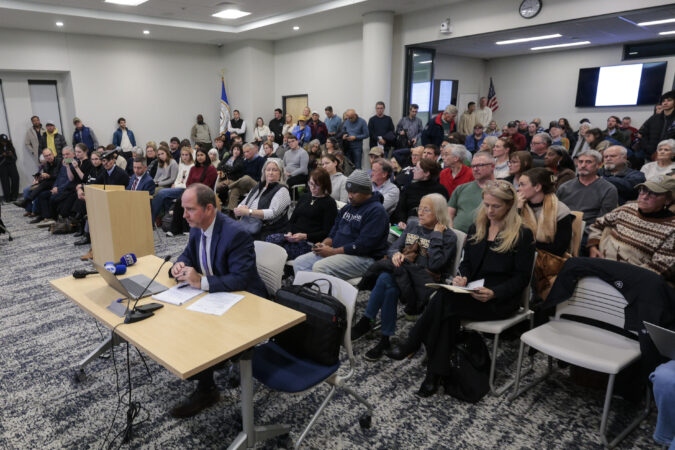
The plan has faced neighborhood pushback, and hundreds of people packed the meeting room on Monday night. O’Neill did not appear to be among them.
Edmund J. Campbell Jr., an attorney for O’Neill, said they wished to move the hearing to the township’s December meeting. Then an attorney for Cleveland-Cliffs, the property owner, said the prospective buyer did not have legal standing to do so.
An agreement of sale had not been approved prior to the meeting, said Heather Fine, the attorney for Cleveland-Cliffs.
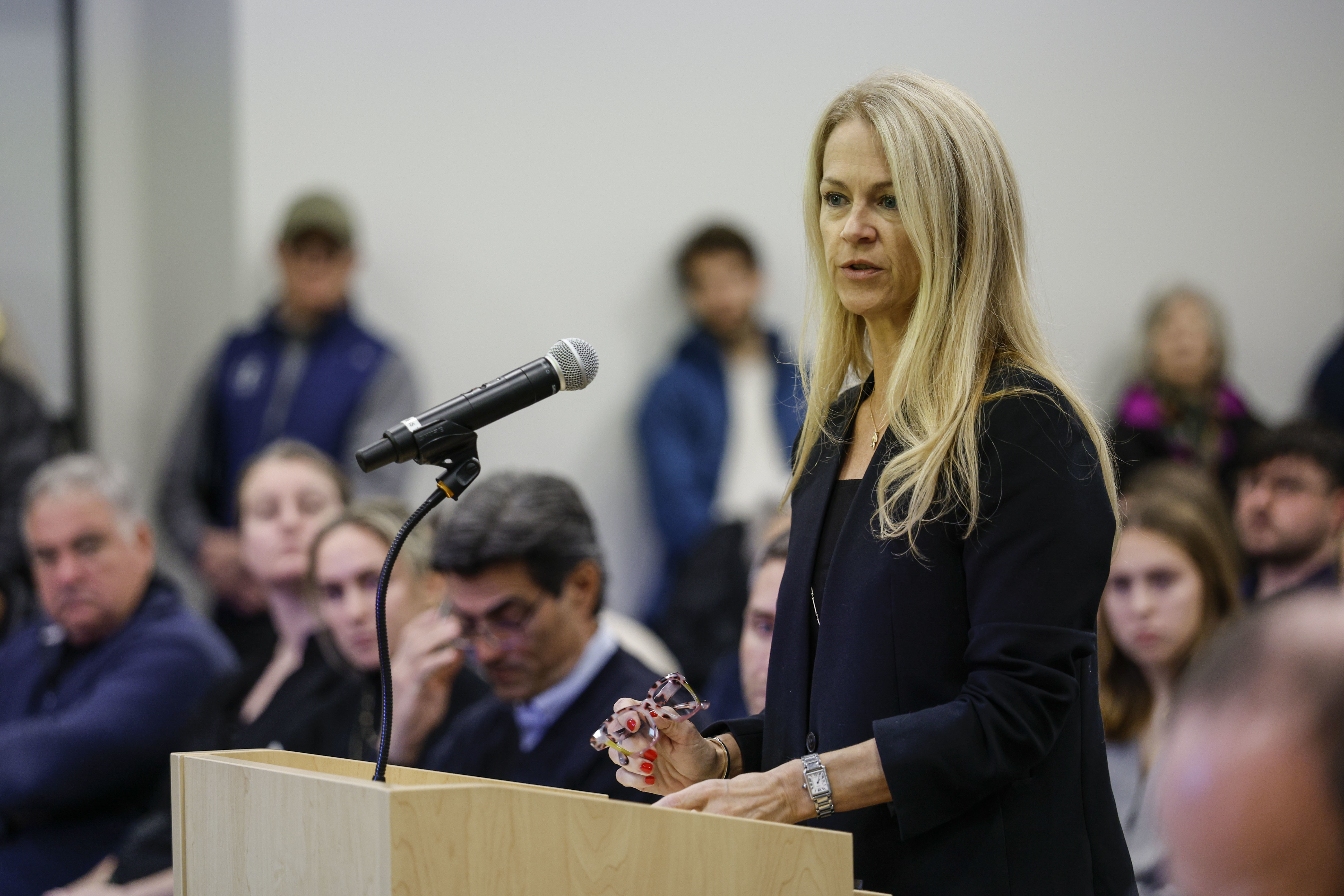
Heather Fine, an attorney for Cleveland-Cliffs, addresses the Plymouth Township zoning hearing board on Monday.
Campbell later asked Fine and then the board for permission to withdraw the application. Both declined to provide additional comment.
Residents who had spent more than a month organizing in opposition to the project said they had mixed emotions.
“It is the smallest of small wins, because we’re making it harder for something bad to happen to our community,” said Nick Liermann, an attorney who lives in a neighborhood near the former steel mill. “But we will be back in this room in a few months.”
“Communities can be effective,” said Patti Smith, a neighbor of Liermann who has spearheaded the local data-center opposition efforts. “We have to stand up for ourselves.”
With the withdrawal, the data center proposal is officially off the docket in Plymouth Township, zoning officer Joel Rowe said, but the applicant can resubmit a plan at any time, restarting the process.
What the data center proposal entailed
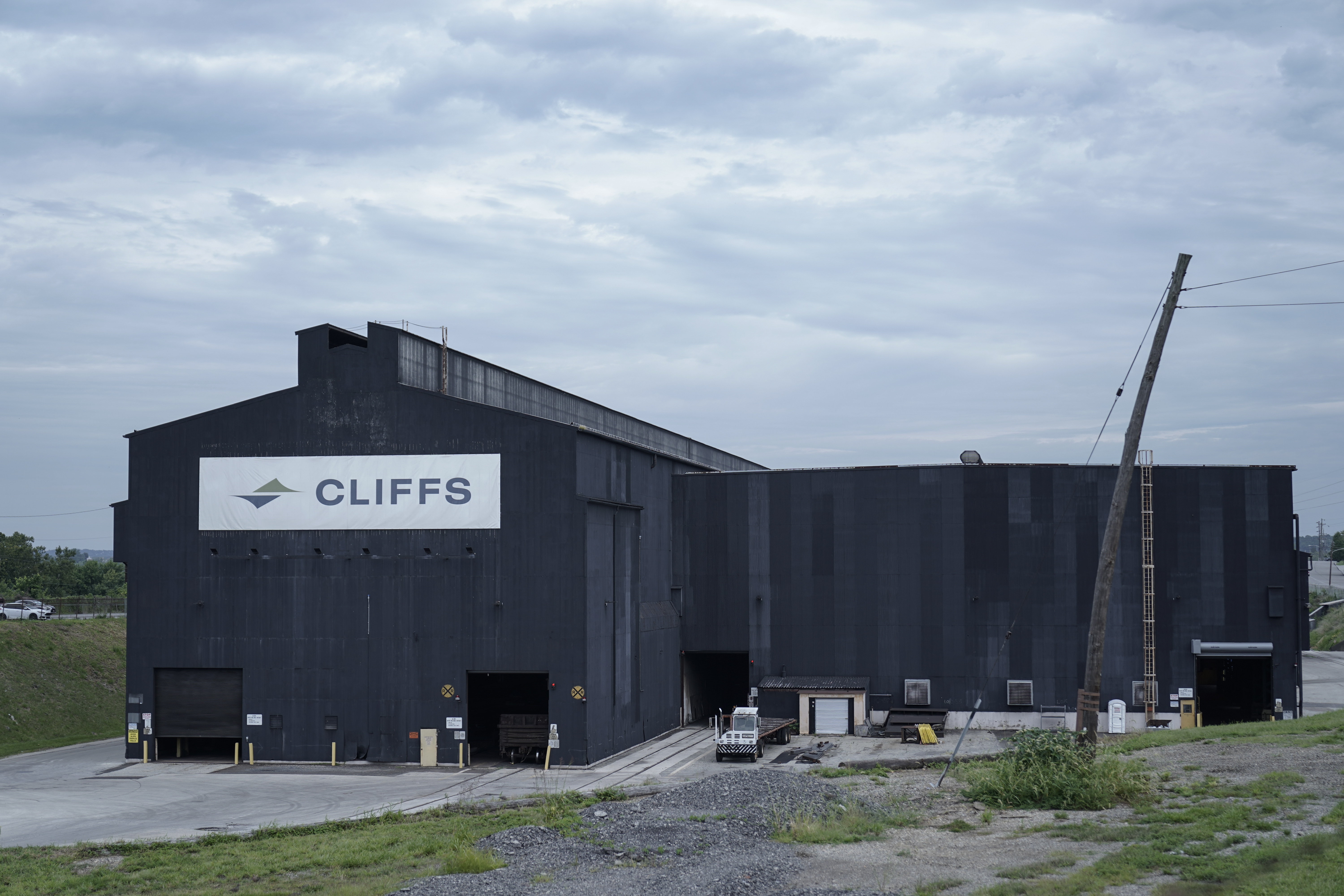
The now-closed Cleveland-Cliffs plant near Conshohocken is shown in this 2023 file photo. A data center has been proposed for the site.
This latest development in the Conshohocken-area data center saga occurs amid broader controversy about such facilities, which handle cloud-computing and storage for Big Tech companies.
The construction of data centers has been fast-tracked to meet the growing demands of power-hungry AI tools like ChatGPT. Politicians on both sides of the aisle, including President Donald Trump and Gov. Josh Shapiro, have pushed for more centers, while some neighbors near proposed sites have mounted fierce pushback.
In the Philadelphia area, Amazon is building a 2-million-square-foot data center on a former steel mill in Falls Township, Bucks County. And a 1.3-million-square-foot data center has been proposed at the former Pennhurst State School and Hospital in East Vincent Township, Chester County.
In Plymouth Township, O’Neill had not revealed the potential tenant for his proposed data center, but indicated it would be related to the life sciences.
The data center is proposed for a 66-acre property along the Schuylkill in the Connaughtown section of the township. The site is less than a mile from downtown Conshohocken. Its neighbors include the Proving Grounds sports complex, Tee’s Golf Center, and dozens of homes.
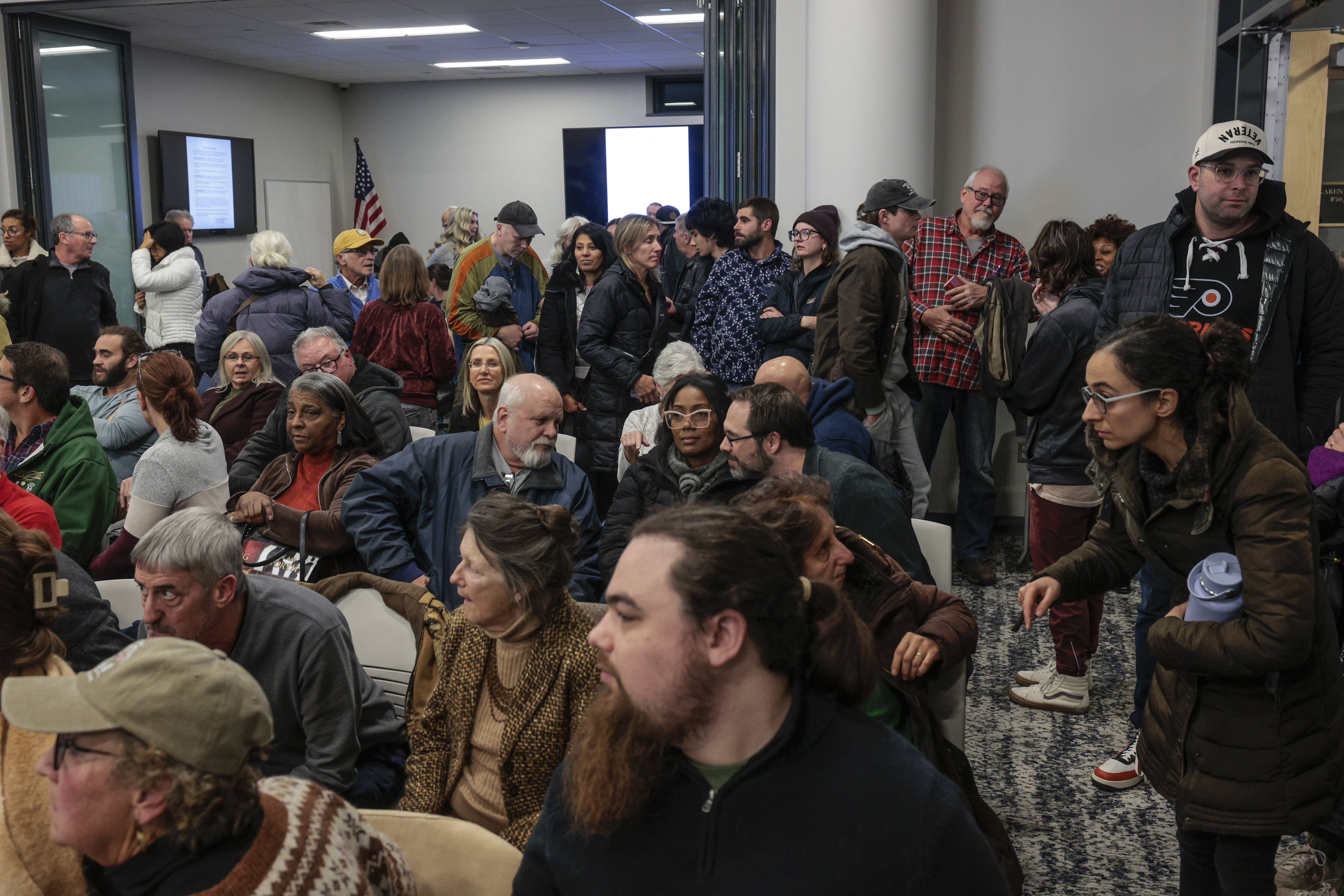
A crowd of people leave the Plymouth Township zoning hearing board meeting on Monday.
Some Connaughtown residents, along with other data center opponents from across the Philadelphia region, have rallied against the proposal. As of Tuesday, more than 1,000 people had signed an online petition urging township officials not to grant a zoning exception for the data center, citing concerns about light, noise, and air pollution; water usage; and electricity costs.
O’Neill, meanwhile, had argued that a data center should be permitted in the “heavy industrial” zone due its to similarity to a warehouse and laboratory, which are both permitted uses under township code. He had also touted the center’s potential economic benefits, saying it could bring in $21 million in annual tax revenue and attract other companies to the area.
“Industry hasn’t come and gone. It’s simply changed,” O’Neill said at last month’s planning board meeting. “What I’m proposing is to put 21st-century industry into an industrial building.”
Why the data center plan was withdrawn
The Plymouth Township zoning hearing board had been set to hear Brian O’Neill’s proposal for an AI data center outside Conshohocken on Monday.
At the start of Monday’s standing-room-only meeting, Plymouth Township officials were expecting a long and potentially tense night.
Solicitor Dave Sander began by warning the crowd that they must maintain decorum, and said he would cut off the proceedings at 10 p.m. Police officers stood outside the room.
Quickly, however, it became clear that Campbell, O’Neill’s attorney, had other plans, requesting a continuance to the Dec. 15 meeting. If granted, it would have marked the hearing’s second continuance: The proposal was initially supposed to be discussed at an October meeting.
“My client would like an additional opportunity to review with [community members] the project,” Campbell said. “When we proceed, if we have had a more robust dialogue with those participants, this hearing on the 15th would be significantly more efficient.”
Neighbors, some of whom had already attended a private meeting with O’Neill last month, objected to the last-minute request, saying that it was unlikely their minds would be changed if no significant changes had been made to the plan.
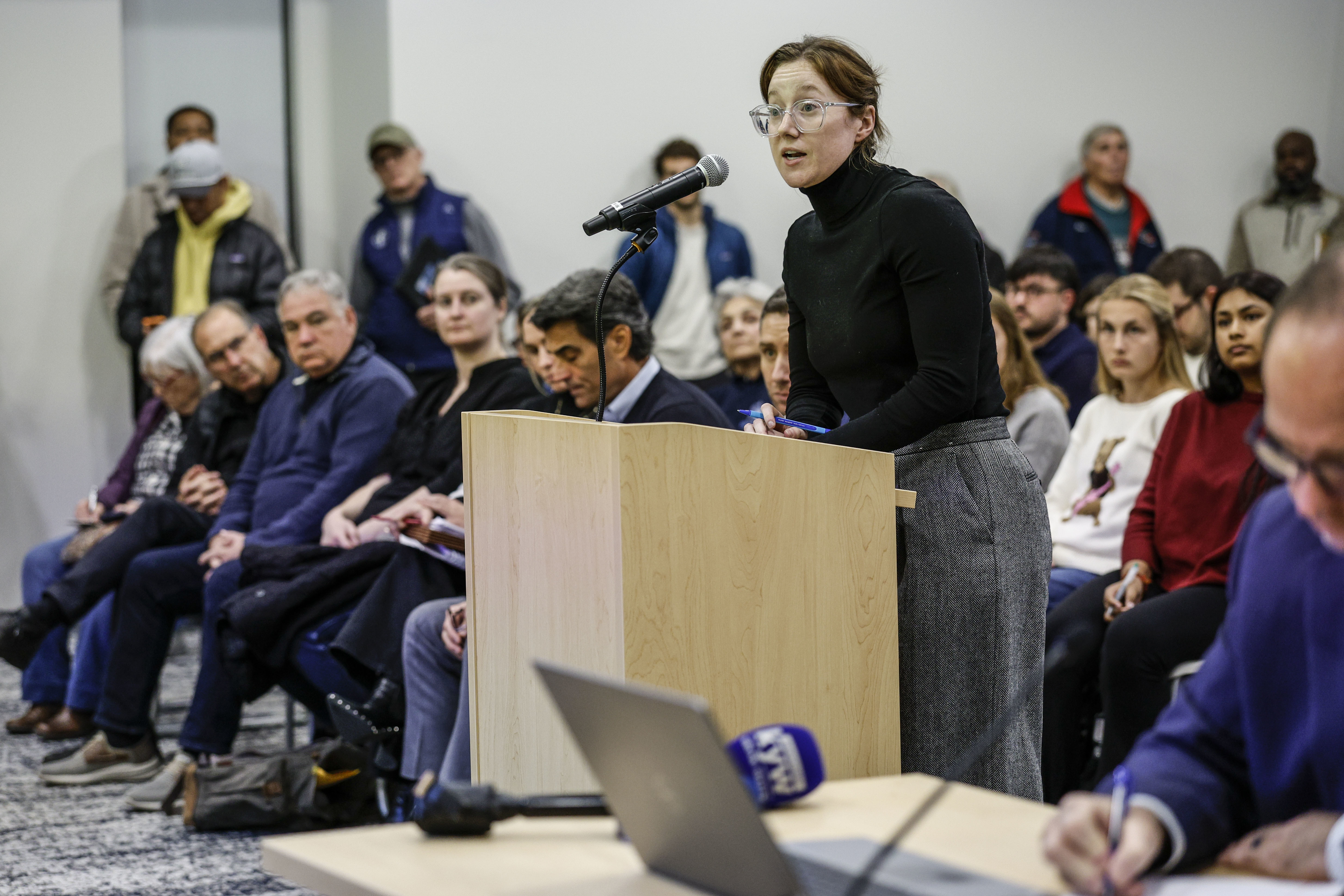
“Is the proposal significantly different than what was displayed to community members at the Oct. 8 meeting?” asked Smith, who organized neighborhood opposition.
Patti Smith, resident and organizer of anti-data center movement in the neighborhood, addresses the Plymouth Township zoning hearing board at Monday’s meeting.
“No,” Campbell responded, later adding that they wanted more residents to be able to attend the meeting and hear from their experts who could speak to concerns, including about noise and emissions.
Before the zoning hearing board could vote on the continuance request, Fine, the attorney for property owner Cleveland-Cliffs, took to the podium.
“There is no standing for the prospective buyer to proceed with the application this evening,” Fine said. “That authority was not extended to the prospective buyer from the owner. There is no LOI [letter of intent] in place.”
“My client delivered a signed agreement of sale to the owner this evening,” Campbell said. “Based on that, we have standing. … We made our application with the express consent of the owner.”
Sander turned to Fine, asking if that was true.
“It’s not entirely true, no,” Fine said. “The signed agreement that was transmitted to my colleague at 5:51 p.m. this evening had redline changes. Those have not been accepted by my client.”
She did not elaborate on what those changes entailed.
The zoning hearing board recessed before returning to accept Campbell’s motion to withdraw the application.
As a neighbor to the site, Liermann said the unexpected turn of events left him with a more sour taste in his mouth about the developer: “The last-minute request in an attempt to obstruct the process and dissuade the public from participating, and then this ‘confusion’ over whether or not an LOI was actually signed between the developer and the owner, is incredibly disturbing.”
Those watching the Eagles’ winning matchup against the Detroit Lions on Sunday may have caught a glimpse of something absolutely “thrillifying.”
As the NBC Sunday Night Football broadcast headed to a commercial break, hosts pointed out a flyover view of Philadelphia’s iconic Boathouse Row. Only this time, the boathouses along the Schuylkill were lit up in pink and green.
Announcers said the special color treatment was brought to viewers by Wicked: For Good, the anticipated musical-to-film finale starring Cynthia Erivo and Ariana Grande (plus West Philly’s own Colman Domingo as the Cowardly Lion).
On social media, viewers were surprised and delighted by the marketing play.
“What do you mean ‘Wicked: For Good’ sponsored by Boathouse Row?” one X user wrote. “Boathouse Row being lit up in Wicked colors is HUGE for my brand,” said another.
It marks the latest effort in the film’s megamarketing campaign, which has ranged from Wicked dolls, to deodorant, to laundry detergent, to make up kits, to Swiffers, to cereal, and everything in between. Truly, no stone has been left un-greenified. And now that approach appears to extend to extremely hyperlocal stops, like Boathouse Row.
It also appears to be Boathouse Row’s first foray into paid movie promotions.
So how did this all pan out? And does it mean Wicked has paid the Fairmount Park Conservatory and Boathouse Row a boatload of sponsorship dollars?
Here’s what we know.
How do the Boathouse Row lights work?
The Boathouse Row lights debuted in 1979 and quickly became a beloved feature along the stretch of 19th-century historic homes. The strip is listed on the National Register of Historic Places.
In 2005, the homes transitioned to LED lights, according to the Fairmount Park Conservancy, which manages Boathouse Row. In 2023, the homes temporarily went dark as part of a $2 million refurbishing project. They were re-lit in March 2024.
According to the conservancy’s website, 6,400 individual LED lights are installed along 10 of the historic boathouses. The light configurations, which were installed by Philly-based firm The Lighting Practice can make 16 million color combinations.
Can anyone make a Boathouse Row light change request?
Surprisingly, yes.
After the homes’ lighting upgrades, Boathouse Row announced that seemingly anyone could become a “Boathouse Row Lighting Partner,” and make a special request in exchange for payment to the Fairmount Park Conservancy.
Of course, the conservancy gets first right of refusal, and there are some exceptions. According to its website, political events and observances, campaigns that conflict with City of Philadelphia laws, religious figures or organizations, and campaigns or events deemed “inappropriate” will not be considered.
You can also check on Boathouse Row’s website to see what color the lights are each day.
How much does a special lighting request cost?
It depends on the level of razzle-dazzle and its duration.
According to Boathouse Row’s website, prices range from $750 to $2,500 per day, depending on the display’s complexity. Fees go directly to the Boathouse Row’s ongoing maintenance. The limit for a display is one week.
How much did Wicked pay Boathouse Row to go green and pink?
It’s unclear exactly how much the Wicked display costs. The lighting scheme aired during Sunday’s broadcast. In reality, that B-roll was filmed in advance on Friday evening, a spokesperson with the Fairmount Park Conservancy said. It lasted about 20 minutes.
The conservancy declined to disclose the exact amount NBC paid. Wicked is a Universal film, which is under the NBC and Comcast umbrella. NBC also broadcasts Sunday Night Football.
Have other movies or marketing campaigns worked with Boathouse Row before?
It looks like this is the first movie campaign.
“We don’t think it’s ever been done before,” conservancy spokesperson Cari Feiler Bender said.
But there are no other mentions of entertainment-related tributes. (This week’s Wicked tribute did not make the row’s Instagram feed, which posts light color updates.)
Boathouse Row has traditionally lit up in color schemes to celebrate local teams or to observe special causes like breast cancer, Alzheimer’s awareness, and Pride months.
The spokesperson added that Boathouse Row would welcome future marketing partnerships to “help keep the lights on.”
(function() {
var l2 = function() {
new pym.Parent(‘michelin_philly’,
‘https://media.inquirer.com/storage/inquirer/projects/innovation/arcgis_iframe/michelin_philly.html’);
};
if (typeof(pym) === ‘undefined’) {
var h = document.getElementsByTagName(‘head’)[0],
s = document.createElement(‘script’);
s.type = ‘text/javascript’;
s.src = ‘https://pym.nprapps.org/pym.v1.min.js’;
s.onload = l2;
h.appendChild(s);
} else {
l2();
}
})();
// Pinned
// Timestamp 11/18/25 9:11pm
Philly earns three Michelin stars
The Philadelphia chefs acknowledged at the Michelin Guide announcements at the Kimmel Center Tuesday.
For the first time ever, Philadelphia has a Michelin star. Three, in fact.
Chefs Amanda Shulman and Alex Kemp won a prestigious Michelin star for Her Place Supper Club. She started in the biz by cooking for friends at her Penn campus apartment. The second star went to Chad and Hanna Williams’ Friday Saturday Sunday. And the third restaurant to earn a star was Nicholas Bazik’s Provenance.
Michelin added 21 Philadelphia restaurants to their “Michelin Recommended” category: Ambra, Forsythia, High Street, Hiroki, Honeysuckle, Illata, Kalaya, Laser Wolf, Laurel, Little Water, Mish Mish, My Loup, Pietramala, River Twice, Roxanne, Southwark, Suraya, Vedge, Vernick Food & Drink, Vetri Cucina, and Zahav. The broader Recommended (or “Selected”) category includes restaurants deemed noteworthy and reliably good.
Ian Graye at Pietramala won a Michelin Green star. This distinction is given to restaurants that demonstrate commitment to sustainability.
Below the star level is the Bib Gourmand, highlighting restaurants offering high-quality food at good value, usually in a more casual format. Philadelphia also got strong representation in that category. Angelo’s, Dalessandro’s, Del Rossi’s, Fiorella, El Chingon, Dizengoff, 4th Street Deli, Pizzeria Beddia, Royal Sushi & Izakaya, and Sally all were awarded Bib Gourmands.
Cheesesteaks dominated Philly’s surprising list of Bib Gourmands
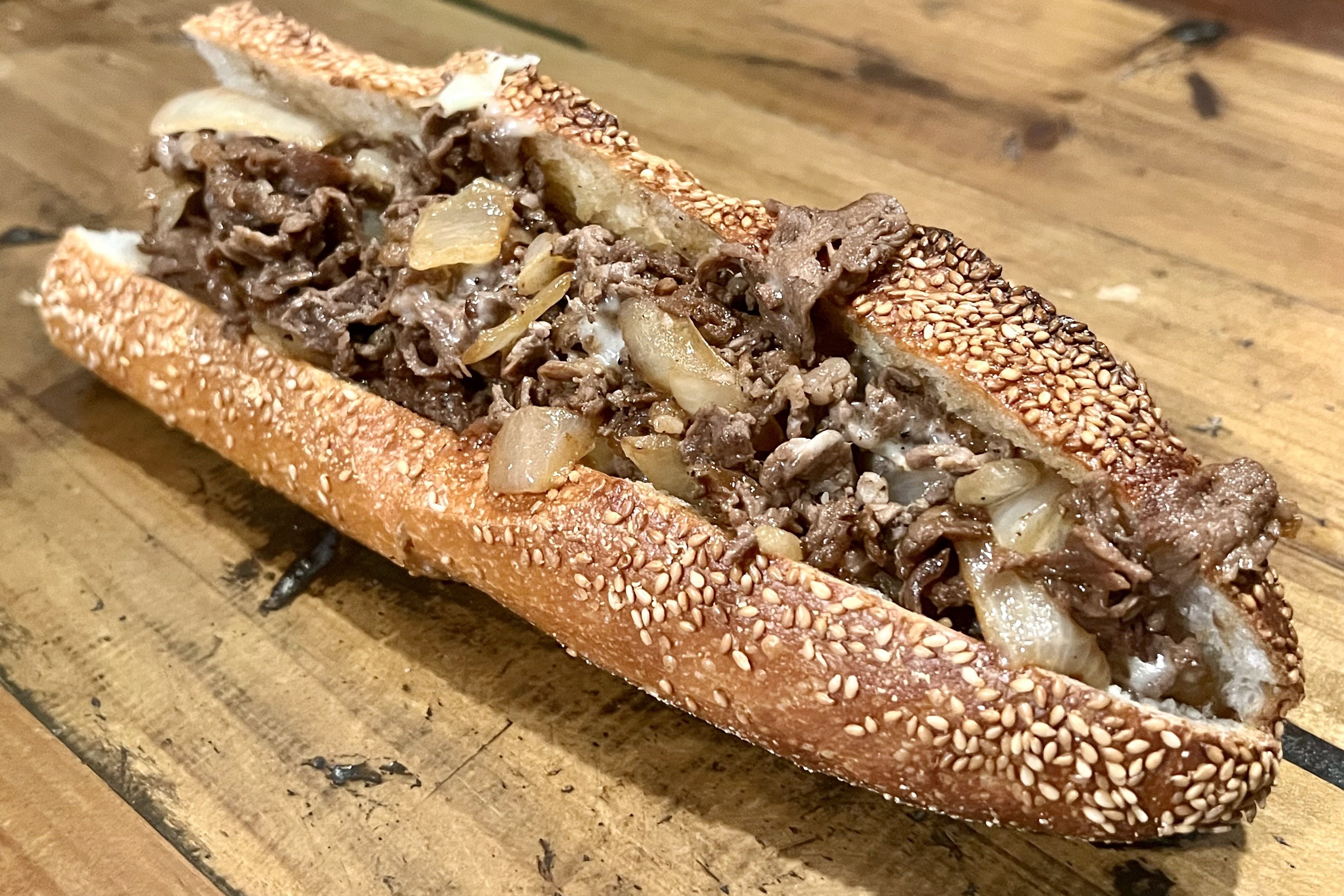
A cheesesteak at Del Rossi’s.
Of all the Michelin choices, the most surprising category was the Bib Gourmands.
There are three cheesesteak specialists on the list — Angelo’s, Dalessandro’s, and Del Rossi’s — but only El Chingon as representative for the city’s huge Mexican scene.
Fiorella also seems like an odd choice for a Bib — sure, it’s “high quality food at a moderate price” but it’s in a difference price bracket than say, Dizengoff.
Of the three restaurants that actually received a star, only Friday Saturday Sunday received a majority of their vote, with 63.3% of readers saying they’ll win one.
Her Place Supper Club (34.9%) and Provenance (37.8%) fared much better in the real awards than readers gave them credit for.
A majority of Inquirer readers also gave stars to Royal Sushi & Izakaya (65.9%), Kalaya (59.3%), and Zahav (51.4%) – all three received recommendations but no stars.
It’s hard to overstate the broader influence of Her Place Supper Club, with its frequently changing tasting menus, TED Talk-like course narrations, and Instagram-stoked reservation scrambles that helped launch Amanda Shulman’s star. But the James Beard-nominated chef has never lost sight of the goal of making her original 24-seat gem into one of Philly’s most exquisitely polished dining experiences, with a thoughtfully concise drink program, an ever-whimsical vibe, and hyper-seasonal menus with French, Italian, and nostalgic Jewish influences, crafted together with chef de cuisine Ana Caballero and sous chef Santina Renzi. Whether it’s a refreshing red drum crudo over chilled cucumber-honeydew gazpacho, smoky lamb merguez with eggplant and chanterelles, or delicate caramelle dumplings stuffed with sweet corn over creamy blue cheese sauce, the dishes here are a pitch-perfect collaboration of an all-female kitchen locked in sync. Cultivating that team has been essential as Shulman’s gone on to open My Loup with husband Alex Kemp and readies another project on Fitler Square. Her Place’s continued success very much reflects that Shulman has allowed it to become their place, too.
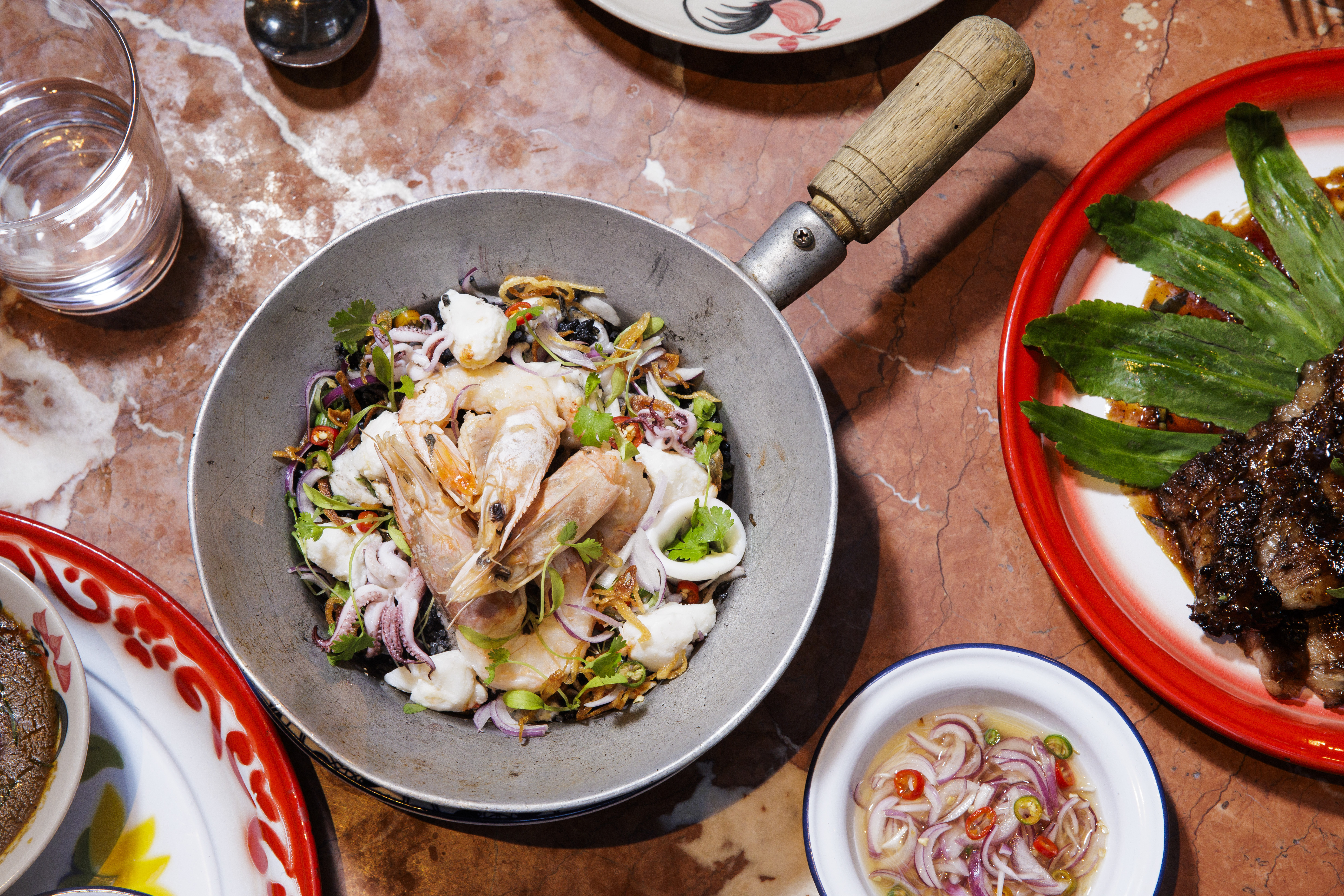
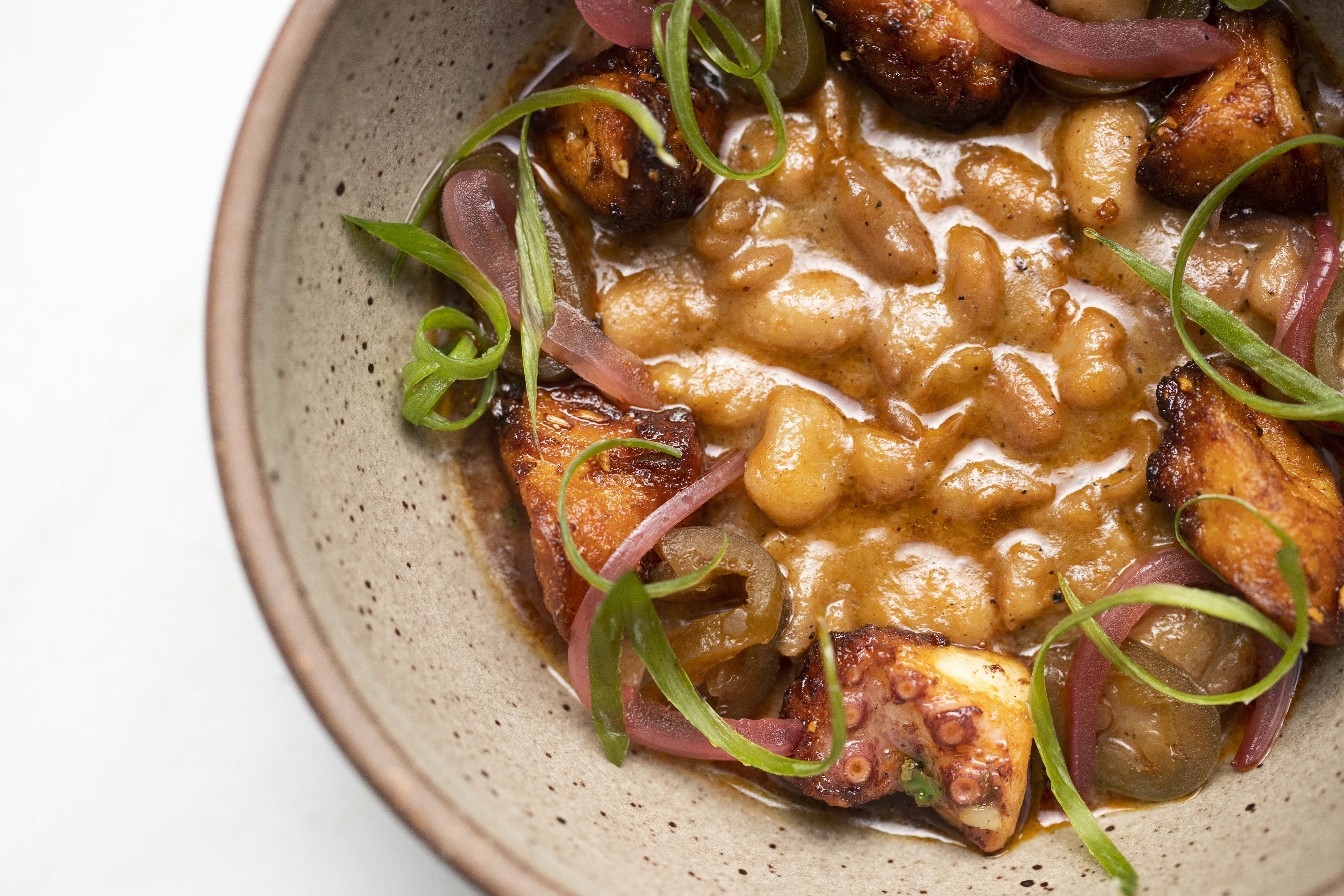
The octopus and beans from the bar menu at Friday Saturday Sunday.
The buzz might seem impossible to live up to for Friday Saturday Sunday after being named most outstanding restaurant in America by the James Beard Foundation in 2023. But with one astounding bite after another on the recent tasting menu — starting with a shatteringly crisp, thimble-sized cup of nori pastry filled with a tartare duo of veal and tuna, all crowned with caviar — Chad and Hanna Williams are clearly not resting on any laurels. Their townhouse oasis off Rittenhouse Square, already the most exciting fine dining experience in Philly, has only gotten better. The airy beignet stuffed with braised oxtail and smoked yam purée was so ethereal, I wished it was more than just a singular “snack.” Pastry chef Amanda Rafalski’s strawberry tarte may also be the most beautiful strawberry confection I’ve ever eaten. It was so vivid, we needed to pause on the way out for a celebratory drink at the ground-floor Lovers Bar, whose leopard-print stools are designated for walk-ins only. It’s a worthwhile stop on any visit to spin Paul MacDonald’s brilliant cocktail carousel for a lucky mystery drink, sip through several obscure amari, and conclude (once again) that the hype for Friday Saturday Sunday is absolutely legit.
Steelhead Trout “En Croûte” with beurre cancalaise served at Provenance.
When you’re paying $225 to sit down for a 2½ hour dinner (figure between $700 or $800 for two all-in with tip and tax, depending on what you drink), there isn’t much room for error. And there are still too many menu missteps at Provenance, where only about half of the 47 compositions I tasted over two meals were a complete success.The focal point of Provenance is an 11-seat counter wrapped around a gleaming steel kitchen that is also a stage — where chefs and servers are the protagonists. And the drama is high at Provenance, the most ambitious French fine-dining project to open in Philly since Jean-Georges in 2019.Such a grand tasting should, ideally, paint a picture with a compelling narrative and a distinct point of view. For Bazik, who has spent 15 years in local kitchens, including Fork, Bistrot La Minette, Good King Tavern, and Lacroix at the Rittenhouse, that portrait is clearly of his passion for updating French classics with influences from the Korean pantry, introduced to him by his wife, Eunbin Whang.Details, however, too frequently marred the bigger picture. With such intricate compositions, where there are bull’s-eyes of sauces within sauces within sauces, the slip of a knife, the rapid cooling of a protein meant to be served hot, or the miscalculated intensity of any one element, can tip the balance.
Notable Michelin snubs include Kalaya, Royal Sushi & Izakaya
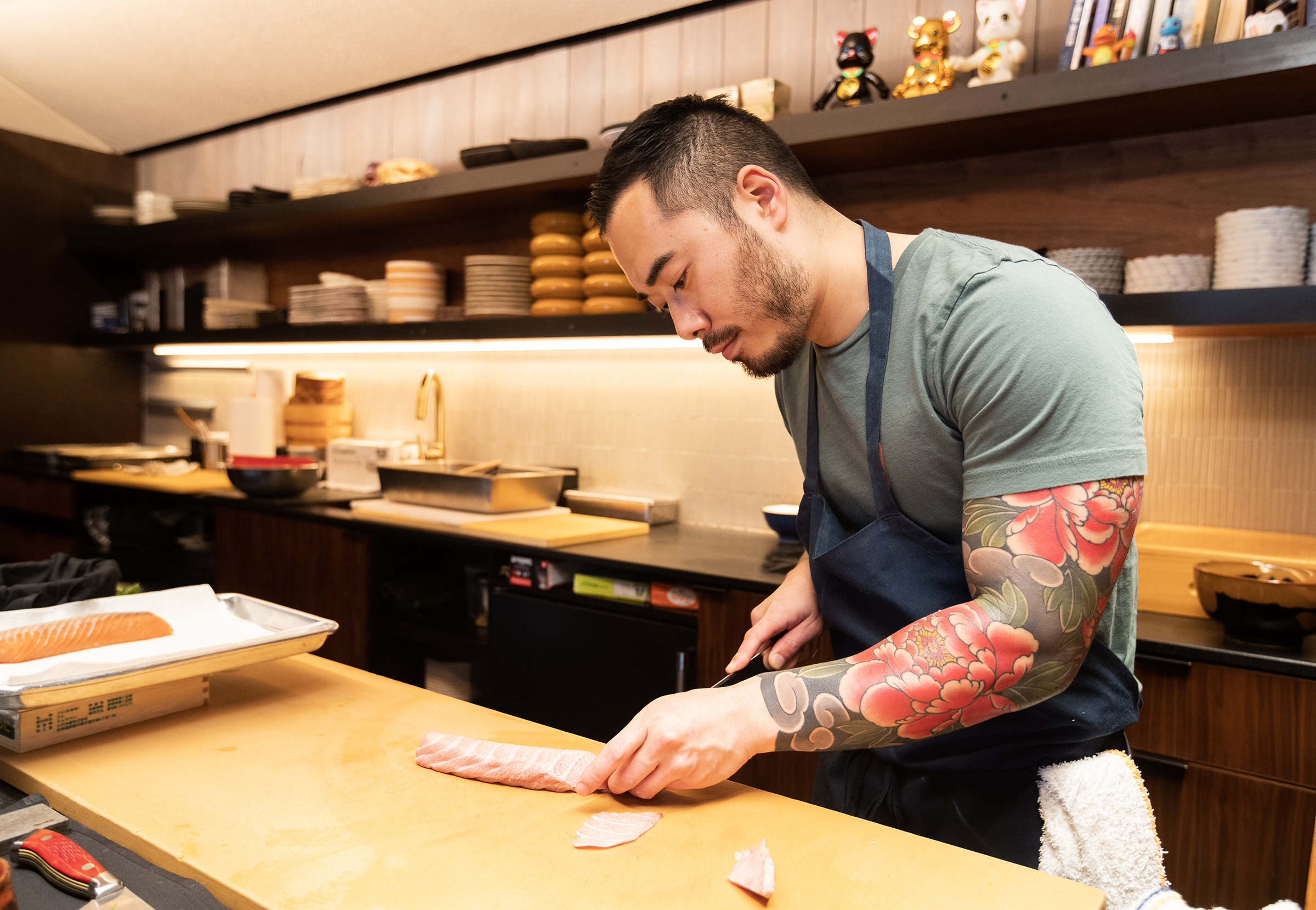
Chef-owner Jesse Ito at work at Royal Sushi & Izakaya.
Giving Kalaya and Vetri Cucina a recommended but not a star was a notable snub. But perhaps the spiciest choice of the night was awarding a Bib Gourmand to Jesse Ito’s Royal Sushi & Omakase, long considered a star contender.
One wonders if the inspectors had trouble getting into the vaunted omakase.
Another notable snub: Phila and Rachel Lorn, owners of Mawn and Sao, were nowhere to be seen. Nor was Northeast restaurant impresario Stephen Starr.
Provenance, open less than a year, awarded a Michelin star
Chef Nicholas Bazik, of Provenance with wife Eunbin Whang, is awarded a star at Tuesday’s Michelin ceremony.
Provenance, chef Nicholas Bazik’s hushed atelier across from Headhouse Square, was awarded a star — a stunning development for a restaurant open less than a year.
Michelin international director Gwendal Poullennec asked Bazik what his inspiration was. He pointed to his wife, Eunbin Whang.
First-ever Philly Michelin star goes to Her Place Supper Club
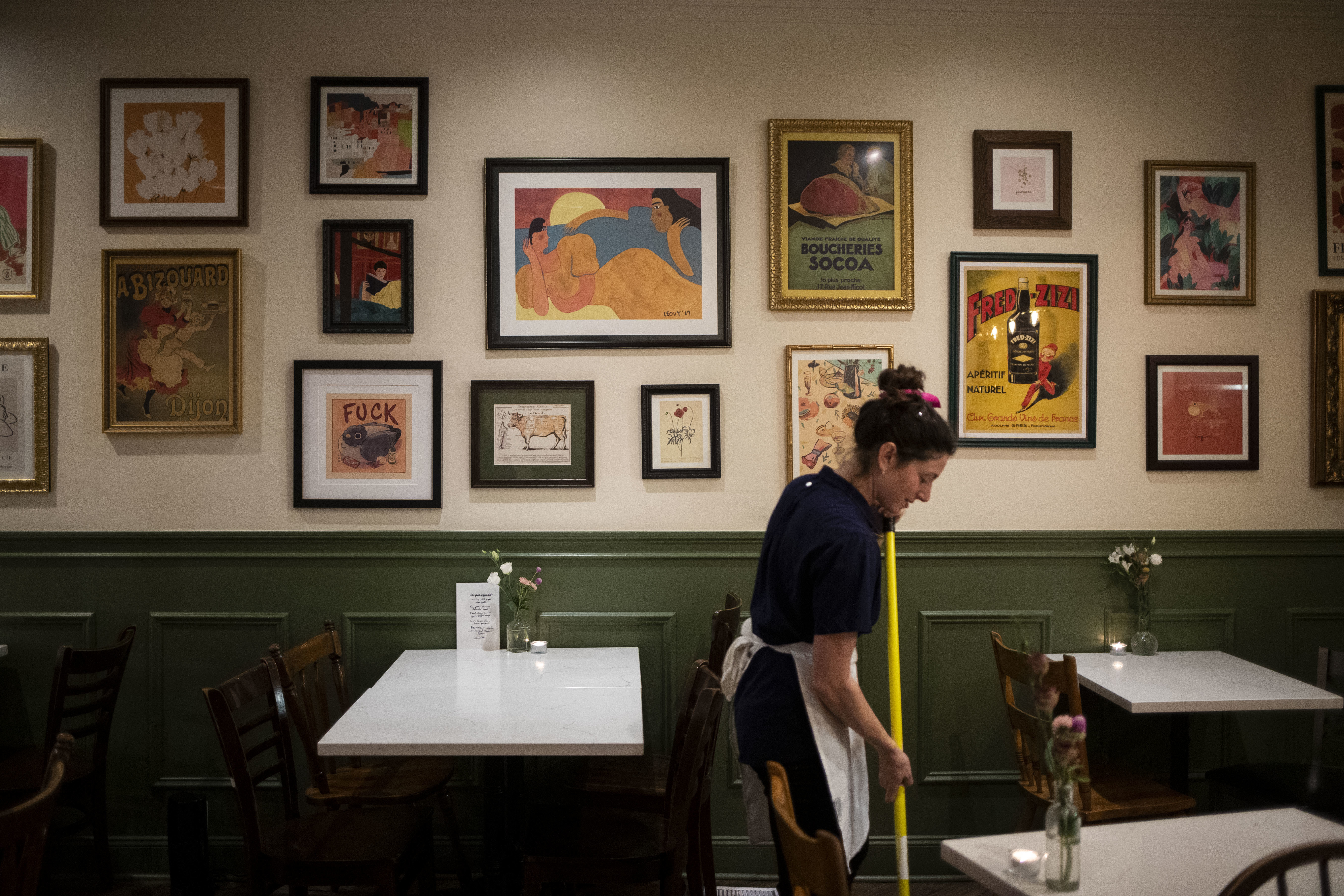
Chef and owner Amanda Shulman sweeps between seatings at Her Place Supper Club.
For the first time ever, Philadelphia has a Michelin star.
Amanda Shulman and Alex Kemp won the prestigious Michelin star for Her Place Supper Club. She started in the biz by cooking for friends at her Penn campus apartment.
Shulman started in the biz by cooking for friends at her Penn campus apartment.
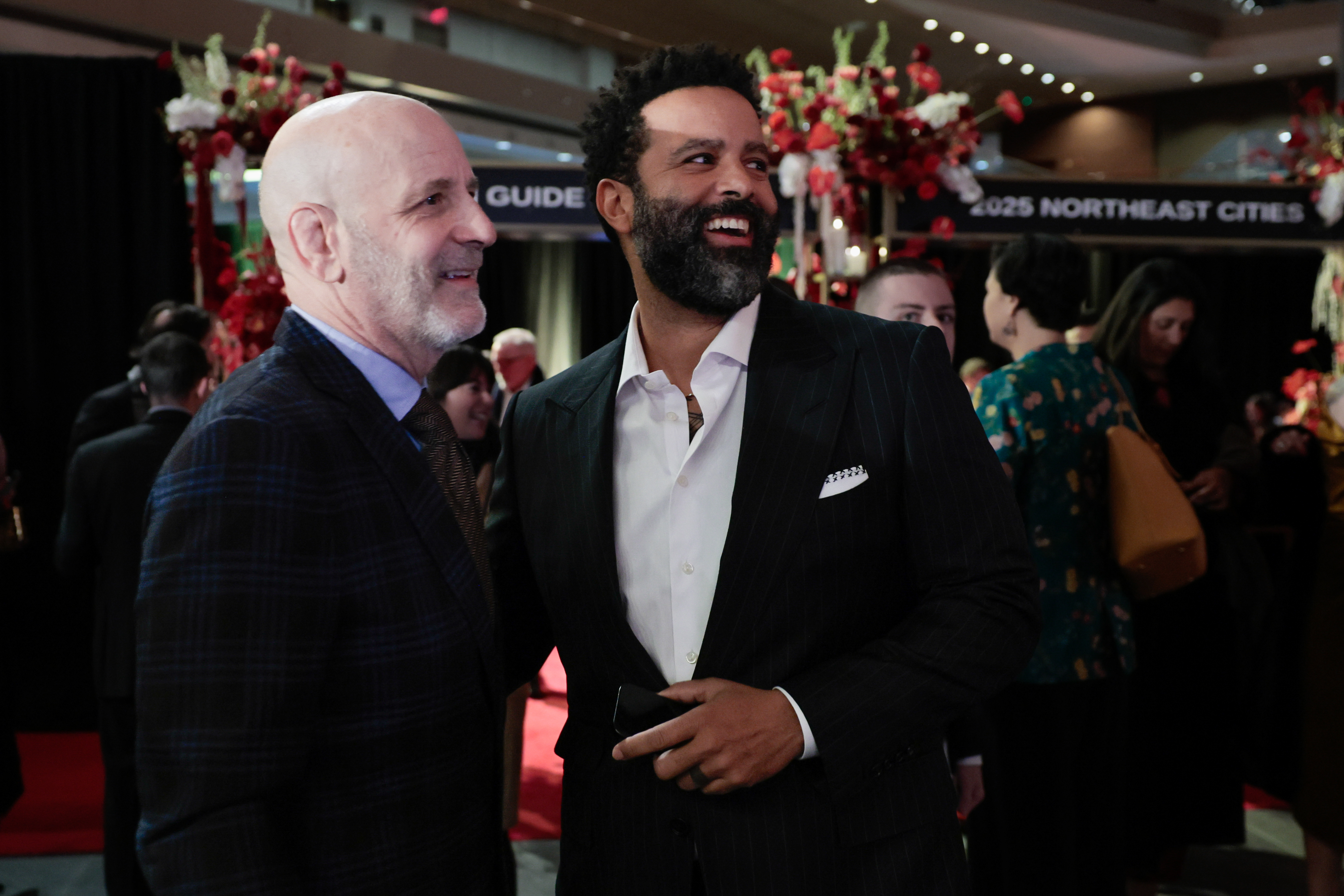
The energetic and anxious crowd of chefs and restauranteurs during the Michelin ceremony at the Kimmel Center Tuesday, Nov. 18, 2025.
// Timestamp 11/18/25 7:13pm
Watch live: Michelin awards ceremony in Philly
// Timestamp 11/18/25 6:50pm
Jean-Georges Vongerichten hopes to add to his Michelin star collection
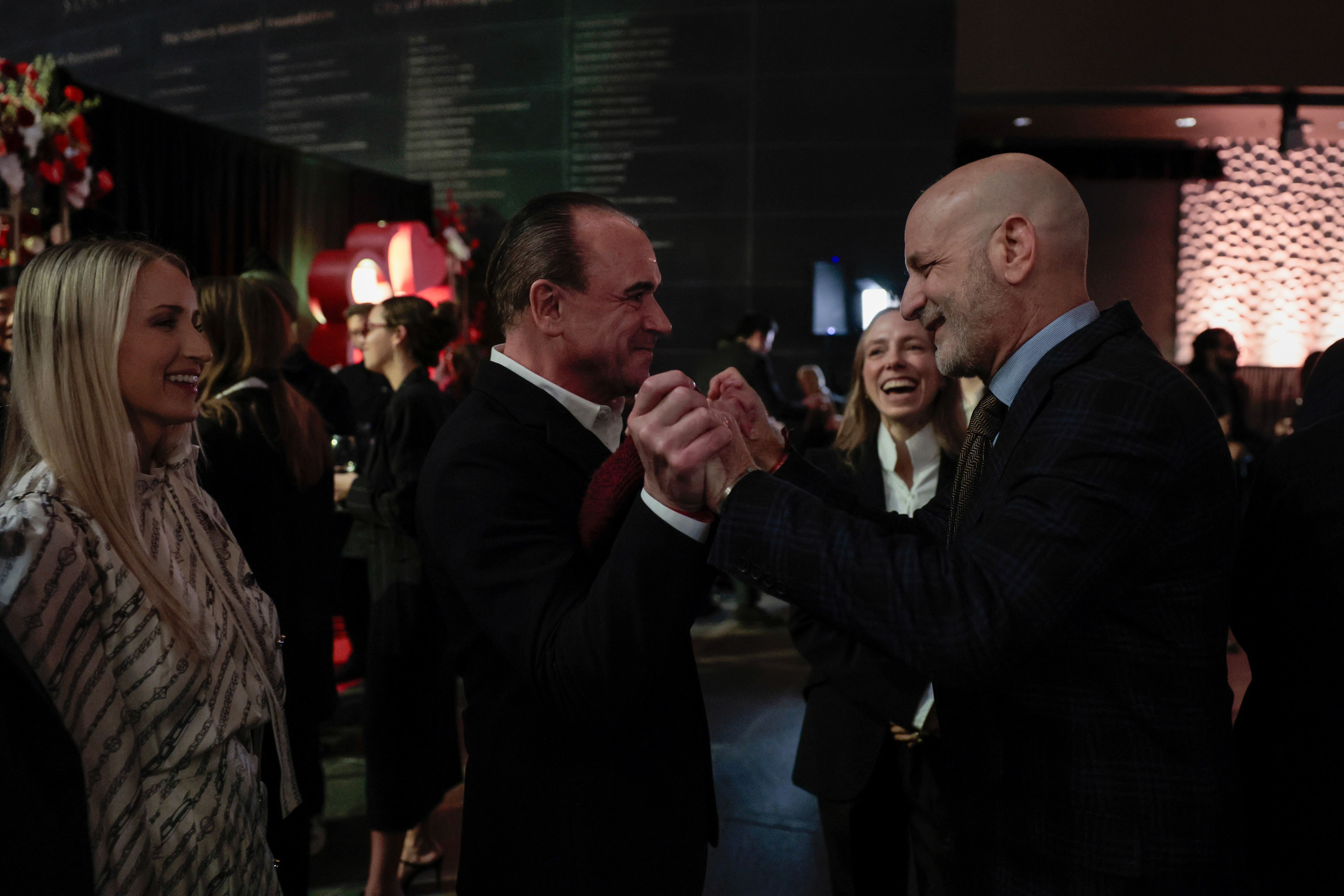
(From left) Kateryna Brooke, Jean Georges Vongerichten, and Marc Vetri during the cocktail hour at the Kimmel Center.
Chef Jean-Georges Vongerichten drew a crowd of onlookers.
Vongerichten is one of the most decorated restaurateurs ever, and recalled his first Michelin experience in 1973 when his parents took him to dine at the three-starred Auberge de l’Ill in Alsace.
I asked him how many Michelin stars he had among his restaurants and he said, “I don’t know. My whole head is full of stars. I hope to pick up more tonight.”
Kimmel lobby getting crowded ahead of Michelin ceremony
Chef Marc Vetri (left), and Chad Williams, of Friday Saturday Sunday, during the cocktail hour at the Kimmel Center.
The Kimmel lobby is becoming a crush of people, photographers, and cater-waiters, handing out wine and hors d’oeuvres.
There is a lot of French being spoken in the crowd, befitting Michelin.
“I always get nervous before an awards ceremony,” said chef Marc Vetri, here with his wife and a crew of five people, including his business partner, Jeff Benjamin.
“These events are great,” Vetri said. “I can say, ‘hey, chef,’ and not worry about their name.”
The lobby of the Kimmel Center ahead of the Michelin ceremony Tuesday, Nov. 18, 2025.
Michelin has editions of its Red Guide to cover regions around the world. It started in France.
There are a lot of factors at play, but to get an estimate, let’s look at how other cities fared in 2024’s guides.
window.addEventListener(“message”,function(a){if(void 0!==a.data[“datawrapper-height”]){var e=document.querySelectorAll(“iframe”);for(var t in a.data[“datawrapper-height”])for(var r,i=0;r=e[i];i++)if(r.contentWindow===a.source){var d=a.data[“datawrapper-height”][t]+”px”;r.style.height=d}}});
With almost two decades of guides under its belt and a population of almost 8.5 million, it’s no surprise that New York City topped the list of cities with the most starred restaurants in 2024. New York City was the first American city to get a Michelin Guide, in 2006.
In this top ten both Atlanta and Washington, D.C., serve as a better comparison to Philly. Atlanta, with about 513,000 residents, earned five one-star ratings in 2023, the first year that Michelin awarded stars there. Washington’s population was about 700,000 in 2017, the same year the Michelin Guide was introduced there and awarded 15 restaurants with star ratings. Population isn’t always a good indicator though. Houston, with 2.3 million residents, earned six stars in its first year.
Kiki Aranita, a food writer (and former chef and restaurateur) for The Inquirer, predicts four or five Philadelphia restaurants will earn a Michelin star this year. She also thinks we might see a Bib Gourmand or two.
Will Philly get any two- or three-star ratings?
Paula Forbes, a senior writer and restaurant critic at Texas Monthly who has reported on the Michelin Guide in Texas, says that “generally speaking, I think that there is sort of an attitude towards, you have to kind of grow into it. You have to get your first star, then your second star, and then your third star.”
Restaurants often don’t earn a two- or three-star rating the first time they achieve a rating and it often takes several years for a restaurant to move up a rank, if at all. Texas has yet to earn a two- or three-star rating. In its third year, Colorado gained its first two-star rating.
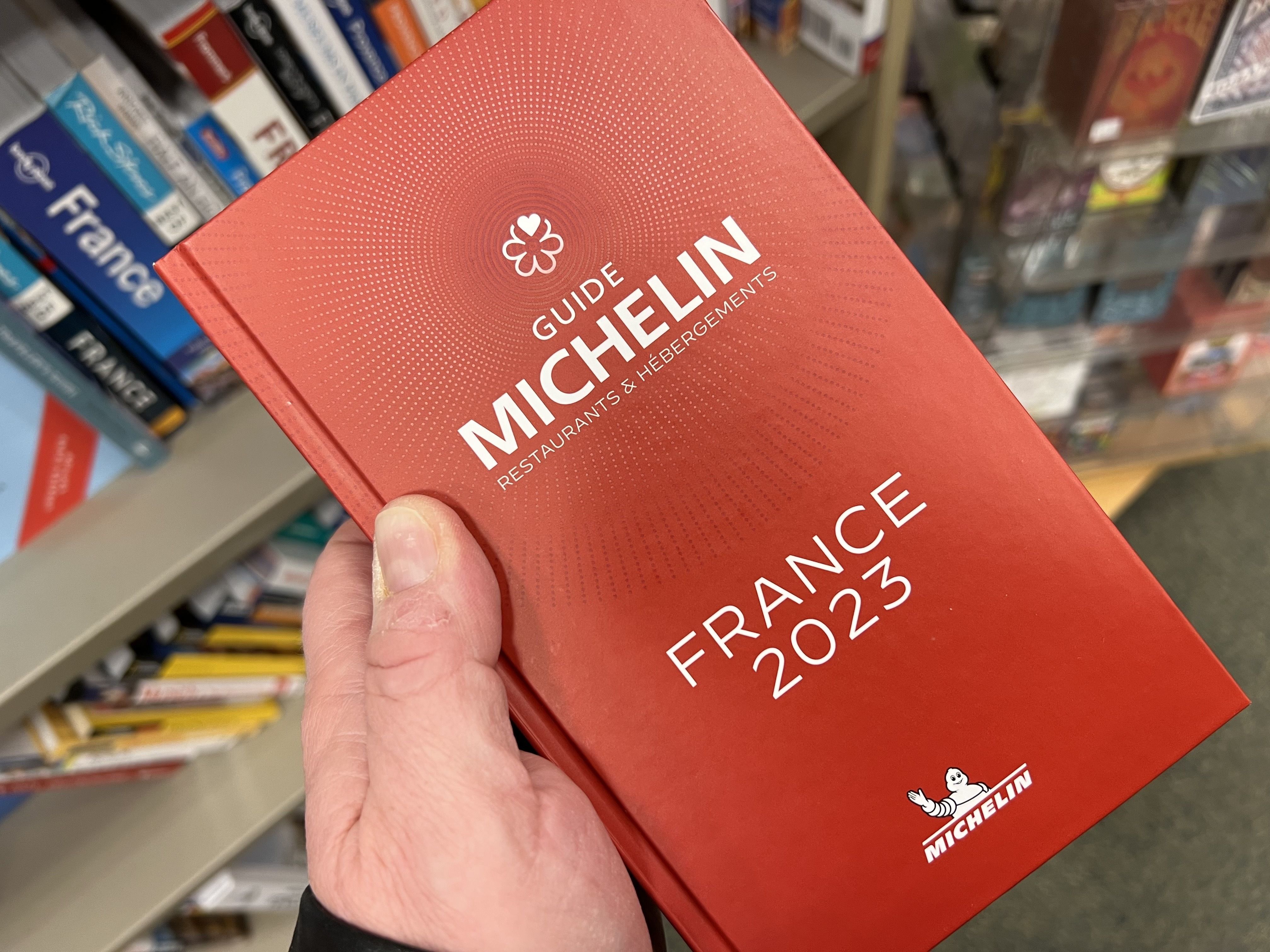
Michelin’s guide to France. The tire company premiered its guides in 1900 as a promotional tool.
City and state tourism boards partner with Michelin — the French-based tire company that has been publishing the influential dining guides for decades — as food tourism plays a growing role in travel planning.
Michelin has expanded rapidly in the United States over the last several years. Besides the American South region — covering Alabama, Louisiana, Mississippi, North Carolina, South Carolina, and Tennessee — there are guides for Texas and Colorado. Atlanta’s 2023 guide has since been rolled into the South. The Florida guide, launched in 2022, now includes Miami, Orlando, and Tampa. Internationally, it recently arrived in Qatar, New Zealand, and the Philippines.
The Philadelphia Convention and Visitors Bureau cites an Ernst & Young study, commissioned by Michelin, showing the guide’s influence: 74% of travelers consider Michelin’s presence a decisive factor when choosing a destination; 76% say they would extend a trip to dine at a recommended restaurant; and 80% report being willing to pay more for what they view as a Michelin-level dining experience.
For restaurants that receive distinctions, the impact is immediate as restaurants append “Michelin” to their social-media profiles.
The reservations boost can be dramatic. In Charlotte, the 18-seat Counter sold about 900 reservations in the days after earning a star at the 2025 American South ceremony on Nov. 3, booking out through mid-February, chef-owner Sam Hart told Axios. About half the reservations came from out-of-town guests, including some international travelers.
In many U.S. markets, the guide is explicitly part of tourism strategies: Axios has reported that the states included in the South edition are collectively paying Michelin $5 million over three years. PHLCVB has not disclosed how much it paid for Michelin’s partnership, which was announced in May.
Not only can reservations rise, so can menu prices at the winning restaurants. A widely cited 2018 analysis by Carly Shin of George Washington University found that a one-star rating increases menu prices by about 15%, two stars by 55%, and three stars by roughly 80%.
Michelin says that 82% of chefs report increased revenue after receiving a distinction, 60% add new staff, and 58% say a nod boosts team motivation and morale — though anecdotally, some chefs acknowledge enormous pressure to maintain such a high level.
In connection with Michelin, the PHLCVB Foundation is sponsoring the Philabundance Community Kitchen program, a 16-week culinary vocational training and life-skills program for adults with low or no income, offering hands-on kitchen experience, ServSafe certification, and post-graduation employment support in the food service and restaurant industry. The foundation will connect the recognized chefs and restaurateurs to the PCK program.
Rittenhouse Square weighs in on which spots deserve Michelin stars
// Timestamp 11/18/25 12:20pm
What to expect at tonight’s Michelin ceremony
Gwendal Poullennec, the Michelin Guide’s international director, will help emcee tonight’s ceremony.
Awards will be presented live with TV host Java Ingram serving as emcee alongside Gwendal Poullennec, the Michelin Guide’s international director. Gregg Caren, president and CEO of the PHLCVB, will open the evening.
Lillia Callum-Penso, a reporter who covered the American South awards for the Greenville News earlier this month, said she was struck by the atmosphere onstage during the ceremony. Many of the chefs already knew one another from festivals or previous jobs. “There was a lot of conviviality among the chefs when they were called on stage,” she said. “It was kind of moving — that to me was a very telling and interesting part of the ceremony.”
Michelin may be a huge part of the foodie lexicon, but it might not be a household word everywhere. Because Michelin North America’s headquarters are in Greenville, “people in Greenville know Michelin as the tire company,” Callum-Penso said.
Many residents, she said, were surprised to learn “there’s a whole lifestyle component to Michelin.”
Philly in the spotlight as chefs gather for prestigious Michelin awards
Gwendal Poullennec, Michelin’s international director, attends a dinner in Michelin’s honor in May at Philadelphia’s Her Place Supper Club.
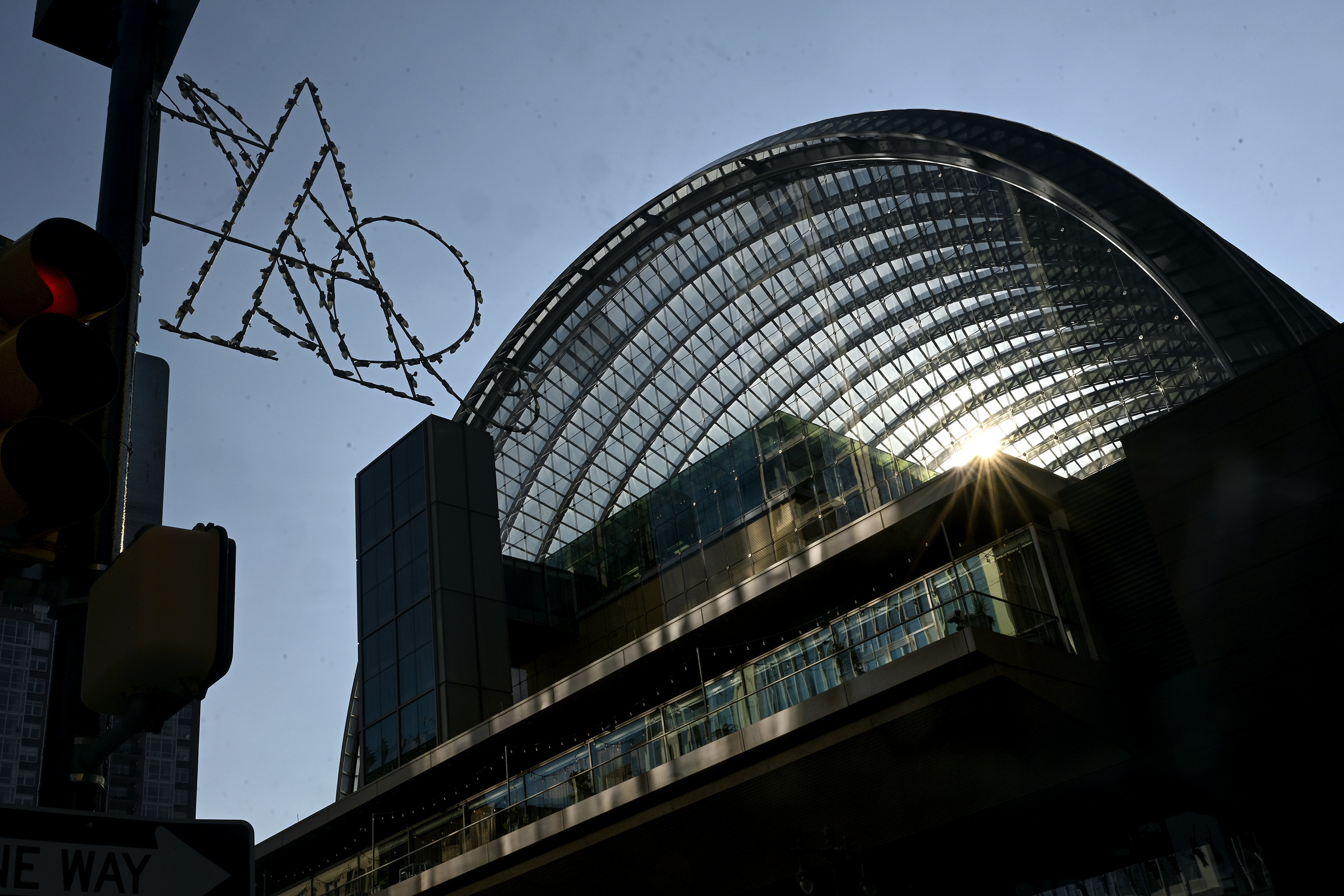
Philadelphia will be thrust onto the world culinary stage tonight as chefs, restaurateurs, tourism officials, sponsors, and international media gather at the Kimmel Center for the unveiling of the Michelin Guide’s expanded Northeast Cities edition. It covers restaurants in Chicago, New York, Washington, D.C., and, for the first time, Boston and Philadelphia.
The ceremony, marking a milestone for Philadelphia’s profile as a dining destination, is the city’s highest-profile appearance since 2018, when the James Beard Foundation announced that year’s finalists for its annual chef, restaurant, and media awards.
Given that five cities are involved — with two newcomers — it’s likely that more than a hundred restaurants will be honored tonight overall. The results will appear online only; there will be no published book.
Michelin, which operates in secrecy, bases the selections on its anonymous inspectors. Stars denote excellence: one star signals very good cuisine that’s “worth a stop,” two stars indicate excellence “worth a detour,” and three stars represent exceptional dining “worth a special journey.” Below the star level is the Bib Gourmand, highlighting restaurants offering high-quality food at good value, usually in a more casual format. The broader Recommended (or “Selected”) category includes restaurants deemed noteworthy and reliably good. There also is a Green Star, given to restaurants that demonstrate commitments to sustainability. Restaurants, not the chefs, get the award.
In Philadelphia, speculation on who will win — and even who was invited to the ceremony — is all chefs have been talking about for the last several weeks. Michelin does not inform winners beforehand (though early this month, the list of the American South winners was accidentally leaked 12 hours before the ceremony in Greenville, S.C.).
Last week, Michelin did inform the owners of three three-star restaurants — Alinea, the Inn at Little Washington, and Masa — that they would each lose a star at tonight’s awards.
As Philadelphia City Hall was lit up in Michelin red last night, the partying began. OpenTable took over Sao, a hot, new South Philadelphia restaurant, for a cocktail reception for chefs who use the reservation platform. Guests included Ian Graye of Pietramala, Omar Tate of Honeysuckle, and Chad and Hanna Williams of Friday Saturday Sunday.
Late this afternoon, chef Jean-Georges Vongerichten will host a private reception at Jean-Georges Philadelphia at the Four Seasons, with chefs shuttled to the ceremony by private bus. A cocktail hour will precede the awards, and multiple after-parties are scheduled, including a gathering at the Arts Ballroom sponsored by OpenTable and Evian, and a Resy/Amex and Visit Philly takeover at Dancerobot — the new Center City izakaya from Jesse Ito and Justin Bacharach — featuring drinks, food, and karaoke.
Michelin Stars are finally coming to Philly. How well will the city’s restaurants fare?
A Michelin star is a coveted award among restaurants and chefs and is the most prestigious of the awards the Michelin Guide bestows. Only 259 restaurants in the United States earned a star rating in 2024. In addition to the star ratings, the Michelin Guide also awards the Bib Gourmand to recognize restaurants that are serving high-quality meals at a reasonable price and a Green Star to symbolize excellence in sustainability.
Restaurants are not nominated nor do they apply to be evaluated. Stars are awarded annually and can be lost or gained year-on-year. Michelin keeps most details of the process secret, but we know a few vague details.
Anonymous inspectors visit restaurants multiple times to evaluate the restaurant during different dining periods, different days of the week, and different seasons. Restaurants around the world are evaluated by the same inspectors, to ensure that restaurants are judged by the same standards, and those inspectors make decisions to award stars as a collective.
Inspectors evaluate based on the following criteria:
South Philly weighs in on what spots deserve Michelin stars
What will Michelin mean for the Philly restaurant scene?
Provenance chef-owner Nicholas Bazik greets guest in the Headhouse Square restaurant on Oct. 17, 2024.
Dining rooms in Philly are abuzz with talk of Michelin’s impending arrival in Philadelphia —whose stars (or lack thereof) are set to be announced on Tuesday.
On a recent night, while celebrating my wedding anniversary at the elegant Friday Saturday Sunday, diners at tables on either side of mine discussed the potential of the restaurant winning a star. That same week, at the hushed, luxe soapstone counter at Provenance, where spotlights shine precisely upon the parade of twenty-some courses (which costs $300 inclusive of tax and service charge, but not beverages) placed in front of diners, Michelin was brought up by every single guest to chef Nich Bazik as he made his rounds.
“I’ve been to a lot of Michelin-starred places and they’ve been mediocre. But I think you’re going to get one,” I overheard one diner telling Bazik.
Anticipation is high. But what would getting Michelin recognition actually mean to Philadelphia restaurants? In at least one case, it might translate to survival. For the rest of the city, the guide’s arrival is both foreboding and exciting.
It’s official. Medicare costs will eat up much of older Americans’ Social Security cost-of-living increase next year.
The standard monthly premium for Medicare Part B, which covers outpatient care, doctors’ services, durable medical equipment and preventive service, will be $202.90 in 2026, the Centers for Medicare and Medicaid Services said on Nov. 14. That’s up $17.90, or nearly 9.7%, from $185.00 in 2025.
It’s smaller than the $21.50 increase the Medicare Trustees had forecast earlier but still the second largest dollar jump in program history behind 2022’s $21.60 gain and almost 3.5 times the 2.8% Social Security raise for next year. That means seniors will probably see a drop, again, in their standard of living, experts said.
Seniors were the only ones who saw an increase in poverty in 2024. All other age groups saw a decrease or stayed the same.
“The public is likely to perceive this Part B increase as taking a significant chunk of or even most of their COLA,” said Mary Johnson, independent Social Security and Medicare policy analyst. “In other words, another continuation in relentless cost increases battering consumer finances.”
Monthly Social Security checks will rise $56, on average, starting in January because of the 2.8% COLA, the Social Security Administration said. After the $17.90 increase in Medicare Part B, the average monthly COLA increase is cut to $38.10.
Hold-harmless provision
Such a large increase in Medicare Part B will likely trigger the hold-harmless provision for Social Security recipients with a Social Security benefit of $640 or less, Johnson said.
The Medicare hold-harmless provision prevents the Part B premium increase from being larger than the Social Security COLA. If a premium increase is higher than the COLA, the rule prevents the beneficiary from paying the full increase. The portion of the increase those beneficiaries don’t pay is spread out among others who aren’t protected by the rule.
For those people with a Social Security benefit of $640 or less, the 2.8% COLA next year would mean just less than an $18 per month increase in their Social Security checks. Without the hold-harmless rule, the Part B premium increase would swallow the entire COLA.
In 2022, only about 1.5% of Medicare beneficiaries had their Part B premiums limited by the hold-harmless provision, government data showed. Part B rose $21.60 to $170.10 in 2022 while the average monthly COLA increase boosted Social Security checks by $92.
In 2017, when Medicare premiums jumped 10%, or $12.20, to $134.00 and far outpaced the 0.3%, or $5 average, monthly COLA increase, 70% of Medicare Part B enrollees paid a lower-than-standard Part B premium due to the hold-harmless provision.
Hold-harmless rule isn’t panacea for all costs
The hold-harmless provision can protect seniors from Part B premium surges, but other costs may bite, Johnson said.
“If individuals have other automatic deductions such as for Medicare Advantage or Part D premiums, increases in those premiums could reduce Social Security benefits,” Johnson said. The optional Part D covers prescription drugs.
Some Part D plans are increasing premiums by as much as $50 in 2026, the maximum allowed under a Part D Premium Stabilization Demonstration Program, according to the nonprofit, nonpartisan research organization KFF.
“To complicate things, there are fewer stand-alone Part D plans to choose from,” Johnson said. The total number of prescription drug plans has dropped by half since 2024, KFF said.
Is everyone eligible for hold harmless?
Those who aren’t eligible for the hold-harmless provision include:
New Medicare enrollees
People who aren’t receiving Social Security benefits
High-income earners
What about deductibles?
In addition to higher premiums, higher annual deductibles next year will make health insurance even more expensive for Medicare enrollees.
The annual deductible for all Medicare Part B beneficiaries before insurance covers costs will be $283 in 2026, up $26 from $257 in 2025, CMS said.
Could it have been worse?
The Part B premium could have been higher, CMS said.
“If the Trump Administration had not taken action to address unprecedented spending on skin substitutes, the Part B premium increase would have been about $11 more a month,” CMS said. “However, due to changes finalized in the 2026 Physician Fee Schedule Final Rule, spending on skin substitutes is expected to drop by 90% without affecting patient care.”
Skin substitutes are materials like biologic, synthetic or biosynthetic products that mimic human skin and are used to cover and treat chronic wounds, such as diabetic foot ulcers. The Trump administration reclassified these bandages so they aren’t billed separately. CMS estimates the change would reduce Medicare spending on these products by nearly 90% in calendar year 2026.
Medicare Trustees also estimated earlier this year the standard monthly Part B premium would rise $21.50 to $206.50 in 2026 from $185 in 2025. That would have been more than the $17.90 increase to $202.90 in 2026.
The turning point in Pennsylvania’s budget impasse, by Gov. Josh Shapiro’s telling, came just before Halloween, when he and leaders in Harrisburg gathered in his stately, wood-paneled office to meet twice daily to hash out a deal to end the bitter, monthslong stalemate.
The long grind eventually led to compromises 135 days in, and a deal Shapiro said he thinks is far better than what national Democrats, hoping to extend healthcare subsidies, got in Washington at the end of the federal shutdown.
“Sometimes you’ve got to show that you’re willing to stay at the table and fight and bring people together in order to deliver,” Shapiro told The Inquirer in an interview Friday, touting the state budget agreement finally signed that week.
“I think it’s a stark contrast, frankly, with what happened in D.C., where they didn’t stay at the table, they didn’t fight, and they got nothing,” he said.
Washington is controlled by Republicans, while in Pennsylvania, Democrats control the state House and governorship, and Republicans hold a majority in the Senate.
Both state and federal budgets were signed the same day, offering Pennsylvanians relief from more than a month of government dysfunction at two levels. But for Shapiro — an exceedingly popular Democratic governor facing reelection in 2026 as whispers swirl over his potential 2028 presidential ambitions — the moment was bigger than a procedural win. In the end, Shapiro, preaching his oft-used slogan of “getting things done,” cast the outcome as proof he can muscle through gridlock of a divided legislature, cut deals under pressure, and hold firm where others cave.
So what if it took almost five months? Shapiro argues. At least he didn’t fold.
“I would have hoped to have gotten this budget done, you know, 100 or so days earlier,” Shapiro said, putting pen to paper in the state Capitol building’s baroque reception room last week. “But I think what you also saw was the result of having the courage to stay at the table and keep fighting for what you believe in. And we got a lot more than we gave in this budget.”
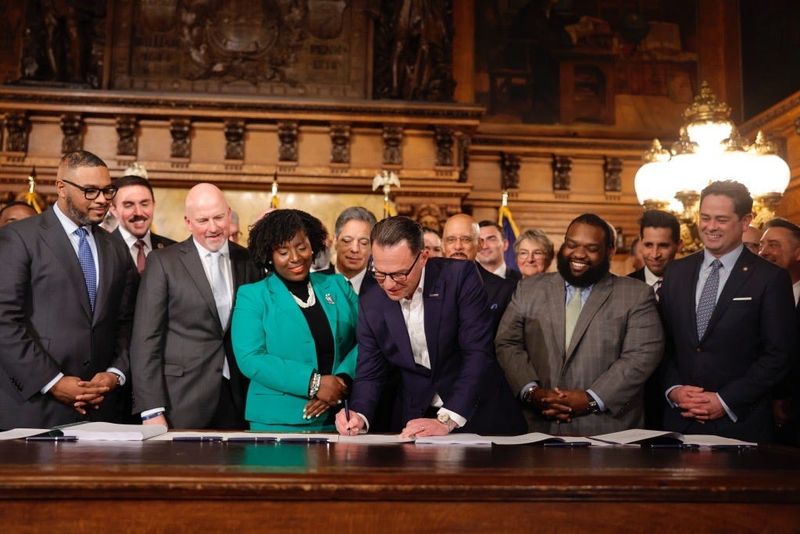
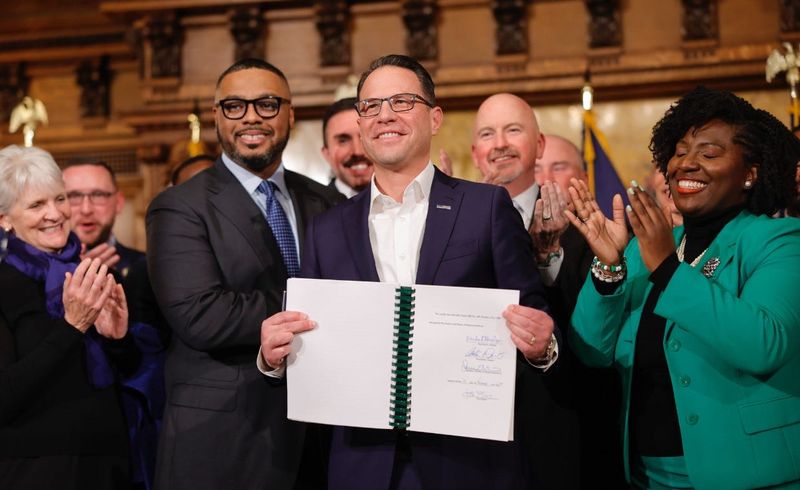
Gov. Josh Shapiro signs the fiscal year 2025-26 budget surrounded by General Assembly members on Nov. 12 at the Capitol in Harrisburg. The state budget had been due June 30, and Pennsylvania the final state in the country to approve a funding deal.
Critics are quick to note it took the self-proclaimed dealmaker so long to get a deal. Counties, school districts, and nonprofits struggled through four months without state payments while officials remained at loggerheads.Pennsylvania was the last state in the nation to pass a spending plan for the 2025-26 fiscal year.
“He’s five months late. He’s the governor of the fifth-biggest state in the country and the last state to get a budget done,” GOP consultant Vince Galko said. “It’s not a failing grade because it got done, but it’s still a D.”
‘A tremendous cost’
The $50.1 billion budget includes several key priorities for Shapiro and Democrats: significant increases in public education funding, a new tax credit for lower- and middle-income residents, continuation of a popular student-teacher stipend, and other economic and workforce development initiatives.
House Speaker Joanna McClinton (D., Philadelphia) heaped praise on Shapiro during a Monday news conference celebrating the budget’s new Working Pennsylvanians tax credit. “I am grateful that here in Harrisburg we have a hero among us for working families, and his name is Josh Shapiro.”
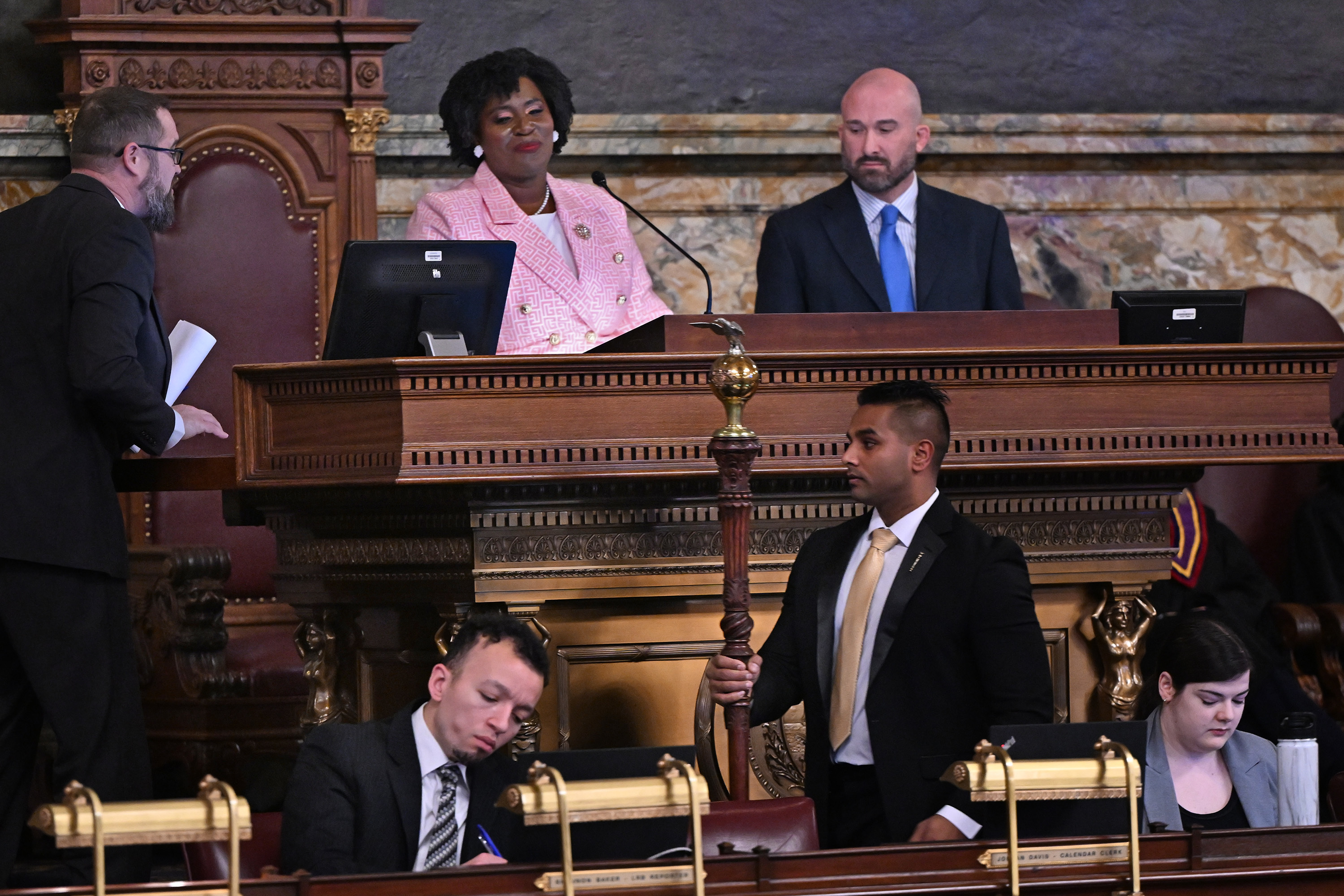
State Rep. Joanna McClinton (D., Philadelphia) is on the rostrum in the House chamber on Jan. 7 after she was reelected speaker of the House despite an initial 101-101 tie vote along party lines.
State Sen. Nikil Saval, a progressive lawmaker who represents part of Philadelphia, was one of a handful of Democrats to vote against the bipartisan Pennsylvania budgetbill that was largely lauded by Democrats and Republicans in Harrisburg and beyond. Saval applauded the school funding, anti-violence grant funding, and childcare support but slammed the absence of transit funding and Democrats’ agreement to end their pursuit to join a key climate program.
“Unfortunately, it comes at this tremendous cost,” he said.And ultimately, Saval said, the finished product didn’t seem to justify the time it took to get there.
Gov. Josh Shapiro visits SEPTA headquarters on Aug. 10 to discuss funding for the transit agency. To his right, from left, are state Democratic legislators Sen. Anthony H. Williams; Sen. Nikil Saval; Rep. Ed Neilson; and Rep. Jordan Harris.
It was not just transit funding that took a back seat to get the budget deal over the line. To thedelight of Republicans — and the chagrin of some progressive Democrats and the climate-conscious — the deal also pulled the state out of the Regional Greenhouse Gas Initiative, a cooperative among states to reduce carbon emissions.
“For years, the Republicans who have led the Senate have used RGGI as an excuse to stall substantive conversations about energy,” Shapiro said. “Today, that excuse is gone.”
The powerful Pennsylvania Building and Construction Trades Council had lobbied heavily for lawmakers to walk away from the initiative, and it was a top win for state Republicans, who have long said the state should not join the multistate cap-and-trade emissions program they see as hamstringing Pennsylvania’s energy industry from accessing the state’s plentiful natural resources.
‘Two-a-days’
Shapiro said he spent months “running back and forth” to broker a deal between Senate Majority Leader Joe Pittman (R., Indiana) and House Majority Leader Matt Bradford (D., Montgomery). The three met on-and-off in private talks, attempting to hammer out a compromise between the Democratic House and Republican-controlled Senate. But the week of Oct. 27, more than four months into the stalemate, Shapiro said a “breakthrough” finally came when he broadened the talks to include McClinton and Ward.
Minority leaders Rep. Jesse Topper (R., Bedford) and Sen. Jay Costa (D., Allegheny) also joined the group, as it became clear that neither of the tightly controlled chambers would have the votes needed to pass a final budget deal.
The group met twice daily in a conference room in Shapiro’s office. Shapiro, always a fan of the sports metaphor, called the meetings “two-a-days.”
“We would come in the morning, go over the issues. We’d have our homework for a few hours, then come back in the afternoon and talk about, you know, the progress that we made,” Shapiro said. Coming out of that week, the governor said, leaders “had a clear direction on where we were going to go.”
Pennsylvania Lt. Gov. Austin Davis and Gov. Josh Shapiro show a budget document moments after it was signed Nov. 12 while surrounded by legislators at the state Capitol. A deal struck Nov. 12 ended a budget delay that lasted more than four months.
At the negotiating table, Shapiro served as “referee and facilitator” between House Democrats and Senate Republicans, McClinton said in an interview Monday.
“The man is nothing if not dogged and determined,” Bradford said of Shapiro last week.
Two officials in the closed-door talks said Topper’s presence, as the House minority leader who understands House Democrats and Senate Republicans, helped change the dynamic and got leaders on track toward a deal. Other officials in negotiations noted that once the state’s two top leaders — McClinton and Ward, who are both the first women to serve in their roles — the breakthrough deal swiftly came together.
Topper, for his part, didn’t try to take credit for striking the final budget deal, calling himself “a neutral arbiter” and “someone all sides can trust to have an honest dialogue.”
There were other signs of tensions easing as the legislators worked through the fall. Ward, a top critic of Shapiro since he reneged on a promise he made over school vouchers during his first budget negotiations, joined the conversations. The two had not met in person since 2023, and had barely communicated. Suddenly, they were sitting across from one another.
Kim Ward, president pro tempore of the Pennsylvania Senate, talks with her chief of staff Rob Ritson in her office Tuesday, Jan. 17, 2023, before heading out to preside over the swearing-in of Lt. Gov. Austin Davis in the Senate chambers.
Ward said her criticisms of Shapiro still stand — she wants him to be more transparent, among other disagreements. But she described the conversations as “very cordial, very professional.” And there were moments of levity that helped, said the top Republican leader in the Senate, who is known for her wry humor.
“He did leave me a sugar sprinkle heart [cookie] one day at my seat, and I told him, ‘You know, I’m too old for you, and we’re both married,’” she joked.
“I can’t understand why all these legislators think they did a great job,” she said on The Conservative Voice radio program, breaking with GOP leaders, like Ward and Pittman, who lauded the deal. “… Next year, they’re going to have to dip into the Rainy Day Fund to plug a budget, and then taxes are going to go up.”
Because of how long this budget took to finalize, Shapiro will already need to introduce his next budget in just three months, and in proximity to the 2026 midterms and Pennsylvania governor’s election. But it’s unclear whether those negotiations will be as fraught, given budgets tend to get resolved faster in election years with both parties eager to focus on the campaign trail.
“In this day and age, I would not downplay the fact that there was compromise,” said Berwood Yost, a pollster with Franklin and Marshall College. “People want their problems solved. They want politicians to do things that help their everyday lives and that, for most people, means some kind of compromise. Getting this problem solved fits with his narrative.”
Galko, the GOP consultant, looked further ahead to a potential 2028 presidential election. The budget impasse, he said, could provide material for Democratic rivals on the national stage. The possible field is filled with other governors, several from blue states, like Gov. JB Pritzker of Illinois and Gov. Gavin Newsom of California, where in-state dealmaking is easier among a uniform legislature.
“If he’s unable to negotiate with the Pennsylvania Senate, what’s he gonna do when he goes up against China or Russia?” Galko asked, previewing the possible attack.
Ultimately, history suggests Shapiro’s political success is likely to hinge less on the nuts and bolts of a budget only some Pennsylvanians — and even fewer outside Pennsylvania — are familiar with, and more on his ability to bolster his image as a bipartisan governor in a purple state.
On Friday morning in South Philadelphia, Shapiro sported a bomber jacket while posing for selfies with Eagles fans, nodding along to a rock band’s cover of “Santeria” in a tent outside the Xfinity Mobile Arena at an event hosted by radio station WMMR.
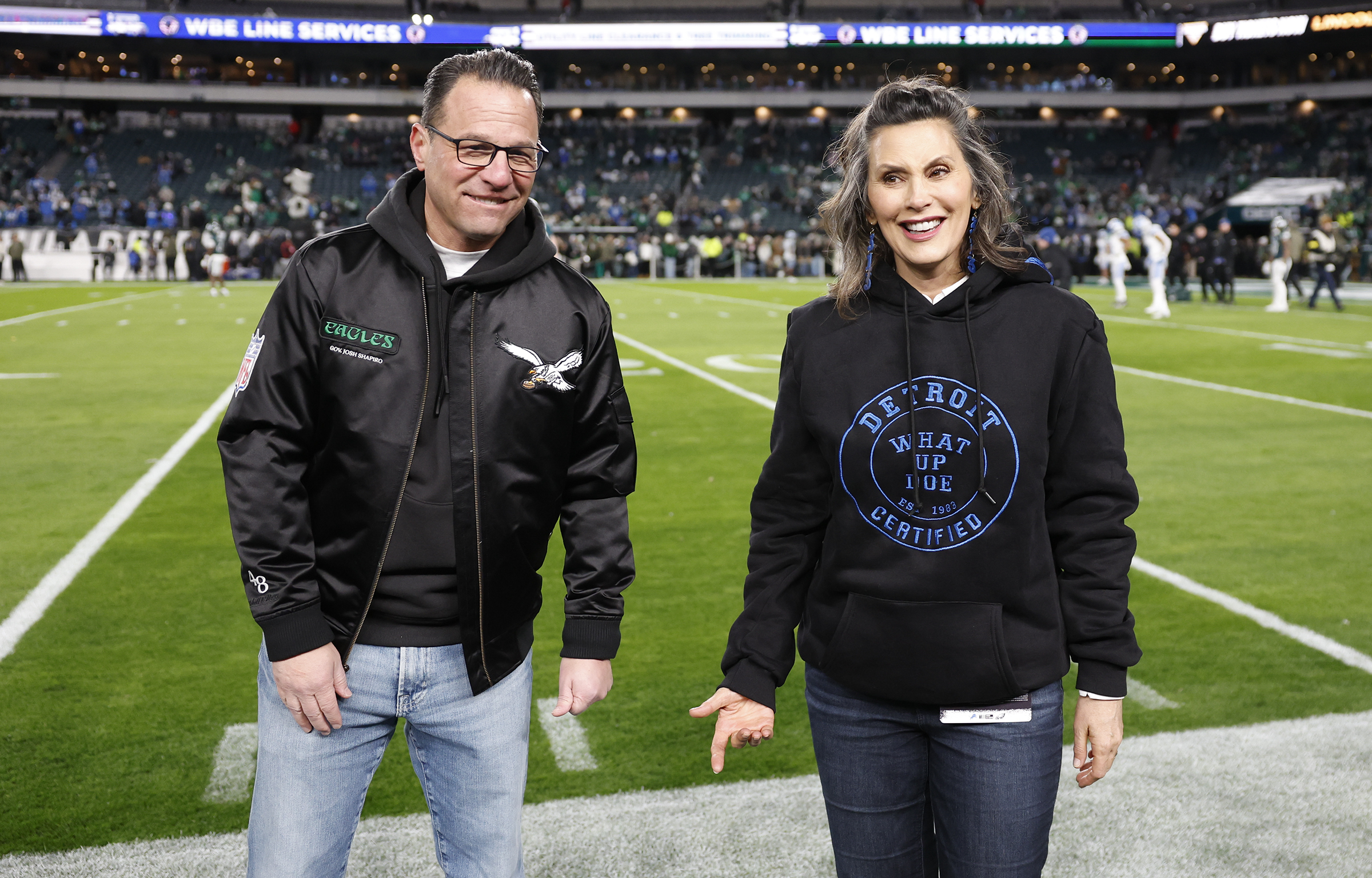
Casually, almost as a throwaway line, Shapiro mentioned to radio hosts Preston and Steve during an interview that he planned to bring Michigan Gov. Gretchen Whitmer — a fellow swing-state governor seen, too, as a possible 2028 Democratic contender — as his guest to the Eagles-Lions game at the Linc that Sunday.
“She actually said, ‘Is it OK if I wear Lions stuff?’” Shapiro told the kelly green-clad crowd in Philadelphia, riffing on the friendly football rivalry — the undercurrents of national politics left unspoken. “And I’m like, ‘No problem. You’re on your own in the parking lot. I can’t protect you.’”
Michigan Gov. Gretchen Whitmer joined Pennsylvania Gov. Josh Shapiro at Sunday’s game between the Eagles and Detroit Lions at Lincoln Financial Field.
The event was a food drive but also served as a tribute to the station’s beloved late host, Pierre Robert. Shapiro brought along a commendation from the governor’s office for the occasion.
“He created community, created joy, brought people together,” Shapiro said of Robert. “You think about just how divided we are as a world, there’s a few things that still bring us together, right?”
“By the way, I’ve learned those lessons. That’s what I try and do governing with a, you know, divided legislature.”
Music and sports, the governor mused before the crowd of Philadelphia fans, are two things that bridge the gap. “Go Birds,” he added with a grin.
Staff writer Katie Bernard contributed to this article.
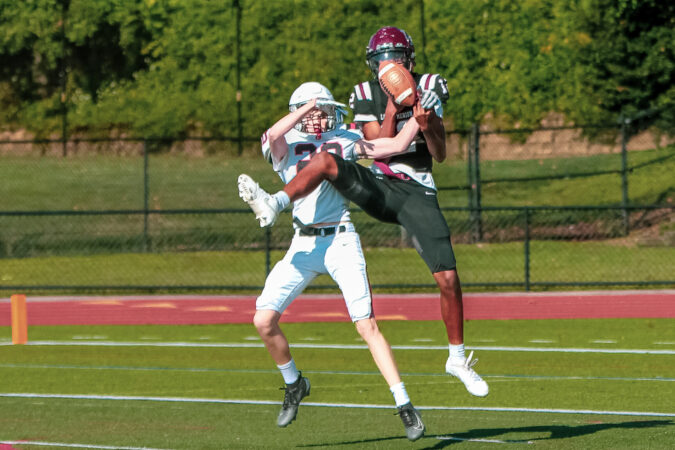
Lower Merion’s two high school football teams won’t be merging, for now.
At a school board meeting Monday night, Lower Merion School District Superintendent Frank Ranelli made an official recommendation that the district not merge Lower Merion and Harriton High Schools’ football programs despite a coordinated push by parents to combine the teams.
“I don’t feel it’s [Lower Merion’s] responsibility to give up their team identity … and playoff chances to merge with Harriton,” Ranelli said. “Lower Merion High School would be giving up a great deal for a problem that they do not need to solve.”
Parents of Lower Merion and Harriton football players in recent months have petitioned the school board to allow for a merger. They argue that a lack of youth football infrastructure in Lower Merion Township has contributed to a steep decline in player interest, leaving both high school teams under-rostered and unable to compete with neighboring schools. Neither high school has a freshman or junior varsity team, leaving 14-year-old freshmen to play alongside 18-year-old seniors and, the parents argue, increasing the risk of injury.
Amy Buckman, director of communications for the Lower Merion School District, said any further action or vote on a potential football merger would be the school board’s decision.
Last fall, Lower Merion went 1-8 in the Central League, the 12-school athletic conference that stretches across parts of Montgomery and Delaware Counties. Harriton went 0-9.
Ranelli said the issues described by parents were “more of a Harriton problem than [a Lower Merion] problem.”
Explaining his recommendation, Ranelli cited a potential loss of age-old traditions, school spirit, and playoff eligibility. He expressed concerns that the district’s two cheerleading teams would not combine, creating potential issues.
Ranelli also cited a survey sent out to football players and parents. He said 95% of Lower Merion High School football players rated “having their own school team [as] important” and 74% of Harriton players “want to maintain the program at their school.” Thirty-nine percent of middle school players were in favor of merging the teams, Ranelli said.
Parents, students, and alumni, however, called the survey “misleading” and said Ranelli’s comments ignored the safety concerns at the core of their argument. Many urged the school board to take an official vote on the merger.
“To say I am unhappy and a little shocked with the decision is an understatement,” said Michelle Miller, a Lower Merion football parent.
Miller called the survey questions “confusing and up for interpretation.”
About a dozen football players attended the meeting, and four addressed the school board, advocating for their teams to merge.
“You’re shorting a lot of students this opportunity to develop,” Tommy Burke, a Lower Merion High School football player, said. “You’re shorting them development as players and as young men. A lot of them quit because of it. It’s a complete detriment to both programs.”
Rahul Mistry, the parent of a Harriton football player, told the board: “We’ve been trying to have a conversation for months. Let’s talk about it. Let’s open the books and have a conversation.”
This suburban content is produced with support from the Leslie Miller and Richard Worley Foundation and The Lenfest Institute for Journalism. Editorial content is created independently of the project donors. Gifts to support The Inquirer’s high-impact journalism can be made at inquirer.com/donate. A list of Lenfest Institute donors can be found at lenfestinstitute.org/supporters.
Cloudflare, an internet infrastructure platform, is experiencing an outage that appears to be affecting websites across the internet, including the social media platform X.
The company said in a status update before 7 a.m. EST on Nov. 18 that it was aware of “an issue which potentially impacts multiple customers,” and was investigating the problem.
In a statement to USA TODAY around 8:30 a.m. EST, Cloudflare said it “saw a spike in unusual traffic” to one of its services around 6:20 a.m. EST.
“That caused some traffic passing through Cloudflare’s network to experience errors. We do not yet know the cause of the spike in unusual traffic. We are all hands on deck to make sure all traffic is served without errors. After that, we will turn our attention to investigating the cause of the unusual spike in traffic,” the statement said.
Many X users reported having problems loading the social media app.
According to Downdetector, an outage-tracking website, thousands of users of several popular websites were reporting issues or outages as of 8 a.m. EST, including X, Spotify, OpenAI, League of Legends and more.
By 8:30 a.m. EST, though, Downdetector also appeared to be having connectivity issues tied to the Cloudflare outage.
Is Cloudflare down?
Cloudflare said it is experiencing issues with its global network, causing outages at many websites that rely on the platform.
Shortly after 8 a.m. EST, Cloudflare said it had identified the issue and made changes to recover its Cloudflare Access and WARP system, which both help protect companies’ traffic and devices.
“We are continuing to work towards restoring other services,” Cloudflare said.
More updates will be available on its status website.
Cloudflare is a platform which many websites use to improve their performance and functionality.
Which websites are down from Cloudflare outage?
According to Downdetector, the following websites were reporting increased outages as of 9 a.m. EST:
X, formerly Twitter
Spotify
OpenAI
League of Legends
Grindr
Google Store
Archive of Our Own
Uber
Quizlet
Canva
Claude AI
Character AI
Indeed
Truth Social
Dayforce
ChatGPT
Letterboxd
Square
Rover
Zoom
Canvas
Ikea
Downdetector also appeared to be impacted by the outage, as did news outlet Axios. Both websites loaded a banner that said, “Please unblock challenges.cloudflare.com to proceed.”
Marathon weekend is finally here and while the races are unquestionably the main event, runners and spectators alike look forward to seeing fun signs along the route.
However, there are some exceptions. “There are two signs people hate,” said Gary Brown Jr., founder and co-leader of the local running group Chasing Trail Philadelphia, “‘You're almost there’, especially when you're at, like, you know, Mile 13, and then ‘Worst parade ever’.”
As a city, let’s not add to Gary’s list. Use our sign generator to get some ideas.
What kind of sign are you going for?
What type of sign do you want to make?
story continues after advertisement
If you have other ideas or see a particularly creative sign, drop us a line at interactives@inquirer.com.
Marathon weekend can look chaotic — thousands of runners, crowds along the Parkway, and traffic everywhere — but it can also be one of the most fun, kid-friendly days in Philadelphia.
Between the Nemours Children’s Run, the Health and Fitness Expo, easy cheering spots, and plenty of stroller-friendly food stops, there’s a lot for families to enjoy without getting overwhelmed.
Here’s how to navigate the Philadelphia Marathon with kids in tow.
📍 Eakins Oval (22nd St. & Benjamin Franklin Parkway)
Kids run age-specific, short-distance dashes along the Parkway and get an event T-shirt, a finisher medal, and special goodies.
Nothing is timed, so the emphasis is fun. Children may only run in their age group, and each child is limited to one race. A parent or guardian must be present, but adults can’t run with the kids.
Come early. Before the races, kids can enjoy:
sports zone (football, baseball, basketball, soccer)
Runners on Walnut Street in Center City during the 2024 Philadelphia Marathon Sunday, Nov. 24, 2024.
Best viewing spots with kids
The marathon route stretches across Center City, Fairmount, and Manayunk. These spots are easiest for families:
Chestnut Street at Mile 1: High-energy, big crowds, and runners come through early — good for short attention spans. There’s room on side streets for stroller parking.
34th Street / University City (around Mile 5 and Mile 13): Wide sidewalks, walkable from the Parkway, and you can catch runners twice here if you hustle.
Manayunk’s Main Street (Miles 19–21): The loudest, most festive part of the race — think music, costumes, cowbells. Great for older kids; may feel crowded for toddlers.
Kelly Drive (Miles 22–24): Quieter stretch with room to spread out. Better for small kids and families who want to avoid packed sidewalks.
Cheering tip for kids: Have them call out runners’ names from their bibs — runners light up when a kid yells their name.
Getting Around: Transit, biking, and parking for families
Getting to the start/finish near the Art Museum is doable — especially with public transit.
SEPTA (big perk for parents)
Children 11 and under ride free with a fare-paying adult. Buses that usually stop near the Parkway (7, 32, 33, 38, 43, 48, 49) may be detoured. Check SEPTA’s System Status before you head out.
Regional Rail is helpful if you’re heading to Manayunk to cheer between Miles 19 and 21.
Driving & parking
Road closures are extensive, so expect detours and delays. If you plan to drive with kids, park early.
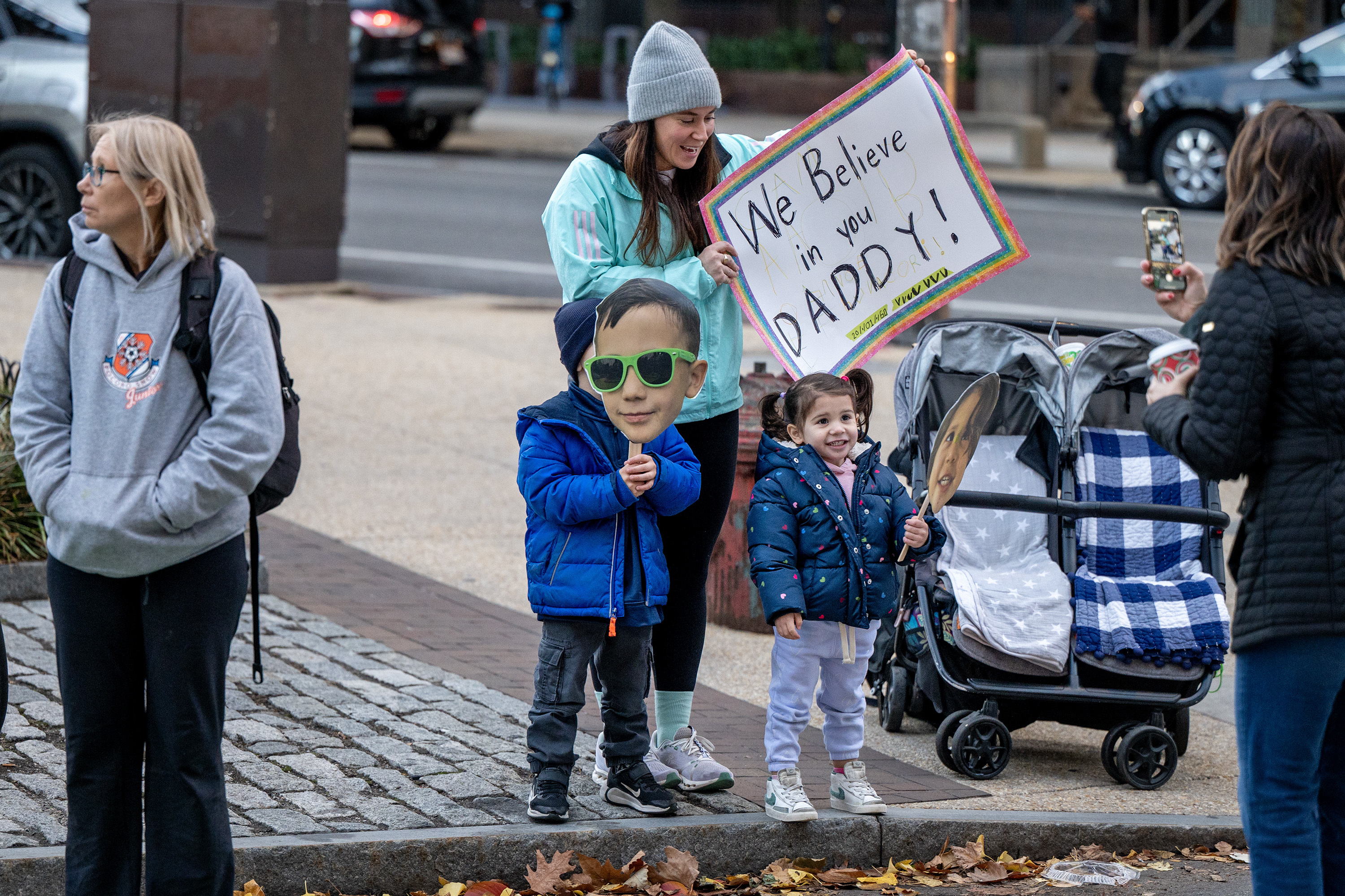
Amanda Carter and her children, Quinn, 3, and Cameron, 5, pose for a photo at 16th and Arch Streets at the start of the 2024 Philadelphia Marathon Sunday, Nov. 24, 2024. The kids had masks with dad Ron Carter’s face. They’re from New York City and this is Ron’s first marathon. Amanda who had done three, says “’m usually the one running.”
Kid-friendly sign ideas
If your kid needs inspiration, try:
You’re super fast! Like superhero fast!
Don’t stop! You’re almost at the snacks!
Run like you’re chasing the ice cream truck!
Go Birds! (And go YOU!)
My arms are tired from holding this sign!
My mom trained for months — I made this sign in five minutes!
Or have them tap through our Sign Generator for more options.
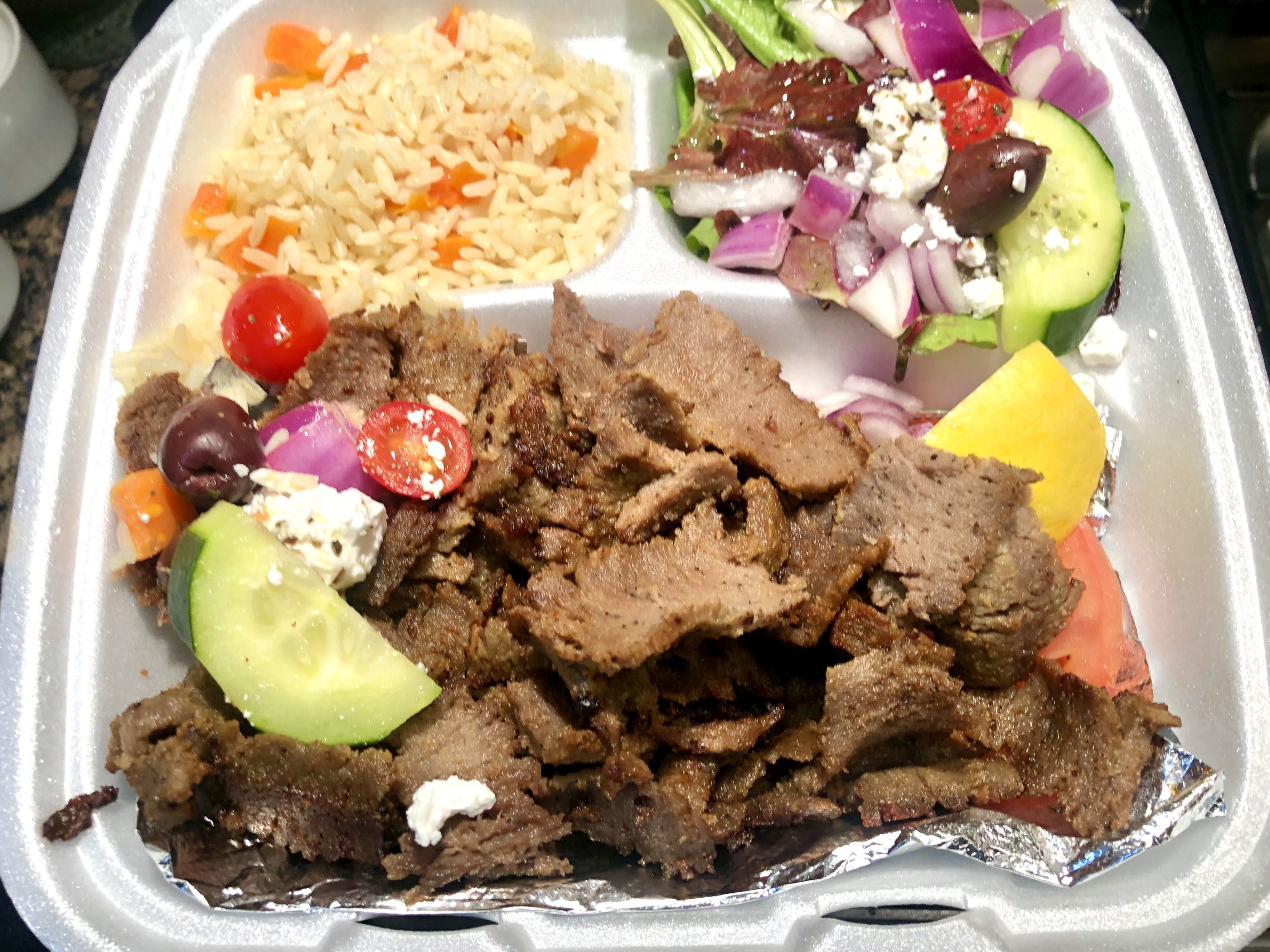
The gyros platter from Moustaki.
Where to eat with kids along the route
Whether you need a quick warm-up or a post-race reward, we rounded up 10 family-friendly places along (or just off) the course — from dumplings and giant slices to pancakes, burgers, and big dining rooms made for strollers.
When a western diamondback rattlesnake sinks its fangs into your hand, and it swells up like a purplish water balloon for days in a Texas hospital, it might be a sign for a career change.
But Clyde Peeling, who was born in Muncy, Lycoming County, in 1942, had already been bitten by the proverbial bug long before the rattlesnake bit him while he was stationed in Texas with the Air Force. Peeling, 83, still loved snakes, despite that close call, and went on to become the reptile king of Pennsylvania.
“I’ve pretty much known what I wanted to do with my life since I was 14,” Peeling said recently, from his beloved zoo near Williamsport.
A snake-necked turtle is shown in an aquarium at Clyde Peeling’s Reptiland in Allenwood, Pa., on Saturday, Nov. 1, 2025.
It wouldn’t be the last time he’d be bitten, either, in a career that has spanned more than half a century.
“Let’s see, once by a copperhead, a viper, and four other rattlesnakes. I don’t say that with any bravado,” Peeling said. “That was a very serious bite.”
Today, Clyde Peeling’s Reptiland is home to enormous Komodo dragons with uncanny eyes, poisonous Gila monsters, anacondas thicker than most thighs, and Aldabra tortoises that can live up to 150 years.
“Some of these tortoises were just five pounds when we got them,” he said, in their hot enclosure.
Today, the tortoises look like boulders.
Clyde Peeling, 83, talks about his experiences at his reptile zoo, Clyde Peeling’s Reptiland.
Reptiland opened on US-15 in Allenwood, Union County, in 1976. It joined an American tradition of roadside attractions ushered in by the post-World War II auto boom and the urge to hit the highway.
U.S. Route 15 bisects Pennsylvania, from the Maryland border, north to New York, passing through Williamsport and Harrisburg. Still, Peeling said it was far from bustling back then.
“I remember sitting there hoping one car would pass by. I was too egotistical to think I’d made a mistake, but I had a lot of naysayers,” he recalled.
In the timeless tradition of late-night television, Peeling has brought wild animals to visit Conan O’Brien, Jay Leno, Jon Stewart, and others.
Reptile parks, serpentariums, and alligator farms dot the American landscape. Peeling wanted to elevate Reptiland beyond those hokey roadside shacks.
In 1986, his facility received a key and difficult-to-obtain accreditation by the Association of Zoos & Aquariums and it’s held that status ever since. Peeling said the inspection process, which takes place every five years, is grueling and every facet of the business is scrutinized, everything from record keeping, to veterinary care, aesthetics, and visitor services.
“We would have been accredited in 1985, but we were hit by a tornado that nearly flattened us,” he said.
Over the decades, Peeling expanded with a parakeet-feeding aviary and a large, outdoor dinosaur exhibit. More renovations are in the works, too. If you’d like parakeets to land on your head, you’ll have a blast. The park hosts a “Wino & Dinos” event outdoors, during the summer, for adults only.
At Clyde Peeling’s Reptiland, life-size animated dinosaurs give visitors a perspective on life in the Mesozoic Era.
Peeling, with his sons, has visited, lectured, and collected in dozens of countries.
“That skull is from a crocodile in Borneo,” he said in his office.
Peeling’s son Chad, a right-hand man in the family business, died from brain cancer in 2019. Peeling himself fought non-Hodgkin’s lymphoma. Tornadoes have damaged the property, and the COVID-19 pandemic has hurt, too.
Peeling hasn’t guided a trip since his son died but won’t rule out doing it one more time.
It's been 30 years since I've been back to Clyde Peeling's Reptiland in Union County and I wish I had come back sooner. Thanks for having us, Clyde! pic.twitter.com/5RKP9AbuWM