A woman was shot in the wrist and a man was arrested after what police say appeared to be a road rage incident Monday evening in Bucks County.
Around 6:30 p.m., police responded to a reported shooting in the area of the Newtown Bypass and Woodbourne Road in Newtown Township.
The woman, who was driving one of the vehicles involved in the incident, was transported to St. Mary Medical Center and was listed in stable condition, police said.
A few minutes later, the man and the vehicle he was driving were located at Washington Crossing and Stoopville Roads, and he was taken into custody, police said. A gun was recovered for evidence.
Police said both vehicles reportedly were traveling east on Newtown Bypass during the initial encounter and then south onto Woodbourne Road.
Anyone who witnessed the incident or has information helpful to the case can contact the Newtown Township Police Department at 215-579-1000 ext. 317.
Philadelphia discharges 12.7 billion gallons of raw, diluted sewage into the Delaware River’s watershed each year, with Camden County adding to the mix, according to a new report.
That’s a problem, say the report’s authors at the nonprofit advocacy groupPennEnvironment. Philadelphia and Camden border the river, and significant recreational potential is blocked forpart of the year because of pollution from both, the authors say.
A waterway can remain unsafe for recreation for up to 72 hours after an overflow. That suggests local waterways could be unsafe for recreation up to 195 days per year, or more than half the year.
Five decades after the Clean Water Act mandated that waterways be made safe for swimming and fishing, combined sewer overflows (CSOs) continue to pollute during wet weather when untreated sewage and runoff surge into nearby creeks and rivers, creating the potential to sicken recreational users.
David Masur, executive director of PennEnvironment, said the group included Camden County in its most recent report“to get a more holistic view.”PennEnvironment’s first report on CSOs in 2023focused only on Philly.
The pollution “affects the waterway, the environment, and public health,” Masur said. “The river is the border between the two states, and people on both sides use it a lot.”
PennEnvironment acknowledges that both Philly and Camden County have programs to reduce overflows and is calling on federal officials for increased funding to put proper infrastructure into place.
Philadelphia Council member Jamie Gauthier (center) spoke Monday about PennEnvironment’s report on pollution from combined sewer overflows. To her left is Margaret Meigs, president, Friends of the Schuylkill Navy. And to her right is Tim Dillingham, senior adviser, American Littoral Society, and Hanna Felber, clean water associate at PennEnvironment Research & Policy Center.
Frequent overflows, high volume in Philly
Roughly 60% of Philadelphia is served by a combined sewer system, which has 164 outfalls — really large metal or concrete openings — that discharge pollution into waterways. A CSO system uses a single pipe to collect and transport sewage from homes and businessesas well as stormwater runoff from streets and sidewalks.
During dry weather, the system can handle the volume before safely releasing it back into the rivers. But during heavy rainfall, thesystem discharges untreated, though highly diluted, sewage mixed with stormwater directly into waterways.
Despite the Philadelphia Water Department’s ongoing Green City, Clean Waters project — a 25-year plan focusing on green infrastructure to reduce overflows — the frequency and volume remain alarmingly high, the report states.
Overall, CSOs dumped an average of 12.7 billion gallons of raw sewage mixed with polluted stormwater per year into local waterways from 2016 to 2024, the authors of the report stated. They included an online map to show the location of the outfalls and annual overflow.
Half the sewage came from just 10 CSOs.
window.addEventListener(“message”,function(a){if(void 0!==a.data[“datawrapper-height”]){var e=document.querySelectorAll(“iframe”);for(var t in a.data[“datawrapper-height”])for(var r,i=0;r=e[i];i++)if(r.contentWindow===a.source){var d=a.data[“datawrapper-height”][t]+”px”;r.style.height=d}}});
Still, the numbers are a slight improvement over the 15 billion gallons a year released into local rivers, as PennEnvironment reported in 2023.
Philadelphia gets its drinking water from the rivers, but the CSOs are downstream of the city’s treatment plants on the Delaware and the Schuylkill.
The reportused publicly available data to show that five of six waterways in Philly produced at least one overflow 65 times or more per year on average between 2016 and 2024. Those were the Delaware River, the Schuylkill, and Cobbs, Frankford and Tacony Creeks.
In better news: The average volume of overflow per inch of precipitation declined by about 16% from previous periods, but progress is slow and threatened by increased rainfall and rising sea levels due to climate change, the authors say.
PWD could not be reached for comment.
window.addEventListener(“message”,function(a){if(void 0!==a.data[“datawrapper-height”]){var e=document.querySelectorAll(“iframe”);for(var t in a.data[“datawrapper-height”])for(var r,i=0;r=e[i];i++)if(r.contentWindow===a.source){var d=a.data[“datawrapper-height”][t]+”px”;r.style.height=d}}});
Camden County
The report also found persistent overflows in Camden County. The cities of Camden and Gloucester, along with the Camden County Municipal Utilities Authority (CCMUA), operate combined sewer systems that frequently overflow into the Delaware River and its tributaries, including the Cooper River and Newton Creek.
The report found that systemson the Camden County side of the river overflowed into local waterways an averageof 76 days per year from 2016 to 2024.
window.addEventListener(“message”,function(a){if(void 0!==a.data[“datawrapper-height”]){var e=document.querySelectorAll(“iframe”);for(var t in a.data[“datawrapper-height”])for(var r,i=0;r=e[i];i++)if(r.contentWindow===a.source){var d=a.data[“datawrapper-height”][t]+”px”;r.style.height=d}}});
The highest-frequency outfall for the Cooper River released sewage for an average of 118 days annually during that period.
The Delaware River received sewage overflows for an average of 94 days annually from its highest-frequency outfall.
The authors said gaps in data leave them unable to show the total volume of diluted sewage releasedfrom Camden. But they said that the amount of “solids/floatables” collected at each outfall is an indicator a waterway is polluted.
Dan Keashen, a spokesperson for Camden County, said officials have been making strides.
He said that crews recently cleaned 30 miles of pipe and that a $26 million project is underway to physically separate the combined sewer service area of Pennsauken that flows into Camden. Officials are also studying how to better achieve compliance for the largest outfall in the system, a project estimated to cost $40 million to $150 million when complete.
What can be done?
The report concludes that current plans by Philadelphia and Camden County are insufficient to achieve the goal of a clean Delaware River watershed.
The report was written by John Rumpler, clean water director for Environment America, PennEnvironment’s parent organization, and Elizabeth Ridlington, associate director of the Frontier Group, a nonprofit research group that is part of the Public Interest Network, an environmental advocacy organization.
The authors call for officials to accelerate action to end all sewer overflows, set a hard deadline, and find new ways to pay for necessary infrastructure upgrades.
Philadelphia CouncilmemberJamie Gauthier, chair of the committee on the environment, called overflows “a public health crisis” and urged PWD’s new commissioner, Benjamin Jewell, to act. She said elected officials in Harrisburg and Washington also need to step up.
PWD is separately under pressure by a new Environmental Protection Agency regulation that seeks to improve the amount of dissolved oxygen in the Delaware by ordering a large-scale reduction of ammonia at the city’s three water pollution control plants. PWD estimates that the price for compliance is $3.6 billion and would cost households an additional $265 annually on their water bills.
The authors of the PennEnvironment report concede the CSO task is daunting. But they say Portland and Boston faced similar situations, invested in infrastructure, and managed to make CSO overflows infrequent. Washington, D.C., they said, is on track to reduce sewage overflows by 96% in 2030.
Hanna Felber, a PennEnvironment advocate, said that PWD needs to use creative funding, such as floating longer-term bonds to finance projects, and that its engineers need to find more creative solutions, such as installing larger stormwater tunnels that flow separately from sewage.
“Unfortunately, our new report on sewage pollution in Philadelphia shows that on far too many days each year, the Philadelphia Water Department’s pipes and sewer systems dump huge volumes of raw sewage into our beautiful waters, harming our environment and depriving the public of a safe place to fish, boat, and float,” Felber said.
New Jersey’s beaches, still recovering from major sand losses from an offshore hurricane and a nor’easter, evidently are in for another assault this week as October is about to make a dramatic exit.
Gale-force gusts off the ocean could develop as early as Tuesday afternoon at the Shore, said Eric Hoeflich, a meteorologist at the National Weather Service office in Mount Holly, with brisk onshore winds persisting “maybe into Friday.”
A potent storm is forecast to affect the entire region Wednesday night into Thursday, with heavy rains in the immediate Philadelphia area, where drought conditions have been intensifying.
Also on Thursday, what is likely to become catastrophic Hurricane Melissa will be passing offshore, churning up the waves crashing on East Coast beaches.
“The coast once again is going to take a pretty good battering,” said Dave Dombek, senior meteorologist with AccuWeather Inc.
On the plus side, Hoeflich said, for the Shore, this week’s storm “doesn’t look as bad” as the beach-erasing nor’easter earlier this month. The path should be more inland, and the lunar influence on the tides would be less. Only minor flooding is expected, he said, subject to change.
However, not only would the track mean region-wide heavy rain, but it would also increase the potential for severe thunderstorms Thursday. A front is due to chase the rains Friday, but it may generate gusts to 50 mph, the weather service says. Power outages are possible both days.
The timetable for the winds and the storm in the Philly region
The National Weather Service has posted a gale warning for Tuesday into Wednesday morning for the waters along the immediate coast for winds from the east that could gust past 50 mph.
That would be more the result of high pressure to the north of the region. Winds circulate clockwise around centers of highs; thus, areas to the south of the center experience winds from the east.
The breezes will be getting a second wind as a storm develops in the Southeast and tracks north. Meanwhile, a weakened Hurricane Melissa will be churning the ocean as it passes well off the U.S. coast on Thursday.
A strong storm system will move across the region later this week. Here is a summary of expected impacts. pic.twitter.com/OvhoVAaS11
Rain for the last 30 days has been about a third of normal in the city and the neighboring Pennsylvania counties.
South Jersey has fared only slightly better, but precipitation is well less than half of normal.
What is the forecast for the trick-or-treaters?
It is all but certain that Friday will be a dry day, with temperatures in the low and mid-50s. Wind gusts are forecast to die down sometime after 5 p.m., but hold onto those brooms, just in case.
A former Philadelphia probation officer and a former city police officer have been charged with illegally connecting bettors to an overseas sports gambling website that allowed them to place hundreds of thousands of dollars in bets over nearly a decade, according to federal authorities.
Joseph Moore and James P. DeAngelo Jr. each face one count of conducting an illegal gambling business, court records show. Moore, the former probation officer, pleaded guilty in federal court Monday.
DeAngelo, the former police officer, is scheduled to appear in court later this week and has been charged by information, which typically indicates that a defendant intends to plead guilty.
Prosecutors said in charging documents that Moore ran the scheme from 2017 to 2025 — operating “block pools” based on NFL or NCAA basketball games, or helping bettors place ordinary wagers on different sporting events. He would sometimes send mass emails to hundreds of bettors advertising pools he was running, the documents said, with entry fees of a few hundred dollars and payouts in the thousands for winners.
Moore often collected 10% of the winners’ earnings as a “tip,” prosecutors said, and he sometimes allowed bettors to place wagers on credit even if they had incurred multiple losses.
He conducted some of his business from his probation office, the documents said, and saved records from the operation on his work computer. At one point, prosecutors said, he recruited another probation officer to help collect and transfer money from bettors using peer-to-peer apps such as Venmo and Cash App.
DeAngelo, meanwhile, helped maintain the operation’s access to the overseas gambling site, prosecutors said, and he sometimes accepted wagers from individual bettors.
Prosecutors did not specify whether the investigation led either man to lose his job. But in charging documents, prosecutors said Moore ran the operation until February 2025, and Martin O’Rourke, a spokesperson for the First Judicial District, said Monday that Moore resigned from the probation department that month.
A police spokesperson did not immediately respond to a request for comment Monday, and DeAngelo did not have an attorney listed in court records.
The case was unsealed Monday, just days after federal prosecutors in New York unveiled two sweeping indictments charging several NBA figures with participating in illegal gambling schemes, one of which involved a player allegedly providing inside information to bettors about specific games.
The fallout from that scandal has come quickly, with some commentators questioning whether sports leagues have grown too close to the betting industry, and Congress requesting a briefing from the NBA’s commissioner, Adam Silver.
A Wilmington man brought his mother’s gun to Lincoln University’s campus Saturday, prosecutors said, and was still holding the loaded weapon when a deadly shooting tore through the school’s homecoming celebration.
Zecqueous Morgan-Thompson, 21, has not been charged in connection with the shooting, only with possessing the weapon without a concealed-carry permit. But investigators said they were still working Monday to determine whether his firearm was used in the incident at the historically Black university, which left one person dead and six others wounded.
Morgan-Thompson remained in custody Monday in lieu of $25,000 bail.
Chester County District Attorney Chris de Barrena-Sarobe said his office is trying to determine if more than one shooter was involved. Morgan-Thompson was arrested on the campus in the aftermath of the gunfire, holding a loaded Glock 28 .380-caliber handgun, according to the affidavit of probable cause for his arrest.
The shots rang out about 9:30 p.m. Saturday on the campus in Lower Oxford Township. De Barrena-Sarobe has said he does not believe the shooting was a coordinated attack targeting the school, but instead took place as the crowd swelled on the campus.
The motive for the shooting remained under investigation.
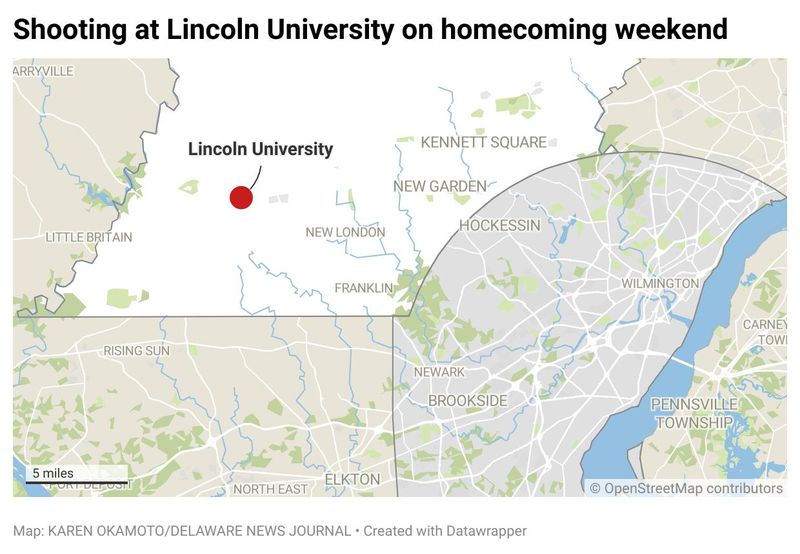
Gunfire rang out just before 9:30 p.m. Oct. 25 at Lincoln University in the parking lot of the International Cultural Center in Lower Oxford Township in Chester County, Pennsylvania. The university is about 15 miles from Hockessin.
Jujuan Jeffers, 20, of Wilmington, died after being shot in the head. It was unclear if Jeffers had any affiliation with Lincoln — investigators have said the victims included one alumnus and one current student.
Jeffers’ brother declined to speak with a reporter when contacted Monday.
The student who was hurt was recovering well, but obviously shaken, according to Chester County Commissioner Josh Maxwell, who is an adjunct professor at the school. Her injuries, he said, were not life-threatening.
Lincoln University canceled classes Monday in light of the shooting.
“Gun violence happens far too often in our country, and we are heartbroken that Lincoln University and its students are among the latest victims of such senseless violence,” the school said in a statement.
The rural campus was quiet Monday afternoon as students gathered for a vigil that gave members of the university community a chance to grieve and heal.
The service was not open to the media, and gates at various entrances to Lincoln’s campus were locked.
Geslande Sanne, a Lincoln University junior from Oregon, was in her dorm Monday morning, still coming to terms with the chaotic scene she experienced Saturday night.
“A lot of us on campus are processing it in our own different ways,” said Sanne, a political science and French major. “We are all reaching out to each other. Our professors are talking to each other and to us. Some students went home to be with their families. Some people are just resting.”
She said she intended to attend the university’s community healing session on campus at noon and later go to the hospital to visit her friend, who was the only Lincoln student shot during the incident.
Sanne recalled that she and a group of friends were on the outskirts of the crowd when they heard gunshots.
“Everybody started running and we started running, too,” she said. “We were confused. Did something really happen? After a few minutes, the music stopped, and we knew something really happened.”
She and her friends made a plan to get back to their dorms so they would be safe, but then decided to seek shelter inside the International Cultural Center building, not far from where the shooting took place.
After people started banging on the windows, she said, Sanne and her friends left there and walked carefully back to their dorms.
It all happened in about 20 minutes, she estimated.
Sanne said she chose to attend Lincoln because she wanted to go to an HBCU and was impressed by all its prominent graduates. She said she has received much encouragement and many opportunities at the school.
“It’s really inspired me,” she said, “that I can be a part of something positive despite everything going on in the country.”
She said she has always felt safe on Lincoln’s rural campus, safer than she does anywhere else. And Saturday night’s shooting hasn’t changed that.
“It wasn’t Lincoln’s fault,” said Sanne, who wants to be an international lawyer. “We do the best we can with the resources we have. It shouldn’t be an excuse to leave or disinvest in Lincoln. It’s a reason to pour in more resources and support these schools even more.”
Staff writer Jesse Bunch contributed to this article.
The transit agency has until Oct. 31 to complete the inspections, which were recommended after the National Transportation Safety Board released a report investigating five fires that occurred on the Silverliner IVs this year.
As of Oct. 9, SEPTA said that crews can handle about six Silverliner IV cars a day, with a goal of ramping up inspections to handle 12 cars a day with five-person crews per car.
Although SEPTA is rotating cars in and out of service for the inspections — instead of yanking all 225 from service at once — riders have experienced significant delays and some trains have been outright canceled. Without a full fleet, SEPTA says it is unable to respond as easily to typical delay-causing events, such as power outages and bad weather.
Riders should check the SEPTA app for real-time updates on how trains are running.
As the deadline approaches and delays persist, The Inquirer is tracking SEPTA’s inspection progress.
Mon., Oct. 27, 2025
95 inspections complete
Days until deadline: 4
Fri., Oct. 24, 2025
88 inspections complete
Days until deadline: 7
Wed., Oct. 22, 2025
78 inspections complete
Days until deadline: 9
Mon., Oct. 20, 2025
66 inspections complete
Days until deadline: 11
Fri., Oct. 17, 2025
58 inspections complete
Days until deadline: 14
story continues after advertisement
Wed., Oct. 15, 2025
46 inspections complete
Days until deadline: 16
Thurs., Oct. 9, 2025
12 inspections completed
Days until deadline: 22
Mon., Oct. 6, 2025
Inspections begin
Cars began undergoing inspections in SEPTA’s four regional maintenance facilities.
Greg Buzby, manager of Regional Rail vehicle engineering, shows some of the work being done for the safety inspections at the SEPTA Overbrook Maintenance Facility.Tyger Williams / Staff Photographer
“We’re looking for any signs of overheating or damage to any of the circuits, physical damage, making sure the bolted connections are tight,” said Greg Buzby, manager of Regional Rail engineering. “There’s also electrical testing that we have to do to make sure the insulation has its integrity.”
Inspections remaining: 225
Days until deadline: 25
Wed., Oct. 1, 2025
NTSB releases report
Noting that the Silverliner IV cars’ “outdated design … represents an immediate and unacceptable safety risk,” the National Transportation Safety Board urged SEPTA to sideline all the Silverliner cars immediately and to retrofit or replace them as soon as possible. The Silverliner IVs went into service between 1974 and 1976, with technology that was designed even before that time.
The NTSB’s findings are advisory.
More than 300 passengers were safely evacuated after a SEPTA Regional Rail train caught fire in February in Delaware County.Charles Fox / Staff Photographer
The Federal Railroad Administration, which regulates freight and passenger railroads, ordered SEPTA to undertake the inspections, concluding “that SEPTA’s maintenance and operation of its passenger rail equipment requires additional oversight and corrective action.”
Inspections remaining: 225
Days until deadline: 30
story continues after advertisement
Talk to our transportation team.
Do you have questions about what’s happening on Regional Rail? Ask here or share how your rides on Regional Rail have been impacted in October.
Staff Contributors
Reporting: Thomas Fitzgerald and Erica Palan
Graphics: John Duchneskie
Editing: Lizzy McLellan Ravitch
Digital Editing: Erica Palan
Subscribe to The Philadelphia Inquirer
Our reporting is directly supported by reader subscriptions. If you want more journalism like this story, please subscribe today
Curiosity killed the cat, the adage goes, but in the case of Ace the kitten, the fault lies with a defective pet-food container, according to a proposed class-action lawsuit filed in Philadelphia’s federal court.
Valentina Mallozzi, of Montgomery County, says in the complaint that, in July, Ace managed to get into a locked Iris pet food container she ordered from Amazon. But once the 3-pound kitten was inside, the airtight lid dropped and locked Ace inside.
The lawsuit, filed last week, accuses Iris USA of creating a defective product that it markets as safe for pets. The complaint says Mallozzi is one of many pet owners who tragically lost their cat to an Iris container.
The complaint aims to represent all people in the United States who purchased an Iris container. The complaint does not include an estimate of how many people are included in the class, or how much money Iris would owe each person.
Iris USA, a subsidiary of Japanese plastics manufacturer Iris Ohyama, did not respond to a request for comment.
Mallozzi bought the Iris airtight stackable containers for $29.99 from Amazon in March, the complaint says. The containers have a locking mechanism that Iris claimed is designed to “keep pets from sneaking a second or even third breakfast with the secure locking latch,” according to the complaint.
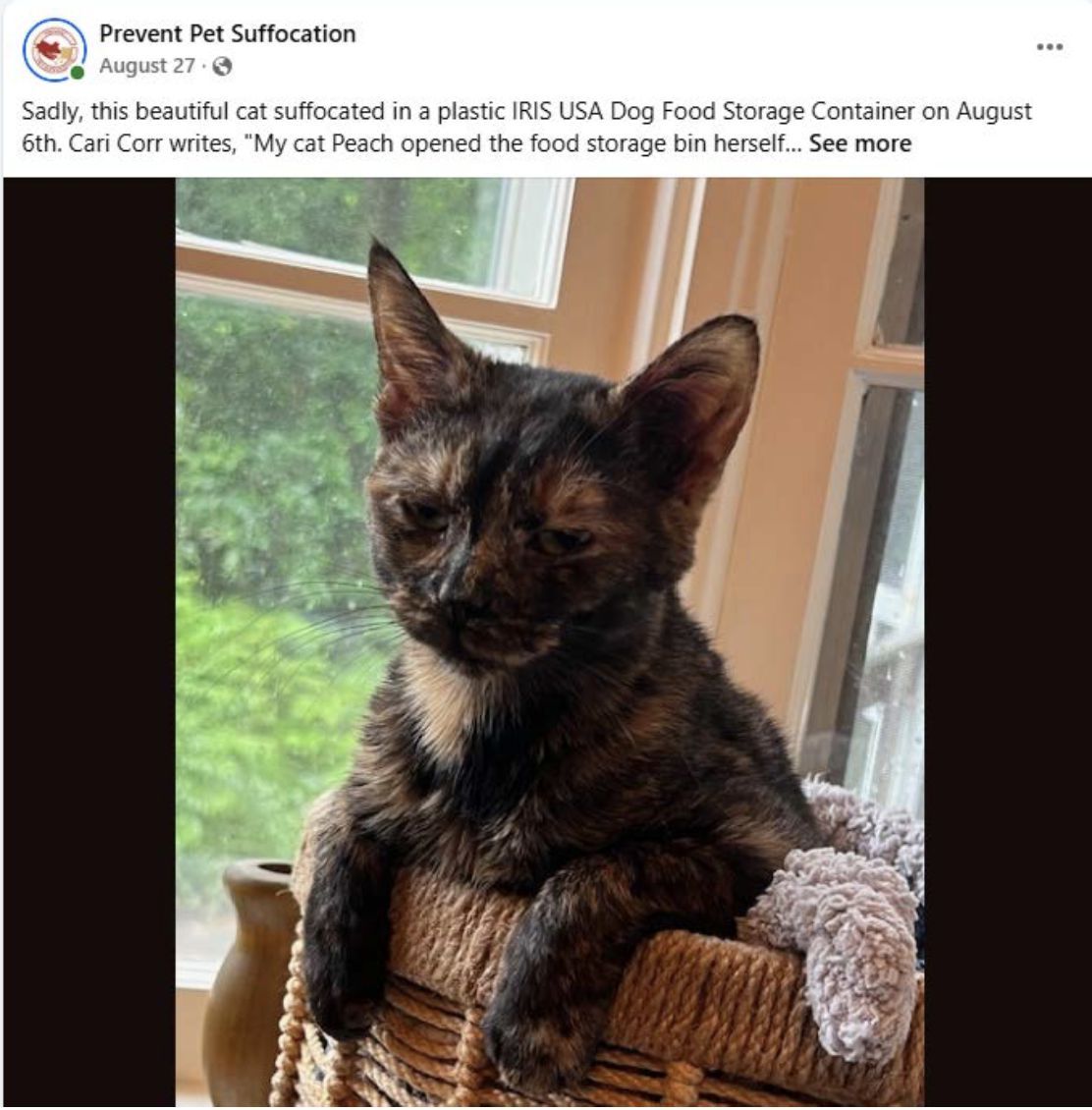
Screenshot of a post in the Prevent Pet Suffocation Facebook group, which shares the story of Peach the cat who died trapped in a Iris USA food storage container, from Valentina Mallozzi’s lawsuit against the company.
The problem, the suit says, is that cats can open the latch from outside, climb in, and get trapped as the mechanism automatically locks them in. The airtight seal that keeps pet food fresh makes the trap deadly, as a “pet will suffocate within a few minutes,” the complaint says.
The lawsuit cites posts from the Prevent Pet Suffocation Facebook group in which cat owners share stories about their beloved pets getting trapped in an Iris container.
One post included in the complaint shares the story of Baby Bear, a family’s cat who was found dead in an Iris container by an 8-year-old girl.
“My cat, Max, also suffocated in an Iris pet food container,” a woman responded. “I know the pain you’re going through.”
Iris USA was put on notice, and not only by people on social media, the complaint says. In March, the Center for Pet Safety, a Virginia-based nonprofit, put out a report evaluating the risk food containers represent for pet suffocation that specifically calls out Iris.
The latch mechanism on the lid “significantly increases the risk of pet suffocation,” the report says.
The lawsuit says the product should have come with a label warning of the suffocation risk for pets that can unlatch the lid.
“Bottom line, the well has run dry,” the USDA notice says. “At this time, there will be no benefits issued November 01. We are approaching an inflection point for Senate Democrats.”
The shutdown, which began Oct. 1, is now the second-longest on record. While the Republican administration took steps leading up to the shutdown to ensure SNAP benefits were paid this month, the cutoff would expand the impact of the impasse to a wider swath of Americans — and some of those most in need — unless a political resolution is found in just a few days.
The administration blames Democrats, who say they will not agree to reopen the government until Republicans negotiate with them on extending expiring subsidies under the Affordable Care Act. Republicans say Democrats must first agree to reopen the government before negotiation.
Democratic lawmakers have written to Agriculture Secretary Brooke Rollins requesting to use contingency funds to cover the bulk of next month’s benefits.
But a USDA memo that surfaced Friday says “contingency funds are not legally available to cover regular benefits.” The document says the money is reserved for such things such as helping people in disaster areas.
It cited a storm named Melissa, which has strengthened into a major hurricane, as an example of why it’s important to have the money available to mobilize quickly in the event of a disaster.
Some states have pledged to keep SNAP benefits flowing even if the federal program halts payments, but there are questions about whether U.S. government directives may allow that to happen. The USDA memo also says states would not be reimbursed for temporarily picking up the cost.
Other states are telling SNAP recipients to be ready for the benefits to stop. Arkansas and Oklahoma, for example, are advising recipients to identify food pantries and other groups that help with food.
Sen. Chris Murphy, D-Conn., accused Republicans and Trump of not agreeing to negotiate.
“The reality is, if they sat down to try to negotiate, we could probably come up with something pretty quickly,” Murphy said Sunday on CNN’s “State of the Union.” “We could open up the government on Tuesday or Wednesday, and there wouldn’t be any crisis in the food stamp program.”
Delaware County’s homeless services, already overextended and stretched to its limits, are slated to lose two shelters and a much-needed rental assistance program at the end of the month as a result of the ongoing budget impasse in Harrisburg.
The closures, though likely temporary until state lawmakers set aside partisan disagreements to approve a budget, would mark a major blow to a system some say is on the brink of collapse in one of Pennsylvania’s most populous counties.
Delaware County officials have attempted to stave off suspensions in critical social services for the first few months of the budget impasse by dipping into their coffers. According to officials, the county typically spends $12 million a month on homeless shelters and other services for children and youth, mental health needs, and substance use disorders.
Now out of options to pay for these critical supports, the county has notified local service providers that they won’t be able to help them any further. Only a budget can restore funding.
“We had hoped the impasse would be resolved much sooner and had fully funded our providers through September, but unfortunately can no longer fully fund providers without the funds from the state,” county spokesperson Mike Connolly said.
Men’s dorm at Life Center-Eastern Delaware County in Upper Darby on Friday.
The Community Action Agency of Delaware County, which operates three shelters and a rental assistance program, among other services, has no choice but to make cuts to its services or even close, its executive director Ed Coleman said.
Life Center, a shelter that has room for about 50 people, has gradually cut its capacity by half. Wesley House and Family Management Center, which have a combined capacity to house more than 110 people, are slated to close by the end of the month. Plus, CAADC’s rental assistance program, which helps approximately 270 families a year, will be paused until the state budget is passed.
Remaining homeless shelters, such as Breaking Bread in Upper Darby and the Salvation Army in Chester, have already seen a surge in people seeking assistance in recent weeks as Wesley House Shelter and Family Management Center wind down operations.
“We’re at capacity. We have no more room,” said James Stephenson, who leads the Salvation Army’s 40-person facility.
Mental Health Partnerships, which provides services for people with mental health conditions or substance use disorders, has been assembling a weekly working group with local shelters and county government to prepare for a winter with at least one emergency shelter, in anticipation of more shelter closures, said its president and CEO, Jeannine Lisitski. Mental Health Partnerships officials have already begun seeing more people on the streets around Delaware County as part of their street outreach there due to the diminishing number of places that people can go to stay warm in these cooling months.
“There’s a real crisis in Delaware County brewing now,” Lisitski said.
‘It’s childish for people to be so politically divided’
With no state budget in sight, public schools, counties, and service providers that help Pennsylvania’s most vulnerable have been forced to find ways to keep their doors open as they await reimbursement from the state. School districts have had to make up more than $3 billion in expected state payments, while some counties have had to lay off staff or take out major loans.
But the issues are particularly dire in Delaware County, where the budget impasse is just the latest blow to the threadbare safety net that has only been further stretched in recent years.
Delco had the fourth-highest eviction rate in Pennsylvania in 2022, at 11.5%, according to a study by PolicyLink and Community Legal Services of Philadelphia.
The persistent issue pushed Delco officials and dozens of other stakeholders to convene the following year to find ways to help the more than 300 people already facing homelessness and the 100 families on wait lists for shelters in the county, as well as all those in danger of losing housing.
Breaking Bread, which until recently could serve 25 people, can take in only eight after moving back to its original building, which is in need of repairs and has limited space.
And the county’s adult and family services agency, which contracts with shelter providers, saw a loss of $1 million in funding.
Lisitski said Mental Health Partnerships — which serves Delaware County, the other three collar counties, and Philadelphia — has already taken out a significant amount of credit to continue operating. And she has grown deeply frustrated with the state government that leaders have not been able to come together to achieve a budget deal.
“I’m really disgusted, I have to say. I hold myself to a very high standard as a CEO and as a leader. I would not leave my post if I did not take care of every program. I would not leave for the day until I resolved everything,” she said.
“That’s my commitment. I want the same commitment from our elected officials. And it’s childish for people to be so politically divided,” she added.
Separately, the federal shutdown is poised to delay funds from the Low-Income Energy Assistance Program, which help about 300,000 Pennsylvanians pay their heating bills, as well as the distribution of Supplemental Nutrition Assistance Program (SNAP) benefits.
At Wesley House, which can serve an average of 50 children at any given time, families like Grayson’s are scrambling to find temporary housing.
The 52-year-old has been living in Wesley House for almost seven months after caring for his terminally ill mother drained the family’s finances and led his family of four to be evicted. He asked that his full name be withheld to protect the identity of his two young children, as not everyone knows the family became homeless this year.
“This is people’s last resort. This is the last stop before being on the street,” Grayson said of the room with four bunk beds he shares with his family. “I feel like we’re being kicked while we’re already down.”
With news of Wesley House’s closure, Grayson and his wife are working with social workers to get rapid rehousing so as not to disrupt their children’s lives, but it’s a race against time in between the three combined jobs the couple is working.
John Weis, Life Center of Delaware County’s lead case manager (left) assists client Joseph Wallace Friday.
For Heather Schearer, her several months living at Life Center were a necessary step up in her recovery process. She had been unhoused for about five months earlier this year, and was sleeping in her car until it got too cold. When approached, she agreed to stay at Life Center until she eventually was connected to longer-term provider Mental Health Partnerships for its rapid rehousing and peer support programs, she said.
“[Politicians] don’t want to get their boots on the ground, take your ties off, and sit and talk,” Schearer said. “It’s the little things that matter that will get you to the next step.”
According to Community Action, similar scenes are playing out at Family Management Center, which can serve an average of a little more than 30 children at any given time. And while the most significant service reductions in homeless services are not scheduled for another week, the impacts of cuts are already visible across Delaware County.
Lisitski, of Mental Health Partnerships, which provides street outreach around Delaware County, said staff have already seen “a lot more people” than usual living on the street.
When shelters close like this, it becomes a “life-and-death situation” for people who are unhoused, she added. If the people who access critical services — usually people who are homeless, have substance use disorder, or have serious mental health conditions — cannot do so, she said, it will result in their being jailed, institutionalized, or, in the worst cases, dead.
In anticipation of the added need for housing due to the impasse, Mental Health Partnerships is working with Delaware County officials, faith-based entities, and other local groups to prepare emergency shelter space from December through April. It is also taking a line of credit to stay afloat.
But loans are not a viable option for all service providers.
Coleman, of Community Action, said even if the nonprofit could be approved for a line of credit, leaders have no way of knowing how much to ask for since they don’t know when a budget will be passed. Then there would be the question of interest.
“There’s no way [shelters] can afford to pay back interest on a loan, and the interest on a loan cannot be charged to a grant, so it would just be money lost to them,” he said.
Without a state budget, local government is the nonprofit’s last hope. Upper Darby, where Life Center is located, has awarded Life Center $120,000 in Community Development Block Grant funds, which will become available Jan. 1, according to officials there.
It’s much-needed money, but only one thing can help Community Action’s two other shelters stay open.
“We’re hoping that the legislators can do their job and pass a budget so the county doesn’t have to deal with some unfortunate situations,” Coleman said.
The frogs are all over social media, playing and prancing in front of the ICE building in Portland, Ore. The demonstrators in big, green inflatable costumes have grown from local oddity tosymbol of the resistance, undermining President Donald Trump’s claim that “war ravaged” Portland is under siege by “domestic terrorists.”
Protests that started with a single amphibian have in recent weeks expanded into full ponds, particularly after a viral video showed officers pepper-spraying a demonstrator through the air-intake of his costume. The frog corps there has been joined by a shark, giraffe, chicken, and raccoon, and during the recent nationwide “No Kings” marches expanded its web-toed footprint to places including Philadelphia.
Demonstrators gather for a ’No Kings’ rally in Philadelphia on Saturday, Oct. 18, 2025.
Why has the frog become so popular?
People following the news on the internet and TV see the paramilitary might of helmeted ICE agents arrayed against … frogs. And unicorns. And other dancing creatures.
For demonstrators, it’s a way to make the other side look ridiculous by embracing ridiculousness ― a staple of effective political street theater, said Temple University professor Ralph Young, an expert on protest and dissent.
“Trump saying Portland is occupied by terrorists, it’s so over the top,” Young said. “How do you respond? I guess you put on a frog outfit.”
What has made Portland a center of immigration protest?
Demonstrators oppose Trump’s effort to deport millions of people. And Portland has long been a target of the president, who last weekagain falsely claimed that the city was “burning down.”
He wants to deploy National Guard troops in response to the protests outside the city’s Immigration and Customs Enforcement facility. An appeals court last week reversed an earlier ruling and said that deployment could proceed.
Wearing animal costumes “dismantles their narrative a little bit,” chicken-suited protester Jack Dickinson told Willamette Week. “[Homeland Security Secretary] Kristi Noem is up on the balcony staring over the ‘Antifa Army’ and it’s, like, eight journalists and five protesters and one of them is in a chicken suit.”
Laura Murphy, 74, wears a handmade tiara inspired by a Portland, Oregon, protester’s frog costume, on her way to the No Kings protest on Oct. 18 in Philadelphia.
Where did the idea for the frogs come from?
The frogs, Temple’s Young said, come out of a court jester tradition. In ancient times, jesters could speak to the king in ways that might get someone else beheaded. They offered what others might be unwilling to say ― the truth, cloaked in humor.
Since that time there have been many other instances of truth-in-comedy protests.
At the 1968 Democratic National Convention, the Youth International Party, the Yippies, nominated a 145-pound pig for president. Pigasus, sarcastically named for the winged horse Pegasus, served to protest the political establishment and the sorry choice many voters felt they faced in choosing between Richard Nixon and Hubert Humphrey. The pig’s campaign slogan: “If we can’t have him in the White House, we can have him for breakfast.”
Here on trial as part of the Chicago Seven, Abbie Hoffman (left) and Jerry Rubin (right), with beard and headband, helped nominate a pig for president. In center in striped shirt is defendant Rennie Davis. They’re picture here on Oct. 23, 1969, at the Federal Building in Chicago.
The same year, the New York Radical Women attracted huge news coverage at the Miss America pageant when they dumped bras, makeup, and girdles into a “Freedom Trash Can” set up on the Atlantic City Boardwalk. The demonstrators were labeled “bra-burners,” though organizers insisted no bras were actually burned.
Have frogs been spotted in Philadelphia?
Yes, including at the recent “No Kings” protest that drew thousands onto city streets. One person carried a sign endorsing “Amphifa,” or “Amphibians Against Fascism.”
Frogs are appearing on posters and T-shirts in a variety of poses: Raising the U.S. flag at Iwo Jima, with the help of a chicken and a unicorn. And as the subject of the famous Barack Obama campaign portrait, this one captioned not “HOPE” but “HOP.”
So far the ICE field office in Philadelphia has not been the target of sustained protests, though the exterior of the building is now guarded by heavy concrete blocks. The group No ICE Philly plans to hold an all-day, Halloween Eve demonstration on Thursday, complete with costumes, live music, art, and free food.
A demonstrator wearing a frog costume stands outside a U.S. Immigration and Customs Enforcement facility on Tuesday, Oct. 7, 2025, in Portland, Ore. (AP Photo/Ethan Swope)
Is it true the frogs are meant as a biblical reference?