Category: News

Latest breaking news and updates

  • Somalia welcomes its first bowling alley as the middle class and diaspora returnees grow

    Somalia welcomes its first bowling alley as the middle class and diaspora returnees grow

    MOGADISHU, Somalia — In a city long defined by conflict, Somalia‘s capital of Mogadishu now echoes with the crash of pins at the country’s first modern bowling alley.

    It’s the latest sign of revival in the once-thriving Indian Ocean port shaped by 35 years of civil war and militant bombings. Millions of people were forced to flee what became one of the world’s most dangerous cities. Those who remained avoided public spaces as the al-Qaeda-linked group al-Shabab waged an insurgency against the Somali state.

    In recent years, improved security measures against al-Shabab, an expanded government presence and growing private investment have allowed daily life to reemerge. Cafes line newly reopened streets, beaches draw evening crowds, and traffic congestion, once unimaginable, now clogs key intersections.

    The Feynuus Bowling Center opened last year and draws many locals and Somalis returning from the diaspora, who bring investment and business ideas after years of sending billions of dollars in remittances from abroad.

    On a recent evening, young Somalis gathered in groups, laughing and filming each other on their phones while music played. Many from the diaspora are visiting Mogadishu for the first time in years, or the first time ever.

    “I couldn’t believe Mogadishu has this place,” said Hudoon Abdi, a Somali-Canadian on holiday, as she prepared to take her turn to bowl.

    “I’m enjoying it. Mogadishu is actually safe,” she said, urging others to visit.

    Mogadishu remains vulnerable to militant attacks, however, with security measures like checkpoints and heavily guarded zones part of daily life. Non-Somalis remain largely confined to a compound at the international airport.

    But residents say the ability to gather for recreation signals an important psychological shift. Such venues provide a welcoming environment for a younger generation eager for safe spaces to socialize.

    Abukar Hajji returned from the United Kingdom on holiday after many years away and found the difference between what he imagined and what he experienced eye-opening.

    “When I was flying from the U.K., I believed it was a scary place, like a war-torn country,” he said. “Everyone told me, ‘Good luck,’ but when I came and saw it with my own eyes, I didn’t want to leave.”

    Sadaq Abdurahman, the manager of the bowling center, said the idea for the business emerged from a growing demand among young people for recreational facilities.

    “It has created employment opportunities for at least 40 youths,” he said.

    According to the Somali National Bureau of Statistics, Somalia’s unemployment rate stands at 21.4%.

    The bowling alley has private security guards, bag checks, and surveillance cameras, reflecting the precautions common at public venues in Mogadishu.

    Urban planners and economists say businesses like the bowling alley signal a broader shift in Mogadishu’s recovery, as private sector growth increasingly complements international aid and government-led rebuilding efforts.

    Ahmed Khadar Abdi Jama, a lecturer in economics at the University of Somalia, said innovative businesses are responding to the needs of diaspora returnees and the growing middle class, “which in turn adds to the expected increase in Somalia’s GDP.”

    Outside the bowling alley, traffic hummed and neon signs flickered, other reminders of Mogadishu’s fragile transformation.

  • Philly’s snowpack is making history, along with misery

    Philly’s snowpack is making history, along with misery

    That inert, frozen mass that has turned parking and walking and the routine business of life into punitive experiences around here is a certifiable Philadelphia rarity.

    It almost certainly will take a significant hit this week — temperature readings may reach the big 4-0 (hold the applause; a downside is possible) — but the snowpack already has earned historic status in Philly’s weather annals.

    The official snow depth at Philadelphia International Airport at 7 a.m. Monday was 5 inches, the 15th consecutive day that it has weighed in at 5 inches or more.

    That is tied for the fourth-longest streak in National Weather Service records dating to the late 19th century. But this one arguably is more impressive than its predecessors.

    The Philly snow cover’s staying power

    The staying power of the other snow-cover streaks at the top of the list were the results of heavy snow followed by additional snowfall of 10 inches or more that replenished the snow pack. That list includes the 44 inches that fell in a six-day period in February 2010.

    window.addEventListener(“message”,function(a){if(void 0!==a.data[“datawrapper-height”]){var e=document.querySelectorAll(“iframe”);for(var t in a.data[“datawrapper-height”])for(var r,i=0;r=e[i];i++)if(r.contentWindow===a.source){var d=a.data[“datawrapper-height”][t]+”px”;r.style.height=d}}});

    This time around, only 0.3 inches have been measured since the 9.3 inches of snow and white ice stopped falling on Jan. 25.

    The sleet that fell atop the several inches of snow added considerable durability to the pack, since ice melts more slowly than snow, and then it all was rock-frozen by a memorable arctic freeze, followed by reinforcements.

    Temperatures the last 15 days have averaged 10 to 15 degrees below normal, and Sunday’s low of 8 was the coldest of the season to date.

    It isn’t often that the Philadelphia region experiences such “magnitude … and persistence” of cold, said Kyle Imhoff, the Pennsylvania state climatologist. Plus, typically big snows are followed by a thawing period of few days later. What’s happened since Jan. 25, he said, “is a much rarer occurrence.”

    The cumulative effects have been evident along the Schuylkill, which is looking (deceptively) fit for skating, and the Delaware River navigation channel. The river and most of Delaware Bay are between 90% and 99% ice covered, the U.S. National Ice Center reported Monday.

    It hasn’t been just us. Data pulled by Samantha Borisoff, climatologist at the Northeast Regional Climate Center, showed impressive snow-cover endurance streaks in Wilmington, Atlantic City, Washington, and New York.

    Ice cover throughout the Mid-Atlantic region expanded Sunday, said ice center physical scientist Jonathan Edwards-Opperman. While Saturday was harsher with winds gusting past 50 mph and below-zero windchills from midmorning on in Philly, the “strong winds pushed a lot of the existing ice into the shore, which exposed open water,” he said.

    Ice levels along Midatlantic waterways on Monday, Feb. 9, 2026.

    When the gusts backed off Sunday, the ice went to town. “We saw rapid new growth,” he said.

    Said PhilaPort spokesperson Ryan Mulvey, “Talking with people around the port we haven’t seen ice like this in over 10 years.”

    That said, however, he added that the Coast Guard has kept the traffic moving and “we have not experienced any ice-related delays.”

    It is about to get better

    It did not get to freezing Monday afternoon, but it should make it to the upper 30s, or perhaps the low 40s by midweek, said Amanda Lee, a meteorologist with the National Weather Service in Mount Holly.

    And daytime highs should go above 32 at least through the workweek. That combined with the growing power of the February sun — its daily wattage will be about 10% higher on Tuesday than it was on Feb. 1, according to NASA — should lessen the snow and ice cover considerably.

    That thaw, however, could come with some bumps in the road.

    “I think it’s fair to expect potholes to grow or develop as the weather gets warmer,” said PennDot spokesperson Helen Reinbrecht. Patching crews will be out there, conditions, permitting, she said.

    Those conditions should persist at least until the weekend, when another storm could affect the region, said Lee.

    It’s only Monday, which means the computers still have several more days of disputation.

    In the meantime, you may not be seeing much in the way of bare ground, but expect an outbreak of puddles. It’s been a while.

  • A security fence has sparked dueling lawsuits between Gov. Josh Shapiro and his Abington neighbors

    A security fence has sparked dueling lawsuits between Gov. Josh Shapiro and his Abington neighbors

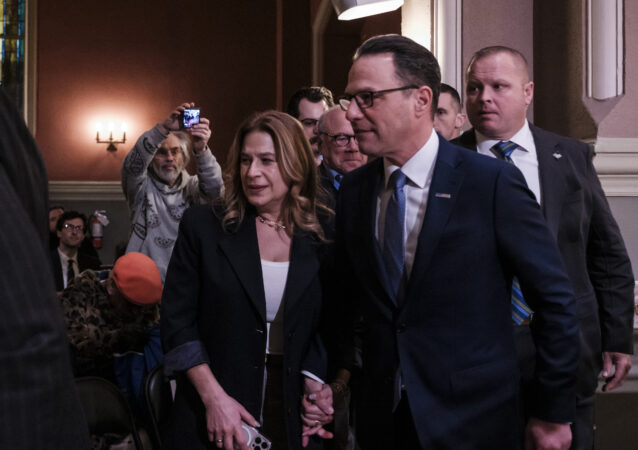
    Gov. Josh Shapiro’s Abington Township neighbors filed a federal lawsuit Monday against Pennsylvania’s first couple, in what is the latest clash over security upgrades to his personal home following an arson attack on the governor’s Harrisburg residence while Shapiro and his family slept inside.

    In the suit, filed in U.S. District Court for the Eastern District of Pennsylvania, the Shapiros’ neighbors in Abington Township, Jeremy and Simone Mock, accuse the governor and his wife, Lori Shapiro, of illegally occupying part of the Mocks’ yard to build an eight-foot security fence last summer in what they claim in the lawsuit is an “outrageous abuse of power.”

    In short, they asked a federal judge to order the Shapiros off their property.

    The Shapiros quickly filed a countersuit in Montgomery County Court of Common Pleas on Monday against the Mocks, asking a judge to declare that the disputed chunk of the property has been theirs for years.

    The attempt to build the new fence is part of a larger security upgrade for Shapiro and his family, following the April firebombing of the state-owned governor’s residence in Harrisburg, when a man broke in to the mansion and set off Molotov cocktails that quickly engulfed part of the home. Cody Balmer, 38, pleaded guilty in October to attempted murder and was sentenced to 25 to 50 years in prison.

    The Mocks, whose property is adjacent to the Shapiros’ Montgomery County property, say the planned location of the fence is on their property unlawfully and violates their rights, according to the lawsuit.

    The couple is represented by Wally Zimolong, a Delaware County attorney who is described as “the ‘go-to’ lawyer in Pennsylvania for conservative causes and candidates” on his firm’s website. He previously represented the political campaigns of President Donald Trump and U.S. Sen. Dave McCormick (R., Pa.), according to his website.

    “The Governor looks forward to a swift resolution and will not be bullied by anyone trying to score cheap political points, especially at the expense of his family’s safety and wellbeing,” Will Simons, a spokesperson for Shapiro, a Democrat running for reelection, said in a statement.

    According to the Mocks’ lawsuit, the Shapiros approached their neighbors in July to discuss the construction of a security fence near where their yards meet. The Shapiros were interested in purchasing a portion of the Mocks’ property for the fence, and also discussed a lease option. But the couples couldn’t agree on the price, according to the suit.

    Things took a turn in late August, when, according to the lawsuit, the Shapiros’ attorney told the Mocks they would obtain the chunk of land through “alternative actions.”

    “What followed was an outrageous abuse of power by the sitting Governor of Pennsylvania and its former Attorney General,” the complaint says. (Shapiro served as Pennsylvania’s attorney general before he was elected governor in 2022.)

    The Shapiros told the Mock family, according to the neighbors’ lawsuit, that they owned the land through adverse possession, a legal mechanism through which a person can gain ownership of a property they’ve actively used for at least 21 years. The Shapiros have lived in their Montgomery County home for 23 years.

    The governor and first lady then began planting arborvitae-type trees and other plants on the Mocks’ property, flying drones over it, threatening to remove healthy trees, and “chasing away” contractors who came to work in the Mocks’ yard, the lawsuit claims.

    The complaint also accuses Shapiro of directing state police to patrol the property. Troopers instructed the Mocks to leave the area of the yard multiple times, calling it a “disputed” area or “security zone,” the suit says.

    The Mocks purchased the house in 2017, according to property records, and their lawsuit says they have paid taxes on the property over the time period. The offer to purchase the land shows the Shapiros knew it wasn’t theirs, according to the complaint.

    “The Shapiros continue to occupy the Mock Property without permission or any legal justification whatsoever,” the lawsuit says.

    The security fencing for the Shapiros’ home was purchased but ultimately never installed, and is being repurposed at the Pennsylvania State Police training academy, Spotlight PA previously reported.

    Zimolong declined to comment on the lawsuit Monday.

    The Shapiro’s countersuit

    The Shapiros’ lawsuit doesn’t dispute many elements of the Mocks’ suit, but casts them in a different light.

    As the Shapiros tell it, a land surveyor discovered in summer 2025 that the Mocks actually owned about 2,900 square feet of land that the Shapiros had believed was a part of their property since they bought the home in 2003. That time period, 22 years, satisfies Pennsylvania’s adverse possession law.

    The Mocks didn’t consider that part of the property to be theirs, according to the complaint, until the Shapiros told them.

    But after negotiations fell apart when the Shapiros attempted to purchase the land, the Mocks sought a permit to erect their own fence and include the disputed area on their property, the suit says.

    Shapiro’s security detail denied a tree-removal contractor access to the area, according to the complaint, because the first couple believe they possessed the land.

    And the state police troopers the Mocks saw were part of Shapiro’s security detail, which after the April attack have conducted review of his Abington home.

    The governor and his wife are asking a judge to find that they are the “legal and equitable owners” of the area in dispute.

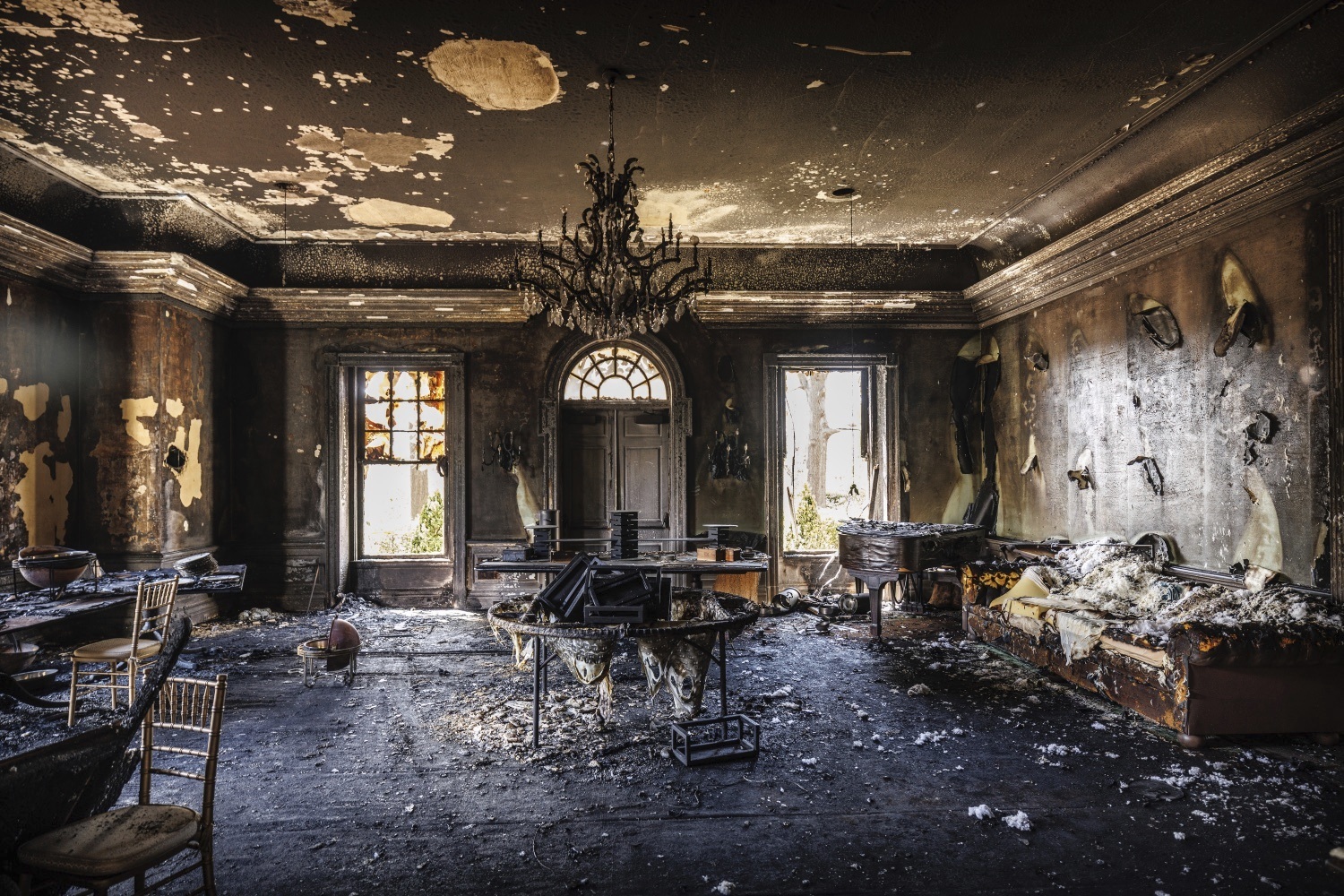
    This image provided by Commonwealth Media Services shows damage after a fire on April 13, 2025, at the Pennsylvania governor’s mansion while Democratic Gov. Josh Shapiro and his family slept inside.

    Scrutiny over security

    Shapiro has faced scrutiny for using taxpayer dollars with little transparency to upgrade the security of his personal home, which is the primary residence for two of his four children, who are school-aged. State Police spent at least $1 million to upgrade security on his Abington Township property, in addition to more than $32 million in upgrades and repairs to the Harrisburg governor’s mansion.

    The GOP-controlled Senate Intergovernmental Operations Committee in December took the rare step of subpoenaing Shapiro for access to records about how taxpayer dollars were spent to upgrade the Shapiro property and home, including a new security system and landscaping work previously reported by Spotlight PA. Sen. Jarrett Coleman (R., Lehigh), who chairs the committee, argued the subpoenas were necessary because the Shapiro administration did not turn over the requested documents, or turned over incomplete records.

    As the Democratic governor of the nation’s fifth most-populous state, Shapiro continues to face threats to his safety. Police arrested a Carlisle man last week for allegedly sending messages to the governor’s office, that said “I do plan on stalking and hurting your family, before adding “metaphorically speaking of course.” The man, George R. Brown Jr., later told police they were “fake threats” and he was trying to get help with an eye injury he suffered while at Cumberland County Prison, PennLive reported.

  • Vance is in Armenia, a country no sitting U.S. president or vice president has visited before

    Vance is in Armenia, a country no sitting U.S. president or vice president has visited before

    YEREVAN, Armenia — Vice President JD Vance landed in Armenia on Monday — a country that no sitting U.S. vice president or president has visited before — as the Trump administration offered economic opportunities while it works to advance a U.S.-brokered deal aimed at ending a decades-long conflict with Azerbaijan.

    Vance and Armenian Prime Minister Nikol Pashinyan signed an agreement to push forward negotiations on a civil nuclear energy deal, and Vance said the U.S. was ready to export advanced computer chips and surveillance drones to Armenia, and invest in the country’s infrastructure.

    The visit comes after Pashinyan joined a deal at the White House in August with Azerbaijani President Ilham Aliyev where the leaders signed agreements reaffirming their commitment to signing a peace treaty. The text of the treaty was initialed by foreign ministers, which indicates preliminary approval. But the leaders have yet to sign the treaty and parliaments have yet to ratify it.

    “Peace is not made by cautious people,” said Vance, who planned to travel to Azerbaijan on Tuesday. “Peace is not made by people who are too focused on the past. Peace is made by people who are focused on the future.”

    The August deal between the two former Soviet republics calls for the creation of a major transit corridor dubbed the Trump Route for International Peace and Prosperity. It is expected to connect Azerbaijan and its autonomous Nakhchivan exclave, which are separated by a 20-mile-wide patch of Armenian territory.

    The land bridge had been a sticking point in resolving a conflict that lasted for nearly four decades over control of the Karabakh region, known internationally as Nagorno-Karabakh. The region had been under the control of ethnic Armenian forces backed by Armenia since 1994. A six-week war in 2020 resulted in Azerbaijan regaining control of parts of the region and the surrounding areas. In September 2023, Azerbaijan launched a blitz that forced the separatist authorities to capitulate. After Azerbaijan regained full control of Karabakh, most of its 120,000 Armenian residents fled to Armenia.

    Vance said that the Armenian prime minister had his endorsement in upcoming elections and he emphasized that the country was among the oldest to have identified as Christian.

    Pashinyan expressed his gratitude toward President Donald Trump and Vance, noting that he had accepted an invitation to participate in the first meeting of Trump’s Board of Peace on Feb. 19 in Washington. The group, founded by Trump, is overseeing the ceasefire plan in Gaza.

    He said Vance’s visit was “of truly historic and symbolic importance” and it “reflects the depth of the strong and strategic partnership forged between the Republic of Armenia and the United States of America.”

    The vice president and his wife, Usha, arrived in Yerevan after spending four days in Milan at the Winter Olympics with their family. They were greeted with a red carpet, an honor guard, and a delegation of officials. Armenian and American flags hung from poles from as the delegation drove to the vice president’s meeting, with some demonstrators on the side of the road, including one with a sign that said, “Does Trump support Devils?”

  • Joe Frazier statue could move to base of Art Museum steps, taking Rocky’s place

    Joe Frazier statue could move to base of Art Museum steps, taking Rocky’s place

    History may not repeat itself, but at least in Philadelphia, it sure does rhyme.

    Twenty years ago, our famed Rocky statue made the move from its former perch at the stadium complex in South Philly to the base of the steps of the Philadelphia Museum of Art, where it has stood since.

    Now, the city’s statue of former world heavyweight champion “Smokin’” Joe Frazier could soon do the same.

    Creative Philadelphia, the city’s office for the creative sector, is slated to present a proposal at a Wednesday Art Commission meeting that would have the Frazier statue take over the Rocky statue’s current home at the base of the Art Museum’s steps. Last month, the commission approved the Rocky statue’s coming move back to the top of the steps, where it supposedly will permanently stay starting in the fall and following its first-time display inside the museum.

    “Relocating the Joe Frazier statue to this prominent civic and cultural space would … create a respectful dialogue between two complementary representations of Philadelphia’s spirit,” chief cultural officer Valerie V. Gay and public art director Marguerite Anglin wrote in a letter to the Art Commission. “Rocky Balboa as a symbol of hard work and aspiration, and Joe Frazier as the embodiment of those values lived out in real life.”

    Created by sculptor Stephen Layne in 2014, the Frazier statue has stood in the sports complex outside what is now Stateside Live! for about a decade, and has been a part of the city’s public art collection since its inception. In an effort led by Joe Hand, the owner of Feasterville’s Joe Hand Boxing Gym and a longtime friend of Frazier’s, the statue’s commission was funded by the boxer’s family and supporters before its donation to the city.

    The statue, standing at about 12 feet tall, depicts Frazier just moments after besting Muhammad Ali in the so-called “Fight of the Century” — the March 1971 bout in which Ali suffered his first professional loss after 15 grueling rounds.

    Frazier, who died in 2011, was a well-accomplished boxer before that matchup, having won an Olympic gold medal in 1964 in Tokyo. He held the heavyweight championship title from 1970 to 1973, when he lost the belt to fellow legend George Foreman following a bout in Kingston, Jamaica, in a matchup referred to as “The Sunshine Showdown.” He retired in 1976, the year following a vicious loss to Ali in the famed “Thrilla in Manila” fight. After returning for a 1981 match against “Jumbo” Floyd Cummings that resulted in a draw, Frazier left the sport for good.

    Relocating the Frazier statue to the Art Museum is expected to cost roughly $150,000 in city funds, and has support from leaders including Mayor Cherelle L. Parker, City Councilmember Katherine Gilmore Richardson, State Sen. Sharif Street, and State Sen. Anthony Hardy Williams, according to Creative Philadelphia’s Art Commission proposal.

    “Placing the Joe Frazier statue at the Art Museum affirms Philadelphia’s commitment to honoring real-life achievement alongside cultural mythology,” Parker wrote in a letter supporting the move. “Together, these figures reflect the city’s spirit, where determination, resilience, and opportunity meet.”

    Friends of Frazier also expressed support in letters included as part of Creative Philadelphia’s proposal — in part, at least, because the Art Museum has higher foot traffic than where the statue currently stands.

    The move “will give the Frazier statue many more eyes on it than at the Xfinity area,” wrote Nicholas L. Depace, the boxer’s friend and former physician.

    Frazier served as a major inspiration for the Rocky Balboa character, with the man and the character sharing several key elements, according to Creative Philadelphia. Like Rocky, Frazier trained for boxing matches by hitting frozen raw meat, ran the Art Museum steps, and faced opponents that closely mirrored those actor Sylvester Stallone’s character faced in the franchise.

    “Stallone made 5 Rocky movies mostly based on the real life humble champion Smokin’ Joe Frazier from Philadelphia,” wrote Smokin’ Frazier Championship Foundation Inc. CEO Pete Lyde in a letter of support for the move. “Joe Frazier’s statue at the Philadelphia Art Museum Steps symbolizes and celebrates the real life human heart and potential within us all worldwide.”

    The Rocky statue, meanwhile, is cleared for installation atop the Art Museum steps following its exhibition in “Rising Up: Rocky and the Making of Monuments,” an Art Museum program slated to run from April to August. After that, the statue now displayed at the top of steps — which Stallone lent to the city for the inaugural RockyFest in December 2024 — will head back to the actor’s collection, and the original, screen-used statue will take its place.

    It was not immediately clear when the Frazier statue could head to the Art Museum. Creative Philadelphia did not immediately respond to a request for comment.

    “Placing the Smokin’ Joe Frazier statue at the Art Museum steps would not only correct a historical imbalance but also serve as an inspirational symbol for residents and visitors alike,” wrote Councilmember at-large Jim Harrity in a letter of support. “It would elevate a true Philadelphia champion whose impact reached far beyond the boxing ring and whose contributions to sports, labor history, and community service continue to resonate today.”

  • Trump leaves Republicans guessing on midterms plans as outlook darkens

    Trump leaves Republicans guessing on midterms plans as outlook darkens

    Republicans looking to the White House to lead in the face of the party’s dimming prospects for November’s midterms are facing a crucial hang-up: the president.

    The party’s flagship campaign committee and super PACs have no indication of how President Donald Trump will deploy his $300 million-plus war chest because he has not approved a spending plan. Republican donors are funding expensive Senate primaries in Texas and Georgia because Trump has not cleared the field with his endorsement, or, in the case of Louisiana, endorsed a challenger to the incumbent Republican.

    People who have spoken with Trump about these obstacles said he at times can sound detached and noncommittal about his plans for spending and endorsements. One person close to the White House said some days the president seems not to care. Having already been impeached twice and indicted four times, Trump is less afraid of being impeached again than he is determined not to let a Democratic-controlled House halt his policy agenda, a White House official said. The official and others spoke to the Washington Post on the condition of anonymity to detail private conversations.

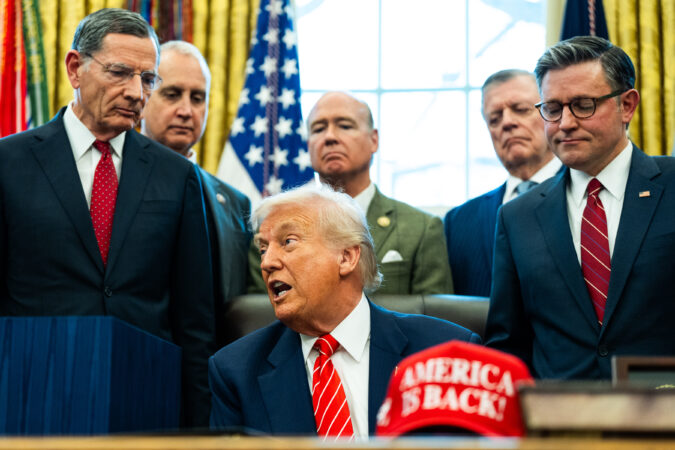
    But a White House official said Trump is excited to get more engaged in midterm strategy and looking forward to increasing his travel this month, including a campaign-style event outside of Washington this week. An Oval Office meeting to go over a handful of House endorsements Wednesday night turned into a five-hour gabfest on the midterms, according to two people present. Trump said he wants to defy the tendency of the president’s party losing seats in Congress in the midterms, one of the people said.

    “We’ll spend whatever it takes,” the person recalled Trump saying. “Go get it done.”

    The president’s political team, led by White House adviser James Blair, campaign strategist Chris LaCivita, and pollster Tony Fabrizio, met in Palm Beach, Fla., on Friday to review research from every competitive race in both chambers and develop estimates for what Republicans will have to spend to win. The team also briefed a retreat of the Senate Republicans’ campaign arm on Saturday.

    For much of last year, the White House was an island of optimism. Trump’s team would argue that Republicans were better positioned than at the same point in his first term, based on data such as the president’s approval rating, the generic ballot, and voter registration.

    Democrats, however, don’t need a 2018-size blue wave to win the House, where Republicans hold the narrowest possible majority and are defending 14 seats rated as toss-ups by the Cook Political Report. Democrats are defending four toss-up seats, and Cook shifted 18 seats in their favor in January.

    Republicans are anxiously awaiting a clear picture of the Trump team’s plans as the president’s sagging approval ratings and Democratic overperformances in special elections have darkened the GOP’s outlook for the midterms. Most Republicans are not ready to criticize Trump in public. But privately, there is rising frustration with an apparent lack of urgency from Trump and his staff, according to people who spoke to the Post.

    “Every time I talk to him on the phone, he says, ‘How’s the race going?’ and then he cites polls back to me so I know he’s following it closely,” Sen. John Cornyn (R., Texas) said, noting that Fabrizio is also his pollster and that LaCivita is a consultant to the super PAC supporting his reelection.

    Still, Trump’s endorsement has eluded Cornyn. “There’s only one person in the world who’s going to make that decision, and we can’t wait,” the senator said.

    Cornyn’s primary in Texas next month is dominating Republican anxieties on the Senate side since national strategists see his toughest challenger, state Attorney General Ken Paxton, as weaker in the general election, according to a memo from the National Republican Campaign Committee obtained by the Post. Holding the Senate seat for the GOP with Paxton as the nominee would cost an additional $100 million in a state where effective advertising costs $8 million a week, according to people involved in the race.

    “Texas cannot be taken for granted,” the memo said, presenting internal polling that puts Cornyn ahead of the Democratic candidates and Paxton behind them. Either Republican would face a competitive general election, the survey showed, with Texas state Rep. James Talarico running stronger than U.S. Rep. Jasmine Crockett on the Democratic side.

    An online survey released Monday that was conducted between Jan. 20 and 31 by the Hobby School of Public Affairs at the University of Houston found Paxton leading Cornyn 38% to 31%, with Rep. Wesley Hunt at 17%. On the Democratic side, Crockett led Talarico 47% to 39%.

    In a presentation to the Republican Senate caucus on Tuesday, National Republican Senatorial Committee Chair Tim Scott of South Carolina said a recent Fox News poll giving Democrats a six-point advantage in House races would put all nine Senate battlegrounds up for grabs, according to two people present. He also noted that Democratic candidates are raising more money for competitive races such as those in Georgia, North Carolina, and Ohio.

    Senate Republicans were heartened Feb. 1 when Trump endorsed John E. Sununu in the Republican primary for Senate in New Hampshire, after extensive lobbying by Senate Majority Leader John Thune (R., S.D.). Sununu has criticized Trump in the past but was leading in polls, and national Republicans saw him as the strongest candidate to flip the seat being vacated by a retiring Democrat, Jeanne Shaheen.

    But lobbying for Trump to endorse Cornyn has stalled as the incumbent has not established a clear polling lead — even after allies have poured $50 million into ads supporting Cornyn. Trump treasures his endorsement as definitive in primaries — and it often is, in part because he resists backing underdogs.

    Early voting opens Feb. 17 for the March 3 primary. If no one wins a majority, the top two candidates will compete in a runoff on May 26.

    Trump renewed hopes that he would wade into the race by telling reporters Feb. 1, “I’m giving it a very serious look.” The day before, a Democrat won a special election in a state Senate district that Trump won by 17 points in 2024.

    “I’ve had many conversations about why I think that makes the most sense to get behind John Cornyn,” Thune told reporters last week. “I don’t have any inside knowledge of when or what that might look like or when it might happen.”

    Trump might clear the field with an endorsement in Georgia to challenge Democrat Jon Ossoff, the person close to the White House said. The Republican primary includes Reps. Buddy Carter and Mike Collins, as well as former football coach Derek Dooley, who is backed by Gov, Brian Kemp. That race, though, is not considered as much a priority for Senate leaders as Texas is.

    Senate Republicans, including Thune, have been frustrated by Trump’s treatment of Senate incumbents, according to two people familiar with the tensions. Sen. Thom Tillis of North Carolina declined to run for reelection in the battleground state after feuding with Trump over Medicaid cuts in the president’s 2025 tax cuts and spending package. Last month, Trump recruited and endorsed a challenger to Sen. Bill Cassidy in Louisiana — which the White House official said was the result of Cassidy’s vote five years ago to convict Trump in the Senate impeachment trial of inciting the Jan. 6, 2021, riot at the Capitol.

    “I do think it’s a real problem when Senate Leadership Fund is on record supporting Cornyn and Cassidy, and President Trump is either silent or in opposition,” Tillis said, referring to the main super PAC supporting Senate Republicans. “We’re literally going to have Republican-on-Republican money being spent, and that makes no sense leading up to a general [election] where we’re going to have headwinds.”

    On the House side, the White House’s push to protect the House majority using redrawn congressional maps in Texas, North Carolina, and Missouri appears poised to net zero seats because of Democratic counteractions in California, Maryland, and Virginia. The latter two still face legislative or judicial hurdles.

    The White House still expects to pick up Republican seats from a new map in Florida, after Gov. Ron DeSantis (R) last month announced a state legislative special session in April. DeSantis said he wanted to wait until then in the hopes of a new Supreme Court ruling that could reshape as many as 19 House districts across the South by further weakening the Voting Rights Act of 1965.

    Trump has noted that the stakes of the midterms include, for him personally, the likelihood of being investigated or even impeached by a Democratic-controlled House. His first administration uniformly disregarded oversight requests and litigated subpoenas until after his term. Now some advisers expect that the administration can stonewall congressional oversight and that Democratic focus on investigating Trump could backfire on them leading up to the 2028 presidential election.

    Republicans still hold an overall advantage in fundraising. The House GOP campaign arm, which historically struggles to attract donors in uphill midterms, outraised its Democratic counterpart in 2025. The Democratic National Committee has more debt than cash, while the Republican National Committee has $95 million in the bank.

    Trump’s main super PAC, MAGA Inc., finished 2025 with a $304 million stockpile. But the PAC, led by LaCivita and Fabrizio, has been mum with allies about its spending plans. The person close to the White House said the president is likely to approve spending in multiple waves, and may reserve funds to maintain his political kingmaker role in future elections and for legal fees.

    “Thanks to President Trump’s leadership, MAGA Inc. will have the resources to help candidates who support President Trump’s America First agenda of securing our border, keeping our streets safe, supercharging our economy, and making life more affordable for all Americans,” PAC spokesperson Alex Pfeiffer said.

    While lawmakers await details on what assistance they can expect from the super PAC, Trump’s team noted it was the largest outside spender in the Dec. 2 special election to retain a House seat in Tennessee.

    “President Trump and his team were all in for me. I wouldn’t have won without them,” said Rep. Matt Van Epps, who won by 8.8 points in a district Trump carried by 22 points in 2024. “I know they’ll do the same for the entire America First team in this year’s midterm.”

    The White House said it is actively scheduling multiple trips for the president in battleground states and districts in the coming weeks and months that will include local lawmakers. The White House has also encouraged cabinet secretaries to minimize foreign trips and focus solely on domestic travel this year, encouraging officials to seek guidance on prioritizing battleground districts. White House officials are also helping to book cabinet members on local media in target areas.

    Since Thanksgiving, Trump has visited the battleground districts of Reps. Rob Bresnahan (R., Pa.) and Don Davis (R., N.C.), as well as Detroit (home to a Senate and governor’s race) and Iowa (home to a Senate race and two target House races). Vice President JD Vance visited battleground House districts held by Ryan Mackenzie (R., Pa.) and Marcy Kaptur (D., Ohio). Medicare administrator Mehmet Oz visited the districts of Rep. Michael Lawler (R., N.Y.) and Brian Fitzpatrick (R., Pa.).

    The White House provided statements from Lawler, North Carolina U.S. Senate candidate Michael Whatley, Sen. Jon Husted of Ohio, Sen. Dan Sullivan of Alaska, and RNC adviser Danielle Alvarez praising Trump and his staff for their support.

    “It is only February, and there is time for more, but I’m glad to have very strong support from the President and his administration,” Husted said.


  • Democratic ward leaders endorse Sharif Street for Congress, solidifying him as Philly’s establishment favorite

    Democratic ward leaders endorse Sharif Street for Congress, solidifying him as Philly’s establishment favorite

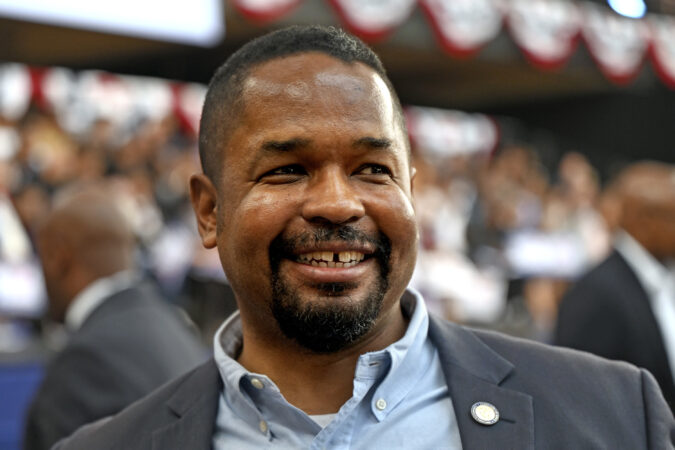
    Philadelphia’s Democratic Party has endorsed State Sen. Sharif Street for the city’s open congressional seat.

    The endorsement Monday came as no surprise, given Street’s insider connections. He previously chaired the Pennsylvania Democratic Party and is close to party leaders in the city. And Bob Brady, who chairs the Democratic City Committee, said last fall that he expected his fellow ward leaders to vote to endorse Street.

    But it nonetheless strengthens Street’s status as the favorite in the race among the local Democratic establishment. Street, the son of former Mayor John F. Street, was endorsed by the politically powerful unions in the Philadelphia Building & Construction Trades Council last year.

    “I am deeply honored to have received the overwhelming support of the grassroots leaders who power our party,” Street, who represents a North Philadelphia district in the state Senate, said in a statement. “This endorsement is more than just a vote of confidence — it is a demonstration that we are building a broad-based coalition.”

    Street is one of about a dozen Democrats vying to succeed retiring U.S. Rep. Dwight Evans in Pennsylvania’s 3rd Congressional District. Other contenders include State Reps. Morgan Cephas and Chris Rabb and physicians Ala Stanford and Dave Oxman.

    Street has also emerged as the front-runner in the financial race. Recently disclosed campaign reports showed he raised $348,000 from donors in the last quarter of 2025, the largest haul among the candidates.

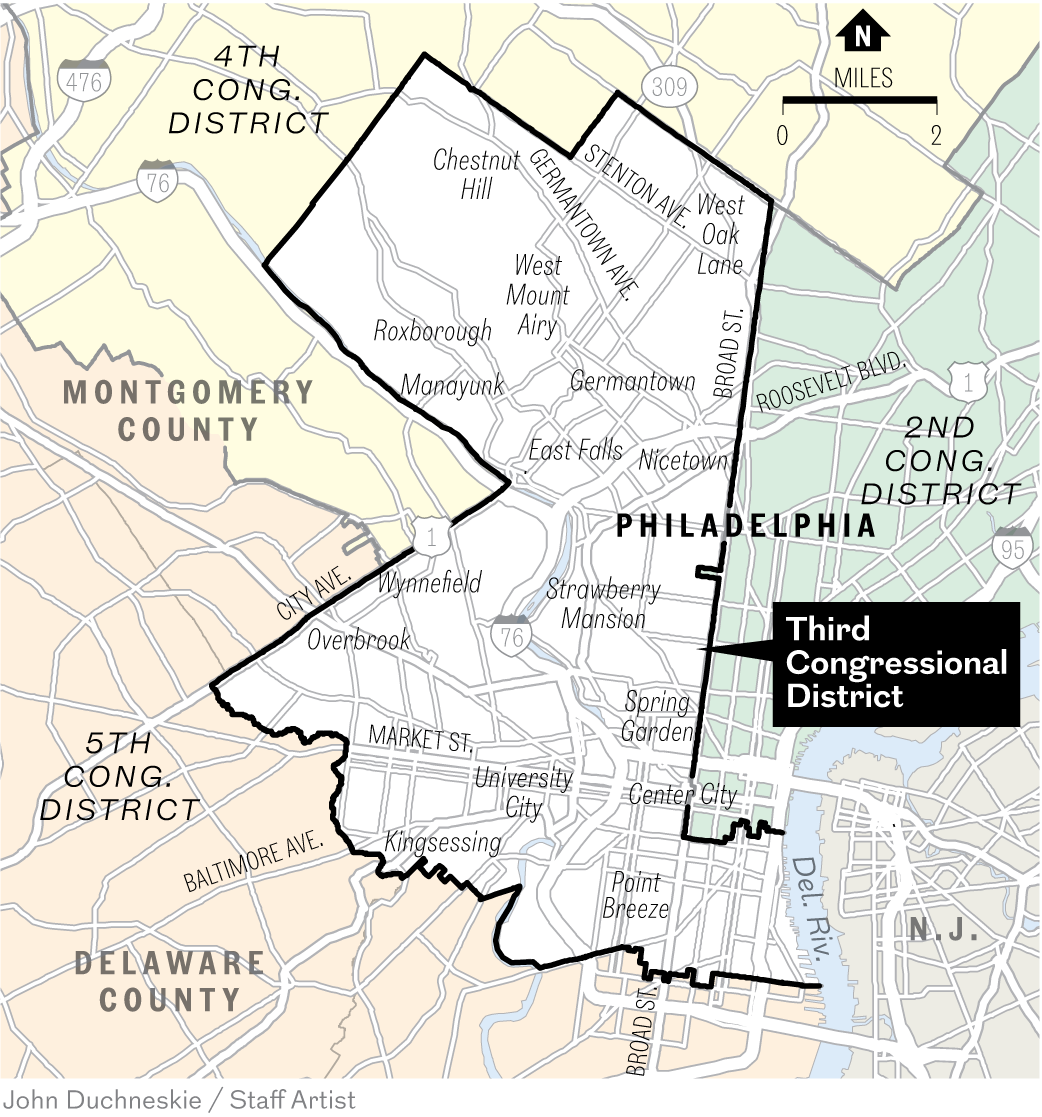
    The 3rd Congressional District is, by some measures, the most heavily Democratic district in the U.S. House, and includes West and Northwest Philadelphia and parts of Center City, Southwest, South, and North Philadelphia.

    The winner of the Democratic primary in May is all but guaranteed victory in November. Democrats hold a 7-to-1 voter registration edge over Republicans in Philadelphia.

    Map of Pennsylvania’s Third Congressional District.

    Earning the party nod may help Street stand out in a crowded field and will bolster his ground game for campaigning, activating the party’s hundreds of committeepeople to get out the vote for him.

    But it doesn’t guarantee victory. Insurgent candidates have defied the party’s dominance several times in recent city elections, and the district includes several progressive pockets that could open the door for a candidate who can coalesce the left against Street.

    The endorsement followed a vote by the Democratic ward leaders in the district. A candidate must receive at least 50% of the vote to win the party endorsement.

    If no candidate reaches that mark, each ward prints its own sample ballots with its preferred candidates, which often happens in open contests like this year’s primary.

    The party’s endorsement of Street means all ward leaders are now encouraged to include him in the literature distributed to voters before and on election day. Some wards, however, choose to print their own slates anyway.

    The party did not immediately disclose the final vote tally at the endorsement meeting.

    Northwest Philadelphia’s 50th Ward, which is led by Mayor Cherelle L. Parker, has not yet made an endorsement in the race, said Aren Platt, executive director of the mayor’s campaign, People for Parker.

    Top candidates in the race, including Street, were scheduled to face off at a candidates forum hosted by the Center City Residents Association on Monday night.

  • Moore College will consider opening undergraduate programs to men

    Moore College will consider opening undergraduate programs to men

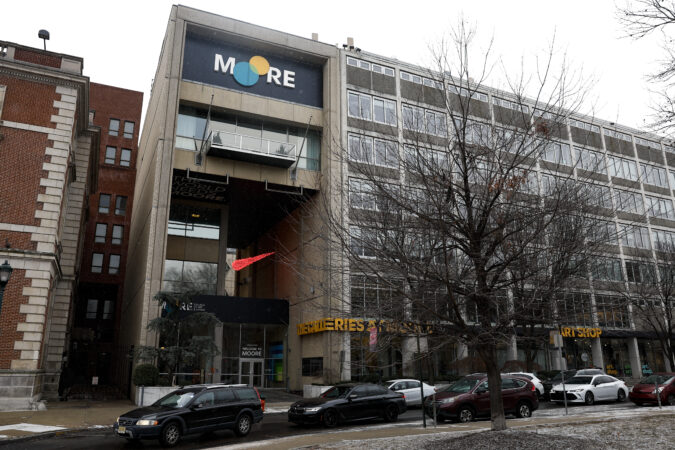
    Moore College of Art and Design will consider opening its undergraduate programs to men for the first time in its 177-year history.

    The Philadelphia school, which touts its role as “the first and only historically visual arts college for women in the nation,” cited the need to make arts programs more accessible in the region and the expected national decline in the available pool of high school graduates.

    The college, which enrolls about 500 students, will study and discuss with its community the prospect of admitting men over the next four months and make a decision by June, the school announced in emails to alumni, faculty, and students Monday. If the school decides to admit all genders, the first class admitted would be for 2027.

    “We will explore all of this together in an inclusive way for students, faculty, staff, and alumni,” wrote Moore president Cathy Young and Frances Graham and Art Block, chairs of the school’s board of trustees and board of managers, respectively. “Your voices are essential. No decision has been made at this time. The boards want your feedback.”

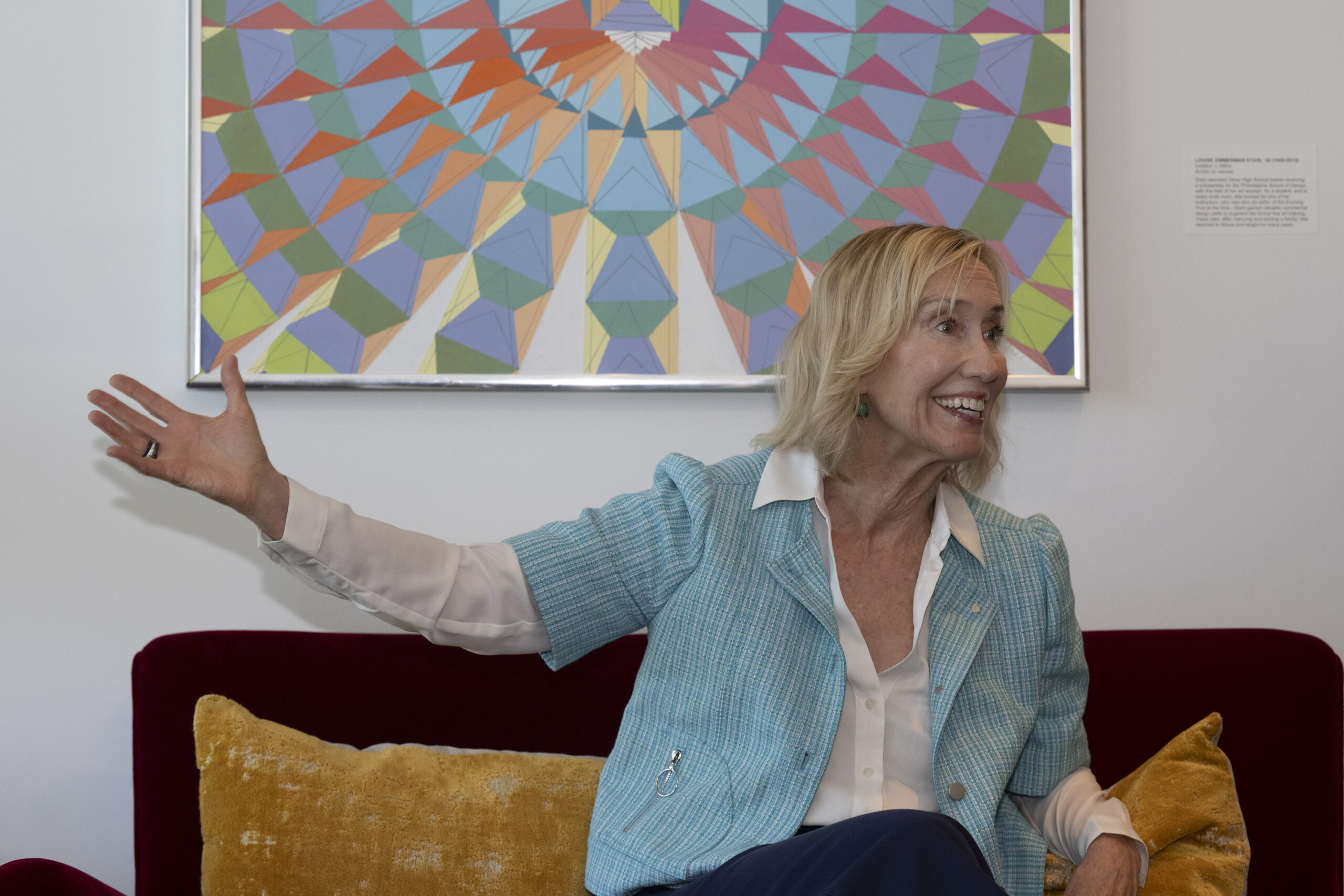
    Moore College of Art and Design president Cathy Young.

    If Moore goes coed, Bryn Mawr College would be the only remaining women’s school in the Philadelphia region. (In Allentown, Cedar Crest College remains primarily a women’s college.)

    Several other colleges in the region that were formerly for women have gone coed over the last decades, including Rosemont on Philadelphia’s Main Line in 2008, Immaculata University in Chester County in 2005, and Chestnut Hill College in Philadelphia in 2003.

    Nationally, the number of women’s colleges has been declining from a high of over 200 to just 31 as of 2022, according to a 2025 report by the Pew Research Center.

    It wouldn’t be the first change in Moore’s admissions policy in recent years.

    In 2015, Moore began admitting “all qualified students who live as women and who consistently identify as women at the time of application.”

    Then in 2020, Moore also began accepting nonbinary and gender-nonconforming students. Since then, the number of those students has been growing. They made up 6% of the first freshman class under the new policy in 2021. By fall 2022, they accounted for 21%, and by fall 2023, 26%. Last fall, that grew to one-third of the freshman class.

    Moore’s graduate programs and most of its continuing education programs already include men.

    Moore officials said they are making the decision from a position of financial and academic “strength.” The school has had operating surpluses for the last 24 consecutive years, a school spokesperson said. Many small schools have faced financial strain in recent years, but Moore fared among the top small private colleges in the Philadelphia region for financial health in a 2024 Inquirer review.

    Moore’s net tuition climbed from $10.8 million to $12.7 million in fiscal 2024 and to $16.5 million in fiscal 2025, financial records show. The school also saw a big gain in private gifts and grants last year to $2.2 million, up from $885,383 the year before.

    This year’s enrollment is the school’s second highest behind fall 2024, when the college accepted 112 students from the University of the Arts, which abruptly closed in June 2024. The school also took 12 students that year from the Delaware College of Art and Design, which closed that year, too.

    Moore opened a new residence hall in Rittenhouse Square last fall, which is just a seven-minute walk from campus and will allow the school to guarantee students housing for all four years.

    In announcing the possibility of accepting all genders, Moore officials noted UArts’ closure and the end of degree-granting programs at the Pennsylvania Academy of Fine Arts.

    “There is a void in Philadelphia’s higher ed creative landscape, and that begs the question: Shouldn’t all creatives, regardless of gender, have access to Moore …” they wrote. “The answer doesn’t have to be “yes,” but it is our responsibility to explore it.”

    College surveys of applicants have shown that the school’s status as a women’s college isn’t a big draw. Only 6% cited it as important to their decision out of 885 survey respondents over the last dozen years, the school said. Meanwhile, a quarter said it was one of the important reasons they didn’t choose Moore.

    Moore officials also cited the expected drop in the high school graduate population beginning this year because of declining birth rates. A decline of 10% is expected by 2037, they noted.

    “There are simply fewer students,” they wrote. “No responsible institution can ignore factors like these. And we won’t.”

    They said they will discuss ways “to preserve and activate in new ways” Moore’s history and legacy as part of the exploration.

    Between February and April, Moore plans to host about 20 sessions for faculty, staff, and alumni to share their thoughts, as well as providing an opportunity for online comments.

    Staff writer Harold Brubaker contributed to this article.

  • Trump set off a surge of AI in the federal government. Here’s what happened.

    Trump set off a surge of AI in the federal government. Here’s what happened.

    As the Trump administration seeks to sweep away obstacles to developing artificial intelligence, the president’s team has brought its zeal for the new technology to the federal government itself.

    Orders came down from the White House budget office in April urging every corner of the government to deploy AI. “The Federal Government will no longer impose unnecessary bureaucratic restrictions on the use of innovative American AI in the Executive Branch,” the White House said in a statement announcing the push.

    Officials across the government answered the call, according to a Washington Post analysis of more than two dozen recent agency disclosures on AI use. On top of automating rote tasks, government agencies have launched hundreds of artificial intelligence projects in the past year, many of them taking on central and sensitive roles in law enforcement, immigration, and healthcare.

    The Department of Homeland Security has adopted new, more sophisticated facial recognition tools. The FBI has purchased novel systems to sift through reams of images and text to generate leads for investigators. And the Department of Veterans Affairs is developing an AI program to predict whether a veteran is likely to attempt suicide.

    Revoking — even scorning — the Biden administration’s caution, the White House has directed government departments to cut through any red tape that might slow the adoption of AI. “Simply put, we need to ‘Build, Baby, Build!’” the Trump administration’s AI action plan says.

    Federal agencies are doing just that: The 29 that had posted data last week listed 2,987 active uses for AI by the end of 2025, up from 1,684 the year before. The disclosures are required by the budget office and provide basic details about each use of AI. Hundreds of those uses were marked as “high impact,” meaning they are being used as the main basis for making significant decisions or have implications for people’s rights or their safety, according to federal standards.

    The White House argues the technology is a way to make the government vastly more efficient, though it’s impossible to tell from the disclosures how well used any of the thousands of tools are.

    The practical value of many of these tools remains uncertain. The public, meanwhile, remains deeply skeptical of the technology.

    The administration’s focus on speed may come at the expense of ensuring the tools are being used safely, said Suresh Venkatasubramanian, a Brown University computer science professor. AI could spit out erroneous information, leading officials to make bad decisions, or a facial recognition tool could lead to someone being wrongfully placed on a watch list, he said. Venkatasubramanian, who worked on AI safety in the Biden administration, argued that officials previously placed a greater emphasis on oversight and managing risks.

    “It’s not the use case itself that raises the question, it’s do you have the guardrails in place to use what can be very noisy and powerful tools in the right way,” he said. “Any particular use case — even the most innocuous sounding ones — could backfire.”

    The White House Office of Management and Budget, which is overseeing the government’s AI rollout, did not respond to a request for comment. Its April memo directs agency leaders to ensure “that rapid AI innovation is not achieved at the expense of the American people or any violations of their trust.”

    Turbocharged law enforcement

    As the administration has dramatically ramped up its deportation efforts, DHS has increasingly turned to advanced technology to turbocharge its work. The department’s disclosures reveal a suite of facial recognition tools deployed in the past year and another system to help identify people to deport. In all, 151 AI use cases mention either “immigration” or “border” or were filed by immigration and customs agencies.

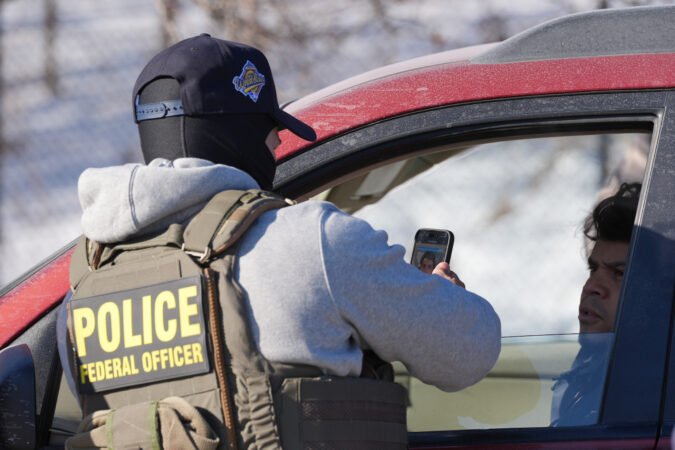
    Immigration and Customs Enforcement, which is part of DHS, reported adding new facial recognition functions, including the Mobile Fortify app, which is used to scan individuals’ faces in the field. It also disclosed its use of an unspecified system to identify “vulnerable populations,” which the agency defined as including “unaccompanied minors who have crossed the border.”

    ICE also said it began in June using a new generative AI system from the defense contractor Palantir that trawls through handwritten records such as rap sheets and warrants, to automatically extract addresses to aid Enforcement and Removal Operations, the agency’s deportation division. The AI-powered system, called Enhanced Leads Identification and Targeting for Enforcement (ELITE), is not supposed to serve as a “primary basis for enforcement actions,” the agency said. Officers manually review the data and make decisions, it added.

    Another Palantir system helps quickly review ICE’s tip line, summarizing and categorizing each tip, whatever language it is submitted in.

    “Employing various forms of technology in support of investigations and law enforcement activities aids in the arrest of criminal gang members, child sex offenders, murderers, drug dealers, identity thieves and more, all while respecting civil liberties and privacy interests,” DHS previously said in a statement.

    The Justice Department disclosed multiple tools designed to generate leads for investigators, including a facial recognition system at the FBI and another to prioritize tips coming into bureau offices around the country. But many of the department’s descriptions are vague: The output of one FBI tool is described merely as “text.”

    Valerie Wirtschafter, a fellow at the Washington-based think tank Brookings, said a lack of detail in some agency disclosures makes it difficult to fully judge some of their more sensitive uses of AI.

    The Justice Department and Palantir did not respond to requests for comment.

    A Veterans Affairs boom

    The Department of Veterans Affairs listed more high-impact uses of AI than any other agency, disclosing 174 such tools either in development or operation to revamp how it provides healthcare and benefits. The department said it is developing AI helpers to prepare patients for surgery, use computer vision to more precisely measure wounds, and identify potential suicide risks that human clinicians might have missed.

    Another system is designed to help veterans claim their benefits. “This project harnesses the power of artificial intelligence to analyze vast amounts of data, providing personalized recommendations and streamlined access to a wide array of veteran benefits,” the department said in its disclosure.

    Pete Kasperowicz, a VA spokesperson, said those four systems “are still being assessed for their viability and have not been tested or deployed.” He said the department uses AI only as a “support tool,” leaving final healthcare and benefits decisions to agency staff.

    Chris Macinkowicz, an official at Veterans of Foreign Wars, a service group, said that while VA’s use of AI promises to help the agency serve millions of veterans more efficiently, it needs to be carefully overseen.

    “Our experience has shown that, although AI can be a valuable tool, it is not infallible,” Macinkowicz said in an email. “Human judgment is essential to ensure accuracy, fairness, and accountability in decisions that have a direct and lasting impact on veterans and their families.”

    The Department of Health and Human Services disclosed an additional 89 projects connected to medical care. They include using AI to oversee clinical trials and to track the availability of vaccines. The department did not respond to a request for comment.

    Chatbots

    Many government uses are similar to those available to the general public. Agencies operate at least 180 chatbots designed to not only help federal employees complete mundane tasks such as scheduling travel and IT help, but also support them in more sensitive work like understanding labyrinthine internal rule books. Several agencies are using similar tools to help with writing federal rules and deciding how to award contracts.

    In a year that saw hundreds of thousands of federal employees laid off or take buyouts under cuts engineered by the Trump administration, a Defense Department official described at a conference last month how one team was able to use AI to still get a mandatory report finished despite losing the help of a team of about 20 contractors.

    “There’s four people, and guess what?” said Jake Glassman, a senior Pentagon technology official. “They generated the report, and I would dare anyone to see any type of difference on that.”

    National security

    The Pentagon is exempt from the disclosure process, but other government records show how it is aggressively accelerating its AI experimentation. Defense Secretary Pete Hegseth ordered officials to avoid being hamstrung by undue concerns of risks in a memo issued last month. Future AI contracts with vendors must allow for “any lawful use,” he wrote, without further usage constraints.

    “We must eliminate blockers to data sharing,” the memo said. “… We must approach risk tradeoffs … and other subjective questions as if we were at war.” The Pentagon told vendors in recent weeks that it is seeking to acquire cutting-edge “agentic” AI systems that exhibit “decision-making capabilities” and “humanlike agency” for its elite Special Operations forces. One potential use for such systems is to weigh various “constraints” that govern when units can initiate or continue combat and the risk of killing or injuring civilians.

    “These constraints overlap and sometimes include conflicting guidance,” the department said in a request for industry input, adding that the AI agents should understand how certain constraints have priority over others.

    The request said the tools are expected to adapt and learn in real time, though they will be prohibited from “online” learning in contexts such as “kinetic fires” — the use of live ammunition — “since it may lead to undesired behavior.”

    The Defense Department did not respond to a request for comment.

    Science and research

    Government scientists are experimenting with using AI to solve problems in hundreds of niche areas, including eight related to whales and dolphins. Some at the National Oceanic and Atmospheric Administration are working on “Automated whale blow detections” — part of a population-tracking effort. (Some of these biologists are having fun, titling one project “Artificial Fintelligence: Automating photo-ID of dolphins in the Pacific Islands.”) Some 49 other projects use AI to evaluate satellite and aerial imagery to detect ice seals, track invasive species, estimate soybean yields, and locate cooling towers that might be vectors for the spread of Legionnaires’ disease.

    NOAA did not respond to a request for comment.

    Federal archivists have also turned to AI to help make the nation’s history more accessible.

    Jim Byron, a senior adviser at the National Archives and Records Administration, said the agency launched an AI-powered tool last month to let the public search through newly digitized records. They include documents related to the assassinations of President John F. Kennedy and Martin Luther King Jr., as well as the disappearance of pioneering aviator Amelia Earhart.

    Byron said in a statement that the agency plans to build on its work, calling the tool a “giant leap into the present.”

  • Palace says King Charles III will support police assessing former Prince Andrew’s Epstein links

    Palace says King Charles III will support police assessing former Prince Andrew’s Epstein links

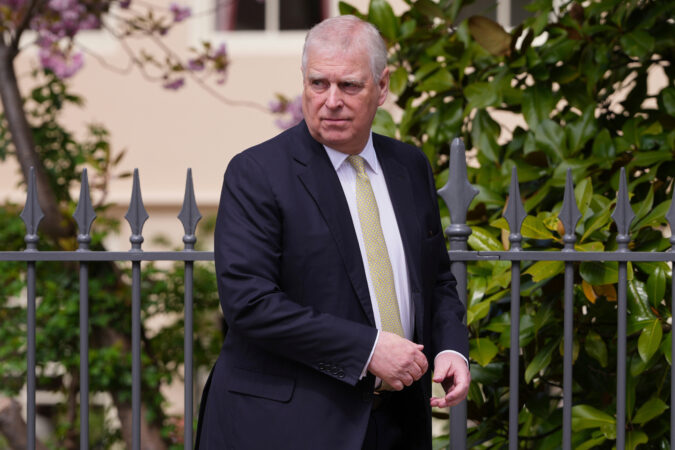
    LONDON — King Charles III is ready to “support’’ U.K. police examining claims that the former Prince Andrew gave confidential information to convicted sex offender Jeffrey Epstein, Buckingham Palace said on Monday.

    The statement came after Thames Valley Police said Monday that they were ”assessing” reports that the former prince, now known as Andrew Mountbatten-Windsor, sent trade reports to Epstein in 2010. The department, which serves an area west of London that includes Mountbatten-Windsor’s former home, previously said it was evaluating allegations that Epstein flew a young woman to Britain to have sex with Andrew, also in 2010.

    “The King has made clear, in words and through unprecedented actions, his profound concern at allegations which continue to come to light in respect of Mr. Mountbatten-Windsor’s conduct,’’ the palace said in a statement. “While the specific claims in question are for Mr. Mountbatten-Windsor to address, if we are approached by Thames Valley Police we stand ready to support them as you would expect.’’

    The statement is just the latest effort by the palace to distance the royal family from Mountbatten-Windsor as the U.S. Justice Department’s release of more than 3 million pages of documents from its investigation into Epstein reveal more embarrassing details about the relationship between the two men. Earlier in the day, Prince William and Princess Catherine released their own statement saying they have been “deeply concerned” by recent revelations.

    The palace also reiterated Charles and Queen Camilla’s concern for the victims of Epstein’s abuse.

    “As was previously stated, Their Majesties’ thoughts and sympathies have been, and remain with, the victims of any and all forms of abuse,’’ the palace said.

    The jeopardy faced by the royal family could be seen Monday when Charles visited Lancashire, in northwest England. While most of the crowd clapped, cheered, and waved flags, one person shouted, “How long have you known about Andrew?”

    Concerns about Mountbatten-Windsor’s links to Epstein have dogged the royal family for more than a decade.

    The late Queen Elizabeth II forced her second son to give up royal duties and end his charitable work in 2019 after he tried to explain away his friendship with Epstein during a catastrophic interview with the BBC. After more details about the relationship emerged in a book published last year, Charles stripped him of the right to be called a prince and ordered him to move out of a royal residence close to Windsor Castle.

    But the Justice Department documents have brought new attention to Mountbatten-Windsor as reporters home in on dozens of email exchanges between Epstein and the former prince, many of which took place after the financier was convicted of soliciting a minor for prostitution in 2008.

    Correspondence unearthed in recent days appears to show that Mountbatten-Windsor sent Epstein copies of his reports from a 2010 tour of Southeast Asia, which he undertook as Britain’s envoy for international trade. An earlier email appears to show Andrew sharing his itinerary for the two-week trip to Hanoi, Saigon, Singapore, Kuala Lumpur, and Hong Kong with Epstein.

    “We can confirm receipt of this report and are assessing the information in line with our established procedures,” Thames Valley police said in a statement released on Monday.

    Adding to the storm, a U.S.-based attorney said on Feb. 1 that he represented a woman who alleges Epstein flew her to Britain to have sex with Mountbatten-Windsor. The encounter took place at Royal Lodge, the former prince’s longtime home in Windsor, the attorney said in an interview with the BBC.

    Police previously said they were assessing this report.

    The king last week forced Mountbatten-Windsor to move out of Royal Lodge months ahead of schedule. Anger over Mountbatten-Windsor’s living arrangements had grown amid concern that he was still reaping rewards from his status as a royal even though he is no longer a working member of the royal family.

    Mountbatten-Windsor is now living on the king’s Sandringham estate in eastern England. He will live temporarily at Wood Farm Cottage while his permanent home on the estate undergoes repairs. Unlike Royal Lodge, which is owned by the crown and managed for the benefit of taxpayers, Sandringham is owned privately by the king.

    Thames Valley Police began its latest inquiry after Graham Smith, chief executive of the antimonarchy group Republic, reported Mountbatten-Windsor for suspected abuse of public office and violations of Britain’s Official Secrets Act.

    Smith, whose group seeks to replace the king with an elected head of state, compared Mountbatten-Windsor’s correspondence with Epstein to earlier revelations about Peter Mandelson, Britain’s former ambassador to the U.S., who is already the subject of a police investigation into whether he shared sensitive information with Epstein. Those communications were also revealed in the Justice Department documents.

    “I cannot see any significant difference between these allegations and those against Peter Mandelson,” Smith said on social media.