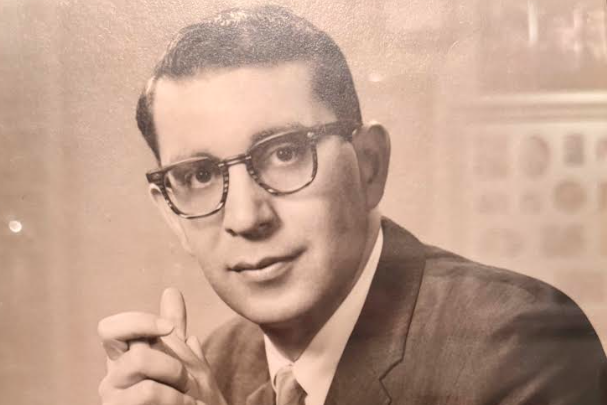
Carl W. Schneider, 93, of Philadelphia, retired longtime attorney at the old Wolf, Block, Schorr, & Solis-Cohen law firm, former special adviser to the Securities and Exchange Commission, visiting associate professor at what is now the University of Pennsylvania Carey Law School, writer, poet, mentor, and volunteer, died Thursday, Dec. 18, of pneumonia at Pennsylvania Hospital.
Mr. Schneider was an expert on corporate, business, and securities law, and he spent 42 years, from 1958 to his retirement in 2000, at Wolf, Block, Schorr, & Solis-Cohen in Philadelphia. He was adept at handling initial public offerings and analyzing stock exchange machinations, and he became partner in 1965 and chaired the corporate department for years.
Although he did not plan to specialize in securities law after graduating from Penn’s law school in 1956, Mr. Schneider told the American Bar Association in 1999: “I found this type of work to be challenging, gratifying, stimulating, and educational.”
He spent most of 1964 on leave from the law firm as a special adviser to the Securities and Exchange Commission’s Division of Corporation Finance in Washington. His recommendations to SEC officials regarding its public-offering process, disclosure system, civil liability rules, and arbitration procedure, many of which were ahead of their time, eventually led to modernization and reforms in the administration of federal securities laws. “I was cast in the role of the constructive critic,” he said in 1999.
He chaired committees for the Philadelphia and American Bar Associations and was active in leadership roles with the American Law Institute and other groups. He clerked for Supreme Court Justice Harold H. Burton and Judge Herbert F. Goodrich of the U.S. Court of Appeals for the Third Circuit for two years after graduating from law school.
He also taught classes as a visiting associate professor at Penn’s law school and lectured extensively elsewhere on the continuing legal education circuit. “I am aware of two personality traits that have shaped my career,” he said in 1999, “a need to fix things and a love of teaching.”
He spent the 1978-79 school year as head of Penn’s Center for Study of Financial Institutions and said in 1999 that he would have taught full time had he not enjoyed his legal work so much. “I was a practitioner,” he said, “and I tried to give my classes useful training to do what most practitioners do.”
Mr. Schneider wrote, cowrote, and edited dozens of scholarly articles, books, and pamphlets, including the celebrated Pennsylvania Corporate Practice and Formsmanual in 1997. He also penned poetry, and used this stanza to open a chapter about boilerplate clauses in the Pennsylvania Corporate Practice and Forms manual:
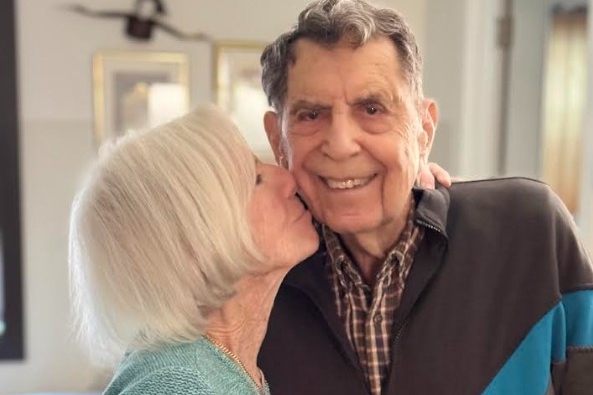
Mr. Schneider and his wife, Mary Ellen, were inseparable for 68 years.
“The ending stuff gets little thought/Like notice, gender, choice of laws/If badly done you may get caught/With a provision full of flaws.”
He volunteered with what is now Jewish Family Service, the Jewish Federation of Greater Philadelphia, Abramson Senior Care, and Congregation Rodeph Shalom. He mentored countless other lawyers and students, and agreed in 1972 to a request by The Inquirer’s Teen-Age Action Line to be interviewed in his office for a high school student’s research project.
“He was often described as brilliant, humble, a dry wit, and a great listener,” his family said in a tribute. “He gave everyone he spoke to the same time, attention, and respect.”
He was quoted often in The Inquirer and lectured about legal matters at conferences and panels. He earned several service and achievement awards and said in 1999: “I suppose I am one of those compulsives who cannot see something in the world important to him that is broken without feeling the need to repair it.”
Mr. Schneider and his wife, Mary Ellen, married in 1957.
Carl William Schneider was born April 27, 1932, in the Wynnefield section of Philadelphia. His family later moved to Elkins Park, Montgomery County, and he graduated from Cheltenham High School in 1949.
He knew he wanted to be a lawyer, like his father and grandfather, when he was young and said in a 2014 video interview at Penn that school was his favorite place. He earned a bachelor’s degree at Cornell University in 1953 and served on the law review at Penn.
He met Mary Ellen Baylinson through a mutual friend, and they married in 1957. They had sons Eric, Mark, and Adam and a daughter, Cara, and lived for years in Elkins Park. He and his wife moved to Center City in 2005.
Mr. Schneider enjoyed reading, bird-watching, photography, swimming, tennis, and springtime strolls through Rittenhouse Square. His favorite song was “The Gambler” by Kenny Rogers.
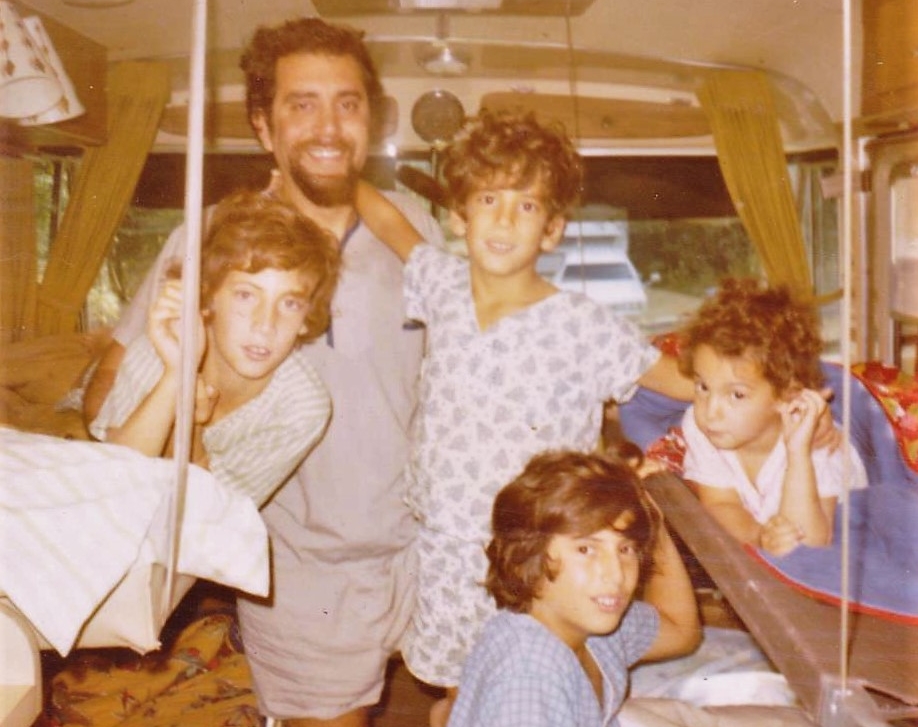
Mr. Schneider drove his family across the country in a motorhome he nicknamed Herman.
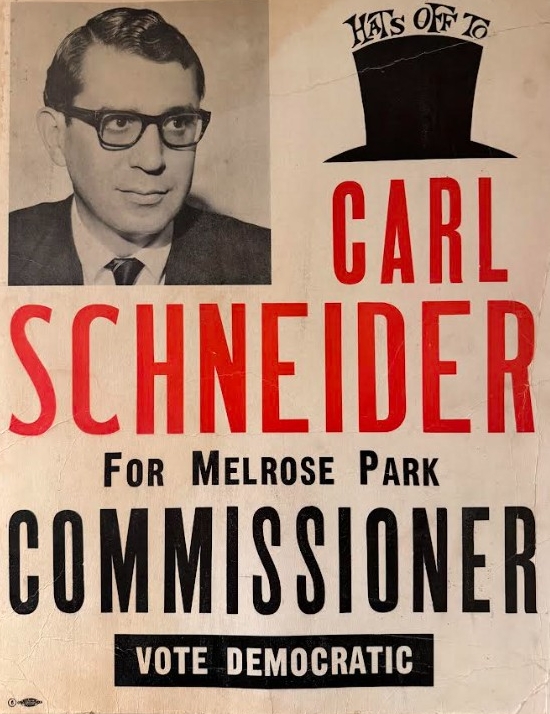
He collected old-fashioned scales, spent quality time with family and friends on Long Beach Island, N.J., and drove cross-country on a family road trip in a motorhome he nicknamed Herman. He ran unsuccessfully for commissioner in Melrose Park in the 1960s.
He made sure to be home every night for dinner and drew smiley faces inside the capital C when he signed his name. “He never judged, never overreacted,” his daughter said.
His son Adam said: “He was a gentle man but forthright and direct.” His son Mark said: “He had a moral code on how to live a life and never deviated from it.”
His son Eric said: “He left the world a better place.”
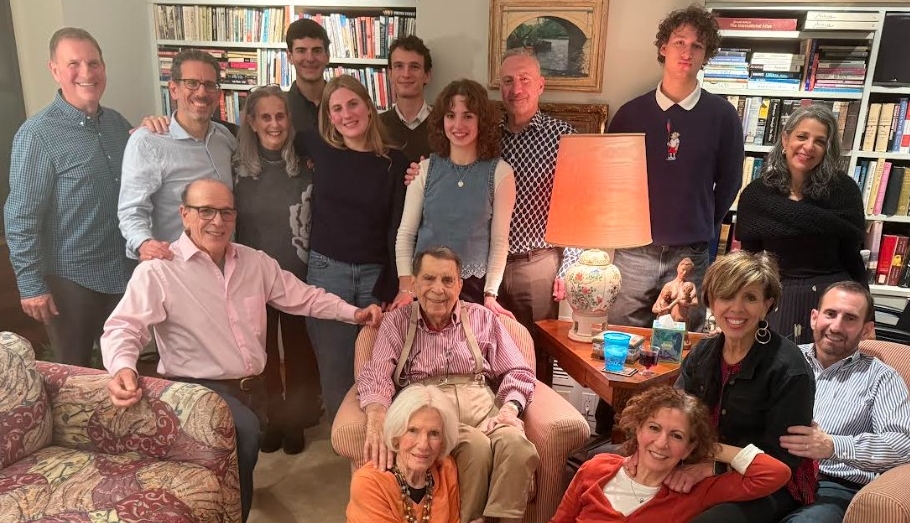
Mr. Schneider (center) and his family spent many Thanksgivings together.
In addition to his wife and children, Mr. Schneider is survived by three grandchildren; a sister, Julie; and other relatives.
Services were held Monday, Dec. 22.
Donations in his name may be made to Congregation Rodeph Shalom, 615 N. Broad St., Philadelphia, Pa. 19123.
Mr. Schneider was interested in civic and community issues as well as legal affairs.
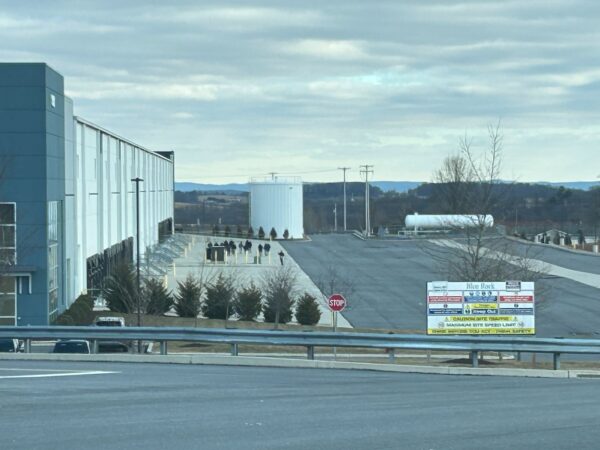
UPPER BERN, Pa. — The Trump administration has quietly purchased a nearly 520,000-square-foot warehouse in Berks County as it plans to convert such facilities into immigration detention centers across the U.S.
The warehouse, located at 3501 Mountain Rd. in Upper Bern Township, was sold to the U.S. government on behalf of the Department of Homeland Security and Immigration and Customs Enforcement for $87.4 million, deed records show. The purchase was recorded on Feb. 2.
Spotlight PA visited the warehouse, which is located about a mile from I-78, on Jan. 15 and witnessed about two dozen individuals touring the exterior of the building. One man who arrived early to the site that day identified himself to a reporter as ICE.
The property was most recently called the Hamburg Logistics Center, and before that was the site of the Mountain Springs Arena, a county landmark known for rodeos and demolition derbies. It neighbors an Amazon warehouse and the Mountain Springs Camping Resort.
The building is one of at least 23 that ICE plans to convert into immigration detention facilities, Bloomberg reports. The Berks County warehouse could house up to 1,500 beds.
ICE also finalized the purchase of a warehouse in nearby Tremont Township, in Schuylkill County, on Monday, according to a deed. The Tremont property is located less than 300 yards from a daycare center and has already faced fierce resident opposition.
A spokesperson for ICE did not answer any questions about the Berks County warehouse purchase and instead lauded the agency’s targeting of “vicious criminals.”
“Thanks to the One Big Beautiful Bill, ICE has new funding to expand detention space to keep these criminals off American streets before they are removed for good from our communities,” the spokesperson said.
Upper Bern Township’s solicitor said in an emailed statement that community leaders learned about the sale on Monday. They declined to answer questions.
“The township was not involved in this transfer and has not received any applications from either the prior or new owners regarding the future use of the property,” the statement reads. “The township has no further comment on this matter at this time.”
State Sen. Chris Gebhard and State Rep. Jamie Barton, Republicans who represent the area, said they have reached out to federal contacts to gather more information on how the Department of Homeland Security plans to use the warehouse.
“Our immediate concerns include the potential loss of property tax revenue for the host municipality, county, and school district, as well as security and perimeter considerations,” the lawmakers said in a joint statement. “We look forward to engaging directly with the appropriate federal officials to address these issues. Once additional information is available, we will provide an update.”
The property is assessed at $22 million and currently pays $198,286 annually in county property taxes under the current tax rate of 9.013 mills. Combined with Hamburg Area School District and township taxes, the loss of tax revenue from the federal government’s purchase would be about $624,000.
State Sen. Judy Schwank (D., Berks) declined to comment on the warehouse purchase on Monday. In an earlier interview with Spotlight PA, she called the then-potential sale “deeply concerning,” especially given the reports of mistreatment of people detained in ICE facilities. She released a statement about “ICE’s action in Minneapolis” on Jan. 27, shortly after federal agents killed Alex Pretti.
“My concern is, knowing the track record of some of these other facilities located throughout the country, it’s not good,” she said. “I don’t necessarily want to see something like that being housed in our county.”
The deed finalized on Monday shows the property was sold to ICE by an LLC connected to PCCP, a national commercial real estate equity firm. The firm purchased the warehouse in 2024 for $57.5 million, deed records show.
Reached by phone Monday afternoon, PCCP partner Greg Eberhardt — who is the authorized signatory for 3501 Mountain Road Owner LLC on the latest deed — denied knowledge of the property and its sale, and refused to comment further.
“I have no idea what you’re talking about,” Eberhardt said before hanging up on a Spotlight PA reporter. “I’m not making company comments.”
Upper Bern Township is situated on the edge of Berks and Schuylkill Counties, with a population of roughly 1,600 people. The community is mostly white, with only 2.8% of residents identifying as another race, according to the 2020 Census.
Bridget Cambria, an attorney with Aldea, a nonprofit that provides pro bono immigration legal services, said the detention center would have a “disruptive” and “chilling” impact on Berks County’s immigrant community.
“If there are people that live freely and at peace knowing that they do the right thing, they can do their immigration process or stay with their family or figure out a way to legalize their status, they’re going to be more afraid to do that with a giant detention center in their backyard,” Cambria said.
A 2022 study by the Detention Watch Center and the Immigrant Legal Resource Center found that immigrants were more likely to be arrested by ICE in counties with more detention bed space.
BEFORE YOU GO … If you learned something from this article, pay it forward and contribute to Spotlight PA at spotlightpa.org/donate. Spotlight PA is funded by foundations and readers like you who are committed to accountability journalism that gets results.
HARRISBURG — Gov. Josh Shapiro on Tuesday is expected to propose a $53.2 billion state budget for the 2026-27 fiscal year, just three months after settling a bitter, 135-daybudget impasse that forced schools, counties, and nonprofits to take out loans to stay afloat.
Shapiro, a first-term Democrat running for reelection this year and potentially poised for higher office, will deliver his fourth annual budget address before a joint session of the Pennsylvania General Assembly, where he plans to pitch an expansive $1 billion housing and infrastructure plan to incentivize new housing development with an overall focus on affordability in the state.
And as in years past, Shapiro is expected to again propose new revenue streams to fill a more than $5 billion deficit, such as the legalization and taxation of adult-use cannabis, as Pennsylvania is again expected to spend more than it brings in tax revenues.
Here are three things to watch for in Shapiro’s budget proposal.
Affordability, affordability, affordability
Affordability has become somewhat of a top Democratic catchphrase heading into the midterm elections, as housing, energy and healthcare costs continue to rise.
It’s an issue Shapiro has repeated as one that is top of mind for him, and he is now applying it to a basic need for many Pennsylvanians: housing.
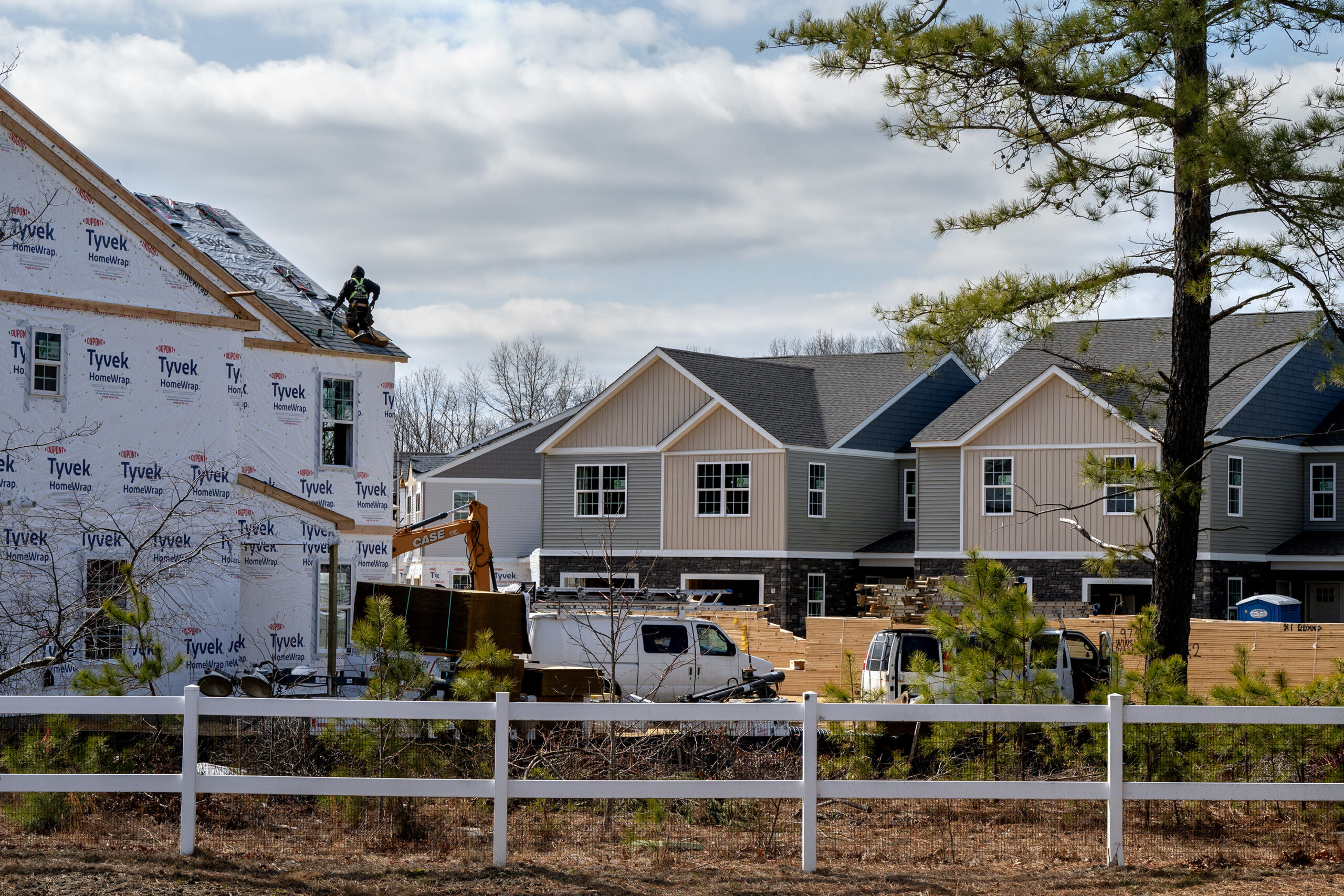
Construction is underway on three bedroom units with garages at Winslow Cross Creek Family Apartments Thursday, Mar. 6, 2025. Hans Lampart, founder, president, and CEO of Eastern Pacific Development and Brookfield Construction specializes in build-to-rent affordable housing.
The average rental price in Pennsylvania is $1,525 per month, with 25,000 rentals available across the state, according to the real estate website Zillow.
The governor on Tuesday is also expected to reintroduce his “Lightning Plan” that includes incentives to increase renewable energy production and a new Pennsylvania-specific cap-and-trade carbon program.
The plan would replace the Regional Greenhouse Gas Initiative that Shapiro and House Democrats agreed to ditch as part of an overall $50.5 billion budget deal in November, following years of urging from Republicans who argued that it stifled economic growth in the state. A similar cap-and-trade program would be unlikely to pass the Republican-controlled state Senate.
New revenue streams, again
Shapiro will again try to fill the state’s projected $4.3 billion budget gap with new revenue streams — although none of them would be likely to be up and running in time for the start of the new fiscal year on July 1.
Last year was the first time Pennsylvania’s state budget ever topped $50 billion. Its revenue still has yet to hit that milestone, and is unlikely to do so this fiscal year. The Independent Fiscal Office estimates the state will bring in nearly $49 billion, a 1.3% increase in revenue over the last fiscal year.
The budget gap is among the biggest challenges for Shapiro in upcoming negotiations with top legislative leaders, as Senate Republicans say it’s their top priority to spend within the state’s means.
Shapiro last year proposed tapping into the state’s Rainy Day Fund — approximately $7 billion set aside for emergencies — that the state has been stockpiling in the years since the COVID-19 pandemic. It’s unclear whether he will pitch using some of the fund again for the 2026-27 fiscal year.
Last year, Shapiro proposed a 20% tax on adult-use cannabis that he predicted would bring in $535.6 million in its first year, largely from licensing fees. He projected it could bring in $1.3 billion in the first five years, noting that only one of Pennsylvania’s neighboring states, West Virginia, hasn’t legalized recreational marijuana, essentially allowing Pennsylvania to lose out on tax revenue as residents cross state lines to buy it.
A legal marijuana purchase in Deptford, N.J. on April 21, 2022.
Shapiro has proposed regulating skill games in his last two budgets, asking last year that the unregulated gaming machines be taxed at 52%, which is the same tax rate as slot machines in casinos or gas stations. He estimated then that skill games would bring in nearly $369 million in its first year.
(The skill games industry has continuously rejected a high tax rate, arguing that it would hurt the industry and small business owners that carry the machines, like bars and corner stores.)
A possibly quicker resolution
There is one bright spot for the schools, counties, and nonprofits that rely on state funding and which last year had to wait more than four months for that money when lawmakers couldn’t agree: It’s an election year.
Election years often result in quicker budget resolutions, as lawmakers and officials want to secure money for their districts before they go home to campaign for reelection.
Sign posted by the PA Senate at the Pennsylvania State Capitol in Harrisburg Aug. 26, 2025, reminds visitors of the state’s “multi-billion dollar structural deficit.”
In 2018, when former Democratic Gov. Tom Wolf was up for reelection, he signed the state budget on June 23 — a week ahead of the July 1 deadline.
This year, Shapiro is up for reelection, likely to face a November challenge from State Treasurer Stacy Garrity, the state Republican Party-endorsed candidate. And many other state lawmakers are in the same boat.
All 203 seats in the state House and half the 50 seats in the state Senate are on the ballotin November. Several lawmakers have announced that they will not seek reelection, allowing for competitive elections to fill the vacancies.
There’s one reason to believe this year’s budget could see a faster resolution: 2026 is an election year.
// Timestamp 02/03/26 4:26pm
SEPTA not considering imminent service cuts, fare increases as long-term funding remains unresolved
SEPTA officials are sketching out their own budget plans but already know it’s not going to look or sound like last year’s “doomsday” scenario.
“We won’t be talking about deep service cuts and fare increases and layoffs and all the things that were discussed then,” SEPTA General Manager Scott Sauer said in an interview Tuesday following Gov. Josh Shapiro’s budget address.
Last August, the transit agency implemented service cuts of 20%, including the elimination of some bus routes, and raised fares by 21.5% after the legislature failed to pass new money for transit operations.
House Majority Leader Matt Bradford (D., Montgomery) said that the latest use of capital funds for mass transit operations deferred the issue for two years, so the General Assembly can agree on a long-term revenue stream to increase state support for public transit in Pennsylvania’s metropolitan areas and beyond.
“The governor bailed out the legislature again on the issue of transit last year and got us a two-year bridge, which will have us dealing with this issue immediately after the next election,” Bradford said in a Harrisburg press conference.
SEPTA officials said they will be able to continue robust service through July 1, 2027 because of the converted capital money.
The maneuver allowed SEPTA to quickly restore the 2025 service cuts; it came as the agency faced a judge’s order to do so.
Longer term, Shapiro proposed to increase the share of the state sales and use tax devoted to mass transit subsidies by 1.75% for five years. But it wouldn’t take effect until fiscal year 2008, raising an additional $319.6 million in the first year to help strapped public transportation systems.
It’s the same proposal as last year’s, though projected to generate more because of growth in sales-tax revenue.
Democrats are pushing to hold Senate GOP lawmakers accountable at the ballot box in November for their failure to find a long-term revenue source last year.
“Now the people are going to have their say on this,” Bradford said. “Do you support this type of obstruction? Do you support staying in the way of funding mass transit systems in this commonwealth? I think the answer is decidedly not.”
To be fair, both parties proved unable to reach a compromise but the sticking point was in the Senate, controlled by Republicans.
Democrats hope the issue will help them flip the state Senate and give them a trifecta of control in the state House, Senate and governor’s mansion.
For his part, Sauer said the governor’s renewed funding proposal and his rhetorical support in the address will help.
“The fact that we’re still in the conversation is important,” he said. “That’s the most I can hope for at this stage.”
Senate Republicans pan Shapiro’s budget proposal as overspending
Senate Republicans were quick to pan Shapiro’s budget proposal as overspending that would harm the state’s economic outlook in the long term.
In a press conference responding to the budget address Tuesday, Republican leaders said the governor’s proposed spending increases relied on revenue streams that may not be approved by the legislature while perpetuating a structural deficit that would dip into the state’s Rainy Day Fund.
“We’re going to do everything we can to protect the taxpayer and make sure that the dollars that are allocated are wisely used,” Senate Majority Leader Joe Pittman (R., Indiana) said. “We have to make sure we’re, again, stretching every taxpayer dollar we can and bringing the cost of government down as much as possible.”
Sen. Scott Martin (R., Lancaster), who chairs the Senate Appropriations Committee, called the spending “mind-boggling.”
Shapiro’s budget assumes that more than $1 billion in new revenue will come from legalization of recreational marijuana and regulation and taxation of skill games. Pittman did not commit to moving either forward in the state Senate this year.
Democratic leaders, however, lauded Shapiro’s budget, insisting that Republicans would be forced to support it or come up with an alternative if they wanted to retain their slim majority in the state Senate.
“I would argue the polls indicate that we have a very popular governor. They tried to obstruct him and his numbers only got more popular,” House Majority Leader Matt Bradford (D., Montgomery) said. “My suggestion is it would be the political imperative, regardless of the policy implications, that they start working with this governor to pass things.”
Asked whether his caucus disagreed with any part of Shapiro’s budget, or were disappointed to see any items left out, Bradford said no.
Gov. Josh Shapiro proposes $53.2 billion state budget focusing on affordability, development, and raising Pennsylvania’s minimum wage
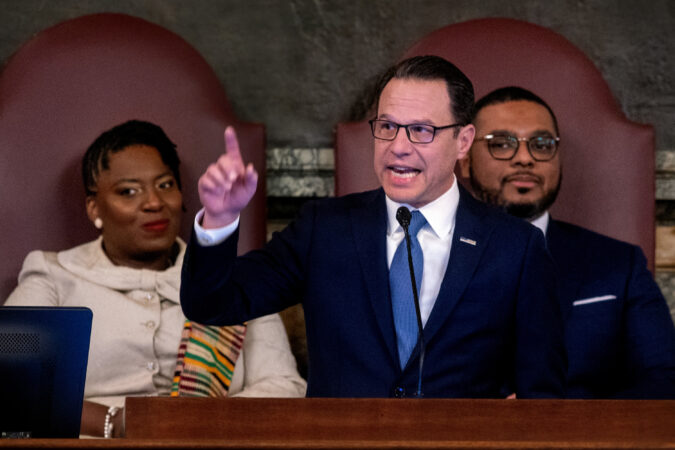
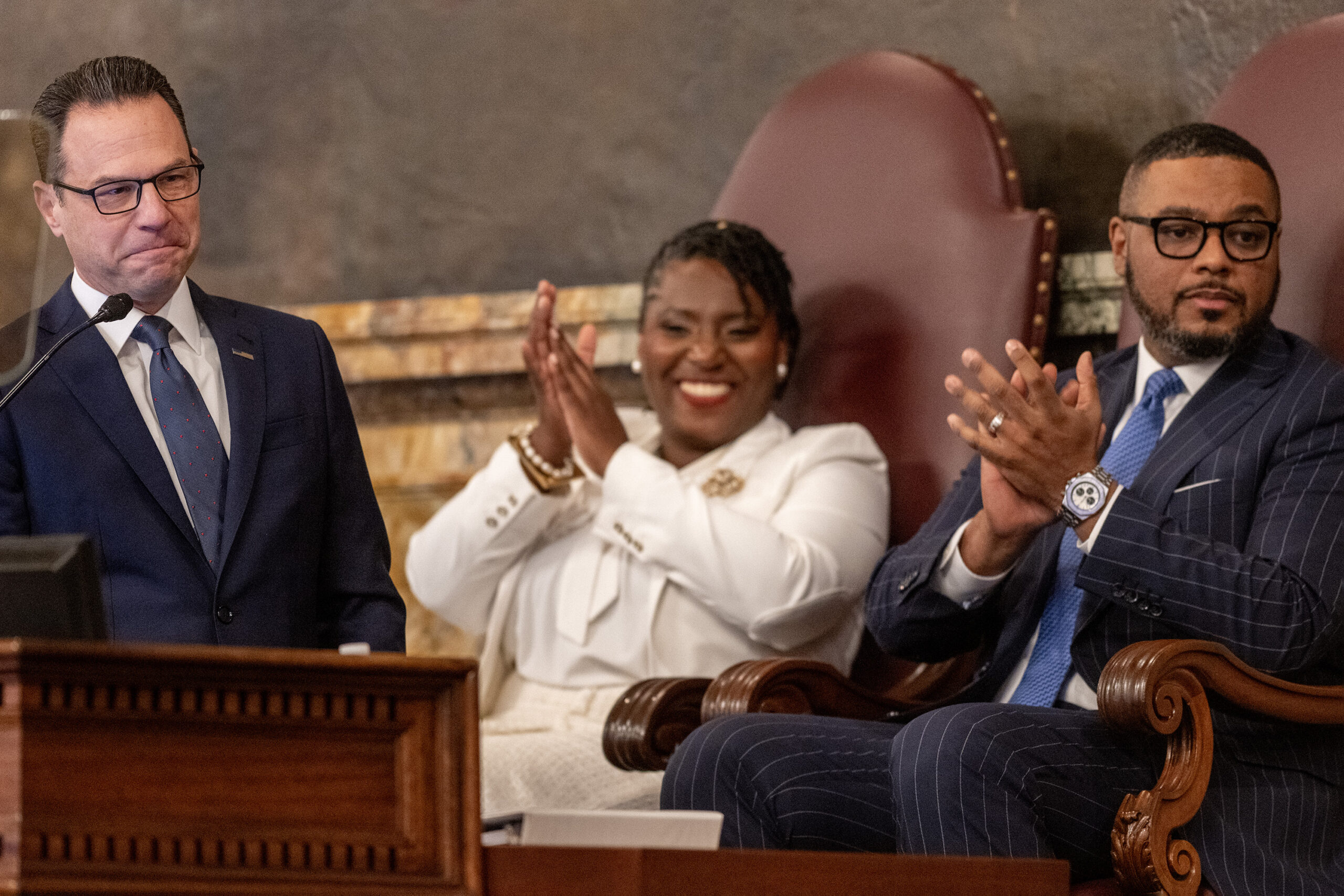
Gov. Josh Shapiro make his annual budget proposal in the state House chamber in Harrisburg Tuesday, Feb. 3, 2026. Pa. House Speaker Joanna McClinton (left) and Lt. Gov. Austin Davis (right) are seated behind him.
HARRISBURG — Gov. Josh Shapiro on Tuesday unveiled a $53.2 billion state budget proposal with a focus on affordability and attracting development in Pennsylvania, in what — if approved by the state’s divided legislature — would be a 6.2% increase over last year’s budget.
Shapiro’s $53.2 billion pitch is likely setting him up for another fight during the election year with Senate Republicans, who control the chamber and have promised fiscal restraint as their top priority and are unlikely to approve a major spending increase. Shapiro’s budget proposal would spend $4.6 billion more than the state is projected to bring in in the 2026-27 fiscal year, requiring the state to pull most of new spending from Pennsylvania’s Rainy Day Fund that currently tops more than $7 billion.
Shapiro on Tuesday said he wants to avoid another lengthy stalled budget, which forced schools, counties and nonprofits to take out billions in loans to stay afloat during the four-month-long impasse.
He invited leaders of all four caucuses — Senate Democrats, Senate Republicans, House Democrats, and House Republicans — to meet on Wednesday to start budget talks much sooner than prior years. They all agreed to attend, he added.
“We all recognize it took too long last year and that had real impacts on Pennsylvanians, but we learned some valuable lessons through that process,” Shapiro said in his address lasting an hour and 24 minutes. “We learned that we all need to be at the table, and that we all need to be at the table sooner.”
Shapiro takes aim at grid operator PJM, utility companies for high rates
Pennsylvania Gov. Josh Shapiro had sharp words for PJM, the region’s independent electric grid operator, during his budget address Tuesday, saying it has “moved too slow to supply new power,” helping lead to high energy rates to consumers.
Shapiro and advocates have long criticized the way PJM holds auctions that impact the rates consumers pay to energy providers. On Tuesday, he called for a continued cap on rates of wholesale electricity payments to power plant owners.
But Shapiro, calling PJM “just one part of the problem,” also took aim at utility companies, saying they have “too little public accountability or transparency.”
“That’s going to change,” Shapiro said.
According to the governor, only about 20% of the amount people pay on utility bills comes from energy use.
“Another big chunk comes from fees and costs that your local utility company charges to get electricity to your home,” Shapiro said. “Utilities companies in Pennsylvania make billions of dollars every year, while at the same time, they’ve increased the cost for consumers.”
Shapiro said major utility providers, such as PECO have agreed to take four steps to rein in costs. PECO serves 2,100 square miles in Southeastern Pennsylvania and provides electricity to up to 1.7 million customers.
The steps are:
End so-called “black box” settlements, which are confidential negotiated agreements between utility companies and regulators that determine rate changes, and agree to set prices transparently.
Enact “common sense reforms” to ban “deceptive contracts.”
Eliminate “jump fees” utilities charge low-income Pennsylvanians to have their services reconnected “something that literally can be done with the press of a button.”
Work to extend protections for low-income and vulnerable residents from shut-offs while managing unpaid bills.
In an apparent effort to dodge a repeat of last year’s five month (135 day) budget impasse, Shapiro announced he would be meeting with legislative leaders on Wednesday to begin budget talks.
Shapiro said he had invited the leaders of all four caucus in the House and Senate to his office and each had accepted.
“We all recognize it took too long last year — and that had real impacts on Pennsylvanians,” Shapiro said. “But we learned some valuable lessons through that process.”
The impasse resulted in temporary cuts to social services, schools and counties across the state as budget talks stretched on into November and state dollars stopped flowing.
This played out in Pennsylvania alongside a federal government shutdown that threatened critical food assistance dollars. But Shapiro said the final deal showed progress.
“At a time when dysfunction and chaos reigns elsewhere, Pennsylvania is showing that we can be a model for steady progress when we come together, treat others with respect, and find ways to extend a helping hand to our neighbors,” he said.
Shapiro calls for renter protections including a statewide cap on rental application fees
Shapiro also used his budget address to call for protections for households that either rent their homes or rent the land their homes sit on.
He called for a statewide cap on rental application fees, “limiting them to the actual cost of screening, and prohibiting landlords from charging fees before a prospective tenant can view a property.”
Philadelphia City Council members last year passed legislation that prohibits rental property owners from charging rental application fees of more than $50 or the cost of running a background and/or credit check, whichever is less. And landlords are banned from charging application fees unless they are used to cover the cost of these checks.
City Councilmember Rue Landau, who introduced the legislation, said some renters had been paying $100 or more per application, which adds up when tenants apply to multiple properties.
Shapiro also called for protections for owners of manufactured homes, which are single-family dwellings often built off-site and placed on a lot. These households own their homes, but many of them rent the land their homes sit on.
Manufactured homes represent one of the most affordable forms of homeownership. But homeowners are often left vulnerable, because they have no other option than to pay increased rent costs if they want to keep the homes they own. Manufactured-home communities are increasingly being bought by private equity companies and other institutional investors, and rent hikes tend to follow.
Across Pennsylvania, 56,000 households live in these communities, Shapiro said. He asked lawmakers to limit the rent increases that landowners can charge.
Last year, New Jersey enacted a law that limits annual rent increases to 3.5% for these lots. Landlords who want higher increases must ask the state’s Department of Community Affairs for permission.
“Last year, we all – all of us – identified a problem that we don’t have enough childcare workers, and that’s because we don’t pay them enough,” said Shapiro.
“We showed them the respect that they deserve,” said Shapiro.
On Tuesday Shapiro proposed increasing the recruitment and retention bonus from $450 to $630 as he noted the program has seen overwhelming demand.
“That’s more money in the pockets of our childcare workers, and more available child care for Pennsylvania families. It’s a win, win,” he said.
Staffing shortages plague the childcare sector in Pennsylvania and nationally, and the need for workers is expected to continue to grow. Employees who work as care providers are some of the lowest paid workers, earning on average roughly $30,000 annually in Philadelphia, Montgomery, Delaware, Chester and Bucks Counties.
And when parents can’t find adequate childcare, the Pennsylvania economy takes a hit, the Inquirer has reported. The state loses out on $6.65 billion annually when parents have to call out of work or lose their job due to childcare issues.
Shapiro renews calls for lawmakers to legalize marijuana in Pennsylvania
Shapiro renewed his calls for the state General Assembly to legalize recreational, also known as adult-use, marijuana as a way to drive needed revenue in the commonwealth.
According to the National Conference of State Legislatures 24 states, including Pennsylvania’s neighbors in Delaware, New Jersey, New York and Ohio, have legalized adult use marijuana. Pennsylvania is among 14 states that allow marijuana for medicinal purposes only.
The governor’s budget proposal calls for a 20% tax on marijuana products sold with sales beginning on January 1 of next year. According to budget documents from his office that tax would provide Pennsylvania with $729 million in revenue in its first year.
The figure is nearly $200 million more than Shapiro’s administration projected for revenues from legalization when he made the same proposal in last year’s budget.
A Shapiro administration official credited the increased projection as a result of increased interest among marijuana companies who would want to come to Pennsylvania and purchase licenses.
Approving recreational use of cannabis will be an uphill battle for Shapiro with a split legislature. Even as the federal government moves towards rescheduling marijuana and opening the door to more research, Senate Republicans have been reluctant to legalize the drug in the commonwealth.
If Pennsylvania doesn’t take action to build and preserve more housing, it will be short 185,000 homes by 2035, Shapiro said during his budget address. He called for the construction of more homes and the reform of local land-use laws to allow for more housing and lower housing costs.
Shapiro’s budget would create a $1 billion fund, supported by the issuing of bonds, to pay for a range of infrastructure projects. He called the fund “a major investment in building new housing.”
“We need hundreds of thousands of new homes,” Shapiro said. “This is how we build them.”
He also noted that local land-use laws vary across Pennsylvania’s 2,560 municipalities. He called for the state to create a catalog of local zoning rules and to help local governments reform ordinances to allow for more housing.
Shapiro called for local governments to allow for the construction of more homes near mass transit, streamline the construction of mixed-use development, and allow accessory dwelling units – such as in-law suites, garage apartments, and backyard cottages.
Most Pennsylvania municipalities ban the building of accessory dwelling units or make building them difficult.
The day before Gov. Shapiro’s budget address, a group of lawmakers in the state House announced a bipartisan package of bills meant to make homes more affordable. The two bills that have been introduced so far would allow for more housing density.
One would allow accessory dwelling units – such as in-law suites, garage apartments, and backyard cottages – in areas zoned for single-family housing. Property owners would have the right to build ADUs without asking their local government for a special exception, but municipalities would still be allowed to make “reasonable” restrictions, state Rep. John Inglis (D., Allegheny) said at a news conference Monday.
ADUs are “a simple way to add affordable housing without changing the character of our neighborhoods, and we can’t afford to keep blocking these solutions,” Inglis said.
Another bill would promote the construction of duplexes, triplexes, and quadplexes in certain areas that are zoned for single-family housing. It would require larger municipalities to allow these types of multifamily housing “while still allowing local governments to reject certain projects that might not be viable in their communities,” Inglis said.
Pennsylvania isn’t building enough housing, and that lack of supply is hiking prices for homeowners and renters, the Pew Charitable Trusts said in a report released last year.
Pennsylvania is one of the states that has allowed the least amount of housing to be built. It ranked 44th for the share of homes approved to be built from 2017 to 2023, according to the nonpartisan, nonprofit research and public policy organization.
Pew researchers cited restrictive local land-use laws as a cause and recommended the loosening of zoning rules.
“The bottom line is the best way to bring high rents and housing costs down is to build more housing and to build more varied types of housing,” Seva Rodnyansky, a manager in Pew’s housing policy initiative, told The Inquirer last year.
Shapiro urges GOP lawmakers to pass statute of limitations reforms for child sex abuse victims
After years of advocating for statute of limitations reform to allow a window for child sex abuse victims to sue their abusers, Shapiro placed the blame for the policy’s lack of movement at the feet of Senate Republicans in Tuesday’s address.
“Stop cowering to the special interests, like insurance companies and lobbyists for the Catholic Church,” Shapiro said to Senate Republicans as Republicans in the chamber booed.
The governor has pushed for the window since his time as Attorney General when, in 2018, his office released a grand jury report on clergy abuse in the state that called for the window among other reforms.
The policy passed the General Assembly as a constitutional amendment in 2020 but failed to reach voters’ ballots due to an administrative error from Gov. Tom Wolf’s Department of State.
Ever since, the policy has stalled as Senate Republicans have sought to tie it to constitutional amendments relating to voter identification and other GOP priorities.
The governor, who has faced criticism from some survivors for not being a strong enough advocate for reform enough since becoming governor, made an impassioned plea to Senate Republicans, urging them to “stop trying justice for abused kids to your pet political projects.”
“It is shameful that this hasn’t gotten done here in Pennsylvania when almost 30 other states have followed our grand jury report and passed it in their legislatures,” Shapiro said. “Pass statute of limitations reform this year — and give survivors of sexual abuse the chance to confront their abusers in court.”
‘Stop delaying’: Shapiro again asks legislators to raise the state minimum wage
On Tuesday, Gov. Josh Shapiro once again asked legislators to raise Pennsylvania’s minimum wage.
“I am calling on the General Assembly to stop delaying and put a minimum wage bill on my desk, and I will sign it,” he said to audible cheers.
Some in the crowd chanted “raise the minimum wage” as he brought up the issue. Shapiro responded to the chant, noting that 25 senators stood to applaud raising the minimum wage, including two Republicans: Sen. Joe Picozzi (R., Philadelphia) and Sen. Devlin Robinson (R., Allegheny).
Since taking office as governor, Shapiro has backed raising the minimum wage at every annual state budget address.
Pennsylvania’s minimum wage is the federal minimum of $7.25, which was set in 2009. Neighboring states all have higher minimum wages. In January, New Jersey’s minimum wage increased by $0.43 to $15.92 – making it more than double that of Pennsylvania’s.
“Our minimum wage in Pennsylvania has been stuck at $7.25 for the last 16 years. In that time, every single one of our neighboring states has raised the wage for their workers,” he said.
Shapiro noted Tuesday that raising the minimum wage to $15 an hour would save the state $300 million on entitlement programs like Medicaid.
“If you aren’t going to do this because it’s the right thing to do, or because it would let more families put food on the table for their kids, then do it because it’s going to save us $300 million, shrink our entitlement budget by growing our workforce and putting more money back in workers’ pockets,” he said.
In order to cover their basic needs, an adult living in Pennsylvania needs to earn $22.91 an hour, according to a living wage calculator developed at the Massachusetts Institute of Technology.
Only 2% of hourly wage earners in Pennsylvania earn the minimum wage or less, according to a report from the state’s Department of Labor and Industry based on 2022 data.
Shapiro calls for faster licensing for social workers and other professionals
Shapiro, who has touted himself as a good for business governor and last year worked with Republicans to approve building permitting reform, asked lawmakers to help him move that work forward in reducing licensing time for Pennsylvania professionals.
He called on the General assembly to approve reforms allowing social workers to be licensed in conjunction with graduate school, helping to address a shortage in the state, and he called for lower wait times for other professionals like barbers and pharmacists.
“We’ve put ourselves at a competitive disadvantage by incentivizing workers to go to another state,” he said.
Shapiro proposes adding $5 million to Pa.’s student teacher stipend program
As Pennsylvania continues to struggle with teacher shortages, Shapiro proposed adding another $5 million to the state’s student teacher stipend program — bringing the program up to $35 million.
Growing the program, which provides $10,000 to student teachers completing their required placements, will “ensure there are more well-trained teachers,” Shapiro said. He called out a teacher from Susquehanna Township, Hallie Sill, who he said had told him how the stipend program that launched in 2024 had helped her land a job after graduating from the University of Pittsburgh.
“Let’s increase our commitment to this initiative that we know works,” Shapiro said.
Budget would add $18 million in funding for career and technical education
The governor wants to increase funding for career and technical education in the state by $18 million, bringing up total funding for these initiatives to $200 million.
He noted that career and technical education, apprenticeship and vocational technical program funding has increased 50% since he took office.
“We’ve registered 231 new pre-apprenticeships and apprenticeships, and more than 39,000 of our fellow Pennsylvanians have participated in an apprenticeship during my time as your governor in fields ranging from welding to nursing to dairy herd management,” said Shapiro. “Those investments are making a meaningful difference, and they’re creating pathways of opportunity.”
He highlighted that some workers in the state lack a high school degree.
“We can’t lose sight of the fact that there are literally hundreds of thousands of Pennsylvanians who could be added to the workforce if we take care to give them the tools they need to succeed,“ said Shapiro. “Take the 614,000 Pennsylvania adults who don’t have a high school degree, for example. That’s a ton of untapped potential.”
Shapiro introduces ‘GRID’ plan for the rise of massive data centers
Saying the U.S. is in a race to dominate artificial intelligence, Pennsylvania Gov. Josh Shapiro announced a new plan he says will protect consumers against rising energy costs associated with data centers, while also easing a path for tech companies to build.
The Governor’s Responsible Infrastructure Development (GRID) plan would make data center developers either bring their own power generation or pay for any new generation they’ll need, “not saddling homeowners with added costs because of their development.”
Shapiro said too many data center proposals have been “shrouded in secrecy” but that they are crucial to the U.S.
“The United States is locked in a battle for AI supremacy against China. Look, I don’t know about you, but I’d much rather the future be controlled by the United States of America and not Communist China,” Shapiro said.
Components of the plan include:
Commit to “strict transparency standards.”
Engage communities.
Hire and train local workers from Pennsylvania.
Enter into community benefit agreements.
In return, developers would be “speed and certainty” in getting permits, as well as qualifying for tax credits.
“I know everyone … wants to see our economy grow and create more jobs and more opportunity,” Shapiro said. “But I also recognize this is unchartered territory, so let’s come together, codify these principles and take advantage of this opportunity.”
Shapiro proposes ensuring access to recess for Pennsylvania students
The governor made another proposal for Pennsylvania schools: ensuring they have recess.
“Recess, to me, isn’t just an extra block on the schedule. I would argue it’s just as critical as learning math and science and English,” Shapiro said.
He said he had directed the Pennsylvania State Board of Education to develop recommendations to “guarantee recess for our students.”
“Students need to spend less time focused on their phones and more time focused on learning, on talking to their friends face to face, and on developing the critical skills that they will need later in life,” said Shapiro, who drew sustained applause for the proposal. (“If applause could vote, we’d have this whole thing done already,” the governor quipped.)
He told lawmakers: “I know there are bills in both chambers to do this — I urge you respectfully to come together and send a bill to my desk.”
Some proposals garner unanimous standing ovations from lawmakers
Shapiro’s budget address is a workout for Democratic lawmakers, as they stand up, clap, repeat for each of his ideas.
As Shapiro mentioned mass transit — which he is proposing a long-term funding stream to begin in 2027 — all Democrats quickly shot up to applaud. Only one Republican lawmaker, Sen. Joe Picozzi (R., Philadelphia) stood to celebrate the mention.
As Shapiro talked about new standards he plans to implement for new data centers in Pennsylvania, a handful of other Republicans also stood to applaud.
Two popular proposals that garnered unanimous standing ovations: mentions of first responders and Shapiro’s pitch for restricting children’s access to dangerous AI chatbots.
Shapiro joked at one point, as he has in prior years, that Republicans should applaud his federal response fund because it will help safeguard money Pennsylvanians deserve. This brought a laugh from Democrats, but no reaction from Republicans.
Shapiro calls for limitations on AI to protect children and seniors
Shapiro called for a litany of limits on artificial intelligence as the emerging technology presents new risks to children and seniors across the commonwealth.
In recent months AI developers have faced calls for regulation nationwide and lawsuits from parents who say their children’s relationship with chatbots drove them to self harm.
Even as Shapiro advocated for making Pennsylvania a hub for AI, he said safeguards needed to be established.
He called for age verification and parental consent for chat bots, requirements that companies direct mentions of self harm or violence from children to the correct authorities and periodic reminders from AI chatbots that they are not human.
Furthermore, he called for prohibiting AI chatbots from producing sexually explicit or violent content involving children.
“This space is evolving rapidly. We need to act quickly to protect our kids,” Shapiro said.
In addition to for calling for the General Assembly to pass legislation imposing those limits, Shapiro said he had directed state agencies to explore legal avenues to hold app developers accountable.
Shapiro touts list of achievements as governor: ‘We’re solving problems and getting stuff done’
In his fourth budget address, and final before he stands for reelection in November, Shapiro touted a laundry list of his administration’s accomplishments – from funding of education, to investments in the state’s economy to reducing violent crime across the state.
“We’re solving problems and getting stuff done to improve people’s lives,” Shapiro said, referencing his campaign’s slogan “get sh*t done.”
The list of accomplishments closely mirrored the stump speech the governor gave to supporters in Pittsburgh and Philadelphia last month as he formally launched his reelection campaign and his talking points as he hit the cable news circuit on his book tour last month.
Likely to face State Treasurer Stacey Garrity in the general election next year the centrist Democrat has focused on the idea that he, as governor, can accomplish things for Pennsylvanians regardless of party affiliation.
He will retain that focus throughout his budget address, and throughout the next year as he campaigns for reelection while raising his national profile ahead of a possible 2028 presidential run.
Proposal includes $565 million funding increase to raise poor schools to ‘adequately’ funded levels
Gov. Shapiro is sticking to the state’s plan for remedying constitutional underfunding of its public schools — proposing another $565 million increase to raise poor schools to “adequately” funded levels, and reimburse high-taxing districts.
The governor’s proposed budget also includes a $50 million increase in basic education funding to be distributed to all K-12 schools and a $50 million increase in special education funding.
And it takes another step to curb payments from school districts by $75 million to cyber charter schools, after funding changes last year that were projected to save districts $175 million. While school districts have long accused charters of draining their budget, the cyber schools have vigorously protested proposals to scale back their payments, arguing their students will be hurt.
State mass transit funding fight could be postponed until 2027
Gov. Josh Shapiro is ready to postpone until 2027 a likely fight over a longer-term enhancement of state mass transit funding, citing the temporary cash infusion the administration arranged last year to bail out SEPTA.
“We believe that they are stabilized for two years,” said a Shapiro administration official on Tuesday, adding that they are happy to discuss the issue sooner if the General Assembly is willing.
The money, spread over two fiscal years, allowed SEPTA to reverse 20% service cuts it had imposed last year amid a $213 million deficit. It also was to carry the transit agency through the coming budget year. Shapiro’s proposed spending plan and annual address Tuesday kicked off the negotiations process.
Yet the governor did put on record his preferred stable funding solution for mass transit, which looks just like the one lawmakers spurned last year.
The spending plan would increase the share of the sales and use tax devoted to mass transit subsidies by 1.75%, raising an additional $319.6 million yearly to help strapped local and regional public transportation systems, according to budget documents.
But the proposal would not take effect until July 1, 2027, the start of the fiscal year that will run through June 2028.
“I bought us two years — but we have to keep working at this, because this isn’t a problem we can ignore,” Shapiro said Tuesday. “Mass transit helps drive our economy — this is an issue of economic competitiveness. You know I’m competitive as hell — and I want to win.”
State lawmakers share bipartisan hugs ahead of Shapiro’s budget address
The joint session of the Pennsylvania House and Senate was called to order, and as the group of state lawmakers awaited the arrival of Gov. Josh Shapiro to the chamber to deliver his $53.2 billion budget proposal.
Up until Shapiro’s arrival, attendees gave bipartisan, bicameral hugs to lawmakers from their opposing chamber. Several legislators reunited with their former colleagues who had returned to Harrisburg on Tuesday in their current roles as mayors or executives across the state, including Philadelphia Mayor Cherelle L. Parker, who previously served in the state House for 11 years.
Seated nearby to Shapiro’s left is state Treasurer Stacy Garrity, alongside the other GOP row officers Auditor General Tim DeFoor and Attorney General Dave Sunday. Garrity is likely to challenge Shapiro in November’s midterm election as the state GOP- endorsed candidate for governor.
Shapiro has delivered some lengthy speeches in past years during his first term, running for more than an hour to lay out his priorities for the upcoming fiscal year.
Shapiro’s budget would allot $30 million in performance-based funding for Temple, Penn State and Pitt
Gov. Shapiro’s budget once again proposes to allot money for performance-based funding for Temple, Pennsylvania State University and the University of Pittsburgh.
The budget includes $30 million for the effort, half of what Shapiro proposed last year, according to a source close to the process. When the current budget was passed, however, it included no money for performance-based funding this year.
Whether the initiative will gain legislative support in the new budget year is unclear.
The three universities currently receive about $551 million in state funding.
The new performance measures that would determine how the $30 million is allotted include graduation rates, affordability, and enrollment of low-income students and those pursuing degrees in wide-ranging occupations deemed critical for the state. The criteria were developed last year by a bipartisan council of legislative leaders and the acting secretary of education.
The universities in Pennsylvania’s State System of Higher Education, meanwhile, would be flat-funded for a second consecutive year under the budget, according to the source.
West Chester, East Stroudsburg, Kutztown, Millersville, Slippery Rock, Shippensburg, Commonwealth, Pennsylvania West and Indiana received the same basic funding this year that they did last year. That was the first time since 2021-22 that the schools did not receive an increase.
Cheyney also got the same basic funding, but the historically Black college got a special $5 million earmark “to develop and implement an enhanced transfer and workforce development initiative in partnership with a community college.”
The state’s community colleges also would be flat-funded under the governor’s proposal.
PJM Interconnection — the region’s dominant electric grid operator — is poised to play a central role in that expansion, as the independent organization has been shoved into the national spotlight and subjected to mounting pressure over the past year.
In many ways, PJM may be one of the most consequential Philly‑area institutions that most residents have barely heard of, even though their electricity supply and monthly bills hinge on its decisions.
The organization has faced escalating scrutiny nationwide and across the region because of its position as the country’s largest independent grid operator and the challenges tied to surging energy demand.
But what is PJM and why is everyone always so mad at it?
Shapiro will pitch $100 million reserve in the event Trump cuts federal funds for Pennsylvania
Gov. Josh Shapiro is expected to propose a new $100 million fund to use as a reserve in the event President Donald Trump’s administration opts to withhold federal funds from Pennsylvania.
Shapiro will pitch the new Federal Response Fund on Tuesday, when he delivers his fourth budget address before a joint session of the state General Assembly.
While Shapiro’s budget pitch will outline how he believes the state should spend $53.3 billion in state revenue and reserves, it is only a piece of Pennsylvania’s annual spending. In the 2025-26 budget, the state was projected to receive $53.1 billion in additional funds from the federal government, or 40% of the state’s total annual spending.
Shapiro has repeatedly said the state cannot backfill the federal cuts by the Trump administration and Congress to Medicaid, health subsidies, food assistance, and more, as these cuts total billions in federal funds. The proposed fund would not try to replace this money, but would be available if the Trump administration chooses to withhold federal fund as it did multiple times last year.
Shapiro is expected to note in his address the 19 times he sued or joined lawsuits against the Trump administration for failing to release federal funds, such as $18 million set aside for state-level Homeland Security funding or $2 billion for environmental and energy projects already appropriated by Congress during former President Joe Biden’s tenure.
Shapiro frequently sued Trump during his first administration while he was Pennsylvania’s attorney general, and has chosen to continue to legally challenge him in his capacity as the state’s governor on numerous occasions.
In his new memoir Where We Keep the Light, which was released last week, Shapiro gave a window into how he decided to join lawsuits as attorney general, noting the many times he beat the Trump administration in court because “we were rooted in the law, not politics.”
“But while I had profound differences with [Trump], and I didn’t like the way he talked, and I certainly didn’t like the values and viewpoints he espoused, I only sued his administration when I believed that he was actually violating the law,” Shapiro wrote.
One reason the budget could get resolved faster than last year
There is one bright spot for the schools, counties and nonprofits that rely on state funding and which last year had to wait more than four months for the money when lawmakers couldn’t agree: It’s an election year.
Election years often result in quicker budget resolutions, as lawmakers and officials want to secure money for their districts before they go home to campaign for reelection.
In 2018, when former Democratic Gov. Tom Wolf was up for reelection, he signed the state budget on June 23 — a week ahead of the July 1 deadline.
This year, Gov. Josh Shapiro is up for reelection, likely to face a November challenge from State Treasurer Stacy Garrity, the state-GOP endorsed candidate. And many other state lawmakers are in the same boat.
All 203 seats in the state House and half the 50 seats in the state Senate are on the ballot in November. Several lawmakers have announced they will not seek reelection, allowing for competitive elections to fill the vacancies.
Gov. Josh Shapiro proposed to generate an additional $1.5 billion over five years to subsidize public transit operations by increasing its share of state sales tax income.
Senate Republicans, in the majority in the chamber, opposed using the sales tax, though the rate would not have increased.
They preferred a new source for the state’s transit aid rather than a broad-based levy, and said SEPTA was mismanaged, citing high-profile crimes, rampant fare evasion, and spending decisions.
Hopes were raised of a deal to use money from a new tax on games of “skill,” slot-like machines that are currently untaxed or regulated — the proverbial magical money pot that would make raising cash painless. It had featured in several budget cycles but again did not come together amid clashing opinions among GOP lawmakers.
When the state budget passed in December, there was no new transit money in it.
In November, the administration also sent $220 million in emergency money in November for repairs to the ailing Regional Rail fleet and the trolley tunnel.
SEPTA officials and transit advocates say they are unsure what’s coming this time around, if anything.
One thing is clear in advance: A Pennsylvania budget process ain’t Schoolhouse Rock, so hang on.
Shapiro could promote effort to ban cell phones from Pa. schools today
Gov. Josh Shapiro is backing a proposal to ban cell phones from Pennsylvania classrooms, joining a growing chorus of parents, teachers, and officials seeking to curb school disruptions and detach kids from addictive devices.
“It’s time for us to get distractions out of the classroom and create a healthier environment in our schools,” Shapiro said in a post on X on Thursday.
He called on Pennsylvania lawmakers to pass a bill that would require schools to ban the use of cell phones during the school day, “from the time they start class until the time they leave for home.”
The endorsement from the Democratic governor — who could promote the issue during his budget address Tuesday — comes as school cell phone bans have increasingly become the norm: 31 states have restrictions of some kind on phones, including 23 states with “bell-to-bell” bans barring the use of phones the entire school day, according to Education Week.
Housing, affordability, and new revenue: What we’re watching for in Gov. Josh Shapiro’s budget address
HARRISBURG — Gov. Josh Shapiro on Tuesday is expected to propose a $53.2 billion state budget for the 2026-27 fiscal year, just three months after settling a bitter, 135-day budget impasse that forced schools, counties, and nonprofits to take out loans to stay afloat.
Shapiro, a first-term Democrat running for reelection this year and potentially poised for higher office, will deliver his fourth annual budget address before a joint session of the Pennsylvania General Assembly, where he plans to pitch an expansive $1 billion housing and infrastructure plan to incentivize new housing development with an overall focus on affordability in the state.
And as in years past, Shapiro is expected to again propose new revenue streams to fill a more than $5 billion deficit, such as the legalization and taxation of adult-use cannabis, as Pennsylvania is again expected to spend more than it brings in tax revenues.
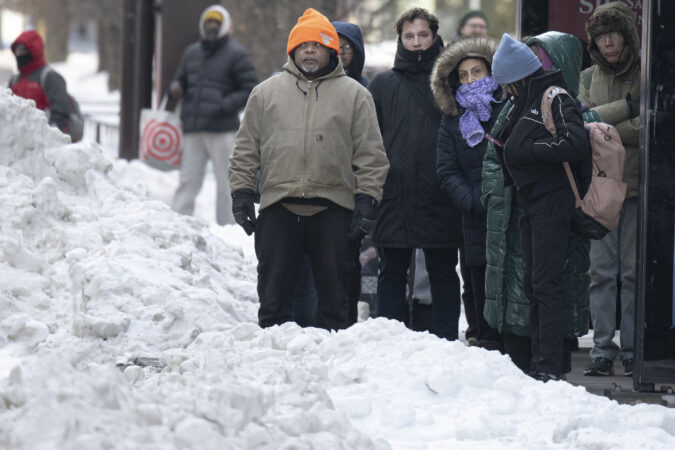
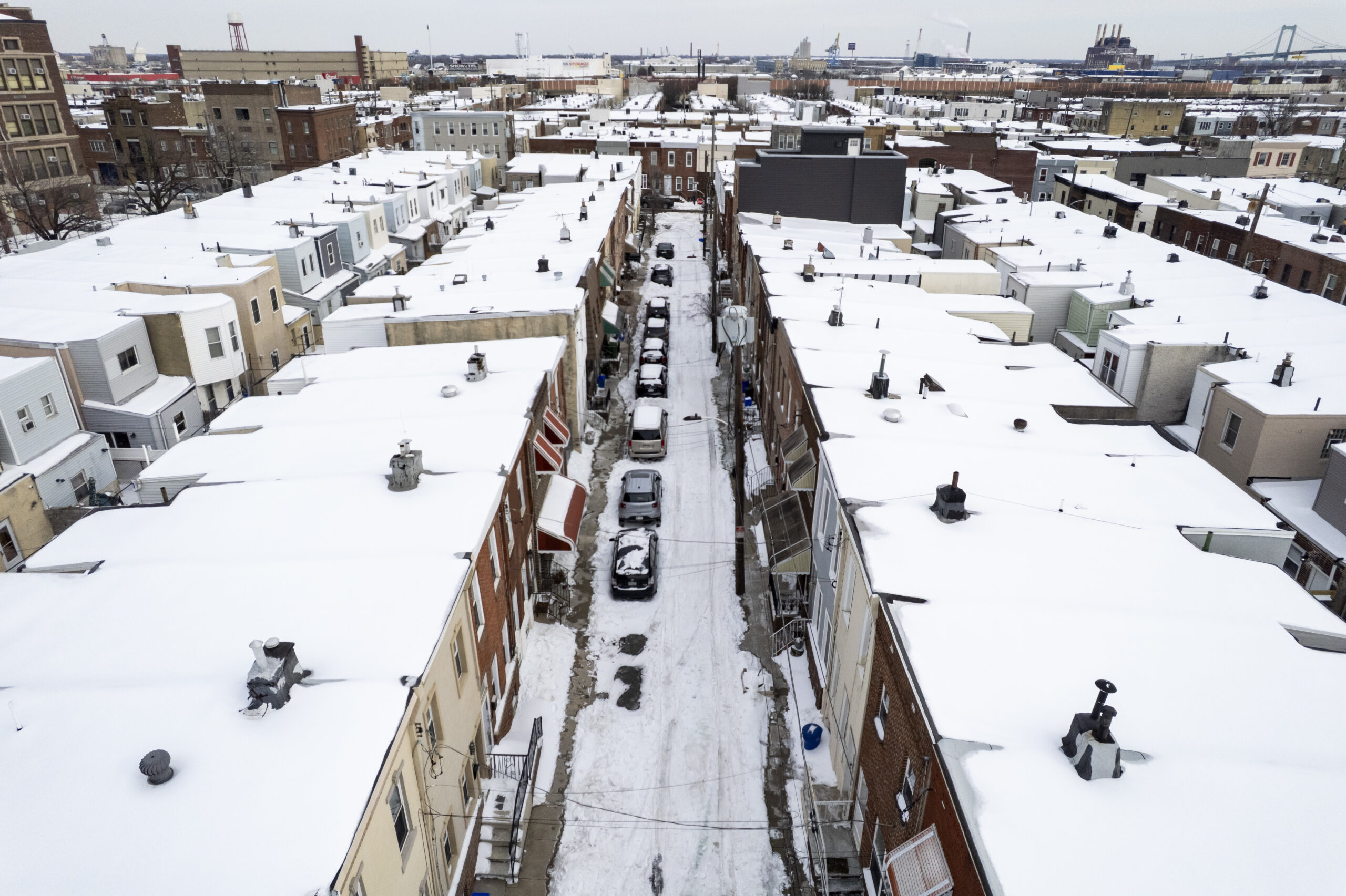
If it appears that the tenacious meringue of snow and ice that landed on the region two weekends ago hasn’t budged, it hasn’t.
Among Philadelphia winters, this one is approaching a rarefied status.
Not long after Phil predictably saw his shadow in Punxsutawney, the National Weather Weather Service contractor at Philadelphia International Airport reported a snow depth of six inches on Monday.
That marked the eighth consecutive day of a snow cover of at least six inches, a streak unmatched since February 2010 — which included a five-day period in which 44 inches of snow had fallen.
And what’s out there now may get a fresh frosting on Tuesday night that could affect the Wednesday morning commute, and perhaps snow squalls on Friday with the approach of another Arctic front as the freezer reopens.
Don’t be surprised if next Monday morning looks a lot like this one.
“The snowpack is not going anywhere,” said Amanda Lee, meteorologist at the weather service office in Mount Holly.
What explains the durability of the snow cover
The primary factor locking in the regional glacier has been the obvious — the cold. Sunday marked the ninth consecutive day that temperatures failed to surpass freezing, the longest stretch since 2004. The temperature did reach above freezing at Philadelphia International Airport on Monday.
Temperatures since Jan. 24 have averaged 14 degrees below normal in Philly. January temperatures ended up finishing 2.2 degrees below normal, even though the month had a nine-day warm spell in which the highs went past 55 on five days.
In addition to the cold, the icy layers of sleet that have put a cap and a patent-leather sheen on the several inches of snow that fell Jan. 25, have limited melting. Ice is way slower to melt than snow.
Eight days after an official 9.3 inches of snow and ice was measured officially, about two-thirds of it has survived.
The forecast for the next several days
The region is in for a modest — very modest — warming trend. Readings cracked freezing Monday, reaching 35 degrees at 4 p.m. and are forecast to top out near 32 on Tuesday and Wednesday, and hold in the upper 20s Thursday. Those readings still would be several degrees below normal.
Some light snow is possible Tuesday night, “maybe up to an inch,” Lee said. The weather service on Monday was listing a 72% probability of something measurable — defined as 0.1 inches or more — falling in Philly.
Given the cold and the solidly frozen paved surfaces, “it could make things slippery for the morning commute on Wednesday,” said Matt Benz, senior meteorologist with AccuWeather Inc.
Friday afternoon, he said, the region could see snow squalls — brief, mini-blizzards that can come on without notice and reduce visibility dangerously.
Then it’s back to the freezer with expected weekend lows in single digits and highs struggling to reach 20.
For those ready for something completely different, NOAA’s Climate Prediction Center on Monday suggested the potential for significant pattern change, although this may require a little patience around here.
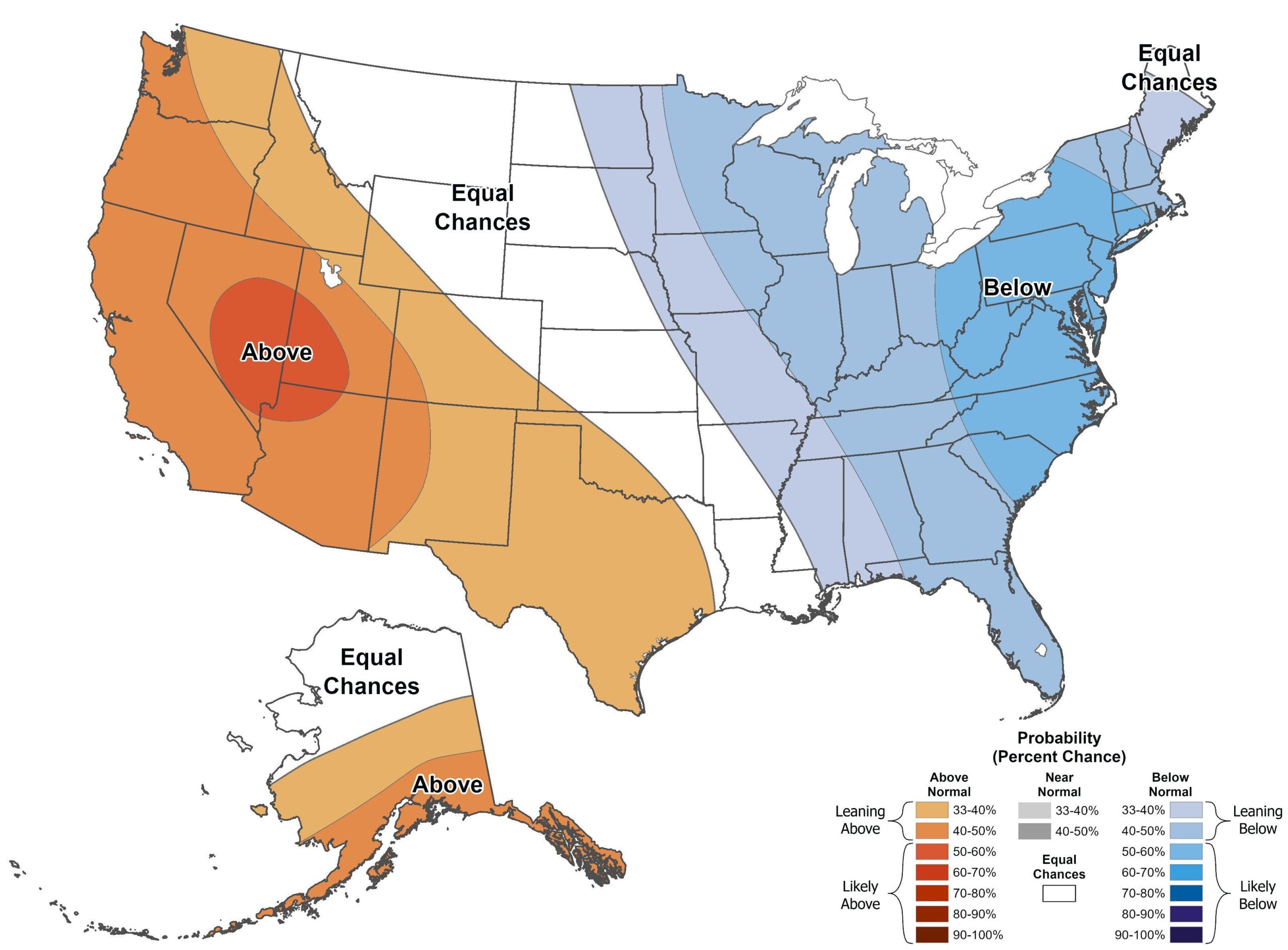
Its extended outlook for the six-to-10 day period that begins Sunday has most of the nation warmer than normal, with odds strongly favoring below-normal readings in the Philadelphia-to-Boston corridor. But a “rapid warmup” in the Philly region is possible around mid-month, the climate center says.
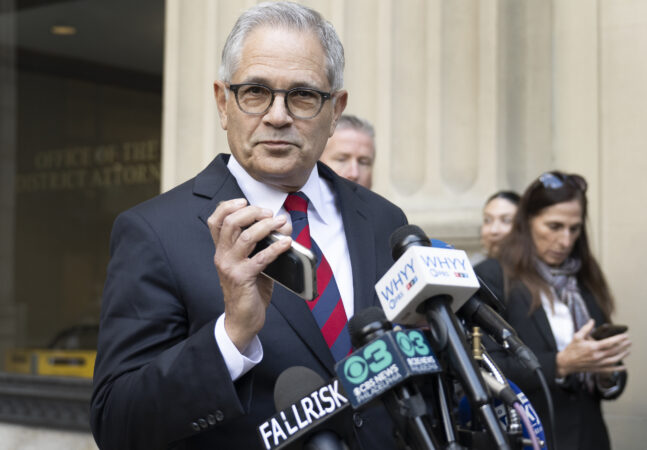
Philadelphia’s bombastic district attorney, Larry Krasner, is no stranger to opposition from within his own party, but the anger directed at him last week after he said ICE agents are “wannabe Nazis” was more pronounced than usual.
After making the comparison, Krasner faced a wave of criticism, including from Pennsylvania Gov. Josh Shapiro, a Democrat, who called the comments “abhorrent” and said the rhetoric doesn’t help “bring down the temperature.”
But the progressive district attorney said Monday that he would not back down, saying “these are people who have taken their moves from a Nazi playbook and a fascist playbook.”
“Governor Shapiro is not meeting the moment,” Krasner said in an interview. “The moment requires that we call a subgroup of people within federal law enforcement — who are killing innocent people, physically assaulting innocent people, threatening and punishing the use of video — what they are. … Just say it. Don’t be a wimp.”
Krasner pointed to a speech by Rabbi Joachim Prinz at the March on Washington in 1963: “Bigotry and hatred are not the most urgent problem. The most urgent, the most disgraceful, the most shameful, and the most tragic problem is silence.”
In invoking that speech, Krasner said: “A reminder, Mr. Governor: Silence equals death.”
Krasner’s defense came after days of criticism from across the political spectrum, ranging from the White House press secretary to Democratic members of Congress. And it punctuated a yearslong history of conflict with Shapiro.
The governor and Philadelphia’s top law enforcement official have feuded politically,sparred in court, and disagreed on policy. In 2019 — when lawyers from Krasner’s office decamped to work for then-Attorney General Shapiro — DA’s office staffers referred to Shapiro’s office as “Paraguay,” a reference to the country where Nazis took refuge after the war.
Last week, during a news conference about proposed restrictions on immigration enforcement in Philadelphia, the district attorney said he would “hunt down” and prosecute U.S. Immigration and Customs Enforcement agents who commit crimes in the city.
“There will be accountability now. There will be accountability in the future. There will be accountability after [Trump] is out of office,” Krasner said. “If we have to hunt you down the way they hunted down Nazis for decades, we will find your identities.”
During an interview Thursday on Fox News’ Special Report with Bret Baier, Shapiro was asked about Krasner’s comparison of ICE agents to Nazis and called the comments “unacceptable.”
“It is abhorrent and it is wrong, period, hard stop, end of sentence,” Shapiro said.
Several other Democrats in political and media circles weighed in. U.S. Sen. John Fetterman, a Pennsylvania Democrat who has at times sided with Trump on immigration matters, appeared on Fox News and said he “strongly” condemned Krasner’s language.
He said that “members of ICE are not Nazis.”
“That’s gross,” Fetterman said. “Do not compare anyone to Nazis. Don’t use that kind of rhetoric. That can incite violence.”
U.S. Rep. Chris Deluzio, a Democrat who represents parts of Western Pennsylvania, in an interview with the Washington Examiner contrasted his own approach with Krasner’s, saying: “I reserve throwing the phrase Nazis at actual Nazis. I don’t just throw that around.”
And State Rep. Manuel Guzman Jr., a Democrat who represents a significant Latino population in Berks County, wrote on social media Friday: “I really, really want Krasner to chill tf out.”
“I get it. We want to protect our immigrant community,” Guzman wrote, “but I question if constantly poking the bear is the right strategy. At the end of the day it’s my community that is under siege.”
And U.S. Rep. Dan Meuser, a Republican who represents parts of Northeast Pennsylvania, appeared on Newsmax and called Krasner a “psychopath with a badge.”
Meuser — who considered challenging Shapiro for governor with Trump’s backing but ultimately decided not to run — also on social media decried “the Left’s silence and, in many cases, encouragement of this rhetoric.”
Krasner doubled down. In an interview on CNN on Thursday, he criticized Fetterman as “not a real Democrat” and also said, “There are some people who are all in on the fascist takeover of this country who do not like the comparison to Nazi Germany.”
He said that when he promised to “hunt down” federal agents who kill someone in his jurisdiction, he was attempting to make a point that there is no statute of limitations on homicide.
The interviewer, Kaitlan Collins, asked Krasner whether he could have made that point without comparing agents to Nazis.
“Why would I do that?” Krasner responded. “They’re taking almost everything they do out of the Nazi playbook.”
A freshman football player at Villanova University texted the woman he is accused of raping to apologize for the encounter,according to the affidavit of probable cause for his arrest,offering new details about the incident.
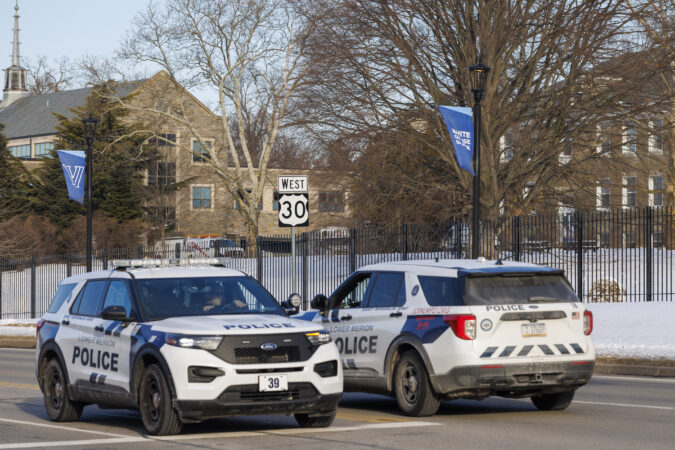
D’Hani Cobbs, 20, was charged with rape, sexual assault, and related crimes after police say he assaulted a woman who also attends the university. He was removed from campus following the Dec. 7 attack, school officials said in a statement. The student newspaper the Villanovan first reported his arrest.
According to the affidavit, Cobbs allegedly assaulted the woman in Good Counsel Hall on the Main Line school’s South Campus.
The early morning attack began after Cobbs and the woman, whom police did not identify, met at an off-campus event and exchanged phone numbers, the document said.
The two later got a ride with others back to South Campus, according to the affidavit. Sometime between 1 and 2 a.m., Cobbs and the woman entered a residence hall room along with another person, whom the filing did not identify. That person left, the document said, leaving the woman alone with Cobbs.
Cobbs asked the woman for a hug, and then he “tried to kiss her, and she said no,” the filing said. Cobbs then “pinned her up against a desk” and began touching her buttocks and genitals and penetrated her with his fingers, the affidavit said. He then grabbed her and lifted her on top of his bed and allegedly raped her, according to the affidavit.
The woman later told police she was screaming and crying during the attack. She said she left the room in tears and asked Cobbs to call a friend to pick her up.
Cobbs later contacted the woman twice, according to the filing.
Around 2 a.m., he texted: “Are [you for real] good tho? That was random [as hell]” and “U were jus fine.”
Just before 5:30 p.m., Cobbs texted: “Yoo Wsp, u ok? My apologies if I made u feel uncomfortable in any way last night I didn’t have any intentions on making u feel uncomfortable. If u want to talk about it over the phone or in person we can just to come to more of a understanding.”
When investigators interviewed Cobbs that week, he did not deny that he had sexual contact with the woman but said it was consensual.
Cobbs’ defense attorney, Thomas G. Masciocchi, did not immediately return a request for comment.
Delaware County District Attorney Tanner Rouse said in a statement Monday that prosecutors had reviewed evidence in the case and swiftly brought charges.
“The message here is as simple as it is clear — when it comes to other people’s bodies, no means no, and stop means stop,” Rouse said. “That’s what we tell our kids and it holds true throughout life, no matter who you are or how talented an athlete you might be.”
As of this week, Cobbs’ player bio page on Villanova’s website is out of service with an error message.
Cobbs’ profile on ESPN is still active, and lists the New Jersey native as a wide receiver. He returned one punt last season, according to the page. A post from the Instagram account for Villanova’s football team announced Cobbs’ signing in 2024.
A Villanova spokesperson said in a statement that in addition to ordering Cobbs to leave campus, the school is “committed to both supporting the victim and fostering a safe environment for all of our students.”
Cobbs was arraigned Friday and was released on unsecured bail, according to court records. He is scheduled to appear in court for a preliminary hearing on Feb. 12 and is ordered not to have contact with the woman.
Expect the deep cold Philadelphia has been experiencing to continue for the next six weeks, at least according to Punxsutawney Phil.
The weather-predicting groundhog saw his shadow Monday outside his hole at Gobbler’s Knob in Punxsutawney. If you believe such things, that means the entire country — including our snow-covered section of the Northeast — can expect below-average temperatures for the next six weeks.
That won’t come as a surprise to folks in Philadelphia, where the temperature hasn’t made it past the freezing mark of 32 degrees for more than a week.
Despite the frigid temperatures in Punxsutawney, thousands of Phil’s biggest fans gathered early in the morning for what remains the weirdest celebration of meteorology and marmots.
What do forecasters say?
It’s been so cold, Emily Street and much of Philadelphia remains covered in snow.
Predicting the arrival of spring beyond the vernal equinox on March 20 is tricky business, especially when trying to apply it to a regionally diverse country as large as the United States.
As of Sunday, NOAA was predicting below-average temperatures in February along most of the East Coast all the way west to the Mississippi River. But that’s counterbalanced by above-average temperatures predicted along the West Coast inland as far as Texas.
NOAA’s weather outlook for February, forecasting colder-than-normal temperatures across much of the East Coast.
As for the Philadelphia region, temperatures are expected to remain near or below freezing for at least the next week, with another cold snap possible for the weekend.
The temperature reached above freezing at Philadelphia International Airport on Monday, ending a frigid nine-day streak dating to Jan. 23, the longest since 2004.
If you need to get out, the warmest day of the week is expected to be Tuesday, with highs forecast to reach the mid-30s.
“Outside of that, our high temperatures through the week are looking to be below freezing,” said Amanda Lee, a meteorologist at the National Weather Service’s Mount Holly office, where it dipped to minus-1 degree Sunday morning.
For sake of comparison, the normal high temperature in Philadelphia in the beginning of February is 42 degrees. So we have a ways to go before anything approaching spring reaches the city.
How accurate has Punxsutawney Phil been over the years?
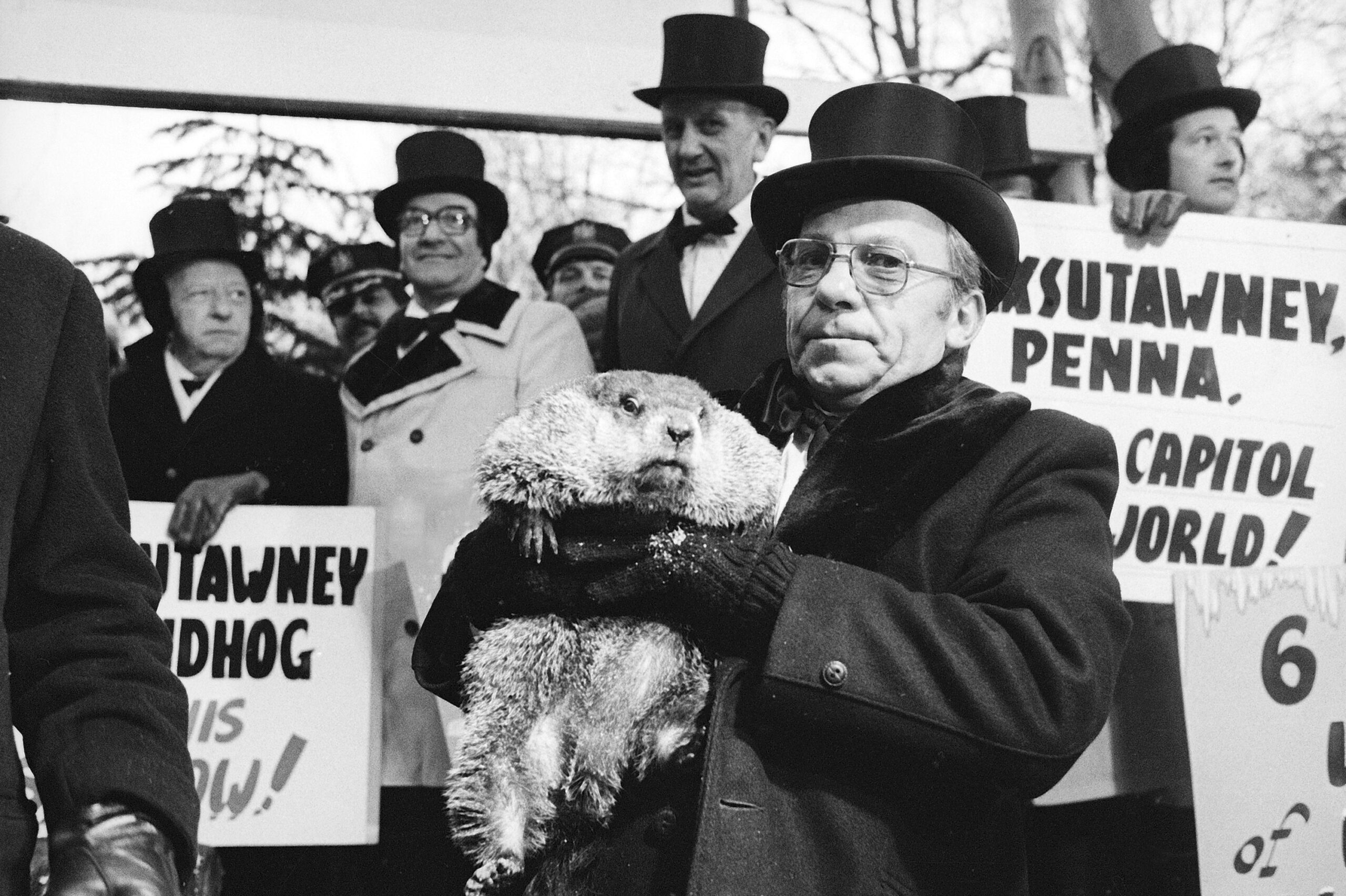
Jim Means holds up Punxsutawney Phil at daybreak on Groundhog Day in 1980.
Were you actually expecting a four-legged creature to accurately predict the weather?
In short, no, I wouldn’t peg my plans over the next six weeks on Phil’s prediction. According to a 2025 analysis by NOAA’s National Centers for Environmental Information, Phil’s forecast has been accurate only 35% of time, based on data of more than a century.
Last year, when Phil predicted six more weeks of winter, temperatures in Philadelphia were 1.8 degrees above normal for the six weeks following Phil’s forecast, with a high of 48 degrees and a balmy low of 30. Nationally, the contiguous U.S. saw near-average temperatures in February and much-above-average temperatures in March 2025, according to NOAA.
“Phil’s forecast was incorrect,” NOAA said bluntly.
!function(){“use strict”;window.addEventListener(“message”,(function(a){if(void 0!==a.data[“datawrapper-height”]){var e=document.querySelectorAll(“iframe”);for(var t in a.data[“datawrapper-height”])for(var r=0;r<e.length;r++)if(e[r].contentWindow===a.source){var i=a.data["datawrapper-height"][t]+"px";e[r].style.height=i}}}))}();
A dead groundhog in Lancaster has been more accurate than Phil
Richard Rankin, Governor of the Groundhog Lodge, poses for a photo with Octoraro Orphie in 2012.
Why brave frigid temperatures in the early morning hours to wait on Phil when you can just pull a stuffed groundhog out of the closet?
That’s what the folks in Lancaster do. Every Groundhog Day since 1907, handlers at the Hibernating Governor of the Slumbering Groundhog Lodge in Quarryville fetch the remains of Octoraro Orphie — often sporting a top hat and bow tie — to offer some weather divination.
They do get outside, celebrating with a parade that ends at the so-called Pinnacle of Prognostication (their tongue-in-cheek description of a manure spreader), where Orphie’s forecast is delivered to the faithful.
What’s wild is the stuffed groundhog is surprisingly accurate, nailing its prediction more than 52% of the time, according to a NOAA analysis done last year.
Orphie did not see his shadow Monday, predicting an early spring. We’ll see which groundhog ends up being right.
Lancaster is a hotbed for groundhog activity, sporting several weather-predicting furballs, including Mount Joy Minnie (who did not see her shadow), M.T. Parker (who did), and a pair of actual living groundhogs in Elliott and Lilly at Acorn Acres who were set to offer their predictions Monday evening.
Staten Island Chuck, seen here at the Staten Island Zoo in 2025.
But none of Pennsylvania’s native groundhogs have been as accurate over the years as Staten Island Chuck. Since his first forecast in 1981, Chuck (formally Charles G. Hogg) has accurately predicted an early spring or six more weeks of winter an astounding 85% of the time, according to NOAA’s analysis.
On Monday, Chuck agreed with Phil, predicting six more weeks of winter, which seems like a safe call.
Chuck has been able to remain accurate despite dealing with much more harrowing conditions than his Pennsylvania counterpart. In 2009, Chuck bit then-Mayor Michael Bloomberg and was secretly replaced by granddaughter Charlotte for the 2014 ceremony. Unfortunately, then-Mayor Bill de Blasio dropped Charlotte, and the groundhog died several days later.
How did this whole marmot-predicting-the-weather thing start?
According to the Pennsylvania Tourism Office, Romans took the early Christian holiday Candlemas to Germany, where it was said that if there was enough sun on Candlemas Day for a badger to cast a shadow, there would be six more weeks of bad weather.
German immigrants brought this tradition to Pennsylvania, and in 1886 the editor of Punxsutawney’s newspaper teamed up with a group of groundhog hunters to begin the legend of Punxsutawney Phil’s weather prowess. So in the United States and Canada, we celebrate Groundhog Day on the same date Christians across the globe celebrate Candlemas.
Good luck trying to stream Groundhog Day today
Bill Murray in a scene from “Groundhog Day.”
You’re not wrong if you remember seeing Groundhog Day on Netflix the other day. It’s just not there now.
The beloved 1993 comedy, staring Bill Murray and directed by the late Harold Ramis, left Netflix as of Sunday. Other than renting the film through a host of streaming platforms, the only other place to stream Groundhog Day on Groundhog Day is AMC+, a subscription service few have that’ll set you back $9.99 a month (though it does have a seven-day free trial).
If you still have a cable subscription, Groundhog Day is airing all day on AMC beginning at 8:30 a.m. Philly time, so set your DVR.
Are there any other Groundhog Day movies?
If you’re looking for another good time loop flick, check out 1998’s “Run Lola Run.”
Listen, we all love Groundhog Day, but to some watching it each and every year is starting to feel a bit like the movie’s repetitive plot.
There are plenty of Christmas, Halloween, and even Valentine’s Day movies for us to choose from. Aren’t there any other films that take place on Groundhog Day?
Sadly, no. About the best you’ll get are a few animated short films, such as the early Disney flick Winter (featuring Walt Disney’s uncredited voice as a raccoon) and 1947’s One Meat Brawl from Warner Bros. And that’s only if you can find them.
Now, if you’re looking for a movie swiping Groundhog Day’s premise — someone living the same day over and over again — there are a few options, from Tom Cruise in Edge of Tomorrow to the sci-fi comedy Palm Springs, staring Andy Samberg and Cristin Milioti.
There’s also 1998’s Run Lola Run, a German thriller where Franka Potente’s protagonist gets three chances to re-run the same 20 minutes to save the life of her boyfriend.
As Train 9710 pulled out of the Trenton Transit Center at 7:25 a.m. Monday, something looked out of place.
Five passenger coaches in the Philadelphia-bound Regional Rail train bore foreign “MARC” logos and orange-and-blue markings, all pulled by a properly labeled SEPTA electric locomotive.
The substitute cars initially will be running on the Trenton and West Trenton lines, where riders for months have endured packed trains due to a shortage of available 50-year-old Silverliner IVs.
The transit agency is paying $2.6 million to lease the new coaches for a year.
SEPTA’s records show it canceled at least 2,544 Regional Rail trips in the last three months of 2025. Delays and skipped stops also have plagued commuters for months.
SEPTA is using its ACS-64 electric locomotives, which it bought in 2019, to pull the MARC coaches and its own fleet of 45 coaches.
Silverliner cars do double duty; they carry passengers and have motors that provide their own locomotion through electricity drawn from overhead wires.
SEPTA said in a statement that the schedules will add trips on the Wilmington, Trenton, and Chestnut Hill East lines and increase the frequency of service from Wayne Junction directly to the Philadelphia International Airport on the Airport line.
A freshman football player at Villanova University has been charged with rape and sexual assault stemming from a December incident on campus, a university spokesperson said Sunday.
D’Hani Cobbs, 20, faces charges of rape, sexual assault, and related offenses in Delaware County, court records show. He is accused of assaulting another student on Dec. 7, the university said in a statement, which did not provide any additional details about the alleged incident. The arrest was first reported by student newspaper The Villanovan.
Cobbs was arraigned Friday and held on $250,000 bail, according to court records.
A university spokesperson said school leaders reported the incident to law enforcement and “removed” Cobbs from campus shortly after the incident in December.
“Sexual violence of any kind is not tolerated on our campus and we are committed to both supporting the victim and fostering a safe environment for all of our students,” the university said in the statement.
A player bio page on Villanova’s website was out of service with an error message on Sunday, but according to social media and sports news outlets, Cobbs graduated from Camden High School in 2025 and played wide receiver at Villanova. Recruiters for the Villanova Wildcats posted a “welcome to the family” message on social media after recruiting Cobbs in December 2024.
An attorney for Cobbs did not immediately respond to a request for comment Sunday.