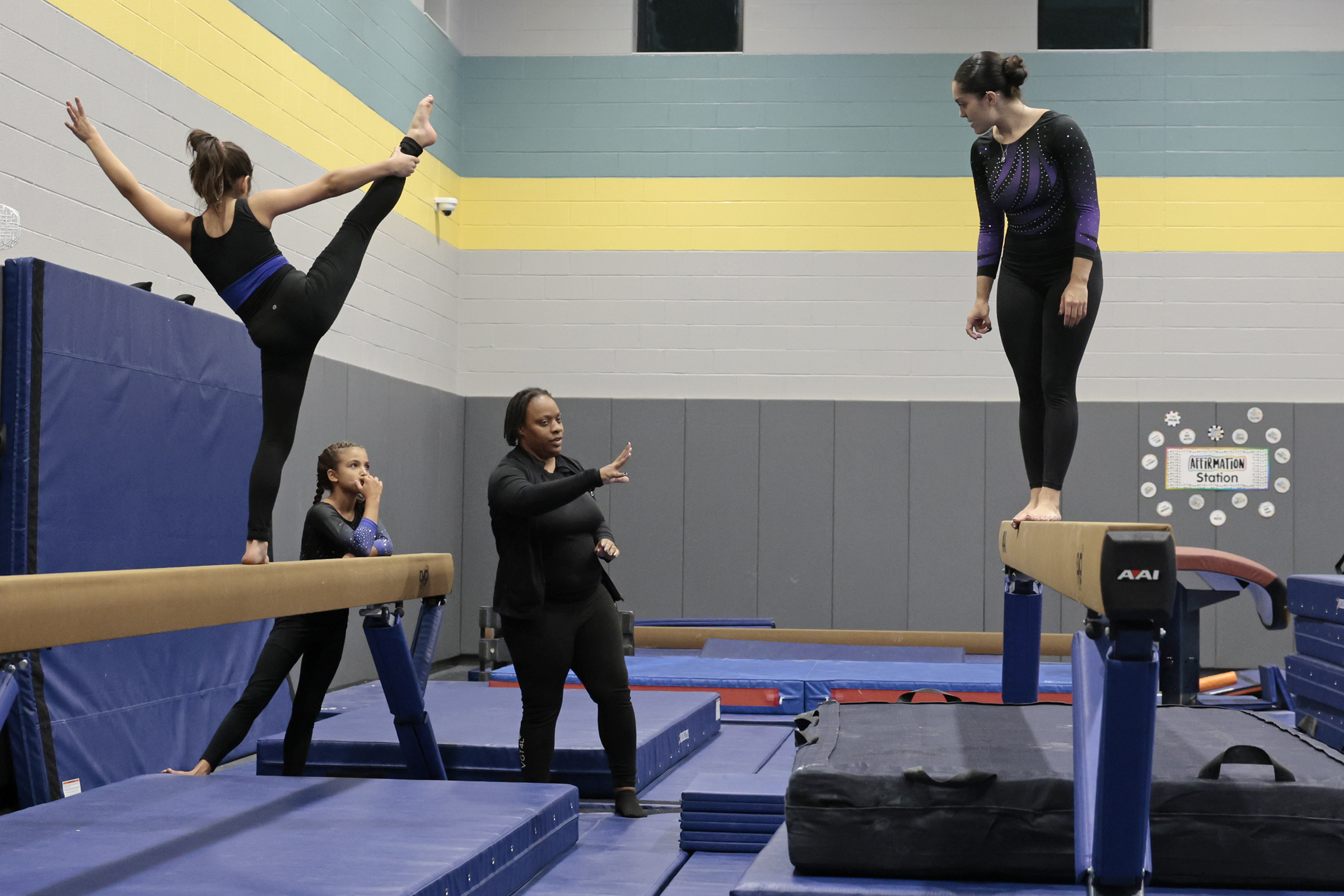
Cherokee Guido swung her legs and hips vertically above the lower uneven bar at Vare Recreation Center one recent evening as her coach steadied her. Guido had once mastered this handstand but lost it during a few months off. She wanted it back.
“I can’t be afraid to fall,” Guido, 19, coached herself out loud. Behind her hung a sign with rainbow borders: The way you speak to yourself matters.
Over the years, young gymnasts like Guido and their Vare coaches have learned to talk themselves to victory, first when they were practicing in a crumbling rec building before COVID, then when they were trekking from South Philadelphiato Brewerytown’s Athletic Recreation Center while Vare underwent renovations. They had gotten used to tumbling on mats that slipped around, without a regulation spring floor. They learned to train their minds as much as their bodies.
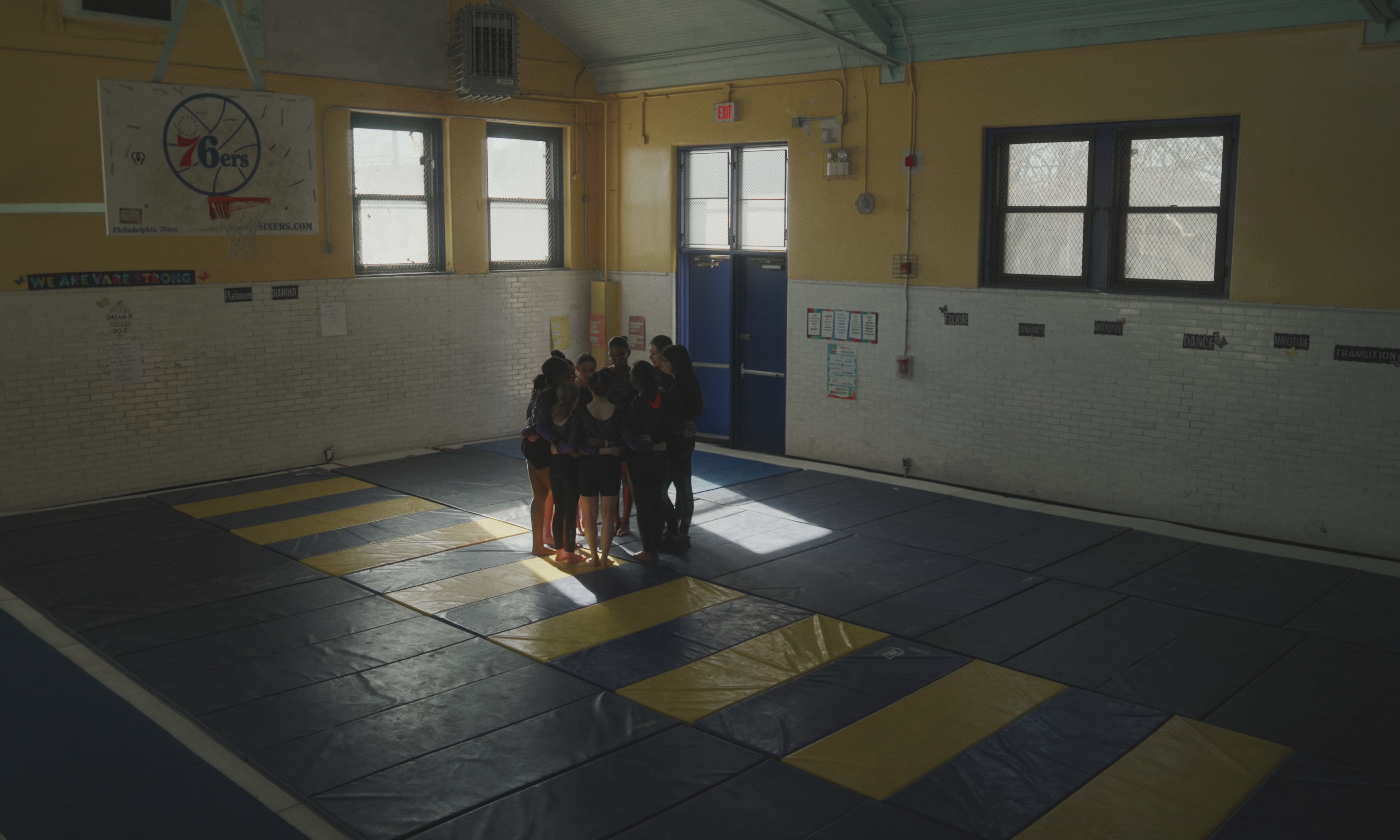
Throughout practice, the girls cheer each other on across the gym, quick to compliment teammates they say are more like sisters.
“Nice, Laila!” Ariah Buzzetto, 10, called out to her friend Laila Godfrey, 12, across the floor.
“How you practice is how you compete. If you practice lazy, then you’re going to compete lazy,” said 12-year-old Meela Muhammad, sounding very much like an inspirational poster.
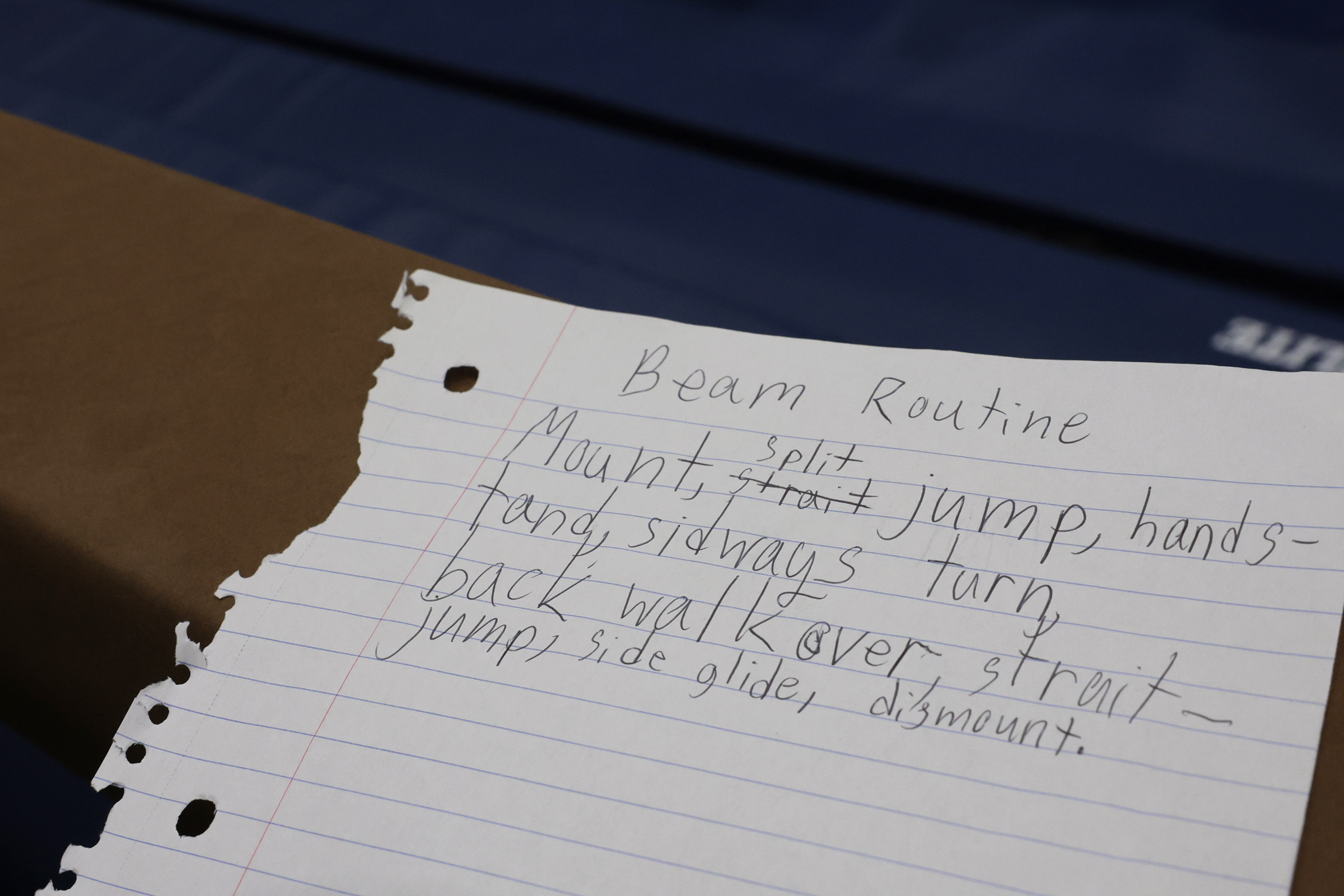
Notes written by 9-year-old Alessia Samson during practice.
Now, training in a new, state-of-the-art, 4,900-square-foot gym at the renovated Vare, which reopened in November 2024,the gymnasts have come a long way — but they’re still competing against private-club teams with sleek, matching uniforms who are better funded, and often better prepared for high-pressure USA Gymnastics (USAG) competitions.
“They have a lot more, bigger skills,” Guido said of their rivals. “At first, for me, I felt like how you go to a ball, you feel underdressed.”
Guido, for example, still wears an older purple leotard because she couldn’t afford a new one, while the rest of her team wears blue.
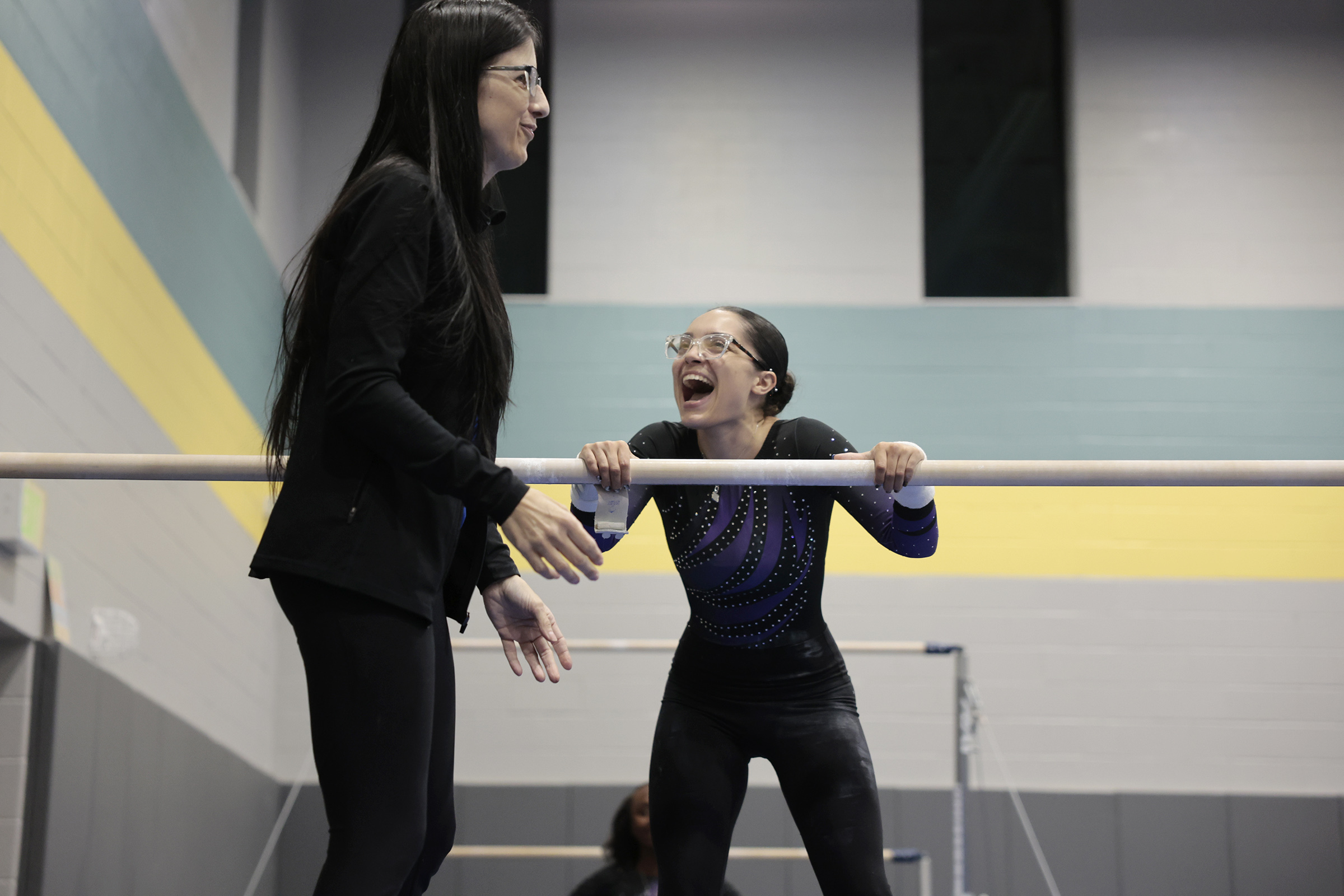
Head coach Kristin Smerker and Cherokee Guido, 19, laugh while working on the uneven bars during team practice.
Now, Vare Gymnastics is trying to raise at least$6,000 as soon as possible through a GoFundMefor new jackets and gym bags for this year’s competition season, which begins with the Liberty Cup, a December USAG meet at the Greater Philadelphia Expo Center.
If they don’t raise the money, they won’t be able to purchase full uniform sets. The team is also hoping to put some of the money toward financial aid for spring meets; most meets fill up by the end of the fall, and without the funds to enter, some girls won’t be able to attend.
USAG is the national governing body for gymnasts; the Vare Rec team competes in Xcel, a program that offers more accessible competitions than the parallel track that funnels athletes to world competitions and the Olympics.There are only two other city rec centers in Philly that compete in USAG competitions: Kendrick Recreation Center in Roxborough and the Water Tower Recreation Center in Chestnut Hill.
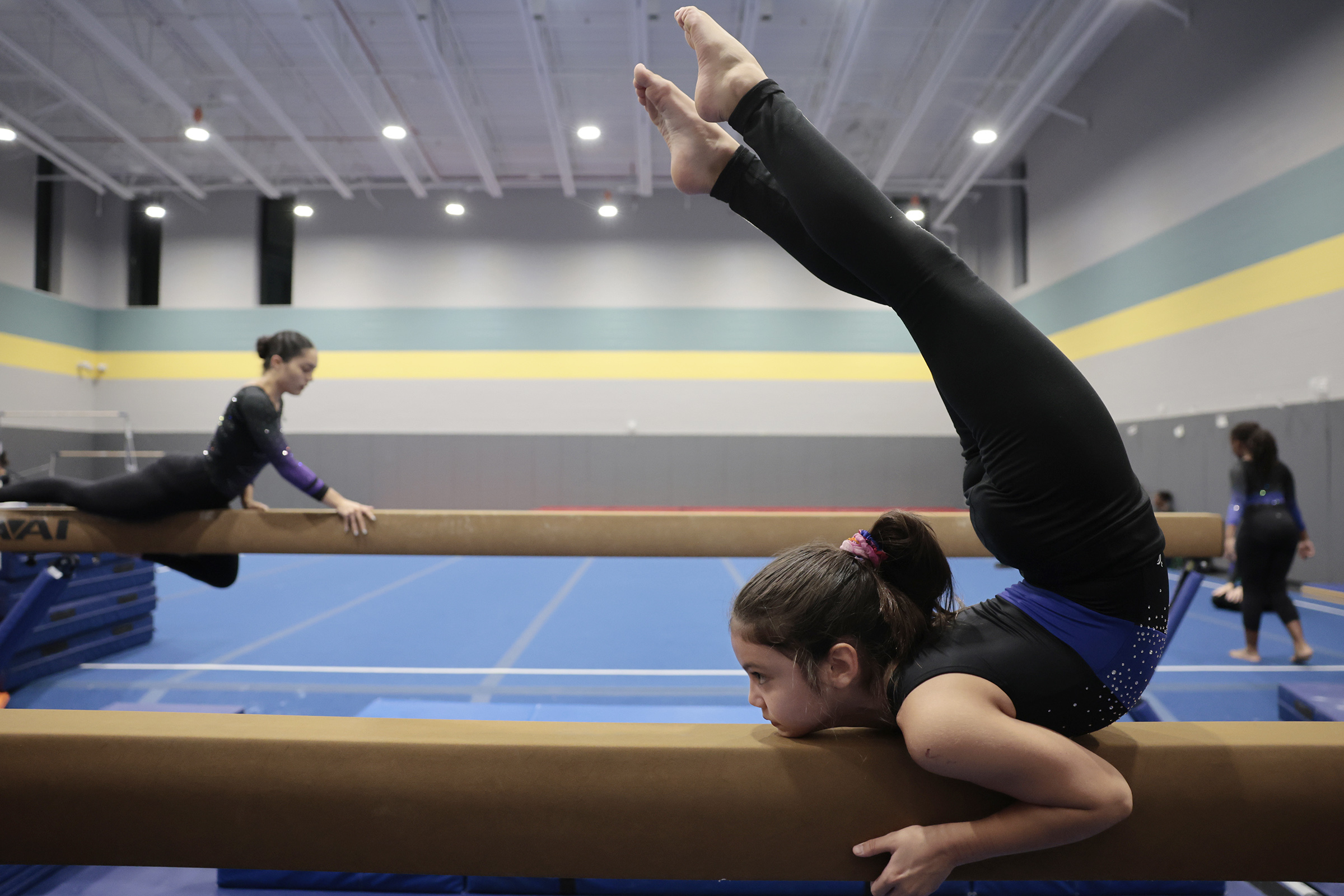
From left, Cherokee Guido, 19, and Alessia Samson, 9, train on the balance beam during team practice.
Though Xcel is supposed to be more affordable, gymnastics is expensive: Entrance fees and uniforms cost hundreds of dollars per child, plus tuition for practice. At $100 per semester, Vare’s rate is far less than at those private gyms, but many parents still struggle to pay.
Marie McBreen, 42, has two daughters in the program. Her oldest enrolled 10 years ago after McBreen begged the coaches for three weeks to find her a spot. She’s seen how positive the team is for them: It has boosted their confidence and they’ve made close friends. But this year, with two kids in the program, she can’t afford to send both to all the competitions.
“Most of us don’t have a whole lot of money. You do the fundraiser to help so they don’t have to miss out,” McBreen said.
Head coach Kristin Smerker is not sure whether the team will raise enough in time.
“Every club has a whole getup. And we don’t. We’re getting whatever we can,” Smerker said. “You can still compete, but they just don’t feel good about it … They’re so talented and they deserve better.”
Smerker is a Northeast native, an encouraging, pump-you-up kind of coach prone to wearing black leggings and mismatched grip socks at daily practice. She built the program from the ground up, starting in 1998 with two floor mats she had begged from nearby gyms.
Nearly 30 years later, Vare Gymnastics has 130 participants, plus a nine-page waiting list. In 2013, the team joined USAG. Alongside Smerker, the team has a beam coach and also a floor coach, Smerker’s sister. In 2017, Smerker brought the team to a USAG meet and lamented to the other coaches that the girls didn’t have a permanent building and were shuttling all over the city for practice.
“Our team won first place,” she said, laughing. “Our kids have heart.”
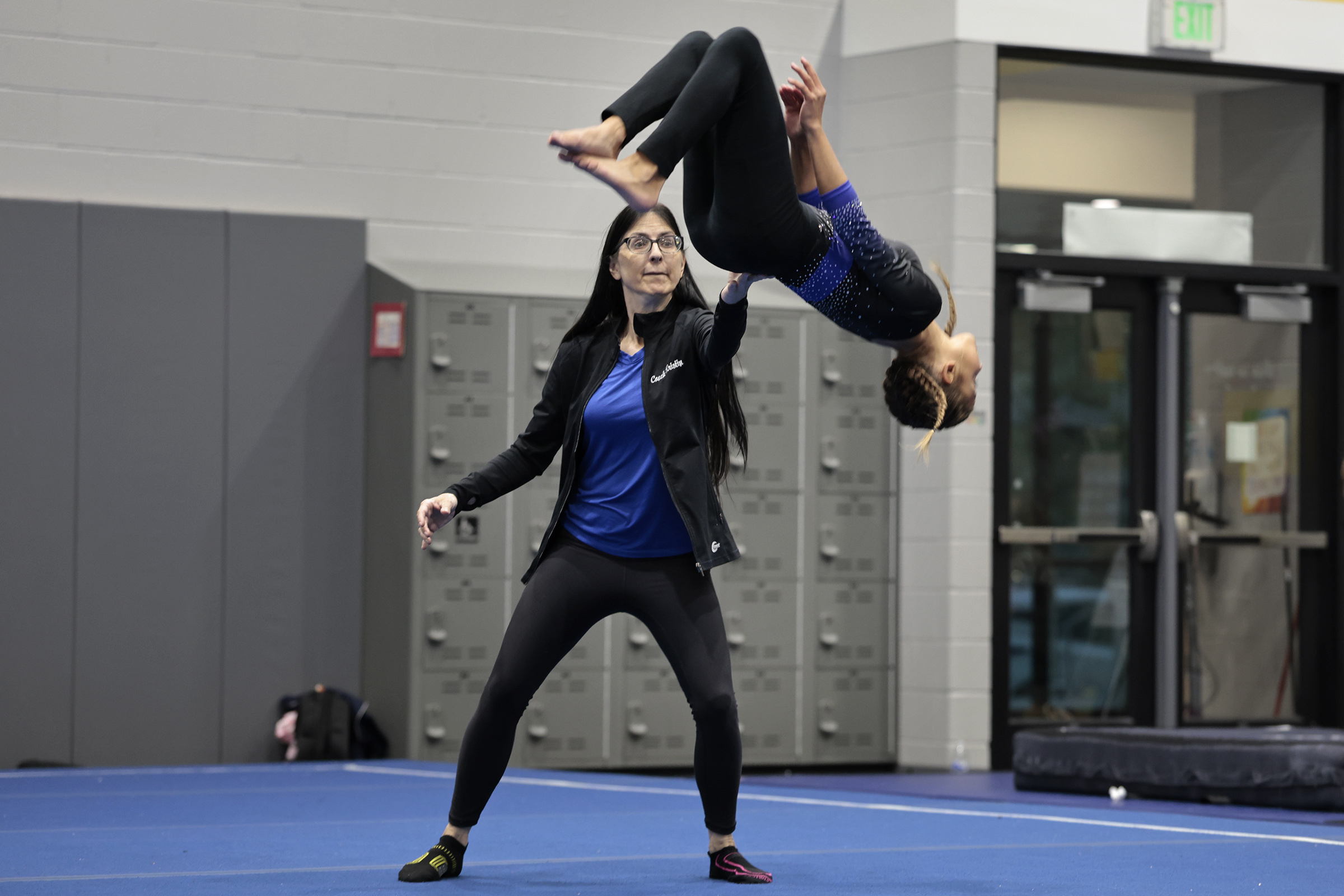
Head coach Kristin Smerker guides Ariah Buzzetto, 10, during practice. Alessia Samson, 9, (left) and Cherokee Guido, 19, (right) are guided by beam coach Natasha Rogers (middle) as Ariah Buzzetto, 10, looks on.
Guido has been practicing gymnastics at Vare since she was 2 years old, and is among the best at the gym. Last year she graduated from high school and technically from Vare, but she is now back working on her skills.
“I love it already!” she called to her teammate Suadaa “Susu” Muhammad, as Susu debuted her new floor routine.
Along with team captain Elianna Olsen,Muhammad and Guido call themselves the “OG gymnasts” because they’ve been at Vare the longest.
Perhaps like many young gymnasts, Muhammad, 19, started with enormous dreams.
In the beginning, she said, “I thought I was gonna be bigger than Simone Biles.”
These days, she fits practice in three times a week, alongside radiology classes in her freshman year at the Community College of Philadelphia, and a night job pushing wheelchairs at the airport. She was also just hired as a coach for the Vare team. In her own training, she’s focused on her round off back handspring back tuck for her floor routine, trying to get it ready for December’s meet.
“Some coaches say to our coaches, ‘Oh, wow, you’re from a rec center? I’m surprised your girls are doing this good,’” Muhammad said.
South Philly’s Vare Gymnastics Team is the subject of the short documentary “Underdogs,” which is executive produced by former Philadelphia Eagles Connor Barwin and Jason Kelce.
In the early years, Muhammad used to get points deducted at meets for wearing her headscarf, she said; the judges considered it in the same category as jewelry and nail polish, which are prohibited. Her family and coaches wrote letters to USAG, and the rule was changed, Smerker said.
This year, Smerker wants the girls to be wearing their matching uniforms when they walk out to meet their rivals.
“I want them to walk in there and feel proud of themselves and feel confident,” she said. “It’s important to them and important to me to do everything to make it happen.”
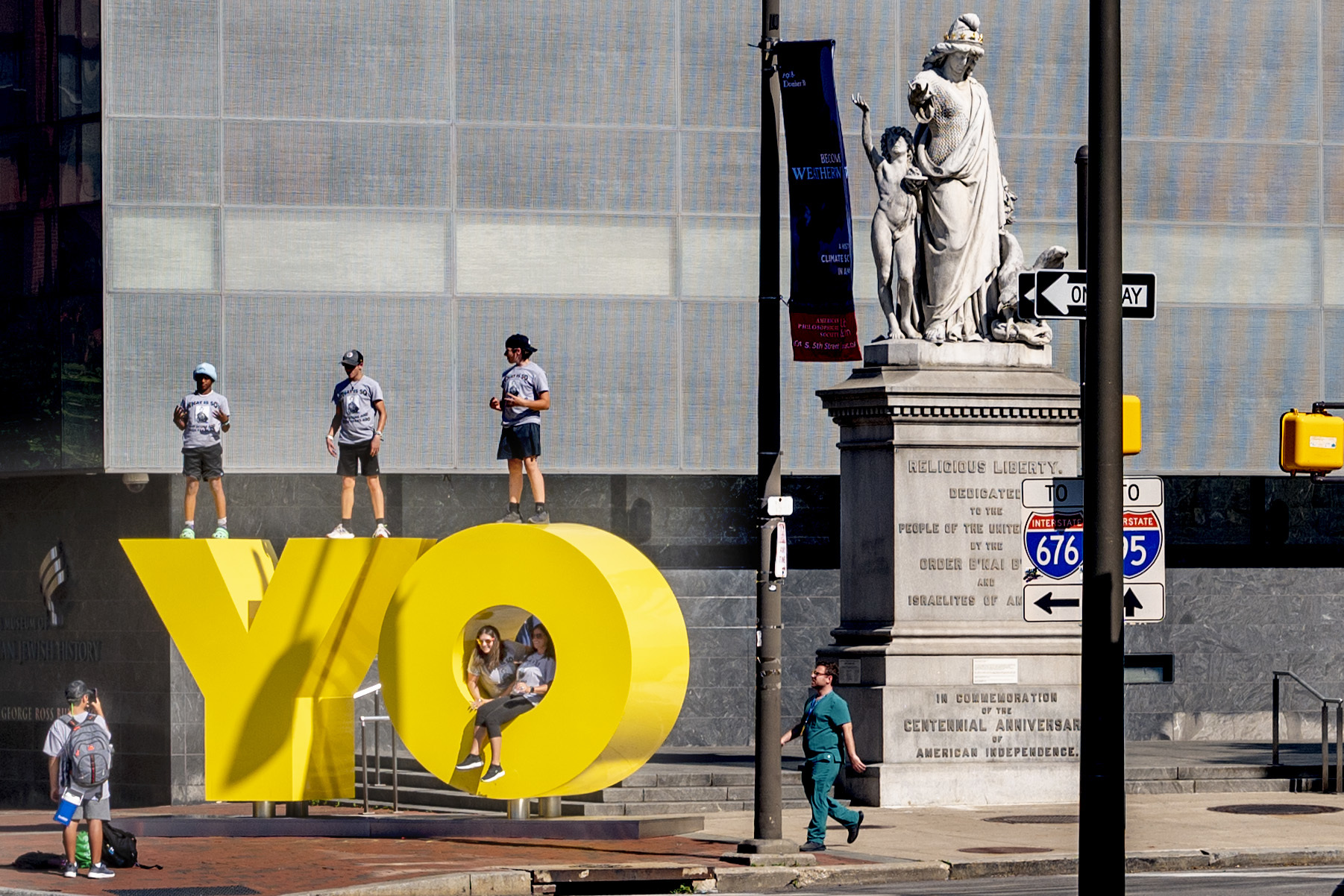
No longer at its home outside the Weitzman National Museum of American Jewish History on the corner of Fifth and Market Streets, the bright “Lamborghini yellow” sculpture that then-curator Josh Perelman called “an ongoing love letter to the city,” had gone away for some R & R — removal and refurbishment.
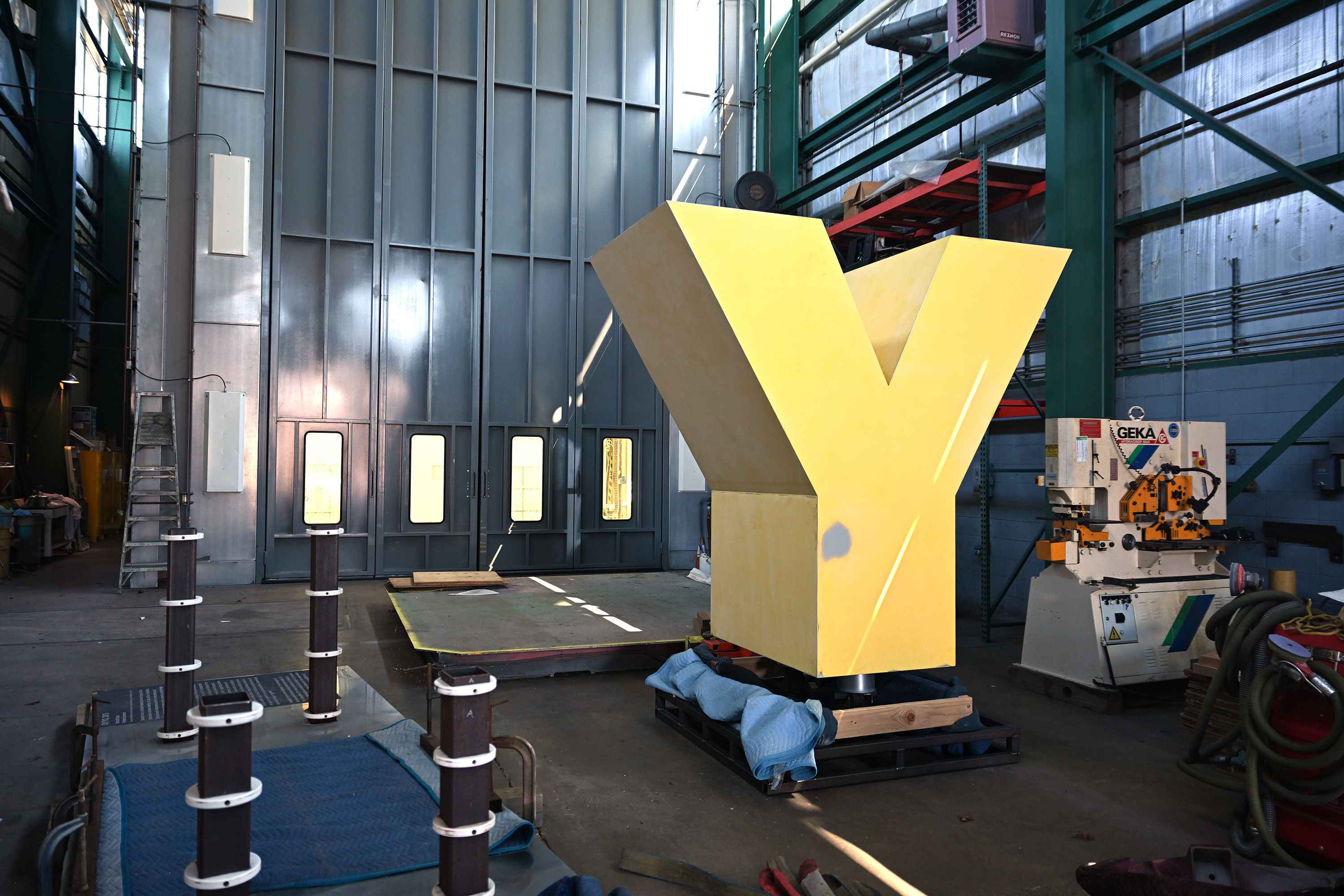
The “Y” waits to be refurbished at the Johnson Atelier in September.
Installed in 2022, the work by Brooklyn, N.Y.-based artist Deborah Kass quickly became one of our city’s most selfied spots — right up there with that bell just across Independence Mall.
It was only supposed to be here a year, but it stayed around (although the museum is hopeful, it’s still not officially permanent).
Students from Hillwood Middle School in Ft. Worth, Texas visit in 2022.
After years on the busy corner (and all those field-tripping middle-schoolers climbing on it) the museum scheduled a removal in May of the eight foot tall Y and O letters for freshening up, planned to coincide with the continuing construction along Market Street through Old City.
Knowing my feelings for their sculpture, the folks at the museum invited me to photograph the refurbishment.
The letters did not require extensive work, and the aluminum was treated not unlike body work on a car: removing dents, priming, painting and leaving a durable finish.
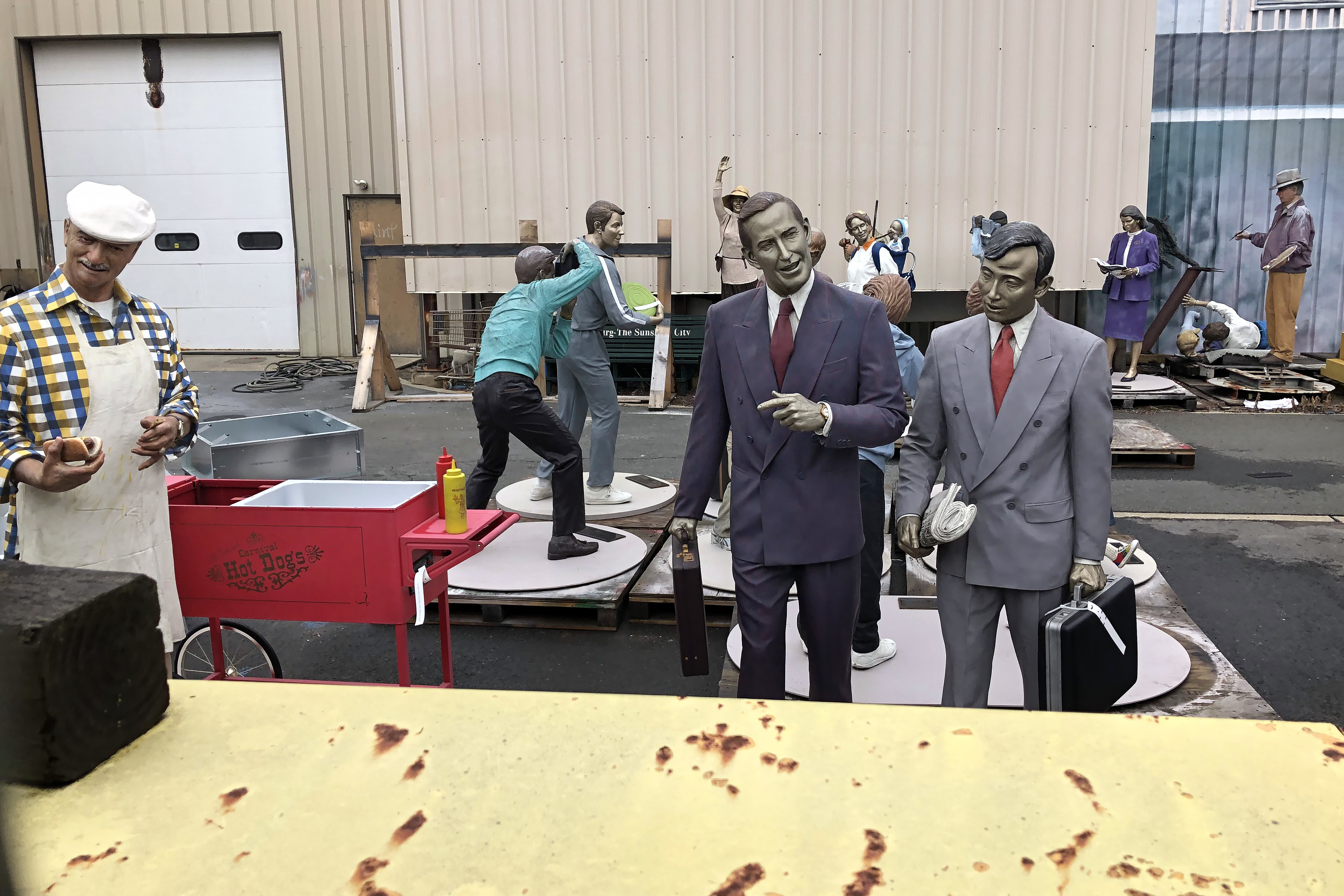
At the Johnson Atelier, a facility established by Seward Johnson in 1974 to give artists greater involvement in the production of their work, I was not allowed to photograph from any angle that showed any other art works in the background. And there were plenty (sigh), like an eight-foot tall metal hand sitting on the floor, right across from the “Y” (I had to sign an NDA).
Looking over the fence from a public area at Grounds for Sculpture in 2019. A collection of trompe-l’œil painted sculptures by Seward Johnson in the yard at the adjacent Johnson Atelier.
Adding to the lack of visual variety, the letters went into the painting booth one at a time, so I couldn’t make a picture of them in the same frame. And I could only see the workers in the booth from outside – through a couple of windows. But that is exactly the kind of photographic challenge I most enjoy.
Now, after a few months the two giant letters are both as good as new and are scheduled to be reinstalled this Saturday.
Weitzman president and CEO Dan Tadmor, looking forward to its return to their corner heading into the nation’s 250th says, “Deborah Kass’s OY/YO celebrates the spirit of a city that’s always spoken in its own voice: bold, funny, and full of heart.”
Since 1998 a black-and-white photo has appeared every Monday in staff photographer Tom Gralish’s “Scene Through the Lens” photo column in the print editions of The Inquirer’s local news section. Here are the most recent, in color:
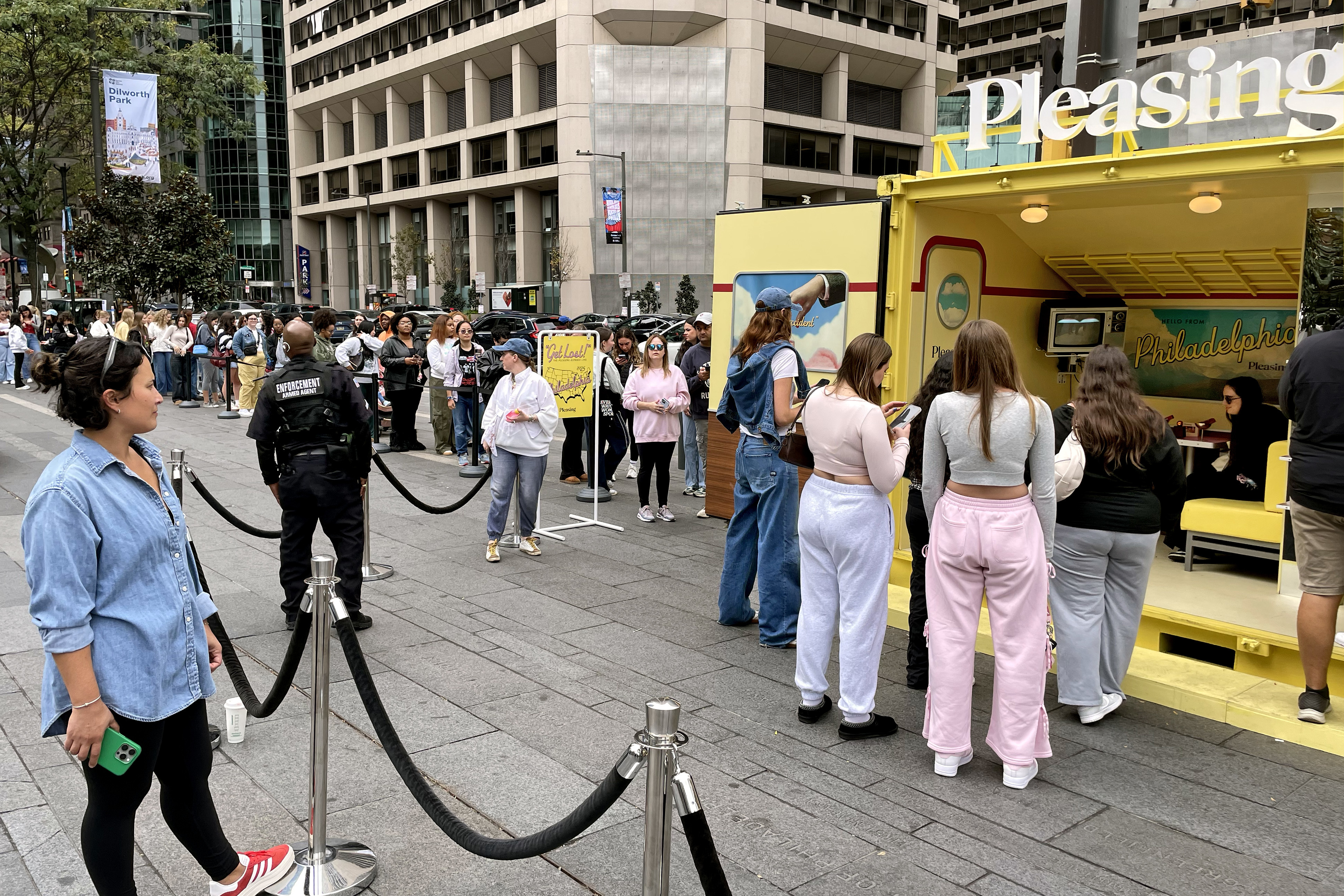
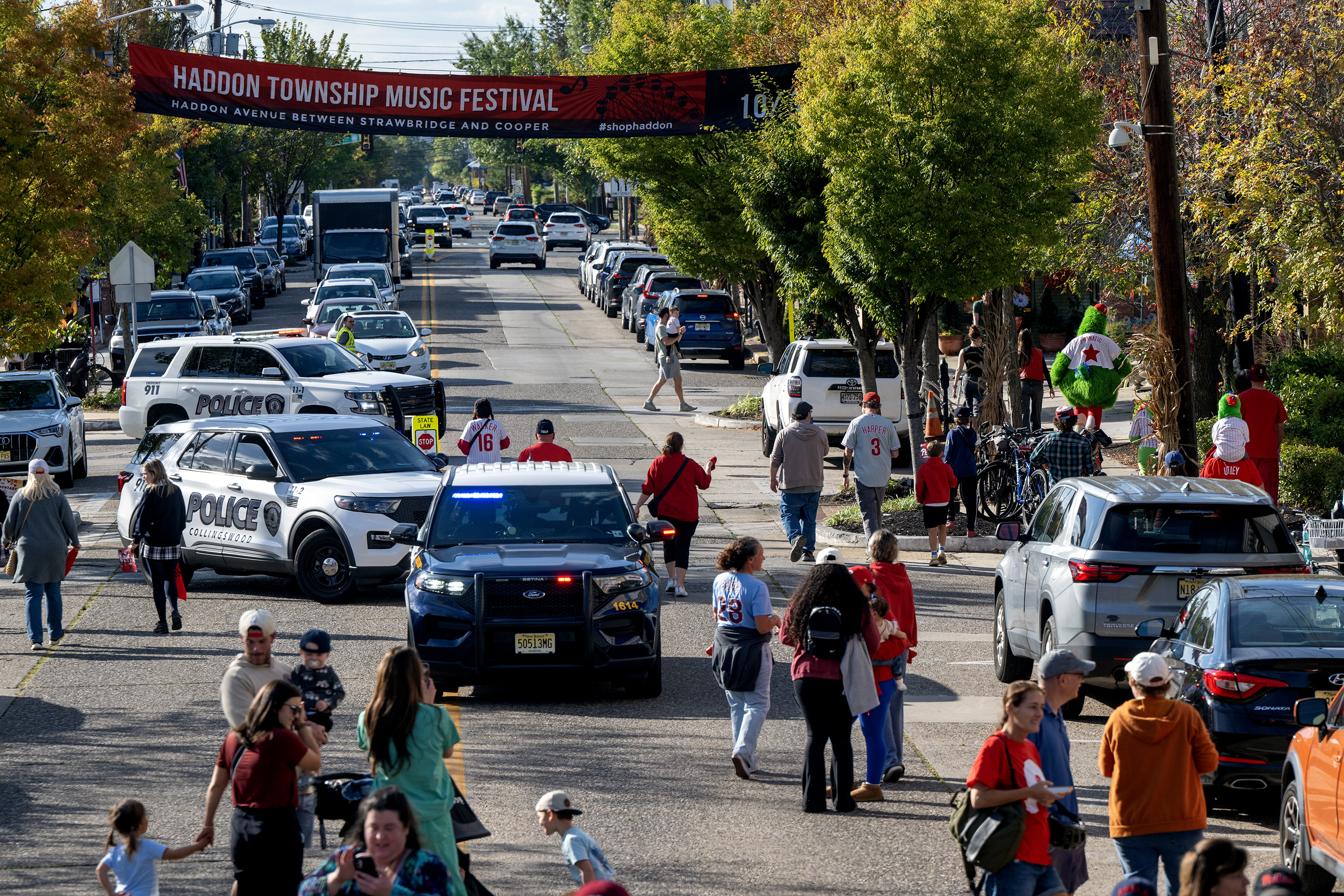
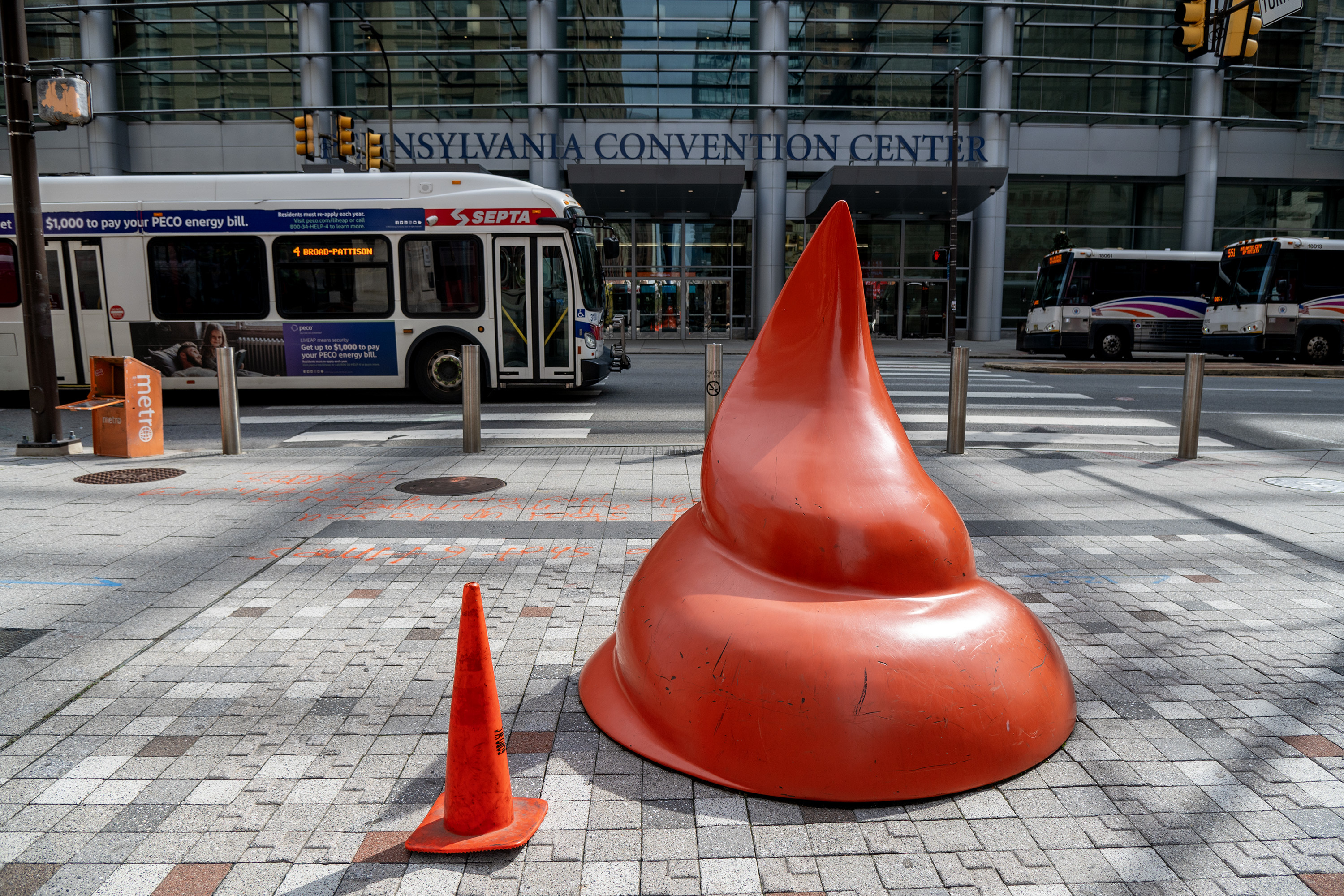
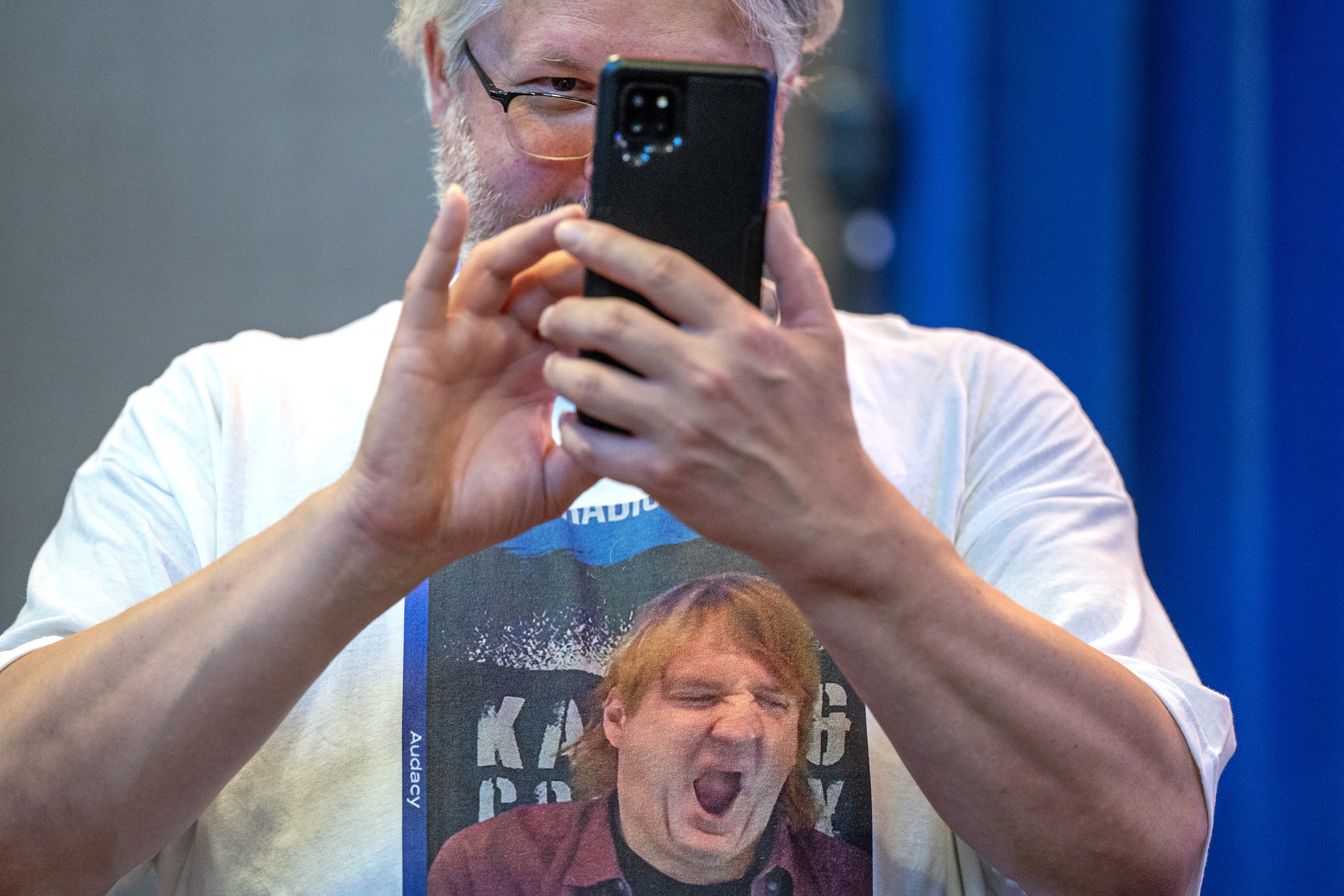
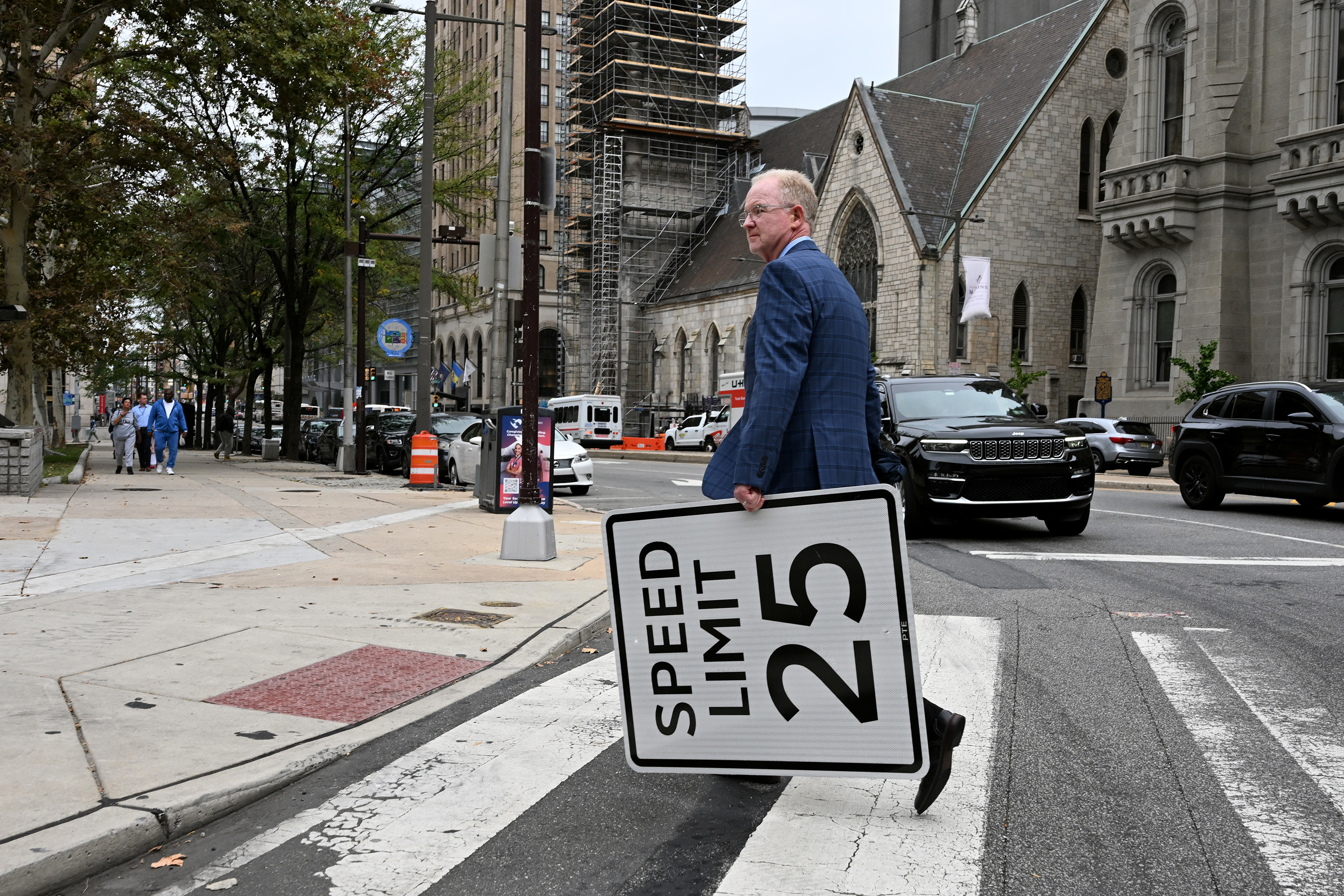
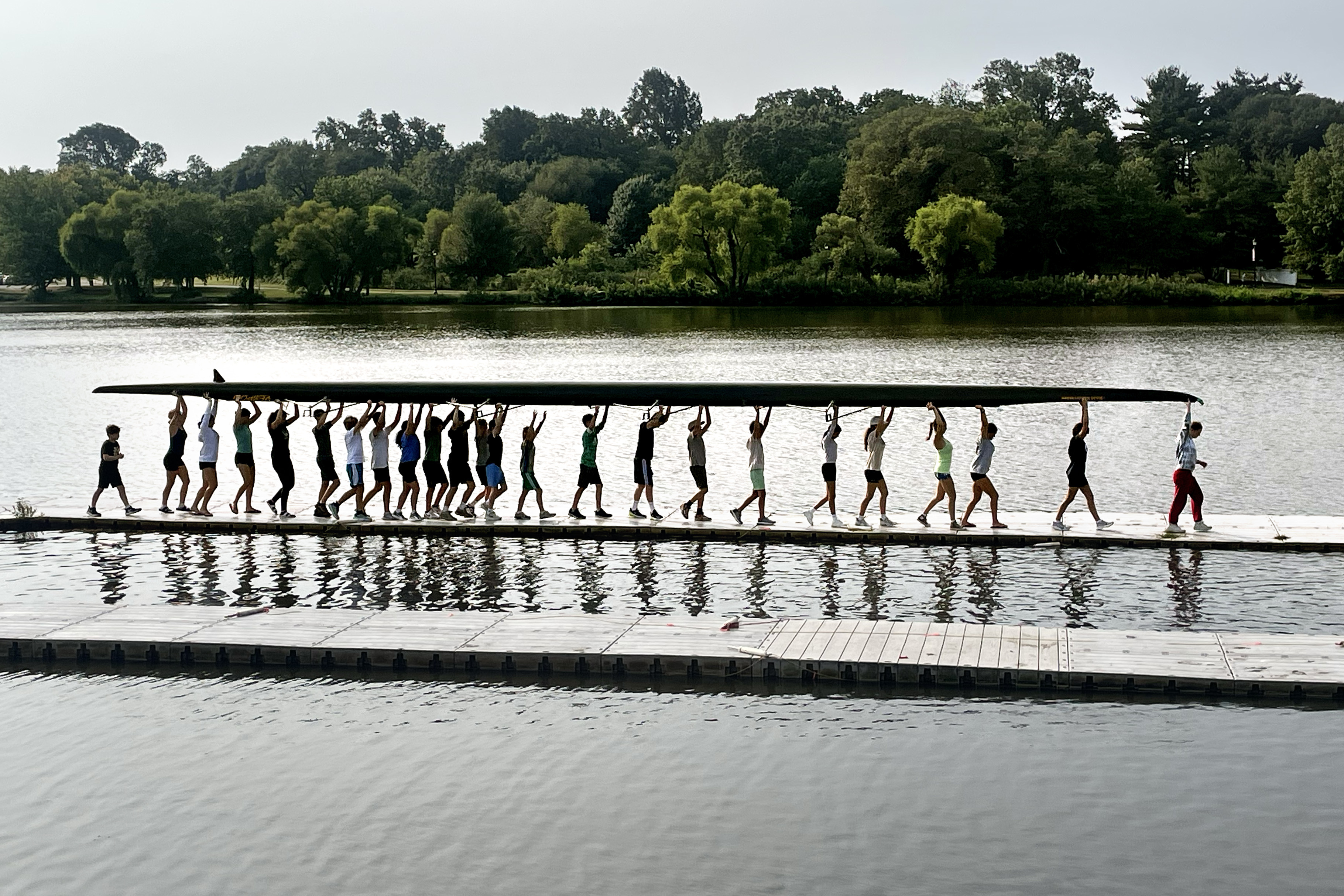
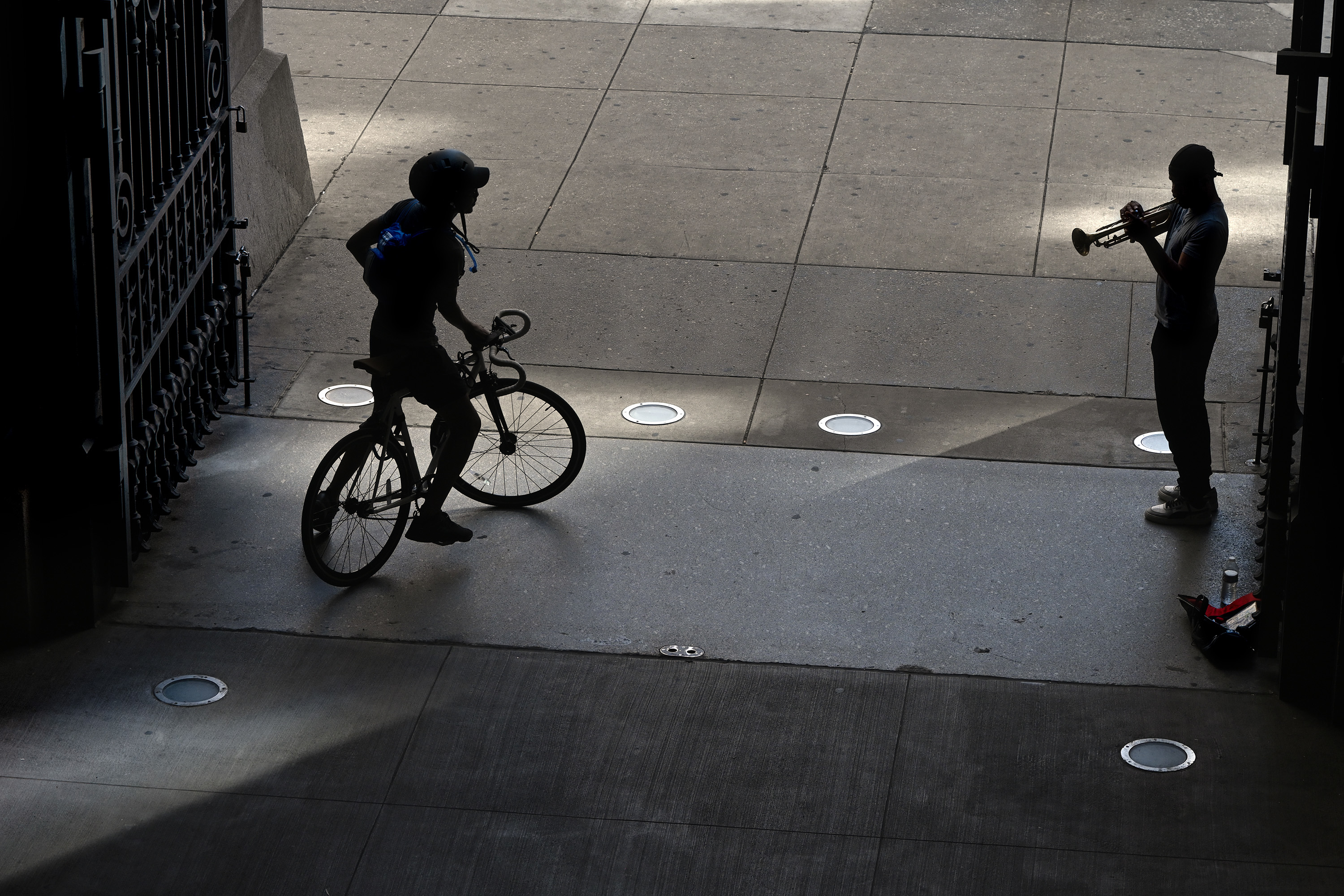
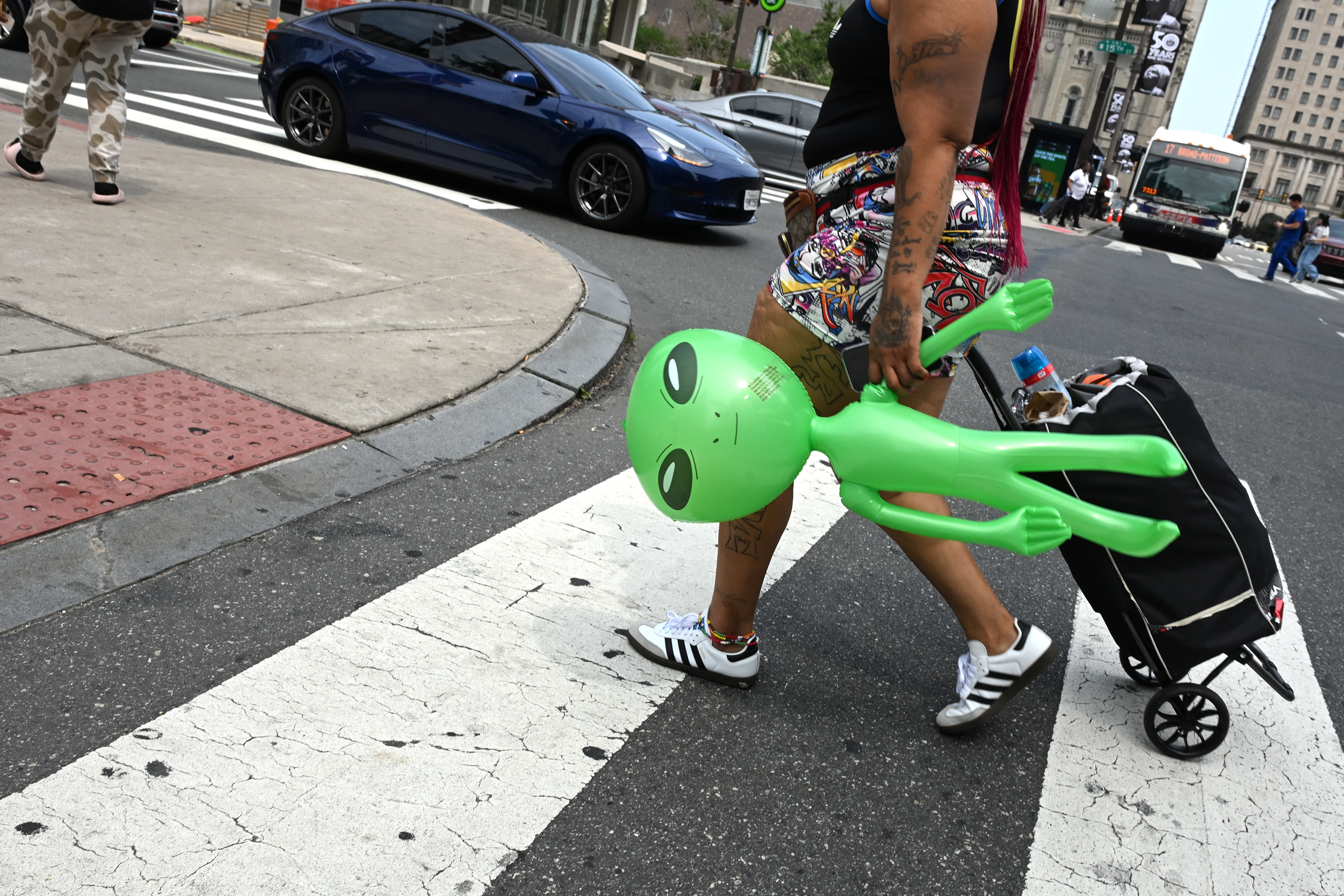
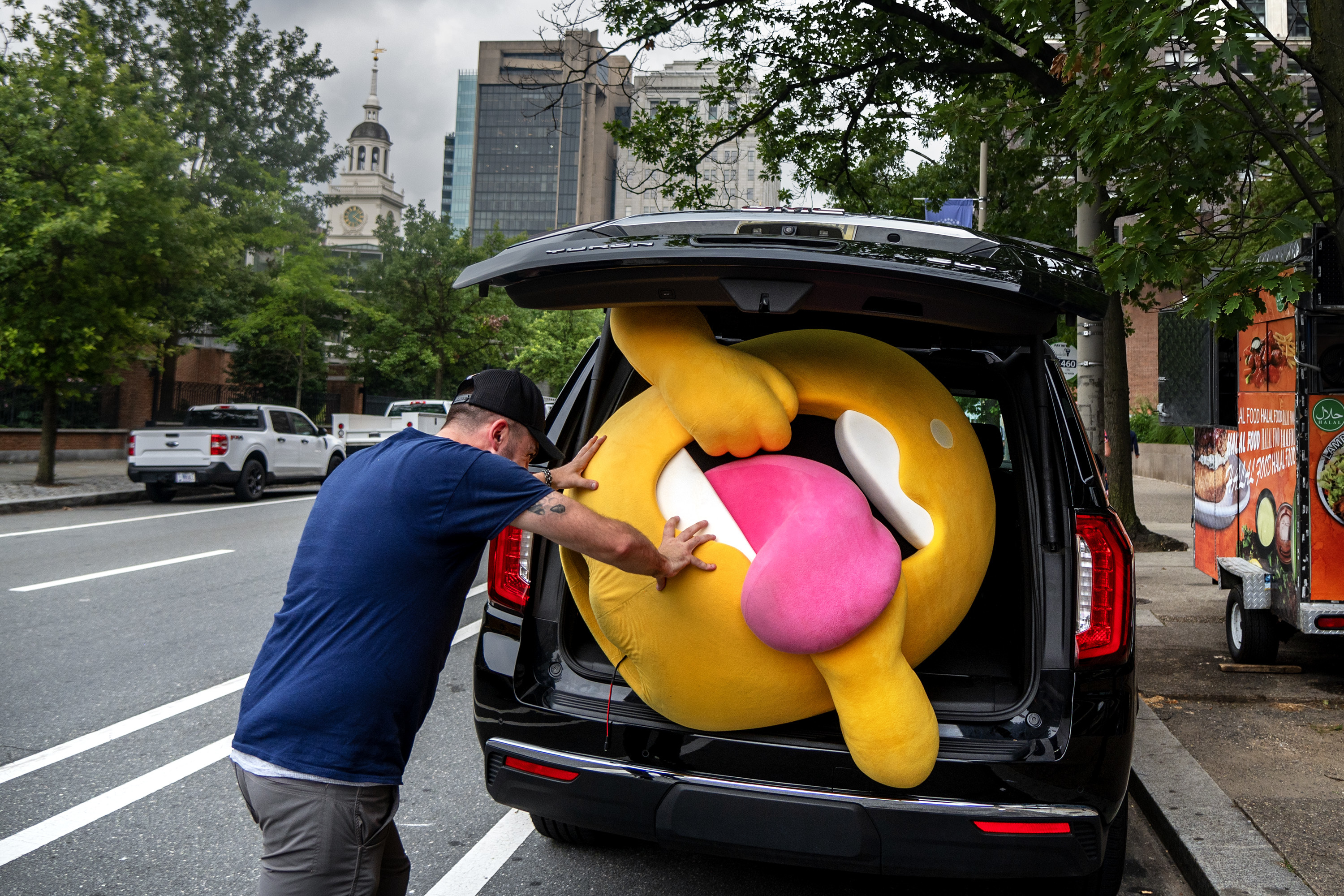
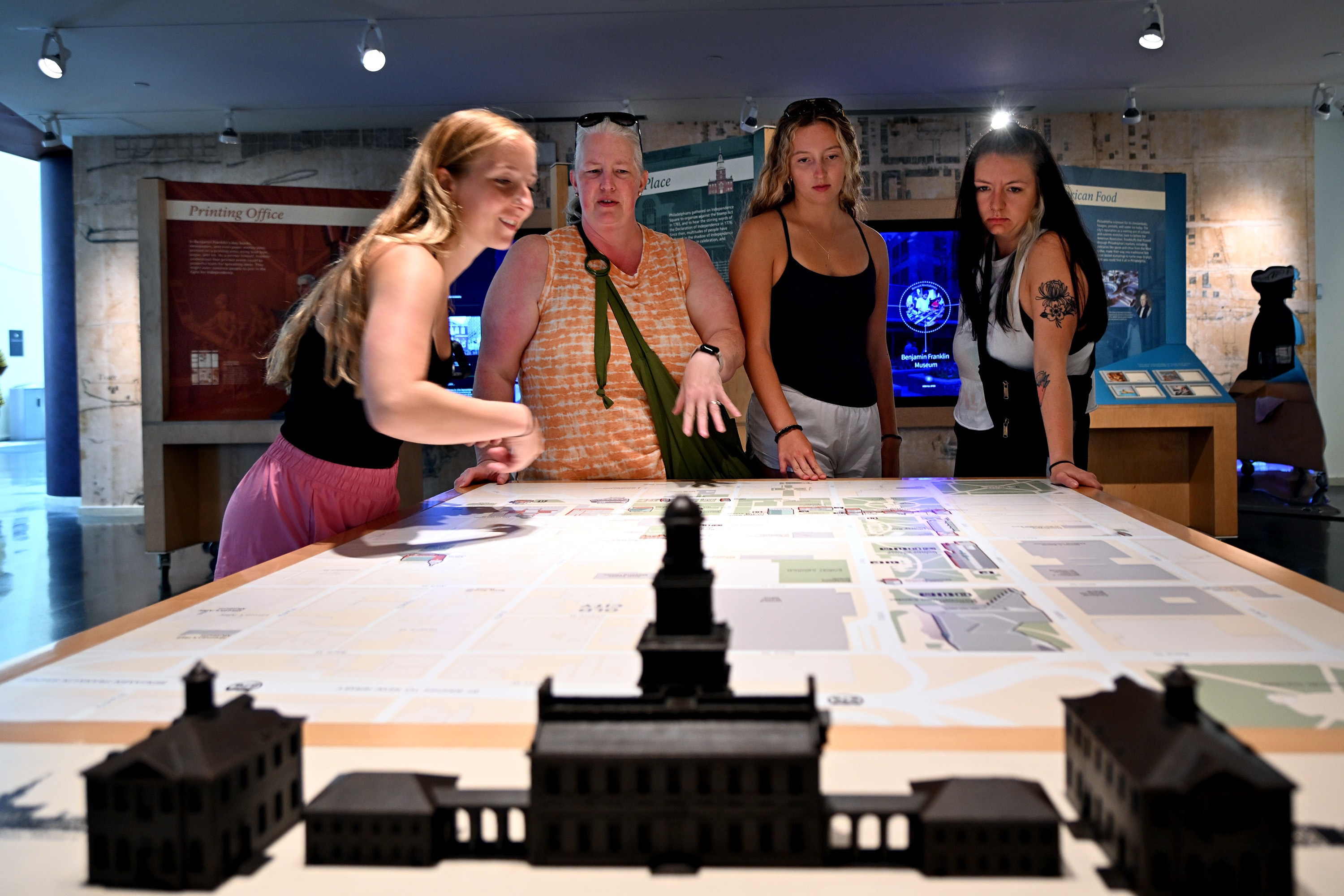
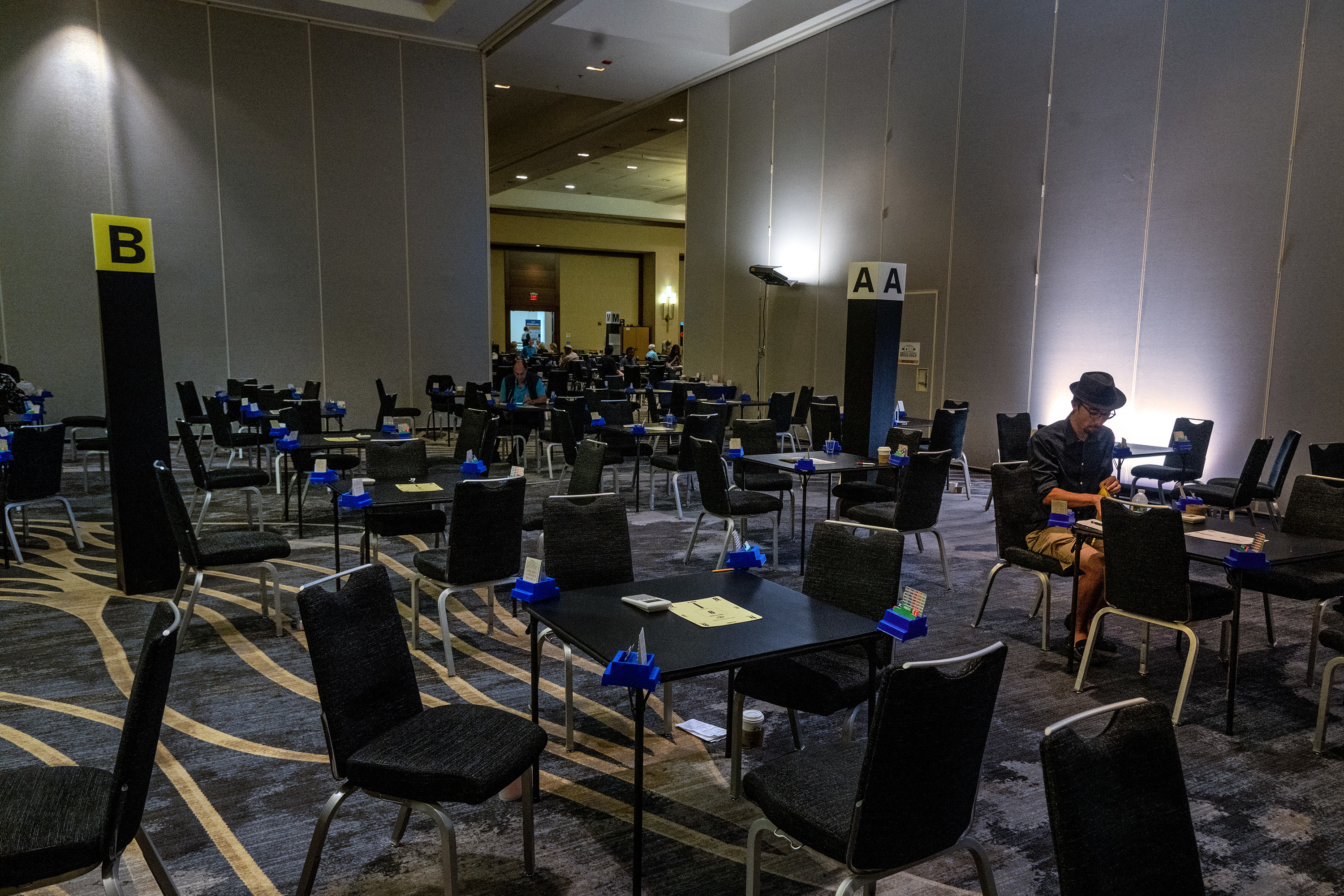
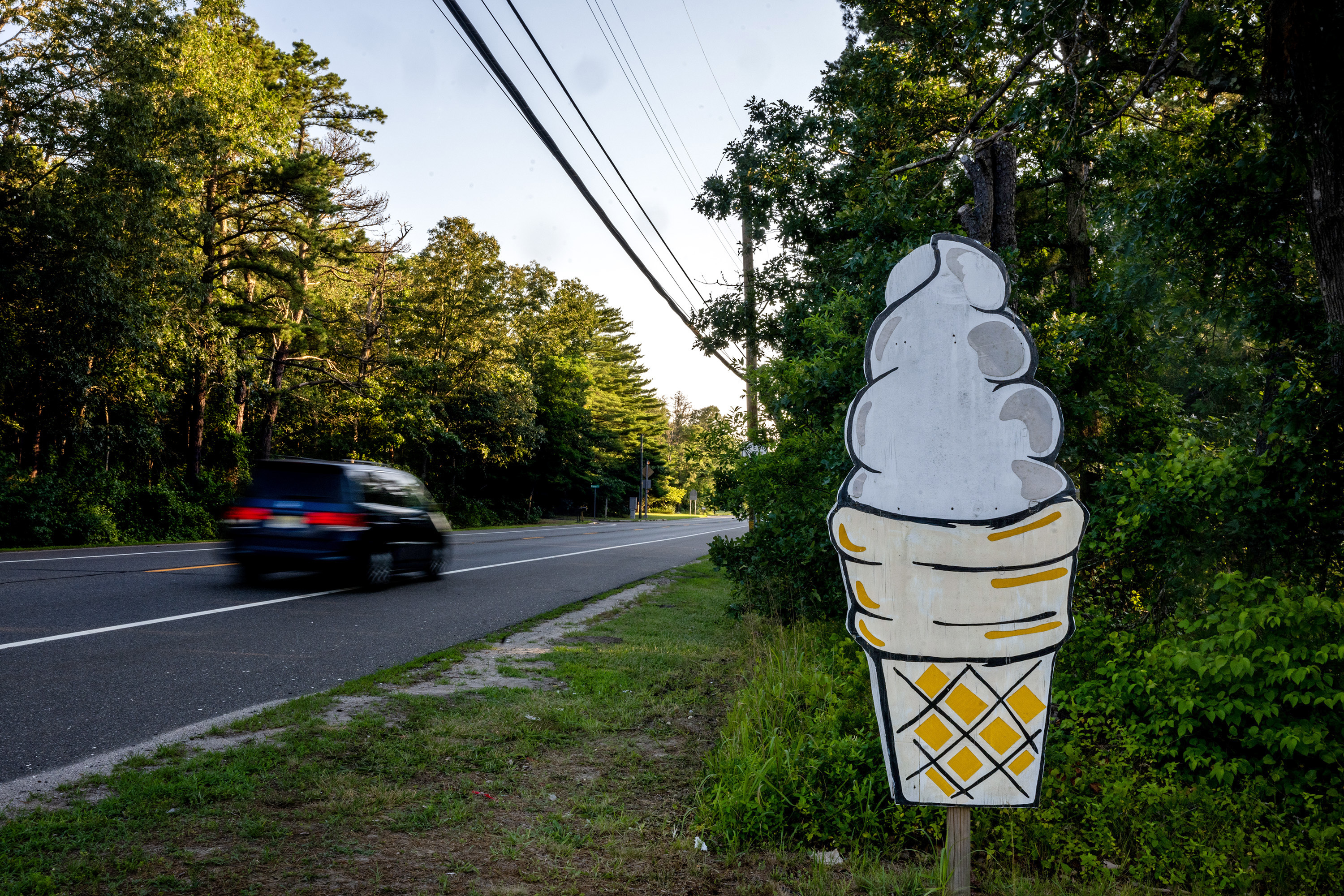
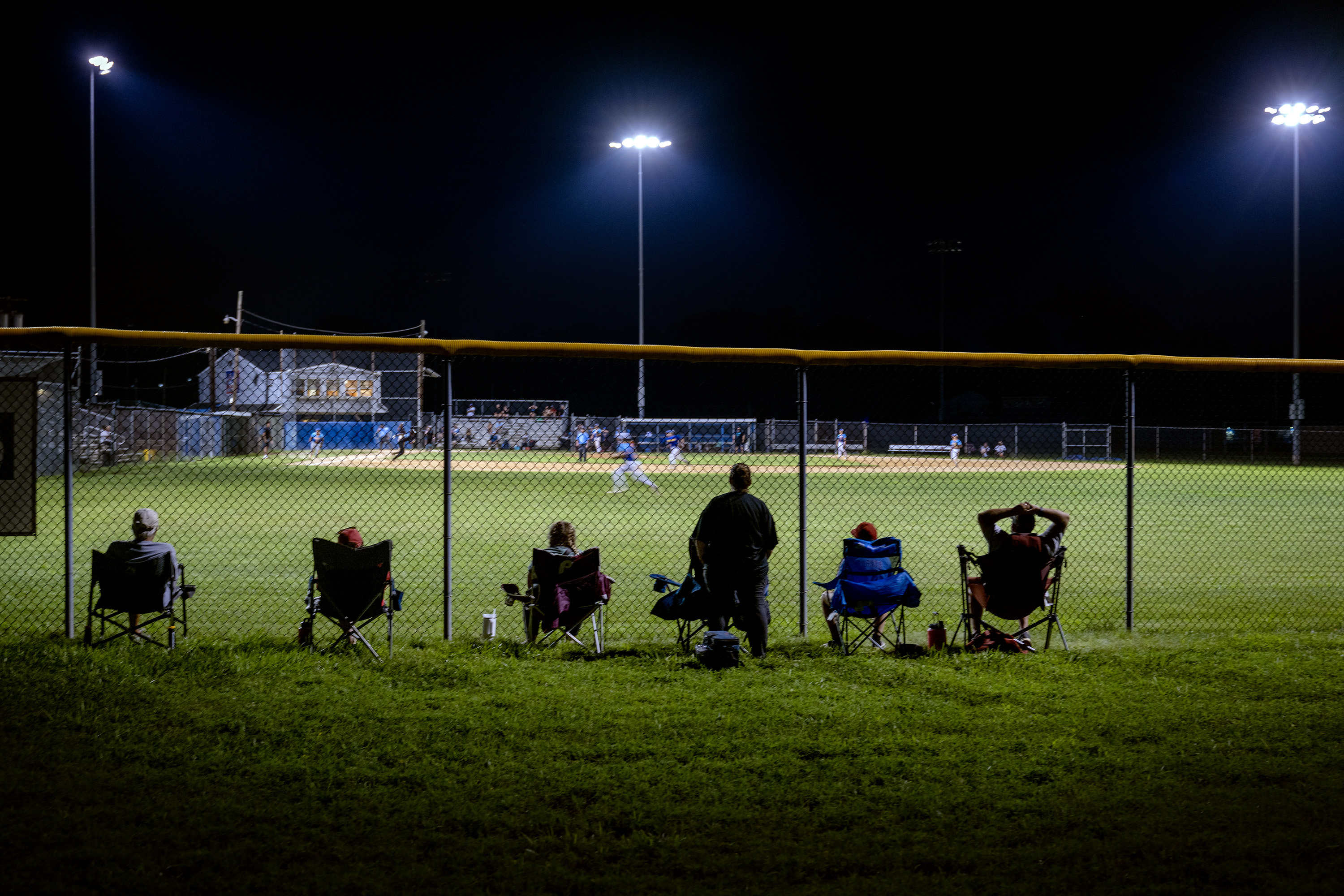
October 20, 2025:The yellow shipping container next to City Hall attracted a line of over 300 people that stretched around a corner of Dilworth Park. Bystanders wondered as they watched devotees reaching the front take their selfies inside a retro Philly diner-esque booth tableau. Followers on social media had been invited to “Climb on to immerse yourself in the worlds of Pleasing Fragrance, Big Lip, and exclusive treasures,” including a spin of the “Freebie Wheel,” for products of the unisex lifestyle brand Pleasing, created by former One Direction singer Harry Styles.October 11, 2025: Can you find the Phillie Phanatic, as he leaves a “Rally for Red October Bus Tour” stop in downtown Westmont, N.J. just before the start of the NLDS? There’s always next year and he’ll be back. The 2026 Spring Training schedule has yet to be announced by Major League Baseball, but Phillies pitchers and catchers generally first report to Clearwater, Florida in mid-February.October 6. 2025: Fluorescent orange safety cone, 28 in, Poly Ethylene. Right: Paint Torch (detail) Claes Oldenburg, 2011, Steel, Fiberglass Reinforced Plastic, Gelcoat and Polyurethane. (Gob of paint, 6 ft. Main sculpture, 51 ft.). Lenfest Plaza at the Pennsylvania Academy of the Fine Arts on North Broad Street, across from the Convention Center.September 29, 2025: A concerned resident who follows Bucks County politics, Kevin Puls records the scene before a campaign rally for State Treasurer Stacy Garrity, the GOP candidate for governor. His T-shirt is “personal clickbait” with a url to direct people to the website for The Travis Manion Foundation created to empower veterans and families of fallen heroes. The image on the shirts is of Greg Stocker, one of the hosts of Kayal and Company, “A fun and entertaining conservative spin on Politics, News, and Sports,” mornings on Talk Radio 1210 WPHT.September 22, 2025: A shadow is cast by “The Cock’s Comb,” created by Alexander “Sandy” Calder in 1960, is the first work seen by visitors arriving at Calder Gardens, the new sanctuary on the Ben Franklin Parkway. The indoor and outdoor spaces feature the mobiles, stabiles, and paintings of Calder, who was born in Philadelphia in 1898, the third generation of the family’s artistic legacy in the city.September 15, 2025: Department of Streets Director of Operations Thomas Buck leaves City Hall following a news conference marking the activation of Automated Speed Enforcement (ASE) cameras on the Broad Street corridor – one the city’s busiest and most dangerous roads. The speed limit on the street, also named PA Route 611, is 25 mph.September 8, 2025: Middle schoolers carry a boat to the water during their first outing in a learn-to-row program with the Cooper Junior Rowing Club, at the Camden County Boathouse on the Cooper River in Pennsauken. September 1, 2025: Trumpet player Rome Leone busks at City Hall’s Easr Portal. The Philadelphia native plays many instruments, including violin and piano, which he started playing when he was 3 years old. He tells those who stop to talk that his grandfather played with Billie Holiday, Duke Ellington, Nina Simone, and Dizzy Gillespie. August 25, 2025: Bicycling along on East Market Street.August 18, 2025: Just passing through Center City; another extraterrestrial among us. August 11, 2025: Chris Brown stows away Tongue, the mascot for a new hard iced tea brand, after wearing the lemon costume on a marketing stroll through the Historic District. Trenton-based Crooked Tea is a zero-sugar alcoholic tea brand founded by the creator of Bai, the antioxidant-infused coconut-flavored water, and launched in April with former Eagles defensive end Brandon Graham as a partner.August 4,2025: Shanna Chandler and her daughters figure out their plans for a morning spent in Independence National Historical Park on the map in the Independence Visitor Center. The women (from left) Lora, 20; Shanna; Lenna, 17; and Indigo, 29, were stopping on their way home to Richmond, Virginia after vacationing in Maine. The last time they were all in Philadelphia Shanna was pregnant with Lenna. July 28, 2025: Louis-Amaury Beauchet, a professional bridge player from Brittany, France, takes a break between game sessions in an empty ballroom during the North American Bridge Championships at the Center City Marriott with some 4000 people in town over week of the tournament. The American Contract Bridge League is hosting the week of meetings and tournaments with bridge players from all over the world. The ACBL is the largest bridge organization in North America, with over 120,000 members (down from around 165,000 before COVID). Bridge draws players of all ages and walks of life – fictional characters James Bond and Snoopy both played as do billionaires Bill Gates and Warren Buffett (who sometimes play as partners).July 21, 2015: Signage for the Kustard Korner in Egg Harbor City, on the way to the Jersey Shore. President Ronald Reagan designated July as National Ice Cream Month and the third Sunday of the month.July 14, 2025: Fans watch a game at the Maple Shade Babe Ruth Field, part of the 20th Annual Franny Friel Summer Classic, on a cool(er) night with a refreshing breeze, the weekend before the MLB All-Star Game (with Kyle Schwarber the lone Phillies representative).
Philly’s favorite running path is at it again. A “chasm”-sized sinkhole has swallowed part of the Schuylkill River Trail between Race and JFK — big enough, officials say, that you could almost park a car in it. (“Almost” feels like a challenge.)
The Schuylkill Banks crew fenced it off and called in Parks & Rec, the Water Department, and engineers — basically the full Avengers lineup of Philly infrastructure — to figure out what caused the hole and how to patch it before joggers start treating it like a new obstacle course.
The Schuylkill Trail might be cursed. Every year it’s something — floods, fallen trees, now this. Until it’s fixed, cyclists and runners are being detoured, which in Philly terms means “good luck.”
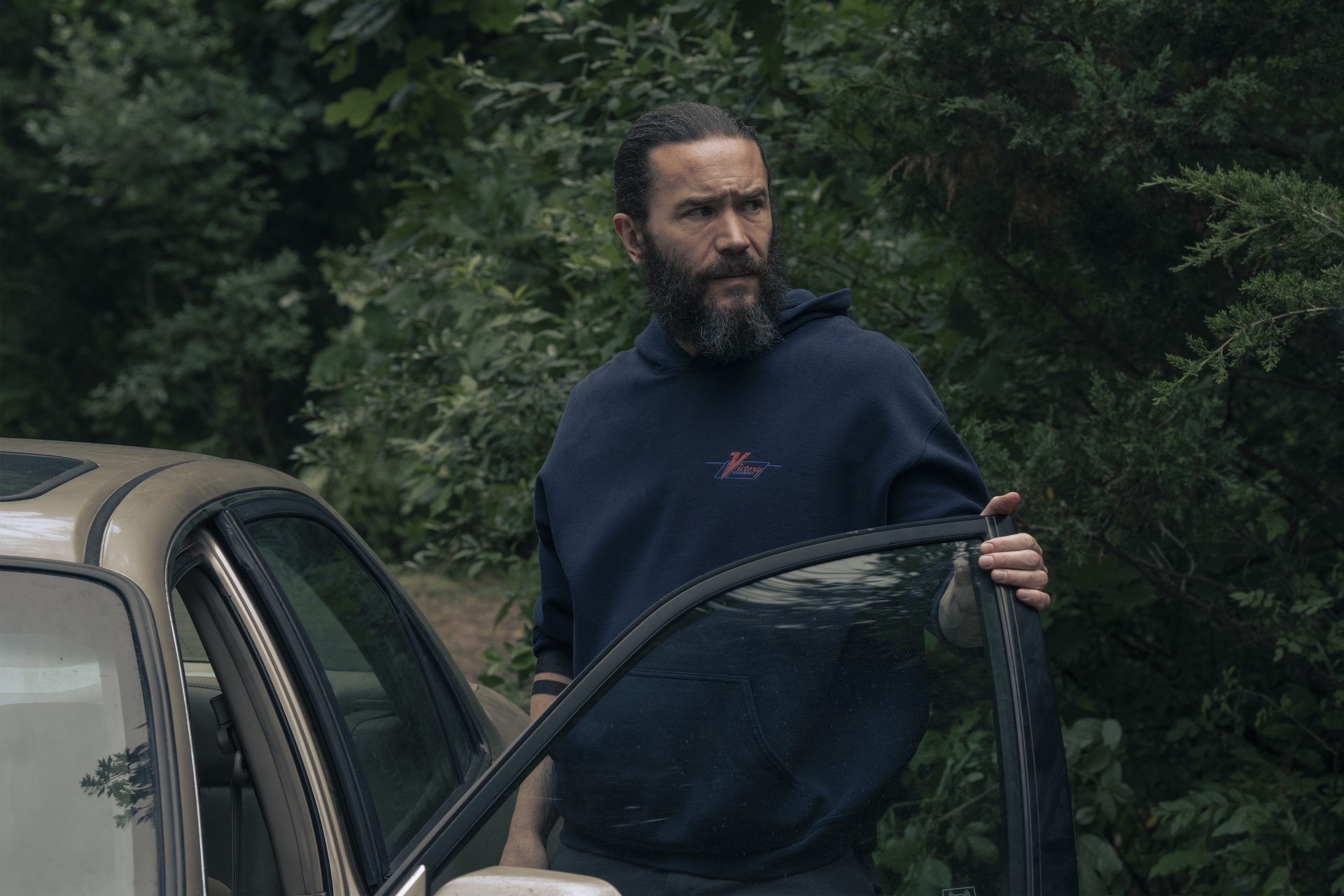
In Task, Robbie (Tom Pelphrey) uses Sixpenny Creek Quarry as a meeting place.
Delco goes “rural”…at least according to the NYT — C-
Somehow, the New York Times looked at Delco — home of Villanova, Swarthmore, and approximately 47 Wawas — and decided, “Ah yes, rural America.” Because nothing says “farm country” like the Blue Route at rush hour and a Target every three miles.
To be fair, Task creator Brad Ingelsby does paint parts of Delco as working-class, gritty, and hollowed-out, which, yeah, that’s real. But “rural”? Come on. The county has fewer farms than vape shops. The only livestock most Delco residents see are on a roast pork sandwich.
Still, the show does get something right: that weird in-between space so many towns around Philly live in — not city, not country, just post-industrial limbo where people are hustling to hang on. It’s not the backwoods. It’s just… us. Blue-collar, blunt, and way too online to ever be called rural again.
Philly’s 52-week flex — A-
For America’s 250th, Philly’s not settling for a parade — we’re throwing a 52-week-long brag about how we basically invented everything. Every week in 2026 will spotlight something that started here: the first hospital, zoo, flag, computer, hot-air balloon, even the penitentiary (because nothing says “city of firsts” like also being the first to lock people up).
It’s peak Philly — proud, weird, and wildly specific. Some of these firsts are legitimately world-changing (first medical school, first abolitionist society), while others are pure “only in Philly” energy (first Slinky, first ice-cream soda). The lineup’s got range. We went from inventing democracy to inventing dessert.
The ‘Six-Seven’ confusion — C-
Philly might’ve given the world democracy, the cheesesteak, and now… “six-seven,” a phrase that means absolutely nothing and somehow everything to a generation of teens who can’t stop saying it. It possibly started with Kensington rapper Skrilla’s song “Doot Doot (6 7)” and spiraled into TikToks, classrooms, and apparently South Park.
It’s not code, it’s not deep — it’s just two numbers. Maybe it’s a street, maybe it’s a mindset, maybe it’s proof that the internet’s broken our brains. Teachers hate it, parents are confused, and kids are out here saying “six-seven” like it’s a personality trait.
Still, if you hear it echoing down Broad Street, just nod and say it back. Six-seven. Whatever that means.
Philly drama doesn’t get juicier than this. Someone plastered a flyer around Fishtown calling out Two Robbers for serving a sad, gray burger — complete with a date stamp and the caption, “This is literally the burger that came out.”Reddit, of course, lost its mind.
Comments ranged from pure joy (“I f***in love love love this level of petty”) to the perfectly Philly (“This is what you get for ordering a burger at a craft seltzeria”). One guy even chimed in with, “They got robbed — by two robbers.” Another declared the poster was “doing the Lord’s work.”
But plot twist: the burger wasn’t theirs. The photo was actually from 9GAG, posted seven years ago under the title “Nasty Burger.” The owner jumped into Reddit like a man defending his honor, posting receipts side-by-side — the fake, the meme, and their actual burger, which, to be fair, looks great — and calling the whole stunt “diabolical.”
Now the thread’s full of conspiracy theories that the whole thing was a genius marketing stunt (“If it is, it worked on me”) and locals promising to stop by just to try the burger. So whether this was sabotage, performance art, or Philly’s pettiest PR move — Burgergate proves one thing: in this town, we don’t do calm, we do chaos. And we’ll probably Yelp about it after.
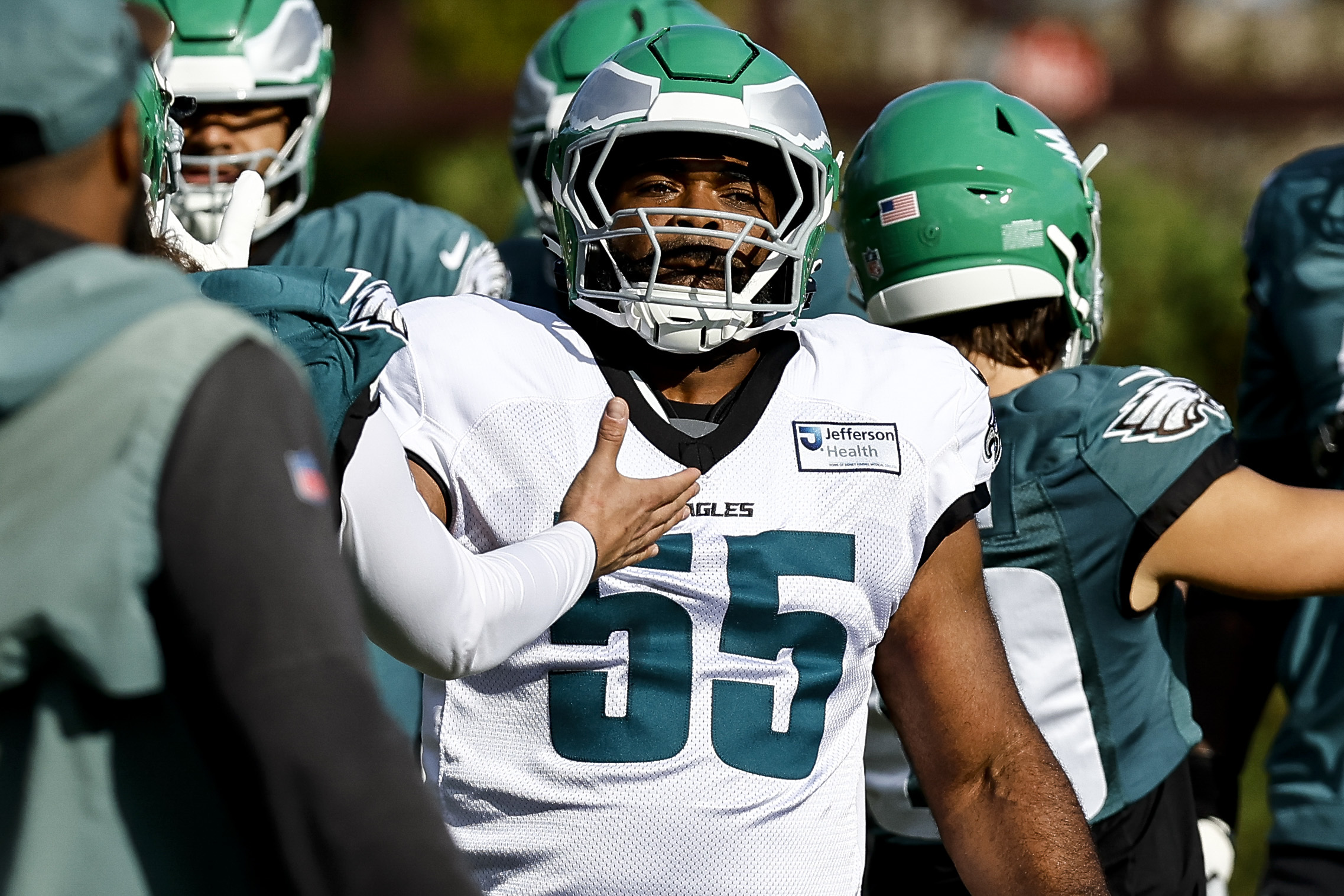
Philadelphia Eagles defensive end Brandon Graham during practice at the NovaCare Complex on Wednesday, Oct. 22, 2025 in Philadelphia.
Brandon Graham’s encore — A+
Philly’s loudest legend just couldn’t stay away. After seven whole months of “retirement,” Brandon Graham is back in midnight green for his 16th season, saying he’s still got “juice left.” The Eagles desperately needed both sacks and smiles, and no one brings either like BG.
At 37, rookies call him “the OG,” veterans call him the engine, and everyone calls him the guy who won’t stop talking in practice. “You thought you wasn’t gonna have to deal with me?” he said on his podcast. That’s the guy who strip-sacked Brady — not a man easing into retirement.
And honestly? The timing couldn’t be better. Missed tackles, blown assignments, no spark — the Eagles’ defense has been ugly. BG can’t fix everything, but he can sure as hell remind the Birds what fight looks like.
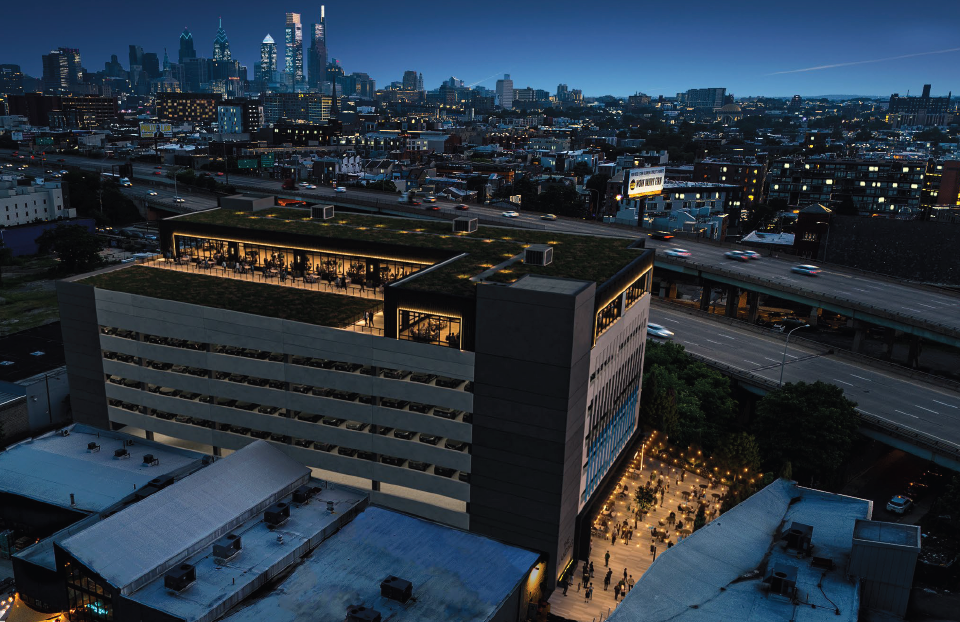
A rendering of the garage planned for Fishtown, looking west towards Center City.
Philly’s year of the parking garage — D+
In a city that loves to say it’s all about bikes, buses, and tree-lined streets, somehow 2025 has turned into the Year of the Parking Garage. Three new standalone garages are in the works — in Fishtown, University City, and Grays Ferry — because apparently we looked at the skyline and thought, “You know what’s missing? More concrete boxes for cars.”
Developers say people need somewhere to park near all the shiny new apartments, but urbanists are screaming into their reusable coffee cups. We’re talking a 1,000-car garage from CHOP (in a neighborhood already struggling with air quality), a 495-space one in University City (for a city lab and staff), and a Fishtown “garage-with-a-view” that’s trying to make rooftop parking sound sexy.
Parking pros say it’s a losing game — sky-high taxes, slim profits, and way too many empty spaces already. Even Parkway Corp. and E-Z Park, the kings of concrete, have looked at the numbers and said, “Good luck, you’ll need it.”
It’s the most Philly thing ever: everyone agrees it’s a bad idea, but someone’s still building it.
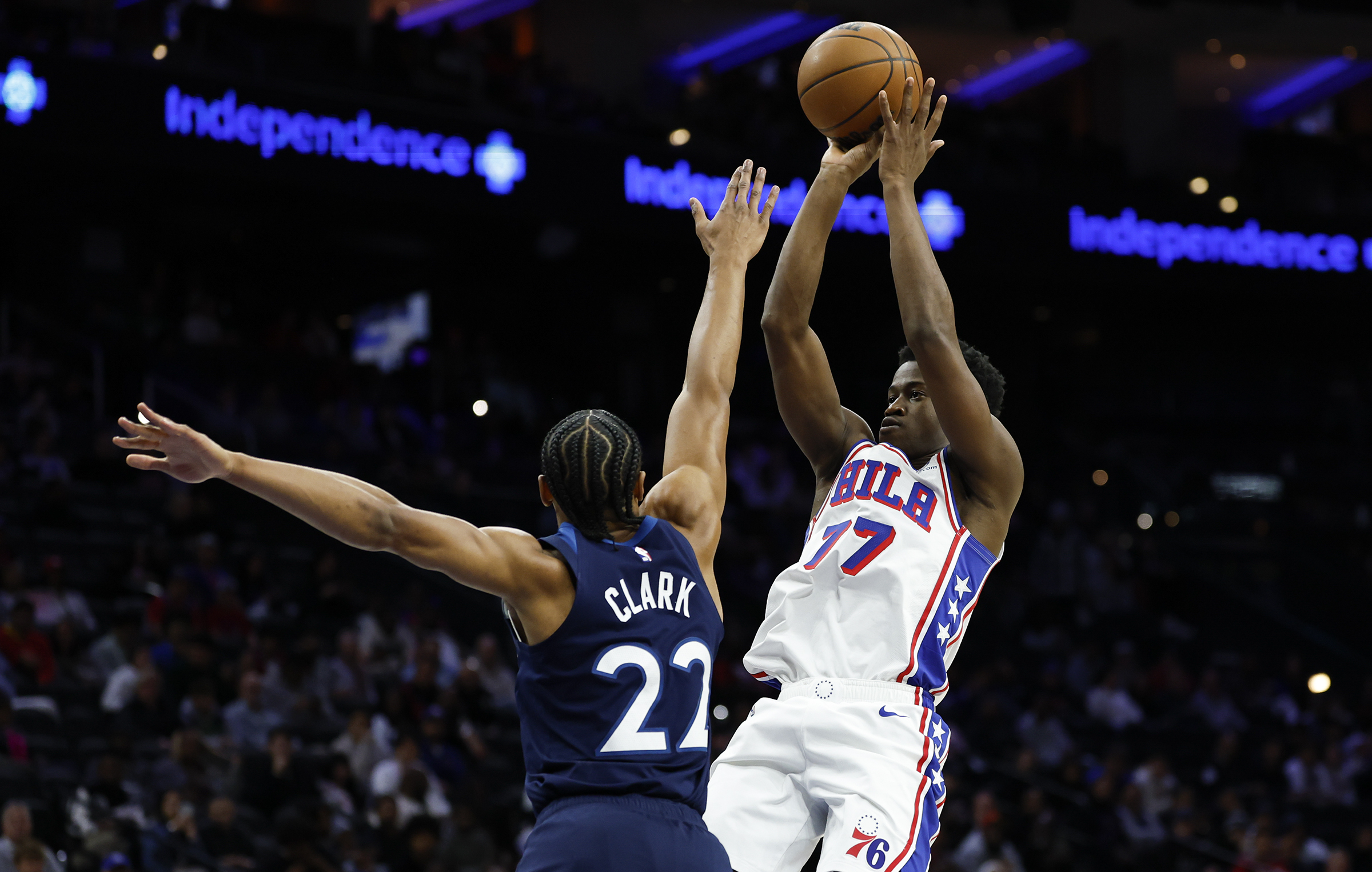
Sixers guard VJ Edgecombe shoots the basketball against Minnesota Timberwolves guard Jaylen Clark during a preseason game on Friday, Oct. 17, 2025 in Philadelphia.
Sixers start with a spark — B
Nobody in Philly was expecting the Sixers to look this good out the gate. Rookie VJ Edgecombe dropped 34 points in his debut — the third-highest in NBA history — and helped the Sixers steal a 117-116 win over the Celtics. That’s right: Wilt, LeBron, and now a 20-year-old kid who apparently sleeps like a baby before facing Boston in the Garden.
Edgecombe didn’t just show up — he looked like he’d been here for years. Calm, confident, and already saying the kind of humble stuff that makes you want to buy his jersey before Christmas. Tyrese Maxey poured in 40, and even his gentle clowning (“77 definitely got scared at the free-throw line”) couldn’t hide the fact that Philly might actually have a backcourt worth believing in.
It’s still early, but this team has something it hasn’t had in forever: fun. For once, the Sixers aren’t pretending to be contenders — they’re just hooping. No melodrama, no birthday banners about Daryl Morey being a liar, no Teletubby coats. Just fast breaks, fresh legs, and a rookie who already has his name next to Wilt’s.
We’ve been hurt before, so no one’s saying “This is the year.” But after one game, it’s hard not to feel a little something.
The University of Pennsylvania on Friday afternoon released the letter that President J. Larry Jameson sent to the U.S. Department of Education last week, explaining why the school rejected the compact proposed by President Donald Trump’s administration.
“Our university policies and practices are already aligned with many of the core principles of the Compact…” Jameson wrote. But “we find that significant portions of the Compact and its overarching framing would undermine Penn’s ability to advance our mission and the nation’s interests.”
The “Compact for Academic Excellence in Higher Education” was the latest attempt by the Trump administration to force changes in the way universities operate as the president tries to reshape higher education to match his vision. It offered colleges that sign preferential consideration for federal funding. It’s still not clear what penalty, if any, Penn — which receives about $1 billion annually in federal funding — will face for not signing.
“Institutions of higher education are free to develop models and values other than [those in the compact], if the institution elects to forego federal benefits,” the compact states.
Penn last week declined to release its letter, but Jameson in a message to the campus community Friday afternoon said “in the spirit of transparency” he would share it. He said he’d received many requests for its release.
The university has not had further discussions with the government since rejecting the compact, Jameson said, noting “we believe there remains opportunity to advance the long-standing relationship between American higher education and the federal government which has greatly benefited our community, nation and world.”
But he also was clear that Penn’s greatest partnership is with the public.
“America’s great universities already have a compact with the American people,” he said. “It is built on the open exchange of ideas, merit-based selection and achievement, and freedom of inquiry to yield knowledge. It affirms that knowledge should serve the public good, that education should remain a ladder of opportunity, and that discovery should make life better, richer, and freer.”
Jameson highlighted seven areas where he said Penn and the compact appear to be in alignment and five areas that pose concerns.
Areas of agreement include hiring and promotion standards and “merit based admissions” that comply with the law, including the 2023 U.S. Supreme Court decision that banned the use of race-based admission, Jameson said. The university also has reinstituted a standardized test score requirement for admission; Penn like many others had paused the requirement during the pandemic. And, its undergraduate student body is 13% international, Jameson said. That’s under the 15% mark that the compact would require.
Penn also is in compliance with federal foreign gift regulations and has “viewpoint-neutral rules” governing protests and expression, he said.
The university last year adopted an “institutional neutrality” policy, which states that the school will no longer make statements about world events unless they have a direct effect on Penn’s operations; the compact calls for schools to adhere to institutional neutrality.
While the university hasn’t agreed to freezing tuition for five years as the compact asks, the school has taken steps to make education more affordable, Jameson said, noting that its aid is all grants and no loans and is need based. Nearly half its students receive aid, he said.
And, Jameson said, Penn officials “share concerns about grade inflation and believe there may be an opportunity to engage the higher education community to seek a broader solution.”
But Penn objects to federal funding being meted out based on signing a compact, Jameson said.
“Research and our nation are better served by competition that rewards promise and performance,” he said. “Penn seeks no special consideration beyond fair and merit-based funding.”
The compact fails to promise or even mention academic freedom, which is “the bedrock of our national system of higher education,” Jameson said. It seeks to protect conservative thought alone, he said.
“One-sided conditions conflict with the viewpoint diversity and freedom of expression that are central to how universities contribute to democracy and to society,” Jameson wrote.
He also objected to the compact mandating free tuition to students in the “hard sciences.”
“We celebrate the sciences,” Jameson wrote. “However, we focus our financial aid efforts on those who cannot afford to pay, ensuring that a Penn education is accessible to those who are offered admission.”
Jameson also called out the compact’s financial penalties for failing to comply “based on subjective standards and undefined processes.” That could endanger teaching and research, he said.
“Universities must be accountable for their actions,” he wrote. “We believe that existing laws and policies suffice to achieve compliance and accountability.”
Many groups on campus had spoken out against the compact and were watching closely, given that the university had struck an agreement with the Education Department in July over the participation of a transgender athlete on the women’s swim team.
Penn’s announcement that it would reject the compact brought praise from local and state officials, including Democratic Gov. Josh Shapiro.
FBI Director Kash Patel visited Philadelphia Friday to announce the results of a large-scale investigation into a Kensington-based drug gang — the latest demonstration of how President Donald Trump’s administration is seeking to highlight what it’s called a nationwide crackdown against suspected drug dealers.
The target of the investigation — which spanned several years — was a gang that had long run a 24-hour open-air drug market on the 3100 block of Weymouth Street, according to court documents. The group was sophisticated, the documents said, with dozens of members working specific schedules, performing specific roles — such as block owner, street dealer, or lookout — and seeking to control territory with the threat of violence.
Members dealt drugs including fentanyl, heroin, cocaine, and crack, the documents said, and oversaw “one of the most prolific drug blocks in the city.” They also controlled parts of other nearby streets in a neighborhood where single corners have historically been able to generate tens of millions of dollars per year in drug sales.
Prosecutors indicted 33 people in all, court records show, including Jose Antonio Morales Nieves and Ramon Roman-Montanez, whom they described as two of the group’s leaders. Most defendants were charged with conspiracy to distribute controlled substances or other drug-related crimes.
Moralez Nieves “owned” the 3100 block of Weymouth, prosecutors said, and let dealers sell there by paying him “rent.” Roman-Montanez, meanwhile, organized street-level operations — developing schedules, doling out roles, and managing profits.
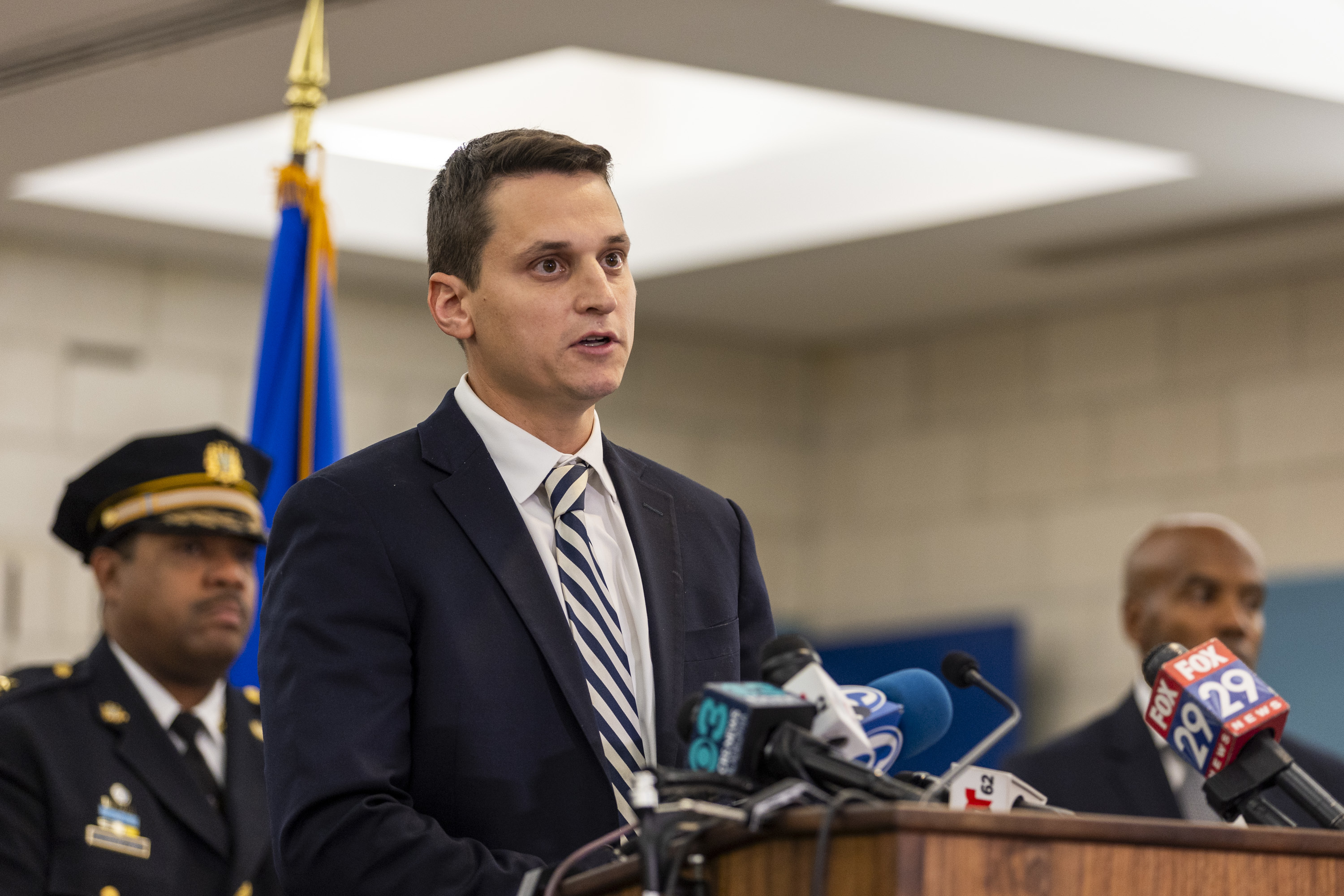
U.S. Attorney David Metcalf said the investigation into the Weymouth Street group would effectively eliminate it.
U.S. Attorney David Metcalf said more defendants were indicted in this case than any other federal prosecution in the Philadelphia region in a quarter-century.
And although prosecutors did not estimate how much money the group made during its decade-long run on the block — and none of its members were officially charged with committing acts of violence — Metcalf said the arrests nonetheless “annihilated” a gang that had terrorized a long-suffering part of Kensington.
Patel said the effort was emblematic of how law enforcement — both local and federal — can work together to address chronic issues including drug dealing and gun violence.
“Everyone in America should be looking at this takedown,” Patel said “This takedown is how you safeguard American cities from coast to coast.”
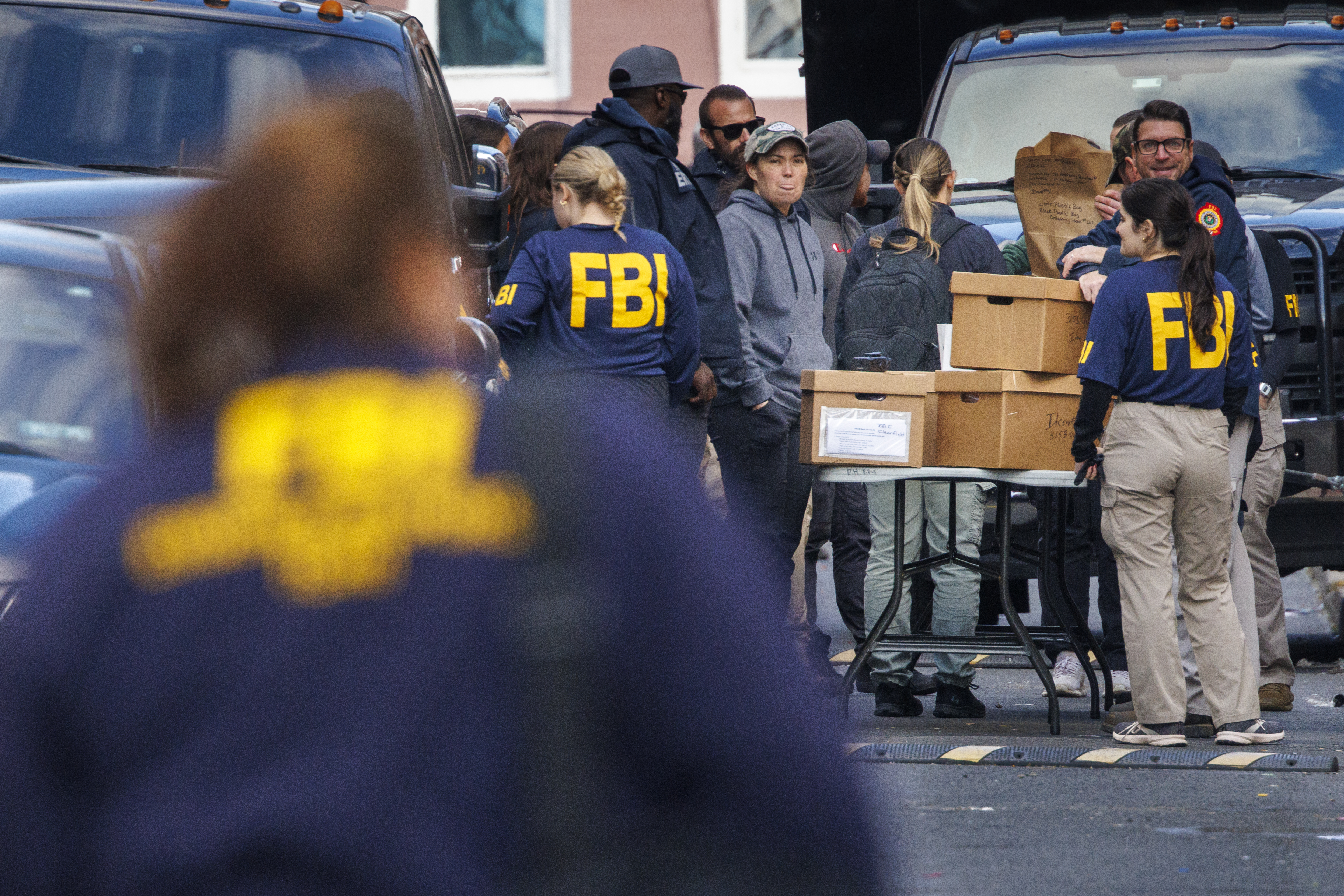
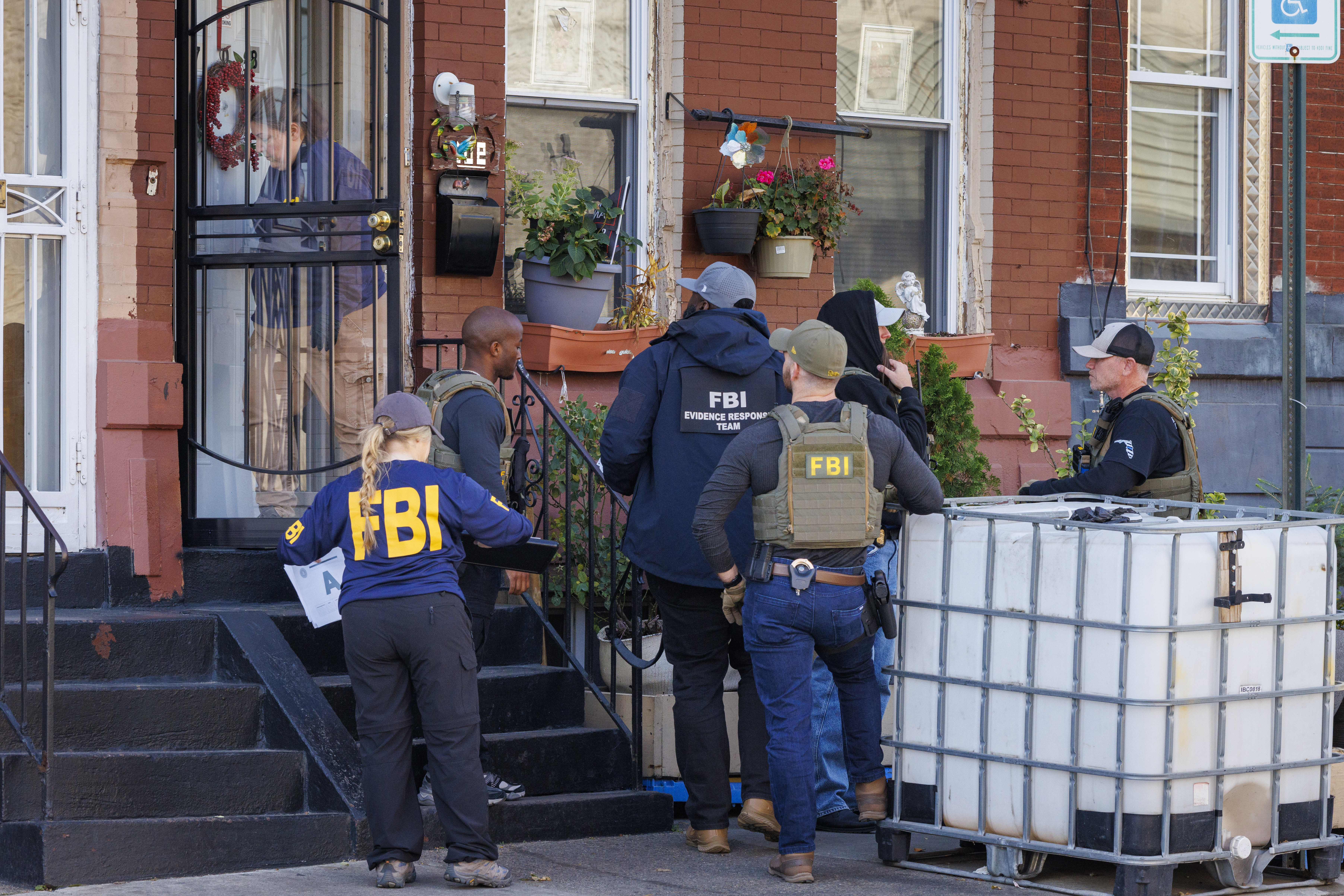
Law enforcement and FBI at Weymouth Street between Clearfield and Allegheny Avenue on Friday, October 24, 2025.
FBI agents and Philadelphia police officers conducted a series of raids in Kensington early Friday morning in support of the initiative. Wayne Jacobs, the FBI’s top official in Philadelphia, said agents served 11 search warrants, and that 30 of the 33 defendants were in custody as of Friday afternoon.
Philadelphia Police Commissioner Kevin Bethel said he was proud that the arrests might help bring “safety, dignity and peace” to Kensington — a neighborhood that Mayor Cherelle L. Parker’s administration has sought to prioritize throughout her two years in office, nearly tripling the police force in the neighborhood.
While officials acknowledged that the investigation began several years ago, the results nonetheless came as Trump and some of his top cabinet officials — including Patel, Attorney General Pam Bondi, and Defense Secretary Pete Hegseth — have sought in recent weeks to promote what they’ve cast as a concerted effort to address crime across the country, particularly involving suspected drug traffickers.
Some of the Trump administration’s initiatives have been relatively conventional, such as Friday’s raids in Philadelphia and other recent takedowns in cities such as Milwaukee and Pittsburgh.
Trump and Patel have also touted the FBI’s arrest numbers this year, saying they are “working non-stop to make America safe again.”
Dan Bongino, one of Patel’s top deputies at the FBI, said Friday that the Philadelphia arrests were part of that mission, writing on social media: “When President Trump told us to ‘go get em,’ he wasn’t kidding. And neither were we.”
FBI agents were on the 700 block of East Clearfield near Weymouth Street on Friday morning.
Still, other aspects of the campaign have been highly controversial, including Trump seeking to deploy federal troops to cities such as Chicago and Portland in response to what he’s called widespread unrest or clashes between protesters and U.S. Immigration and Customs Enforcement agents. Local officials have described Trump’s efforts as unnecessary and challenged them in court.
Trump also moved to effectively federalize law enforcement in Washington, D.C., an effort that local officials called a “baseless power grab” in a lawsuit.
And international tensions have started to rise over the military’s continued bombing of alleged drug-carrying boats in the Caribbean Sea and Pacific Ocean — strikes that have killed dozens of people and raised questions about whether the tactic is legal.
Around Weymouth Street on Friday, SWAT units had dispersed by noon. Residents by then had gathered in the street along the narrow block, where some rowhouse doors were left ajar and several neighbors peered curiously from upper windows.
Victor Ramirez, who has lived near Weymouth Street for 20 years, said police activity has become more common in the area in recent months.
“It’s a different story almost every day,” Ramirez said outside his home.
Ramirez said increased law enforcement activity has frightened his neighbors. He said most are “good people” who work to feed their families. Still, Ramirez said he feels more safe with the increased attention to crime in the neighborhood.
The FBI raid Friday morning felt like a significant escalation, he said. Ramirez was surprised to see agents armed with assault rifles hopping out of armored cars and making arrests.
The raid came on the day of a fall block party on Allegheny Avenue, which stretched between F and G Streets and intersected with neighboring Weymouth Street. The event is popular with local children, Ramirez said, and he hoped it would bring positive energy to a block that experienced an unusual morning.
Philly-raised rapper Armani White is pushing back on the media coverage of his arrest earlier this month.
White, 29, born Enoch Armani Tolbert, was arrested for disorderly conduct on Oct. 12 after police found the artist and members of his tour bus filming a music video on I-75 in Newport, Ky.
TMZ covered the arrest, releasing Tolbert’s mug shot and police bodycam footage of the arrest, as well as remarking on the nature of his hair in the mug shot.
“My father didn’t raise me to be a criminal. My grandfather didn’t raise me to be a criminal. The only reason why I smiled in that mug shot is because I refuse to let anybody paint a picture of me as a criminal on TV, on the internet, anywhere,” White said to a packed crowd in Birmingham, Ala., last weekend.
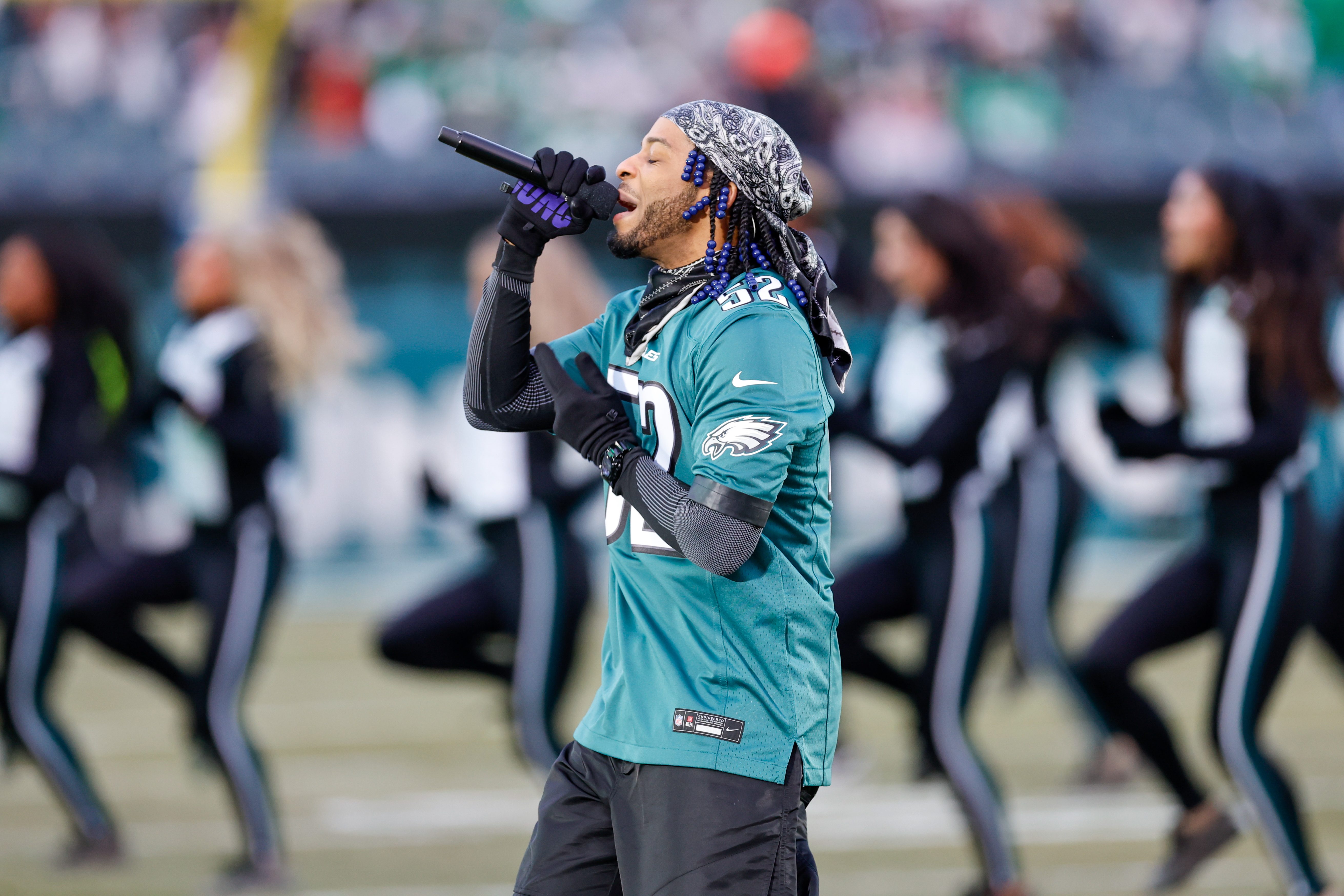
Armani White performs during the NFC Championship show as the Eagles face the Commanders Sunday, Jan. 26, 2025, in Philadelphia.
Tolbert was in Kentucky as part of a nationwide tour alongside Grammy-award-winning singer T-Pain when his tour bus stopped on the interstate to film a music video. White did not respond to a request for comment.
According to a police citation, the police were called to the highway after reports of people running on the road. When they arrived, police reportedly found White dancing on the concrete median of the interstate.
White grew to international fame in 2022 after his bass-bumping, Neptunes-sampled track “BILLIE EILISH” birthed a viral TikTok challenge reaching millions. White later joined the track’s namesake, Billie Eilish, the 23-year-old Grammy and Oscar award-winning singer, to perform the song together in 2023.
Rapping since the 2010s, White grew an underground following before joining the lineup of Jay-Z’s Made In America festival in 2018, which he had been attending as a fan before hitting the stage. Earlier this year, White performed his first NFL halftime show during the NFC championship, with the Philadelphia Eagles against the Washington Commanders.
White released his debut album, Keep In Touch, in 2019, followed by the EP, Things We Lost in the Fire, referring to a house fire in which White lost family members at a young age.
This week, he released a music video for the single, “MOUNT PLEASANT.,” a teaser for what’s to come on the release of his next album on Oct. 31.
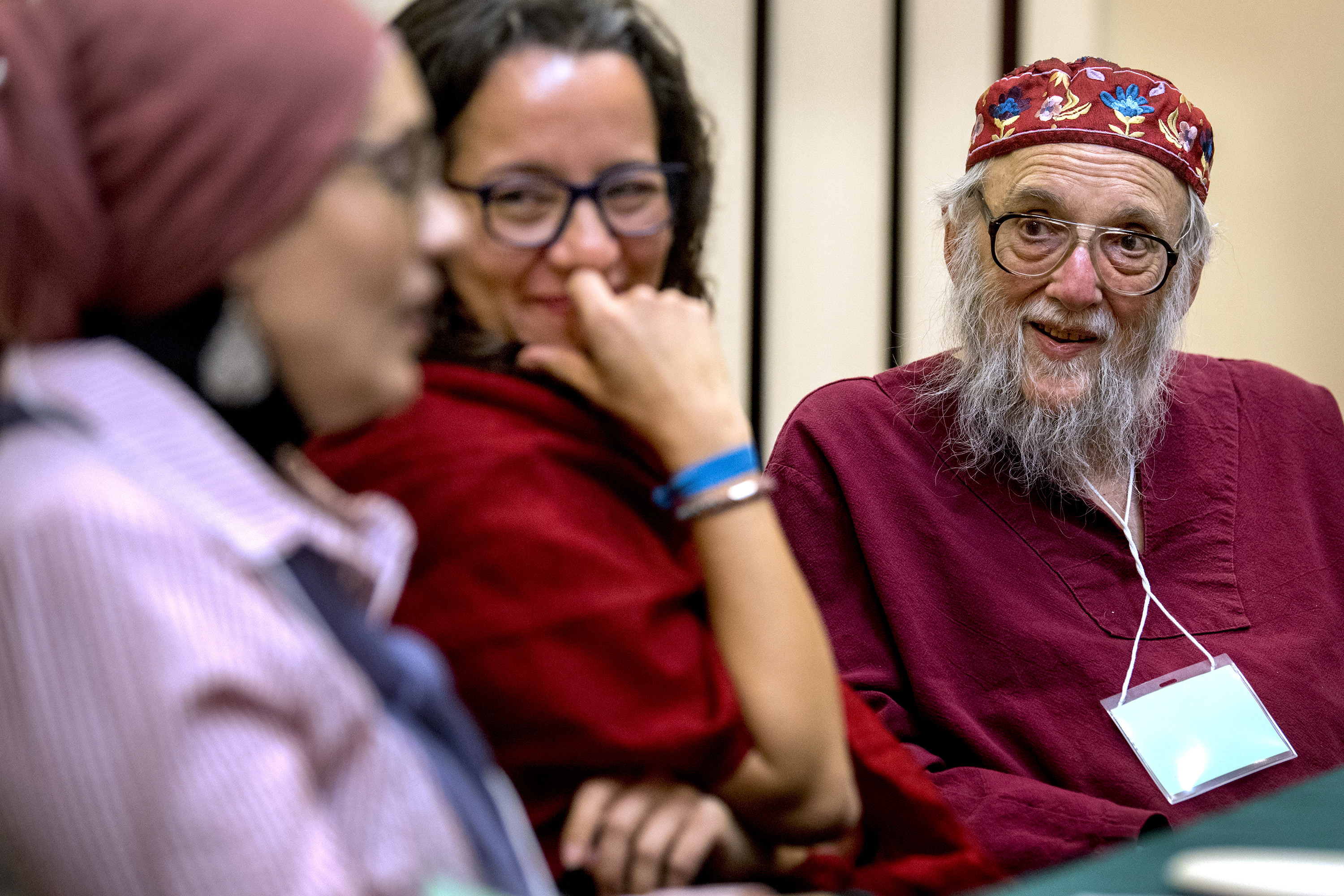
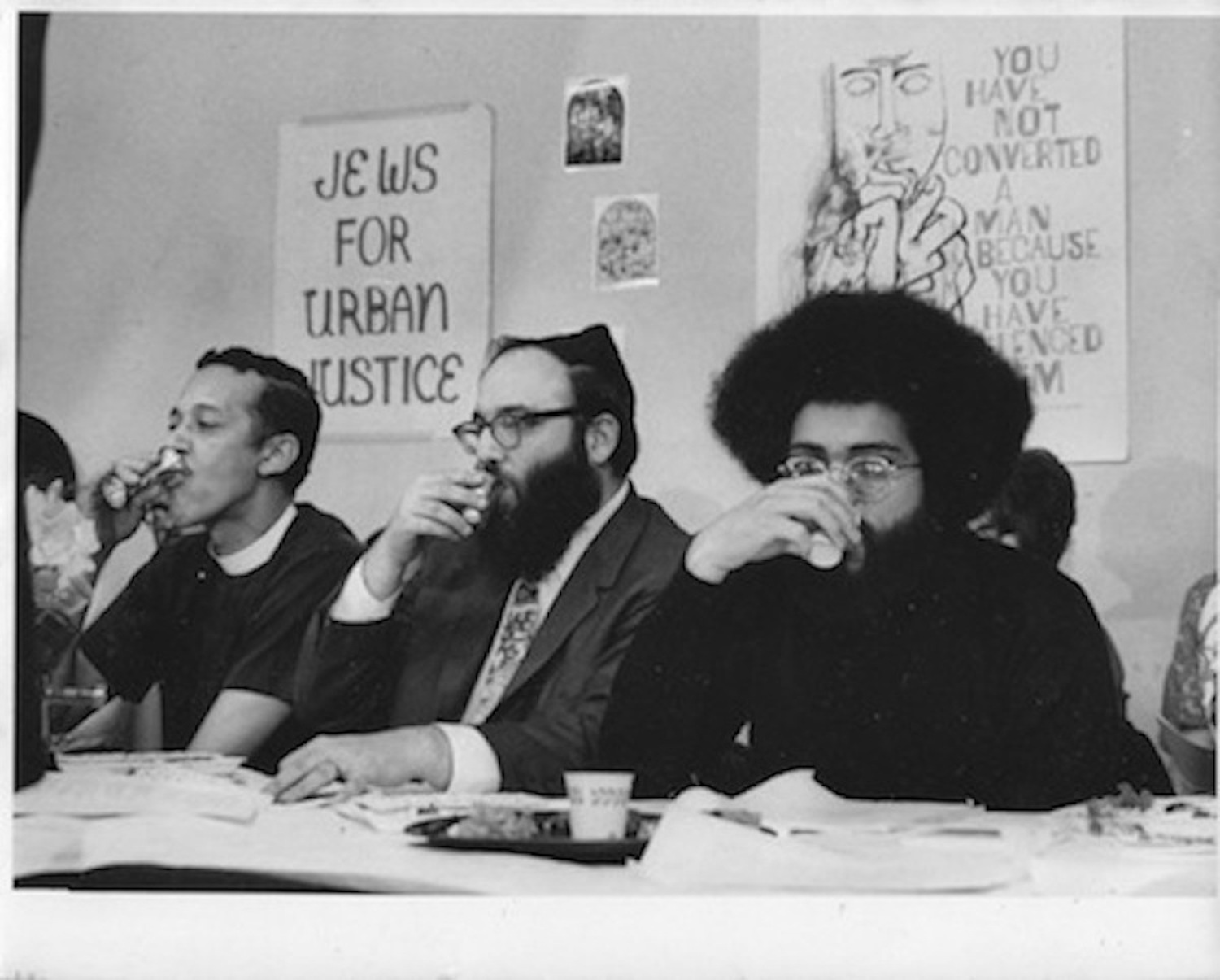
Arthur Waskow, 92, of Philadelphia, longtime social activist, pioneering Jewish scholar and rabbi, founder of the Shalom Center for public prophetic action, religion teacher, mentor, and prolific author, died Monday, Oct. 20, of chronic respiratory failure at his home in Mount Airy.
A longtime expert in Judaism, prophetic justice, and peaceful civil disobedience, Rabbi Waskow was so disturbed by the 1968 assassination of the Rev. Dr. Martin Luther King Jr. and the social unrest that followed that he protested, wrote about, and lectured around the country on what he called the “overwhelming crisis” of whether humanity will “build a decent society or will poison or burn it empty.”
For more than five decades, starting in Washington and then in Philadelphia, he connected contemporary social issues with Jewish traditions and championed prophetic justice regarding peace, nuclear disarmament, feminism, LGBTQ rights, same-sex marriage, environmental sustainability, and interfaith collaboration. “He consistently held that Judaism is not meant to stand above and apart from ordinary life, but rather to guide our actions in this life,” Rabbi Jill Jacobs said in a tribute.
Colleagues at the Shalom Center said he dramatically “fused social justice with traditional Jewish themes and spirituality.” Jacobs praised his “legacy of non-violent protest, his prophetic writing, and his courageous leadership.”
He established the Shalom Center for prophetic Judaism in Philadelphia in 1983, cofounded the Alliance for Jewish Renewal in 1993, and helped establish the National Havurah Committee, T’ruah: the Rabbinic Call for Human Rights, and other organizations. “He’s one of the most important figures to merge spirituality and politics since the 1960s,” Rabbi Tsvi Blanchard told The Inquirer in 2001. He “transcends categories and, as a result, he’s always crossing boundaries, but for good.”
Strategic action with compassion was usually his favorite tactic. He called his many disagreements with Jewish orthodoxy “a continuous loving debate” and told The Inquirer in 1970: “Jews have a radical role and mission to join with other communities to remake American society.” In 1993, he said: “In our generation, the people of the earth at last have to learn to share the great round earth or risk ruining it.”
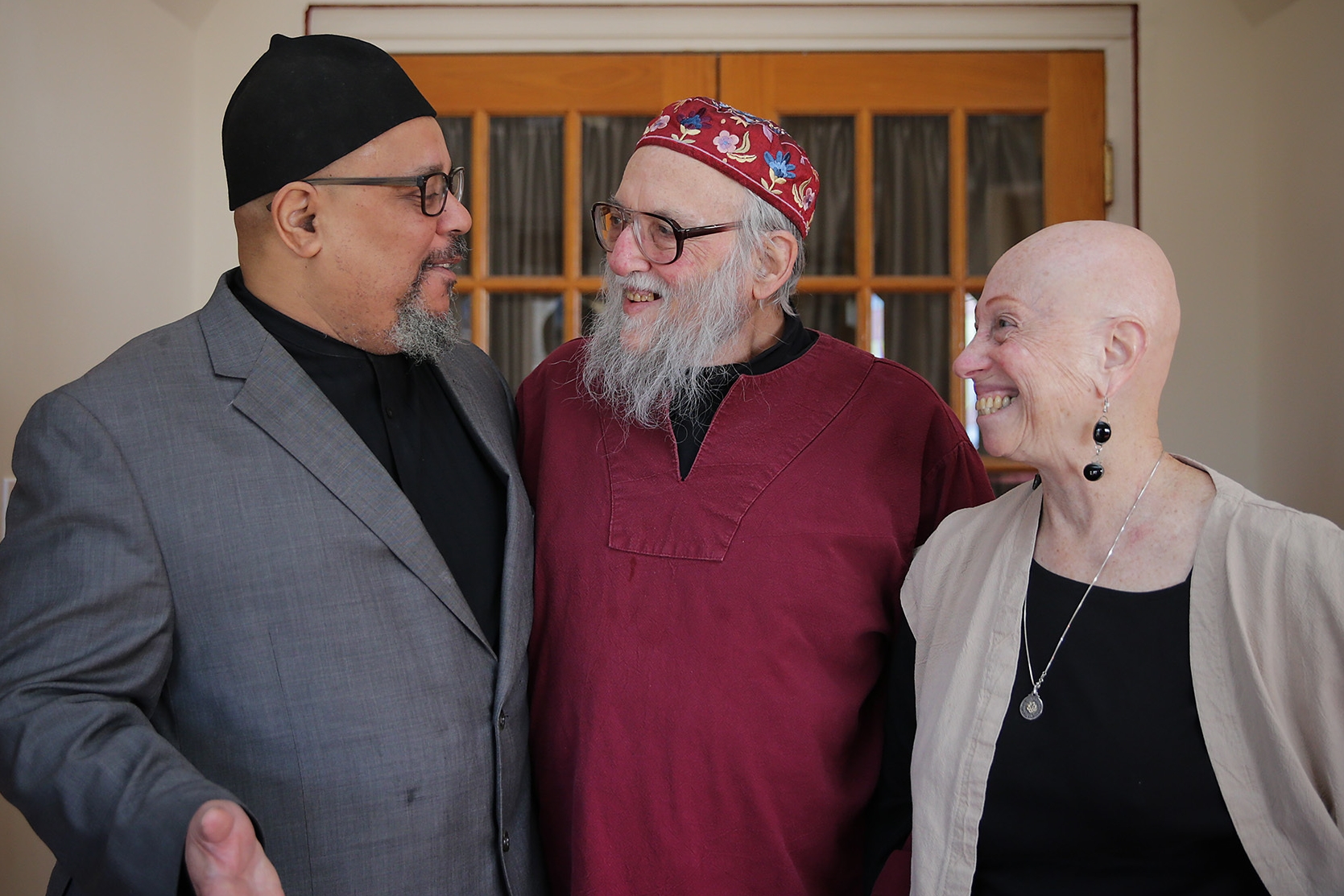
He worked closely on social projects with Sister Mary Scullion of Project HOME, Rabbi Leonard Gordon of the Germantown Jewish Centre, and Imam Abdul-Halim Hassan of the Masjidullah Community Center Mosque. His embrace of the Jewish Renewal movement drew critics, but he never wavered in his support.
“There’s an unpredictability to him, a drama to him, a charisma to him,” Rabbi Gordon said in 2001. “That is who he is and has to be in challenging the community. We would lose too much without it.”
Rabbi Waskow celebrated the 50th anniversary of his Freedom Seder in 2019.
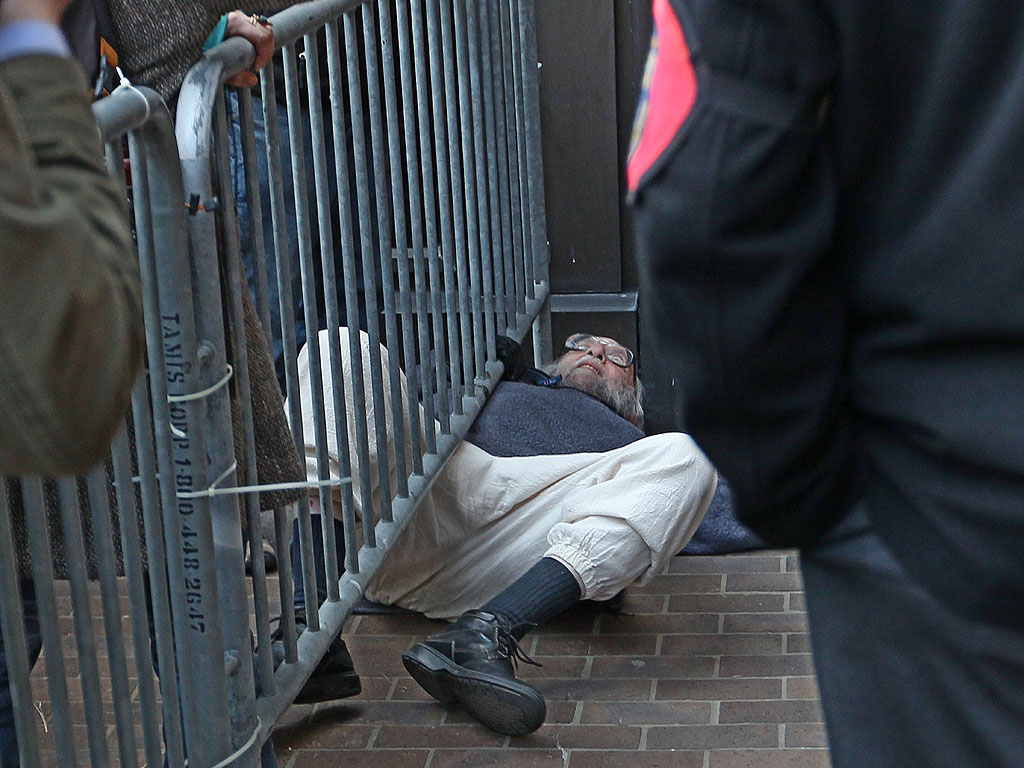
Rabbi Waskow was arrested dozens of times for peacefully protesting about segregation, immigration, and other issues. He wrote so many books he lost track of how many were published. “It’s either 19 or 20,” he told The Inquirer in 2007. “My wife said it’s the same number as the times I’ve been arrested.” He never retired.
He wrote and organized the first Freedom Seder in 1969 to recognize contemporary liberation efforts as well as the Exodus of the ancient Israelites. He was invited to President Clinton’s Middle East peace ceremony at the White House in 1993 and appeared in a TV ad in 2004 that denounced prisoner abuse in Iraq. “He found joy in reimagining Jewish holidays and prayers in ways that spoke to contemporary issues,” his family said in a tribute.
He came to Philadelphia from Washington in 1982 as a new faculty member at the Reconstructionist Rabbinical College and went on to teach religion at Swarthmore, Temple, Drew University in New Jersey, Vassar College in New York, and the Hebrew Union College-Jewish Institute of Religion in New York.
He wrote articles and op-eds for The Inquirer, Daily News, and other publications, and authored more than 25 books on all kinds of topics. His 1978 book Godwrestling and 1982’s Seasons of Our Joy are religious classics. In 1993, he wrote Becoming Brotherswith his younger brother, Howard.
Rabbi Waskow crawls under a barricade so he could get arrested at a protest in 2014.
Rabbi Waskow won many awards and was recognized for his leadership and lifetime achievements by the Jewish Peace Fellowship, Neighborhood Interfaith Movement, and other groups. Newsweek named him one of the fifty most influential American rabbis in 2007.
Recently, he focused on describing God in traditional ways with modern insights. “Watching your kids begin to parent feels like there is a spiral to life,” he said in 2001.
Arthur Irwin Waskow was born Oct. 12, 1933, in Baltimore. He was always an avid writer and reader, especially science fiction, and fascinated by words.
His father was a high school history teacher, and, with his help, Rabbi Waskow won a newspaper history contest that paid part of his college tuition. He earned a bachelor’s degree in history from Johns Hopkins University in 1954 and a doctorate in American history from the University of Wisconsin in 1963.
Rabbi Waskow (center) celebrates the first Freedom Seder in 1969.
He protested against the Vietnam War and other hot topics in the 1960s, and worked in Washington after college as an aide to U.S Rep. Robert Kastenmeier, and a fellow at the Institute for Policy Studies.
He married Irene Elkin, and they had a son, David, and a daughter, Shoshana. After a divorce, he met Rabbi Phyllis Berman at a conference, and they married in 1986, and both adopted the middle name Ocean.
Over the last 18 months, even though he couldn’t see, Rabbi Waskow wrote two more books. “He was very determined in the fullest sense of that,” his son said. His daughter said: “He was passionate about what he was passionate about.”
His wife said: “He was playful, brilliant, creative, and fierce. He was generous in every way.”
In addition to his wife, children, and former wife, Rabbi Waskow is survived by five grandchildren and other relatives. His brother died earlier.
Rabbi Waskow (center) talks with his wife, Phyllis, and Imam Abdul-Halim Hassan in 2019.
Services were held on Oct. 22.
Donations in his name may be made to the legacy fund at the Shalom Center, 6711 Lincoln Dr., Philadelphia, Pa. 19119.
Pennsylvania and New Jersey turnpike officials have settled on two alternative plans for replacing the Delaware River Bridge that has linked their toll roads for 70 years.
Traffic has mushroomed since the interchange with I-95 opened in 2018, and the four-lane span is often congested, along with highways and roads in Bucks and Burlington Counties.
“We have a lot more traffic here … and it will keep growing,” said engineer John Boyer, the Pennsylvania Turnpike Commission’s project manager. “We need additional capacity.”
Before the I-95 connection was finished, about 42,000 vehicles a day crossed the Delaware River Bridge. Now, that’s up to around 67,000. Average daily traffic is projected to be 90,000 vehicles by 2050.
What are the two ‘finalist’ options for a new bridge?
In one scenario, the new bridge would be constructed at once about 75 feet north of the existing span over four years. Pennsylvania- and New Jersey-bound lanes (six in all) would be built 15 feet apart. When finished, all traffic would be moved to the new bridge. The existing bridge would be removed.
The other option: constructing the new bridge in stages, about 40 feet north of the existing bridge — over eight years. Initially, the first half of the new span would go up. Then four lanes of traffic would be diverted to the new half while the old bridge is demolished, after which the second half of the new bridge would be built. When complete, there would be six traffic lanes.
What are the next steps?
Turnpike officials are preparing a new environmental impact statement, required for federal approval and funding. The 2003 version is outdated.
The plan is to unveil the site decision in the spring. Then would come final design and the rest of the bureaucratic steps in building transportation infrastructure.
Construction could start in 2031.
The final cost of the project has not yet been estimated, officials said, but it won’t be cheap.
What’s the history of the project?
Talk of fixing the crossing started more than 30 years ago, and by 2003, after exhaustive environmental impact and engineering studies, authorities proposed building a modern bridge alongside the old one, which would be refurbished.
Federal highway officials signed off, but it never came together.
In 2010, the Pennsylvania Turnpike Commission formally deferred the project “due to funding constraints,” spokesperson Marissa Orbanek said.
A crack in a steel truss supporting the bridge closed the span for six weeks in 2017 and rekindled the idea. Engineers combed through nine possible sites north and south of the bridge and decided to replace rather than refurbish the span, as first planned.
The Pennsylvania Turnpike Commission and New Jersey Turnpike Authority are working together on the project.
In addition, the turnpike prioritized the connection to I-95 and widening the roadway to accommodate the additional traffic, as well as other projects — including removal of toll booths and switching to gantries that charge drivers by reading an EZ-Pass or snapping a picture of a vehicle’s license plate.
Act 44 was a workaround for a state constitutional prohibition on the use of the gas tax for public transit and legislators’ reluctance to hike that tax for highways and bridges.
The turnpike would contribute $750 million a year to the Pennsylvania Department of Transportation, split evenly between transit and roads.
That formula was tweaked in 2013 with Act 89, which raised the gas tax to finance roads and bridges and cut the turnpike’s annual payment to $450 million — with all of it going to transit — through 2022.
The toll road’s obligation to PennDot then dropped to $22 million a year.
Will the Pa. Turnpike need to acquire properties? Where?
It’s too early to say. Officials working on the project said they would have a better idea after the final proposal is chosen, expected in spring 2026. The two northern options are seen as likely to have fewer impacts than other alternatives considered.
What about a shared-use path for bikers and walkers?
Pennsylvania Turnpike officials have ruled that out, citing regulations barring pedestrians or nonmotorized vehicles on turnpikes and interstates — the connector is part of I-95 — as well as future maintenance costs. Advocates still want access.
John Boyle, a staffer for the Bicycle Coalition of Greater Philadelphia, pointed to several toll bridges with free paths that accommodate cyclists and pedestrians.
The Great Egg Harbor Bridge on the tolled Garden State Parkway, for instance, has bike and pedestrian lanes.
And the Gordie Howe International Bridge, a toll facility between Detroit and Windsor, Ontario, nearing completion, will have separate shared-use lanes.
What considerations guide the choice?
Boyer said they boiled itdown to picking a site that would have the lowest negative impact on the built and natural environments.
“We’re looking at it from a 10,000-foot view in the entire corridor: commercial impacts, industrial impacts, residential impacts, and potential impacts to billboards or cell towers in the area,” Boyer said.
Think you know your news? There’s only one way to find out. Welcome back to our weekly News Quiz — a quick way to see if your reading habits are sinking in and to put your local news knowledge to the test.
Question 1 of 10
The jewel heist at the Louvre this week caused a stir, marking one of the highest-profile museum thefts in living memory. But Philly’s seen its own fair share of heists over the years. In 2017, a man attending a party at the Franklin Institute broke this body part off a life-size Chinese terracotta warrior statue.
CorrectIncorrect. XX% of other readers got this question right.
While attending an after-hours ugly sweater party at the Franklin Institute, Michael Rohana broke the thumb off the warrior statue. He described the incident as a “drunken mistake” and returned the thumb, which he had taken home. Still, it caused international turmoil, with Chinese officials accusing the Franklin Institute of carelessness with the artifact. Rohana was eventually sentenced to five years’ probation, a $5,000 fine, and community service.
Question 2 of 10
In an interview on Switch the Play (with Roger Bennett of Men in Blazers), Joel Embiid said this sport was his first love:
CorrectIncorrect. XX% of other readers got this question right.
A young Embiid had dreams of being a footballer (as in soccer, not the NFL) until the 7-footer grew too tall for that to be in the cards. Even though he doesn’t play anymore, he’s still a passionate fan of Real Madrid and the Cameroonian national team.
Subscribe to The Philadelphia Inquirer
Our reporting is directly supported by reader subscriptions. If you want more journalism like this story, please subscribe today.
Which supermarket is opening at the former Walgreens in South Philadelphia at Broad and Snyder Streets in early 2026?
CorrectIncorrect. XX% of other readers got this question right.
New York-based Met Fresh is on track to open its first Philly location. The 13,000-square-foot supermarket will include a pharmacy, a fresh-cut produce department, and a deli counter. It is also applying for a license to sell beer and wine.
Question 4 of 10
In its review of HBO mini-series Task, the New York Times describes Delaware County as a ___ stretch of rural America.
CorrectIncorrect. XX% of other readers got this question right.
In the opinion piece, television journalist Alan Sepinwall, a New Jersey native who went to Penn, says show creator Brad Ingelsby — who grew up in Chester County — “transports us to a downtrodden stretch of rural America where a guy like Robbie has to resort to stealing from drug dealers in order to make ends meet.” But statistically, there’s really no argument to support that Delco is rural.
Question 5 of 10
Prime Video’s three-part series on this Philly-tied athlete premiered at the Philadelphia Film Festival this week:
CorrectIncorrect. XX% of other readers got this question right.
Prime Video’s Allen Iv3rsonfollows the journey of 11-time NBA All-Star Allen Iverson from Newport News, Va., to his career in the NBA, covering his life both on and off the court.
story continues after advertisement
Question 6 of 10
The popular phrase among Gen Z and chronically online crowds, “six-seven” (or “6-7”), has ties to Philly. Which local rapper kicked off the trend through lyrics in their song?
CorrectIncorrect. XX% of other readers got this question right.
Skrilla, 27, has more than 130 million streams across platforms and continues to rise in popularity. The Kensington-based artist’s song “Doot Doot (6 7)” features the first reference to “6-7.”
Question 7 of 10
This popular musician made an appearance in the crowds at Philadelphia’s installment of the “No Kings” rally against President Donald Trump and his administration. Who was it?
CorrectIncorrect. XX% of other readers got this question right.
Former Talking Heads singer David Byrne, amid three solo shows at the Met Philadelphia, told a fan at the "No Kings" march that “he wanted to be here for this.”
Question 8 of 10
Barry Leonard, 87, formerly of Philadelphia, known for pioneering legal change to allow unisex hair salons, died this month at his home in Hallandale Beach, Fla. Leonard was best known as this term:
CorrectIncorrect. XX% of other readers got this question right.
In the late 1960s, Mr. Leonard gave local advertising whiz Elliott Curson a haircut, and Curson, delighted with the result, suggested rebranding Mr. Leonard as “a crimper,” British slang for hairdresser. What followed was a hugely successful ad campaign and a friendship that lasted more than 50 years.
Question 9 of 10
As the United States women's national soccer team took on Portugal at Subaru Park this week, it’s worth noting that this USWNT player is an “honorary Philadelphian” due to her local ties — and Inquirer reporter sister.
CorrectIncorrect. XX% of other readers got this question right.
Sam Coffey, 26, is a product of Penn State and now one of the U.S. team’s certifiable stars: an Olympic gold medalist, defensive midfield stalwart, and even a captain for a few recent games. She’s also the sister of Inquirer sports writer Alex Coffey.
Question 10 of 10
What is the title of Josh Shapiro’s upcoming memoir?
CorrectIncorrect. XX% of other readers got this question right.
On Tuesday, Harper — an imprint of HarperCollins Publishing — announced the release of Shapiro’s forthcoming memoir, Where We Keep the Light: Stories From a Life of Service, which will hit shelves on Jan. 27, 2026. The book will detail Shapiro’s career and personal life, including when a man firebombed the governor’s mansion while Shapiro and his family slept inside and his place on the short list for Kamala Harris’ vice president.
Your Results
You have skipped .
You scored XX out of 10.
The average reader scored XX out of 10
Seems like you’ve been skimming more than reading there, buddy. There’s always next week.
You’ve read some articles (or made some educated guesses) but we wouldn’t come to you first for our local news recaps. Better luck next week!
Do you work here? You’re a local news stan with the latest updates on Philly happenings. Your friends definitely ask you for summaries on what’s going on and it shows.
A sixth person will go to trial over the September 2022 shooting outside Roxborough High School that killed 14-year-old Nicolas Elizalde and wounded four others.
Zaakir McClendon, 20, will be tried for his alleged role in the deadly ambush, which began when five young men armed with handguns burst from an SUV and sprayed more than 60 bullets at a group of boys who had just finished junior varsity football practice.
Police said a sixth person was driving the SUV. Police arrested five people in the months after the incident but did not charge McClendon until August.
At a preliminary hearing — a court process to decide whether there is enough evidence for someone to go to trial — Judge David H. Conroy reviewed video footage and cell phone records and heard from detectives.
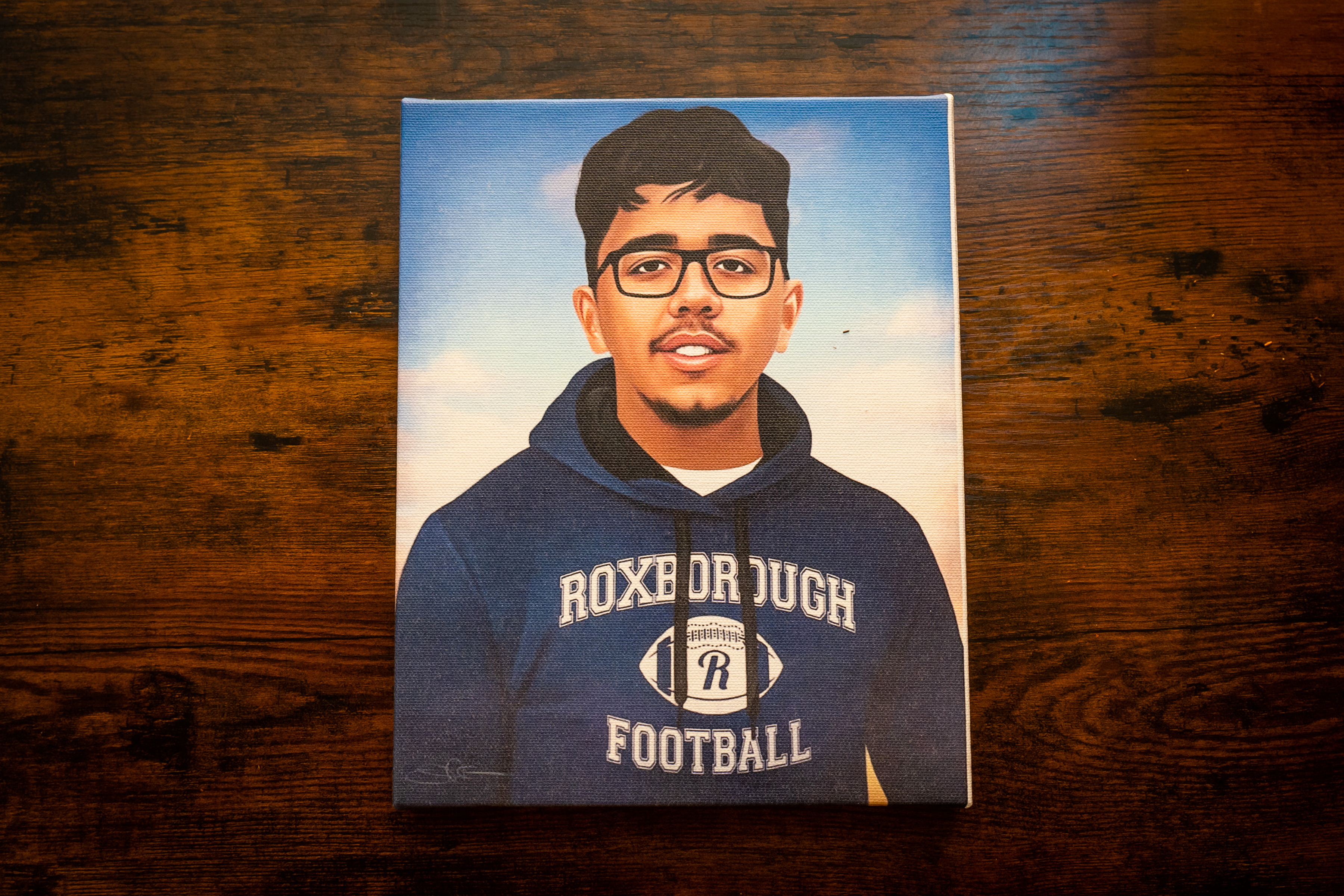
A painting of Nicolas Elizalde, that his mother Meredith Elizalde is bringing with her as part of a small colleciton of her sons things as she packs to start a new life in Montana, two years after Nicolas was killed in a shooting, in Aston, PA, August 15, 2024.
Citing text messages, Philadelphia Police Detective Robert Daly said the shooting happened after McClendon told another defendant in Elizalde’s killing that a Northeast High School football player had assaulted a girl he knew. The Northeast and Roxborough junior varsity teams were playing a scrimmage on the day of the shooting. Elizalde, a freshman at Walter B. Saul High School who played football for Roxborough, had nothing to do with the girl, police said.
“It’s clear to me that this defendant set this all in motion,” Conroy said of McClendon.
Stephen Grace, who was a detective on the case, said police found DNA on one of the 64 cartridge casings left at the scene among the bullet fragments and discarded football equipment.
For nearly three years, police searched for the person whose DNA was found on the 9mm casing. After police in July charged McClendon with killing a 16-year old boy, and his DNA was uploaded into a criminal database, they got a match, Grace said.
Two men have already pleaded guilty and been sentenced to decades in prison for their involvement in the shooting. Three others will soon go to trial — and now, McClendon is likely to join them.
“The goal now is to link these cases and try these defendants together,” said Assistant District Attorney Ashley Toczylowski.