Category: Opinion

  • Another senseless killing in Trump’s senseless war against Americans | Editorial

    Another senseless killing in Trump’s senseless war against Americans | Editorial

    “Terrible things are happening outside. At any time of night and day, poor helpless people are being dragged out of their homes … Families are torn apart; men, women and children are separated. Children come home from school to find that their parents have disappeared … Everyone is scared … No one can keep out of the conflict … the end is nowhere in sight.”

    Anne Frank, The Diary of a Young Girl

    Donald Trump’s masked marauders murdered another U.S. citizen in Minneapolis on Saturday, a senseless killing in a senseless war playing out in broad daylight on America’s streets.

    Cell phone videos showed one of Trump’s immigration enforcement goons violently pushing a woman to the ground. As a man recording the agents tried to intervene, at least seven federal agents surrounded and dragged him to the ground as another beat him with a canister.

    As the agents struggled to subdue the man, another agent appeared to remove a gun from the scrum. A Border Patrol agent then shot the man in the back from close range. A third agent pulled out his gun as nine more shots were fired within seconds.

    Several agents scampered away as Alex Pretti, a 37-year-old U.S. citizen with no criminal record, lay motionless on the street.

    This undated photo provided by Michael Pretti shows Alex Pretti, the man who was shot by a federal officer in Minneapolis on Saturday.

    After the shooting, a crowd of protesters shouted profanities at the federal officers, calling them “cowards” and urging them to leave. One officer mockingly responded, “Boo-hoo.”

    Pretti’s killing came two weeks after a U.S. Immigration and Customs Enforcement agent in Minneapolis killed Renee Good — a mother of three and a U.S. citizen — as she tried to maneuver her SUV out of the street. A week later, a DoorDash delivery driver was shot in the leg by ICE agents in Minneapolis.

    After the two killings, Trump and his loyal lieutenants tried to blame the victims and local Democratic leaders. But cell phone videos showed the truth: Trump’s jackboots have now plainly executed two U.S. citizens.

    The American people can see the lawless mayhem with their own eyes.

    Trump has unleashed a paramilitary of ICE and Border Patrol agents into American streets with a license to arrest, confront, detain, beat, or kill anyone who gets in their way — even if it is an off-duty police officer or a 5-year-old boy.

    Any pretense of federal investigations into abuses by ICE or others doing Trump’s bidding is quickly compromised or shut down. Constitutional rights are ignored. The rule of law is now set by Trump’s morality, which appears to thrive on cruelty.

    Federal immigration agents must leave Minneapolis and end their vigilantism. But who will stop them?

    There are no checks on Trump’s power, as his administration is stocked with unqualified lackeys competing for his attention.
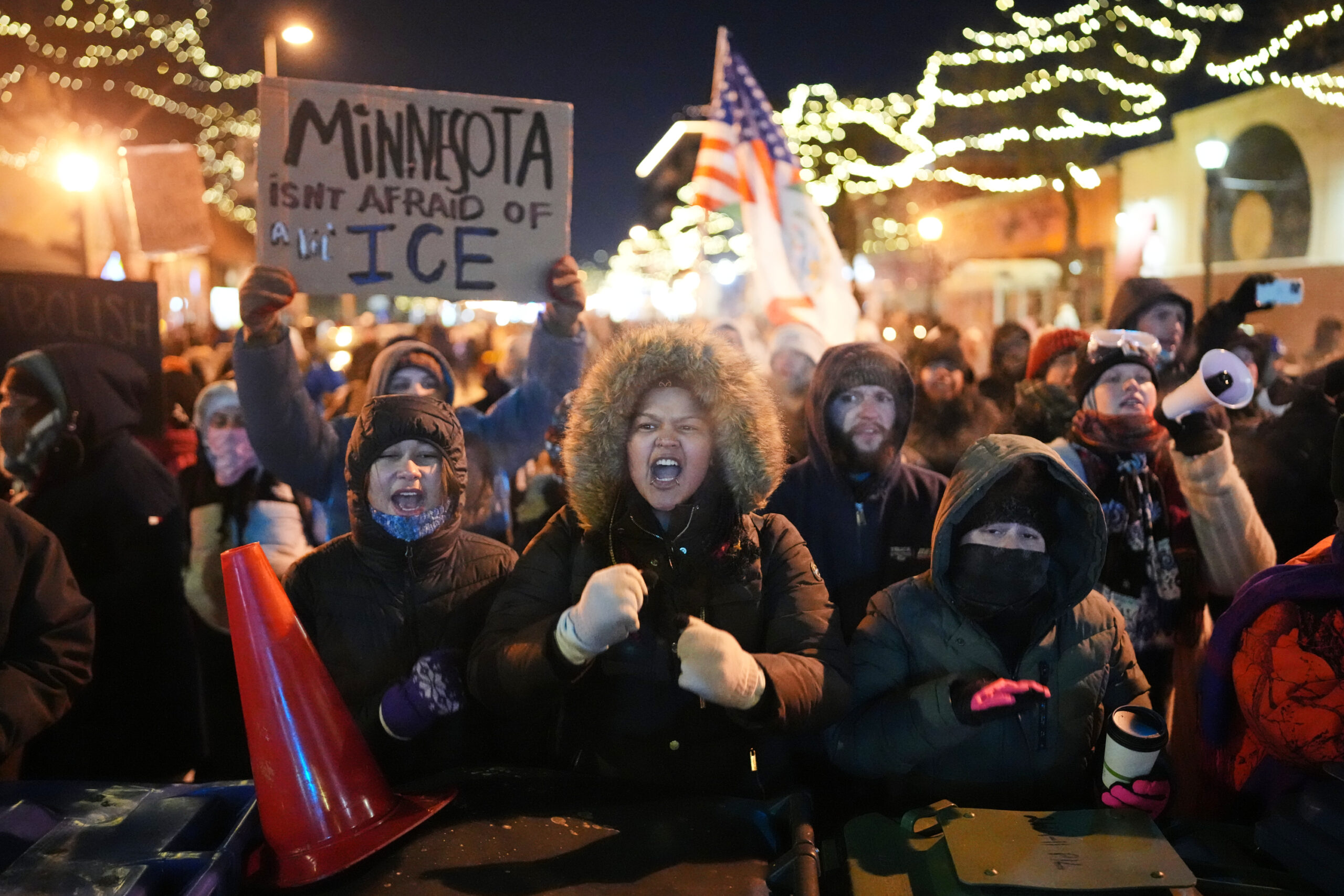
    Protesters chant and bang on trash cans Saturday as they stand behind a makeshift barricade during a protest in response to the death of 37-year-old Alex Pretti, who was fatally shot by a U.S. Border Patrol agent earlier in the day in Minneapolis.

    The Republicans who control Congress have abdicated their constitutional duty, while conservatives on the U.S. Supreme Court continue to enable the president.

    Sadly, justice left town after the U.S. Senate — including Pennsylvania’s John Fetterman and Dave McCormick — confirmed Pam Bondi, one of Trump’s personal lawyers, as attorney general.

    The FBI has been decimated by Kash Patel, an unqualified incompetent, pushing conspiracy theories and vendettas. Kristi Noem has turned the U.S. Department of Homeland Security into a Bull Connor-like police force, led by Gregory Bovino in his greatcoat.

    The architect behind the draconian ICE crackdown is Stephen Miller, an unelected and unconfirmed senior adviser and speechwriter with a history of white nationalist ties and bigotry.

    Republicans enabled the surge in ICE man power and funding when they approved Trump’s Big Beautiful Bill. If the GOP will not stop Trump, then voters must act come November.

    ICE was supposed to go after the “worst of the worst” people who entered the country illegally. Instead, Trump and his lawless administration have occupied cities, caused civil unrest, and accomplished essentially nothing.

    Tens of thousands of immigrants arrested have no criminal records. Others are collateral damage. After Good was killed, Trump said that “things happen.”

    Pretti was among the best in America. He was a nurse in an intensive care unit that served veterans. He died trying to help a woman attacked by a masked thug.

    Minneapolis Mayor Jacob Frey asked the question many want to know about the Trump administration’s growing domestic war: “How many more Americans need to die?”
  • Elizabeth Hughes: There is a viable path for Pittsburgh to save its newspaper. Here’s how we did it with The Inquirer.

    Elizabeth Hughes: There is a viable path for Pittsburgh to save its newspaper. Here’s how we did it with The Inquirer.

    The news that the Pittsburgh Post-Gazette will soon cease publishing has, justifiably, sounded alarms across the media landscape. The end of a storied organization with deep local roots and a legacy of strong journalism should concern all who believe that a free and thriving press is fundamental to a functioning civic society.

    Among the questions clamoring for answers in light of the news: What will fill the void in Pittsburgh? Will the deep pockets of the city’s many notable philanthropies provide the funds needed to support a new news organization? Will the remaining media outlets — Pittsburgh is not a news desert by any stretch — have the capacity to grow and expand? And the existential question: Will the citizens of the Steel City see the need to support local news now that it is, to an extent, imperiled?

    As publisher of The Philadelphia Inquirer, I believe that our own experience over the past decade offers a template for success. It was only a little more than a decade ago that we were a struggling news organization, with an impressive history of notable journalism, but beset by warring owners, threatened by bankruptcy, and, in May 2014, up for sale on the auction block.

    Redemption began with a visionary philanthropist, H.F. “Gerry” Lenfest, who set out to save The Inquirer and provided the wherewithal to do it. He established the Lenfest Institute for Journalism, our nonprofit owner, and pursued an innovative tax structure that created a for-profit Inquirer with a separate board. Both are the indispensable keys to our stability and success.

    Lenfest’s generosity planted the news philanthropy seed in Philadelphia and, through the institute, established a funding mechanism that supports our journalism. His donation, in cash, allowed The Inquirer to modernize and transform from a legacy print shop to a modern multiplatform news organization.

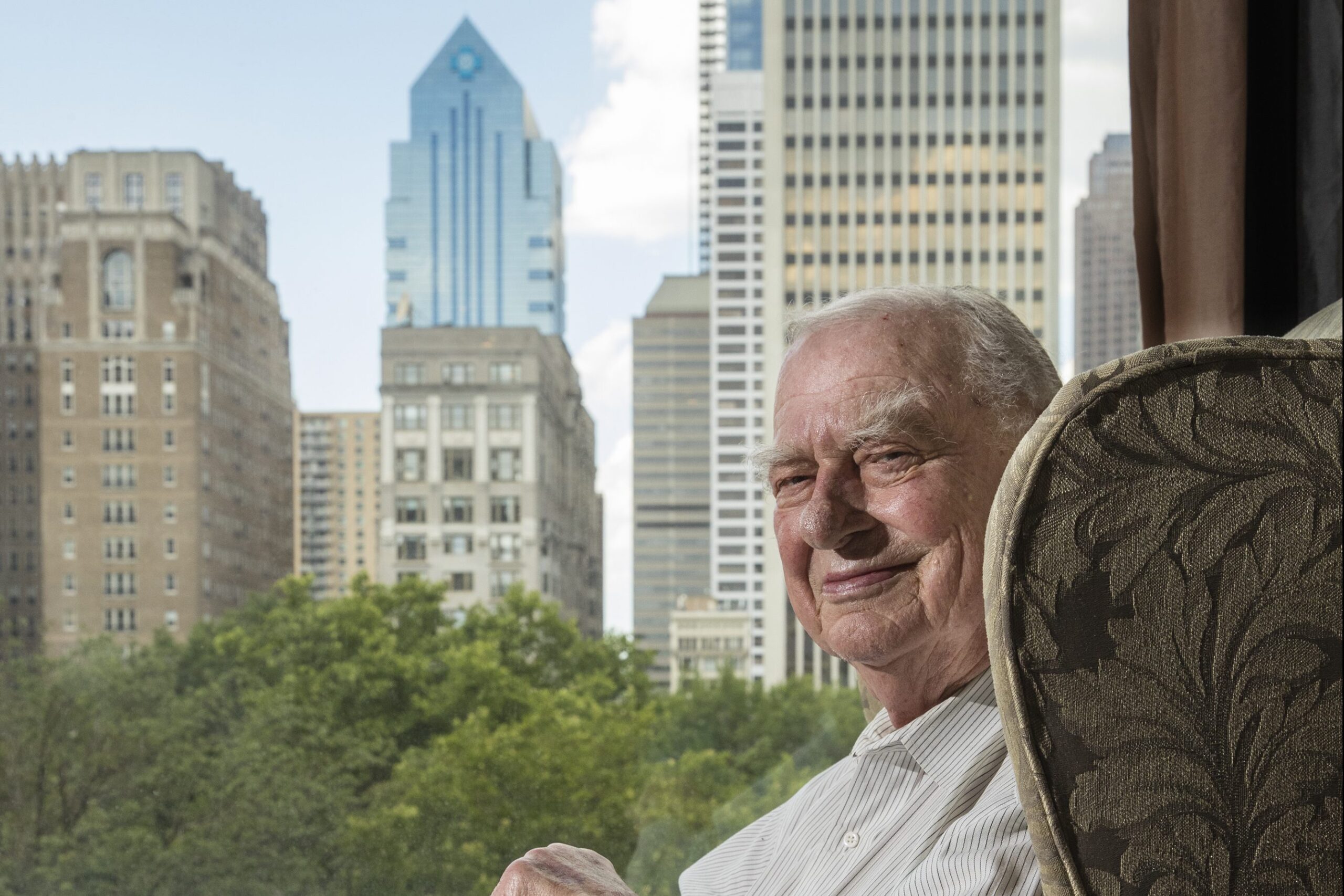
    The late H.F. “Gerry” Lenfest’s generosity planted the news philanthropy seed in Philadelphia, writes Elizabeth H. Hughes.

    But we have also known that The Inquirer’s long-term stability — and the ability to consistently provide quality journalism — depended on building a successful and integrated business. And that meant forging a new identity through a modern brand campaign, developing a robust marketing strategy, engineering our own path to success by building our own products, and creating new and compelling opportunities for advertisers. Significantly, it also required meeting and convincing civic and business leaders that The Inquirer was a vital asset worth investing in.

    There are 200 journalists in our newsroom, and the journalism produced every day is impressive and innovative, deep and local. In the end, that is what people will pay for. And the business results? The Inquirer in 2025 had its first year-over-year increase in revenue since 2004, and an operating profit of several million.

    The majority of our revenue, 70%, comes from consumer marketing, which means people are paying for our journalism; 19% is from advertising, which signals that local businesses and institutions find merit in supporting us; and 5% from syndication and other partnerships. Philanthropy accounted for 6% of revenue in 2025, and we project donor contributions ranging from 6% to 10% going forward.

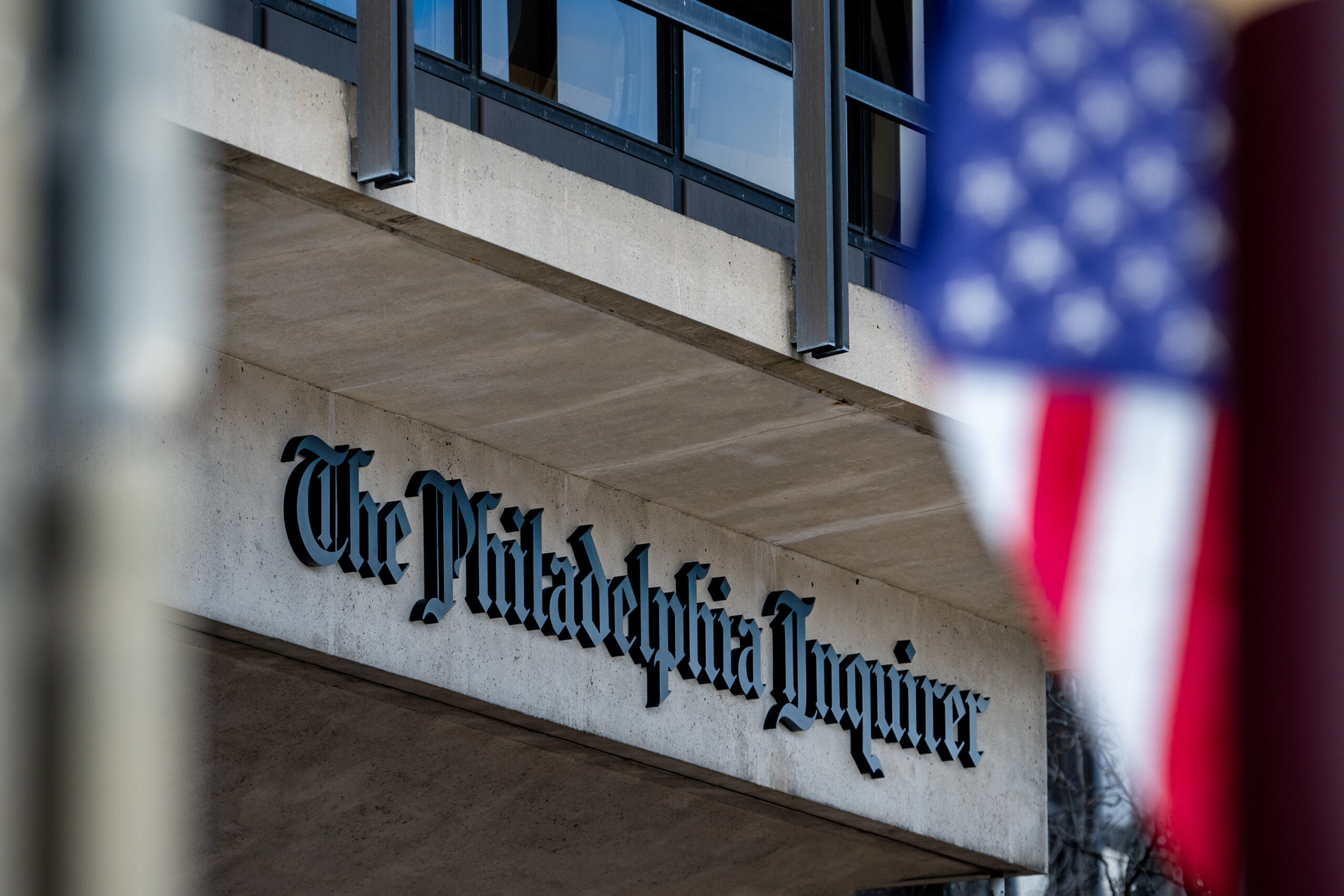
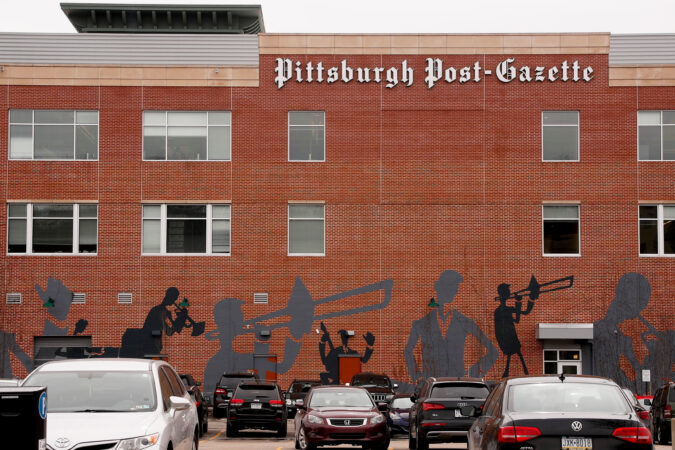
    The facade of The Inquirer’s offices on Independence Mall West. The Inquirer in 2025 had its first year-over-year increase in revenue since 2004.

    Lenfest, who died in 2018, was a successful businessman before he became an influential philanthropist. He left his mark on civic and cultural institutions throughout Philadelphia. But his last great effort was to save The Inquirer — to give it the runway it needed because he believed in the importance of local journalism.

    There is much work to be done, and challenges to be met, but the lasting legacy of H.F. “Gerry” Lenfest is an Inquirer that is stable and succeeding as a business.

    Elizabeth H. Hughes has been the publisher of The Philadelphia Inquirer since 2020.

  • Prize out | Editorial Cartoon

    John Cole spent 18 years as editorial cartoonist for The (Scranton) Times-Tribune, and now draws for various statesnewsroom.com sites.

  • Moving beyond supervision: It’s time to rethink juvenile probation

    Moving beyond supervision: It’s time to rethink juvenile probation

    Most people hear the phrase “juvenile probation” and think of second chances. They imagine a young person avoiding detention and getting the support they need to stay on track. It sounds compassionate, reasonable, and like progress. But for thousands of young people in Philadelphia and hundreds of thousands across the country, juvenile probation is not freedom; it’s a trap.

    For many youths, probation is not an opportunity to grow, but feels like walking through life with a countdown clock. Every interaction carries risk. Every mistake, no matter how small, can be interpreted as defiance or as a violation of probation. Instead of stabilizing young people, probation often destabilizes them, pulling them deeper into systems that punish rather than support.

    What is described as a “community-based alternative” becomes a constant reminder that freedom is conditional and fragile.

    Juvenile probation places youth under a long list of conditions that most adults couldn’t realistically follow. There are weekly check-ins, strict curfews, school mandates, drug tests, random home visits, and the constant threat of detention if they mess up.

    Missing an appointment, being late, skipping school during a crisis, or being around a family member who is also under supervision can all be labeled “technical violations.” These violations, while not new crimes, can send a young person straight to juvenile detention or state secure placement.

    The public rarely sees this reality, but young people and their families do.

    We both work at YEAH Philly (Youth Empowerment for Advancement Hangout), which has worked with more than 300 Philadelphia youth involved in the legal system, and we see the harm every single day.

    Probation doesn’t work the way people think

    A common narrative around juvenile probation is that it was designed to divert youth from incarceration and connect them to guidance and resources. The reality is different.

    Instead of being a short-term intervention, probation has become a default response applied broadly, regardless of a young person’s actual risk or needs. What was meant to be rehabilitative has become expansive, punitive, and deeply entangled with punishment.

    Across the country, more than 150,000 kids are on juvenile probation, many for minor or “status” offenses like skipping school or missing curfew, not violence. Black youth are disproportionately targeted, placed on probation more often, kept on longer, and violated more quickly.

    In a large study of over 18,000 youth placed on probation for the first time, about 15% broke a probation rule without committing a new crime. Black youth, who made up just over half of the group, were written up sooner than white youth and were more likely to be violated at any point during supervision.

    The system claims to be rehabilitative, but the numbers tell a different story. In many states, more young people are punished for technical violations than for new offenses.

    Youth on probation often remember only a fraction of the rules they are expected to follow, yet remain under court supervision for months or years after any public safety benefit exists.

    A Pew Charitable Trusts study found that in one state, after the first 10 months of probation supervision, there were more arrests for technical violations than for new offenses, and Black youth were more likely to be placed on probation rather than diverted to non-court services, even when offense severity was comparable.

    This is what researchers describe as “net-widening,” where more youth are pulled into the system, more rules are imposed, more pipelines to jail and prison, and more opportunities for failure without improved outcomes.

    What we see at YEAH Philly

    (From left) Tayanna Hubbard, Jasmine Brown, and Kendra Van de Water walk during a YEAH Philly nature walk at Bartram’s Garden in Philadelphia in April 2021.

    Every week, young people come to us terrified of making a mistake. They are trying to navigate a system built on compliance while also surviving poverty, school instability, community violence, and unmet mental health needs.

    We work with teenagers who miss appointments because SEPTA was delayed, or because they have no reliable way to travel across the city. We see youth violated for missing school when the real issue was a lack of clean clothes, food insecurity, or an unsafe home environment.

    We support young people placed on probation not because they caused harm, but because they needed help; help that juvenile probation was never designed to provide.

    These are not failures of individual responsibility; they are failures of a system that confuses surveillance with support and punishment with accountability. Juvenile probation wears the mask of care, but it operates through control and coercion.

    Why probation can’t be ‘reformed’

    Cities have tried for decades to tweak juvenile probation with fewer conditions, shorter terms, or trauma-informed training. While these reforms may reduce some harm, they do not change the core structure of probation itself.

    Juvenile probation still polices adolescence instead of supporting it. It punishes normal teenage behavior, responds to trauma with surveillance, and relies on the constant threat of incarceration to enforce compliance.

    A system built on control cannot be transformed into one rooted in care through policy tweaks alone. There must be a complete overhaul to create something better.

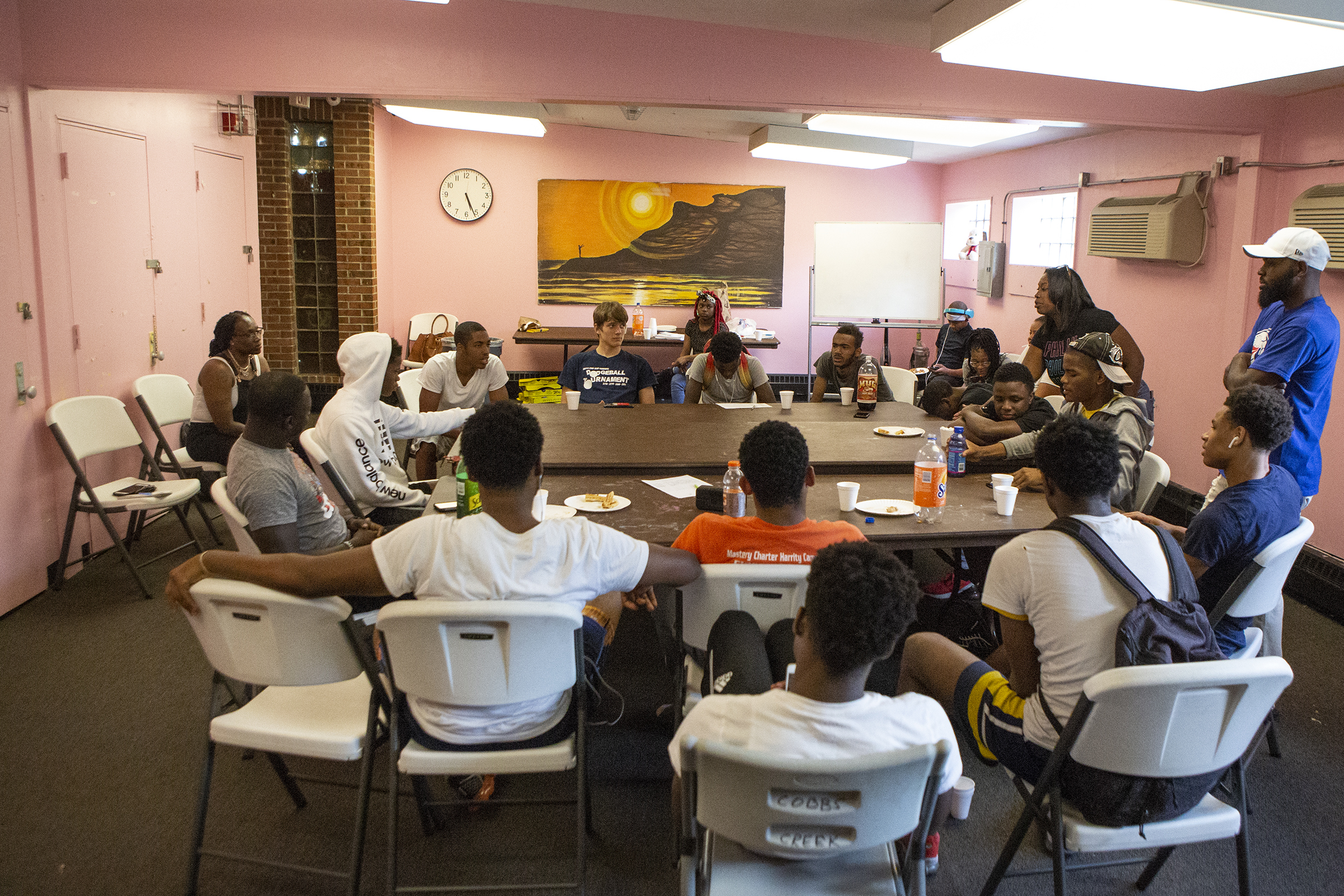
    A group of teens and two police officers meet during the final session of a YEAH Philly pilot program at the Cobbs Creek Recreation Center in June 2019.

    YEAH Philly’s approach through our Violent Crime Initiative and healing-centered youth support model shows what is possible when young people are surrounded by genuine care rather than constant monitoring.

    When youth have trusted adults, access to transportation, meals, basic needs, job opportunities, therapy, mediation, and a safe place to go every day, they grow. They build accountability because they feel connected, not controlled.

    Community-based models across the country show the same results, where healing and restorative approaches reduce reoffending more effectively than supervision ever has.

    People hear “end juvenile probation” and fear it means “end safety.” But abolition does not mean abandoning young people. It means abandoning systems that have consistently failed them.

    Abolition means replacing surveillance with support, punishment with opportunity, control with care, and isolation with belonging.

    Crafting a new vision

    In the coming months, YEAH Philly and the Gault Center, alongside youth, families, and researchers, will launch the Juvenile Probation Accountability Coalition.

    The coalition will expose the harms of juvenile probation through youth-led research, hold systems accountable for the trauma they create, elevate community-based accountability models, and push for policies and models that move us beyond probation.

    Our goal is a national blueprint for real public safety rooted in dignity and care.

    Philadelphia has an opportunity to lead the nation in redefining accountability and safety for young people. We can build systems that help youth grow instead of continuing to invest in systems that wait for them to fail.

    Ending juvenile probation is not a radical idea. It is an overdue commitment to young people’s futures.

    It is time to move from supervision to support, and from punishment to possibility.

    The Juvenile Probation Accountability Coalition is coming — and this is just the beginning.

    Kendra Van de Water is the cofounder and co-CEO and Mona Baishya is the Violent Crime Initiative research director at YEAH Philly. For more information about the Juvenile Probation Accountability Coalition and the forthcoming work, please contact Van de Water (kvandewater@yeahphilly.org) or HyeJi Kim (hkim@defendyouthrights.org).

  • Letters to the Editor | Jan. 25, 2026

    Letters to the Editor | Jan. 25, 2026

    Fate of ‘Rocky’ statue

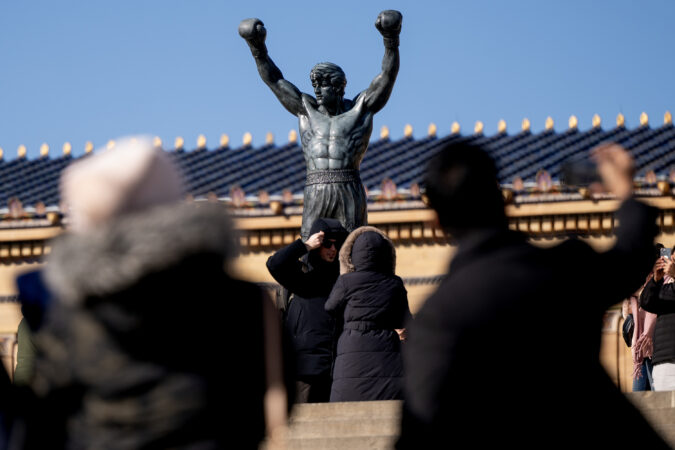
    F. Eugene Dixon, former chair of the Philadelphia Art Commission, was asked in the early ’80s whether the Rocky statue should be placed atop the steps of the Philadelphia Museum of Art. Mr. Dixon responded, “Surely you jest.”

    City officials had argued that the statue was “not art but a movie prop,” and it was moved to the old Spectrum arena. For the filming of Rocky V, the statue was temporarily moved to the top of the steps at the Philadelphia Museum of Art. For many years, it has been at the bottom of the steps. The Philadelphia Art Commission, not jesting, recently voted 4-1 to move the statue back to the top of the steps.

    Landis W. Doner, Jenkintown, islanderdon@gmail.com

    . . .

    The kerfuffle over the Rocky statue is as artificial as the celluloid boxer. If a Rocky statue defining grit belongs at the Art Museum, cast it in the image of the real Rocky Balboa who fought the real Apollo Creed. Chuck Wepner lost a 1975 bloodbath to Muhammad Ali when he was knocked out in the 15th round. Sylvester Stallone used the fight (and much of Wepner’s persona) to create a billion-dollar franchise. Wepner sued Stallone, claiming he was unjustly enriched by Wepner’s story, settling out of court.

    Philadelphia produced many great fighters who demonstrated grit and courage. Harold Johnson, Joey Giardello, and Bernard Hopkins come to mind. Matthew Saad Muhammad — abandoned at the Benjamin Franklin Parkway at age 5 — began boxing as Matt Franklin, changing his name when he converted to Islam. He was a champion who fought the best of his generation with power and determination. After winning the championship, he defended it eight times. He remained in Philadelphia after retiring, where he died broke, homeless, and largely forgotten.

    Joe Frazier had an equally difficult upbringing. After moving to Philadelphia alone at age 15, he became an Olympic gold medalist and heavyweight champion. He fought Ali three times, beating him in the 1971 title bout that riveted a nation.

    Rocky’s sculptor stated that “Rocky is the DNA” of Philadelphia. Nope. Fighters such as the above, and many others who worked in gritty blue-collar jobs, provided the DNA, giving Philadelphia the tough, hardworking ethic it claims, not a celluloid fighter. If the Rocky statue belongs anywhere, it would be near the shuttered Blue Horizon boxing venue in North Philadelphia, which Ring magazine once called the greatest boxing venue in the world. The fictional Rocky is tied to boxing far more than to art.

    Stewart Speck, Wynnewood

    Expensive ICE

    As a lifelong Democrat, I am profoundly disappointed in my party’s apparent capitulation on U.S. Immigration and Customs Enforcement funding. $10 billion? People not making half of any Congress member’s salary are out in the cold in Minnesota, peacefully registering outrage at the city’s brutal occupation by ICE, and my party is compromising on $10 billion so ICE can have a fleet of Boeing airliners, too. No budget cut for ICE, no congressional imposition of policing standards common in every city in America to protect due process and privacy rights. Democrats had better put up some real opposition now — or they may fail to convince voters later this year that they are a true alternative. Congress, please stand up for the poor folks in Minnesota.

    William Culleton, Philadelphia

    Join the conversation: Send letters to letters@inquirer.com. Limit length to 150 words and include home address and day and evening phone number. Letters run in The Inquirer six days a week on the editorial pages and online.

  • Poverty is not only a Philadelphia problem. It’s about time suburban leaders recognized that. | Editorial

    Poverty is not only a Philadelphia problem. It’s about time suburban leaders recognized that. | Editorial

    For generations, wealth has been regionally segregated in Southeastern Pennsylvania, with Philadelphia considered until recently the poorest big city in America, while three of its four collar counties had the lowest poverty rates in the state.

    But having fewer people in poverty doesn’t mean there are none who are struggling in the suburbs. More than 180,000 people across Bucks, Chester, Montgomery, and Delaware Counties live below the poverty line, yet for too long, experts say, those communities have underserved those in need.

    Recently, however, suburban leaders have been stepping up their efforts to help those with low incomes. It’s a heartening and welcome shift in attitude.

    Poverty is not solely a big-city ailment. With median incomes in Bucks, Chester, and Montgomery Counties nearly twice what they are within Philadelphia, it’s very difficult for poor and working-class people to maintain a suburban lifestyle.

    That is especially true when it comes to issues of land use and transportation policy, which experts often treat as intertwined.

    In the suburbs, the vast majority of developable land is zoned for detached, single-family homes on large lots, and nearby transit options are often both slow and infrequent. The result is that median housing values in Bucks, Montgomery, and Chester Counties range between $432,000 and $476,000, compared with roughly $250,000 in Philadelphia. Delaware County, which is home to both more suburban areas like Swarthmore and urbanized municipalities like Chester and Upper Darby, splits the difference at $331,000.

    This so-called snob zoning doesn’t just prevent poor, working-class, and sometimes even middle-class people from moving into or remaining in many suburban areas; it also makes it harder to get around without a car, which raises the cost of living. While a monthly transit fare card costs between $1,400 and $3,000 per year, AAA estimates the average cost of car ownership is about $12,000. While roughly three-quarters of households in Philadelphia typically don’t have more than one vehicle, most suburban households have two or more. Between the cost of housing and the cost of transportation, that’s an average of more than $60,000 per year just to get by and around.

    The de facto suburban gatekeeping essentially compels low-income people to choose to live in the city — a reality that has allowed past suburban leaders to lean into the widely held perception that poverty is a Philadelphia problem. In effect, economic researchers say, that’s meant the suburban poor have basically been left to fend for themselves.

    Thankfully, there are signs that things are beginning to change.

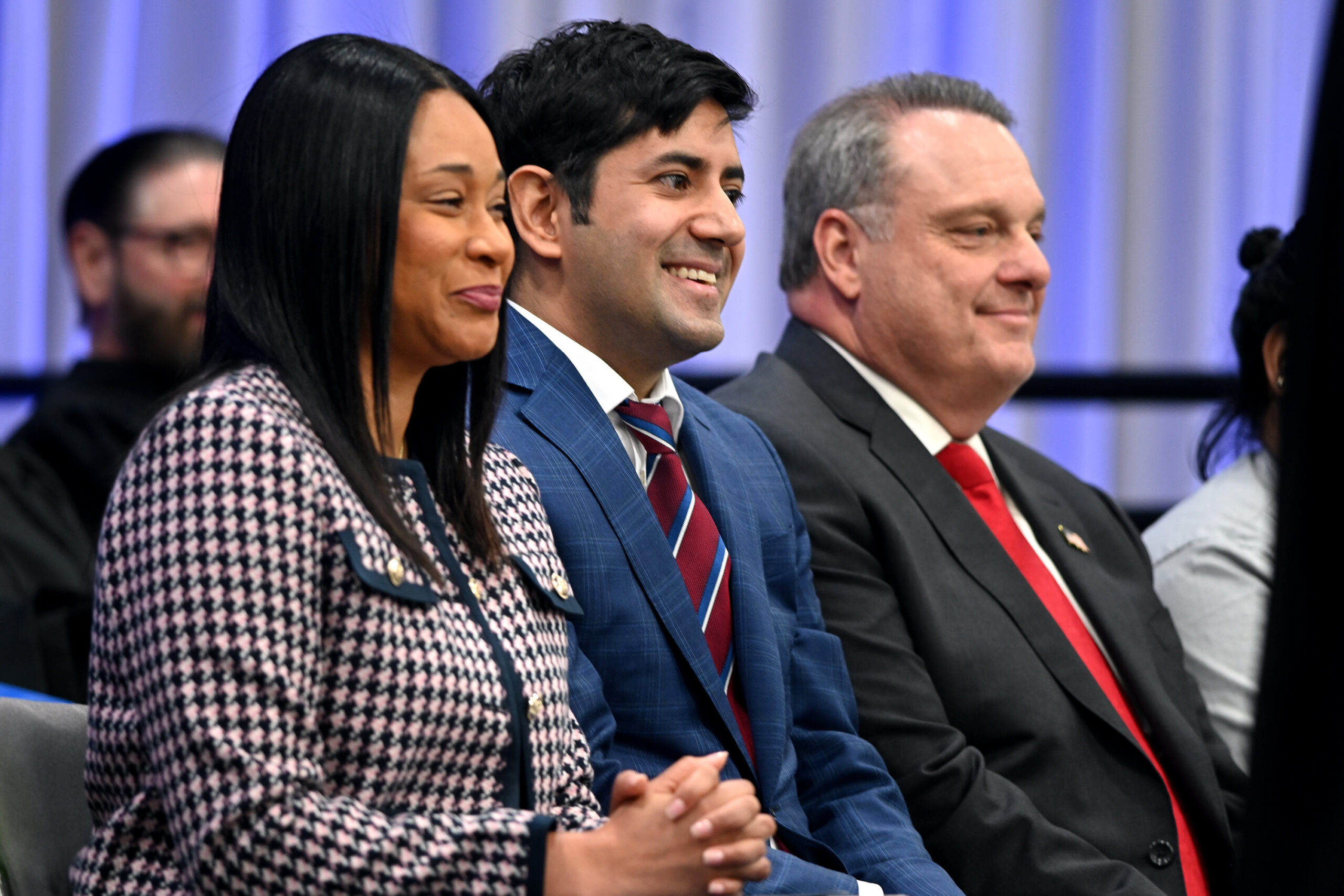
    (From left) Jamila Winder, Neil Makhija, and Tom DiBello are seated together on stage at the Montgomery County Community College gymnasium during their swearing-in as county commissioners in 2024.

    In Montgomery County, Commissioners Jamila Winder, Tom DiBello, and Neil Makhija have demonstrated a strong bipartisan commitment to address housing needs.

    While the county had zero full-time homeless shelters by the end of 2024 — even as the number of unhoused people grew — the commissioners have invested in an additional 190 short-term shelter beds, split between Pottstown, Norristown, and Lansdale. The commissioners should be commended for doing right by the wider community, even as they faced opposition from some constituents who did not want shelter space available.

    The commissioners have also attended community meetings to lobby in favor of housing plans. Makhija has also proposed creating a new grant system that would reward municipalities that opt to allow for more construction. This would help address reasonable concerns about the infrastructure needs of new residents.

    There is evidence that efforts to build more inclusive and sustainable suburbs have broadened support. Three of the five new Lower Merion Township commissioners mentioned walkability or pedestrian safety as priorities; Joi Washington — the new mayor of Media — wants to take advantage of her borough’s exceptionally strong transit connections; and Delaware County opened its first-ever health department four years ago.

    Leaders from all four suburban counties have also pledged support for new sources of revenue to support public transportation in the region, and Chester County has become a leader in housing development.

    If these efforts succeed, a future where poverty is no longer concentrated within Philadelphia — and the poorest can access the support they need, no matter where they live — may be within our grasp.

  • Trump can try to hide it, but slavery is part of America’s story

    Trump can try to hide it, but slavery is part of America’s story

    It hurts my soul that the Trump administration has made good on the president’s threats to destroy the President’s House slavery exhibit at Independence National Historical Park, something Philadelphians fought long and hard to get. It would hurt President Donald Trump’s soul, too, if only he had one.

    None of this makes America great again. It doesn’t bring down the cost of groceries. It doesn’t help Americans whose healthcare premiums have skyrocketed. It doesn’t make our streets safer. It doesn’t do anything but rile up Confederate flag-waving racists in Trump’s base. They had an awful lot to say about preserving history when monuments honoring traitorous soldiers who fought for the Confederacy and the right to own Black folks were torn down. But not so much when it comes to the destruction that happened at Sixth and Market Streets Thursday afternoon.

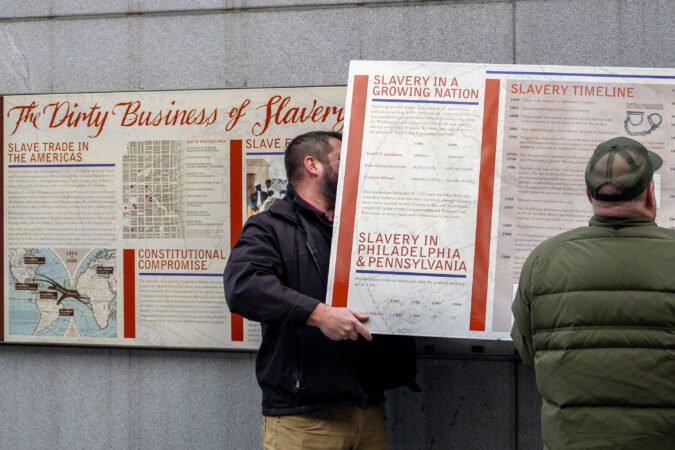
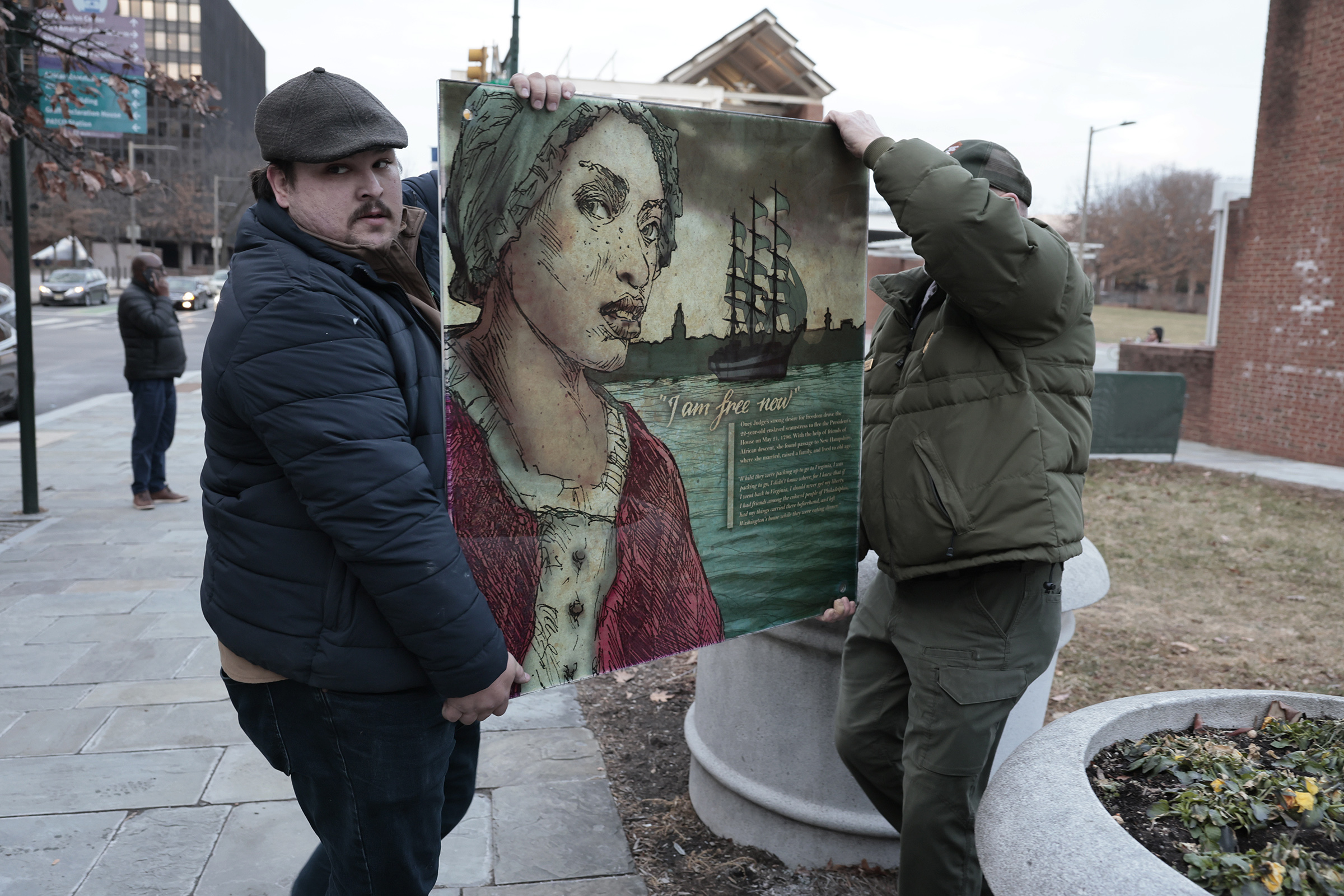
    National Park Service workers remove the displays at the President’s House site in Independence National Historical Park in Philadelphia on Thursday.

    I hope the spirits of the enslaved Africans whose stories had been immortalized in that display adjacent to the Liberty Bell will forever haunt Trump. It is my sincere wish that he and the henchmen who took down signs and dismantled the panels documenting the sad history of the nine enslaved Black people owned by our nation’s first president will never forget what they’ve done.

    From this day forward, may they toss and turn each night as they remember the destruction they have wrought, as well as the names of the enslaved whose memorial they defiled: Austin, Paris, Hercules, Christopher Sheels, Richmond, Giles, Oney Judge, Moll, and Joe.

    Trump and his enablers can try to hide the facts, but chattel slavery is an undeniable part of America’s founding. This nation wouldn’t be what it is now without the free labor of Africans dragged to these shores against their will and forced to toil for free in brutally inhumane conditions. It’s our story and one that should be acknowledged — not played down because Trump says so.

    What will he do next? Take a sledgehammer to the Martin Luther King Jr. statue in Washington, D.C.? Empty out the Smithsonian’s National Museum of African American History and Culture? Burn the books about slavery and Black codes that have been for sale in museum gift shops and national parks?

    The exhibit at the President’s House was the first I’d ever seen that, instead of glorifying the nation’s first president, humanized the poor people Washington held in the worst kind of bondage. The offices of The Inquirer are right across the street, and I’ve walked through the free outdoor exhibit many times. I used to enjoy seeing the expressions of tourists as they learned about the side of Washington that’s left out of most history books.

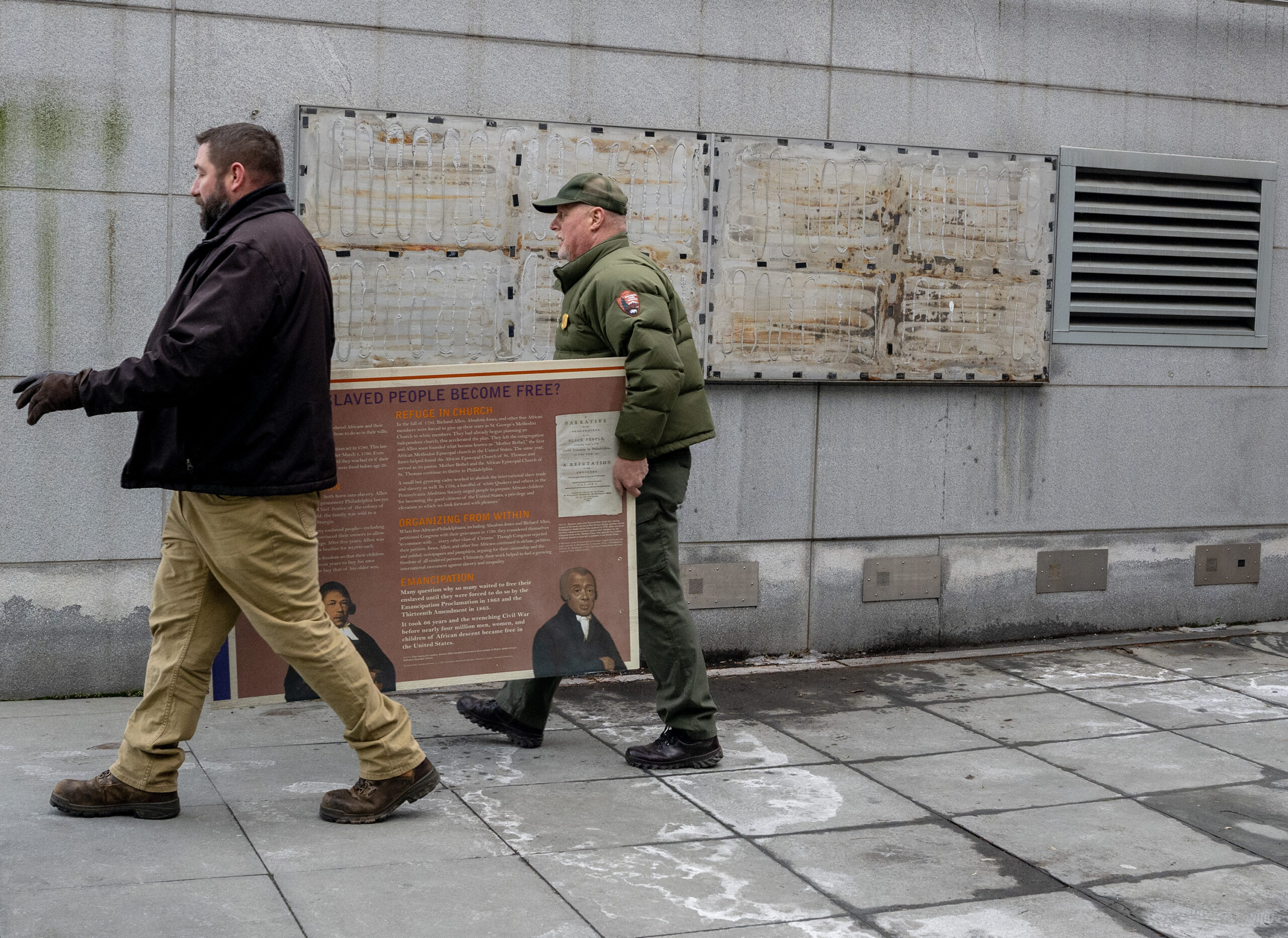
    Workers remove display panels about slavery at the President’s House site in Independence National Historical Park on Thursday, leaving only empty spaces where history has been redacted by President Donald Trump.

    Now all that’s left are the empty spaces where the various signs used to be. These sudden omissions at Independence Park make it feel like the historical account now being told at the site is a lie — not unlike the foundational lie of white supremacy that was used to justify the sin of slavery in the first place.

    The removals are just another step in Trump’s brutal agenda to take things in America back to how they used to be when white men had everything and Black people had nothing.

    Since his return to power, it has been one thing after another: his attempts to destroy all vestiges of diversity, equity, and inclusion, including his decision to no longer allow free admission to national parks on the federal holidays celebrating the late Rev. Dr. King and Juneteenth. Instead, parkgoers can enjoy free admission on Trump’s birthday, as if that’s really a thing.

    The president would destroy Black History Month, too, if he could, and I don’t put it past him to try. He’s been clear about his racial animus, restoring the names of Army bases to those of Confederate military figures and using U.S. Immigration and Customs Enforcement agents to inflict a reign of terror on Black and brown people.

    I’m proud Philadelphia has filed suit to take back what was removed from the President’s House. This is the beginning of the City of Brotherly Love, showing the Trump administration that, in the words of Sheriff Rochelle Bilal, “You don’t want this smoke.”

  • Let’s talk about blagony: What it means to be the only Black person at work

    Let’s talk about blagony: What it means to be the only Black person at work

    There is a word I want us to consider: blagony. It’s a portmanteau of Black and agony, and it captures a specific psychological space.

    It’s not merely being the only Black person in the boardroom. It’s the sustained emotional labor, the relentless vigilance, the pressure of representation and racialized perception — all while trying to meet the explicit performance metrics of any job.

    The only Black engineer in a meeting. The single Black adviser on a team. The only Black teacher, the only Black graduate student. The Black female leader whose presence is always under the magnifying glass.

    This is the daily landscape for many, and it is, in its quiet omnipresence, exhausting.

    To understand blagony is to understand that workplace stress isn’t just about deadlines and deliverables. In the last decade, a significant body of research has reminded us that burnout — the chronic stress response the World Health Organization formally recognizes in the workplace — emerges not only from workload but from identity threat, lack of psychological safety, and perpetual masking of one’s authentic self. Burnout has been with us for decades, yet we are only beginning to grasp its intersecting causes.

    In Burnout: The Secret to Unlocking the Stress Cycle, Emily and Amelia Nagoski explain that stress has a physiological component that often isn’t resolved by self-care alone. Stressors accumulate, and without mechanisms to complete the “stress cycle,” our bodies and minds remain in distress.

    Now imagine experiencing the ordinary stress of overwork while also managing the extraordinary stress of visibility — being watched, categorized, and held up as both token and template for an entire community. That’s blagony. It’s not just about being in the room; it’s about being on stage in every room.

    Organizational research shows this isn’t abstract. Studies probing wellness in underrepresented groups report that women of color — and particularly Black women — face compounded barriers in professional settings.

    The freedom to bring all of who you are to work is one of the major predictors of organizational success. Yet, for Black employees, that safety is often a mirage. They must code-switch, temper their expertise with humility, and constantly evaluate whether being authentic will be rewarded or punished, writes Jack Hill.

    They are both underrepresented and overlooked, which research connects to diminished career progression, reduced well-being, and heightened psychological strain.

    This isn’t about victimhood. It’s about recognition. True psychological safety — the freedom to bring all of who you are to work — is one of the major predictors of organizational success. Yet, for Black employees, that safety is often a mirage. They must code-switch, temper their expertise with humility, and constantly evaluate whether being authentic will be rewarded or punished.

    This labor — unmeasured, unpaid, and deeply internalized — is blagony.

    Of course, we talk about inclusion and equity, about diversity plans and affinity groups. But intention isn’t impact. A reading of workplace wellness literature reveals a troubling tendency: The wellness industry urges individual strategies — meditation, resilience, boundary setting — while often ignoring structural stressors that are built into the workplace.

    Jennifer Moss, in her widely discussed book, The Burnout Epidemic: The Rise of Chronic Stress and How We Can Fix It, argues that organizations must stop treating burnout as an individual failure and instead redesign workplaces to reduce chronic stress.

    Yet, most corporate wellness programs remain superficial: apps, yoga classes, snack bars, mindfulness sessions. None of these treats the root of blagony: the constant cognitive load of being the sole representative of a marginalized group. Psychological research calls this “identity threat,” and it’s real.

    In higher education and STEM settings, scholars highlight how Black professionals must mask parts of themselves — hide cultural cues, soften speech, temper humor — to conform to dominant norms. Every day, they must decide: Be fully me and risk being misunderstood? Or mold myself into the organizational ideal and risk losing touch with my own sense of self, or possibly risk losing my job?

    In a striking parallel, centuries of research on microaggressions show how seemingly small, everyday slights accumulate into a wear and tear on the psyche. One corporate DEI consultant who has developed mindfulness tools for Black workers notes that these workers face not only the standard burnout of their peers, but additional layers — microaggressions, coded language, isolation, and stereotypical assumptions — which add up over the years.

    That is blagony.

    Some might raise the counterargument: Isn’t this just the cost of progress? The pain inherent in entering spaces that were never designed for everyone? But that is precisely the problem. Organizations and societies that value innovation, creativity, and collective intelligence must also value plurality of perspective, and the racial and ethnic components that come along with it. If we ignore the emotional costs paid by minoritized workers, we will degrade our own workplaces and squander human potential.

    Consider the economy’s current preoccupation with “wellness.” Most wellness initiatives are rooted in an individualistic self-care model that assumes stress arises from personal habits. But when stress is born of organizational dynamics, personal adjustment alone isn’t enough.

    Nagoski reminds us: Stress is physiological, yes, but it’s also social. You cannot meditate your way out of an environment that constantly signals that your presence is provisional.

    Blagony demands more than corporate slogans or pulse surveys. It demands structural change. It demands that we rethink hiring, promotion, and evaluation criteria. It demands that we foster climates where people don’t feel the need to mask their identities to fit in. It demands sustained effort to build genuine psychological safety.

    There is also a cultural dimension. We must shift from valuing perfection to valuing wholeness. We must recognize that human beings — especially those carrying the cumulative weight of historical and structural marginalization — cannot compartmentalize identity from performance. Workplaces that expect competence without empathy will find neither.

    In my own conversations with Black professionals, what emerges over and over is not a desire for special treatment, but for authentic belonging. They don’t want to be tokens. They want to be colleagues whose full humanity is recognized and respected.

    So let’s retire the idea that burnout is merely overwork. Let’s broaden our understanding to include blagony: the strain of being seen as a single voice for a whole community, the chronic vigilance against bias, the emotional taxation that is neither acknowledged nor compensated.

    If we want workplaces that are not just more diverse but more human, then we must reckon with this. Because until we address the unique stressors Black employees carry — and redesign institutions to reduce them — we will continue to lose not just talent, but our shared moral coherence.

    Blagony is not a symptom of individual weakness. It is a signal that our workplaces — and our culture — still have far to go.

    Jack Hill is a diversity consultant, child advocate, journalist, and writer.

  • European and business leaders force Trump to reverse course on threats to Greenland

    European and business leaders force Trump to reverse course on threats to Greenland

    Donald Trump’s sudden retreat from his military and economic threats to seize Greenland from NATO ally Denmark shows it is still possible to block the president from further foreign policy folly.

    Trump did a complete U-turn at the World Economic Forum in Davos, Switzerland, shortly after berating European allies and NATO in a lengthy, lie-filled speech, insisting he must “own” Greenland. Just two hours later, after a meeting with NATO Secretary General Mark Rutte, the president suddenly announced he had a “framework” for a deal that would satisfy all U.S. needs.

    Make no mistake. No matter how the White House spins Trump’s sudden about-face, he staged a total climb-down from a mess of his own making. Based on early reports, he got almost nothing he couldn’t have agreed on with Denmark months ago, based on a 1951 treaty that permits the U.S. to open multiple bases in Greenland.

    All Trump’s bluster achieved was to totally alienate America’s European allies and deeply wound the NATO military alliance, whose help he needs to block Russian and Chinese aggression in the Arctic and elsewhere.

    So what caused Trump’s sudden reversal? No one can penetrate the president’s aging brain, but the likely reasons have to do with economics and his base, the only factors that seem to move him.

    The financial markets tanked early this week from fear that Trump would invade Greenland. No doubt tech moguls at Davos were warning him. New polls also showed 90% of Americans opposed an invasion.

    Yet, as late as Wednesday afternoon, he was insisting, in his Davos speech, on the need for “title and ownership” of Greenland, and was threatening to impose new tariffs on Denmark and other European allies if they didn’t surrender. “You need the ownership to defend [Greenland],” Trump contended. “Who the hell wants to defend a license agreement or a lease?”

    President Donald Trump during a meeting with NATO Secretary General Mark Rutte on the sidelines of the annual meeting of the World Economic Forum in Davos, Switzerland, on Wednesday.

    Parse those words, and you see they intimate an end to NATO and its Article 5 defense mechanism. After all, if the U.S. doesn’t own Poland or the Baltics or Finland, why should Trump defend them if Russia ever attacks?

    Still, even in his aggressive speech, Trump was hinting he was seeking an off-ramp, stating he wouldn’t use force.

    No doubt he recognized that, despite his open disdain for Europe, its key leaders had abandoned their conciliatory stance and were determined to strike back economically. Last week, the European Union discussed imposing $108 billion worth of retaliatory tariffs on the U.S., as well as restricting American companies from the bloc’s market. The EU-U.S. trade deal agreed to last July was also put on hold.

    European leaders had been reluctant to wage such a trade war, but recognized they had no choice, as Trump threatened the future of the NATO alliance. Instead of focusing on the immediate security threat to the West — namely, Vladimir Putin’s war on Ukraine — Trump was helping the Kremlin by splitting with his European allies.

    Instead of working with Canada and other allies whose territory abuts the Arctic, the White House leader was telling them to get stuffed. No wonder the language heard from once close European allies at Davos was unlike anything heard since NATO was founded.

    “Until now, we tried to appease the new president in the White House, hoping to get his support for the Ukraine war,” admitted Belgian Prime Minister Bart De Wever. “We were dependent on the United States. But now so many red lines are being crossed … Being a happy vassal is one thing, being a miserable slave is something else.”

    Even more blunt was Canadian Prime Minister Mark Carney (whom Trump later threatened for his critique).

    Canada Prime Minister Mark Carney delivers a speech at the World Economic Forum in Davos, Switzerland on Tuesday.

    “The United States under President Donald Trump is no longer a reliable or predictable ally,” Carney said frankly. “We are in the middle of a rupture in the world order … where the large, main power … is submitted to no limits, no constraints.”

    Intermediate powers like Canada, however, “are not powerless,” Carney added. Acting together, Canada and European leaders helped force Trump to face that reality this week.

    But the fight over Greenland, and the future of NATO, is far from over, and Trump’s retreat may only be temporary. Denmark and Greenland may or may not agree that the U.S. can have sovereign rights to the territory housing new military bases (a provision under discussion).

    Denmark will not sell or surrender Greenland, however. In fact, there will be no deal at all unless Copenhagen and Greenland approve the terms.

    Moreover, as was clear at Davos from Trump’s speech and actions, he still believes he is the most brilliant leader the world has ever witnessed, which leaves him wide open to Russian and Chinese manipulation.

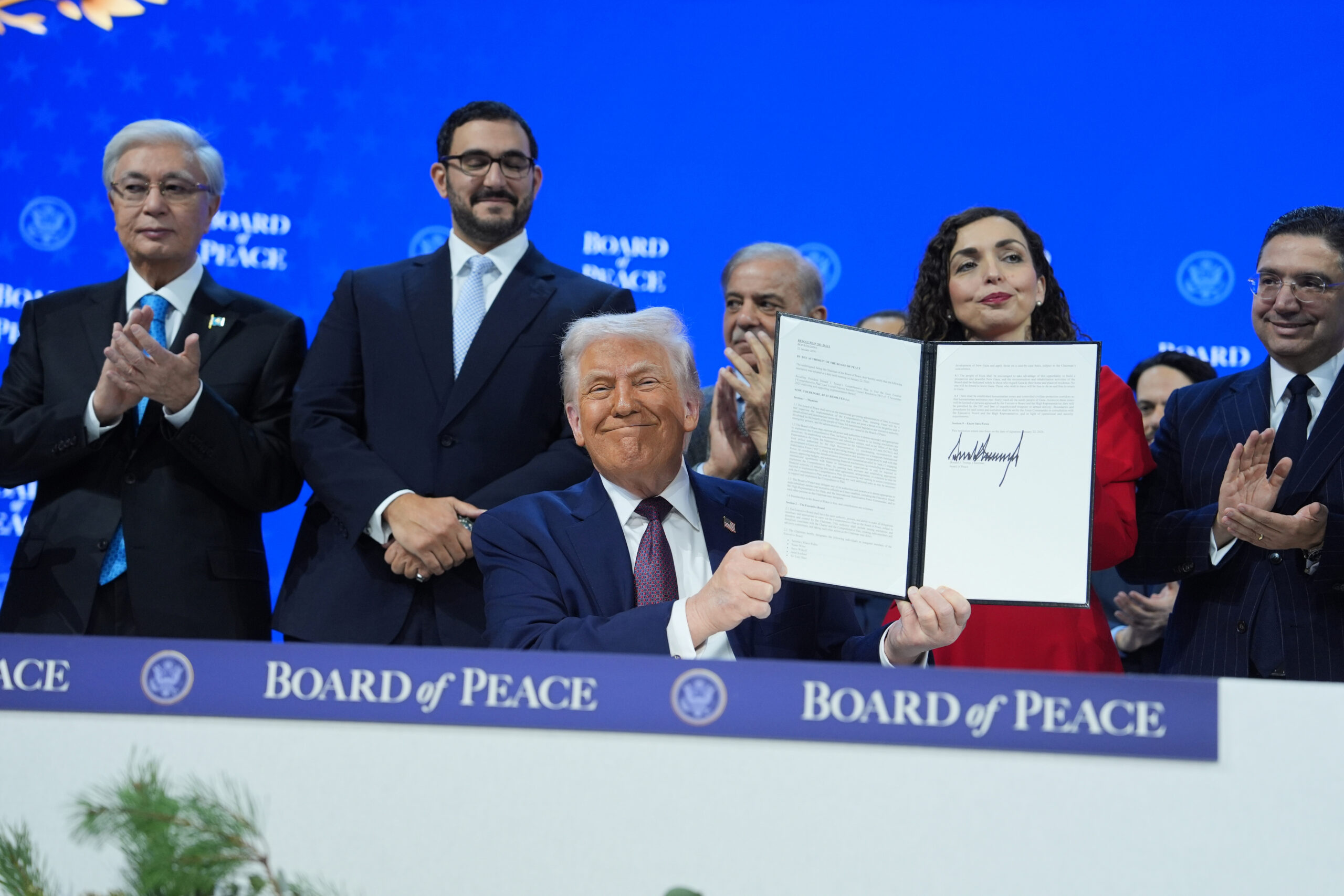
    Nothing so clearly illustrated the president’s megalomania as his inauguration of a so-called Board of Peace. Originally envisioned as a group of world leaders overseeing Gaza’s reconstruction, the board’s newly released charter doesn’t even mention Gaza, but presents its mission as an alternative United Nations, tasked with making peace around the world.

    In reality, it is a mammoth Trump vanity project: He heads the board, and its every action is subject to a presidential veto, according to its charter.

    President Donald Trump holds up a signed Board of Peace charter during the annual meeting of the World Economic Forum in Davos, Switzerland, on Thursday.

    The 20-plus initial participants were mostly Mideast sheikhs, emirs, and kings who can pay the $1 billion fee for permanent membership, along with several other autocrats and military-backed rulers. (The only Europeans signed up so far are pro-Russia Hungary and Bulgaria.)

    War criminal Putin, busy bombing Ukraine’s civilian infrastructure to smithereens, may accept his invitation to the peace board if the United States releases $1 billion in frozen Russian assets to pay the fee. This, according to the Kremlin.

    Meantime, Trump’s son-in-law, Jared Kushner, gave a slide presentation in Davos describing how Gaza could become a futuristic city with apartment towers and resorts in two to three years, a reprise of Trump’s earlier pitch for a Gaza Riviera. This, while the Gaza ceasefire is falling apart, and Israel has banned scores of humanitarian agencies from delivering food or medical treatment to desperate civilians.

    Trump’s link to reality is so tenuous that the president could still resume his war on NATO. Instead of benefiting from his successful push for Europeans to spend more on defense, he may prefer to fight Europeans while conciliating with Russia.

    European allies have finally demonstrated that a unified stand can check some of Trump’s foreign policy delusions. Gutless GOP senators and business leaders who moan privately about Trump’s madness but shut up in public should take note.

  • A win-win for Parker and Council brings $800 million housing spending plan closer to reality | Shackamaxon

    A win-win for Parker and Council brings $800 million housing spending plan closer to reality | Shackamaxon

    This week’s Shackamaxon covers the return of City Council, an update on the water wars, and the weekend’s potential snowpocalypse.

    Closer to H.O.M.E.

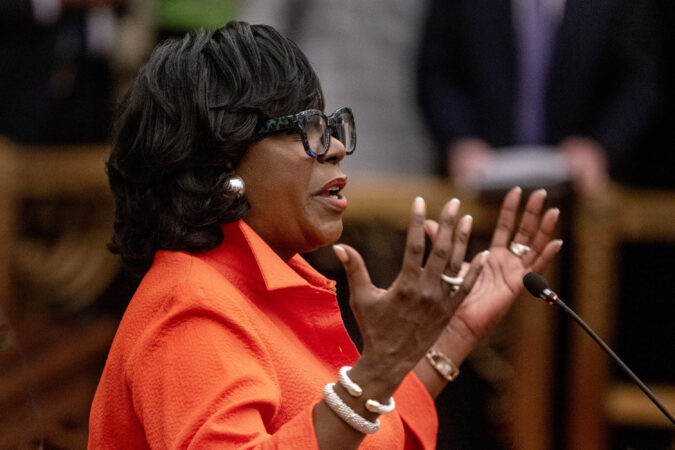
    Both City Council and Mayor Cherelle L. Parker are calling the compromise agreement on the $800 million housing spending plan a win.

    For councilmembers, the Housing Opportunities Made Easy, or H.O.M.E., proposal was altered to prioritize households at the bottom of the income scale, their main demand throughout the process. For the mayor, Council has approved her signature proposal and done so without significant alterations. That means the city will borrow and spend the first tranche of money soon.

    Frankly, I’m surprised the income limits for just two of the dozens of programs included in the initiative became such a source of contention. Council is right that the neediest should be prioritized, while the mayor is correct in saying that raising the limits is unlikely to create a flood of interest that will squeeze out lower-income homeowners.

    If a house needs modification to facilitate a resident’s physical needs, or has one of the qualifying repairs (like a major roof leak) for the Basic Systems Repair Program, most homeowners with means will address the problem as soon as they can — even if it means spending their own money. Getting help from the city can take months. That’s a lot of time to deal with a leaking roof, crumbling joists, or an inability to access your entire home.

    Perhaps the argument suited both sides. For the mayor, arguing with Council about income limits meant not arguing about whether borrowing nearly a billion dollars for her housing initiative is a good idea. It also meant new concepts like One Philly Mortgage or the property-based Shallow Rent Program mostly went unscrutinized. For councilmembers, it was an opportunity to demonstrate their compassion and score a win over a mayor who doesn’t like to lose.

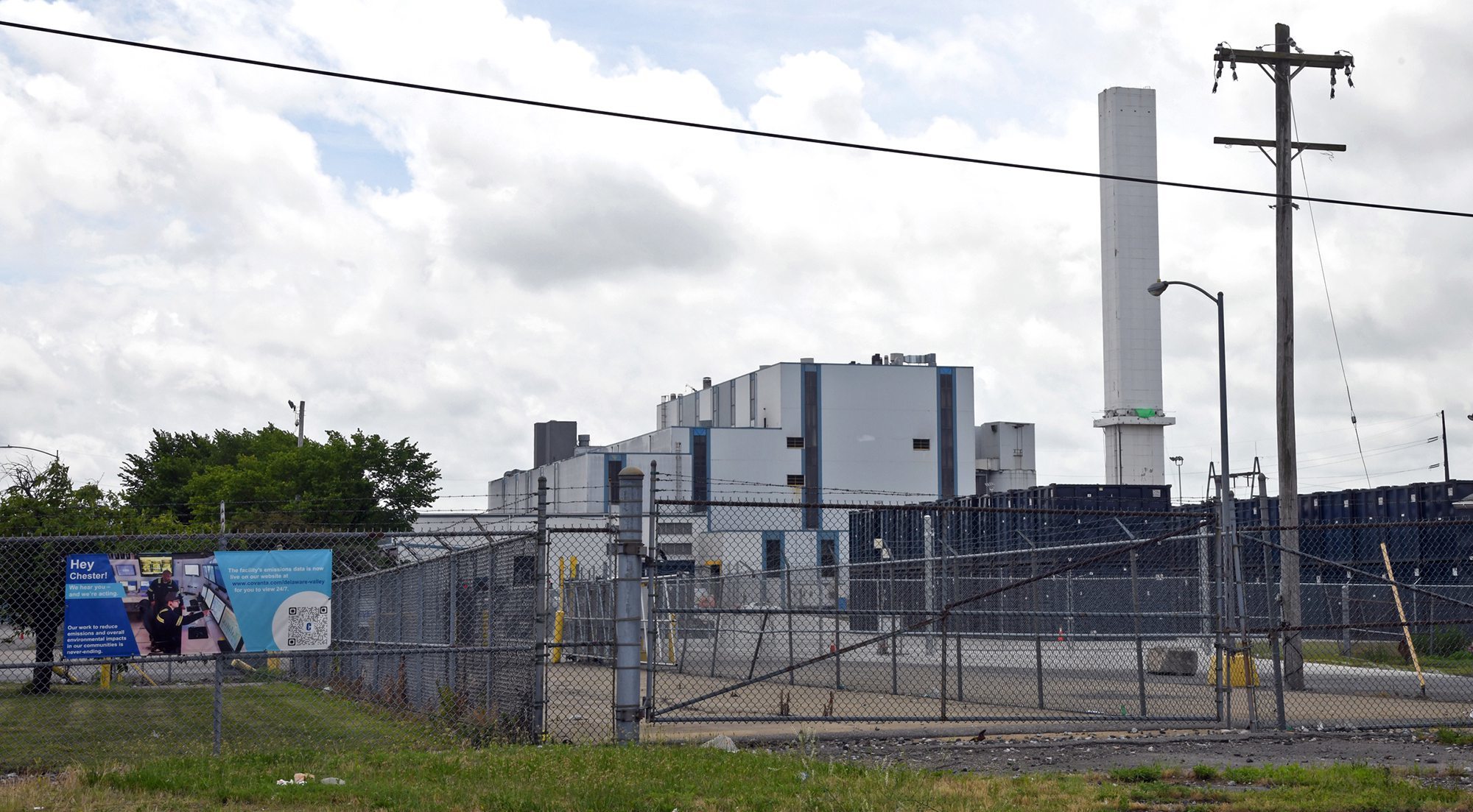
    The Delaware Valley Resource Recovery Facility is a waste-to-energy incinerator in Chester that handles more than a million tons of trash a year.

    Burning desire

    The biggest controversy during Council’s first session of the year was whether or not the city should continue sending trash for incineration at the Reworld Delaware Valley Resource Recovery Facility.

    Chester residents and 3rd District Councilmember Jamie Gauthier want the city to stop a practice they view as unneighborly, blaming Reworld for poor air quality and medical issues. Reworld says incineration is better than the alternative: landfills. Both options lead to increased local emissions. Which one is considered worse often depends on whom you’re talking to.

    One way to reduce the impact of the city’s trash would be to begin a municipal pilot program for composting. While many residents utilize composting services, extending access could lead to a significant reduction in waste. This would mean less impact on the environment and local communities, no matter which option the city ultimately chooses.

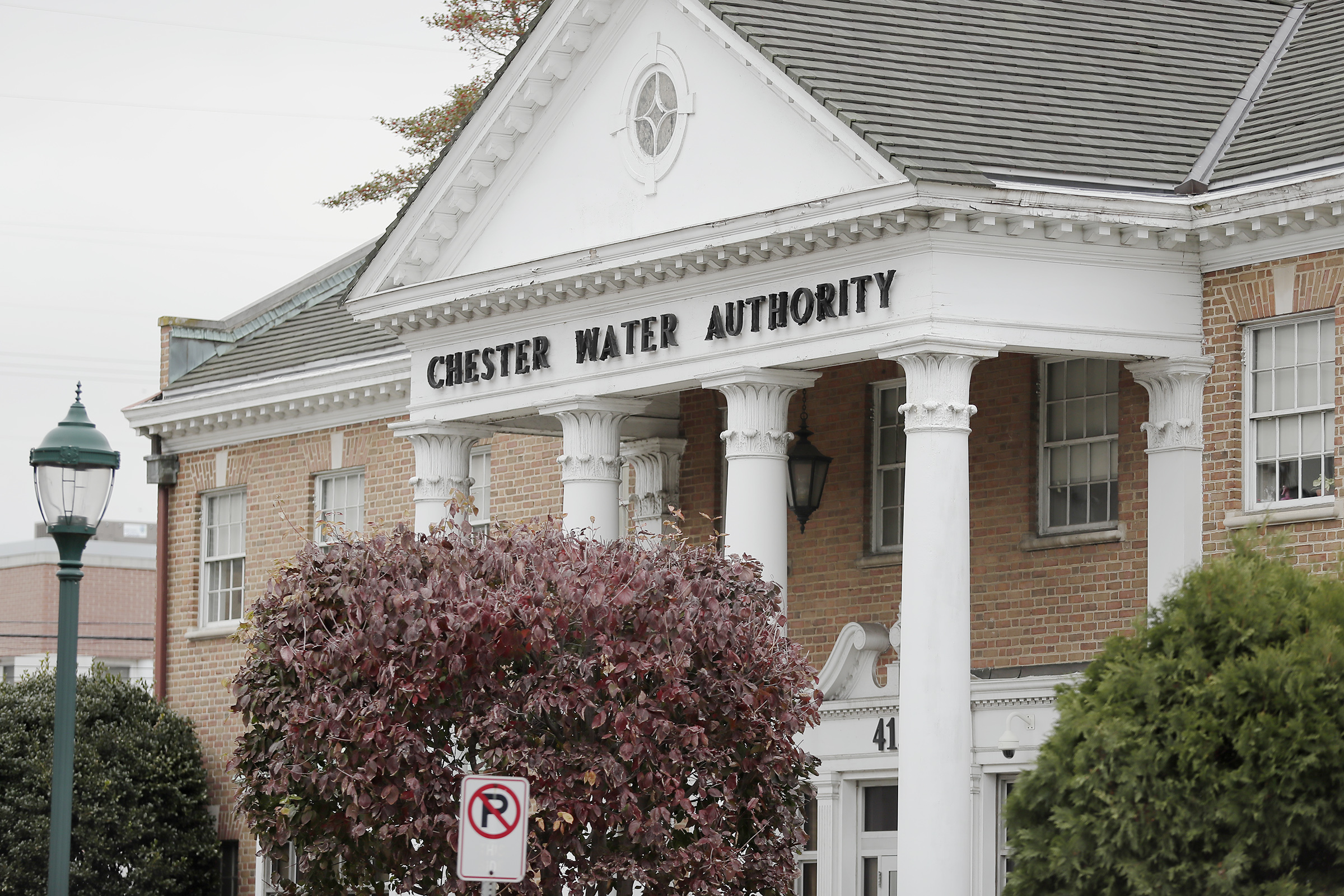
    The Chester Water Authority, located at 415 Welsh St. in Chester.

    Water wars

    The Pennsylvania Supreme Court ruled in favor of the Chester Water Authority, a win for advocates of publicly owned water utilities. The financially distressed Delaware County city had claimed ownership of the authority and its assets, based on the fact that it had originally established the agency decades ago. In the meantime, however, the coverage area has spread, even including much of neighboring Chester County.

    Despite this, the state-appointed receiver for the city of Chester came to see a sale of the authority as a way to rebalance the books. Chester has been under state supervision since 1995 and was placed into receivership by former Gov. Tom Wolf in 2020. When Aqua America offered more than $400 million for the authority, it was hard for the city, which has around $500 million in liabilities, to refuse — even when the authority’s board opposed the deal.

    The court’s ruling ends the push to privatize the authority, which is a win for ratepayers, especially the many who don’t live in the city but still rely on the authority for water. But it leaves Chester City in need of another way out of its long municipal nightmare.

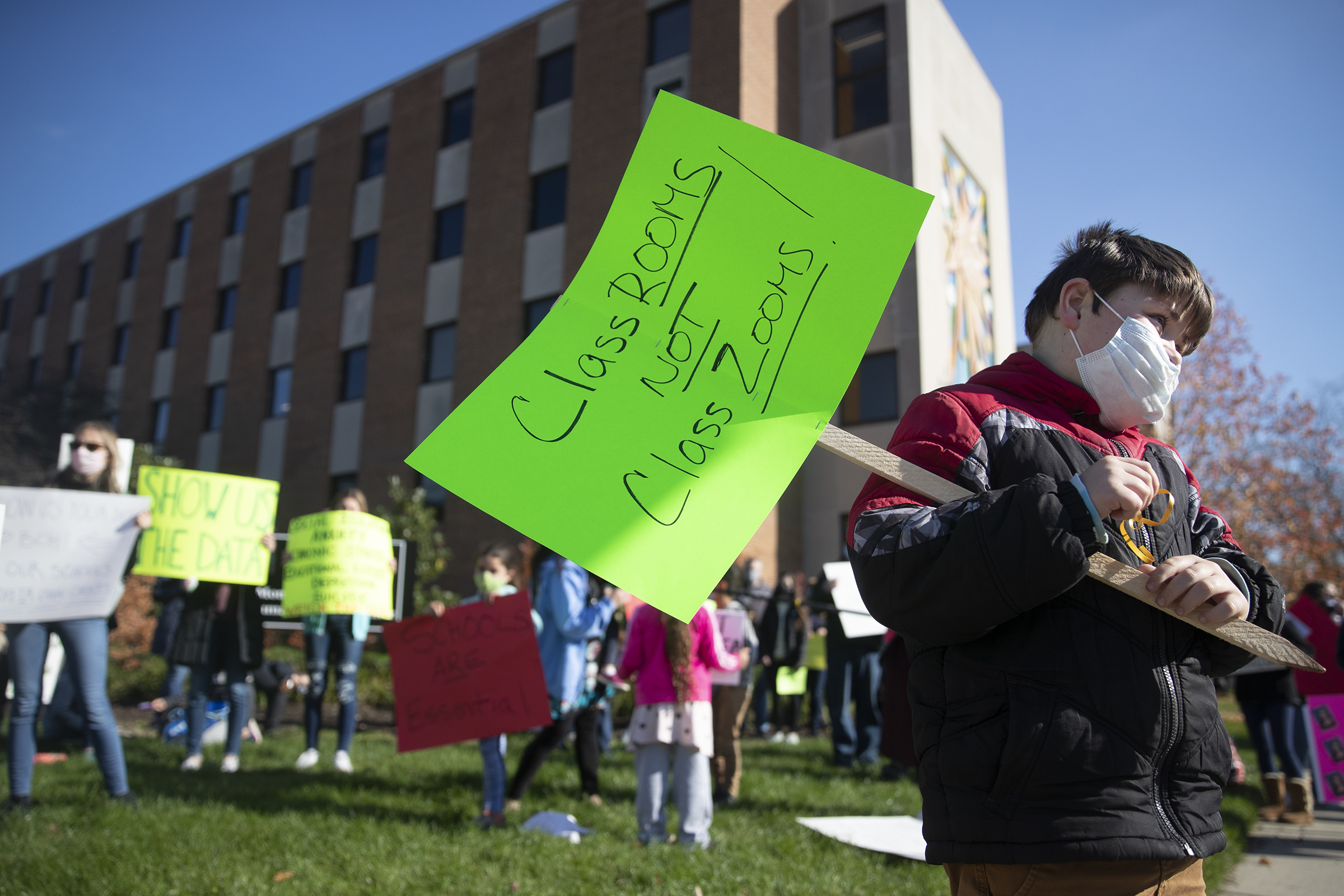
    Colin McAndrew, 9, a fourth grader at North Penn, holds a sign that reads “Classrooms not Class Zooms” during a rally held outside of the Montgomery County Human Services Center in Norristown in 2020.

    No Zoom school

    With Philadelphia expected to receive a huge helping of snow this weekend, I think it is worth reminding regional school administrators that kids deserve better than Zoom school.

    Weather models that are much more accurate than the ones they used back in John Bolaris’ day are predicting a foot or more of snow. That could be enough to make getting to class on Monday unrealistic, especially given how many teachers travel in from the suburbs.

    Losing a day of school is a challenge, but it doesn’t justify forcing kids to spend the day on their laptops, especially given the growing body of evidence showing that digital learning tools simply aren’t as effective. The National Assessment of Educational Progress test scores, often called the Nation’s Report Card, show that students have regressed across the board, erasing decades of progress.

    This decline roughly correlates with the explosion of technology in the classroom. Additionally, children’s behavior worsened overall during the pandemic, with some researchers blaming the shift to screens. UNESCO went as far as to blame it for increasing educational inequality.

    Psychologist Jonathan Haidt wrote a book called The Anxious Generation, which blames a surge in screen time (including for school) and a severe curtailment of unstructured free time for growing teenage anxiety.

    Sadly, too many adults who grew up in a time when children were allowed more freedom and spontaneity keep imposing policies on kids that leave them with less of both.