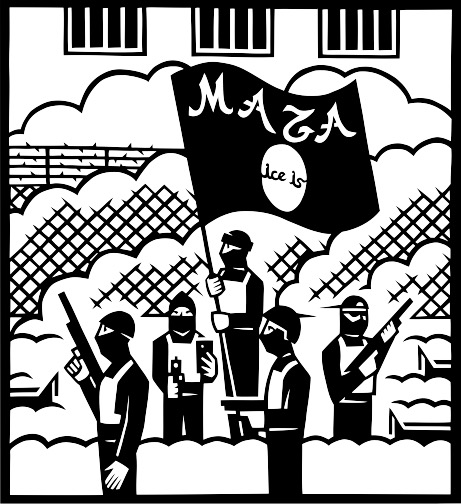
When I put pencil to paper and let my imagination run, I’m often surprised by certain discoveries and associations that emerge. While sketching in the aftermath of Renee Good’s and Alex Pretti’s recent killings, I began to conjure images of ISIS rolling out over the Levant in 2013.
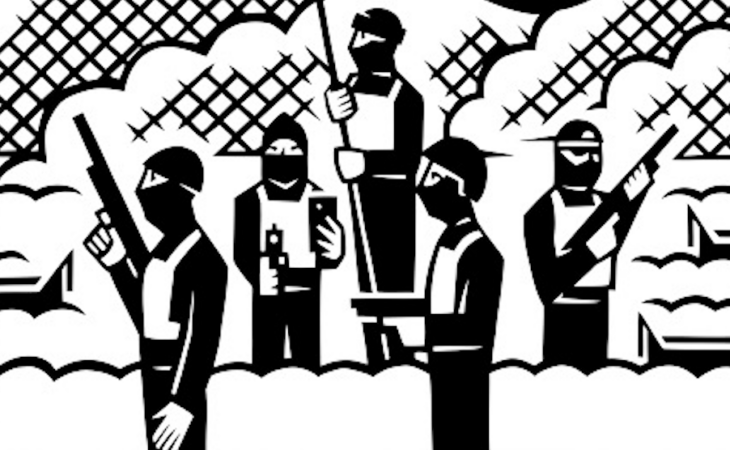
Not wanting to commit to a ham-fisted metaphor, I put my sketchbook away, only to find the idea too sticky to relinquish. As I embarked on the labor-intensive process of making the paper cutout you see printed here, the parallels became all too clear: the uniforms, the masks, the military armaments, the extremism, the rigid ideology. This is what ICE is.
This MAGA army, paid for by 2025’s “Big Beautiful Bill,” is the highest-funded law enforcement agency in the nation. It is only partly intended to expel and terrify what the regime perceives as undesirable immigrants. It is becoming apparent that it was also created to impose the movement’s fundamentalist values on American society writ large.
That is why Good and Pretti were perceived as such a threat. Good was a liberal woman in a same-sex marriage who wouldn’t bow to ICE tyranny. Pretti was a legally armed citizen determined to protect his neighbors from agents’ overreach and abuse.
As the flow of immigrants over the nation’s southern border has abated, Republicans have resurrected their panic over Sharia Law. Sen. John Cornyn of Texas has been campaigning on his fight against “radical Islam,” while his colleagues at the state level have created a “Sharia-Free America Caucus.” This is pure projection. Similar to Islamic extremists, conservative Republicans strive to impose their retrograde worldview on the rest of us.
It continues: “This includes pastors publicly reinforcing the truth that there are only two sexes — male and female — and that reason and revelation agree that marriage … consists of the exclusive union of one man and one woman and is ordered toward the spouses and the children that can and, if so blessed, should come from that union.”
Although they don’t explicitly say it, I believe Kristi Noem’s Department of Homeland Security, with U.S. Immigration and Customs Enforcement and U.S. Customs and Border Protection under her command, is positioned to be the enforcers of this ideology, using the state’s monopoly of violence against transgressors.
“MAGA, ICE Is” — a paper-cut illustration by the artist Joe Boruchow.
As ICE and CBP expand their operations to other cities and the government builds out its archipelago of concentration camps, I expect we will see more scenes that evoke the violent tactics and aesthetics of fundamentalist extremist groups of the past.
If we are unable to stop this project at the ballot box, and America’s elites continue to roll over to this administration, these antidemocratic forces will continue their race to entrench their power and strip us of the freedoms we take for granted.
MAGA continues to show us what they are: MAGA, ICE is.
If you have an idea for a drawing, editorial cartoon, multipanel comic strip, or other illustration that might serve as a visual op-ed, please email oped@inquirer.com.
Quakertown’s response to Friday’s student walkout is a disgrace. When teenagers leave school to protest, the role of police is to protect life and de-escalate. Keep students out of traffic, keep bystanders safe, and help everyone get home. It is not to turn a civic act into a street fight. Videos and witness accounts from Quakertown show a chaotic, physical confrontation between officers and students, exactly the kind of escalation law enforcement should be trained to prevent. Even if some students acted irresponsibly, adults with badges are held to a higher standard. Force against minors should be the last resort, not the first tool.
Most alarming is that detained students were held through the weekend. That is punitive, unnecessary, and indefensible. These are children. They should have been released immediately to their families. Bucks County’s independent investigation must be thorough, transparent, and swift. But the moral line is already clear. Quakertown’s young people deserved calm supervision and guidance. They got aggression and detention.
Brandon McNeice, head of school and CEO, Cornerstone Christian Academy, Philadelphia
Using kid gloves
Being a police officer is difficult. It comes with risk, demands courage, and requires split-second decision-making. Policing youth is even more difficult. One would then assume that this incredibly difficult assignment would be subject to intense training and that clear standards would exist to guide every interaction. Unfortunately, when it comes to policing youth, that is not the case. The typical law enforcement officer, at most, receives several hours of training directed at juvenile law.
But how many of them train on the developmental differences between adults and young people? Not near enough. To the detriment of both the community and the officer, these interactions are ripe for undesirable, yet predictable, outcomes. There is no dispute that youth are different from adults. We all know this. That is not political or controversial. Yet, as a community, we have not required change. Maybe the recent events in Quakertown are enough to demand it. We do not accept other professional specialties to just figure it out with kids; we shouldn’t with police, either. Not for them, and not for us.
Anthony V. Pierro, executive director, Strategies for Youth, Raleigh, N.C.
Voting issues
A recent Inquirer article regarding U.S. Sen. Dave McCormick addressing the voting issues in Chester County last year states there is “no evidence that voters were turned away,” yet also reports that some voters “voluntarily left” when their names were missing from the pollbook. That may be legally accurate if provisional ballots were offered. But if an eligible voter shows up, can’t find their name, and leaves without voting — for any reason — the system did not function as it should. The issue isn’t only whether anyone was formally denied. It’s whether the process worked smoothly and clearly for every voter. In a less affluent area, where voters may not be able to return later, the outcome could reasonably be viewed as disenfranchisement. Technical compliance matters. So does operational competence.
Jeffrey Williams, Malvern
Join the conversation: Send letters to letters@inquirer.com. Limit length to 150 words and include home address and day and evening phone number. Letters run in The Inquirer six days a week on the editorial pages and online.
As the nation enters its 250th birthday at a moment when faith in democracy feels fragile, I have been thinking deeply about what it means to be American right now. This is not a season for rose-tinted nostalgia, nor is it a time to ignore the difficulties of the past year. The challenges we have faced have been real and impossible to dismiss.
But cynicism is not a solution, and disengagement is not patriotism.
I keep returning to what feels like a revolutionary idea right now: I am not giving up on democracy, and I am not giving up on my neighbor.
American democracy is a glorious, unfinished experiment. Anchored in the radical idea that government derives its power from, and is created of, by, and for the people, it was new and unproven nearly 250 years ago.
Rejecting rule by kings in favor of the will of the people, it was an idea that endured extraordinary challenges and helped shape one of the most successful societies in human history.
In everyday life, not giving up on democracy looks like staying in the game. It means talking openly with people in our communities, engaging across differences, and resisting the urge to judge or dismiss ideas before listening for understanding. At its core, it is a recommitment to respecting the human dignity of every person.
I come to this work as the president and CEO of Eastern State Penitentiary Historic Site, a site founded on a Quaker belief in the “light within” every person, and a deep respect for our shared humanity. Today, Eastern State bears witness to nearly 200 years of evolving ideas about justice, liberty, and freedom in America. Walking its corridors and sitting with its stories reveals a powerful record of trauma and human resilience — and a nation still wrestling with the true meaning of those ideals.
This perspective is also shaped by more than 20 years of studying the Constitution, a document woven with both brilliance and imperfection. At Eastern State, we recognize humans’ capacity for change. Like democracy itself, people are not a finished product. We are living beings who both require and deserve care to grow and evolve.
When democracy is healthy, individuals and groups can express different viewpoints freely, with the goal of shaping public life. But those viewpoints must also be shaped by one another through engagement and dialogue. Civic ideas are meant to strengthen over time, not harden into absolutes. When trust erodes, that essential civic interplay breaks down.
We see this erosion clearly. According to the General Social Survey, the share of Americans who believe “most people can be trusted” fell from 46% in 1972 to just 34% in 2024. Research shows social trust is rooted in personal experience. How we treat one another is inseparable from the health of our democracy.
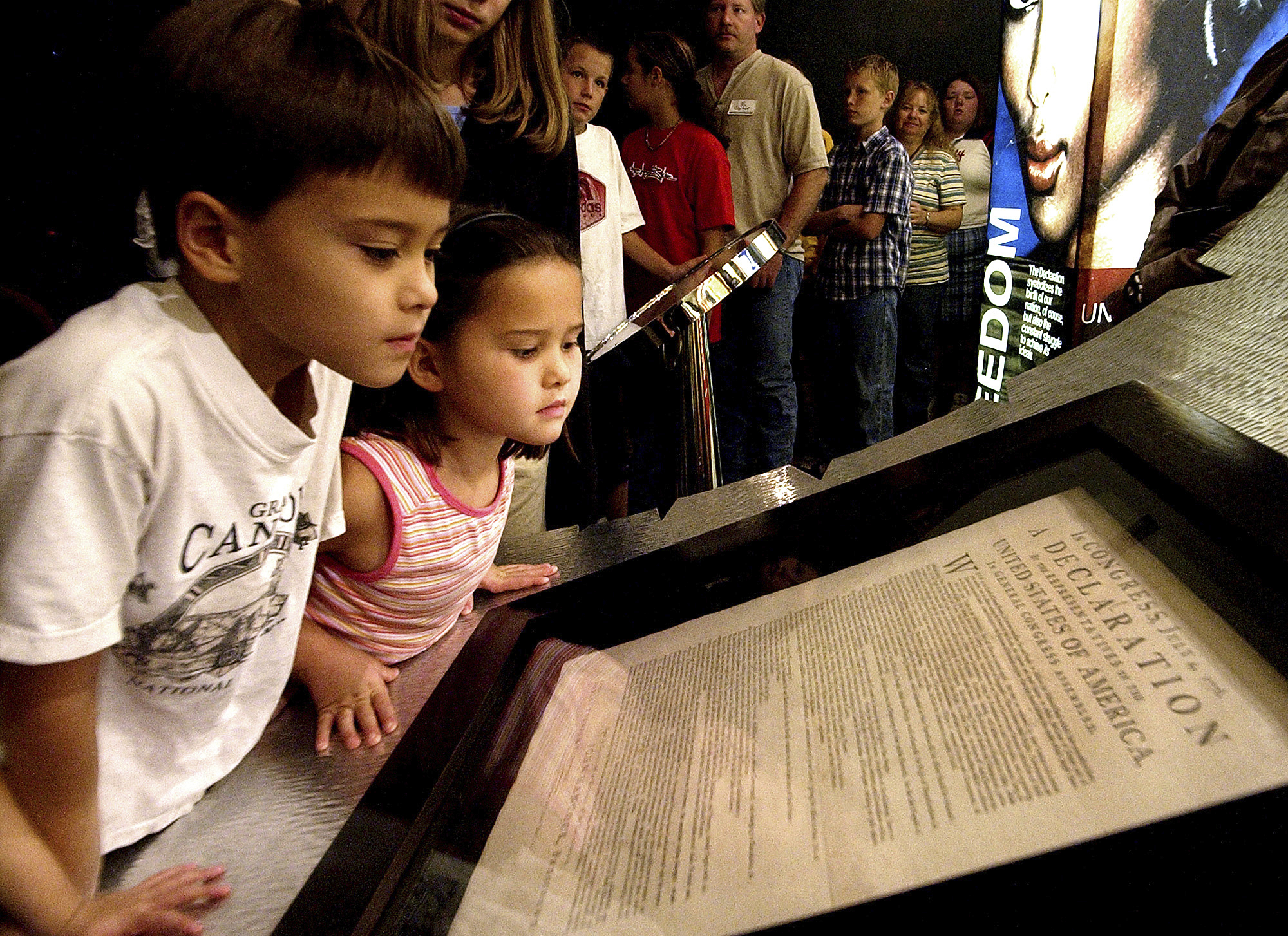
Children look at an original printed version of the Declaration of Independence. The ideals that guided the founders are pertinent today.
The American Revolution did not happen in a single summer in Philadelphia. John Adams wrote that the war was just one part of the revolution, stating: “The Revolution was in the Minds and Hearts of the People. … This radical Change in the Principles, Opinions Sentiments and Affection of the People, was the real American Revolution.”
Likewise, Benjamin Rush, a framer of both the Declaration of Independence and of Eastern State, believed the real revolution was still unfolding, shaped over time by citizens’ morals and manners. He was right then, and he remains right now.
Civic holidays give us a chance to come together, remember, commemorate, and celebrate. As we approach the Semiquincentennial, perhaps it is also time to reconnect and consider how those founding ideals can guide us forward.
The real revolution is not behind us. It is happening now — in how we show up for one another, and in our refusal to give up on each other.
Kerry Sautner is president and CEO of Eastern State Penitentiary.
Every generation eventually discovers whether it truly believes in the limits placed on power — or only supports those limits when they restrain political opponents. The moment we are living through now forces that question upon us.
The Founding Fathers of the United States did not design government for efficiency or speed. They designed it to restrain ambition. When they embedded the separation of powers into the Constitution, they were responding to centuries of human history that proved a simple truth: Unchecked power eventually silences the people.
They understood human nature’s tendency toward absolutism. Kings centralize authority. Leaders justify overreach. Governments expand unless they are deliberately restrained. The American republic was built differently. Authority was divided so that no single person could ever claim to speak fully for we the people.
That is why last Friday’s U.S. Supreme Court decision matters far beyond tariffs or commerce. The court reminded the executive branch of a basic constitutional principle: Decisions concerning commerce — especially taxation and tariffs — must originate in Congress.
Yes, the process is messy. Debate is slow. Compromise is imperfect. But the friction is intentional. The founders built resistance into the machinery of government so that sweeping economic power could never again be exercised by personal decree.
If tariffs are truly wise policy, then Congress should debate them openly. Legislators should defend them before voters. That is representation. That is accountability. That is self-government.
Our nation was born out of resistance to unilateral taxation. The Boston Tea Party of 1773 was not simply protest theater — it was a rejection of economic authority imposed without representation. The Constitution ensured such power would never again rest in one individual’s hands.
When one branch exceeds its authority, another branch must respond. That is not dysfunction; it is design. The judicial branch exists precisely to interpret the law and restore and remind us of the constitutional boundaries when political actors drift beyond them.
Courts have not always been right. History reminds us of poor decisions that took decades and courage to correct. Yet, judicial independence remains essential. Without it, constitutional limits become optional.
What should concern Americans today is not disagreement with the court’s ruling, but the reaction that followed.
Instead of accepting the decision, the executive branch responded with personal attacks against justices carrying out their constitutional duty. Even more troubling were the immediate efforts to search for ways around the ruling — to achieve the same outcome by different means.
That should unsettle every citizen, regardless of party affiliation.
I remember when one of my children was young, and my wife placed a forbidden toy on a high shelf for their safety. Determined to retrieve it anyway, the child stacked books and climbed upward, trying to bypass the boundary we had set. The creativity was impressive. The disobedience was undeniable.
A constitutional ruling is that high shelf.
Attempting to maneuver around it rather than respecting it undermines not only the court’s authority but the rule of law itself. The Constitution works only when leaders accept limits they dislike.
Equally troubling was the suggestion that a president could act militarily against another nation at will while being constrained economically. The Constitution says otherwise. The power to declare war rests with Congress. The president commands the military, but he does not possess unilateral authority to wage war or impose economic punishment without legislative participation.
The founders feared concentrated authority in every form — economic, military, and political. Their caution was wisdom born from history.
Republics rarely collapse in dramatic moments. They erode gradually — one ignored boundary at a time. One exception becomes precedent. One act of defiance becomes normalization.
The question before us now is not about one ruling or one administration. It is whether Americans still believe constitutional limits apply equally to those who govern and those who are governed.
The founders’ vision was never about strong personalities. It was about strong institutions accountable to a free people.
This feels like a dark chapter in the life of our republic. Yet, darkness often clarifies responsibility. Citizens must decide whether we will defend the structure that preserves our liberty, or remain silent as its guardrails are tested.
At the close of the Constitutional Convention in 1787, a woman asked Benjamin Franklin what kind of government had been created. Franklin replied with words that echo across generations: “A republic, if you can keep it.”
The question is no longer theoretical.
Now, we the people must decide whether we will.
The Rev. Dr. Michel J. Faulkner, a former NFL player, community leader, pastor, and registered Republican, is chair of the board of directors of the Philadelphia Council of Clergy.
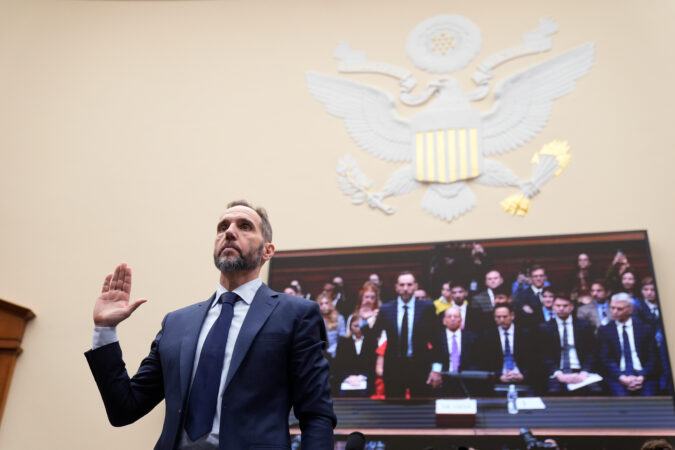
Is anyone surprised U.S. District Court Judge Aileen Cannon — young, inexperienced, and appointed by Donald Trump — has ruled that special counsel Jack Smith’s report on the president’s retention of classified documents may not be released, now or ever? Cannon has consistently acted as a Trump stooge, stalling proceedings against him, making rulings to his benefit, and playing a significant role in ensuring he would never be subjected to justice for any of the alleged crimes he committed.
No doubt Cannon’s deference to Trump will earn her a pat on the head, and that the president will speak of her “brilliance.” Perhaps she was auditioning to be Trump’s next selection if a vacancy were to open on the U.S. Supreme Court. I imagine that most, if not all, of the supine Republican U.S. senators would go along with the nomination of such a lightweight. Trump believes those whom he appoints should be loyal to him rather than to the country. He got what he wanted in Cannon.
Oren Spiegler,Peters Township
Health over politics
All this outrageous conversation of Israel and genocide and apartheid, rooted in a false narrative, denies the reality of Israel being “a light unto the nations.” Take pancreatic cancer. This pernicious affliction, a death sentence accompanied by hopelessness and horrific pain, has no boundaries; no ethnic, national, racial, or political favorites. The Food and Drug Administration has recently approved Israeli-founded company Novocure to market a wearable device for the treatment of advanced pancreatic cancer. The device, Optune Pax, uses high-frequency electric fields and is designed to be used in combination with standard chemotherapy drugs. The electrical treatment not only extends patients’ lives on average, but also delays the worsening of pain by about six months. This is the reality of Israel: cutting-edge medicine and discovery for all; living life, day by day, with its vulnerabilities, many challenges, and remarkable achievements.
Rabbi Charles S. Sherman, Elkins Park
Sowing mistrust
I appreciate The Inquirer setting the record straight in response to U.S. Sen. Dave McCormick’s inaccurate comments about the voting issue that occurred in Chester County. In comments on the Senate floor and in his weekly newsletter, he repeats the heavily investigated and thoroughly debunked claim that noneligible voters are casting ballots. He says people question the integrity of voting — if they do, it is because Donald Trump has spent years making this same false claim. I had been expecting our new senator, with his history of military and government service, would stand up for facts and democracy rather than join the forces sowing mistrust.
Karen Melton, Philadelphia
Protect democracy
My work as a therapist makes two concepts abundantly clear: There are parallel personality traits shared by destructive leaders in all walks of life and — for those who are enamored, empowered, or terrified by them — the defense mechanism of denialis extremely difficult to pierce. When it becomes clear that a leader of a household is a killer of either spirit or body or both, it is an uphill challenge to convey a warning to countless partners and many sons and daughters that, without their wake-up call, further destruction is both predictable and inevitable.
In like manner, warning signs clearly show our 47th president, raised to be a destroyer of all he cannot control, dominate, or seduce, never intends to leave office. For readers loyal to Donald Trump, I ask you to consider the futures of your sons, daughters, and theirs when you are no longer here to protect them, and they dare to have thoughts that lead to their imprisonment or death by an authoritarian leadership. If Trump ever intended to leave office, why has he sent a team of FBI agents armed with a search warrant to Fulton County to seize all available materials relating to the 2020 election? Do you think he will stop this behavior with Georgia?
Terrified his poll numbers are dropping, his intention is to alter evidence and once again lie — to tell the American people that evidence of voter fraud has, as he has always insisted, been found. Subsequently, he will tell us it will be too dangerous to hold elections. This takeover is our future if not stopped by a union of sane voices.
SaraKay Smullens, Philadelphia
Price on life
The article on making CPR more accessible missed one important factor: the cost of the training. CPR can double or even triple a cardiac arrest victim’s chance of survival, but to do that, proper training is necessary. When we explored CPR training in this area, the costs were over $80 per person. Some people need $80 for food and other essentials. If we all agree that CPR is critical, then provide a less expensive way to deliver it.
Anne Weisbord,Blue Bell
No justice
Nasrallah Abu Siyam, born in Philadelphia, was shot by Israeli settlers in a West Bank village last week, becoming at least the sixth American citizen killed by Israeli settlers or soldiers in the territory in the last two years. The Israeli Knesset voted last year to annex the Palestinian West Bank, which was supposed to be the land for a Palestinian state — something past American administrations have supported. Our American ambassador to Israel, Mike Huckabee, is an avowed Christian Zionist and supports Israel’s “biblical claim” to that area, and possibly further expansion, despite all international resolutions and laws saying it is illegal. Palestinian families have lived there for centuries and now face violence and ethnic cleansing. After supporting Israel in killing tens of thousands in Gaza, we should not continue to allow Israel to act with such impunity. We should also defend the right to life of an American born in Philadelphia.
Joan Hazbun,Media
Grim anniversary
As columnist Trudy Rubin recently reminded us, this week marks the fourth anniversary of Russia’s bloody invasion of Ukraine, a conflict that now counts two million casualties and nearly half a million deaths. Despite these losses and the threat of many more, the purpose and urgency of U.S. support for Ukraine have faded in the minds of many American leaders. So this is an appropriate moment to recall why Ukraine’s fate matters.
As the world’s model for democracy and freedom, the U.S. has long stood by those who align with those values. Invaded by a country whose population, wealth, and weaponry far exceed their own, the Ukrainian people have fought steadily with grim and unfailing endurance. Through commitment, grit, and bloodshed, they have shown themselves to be true partners in the pursuit of values we share. To abandon Ukraine today would be a betrayal of what we as Americans have long stood for.
To assure global peace and security, it is essential that this war ends in a way that assures Russia will not renew it. By procrastination and by insistence on impossible terms, Vladimir Putin has shown repeatedly that peace with Ukraine is not on his agenda. He will call a halt to the war only when its price becomes intolerable. A weak deal will only invite renewed aggression. On this anniversary, let’s broadcast our support for Ukraine. We urge our fellow Philadelphians to convey to our elected representatives that we want a just and enduring end to this conflict, one that will be possible only when the U.S. exerts the necessary economic, political, and military pressure on the invader.
Elaine Fultz and John Francis,Philadelphia
Join the conversation: Send letters to letters@inquirer.com. Limit length to 150 words and include home address and day and evening phone number. Letters run in The Inquirer six days a week on the editorial pages and online.
Does Donald Trump have to ruin everything? The answer is obviously yes, but this one was heartbreaking. Sunday’s overtime thriller over Canada, which gave U.S. men’s hockey its first gold medal since this senior citizen was a college junior, was a howl of joy in what’s been a dire year for America. But then (taxpayer-)Ka$h Patel showed up to party, and soon Trump was on the phone, egging on the boys with misogynistic trash talk about their gold medal compatriots, the women’s hockey team. Now the men are invited to Trump’s State of the Union address, the women “had other plans,” and I almost wish our Canadian friends had won the game.
How Indiana University won a football crown and lost the plot
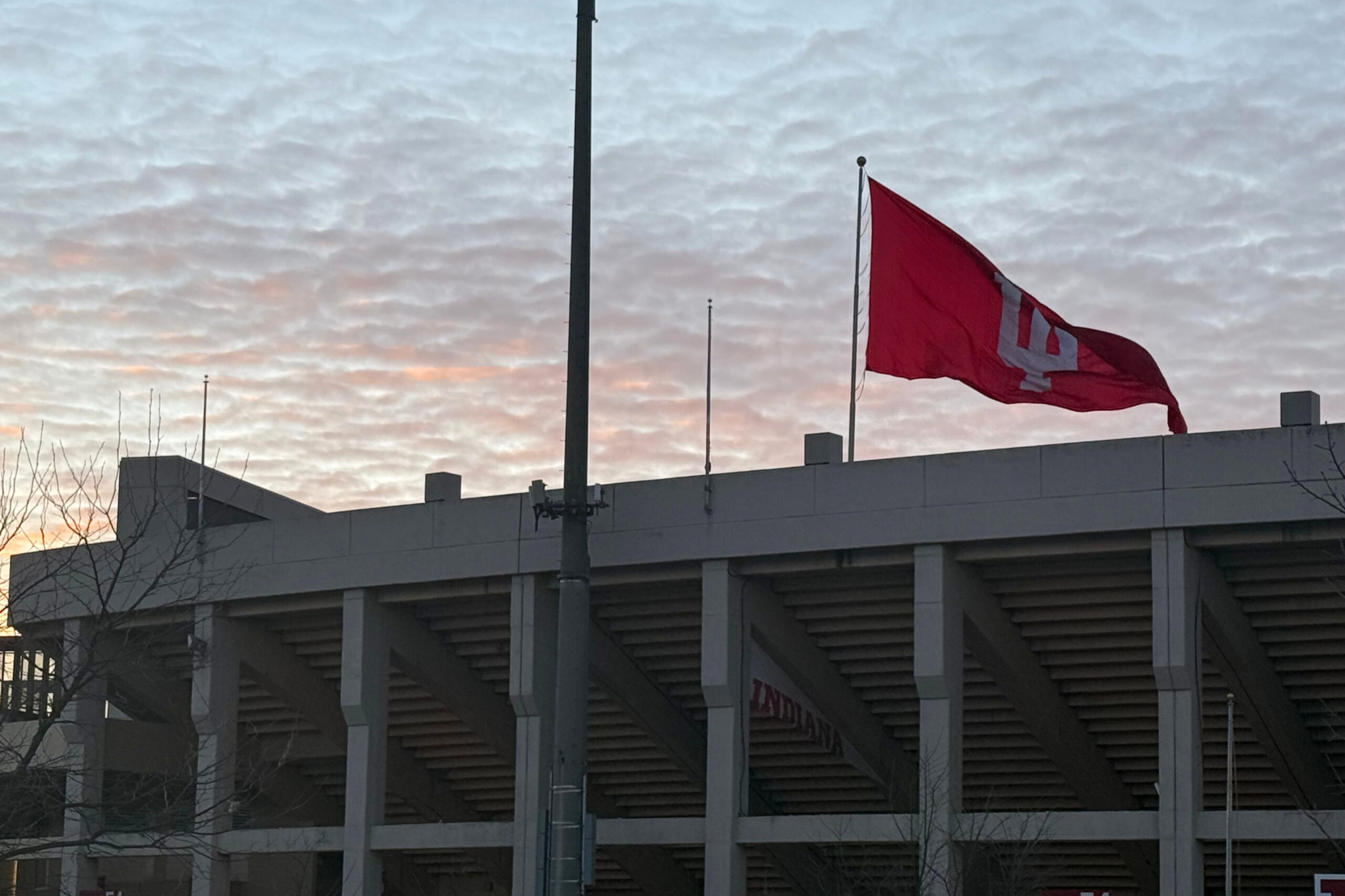
Indiana University’s victory flag flies over Memorial Stadium in January in Bloomington, Ind.
Even in a state where the sports miracles, from Rudy and The Knute Rockne Story to Hoosiers, are so big they tend to make it to Hollywood, there’s never been a feel-good script quite like Indiana University — with the most losses in college football history until this season, when it went 16-0 and won the national championship.
“The energy is just absolutely insane,” Katie Shin, a recent Indiana alumna, told the Athletic as thousands of fans went wild on the Bloomington campus that night, saluting Heisman Trophy quarterback Fernando Mendoza and their unsmiling genius head coach Curt Cignetti. “The whole state is just rallying around IU.”
But there’s a huge irony for anyone who’s a big fan of America’s colleges for more than just what happens on the gridiron. In the same season Indiana was slowly climbing to the top of the football polls, the flagship public university was also ranked dead last in the nation.
For something arguably more important: free speech.
The Foundation for Individual Rights and Expression (FIRE), the national campus speech group based here in Philadelphia, last fall ranked IU 255th on its 2026 ranking of universities over freedom of expression — the lowest-rated public institution in America, and only higher than the controversy-wracked private sister schools, Columbia University and Barnard College.
Interestingly, the FIRE low-ranking came after a slew of campus controversies in which the silenced speakers or protesters were all over the map ideologically — a canceled Jewish speaker and a shout down of right-wing speakers, but also draconian moves against pro-Palestinian protesters, including harsh penalties for a 2024 encampment. Last month, a federal court ruled that IU’s punishments of the Gaza campers and its anti-protest policies were unconstitutional.
FIRE’s lambasting of IU’s free speech transgressions was reported upon last Sept. 9 in the student paper, the Indiana Daily Student. The following month, school administrators ousted the faculty adviser to the IDS and told the student journalists they could no longer print the paper, and that news could only be published online. The university’s insistence that this was purely an economic move was a surprise to the ex-adviser, who sued and said he was fired “after he refused to censor the students’ work.”
It ought to go without saying that curbing the free exchange of ideas is antithetical to the most sacred values of American higher education. But the free speech mess at IU is but one controversy at an iconic heartland university that has become a poster child for the moral crisis of U.S. universities, even as it celebrates football glory.
Clearly, the leadership at IU — and this includes its board of trustees, with three new conservative, pro-MAGA members that GOP Gov. Mike Braun named in June under a law that also allowed him to boot three trustees elected by IU’s alumni — is eager to keep its pigskin prowess as the main thing America knows about the university.
The school just signed its field general, Cignetti, to a contract extension that will pay him $13.2 million a year through 2033, making him one of the three highest-paid coaches in the nation. But his new deal flabbergasted a growing number of critics, who note the big raise came as IU — just days after the new conservative trustees were named — either eliminated or made deep cuts in nearly 250 academic programs such as French, art history, geography, and East Asian studies.
Meanwhile, Cignetti isn’t the only high-profile figure at IU to see a big raise. Also this weekend, the trustees gave Whitten a $100,000 pay hike, to an even $1 million a year — citing her willingness to work with industry.
At least 250 IU alums, joined by current faculty and students, have signed on so far to an open letter and donation freeze demanding that, instead, Whitten step down. They also want the university to restore both its diversity programs and robust free speech protections, as well as the reinstatement of the three alumni trustee positions. But they are swimming against a red tide of conservatism that’s polluted the public college universe in Indiana.
Cross-state public rival Purdue University is reeling from a recent report in its hometown newspaper that the school, under pressure from conservative lawmakers, has informally banned the admission of international students from China and a slew of other countries. Students and faculty have complained of an unwritten “soft ban” on many overseas applicants, although Purdue has denied that such a policy exists.
Meanwhile, the regional campus of IU Indianapolis caused a stir and triggered a protest when it abruptly canceled the 57-year tradition of an annual Rev. Dr. Martin Luther King Jr. dinner — a move that was undertaken not long after the school removed campus signs that read “Black Lives Matter” and “Discrimination has no place here.”
Indiana is hardly alone. The 2025-26 academic year has been marked by similar outrages against unfettered speech and racial inclusion, especially in the most pro-Trump red states. To cite just one of many examples, the University of Texas System just adopted a new policy aimed at limiting discussion of “controversial topics” in the classroom. Isn’t that the whole point of the college experience?
The erosion of freedom at the American university has happened gradually and then suddenly, and it needs to be getting a lot more attention. That’s hard when the president is sending aircraft carriers to threaten Iran, imposing steep taxes for no reason, and generally acting and talking like the mad king he is.
Yet, nothing is more important for MAGA’s authoritarian project than what is happening at Indiana University and other college campuses right now. As I wrote in my 2022 book, After the Ivory Tower Falls, higher ed is the fulcrum of America’s political divide, now more than ever.
Every tactic — murdering the humanities and the social sciences, making campuses more white, ensuring our future elites aren’t exposed to “controversial topics” while entertaining them with the beer and circuses (a phrase, ironically, coined by an IU English professor) of big-time football — is another step toward MAGA’s strategic goal of an American electorate that cannot think critically.
The fight for the soul of Indiana University is the fight for the soul of the United States, and it’s not what’s happening inside Memorial Stadium against Ohio State or Michigan.
“We know that IU alums are smart enough to celebrate the success of the Football Hoosiers and condemn what Pamela Whitten is doing to degrade the prestige of our degrees,” the university dissidents write in their open letter. “Please help us take a stand against the debasement of our university and restore the glory of old IU.”
Yo, do this!
You might have noticed that the late Jeffrey Epstein and his randy U.K. royal pal, the artist formerly known as Prince Andrew, have been in the news a lot lately. But did you know there’s an excellent 2024 Netflix movie called Scoop about the drama behind the disastrous 2019 BBC interview that started the long downfall of Andrew Mountbatten-Windsor, now arrested and under a British police investigation? I watched Scoop over the weekend, and it’s both an entertaining and highly relevant journalism thriller.
Since this space is devoted to my weird entertainment choices, and not what normal people are doing, I have to share that I’ve been escaping today’s banality of evil with a deep dive into the musical world of … mass murderer Charles Manson. My all-time favorite podcast, Andrew Hickey’s A History of Rock Music in 500 Songs, did a remarkable four-parter a couple of years ago about Manson and his shockingly close ties to the Beach Boys (and others like, sigh, Neil Young) that resulted in the murder mastermind’s uncredited cowriting of their 1968 song, “Never Learn Not to Love.” There’s also a compelling detour into the life of Black music pioneer Huddie “Lead Belly” Ledbetter, and a book recommendation that sounds equally incredible: Bring Judgment Day: Reclaiming Lead Belly’s Truth from Jim Crow’s Lies by Sheila Curran Bernard.
Ask me anything
Question: Update us on what is and what should be happening in Quakertown [please]. — @marco2751.bsky.social via Bluesky
Answer: Thanks for this, Marco, because if readers aren’t up to speed on what’s been happening in Quakertown, an exurb nearly an hour’s drive north of Philadelphia, then they need to learn. Quick version: A peaceful Friday walkout by Quakertown High School students protesting U.S. Immigration and Customs Enforcement raids turned shockingly violent, highlighted by a grown man placing a teen girl in what appeared on video to be a dangerous choke hold. It turned out this man was the Quakertown police chief and interim borough manager, Scott McElree. Adding insult to injury, five students were arrested and spent the entire weekend in jail before they could see a judge. What should be done? Quakertown can’t fire McElree quickly enough. The right to peacefully assemble and protest the government is the heart of the First Amendment, and what makes America a democracy. A police chief who can’t honor the U.S. Constitution should not have a job.
What you’re saying about …
Last week’s take-a-step-back-from-the-madness question about who is the greatest living American (inspired by the passing of the Rev. Jesse Jackson) didn’t get a large response, but brought some compelling arguments. Two men were named twice: Pope Leo XIV, the Villanova alum who has shone as an advocate for immigrants and for peace on the world’s stage since last summer, and Sen. Bernie Sanders, who has never wavered in fighting for progressive values. Other suggestions included Bob Dylan, Edward Snowden, Barack Obama, and — in a show of respect for science under siege — the health experts Anthony Fauci and Peter Hotez, who, wrote Pat Eisenberg, “is trying to improve the health of Americans despite all the things the Trump administration is doing to ruin our health.”
📮 This week’s question: I’m hopefully going to be writing soon about the scourge of prediction markets like Kalshi, and more broadly, the problem of sports betting. Should these forms of gambling be banned, or at least more strictly regulated? Please email me your answer and put the exact phrase “Betting bans” in the subject line.
Backstory on what pundits don’t get about ‘28
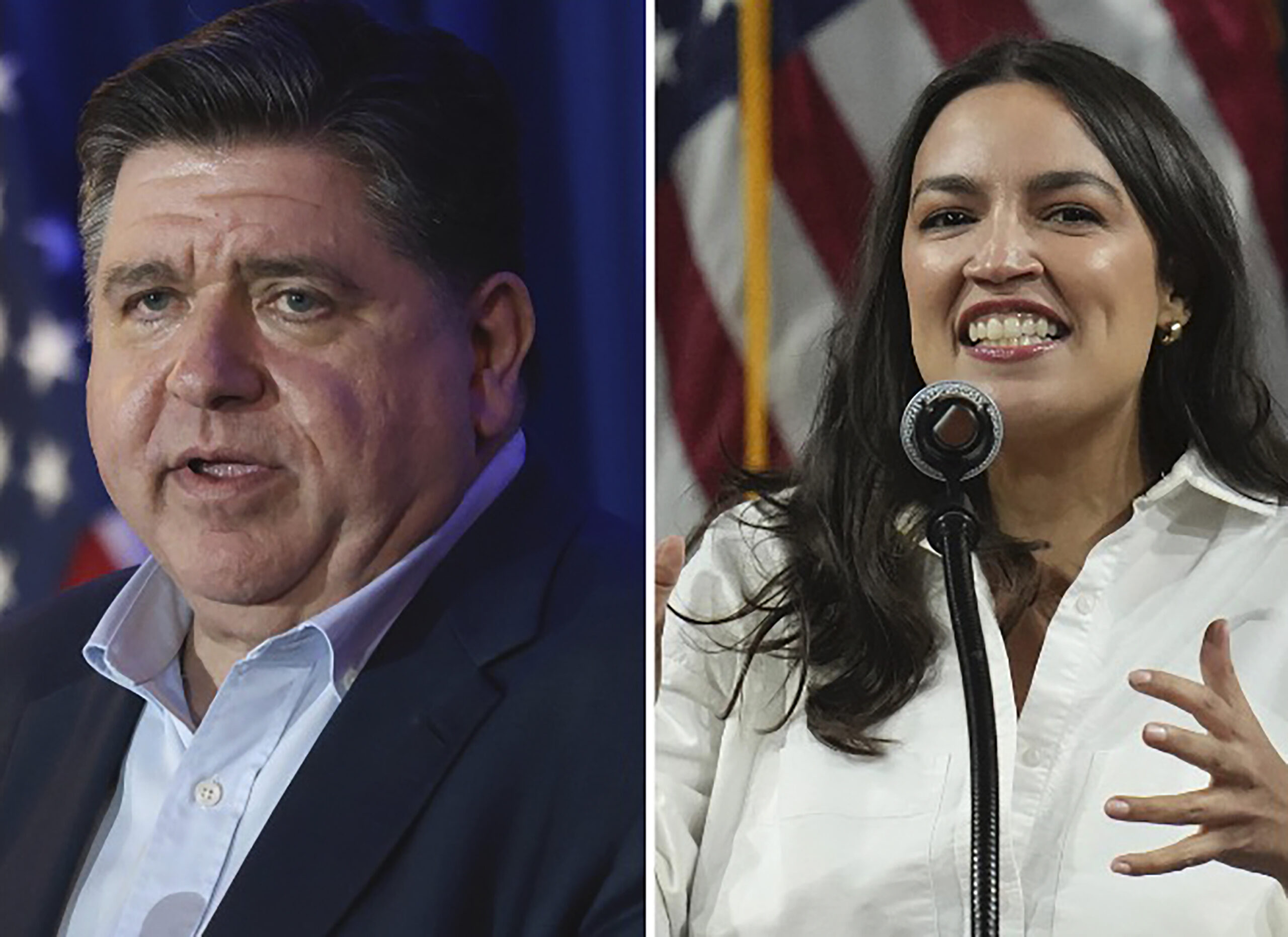
This photo combo shows Illinois Gov. JB Pritzker, left, speaking during the McIntyre-Shaheen 100 Club Dinner, April 27, 2025, in Manchester, N.H., and U.S. Rep. Alexandria Ocasio-Cortez (D., N.Y.) speaking during a “Fighting Oligarchy” tour event at Arizona State University, March 20, 2025, in Tempe, Ariz.
Get 13 Democratic and left-leaning independent voters together in the same chat — as the New York Times did with a recent focus group, the latest in its running series — and you’d surely hear some harsh words about Donald Trump and the GOP. But ask them what they think about the Democratic Party, and you might want to cover your ears.
“Spineless.” “More complacent than I thought they would be.” “Paralyzed.” “Afraid.” “Incompetent.” “I guess suffocated, or given up …” “Sold out.” I’m not leaving out the positive responses, because there weren’t any. You also won’t be surprised that these 13 Democratic or aligned voters — very diverse across racial, class, and age lines — want more radical leaders who will take the party, and hopefully the nation, in a bold new direction. There was positive buzz for the likes of new New York Mayor Zohran Mamdani and Texas Rep. Jasmine Crockett — anyone with fresh ideas and a willingness to mix it up with Trump. Said a 36-year-old independent woman from Washington state: “I still don’t agree with everything she’s doing, but Alexandria Ocasio-Cortez is a well-known name and seems to be fighting against Trump.”
I thought a lot about the Times’ focus group last week as I heard or read two veteran pundits try, at this relatively early date, to handicap the 2028 presidential race. Mark Halperin (who’s somehow still around despite this) went on POTUS radio with Michael Smerconish to defend his picks: He included ex-Chicago mayor Rahm Emanuel, a center-right figure who is passionately hated by any real Democrat I’ve ever spoken with, and also overrated Kamala Harris (floating on the fumes of her name ID), as well as his No. 1 pick, California Gov. Gavin Newsom, with Pennsylvania Gov. Josh Shapiro at No. 2. He said he included AOC and upgraded Illinois Gov. JB Pritzker only because his “sources” told him to — because his sources understand the Democrats while the clueless Halperin does not.
Ditto Nate Silver, who has magically reappeared in the Times, which first made him a star in 2012. Although Silver did place AOC in second, behind Newsom, he also — much like Halperin — uprated tired conventional wisdom candidates like Shapiro (No. 6) and Michigan Gov. Gretchen Whitmer (No. 4, despite being invisible recently), and grossly downrated progressive favorites like Pritzker (14) and Connecticut Sen. Chris Murphy (18), as well as more interesting and unorthodox names like Arizona Sen. Mark Kelly (12) and Kentucky Gov. Andy Beshear (15). He sees Newsom as the darling of “Resistance Libs,” the Trump-hating MS Now watchers who controversially get tagged as heavily “wine moms.” Said Silver of Newsom: “They want a fighter. And Newsom plays expertly into that.”
True, but I expect Newsom’s standing among Democratic primary voters will crumble once voters learn more about his ties to Silicon Valley billionaires, or his verbal sellouts of the transgender community, or his “meh” popularity among the Californians who know him best. Readers of this newsletter were unanimous earlier this month in not wanting Shapiro to run. I’m not going to do a numerical ranking, but I would place Pritzker, who’s made all the right moves against Trump without Newsom’s train car of baggage, and AOC, who’s making all the right enemies, including the worst Beltway journalists, as my top two. I’ve covered presidential races since 1984, and I’ve learned the only thing that matters two years out is to listen to the people. The pundits know nothing right now.
What I wrote on this date in 2019
It’s impossible to top this anniversary: The day I appeared in the Epstein files. In February 2019, with the walls closing in, Epstein’s close adviser and quasi-journalist friend, Michael Wolff, wanted to make sure he saw my Feb. 24, 2019, column about elite male impunity that mentioned him and two billionaires in his orbit: Donald Trump and New England Patriots owner Robert Kraft. What did Epstein read, assuming he clicked on it? I wrote that “this isn’t really ‘a sex scandal.’ The real scandal here is the gross imbalance of power involving women who were held in a form of human bondage to serve as objects of gratification for powerful men intoxicated by their belief they can get away with anything.”
I took a short break from the relentless anti-Trump, anti-ICE beat last week to write about the other threat to the American way of life: artificial intelligence. Rapid advances in AI technology make it clear that robots and chatbots and the like are going to upend the economy — most importantly, the job market — sooner rather than later. Can wary voters find politicians who are willing to regulate AI and its threats to employment, education, and the environment, or will pols continue to prefer Silicon Valley’s campaign donations? Over the weekend, I highlighted the recently leaked ICE blueprint for an American concentration camp in Georgia, and what that document tells us about the moral depravity of mass deportation.
In a city as large and as history-bound as Philadelphia, all big stories are inevitably local. That was never truer than at the Winter Olympics in northern Italy, especially for the most-watched event on these shores: the U.S. men’s hockey’s thrilling overtime victory over Canada. The on-ice celebration blended with copious tears as Team USA teammates went into the stands and skated back with Johnny Jr. and Noa Gaudreau, the young children of late South Jersey NHL hockey icon Johnny Gaudreau. Their dad and their uncle Matty were killed by an alleged drunk driver while cycling on a South Jersey road in August 2024, as Gaudreau was training to hopefully make this Olympic squad. The players centered the Gaudreau family and his No. 13 jersey during the gold-medal celebration, and The Inquirer’s Alex Coffey captured the whole emotional story — one you won’t read anywhere else. “This is a history book [moment] that there will be a movie about,“ sister Katie Gaudreau told Coffey. ”And in that movie, Noa and Johnny will be on the ice.” You get the big, moving stories like this, and allow us to keep covering them, when you subscribe to The Inquirer.
By submitting your written, visual, and/or audio contributions, you agree to The Inquirer’s Terms of Use, including the grant of rights in Section 10.
As America prepares to celebrate its 250th anniversary, the state of the union is in turmoil.
In little more than a year in office, President Donald Trump has assailed the country’s institutions, upset the constitutional system of checks and balances, flouted the law, undermined democracy at home and abroad, and ignored the rising cost of living for ordinary people while lining his family’s pockets.
Under Trump — at the whims of his unelected billionaire buddy, Elon Musk — senseless funding cuts have gutted U.S. medical research, led to thousands of federal employees losing their jobs, and more than 800,000 lives lost due to discontinued foreign aid.
The president’s chaotic mass deportation efforts have a body count — including two citizens — as the nation’s streets are overrun by heavily armed, masked federal agents who routinely use excessive force with little accountability. Meanwhile, the government continues to protect the rich and powerful listed in the Jeffrey Epstein files, perhaps hoping to redact away their sins.
When the president addresses Congress on Tuesday at the annual State of the Union address, he will do so with a 60% disapproval rating, according to a Washington Post-ABC News-Ipsos poll. Those abysmal numbers echo those seen after the Jan. 6, 2021, assault on the U.S. Capitol by Trump followers.
The reproach has been hard-earned by the president, who has squandered away the goodwill of voters after his undeniable 2024 election victory.
Rather than focusing on the kitchen-table issues that won him a return trip to the White House, Trump has ramped up the cruelty of his anti-immigrant policies and ignored the economic pressures many people face.
Instead of presiding over cooling inflation, the president’s obsession with tariffs cost American families an extra $1,000 last year. In place of policies that would make owning a home more affordable and bring down the cost of rent, Trump said he wants to keep housing prices high. Contrary to what the administration wants people to believe, mass deportations don’t create jobs; they stunt economic growth.
The tax cuts promised in Trump’s signature piece of legislation, the One Big Beautiful Bill Act, mostly benefited the very wealthy. The law allots billions to hire U.S. Immigration and Customs Enforcement agents and build vast detention facilities on the back of steep cuts to Medicaid and food assistance.
That people are roundly pushing back against the president’s upside-down priorities and abuses of power seems to have restored some conservative leaders’ resolve.
In Congress, a handful of Republicans have also rejected Trump’s wishes, denouncing his administration’s refusal to release the Epstein files and the president’s ill-conceived tariffs on Canada. GOP lawmakers have so successfully abandoned their authority to Trump that even these limited developments are heartening.
When it comes to the president, perhaps the legislative branch should pay heed to the judicial.
In the same court decision that denied Trump his tariff authority, Justice Neil Gorsuch, who is part of the conservative majority, laid it out clearly.
“Yes, legislating can be hard and take time. And, yes, it can be tempting to bypass Congress when some pressing problem arises,” the Trump appointee wrote in his concurrence. “But the deliberative nature of the legislative process was the whole point of its design. Through that process, the Nation can tap the combined wisdom of the people’s elected representatives, not just that of one faction or man.”
The American people and the courts are speaking. If the state of the union is to ever recover, Congress must listen.
The implication is clear. The United States economy is doing well, so nothing else matters. However, although an elevated Dow helps those with retirement accounts, what does it mean for the 40% of Americans who do not have a 401(k) or any other retirement savings account? How does that translate into affordability for basic items like food, clothing, shelter, and, perhaps most importantly, healthcare?
The latter is a huge problem, especially with the Medicaid and Medicare cuts in July, and the expiration of the Affordable Care Act (ACA) subsidies last month. The combination is expected to affect 15 million Americans by 2034. Consider also that 3.14 million Pennsylvanians, which translates to 24.1% of everyone in the commonwealth, were covered by Medicaid in 2024.
The facts are that health insurance has become increasingly unaffordable for most Americans, and that has a downstream effect. When health insurance premiums are prohibitive, people are more likely to go without insurance or opt for a plan that offers a lower premium but a much higher deductible. Those people are more likely to skip important preventive care, placing them at increased risk for adverse health consequences. This also applies to those whose Medicaid benefits were cut.
Under Health and Human Services Secretary Robert F. Kennedy Jr., the number of measles cases in the U.S. has skyrocketed.
President Donald Trump has promised to decrease the price of prescription drugs through the Trump Rx program, but in actuality, the differences will be much smaller than promised.
To his credit, his administration has tried to address the price of drugs by reining in pharmacy benefit managers, the middlemen whose practices serve to increase the cost of drugs. However, the success in that area pales in comparison with the overall detrimental effects of this administration on healthcare.
The most recent problem is the expiration of the federal subsidies under the ACA. Consider the case of Pennsylvania residents Tom and Carol Shaw, who saw their health insurance premiums jump from $1,090 a month to $3,505 a month, largely due to the loss of the ACA subsidies. That’s a 221% increase!
To put that in perspective, the average monthly mortgage payment in York County, where they live, is about $1,300, according to the U.S. Census. The Shaws can afford the increase, but what about those who can’t? The result is that about 85,000 Pennsylvanians have dropped their health insurance in 2026. That amounts to one in five enrollees terminating coverage, which is truly a stunning statistic.
On top of the financial effects, the dismantling of our vaccine infrastructure poses a significant risk to the health of the nation. The science of vaccines has not changed, but the politics have, such that Health and Human Services Secretary Robert F. Kennedy Jr. has been able to spew misinformation and take numerous actions designed to destroy trust in science and physicians without any accountability, no matter how much he mangles the facts and the science. As a result, in 2025, we saw 1,277 measles cases — the highest number since 1992.
Meanwhile, Kennedy continues to insult physicians by stating that the only reason physicians recommend vaccines is to make money. It is difficult enough to take proper care of patients in the limited time allotted without having to dispel the numerous lies coming from this administration.
It is not clear exactly what President Trump will say in his upcoming State of the Union address. We suspect he will address the affordability of healthcare. If he does, we are quite confident he will dismiss it as a nonissue, given his comments in December that the affordability crisis is a hoax.
We are convinced he will cite the Dow while ignoring the fact that 59% of Americans disapprove of his handling of their cost of living. We fully expect a speech that will be tone deaf to the financial plight of many Americans, including his own supporters.
There must be accountability for this administration. The midterm elections are approaching, and healthcare, yours and that of your neighbors, will be guided by your vote.
If we do not address this issue appropriately, we will pay the price, as will our children and loved ones. In fact, we already have.
Mark Lopatin is a physician and the author of “Rheum for Improvement,” a member of Ask Nurses and Doctors, and a coeditor for Doctors for America, a nonprofit that focuses on putting patients over politics. Jeffrey Lerner holds a doctorate in health policy and is the Pennsylvania coordinator of Ask Nurses and Doctors, a bipartisan organization whose mission is to help elect government officials who prioritize U.S. healthcare problems.
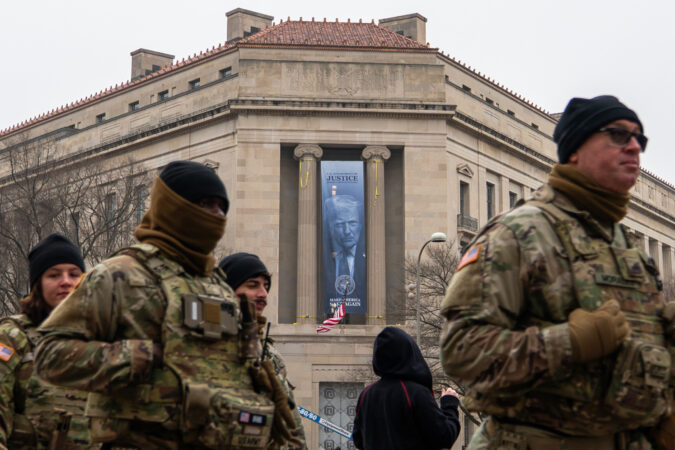
The U.S. Supreme Court ruling that declared the Trump administration’s tariffs illegal may have pushed another front-page story to the inside of The Inquirer. The story that should have been out front described a large banner with a picture of Donald Trump unfurled and now hanging on the facade of the U.S. Department of Justice’s headquarters in Washington, D.C. It is a reminder that the department had been independent of the executive branch until Trump’s second term started last year.
The banner of Big Brother hanging on the building clearly indicates the department has surrendered its independence. Cases against Don Lemon, James Comey, Letitia James, and the six Democratic members of Congress who discouraged service members from obeying illegal orders are examples of how the Justice Department now bows to the president’s commands.
That banner must come down, and the Justice Department must recover its independence. To achieve this, we need a Congress that is also independent of the man on the banner.
Joel Chinitz,Philadelphia
Genocide scholars
Sen. John Fetterman (D., Pa.) has rebuked Rep. Alexandria Ocasio-Cortez (D., N.Y.) for her criticism of Israel at the Munich Security Conference. Fetterman claims that “there was never any genocide in Gaza.” However, Israeli Holocaust and genocide researchers — Amos Goldberg, Omer Bartov, Daniel Blatman, Raz Segal, and Shmuel Lederman — have all identified Israel’s actions in Gaza as genocide.
Goldberg writes: “What is happening in Gaza is genocide because the level and pace of indiscriminate killing, destruction, mass expulsions, displacement, famine, executions, the wiping out of cultural and religious institutions … and the sweeping dehumanization of the Palestinians — create an overall picture of genocide, of a deliberate, conscious crushing of Palestinian existence in Gaza.” Other genocide scholars, including Martin Shaw, author of the book What is Genocide? Melanie O’Brien, president of the International Association of Genocide Scholars, and Dirk Moses, senior editor of the Journal of Genocide Research, have drawn the same conclusion.
The United Nations Genocide Convention placed prevention at the center of international law. By rejecting credible evidence of genocide, Fetterman is undermining the postwar promise of “never again.”
Terry Hansen, Grafton, Wisc.
Join the conversation: Send letters to letters@inquirer.com. Limit length to 150 words and include home address and day and evening phone number. Letters run in The Inquirer six days a week on the editorial pages and online.