Category: Opinion

  • It’s not just about schools. It’s about neighborhoods.

    It’s not just about schools. It’s about neighborhoods.

    Reginald Streater, president of the Philadelphia Board of Education, opened his testimony before City Council last month by introducing himself as “Reggie from Germantown,” a graduate of two district schools that no longer exist. Germantown High and Leeds Middle both closed. He knows what it means to lose a building. He’s also voting to close 20 more.

    The conflict playing out in Philadelphia isn’t only about schools. It’s about the fact that the school district and City Council have different responsibilities for the same places, and the new facilities plan brings that conflict into sharp focus.

    On Jan. 22, Superintendent Tony B. Watlington Sr. released a facilities master plan proposing to close 20 schools, colocate six, and modernize 159 others. On Feb. 26, he presented an amended final plan to the Board of Education, which was updated from 20 school closures to 18. Russell Conwell Middle School and Motivation High School were removed from the closure list.

    The district has lost 15,000 students in a decade, carries 300 buildings, many of them 75 years and older, and runs some schools with more than 1,000 empty seats, while others are overcrowded. Concentrating students means Advanced Placement courses in every high school, algebra for every eighth grader, and real career and technical pathways. The current spread of half-empty buildings makes all of that impossible to deliver consistently or fairly.

    The facilities plan is doing exactly what it was designed to do. The trouble is that everything it was not designed to do.

    A Philadelphia neighborhood school isn’t just one institution. It’s four, sharing an address. There’s the instructional platform: courses, teachers, schedules, the district’s domain. There’s the civic anchor: the building that signals to a neighborhood that its children count, and they belong. There’s the distribution node: where meals are served, where social workers operate, and where there is, most days, someone watching. And there’s the pathway to the future: where a counselor knows a family by name, where a student learns there’s a college or a trade or a life beyond the block.

    In places like Kensington, schools have absorbed those responsibilities over time.

    When that school building closes, all of those other things close with it. Some of those functions were formal educational programs. Others accumulated because families had nowhere else to go for them. The school became the place where paperwork was explained, problems were addressed and solved, and someone always knew which door to knock on next.

    City Council doesn’t get to vote on the facilities plan, but it funds roughly 40% of the district’s $2 billion budget. Councilmember Jimmy Harrity, an at-large member who lives in Kensington, decried that lack of input, but said that “the budget’s coming, and we will be looking.” Council President Kenyatta Johnson has signaled he’s willing to hold up city funding entirely.
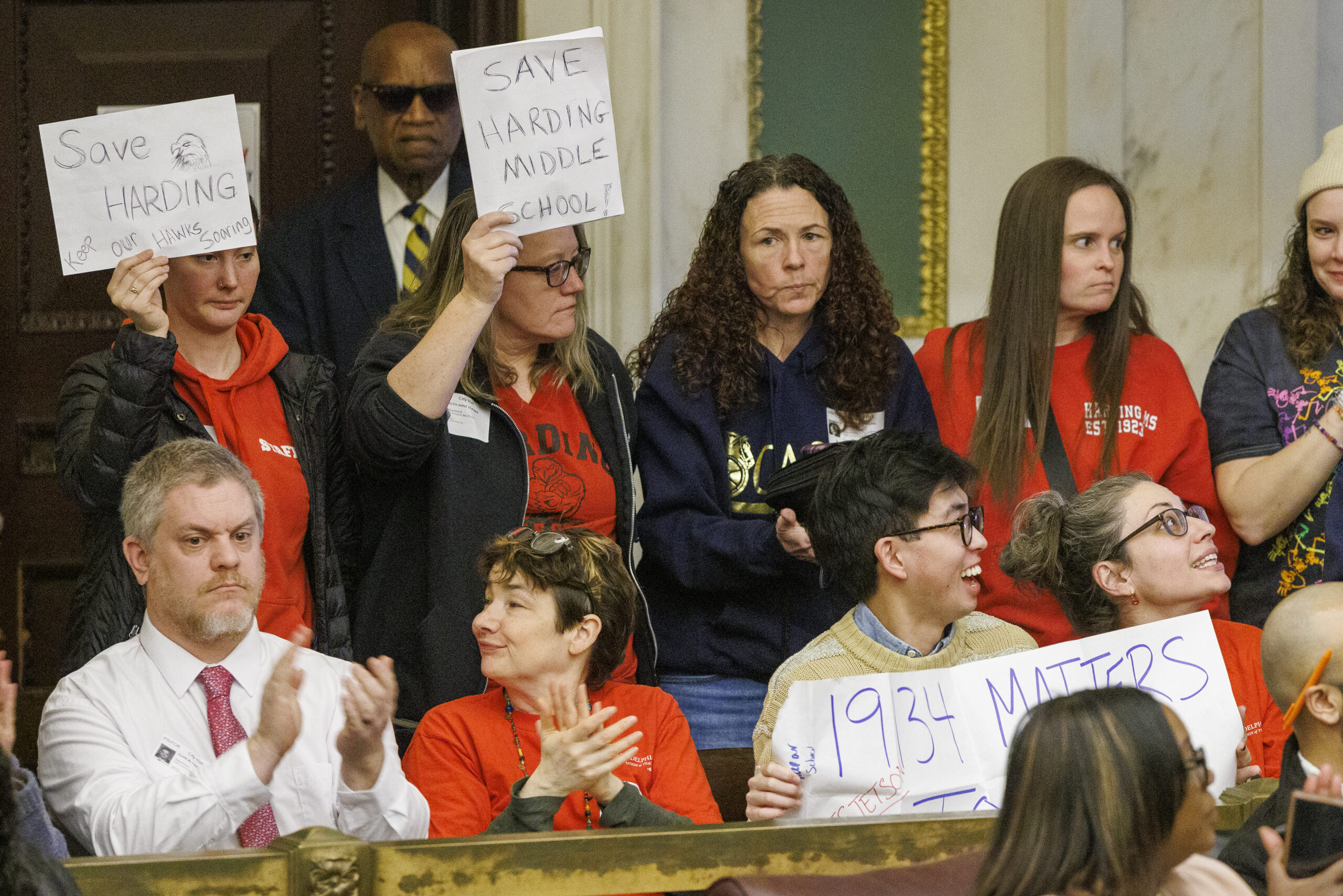
    Supporters of Harding Middle School protest at a City Council hearing with school board members earlier this month.

    Residents and families filled the chamber. Parents stood along the walls long after seats ran out, some holding infants, others carrying school backpacks. The hearing lasted hours.

    The debate sounded like a disagreement about the plan, but it was really a disagreement about who is responsible for what the plan leaves behind.

    What closes with a school building is not limited to instruction. Council’s budget is the instrument for the functions the facilities plan does not govern: housing investment, community infrastructure, colocated services, and neighborhood anchors that exist independent of school enrollment.

    The district held 47 public listening sessions and surveyed more than 13,000 people before releasing this plan. The fight at City Hall last month wasn’t because communities weren’t heard. It’s because what they described was a loss that the facilities plan was never designed to address. That’s not a failure of process. It’s a mismatch of jurisdiction.

    The district’s plan answers an educational question. What replaces the neighborhood functions housed in those buildings is a civic one.

    That answer does not sit with the school district.

    Amanda Soskin is a Philadelphia resident and consultant who writes about neighborhoods and civic infrastructure at Neighborhood Fundamentals.
  • Letters to the Editor | March 3, 2026

    Letters to the Editor | March 3, 2026

    Iraq 2003 redux

    Has Iran been developing nuclear bombs? Almost certainly. The detection by the International Atomic Energy Agency of uranium 235 enriched to 60% in recent years proves that. There is no known peaceful use for large quantities of such highly enriched uranium. Many of Iran’s nuclear facilities have been damaged or destroyed, but we do not know what others may be undiscovered and still functional.

    Now, President Donald Trump has joined Israel in an all-out war against Iran. This is the Iraq War of 2003 all over again: Create a boogeyman and get public opinion on board. There is little doubt Trump will press ahead with this operation for who knows how long — he will not want to be seen as backing down and weak — the U.S. and the rest of the world be damned.

    Sam Goldwasser, Bala Cynwyd, samslaser@gmail.com

    Boys to men?

    In a recent article by the Associated Press, Defense Secretary Pete Hegseth is quoted as complaining about so-called woke changes to Scouting America’s policies. He argued that the organization, formerly known as Boy Scouts of America, should return to its roots as “a group that develops boys into men.” I am an old and gray Eagle Scout and the product of one of the most traditional scouting programs anywhere. So believe me when I say: Mr. Hegseth doesn’t have a clue.

    Scouting has never existed simply to “develop boys into men.” It has always existed to teach and practice the unchanging principles of the “Scout Oath and Law.” They are summarized in the first words of the Scout Oath: “On my honor, I will do my best.” In other words, I am a person of integrity, and I will do the right thing regardless of what anyone else is doing. That’s not Mr. Hegseth’s principle — just ask Sen. Mark Kelly — but it is scouting’s unchanging principle.

    The rest is program. Our scouting programs change, or rather evolve, to meet the realities of the day. Otherwise, we are not doing our promised best to teach principles in the here and now. And that would be much worse than even Mr. Hegseth’s uninformed nostalgic exercise.

    Jim Matthews, Wayne

    A time and a place

    I believe the awarding of the Medal of Honor to two of our nation’s bravest warriors during the State of the Union address was entirely inappropriate. Those men deserved a presentation where they would be the center of attention rather than a sideshow to the president’s speech.

    The president politicized the event to cast himself in a positive light. Those valiant service members should have been recognized with a more respectable, personal, and honorable ceremony.

    Ken Biles, Douglassville

    Deadly distraction

    Donald Trump has unconstitutionally launched yet another attack without addressing the American people or securing the approval of Congress. He says he bombed Iran to stop it from using its nuclear arsenal. Didn’t he say eight months ago that we had totally “obliterated” its nuclear capabilities? And Congress? Trump’s Republican minions just follow his lead — it’s a complete disgrace to our democracy. This attack on Iran is simply a distraction from the Jeffrey Epstein files, environmental regulations being rescinded, the economy, farmers declaring bankruptcy at increasing rates, burdensome healthcare costs, cryptocurrency making Trump rich — the list goes on and on. Trump, the self-proclaimed “president of peace,” just started another “forever war.” God help us all.

    Robert LaRosa Sr., Whitestone, N.Y.

    Join the conversation: Send letters to letters@inquirer.com. Limit length to 150 words and include home address and day and evening phone number. Letters run in The Inquirer six days a week on the editorial pages and online.

  • Trump’s war of choice with Iran makes a mockery of the Constitution | Editorial

    Trump’s war of choice with Iran makes a mockery of the Constitution | Editorial

    Donald Trump, the president of war, keeps killing people at home and abroad.

    Over the weekend, Trump presided over the assassination of Iran’s supreme leader. While many Iranians celebrated the end of Ali Khamenei’s 37-year reign of terror, the reckless gambit does not hide the fact that Trump violated the Constitution (again) by going to war without consent from Congress and unleashed more chaos.

    This was a war of choice by Trump, who was egged on by the bloodthirsty leaders of Israel and Saudi Arabia. The administration provided no evidence of an imminent threat from Iran.

    More alarming, Trump acted with no mandate, no plan, and no idea of what comes next.

    The bill is already coming due. At least six U.S. service members have been killed, and five others seriously injured. Trump blithely said more soldiers will likely die. Apparently, that’s the price of a senseless war started by an unstable leader.

    Oil prices jumped, and the stock market slumped, underscoring how Trump’s latest folly will cost Americans blood and treasure.

    The conflict has already spread to other countries across the Middle East, as Iran fired drones and missiles at Israel, Kuwait, Bahrain, Iraq, Oman, Syria, Qatar, and the United Arab Emirates. Dozens have been killed.

    Israel, the U.S.’s eager bombing partner, responded with airstrikes in Lebanon that killed at least 31 people. The volatile situation risks spinning out of control.

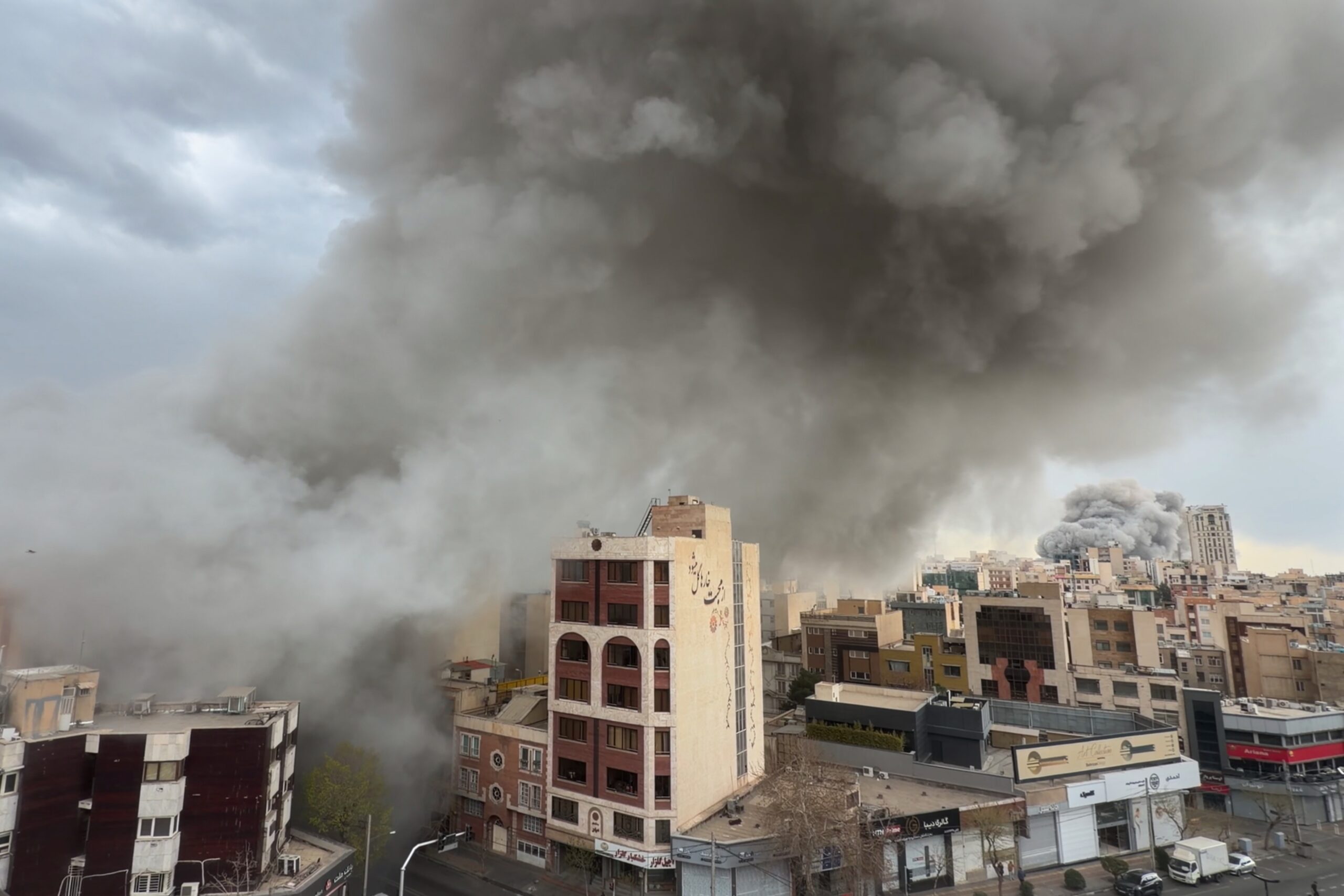
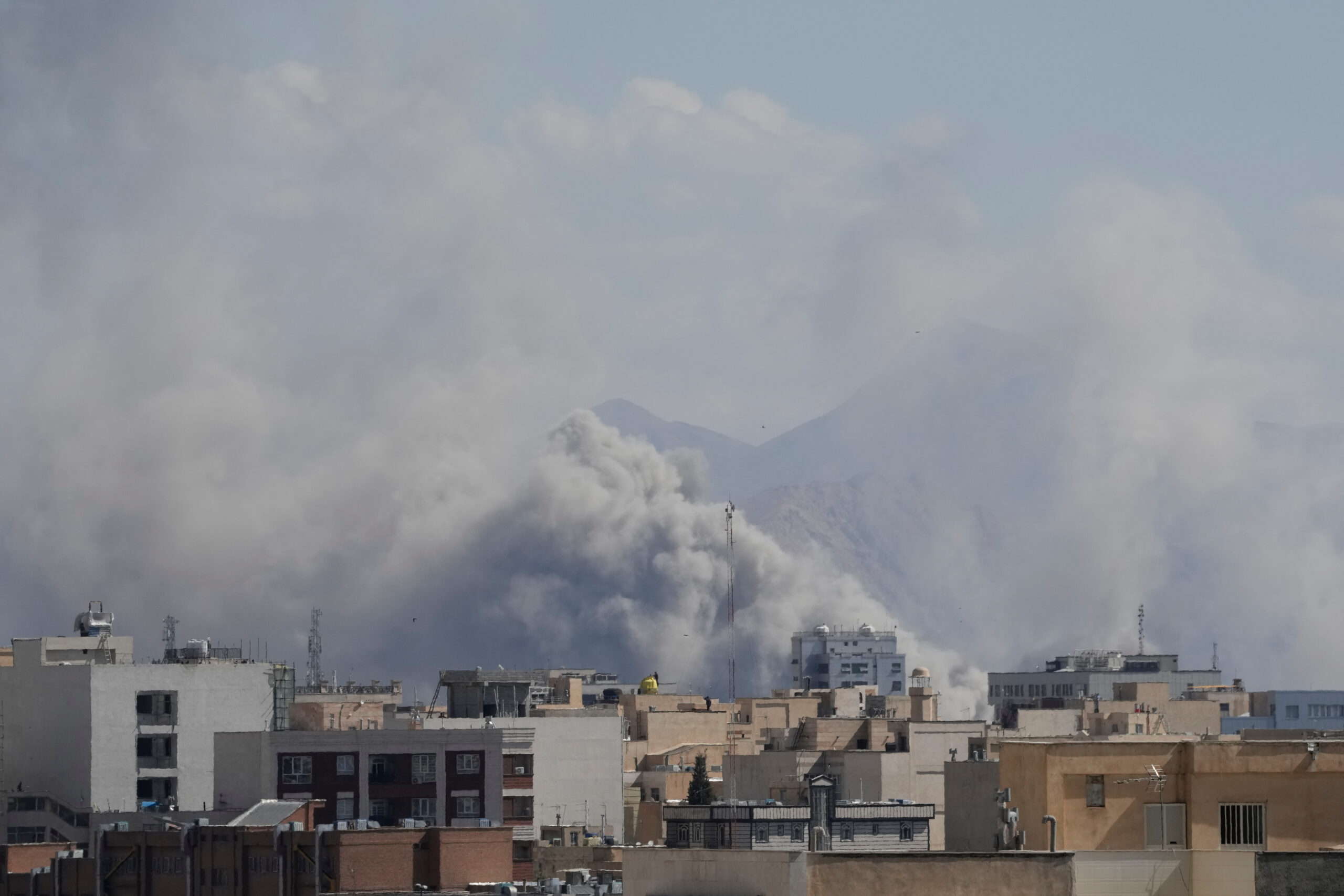
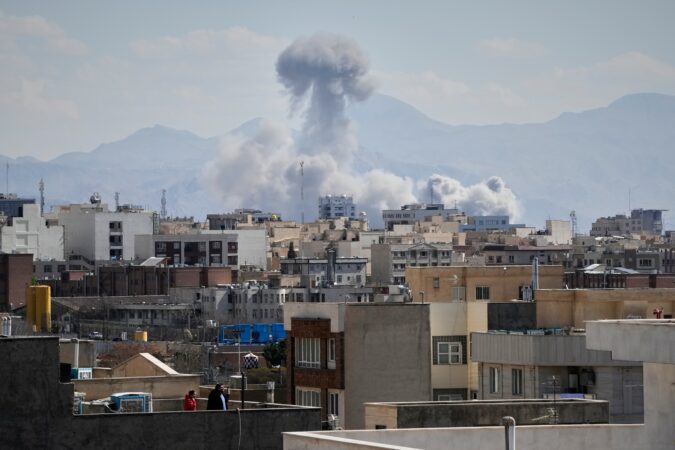
    Plumes of smoke from two simultaneous strikes rise over Tehran, Iran, on Monday.

    The FBI and the U.S. Department of Homeland Security are on high alert for terror attacks.

    Can either agency be trusted to keep Americans safe?

    Under Trump, scores of FBI counterterrorism agents have been fired, while DHS has undergone a mass exodus. DHS has been focused on arresting immigrants, killing Americans, and trampling the Constitution, while FBI Director Kash Patel was last seen pounding beers at the Olympics.

    Meanwhile, Pete Hegseth, the weekend TV commentator turned unfit and unqualified defense secretary, claimed that taking out Iran’s top leaders was not about regime change.

    That’s good, because the U.S. has a failed history when it comes to forcing its will on other countries, something presidents never seem to learn.

    So, what is the plan? No one knows — not even Trump, whose rationale keeps shifting.

    Trump urged Iranians to take control of their country. But that is impossible to do without weapons or outside support. Indeed, more than 30,000 Iranians were killed in January after they took to the streets.

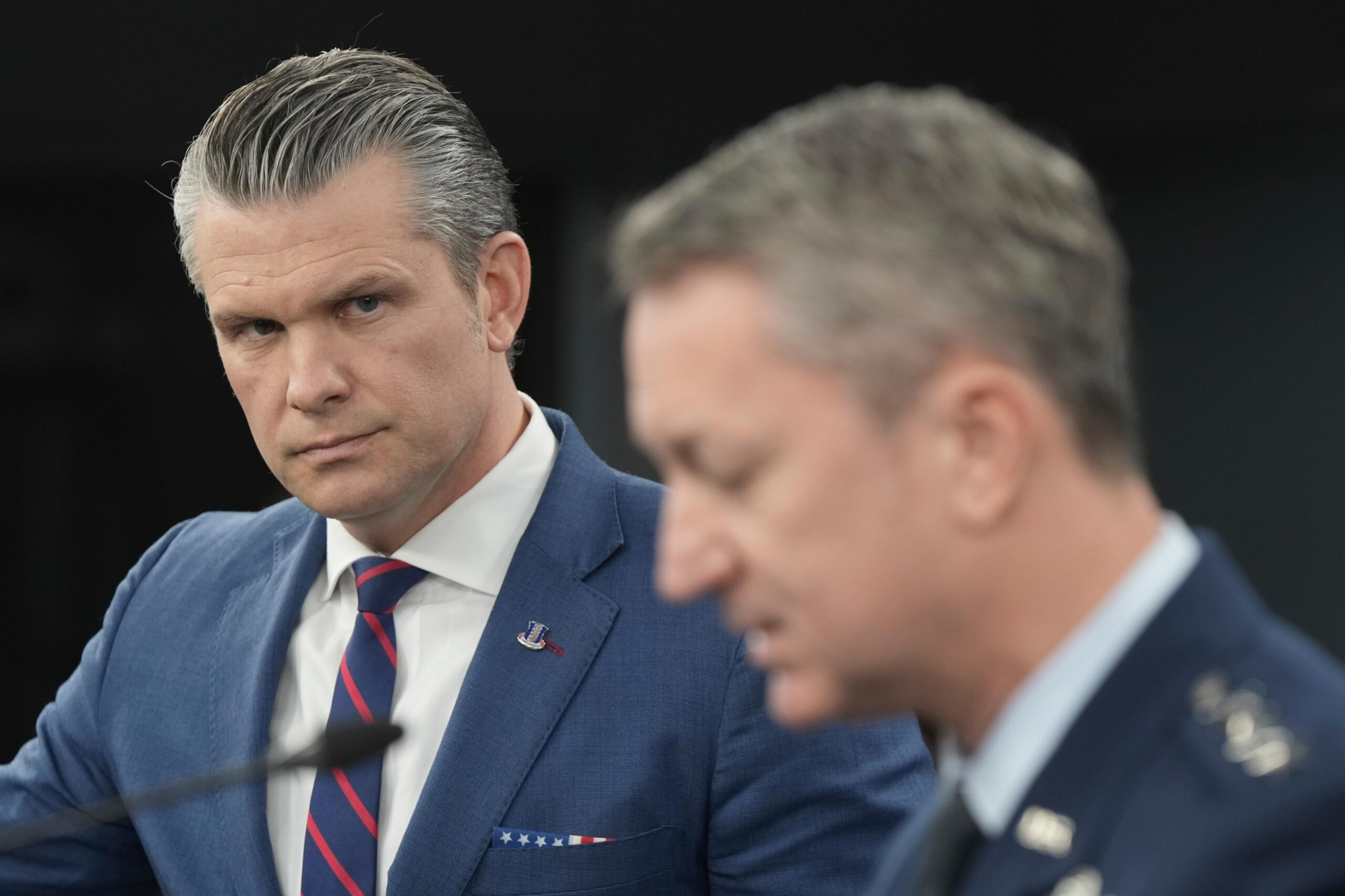
    Defense Secretary Pete Hegseth listens to Chairman of the Joint Chiefs of Staff Gen. Dan Caine, during a news briefing at the Pentagon, Monday.

    Hegseth would not rule out sending American troops into Iran. That undercuts the president’s campaign promise to end costly forever wars like the ones in Vietnam — which Trump dodged — Iraq, and Afghanistan. Wars that cost thousands of lives and trillions in taxpayer dollars.

    Then again, the Trump doctrine is day-to-day and subject to hourly change, fits and starts, and overnight zigzagging.

    In fact, Trump now says the Iran war will go on until the U.S. achieves its objectives — whatever they are. Just last week, the president said Iran could avoid military conflict if it would end its nuclear weapons program.

    Iran agreed with negotiators last week to never stockpile enriched uranium. But even as the talks showed progress, Trump decided to start bombing while he hosted a $1 million-a-ticket fundraiser at his private club in Palm Beach, Fla.

    Let’s not forget Trump withdrew from a deal in 2018 that limited Iran’s nuclear enrichment and stockpiles of enriched uranium. He also claimed last year that Iran’s nuclear program was “obliterated” after a bombing campaign by the U.S. and Israel.

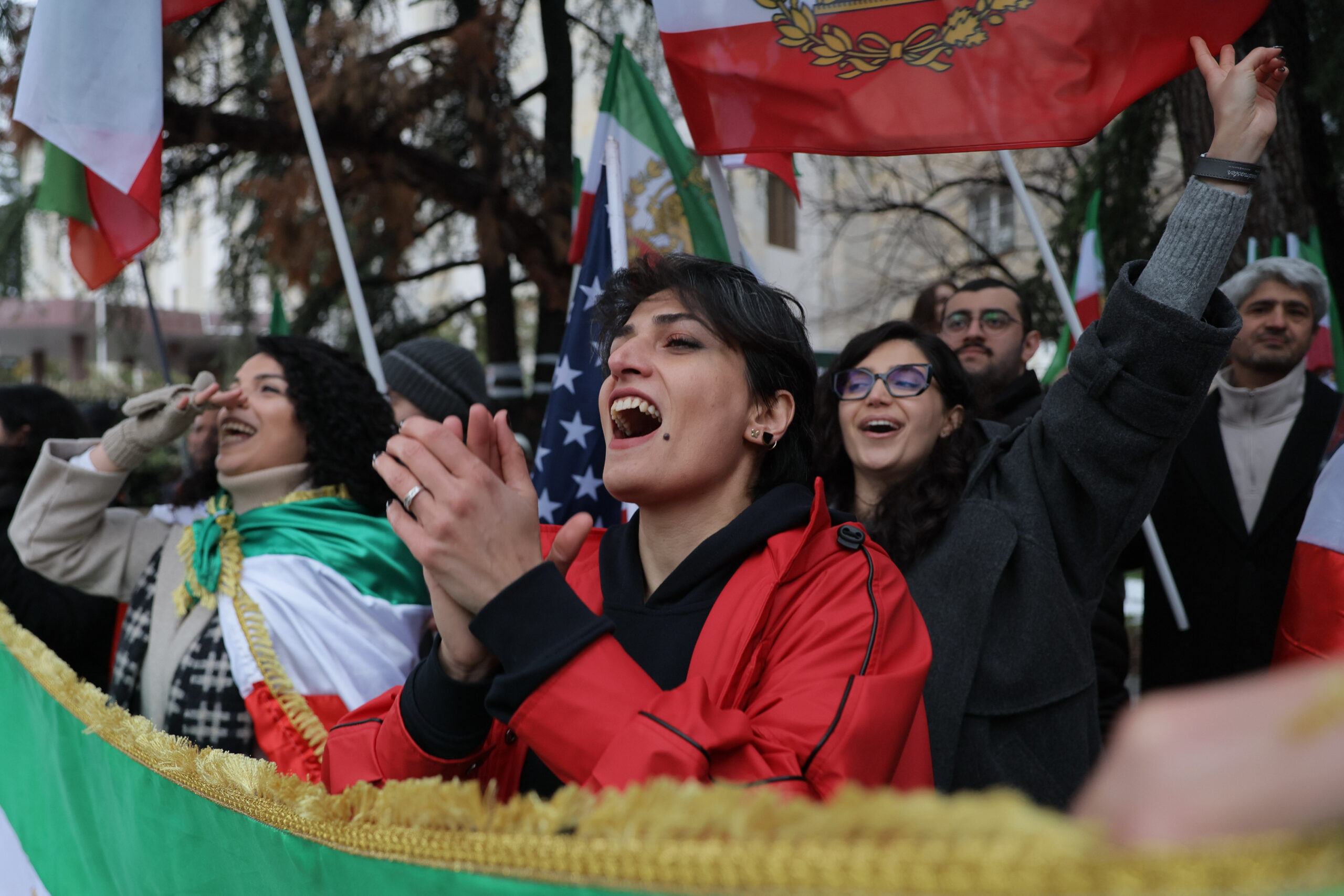
    Demonstrators rally in support of the U.S. and Israeli strikes on Iran, at the Iranian Embassy in Tbilisi, Georgia, on Sunday.

    Trump created all this chaos. An unserious president is leading the country into serious trouble. And the Republicans in Congress who have the power to stop him do nothing.

    Killing Iran’s leader comes on the heels of Trump ordering the illegal invasion and arrest of Venezuela’s president.

    That came after Trump’s illegal boat strikes in Central and South America that have killed more than 100 people without any evidence of wrongdoing.

    Meanwhile, Trump has threatened to take over Greenland, make Canada the 51st state, and attack drug cartels in Mexico. He continues to diss European allies, while doing nothing to stop Russia’s war crimes in Ukraine.

    Republicans who control Congress continue to defer to Trump, who is quickly turning the United States into a rogue state.

    Now, with no clear exit strategy in Iran, Trump appears poised to continue to try to bomb his way to a Nobel Peace Prize, while making a mockery of America.

  • Choose transparency, deliberation, and investment over closure

    Choose transparency, deliberation, and investment over closure

    Superintendent Tony B. Watlington Sr. and the Philadelphia School District have proposed 18 school closures, six colocations, and a vague, insufficiently transparent plan to reconfigure grade levels across numerous other schools, citing the need for “more efficient use of all of our resources” to deliver high-quality academic and extracurricular programming districtwide.

    The Inquirer Editorial Board has endorsed the plan, pending adjustments to several sites, including Lankenau Environmental Science Magnet High School.

    The district is right to pursue a comprehensive facilities plan that addresses toxic building conditions, overcrowding, and underutilization. But it is going about it the wrong way. Facilities planning should be an annual, longitudinal process grounded in sustained community engagement, not a punctuated moment of 24 mass closures that disrupt neighborhoods and sidestep the thoughtful incorporation of public input that only time and intention can provide.

    Mistakes of 2013

    Without such care, the district will repeat the mistakes of the 2013 closures, which led to students disappearing from school rolls in September, overcrowded receiving schools, and the racialized erasure of neighborhood histories and place-based educational traditions.

    First, significant questions remain about implementation and transparency. Ten properties are slated to be “conveyed” to the city, reportedly tied to Mayor Cherelle L. Parker’s H.O.M.E. plan. Amid speculation about a 20-year tax abatement connected to redevelopment, it is unclear what mechanisms will ensure the benefits of these transfers accrue to the communities that have borne the brunt of closure, rather than to private developers. A two-decade tax abatement would symbolically and materially reinscribe the racialized disinvestment, neglect, and manufactured crisis that have too often paved the way for school closures in the first place.

    Second, the data used to inform the closures have been called into question by many, and do not take into account the nuance of mixing school populations via colocation. For example, parents at Childs Elementary have cited the district’s plan to colocate a new Academy at Palumbo based on a building capacity of 1,000. However, a significant portion of the building’s classrooms is dedicated to special-education students. A colocation would displace SPED students from these classrooms while reinforcing a bifurcated culture among the catchment-based middle school students and Palumbo students in an already rapidly gentrifying neighborhood of Point Breeze.

    Third, closure and conveyance to the city for resale do not guarantee public-serving outcomes. With my collaborators — Ariel Bierbaum, Amy Bach, and Elaine Simon — I have studied how thoughtful reuse, rooted in restoring community access and public control, can begin to repair the racially inequitable legacy of past closures.

    Yet, private redevelopment has repeatedly failed to stabilize these properties. Selling off public assets does not guarantee revitalization; it often perpetuates stagnation or displacement. Developers frequently “flip” former school buildings, speculating on value rather than advancing community use.

    After it closed in 2013, Germantown High School fell into decay and disrepair, a fate Julia McWilliams writes could be repeated.

    Take the former Germantown High School and Robert Fulton Elementary, for example. Concordia Group bought them in 2014, only to abandon its plans and resell the buildings three years later to local developer Jack Azran, whose opaque redevelopment has sparked concern.

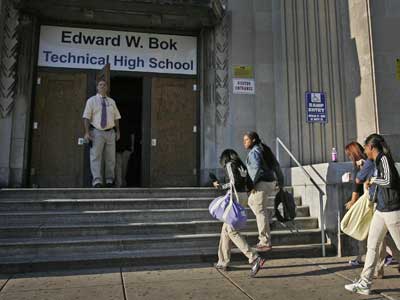
    Moreover, once schools are sold to private entities, they are effectively lost to some communities and public education forever. South Philadelphia’s experience is a cautionary tale. As nearby elementary schools became overcrowded following the 2013 closures, the former Edward W. Bok Technical High School, once a public citywide admissions school, was transformed into a workspace for small-business owners, artists, and nonprofit organizations, closing classrooms forever.

    This reuse no longer serves the same community of students and families as when it was a high school, and raises important questions: What does it mean for a community’s future when former schools become symbols of gentrification rather than centers of education? And what options remain when demographic shifts create new demand for neighborhood schools that no longer exist?

    Had Bok remained in public hands, it could have flexibly adapted to those needs. Instead, it serves a much different population: South Philadelphia working artists, small-business owners, and local refugee-serving nonprofits, but also patrons who can afford $14 cocktails.

    Slow down

    Rather than defaulting to closure, the Board of Education should consider how underenrolled buildings might be repurposed for public-serving uses that retain community control. Could redevelopment proceed gradually, with clear commitments that investments in existing buildings benefit both local families and those who have chosen these schools?

    Such an approach would require genuine public engagement and sustained dialogue. It would require slowing down and rejecting a disruptive, thinly deliberated plan shaped by speculative capital and instead committing to participatory, long-term facilities planning.

    The district and the city face a choice. They can repeat a cycle of disinvestment and dispossession, or they can chart a more deliberative, community-rooted path. The question is whether they have the will to do so.

    Julia McWilliams is the codirector of the Urban Studies Program at the University of Pennsylvania and a member of Stand Up for Philly Schools. She coauthored the forthcoming book, “Schools for Sale: Disinvestment, Dispossession, and School Building Reuse in Philadelphia,” from the University of Chicago Press.

  • Kenyatta Johnson: No presidential administration should be allowed to whitewash African American history

    Kenyatta Johnson: No presidential administration should be allowed to whitewash African American history

    Philadelphia is the birthplace of American democracy. It is also a city that understands democracy is strongest when rooted in truth.

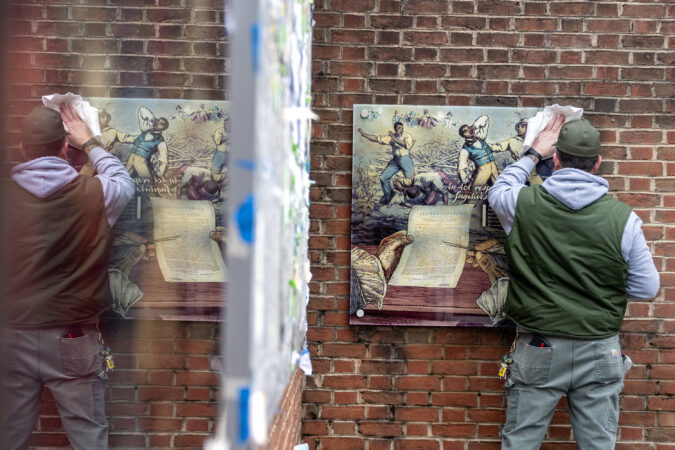
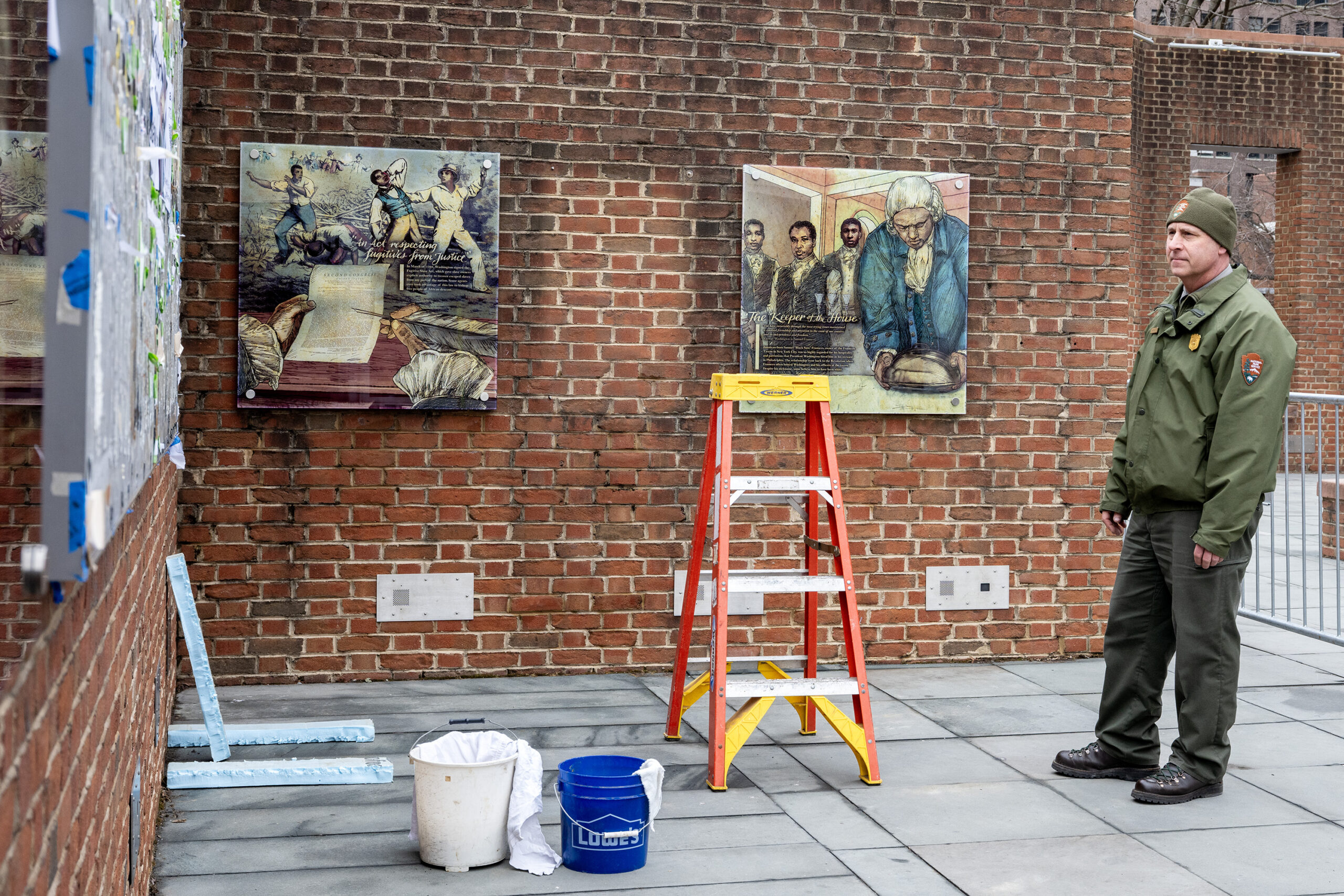
    That is why the January removal of slavery exhibits from the President’s House site in Center City was so deeply concerning. I am happy National Park Service workers restored the exhibits on Feb. 19, but they are only back up in their rightful place because of U.S. District Judge Cynthia M. Rufe’s order directing the NPS to restore them.

    Rufe made it clear in her Feb. 16 ruling that historical truth cannot be dismantled or rewritten, and that the federal government and President Donald Trump’s administration do not have the authority to erase or alter facts simply because they control a national site.

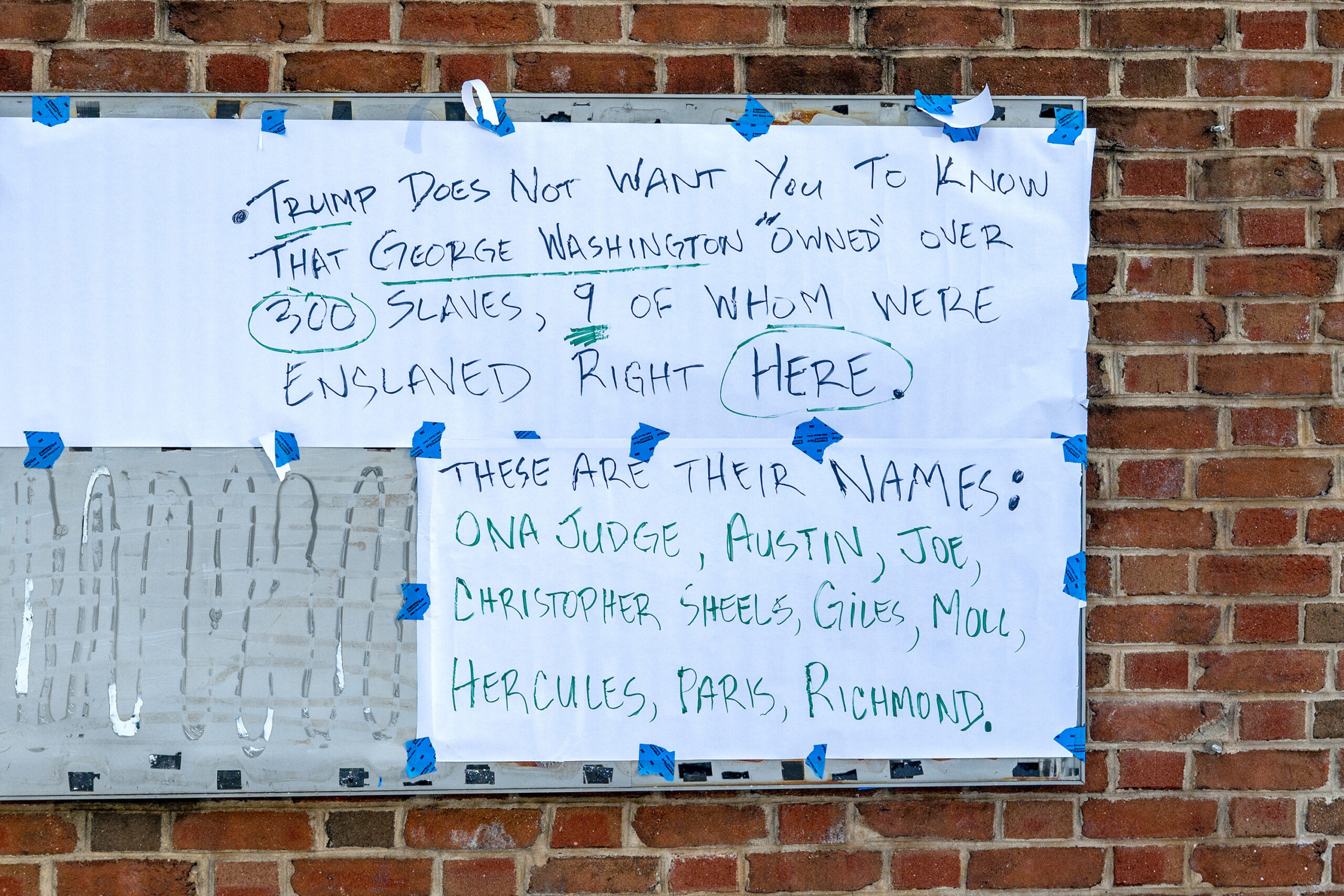
    At the President’s House — located within Independence National Historical Park — visitors learn about George Washington’s early presidency. But equally important, they learn about the nine enslaved Africans who were forced to live and work in Washington’s Philadelphia household. Their lives unfolded in the literal shadow of a building where liberty was debated and declared.

    That story is not just an aside in our nation’s founding — it is essential for understanding both America’s ideals and its contradictions. Removing those interpretive panels is more than just an administrative decision; it’s an effort to alter the narrative of our shared history.

    Signs and notes placed by visitors at the President’s House in Independence National Historical Park on Feb. 2 replace the panels about slavery that were removed in January by the National Park Service.

    The City of Philadelphia sought an injunction in federal court on Jan. 22 to preserve the integrity of this significant site. This battle goes beyond signage; it’s about whether we are prepared to face the full truth of who we are as a nation.

    There is no harmful ideology in recognizing that slavery existed at the highest levels of early American government. There is no political agenda in naming the enslaved men and women who lived at the President’s House. There is only a duty to tell the truth.

    The President’s House memorial opened in 2010 after years of research, advocacy, and public engagement, led by the Avenging the Ancestors Coalition and supported for decades by the city of Philadelphia and the NPS.

    It reflects Philadelphia’s long-standing commitment to the honest telling of history. We acknowledge that our nation’s founding documents proclaimed liberty while millions remained enslaved. We understand that progress arises not from denial, but from reckoning.

    A worker pauses while rehanging panels at the President’s House in Independence National Historical Park on Feb, 19.

    Philadelphia will always remain dedicated to sharing the full history of our nation, not just the easy parts, but the whole truth.

    Our children deserve to learn that America’s greatness is not in pretending we are perfect, but in working to become a more perfect union every day.

    Restoring these exhibits at the President’s House is not about politics. It’s about principles. It’s about making sure that a site visited by people from all over the world, especially on the 250th anniversary of the United States, reflects the full scope of our history, including both triumphs and injustices.

    As the fight over the President’s House continues through the federal court system, I will continue to support our efforts to ensure the exhibits remain at the site permanently.

    We must not let Trump whitewash African American history. Black history is an integral part of American history.

    Kenyatta Johnson is City Council president and represents the 2nd Council District in Philadelphia, which includes parts of Center City, South Philadelphia, and Southwest Philadelphia.

  • Letters to the Editor | March 2, 2026

    Letters to the Editor | March 2, 2026

    Dangerous men

    It is beyond disgusting that the prince formerly known as Andrew was finally arrested, not for any of his alleged egregious crimes with underage girls and women, but for some impropriety with government documents. I’m waiting for whatever materializes against our current leader regarding the Jeffrey Epstein files, despite the dozens of women who had already voiced claims of sexual assault before he was first elected president. There is no denying that men have a zipper problem. It transcends race, religion, ethnicity, politics, wealth, age, education, legal status, you name it. Would relaxing views on celibacy, masturbation, and decriminalizing sex work help? I don’t know. Women are still regarded as chattel and statistically have a one in three chance of being the victim of physical or sexual violence in their lifetime. It didn’t spare this writer. It won’t spare your mother, sister, daughter, neighbor, coworker, nurse, teacher, or friend. One in three women is a victim! Please report and support to help end sexual assault against women. Enough!

    K. Mayes, Philadelphia

    Missing documents

    Fifty-two years ago, Richard Nixon famously proclaimed, “People have to know whether or not their president is a crook.” As applied to our current president, one jury has already answered that question, and repeated revelations regarding his (and his family’s) financial dealings suggest an unfortunate answer (unfortunate for the country, but not for his family’s bank accounts).

    Beyond Nixon’s mandate, the American people have to know whether their president is a pedophile. However, under Donald Trump’s absolute control, the U.S. Department of Justice (now staffed with his acolytes, the “Roy Cohns” whose absence Trump lamented during his first term) refuses to release millions of files related to Jeffrey Epstein, and has produced documents rendered meaningless with many redactions in violation of federal law.

    As with his other legal and moral challenges, Trump’s robotic claim of “complete exoneration” rings hollow unless and until the evidence is revealed and analyzed. As Trump continues to give the survivors, members of Congress, and the American public the middle finger, where are the elected Republicans? The answer to that one is also obvious: Still cowering under their beds with the lights out.

    Stephen Ulan, Wynnewood

    Dress for respect

    Two recent comments by Pennsylvania’s senior senator, John Fetterman, caught my attention. For one, he criticized Democrats who boycotted the State of the Union address, saying it was a matter of respect for the office of the presidency. At another point, he acknowledged that he usually “dresses like a slob” before showing up in a suit for Donald Trump’s address. Should we conclude from his own comments that he respects the president but not his colleagues?

    Laslo Boyd, Philadelphia

    Inspired to give

    Ramadan has begun. It’s a sacred month observed by Muslims through fasting and prayer. From dawn to dusk, Muslims abstain not only from food and drink, but also from harsh words and other negative behaviors. As the Holy Quran teaches, “O ye who believe! fasting is prescribed for you … so that you may become righteous” (2:184). Ramadan is, at its heart, a time for spiritual growth and moral renewal.

    Experiencing hunger reminds us of our neighbors who face it daily. The Holy Prophet Muhammad (peace and blessings be upon him) said, “He is not a believer whose stomach is filled while his neighbor goes hungry.” In a nation where one in eight families has faced food insecurity in recent years — disproportionately affecting single-parent households, families below the poverty line, and many families of color — this message feels especially urgent.

    Ramadan calls Muslims to increase their generosity and to feed the needy. We invite our fellow Americans, regardless of faith, to join in supporting local food banks, shelters, and community initiatives. Together, we can transform empathy into action. Though Ramadan is usually marked by joyful gatherings, we are mindful of the many around the world suffering from conflict and hardship. We pray for peace, justice, and for leaders to place our shared humanity above division. May this month inspire compassion and service for all.

    Madeel Abdullah, Garnet Valley

    Little things

    “Don’t sweat the small stuff” is a phrase we usually hear in personal life, not in healthcare. But hospitals would do well to take it seriously — because in medical settings, the “small stuff” is often anything but. Patients and families routinely encounter minor lapses that, taken individually, may seem inconsequential: unanswered call buttons, missing medications, delayed transport, incomplete discharge instructions, inaccurate charts, malfunctioning equipment, or staff who are stretched so thin that basic communication falls apart. None of these failures alone makes headlines. Yet, together, they erode trust, increase risk, and ultimately affect outcomes.

    Hospitals are rightly focused on major metrics — mortality rates, readmissions, infection control, and cutting-edge treatments. But an exclusive focus on big-picture indicators can blind institutions to the everyday breakdowns that define the patient experience. When small problems are tolerated, normalized, or dismissed as inevitable, they accumulate into systemic failure. For patients who are elderly, seriously ill, or frightened, these “little things” are not abstractions. They are moments of confusion, discomfort, and vulnerability. For families, they are warning signs that no one is fully in charge.

    Attention to detail is not cosmetic; it is clinical. Precision, follow-through, and accountability at the smallest levels are the foundation of safe, humane care. Hospitals that truly aspire to excellence must insist on reliability not only in the operating room, but in the hallway, the chart, the shift change, and the bedside conversation. If hospitals want better outcomes, they should start by sweating the small stuff.

    John C. Levine, Philadelphia

    Not a hoax

    It is disturbing to watch Donald Trump’s Environmental Protection Agency take a huge step backward on protecting the world as we know it. We know the climate emergency will determine the future for all living things on Earth. Many aspects related to the weather — extreme storms, droughts, heat waves, freezes — are being affected. Several years ago, I read a small book on climate change by Greg Craven, a science teacher in Corvallis, Ore., who produced a series of short videos that explained phenomena such as the melting of polar ice caps and thawing of the tundra, both of which would likely lead to dramatic shifts in the weather we have known for millennia. Both are now happening.

    Craven created a chart on the impact of taking climate action. There were four squares: 1) Climate change is not a problem, and we don’t take action. 2) Climate change is not a problem, and we take action that proves unnecessary. 3) Climate change is a problem, and we do take action. 4) Climate change is a problem, and we don’t take action. It’s that last box that we are now putting ourselves in, and it’s the one box Craven said we should avoid at all costs.

    Sue Edwards, Swarthmore

    Join the conversation: Send letters to letters@inquirer.com. Limit length to 150 words and include home address and day and evening phone number. Letters run in The Inquirer six days a week on the editorial pages and online.

  • Pope Leo’s pointed message to Catholics the day after the U.S. bombed Iran

    Pope Leo’s pointed message to Catholics the day after the U.S. bombed Iran

    The day after the United States bombed Iran in a military effort to forcibly change the nation’s regime, the most famous American global leader — outside of President Donald Trump — was speaking out about it.

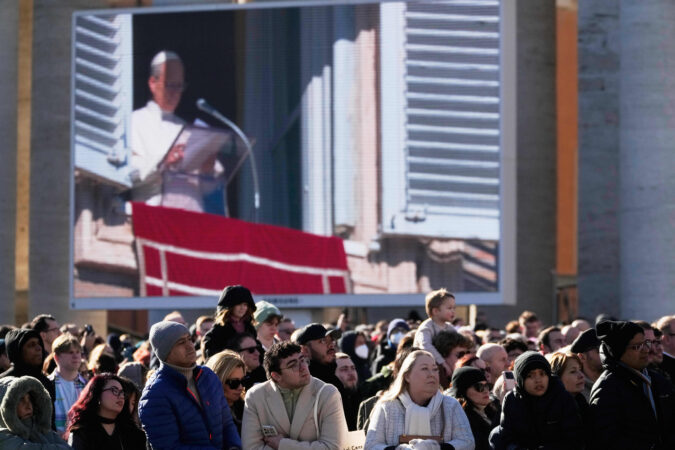
    “Faced with the possibility of a tragedy of enormous proportions, I am making a heartfelt appeal to the parties involved to assume their moral responsibility to stop the spiral of violence before it becomes an irreparable abyss,” Pope Leo XIV said in his weekly Angelus address Sunday morning.

    The American-born pope wasn’t speaking only to the thousands gathered in St. Peter’s Square, but to the more than 1.4 billion Roman Catholics in the world, including those in the Trump administration who self-identify as Catholics, such as Vice President JD Vance or Secretary of State Marco Rubio.

    “Stability and peace are not built with reciprocal threats or with weapons that sow destruction, pain, and death,” the pontiff said, “but only through reasonable, authentic, and responsible dialogue.”

    The joint U.S.-Israeli strikes have already claimed the lives of Iran’s Supreme Leader Ali Khamenei and numerous civilians, including, reportedly, more than 100 girls at an elementary school.

    Smoke rises up after a strike in Tehran, Iran, on Sunday.

    While the pope doesn’t wield the sort of temporal power that presidents and prime ministers do, his words carry moral weight for those within his religious tradition, and cannot be easily dismissed by politicians, nor the 52% of U.S. Catholics who still have a favorable view of Trump, according to a recent poll by the conservative EWTN News and RealClearPolitics.

    It is not the first time Pope Leo has called out the Trump administration’s efforts to force regime change in sovereign nations with leaders who have been accused of human rights abuses.

    “The good of the beloved Venezuelan people must prevail over every other consideration and lead us to overcome violence and to undertake paths of justice and peace, safeguarding the country’s sovereignty, ensuring the rule of law enshrined in the Constitution, respecting the human and civil rights of each person,” the pope said during the Angelus address Jan. 4.

    I often write about how religion impacts the lives of Latinas like me, who are trying to navigate a world that often seems to have eschewed moral clarity for political dissolution. As a Roman Catholic, I pay particular attention to the guidance offered not only by Pope Leo but also by the bishops who are tasked with providing moral counsel to their flock.

    No one who has remained a Catholic as the church has been wracked by an ongoing, self-made crisis of clerical abuse can ignore the fact that some bishops are as opportunistic and power-hungry as our politicians. But under the leadership of Pope Leo, more U.S. bishops than ever have chosen to speak out from a place of genuine moral authority, untainted by the gross partisan and ideological bias that had previously infected the U.S. Conference of Catholic Bishops.

    In January, three U.S. cardinals — whom some consider progressives — called on the administration to adopt a “genuinely moral” foreign policy with respect to Venezuela, Ukraine, and Greenland. Meanwhile, the archbishop for the U.S. military — widely considered a staunch conservative — reminded Catholic military personnel that it is “morally acceptable” for them to disobey an order that violates their conscience.

    At the same time, 18 bishops asked for the government to cut U.S. military spending to invest in eradicating poverty instead, and across the world, bishops have disavowed the appetite for war and domination by military force that the Trump administration has modeled.

    For example, the pope has declined to participate in a Trump-led “Board of Peace” that seems to be about anything other than peace. “A diplomacy that promotes dialogue and seeks consensus among all parties is being replaced by diplomacy based on force by either individuals or groups of allies,” Pope Leo said on Feb. 17.

    “War is back in vogue, and the zeal for war is spreading.”

    Cardinal Pierbattista Pizzaballa, Latin patriarch of Jerusalem, was more direct in his criticism of the board: “What do I think of the Board of Peace? I think it is a colonialist operation: others deciding for the Palestinians,” he told the Italian newspaper Il Sole 24 Ore.

    While the Vatican releases Pope Leo’s Angelus addresses without much fanfare, it is important for Catholics seeking moral guidance on world events like the U.S. war on Iran to listen to the address directly rather than rely on the interpretation of those who might alter the pope’s words for political convenience.

    In the instance of the pope’s Angelus address on Venezuela, for example, the Trump administration’s U.S. ambassador to the Holy See reportedly omitted the pope’s reference to safeguarding that nation’s sovereignty because it could not be aligned with the administration’s actions.

    And Vance last year offered a justification of Trump’s mass deportation policies based on his misunderstanding of a Catholic theological concept. The vice president’s error was corrected and addressed by Pope Francis shortly before his death in April.

    During Lent, we as Catholics are called to examine our habitual excuses, our profane tendencies, and our susceptibility to the spin of those with a stake in worldly power, to instead focus deeply on our spiritual life and its obligations.

    For Catholics, in particular, Pope Leo’s words Sunday cannot be explained away. We must demand that our nation’s leaders stop the spiral of violence and acknowledge that peace cannot be built with weapons.

    Swords into plowshares, mi gente, swords into plowshares. And we shall study war no more.

  • How the world can stop ICE from hijacking the World Cup

    How the world can stop ICE from hijacking the World Cup

    The 2026 Winter Olympics in Milan may be over, but the political storm and protests stirred by the presence of U.S. Immigration and Customs Enforcement have not faded. With the FIFA World Cup set to bring millions of international fans to North America next, the Milan backlash now feels less like an isolated controversy and more like a warning of what could lie ahead.

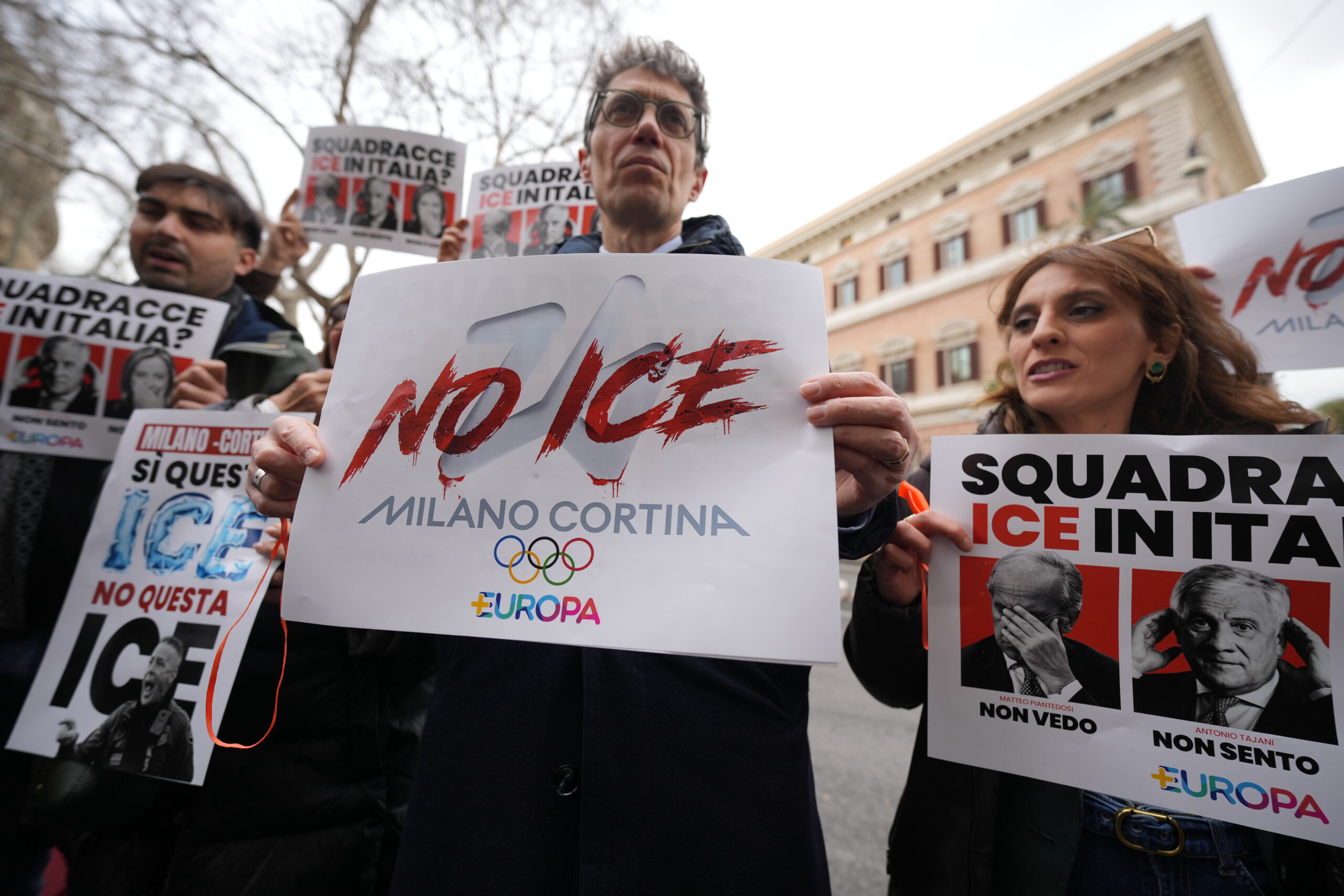
    Italian lawmaker Riccardo Magi (center) shows a placard demanding that U.S. Immigration and Customs Enforcement (ICE) agents not be allowed at the Milan Cortina Olympics, during a protest staged outside the U.S. Embassy in Rome in January.

    The last World Cup in Qatar drew about one million international visitors. The 2026 tournament — hosted across the United States, Canada, and Mexico — is expected to attract several times that number, making it the largest in soccer’s history. Its success will hinge not only on logistics and policing, but on whether teams and supporters feel welcome, safe, and able to move across borders within tight time frames.

    That confidence is now under scrutiny. ICE acting Director Todd Lyons has said the agency will be a “key part of the overall security apparatus” for the World Cup. Yet, when immigration enforcement becomes visibly woven into the staging of a global tournament, it ceases to look like routine security and instead risks appearing as a projection of domestic policy onto an international stage.

    Already, there are increasing calls to boycott the event for safety reasons, with fan groups like Football Supporters Europe expressing concern about the “ongoing militarization of police forces in the U.S.”

    Meanwhile, supporters from Latin America, Africa, and the Middle East are already asking whether a valid visa will be enough. Could minor paperwork errors lead to detention? For mixed-status families living in the United States, the anxiety is sharper still. A major German team has reportedly canceled a U.S. tour, and online fan forums openly debate boycotts.

    Sport has always intersected with politics. The 1936 Berlin Olympics were carefully orchestrated by the Nazi regime to project ideological confidence and international legitimacy, even as discriminatory policies continued at home. Decades later, the global boycott of apartheid South Africa — leading to the country being barred from the 1964 Olympic Games — showed that tournaments can reflect moral choices.

    But there is a difference between holding regimes accountable and turning sporting events into stages for domestic enforcement policy. This point carries particular weight in the U.S., a country whose global appeal has long rested on openness and pluralism.

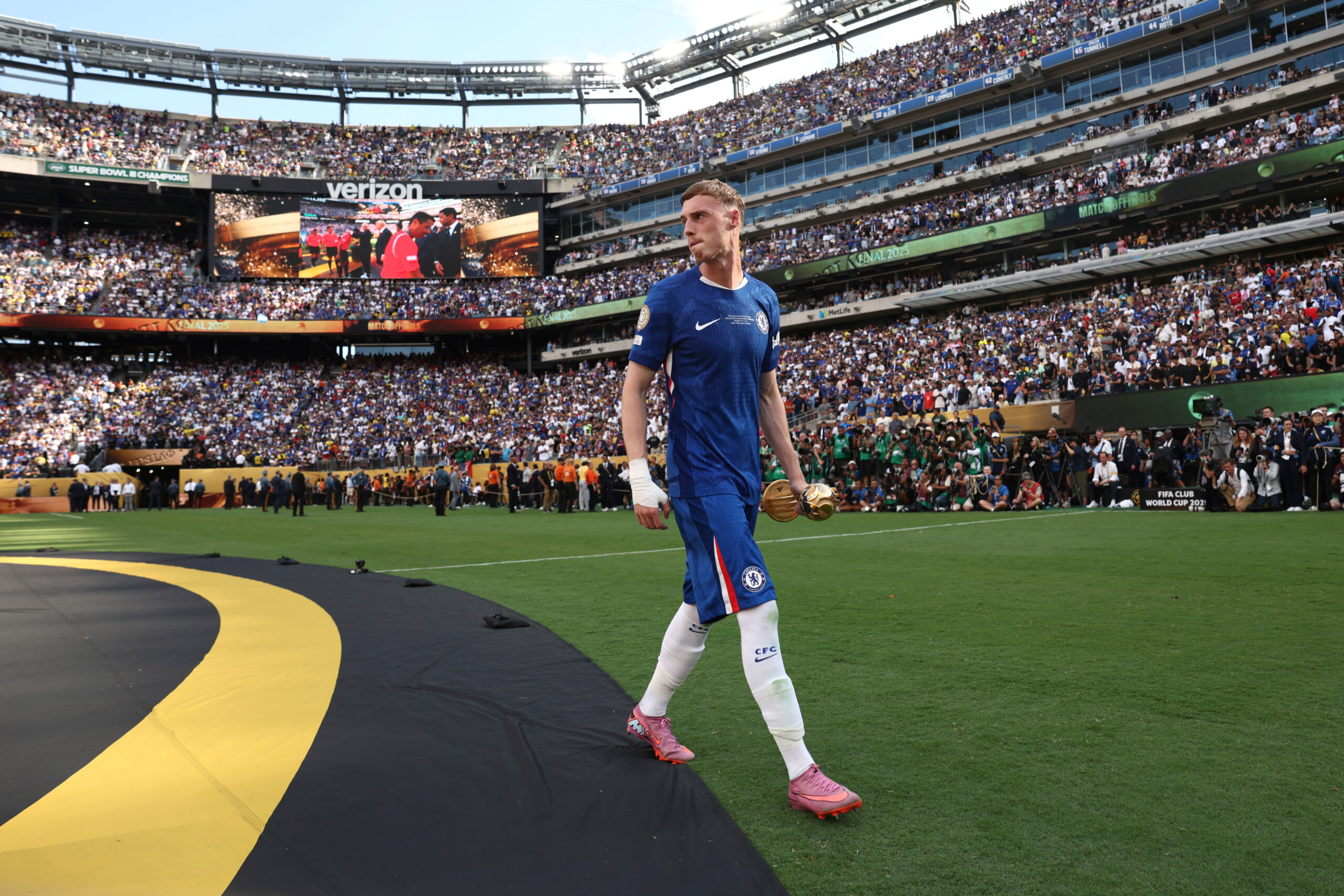
    Chelsea’s Cole Palmer walks with the golden ball trophy after Chelsea won against Paris St. Germain in the Club World Cup final, at MetLife Stadium in East Rutherford, N.J., in July.

    The World Cup is a soft-power moment. For one month, North America will present itself to billions of viewers not just as a host, but as a harmonious society — a rare global moment when rival nations share rules, rituals, and space on equal terms.

    That is precisely why international bodies have treated soccer as a tool for cohesion rather than division. The United Nations has repeatedly promoted sport as a mechanism for refugee integration and social stability, while organizations working on counter-extremism and discrimination, including the Muslim World League, have similarly highlighted how athletics can cultivate “understanding, empathy and respect” across communities.

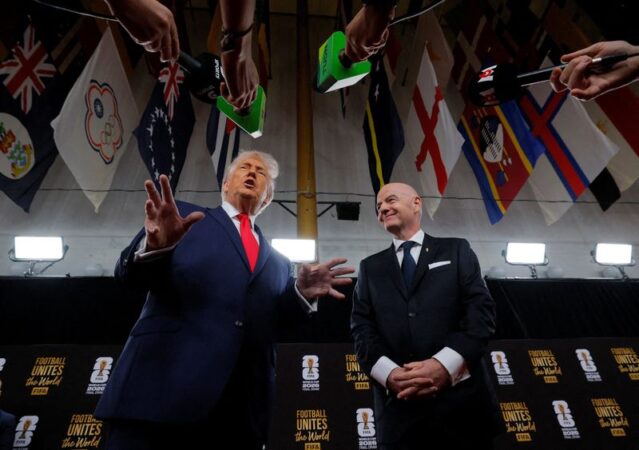
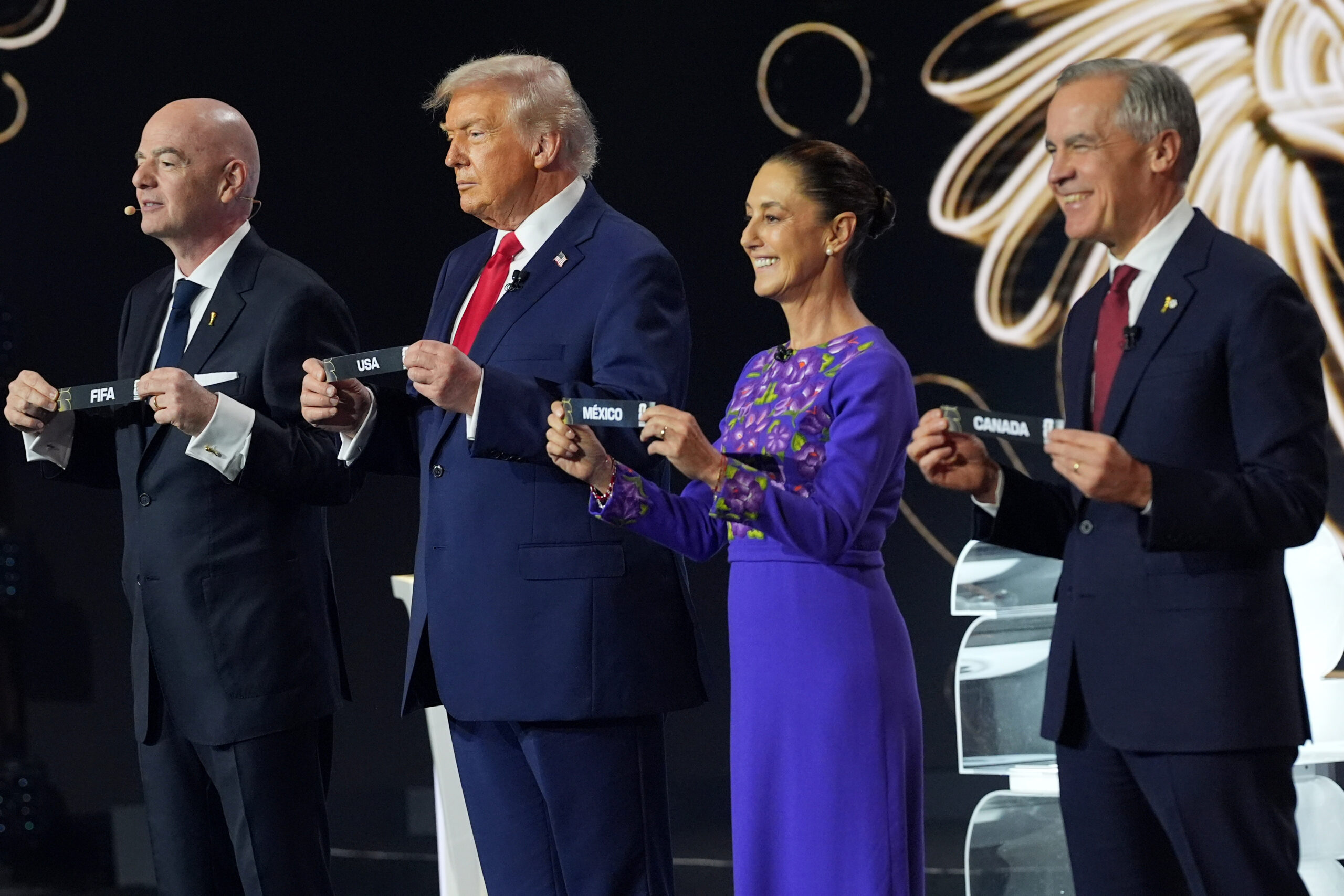
    Canadian Prime Minister Mark Carney, Mexican President Claudia Sheinbaum, President Donald Trump, and FIFA President Gianni Infantino hold up country names during the draw for the 2026 FIFA World Cup at the Kennedy Center in Washington in December.

    MWL’s secretary general, Mohammad bin Abdulkarim Al-Issa — who was recently recognized in the United States for his efforts to combat hate — has repeatedly warned that weak integration and social division are the biggest threats facing humanity today. Global sporting events, by contrast, offer rare shared civic spaces where diverse societies meet on equal terms, reinforcing inclusion rather than suspicion.

    If enforcement spectacle overshadows the 2026 World Cup, the consequences will be economic as well as social. Travel hesitancy, empty seats, and reduced tourism would be immediate effects.

    But the deeper risk is political: Visible exclusion at a global event reinforces narratives of division and grievance that extremists on all sides are quick to exploit. When people feel unwelcome in shared civic spaces, mistrust grows — and the integrative power that sport is meant to provide begins to erode.

    That makes clarity from federal authorities essential. The U.S. Departments of Homeland Security and State and host city governments should coordinate to publish tournament-specific guidance covering visa processing timelines, entry procedures for ticket holders, and the scope of enforcement activity around official venues.

    Clear assurances that immigration sweeps will not be conducted at stadiums, accredited fan zones, or public watch sites would reduce uncertainty without compromising border security.

    For a country that prides itself on being a nation of immigrants — and for a president who places great stock in ratings, turnout, and global spectacle — the 2026 tournament presents an extraordinary opportunity to show that security and openness can coexist. Full stadiums and strong international attendance would reinforce the image of a confident, welcoming host nation.

    If instead, travel hesitancy, empty seats, and visible enforcement dominate the optics, the tournament risks projecting exclusion rather than unity.

    That outcome would not only diminish the World Cup’s global appeal but squander a rare moment of soft power that no amount of security planning alone can restore.

    Khalid Sayed is the leader of the opposition for the African National Congress in the Western Cape Provincial Parliament in South Africa, now serving his second term. A former provincial leader of the ANC Youth League, he is an activist committed to social cohesion and democratic renewal in a postapartheid society.

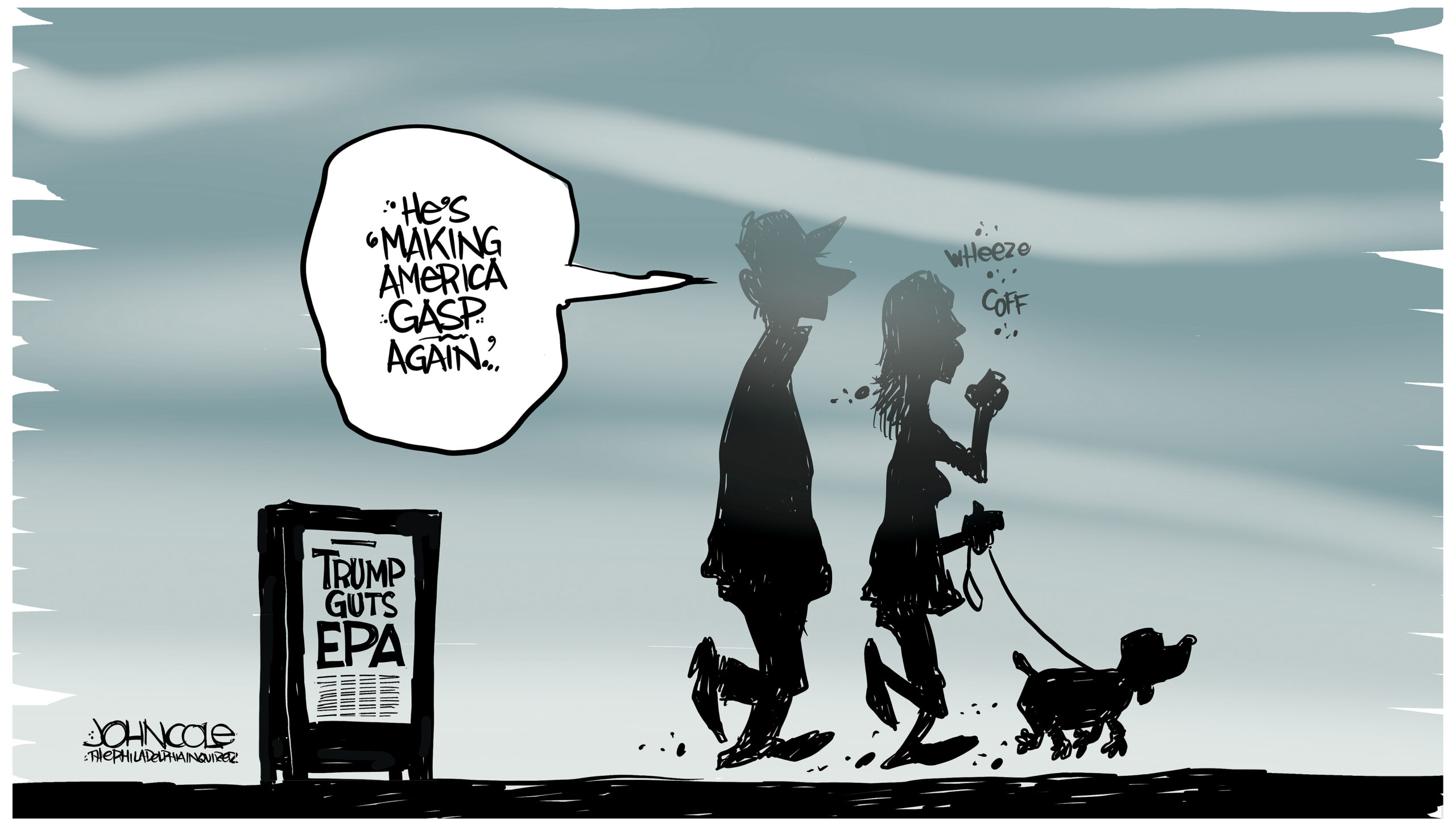
  • Outlook hazy | Editorial Cartoon

    John Cole spent 18 years as editorial cartoonist for The (Scranton) Times-Tribune, and now draws for various statesnewsroom.com sites.

  • Forget State of the Union sideshow, MAGA’s real chilling message was delivered by Marco Rubio in Munich

    Forget State of the Union sideshow, MAGA’s real chilling message was delivered by Marco Rubio in Munich

    As a matter of journalistic duty, I forced myself to watch the endless State of the Union reality show.

    Punting on all serious issues, President Donald Trump stoked the applause meter by delivering awards to a 100-year-old vet and a brave U.S. pilot, and inviting the entire U.S. men’s Olympic hockey team to celebrate their gold medal win.

    Trump was relentlessly racist (with disgusting slurs against all Somali Americans in Minnesota). His lies were dangerously predictive about the 2026 elections, never tiring of the Big Whopper about winning in 2020 and claiming Democrats must be stopped because they “only win if they cheat.”

    In short, the union is in a dangerous state under an amoral, unprincipled, delusional commander in chief.

    What disturbed me most as I watched Trump rant on is how a president could be so wholly indifferent to the liberal democratic values that underlie the existence of our nation. Although often honored in the breach, they are what have made this country unique. Yet, the sycophants in his administration, along with most GOP legislators, have chosen to abandon those values, or never believed in them from the start.

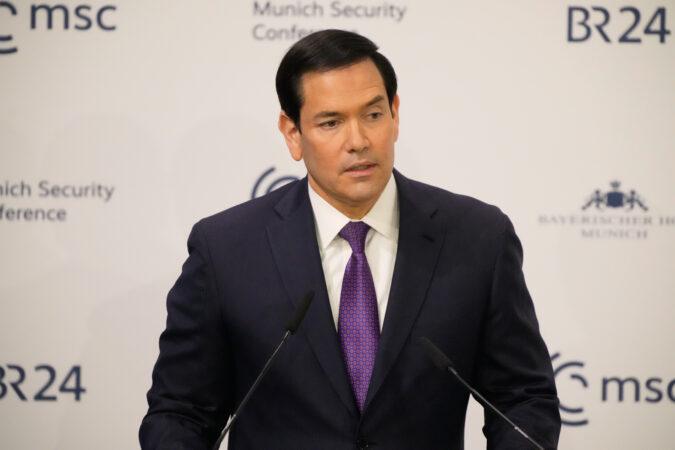
    For that reason, I’d rank Secretary of State Marco Rubio’s speech at the recent Munich Security Conference as far more important than Trump’s sad State of the Union guff.

    That’s because Rubio laid out an alternative set of U.S. values promoted abroad and at home by the political theologians of the Trump regime. Precepts that would make the Founding Fathers revolt anew.

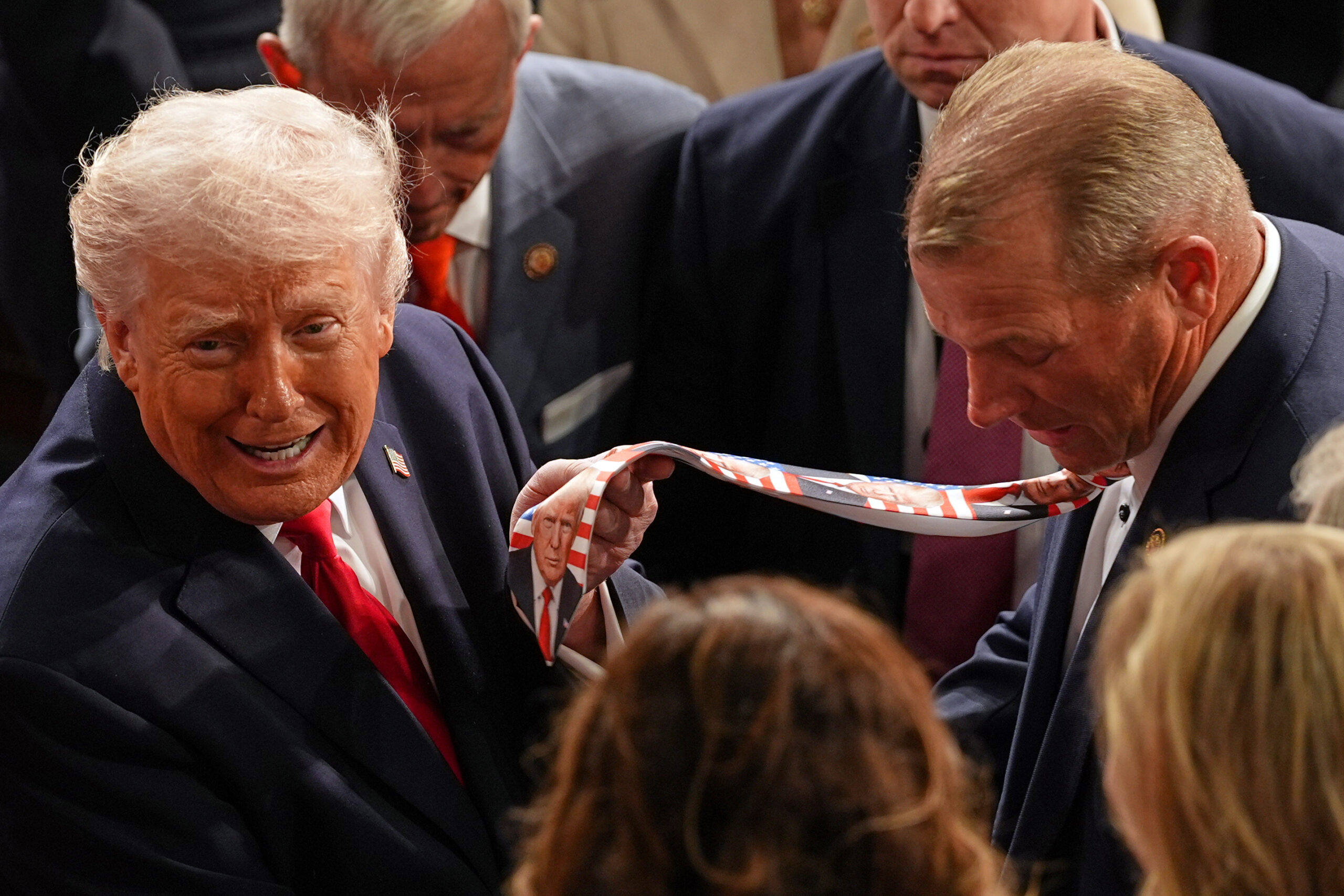
    President Donald Trump holds up U.S. Rep. Troy Nehls’ (R., Texas) tie with his face on it as he departs after delivering the State of the Union address to a joint session of Congress in the House chamber at the U.S. Capitol in Washington, Tuesday.

    The new theology revolves around the theme of saving “thousands of years of Western civilization” from the depredations of “woke” liberal democracy. It is an extension of language long used by white nationalists, and which came back to prominence during the rise of Islamist terrorism in the Mideast, which led to an influx of Syrian and Afghan immigrants into Europe fleeing civil wars at home. It became even more useful to Trumper populists when fanning fears of immigrants at home.

    Former Trump adviser Steve Bannon and current Deputy White House Chief of Staff Stephen Miller latched onto the “saving Western civilization trope” a decade ago, and have embraced its transition into saving Western “Christian civilization.” Somehow, the term, which had been commonly used to describe shared Western religious and cultural identity for decades — Judeo-Christian civilization — has conveniently been shortened.

    Never mind the historical inaccuracy of a term that tries to combine thousands of years of shifting, melding populations, ideas, and religions into one neat sum.

    Yes, there are obvious philosophical threads from Athens to Rome to the Magna Carta, and ultimately to the values of the Enlightenment. But there are centuries of religious, ethnic, and philosophical wars, as well.

    When Vice President JD Vance tried to promote the concept at the Munich Security Conference last year — and to promote white Christian populist parties in Europe as the saviors of “Western civilization” — the audience of European leaders, officials, and think tankers reacted with shock. More so when he berated German leaders for not inviting the neofascist Alternative für Deutschland (AfD) party into the government, even though its leaders have downplayed Adolf Hitler’s crimes. To add insult to injury, he pointedly paid a visit to the AfD’s political leader.

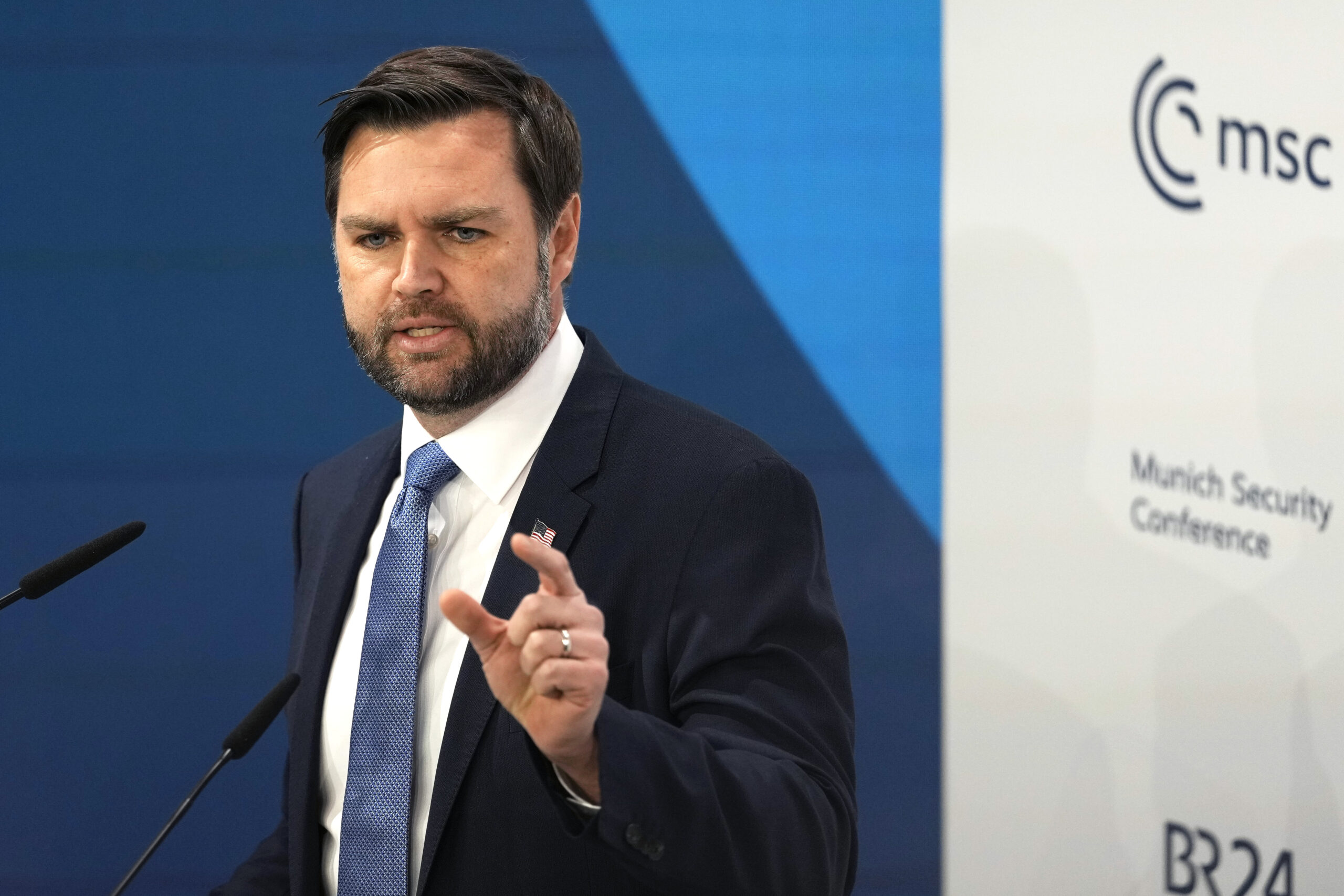
    Vice President JD Vance addresses the audience during the 2025 Munich Security Conference at the Bayerischer Hof Hotel in Munich.

    But Rubio was supposed to be different: the realistic, savvy foreign policy adviser who tried to save Trump from his worst instincts. When the secretary of state delivered remarks that praised U.S.-European ties, the eager audience was at first won over — until reality sank in, and many participants read the text of his speech.

    Indeed, Rubio was warmed-over Vance, blaming liberal democracy (which, in the Enlightenment sense, means individual freedoms, human rights and rule of law, and observance of science) for all the West’s ills, and urging Europeans to junk “the global rules-based order.”

    It got tiresome hearing Rubio tout the dangers of Western “civilizational erasure.” As Hillary Clinton noted — on a panel titled “The West-West Divide” — “When Rubio talks about Western ‘civilization,’ I never knew he was so supportive of Native Americans.” Then she added, “He is wrong historically.”

    Indeed. “Western civilization” has become the MAGA dog whistle that stands for bashing all immigration and playing to racial fears.

    No surprise, Rubio had not a word of criticism for the Russian invasion of Ukraine as an attack on “Western civilization,” although Vladimir Putin’s war crimes have upended the relatively peaceful, post-World War II order. And not a word of apology for Trump’s threat to seize Greenland from a NATO ally, which also threatened that order.

    Nor any word of recognition that a dog-eat-dog world of unrestrained big power dominance resulting from an end to global “rules” will lead back to the violent era preceding World War II.

    Instead, Rubio urged the Europeans not to be “shackled by guilt and shame,” which is a key buzz phrase for the AfD, which urges its members to stop apologizing for Nazi crimes.

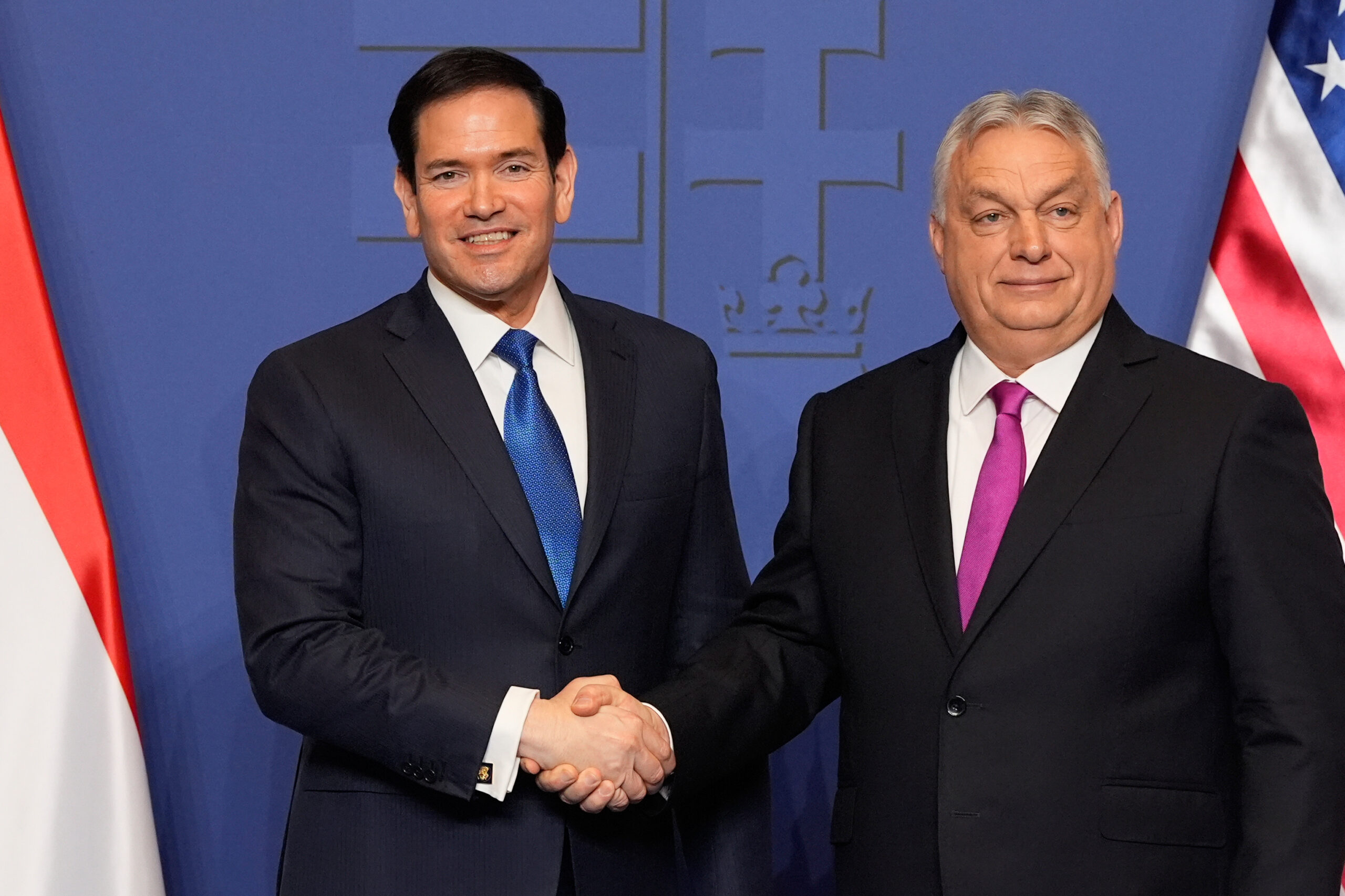
    Secretary of State Marco Rubio (left) and Hungarian Prime Minister Viktor Orbán shake hands after a news conference in Budapest, Hungary, on Feb. 16.

    And right after his speech, the secretary rushed off to Hungary to praise the pro-Putin Prime Minister Viktor Orbán, a Trump ally who has done his best to destroy Hungarian democracy, including press and judicial freedom — and is trying to block European Union aid to Ukraine.

    Yet, Orbán’s corruption and Hungary’s economic decline have become so overwhelming that he may be defeated in an April election. But Trump sent Rubio to bolster this antisemitic autocrat who repeats the “saving white Christian civilization” line.

    It is no wonder the Munich scene erupted into debate about the West-West division over democratic values. As Germany’s Green Party coleader and Bundestag member, Franziska Brantner, stated: “Our values are rooted in the Enlightenment, in reason, science, freedom of religion, equal rights. The Enlightenment is a project, not a period in history. It is about very concrete individual freedoms, about free elections dependent on the will of the people, not run by oligarchs.”

    “I don’t want to go back in history,” Brantner said flatly.

    Norwegian Finance Minister Jens Stoltenberg added, in a restrained poke at Trump, “For all those who believe in liberal values and protection of the truth, it is difficult when we see that not all of our allies agree on these values.”

    In Europe, at least, there is an active debate about the consequences of the junking of rules and history by the world’s most powerful democracy. The dangers to democracy are more immediately apparent to those who live closer to Russia and Ukraine.

    Watching Trump’s performance and Rubio’s subservience, those dangers may seem obvious to many Americans. But they must find a way to get that message across more clearly to those who still doubt the danger here.